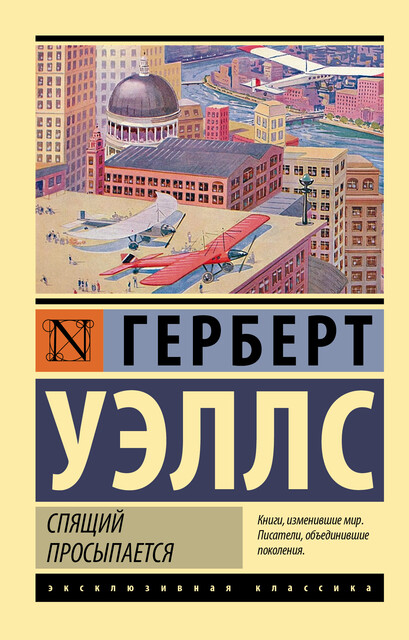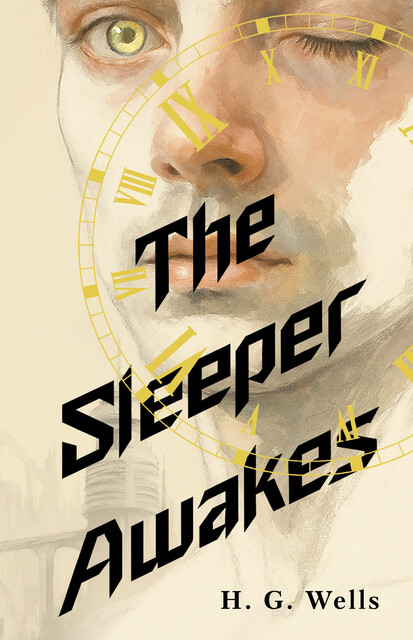



The Sleeper Awakes = Когда Спящий проснётся
Қосымшада ыңғайлырақҚосымшаны жүктеуге арналған QRRuStore · Samsung Galaxy Store
Huawei AppGallery · Xiaomi GetApps

автордың кітабын онлайн тегін оқу  The Sleeper Awakes = Когда Спящий проснётся

H. G. Wells

The Sleeper Awakes

Герберт Джордж Уэллс

Когда Спящий проснётся

Серия

«Exclusive Classics Hardcover»

«Exclusive Classics Paperback»



© ООО «Издательство АСТ», 2026

Chapter I. Insomnia

One afternoon, at low water, Mr. Isbister, a young artist lodging at Boscastle, walked from that place to the picturesque cove of Pentargen, desiring to examine the caves there. Halfway down the precipitous path to the Pentargen beach he came suddenly upon a man sitting in an attitude of profound distress beneath a projecting mass of rock. The hands of this man hung limply over his knees, his eyes were red and staring before him, and his face was wet with tears.

He glanced round at Isbister's footfall. Both men were disconcerted, Isbister the more so, and, to override the awkwardness of his involuntary pause, he remarked, with an air of mature conviction, that the weather was hot for the time of year.

“Very,” answered the stranger shortly, hesitated a second, and added in a colourless tone, “I can't sleep.”

Isbister stopped abruptly. “No?” was all he said, but his bearing conveyed his helpful impulse.

“It may sound incredible,” said the stranger, turning weary eyes to Isbister's face and emphasizing his words with a languid hand, “but I have had no sleep – no sleep at all for six nights.”

“Had advice?”

“Yes. Bad advice for the most part. Drugs. My nervous system… They are all very well for the run of people. It's hard to explain. I dare not take… sufficiently powerful drugs.”

“That makes it difficult,” said Isbister.

He stood helplessly in the narrow path, perplexed what to do. Clearly the man wanted to talk. An idea natural enough under the circumstances, prompted him to keep the conversation going. “I've never suffered from sleeplessness myself,” he said in a tone of commonplace gossip, “but in those cases I have known, people have usually found something —”

“I dare make no experiments.”

He spoke wearily. He gave a gesture of rejection, and for a space both men were silent.

“Exercise?” suggested Isbister diffidently, with a glance from his interlocutor's face of wretchedness to the touring costume he wore.

“That is what I have tried. Unwisely perhaps. I have followed the coast, day after day – from New Quay. It has only added muscular fatigue to the mental. The cause of this unrest was overwork – trouble. There was something —”

He stopped as if from sheer fatigue. He rubbed his forehead with a lean hand. He resumed speech like one who talks to himself.

“I am a lone wolf, a solitary man, wandering through a world in which I have no part. I am wifeless – childless – who is it speaks of the childless as the dead twigs on the tree of life? I am wifeless, childless – I could find no duty to do. No desire even in my heart. One thing at last I set myself to do.

“I said, I will do this, and to do it, to overcome the inertia of this dull body, I resorted to drugs. Great God, I've had enough of drugs! I don't know if you feel the heavy inconvenience of the body, its exasperating demand of time from the mind – time – life! Live! We only live in patches. We have to eat, and then comes the dull digestive complacencies – or irritations. We have to take the air or else our thoughts grow sluggish, stupid, run into gulfs and blind alleys. A thousand distractions arise from within and without, and then comes drowsiness and sleep. Men seem to live for sleep. How little of a man's day is his own – even at the best! And then come those false friends, those Thug helpers, the alkaloids that stifle natural fatigue and kill rest – black coffee, cocaine —”

“I see,” said Isbister.

“I did my work,” said the sleepless man with a querulous intonation.

“And this is the price?”

“Yes.”

For a little while the two remained without speaking.

“You cannot imagine the craving for rest that I feel – a hunger and thirst. For six long days, since my work was done, my mind has been a whirlpool, swift, unprogressive and incessant, a torrent of thoughts leading nowhere, spinning round swift and steady —” He paused. “Towards the gulf.”

“You must sleep,” said Isbister decisively, and with an air of a remedy discovered. “Certainly you must sleep.”

“My mind is perfectly lucid. It was never clearer. But I know I am drawing towards the vortex. Presently —”

“Yes?”

“You have seen things go down an eddy? Out of the light of the day, out of this sweet world of sanity – down —”

“But,” expostulated Isbister.

The man threw out a hand towards him, and his eyes were wild, and his voice suddenly high. “I shall kill myself. If in no other way – at the foot of yonder dark precipice there, where the waves are green, and the white surge lifts and falls, and that little thread of water trembles down. There at any rate is… sleep.”

“That's unreasonable,” said Isbister, startled at the man's hysterical gust of emotion. “Drugs are better than that.”

“There at any rate is sleep,” repeated the stranger, not heeding him.

Isbister looked at him. “It's not a cert, you know,” he remarked. “There's a cliff like that at Lulworth Cove – as high, anyhow – and a little girl fell from top to bottom. And lives to-day – sound and well.”

“But those rocks there?”

“One might lie on them rather dismally through a cold night, broken bones grating as one shivered, chill water splashing over you. Eh?”

Their eyes met. “Sorry to upset your ideals,” said Isbister with a sense of devil-may-careish brilliance. “But a suicide over that cliff (or any cliff for the matter of that), really, as an artist —” He laughed. “It's so damned amateurish.”

“But the other thing,” said the sleepless man irritably, “the other thing. No man can keep sane if night after night —”

“Have you been walking along this coast alone?”

“Yes.”

“Silly sort of thing to do. If you'll excuse my saying so. Alone! As you say; body fag is no cure for brain fag. Who told you to? No wonder; walking! And the sun on your head, heat, fag, solitude, all the day long, and then, I suppose, you go to bed and try very hard – eh?”

Isbister stopped short and looked at the sufferer doubtfully.

“Look at these rocks!” cried the seated man with a sudden force of gesture. “Look at that sea that has shone and quivered there for ever! See the white spume rush into darkness under that great cliff. And this blue vault, with the blinding sun pouring from the dome of it. It is your world. You accept it, you rejoice in it. It warms and supports and delights you. And for me —”

He turned his head and showed a ghastly face, bloodshot pallid eyes and bloodless lips. He spoke almost in a whisper. “It is the garment of my misery. The whole world… is the garment of my misery.”

Isbister looked at all the wild beauty of the sunlit cliffs about them and back to that face of despair. For a moment he was silent.

He started, and made a gesture of impatient rejection. “You get a night's sleep,” he said, “and you won't see much misery out here. Take my word for it.”

He was quite sure now that this was a providential encounter. Only half an hour ago he had been feeling horribly bored. Here was employment the bare thought of which, was righteous self-applause. He took possession forthwith. The first need of this exhausted being was companionship. He flung himself down on the steeply sloping turf beside the motionless seated figure, and threw out a skirmishing line of gossip.

His hearer lapsed into apathy; he stared dismally seaward, and spoke only in answer to Isbister's direct questions – and not to all of those. But he made no objection to this benevolent intrusion upon his despair.

He seemed even grateful, and when presently Isbister, feeling that his unsupported talk was losing vigour, suggested that they should reascend the steep and return towards Boscastle, alleging the view into Blackapit, he submitted quietly. Halfway up he began talking to himself, and abruptly turned a ghastly face on his helper. “What can be happening?” he asked with a gaunt illustrative hand. “What can be happening? Spin, spin, spin, spin. It goes round and round, round and round for evermore.”

He stood with his hand circling.

“It's all right, old chap,” said Isbister with the air of an old friend. “Don't worry yourself. Trust to me,”

The man dropped his hand and turned again. They went over the brow and to the headland beyond Penally, with the sleepless man gesticulating ever and again, and speaking fragmentary things concerning his whirling brain. At the headland they stood by the seat that looks into the dark mysteries of Blackapit, and then he sat down. Isbister had resumed his talk whenever the path had widened sufficiently for them to walk abreast. He was enlarging upon the complex difficulty of making Boscastle Harbour in bad weather, when suddenly and quite irrelevantly his companion interrupted him again.

“My head is not like what it was,” he said, gesticulating for want of expressive phrases. “It's not like what it was. There is a sort of oppression, a weight. No – not drowsiness, would God it were! It is like a shadow, a deep shadow falling suddenly and swiftly across something busy. Spin, spin into the darkness. The tumult of thought, the confusion, the eddy and eddy. I can't express it. I can hardly keep my mind on it – steadily enough to tell you.”

He stopped feebly.

“Don't trouble, old chap,” said Isbister. “I think I can understand. At any rate, it don't matter very much just at present about telling me, you know.”

The sleepless man thrust his knuckles into his eyes and rubbed them. Isbister talked for awhile while this rubbing continued, and then he had a fresh idea. “Come down to my room,” he said, “and try a pipe. I can show you some sketches of this Blackapit. If you'd care?”

The other rose obediently and followed him down the steep.

Several times Isbister heard him stumble as they came down, and his movements were slow and hesitating. “Come in with me,” said Isbister, “and try some cigarettes and the blessed gift of alcohol. If you take alcohol?”

The stranger hesitated at the garden gate. He seemed no longer aware of his actions. “I don't drink,” he said slowly, coming up the garden path, and after a moment's interval repeated absently, “No – I don't drink. It goes round. Spin, it goes – spin —”

He stumbled at the doorstep and entered the room with the bearing of one who sees nothing.

Then he sat down heavily in the easy chair, seemed almost to fall into it. He leant forward with his brows on his hands and became motionless. Presently he made a faint sound in his throat.

Isbister moved about the room with the nervousness of an inexperienced host, making little remarks that scarcely required answering. He crossed the room to his portfolio, placed it on the table and noticed the mantel clock.

“I don't know if you'd care to have supper with me,” he said with an unlighted cigarette in his hand – his mind troubled with ideas of a furtive administration of chloral. “Only cold mutton, you know, but passing sweet. Welsh. And a tart, I believe.” He repeated this after momentary silence.

The seated man made no answer. Isbister stopped, match in hand, regarding him.

The stillness lengthened. The match went out, the cigarette was put down unlit. The man was certainly very still. Isbister took up the portfolio, opened it, put it down, hesitated, seemed about to speak. “Perhaps,” he whispered doubtfully. Presently he glanced at the door and back to the figure. Then he stole on tiptoe out of the room, glancing at his companion after each elaborate pace.

He closed the door noiselessly. The house door was standing open, and he went out beyond the porch, and stood where the monkshood rose at the corner of the garden bed. From this point he could see the stranger through the open window, still and dim, sitting head on hand. He had not moved.

A number of children going along the road stopped and regarded the artist curiously. A boatman exchanged civilities with him. He felt that possibly his circumspect attitude and position looked peculiar and unaccountable. Smoking, perhaps, might seem more natural. He drew pipe and pouch from his pocket, filled the pipe slowly.

“I wonder,”… he said, with a scarcely perceptible loss of complacency. “At any rate one must give him a chance.” He struck a match in the virile way, and proceeded to light his pipe.

He heard his landlady behind him, coming with his lamp lit from the kitchen. He turned, gesticulating with his pipe, and stopped her at the door of his sitting-room. He had some difficulty in explaining the situation in whispers, for she did not know he had a visitor. She retreated again with the lamp, still a little mystified to judge from her manner, and he resumed his hovering at the corner of the porch, flushed and less at his ease.

Long after he had smoked out his pipe, and when the bats were abroad, curiosity dominated his complex hesitations, and he stole back into his darkling sitting-room. He paused in the doorway. The stranger was still in the same attitude, dark against the window. Save for the singing of some sailors aboard one of the little slate-carrying ships in the harbour the evening was very still. Outside, the spikes of monkshood and delphinium stood erect and motionless against the shadow of the hillside. Something flashed into Isbister's mind; he started, and leaning over the table, listened. An unpleasant suspicion grew stronger; became conviction. Astonishment seized him and became – dread!

No sound of breathing came from the seated figure!

He crept slowly and noiselessly round the table, pausing twice to listen. At last he could lay his hand on the back of the armchair. He bent down until the two heads were ear to ear.

Then he bent still lower to look up at his visitor's face. He started violently and uttered an exclamation. The eyes were void spaces of white.

He looked again and saw that they were open and with the pupils rolled under the lids. He was afraid. He took the man by the shoulder and shook him. “Are you asleep?” he said, with his voice jumping, and again, “Are you asleep?”

A conviction took possession of his mind that this man was dead. He became active and noisy, strode across the room, blundering against the table as he did so, and rang the bell.

“Please bring a light at once,” he said in the passage. “There is something wrong with my friend.”

He returned to the motionless seated figure, grasped the shoulder, shook it, shouted. The room was flooded with yellow glare as his landlady entered with the light. His face was white as he turned blinking towards her. “I must fetch a doctor,” he said. “It is either death or a fit. Is there a doctor in the village? Where is a doctor to be found?”

Chapter II. The trance

The state of cataleptic rigour into which this man had fallen, lasted for an unprecedented length of time, and then he passed slowly to the flaccid state, to a lax attitude suggestive of profound repose. Then it was his eyes could be closed.

He was removed from the hotel to the Boscastle surgery, and from the surgery, after some weeks, to London. But he still resisted every attempt at reanimation. After a time, for reasons that will appear later, these attempts were discontinued. For a great space he lay in that strange condition, inert and still – neither dead nor living but, as it were, suspended, hanging midway between nothingness and existence. His was a darkness unbroken by a ray of thought or sensation, a dreamless inanition, a vast space of peace. The tumult of his mind had swelled and risen to an abrupt climax of silence. Where was the man? Where is any man when insensibility takes hold of him?

“It seems only yesterday,” said Isbister. “I remember it all as though it happened yesterday – clearer, perhaps, than if it had happened yesterday.”

It was the Isbister of the last chapter, but he was no longer a young man. The hair that had been brown and a trifle in excess of the fashionable length, was iron grey and clipped close, and the face that had been pink and white was buff and ruddy. He had a pointed beard shot with grey. He talked to an elderly man who wore a summer suit of drill (the summer of that year was unusually hot). This was Warming, a London solicitor and next of kin to Graham, the man who had fallen into the trance. And the two men stood side by side in a room in a house in London regarding his recumbent figure.

It was a yellow figure lying lax upon a water-bed and clad in a flowing shirt, a figure with a shrunken face and a stubby beard, lean limbs and lank nails, and about it was a case of thin glass. This glass seemed to mark off the sleeper from the reality of life about him, he was a thing apart, a strange, isolated abnormality. The two men stood close to the glass, peering in.

“The thing gave me a shock,” said Isbister. “I feel a queer sort of surprise even now when I think of his white eyes. They were white, you know, rolled up. Coming here again brings it all back to me.”

“Have you never seen him since that time?” asked Warming.

“Often wanted to come,” said Isbister; “but business nowadays is too serious a thing for much holiday keeping. I've been in America most of the time.”

“If I remember rightly,” said Warming, “you were an artist?”

“Was. And then I became a married man. I saw it was all up with black and white, very soon – at least for a mediocrity, and I jumped on to process. Those posters on the Cliffs at Dover are by my people.”

“Good posters,” admitted the solicitor, “though I was sorry to see them there.”

“Last as long as the cliffs, if necessary,” exclaimed Isbister with satisfaction. “The world changes. When he fell asleep, twenty years ago, I was down at Boscastle with a box of water-colours and a noble, old-fashioned ambition. I didn't expect that some day my pigments would glorify the whole blessed coast of England, from Land's End round again to the Lizard. Luck comes to a man very often when he's not looking.”

Warming seemed to doubt the quality of the luck. “I just missed seeing you, if I recollect aright.”

“You came back by the trap that took me to Camelford railway station. It was close on the Jubilee, Victoria's Jubilee, because I remember the seats and flags in Westminster, and the row with the cabman at Chelsea.”

“The Diamond Jubilee, it was,” said Warming; “the second one.”

“Ah, yes! At the proper Jubilee – the Fifty Year affair – I was down at Wookey – a boy. I missed all that… What a fuss we had with him! My landlady wouldn't take him in, wouldn't let him stay – he looked so queer when he was rigid. We had to carry him in a chair up to the hotel. And the Boscastle doctor – it wasn't the present chap, but the G.P. before him – was at him until nearly two, with me and the landlord holding lights and so forth.”

“Do you mean – he was stiff and hard?”

“Stiff! – wherever you bent him he stuck. You might have stood him on his head and he'd have stopped. I never saw such stiffness. Of course this” – he indicated the prostrate figure by a movement of his head —“is quite different. And the little doctor – what was his name?”

“Smithers?”

“Smithers it was – was quite wrong in trying to fetch him round too soon, according to all accounts. The things he did! Even now it makes me feel all – ugh! Mustard, snuff, pricking. And one of those beastly little things, not dynamos —”

“Coils.”

“Yes. You could see his muscles throb and jump, and he twisted about. There were just two flaring yellow candles, and all the shadows were shivering, and the little doctor nervous and putting on side, and him – stark and squirming in the most unnatural ways. Well, it made me dream.”

Pause.

“It's a strange state,” said Warming.

“It's a sort of complete absence,” said Isbister. “Here's the body, empty. Not dead a bit, and yet not alive. It's like a seat vacant and marked 'engaged.' No feeling, no digestion, no beating of the heart – not a flutter. That doesn't make me feel as if there was a man present. In a sense it's more dead than death, for these doctors tell me that even the hair has stopped growing. Now with the proper dead, the hair will go on growing —”

“I know,” said Warming, with a flash of pain in his expression.

They peered through the glass again. Graham was indeed in a strange state, in the flaccid phase of a trance, but a trance unprecedented in medical history. Trances had lasted for as much as a year before – but at the end of that time it had ever been a waking or a death; sometimes first one and then the other. Isbister noted the marks the physicians had made in injecting nourishment, for that had been resorted to to postpone collapse; he pointed them out to Warming, who had been trying not to see them.

“And while he has been lying here,” said Isbister, with the zest of a life freely spent, “I have changed my plans in life; married, raised a family, my eldest lad – I hadn't begun to think of sons then – is an American citizen, and looking forward to leaving Harvard. There's a touch of grey in my hair. And this man, not a day older nor wiser (practically) than I was in my downy days. It's curious to think of.”

Warming turned. “And I have grown old too. I played cricket with him when I was still only a boy. And he looks a young man still. Yellow perhaps. But that is a young man nevertheless.”

“And there's been the War,” said Isbister.

“From beginning to end.”

“And these Martians.”

“I've understood,” said Isbister after a pause, “that he had some moderate property of his own?”

“That is so,” said Warming. He coughed primly. “As it happens – I have charge of it.”

“Ah!” Isbister thought, hesitated and spoke: “No doubt – his keep here is not expensive – no doubt it will have improved – accumulated?”

“It has. He will wake up very much better off – if he wakes – than when he slept.”

“As a business man,” said Isbister, “that thought has naturally been in my mind. I have, indeed, sometimes thought that, speaking commercially, of course, this sleep may be a very good thing for him. That he knows what he is about, so to speak, in being insensible so long. If he had lived straight on —”

“I doubt if he would have premeditated as much,” said Warming. “He was not a far-sighted man. In fact —”

“Yes?”

“We differed on that point. I stood to him somewhat in the relation of a guardian. You have probably seen enough of affairs to recognise that occasionally a certain friction – But even if that was the case, there is a doubt whether he will ever wake. This sleep exhausts slowly, but it exhausts. Apparently he is sliding slowly, very slowly and tediously, down a long slope, if you can understand me?”

“It will be a pity to lose his surprise. There's been a lot of change these twenty years. It's Rip Van Winkle come real.”

“There has been a lot of change certainly,” said Warming. “And, among other changes, I have changed. I am an old man.”

Isbister hesitated, and then feigned a belated surprise. “I shouldn't have thought it.”

“I was forty-three when his bankers – you remember you wired to his bankers – sent on to me.”

“I got their address from the cheque book in his pocket,” said Isbister.

“Well, the addition is not difficult,” said Warming.

There was another pause, and then Isbister gave way to an unavoidable curiosity. “He may go on for years yet,” he said, and had a moment of hesitation. “We have to consider that. His affairs, you know, may fall some day into the hands of – someone else, you know.”

“That, if you will believe me, Mr. Isbister, is one of the problems most constantly before my mind. We happen to be – as a matter of fact, there are no very trustworthy connexions of ours. It is a grotesque and unprecedented position.”

“Rather,” said Isbister.

“It seems to me it's a case of some public body, some practically undying guardian. If he really is going on living – as the doctors, some of them, think. As a matter of fact, I have gone to one or two public men about it. But, so far, nothing has been done.”

“It wouldn't be a bad idea to hand him over to some public body – the British Museum Trustees, or the Royal College of Physicians. Sounds a bit odd, of course, but the whole situation is odd.”

“The difficulty is to induce them to take him.”

“Red tape, I suppose?”

“Partly.”

Pause. “It's a curious business, certainly,” said Isbister. “And compound interest has a way of mounting up.”

“It has,” said Warming. “And now the gold supplies are running short there is a tendency towards… appreciation.”

“I've felt that,” said Isbister with a grimace. “But it makes it better for him.”

If he wakes.”

“If he wakes,” echoed Isbister. “Do you notice the pinched-in look of his nose, and the way in which his eyelids sink?”

Warming looked and thought for a space. “I doubt if he will wake,” he said at last.

“I never properly understood,” said Isbister, “what it was brought this on. He told me something about overstudy. I've often been curious.”

“He was a man of considerable gifts, but spasmodic, emotional. He had grave domestic troubles, divorced his wife, in fact, and it was as a relief from that, I think, that he took up politics of the rabid sort. He was a fanatical Radical – a Socialist – or typical Liberal, as they used to call themselves, of the advanced school. Energetic – flighty – undisciplined. Overwork upon a controversy did this for him. I remember the pamphlet he wrote – a curious production. Wild, whirling stuff. There were one or two prophecies. Some of them are already exploded, some of them are established facts. But for the most part to read such a thesis is to realise how full the world is of unanticipated things. He will have much to learn, much to unlearn, when he wakes. If ever a waking comes.”

“I'd give anything to be there,” said Isbister, “just to hear what he would say to it all.”

“So would I,” said Warming. “Aye! so would I,” with an old man's sudden turn to self pity. “But I shall never see him wake.”

He stood looking thoughtfully at the waxen figure. “He will never awake,” he said at last. He sighed. “He will never awake again.”

Chapter III. The awakening

But Warming was wrong in that. An awakening came.

What a wonderfully complex thing! this simple seeming unity – the self! Who can trace its reintegration as morning after morning we awaken, the flux and confluence of its countless factors interweaving, rebuilding, the dim first stirrings of the soul, the growth and synthesis of the unconscious to the subconscious, the subconscious to dawning consciousness, until at last we recognise ourselves again. And as it happens to most of us after the night's sleep, so it was with Graham at the end of his vast slumber. A dim cloud of sensation taking shape, a cloudy dreariness, and he found himself vaguely somewhere, recumbent, faint, but alive.

The pilgrimage towards a personal being seemed to traverse vast gulfs, to occupy epochs. Gigantic dreams that were terrible realities at the time, left vague perplexing memories, strange creatures, strange scenery, as if from another planet. There was a distinct impression, too, of a momentous conversation, of a name – he could not tell what name – that was subsequently to recur, of some queer long-forgotten sensation of vein and muscle, of a feeling of vast hopeless effort, the effort of a man near drowning in darkness. Then came a panorama of dazzling unstable confluent scenes…

Graham became aware that his eyes were open and regarding some unfamiliar thing.

It was something white, the edge of something, a frame of wood. He moved his head slightly, following the contour of this shape. It went up beyond the top of his eyes. He tried to think where he might be. Did it matter, seeing he was so wretched? The colour of his thoughts was a dark depression. He felt the featureless misery of one who wakes towards the hour of dawn. He had an uncertain sense of whispers and footsteps hastily receding.

The movement of his head involved a perception of extreme physical weakness. He supposed he was in bed in the hotel at the place in the valley – but he could not recall that white edge. He must have slept. He remembered now that he had wanted to sleep. He recalled the cliff and Waterfall again, and then recollected something about talking to a passer-by…

How long had he slept? What was that sound of pattering feet? And that rise and fall, like the murmur of breakers on pebbles? He put out a languid hand to reach his watch from the chair whereon it was his habit to place it, and touched some smooth hard surface like glass. This was so unexpected that it startled him extremely. Quite suddenly he rolled over, stared for a moment, and struggled into a sitting position. The effort was unexpectedly difficult, and it left him giddy and weak – and amazed.

He rubbed his eyes. The riddle of his surroundings was confusing but his mind was quite clear – evidently his sleep had benefited him. He was not in a bed at all as he understood the word, but lying naked on a very soft and yielding mattress, in a trough of dark glass. The mattress was partly transparent, a fact he observed with a sense of insecurity, and below it was a mirror reflecting him greyly. About his arm – and he saw with a shock that his skin was strangely dry and yellow – was bound a curious apparatus of rubber, bound so cunningly that it seemed to pass into his skin above and below. And this bed was placed in a case of greenish coloured glass (as it seemed to him), a bar in the white framework of which had first arrested his attention. In the corner of the case was a stand of glittering and delicately made apparatus, for the most part quite strange appliances, though a maximum and minimum thermometer was recognisable.

The slightly greenish tint of the glass-like substance which surrounded him on every hand obscured what lay behind, but he perceived it was a vast apartment of splendid appearance, and with a very large and simple white archway facing him. Close to the walls of the cage were articles of furniture, a table covered with a silvery cloth, silvery like the side of a fish, a couple of graceful chairs, and on the table a number of dishes with substances piled on them, a bottle and two glasses. He realised that he was intensely hungry.

He could see no one, and after a period of hesitation scrambled off the translucent mattress and tried to stand on the clean white floor of his little apartment. He had miscalculated his strength, however, and staggered and put his hand against the glass like pane before him to steady himself. For a moment it resisted his hand, bending outward like a distended bladder, then it broke with a slight report and vanished – a pricked bubble. He reeled out into the general space of the hall, greatly astonished. He caught at the table to save himself, knocking one of the glasses to the floor – it rang but did not break – and sat down in one of the armchairs.

When he had a little recovered he filled the remaining glass from the bottle and drank – a colourless liquid it was, but not water, with a pleasing faint aroma and taste and a quality of immediate support and stimulus. He put down the vessel and looked about him.

The apartment lost none of its size and magnificence now that the greenish transparency that had intervened was removed. The archway he saw led to a flight of steps, going downward without the intermediation of a door, to a spacious transverse passage. This passage ran between polished pillars of some white-veined substance of deep ultramarine, and along it came the sound of human movements, and voices and a deep undeviating droning note. He sat, now fully awake, listening alertly, forgetting the viands in his attention.

Then with a shock he remembered that he was naked, and casting about him for covering, saw a long black robe thrown on one of the chairs beside him. This he wrapped about him and sat down again, trembling.

His mind was still a surging perplexity. Clearly he had slept, and had been removed in his sleep. But where? And who were those people, the distant crowd beyond the deep blue pillars? Boscastle? He poured out and partially drank another glass of the colourless fluid.

What was this place? – this place that to his senses seemed subtly quivering like a thing alive? He looked about him at the clean and beautiful form of the apartment, unstained by ornament, and saw that the roof was broken in one place by a circular shaft full of light, and, as he looked, a steady, sweeping shadow blotted it out and passed, and came again and passed. “Beat, beat,” that sweeping shadow had a note of its own in the subdued tumult that filled the air.

He would have called out, but only a little sound came into his throat. Then he stood up, and, with the uncertain steps of a drunkard, made his way towards the archway. He staggered down the steps, tripped on the corner of the black cloak he had wrapped about himself, and saved himself by catching at one of the blue pillars.

The passage ran down a cool vista of blue and purple and ended remotely in a railed space like a balcony brightly lit and projecting into a space of haze, a space like the interior of some gigantic building. Beyond and remote were vast and vague architectural forms. The tumult of voices rose now loud and clear, and on the balcony and with their backs to him, gesticulating and apparently in animated conversation, were three figures, richly dressed in loose and easy garments of bright soft colourings. The noise of a great multitude of people poured up over the balcony, and once it seemed the top of a banner passed, and once some brightly coloured object, a pale blue cap or garment thrown up into the air perhaps, flashed athwart the space and fell. The shouts sounded like English, there was a reiteration of “Wake!” He heard some indistinct shrill cry, and abruptly these three men began laughing.

“Ha, ha, ha!” laughed one – a red-haired man in a short purple robe. “When the Sleeper wakes – When!”

He turned his eyes full of merriment along the passage. His face changed, the whole man changed, became rigid. The other two turned swiftly at his exclamation and stood motionless. Their faces assumed an expression of consternation, an expression that deepened into awe.

Suddenly Graham's knees bent beneath him, his arm against the pillar collapsed limply, he staggered forward and fell upon his face.

Chapter IV. The sound of a tumult

Graham's last impression before he fainted was of the ringing of bells. He learnt afterwards that he was insensible, hanging between life and death, for the better part of an hour. When he recovered his senses, he was back on his translucent couch, and there was a stirring warmth at heart and throat. The dark apparatus, he perceived, had been removed from his arm, which was bandaged. The white framework was still about him, but the greenish transparent substance that had filled it was altogether gone. A man in a deep violet robe, one of those who had been on the balcony, was looking keenly into his face.

Remote but insistent was a clamour of bells and confused sounds, that suggested to his mind the picture of a great number of people shouting together. Something seemed to fall across this tumult, a door suddenly closed.

Graham moved his head. “What does this all mean?” he said slowly. “Where am I?”

He saw the red-haired man who had been first to discover him. A voice seemed to be asking what he had said, and was abruptly stilled.

The man in violet answered in a soft voice, speaking English with a slightly foreign accent, or so at least it seemed to the Sleeper's ears. “You are quite safe. You were brought hither from where you fell asleep. It is quite safe. You have been here some time – sleeping. In a trance.”

He said, something further that Graham could not hear, and a little phial was handed across to him. Graham felt a cooling spray, a fragrant mist played over his forehead for a moment, and his sense of refreshment increased. He closed his eyes in satisfaction.

“Better?” asked the man in violet, as Graham's eyes reopened. He was a pleasant-faced man of thirty, perhaps, with a pointed flaxen beard, and a clasp of gold at the neck of his violet robe.

“Yes,” said Graham.

“You have been asleep some time. In a cataleptic trance. You have heard? Catalepsy? It may seem strange to you at first, but I can assure you everything is well.”

Graham did not answer, but these words served their reassuring purpose. His eyes went from face to face of the three people about him. They were regarding him strangely. He knew he ought to be somewhere in Cornwall, but he could not square these things with that impression.

A matter that had been in his mind during his last waking moments at Boscastle recurred, a thing resolved upon and somehow neglected. He cleared his throat.

“Have you wired my cousin?” he asked. “E. Warming, 27, Chancery Lane?”

They were all assiduous to hear. But he had to repeat it. “What an odd blurr in his accent!” whispered the red-haired man. “Wire, sir?” said the young man with the flaxen beard, evidently puzzled.

“He means send an electric telegram,” volunteered the third, a pleasant-faced youth of nineteen or twenty. The flaxen-bearded man gave a cry of comprehension. “How stupid of me! You may be sure everything shall be done, sir,” he said to Graham. “I am afraid it would be difficult to – wire to your cousin. He is not in London now. But don't trouble about arrangements yet; you have been asleep a very long time and the important thing is to get over that, sir.” (Graham concluded the word was sir, but this man pronounced it “Sire.”)

“Oh!” said Graham, and became quiet.

It was all very puzzling, but apparently these people in unfamiliar dress knew what they were about. Yet they were odd and the room was odd. It seemed he was in some newly established place. He had a sudden flash of suspicion! Surely this wasn't some hall of public exhibition! If it was he would give Warming a piece of his mind. But it scarcely had that character. And in a place of public exhibition he would not have discovered himself naked.

Then suddenly, quite abruptly, he realised what had happened. There was no perceptible interval of suspicion, no dawn to his knowledge. Abruptly he knew that his trance had lasted for a vast interval; as if by some processes of thought-reading he interpreted the awe in the faces that peered into his. He looked at them strangely, full of intense emotion. It seemed they read his eyes. He framed his lips to speak and could not. A queer impulse to hide his knowledge came into his mind almost at the moment of his discovery. He looked at his bare feet, regarding them silently. His impulse to speak passed. He was trembling exceedingly.

They gave him some pink fluid with a greenish fluorescence and a meaty taste, and the assurance of returning strength grew.

“That – that makes me feel better,” he said hoarsely, and there were murmurs of respectful approval. He knew now quite clearly. He made to speak again, and again he could not.

He pressed his throat and tried a third time. “How long?” he asked in a level voice. “How long have I been asleep?”

“Some considerable time,” said the flaxen-bearded man, glancing quickly at the others.

“How long?”

“A very long time.”

“Yes – yes,” said Graham, suddenly testy. “But I want – Is it – it is – some years? Many years? There was something – I forget what. I feel – confused. But you —” He sobbed. “You need not fence with me. How long —?”

He stopped, breathing irregularly. He squeezed his eyes with his knuckles and sat waiting for an answer.

They spoke in undertones.

“Five or six?” he asked faintly. “More?”

“Very much more than that.”

“More!”

“More.”

He looked at them and it seemed as though imps were twitching the muscles of his face. He looked his question.

“Many years,” said the man with the red beard.

Graham struggled into a sitting position. He wiped a rheumy tear from his face with a lean hand. “Many years!” he repeated. He shut his eyes tight, opened them, and sat looking about him from one unfamiliar thing to another.

“How many years?” he asked.

“You must be prepared to be surprised.”

“Well?”

“More than a gross of years.”

He was irritated at the strange word. “More than a what?”

Two of them spoke together. Some quick remarks that were made about “decimal” he did not catch.

“How long did you say?” asked Graham. “How long? Don't look like that. Tell me.”

Among the remarks in an undertone, his ear caught six words: “More than a couple of centuries.”

What?” he cried, turning on the youth who he thought had spoken. “Who says —? What was that? A couple of centuries!”

“Yes,” said the man with the red beard. “Two hundred years.”

Graham repeated the words. He had been prepared to hear of a vast repose, and yet these concrete centuries defeated him.

“Two hundred years,” he said again, with the figure of a great gulf opening very slowly in his mind; and then, “Oh, but —!”

They said nothing.

“You – did you say —?”

“Two hundred years. Two centuries of years,” said the man with the red beard.

There was a pause. Graham looked at their faces and saw that what he had heard was indeed true.

“But it can't be,” he said querulously. “I am dreaming. Trances – trances don't last. That is not right – this is a joke you have played upon me! Tell me – some days ago, perhaps, I was walking along the coast of Cornwall —?”

His voice failed him.

The man with the flaxen beard hesitated. “I'm not very strong in history, sir,” he said weakly, and glanced at the others.

“That was it, sir,” said the youngster. “Boscastle, in the old Duchy of Cornwall – it's in the south-west country beyond the dairy meadows. There is a house there still. I have been there.”

“Boscastle!” Graham turned his eyes to the youngster. “That was it – Boscastle. Little Boscastle. I fell asleep – somewhere there. I don't exactly remember. I don't exactly remember.”

He pressed his brows and whispered, “More than two hundred years!”

He began to speak quickly with a twitching face, but his heart was cold within him. “But if it is two hundred years, every soul I know, every human being that ever I saw or spoke to before I went to sleep, must be dead.”

They did not answer him.

“The Queen and the Royal Family, her Ministers, Church and State. High and low, rich and poor, one with another… Is there England still?”

“That's a comfort! Is there London?”

“This is London, eh? And you are my assistant-custodian; assistant-custodian. And these —? Eh? Assistant-custodians too!”

He sat with a gaunt stare on his face. “But why am I here? No! Don't talk. Be quiet. Let me —”

He sat silent, rubbed his eyes, and, uncovering them, found another little glass of pinkish fluid held towards him. He took the dose. Directly he had taken it he began to weep naturally and refreshingly.

Presently he looked at their faces, suddenly laughed through his tears, a little foolishly. “But – two – hun – dred – years!” he said. He grimaced hysterically and covered his face again.

After a space he grew calm. He sat up, his hands hanging over his knees in almost precisely the same attitude in which Isbister had found him on the cliff at Pentargen. His attention was attracted by a thick domineering voice, the footsteps of an advancing personage. “What are you doing? Why was I not warned? Surely you could tell? Someone will suffer for this. The man must be kept quiet. Are the doorways closed? All the doorways? He must be kept perfectly quiet. He must not be told. Has he been told anything?”

The man with the fair beard made some inaudible remark, and Graham looking over his shoulder saw approaching a short, fat, and thickset beardless man, with aquiline nose and heavy neck and chin. Very thick black and slightly sloping eyebrows that almost met over his nose and overhung deep grey eyes, gave his face an oddly formidable expression. He scowled momentarily at Graham and then his regard returned to the man with the flaxen beard. “These others,” he said in a voice of extreme irritation. “You had better go.”

“Go?” said the red-bearded man.

“Certainly – go now. But see the doorways are closed as you go.”

The two men addressed turned obediently, after one reluctant glance at Graham, and instead of going through the archway as he expected, walked straight to the dead wall of the apartment opposite the archway. A long strip of this apparently solid wall rolled up with a snap, hung over the two retreating men and fell again, and immediately Graham was alone with the newcomer and the purple-robed man with the flaxen beard.

For a space the thickset man took not the slightest notice of Graham, but proceeded to interrogate the other – obviously his subordinate – upon the treatment of their charge. He spoke clearly, but in phrases only partially intelligible to Graham. The awakening seemed not only a matter of surprise but of consternation and annoyance to him. He was evidently profoundly excited.

“You must not confuse his mind by telling him things,” he repeated again and again. “You must not confuse his mind.”

His questions answered, he turned quickly and eyed the awakened sleeper with an ambiguous expression.

“Feel queer?” he asked.

“Very.”

“The world, what you see of it, seems strange to you?”

“I suppose I have to live in it, strange as it seems.”

“I suppose so, now.”

“In the first place, hadn't I better have some clothes?”

“They —” said the thickset man and stopped, and the flaxen-bearded man met his eye and went away. “You will very speedily have clothes,” said the thickset man.

“Is it true indeed, that I have been asleep two hundred —?” asked Graham.

“They have told you that, have they? Two hundred and three, as a matter of fact.”

Graham accepted the indisputable now with raised eyebrows and depressed mouth. He sat silent for a moment, and then asked a question, “Is there a mill or dynamo near here?” He did not wait for an answer. “Things have changed tremendously, I suppose?” he said.

“What is that shouting?” he asked abruptly.

“Nothing,” said the thickset man impatiently. “It's people. You'll understand better later – perhaps. As you say, things have changed.” He spoke shortly, his brows were knit, and he glanced about him like a man trying to decide in an emergency. “We must get you clothes and so forth, at any rate. Better wait here until they can be procured. No one will come near you. You want shaving.”

Graham rubbed his chin.

The man with the flaxen beard came back towards them, turned suddenly, listened for a moment, lifted his eyebrows at the older man, and hurried off through the archway towards the balcony. The tumult of shouting grew louder, and the thickset man turned and listened also. He cursed suddenly under his breath, and turned his eyes upon Graham with an unfriendly expression. It was a surge of many voices, rising and falling, shouting and screaming, and once came a sound like blows and sharp cries, and then a snapping like the crackling of dry sticks. Graham strained his ears to draw some single thread of sound from the woven tumult.

Then he perceived, repeated again and again, a certain formula. For a time he doubted his ears. But surely these were the words: “Show us the Sleeper! Show us the Sleeper!”

The thickset man rushed suddenly to the archway.

“Wild!” he cried. “How do they know? Do they know? Or is it guessing?”

There was perhaps an answer.

“I can't come,” said the thickset man; “I have him to see to. But shout from the balcony.”

There was an inaudible reply.

“Say he is not awake. Anything! I leave it to you.”

He came hurrying back to Graham. “You must have clothes at once,” he said. “You cannot stop here – and it will be impossible to —”

He rushed away, Graham shouting unanswered questions after him. In a moment he was back.

“I can't tell you what is happening. It is too complex to explain. In a moment you shall have your clothes made. Yes – in a moment. And then I can take you away from here. You will find out our troubles soon enough.”

“But those voices. They were shouting —?”

“Something about the Sleeper – that's you. They have some twisted idea. I don't know what it is. I know nothing.”

A shrill bell jetted acutely across the indistinct mingling of remote noises, and this brusque person sprang to a little group of appliances in the corner of the room. He listened for a moment, regarding a ball of crystal, nodded, and said a few indistinct words; then he walked to the wall through which the two men had vanished. It rolled up again like a curtain, and he stood waiting.

Graham lifted his arm and was astonished to find what strength the restoratives had given him. He thrust one leg over the side of the couch and then the other. His head no longer swam. He could scarcely credit his rapid recovery. He sat feeling his limbs.

The man with the flaxen beard re-entered from the archway, and as he did so the cage of a lift came sliding down in front of the thickset man, and a lean, grey-bearded man, carrying a roll, and wearing a tightly-fitting costume of dark green, appeared therein.

“This is the tailor,” said the thickset man with an introductory gesture. “It will never do for you to wear that black. I cannot understand how it got here. But I shall. I shall. You will be as rapid as possible?” he said to the tailor.

The man in green bowed, and, advancing, seated himself by Graham on the bed. His manner was calm, but his eyes were full of curiosity. “You will find the fashions altered, Sire,” he said. He glanced from under his brows at the thickset man.

He opened the roller with a quick movement, and a confusion of brilliant fabrics poured out over his knees. “You lived, Sire, in a period essentially cylindrical – the Victorian. With a tendency to the hemisphere in hats. Circular curves always. Now —” He flicked out a little appliance the size and appearance of a keyless watch, whirled the knob, and behold – a little figure in white appeared kinetoscope fashion on the dial, walking and turning. The tailor caught up a pattern of bluish white satin. “That is my conception of your immediate treatment,” he said.

The thickset man came and stood by the shoulder of Graham.

“We have very little time,” he said.

“Trust me,” said the tailor. “My machine follows. What do you think of this?”

“What is that?” asked the man from the nineteenth century.

“In your days they showed you a fashion-plate,” said the tailor, “but this is our modern development. See here.” The little figure repeated its evolutions, but in a different costume. “Or this,” and with a click another small figure in a more voluminous type of robe marched on to the dial. The tailor was very quick in his movements, and glanced twice towards the lift as he did these things.

It rumbled again, and a crop-haired anemic lad with features of the Chinese type, clad in coarse pale blue canvas, appeared together with a complicated machine, which he pushed noiselessly on little castors into the room. Incontinently the little kinetoscope was dropped, Graham was invited to stand in front of the machine and the tailor muttered some instructions to the crop-haired lad, who answered in guttural tones and with words Graham did not recognise. The boy then went to conduct an incomprehensible monologue in the corner, and the tailor pulled out a number of slotted arms terminating in little discs, pulling them out until the discs were flat against the body of Graham, one at each shoulder blade, one at the elbows, one at the neck and so forth, so that at last there were, perhaps, two score of them upon his body and limbs. At the same time, some other person entered the room by the lift, behind Graham. The tailor set moving a mechanism that initiated a faint-sounding rhythmic movement of parts in the machine, and in another moment he was knocking up the levers and Graham was released. The tailor replaced his cloak of black, and the man with the flaxen beard proffered him a little glass of some refreshing fluid. Graham saw over the rim of the glass a pale-faced young man regarding him with a singular fixity.

The thickset man had been pacing the room fretfully, and now turned and went through the archway towards the balcony, from which the noise of a distant crowd still came in gusts and cadences. The crop-headed lad handed the tailor a roll of the bluish satin and the two began fixing this in the mechanism in a manner reminiscent of a roll of paper in a nineteenth century printing machine. Then they ran the entire thing on its easy, noiseless bearings across the room to a remote corner where a twisted cable looped rather gracefully from the wall. They made some connexion and the machine became energetic and swift.

“What is that doing?” asked Graham, pointing with the empty glass to the busy figures and trying to ignore the scrutiny of the new comer. “Is that – some sort of force – laid on?”

“Yes,” said the man with the flaxen beard.

“Who is that?” He indicated the archway behind him.

The man in purple stroked his little beard, hesitated, and answered in an undertone, “He is Howard, your chief guardian. You see, Sire – it's a little difficult to explain. The Council appoints a guardian and assistants. This hall has under certain restrictions been public. In order that people might satisfy themselves. We have barred the doorways for the first time. But I think – if you don't mind, I will leave him to explain.”

“Odd!” said Graham. “Guardian? Council?” Then turning his back on the new comer, he asked in an undertone, “Why is this man glaring at me? Is he a mesmerist?”

“Mesmerist! He is a capillotomist.”

“Capillotomist!”

“Yes – one of the chief. His yearly fee is sixdoz lions.”

It sounded sheer nonsense. Graham snatched at the last phrase with an unsteady mind. “Sixdoz lions?” he said.

“Didn't you have lions? I suppose not. You had the old pounds? They are our monetary units.”

“But what was that you said – sixdoz?”

“Yes. Six dozen, Sire. Of course things, even these little things, have altered. You lived in the days of the decimal system, the Arab system – tens, and little hundreds and thousands. We have eleven numerals now. We have single figures for both ten and eleven, two figures for a dozen, and a dozen dozen makes a gross, a great hundred, you know, a dozen gross a dozand, and a dozand dozand a myriad. Very simple?”

“I suppose so,” said Graham. “But about this cap – what was it?”

The man with the flaxen beard glanced over his shoulder.

“Here are your clothes!” he said. Graham turned round sharply and saw the tailor standing at his elbow smiling, and holding some palpably new garments over his arm. The crop-headed boy, by means of one ringer, was impelling the complicated machine towards the lift by which he had arrived. Graham stared at the completed suit. “You don't mean to say —!”

“Just made,” said the tailor. He dropped the garments at the feet of Graham, walked to the bed, on which Graham had so recently been lying, flung out the translucent mattress, and turned up the looking-glass. As he did so a furious bell summoned the thickset man to the corner. The man with the flaxen beard rushed across to him and then hurried out by the archway.

The tailor was assisting Graham into a dark purple combination garment, stockings, vest, and pants in one, as the thickset man came back from the corner to meet the man with the flaxen beard returning from the balcony. They began speaking quickly in an undertone, their bearing had an unmistakable quality of anxiety. Over the purple under-garment came a complex garment of bluish white, and Graham, was clothed in the fashion once more and saw himself, sallow-faced, unshaven and shaggy still, but at least naked no longer, and in some indefinable unprecedented way graceful.

“I must shave,” he said regarding himself in the glass.

“In a moment,” said Howard.

The persistent stare ceased. The young man closed his eyes, reopened them, and with a lean hand extended, advanced on Graham. Then he stopped, with his hand slowly gesticulating, and looked about him.

“A seat,” said Howard impatiently, and in a moment the flaxen-bearded man had a chair behind Graham. “Sit down, please,” said Howard.

Graham hesitated, and in the other hand of the wild-eyed man he saw the glint of steel.

“Don't you understand, Sire?” cried the flaxen-bearded man with hurried politeness. “He is going to cut your hair.”

“Oh!” cried Graham enlightened. “But you called him —”

“A capillotomist – precisely! He is one of the finest artists in the world.”

Graham sat down abruptly. The flaxen-bearded man disappeared. The capillotomist came forward, examined Graham's ears and surveyed him, felt the back of his head, and would have sat down again to regard him but for Howard's audible impatience. Forthwith with rapid movements and a succession of deftly handled implements he shaved Graham's chin, clipped his moustache, and cut and arranged his hair. All this he did without a word, with something of the rapt air of a poet inspired. And as soon as he had finished Graham was handed a pair of shoes.

Suddenly a loud voice shouted – it seemed from a piece of machinery in the corner —“At once – at once. The people know all over the city. Work is being stopped. Work is being stopped. Wait for nothing, but come.”

This shout appeared to perturb Howard exceedingly. By his gestures it seemed to Graham that he hesitated between two directions. Abruptly he went towards the corner where the apparatus stood about the little crystal ball. As he did so the undertone of tumultuous shouting from the archway that had continued during all these occurrences rose to a mighty sound, roared as if it were sweeping past, and fell again as if receding swiftly. It drew Graham after it with an irresistible attraction. He glanced at the thickset man, and then obeyed his impulse. In two strides he was down the steps and in the passage, and in a score he was out upon the balcony upon which the three men had been standing.

Chapter V. The moving ways

He went to the railings of the balcony and stared upward. An exclamation of surprise at his appearance, and the movements of a number of people came from the great area below.

His first impression was of overwhelming architecture. The place into which he looked was an aisle of Titanic buildings, curving spaciously in either direction. Overhead mighty cantilevers sprang together across the huge width of the place, and a tracery of translucent material shut out the sky. Gigantic globes of cool white light shamed the pale sunbeams that filtered down through the girders and wires. Here and there a gossamer suspension bridge dotted with foot passengers flung across the chasm and the air was webbed with slender cables. A cliff of edifice hung above him, he perceived as he glanced upward, and the opposite fagade was grey and dim and broken by great archings, circular perforations, balconies, buttresses, turret projections, myriads of vast windows, and an intricate scheme of architectural relief. Athwart these ran inscriptions horizontally and obliquely in an unfamiliar lettering. Here and there close to the roof cables of a peculiar stoutness were fastened, and drooped in a steep curve to circular openings on the opposite side of the space, and even as Graham noted these a remote and tiny figure of a man clad in pale blue arrested his attention. This little figure was far overhead across the space beside the higher fastening of one of these festoons, hanging forward from a little ledge of masonry and handling some well-nigh invisible strings dependent from the line. Then suddenly, with a swoop that sent Graham's heart into his mouth, this man had rushed down the curve and vanished through a round opening on the hither side of the way. Graham had been looking up as he came out upon the balcony, and the things he saw above and opposed to him had at first seized his attention to the exclusion of anything else. Then suddenly he discovered the roadway! It was not a roadway at all, as Graham understood such things, for in the nineteenth century the only roads and streets were beaten tracks of motionless earth, jostling rivulets of vehicles between narrow footways. But this roadway was three hundred feet across, and it moved; it moved, all save the middle, the lowest part. For a moment, the motion dazzled his mind. Then he understood. Under the balcony this extraordinary roadway ran swiftly to Graham's right, an endless flow rushing along as fast as a nineteenth century express train, an endless platform of narrow transverse overlapping slats with little interspaces that permitted it to follow the curvatures of the street. Upon it were seats, and here and there little kiosks, but they swept by too swiftly for him to see what might be therein. From this nearest and swiftest platform a series of others descended to the centre of the space. Each moved to the right, each perceptibly slower than the one above it, but the difference in pace was small enough to permit anyone to step from any platform to the one adjacent, and so walk uninterruptedly from the swiftest to the motionless middle way. Beyond this middle way was another series of endless platforms rushing with varying pace to Graham's left. And seated in crowds upon the two widest and swiftest platforms, or stepping from one to another down the steps, or swarming over the central space, was an innumerable and wonderfully diversified multitude of people.

“You must not stop here,” shouted Howard suddenly at his side. “You must come away at once.”

Graham made no answer. He heard without hearing. The platforms ran with a roar and the people were shouting. He perceived women and girls with flowing hair, beautifully robed, with bands crossing between the breasts. These first came out of the confusion. Then he perceived that the dominant note in that kaleidoscope of costume was the pale blue that the tailor's boy had worn. He became aware of cries of “The Sleeper. What has happened to the Sleeper?” and it seemed as though the rushing platforms before him were suddenly spattered with the pale buff of human faces, and then still more thickly. He saw pointing fingers. He perceived that the motionless central area of this huge arcade just opposite to the balcony was densely crowded with blue-clad people. Some sort of struggle had sprung into life. People seemed to be pushed up the running platforms on either side, and carried away against their will. They would spring off so soon as they were beyond the thick of the confusion, and run back towards the conflict.

“It is the Sleeper. Verily it is the Sleeper,” shouted voices. “That is never the Sleeper,” shouted others. More and more faces were turned to him. At the intervals along this central area Graham noted openings, pits, apparently the heads of staircases going down with people ascending out of them and descending into them. The struggle it seemed centred about the one of these nearest to him. People were running down the moving platforms to this, leaping dexterously from platform to platform. The clustering people on the higher platforms seemed to divide their interest between this point and the balcony. A number of sturdy little figures clad in a uniform of bright red, and working methodically together, were employed it seemed in preventing access to this descending staircase. About them a crowd was rapidly accumulating. Their brilliant colour contrasted vividly with the whitish-blue of their antagonists, for the struggle was indisputable.

He saw these things with Howard shouting in his ear and shaking his arm. And then suddenly Howard was gone and he stood alone.

He perceived that the cries of “The Sleeper!” grew in volume, and that the people on the nearer platform were standing up. The nearer platform he perceived was empty to the right of him, and far across the space the platform running in the opposite direction was coming crowded and passing away bare. With incredible swiftness a vast crowd had gathered in the central space before his eyes; a dense swaying mass of people, and the shouts grew from a fitful crying to a voluminous incessant clamour: “The Sleeper! The Sleeper!” and yells and cheers, a waving of garments and cries of “Stop the Ways!” They were also crying another name strange to Graham. It sounded like “Ostrog.” The slower platforms were soon thick with active people, running against the movement so as to keep themselves opposite to him.

“Stop the Ways,” they cried. Agile figures ran up from the centre to the swift road nearest to him, were borne rapidly past him, shouting strange, unintelligible things, and ran back obliquely to the central way. One thing he distinguished: “It is indeed the Sleeper. It is indeed the Sleeper,” they testified.

For a space Graham stood motionless. Then he became vividly aware that all this concerned him. He was pleased at his wonderful popularity, he bowed, and, seeking a gesture of longer range, waved his arm. He was astonished at the violence of uproar that this provoked. The tumult about the descending stairway rose to furious violence. He became aware of crowded balconies, of men sliding along ropes, of men in trapeze-like seats hurling athwart the space. He heard voices behind him, a number of people descending the steps through the archway; he suddenly perceived that his guardian Howard was back again and gripping his arm painfully, and shouting inaudibly in his ear.

He turned, and Howard's face was white. “Come back,” he heard. “They will stop the ways. The whole city will be in confusion.”

He perceived a number of men hurrying along the passage of blue pillars behind Howard, the red-haired man, the man with the flaxen beard, a tall man in vivid vermilion, a crowd of others in red carrying staves, and all these people had anxious eager faces.

“Get him away,” cried Howard.

“But why?” said Graham. “I don't see —”

“You must come away!” said the man in red in a resolute voice. His face and eyes were resolute, too. Graham's glances went from face to face, and he was suddenly aware of that most disagreeable flavour in life, compulsion. Someone gripped his arm…

He was being dragged away. It seemed as though the tumult suddenly became two, as if half the shouts that had come in from this wonderful roadway had sprung into the passages of the great building behind him. Marvelling and confused, feeling an impotent desire to resist, Graham was half led, half thrust, along the passage of blue pillars, and suddenly he found himself alone with Howard in a lift and moving swiftly upward.

Chapter VI. The hall of the atlas

From the moment when the tailor had bowed his farewell to the moment when Graham found himself in the lift, was altogether barely five minutes. As yet the haze of his vast interval of sleep hung about him, as yet the initial strangeness of his being alive at all in this remote age touched everything with wonder, with a sense of the irrational, with something of the quality of a realistic dream. He was still detached, an astonished spectator, still but half involved in life. What he had seen, and especially the last crowded tumult, framed in the setting of the balcony, had a spectacular turn, like a thing witnessed from the box of a theatre. “I don't understand,” he said. “What was the trouble? My mind is in a whirl. Why were they shouting? What is the danger?”

“We have our troubles,” said Howard. His eyes avoided Graham's enquiry. “This is a time of unrest. And, in fact, your appearance, your waking just now, has a sort of connexion —”

He spoke jerkily, like a man not quite sure of his breathing. He stopped abruptly.

“I don't understand,” said Graham.

“It will be clearer later,” said Howard.

He glanced uneasily upward, as though he found the progress of the lift slow.

“I shall understand better, no doubt, when have seen my way about a little,” said Graham puzzled. “It will be – it is bound to be perplexing. At present it is all so strange. Anything seems possible. Anything. In the details even. Your counting, I understand, is different.”

The lift stopped, and they stepped out into a narrow but very long passage between high walls, along which ran an extraordinary number of tubes and big cables.

“What a huge place this is!” said Graham. “Is it all one building? What place is it?”

“This is one of the city ways for various public services. Light and so forth.”

“Was it a social trouble – that – in the great roadway place? How are you governed? Have you still a police?”

“Several,” said Howard.

“Several?”

“About fourteen.”

“I don't understand.”

“Very probably not. Our social order will probably seem very complex to you. To tell you the truth, I don't understand it myself very clearly. Nobody does. You will, perhaps – bye and bye. We have to go to the Council.”

Graham's attention was divided between the urgent necessity of his inquiries and the people in the passages and halls they were traversing. For a moment his mind would be concentrated upon Howard and the halting answers he made, and then he would lose the thread in response to some vivid unexpected impression. Along the passages, in the halls, half the people seemed to be men in the red uniform. The pale blue canvas that had been so abundant in the aisle of moving ways did not appear. Invariably these men looked at him, and saluted him and Howard as they passed.

He had a clear vision of entering a long corridor, and there were a number of girls sitting on low seats, as though in a class. He saw no teacher, but only a novel apparatus from which he fancied a voice proceeded. The girls regarded him and his conductor, he thought, with curiosity and astonishment. But he was hurried on before he could form a clear idea of the gathering. He judged they knew Howard and not himself, and that they wondered who he was. This Howard, it seemed, was a person of importance. But then he was also merely Graham's guardian. That was odd.

There came a passage in twilight, and into this passage a footway hung so that he could see the feet and ankles of people going to and fro thereon, but no more of them. Then vague impressions of galleries and of casual astonished passers-by turning round to stare after the two of them with their red-clad guard.

The stimulus of the restoratives he had taken was only temporary. He was speedily fatigued by this excessive haste. He asked Howard to slacken his speed. Presently he was in a lift that had a window upon the great street space, but this was glazed and did not open, and they were too high for him to see the moving platforms below. But he saw people going to and fro along cables and along strange, frail-looking bridges.

Thence they passed across the street and at a vast height above it. They crossed by means of a narrow bridge closed in with glass, so clear that it made him giddy even to remember it. The floor of it also was of glass. From his memory of the cliffs between New Quay and Boscastle, so remote in time, and so recent in his experience, it seemed to him that they must be near four hundred feet above the moving ways. He stopped, looked down between his legs upon the swarming blue and red multitudes, minute and foreshortened, struggling and gesticulating still towards the little balcony far below, a little toy balcony, it seemed, where he had so recently been standing. A thin haze and the glare of the mighty globes of light obscured everything. A man seated in a little openwork cradle shot by from some point still higher than the little narrow bridge, rushing down a cable as swiftly almost as if he were falling. Graham stopped involuntarily to watch this strange passenger vanish below, and then his eyes went back to the tumultuous struggle.

Along one of the faster ways rushed a thick crowd of red spots. This broke up into individuals as it approached the balcony, and went pouring down the slower ways towards the dense struggling crowd on the central area. These men in red appeared to be armed with sticks or truncheons; they seemed to be striking and thrusting. A great shouting, cries of wrath, screaming, burst out and came up to Graham, faint and thin. “Go on,” cried Howard, laying hands on him.

Another man rushed down a cable. Graham suddenly glanced up to see whence he came, and beheld through the glassy roof and the network of cables and girders, dim rhythmically passing forms like the vanes of windmills, and between them glimpses of a remote and pallid sky. Then Howard had thrust him forward across the bridge, and he was in a little narrow passage decorated with geometrical patterns.

“I want to see more of that,” cried Graham, resisting.

“No, no,” cried Howard, still gripping his arm. “This way. You must go this way.” And the men in red following them seemed ready to enforce his orders.

Some negroes in a curious wasp-like uniform of black and yellow appeared down the passage, and one hastened to throw up a sliding shutter that had seemed a door to Graham, and led the way through it. Graham found himself in a gallery overhanging the end of a great chamber. The attendant in black and yellow crossed this, thrust up a second shutter and stood waiting.

This place had the appearance of an ante-room. He saw a number of people in the central space, and at the opposite end a large and imposing doorway at the top of a flight of steps, heavily curtained but giving a glimpse of some still larger hall beyond. He perceived white men in red and other negroes in black and yellow standing stiffly about those portals.

As they crossed the gallery he heard a whisper from below, “The Sleeper,” and was aware of a turning of heads, a hum of observation. They entered another little passage in the wall of this ante-chamber, and then he found himself on an iron-railed gallery of metal that passed round the side of the great hall he had already seen through the curtains. He entered the place at the corner, so that he received the fullest impression of its huge proportions. The black in the wasp uniform stood aside like a well-trained servant, and closed the valve behind him.

Compared with any of the places Graham had seen thus far, this second hall appeared to be decorated with extreme richness. On a pedestal at the remoter end, and more brilliantly lit than any other object, was a gigantic white figure of Atlas, strong and strenuous, the globe upon his bowed shoulders. It was the first thing to strike his attention, it was so vast, so patiently and painfully real, so white and simple. Save for this figure and for a dais in the centre, the wide floor of the place was a shining vacancy. The dais was remote in the greatness of the area; it would have looked a mere slab of metal had it not been for the group of seven men who stood about a table on it, and gave an inkling of its proportions. They were all dressed in white robes, they seemed to have arisen that moment from their seats, and they were regarding Graham steadfastly. At the end of the table he perceived the glitter of some mechanical appliances.

Howard led him along the end gallery until they were opposite this mighty labouring figure. Then he stopped. The two men in red who had followed them into the gallery came and stood on either hand of Graham.

“You must remain here,” murmured Howard, “for a few moments,” and, without waiting for a reply, hurried away along the gallery.

“But, why —?” began Graham.

He moved as if to follow Howard, and found his path obstructed by one of the men in red. “You have to wait here, Sire,” said the man in red.

“Why?”

“Orders, Sire.”

“Whose orders?”

“Our orders, Sire.”

Graham looked his exasperation.

“What place is this?” he said presently. “Who are those men?”

“They are the lords of the Council, Sire.”

“What Council?”

The Council.”

“Oh!” said Graham, and after an equally ineffectual attempt at the other man, went to the railing and stared at the distant men in white, who stood watching him and whispering together.

The Council? He perceived there were now eight, though how the newcomer had arrived he had not observed. They made no gestures of greeting; they stood regarding him as in the nineteenth century a group of men might have stood in the street regarding a distant balloon that had suddenly floated into view. What council could it be that gathered there, that little body of men beneath the significant white Atlas, secluded from every eavesdropper in this impressive spaciousness? And why should he be brought to them, and be looked at strangely and spoken of inaudibly? Howard appeared beneath, walking quickly across the polished floor towards them. As he drew near he bowed and performed certain peculiar movements, apparently of a ceremonious nature. Then he ascended the steps of the dais, and stood by the apparatus at the end of the table.

Graham watched that visible inaudible conversation. Occasionally, one of the white-robed men would glance towards him. He strained his ears in vain. The gesticulation of two of the speakers became animated. He glanced from them to the passive faces of his attendants… When he looked again Howard was extending his hands and moving his head like a man who protests. He was interrupted, it seemed, by one of the white-robed men rapping the table.

The conversation lasted an interminable time to Graham's sense. His eyes rose to the still giant at whose feet the Council sat. Thence they wandered to the walls of the hall. It was decorated in long painted panels of a quasi-Japanese type, many of them very beautiful. These panels were grouped in a great and elaborate framing of dark metal, which passed into the metallic caryatidae of the galleries, and the great structural lines of the interior. The facile grace of these panels enhanced the mighty white effort that laboured in the centre of the scheme. Graham's eyes came back to the Council, and Howard was descending the steps. As he drew nearer his features could be distinguished, and Graham saw that he was flushed and blowing out his cheeks. His countenance was still disturbed when presently he reappeared along the gallery.

“This way,” he said concisely, and they went on in silence to a little door that opened at their approach. The two men in red stopped on either side of this door. Howard and Graham passed in, and Graham, glancing back, saw the white-robed Council still standing in a close group and looking at him. Then the door closed behind him with a heavy thud, and for the first time since his awakening he was in silence. The floor, even, was noiseless to his feet.

Howard opened another door, and they were in the first of two contiguous chambers furnished in white and green. “What Council was that?” began Graham. “What were they discussing? What have they to do with me?” Howard closed the door carefully, heaved a huge sigh, and said something in an undertone. He walked slantingways across the room and turned, blowing out his cheeks again. “Ugh!” he grunted, a man relieved.

Graham stood regarding him.

“You must understand,” began Howard abruptly, avoiding Graham's eyes, “that our social order is very complex. A half explanation, a bare unqualified statement would give you false impressions. As a matter of fact – it is a case of compound interest partly – your small fortune, and the fortune of your cousin Warming which was left to you – and certain other beginnings – have become very considerable. And in other ways that will be hard for you to understand, you have become a person of significance – of very considerable significance – involved in the world's affairs.”

He stopped.

“Yes?” said Graham.

“We have grave social troubles.”

“Yes?”

“Things have come to such a pass that, in fact, it is advisable to seclude you here.”

“Keep me prisoner!” exclaimed Graham.

“Well – to ask you to keep in seclusion.”

Graham turned on him. “This is strange!” he said.

“No harm will be done you.”

“No harm!”

“But you must be kept here —”

“While I learn my position, I presume.”

“Precisely.”

“Very well then. Begin. Why harm?”

“Not now.”

“Why not?”

“It is too long a story, Sire.”

“All the more reason I should begin at once. You say I am a person of importance. What was that shouting I heard? Why is a great multitude shouting and excited because my trance is over, and who are the men in white in that huge council chamber?”

“All in good time, Sire,” said Howard. “But not crudely, not crudely. This is one of those flimsy times when no man has a settled mind. Your awakening – no one expected your awakening. The Council is consulting.”

“What council?”

“The Council you saw.”

Graham made a petulant movement. “This is not right,” he said. “I should be told what is happening.”

“You must wait. Really you must wait.”

Graham sat down abruptly. “I suppose since I have waited so long to resume life,” he said, “that I must wait a little longer.”

“That is better,” said Howard. “Yes, that is much better. And I must leave you alone. For a space. While I attend the discussion in the Council… I am sorry.”

He went towards the noiseless door, hesitated and vanished.

Graham walked to the door, tried it, found it securely fastened in some way he never came to understand, turned about, paced the room restlessly, made the circuit of the room, and sat down. He remained sitting for some time with folded arms and knitted brow, biting his finger nails and trying to piece together the kaleidoscopic impressions of this first hour of awakened life; the vast mechanical spaces, the endless series of chambers and passages, the great struggle that roared and splashed through these strange ways, the little group of remote unsympathetic men beneath the colossal Atlas, Howard's mysterious behaviour. There was an inkling of some vast inheritance already in his mind – a vast inheritance perhaps misapplied – of some unprecedented importance and opportunity. What had he to do? And this room's secluded silence was eloquent of imprisonment!

It came into Graham's mind with irresistible conviction that this series of magnificent impressions was a dream. He tried to shut his eyes and succeeded, but that time-honoured device led to no awakening.

Presently he began to touch and examine all the unfamiliar appointments of the two small rooms in which he found himself.

In a long oval panel of mirror he saw himself and stopped astonished. He was clad in a graceful costume of purple and bluish white, with a little greyshot beard trimmed to a point, and his hair, its blackness streaked now with bands of grey, arranged over his forehead in an unfamiliar but pleasing manner. He seemed a man of five-and-forty perhaps. For a moment he did not perceive this was himself.

A flash of laughter came with the recognition. “To call on old Warming like this!” he exclaimed, “and make him take me out to lunch!”

Then he thought of meeting first one and then another of the few familiar acquaintances of his early manhood, and in the midst of his amusement realised that every soul with whom he might jest had died many score of years ago. The thought smote him abruptly and keenly; he stopped short, the expression of his face changed to a white consternation.

The tumultuous memory of the moving platforms and the huge fagade of that wonderful street reasserted itself. The shouting multitudes came back clear and vivid, and those remote, inaudible, unfriendly councillors in white. He felt himself a little figure, very small and ineffectual, pitifully conspicuous. And all about him, the world was – strange.

Chapter VII. In the silent rooms

Presently Graham resumed his examination of his apartments. Curiosity kept him moving in spite of his fatigue. The inner room, he perceived, was high, and its ceiling dome shaped, with an oblong aperture in the centre, opening into a funnel in which a wheel of broad vanes seemed to be rotating, apparently driving the air up the shaft. The faint humming note of its easy motion was the only clear sound in that quiet place. As these vanes sprang up one after the other, Graham could get transient glimpses of the sky. He was surprised to see a star.

This drew his attention to the fact that the bright lighting of these rooms was due to a multitude of very faint glow lamps set about the cornices. There were no windows. And he began to recall that along all the vast chambers and passages he had traversed with Howard he had observed no windows at all. Had there been windows? There were windows on the street indeed, but were they for light? Or was the whole city lit day and night for evermore, so that there was no night there?

And another thing dawned upon him. There was no fireplace in either room. Was the season summer, and were these merely summer apartments, or was the whole city uniformly heated or cooled? He became interested in these questions, began examining the smooth texture of the walls, the simply constructed bed, the ingenious arrangements by which the labour of bedroom service was practically abolished. And over everything was a curious absence of deliberate ornament, a bare grace of form and colour, that he found very pleasing to the eye. There were several very comfortable chairs, a light table on silent runners carrying several bottles of fluids and glasses, and two plates bearing a clear substance like jelly. Then he noticed there were no books, no newspapers, no writing materials. “The world has changed indeed,” he said.

He observed one entire side of the outer room was set with rows of peculiar double cylinders inscribed with green lettering on white that harmonized with the decorative scheme of the room, and in the centre of this side projected a little apparatus about a yard square and having a white smooth face to the room. A chair faced this. He had a transitory idea that these cylinders might be books, or a modern substitute for books, but at first it did not seem so.

The lettering on the cylinders puzzled him. At first sight it seemed like Russian. Then he noticed a suggestion of mutilated English about certain of the words.

“Thi Man huwdbi Kin” forced itself on him as “The Man who would be King.”

“Phonetic spelling,” he said. He remembered reading a story with that title, then he recalled the story vividly, one of the best stories in the world. But this thing before him was not a book as he understood it. He puzzled out the titles of two adjacent cylinders. “The Heart of Darkness” he had never heard of before nor “The Madonna of the Future” – no doubt if they were indeed stories, they were by post-Victorian authors.

He puzzled over this peculiar cylinder for some time and replaced it. Then he turned to the square apparatus and examined that. He opened a sort of lid and found one of the double cylinders within, and on the upper edge a little stud like the stud of an electric bell. He pressed this and a rapid clicking began and ceased. He became aware of voices and music, and noticed a play of colour on the smooth front face. He suddenly realised what this might be, and stepped back to regard it.

On the flat surface was now a little picture, very vividly coloured, and in this picture were figures that moved. Not only did they move, but they were conversing in clear small voices. It was exactly like reality viewed through an inverted opera glass and heard through a long tube. His interest was seized at once by the situation, which presented a man pacing up and down and vociferating angry things to a pretty but petulant woman. Both were in the picturesque costume that seemed so strange to Graham. “I have worked,” said the man, “but what have you been doing?”

“Ah!” said Graham. He forgot everything else, and sat down in the chair. Within five minutes he heard himself, named, heard “when the Sleeper wakes,” used jestingly as a proverb for remote postponement, and passed himself by, a thing remote and incredible. But in a little while he knew those two people like intimate friends.

At last the miniature drama came to an end, and the square face of the apparatus was blank again.

It was a strange world into which he had been permitted to see, unscrupulous, pleasure seeking, energetic, subtle, a world too of dire economic struggle; there were allusions he did not understand, incidents that conveyed strange suggestions of altered moral ideals, flashes of dubious enlightenment. The blue canvas that bulked so largely in his first impression of the city ways appeared again and again as the costume of the common people. He had no doubt the story was contemporary, and its intense realism was undeniable. And the end had been a tragedy that oppressed him. He sat staring at the blankness.

He started and rubbed his eyes. He had been so absorbed in the latter-day substitute for a novel, that he awoke to the little green and white room with more than a touch of the surprise of his first awakening.

He stood up, and abruptly he was back in his own wonderland. The clearness of the kinetoscope drama passed, and the struggle in the vast place of streets, the ambiguous Council, the swift phases of his waking hour, came back. These people had spoken of the Council with suggestions of a vague universality of power. And they had spoken of the Sleeper; it had not really struck him vividly at the time that he was the Sleeper. He had to recall precisely what they had said…

He walked into the bedroom and peered up through the quick intervals of the revolving fan. As the fan swept round, a dim turmoil like the noise of machinery came in rhythmic eddies. All else was silence. Though the perpetual day still irradiated his apartments, he perceived the little intermittent strip of sky was now deep blue – black almost, with a dust of little stars…

He resumed his examination of the rooms. He could find no way of opening the padded door, no bell nor other means of calling for attendance. His feeling of wonder was in abeyance; but he was curious, anxious for information. He wanted to know exactly how he stood to these new things. He tried to compose himself to wait until someone came to him. Presently he became restless and eager for information, for distraction, for fresh sensations.

He went back to the apparatus in the other room, and had soon puzzled out the method of replacing the cylinders by others. As he did so, it came into his mind that it must be these little appliances had fixed the language so that it was still clear and understandable after two hundred years. The haphazard cylinders he substituted displayed a musical fantasia. At first it was beautiful, and then it was sensuous. He presently recognised what appeared to him to be an altered version of the story of Tannhauser. The music was unfamiliar. But the rendering was realistic, and with a contemporary unfamiliarity. Tannhauser did not go to a Venusberg, but to a Pleasure City. What was a Pleasure City? A dream, surely, the fancy of a fantastic, voluptuous writer.

He became interested, curious. The story developed with a flavour of strangely twisted sentimentality. Suddenly he did not like it. He liked it less as it proceeded.

He had a revulsion of feeling. These were no pictures, no idealisations, but photographed realities. He wanted no more of the twenty-second century Venusberg. He forgot the part played by the model in nineteenth century art, and gave way to an archaic indignation. He rose, angry and half ashamed at himself for witnessing this thing even in solitude. He pulled forward the apparatus, and with some violence sought for a means of stopping its action. Something snapped. A violet spark stung and convulsed his arm and the thing was still. When he attempted next day to replace these Tannhauser cylinders by another pair, he found the apparatus broken…

He struck out a path oblique to the room and paced to and fro, struggling with intolerable vast impressions. The things he had derived from the cylinders and the things he had seen, conflicted, confused him. It seemed to him the most amazing thing of all that in his thirty years of life he had never tried to shape a picture of these coming times. “We were making the future,” he said, “and hardly any of us troubled to think what future we were making. And here it is!”

“What have they got to, what has been done? How do I come into the midst of it all?” The vastness of street and house he was prepared for, the multitudes of people. But conflicts in the city ways! And the systematised sensuality of a class of rich men!

He thought of Bellamy, the hero of whose Socialistic Utopia had so oddly anticipated this actual experience. But here was no Utopia, no Socialistic state. He had already seen enough to realise that the ancient antithesis of luxury, waste and sensuality on the one hand and abject poverty on the other, still prevailed. He knew enough of the essential factors of life to understand that correlation. And not only were the buildings of the city gigantic and the crowds in the street gigantic, but the voices he had heard in the ways, the uneasiness of Howard, the very atmosphere spoke of gigantic discontent. What country was he in? Still England it seemed, and yet strangely “un-English.” His mind glanced at the rest of the world, and saw only an enigmatical veil.

He prowled about his apartment, examining everything as a caged animal might do. He was very tired, with that feverish exhaustion that does not admit of rest. He listened for long spaces under the ventilator to catch some distant echo of the tumults he felt must be proceeding in the city.

He began to talk to himself. “Two hundred and three years!” he said to himself over and over again, laughing stupidly. “Then I am two hundred and thirty-three years old! The oldest inhabitant. Surely they haven't reversed the tendency of our time and gone back to the rule of the oldest. My claims are indisputable. Mumble, mumble. I remember the Bulgarian atrocities as though it was yesterday. 'Tis a great age! Ha ha!” He was surprised at first to hear himself laughing, and then laughed again deliberately and louder. Then he realised that he was behaving foolishly. “Steady,” he said. “Steady!”

His pacing became more regular. “This new world,” he said. “I don't understand it. Why?.. But it is all why!”

“I suppose they can fly and do all sorts of things. Let me try and remember just how it began.”

He was surprised at first to find how vague the memories of his first thirty years had become. He remembered fragments, for the most part trivial moments, things of no great importance that he had observed. His boyhood seemed the most accessible at first, he recalled school books and certain lessons in mensuration. Then he revived the more salient features of his life, memories of the wife long since dead, her magic influence now gone beyond corruption, of his rivals and friends and betrayers, of the decision of this issue and that, and then of his last years of misery, of fluctuating resolves, and at last of his strenuous studies. In a little while he perceived he had it all again; dim perhaps, like metal long laid aside, but in no way defective or injured, capable of re-polishing. And the hue of it was a deepening misery. Was it worth re-polishing? By a miracle he had been lifted out of a life that had become intolerable…

He reverted to his present condition. He wrestled with the facts in vain. It became an inextricable tangle. He saw the sky through the ventilator pink with dawn. An old persuasion came out of the dark recesses of his memory. “I must sleep,” he said. It appeared as a delightful relief from this mental distress and from the growing pain and heaviness of his limbs. He went to the strange little bed, lay down and was presently asleep…

He was destined to become very familiar indeed with these apartments before he left them, for he remained imprisoned for three days. During that time no one, except Howard, entered the rooms. The marvel of his fate mingled with and in some way minimised the marvel of his survival. He had awakened to mankind it seemed only to be snatched away into this unaccountable solitude. Howard came regularly with subtly sustaining and nutritive fluids, and light and pleasant foods, quite strange to Graham. He always closed the door carefully as he entered. On matters of detail he was increasingly obliging, but the bearing of Graham on the great issues that were evidently being contested so closely beyond the sound-proof walls that enclosed him, he would not elucidate. He evaded, as politely as possible, every question on the position of affairs in the outer world.

And in those three days Graham's incessant thoughts went far and wide. All that he had seen, all this elaborate contrivance to prevent him seeing, worked together in his mind. Almost every possible interpretation of his position he debated – even as it chanced, the right interpretation. Things that presently happened to him, came to him at last credible, by virtue of this seclusion. When at length the moment of his release arrived, it found him prepared…

Howard's bearing went far to deepen Graham's impression of his own strange importance; the door between its opening and closing seemed to admit with him a breath of momentous happening. His enquiries became more definite and searching. Howard retreated through protests and difficulties. The awakening was unforeseen, he repeated; it happened to have fallen in with the trend of a social convulsion. “To explain it I must tell you the history of a gross and a half of years,” protested Howard.

“The thing is this,” said Graham. “You are afraid of something I shall do. In some way I am arbitrator – I might be arbitrator.”

“It is not that. But you have – I may tell you this much – the automatic increase of your property puts great possibilities of interference in your hands. And in certain other ways you have influence, with your eighteenth century notions.”

“Nineteenth century,” corrected Graham.

“With your old world notions, anyhow, ignorant as you are of every feature of our State.”

“Am I a fool?”

“Certainly not.”

“Do I seem to be the sort of man who would act rashly?”

“You were never expected to act at all. No one counted on your awakening. No one dreamt you would ever awake. The Council had surrounded you with antiseptic conditions. As a matter of fact, we thought that you were dead – a mere arrest of decay. And – but it is too complex. We dare not suddenly – while you are still half awake.”

“It won't do,” said Graham. “Suppose it is as you say – why am I not being crammed night and day with facts and warnings and all the wisdom of the time to fit me for my responsibilities? Am I any wiser now than two days ago, if it is two days, when I awoke?”

Howard pulled his lip.

“I am beginning to feel – every hour I feel more clearly – a system of concealment of which you are the face. Is this Council, or committee, or whatever they are, cooking the accounts of my estate? Is that it?”

“That note of suspicion —” said Howard.

“Ugh!” said Graham. “Now, mark my words, it will be ill for those who have put me here. It will be ill. I am alive. Make no doubt of it, I am alive. Every day my pulse is stronger and my mind clearer and more vigorous. No more quiescence. I am a man come back to life. And I want to live —”

“Live!”

Howard's face lit with an idea. He came towards Graham and spoke in an easy confidential tone.

“The Council secludes you here for your good. You are restless. Naturally – an energetic man! You find it dull here. But we are anxious that everything you may desire – every desire – every sort of desire… There may be something. Is there any sort of company?”

He paused meaningly.

“Yes,” said Graham thoughtfully. “There is.”

“Ah! Now! We have treated you neglectfully.”

“The crowds in yonder streets of yours.”

“That,” said Howard, “I am afraid – But —”

Graham began pacing the room. Howard stood near the door watching him. The implication of Howard's suggestion was only half evident to Graham. Company? Suppose he were to accept the proposal, demand some sort of company? Would there be any possibilities of gathering from the conversation of this additional person some vague inkling of the struggle that had broken out so vividly at his waking moment? He meditated again, and the suggestion took colour. He turned on Howard abruptly.

“What do you mean by company?”

Howard raised his eyes and shrugged his shoulders. “Human beings,” he said, with a curious smile on his heavy face. “Our social ideas,” he said, “have a certain increased liberality, perhaps, in comparison with your times. If a man wishes to relieve such a tedium as this – by feminine society, for instance. We think it no scandal. We have cleared our minds of formulae. There is in our city a class, a necessary class, no longer despised – discreet —”

Graham stopped dead.

“It would pass the time,” said Howard. “It is a thing I should perhaps have thought of before, but, as a matter of fact, so much is happening —”

He indicated the exterior world.

Graham hesitated. For a moment the figure of a possible woman dominated his mind with an intense attraction. Then he flashed into anger.

No!” he shouted.

He began striding rapidly up and down the room. “Everything you say, everything you do, convinces me – of some great issue in which I am concerned. I do not want to pass the time, as you call it. Yes, I know. Desire and indulgence are life in a sense – and Death! Extinction! In my life before I slept I had worked out that pitiful question. I will not begin again. There is a city, a multitude – And meanwhile I am here like a rabbit in a bag.”

His rage surged high. He choked for a moment and began to wave his clenched fists. He gave way to an anger fit, he swore archaic curses. His gestures had the quality of physical threats.

“I do not know who your party may be. I am in the dark, and you keep me in the dark. But I know this, that I am secluded here for no good purpose. For no good purpose. I warn you, I warn you of the consequences. Once I come at my power —”

He realised that to threaten thus might be a danger to himself. He stopped. Howard stood regarding him with a curious expression.

“I take it this is a message to the Council,” said Howard.

Graham had a momentary impulse to leap upon the man, fell or stun him. It must have shown upon his face; at any rate Howard's movement was quick. In a second the noiseless door had closed again, and the man from the nineteenth century was alone.

For a moment he stood rigid, with clenched hands half raised. Then he flung them down. “What a fool I have been!” he said, and gave way to his anger again, stamping about the room and shouting curses… For a long time he kept himself in a sort of frenzy, raging at his position, at his own folly, at the knaves who had imprisoned him. He did this because he did not want to look calmly at his position. He clung to his anger – because he was afraid of fear.

Presently he found himself reasoning with himself. This imprisonment was unaccountable, but no doubt the legal forms – new legal forms – of the time permitted it. It must, of course, be legal. These people were two hundred years further on in the march of civilisation than the Victorian generation. It was not likely they would be less – humane. Yet they had cleared their minds of formulae! Was humanity a formula as well as chastity?

His imagination set to work to suggest things that might be done to him. The attempts of his reason to dispose of these suggestions, though for the most part logically valid, were quite unavailing. “Why should anything be done to me?”

“If the worst comes to the worst,” he found himself saying at last, “I can give up what they want. But what do they want? And why don't they ask me for it instead of cooping me up?”

He returned to his former preoccupation with the Council's possible intentions. He began to reconsider the details of Howard's behaviour, sinister glances, inexplicable hesitations. Then, for a time, his mind circled about the idea of escaping from these rooms; but whither could he escape into this vast, crowded world? He would be worse off than a Saxon yeoman suddenly dropped into nineteenth century London. And besides, how could anyone escape from these rooms?

“How can it benefit anyone if harm should happen to me?”

He thought of the tumult, the great social trouble of which he was so unaccountably the axis. A text, irrelevant enough, and yet curiously insistent, came floating up out of the darkness of his memory. This also a Council had said:

“It is expedient for us that one man should die for the people.”

Chapter VIII. The roof spaces

As the fans in the circular aperture of the inner room rotated and permitted glimpses of the night, dim sounds drifted in thereby. And Graham, standing underneath, was startled by the sound of a voice.

He peered up and saw in the intervals of the rotation, dark and dim, the face and shoulders of a man regarding him. Then a dark hand was extended, the swift vane struck it, swung round and beat on with a little brownish patch on the edge of its thin blade, and something began to fall therefrom upon the floor, dripping silently.

Graham looked down, and there were spots of blood at his feet. He looked up again in a strange excitement. The figure had gone.

He remained motionless – his every sense intent upon the flickering patch of darkness. He became aware of some faint, remote, dark specks floating lightly through the outer air. They came down towards him, fitfully, eddyingly, and passed aside out of the uprush from the fan. A gleam of light flickered, the specks flashed white, and then the darkness came again. Warmed and lit as he was, he perceived that it was snowing within a few feet of him.

Graham walked across the room and came back to the ventilator again. He saw the head of a man pass near. There was a sound of whispering. Then a smart blow on some metallic substance, effort, voices, and the vanes stopped. A gust of snowflakes whirled into the room, and vanished before they touched the floor. “Don't be afraid,” said a voice.

Graham stood under the vane. “Who are you?” he whispered.

For a moment there was nothing but a swaying of the fan, and then the head of a man was thrust cautiously into the opening. His face appeared nearly inverted to Graham; his dark hair was wet with dissolving flakes of snow upon it. His arm went up into the darkness holding something unseen. He had a youthful face and bright eyes, and the veins of his forehead were swollen. He seemed to be exerting himself to maintain his position.

For several seconds neither he nor Graham spoke.

“You were the Sleeper?” said the stranger at last.

“Yes,” said Graham. “What do you want with me?”

“I come from Ostrog, Sire.”

“Ostrog?”

The man in the ventilator twisted his head round so that his profile was towards Graham. He appeared to be listening. Suddenly there was a hasty exclamation, and the intruder sprang back just in time to escape the sweep of the released fan. And when Graham peered up there was nothing visible but the slowly falling snow.

It was perhaps a quarter of an hour before anything returned to the ventilator. But at last came the same metallic interference again; the fans stopped and the face reappeared. Graham had remained all this time in the same place, alert and tremulously excited.

“Who are you? What do you want?” he said.

“We want to speak to you, Sire,” said the intruder. “We want – I can't hold the thing. We have been trying to find a way to you – these three days.”

“Is it rescue?” whispered Graham. “Escape?”

“Yes, Sire. If you will.”

“You are my party – the party of the Sleeper?”

“Yes, Sire.”

“What am I to do?” said Graham.

There was a struggle. The stranger's arm appeared, and his hand was bleeding. His knees came into view over the edge of the funnel. “Stand away from me,” he said, and he dropped rather heavily on his hands and one shoulder at Graham's feet. The released ventilator whirled noisily. The stranger rolled over, sprang up nimbly and stood panting, hand to a bruised shoulder, and with his bright eyes on Graham.

“You are indeed the Sleeper,” he said. “I saw you asleep. When it was the law that anyone might see you.”

“I am the man who was in the trance,” said Graham. “They have imprisoned me here. I have been here since I awoke – at least three days.”

The intruder seemed about to speak, heard something, glanced swiftly at the door, and suddenly left Graham and ran towards it, shouting quick incoherent words. A bright wedge of steel flashed in his hand, and he began tap, tap, a quick succession of blows upon the hinges. “Mind!” cried a voice. “Oh!” The voice came from above.

Graham glanced up, saw the soles of two feet, ducked, was struck on the shoulder by one of them, and a heavy weight bore him to the earth. He fell on his knees and forward, and the weight went over his head. He knelt up and saw a second man from above seated before him.

“I did not see you, Sire,” panted the man. He rose and assisted Graham to rise. “Are you hurt, Sire?” he panted. A succession of heavy blows on the ventilator began, something fell close to Graham's face, and a shivering edge of white metal danced, fell over, and lay fiat upon the floor.

“What is this?” cried Graham, confused and looking at the ventilator. “Who are you? What are you going to do? Remember, I understand nothing.”

“Stand back,” said the stranger, and drew him from under the ventilator as another fragment of metal fell heavily.

“We want you to come, Sire,” panted the newcomer, and Graham glancing at his face again, saw a new cut had changed from white to red on his forehead, and a couple of little trickles of blood starting therefrom. “Your people call for you.”

“Come where? My people?”

“To the hall about the markets. Your life is in danger here. We have spies. We learned but just in time. The Council has decided – this very day – either to drug or kill you. And everything is ready. The people are drilled, the Wind-Vane police, the engineers, and half the way-gearers are with us. We have the halls crowded – shouting. The whole city shouts against the Council. We have arms.” He wiped the blood with his hand. “Your life here is not worth —”

“But why arms?”

“The people have risen to protect you, Sire. What?”

He turned quickly as the man who had first come down made a hissing with his teeth. Graham saw the latter start back, gesticulate to them to conceal themselves, and move as if to hide behind the opening door.

As he did so Howard appeared, a little tray in one hand and his heavy face downcast. He started, looked up, the door slammed behind him, the tray tilted side-ways, and the steel wedge struck him behind the ear. He went down like a felled tree, and lay as he fell athwart the floor of the outer room. The man who had struck him bent hastily, studied his face for a moment, rose, and returned to his work at the door.

“Your poison!” said a voice in Graham's ear.

Then abruptly they were in darkness. The innumerable cornice lights had been extinguished. Graham saw the aperture of the ventilator with ghostly snow whirling above it and dark figures moving hastily. Three knelt on the vane. Some dim thing – a ladder – was being lowered through the opening, and a hand appeared holding a fitful yellow light.

He had a moment of hesitation. But the manner of these men, their swift alacrity, their words, marched so completely with his own fears of the Council, with his idea and hope of a rescue, that it lasted not a moment. And his people awaited him!

“I do not understand,” he said. “I trust. Tell me what to do.”

The man with the cut brow gripped Graham's arm. “Clamber up the ladder,” he whispered. “Quick. They will have heard —”

Graham felt for the ladder with extended hands, put his foot on the lower rung, and, turning his head, saw over the shoulder of the nearest man, in the yellow flicker of the light, the first-comer astride over Howard and still working at the door. Graham turned to the ladder again, and was thrust by his conductor and helped up by those above, and then he was standing on something hard and cold and slippery outside the ventilating funnel.

He shivered. He was aware of a great difference in the temperature. Half a dozen men stood about him, and light flakes of snow touched hands and face and melted. For a moment it was dark, then for a flash a ghastly violet white, and then everything was dark again.

He saw he had come out upon the roof of the vast city structure which had replaced the miscellaneous houses, streets and open spaces of Victorian London. The place upon which he stood was level, with huge serpentine cables lying athwart it in every direction. The circular wheels of a number of windmills loomed indistinct and gigantic through the darkness and snowfall, and roared with a varying loudness as the fitful wind rose and fell. Some way off an intermittent white light smote up from below, touched the snow eddies with a transient glitter, and made an evanescent spectre in the night; and here and there, low down, some vaguely outlined wind-driven mechanism flickered with livid sparks.

All this he appreciated in a fragmentary manner as his rescuers stood about him. Someone threw a thick soft cloak of fur-like texture about him, and fastened it by buckled straps at waist and shoulders. Things were said briefly, decisively. Someone thrust him forward.

Before his mind was yet clear a dark shape gripped his arm. “This way,” said this shape, urging him along, and pointed Graham across the flat roof in the direction of a dim semicircular haze of light. Graham obeyed.

“Mind!” said a voice, as Graham stumbled against a cable. “Between them and not across them,” said the voice. And, “We must hurry.”

“Where are the people?” said Graham. “The people you said awaited me?”

The stranger did not answer. He left Graham's arm as the path grew narrower, and led the way with rapid strides. Graham followed blindly. In a minute he found himself running. “Are the others coming?” he panted, but received no reply. His companion glanced back and ran on. They came to a sort of pathway of open metal-work, transverse to the direction they had come, and they turned aside to follow this. Graham looked back, but the snowstorm had hidden the others.

“Come on!” said his guide. Running now, they drew near a little windmill spinning high in the air. “Stoop,” said Graham's guide, and they avoided an endless band running roaring up to the shaft of the vane. “This way!” and they were ankle deep in a gutter full of drifted thawing snow, between two low walls of metal that presently rose waist high. “I will go first,” said the guide. Graham drew his cloak about him and followed. Then suddenly came a narrow abyss across which the gutter leapt to the snowy darkness of the further side. Graham peeped over the side once and the gulf was black. For a moment he regretted his flight. He dared not look again, and his brain spun as he waded through the half liquid snow.

Then out of the gutter they clambered and hurried across a wide flat space damp with thawing snow, and for half its extent dimly translucent to lights that went to and fro underneath. He hesitated at this unstable looking substance, but his guide ran on unheeding, and so they came to and clambered up slippery steps to the rim of a great dome of glass. Round this they went. Far below a number of people seemed to be dancing, and music filtered through the dome… Graham fancied he heard a shouting through the snowstorm, and his guide hurried him on with a new spurt of haste. They clambered panting to a space of huge windmills, one so vast that only the lower edge of its vanes came rushing into sight and rushed up again and was lost in the night and the snow. They hurried for a time through the colossal metallic tracery of its supports, and came at last above a place of moving platforms like the place into which Graham had looked from the balcony. They crawled across the sloping transparency that covered this street of platforms, crawling on hands and knees because of the slipperiness of the snowfall.

For the most part the glass was bedewed, and Graham saw only hazy suggestions of the forms below, but near the pitch of the transparent roof the glass was clear, and he found himself looking sheerly down upon it all. For awhile, in spite of the urgency of his guide, he gave way to vertigo and lay spread-eagled on the glass, sick and paralysed. Far below, mere stirring specks and dots, went the people of the unsleeping city in their perpetual daylight, and the moving platforms ran on their incessant journey. Messengers and men on unknown businesses shot along the drooping cables and the frail bridges were crowded with men. It was like peering into a gigantic glass hive, and it lay vertically below him with only a tough glass of unknown thickness to save him from a fall. The street showed warm and lit, and Graham was wet now to the skin with thawing snow, and his feet were numbed with cold. For a space he could not move. “Come on!” cried his guide, with terror in his voice. “Come on!”

Graham reached the pitch of the roof by an effort.

Over the ridge, following his guide's example, he turned about and slid backward down the opposite slope very swiftly, amid a little avalanche of snow. While he was sliding he thought of what would happen if some broken gap should come in his way. At the edge he stumbled to his feet ankle deep in slush, thanking heaven for an opaque footing again. His guide was already clambering up a metal screen to a level expanse.

Through the spare snowflakes above this loomed another line of vast windmills, and then suddenly the amorphous tumult of the rotating wheels was pierced with a deafening sound. It was a mechanical shrilling of extraordinary intensity that seemed to come simultaneously from every point of the compass.

“They have missed us already!” cried Graham's guide in an accent of terror, and suddenly, with a blinding flash, the night became day.

Above the driving snow, from the summits of the wind-wheels, appeared vast masts carrying globes of livid light. They receded in illimitable vistas in every direction. As far as his eye could penetrate the snowfall they glared.

“Get on this,” cried Graham's conductor, and thrust him forward to a long grating of snowless metal that ran like a band between two slightly sloping expanses of snow. It felt warm to Graham's benumbed feet, and a faint eddy of steam rose from it.

“Come on!” shouted his guide ten yards off, and, without waiting, ran swiftly through the incandescent glare towards the iron supports of the next range of wind-wheels. Graham, recovering from his astonishment, followed as fast, convinced of his imminent capture…

In a score of seconds they were within a tracery of glare and black shadows shot with moving bars beneath the monstrous wheels. Graham's conductor ran on for some time, and suddenly darted sideways and vanished into a black shadow in the corner of the foot of a huge support. In another moment Graham was beside him.

They cowered panting and stared out.

The scene upon which Graham looked was very wild and strange. The snow had now almost ceased; only a belated flake passed now and again across the picture. But the broad stretch of level before them was a ghastly white, broken only by gigantic masses and moving shapes and lengthy strips of impenetrable darkness, vast ungainly Titans of shadow. All about them, huge metallic structures, iron girders, inhumanly vast as it seemed to him, interlaced, and the edges of wind-wheels, scarcely moving in the lull, passed in great shining curves steeper and steeper up into a luminous haze. Wherever the snow-spangled light struck down, beams and girders, and incessant bands running with a halting, indomitable resolution, passed upward and downward into the black. And with all that mighty activity, with an omnipresent sense of motive and design, this snow-clad desolation of mechanism seemed void of all human presence save themselves, seemed as trackless and deserted and unfrequented by men as some inaccessible Alpine snowfield.

“They will be chasing us,” cried the leader. “We are scarcely halfway there yet. Cold as it is we must hide here for a space – at least until it snows more thickly again.”

His teeth chattered in his head.

“Where are the markets?” asked Graham staring out. “Where are all the people?”

The other made no answer.

Look!” whispered Graham, crouched close, and became very still.

The snow had suddenly become thick again, and sliding with the whirling eddies out of the black pit of the sky came something, vague and large and very swift. It came down in a steep curve and swept round, wide wings extended and a trail of white condensing steam behind it, rose with an easy swiftness and went gliding up the air, swept horizontally forward in a wide curve, and vanished again in the steaming specks of snow. And, through the ribs of its body, Graham saw two little men, very minute and active, searching the snowy areas about him, as it seemed to him, with field glasses. For a second they were clear, then hazy through a thick whirl of snow, then small and distant, and in a minute they were gone.

Now!” cried his companion. “Come!”

He pulled Graham's sleeve, and incontinently the two were running headlong down the arcade of iron-work beneath the wind-wheels. Graham, running blindly, collided with his leader, who had turned back on him suddenly. He found himself within a dozen yards of a black chasm. It extended as far as he could see right and left. It seemed to cut off their progress in either direction.

“Do as I do,” whispered his guide. He lay down and crawled to the edge, thrust his head over and twisted until one leg hung. He seemed to feel for something with his foot, found it, and went sliding over the edge into the gulf. His head reappeared. “It is a ledge,” he whispered. “In the dark all the way along. Do as I did.”

Graham hesitated, went down upon all fours, crawled to the edge, and peered into a velvety blackness. For a sickly moment he had courage neither to go on nor retreat, then he sat and hung his leg down, felt his guide's hands pulling at him, had a horrible sensation of sliding over the edge into the unfathomable, splashed, and felt himself in a slushy gutter, impenetrably dark.

“This way,” whispered the voice, and he began crawling along the gutter through the trickling thaw, pressing himself against the wall. They continued along it for some minutes. He seemed to pass through a hundred stages of misery, to pass minute after minute through a hundred degrees of cold, damp, and exhaustion. In a little while he ceased to feel his hands and feet.

The gutter sloped downwards. He observed that they were now many feet below the edge of the buildings. Rows of spectral white shapes like the ghosts of blind-drawn windows rose above them. They came to the end of a cable fastened above one of these white windows, dimly visible and dropping into impenetrable shadows. Suddenly his hand came against his guide's. “Still!” whispered the latter very softly.

He looked up with a start and saw the huge wings of the flying machine gliding slowly and noiselessly overhead athwart the broad band of snow-flecked grey-blue sky. In a moment it was hidden again.

“Keep still; they were just turning.”

For awhile both were motionless, then Graham's companion stood up, and reaching towards the fastenings of the cable fumbled with some indistinct tackle.

“What is that?” asked Graham.

The only answer was a faint cry. The man crouched motionless. Graham peered and saw his face dimly. He was staring down the long ribbon of sky, and Graham, following his eyes, saw the flying machine small and faint and remote. Then he saw that the wings spread on either side, that it headed towards them, that every moment it grew larger. It was following the edge of the chasm towards them.

The man's movements became convulsive. He thrust two cross bars into Graham's hand. Graham could not see them, he ascertained their form by feeling. They were slung by thin cords to the cable. On the cord were hand grips of some soft elastic substance. “Put the cross between your legs,” whispered the guide hysterically, “and grip the holdfasts. Grip tightly, grip!”

Graham did as he was told.

“Jump,” said the voice. “In heaven's name, jump!”

For one momentous second Graham could not speak. He was glad afterwards that darkness hid his face. He said nothing. He began to tremble violently. He looked sideways at the swift shadow that swallowed up the sky as it rushed upon him.

“Jump! Jump – in God's name! Or they will have us,” cried Graham's guide, and in the violence of his passion thrust him forward.

Graham tottered convulsively, gave a sobbing cry, a cry in spite of himself, and then, as the flying machine swept over them, fell forward into the pit of that darkness, seated on the cross wood and holding the ropes with the clutch of death. Something cracked, something rapped smartly against a wall. He heard the pulley of the cradle hum on its rope. He heard the aeronauts shout. He felt a pair of knees digging into his back… He was sweeping headlong through the air, falling through the air. All his strength was in his hands. He would have screamed but he had no breath.

He shot into a blinding light that made him grip the tighter. He recognised the great passage with the running ways, the hanging lights and interlacing girders. They rushed upward and by him. He had a momentary impression of a great round mouth yawning to swallow him up.

He was in the dark again, falling, falling, gripping with aching hands, and behold! a clap of sound, a burst of light, and he was in a brightly lit hall with a roaring multitude of people beneath his feet. The people! His people! A proscenium, a stage rushed up towards him, and his cable swept down to a circular aperture to the right of this. He felt he was travelling slower, and suddenly very much slower. He distinguished shouts of “Saved! The Master. He is safe!” The stage rushed up towards him with rapidly diminishing swiftness. Then —

He heard the man clinging behind him shout as if suddenly terrified, and this shout was echoed by a shout from below. He felt that he was no longer gliding along the cable but falling with it. There was a tumult of yells, screams, and cries. He felt something soft against his extended hand, and the impact of a broken fall quivering through his arm…

He wanted to be still and the people were lifting him. He believed afterwards he was carried to the platform and given some drink, but he was never sure. He did not notice what became of his guide. When his mind was clear again he was on his feet; eager hands were assisting him to stand. He was in a big alcove, occupying the position that in his previous experience had been devoted to the lower boxes. If this was indeed a theatre.

A mighty tumult was in his ears, a thunderous roar, the shouting of a countless multitude. “It is the Sleeper! The Sleeper is with us!”

“The Sleeper is with us! The Master – the Owner! The Master is with us. He is safe.”

Graham had a surging vision of a great hall crowded with people. He saw no individuals, he was conscious of a froth of pink faces, of waving arms and garments, he felt the occult influence of a vast crowd pouring over him, buoying him up. There were balconies, galleries, great archways giving remoter perspectives, and everywhere people, a vast arena of people, densely packed and cheering. Across the nearer space lay the collapsed cable like a huge snake. It had been cut by the men of the flying machine at its upper end, and had crumpled down into the hall. Men seemed to be hauling this out of the way. But the whole effect was vague, the very buildings throbbed and leapt with the roar of the voices.

He stood unsteadily and looked at those about him. Someone supported him by one arm. “Let me go into a little room,” he said, weeping; “a little room,” and could say no more. A man in black stepped forward, took his disengaged arm. He was aware of officious men opening a door before him. Someone guided him to a seat. He staggered. He sat down heavily and covered his face with his hands; he was trembling violently, his nervous control was at an end. He was relieved of his cloak, he could not remember how; his purple hose he saw were black with wet. People were running about him, things were happening, but for some time he gave no heed to them.

He had escaped. A myriad of cries told him that. He was safe. These were the people who were on his side. For a space he sobbed for breath, and then he sat still with his face covered. The air was full of the shouting of innumerable men.

Chapter IX. The people march

He became aware of someone urging a glass of clear fluid upon his attention, looked up and discovered this was a dark young man in a yellow garment. He took the dose forthwith, and in a moment he was glowing. A tall man in a black robe stood by his shoulder, and pointed to the half open door into the hall. This man was shouting close to his ear and yet what was said was indistinct because of the tremendous uproar from the great theatre. Behind the man was a girl in a silvery grey robe, whom Graham, even in this confusion, perceived to be beautiful. Her dark eyes, full of wonder and curiosity, were fixed on him, her lips trembled apart. A partially opened door gave a glimpse of the crowded hall, and admitted a vast uneven tumult, a hammering, clapping and shouting that died away and began again, and rose to a thunderous pitch, and so continued intermittently all the time that Graham remained in the little room. He watched the lips of the man in black and gathered that he was making some explanation.

He stared stupidly for some moments at these things and then stood up abruptly; he grasped the arm of this shouting person.

“Tell me!” he cried. “Who am I? Who am I?”

The others came nearer to hear his words. “Who am I?” His eyes searched their faces.

“They have told him nothing!” cried the girl.

“Tell me, tell me!” cried Graham.

“You are the Master of the Earth. You are owner of the world.”

He did not believe he heard aright. He resisted the persuasion. He pretended not to understand, not to hear. He lifted his voice again. “I have been awake three days – a prisoner three days. I judge there is some struggle between a number of people in this city – it is London?”

“Yes,” said the younger man.

“And those who meet in the great hall with the white Atlas? How does it concern me? In some way it has to do with me. Why, I don't know. Drugs? It seems to me that while I have slept the world has gone mad. I have gone mad… Who are those Councillors under the Atlas? Why should they try to drug me?”

“To keep you insensible,” said the man in yellow. “To prevent your interference.”

“But why?”

“Because you are the Atlas, Sire,” said the man in yellow. “The world is on your shoulders. They rule it in your name.”

The sounds from the hall had died into a silence threaded by one monotonous voice. Now suddenly, trampling on these last words, came a deafening tumult, a roaring and thundering, cheer crowded on cheer, voices hoarse and shrill, beating, overlapping, and while it lasted the people in the little room could not hear each other shout.

Graham stood, his intelligence clinging helplessly to the thing he had just heard. “The Council,” he repeated blankly, and then snatched at a name that had struck him. “But who is Ostrog?” he said.

“He is the organiser – the organiser of the revolt. Our Leader – in your name.”

“In my name? – And you? Why is he not here?”

“He – has deputed us. I am his brother – his half-brother, Lincoln. He wants you to show yourself to these people and then come on to him. That is why he has sent. He is at the wind-vane offices directing. The people are marching.”

“In your name,” shouted the younger man. “They have ruled, crushed, tyrannised. At last even —”

“In my name! My name! Master?”

The younger man suddenly became audible in a pause of the outer thunder, indignant and vociferous, a high penetrating voice under his red aquiline nose and bushy moustache. “No one expected you to wake. No one expected you to wake. They were cunning. Damned tyrants! But they were taken by surprise. They did not know whether to drug you, hypnotise you, kill you.”

Again the hall dominated everything.

“Ostrog is at the wind-vane offices ready – Even now there is a rumour of fighting beginning.”

The man who had called himself Lincoln came close to him. “Ostrog has it planned. Trust him. We have our organisations ready. We shall seize the flying stages – Even now he may be doing that. Then —”

“This public theatre,” bawled the man in yellow, “is only a contingent. We have five myriads of drilled men —”

“We have arms,” cried Lincoln. “We have plans. A leader. Their police have gone from the streets and are massed in the —” (inaudible). “It is now or never. The Council is rocking – They cannot trust even their drilled men —”

“Hear the people calling to you!”

Graham's mind was like a night of moon and swift clouds, now dark and hopeless, now clear and ghastly. He was Master of the Earth, he was a man sodden with thawing snow. Of all his fluctuating impressions the dominant ones presented an antagonism; on the one hand was the White Council, powerful, disciplined, few, the White Council from which he had just escaped; and on the other, monstrous crowds, packed masses of indistinguishable people clamouring his name, hailing him Master. The other side had imprisoned him, debated his death. These shouting thousands beyond the little doorway had rescued him. But why these things should be so he could not understand.

The door opened, Lincoln's voice was swept away and drowned, and a rash of people followed on the heels of the tumult. These intruders came towards him and Lincoln gesticulating. The voices without explained their soundless lips. “Show us the Sleeper, show us the Sleeper!” was the burden of the uproar. Men were bawling for “Order! Silence!”

Graham glanced towards the open doorway, and saw a tall, oblong picture of the hall beyond, a waving, incessant confusion of crowded, shouting faces, men and women together, waving pale blue garments, extended hands. Many were standing, one man in rags of dark brown, a gaunt figure, stood on the seat and waved a black cloth. He met the wonder and expectation of the girl's eyes. What did these people expect from him. He was dimly aware that the tumult outside had changed its character, was in some way beating, marching. His own mind, too, changed. For a space he did not recognise the influence that was transforming him. But a moment that was near to panic passed. He tried to make audible inquiries of what was required of him.

Lincoln was shouting in his ear, but Graham was deafened to that. All the others save the woman gesticulated towards the hall. He perceived what had happened to the uproar. The whole mass of people was chanting together. It was not simply a song, the voices were gathered together and upborne by a torrent of instrumental music, music like the music of an organ, a woven texture of sounds, full of trumpets, full of flaunting banners, full of the march and pageantry of opening war. And the feet of the people were beating time – tramp, tramp.

He was urged towards the door. He obeyed mechanically. The strength of that chant took hold of him, stirred him, emboldened him. The hall opened to him, a vast welter of fluttering colour swaying to the music.

“Wave your arm to them,” said Lincoln. “Wave your arm to them.”

“This,” said a voice on the other side, “he must have this.” Arms were about his neck detaining him in the doorway, and a black subtly-folding mantle hung from his shoulders. He threw his arm free of this and followed Lincoln. He perceived the girl in grey close to him, her face lit, her gesture onward. For the instant she became to him, flushed and eager as she was, an embodiment of the song. He emerged in the alcove again. Incontinently the mounting waves of the song broke upon his appearing, and flashed up into a foam of shouting. Guided by Lincoln's hand he marched obliquely across the centre of the stage facing the people.

The hall was a vast and intricate space – galleries, balconies, broad spaces of amphitheatral steps, and great archways. Far away, high up, seemed the mouth of a huge passage full of struggling humanity. The whole multitude was swaying in congested masses. Individual figures sprang out of the tumult, impressed him momentarily, and lost definition again. Close to the platform swayed a beautiful fair woman, carried by three men, her hair across her face and brandishing a green staff. Next this group an old careworn man in blue canvas maintained his place in the crush with difficulty, and behind shouted a hairless face, a great cavity of toothless mouth. A voice called that enigmatical word “Ostrog.” All his impressions were vague save the massive emotion of that trampling song. The multitude were beating time with their feet – marking time, tramp, tramp, tramp, tramp. The green weapons waved, flashed and slanted. Then he saw those nearest to him on a level space before the stage were marching in front of him, passing towards a great archway, shouting “To the Council!” Tramp, tramp, tramp, tramp. He raised his arm, and the roaring was redoubled. He remembered he had to shout “March!” His mouth shaped inaudible heroic words. He waved his arm again and pointed to the archway, shouting “Onward!” They were no longer marking time, they were marching; tramp, tramp, tramp, tramp. In that host were bearded men, old men, youths, fluttering robed bare-armed women, girls. Men and women of the new age! Rich robes, grey rags fluttered together in the whirl of their movement amidst the dominant blue. A monstrous black banner jerked its way to the right. He perceived a blue-clad negro, a shrivelled woman in yellow, then a group of tall fair-haired, white-faced, blue-clad men pushed theatrically past him. He noted two Chinamen. A tall, sallow, dark-haired, shining-eyed youth, white clad from top to toe, clambered up towards the platform shouting loyally, and sprang down again and receded, looking backward. Heads, shoulders, hands clutching weapons, all were swinging with those marching cadences.

Faces came out of the confusion to him as he stood there, eyes met his and passed and vanished. Men gesticulated to him, shouted inaudible personal things. Most of the faces were flushed, but many were ghastly white. And disease was there, and many a hand that waved to him was gaunt and lean. Men and women of the new age! Strange and incredible meeting! As the broad stream passed before him to the right, tributary gangways from the remote uplands of the hall thrust downward in an incessant replacement of people; tramp, tramp, tramp, tramp. The unison of the song was enriched and complicated by the massive echoes of arches and passages. Men and women mingled in the ranks; tramp, tramp, tramp, tramp. The whole world seemed marching. Tramp, tramp, tramp, tramp; his brain was tramping. The garments waved onward, the faces poured by more abundantly.

Tramp, tramp, tramp, tramp; at Lincoln's pressure he turned towards the archway, walking unconsciously in that rhythm, scarcely noticing his movement for the melody and stir of it. The multitude, the gesture and song, all moved in that direction, the flow of people smote downward until the upturned faces were below the level of his feet. He was aware of a path before him, of a suite about him, of guards and dignities, and Lincoln on his right hand. Attendants intervened, and ever and again blotted out the sight of the multitude to the left. Before him went the backs of the guards in black – three and three and three. He was marched along a little railed way, and crossed above the archway, with the torrent dipping to flow beneath, and shouting up to him. He did not know whither he went; he did not want to know. He glanced back across a flaming spaciousness of hall. Tramp, tramp, tramp, tramp.

Chapter X. The battle of the darkness

He was no longer in the hall. He was marching along a gallery overhanging one of the great streets of the moving platforms that traversed the city. Before him and behind him tramped his guards. The whole concave of the moving ways below was a congested mass of people marching, tramping to the left, shouting, waving hands and arms, pouring along a huge vista, shouting as they came into view, shouting as they passed, shouting as they receded, until the globes of electric light receding in perspective dropped down it seemed and hid the swarming bare heads. Tramp, tramp, tramp, tramp.

The song roared up to Graham now, no longer upborne by music, but coarse and noisy, and the beating of the marching feet, tramp, tramp, tramp, tramp, interwove with a thunderous irregularity of footsteps from the undisciplined rabble that poured along the higher ways.

Abruptly he noted a contrast. The buildings on the opposite side of the way seemed deserted, the cables and bridges that laced across the aisle were empty and shadowy. It came into Graham's mind that these also should have swarmed with people.

He felt a curious emotion – throbbing – very fast! He stopped again. The guards before him marched on; those about him stopped as he did. He saw anxiety and fear in their faces. The throbbing had something to do with the lights. He too looked up.

At first it seemed to him a thing that affected the lights simply, an isolated phenomenon, having no bearing on the things below. Each huge globe of blinding whiteness was as it were clutched, compressed in a systole that was followed by a transitory diastole, and again a systole like a tightening grip, darkness, light, darkness, in rapid alternation.

Graham became aware that this strange behaviour of the lights had to do with the people below. The appearance of the houses and ways, the appearance of the packed masses changed, became a confusion of vivid lights and leaping shadows. He saw a multitude of shadows had sprung into aggressive existence, seemed rushing up, broadening, widening, growing with steady swiftness – to leap suddenly back and return reinforced. The song and the tramping had ceased. The unanimous march, he discovered, was arrested, there were eddies, a flow sideways, shouts of “The lights!” Voices were crying together one thing. “The lights!” cried these voices. “The lights!” He looked down. In this dancing death of the lights the area of the street had suddenly become a monstrous struggle. The huge white globes became purple-white, purple with a reddish glow, flickered, flickered faster and faster, fluttered between light and extinction, ceased to flicker and became mere fading specks of glowing red in a vast obscurity. In ten seconds the extinction was accomplished, and there was only this roaring darkness, a black monstrosity that had suddenly swallowed up those glittering myriads of men.

He felt invisible forms about him; his arms were gripped. Something rapped sharply against his shin. A voice bawled in his ear, “It is all right – all right.”

Graham shook off the paralysis of his first astonishment. He struck his forehead against Lincoln's and bawled, “What is this darkness?”

“The Council has cut the currents that light the city. We must wait – stop. The people will go on. They will —”

His voice was drowned. Voices were shouting, “Save the Sleeper. Take care of the Sleeper.” A guard stumbled against Graham and hurt his hand by an inadvertent blow of his weapon. A wild tumult tossed and whirled about him, growing, as it seemed, louder, denser, more furious each moment. Fragments of recognisable sounds drove towards him, were whirled away from him as his mind reached out to grasp them. Voices seemed to be shouting conflicting orders, other voices answered. There were suddenly a succession of piercing screams close beneath them.

A voice bawled in his ear, “The red police,” and receded forthwith beyond his questions.

A crackling sound grew to distinctness, and therewith a leaping of faint flashes along the edge of the further ways. By their light Graham saw the heads and bodies of a number of men, armed with weapons like those of his guards, leap into an instant's dim visibility. The whole area began to crackle, to flash with little instantaneous streaks of light, and abruptly the darkness rolled back like a curtain.

A glare of light dazzled his eyes, a vast seething expanse of struggling men confused his mind. A shout, a burst of cheering, came across the ways. He looked up to see the source of the light. A man hung far overhead from the upper part of a cable, holding by a rope the blinding star that had driven the darkness back.

Graham's eyes fell to the ways again. A wedge of red a little way along the vista caught his eye. He saw it was a dense mass of red-clad men jammed on the higher further way, their backs against the pitiless cliff of building, and surrounded by a dense crowd of antagonists. They were fighting. Weapons flashed and rose and fell, heads vanished at the edge of the contest, and other heads replaced them, the little flashes from the green weapons became little jets of smoky grey while the light lasted.

Abruptly the flare was extinguished and the ways were an inky darkness once more, a tumultuous mystery.

He felt something thrusting against him. He was being pushed along the gallery. Someone was shouting – it might be at him. He was too confused to hear. He was thrust against the wall, and a number of people blundered past him. It seemed to him that his guards were struggling with one another.

Suddenly the cable-hung star-holder appeared again, and the whole scene was white and dazzling. The band of red-coats seemed broader and nearer; its apex was half-way down the ways towards the central aisle. And raising his eyes Graham saw that a number of these men had also appeared now in the darkened lower galleries of the opposite building, and were firing over the heads of their fellows below at the boiling confusion of people on the lower ways. The meaning of these things dawned upon him. The march of the people had come upon an ambush at the very outset. Thrown into confusion by the extinction of the lights they were now being attacked by the red police. Then he became aware that he was standing alone, that his guards and Lincoln were along the gallery in the direction along which he had come before the darkness fell. He saw they were gesticulating to him wildly, running back towards him. A great shouting came from across the ways. Then it seemed as though the whole face of the darkened building opposite was lined and speckled with red-clad men. And they were pointing over to him and shouting. “The Sleeper! Save the Sleeper!” shouted a multitude of throats.

Something struck the wall above his head. He looked up at the impact and saw a star-shaped splash of silvery metal. He saw Lincoln near him. Felt his arm gripped. Then, pat, pat; he had been missed twice.

For a moment he did not understand this. The street was hidden, everything was hidden, as he looked. The second flare had burned out.

Lincoln had gripped Graham by the arm, was lugging him along the gallery. “Before the next light!” he cried. His haste was contagious. Graham's instinct of self-preservation overcame the paralysis of his incredulous astonishment. He became for a time the blind creature of the fear of death. He ran, stumbling because of the uncertainty of the darkness, blundered into his guards as they turned to run with him. Haste was his one desire, to escape this perilous gallery upon which he was exposed. A third glare came close on its predecessors. With it came a great shouting across the ways, an answering tumult from the ways. The red-coats below, he saw, had now almost gained the central passage. Their countless faces turned towards him, and they shouted. The white fagade opposite was densely stippled with red. All these wonderful things concerned him, turned upon him as a pivot. These were the guards of the Council attempting to recapture him.

Lucky it was for him that these shots were the first fired in anger for a hundred and fifty years. He heard bullets whacking over his head, felt a splash of molten metal sting his ear, and perceived without looking that the whole opposite fagade, an unmasked ambuscade of red police, was crowded and bawling and firing at him.

Down went one of his guards before him, and Graham, unable to stop, leapt the writhing body.

In another second he had plunged, unhurt, into a black passage, and incontinently someone, coming, it may be, in a transverse direction, blundered violently into him. He was hurling down a staircase in absolute darkness. He reeled, and was struck again, and came against a wall with his hands. He was crushed by a weight of struggling bodies, whirled round, and thrust to the right. A vast pressure pinned him. He could not breathe, his ribs seemed cracking. He felt a momentary relaxation, and then the whole mass of people moving together, bore him back towards the great theatre from which he had so recently come. There were moments when his feet did not touch the ground. Then he was staggering and shoving. He heard shouts of “They are coming!” and a muffled cry close to him. His foot blundered against something soft, he heard a hoarse scream under foot. He heard shouts of “The Sleeper!” but he was too confused to speak. He heard the green weapons crackling. For a space he lost his individual will, became an atom in a panic, blind, unthinking, mechanical. He thrust and pressed back and writhed in the pressure, kicked presently against a step, and found himself ascending a slope. And abruptly the faces all about him leapt out of the black, visible, ghastly-white and astonished, terrified, perspiring, in a livid glare. One face, a young man's, was very near to him, not twenty inches away. At the time it was but a passing incident of no emotional value, but afterwards it came back to him in his dreams. For this young man, wedged upright in the crowd for a time, had been shot and was already dead.

A fourth white star must have been lit by the man on the cable. Its light came glaring in through vast windows and arches and showed Graham that he was now one of a dense mass of flying black figures pressed back across the lower area of the great theatre. This time the picture was livid and fragmentary, slashed and barred with black shadows. He saw that quite near to him the red guards were fighting their way through the people. He could not tell whether they saw him. He looked for Lincoln and his guards. He saw Lincoln near the stage of the theatre surrounded in a crowd of black-badged revolutionaries, lifted up and staring to and fro as if seeking him. Graham perceived that he himself was near the opposite edge of the crowd, that behind him, separated by a barrier, sloped the now vacant seats of the theatre. A sudden idea came to him, and he began fighting his way towards the barrier. As he reached it the glare came to an end.

In a moment he had thrown off the great cloak that not only impeded his movements but made him conspicuous, and had slipped it from his shoulders. He heard someone trip in its folds. In another he was scaling the barrier and had dropped into the blackness on the further side. Then feeling his way he came to the lower end of an ascending gangway. In the darkness the sound of firing ceased and the roar of feet and voices lulled. Then suddenly he came to an unexpected step and tripped and fell. As he did so pools and islands amidst the darkness about him leapt to vivid light again, the uproar surged louder and the glare of the fifth white star shone through the vast fenestrations of the theatre walls.

He rolled over among some seats, heard a shouting and the whirring rattle of weapons, struggled up and was knocked back again, perceived that a number of black-badged men were all about him firing at the reds below, leaping from seat to seat, crouching among the seats to reload. Instinctively he crouched amidst the seats, as stray shots ripped the pneumatic cushions and cut bright slashes on their soft metal frames. Instinctively he marked the direction of the gangways, the most plausible way of escape for him so soon as the veil of darkness fell again.

A young man in faded blue garments came vaulting over the seats. “Hullo!” he said, with his flying feet within six inches of the crouching Sleeper's face.

He stared without any sign of recognition, turned to fire, fired, and shouting, “To hell with the Council!” was about to fire again. Then it seemed to Graham that the half of this man's neck had vanished. A drop of moisture fell on Graham's cheek. The green weapon stopped half raised. For a moment the man stood still with his face suddenly expressionless, then he began to slant forward. His knees bent. Man and darkness fell together. At the sound of his fall Graham rose up and ran for his life until a step down to the gangway tripped him. He scrambled to his feet, turned up the gangway and ran on.

When the sixth star glared he was already close to the yawning throat of a passage. He ran on the swifter for the light, entered the passage and turned a corner into absolute night again. He was knocked sideways, rolled over, and recovered his feet. He found himself one of a crowd of invisible fugitives pressing in one direction. His one thought now was their thought also; to escape out of this fighting. He thrust and struck, staggered, ran, was wedged tightly, lost ground and then was clear again.

For some minutes he was running through the darkness along a winding passage, and then he crossed some wide and open space, passed down a long incline, and came at last down a flight of steps to a level place. Many people were shouting, “They are coming! The guards are coming. They are firing. Get out of the fighting. The guards are firing. It will be safe in Seventh Way. Along here to Seventh Way!” There were women and children in the crowd as well as men.

The crowd converged on an archway, passed through a short throat and emerged on a wider space again, lit dimly. The black figures about him spread out and ran up what seemed in the twilight to be a gigantic series of steps. He followed. The people dispersed to the right and left… He perceived that he was no longer in a crowd. He stopped near the highest step. Before him, on that level, were groups of seats and a little kiosk. He went up to this and, stopping in the shadow of its eaves, looked about him panting.

Everything was vague and grey, but he recognised that these great steps were a series of platforms of the “ways,” now motionless again. The platform slanted up on either side, and the tall buildings rose beyond, vast dim ghosts, their inscriptions and advertisements indistinctly seen, and up through the girders and cables was a faint interrupted ribbon of pallid sky. A number of people hurried by. From their shouts and voices, it seemed they were hurrying to join the fighting. Other less noisy figures flitted timidly among the shadows.

From very far away down the street he could hear the sound of a struggle. But it was evident to him that this was not the street into which the theatre opened. That former fight, it seemed, had suddenly dropped out of sound and hearing. And they were fighting for him!

For a space he was like a man who pauses in the reading of a vivid book, and suddenly doubts what he has been taking unquestionably. At that time he had little mind for details; the whole effect was a huge astonishment. Oddly enough, while the flight from the Council prison, the great crowd in the hall, and the attack of the red police upon the swarming people were clearly present in his mind, it cost him an effort to piece in his awakening and to revive the meditative interval of the Silent Rooms. At first his memory leapt these things and took him back to the cascade at Pentargen quivering in the wind, and all the sombre splendours of the sunlit Cornish coast. The contrast touched everything with unreality. And then the gap filled, and he began to comprehend his position.

It was no longer absolutely a riddle, as it had been in the Silent Rooms. At least he had the strange, bare outline now. He was in some way the owner of the world, and great political parties were fighting to possess him. On the one hand was the Council, with its red police, set resolutely, it seemed, on the usurpation of his property and perhaps his murder; on the other, the revolution that had liberated him, with this unseen “Ostrog” as its leader. And the whole of this gigantic city was convulsed by their struggle. Frantic development of his world! “I do not understand,” he cried. “I do not understand!”

He had slipped out between the contending parties into this liberty of the twilight. What would happen next? What was happening? He figured the red-clad men as busily hunting him, driving the black-badged revolutionists before them.

At any rate chance had given him a breathing space. He could lurk unchallenged by the passers-by, and watch the course of things. His eye followed up the intricate dim immensity of the twilight buildings, and it came to him as a thing infinitely wonderful, that above there the sun was rising, and the world was lit and glowing with the old familiar light of day. In a little while he had recovered his breath. His clothing had already dried upon him from the snow.

He wandered for miles along these twilight ways, speaking to no one, accosted by no one – a dark figure among dark figures – the coveted man out of the past, the inestimable unintentional owner of the world. Wherever there were lights or dense crowds, or exceptional excitement, he was afraid of recognition, and watched and turned back or went up and down by the middle stairways, into some transverse system of ways at a lower or higher level. And though he came on no more fighting, the whole city stirred with battle. Once he had to run to avoid a marching multitude of men that swept the street. Everyone abroad seemed involved. For the most part they were men, and they carried what he judged were weapons. It seemed as though the struggle was concentrated mainly in the quarter of the city from which he came. Ever and again a distant roaring, the remote suggestion of that conflict, reached his ears. Then his caution and his curiosity struggled together. But his caution prevailed, and he continued wandering away from the fighting – so far as he could judge. He went unmolested, unsuspected through the dark. After a time he ceased to hear even a remote echo of the battle, fewer and fewer people passed him, until at last the streets became deserted. The frontages of the buildings grew plain, and harsh; he seemed to have come to a district of vacant warehouses. Solitude crept upon him – his pace slackened.

He became aware of a growing fatigue. At times he would turn aside and sit down on one of the numerous benches of the upper ways. But a feverish restlessness, the knowledge of his vital implication in this struggle, would not let him rest in any place for long. Was the struggle on his behalf alone?

And then in a desolate place came the shock of an earthquake – a roaring and thundering – a mighty wind of cold air pouring through the city, the smash of glass, the slip and thud of falling masonry – a series of gigantic concussions. A mass of glass and ironwork fell from the remote roofs into the middle gallery, not a hundred yards away from him, and in the distance were shouts and running. He, too, was startled to an aimless activity, and ran first one way and then as aimlessly back.

A man came running towards him. His self-control returned. “What have they blown up?” asked the man breathlessly. “That was an explosion,” and before Graham could speak he had hurried on.

The great buildings rose dimly, veiled by a perplexing twilight, albeit the rivulet of sky above was now bright with day. He noted many strange features, understanding none at the time; he even spelt out many of the inscriptions in Phonetic lettering. But what profit is it to decipher a confusion of odd-looking letters resolving itself, after painful strain of eye and mind, into “Here is Eadhamite,” or, “Labour Bureau – Little Side”? Grotesque thought, that all these cliff-like houses were his!

The perversity of his experience came to him vividly. In actual fact he had made such a leap in time as romancers have imagined again and again. And that fact realised, he had been prepared. His mind had, as it were, seated itself for a spectacle. And no spectacle unfolded itself, but a great vague danger, unsympathetic shadows and veils of darkness. Somewhere through the labyrinthine obscurity his death sought him. Would he, after all, be killed before he saw? It might be that even at the next corner his destruction ambushed. A great desire to see, a great longing to know, arose in him.

He became fearful of corners. It seemed to him that there was safety in concealment. Where could he hide to be inconspicuous when the lights returned? At last he sat down upon a seat in a recess on one of the higher ways, conceiving he was alone there.

He squeezed his knuckles into his weary eyes. Suppose when he looked again he found the dark trough of parallel ways and that intolerable altitude of edifice gone. Suppose he were to discover the whole story of these last few days, the awakening, the shouting multitudes, the darkness and the fighting, a phantasmagoria, a new and more vivid sort of dream. It must be a dream; it was so inconsecutive, so reasonless. Why were the people fighting for him? Why should this saner world regard him as Owner and Master?

So he thought, sitting blinded, and then he looked again, half hoping in spite of his ears to see some familiar aspect of the life of the nineteenth century, to see, perhaps, the little harbour of Boscastle about him, the cliffs of Pentargen, or the bedroom of his home. But fact takes no heed of human hopes. A squad of men with a black banner tramped athwart the nearer shadows, intent on conflict, and beyond rose that giddy wall of frontage, vast and dark, with the dim incomprehensible lettering showing faintly on its face.

“It is no dream,” he said, “no dream.” And he bowed his face upon his hands.

Chapter XI. The old man who knew everything

He was startled by a cough close at hand.

He turned sharply, and peering, saw a small, hunched-up figure sitting a couple of yards off in the shadow of the enclosure.

“Have ye any news?” asked the high-pitched wheezy voice of a very old man.

Graham hesitated. “None,” he said.

“I stay here till the lights come again,” said the old man. “These blue scoundrels are everywhere – everywhere.”

Graham's answer was inarticulate assent. He tried to see the old man but the darkness hid his face. He wanted very much to respond, to talk, but he did not know how to begin.

“Dark and damnable,” said the old man suddenly. “Dark and damnable. Turned out of my room among all these dangers.”

“That's hard,” ventured Graham. “That's hard on you.”

“Darkness. An old man lost in the darkness. And all the world gone mad. War and fighting. The police beaten and rogues abroad. Why don't they bring some negroes to protect us?.. No more dark passages for me. I fell over a dead man.”

“You're safer with company,” said the old man, “if it's company of the right sort,” and peered frankly. He rose suddenly and came towards Graham.

Apparently the scrutiny was satisfactory. The old man sat down as if relieved to be no longer alone. “Eh!” he said, “but this is a terrible time! War and fighting, and the dead lying there – men, strong men, dying in the dark. Sons! I have three sons. God knows where they are to-night.”

The voice ceased. Then repeated quavering: “God knows where they are to-night.”

Graham stood revolving a question that should not betray his ignorance. Again the old man's voice ended the pause.

“This Ostrog will win,” he said. “He will win. And what the world will be like under him no one can tell. My sons are under the wind-vanes, all three. One of my daughters-in-law was his mistress for a while. His mistress! We're not common people. Though they've sent me to wander to-night and take my chance… I knew what was going on. Before most people. But this darkness! And to fall over a dead body suddenly in the dark!”

His wheezy breathing could be heard.

“Ostrog!” said Graham.

“The greatest Boss the world has ever seen,” said the voice.

Graham ransacked his mind. “The Council has few friends among the people,” he hazarded.

“Few friends. And poor ones at that. They've had their time. Eh! They should have kept to the clever ones. But twice they held election. And Ostrog—And now it has burst out and nothing can stay it, nothing can stay it. Twice they rejected Ostrog – Ostrog the Boss. I heard of his rages at the time – he was terrible. Heaven save them! For nothing on earth can now he has raised the Labour Companies upon them. No one else would have dared. All the blue canvas armed and marching! He will go through with it. He will go through.”

He was silent for a little while. “This Sleeper,” he said, and stopped.

“Yes,” said Graham. “Well?”

The senile voice sank to a confidential whisper, the dim, pale face came close. “The real Sleeper —”

“Yes,” said Graham.

“Died years ago.”

“What?” said Graham, sharply.

“Years ago. Died. Years ago.”

“You don't say so!” said Graham.

“I do. I do say so. He died. This Sleeper who's woke up – they changed in the night. A poor, drugged insensible creature. But I mustn't tell all I know. I mustn't tell all I know.”

For a little while he muttered inaudibly. His secret was too much for him. “I don't know the ones that put him to sleep – that was before my time – but I know the man who injected the stimulants and woke him again. It was ten to one – wake or kill. Wake or kill. Ostrog's way.”

Graham was so astonished at these things that he had to interrupt, to make the old man repeat his words, to re-question vaguely, before he was sure of the meaning and folly of what he heard. And his awakening had not been natural! Was that an old man's senile superstition, too, or had it any truth in it? Feeling in the dark corners of his memory, he presently came on something that might conceivably be an impression of some such stimulating effect. It dawned upon him that he had happened upon a lucky encounter, that at last he might learn something of the new age. The old man wheezed awhile and spat, and then the piping, reminiscent voice resumed:

“The first time they rejected him. I've followed it all.”

“Rejected whom?” said Graham. “The Sleeper?”

“Sleeper? No. Ostrog. He was terrible – terrible! And he was promised then, promised certainly the next time. Fools they were – not to be more afraid of him. Now all the city's his millstone, and such as we dust ground upon it. Dust ground upon it. Until he set to work – the workers cut each other's throats, and murdered a Chinaman or a Labour policeman at times, and left the rest of us in peace. Dead bodies! Robbing! Darkness! Such a thing hasn't been this gross of years. Eh! – but 'tis ill on small folks when the great fall out! It's ill.”

“Did you say – there had not been – what? – for a gross of years?”

“Eh?” said the old man.

The old man said something about clipping his words, and made him repeat this a third time. “Fighting and slaying, and weapons in hand, and fools bawling freedom and the like,” said the old man. “Not in all my life has there been that. These are like the old days – for sure – when the Paris people broke out – three gross of years ago. That's what I mean hasn't been. But it's the world's way. It had to come back. I know. I know. This five years Ostrog has been working, and there has been trouble and trouble, and hunger and threats and high talk and arms. Blue canvas and murmurs. No one safe. Everything sliding and slipping. And now here we are! Revolt and fighting, and the Council come to its end.”

“You are rather well-informed on these things,” said Graham.

“I know what I hear. It isn't all Babble Machine with me.”

“No,” said Graham, wondering what Babble Machine might be. “And you are certain this Ostrog – you are certain Ostrog organised this rebellion and arranged for the waking of the Sleeper? Just to assert himself – because he was not elected to the Council?”

“Everyone knows that, I should think,” said the old man. “Except – just fools. He meant to be master somehow. In the Council or not. Everyone who knows anything knows that. And here we are with dead bodies lying in the dark! Why, where have you been if you haven't heard all about the trouble between Ostrog and the Verneys? And what do you think the troubles are about? The Sleeper? Eh? You think the Sleeper's real and woke of his own accord – eh?”

“I'm a dull man, older than I look, and forgetful,” said Graham. “Lots of things that have happened – especially of late years – If I was the Sleeper, to tell you the truth, I couldn't know less about them.”

“Eh!” said the voice. “Old, are you? You don't sound so very old! But it's not everyone keeps his memory to my time of life – truly. But these notorious things! But you're not so old as me – not nearly so old as me. Well! I ought not to judge other men by myself, perhaps. I'm young – for so old a man. Maybe you're old for so young.”

“That's it,” said Graham. “And I've a queer history. I know very little. And history! Practically I know no history. The Sleeper and Julius Caesar are all the same to me. It's interesting to hear you talk of these things.”

“I know a few things,” said the old man. “I know a thing or two. But—Hark!”

The two men became silent, listening. There was a heavy thud, a concussion that made their seat shiver. The passers-by stopped, shouted to one another. The old man was full of questions; he shouted to a man who passed near. Graham, emboldened by his example, got up and accosted others. None knew what had happened.

He returned to the seat and found the old man muttering vague interrogations in an undertone. For a while they said nothing to one another.

The sense of this gigantic struggle, so near and yet so remote, oppressed Graham's imagination. Was this old man right, was the report of the people right, and were the revolutionaries winning? Or were they all in error, and were the red guards driving all before them? At any time the flood of warfare might pour into this silent quarter of the city and seize upon him again. It behoved him to learn all he could while there was time. He turned suddenly to the old man with a question and left it unsaid. But his motion moved the old man to speech again.

“Eh! but how things work together!” said the old man. “This Sleeper that all the fools put their trust in! I've the whole history of it – I was always a good one for histories. When I was a boy – I'm that old – I used to read printed books. You'd hardly think it. Likely you've seen none – they rot and dust so – and the Sanitary Company burns them to make ashlarite. But they were convenient in their dirty way. One learnt a lot. These new-fangled Babble Machines – they don't seem new-fangled to you, eh? – they're easy to hear, easy to forget. But I've traced all the Sleeper business from the first.”

“You will scarcely believe it,” said Graham slowly, “I'm so ignorant – I've been so preoccupied in my own little affairs, my circumstances have been so odd – I know nothing of this Sleeper's history. Who was he?”

“Eh!” said the old man. “I know, I know. He was a poor nobody, and set on a playful woman, poor soul! And he fell into a trance. There's the old things they had, those brown things – silver photographs – still showing him as he lay, a gross and a half years ago – a gross and a half of years.”

“Set on a playful woman, poor soul,” said Graham softly to himself, and then aloud, “Yes – well go on.”

“You must know he had a cousin named Warming, a solitary man without children, who made a big fortune speculating in roads – the first Eadhamite roads. But surely you've heard? No? Why? He bought all the patent rights and made a big company. In those days there were grosses of grosses of separate businesses and business companies. Grosses of grosses! His roads killed the railroads – the old things – in two dozen years; he bought up and Eadhamited the tracks. And because he didn't want to break up his great property or let in shareholders, he left it all to the Sleeper, and put it under a Board of Trustees that he had picked and trained. He knew then the Sleeper wouldn't wake, that he would go on sleeping, sleeping till he died. He knew that quite well! And plump! a man in the United States, who had lost two sons in a boat accident, followed that up with another great bequest. His trustees found themselves with a dozen myriads of lions'-worth or more of property at the very beginning.”

“What was his name?”

“Graham.”

“No – I mean – that American's.”

“Isbister.”

“Isbister!” cried Graham. “Why, I don't even know the name.”

“Of course not,” said the old man. “Of course not. People don't learn much in the schools nowadays. But I know all about him. He was a rich American who went from England, and he left the Sleeper even more than Warming. How he made it? That I don't know. Something about pictures by machinery. But he made it and left it, and so the Council had its start. It was just a council of trustees at first.”

“And how did it grow?”

“Eh! – but you're not up to things. Money attracts money – and twelve brains are better than one. They played it cleverly. They worked politics with money, and kept on adding to the money by working currency and tariffs. They grew – they grew. And for years the twelve trustees hid the growing of the Sleeper's estate under double names and company titles and all that. The Council spread by title deed, mortgage, share, every political party, every newspaper they bought. If you listen to the old stories you will see the Council growing and growing. Billions and billions of lions at last – the Sleeper's estate. And all growing out of a whim – out of this Warming's will, and an accident to Isbister's sons.

“Men are strange,” said the old man. “The strange thing to me is how the Council worked together so long. As many as twelve. But they worked in cliques from the first. And they've slipped back. In my young days speaking of the Council was like an ignorant man speaking of God. We didn't think they could do wrong. We didn't know of their women and all that! Or else I've got wiser.

“Men are strange,” said the old man. “Here are you, young and ignorant, and me – sevendy years old, and I might reasonably before getting – explaining it all to you short and clear.

“Sevendy,” he said, “sevendy, and I hear and see – hear better than I see. And reason clearly, and keep myself up to all the happenings of things. Sevendy!

“Life is strange. I was twaindy before Ostrog was a baby. I remember him long before he'd pushed his way to the head of the Wind Vanes Control. I've seen many changes. Eh! I've worn the blue. And at last I've come to see this crush and darkness and tumult and dead men carried by in heaps on the ways. And all his doing! All his doing!”

His voice died away in scarcely articulate praises of Ostrog.

Graham thought. “Let me see,” he said, “if I have it right.”

He extended a hand and ticked off points upon his fingers. “The Sleeper has been asleep —”

“Changed,” said the old man.

“Perhaps. And meanwhile the Sleeper's property grew in the hands of Twelve Trustees, until it swallowed up nearly all the great ownership of the world. The Twelve Trustees – by virtue of this property have become masters of the world. Because they are the paying power – just as the old English Parliament used to be —”

“Eh!” said the old man. “That's so – that's a good comparison. You're not so —”

“And now this Ostrog – has suddenly revolutionised the world by waking the Sleeper – whom no one but the superstitious, common people had ever dreamt would wake again – raising the Sleeper to claim his property from the Council, after all these years.”

The old man endorsed this statement with a cough. “It's strange,” he said, “to meet a man who learns these things for the first time to-night.”

“Aye,” said Graham, “it's strange.”

“Have you been in a Pleasure City?” said the old man. “All my life I've longed —” He laughed. “Even now,” he said, “I could enjoy a little fun. Enjoy seeing things, anyhow.” He mumbled a sentence Graham did not understand.

“The Sleeper – when did he awake?” said Graham suddenly.

“Three days ago.”

“Where is he?”

“Ostrog has him. He escaped from the Council not four hours ago. My dear sir, where were you at the time? He was in the hall of the markets – where the fighting has been. All the city was screaming about it. All the Babble Machines. Everywhere it was shouted. Even the fools who speak for the Council were admitting it. Everyone was rushing off to see him – everyone was getting arms. Were you drunk or asleep? And even then! But you're joking! Surely you're pretending. It was to stop the shouting of the Babble Machines and prevent the people gathering that they turned off the electricity – and put this damned darkness upon us. Do you mean to say —?”

“I had heard the Sleeper was rescued,” said Graham. “But – to come back a minute. Are you sure Ostrog has him?”

“He won't let him go,” said the old man.

“And the Sleeper. Are you sure he is not genuine? I have never heard —”

“So all the fools think. So they think. As if there wasn't a thousand things that were never heard. I know Ostrog too well for that. Did I tell you? In a way I'm a sort of relation of Ostrog's. A sort of relation. Through my daughter-in-law.”

“I suppose —”

“Well?”

“I suppose there's no chance of this Sleeper asserting himself. I suppose he's certain to be a puppet – in Ostrog's hands or the Council's, as soon as the struggle is over.”

“In Ostrog's hands – certainly. Why shouldn't he be a puppet? Look at his position. Everything done for him, every pleasure possible. Why should he want to assert himself?”

“What are these Pleasure Cities?” said Graham, abruptly.

The old man made him repeat the question. When at last he was assured of Graham's words, he nudged him violently. “That's too much,” said he. “You're poking fun at an old man. I've been suspecting you know more than you pretend.”

“Perhaps I do,” said Graham. “But no! why should I go on acting? No, I do not know what a Pleasure City is.”

The old man laughed in an intimate way.

“What is more, I do not know how to read your letters, I do not know what money you use, I do not know what foreign countries there are. I do not know where I am. I cannot count. I do not know where to get food, nor drink, nor shelter.”

“Come, come,” said the old man, “if you had a glass of drink now, would you put it in your ear or your eye?”

“I want you to tell me all these things.”

“He, he! Well, gentlemen who dress in silk must have their fun.” A withered hand caressed Graham's arm for a moment. “Silk. Well, well! But, all the same, I wish I was the man who was put up as the Sleeper. He'll have a fine time of it. All the pomp and pleasure. He's a queer looking face. When they used to let anyone go to see him, I've got tickets and been. The image of the real one, as the photographs show him, this substitute used to be. Yellow. But he'll get fed up. It's a queer world. Think of the luck of it. The luck of it. I expect he'll be sent to Capri. It's the best fun for a greener.”

His cough overtook him again. Then he began mumbling enviously of pleasures and strange delights. “The luck of it, the luck of it! All my life I've been in London, hoping to get my chance.”

“But you don't know that the Sleeper died,” said Graham, suddenly.

The old man made him repeat his words.

“Men don't live beyond ten dozen. It's not in the order of things,” said the old man. “I'm not a fool. Fools may believe it, but not me.”

Graham became angry with the old man's assurance. “Whether you are a fool or not,” he said, “it happens you are wrong about the Sleeper.”

“Eh?”

“You are wrong about the Sleeper. I haven't told you before, but I will tell you now. You are wrong about the Sleeper.”

“How do you know? I thought you didn't know anything – not even about Pleasure Cities.”

Graham paused.

“You don't know,” said the old man. “How are you to know? It's very few men —”

“I am the Sleeper.”

He had to repeat it.

There was a brief pause. “There's a silly thing to say, sir, if you'll excuse me. It might get you into trouble in a time like this,” said the old man.

Graham, slightly dashed, repeated his assertion.

“I was saying I was the Sleeper. That years and years ago I did, indeed, fall asleep, in a little stone-built village, in the days when there were hedgerows, and villages, and inns, and all the countryside cut up into little pieces, little fields. Have you never heard of those days? And it is I–I who speak to you – who awakened again these four days since.”

“Four days since! – the Sleeper! But they've got the Sleeper. They have him and they won't let him go. Nonsense! You've been talking sensibly enough up to now. I can see it as though I was there. There will be Lincoln like a keeper just behind him; they won't let him go about alone. Trust them. You're a queer fellow. One of these fun pokers. I see now why you have been clipping your words so oddly, but —”

He stopped abruptly, and Graham could see his gesture.

“As if Ostrog would let the Sleeper run about alone! No, you're telling that to the wrong man altogether. Eh! as if I should believe. What's your game? And besides, we've been talking of the Sleeper.”

Graham stood up. “Listen,” he said. “I am the Sleeper.”

“You're an odd man,” said the old man, “to sit here in the dark, talking clipped, and telling a lie of that sort. But —”

Graham's exasperation fell to laughter. “It is preposterous,” he cried. “Preposterous. The dream must end. It gets wilder and wilder. Here am I – in this damned twilight – I never knew a dream in twilight before – an anachronism by two hundred years and trying to persuade an old fool that I am myself, and meanwhile – Ugh!”

He moved in gusty irritation and went striding. In a moment the old man was pursuing him. “Eh! but don't go!” cried the old man. “I'm an old fool, I know. Don't go. Don't leave me in all this darkness.”

Graham hesitated, stopped. Suddenly the folly of telling his secret flashed into his mind.

“I didn't mean to offend you – disbelieving you,” said the old man coming near. “It's no manner of harm. Call yourself the Sleeper if it pleases you. 'Tis a foolish trick —”

Graham hesitated, turned abruptly and went on his way.

For a time he heard the old man's hobbling pursuit and his wheezy cries receding. But at last the darkness swallowed him, and Graham saw him no more.