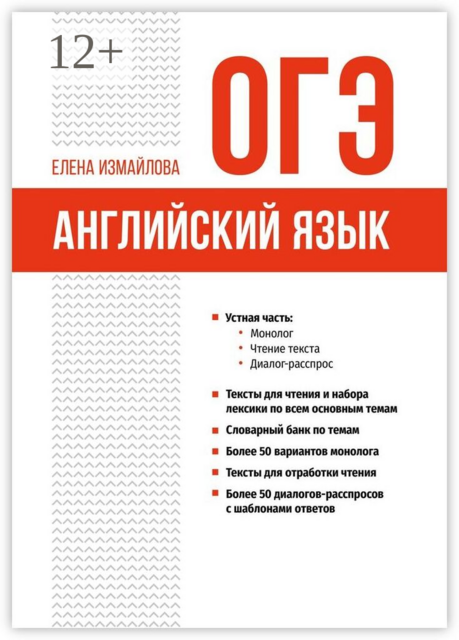



Елена Измайлова
ОГЭ
Английский язык
Шрифты предоставлены компанией «ПараТайп»
© Елена Измайлова, 2025
Данное пособие предназначено для подготовки устной части ОГЭ по английскому языку. Пособие подойдет для учащихся с разным уровнем и поможет преподавателям организовать эффективную подготовку. В книге представлены тексты по ключевым темам, актуальная лексика, монологи и опросы, материалы для чтения и готовые шаблоны ответов.
ISBN 978-5-0068-8816-6
Создано в интеллектуальной издательской системе Ridero
Оглавление
Устная часть:
Монолог
Чтение текста
Диалог-расспрос
Тексты для чтения и набора лексики по всем основным темам
Словарный банк по темам
Более 50 вариантов монолога
Тексты для отработки чтения
Более 50 диалогов -расспросов с шаблонами ответов
Выпускникам 9-х классов общеобразовательных школ предлагается учебное пособие для подготовки к устной части основного государственного экзамена (ОГЭ) по английскому языку. Издание включает: смысловые тексты по всем основным темам, лексика по основным темам, более 50 вариантов монолога, тексты для отработки чтения, более 50 диалогов — расспросов с шаблонами ответов.
Каждый вариант содержит развернутый пример ответа, который при необходимости можно сократить или адаптировать с учётом уровня подготовки и индивидуальных возможностей учащегося. По отдельным темам приведено несколько примеров заданий и ответов.
Основная цель данного пособия — помочь учащимся 9-х классов эффективно и в сжатые сроки подготовиться к экзамену по английскому языку в формате основного государственного экзамена (ОГЭ). Материал может быть полезен и учителям английского языка, так как содержит необходимые ресурсы для организации учебной работы.
Желаем успеха!
1. Friends and Friendship
My best friend
My friend Liam is a really interesting person. He has always been curious about the world around him. Since childhood, he loved exploring nature and learning about animals. Every weekend, Liam goes hiking in the nearby hills. He says it helps him relax and think clearly. Despite his busy schedule, he always finds time for his hobbies. Liam is also passionate about photography. He captures amazing landscapes and shares them on social media. His pictures often receive a lot of likes and comments.
People admire his ability to find beauty in everyday scenes. Besides being creative, Liam is very thoughtful. He often volunteers at the local animal shelter. In his spare time, he reads books about history and cultures. That’s why he knows so many fascinating facts.
Liam dreams of traveling to different countries someday. He plans to write a blog about his adventures. Even when things get tough, he stays optimistic. His positive attitude inspires everyone around him. I feel lucky to have such a supportive and caring friend.
• be curious about — интересоваться чем-то — I am curious about different cultures and traditions.
• since childhood — с детства — Since childhood, I have loved reading adventure books.
• explore nature — исследовать природу — We often explore nature during our summer holidays.
• go hiking — ходить в поход — On weekends, we usually go hiking in the forest.
• nearby hills — близлежащие холмы — We climbed the nearby hills to enjoy the view.
• think clearly — ясно мыслить — After a walk, I can think clearly and make better decisions.
• despite — несмотря на — Despite the rain, we continued our trip.
• schedule — расписание — I try to follow my study schedule every day.
• be passionate about — увлекаться чем-то — She is passionate about photography and art.
• capture amazing landscapes — запечатлеть потрясающие пейзажи — He used his camera to capture amazing landscapes during the trip.
• share something on social media — поделиться чем-то в соцсетях — Many teenagers like to share photos on social media.
• receive — получать — I received a thoughtful gift from my best friend.
• admire — восхищаться — I admire people who never give up.
• ability — способность — Her ability to learn languages is impressive.
• everyday scene — повседневная сцена — The artist painted an everyday scene of village life.
• besides — кроме того — Besides studying, I also work part-time.
• thoughtful — заботливый, внимательный — He gave me a thoughtful present for my birthday.
• volunteer — быть волонтёром — She decided to volunteer at a local charity.
• local — местный — We visited a local museum last weekend.
• animal shelter — приют для животных — My sister helps at the local animal shelter.
• spare time — свободное время — I read books in my spare time.
• fascinating — увлекательный — The documentary about space was fascinating.
• things get tough — когда становится трудно — He always stays calm when things get tough.
• stay optimistic — оставаться оптимистом — It’s important to stay optimistic about the future.
• attitude — отношение — Her positive attitude inspires everyone around her.
• inspire — вдохновлять — Great teachers inspire their students to achieve more.
• supportive — поддерживающий — My family is always supportive of my choices.
• caring — заботливый — She is a very caring person who helps others.
Why is friendship important?
Friendship is a vital part of life for many reasons. First, friends provide support during difficult times. They listen to our problems and offer helpful advice. This support makes us feel valued and understood. Additionally, having friends boosts happiness. We share laughter and joy with them, enriching our lives.
Friends also encourage us to grow as individuals. They motivate us to try new things and step out of our comfort zones. Through these experiences, we learn more about who we are. Furthermore, friendship helps improve our social skills. We learn to communicate effectively and resolve conflicts.
Friendships can create a sense of belonging. Being part of a group of friends makes us feel connected to something larger. This connection can reduce feelings of loneliness. Moreover, friends celebrate our achievements. They cheer us on and share in our success, boosting our confidence.
On another note, good friends can influence our habits positively. They can inspire healthier lifestyle choices, like exercising or studying. Spending time with friends also reduces stress. Relaxing with friends helps us unwind and recharge.
Lastly, friendship teaches us about empathy and understanding. We learn to see the world from others’ perspectives. This skill is valuable in all areas of life. In conclusion, friendships enrich our lives in many ways, making them an essential part of our well-being.
• friendship — дружба — True friendship makes life brighter.
• vital part of life — жизненно важная часть жизни — Friendship is a vital part of life for everyone.
• for many reasons — по многим причинам — I love my best friend for many reasons.
• provide support — обеспечивать поддержку — Good friends always provide support during hard times.
• during difficult times — в трудные времена — She stood by me during difficult times.
• offer helpful advice — давать полезный совет — My friend can always offer helpful advice.
• additionally — кроме того — Additionally, friendship brings a lot of joy.
• boost happiness — повышать счастье — Spending time with friends can boost happiness.
• we share laughter and joy — мы делимся смехом и радостью — With my friends, we share laughter and joy every day.
• laughter ['lɑ:ftə] — смех — Her laughter is very contagious.
• enrich — обогащать — True friends enrich our lives in many ways.
• encourage — поддерживать, воодушевлять — Friends encourage us to reach our goals.
• step out of our comfort zone — выйти из зоны комфорта — Good friends inspire us to step out of our comfort zone.
• through this experience — через этот опыт — Through this experience, I learned the value of trust.
• furthermore — более того — Furthermore, friendship helps us grow as individuals.
• improve our social skills — улучшать социальные навыки — Friendship helps us improve our social skills.
• communicate effectively — эффективно общаться — Friends teach us how to communicate effectively.
• resolve a conflict — решать конфликт — Sometimes we must resolve a conflict to keep friendship strong.
• create a sense of belonging — создавать чувство принадлежности — Friends create a sense of belonging and unity.
• connected to something larger — связанный с чем-то большим — Friendship makes us feel connected to something larger than ourselves.
• connection — связь — We have a strong emotional connection.
• reduce feeling of loneliness — уменьшать чувство одиночества — Friendship helps reduce the feeling of loneliness.
• moreover — более того — Moreover, good friends inspire us to be better.
• celebrate an achievement — праздновать достижение — True friends celebrate an achievement with you.
• cheer on — поддерживать, подбадривать — My friends always cheer me on before exams.
• share in one’s success — разделять чей-то успех — Friends happily share in one’s success.
• boost confidence — повышать уверенность — Encouragement from friends can boost confidence.
• on another note — с другой стороны — On another note, friendship also teaches responsibility.
• influence a habit — влиять на привычку — Friends can influence a habit, both good and bad.
• inspire — вдохновлять — My best friend inspires me to never give up.
• healthy lifestyle choice — выбор здорового образа жизни — Friends can inspire a healthy lifestyle choice.
• reduce stress — снижать стресс — Spending time with friends helps reduce stress.
• unwind and recharge — расслабиться и восстановить силы — We meet on weekends to unwind and recharge.
• lastly — наконец — Lastly, friendship gives us unforgettable memories.
• teach us empathy — учить нас сочувствию — Friends teach us empathy and kindness.
• from other’s perspectives — с точки зрения других — Friendship helps us see things from other’s perspectives.
• skill — навык — Good communication is a valuable skill we practice in friendship.
• valuable — ценный — Having loyal friends is the most valuable gift.
• area — сфера, область — In every area of life, friendship is important.
• in conclusion — в заключение — In conclusion, friendship is essential for well-being.
• essential part — важная часть — Friendship is an essential part of happiness.
• well-being — благополучие — Strong friendships improve our emotional well-being.
Sample #1
Task 3. You are going to give a talk about your best friend. You will have to start in 1.5 minutes and speak for not more than 2 minutes (10–12 sentences).
Remember to say:
• the reasons people need friends;
• when you and your friend met;
• what you like doing together;
• what your attitude to friendship is.
You have to talk continuously
Today I am going to give a talk about my best friend.
To my mind, people need friends to share good and bad times with. Friends listen and give support when someone is feeling sad or happy. Having friends means you have someone to do fun activities with. Friends can also help each other grow by sharing advice and experiences.
Well, my friend and I have known each other for five years. His name is Vlad. We met at school and quickly became close. We have a lot in common and we never argue. Our friendship is very special, and I hope it lasts a lifetime.
You know, my friend and I enjoy playing basketball in the park. We often go for walks and explore new places in our city. Watching movies together is another activity we love, especially comedies. Sometimes, we cook meals and try new recipes in the kitchen. Playing board games is also a favorite pastime for us.
I have to admit, my attitude to friendship is good, of course. Friendship teaches us to trust, be responsible and share. I can’t imagine my life without my friends and I am really happy I have them.
That’s all I wanted to say about my best friend. Thank you for listening.
Sample #2
Task 3. You are going to give a talk about friendship. You will have to start in 1.5 minutes and speak for not more than 2 minutes (10–12 sentences).
Remember to say:
• if it is easier to find or to lose a good friend;
• how people become friends;
• how often you invite friends to your place;
• what your best friend is like
You have to talk continuously.
Today I am going to give a talk about friendship.
In my opinion, it is easier to lose a good friend than to find one. One mistake or misunderstanding can destroy your friendship quickly. Besides, sometimes people move to different cities, and their friendship slowly fades. On the other hand, finding and keeping a real friend requires effort, honesty, and care.
I believe, people usually become friends when they spend time together and find common interests. They start talking, sharing ideas, and helping each other and eventually become friends. For example, classmates, colleagues, or neighbours often become friends because they see each other every day.
Well, from time to time, I invite my friends to come over, especially on holidays or special occasions. We cook or order something delicious, talk about our plans, and just enjoy each other’s company. It always creates a warm and friendly atmosphere.
My best friend is really fun to be around. He’s open-minded, talkative, and has a great sense of humour. We can discuss anything and laugh for hours. I like that he never judges anyone and always stays positive.
That’s all I wanted to say about friendship. Thank you for listening.
Vocabulary Bank
• friend — друг — My friend always listens to me carefully.
• best friend — лучший друг — My best friend knows all my secrets.
• friendship — дружба — True friendship makes life happier.
• loyal — верный — A loyal friend never betrays you.
• honest — честный — An honest friend tells the truth even if it is hard.
• caring — заботливый — She is a caring person who always helps others.
• cheerful — весёлый — My cheerful friend can make me laugh anytime.
• reliable — надёжный — He is a reliable friend I can always count on.
• kind — добрый — A kind friend is ready to help without asking.
• understanding — понимающий — An understanding friend accepts your feelings.
• respectful — уважающий — A respectful friend listens to your opinion.
• spend time together — проводить время вместе — We spend time together at weekends.
• share secrets — делиться секретами — I can share secrets with my best friend.
• play games — играть в игры — We often play computer games together.
• watch films — смотреть фильмы — Sometimes we watch films with popcorn at my house.
• go for a walk — ходить гулять — I like to go for a walk with my friends in the park.
• do homework together — делать домашнее задание вместе — We sometimes do homework together after school.
• celebrate birthdays — отмечать дни рождения — We always celebrate birthdays with fun and cake.
• travel — путешествовать — I want to travel with my friends next summer.
• take photos — фотографироваться — We like to take funny photos together.
• chat online — переписываться онлайн — We chat online every evening.
• make memories — создавать воспоминания — With friends, you can always make great memories.
• laugh together — смеяться вместе — We laugh together until our stomachs hurt.
• support — поддержка — Friends give us support when we feel sad.
• trust — доверие — Trust is the foundation of every strong friendship.
• loyalty — верность — Loyalty makes friendship stable and reliable.
• honesty — честность — Honesty helps friends solve problems without lies.
• understanding — понимание — Good friends show understanding in difficult situations.
• respect — уважение — Friendship teaches us respect for other people’s opinions.
• care — забота — Friends show care by helping each other.
• empathy — сочувствие — Empathy makes us feel less lonely.
• companionship — товарищество — Companionship brings joy to everyday life.
• bond — узы, связь — Shared experiences create a strong bond between friends.
• connection — связь, контакт — Friendship gives us a deep emotional connection.
• sense of belonging — чувство принадлежности — Friends give us a sense of belonging to a group.
• confidence — уверенность — True friendship boosts our confidence.
• happiness — счастье — Friendship adds happiness to life.
• well-being — благополучие — Strong friendships improve our emotional well-being.
• reduce stress — снижать стресс — Talking to friends helps reduce stress.
• share joy — делиться радостью — We share joy when something good happens.
• cheer up — подбадривать — Friends cheer us up when we are upset.
• encourage — поддерживать, воодушевлять — Friends encourage us to reach our goals.
• inspire — вдохновлять — A good friend can inspire us to be better.
• teach life lessons — учить жизненным урокам — Friendship can teach us important life lessons.
• help in difficult times — помогать в трудные времена — True friends help in difficult times.
• share experiences — делиться опытом — We share experiences and learn from each other.
• celebrate together — праздновать вместе — Friends celebrate together both small and big successes.
• create memories — создавать воспоминания — Friendship helps us create memories that last forever.
• emotional anchor — эмоциональная опора — True friends are an emotional anchor during storms of life.
• safe space — безопасное пространство — Friendship creates a safe space where you can be yourself.
• mutual trust — взаимное доверие — Mutual trust makes friendship strong and lasting.
• shared laughter — общий смех — Shared laughter is one of the best parts of friendship.
• shoulder to cry on — «плечо, чтобы поплакать» — A real friend is always a shoulder to cry on.
• boost of confidence — заряд уверенности — Friends give us a boost of confidence before exams or interviews.
• emotional well-being — эмоциональное благополучие — Good friendships improve our emotional well-being.
• life lessons — жизненные уроки — Through friendship, we learn valuable life lessons.
• moral support — моральная поддержка — She gave me moral support when I felt hopeless.
• sense of unity — чувство единства — Friendship brings a sense of unity and belonging.
• shared adventures — совместные приключения — Friends turn simple walks into shared adventures.
• trustworthy companion — надёжный спутник — A trustworthy companion is a treasure in life.
• reduce loneliness — уменьшать одиночество — Talking to friends helps reduce loneliness.
• positive influence — положительное влияние — Friends can have a positive influence on our habits.
• motivation to grow — мотивация развиваться — Good friends give us motivation to grow and improve.
• celebrate victories — праздновать победы — We celebrate victories together, big or small.
• unconditional support — безусловная поддержка — Unconditional support makes friendship priceless.
• personal growth — личностный рост — Friendship encourages personal growth through challenges.
• comfort in silence — уютное молчание — With true friends, even silence feels like comfort.
• inspire optimism — вдохновлять на оптимизм — Friends inspire optimism when things get tough.
• valuable memories — ценные воспоминания — Time with friends creates valuable memories.
• open communication — открытое общение — Open communication helps avoid conflicts in friendship.
• empathy in action — сочувствие в действии — Empathy in action is what makes a real friend special.
• source of joy — источник радости — Friendship is a constant source of joy.
• long-lasting bond — прочная связь — A long-lasting bond between friends is rare but precious.
2. Our family
My family is an important part of my life. We live in a cozy house in the suburbs. My parents, my younger sister, and I make up our household. My dad works as an engineer, and my mom is a teacher. They have always been supportive and caring, teaching us valuable lessons about life.
My sister is ten years younger than me. She is a cheerful and energetic girl, always eager to learn new things. We enjoy playing games together or watching movies on weekends.
Our extended family includes my grandparents, aunts, uncles, and cousins. We often gather for family celebrations, enjoying delicious meals and sharing stories. These gatherings create strong bonds and wonderful memories.
Having such a close-knit family helps me feel secure and loved. We always support each other and remain connected despite our busy lives. This unity and love are what make my family truly special to me.
• cozy — уютный — We spent a cozy evening at home, drinking tea and talking.
• in the suburbs — в пригороде — My grandparents live in the suburbs, where it is quieter and greener.
• make up one’s household — составлять хозяйство — Five people make up our household, including my parents, my brother, and me.
• supportive — поддерживающий — My family is very supportive when I face difficulties.
• teach a lesson — преподать урок — Parents sometimes teach a lesson by showing the consequences of bad behavior.
• valuable — ценный — I learned a valuable skill from my father: how to stay patient.
• be eager to — очень хотеть, стремиться — Children are usually eager to spend time with their grandparents.
• cheerful — весёлый, жизнерадостный — My cousin has a cheerful character, and he always makes us laugh.
• extended family — большая семья (с дальними родственниками) — Our extended family gathers at New Year to celebrate together.
• nuclear family — нуклеарная семья (только родители и дети) — Nowadays, many people live in a nuclear family without grandparents.
• include — включать — The family dinner usually includes traditional dishes.
• gather — собираться — Every summer we gather at our grandparents’ house.
• gathering — собрание, встреча — The wedding was a big family gathering.
• create strong bonds — создавать крепкие связи — Shared traditions create strong bonds between family members.
• close-knit family — сплочённая семья — We are a close-knit family, and we always help one another.
• secure — безопасный, надёжный — Children feel secure when they grow up in a loving family.
• despite — несмотря на — Despite small arguments, we remain a close family.
• unity — единство — Family unity is very important during difficult times.
Sample #1
You are going to give a talk about your family traditions. You will have to start in 1.5 minutes and speak for not 2 minutes — 10—12 sentences.
Remember to say:
• if you have got many relatives;
• if you get along with your relatives;
• what traditions you have in your family;
• what your attitude to spending time with your family is.
You have to talk continuously.
Today I’m going to give a talk about my family traditions.
Well, I come from an extended family. I have a few aunts, uncles and a lot of cousins. I really love it since every time we meet up, we have lots of fun.
I have to admit, I get along with my relatives. Of course, sometimes we may have occasional disagreements, however, we respect each other’s opinions and support one another through thick and thin.
Frankly speaking, we have a few traditions in our family that we keep. The favourite one is probably celebrating the New Year. Every year we gather at our grandparents’ place, make festive New Year dishes like the Olivier salad or the Honey cake. We exchange presents, sing popular songs, watch fireworks and just have a good time.
My attitude to spending time with my family is great, of course. It doesn’t matter what we do, it always feels like home and it feels safe. These are people who know you and love you the way you are. It’s always a joy to catch up, enjoy good food together, and simply be in each other’s company.
To sum up, I’d like to say that it is really important to keep family traditions because they strengthen family bonds, create lasting memories and connect family members across generations.
That’s all I wanted to say about my family traditions. Thank you for listening.
Sample #2
You are going to give a talk about your family. You will have to start in 1.5 minutes and speak for not 2 minutes — 10—12 sentences.
Remember to say:
• how you spend time with your family;
• when you give each other presents;
• if it important to help your parents with household chores;
• if you can say that your parents are your friends; why?/why not?
You have to talk continuously.
Today I’m going to give a talk about my family.
You know, we try to spend as much time together as possible, especially at weekends. Sometimes we go to the countryside or have picnics in the park. In the evenings, we usually talk, share news, or watch TV. In summer we always travel somewhere.
In my family, of course, we usually give each other presents on birthdays and New Year’s Eve. These are the most important celebrations for us. We also exchange small gifts on other holidays like Women’s Day or Father’s Day. It’s always a pleasant moment when everyone opens their presents and smiles.
I believe helping parents with household chores is very important. It teaches young people discipline and responsibility. Besides, it’s a good way to thank parents for everything they do for us.
I would say that my parents are both my mentors and my friends. They always give me good advice and support my decisions. I admire their wisdom and kindness. Our relationship is based on love, trust, and mutual respect.
That’s all I wanted to say about my family. Thank you for listening.
Sample #3
You are going to give a talk about family relations. You will have to start in 1.5 minutes and speak for not 2 minutes — 10—12 sentences.
Remember to say:
• what the most common family problems are;
• if you always understand your parents; Do they understand you?
• how often you quarrel with your parents and why;
• what you think of your parents.
You have to talk continuously.
Today I’m going to give a talk about family relations.
In my opinion, common family problems include misunderstandings, financial difficulties, and generation gaps. People often have different opinions about rules, studies, or free time. It’s important to discuss these issues calmly and try to find a compromise.
I have to admit that sometimes I feel like my parents don’t really understand me, especially when it comes to modern things like social media or fashion. But I know they care about me and just want the best. We try to listen to each other and avoid arguments. Even if we disagree, we always make peace.
Honestly, I don’t quarrel with my parents very often, but it happens sometimes. We usually argue about school, housework, or how much time I spend on my phone. Besides, we may argue about my studies or going out with friends. They worry too much, and I want to be more independent.
I think my parents are wonderful people who always support me. They work hard to make our family happy and comfortable. They are kind, patient, and understanding, even when I make mistakes. I’m really grateful to have them in my life.
That’s all I wanted to say about family relations. Thank you for listening.
Sample #4
You are going to give a talk about family. You will have to start in 1.5 minutes and speak for not 2 minutes — 10—12 sentences.
Remember to say:
• what you think the main role of the family is;
• what the most important family events are and why;
• whether you would like to have 4 or 5 brothers or sisters /why;
• what government should do to help young families.
You have to talk continuously.
Today I’m going to give a talk about family.
I’m convinced that the main role of the family is to provide emotional and moral support to all its members. A family shapes a person’s character and helps them develop important values such as honesty and respect. Without family, it’s much harder to feel truly happy and confident.
I believe the most important family events are those that bring people together, such as anniversaries, weddings, and traditional holidays. They remind us of our roots and help us keep family traditions alive. During these occasions, people show love, gratitude, and respect for one another.
Frankly speaking, no, I wouldn’t like to have so many brothers and sisters. I think it would be too noisy and difficult for parents to take care of everyone. It’s also hard to have enough personal space in a big family. I prefer having one or two siblings so that we can stay close and help each other.
I think, the government should support young families by giving them financial help and affordable housing. It’s often difficult for young couples to buy a flat or raise children without assistance. The government could also provide free education and healthcare for kids.
That’s all I wanted to say about family relations. Thank you for listening.
Vocabulary Bank
• parents — родители — My parents always help me when I need advice.
• mother / mom / mum — мама — My mom is a very caring person.
• father / dad — папа — My dad works in an office.
• sibling — брат или сестра — I have two siblings: one brother and one sister.
• brother — брат — My brother is older than me.
• sister — сестра — My sister studies at university.
• twins — близнецы — My cousins are twins, and they look the same.
• grandparents — бабушка и дедушка — My grandparents live in the village.
• grandmother / grandma — бабушка — My grandma tells me fairy tales.
• grandfather / grandpa — дедушка — My grandpa goes fishing every weekend.
• uncle — дядя — My uncle is a teacher.
• aunt — тётя — My aunt lives in another city.
• cousin — двоюродный брат / сестра — My cousin often visits us in summer.
• nephew — племянник — My nephew is very active.
• niece — племянница — My niece likes painting.
• husband — муж — Her husband is very kind.
• wife — жена — My uncle’s wife is a doctor.
• children / kids — дети — They have three children.
• son — сын — Their son goes to school.
• daughter — дочь — Their daughter is five years old.
• close family — близкая семья — We are a close family and always support each other.
• extended family — большая семья — Our extended family meets during holidays.
• nuclear family — нуклеарная семья (только родители и дети) — Most people live in a nuclear family today.
• single-parent family — неполная семья — He grew up in a single-parent family.
• large family — большая семья — She comes from a large family with five siblings.
• generation — поколение — Different generations sometimes have different views.
• ancestor — предок — I want to know more about my ancestors.
• descendant — потомок — We are the descendants of our grandparents.
• family tree — семейное древо — I drew my family tree for school.
• relatives — родственники — We invited all our relatives to the wedding.
• grow up — расти, взрослеть — I grew up in a small family.
• get along with — ладить — I get along with my sister very well.
• argue — ссориться — Teenagers often argue with their parents.
• quarrel — ругаться — They sometimes quarrel about small things.
• make peace — мириться — After the fight, they quickly made peace.
• respect — уважать — Children should respect their parents.
• support — поддерживать — My parents always support me in my studies.
• rely on — полагаться на — I can rely on my family when I have problems.
• trust — доверять — I trust my brother with my secrets.
• care about — заботиться о — My family cares about me a lot.
• take care of — ухаживать — She takes care of her little brother.
• protect — защищать — Parents always protect their children.
• share — делиться — We share everything in our family.
• forgive — прощать — Family members forgive each other easily.
• love — любить — I love my family very much.
• family tradition — семейная традиция — We have a family tradition to celebrate birthdays together.
• family values — семейные ценности — Family values are important for raising children.
• household chores — домашние дела — We divide household chores in my family.
• do the washing-up — мыть посуду — I usually do the washing-up after dinner.
• do the laundry — стирать бельё — My mom does the laundry twice a week.
• clean the house — убирать дом — We clean the house every Saturday.
• cook meals — готовить еду — My father often cooks meals on weekends.
• help with homework — помогать с домашним заданием — My parents help me with homework when I need it.
• spend time together — проводить время вместе — We like to spend time together in the evenings.
• family dinner — семейный ужин — Every Sunday we have a big family dinner.
• celebration — празднование — We had a big celebration for my grandmother’s birthday.
• holiday gathering — семейный праздник — We always have a holiday gathering at New Year.
• weekend activity — занятие на выходных — Our weekend activity is walking in the park together.
• family trip — семейная поездка — Last summer we went on a family trip to the sea.
• to visit relatives — навещать родственников — We often visit relatives in the countryside.
• caring — заботливый — My mom is very caring.
• supportive — поддерживающий — My parents are always supportive.
• strict — строгий — My father is strict but fair.
• generous — щедрый — My aunt is very generous with gifts.
• kind — добрый — My grandma is a kind woman.
• hard-working — трудолюбивый — My dad is hard-working and never lazy.
• responsible — ответственный — My brother is responsible and always does his tasks.
• patient — терпеливый — My mother is very patient with children.
• funny — смешной — My cousin is funny and tells good jokes.
• friendly — дружелюбный — My family is friendly to everyone.
• to be proud of — гордиться — My parents are proud of my success at school.
• to look after — присматривать — I look after my little sister when my parents are busy.
• to be close to — быть близким с — I am very close to my grandmother.
• to be part of — быть частью — I feel happy to be part of my family.
• to keep in touch — поддерживать связь — We keep in touch with relatives by phone.
• to celebrate together — праздновать вместе — We celebrate all important holidays together.
• to give advice — давать совет — My parents always give me good advice.
• to solve problems — решать проблемы — In my family we solve problems by talking.
• to spend holidays — проводить праздники — We spend holidays with our grandparents.
• to enjoy company — наслаждаться компанией — I enjoy the company of my cousins.
• marriage — брак — Their marriage is very strong.
• wedding — свадьба — We went to my cousin’s wedding last year.
• divorce — развод — Divorce can be hard for children.
• get married — пожениться — My parents got married twenty years ago.
• have children — завести детей — They want to have children in the future.
• raise / bring up children — воспитывать детей — It is not easy to raise children.
• adopt a child — усыновить / удочерить ребёнка — They decided to adopt a child.
• move house — переехать — My family moved house last year.
• live together — жить вместе — We live together with our grandparents.
• live separately — жить отдельно — My uncle lives separately from us.
• family background — семейное происхождение — She comes from a strong family background.
• household — домашнее хозяйство — There are five people in our household.
• generation gap — разница поколений — There is sometimes a generation gap between parents and children.
• role model — образец для подражания — My father is my role model.
• upbringing — воспитание — He had a strict upbringing.
• family bond — семейная связь — Strong family bonds help in hard times.
• family reunion — семейное собрание — We had a family reunion last summer.
• family support — поддержка семьи — Family support is important for success.
• only child — единственный ребёнок — I am an only child, so I don’t have siblings.
• stepmother / stepfather — мачеха / отчим — Her stepfather is very kind to her.
3. School Holidays
Level A1-A2
School holidays are a favorite time for students. They don’t have to go to school and can relax or try new things. Most countries have school holidays in summer and winter, but some also have breaks in spring and fall.
During summer holidays, many children enjoy going to the beach, swimming, or playing sports. It’s a great time for family trips. Some families visit interesting places like museums or amusement parks. Others might go camping in nature. Summer holidays can be long, sometimes lasting for six to eight weeks.
Winter holidays are usually shorter, but they are fun too. In places with snow, children may build snowmen, go sledding, or have snowball fights. Many people celebrate Christmas or other holidays with friends and family. They may exchange gifts, sing songs, and enjoy special meals.
Spring and fall breaks, often just a week long, offer a chance to relax between school terms. Some students use this time to catch up on homework or read books. Others may play with friends or visit grandparents.
Not all children go on trips during the holidays. Some prefer to stay at home, watching movies or playing video games. Others might take part in local clubs or activities, like art classes or sports teams.
No matter how children spend their holidays, this time is important for rest and fun. It helps them return to school feeling refreshed and ready to learn. Holidays offer a chance to explore, discover new interests, and create happy memories with family and friends.
• amusement park — парк развлечений — We spent the whole day at the amusement park riding roller coasters.
• go camping — пойти в поход с палаткой — In summer, we usually go camping near the lake.
• go sledding — кататься на санках — Children love to go sledding in winter.
• have snowball fights — играть в снежки — We had fun having snowball fights during the holidays.
• exchange gifts — обмениваться подарками — On New Year’s Eve, we exchange gifts with our family.
• spring break / autumn break — весенние / осенние каникулы — During spring break we went on a family trip.
• school term — учебный семестр — The new school term starts in September.
• catch up on homework — наверстать домашнюю работу — I used the holidays to catch up on homework.
• take part in — принимать участие — Many students take part in school competitions.
• no matter how — неважно, как; несмотря на то, что — No matter how difficult it was, we finished the project.
• refreshed — отдохнувший, обновлённый — After the holidays, I felt refreshed and ready for school.
• offer a chance — предлагать возможность — Vacations offer a chance to relax and spend time with family.
• explore — исследовать — We explored a new city during our summer trip.
• discover — открывать, узнавать — Travelling helps us discover new cultures and traditions.
Level B1-B2
School holidays are a much-anticipated time for students and teachers alike. They provide a break from regular routines and offer opportunities for rest, relaxation, and adventure. During these periods, schools close for a certain number of weeks, allowing students to spend their time away from academic pressures and classroom learning.
In many countries, school holidays are scheduled around major national or cultural events. Typically, the longest break occurs during the summer months, lasting between six and eight weeks. This extended vacation is often used by families to travel, explore new places, or visit relatives. Many children attend summer camps during this time, where they can learn new skills, make friends, and enjoy outdoor activities.
Winter break is another common holiday period, often coinciding with Christmas and New Year celebrations. It usually lasts about two to three weeks. This time is often filled with festive activities, family gatherings, and enjoying winter sports like skiing and snowboarding, especially in regions with cold climates.
Shorter breaks, like spring and autumn holidays, typically last one to two weeks. These times offer a chance for students to rest and prepare for upcoming exams. Many families use this time for short trips or local outings, offering a change of scenery without the need for extensive travel planning.
School holidays also provide an opportunity for students to pursue hobbies and interests outside of school. Whether it’s learning a musical instrument, engaging in sports, or participating in art projects, these breaks give students the freedom to explore their passions. For some, it is also a time for extra tutoring or catching up on studies to better prepare for the next term.
Overall, school holidays are a valuable time for growth and rejuvenation, allowing students to return to school with refreshed minds and renewed energy.
• much-anticipated — долгожданный — The summer holidays are the most much-anticipated time for students.
• break from — перерыв от — Holidays give us a break from school and homework.
• regular routine — обычный распорядок — A holiday is a chance to escape the regular routine.
• offer an opportunity — предоставлять возможность — Vacations offer an opportunity to travel or relax.
• certain number of — определённое количество — Students get a certain number of weeks off each year.
• allow — позволять — The long holidays allow us to spe