Introduction
“You have gone mad!”
‘‘‘That was my friend’s reaction to my new obsession. From experience, I know that whenever someone says this, the most interesting things in life are just about to begin.
The idea of learning Arabic first crossed my mind before a trip to Qatar. Whenever I travel to a new country, I want to be able to say at least something in the local language. Without much hesitation, I went to the Bookvoed bookstore, bought an Arabic – Russian phrasebook, and triumphantly carried it to the checkout under the amused and curious gaze (a friendly one) of a shop assistant who, as it later turned out, spoke a Syrian dialect of Arabic.
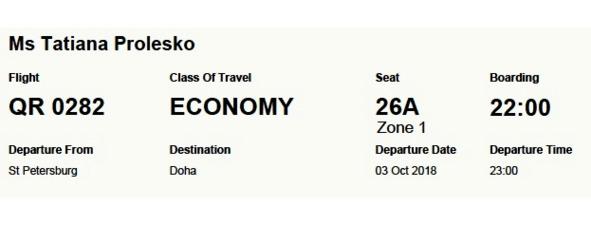
The trip to Qatar happened to be framed by two other journeys — to Madrid and Barcelona. At the time, I was irritated by the way Italian words kept intruding into my head and interfering with my attempts to learn Spanish. A few hours spent with an Arabic phrasebook on flight QR0282 from Saint Petersburg to Doha cured me, once and for all, of complaining about the difficulty of any European language.
I opened the little book, closed it again in despair — and repeated this ritual several times.
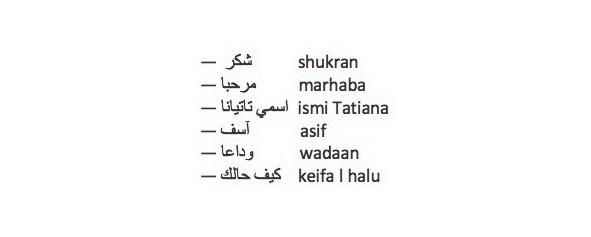
By the time we landed, I had managed to remember exactly six words.
Everything else caused complete mental paralysis and led to gloomy thoughts: This is impossible to learn. How can anyone understand these strange symbols? And what will I do if, one day in some Dubai, all the English signs suddenly disappear?
So what made me continue?
First of all, the people. Those I met in Qatar, and later others from different parts of the Middle East, left a deep impression on me.
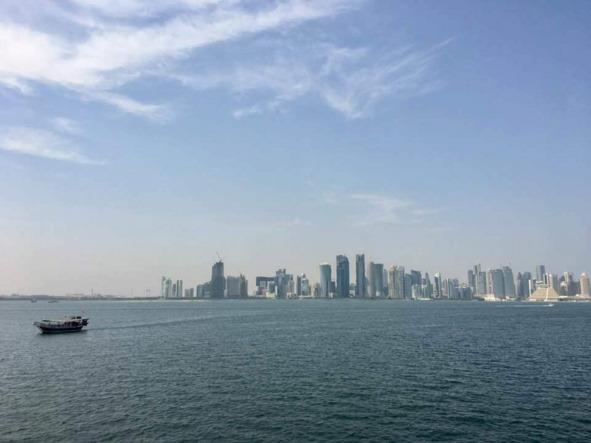
Secondly, Qatar itself amazed me so profoundly that after returning home I wrote a long article about the country for a Saint Petersburg publication, bought a thick Arabic textbook, and a thin notebook for handwriting practice. I wanted to understand how native speakers think — and to learn how to speak, at least a little, the way they do.
It turned out to be an extraordinary mental exercise: a way to penetrate local culture more deeply and to significantly expand my own way of thinking.
And then there were discoveries.
1. I realized that Arabic letters are not frightening at all — they are simply unfamiliar to the eye. Each letter changes its shape depending on whether it appears at the beginning, in the middle, or at the end of a word, or stands alone. Words are written from right to left, while numbers go from left to right. Letters that can connect always do so, both in handwriting and in printed texts. The only exceptions are crosswords and vertical signs.
2. Arabic word formation leads to unexpected reflections. For example, the word student in Arabic is ṭālib, a participle derived from the verb ṭalaba — “to ask,” “to seek,” “to demand.” A student, therefore, is literally someone who seeks and asks. Unlike a child sent to school by parents, unsure of what knowledge is needed, a student consciously searches for learning, is not afraid to ask for help, and even demands knowledge when necessary. The word itself perfectly conveys the true essence of a student — a person driven by the desire to know. Even its sound suggests what actions a seeker of knowledge must take in order to succeed.
3. I also discovered that nearly 10 percent of Spanish vocabulary is borrowed from Arabic — a fact that proved extremely useful while continuing my studies of español in Barcelona:
aduana — customs
azúcar — sugar
álgebra — algebra
elixir — elixir
alcohol — alcohol
azimut — azimuth
algoritmo — algorithm
aldea — village
There are many Arabic borrowings in Russian as well. For instance, the word lafa is close to alafa, meaning “an easy life” or “good fortune.” The word balagan originates from the Arabic balagh — “news” or “message.” Other examples include alchemy, admiral, amalgam, arsenal, caliber, coffee, gazelle, giraffe, halva, chest, jasmine, lemon, sherbet, sugar, syrup, talisman, tariff, and many more.
4. What I loved most was drawing Arabic script — not writing or typing it, but truly drawing it. Arabic calligraphy is an art form in itself. I remember once practicing for four hours straight just to handwrite a congratulatory card for my Arab partners.
5. Encouraged by my progress in writing, I almost forgot about pronunciation. Arabic contains several groups of sounds that are nearly indistinguishable to a Russian or European ear. For example, where Russian has just one “s” sound, Arabic has three similar ones: sin, pronounced like the Russian “s”; sad, pronounced much harder; and th an interdental sound similar to the English th.
Learning new languages gradually erases boundaries in every sense. I enjoy speaking with native speakers and forming my own understanding of people, cultures, and countries — rather than relying on second-hand opinions or information dissected and packaged by others.