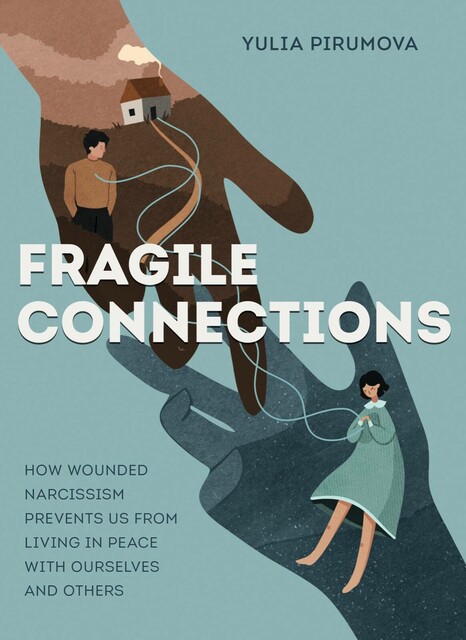



автордың кітабын онлайн тегін оқу Fragile connections. How wounded narcissism prevents us from living in peace with ourselves and others
Julia Pirumova
Fragile Connections
From the author
In Pursuit of Healing
One day, while casually re-watching an old lighthearted TV series, I caught myself thinking: “How simple, sincere, and unaffected their lives seem! No endless analysis, no buzzwords like 'abuser' and 'narcissist', no constant discussions about personal boundaries or independence. Just life.” Indeed, those old stories were so full of life.
It struck me then how much we have been “spoiled” by modern psychology (there really should be a little smiley face here, but the editor will not allow it). It became painfully clear that most people I meet today are preoccupied with how “unhealed” or “immature” they still are – as if, somewhere along the way, these became necessary prerequisites for living, loving, building friendships, or having relationships. And so, we all rushed into endless self-work, hoping to one day earn that coveted ticket to the paradise of the healed and normal.
I found myself wondering: When did we fall so deeply in love with the idea of self-perfection? When did self-work start to look more like a moral obligation than a living process of seeking ourselves? It feels like we have turned our inner lives into projects with strict deadlines, where every “immature” feeling is a missed milestone, and every unresolved pain is a failed assignment.
Paradoxically, in our desperate race for healing, we often lose life itself – interrupting it at every step with self-monitoring: “Am I mature enough now?” “Am I still too unhealed?” Instead of simply feeling, loving, making mistakes, we analyze ourselves, scan every emotion for “trauma”, and keep thinking: “Just a little more work on myself and then I can finally be happy…”.
But life is not a checklist waiting for all boxes to be ticked. The maturity we will reflect on together is not a prize for good behavior, not a status awarded after mastering every psychological level. It is a path, a movement shaped by how we meet reality and weave it into the fabric of who we are.
At the very start, it is important to remember:
Life does not wait for us to solve all our internal conflicts or reach “full maturity”.
It is already happening – right here, right now.
And perhaps, our task is not to “fix ourselves” but to learn to live within this imperfect human experience – to coexist with our inner paradoxes, with that strange mix of love, fear, desire, and anxiety that makes us alive, instead of endlessly postponing life under the pretext of self-improvement.
Let us think about this together. Without rushing. Without judgment. Simply observing the remarkable puzzle of our Self slowly coming together.
You are holding a special work in your hands – a book that brings together knowledge from different fields of psychology. This information will help you better understand your mental life. It will help you find words for your inner processes and states, those vague sensations you may have felt but never clearly named.
This book is an invitation to a deep dialogue with yourself. It will help you understand the structure of your relationships with the world, with others, and, most importantly, with yourself. You will see how wounds, disappointments, and internal conflicts have shaped your personality and how you can begin the journey back toward your own integrity.
As you read and reflect, your unconscious will awaken. Your dreams may grow richer, your fantasies bolder, your memories more vivid. You will start noticing inner patterns that previously lived quietly in the background. It will not always be easy, but that is how we begin to truly know ourselves.
In every chapter, you will find life stories, which do not provide theoretical explanations but help you recognize yourself in other people. You will see that your background is a part of the shared human experience, and this realization will bring you closer to others.
Practical exercises, reflection prompts, and checklists encountered throughout the book are not simple tasks to complete but a gentle way to build a deeper connection with yourself. Gradually, you will learn to recognize where harsh, critical voices dominate your inner world, and how you might soften their hold.
This book will guide you through essential stages: from acknowledging your wounds and vulnerability, to discovering the strength hidden within your authenticity. You will see how your Adult Self can become a guide for your Inner Child, helping them leave their lonely inner exile. You will begin to sense freedom from the destructive inner filters that make the outside world seem so unbearable to you today.
Together, we will work on changing your internal dialogue, so that, over time, the stern voice of self-criticism gives way to a voice that is respectful and supportive. By the end of this journey, you will feel closer to yourself —
more alive, more whole, more real. This is not a journey of “fixing yourself”. It is a journey of discovering and accepting the self that, perhaps, you have never truly known.
Introduction
The Epidemic of Narcissistic Loneliness
Hello. It's me, your narcissism
Yes, the very same you might have read about in books and articles, usually portrayed as some kind of inner enemy. But what if I, your narcissism, have always been on your side? I'm not about arrogance or selfishness. I am your protection. A subtle, complex mechanism that helped you cope with hardships and preserve yourself when the world seemed not to see you or worse, to reject you.
Once, I was simply a part of your inner childhood world. Born alongside you so that your sense of self could emerge. I helped you feel: “I exist. I matter.” But then I saw how often you lacked acceptance, safety, support. So, I stepped in stronger.
I began creating roles and masks for you so that you wouldn't have to face the pain of your real self being unseen, uninteresting, or unwanted. Those roles helped you survive, but over time, they started getting in the way of living. I see how you sometimes wake up feeling the day is already lost. How every action turns into a tiny test: Was it good enough? Fast enough? Smart enough? How even rest becomes a competition: who got more done, who was more productive? That's not you. That's me whispering that if you just try a little harder, you'll feel worthy. But that voice – it's not your true essence. It's just an echo of the old pain I tried to muffle but only made louder.
You know, I always wanted one thing: for you to feel significant. Remember how, as a child, you craved being noticed? How you lit up when someone praised your drawing, your schoolwork, your bravery or kindness? That was me, whispering: “You can do it! You're important!” My task was to make sure you never forgot that feeling.
I wanted you to see yourself through the eyes of those who loved you. I worked so hard hoping you'd find such eyes and reflect yourself in them! So that you could say, “I exist. And that's enough.” I could have been the cement holding together the fragments of your self, helping you realize you are unique, worthy, whole. But sometimes, the world didn't respond.
Often, those whose acknowledgment you longed for turned away or criticized you. Even those closest to you couldn't always give what you needed. I whispered: “Hold on. Don't show weakness. You can do it!” I tried so hard to shield you from new wounds, new rejections that, without noticing, I became more of a captor than a supporter.
And now, when I see how my protection brings you resentment, anger, and exhaustion, it hurts me too. I never meant for it to end up this way. I just tried to keep you from falling, feeling worthless or not enough. And it seems, I overdid it. Instead of inspiring you, I began to control you. Instead of freedom, I built endless checklists: good enough, right enough, fast enough.
I see how hard it is for you. How you look in the mirror and feel unsure. How you hold back bold steps, afraid of making mistakes. How you close off when you want to show true feelings, because you're afraid of judgment. This is not what I wanted for you. This is not what you deserve.
I'm here to say: it's time for me to stop being your overseer. I want to become your ally, helping you see that even with all your imperfections, you are already good enough. Let's rewrite the story of our relationship in order to cooperate for your better future.
Narcissism: A Story of Our Relationship with Ourselves
In psychoanalysis, narcissism is not just a character trait and certainly not simply a mental disorder. It is a fundamental structure that shapes our relationship with ourselves and others. At its core lies the ability to feel one's own value and significance, which is an essential part of psychological health. It is how we build our sense of self, balancing internal experiences with external expectations.
In early childhood, narcissism is natural: the child sees themselves as the center of the world, and that grandiosity helps their Self to grow. The “narcissistic piggy bank” gathers together the history of our relationship with ourselves. It holds all traces of love and rejection, joy and sorrow, unexpected discoveries in relationships with our close ones and devastating losses. Narcissism is designed by nature precisely to allow our Self to first emerge within the field of relationships with parents. Like connecting cement, it binds the scattered puzzles of our Self into a holistic view of ourselves, so we can rely on it and navigate our inner world.
From the very beginning, narcissism was on our side. Thanks to it, we felt significant, coped with early challenges, and learned how to relate to the world.
But not everything went smoothly. When there was not enough attention, acceptance, or simply the safety to be oneself, narcissism had to work differently. Sometimes, it reminds me of that song: “I made him out of what was at hand…”. It stitched our self-image together from the chaotic fantasies and the reflections we caught in the eyes of those around us. Sometimes, there were not enough reflections. Sometimes, they were colored too darkly, showing only our flaws. Sometimes, they were distorted by parental expectations we could never quite meet.
Thus, narcissism sewed us a costume not tailored to our Real Self but to the pattern we were handed. And it helped preserve the vital connections we needed so desperately – more than we needed to stay loyal to ourselves.
At the heart of this kind of narcissistic work, there is always the fragility of the construction of what we can consider our Self. As if it wants to emerge but keeps hiding in its childhood costume, still unable to find a healthy form of living in today's world.
We do not know whether we should flaunt our strengths, hide our flaws, or, on the contrary, obsessively embrace everything in ourselves so that it becomes an egoistic message to the world:
“Accept me as I am. I don't care what you think of me.”
It is not possible to always fully feel what our Self actually is, and we do not know how to replenish the missing pieces of that fullness. So, we decide: “Maybe I'll feel it through achievements and success?” “Or through enthusiastic responses – or at least through any attention at all?” “Or maybe I should stop needing it altogether, so I won't be so vulnerable and dependent?”
A New Model of Narcissism
One day, a client of mine, a very successful woman by modern standards, complained about an unfair comment she had received on social media. A comment that, in my view, was borderline abusive. I asked her how she felt about it. I was not surprised when she said she was angry with herself. Since every pop-psychology outlet she had encountered had already explained that “if you have high self-esteem, nothing can hurt you”. So, logically, she wanted to get rid of her feelings – her woundedness, which revealed her vulnerability to others.
I think I would be right if I say that most of my clients think the same.
Some believe they must forbid themselves to feel “inappropriate” tenderness toward anyone who has not yet “earned” loyalty. Others think they must purge anger from themselves to show they have total control over their mood and emotions. Some wish to become utterly free of needing care or support. “Why does this affect me so much?” “Why do I care so much?”, they ask me, convinced that it is abnormal. They believe that our work together must help them to finally rise above all this everyday fuss and human relationships filled with feelings for each other.
What is being glorified today as personal growth model is, in fact, a new form of social narcissism. Everyone thinks it is about constant striving for success and craving recognition. But it is subtler and more insidious. Detached from our Real Self, unsure of who we really are, our “narcissistic costumes” now disguise us as “healed” and “well-therapized”.
Now, vulnerability is seen as a mistake. Feelings, even the most natural and sincere ones, are treated as weaknesses, as signs of immaturity. And it is not just a personal conviction. It is practically a rule in the culture of “successful” people. We think real maturity is about being above emotions, mastering them, controlling them. About not feeling pain, offense, longing, or dependency. And certainly, about never showing anything like that to others.
It is fitting to recall Ayn Rand's words here: “In an absolute sense, an egoist is not someone who sacrifices others. He is someone who stands above the need to use others. He does without them. They are irrelevant to his purposes, motives, thoughts, desires, or the sources of his energy.”[1] But if you look closer, you will not see strength in this “absolute egoist” – you will see fear. Fear of showing feelings. Fear of needing others. Fear of being misunderstood or rejected.
It is that fear that drives us to hide behind “healing” and stoicism.
We learn not to feel – because feeling hurts.
We learn not to need – because needing makes us vulnerable.
We learn not to want anything from others – because they might reject us, and we might get hurt.
We learn to keep our distance – because closeness always carries risks.
When my client got angry at herself for feeling hurt, she was actually angry at her Self for refusing to fit into this new model. Her feelings were real, but the model demanded that they disappear. And in this conflict between the Real Self and their “narcissistic costume”, she is not alone.
Many of us live trying to be invisibly vulnerable and perfectly indifferent at the same time.
Since that is sold to us as success in personal development.
Confused People
New social models (by the way, with the help of pop-psychology) have reprogrammed our defensive narcissism. It is as if it received new instructions on how to protect who we are – and simultaneously create the illusion that we are manifested authentically.
Self-presentation has become more refined and subtler: morning coffee snapshots, sunset jogs, snippets of daily life. We crave being seen but must not show that we crave it. In this model, emotions stay behind the scenes; desires are tightly controlled. As if we play roles pretending that it is our real life and that we are truly present in it. But everything feels… fabricated.
In this new reality, the rules are different:
We must be here – but behind the glass, untouched and unmoved.
We must show ourselves – but only just enough. Brightly and sometimes even obtrusively – but pretending that it is natural.
We must evoke emotions – but not directly feel them toward those who evoke them in us.
We must create distance, always leaving space, so that no one can come too close.
And in that silence, your narcissism does not scream, “I'm the best!” It whispers: “I don't know if I'm really here. I don't know what I'm supposed to be like. I'm completely lost about how to manifest myself, because the way I am feels not enough. And pretending to be someone else is exhausting.”
It is the voice not of strength but of confusion. It is not controlling but searching for control. It is not dominating but trying to find itself in a world where the right answer to “Who am I really?” is always somewhere else, outside, and in the future.
And the heaviest part: we feel we must quickly get rid of this confused, vulnerable self. The moment we discover ourselves to be confused, vulnerable, or unsure, we split into pieces and sweep the unsuitable parts under the rug. Instead of a whole Self, our narcissism keeps piecing together a shifting mosaic, whose shape and colors change depending on the lighting. Today we might see the bright, captivating colors of our Self. Tomorrow, after one indifferent glance from someone – we shatter, like tiny glass fragments in a child's kaleidoscope.
Black-and-White Coloring Books
The world we live in increasingly resembles a childhood coloring book. But a simplified one. Black-and-white. There is no room for nuance, complexity, or anything that cannot be described in a single word. All the immense media power of countless mentors, curators, coaches, and psychologists has handed us uniform pictures where nothing can be changed.
You are either “healed,” having conquered yourself, your emotions, and preferably your need for others – or you are a loser-neurotic, stewing in your contradictions, while everyone else has “already figured it out”. You are either manifested – in the feed, in stories, in the other people's mind, or a procrastinator who cannot pull themselves together to “make it out into the world”.
This is a reality where answers are simple and criteria merciless. You are either strong or weak. Either you know how to set boundaries, or you have let the whole world walk all over you. Either you are free or still dependent on the opinions of others. Either you are utterly confident and know exactly how to react in every situation, or you simply have not worked hard enough on your self-esteem yet.
And most importantly: you must always know exactly which side you are on. Because in this crisp picture of the world, there is no space for searching, for not knowing something yet. Uncertainty is not appropriate. It looks like a mistake. We ourselves become mistakes…
But what exists beyond this coloring book? Color that cannot be named. Feelings that cannot be squeezed into a quick checklist. Complexity. Something bigger than a simple answer, something deeper than mere approval or rejection. Complexity demands time. It demands reflection. It demands psychic effort, where our soul could slowly sharpen its own colored pencil. And most inconvenient of all, complexity demands admitting: you do not always know what is right, normal, or enough.
It is complexity that makes us real, and it is precisely what we fear most. Because complexity cannot be quickly sold, cannot be packaged into a flashy product, cannot be captured in a single post. Complexity is always contradictory, always a bit awkward. No one is entirely right in it, but no one is entirely wrong either. In complexity, you are neither a perfect hero nor a broken neurotic.
You are just a person: who sometimes manages and sometimes does not.
The world that tries to turn us into coloring books is comfortable because it is predictable. But in that comfort, we lose the most important thing: the ability to be complex. To be both strong and vulnerable at the same time. Both successful and still confused. Bright and sometimes invisible. It is terrifying – but it is out of this very complexity that real color is born. Color that is not distorted by filters.
The Epidemic of “Adulthood”
I once saw a picture that was both hilarious and sad. It read: “Ah, these new relationships, where you aren't allowed to ask for affection, support, or warmth because you are both ADULTS. Might as well replace 'I love you' with 'I don't need you' – just to make sure you're truly independent.”
To my mind, it perfectly captures a modern trend. We no longer tolerate abuse, we no longer agree to discomfort, we no longer bend to demands of other people. We have a language now to name what hurts us: toxicity, gaslighting, codependency. We know exactly how things should be, and anything outside those bounds is immediately tossed into the trash. “You're abusive? Goodbye.” “You aren't self-aware enough? Goodbye.” “You're dependent, unstable, too complicated? Go fix yourself first, then come back.” And we diligently work on maturity, where vulnerability, weakness, and sensitivity are labeled as childish flaws.
And you know what? This is a pure narcissistic dream: to need no one, depend on no one, and purge yourself of vulnerability as something that decent people have long since gotten rid of. Thus, our narcissism has learned to become socially acceptable. It no longer looks grandiose or demanding. It has learned to say all the right words about self-worth, boundaries, and toxicity. But its essence remains unchanged: we are still afraid of being vulnerable, of being complex, of not being accepted as we are. Instead of learning how to be in relationships, we learn how to avoid them.
It is narcissism that says: “If something is uncomfortable – get rid of it.”
“If someone causes complications, they're not right for you.” “If something goes wrong, it is not your responsibility.” This kind of narcissism sounds like self-care, but in reality, it is a way to cling to the illusion of invulnerability. A protection behind which we hide from real life and real relationships.
Because it is true that real life is uncomfortable.
People are complex.
Relationships demand effort, compromise, the ability to hear and accept not only the other but also your own imperfection alongside them.
It is not about tolerating abuse or ignoring your needs. It is about being ready to accept that intimacy is always a risk zone.
Yes, sometimes relationships truly destroy us, and it is vital to leave them in order to save ourselves. But the problem is, we start seeing danger where there is none. We stop giving people a chance. We stop learning how to be with others in their complexity, just as they are learning to be with us in ours.
Narcissistic Loneliness is about remaining trapped in the idealized version of life, where no one can hurt us, but no one truly sees us either.
We cannot negotiate. We stop trying to understand. We cannot bear disappointments.
We diagnose, but we no longer connect.
We fear admitting that we are also complicated, dependent, vulnerable.
We are looking for ease in areas where ease cannot exist.
We choose to stay in this “lonely invulnerability”, clutching the illusion of control.
We hide in these narcissistic shelters, believing it to be self-work. And every day, I see the consequences: the deep, hopeless feeling of being cut off from the world and from ourselves. And it feels as if there is no way out…
Wait, Was That Even Possible?
Once I was talking to an acquaintance who, like many, had a habit of attacking himself whenever he felt unsure. He said, “I just want to rest. I'm so tired. I'd love to not work for a year to sort everything out.”
“That's an interesting fantasy,” I said, slipping a little into psychologist mode, “that a break from work could calm your inner battles. In fact, it would probably be the opposite. As soon as you have free time, the anxiety will surge even harder for you not to leave yourself alone. Your exhaustion isn't from external pressure. It's the grip of self-aggression pressing down on you. If you give yourself a break, that pressure might even increase.”
“But then how can I feel calm?” he asked.
“You know,” I said, “I think you're confusing calmness with something else. What you call calmness isn't about the absence of external stress. It is about making peace with yourself. Look, right now I'm writing a book (yes, this very one) and it's not going well. I can't figure out how to weave together all the things I want to say. There are so many ideas that I feel overwhelmed. I get angry, anxious, tense, trying to improve it. But it didn't occur to me once that I'm stupid or worthless because it's not working. Not once. It's just not coming together yet, that is all. But I'm trying. And of course, I get tired, but it is a different kind of tiredness. In this tiredness, my Self is alive and feels normal.”
“Wait, is that even possible?” he said.
“It is,” I said. “It might feel like fantasy for now. But that's what people truly come for when they seek help. Under the pressure of their previous worldview, people turn to psychologists to fix themselves: to turn a Bad Self into the Ideal One. But deep inside they aren't looking for that. They come seeking peace inside. A place where they can look at themselves with a different lens. Where instead of the Bad Self, the Real Self emerges – the one that doesn't swing between 'worthless' and 'magnificent'. Where the inner gaze shifts from judgment to acceptance, from cruelty to love.”
It is not about indulgence or abandoning growth. It is about inner support – strong enough to bear who we really are – that helps us move forward without breaking under the weight of expectations.
For example, one of my clients, after a disappointing date, said, “Maybe it's not about me. Maybe that woman just has her own issues.”
Another client shared how her state had changed:
“Last time, we talked about my childhood, about how I coped with loneliness when my mom left. I saw the roots of my tension. And I suddenly realized I've carried this feeling for years. For the first time ever, I didn't want to get rid of that part of me. In two weeks, I didn't attack myself even once when I noticed I was tense. I just thought: 'Yeah, that is me'. That's all.”
And another client, summing up our work, said:
“This year, I stopped treating myself badly. Maybe I still don't know how to treat myself kindly. Next year, I want to learn that. But I already have more strength to find that attitude in real life.”
And it really does feel like “surfacing”, like emerging from the endless lake Narcissus sat beside, staring at his reflection. Now you can look around. See others. Feel the real world around you – a world that matters too.
When a person accepts that the 14th-century chapel had been destroyed long before they were born, and not everything is about their badness or perfection, there is hope. Hope for a shift from narcissistic ways of treating oneself to something more human and mature. It turns out peace with oneself is truly possible.
Why Read This Book?
We are all tired. Tired of endlessly trying to relax, to let go of control, to stop attacking ourselves. Tired of battling the inner critic who always finds a way to whisper: “You aren't enough.” Tired of the aggressive internal dialogues that never end. But the real problem is that our whole search for peace starts from two fundamentally false premises.
First – that our Real Self is terrible. That deep inside us lurks a monster best kept locked away. Well, maybe not a monster but that infamous core defect, the idea that “something is wrong with me”. This belief acts like a slow poison, infecting everything that comes from within us. How can anything good belong to someone so defective?
Second – that our true Self must be perfect. That if we just attend one more training, learn one more ultimate truth, we will finally find and reveal it. And if that has not happened yet, it must be due to some freak accident but most likely because of trauma or unloving parents.
These are not simply our beliefs. They are the very rules of the game of today. The pendulum has swung: from general psychological ignorance to widespread, simplified pop-psychology. But the essence remains the same: we are all still running around with our neuroses. Only now we have legal grounds to keep trying to “fix ourselves”. Because if you are not sufficiently “healed”, “confident”, or “successful”, then obviously something is wrong with you. It cannot be that you are normal and simply do not know exactly what to do yet or how to react properly, can it?
But that is what matters: both ideas are false. Our Real Self is not terrible. They are complex. They carry contradictions, mistakes, fears, desires – all the things that make us alive.
Our true Self does not have to be beautiful.
They can be tired, confused, imperfect, lost.
And that is their value.
Come with me – and I will show you why the ideas of personal growth and strengthening self-esteem do not work the way they promise. Why we get stuck in endless self-improvement, and what it is really protecting us from. Why we cannot admit that our real need is connection with others. And why we cannot step out into the world while endlessly wandering in our own narcissistic Wonderland.
This book is not about finding the way to finally become better. It is about stopping. Stopping the escape from yourself and beginning to understand yourself. Together, we will explore how our fears, masks, and inner critics became part of us. We will understand how narcissism, trying to protect us, sometimes becomes the very abuser that traps us in eternal self-battle.
We will go through your stories – the ones that shaped your Bad Self. We will work out how they taught you to fear your feelings and reject your imperfections. We will look at your Inner Parent, who sometimes becomes too harsh or even cruel. And step by step, we will find our way back – to the real you. Not perfect. Not “healed”. But sincere. And alive.
This is a book about coming home.
To yourself.
To those around you.
To the idea that being you, just the way you are, is a wonderful thing.
With care for you, Julia Pirumova
Ayn Rand. Fountainhead. – M.: Alpina Publisher, 2013.
Part One
How the Psyche Is Built and What Narcissism Has to Do With It
Chapter One
“Narcissistic Syndrome”
After the book Fragile People, many recognized themselves in narcissistic deficiency and even called themselves narcissists. Of course, I understood that this was not accurate, but it was impossible to attribute such a variety of narcissistic symptoms and manifestations to one definite phenomenon. After all, for example, we all sometimes feel a sense of inadequacy or shame about some part of ourselves. And many live with the feeling of a hole or emptiness inside. And then I thought, why not unite all this under the name “narcissistic syndrome”? You will not find this term anywhere. That is why I put it in quotation marks and now I will explain why I find it important to talk about it.
In psychology, a syndrome is not always a pathology. It is a collection of symptoms and manifestations united by a common cause. In our case, it is exactly so. Narcissistic dynamics can belong to any type of character and any organization of personality. They are what form, sustain, and protect self-esteem, dignity, a sense of self-respect, and our human identity – that is, our Self. They can manifest through different strategies and behavioral patterns. For some of us, narcissistic dynamics are the leading way the psyche functions. And then we can call ourselves a narcissistic person. But even in this case, there are several variations of how exactly the narcissistic syndrome will manifest in us and to what extent it will define our lives. Thus, looking at our history, as a result of childhood trauma, we can become either a narcissist to the extent of a personality disorder or a depressive person with narcissistic defenses. Or a schizoid character with a powerful narcissistic armor.
“Narcissistic syndrome” is a concept that unites these manifestations, showing how they can take the form of masks, defensive bastions, or internal emptiness, regardless of where we are on the scale of mental health. It is not only about the “narcissists” who we easily recognize by their demonstrative brightness but also about those who quietly retreat into the shadows, walling themselves off from the pain of insufficiency. And about the neurotics for whom a compulsive striving to be better is a hidden cry for help. And also about those who seem perfectly adapted but are afraid that behind the facade of success, their own fragility will be revealed.
This idea is like a magnifying glass that allows us to see the barely visible lines on the map of the psyche. It shows that no matter how strongly or weakly narcissistic traits manifest themselves in us: they are there, and they are working. Grandiosity can be obvious or hidden, vulnerability can hide behind a stone face or spill out in tears.
But inside each of us, there is a place where narcissistic trauma whispers that we are not good enough, and where our defenses against it are born.
That is why “narcissistic syndrome” is not a diagnosis but a way to see how our nature fits into the general map of personality development. We all carry elements of the syndrome. We are all trying to compensate for the lack of maturity in our psychic structures where they are still too weak to withstand this big complex world. This is our common human essence, and it has far more nuances than simply dividing people into “healthy” and “unhealthy”.
Symptoms That Lie on the Surface
“Narcissistic syndrome” often speaks in the language of paradoxes. When clients talk about their lives, we observe everyday dramas, internal monologues that become visible through words, actions, and even silence. And the most surprising thing is that they exist in all of us – to varying degrees, in different forms, but inevitably.
The first trait that catches the eye is the striving to seem. It is not always grandiosity or flamboyance, although sometimes those are obvious too. A person may try to seem stronger than they are, smarter, more successful, more attractive. To seem better. But what hides behind it? The feeling that simply “being” is not enough. That something must be added to oneself or, more often, something must be eliminated from oneself to gain approval, to be seen, to earn acceptance.
Next – the constant drama with self-esteem. “Narcissistic syndrome” is often manifested in the inability to remain in a state of balance. A person seems to swing between the sense of greatness (of course, imaginary) and the feeling of total failure (also imaginary). One day, or even at one moment, they are convinced they are capable of everything; the next, they feel worthless. These are not the consistent highs and lows of bipolarity, but rather a subtle, habitual instability: the dependence of the inner Self on the gaze, assessments, and opinions of others.
Another noticeable symptom – the eternal search for confirmation, the thirst for recognition, for being needed, important, significant. This search shows itself in how a person talks about their achievements, looks at others awaiting their reaction, tries to be useful or needed, sometimes even at the expense of themselves. There is nothing overtly narcissistic here in the way we usually think about narcissists, but it reflects the same internal mechanism: if I am not confirmed, it is as if I cease to exist.
Equally evident is the fear of revealing and expressing oneself. People with “narcissistic syndrome” often fear being exposed, fear that someone will notice their weaknesses, their imperfections. Therefore, they maintain distance, do not fully reveal their feelings, and build relationships in a way that keeps them safe.
The fear of intimacy can be read in small things:
in answers with slight defensiveness, in avoiding painful questions, or in the desire to change the subject if the conversation gets too close to something too personal.
These symptoms are a vibrating fragile armor, hiding the internal struggle with one's worthlessness, with the sense of insufficiency. They become so obvious that they seem “normal” against the backdrop of life filled with achievements, duties, and demands. But these symptoms are clear alarm signals hinting that something inside is wrong. We are not imagining things, and we are not exaggerating. Our Self desperately seeks attention and signals about problems through symptoms. It simply has no other language for us yet…
Loneliness
Behind the obvious symptoms that complicate life, there is always something deeper, which can also be attributed to “narcissistic syndrome”. For example, loneliness.
And when I use this word, I do not mean simply the absence of people around. It is not situational emptiness. I am speaking of the collapse of connections – both external and internal. Imagine an inner world where there is no life: scorched or, on the contrary, frozen land. There are no people, none expected, and between the person and the surrounding world lie deep moats and rise high walls. Sometimes, you feel like an invisible being, a bodily shell unable to establish contact with others. And although outwardly we might rush from one relationship to another, bustle about, try to adapt or fit in, inside we cannot overcome the distance to reach what we call a connection with others.
Loneliness is not freedom and not solitude, which can be temporary or desirable. Loneliness is a constant and habitual state.
A sense that no close relationships are possible in principle.
Maybe because we are not suitable for them, or because we do not even hope that someone would respond to us so perfectly that we could let them get close and start to trust them.
Feelings of guilt, shame, melancholy, and hopelessness – that is what lies at the root of loneliness. It is global alienation, not related to the physical absence of people but to the internal impossibility of genuine connection. We do not even believe that we are capable of being in these relationships. We do not believe it is even possible to be who we are in intimacy with others. Since attempts to change ourselves create too much tension, and, thus, isolation and refusal to establish connections become the logical choice.
And now this process of “withdrawing ourselves” from connections becomes a self-fulfilling prophecy. We turn into observers, unable to get involved in direct interaction. We avoid intimacy, believing that it is the only way we can protect ourselves from pain, fear, and tension.
One day during a session, a client and I observed how he was making himself lonely right in our conversation.
He said, “Firstly, I don't look at you. Secondly, I don't show my feelings. And thirdly, I always try to answer your questions correctly so that nothing else is noticed.”
It was a clear demonstration. You can close all channels of communication: visual, emotional, verbal. You can cut off all energetic exchange with the world: give nothing and take nothing. We seem to be present, but we remain somewhere far away, on our own cold and deserted inner North Pole. We talk, listen, show emotions, but we do not let anything inside. We do not allow ourselves to be touched or involved. It is an eternal illusion of connection and escape into oneself for self-correction…
Abandonment and Abnormality
The experience of abandonment, on the one hand, resembles loneliness, but it contains something more: feelings directed not just inward but toward those who left us. It is like constant flashbacks where someone once left or simply abandoned us to our fate. It is a psychic imprint left by relationships that defines our essence.
“Abandonment” has synonyms: “being lost”, “being forsaken”, “orphanhood”. But for abandonment to become a habitual state, it is not necessary to have been a literal orphan from childhood. It is enough that no one showed us we were important to others, that no one gave us a sense of belonging. We were not given attention and care but rather shown indifference or apathy.
Abandonment is when we are left alone with ourselves and have no one to rely on at the very moments when someone is needed around.
These moments did not just generate pain, fear, or dissatisfaction in us – they planted the feeling of having been left behind.
Deep inside, there is a belief that we were abandoned because something is wrong with us. Because abandonment is not just an action, it is an attitude, and no one would abandon someone who is valuable and loved. After being left, we feel a rupture not only with the external world but also with ourselves. We begin to feel that some parts of us deserved this rejection.
Of course, the sense of abnormality resulting from abandonment can be very loud and destructive. It can sound like: “I am a mistake, I am an error.” Or it can manifest itself as a faint thought that something is wrong with you when things do not work out, when you do not meet expectations. Or it can appear as clear convictions about yourself: I don't fit, I'm not enough. But most often, it is deep melancholy that is hard to recognize consciously. A feeling that everyone around knows how to do things, and you don't.
I am incapable of loving.
I am incapable of feeling.
I am incapable of creating, of making something new.
I am incapable of being in deep relationships with others.
I am incapable of being…
Self-Alienation
For a long time, I could not find the right word to describe something I felt myself and that my clients tried to convey to me. It always seemed that some aspects remained unexpressed. And then I found it: self-alienation! That is the word!
We feel cut off from our Self, as if we exist behind thick glass that prevents us from connecting either with the energy of life or with other people. We are separated from ourselves, we do not understand who lives inside us and whether they even exist. We do not feel our desires, we do not understand what we truly want. It is as if we live someone else's life, fulfilling duties, following obligations. Sometimes, when waking up in the morning, we do not even know why we got out of bed. We read books, talk to people, but we do not feel that it has anything to do with us. Sometimes, it seems that we act not out of our own inner impulse, but because “it is necessary,” because others expect it.
For example: we sit at work, enjoying our achievements, but inside, there is emptiness. We feel anxiety that we cannot express in words. It seems that no accomplishments can bring a sense of reality, because we do not feel connected to ourselves. We strive for success, but inside, there is no one who could rejoice in these victories.
Self-alienation can manifest itself even in the simplest actions. For example, we simply sit at dinner and suddenly realize that we do not feel the taste of the food or the pleasure of communication. We are surrounded by people who love us, but inside, we still feel as if we are not there. Or, on the contrary, we sincerely laugh with friends, but then, when we are left alone, we feel emptiness, as if the good mood was just a mask we wear to avoid being noticed, to hide from others the absence of connection with ourselves.
And in such moments, the realization comes that we were never truly in contact with ourselves, that our inner world remained inaccessible.
But scarier still is the feeling that this “real self” might not exist at all.
And then we see no point in changing or doing anything, because it seems that, anyway, it will lead nowhere. We do not feel hope that life can change. We feel complete meaninglessness and even despair. Yes, we flail, try to drown out the anxiety, chase achievements and reflections – but it is useless.
That is how self-alienation works.
It manifests itself in the fact that we do not believe ourselves.
We do not feel what we want and what we do not want.
We do not feel our body and what is happening to it.
We whip ourselves with a mental “lash” for misfortunes and failures that prevented us from becoming the ideal version of ourselves.
We close our eyes to what has been done and experienced.
We betray our soul, which was silenced because its impulses led us into trouble too many times.
We refuse our potential, citing the pain of past disappointments when something did not work out.
We retreat from life into our psychic shelters, prepared back in childhood when we were too young to have any control.
We hide in loneliness, fleeing from connections that might bring new disappointments.
We become so cautious that we almost block the flow of our own life, turning it into a dried-up trickle.
Case from Practice
One day, a client came to a session and said he had nothing to talk about today. And that if he could, he would just go and lie down to sleep because he was very tired. A person, coming to another person, does not consider it possible to talk about what is really happening to him and how he truly feels. Fatigue and the tension that caused it seemed not serious or weighty enough for conversation. Who he was at that moment seemed not important enough to be brought into the present contact.
When we began to discuss this, it turned out that, like many of us, he was guided by a purely functional attitude toward himself: if I cannot feel relieved, why share it with you? As a result, the entire layer of human attitude to oneself gets removed from all contacts. What remains is effective and useful interaction. At first glance, the logic is flawless and fits the modern trend: “I'll come to you, you'll fix me, and as for how I am in all this and how I experience it – let's leave that out of brackets.”
Only somehow it turns out that the problems the client came with do not go away. Because in life he does exactly the same: he extracts himself, his feelings, experiences, pains, and anxieties from relationships, sincerely considering them unimportant and undeserving of attention. He tries to present himself at that moment as someone else: collected and efficiently coping with his fatigue, for instance, somewhere else.
“If we cannot solve my work problems right now, why discuss them? If, for example, I punctured my foot, I need to run to get it stitched, not discuss my feelings.”
“I totally agree. But that doesn't mean you won't have feelings at that moment. And I, for example, can handle them differently while being around. I can comfort and soothe you, acknowledging your pain as real. Or I can pretend that for me nothing is happening except the task of stitching your foot. And then, when everything is over, I can ask you how you experienced it. And you will tell me how scared you were, how you panicked, how it hurt. You will recall that in childhood you had already punctured your foot. And what happened then. And I will sympathize with you or tell you about my own case. And then the human part will surface in each of us, as well as toward each other. But we can stay efficient, rational, cold. We won't leave these roles: I am a psychologist, who doesn't get distracted by feelings and solves people's problems; you are a proper client of a psychologist.”
“That doesn't sound very good.”
“I seriously want to see how exactly you feel inside these problems. How you experience them. What's happening to you. Because that is you, not just your problems at work.”
“I hear what you are saying, but it just doesn't fit into my picture of the world.”
“Yes, I understand. If until now, no one has looked into your feelings and states, they simply could not appear as a reality inside you and much less be seen as a valuable reason to share them with someone.”
In this example, there is a lot about loneliness and abandonment. Inside us, there is an “embedded” picture of the world where people around us are indifferent to our feelings, and we are not needed by them with what we are. We have spent many years learning to suppress manifestations of ourselves. And we have become very efficient at it.
Unrealness
You will not find the word “unrealness” in proper academic texts either. But what can you do if no other word captures this very essence? “Falseness” does not exactly convey the feeling of unrealness and disconnection from what is happening inside and outside. Probably, “unreality” is the closest synonym. Or even “lifelessness”.
Still, “unrealness” is the word that best describes what is so familiar to us: the feeling that our life is happening without us, even though it is we who strain, exhaust ourselves, and try to keep up.
One of my clients once put it this way: “I can move, speak, even smile, but everything happens somehow by itself. I watch my actions but don't feel that it is me. Life goes on, but I seem to be absent from it.” For me, her words became an example of how unrealness paints everything in shades of a color that does not really exist. Feelings that seem to be there but feel alien; thoughts that sound but do not resonate; actions that happen but are not felt.
The psychoanalyst Neville Symington described this phenomenon very precisely. He wrote that people experiencing unrealness sometimes compensate for it with frantic activity, drowning out the inner emptiness with constant hustle. As if movement and external events could revive what feels dead inside. But there are others – those who freeze, withdraw, sink into apathy, in order not to feel the unreality of their existence.
Both of these strategies, hustle and freezing, are just ways to cope with the absence of oneself in one's own life. Some seek proof they are still alive through constant activity, others – through complete stoppage and withdrawal from reality. The first envy the peace of the second, and the second dream of the life of the first. But both sense this unrealness, this constant question: “Am I living? Or just functioning?”
This feeling is familiar to many. It arises when our days are filled with tasks but not emotions. When, after a string of events, only fatigue remains, not joy or satisfaction. When inner tension and boredom mix into a strange cocktail, and you want either to run away or to hide.
Unrealness is pseudo-existence. Life in which we do not participate. Because there is no place for us in it as we are. And we will never become the selves we could manifest ourselves through…
Emptiness
The feeling of inner emptiness is so familiar and natural to many that it is almost the first thing people complain about. It causes most of the anxiety. And indeed, if inside me there is no “me” but only emptiness, you will turn to any means just to plug this feeling. You will throw in achievements, work, children, anything, just to calm down. But it is like stuffing yourself with vitamin C when you actually have an iron deficiency. Attempts to fill the wrong thing with the wrong means.
People talk about their emptiness differently. Some mention it in the way the abovementioned metaphor illustrates it, describing vague feelings of missing something important inside. Others feel real physical symptoms, they describe a hole in the chest or solar plexus area that aches and throbs. Some experience a constant feeling, resembling hunger, but not experienced physiologically – rather psychologically, pushing them to seek various ways to get rid of this painful discomfort.
And again, I want to say: it is not just our imagination that there is a hole inside us. Emptiness in our psyche is not just a poetic metaphor or a vague sensation. It is something much more real than one might think. It exists as part of our inner structure and can be described almost physically: a space devoid of our own content. An uninhabited room with nothing but walls.
It appears where something was supposed to be once. Where our real Self, their desires, feelings, interests, should have unfolded. But instead, their absence took root. The space inside us is not just “empty” in the usual sense. It was not filled because at some point in our development, the process of filling it was interrupted. And since then, it is as if the construction has never been finished: the walls are there, the floor and ceiling too, but the room is hollow, lifeless, and cold.
Emptiness cannot tolerate itself. Because it knows that this is not the normal state of our inner space. It forces us to search for at least something outside to fill it: new people, achievements, purchases, bright emotions. But no matter how hard we try, nothing brings lasting relief, since you cannot fill inner emptiness from the outside.
Emptiness is not the same as apathy or depression, though it can be connected to them. It is deeper. It is a structural, almost fundamental sensation of the absence of life where the energy of life should be. Where the feeling of our true, Real Self should be.
Emptiness again cries out about unrecognizedness. About the fact that we have no connection with who we truly are, and this loss must be acknowledged. And then we turn toward ourselves, toward the processes we must undertake for ourselves. Instead of trying to fix and repair what was never broken…
Case from Practice
Once, with a client, we were examining why she had absolutely no free time. She worked, studied, managed the house, raised children – she was always busy. Of course, she got tired, but allowing herself to rest was impossible for her.
I explained that no matter how unbearable the symptoms may seem, they are still easier to endure than to face what we are not ready to face.
At some point, I said, “It seems that even now you are rushing. As if you need to find the right answer.”
“Otherwise, why are we here?” she replied.
“What if you allowed yourself to slow down a little and not hurry?”
She thought for a moment and then said quietly, “Then I would feel too anxious.”
“I understand. But what would happen if you didn't try to fill our contact with quick words or actions? If you simply stayed in this state?”
“I don't know…” She fell silent, then added, “Maybe I would see the emptiness.”
This emptiness frightened her. She confessed, “I've worked so hard on myself, only to find this? How horrible!”
“I want to remind you that right now you continue to exist. You are here – confused and thoughtful. That is still you. What would happen if you allowed yourself to be like this and let me see you like this?”
“You would think I'm boring and stupid. And then you'd say it is not interesting to work with me and we would end therapy.”
We started to explore this fear. I asked, “It must be hard to always try to look like a 'proper' client?”
“Honestly, I don't even notice it anymore. It's become habitual for me.”
Then I clarified, “So, you fear that I won't be able to handle seeing you thoughtful, without ready answers?”
“Yes.”
“And if you could honestly tell me what you need, what would it be?”
“Probably, that I need more time. I'm not one of those who instantly grasp everything.”
Gradually, she began to remember, “When I was different, not like everyone else, I was mocked at. It hurt so much. I learned that it is better not to show anything of my own. 'Stay silent, and they'll think you're smart.' But now it feels like I not only don't speak but don't even feel anything of my own.”
“I understand. If every expression of individuality results in pain, risking being yourself becomes too dangerous,” I said.
“Yes,” she agreed. “It is sad: I was afraid of my feelings for so long that I stopped noticing them.”
“It is very sad. But I want to point out that of course you are always filled with something. But since you broke the connection with yourself for the sake of external contacts, it feels like emptiness.”
These words seemed to touch her. For the first time in our sessions, she dared to linger in this feeling, not running away, not filling it with something external.
Afterword to Chapter One
Remember the terrifying creatures in the Harry Potter books – the Dementors? Their presence made people feel as if all the light had disappeared from the world. It was not just a gloomy feeling but an unbearable, all-consuming cold that seeped into the very soul. As if it sucked not only joy but also hope itself, leaving only painful memories and fear.
People felt utterly powerless, defenseless, as if all the good moments of their lives had turned out to be a lie. The most terrible episodes, the most frightening losses, and forgotten grievances would surface in their minds. Dementors seemed to draw a person's past out of them, forcing them to relive the pain over and over again.
Physically, it resembled falling into icy water: the body would become heavy, breathing labored, and a sticky horror would spread all around. Moreover, with each passing moment, it seemed more and more that the cold would never end, that there was no way out, and that the darkness would last forever. Dementors robbed people not only of happiness but of the very sense that happiness was even possible. It felt like the awareness of absolute abandonment when it seems that no one will come to help and that salvation is just an illusion. And the scariest part – this feeling did not quickly fade. Even when the Dementors left, their imprint remained in human souls for a long time. People could sense emptiness, as if a part of them had been irrevocably lost.
Many of us, to a greater or lesser extent, carry both the mentioned symptoms and these deeper experiences. This does not make us narcissists. Such states can be caused by traumatic events where the psyche, trying to protect itself, walls itself off from both the inner and outer worlds.
But for those who have survived narcissistic trauma, these sensations are especially familiar: inside – darkness, silence, and emptiness, as if the connection with the living, life-seeking center has been severed. Moreover, the emergence of the warm, vulnerable part that could reach out to the world and to people becomes forbidden and aggressively suppressed. All this creates a feeling of disconnection from others, leaving a sense of isolation and unrealness of what is happening.
Let us set out on a journey of exploration and understanding of what exactly was lost in the process of the formation and development of