автордың кітабын онлайн тегін оқу Memoir, Correspondence, And Miscellanies, From The Papers Of Thomas Jefferson, Volume 2
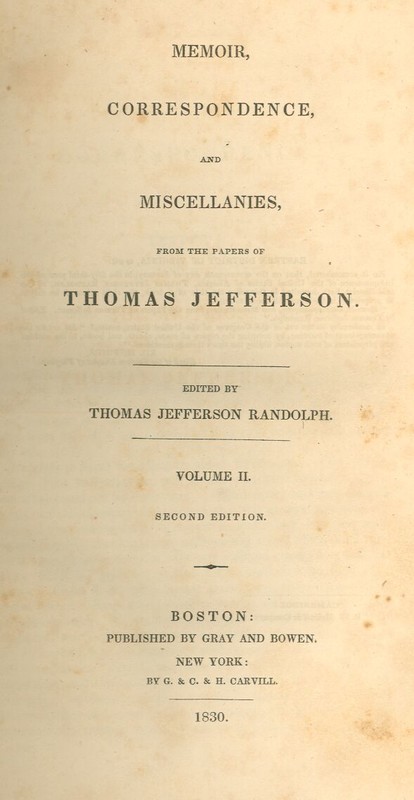
MEMOIR, CORRESPONDENCE, AND MISCELLANIES,
FROM THE PAPERS OF THOMAS JEFFERSON.
Edited by Thomas Jefferson Randolph.
VOLUME TWO
CONTENTS
LETTER I. TO RICHARD HENRY LEE, April 22, 1786
LETTER II. TO CHARLES THOMSON, April 22, 1786
LETTER III. TO JOHN JAY, April 23, 1786
LETTER IV. TO JOHN JAY, April 23, 1786
LETTER V. TO JAMES MADISON, April 25, 1786
LETTER VI. TO THE COUNT DE VERGENNES, May 3, 1786
LETTER VII. TO JOHN PAGE, May 4, 1786
LETTER VIII. TO WILLIAM CARMICHAEL
LETTER IX. TO MR. DUMAS, May 6, 1789
LETTER X. TO WILLIAM DRAYTON, May 6, 1786
LETTER XI. TO W. T. FRANKLIN, May 7, 1786
LETTER XII. TO ELBRIDGE GERRY, May 7, 1786
LETTER XIII. TO JAMES ROSS, May 8, 1786
LETTER XIV. TO T. PLEASANTS, May 8,1786
LETTER XV. TO COLONEL MONROE, May 10,1786
LETTER XVI. TO JOHN ADAMS, May 11, 1786
LETTER XVII. TO LISTER ASQUITH, May 22, 1786
LETTER XVIII. TO JOHN JAY, May 23, 1786
LETTER XIX. TO MR. CARMICHAEL, June 20, 1786
LETTER XX. TO MR. LAMBE, June 20,1786
LETTER XXI.. TO MONSIEUR DE REYNEVAL, June 25, 1786
LETTER XXII. TO THE PREVOT DES MARCHANDS, September 27, 1786
LETTER XXIII. TO COLONEL MONROE, July 9, 1786
LETTER XXIV. TO JOHN ADAMS, July 11, 1786
LETTER XXV. TO JOHN JAY, August 11, 1786
LETTER XXVI. TO COLONEL MONROE, August 11, 1786
LETTER XXVII. TO MR. WYTHE, August 13,1786
LETTER XXVIII. TO MRS. COSWAY, October 12, 1786
LETTER XXIX. TO MRS. COSWAY, October 13, 1786
LETTER XXX. M. LE ROY DE L’ACADEMIE DES SCIENCES, November 13, 1786
LETTER XXXI. TO GENERAL WASHINGTON, November 14, 1786
LETTER XXXII. TO JAMES MADISON, December 16, 1786
LETTER XXXIII. TO CHARLES THOMSON, December 17,1780
LETTER XXXIV. TO COLONEL MONROE, December 18, 1786
LETTER XXXV. TO MR. CARMICHAEL, December 26,1786
LETTER XXXVI. TO MR. VAUGHAN, December 29, 1786
LETTER XXXVII. TO JOHN JAY, December 31, 1786
LETTER XXXVIII. TO SAMUEL OSGOOD, January 5, 1787
LETTER XXXIX. TO JOHN JAY, January 9, 1787
LETTER XL. TO JOHN ADAMS, January 11, 1787
LETTER XLI. TO MONSIEUR LE DUC D’HARCOURT, January 14, 1787
LETTER XLII. TO MONSIEUR DE CREVE-COEUR, January 15,1787
LETTER XLIII. TO COLONEL EDWARD CARRINGTON, January 16, 1787
LETTER XLIV TO JAMES MADISON, January 30, 1787 *
LETTER XLV. TO JOHN JAY, February 1, 1787
LETTER XLVI. TO MRS. BINGHAM, February 7, 1787
LETTER XLVII. TO GOVERNOR RANDOLPH, February 7, 1787
LETTER XLVIII. TO JOHN JAY, February 8, 1787
LETTER XLIX. TO MR. DUMAS, February 9, 1787
LETTER L. TO JOHN JAY, February 14, 1787
LETTER LI. TO JOHN JAY, February 23, 1787
LETTER LII. TO THE MARQUIS DE LA FAYETTE, February 28, 1787
LETTER LIII. TO MADAME LA COMTESSE DE TESSE, March 20, 1787
LETTER LIV. TO THE MARQUIS DE LA FAYETTE, April 11, 1787
LETTER LV. TO WILLIAM SHORT, April 12, 1787
LETTER LVI. TO JOHN JAY, May 4, 1787
LETTER LVII. TO M. GUIDE, May 6, 1787
MEMORANDA TAKEN ON A JOURNEY FROM PARIS IN 1787
LETTER LVIII. TO WILLIAM CARMICHAEL, June 14, 1787
LETTER LIX. TO J. BANNISTER, JUNIOR, June 19, 1787
LETTER LX. TO JAMES MADISON, June 20, 1787*
LETTER LXI. TO JOHN JAY, June 21,1787
LETTER LXII. TO MADAME DE CORNY, June 30,1787
LETTER LXIII. TO JOHN ADAMS, July 1, 1787
LETTER LXIV. TO DAVID HARTLEY, July 2,1787
LETTER LXV. TO B. VAUGHAN, July 2, 1787
LETTER LXVI. TO M. L’ABBE MORELLET, July 2, 1787
OBSERVATIONS ON THE LETTER OF MONSIEUR DE CALONNE
LETTER LXVII. TO T. M. RANDOLPH, JUNIOR, July 6, 1787
LETTER LXVIII. TO STEPHEN CATHALAN, JUNIOR, July 21,1787
LETTER LXIX. TO THE DELEGATES OF RHODE ISLAND, July 22,1787
LETTER LXX. TO THE COUNT DE MONTMORIN, July 23, 1787
LETTER LXXI. TO MR. SKIPWITH, July 28, 1787
LETTER LXXII. TO J. W. EPPES, July 28,1787
LETTER LXXIII. TO A. DONALD, July 28, 1787
LETTER LXXIV. TO WILLIAM DRAYTON, July 30, 1787
LETTER LXXV. TO JAMES MADISON, August 2, 1787
LETTER LXXVI. TO THOMAS BARCLAY, August 3, 1787
LETTER LXXVII. TO E. CARRINGTON, August 4,1787
LETTER LXXVIII. TO DR. CURRIE, August 4, 1787
LETTER LXXIX. TO MR. HAWKINS, August 4, 1787
LETTER LXXX. TO COLONEL MONROE, August 5, 1787
LETTER LXXXI. TO JOHN JAY, August 6,1787
LETTER LXXXII. TO JOHN CHURCHMAN, August 8, 1787
LETTER LXXXIII. TO MONSIEUR L HOMMANDE, August 9, 1787
LETTER LXXXIV. TO PETER CARR, August 10, 1787
LETTER LXXXV. TO DR. GILMER, August 11, 1787
LETTER LXXXVI. TO JOSEPH JONES, August 14, 1787
LETTER LXXXVII. TO GENERAL WASHINGTON, August 14, 1787
LETTER LXXXVIII. TO COLONEL HUMPHREYS, August 14, 1787
LETTER LXXXIX. TO JOHN JAY, August 15, 1787
LETTER XC. TO JOHN ADAMS, August 30, 1787
LETTER XCI. TO MR. WYTHE, September 16,1787
LETTER XCII. TO JOHN JAY, September 19, 1787
LETTER XCIII. TO CHARLES THOMSON, September 20, 1787
LETTER XCIV. TO JOHN JAY, September 22,1787
LETTER XCV. TO JOHN JAY, September 22, 1787
LETTER XCVI. TO MR. CARNES, September 22, 1787
LETTER XCVII. TO JOHN JAY, September 24, 1787
LETTER XCVIII, TO JOHN ADAMS, September 28, 1787
LETTER XCIX. TO COLONEL SMITH, September 28,1787
LETTER C. TO MONSIEUR LE COMTE DE BUFFON, October 3, 1787
LETTER CI. TO MR. DUMAS, October 4,1787
LETTER CII. TO JOHN JAY, October 8, 1787
LETTER CIII. TO JAMES MADISON, October 8, 1787
LETTER CIV. TO JOHN JAY, October 8, 1787
LETTER CV. TO MONSIEUR LE COMTE DE MOUSTIER, October 9,1787
LETTER CVI. TO MADAME DE BREHAN, October 9, 1787
LETTER CVII. TO MR. DUMAS, October 14, 1787
LETTER CVIII. TO MADAME DE CORNY, October 18, 1787
LETTER CIX. TO THE COUNT DE MONTMORIN, October 23, 1787
LETTER CX. TO JOHN JAY, November 3, 1787
LETTER CXI. TO JOHN JAY, November 3, 1787
LETTER CXII. TO THE COUNT DE MONTMORIN, November 6, 1787
LETTER CXIII. TO JOHN ADAMS, November 13, 1787
LETTER CXIV. TO COLONEL SMITH, November 13, 1787
LETTER CXV. TO WILLIAM CARMICHAEL, December 11, 1787
LETTER CXVI. TO JOHN ADAMS
LETTER CXVII. TO JAMES MADISON, December 20, 1787
LETTER CXVIII. TO E. CARRINGTON, December 21, 1787
LETTER CXIX. TO MONSIEUR LIMOZIN, December 22, 1787
LETTER CXX. TO JOHN JAY, December 31, 1787
LETTER CXXI. TO MONSIEUR LAMBERT, January 3, 1788
LETTER CXXII. TO LE COMTE BERNSTORFF, January 21, 1788
LETTER CXXIII. TO WILLIAM RUTLEDGE, February 2, 1788
LETTER CXXIV. TO THE COMMISSIONERS OF THE TREASURY, Feb. 7, 1788
LETTER CXXV. TO DOCTOR PRICE, February 7, 1788
LETTER CXXVI. TO A. DONALD, February.7, 1788
LETTER CXXVII. TO M. WARVILLE, February 12, 1888
LETTER CXXVIII. TO JOHN ADAMS, March 2, 1788
LETTER CXXIX. TO JOHN JAY, March 16, 1788
LETTER CXXX. TO MR. DUMAS, March 29, 1788
LETTER CXXXI. TO THE COMMISSIONERS OF THE TREASURY, March 29, 1788
LETTER CXXXII. TO GENERAL WASHINGTON, May 2, 1788
LETTER CXXXIII. TO JAMES MADISON, May 3,1788
LETTER CXXXIV. TO JOHN JAY, May 4, 1788
LETTER CXXXV. TO THE COUNT DE MOUSTIER, May 17, 1788
LETTER CXXXVI. TO JOHN JAY, May 23,1788
LETTER CXXXVII. TO JOHN BROWN, May 26,1788
LETTER CXXXVIII. TO WILLIAM CARMICHAEL, May 27, 1788
LETTER CXXXIX. TO JOHN JAY, May 27, 1788
LETTER CXL.* TO JAMES MADISON, May 28, 1788
LETTER CXLI. TO PETER CARU, May 23, 1788
LETTER CXLII. TO THE COMTE DE BERNSTORFF, June 19, 1788
LETTER CXLIII. TO THE COUNT DE MONTMORIN, June 20, 1788
LETTER CXLIV. TO DOCTOR GORDON, July 16, 1788
LETTER CXLV. TO JAMES MADISON, July 19, 1788
LETTER CXLVI. TO E. RUTLEDGE, July 18, 1788
LETTER CXLVII. TO MR. BELLINI, July 25,1788
LETTER CXLVIII. TO JAMES MADISON, July 31, 1788
LETTER CXLIX. TO JOHN JAY, August 3, 1788
LETTER CL. TO COLONEL MONROE, August 9, 1788
LETTER CLI. TO MONSIEUR DE CREVE-COEUR, August 9, 1788
LETTER CLII. TO JOHN JAY, August 10, 1788
LETTER CLIII. TO JOHN JAY, August 11, 1788
LETTER CLIV. TO WILLIAM CARMICHAEL, August 12, 1788
LETTER CLV. TO M. CATHALAN, August 13,1788
LETTER CLVI. TO JOHN JAY, August 20,1788
LETTER CLVII. TO MR. CUTTING, August 23, 1788
LETTER CLVIII. TO JOHN JAY, September 3, 1788
LETTER CLIX. TO THE COMMISSIONERS OF THE TREASURY, Sep. 6, 1788
LETTER CLX. TO THE COUNT DE MONTMORIN,
LETTER CLXI. TO M. DE REYNEVAL, September 16, 1788
LETTER CLXII. TO THE MARQUIS DE LA ROUERIE, September 16,1788
LETTER CLXIII. TO WILLIAM SHORT, September 20, 1788
LETTER CLXIV. TO JOHN JAY, September 24,1788
LETTER CLXV. TO M. DE REYNEVAL, October 1, 1788
LETTER CLXVI. TO MR. CUTTING, October 2, 1788
LETTER CLXVIII. TO JAMES MADISON, November 18, 1788
LETTER CLXIX. TO A. DONALD, November 18,1788
LETTER CLXX. TO JOHN JAY, November 19, 1788
LETTER CLXXI. TO JOHN JAY, November 29, 1788
LETTER, CLXXII. TO GENERAL WASHINGTON, December 4, 1788
LETTER CLXXIII. TO JOHN ADAMS, December 5, 1788
LETTER CLXXIV. TO MR. SHORT, December 8, 1788
LETTER CLXXV. TO DOCTOR GILMER, December 16, 1788
LETTER CLXXVI. TO THOMAS PAINE, December 23,1788
LETTER CLXXVII. TO JOHN JAY, January 11, 1789
LETTER CLXXVIII. TO JAMES MADISON, January 12, 1789
LETTER CLXXIX. TO JOHN JAY, January 14, 1789
LETTER CLXXX. TO MADAME NECKER, January 24, 1789
LETTER CLXXXI. TO JOHN JAY, February 1, 1789
LETTER CLXXXII. TO JOHN JAY, February 4, 1789
LETTER CLXXXIII. TO WILLIAM SHORT, February 9,1789
LETTER CLXXXIV. TO M. DE VILLEDEUIL, February 10, 1789
LETTER CLXXXV. TO MR. CARNES, February 15,1789
LETTER CLXXXVI. TO DR. BANCROFT, March 2, 1789
LETTER CLXXXVII. TO M. DE MALESHERBES, March 11, 1789
LETTER CLXXXVIII. TO JOHN JAY, March 12, 1789
LETTER CLXXXIX. TO F. HOPKINSON, March 13, 1789
LETTER CXC. TO MADAME DE BREHAN, March 14, 1789
LETTER CXCI. TO JAMES MADISON, March 15, 1789
LETTER, CXCII. TO THOMAS PAINE, March 17,1789
LETTER CXIII. TO COLONEL HUMPHREYS, March 18, 1789
LETTER CXCIV. TO DOCTOR WILLARD, March 24, 1789
LETTER CXCV. TO J. SARSFIELD, April 3, 1789
LETTER CXCVI. TO THE MARQUIS DE LA FAYETTE, May 6,1789
LETTER CXCVII. TO WILLIAM CARMICHAEL, May 8, 1789
LETTER CXCVIII. TO JOHN JAY, May 9, 1789
LETTER CXCIX. TO GENERAL WASHINGTON, May 10, 1780
LETTER CC. TO JAMES MADISON, May 11,1789
LETTER CCI. TO MONSIEUR DE PONTIERE, May 17, 1789
LETTER CCII. TO MR. VAUGHAN, May 17, 1789
LETTER CCIII. TO THOMAS PAINE, May 19,1789
LETTER CCIV. TO MONSIEUR DE ST. ETIENNE, June 3, 1789
LETTER CCV. TO THE MARQUIS DE LA FAYETTE, June 12, 1789
LETTER CCVI. TO JOHN JAY, June 17, 1789
LETTER CCVII. TO JAMES MADISON, June 18, 1789
LETTER CCVIII. TO JOHN JAY, June 24,1789
LETTER CCIX. TO JOHN JAY, June 29, 1789
LETTER CCX. TO THE MARQUIS DE LA FAYETTE, July 6, 1789
LETTER CCXI. TO THE MARQUIS DE LA FAYETTE, July 7,1789
LETTER CCXII. TO MR. NECKER, July 8, 1789
LETTER CCXIII. TO THE COUNT DE MONTMORIN, July 8, 1789
LETTER CCXIV. TO THE MARQUIS DE LA FAYETTE, July 9, 1789
LETTER CCXV. TO THE MARQUIS DE LA FAYETTE, July 10, 1789
LETTER CCXVI. TO THOMAS PAINE, July 11, 1789
List of Illustrations
Book Spines, 1829 Set of Jefferson Papers
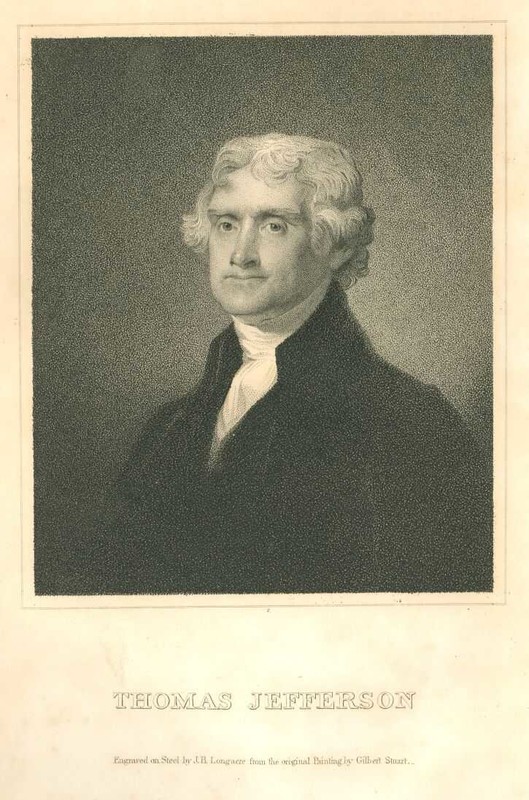
Steel Engraving by Longacre from Painting of G. Stuart
Titlepage of Volume Two (of Four)
Greek Phrase Page216
LETTER I.—TO RICHARD HENRY LEE, April 22, 1786
TO RICHARD HENRY LEE.
London, April 22, 1786.
Dear Sir,
In your letter of October the 29th, you desired me to send you one of the new lamps. I tried at every probable place in Paris, and could not get a tolerable one. I have been glad of it since I came here, as I find them much better made here. I now deliver one, with this letter, into the hands of Mr. Fulwar Skipwith, a merchant from Virginia, settled here, who promises to send it to you, with one for Mr. C. Thomson. Of this be pleased to accept, from me. It is now found, that they may be used with almost any oil.
I expect to leave this place in about three days. Our public letters, joint and separate, will inform you what has been done, and what could not be done here. With respect to a commercial treaty with this country, be assured, that this government not only has it not in contemplation at present to make any, but that they do not conceive that any circumstances will arise, which shall render it expedient for them to have any political connection with us. They think we shall be glad of their commerce on their own terms. There is no party in our favor here, either in power or out of power. Even the opposition concur with the ministry and the nation in this. I can scarcely consider as a party, the Marquis of Lansdowne, and a half dozen characters about him, such as Dr. Price, &c. who are impressed with the utility of a friendly connection with us. The former does not venture this sentiment in parliament, and the latter are not in situations to be heard. The Marquis of Lansdowne spoke to me affectionately of your brother, Doctor Lee, and desired his respects to him, which I beg leave to communicate through you. Were he to come into the ministry (of which there is not the most distant prospect), he must adopt the King’s system, or go out again, as he did before, for daring to depart from it. When we see, that through all the changes of ministry, which have taken place during the present reign, there has never been a change of system with respect to America, we cannot reasonably doubt, that this is the system of the King himself. His obstinacy of character we know; his hostility we have known, and it is embittered by ill success. If ever this nation, during his life, enter into arrangements with us, it must be in consequence of events, of which they do not at present see a possibility. The object of the present ministry is to buoy up the nation with flattering calculations of their present prosperity, and to make them believe they are better without us than with us. This they seriously believe; for what is it men cannot be made to believe? I dined the other day in a company of the ministerial party. A General Clark, a Scotchman and ministerialist, sat next to me. He introduced the subject of American affairs, and in the course of the conversation told me, that were America to petition parliament to be again received on their former footing, the petition would be very generally rejected. He was serious in this, and I think it was the sentiment of the company, and is the sentiment perhaps of the nation. In this they are wise, but for a foolish reason. They think they lost more by suffering us to participate of their commercial privileges, at home and abroad, than they lose by our political severance. The true reason, however, why such an application should be rejected, is, that in a very short time we should oblige them to add another hundred millions to their debt, in unsuccessful attempts to retain the subjection offered to them. They are at present in a frenzy, and will not be recovered from it, till they shall have leaped the precipice they are now so boldly advancing to. Writing from England, I write you nothing but English news. The continent, at present, furnishes nothing interesting. I shall hope the favor of your letters, at times. The proceedings and views of Congress and of the Assemblies, the opinions and dispositions of our people in general, which, in governments like ours, must be the foundation of measures, will always be interesting to me, as will whatever respects your own health and happiness; being with great esteem,
Dear Sir, your most obedient
and most humble servant,
Th: Jefferson
LETTER II.—TO CHARLES THOMSON, April 22, 1786
TO CHARLES THOMSON.
London, April 22, 1786.
Dear Sir,
In one of your former letters, you expressed a wish to have one of the newly invented lamps. I find them made here much better than at Paris, and take the liberty of asking your acceptance of one, which will accompany this letter. It is now found, that any tolerable oil may be used in them. The spermaceti oil is best, of the cheap kinds.
I could write you volumes on the improvements which I find made, and making here, in the arts. One deserves particular notice, because it is simple, great, and likely to have extensive consequences. It is the application of steam, as an agent for working grist-mills. I have visited the one lately made here. It was at that time turning eight pair of stones. It consumes one hundred bushels of coal a day. It is proposed to put up thirty pair of stones. I do not know whether the quantity of fuel is to be increased. I hear you are applying the same agent in America to navigate boats, and I have little doubt, but that it will be applied generally to machines, so as to supersede the use of water ponds, and of course to lay open all the streams for navigation. We know, that steam is one of the most powerful engines we can employ; and in America fuel is abundant. I find no new publication here worth sending to you. I shall set out for Paris within three or four days. Our public letters will inform you of our public proceedings here.
I am, with sincere esteem, Dear Sir,
your friend and servant,
Th: Jefferson.
LETTER III.—TO JOHN JAY, April 23, 1786
TO JOHN JAY.
London, April 23, 1786.
Sir,
In my letter of March the 12th, I had the honor of explaining to you the motives which had brought me to this place. A joint letter from Mr. Adams and myself, sent by the last packet, informed you of the result of our conferences with the Tripoline minister. The conferences with the minister of Portugal have, been drawn to a greater length than I expected. However, every thing is now agreed, and the treaty will be ready for signature the day after to-morrow. I shall set out for Paris the same day. With this country nothing is done: and that nothing is intended to be done, on their part, admits not the smallest doubt. The nation is against any change of measures: the ministers are against it; some from principle, others from subserviency: and the King, more than all men, is against it. If we take a retrospect to the beginning of the present reign, we observe, that amidst all the changes of ministry, no change of measures with respect to America ever took place; excepting only at the moment of the peace; and the minister of that moment was immediately removed. Judging of the future by the past, I do not expect a change of disposition during the present reign, which bids fair to be a long one, as the King is healthy and temperate. That he is persevering, we know. If he ever changes his plan, it will be in consequence of events, which, at present, neither himself nor his ministers place among those which are probable. Even the opposition dare not open their lips in favor of a connection with us, so unpopular would be the topic. It is not, that they think our commerce unimportant to them. I find that the merchants here set sufficient value on it. But they are sure of keeping it on their own terms. No better proof can be shown of the security in which the ministers think themselves on this head, than that they have not thought it worth while to give us a conference on the subject, though, on my arrival, we exhibited to them our commission, observed to them that it would expire on the 12th of the next month, and that I had come over on purpose to see if any arrangements could be made before that time. Of two months which then remained, six weeks have elapsed without one scrip of a pen, or one word from a minister, except a vague proposition at an accidental meeting. We availed ourselves even of that, to make another essay to extort some sort of declaration from the court. But their silence is invincible. But of all this, as well as of the proceedings in the negotiation with Portugal, information will be given you by a joint letter from Mr. Adams and myself. The moment is certainly arrived, when, the plan of this court being out of all doubt, Congress and the States may decide what their own measures should be.
The Marquis of Lansdowne spoke of you in very friendly terms, and desired me to present his respects to you, in the first letter I should write. He is thoroughly sensible of the folly of the present measures of this country, as are a few other characters about him. Dr. Price is among these, and is particularly disturbed at the present prospect. He acknowledges, however, that all change is desperate: which weighs the more, as he is intimate with Mr. Pitt. This small band of friends, favorable as it is, does not pretend to say one word in public on our subject.
I have the honor to be, with sentiments of the highest esteem and respect,
Sir, your most obedient
and most humble servant,
Th: Jefferson.
LETTER IV.—TO JOHN JAY, April 23, 1786
TO JOHN JAY.
London, April 23, 1786.
Sir,
In another letter of this day, I stated to you what had passed with public characters since my arrival here. Conversations with private individuals, I thought it best not to mingle with the contents of that letter. Yet, as some have taken place, which relate to matters within our instructions, and with persons whose opinions deserve to have some weight, I will take the liberty of stating them. In a conversation with an ancient and respectable merchant of this place, such a view of the true state of the commercial connections of America and Great Britain was presented to him, as induced him to acknowledge they had been mistaken in their opinions, and to ask, that Mr. Adams and myself would permit the chairman of the committee of American merchants to call on us. He observed, that the same person happened to be also chairman of the committee of the whole body of British merchants; and that such was the respect paid to his person and office, that we might consider what came from him, as coming from the committees themselves. He called on us at an appointed hour. He was a Mr. Duncan Campbell, formerly much concerned in the American trade. We entered on the subject of the non-execution of the late treaty of peace, alleged on both sides. We observed, that the refusal to deliver the western posts, and the withdrawing American property, contrary to express stipulation, having preceded what they considered as breaches on our part, were to be considered as the causes of our proceedings. The obstructions thrown by our legislatures in the way of the recovery of their debts, were insisted on by him. We observed to him, that the great amount of the debt from America to Great Britain, and the little circulating coin in the formeer country, rendered an immediate payment impossible; that time was necessary; that we had been authorized to enter into explanatory arrangements on this subject; that we had made overtures for the purpose, which had not been attended to, and that the States had, therefore, been obliged to modify the article for themselves. He acknowledged the impossibility of immediate payment, the propriety of an explanatory convention, and said, that they were disposed to allow a reasonable time. We mentioned the term of five years, including the present; but that judgments might be allowed immediately, only dividing the execution into equal and annual parts, so that the last should be levied by the close of the year 1790. This seemed to be quite agreeable to him, and to be as short a term as would be insisted on by them. Proceeding to the sum to be demanded, we agreed that the principal, with the interest incurring before and after the war, should be paid; but as to that incurring during the war, we differed from him. He urged its justice with respect to themselves, who had laid out of the use of their money during that period. This was his only topic. We opposed to it all those which circumstances, both public and private, gave rise to. He appeared to feel their weight, but said the renunciation of this interest was a bitter pill, and such a one as the merchants here could not swallow. He wished, that no declaration should be made as to this article: but we observed, that if we entered into explanatory declarations of the points unfavorable to us, we should expect, as a consideration for this, corresponding declarations on the parts in our favor. In fact, we supposed his view was to leave this part of the interest to stand on the general expressions of the treaty, that they might avail themselves, in individual cases, of the favorable dispositions of debtors or of juries. We proceeded to the necessity of arrangements of our future commerce, were it only as a means of enabling our country to pay its debts. We suggested, that they had been contracted while certain modes of remittance had existed here, which had been an inducement to us to contract these debts. He said he was not authorized to speak on the subject of the future commerce. He appeared really and feelingly anxious, that arrangements should be stipulated as to the payment of the old debts, said he would proceed in that moment to Lord Caermarthen’s, and discuss the subject with him, and that we might expect to hear from him. He took leave, and we have never since heard from him or any other person on the subject. Congress will judge how far these conversations should influence their future proceedings, or those of the States.
I have the honor to be, with the highest respect and esteem, Sir, your most obedient, humble servant,
Th: Jefferson.
LETTER V.—TO JAMES MADISON, April 25, 1786
TO JAMES MADISON.
London, April 25, 1786.
Dear Sir,
Some of the objects of the joint commission, with which we were honored by Congress, called me to this place about six weeks ago. To-morrow I set out on my return to Paris. With this nation nothing is done; and it is now decided, that they intend to do nothing with us.
I wrote you, in a former letter, on the subject of a Mr. Paradise, who owns an estate in Virginia in right of his wife, and who has a considerable sum due to him in our loan office. Since I came here, I have had opportunities of knowing his extreme personal worth, and his losses by the late war. He is, from principle, a pure republican, while his father was as warm a tory. His attachment to the American cause, and his candid warmth, brought him sometimes into altercations on the subject with his father, and some persons interested in their variance, artfully brought up this subject of conversation whenever they met. It produced a neglect in the father. He had already settled on him a sum of money in the funds: but would do no more, and probably would have undone that, if he could. When remittances from Virginia were forbidden, the profits of the Virginia estate were carried into our loan office. Paradise was then obliged to begin to eat his capital in England: from that, to part with conveniences, and to run in debt. His situation is now distressing; and would be completely relieved, could he receive what is due to him from our State. He is coming over to settle there. His wife and family will follow him. I never ask unjust preferences for any body. But if, by any just means, he can be helped to his money, I own I should be much gratified. The goodness of his heart, his kindness to Americans before, during, and since the war, the purity of his political and moral character, interest me in the events impending over him, and which will infallibly be ruinous, if he fails to receive his money. I ask of you, on his behalf, that in pursuing the path of right, you will become active for him, instead of being merely quiescent, as you might be, were his merit and his misfortunes unknown to you.
I have put into the hands of Mr. Fulwar Skipwith for you, a packet containing some catalogues, which he will forward. I am, with very sincere esteem, Dear Sir,
your friend and servant,
Th: Jefferson.
LETTER VI.—TO THE COUNT DE VERGENNES, May 3, 1786
TO THE COUNT DE VERGENNES.
Paris, May 3, 1786.
Sir,
After begging leave to present my respects to your Excellency, on my return to this place, I take the liberty of offering to your attention some papers, which I found on my arrival here, written by sundry merchants of L’Orient and others, some of whom are citizens of the United States, and all of them concerned in the trade between the two countries. This has been carried on by an exchange of the manufactures and produce of this country, for the produce of that, and principally for tobacco, which, though, on its arrival here, confined to a single purchaser, has been received equally from all sellers. In confidence of a continuance of this practice, the merchants of both countries were carrying on their commerce of exchange. A late contract by the Farm has, in a great measure, fixed in a single mercantile house the supplies of tobacco wanted for this country. This arrangement found the established merchants with some tobacco on hand, some on the seas coming to them, and more still due. By the papers now enclosed, it seems, that there are six thousand four hundred and eight hogsheads in the single port of L’Orient. Whether government may interfere, as to articles furnished by the merchants after they had notice of the contract before mentioned, must depend on principles of policy. But those of justice seem to urge, that, for commodities furnished before such notice, they should be so far protected, as that they may wind up, without loss, the transactions in which the new arrangement found them actually engaged. Your Excellency is the best judge, how far it may be consistent with the rules of government, to interfere for their relief, and with you, therefore, I beg leave entirely to rest their interests.
Information lately received, relative to the Barbary States, has suggested, that it might be expedient, and perhaps necessary for us, to pave the way to arrangements with them, by a previous application to the Ottoman Porte. Your Excellency’s intimate acquaintance with this subject would render your advice to us equally valuable and desirable. If you would be pleased to permit me to wait on you, any day or hour which shall be most convenient to yourself, I should be much gratified by a little conversation with you on this subject.
I have the honor to be, with great respect, your Excellency’s most obedient
and most humble servant,
Th: Jefferson.
LETTER VII.—TO JOHN PAGE, May 4, 1786
TO JOHN PAGE.
Paris, May 4, 1786.
Dear Sir,
Your two favors of March the 15th and August the 23, 1785, by Monsieur de la Croix, came to hand on the 15th of November. His return gives me an opportunity of sending you a copy of the Nautical Almanacs for 1786, 7, 8, 9. There is no late and interesting publication here, or I would send it by the same conveyance. With these almanacs, I pack a copy of some Notes I wrote for Monsieur de Marbois, in the year 1781, of which I had a few printed here. They were written in haste, and for his private inspection. A few friends having asked copies, I found it cheaper to print than to write them. They will offer nothing new to you, not even as an oblation of my friendship for you, which is as old almost as we are ourselves. Mazzei brought me your favor of April the 27th. I thank you much for your communications. Nothing can be more grateful at such a distance. It is unfortunate, that most people think the occurrences passing daily under their eyes, are either known to all the world, or not worth being known. They therefore do not give them place in their letters. I hope you will be so good as to continue your friendly information. The proceedings of our public bodies, the progress of the public mind on interesting questions, the casualties which happen among our private friends, and whatever is interesting to yourself and family, will always be anxiously received by me. There is one circumstance in the work you were concerned in, which has not yet come to my knowledge; to wit, How far westward from Fort Pitt, does the western boundary of Pennsylvania pass, and where does it strike the Ohio? The proposition you mention from Mr. Anderson, on the purchase of tobacco, I would have made use of, but that I have engaged the abuses of the tobacco trade on a more general scale. I confess their redress is by no means certain; but till I see all hope of removing the evil by the roots desperate, I cannot propose to prune its branches.
I returned but three or four days ago, from a two months’ trip to England. I traversed that country much, and own, both town and country fell short of my expectations. Comparing it with this, I found a much greater proportion of barrens, a soil, in other parts, not naturally so good as this, not better cultivated, but better manured, and therefore more productive. This proceeds from the practice of long leases there, and short ones here. The laboring people here, are poorer than in England. They pay about one half their produce in rent; the English, in general, about a third. The gardening, in that country, is the article in which it surpasses all the earth. I mean their pleasure gardening. This, indeed, went far beyond my ideas. The city of London, though handsomer than Paris, is not so handsome as Philadelphia. Their architecture is in the most wretched style I ever saw, not meaning to except America, where it is bad, nor even Virginia, where it is worse than in any other part of America which I have seen. The mechanical arts in London are carried to a wonderful perfection. But of these I need not speak, because, of them my countrymen have unfortunately too many samples before their eyes. I consider the extravagance which has seized them, as a more baneful evil than toryism was during the war. It is the more so, as the example is set by the best and most amiable characters among us. Would a missionary appear, who would make frugality the basis of his religious system, and go through the land, preaching it up as the only road to salvation, I would join his school, though not generally disposed to seek my religion out of the dictates of my own reason, and feelings of my own heart. These things have been more deeply impressed on my mind, by what I have heard and seen in England. That nation hate us, their ministers hate us, and their King, more than all other men. They have the impudence to avow this, though they acknowledge our trade important to them. But they think, we cannot prevent our countrymen from bringing that into their laps. A conviction of this determines them to make no terms of commerce with us. They say, they will pocket our carrying trade as well as their own. Our overtures of commercial arrangements have been treated with a derision, which shows their firm persuasion, that we shall never unite to suppress their commerce, or even to impede it. I think their hostility towards us is much more deeply rooted at present, than during the war. In the arts, the most striking thing I saw there, new, was the application of the principle of the steam-engine to grist-mills. I saw eight pair of stones which are worked by steam, and there are to be set up thirty pair in the same house. A hundred bushels of coal, a day, are consumed at present. I do not know in what proportion the consumption will be increased by the additional gear.
Be so good as to present my respects to Mrs. Page and your family, to W. Lewis, F. Willis, and their families, and to accept yourself assurances of the sincere regard, with which I am, Dear Sir, your affectionate friend and servant,
Th: Jefferson.
LETTER VIII.—TO WILLIAM CARMICHAEL
TO WILLIAM CARMICHAEL.
Paris, May 5, 1786.
Dear Sir,
A visit of two months to England has been the cause of your not hearing from me during that period. Your letters of February the 3rd, to Mr. Adams and myself, and of February the 4th, to me, had come to hand before my departure. While I was in London, Mr. Adams received the letters giving information of Mr. Lambe’s arrival at Algiers. In London, we had conferences with a Tripoline ambassador, now at that court, named Abdrahaman. He asked us thirty thousand guineas for a peace with his court, and as much for Tunis, for which he said he could answer. What we were authorized to offer, being to this, but as a drop to a bucket, our conferences were repeated, only for the purpose of obtaining information. If the demands of Algiers and Morocco should be proportioned to this, according to their superior power, it is easy to foresee that the United States will not buy a peace with money. What principally led me to England was, the information that the Chevalier del Pinto, Portuguese minister at that court, had received full powers to treat with us. I accordingly went there, and, in the course of six weeks, we arranged a commercial treaty between our two countries. His powers were only to negotiate, not to sign. And as I could not wait, Mr. Adams and myself signed, and the Chevalier del Pinto expected daily the arrival of powers to do the same. The footing on which each has placed the other, is that of the most favored nation. We wished much to have had some privileges in their American possessions: but this was not to be effected. The right to import flour into Portugal, though not conceded by the treaty, we are not without hopes of obtaining.
My journey furnished us occasion to renew our overtures to the court of London; which it was the more important to do, as our powers to that court were to expire on the 12th of this month. These overtures were not attended to, and our commission expiring, we made our final report to Congress; and I suppose this the last offer of friendship, which will ever be made on our part. The treaty of peace being unexecuted on either part, in important points, each will now take their own measures for obtaining execution. I think the King, ministers, and nation are more bitterly hostile to us at present, than at any period of the late war. A like disposition on our part, has been rising for some time. In what events these things will end, we cannot foresee. Our countrymen are eager in their passions and enterprise, and not disposed to calculate their interests against these. Our enemies (for such they are, in fact) have for twelve years past, followed but one uniform rule, that of doing exactly the contrary of what reason points out. Having early, during our contest, observed this in the British conduct, I governed myself by it, in all prognostications of their measures; and I can say, with truth, it never failed me but in the circumstance of their making peace with us. I have no letters from America of later date than the new year. Mr. Adams had, to the beginning of February. I am in hopes our letters will give a new spur to the proposition, for investing Congress with the regulation of our commerce.
This will be handed you by a Baron Waltersdorf, a Danish gentleman, whom, if you did not already know, I should take the liberty of recommending to you. You were so kind as to write me, that you would forward me a particular map, which has not come to hand.
I beg you to be assured of the respect and esteem, with which I have the honor to be, Dear Sir,
your most obedient
and most humble servant,
Th: Jefferson.
LETTER IX.—TO MR. DUMAS, May 6, 1789
TO MR. DUMAS.
Paris, May 6, 1789.
Sir,
Having been absent in England, for some time past, your favors of February the 27th, March the 28th, and April the 11th, have not been acknowledged so soon as they should have been. I am obliged to you, for assisting to make me known to the Rhingrave de Salm and the Marquis de la Coste, whose reputations render an acquaintance with them desirable. I have not yet seen either: but expect that honor from the Rhingrave very soon. Your letters to Mr. Jay and Mr. Van Berkel, received in my absence, will be forwarded by a gentleman who leaves this place for New York, within a few days. I sent the treaty with Prussia by a gentleman who sailed from Havre, the 11th of November. The arrival of that vessel in America is not yet known here. Though the time is not long enough to produce despair, it is sufficiently so to give inquietude lest it should be lost. This would be a cause of much concern to me: I beg the favor of you to mention this circumstance to the Baron de Thulemeyer, as an apology for his not hearing from us. The last advices from America bring us nothing interesting. A principal object of my journey to London was, to enter into commercial arrangements with Portugal. This has been done almost in the precise terms of those of Prussia. The English are still our enemies. The spirit existing there, and rising in America, has a very lowering aspect. To what events it may give birth, I cannot foresee. We are young, and can survive them; but their rotten machine must crush under the trial. The animosities of sovereigns are temporary, and may be allayed: but those which seize the whole body of a people, and of a people, too, who dictate their own measures, produce calamities of long duration. I shall not wonder to see the scenes of ancient Rome and Carthage renewed in our day; and if not pursued to the same issue, it may be, because the republic of modern powers will not permit the extinction of any one of its members. Peace and friendship with all mankind is our wisest policy: and I wish we may be permitted to pursue it. But the temper and folly of our enemies may not leave this in our choice. I am happy in our prospect of friendship with the most estimable powers of Europe, and particularly with those of the confederacy, of which yours is. That your present crisis may have a happy issue, is the prayer and wish of him, who has the honor to be, with great respect and esteem, Sir, your most obedient humble servant,
Th: Jefferson.
LETTER X.—TO WILLIAM DRAYTON, May 6, 1786
TO WILLIAM DRAYTON.
Paris, May 6, 1786.
Sir,
Your favor of November the 23rd came duly to hand. A call to England, soon after its receipt, has prevented my acknowledging it so soon as I should have done. I am very sensible of the honor done me by the South Carolina society for promoting and improving agriculture and other rural concerns, when they were pleased to elect me to be of their body: and I beg leave, through you, Sir, to convey to them my grateful thanks for this favor. They will find in me, indeed, but a very unprofitable servant. At present, particularly, my situation is unfavorable to the desire I feel, of promoting their views. However, I shall certainly avail myself of every occasion, which shall occur of doing so. Perhaps I may render some service, by forwarding to the society such new objects of culture, as may be likely to succeed in the soil and climate of South Carolina. In an infant country, as ours is, these experiments are important. We are probably far from possessing, as yet, all the articles of culture for which nature has fitted our country. To find out these, will require abundance of unsuccessful experiments. But if in a multitude of these, we make one useful acquisition, it repays our trouble. Perhaps it is the peculiar duty of associated bodies, to undertake these experiments. Under this sense of the views of the society, and with so little opportunity of being otherwise useful to them, I shall be attentive to procure for them the seeds of such plants, as they will be so good as to point out to me, or as shall occur to myself as worthy their notice. I send at present, by Mr. McQueen, some seeds of a grass, found very useful in the southern parts of Europe, and particularly, and almost solely, cultivated in Malta. It is called by the names of Sulla, and Spanish St. Foin, and is the Hedysarum coronarium of Linnaeus. It is usually sown early in autumn. I shall receive a supply of fresher seed this fall, which I will also do myself the honor of forwarding to you. I expect, in the same season, from the south of France, some acorns of the cork oak, which I propose for your society, as I am persuaded they will succeed with you. I observed it to grow in England, without shelter; not well indeed; but so as to give hopes that it would do well with you. I shall consider myself as always honored by the commands of the society, whenever they shall find it convenient to make use of me, and beg you to be assured, personally, of the sentiments of respect and esteem, with which I have the honor to be, Sir, your most obedient and most humble servant,
Th: Jefferson.
LETTER XI.—TO W. T. FRANKLIN, May 7, 1786
TO W. T. FRANKLIN.
Paris, May 7, 1786.
Dear Sir,
On my return from a two months’ visit to England, I found here your favor of January the 18th. This contains the latest intelligence I have from America. Your effects not being then arrived, gives me anxiety for them, as I think they went in a vessel, which sailed from Havre the 11th of November. In this vessel, went also the two Mr. Fitzhughs of Virginia, with the Prussian treaty, our papers relative to the Barbary States, with the despatches for Congress, and letters which I had been writing to other persons in America for six weeks preceding their departure. I am obliged to you for the information as to Dr. Franklin’s health, in which I feel a great interest. I concur in opinion with you, that in the present factious division of your State, an angel from heaven could do no good. I have been sorry, therefore, from the beginning, to see such time as Dr. Franklin’s wasted on so hopeless a business. You have formed a just opinion of Monroe. He is a man whose soul might be turned wrong side outwards, without discovering a blemish to the world. I wish with all my heart, Congress may call you into the diplomatic line, as that seems to have attracted your own desires. It is not one in which you can do any thing more, than pass the present hour agreeably, without any prospect to future provision. Perhaps the arrangements with Portugal, by adding to the number of those appointments, may give Congress an opportunity of doing justice to your own, and to Dr. Franklin’s services. If my wishes could aid you, you have them sincerely. My late return to this place scarcely enables me to give you any of its news. I have not yet called on M. La Veillard, or seen any of your acquaintances. The marriage of the ambassador of Sweden with Miss Necker, you have heard of. Houdon is about taking a wife also. His bust of the General has arrived, and meets the approbation of those who know the original. Europe enjoys a perfect calm, at present. Perhaps it may be disturbed by the death of the King of Prussia, which is constantly expected. As yet, we have no information from the Barbary States, which may enable us to prognosticate the success of our endeavors to effect a peace in that quarter. Present me respectfully and affectionately to Dr. Franklin, and accept assurances of the esteem, with which I am, Dear Sir, your friend and servant,
Th: Jefferson.
LETTER XII.—TO ELBRIDGE GERRY, May 7, 1786
TO ELBRIDGE GERRY.
Paris, May 7, 1786.
Dear Sir,
My last to you was of the 11th of October. Soon after that, your favor of the 12th of September came to hand. My acknowledgment of this is made later than it should have been, by my trip to England. Your long silence I ascribe to a more pleasing cause, that of devoting your spare time to one more capable of filling it with happiness, and to whom, as well as to yourself, I wish all those precious blessings which this change of condition is calculated to give you.
My public letters to Mr. Jay will have apprized you of my journey to England, and of its motives; and the joint letters of Mr. Adams and myself, of its effects. With respect to Portugal, it produced arrangements; with respect to England and Barbary, only information. I am quite at a loss what you will do with England. To leave her in possession of our posts, seems inadmissible; and yet to take them, brings on a state of things, for which we seem not to be in readiness. Perhaps a total suppression of her trade, or an exclusion of her vessels from the carriage of our produce, may have some effect; but I believe not very great. Their passions are too deeply and too universally engaged in opposition to us. The ministry have found means to persuade the nation, that they are richer than they were while we participated of their commercial privileges. We should try to turn our trade into other channels. I am in hopes this country will endeavor to give it more encouragement. But what will you do with the piratical States? Buy a peace at their enormous price; force one; or abandon the carriage into the Mediterranean to other powers? All these measures are disagreeable. The decision rests with you. The Emperor is now pressing a treaty with us. In a commercial view, I doubt whether it is desirable: but in a political one, I believe it is. He is now undoubtedly the second power in Europe, and on the death of the King of Prussia, he becomes the first character. An alliance with him will give us respectability in Europe, which we have occasion for. Besides, he will be at the head of the second grand confederacy of Europe, and may at any time serve us with the powers constituting that. I am pressed on so many hands to recommend Dumas to the patronage of Congress, that I cannot avoid it. Every body speaks well of him, and his zeal in our cause. Any thing done for him will gratify this court, and the patriotic party in Holland, as well as some distinguished individuals. I am induced, from my own feelings, to recommend Colonel Humphreys to your care. He is sensible, prudent, and honest, and may be very firmly relied on, in any office which requires these talents. I pray you to accept assurance of the sincere esteem and respect, with which I am,
Dear Sir, your most obedient
and most humble servant,
Th: Jefferson.
LETTER XIII.—TO JAMES ROSS, May 8, 1786
TO JAMES ROSS.
Paris, May 8, 1786.
Dear Sir,
I have duly received your favor of October the 22nd, and am much gratified by the communications therein made. It has given me details, which do not enter into the views of my ordinary correspondents, and which are very entertaining. I experience great satisfaction at seeing my country proceed to facilitate the intercommunications of its several parts, by opening rivers, canals, and roads. How much more rational is this disposal of public money, than that of waging war.
Before the receipt of your letter, Morris’s contract for sixty thousand hogsheads of tobacco was concluded with the Farmers General. I have been for some time occupied in endeavoring to destroy the root of the evils, which the tobacco trade encounters in this country, by making the ministers sensible, that merchants will not bring a commodity to a market, where but one person is allowed to buy it; and that so long as that single purchaser is obliged to go to foreign markets for it, he must pay for it in coin, and not in commodities. These truths have made their way to the minds of the ministry, insomuch, as to have delayed the execution of the new lease of the Farms, six months. It is renewed, however, for three years, but so as not to render impossible a reformation of this great evil. They are sensible of the evil, but it is so interwoven with their fiscal system, that they find it hazardous to disentangle. The temporary distress, too, of the revenue, they are not prepared to meet. My hopes, therefore, are weak, though not quite desperate. When they become so, it will remain to look about for the best palliative this monopoly can bear. My present idea is, that it will be found in a prohibition to the Farmers General, to purchase tobacco any where but in France. You will perceive by this, that my object is to strengthen the connection between this country and my own in all useful points. I am of opinion, that twenty-three thousand hogsheads of tobacco, the annual consumption of this country, do not exceed the amount of those commodities, which it is more advantageous to us to buy here than in England, or elsewhere; and such a commerce would powerfully reinforce the motives for a friendship from this country towards ours. This friendship we ought to cultivate closely, considering the present dispositions of England towards us.
I am lately returned from a visit to that country. The spirit of hostility to us has always existed in the mind of the King, but it has now extended itself through the whole mass of the people, and the majority in the public councils. In a country, where the voice of the people influences so much the measures of administration, and where it coincides with the private temper of the King, there is no pronouncing on future events. It is true, they have nothing to gain, and much to lose, by a war with us. But interest is not the strongest passion in the human breast. There are difficult points, too, still unsettled between us. They have not withdrawn their armies out of our country, nor given satisfaction for the property they brought off. On our part, we have not paid our debts, and it will take time to pay them. In conferences with some distinguished mercantile characters, I found them sensible of the impossibility of our paying these debts at once, and that an endeavor to force universal and immediate payment, would render debts desperate, which are good in themselves. I think we should not have differed in the term necessary. We differed essentially in the article of interest. For while the principal, and interest preceding and subsequent to the war, seem justly due from us, that which accrued during the war does not. Interest is a compensation for the use of money. Their money, in our hands, was in the form of lands and negroes. Tobacco, the produce of these lands and negroes (or, as I may call it, the interest for them), being almost impossible of conveyance to the markets of consumption, because taken by themselves in its way there, sold during the war at five or six shillings the hundred. This did not pay taxes, and for tools, and other plantation charges. A man who should have attempted to remit to his creditor tobacco, for either principal or interest, must have remitted it three times before one cargo would have arrived safe: and this from the depredations of their own nation, and often of the creditor himself; for some of the merchants entered deeply into the privateering business. The individuals who did not, say they have lost this interest: the debtor replies, that he has not gained it, and that it is a case where, a loss having been incurred, every one tries to shift it from himself. The known bias of the human mind from motives of interest should lessen the confidence of each party in the justice of their reasoning: but it is difficult to say, which of them should make the sacrifice, both of reason and interest. Our conferences were intended as preparatory to some arrangement. It is uncertain how far we should have been able to accommodate our opinions. But the absolute aversion of the government to enter into any arrangement prevented the object from being pursued. Each country is left to do justice to itself and to the other, according to its own ideas as to what is past; and to scramble for the future as well as they can: to regulate their commerce by duties and prohibitions, and perhaps by cannons and mortars; in which event, we must abandon the ocean, where we are weak, leaving to neutral nations the carriage of our commodities; and measure with them on land, where they alone can lose. Farewell, then, all our useful improvements of canals and roads, reformations of laws, and other rational employments. I really doubt, whether there is temper enough, on either side, to prevent this issue of our present hatred. Europe is, at this moment, without the appearance of a cloud. The death of the King of Prussia, daily expected, may raise one. My paper admonishes me, that, after asking a continuance of your favors, it is time for me to conclude with assurances of the esteem with which I am,
Dear Sir, your friend and servant,
Th: Jefferson.
LETTER XIV.—TO T. PLEASANTS, May 8,1786
TO T. PLEASANTS.
Paris, May 8,1786.
Dear Sir,
At the time of the receipt of your favor of October the 24th, the contract between the Farmers General and Mr. Morris, for tobacco, was concluded, and in a course of execution. There was no room, therefore, to offer the proposals which accompanied your letter. I was, moreover, engaged in endeavors to have the monopoly, in the purchase of this article, in this country, suppressed. My hopes on that subject are not desperate, but neither are they flattering. I consider it as the most effectual means of procuring the full value of our produce, of diverting our demands for manufactures from Great Britain to this country, to a certain amount, and of thus producing some equilibrium in our commerce, which at present lies all in the British scale. It would cement an union with our friends, and lessen the torrent of wealth which we are pouring into the laps of our enemies. For my part, I think that the trade with Great Britain is a ruinous one to ourselves; and that nothing would be an inducement to tolerate it, but a free commerce with their West Indies: and that this being denied to us, we should put a stop to the losing branch. The question is, whether they are right in their prognostications, that we have neither resolution nor union enough for this. Every thing I hear from my own country, fills me with despair as to their recovery from their vassalage to Great Britain. Fashion and folly are plunging them deeper and deeper into distress: and the legislators of the country becoming debtors also, there seems no hope of applying the only possible remedy, that of an immediate judgment and execution. We should try, whether the prodigal might not be restrained from taking on credit the gewgaw held out to him in one hand, by seeing the keys of a prison in the other. Be pleased to present my respects to Mrs. Pleasants, and to be assured of the esteem with which I am,
Dear Sir, your friend and servant,
Th: Jefferson.
LETTER XV.—TO COLONEL MONROE, May 10,1786
TO COLONEL MONROE.
Paris, May 10,1786.
Dear Sir,
My last to you was of January the 27th. Since that, I have received yours of January the 19th. Information from other quarters gives me reason to suspect you have in negotiation a very important change in your situation. You will carry into its execution all my wishes for your happiness. I hope it will not detach you from a settlement in your own country. I had even entertained hopes of your settling in my neighborhood: but these were determined by your desiring a plan of a house for Richmond. However reluctantly I relinquish this prospect, I shall not the less readily obey your commands, by sending you a plan. Having been much engaged since my return from England, in answering the letters and despatching other business which had accumulated during my absence, and being still much engaged, perhaps I may not be able to send the plan by this conveyance. If I do not send it now, I will surely by the next conveyance after this. Your Encyclopédie, containing eighteen livraisons, went off last night for Havre, from whence it will go in a vessel bound to New York. It will be under the care of M. la Croix, a passenger, who, if he does not find you in New York, will carry it to Virginia, and send it to Richmond. Another copy, in a separate box, goes for Currie. I pay here all charges to New York. What may occur afterwards, I desire him to ask either of you or Currie, as either will pay for the other; or to draw on me for them.
My letters to Mr. Jay will have informed you of the objects which carried me to England: and that the principal one, the treaty with Portugal, has been accomplished. Though we were unable to procure any special advantages in that, yet we thought it of consequence to insure our trade against those particular checks and discouragements, which it has heretofore met with there. The information as to the Barbary States, which we obtained from Abdrahaman the Tripoline ambassador, was also given to Mr. Jay. If it be right, and the scale of proportion between those nations, which we had settled, be also right, eight times the sum required by Tripoli will be necessary to accomplish a peace with the whole; that is to say, about two hundred and forty thousand guineas. The continuance of this peace will depend on their idea of our power to enforce it, and on the life of the particular Dey, or other head of the government, with whom it is contracted. Congress will, no doubt, weigh these circumstances against the expense and probable success of compelling a peace by arms. Count d’Estaing having communicated to me verbally some information as to an experiment formerly made by this country, I shall get him to put it into writing, and I will forward it to Congress, as it may aid them in their choice of measures. However, which plan is most eligible can only be known to yourselves, who are on the spot, and have under your view all the difficulties of both. There is a third measure, that of abandoning the Mediterranean carriage to other nations.
With respect to England, no arrangements can be taken. The merchants were certainly disposed to have consented to accommodation, as to the article of debts. I was not certain, when I left England, that they would relinquish the interest during the war. A letter received since, from the first character among the American merchants in Scotland, satisfies me they would have relinquished it, to insure the capital and residue of interest. Would to heaven, all the States, therefore, would settle a uniform plan. To open the courts to them, so that they might obtain judgments; to divide the executions into so many equal annual instalments, as that the last might be paid in the year 1790; to have the payments in actual money; and to include the capital, and interest preceding and subsequent to the war, would give satisfaction to the world, and to the merchants in general. Since it is left for each nation to pursue their own measures, in the execution of the late treaty, may not Congress, with propriety, recommend a mode of executing that article respecting the debts, and send it to each State to be passed into law? Whether England gives up the posts or not, these debts must be paid, or our character stained with infamy among all nations, and through all time. As to the satisfaction for slaves carried off, it is a bagatelle, which, if not made good before the last instalment becomes due, may be secured out of that.
I formerly communicated the overtures for a treaty, which had been made by the imperial ambassador. The instructions from Congress being in their favor, and Mr. Adams’s opinion also, I encouraged them. He expected his full powers when I went to England. Yet I did not think, nor did Mr. Adams, that this was of importance enough to weigh against the objects of that journey. He received them soon after my departure, and communicated it to me on my return, asking a copy of our propositions. I gave him one, but observed, our commission had then but a few days to run. He desired I should propose to Congress the giving new powers to go on with this, and said, that, in the mean time, he would arrange with us the plan. In a commercial view, no great good is to be gained by this. But in a political one, it may be expedient. As the treaty would, of course, be in the terms of those of Prussia and Portugal, it will give us but little additional embarrassment, in any commercial regulations we may wish to establish. The exceptions from these, which the other treaties will require, may take in the treaty with the Emperor. I should be glad to communicate some answer, as soon as Congress shall have made up their minds on it. My information to Congress, on the subject of our commercial articles with this country, has only come down to January the 27th. Whether I shall say any thing on it, in my letter to Mr. Jay by this conveyance, depends on its not being too early for an appointment I expect hourly from the Count de Vergennes, to meet him on this and other subjects. My last information was, that the lease was too far advanced to withdraw from it the article of tobacco, but that a clause is inserted in it, empowering the King to discontinue it at any time. A discontinuance is, therefore, the only remaining object, and as even this cannot be effected till the expiration of the old lease, which is about the end of the present year, I have wished only to stir the subject, from time to time, so as to keep it alive. This idea led me into a measure proposed by the Marquis de la Fayette, whose return from Berlin found the matter at that point, to which my former report to Congress had conducted it. I communicated to him what I had been engaged on, what were my prospects, and my purpose of keeping the subject just open. He offered his services with that zeal which commands them on every occasion respecting America. He suggested to me the meeting two or three gentlemen, well acquainted with this business. We met. They urged me to propose to the Count de Vergennes, the appointing a committee to take the matter into consideration. I told them, that decency would not permit me to point out to the Count de Vergennes the mode by which he should conduct a negotiation, but that I would press again the necessity of an arrangement, if, whilst that should be operating on his mind, they would suggest the appointment of a committee. The Marquis offered his services for this purpose. The consequence was the appointment of a committee, and the Marquis as a member of it. I communicated to him my papers. He collected other lights wherever he could, and particularly from the gentlemen with whom we had before concerted, and who had a good acquaintance with the subject. The Marquis became our champion in the committee, and two of its members, who were of the corps of Farmers General, entered the lists on the other side. Each gave in memorials. The lease, indeed, was signed while I was gone to England, but the discussions were, and still are continued in the committee: from which we derive two advantages; 1. that of showing, that the object is not to be relinquished; and 2. that of enlightening government, as to its true interest. The Count de Vergennes is absolutely for it; but it is not in his department. Calonne is his friend, and in this instance his principle seems to be, Amica veritas, sed magis amicus Plato. An additional hope is founded in the expectation of a change of the minister of finance. The present one is under the absolute control of the Farmers General. The committee’s views have been somewhat different from mine. They despair of a suppression of the Farm, and therefore wish to obtain palliatives, which would coincide with the particular good of this country. I think, that so long as the monopoly in the sale is kept up, it is of no consequence to us, how they modify the pill for their own internal relief: but, on the contrary, the worse it remains, the more necessary it will render a reformation. Any palliative would take from us all those arguments and friends, that would be satisfied with accommodation. The Marquis, though differing in opinion from me on this point, has, however, adhered to my principle of absolute liberty or nothing. In this condition is the matter at this moment. Whether I say any thing on the subject to Mr. Jay, will depend on my interview with the Count de Vergennes. I doubt whether that will furnish any thing worth communicating, and whether it will be in time. I therefore state thus much to you, that you may see the matter is not laid aside.
I must beg leave to recommend Colonel Humphreys to your acquaintance and good offices. He is an excellent man, an able one, and in need of some provision. Besides former applications to me in favor of Dumas, the Rhingrave of Salm (the effective minister of the government of Holland, while their two ambassadors here are ostensible), who is conducting secret arrangements for them with this court, presses his interests on us. It is evident the two governments make a point of it. You ask, why they do not provide for him themselves. I am not able to answer the question, but by a conjecture, that Dumas’s particular ambition prefers an appointment from us. I know all the difficulty of this application, which Congress has to encounter. I see the reasons against giving him the primary appointment at that court, and the difficulty of his accommodating himself to a subordinate one. Yet I think something must be done in it, to gratify this court, of which we must be always asking favors. In these countries, personal favors weigh more than public interest. The minister who has asked a gratification for Dumas, has embarked his own feelings and reputation in that demand. I do not think it was discreet, by any means. But this reflection might perhaps aggravate a disappointment. I know not really what you can do: but yet hope something will be done. Adieu, my Dear Sir, and believe me to be
yours affectionately,
Th: Jefferson.
LETTER XVI.—TO JOHN ADAMS, May 11, 1786
TO JOHN ADAMS.
Paris, May 11, 1786.
Dear Sir,
I do myself the honor of enclosing to you, letters which came to hand last night, from Mr. Lambe, Mr. Carmichael, and Mr. Barclay. By these you will perceive, that our peace is not to be purchased at Algiers but at a price far beyond our powers. What that would be, indeed, Mr. Lambe does not say, nor probably does he know. But as he knew our ultimatum, we are to suppose from his letter, that it would be a price infinitely beyond that. A reference to Congress hereon seems to be necessary. Till that can be obtained, Mr. Lambe must be idle at Algiers, Carthagena, or elsewhere. Would he not be better employed in going to Congress? They would be able to draw from him and Mr. Randall, the information necessary to determine what they will do. And if they determine to negotiate, they can re-appoint the same, or appoint a new negotiator, according to the opinion they shall form on their examination. I suggest this to you as my first thoughts; an ultimate opinion should not be formed till we see Mr. Randall, who may be shortly expected. In the mean time, should an opportunity occur, favor me with your ideas hereon that we may be maturing our opinions. I shall send copies of these three letters to Mr. Jay, by the packet which sails from L’Orient the first of the next month.
I have the honor to be, with great esteem, Dear Sir, your most obedient and most humble servant,
Th: Jefferson
LETTER XVII.—TO LISTER ASQUITH, May 22, 1786
TO LISTER ASQUITH.
Paris, May 22, 1786.
Sir,
When I left this place for England, I had no suspicion that any thing more would be necessary on my part for your liberation. Being but lately returned, I could not sooner acknowledge the receipt of your letters of April the 21st and May the 1st. I this day write to M. Desbordes, to pay the charges necessary for your enlargement, to furnish you with a guinea apiece, and to take your draft on Mr. Grand for those sums, and the others which he has furnished you at my request. This being a new case, I am unable to say whether you will be held to repay this money. Congress will decide on that, to whom I shall send a report of the case, and to whom you should apply on your return to America, to know whether you are to repay it or not. During the whole of this long transaction, I have never ceased soliciting your discharge. The evidence furnished by the Farmers to the ministers, impressed them with a belief that you were guilty. However, they obtained a remission of all which the King could remit, which was your condemnation to the galleys, and imprisonment, and the sum in which you were fined. The confiscation belonged to the Farmers, and the expenses of subsistence and of prosecution were theirs also, and so could not be remitted by the King. I wish you to be assured of my sensibility for your sufferings, and of my wishes to have obtained an earlier relief, had it been possible. I shall be glad if you can have an immediate and safe return to your own country, and there find your families well, and make those who may be authorized to decide on your case sensible, that these misfortunes have not been brought on you by any desire of yours, to infringe the laws of the country in which you have suffered. I enclose herewith your log-book and the other papers desired by you, and am, Sir,
your most obedient, humble servant,
Th: Jefferson.
LETTER XVIII.—TO JOHN JAY, May 23, 1786
TO JOHN JAY.
Sir,
Paris, May 23, 1786.
Letters received both from Madrid and Algiers, while I was in London, having suggested that treaties with the States of Barbary would be much facilitated by a previous one with the Ottoman Porte, it was agreed between Mr. Adams and myself, that on my return, I should consult on this subject the Count de Vergennes, whose long residence at Constantinople rendered him the best judge of its expediency. Various circumstances have put it out of my power to consult him, till to-day. I stated to him the difficulties we were likely to meet with at Algiers; and asked his opinion, what would be the probable expense of a diplomatic mission to Constantinople, and what its effect at Algiers. He said that the expense would be very great, for that presents must be made at that court, and every one would be gaping after them: and that it would not procure us a peace at Algiers one penny the cheaper. He observed, that the Barbary States acknowledged a sort of vassalage to the Porte, and availed themselves of that relation, when any thing was to be gained by it; but that whenever it subjected them to a demand from the Porte, they totally disregarded it: that money was the sole agent at Algiers, except so far as fear could be induced also. He cited the present example of Spain, which, though having a treaty with the Porte would probably be obliged to buy a peace at Algiers, at the expense of upwards of six millions of livres. I told him, we had calculated from the demands and information of the Tripoline ambassador, at London, that to make peace with the four Barbary States would cost us between two and three hundred thousand guineas, if bought with money. The sum did not seem to exceed his expectations. I mentioned to him, that considering the uncertainty of a peace, when bought, perhaps Congress might think it more eligible to establish a cruise of frigates in the Mediterranean, and even to blockade Algiers. He supposed it would require ten vessels, great and small. I observed to him that Monsieur de Massiac had formerly done it with five: he said it was true, but that vessels of relief would be necessary. I hinted to him that I thought the English capable of administering aid to the Algerines. He seemed to think it impossible, on account of the scandal it would bring on. I asked him what had occasioned the blockade by Monsieur de Massiac: he said, an infraction of their treaty by the Algerines.
I had a good deal of conversation with him, also, on the situation of affairs between England and the United States: and particularly, on their refusal to deliver up our posts. I observed to him, that the obstructions thrown in the way of the recovery of their debts, were the effect, and not the cause, as they pretended, of their refusal to deliver up the posts; that the merchants interested in these debts, showed a great disposition to make arrangements with us; that the article of time we could certainly have settled, and probably that of the interest during the war: but that, the minister showing no disposition to have these matters arranged, I thought it a sufficient proof that this was not the true cause of their retaining the posts. He concurred as to the justice of our requiring time for the payment of our debts; said nothing which showed a difference of opinion as to the article of interest, and seemed to believe fully, that their object was to divert the channel of the fur-trade, before they delivered up the posts, and expressed a strong sense of the importance of that commerce to us. I told him I really could not foresee what would be the event of this detention; that the situation of the British funds, and the desire of their minister to begin to reduce the national debt, seemed to indicate that they could not wish a war. He thought so, but that neither were we in a condition to go to war. I told him, I was yet uninformed what Congress proposed to do on this subject, but that we should certainly always count on the good offices of France, and I was sure that the offer of them would suffice to induce Great Britain to do us justice. He said that surely we might always count on the friendship of France. I added, that by the treaty of alliance, she was bound to guaranty our limits to us, as they should be established at the moment of peace. He said they were so, ‘mais qu’il nous etoit nécessaire de les constater.’ I told him there was no question what our boundaries were; that the English themselves admitted they were clear beyond all question. I feared, however, to press this any further, lest a reciprocal question should be put to me, and therefore diverted the conversation to another object. This is a sketch only of a conference which was long. I have endeavored to give the substance, and sometimes the expressions, where they were material. I supposed it would be agreeable to Congress to have it communicated to them, in the present undecided state in which these subjects are. I should add, that an explanation of the transaction of Monsieur de Massiac with the Algerines, before hinted at, will be found in the enclosed letter from the Count d’Estaing to me, wherein he gives also his own opinion. The whole is submitted to Congress, as I conceive it my duty to furnish them with whatever information I can gather, which may throw any light on the subjects depending before them. I have the honor to be, with the most perfect esteem and respect, Sir, your most obedient and most humble servant,
Th: Jefferson.
LETTER XIX.—TO MR. CARMICHAEL, June 20, 1786
TO MR. CARMICHAEL.
Paris, June 20, 1786.
Dear Sir,
My last to you was of the 5th of May, by Baron Waltersdorff. Since that I have been honored with yours of April the 13th, and May the 16th and 18th. The present covers letters to Mr. Lambe and Mr. Randall, informing them that the demands of Algiers for the ransom of our prisoners and also for peace, are so infinitely beyond our instructions, that we must refer the matter back to Congress, and therefore praying them to come on immediately. I will beg the favor of you to forward these letters. The whole of this business, therefore, is suspended till we receive further orders, except as to Mr. Barclay’s mission. Your bills have been received and honored. The first naming expressly a letter of advice, and none coming, it was refused till the receipt of your letter to me, in which you mentioned that you had drawn two bills. I immediately informed Mr. Grand, who thereupon honored the bill.
I have received no public letters of late date. Through other channels, I have collected some articles of information, which may be acceptable to you.
In a letter of March the 20th, from Dr. Franklin to me, is this passage. ‘As to public affairs, the Congress has not been able to assemble more than seven or eight States during the whole winter, so the treaty with Prussia remains still unratified, though there is no doubt of its being done soon, as a full Congress is expected next month. The disposition to furnish Congress with ample powers augments daily, as people become more enlightened. And I do not remember ever to have seen, during my long life, more signs of public felicity than appear at present, throughout these States; the cultivators of the earth, who make the bulk of our nation, have made good crops, which are paid for at high prices, with ready money; the artisans, too, receive high wages; and the value of all real estates is augmented greatly. Merchants and shopkeepers, indeed, complain that there is not business enough. But this is evidently not owing to the fewness of buyers, but to the too great number of sellers; for the consumption of goods was never greater, as appears by the dress, furniture, and manner of living, of all ranks of the people.’ His health is good, except as to the stone, which does not grow worse. I thank you for your attention to my request about the books, which Mr. Barclay writes me he has forwarded from Cadiz.
I have the honor to be with great respect, Dear Sir, your most obedient, humble servant,
Th: Jefferson.
LETTER XX.—TO MR. LAMBE, June 20,1786
TO MR. LAMBE.
Sir,
Paris, June 20,1786.
Having communicated to Mr. Adams the information received, at different times, from yourself, from Mr. Randall, and Mr. Carmichael, we find that the sum likely to be demanded by Algiers for the ransom of our prisoners, as well as for peace, is so infinitely beyond our powers, and the expectations of Congress, that it has become our duty to refer the whole matter back to them. Whether they will choose to buy a peace, to force one, or to do nothing, will rest in their pleasure. But that they may have all the information possible to guide them in their deliberations, we think it important that you should return to them. No time will be lost by this, and perhaps time maybe gained. It is, therefore, our joint desire, that you repair immediately to New York, for the purpose of giving to Congress all the information on this subject, which your journey has enabled you to acquire. You will consider this request as coming from Mr. Adams as well as myself, as it is by express authority from him, that I join him in it. I am of opinion, it will be better for you to come to Marseilles and by Paris: because there is a possibility that fresh orders to us, from Congress, might render it useful that we, also, should have received from you all possible information on this subject. And perhaps no time may be lost by this, as it might be long before you would set a passage from Alicant to America.
I am, Sir, your most obedient and most humble servant,
Th: Jefferson.
LETTER XXI..—TO MONSIEUR DE REYNEVAL, June 25, 1786
TO MONSIEUR DE REYNEVAL.
Paris, June 25, 1786.
Sir,
I have received letters from two citizens of the United States, of the names of Geary and Arnold, informing me, that having for some time past exercised commerce in London, and having failed, they were obliged to leave that country; that they came over to Dunkirk, and from thence to Brest, where, one of them having changed his name, the more effectually to elude the search of his creditors, they were both imprisoned by order of the commandant; whether at the suit of their creditors, or because one of them changed his name, they are uninformed. But they are told, that the commandant has sent information of his proceedings to your office. I have some reason to suppose, their creditors are endeavoring to obtain leave to remove them to England, where their imprisonment would be perpetual. Unable to procure information elsewhere, I take the liberty of asking you, whether you know the cause of their imprisonment, and of soliciting your attention to them, so far as that nothing may take place against them by surprise, and out of the ordinary course of the law.
I have the honor to be, with sentiments of the most perfect esteem and respect, Sir, your most obedient and most humble; servant,
Th: Jefferson.
LETTER XXII.—TO THE PREVOT DES MARCHANDS, September 27, 1786
TO THE PREVOT DES MARCHANDS ET ECHEVINS DE PARIS.
Paris, September 27, 1786.
Gentlemen,
The commonwealth of Virginia, in gratitude for the services of Major General the Marquis de la Fayette, have determined to erect his bust in their Capital. Desirous to place a like monument of his worth, and of their sense of it, in the country to which they are indebted for his birth, they have hoped that the city of Paris will consent to become the depository of this second testimony of their gratitude. Being charged by them with the execution of their wishes, I have the honor to solicit of Messieurs le Prevot des Marchands et Echevins, on behalf of the city, their acceptance of a bust of this gallant officer, and that they will be pleased to place it where, doing most honor to him, it will most gratify the feelings of an allied nation.
It is with true pleasure that I obey the call of that commonwealth, to render just homage to a character so great in its first developements, that they would honor the close of any other. Their country covered by a small army against a great one, their exhausted means supplied by his talents, their enemies finally forced to that spot whither their allies and confederates were collecting to receive them, and a war which had spread its miseries into the four quarters of the earth thus reduced to a single point, where one blow should terminate it, and through the whole, an implicit respect paid to the laws of the land; these are facts which would illustrate any character, and which fully justify the warmth of those feelings, of which I have the honor, on this occasion, to be the organ.
It would have been more pleasing to me to have executed this office in person, to have mingled the tribute of private gratitude with that of my country, and, at the same time, to have had an opportunity of presenting to your honorable body, the homage of that profound respect which I have the honor to bear them. But I am withheld from these grateful duties, by the consequences of a fall, which confine me to my room. Mr. Short, therefore, a citizen of the State of Virginia, and heretofore a member of its Council of State, will have the honor of delivering you this letter, together with the resolution of the General Assembly of Virginia. He will have that, also, of presenting the bust at such time and place, as you will be so good as to signify your pleasure to receive it. Through him, I beg to be allowed the honor of presenting those sentiments of profound respect and veneration, with which I am, Gentlemen, your most obedient and most humble servant,
Th: Jefferson.
LETTER XXIII.—TO COLONEL MONROE, July 9, 1786
TO COLONEL MONROE.
Paris, July 9, 1786.
Dear Sir,
I wrote you last on the 10th of May; since which your favor of May the 11th has come to hand. The political world enjoys great quiet here. The King of Prussia is still living, but like the snuff of a candle, which sometimes seems out, and then blazes up again. Some think that his death will not produce any immediate effect in Europe. His kingdom like a machine, will go on for some time with the winding up he has given it. The King’s visit to Cherbourg has made a great sensation in England and here. It proves to the world, that it is a serious object to this country, and that the King commits himself for the accomplishment of it. Indeed, so many cones have been sunk, that no doubt remains of the practicability of it. It will contain, as is said, eighty ships of the line, be one of the best harbors in the world, and by means of two entrances, on different sides, will admit vessels to come in and go out with every wind. The effect of this, in another war with England, defies calculation. Having no news to communicate, I will recur to the subjects of your letter of May the 11th.
With respect to the new States, were the question to stand simply in this form, How may the ultramontane territory be disposed of, so as to produce the greatest and most immediate benefit to the inhabitants of the maritime States of the Union? the plan would be more plausible, of laying it off into two or three States only. Even on this view, however, there would still be something to be said against it, which might render it at least doubtful. But that is a question, which good faith forbids us to receive into discussion. This requires us to state the question in its just form, How may the territories of the Union be disposed of, so as to produce the greatest degree of happiness to their inhabitants? With respect to the maritime States, little or nothing remains to be done. With respect, then, to the ultramontane States, will their inhabitants be happiest, divided into States of thirty thousand square miles, not quite as large as Pennsylvania, or into States of one hundred and sixty thousand square miles each, that is to say, three times as large as Virginia within the Allegany? They will not only be happier in States of moderate size, but it is the only way in which they can exist as a regular society. Considering the American character in general, that of those people particularly, and the energetic nature of our governments, a State of such extent as one hundred and sixty thousand square miles, would soon crumble into little ones. These are the circumstances, which reduce the Indians to such small societies. They would produce an effect on our people, similar to this. They would not be broken into such small pieces, because they are more habituated to subordination, and value more a government of regular law. But you would surely reverse the nature of things, in making small States on the ocean, and large ones beyond the mountains. If we could, in our consciences, say, that great States beyond the mountains will make the people happiest, we must still ask, whether they will be contented to be laid off into large States. They certainly will not: and if they decide to divide themselves, we are not able to restrain them. They will end by separating from our confederacy, and becoming its enemies. We had better then look forward, and see what will be the probable course of things. This will surely be a division of that country into States, of a small, or, at most, of a moderate size. If we lay them off into such, they will acquiesce; and we shall have the advantage of arranging them, so as to produce the best combinations of interest. What Congress have already done in this matter, is an argument the more, in favor of the revolt of those States against a different arrangement, and of their acquiescence under a continuance of that. Upon this plan, we treat them as fellow-citizens; they will have a just share in their own government; they will love us, and pride themselves in an union with us. Upon the other, we treat them as subjects; we govern them, and not they themselves; they will abhor us as masters, and break off from us in defiance. I confess to you, that I can see no other turn that these two plans would take. But I respect your opinion, and your knowledge of the country, too much, to be over-confident in my own.
I thank you sincerely for your communication, that my not having sooner given notice of the Arrêts relative to fish, gave discontent to some persons. These are the most friendly offices you can do me, because they enable me to justify myself, if I am right, or correct myself, if wrong. If those who thought I might have been remiss, would have written to me on the subject, I should have admired them for their candor, and thanked them for it: for I have no jealousies nor resentments at things of this kind, where I have no reason to believe they have been excited by a hostile spirit; and I suspect no such spirit in a single member of Congress. You know there were two Arrêts; the first of August the 30th, 1784, the second of the 18th and 25th of September, 1785. As to the first, it would be a sufficient justification of myself, to say, that it was in the time of my predecessor, nine months before I came into office, and that there was no more reason for my giving information of it, when I did come into office, than of all the other transactions, which preceded that period. But this would seem to lay a blame on Dr. Franklin for not communicating it, which I am confident he did not deserve. This government affects a secrecy in all its transactions whatsoever, though they be of a nature not to admit a perfect secrecy. Their Arrêts respecting the islands go to those islands, and are unpublished and unknown in France, except in the bureau where they are formed. That of August, 1784, would probably be communicated to the merchants of the seaport towns also. But Paris having no commercial connections with them, if any thing makes its way from a seaport town to Paris, it must be by accident. We have, indeed, agents in these seaports; but they value their offices so little, that they do not trouble themselves to inform us of what is passing there. As a proof that these things do not transpire here, nor are easily got at, recollect that Mr. Adams, Dr. Franklin, and myself were all here on the spot together, from August, 1784, to June, 1785, that is to say, ten months, and yet not one of us knew of the Arrêt of August, 1784. September the 18th and 25th, 1785, the second was passed. And here alone I became responsible. I think it was about six weeks before I got notice of it, that is, in November. On the 20th of that month, writing to Count de Vergennes on another subject, I took occasion to remonstrate to him on that. But from early in November, when the Fitzhughs went to America. I had never a confidential opportunity of writing to Mr. Jay from hence, directly, for several months. In a letter of December the 14th, to Mr. Jay, I mentioned to him the want of an opportunity to write to him confidentially, which obliged me at that moment to write by post via London, and on such things only, as both post-offices were welcome to see. On the 2nd of January, Mr. Bingham setting out for London, I wrote to Mr. Jay, sending him a copy of my letter to Count de Vergennes, and stating something, which had passed in conversation on the same subject. I prayed Mr. Bingham to take charge of the letter, and either to send it by a safe hand, or carry it himself, as circumstances should render most advisable. I believe he kept it, to carry himself. He did not sail from London till about the 12th of March, nor arrive in America till the middle of May. Thus you see, that causes had prevented a letter, which I had written on the 20th of November, from getting to America till the month of May. No wonder, then, if notice of this Arrêt came first to you by the way of the West Indies: and, in general, I am confident, that you will receive notice of the regulations of this country, respecting their islands, by the way of those islands, before you will from hence. Nor can this be remedied, but by a system of bribery, which would end in the corruption of your own ministers, and produce no good adequate to the expense. Be so good as to communicate these circumstances to the persons who you think may have supposed me guilty of remissness on this occasion.
I will turn to a subject more pleasing to both, and give you my sincere congratulations on your marriage. Your own dispositions, and the inherent comforts of that state, will insure you a great addition of happiness. Long may you live to enjoy it, and enjoy it in full measure. The interest I feel in every one connected with you, will justify my presenting my earliest respects to the lady, and of tendering her the homage of my friendship. I shall be happy at all times to be useful to either of you, and to receive your commands. I enclose you the bill of lading of your Encyclopédie. With respect to the remittance for it, of which you make mention, I beg you not to think of it. I know, by experience, that on proceeding to make a settlement in life, a man has need of all his resources; and I should be unhappy, were you to lessen them by an attention to this trifle. Let it lie till you have nothing else to do with your money. Adieu, my Dear Sir, and be assured of the esteem with which I am your friend and servant,
Th: Jefferson.
LETTER XXIV.—TO JOHN ADAMS, July 11, 1786
TO JOHN ADAMS.
Paris, July 11, 1786.
Dear Sir,
Our instructions relative to the Barbary States having required us to proceed by way of negotiation to obtain their peace, it became our duty to do this to the best of our power. Whatever might be our private opinions, they were to be suppressed, and the line marked out to us was to be followed. It has been so, honestly and zealously. It was, therefore, never material for us to consult together on the best plan of conduct towards these States. I acknowledge I very, early thought it would be best to effect a peace through the medium of war. Though it is a question with which we have nothing to do, yet as you propose some discussion of it, I shall trouble you with my reasons. Of the four positions laid down in your letter of the 3rd instant, I agree to the three first, which are, in substance, that the good offices of our friends cannot procure us a peace, without paying its price, that they cannot materially lessen that price; and that paying it, we can have the peace in spite of the intrigues of our enemies. As to the fourth, that the longer the negotiation is delayed, the larger will be the demand; this will depend on the intermediate captures: if they are many and rich, the price may be raised; if few and poor, it will be lessened. However, if it is decided, that we shall buy a peace, I know no reason for delaying the operation, but should rather think it ought to be hastened: but I should prefer the obtaining it by war.
1. Justice is in favor of this opinion. 2. Honor favors it. 3. It will procure us respect in Europe; and respect is a safeguard to interest. 4. It will arm the federal head with the safest of all the instruments of coercion over its delinquent members, and prevent it from using what would be less safe. I think, that so far you go with me. But in the next steps we shall differ. 5. I think it least expensive. 6. Equally effectual. I ask a fleet of one hundred and fifty guns, the one half of which shall be in constant cruise. This fleet, built, manned, and victualled for six months, will cost four hundred and fifty thousand pounds sterling. Its annual expense will be three hundred pounds sterling a gun, including every thing: this will be forty-five thousand pounds sterling a year. I take British experience for the basis of my calculation: though we know, from our own experience, that we can do in this way for pounds lawful, what costs them pounds sterling. Were we to charge all this to the Algerine war, it would amount to little more than we must pay if we buy peace. But as it is proper and necessary, that we should establish a small marine force (even were we to buy a peace from the Algerines), and as that force, laid up in our dock-yard, would cost us half as much annually as if kept in order for service, we have a right to say, that only twenty-two thousand and five hundred pounds sterling, per annum, should be charged to the Algerine war. 6. It will be as effectual. To all the mismanagements of Spain and Portugal, urged to show that war against those people is ineffectual, I urge a single fact to prove the contrary, where there is any management. About forty years ago, the Algerines having broke their treaty with France, this court sent Monsieur de Massiac, with one large and two small frigates: he blockaded the harbor of Algiers three months, and they subscribed to the terms he proposed. If it be admitted, however, that war, on the fairest prospects, is still exposed to uncertainties, I weigh against this the greater uncertainty of the duration of a peace bought with money, from such a people, from a Dey eighty years old, and by a nation who, on the hypothesis of buying peace, is to have no power on the sea to enforce an observance of it.
So far I have gone on the supposition, that the whole weight of this war would rest on us. But, 1. Naples will join us. The character of their naval minister (Acton), his known sentiments with respect to the peace Spain is officiously trying to make for them, and his dispositions against the Algerines, give the best grounds to believe it. 2. Every principle of reason assures,us, that Portugal will join us. I state this as taking for granted, what all seem to believe, that they will not be at peace with Algiers. I suppose, then, that a convention might be formed between Portugal, Naples, and the United States, by which the burthen of the war might be quotaed on them, according to their respective wealth; and the term of it should be, when Algiers should subscribe to a peace with all three on equal terms. This might be left open for other nations to accede to, and many, if not most of the powers of Europe (except France, England, Holland, and Spain, if her peace be made), would sooner or later enter into the confederacy, for the sake of having their peace with the piratical States guarantied by the whole. I suppose, that, in this case, our proportion of force would not be the half of what I first calculated on.
These are the reasons, which have influenced my judgment on this question. I give them to you, to show you that I am imposed on by a semblance of reason at least; and not with an expectation of their changing your opinion. You have viewed the subject, I am sure, in all its bearings. You have weighed both questions, with all their circumstances. You make the result different from what I do. The same facts impress us differently. This is enough to make me suspect an error in my process of reasoning, though I am not able to detect it. It is of no consequence; as I have nothing to say in the decision, and am ready to proceed heartily on any other plan, which may be adopted, if my agency should be thought useful. With respect to the dispositions of the States, I am utterly uninformed. I cannot help thinking, however, that on a view of all the circumstances, they might be united in either of the plans.
Having written this on the receipt of your letter, without knowing of any opportunity of sending it, I know not when it will go: I add nothing, therefore, on any other subject, but assurances of the sincere esteem and respect, with which I am,
Dear Sir, your friend and servant,
Th: Jefferson.
LETTER XXV.—TO JOHN JAY, August 11, 1786
TO JOHN JAY.
Paris, August 11, 1786.
Sir,
Since the date of my last, which was of July the 8th, I have been honored with the receipt of yours of June the 16th. I am to thank you, on the part of the minister of Geneva, for the intelligence it contained on the subject of Gallatin, whose relations will be relieved by the receipt of it.
The enclosed intelligence, relative to the instructions of the court of London to Sir Guy Carleton, came to me through the Count de la Touche and Marquis de la Fayette. De la Touche is a director under the Marechal de Castries, minister for the marine department, and possibly receives his intelligence from him, and he from their ambassador at London. Possibly, too, it might be fabricated here. Yet weighing the characters of the ministry of St. James’s and Versailles, I think the former more capable of giving such instructions, than the latter of fabricating them for the small purposes the fabrication could answer.
The Gazette of France, of July the 28th, announces the arrival of Peyrouse at Brazil, that he was to touch at Otaheite, and proceed to California, and still further northwardly. This paper, as you well know, gives out such facts as the court are willing the world should be possessed of. The presumption is, therefore, that they will make an establishment of some sort on the northwest coast of America.
I trouble you with the copy of a letter from Schweighauser and Dobree, on a subject with which I am quite unacquainted. Their letter to Congress of November the 30th, 1780, gives their state of the matter. How far it be true and just, can probably be ascertained from Dr. Franklin, Dr. Lee, and other gentlemen now in America. I shall be glad to be honored with the commands of Congress on this subject. I have inquired into the state of the arms, mentioned in their letter to me. The principal articles were about thirty thousand bayonets, fifty thousand gunlocks, thirty cases of arms, twenty-two cases of sabres, and some other things of little consequence. The quay at Nantes having been overflowed by the river Loire, the greatest part of these arms was under water, and they are now, as I am informed, a solid mass of rust, not worth the expense of throwing them out of the warehouse, much less that of storage. Were not their want of value a sufficient reason against reclaiming the property of these arms, it rests with Congress to decide, whether other reasons are not opposed to this reclamation. They were the property of a sovereign body, they were seized by an individual, taken cognizance of by a court of justice, and refused, or at least not restored by the sovereign, within whose State they had been arrested. These are circumstances which have been mentioned to me. Doctor Franklin, however, will be able to inform Congress, with precision, as to what passed on this subject. If the information I have received be any thing like the truth, the discussion of this matter can only be with the court of Versailles. It would be very delicate, and could have but one of two objects; either to recover the arms, which are not worth receiving, or to satisfy us on the point of honor. Congress will judge how far the latter may be worth pursuing against a particular ally, and under actual circumstances. An instance, too, of acquiescence on our part under a wrong, rather than disturb our friendship by altercations, may have its value in some future case. However, I shall be ready to do in this what Congress shall be pleased to direct.
I enclose the despatches relative to the Barbary negotiation, received since my last. It is painful to me to overwhelm Congress and yourself continually with these voluminous papers. But I have no right to suppress any part of them, and it is one of those cases, where, from a want of well digested information, we must be contented to examine a great deal of rubbish, in order to find a little good matter.
The gazettes of Leyden and France, to the present date, accompany this, which, for want of direct and safe opportunities, I am obliged to send by an American gentleman, by the way of London. The irregularity of the French packets has diverted elsewhere the tide of passengers who used to furnish me occasions of writing to you, without permitting my letters to go through the post-office. So that when the packets go now, I can seldom write by them.
I have the honor to be, with sentiments of the highest esteem and respect, Sir, your most obedient and most humble servant,
Th: Jefferson.
[The annexed is a translation of the paper referred to in
the preceding letter, on the subject of the instructions
given to Sir Guy Carleton.]
An extract of English political news, concerning North America, July 14th, 1786.
General Carleton departs in a few days with M. de la Naudiere, a Canadian gentleman. He has made me acquainted with the Indian Colonel Joseph Brandt. It is certain that he departs with the most positive instructions to distress the Americans as much as possible, and to create them enemies on all sides.
Colonel Brandt goes loaded with presents for himself, and for several chiefs of the tribes bordering on Canada. It would be well for the Americans to know in time, that enemies are raised against them, in order to derange their system of government, and to add to the confusion which already exists in it. The new possessions of England will not only gain what America shall lose, but will acquire strength in proportion to the weakening of the United States.
Sooner or later, the new States which are forming will place themselves under the protection of England, which can always communicate with them through Canada; and which, in case of future necessity, can harass the United States on one side, by her shipping, and on the other, by her intrigues. This system has not yet come to maturity, but it is unfolded, and we may rely upon the instructions given to Colonel Brandt.
LETTER XXVI.—TO COLONEL MONROE, August 11, 1786
TO COLONEL MONROE.
Paris, August 11, 1786.
Dear Sir,
I wrote you last on the 9th of July; and since that, have received yours of the 16th of June, with the interesting intelligence it contained. I was entirely in the dark as to the progress of that negotiation, and concur entirely in the views you have taken of it The difficulty on which it hangs, is a sine qua non with us. It would be to deceive them and ourselves, to suppose that an amity can be preserved, while this right is withheld. Such a supposition would argue, not only an ignorance of the people to whom this is most interesting, but an ignorance of the nature of man, or an inattention to it. Those who see but halfway into our true interest, will think that that concurs with the views of the other party. But those who see it in all its extent, will be sensible that our true interest will be best promoted, by making all the just claims of our fellow-citizens, wherever situated, our own, by urging and enforcing them with the weight of our whole influence, and by exercising in this, as in every other instance, a just government in their concerns, and making common cause, even where our separate interest would seem opposed to theirs. No other conduct can attach us together; and on this attachment depends our happiness.
The King of Prussia still lives, and is even said to be better. Europe is very quiet at present. The only germ of dissension which shows itself at present, is in the quarter of Turkey. The Emperor, the Empress, and the Venetians seem all to be picking at the Turks. It is not probable, however, that either of the two first will do any thing to bring on an open rupture, while the King of Prussia lives.
You will perceive by the letters I enclose to Mr. Jay, that Lambe, under the pretext of ill health, declines returning either to Congress, Mr. Adams, or myself. This circumstance makes me fear some malversation. The money appropriated to this object being in Holland, and having been always under the care of Mr. Adams, it was concerted between us that all the drafts should be on him. I know not, therefore, what sums may have been advanced to Lambe; I hope, however, nothing great. I am persuaded that an angel sent on this business, and so much limited in his terms, could have done nothing. But should Congress propose to try the line of negotiation again, I think they will perceive that Lambe is not a proper agent. I have written to Mr. Adams on the subject of a settlement with Lambe. There is little prospect of accommodation between the Algerines, and the Portuguese and Neapolitans. A very valuable capture too, lately made by them on the Empress of Russia, bids fair to draw her on them. The probability is therefore, that these three nations will be at war with them, and the possibility is that could we furnish a couple of frigates, a convention might be formed with those powers, establishing a perpetual cruise on the coast of Algiers, which would bring them to reason. Such a convention being left open to all powers willing to come into it, should have for its object a general peace, to be guarantied to each, by the whole. Were only two or three to begin a confederacy of this kind, I think every power in Europe would soon fall into it, except France, England, and perhaps Spain and Holland. Of these there is only England who would give any real aid to the Algerines. Morocco, you perceive, will be at peace with us. Were the honor and advantage of establishing such a confederacy out of the question, yet the necessity that the United States should have some marine force, and the happiness of this, as the ostensible cause for beginning it, would decide on its propriety. It will be said, there is no money in the treasury. There never will be money in the treasury till the confederacy shows its teeth. The States must see the rod; perhaps it must be felt by some one of them. I am persuaded, all of them would rejoice to see every one obliged to furnish its contributions. It is not the difficulty of furnishing them, which beggars the treasury, but the fear that others will not furnish as much. Every rational citizen must wish to see an effective instrument of coercion, and should fear to see it on any other element than the water. A naval force can never endanger our liberties, nor occasion bloodshed: a land force would do both. It is not in the choice of the States, whether they will pay money to cover their trade against the Algerines. If they obtain a peace by negotiation, they must pay a great sum of money for it; if they do nothing, they must pay a great sum of money, in the form of insurance; and in either way, as great a one as in the way of force, and probably less effectual.
I look forward with anxiety to the approaching moment of your departure from Congress. Besides the interest of the confederacy and of the State, I have a personal interest in it. I know not to whom I may venture confidential communications, after you are gone. I take the liberty of placing here my respects to Mrs. Monroe, and assurances of the sincere esteem with which I am, Dear Sir, your friend and servant,
Th: Jefferson.
LETTER XXVII.—TO MR. WYTHE, August 13,1786
TO MR. WYTHE.
Paris, August 13,1786.
Dear Sir
Your favors of January the 10th and February the 10th, came to hand on the 20th and 23rd of May. I availed myself of the first opportunity which occurred, by a gentleman going to England, of sending to Mr. Joddrel a copy of the Notes on our country! with a line informing him, that it was you who had emboldened me to take that liberty. Madison, no doubt, informed you of the reason why I had sent only a single copy to Virginia. Being assured by him, that they will not do the harm I had apprehended, but on the contrary may do some good, I propose to send thither the copies remaining on hand, which are fewer than I had intended. But of the numerous corrections they need, there are one or two so essential, that I must have them made, by printing a few new leaves, and substituting them for the old. This will be done while they are engraving a map which I have constructed, of the country from Albemarle sound to Lake Erie, and which will be inserted in the book. A bad French translation which is getting out here, will probably oblige me to publish the original more freely; which it did not deserve, nor did I intend. Your wishes, which are laws to me, will justify my destining a copy for you, otherwise, I should as soon have thought of sending you a horn-book; for there is no truth in it which is not familiar to you, and its errors I should hardly have proposed to treat you with.
Immediately on the receipt of your letter, I wrote to a correspondent at Florence to inquire after the family of Tagliaferro, as you desired. I received his answer two days ago, a copy of which I now enclose. The original shall be sent by some other occasion. I will have the copper-plate immediately engraved. This may be ready within a few days, but the probability is, that I shall be long getting an opportunity of sending it to you, as these rarely occur. You do not mention the size of the plate, but presuming it is intended for labels for the inside of books, I shall have it made of a proper size for that. I shall omit the word agisos, according to the license you allow me, because I think the beauty of a motto is to condense much matter in as few words as possible. The word omitted will be supplied by every reader.
The European papers have announced, that the Assembly of Virginia were occupied on the revisal of their code of laws. This, with some other similar intelligence, has contributed much to convince the people of Europe, that what the English papers are constantly publishing of our anarchy, is false; as they are sensible that such a work is that of a people only, who are in perfect tranquillity. Our act for freedom of religion is extremely applauded. The ambassadors and ministers of the several nations of Europe, resident at this court, have asked of me copies of it, to send to their sovereigns, and it is inserted at full length in several books now in the press; among others, in the new Encyclopédie. I think it will produce considerable good even in these countries, where ignorance, superstition, poverty, and oppression of body and mind, in every form, are so firmly settled on the mass of the people, that their redemption from them can never be hoped. If all the sovereigns of Europe were to set themselves to work, to emancipate the minds of their subjects from their present ignorance and prejudices, and that, as zealously as they now endeavor the contrary, a thousand years would not place them on that high ground, on which our common people are now setting out. Ours could not have been so fairly placed under the control of the common sense of the people, had they not been separated from their parent stock, and kept from contamination, either from them, or the other people of the old world, by the intervention of so wide an ocean. To know the worth of this, one must see the want of it here. I think by far the most important bill in our whole code, is that for the diffusion of knowledge among the people. No other sure foundation can be devised for the preservation of freedom and happiness. If any body thinks, that kings, nobles, or priests are good conservators of the public happiness, send him here. It is the best school in the universe to cure him of that folly. He will see here, with his own eyes, that these descriptions of men are an abandoned confederacy against the happiness of the mass of the people. The omnipotence of their effect cannot be better proved, than in this country particularly, where, notwithstanding the finest soil upon earth, the finest climate under heaven, and a people of the most benevolent, the most gay and amiable character of which the human form is susceptible; where such a people, I say, surrounded by so many blessings from nature, are loaded with misery by kings, nobles, and priests, and by them alone. Preach, my dear Sir, a crusade against ignorance; establish and improve the law for educating the common people. Let our countrymen know, that the people alone can protect us against these evils, and that the tax which will be paid for this purpose, is not more than the thousandth part of what will be paid to kings, priests, and nobles, who will rise up among us if we leave the people in ignorance. The people of England, I think, are less oppressed than here. But it needs but half an eye to see, when among them, that the foundation is laid in their dispositions for the establishment of a despotism. Nobility, wealth, and pomp are the objects of their admiration. They are by no means the free-minded people, we suppose them in America. Their learned men, too, are few in number, and are less learned, and infinitely less emancipated from prejudice, than those of this country. An event, too, seems to be preparing, in the order of things, which will probably decide the fate of that country. It is no longer doubtful, that the harbor of Cherbourg will be complete, that it will be a most excellent one, and capacious enough to hold the whole navy of France. Nothing has ever been wanting to enable this country to invade that, but a naval force conveniently stationed to protect the transports. This change of situation must oblige the English to keep up a great standing army, and there is no King, who, with sufficient force, is not always ready to make himself absolute. My paper warns me, it is time to recommend myself to the friendly recollection of Mrs. Wythe, of Colonel Taliaferro and his family, and particularly of Mr. R. T. and to assure you of the affectionate esteem, with which I am,
Dear Sir, your friend and servant,
Th: Jefferson.
LETTER XXVIII.—TO MRS. COSWAY, October 12, 1786
TO MRS. COSWAY.
Paris, October 12, 1786.
My Dear Madam,
Having performed the last sad office of handing you into your carriage, at the pavillion de St. Denis, and seen the wheels get actually into motion, I turned on my heel and walked, more dead than alive, to the opposite door, where my own was awaiting me. Mr. Danquerville was missing. He was sought for, found, and dragged down stairs. We were crammed into the carriage, like recruits for the Bastille, and not having soul enough to give orders to the coachman, he presumed Paris our destination, and drove off. After a considerable interval, silence was broke, with a ‘Je suis vraiment affligé du depart de ces bons gens.’ This was a signal for mutual confession of distress. We began immediately to talk of Mr. and Mrs. Cosway, of their goodness, their talents, their amiability; and though we spoke of nothing else, we seemed hardly to have entered into the matter, when the coachman announced the rue St. Denis, and that we were opposite Mr. Danquerville’s. He insisted on descending there, and traversing a short passage to his lodgings. I was carried home. Seated by my fire-side, solitary and sad, the following dialogue took place between my Head and my Heart.
Head. Well, friend, you seem to be in a pretty trim.
Heart. I am indeed the most wretched of all earthly beings. Overwhelmed with grief, every fibre of my frame distended beyond its natural powers to bear, I would willingly meet whatever catastrophe should leave me no more to feel, or to fear.
Head. These are the eternal consequences of your warmth and precipitation. This is one of the scrapes into which you are ever leading us. You confess your follies, indeed; but still you hug and cherish them; and no reformation can be hoped, where there is no repentance.
Heart. Oh, my friend! this is no moment to upbraid my foibles. I am rent into fragments by the force of my grief! If you have any balm, pour it into my wounds; if none, do not harrow them by new torments. Spare me in this awful moment! At any other, I will attend with patience to your admonitions.
Head. On the contrary, I never found that the moment of triumph, with you, was the moment of attention to my admonitions. While suffering under your follies, you may perhaps be made sensible of them; but, the paroxysm over, you fancy it can never return. Harsh, therefore, as the medicine may be, it is my office to administer it. You will be pleased to remember, that when our friend Trumbull used to be telling us of the merits and talents of these good people, I never ceased whispering to you that we had no occasion for new acquaintances; that the greater their merit and talents, the more dangerous their friendship to our tranquillity, because the regret at parting would be greater.
Heart. Accordingly, Sir, this acquaintance was not the consequence of my doings. It was one of your projects, which threw us in the way of it. It was you, remember, and not I, who desired the meeting at Legrand and Motinos. I never trouble myself with domes nor arches. The Halle aux bleds might have rotted down, before I should have gone to see it. But you, forsooth, who are eternally getting us to sleep with your diagrams and crotchets, must go and examine this wonderful piece of architecture; and when you had seen it, oh! it was the most superb thing on earth! What you had seen there was worth all you had yet seen in Paris! I thought so too. But I meant it of the lady and gentleman to whom we had been presented; and not of a parcel of sticks and chips put together in pens. You then, Sir, and not I, have been the cause of the present distress.
Head. It would have been happy for you, if my diagrams and crotchets had gotten you to sleep on that day, as you are pleased to say they eternally do. My visit to Legrand and Motinos, had public utility for its object. A market is to be built in Richmond. What a commodious plan is that of Legrand and Motinos; especially, if we put on it the noble dome of the Halle aux bleds. If such a bridge as they showed us, can be thrown across the Schuylkill, at Philadelphia, the floating bridges taken up, and the navigation of that river opened, what a copious resource will be added of wood and provisions, to warm and feed the poor of that city? While I was occupied with these objects, you were dilating with your new acquaintances, and contriving how to prevent a separation from them. Every soul of you had an engagement for the day. Yet all these were to be sacrificed, that you might dine together. Lying messengers were to be despatched into every quarter of the city, with apologies for your breach of engagement. You, particularly, had the effrontery to send word to the Duchess Danville, that on the moment we were setting out to dine with her, despatches came to hand, which required immediate attention. You wanted me to invent a more ingenious excuse; but I knew you were getting into a scrape, and I would have nothing to do with it. Well; after dinner to St. Cloud, from St. Cloud to Ruggieri’s, from Ruggieri’s to Krumfoltz; and if the day had been as long as a Lapland summer day, you would still have contrived means among you to have filled it.
Heart. Oh! my dear friend, how you have revived me, by recalling to mind the transactions of that day! How well I remember them all, and that when I came home at night, and looked back to the morning, it seemed to have been a month agone. Go on, then, like a kind comforter, and paint to me the day we went to St. Germains. How beautiful was every object! the Port de Reuilly, the hills along the Seine, the rainbows of the machine of Marly, the terras of St. Germains, the chateaux, the gardens, the statues of Marly, the pavillion of Lucienne. Recollect, too, Madrid, Bagatelle, the King’s garden, the Desert. How grand the idea excited by the remains of such a column. The spiral staircase, too, was beautiful. Every moment was filled with something agreeable. The wheels of time moved on with a rapidity, of which those of our carriage gave but a faint idea. And yet, in the evening, when one took a retrospect of the day, what a mass of happiness had we travelled over! Retrace all those scenes to me, my good companion, and I will forgive the unkindness with which you were chiding me. The day we went to St. Germains was a little too warm, I think; was it not?
Head. Thou art the most incorrigible of all the beings that ever sinned! I reminded you of the follies of the first day, intending to deduce from thence some useful lessons for you, but instead of listening to them, you kindle at the recollection, you retrace the whole series with a fondness, which shows you want nothing but the opportunity, to act it over again. I often told you, during its course, that you were imprudently engaging your affections, under circumstances that must cost you a great deal of pain; that the persons, indeed, were of the greatest merit, possessing good sense, good humor, honest hearts, honest manners, and eminence in a lovely art; that the lady had, moreover, qualities and accomplishments belonging to her sex, which might form a chapter apart for her; such as music, modesty, beauty, and that softness of disposition, which is the ornament of her sex, and charm of ours: but that all these considerations would increase the pang of separation, that their stay here was to be short; that you rack our whole system when you are parted from those you love, complaining that such a separation is worse than death, inasmuch as this ends our sufferings, whereas that only begins them; and that the separation would, in this instance, be the more severe, as you, would probably never see them again.
Heart. But they told me, they would come back again the next year.
Head. But in the mean time, see what you surfer: and their return, too, depends on so many circumstances, that, if you had a grain of prudence, you would not count upon it. Upon the whole, it is improbable, and therefore you should abandon the idea of ever seeing them again.
Heart. May Heaven abandon me, if I do!
Head. Very well. Suppose, then, they come back. They are to stay two months, and when these are expired, what is to follow? Perhaps you flatter yourself they may come to America?
Heart. God only knows what is to happen. I see nothing impossible in that supposition: and I see things wonderfully contrived sometimes to make us happy. Where could they find such objects as in America, for the exercise of their enchanting art; especially the lady, who paints landscapes so inimitably? She wants only subjects worthy of immortality, to render her pencil immortal. The Falling Spring, the Cascade of Niagara, the Passage of the Potomac through the Blue Mountains, the Natural Bridge; it is worth a voyage across the Atlantic to see these objects; much more to paint, and make them, and thereby ourselves, known to all ages. And our own dear Monticello; where has nature spread so rich a mantle under the eye?—mountains, forests rocks, rivers. With what majesty do we there ride above the storms! How sublime to look down into the workhouse of nature to see her clouds, hail, snow, rain, thunder, all fabricated at our feet! and the glorious sun when rising as if out of a distant water, lust gilding the tops of the mountains, and giving life to all nature! 1 hope in God, no circumstance may ever make either seek an asylum from grief! With what sincere sympathy I would open every cell of my composition, to receive the effusion of their woes!
I would pour my tears into their wounds; and if a drop of balm could be found on the top of the Cordilleras, or at the remotest sources of the Missouri, I would go thither myself to seek and to bring it. Deeply practised in the school of affliction, the human heart knows no joy which I have not lost, no sorrow of which I have not drank! Fortune can present no grief of unknown form to me! Who, then, can so softly bind up the wound of another, as he who has felt the same wound himself? But Heaven forbid, they should ever know a sorrow! Let us turn over another leaf, for this has distracted me.
Head. Well. Let us put this possibility to trial, then, on another point. When you consider the character which is given of our country by the lying newspapers of London, and their credulous copyers in other countries; when you reflect, that all Europe is made to believe we are a lawless banditti, in a state of absolute anarchy, cutting one another’s throats, and plundering without distinction, how could you expect, that any reasonable creature would venture among us?
Heart. But you and I know, that all this is false: that there is not a country on earth, where there is greater tranquillity; where the laws are milder, or better obeyed; where every one is more attentive to his own business, or meddles less with that of others; where strangers are better received, more hospitably treated, and with a more sacred respect.
Head. True, you and I know this, but your friends do not know it.
Heart. But they are sensible people, who think for themselves. They will ask of impartial foreigners, who have been among us, whether they saw or heard on the spot any instance of anarchy. They will judge, too, that a people occupied, as we are, in opening rivers, digging navigable canals, making roads, building public schools, establishing academies, erecting busts and statues to our great men, protecting religious freedom, abolishing sanguinary punishments, reforming and improving our laws in general; they will judge, I say, for themselves, whether these are not the occupations of a people at their ease; whether this is not better evidence of our true state, than a London newspaper, hired to lie, and from which no truth can ever be extracted, but by reversing every thing it says.
Head. I did not begin this lecture, my friend, with a view to learn from you what America is doing. Let us return, then, to our point. I wish to make you sensible how imprudent it is to place your affections without reserve on objects you must so soon lose, and whose loss, when it comes, must cost you such severe pangs. Remember the last night. You knew your friends were to leave Paris to-day. This was enough to throw you into agonies. All night you tossed us from one side of the bed to the other; no sleep, no rest. The poor Crippled wrist, too, never left one moment in the same position; now up, now down, now here, now there; was it to be wondered at, if its pains returned? The surgeon then was to be called, and to be rated as an ignoramus, because he could not divine the cause of this extraordinary change. In fine, my friend, you must mend your manners. This is not a world to live at random in, as you do. To avoid those eternal distresses, to which you are for ever exposing us, you must learn to look forward before you take a step, which may interest our peace. Every thing in this world is matter of calculation. Advance, then, with caution, the balance in your hand. Put into one scale the pleasures which any object may offer; but put fairly into the other the pains which are to follow, and see which preponderates. The making an acquaintance is not a matter of indifference. When a new one is proposed to you, view it all round. Consider what advantages it presents, and to what inconveniences it may expose you. Do not bite at the bait of pleasure, till you know there is no hook beneath it. The art of life is the art of avoiding pain; and he is the best pilot, who steers clearest of the rocks and shoals with which it is beset. Pleasure is always before us; but misfortune is at our side: while running after that, this arrests us. The most effectual means of being secure against pain, is to retire within ourselves, and to suffice for our own happiness. Those which depend on ourselves, are the only pleasures a wise man will count on; for nothing is ours, which another may deprive us of. Hence the inestimable value of intellectual pleasures. Ever in our power, always leading us to something new, never cloying, we ride serene and sublime above the concerns of this mortal world, contemplating truth and nature, matter and motion, the laws which bind up their existence, and that Eternal Being, who made and bound them up by those laws. Let this be our employ. Leave the bustle and tumult of society to those who have not talents to occupy themselves without them. Friendship is but another name for an alliance with the follies and the misfortunes of others. Our own share of miseries is sufficient: why enter then as volunteers into those of another? Is there so little gall poured into our cup, that we must heed help to drink that of our neighbor? A friend dies, or leaves us: we feel as if a limb was cut off. He is sick: we must watch over him, and participate of his pains. His fortune is shipwrecked: ours must be laid under contribution. He loses a child, a parent, or a partner: we must mourn the loss as if it were our own.
Heart. And what more sublime delight, than to mingle tears with one whom the hand of Heaven hath smitten! to watch over the bed of sickness, and to beguile its tedious and its painful moments! to share our bread with one to whom misfortune has left none! This world abounds indeed with misery: to lighten its burthen, we must divide it with one another. But let us now try the virtue of your mathematical balance, and as you have put into one scale the burthens of friendship, let me put its comforts into the other. When languishing then under disease, how grateful is the solace of our friends! how are we penetrated with their assiduities and attentions! how much are we supported by their encouragements and kind offices! When Heaven has taken from us some object of our love, how sweet is it to have a bosom whereon to recline our heads, and into which we may pour the torrent of our tears! Grief, with such a comfort, is almost a luxury! In a life where we are perpetually exposed to want and accident, yours is a wonderful proposition, to insulate ourselves, to retire from all aid, and to wrap ourselves in the mantle of self-sufficiency! For assuredly nobody will care for him, who cares for nobody. But friendship is precious, not only in the shade, but in the sunshine of life: and thanks to a benevolent arrangement of things, the greater part of life is sunshine. I will recur for proof to the days we have lately passed. On these, indeed, the sun shone brightly! How gay did the face of nature appear! Hills, valleys, chateaux, gardens, rivers, every object wore its liveliest hue! Whence did they borrow it? From the presence of our charming companion. They were pleasing, because she seemed pleased. Alone, the scene would have been dull and insipid: the participation of it with her gave it relish. Let the gloomy monk, sequestered from the world, seek unsocial pleasures in the bottom of his cell! Let the sublimated philosopher grasp visionary happiness, while pursuing phantoms dressed in the garb of truth! Their supreme wisdom is supreme folly: and they mistake for happiness the mere absence of pain. Had they ever felt the solid pleasure of one generous spasm of the heart, they would exchange for it all the frigid speculations of their lives, which you have been vaunting in such elevated terms. Believe me, then, my friend, that that is a miserable arithmetic, which could estimate friendship at nothing, or at less than nothing. Respect for you has induced me to enter into this discussion, and to hear principles uttered, which I detest and abjure. Respect for myself now obliges me to recall you into the proper limits of your office. When nature assigned us the same habitation, she gave us over it a divided empire. To you she allotted the field of science; to me that of morals.
When the circle is to be squared, or the orbit of a comet to be traced; when the arch of greatest strength, or the solid of least resistance is to be investigated, take up the problem; it is yours; nature has given me no cognizance of it. In like manner, in denying to you the feelings of sympathy, of benevolence, of gratitude, of justice, of love, of friendship, she has excluded you from their control. To these she has adapted the mechanism of the heart. Morals were too essential to the happiness of man, to be risked on the uncertain combinations of the head. She laid their foundation, therefore, in sentiment, not in science. That she gave to all, as necessary to all: this to a few only, as sufficing with a few. I know indeed, that you pretend authority to the sovereign control of our conduct, in all its parts: and a respect for your grave saws and maxims, a desire to do what is right, has sometimes induced me to conform to your counsels. A few facts, however, which I can readily recall to your memory, will suffice to prove to you, that nature has not organized you for our moral direction. When the poor wearied soldier, whom we overtook at Chickahominy, with his pack on his back, begged us to let him get up behind our chariot, you began to calculate that the road was full of soldiers, and that if all should be taken up, our horses would fail in their journey. We drove on therefore. But soon becoming sensible you had made me do wrong, that though we cannot relieve all the distressed, we should relieve as many as we can, I turned about to take up the soldier; but he had entered a by-path, and was no more to be found: and from that moment to this, I could never find him out to ask his forgiveness. Again, when the poor woman came to ask a charity in Philadelphia, you whispered, that she looked like a drunkard, and that half a dollar was enough to give her for the ale-house. Those who want the dispositions to give, easily find reasons why they ought not to give. When I sought her out afterwards, and did what I should have done at first, you know, that she employed the money immediately towards placing her child at school. If our country, when pressed with wrongs at the point of the bayonet, had been governed by its heads instead of its’ hearts, where should we have been now? Hanging on a gallows as high as Hainan’s. You began to calculate, and to compare wealth and numbers: we threw up a few pulsations of our blood; we supplied enthusiasm against wealth and numbers; we put our existence to the hazard, when the hazard seemed against us, and we saved our country: justifying, at the same time, the ways of Providence, whose precept is, to do always what is right, and leave the issue to him. In short, my friend, as far as my recollection serves me, I do not know that I ever did a good thing on your suggestion, or a dirty one without it. I do for ever, then, disclaim your interference in my province. Fill paper as you please with triangles and squares: try how many ways you can hang and combine them together. I shall never envy nor control your sublime delights. But leave me to decide when and where friendships are to be contracted. You say I contract them at random. So you said the woman at Philadelphia was a drunkard. I receive none into my esteem, till I know they are worthy of it. Wealth, title, office, are no recommendations to my friendship. On the contrary, great good qualities are requisite to make amends for their having wealth, title, and office. You confess, that, in the present case, I could not have made a worthier choice. You only object, that I was so soon to lose them. We are not immortal ourselves, my friend; how can we expect our enjoyments to be so? We have no rose without its thorn; no pleasure without alloy. It is the law of our existence; and we must acquiesce. It is the condition annexed to all our pleasures, not by us who receive, but by him who gives them. True, this condition is pressing cruelly on me at this moment. I feel more fit for death than life. But when I look back on the pleasures of which it is the consequence, I am conscious they were worth the price I am paying. Notwithstanding your endeavors, too, to damp my hopes, I comfort myself with expectations of their promised return. Hope is sweeter than despair; and they were too good to mean to deceive me. ‘In the summer,’ said the gentleman; but ‘In the spring,’ said the lady; and I should love her for ever, were it only for that! Know, then, my friend, that I have taken these good people into my bosom; that I have lodged them in the warmest cell I could find; that I love them, and will continue to love them through life; that if fortune should dispose them on one side the globe, and me on the other, my affections shall pervade its whole mass to reach them. Knowing then my determination, attempt not to disturb it. If you can at any time furnish matter for their amusement, it will be the office of a good neighbor to do it. I will, in like manner, seize any occasion which may offer, to do the like good turn for you with Condorcet, Rittenhouse, Madison, La Cretelle, or any other of those worthy sons of science, whom you so justly prize.
I thought this a favorable proposition whereon to rest the issue of the dialogue. So I put an end to it by calling for my nightcap. Methinks, I hear you wish to Heaven I had called a little sooner, and so spared you the ennui of such a sermon. I did not interrupt them sooner, because I was in a mood for hearing sermons. You, too, were the subject; and on such a thesis, I never think the theme long; not even if I am to write it, and that slowly and awkwardly, as now, with the left hand. But that you may not be discouraged from a correspondence, which begins so formidably, I will promise you, on my honor, that my future letters shall be of a reasonable length. I will even agree to express but half my esteem for you, for fear of cloying you with too full a dose. But on your part, no curtailing. If your letters are as long as the Bible, they will appear short to me. Only let them be brim full of affection. I shall read them with the dispositions with which Arlequin, in Les Deux Billets, spelt the words ‘Je t’aime,’ and wished that the whole alphabet had entered into their composition.
We have had incessant rains since your departure. These make me fear for your health, as well as that you had an uncomfortable journey. The same cause has prevented me from being able to give you any account of your friends here. This voyage to Fontainebleau will probably send the Count de Moutier and the Marquis de Brehan to America. Danquerville promised to visit me, but has not done it as yet. De la Tude comes sometimes to take family soup with me, and entertains me with anecdotes of his five and thirty years’ imprisonment. How fertile is the mind of man, which can make the Bastille and dungeon of Vincennes yield interesting anecdotes! You know this was for making four verses on Madame de Pompadour. But I think you told me you did not know the verses. They were these.
‘Sans esprit, sans sentiment,
Sans etre belle, ni neuve,
En France on peut avoir le premier amant:
Pompadour en est Tepreuve.’
I have read the memoir of his three escapes. As to myself, my health is good, except my wrist, which mends slowly, and my mind, which mends not at all, but broods constantly over your departure. The lateness of the season obliges me to decline my journey into the south of France. Present me in the most friendly terms to Mr. Cosway, and receive me into your own recollection with a partiality and warmth, proportioned not to my own poor merit, but to the sentiments of sincere affection and esteem, with which I have the honor to be, my Dear Madam,
Your most obedient, humble servant,
Th: Jefferson.
LETTER XXIX.—TO MRS. COSWAY, October 13, 1786
TO MRS. COSWAY.
Paris, October 13, 1786.
My Dear Madam,
Just as I had sealed the enclosed, I received a letter of a good length, dated Antwerp, with your name at the bottom. I prepared myself for a feast. I read two or three sentences: looked again at the signature, to see if I had not mistaken it. It was visibly yours. Read a sentence or two more. Diable! Spelt your name distinctly. There was not a letter of it omitted. Began to read again. In fine, after reading a little, and examining the signature alternately, half a dozen times, I found that your name was to four lines only, instead of four pages. I thank you for the four lines, however, because they prove you think of me; little, indeed, but better little than none. To show how much I think of you, I send you the enclosed letter of three sheets of paper, being a history of the evening I parted with you. But how expect you should read a letter of three mortal sheets of paper? I will tell you. Divide it into six doses of half a sheet each, and every day, when the toilette begins, take a dose, that is to say, read half a sheet. By this means, it will have the only merit its length and dulness can aspire to, that of assisting your coiffeuse to procure you six good naps of sleep. I will even allow you twelve days to get through it, holding you rigorously to one condition only, that is, that at whatever hour you receive this, you do not break the seal of the enclosed till the next toilette. Of this injunction I require a sacred execution. I rest it on your friendship, and that in your first letter, you tell me honestly, whether you have honestly performed it. I send you the song I promised. Bring me in return the subject, Jours heureux! Were I a songster, I should sing it all to these words; ‘Dans ces lieux qu’elle tarde à se rendre!’ Learn it, I pray you, and sing it with feeling. My right hand presents its devoirs to you, and sees with great indignation the left supplanting it in a correspondence so much valued. You will know the first moment it can resume its rights. The first exercise of them shall be addressed to you, as you had the first essay of its rival. It will yet, however, be many a day. Present my esteem to Mr. Cosway, and believe me to be yours very affectionately,
Th: Jefferson.
LETTER XXX.—M. LE ROY DE L’ACADEMIE DES SCIENCES, November 13, 1786
M. LE ROY DE L’ACADEMIE DES SCIENCES.
Paris, November 13, 1786.
Sir,
I received the honor of yours of September the 18th, a day or two after the accident of a dislocated wrist had disabled me from writing. I have waited thus long in constant hope of recovering its use. But finding that this hope walks before me like my shadow, I can no longer oppose the desire and duty of answering your polite and learned letter. I therefore employ my left hand in the office of scribe, which it performs indeed slowly, awkwardly, and badly.
The information given by me to the Marquis de Chastellux, and alluded to in his book and in your letter, was, that the sea breezes which prevail in the lower parts of Virginia, during the summer months, and in the warm parts of-the day, had made a sensible progress into the interior country: that formerly, within the memory of persons living, they extended but little above Williamsburg; that afterwards they became sensible as high as Richmond; and that, at present, they penetrate sometimes as far as the first mountains, which are above an hundred miles further from the sea coast, than Williamsburg is. It is very rare, indeed, that they reach those mountains, and not till the afternoon is considerably advanced. A light northwesterly breeze is, for the most part, felt there, while an easterly or northeasterly wind is blowing strongly in the lower country. How far northward and southward of Virginia, this easterly breeze Takes place, I am not informed. I must, therefore, be understood as speaking of that State only, which extends on the sea coast from 36 1/2 to 38° of latitude.
This is the fact. We know too little of the operations of nature in the physical world, to assign causes with any degree of confidence. Willing always, however, to guess at what we do not know, I have sometimes indulged myself with conjectures on the causes of the phenomena above stated. I will hazard them on paper, for your amusement, premising for their foundation some principles believed to be true.
Air resting on a heated and reflecting surface, becomes warmer, rarer, and lighter: it ascends therefore, and the circumjacent air, which is colder and heavier, flows into its place, becomes warmed and lightened in its turn, ascends, and is succeeded as that which went before. If the heated surface be circular, the air flows to it from every quarter, like the rays of a circle to its centre. If it be a zone of determinate breadth and indefinite length, the air will flow from each side perpendicularly on it. If the currents of air flowing from opposite sides, be of equal force, they will meet in equilibrio, at a line drawn longitudinally through the middle of the zone. If one current be stronger than the other, the stronger one will force back the line of equilibrium, towards the further edge of the zone, or even beyond it: the motion it has acquired causing it to overshoot the zone, as the motion acquired by a pendulum in its descent, causes it to vibrate beyond the point of its lowest descent.
Earth, exposed naked to the sun’s rays, absorbs a good portion of them; but, being an opaque body, those rays penetrate to a small depth only. Its surface, by this accumulation of absorbed rays, becomes considerably heated. The residue of the rays are reflected into the air resting on that surface. This air, then, is warmed, 1. by the direct rays of the sun; 2. by its reflected rays; 3. by contact with the heated surface. A forest receiving the sun’s rays, a part of them enters the intervals between the trees, and their reflection upwards is intercepted by the leaves and boughs. The rest fall on the trees, the leaves of which being generally inclined towards the horizon, reflect the rays downwards. The atmosphere here, then, receives little or no heat by reflection. Again, these leaves having a power of keeping themselves cool by their own transpiration, they impart no heat to the air by contact. Reflection and contact, then, two of the three modes before-mentioned, of communicating heat, are wanting here; and, of course, the air over a country covered by forest must be colder than that over cultivated grounds.
The sea being pellucid, the sun’s rays penetrate it to a considerable depth. Being also fluid, and in perpetual agitation, its parts are constantly mixed together; so that instead of its heat being all accumulated in its surface, as in the case of a solid, opaque body, it is diffused through its whole mass. Its surface, therefore, is comparatively cool, for these reasons; to which may be added that of evaporation. The small degree of reflection which might otherwise take place, is generally prevented by the rippled state of its surface. The air resting on the sea, then, like that resting on a forest, receives little or no heat by reflection or contact; and is therefore colder than that which lies over a cultivated country.
To apply these observations to the phenomena under consideration. The first settlements of Virginia were made along the sea coast, bearing from the south, towards the north, a little eastwardly. These settlements formed a zone, in which, though every point was not cleared of its forest, yet a good proportion was cleared and cultivated. The cultivated earth, as the sun advances above the horizon in the morning, acquires from it an intense heat, which is retained and increased through the warm parts of the day. The air resting on it becomes warm in proportion, and rises. On one side is a country still covered with forest: on the other is the ocean. The colder air from both of these, then rushes towards the heated zone, to supply the place left vacant there by the ascent of its warm air. The breeze from the west is light and feeble; because it traverses a country covered with mountains and forests, which retard its current. That from the east is strong; as passing over the ocean, wherein there is no obstacle to its motion. It is probable, therefore, that this easterly breeze forces itself far into, or perhaps beyond, the zone which produces it. This zone is, by the increase of population, continually widening into the interior country. The line of equilibrium between the easterly and westerly breezes is, therefore, progressive.
Did no foreign causes intervene, the sea breezes would be a little southwardly of the east, that direction being perpendicular to our coast. But within the tropics, there are winds which blow continually and strongly from the east. This current affects the course of the air, even without the tropics. The same cause, too, which produces a strong motion of the air, from east to west, between the tropics, to wit, the sun, exercises its influence without those limits, but more feebly, in proportion as the surface of the globe is there more obliquely presented to its rays. This effect, though not great, is not to be neglected when the sun is in or near our summer solstice, which is the season of these easterly breezes. The northern air, too, flowing towards the equatorial parts, to supply the vacuum made there by the ascent of their heated air, has only the small rotary motion of the polar latitudes from which it comes. Nor does it suddenly acquire the swifter rotation of the parts into which it enters. This gives it the effect of a motion opposed to that of the earth, that is to say, of an easterly one. And all these causes together are known to produce currents of air in the Atlantic, varying from east to northeast, as far as the fortieth degree of latitude. It is this current which presses our sea breeze out of its natural southeasterly direction, to an easterly, and sometimes almost a northeasterly one.
We are led naturally to ask, where the progress of our sea breezes will ultimately be stopped? No confidence can be placed in any answer to this question. If they should ever pass the mountainous country which separates the waters of the ocean from those of the Mississippi, there may be circumstances which might aid their further progress, as far as the Mississippi. That mountainous country commences about two hundred miles from the sea coast, and consists of successive ranges passing from northeast to southwest, and rising the one above the other to the Allegany Ridge, which is the highest of all. From that, lower and lower ridges succeed one another again, till having covered, in the whole, a breadth of two hundred miles from southeast to northwest, they subside into a plain, fertile country, extending four hundred miles to the Mississippi, and probably much further on the other side, towards the heads of the western waters. When this country shall become cultivated, it will, for the reasons before explained, draw to it winds from the east and west. In this case, should the sea breezes pass the intermediate mountains, they will rather be aided than opposed in their further progress to the Mississippi. There are circumstances, however, which render it possible that they may not be able to pass those intermediate mountains. 1. These mountains constitute the highest lands within the United States. The air on them must consequently be very cold and heavy, and have a tendency to flow both to the east and west. 2. Ranging across the current of the sea breezes, they are in themselves, so many successive barriers opposed to their progress. 3. The country they occupy is covered with trees, which assist to weaken and spend the force of the breezes. 4. It will remain so covered; a very small proportion of it being capable of culture. 5. The temperature of its air, then, will never be softened by culture.
Whether in the plain country between the Mississippi and Allegany mountains, easterly or westerly winds prevail at present, I am not informed. I conjecture, however, that they must be westerly: and I think with you, Sir, that if those mountains were to subside into plain country, as their opposition to the westerly winds would then be removed, they would repress more powerfully those from the east, and of course would remove the line of equilibrium nearer to the sea coast for the present.
Having had occasion to mention the course of the tropical winds from east to west, I will add some observations connected with them. They are known to occasion a strong current in the ocean, in the same direction. This current breaks on that wedge of land of which Saint Roque is the point; the southern column of it probably turning off and washing the coast of Brazil. I say probably, because I have never heard the fact, and conjecture it from reason only. The northern column, having its western motion diverted towards the north, and reinforced by the currents of the great rivers Orinoko, Amazons, and Tocantin, has probably been the agent which formed the Gulf of Mexico, cutting the American continent nearly in two, in that part. It re-issues into the ocean at the northern end of the Gulf, and passes by the name of the Gulf Stream, all along the coast of the United States, to its northern extremity. There it turns off eastwardly, having formed by its eddy, at this turn, the Banks of Newfoundland. Through the whole of its course, from the Gulf to the Banks, it retains a very sensible warmth. The Spaniards are, at this time, desirous of trading to their Philippine Islands, by the way of the Cape of Good Hope: but opposed in it by the Dutch, under authority of the treaty of Munster, they are examining the practicability of a common passage through the Straits of Magellan, or round Cape Horn. Were they to make an opening through the Isthmus of Panama, a work much less difficult than some even of the inferior canals of France, however small this opening should be in the beginning, the tropical current entering it with all its force, would soon widen it sufficiently for its own passage, and thus complete in a short time, that work which otherwise will still employ it for ages. Less country, too, would be destroyed by it in this way. These consequences would follow. 1. Vessels from Europe or the western coast of Africa, by entering the tropics, would have a steady wind and tide to carry them through the Atlantic, through America and the Pacific ocean, to every part of the Asiatic coast, and of the eastern coast of Africa: thus performing with speed and safety the tour of the whole globe, to within about twenty-four degrees of longitude, or one fifteenth part of its circumference; the African continent, under the line, occupying about that space. 2. The Gulf of Mexico, now the most dangerous navigation in the world on account of its currents and moveable sands, would become stagnant and safe. 3. The Gulf Stream on the coast of the United States would cease, and with that, those derangements of course and reckoning, which now impede and endanger the intercourse with those States. 4. The fogs on the Banks of Newfoundland,* supposed to be the vapors of the Gulf Stream rendered turbid by cold air, would disappear. 5. Those Banks ceasing to receive supplies of sand, weeds, and warm water, by the Gulf Stream, it might become problematical what effect changes of pasture and temperatures would have on the fisheries. However it is time to relieve you from this long lecture. I wish its subject may have been sufficiently interesting to make amends for its details. These are submitted with entire deference to your better judgment. I will only add to them, by assuring you of the sentiments of perfect esteem and respect, with which I have the honor to be, Sir, your most obedient and most humble servant,
Th: Jefferson.
[* This ingenious and probable conjecture, I found in a
letter from Dr. Franklin to yourself, published in the late
volume of the American Philosophical Transactions.]
LETTER XXXI.—TO GENERAL WASHINGTON, November 14, 1786
TO GENERAL WASHINGTON.
Paris, November 14, 1786.
Sir,
The house of Le Coulteux, which for some centuries has been the wealthiest of this place, has it in contemplation to establish a great company for the fur trade. They propose that partners interested one half in the establishment, should be American citizens, born and residing in the United States. Yet if I understood them rightly, they expect that the half of the company which resides here, should make the greatest part, or perhaps the whole of the advances, while those on our side the water should superintend the details. They had, at first, thought of Baltimore as the centre of their American transactions. I have pointed out to them the advantages of Alexandria for this purpose. They have concluded to take information as to Baltimore, Philadelphia, and New York, for a principal deposit, and having no correspondent at Alexandria, have asked me to procure a state of the advantages of that place, as also to get a recommendation of the best merchant there, to be adopted as partner and head of the business there. Skill, punctuality, and integrity are the requisites in such a character. They will decide on their whole information, as to the place for their principal factory. Being unwilling that Alexandria should lose its pretensions, I have undertaken to procure them information as to that place. If they undertake this trade at all, it will be on so great a scale as to decide the current of the Indian-trade to the place they adopt. I have no acquaintance at Alexandria or in its neighborhood; but believing you would feel an interest in the matter, from the same motives which I do, I venture to ask the favor of you to recommend to me a proper merchant for their purpose, and to engage some well informed person to send me a representation of the advantages of Alexandria, as the principal deposit of the fur trade.
The author of the political part of the Encyclopédie Méthodique desired me to examine his article, Etats Unis. I did so. I found it a tissue of errors; for in truth they know nothing about us here. Particularly, however, the article Cincinnati was a mere philippic against that institution: in which it appeared that there was an utter ignorance of facts and motives. I gave him notes on it. He reformed it, as he supposed, and sent it again to me to revise. In this reformed state, Colonel Humphreys saw it.
I found it necessary to write that article for him. Before I gave it to him, I showed it to the Marquis de la Fayette, who made a correction or two. I then sent it to the author. He used the materials, mixing a great deal of his own with them. In a work which is sure of going down to the latest posterity, I thought it material to set facts to rights, as much as possible. The author was well disposed; but could not entirely get the better of his original bias. I send you the article as ultimately published. If you find any material errors in it, and will be so good as to inform me of them, I shall probably have opportunities of setting this author to rights. What has heretofore passed between us on this institution, makes it my duty to mention to you, that I have never heard a person in Europe, learned or unlearned, express his thoughts on this institution, who did not consider it as dishonorable and destructive to our governments; and that every writing which has come out since my arrival here, in which it is mentioned, considers it, even as now reformed, as the germ whose developement is one day to destroy the fabric we have reared. I did not apprehend this, while I had American ideas only. But I confess that what I have seen in Europe, has brought me over to that opinion; and that though the day may be at some distance, beyond the reach of our lives perhaps, yet it will certainly come, when a single fibre left of this institution will produce an hereditary aristocracy, which will change the form of our governments from the best to the worst in the world. To know the mass of evil which flows from this fatal source, a person must be in France; he must see the finest soil, the finest climate, the most compact state, the most benevolent character of people, and every earthly advantage combined, insufficient to prevent this scourge from rendering existence a curse to twenty-four out of twenty-five parts of the inhabitants of this country. With us, the branches of this institution cover all the states. The southern ones, at this time, are aristocratical in their dispositions: and that that spirit should grow and extend itself, is within the natural order of things. I do not flatter myself with the immortality of our governments: but I shall think little also of their longevity, unless this germ of destruction be taken out. When the society themselves shall weigh the possibility of evil, against the impossibility of any good to proceed from this institution, I cannot help hoping they will eradicate it. I know they wish the permanence of our governments, as much as any individuals composing them.
An interruption here, and the departure of the gentleman by whom I send this, oblige me to conclude it with assurances of the sincere respect and esteem, with which I have the honor to be, Dear Sir, your most obedient and most humble servant,
Th: Jefferson.
LETTER XXXII.—TO JAMES MADISON, December 16, 1786
TO JAMES MADISON.
Paris, December 16, 1786.
Dear Sir,
After a very long silence, I am at length able to write to you. An unlucky dislocation of my right wrist has disabled me from using that hand, three months. I now begin to use it a little, but with great pain; so that this letter must be taken up at such intervals as the state of my hand will permit, and will probably be the work of some days. Though the joint seems to be well set, the swelling does not abate, nor the use of it return. I am now, therefore, on the point of setting out, to the south of France, to try the use of some mineral waters there, by immersion. This journey will be of two or three months.
I enclose you herein a copy of the letter from the minister of finance to me, making several advantageous regulations for our commerce. The obtaining this has occupied us a twelvemonth. I say us, because I find the Marquis de la Fayette so useful an auxiliary, that acknowledgements for his co-operation are always due. There remains still something to do for the articles of rice, turpentine, and ship duties. What can be done for tobacco when the late regulation expires, is very uncertain. The commerce between the United States and this country being put on a good footing, we may afterwards proceed to try if any thing can be done to favor our intercourse with her colonies. Admission into them for our fish and flour, is very desirable: but, unfortunately, both those articles would raise a competition against their own.
I find by the public papers, that your commercial convention failed in point of representation. If it should produce a full meeting in May, and a broader reformation, it will still be well. To make us one nation as to foreign concerns, and keep us distinct in domestic ones, gives the outline of the proper division of powers between the general and particular governments. But to enable the federal head to exercise the powers given it, to best advantage, it should be organized, as the particular ones are, into legislative, executive, and judiciary. The first and last are already separated. The second should be. When last with Congress, I often proposed to members to do this, by making of the committee of the States an executive committee during the recess of Congress, and during its sessions to appoint a committee to receive and despatch all executive business, so that Congress itself should meddle only with what should be legislative. But I question if any Congress (much less all successively) can have self-denial enough to go, through with this distribution. The distribution, then, should be imposed on them. I find Congress have reversed their division of the western States, and proposed to make them fewer and larger. This is reversing the natural order of things. A tractable people may be governed in large bodies: but in proportion as they depart from this character, the extent of their government must be less. We see into what small divisions the Indians are obliged to reduce their societies. This measure, with the disposition to shut up the Mississippi, gives me serious apprehensions of the severance of the eastern and western parts of our confederacy. It might have been made the interest of the western States to remain united with us, by managing their interests honestly, and for their own good. But the moment we sacrifice their interests to our own, they will see it better to govern themselves. The moment they resolve to do this, the point is settled. A forced connection is neither our interest, nor within our power. The Virginia act for religious freedom has been received with infinite approbation in Europe, and propagated with enthusiasm. I do not mean by the governments, but by the individuals who compose them. It has been translated into French and Italian, has been sent to most of the courts of Europe, and has been the best evidence of the falsehood of those reports, which stated us to be in anarchy. It is inserted in the new Encyclopédie, and is appearing in most of the publications respecting America. In fact, it is comfortable to see the standard of reason at length erected, after so many ages, during which the human mind has been held in vassalage by kings, priests, and nobles: and it is honorable for us to have produced the first legislature who had the courage to declare, that the reason of man may be trusted with the formation of his own opinions.
I thank you for your communications in Natural History. The several instances of trees, &c. found far below the surface of the earth, as in the case of Mr. Hay’s well, seem to set the reason of man at defiance.
I am, Dear Sir, with sincere esteem, your friend and servant,
Th: Jefferson.
LETTER XXXIII.—TO CHARLES THOMSON, December 17,1780
TO CHARLES THOMSON.
Paris, December 17,1780.
Dear Sir,
A dislocation of my right wrist has for three months past disabled me from writing, except with my left hand, which was too slow and awkward to be employed often. I begin to have so much use of my wrist as to be able to write, but it is slowly, and in pain. I take the first moment I can, however, to acknowledge the receipt of your letters of April the 6th, July the 8th and 30th. In one of these, you say you have not been able to learn, whether, in the new mills in London, steam is the immediate mover of the machinery, or raises water to move it. It is the immediate mover. The power of this agent, though long known, is but now beginning to be applied to the various purposes of which it is susceptible. You observe, that Whitehurst supposes it to have been the agent, which bursting the earth, threw it up into mountains and vallies. You ask me what I think of this book. I find in it many interesting facts brought together, and many ingenious commentaries on them. But there are great chasms in his facts, and consequently in his reasoning, These he fills up by suppositions, which may be as reasonably denied as granted. A sceptical reader, therefore, like myself, is left in the lurch. I acknowledge, however, he makes more use of fact, than any other writer on a theory of the earth. But I give one answer to all these theorists. That is as follows. They all suppose the earth a created existence. They must suppose a creator then; and that he possessed power and wisdom to a great degree. As he intended the earth for the habitation of animals and vegetables, is it reasonable to suppose, he made two jobs of his creation, that he first made a chaotic lump, and set it into rotatory motion, and then waited the millions of ages necessary to form itself? That when it had done this, he stepped in a second time, to create the animals and plants which were to inhabit it? As the hand of a creator is to be called in, it may as well be called in at one stage of the process as another. We may as well suppose he created the earth at once, nearly in the state in which we see it, fit for the preservation of the beings he placed on it. But it is said, we have a proof that he did not create it in its present solid form, but in a state of fluidity: because its present shape of an oblate spheroid is precisely that, which a fluid mass revolving on its axis would assume.
I suppose, that the same equilibrium between gravity and centrifugal force, which would determine a fluid mass into the form of an oblate spheroid, would determine the wise creator of that mass, if he made it in a solid state, to give it the same spheroidical form. A revolving fluid will continue to change its shape, till it attains that in which its principles of contrary motion are balanced. For if you suppose them not balanced, it will change its form. Now the same balanced form is necessary for the preservation of a revolving solid. The creator, therefore, of a revolving solid, would make it an oblate spheroid, that figure alone admitting a perfect equilibrium. He would make it in that form, for another reason; that is, to prevent a shifting of the axis of rotation. Had he created the earth perfectly spherical, its axis might have been perpetually shifting, by the influence of the other bodies of the system; and by placing the inhabitants of the earth successively under its poles, it might have been depopulated; whereas, being spheroidical, it has but one axis on which it can revolve in equilibrio. Suppose the axis of the earth to shift forty-five degrees; then cut it into one hundred and eighty slices, making every section in the plane of a circle of latitude, perpendicular to the axis: every one of these slices, except the equatorial one, would be unbalanced, as there would be more matter on one side of its axis than on the other. There could be but one diameter drawn through such a slice, which would divide it into two equal parts. On every other possible diameter, the parts would hang unequal. This would produce an irregularity in the diurnal rotation. We may, therefore, conclude it impossible for the poles of the earth to shift, if it was made spheroidical; and that it would be made spheroidical, though solid, to obtain this end. I use this reasoning only on the supposition, that the earth has had a beginning. I am sure I shall read your conjectures on this subject with great pleasure, though I bespeak beforehand, a right to indulge my natural incredulity and scepticism. The pain in which I write, awakens me here from my reverie, and obliges me to conclude with compliments to Mrs. Thomson, and assurances to yourself of the esteem and affection with which I am sincerely, Dear Sir, your friend and servant,
Th: Jefferson.
P. S. Since writing the preceding, I have had a conversation on the subject of the steam-mills, with the famous Boulton, to whom those of London belong, and who is here at this time. He compares the effect of steam with that of horses, in the following manner. Six horses, aided with the most advantageous combination of the mechanical powers hitherto tried, will grind six bushels of flour in an hour; at the end of which time they are all in a foam, and must rest. They can work thus six hours in the twenty-four, grinding thirty-six bushels of flour, which is six to each horse, for the twenty-four hours. His steam-mill in London consumes one hundred and twenty bushels of coal in twenty-four hours, turns ten pair of stones, which grind eight bushels of flour an hour each, which is nineteen hundred and twenty bushels in the twenty-four hours. This makes a peck and a half of coal perform exactly as much as a horse in one day can perform.
LETTER XXXIV.—TO COLONEL MONROE, December 18, 1786
TO COLONEL MONROE.
Paris, December 18, 1786.
Dear Sir,
Your letters of August the 19th and October the 12th have come duly to hand. My last to you was of the 11th of August. Soon after that date I got my right wrist dislocated, which has till now deprived me of the use of that hand; and even now I can use it but slowly, and with pain. The revisal of the Congressional intelligence contained in your letters, makes me regret the loss of it on your departure. I feel, too, the want of a person there to whose discretion I can trust confidential communications, and on whose friendship I can rely against the unjust designs of malevolence. I have no reason to suppose I have enemies in Congress; yet it is too possible, to be without that fear. Some symptoms make me suspect, that my proceedings to redress the abusive administration of tobacco by the Farmers General have indisposed towards me a powerful person in Philadelphia, who was profiting from that abuse. An expression in the enclosed letter of M. de Calonne, would seem to imply, that I had asked the abolition of Mr. Morris’s contract. I never did. On the contrary, I always observed to them, that it would be unjust to annul that contract. I was led to this, by principles both of justice and interest. Of interest, because that contract would keep up the price of tobacco here to thirty-four, thirty-six, and thirty-eight livres, from which it will fall when it shall no longer have that support. However, I have done what was right, and I will not so far wound my privilege of doing that, without regard to any man’s interest, as to enter into any explanations of this paragraph with him. Yet I esteem him highly, and suppose that hitherto he had esteemed me. You will see by Calonne’s letter, that we are doing what we can to get the trade of the United States put on a good footing. I am now about setting out on a journey to the south of France, one object of which is to try the mineral waters there for the restoration of my hand; but another is, to visit all the seaports where we have trade, and to hunt up all the inconveniences under which it labors, in order to get them rectified. I shall visit, and carefully examine too, the canal of Languedoc. On my return, which will be early in the spring, I shall send you several livraisons of the Encyclopédie, and the plan of your house. I wish to Heaven, you may continue in the disposition to fix it in Albemarle. Short will establish himself there, and perhaps Madison may be tempted to do so. This will be society enough, and it will be the great sweetener of our lives. Without society, and a society to our taste, men are never contented. The one here supposed, we can regulate to our minds, and we may extend our regulations to the sumptuary department, so as to set a good example to a country which needs it, and to preserve our own happiness clear of embarrassment. You wish not to engage in the drudgery of the bar. You have two asylums from that. Either to accept a seat in the Council, or in the judiciary department. The latter, however, would require a little previous drudgery at the bar, to qualify you to discharge your duty with satisfaction to yourself. Neither of these would be inconsistent with a continued residence in Albemarle. It is but twelve hours drive in a sulky from Charlottesville to Richmond, keeping a fresh horse always at the half-way, which would be a small annual expense. I am in hopes, that Mrs. M. will have in her domestic cares occupation and pleasure sufficient to fill her time, and insure her against the tedium vitæ: that she will find, that the distractions of a town, and the waste of life under these, can bear no comparison with the tranquil happiness of domestic life. If her own experience has not yet taught her this truth, she has in its favor the testimony of one, who has gone through the various scenes of business, of bustle, of office, of rambling, and of quiet retirement, and who can assure her, that the latter is the only point upon which the mind can settle at rest. Though not clear of inquietudes, because no earthly situation is so, they are fewer in number, and mixed with more objects of contentment, than in any other mode of life. But I must not philosophize too much with her, lest I give her too serious apprehensions of a friendship I shall impose on her. I am with very great esteem, Dear Sir, your sincere friend and servant,
Th: Jefferson.
LETTER XXXV.—TO MR. CARMICHAEL, December 26,1786
TO MR. CARMICHAEL.
Paris, December 26,1786.
Dear Sir,
A note from me of the 22nd of September apprized you it would be some time before I should be able to answer your letters. I did not then expect it would have been so long.
I enclose herein a resolution of Congress recalling Mr. Lambe, which I will beg the favor of you to have delivered him. I have written to Mr. Adams on the subject of directing him to settle with Mr. Barclay, and attend his answer. In the mean time, I am not without hopes Mr. Barclay has done the business. I send also a note desiring Mr. Lambe to deliver you his cipher: and a copy of a letter from the minister of finance here to me, announcing several regulations in favor of our commerce.
My Notes on Virginia, having been hastily written, need abundance of corrections. Two or three of these are so material, that I am reprinting a few leaves to substitute for the old. As soon as these shall be ready, I will beg your acceptance of a copy. I shall be proud to be permitted to send a copy also to the Count de Campomanes, as a tribute to his science and his virtues. You will find in them, that the Natural Bridge has found an admirer in me also. I should be happy to make with you the tour of the curiosities you will find therein mentioned. That kind of pleasure surpasses much, in my estimation, whatever I find on this side the Atlantic. I sometimes think of building a little hermitage at the Natural Bridge (for it is my property), and of passing there a part of the year at least.
I have received American papers to the 1st of November. Some tumultuous meetings of the people have taken place in the eastern States; i.e. one in Massachusetts, one in Connecticut, and one in New Hampshire. Their principal demand was a respite in the judiciary proceedings. No injury was done, however, in a single instance, to the person or property of any one, nor did the tumult continue twenty-four hours in any one instance. In Massachusetts this was owing to the discretion which the malcontents still preserved; in Connecticut and New Hampshire the body of the people rose in support of government, and obliged the malcontents to go to their homes. In the last mentioned State they seized about forty, who were in jail for trial. It is believed this incident will strengthen our government. Those people are not entirely without excuse. Before the war these States depended on their whale-oil and fish. The former was consumed in England, and much of the latter in the Mediterranean. The heavy duties on American whale-oil, now required in England, exclude it from that market: and the Algerines exclude them from bringing their fish into the Mediterranean. France is opening her ports for their oil, but in the mean while their ancient debts are pressing them, and they have nothing to pay with. The Massachusetts Assembly, too, in their zeal for paying their public debt, had laid a tax too heavy to be paid, in the circumstances of their State. The Indians seem disposed, too, to make war on us. These complicated causes determined Congress to increase their forces to two thousand men. The latter was the sole object avowed, yet the former entered for something into the measure. However, I am satisfied the good sense of the people is the strongest army our governments can ever have, and that it will not fail them. The commercial convention at Annapolis was not full enough to do business. They found, too, their appointments too narrow, being confined to the article of commerce. They have proposed a meeting at Philadelphia in May, and that it may be authorized to propose amendments of whatever is defective in the federal constitution.
When I was in England, I formed a portable copying press, on the principles of the large one they make there, for copying letters. I had a model made there, and it has answered perfectly. A workman here has made several from that model. The itinerant temper of your court will, I think, render one of these useful to you. You must, therefore, do me the favor to accept of one. I have it now in readiness, and shall send it by the way of Bayonne, to the care of Mr. Alexander there, unless Don Miguel de Lardi-zabal can carry it with him.
My hand admonishes me it is time to stop, and that I must defer writing to Mr. Barclay till to-morrow.
I have the honor to be, with sentiments of the highest esteem and respect,
Dear Sir, your most obedient
and most humble servant,
Th: Jefferson.
LETTER XXXVI.—TO MR. VAUGHAN, December 29, 1786
TO MR. VAUGHAN.
Paris, December 29, 1786.
Sir,
When I had the honor of seeing you in London, you were so kind as to permit me to trouble you, sometimes with my letters, and particularly on the subject of mathematical or philosophical instruments. Such a correspondence will be too agreeable to me, and at the same time too useful, not to avail myself of your permission. It has been an opinion pretty generally received among philosophers, that the atmosphere of America is more humid than that of Europe. Monsieur de Buffon makes this hypothesis one of the two pillars whereon he builds his system of the degeneracy of animals in America. Having had occasion to controvert this opinion of his, as to the degeneracy of animals there, I expressed a doubt of the fact assumed, that our climates are more moist. I did not know of any experiments, which might authorize a denial of it. Speaking afterwards on the subject with Dr. Franklin, he mentioned to me the observations he had made on a case of magnets, made for him by Mr. Nairne in London. Of these you will see a detail in the second volume of the American Philosophical Transactions, in a letter from Dr. Franklin to Mr. Nairne, wherein he recommends to him to take up the principle therein explained, and endeavor to make an hygrometer, which, taking slowly the temperature of the atmosphere, shall give its mean degree of moisture, and enable us thus to make with more certainty a comparison between the humidities of different climates. May I presume to trouble you with an inquiry of Mr. Nairne, whether he has executed the Doctor’s idea; and if he has, to get him to make for me a couple of the instruments he may have contrived. They should be made of the same piece, and under like circumstances, that sending one to America, I may rely on its indications there, compared with those of the one I shall retain here. Being in want of a set of magnets also, I would be glad if he would at the same time send me a set, the case of which should be made as Dr. Franklin describes his to have been, so that I may repeat his experiment. Colonel Smith will do me the favor to receive these things from Mr. Nairne, and to pay him for them.
I think Mr. Rittenhouse never published an invention of his in this way, which was a very good one. It was of an hygrometer, which, like the common ones, was to give the actual moisture of the air. He has two slips of mahogany about five inches long, three fourths of an inch broad, and one tenth of an inch thick, the one having the grain running lengthwise, and the other crosswise. These are glued together by their faces, so as to form a piece five inches long, three fourths of an inch broad, and one third of an inch thick, which is stuck by its lower end into a little plinth of wood, presenting their edge to the view. The fibres of the wood you know are dilated, but not lengthened by moisture. The slip, therefore, whose grain is lengthwise, becomes a standard, retaining always the same precise length. That which has its grain crosswise, dilates with moisture, and contracts for the want of it. If the right hand piece be the cross-grained one, when the air is very moist, it lengthens, and forces its companion to form a kind of interior annulus of a circle on the left. When the air is dry, it contracts, draws its companion to the right, and becomes itself the interior annulus. In order to show this dilation and contraction, an index is fixed on the upper end of the two slips; a plate of metal or wood is fastened to the front of the plinth, so as to cover the two slips from the eye. A slit, being nearly the portion of a circle, is cut in this plate, so that the shank of the index may play freely through its whole range. On the edge of the slit is a graduation. The objection to this instrument is, that it is not fit for comparative observations, because no two pieces of wood being of the same texture exactly, no two will yield exactly alike to the same agent. However, it is less objectionable on this account, than most of the substances used. Mr. Rittenhouse had a thought of trying ivory: but I do not know whether he executed it. All these substances not only vary from one another at the same time, but from themselves at different times. All of them, however, have some peculiar advantages, and I think this, on the whole, appeared preferable to any other I had ever seen. Not knowing whether you had heard of this instrument, and supposing it would amuse you, I have taken the liberty of detailing it to you.
I beg you to be assured of the sentiments of perfect esteem and respect with which I have the honor to be, Sir, your most obedient
and most humble servant,
Th: Jefferson.
LETTER XXXVII.—TO JOHN JAY, December 31, 1786
TO JOHN JAY.
Paris, December 31, 1786
Sir,
I had the honor of addressing you on the 12th of the last month; since which your favor of October the 12th has been received, enclosing a copy of the resolution of Congress for recalling Mr. Lambe. My letter by Mr. Randall informed you, that we had put an end to his powers, and required him to repair to Congress. I lately received a letter from him, dated Alicant, October the 10th, of which I have the honor to enclose you a copy: by which you will perceive, that the circumstance of ill health, either true or false, is urged for his not obeying our call. I shall immediately forward the order of Congress. I am not without fear, that some misapplication of the public money may enter into the causes of his declining to return. The moment that I saw a symptom of this in his conduct, as it was a circumstance which did not admit the delay of consulting Mr. Adams, I wrote to Mr. Carmichael, to stop any monies which he might have in the hands of his banker. I am still unable to judge whether he is guilty of this or not, as by the arrangements with Mr. Adams, who alone had done business with the bankers of the United States, in Holland, Mr. Lambe’s drafts were to be made on him, and I know not what their amount has been. His drafts could not have been negotiated, if made on us both, at places so distant. Perhaps it may be thought, that the appointment of Mr. Lambe was censurable in the moment in which it was made. It is a piece of justice, therefore, which I owe to Mr. Adams, to declare that the proposition went first from me to him. I take the liberty of enclosing you a copy of my letter to Mr. Adams, of September the 24th, 1785, in which that proposition was made. It expresses the motives operating on my mind in that moment, as well as the cautions I thought it necessary to take. To these must be added the difficulty of finding an American in Europe fit for the business, and willing to undertake it. I knew afterwards, that Dr. Bancroft (who is named in the letter) could not, on account of his own affairs, have accepted even a primary appointment. I think it evident, that no appointment could have succeeded without a much greater sum of money.
I am happy to find that Mr. Barclay’s mission has been attended with complete success. For this we are indebted, unquestionably, to the influence and good offices of the court of Madrid. Colonel Franks, the bearer of this, will have the honor to put into your hands the original of the treaty, with other papers accompanying it. It will appear by these, that Mr. Barclay has conducted himself with a degree of intelligence and of good faith which reflects the highest honor on him.
A copy of a letter from Captain O’Bryan to Mr. Carmichael is also herewith enclosed. The information it contains will throw farther light on the affairs of Algiers. His observations on the difficulties which arise from the distance of Mr. Adams and myself from that place, and from one another, and the delays occasioned by this circumstance, are certainly just. If Congress should propose to revive the negotiations, they will judge whether it will not be more expedient to send a person to Algiers, who can be trusted with full powers: and also whether a mission to Constantinople may not be previously necessary. Before I quit this subject, I must correct an error in the letter of Captain O’Bryan. Mr. Lambe was not limited, as he says, to one hundred, but to two hundred dollars apiece for our prisoners. This was the price which had been just paid for a large number of French prisoners, and this was our guide.
I have the honor to be, with the most perfect esteem and respect, Sir, your most obedient and most humble servant,
Th: Jefferson.
LETTER XXXVIII.—TO SAMUEL OSGOOD, January 5, 1787
TO SAMUEL OSGOOD.
Paris, January 5, 1787.
Dear Sir,
I am desired to forward to you the enclosed queries, and to ask the favor of you to give such an answer to them, as may not give you too much trouble. Those which stand foremost on the paper, can be addressed only to your complaisance; but the last may possibly be interesting to your department, and to the United States. I mean those which suggest the possibility of borrowing money in Europe, the principal of which shall be ultimately payable in land, and in the mean time, a good interest. You know best whether the suggestion can be turned to any profit, and whether it will be worth while to introduce any proposition to Congress thereon. Among the possible shapes into which a matter of this kind may be formed, the following is one. Let us suppose the public lands to be worth a dollar, hard money, the acre. If we should ask of a monied man a loan of one hundred dollars, payable with one hundred acres of land at the end of ten years, and in the mean time, carrying an interest of five per cent., this would be more disadvantageous to the lender than a common loan, payable ultimately in cash. But if we should say, we will deliver you the one hundred acres of land immediately, which is in fact an immediate payment of the principal, and will nevertheless pay your interest of five per cent., for ten years, this offers a superior advantage, and might tempt money-holders. But what should we in fact receive, in this way, for our lands? Thirty-seven dollars and one fourth, being left in Europe, on an interest of five per cent., would pay annually the interest of the one hundred dollars for ten years. There would remain then only sixty-two dollars and three quarters, for the one hundred acres of land; that is to say, about two thirds of its price. Congress can best determine, whether any circumstances in our situation, should induce us to get rid of any of our debts in that way. I beg you to understand, that I have named rates of interest, term of payment and price of land, merely to state the case, and without the least knowledge that a loan could be obtained on these terms. It remains to inform you, from whom this suggestion comes. The person from whom I receive it, is a Monsieur Claviere, connected with the monied men of Amsterdam. He is, on behalf of a company there, actually treating with the Comptroller General here, for the purchase of our debt to this country, at a considerable discount. Whether he has an idea of offering a loan to us, on terms such as I have above spoken of, I know not; nor do I know that he is authorized to make the suggestion he has made. If the thing should be deemed worthy the attention of Congress, they can only consider it as a possibility, and take measures to avail themselves of it, if the possibility turns out in their favor, and not to be disappointed if it does not. Claviere’s proposition not being formal enough for me to make an official communication of it, you will make what use of it you see best.
I am, with very sincere esteem and attachment, Dear Sir, your most obedient
and most humble servant,
Th: Jefferson.
LETTER XXXIX.—TO JOHN JAY, January 9, 1787
TO JOHN JAY.
Paris, January 9, 1787.
Sir,
My last, of December the 31st, acknowledged the receipt of yours of October the 12th, as the present does those of October the 3rd, 9th, and 27th, together with the resolution of Congress of October the 16th, on the claim of Schweighaeuser. I will proceed in this business on the return of Mr. Barclay, who being fully acquainted with all the circumstances, will be enabled to give me that information, the want of which might lead me to do wrong on the one side or the other.
Information of the signature of the treaty with Morocco has been long on its passage to you. I will beg leave to recur to dates, that you may see that no part of it has been derived from me. The first notice I had of it, was in a letter from Mr. Barclay, dated, Daralbeyda, August the 11th. I received this on the 13th of September. No secure conveyance offered till the 26th of the same month, being thirteen days after my receipt of it. In my letter of that date, which went by the way of London, I had the honor to enclose you a copy of Mr. Barclay’s letter. The conveyance of the treaty itself is suffering a delay here at present, which all my anxiety cannot prevent. Colonel Franks’ baggage, which came by water from Cadiz to Rouen, has been long and hourly expected. The moment it arrives, he will set out to London, to have duplicates of the treaty signed by Mr. Adams, and from thence he will proceed to New York.
The Chevalier del Pinto, who treated with us on behalf of Portugal, being resident at London, I have presumed that causes of the delay of that treaty had been made known to Mr. Adams, and by him communicated to you. I will write to him by Colonel Franks, in order that you may be answered on that subject.
The publication of the enclosed extract from my letter of May the 27th, 1786, will, I fear, have very mischievous effects. It will tend to draw on the Count de Vergennes the formidable phalanx of the Farms; to prevent his committing himself to me in any conversation which he does not mean for the public papers; to inspire the same diffidence into all other ministers, with whom I might have to transact business; to defeat the little hope, if any hope existed, of getting rid of the Farm on the article of tobacco; and to damp that freedom of, communication which the resolution of Congress of May the 3rd, 1784, was intended to re-establish. Observing by the proceedings of Congress, that they are about to establish a coinage, I think it my duty to inform them, that a Swiss, of the name of Drost, established here, has invented a method of striking the two faces and the edge of a coin, at one stroke. By this, and other simplifications of the process of coinage, he is enabled to coin from twenty-five thousand to thirty thousand pieces a day, with the assistance of only two persons, the pieces of metal being first prepared. I send you by Colonel Franks three coins of gold, silver, and copper, which you will perceive to be perfect medals: and I can assure you, from having seen him coin many, that every piece is as perfect as these. There has certainly never yet been seen any coin, in any country, comparable to this. The best workmen in this way acknowledge that his is like a new art. Coin should always be made in the highest perfection possible, because it is a great guard against the danger of false coinage. This man would be willing to furnish his implements to Congress, and if they please, he will go over and instruct a person to carry on the work: nor do I believe he would ask any thing unreasonable. It would be very desirable, that in the institution of a new coinage, we could set out on so perfect a plan as this, and the more so, as while the work is so exquisitely done, it is done cheaper.
I will certainly do the best I can for the reformation of the consular convention, being persuaded that our States would be very unwilling to conform their laws either to the convention, or to the scheme. But it is too difficult and too delicate, to form sanguine hopes. However, that there may be room to reduce the convention, as much as circumstances will admit, will it not be expedient for Congress to give me powers, in which there shall be no reference to the scheme? The powers sent me, oblige me to produce that scheme, and certainly, the moment it is produced, they will not abate a tittle from it. If they recollect the scheme, and insist on it, we can but conclude it; but if they have forgotten it (which may be), and are willing to reconsider the whole subject, perhaps we may get rid of something the more of it. As the delay is not injurious to us, because the convention, whenever and however made, is to put us in a worse state than we are in now, I shall venture to defer saying a word on the subject, till I can hear from you in answer to this. The full powers may be sufficiently guarded, by private instructions to me, not to go beyond the former scheme. This delay may be well enough ascribed (whenever I shall have received new powers) to a journey, I had before apprized the minister that I should be obliged to take, to some mineral waters in the south of France, to see if by their aid I may recover the use of my right hand, of which a dislocation about four months ago, threatens to deprive me in a great measure. The surgeons have long insisted on this measure. I shall return by Bordeaux, Nantes, and L’Orient, to get the necessary information for finishing our commercial regulations here. Permit me, however, to ask, as immediately as possible, an answer, either affirmative or negative, as Congress shall think best, and to ascribe the delay on which I venture, to my desire to do what is for the best.
I send you a copy of the late marine regulations of this country. There are things in it, which may become interesting to us. Particularly, what relates to the establishment of a marine militia, and their classification.
You will have seen in the public papers, that the King has called an Assembly of the Notables of this country. This has not been done for one hundred and sixty years past. Of course, it calls up all the attention of the people. The objects of this Assembly are not named: several are conjectured. The tolerating the Protestant religion; removing all the internal Custom-houses to the frontier; equalizing the gabelles on salt through the kingdom; the sale of the King’s domains, to raise money; or, finally, the effecting this necessary end by some other means, are talked of. But, in truth, nothing is known about it. This government practises secrecy so systematically, that it never publishes its purposes or its proceedings, sooner or more extensively than necessary. I send you a pamphlet, which, giving an account of the last Assemblée des Notable, may give an idea of what the present will be.
A great desire prevails here of encouraging manufactures. The famous Boulton and Watt, who are at the head of the plated manufactures of Birmingham, the steam mills of London, copying presses and other mechanical works, have been here. It is said, also, that Wedgewood has been here, who is famous for his steel manufactories, and an earthen ware in the antique style; but as to this last person, I am not certain. It cannot, I believe be doubted, but that they came at the request of government, and that they will be induced to establish similar manufactures here.
The transferring hither those manufactures, which contribute so much to draw our commerce to England, will have a great tendency to strengthen our connections with this country, and loosen them with that.
The enfranchising the port of Honfleur at the mouth of the Seine, for multiplying the connections with us, is at present an object. It meets with opposition in the ministry; but I am in hopes it will prevail. If natural causes operate, uninfluenced by accidental circumstances, Bordeaux and Honfleur, or Havre, must ultimately take the greatest part of our commerce. The former, by the Garonne and canal of Languedoc, opens the southern provinces to us; the latter, the northern ones and Paris. Honfleur will be peculiarly advantageous for our rice and whale oil, of which the principal consumption is at Paris. Being free, they can be re-exported when the market here shall happen to be overstocked.
The labors of the ensuing summer will close the eastern half of the harbor of Cherbourg, which will contain and protect forty sail of the line. It has from fifty to thirty-five feet of water next to the cones, shallowing gradually to the shore. Between this and Dunkirk, the navigation of the channel will be rendered much safer in the event of a war with England, and invasions on that country become more practicable.
The gazettes of France and Leyden, to the present date, accompany this.
I have the honor to be, with sentiments of the most perfect respect, Sir, your most obedient and most humble servant,
Th: Jefferson.
LETTER XL.—TO JOHN ADAMS, January 11, 1787
TO JOHN ADAMS.
Paris, January 11, 1787.
Dear Sir,
Mr. Jay, in his last letter to me, observes they hear nothing further of the treaty with Portugal. I have taken the liberty of telling him that I will write to you on the subject, and that he may expect to hear from you on it, by the present conveyance. The Chevalier del Pinto being at London, I presume he has, or can inform you why it is delayed on their part. I will thank you also for the information he shall give you.
There is here an order of priests called the Mathurins, the object of whose institution is, the begging of alms for the redemption of captives. About eighteen months ago, they redeemed three hundred, which cost them about fifteen hundred livres a piece. They have agents residing in the Barbary States, who are constantly employed in searching and contracting for the captives of their nation, and they redeem at a lower price than any other people can. It occurred to me, that their agency might be engaged for our prisoners at Algiers. I have had interviews with them, and the last night a long one with the General of the order. They offer their services with all the benignity and cordiality possible. The General told me, he could not expect to redeem our prisoners as cheap as their own, but that he would use all the means in his power to do it on the best terms possible, which will be the better, as there shall be the less suspicion that he acts for our public. I told him I would write to you on the subject, and speak to him again. What do you think of employing them, limiting them to a certain price, as three hundred dollars, for instance, or any other sum you think proper? He will write immediately to his instruments there, and in two or three months we can know the event. He will deliver them at Marseilles, Cadiz, or where we please, at our expense. The money remaining of the fund destined to the Barbary business, may, I suppose, be drawn on for this object. Write me your opinion, if you please, on this subject, finally, fully, and immediately, that, if you approve the proposition, I may enter into arrangements with the General before my departure to the waters of Aix, which will be about the beginning of February,
I have the honor to be, with very sincere esteem and respect, Dear Sir, your most obedient and most humble servant,
Th: Jefferson.
LETTER XLI.—TO MONSIEUR LE DUC D’HARCOURT, January 14, 1787
TO MONSIEUR LE DUC D’HARCOURT, GOUVERNEUR DU DAUPHIN.
Paris, January 14, 1787.
Sir,
In the conversation with which you were pleased to honor me a few days ago, on the enfranchisement of the port of Honfleur, I took the liberty of observing, that I was not instructed by my constituents to make any proposition on that subject. That it would be agreeable to them, however, I must suppose, because it will offer the following advantages.
1. It is a convenient entrepôt for furnishing us with the manufactures of the northern parts of France, and particularly of Paris, and for receiving and distributing the productions of our country in exchange.
2. Cowes, on the opposite side of the channel, has heretofore been the deposite for a considerable part of our productions, landed in Great Britain in the first instance, but intended for re-exportation. From thence our rice, particularly, has been distributed to France and other parts of Europe. I am not certain, whether our tobaccos were deposited there, or carried to London to be sorted for the different markets. To draw this business from Cowes, no place is so favorably situated as Honfleur.
3. It would be a convenient deposite for our whale-oil, of which, after the supply of Paris, there will be a surplus for re-exportation.
4. Should our fur-trade be recovered out of the hands of the English, it will naturally come to Honfleur, as the out-port of Paris.
5. Salt is an important article in all our return cargoes; because, being carried as ballast, its freight costs nothing. But on account of some regulations, with which I am not well acquainted, it cannot at present be shipped to advantage from any port on the Seine.
6. Our vessels being built sharp, for swift sailing, suffer extremely in most of the western ports of France, in which they are left on dry ground at every ebb of the tide. But at Honfleur, I am told, they can ride in bold water, on a good bottom, and near the shore, at all times.
These facts may, perhaps, throw some light on the question in which, for the good of both countries, you are pleased to interest yourself. I take the liberty, therefore, of barely mentioning them, and with the more pleasure, as it furnishes me an occasion of assuring you of those sentiments of respect and esteem, with which I have the honor to be your most obedient, humble servant,
Th: Jefferson.
LETTER XLII.—TO MONSIEUR DE CREVE-COEUR, January 15,1787
TO MONSIEUR DE CREVE-COEUR.
Paris, January 15,1787.
Dear Sir,
I see by the Journal of this morning, that they are robbing us of another of our inventions, to give it to the English. The writer, indeed, only admits them to have revived what he thinks was known to the Greeks, that is, the making the circumference of a wheel of one single piece. The farmers in New Jersey were the first who practised it, and they practised it commonly. Dr. Franklin, in one of his trips to London, mentioned this practice to the man now in London, who has the patent for making those wheels. The idea struck him. The Doctor promised to go to his shop, and assist him in trying to make the wheel of one piece. The Jersey farmers do it by cutting a young sapling, and bending it, while green and juicy, into a circle; and leaving it so until it becomes perfectly seasoned. But in London there are no saplings. The difficulty was, then, to give to old wood the pliancy of young. The Doctor and the workman labored together some weeks, and succeeded; and the man obtained a patent for it, which has made his fortune. I was in his shop in London; he told me the whole story himself, and acknowledged not only the origin of the idea, but how much the assistance of Dr. Franklin had contributed to perform the operation on dry wood. He spoke of him with love and gratitude. I think I have had a similar account from Dr. Franklin, but cannot be quite certain. I know, that being in Philadelphia when the first set of patent wheels arrived from London, and were spoken of, by the gentleman (an Englishman) who brought them, as a wonderful discovery, the idea of its being a new discovery was laughed at by the Philadelphians, who, in their Sunday parties across the Delaware, had seen every farmer’s cart mounted on such wheels. The writer in the paper supposes the English workman got his idea from Homer. But it is more likely the Jersey farmer got his idea from thence, because ours are the only farmers who can read Homer; because, too, the Jersey practice is precisely that stated by Homer: the English practice very different. Homer’s words are (comparing a young hero killed by Ajax to a poplar felled by a workman) literally thus: ‘He fell on the ground, like a poplar, which has grown smooth, in the west part of a great meadow; with its branches shooting from its summit. But the chariot-maker, with his sharp axe, has felled it, that he may bend a wheel for a beautiful chariot. It lies drying on the banks of the river.’ Observe the circumstances, which coincide with the Jersey practice. 1. It is a tree growing in a moist place, full of juices, and easily bent. 2. It is cut while green. 3. It is bent into the circumference of a wheel. 4. It is left to dry in that form. You, who write French well and readily, should write a line for the Journal, to reclaim the honor of our farmers. Adieu. Yours affectionately,
Th: Jefferson.
LETTER XLIII.—TO COLONEL EDWARD CARRINGTON, January 16, 1787
TO COLONEL EDWARD CARRINGTON.
Paris, January 16, 1787.
Dear Sir,
Uncertain whether you might be at New York at the moment of Colonel Franks’ arrival, I have enclosed my private letters for Virginia, under cover to our delegation in general, which, otherwise, I would have taken the liberty to enclose particularly to you, as best acquainted with the situation of the persons to whom they are addressed. Should this find you at New York, I will still ask your attention to them.
In my letter to Mr. Jay, I have mentioned the meeting of the Notables, appointed for the 29th instant. It is now put off to the 7th or 8th of next month. This event, which will hardly excite any attention in America, is deemed here the most important one, which has taken place in their civil line during the present century. Some promise their country great things from it, some nothing. Our friend De la Fayette was placed on the list originally. Afterwards his name disappeared; but finally was reinstated. This shows, that his character here is not considered as an indifferent one; and that it excites agitation. His education in our school has drawn on him a very jealous eye, from a court whose principles are the most absolute despotism. But I hope he has nearly passed his crisis. The King, who is a good man, is favorably disposed towards him; and he is supported by powerful family connections, and by the public good will. He is the youngest man of the Notables, except one, whose office placed him on the list.
The Count de Vergennes has, within these ten days, had a very severe attack of what is deemed an unfixed gout. He has been well enough, however, to do business to-day. But anxieties for him are not yet quieted. He is a great and good minister, and an accident to him might endanger the peace of Europe.
The tumults in America I expected would have produced in Europe an unfavorable opinion of our political state. But it has not. On the contrary, the small effect of these tumults seems to have given more confidence in the firmness of our governments. The interposition of the people themselves on the side of government, has had a great effect on the opinion here. I am persuaded myself, that the good sense of the people will always be found to be the best army. They may be led astray for a moment, but will soon correct themselves. The people are the only censors of their governors; and even their errors will tend to keep these to the true principles of their institution. To punish these errors too severely, would be to suppress the only safeguard of the public liberty. The way to prevent these irregular interpositions of the people, is to give them full information of their affairs through the channel of the public papers, and to contrive that those papers should penetrate the whole mass of the people. The basis of our governments being the opinion of the people, the very first object should be to keep that right; and were it left to me to decide, whether we should have a government without newspapers, or newspapers without a government, I should not hesitate a moment to prefer the latter. But I should mean, that every man should receive those papers, and be capable of reading them. I am convinced that those societies (as the Indians), which live without government, enjoy in their general mass an infinitely greater degree of happiness, than those who live under the European governments. Among the former, public opinion is in the place of law, and restrains morals as powerfully as laws ever did any where. Among the latter, under pretence of governing, they have divided their nations into two classes, wolves and sheep. I do not exaggerate. This is a true picture of Europe. Cherish, therefore, the spirit of our people, and keep alive their attention. Do not be too severe upon their errors, but reclaim them by enlightening them. If once they become inattentive to the public affairs, you, and I, and Congress, and Assemblies, Judges and Governors, shall all become wolves. It seems to be the law of our general nature, in spite of individual exceptions: and experience declares, that man is the only animal which devours his own kind; for I can apply no milder term to the governments of Europe, and to the general prey of the rich on the poor. The want of news has led me into disquisition instead of narration, forgetting you have every day enough of that. I shall be happy to hear from you sometimes, only observing, that whatever passes through the post is read, and that when you write what should be read by myself only, you must be so good as to confide your letter to some passenger, or officer of the packet. I will ask your permission to write to you sometimes, and to assure you of the esteem and respect with which I have the honor to be,
Dear Sir, your most obedient
and most humble servant,
Th: Jefferson.
LETTER XLIV—TO JAMES MADISON, January 30, 1787 *
TO JAMES MADISON.
Paris, January 30, 1787.
[* The latter part of this letter is in cipher; but appended
to the copy preserved, are explanatory notes, which have
enabled us to publish it entire, except a few words, to
which they afford no key. These are either marked thus * * *,
or the words, which the context seemed to require, inserted
in italics.]
Dear Sir,
My last to you was of the 16th of December; since which I have received yours of November the 25th and December the 4th, which afforded me, as your letters always do, a treat on matters public, individual and economical. I am impatient to learn your sentiments on the late troubles in the Eastern States. So far as I have yet seen, they do not appear to threaten serious consequences. Those States have suffered by the stoppage of the channels of their commerce, which have not yet found other issues. This must render money scarce, and make the people uneasy. This uneasiness has produced acts absolutely unjustifiable: but I hope they will provoke no severities from their governments. A consciousness of those in power, that their administration of the public affairs has been honest, may, perhaps, produce too great a degree of indignation: and those characters wherein fear predominates over hope, may apprehend too much from these instances of irregularity. They may conclude too hastily, that nature has formed man insusceptible of any other government than that of force, a conclusion not founded in truth nor experience. Societies exist under three forms, sufficiently distinguishable. 1. Without government, as among our Indians. 2. Under governments, wherein the will of every one has a just influence; as is the case in England, in a slight degree, and in our States, in a great one. 3. Under governments of force; as is the case in all other monarchies, and in most of the other republics. To have an idea of the curse of existence under these last, they must be seen. It is a government of wolves over sheep. It is a problem, not clear in my mind, that the first condition is not the best. But I believe it to be inconsistent with any great degree of population. The second state has a great deal of good in it. The mass of mankind under that enjoys a precious degree of liberty and happiness. It has its evils too: the principal of which is the turbulence to which it is subject. But weigh this against the oppressions of monarchy, and it becomes nothing. Malo periculosam libertatem quam quietam servitutem. Even this evil is productive of good. It prevents the degeneracy of government, and nourishes a general attention to the public affairs. I hold it, that a little rebellion now and then is a good thing, and as necessary in the political world, as storms in the physical. Unsuccessful rebellions, indeed, generally establish the encroachments on the rights of the people, which have produced them. An observation of this truth should render honest republican governors so mild in their punishment of rebellions, as not to discourage them too much. It is a medicine necessary for the sound health of government.
If these transactions give me no uneasiness, I feel very differently at another piece of intelligence, to wit, the possibility that the navigation of the Mississippi may be abandoned to Spain. I never had any interest westward of the Allegany; and I never will have any. But I have had great opportunities of knowing the character of the people who inhabit that country; and I will venture to say, that the act which abandons the navigation of the Mississippi, is an act of separation between the eastern and western country. It is a relinquishment of five parts out of eight of the territory of the United States; an abandonment of the fairest subject for the payment of our public debts, and the chaining those debts on our own necks, in perpetuum. I have the utmost confidence in the honest intentions of those who concur in this measure; but I lament their want of acquaintance with the character and physical advantages of the people, who, right or wrong, will suppose their interests sacrificed on this occasion to the contrary interests of that part of the confederacy in possession of present power. If they declare themselves a separate people, we are incapable of a single effort to retain them. Our citizens can never be induced, either as militia or as soldiers, to go there to cut the throats of their own brothers and sons, or rather, to be themselves the subjects, instead of the perpetrators, of the parricide. Nor would that country quit the cost of being retained against the will of its inhabitants, could it be done. But it cannot be done. They are able already to rescue the navigation of the Mississippi out of the hands of Spain, and to add New Orleans to their own, territory. They will be joined by the inhabitants of Louisiana. This will bring on a war between them and Spain; and that will produce the question with us, whether it will not be worth our while to become parties with them in the war, in order to re-unite them with us, and thus correct our error. And were I to permit my forebodings to go one step further, I should predict, that the inhabitants of the United States would force their rulers to take the affirmative of that question. I wish I may be mistaken in all these opinions.
We have for some time expected, that the Chevalier de la Luzerne would obtain a promotion in the diplomatic line, by being appointed to some of the courts where this country keeps an ambassador. But none of the vacancies taking place, which had been counted on, I think the present disposition is to require his return to his station in America. He told me himself, lately, that he should return in the spring. I have never pressed this matter on the court, though I knew it to be desirable and desired on our part; because if the compulsion on him to return had been the work of Congress, he would have returned in such ill temper with them, as to disappoint them in the good they expected from it. He would for ever have laid at their door his failure of promotion. I did not press it for another reason, which is, that I have great reason to believe, that the character of the Count de Moutier, who would go, were the Chevalier to be otherwise provided for, would give the most perfect satisfaction in America.
As you have now returned into Congress, it will become of importance, that you should form a just estimate of certain public characters; on which, therefore, I will give you such notes as my knowledge of them has furnished me with. You will compare them with the materials you are otherwise possessed of, and decide on a view of the whole.
You know the opinion I formerly entertained of my friend, Mr. Adams. * * * and the Governor were the first who shook that opinion. I afterwards saw proofs, which convicted him of a degree of vanity, and of a blindness to it, of which no germ appeared in Congress. A seven months’ intimacy with him here and as many weeks in London, have given me opportunities of studying him closely. He is vain, irritable, and a bad calculator of the force and probable effect of the motives which govern men. This is all the ill which can possibly be said of him. He is as disinterested as the Being who made him: he is profound in his views; and accurate in his judgment, except where knowledge of the world is necessary to form a judgment. He is so amiable, that I pronounce you will love him, if ever you become acquainted with him. He would be, as he was, a great man in Congress.
Mr. Carmichael is, I think, very little known in America. I never saw him, and while I was in Congress I formed rather a disadvantageous idea of him. His letters received then showed him vain, and more attentive to ceremony and etiquette, than we suppose men of sense should be. I have now a constant correspondence with him, and find him a little hypochondriac and discontented. He possesses a very good understanding, though not of the first order. I have had great opportunities of searching into his character, and have availed myself of them. Many persons of different nations, coming from Madrid to Paris, all speak of him as in high esteem, and I think it certain that he has more of the Count de Florida Blanca’s friendship, than any diplomatic character at that court. As long as this minister is in office, Carmichael can do more than any other person who could be sent there.
You will see Franks, and doubtless he will be asking some appointment. I wish there may be any one for which he is fit. He is light, indiscreet, active, honest, affectionate. Though Bingham is not in diplomatic office, yet as he wishes to be so, I will mention such circumstances of him, as you might otherwise be deceived in. He will make you believe he was on the most intimate footing with the first characters in Europe, and versed in the secrets of every cabinet. Not a word of this is true. He had a rage for being presented to great men, and had no * * * in the methods by which he could effect it. * * * * *
The Marquis de la Fayette is a most valuable auxiliary to me. His zeal is unbounded, and his weight with those in power, great. His education having been merely military, commerce was an unknown field to him. But his good sense enabling him to comprehend perfectly whatever is explained to him, his agency has been very efficacious. He has a great deal of sound genius, is well remarked by the King, and rising in popularity. He has nothing against him, but the suspicion of republican principles. I think he will one day be of the ministry. His foible is a canine appetite for popularity and fame; but he will get above this. The Count de Vergennes is ill. The possibility of his recovery renders it dangerous for us to express a doubt of it; but he is in danger. He is a great minister in European affairs, but has very imperfect ideas of our institutions, and no confidence in them. His devotion to the principles of pure despotism, renders him unaffectionate to our governments. But his fear of England makes him value us as a make-weight. He is cool, reserved in political conversations, but free and familiar on other subjects, and a very attentive, agreeable person to do business with. It is impossible to have a, clearer, better organized head; but age has chilled his heart,
Nothing should be spared on our part, to attach this country to us. It is the only one on which we can rely for support, under every event. Its inhabitants love us more, I think, than they do any other nation on earth. This is very much the effect of the good dispositions with which the French officers returned. In a former letter, I mentioned to you the dislocation of my wrist. I can make not the least use of it, except for the single article of writing, though it is going on five months since the accident happened. I have great anxieties, lest I should never recover any considerable use of it. I shall, by the advice of my surgeons, set out in a fortnight for the waters of Aix, in Provence. I chose these out of several they proposed to me, because if they fail to be effectual, my journey will not be useless altogether. It will give me an opportunity of examining the canal of Languedoc, and of acquiring knowledge of that species of navigation, which may be useful hereafter: but, more immediately, it will enable me to make the tour of the ports concerned in commerce with us, to examine, on the spot, the defects of the late regulations, respecting our commerce, to learn the further improvements which may be made in it, and, on my return, to get this business finished. I shall be absent between two and three months, unless anything happens to recall me here sooner, which may always be effected in ten days, in whatever part of my route I may be.
In speaking of characters, I omitted those of Reyneval and Hennin, the two eyes of Count de Vergennes. The former is the most important character, because possessing the most of the confidence of the Count. He is rather cunning than wise, his views of things being neither great nor liberal. He governs himself by principles which he has learned by rote, and is fit only for the details of execution. His heart is susceptible of little passions, but not of good ones. He is brother-in-law to M. Gerard, from whom he received disadvantageous impressions of us, which cannot be effaced. He has much duplicity. Hennin is a philosopher, sincere, friendly, liberal, learned, beloved by every body: the other by nobody. I think it a great misfortune that the United States are in the department of the former. As particulars of this kind may be useful to you, in your present situation, I may hereafter continue the chapter. I know it will be safely lodged in your discretion. Feb. 5. Since writing thus far, Franks has returned from England. I learn that Mr. Adams desires to be recalled, and that Smith should be appointed Chargé des Affaires there. It is not for me to decide whether any diplomatic character should be kept at a court, which keeps none with us. You can judge of Smith’s abilities by his letters. They are not of the first order, but they are good. For his honesty, he is like our friend Monroe; turn his soul wrong side outwards, and there is not a speck on it. He has one foible, an excessive inflammability of temper, but he feels it when it comes on, and has resolution enough to suppress it, and to remain silent till it passes over.
I send you, by Colonel Franks, your pocket telescope, walking stick, and chemical box. The two former could not be combined together. The latter could not be had in the form you referred to. Having a great desire to have a portable copying machine, and being satisfied from some experiment, that the principle of the large machine might be applied in a small one, I planned one when in England, and had it made. It answers perfectly. I have since set a workman to making them here, and they are in such demand that he has his hands full. Being assured that you will be pleased to have one, when you shall have tried its convenience, I send you one by Colonel Franks. The machine costs ninety-six livres, the appendages twenty-four livres, and I send you paper and ink for twelve livres; in all, one hundred and thirty-two livres. There is a printed paper of directions: but you must expect to make many essays before you succeed perfectly. A soft brush, like a shaving-brush, is more convenient than the sponge. You can get as much ink and paper as you please, from London. The paper costs a guinea a ream. I am, Dear Sir, with sincere esteem and affection, your most obedient, humble servant,
Th: Jefferson.
LETTER XLV.—TO JOHN JAY, February 1, 1787
TO JOHN JAY.
Sir,
Paris, February 1, 1787.
My last letters were of the 31st of December and 9th of January; since which last date, I have been honored with yours of December the 13th and 14th. I shall pay immediate attention to your instructions relative to the South Carolina frigate. I had the honor of informing you of an improvement in the art of coining, made here by one Drost, and of sending you, by Colonel Franks, a specimen of his execution in gold and silver. I expected to have sent also a coin of copper. The enclosed note from Drost will explain the reason why this was not sent. It will let you see also, that he may be employed; as I suppose he is not so certain as he was of being engaged here. Mr. Grand, who knows him, gives me reason to believe he may be engaged reasonably. Congress will decide whether it be worth their attention.
In some of my former letters, I suggested an opportunity of obliging the court, by borrowing as much money in Holland as would pay the debt due here, if such a loan could be obtained; as to which, I was altogether ignorant. To save time, I wrote to Mr. Dumas, to know whether he thought it probable a loan could be obtained, enjoining on him the strictest secrecy, and informing him I was making the inquiry merely of my own motion, and without instruction. I enclose you his answer. He thinks purchasers of the debt could be found, with a sacrifice of a small part of the capital, and a postponement be obtained of some of the first reimbursements. The proposition by him, for an immediate adoption of this measure by me, was probably urged, on his mind by a desire to serve our country, more than a strict attention to my duty, and the magnitude of the object. I hope, on the contrary, that if it should be thought worth a trial, it may be put into the hands of Mr. Adams, who knows the ground, and is known there, and whose former successful negotiations in this line would give better founded hopes of success on this occasion.
I formerly mentioned to you the hopes of preferment, entertained by the Chevalier de la Luzerne. They have been baffled by events; none of the vacancies taking place which had been expected. Had I pressed his being ordered back, I have reason to believe the order would have been given. But he would have gone back in ill humor with Congress, he would have laid for ever at their door the failure of a promotion then viewed as certain; and this might have excited dispositions that would have disappointed us of the good we hoped from his return. The line I have observed with him has been, to make him sensible that nothing was more desired by Congress than his return, but that they would not willingly press it, so as to defeat him of a personal advantage. He sees his prospects fail, and will return in the approaching spring unless something unexpected should turn up in his favor. In this case, the Count de Moutier has the promise of succeeding to him, and if I do not mistake his character, he would give great satisfaction. So that I think you may calculate on seeing one or the other, by midsummer.
It had been suspected that France and England might adopt those concerted regulations of commerce for their West Indies, of which your letter expresses some apprehensions. But the expressions in the 4th, 5th, 7th, 11th, 18th, and other articles of their treaty, which communicate to the English the privileges of the most favored European nation only, has lessened, if not removed those fears. They have clearly reserved a right of favoring, specially, any nation not European; and there is no nation out of Europe, who could so probably have been in their eye at that time, as ours. They are wise. They must see it probable, at least, that any concert with England will be but of short duration; and they could hardly propose to sacrifice for that, a connection with us, which may be perpetual.
We have been for some days, in much inquietude for the Count de Vergennes. He is very seriously ill. Nature seems struggling to decide his disease into a gout. A swelled foot, at present gives us a hope-of this issue. His loss would at all times have been great; but it would be immense during the critical poise of European affairs, existing at this moment. I enclose you a letter from one of the foreign officers, complaining of the non-payment of their interest. It is only one out of many I have received. This is accompanied by a second copy of the Moorish declaration sent me by Mr. Barclay. He went to Alicant to settle with Mr. Lambe; but on his arrival there, found he was gone to Minorca. A copy of his letter will inform you of this circumstance, and of some others relative to Algiers, with his opinion on them. Whatever the States may enable Congress to do for obtaining the peace of that country, it is a separate question whether they will redeem our captives, how, and at what price. If they decide to redeem them, I will beg leave to observe, that it is of great importance that the first redemption be made at as low a price as possible, because it will form the future tariff. If these pirates find that they can have a very great price for Americans, they will abandon proportionably their pursuits against other nations, to direct them towards ours. That the choice of Congress may be enlarged, as to the instruments they may use for effecting the redemption, I think it my duty to inform them, that there is here an order of priests called the Mathurins, the object of whose institution is to beg alms for the redemption of captives. They keep members always in Barbary, searching out the captives of their country, and redeem, I believe, on better terms than any other body, public or private. It occurred to me, that their agency might be obtained for the redemption of our prisoners at Algiers. I obtained conferences with the General, and with some members of the order. The General, with all the benevolence and cordiality possible, undertook to act for us if we should, desire it. He told me that their last considerable redemption was of about three hundred prisoners, who cost them somewhat upwards of fifteen hundred livres apiece. But that they should not be able to redeem ours, as cheap as they do their own; and that it must be absolutely unknown that the public concern themselves in the operation, or the price would be greatly enhanced. The difference of religion was not once mentioned, nor did it appear to me to be thought of. It was a silent reclamation and acknowledgment of fraternity, between two religions of the same family, which historical events of ancient date had rendered more hostile to one another, than to their common adversaries. I informed the General, that I should communicate the good dispositions of his order, to those who alone had the authority to decide whatever related to our captives. Mr. Carmichael informs me, that monies have been advanced for the support of our prisoners at Algiers, which ought to be replaced. I infer from the context of his letter, that these advances have been made by the court of Madrid. I submit the information to Congress.
A treaty of commerce is certainly concluded between France and Russia. The particulars of it are yet secret.
I enclose the gazettes of France and Leyden to this date, and have the honor of assuring you of those sentiments of perfect esteem and respect, with which I am, Sir, your most obedient and most humble servant,
Th: Jefferson.
LETTER XLVI.—TO MRS. BINGHAM, February 7, 1787
TO MRS. BINGHAM.
Paris, February 7, 1787.
I know, Madam, that the twelve-month is not yet expired; but it will be, nearly, before this will have the honor of being put into your hands. You are then engaged to tell me, truly and honestly, whether you do not find the tranquil pleasures of America, preferable to the empty bustle of Paris. For to what does that bustle tend? At eleven o’clock, it is day, chez madame, the curtains are drawn. Propped on bolsters and pillows, and her head scratched into a little order, the bulletins of the sick are read, and the billets of the well. She writes to some of her acquaintance, and receives the visits of others. If the morning is not very thronged, she is able to get out and hobble round the cage of the Palais Royal; but she must hobble quickly, for the coiffeurs turn is come; and a tremendous turn it is! Happy, if he does not make her arrive when dinner is half over! The torpitude of digestion a little passed, she flutters half an hour through the streets, by way of paying visits, and then to the spectacles. These finished; another half hour is devoted to dodging in and out of the doors of her very sincere friends, and away to supper. After supper, cards and after cards, bed; to rise at noon the next day, and to tread, like a mill-horse, the same trodden circle over again. Thus the days of life are consumed, one by one, without an object beyond the present moment; ever flying from the ennui of that, yet carrying it with us; eternally in pursuit of happiness, which keeps eternally before us. If death or bankruptcy happen to trip us out of the circle, it is matter for the buzz of the evening, and is completely forgotten by the next morning. In America, on the other hand, the society of your husband, the fond cares for the children, the arrangements of the house, the improvements of the grounds, fill every moment with a healthy and an useful activity. Every exertion is encouraging, because to present amusement it joins the promise of some future good. The intervals of leisure are filled by the society of real friends, whose affections are not thinned to cobweb, by being spread over a thousand objects. This is the picture, in the light it is presented to my mind; now let me have it in yours. If we do not concur this year, we shall the next; or if not then, in a year or two more. You see I am determined not to suppose myself mistaken.
To let you see that Paris is not changed in its pursuits, since it was honored with your presence, I send you its monthly history. But this relating only to the embellishments of their persons, I must add, that those of the city go on well also. A new bridge, for example, is begun at the Place Louis Quinze; the old ones are clearing of the rubbish which encumbered them in the form of houses 5 new hospitals erecting; magnificent walls of inclosure, and Custom-houses at their entrances, &c. &c. &c. I know of no interesting change among those whom you honored with your acquaintance, unless Monsieur de Saint James was of that number. His bankruptcy, and taking asylum in the Bastille, have furnished matter of astonishment. His garden, at the Pont de Neuilly, where, on seventeen acres of ground he had laid out fifty thousand louis, will probably sell for somewhat less money. The workmen of Paris are making rapid strides towards English perfection. Would you believe, that in the course of the last two years, they have learned even to surpass their London rivals in some articles? Commission me to have you a phaeton made, and if it is not as much handsomer than a London one, as that is than a fiacre, send it back to me. Shall I fill the box with caps, bonnets, &c.? Not of my own choosing, but I was going to say, of Mademoiselle Bertin’s, forgetting for the moment, that she too is bankrupt. They shall be chosen then by whom you please; or, if you are altogether nonplused by her eclipse, we will call an Assemblées des Notables, to help you out of the difficulty, as is now the fashion. In short, honor me with your, commands of any kind, and they shall be faithfully executed. The packets now established from Havre to New York furnish good opportunities of sending whatever you wish.
I shall end where I began, like a Paris day, reminding you of your engagement to write me a letter of respectable length, an engagement the more precious to me, as it has furnished me the occasion, after presenting my respects to Mr. Bingham, of assuring you of the sincerity of those sentiments of esteem and respect, with which I have the honor to be, Dear Madam, your most obedient and most humble servant,
Th: Jefferson,
LETTER XLVII.—TO GOVERNOR RANDOLPH, February 7, 1787
TO GOVERNOR RANDOLPH.
Paris, February 7, 1787.
I have the honor of enclosing to your Excellency a report of the proceedings on the inauguration of the bust of the Marquis de la Fayette, in this city. This has been attended with a considerable, but a necessary delay. The principle that the King is the sole fountain of honor in this country, opposed a barrier to our desires, which threatened to be insurmountable. No instance of a similar proposition from a foreign power, had occurred in their history. The admitting it in this case, is a singular proof of the King’s friendly dispositions towards the States of America, and of his personal esteem for the character of the Marquis de la Fayette.
I take this, the earliest occasion, of congratulating my country on your excellency’s appointment to the chair of government, and of assuring you, with great sincerity, of those sentiments of perfect esteem and respect, with which I have the honor to be your. Excellency’s most obedient and most humble servant,
Th: Jefferson.
LETTER XLVIII.—TO JOHN JAY, February 8, 1787
TO JOHN JAY.
Paris, February 8, 1787.
Sir,
The packet being to sail the day after to-morrow, I have awaited the last possible moment of writing by her, in hopes I might be able to announce some favorable change in the situation of the Count de Vergennes. But none has occurred, and in the mean time he has become weaker by the continuance of his illness. Though not desperately ill, he is dangerously so. The Comptroller General, M. de Calonne, has been very ill also, but he is getting well. These circumstances have occasioned the postponement of the Assemblée des Notables to the 14th instant, and will probably occasion a further postponement. As I shall set out this day se’nnight for the waters of Aix, you will probably hear the issue of the Count de Vergennes illness through some other channel, before I shall have the honor of addressing you again. I may observe the same as to the final decision for the enfranchisement of Honfleur, which is in a fair way of being speedily concluded. The exertions of Monsieur de Creve-coeur, and particularly his influence with the Duke d’Harcourt, the principal instrument in effecting it, have been of chief consequence in this matter.
I have the honor to be, with the most perfect esteem and respect, Sir, your most obedient and most humble servant,
Th: Jefferson.
LETTER XLIX.—TO MR. DUMAS, February 9, 1787
TO MR. DUMAS.
Paris, February 9, 1787.
Sir,
My last to you was dated December the 25th; since which I have been honored with your several favors of December the 29th, January the 5th, 9th, and 23rd. I thought that your affairs could not be more interesting than they have been for a considerable time. Yet in the present moment they are become more so, by the apparent withdrawing of so considerable a personage in the drama, as the King of Prussia. To increase this interest, another person, whose importance scarcely admits calculation, is in a situation which fills us with alarm. Nature is struggling to relieve him by a decided gout; she has my sincere prayers to aid her, as I am persuaded she has yours. I have letters and papers from America as late as the 15th of December. The government of Massachusetts had imprisoned three of the leaders of their insurgents. The insurgents, being collected to the number of three or four hundred, had sent in their petition to the government, praying another act of pardon for their leaders and themselves, and on this condition offering to go every man home, and conduct himself dutifully afterwards. This is the latest intelligence.
I thank you for your attention to the question I had taken the liberty of proposing to you. I think with you, that it would be advisable to have our debt transferred to individuals of your country. There could and would be no objection to the guarantee remaining as you propose; and a postponement of the first payments of capital would surely be a convenience to us. For though the resources of the United States are great and growing, and their dispositions good, yet their machine is new, and they have not got it to go well. It is the object of their general wish at present, and they are all in movement, to set it in a good train; but their movements are necessarily slow. They will surely effect it in the end, because all have the same end in view; the difficulty being only to get all the thirteen States to agree on the same means. Divesting myself of every partiality, and speaking from that thorough knowledge which I have of the country, their resources, and their principles, I had rather trust money in their hands, than in that of any government on earth; because, though for a while the payments of the interest might be less regular, yet the final reimbursement of the capital would be more sure.
I set out next week for the south of France, to try whether some mineral waters in that quarter, much recommended, will restore the use of my hand. I shall be absent from Paris two or three months; but I take arrangements for the regular receipt of your favors, as if I were here. It will be better, however, for you to put your letters to Mr. Jay under cover to Mr. Short, who remains here, and will forward them.
I have thought it my duty to submit to Congress the proposition about the French debt, and may expect their answer in four months.
I have the honor to be, with sincere esteem and respect, Sir, your most obedient and most humble servant,
Th: Jefferson.
LETTER L.—TO JOHN JAY, February 14, 1787
TO JOHN JAY.
Paris, February 14, 1787.
Sir,
In the letter of the 8th instant, which I had the honor of writing you, I informed you that the Count de Vergennes was dangerously ill. He died yesterday morning, and the Count de Montmorin is appointed his successor. Your personal knowledge of this gentleman renders it unnecessary for me to say any thing of him.
Mr. Morris, during his office, being authorized to have the medals and swords executed, which had been ordered by Congress, he authorized Colonel Humphreys to take measures here for the execution. Colonel Humphreys did so; and the swords were finished in time for him to carry them. The medals not being finished, he desired me to attend to them. The workman who was to make that of General Greene, brought me yesterday the medal in gold, twenty-three in copper, and the die. Mr. Short, during my absence, will avail himself of the first occasion which shall offer, of forwarding the medals to you. I must beg leave, through you, to ask the pleasure of Congress as to the number they would choose to have struck. Perhaps they might be willing to deposite one of each person in every college of the United States. Perhaps they might choose to give a series of them to each of the crowned heads of Europe, which would be an acceptable present to them. They will be pleased to decide. In the mean time I have sealed up the die, and shall retain it till I am honored with their orders as to this medal, and the others also when they shall be finished.
I have the honor to be, with sentiments of the most perfect esteem and respect,
Sir, your most obedient
and most humble servant,
Th: Jefferson.
LETTER LI.—TO JOHN JAY, February 23, 1787
TO JOHN JAY.
Paris, February 23, 1787.
Sir,
The Assemblée des Notables being an event in the history of this country which excites notice, I have supposed it would not be disagreeable to you to learn its immediate objects, though no way connected with our interests. The Assembly met yesterday: the King, in a short but affectionate speech, informed them of his wish to consult with them on the plans he had digested, and on the general good of his people, and his desire to imitate the head of his family, Henry IV., whose memory is so dear to the nation. The Garde des Sceaux then spoke about twenty minutes, chiefly in compliment to the orders present. The Comptroller General, in a speech of about an hour, opened the budget, and enlarged on the several subjects which will be under their deliberation. He explained the situation of the finances at his accession to office, the expenses which their arrangement had rendered necessary, their present state with the improvements made in them, the several plans which had been proposed for their further improvement, a change in the form of some of their taxes, the removal of the interior Custom-houses to the frontiers, and the institution of Provincial Assemblies. The Assembly was then divided into committees, with a prince of the blood at the head of each. In this form they are to discuss separately the subjects which will be submitted to them. Their decision will be reported by two members to the minister, who, on view of the separate decisions of all the committees, will make such changes in his plans, as will best accommodate them to their views, without too much departing from his own, and will then submit them to the vote (but I believe not to the debate) of the General Assembly, which will be convened for this purpose one day in every week, and will vote individually.
The event ©f the Count de Vergennes’death, of which I had the honor to inform you in a letter of the 14th instant, the appointment of the Count Montmorin, and the propriety of my attending at his first audience, which will be on the 27th, have retarded the journey I had proposed a few days.
I shall hope, on my return, to meet here new powers for the consular convention, as, under those I have, it will be impossible to make the changes in the convention, which may be wished for.
I have the honor to be, with sentiments of the most perfect esteem and respect, Sir, your most obedient and most humble servant,
Th: Jefferson.
LETTER LII.—TO THE MARQUIS DE LA FAYETTE, February 28, 1787
TO THE MARQUIS DE LA FAYETTE.
Paris, February 28, 1787.
Dear Sir,
I am just now in the moment of my departure. Monsieur de Montmorin having given us audience at Paris yesterday, I missed the opportunity of seeing you once more. I am extremely pleased with his modesty, the simplicity of his manners, and his dispositions towards us. I promise myself a great deal of satisfaction in doing business with him. I hope he will not give ear to any unfriendly suggestions. I flatter myself I shall hear from you sometimes. Send your letters to my hotel as usual, and they will be forwarded to me. I wish you success in your meeting. I should form better hopes of it, if it were divided into two Houses instead of seven. Keeping the good model of your neighboring country before your eyes, you may get on, step by step, towards a good constitution. Though that model is not perfect, yet, as it would unite more suffrages than any new one which could be proposed, it is better to make that the object. If every advance is to be purchased by filling the royal coffers with gold, it will be gold well employed. The King, who means so well, should be encouraged to repeat these Assemblies. You see how we republicans are apt to preach, when we get on politics. Adieu, my dear friend.
Yours affectionately,
Th: Jefferson.
LETTER LIII.—TO MADAME LA COMTESSE DE TESSE, March 20, 1787
TO MADAME LA COMTESSE DE TESSE.
Nismes, March 20, 1787.
Here I am, Madam, gazing whole hours at the Maison Quarrée, like a lover at his mistress. The stocking-weavers and silk-spinners around it, consider me as a hypochondriac Englishman, about to write with a pistol the last chapter of his history. This is the second time I have been in love since I left Paris. The first was with a Diana at the Chateau de Lay-Epinaye in Beaujolois, a delicious morsel of sculpture, by M. A. Slodtz. This, you will say, was in rule, to fall in love with a female beauty: but with a house! It is out of all precedent. No, Madam, it is not without a precedent, in my own history. While in Paris, I was violently smitten with the Hotel de Salm, and used to go to the Tuileries almost daily to look at it. The loueuse des chaises, inattentive to my passion, never had the complaisance to place a chair there, so that, sitting on the parapet, and twisting my neck round to see the object of my admiration, I generally left it with a torticollis.
From Lyons to Nismes I have been nourished with the remains of Roman grandeur. They have always brought you to my mind, because I know your affection for whatever is Roman and noble. At Vienne I thought of you. But I am glad you were not there; for you would have seen me more angry than I hope you will ever see me. The Praetorian palace, as it is called, comparable, for its fine proportions, to the Maison Quarrée, defaced by the barbarians who have converted it to its present purpose, its beautiful fluted Corinthian columns cut out in part to make space for Gothic windows, and hewed down in the residue to the plane of the building, was enough, you must admit, to disturb my composure. At Orange, too, I thought of you. I was sure you had seen with pleasure the sublime triumphal arch of Marius at the entrance of the city. I went then to the Arena. Would you believe, Madam, that in this eighteenth century, in France, under the reign of Louis XVI., they are at this moment pulling down the circular wall of this superb remain to pave a road? And that too from a hill which is itself an entire mass of stone, just as fit, and more accessible? A former intendant, a M. de Basville, has rendered his memory dear to the traveller and amateur, by the pains he took to preserve and restore these monuments of antiquity. The present one (I do not know who he is) is demolishing the object to make a good road to it. I thought of you again, and I was then in great good humor, at the Pont du Gard, a sublime antiquity, and well preserved. But most of all here, where Roman taste, genius, and magnificence excite ideas analogous to yours at every step. I could no longer oppose the inclination to avail myself of your permission to write to you, a permission given with too much complaisance by you, and used by me with too much indiscretion. Madame de Tott did me the same honor.
But she being only the descendant of some of those puny heroes who boiled their own kettles before the walls of Troy, I shall write to her from a Grecian, rather than a Roman canton: when I shall find myself, for example, among her Phocæan relations at Marseilles.
Loving, as you do, Madam, the precious remains of antiquity, loving architecture, gardening, a warm sun, and a clear sky, I wonder you have never thought of moving Chaville to Nismes. This, as you know, has not always been deemed impracticable; and, therefore, the next time a Surintendant des bailments du roi, after the example of M. Colbert, sends persons to Nismes to move the Maison Quarrée to Paris, that they may not come empty-handed, desire them to bring Chaville with them to replace it. A propos of Paris. I have now been three weeks from there, without knowing any thing of what has passed. I suppose I shall meet it all at Aix, where I have directed my letters to be lodged, poste restante. My journey has given me leisure to reflect on this Assemblée des Notables. Under a good and a young King, as the present, I think good may be made of it. I would have the deputies, then, by all means, so conduct themselves as to encourage him to repeat the calls of this Assembly. Their first step should be to get themselves divided into two chambers instead of seven; the Noblesse and the Commons separately. The second, to persuade the King, instead of choosing the deputies of the Commons himself, to summon those chosen by the people for the Provincial administrations. The third, as the Noblesse is too numerous to be all of the Assemblée, to obtain permission for that body to choose its own deputies. Two Houses, so elected, would contain a mass of wisdom, which would make the people happy, and the King great; would place him in history where no other act can possibly place him. They would thus put themselves in the track of the best guide they can follow, they would soon overtake it, become its guide in turn, and lead to the wholesome modifications wanting in that model, and necessary to constitute a rational government. Should they attempt more than the established habits of the people are ripe for, they must lose all, and retard indefinitely the ultimate object of their aim. These, Madam, are my opinions; but I wish to know yours, which I am sure will be better.
From a correspondent at Nismes you will not expect news. Were I to attempt to give you news, I should tell you stories one thousand years old. I should detail to you the intrigues of the courts of the Cæsars, how they affect us here, the oppressions of their praetors, prefects, &c. I am immersed in antiquities from morning to night. For me the city of Rome is actually existing in all the splendor of its empire. I am filled with alarms for the event of the irruptions daily making on us by the Goths, the Visigoths, Ostrogoths, and Vandals, lest they should re-conquer us to our original barbarism. If I am sometimes induced to look forward to the eighteenth century, it is only when recalled to it by the recollection of your goodness and friendship, and by those sentiments of sincere esteem and respect, with which I have the honor to be,
Madam, your most obedient
and most humble servant,
Th: Jefferson.
LETTER LIV.—TO THE MARQUIS DE LA FAYETTE, April 11, 1787
TO THE MARQUIS DE LA FAYETTE.
Nice, April 11, 1787.
Your head, my dear friend, is full of Notable things; and being better employed, therefore, I do not expect letters from you. I am constantly roving about to see what I have never seen before, and shall never see again. In the great cities, I go to see what travellers think alone worthy of being seen; but I make a job of it, and generally gulp it all down in a day. On the other hand, I am never satiated with rambling through the fields and farms, examining the culture and cultivators with a degree of curiosity, which makes some take me to be a fool, and others to be much wiser than I am. I have been pleased to find among the people a less degree of physical misery than I had expected. They are generally well clothed, and have a plenty of food, not animal indeed, but vegetable, which is as wholesome. Perhaps they are over-worked, the excess of the rent required by the landlord obliging them to too many hours of labor in order to produce that, and wherewith to feed and clothe themselves. The soil of Champagne and Burgundy I have found more universally good than I had expected, and as I could not help making a comparison with England, I found that comparison more unfavorable to the latter than is generally admitted. The soil, the climate, and the productions are superior to those of England, and the husbandry as good, except in one point; that of manure. In England, long leases for twenty-one years, or three lives, to wit, that of the farmer, his wife, and son, renewed by the son as soon as he comes to the possession, for his own life, his wife’s, and eldest child’s, and so on, render the farms there almost hereditary, make it worth the farmer’s while to manure the lands highly, and give the landlord an opportunity of occasionally making his rent keep pace with the improved state of the lands. Here the leases are either during pleasure, or for three, six, or nine years, which does not give the farmer time to repay himself for the expensive operation of well manuring, and therefore, he manures ill, or not at all. I suppose, that could the practice of leasing for three lives be introduced in the whole kingdom, it would, within the term of your life, increase agricultural productions fifty per cent.; or were any one proprietor to do it with his own lands, it would increase his rents fifty per cent, in the course of twenty-five years. But I am told the laws do not permit it. The laws then, in this particular, are unwise and unjust, and ought to give that permission. In the southern provinces, where the soil is poor, the climate hot and dry, and there are few animals, they would learn the art, found so precious in England, of making vegetable manure, and thus improving the provinces in the article in which nature has been least kind to them. Indeed, these provinces afford a singular spectacle. Calculating on the poverty of their soil, and their climate by its latitude only, they should have been the poorest in France. On the contrary, they are the richest, from one fortuitous circumstance. Spurs or ramifications of high mountains, making down from the Alps, and, as it were, reticulating these provinces, give to the vallies the protection of a particular inclosure to each, and the benefit of a general stagnation of the northern winds produced by the whole of them, and thus countervail the advantage of several degrees of latitude. From the first olive fields of Pierrelatte, to the orangeries of Hieres, has been continued rapture to me. I have often wished for you. I think you have not made this journey. It is a pleasure you have to come, and an improvement to be added to the many you have already made. It will be a great comfort to you, to know, from your own inspection, the condition of all the provinces of your own country, and it will be interesting to them at some future day, to be known to you. This is, perhaps, the only moment of your life in which you can acquire that knowledge. And to do it most effectually, you must be absolutely incognito, you must ferret the people out of their hovels as I have done, look into their kettles, eat their bread, loll on their beds under pretence of resting yourself, but in fact to find if they are soft. You will feel a sublime pleasure in the course of this investigation, and a sublimer one hereafter, when you shall be able to apply your knowledge to the softening of their beds, or the throwing a morsel of meat into their kettle of vegetables.
You will not wonder at the subjects of my letter: they are the only ones which have been presented to my mind for some time past; and the waters must always be what are the fountains from which they flow. According to this, indeed, I should have intermixed, from beginning to end, warm expressions of friendship to you. But, according to the ideas of our country, we do not permit ourselves to speak even truths, when they may have the air of flattery. I content myself, therefore, with saying once for all, that I love you, your wife, and children. Tell them so, and adieu.
Yours affectionately,
Th: Jefferson.
LETTER LV.—TO WILLIAM SHORT, April 12, 1787
TO WILLIAM SHORT.
Nice, April 12, 1787,
Dear Sir,
At Marseilles, they told me I should encounter the rice fields of Piedmont soon after crossing the Alps. Here they tell me there are none nearer than Vercelli and Novara, which is carrying me almost to Milan. I fear that this circumstance will occasion me a greater delay than I had calculated on. However, I am embarked in the project, and shall go through with it. To-morrow, I set out on my passage over the Alps, being to pursue it ninety-three miles to Coni, on mules, as the snows are not yet enough melted to admit carriages to pass. I leave mine here, therefore, proposing to return by water from Genoa. I think it will be three weeks before I get back to Nice. I find this climate quite as delightful as it has been represented. Hieres is the only place in France, which may be compared with it. The climates are equal. In favor of this place, are the circumstances of gay and dissipated society, a handsome city, good accommodations, and some commerce. In favor of Hieres, are environs of delicious and extensive plains, a society more contracted, and therefore more capable of esteem, and the neighborhood of Toulon, Marseilles, and other places, to which excursions may be made. Placing Marseilles in comparison with Hieres, it has extensive society, a good theatre, freedom from military control, and the most animated commerce. But its winter climate is far inferior. I am now in the act of putting my baggage into portable form for my bat-mule; after praying you, therefore, to let my daughter know I am well, and that I shall not be heard of again in three weeks, I take my leave of you for that time, with assurances of the sincere esteem with which I am, Dear Sir, your friend and servant,
Th: Jefferson.
LETTER LVI.—TO JOHN JAY, May 4, 1787
TO JOHN JAY.
Marseilles, May 4, 1787.
Sir,
I had the honor of receiving at Aix, your letter of February the 9th, and immediately wrote to the Count de Montmorin, explaining the delay of the answer of Congress to the King’s letter, and desired Mr. Short to deliver that answer, with my letter, to Monsieur de Montmorin, which he informs me he has accordingly done.
My absence prevented my noting to you, in the first moment, the revolution which has taken place at Paris, in the department of finance, by the substitution of Monsieur de Fourqueux in the place of Monsieur de Calonne; so that you will have heard of it through other channels, before this will have the honor of reaching you.
Having staid at Aix long enough to prove the inefficacy of the waters, I came on to this place, for the purpose of informing myself here, as I mean to do at the other seaport towns, of whatever may be interesting to our commerce. So far as carried on in our own bottoms, I find it almost nothing; and so it must probably remain, till something can be done with the Algerines. Though severely afflicted with the plague, they have come out within these few days, and showed themselves in force along the coast of Genoa, cannonading a little town and taking several vessels.
Among other objects of inquiry, this was the place to learn something more certain on the subject of rice, as it is a great emporium for that of the Levant, and of Italy. I wished particularly to know, whether it was the use of a different machine for cleaning, which brought European rice to market less broken than ours, as had been represented to me, by those who deal in that article in Paris. I found several persons who had passed through the rice country of Italy, but not one who could explain to me the nature of the machine. But I was given to believe, that I might see it myself immediately on entering Piedmont. As this would require but about three weeks, I determined to go, and ascertain this point; as the chance only of placing our rice above all rivalship in quality, as it is in color, by the introduction of a better machine, if a better existed, seemed to justify the application of that much time to it. I found the rice country to be in truth Lombardy, one hundred miles further than had been represented, and that though called Piedmont rice, not a grain is made in the country of Piedmont. I passed through the rice-fields of the Vercellese and Milanese, about sixty miles, and returned from thence last night, having found that the machine is absolutely the same as ours, and of course, that we need not listen more to that suggestion. It is a difference in the species of grain; of which the government of Turin is so sensible, that, as I was informed, they prohibit the exportation of rough rice, on pain of death. I have taken measures, however, which I think will not fail, for obtaining a quantity of it, and I bought on the spot a small parcel, which I have with me. As further details on this subject to Congress would be misplaced, I propose, on my return to Paris, to communicate them, and send the rice to the society at Charleston for promoting agriculture, supposing that they will be best able to try the experiment of cultivating the rice of this quality, and to communicate the species to the two States of South Carolina and Georgia, if they find it answers. I thought the staple of these two States was entitled to this attention, and that it must be desirable to them, to be able to furnish rice of the two qualities demanded in Europe, especially, as the greater consumption is in the forms for which the Lombardy quality is preferred. The mass of our countrymen being interested in agriculture, I hope I do not err in supposing, that in a time of profound peace, as the present, to enable them to adapt their productions to the market, to point out markets for them, and endeavor to obtain favorable terms of reception, is within the line of my duty.
My journey into this part of the country has procured me information, which I will take the liberty of communicating to Congress. In October last, I received a letter, dated Montpelier, October the 2nd, 1786, announcing to me that the writer was a foreigner, who had a matter of very great consequence to communicate to me, and desired I would indicate the channel through which it might pass safely. I did so.
I received soon after, a letter in the following words, omitting only the formal parts. [A translation of it is here given.]
‘I am a native of Brazil. You are not ignorant of the frightful slavery under which my country groans. This continually becomes more insupportable, since the epoch of your glorious independence; for the cruel Portuguese omit nothing which can render our condition more wretched, from an apprehension that we may follow your example. The conviction, that these usurpers against the laws of nature and humanity only meditate new oppressions, has decided us to follow the guiding light which you have held out to us, to break our chains, to revive our almost expiring liberty, which is nearly overwhelmed by that force, which is the sole foundation of the authority that Europeans exercise over America. But it is necessary that some power should extend assistance to the Brazilians, since Spain would certainly unite herself with Portugal; and in spite of our advantages for defence, we could not make it effectual, or, at least, it would be imprudent to hazard the attempt, without some assurance of success. In this state of affairs, Sir, we can, with propriety, look only to the United States, not only because we are following her example, but, moreover, because nature, in making us inhabitants of the same continent, has in some sort united us in the bonds of a common patriotism. On our part, we are prepared to furnish the necessary supplies of money, and at all times to acknowledge the debt of gratitude due to our benefactors. I have thus, Sir, laid before you a summary of my views. It is in discharge of this commission that I have come to France, since I could not effect it in America without exciting suspicion. It now remains for you to decide whether those views can be accomplished. Should you desire to consult your nation on them, it is in my power to give you all the information you may require.’
As by this time, I had been advised to try the waters of Aix, I wrote to the gentleman my design, and that I would go off my road as far as Nismes, under the pretext of seeing the antiquities of that place, if he would meet me there. He met me, and the following is the sum of the information I received from him. ‘Brazil contains as many inhabitants as Portugal. They are, 1. Portuguese. 2. Native whites. 3. Black and mulatto slaves. 4. Indians, civilized and savage. 1. The Portuguese are few in number, mostly married there, have lost sight of their native country, as well as the prospect of returning to it, and are disposed to become independent. 2. The native whites form the body of their nation. 3. The slaves are as numerous as the free. 4. The civilized Indians have no energy, and the savage would not meddle. There are twenty thousand regular troops. Originally these were Portuguese. But as they died off, they were replaced by natives, so that these compose at present the mass of the troops, and may be counted on by their native country. The officers are partly Portuguese, partly Brazilians: their bravery is not doubted, and they understand the parade, but not the science of their profession. They have no bias for Portugal, but no energy either for any thing. The priests are partly Portuguese, partly Brazilians, and will not interest themselves much. The Noblesse are scarcely known as such. They will, in no manner, be distinguished from the people. The men of letters are those most desirous of a revolution. The people are not much under the influence of their priests, most of them read and write, possess arms, and are in the habit of using them for hunting. The slaves will take the side of their masters. In short, as to the question of revolution, there is but one mind in that Country. But there appears no person capable of conducting a revolution, or willing to venture himself at its head, without the aid of some powerful nation, as the people of their own might fail them. There is no printing press in Brazil. They consider the North American revolution as a precedent for theirs. They look to the United States as most likely to give them honest support, and, from a variety of considerations, have the strongest prejudices in our favor. This informant is a native and inhabitant of Rio Janeiro, the present metropolis, which contains fifty thousand inhabitants, knows well St. Salvador, the former one, and the mines d’or, which are in the centre of the country. These are all for a revolution; and, constituting the body of the nation, the other parts will follow them, The King’s fifth of the mines, yields annually thirteen millions of crusadoes or half dollars. He has the sole right of searching for diamonds and other precious stones, which yield him about half as much. His income from those two resources alone, then, is about ten millions of dollars annually; but the remaining part of the produce of the mines, being twenty-six millions, might be counted on for effecting a revolution. Besides the arms in the hands of the people, there are public magazines. They have abundance of horses, but only a part of their country would admit the service of horses. They would want cannon, ammunition, ships, sailors, soldiers, and officers, for which they are disposed to look to the United States, it being always understood, that every service and furniture will be well paid. Corn costs about twenty livres the one hundred pounds. They have flesh in the greatest abundance, insomuch, that in some parts, they kill beeves for the skin only. The whale fishery is carried on by Brazilians altogether, and not by Portuguese; but in very small vessels, so that the fishermen know nothing of managing a large ship. They would want of us; at all times, shipping, corn, and salt fish. The latter is a great article, and they are at present supplied with it from Portugal. Portugal being without either army or navy, could not attempt an invasion under a twelvemonth. Considering of what it would be composed, it would not be much to be feared, and if it failed, they would probably never attempt a second. Indeed, this source of their wealth being intercepted, they are scarcely capable of a first effort. The thinking part of the nation are so sensible of this, that they consider an early separation inevitable. There is an implacable hatred between the Brazilians and Portuguese; to reconcile which, a former minister adopted the policy of letting the Brazilians into a participation of public offices; but subsequent administrations have reverted to the ancient policy of keeping the administrations in the hands of native Portuguese. There is a mixture of natives, of the old appointments, still remaining in office. If Spain should invade them on their southern extremities, these are so distant from the body of their settlements, that they could not penetrate thence; and Spanish enterprise is not formidable. The mines d’or are among mountains, inaccessible to any army; and Rio Janeiro is considered the strongest port in the world after Gibraltar. In case of a successful revolution, a republican government in a single body would probably be established.’
I took care to impress on him, through the whole of our conversation, that I had neither instructions nor authority to say a word to any body on this subject, and that I could only give him my own ideas, as a single individual: which were, that we were not in a condition at present to meddle nationally in any war; that we wished particularly to cultivate the friendship of Portugal, with whom we have an advantageous commerce. That yet, a successful revolution in Brazil could not be uninteresting to us. That prospects of lucre might possibly draw numbers of individuals to their aid, and purer motives our officers, among whom are many excellent. That our citizens being free to leave their own country individually, without the consent of their governments, are equally free to go to any other.
A little before I received the first letter of the Brazilian, a gentleman informed me there was a Mexican in Paris, who wished to have some conversation with me. He accordingly called on me. The substance of the information I drew from him, was as follows. He is himself a native of Mexico, where his relations are, principally. He left it about seventeen years of age, and seems now to be about thirty-three or thirty-four. He classes and characterizes the inhabitants of that country, as follows. 1. The natives of Old Spain, possessed of most of the offices of government, and firmly attached to it. 2. The clergy, equally attached to the government. 3. The natives of Mexico, generally disposed to revolt, but without instruction, without energy, and much under the dominion of their priests. 4. The slaves, mulatto and black; the former enterprising and intelligent, the latter brave, and of very important weight, into whatever scale they throw themselves; but he thinks they will side with their masters. 5. The conquered Indians, cowardly, not likely to take any side, nor important which they take. 6. The free Indians, brave and formidable, should they interfere, but not likely to do so, as being at a great distance. I asked him the numbers of these several classes, but he could not give them. The first, he thought very inconsiderable; that the second formed the body of the freemen; the third equal to the two first; the fourth, to all the preceding: and as to the fifth, he could form no idea of their proportion. Indeed, it appeared to me, that his conjectures as to the others were on loose grounds. He said he knew from good information, there were three hundred thousand inhabitants in the city of Mexico. I was still more cautious with him than with the Brazilian, mentioning it as my private opinion (unauthorized to say a word on the subject, otherwise), that a successful revolution was still at a distance with them; that I feared they must begin by enlightening and emancipating the minds of their people; that as to us, if Spain should give us advantageous terms of commerce, and remove other difficulties, it was not probable that we should relinquish certain and present advantages, though smaller, for uncertain and future ones, however great. I was led into this caution by observing, that this gentleman was intimate at the Spanish ambassador’s, and that he was then at Paris, employed by Spain to settle her boundaries with France, on the Pyrenees. He had much the air of candor, but that can be borrowed; so that I was not able to decide about him in my own mind.
Led by a unity of subject, and a desire to give Congress as general a view of the disposition of our southern countrymen, as my information enables me, I will add an article which, old and insulated, I did not think important enough to mention at the time I received it. You will remember, Sir, that during the late war, the British papers often gave details of a rebellion in Peru. The character of those papers discredited the information. But the truth was, that the insurrections were so general, that the event was long on the poise. Had Commodore Johnson, then expected on that coast, touched and landed there two thousand men, the dominion of Spain in that country would have been at an end. They only wanted a point of union, which this body would have constituted. Not having this, they acted without concert, and were are length subdued separately. This conflagration was quenched in blood; two hundred thousand souls, on both sides, having perished; but the remaining matter is very capable of combustion. I have this information from a person who was on the spot at the time, and whose good faith, understanding, and means of information leave no doubt of the facts. He observed, however, that the numbers above supposed to have perished were on such conjectures only as he could collect.
I trouble Congress with these details, because, however distant we may be, both in condition and dispositions, from taking an active part in any commotions in that country, nature has placed it too near us to make its movements altogether indifferent to our interests, or to our curiosity.
I hear of another Arrêt of this court, increasing the duties on foreign stock-fish, and the premium on their own imported into their islands; but not having yet seen it, I can say nothing certain on it. I hope the effect of this policy will be defeated by the practice which, I am told, takes place on the Banks of Newfoundland, of putting our fish into the French fishing-boats, and the parties sharing the premium, instead of ours paying the duty.
I am in hopes Mr. Short will be able to send you the medals of General Gates by this packet. I await a general instruction as to these medals. The academies of Europe will be much pleased to receive each a set.
I propose to set out the day after to-morrow for Bordeaux (by the canal of Languedoc), Mantes, L’Orient, and Paris.
I have the honor to be, with sentiments of the most perfect esteem and respect, Sir, your most obedient and most humble servant,
Th: Jefferson.
LETTER LVII.—TO M. GUIDE, May 6, 1787
TO M. GUIDE.
Marseilles, May 6, 1787.
Sir,
A desire of seeing a commerce commenced between the dominions of his Majesty, the King of Sardinia, and the United States of America, and a direct exchange of their respective productions, without passing through a third nation, led me into the conversation which I had the honor of having with you on that subject, and afterwards with Monsieur Tallon at Turin, to whom I promised that I would explain to you, in writing, the substance of what passed between us. The articles of your produce wanted with us are brandies, wines, oil, fruits, and manufactured silks: those with which we can furnish you are indigo, potash, tobacco, flour, salt-fish, furs and peltries, ships and materials for building them. The supply of tobacco, particularly, being in the hands of government solely, appeared to me to offer an article for beginning immediately the experiment of direct commerce. That of the first quality can be had at first hand only from James river in Virginia; those of the second and third from the same place, and from Baltimore in Maryland. The first quality is delivered in the ports of France at thirty-eight livres the quintal, the second at thirty-six livres, the third at thirty-four livres, weight and money of France, by individuals generally. I send you the copy of a large contract, wherein the three qualities are averaged at thirty-six livres. They may be delivered at Nice for those prices. Indeed, it is my opinion, that by making shipments of your own produce to those places, and buying the tobaccos on the spot, they may be had more advantageously. In this case, it would be expedient that merchants of Nice, Turin, and America, should form a joint concern for conducting the business in the two countries. Monsieur Tallon desired me to point out proper persons in America who might be addressed for this purpose. The house of the most extensive reputation, concerned in the tobacco trade, and on the firmest funds, is that of Messrs. Ross and Pleasants at Richmond, in Virginia. If it should be concluded on your part to make any attempt of this kind, and to address yourselves to these gentlemen, or any others, it would be best to write them your ideas, and receive theirs, before you make either purchases or shipments. A more hasty conduct might occasion loss, and retard, instead of encouraging, the establishment of this commerce. I would undertake to write, at the same time, to these or any other merchants whom you should prefer, in order to dispose them favorably, and as disinterestedly as possible, for the encouragement of this essay. I must observe to you, that our vessels are fearful of coming into the Mediterranean on account of the Algerines: and that if you should freight vessels, those of the French will be most advantageous for you, because received into our ports without paying any duties on some of those articles, and lighter than others on all of them. English vessels, on the other hand, are distinguished by paying heavier duties than those of any other nation. Should you desire any further information, or to pass letters with certainty to any mercantile house in America, do me the favor to address yourselves to me at Paris, and I shall do whatever depends on me for this object.
I have the honor to be, with sentiments of high esteem and respect, Sir, your most obedient, humble servant,
Th: Jefferson.
MEMORANDA TAKEN ON A JOURNEY FROM PARIS IN 1787
Memoranda taken on a Journey from Paris into the Southern Parts of France, and Northern of Italy, in the year 1787.
CHAMPAGNE. March 3. Sens to Vermanton. The face of the country is in large hills, not too steep for the plough, somewhat resembling the Elk hill and Beaver-dam hills of Virginia. The soil is generally a rich mulatto loam, with a mixture of coarse sand, and some loose stone. The plains of the Yonne are of the same color. The plains are in corn, the hills in vineyard, but the wine not good. There are a few apple-trees, but none of any other kind, and no enclosures. No cattle, sheep, or swine; fine mules.
Few chateaux; no farm-houses, all the people being gathered in villages. Are they thus collected by that dogma of their religion, which makes them believe, that to keep the Creator in good humor with his own works, they must mumble a mass every day? Certain it is, that they are less happy and less virtuous in villages, than they would be insulated with their families on the grounds they cultivate. The people are illy clothed. Perhaps they have put on their worst clothes at this moment, as it is raining. But I observe women and children carrying heavy burthens, and laboring with the hoe. This is an unequivocal indication of extreme poverty. Men, in a civilized country, never expose their wives and children to labor above their force and sex, as long as their own labor can protect them from it. I see few beggars. Probably this is the effect of a police.
BURGUNDY. March 4. Lucy-le-Bois. Cussy-les-Forges. Rouvray. Maison-neuve. Vitieaux. La Chaleure. Pont de Panis. Dijon. The hills are higher, and more abrupt. The soil a good red loam and sand, mixed with more or less grit, small stone, and sometimes rock. All in corn. Some forest wood here and there, broom, whins, and holly, and a few enclosures of quick-hedge. Now and then a flock of sheep.
The people are well clothed, but it is Sunday. They have the appearance of being well fed. The Chateau de Sevigny, near Cussy-les-Forges, is a charming situation. Between Maison-neuve and Vitteaux the road leads through an avenue of trees, eight American miles long, in a right line. It is impossible to paint the ennui of this avenue. On the summits of the hills, which border the valley in which Vitteaux is, there is a parapet of rock, twenty, thirty, or forty feet perpendicular, which crowns the hills. The tops are nearly level, and appear to be covered with earth. Very singular. Great masses of rock in the hills between La Chaleure and Pont de Panis, and a conical hill in the approach to the last place.
Dijon. The tavern price of a bottle of the best wine (e. g. of Vaune) is four livres. The best round potatoes here, I ever saw. They have begun a canal thirty feet wide, which is to lead into the Saone at ————-. It is fed by springs. They are not allowed to take any water out of the riviere d’Ouche, which runs through this place, on account of the mills on that river. They talk of making a canal to the Seine, the nearest navigable part of which, at present, is fifteen leagues from hence. They have very light wagons here for the transportation of their wine. They are long and narrow; the fore-wheels as high as the hind. Two pieces of wine are drawn by one horse in one of these wagons. The road in this part of the country is divided into portions of forty or fifty feet by stones, numbered, which mark the task of the laborers.
March 7 and 8. From La Baraque to Chagny. On the left are plains, which extend to the Saone; on the right the ridge of mountains, called the Cote. The plains are of a reddish-brown, rich loam, mixed with much small stone. The Cote has for its basis a solid rock, on which is about a foot of soil and small stone, in equal quantities, the soil red, and of middling quality. The plains are in corn; the Cote in vines. The former have no enclosures, the latter is in small ones, of dry stone wall. There is a good deal of forest. Some small herds of small cattle and sheep. Fine mules, which come from Provence, and cost twenty louis. They break them at two years old, and they last to thirty.
The corn-lands here rent for about fifteen livres the arpent. They are now planting, pruning, and sticking their vines. When a new vineyard is made, they plant the vines in gutters about four feet apart. As the vines advance, they lay them down. They put out new shoots, and fill all the intermediate space, till all trace of order is lost. They have ultimately about one foot square to each vine. They begin to yield good profit at five or six years old, and last one hundred, or one hundred and fifty years. A vigneron at Volnay carried me into his vineyard, which was of about ten arpents. He told me, that some years it produced him sixty pieces of wine, and some not more than three pieces. The latter is the most advantageous produce, because the wine is better in quality, and higher in price, in proportion as less is made; and the expenses, at the same time, diminish in the same proportion. Whereas, when much is made, the expenses are increased, while the quality and price become less. In very plentiful years, they often give one half the wine for casks to contain the other half. The cask for two hundred and fifty bottles costs six livres in scarce years, and ten in plentiful. The feuillette is of one hundred and twenty-five bottles, the piece of two hundred and fifty, and the queue or botte of five hundred. An arpent rents at from twenty to sixty livres. A farmer of ten arpents has about three laborers engaged by the year. He pays four louis to a man, and half as much to a woman, and feeds them. He kills one hog, and salts it, which is all the meat used in the family during the year. Their ordinary food is bread and vegetables. At Pomard and Volnay, I observed them eating good wheat bread; at Meursault, rye. I asked the reason of the difference. They told me, that the white wines fail in quality much oftener than the red, and remain on hand. The farmer, therefore, cannot afford to feed his laborers so well. At Meursault only white wines are made, because there is too much stone for the red. On such slight circumstances depends the condition of man! The wines which have given such celebrity to Burgundy grow only on the Cote, an extent of about five leagues long, and half a league wide. They begin at Chambertin, and go through Vougeau, Romanie, Veaune, Nuits, Beaune, Pomard, Volnay, Meursault, and end at Monrachet. Those of the two last are white; the others red. Chambertin, Vougeau, and Beaune are the strongest, and will bear transportation and keeping. They sell, therefore, on the spot for twelve hundred livres the queue, which is forty-eight sous the bottle. Volnay is the best of the other reds, equal in flavor to Chambertin, &c., but being lighter, will not keep, and therefore sells for not more than three hundred livres the queue, which is twelve sous the bottle. It ripens sooner than they do, and consequently is better for those who wish to broach at a year old. In like manner of the white wines, and for the same reason, Monrachet sells for twelve hundred livres the queue (forty-eight sous the bottle), and Meursault of the best quality, viz. the Goutte d’or, at only one hundred and fifty livres (six sous the bottle). It is remarkable, that the best of each kind, that is, of the red and white, is made at the extremities of the line, to wit, at Chambertin and Monrachet. It is pretended, that the adjoining vineyards produce the same qualities, but that, belonging to obscure individuals, they have not obtained a name, and therefore sell as other wines. The aspect of the Cote is a little south of east. The western side is also covered with vines, and is apparently of the same soil; yet the wines are only of the coarsest kinds. Such, too, are those which are produced in the plains; but there the soil is richer, and less strong. Vougeau is the property of the monks of Citeaux, and produces about two hundred pieces. Monrachet contains about fifty arpents, and produces, one year with another, about one hundred and twenty pieces. It belongs to two proprietors only, Monsieur de Clarmont, who leases to some wine-merchants, and the Marquis de Sarsnet, of Dijon, whose part is farmed to a Monsieur de la Tour, whose family, for many generations, have had the farm. The best wines are carried to Paris by land. The transportation costs thirty-six livres the piece. The more indifferent go by water. Bottles cost four and a half sous each.
March 9. Chalons. Sennecey. Tournus. St. Albin. Macon. On the left are the fine plains of the Saone; on the right high lands, rather waving than hilly, sometimes sloping gently to the plains, sometimes dropping down in precipices, and occasionally broken into beautiful vallies[sp.] by the streams which run into the Saone. The plains are a dark rich loam, in pasture and corn; the heights more or less red or reddish, always gritty, of middling quality only, their sides in vines, and their summits in corn. The vineyards are enclosed with dry stone-walls, and there are some quick-hedges in the corn-grounds. The cattle are few and indifferent. There are some good oxen, however. They draw by the head. Few sheep, and small. A good deal of wood-lands.
I passed three times the canal called Le Charollois, which they are opening from Chalons on the Saone to Dijon on the Loire. It passes near Chagny, and will be twenty-three leagues long. They have worked on it three years, and will finish it in four more. It will reanimate the languishing commerce of Champagne and Burgundy, by furnishing a water transportation for their wines to Nantes, which also will receive new consequence by becoming the emporium of that commerce. At some distance on the right are high mountains, which probably form the separation between the waters of the Saone and Loire. Met a malefactor in the hands of one of the Marichausee; perhaps a dove in the talons of the hawk. The people begin now to be in separate establishments, and not in villages. Houses are mostly covered with tile.
BEAUJOLOIS.[Sp.] Maison Blanche. St. George. Chateau de Laye-Epinaye. The face of the country is like that from Chalons to Macon. The plains are a dark rich loam, the hills a red loam of middling quality, mixed generally with more or less coarse sand and grit, and a great deal of small stone. Very little forest. The vineyards are mostly enclosed with dry stone-wall. A few small cattle and sheep. Here, as in Burgundy, the cattle are all white. This is the richest country I ever beheld. It is about ten or twelve leagues in length, and three, four, or five in breadth; at least that part of it, which is under the eye of a traveller. It extends from the top of a ridge of mountains, running parallel with the Saone, and sloping down to the plains of that river, scarce any where too steep for the plough. The whole is thick set with farm-houses, chateaux, and the bastides of the inhabitants of Lyons. The people live separately, and not in villages. The hill-sides are in vine and corn: the plains in corn and pasture. The lands are farmed either for money, or on half-stocks. The rents of the corn-lands, farmed for money, are about ten or twelve livres the arpent. A farmer takes perhaps about one hundred and fifty arpents, for three, six, or nine years. The first year they are in corn; the second in other small grain, with which he sows red clover. The third is for the clover. The spontaneous pasturage is of greensward, which they call fromenteau. When lands are rented on half-stocks, the cattle, sheep, &c. are furnished by the landlord. They are valued, and must be left of equal value. The increase of these, as well as the produce of the farm is divided equally. These leases are only from year to year. They have a method of mixing beautifully the culture of vines, trees, and corn. Rows of fruit-trees are planted about twenty feet apart. Between the trees, in the row, they plant vines four feet apart, and espalier them. The intervals are sowed alternately in corn, so as to be one year in corn, the next in pasture, the third in corn, the fourth in pasture, &c. One hundred toises of vines in length, yield generally about four pieces of wine. In Dauphine, I am told, they plant vines only at the roots of the trees, and let them cover the whole trees. But this spoils both the wine and the fruit. Their wine, when distilled, yields but one-third its quantity in brandy. The wages of a laboring man here are five louis; of a woman, one half. The women do not work with the hoe: they only weed the vines, the corn, &c, and spin. They speak a patois very difficult to understand. I passed some time at the Chateau de Laye-Epinaye. Monsieur de Laye has a seignory of about fifteen thousand arpents, in pasture, corn, vines, and wood. He has over this, as is usual, a certain jurisdiction, both criminal and civil. But this extends only to the first crude examination, which is before his judges. The subject is referred, for final examination and decision, to the regular judicatures of the country. The Seigneur is keeper of the peace on his domains. He is therefore subject to the expenses of maintaining it. A criminal prosecuted to sentence and execution costs M. de Laye about five thousand livres. This is so burthensome to the Seigneurs, that they are slack in criminal prosecutions. A good effect from a bad cause. Through all Champagne, Burgundy, and the Beaujolois, the husbandry seems good, except that they manure too little. This proceeds from the shortness of their leases. The people of Burgundy and Beaujolois are well clothed, and have the appearance of being well fed. But they experience all the oppressions which result from the nature of the general government, and from that of their particular tenures, and of the seignorial government to which they are subject. What a cruel reflection, that a rich country cannot long be a free one. M. de Laye has a Diana and Endymion, a very superior morsel of sculpture by Michael Angelo Slodtz, done in 1740. The wild gooseberry is in leaf; the wild pear and sweet-briar in bud.
Lyons. There are some feeble remains here of an amphitheatre of two hundred feet diameter, and of an aqueduct in brick. The Pont d’Ainay has nine arches of forty feet from centre to centre. The piers are of six feet. The almond is in bloom.
DAUPHINE. From St. Fond to Mornant. March 15, 16, 17, 18. The Rhone makes extensive plains, which lie chiefly on the eastern side, and are often in two stages. Those of Montelimart are three,or four miles wide, and rather good. Sometimes, as in the neighborhood of Vienne, the hills come in precipices to the river, resembling then very much our Susquehanna and its hill, except that the Susquehanna is ten times as wide as the Rhone. The highlands are often very level. The soil both of hill and plain, where there is soil, is generally tinged, more or less, with red. The hills are sometimes mere masses of rock, sometimes a mixture of loose stone and earth. The plains are always stony, and as often as otherwise covered perfectly with a coat of round stones, of the size of the fist, so as to resemble the remains of inundations, from which all the soil has been carried away. Sometimes they are middling good, sometimes barren. In the neighborhood of Lyons there is more corn than wine. Towards Tains more wine than corn. From thence the plains, where best, are in corn, clover, almonds, mulberries, walnuts: where there is still some earth, they are in corn, almonds, and oaks. The hills are in vines. There is a good deal of forest-wood near Lyons, but not much afterwards. Scarcely any enclosures. There are a few small sheep before we reach Tains; there the’number increases.
Nature never formed a country of more savage aspect, than that on both sides the Rhone. A huge torrent rushes like an arrow between high precipices, often of massive rock, at other times of loose stone, with but little earth. Yet has the hand of man subdued this savage scene, by planting corn where there is a little fertility, trees where there is still less, and vines where there is none. On the whole, it assumes a romantic, picturesque, and pleasing air. The hills on the opposite side of the river, being high, steep, and laid up in terraces, are of a singular appearance. Where the hills are quite in waste, they are covered with broom, whins, box, and some clusters of small pines. The high mountains of Dauphine and Languedoc are now covered with snow. The almond is in general bloom, and the willow putting out its leaf. There were formerly olives at Tain; but a great cold, some years ago, killed them, and they have not been replanted. I am told at Montelimart, that an almond tree yields about three livres profit a year. Supposing them three toises apart, there will be one hundred to the arpent, which gives three hundred livres a year, besides the corn growing on the same ground. A league below Vienne, on the opposite side of the river, is Cote Rotie. It is a string of broken hills, extending a league on the river, from the village of Ampuis to the town of Condrieu. The soil is white, tinged a little, sometimes, with yellow, sometimes with red, stony, poor, and laid up in terraces. Those parts of the hills only, which look to the sun at mid-day, or the earlier hours of the afternoon, produce wines of the first quality. Seven hundred vines, three feet apart, yield a feuillette, which is about two and a half pièces, to the arpent. The best red wine is produced at the upper end, in the neighborhood of Ampuis; the best white, next to Condrieu. They sell of the first quality and last vintage, at one hundred and fifty livres the pièce, equal to twelve sous the bottle. Transportation to Paris is sixty livres, and the bottle four sous; so it may be delivered at Paris in bottles, at twenty sous. When old, it costs ten or eleven louis the pièce. There is a quality which keeps well, bears transportation, and cannot be drunk under four years. Another must be drunk at a year old. They are equal in flavor and price.
The wine called Hermitage, is made on the hills impending over the village of Tain; on one of which is the hermitage which gives name to the hills for about two miles, and to the wine made on them. There are but three of those hills which produce wine of the first quality, and of these, the middle regions only. They are about three hundred feet perpendicular height, three quarters of a mile in length, and have a southern aspect. The soil is scarcely tinged red, consists of small rotten stone, and is, where the best wine is made, without any perceptible mixture of earth. It is in sloping terraces. They use a little dung. An homme de vignes, which consists of seven hundred plants, three feet apart, yields generally about three quarters of a pièce, which is nearly four pièces to the arpent. When new, the pièce is sold at about two hundred and twenty-five livres; when old, at three hundred. It cannot be drunk under four years, and improves fastest in a hot situation. There is so little white made in proportion to the red, that it is difficult to buy it separate. They make the white sell the red. If bought separately, it is from fifteen to sixteen louis the pièce, new, and three livres the bottle, old. To give quality to the red, they mix one eighth of white grapes. Portage to Paris is seventy-two livres the pièce, weighing six hundred pounds. There are but about one thousand pièces of both red and white, of the first quality, made annually. Vineyards are never rented here, nor are laborers in the vineyard hired by the year. They leave buds proportioned to the strength of the vine, sometimes as much as fifteen inches. The last hermit died in 1751.
In the neighborhood of Montelimart, and below that, they plant vines in rows, six, eight, or ten feet apart, and two feet asunder in the row, filling the intervals with corn. Sometimes the vines are in double rows, two feet apart. I saw single asses in ploughs proportioned to their strength. There are few chateaux in this province. The people, too, are mostly gathered into villages. There are, however, some scattering farm-houses. These are made either of mud, or of round stone and mud. They make enclosures also, in both those ways. Day-laborers receive, sixteen or eighteen sous the day, and feed themselves. Those by the year receive, men three louis, women half that, and are fed. They rarely eat meat; a single hog, salted, being the year’s stock for a family. But they have plenty of cheese, eggs, potatoes, and other vegetables, and walnut oil with their salad. It is a trade here, to gather dung along the road for their vines. This proves they have few cattle. I have seen neither hares nor partridges since I left Paris, nor wild fowl on any of the rivers. The roads from Lyons to St. Rambert are neither paved nor gravelled. After that, they are coated with broken flint. The ferry-boats on the Rhone and the Isere, are moved by the stream, and very rapidly. On each side of the river is a moveable stage, one end of which is on an axle and two wheels, which, according to the tide, can be advanced or withdrawn, so as to apply to the gunwale of the boat. The Praetorian Palace at Vienne, is forty-four feet wide, of the Corinthian order, four columns in front, and four in flank. It was begun in the year 400, and finished by Charlemagne.
The sepulchral Pyramid, a little way out of the town, has an order for its basement, the pedestal of which, from point to point of its cap, is twenty-four feet, one inch. At each angle, is a column, engaged one fourth in the wall. The circumference of the three fourths disengaged, is four feet four inches; consequently, the diameter is twenty-three inches. The base of the column indicates it to be Ionic, but the capitals are not formed. The cornice, too, is a bastard Ionic, without modillions or dentils. Between the columns, on each side, is an arch of eight feet, four inches, opening with a pilaster on each side of it. On the top of the basement is a zocle, in the plane of the frieze below. On that is the pyramid, its base in the plane of the collarins of the pilaster below. The pyramid is a little truncated on its top. This monument is inedited.
March 18. Principality of Orange. The plains on the Rhone here, are two or three leagues wide, reddish, good, in corn, clover, almonds, olives. No forests. Here begins the country of olives, there being very few till we enter this principality. They are the only tree which I see planted among vines. Thyme grows wild here on the hills. Asses, very small, sell here for two or three louis. The high hills in Dauphine are covered with snow. The remains of the Roman aqueduct are of brick: a fine pièce of Mosaic, still on its bed, forming the floor of a cellar. Twenty feet of it still visible. They are taking down the circular wall of the Amphitheatre to pave a road.
March 19 to 23. LANGUEDOC. Pont-St.-Esprit. Bagnols. Connaux. Valignitres. Remoulins. St. Gervasy. Vismes. Pont d’Aries. To Remoulins, there is a mixture of hill and dale. Thence to Nismes, hills on the right, on the left, plains extending to the Rhone and the sea. The hills are rocky. Where there is soil, it is reddish and poor. The -plains generally reddish and good, but stony. When you approach the Rhone, going to Arles, the soil becomes a dark gray loam with some sand, and very good. The culture is corn, clover, saintfoin, olives, vines, mulberries, willow, and some almonds. There is no forest. The hills are enclosed in dry stone-wall. Many sheep.
From the summit of the first hill, after leaving Pont-St.-Esprit, there is a beautiful view of the bridge at about two miles’ distance, and a fine landscape of the country both ways. From thence, an excellent road, judiciously conducted, through very romantic scenes. In one part, descending the face of a hill, it is laid out in serpentine, and not zigzag, to ease the descent. In others, it passes through a winding meadow, from fifty to one hundred yards wide, walled, as it were, on both sides, by hills of rock; and at length issues into plain country. The waste hills are covered with thyme, box, and chene-vert. Where the body of the mountains has a surface of soil, the summit has sometimes a crown of rock, as observed in Champagne. At Nismes, the earth is full of lime-stone. The horses are shorn. They are now pruning the olive. A very good tree produces sixty pounds of olives, which yield fifteen pounds of oil: the best quality selling at twelve sous the pound, retail, and ten sous, wholesale. The high hills of Languedoc still covered with snow. The horse-chestnut and mulberry are leafing; apple trees and peas blossoming. The first butterfly I have seen. After the vernal equinox, they are often six or eight months without rain. Many separate farm-houses, numbers of people in rags, and abundance of beggars. The mine of wheat, weighing thirty pounds, costs four livres and ten sous. Wheat bread, three sous the pound. Vin ordinaire, good, and of a strong body, two or three sous the bottle. Oranges, one sous apiece. They are nearly finishing at Nismes a great mill, worked by a steam-engine, which pumps water from a lower into an upper cistern, from whence two overshot wheels are supplied, each of which turns two pair of stones. The upper cistern being once filled with water, it passes through the wheels into the lower one, from whence it is returned to the upper by the pumps. A stream of water of one quarter or one half inch diameter, supplies the waste of evaporation, absorption, fee. This is furnished from a well by a horse. The arches of the Pont-St.-Esprit are of eighty-eight feet. Wild figs, very flourishing, grow out of the joints of the Pont-du-Gard. The fountain of Nismes is so deep, that a stone was thirteen seconds descending from the surface to the bottom.
March 24. From Nismes to Arles. The plains extending from Nismes to the Rhone, in the direction of Aries, are broken in one place by a skirt of low hills. They are red and stony at first, but as you approach the Rhone, they are of a dark gray mould, with a little sand, and very good. They are in corn and clover, vines, olives, almonds, mulberries, and willow. There are some sheep, no wood, no enclosures.
The high hills of Languedoc are covered with snow. At an ancient church, in the suburbs of Aries, are some hundreds of ancient stone coffins, along the road-side. The ground is thence called Les Champs Elysees. In a vault in a church, are some curiously wrought, and in a back yard are many ancient statues, inscriptions, &c. Within the town are a part of two Corinthian columns, and of the pediment with which they were crowned, very rich, having belonged to the ancient capitol of the place.
But the principal monument here, is an amphitheatre, the external portico of which is tolerably complete. How many porticoes there were, cannot be seen; but at one of the principal gates there are still five, measuring, from out to in, seventy-eight feet, ten inches, the vault diminishing inwards. There are sixty-four arches, each of which is, from centre to centre, twenty feet, six inches. Of course, the diameter is of four hundred and thirty-eight feet; or of four hundred and fifty feet, if we suppose the four principal arches a little larger than the rest. The ground floor is supported on innumerable vaults. The first story, externally, has a tall pedestal, like a pilaster, between every two arches; the upper story, a column, the base of which would indicate it Corinthian. Every column is truncated as low as the impost of the arch, but the arches are all entire. The whole of the upper entablature is gone, and of the Attic, if there was one. Not a single seat of the internal is visible. The whole of the inside, and nearly the whole of the outside, is masked by buildings. It is supposed there are one thousand inhabitants within the amphitheatre. The walls are more entire and firm than those of the ampitheatre at Nismes. I suspect its plan and distribution to have been very different from that.
Terrasson. The plains of the Rhone from Arles to this place, are a league or two wide; the mould is of a dark gray, good, in corn and lucerne. Neither wood, nor enclosures. Many sheep.
St. Remy. From Terrasson to St. Remy, is a plain of a league or two wide, bordered by broken hills of massive rock. It is gray and stony, mostly in olives. Some almonds, mulberries, willows, vines, corn, and lucerne. Many sheep. No forest, nor enclosures.
A laboring man’s wages here, are one hundred and fifty livres, a woman’s half, and fed. Two hundred and eighty pounds of wheat sell for forty-two livres. They make no butter here. It costs, when brought, fifteen sous the pound. Oil is ten sous the pound. Tolerably good olive trees yield, one with another, about twenty pounds of oil. An olive tree must be twenty years old before it has paid its own expenses. It lasts for ever. In 1765, it was so cold, that the Rhone was frozen over at Aries for two months. In 1767, there was a cold spell of a week, which killed all the olive trees. From being fine weather, in one hour there was ice hard enough to bear a horse. It killed people on the road. The old roots of the olive trees put out again. Olive grounds sell for twenty-four livres a tree, and lease at twenty-four sous the tree. The trees are fifteen pieds apart. But lucerne is a more profitable culture. An arpent yields one hundred quintals of hay a year, worth three livres the quintal. It is cut four or five times a year. It is sowed in the broadcast, and lasts five or six years. An arpent of ground for corn rents at from thirty to thirty-six livres. Their leases are for six or nine years. They plant willow for fire-wood, and for hoops to their casks. It seldom rains here in summer. There are some chateaux, many separate farm-houses, good, and ornamented in the small way, so as to show that the tenant’s whole time is not occupied in procuring physical necessaries.
March 25. Orgon. Pontroyal. St. Cannat. From Orgon to Pontroyal, after quitting the plains of the Rhone, the country seems still to be a plain, cut into compartments by chains of mountains of massive rock, running through it in various directions. From Pontroyal to St. Cannat, the land lies rather in basins. The soil is very various, gray and clay, gray and stony, red and stony; sometimes good, sometimes middling, often barren. We find some golden willows. Towards Pontroyal, the hills begin to be in vines and afterwards in some pasture of greensward and clover. About Orgon are some enclosures of quick-set, others of conical yews planted close. Towards St. Cannat, they begin to be of stone.
The high mountains are covered with snow. Some separate farm-houses of mud. Near Pontroyal is a canal for watering the country; one branch goes to Terrasson, the other to Arles.
March 25, 26, 27, 28. Aix. The country is waving, in vines, pasture of greensward and clover, much enclosed with stone, and abounding with sheep.
On approaching Aix, the valley which opens from thence towards the mouth of the Rhone and the sea, is rich and beautiful; a perfect grove of olive trees, mixed among which are corn, lucerne, and vines. The waste grounds throw out thyme and lavender. Wheat bread is three sous the pound. Cow’s milk sixteen sous the quart, sheep’s milk six sous, butter of sheep’s milk twenty sous the pound. Oil, of the best quality, is twelve sous the pound, and sixteen sous if it be virgin oil. This is what runs from the olive when put into the press, spontaneously; afterwards they are forced by the press and by hot water. Dung costs ten sous the one hundred pounds. Their fire-wood is chene-vert and willow. The latter is lopped every three years. An ass sells for from one to three louis; the best mules for thirty louis. The best asses will carry two hundred pounds; the best horses three hundred pounds; the best mules six hundred pounds. The temperature of the mineral waters of Aix is 90° of Fahrenheit’s thermometer, at the spout. A mule eats half as much as a horse. The allowance to an ass for the day, is a handful of bran mixed with straw. The price of mutton and beef, about six and a half sous the pound. The beef comes from Auvergne, and is poor and bad. The mutton is small, but of excellent flavor. The wages of a laboring man are one hundred and fifty livres the year, a woman’s sixty to sixty-six livres, and fed. Their bread is half wheat, half rye, made once in three or four weeks, to prevent too great a consumption. In the morning they eat bread with an anchovy, or an onion. Their dinner in the middle of the day is bread, soup, and vegetables. Their supper the same. With their vegetables, they have always oil and vinegar. The oil costs about eight sous the pound. They drink what is called piquette. This is made after the grapes are pressed, by pouring hot water on the pumice. On Sunday they have meat and wine. Their wood for building comes mostly from the Alps, down the Durance and Rhone. A stick of pine, fifty feet long, girting six feet and three inches at one end, and three feet three inches at the other, costs, delivered here, from fifty-four to sixty livres. Sixty pounds of wheat cost seven livres. One of their little asses will travel with his burthen about five or six leagues a day, and day by day; a mule from six to eight leagues.*
* It is twenty American miles from Aix to Marseilles, and
they call it five leagues. Their league, then, is of four
American miles.
March 29. Marseilles. The country is hilly, intersected by chains of hills and mountains of massive rock. The soil is reddish, stony, and indifferent where best. Wherever there is any soil, it is covered with olives. Among these are corn, vines, some lucerne, mulberry, some almonds, and willow. Neither enclosures, nor forest. A very few sheep.
On the road I saw one of those little whirlwinds which we have in Virginia, also some gullied hill-sides. The people are in separate establishments. Ten morning observations of the thermometer, from the 20th to the 31st of March inclusive, made at Nismes, St. Remy, Aix, and Marseilles, give me an average of 52 1/2°, and 46° and 61°, for the greatest and least morning heats. Nine afternoon observations, yield an average of 62 2/3°, and 57° and 66°, the greatest and least. The longest day here, from sunrise to sunset, is fifteen hours and fourteen minutes; the shortest is eight hours and forty-six minutes; the latitude being ————-.
There are no tides in the Mediterranean. It is observed to me, that the olive tree grows nowhere more than thirty leagues distant from that sea. I suppose, however, that both Spain and Portugal furnish proofs to the contrary, and doubt its truth as to Asia, Africa, and America. They are six or eight months at a time, here, without rain. The most delicate figs known in Europe, are those growing about this place, called figues Marseilloises, or les veritables Marseilloises, to distinguish them from others of inferior quality growing here. These keep any length of time. All others exude a sugar in the spring of the year, and become sour. The only process for preserving them, is drying them in the sun, without putting any thing to them whatever. They sell at fifteen sous the pound, while there are others as cheap as five sous the pound. I meet here a small dried grape from Smyrna, without a seed. There are few of the plants growing in this neighborhood. The best grape for drying, known here, is called des Panses. They are very large, with a thick skin and much juice. They are best against a wall of southern aspect, as their abundance of juice requires a great deal of sun to dry it. Pretty good fig trees are about the size of the apricot tree, and yield about twenty pounds of figs when dry, each. But the largest will yield the value of a louis. They are sometimes fifteen inches in diameter. It is said that the Marseilles fig degenerates when transported into any other part of the country. The leaves of the mulberry tree will sell for about three livres, the purchaser gathering them. The caper is a creeping plant. It is killed to the roots every winter. In the spring it puts out branches, which creep to the distance of three feet from the centre. The fruit forms on the stem, as that extends itself, and must be gathered every day, as it forms. This is the work of women. The pistache grows in this neighborhood also, but not very good. They eat them in their milky state. Monsieur de Bergasse has a wine-cellar two hundred and forty pieds long, in which are one hundred and twenty tons, of from fifty to one hundred pièces each. These tons are twelve pieds diameter, the staves four inches thick, the heading two and a half pouces thick. The temperature of his cellar is of 9 1/2° of Reaumur. The best method of packing wine, when bottled, is to lay the bottles on their side, and cover them with sand. The 2d of April, the young figs are formed; the 4th we have Windsor beans. They have had asparagus ever since the middle of March. The 5th, I see strawberries and the Guelder rose in blossom. To preserve the raisin, it is first dipped into ley, and then dried in the sun. The aloe grows in the open ground. I measure a mule, not the largest, five feet and two inches high. Marseilles is in an amphitheatre, at the mouth of the Veaune, surrounded by high mountains of naked rock, distant two or three leagues. The country within that amphitheatre is a mixture of small hills, vallies, and plains. The latter are naturally rich. The hills and vallies are forced into production. Looking from the Chateau de Notre Dame de la Garde, it would seem as if there was a bastide for every arpent. The plain-lands sell for one hundred louis the carterelle, which is less than an acre. The ground of the arsenal in Marseilles sold for from fifteen to forty louis the square verge, being nearly the square yard English. In the fields open to the sea, they are obliged to plant rows of canes, every here and there, to break the force of the wind. Saw at the Chateau Borelli pumps worked by the wind.
April 6. From Marseilles to Aubagne. A valley on the Veaune, bordered on each side by high mountains of massive rock, on which are only some small pines. The interjacent valley is of small hills, vallies, and plains, reddish, gravelly, and originally poor, but fertilized by art, and covered with corn, vines, olives, figs, almonds, mulberries, lucerne, and clover. The river is twelve or fifteen feet wide, one or two feet deep, and rapid.
From Aubagne to Cuges, Beausset, Toulon. The road, quitting the Veaune and its wealthy valley, a little after Aubagne, enters those mountains of rock, and is engaged with them about a dozen miles. Then it passes six or eight miles through a country still very hilly and stony, but laid up in terraces, covered with olives, vines, and corn. It then follows for two or three miles a hollow between two of those high mountains, which has been, found or made by a small stream. The mountains then reclining a little from their perpendicular, and presenting a coat of soil, reddish, and tolerably good, have given place to the little village of Olioules, in the gardens of which are oranges in the open ground. It continues hilly till we enter the plain of Toulon. On different parts of this road there are figs in the open fields. At Cuges is a plain of about three fourths of a mile diameter, surrounded by high mountains of rock. In this the caper is principally cultivated. The soil is mulatto, gravelly, and of middling quality, or rather indifferent. The plants are set in quincunx, about eight feet apart. They have been covered during winter by a hill of earth a foot high. They are now enclosing, pruning, and ploughing them.
Toulon. From Olioules to Toulon the figs are in the open fields. Some of them have stems of fifteen inches diameter. They generally fork near the ground, but sometimes have a single stem of five feet long. They are as large as apricot trees. The olive trees of this day’s journey are about the size of large apple trees. The people are in separate establishments. Toulon is in a valley at the mouth of the Goutier, a little river of the size of the Veaune; surrounded by high mountains of naked rock, leaving some space between them and the sea. This space is hilly, reddish, gravelly, and of middling quality, in olives, vines, corn, almonds, figs, and capers. The capers are planted eight feet apart. A bush yields, one year with another, two pounds, worth twelve sous the pound. Every plant, then, yields twenty-four sous, equal to one shilling sterling. An acre, containing six hundred and seventy-six plants, would yield thirty-three pounds sixteen shillings sterling. The fruit is gathered by women, who can gather about twelve pounds a day. They begin to gather about the last of June, and end about the middle of October. Each plant must be picked every day. These plants grow equally well in the best or worst soil, or even in the walls, where there is no soil. They will last the life of a man, or longer. The heat is so great at Toulon in summer, as to occasion very great cracks in the earth. Where the caper is in a soil that will admit it, they plough it. They have pease here through the winter, sheltering them occasionally; and they have had them ever since the 25th of March, without shelter.
April 6. Hieres. This is a plain of two or three miles diameter, bounded by the sea on one side, and mountains of rock on the other. The soil is reddish, gravelly, tolerably good, and well watered. It is in olives, mulberries, vines, figs, corn, and some flax. There are also some cherry trees. From Hieres to the sea, which is two or three miles, is a grove of orange trees, olives, and mulberries. The largest orange tree is of two feet diameter one way, and one foot the other (for the section of all the larger ones would be an oval, not a round), and about twenty feet high. Such a tree will yield about six thousand oranges a year. The garden of M. Fille has fifteen thousand six hundred orange, trees. Some years they yield forty thousand livres, some only ten thousand; but generally about twenty-five thousand. The trees are from eight to ten feet apart. They are blossoming and bearing, all the year, flowers and fruit in every stage at the same time. But the best fruit is that which is gathered in April and May. Hieres is a village of about five thousand inhabitants, at the foot of a mountain, which covers it from the north, and from which extends a plain of two or three miles to the sea-shore. It has no port. Here are palm trees twenty or thirty feet high, but they bear no fruit. There is also a botanical garden kept by the King. Considerable salt-ponds here. Hieres is six miles from the public road. It is built on a narrow spur of the mountain. The streets in every direction are steep, in steps of stairs, and about eight feet wide. No carriage of any kind can enter it. The wealthier inhabitants use chaises à porteurs. But there are few wealthy, the bulk of the inhabitants being laborers of the earth. At a league’s distance in the sea is an island, on which is the Chateau de Géans, belonging to the Marquis de Pontoives: there is a causeway leading to it. The cold of the last November killed the leaves of a great number of the orange-trees, and some of the trees themselves.
From Hieres to Cuers, Pignans, Luc, is mostly a plain, with mountains on each hand at a mile or two distance. The soil is generally reddish, and the latter part very red and good. The growth is olives, figs, vines, mulberries, corn, clover, and lucerne. The olive trees are from three to four feet in diameter. There are hedges of pomegranates, sweet-briar, and broom. A great deal of thyme growing wild. There are some enclosures of stone; some sheep and goats.
April 9. From Luc to Vidavban, Muy, Frejus, the road leads through vallies, and crosses occasionally the mountains which separate them. The vallies are tolerably good, always red and stony, gravelly or gritty. Their produce as before. The mountains are barren.
Lesterelle, Napoule. Eighteen miles of ascent and descent of a very high mountain. Its growth, where capable of any, two-leaved pine, very small, and some chêne vert.
Antibes, Nice. From Napoule the road is generally near the sea, passing over little hills or strings of vallies, the soil stony, and much below mediocrity in its quality. Here and there is a good plain.
There is snow on the high mountains. The first frogs I have heard are of this day (the 9th). At Antibes are oranges in the open ground, but in small enclosures; palm trees also. From thence to the Var are the largest fig trees and olive trees I have seen. The fig trees are eighteen inches in diameter, and six feet stem; the olives sometimes six feet in diameter, and as large heads as the largest low-ground apple trees. This tree was but a shrub where I first fell in with it, and has become larger and larger to this place. The people are mostly in villages. The several provinces, and even cantons, are distinguished by the form of the women’s hats, so that one may know of what canton a woman is by her hat.
Nice. The pine-bur is used here for kindling fires. The people are in separate establishments. With respect to the orange, there seems to be no climate on this side of the Alps sufficiently mild in itself to preserve it without shelter. At Olioules they are between two high mountains; at Hieres covered on the north by a very high mountain; at Antibes and Nice covered by mountains, and also within small, high enclosures. Quære. To trace the true line from east to west, which forms the northern and natural limit of that fruit? Saw an elder tree (sambucus) near Nice, fifteen inches in diameter, and eight feet stem. The wine made in this neighborhood is good, though not of the first quality. There are one thousand mules, loaded with merchandise, which pass every week between Nice and Turin, counting those coming as well as going.
April 13. Scarena. Sospello. There are no orange trees after we leave the environs of Nice. We lose the olive after rising a little above the village of Scarena, on Mount Braus, and find it again on the other side, a little before we get down to Sospello. But wherever there is soil enough it is terraced, and in corn. The waste parts are either in two-leaved pine and thyme, or of absolutely naked rock. Sospello is on a little torrent, called Bevera, which runs into the river Roia, at the mouth of which is Ventimiglia. The olive trees on the mountain are now loaded with fruit; while some at Sospello are in blossom. Fire-wood here and at Scarena costs fifteen sous the quintal.
April 14. Ciandola. Tende. In crossing Mount Brois we lose the olive tree after getting to a certain height, and find it again on the other side at the village of Breglio. Here we come to the river Roia, which, after receiving the branch on which is Sospello, leads to the sea at Ventimiglia. The Roia is about twelve yards wide, and abounds with speckled trout. Were a road made from Breglio, along the side of the Roia to Ventimiglia, it might turn the commerce of Turin to this last place instead of Nice; because it would avoid the mountains of Braus and Brois, leaving only that of Tende; that is to say, it would avoid more than half the difficulties of the passage. Further on, we come to the Chateau di Saorgio, where a scene is presented the most singular and picturesque I ever saw. The castle and village seem hanging to a cloud in front. On the right is a mountain cloven through, to let pass a gurgling stream; on the left, a river, over which is thrown a magnificent bridge. The whole forms a basin, the sides of which are shagged with rocks, olive trees, vines, herds, &c. Near here I saw a tub-wheel without a ream; the trunk descended from the top of the water-fall to the wheel in a direct line, but with the usual inclination. The produce along this passage is most generally olives, except on the heights as before observed; also corn, vines, mulberries, figs, cherries, and walnuts. They have cows, goats, and sheep. In passing on towards Tende, olives fail us ultimately at the village of Fontan, and there the chestnut trees begin in good quantity. Ciandola consists of only two houses, both taverns. Tende is a very inconsiderable village, in which they have not yet the luxury of glass windows: nor in any of the villages on this passage have they yet the fashion of powdering the hair. Common stone and limestone are so abundant, that the apartments of every story are vaulted with stone to save wood.
April 15. Limone. Coni. I see abundance of lime-stone as far as the earth is uncovered with snow; i.e. within half or three quarters of an hour’s walk of the top. The snows descend much lower on the eastern than western side. Wherever there is soil, there is corn quite to the commencement of the snows, and I suppose under them also. The waste parts are in two-leaved pine, lavender, and thyme. From the foot of the mountain to Coni the road follows a branch of the Po, the plains of which begin narrow, and widen at length into a general plain country, bounded on one side by the Alps. They are good, dark-colored, sometimes tinged with red, and in pasture, corn, mulberries, and some almonds. The hill-sides bordering these plains are reddish, and where they admit of it are in corn; but this is seldom. They are mostly in chestnut, and often absolutely barren. The whole of the plains are plentifully watered from the river, as is much of the hill-side. A great deal of golden willow all along the rivers on the whole of this passage through the Alps. The southern parts of France, but still more the passage through the Alps, enable one to form a scale of the tenderer plants, arranging them according to their several powers of resisting cold. Ascending three different mountains, Braus, Brois, and Tende, they disappear one after another: and descending on the other side, they show themselves again one after another. This is their order, from the tenderest to the hardiest. Caper, orange, palm, aloe, olive, pomegranate, walnut, fig, almond. But this must be understood of the plant; for as to the fruit, the order is somewhat different. The caper, for example, is the tenderest plant, yet being so easily protected, it is the most certain in its fruit. The almond, the hardiest plant, loses its fruit the oftenest on account of its forwardness. The palm, hardier than the caper and the orange, never produces perfect fruit in these parts. Coni is a considerable town, and pretty well built. It is walled.
April 16. Centale. Savigliano. Racconigi. Poirino. Turin. The Alps, as far as they are in view from north to south, show the gradation of climate by the line which terminates the snows lying on them. This line begins at their foot northwardly, and rises as they pass on to the south, so as to be half way up their sides on the most southern undulations of the mountain now in view. From the mountains to Turin we see no tree tenderer than the walnut. Of these, as well as of almonds and mulberries, there are a few: somewhat more of vines, but most generally willows and poplars. Corn is sowed with all these. They mix with them also clover and small grass. The country is a general plain; the soil dark, and sometimes, though rarely, reddish. It is rich, and much infested with wild onions. At Racconigi I see the tops and shocks of maize, which prove it is cultivated here: but it can be in small quantities only, because I observe very little ground but what has already something else in it. Here and there are small patches prepared, I suppose, for maize. They have a method of planting the vine, which I have not seen before. At intervals of about eight feet they plant from two to six plants of vine in a cluster At each cluster they fix a forked staff, the plane of the prongs of the fork at a right angle with the row of vines. Athwart these prongs they lash another staff, like a handspike, about eight feet long, horizontally, seven or eight feet from the ground. Of course, it crosses the rows at right angles. The vines are brought from the foot of the fork up to this cross-piece, turned over it, and conducted along over the next, the next, and so on, as far as they will extend, the whole forming an arbor eight feet wide and high and of the whole length of the row, little interrupted by the stems of the vines, which being close around the fork, pass up through hoops, so as to occupy a space only of small diameter. All the buildings in this country are of brick, sometimes covered with plaister, sometimes not. There is a very large and handsome bridge, of seven arches, over the torrent of Sangone. We cross the Po in swinging batteaux. Two are placed side by side, and kept together by a plank-floor, common to both, and lying on the gunwales. The carriage drives on this, without taking out any of the horses. About one hundred and fifty yards up the river is a fixed stake, and a rope tied to it, the other end of which is made fast to one side of the batteaux, so as to throw them oblique to the current. The stream then acting on them, as on an inclined plane, forces them across the current in the portion of a circle, of which the rope is the radius. To support the rope in its whole length, there are two intermediate canoes, about fifty yards apart, in the heads of which are short masts. To the top of these the rope is lashed, the canoes being free otherwise to concur with the general vibration in their smaller arcs of circles. The Po is there about fifty yards wide, and about one hundred in the neighborhood of Turin.
April 17, 18. Turin. The first nightingale I have heard this year is to-day (18th). There is a red wine of Nebiule made in this neighborhood, which is very singular. It is about as sweet as the silky Madeira, as astringent on the palate as Bordeaux, and as brisk as Champagne. It is a pleasing wine. At Moncaglieri, about six miles from Turin, on the right side of the Po, begins a ridge of mountains, which, following the Po by Turin, after some distance, spreads wide, and forms the duchy of Montferrat. The soil is mostly red, and in vines, affording a wine called Montferrat, which is thick and strong.
April 19. Settimo. Chivasso. Ciliano. S. Germano. Vercelli. The country continues plain and rich, the soil black. The culture, corn, pasture, maize, vines, mulberries, walnuts, some willow, and poplar. The maize bears a very small proportion to the small grain. The earth is formed into ridges from three to four feet wide, and the maize sowed in the broad-cast, on the higher parts of the ridge, so as to cover a third or half of the whole surface. It is sowed late in May. This country is plentifully and beautifully watered at present. Much of it is by torrents, which are dry in summer. These torrents make a great deal of waste ground, covering it with sand and stones. These wastes are sometimes planted in trees, sometimes quite unemployed. They make hedges of willows, by setting the plants from one to three feet apart. When they are grown to the height of eight or ten feet, they bend them down, and interlace them one with another. I do not see any of these, however, which are become old. Probably, therefore, they soon die. The women here smite on the anvil, and work with the maul and spade. The people of this country are ill dressed in comparison with those of France, and there are more spots of uncultivated ground. The plough here is made with a single handle, which is a beam twelve feet long, six inches in diameter below, and tapered to about two inches at the upper end. They use goads for the oxen, not whips. The first swallows I have seen are to-day. There is a wine called Gatina, made in the neighborhood of Vercelli, both red and white. The latter resembles Calcavallo. There is also a red wine of Salusola, which is esteemed. It is very light. In the neighborhood of Vercelli begin the rice-fields. The water with which they are watered is very dear. They do not permit rice to be sown within two miles of the cities, on account of the insalubrity. Notwithstanding this, when the water is drawn off the fields, in August, the whole country is subject to agues and fevers. They estimate, that the same measure of ground yields three times as much rice as wheat, and with half the labor. They are now sowing. As soon as sowed, they let on the water two or three inches deep. After six weeks, or two months, they draw it off to weed; then let it on again, and it remains till August, when it is drawn off, about three or four weeks before the grain is ripe. In September they cut it. It is first threshed; then beaten in the mortar to separate the husk; then, by different siftings, it is separated into three qualities. Twelve rupes, equal to three hundred pounds of twelve ounces each, sell for sixteen livres, money of Piedmont, where the livre is exactly the shilling of England. Twelve rupes of maize sell for nine livres. The machine for separating the husk is thus made. In the axis of a water-wheel are a number of arms inserted, which, as they revolve, catches each the cog of a pestle, lifts it to a certain height, and lets it fall again. These pestles are five and a quarter inches square, ten feet long, and at their lower end formed into a truncated cone of three inches diameter, where cut off. The conical part is covered with iron. The pestles are ten and a half inches apart in the clear. They pass through two horizontal beams, which string them, as it were, together, and while the mortises in the beams are so loose, as to let the pestles work vertically, it restrains them to that motion. There is a mortar of wood, twelve or fifteen inches deep, under each pestle, covered with a board, the hole of which is only large enough to let the pestle pass freely. There are two arms in the axis for every pestle, so that the pestle gives two strokes for every revolution of the wheel. Poggio, a muleteer, who passes every week between Vercelli and Genoa, will smuggle a sack of rough rice for me to, Genoa; it being death to export it in that form. They have good cattle, and in good number, mostly cream-colored; and some middle-sized sheep. The streams furnish speckled trout.
April 20. Novara. Buffalora. Sedriano. Milan. From Vercelli to Novara the fields are all in rice, and now mostly under water. The dams separating the several water-plats or ponds, are set in willow. At Novara there are some figs in the gardens in situations well protected. From Novara to the Ticino it is mostly stony and waste, grown up in broom. From Ticino to Milan it is all in corn. Among the corn are willows, principally, a good many mulberries, some walnuts, and here and there an almond. The country still a plain, the soil black and rich, except between Novara and the Ticino, as before mentioned. There is very fine pasture round Vercelli and Novara to the distance of two miles, within which rice is not permitted. We cross the Sisto on the same kind of vibrating or pendulum boat as on the Po. The river is eighty or ninety yards wide; the rope fastened to an island two hundred yards above, and supported by five intermediate canoes. It is about one and a half inches in diameter. On these rivers they use a short oar of twelve feet long, the flat end of which is hooped with iron, shooting out a prong at each corner, so that it may be used occasionally as a setting-pole. There is snow on the Apennines, near Genoa. They have still another method here of planting the vine. Along rows of trees, they lash poles from tree to tree. Between the trees, are set vines, which, passing over the pole, are carried on to the pole of the, next tree, whose vines are in like manner brought to this, and twined together; thus forming the intervals between the rows of trees, alternately, into arbors and open space. They have another method also of making quick-set hedges. Willows are planted from one to two feet apart, and interlaced, so that every one is crossed by three or four others.
April 21, 22. Milan. Figs and pomegranates grow here, unsheltered, as I am told. I saw none, and therefore suppose them rare. They had formerly olives; but a great cold, in 1709, killed them, and they have not been replanted. Among a great many houses painted al fresco, the Casa Roma and Casa Candiani, by Appiani, and Casa Belgioiosa, by Martin, are superior. In the second, is a small cabinet, the ceiling of which is in small hexagons, within which are cameos and heads painted alternately, no two the same. The salon of the Casa-Belgioiosa is superior to any thing 1 have ever seen. The mixture called scagliuola, of which they make their walls and floors, is so like the finest marble, as to be scarcely distinguishable from it. The nights of the 20th and 21st instant, the rice ponds froze half an inch thick. Droughts of two or three months are not uncommon here, in summer. About five years ago, there was such a hail as to kill cats. The Count del Verme tells me of a pendulum odometer for the wheel of a carriage. Leases here are mostly for nine years. Wheat costs a louis d’or the one hundred and forty pounds. A laboring man receives sixty livres, and is fed and lodged. The trade of this country is principally rice, raw silk, and cheese.
April 23. Casino, five miles from Milan. I examined another rice-beater of six pestles. They are eight feet nine inches long. Their ends, instead of being a truncated cone, have nine teeth of iron, bound closely together. Each tooth is a double pyramid, joined at the base. When put together, they stand with the upper ends placed in contact, so as to form them into one great cone, and the lower ends diverging. The upper are socketed into the end of the pestle, and the lower, when a little blunted by use, are not unlike the jaw-teeth of the mammoth, with their studs. They say here, that pestles armed with these teeth, clean the rice faster, and break it less. The mortar, too, is of stone, which is supposed as good as wood, and more durable. One half of these pestles are always up. They rise about twenty-one inches; and each makes thirty-eight strokes in a minute; one hundred pounds of rough rice is put into the six mortars, and beaten somewhat less than a quarter of an hour. It is then taken out, put into a sifter of four feet diameter, suspended horizontally; sifted there; shifted into another of the same size; sifted there; returned to the mortars; beaten a little more than a quarter of an hour; sifted again; and it is finished. The six pestles will clear four thousand pounds in twenty-four hours. The pound here is twenty-eight ounces: the ounce equal to that of Paris. The best rice requires half an hour’s boiling; a more indifferent kind, somewhat less. To sow the rice, they first plough the ground, then level it with a drag-harrow, and let on the water; when the earth has become soft, they smooth it with a shovel under the water, and then sow the rice in the water.
Rozzano. Parmesan cheese. It is supposed this was formerly made at Parma, and took its name thence; but none is made there now. It is made through all the country extending from Milan, for one hundred and fifty miles. The most is made about Lodi. The making of butter being connected with that of making cheese, both must be described together. There are, in the stables I saw, eighty-five cows, fed on hay and grass, not on grain. They are milked twice in twenty-four hours, ten cows yielding at the two milkings a brenta of milk, which is twenty-four of our gallons. The night’s milk is scummed in the morning at daybreak, when the cows are milked again, and the new milk mixed with the old. In three hours, the whole mass is scummed a second time, the milk remaining in a kettle for cheese, and the cream being put into a cylindrical churn, shaped like a grind-stone, eighteen inches radius, and fourteen inches thick. In this churn, there are three staves pointing inwardly, endwise, to break the current of the milk. Through its centre passes an iron axis, with a handle at each end. It is turned, about an hour and an half, by two men, till the butter is produced. Then they pour off the butter-milk, and put in some water which they agitate backwards and forwards about a minute, and pour it off. They take out the butter, press it with their hands into loaves, and stamp it. It has no other washing. Sixteen American gallons of milk yield fifteen pounds of butter, which sell at twenty-four sous the pound.
The milk, which, after being scummed as before, had been put into a copper kettle, receives its due quantity of rennet, and is gently warmed, if the season requires it. In about four hours, it becomes a slip. Then the whey begins to separate. A little, of it is taken out. The curd is then thoroughly broken by a machine like a chocolate-mill. A quarter of an ounce of saffron is put to seven brentas of milk, to give color to the cheese. The kettle is then moved over the hearth, and heated by a quick fire till the curd is hard enough, being broken into small lumps by continued stirring. It is moved off the fire, most of the whey taken out, the curd compressed into a globe by the hand, a linen cloth slipped under it, and it is drawn out in that. A loose hoop is then laid on a bench, and the curd, as wrapped in the linen, is put into the hoop: it is a little pressed by the hand, the hoop drawn tight, and made fast. A board, two inches thick, is laid on it, and a stone on that, of about twenty pounds weight. In an hour, the whey is run off, and the cheese finished. They sprinkle a little salt on it every other day in summer, and every day in winter, for six weeks. Seven brentas of milk make a cheese of fifty pounds, which requires six months to ripen, and is then dried to forty-five pounds. It sells on the spot for eighty-eight livres, the one hundred pounds. There are now one hundred and fifty cheeses in this dairy. They are nineteen inches diameter, and six inches thick. They make a cheese a day, in summer, and two in three days, or one in two days, in winter.
The whey is put back into the kettle, the butter-milk poured into it, and of this, they make a poor cheese for the country people. The whey of this is given to the hogs. Eight men suffice to keep the cows, and to do all the business of this dairy. Mascarponi, a kind of curd, is made by pouring some butter-milk into cream, which is thereby curdled, and is then pressed in a linen cloth.
The ice-houses at Rozzano are dug about fifteen feet deep, and twenty feet diameter, and poles are driven down all round. A conical thatched roof is then put over them, fifteen feet high, and pieces of wood are laid at bottom, to keep the ice out of the water which drips from it, and goes off by a sink. Straw is laid on this wood, and then the house filled with ice, always putting straw between the ice and the walls, and covering ultimately with straw. About a third is lost by melting. Snow gives the most delicate flavor to creams; but ice is the most powerful congealer, and lasts longest. A tuft of trees surrounds these ice-houses.
Round Milan, to the distance of five miles, are corn, pasture, gardens, mulberries, willows, and vines. For, in this state, rice ponds are not permitted within five miles of the cities.
Binasco. Pavia. Near Casino the rice-ponds begin, and continue to within five miles of Pavia, the whole ground being in rice, pasture, and willows. The pasture is in the rice grounds which are resting. In the neighborhood of Pavia, again, are corn, pasture, &c. as round Milan. They gave me green pease at Pavia.
April 24. Voghera. Tortona. Novi. From Pavia to Novi corn, pasture, vines, mulberries, willows; but no rice. The country continues plain, except that the Apennines are approaching on the left. The soil, always good, is dark till we approach Novi, and then red. We cross the Po where it is three hundred yards wide, in a pendulum boat. The rope is fastened on one side of the river, three hundred yards above, and supported by eight intermediate canoes, with little masts in them to give a greater elevation to the rope. We pass in eleven minutes. Women, girls, and boys are working with the hoe, and breaking the clods with mauls.
April 25. Voltaggio. Campo-Marone. Genoa. At Novi, the Apennines begin to rise. Their growth of timber is oak, tall, small, and knotty, and chestnut. We soon lose the walnut, ascending, and find it again, about one fourth of the way down, on the south side. About halfway down, we find figs and vines, which continue fine and in great abundance. The Apennines are mostly covered with soil, and are in corn, pasture, mulberries and figs, in the parts before indicated. About half way from their foot to Genoa, at Campo-Marone, we find again the olive tree. Hence the produce becomes mixed, of all the kinds before mentioned. The method of sowing the Indian corn at Campo-Marone, is as follows. With a hoe shaped like the blade of a trowel, two feet long, and six inches broad at its upper end, pointed below, and a little curved, they make a trench. In that, they drop the grains six inches apart. Then two feet from that, they make another trench, throwing the earth they take out of that on the grain of the last one, with a singular slight and quickness; and so through the whole piece. The last trench is filled with the earth adjoining.
April 26. Genoa. Strawberries at Genoa. Scaffold poles for the upper parts of a wall, as for the third story, rest on the window sills of the story below. Slate is used here for paving, for steps, for stairs (the rise as well as tread), and for fixed Venetian blinds. At the Palazzo Marcello Durazzo, benches with straight legs, and bottoms of cane. At the Palazzo del Prencipe Lomellino, at Sestri, a phaeton with a canopy. At the former, tables folding into one plane. At Nervi they have pease, strawberries, &c. all the year round. The gardens of the Count Durazzo at Nervi, exhibit as rich a mixture of the utile dulci, as I ever saw. All the environs in Genoa are in olives, figs, oranges, mulberries, corn, and garden-stuff. Aloes in many places, but they never flower.
April 28. Noli. The Apennine and Alps appear to me to be one and the same continued ridge of mountains, separating every where the waters of the Adriatic Gulf from those of the Mediterranean. Where it forms an elbow, touching the Mediterranean, as a smaller circle touches a larger, within which it is inscribed, in the manner of a tangent, the name changes from Alps to Apennine. It is the beginning of the Apennine which constitutes the state of Genoa, the mountains there generally falling down in barren, naked precipices into the sea. Wherever there is soil on the lower parts, it is principally in olives and figs, in vines also, mulberries, and corn. Where there are hollows well protected, there are oranges. This is the case at Golfo della Spezia, Sestri, Bugiasco, Nervi, Genoa, Pegli, Savona, Finale, Oneglia (where there are abundance), St. Rerno, Ventimiglia, Mentone, and Monaco. Noli, into which I was obliged to put, by a change of wind, is forty miles from Genoa. There are twelve hundred inhabitants in the village, and many separate houses round about. One of the precipices hanging over the sea, is covered with aloes. But neither here, nor any where else I have been, could I procure satisfactory information that they ever flower. The current of testimony is to the contrary. Noli furnishes many fishermen. Paths penetrate up into the mountains in several directions, about three fourths of a mile; but these are practicable only for asses and mules. I saw no cattle nor sheep in the settlement. The wine they make, is white and indifferent. A curious cruet for oil and vinegar in one piece, I saw here. A bishop resides here, whose revenue is two thousand livres, equal to sixty-six guineas. I heard a nightingale here.
April 29. Albenga. In walking along the shore from Louano to this place, I saw no appearance of shells. The tops of the mountains are covered with snow, while there are olive trees, &c. on the lower parts. I do not remember to have seen assigned any where, the cause of the apparent color of the sea. Its water is generally clear and colorless, if taken up and viewed in a glass. That of the Mediterranean is remarkably so. Yet in the mass, it assumes, by reflection, the color of the sky or atmosphere, black, green, blue, according to the state of the weather. If any person wished to retire from his acquaintance, to live absolutely unknown, and yet in the midst of physical enjoyments, it should be in some of the little villages of this coast, where air, water, and earth concur to offer what each has, most precious. Here are nightingales, beccaficas, ortolans, pheasants, partridges, quails, a superb climate, and the power of changing it from summer to winter at any moment, by ascending the mountains. The earth furnishes wine, oil, figs, oranges, and every production of the garden, in every season. The sea yields lobsters, crabs, oysters, tunny, sardines, anchovies, &c. Ortolans sell, at this time, at thirty sous, equal to one shilling sterling, the dozen. At this season, they must be fattened. Through the whole of my route from Marseilles, I observe they plant a great deal of cane or reed, which is convenient while growing, as a cover from the cold and boisterous winds, and when cut, it serves for espaliers to vines, pease, &c. Through Piedmont, Lombardy, the Milanese, and Genoese, the garden bean is a great article of culture; almost as much so as corn. At Albenga, is a rich plain opening from between two ridges of mountains, triangularly, to the sea, and of several miles extent. Its growth is olives, figs, mulberries, vines, corn, and beans. There is some pasture. A bishop resides here, whose revenue is forty thousand livres. This place is said to be rendered unhealthy in summer, by the river which passes through the valley.
April 30. Oneglia. The wind continuing contrary, I took mules at Albenga for Oneglia. Along this tract are many of the tree called caroubier, being a species of locust. It is the ceratonia siliqua of Linnaeus. Its pods furnish food for horses, and also for the poor, in time of scarcity. It abounds in Naples and Spain. Oneglia and Port Maurice, which are within a mile of each other, are considerable places, and in a rich country. At St. Remo, are abundance of oranges and lemons, and some palm trees.
May 1. Ventimiglia. Mentone. Monaco. Nice. At Bordighera, between Ventimiglia and Mentone, are extensive plantations of palms, on the hill as well as in the plain. They bring fruit, but it does not ripen. Something is made of the midrib which is in great demand at Rome, on the Palm Sunday, and which renders this tree profitable here. From Mentone to Monaco, there is more good land, and extensive groves of oranges and lemons. Orange water sells here at forty sous, equal to sixteen pence sterling, the American quart. The distances on this coast are, from La Spezia, at the eastern end of the territories of Genoa, to Genoa, fifty-five miles, geometrical; to Savona, thirty; Albenga, thirty; Oneglia, twenty; Ventimiglia, twenty-five; Monaco, ten; Nice, ten; in the whole, one hundred and eighty miles. A superb road might be made along the margin of the sea from La Spezai, where the champaign country of Italy opens, to Nice, where the Alps go off northwardly, and the post roads of France begin; and it might even follow the margin of the sea quite to Cette. By this road, travellers would enter Italy without crossing the Alps, and all the little insulated villages of the Genoese would communicate together, and in time, form one continued village along that road.
May 3. Luc, Brignoles. Tourves. Pourcieux. La Galiniere. Long, small mountains, very rocky, the soil reddish, from bad to middling; in olives, grapes, mulberries, vines, and corn. Brignolles is an extensive plain, between two ridges of mountains, and along a water-course which continues to Tourves. Thence to Pourcieux we cross a mountain, low and easy. The country is rocky and poor. To La Galiniere are waving grounds, bounded by mountains of rock at a little distance. There are some enclosures of dry wall from Luc to La Galiniere; also, sheep and hogs. There is snow on the high mountains. I see no plums in the vicinities of Brignoles; which makes me conjecture that the celebrated plum of that name is not derived from this place.
May 8. Orgon. Avignon. Vaucluse. Orgon is on the Durance. From thence, its plain opens till it becomes common with that of the Rhone; so that from Orgon to Avignon is entirely a plain of rich dark loam, which is in willows, mulberries, vines, corn, and pasture. A very few figs. I see no olives in this plain. Probably the cold winds have too much power here. From the Bac de Nova (where we cross the Durance) to Avignon, is about nine American miles; and from the same Bac to Vaucluse, eleven miles. In the valley of Vaucluse, and on the hills impending over it, are olive trees. The stream issuing from the fountain of Vaucluse is about twenty yards wide, four or five feet deep, and of such rapidity that it could not be stemmed by a canoe. They are now mowing hay, and gathering mulberry leaves. The high mountains just back of Vaucluse, are covered with snow. Fine trout in the stream of Vaucluse, and the valley abounds peculiarly with nightingales. The vin blanc de M. de Rochequde of Avignon, resembles dry Lisbon. He sells it, at six years old, for twenty-two sous the bottle, the price of the bottle, &c. included.
Avignon. Remoulins. Some good plains, but generally hills, stony and poor. In olives, mulberries, vines, and corn. Where it is waste the growth is chéne-vert, box, furze, thyme, and rosemary.
May 10. Lismes. Lunel. Hills on the right, plains on the left. The soil reddish, a little stony, and of middling quality. The produce, olives, mulberries, vines, corn, saintfoin. No wood and few enclosures. Lunel is famous for its vin de muscat blanc, thence called Lunel, or vin muscat de Lunel. It is made from the raisin muscat, without fermenting the grain in the hopper. When fermented, it makes a red muscat, taking the tinge from the dissolution of the skin of the grape, which injures the quality. When a red muscat is required, they prefer coloring it with a little Alicant wine. But the white is best. The pièce of two hundred and forty bottles, after being properly drawn off from its lees, and ready for bottling, costs from one hundred and twenty to two hundred livres, the first, quality and last vintage. It cannot be bought old, the demand being sufficient to take it all the first year. There are not more than from fifty to one hundred pièces a year, made of this first quality. A setterie yields about one pièce, and my informer supposes there are about two setteries in an arpent. Portage to Paris, by land, is fifteen livres the quintal. The best récoltes are those of M. Bouquet and M. Tremoulet. The vines are in rows four feet apart, every way.
May 11. Montpelier. Snow on the Cevennes, still visible from here. With respect to the muscat grape, of which the wine is made, there are two kinds, the red and the white. The first has a red skin, but a white juice. If it be fermented in the cuve, the coloring matter which resides in the skin, is imparted to the wine. If not fermented in the cuve, the wine is white. Of the white grape, only a white wine can be made. The species of saintfoin cultivated here by the name of sparsette, is the hedysarum onobrychis. They cultivate a great deal of madder (garance) rubia tinctorum here, which is said to be immensely profitable. Monsieur de Gouan tells me, that the pine, of which they use the burs for fuel, is the pinus sativus, being two-leaved. They use-for an edging to the borders of their gardens, the santolina, which they call garderobe. I find the yellow clover here, in a garden, and the large pigeon succeeding well, confined in a house.
May 12. Frontignan. Some tolerably good plains in olives, vines, corn, saintfoin, and lucerne. A great proportion of the hills are waste. There are some enclosures of stone, and some sheep. The first four years of madder are unproductive; the fifth and sixth yield the whole value of the land. Then it must be renewed. The sparsette is the common or true saintfoin. It lasts about five years: in the best land it is cut twice, in May and September, and yields three thousand pounds of dry hay to the setterie, the first cutting, and five hundred pounds, the second. The setterie is of seventy-five dextres en tout sens, supposed about two arpents. Lucerne is the best of all forage; it is sowed herein the broad-cast, and lasts about twelve or fourteen years. It is cut four times a year, and yields six thousand pounds of dry hay, at the four cuttings, to the setterie. The territory in which the vin muscat de Frontignan is made, is about a league of three thousand toises long, and one fourth of a league broad. The soil is reddish and stony, often as much stone as soil. On the left, it is a plain, on the right hills. There are made about one thousand pièces (of two hundred and fifty bottles each) annually, of which six hundred are of the first quality, made on the coteaux. Of these, Madame Soubeinan makes two hundred, Monsieur Reboulle ninety, Monsieur Lambert, medecin de la faculte de Montpelier, sixty, Monsieur Thomas, notaire, fifty, Monsieur Argilliers fifty, Monsieur Audibert forty; equal to four hundred and ninety; and there are some small proprietors who make small quantities. The first quality is sold, brut, for one hundred and twenty livres the pièce; but it is then thick, and must have a winter and the fouet, to render it potable and brilliant. The fouet is like a chocolate-mill, the handle of iron, the brush of stiff hair. In bottles, this wine costs twenty-four sous, the bottle, &c. included. It is potable the April after it is made, is best that year, and after ten years begins to have a pitchy taste, resembling it to Malaga. It is not permitted to ferment more than half a day, because it would not be so liquorish. The best color, and its natural one, is the amber. By force of whipping, it is made white, but loses flavor. There are but two or three pièces a year of red Muscat made; there being but one vineyard of the red grape, which belongs to a baker called Pascal. This sells in bottles at thirty sous, the bottle included. Rondelle, négociant en vin, Porte St. Bernard, fauxbourg St. Germain, Paris, buys three hundred pieces of the first quality every year. The coteaux yield about half a piece to the setterie, the plains a whole piece. The inferior quality is not at all esteemed. It is bought by the merchants of Cette, as is also the wine of Beziers, and sold by them for Frontignan of the first quality. They sell thirty thousand pièces a year under that name. The town of Frontignan marks its casks with a hot iron: an individual of that place, having two casks emptied, was offered forty livres for the empty cask by a merchant of Cette. The town of Frontignan contains about two thousand inhabitants; it is almost on the level of the ocean. Transportation to Paris is fifteen livres the quintal, and takes fifteen days. The price of packages is about eight livres eight sous the one hundred bottles. A setterie of good vineyard sells for from three hundred and fifty to five hundred livres, and rents for fifty livres. A laboring man hires at one hundred and fifty livres the year, and is fed and lodged; a woman at half as much. Wheat sells at ten livres the settier, which weighs one hundred pounds, poids de table. They make some Indian corn here, which is eaten by the poor. The olives do not extend northward of this into the country above twelve or fifteen leagues. In general, the olive country in Languedoc is about fifteen leagues broad. More of the waste lands between Frontignan and Mirval are capable of culture; but it is a marshy country, very subject to fever and ague, and generally unhealthy. Thence arises, as is said, a want of hands.
Cette. There are in this town about ten thousand inhabitants. Its principal commerce is wine; it furnishes great quantities of grape-pumice for making verdigrise. They have a very growing commerce; but it is kept under by the privileges of Marseilles.
May 13. Agde. On the right of the Etang de Thau are plains of some width, then hills, in olives, vines, mulberry, corn, and pasture. On the left a narrow sand-bar, separating the Etang from the sea, along which it is proposed to make a road from Cette to Agde. In this case, the post would lead from Montpelier by Cette and Agde to Beziers, being leveller, and an hour or an hour and a half nearer. Agde contains six or eight thousand inhabitants.
May 14. Beziers. Rich plains in corn, saintfoin, and pasture; hills at a little distance to the right in olives; the soil both of hill and plain is red going from Agde to Beziers. But at Beziers the country becomes hilly, and is in olives, corn, saintfoin, pasture, some vines, and mulberries.
May 15. Beziers. Argilies. Le Saumal. From Argilies to Saumal are considerable plantations of vines. Those on the red hills, to the right, are said to produce good wine. No wood, no enclosures. There are sheep and good cattle. The Pyrenees are covered with snow. I am told they are so in certain parts all the year. The canal of Languedoc, along which I now travel, is six toises wide at bottom, and ten toises at the surface of the water, which is one toise deep. The barks which navigate it are seventy and eighty feet long, and seventeen or eighteen feet wide. They are drawn by one horse, and worked by two hands, one of which is generally a woman. The locks are mostly kept by women, but the necessary operations are much too laborious for them. The encroachments by the men, on the offices proper for the women, is a great derangement in the order of things. Men are shoemakers, tailors, upholsterers, staymakers, mantua-makers, cooks, housekeepers, house-cleaners, bed-makers, they coiffe the ladies, and bring them to bed: the women, therefore, to live, are obliged to undertake the offices which they abandon. They become porters, carters, reapers, sailors, lock-keepers, smiters on the anvil, cultivators of the earth, &c. Can we wonder, if such of them as have a little beauty, prefer easier courses to get their livelihood, as long as that beauty lasts? Ladies who employ men in the offices which should be reserved for their sex, are they not bawds in effect? For every man whom they thus emply, some girl, whose place he has thus taken, is driven to whoredom. The passage of the eight locks at Beziers, that is, from the opening of the first to the last gate took one hour and thirty-three minutes. The bark in which I go is about thirty-five feet long, drawn by one horse, and goes from two to three geographical miles an hour. The canal yields abundance of carp and eel. I see also small fish, resembling our perch and chub. Some plants of white clover, and some of yellow, on the banks of the canal near Capestan; santolina also, and a great deal of yellow iris. Met a raft of about three hundred and fifty beams, forty feet long, and twelve or thirteen inches in diameter, formed into fourteen rafts, tacked together. The extensive and numerous fields of saintfoin, in general bloom, are beautiful.
May 16. Le Saumal. Marseillette. May 17. Marseilleite. Carcassonne. From Saumal to Carcassonne we have always the river Aube close on our left. This river runs in the valley between the Cevennes and Pyrenees, serving as the common receptacle for both their waters. It is from fifty to one hundred and fifty yards wide, always rapid, rocky, and insusceptible of navigation. The canal passes in the side of hills made by that river, overlooks the river itself, and its plains, and has its prospect ultimately terminated on one side by mountains of rock, overtopped by the Pyrenees, on the other by small mountains, sometimes of rock, sometimes of soil, overtopped by the Cevennes. Marseillette is on a ridge, which separates the river Aube from the Etang de Marseillette. The canal, in its approach to this village, passes the ridge, and rides along the front, overlooking the Etang, and the plains on its border; and having passed the village, re-crosses the ridge, and resumes its general ground in front of the Aube. The land is in corn, saintfoin, pasture, vines, mulberries, willows, and olives.
May 18. Carcassonne. Castelnaudari. Opposite to Carcassonne the canal receives the river Fresquel, about thirty yards wide, which is its substantial supply of water from hence to Beziers. From Beziers to Agde the river Orb furnishes it, and the Eraut, from Agde to the Etang de Thau. By means of the écluse ronde at Agde, the waters of the Eraut can be thrown towards Beziers, to aid those of the Orb, as far as the écluse de Porcaraigne, nine geometrical miles. Where the Fresquel enters the canal, there is, on the opposite side, a waste, to let off the superfluous waters. The horse-way is continued over this waste, by a bridge of stone of eighteen arches. I observe them fishing in the canal, with a skimming net of about fifteen feet diameter, with which they tell me they catch carp. Flax in blossom. Neither strawberries nor peas yet at Carcassonne. The Windsor-bean just come to table. From the écluse de la Lande we see the last olive trees near a metairée, or farm-house-, called La Lande. On a review of what I have seen and heard of this tree, the following seem to be its northern limits. Beginning on the Atlantic, at the Pyrenees, and along them to the meridian of La Lande, or of Carcassonne; up that meridian to the Cevennes, as they begin just there to raise themselves high enough to afford it shelter. Along the Cevennes, to the parallel of forty-five degrees of latitude, and along that parallel (crossing the Rhone near the mouth of the Isere) to the Alps; thence along the Alps and Apennines, to what parallel of latitude I know not. Yet here the tracing of the line becomes the most interesting. For from the Atlantic, so far we see this production the effect of shelter and latitude combined. But where does it venture to launch forth unprotected by shelter, and by the mere force of latitude alone? Where, for instance, does its northern limit cross the Adriatic? I learn, that the olive tree resists cold to eight degrees of Reaumur below the freezing-point, which corresponds to fourteen above zero of Fahrenheit: and that the orange resists to four degrees below freezing of Reaumur, which is twenty-three degrees above zero of Fahrenheit.
May 19. Castelnaudari. St. Feriol. Escamaze. Lampy. Some sheep and cattle; no enclosures. St. Feriol, Escamaze, and Lampy are in the montagnes noires. The country almost entirely waste. Some of it in shrubbery. The voute d’Escamaze is of one hundred and thirty-five yards. Round about Castelnaudari the country is hilly, as it has been constantly from Beziers; it is very rich. Where it is plain, or nearly plain, the soil is black: in general, however, it is hilly and reddish, and in corn. They cultivate a great deal of Indian corn here, which they call millet; it is planted, but not yet up.
May 20. Castelnaudari. Naurouze. Villefranche. Baziege. At Naurouze is the highest ground which the canal had to pass between the two seas. It became necessary, then, to find water still higher to bring it here. The river Fresquel heading by its two principal branches in the montagnes noires, a considerable distance off to the eastward, the springs of the most western one were brought together, and conducted to Naurouze, where its waters are divided, part furnishing the canal towards the ocean, the rest towards the Mediterranean, as far as the écluse de Fresquel, where, as has been before noted, the Lampy branch and the Alzau, under the name of the Fresquel, enter.
May 20. They have found that a lock of six pieds is best; however, eight pieds is well enough. Beyond this, it is bad. Monsieur Pin tells me of a lock of thirty pieds made in Sweden, of which it is impossible to open the gates. They therefore divided it into four locks. The small gates of the locks of this canal have six square pieds of surface. They tried the machinery of the jack for opening them. They were more easily opened, but very subject to be deranged, however strongly made. They returned, therefore, to the original wooden screw, which is excessively slow and laborious. I calculate that five minutes are lost at every basin by this screw, which, on the whole number of basins, is one eighth of the time necessary to navigate the canal: and of course, if a method of lifting the gate at one stroke could be found, it would reduce the passage from eight to seven days, and the freight equally. I suggested to Monsieur Pin and others a quadrantal gate, turning on a pivot, and lifted by a lever like a pump-handle, aided by a windlass and cord, if necessary. He will try it, and inform me of the success. The price of transportation from Cette to Bordeaux, through the canal and Garonne is ——— the quintal: round by the straits of Gibraltar is ———. Two hundred and forty barks, the largest of twenty-two hundred quintals (or say, in general, of one hundred tons), suffice to perform the business of this canal, which is stationary, having neither increased nor diminished for many years. When pressed, they can pass and repass between Toulouse and Beziers in fourteen days; but sixteen is the common period. The canal is navigated ten and a half months of the year: the other month and a half being necessary to lay it dry, cleanse it, and repair the works. This is done in July and August, when there would perhaps be a want of water.
May 21. Baziège. Toulouse. The country continues hilly, but very rich. It is in mulberries, willows, some vines, corn, maize, pasture, beans, flax. A great number of chateaux and good houses in the neighborhood of the canal. The people partly in farm-houses, partly in villages. I suspect that the farm-houses are occupied by the farmers, while the laborers (who are mostly by the day) reside in the villages. Neither strawberries nor pease yet at Baziege or Toulouse. Near the latter are some fields of yellow clover.
At Toulouse the canal ends. It has four communications with the Mediterranean. 1. Through the ponds of Thau, Frontignan, Palavas, Maguelone, and Manjo, the canal de la Radela Aigues-mortes, le canal des Salines de Pecair, and the arm of the Rhone called Bras de Fer, which ends at Fourgues, opposite to Arles, and thence down the Rhone. 2. At Cette, by a canal of a few hundred toises, leading out of the Etang de Thau into the sea. The vessels pass the Etang, though a length of nine thousand toises, with sails. 3. At Agde, by the river Eraut, twenty-five hundred toises. It has but five or six pieds of water at its mouth. It is joined to the canal at the upper part of this communication, by a branch of a canal two hundred and seventy toises long. 4. At Narbonne, by a canal they are now opening, which leads from the great canal near the aqueduct of the river Cesse, twenty-six hundred toises, into the Aude. This new canal will have five lock-basins, of about twelve pieds fall each. Then you are to cross the Aude very obliquely, and descend a branch of it six thousand toises, through four lock-basins to Narbonne, and from Narbonne down the same branch, twelve hundred toises into the Etang de Sigen, across that Etang four thousand toises, issuing at an inlet, called Grau de la Nouvelle, into the Gulf of Lyons. But only vessels of thirty or forty tons can enter this inlet. Of these four communications, that of Cette only leads to a deep sea-port, because the exit is there by a canal, and not a river. Those by the Rhone, Eraut, and Aude, are blocked up by bars at the mouths of those rivers. It is remarkable, that all the rivers running into the Mediterranean are obstructed at their entrance by bars and shallows, which often change their position. This is the case with the Nile, Tiber, the Po, the Lez, le Lyoron, the Orbe, the Gly, the Tech, the Tet, he. Indeed, the formation of these bars seems not confined to the mouths of the rivers, though it takes place at them more certainly. Along almost the whole of the coast, from Marseilles towards the Pyrenees, banks of sand are thrown up parallel with the coast, which have insulated portions of the sea, that is, formed them into etangs, ponds, or sounds, through which here and there narrow and shallow inlets only are preserved by the currents of the rivers. These sounds fill up in time, with the mud and sand deposited in them by the rivers. Thus the Etang de Vendres, navigated formerly by vessels of sixty tons, is now nearly filled up by the mud and sand of the Aude. The Vistre and Vidourle, which formerly emptied themselves into the Gulf of Lyons, are now received by the Etangs de Manjo and Aiguesmortes, that is to say, the part of the Gulf of Lyons, which formerly received, and still receives those rivers, is now cut off from the sea by a bar of sand, which has been thrown up in it, and has formed it into sounds. Other proofs that the land gains there on the sea, are, that the towns of St. Giles and Notre Dame d’Asposts, formerly seaports, are no far from the sea, and that Aiguesmortes, where are still to be seen the iron rings to which vessels were formerly moored, and where St. Louis embarked for Palestine, has now in its vicinities only ponds, which cannot be navigated, and communicates with the sea by an inlet, called Grau du Roy, through which only fishing-barks can pass. It is pretty well established, that all the Delta of Egypt has been formed by the depositions of the Nile, and the alluvions of the sea, and it is probable that that operation is still going on. Has this peculiarity of the Mediterranean any connection with the scantiness of its tides, which, even at the equinoxes, are of two or three feet only? The communication from the western end of the canal to the ocean, is by the river Garonne. This is navigated by flat boats of eight hundred quintals, when the water is well; but when it is scanty, these boats carry only two hundred quintals, till they get to the mouth of the Tarn. It has been proposed to open a canal that far from Toulouse, along the right side of the river.
May 22. Toulouse. 23. Agen. 24. Castres. Bordeaux. The Garonne, and rivers emptying into it, make extensive and rich plains, which are in mulberries, willows, corn, maize, pasture, beans, and flax. The hills are in corn, maize, beans, and a considerable proportion of vines. There seems to be as much maize as corn in this country. Of the latter, there is more rye than wheat. The maize is now up, and about three inches high. It is sowed in rows two feet or two and a half feet apart, and is pretty thick in the row. Doubtless they mean to thin it. There is a great deal of a forage they call farouche. It is a species of red trefoil, with few leaves, a very coarse stalk, and a cylindrical blossom of two inches in length, and three quarters of an inch in diameter, consisting of floscules, exactly as does that of the red clover. It seems to be a coarse food, but very plentiful. They say it is for their oxen. These are very fine, large, and cream-colored. The services of the farm and of transportation are performed chiefly by them. There are a few horses and asses, but no mules. Even in the city of Bordeaux we see scarcely any beasts of draught but oxen. When we cross the Garonne at Langon, we find the plains entirely of sand and gravel, and they continue so to Bordeaux. Where they are capable of any thing, they are in vines, which are in rows, four, five, or six feet apart, and sometimes more. Near Langon is Sauterne, where the best white wines of Bordeaux are made. The waste lands are in fern, furze, shrubbery, and dwarf trees. The farmers live on their farms. At Agen, Castres, Bordeaux, strawberries and pease are now brought to table; so that the country on the canal of Languedoc seems to have later seasons than that east and west of it. What can be the cause? To the eastward, the protection of the Cevennes makes the warm season advance sooner. Does the neighborhood of the Mediterranean co-operate? And does that of the ocean mollify and advance the season to the westward? There are ortolans at Agen, but none at Bordeaux. The buildings on the canal and the Garonne are mostly of brick, the size of the bricks the same with that of the ancient Roman brick, as seen in the remains of their buildings in this country. In those of a circus at Bordeaux, considerable portions of which are standing, I measured the bricks, and found them nineteen or twenty inches long, eleven or twelve inches wide, and from one and a half to two inches thick; their texture as fine, compact, and solid as that of porcelain. The bricks now made, though of the same dimensions, are not so fine. They are burnt in a kind of furnace, and make excellent work. The elm tree shows itself at Bordeaux peculiarly proper for being spread flat for arbors. Many are done in this way on the Quay des Charterons. Strawberries, pease, and cherries at Bordeaux.
May 24, 25, 26, 27, 28. Bordeaux. The cantons in which the most celebrated wines of Bordeaux are made, are Medoc down the river, Grave adjoining the city, and the parishes next above; all on the same side of the river. In the first, is made red wine principally, in the two last, white. In Medoc they plant the vines in cross-rows of three and a half pieds. They keep them so low, that poles extended along the rows one way, horizontally, about fifteen or eighteen inches above the ground, serve to tie the vines to, and leave the cross row open to the plough. In Grave they set the plants in quincunx, i.e. in equilateral triangles of three and a half pieds every side; and they stick a pole of six or eight feet high to every vine, separately. The vine-stock is sometimes three or four feet high. They find these two methods equal in culture, duration, quantity, and quality. The former, however, admits the alternative of tending by hand or with the plough. The grafting of the vine, though a critical operation, is practised with success. When the graft has taken, they bend it into the earth, and let it take root above the scar. They begin to yield an indifferent wine at three years old, but not a good one till twenty-five years, nor after eighty, when they begin to yield less, and worse, and must be renewed. They give three or four workings in the year, each worth seventy or seventy-five livres the journal, which is of eight hundred and forty square ioises, and contains about three thousand plants. They dung a little in Medoc and Grave, because of the poverty of the soil; but very little; as more would affect the wine. The journal yields, communions annis, about three pièces (of two hundred and forty, or two hundred and fifty bottles each). The vineyards of first quality are all worked by their proprietors. Those of the second, rent for three hundred livres the journal: those of third, at two hundred livres. They employ a kind of overseer at four or five hundred livres the year, finding him lodging and drink: but he feeds himself. He superintends and directs, though he is expected to work but little. If the proprietor has a garden, the overseer tends that. They never hire laborers by the year. The day wages for a man are thirty sous, a woman’s fifteen sous, feeding themselves. The women make the bundles of sarment, weed, pull off the snails, tie the vines, and gather the grapes. During the vintage they are paid high, and fed well.
Of Red wines, there are four vineyards of the first quality; viz. 1. Chateau Margau, belonging to the Marquis d’Agincourt, who makes about one hundred and fifty tons, of one thousand bottles each. He has engaged to Jernon, a merchant. 2. La Tour de Segur, en Saint Lambert, belonging to Monsieur Miresmenil, who makes one hundred and twenty-five tons. 3. Hautbrion, belonging two-thirds to M. le Comte de Femelle, who has engaged to Barton, a merchant: the other third to the Comte de Toulouse, at Toulouse. The whole is seventy-five tons. 4. Chateau de la Fite, belonging to the President Pichard, at Bordeaux, who makes one hundred and seventy-five tons. The wines of the three first, are not in perfection till four years old: those of de la Fite, being somewhat lighter, are good at three years; that is, the crop of 1786 is good in the spring of 1789. These growths, of the year 1783, sell now at two thousand livres the ton; those of 1784, on account of the superior quality of that vintage, sell at twenty-four hundred livres; those of 1785, at eighteen hundred livres; those of 1786, at eighteen hundred livres, though they had sold at first for only fifteen hundred livres. Red wines of the second quality, are Rozan, Dabbadie or Lionville, la Rose, Qui-rouen, Durfort; in all eight hundred tons, which sell at one thousand livres, new. The third class, are Galons, Mouton, Gassie, Arboete, Pontette, de Ferme, Candale; in all two thousand tons, at eight or nine hundred livres. After these, they are reckoned common wines, and sell from five hundred livres, down to one hundred and twenty livres, the ton. All red wines decline after a certain age, losing color, flavor, and body. Those of Bordeaux begin to decline at about seven years old.
Of White wines, those made in the canton of Grave, are most esteemed at Bordeaux. The best crops are, 1. Pontac, which formerly belonged to M. de Pontac, but now to M. de Lamont. He makes forty tons, which sell at four hundred livres, new. 2. St. Brise, belonging to M. de Pontac; thirty tons, at three hundred and fifty livres. 3. De Carbonius, belonging to the Benedictine monks, who make fifty tons, and never selling till three or four years old, get eight hundred livres the ton. Those made in the three parishes next above Grave, and more esteemed at Paris, are, 1. Sauterne. The best crop belongs to M. Diquem at Bordeaux, or to M. de Salus, his son-in-law; one hundred and fifty tons, at three hundred livres, new, and six hundred livres, old. The next best crop is M. de Fillotte’s, one hundred tons, sold at the same price. 2. Prignac. The best is the President du Roy’s, at Bordeaux. He makes one hundred and seventy-five tons, which sell at three hundred livres, new, and six hundred livres, old. Those of 1784, for their extraordinary quality, sell at eight hundred livres. 3. Barsac. The best belongs to the President Pichard, who makes one hundred and fifty tons, at two hundred and eighteen livres, new, and six hundred livres, old. Sauterne is the pleasantest; next Prignac, and lastly Barsac: but Barsac is the strongest; next Prignac, and lastly Sauterne; and all stronger than Grave. There are other good crops made in the same parishes of Sauterne, Prignac, and Barsac; but none as good as these. There is a virgin wine, which, though made of a red grape, is of a light rose color, because, being made without pressure, the coloring matter of the skin does not mix with the juice. There are other white wines, from the preceding prices down to seventy-five livres. In general, the white wines keep longest. They will be in perfection till fifteen or twenty years of age. The best vintage now to be bought, is of 1784; both of red and white. There has been no other good year since 1779. The celebrated vineyards before mentioned, are plains, as is generally the canton of Medoc, and that of the Grave. The soil of Hautbrion, particularly, which I examined, is a sand, in which is near as much round gravel or small stone, and very little loam: and this is the general soil of Medoc. That of Pontac, which I examined also, is a little different. It is clayey, with a fourth or fifth of fine rotten stone; and at two feet depth, it becomes all a rotten stone. M. de Lamont tells me, he has a kind of grape without seeds, which I did not formerly suppose to exist; but I saw at Marseilles dried raisins from Smyrna without seeds. I see in his farm at Pontac, some plants of white clover, and a good deal of yellow: also some small peach trees in the open ground. The principal English wine merchants at Bordeaux, are Jernon, Barton, Johnston, Foster, Skinner, Copinger, and M’Cartey: the chief French wine merchants, are Feger, Nerac, Bruneaux Jauge, and Du Verget. Desgrands, a wine-broker, tells me they never mix the wines of first quality: but that they mix the inferior ones to improve them. The smallest wines make the best brandy. They yield about a fifth or sixth.
May 28, 29. From Bordeaux to Blaye, the country near the river is hilly, chiefly in vines, some corn, some pasture: further out, are plains, boggy and waste. The soil, in both cases, clay and grit. Some sheep on the waste. To Etauliers, we have sometimes boggy plains, sometimes waving grounds and sandy, always poor, generally waste, in fern and furze, with some corn however, interspersed. To Mirambeau and St. Genis, it is hilly, poor, and mostly waste. There are some corn and maize however, and better trees than usual. Towards Pons, it becomes a little red, mostly rotten stone. There are vines, corn, and maize, which is up. At Pons we approach the Charente; the country becomes better, a blackish mould mixed with a rotten chalky stone: a great many vines, corn, maize, and farouche. From Lajart to Saintes and Rochefort, the soil is reddish, its foundation a chalky rock, at about a foot depth; in vines, corn, maize, clover, lucerne, and pasture. There are more and better trees than I have seen in all my journey; a great many apple and cherry trees: fine cattle and many sheep.
May 30. From Rochefort to La Rochelle, it is sometimes hilly and red, with a chalky foundation, middling good; in corn, pasture, and some waste: sometimes it is reclaimed marsh, in clover and corn, except the parts accessible to the tide, which are in wild grass. About Rochelle, it is a low plain. Towards Usseau, and halfway to Marans, level highlands, red, mixed with an equal quantity of broken chalk; mostly in vines, some corn, and pasture: then to Marans and halfway to St. Hermine, it is reclaimed marsh, dark, tolerably good, and all in pasture: there we rise to plains a little higher, red, with a chalky foundation, boundless to the eye, and altogether in corn and maize.
May 31. At St. Hermine, the country becomes very hilly, a red clay mixed with chalky stone, generally waste, in furze and broom, with some patches of corn and maize; and so it continues to Chantonay, and St. Fulgent. Through the whole of this road from Bordeaux, are frequent hedge rows, and small patches of forest wood, not good, yet better than I had seen in the preceding part of my journey. Towards Montaigu, the soil mends a little; the cultivated parts in corn and pasture, the uncultivated in broom. It is in very small enclosures of ditch and quickset. On approaching the Loire to Nantes, the country is leveller: the soil from Rochelle to this place may be said to have been sometimes red, but oftener gray, and always on a chalky foundation. The last census, of about 1770, made one hundred and twenty thousand inhabitants at Nantes. They conjecture there are now one hundred and fifty thousand, which equals it to Bordeaux.
June 1,2. The country from Nantes to L’Orient is very hilly and poor, the soil gray; nearly half is waste, in furze and broom, among which is some poor grass. The cultivated parts are in corn, some maize, a good many apple trees; no vines. All is in small enclosures of quick hedge and ditch. There are patches and hedge-rows of forest-wood, not quite deserving the name of timber. The people are mostly in villages; they eat rye-bread, and are ragged. The villages announce a general poverty, as does every other appearance. Women smite on the anvil, and work with the hoe, and cows are yoked to labor. There are great numbers of cattle, insomuch that butter is their staple. Neither asses nor mules: yet it is said that the fine mules I have met with on my journey, are raised in Poictou. There are but few chateaux here. I observe mill-ponds, and hoes with long handles. Have they not, in common with us, derived these from England, of which Bretagne is probably a colony? L’Orient is supposed to contain twenty-five thousand inhabitants. They tell me here, that to make a reasonable profit on potash and pearlash, as bought in America, the former should sell at thirty livres, the latter thirty-six livres, the quintal. Of turpentine they make no use in their vessels. Bayonne furnishes pitch enough; but tar is in demand, and ours sells well. The tower of L’Orient is sixty-five pieds above the level of the sea, one hundred and twenty pieds high, twenty-five pieds in diameter; the stairs four feet radius, and cost thirty thousand livres, besides the materials of the old tower.
June 3, 4, 5. The country and productions from L’Orient to Rennes, and from Rennes to Nantes, are precisely similar to those from Nantes to L’Orient. About Rennes, it is somewhat leveller, perhaps less poor, and almost entirely in pasture. The soil always gray. Some small, separate houses, which seem to be the residence of laborers, or very small farmers; the walls frequently of mud, and the roofs generally covered with slate. Great plantations of walnut, and frequently of pine. Some apple trees and sweet-briar still in bloom, and broom generally so. I have heard no nightingale since the last day of May. There are gates in this country made in such a manner, that the top rail of the gate overshoots backwards the hind post, so as to counterpoise the gate, and prevent its swagging.
Nantes. Vessels of eight feet draught only can come to Nantes. Those which are larger, lie at Painboeuf, ten leagues below Nantes, and five leagues above the mouth of the river. There is a continued navigation from Nantes to Paris, through the Loire, the canal de Briare and the Seine. Carolina rice is preferred to that of Lombardy for the Guinea trade, because it requires less water to boil it.
June 6, 7, 8. Nantes. Ancenis. Angers. Tours. Ascending the Loire from Nantes, the road, as far as Angers, leads over the hills, which are gray, oftener below than above mediocrity, and in corn, pasture, vines, some maize, flax, and hemp. There are no waste lands. About the limits of Bretagne and Anjou, which are between Loriottiere and St. George, the lands change for the better. Here and there, we get views of the plains on the Loire, of some extent, and good appearance, in corn and pasture. After passing Angers, the road is raised out of the reach of inundations, so as at the same time to ward them off from the interior plains. It passes generally along the river side; but sometimes leads through the plains, which, after we pass Angers, become extensive and good, in corn, pasture, some maize, hemp, flax, pease, and beans; many willows, also poplars and walnuts. The flax is near ripe. Sweet-briar in general bloom. Some broom here still, on which the cattle and sheep browse in winter and spring, when they have no other green food; and the hogs eat the blossoms and pods, in spring and summer. This blossom, though disagreeable when smelt in a small quantity, is of delicious fragrance when there is a whole field of it. There are some considerable vineyards in the river plains, just before we reach Les Trois Volets (which is at the one hundred and thirty-sixth milestone), and after that, where the hills on the left come into view, they are mostly in vines. Their soil is clayey and stony, a little reddish, and of southern aspect. The hills on the other side of the river, looking to the north, are not in vines. There is very good wine made on these hills; not equal indeed to the Bordeaux of best quality, but to that of good quality, and like it. It is a great article of exportation from Anjou and Touraine, and probably is sold abroad, under the name of Bordeaux. They are now mowing the first crop of hay. All along both hills of the Loire, is a mass of white stone, not durable, growing black with time, and so soft, that the people cut their houses out of the solid, with all the partitions, chimnies, doors, &c. The hill sides resemble cony burrows, full of inhabitants. The borders of the Loire are almost a continued village. There are many chateaux: many cattle, sheep, and horses; some asses.
Tours is at the one hundred and nineteenth mile-stone. Being desirous of inquiring here into a fact stated by Voltaire, in his Questions Encylopédiques, article Coquilles, relative to the growth of shells unconnected with animal bodies at the Chateau of Monsieur de la Sauvagiere, near Tours, I called on Monsieur Gentil, premier sécrétaire de l’ntendance, to whom the Intendant had written on my behalf, at the request of the Marquis de Chastellux.
I stated to him the fact as advanced by Voltaire, and found he was, of all men, the best to whom I could have addressed myself. He told me he had been in correspondence with Voltaire on that very subject, and was perfectly acquainted with Monsieur de la Sauvagiere, and the Faluniere where the fact is said to have taken place. It is at the Chateau de Grillemont, six leagues from Tours, on the road to Bordeaux, belonging now to Monsieur d’Orcai. He says, that De la Sauvagiere was a man of truth, and might be relied on for whatever facts he stated as of his own observation; but that he was overcharged with imagination, which, in matters of opinion and theory, often led him beyond his facts; that this feature in his character had appeared principally in what he wrote on the antiquities of Touraine; but that as to the fact in question, he believed him. That he himself, indeed, had not watched the same identical shells, as Sauvagiere had done, growing from small to great; but that he had often seen such masses of those shells of all sizes, from a point to a full size, as to carry conviction to his mind that they were in the act of growing; that he had once made a collection of shells for the Emperor’s cabinet, reserving duplicates of them for himself; and that these afforded proofs of the same fact; that he afterwards gave those duplicates to a Monsieur du Verget, a physician of Tours, of great science and candor, who was collecting on a larger scale, and who was perfectly in sentiment with Monsieur de la Sauvagiere, and not only the Faluniere, but many other places about Tours, would convince any unbiassed observer, that shells are a fruit of the earth, spontaneously produced; and he gave me a copy of De la Sauvagiere’s Recueil de Dissertations, presented him by the author, wherein is one Sur la vegetation spontanée des coquilles du Chateau des Places. So far, I repeat from him. What are we to conclude? That we have not materials enough yet, to form any conclusion. The fact stated by Sauvagiere is not against any law of nature, and is therefore possible; but it is so little analogous to her habitual processes, that, if true, it would be extraordinary: that to command our belief, therefore, there should be such a suite of observations, as that their untruth would be more extraordinary than the existence of the fact they affirm. The bark of trees, the skin of fruits and animals, the feathers of birds, receive their growth and nutriment from the internal circulation of a juice through the vessels of the individual they cover. We conclude from analogy, then, that the shells of the testaceous tribe receive also their growth from a like internal circulation. If it be urged, that this does not exclude the possibility of a like shell being produced by the passage of a fluid through the pores of the circumjacent body, whether of earth, stone, or water; I answer, that it is not within the usual economy of nature, to use two processes for one species of production. While I withhold my assent, however, from this hypothesis, I must deny it to every other I have ever seen, by which their authors pretend to account for the origin of shells in high places. Some of these are against the laws of nature, and therefore impossible; and others are built on positions more difficult to assent to, than that of De la Sauvagiere. They all suppose these shells to have covered submarine animals, and have then to answer the question, How came they fifteen thousand feet above the level of the sea? And they answer it, by demanding what cannot be conceded. One, therefore, who had rather have no opinion than a false one, will suppose this question one of those beyond the investigation of human sagacity; or wait till further and fuller observations enable him to decide it.
Chanteloup. I heard a nightingale to-day at Chanteloup. The gardener says it is the male, who alone sings, while the female sits; and that when the young are hatched, he also ceases. In the boudoir at Chanteloup, is an ingenious contrivance to hide the projecting steps of a staircase. Three steps were of necessity to project into the boudoir: they are therefore made triangular steps; and instead of being rested on the floor, as usual, they are made fast at their broad end to the stair door, swinging out and in, with that. When it shuts, it runs them under the other steps; when open it brings them out to their proper place. In the kitchen garden, are three pumps, worked by one horse. The pumps are placed in an equilateral triangle, each side of which is of about thirty-five feet. In the centre is a post, ten or twelve feet high, and one foot in diameter. In the top of this, enters the bent end of a lever, of about twelve or fifteen feet long, with a swingle-tree at the other end. About three feet from the bent end, it receives, on a pin, three horizontal bars of iron, which at their other end lay hold of one corner of a quadrantal crank (like a bell crank) moving in a vertical plane, to the other corner of which is hooked the vertical handle of the pump. The crank turns on its point as a centre, by a pin or pivot passing through it. The horse moving the lever horizontally in a circle, every point of the lever describes a horizontal circle. That which receives the three bars, describes a circle of six feet in diameter. It gives a stroke then of six feet to the handle of each pump, at each revolution.
Blois. Orleans. June 9, 10. At Blois, the road leaves the river, and traverses the hills, which are mostly reddish, sometimes gray, good enough, in vines, corn, saintfoin. From Orleans to the river Juines, at Etampes, it is a continued plain of corn, and saintfoin, tolerably good, sometimes gray, sometimes red. From Etampes to Etrechy, the country is mountainous and rocky, resembling that of Fontainebleau. Quere. If it may not be the same vein?
LETTER LVIII.—TO WILLIAM CARMICHAEL, June 14, 1787
TO WILLIAM CARMICHAEL.
Paris, June 14, 1787.
Dear Sir,
Having got back to Paris three days ago, I resume immediately the correspondence with which you have been pleased to honor me. I wish I could have begun it with more agreeable information than that furnished me by Mr. Grand, that the funds of the United States here are exhausted, and himself considerably in advance; and by the board of treasury at New York, that they have no immediate prospect of furnishing us supplies. We are thus left to shift for ourselves, without previous warning. As soon as they shall replenish Mr. Grand’s hands, I will give you notice, that you may recommence your usual drafts on him; unless the board should provide a separate fund for you, dependant on yourself alone, which I have strongly and repeatedly pressed on them, in order to remove the indecency of suffering your drafts to pass through any intermediate hand for payment.
My letters from America came down to the 24th of April. The disturbances in the Eastern States were entirely settled. I do not learn that the government had made any examples. Mr. Hancock’s health being re-established, the want of which had occasioned him to resign the government of Massachusetts, he has been re-elected to the exclusion of Governor Bowdoin. New York still refuses to pass the impost in any form, and were she to pass it, Pennsylvania will not uncouple it from the supplementary funds. These two States and Virginia, are the only ones, my letters say, which have paid any thing into the Continental treasury, for a twelvemonth past. I send you a copy of a circular letter from Congress to the several States, insisting on their removing all obstructions to the recovery of British debts. This was hurried, that it might be delivered to the Assembly of New York before they rose. It was delivered, but they did nothing in consequence of it. The convention to be assembled at Philadelphia will be an able one. Ten States were known to have appointed delegates. Maryland was about to appoint; Connecticut was doubtful; and Rhode Island had refused. We are sure, however, of eleven States. South Carolina has prohibited the importation of slaves for three years; which is a step towards a perpetual prohibition. Between six and seven hundred thousand acres of land are actually surveyed into townships, and the sales are to begin immediately. They are not to be sold for less than a dollar the acre, in public certificates. I wrote you from Bordeaux on the subject of Colonel Smith. I was sorry I missed him there, for other reasons as well as from a curiosity to know his errand. The Notables have laid the foundation of much good here: you have seen it detailed in the public papers. The Prince of Wales is likely to recover from his illness, which was very threatening. It is feared, that three powers have combined to lift the Prince of Orange out of his difficulties. Have you yet the cipher of which I formerly wrote to you, or any copy of it?
I am, with sincere esteem, Dear Sir, your most obedient and most humble servant,
Th: Jefferson.
LETTER LIX.—TO J. BANNISTER, JUNIOR, June 19, 1787
TO J. BANNISTER, JUNIOR.
Paris, June 19, 1787.
Dear Sir,
I have received your favor of April the 23d, from New York, and am sorry to find you have had a relapse. Time and temperance, however, will cure you; to which add exercise. I hope you have long ago had a happy meeting with your friends, with whom a few hours would be to me an ineffable feast. The face of Europe appears a little turbid, but all will subside. The Empress has endeavored to bully the Turk, who laughed at her, and she is going back. The Emperor’s reformations have occasioned the appearance of insurrection in Flanders, and he, according to character, will probably tread back his steps. A change of system here with respect to the Dutch, is suspected; because the Kings of Prussia and England openly espouse the cause of the Stadtholder, and that of the Patriots is likely to fall. The American acquaintances whom you left here, not being stationary, you will hardly expect news of them. Mrs. Barrett, lately dead, was, I think, known to you. I had a letter from Ledyard lately, dated at St. Petersburg. He had but two shirts, and yet more shirts than shillings. Still he was determined to obtain the palm of being the first circumambulator of the earth. He says, that having no money, they kick him from place to place, and thus he expects to be kicked round the globe. Are you become a great walker? You know I preach up that kind of exercise. Shall I send you a conte-pas? It will cost you a dozen louis, but be a great stimulus to walking, as it will record your steps. I finished my tour a week or ten days ago. I went as far as Turin, Milan, Genoa; and never passed three months and a half more delightfully. I returned through the canal of Languedoc, by Bordeaux, Nantes, L’Orient, and Rennes; then returned to Nantes, and came up the Loire to Orleans. I was alone through the whole, and think one travels more usefully when alone, because he reflects more.
Present me in the most friendly terms to Mrs. Bannister and to your father, and be assured of the sincere esteem of, Dear Sir, your friend and servant,
Th: Jefferson.
LETTER LX.—TO JAMES MADISON, June 20, 1787*
TO JAMES MADISON.
Paris, June 20, 1787.
[* Much of this letter is in cipher: but the notes annexed
to it, have enabled the Editor to decipher and publish it.]
Dear Sir,
I wrote you last on the 30th of January, with a Postscript of February the 5th. Having set out the last day of that month to try the waters of Aix, and been journeying since, till the 10th instant, I have been unable to continue my correspondence with you. In the mean time, I have received your several favors of February the 15th, March the 18th and 19th, and April the 23d. The last arrived here about the 25th of May, while those of March the 18th and 19th, though written, five weeks earlier, arrived three weeks later. I mention this, to show you how uncertain is the conveyance through England.
The idea of separating the executive business of the confederacy from Congress, as the judiciary is already, in some degree, is just and necessary. I had frequently pressed on the members individually, while in Congress, the doing this by a resolution of Congress for appointing an executive committee, to act during the sessions of Congress, as the committee of the States was to act during their vacations. But the referring to this committee all executive business, as it should present itself, would require a more persevering self-denial than I suppose Congress to possess. It will be much better to make that separation by a federal act. The negative proposed to be given them on all the acts of the several legislatures, is now, for the first time, suggested to my mind. Prima facie, I do not like it. It fails in an essential character; that the hole and the patch should be commensurate. But this proposes to mend a small hole, by covering the whole garment. Not more than one out of one hundred State acts, concern the confederacy. This proposition, then, in order to give them one degree of power, which they ought to have, gives them ninety-nine more, which they ought not to have, upon a presumption that they will not exercise the ninety-nine. But upon every act there will be a preliminary question, Does this act concern the confederacy? And was there ever a proposition so plain, as to pass Congress without a debate? Their decisions are almost always wise; they are like pure metal. But you know of how much dross this is the result. Would not an appeal from the State judicature to a federal court, in all cases where the act of Confederation controlled the question, be as effectual a remedy, and exactly commensurate to the defect. A British creditor, for example, sues for his debt in Virginia; the defendant pleads an act of the State, excluding him from their courts; the plaintiff urges the confederation, and the treaty made under that, as controlling the State law; the judges are weak enough to decide according to the views of their legislature. An appeal to a federal court gets all to rights. It will be said, that this court may encroach on the jurisdiction of the State courts. It may. But there will be a power, to wit, Congress, to watch and restrain them. But place the same authority in Congress itself, and there will be no power above them to perform the same office. They will restrain within due bounds a jurisdiction exercised by others, much more rigorously than if exercised by themselves.
I am uneasy at seeing that the sale of our western lands is not yet commenced. That valuable fund for the immediate extinction of our debt will, I fear, be suffered to slip through our fingers. Every day exposes it to events, which no human foresight can guard against. When we consider the temper of the people of that country, derived from the circumstances which surround them, we must suppose their separation possible, at every moment. If they can be retained till their governments become settled and wise, they will remain with us always, and be a precious part of our strength and our virtue. But this affair of the Mississippi, by showing that Congress is capable of hesitating on a question, which proposes a clear sacrifice of the western to the maritime States, will with difficulty be obliterated. The proposition of my going to Madrid, to try to recover there the ground which has been lost at New York, by the concession of the vote of seven States, I should think desperate. With respect to myself, weighing the pleasure of the journey and bare possibility of success in one scale, and the strong probability of failure and the public disappointment directed on me, in the other, the latter preponderates. Add to this, that jealousy might be excited in the breast of a person, who could find occasions of making me uneasy.
The late changes in the ministry here, excite considerable hopes. I think we gain in them all. I am particularly happy at the reentry of Malesherbes into the Council. His knowledge and integrity render his value inappreciable, and the greater to me, because, while he had no views of office, we had established together the most unreserved intimacy. So far, too, I am pleased with Montmorin. His honesty proceeds from the heart as well as the head, and therefore may be more surely counted on. The King loves business, economy, order, and justice, and wishes sincerely the good of his people; but he is irascible, rude, very limited in his understanding, and religious bordering on bigotry. He has no mistress, loves his queen, and is too much governed by her. She is capricious, like her brother, and governed by him; devoted to pleasure and expense; and not remarkable for any other vices or virtues. Unhappily the King shows a propensity for the pleasures of the table. That for drink has increased lately, or at least it has become more known.
For European news in general, I will refer you to my letter to Mr. Jay. Is it not possible, that the occurrences in Holland may excite a desire in many of leaving that country, and transferring their effects out of it, and thus make an opening for shifting into their hands the debts due to this country, to its officers, and Farmers? It would be surely eligible. I believe Dumas, if put on the watch, might alone suffice; but he surely might, if Mr. Adams should go when the moment offers. Dumas has been in the habit of sending his letters open to me, to be forwarded to Mr. Jay. During my absence, they passed through Mr. Short’s hands, who made extracts from them, by which I see he has been recommending himself and me for the money-negotiations in Holland. It might be thought, perhaps, that I have encouraged him in this. Be assured, my Dear Sir, that no such idea ever entered my head. On the contrary, it is a business which would be the most disagreeable to me of all others, and for which I am the most unfit person living. I do not understand bargaining, nor possess the dexterity requisite for the purpose. On the other hand, Mr. Adams, whom I expressly and sincerely recommend, stands already on ground for that business, which I could not gain in years. Pray set me to rights in the minds of those, who may have supposed me privy to this proposition. En passant, I will observe with respect to Mr. Dumas, that the death of the Count de Vergennes places Congress more at their ease, how to dispose of him. Our credit has been ill treated here in public debate, and our debt here deemed apocryphal. We should try to transfer this debt elsewhere, and leave nothing capable of exciting ill thoughts between us. I shall mention in my letter to Mr. Jay, a disagreeable affair which Mr. Barclay has been thrown into, at Bordeaux. An honester man cannot be found, nor a slower, nor more decisive one. His affairs, too, are so embarrassed and desperate, that the public reputation is, every moment, in danger of being compromitted with him. He is perfectly amiable and honest, with all his embarrassments.
By the next packet, I shall be able to send you some books, as also your watch and pedometer. The two last are not yet done. To search for books, and forward them to Havre, will require more time than I had between my return and the departure of this packet. Having been a witness, heretofore, to the divisions in Congress on the subject of their foreign ministers, it would be a weakness in me to suppose none with respect to myself, or to count with any confidence on the renewal of my commission, which expires on the 10th day of March next; and the more so, as instead of requiring the disapprobation of seven States, as formerly, that of one suffices for a recall, when Congress consists of only seven States, two, when of eight, &c. which I suppose to be habitually their numbers at present. Whenever I leave this place, it will be necessary to begin my arrangements six months before my departure; and these, once fairly begun and under way, and my mind set homewards, a change of purpose could hardly take place. If it should be the desire of Congress that I should continue still longer, I could wish to know it, at farthest, by the packet which will sail from New York in September. Because, were I to put off longer the quitting my house, selling my furniture, he, I should not have time left to wind up my affairs; and having once quitted, and sold off my furniture, I could not think of establishing myself here again. I take the liberty of mentioning this matter to you, not with a desire to change the purpose of Congress, but to know it in time. I have never fixed in my mind, the epoch of my return, so far as shall depend on myself, but I never supposed it very distant. Probably I shall not risk a second vote on this subject. Such trifling things may draw on me the displeasure of one or two States, and thus submit me to the disgrace of a recall.
I thank you for the paccan nuts, which accompanied your letter of March. Could you procure me a copy of the bill for proportioning crimes and punishments, in the form in which it was ultimately rejected by the House of Delegates? Young Mr. Bannister desired me to send him regularly the Mercure de France. I will ask leave to do this through you, and that you will adopt such method of forwarding them to him, as will save him from being submitted to postage, which they would not be worth. As a compensation for your trouble, you will be free to keep them till you shall have read them. I am, with sentiments of the most sincere esteem, Dear Sir, your friend and servant,
Th: Jefferson.
LETTER LXI.—TO JOHN JAY, June 21,1787
TO JOHN JAY.
Paris, June 21,1787.
Sir,
I had the honor of addressing you in a letter of May the 4th, from Marseilles, which was to have gone by the last packet. Bat it arrived a few hours too late for that conveyance, and has been committed to a private one, passing through England, with a promise that it should go through no post-office.
I was desirous, while at the sea-ports, to obtain a list of the American vessels which have come to them since the peace, in order to estimate their comparative importance to us, as well as the general amount of our commerce with this country, so far as carried on in our own bottoms. At Marseilles, I found there had been thirty-two, since that period; at Cette, not a single one; at Bayonne, one of our free ports, only one. This last fact I learned from other information, not having visited that place; as it would have been a deviation from my route, too considerable for the importance of the object. At Bordeaux, Nantes, and L’Orient, I could not obtain lists in the moment; but am in hopes I shall be able to get them ere long. Though more important to us, they will probably be more imperfect than that of Marseilles. At Nantes, I began with Monsieur Dobrée an arrangement of his claims. I visited the military stores, which have been detained there so long, opened some boxes of each kind, and found the state of their contents much better than had been represented. An exact list of the articles is to be sent me.
The importations into L’Orient of other fish-oils, besides those of the whale, brought to my notice there a defect in the letter of Monsieur de Calonne, of October the 22nd, which letter was formerly communicated to you. In that, whale oil only was named. The other fish-oils, therefore, have continued to pay the old duties. In a conference with Monsieur de Villedeuil, the present Comptroller General, since my return, I proposed the extending the exemption to all fish-oils, according to the letter of the Hanseatic treaty, which had formed the basis of the regulations respecting us. I think this will be agreed to. The delays of office first, then the illness of Monsieur de Colonne, and lastly, his removal and the throng of business occasioned by the Assemblée des Notables, have prevented the reducing the substance of the letter into the form of an Arrêt, as yet though I have continued soliciting it as much as circumstances would bear. I am now promised that it shall be done immediately, and it shall be so far retrospective to the date of the letter, as that all duties paid since that, shall be refunded.
The new accessions of the ministry are valued here. Good is hoped from the Archbishop of Toulouse, who succeeds the Count de Vergennes as Chef du Conseil de finance. Monsieur de Villedeuil, the Comptroller General, has been approved by the public, in the offices he has heretofore exercised. The Duke de Nivernois, called to the Council, is reckoned a good and able man; and Monsieur de Malesherbes, called also to the Council, is unquestionably the first character in the kingdom, for integrity, patriotism, knowledge, and experience in business. There is a fear that the Marechal de Castries is disposed to retire.
The face of things in Europe is a little turbid, at present; but probably all will subside. The Empress of Russia, it is supposed, will not push her pretensions against the Turks to actual war. Weighing the fondness of the Emperor for innovation, against his want of perseverance, it is difficult to calculate what he will do with his discontented subjects in Brabant and Flanders. If those provinces alone were concerned, he would probably give back; but this would induce an opposition to his plan, in all his other dominions. Perhaps he may be able to find a compromise. The cause of the Patriots in Holland is a little clouded at present.
England and Prussia seem disposed to interpose effectually. The former has actually ordered a fleet of six sail of the line, northwardly, under Gore; and the latter threatens to put her troops into motion. The danger of losing such a weight in their scale, as that of Prussia, would occasion this court to prefer conciliation to war. Add to this, the distress of their finances, and perhaps not so warm a zeal in the new ministry for the innovations in Holland. I hardly believe they will think it worth while to purchase the change of constitution proposed there, at the expense of a war. But of these things, you will receive more particular and more certain details from Mr. Dumas, to whom they belong.
Mr. Eden is appointed ambassador from England to Madrid. To the hatred borne us by his court and country, is added a recollection of the circumstances of the unsuccessful embassy to America, of which he made a part. So that I think he will carry to Madrid, dispositions to do us all the ill he can.
The late change in the ministry is very favorable to the prospects of the Chevalier de la Luzerne. The Count de Montmorin, Monsieur de Malesherbes, and Monsieur de Lamoignon, the Garde des Sceaux, are his near relations. Probably something will be done for him, and without delay. The promise of the former administration to the Count de Moutier, to succeed to this vacancy, should it take place, will perhaps be performed by the present one.
Mr. Barclay has probably informed you of his having been arrested in Bordeaux, for a debt contracted in the way of his commerce. He immediately applied to the parliament of that place, who ordered his discharge. This took place after five days’ actual imprisonment. I arrived at Bordeaux a few days after his liberation. As the Procureur General of the King had interested himself to obtain it, with uncommon zeal, and that too on public principles, I thought it my duty to wait on him and return him my thanks. I did the same to the President of the parliament, for the body over which he presided; what would have been an insult in America, being an indispensable duty here. You will see by the enclosed printed paper, on what grounds the Procureur insisted on Mr. Barclay’s liberation. Those on which the parliament ordered it, are not expressed. On my arrival here, I spoke with the minister on the subject. He observed, that the character of Consul is no protection in this country, against process for debt: that as to the character with which Mr. Barclay had been invested at the court of Morocco, it was questionable whether it would be placed on the diplomatic line, as it had not been derived immediately from Congress; that if it were, it would have covered him to Paris only, where he had received his commission, had he proceeded directly thither, but that his long stay at Bordeaux, must be considered as terminating it there. I observed to him, that Mr. Barclay had been arrested almost immediately on his arrival at Bordeaux. But, says he, the arrest was made void by the parliament, and still he has continued there several weeks. True, I replied, but his adversaries declared they would arrest him again, the moment he should be out of the jurisdiction of the parliament of Bordeaux, and have actually engaged the Maréchausée on the road, to do it. This seemed to impress him. He said he could obtain a letter of safe conduct which would protect him to Paris, but that immediately on his arrival here, he would be liable to arrest. I asked him, if such a letter could not be obtained to protect him to Paris, and back to Bordeaux, and even to America? He said, that for that, the consent of the greater part of his creditors would be necessary; and even with this, it was very doubtful whether it could be obtained: still, if I would furnish him with that consent, he would do what should depend on him. I am persuaded he will, and have written to Mr. Barclay to obtain the consent of his creditors. This is the footing on which this matter stands at present. I have stated it thus particularly, that you may know the truth, which will probably be misrepresented in the English papers, to the prejudice of Mr. Barclay. This matter has been a great affliction to him, but no dishonor where its true state is known. Indeed he is incapable of doing any thing not strictly honorable.
In a letter of August the 30th, 1785, I had the honor of mentioning to you what had passed here, on the subject of a convention for the regulation of the two post offices. I now inclose you a letter from the Baron D’Ogny, who is at the head of that department, which shows that he still expects some arrangement. I have heard it said, that M. de Creve-coeur is authorized to treat on this subject. You doubtless know if this be true. The articles may certainly be better adjusted there, than here. This letter from the Baron D’Ogny was in consequence of an application from a servant of mine, during my absence, which would not have been made had I been here. Nor will it be repeated; it being my opinion and practice to pay small sums of money, rather than to ask favors.
I have the honor to inclose you also, copies of a letter and papers from the Marechal de Castries, on the claim of an individual against the State of South Carolina, for services performed on board the Indian; and the petition of another, on a like claim: also copies of letters received from O’Bryan at Algiers, and from Mr. Lambe. A letter of the 26th of May, from Mr. Montgomery, at Alicant, informs me, that by a vessel arrived at Carthagena from Algiers, they learn the death of the Dey of that republic. Yet, as we hear nothing of it through any other channel, it may be doubted. It escaped me at the time of my departure to Aix, to make arrangements for sending you the gazettes regularly, by the packets. The whole are now sent, though a great part of them are so old as to be not worth perusal. Your favor of April the 24th, has been duly received.
I have the honor,to be, with sentiments of the most perfect esteem and respect. Sir, your most obedient and most humble servant,
Th: Jefferson.
LETTER LXII.—TO MADAME DE CORNY, June 30,1787
TO MADAME DE CORNY.
Paris, June 30,1787.
On my return to Paris, it was among my first attentions to go to the rue Chaussée d’Antin, No. 17, and inquire after my friends whom I had left there. I was told they were in England. And how do you like England, Madam? I know your taste for the works of art gives you little disposition to Anglomania. Their mechanics certainly exceed all others in some lines. But be just to your own nation. They have not patience, it is true, to set rubbing a piece of steel from morning to night, as a lethargic Englishman will do, full charged with porter. But do not their benevolence, their cheerfulness, their amiability, when compared with the growling temper and manners of the people among whom you are, compensate their want of patience? I am in hopes that when the splendor of their shops, which is all that is worth seeing in London, shall have lost the charm of novelty, you will turn a wishful eye to the good people of Paris, and find that you cannot be so happy with any others. The Bois de Boulogne invites you earnestly to come and survey its beautiful verdure, to retire to its umbrage from the heats of the season. I was through it to-day, as I am every day. Every tree charged me with this invitation to you. Passing by la Muette, it wished for you as a mistress. You want a country-house. This is for sale; and in the Bois de Boulogne, which I have always insisted to be most worthy of your preference. Come then, and buy it. If I had had confidence in your speedy return, I should have embarrassed you in earnest with my little daughter. But an impatience to have her with me, after her separation from her friends, added to a respect for your ease, has induced me to send a servant for her.
I tell you no news, because you have correspondents infinitely more au fait of the details at Paris than I am. And I offer you no services, because I hope you will come as soon as the letter could, which should command them. Be assured, however, that nobody is more disposed to render them, nor entertains for you a more sincere and respectful attachment, than him, who, after charging you with his compliments to Monsieur de Corny, has the honor of offering you the homage of those sentiments of distinguished esteem and regard, with which he is, Dear Madam, your most obedient and most humble servant,
Th: Jefferson.
LETTER LXIII.—TO JOHN ADAMS, July 1, 1787
TO JOHN ADAMS.
Paris, July 1, 1787.
Dear Sir,
I returned about three weeks ago from a very useless voyage; useless, I mean, as to the object which first suggested it, that of trying the effect of the mineral waters of Aix, in Provence, on my hand. I tried these, because recommended among six or eight others as equally beneficial, and because they would place me at the beginning of a tour to the seaports of Marseilles, Bordeaux, Nantes, and L’Orient, which I had long meditated, in hopes that a knowledge of the places and persons concerned in our commerce, and the information to be got from them, might enable me sometimes to be useful. I had expected to satisfy myself at Marseilles, of the causes of the difference of quality between the rice of Carolina, and that of Piedmont, which is brought in quantities to Marseilles. Not being able to do it, I made an excursion of three weeks into the rice country beyond the Alps, going through it from Vercelli to Pavia, about sixty miles. I found the difference to be, not in the management, as had been supposed both here and in Carolina, but in the species of rice; and I hope to enable them in Carolina, to begin the cultivation of the Piedmont rice, and carry it on, hand in hand, with their own, that they may supply both qualities which is absolutely necessary at this market. I had before endeavored to lead the depot of rice from Cowes to Honfleur, and hope to get it received there on such terms, as may draw that branch of commerce from England to this country. It is an object of two hundred and fifty thousand guineas a year. While passing through the towns of Turin, Milan, and Genoa, I satisfied myself of the practicability of introducing our whale-oil for their consumption, and suppose it would be equally so in the other great cities of that country. I was sorry that I was not authorized to set the matter on foot. The merchants with whom I chose to ask conferences met me freely, and communicated fully, knowing I was in a public character. I could, however, only prepare a disposition to meet our oil-merchants. On the article of tobacco, I was more in possession of my ground; and put matters into a train for inducing their government to draw their tobaccos directly from the United States, and not, as heretofore, from Great Britain. I am now occupied with the new ministry here, to put the concluding hand to the new regulations for our commerce with this country, announced in the letter of Monsieur de Calonne, which I sent you last fall. I am in hopes, in addition to those, to obtain a suppression of the duties on tar, pitch, and turpentine, and, an extension of the privileges of American whale oil, to their fish oils in general. I find that the quantity of cod-fish oil brought to L’Orient is considerable. This being got off hand (which will be in a few days), the chicaneries and vexations of the Farmers on the article of tobacco, and their elusions of the order of Bernis, call for the next attention. I have reasons to hope good dispositions in the new ministry towards our commerce with this country. Besides endeavoring, on all occasions, to multiply the points of contact and connection with this country, which I consider as our surest mainstay under every event, I have had it much at heart to remove from between us every subject of misunderstanding or irritation. Our debts to the King, to the Officers, and the Farmers, are of this description. The having complied with no part of our engagements in these, draws on us a great deal of censure, and occasioned a language in the Assemblée des Notables, very likely to produce dissatisfaction between us. Dumas being on the spot in Holland, I had asked of him some time ago, in confidence, his opinion of the practicability of transferring these debts from France to Holland, and communicated his answer to Congress, pressing them to get you to go over to Holland, and try to effect this business. Your knowledge of the ground, and former successes, occasioned me to take this liberty without consulting you, because I was sure you would not weigh your personal trouble against public good. I have had no answer from Congress; but hearing of your journey to Holland, have hoped that some money operation had led you there. If it related to the debts of this country, I would ask a communication of what you think yourself at liberty to communicate, as it might change the form of my answers to the eternal applications I receive. The debt to the officers of France, carries an interest of about two thousand guineas, so we may suppose its principal is between thirty and forty thousand. This makes more noise against us, than all our other debts put together.
I send you the Arrêts which begin the reformation here, and some other publications respecting America; together with copies of letters received from O’Bryan and Lambe. It is believed, that a naval armament has been ordered at Brest, in correspondence with that of England. We know, certainly, that orders are given to form a camp in the neighborhood of Brabant, and that Count Rochambeau has the command of it. Its amount I cannot assert. Report says fifteen thousand men. This will derange the plans of economy. I take the liberty of putting under your cover a letter for Mrs. Kinloch, of South Carolina, with a packet, and will trouble you to inquire for her, and have them delivered. The packet is of great consequence, and therefore referred to her care, as she will know the safe opportunities of conveying it. Should you not be able to find her, and can forward the packet to its address, by any very safe conveyance, I will beg you to do it.
I have the honor to be, with sentiments of the most perfect friendship and esteem, Dear Sir, your most obedient and most humble servant,
Th: Jefferson.
LETTER LXIV.—TO DAVID HARTLEY, July 2,1787
TO DAVID HARTLEY.
Paris, July 2,1787.
Dear Sir,
I received lately your favor of April the 23d, on my return from a journey of three or four months; and am always happy in an occasion of recalling myself to your memory. The most interesting intelligence from America, is that respecting the late insurrection in Massachusetts. The cause of this has not been developed to me to my perfect satisfaction. The most probable is, that those individuals were of the imprudent number of those who have involved themselves in debt beyond their abilities to pay, and that a vigorous effort in that government to compel the payment of private debts, and raise money for public ones, produced the resistance. I believe you may be assured, than an idea or desire of returning to any thing like their ancient government, never entered into their heads. I am not discouraged by this. For thus I calculate. An insurrection in one of thirteen States, in the course of eleven years that they have subsisted, amounts to one in any particular state, in one hundred and forty-three years, say a century and a half. This would not be near as many as have happened in every other government that has ever existed. So that we shall have the difference between a light and a heavy government as clear gain. I have no fear, but that the result of our experiment will be, that men may be trusted to govern themselves without a master. Could the contrary of this be proved, I should conclude, either that there is no God, or that he is a malevolent being. You have heard of the federal convention, now sitting at Philadelphia, for the amendment of the Confederation. Eleven States appointed delegates certainly; it was expected that Connecticut would also appoint, the moment its Assembly met. Rhode Island had refused. I expect they will propose several amendments; that that relative to our commerce will probably be adopted immediately, but that the others must wait to be adopted, one after another, in proportion as the minds of the States ripen for them. Dr. Franklin enjoys good health. I shall always be happy to hear from you, being, with sentiments of very sincere esteem and respect, Dear Sir, your most obedient and most humble servant,
Th: Jefferson.
LETTER LXV.—TO B. VAUGHAN, July 2, 1787
TO B. VAUGHAN.
Paris, July 2, 1787.
Dear Sir,
Your favor of February the 16th came to my hands in the moment I was setting out on a tour through the southern parts of France and northern of Italy, from which I am but just now returned. I avail myself of the earliest moment to acknowledge its receipt, and to thank you for the box of magnets which I found here. Though I do not know certainly by or from whom they come, I presume they came by Colonel Smith, who was here in my absence, and from Messrs. Nairne and Blunt, through your good offices. I think your letter of February the 16th flatters me with the expectation of another, with observations on the hygrometers I had proposed. I value what comes from you too much, not to remind you of it. Your favor by Mr. Garnett also came during my absence. I presume he has left Paris, as I can hear nothing of him. I have lost the opportunity, therefore, of seeing his method of resisting friction, as well as of showing, by attentions to him, respect for yourself and your recommendations. Mr. Paine (Common Sense) is here on his way to England. He has brought the model of an iron bridge, with which he supposes a single arch of four hundred feet may be made. It has not yet arrived in Paris. Among other projects, with which we begin to abound in America, is one for finding the longitude by the variation of the magnetic needle. The author supposes two points, one near each pole, through the northern of which pass all the magnetic meridians of the northern hemisphere, and through the southern those of the southern hemisphere. He determines their present position and periodical revolution. It is said his publication is plausible. I have not seen it.
What are you going to do with your naval armament on your side the channel. Perhaps you will ask me, what they are about to do here. A British navy and Prussian army hanging over Holland on one side, a French navy and army hanging over it on the other, looks as if they thought of fighting. Yet I think both parties too wise for that, too laudably intent on economizing, rather than on further embarrassing their finances. May they not propose to have a force on the spot to establish some neutral form of a constitution, which these powers will cook up among themselves, without consulting the parties for whom it is intended? The affair of Geneva shows such combinations possible. Wretched, indeed, is the nation, in whose affairs foreign powers are once permitted to intermeddle. Lord Wycombe is with us at present. His good sense, information, and discretion are much beyond his years, and promise good things for your country.
I beg you to accept assurances of the esteem/and respect, with which I have the honor to be, Dear Sir, your most obedient and most humble servant,
Th: Jefferson.
LETTER LXVI.—TO M. L’ABBE MORELLET, July 2, 1787
TO M. L’ABBE MORELLET.
Paris, July 2, 1787.
I am sorry, my Dear Sir, that your interest should be affected by the ill behavior of Barrois. But when you consider the facts, you will be sensible that I could not have indulged his indolence further, without increasing the injury to a more punctual workman. Stockdale, of London, had asked leave to print my Notes. I agreed to it; and promised he should have the plate of the map as soon as it should be corrected, and the copies struck off for you and myself. He thereupon printed his edition completely in three weeks. The printer, who was to strike off two hundred and fifty maps for me, kept the plate but five days. It was then delivered to Barrois, with notice that it could not be left longer with him, than should suffice to strike off his number. Repeated applications for it, by Mr. Short and my servant, were only answered by repeated promises, and times of delivery fixed, no one of which was performed. When I returned, he had been possessed of the plate upwards of two months. I was astonished and confounded, to be told it had not been sent to Stockdale, and that his edition had been lying dead on his hands three months. I sent to Barrois the very day of my return, to let him know, that justice to Stockdale did not permit me to defer sending him the plate any longer: yet I would wait five days, at the end of which he must deliver me the plate, whether his maps were done or not. I received no answer, but waited ten days. I then sent for the plate. The answer was, he was not at home. I sent again the next day. Answer, he was not at home. I sent the third day. Not at home. I then ordered the messenger to go back, and wait till he should come home. This produced an answer of two lines, qu’il alloit soigner son ouvrier? I wrote him word in return, to deliver the plate instantly. This I think was on a Saturday or Sunday. He told the messenger he would let me have it the Thursday following. I took patience, and sent on the Friday, but telling the messenger, if he refused to deliver it, to inform him I would be plagued no more with sending messages, but apply to the police. He then delivered it, and I sent it off immediately to London. He had kept it three months, of which three weeks were after my return. I think, Sir, you will be satisfied that justice to Stockdale, justice to myself, who had passed my word for sending on the plate, and sensibility to the shuffling conduct of Barrois, permitted me to act no otherwise. But no matter. Let his ill behavior make no odds between you and me. It will affect your interest, and that suffices to determine me to order back the plate, as soon as Stockdale has done with it. He will not require more days, than Barrois months. So that it will be here before you can want it. But it must never go into Barrois’ hands again, nor of any person depending on him, or under his orders. The workman who struck off the two hundred and fifty for me, seems to have been diligent enough. Either he, or any other workman you please of that description, shall have it, to strike what number you wish. I forgot to observe, in its proper place, that when I was in the midst of my difficulties, I did myself the honor of calling on you, as well to have that of asking after your health on my return, as of asking your assistance to obtain the plate. Unluckily you were gone to Versailles; so I was obliged to proceed as well as I could. It is no excuse for Barrois, to say, he could not get his imprimeur to proceed. He should have applied to another. But as to you, it shall be set to rights in the manner I have before stated. Accept my regret that you were in the hands of so underserving a workman, and one who placed me under the necessity of interrupting a work which interested you. Be assured, at the same time, of the sincerity of those sentiments of esteem and respect with which I have the honor to be, Dear Sir, your most obedient and most humble servant,
Th: Jefferson.
OBSERVATIONS ON THE LETTER OF MONSIEUR DE CALONNE
[The following observations appear to have been addressed to
the Count de Montmorin, about the 6th of July, 1787.]
Observations on the Letter of Monsieur de Calonne to Monsieur Jefferson, dated, Fontainbleau, October 22, 1786.
A committee was appointed, in the course of the last year, to take a view of the subjects of commerce which might be brought from the United States of America, in exchange for those of France, and to consider what advantages and facilities might be offered to encourage that commerce. The letter of Monsieur de Calonne was founded on their report. It was conclusive as to the articles on which satisfactory information had been then obtained, and reserved, for future consideration, certain others, needing further inquiry. It is proposed now to review those unfinished articles, that they may also be comprehended in the Arrêt, and the regulations on this branch of commerce be rendered complete.
1. The letter promised to diminish the Droits du Roi et d’amirautè, payable by an American vessel entering into a port at France, and to reduce what should remain into a single duty, which shall be regulated by the draught of the vessel, or her number of masts. It is doubted whether it will be expedient to regulate the duty, in either of these ways. If by the draught,of water, it will fall unequally on us as a nation; because we build our vessels sharp-bottomed, for swift sailing, so that they draw more water than those of other nations, of the same burthen. If by the number of masts, it will fall unequally on individuals; because we often see ships of one hundred and eighty tons, and brigs of three hundred and sixty. This, then, would produce an inequality among individuals, of six to one. The present principle is the most just, to regulate by the burthen. It is certainly desirable, that these duties should be reduced to a single one. Their names and numbers perplex and harass the merchant, more than their amount; subject him to imposition, and to the suspicion of it when there is none. An intention of general reformation in this article has been accordingly announced, with augmentation as to foreigners. We are in hopes, that this augmentation is not to respect us; because it is proposed as a measure of reciprocity, whereas, in some of our States, no such duties exist, and in others they are extremely light; because we have been made to hope a diminution, instead of augmentation; and because this distinction cannot draw on France any just claims from other nations; the jura gentis amicissima, conferred by her late treaties, having reference expressly to the nations of Europe only; and those conferred by the more ancient ones not being susceptible of any other interpretation, nor admitting a pretension of reference to a nation which did not then exist, and which has come into existence under circumstances distinguishing its commerce from that of all other nations. Merchandise received from them, takes employment from the poor of France; ours gives it: theirs is brought in, the last stage of manufacture; ours in the first: we bring our tobaccos to be manufactured into snuff, our flax and hemp into linen and cordage, our furs into hats, skins into saddlery, shoes, and clothing; we take nothing till it has received the last hand.
2. Fish-oils. The Hanseatic treaty was the basis, on which the diminution of duty on this article was asked and granted. It is expressly referred to as such, in the letter of Monsieur de Calonne. Instead, however, of the expression, huile et graisse de baleine et d’autres poisons, used in that treaty, the letter uses the terms, ‘huiles de baleine, spermaceti, et tout ce qui est compris sous ces denominations.’ And the Farmers have availed themselves of this variation, to refuse the diminution of duty on the oils of the vache marine, chien de mer, esturgeon, and other fish. It is proposed, therefore, to re-establish in the Arrêt, the expression of the Hanseatic treaty, and to add, from the same treaty, the articles ‘baleine coupée et fanon de baleine.’
The letter states these regulations as finally made by the King. The merchants, on this supposition, entered into speculations. But they found themselves called on for the old duties, not only on other fish-oils, but on the whale-oil. Monsieur de Calonne always promised, that the Arrêt should be retrospective to the date of the letter, so as to refund to them the duties they had thus been obliged to pay. To this, attention is prayed in forming the Arrêt. His majesty having been pleased, as an encouragement to the importation of our fish-oils, to abolish the Droits de fabrication, it is presumed that the purpose announced, of continuing those duties on foreign oils, will not be extended to us.
3. Rice. The duty on this, is only seven and a half deniers the quintal, or about one quarter per cent, on its first cost. While this serves to inform a government of the quantities imported, it cannot discourage that importation. Nothing further, therefore, is necessary on this article.
4. Potasse. This article is of principal utility to France, in her bleacheries of linen, glass-works, and soap-works; and the potash of America, being made of green wood, is known to be the best in the world. All duty on it was, therefore, abolished by the King. But the city of Rouen levies on it a duty of twenty sols the quintal, which is very sensible in its price, brings it dearer to the bleacheries near Paris, to those of Beauvais, Laval, &c. and to the glass-works, and encourages them to give a preference to the potash or soude of other nations. This is a counteraction of the views of the King, expressed in the letter, which it is hoped will be prevented.
5. Turpentine, tar, and pitch were not decided on, on the former occasion. Turpentine (térébenthine) pays ten sols the quintal, and ten sols the livre, making fifteen sols the quintal; which is ten per cent, on its prime cost. Tar (goudron, braigras) pays eight livres the leth of twelve barrels, and ten sols the livre, amounting to twenty sols the barrel; which is twelve and a half per cent, on its prime cost. Pitch (brai sec) pays ten sols the quintal, and ten sols the livre, making fifteen sols the quintal; which is twenty per cent, on its prime cost. Duties of from ten to twenty per cent., on articles of heavy carriage, prevent their importation. They eat up all the profits of the merchant, and often subject him to loss. This has been much the case with respect to turpentine, tar, and pitch, which are principal articles of remittance for the State of North Carolina. It is hoped, that it will coincide with the views of government, in making the present regulations, to suppress the duties on these articles, which, of all others, can bear them least.
LETTER LXVII.—TO T. M. RANDOLPH, JUNIOR, July 6, 1787
TO T. M. RANDOLPH, JUNIOR.
Paris, July 6, 1787.
Dear Sir,
Your favor of April the 14th came here during my absence on a journey through the southern parts of France and northern of Italy, from which I am but lately returned. This cause alone, has prevented your receiving a more early answer to it. I am glad to find, that among the various branches of science presenting themselves to your mind, you have fixed on that of politics as your principal pursuit. Your country will derive from this a more immediate and sensible benefit. She has much for you to do. For though we may say with confidence, that the worst of the American constitutions, is better than the best which ever existed before, in any other country, and that they are wonderfully perfect for a first essay, yet every human essay must have defects. It will remain, therefore, to those now coming on the stage of public affairs, to perfect what has been so well begun by those, going off it. Mathematics, Natural Philosophy, Natural History, Anatomy, Chemistry, Botany, will become amusements for your hours of relaxation, and auxiliaries to your principal studies. Precious and delightful ones they will be. As soon as such a foundation is laid in them, as you may build on as you please, hereafter, I suppose you will proceed to your main objects, Politics, Law, Rhetoric, and History. As to these, the place where you study them is absolutely indifferent. I should except Rhetoric, a very essential member of them, and which I suppose must be taught to advantage where you are. You would do well, therefore, to attend the public exercises in this branch also, and to do it with very particular diligence. This being done, the question arises, where you shall fix yourself for studying Politics, Law, and History. I should not hesitate to decide in favor of France, because you will, at the same time, be learning to speak the language of that country, become absolutely essential under our present circumstances. The best method of doing this, would be to fix yourself in some family where there are women and children, in Passy, Auteuil, or some other of the little towns in reach of Paris. The principal hours of the day you will attend to your studies, and in those of relaxation associate with the family. You will learn to speak better from women and children in three months, than from men in a year. Such a situation, too, will render more easy a due attention to economy of time and money. Having pursued your main studies here about two years, and acquired a facility in speaking French, take a tour of four or five months through this country and Italy, return then to Virginia, and pass a year in Williamsburg, under the care of Mr. Wythe; and you will be ready to enter on the public stage, with superior advantages. I have proposed to you to carry on the study of the law, with that of politics and history. Every political measure will, for ever, have an intimate connection with the laws of the land; and he who knows nothing of these, will always be perplexed, and often foiled by adversaries having the advantage of that knowledge over him. Besides, it is a source of infinite comfort to reflect, that under every change of fortune, we have a resource in ourselves, from which we may be able to derive an honorable subsistence. I would, therefore, propose not only the study, but the practice of the law for some time, to possess yourself of the habit of public speaking. With respect to modern languages, French, as I have before observed, is indispensable. Next to this, the Spanish is most important to an American. Our connection with Spain is already important, and will become daily more so. Besides this, the ancient part of American history is written chiefly in Spanish. To a person who would make a point of reading and speaking French and Spanish, I should doubt the utility of learning Italian. These three languages, being all degeneracies from the Latin, resemble one another so much, that I doubt the probability of keeping in the head a distinct knowledge of them all. I suppose that he who learns them all, will speak a compound of the three, and neither perfectly. The journey which I propose to you, need not be expensive, and would be very useful. With your talents and industry, with science, and that steadfast honesty which eternally pursues right, regardless of consequences, you may promise yourself every thing—but health, without which there is no happiness. An attention to health, then, should take place of every other object. The time necessary to secure this by active exercises, should be devoted to it, in preference to every other pursuit. I know the difficulty with which a studious man tears himself from his studies, at any given moment of the day. But his happiness, and that of his family, depend on it. The most uninformed mind with a healthy body, is happier than the wisest valetudinarian. I need not tell you, that if I can be useful to you in any part of this, or any other plan you shall adopt, you will make me happy by commanding my services.
Will you be so good, Sir, as to return my most respectful thanks for the diploma with which I am honored by the society instituted with you, for the encouragement of the study of Natural History. I am afraid it will never be in my power to contribute any thing to the object of the institution. Circumstances have thrown me into a very different line of life; and not choice, as I am happy to find in your case. In the year 1781, while confined to my room by a fall from my horse, I wrote some Notes, in answer to the inquiries of M. de Marbois, as to the natural and political state of Virginia. They were hasty and undigested: yet as some of these touch slightly on some objects of its natural history, I will take the liberty of asking the society to accept a copy of them. For the same reason, and because too, they touch on the political condition of our country, I will beg leave to present you with a copy, and ask the favor of you to find a conveyance for them, from London to Edinburgh. They are printed by Stockdale, bookseller, Piccadilly, and will be ready in three or four weeks from this time. I will direct him to deliver two copies to your order. Repeating, constantly, the proffer of my services, I shall only add assurances of the esteem and attachment, with which I am, Dear Sir, your friend and servant,
Th: Jefferson.
LETTER LXVIII.—TO STEPHEN CATHALAN, JUNIOR, July 21,1787
TO STEPHEN CATHALAN, JUNIOR.
Paris, July 21,1787.
Sir,
I received your favor of May the 9th, just as I was stepping into the barge on my departure from Cette; which prevented my answering it from that place. On my arrival here, I thought I would avail myself of the opportunity of paying your balance, to make a little acquaintance with Sir John Lambert. One or two unsuccessful attempts to find him at home, with the intermediate procrastinations well known to men of business, prevented my seeing him till yesterday, and have led me on to this moment, through a perpetual remorse of conscience for not writing to you, and in the constant belief that it would be to morrow and to morrow. At length, I have seen him, paid him the eighty-five livres which you have been so kind as to advance for me, and am actually at my writing table, returning you thanks for this kindness, and to yourself and the family for the thousand others I received at their hands, at Marseilles. My journey, after leaving you, wanted nothing but the company of Madame Cathalan and yourself, to render it perfectly agreeable. I felt the want of it peculiarly on the canal de Languedoc, where, with society, the mode of travelling would have been charming. I was much indebted to M. Minaudier, for a good equipment from Agde, and unceasing attentions to that place; for which I was indebted to your recommendations as well as to his goodness.
I am honored with your father’s letters of June the 30th; and as he does not read English, and I cannot write French, I must beg leave to answer him through you. I thank him for his hints on the subject of tobacco. I am now pressing for arrangements as to that article, to take place on the expiration of Mr. Morris’s contract, and the order of Bernis. What form this business will take, or what will be the nature of the arrangements, or whether there will be any, I am as yet unable to say. I will take care to inform you the moment there is a decision.
The public business with which Mr. Barclay has been charged rendering it necessary for him to repair to Congress, and the interest of his creditors, his family, and himself requiring his return to America, he has departed for that country. I know nothing of Mr. Barclay’s affairs in this country. He has good possessions in America, which, he assured me, were much more than sufficient to satisfy all the demands against him. He went, determined to convert those immediately into money, and to collect the debts due to him there, that he might be enabled to pay his debts. My opinion of his integrity is such, as to leave no doubt in my mind, that he will do every thing in his power to render justice to his creditors; and I know so well his attachment to M. Cathalan, as to be satisfied, that if he makes any difference among his creditors, he will be among the most favored. Mr. Barclay is an honest and honorable man, and is more goaded towards the payment of his debts by his own feelings, than by all the processes of law, which could be set on foot against him.
No arrangements having ever been made as yet, for cases like that of the carpenter of the American ship Sally, I am unable to answer on that subject. I am in hopes, his money will last till he recovers his senses, or till we can receive instructions what to do in that and similar cases.
M. Cathalan wishes a copy of my Notes on Virginia. If you will be so good as to advise me by what channel they will go safely, I will do myself the honor of sending a copy, either of the original or of the translation. Present me affectionately to Mrs. Cathalan, the mother and daughter; tell the latter I feed on the hopes of seeing her one day at Paris. My friendly respects wait also on your father; and on yourself, assurances of the esteem and consideration with which I have the honor to be, Dear Sir, your most obedient and most humble servant,
Th: Jefferson.
LETTER LXIX.—TO THE DELEGATES OF RHODE ISLAND, July 22,1787
TO THE DELEGATES OF RHODE ISLAND.
Paris, July 22,1787.
Gentlemen,
I was honored, in the month of January last, with a letter from the honorable the Delegates of Rhode Island in Congress, enclosing a letter from the corporation of Rhode Island College to his Most Christian Majesty, and some other papers. I was then in the hurry of a preparation for a journey into the south of France, and therefore unable, at that moment, to make the inquiries which the object of the letter rendered necessary. As soon as I returned, which was in the last month, I turned my attention to that object, which was the establishment of a professorship of the French language in the College, and the obtaining a collection of the best French authors, with the aid of the King. That neither the College nor myself might be compromitted uselessly, I thought it necessary to sound, previously, those who were able to inform me what would be the success of the application. I was assured, so as to leave no doubt, that it would not be complied with; that there had never been an instance of the King’s granting such a demand in a foreign country, and that they would be cautious of setting the precedent: that in this moment, too, they were embarrassed with the difficult operation of putting down all establishments of their own, which could possibly be dispensed with, in order to bring their expenditures down to the level of their receipts. Upon such information I was satisfied, that it was most prudent not to deliver the letter, and spare to both parties the disagreeableness of giving and receiving a denial. The King did give to two colleges in America copies of the works printing in the public press. But were this to be obtained for the College of Rhode Island, it would extend only to a volume or two of Buffon’s works, still to be printed, Manilius’s Astronomicon, and one or two other works in the press, which are of no consequence. I did not think this an object for the College worth being pressed. I beg the favor of you, gentlemen, to assure the corporation, that no endeavors of mine should have been spared, could they have effected their wish: and that they have been faithfully used in making the preliminary inquiries which are necessary, and which ended in an assurance, that nothing could be done. These papers having been transmitted to me through your delegation, will, I hope, be an apology for my availing myself of the same channel for communicating the result.
I have the honor to be, with sentiments of the most perfect esteem and respect, Gentlemen, your most obedient and most humble servant,
Th: Jefferson.
LETTER LXX.—TO THE COUNT DE MONTMORIN, July 23, 1787
TO THE COUNT DE MONTMORIN.
Paris, July 23, 1787.
Sir,
I had the honor, a few days ago, of putting into the hands of your Excellency, some observations on the other articles of American produce, brought into the ports of this country. That of our tobaccos, from the particular form of their administration here, and their importance to the King’s revenues, has been placed on a separate line, and considered separately. I will now ask permission to bring that subject under your consideration.
The mutual extension of their commerce was among the fairest advantages to be derived to France and the United States, from the independence of the latter. An exportation of eighty millions, chiefly in raw materials, is supposed to constitute the present limits of the commerce of the United States with the nations of Europe; limits, however, which extend as their population increases. To draw the best proportion of this into the ports of France, rather than of any other nation, is believed to be the wish and interest of both. Of these eighty millions, thirty are constituted by the single article of tobacco. Could the whole of this be brought into the ports of France, to satisfy its own demands, and the residue to be re-vended to other nations, it would be a powerful link of commercial connection. But we are far from this. Even her own consumption, supposed to be nine millions, under the administration of the monopoly to which it is farmed, enters little, as an article of exchange, into the commerce of the two nations. When this article was first put into Farm, perhaps it did not injure the commercial interests of the kingdom; because nothing but British manufactures were then allowed to be given in return for American tobaccos. The laying the trade open, then, to all the subjects of France, could not have relieved her from a payment in money. Circumstances are changed; yet the old institution remains. The body to which this monopoly was given, was not mercantile. Their object is to simplify, as much as possible, the administration of their affairs. They sell for cash; they purchase, therefore, with cash. Their interest, their principles, and their practice seem opposed to the general interest of the kingdom, which would require, that this capital article should be laid open to a free exchange for the productions of this country. So far does the spirit of simplifying their operations govern this body, that, relinquishing the advantages to be derived from a competition of sellers, they contracted some time ago with a single person (Mr. Morris) for three years’ supplies of American tobacco, to be paid for in cash. They obliged themselves, too, expressly, to employ no other person to purchase in America, during that term. In consequence of this, the mercantile houses of France, concerned in sending her productions to be exchanged for tobacco, cut off for three years from the hope of selling these tobaccos in France, were of necessity to abandon that commerce. In consequence of this, too, a single individual, constituted sole purchaser of so great a proportion of the tobaccos made, had the price in his own power. A great reduction in it took place, and that not only on the quantity he bought, but on the whole quantity made. The loss to the States producing the article, did not go to cheapen it for their friends here. Their price was fixed. What was gained on their consumption, was to enrich the person purchasing it; the rest, the monopolists and merchants of other countries. The effect of this operation was vitally felt by every farmer in America, concerned in the culture of this plant. At the end of the year, he found he had lost a fourth or a third of his revenue; the State, the same proportion of its subjects of exchange with other nations: the manufactures of this country, too, were either not to go there at all, or go through the channel of a new monopoly, which, freed from the control of competition in prices and qualities, was not likely to extend their consumption. It became necessary to relieve the two countries from the fatal effects of this double monopoly. I had the honor of addressing a letter, on the 15th day of August, 1785, to his late Excellency, the Count de Vergennes, upon this subject, a copy of which I do myself the honor herein to enclose. The effectual mode of relief was to lay the commerce open. But the King’s interest was also to be guarded. A committee was appointed to take this matter into consideration; and the result was, an order to the Farmers General, that no such contract should be made again. And to furnish such aliment as might keep that branch of commerce alive, till the expiration of the present contract, they were required to put the merchants in general on a level with Mr. Morris, for the quantity of twelve or fifteen thousand hogsheads a year. That this relief, too, might not be intercepted from the merchants of the two suffering nations, by those of a neighboring one, and that the transportation of so bulky an article might go to nourish their own shipping, no tobaccos were to be counted of this purchase, but those brought in French or American vessels. Of this order, made at Bernis, his Excellency, Count de Vergennes, was pleased to honor me with a communication, by a letter of the 30th of May, 1786; desiring that I would publish it as well in America as to the American merchants in France. I did so; communicating it to Congress at the same time. This order, thus viewed, with the transactions which produced it, will be seen to have been necessary; and its punctual and candid execution has been rendered still more so, by the speculations of the merchants, entered into on the faith of it. Otherwise it would become the instrument of their ruin instead of their relief. A twelvemonth has elapsed some time since; and it is questioned, whether the Farmers General have purchased, within that time, the quantity prescribed, and on the conditions prescribed. It would be impossible for the merchants to prove the negative; it will be easy for the Farmers General to show the affirmative, if it exists. I hope that a branch of commerce of this extent, will be thought interesting enough to both nations to render it the desire of your Excellency to require, as I deem it my duty to ask, a report of the purchases they have made, according to the conditions of the order of Bernis, specifying in that report, 1. The quantities purchased; 2. the prices paid; 3. the dates of the purchase and payment; 4. the flag of the vessel in which imported; 5. her name; 6. her port of delivery; and 7. the name of the seller. The four first articles make part of the conditions required by the order of Bernis; the three last may be necessary for the correction of any errors, which should happen to arise in the report.
But the order of Bernis was never considered but as a temporary relief. The radical evil will still remain. There will be but one purchaser in the kingdom, and the hazard of his refusal will damp every mercantile speculation. It is very much to be desired, that before the expiration of this order, some measure may be devised, which may bring this great article into free commerce between the two nations. Had this been practicable at the time it was put into Farm, that mode of collecting the revenue would probably never have been adopted: now that it has become practicable, it seems reasonable to discontinue this mode, and to substitute some of those practised on other imported articles, on which a revenue is levied, without absolutely suppressing them in commerce. If the revenue can be secured, the interests of a few individuals will hardly be permitted to weigh against those of as many millions, equally subjects of his Majesty, and against those, too, of a nation allied to him by all the ties of treaty, of interest, and of affection. The privileges of the most favored nation have been mutually exchanged by treaty. But the productions of other nations, which do not rival those of France, are suffered to be bought and sold freely within the kingdom. By prohibiting all his Majesty’s subjects from dealing in tobacco, except with a single company, one third of the exports of the United States are rendered uncommerciable here. This production is so peculiarly theirs, that its shackles affect no other nation. A relief from these shackles will form a memorable epoch in the commerce of the two nations. It will establish at once a great basis of exchange serving, like a point of union, to draw to it other members of our commerce. Nature, too, has conveniently assorted our wants and our superfluities to each other. Each nation has exactly to spare the articles which the other wants. We have a surplus of rice, tobacco, furs, peltry, potash, lamp-oils, timber, which France wants; she has a surplus of wines, brandies, esculent oils, fruits, and manufactures of all kinds, which we want. The governments have nothing to do, but not to hinder their merchants from making the exchange. The difference of language, laws, and customs, will be some obstacle for a time; but the interest of the merchants will surmount them. A more serious obstacle is our debt to Great Britain. Yet, since the treaty between this country and that, I should not despair of seeing that debt paid, in part, with the productions of France, if our produce can obtain here a free course of exchange for them. The distant prospect is still more promising. A century’s experience has shown, that we double our numbers every twenty or twenty-five years. No circumstance can be foreseen, at this moment, which will lessen our rate of multiplication for centuries to come. For every article of the productions and manufactures of this country, then, which can be introduced into habit there, the demand will double every twenty or twenty-five years. And to introduce the habit, we have only to let the merchants alone. Whether we may descend, by a single step, from the present state to that of perfect freedom of commerce in this article; whether any, and what, intermediate operation may be necessary to prepare the way to this; what cautions must be observed for the security of his Majesty’s revenue, which we do not wish to impair, will rest with the wisdom of his ministers, whose knowledge of the subject will enable them to devise the best plans, and whose patriotism and justice will dispose them to pursue them. To the friendly dispositions of your Excellency, of which we have had such early and multiplied proofs, I take the liberty of committing this subject, particularly, trusting that some method may be devised of reconciling the collection of his Majesty’s revenues with the interests of the two nations; and have the honor of assuring you of those sincere sentiments of esteem and respect, with which I am your Excellency’s most obedient and most humble servant,
Th: Jefferson.
LETTER LXXI.—TO MR. SKIPWITH, July 28, 1787
TO MR. SKIPWITH.
Paris, July 28, 1787.
Dear Sir,
A long journey has prevented me from writing to any of my friends for some time past. This was undertaken with a view to benefit a dislocated and ill-set wrist, by the mineral waters of Aix, in Provence. Finding this hope vain, I was led from other views to cross the Alps as far as Turin, Milan, Genoa; to follow the Mediterranean as far as Cette, the canal of Languedoc, the Garonne, &c, to Paris. A most pleasing journey it proved; arts and agriculture offering something new at every step, and often things worth our imitation. But the accounts from our country give me to believe, that we are not in a condition to hope for the imitation of any thing good. All my letters are filled with details of our extravagance. From these accounts, I look back to the time of the war, as a time of happiness and enjoyment, when amidst the privation of many things not essential to happiness, we could not run in debt, because nobody would trust us; when we practised, of necessity, the maxim of buying nothing but what we had money in our pockets to pay for; a maxim, which, of all others, lays the broadest foundation for happiness. I see no remedy to our evils, but an open course of law. Harsh as it may seem, it would relieve the very patients who dread it, by stopping the course of their extravagance, before it renders their affairs entirely desperate. The eternal and bitter strictures on our conduct, which teem in every London paper, and are copied from them into others, fill me with anxiety on this subject. The state of things in Europe is rather threatening at this moment. The innovations of the Emperor in his dominions, have excited a spirit of resistance. His subjects in Brabant and Flanders are arming, and he has put forty-five thousand troops in motion towards that country. I believe they will come to blows. The parties in Holland have already spilt too much blood to be easily stopped. If left to themselves, I apprehend the Stadtholderians will be too strong; and if foreign powers interfere, the weight is still on their side. England and Prussia will be too much for France. As it is certain that neither of these powers wish for war, and that England and France are particularly averse to it, perhaps the matter may end in an armed mediation. If the mediators should not agree, they will draw their negotiations into length, and trust to the chapter of accidents for their final solution. With respect to our country, it stands well with the present ministry here. The non-payment of our debt is against us. We are occupied in procuring favorable terms of reception for our produce.
Adieu, my Dear Sir, and be assured of the sentiments of sincere esteem of your affectionate friend and servant,
Th: Jefferson.
LETTER LXXII.—TO J. W. EPPES, July 28,1787
TO J. W. EPPES.
Paris, July 28,1787.
Dear Jack,
The letter which you were so kind as to write to me the 22nd of May, 1786, was not delivered to me till the 3rd of May, 1787, when it found me in the neighborhood of Marseilles. Before that time you must have taken your degree, as mentioned in your letter. Those public testimonies which are earned by merit, and not by solicitation, may always be accepted without the imputation of vanity. Of this nature is the degree which your masters proposed to confer on you. I congratulate you sincerely on it. It will be a pleasing event to yourself; it will be the same to your parents and friends, and to none more than myself. Go on deserving applause, and you will be sure to meet with it: and the way to deserve it, is to be good, and to be industrious. I am sure you will be good, and hope you will be industrious. As to your future plan, I am too distant from you, to advise you on sure grounds. In general, I am of opinion that till the age of about sixteen, we are best employed on languages; Latin, Greek, French, and Spanish, or such of them as we can. After this, I think the College of William and Mary the best place to go through courses of Mathematics, Natural Philosophy in its different branches, and Law. Of the languages I have mentioned, I think Greek the least useful. Write me word, from time to time, how you go on. I shall always be glad to assist you with any books you may have occasion for, and you may count with certainty on every service I can ever render you, as well as on the sincere esteem of, Dear Jack, yours affectionately,
Th: Jefferson.
LETTER LXXIII.—TO A. DONALD, July 28, 1787
TO A. DONALD.
Paris, July 28, 1787.
Dear Sir,
I received with infinite satisfaction your letter of the 1st of March: it was the first information I had of your being in America. There is no person whom I shall see again with more cordial joy, whenever it shall be my lot to return to my native country; nor any one whose prosperity, in the mean time, will be more interesting to me. I find as I grow older, that I set a higher value on the intimacies of my youth, and am more afflicted by whatever loses one of them to me. Should it be in my power to render any service, in your shipment of tobacco to Havre de Grace, I shall do it with great pleasure. The order of Bernis has, I believe, been evaded by the Farmers General as much as possible. At this moment, I receive information from most of the seaports, that they refuse taking any tobacco, under the pretext, that they have purchased their whole quantity. From Havre I have heard nothing, and believe you will stand a better chance there than any where else. Being one of the ports of manufacture, too, it is entitled to a higher price. I have now desired that the Farmers may make a distinct return of their purchases, which are conformable to the order of Bernis. If they have really bought their quantity, on those terms, we must be satisfied: if they have not, I shall propose their being obliged to make it up instantly. There is a considerable accumulation of tobacco in the ports.
Among many good qualities which my countrymen possess, some of a different character unhappily mix themselves. The most remarkable are indolence, extravagance, and infidelity to their engagements. Cure the two first, and the last would disappear, because it is a consequence of them, and not proceeding from a want of morals. I know of no remedy against indolence and extravagance, but a free course of justice. Every thing else is merely palliative: but unhappily, the evil has gained too generally the mass of the nation, to leave the course of justice unobstructed. The maxim of buying nothing without the money in our pockets to pay for it, would make of our country one of the happiest upon earth. Experience during the war proved this; as I think every man will remember, that under all the privations it obliged him to submit to, during that period, he slept sounder, and awaked happier than he can do now. Desperate of finding relief from a free course of justice, I look forward to the abolition of all credit, as the only other remedy which can take place. I have seen, therefore, with pleasure, the exaggerations of our want of faith, with which the London papers teem. It is, indeed, a strong medicine for sensible minds, but it is a medicine. It will prevent their crediting us abroad, in which case, we cannot be credited at home. I have been much concerned at the losses produced by the fire of Richmond. I hope you have escaped them. It will give me much pleasure to hear from you, as often as you can spare a moment to write. Be assured that nobody entertains for you sentiments of more perfect and sincere esteem than, Dear Sir, your friend and servant,
Th: Jefferson.