автордың кітабын онлайн тегін оқу Memoir, Correspondence, And Miscellanies, From The Papers Of Thomas Jefferson, Volume 3
MEMOIR, CORRESPONDENCE, AND MISCELLANIES,
FROM THE PAPERS OF THOMAS JEFFERSON.
Edited by Thomas Jefferson Randolph.
VOLUME III.
CONTENTS
LETTER I. TO JOHN JAY, July 19, 1789
LETTER II. TO M. L’ABBE ARNOND, July 19, 1789
LETTER III. TO JOHN JAY, July 23, 1789
LETTER IV. TO JOHN JAY, July 29, 1789
LETTER V. TO JOHN JAY, August 5, 1789
LETTER VI. TO MR. CARMICHAEL, August 9, 1789
LETTER VII. TO JOHN JAY, August 12, 1789
LETTER VIII. TO COLONEL GOUVION, August 15,1789
LETTER IX. TO JOHN JAY, August 27, 1789
LETTER X. TO JAMES MADISON, August 28,1789
LETTER XI. TO JAMES MADISON, September 6, 1789
LETTER XII. TO DR. GEM
LETTER XIII. TO GENERAL KNOX, September 12,1789
LETTER XIV. TO E. RUTLEDGE, September 18, 1789
LETTER XV. TO JOHN JAY, September 19, 1789
LETTER XVI. TO MR. NECKER, September 26,1789
LETTER XVII. TO JOHN JAY, September 30, 1789
LETTER XVIII. TO THE PRESIDENT, December 15,1789
LETTER XIX. TO HENRY LAURENS, ESQUIRE, March 31, 1790
LETTER XX. TO MR. VANDERKEMP, March 31, 1799
LETTER XXI. TO GEORGE JOY, March 31, 1790
LETTER XXII. TO THE COUNT DE MONTMORIN, April 6, 1790
LETTER XXIII. TO THE COUNT DE MONTMORIN, April 6,1790
LETTER XXIV. TO WILLIAM SHORT, April 6, 1790
LETTER XXV. TO THE COUNT DE FLORIDA BLANCA, April 11, 1790
LETTER XXVI. TO WILLIAM CARMICHAEL, April 11, 1789
LETTER XXVII. TO MR. GRAND, April 23, 1790
LETTER XXVIII. TO THE MARQUIS DE LA LUZERNE, April 30,1790
LETTER XXIX. TO WILLIAM SHORT, April 30, 1790
LETTER XXX. TO MR. DUMAS, June 23, 1790
LETTER XXXI. TO MR. DUMAS, July 13,1790
LETTER XXXII TO WILLIAM SHORT, July 26, 1790
LETTER XXXIII. TO WILLIAM CARMICHAEL, August 2, 1790
LETTER XXXIV. TO M. DE PINTO, August 7, 1790
LETTER XXXV. TO JOSHUA JOHNSON, August 7,1790
LETTER XXXVI. TO WILLIAM SHORT, August 10,1790
LETTER XXXVII. TO COLONEL DAVID HUMPHREYS, August 11, 1790
LETTER XXXVIII. TO GOUVERNEUR MORRIS, August 12, 1790
LETTER XXXIX. TO GOVERNOR HANCOCK, August 24, 1790
LETTER XL. TO SYLVANUS BOURNE, August 25, 1790
LETTER XLI. CIRCULAR TO THE CONSULS, August 26, 1790
LETTER XLII. TO WILLIAM SHORT, August 26, 1790
LETTER XLIII. TO M. LA FOREST, August 30, 1790
LETTER XLIV. TO WILLIAM SHORT, August 31,1790
LETTER XLV. TO GOUVERNEUR MORRIS, December 17, 1790
LETTER XLVI. TO JOSHUA JOHNSON, December 17, 1790
LETTER XLVII. TO JOSHUA JOHNSON, December 23, 1790
LETTER XLVIII. TO CHARLES HELLSTEDT, February 14,1791
LETTER XLIX. TO M. DE PINTO, February 21,1791
LETTER L. TO WILLIAM SHORT, March 8,1791
LETTER LI. TO THE PRESIDENT OF THE NATIONAL ASSEMBLY, March 8, 1791
LETTER LII. TO WILLIAM CARMICHAEL, March 12, 1791
LETTER LIII. TO WILLIAM SHORT, March 12,1791
LETTER LIV. TO WILLIAM SHORT, March 15, 1791
LETTER LV. TO WILLIAM CARMICHAEL, March 17,1791
LETTER LVI. TO WILLIAM SHORT, March 19, 1791
LETTER LVII. TO MR. OTTO, March 29, 1791
LETTER FROM THE PRESIDENT, April 4, 1791
LETTER LVIII. TO COLONEL HUMPHREYS, April 11, 1791
LETTER LIX. TO WILLIAM CARMICHAEL, April 11,1791
LETTER LX. TO WILLIAM SHORT, April 25, 1791
LETTER LXI. TO MR. OTTO, May 7, 1791
LETTER LXII. TO THE ATTORNEY OF THE DISTRICT OF KENTUCKY, May 7,1791
LETTER LXIII. TO THOMAS BARCLAY, May 13,1791
LETTER LXIV. TO FULWAR SKIPWITH, May 13,1791
LETTER LXV. TO WILLIAM CARMICHAEL, May 16, 1791
LETTER LXVI. TO COLONEL HUMPHREYS, July 13,1791
LETTER LXVII. TO M. VAN BERKEL, July 14,1791
LETTER LXVIII. TO GOUVERNEUR MORRIS, July 26,1791
LETTER LXIX. TO WILLIAM SHORT, July 28,1791
LETTER LXX. TO THE PRESIDENT, July 30,1791
LETTER LXXI. TO GENERAL KNOX, August 10, 1791
LETTER LXXII. TO THE MINISTER OF FRANCE, August 12, 1791
LETTER LXXIII. TO SYLVANUS BOURNE, August 14,1791
LETTER LXXIV. TO WILLIAM SHORT, August 29, 1791
LETTER LXXV. TO M. LA MOTTE, August 30, 1791
LETTER LXXVI. TO GOUVERNEUR MORRIS, August 30, 1791
LETTER LXXVII. TO MONSIEUR DE TERNANT, September 1, 1791
LETTER LXXVIII. TO T. NEWTON, September 8, 1791
LETTER LXXIX. TO MR. HAMMOND, October 26,1791
LETTER LXXX. TO WILLIAM CARMICHAEL, November 6, 1791
LETTER LXXXI. TO THE PRESIDENT, November 6, 1791
LETTER LXXXII. TO MAJOR THOMAS PINCKNEY, November 6, 1791
LETTER LXXXIII. TO THE PRESIDENT, November 7, 1791
LETTER LXXXIV. TO WILLIAM SHORT, November 24, 1791
LETTER LXXXV. TO THE ATTORNEY GENERAL, December 5,1791
LETTER LXXXVI. TO MR. HAMMOND, December 5, 1791
LETTER LXXXVII. TO MR. HAMMOND, December 12, 1791
LETTER LXXXVIII. TO MR. HAMMOND, December 13, 1791
LETTER LXXXIX. TO THE PRESIDENT, December 23, 1791
LETTER XC. TO THE PRESIDENT, January 4, 1792
LETTER XCI. TO THOMAS PINCKNEY, January 17, 1792
LETTER XCII. TO WILLINKS, VAN STAPHORSTS, AND HUBARD, Jan. 23,1792
LETTER XCIII. TO WILLIAM SHORT, January 23, 1792
LETTER XCIV. TO GOUVERNEUR MORRIS, January 23, 1792
LETTER XCV. TO MR. HAMMOND, February 2, 1792
LETTER XCVI. TO MR. HAMMOND, February 25, 1792
LETTER XCVII. TO MESSRS. JOHNSON, CARROL, AND STEWART, March 6, 1792
LETTER XCVIII. TO GOUVERNEUR MORRIS,
LETTER XCIX. TO MESSRS. CARMICHAEL AND SHORT, March 18, 1792
LETTER C. TO COLONEL PICKERING, March 28, 1792
LETTER CI. TO MR. HAMMOND, March 31, 1792
LETTER CII. TO GOVERNOR PINCKNEY, April 1, 1792
LETTER CIII. TO COLONEL HUMPHREYS, April 9, 1792
LETTER CIV. TO MR. HAMMOND, April 12, 1792
LETTER CV. TO MR. HAMMOND, April 13,1792
LETTER CVI. TO THE PRESIDENT, April 13, 1792
LETTER CVII. TO MESSRS. CARMICHAEL AND SHORT, April 24, 1792
LETTER CVIII. TO GOUVERNEUR MORRIS, April 28,1792
LETTER CIX. CIRCULAR TO THE AMERICAN CONSULS, May 31, 1792
LETTER CX. TO JOHN PAUL JONES, June 1, 1792
LETTER CXI. TO MR. PINCKNEY, June 11, 1792
LETTER CXII. TO THOMAS PINCKNEY, June 11, 1792
LETTER CXIII. TO MR. PINCKNEY, June 14, 1792
LETTER CXIV. TO GOUVERNEUR MORRIS, June 16, 1792
LETTER CXV. TO MR. VAN BERCKEL, July 2,1792
LETTER CXVI. TO MR. PALESKE, August 19,1792
LETTER CXVII. TO THE PRESIDENT, August 19, 1792
LETTER CXVIII. TO M. DE TERNANT, September 27,1792
LETTER CXIX. TO MR. PINCKNEY, October 12,1792
LETTER CXX. TO MESSRS. CARMICHAEL AND SHORT, October 14,1792
LETTER CXXI. TO GOUVERNEUR MORRIS, October 15, 1792
LETTER CXXII. TO M. DE TERNANT, October 16,1792
LETTER CXXIII. TO MESSRS. VIAR AND JAUDENES, November 1, 1792
LETTER CXXIV. TO THE PRESIDENT, November 2,1792
LETTER CXXV. TO MESSRS. CARMICHAEL AND SHORT, November 3, 1792
LETTER CXXVI. TO GOUVERNEUR MORRIS, November 7, 1792
LETTER CXXVII. TO M. DE TERNANT, November 20, 1792
LETTER CXXVIII. TO MR. RUTHERFORD, December 25, 1792
LETTER CXXIX. TO THE SPEAKER OF THE HOUSE, January 2, 1793
LETTER CXXX. CIRCULAR TO THE MINISTERS, February 13, 1793
LETTER CXXXI. TO MR. HAMMOND, February 16, 1793
LETTER CXXXII. TO M. DE TERNANT, February 17, 1793
LETTER CXXXIII. TO M. DE TERNANT, February 20, 1793
LETTER CXXXIV. TO THE SPEAKER OF THE HOUSE, February 20, 1793
LETTER CXXXV. TO GOUVERNEUR MORRIS, March 12,1793
LETTER CXXXVI. TO GOUVERNEUR MORRIS, March 15, 1793
LETTER CXXXVII. TO MR. PINCKNEY, March 16, 1793
LETTER CXXXVIII. TO COLONEL HUMPHREYS, March 21, 1793
LETTER CXXXIX. TO COLONEL HUMPHREYS, March 22, 1793
LETTER CXL.* TO MESSRS. CARMICHAEL AND SHORT, March 23, 1793
LETTER CXLI. TO MR. HAMMOND, April 18, 1793
LETTER CXLII. TO MR. PINCKNEY, April 20, 1793
LETTER CXLIII. CIRCULAR TO MORRIS, PINCKNEY, AND SHORT, April 26,1793
LETTER CXLIV. TO M. DE TERNANT, April 27,1793
LETTER CXLV. TO M. DE TERNANT, May 3,1793
LETTER CXLVI. TO MR. PINCKNEY, May 7, 1793
LETTER CXLVII. TO MR. HAMMOND, May 15, 1793
LETTER CXLVIII.* TO M. DE TERNANT, May 15, 1793
LETTER CXLIX. TO THE GOVERNOR OF VIRGINIA, May 21,1793
LETTER CL. TO MR. VAN BERCKEL, May 29,1793
LETTER CLI. TO MESSRS. CARMICHAEL AND SHORT, May 31, 1793
LETTER CLII. TO MR. GENET, June 5,1793
LETTER CLIII. TO MR. HAMMOND, June 5, 1793
LETTER CLIV. TO GOUVERNEUR MORRIS, June 13, 1793
LETTERS RE THE LOST MILLION, June 10, 1793
LETTER CLV. TO GOUVERNEUR MORRIS, June 13, 1793
LETTER CLVI. TO MR. PINCKNEY, June 14, 1793
LETTER CLVII. TO MR. GENET, June 17, X
LETTER CLVIII. TO MR. HAMMOND, June 19, 1793
LETTER CLIX. TO MESSRS. CARMICHAEL AND SHORT, June 30, 1793
LETTER CLX. TO THE SUPREME COURT OF THE UNITED STATES, July 18,1793
LETTER CLXI. TO MR. GENET, July 24,1793
LETTER CLXII. TO MR. GENET, August 7, 1793
LETTER CLXIII. TO GOUVERNEUR MORRIS, August 16,1793
LETTER CLXIV. CIRCULAR TO THE MERCHANTS OF THE U.S., August 23, 1793
LETTER CLXV. TO MR. GORE, September 2, 1793
LETTER CLXVI. TO MR. HAMMOND, September 5, 1793
LETTER CLXVII. TO MR. PINCKNEY, September 7,1793
LETTER CLXVIII. TO MR. HAMMOND, September 9, 1793
LETTER CLXIX. TO MR. GENET, September 9, 1793
LETTER CLXX. TO COLONEL HUMPHREYS, September 11, 1793
LETTER CLXXI. TO MR. GENET, October 3, 1793
LETTER CLXXII. TO MR. GENET, November 8,1793
LETTER CLXXIII. TO MR. GENET, November 22, 1793
LETTER CLXXIV. TO MR. GENET, December 9, 1793
LETTER CLXXV. TO THE ATTORNEY GENERAL OF THE U.S., December 18, 1793
LETTER CLXXVI. TO E. RANDOLPH, February 3, 1794
LETTER CLXXVII. TO JAMES MADISON, April 3, 1794
LETTER CLXXVIII. TO TENCH COXE, May 1,1794
LETTER CLXXIX. TO THE PRESIDENT, May 14, 1794
LETTER CLXXX. TO THE SECRETARY OF STATE, September 7, 1794
LETTER CLXXXI. TO JAMES MADISON, December 28, 1794
LETTER CLXXXII. TO M. D’IVERNOIS, February 6,1795
LETTER CLXXXIII. TO JAMES MADISON, April 27, 1795
LETTER CLXXXIV. TO WILLIAM B. GILES, April 27, 1795
LETTER CLXXXV. TO MANN PAGE, August 30, 1795
LETTER CLXXXVI. TO JAMES MADISON
LETTER CLXXXVII. TO EDWARD RUTLEDGE, November 30, 1795
LETTER CLXXXVIII. TO WILLIAM B. GILES, December 31, 1795
LETTER CLXXXIX. TO JAMES MADISON, March 6, 1796
LETTER CXC. TO WILLIAM B. GILES, March 19,1796.
LETTER CXCI. TO COLONEL MONROE, March 21, 1796
LETTER CXCII. TO JAMES MADISON, March 27,1796
LETTER CXCIII. TO JAMES MADISON, April 19, 1796
LETTER CXCIV.* TO P. MAZZEI, April 24, 1796
LETTER CXCV. TO COLONEL MONROE, June 12, 1796
LETTER CXCVI. TO THE PRESIDENT, June 19, 1796
LETTER CXCVII. TO M. DE LA FAYETTE, June 19, 1796
LETTER CXCVIII. TO JONATHAN WILLIAMS, July 3,1796
LETTER CXCIX. TO COLONEL MONROE, July 10, 1796
LETTER CC. TO JAMES MADISON
LETTER CCI. TO EDWARD RUTLEDGE, December 27, 1796
LETTER CCII. TO JOHN ADAMS, December 28,1796
LETTER CCIII. to James Madison, January 1, 1797
LETTER CCIV. TO MR. VOLNEY, January 8, 1797
LETTER CCV. TO HENRY TAZEWELL, January 16, 1797
LETTER CCVI. TO JAMES MADISON, January 16, 1797
LETTER CCVII. TO JAMES MADISON, January 22, 1797
LETTER CCVIII. TO JAMES MADISON, January 30, 1797
LETTER CCIX. TO JAMES SULLIVAN, February 9, 1797
LETTER CCX. TO ELBRIDGE GERRY, May 13, 1797
LETTER CCXI. TO GENERAL GATES, May 30,1797
LETTER CCXII. TO JAMES MADISON, June 1, 1797
LETTER CCXIII. TO COLONEL BURR, June 17,1797
LETTER CCXIV. TO ELBRIDGE GERRY, June 21, 1797
LETTER CCXV. TO EDWARD RUTLEDGE, June 24, 1797
LETTER, CCXVI. TO JAMES MADISON, August 3, 1797
LETTER CCXVII. TO COLONEL ARTHUR CAMPBELL, September 1, 1797
LETTER CCXVIII. TO JAMES MONROE, September 7, 1797
LETTER CCXIX. TO JAMES MADISON, January 3, 1798
LETTER CCXX. TO JAMES MADISON, January 25, 1798
LETTER CCXXI. TO JAMES MADISON, February 8, 1798
LETTER CCXXII. TO JAMES MADISON, February 15, 1798
LETTER CCXXIII. TO GENERAL GATES, February 21, 1798
LETTER CCXXIV. TO JAMES MADISON, February 22, 1798
LETTER CCXXV. TO JAMES MADISON, March 2, 1798
LETTER CCXXVI. TO JAMES MADISON, March 15, 1798
LETTER CCXXVII. TO JAMES MADISON, March 21, 1798
LETTER CCXXVIII. TO JAMES MADISON, March 29, 1798
LETTER CCXXIX. TO JAMES MADISON, April 5, 1798
LETTER CCXXX. TO JAMES MADISON, April 6, 1798
LETTER CCXXXI. TO JAMES MADISON, April 12, 1798
LETTER CCXXXII. TO JAMES MADISON, April 26, 1798
LETTER CCXXXIII. TO JAMES MADISON, May 3, 1798
LETTER CCXXXIV. TO JAMES LEWIS, JUNIOR, May 9, 1798
LETTER CCXXXV. TO JAMES MADISON, May 31, 1798
LETTER CCXXXVI. TO JOHN TAYLOR, June 1, 1798
LETTER CCXXXVII. TO GENERAL KOSCIUSKO, June 1, 1798
LETTER CCXXXVIII. TO JAMES MADISON, June 21, 1798
LETTER CCXXXIX. TO SAMUEL SMITH, August 22, 1798
LETTER CCXL. TO A. H. ROWAN, September 26, 1798
LETTER CCXLI. TO STEPHENS THOMPSON MASON, October 11, 1798
LETTER CCXLII. TO JOHN TAYLOR, November 26, 1798
LETTER CCXLIII. TO JAMES MADISON, January 3, 1799
LETTER CCXLIV. TO JAMES MADISON, January 16, 1799
LETTER CCXLV. TO ELBRIDGE GERRY
LETTER CCXLVI. TO EDMUND PENDLETON, January 29, 1799
LETTER CCXLVII. TO JAMES MADISON, February 5, 1799
LETTER CCXLVIII. TO EDMUND PENDLETON, February 14, 1799
LETTER CCXLIX. TO JAMES MADISON, February 19, 1799
LETTER CCL. TO GENERAL KOSCIUSKO, February 21, 1799
LETTER CCLI. TO JAMES MADISON, February 26, 1799
LETTER CCLII. TO T. LOMAX, March 12, 1799
LETTER CCLIII. TO EDMUND RANDOLPH, August 18, 1799
LETTER CCLIV. TO WILSON C. NICHOLAS, September 5, 1799
LETTER CCLV. TO JAMES MADISON, November 22, 1799
LETTER CCLVI. TO COLONEL MONROE, January 12, 1800
LETTER CCLVII. TO SAMUEL ADAMS
LETTER CCLVIII. TO JAMES MADISON, March 4, 1800
LETTER CCLIX. TO JAMES MADISON, May 12, 1800
LETTER CCLX. TO GIDEON GRANGER, August 13, 1800
LETTER CCLXI. TO URIAH M’GREGORY, August 13, 1800
LETTER CCLXII. TO DOCTOR RUSH, September 23, 1800
LETTER, CCLXIII. TO ROBERT R. LIVINGSTON, December 14, 1800
LETTER CCLXIV. TO COLONEL BURR, December 15,1800
LETTER CCLXV. TO JUDGE BRECKENRIDGE, December 18,1800
LETTER CCLXVI. TO JAMES MADISON, December 19,1800
LETTER CCLXVII. TO JAMES MADISON, December 26, 1800
LETTER CCLXVIII. TO COLONEL BURR, February 1, 1801
LETTER CCLXIX. TO GOVERNOR M’KEAN, February 2, 1801
LETTER CCLXX. TO TENCH COXE, February 11,1801
LETTER CCLXXI. TO JAMES MONROE, February 15, 1801
LETTER CCLXXII. TO JAMES MADISON, February 18,1801
LETTER CCLXXIII. TO JOHN DICKINSON, March 6, 1801
LETTER CCLXXIV. TO COLONEL MONROE, March 7, 1801
LETTER CCLXXV. TO GOVERNOR M’KEAN, March 9, 1801
LETTER CCLXXVI. TO JOEL BARLOW, March 14, 1801
LETTER CCLXXVII. TO THOMAS PAINE, March 18, 1801
LETTER CCLXXVIII. TO M. DE REYNEVAL, March 20, 1801
LETTER CCLXXIX. TO DOCTOR JOSEPH PRIESTLEY, March 21, 1801
LETTER CCLXXX. TO MOSES ROBINSON, March 23,1801
LETTER CCLXXXI. TO WILLIAM B. GILES, March 23, 1801
LETTER CCLXXXII. TO SAMUEL ADAMS, March 29, 1801
LETTER CCLXXXIII. TO ELBRIDGE GERRY, March 29, 1801
LETTER CCLXXXIV. TO GIDEON GRANGER, May 3, 1801
LETTER CCLXXXV. TO NATHANIEL MACON, May 14, 1801
LETTER CCLXXXVI. TO LEVI LINCOLN, July 11, 1801
LETTER CCLXXXVII. TO GOVERNOR MONROE, July 11, 1801
LETTER CCLXXXVIII. TO A COMMITTEE OF MERCHANTS, July 12, 1801
LETTER CCLXXXIX. TO LEVI LINCOLN, August 26, 1801
LETTER CCXC. TO ROBERT R. LIVINGSTON, September 9, 1801
LETTER CCXCI. TO WILLIAM SHORT, October 3, 1801
LETTER CCXCII. TO THE HEADS OF THE DEPARTMENTS, November 6, 1801
LETTER CCXCIII. TO JOHN DICKINSON, December 19, 1801
LETTER CCXCIV. TO ALBERT GALLATIN, April 1,1802
LETTER CCXCV. TO GENERAL KOSCIUSKO, April 2,1802
LETTER CCXCVI. TO ROBERT R. LIVINGSTON, April 18, 1802
LETTER CCXCVII. TO GOVERNOR MONROE, July 15, 1802
LETTER CCXCVIII. TO GOVERNOR MONROE, July 17, 1802
LETTER CCXCIX. TO ROBERT R. LIVINGSTON, October 10, 1802
LETTER CCC. TO ALBERT GALLATIN, October 13, 1802
LETTER CCCI. TO LEVI LINCOLN, October 25, 1802
LETTER CCCII. TO GOVERNOR MONROE, January 13,1803
LETTER CCCIII. TO M. DUPONT, February 1, 1803
LETTER CCCIV. TO DOCTOR BENJAMIN RUSH, April 21, 1803
LETTER CCCV. TO GENERAL GATES, July 11, 1803
LETTER CCCVI. TO MR. BRECKENRIDGE, August 12, 1803
List of Illustrations
Book Spines, 1829 Set of Jefferson Papers
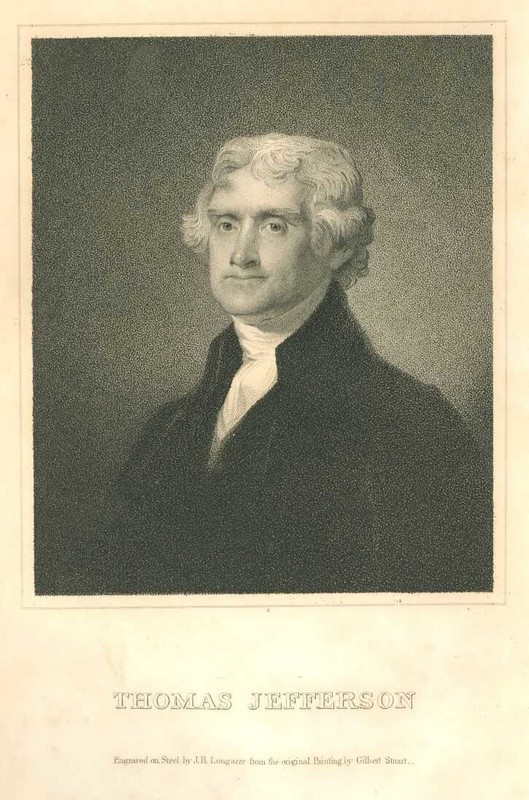
Steel Engraving by Longacre from Painting of G. Stuart
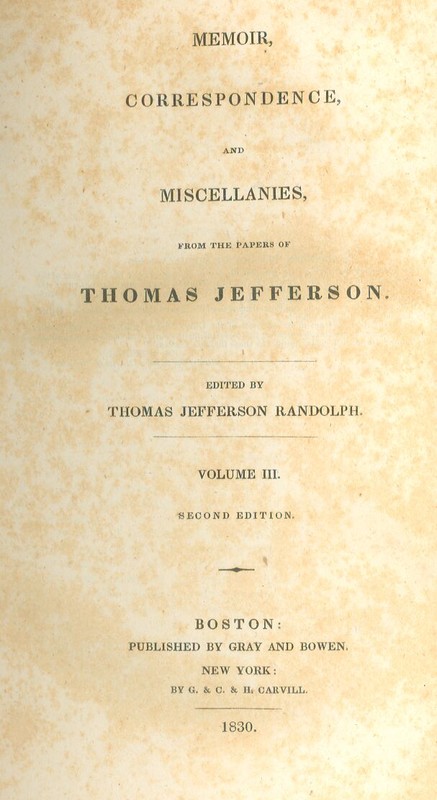
Titlepage of Volume Three (of Four)
Page143
Page144
Page342
LETTER I.—TO JOHN JAY, July 19, 1789
TO JOHN JAY.
Paris, July 19, 1789.
Dear Sir,
I am become very uneasy, lest you should have adopted some channel for the conveyance of your letters to me, which is unfaithful. I have none from you of later date than November the 25th, 1788, and of consequence, no acknowledgment of the receipt of any of mine, since that of August the 11th, 1788. Since that period, I have written to you of the following dates. 1788. August the 20th, September the 3rd, 5th, 24th, November the 14th, 19th, 29th. 1789. January the 11th, 14th, 21st, February the 4th, March the 1st, 12th, 14th, 15th, May the 9th, 11th, 12th, June the 17th, 24th, 29th. I know, through another person, that you have received mine of November the 29th, and that you have written an answer; but I have never received the answer, and it is this which suggests to me the fear of some general source of miscarriage.
The capture of three French merchant ships by the Algerines, under different pretexts, has produced great sensation in the seaports of this country, and some in its government. They have ordered some frigates to be armed at Toulon to punish them. There is a possibility that this circumstance, if not too soon set to rights by the Algerines, may furnish occasion to the States General, when they shall have leisure to attend to matters of this kind, to disavow any future tributary treaty with them. These pirates respect still less their treaty with Spain, and treat the Spaniards with an insolence greater than was usual before the treaty.
The scarcity of bread begins to lessen in the southern parts of France, where the harvest has commenced. Here it is still threatening, because we have yet three weeks to the beginning of harvest, and I think there has not been three days’ provision beforehand in Paris, for two or three weeks past. Monsieur de Mirabeau, who is very hostile to Mr. Necker, wished to find a ground for censuring him, in a proposition to have a great quantity of flour furnished from the United States, which he supposed me to have made to Mr. Necker, and to have been refused by him; and he asked time of the States General to furnish proofs. The Marquis de la Fayette immediately gave me notice of this matter, and I wrote him a letter to disavow having ever made any such proposition to Mr. Necker, which I desired him to communicate to the States. I waited immediately on Mr. Necker and Monsieur de Montmorin, satisfied them that what had been suggested was absolutely without foundation from me; and indeed they had not needed this testimony. I gave them copies of my letter to the Marquis de la Fayette, which was afterwards printed. The Marquis, on the receipt of my letter, showed it to Mirabeau. who turned then to a paper from which he had drawn his information, and found he had totally mistaken it. He promised immediately that he would himself declare his error to the States General, and read to them my letter, which he did. I state this matter to you, though of little consequence in itself, because it might go to you misstated in the English papers.
Our supplies to the Atlantic ports of France, during the months of March, April, and May, were only twelve thousand two hundred and twenty quintals, thirty-three pounds of flour, and forty-four thousand one hundred and fifteen quintals, forty pounds of wheat, in twenty-one vessels.
My letter of the 29th of June, brought down the proceedings of the States and government to the re-union of the orders, which took place on the 27th. Within the Assembly, matters went on well. But it was soon observed, that troops, and particularly the foreign troops, were on their march towards Paris from various quarters, and that this was against the opinion of Mr. Necker. The King was probably advised to this, under pretext of preserving peace in Paris and Versailles, and saw nothing else in the measure. That his advisers are supposed to have had in view, when he should be secured and inspirited by the presence of the troops to take advantage of some favorable moment, and surprise him into an act of authority for establishing the declaration of the 23rd of June, and perhaps dispersing the States General, is probable. The Marshal de Broglio was appointed to command all the troops within the Isle of France, a high-flying aristocrat, cool and capable of everything. Some of the French guards were soon arrested under other pretexts, but in reality, on account of their dispositions in favor of the national cause. The people of Paris forced the prison, released them, and sent a deputation to the States General, to solicit a pardon. The States, by a most moderate and prudent Arrêtè, recommended these prisoners to the King, and peace to the people of Paris. Addresses came in to them from several of the great cities, expressing sincere allegiance to the King, but a determined resolution to support the States General. On the 8th of July, they voted an address to the King to remove the troops. This piece of masculine eloquence,* written by Monsieur de Mirabeau, is worth attention on account of the bold matter it expresses and discovers through the whole. The King refused to remove the troops, and said they might remove themselves, if they pleased, to Noyon or Soissons. They proceeded to fix the order in which they will take up the several branches of their future constitution, from which it appears, they mean to build it from the bottom, confining themselves to nothing in their ancient form, but a King. A declaration of rights, which forms the first chapter of their work, was then proposed by the Marquis de la Fayette. This was on the 11th. In the mean time troops, to the number of about twenty-five or thirty thousand, had arrived, and were posted in and between Paris and Versailles. The bridges and passes were guarded. At three o’clock in the afternoon, the Count de la Luzerne was sent to notify Mr. Necker of his dismission, and to enjoin him to retire instantly, without saying a word of it to any body. He went home, dined, proposed to his wife a visit to a friend, but went in fact to his country-house at St. Ouen, and at midnight set out from thence, as is supposed, for Brussels. This was not known till the next day, when the whole ministry was changed, except Villedeuil, of the domestic department, and Barentin, Garde des Sceaux. These changes were as follows. The Baron de Breteuil, president of the council of finance; and De la Galaisière, Comptroller General in the room of Mr. Necker; the Marshal de Broglio, minister of war, and Foulon under him, in the room of Puy-Ségur; Monsieur de la Vauguyon, minister of foreign affairs, instead of Monsieur de Montmorin; De la Porte, minister of marine, in place of the Count de la Luzerne; St. Priest was also removed from the Council. It is to be observed, that Luzerne and Puy-Ségur had been strongly of the aristocratical party in Council; but they were not considered as equal to bear their shares in the work now to be done. For this change, however sudden it may have been in the mind of the King, was, in that of his advisers, only one chapter of a great plan, of which the bringing together the foreign troops had been the first. He was now completely in the hands of men, the principal among whom had been noted through their lives for the Turkish despotism of their characters, and who were associated about the King, as proper instruments for what was to be executed. The news of this change began to be known in Paris about one or two o’clock. In the afternoon, a body of about one hundred German cavalry were advanced and drawn up in the Place Louis XV., and about two hundred Swiss posted at a little distance in their rear. This drew the people to that spot, who naturally formed themselves in front of the troops, at first merely to look at them. But as their numbers increased, their indignation arose; they retired a few steps, posted themselves on and behind large piles of loose stone, collected in that place for a bridge adjacent to it, and attacked the horse with stones. The horse charged, but the advantageous position of the people, and the showers of stones, obliged them to retire, and even to quit the field altogether, leaving one of their number on the ground. The Swiss in their rear were observed never to stir. This was the signal for universal insurrection, and this body of cavalry, to avoid being massacred, retired towards Versailles. The people now armed themselves with such weapons as they could find in armorers’ shops and private houses, and with bludgeons, and were roaming all night through all parts of the city, without any decided practicable object. The next day, the States pressed on the King to send away the troops, to permit the Bourgeois of Paris to arm for the preservation of order in the city, and offered to send a deputation from their body to tranquillize them. He refused all their propositions. A committee of magistrates and electors of the city were appointed by their bodies, to take upon them its government. The mob, now openly joined by the French guards, forced the prison of St. Lazare, released all the prisoners, and took a great store of corn, which they carried to the corn market. Here they got some arms, and the French guards began to form and train them. The committee determined to raise forty-eight thousand Bourgeois, or rather to restrain their numbers to forty-eight thousand. On the 14th, they sent one of their members (Monsieur de Corny, whom we knew in America) to the Hôtel des Invalides, to ask arms for their Garde Bourgeoise. He was followed by, or he found there, a great mob. The Governor of the Invalides came out, and represented the impossibility of his delivering arms, without the orders of those from whom he received them. De Corny advised the people then to retire, and retired himself; and the people took possession of the arms. It was remarkable, that not only the Invalides themselves made no opposition, but that a body of five thousand foreign troops, encamped within four hundred yards, never stirred. Monsieur de Corny and five others were then sent to ask arms of Monsieur de Launai, Governor of the Bastile. They found a great collection of people already before the place, and they immediately planted a flag of truce, which was answered by a like flag hoisted on the parapet. The deputation prevailed on the people to fall back a little, advanced themselves to make their demand of the Governor, and in that instant a discharge from the Bastile killed four people of those nearest to the deputies. The deputies retired: the people rushed against the place, and almost in an instant were in possession of a fortification, defended by one hundred men, of infinite strength, which in other times had stood several regular sieges, and had never been taken. How they got in, has as yet been impossible to discover. Those who pretend to have been of the party tell so many different stories, as to destroy the credit of them all. They took all the arms, discharged the prisoners, and such of the garrison as were not killed in the first moment of fury, carried the Governor and Lieutenant Governor to the Greve (the place of public execution), cut off their heads, and sent them through the city in triumph to the Palais Royal. About the same instant, a treacherous correspondence having been discovered in Monsieur de Flesselles, Prévôt des Marchands, they seized him in the Hotel de Ville, where he was in the exercise of his office, and cut off his head. These events, carried imperfectly to Versailles, were the subject of two successive deputations from the States to the King, to both of which he gave dry and hard answers; for it has transpired, that it had been proposed and agitated in Council, to seize on the principal members of the States General, to march the whole army down upon Paris, and to suppress its tumults by the sword. But, at night, the Duke de Liancourt forced his way into the King’s bed-chamber, and obliged him to hear a full and animated detail of the disasters of the day in Paris. He went to bed deeply impressed. The decapitation of De Launai worked powerfully through the night on the whole aristocratical party, insomuch that, in the morning, those of the greatest influence on the Count d’Artois, represented to him the absolute necessity that the King should give up every thing to the States. This according well enough with the dispositions of the King, he went about eleven o’clock, accompanied only by his brothers, to the States General, and there read to them a speech, in which he asked their interposition to re-establish order. Though this be couched in terms of some caution, yet the manner in which it was delivered, made it evident that it was meant as a surrender at discretion. He returned to the Chateau afoot, accompanied by the States. They sent off a deputation, the Marquis de la Fayette at their head, to quiet Paris. He had, the same morning, been named Commandant in Chief of the Milice Bourgeoise, and Monsieur Bailly, former President of the States General, was called for as Prévôt des Marchands. The demolition of the Bastile was now ordered, and begun. A body of the Swiss guards of the regiment of Ventimille, and the city horse-guards joined the people. The alarm at Versailles increased instead of abating. They believed that the aristocrats of Paris were under pillage and carnage, that one hundred and fifty thousand men were in arms, coming to Versailles to massacre the royal family, the court, the ministers, and all connected with them, their practices, and principles. The aristocrats of the Nobles and Clergy in the States General, vied with each other in declaring how sincerely they were converted to the justice of voting by persons, and how determined to go with the nation all its lengths. The foreign troops were ordered off instantly. Every minister resigned. The King confirmed Bailly as Prévôt des Marchands, wrote to Mr. Necker to recall him, sent his letter open to the States General, to be forwarded by them, and invited them to go with him to Paris the next day, to satisfy the city of his dispositions: and that night and the next morning, the Count d’Artois, and Monsieur de Montisson (a deputy connected with him), Madame de Polignac, Madame de Guiche, and the Count de Vaudreuil, favorites of the Queen, the Abbe de Vermont, her confessor, the Prince of Conde, and Duke de Bourbon, all fled; we know not whither. The King came to Paris, leaving the Queen in consternation for his return. Omitting the less important figures of the procession, I will only observe, that the King’s carriage was in the centre, on each side of it the States General, in two rank, afoot, and at their head the Marquis de la Fayette, as Commander in Chief, on horseback, and Bourgeois guards before and behind. About sixty thousand citizens of all forms and colors, armed with the muskets of the Bastile and Invalids, as far as they would go, the rest with pistols, swords, pikes, pruning-hooks, scythes, &c. lined all the streets through which the procession passed, and, with the crowds of people in the streets, doors, and windows, saluted them every where with cries of ‘Vive la Nation;’ but not a single ‘Vive le Roy’ was heard. The King stopped at the Hôtel de Ville. There Monsieur Bailly presented and put into his hat the popular cockade, and addressed him. The King being unprepared and unable to answer, Bailly went to him, gathered from him some scraps of sentences, and made out an answer, which he delivered to the audience as from the King. On their return, the popular cries were ‘Vive le Roy et la Nation.’ He was conducted by a Garde Bourgeoise to his palace at Versailles, and thus concluded such an amende honorable, as no sovereign ever made, and no people ever received. Letters written with his own hand to the Marquis de la Fayette remove the scruples of his position. Tranquillity is now restored to the capital: the shops are again opened; the people resuming their labors, and if the want of bread does not disturb our peace, we may hope a continuance of it. The demolition of the Bastile is going on, and the Milice Bourgeoise organizing and training. The ancient police of the city is abolished by the authority of the people, the introduction of the King’s troops will probably be proscribed, and a watch or city guards substituted, which shall depend on the city alone. But we cannot suppose this paroxysm confined to Paris alone. The whole country must pass successively through it, and happy if they get through it as soon and as well as Paris has done.
I went yesterday to Versailles, to satisfy myself what had passed there; for nothing can be believed but what one sees, or has from an eye-witness. They believe there still, that three thousand people have fallen victims to the tumults of Paris. Mr. Short and myself have been every day among them, in order to be sure of what was passing. We cannot find, with certainty, that any body has been killed but the three before mentioned, and those who fell in the assault or defence of the Bastile. How many of the garrison were killed, nobody pretends to have ever heard. Of the assailants, accounts vary from six to six hundred. The most general belief is, that there fell about thirty. There have been many reports of instantaneous executions by the mob, on such of their body as they caught in acts of theft or robbery. Some of these may perhaps be true. There was a severity of honesty observed, of which no example has been known. Bags of money offered on various occasions through fear or guilt, have been uniformly refused by the mobs. The churches are now occupied in singing ‘De projundis’ and ‘Requiems,’ ‘for the repose of the souls of the brave and valiant citizens who have sealed with their blood the liberty of the nation.’ Monsieur de Montmorin is this day replaced in the department of foreign affairs, and Monsieur de St. Priest is named to the home department. The gazettes of France and Leyden accompany this. I send also a paper (called the Point du Jour) which will give you some idea of the proceedings of the National Assembly. It is but an indifferent thing; however, it is the best.
I have the honor to be, with great esteem and respect, Sir, your most obedient and most humble servant,
Th: Jefferson.
P. S. July 21. Mr. Necker had left Brussels for Frankfort, before the courier got there. We expect, however, to hear of him in a day or two. Monsieur le Comte de la Luzerne has resumed the department of the marine this day. Either this is an office of friendship effected by Monsieur de Montmorin (for though they had taken different sides, their friendship continued), or he comes in as a stop-gap, till somebody else can be found. Though very unequal to his office, all agree that he is an honest man. The Count d’Artois was at Valenciennes. The Prince of Conde and Duke de Bourbon had passed that place. T. J.
LETTER II.—TO M. L’ABBE ARNOND, July 19, 1789
TO M. L’ABBE ARNOND.
Paris, July 19, 1789.
Dear Sir,
The annexed is a catalogue of all the books I recollect, on the subject of juries. With respect to the value of this institution, I must make a general observation. We think, in America, that it is necessary to introduce the people into every department of government, as far as they are capable of exercising it: and that this is the only way to insure a long continued and honest administration of its powers.
1. They are not qualified to exercise themselves the executive department, but they are qualified to name the person who shall exercise it. With us, therefore, they choose this officer every four years. 2. They are not qualified to legislate. With us, therefore, they only choose the legislators. 3. They are not qualified to judge questions of law, but they are very capable of judging questions of fact. In the form of juries, therefore, they determine all matters of fact, leaving to the permanent judges to decide the law resulting from those facts. But we all know, that permanent judges acquire an esprit de corps; that being known, they are liable to be tempted by bribery; that they are misled by favor, by relationship, by a spirit of party, by a devotion to the executive or legislative power; that it is better to leave a cause to the decision of cross and pile, than to that of a judge biassed to one side; and that the opinion of twelve honest jurymen gives still a better hope of right, than cross and pile does. It is in the power, therefore, of the juries, if they think the permanent judges are under any bias whatever, in any cause, to take on themselves to judge the law as well as the fact. They never exercise this power but when they suspect partiality in the judges; and by the exercise of this power, they have been the firmest bulwarks of English liberty. Were I called upon to decide, whether the people had best be omitted in the legislative or judiciary department, I would say it is better to leave them out of the legislative. The execution of the laws is more important than the making them. However, it is best to have the people in all the three departments, where that is possible.
I write in great haste, my Dear Sir, and have, therefore, only time to add wishes for the happiness of your country, to which a new order of things is opening; and assurances of the sincere esteem with which 1 have the honor to be, Dear Sir, your most obedient and humble servant,
Th: Jefferson.
Books, on the subject of Juries.
Complete Juryman, or a Compendium of the Laws relating to Jurors.
Guide to English Juries.
Hawles’s Englishman’s Right.
Jurors Judges both of Law and Fact, by Jones.
Security of Englishmen’s Lives, or the Duty of Grand Juries.
Walwin’s Juries Justified.
LETTER III.—TO JOHN JAY, July 23, 1789
TO JOHN JAY.
Paris, July 23, 1789.
SIR,
The bearer of my letters (a servant of Mr. Morris) not going off till to-day, I am enabled to add to their contents. The spirit of tumult seemed to have subsided, when, yesterday, it was excited again, by a particular incident. Monsieur Foulon, one of the obnoxious ministry, who, as well as his brethren, had absconded, was taken in the country, and, as is said, by his own tenants, and brought to Paris. Great efforts were exerted by popular characters, to save him. He was at length forced out of the hands of the Garde. Bourgeoise, hung immediately, his head cut off, and his body drawn through the principal streets of the city. The Intendant of Paris, Monsieur de Chauvigny, accused of having entered into the designs of the same ministry, has been taken at Compiegne, and a body of two hundred men on horseback have gone for him. If he be brought here, it will be difficult to save him. Indeed, it is hard to say, at what distance of time the presence of one of those ministers, or of any of the most obnoxious of the fugitive courtiers, will not rekindle the same blood-thirsty spirit. I hope it is extinguished as to every body else, and yesterday’s example will teach them to keep out of its way. I add two other sheets of the Point du Jour, and am, with the most perfect esteem and respect, Sir, your most obedient and most humble servant,
Th: Jefferson.
P. S. I just now learn that Bertier de Chauvigny was brought to town last night, and massacred immediately.
LETTER IV.—TO JOHN JAY, July 29, 1789
TO JOHN JAY.
Paris, July 29, 1789.
Sir,
I have written you lately, on the 24th of June, with a postscript of the 25th; on the 29th of the same month; the 19th of July, with a postscript of the 21st; and again on the 23rd. Yesterday I received yours of the 9th of March, by the way of Holland.
Mr. Necker has accepted his appointment, and will arrive today from Switzerland, where he had taken refuge. No other ministers have been named since my last. It is thought that Mr. Necker will choose his own associates. The tranquillity of Paris has not been disturbed, since the death of Foulon and Bertier, mentioned in my last. Their militia is in a course of organization. It is impossible to know the exact state of the supplies of bread. We suppose them low and precarious, because, some days, we are allowed to buy but half or three fourths of the daily allowance of our families. Yet as the wheat harvest must begin within ten days or a fortnight, we are in hopes there will be subsistence found till that time. This is the only source from which I should fear a renewal of the late disorders; for I take for granted, the fugitives from the wrath of their country, are all safe in foreign countries. Among these are numbered seven Princes of the house of Bourbon, and six ministers; the seventh (the Marshal de Broglio) being shut up in the fortified town of Metz, strongly garrisoned with foreign soldiers. I observed to you, in a preceding letter, that the storm which had begun in Paris, on the change of the ministry, would have to pass over the whole country, and consequently, would, for a short time, occasion us terrible details from the different parts of it. Among these, you will find a horrid one retailed from Vesoul, in Franche Compte. The atrociousness of the fact would dispose us rather to doubt the truth of the evidence on which it rests, however regular that appears. There is no question, that a number of people were blown up; but there are reasons for suspecting that it was by accident and not design. It is said the owner of the chateau sold powder by the pound, which was kept in the cellar of the house blown up; and it is possible, some one of the guests may have taken this occasion to supply himself, and been too careless in approaching the mass. Many idle stories have also been propagated and believed here, against the English, as that they have instigated the late tumults with money, that they had taken or were preparing to take Cherbourg, Brest, &c.; and even reasonable men have believed, or pretended to believe, all these. The British ambassador has thought it necessary to disavow them in a public letter, which you will find in one of the papers accompanying this.
I have lately had an opportunity of knowing with certainty the present state of the King of England. His recovery was slow; he passed through a stage of profound melancholy; but this has at length dissipated, and he is at present perfectly re-established. He talks now as much as ever, on the same trifling subjects, and has recovered even his habitual inquisitiveness into the small news of the families about him. His health is also good, though he is not as fleshy as he used to be. I have multiplied my letters to you lately, because the scene has been truly interesting; so much so, that had I received my permission to pay my projected visit to my own country, I should have thought, and should still think it my duty to defer it a while. I presume it cannot now be long, before I receive your definitive answer to my request. I send herewith the public papers, as usual; and have the honor to be, with the most perfect esteem and respect, Sir, your most obedient and most humble servant,
Th: Jefferson.
LETTER V.—TO JOHN JAY, August 5, 1789
TO JOHN JAY.
Paris, August 5, 1789.
Sir,
I wrote you on the 19th of the last month, with a postscript of the 21st; and again on the 23rd and 29th. Those letters went by private conveyances. This goes by the London post. Since my last, some small and momentary tumults have taken place in this city, in one of which a few of the rioters were killed by the city militia. No more popular executions have taken place. The capture of the Baron de Besenval, commandant of the Swiss troops, as he was flying to Switzerland, and of the Duke de la Vauguyon, endeavoring to escape by sea, would endanger new interpositions of the popular arm, were they to be brought to Paris. They are, therefore, confined where they were taken. The former of these being unpopular with the troops under his command, on account of oppressions, occasioned a deputation from their body, to demand justice to be done on him, and to avow the devotion of the Swiss troops to the cause of the nation. They had before taken side in part only. Mr. Necker’s return contributed much to re-establish tranquillity, though not quite as much as was expected. His just intercessions for the Baron de Besenval and other fugitives, damped very sensibly the popular ardor towards him. Their hatred is stronger than their love.
Yesterday, the other ministers were named. The Archbishop of Bordeaux is Garde des Sceaux, Monsieur de la Tour du Pin, minister of war, the Prince of Beauvou is taken into the Council, and the feuille des bénéfices given to the Archbishop of Bordeaux. These are all the popular party; so that the ministry (M. de la Luzerne excepted) and the Council, being all in reformation principles, no further opposition may be expected from that quarter. The National Assembly now seriously set their hands to the work of the constitution. They decided, a day or two ago, the question, whether they should begin by a declaration of rights, by a great majority in the affirmative. The negatives were of the Clergy, who fear to trust the people with the whole truth. The declaration itself is now on the carpet. By way of corollary to it, they last night mowed down a whole legion of abuses, as you will see by the Arrêté which I have the honor to inclose you. This will stop the burning of chateaux, and tranquillize the country more than all the addresses they could send them. I expressed to you my fears of the impractibility of debate and decision in a room of one thousand and two hundred persons, as soon as Mr. Necker’s determination to call that number, was known. The inconveniences of their number have been distressing to the last degree, though, as yet, they have been employed in work which could be done in the lump. They are now proceeding to instruments, every word of which must be weighed with precision. Heretofore, too, they were hooped together by a common enemy. This is no longer the case. Yet a thorough view of the wisdom and rectitude of this assembly disposes me more to hope they will find some means of surmounting the difficulty of their numbers, than to fear that yielding to the unmanageableness of debate in such a crowd, and to the fatigue of the experiment, they may be driven to adopt, in the gross, some one of the many projects which will be proposed.
There is a germ of schism in the pretensions of Paris to form its municipal establishment independently of the authority of the nation. It has not yet proceeded so far, as to threaten danger. The occasion does not permit me to send the public papers; but nothing remarkable has taken place in the other parts of Europe.
I have the honor to be, with the most perfect respect and esteem, Sir, your most obedient and most humble servant,
Th: Jefferson.
LETTER VI.—TO MR. CARMICHAEL, August 9, 1789
TO MR. CARMICHAEL.
Paris, August 9, 1789.
Dear Sir,
Since your last of March the 27th, I have only written that of May the 3th. The cause of this long silence, on both parts has been the expectation I communicated to you of embarking for America. In fact, I have expected permission for this, every hour since the month of March, and therefore always thought that by putting off writing to you a few days, my letter, while it should communicate the occurrences of the day, might be a letter of adieu. Should my permission now arrive, I should put off my departure till after the equinox. They write me that my not receiving it, has proceeded from the ceasing of the old government in October last, and the organization of the higher departments in the new, which had not yet taken place when my last letters came away. Bills had been brought in, for establishing departments of Foreign Affairs, Finance, and War. The last would certainly be given to General Knox. Mr. Jay would probably have his choice of the first and second; and it was supposed Hamilton would have that which Mr. Jay declined. Some thought Mr. Jay would prefer and obtain the head of the law department, for which Wilson would be a competitor. In such a case, some have supposed C. Thomson would ask the Foreign Affairs. The Senate and Representatives differed about the title of the President. The former wanted to style him ‘His Highness George Washington, President of the United States, and Protector of their Liberties.’ The latter insisted and prevailed, to give no title but that of office, to wit, ‘George Washington, President of the United States.’ I hope the terms of Excellency, Honor, Worship, Esquire, for ever disappear from among us, from that moment: I wish that of Mr. would follow them. In the impost bill, the Representatives had, by almost an unanimous concurrence, made a difference between nations in treaty with us, and those not in treaty. The Senate had struck out this difference, and lowered all the duties. Quære, whether the Representatives would yield? Congress were to proceed, about the 1st of June, to propose amendments to the new constitution. The principal would be the annexing a declaration of rights to satisfy the minds of all, on the subject of their liberties. They waited the arrival of Brown, Delegate from Kentucky, to take up the receiving that district as a fourteenth State. The only objections apprehended, were from the partisans of Vermont, who might insist on both coming in together. This would produce a delay, though probably not a long one.
To detail to you the events of this country, would require a volume. It would be useless too; because those given in the Leyden gazette, though not universally true, have so few and such unimportant errors mixed with them, that you may give a general faith to them. I will rather give you, therefore, what that paper cannot give, the views of the prevailing power, as far as they can be collected from conversation and writings. They will distribute the powers of government into three parts, legislative, judiciary, and executive. The legislative will certainly have no hereditary branch, probably not even a select one, (like our Senate). If they divide it into two chambers at all, it will be by breaking the representative body into two equal halves by lot. But very many are for a single House, and particularly the Turgotists. The imperfection of their legislative body, I think, will be, that not a member of it will be chosen by the people directly. Their representation will be an equal one, in which every man will elect and be elected as a citizen, not as of a distinct order. Quære, whether they will elect placemen and pensioners? Their legislature will meet periodically, and sit at their own will, with a power in the executive to call them extraordinarily, in case of emergencies. There is a considerable division of sentiment whether the executive shall have a negative on the laws. I think they will determine to give such a negative, either absolute or qualified. In the judiciary, the parliaments will be suppressed, less numerous judiciary bodies instituted, and trial by jury established in criminal, if not in civil cases. The executive power will be left entire in the hands of the King. They will establish the responsibility of ministers, gifts and appropriations of money by the National Assembly alone; consequently a civil list, freedom of the press, freedom of religion, freedom of commerce and industry, freedom of person against arbitrary arrests, and modifications, if not a total prohibition, of military agency in civil cases. I do not see how they can prohibit, altogether, the aid of the military in cases of riot, and yet I doubt whether they can descend from the sublimity of ancient military pride, to let a Marechal of France, with his troops, be commanded by a magistrate. They cannot conceive that General Washington, at the head of his army, during the late war, could have been commanded by a common constable to go as his posse comitates, to suppress a mob, and that Count Rochambeau, when he was arrested at the head of his army by a sheriff, must have gone to jail if he had not given bail to appear in court. Though they have gone astonishing lengths, they are not yet thus far. It is probable, therefore, that not knowing how to use the military as a civil weapon, they will do too much or too little with it.
I have said that things will be so and so. Understand by this, that these are only my conjectures, the plan of the constitution not being proposed yet, much less agreed to. Tranquillity is pretty well established in the capital; though the appearance of any of the refugees here would endanger it. The Baron de Besenval is kept away: so is M. de la Vauguyon. The latter was so short a time a member of the obnoxious administration, that probably he might not be touched were he here. Seven Princes of the house of Bourbon, and seven ministers, fled into foreign countries, is a wonderful event indeed.
I have the honor to be, with great respect and attachment, Dear Sir, your most obedient and most humble servant,
Th: Jefferson.
LETTER VII.—TO JOHN JAY, August 12, 1789
TO JOHN JAY.
Paris, August 12, 1789.
Sir,
I wrote you on the 19th, 23rd, 29th of the last, and 5th of the present month. The last occasions not having admitted the forwarding to you the public papers, I avail myself of the present, by a gentleman going to London, to furnish you with them to the present date. It is the only use I can prudently make of the conveyance. I shall, therefore, only observe, that the National Assembly has been entirely occupied since my last, in developing the particulars which were the subject of their resolutions of the 4th instant, of which I send you the general heads.
The city is as yet not entirely quieted. Every now and then summary execution is done on individuals, by individuals, and nobody is in condition to ask for what, or by whom. We look forward to the completion of the establishment of the city militia, as that which is to restore protection to the inhabitants. The details from the country are as distressing as I had apprehended they would be. Most of them are doubtless false, but many must still be true. Abundance of chateaux are certainly burnt and burning, and not a few lives sacrificed. The worst is probably over in this city; but I do not know whether it is so in the country. Nothing important has taken place in the rest of Europe.
I have the honor to be, with the most perfect esteem and respect, Sir, your most obedient and most humble servant,
Th: Jefferson.
LETTER VIII.—TO COLONEL GOUVION, August 15,1789
TO COLONEL GOUVION.
Paris, August 15,1789.
Sir,
I have the pleasure to inform you, that money is now deposited in the hands of Messrs. Grand and company, for paying the arrears of interest due to the foreign officers who served in the American army. I will beg the favor of you to notify thereof as many of them as you find convenient; and if you can furnish the addresses of any others to Messrs. Grand and company, they will undertake to give notice to them. The delays which have attended the completion of this object, have been greater than I expected. This has not proceeded from any inattention of Congress or any of their servants to the justice due to those officers. This has been sufficiently felt. But it was not till the present moment, that their efforts to furnish such a sum of money have been successful. The whole amount of arrears to the beginning of the present year, is about ten thousand louis d’ors.
I have the honor to be, with sentiments of the most perfect esteem and attachment, Sir, your most obedient and most humble servant,
Th: Jefferson.
LETTER IX.—TO JOHN JAY, August 27, 1789
TO JOHN JAY.
Paris, August 27, 1789.
Sir,
I am honored with your favor of June the 19th, informing me that permission is given me to make a short visit to my native country, for which indulgence I beg leave to return my thanks to the President, and to yourself, Sir, for the expedition with which you were so good as to forward it, after it was obtained. Being advised that October is the best month of the autumn for a passage to America, I shall wish to sail about the first of that month and as I have a family with me, and their baggage is considerable I must endeavor to find a vessel bound directly for Virginia if possible.
My last letters to you have been of the 5th and 12th instant. Since these, I received information from our bankers in Holland, that they had money in hand sufficient to answer the demands for the foreign officers, and for the captives; and that, moreover, the residue of the bonds of the last loan were engaged. I hereupon wrote to Mr. Grand for an exact estimate of the sum necessary for the officers. He had stated it to me as being forty-five thousand six hundred and fifty-two livres eleven sous six deniers a year, when I was going to Holland to propose the loan to Mr. Adams, and at that sum, you will see it was stated in the estimate we sent you from Amsterdam. He now informed me it was sixty thousand three hundred and ninety-three livres seventeen sous ten deniers a year. I called on him for an explanation. He showed me that his first information agreed with the only list of the officers and sums then in his possession, and his last with a new list lately sent from the treasury board, in which other officers were set down, who had been omitted in the first. I wrote to our bankers on account of this error, and desired to know whether, after receiving the money necessary for the captives, they were in condition to furnish two hundred and fifty-four thousand,livres for the officers. They answered me by sending the money, and the additional sum of twenty-six thousand livres, to complete the business of the medals. I delivered the bills to Messrs. Grand and company, to negotiate and pay away; and the arrears to the officers, to the first day of the present year, are now in a course of payment. While on this subject, I will ask that an order may be forwarded to the bankers in Holland to furnish, and to Mr. Grand to pay, the arrearages which may be due on the first of January next. The money being in hand, it would be a pity that we should fail in payment a single day, merely for want of an order. The bankers further give it as their opinion, that our credit is so much advanced on the exchange of Amsterdam, that we may probably execute any money arrangements we may have occasion for, on this side the water. I have the honor to send you a copy of their letter. They have communicated to me apprehensions, that another house was endeavoring to obtain the business of our government. Knowing of no such endeavors myself, I have assured them that I am a stranger to any applications on the subject. At the same time, I cannot but suspect that this jealousy has been one of the spurs, at least, to the prompt completion of our loan. The spirited proceedings of the new Congress in the business of revenue, has doubtless been the principal one.
An engagement has taken place between the Russian and Swedish fleets in the Baltic, which has been not at all decisive, no ship having been lost on either side. The Swedes claim a victory, because they remained in the field till the Russians quitted it. The latter effected a junction soon after with another part of their fleet, and being now about ten ships strongest, the Swedes retired into port, and it is imagined they will not appear again under so great disparity; so that the campaign by sea is supposed to be finished. Their commerce will be at the mercy of their enemies: but they have put it out of the power of the Russians to send any fleet to the Mediterranean this year.
A revolution has been effected very suddenly in the bishoprick of Liege. Their constitution had been changed by force, by the reigning sovereign, about one hundred years ago. This subject had been lately revived and discussed in print. The people were at length excited to assemble tumultuously. They sent for their Prince, who was at his country-seat, and required him to come to the town-house to hear their grievances. Though in the night, he came instantly, and was obliged to sign a restitution of their ancient constitution, which took place on the spot, and all became quiet without a drop of blood spilt. This fact is worthy notice, only as it shows the progress of the spirit of revolution.
No act of violence has taken place in Paris since my last, except on account of the difference between the French and Swiss guards, which gave rise to occasional single combats, in which five or six were killed. The difference is made up. Some misunderstandings had arisen between the committees of the different districts of Paris, as to the form of the future municipal government. These gave uneasiness for a while, but have been also reconciled. Still there is such a leaven of fermentation remaining in the body of the people, that acts of violence are always possible, and are quite unpunishable; there being, as yet, no judicature which can venture to act in any case, however small or great. The country is becoming more calm. The embarrassments of the government, for want of money, are extreme. The loan of thirty millions, proposed by Mr. Necker, has not succeeded at all. No taxes are paid. A total stoppage of all payment to the creditors of the State is possible every moment. These form a great mass in the city as well as country, and among the lower class of people too, who have been used to carry their little savings of their service into the public funds, upon life rents of five, ten, twenty guineas a year, and many of whom have no other dependence for daily subsistence. A prodigious number of servants are now also thrown out of employ by domestic reforms, rendered necessary by the late events. Add to this the want of bread, which is extreme. For several days past, a considerable proportion of the people have been without bread altogether; for though the new harvest is begun, there is neither water nor wind to grind the grain. For some days past the people have besieged the doors of the bakers, scrambled with one another for bread, collected in squads all over the city, and need only some slight incident to lead them to excesses which may end in, nobody can tell what. The danger from the want of bread, however, which is the most imminent, will certainly lessen in a few days. What turn that may take which arises from the want of money, is difficult to be foreseen. Mr. Necker is totally without influence in the National Assembly, and is, I believe, not satisfied with this want of importance. That Assembly has just finished their bill of rights. The question will then be, whether to take up first the constitution or the business of finance.
No plan of a constitution has been yet given in. But I can state to you the outlines of what the leading members have in contemplation. The executive power in a hereditary King, with power of dissolving the legislature and a negative on their laws; his authority in forming treaties to be greatly restrained. The legislative to be a single House of Representatives, chosen for two or three years. They propose a body whom they call a Senate, to be chosen by the Provincial Assemblies, as our federal Senate is, but with no power of negativing or amending laws; they may only remonstrate on them to the representatives, who will decide by a simple majority the ultimate event of the law. This body will therefore be a mere council of revision. It is proposed that they shall be of a certain age and property, and be for life. They may make them also their court of impeachment. They will suppress the parliaments, and establish a system of judicature somewhat like that of England, with trial by jury in criminal cases, perhaps also in civil. Each province will have a subordinate provincial government, and the great cities, a municipal one on a free basis. These are the ideas and views of the most distinguished members. But they may suffer great modifications from the Assembly, and the longer the delay, the greater will be the modifications. Considerable interval having taken place since any popular execution, the aristocratic party is raising its head. They are strengthened by a considerable defection from the patriots, in consequence of the general suppression of the abuses of the 4th of August, in which many were interested. Another faction too, of the most desperate views, has acquired strength in the Assembly, as well as out of it. These wish to dethrone the reigning branch, and transfer the crown to the Duke d’Orleans. The members of this faction are mostly persons of wicked and desperate fortunes, who have nothing at heart but to pillage from the wreck of their country. The Duke himself is as unprincipled as his followers; sunk in debaucheries of the lowest kind, and incapable of quitting them for business; not a fool, yet not head enough to conduct any thing. In fact, I suppose him used merely as a tool, because of his immense wealth, and that he acquired a certain degree of popularity by his first opposition to the government, then credited to him as upon virtuous motives. He is certainly borrowing money on a large scale. He is in understanding with the court of London, where he had been long in habits of intimacy. The ministry here are apprehensive, that that ministry will support his designs by war. I have no idea of this, but no doubt, at the same time, that they will furnish him money liberally to aliment a civil war, and prevent the regeneration of this country.
It was suggested to me, some days ago, that the court of Versailles were treating with that of London, for a surrender of their West India possessions, in consideration of a great sum of money to relieve their present distress. Every principle of common sense was in opposition to this fact; yet it was so affirmed as to merit inquiry. I became satisfied the government had never such an idea; but that the story was not without foundation altogether; that something like this was in contemplation between the faction of Orleans and the court of London, as a means of obtaining money from that court. In a conversation with the Count de Montmorin, two days ago, he told me their colonies were speaking a language which gave them uneasiness, and for which there was no foundation. I asked him if he knew any thing of what I have just mentioned. He appeared unapprized of it, but to see at once that it would be a probable speculation between two parties circumstanced and principled as those two are. I apologized to him for the inquiries I had made into this business, by observing that it would be much against our interest, that any one power should monopolize all the West India islands. ‘Parde, assurément,’ was his answer.
The emancipation of their islands is an idea prevailing in the minds of several members of the National Assembly, particularly those most enlightened and most liberal in their views. Such a step by this country would lead to other emancipations or revolutions in the same quarter. I enclose you some papers received from Mr. Carmichael, relative to the capture of one of our vessels by a Morocco cruiser, and restitution by the Emperor. I shall immediately write to M. Chiappe, to express a proper sense of the Emperor’s friendly dispositions to us. I forward also the public papers to the present date; and have the honor to be, with sentiments of the most perfect esteem and respect, Sir, your most obedient and most humble servant,
Th: Jefferson.
LETTER X.—TO JAMES MADISON, August 28,1789
TO JAMES MADISON.
Paris, August 28,1789.
Dear Sir,
My last to you was of July the 22nd. Since that, I have received yours of May the 27th, June 13th and 30th. The tranquillity of the city has not been disturbed since my last. Dissensions between the French and Swiss guards occasioned some private combats, in which five or six were killed. These dissensions are made up. The want of bread for some days past has greatly endangered the peace of the city. Some get a little, some none at all. The poor are the best served, because they besiege perpetually the doors of the bakers. Notwithstanding this distress, and the palpable impotence of the city administration to furnish bread to the city, it was not till yesterday, that general leave was given to the bakers to go into the country and buy flour for themselves, as they can. This will soon relieve us, because the wheat harvest is well advanced.’ Never was there a country where the practice of governing too much, had taken deeper root and done more mischief. Their declaration of rights is finished. If printed in time, I will enclose a copy with this. It is doubtful whether they will now take up the finance or the constitution first. The distress for money endangers every thing. No taxes are paid, and no money can be borrowed. Mr. Necker was yesterday to give in a memoir to the Assembly, on this subject. I think they will give him leave to put into execution any plan he pleases, so as to debarrass themselves of this, and take up that of the constitution. No plan is yet reported; but the leading members (with some small difference of opinion) have in contemplation the following. The executive power in a hereditary King, with a negative on laws, and power to dissolve the legislature; to be considerably restrained in the making of treaties, and limited in his expenses. The legislative in a House of Representatives. They propose a Senate also, chosen on the plan of our federal Senate, by the Provincial Assemblies, but to be for life, of a certain age, (they talk of forty years), and certain wealth (four or five hundred guineas a year), but to have no other power as to laws but to remonstrate against them to the representatives, who will then determine their fate by a simple majority. This you will readily perceive is a mere council of revision, like that of New York, which, in order to be something, must form an alliance with the King, to avail themselves of his veto. The alliance will be useful to both, and to the nation. The representatives to be chosen every two or three years. The judiciary system is less prepared than any other part of the plan; however, they will abolish the parliaments, and establish an order of judges and justices, general and provincial, a good deal like ours, with trial by jury in criminal cases certainly, perhaps also in civil. The provinces will have Assemblies for their provincial government, and the cities a municipal body for municipal government, all founded on the basis of popular election. These subordinate governments, though completely dependent on the general one, will be intrusted with almost the whole of the details which our State governments exercise. They will have their own judiciary, final in all but great cases, the executive business will principally pass through their hands, and a certain local legislature will be allowed them. In short, ours has been professedly their model, in which such changes are made as a difference of circumstances rendered necessary, and some others neither necessary nor advantageous, but into which men will ever run, when versed in theory and new in the practice of government, when acquainted with man only as they see him in their books and not in the world. This plan will undoubtedly undergo changes in the Assembly, and the longer it is delayed, the greater will be the changes; for that Assembly, or rather the patriotic part of it, hooped together heretofore by a common enemy, are less compact since their victory. That enemy (the civil and ecclesiastical aristocracy) begins to raise its head. The lees, too, of the patriotic party, of wicked principles and desperate fortunes, hoping to pillage something in the wreck of their country, are attaching themselves to the faction of the Duke of Orleans: that faction is caballing with the populace, and intriguing at London, the Hague, and Berlin, and have evidently in view the transfer of the crown to the Duke of Orleans. He is a man of moderate understanding, of no principle, absorbed in low vice, and incapable of abstracting himself from the filth of that, to direct any thing else. His name and his money, therefore, are mere tools in the hands of those who are duping him.
They may produce a temporary confusion, and even a temporary civil war, supported, as they will be, by the money of England; but they cannot have success ultimately. The King, the mass of the substantial people of the whole country, the army, and the influential part of the clergy, form a firm phalanx which must prevail. Should those delays which necessarily attend the deliberations of a body of one thousand two hundred men, give time to this plot to ripen and burst, so as to break up the Assembly before any thing definitive is done, a constitution, the principles of which are pretty well settled in the minds of the Assembly, will be proposed by the national militia, (*****) urged by the individual members of the Assembly, signed by the King and supported by the nation, to prevail till circumstances shall permit its revision and more regular sanction. This I suppose the pis aller of their affairs, while their probable event is a peaceable settlement of them. They fear a war from England, Holland, and Prussia. I think England will give money, but not make war. Holland would soon be afire, internally, were she to be embroiled in external difficulties. Prussia must know this, and act accordingly.
It is impossible to desire better dispositions towards us, than prevail in this Assembly. Our proceedings have been viewed as a model for them on every occasion; and though in the heat of debate men are generally disposed to contradict every authority urged by their opponents, ours has been treated like that of the Bible, open to explanation, but not to question. I am sorry that in the moment of such a disposition, any thing should come from us to check it. The placing them on a mere footing with the English, will have this effect. When of two nations, the one has engaged herself in a ruinous war for us, has spent her blood and money to save us, has opened her bosom to us in peace, and received us almost on the footing of her own citizens, while the other has moved heaven, earth, and hell to exterminate us in war, has insulted us in all her councils in peace, shut her doors to us in every part where her interests would admit it, libelled us in foreign nations, endeavored to poison them against the reception of our most precious commodities; to place these two nations on a footing, is to give a great deal more to one than to the other, if the maxim be true, that to make unequal quantities equal, you must add more to one than the other. To say, in excuse, that gratitude is never to enter into the motives of national conduct, is to revive a principle which has been buried for centuries with its kindred principles of the lawfulness of assassination, poison, perjury, &c. All of these were legitimate principles in the dark ages which intervened between ancient and modern civilization, but exploded and held in just horror in the eighteenth century. I know but one code of morality for men, whether acting singly or collectively. He who says I will be a rogue when I act in company with a hundred others, but an honest man when I act alone, will be believed in the former assertion, but not in the latter. I would say with the poet, ‘Hie niger est; hunc tu, Romane, caveto.’ If the morality of one man produces a just line of conduct in him, acting individually, why should not the morality of one hundred men produce a just line of conduct in them, acting together? But I indulge myself in these reflections because my own feelings run me into them; with you they were always acknowledged. Let us hope that our new government will take some other occasion to show, that they mean to proscribe no virtue from the canons of their conduct with other nations. In every other instance, the new government has ushered itself to the world as honest, masculine, and dignified. It has shown genuine dignity, in my opinion, in exploding adulatory titles; they are the offerings of abject baseness, and nourish that degrading vice in the people.
I must now say a word on the declaration of rights, you have been so good as to send me. I like it, as far as it goes; but I should have been for going further. For instance, the following alterations and additions would have pleased me. Article 4. The people shall not be deprived of their right to speak, to write, or otherwise to publish any thing but false facts affecting injuriously the life, liberty, property, or reputation of others, or affecting the peace of the confederacy with foreign nations. Article 7. All facts put in issue before any judicature, shall be tried by jury, except, 1. in cases of admiralty jurisdiction, wherein a foreigner shall be interested; 2. in cases cognizable before a court martial, concerning only the regular-officers and soldiers of the United States, or members of the militia in actual service in time of war or insurrection; and 3. in impeachments allowed by the constitution. Article 8. No person shall be held in confinement more than ——— days after he shall have demanded and been refused a writ of habeas corpus by the judge appointed by law, nor more than ——— days after such a writ shall have been served on the person holding him in confinement, and no order given on due examination for his remandment or discharge, nor more than ——— hours in any place at a greater distance than ——— miles from the usual residence of some judge authorized to issue the writ of habeas corpus; nor shall that writ be suspended for any term exceeding one year, nor in any place more than ——— miles distant from the State or encampment of enemies or of insurgents. Article 9. Monopolies may be allowed to persons for their own productions in literature, and their own inventions in the arts, for a term not exceeding ——— years, but for no longer term, and no other purpose. Article 10. All troops of the United States shall stand ipso facto disbanded, at the expiration of the term for which their pay and subsistence shall have been last voted by Congress, and all officers and soldiers, not natives of the United States, shall be incapable of serving in their armies by land, except during a foreign war. These restrictions I think are so guarded, as to hinder evil only. However, if we do not have them now, I have so much confidence in my countrymen, as to be satisfied that we shall have them as soon as the degeneracy of our government shall render them necessary.
I have no certain news of Paul Jones. I understand only, in a general way, that some persecution on the part of his officers occasioned his being called to Petersburg, and that though protected against them by the Empress, he is not yet restored to his station. Silas Deane is coming over to finish his days in America, not having one sous to subsist on, elsewhere. He is a wretched monument of the consequences of a departure from right. I will, before my departure, write Colonel Lee fully the measures I pursued to procure success in his business, and which as yet offer little hope; and I shall leave it in the hands of Mr. Short to be pursued, if any prospect opens on him. I propose to sail from Havre as soon after the first of October as I can get a vessel; and shall consequently leave this place a week earlier than that. As my daughters will be with me, and their baggage somewhat more than that of mere voyageures, I shall endeavor, if possible, to obtain a passage for Virginia directly. Probably I shall be there by the last of November. If my immediate attendance at New York should be requisite for any purpose, I will leave them with a relation near Richmond, and proceed immediately to New York. But as I do not foresee any pressing purpose for that journey immediately on my arrival, and as it will be a great saving of time, to finish at once in Virginia, so as to have no occasion to return there after having once gone on to the northward, I expect to proceed to my own house directly. Staying there two months (which I believe will be necessary), and allowing for the time I am on the road, I may expect to be at New York in February, and to embark from thence or some eastern port. You ask me if I would accept any appointment on that side of the water? You know the circumstances which led me from retirement, step by step, and from one nomination to another, up to the present. My object is a return to the same retirement. Whenever, therefore, I quit the present, it will not be to engage in any other office, and most especially any one which would require a constant residence from home. The books I have collected for you will go off for Havre in three or four days, with my baggage. From that port, I shall try to send them by a direct occasion to New York.
I am, with great and sincere esteem, Dear Sir, your affectionate friend and servant,
Th: Jefferson.
P. S. I just now learn that Mr. Necker proposed yesterday to the National Assembly a loan of eighty millions, on terms more tempting to the lender than the former, and that they approved it, leaving him to arrange the details, in order that they might occupy themselves at once about the constitution. T. J.
LETTER XI.—TO JAMES MADISON, September 6, 1789
TO JAMES MADISON.
Paris, September 6, 1789.
Dear Sir,
I sit down to write to you, without knowing by what occasion I shall send my letter. I do it, because a subject comes into my head, which I wrould wish to develope[sp.] a little more than is practicable in the hurry of the moment of making up general despatches.
The question, whether one generation of men has a right to bind another, seems never to have been started either on this, or our side of the water. Yet it is a question of such consequences as not only to merit decision, but place also among the fundamental principles of every government. The course of reflection in which we are immersed here, on the elementary principles of society, has presented this question to my mind; and that no such obligation can be so transmitted, I think very capable of proof. I set out on this ground, which I suppose to be self-evident, that the earth belongs in usufruct to the living: that the dead have neither powers nor rights over it. The portion occupied by any individual ceases to be his when himself ceases to be, and reverts to the society. If the society has formed no rules for the appropriation of its lands in severalty, it will be taken by the first occupants, and these will generally be the wife and children of the decedent. If they have formed rules of appropriation, those rules may give it to the wife and children, or to some one of them, or to the legatee of the deceased. So they may give it to his creditor.
But the child, the legatee, or creditor, takes it not by natural right, but by a law of the society of which he is a member, and to which he is subject. Then, no man can, by natural right, oblige the lands he occupied, or the persons who succeed him in that occupation, to the payment of debts contracted by him. For if he could, he might, during his own life, eat up the usufruct of the lands for several generations to come; and then the lands would belong to the dead, and not to the living, which is the reverse of our principle.
What is true of every member of the society individually, is true of them all collectively; since the rights of the whole can be no more than the sum of the rights of the individuals. To keep our ideas clear when applying them to a multitude, let us suppose a whole generation of men to be born on the same day, to attain mature age on the same day, and to die on the same day, leaving a succeeding generation in the moment of attaining their mature age, all together. Let the ripe age be supposed of twenty-one years, and their period of life thirty-four years more, that being the average term given by the bills of mortality to persons of twenty-one years of age. Each successive generation would, in this way, come and go off the stage at a fixed moment, as individuals do now. Then I say, the earth belongs to each of these generations during its course, fully and in its own right. The second generation receives it clear of the debts and incumbrances of the first, the third of the second, and so on. For if the first could charge it with a debt, then the earth would belong to the dead and not to the living generation. Then no generation can contract debts greater than may be paid during the course of its own existence. At twenty-one years of age, they may bind themselves and their lands for thirty-four years to come; at twenty-two, for thirty-three; at twenty-three, for thirty-two; and at fifty-four, for one year only; because these are the terms of life which remain to them at the respective epochs. But a material difference must be noted, between the succession of an individual and that of a whole generation. Individuals are parts only of a society, subject to the laws of the whole. These laws may appropriate the portion of land occupied by a decedent, to his creditor rather than to any other, or to his child, on condition he satisfies the creditor. But when a whole generation, that is, the whole society, dies, as in the case we have supposed, and another generation or society succeeds, this forms a whole, and there is no superior who can give their territory to a third society, who may have lent money to their predecessors, beyond their faculties of paying. What is true of generations succeeding one another at fixed epochs, as has been supposed for clearer conception, is true for those renewed daily, as in the actual course of nature. As a majority of the contracting generation will continue in being thirty-four years, and a new majority will then come into possession, the former may extend their engagements to that term, and no longer. The conclusion, then, is, that neither the representatives of a nation, nor the whole nation itself assembled, can validly engage debts beyond what they may pay in their own time, that is to say, within thirty-four years from the date of the engagement.
To render this conclusion palpable, suppose that Louis the XIV. and XV. had contracted debts in the name of the French nation, to the amount of ten thousand milliards, and that the whole had been contracted in Holland. The interest of this sum would be five hundred milliards, which is the whole rent-roll or nett[sp.] proceeds of the territory of France. Must the present generation of men have retired from the territory in which nature produces them, and ceded it to the Dutch creditors? No; they have the same rights over the soil on which they were produced, as the preceding generations had. They derive these rights not from them, but from nature. They, then, and their soil are, by nature, clear of the debts of their predecessors. To present this in another point of view, suppose Louis XV. and his cotemporary generation had said to the money-lenders of Holland, Give us money, that we may eat, drink, and be merry in our day; and on condition you will demand no interest till the end of thirty-four years, you shall then, for ever after, receive an annual interest of fifteen per cent. The money is lent on these conditions, is divided among the people, eaten, drunk, and squandered. Would the present generation be obliged to apply the produce of the earth and of their labor, to replace their dissipations? Not at all.
I suppose that the received opinion, that the public debts of one generation devolve on the next, has been suggested by our seeing, habitually, in private life, that he who succeeds to lands is required to pay the debts of his predecessor; without considering that this requisition is municipal only, not moral, flowing from the will of the society, which has found it convenient to appropriate the lands of a decedent on the condition of a payment of his debts: but that between society and society, or generation and generation, there is no municipal obligation, no umpire, but the law of nature.
The interest of the national debt of France being, in fact, but a two thousandth part of its rent-roll, the payment of it is practicable enough; and so becomes a question merely of honor or of expediency. But with respect to future debts, would it not be wise and just for that nation to declare in the constitution they are forming, that neither the legislature nor the nation itself, can validly contract more debt than they may pay within their own age, or within the term of thirty-four years? And that all future contracts shall be deemed void, as to what shall remain unpaid at the end of thirty-four years from their date? This would put the lenders, and the borrowers also, on their guard. By reducing, too, the faculty of borrowing within its natural limits, it would bridle the spirit of war, to which too free a course has been procured by the inattention of money-lenders to this law of nature, that succeeding generations are not responsible for the preceding.
On similar ground it may be proved, that no society can make a perpetual constitution, or even a perpetual law. The earth belongs always to the living generation: they may manage it, then, and what proceeds from it, as they please, during their usufruct. They are masters, too, of their own persons, and consequently may govern them as they please. But persons and property make the sum of the objects of government. The constitution and the laws of their predecessors are extinguished then, in their natural course, with those whose will gave them being. This could preserve that being, till it ceased to be itself, and no longer. Every constitution, then, and every law, naturally expires at the end of thirty-four years. If it be enforced longer, it is an act of force and not of right. It may be said that the succeeding generation exercising, in fact, the power of repeal, this leaves them as free as if the constitution or law had been expressly limited to thirty-four years only. In the first place, this objection admits the right, in proposing an equivalent. But the power of repeal is not an equivalent. It might be, indeed, if every form of government were so perfectly contrived, that the will of the majority could always be obtained, fairly and without impediment. But this is true of no form. The people cannot assemble themselves; their representation is unequal and vicious. Various checks are opposed to every legislative proposition. Factions get possession of the public councils, bribery corrupts them, personal interests lead them astray from the general interests of their constituents; and other impediments arise, so as to prove to every practical man, that a law of limited duration is much more manageable than one which needs a repeal.
This principle, that the earth belongs to the living and not to the dead, is of very extensive application and consequences in every country, and most especially in France. It enters into the resolution of the questions, whether the nation may change the descent of lands holden in tail; whether they may change the appropriation of lands given anciently to the church, to hospitals, colleges, orders of chivalry, and otherwise in perpetuity whether they may abolish the charges and privileges attached on lands, including the whole catalogue, ecclesiastical and feudal; it goes to hereditary offices, authorities, and jurisdictions, to hereditary orders, distinctions, and appellations, to perpetual monopolies in commerce, the arts, or sciences, with a long train of et ceteras; and it renders the question of reimbursement, a question of generosity and not of right. In all these cases, the legislature of the day could authorize such appropriations and establishments for their own time, but no longer; and the present holders, even where they or their ancestors have purchased, are in the case of bonâ fide purchasers of what the seller had no right to convey.
Turn the subject in your mind, my Dear Sir, and particularly as to the power of contracting debts, and develope it with that cogent logic which is so peculiarly yours. Your station in the councils of our country gives you an opportunity of producing it to public consideration, of forcing it into discussion. At first blush it may be laughed at, as the dream of a theorist; but examination will prove it to be solid and salutary. It would furnish matter for a fine preamble to our first law for appropriating the public revenue: and it will exclude, at the threshold of our new government, the ruinous and contagious errors of this quarter of the globe, which have armed despots with means which nature does not sanction, for binding in chains their fellow-men. We have already given, in example, one effectual check to the dog of war, by transferring the power of declaring war from the executive to the legislative body, from those who are to spend, to those who are to pay. I should be pleased to see this second obstacle held out by us also, in the first instance. No nation can make a declaration against the validity of long contracted debts, so disinterestedly as we, since we do not owe a shilling which will not be paid, principal and interest, by the measures you have taken, within the time of our own lives. I write you no news, because when an occasion occurs, I shall write a separate letter for that.
I am always, with great and sincere esteem, Dear Sir, your affectionate friend and servant,
Th: Jefferson.
LETTER XII.—TO DR. GEM
THOMAS JEFFERSON TO DR. GEM.
The hurry in which I wrote my letter to Mr. Madison, which is in your hands, occasioned an inattention to the difference between generations succeeding each other at fixed epochs, and generations renewed daily and hourly. It is true that in the former case, the generation when at twenty-one years of age, may contract a debt for thirty-four yours, because a majority of them will live so long. But a generation consisting of all ages, and which legislates by all its members above the age of twenty-one years, cannot contract for so long a time, because their majority will be dead much sooner. Buffon gives us a table of twenty-three thousand nine hundred and ninety-four deaths, stating the ages at which they happened. To draw from these the result I have occasion for, I suppose a society in which twenty-three thousand nine hundred and ninety-four persons are born every year, and live to the age stated in Buffon’s table. Then, the following inferences may be drawn. Such a society will consist constantly of six hundred and seventeen thousand seven hundred and three persons, of all ages. Of those living at any one instant of time, one half will be dead in twenty-four years and eight months. In such a society, ten thousand six hundred and seventy-five will arrive every year at the age of twenty-one years complete. It will constantly have three hundred and forty-eight thousand four hundred and seventeen persons of all ages above twenty-one years, and the half of those of twenty-one years and upwards living at any one instant of time, will be dead in eighteen years and eight months, or say nineteen years.
Then, the contracts, constitutions, and laws of every such society become void in nineteen years from their date.
LETTER XIII.—TO GENERAL KNOX, September 12,1789
TO GENERAL KNOX.
Paris, September 12,1789.
Sir,
In a letter which I had the honor of writing to the Secretary for Foreign Affairs, some three or four years ago, I informed him that a workman here had undertaken by the help of moulds and other means, to make all the parts of the musket so exactly alike, as that, mixed together promiscuously, any one part should serve equally for every musket. He had then succeeded as to the lock both of the officer’s fusil and the soldier’s musket. From a promiscuous collection of parts, I put together myself half a dozen locks, taking the first pieces which came to hand. He has now completed the barrel, stock, and mounting of the officer’s fusil, and is proceeding on those of the soldier’s musket. This method of forming the fire-arm appears to me so advantageous when repairs become necessary, that I thought it my duty not only to mention to you the progress of this artist, but to purchase and send you half a dozen of his officer’s fusils. They are packed in a box marked T. J. No. 36, and are sent to Havre, from whence they shall be forwarded to New York. The barrels and furniture are to their stocks, to prevent the warping of the wood. The locks are in pieces. You will find with them tools for putting them together, also a single specimen of his soldier’s lock. He formerly told me, and still tells me, that he shall be able, after a while, to furnish them cheaper than the common musket of the same quality, but at first, they will not be so cheap in the first cost, though the economy in repairs will make them so in the end. He cannot tell me exactly, at what price he can furnish them. Nor will he be able, immediately, to furnish any great quantity annually; but with the aid of the government, he expects to enlarge his establishment greatly. If the situation of the finances of this country should oblige the government to abandon him, he would prefer removing with all his people and implements to America, if we should desire to establish such a manufacture, and he would expect our government to take all his implements, on their own account, at what they have cost him. He talked of about three thousand guineas. I trouble you with these details, and with the samples, 1. That you may give the idea of such an improvement to our own workmen, if you think it might answer any good end. 2. That all the arms he shall have for sale, may be engaged for our government, if he continues here, and you think it important to engage them. 3. That you may consider, and do me the honor of communicating your determination, whether in the event of his establishment being abandoned by this government, it might be thought worth while to transfer it to the United States, on conditions somewhat like those he has talked of.
I have the honor to be, with sentiments of the most perfect esteem and respect, Sir, your most obedient, humble servant,
Th: Jefferson.
LETTER XIV.—TO E. RUTLEDGE, September 18, 1789
TO E. RUTLEDGE.
Paris, September 18, 1789.
Dear Sir,
I have duly received your favor by Mr. Cutting, enclosing the paper from Doctor Trumbull, for which I am very thankful. The conjecture that inhabitants may have been carried from the coast of Africa to that of America, by the trade winds, is possible enough; and its probability would be greatly strengthened by ascertaining a similarity of language, which I consider as the strongest of all proofs of consanguinity among nations. Still a question would remain between the red men of the eastern and western sides of the Atlantic, which is the stock, and which the shoot. If a fact be true, which I suspect to be true, that there is a much greater number of radical languages among those of America than among those of the other hemisphere, it would be a proof of superior antiquity, which I can conceive no arguments strong enough to overrule.
When I received your letter, the time of my departure was too near to permit me to obtain information from Constantinople, relative to the demand and price of rice there. I therefore wrote to a merchant at Marseilles, concerned in the Levant trade, for the prices current of rice at Constantinople and at Marseilles for several years past. He has sent me only the present price at Marseilles, and that of a particular cargo at Constantinople. I send you a copy of his letter. The Algerines form an obstacle; but the object of our commerce in the Mediterranean is so immense, that we ought to surmount that obstacle, and I believe it could be done by means in our power, and which, instead of fouling us with the dishonorable and criminal baseness of France and England, will place us in the road to respect with all the world.
I have obtained, and enclose to you, a state of all the rice imported into this country in the course of one year, which shows its annual consumption to be between eighty-one and eighty-two thousand quintals. I think you may supplant all the other furnishing States, except as to what is consumed at Marseilles and its neighborhood. In fact, Paris is the place of main consumption. Havre, therefore, is the port of deposit, where you ought to have one or two honest, intelligent, and active consignees. The ill success of a first or second experiment should not damp the endeavors to open this market fully, but the obstacles should be forced by perseverance. I have obtained, from different quarters, seeds of the dry rice; but having had time to try them, I find they will not vegetate, having been too long kept. I have still several other expectations from the East Indies. If this rice be as good, the object of health will render it worth experiment with you. Cotton is a precious resource, and which cannot fail with you. I wish the cargo of olive plants sent by the way of Baltimore, and that which you will perceive my correspondent is preparing now to send, may arrive to you in good order. This is the object for the patriots of your country; for that tree once established there, will be the source of the greatest wealth and happiness. But to insure success, perseverance may be necessary. An essay or two may fail. I think, therefore, that an annual sum should be subscribed, and it need not be a great one. A common country laborer should be engaged to make it his sole occupation, to prepare and pack plants and berries at Marseilles, and in the autumn to go with them himself through the canal of Languedoc to Bordeaux, and there to stay with them till he can put them on board a vessel bound directly to Charleston; and this repeated annually, till you have a sufficient stock insured, to propagate from, without further importation. I should guess that fifty guineas a year would do this, and if you think proper to set such a subscription afoot, write me down for ten guineas of the money, yearly, during my stay in France, and offer my superintendence of the business on this side the water if no better can be had.
Mr. Cutting does full justice to the honorable dispositions of the legislature of South Carolina towards their foreign creditors. None have yet come into the propositions sent to me, except the Van Staphorsts.
The clanger of famine here has not ceased with a plentiful harvest. A new and unskilful administration has not yet got into the way of bringing regular supplies to the capital. We are in danger of hourly insurrection for the want of bread; and an insurrection once begun for that cause, may associate itself with those discontented for other causes, and produce incalculable events. But if the want of bread does not produce a commencement of disorder, I am of opinion the other discontents will be stifled, and a good and free constitution established without opposition. In fact, the mass of the people, the clergy, and army, (excepting the higher orders of the three bodies) are in as compact an union as can be. The National Assembly have decided that their executive shall be hereditary, and shall have a suspensive negative on the laws; that the legislature shall be of one House, annual in its sessions and biennial in its elections. Their declaration of rights will give you their other general views. I am just on my departure for Virginia, where the arrangement of my affairs will detain me the winter; after which (say in February) I shall go on to New York, to embark from some northern port for France. In the mean while and always, I am with great and sincere esteem, Dear Sir, your friend and servant.
Th: Jefferson.
LETTER XV.—TO JOHN JAY, September 19, 1789
TO JOHN JAY.
Paris, September 19, 1789.
Sir,
I had the honor of addressing you on the 30th of the last month. Since that, I have taken the liberty of consigning to you a box of officers’ muskets, containing half a dozen, made by the person and on the plan which I mentioned to you in a letter which I cannot turn to at this moment, but I think it was of the year 1785. A more particular account of them you will find in the enclosed copy of a letter which I have written to General Knox. The box is marked T. J. No. 36, is gone to Havre, and will be forwarded to you by the first vessel bound to New York, by Mr. Nathaniel Cutting, an American gentleman establishing himself there.
Recalling to your mind the account I gave you of the number and size of ships fitted out by the English last year, for the northern whale-fishery, and comparing with it what they have fitted out this year, for the same fishery, the comparison will stand thus:
Years. Vessels. Tons. Men.
1788. 255 75,436 10,710
1789. 178 51,473 7,476
Difference. 77 23,963 3,234
By which you will perceive, that they have lost a third of that fishery in one year, which I think almost entirely, if not quite, ascribable to the shutting the French ports against their oil. I have no account of their southern fishery of the present year.
As soon as I was informed that our bankers had the money ready for the redemption of our captives, I went to the General of the order of the Holy Trinity, who retained all his dispositions to aid us in that business. Having a very confidential agent at Marseilles, better acquainted than himself with the details, he wrote to him for his opinion and information on the subject. I enclose you a copy of his answer, the original of which was communicated to me. I thereupon have authorized the General to go as far as three thousand livres a head for our captives, and for this purpose to adopt the plan proposed, of sending one of his own religion at our expense (which will be small), or any other plan he thinks best. The honesty and goodness of his character places us in safety in his hands. To leave him without any hesitation in engaging himself for such a sum of money, it was necessary to deposit it in a banker’s hands here. Mr. Grand’s were agreeable to him, and I have therefore desired our banker at Amsterdam to remit it here. I do not apprehend, in the progress of the present revolution, any thing like a general bankruptcy which should pervade the whole class of bankers. Were such an event to appear imminent, the excessive caution of the house of Grand and Company establishes it in the general opinion as the last that would give way, and consequently would give time to withdraw this money from their hands. Mr. Short will attend to this, and will withdraw the money on the first well-founded appearance of danger. He has asked me what he shall do with it. Because it is evident, that when Grand cannot be trusted, no other individual at Paris can, and a general bankruptcy can only be the effect of such disorders, as would render every private house an insecure deposit, I have not hesitated to say to him, in such an event, ‘Pay it to the government.’ In this case, it becomes only a change of destination and no loss at all. But this has passed between us for greater caution only, and on the worst case supposable: for though a suspension of payment by government might affect the bankers a little, I doubt if any of them have embarked so much in the hands of government as to endanger failure, and especially as they have had such long warning.
You will have known, that the ordinance passed by M. de Chillon in St. Domingo, for opening ports to our importations in another part of the island, was protested against by Marbois. He had always led the Count de la Luzerne by the nose, while Governor of that island. Marbois’ representations, and Luzerne’s prepossessions against our trade with their colonies, occasioned him, as minister of that department, not only to reverse the ordinance, but to recall Chillon and send out a successor. Chillon has arrived here, and having rendered himself very popular in the islands, their deputies in the National Assembly have brought the question before them. The Assembly has done nothing more, as yet, than to appoint a committee of inquiry. So much of Chillon’s ordinance as admitted the importation of our provisions, is continued for a time. M. de Marbois, too, is recalled, I know not why or how. M. de la Luzerne’s conduct will probably come under view only incidentally to the general question urged by the colony deputies, whether they shall not be free in future, to procure provisions where they can procure them cheapest. But the deputies are disposed to treat M. de la Luzerne roughly. This, with the disgrace of his brother, the Bishop de Langres, turned out of the presidentship of the National Assembly, for partiality in office to the aristocratic principles, and the disfavor of the Assembly towards M. de la Luzerne himself, as having been formerly of the plot (as they call it) with Breteuil and Broglio, will probably occasion him to be out of office soon.
The treasury board have no doubt attended to the necessity of giving timely orders for the payment of the February interest at Amsterdam. I am well informed that our credit is now the first at that exchange, (England not borrowing at present.) Our five per cent, bonds have risen to ninety-seven and ninety-nine. They have been heretofore at ninety-three. There are, at this time, several companies and individuals here, in England, and Holland, negotiating to sell large parcels of our liquidated debt. A bargain was concluded by one of these the other day, for six hundred thousand dollars. In the present state of our credit, every dollar of this debt will probably be transferred to Europe within a short time.
September the 20th. The combination of bankers and other ministerial tools had led me into the error (when I wrote my last letter), into which they had led most people, that the loan lately opened here went on well. The truth is, that very little has been borrowed, perhaps not more than six or eight millions. The King and his ministers were yesterday to carry their plate to the mint. The ladies are giving up their jewels to the National Assembly. A contribution of plate in the time of Louis XV. is said to have carried about eight millions to the treasury. Plate is much more common now, and therefore, if the example prevail now in the same degree it did then, it will produce more. The contribution of jewels will hardly be general, and will be unproductive. Mr. Necker is, on the 25th, to go to the Assembly, to make some proposition. The hundreth penny is talked of.
The Assembly proceeds slowly in the forming their constitution. The original vice of their numbers causes this, as well as a tumultuous manner of doing business. They have voted that the elections of the legislature shall be biennial; that it shall be of a single body; but they have not yet decided what shall be its number, or whether they shall be all in one room, or in two (which they call a division into sections). They have determined that the King shall have a suspensive and iterative veto: that is, that after negativing a law, it cannot be presented again till after a new election. If he negatives it then, it cannot be presented a third time till after another new election. If it be then presented, he is obliged to pass it. This is perhaps justly considered as a more useful negative than an absolute one, which a King would be afraid to use. Mr. Necker’s influence with the Assembly is nothing at all. Having written to them, by order of the King, on the subject of the veto, before it was decided, they refused to let his letter be read. Again, lately, when they desired the sanction of the King to their proceedings of the fourth of August, he wrote in the King’s name a letter to them, remonstrating against an immediate sanction to the whole; but they persisted, and the sanction was given. His disgust at this want of influence, together with the great difficulties of his situation, make it believed that he is desirous of resigning. The public stocks were extremely low the day before yesterday. The caisse d’escompte at three thousand six hundred and forty, and the loan of one hundred and twenty-five millions, of 1784, was at fifteen per cent. loss. Yesterday they rose a little. The sloth of the assembly (unavoidable from their number) has done the most sensible injury to the public cause. The patience of a people, who have less of that quality than any other nation in the world, is worn thread-bare. Time has been given to the aristocrats to recover from their panic, to cabal, to sow dissensions in the Assembly, and distrust out of it. It has been a misfortune, that the King and aristocracy together have not been able to make a sufficient resistance, to hoop the patriots in a compact body. Having no common enemy of such force as to render their union necessary, they have suffered themselves to divide. The Assembly now consists of four distinct parties. 1. The aristocrats, comprehending the higher members of the clergy, military, nobility, and the parliaments of the whole kingdom. This forms a head without a body. 2. The moderate royalists, who wish for a constitution nearly similar to that of England. 3. The republicans, who are willing to let their first magistracy be hereditary, but to make it very subordinate to the legislature, and to have that legislature consist of a single chamber. 4. The faction of Orleans. The second and third descriptions are composed of honest, well meaning men, differing in opinion only, but both wishing the establishment of as great a degree of liberty as can be preserved. They are considered together as constituting the patriotic part of the Assembly, and they are supported by the soldiery of the army, the soldiery of the clergy, that is to say, the Cures and monks, the dissenters, and part of the nobility which is small, and the substantial Bourgeoisie of the whole nation. The part of these collected in the cities, have formed themselves into municipal bodies, have chosen municipal representatives, and have organized an armed corps, considerably more numerous in the whole than the regular army. They have also the ministry, such as it is, and as yet, the King. Were the second and third parties, or rather these sections of the same party, to separate entirely, this great mass of power and wealth would be split, no body knows how. But I do not think they will separate; because they have the same honest views; because, each being confident of the rectitude of the other, there is no rancor between them; because they retain the desire of coalescing. In order to effect this, they not long ago proposed a conference, and desired it might be at my house, which gave me an opportunity of judging of their views. They discussed together their points of difference for six hours, and in the course of discussion agreed on mutual sacrifices. The effect of this agreement has been considerably defeated by the subsequent proceedings of the Assembly, but I do not know that it has been through any infidelity of the leaders to the compromise they had agreed on. Another powerful bond of union between these two parties, is our friend the Marquis de la Fayette. He left the Assembly while they as yet formed but one party. His attachment to both is equal, and he labors incessantly to keep them together. Should he be obliged to take part against either, it will be against that which shall first pass the Rubicon of reconciliation with the other. I should hope, in this event, that his weight would be sufficient to turn the scale decidedly in favor of the other. His command of the armed militia of Paris (thirty thousand in number, and comprehending the French guards, who are five thousand regulars), and his influence with the municipality, would secure their city: and though the armed militia and municipalities of the other cities are in no wise subordinate to those of Paris, yet they look up to them with respect, and look particularly to the Marquis de la Fayette, as leading always to the rights of the people. This turn of things is so probable, that I do not think either section of the patriots will venture on any act, which will place themselves in opposition to him.
This being the face of things, troubled as you will perceive, civil war is much talked of and expected; and this talk and expectation has a tendency to beget it. What are the events which may produce it? 1. The want of bread, were it to produce a commencement of disorder, might ally itself to more permanent causes of discontent, and thus continue the effect beyond its first cause. The scarcity of bread, which continues very great amidst a plenty of corn, is an enigma which can be solved only by observing, that the furnishing the city is in the new municipality, not yet masters of their trade. 2. A public bankruptcy. Great numbers of the lower as well as higher classes of the citizens, depend for subsistence on their property in the public funds. 3. The absconding of the King from Versailles. This has for some time been apprehended as possible. In consequence of this apprehension, a person, whose information would have weight, wrote to the Count de Montmorin, adjuring him to prevent it by every possible means, and assuring him that the flight of the King would be the signal of a St. Barthelemi against the aristocrats in Paris, and perhaps through the kingdom. M. de Montmorin showed the letter to the Queen, who assured him solemnly that no such thing was in contemplation. His showing it to the Queen, proves he entertained the same mistrust with the public. It may be asked, What is the Queen disposed to do in the present situation of things? Whatever rage, pride, and fear can dictate in a breast which never knew the presence of one moral restraint.
Upon the whole, I do not see it as yet probable that any actual commotion will take place; and if it does take place, I have strong confidence that the patriotic party will hold together, and their party in the nation be what I have described it. In this case, there would be against them the aristocracy and the faction of Orleans. This consists, at this time, of only the Catilines of the Assembly, and some of the lowest descriptions of the mob. Its force, within the kingdom, must depend on how much of this last kind of people it can debauch with money from its present bias to the right cause. This bias is as strong as any one can be, in a class which must accept its bread from him who will give it. Its resources out of the kingdom are not known. Without doubt, England will give money to produce and to feed the fire which should consume this country; but it is not probable she will engage in open war for that. If foreign troops should be furnished, it would be most probably by the King of Prussia, who seems to offer himself as the bull-dog of tyranny to all his neighbors. He might, too, be disturbed by the contagion of the same principles gaining his own subjects, as they have done those of the Austrian Netherlands, Liege, Cologne, and Hesse-Cassel. The army of the latter Prince, joining with his subjects, are said to have possessed themselves of the treasures he had amassed by hiring troops to conquer us, and by other iniquities. Fifty-four millions of livres is the sum mentioned. But all these means, external and internal must prove inadequate to their ultimate object, if the nation be united as it is at present. Expecting within a few days to leave Paris, and that this is my last letter on public subjects, I have indulged myself in giving you a general view of things, as they appear to me at the time of my leaving them. Mr. Short will have the honor of continuing the narration, and of correcting it, where circumstances unknown or unforseen may give a different turn to events.
I have the honor to be, with sentiments of the most perfect esteem and respect, Sir, your most obedient and most humble servant,
Th: Jefferson.
LETTER XVI.—TO MR. NECKER, September 26,1789
TO MR. NECKER.
Paris, September 26,1789.
Sir,
I had the honor of waiting on you at Versailles, the day before yesterday, in order to present my respects on my departure to America. I was unlucky in the moment, as it was one in which you were gone out.
I wished to have put into your hands, at the same time, the enclosed state of the British northern fishery for the years 1788 and 1789, by which you will see that they have lost in one year, one third of that fishery, the effect, almost solely, of the Arrêt which shut the ports of France to their oils.
I wished also to know, whether, while in America, I could be useful towards encouraging supplies of provision to be brought to this country the ensuing year. I am persuaded a considerable relief to the city of Paris might be obtained, by permitting the importation of salted provisions from the United States. Our salted beef, particularly, (which, since the war, we have learned to prepare in the Irish manner, so as to be as good as the best of that country) could be sold out to the people of Paris, for the half of what they pay for fresh meat. It would seem then, that the laborer paying but half the usual price for his meat, might pay the full price of his bread, and so relieve government from its loss on that article. The interest of the gabelles has been an objection, hitherto, to the importation of salted provisions. But that objection is lessened by the reduction of the price of salt, and done away entirely, by the desire of the present government to consider the ease and happiness of the people as the first object. In every country as fully peopled as France, it would seem good policy to encourage the employment of its lands in the cultivation of corn, rather than in pasturage, and consequently to encourage the use of all kinds of salted provisions, because they can be imported from other countries. It may be apprehended, that the Parisian, habituated to fresh provision, would not use salted. Then he would not buy them, and of course they would not be brought, so that no harm can be done by the permission. On the contrary, if the people of Paris should readily adopt the use of salted provisions, the good would result which is before mentioned. Salt meat is not as good as fresh for soups, but it gives an higher flavor to the vegetables boiled with it. The experience of a great part of America, which is fed almost entirely on it, proves it to be as wholesome as fresh meat. The sea scurvy, ascribed by some to the use of salt meat, is equally unknown in America as in Europe. It is the want of vegetables at sea which produces the scurvy. I have thus hastily mentioned reasons and objections, to save you the time and trouble of recollecting them. To you, Sir, it suffices barely to mention them. Mr. Short, chargé des affaires of the United States, will have the honor of delivering you this, and of giving you any further details which you may be pleased to require.
I shall hope, on my return in the spring, to find your health reestablished, and your mind relieved by a perfect settlement of the affairs of the nation; and with my felicitations on those accounts, to express to you those sentiments of profound respect and attachment, with which I have the honor to be, your Excellency’s most obedient and most humble servant,
Th: Jefferson.
LETTER XVII.—TO JOHN JAY, September 30, 1789
TO JOHN JAY.
Havre, September 30, 1789.
Dear Sir,
No convenient ship having offered from any port of France, I have engaged one from London to take me up at Cowes, and am so far on my way thither. She will land me at Norfolk, and as I do not know any service that would be rendered by my repairing immediately to New York, I propose, in order to economize time, to go directly to my own house, get through the business which calls me there, and then repair to New York, where I shall be ready to re-embark for Europe. But should there be any occasion for government to receive any information I can give, immediately on my arrival, I will go to New York on receiving your orders at Richmond. They may probably be there before me, as this goes by Mr. Trumbull, bound directly for New York.
I enclose you herewith the proceedings of the National Assembly on Saturday last, wherein you will perceive that the committee had approved the plan of Mr. Necker. I can add from other sure information received here, that the Assembly adopted it the same evening. This plan may possibly keep their payments alive till their new government gets into motion; though I do not think it very certain. The public stocks lowered so exceedingly the last days of my stay at Paris, that I wrote to our bankers at Amsterdam, to desire they would retain till further orders the thirty thousand guilders, or so much of it as had not yet come on. And as to what might be already coming on, I recommended to Mr. Short to go and take the acceptance himself, and keep the bill in his own hands till the time of payment. He will by that time see what is best to be done with the money.
In taking leave of Monsieur de Montmorin, I asked him whether their West India ports would continue open to us a while. He said they would be immediately declared, open till February, and we may be sure they will be so till the next harvest. He agreed with me, that there would be two or three months’ provision for the whole kingdom wanting for the ensuing year. The consumption of bread for the whole kingdom, is two millions of livres tournois, a day. The people pay the real price of their bread every where, except at Paris and Versailles. There the price is suffered to vary very little as to them, and government pays the difference. It has been supposed that this difference for some time past has cost a million a week. I thought the occasion favorable to propose to Monsieur de Montmorin the free admission of our salted provisions, observing to him, particularly, that our salted beef from the eastern States could be dealt out to the people of Paris for five or six sols the pound, which is but half the common price they pay for fresh beef; that the Parisian paying less for his meat, might pay more for his bread, and so relieve government from its enormous loss on that article. His idea of this resource seemed unfavorable. We talked over the objections of the supposed unhealthiness of that food, its tendency to produce scurvy, the chance of its taking with a people habituated to fresh meat, their comparative qualities of rendering vegetables eatable, and the interests of the gabelles. He concluded with saying the experiment might be tried, and with desiring me to speak with Mr. Necker. I went to Mr. Necker, but he had gone to the National Assembly. On my return to Paris, therefore, I wrote to him on the subject, going over the objections which Monsieur de Montmorin had started. Mr. Short was to carry the letter himself, and to pursue the subject.
Having observed that our commerce to Havre is considerably on the increase, and that most of our vessels coming there, and especially those from the eastward, are obliged to make a voyage round to the neighborhood of the Loire and Garonne for salt, a voyage attended with expense, delay, and more risk, I have obtained from the Farmers General, that they shall be supplied from their magazines at Honfleur, opposite to Havre, at a mercantile price. They fix it at present at sixty livres the muid, which comes to about, fifteen sous, or seven and a half pence sterling our bushel; but it will vary as the price varies at the place from which they bring it. As this will be a great relief to such of our vessels coming to Havre, as might wish to take back salt, it may perhaps be proper to notify it to our merchants. I enclose herewith Mr. Necker’s discourse to the Assembly, which was not printed till I left Paris: and have the honor to be, with sentiments of the most perfect esteem and respect, Sir, your most obedient and most humble servant,
Th: Jefferson.
LETTER XVIII.—TO THE PRESIDENT, December 15,1789
TO THE PRESIDENT.
Chesterfield, December 15,1789.
Sir,
I have received at this place the honor of your letters of October the 13th and November the 30th, and am truly flattered by your nomination of me to the very dignified office of Secretary of State; for which permit me here to return you my humble thanks. Could any circumstance seduce me to overlook the disproportion between its duties and my talents, it would be the encouragement of your choice. But when I contemplate the extent of that office, embracing as it does the principal mass of domestic administration, together with the foreign, I cannot be insensible of my inequality to it; and I should enter on it with gloomy forebodings from the criticisms and censures of a public, just indeed in their intentions, but sometimes misinformed and misled, and always too respectable to be neglected. T cannot but foresee the possibility that this may end disagreeably for me, who, having no motive to public service but the public satisfaction, would certainly retire the moment that satisfaction should appear to languish. On the other hand, I feel a degree of familiarity with the duties of my present office, as far at least as I am capable of understanding its duties. The ground I have already passed over, enables me to see my way into that which is before me. The change of government too, taking place in the country where it is exercised, seems to open a possibility of procuring from the new rulers some new advantages in commerce, which may be agreeable to our countrymen. So that as far as my fears, my hopes, or my inclination might enter into this question, I confess they would not lead me to prefer a change.
But it is not for an individual to choose his post. You are to marshal us as may best be for the public good; and it is only in the case of its being indifferent to you, that I would avail myself of the option you have so kindly offered in your letter. If you think it better to transfer me to another post, my inclination must be no obstacle; nor shall it be, if there is any desire to suppress the office I now hold, or to reduce its grade. In either of these cases, be so good only as to signify to me by another line your ultimate wish, and I shall conform to it cordially. If it should be to remain at New York, my chief comfort will be to work under your eye, my only shelter the authority of your name, and the wisdom of measures to be dictated by you and implicitly executed by me. Whatever you may be pleased to decide, I do not see that the matters which have called me hither, will permit me to shorten the stay I originally asked; that is to say, to set out on my journey northward till the month of March. As early as possible in that month, I shall have the honor of paying my respects to you in New York. In the mean time, I have that of tendering you the homage of those sentiments of respectful attachment, with which I am, Sir, your most obedient and most humble servant,
Th: Jefferson.
LETTER XIX.—TO HENRY LAURENS, ESQUIRE, March 31, 1790
TO HENRY LAURENS, ESQUIRE.
New York, March 31, 1790.
Sir,
Encroachments being made on the eastern limits of the United States, by settlers under the British government, pretending that it is the western and not the eastern river of the bay of Passamaquoddy, which was designated by the name of St. Croix in the treaty of peace with that nation, I have to beg the favor of you to communicate any facts which your memory or papers may enable you to recollect, and which may indicate the true river, the commissioners on both sides had in their view to establish as the boundary between the two nations. It will be of some consequence to be informed by what map they traced the boundary.
I have the honor to be, with the greatest respect, Sir, your most obedient and most humble servant,
Th: Jefferson.
LETTER XX.—TO MR. VANDERKEMP, March 31, 1799
TO MR. VANDERKEMP.
New York, March 31, 1799.
Sir,
The letter has been duly received which you addressed to th© President of the United States, praying his interference with the government of the United Netherlands, on the subject of property you left there on coming to America. I have it in charge to inform you that the United States have at present no minister at the Hague, and consequently no channel through which they could express their concern for your interests. However willing, too, we are to receive and protect all persons who come hither, with the property they bring, perhaps it may be doubted, how far it would be expedient to engage ourselves for what they leave behind, or for any other matter retrospective to their becoming citizens. In the present instance, we hope, that no confiscation of the residuum of your property left in the United Netherlands having taken place, the justice of that government will leave you no occasion for that interference which you have been pleased to ask from this.
I have the honor to be, Sir, your most obedient and most humble servant,
Th: Jefferson.
LETTER XXI.—TO GEORGE JOY, March 31, 1790
TO GEORGE JOY.
New York, March 31, 1790.
Sir,
I have considered your application for sea-letters for the ship Eliza, and examined into the precedents which you supposed might influence the determination. The resolution of Congress, which imposes this duty on the Secretary for Foreign Affairs, provides expressly, ‘that it be made to appear to him by oath or affirmation, or by such other evidence as shall by him be deemed satisfactory, that the vessel is commanded by officers, citizens of the United States.’ Your affidavit satisfies me that one of the officers is a citizen of the United States; but you are unacquainted with the others, and without evidence as to them, and even without a presumption that they are citizens, except so far as arises on the circumstances of the captain’s being an American, and the ship sailing from an American port. Now, I cannot in my conscience say, that this is evidence of the fact, satisfactory to my mind. The precedents of relaxation by Mr. Jay, were all between the date of the resolution of Congress (February the 12th, 1788) and his public advertisement, announcing the evidence which must be produced. Since this last, the proceedings have been uniform and exact. Having perfect confidence in your good faith, and therefore without a suspicion of any fraud intended in the present case, I could have wished sincerely to grant the sea-letter; but besides the letter of the law which ties me down, the public security against a partial dispensation of justice, depends on its being dispensed by certain rules. The slightest deviation in one circumstance, becomes a precedent for another, that for a third, and so on without bounds. A relaxation in a case where it is certain no fraud is intended, is laid hold of by others, afterwards, to cover fraud. I hope, therefore, you will be sensible of the necessity of my adhering to the rules which have been published and practised by my predecessor; and that I am with great respect, Sir, your most obedient and most humble servant,
Th: Jefferson.
LETTER XXII.—TO THE COUNT DE MONTMORIN, April 6, 1790
TO THE COUNT DE MONTMORIN.
New York, April 6, 1790.
Sir,
The President of the United States having thought proper to assign to me other functions than those of their Minister Plenipotentiary near the King, I have the honor of addressing to your Excellency my letters of recall, and of beseeching you to be so good as to present them, with the homage of my respectful adieus, to his Majesty.
It is with great satisfaction that I find myself authorized to conclude, as I had begun my mission, with assurances of the attachment of our government to the King and his people, and of its desire to preserve and strengthen the harmony and good understanding, which has hitherto so happily subsisted between the two nations.
Give me leave to place here, also, my acknowledgments to your Excellency, personally, for the facilities you have been pleased always to give in the negotiation of the several matters I have had occasion to treat with you during my residence at your court. They were ever such as to evince, that the friendly dispositions towards our republic which you manifested even from its birth, were still found consistent with that patriotism of which you have continued to give such constant and disinterested proofs. May this union of interests for ever be the patriot’s creed in both countries. Accept my sincere prayers that the King, with life and health, may be long blessed with so faithful and able a servant, and you with a Prince, the model of royal excellence; and permit me to retain, to my latest hours, those sentiments of affectionate respect and attachment, with which I have the honor to be your Excellency’s most obedient and most humble servant,
Th: Jefferson.
LETTER XXIII.—TO THE COUNT DE MONTMORIN, April 6,1790
TO THE COUNT DE MONTMORIN.
New York, April 6,1790.
Sir,
The President of the United States having been pleased, in the month of June last, to give me leave of absence for some time from the court of France, and to appoint Mr. William Short chargé des affaires for the United States during my absence, and having since thought proper to call me to the office of Secretary of State, comprehending that of Foreign Affairs, I have now the honor of requesting you to give credence to whatever Mr. Short shall say to you on my part. He knows the interest which our republic takes in the prosperity of France, our strong desire to cultivate its friendship, and my zeal to promote it by whatever may depend on my ministry, and I have no doubt he will so conduct himself as to merit your confidence. I avail myself of this occasion of tendering you assurances of the sentiments of respect and esteem, with which I have the honor to be your Excellency’s most obedient and most humble servant,
Th: Jefferson.
LETTER XXIV.—TO WILLIAM SHORT, April 6, 1790
TO WILLIAM SHORT.
New York, April 6, 1790.
Sir,
My last to you was of March the 28th. Since that, yours of the 2nd and 6th of January have come to hand, together with the ratification of the consular convention.
I send you herewith a letter from the President to the King, notifying my recall, with a letter of leave to Monsieur de Montmorin, and another of credence for you to the same, all of which you will be pleased to deliver to him. Copies of them are enclosed for your information.
We are extremely mortified at the prospect there is, that the act of justice and gratitude to the court of France, which Congress, in the first moment it ever was in their power, have been, and still are preparing, may arrive too late, to save that court from the necessity of parting with our debt to a disadvantage. The Secretary of the Treasury, having by order of Congress reported a plan for funding both our foreign and domestic debts, they thought it necessary, by a re-commitment, to subject that part of it which concerned the domestic debt, to maturer discussion. But the clause ‘for making such adequate provision for fulfilling our engagements in respect to our foreign debt,’ was not re-committed, because not susceptible of any abridgment or modification. On the contrary, it was passed without a dissenting voice, and only waits till the residue of that system of which it makes a part, can be digested and put into the form of a law. I send you a copy of the resolution, to be communicated to Monsieur de Montmorin and Monsieur Necker, and anxiously wish it may arrive in time to prevent a disadvantageous alienation, by satisfying these ministers that we are exerting ourselves to repay to that country, in her hour of difficulty, what she generously advanced for us, in ours.
You may remember, I purchased some officer’s fusils, had them packed in my presence, and sent with my own baggage to Havre. When they arrived here, the plates and other principal parts of the locks were no longer in the box. It is necessary, therefore, that the workman send you six new locks, which may be applied to the stocks and barrels we have, and that you be so good as to forward these by the first safe conveyance.
Press the negotiation for our captives, in the line and on the terms I had fixed, not binding us further without further advice, and be pleased to apprize us of its present situation and future progress, as being a subject we have at heart.
The Leyden gazettes furnishing so good information of the interesting scenes now passing in Europe, I must ask your particular attention to the forwarding them as frequently as it is possible to find conveyances. The English papers bring their lies very fresh, and it is very desirable to be provided with an authentic contradiction in the first moment.
You will receive, herewith, the newspapers and other interesting papers, as usual.
I have the honor to be, with the most perfect esteem, Sir, your most obedient and most humble servant,
Th: Jefferson.
LETTER XXV.—TO THE COUNT DE FLORIDA BLANCA, April 11, 1790
TO THE COUNT DE FLORIDA BLANCA.
New York, April 11, 1790.
Sir,
The President of the United States having thought proper to name Mr. William Carmichael their chargé des affaires, near his Catholic Majesty, I have now the honor of announcing the same to your Excellency, and of praying you to give credence to whatever he shall say to you on my part. He knows the concern our republic takes in the interest and prosperity of Spain, our strong desire to cultivate its friendship, and to deserve it by all the good offices which esteem and neighborhood may dictate; he knows also my zeal to promote these by whatever may depend on my ministry. I have no doubt that Mr. Carmichael will so conduct himself as to merit your confidence; and I avail myself with pleasure of this occasion of tendering to you assurances of those sentiments of respect and esteem, with which I have the honor to be, your Excellency’s most obedient and most humble servant,
Th: Jefferson.
LETTER XXVI.—TO WILLIAM CARMICHAEL, April 11, 1789
TO WILLIAM CARMICHAEL.
New York, April 11, 1789.
Sir,
A vessel being about sail from this port for Cadiz, I avail myself of it to inform you, that under the appointment of the President of the United States, I have entered on the duties of Secretary of State, comprehending the department of Foreign Affairs. Mr. Jay’s letter of October the 2nd acknowledged the receipt of the last of yours which have come to hand. Since that date he wrote you on the 7th of December, enclosing a letter for Mr. Chiappe.
The receipt of his letter of September the 9 th, 1788, having never been acknowledged, the contents of which were important and an answer wished for, I send you herewith a duplicate, lest it should have miscarried.
You will also receive, herewith, a letter of credence for yourself, to be delivered to the Count de Florida Blanca, after putting thereon the proper address, with which I am unacquainted. A copy of it is enclosed for your information.
I beg leave to recommend the case of Don Blas Gonzalez to your good offices with the court of Spain, enclosing you the documents necessary for its illustration. You will perceive, that two vessels were sent from Boston in the year 1787, on a voyage of discovery and commercial experiment in general, but more particularly to try a fur-trade with the Russian settlements, on the northwest coast of our continent, of which such wonders have been published in Captain Cook’s voyages, that it excited similar expeditions from other countries also; and that the American vessels were expressly forbidden to touch at any Spanish port, but in cases of extreme distress. Accordingly, through the whole of their voyage through the extensive latitudes held by that crown, they never put into any port but in a single instance. In passing near the island of Juan Fernandez, one of them was damaged by a storm, her rudder broken, her mast disabled, and herself separated from her companion. She put into the island to refit, and at the same time, to wood and water, of which she began to be in want. Don Blas Gonzalez, after examining her, and finding she had nothing on board but provisions and charts, and that her distress was real, permitted her to stay a few days, to refit and take in fresh supplies of wood and water. For this act of common hospitality, he was immediately deprived of his government, unheard, by superior order, and remains still under disgrace. We pretend not to know the regulations of the Spanish government, as to the admission of foreign vessels into the ports of their colonies; but the generous character of the nation is a security to us, that their regulations can, in no instance, run counter to the laws of nature; and among the first of her laws, is that which bids us to succor those in distress. For an obedience to this law, Don Blas appears to have suffered; and we are satisfied, it is because his case has not been able to penetrate to his Majesty’s ministers, at least, in its true colors. We would not choose to be committed by a formal solicitation, but we would wish you to avail yourself of any good opportunity of introducing the truth to the ear of the minister, and of satisfying him, that a redress of this hardship on the Governor would be received here with pleasure, as a proof of respect to those laws of hospitality which we would certainly observe in a like case, as a mark of attention towards us, and of justice to an individual for whose sufferings we cannot but feel.
With the present letter, you will receive the public and other papers as usual, and I shall thank you in return, for a regular communication of the best gazettes published in Madrid.
I have the honor to be, with sentiments of the most perfect esteem, Sir, your most obedient and most humble servant,
Th: Jefferson.
LETTER XXVII.—TO MR. GRAND, April 23, 1790
TO MR. GRAND.
New York, April 23, 1790.
Dear Sir,
You may remember that we were together at the Hôtel de la Monnoye, to see Mr. Drost strike coins in his new manner, and that you were so kind as to speak with him afterwards on the subject of his coming to America. We are now in a condition to establish a mint, and should be desirous of engaging him in it. I suppose him to be at present in the service of Watt and Bolton, the latter of whom you may remember to have been present with us at the Monnoye. I know no means of communicating our dispositions to Drost so effectually as through your friendly agency, and therefore take the liberty of asking you to write to him, to know what emoluments he receives from Watts and Bolton, and whether he would be willing to come to us for the same? If he will, you may give him an expectation, but without an absolute engagement, that we will call for him immediately, and that with himself, we may probably take and pay him for all the implements of coinage he may have, suited to our purpose. If he asks higher terms, he will naturally tell you so, and what they are; and we must reserve a right to consider of them. In either case, I will ask your answer as soon as possible. I need not observe to you, that this negotiation should be known to nobody but yourself, Drost, and Mr. Short. The good old Dr. Franklin, so long the ornament of our country, and, I may say, of the world, has at length closed his eminent career. He died on the 17th instant, of an imposthume of his lungs, which having suppurated and burst, he had not strength to throw off the matter, and was suffocated by it. His illness from this imposthume was of sixteen days. Congress wear mourning for him, by a resolve of their body.
I beg you to present my friendly respects to Madame Grand, the elder and younger, and to your son, and believe me to be, with sentiments of great esteem and attachment, Dear Sir, your most obedient and most humble servant,
Th: Jefferson.
LETTER XXVIII.—TO THE MARQUIS DE LA LUZERNE, April 30,1790
TO THE MARQUIS DE LA LUZERNE.
New York, April 30,1790.
Sir,
When in the course of your legation to the United States, your affairs rendered it necessary that you should absent yourself a while from that station, we flattered ourselves with the hope that that absence was not final. It turned out, in event, that the interests of your sovereign called for your talents and the exercise of your functions, in another quarter. You were pleased to announce this to the former Congress through their Secretary for Foreign Affairs, at a time when, that body was closing its administration, in order to hand it over to a government then preparing on a different model. This government is now formed, organized, and in action; and it considers among its earliest duties, and assuredly among its most cordial, to testify to you the regret which the people and government of the United States felt at your removal from among them; a very general and sincere regret, and tempered only by the consolation of your personal advancement, which accompanied it. You will receive, Sir, by order of the President of the United States, as soon as they can be prepared, a medal and chain of gold, of which he desires your acceptance, in token of their esteem, and of the sensibility with which they will ever recall your legation to their memory.
But as this compliment may hereafter be rendered to other missions, from which yours was distinguished by eminent circumstances, the President of the United States wishes to pay you the distinguished tribute of an express acknowledgment of your services, and our sense of them. You came to us, Sir, through all the perils which encompassed us on all sides. You found us struggling and suffering under difficulties, as singular and trying as our situation was new and unprecedented. Your magnanimous nation had taken side with us in the conflict, and yourself became the centre of our common councils, the link which connected our common operations. In that position you labored without ceasing, till all our labors were crowned with glory to your nation, freedom to ours, and benefit to both. During the whole, we had constant evidence of your zeal, your abilities, and your good faith. We desire to convey this testimony of it home to your own breast, and to that of your sovereign, our best and greatest friend; and this I do, Sir, in the name, and by the express instruction of the President of the United States.
I feel how flattering it is to me, Sir, to be the organ of the public sense on this occasion, and to be justified, by that office, in adding to theirs, the homage of those sentiments of respect and esteem, with which I have the honor to be your Excellency’s most obedient and most humble servant,
Th: Jefferson.
LETTER XXIX.—TO WILLIAM SHORT, April 30, 1790
TO WILLIAM SHORT.
New York, April 30, 1790.
Dear Sir,
My last letter to you was of the 6th instant, acknowledging the receipt of your favors of the 2nd and 6th of January. Since that, Mr. Jay has put into my hands yours of the 12th of January, and I have received your note of February the 10th, accompanying some newspapers.
Mine of the 6th covered the President’s letter to the King for my recall, and my letters of leave for myself and of credence to you, for the Count de Montmorin, with copies of them for your information. Duplicates of all these accompany the present; and an original commission for you as chargé des affaires, signed by the President. At the date of my former letters, I had not had time to examine with minuteness the proper form of credentials under our new constitution: I governed myself, therefore, by foreign precedents, according to which a chargé des affaires is furnished with only a letter of credence from one minister of Foreign Affairs to the other. Further researches have shown me, that under our new constitution, all commissions (or papers amounting to that) must be signed by the President. You will judge whether any explanation on this subject to M. de Montmorin be necessary. I enclose you also the copy of a letter written to the Marquis de la Luzerne, to be communicated to the Count de Montmorin, and by him to the King, if he thinks proper.
It has become necessary to determine on a present proper to be given to diplomatic characters on their taking leave of us; and it is concluded that a medal and chain of gold will be the most convenient. I have, therefore, to ask the favor of you to order the dies to be engraved with all the despatch practicable.
The medal must be of thirty lines diameter, with a loop on the edge to receive the chain. On one side, must be the arms of the United States, of which I send you a written description, and several impressions in wax to render that more intelligible; round them, as a legend, must be ‘The United States of America.’ The device of the other side we do not decide on. One suggestion has been a Columbia (a fine female figure), delivering the emblems of peace and commerce to a Mercury, with a legend ‘Peace and Commerce’ circumscribed, and the date of our republic, to wit, IV July ‘MDCCLXXVI,’ subscribed as an exergum: but having little confidence in our own ideas in an art not familiar here, they are only suggested to you, to be altered, or altogether postponed to such better device as you may approve, on consulting with those who are in the habit and study of medals. Duvivier and Dupre seem to be the best workmen; perhaps the last is the best of the two.
The public papers, which accompany this, will give you fully the news of this quarter.
I am with great and sincere esteem, Dear Sir, your most obedient and most humble servant,
Th: Jefferson.
LETTER XXX.—TO MR. DUMAS, June 23, 1790
TO MR. DUMAS.
New York, June 23, 1790.
Dear Sir,
I arrived at this place the letter[sp.] end of March, and undertook the office to which the President had been pleased to appoint me, of Secretary of State, which comprehends that of Foreign Affairs. Before I had got through the most pressing matters which had been accumulating, a long illness came upon me, and put it out of my power for many weeks to acknowledge the receipt of your letters.
We are much pleased to learn the credit of our paper at Amsterdam. We consider it as of the first importance, to possess the first credit there, and to use it little. Our distance from the wars of Europe, and our disposition to take no part in them, will, we hope, enable us to keep clear of the debts which they occasion to other powers. It will be well for yourself and our bankers, to keep in mind always, that a great distinction is made here, between our foreign and domestic paper. As to the foreign, Congress is considered as the representative of one party only, and I think I can say with truth, that there is not one single individual in the United States, either in or out of office, who supposes they can ever do any thing which might impair their foreign contracts. But with respect to domestic paper, it is thought that Congress, being the representative of both parties, may shape their contracts so as to render them practicable, only seeing that substantial justice be done. This distinction will explain to you their proceedings on the subject of their debts. The funding their foreign debts, according to express contract, passed without a debate and without a dissenting voice. The modeling and funding the domestic debt occasions great debates and great difficulty. The bill of ways and means was lately thrown out, because an excise was interwoven into its texture; and another ordered to be brought in, which will be clear of that. The assumption of the debts contracted by the States to individuals, for services rendered the Union, is a measure which divides Congress greatly. Some think that the States could much more conveniently levy taxes themselves to pay off these, and thus save Congress from the odium of imposing too heavy burthens in their name. This appears to have been the sentiment of the majority hitherto. But it is possible that modifications may be proposed, which may bring the measure yet into an acceptable form. We shall receive with gratitude the copy of Rymer’s Foedera, which you are so good as to propose for the use of our offices here.
I have the honor to be, with great esteem, Dear Sir, your most obedient and most humble servant,
Th: Jefferson.
LETTER XXXI.—TO MR. DUMAS, July 13,1790
TO MR. DUMAS.
New York, July 13,1790.
Sir,
I wrote you last on the 23rd of June, since which I have received yours of March the 24th to the 30th.
Congress are still engaged in their funding bills. The foreign debts did not admit of any difference of opinion. They were settled by a single and unanimous vote: but the domestic debt requiring modifications and settlements, these produce great difference of opinion, and consequently retard the passage of the funding bill. The States had individually contracted considerable debts for their particular defence, in addition to what was done by Congress. Some of the States have so exerted themselves since the war, as to have paid off near the half of their individual debts. Others have done nothing. The State creditors urge, that these debts were as much for general purposes as those contracted by Congress, and insist that Congress shall assume and pay such of them as have not been yet paid by their own States. The States who have exerted themselves most, find, that notwithstanding the great payments they have made, they shall by this assumption, still have nearly as much to pay as if they had never paid any thing. They are therfore opposed to it. I am in hopes a compromise will be effected by a proportional assumption, which may reach a great part of the debts, and leave still a part of them to be paid by those States who have paid few or none of their creditors. This being once settled, Congress will probably adjourn, and meet again in December, at Philadelphia. The appearance of war between our two neighbors, Spain and England, would render a longer adjournment inexpedient.
I have the honor to be, with great esteem, Dear Sir, your most obedient and most humble servant,
Th: Jefferson.
LETTER XXXII—TO WILLIAM SHORT, July 26, 1790
TO WILLIAM SHORT.
New York, July 26, 1790.
Dear Sir,
My public letters to you have been of the 28th of March, the 6th and 30th of April. Yours, which remain to be acknowledged, are of March the 9th, 17th, 29th, April the 4th, 12th, 23rd, and May the 1st; being from No. 21 to 28, inclusive, except No. 23, which had come to hand before. I will state to you the dates of all your letters received by me, with the times they have been received, and length of their passage.
You will perceive that they average eleven weeks and a half; that the quickest are of nine weeks, and the longest are of near eighteen weeks coming. Our information through the English papers is of about five or six weeks, and we generally remain as long afterwards in anxious suspense, till the receipt of your letters may enable us to decide what articles of those papers have been true. As these come principally by the English packet, I will take the liberty of asking you to write always by that packet, giving a full detail of such events as may be communicated through that channel; and indeed most may. If your letters leave Paris nine or ten days before the sailing of the packet, we shall be able to decide, on the moment, on the facts true or false, with which she comes charged. For communications of a secret nature, you will avail yourself of other conveyances, and you will be enabled to judge which are best, by the preceding statement. News from Europe is very interesting at this moment, when it is so doubtful whether a war will take place between our two neighbors.
Congress have passed an act for establishing the seat of government at Georgetown, from the year 1800, and in the mean time to remove to Philadelphia. It is to that place, therefore, that your future letters had better be addressed. They have still before them the bill for funding the public debts. That has been hitherto delayed by a question, whether the debts contracted by the particular Slates for general purposes should, at once, be assumed by the General Government. A developement of circumstances, and more mature consideration, seem to have produced some change of opinion on the subject. When it was first proposed, a majority was against it. There is reason to believe, by the complexion of some later votes, that the majority will now be for assuming these debts to a fixed amount. Twenty-one millions of dollars are proposed. As soon as this point is settled, the funding bill will pass, and Congress will adjourn. That adjournment will probably be between the 6th and 13th of August. They expect it sooner. I shall then be enabled to inform you, ultimately, on the subject of the French debt, the negotiations for the payment of which will be referred to the executive, and will not be retarded by them an unnecessary moment. A bill has passed, authorizing the President to raise the salary of a Chargé des Affaires to four thousand five hundred dollars, from the first day of July last. I am authorized by him to inform you, that yours will accordingly be at that rate, and that you will be allowed for gazettes, translating or printing papers, where that shall be necessary, postage, couriers, and necessary aids to poor American sailors, in addition to the salary, and no charge of any other description, except where you may be directed to incur it expressly. I have thought it would be most agreeable to you to give you precise information, that you may be in no doubt in what manner to state your accounts. Be pleased to settle your account down to the 1st of July last, and state the balance then due, which will be to be paid out of the former fund. From that day downwards, a new account must be opened, because a new fund is appropriated to it, from that time. The expenses for the medals, directed in my letter of April the 30th, must enter into the new account. As I presume the die will be finished by the time you receive this, I have to desire you will have a medal of gold struck for the Marquis de la Luzerne, and have put to it a chain of three hundred and sixty-five links, each link containing gold to the value of two dollars and a half, or thirteen livres and ten sous. The links to be of plain wire, so that their workmanship may cost as it were nothing. The whole will make a present of little more than one thousand dollars, including the medal and chain. As soon as done, be pleased to forward them by a safe hand to the Marquis de la Luzerne, in the name of the President of the United States, informing him that it is the one spoken of in my letter to him of April the 30th, 1790. Say nothing to any body of the value of the present, because that will not always be the same, in all cases. Be so good as to have a second medal of gold struck in the same die, and to send this second, together with the dies, to Philadelphia, by the first safe person who shall be passing; no chain to be sent with this.
We are impatient to learn the progress and prospect of the Algerine business. Do not let it languish a moment, nor leave us a moment uninformed of any thing relative to it. It is in truth a tender business, and more felt as such in this, than in any other country. The suppression of the Farms of tobacco, and the free importation of our salted provisions, will merit all your attention. They are both of them objects of first rate importance.
The following appointments of Consuls have taken place.
Their jurisdictions, in general, extend to all places within the same allegiance, which are nearer to them than to the residence of any other Consul or Vice-Consul. As yet, only their commissions have been made out. General instructions await the passage of a bill now depending. Mr. La Forest, at this place, remarked our appointment of Consuls in the French islands. In the first project of a convention proposed on the part of France, the expressions reached expressly to the kingdom of France only. I objected to this in writing, as being narrower than the twenty-ninth article of the treaty of amity, which was the basis of the consular convention, and which had granted the appointment of Consuls and Vice-Consuls, in their respective ‘States and ports,’ generally, and without restriction. On this, the word ‘France’ was struck out, and the ‘dominions of the M. C. K.’ inserted every where. See the fifth, ninth, twelfth, thirteenth, and fifteenth articles particularly, of the copy of the draughts of 1784 and 1788, as I had them printed side by side. The object of this alteration was, the appointment of Consuls in the free ports allowed us in the French West Indies, where our commerce has greater need of protection than any where. I mention these things, that you may be prepared, should any thing be said to you on the subject. I am persuaded the appointment will contribute eminently to the preservation of harmony between us. These Consuls will be able to prevent the misunderstandings which arise frequently now between the officers there and our traders, and which are doubtless much exaggerated and misrepresented to us by the latter.
I duly received the copy you were so kind as to send me of the Bishop of Autun’s proposition, on the subject of weights and measures. It happened to arrive in the moment I was about giving in to Congress a report on the same subject, which they had referred to me. In consequence of the Bishop of Autun’s proposition, I made an alteration in my report, substituting forty-five degrees instead of thirty-eight degrees, which I had at first proposed as a standard latitude. I send you a copy of my report for the Bishop, and another for M. Condorcet, Secretary of the Academy of Sciences. By taking the second pendulum or rod of the same latitude for the basis of our measures, it will at least furnish a common measure to which both our systems will refer, provided our experiments on the pendulum or rod of forty-five degrees should yield exactly the same result with theirs.
The newspapers, as usual, will accompany the present, which is to go by Mr. Barrett.
I have the honor to be, with great esteem and attachment, Dear Sir, your most obedient and most humble servant,
Th: Jefferson.
LETTER XXXIII.—TO WILLIAM CARMICHAEL, August 2, 1790
TO WILLIAM CARMICHAEL.
New York, August 2, 1790.
Dear Sir,
This letter will be delivered to you by Colonel Humphreys, whose character is so well known to you as to need no recommendations from me. The present appearances of war between our two neighbors Spain, and England, cannot but excite all our attention. The part we are to act is uncertain, and will be difficult. The unsettled state of our dispute with Spain may give a turn to it, very different from what we would wish. As it is important that you should be fully apprized of our way of thinking on this subject, I have sketched, in the enclosed paper, general heads of consideration arising from present circumstances. These will be readily developed by your own reflections and in conversations with Colonel Humphreys; who, possessing the sentiments of the executive on this subject, being well acquainted with the circumstances of the western country in particular, and of the state of our affairs in general, comes to Madrid expressly for the purpose of giving you a thorough communication of them. He will, therefore, remain there as many days or weeks, as may be necessary for this purpose. With this information, written and oral, you will be enabled to meet the minister in conversations on the subject of the navigation of the Mississippi, to which we wish you to lead his attention immediately. Impress him thoroughly with the necessity of an early, and even an immediate settlement of this matter, and of a return to the field of negotiation for this purpose: and though it must be done delicately, yet he must be made to understand unequivocally, that a resumption of the negotiation is not desired on our part, unless he can determine, in the first opening of it, to yield the immediate and full enjoyment of that navigation. (I say nothing of the claims of Spain to our territory north of the thirty-first degree, and east of the Mississippi. They never merited the respect of an answer; and you know it has been admitted at Madrid, that they were not to be maintained.) It may be asked, what need of negotiation, if the navigation is to be ceded at all events? You know that the navigation cannot be practised without a port, where the sea and river vessels may meet and exchange loads, and where those employed about them may be safe and unmolested. The right to use a thing, comprehends a right to the means necessary to its use, and without which it would be useless. The fixing on a proper port, and the degree of freedom it is to enjoy in its operations, will require negotiation, and be governed by events. There is danger indeed, that even the unavoidable delay of sending a negotiator here, may render the mission too late for the preservation of peace. It is impossible to answer for the forbearance of our western citizens. We endeavor to quiet them with the expectation of an attainment of their rights by peaceable means. But should they, in a moment of impatience, hazard others, there is no saying how far we may be led: for neither themselves nor their rights will ever be abandoned by us.
You will be pleased to observe, that we press these matters warmly and firmly, under this idea, that the war between Spain and Great Britain will be begun before you receive this; and such a moment must not be lost. But should an accommodation take place, we retain, indeed, the same object and the same resolutions unalterably; but your discretion will suggest, that in that event, they must be pressed more softly, and that patience and persuasion must temper your conferences, till either these may prevail, or some other circumstance turn up, which may enable us to use other means for the attainment of an object, which we are determined, in the end, to obtain at every risk.
I have the honor to be, with great esteem, Dear Sir, your most obedient and most humble servant,
Th: Jefferson.
LETTER XXXIV.—TO M. DE PINTO, August 7, 1790
TO M. DE PINTO.
New York, August 7, 1790.
Sir, Under cover of the acquaintance I had the honor of contracting with you, during the negotiations we transacted together in London, I take the liberty of addressing you the present letter. The friendly dispositions you were then pleased to express towards this country, which were sincerely and reciprocally felt on my part towards yours, flatter me with the hope you will assist in maturing a subject for their common good. As yet, we have not the information necessary to present it to you formally, as the minister of her Most Faithful Majesty. I beg, therefore, that this letter may be considered as between two individual friends of their respective countries, preliminary to a formal proposition, and meant to give an acceptable shape to that.
It is unnecessary, with your Excellency, to go through the history of our first experiment in government, the result of which was, a want of such tone in the governing powers, as might effect the good of those committed to their care. The nation, become sensible of this, have changed its organization, made a better distribution of its powers, and given to them more energy and independence. The new government has now, for some time, been under way; and, so far, gives a confidence that it will answer its purposes. Abuses under the old forms have led us to lay the basis of the new in a rigorous economy of the public contributions. This principle will show itself in our diplomatic establishments; and the rather, as at such a distance from Europe, and with such an ocean between us, we hope to meddle little in its quarrels or combinations. Its peace and its commerce are what we shall court, and to cultivate these, we propose to place at the courts of Europe most interesting to us, diplomatic characters of economical grade, and shall be glad to receive like ones in exchange. The important commerce carried on between your country and ours, and the proofs of friendly disposition towards us which her Majesty has manifested, induce us to wish for such an exchange with her, to express our sensibility at the intimations heretofore received of her readiness to meet our wish in this point, and our regret at the delay which has proceeded from the circumstances before touched on. The grade to be exchanged is the present question, and that on which I ask a friendly and informal consultation with you. That of Chargé des Affaires is the one we would prefer. It is that we employ at the court of Madrid. But it has been said, that by the etiquette of your court, that grade cannot be received there under a favorable countenance. Something like this existed at the court of Madrid. But his most Catholic Majesty, in consideration of our peculiar circumstances, dispensed with a general rule in our favor and in our particular case; and our Chargé des Affaires there enjoys at court the privileges, the respect, and favor due to a friendly nation, to a nation whom distance and difference of circumstances liberate in some degree, from an etiquette, to which it is a stranger at home as well as abroad. The representative of her Majesty here, under whatever name mutual convenience may designate him, shall be received in the plenitude of friendship and favor. May we not ask a reciprocal treatment of ours with you? The nations of Europe have already seen the necessity of distinguishing America from Europe, even in their treaties; and a difference of commerce, of government, of condition and character, must every day evince more and more the impracticability of involving them under common regulations. Nor ought a difference of arrangement with respect to us to excite claims from others, whose circumstances bear no similitude to ours.
I beg leave to submit these considerations to your Excellency’s wisdom and goodness. You will see them to be such as could not be offered formally. They must shield themselves under the protection of those sentiments of veneration and esteem, with which your character heretofore inspired me, and which I flattered myself were not merely indifferent to you. Be so good as to honor with a conference hereon, the bearer, Colonel Humphreys (who was known to you in London), a gentleman who has long been of the President’s family, and whose worth has acquired so much of our confidence, that whatever shall be arranged with him, on this subject, may be considered as settled. Presuming on a continuance of her Majesty’s dispositions, accept this private assurance that a proper person shall be appointed in due form to reside with you, as soon as we shall know the result of your deliberations with Colonel Humphreys, whom I beg leave to present to your notice; adding the homage of those sentiments of respect and attachment, with which I have the honor to be, your Excellency’s most obedient and most humble servant,
Th: Jefferson.
LETTER XXXV.—TO JOSHUA JOHNSON, August 7,1790
TO JOSHUA JOHNSON.
New York, August 7,1790.
Sir,
The President of the United States, desirous of availing his country of the talents of its best citizens in their respective lines, has thought proper to nominate you consul for the United States, at the port of London. The extent of our commercial and political connections with that country, marks the importance of the trust he confides to you, and the more, as we have no diplomatic character at that court. I shall say more to you in a future letter on the extent of the consular functions, which are, in general, to be confined to the superintendence and patronage of commerce and navigation: but in your position, we must desire somewhat more. Political intelligence from that country is interesting to us in a high degree. We must, therefore, ask you to furnish us with this as far as you shall be able; to send us moreover the gazette of the court, Woodfall’s parliamentary paper, Debrett’s parliamentary register; and to serve sometimes as a centre for our correspondences with other parts of Europe, by receiving and forwarding letters sent to your care. It is desirable that we be annually informed of the extent to which the British fisheries are carried on within each year, stating the number and tonnage of the vessels, and the number of men employed in the respective fisheries, to wit, the northern and southern whale-fisheries, and the cod-fishery. I have as yet no statement of them for the year 1789, with which, therefore, I will thank you to begin. While the press of seamen continues, our seamen in ports nearer to you than to Liverpool (where Mr. Maury is consul), will need your protection. The liberation of those impressed should be desired of the proper authority, with due firmness, yet always in temperate and respectful terms, in which way, indeed, all applications to government should be made.
The public papers herein desired may come regularly, once a month, by the British packet, and intermediately, by any vessels bound directly either to Philadelphia or New York. All expenses incurred for papers and postages shall be paid at such intervals as you choose, either here, on your order, or by bill on London, whenever you transmit to me an account.
There was a bill brought into the legislature for the establishment of some regulations in the consular offices: but it is postponed to the next session. That bill proposed some particular fees for particular services. They were, however, so small, as to be no object. As there will be little or no legal emolument annexed to the office of consul, it is, of course, not expected that it shall render any expense incumbent on him.
I have the honor to be, with great esteem, Sir, your most obedient and most humble servant,
Th: Jefferson.
LETTER XXXVI.—TO WILLIAM SHORT, August 10,1790
TO WILLIAM SHORT.
New York, August 10,1790.
Dear Sir,
This letter, with the very confidential papers it encloses, will be delivered to you by Mr. Barrett with his own hands. If there be no war between Spain and England, they need be known to yourself alone. But if that war be began, or whenever it shall begin, we wish you to communicate them to the Marquis de la Fayette, on whose assistance we know we can count in matters which interest both our countries. He and you will consider how far the contents of these papers may be communicated to the Count de Montmorin, and his influence be asked with the court of Madrid. France will be called into the war, as an ally, and not on any pretence of the quarrel being in any degree her own. She may reasonably require, then, that Spain should do every thing which depends on her, to lessen the number of her enemies. She cannot doubt that we shall be of that number, if she does not yield our right to the common use of the Mississippi, and the means of using and securing it. You will observe, we state in general the necessity, not only of our having a port near the mouth of the river (without which we could make no use of the navigation at all), but of its being so well separated from the territories of Spain and her jurisdiction, as not to engender daily disputes and broils between us. It is certain, that if Spain were to retain any jurisdiction over our entrepot, her officers would abuse that jurisdiction, and our people would abuse their privileges in it. Both parties must foresee this, and that it will end in war. Hence the necessity of a well defined separation. Nature has decided what shall be the geography of that in the end, whatever it might be in the beginning, by cutting off from the adjacent countries of Florida and Louisiana, and enclosing between two of its channels, a long and narrow slip of land, called the Island of New Orleans. The idea of ceding this could not be hazarded to Spain, in the first step: it would be too disagreeable at first view; because this island, with its town, constitutes, at present, their principal settlement in that part of their dominions, containing about ten thousand white inhabitants of every age and sex. Reason and events, however, may, by little and little, familiarize them to it. That we have a right to some spot as an entrepot for our commerce, may be at once affirmed. The expediency, too, may be expressed, of so locating it as to cut off the source of future quarrels and wars. A disinterested eye looking on a map, will remark how conveniently this tongue of land is formed for the purpose; the Iberville and Amite channel offering a good boundary and convenient outlet, on the one side, for Florida, and the main channel an equally good boundary and outlet, on the other side, for Louisiana; while the slip of land between is almost entirely morass or sandbank; the whole of it lower than the water of the river, in its highest floods, and only its western margin (which is the highest ground) secured by banks and inhabited. I suppose this idea too much even for the Count de Montmorin at first, and that, therefore, you will find it prudent to urge, and get him to recommend to the Spanish court, only in general terms, ‘a port near the mouth of the river, with a circumjacent territory sufficient for its support, well defined, and extra-territorial to Spain,’ leaving the idea to future growth.
I enclose you the copy of a paper distributed by the Spanish commandant on the west side of the Mississippi, which may justify us to M. de Montmorin, for pushing this matter to an immediate conclusion. It cannot be expected we shall give Spain time, to be used by her for dismembering us.
It is proper to apprize you of a circumstance, which may show the expediency of being in some degree on your guard, even in your communications to the court of France. It is believed here, that the Count de Moustier, during his residence with us, conceived a project of again engaging France in a colony upon our continent, and that he directed his views to some of the country on the Mississippi, and obtained and communicated a good deal of matter on the subject to his court. He saw the immediate advantage of selling some yards of French cloths and silks to the inhabitants of New Orleans. But he did not take into account what it would cost France to nurse and protect a colony there, till it should be able to join its neighbors, or to stand by itself; and then what it would cost her to get rid of it. I hardly suspect that the court of France could be seduced by so partial a view of the subject as was presented to them, and I suspect it the less, since the National Assembly has constitutionally excluded conquest from the objects of their government. It may be added too, that the place being ours, their yards of cloth and silk would be as freely sold as if it were theirs.
You will perceive by this letter, and the papers it encloses, what part of the ideas of the Count d’Estain coincide with our views. The answer to him must be a compound of civility and reserve, expressing our thankfulness for his attentions; that we consider them as proofs of the continuance of his friendly dispositions, and that though it might be out of our system to implicate ourselves in trans-Atlantic guarantees, yet other parts of his plans are capable of being improved to the common benefit of the parties. Be so good as to say to him something of this kind, verbally, and so that the matter may be ended as between him and us.
On the whole, in the event of war, it is left to the judgment of the Marquis de la Fayette and yourself, how far you will develope the ideas now communicated, to the Count de Montmorin, and how far you will suffer them to be developed to the Spanish court.
I enclose you a pamphlet by Hutchins for your further information on the subject of the Mississippi; and am, with sentiments of perfect esteem and attachment, Dear Sir, your most obedient and most humble servant,
Th: Jefferson.
LETTER XXXVII.—TO COLONEL DAVID HUMPHREYS, August 11, 1790
TO COLONEL DAVID HUMPHREYS.
New York, August 11, 1790.
Sir,
The President having thought proper to confide several special matters in Europe to your care, it will be expedient that you take your passage in the first convenient vessel bound to the port of London.
When there, you will be pleased to deliver to Mr. G. Morris and to Mr. Johnson, the letters and papers you will have in charge for them, to communicate to us from thence any interesting public intelligence you may be able to obtain, and then to take as early a passage as possible to Lisbon.
At Lisbon you will deliver the letter with which you are charged for the Chevalier Pinto, putting on it the address proper to his present situation. You know the contents of this letter, and will make it the subject of such conferences with him as may be necessary to obtain our point of establishing there the diplomatic grade, which alone coincides with our system, and of insuring its reception and treatment with the requisite respect. Communicate to us the result of your conferences, and then proceed to Madrid.
There you will deliver the letters and papers which you have in charge for Mr. Carmichael, the contents of all which are known to you. Be so good as to multiply, as much as possible, your conferences with him, in order to possess him fully of the special matters sketched out in those papers, and of the state of our affairs in general.
Your stay there will be as long as its objects may require, only taking care to return to Lisbon by the time you may reasonably expect that our answers to your letters to be written from Lisbon, may reach that place. This cannot be earlier than the first or second week of January. These answers will convey to you the President’s further pleasure.
Through the whole of this business, it will be best that you avoid all suspicion of being on any public business. This need be known only to the Chevalier Pinto and Mr. Carmichael. The former need not know of your journey to Madrid, or if it be necessary, he may be made to understand that it is a journey of curiosity, to fill up the interval between writing your letters and receiving the answers. To every other person, it will be best that you appear as a private traveller.
The President of the United States allows you from this date, at the rate of two thousand two hundred and fifty dollars a year, for your services and expenses, and moreover, what you may incur for the postage of letters; until he shall otherwise order.
Th: Jefferson.
LETTER XXXVIII.—TO GOUVERNEUR MORRIS, August 12, 1790
TO GOUVERNEUR MORRIS.
New York, August 12, 1790.
Dear Sir,
Your letter of May the 29th to the President of the United States has been duly received. You have placed their proposition of exchanging a minister on proper ground. It must certainly come from them, and come in unequivocal form. With those who respect their own dignity so much, ours must not be counted at nought. On their own proposal, formally, to exchange a minister, we sent them one. They have taken no notice of that, and talk of agreeing to exchange one now, as if the idea were new. Besides, what they are saying to you, they are talking to us through Quebec; but so informally, that they may disavow it when they please. It would only oblige them to make the fortune of the poor Major, whom they would pretend to sacrifice. Through him, they talk of a minister, a treaty of commerce and alliance. If the object of the latter be honorable, it is useless; if dishonorable, inadmissible. These tamperings prove, they view a war as very possible; and some symptoms indicate designs against the Spanish possessions adjoining us. The consequences of their acquiring all the country on our frontier, from the St. Croix to the St. Mary’s, are too obvious to you, to need developement. You will readily see the dangers which would then environ us. We wish you, therefore, to intimate to them, that we cannot be indifferent to enterprises of this kind. That we should contemplate a change of neighbors with extreme uneasiness; and that a due balance on our borders is not less desirable to us, than a balance of power in Europe has always appeared to them. We wish to be neutral, and we will be so, if they will execute the treaty fairly, and attempt no conquests adjoining us. The first condition is just; the second imposes no hardship on them. They cannot complain that the other dominions of Spain would be so narrow as not to leave them room enough for conquest. If the war takes place, we would really wish to be quieted on these two points, offering in return an honorable neutrality. More than this, they are not to expect. It will be proper that these ideas be conveyed in delicate and friendly terms; but that they be conveyed, if the war takes place: for it is in that case alone, and not till it be begun, that we would wish our dispositions to be known. But in no case, need they think of our accepting any equivalent for the posts.
I have the honor to be, with great respect and esteem, Dear Sir, your most obedient and most humble servant,
Th: Jefferson.
LETTER XXXIX.—TO GOVERNOR HANCOCK, August 24, 1790
TO GOVERNOR HANCOCK.
New York, August 24, 1790.
Sir,
The representatives of the United States have been pleased to refer to me the representation from the General Court of Massachusetts, on the subject of the whale and cod fisheries, which had been transmitted by your Excellency, with an instruction to examine the matter thereof, and report my opinion thereupon to the next session of Congress. To prepare such a report as may convey to them the information necessary to lead to an adequate remedy, it is indispensable that I obtain a statement of the fisheries, comprehending such a period before and since the war, as may show the extent to which they were and are carried on. With such a statement under their view, Congress may be able, by comparing the circumstances which existed when the fisheries flourished, with those which exist at this moment of their decline, to discover the cause of that decline, and provide either a remedy for it, or something which may countervail its effect. This information can be obtained no where but in the State over which your Excellency presides, and under no other auspices so likely to produce it. May I, therefore, take the liberty of soliciting your Excellency to charge with the collecting and furnishing me this information, some person or persons who may be competent to the object. Taking a point of commencement at a proper interval before the year of greatest prosperity, there should be stated in a table, year by year, under different columns as follows:
1. The number of vessels fitted out each year for the cod-fishery. 2. Their tonnage. 3. The number of seamen employed. 4. The quantity of fish taken; (I.) of superior quality; (2.) of inferior. 5. The quantity of each kind exported; (1.) to Europe, and to what countries there; (2.) to other, and what parts of America. C. The average prices at the markets, (1.) of Europe; (2.) of America. With respect to the whale-fishery, after the three first articles the following should be substituted. 4. Whether to the northern or southern fishery. 5. The quantity of oil taken; (1.) of the spermaceti whale; (2.) of the other kinds. 6. To what market each kind was sent. 7. The average prices of each. As the ports from which the equipments were made could not be stated in the same table conveniently, they might form a separate one. It would be very material that I should receive this information by the first of November, as I might be able to bestow a more undisturbed attention to the subject before than after the meeting of Congress, and it would be better to present it to them at the beginning, than towards the close of the session.
The peculiar degree of interest with which this subject must affect the State of Massachusetts, the impossibility of obtaining necessary information from any other quarter, and the slender means I should have of acquiring it from thence, without the aid of your Excellency, will, I hope, be a sufficient apology for the trouble I take the liberty of giving you: and I am happy in every occasion of repeating assurances of the respect and attachment with which I have the honor to be your Excellency’s most obedient and most humble servant,
Th: Jefferson.
LETTER XL.—TO SYLVANUS BOURNE, August 25, 1790
TO SYLVANUS BOURNE, Consul at Hispaniola.
New York, August 25, 1790.
Sir,
I enclose you herein sundry papers containing a representation from Messrs. Updike and Earle of Providence, who complain that their sloop Nancy was seized in the island of Hispaniola, and though without foundation, as her acquittal proved, yet they were subjected to the payment of very heavy expenses. It is to be observed, that in no country does government pay the costs of a defendant in any prosecution, and that often, though the party be acquitted, there may have been colorable cause for the prosecution. However this may have been in the present case, should the parties think proper to endeavor, by their own agent, to obtain a reimbursement from the government or from individuals of Hispaniola, I take the liberty of recommending their cause to your patronage, so far as evidence and law shall be in their favor. If they address the government, you will support their demands on the ground of right and amity; if they institute process against individuals, counterpoise by the patronage and weight of your public character, any weight of character which may be opposed to their obtaining of justice.
I am, Sir, your most obedient and most humble servant,
Th: Jefferson.
LETTER XLI.—CIRCULAR TO THE CONSULS, August 26, 1790
Circular to the Consuls and Vice-Consuls of the United States.
New York, August 26, 1790.
Sir,
I expected ere this, to have been able to send you an act of Congress prescribing some special duties and regulations for the exercise of the consular offices of the United States: but Congress not having been able to mature the act sufficiently, it lies over to the next session. In the mean while, I beg leave to draw your attention to some matters of information, which it is interesting to receive.
I must beg the favor of you to communicate to me every six months, a report of the vessels of the United States which enter at the ports of your district, specifying the name and burthen of each vessel, of what description she is (to wit, ship, snow, brig, &c), the names of the master and owners, and number of seamen, the port of the United States from which she cleared, places touched at, her cargo outward and inward, and the owners thereof, the port to which she is bound, and times of arrival and departure; the whole arranged in a table under different columns, and the reports closing on the last days of June and December.
We wish you to use your endeavors that no vessel enter as an American in the ports of your district, which shall not be truly such, and that none be sold under that name, which are not really of the United States.
That you give to me, from time to time, information of all military preparations, and other indications of war which may take place in your ports; and when a war shall appear imminent, that you notify thereof the merchants and vessels of the United States within your district, that they may be duly on their guard; and in general, that you communicate to me such political and commercial intelligence, as you may think interesting to the United States.
The Consuls and Vice-Consuls of the United States are free to wear the uniform of their navy, if they choose to do so. This is a deep-blue coat with red facings, lining, and cuffs, the cuffs slashed and a standing collar; a red waistcoat (laced or not at the election of the wearer) and blue breeches; yellow buttons with a foul anchor, and black cockades and small swords.
Be pleased to observe, that the Vice-Consul of one district is not at all subordinate to the Consul of another. They are equally independent of each other.
The ground of distinction between these two officers is this. Our government thinks, that to whatever there may be either of honor or profit resulting from the consular office, native citizens are first entitled, where such, of proper character, will undertake the duties; but where none such offer, a Vice-Consul is appointed of any other nation. Should a proper native come forward at any future time, he will be named Consul; but this nomination will not revoke the commission of Vice-Consul: it will only suspend his functions during the continuance of the Consul within the limits of his jurisdiction, and on his departure therefrom, it is meant that the vice-consular authority shall revive of course, without the necessity of a re-appointment.
It is understood, that Consuls and Vice-Consuls have authority, of course, to appoint their own agents in the several ports of their district, and that it is with themselves alone those agents are to correspond.
It will be best not fatigue the government in which you reside, or those in authority under it, with applications in unimportant cases. Husband their good dispositions for occasions of some moment, and let all representations to them be couched in the most temperate and friendly terms, never indulging in any case whatever a single expression which may irritate.
I have the honor to be, Sir, your most obedient and most humble servant,
Th: Jefferson.
LETTER XLII.—TO WILLIAM SHORT, August 26, 1790
TO WILLIAM SHORT.
New York, August 26, 1790.
Dear. Sir,
My last letters to you have been of the 26th of July, and 10th instant. Yours of May the 16th, No. 31, has come to hand.
I enclose you sundry papers, by which you will perceive, that the expression in the eleventh article of our treaty of amity and commerce with France, viz. ‘that the subjects of the United States shall not be reputed Aubaines in France, and consequently shall be exempted from the Droit d’Aubaine, or other similar duty, under what name soever,’ has been construed so rigorously to the letter, as to consider us as Aubaines in the colonies of France. Our intercourse with those colonies is so great, that frequent and important losses will accrue to individuals, if this construction be continued. The death of the master or supercargo of a vessel, rendered a more common event by the unhealthiness of the climate, throws all the property which was either his, or under his care, into contest. I presume that the enlightened Assembly now, engaged in reforming the remains of feudal abuse among them, will not leave so inhospitable an one as the Droit d’Aubaine existing in France, or any of its dominions. If this may be hoped, it will be better that you should not trouble the minister with any application for its abolition in the colonies as to us. This would be erecting into a special favor to us, the extinction of a general abuse, which will, I presume, extinguish of itself. Only be so good as to see, that in abolishing this odious law in France, its abolition in the colonies also be not omitted by mere oversight; but if, contrary to expectations, this fragment of barbarism be suffered to remain, then it will become necessary that you bring forward the enclosed case, and press a liberal and just exposition of our treaty, so as to relieve our citizens from this species of risk and ruin hereafter. Supposing the matter to rest on the eleventh article only, it is inconceivable, that he, who with respect to his personal goods is as a native citizen in the mother country, should be deemed a foreigner in its colonies. Accordingly, you will perceive by the opinions of Doctor Franklin and Doctor Lee, two of our ministers who negotiated and signed the treaty, that they considered that rights stipulated for us in France, were meant to exist in all the dominions of France.
Considering this question under the second article of the treaty also, we are exempted from the Droit d’Aubaine in all the dominions of France: for by that article, no particular favor is to be granted to any other nation which shall not immediately become common to the other party. Now, by the forty-fourth article of the treaty between France and England, which was subsequent to ours, it is stipulated, ‘que dans tout ce qui concerne—les successions des biens mobiliers—les sujets des deux hautes parties contractantes auront dans les Etais respectifs les memes privilèges, libertés et droits, que la nation la plus favorisée.’ This gave to the English the general abolition of the Droit d’Aubaine, enjoyed by the Hollanders under the first article of their treaty with France of July the 23rd, 1773, which is in these words. ‘Les sujets des E. G. des P. U. des Pays-Bas ne seront point assujettis au Droit d’Aubaine dans les Etats de S. M. T. C. This favor, then, being granted to the English subsequent to our treaty, we become entitled to it of course by the article in question. I have it not in my power at this moment to turn to the treaty between France and Russia, which was also posterior to ours. If by that, the Russians are exempted from the Droit d’Aubaine, ‘dans les Etats de S. M. T. C. it is a ground the more for our claiming the exemption. To these, you will be pleased to add such other considerations of reason, friendship, hospitality, and reciprocity, as will readily occur to yourself.
About two or three weeks ago, a Mr. Campbell called on me, and introduced himself by observing that his situation was an awkward one, that he had come from Denmark with an assurance of being employed here in a public character, that he was actually in service, though unannounced. He repeated conversations which had passed between Count Bernstorff and him, and asked me when a minister would be appointed to that court, or a character sent to negotiate a treaty of commerce: he had not the scrip of a pen to authenticate himself, however informally. I told him our government had not yet had time to settle a plan of foreign arrangments; that with respect to Denmark particularly, I might safely express to him those sentiments of friendship which our government entertained for that country, and assurances that the King’s subjects would always meet with favor and protection here; and in general, I said to him those things which, being true, might be said to any body. You can perhaps learn something of him from the Baron de Blome. If he be an unauthorized man, it would be well it should be known here, as the respect which our citizens might entertain, and the credit they might give to any person supposed to be honored by the King’s appointment, might lead them into embarrassment.
You know the situation of the new loan of three millions of florins going on at Amsterdam. About one half of this is destined for an immediate payment to France; but advantage may be gained by judiciously timing the payment. The French colonies will doubtless claim, in their new constitution, a right to receive the necessaries of life from whomever will deliver them cheapest; to wit, grain, flour, live stock, salted fish, and other salted provisions. It would be well that you should confer with their deputies, guardedly, and urge them to this demand, if they need urging. The justice of the National Assembly will probably dispose them to grant it, and the clamors of the Bordeaux merchants may be silenced by the clamors and arms of the colonies. It may cooperate with the influence of the colonies, if favorable dispositions towards us can be excited in the moment of discussing this point. It will therefore be left to you to say, when the payment shall be made, in confidence that you will so time it as to forward this great object: and when you make this payment, you may increase its effect, by adding assurances to the minister, that measures have been taken which will enable us to pay up, within a very short time, all arrears of principal and interest now due; and further, that Congress has fully authorized our government to go on and pay even the balance not yet due, which we mean to do, if that money can be borrowed on reasonable terms; and that favorable arrangements of commerce between us and their colonies, might dispose us to effect that payment with less regard to terms. You will, of course, find excuses for not paying the money which is ready and put under your orders, till you see that the moment has arrived when the emotions it may excite, may give a desisive cast to the demands of the colonies.
The newspapers, as usual, will accompany the present.
I have the honor to be, with great esteem and attachment, Dear Sir, your most obedient and most humble servant,
Th: Jefferson.
LETTER XLIII.—TO M. LA FOREST, August 30, 1790
TO M. LA FOREST, Consul of France,
New York, August 30, 1790.
Sir,
I asked the favor of the Secretary of the Treasury to consider the fourth article of the consular convention, and to let me know whether he should conclude that Consuls not exercising commerce, were exempt from paying duties on things imported for their own use. I furnished him no explanation whatever, of what had passed on the subject at the time of forming the convention, because I thought it should be decided on the words of the convention, as they are offered to all the world, and that it would only be where these are equivocal, that explanations might be adduced from other circumstances. He considered the naked words of the article, and delivered to me as his opinion, that, according to these, the first paragraph, ‘The Consuls and Vice-Consuls, &c. as the natives are,’ subjected all their property, in whatever form and under whatever circumstances it existed, to the same duties and taxes to which the property of other individuals is liable, and exempts them only from taxes on their persons, as poll-taxes, head-rates for the poor, for town-charges, &c.; and that the second paragraph, ‘Those of the said Consuls, he or other merchants,’ subjected such of them as exercised commerce, even to the same personal taxes as other merchants are: that the second paragraph is an abridgment of the first, not an enlargement of it; and that the exemption of those, not merchants, which seemed implied in the words of the second paragraph, could not be admitted against the contrary meaning, directly and unequivocally expressed in the first.
Such, Sir, was his opinion, and it is exactly conformable to what the negotiators had in view in forming this article. I have turned to the papers which passed on that occasion, and I find that the first paragraph was proposed in the first project given in by myself, by which the distinction between taxes on their property and taxes on their persons, is clearly enounced, and was agreed to: but as our merchants exercising commerce in France, would have enjoyed a much greater benefit from the personal exemption, than those of France do here, M. de Reyneval, in his first counter-project, inserted the second paragraph, to which I agreed. So that the object was, in the first paragraph, to put Consuls, not being merchants, on the same footing with citizens, not being merchants; and in the second, to put Consuls, merchants, on the same footing with citzens, merchants.
This, Sir, we suppose to be the sense of the convention, which has become a part of the law of the land, and the law, you know, in this country, is not under the control of the executive, either in its meaning or course. We must reserve, therefore, for more favorable occasions, our dispositions to render the situation of the Consuls of his Majesty as easy as possible, by indulgences, depending more on us; and of proving the sentiments of esteem and attachment to yourself personally, with which I have the honor to be, Sir, your most obedient and most humble servant,
Th: Jefferson.
LETTER XLIV.—TO WILLIAM SHORT, August 31,1790
TO WILLIAM SHORT.
New York, August 31,1790.
Dear Sir,
Since writing my letter of the 26th, it has been decided to commit to your care the transaction of very important money matters at Amsterdam. It is thought necessary that you should go there immediately, and remain there about three months, to possess yourself of the ground. The Secretary of the Treasury will detail to you the particulars requisite there.
With respect to our affairs at Paris, we trust, in your absence, to the friendship of the Marquis de la Fayette, for such things as are important enough to merit his attention. Two of the subjects lately given you in charge, are of this description. As to all others, do them by letter or otherwise, as you can. It will be necessary for you, doubtless, sometimes to ask the attention of the Marquis by letter; and where you think the moment requires essentially your presence, it is understood you will come to Paris express, returning again to Amsterdam as quickly as circumstances will admit. The facilities of travelling, in Europe, admit of this. Should you think it necessary, you may appoint a secretary during your absence, to remain at Paris and communicate with you, allowing him a salary of four thousand livres a year. If you think this not necessary, you of course will not make the appointment.
I am, with sincere and great esteem, Dear Sir, your most obedient, humble servant,
Th: Jefferson.
LETTER XLV.—TO GOUVERNEUR MORRIS, December 17, 1790
TO GOUVERNEUR MORRIS.
Philadelphia, December 17, 1790.
Since mine to you of August the 12th, yours of July the 3rd, August the 16th, and September the 18th, have come to hand. They suffice to remove all doubts which might have been entertained as to the real intentions of the British cabinet, on the several matters confided to you. The view of government in troubling you with this business, was, either to remove from between the two nations all causes of difference, by a fair and friendly adjustment, if such was the intention of the other party, or to place it beyond a doubt that such was not their intention. In result, it is clear enough that further applications would tend to delay, rather than advance our object. It is therefore the pleasure of the President, that no others be made; and that in whatever state this letter may find the business, in that state it be left. I have it in charge at the same time to assure you, that your conduct in these communications with the British ministers has met the President’s entire approbation, and to convey to you his acknowledgments for your services.
As an attendance on this business must, at times, have interfered with your private pursuits, and subjected you also to additional expenses, I have the honor to enclose you a draft on our bankers in Holland for a thousand dollars, as an indemnificatian for those sacrifices.
My letter of August the 12th desired a certain other communication to be made to the same court, if a war should have actually commenced. If the event has not already called for it, it is considered as inexpedient to be made at all.
You will, of course, have the goodness to inform us of whatever may have passed further, since the date of your last.
In conveying to you this testimony of approbation from the President of the United States, I am happy in an occasion of repeating assurances of the sentiments of perfect esteem and respect, with which I have the honor to be, Dear Sir, your most obedient and most humble servant,
Th: Jefferson.
LETTER XLVI.—TO JOSHUA JOHNSON, December 17, 1790
TO JOSHUA JOHNSON.
Philadelphia, December 17, 1790.
Sir,
Though not yet informed of your receipt of my letter, covering your commission as Consul for the United States in the port of London, yet knowing that the ship has arrived by which it went, I take for granted the letter and commission have gone safe to hand, and that you have been called into the frequent exercise of your office for the relief of our seamen, upon whom such multiplied acts of violence have been committed in England, by press-gangs, pretending to take them for British subjects, not only without evidence, but against evidence. By what means may be procured for our seamen, while in British ports, that security for their persons which the laws of hospitality require, and which the British nation will surely not refuse, remains to be settled. In the mean time, there is one of these cases, wherein so wilful and so flagrant a violation has been committed by a British officer, on the person of one of our citizens, as requires that it be laid before his government, in friendly and firm reliance of satisfaction for the injury, and of assurance for the future, that the citizens of the United States, entering the ports of Great Britain, in pursuit of a lawful commerce, shall be protected by the laws of hospitality in usage among nations.
It is represented to the President of the United States, that Hugh Purdie, a native of Williamsburg in Virginia, was, in the month of July last, seized in London by a party of men, calling themselves press-officers, and pretending authority from their government so to do, notwithstanding his declarations and the evidence he offered of his being a native citizen of the United States; and that he was transferred on board the Crescent, a British ship of war, commanded by a Captain Young. Passing over the intermediate violences exercised on him, because not peculiar to his case (so many other American citizens having suffered the same), I proceed to the particular one which distinguishes the present representation. Satisfactory evidence having been produced by Mr. John Brown Cutting, a citizen of the United States, to the Lords of the Admiralty, that Hugh Purdie was a native citizen of the same States, they, in their justice, issued orders to the Lord Howe, their Admiral, for his discharge. In the mean time, the Lord Howe had sailed with the fleet of which the Crescent was.
But, on the 27th of August, he wrote to the board of admiralty, that he had received their orders for the discharge of Hugh Purdie, and had directed it accordingly. Notwithstanding these orders, the receipt of which at sea Captain Young acknowledges, notwithstanding Captain Young’s confessed knowledge that Hugh Purdie was a citizen of the United States, from whence it resulted that his being carried on board the Crescent and so long detained there had been an act of wrong, which called for expiatory conduct and attentions, rather than new injuries on his part towards the sufferer, instead of discharging him, according to the orders he had received, on his arrival in port, which was on the 14th of September, he, on the 15th, confined him in irons for several hours, then had him bound and scourged in presence of the ship’s crew, under a threat to the executioner, that if he did not do his duty well, he should take the place of the sufferer. At length he discharged him on the 17th, without the means of subsistence for a single day. To establish these facts, I enclose you copies of papers communicated to me by Mr. Cutting, who laid the case of Purdie before the board of admiralty, and who can corroborate them by his personal evidence. He can especially verify the letter of Captain Young, were it necessary to verify a paper, the original of which is under the command of his Majesty’s ministers, and this paper is so material, as to supersede of itself all other testimony, confessing the orders to discharge Purdie, that yet he had whipped him, and that it was impossible, without giving up all sense of discipline, to avoid whipping a free American citizen. We have such confidence in the justice of the British government, in their friendly regard to these States, in their respect for the honor and good understanding of the two countries, compromitted by this act of their officer, as not to doubt their due notice of him, indemnification to the sufferer, and a friendly assurance to these States that effectual measures shall be adopted in future, to protect the persons of their citizens while in British ports.
By the express command of the President of the United States, you are to lay this case, and our sense of it, before his Britannic Majesty’s Minister for Foreign Affairs, to urge it on his particular notice by all the motives which it calls up, and to communicate to me the result.
I have the honor to be, with great esteem, your most obedient, humble servant,
Th: Jefferson.
LETTER XLVII.—TO JOSHUA JOHNSON, December 23, 1790
TO JOSHUA JOHNSON.
Philadelphia, December 23, 1790.
Dear Sir,
The vexations of our seamen, and their sufferings under the press-gangs of England, have become so serious, as to oblige our government to take serious notice of it. The particular case has been selected where the insult to the United States has been the most barefaced, the most deliberately intentional, and the proof the most complete. The enclosed letter to you is on that subject, and has been written on the supposition that you would show the original to the Duke of Leeds, and give him a copy of it, but as of your own movement, and not as if officially instructed so to do. You will be pleased to follow up this matter as closely as decency will permit, pressing it in firm but respectful terms, on all occasions. We think it essential that Captain Young’s case may be an example to others. The enclosed, letters are important. Be so good as to have them conveyed by the surest means possible. I am, with great esteem, Dear Sir, you most obedient and most humble servant,
Th: Jefferson.
LETTER XLVIII.—TO CHARLES HELLSTEDT, February 14,1791
TO CHARLES HELLSTEDT, Swedish Consul.
Philadelphia, February 14,1791.
Sir, I now return you the papers you were pleased to put into my hands, when you expressed to me your dissatisfaction that our court of admiralty had taken cognizance of a complaint of some Swedish sailors against their captain for cruelty. If there was error in this proceeding, the law allows an appeal from that to the Supreme Court; but the appeal must be made in the forms of the law, which have nothing difficult in them. You were certainly free to conduct the appeal yourself, without employing an advocate, but then you must do it in the usual form. Courts of justice, all over the world, are held by the laws to proceed according to certain forms, which the good of the suitors themselves requires they should not be permitted to depart from.
I have further to observe to you, Sir, that this question lies altogether with the courts of justice; that the constitution of the United States having divided the powers of government into three branches, legislative, executive, and judiciary, and deposited each with a separate body of magistracy, forbidding either to interfere in the department of the other, the executive are not at liberty to intermeddle in the present question. It must be ultimately decided by the Supreme Court. If you think proper to carry it into that, you may be secure of the strictest justice from them. Partialities they are not at liberty to show. But for whatever may come before the executive, relative to your nation, I can assure you of every favor which may depend on their dispositions to cultivate harmony and a good understanding with it.
I have the honor to be, with great esteem, Sir, your most obedient and most humble servant,
Th: Jefferson.
LETTER XLIX.—TO M. DE PINTO, February 21,1791
TO M. DE PINTO.
Philadelphia, February 21,1791.
Sir,
I have duly received the letter of November the 30th, which your Excellency did me the honor to write, informing me that her Most Faithful Majesty had appointed Mr. Freire her minister resident with us, and stating the difficulty of meeting us in the exchange of a chargé des affaires, the grade proposed on our part. It is foreseen that a departure from our system in this instance will materially affect our arrangements with other nations; but the President of the United States has resolved to give her Majesty this proof of his desire to concur in whatever may best tend to promote that harmony and perfect friendship, so interesting to both countries. He has, therefore, appointed Colonel Humphreys to be minister resident for the United States at the court of her Majesty. This gentleman has long been of the President’s own family, and enjoys his particular confidence. I make no doubt he will so conduct himself, as to give perfect satisfaction to her Majesty and yourself, and I therefore recommend him to your friendly attention and respect. Mr. Freire will have every title to the same from us, and will assuredly receive it. It is always with pleasure, that I repeat the homage of those sentiments of respect and esteem with which I have the honor to be your Excellency’s most obedient and most humble servant,
Th: Jefferson.
LETTER L.—TO WILLIAM SHORT, March 8,1791
TO WILLIAM SHORT.
Philadelphia, March 8,1791.
Dear Sir,
A conveyance offering by which we can send large packets, you will receive herewith the following articles.
1. The newspapers.
2. The acts of the second session of Congress.
3. A report on the fisheries of the United States. It is thought that this contains matter which may be usefully communicated. I am persuaded the better this subject is understood in France, the more they will see their interest in favoring our fisheries.
4. A letter from the President to the King, of which an open copy is enclosed for your information.
5. A letter from myself to the Count de Moustier, in answer to his to the President and myself, taking leave.
6. A letter from myself to the President of the National Assembly of France, in answer to his to Congress on the death of Dr. Franklin. Let it be understood, that Congress can only correspond through the executive, whose organ in the case of foreign nations is the Secretary of State. The President of the United States being co-ordinate with Congress, cannot personally be their scribe.
7. Some papers in a case interesting to Dr. M’Henry, of Baltimore. He at first sent them to me, with a desire to commit the subject of them wholly to you. I informed him, we could not consent that you should be used as the agent of private individuals, but that if he would provide an agent on the spot who would undertake the details of solicitation, management, correspondence, &c. I would desire you to patronize the measure so far as you should find it prudent and just. It is put on this footing, as you will see by his answer to me.
8. A correction of the report on weights and measures.
You are desired to have a medal of gold struck from the diplomatic die formerly ordered, and present it with a chain of gold to the Count de Moustier, who is notified that this will be done by you. I formerly informed you, that we proposed to vary the worth of the present, by varying the size of the links of the chain, which are fixed at three hundred and sixty-five in number. Let each link, in the present instance, contain six livres worth of gold, and let it be made of plain wire, so that the value may be in the metal and not at all in the workmanship. I shall hope to receive the dies themselves, when a safe conveyance presents itself. I am, with great esteem, Dear Sir, your friend and servant,
Th: Jefferson.
LETTER LI.—TO THE PRESIDENT OF THE NATIONAL ASSEMBLY, March 8, 1791
TO THE PRESIDENT OF THE NATIONAL ASSEMBLY OF FRANCE.
Philadelphia, March 8, 1791.
Sir,
I have it in charge from the President of the United States of America, to communicate to the National Assembly of France, the peculiar sensibility of Congress to the tribute paid to the memory of Benjamin Franklin, by the enlightened and free representatives of a great nation, in their decree of the 11th of June, 1790.
That the loss of such a citizen should be lamented by us, among whom he lived, whom he so long and eminently served, and who feel their country advanced and honored by his birth, life, and labors, was to be expected. But it remained for the National Assembly of France to set the first example of the representative of one nation, doing homage, by a public act, to the private citizen of another, and by withdrawing arbitrary lines of separation, to reduce into one fraternity the good and the great, wherever they have lived or died.
That these separations may disappear between us in all times and circumstances, and that the union of sentiment which mingles our sorrows on this occasion, may continue long to cement the friendship and the interests of our two nations, is our constant prayer. With no one is it more sincere than with him, who, in being charged with the honor of conveying a public sentiment, is permitted that of expressing the homage of profound respect and veneration, with which he is, Sir, your most obedient and most humble servant,
Th: Jefferson.
LETTER LII.—TO WILLIAM CARMICHAEL, March 12, 1791
TO WILLIAM CARMICHAEL.
Philadelphia, March 12, 1791,
Sir,
I enclose you a statement of the case of Joseph St. Marie, a citizen of the United States of America, whose clerk, Mr. Swimmer, was, in the latter part of the year 1787, seized on the eastern side of the Mississippi, in latitude 34° 40’, together with his goods, of the value of nineteen hundred and eighty dollars, by a party of Spanish soldiers. They justified themselves under the order of a Mr. Valliere, their officer, who avowed authority from the Governor of New Orleans, requiring him to seize and confiscate all property found on either side of the Mississippi, below the mouth of the Ohio. The matter being then carried by St. Marie before the Governor of New Orleans, instead of correcting the injury, he avowed the act and its principle, and pretended orders from his court for this and more. We have so much confidence, however, in the moderation and friendship of the court of Madrid, that we are more ready to ascribe this outrage to officers acting at a distance, than to orders from a just sovereign. We have hitherto considered the delivery of the post of the Natches, on the part of Spain, as only awaiting the result of those arrangements which have been under amicable discussion between us; but the remaining in possession of a post which is so near our limit of thirty-one degrees, as to admit some color of doubt whether it be on our side or theirs, is one thing; while it is a very different one, to launch two hundred and fifty miles further, and seize the persons and property of our citizens; and that too, in the very moment that a friendly accommodation of all differences is under discussion. Our respect for their candor and good faith does not permit us to doubt, that proper notice will be taken of the presumption of their officer, who has thus put to hazard the peace of both nations, and we particularly expect that indemnification will be made to the individual injured. On this you are desired to insist in the most friendly terms, but with that earnestness and perseverance which the complexion of this wrong requires. The papers enclosed will explain the reasons of the delay which has intervened. It is but lately they have been put into the hands of our government.
We cannot omit this occasion of urging on the court of Madrid the necessity of hastening a final acknowledgment of our right to navigate the Mississippi; a right which has been long suspended in exercise, with extreme inconvenience on our part, merely with a desire of reconciling Spain to what it, is impossible for us to relinquish. An accident at this day, like that now complained of, would put further parley beyond our power; yet to such accidents we are every day exposed by the irregularities of their officers, and the impatience of our citizens. Should any spark kindle these dispositions of our borderers into a flame, we are involved beyond recall by the eternal principles of justice to our citizens, which we will never abandon. In such an event, Spain cannot possibly gain; and what may she not lose?
The boldness of this act of the Governor of New Orleans, and of his avowal of it, renders it essential to us to understand the court of Spain on this subject. You will therefore avail yourself of the earliest occasion of obtaining their sentiments, and of communicating them to us.
I have the honor to be, with great esteem, Sir, your most obedient and most humble servant,
Th: Jefferson.
LETTER LIII.—TO WILLIAM SHORT, March 12,1791
TO WILLIAM SHORT.
Philadelphia, March 12,1791.
Dear Sir,
The enclosed papers will explain to you a case which imminently endangers the peace of the United States with Spain. It is not indeed of recent date, but it has been recently laid before government, and is of so bold a feature, as to render dangerous to our rights a further acquiescence in their suspension. The middle ground held by France between us and Spain, both in friendship and interest, requires that we should communicate with her with the fullest confidence on this occasion. I therefore enclose you a copy of my letter to Mr. Carmichael, and of the papers it refers to, to be communicated to Monsieur de Montmorin, whose efficacious interference with the court of Madrid you are desired to ask. We rely with great confidence on his friendship, justice, and influence.
A cession of the navigation of the Mississippi, with such privileges as to make it useful, and free from future chicane, can be no longer dispensed with on our part: and perhaps while I am writing, something may have already happened to cut off this appeal to friendly accommodation. To what consequences such an event would lead, cannot be calculated. To such, very possibly, as we should lament, without being able to control. Your earnestness with Monsieur de Montmorin, and his with the court of Spain, cannot be more pressing than the present situation and temper of this country requires. The case of St. Marie happens to be the incident presenting itself in the moment, when the general question must otherwise have been brought forward.. We rely, on this occasion, on the good offices of the Marquis de la Fayette, whom you are desired to interest in it.
I am, with sincere and great esteem, Dear Sir, your most obedient and most humble servant,
Th: Jefferson.
LETTER LIV.—TO WILLIAM SHORT, March 15, 1791
TO WILLIAM SHORT.
Philadelphia, March 15, 1791.
Dear Sir,
In mine of January the 23rd, I acknowledged the receipt of your letters from No. 29 to 48 inclusive, except 31, 44, 45, 46. Since that, I have received Nos. 45 and 50, the former in three months and seven days, the latter in two months and seventeen days, by the English packet, which had an uncommonly long passage. Nos. 31, 44, 46,47, 48, 49, are still missing. They have probably come through merchant vessels and merchants, who will let them lie on their counters two or three months before they will forward them. I wrote you on the 8th and 12th instant, by a private hand, on particular subjects. I am not certain whether this will be in time to go by the same conveyance. In yours of December the 23rd, you suppose we receive regularly the journals of the National Assembly from your secretary at Paris, but we have never received any thing from him. Nothing has been addressed to him, his name being unknown to us.
It gives great satisfaction, that the Arrêt du Conseil of December, 1787, stands a chance of being saved. It is in truth the sheet-anchor of our connection with France, which will be much loosened when that is lost. This Arrêt saved, a free importation of salted meats into France, and of provisions of all kinds into her colonies, will bind our interests to that country more than to all the world besides. It has been proposed in Congress to pass a navigation act, which will deeply strike at that of Great Britain. I send you a copy of it. It is probable the same proposition will be made at the next Congress, as a first step, and for one more extensive at a later period. It is thought the first will be carried: the latter will be more doubtful. Would it not be worth while to have the bill now enclosed, translated, printed, and circulated among the members of the National Assembly? If you think so, have it done at the public expense, with any little comment you may think necessary, concealing the quarter from whence it is distributed; or take any other method you think better, to see whether that Assembly will not pass a similar act. I shall send copies of it to Mr. Carmichael, at Madrid, and to Colonel Humphreys, appointed resident at Lisbon, with a desire for them to suggest similar acts there. The measure is just, perfectly innocent as to all other nations, and will effectually defeat the navigation act of Great Britain, and reduce her power on the ocean within safer limits.
The time of the late Congress having expired on the 3rd instant, they then separated of necessity. Much important matter was necessarily laid over; this navigation act among others. The land law was put off, and nothing further done with the mint than to direct workmen to be engaged. The new Congress will meet on the 4th Monday in October. Their laws shall be sent you by the first opportunity after they shall be printed. You will receive herewith those of their second session. We know that Massachusetts has agreed to the amendments to the constitution, except (as is said) the first, second, and twelfth articles. The others, therefore, are now in force. The articles excepted, will depend on the other legislatures. The late expedition against the northern Indians having been ineffectual, more serious operations against them will be undertaken as soon as the season admits. The President is just now setting out on a tour to the southern States, from whence he will not return till June. The British packet being the quickest mode of conveyance, I shall avail myself of that, as well as of the French packet, to write to you. Are the letters which now pass through the French post-offices opened, as they were under the former government? This is important for me to know.
I am, with great and sincere esteem, Dear Sir, your most obedient and most humble servant,
Th: Jefferson.
P. S. 1 omitted to draw your attention to an additional duty of one cent per gallon on rum, by name. This was intended as some discrimination between England and France. It would have been higher, but for the fear of affecting the revenues in a contrary direction. T.J.
LETTER LV.—TO WILLIAM CARMICHAEL, March 17,1791
TO WILLIAM CARMICHAEL.
Philadelphia, March 17,1791.
Sir,
The term of the first Congress having expired on the 3rd instant, they separated on that day, much important business being necessarily postponed. New elections have taken place for the most part, and very few changes made. This is one of many proofs, that the proceedings of the new government have given general satisfaction. Some acts, indeed, have produced local discontents; but these can never be avoided. The new Congress will meet on the 4th Monday of October. Enclosed is the copy of an act reported by a committee to the late Congress, who, not having time to go through the subject, referred it to me, to be examined and reported to the next Congress. This measure, therefore, will be proposed to them as a first and immediate step, and perhaps something further at a more distant day. I have sent copies of this act to Mr. Short and Colonel Humphreys, and I enclose this to you, that you may communicate it to the court of Madrid, as a measure in contemplation with us. How far such an one may be politic to be adopted by Spain, France, and Portugal, is for them to consider. The measure is perfectly innocent as to all nations except those, or rather that, which has a navigation act; and to that it retorts only its own principles. Being founded in universal reciprocity, it is impossible it should excite a single complaint. Its consequences on that nation are such as they cannot avoid; for either they must repeal their navigation act, in order to be let in to a share of foreign carriage, or the shipping they now employ in foreign carriage will be out of employ, and this act frustrated, on which their naval power is built. Consequently, that power will be reduced within safer limits, and the freedom of the ocean be better secured to all the world. The more extensive the adoption of this measure is, the more irresistible will be its effect. We would not wish to be declared the exciters of such a concert of measures, but we have thought it expedient to suggest informally to the courts of France, Spain, and Portugal, the measure we propose to take, and to leave with them to decide, on the motives of their own interest, how far it may be expedient for them to adopt a similar measure. Their concurrence will more completely insure the object of our act, and therefore I leave it to yourself to insinuate it with all the discretion and effect you can.
Your letter of May the 6th, 1789, is still the last we have received, and that is now near two years old. A letter from Colonel Humphreys, written within twenty-four hours after his arrival at Madrid, reached us within two months and ten days after its date. A full explanation of the causes of this suspension of all information from you, is expected in answer to my letter of August the 6th. It will be waited for yet a reasonable time, and in the mean while, a final opinion suspended. By the first vessel to Cadiz, the laws and gazettes shall be forwarded.
I have the honor to be, with great esteem, Sir, your most obedient and most humble servant,
Th: Jefferson.
LETTER LVI.—TO WILLIAM SHORT, March 19, 1791
TO WILLIAM SHORT.
Philadelphia, March 19, 1791.
Dear Sir,
Your letter of November the 6th, No. 46, by Mr. Osmont came to hand yesterday, and I have just time before the departure of Mr. Terrasson, the bearer of my letter of the 15th instant, and despatches accompanying it, to acknowledge the receipt, and inform you that it has been laid before the President. On consideration of the circumstances stated in the second page of your letter, he is of opinion, that it is expedient to press at this moment a settlement of our difference with Spain. You are therefore desired, instead of confining your application for the interference of the court of France to the simple case of St. Marie, mentioned in my letter of the 12th, to ask it on the broad bottom of general necessity, that our right of navigating the Mississippi be at length ceded by the court of Madrid, and be ceded in such form, as to render the exercise of it efficacious and free from chicane. This cannot be without an entrepôt in some convenient port of the river, where the river and sea craft may meet and exchange loads, without any control from the laws of the Spanish government. This subject was so fully developed to you in my letter of August the 10th, 1790, that I shall at present only refer to that. We wish you to communicate this matter fully to the Marquis de la Fayette, to ask his influence and assistance, assuring him that a settlement of this matter is become indispensable to us; any further delay exposing our peace, both at home and abroad, to accidents, the results of which are incalculable and must no longer be hazarded. His friendly interposition on this occasion, as well as that of his nation, will be most sensibly felt by us. To his discretion, therefore, and yours, we confide this matter, trusting that you will so conduct it as to obtain our right in an efficacious form, and at the same time, to preserve to us the friendship of France and Spain, the latter of which we value much, and the former infinitely.
Mr. Carmichael is instructed to press this matter at Madrid; yet if the Marquis and yourself think it could be better effected at Paris, with the Count de Nunez, it is left to you to endeavor to draw it there. Indeed, we believe it would be more likely to be settled there than at Madrid or here. Observe always, that to accept the navigation of the river without an entrepot would be perfectly useless, and that an entrepot, if trammeled, would be a certain instrument for bringing on war instead of preventing it.
I am, with great esteem, Dear Sir, your most obedient humble servant,
Th: Jefferson.
LETTER LVII.—TO MR. OTTO, March 29, 1791
TO MR. OTTO.
Philadelphia, March 29, 1791.
Sir,
The note of December the 13th, which you did me the honor to address to me, on the acts of Congress of the 20th of July, 1789, and 1790, fixing the tonnage payable by foreign vessels arriving from a foreign port, without excepting those of France, has been submitted to the government of the United States. They consider the conduct of his Most Christian Majesty, in making this the subject of fair discussion and explanation, as a new proof of his justice and friendship, and they have entered on the consideration with all the respect due to whatever comes from his Majesty or his ministers, and with all the dispositions to find grounds for an union of opinion, which a sincere attachment to your nation and a desire to meet their wishes on every occasion, could inspire. But the fifth article of the treaty of amity and commerce is not seen here exactly in the point of view, in which your note places it.
The third and fourth articles subject the vessels of each nation to pay in the ports of the other, only such duties as are paid by the most favored nation; and give them reciprocally, all the privileges and exemptions in navigation and commerce, which are given by either to the most favored nations. Had the contracting parties stopped here, they would have been free to raise or lower their tonnage, as they should find it expedient; only taking care to keep the other on the footing of the most favored nation.
The question then is, whether the fifth article, cited in the note, is any thing more than an application of the principle comprised in the third and fourth, to a particular object: or whether it is an additional stipulation of something not so comprised.
I. That it is merely an application of a principle comprised in the preceding articles, is declared by the express words of the article, to wit, dans l’exemption ci-dessus est nommément compris, &c: ‘In the above exemption is particularly comprised the imposition of one hundred sols per ton, established in France on foreign vessels.’ Here then is at once an express declaration, that the exemption from the duty of one hundred sols is comprised in the third and fourth articles; that is to say, it was one of the exemptions enjoyed by the most favored nations, and, as such, extended to us by those articles. If the exemption spoken of in this first member of the fifth article was comprised in the third and fourth articles, as is expressly declared, then the reservation by France out of that exemption, (which makes the second member of the same article) was also comprised: that is to say, if the whole was comprised, the part was comprised. And if this reservation of France in the second member, was comprised in the third and fourth articles, then the counter reservation by the United States (which constitutes the third and the last member of the same article) was also comprised. Because it is but a corresponding portion of a similar whole, on our part, which had been comprised by the same terms with theirs.
In short, the whole article relates to a particular duty of one hundred sols, laid by some antecedent law of France on the vessels of foreign nations, relinquished as to the most favored, and consequently as to us. It is not a new and additional stipulation then, but a declared application of the stipulations comprised in the preceding articles to a particular case, by way of greater caution.
The doctrine laid down generally in the third and fourth articles, and exemplified specially in the fifth, amounts to this. ‘The vessels of the most favored nation, coming from foreign ports, are exempted from the duty of one hundred sols: therefore, you are exempted from it by the third and fourth articles. The vessels of the most favored nations, coming coastwise, pay that duty: therefore, you are to pay it by the third and fourth articles. We shall not think it unfriendly in you, to lay a like duty on coasters, because it will be no more than we have done ourselves. You are free also to lay that or any other duty on vessels coming from foreign ports, provided they apply to all other nations, even the most favored. We are free to do the same, under the same restriction. Our exempting you from a duty which the most favored nations do not pay, does not exempt you from one which they do pay.’
In this view, it is evident, that the fifth article neither enlarges nor abridges the stipulations of the third and fourth. The effect of the treaty would have been precisely the same, had it been omitted altogether; consequently, it may be truly said that the reservation by the United States, in this article, is completely useless. And it may be added with equal truth, that the equivalent reservation by France is completely useless, as well as her previous abandonment of the same duty: and in short, the whole article. Each party then remains free to raise or lower its tonnage, provided the change operates on all nations, even the most favored.
Without undertaking to affirm, we may obviously conjecture, that this article has been inserted on the part of the United States, from an over caution to guard, nommément, by name, against a particular aggrievance, which they thought could never be too well secured against: and that has happened, which generally happens; doubts have been produced by the too great number of words used to prevent doubt.
II. The court of France, however, understands this article as intended to introduce something to which the preceding articles had not reached, and not merely as an application of them to a particular case. Their opinion seems to be founded on the general rule in the construction of instruments, to leave no words merely useless, for which any rational meaning can be found. They say, that the reservation by the United States of a right to lay a duty equivalent to that of the one hundred sols, reserved by France, would have been completely useless, if they were left free by the preceding articles, to lay a tonnage to any extent whatever; consequently, that the reservation of a part proves a relinquishment of the residue.
If some meaning, and such a one, is to be given to the last member of the article, some meaning, and a similar one, must be given to the corresponding member. If the reservation by the United States of a right to lay an equivalent duty, implies a relinquishment of their right to lay any other, the reservation by France of a right to continue the specified duty, to which it is an equivalent, must imply a relinquishment of the right on her part, to lay or continue any other. Equivalent reservations by both, must imply equivalent restrictions on both. The exact reciprocity stipulated in the preceding articles, and which pervades every part of the treaty, ensures a counter right to each party for every right ceded to the other.
Let it be further considered, that the duty called tonnage, in the United States, is in lieu of the duties for anchorage, for the support of buoys, beacons, and light-houses, to guide the mariner into harbor and along the coast, which are provided and supported at the expense of the United States, and for fees to measurers, weighers, guagers, &c, who are paid by the United States; for which articles, among many others (light excepted), duties are paid by us in the ports of France, under their specific names. That government has hitherto thought these duties consistent with the treaty; and consequently, the same duties under a general instead of specific names, with us, must be equally consistent with it: it is not the name, but the thing, which is essential. If we have renounced the right to lay any port duties, they must be understood to have equally renounced that of either laying new or continuing the old. If we ought to refund the port duties received from their vessels since the date of the act of Congress, they should refund the port duties they have received from our vessels since the date of the treaty, for nothing short of this is the reciprocity of the treaty.
If this construction be adopted, then each party has for ever renounced the right of laying any duties on the vessels of the other coming from any foreign port, or more than one hundred sols on those coming coastwise. Could this relinquishment be confined to the two contracting parties alone, its effect would be calculable. But the exemption once conceded by the one nation to the other, becomes immediately the property of all others who are on the footing of the most favored nations. It is true, that those others would be obliged to yield the same compensation, that is to say, to receive our vessels duty free. Whether France and the United States would gain or lose in the exchange of the measure with them, is not easy to say.
Another consequence of this construction will be, that the vessels of the most favored nations, paying no duties, will be on a better footing than those of natives, which pay a moderate duty: consequently, either the duty on these also must be given up, or they will be supplanted by foreign vessels in our own ports.
The resource, then, of duty on vessels, for the purposes either of revenue or regulation, will be for ever lost to both. It is hardly conceivable that either party, looking forward to all these consequences, would see their interest in them. So that on the whole, Sir, we consider the fifth article of the treaty merely as an illustration of the third and fourth articles, by an application of the principles comprised in them to the case stated in that, and that a contrary construction would exceedingly embarrass and injure both the contracting parties. We feel every disposition on our part to make considerable sacrifices, where they would result to the sole benefit of your nation: but where they would excite from other nations corresponding claims, it becomes necessary to proceed with caution. You probably know, Sir, that the general subject of navigation was before our legislature at their last session, and was postponed merely for the want of time to go through it, before the period arrived to which the constitution had limited their existence. It will be resumed at the meeting of the new legislature, and from a knowledge of the sincere attachment of my countrymen to the prosperity of your nation, and to the increase of our intercourse with it, I may safely say for the new legislature, that the encouragement of that intercourse, for the advantage of both parties, will be considered as among the most interesting branches of the general subject submitted to them. From a perfect conviction of the coincidence of our interests, nobody wishes more sincerely to cultivate the habit of mutual good offices and favors, than he who has the honor to be, with sentiments of the greatest respect and esteem, Sir, your most obedient and most humble servant,
Th: Jefferson.
LETTER—FROM THE PRESIDENT, April 4, 1791
Thomas Jefferson presents his respects to the Vice-President of the United States, and has the honor to enclose him the copy of a letter from the President, just now received.
April 8, 1791.
[The annexed is the letter referred to.]
Mount Vernon, April 4, 1791. Gentlemen,
As the public service may require that communications should be made to me, during my absence from the seat of government, by the most direct conveyances, and as, in the event of any very extraordinary occurrence, it will be necessary to know at what time I may be found in any particular place, I have to inform you, that unless the progress of my journey to Savannah is retarded by unforeseen interruptions, it will be regulated (including days of halt) in the following manner. I shall be,
On the 8th of April, at Fredericksburg,
“11th” Richmond,
“14th” Petersburg,
“16th” Halifax,
“18th” Tarborough,
“20th” Newbern, ‘
“24th” Wilmington,
“29th” Georgetown, South Carolina,
On the 2nd of May, at Charleston, halting five days,
“11th” Savannah, halting two days.
Thence, leaving the line of the mail, I shall proceed to Augusta, and according to the information which I may receive there, my return, by an upper road, will be regulated. The route of my return is at present uncertain, but in all probability it will be through Columbia, Camden, Charlotte, Salisbury, Salem, Guilford, Hillsborough, Harrisburg, Williamsburg to Taylor’s Ferry on the Roanoke, and thence to Fredericksburg by the nearest and best road.
After thus explaining to you, as far as I am able at present, the direction and probable progress of my journey, I have to express my wish, if any serious and important case should arise during my absence (of which the probability is but too strong), that the Secretaries for the departments of State, Treasury, and War, may hold consultations thereon, to determine whether they are of such a nature as to require my personal attendance at the seat of government, and if they should be so considered, I will return immediately from any place at which the information may reach me; or should they determine that measures relevant to the case may be legally and properly pursued, without the immediate agency of the President, I will approve and ratify the measures which may be conformed to such determination.
Presuming that the Vice-President will have left the seat of government for Boston, I have not requested his opinion to be taken on the supposed emergency. Should it be otherwise, I wish him also to be consulted.
I am, Gentlemen, your most obedient servant,
G. Washington.
Thomas Jefferson, Alexander Hamilton, and Henry Knox, Esquires, Secretaries of the United States for the departments of State, Treasury, and War.
LETTER LVIII.—TO COLONEL HUMPHREYS, April 11, 1791
TO COLONEL HUMPHREYS.
Philadelphia, April 11, 1791.
Dear Sir,
I wrote you March the 15th, with postscripts of the 18th and 19th. Since that, yours of January the 3rd, No. 10, January the 15th, No. 11, from Madrid, February the 6th, No. 12, and February the 12th, No. 13, from Lisbon, have been received. They covered a letter from Mr. Carmichael, the only one we have from him of later date than May, 1789. You know that my letter to him, of which you were the bearer, took notice of the intermission of his correspondence, and the one enclosed to him in my letter to you of March the 15th, being written when this intermission was felt still stronger, as having continued so much longer, conveyed stronger marks of dissatisfaction. Though his letter, now received, convinces us he has been active in procuring intelligence, yet it does not appear that he has been equally assiduous in procuring means of conveyance, which was the more incumbent on him, in proportion as the government was more jealous and watchful. Still, however, I wish him to receive the letter now enclosed for him, herein, as it softens what had been harder said, and shows a disposition rather to look forward than backward. I hope you will receive it in time to forward with the other. It contains important matter, pressing on him, as I wish to do on you and have done on Mr. Short, to engage your respective courts in a co-operation in our navigation act. Procure us all the information possible, as to the strength, riches, resources, lights, and dispositions of Brazil. The jealousy of the court of Lisbon on this subject, will, of course, inspire you with due caution in making and communicating these inquiries.
The acts of the three sessions of Congress, and Fenno’s papers from April, 1790, were sent you with my last. You will now receive the continuation of Fenno’s paper. I send for Mr. Carmichael, also, laws and newspapers, in hopes you may find some means of conveying them to him. I must sometimes avail myself of your channel to write to him, till we shall have a Consul at Cadiz.
I have the honor to be, with great and sincere esteem, Dear Sir, your most obedient, humble servant,
Th: Jefferson.
LETTER LIX.—TO WILLIAM CARMICHAEL, April 11,1791
TO WILLIAM CARMICHAEL.
Philadelphia, April 11,1791.
Sir,
I wrote you on the 12th of March, and again on the 17th of the same month; since which, I have received your favor of January the 24th, wherein you refer to copies of two letters, also to a paper, No. 1, supposed to be enclosed in that letter; but there was nothing enclosed. You speak particularly of several other letters formerly forwarded, but not a single one was ever received of later date than May the 6th, 1789; and this of January the 24th is all we possess from you since that date. I enclose you a list of letters addressed to you on various subjects, and to which answers were, and are, naturally expected; and send you again copies of the papers in the case of the Dover Cutter, which has been the subject of so many of those letters, and is the subject of the constant solicitation of the parties here. A final decision on that application, therefore, is earnestly desired. When you consider the repeated references of matters to you from hence, and the total suppression of whatever you have written in answer, you will not be surprised if it had excited a great degree of uneasiness. We had inquired whether private conveyances did not occur, from time to time, from Madrid to Cadiz, where we have vessels almost constantly, and we were assured that such conveyances were frequent. On the whole, Sir, you will be sensible, that under the jealous government with which you reside, the conveyance of intelligence requires as much management as the obtaining it; and I am in hopes, that in future you will be on your guard against those infidelities in that line, under which you and we have so much suffered.
The President is absent on a journey through the southern States, from which he will not return till the end of June; consequently, I could not sooner notify him of your desire to return; but even then, I will take the liberty of saying nothing to him on the subject till I hear further from you. The suppression of your correspondence has, in a considerable degree, withdrawn you from the public sight. I sincerely wish that before your return, you could do something to attract their attention and favor, and render your return pleasing to yourself and profitable to them, by introducing you to new proofs of their confidence. My two last letters to you furnish occasions; that of a co-operation against the British navigation act, and the arrangement of our affairs on the Mississippi. The former, if it can be effected, will form a remarkable and memorable epoch in the history and freedom of the ocean. Mr. Short will press it at Paris, and Colonel Humphreys at Lisbon. The latter will show most at first; and as to it, be so good as to observe always, that the right of navigating the Mississippi is considered as so palpable, that the recovery of it will produce no other sensation than that of a gross injustice removed. The extent and freedom of the port for facilitating the use of it, is what will excite the attention and gratification of the public. Colonel Humphreys writes me, that all Mr. Gardoqui’s communications, while here, tended to impress the court of Madrid with the idea, that the navigation of the Mississippi was only demanded on our part, to quiet our western settlers, and that it was not sincerely desired by the maritime States. This is a most fatal error, and must be completely eradicated and speedily, or Mr. Gardoqui will prove to have been a bad peace-maker. It is true, there were characters, whose stations entitled them to credit, and who, from geographical prejudices, did not themselves wish the navigation of the Mississippi to be restored to us, and who believe, perhaps, as is common with mankind, that their opinion was the general opinion. But the sentiments of the great mass of the union were decidedly otherwise then, and the very persons to whom Mr. Gardoqui alluded, have now come over to the opinion heartily, that the navigation of the Mississippi, in full and unrestrained freedom, is indispensably necessary, and must be obtained by any means it may call for. It will be most unfortunate, indeed, if we cannot convince Spain that we make this demand in earnest, but by acts which will render that conviction too late to prevent evil.
Not knowing how better to convey to you the laws and the gazettes, than by committing them to the patronage of Colonel Humphreys, I now send through that channel the laws of the second and third sessions of Congress, and the newspapers.
I have the honor to be, with great esteem, Sir, your most obedient and most humble servant,
Th: Jefferson.
LETTER LX.—TO WILLIAM SHORT, April 25, 1791
TO WILLIAM SHORT.
Philadelphia, April 25, 1791.
Dear Sir,
My late letters to you have been of the 8th, 12th, 15th, and
19th of March; yours received and acknowledged, are as follows,
******
I consider the consular convention as securing clearly our right to appoint Consuls in the French colonies. The words ‘Etats du roi’ unquestionably extend to all his dominions. If they had been merely synonymous with ‘la France,’ why was the alteration made? When I proposed that alteration, I explained my reasons, and it cannot be supposed I would offer a change of language, but for some matter of substance. Again, in the translation, it is ‘dominions of France.’ This translation was submitted to M. de Montmorin and M. de Reyneval, with a request that they would note any deviation in it from the original, or otherwise it would be considered as faithful. No part was objected to. M. de Reyneval says, we must decide by the instrument itself, and not by the explanations which took place. It is a rule, where expressions are susceptible of two meanings, to recur to other explanations. Good faith is in favor of this recurrence. However, in the present case, the expression does not admit of two constructions; it is co-extensive with the dominions of the King. I insist on this, only as a reservation of our right, and not with a view to exercise it, if it shall be inconvenient or disagreeable to the government of France. Only two appointments have as yet been made (Mr. Skipwith at Martinique and Guadaloupe, and Mr. Bourne in St. Dominique), and they shall be instructed not to ask a regular Exequatur. We certainly wish to press nothing on our friends, which shall be inconvenient. I shall hope that M. de Montmorin will order such attentions to be shown to those gentlemen as the patronage of commerce may call for, and may not be inconvenient to the government. These gentlemen are most pointedly instructed not to intermeddle, by word or deed, with political matters.
My letter of August, 1790, to Mr. Carmichael, was delivered to him by Colonel Humphreys.
The report you mention of the prospect of our captives at Algiers being liberated, has not taken its rise from any authoritative source. Unfortunately for us, there have been so many persons, who (from friendly or charitable motives, or to recommend themselves) have busied themselves about this redemption, as to excite great expectations in the captors, and render our countrymen in fact irredeemable. We have not a single operation on foot for that purpose, but what you know of, and the more all voluntary interpositions are discouraged, the better for our unhappy friends whom they are meant to serve.
You know how strongly we desire to pay off our whole debt to France, and that for this purpose, we will use our credit as far as it will hold good. You know, also, what may be the probability of our being able to borrow the whole sum. Under these dispositions and prospects, it would grieve us extremely to see our debt pass into the hands of speculators, and be subjected ourselves to the chicaneries and vexations of private avarice. We desire you, therefore, to dissuade the government, as far as you can prudently, from listening from any overtures of that kind, and as to the speculators themselves, whether native or foreign, to inform them, without reserve, that our government condemns their projects, and reserves to itself the right of paying nowhere but into the treasury of France, according to their contract.
I enclose you a copy of Mr. Grand’s note to me, stating the conditions on which Drost would come, and also a letter from the Secretary of the Treasury, expressing his ideas as to those terms, with which I agree. We leave to your agency the engaging and sending Mr. Drost as soon as possible, and to your discretion to fix the terms, rendering the allowance for expenses certain, which his first proposition leaves uncertain. Subsistence here costs about one third of what it does in Paris, to a housekeeper. In a lodging house, the highest price for a room and board is a dollar a day, for the master, and half that for the servant. These facts may enable you to settle the article of expenses reasonably. If Mr. Drost undertakes assaying, I should much rather confide it to him, than to any other person who can be sent. It is the most confidential operation in the whole business of coining. We should expect him to instruct a native in it. I think, too, he should be obliged to continue longer than a year, if it should be necessary for qualifying others to continue his operations. It is not important that he be here till November or December, but extremely desirable then. He may come as much sooner as he pleases.
We address to M. la Motte a small box for you, containing a complete set of the journals of the ancient Congress, the acts of the last session of the federal legislature, and a continuation of the newspapers.
I am, with great and sincere esteem, Dear Sir, your affectionate friend and humble servant,
Th: Jefferson.
LETTER LXI.—TO MR. OTTO, May 7, 1791
TO MR. OTTO.
Philadelphia, May 7, 1791.
Sir,
I have now the honor to return you the propositions of Messrs. Schweizer, Jeanneret, and Company, which have been submitted to the Secretary of the Treasury. He does not think they can be acceded to on the part of the United States. The greater premium demanded than what we now pay, the change of the place of payment, the change of the bankers whom we have always employed, for others unknown to us, the danger of risking our credit by putting such a mass of our paper into new hands, will, I dare say, appear to you, Sir, substantial reasons for declining this measure; and the more so, as the new instructions given to Mr. Short, are to raise money as fast as our credit will admit: and we have no reason to suppose it cannot be as soon done by our ancient bankers as by others. Our desire to pay our whole debt, principal and interest, to France, is as strong as hers can be to receive it, and we believe, that by the arrangements already taken it will be as soon done for her, and more safely and advantageously for us than by a change of them. We beg you to be assured, that no exertions are sparing on our part to accomplish this desirable object, as it will be peculiarly gratifying to us, that monies advanced to us in critical times, should be reimbursed to France in times equally critical to her.
I have the honor to be, with sentiments of the most perfect esteem and respect, Sir, your most obedient and most humble servant,
Th: Jefferson.
LETTER LXII.—TO THE ATTORNEY OF THE DISTRICT OF KENTUCKY, May 7,1791
TO THE ATTORNEY OF THE DISTRICT OF KENTUCKY.
Philadelphia, May 7,1791.
Sir,
A certain James O’Fallon is, as we are informed, undertaking to raise, organize, and commission an army, of his own authority, and independent of that of the government, the object of which is, to go and possess themselves of lands which have never yet been granted by any authority, which the government admits to be legal, and with an avowed design to hold them by force against any power, foreign or domestic. As this will inevitably commit our whole nation in war with the Indian nations, and perhaps others, it cannot be permitted that all the inhabitants of the United States shall be involved in the calamities of war, and the blood of thousands of them be poured out, merely that a few adventurers may possess themselves of lands: nor can a well-ordered government tolerate such an assumption of its sovereignty by unauthorized individuals. I send you herein the Attorney General’s opinion of what may legally be done, with a desire that you proceed against the said O’Fallon according to law. It is not the wish, to extend the prosecution to other individuals, who may have given thoughtlessly in to his unlawful proceeding. I enclose you a proclamation to this effect. But they may be assured, that if this undertaking be prosecuted, the whole force of the United States will be displayed to punish the transgression. I enclose you one of O’Fallon’s commissions, signed, as is said, by himself.
I have the honor to be, with great esteem, Sir, your most obedient, humble servant,
Th: Jefferson.
LETTER LXIII.—TO THOMAS BARCLAY, May 13,1791
TO THOMAS BARCLAY.
Philadelphia, May 13,1791.
Sir,
You are appointed by the President of the United States, to go to the court of Morocco for the purpose of obtaining from the new Emperor, a recognition of our treaty with his father. As it is thought best that you should go in some definite character, that of Consul has been adopted, and you consequently receive a commission as Consul for the United States, in the dominions of the Emperor of Morocco, which, having been issued during the recess of the Senate, will of course expire at the end of their next session. It has been thought best, however, not to insert this limitation in the commission, as being unnecessary; and it might, perhaps, embarrass. Before the end of the next session of the Senate, it is expected the objects of your mission will be accomplished.
Lisbon being the most convenient port of correspondence between us and Morocco, sufficient authority will be given to Colonel Humphreys, resident of the United States at that place, over funds in Amsterdam, for the objects of your mission. On him, therefore, you will draw for the sums herein allowed, or such parts of them as shall be necessary. To that port, too, you had better proceed in the first vessel which shall be going there, as it is expected you will get a ready passage from thence to Morocco.
On your arrival at Morocco, sound your ground, and know how things stand at present. Your former voyage there, having put you in possession of the characters through whom this may be done, who may best be used for approaching the Emperor and effecting your purpose, you are left to use your own knowledge to the best advantage.
The object being merely to obtain an acknowledgment of the treaty, we rely that you will be able to do this, giving very moderate presents. As the amount of these will be drawn into precedent on future similar repetitions of them, it becomes important. Our distance, our seclusion from the ancient world, its politics, and usages, our agricultural occupations and habits, our poverty, and lastly, our determination to prefer war in all cases to tribute under any form, and to any people whatever, will furnish you with topics for opposing and refusing high or dishonoring pretensions; to which may be added, the advantages their people will derive from our commerce, and their sovereign, from the duties laid on whatever we extract from that country.
Keep us regularly informed of your proceedings and progress, by writing by every possible occasion, detailing to us particularly your conferences, either private or public, and the persons with whom they are held.
We think that Francisco Chiappe has merited well of the United States, by his care of their peace and interests. He has sent an account of disbursements for us, amounting to three hundred and ninety-four dollars. Do not recognise the account, because we are unwilling, by doing that, to give him a color for presenting larger ones hereafter, for expenses which it is impossible for us to scrutinize or control. Let him understand, that our laws oppose the application of public money so informally; but in your presents, treat him handsomely, so as not only to cover this demand, but go beyond it with a liberality which may fix him deeply in our interests. The place he holds near the Emperor, renders his friendship peculiarly important. Let us have nothing further to do with his brothers, or any other person. The money, which would make one good friend, divided among several, will produce no attachment.
The Emperor has intimated that he expects an ambassador from us. Let him understand, that this may be a custom of the old world, but it is not ours; that we never sent an ambassador to any nation.
You are to be allowed, from the day of your departure till your return, one hundred and sixty-six dollars and sixty-six cents and two thirds, a month, for your time and expenses, adding thereto your passage money and sea-stores going and coming.
Remain in your post till the first of April next, and as much longer as shall be necessary to accomplish the objects of your mission, unless you should receive instructions from hence to the contrary.
With your commission, you will receive a letter to the Emperor of Morocco, a cipher, and a letter to Colonel Humphreys.
I have the honor to be, with great esteem, Sir, your most obedient and most humble servant,
Th: Jefferson.
A private Instruction which Mr. Barclay is to carry in his memory and not on paper, lest it should come into improper hands.
We rely that you will obtain the friendship of the new Emperor, and his assurances that the treaty shall be faithfully observed, with as little expense as possible. But the sum of ten thousand dollars is fixed as the limit which all your donations together are not to exceed.
May 13, 1791.
[Letter from the President to the Emperor of Morocco, referred to in the letter to Mr Barclay.]
Great and Magnanimous Friend,
Separated by an immense ocean from the more ancient nations of the earth, and little connected with their politics or proceedings, we are late in learning the events which take place among them, and later in conveying to them our sentiments thereon.
The death of the late Emperor, your father and our friend, of glorious memory, is one of those events which, though distant, attracts our notice and concern. Receive, great and good friend, my sincere sympathy with you on that loss; and permit me, at the same time, to express the satisfaction with which I learn the accession of so worthy a successor to the imperial throne of Morocco, and to offer you the homage of my sincere congratulations. May the days of your Majesty’s life be many and glorious, and may they ever mark the era during which a great people shall have been most prosperous and happy, under the best and happiest of sovereigns.
The late Emperor, very soon after the establishment of our infant nation, manifested his royal regard and amity to us by many friendly and generous acts, and particularly by the protection of our citizens in their commerce with his subjects. And as a further instance of his desire to promote our prosperity and intercourse with his realms, he entered into a treaty of amity and commerce with us, for himself and his successors, to continue fifty years. The justice and magnanimity of your Majesty, leave us full confidence that the treaty will meet your royal patronage also; and it will give me great satisfaction to be assured, that the citizens of the United States of America may expect from your imperial Majesty the same protection and kindness, which the example of your illustrious father has taught them to expect from those who occupy the throne of Morocco, and to have your royal word, that they may count on a due observance of the treaty which cements the two nations in friendship.
This will be delivered to your Majesty by our faithful citizen, Thomas Barclay, whom I name Consul for these United States in the dominions of your Majesty, and who, to the integrity and knowledge qualifying him for that office, unites the peculiar advantage of having been the agent, through whom our treaty with the late Emperor was received. I pray your Majesty to protect him in the exercise of his functions for the patronage of the commerce between our two countries, and of those who carry it on.
May that God, whom we both adore, bless your imperial Majesty with long life, health, and success, and have you always, great and magnanimous friend, under his holy keeping.
Written at Philadelphia, the thirty-first day of March, in the fifteenth year of our sovereignty and independence, from your good and faithful friend, George Washington.
By the President.
Th: Jefferson.
LETTER LXIV.—TO FULWAR SKIPWITH, May 13,1791
TO FULWAR SKIPWITH.
Philadelphia, May 13,1791.
Sir,
You will readily conceive, that the union of domestic with the foreign affairs under the department of State, brings on the head of this department such incessant calls, not admitting delay, as oblige him to postpone whatever will bear postponing: hence, though it is important that I should continue to receive, from time to time, regular information from you of whatever occurs within your notice, interesting to the United States, yet it is not in my power to acknowledge the receipt of your letters, regularly as they come. I mention this circumstance, that you may ascribe the delay of acknowledgment to the real cause, and that it may not produce any relaxation on your part in making all those communications which it is important should be received, and which govern our proceedings, though it is not in my power to note it to you specially.
I had hoped that Congress, at their last session, would have passed a bill for regulating the functions of Consuls. Such an one was laid before them, but there being a considerable difference of opinion as to some of its parts, it was finally lost by the shortness of the session, which the constitution had limited to the 3rd of March. It will be taken up again at the ensuing session of October next: in the mean time, you will be pleased to govern yourself by the instructions already given.
In general, our affairs are proceeding in a train of unparalleled prosperity. This arises from the real improvements of our government; from the unbounded confidence reposed in it by the people, their zeal to support it, and their conviction that a solid union is the best rock of their safety; from the favorable seasons which, for some years past, have co-operated with a fertile soil and genial climate to increase the productions of agriculture; and from the growth of industry, economy, and domestic manufactures. So that I believe I may say, with truth, that there is not a nation under the sun enjoying more present prosperity, nor with more in prospect.
The Indians on our frontier, indeed, still continue to cut off straggling individuals or families falling in their way. An expedition against them the last summer was less successful than there was reason to expect; we lost in it about one hundred men. The operations of the present summer will more probably bring them to peace, which is all we desire of them, it having been a leading object of our present government to guaranty them in their present possessions, and to protect their persons with the same fidelity which is extended to its own citizens. We ask nothing of them but that they will accept our peace, friendship, and services; and we hope soon to make them sensible of this, in spite of the incitements against us, which they have been so much the dupes of. This is the general state of our affairs at present, as faithfully as I am able to give it.
Your favors of August the 30th, September the 18th, October the 10th, and February the 10th, have been duly received. Particular reasons render it improper to press a formal acknowledgment of our Consuls in the French colonies: for this purpose we must wait till circumstances shall render it less inconvenient to their government. In the mean time, as to every thing essential, the same attention will be paid to yourself, your representations, and applications, as if you were formally acknowledged. I am to recommend to you, in the strongest terms, not to intermeddle in the least, by word or deed, in the internal disputes of the colony, or those with the mother country: consider this as a family affair, with which we have neither the right nor the wish to intermeddle. We shall expect, however, narratives of them from time to time.
I have the honor to be, Sir, your most obedient and most humble servant,
Th: Jefferson.
LETTER LXV.—TO WILLIAM CARMICHAEL, May 16, 1791
TO WILLIAM CARMICHAEL.
Philadelphia, May 16, 1791.
Sir,
Mr. Swanwick informs me, that the house of Morris, Willing, and Swanwick have suffered a very considerable loss in the port of St. Andero, by an abuse of office, in having a cargo of corn thrown overboard, as being bad, when it was in fact perfectly good. I know that in some countries of Europe it is often difficult to obtain justice against persons protected by court favor. In this, as in all other instances where our citizens shall have occasion to seek justice in the country of your residence, I would wish you to interfere just so far, as by the influence of your character to counterbalance the undue protection of their opponents, so as that equal and impartial justice may be done them.
The regulation by which they suffer, in the present instance, is, in its nature, extremely susceptible of abuse, and prevails, as I am told, only in the ports of the Bay of Biscay. The patronage of our commerce being the chief object of our diplomatic establishments abroad, you would render that an essential service could you obtain a repeal of this regulation, or an impartial exercise of it, if the repeal cannot be obtained; and in any event a permission to re-export a cargo of grain condemned.
I have the honor to be, with great esteem and respect, Sir, your most obedient and most humble servant,
Th: Jefferson.
LETTER LXVI.—TO COLONEL HUMPHREYS, July 13,1791
TO COLONEL HUMPHREYS.
Philadelphia, July 13,1791.
Sir,
Mr. Barclay having been detained longer than was expected, you will receive this as well as my letter of May the 13th, from him. Since the date of that, I have received your No. 15, March the 31st, No. 16, April the 8th, No. 17, April the 30th, No. 18, May the 3rd, and No. 20, May the 21st.
You are not unacquainted with the situation of our captives at Algiers. Measures were taken, and were long depending, for their redemption. During the time of their dependence, we thought it would forward our success to take no notice of the captives. They were maintained by the Spanish Consul, from whom applications for reimbursement, through Mr. Carmichael, often came: no answer of any kind was ever given. A certainty now, that our measures for their redemption will not succeed, renders it unnecessary for us to be so reserved on the subject, and to continue to wear the appearance of neglecting them. Though the government might have agreed to ransom at the lowest price admitted with any nation (as, for instance, that of the French order of Merci), they will not give any thing like the price which has been lately declared to be the lowest by the captors. It remains, then, for us to see what other means are practicable for their recovery. In the mean time, it is our desire that the disbursements hitherto made for their subsistence, by the Spanish Consul or others, be paid off, and that their future comfortable subsistence be provided for. As to past disbursements, I must beg the favor of you to write to Mr. Carmichael, that you are authorized to pay them off, pray him to let you know their amount, and to whom payments are due. With respect to future provision for the captives, I must put it into your hands. The impossibility of getting letters to or from Mr. Carmichael, renders it improper for us to use that channel. As to the footing on which they are to be subsisted, the ration and clothing of a soldier would have been a good measure, were it possible to apply it to articles of food and clothing so extremely different as those used at Algiers. The allowance heretofore made them by the Spanish Consul might perhaps furnish a better rule, as we have it from themselves, that they were then comfortably subsisted. Should you be led to correspond with them at all, it had better be with Captain O’Bryan, who is a sensible man, and whose conduct since he has been there, has been particularly meritorious. It will be better for you to avoid saying any thing which may either increase or lessen their hopes of ransom. I write to our bankers, to answer your drafts for these purposes, and enclose you a duplicate to be forwarded with your first draft. The prisoners are fourteen in number: their names and qualities as follows; Richard O’Bryan and Isaac Stephens, captains; Andrew Montgomery and Alexander Forsyth, mates; Jacob Tessanier, a French passenger; William Patterson, Philip Sloan, Peleg Lorin, John Robertson, James Hall, James Cathcart, George Smith, John Gregory, James Hermel, seamen. They have been twenty-one or twenty-two.
We are in hourly expectation of hearing the event of General Scott’s irruption into the Indian country, at the head of between seven and eight hundred mounted infantry. Perhaps it may yet be known in time to communicate to you by this opportunity. Our bank was filled with subscriptions the moment it was opened. Eight millions of dollars were the whole permitted to be subscribed, of which two millions were deposited in cash, the residue to be public paper. Every other symptom is equally favorable to our credit.
The President has returned from his southern tour in good health. You will receive herewith the newspapers up to the present date.
I have the honor to be, with great esteem Dear Sir, your most obedient and most humble servant,
Th; Jefferson.
LETTER LXVII.—TO M. VAN BERKEL, July 14,1791
TO M. VAN BERKEL.
Philadelphia, July 14,1791.
Sir,
I take the liberty of troubling you with the perusal of the enclosed papers from Mr. Shaw, Consul for the United States in the East Indies; wherein you will observe, he complains of a prohibition from the government of Batavia, to American ships, by name, to have any trade in that port, while such trade was permitted to other nations. I do not hesitate to presume, that something has been misunderstood in this case. My presumption is founded on those sentiments of general amity which subsist between our government and that of the United Netherlands, and also on the whole tenor of our treaty, which secures to us always the treatment of the most favored nation. Nevertheless, the refusal by the government of Batavia has been so formal, so deliberate and pointed, as to render it necessary to ask for some explanation. If you will allow me the honor of a moment’s conference on this subject, the first time you come to town, I shall be obliged to you: and in the mean time, have that of assuring you of those sentiments of esteem and respect, with which I am, Sir, your most obedient and most humble servant,
Th: Jefferson.
LETTER LXVIII.—TO GOUVERNEUR MORRIS, July 26,1791
TO GOUVERNEUR MORRIS.
Philadelphia, July 26,1791.
Dear Sir,
Your favors of February the 26th and March the 16th have been duly received. The conferences which you held last with the British minister needed no apology. At the time of writing my letter desiring that communications with them might cease, it was supposed possible that some might take place before it would be received. They proved to be such as not to vary the opinion formed, and, indeed, the result of the whole is what was to have been expected from known circumstances. Yet the essay was perhaps necessary to justify, as well as induce, the measures proper for the protection of our commerce. The first remittance of a thousand dollars to you, was made without the aid of any facts, which could enable the government to judge what sum might be an indemnification for the interference of the business referred to you, with your private pursuits. Your letter of February the 26th furnishing grounds for correcting the first judgment, I now enclose you a bill on our bankers in Holland for another sum of a thousand dollars. In the original remittance, as in this supplement to it, there has been no view but to do what is right between the public and those who serve them.
Though no authentic account is yet received, we learn through private channels that General Scott has returned from a successful expedition against the Indians; having killed about thirty warriors, taken fifty odd women and children prisoners, and destroyed two or three villages, without the loss of a man, except three, drowned by accident. A similar expedition was to follow immediately after the first, while preparations are making for measures of more permanent effect: so that we hope this summer to bring the Indians to accept of a just and general peace, on which nothing will be asked of them but their peace.
The crops of wheat in the United States are rather abundant, and the quality good. Those of tobacco are not promising as yet. I have heard nothing of the rice crops.
I am, with very great esteem, Dear Sir, your most obedient and most humble servant,
Th: Jefferson.
LETTER LXIX.—TO WILLIAM SHORT, July 28,1791
TO WILLIAM SHORT.
Philadelphia, July 28,1791.
Dear Sir,
Since my last I have received letters from you as follows:
Mine to you unacknowledged, were of March the 8th, 12th, 15th, 19th, April the 25th, and May the 10th. Your two last letters mention the length of time you have been without intelligence, having then received mine of January the 23rd only. You will perceive by the above, that six letters of a later date were on their way to you. The receipt of these, with the newspapers, journals, laws, and other printed papers accompanying them, will have relieved your anxiety, by answering several articles of your former letters, and opening to you some new and important matters. I scarcely ever miss the opportunity of a private vessel going from hence or New York to any port of France, without writing to you and sending you the newspapers, &c. In the winter, occasions are very rare, this port particularly being blocked up with ice. The reason of so long an interval between the last and present letter, has been the journey of a month, which that informed you I was about to take. This is the first vessel which has offered since my return: she is bound to Havre, and will carry the newspapers as usual.
The difference of sixty-two livres ten sols the hogshead, established by the National Assembly on tobacco brought in their and our ships, is such an act of hostility against our navigation, as was not to have been expected from the friendship of that nation. It is as new in its nature as extravagant in its degree; since it is unexampled, that any nation has endeavored to wrest from another the carriage of its own produce, except in the case of their colonies. The British navigation act, so much and so justly complained of, leaves to all nations the carriage of their own commodities free. This measure, too, is calculated expressly to take our own carriage from us and give the equivalent to other nations: for it is well known, that the shipping of France is not equal to the carriage of their whole commerce; but the freight in other branches of navigation being on an equal footing with only forty livres the hogshead, in ours, and this new arrangement giving them sixty-two livres ten sols the hogshead, in addition to their freight, that is to say, one hundred and two livres ten sols, instead of forty livres, their vessels will leave every other branch of business to fill up this. They will consequently leave a void in those other branches, which will be occupied by English, Dutch, and Swedes, on the spot. They complain of our tonnage duty, but it is because it is not understood. In the ports of France, we pay fees for anchorage, buoys, and beacons, fees to measurers, weighers, and guagers, and in some countries, for light-houses. We have thought it better that the public here should pay all these, and reimburse itself by a consolidation of them into one fee, proportioned to the tonnage of the vessel, and therefore called by that name. They complain that the foreign tonnage is higher than the domestic. If this complaint had come from the English, it would not have been wonderful, because the foreign tonnage operates really as a tax on their commerce, which, under this name, is found to pay sixteen dollars and fifty cents for every dollar paid by France. It was not conceived, that the latter would have complained of a measure calculated to operate so unequally on her rival, and I still suppose she would not complain, if the thing were well understood. The refusing to our vessels the faculty of becoming national bottoms, on sale to their citizens, was never before done by any nation but England. I cannot help hoping that these were wanderings of a moment, founded in misinformation, which reflection will have corrected before you receive this.
Whenever jealousies are expressed as to any supposed views of ours, on the dominion of the West Indies, you cannot go farther than the truth, in asserting we have none. If there be one principle more deeply rooted than any other in the mind of every American, it is, that we should have nothing to do with conquest. As to commerce, indeed, we have strong sensations. In casting our eyes over the earth, we see no instance of a nation forbidden, as we are, by foreign powers, to deal with neighbors, and obliged, with them, to carry into another hemisphere, the mutual supplies necessary to relieve mutual wants. This is not merely a question between the foreign power and our neighbor. We are interested in it equally with the latter, and nothing but moderation, at least with respect to us, can render us indifferent to its continuance. An exchange of surpluses and wants between neighbor nations is both a right and a duty under the moral law, and measures against right should be mollified in their exercise, if it be wished to lengthen them to the greatest term possible. Circumstances sometimes require, that rights the most unquestionable should be advanced with delicacy. It would seem that the one now spoken of would need only a mention, to be assented to by any unprejudiced mind: but with respect to America, Europeans in general have been too long in the habit of confounding force with right. The Marquis de la Fayette stands in such a relation between the two countries, that I should think him perfectly capable of seeing what is just as to both. Perhaps on some occasion of free conversation, you might find an opportunity of impressing these truths on his mind, and that from him they might be let out at a proper moment as matters meriting consideration and weight, when they shall be engaged in the work of forming a constitution for our neighbors. In policy, if not in justice, they should be disposed to avoid oppression, which, falling on us as well as on their colonies, might tempt us to act together.*
[* This paragraph was in cipher, but an explication of it
preserved with the copy.]
The element of measure adopted by the National Assembly excludes, ipso facto, every nation on earth from a communion of measure with them; for they acknowledge themselves, that a due portion for admeasurement of a meridian crossing the forty-fifth degree of latitude, and terminating at both ends in the same level, can be found in no country on earth but theirs. It would follow then, that other nations must trust to their admeasurement, or send persons into their country to make it themselves, not only in the first instance, but whenever afterwards they may wish to verify their measures. Instead of concurring, then, in a measure which, like the pendulum, may be found in every point of the forty-fifth degree, and through both hemispheres, and consequently in all the countries of the earth lying under that parallel, either northern or southern, they adopt one which can be found but in a single point of the northern parallel, and consequently only in one country, and that country is theirs.
I left with you a statement of the case of Schweighaeuser and Dobree, with the original vouchers on which it depends. From these you will have known, that being authorized by Congress to settle this matter, I began by offering to them an arbitration before honest and judicious men of a neutral nation. They declined this, and had the modesty to propose an arbitration before merchants of their own town. I gave them warning then, that as the offer on the part of a sovereign nation to submit to a private arbitration was an unusual condescendence, if they did not accept it then, it would not be repeated, and that the United States would judge the case for themselves hereafter. They continued to decline it, and the case now stands thus. The territorial judge of France has undertaken to call the United States to his jurisdiction, and has arrested their property, in order to enforce appearance, and possess himself of a matter whereon to found a decree; but no court can have jurisdiction over a sovereign nation. This position was agreed to; but it was urged, that some act of Mr. Barclay’s had admitted the jurisdiction. It was denied that there had been any such act by Mr. Barclay, and disavowed, if there was one, as without authority from the United States, the property on which the arrest was made having been purchased by Dr. Franklin, and remaining in his possession till taken out of it by the arrest. On this disavowal, it was agreed that there could be no further contest, and I received assurance that the property should be withdrawn from the possession of the court by an evocation of the cause before the King’s Council, on which, without other proceedings, it should be delivered to the United States. Applications were repeated as often as dignity, or even decency, would permit; but it was never done. Thus the matter rests, and thus it is meant it should rest. No answer of any kind is to be given to Schweighaeuser and Dobree. If they think proper to apply to their sovereign, I presume there will be a communication either through you or their representative here, and we shall have no difficulty to show the character of the treatment we have experienced.
I will observe for your information, that the sustenance of our captives at Algiers is committed to Colonel Humphreys.
You will be so kind as to remember, that your public account from the 1st day of July, 1790, to the last of June, 1791, inclusive, is desired before the meeting of congress, that I may be able to lay before them the general account of the foreign fund for that year.
General Scott has returned from a successful expedition against the northern Indians, having killed thirty-two warriors, taken fifty-eight women and children prisoners, and destroyed three towns and villages, with a great deal of corn in grain and growth. A similar expedition was to follow immediately, while preparation is making for measures of more permanent effect; so that we may reasonably hope the Indians will be induced to accept of peace, which is all we desire.
Our funds have risen nearly to par. The eight millions for the bank was subscribed as fast as it could be written, and that stock is now above par. Our crops of wheat have been rather abundant, and of excellent quality. Those of tobacco are not very promising as yet. The census is not yet completed, but, from what we hear, we may expect our whole numbers will be nearer four than three millions. I enclose a sketch of the numbers as far as we yet know them.
I am, with great and sincere esteem, Dear Sir, your sincere friend and servant,
Th: Jefferson.
LETTER LXX.—TO THE PRESIDENT, July 30,1791
TO THE PRESIDENT.
Philadelphia, July 30,1791.
Sir, I have the honor to enclose, for your perusal, a letter which I have prepared for Mr. Short.
The ill humor into which the French colonies are getting, and the little dependence on the troops sent thither, may produce a hesitation in the National Assembly as to the conditions they will impose in their constitution. In a moment of hesitation, small matters may influence their decision. They may see the impolicy of insisting on particular conditions, which, operating as grievances on us as well as on their colonists, might produce a concert of action. I have thought it would not be amiss to trust to Mr. Short the sentiments in the ciphered part of the letter, leaving him to govern himself by circumstances, whether to let them leak out at all or not, and whether so as that it may be known or remain unknown that they come from us. A perfect knowledge of his judgment and discretion leaves me entirely satisfied, that they will be not used, or so used as events shall render proper. But if you think that the possibility that harm may be done, overweighs the chance of good, I would expunge them, as, in cases of doubt, it is better to say too little than too much.
I have the honor to be, with the most perfect respect and attachment, Sir, your most obedient and most humble servant,
Th: Jefferson.
LETTER LXXI.—TO GENERAL KNOX, August 10, 1791
TO GENERAL KNOX.
Philadelphia, August 10, 1791.
Dear Sir,
I have now the honor to return you the petition of Mr. Moultrie on behalf of the South Carolina Yazoo company. Without noticing that some of the highest functions of sovereignty are assumed in the very papers which he annexes as his justification, I am of opinion that government should firmly maintain this ground; that the Indians have a right to the occupation of their lands, independent of the States within whose chartered lines they happen to be; that until they cede them by treaty or other transaction equivalent to a treaty, no act of a State can give a right to such lands; that neither under the present constitution, nor the ancient confederation, had any State or person a right to treat with the Indians, without the consent of the General Government; that that consent has never been given to any treaty for the cession of the lands in question; that the government is determined to exert all its energy for the patronage and protection of the rights of the Indians, and the preservation of peace between the United States and them and that if any settlements are made on lands not ceded by them, without the previous consent of the United States, the government will think itself bound, not only to declare to the Indians that such settlements are without the authority or protection of the United States, but to remove them also by the public force.
It is in compliance with your request, my dear Sir, that I submit these ideas to you, to whom it belongs to give place to them, or such others as your better judgment shall prefer, in answer to Mr. Moultrie.
I have the honor to be, with sentiments of the most sincere and respectful esteem, Dear Sir, your most obedient and most humble servant,
Th: Jefferson.
LETTER LXXII.—TO THE MINISTER OF FRANCE, August 12, 1791
The Secretary of State has the honor to inform the Minister of France, that the President will receive his letters of credence today, at half after two; that this will be done in a room of private audience, without any ceremony whatever, or other person present than the Secretary of State, this being the usage which will be observed.
As the Secretary of State will be with the President before that hour on business, the Minister will find him there.
August 12,1791.
LETTER LXXIII.—TO SYLVANUS BOURNE, August 14,1791
TO SYLVANUS BOURNE.
Philadelphia, August 14,1791.
Sir,
My letter of May the 13th acknowledged the receipt of yours of November the 30th. Since writing that, I have received yours of April the 29th and June the 30th, addressed to myself, and of July the 14th, to Mr. Remsen. As none of these acknowledge mine of May the 13th, I now enclose you a duplicate of it, fearing the first has miscarried. In this, you will find the sentiments of our government on the subject of your recognition. Subsequent circumstances have rendered it an object still less proper to be pressed. In the present divisions of that country, we wish to avoid every measure which may excite the jealousy of any party, being sincerely the friends and well-wishers of all. As to my writing to the Governor, as pressed in your letter of April the 29th, it would be contrary to the usage established among nations, and therefore cannot be done. We have received Consuls from France, England, Portugal, Sweden, with no other credential but their open commissions; we have sent Consuls to most of the countries of Europe with nothing more. There has never been an instance of a special letter demanded.
Though we have not received an authenticated copy of the decree of the National Assembly of France, extending the repeal of the law of Droit d’Aubaine, by name, to their colonies, yet we know it has been so extended, and doubt not that a notification thereof has been sent to the colonies, so as to relieve us from that oppression.
As Congress have not, as yet, allowed any emoluments to the Consuls of the United States, and perhaps may not mean to do it, we do not expect that any of those gentlemen will think themselves confined to their residence a moment beyond their own convenience. These appointments are given to gentlemen who are satisfied to perform their duties, in consideration of the respect and accidental advantages they may derive from them. When the consideration ceases to be sufficient, the government cannot insist on a continuation of services, because this would found claims which it does not mean to authorize. On these principles, Mr. Skipwith has lately returned from Martinique; on the same, it is my duty to say, that however satisfied we should be with a continuance of your services at St. Domingo, we cannot and do not ask them longer than convenient to yourself.
I have the honor to be, with great regard, Sir, your most obedient, humble servant,
Th: Jefferson.
LETTER LXXIV.—TO WILLIAM SHORT, August 29, 1791
TO WILLIAM SHORT.
Philadelphia, August 29, 1791.
Dear Sir,
I am to acknowledge the receipt of your No. 67, June the 6th, No. 68, June the 10th, No. 69, June the 22nd, No. 70, June the 26th, No. 71, June the 29th; the three last by the British packet. My last to you was of July the 28th, by a vessel bound to Havre. This goes to the same port, because accompanied by newspapers. It will be the last I shall write you these two months, as I am to set out for Virginia the next week. I now enclose you a copy of my letter of March the 12th, to Mr. Carmichael, which you say was not in that of the same date to you. There was no paper to accompany it but St. Marie’s, which you say you received. I enclose you also a copy of our census, written in black ink, so far as we have actual returns, and supplied by conjecture in red ink, where we have no returns: but the conjectures are known to be very near the truth. Making very small allowance for omissions, which we know to have been very great, we are certainly above four millions, probably about four millions one hundred thousand.
There is a vessel now lying at Philadelphia, advertising to receive emigrants to Louisiana, gratis, on account of the Spanish government. Be so good as to mention this to M. de Montmorin, who will be a judge what we must feel under so impudent a transaction.
You observe, that if Drost does not come, you have not been authorized to engage another coiner. If he does not come, there will probably be one engaged here. If he comes, I should think him a safe hand to send the diplomatic die by, as also all the dies of our medal, which may be used here for striking off what shall be wanting hereafter. But I would not have them trusted at sea, but from April to October inclusive. Should you not send them by Drost, Havre will be the best route. I have not spoken with the Secretary of the Treasury yet, on the subject of the presses, but believe you may safely consider two presses as sufficient for us, and agree for no more without a further request.
The decree of the National Assembly, relative to tobacco carried in French or American ships, is likely to have such an effect in our ports, as to render it impossible to conjecture what may or may not be done. It is impossible to let it go on without a vigorous correction. If that should be administered on our part, it will produce irritation on both sides, and lessen that disposition which we feel cordially to concur in a treaty, which shall melt the two nations as to commercial matters into one, as nearly as possible. It is extremely desirable, that the National Assembly should themselves correct the decree, by a repeal founded on the expectation of an arrangement.
We have, as yet, no news of the event of our second expedition against the Indians.
I am, with great and sincere esteem, Dear Sir, your friend and servant,
Th: Jefferson.
LETTER LXXV.—TO M. LA MOTTE, August 30, 1791
TO M. LA MOTTE.
Philadelphia, August 30, 1791.
Sir,
I am now to acknowledge the receipt of your favors of February the 9th, March the 25th, and April the 24th; as also of the several packages of wine, carriages, &c. which came safe to hand, and for your care of which be pleased to accept my thanks.
I am sensible of the difficulties to which our Consuls are exposed by the applications of sailors, calling themselves Americans. Though the difference of dialect between the Irish and Scotch, and the Americans, is sensible to the ear of a native, it is not to that of a foreigner, however well he understands the language; and between the American and English (unless of particular provinces) there is no difference sensible even to a native. Among hundreds of applications to me, at Paris, nine-tenths were Irish, whom I readily discovered. The residue, I think, were English: and I believe not a single instance of a Scotchman or American. The sobriety and order of the two last, preserve them from want. You will find it necessary, therefore, to be extremely on your guard against these applications. The bill of expenses for Huls is much beyond those aids which I should think myself authorized to have advanced habitually, until the law shall make express provision for that purpose. I must, therefore, recommend to you, to hazard only small sums in future, until our legislature shall lay down more precise rules for my government.
The difference of duty on tobacco carried to France in French and American bottoms, has excited great uneasiness. We presume the National Assembly must have been hurried into the measure, without being allowed time to reflect on its consequences. A moment’s consideration must convince any body, that no nation upon earth ever submitted to so enormous an assault on the transportation of their own produce. Retaliation, to be equal, will have the air of extreme severity and hostility. Such would be an additional tonnage of twelve livres ten sous the ton burthen, on all French ships entering Our ports. Yet this would but exactly balance an additional duty of six livres five sous the hogshead of tobacco, brought in American ships entering in the ports of France. I hope, either that the National Assembly will repeal the measure, or the proposed treaty be so hastened, as to get this matter out of the way before it shall be necessary for the ensuing legislature to act on it. Their measure, and our retaliation on it, which is unavoidable, will very illy prepare the minds of both parties for a liberal treaty. My confidence in the friendly dispositions of the National Assembly, and in the sincerity of what they have expressed on the subject, induce me to impute, it to surprise altogether, and to hope it will be repealed before time shall be given to take it up here.
I have the honor to be, with great esteem, Sir, your most obedient humble servant,
Th: Jefferson.
LETTER LXXVI.—TO GOUVERNEUR MORRIS, August 30, 1791
TO GOUVERNEUR MORRIS.
Philadelphia, August 30, 1791.
Dear Sir,
My letter of July the 26th covered my first of exchange for a thousand dollars, and though that went by so sure an opportunity as to leave little doubt of its receipt, yet, for greater security, I enclose a second.
The tranquillity of our country leaves us nothing to relate, which may interest a mind surrounded by such buoyant scenes as yours. No matter; I will still tell you the charming though homespun news, that our crops of wheat have been abundant and of superior quality; that very great though partial drought has destroyed the crops of hay to the north, and corn to the south; that the late rains may recover the tobacco to a middling crop, and that the fields of rice are promising.
I informed you in my last, of the success of our first expedition against the Indians. A second has gone against them, the result of which is not yet known. Our public credit is good, but the abundance of paper has produced a spirit of gambling in the funds, which has laid up our ships at the wharves, as too slow instruments of profit, and has even disarmed the hand of the tailor of his needle and thimble. They say the evil will cure itself. I wish it may; but I have rarely seen a gamester cured, even by the disasters of his vocation. Some new indications of the ideas with which the British cabinet are coming into treaty, confirm your opinions, which I knew to be right, but the Anglomany of some would not permit them to accede to.
Adieu, my dear Sir. Your affectionate, humble servant,
Th: Jefferson.
LETTER LXXVII.—TO MONSIEUR DE TERNANT, September 1, 1791
TO MONSIEUR DE TERNANT, Minister Plenipotentiary of France.
Philadelphia, September 1, 1791.
Sir,
I have communicated to the President what passed between us the other day, on the subject of the payments made to France by the United States in the assignats of that country, since they have lost their par with gold and silver; and after conferences, by his instruction, with the Secretary of the Treasury, I am authorized to assure you, that the government of the United States have no idea of paying their debt in a depreciated medium, and that in the final liquidation of the payments which shall have bean made, due regard will be had to an equitable allowance for the circumstance of depreciation.
I have the honor to be, with sentiments of the most perfect esteem and respect, Sir, your most obedient and most humble servant,
Th: Jefferson.
LETTER LXXVIII.—TO T. NEWTON, September 8, 1791
TO T. NEWTON.
Georgetown, September 8, 1791.
Dear Sir,
I was in the moment of my departure from Philadelphia, for Virginia, when I received your favor, inquiring how far the law of nations is to govern in proceedings respecting foreign consuls.
The law of nations does not of itself extend to consuls at all. They are not of the diplomatic class of characters, to which alone that law extends of right. Convention, indeed, may give it to them, and sometimes has done so; but in that case, the convention can be produced. In ours with France, it is expressly declared that consuls shall not have the privileges of that law, and we have no convention with any other nation.
Congress have had before them a bill on the subject of consuls, but have not as yet passed it. Their code then furnishes no law to govern these cases.
Consequently, they are to be decided by the State laws alone. Some of these, I know, have given certain privileges to consuls; and I think those of Virginia did at one time. Of the extent and continuance of those laws, you are a better judge than I am.
Independently of law, consuls are to be considered as distinguished foreigners, dignified by a commission from their sovereign, and specially recommended by him to the respect of the nation with whom they reside. They are subject to the laws of the land, indeed, precisely as other foreigners are, a convention, where there is one, making a part of the laws of the land; but if at any time, their conduct should render it necessary to assert the authority of the laws over them, the rigor of those laws should be tempered by our respect for their sovereign, as far as the case will admit. This moderate and respectful treatment towards foreign-consuls, it is my duty to recommend and press on our citizens, because I ask it for their good towards our own consuls, from the people with whom they reside.
In what I have said, I beg leave to be understood as laying down general principles only, and not as applying them to the facts which may have arisen. Before such application, those facts should be heard from all whom they interest. You, who have so heard them, will be able to make the application yourself, and that, not only in the present, but in future cases.
I have the honor to be, with great esteem, your most obedient, humble servant,
Th: Jefferson.
LETTER LXXIX.—TO MR. HAMMOND, October 26,1791
Mr. Jefferson has the honor of presenting his compliments to Mr. Hammond, of expressing his regrets that he happened to be from home when Mr. Hammond did him the honor of calling on him, and was equally unlucky in not finding him at home when he waited on him on Monday. Being informed by Mr. Bond, that Mr. Hammond is charged with a public mission to the government of the United States, relative to which some previous explanations might be proper, Mr. Jefferson has the honor to assure Mr. Hammond, he shall be ready to receive any communications and enter into explanations, either formally or informally, as Mr. Hammond shall choose, and at any time suitable to him. He recollects with pleasure his acquaintance with Mr. Hammond in Paris, and shall be happy in every opportunity of rendering him such offices and attentions as may be acceptable to him.
October 26,1791.
LETTER LXXX.—TO WILLIAM CARMICHAEL, November 6, 1791
TO WILLIAM CARMICHAEL.
Philadelphia, November 6, 1791.
Sir,
My last letter to you was of the 24th of August. A gentleman going from hence to Cadiz will be the bearer of this, and of the newspapers to the present date, and will take care that the letter be got safe to you, if the papers cannot.
Mr. Mangnal, at length tired out with his useless solicitations at this office, to obtain redress from the court of Spain for the loss of the Dover Cutter, has laid the matter before Congress, and the Senate have desired me to report thereon to them. I am very sorry to know nothing more of the subject, than that letter after letter has been written to you thereon, and that the office is in possession of nothing more than acknowledgments of your receipt of some of them, so long ago as August, 1786, and still to add, that your letter of January the 24th, 1791, is the only one received of later date than May the 6th, 1789. You certainly will not wonder, if the receipt of but one letter in two years and an half inspires a considerable degree of impatience. I have learned through a circuitous channel, that the court of Madrid is at length disposed to yield our right of navigating the Mississippi. I sincerely wish it may be the case, and that this act of justice may be made known, before the delay of it produces any thing intemperate from our western inhabitants.
Congress is now in session. You will see, in the paper herewith sent, the several weighty matters laid before them in the President’s speech. The session will probably continue through the winter. I shall sincerely rejoice to receive from you, not only a satisfactory explanation of the reasons why we receive no letters, but grounds to hope that it will be otherwise in future.
I have the honor to be, with great esteem, Sir, your most obedient and most humble servant,
Th: Jefferson.
LETTER LXXXI.—TO THE PRESIDENT, November 6, 1791
TO THE PRESIDENT.
November 6, 1791.
Sir,
I have the honor to enclose you the draught of a letter to Governor Pinckney, and to observe, that I suppose it to be proper that there should, on fit occasions, be a direct correspondence between the President of the United States and the Governors of the States; and that it will probably be grateful to them to receive from the President, answers to the letters they address to him. The correspondence with them on ordinary business may still be kept up by the Secretary of State, in his own name.
I enclose also a letter to Major Pinckney, with a blank to be filled up, when you shall have made up your mind on it. I have conferred with Mr. M. on the idea of the commissioners of the federal town proceeding to make private sales of the lots, and he thinks it advisable. I cannot but repeat, that if the surveyors will begin on the river, laying off the lots from Rock Creek to the Eastern Branch, and go on, abreast in that way, from the river towards the back part of the town, they may pass the avenue from the President’s house to the Capitol, before the spring; and as soon as they shall have passed it, a public sale may take place, without injustice to either the Georgetown or Carrolsburg interest. Will not the present afford you a proper occasion of assuring the commissioners, that you leave every thing respecting L’Enfant to them?
I have the honor to be, with the most sincere respect, Sir, your most obedient, humble servant,
Th: Jefferson
LETTER LXXXII.—TO MAJOR THOMAS PINCKNEY, November 6, 1791
TO MAJOR THOMAS PINCKNEY.
Philadelphia, November 6, 1791.
Sir,
The mission of a Minister Plenipotentiary to the court of London being now to take place, the President of the United States is desirous of availing the public of your services in that office. I have it in charge, therefore, from him, to ask whether it will be agreeable that he should nominate you for that purpose to the Senate. We know that higher motives will alone influence your mind in the acceptance of this charge. Yet it is proper, at the same time, to inform you, that as a provision for your expenses in the exercise of it, an outfit of nine thousand dollars is allowed, and an annual salary to the same amount, payable quarterly. On receiving your permission, the necessary orders for these sums, together with your credentials, shall be forwarded to you, and it would be expected that you should proceed on the mission as soon as you can have made those arrangements for your private affairs, which such an absence may render indispensable. Let me only ask the favor of you to give me an immediate answer, and by duplicate, by sea and post, that we may have the benefit of both chances for receiving it as early as possible. Though I have not the honor of a personal acquaintance with you, yet I beg you to be assured, that I feel all that anxiety for your entrance on this important mission, which a thorough conviction of your fitness for it can inspire; and that in its relations with my office, I shall always endeavor to render it as agreeable to you as possible.
I have the honor to be, with sentiments of the highest respect and esteem, Sir, your most obedient, humble servant,
Th: Jefferson.
LETTER LXXXIII.—TO THE PRESIDENT, November 7, 1791
TO THE PRESIDENT.
Philadelphia, November 7, 1791.
Sir,
I have duly considered the letter you were pleased to refer to me, of the 18th of August, from his Excellency Governor Pinckney to yourself, together with the draught of one proposed to be written by him to the Governor of Florida, claiming the re-delivery of certain fugitives from justice, who have been received in that country. The inconveniences of such a receptacle for debtors and malefactors in the neighborhood of the southern States, are obvious and great, and I wish the remedy were as certain and short as the latter seems to suppose.
The delivery of fugitives from one country to another, as practised by several nations, is in consequence of conventions settled between them, defining precisely the cases wherein such deliveries shall take place. I know that such conventions exist between France and Spain, France and Sardinia, France and Germany, France and the United Netherlands; between the several sovereigns constituting the Germanic body, and, I believe, very generally between co-terminous States on the continent of Europe. England has no such convention with any nation, and their laws have given no power to their executive to surrender fugitives of any description; they are, accordingly, constantly refused, and hence England has been the asylum of the Paolis, the La Mottes, the Calonnes, in short, of the most atrocious offenders as well as the most innocent victims, who have been able to get there.
The laws of the United States, like those of England, receive every fugitive, and no authority has been given to our executives to deliver them up. In the case of Longchamp, a subject of France, a formal demand was made by the minister of France, and was refused. He had, indeed, committed an offence within the United States; but he was not demanded as a criminal, but as a subject.
The French government has shown great anxiety to have such a convention with the United States, as might authorize them to demand their subjects coming here: they got a clause in the consular convention signed by Dr. Franklin and the Count de Vergennes, giving their Consuls a right to take and send back captains of vessels, mariners, and passengers. Congress saw the extent of the word passengers, and refused to ratify the convention; a new one was therefore formed, omitting that word. In fact, however desirable it be that the perpetrators of crimes, acknowledged to be such by all mankind, should be delivered up to punishment, yet it is extremely difficult to draw the line between those, and acts rendered criminal by tyrannical laws only; hence the first step always is a convention defining the cases where a surrender shall take place.
If, then, the United States could not deliver up to Governor Quesada, a fugitive from the laws of his country, we cannot claim as a right the delivery of fugitives from us; and it is worthy consideration, whether the demand proposed to be made in Governor Pickney’s letter, should it be complied with by the other party, might not commit us disagreeably, perhaps dishonorably, in event; for I do not think we can take for granted, that the legislature of the United States will establish a convention for the mutual delivery of fugitives; and without a reasonable certainty that they will, I think we ought not to give Governor Quesada any grounds to expect that in a similar case, we would re-deliver fugitives from his government.
I have the honor to be, with the most profound respect and attachment, Sir, your most obedient and most humble servant,
Th: Jefferson.
LETTER LXXXIV.—TO WILLIAM SHORT, November 24, 1791
TO WILLIAM SHORT.
Philadelphia, November 24, 1791.
Dear Sir,
My last to you was of August the 29th, acknowledging the receipt of your Nos. 67, 68, 69, 70, 71, and informing you I was about setting out to Virginia, and should not again write to you till my return. Only one vessel has sailed from hence to Havre since my return, and my notice of her departure was so short, that I could not avail myself of it. Your Nos. 72, 73, 74, 75, 78, came here during my absence, and 79, 80, were received October the 28th. The Nos. 76 and 77 seem to be missing.
You mention that Drost wishes the devices of our money to be sent to him, that he may engrave them there. This cannot be done, because not yet decided on. The devices will be fixed by the law which shall establish the mint. M. de Ternant tells me he has no instructions to propose to us the negotiation of a commercial treaty, and that he does not expect any. I wish it were possible to draw that negotiation to this place. In your letter of July the 24th, is the following paragraph. It is published in the English newspapers, that war is inevitable between the United States and Spain, and that preparations are making for it on both sides.’ M. de Montmorin asked me how the business stood at present, and seemed somewhat surprised at my telling him, that I knew nothing later than what I had formerly mentioned to him. I have, in more than one instance, experienced the inconvenience of being without information. In this, it is disagreeable, as it may have the appearance with M. de Montmorin, of my having something to conceal from him, which not being the case, it would be wrong that he should be allowed to take up such an idea. I observed, that I did not suppose there was any new circumstance, as you had not informed me of it.’ Your observation was certainly just. It would be an Augean task for me to go through the London newspapers, and formally contradict all their lies, even those relating to America. On our side, there have been certainly no preparations for war against Spain; nor have I heard of any on their part, but in the London newspapers. As to the progress of the negotiation, I know nothing of it but from you; having never had a letter from Mr. Carmichael on the subject. Our best newspapers are sent you from my office with scrupulous exactness, by every vessel sailing to Havre or any other convenient port of France. On these I rely for giving you information of all the facts possessed by the public; and as to those not possessed by them, I think there has not been a single instance of my leaving you uninformed of any of them which related to the matters under your charge. In Freneau’s paper of the 21st instant, you will see a small essay on population and emigration, which I think it would be well if the news-writers of Paris would translate and insert in their papers. The sentiments are too just not to make impression.
Some proceedings of the assembly of St. Domingo have lately taken place, which it is necessary for me to state to you exactly, that you may be able to do the same to M. de Montmorin. When the insurrection of their negroes assumed a very threatening appearance, the Assembly sent a deputy here to ask assistance of military stores and provisions. He addressed himself to M. de Ternant, who (the President being then in Virginia, as I was also) applied to the Secretaries of the Treasury and War. They furnished one thousand stand of arms, other military stores, and placed forty thousand dollars in the treasury, subject to the order of M. de Ternant, to be laid out in provisions, or otherwise, as he should think best. He sent the arms and other military stores; but the want of provisions did not seem so instantaneous as to render it necessary, in his opinion, to send any at that time. Before the vessel arrived in St. Domingo, the Assembly, further urged by the appearance of danger, sent two deputies more, with larger demands; viz. eight thousand fusils and bayonets, two thousand musquetoons, three thousand pistols, three thousand sabres, twenty-four thousand barrels of flour, four hundred thousand livres’ worth of Indian meal, rice, pease, and hay, and a large quantity of plank, &c. to repair the buildings destroyed. They applied to M. de Ternant, and then with his consent to me; he and I having previously had a conversation on the subject. They proposed to me, first, that we should supply those wants from the money we owed France; or secondly, from the bills of exchange which they were authorized to draw on a particular fund in France; or thirdly, that we would guaranty their bills, in which case they could dispose of them to merchants, and buy the necessaries themselves. I convinced them the two latter alternatives were beyond the powers of the executive, and the first could only be done with the consent of the minister of France. In the course of our conversation, I expressed to them our sincere attachment to France and all its dominions, and most especially to them who were our neighbors, and whose interests had some common points of union with ours, in matters of commerce; that we wished, therefore, to render them every service they needed, but that we could not do it in any way disagreeable to France; that they must be sensible, that M. de Ternant might apprehend that jealousy would be excited by their addressing themselves directly to foreign powers, and, therefore, that a concert with him in their applications to us was essential. The subject of independence and their views towards it having been stated in the public papers, this led our conversation to it; and, I must say, they appeared as far from these views as any persons on earth. I expressed to them, freely, my opinion that such an object was neither desirable on their part, nor attainable; that as to ourselves, there was one case which would be peculiarly alarming to us, to wit, were there a danger of their falling under any other power; that we conceived it to be strongly our interest, that they should retain their connection with the mother country; that we had a common interest with them, in furnishing them the necessaries of life in exchange for sugar and coffee for our own consumption, but that I thought we might rely on the justice of the mother country towards them, for their obtaining this privilege: and, on the whole, let them see that nothing was to be done, but with the consent of the minister of France.
I am convinced myself, that their views and their application to us are perfectly innocent; however, M. de Ternant, and still more, M. de la Forest, are jealous. The deputies, on the other hand, think that M. de Ternant is not sensible enough of their wants. They delivered me sealed letters to the President and to Congress. That to the President contained only a picture of their distresses, and application for relief. That to Congress, I know no otherwise than through the public papers. The Senate read it, and sent it to the Representatives, who read it, and have taken no other notice of it. The line of conduct I pursue, is, to persuade these gentlemen to be contented with such moderate supplies, from time to time, as will keep them from real distress, and to wait with patience for what would be a surplus, till M. de Ternant can receive instructions from France, which he has reason to expect within a few weeks; and I encourage the latter gentleman even to go beyond their absolute wants of the moment, so far as to keep them in good humor. He is accordingly proposing to lay out ten thousand dollars for them, for the present. It would be ridiculous in the present case, to talk about forms. There are situations when form must be dispensed with. A man attacked by assassins will call for help to those nearest him, and will not think himself bound to silence till a magistrate may come to his aid. It would be unwise in the highest degree, that the colonists should be disgusted with either France or us; for it might then be made to depend on the moderation of another power, whether what appears a chimera may not become a reality. I have thought it necessary to go thus fully into this transaction, and particularly as to the sentiments I have expressed to them, that you may be enabled to place our proceedings in their true light.
Our Indian expeditions have proved successful. As yet, however, they have not led to peace. Mr. Hammond has lately arrived here, as Minister Plenipotentiary from the court of London, and we propose to name one to that court in return. Congress will probably establish the ratio of representation by a bill now before them, at one representative for every thirty thousand inhabitants. Besides the newspapers, as usual, you will receive herewith the census lately taken, by towns and counties as well as by States.
I am, with great and sincere esteem, Dear Sir, your most obedient and most humble servant,
Th: Jefferson.
LETTER LXXXV.—TO THE ATTORNEY GENERAL, December 5,1791
TO THE ATTORNEY GENERAL.
Philadelphia, December 5,1791.
Dear Sir,
The enclosed memorial from the British minister, on the case of Thomas Pagan, containing a complaint of injustice in the dispensations of law by the courts of Massachusetts to a British subject, the President approves of my referring it to you, to report thereon your opinion of the proceedings, and whether any thing, and what, can or ought to be done by the government in consequence thereof.
I am, with great and sincere esteem, Dear Sir, your most obedient and most humble servant,
Th: Jefferson.
[The Memorial of the British minister.]
The undersigned, his Britannic Majesty’s Minister Plenipotentiary to the United States of America, has the honor of laying before the Secretary of State, the following brief abstract of the case of Thomas Pagan, a subject of his Britannic Majesty, now confined in the prison of Boston, under an execution issued against him out of the Supreme Judicial Court of Massachusetts Bay. To this abstract, the undersigned has taken the liberty of annexing some observations, which naturally arise out of the statement of the transaction, and which may perhaps tend to throw some small degree of light on the general merits of the case.
In the late war, Thomas Pagan was agent for, and part owner of a privateer called the Industry, which, on the 25th of March, 1783, off Cape Ann, captured a brigantine called the Thomas, belonging to Mr. Stephen Hooper, of Newburyport. The brigantine and cargo were libelled in the Court of Vice-Admiralty in Nova Scotia, and that court ordered the prize to be restored. An appeal was however moved for by the captors, and regularly prosecuted in England before the Lords of Appeals for prize causes, who, in February, 1790, reversed the decree of the Vice-Admiralty Court of Nova Scotia, and condemned the brigantine and cargo as good and lawful prize.
In December, 1788, a judgment was obtained by Stephen Hooper in the Court of Common Pleas for the county of Essex, in Massachusetts, against Thomas Pagan for three thousand five hundred pounds lawful money, for money had and received to the plaintiff’s use. An appeal was brought thereon in May, 1789, to the Supreme Judicial Court of the Commonwealth of Massachusetts, held at Ipswich, for the county of Essex, and on the 16th of June, 1789, a verdict was found for Mr. Hooper, and damages were assessed at three thousand and nine pounds two shillings and ten pence, which sum is ‘for the vessel called the brigantine Thomas, her cargo, and every article found on board.’ After this verdict, and before entering the judgment, Mr. Pagan moved for a new trial, suggesting that the verdict was against law; because the merits of the case originated in a question, whether a certain brigantine called the Thomas, with her cargo, taken on the high seas by a private ship of war called the Industry, was prize or no prize, and that the court had no authority to give judgment in a cause, where the point of a resulting or implied promise arose upon a question of this sort. The Supreme Judicial Court refused this motion for a new trial, because it appeared to the court, that, in order to a legal decision, it is not necessary to inquire whether this prize and her cargo were prize or no prize, and because the case did not, in their opinion, involve a question relative to any matter or thing necessarily consequent upon the capture thereof: it was therefore considered by the court, that Hooper should receive of Pagan three thousand and nine pounds two shillings and ten pence, lawful money, damages; and taxed costs, sixteen pounds two shillings and ten pence. From this judgment, Pagan claimed an appeal to the Supreme Judicial Court of the United States of America, for these reasons; that the judgment was given in an action brought by Hooper, who is, and at the time of commencing the action was, a citizen of the Commonwealth of Massachusetts, one of the United States, against Pagan, who at the time when the action was commenced, was and ever since has been a subject of the King of Great Britain, residing in and inhabiting his province of New Brunswick. This claim of an appeal was not allowed, because it was considered by the court, that this court was the Supreme Judicial Court of the Commonwealth of Massachusetts, from whose judgment there is no appeal; and further, because there does not exist any such court within the United States of America, as that to which Pagan has claimed an appeal from the judgment of this court. Thereupon, execution issued against Pagan on the 9th of October, 1789, and he has been confined in Boston prison ever since. It is to be observed, that in August, 1789, Mr. Pagan petitioned the Supreme Judicial Court of Massachusetts for a new trial, and after hearing the arguments of counsel, a new trial was refused. On the 1st of January, 1791, his Britanic Majesty’s Consul at Boston applied for redress on behalf of Mr. Pagan, to the Governor of Massachusetts Bay, who, in his letter of the 28th of January, 1791, was pleased to recommend this matter to the serious attention of the Senate and House of Representatives of that State. On the 14th of February, 1791, the British Consul memorialized the Senate and House of Representatives on this subject. On the 22nd of February, a committee of both Houses reported a resolution, that the memorial of the Consul and message from the Governor with all the papers, be referred to the consideration of the justices of the Supreme Judicial Court, who were directed, as far as may be, to examine into and consider the circumstances of the case, and if they found that by the force and effect allowed by the law of nations to foreign admiralty jurisdictions, &c. Hooper ought not to have recovered judgment against Pagan, the court was authorized to grant a review of the action. On the 13th of June,’ 1791, the British Consul again represented to the Senate and House of Representatives, that the justices of the Supreme Judicial Court had not been pleased to signify their decision on this subject, referred to them by the resolution of the 22nd of February. This representation was considered by a committee of the Senate and of the House of Representatives, who concluded that one of them should make inquiry of some of the judges to know their determination, and upon being informed that the judges intended to give their opinion, with their reasons, in writing, the committee would not proceed any further in the business. On the 27th of June, 1791, Mr. Pagan’s counsel moved the justices of the Supreme Judicial Court for their opinion in the case of Hooper and Pagan, referred to their consideration by the resolve of the General Court, founded on the British Consul’s memorial. Chief Justice and Justice Dana being absent, Justice Paine delivered it as the unanimous opinion of the judges absent as well as present, that Pagan was not entitled to a new trial for any of the causes mentioned in the said resolve, and added, ‘that the court intended to put their opinions upon paper and to file them in the cause: that the sickness of two of the court had hitherto prevented it, but that it would soon be done.’
It is somewhat remarkable, that the Supreme Judicial Court of Massachusetts Bay should allege, that this case did not necessarily involve a question relative to prize or no prize, when the very jury to whom the court referred the decision of the case established the fact; their verdict was for three thousand and nine pounds two shillings and ten pence, damages, which sum is for the vessel called the brigantine Thomas, her cargo, and every thing found on board. Hence it is evident, that the case did involve a question of prize or no prize, and having received a formal decision by the only court competent to take cognizance thereof (viz. the High Court of Appeals for prize causes in England), every thing that at all related to the property in question or to the legality of the capture, was thereby finally determined. The legality of the capture being confirmed by the High Court of Appeals in England, cannot consistently with the principles of the law of nations be discussed in a foreign court of law; or at least, if a foreign court of common law is, by any local regulations, deemed competent to interfere in matters relating to captures, the decisions of admiralty courts or courts of appeal, should be received and taken as conclusive evidence of the legality or illegality of captures. By such decisions, property is either adjudged to the captors or restored to the owners; if adjudged to the captors, they obtain a permanent property in the captured goods acquired by the rights of war; and this principle originates in the wisdom of nations, and is calculated to prevent endless litigation.
The proceedings of the Supreme Judicial Court of Massachusetts Bay are in direct violation of the rules and usages that have been universally practised among nations in the determination of the validity of captures, and of all collateral questions that may have reference thereto. The General Court of Massachusetts Bay, among other things, kept this point in view, when they referred the case of Mr. Pagan to the consideration of the justices of the Supreme Judicial Court, and authorized the court to grant a review of the action, if it should be found that by the force and effect allowed by the law of nations to foreign admiralty jurisdictions, Mr. Hooper ought not to have recovered judgment against Mr. Pagan. But the Supreme Judicial Court have not only evaded this material consideration, upon which the whole question incontestably turns, but have assumed a fact in direct contradiction to the truth of the case, viz. that the case did not involve a question of prize or no prize. Moreover, they have denied Mr. Pagan the benefit of appeal to that court which is competent to decide on the force of treaties, and which court, by the constitution of the United States, is declared to possess appellate jurisdiction both as to law and fact, in all cases of controversy between citizens of the United States and subjects of foreign countries, to which class this case is peculiarly and strictly to be referred.
From the foregoing abstract of the case of Thomas Pagan, it appears that he is now detained in prison, in Boston, in consequence of a judgment given by a court which is not competent to decide upon his case, or which, if competent, refused to admit the only evidence that ought to have given jurisdiction, and that he is denied the means of appealing to the highest court of judicature known in these States, which exists in the very organization of the constitution of the United States, and is declared to possess appellate jurisdiction in all cases of a nature similar to this.
For these reasons, the undersigned begs leave respectfully to submit the whole matter to the consideration of the Secretary of State, and to request him to take such measures as may appear to him the best adapted for the purpose of obtaining for the said Thomas Pagan, such speedy and effectual redress as his case may seem to require.
George Hammond,
Philadelphia, November 26,1791.
LETTER LXXXVI.—TO MR. HAMMOND, December 5, 1791
TO MR. HAMMOND, Minister Plenipotentiary of Great Britain,
Philadelphia, December 5, 1791.
Sir,
Your favor of November the 30th remains still unanswered, because the clerks are employed in copying some documents on the subject of the treaty of peace, which I wish to exhibit to you with the answer.
In the mean time, as to that part of your letter which respects matters of commerce, the fear of misunderstanding it induces me to mention my sense of it, and to ask if it be right. Where you are pleased to say, that ‘you are authorized to communicate to this government his Majesty’s readiness to enter into a negotiation for establishing that intercourse (of commerce) upon principles of reciprocal benefit,’ I understand that you are not furnished with any commission or express powers to arrange a treaty with us, or to make any specific propositions on the subject of commerce; but only to assure us that his Britannic Majesty is ready to concur with us, in appointing persons, times, and places for commencing such a negotiation. Be so good as to inform me if there be any misapprehension in this, as some steps on our part may be necessary in consequence of it.
1 have the honor to be, with the most perfect esteem, Sir, your most obedient and most humble servant,
Th: Jefferson,
LETTER LXXXVII.—TO MR. HAMMOND, December 12, 1791
TO MR. HAMMOND.
Philadelphia, December 12, 1791.
Sir,
I take the liberty of enclosing you an extract of a letter from a respectable character, giving information of a Mr. Bowles, lately come from England into the Creek country, endeavoring to excite that nation of Indians to war against the United States, and pretending to be employed by the government of England. We have other testimony of these his pretensions, and that he carries them much farther than is here stated. We have too much confidence in the justice and wisdom of the British government, to believe they can approve of the proceedings of this incendiary and impostor, or countenance for a moment a person who takes the liberty of using their name for such a purpose; and I make the communication, merely that you may take that notice of the case which in your opinion shall be proper.
I have the honor to be, with great and sincere esteem, Sir, your most obedient and most humble servant,
Th: Jefferson.
LETTER LXXXVIII.—TO MR. HAMMOND, December 13, 1791
TO MR. HAMMOND.
Philadelphia, December 13, 1791.
Sir,
I have laid before the President of the United States the letters of November the 30th and December the 6th, with which you honored me, and in consequence thereof and particularly of that part of your letter of December the 6th, where you say that you are fully authorized to enter into a negotiation for the purpose of arranging the commercial intercourse between the two countries, I have the honor to inform you, that I am ready to receive a communication of your full powers for that purpose, at any time you shall think proper, and to proceed immediately to their object.
I have the honor to be, with sentiments of the most perfect esteem and respect. Sir, your most obedient and most humble servant,
Th: Jefferson.
LETTER LXXXIX.—TO THE PRESIDENT, December 23, 1791
TO THE PRESIDENT.
Philadelphia, December 23, 1791.
Sir,
As the conditions of our commerce with the French and British dominions are important, and a moment seems to be approaching when it may be useful that both should be accurately understood, I have thrown a representation of them into the form of a table, showing at one view how the principal articles, interesting to our agriculture and navigation, stand in the European and American dominions of these two powers. As to so much of it as respects France, I have cited under every article the law on which it depends; which laws, from 1784 downwards, are in my possession.
Port-charges are so different, according to the size of the vessel and the dexterity of the captain, that an examination of a greater number of port-bills might, perhaps, produce a different result. I can only say, that that expressed in the table is fairly drawn from such bills as I could readily get access to, and that I have no reason to suppose it varies much from the truth, nor on which side the variation would lie. Still, I cannot make myself responsible for this article. The authorities cited will vouch the rest.
I have the honor to be, with the most perfect respect and attachment, Sir, your most obedient and most humble servant,
Th: Jefferson.
Footing of the Commerce of the United States with France and England, and with the French and English American Colonies.
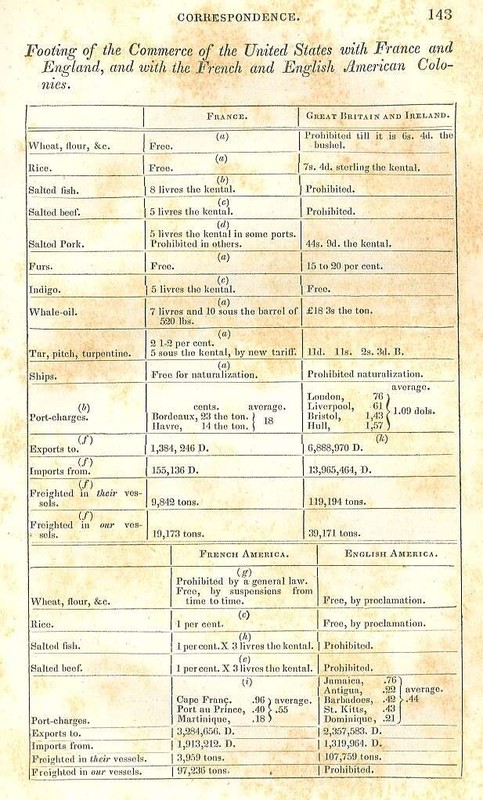
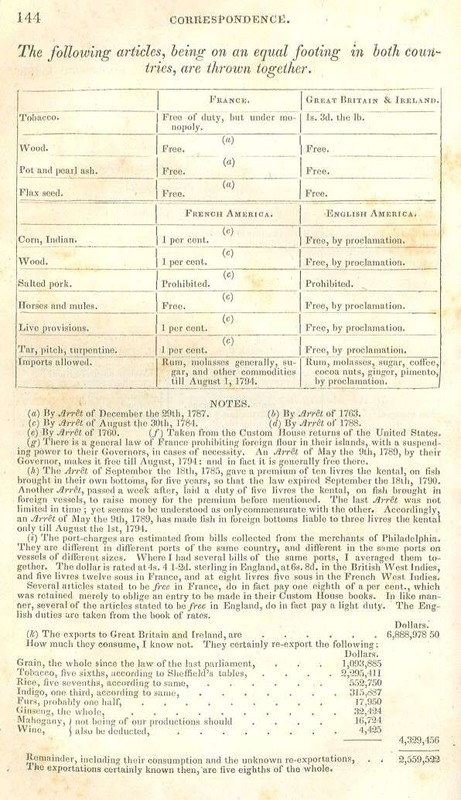
LETTER XC.—TO THE PRESIDENT, January 4, 1792
TO THE PRESIDENT.
Philadelphia, January 4, 1792,
Sir,
Having been in conversation to-day with Monsieur Payan, one of the St. Domingo deputies, I took occasion to inquire of him the footing on which our commerce there stands at present, and particularly whether the colonial Arrêt of 1789, permitting a free importation of our flour till 1793, was still in force. He answered, that that Arrêt was revoked in France on the clamors of the merchants there; and with a like permission to carry flour to the three usual ports, and he thinks to bring away coffee and sugar, was immediately renewed by the Governor. Whether this has been regularly kept up by renewed Arrêts, during the present trouble, he cannot say, but is sure that in practice it has never been discontinued, and that not by contraband, but openly and legally, as is understood. The public application to us to send flour there, is a proof of it. Instead, therefore, of resting this permission on a colonial Arrêt till 1793, it should be rested on temporary Arrêts renewed from time to time, as heretofore. This correction of the notes I took the liberty of laying before you with the table containing a comparative view of our commerce with France and England, I thought it my duty to make.
I have the honor to be, with the most perfect respect and attachment, Sir, your most obedient and most humble servant,
Th: Jefferson.
LETTER XCI.—TO THOMAS PINCKNEY, January 17, 1792
TO THOMAS PINCKNEY.
Philadelphia, January 17, 1792.
Sir,
Your favors of November the 29th, 30th, and December the 1st, came duly to hand, and gave sincere pleasure, by announcing your disposition to accept the appointment to London. The nominations to Paris and the Hague having been detained till yours could be made, they were all immediately sent in to the Senate, to wit, yourself for London, Mr. G. Morris for Paris, Mr. Short for the Hague. Some members of the Senate, apprehending they had a right of determining on the expediency of foreign missions, as well as on the persons named, took that occasion of bringing forward the discussion of that question, by which the nominations were delayed two or three weeks. I am happy to be able to assure you, that not a single personal motive with respect to yourself entered into the objections to these appointments. On the contrary, I believe that your nomination gave general satisfaction. Your commission will be immediately made out, but as the opportunities of conveyance at this season are precarious, and you propose coming to this place, I think it better to retain it.
As to the delay proposed in your letter, it was to be expected: indeed a winter passage from Charleston to this place, or across the Atlantic, is so disagreeable, that if either that circumstance or the arrangement of your affairs should render it in the smallest degree eligible to you to remain at home till the temperate season comes on, stay till after the vernal equinox; there will be no inconvenience to the public attending it. On the contrary, as we are just opening certain negotiations with the British minister here, which have not yet assumed any determinate complexion, a delay till that time will enable us to form some judgment of the issue they may take, and to know exactly in what way your co-operation at the place of your destination may aid us. On this and other accounts it will be highly useful that you take this place in your way, where, or at New York, you will always be sure of finding a convenient, passage to England.
I have the honor to be, with the most perfect esteem and respect, Sir, your most obedient and most humble servant,
Th: Jefferson.
LETTER XCII.—TO WILLINKS, VAN STAPHORSTS, AND HUBARD, Jan. 23,1792
TO MESSRS. WILLINKS, VAN STAPHORSTS, AND HUBARD.
Philadelphia, January 23,1792.
Gentlemen,
On the 19th of March last, I had the honor to enclose you a bill for ninety-nine thousand florins, drawn on yourselves by the Treasurer of the United States, in favor of the Secretary of State, and I desired you to raise an account with the Secretary of State, and pass that bill to his credit in the account. In my letter of May the 14th, I enclosed you a duplicate of the same bill, and informed you that this money was destined to pay the salaries and contingent expenses of our ministers and agents of every description, from July the 1st, 1790, and nothing else; and I added these words; ‘I must beg the favor of you, also, to make up your account to the close of the last day of June this present year, into which no expenses are to enter which preceded, the 1st day of July, 1790, these being the dates of the appropriation of the law.’ And lastly, in my letter of August the 5th, I enclosed a triplicate of the same bill, and added, ‘In the mean time, I hope that your account of this fund, from July the 1st, 1790, to June the 30th, 1791, inclusive, is on its way to me, that I may receive it in time to lay before Congress at their meeting:’ but in fact, I have neither received the account so much desired, nor even an acknowledgment of the receipt of any of the said letters or bills; and though Congress have been now sitting upwards of three months, I have it not in my power to lay before them a statement of the administration of this fund. When you consider the delicate situation of those entrusted with the disposal of public monies, and the express injunction under which I am laid by my office to submit this account to a proper and timely examination, I leave you to conceive what my sensations must be under the disability to do it, which the want of your account alone has brought,on me; and I hope I shall soon be relieved by the receipt of it.
I am, with great esteem, Gentlemen, your most obedient servant,
Th: Jefferson.
LETTER XCIII.—TO WILLIAM SHORT, January 23, 1792
TO WILLIAM SHORT.
Philadelphia, January 23, 1792.
Dear Sir,
I have the pleasure to inform you, that the President of the United States has appointed you Minister Resident for the United. States, at the Hague, which was approved by the Senate on the 16th instant. This new mark of the President’s confidence will be the more pleasing to you, as it imports an approbation of your former conduct, whereon be pleased to accept my congratulations. You will receive herewith, a letter from myself to Monsieur de Montmorin, closing your former mission, your new commission, letters of credence from the President for the States General and Stadtholder, sealed, and copies of them open for your own satisfaction. You will keep the cipher we have heretofore used.
Your past experience in the same line, renders it unnecessary for me to particularize your duties on closing your present, or conducting your future mission. Harmony with our friends being our object, you are sensible how much it will be promoted by attention to the manner as well as the matter of your communications with the government of the United Netherlands. I feel myself particularly bound to recommend, as the most important of your charges, the patronage of our commerce and the extension of its privileges, both in the United Netherlands and their colonies, but most especially the latter.
The allowance to a Minister Resident of the United States, is four thousand five hundred dollars a year, or all his personal services and other expenses, a year’s salary for his outfit and a quarter’s salary for his return. It is understood that the personal services and other expenses here meant, do not extend to the cost of gazettes and pamphlets transmitted to the Secretary of State’s office, to translating or printing necessary papers, postage, couriers, and necessary aids to poor American sailors. These additional charges, therefore, may be inserted in your accounts; but no other of any description, unless where they are expressly directed to be incurred. The salary of your new grade being the same as of your former one, and your services continued, though the scene of them is changed, there will be no intermission of salary; the new one beginning where the former ends, and ending when you shall receive notice of your permission to return. For the same reason, there can be but one allowance of outfit and return, the former to take place now, the latter only on your final return. The funds appropriated to the support of the foreign establishment do not admit the allowance of a secretary to a Minister Resident. I have thought it best to state these things to you minutely, that you may be relieved from all doubt as to the matter of your accounts. I will beg leave to add a most earnest request, that on the 1st day of July next, and on the same day annually afterwards, you make out your account to that day, and send it by the first vessel, and by duplicates. In this I must be very urgent and particular; because at the meeting of the ensuing Congress always, it is expected that I prepare for them a statement of the disbursements from this fund, from July to June inclusive. I shall give orders, by the first opportunity, to our bankers in Amsterdam, to answer your drafts for the allowances herein before mentioned, recruiting them at the same time by an adequate remitment; as I expect that by the time you receive this, they will not have remaining on hand of this fund more than seven or eight thousand dollars.
You shall receive from me, from time to time, the laws and journals of Congress, gazettes, and other interesting papers: for whatever information is in possession of the public, I shall leave you generally to the gazettes, and only undertake to communicate by letter, such, relative to the business of your mission, as the gazetteers cannot, give. From you I shall ask, once or twice a month regularly, a communication of interesting occurrences in Holland, of the general affairs of Europe, and the regular transmission of,the Leyden gazette by every British packet, in the way it now comes, which proves to be very regular. Send also such other publications as may be important enough to be read by one who can spare little time to read any thing, or which may contain matter proper to be turned to, on interesting subjects and occasions. The English packet is the most certain channel for such epistolary communications as are not very secret, and by those packets I would wish always to receive a letter from you by way of corrective to the farrago of news they generally bring. Intermediate letters, secret communications, gazettes, and other printed papers, had better come by private vessels from Amsterdam; which channel I shall use generally for my letters, and always for gazettes and other printed papers.
The President has also joined you in a special and temporary commission with Mr. Carmichael to repair to Madrid, and there negotiate certain matters respecting the navigation of the Mississippi, and other points of common interest between Spain and us. As some time will be necessary to make out the instructions and transcripts necessary in this business, they can only be forwarded by some future occasion; but they shall be soon forwarded, as we wish not to lose a moment in advancing negotiations so essential to our peace. For this reason, I must urge you to repair to the Hague at the earliest day the settlement of your affairs at Paris will admit, that your reception may be over, and the idea of your being established there strengthened, before you receive the new orders.
I have the honor to be, with sincere respect and esteem, Dear Sir, your most obedient and most humble servant,
Th: Jefferson.
LETTER XCIV.—TO GOUVERNEUR MORRIS, January 23, 1792
TO GOUVERNEUR MORRIS.
Philadelphia, January 23, 1792.
Dear Sir,
I have the pleasure to inform you, that the President of the United States has appointed you Minister Plenipotentiary for the United States, at the court of France, which was approved by the Senate on the 12th instant; on which be pleased to accept my congratulations. You will receive herewith your commission, a letter of credence for the King, sealed, and a copy of it open for your own satisfaction, as also a cipher, to be used on proper occasions in the correspondence between us.
To you, it would be more than unnecessary for me to undertake a general delineation of the functions of the office to which you are appointed. I shall therefore only express our desire, that they be constantly exercised in that spirit of sincere friendship and attachment which we bear to the French nation; and that in all transactions with the minister, his good dispositions be conciliated by whatever in language or attentions may tend to that effect. With respect to their government, we are under no call to express opinions which might please or offend any party, and therefore it will be best to avoid them on all occasions, public or private. Could any circumstances require unavoidably such expressions, they would naturally be in conformity with the sentiments of the great mass of our countrymen, who, having first, in modern times, taken the ground of government founded on the will of the people, cannot but be delighted on seeing so distinguished and so esteemed a nation arrive on the same ground, and plant their standard by our side.
I feel myself particularly bound to recommend, as the most important of your charges, the patronage of our commerce and the extension of its privileges, both in France and her colonies, but most especially the latter. Our Consuls in France are under general instructions to correspond with the Minister of the United States at Paris; from them you may often receive interesting information. Joseph Fenwick is Consul at Bordeaux, and Burwell Carnes at Nantz; Monsieur de la Motte, Vice-Consul at Havre, and Monsieur Cathalan at Marseilles.
An act of Congress, of July the 1st, 1790, has limited the allowance of a Minster Plenipotentiary to nine thousand dollars a year, for all his personal services and other expenses, a year’s salary for his outfit, and a quarter’s salary for his return. It is understood that the personal services and other expenses here meant, do not extend to the cost of gazettes and pamphlets transmitted to the Secretary of State’s office, to translating or printing necessary papers, postage, couriers, and necessary aids to poor American sailors. These additional charges, therefore, may be inserted in your accounts; but no other of any description, unless where they are expressly directed to be incurred. By an ancient rule of Congress, your salary will commence from the day you receive this letter, if you be then at Paris, or from the day you set out for Paris from any other place at which it may find you: it ceases on receiving notice or permission to return, after which the additional quarter’s allowance takes place. You are free to name your own private secretary, who will receive, from the public a salary of thirteen hundred and fifty dollars a year, without allowance for any extras. I have thought it best to state these things to you minutely, that you may be relieved from all doubt as to the matter of your accounts. I will beg leave to add a most earnest request, that on the 1st day of July next, and on the same day annually afterwards, you make out your account to that day, and send it by the first vessel, and by duplicates. In this I must be very urgent and particular, because at the meeting of the ensuing Congress always, it is expected that I prepare for them a statement of the disbursements from this fund, from July to June inclusive. I shall give orders by the first opportunity to our bankers in Amsterdam, to answer your drafts for the allowances herein before mentioned, recruiting them at the same time by an adequate remitment, as I expect that by the time you receive this, they will not have remaining on hand of this fund more than seven or eight thousand dollars.
You shall receive from me, from time to time, the laws and journals of Congress, gazettes, and other interesting papers: for whatever information is in possession of the public, I shall leave you generally to the gazettes, and only undertake to communicate by letter, such, relative to the business of your mission, as the gazettes cannot give.
From you I shall ask, once or twice a month regularly, a communication of interesting occurrences in France, of the general affairs of Europe, and transmission of the Leyden gazette, the Journal Logographe, and the best paper of Paris for their colonial affairs, with such other publications as may be important enough to be read by one who can spare little time to read any thing, or which may contain matter proper to be turned to on interesting subjects and occasions. The English packet is the most certain channel for such epistolary communications as are not very secret, and by those packets I would wish always to receive a letter from you by way of corrective to the farrago of news they generally bring. Intermediate letters, secret communications, gazettes, and other printed papers, had better come through the channel of Monsieur de la Motte at Havre, to whom I shall also generally address my letters to you, and always the gazettes and other printed papers.
Mr. Short will receive by the same conveyance, his appointment as Minister Resident at the Hague.
I have the honor to be, with great esteem and respect, Dear Sir, your most obedient and most humble servant,
Th: Jefferson.
LETTER XCV.—TO MR. HAMMOND, February 2, 1792
TO MR. HAMMOND.
Philadelphia, February 2, 1792.
Sir,
On the receipt of your letter of the 14th of December, I communicated it to the President of the United States, and under the sanction of his authority, the principal members of the executive department made it their duty to make known in conversations generally, the explicit disclaimer, in the name of your court, which you had been pleased to give us, that the government of Canada had supported or encouraged the hostilities of our Indian neighbors in the western country. Your favor of January the 30th, to the same purpose, has been, in like manner, communicated to the President, and I am authorized to assure you, that he is duly sensible of this additional proof of the disposition of the court of London to confine the proceedings of their officers in our vicinage within the limits of friendship and good neighborhood, and that a conduct so friendly and just will furnish us a motive the more for those duties and good offices which neighbor nations owe each other.
You have seen too much, Sir, of the conduct of the press in countries where it is free, to consider the gazettes as evidence of the sentiments of any part of the government: you have seen them bestow on the government itself, in all its parts, its full share of inculpation. Of the sentiments of our government on the subject of your letter, I cannot give you better evidence than the statement of the causes of the Indian war, made by the Secretary of War on the 26th of the last month, by order of the President, and inserted in the public papers. No interference on the part of your nation is therein stated among the causes of the war. I am happy however in the hope, that a due execution of the treaty will shortly silence those expressions of public feeling, by removing their cause.
I have the honor to be, with great respect and esteem, Sir, your most obedient and most humble servant,
Th: Jefferson.
LETTER XCVI.—TO MR. HAMMOND, February 25, 1792
TO MR. HAMMOND.
Philadelphia, February 25, 1792.
Sir,
I have now the honor to enclose you the answer of the Attorney General to a letter I wrote him on the subject of yours of the 18th instant.
It appears that the judges of the Supreme Court of the United States are open to the application of Mr. Pagan for a writ of error to revise his case. This writ is to be granted, indeed, or refused, at the discretion of the judge; but the discretion of the judge is governed by the rules of law: if these be in favor of Mr. Pagan’s application, his case will be reviewed in the Supreme Court, and the decision against him corrected, if wrong, if these be against his application, he will then be at the end of the ordinary course of law, at which term alone it is usual for nations to take up the cause of an individual, and to inquire whether their judges have refused him justice. At present, therefore, I am not able to say more, than that the judges of the Supreme Court of the United States will receive Mr. Pagan’s application for a writ of error to revise the judgment given against him by the inferior court, and that there can be no doubt they will do on that application what shall be right.
I have the honor to be, with the highest esteem, your most obedient and most humble servant.
Th: Jefferson.
LETTER XCVII.—TO MESSRS. JOHNSON, CARROL, AND STEWART, March 6, 1792
TO MESSRS. JOHNSON, CARROL, AND STEWART.
Philadelphia, March 6, 1792,
Gentlemen,
It having been found impracticable to employ Major L’Enfant about the federal city, in that degree of subordination which was lawful and proper, he has been notified that his services are at an end. It is now proper that he should receive the reward of his past services; and the wish that he should have no just cause of discontent, suggests that it should be liberal. The President thinks of two thousand five hundred, or three thousand dollars, but leaves the determination to you. Ellicot is to go on, the week after, the next, to finish laying off the plan on the ground, and surveying and platting the district. I have remonstrated with him on the excess of five dollars a day and his expenses, and he has proposed striking off the latter; but this also is left to you, and to make the allowance retrospective. He is fully apprized that he is entirely under your orders, and that there will be no person employed but under your orders. The enemies of this enterprise will take advantage of the retirement of L’Enfant, to trumpet an abortion of the whole. This will require double exertions, to be counteracted. I enclose you the project of a loan, which is agreed on, if you approve it. Your answer will be immediately expected, and it is kept entirely secret, till the subscriptions are actually opened. With this money, in aid of your other funds, the works may be pushed with such spirit as to evince to the world that they will not be relaxed.
The immediate employment of a superintendent, of activity and intelligence equal to the nature of his functions and the public expectations, becomes important. You will, doubtless, also consider it as necessary to advertise immediately for plans of the Capitol and President’s house. The sketch of an advertisement for the plan of a Capitol, which Mr. Johnson had sent to the President, is now returned with some alterations, and one also for a President’s house. Both of them are subject to your pleasure, and when accommodated to that, if you will return them, they shall be advertised here and elsewhere. The President thinks it of primary importance to press the providing as great quantities of brick, stone, lime, plank, timber, &c. this year as possible. It will occur to you that the stone should be got by a skilful hand. Knowing what will be your funds, you will be able to decide which of the following works had better be undertaken for the present year.
The cellars of both houses.
The foundation of one, or both.
Bridge over Rock Creek, and the post-road brought over it.
Canal.
Wharves.
The affair of Mr. Carrol of Duddington’s house, seems to call for settlement. The President thinks the most just course would be, to rebuild the house in the same degree, using the same materials as far as they will go, and supplying what are destroyed or rendered unfit; so that the effect will be in fact, only the removal of the house within his lot, and in a position square with the streets. Do you not think it would be expedient to take measures for importing a number of Germans and Highlanders? This need not be to such an extent as to prevent the employment of eastern laborers, which is eligible for particular reasons. If you approve of the importation of Germans, and have a good channel for it, you will use it, of course. If you have no channel, I can help you to one. Though Roberdeau’s conduct has been really blamable, yet we suppose the principal object of the arrest was to remove him off the ground. As the prosecution of him to judgment might give room to misrepresentation of the motives, perhaps you may think it not amiss to discontinue the proceedings. You will receive herewith a packet of papers, among which are several projects and estimates which have been given in by different persons, and which are handed on to you, not as by any means carrying with them any degree of approbation, but merely, that if you find any thing good in them, you may convert it to some account. Some of these contain the views of L’Enfant.
I have the honor to be, with the most perfect esteem and respect, Gentlemen, your most obedient and most humble servant,
Th: Jefferson.
LETTER XCVIII.—TO GOUVERNEUR MORRIS,
TO GOUVERNEUR MORRIS.
Philadelphia, March 10, 1792.
Dear Sir,
My letter of January the 23rd, put under cover to Mr. Johnson in London, and sent by a passenger in the British packet of February, will have conveyed to you your appointment as Minister Plenipotentiary of the United States, at the court of France. By the Pennsylvania, Captain Harding, bound to Havre de Grace, and plying pretty regularly between this place and that, you will receive the present letter, with the laws of the United States, journals of Congress, and gazettes to this day, addressed to the care of M. de la Motte. You will also receive a letter from the President to the King of France, in answer to his announcing the acceptance of the constitution, which came to hand only a week ago. A copy of this letter is sent for your own use. You will be pleased to deliver the sealed one (to the minister I presume, according to the ancient etiquette of the court), accompanying it with the assurances of friendship, which the occasion may permit you to express, and which are cordially felt by the President and the great body of our nation. We wish no occasion to be omitted of impressing the National Assembly with this truth. We had expected, ere this, that in consequence of the recommendation of their predecessors, some overtures would have been made to us on the subject of a treaty of commerce. An authentic copy of the recommendation was delivered, but nothing said about carrying it into effect. Perhaps they expect that we should declare our readiness to meet them on the ground of treaty. If they do, we have no hesitation to declare it. In the mean time, if the present communications produce any sensation, perhaps it may furnish a good occasion to endeavor to have matters re-placed in statu quo, by repealing the late innovations as to our ships, tobacco, and whale-oil. It is right that things should be on their ancient footing, at opening the treaty. M. Ternant has applied here for four hundred thousand dollars for the succor of the French colonies. The Secretary of the Treasury has reason to believe, that the late loan at Antwerp has paid up all our arrearages to France, both of principal and interest, and consequently, that there is no part of our debt exigible at this time. However, the legislature having authorized the President to proceed in borrowing to pay off the residue, provided it can be done to the advantage of the United States, it is thought the law will be satisfied with avoiding loss to the United States. This has obliged the Secretary of the Treasury to require some conditions, which may remove from us that loss which we encountered, from an unfavorable exchange, to pay what was exigible, and transfer it to France as to payments not exigible. These shall be fully detailed to you when settled. In the mean time, the money will be furnished as far as it can be done. Indeed, our wishes are cordial for the re-establishment of peace and commerce in those colonies, and to give such proofs of our good faith both to them and the mother country, as to suppress all that jealousy which might oppose itself to the free exchange of our mutual productions, so essential to the prosperity of those colonies, and to the preservation of our agricultural interest. This is our true interest, and our true object, and we have no reason to conceal views so justifiable, though the expression of them may require that the occasions be proper and the terms chosen with delicacy. The gazettes will inform you of the proceedings of Congress, the laws passed and proposed, and generally speaking, of all public transactions. You will perceive that the Indian war calls for sensible exertions. It would have been a trifle had we only avowed enemies to contend with. The British court have disavowed all aid to the Indians. Whatever may have been their orders in that direction, the Indians are fully and notoriously supplied by their agents with every thing necessary to carry on the war. Time will show how all this is to end. Besides the laws, journals, and newspapers, before mentioned, you will receive herewith the State constitutions, the census, and almanac, and an answer to Lord Sheffield on our commerce. A cipher is ready for you, but cannot be sent till we can find a trusty passenger going to Paris.
I am, with great respect and esteem, Dear Sir, your most obedient and most humble servant,
Th: Jefferson.
Since writing the preceding, the two Houses have come to resolutions on the King’s letter, which are enclosed in the President’s, and copies of them accompany this for your use. T.J.
LETTER XCIX.—TO MESSRS. CARMICHAEL AND SHORT, March 18, 1792
TO MESSRS. CARMICHAEL AND SHORT.
Philadelphia, March 18, 1792.
Gentlemen,
The President having thought proper to appoint you joint commissioners plenipotentiary, on the part of the United States, to treat with the court of Madrid on the subjects of the navigation of the Mississippi, arrangements on our limits, and commerce, you will herewith receive your commission; as also observations on these several subjects, reported to the President and approved by him, which will therefore serve as instructions for you. These expressing minutely the sense of our government and what they wish to have done, it is unnecessary for me to do more here than desire you to pursue these objects unremittingly, and endeavor to bring them to an issue, in the course of the ensuing summer. It is desirable that you should keep an exact journal of what shall pass between yourselves and the court or their negotiator, and communicate it from time to time to me, that your progress and prospects may be known. You will be the best judges whether to send your letters by Lisbon, Cadiz, or what other route; but we shall be anxious to hear from you as often as possible. If no safe conveyance occurs from Madrid to Lisbon, and your matter should be of importance sufficient to justify the expense, a courier must be sent; but do not incur the expense, unless it be to answer some good end.
I have the honor to be, with great and sincere esteem, Gentlemen, your most obedient and most humble servant,
Th: Jefferson.
LETTER C.—TO COLONEL PICKERING, March 28, 1792
TO COLONEL PICKERING.
Philadelphia, March 28, 1792.
Sir,
The President has desired me to confer with you on the proposition I made the other day, of endeavoring to move the posts at the rate of one hundred miles a day. It is believed to be practicable here, because it is practised in every other country. The difference of expense alone appeared to produce doubts with you on the subject. If you have no engagement for dinner to-day, and will do me the favor to come and dine with me, we will be entirely alone, and it will give us time to go over the matter and weigh it thoroughly. I will, in that case, ask the favor of you to furnish yourself with such notes as may ascertain the present expense of the posts, for one day in the week, to Boston and Richmond, and enable us to calculate the savings which may be made by availing ourselves of the stages. Be pleased to observe that the stages travel all the day. There seems nothing necessary for us then, but to hand the mail along through the night till it may fall in with another stage the next day, if motives, of economy should oblige us to be thus attentive to small savings. If a little latitude of expense can be allowed, I should be for only using the stages the first day, and then have our riders. I am anxious that the thing should be begun by way of experiment, for a short distance, because I believe it will so increase the income of the post-office as to show we may go through with it. I shall hope to see you at three o’clock.
I am with great esteem, Sir, your most obedient, humble servant,
Th: Jefferson.
LETTER CI.—TO MR. HAMMOND, March 31, 1792
TO MR. HAMMOND.
Philadelphia, March 31, 1792.
Sir,
I received yesterday your favor of the day before, and immediately laid it before the President of the United States. I have it in charge from him to express to you the perfect satisfaction which these assurances on the part of your court have given him, that Bowles, who is the subject of them, is an unauthorized impostor. The promptitude of their disavowal of what their candor had forbidden him to credit, is a new proof of their friendly dispositions, and a fresh incitement to us to cherish corresponding sentiments. To these we are led both by interest and inclination, and I am authorized to assure you that no occasion will be omitted, on our part, of manifesting their sincerity.
I have the honor to be, with sentiments of the most perfect esteem and respect, Sir, your most obedient and most humble servant,
Th: Jefferson.
LETTER CII.—TO GOVERNOR PINCKNEY, April 1, 1792
TO GOVERNOR PINCKNEY.
Philadelphia, April 1, 1792.
Sir,
Your letter of January the 8th to the President of the United States having been referred to me, I have given the subject of it as mature consideration as I am able. Two neighboring and free governments, with laws equally mild and just, would find no difficulty in forming a convention for the interchange of fugitive criminals. Nor would two neighboring despotic governments, with laws of equal severity. The latter wish that no door should be opened to their subjects flying from the oppression of their laws. The fact is, that most of the governments on the continent of Europe have such conventions; but England, the only free one till lately, has never yet consented either to enter into a convention for this purpose, or to give up a fugitive. The difficulty between a free government and a despotic one is indeed great. I have the honor to enclose to your Excellency a sketch of the considerations which occurred to me on the subject, and which I laid before the President. He has, in consequence, instructed me to prepare a project of a convention, to be proposed to the court of Madrid, which I have accordingly done, and now enclose a copy of it. I wish it may appear to you satisfactory. Against property we may hope it would be effectual; whilst it leaves a door open to life and liberty except in a single unquestionable case. Messrs. Carmichael and Short will be instructed to make this one of the subjects of their negotiation with the court of Spain. I have the honor to be, with sentiments of the most perfect esteem and respect, your Excellency’s most obedient and most humble servant,
Th: Jefferson.
LETTER CIII.—TO COLONEL HUMPHREYS, April 9, 1792
TO COLONEL HUMPHREYS.
Philadelphia, April 9, 1792.
Dear Sir,
My last to you were of the 29th of November and the 13th of December. I have now to acknowledge the receipt of your Nos. 34 to 44, inclusive. The river here and at New York having remained longer blocked with ice than has been usual, has occasioned a longer interval than usual between my letters. I have particularly to acknowledge, that Mr. Barclay’s receipt of drafts from you on our bankers in Holland for thirty-two thousand one hundred and seventy-five florins has come safely to my hands, and is deposited in my office, where it will be to be found wrapped in the letter in which it came. You have been before informed of the failure of our arms against the Indians, the last year. General St. Clair has now resigned that command. We are raising our western force to five thousand men. The stock-jobbing speculations have occupied some of our countrymen to such a degree, as to give sincere uneasiness to those who would rather see their capitals employed in commerce, manufactures, buildings, and agriculture. The failure of Mr. Duer, the chief of that description of people, has already produced some other bankruptcies, and more are apprehended. He had obtained money from great numbers of small tradesmen and farmers, tempting them by usurious interest, which has made the distress very extensive. Congress will adjourn within a fortnight. The President negatived their representation bill, as framed on principles contrary to the constitution. I suppose another will be passed, allowing simply a representative for every thirty or thirty-three thousand, in each State. The troubles in the French island continue extreme; we have, as yet, heard of the arrival but of a few troops. There begins to be reason to apprehend, the negroes will perhaps never be entirely reduced. A commission has issued to Mr. Carmichael and Mr. Short, to treat with the court of Madrid on the subjects heretofore in negotiation between us. I suppose Mr. Short will be in Madrid by the last of May. We expect Major Pinckney here hourly, on his way to London, as our Minister Plenipotentiary to that court. For a state of our transactions in general, I refer you to the newspapers which accompany this. I put under your cover letters and newspapers for Mr. Carmichael and Mr. Barclay, which I pray you to contrive by some sure conveyances. We must make you, for some time, the common centre of our correspondence.
I am with great and sincere respect and esteem, Dear Sir, your most obedient and most humble servant,
Th: Jefferson.
LETTER CIV.—TO MR. HAMMOND, April 12, 1792
TO MR. HAMMOND.
Philadelphia, April 12, 1792.
Sir,
I am this moment favored with the letter you did me the honor of writing yesterday, covering the extract of a British statute forbidding the admission of foreign vessels into any ports of the British dominions, with goods or commodities of the growth, production, or manufacture of America. The effect of this appears to me so extensive, as to induce a doubt whether I understand rightly the determination to enforce it, which you notify, and to oblige me to ask of you whether we are to consider it as so far a revocation of the proclamation of your government, regulating the commerce between the two countries, and that henceforth no articles of the growth, production, or manufacture of the United States, are to be received in the ports of Great Britain or Ireland, in vessels belonging to the citizens of the United States.
I have the honor to be, with sentiments of the most perfect esteem and respect, Sir, your most obedient and most humble servant,
Th: Jefferson.
LETTER CV.—TO MR. HAMMOND, April 13,1792
The Secretary of State presents his compliments to Mr. Hammond, and encloses him the draught of a letter to the President of the United States, which he has prepared to accompany Mr. Hammond’s communication of the 11th and letter of the 12th. The whole will probably be laid by the President before the legislature, and perhaps communicated to the public, in order to let the merchants know that they need not suspend their shipments, but to the islands of Jersey and Guernsey. Before sending the letter to the President, the Secretary of State has chosen to communicate it to Mr. Hammond in a friendly way, being desirous to know whether it meets his approbation, or whether he would wish any alterations in it.
April 13,1792.
LETTER CVI.—TO THE PRESIDENT, April 13, 1792
TO THE PRESIDENT.
Philadelphia, April 13, 1792,
Sir,
I have the honor to lay before you a communication from Mr. Hammond, Minister Plenipotentiary of his Britannic Majesty, covering a clause of a statute of that country relative to its commerce with this, and notifying a determination to carry it into execution henceforward. Conceiving that the determination announced could not be really meant as extensively as the words import, I asked and received an explanation from the minister, as expressed in the letter and answer herein enclosed: and on consideration of all circumstances, I cannot but confide in the opinion expressed by him, that its sole object is to exclude foreign vessels from the islands of Jersey and Guernsey. The want of proportion between the motives expressed and the measure, its magnitude, and consequences, total silence as to the proclamation on which the intercourse between the two countries has hitherto hung, and of which, in this broad sense, it would be a revocation, and the recent manifestations of the disposition of that government to concur with this in mutual offices of friendship and good will, support his construction. The minister, moreover, assured me verbally, that he would immediately write to his court for an explanation, and, in the mean time, is of opinion that the usual intercourse of commerce between the two countries (Jersey and Guernsey excepted) need not be suspended.
I have the honor to be, with sentiments of the most profound respect and attachment, Sir, your most obedient and most humble servant,
Th: Jefferson.
LETTER CVII.—TO MESSRS. CARMICHAEL AND SHORT, April 24, 1792
TO MESSRS. CARMICHAEL AND SHORT.
Philadelphia, April 24, 1792.
Gentlemen,
My letter of March the 18th conveyed to you full powers for treating with Spain on the subjects therein expressed. Since that, our attention has been drawn to the case of fugitive debtors and criminals, whereon it is always well that coterminous States should understand one another, as far as their ideas on the rightful powers of government can be made to go together. Where they separate, the cases may be left unprovided for. The enclosed paper, approved by the President, will explain to you how far we can go, in an agreement with Spain for her territories bordering on us: and the plan of a convention is there stated. You are desired to propose the matter to that court, and establish with them so much of it as they approve, filling up the blank for the manner of the demand by us and compliance by them, in such way, as their laws and the organization of their government may require. But recollect that they bound on us between two and three thousand miles, and consequently, that they should authorize a delivery by some description of officers to be found on every inhabited part of their border. We have thought it best to agree, specially, the manner of proceeding in our country, on a demand of theirs, because the convention will in that way execute itself, without the necessity of a new law for the purpose. Your general powers being comprehensive enough to take in this subject, no new ones are issued.
I have the honor to be, with great respect, Gentlemen, your most obedient and most humble servant,
Th: Jefferson.
[The annexed are the papers referred to in the preceding.]
Project of a Convention with the Spanish Provinces.
Any person having committed murder of malice prepense, not of the nature of treason, within the United States or the Spanish provinces adjoining thereto, and fleeing from the justice of the country, shall be delivered up by the government where he shall be found, to that from which he fled, whenever demanded by the same.
The manner of the demand by the Spanish government, and of the compliance by that of the United States, shall be as follows. The person authorized by the Spanish government, where the murder was committed, to pursue the fugitive, may apply to any justice of the Supreme Court of the United States, or to the district judge of the place where the fugitive is, exhibiting proof on oath that a murder has been committed by the said fugitive within the said government, who shall thereon issue his warrant to the marshal or deputy-marshal of the same place, to arrest the fugitive and have him before the said district judge; or the said pursuer may apply to such marshal or deputy-marshal directly, who on exhibition of proof as aforesaid, shall thereupon arrest the fugitive, and carry him before the said district judge; and when before him in either way, he shall, within not less than ————-days, nor more than ————-, hold a special court of inquiry, causing a grand jury to be summoned thereto, and charging them to inquire whether the fugitive hath committed a murder, not of the nature of treason, within the province demanding him, and on their finding a true bill, the judge shall order the officer in whose custody the fugitive is, to deliver him over to the person authorized as aforesaid to receive him, and shall give such further authorities to aid the said person in safe-keeping and conveying the said fugitive to the limits of the United States, as shall be necessary and within his powers; and his powers shall expressly extend to command the aid of posse of every district through which the said fugitive is to be carried. And the said justices, judges, and other officers, shall use in the premises the same process and proceedings, mutatis mutandis, and govern themselves by the same principles and rules of law, as in cases of murder committed on the high seas.
And the manner of demand by the United States and of compliance by the Spanish government shall be as follows. The person authorized by a justice of the Supreme Court of the United States, or by the district judge where the murder was committed, to pursue the fugitive, may apply to ————-
Evidence on oath, though written and ex parte, shall have the same weight with the judge and grand jury in the preceding cases, as if the same had been given before them orally and in presence of the prisoner.
The courts of justice of the said States and provinces, shall be reciprocally open for the demand and recovery of debts due to any person inhabiting the one, from any person fled therefrom and found in the other, in like manner as they are open to their own citizens; likewise, for the recovery of the property, or the value thereof, carried away from any person inhabiting the one, by any person fled therefrom and found in the other, which carrying away shall give a right of civil action, whether the fugitive came to the original possession lawfully or unlawfully, even feloniously; likewise, for the recovery of damages sustained by any forgery committed by such fugitive. And the same provision shall hold in favor of the representatives of the original creditor or sufferer, and against the representatives of the original debtor, carrier away, or forger; also, in favor of either government or of corporations, as of natural persons. But in no case shall the person of the defendant be imprisoned for the debt, though the process, whether original, mesne, or final, be for the form sake directed against his person. If the time between the flight and the commencement of the action exceed not ——— years, it shall be counted but as one day under any act of limitations.
This convention shall continue in force ————- years, from the exchange of ratifications, and shall not extend to any thing happening previous to such exchange.
Heads of consideration on the establishment of conventions between the United States and their neighbors, for the mutual delivery of fugitives from justice.
Has a nation a right to punish a person who has not offended itself? Writers on the law of nature agree that it has not. That, on the contrary, exiles and fugitives are, to it, as other strangers, and have a right of residence, unless their presence would be noxious; e. g. infectious persons. One writer extends the exception to atrocious criminals, too imminently dangerous to society; namely, to pirates, murderers, and incendiaries. Vattel, L. 1.5. 233.
The punishment of piracy, being provided for by our laws, need not be so by convention.
Murder. Agreed that this is one of the extreme crimes justifying a denial of habitation, arrest, and re-delivery. It should be carefully restrained by definition to homicide of malice prepense, and not of the nature of treason.
Incendiaries, or those guilty of arson. This crime is so rare as not to call for extraordinary provision by a convention. The only rightful subject then of arrest and delivery, for which we have need, is murder. Ought we to wish to strain the natural right of arresting and re-delivering fugitives to other cases?
The punishment of all real crimes is certainly desirable, as a security to society; the security is greater in proportion as the chances of avoiding punishment are less. But does the fugitive from his country avoid punishment? He incurs exile, not voluntary, but under a moral necessity as strong as physical. Exile, in some countries, has been the highest punishment allowed by the laws. To most minds it is next to death; to many beyond it. The fugitive indeed is not of the latter; he must estimate it somewhat less than death. It may be said that to some, as foreigners, it is no punishment.
Answer. These cases are few. Laws are to be made for the mass of cases.
The object of a convention then, in other cases, would be, that the fugitive might not avoid the difference between exile and the legal punishment of the case. Now in what case would this difference be so important, as to overweigh even the single inconvenience of multiplying compacts?
1. Treason. This, when real, merits the highest punishment. But most codes extend their definitions of treason to acts not really against one’s country. They do not distinguish between acts against the government and acts against the oppressions of the government: the latter are virtues; yet have furnished more victims to the executioner than the former; because real treasons are rare, oppressions frequent. The unsuccessful strugglers against tyranny have been the chief martyrs of treason-laws in all countries.
Reformation of government with our neighbors; being as much wanted now as reformation of religion is, or ever was any where, we should not wish then, to give up to the executioner, the patriot who fails, and flees to us. Treasons then, taking the simulated with the real, are sufficiently punished by exile.
2. Crimes against property; the punishment in most countries, immensely disproportionate to the crime.
In England, and probably in Canada, to steal a horse is death, the first offence; to steal above the value of twelve pence is death, the second offence. All excess of punishment is a crime. To remit a fugitive to excessive punishment is to be accessary to the crime. Ought we to wish for the obligation, or the right to do it? Better, on the whole, to consider these crimes as sufficiently punished by the exile.
There is one crime, however, against property, pressed by its consequences into more particular notice, to wit;
Forgery, whether of coin or paper; and whether paper of public or private obligation. But the fugitive for forgery is punished by exile and confiscation of the property he leaves: to which add by convention, a civil action against the property he carries or acquires, to the amount of the special damage done by his forgery.
The carrying away of the property of another, may also be reasonably made to found a civil action. A convention then may include forgery and the carrying away the property of others, under the head of,
3. Flight from debts.
To remit the fugitive in this case, would be to remit him in every case. For in the present state of things, it is next to impossible not to owe something. But I see neither injustice nor inconvenience in permitting the fugitive to be sued in our courts. The laws of some countries punishing the unfortunate debtor by perpetual imprisonment, he is right to liberate himself by flight, and it would be wrong to re-imprison him in the country to which he flies. Let all process, therefore, be confined to his property.
Murder, not amounting to treason, being the only case in which the fugitive is to be delivered;
On what evidence, and by whom, shall he be delivered? In this country let any justice of the Supreme Court of the United States, or other judge of the district where the fugitive is found, use the same proceedings as for a murder committed on the high seas, until the finding of the ‘true bill’ by the grand jury; but evidence on oath from the country demanding him, though in writing and ex parte, should have the same effect as if delivered orally at the examination.
A true bill being found by the grand jury, let the officer in whose custody the fugitive is, deliver him to the person charged to demand and receive him.
In the British provinces adjoining us, the same proceedings will do.
In the Spanish provinces, a proceeding adapted to the course of their laws should be agreed on.
March 22, 1792.
LETTER CVIII.—TO GOUVERNEUR MORRIS, April 28,1792
TO GOUVERNEUR MORRIS.
Philadelphia, April 28,1792;
Dear Sir,
My last letter to you was of the 10th of March. The preceding one of January the 23rd had conveyed to you your appointment as Minister Plenipotentiary to the court of France. The present will, I hope, find you there. I now enclose you the correspondence between the Secretary of the Treasury and Minister of France, on the subject of the monies furnished to the distressed of their colonies. You will perceive that the Minister chose to leave the adjustment of the terms to be settled at Paris, between yourself and the King’s ministers. This you will therefore be pleased to do on this principle; that we wish to avoid any loss by the mode of payment, but would not choose to make a gain which should throw loss on them. But the letters of the Secretary of the Treasury will sufficiently explain the desire of the government, and be a sufficient guide to you.
I now enclose you the act passed by Congress for facilitating the execution of the consular convention with France. In a bill which has passed the House of Representatives for raising monies for the support of the Indian war, while the duties on every other species of wine are raised from one to three fourths more than they were, the best wines of France will pay little more than the worst of any other country, to wit, between six and seven cents a bottle; and where this exceeds forty per cent, on their cost, they will pay but the forty per cent. I consider this latter provision as likely to introduce in abundance the cheaper wines of France, and the more so, as the tax on ardent spirits is considerably raised. I hope that these manifestations of friendly dispositions towards that country, will induce them to repeal the very obnoxious laws respecting our commerce, which were passed by the preceding National Assembly. The present session of Congress will pass over, without any other notice of them than the friendly preferences before mentioned. But if these should not produce a retaliation of good on their part, a retaliation of evil must follow on ours. It will be impossible to defer longer than the next session of Congress, some counter regulations for the protection of our navigation and commerce. I must entreat you, therefore, to avail yourself of every occasion of friendly remonstrance on this subject. If they wish an equal and cordial treaty with us, we are ready to enter into it. We would wish that this could be the scene of negotiation, from considerations suggested by the nature of our government which will readily occur to you. Congress will rise on this day se’nnight. I enclose you a letter from Mrs. Greene, who asks your aid in getting her son forwarded by the Diligence to London, on his way to America. The letter will explain to you the mode and the means, and the parentage and genius of the young gentleman will insure your aid to him. As this goes by the French packet, I send no newspapers, laws, or other articles of that kind, the postage of which would be high.
I am with great and sincere esteem, Dear Sir, your most obedient and most humble servant,
Th: Jefferson.
LETTER CIX.—CIRCULAR TO THE AMERICAN CONSULS, May 31, 1792
CIRCULAR TO THE AMERICAN CONSULS.
Philadelphia, May 31, 1792.
Sir,
Congress having closed their session on the 8th instant, I have now the honor to forward you a copy of the laws passed thereat. One of these, chapter twenty-four, will require your particular attention, as it contains such regulations relative to the consular office, as it has been thought proper to establish legislatively.
With respect to the security required by the sixth section I would prefer persons residing within the United States, where the party can procure such to be his security. In this case, his own bond duly executed may be sent to me, and his sureties here may enter into a separate bond. Where the party cannot conveniently find sureties within the United States, my distance, and want of means of knowing their sufficiency, oblige me to refer him to the Minister or Chargé des Affaires of the United States, within the same government, if there be one, and if not, then to the Minister of the United States, resident at Paris. The securities which they shall approve, will be admitted as good. In like manner, the account for their disbursements, authorized by this law (and no other can be allowed) are to be settled at stated periods with the Minister or Chargé within their residence, if there be one; if none, then with the Minister of the United States, at Paris. The person who settles the account is authorized to pay it. Our Consuls in America are not meant to be included in these directions as to securityship and the settlement of their accounts, as their situation gives them a more convenient communication with me. It is also recommended to the Consuls to keep an ordinary correspondence with the Minister or Chargé to whom they are thus referred; but it would be also useful, if they could forward directly to me, from time to time, the prices current of their place, and any other circumstances which it might be interesting to make known to our merchants without delay.
The prices of our funds have undergone some variations within the last three months. The six per cents were pushed by gambling adventures up to twenty-six and a half, or twenty-seven and a half shillings the pound. A bankruptcy having taken place among these, and considerably affected the more respectable part of the paper, holders, a greater quantity of paper was thrown suddenly on the market than there was demand or money to take up. The prices fell to nineteen shillings. This crisis has passed, and they are getting up towards their value. Though the price of public paper is considered as the barometer of the public credit, it is truly so only as to the general average of prices. The real credit of the United States depends on their ability, and the immutability of their will, to pay their debts. These were as evident when their paper fell to nineteen shillings, as when it was at twenty-seven shillings. The momentary variation was like that in the price of corn, or any other commodity, the result of a momentary disproportion between the demand and supply.
The unsuccessful issue of our expedition against the savages the last year, is not unknown to you. More adequate preparations are making for the present year, and, in the mean time, some of the tribes have accepted peace, and others have expressed a readiness to do the same.
Another plentiful year has been added to those which had preceded it, and the present bids fair to be equally so. A prosperity built on the basis of agriculture is that which is most desirable to us, because to the efforts of labor it adds the efforts of a greater proportion of soil. The checks, however, which the commercial regulations of Europe have given to the sale of our produce, have produced a very considerable degree of domestic manufacture, which, so far as it is of the household kind, will doubtless continue, and so far as it is more public, will depend on the continuance or discontinuance of the European policy.
I am, with great esteem, Sir, your most obedient, humble servant,
Th: Jefferson.
LETTER CX.—TO JOHN PAUL JONES, June 1, 1792
TO JOHN PAUL JONES.
Philadelphia, June 1, 1792.
Sir,
The President of the United States having thought proper to appoint you commissioner for treating with the Dey and government of Algiers, on the subjects of peace and ransom of our captives, I have the honor to enclose you the commissions, of which Mr. Thomas Pinckney, now on his way to London as our Minister Plenipotentiary there, will be the bearer. Supposing that there exists a disposition to thwart our negotiations with the Algerines, and that this would be very practicable, we have thought it advisable that the knowledge of this appointment should rest with the President, Mr. Pinckney, and myself; for which reason you will perceive, that the commissions are all in my own hand-writing. For the same reason, entire secrecy is recommended to you, and that you so cover from the public your departure and destination, as that they may not be conjectured or noticed; and at the same time, that you set out after as short delay as your affairs will possibly permit.
In order to enable you to enter on this business with full information, it will be necessary to give you a history of what has passed.
On the 25th of July, 1785, the schooner Maria, Captain Stevens, belonging to a Mr. Foster, of Boston, was taken off Cape St. Vincent’s, by an Algerine cruiser; and five days afterwards, the ship Dauphin, Captain O’Bryan, belonging to Messrs. Irwins of Philadelphia, was taken by another, about fifty leagues westward of Lisbon. These vessels, with their cargoes and crews, twenty-one persons in number, were carried into Algiers. Mr. John Lambe, appointed agent for treating of peace between the United States and the government of Algiers, was ready to set out from France on that business, when Mr. Adams and myself heard of these two captures. The ransom of prisoners being a case not existing when our powers were prepared, no provision had been made for it. We thought, however, we ought to endeavor to ransom our countrymen, without waiting for orders; but at the same time, that acting without authority, we should keep within the lowest price which had been given by any other nation. We therefore gave a supplementary instruction to Mr. Lambe to ransom our captives, if it could be done for two hundred dollars a man, as we knew that three hundred French captives had been just ransomed by the Mathurins, at a price very little above this sum. He proceeded to Algiers; but his mission proved fruitless. He wrote us word from thence, that the Dey asked fifty-nine thousand four hundred and ninety-six dollars for the twenty-one captives, and that it was not probable he would abate much from that price. But he never intimated an idea of agreeing to give it. As he has never settled the accounts of his mission, no further information has been received. It has been said that he entered into a positive stipulation with the Dey, to pay for the prisoners the price above mentioned, or something near it; and that he came away with an assurance to return with the money. We cannot believe the fact true: and if it were, we disavow it totally, as far beyond his powers. We have never disavowed it formally, because it has never come to our knowledge with any degree of certainty.
In February, 1787, I wrote to Congress to ask leave to employ the Mathurins of France in ransoming our captives; and on the 19th of September, I received their orders to do so, and to call for the money from our bankers at Amsterdam, as soon as it could be furnished. It was long before they could furnish the money, and as soon as they notified that they could, the business was put into train by the General of the Mathurins, not with the appearance of acting for the United States, or with their knowledge, but merely on the usual ground of charity. This expedient was rendered abortive by the revolution of France, the derangement of ecclesiastical orders there, and the revocation of church property, before any proposition, perhaps, had been made in form by the Mathurins to the Dey of Algiers. I have some reason to believe that Mr. Eustace, while in Spain, endeavored to engage the court of Spain to employ their Mathurins in this business; but whether they actually moved in it or not, I have never learned.
We have also been, told, that a Mr. Simpson of Gibraltar, by the direction of the Messrs. Bulkeleys of Lisbon, contracted for the ransom of our prisoners (then reduced by death and ransom to fourteen) at thirty-four thousand seven hundred and ninety-two dollars. By whose orders they did it, we could never learn. I have suspected it was some association in London, which, finding the prices far above their conception, did not go through with their purpose, which probably had been merely a philanthropic one. Be this as it may, it was without our authority or knowledge.
Again Mr. Cathalan, our Consul at Marseilles, without any instruction from the government, and actuated merely, as we presume, by willingness to do something agreeable, set on foot another negotiation for their redemption; which ended in nothing.
These several volunteer interferences, though undertaken with good intentions, run directly counter to our plan; which was, to avoid the appearance of any purpose on our part ever to ransom our captives, and by that semblance of neglect, to reduce the demands of the Algerines to such a price, as might make it hereafter less their interest to pursue our citizens than any others. On the contrary, they have supposed all these propositions directly or indirectly came from us; they inferred from thence the greatest anxiety on our part, where we had been endeavoring to make them suppose there was none; kept up their demands for our captives at the highest prices ever paid by any nation; and thus these charitable, though unauthorized interpositions, have had the double effect of strengthening the chains they were meant to break, and making us at last set a much higher rate of ransom for our citizens, present and future, than we probably should have obtained, if we had been left alone to do our own work in our own way. Thus stands this business then at present. A formal bargain, as I am informed, being registered in the books of the former Dey, on the part of the Bulkeleys of Lisbon, which they suppose to be obligatory on us, but which is to be utterly disavowed, as having never been authorized by us, nor its source even known to us.
In 1790, this subject was laid before Congress fully, and at the late session, monies have been provided, and authority given to proceed to the ransom of our captive citizens at Algiers, provided it shall not exceed a given sum, and provided also, a peace shall be previously negotiated within certain limits of expense. And in consequence of these proceedings, your mission has been decided on by the President.
Since, then, no ransom is to take place without a peace, you will of course take up first the negotiation of peace; or, if you find it better that peace and ransom should be treated of together, you will take care that no agreement for the latter be concluded, unless the former be established before or in the same instant.
As to the conditions, it is understood that no peace can be made with that government, but for a larger sum of money to be paid at once for the whole time of its duration, or for a smaller one to be annually paid. The former plan we entirely refuse, and adopt the latter. We have also understood that peace might be bought cheaper with naval stores than with money: but we will not furnish them naval stores, because we think it not right to furnish them means which we know they will employ to do wrong, and because there might be no economy in it as to Ourselves, in the end, as it would increase the expenses of that coercion which we may in future be obliged to practise towards them. The only question then, is, What sum of money will we agree to pay them annually, for peace? By a letter from Captain O’Bryan, a copy of which you will receive herewith, we have his opinion that a peace could be purchased with money, for sixty thousand pounds sterling, or with naval stores, for one hundred thousand dollars. An annual payment equivalent to the first, would be three thousand pounds sterling, or thirteen thousand and five hundred dollars, the interest of the sum in gross. If we could obtain it for as small a sum as the second, in money, the annual payment equivalent to it would be five thousand dollars. In another part of the same letter, Captain O’Bryan says, ‘If maritime stores and two light cruisers be given, and a tribute paid in maritime stores every two years, amounting to twelve thousand dollars in America,’ a peace can be had. The gift of stores and cruisers here supposed, converted into an annual equivalent, may be stated at nine thousand dollars, and adding to it half the biennial sum, would make fifteen thousand dollars, to be annually paid. You will, of course, use your best endeavors to get it at the lowest sum practicable; whereupon I shall only say, that we should be pleased with ten thousand dollars, contented with fifteen thousand, think twenty thousand a very hard bargain, yet go as far as twenty-five thousand, if it be impossible to get it for less; but not a copper further, this being fixed by law as the utmost limit. These are meant as annual sums. If you can put off the first annual payment to the end of the first year, you may employ any sum not exceeding that, in presents to be paid down; but if the first payment is to be made in hand, that and the presents cannot by law exceed twenty-five thousand dollars.
And here we meet a difficulty, arising from the small degree of information we have respecting the Barbary States. Tunis is said to be tributary to Algiers. But whether the effect of this be, that peace being made with Algiers, is of course with the Tunisians without separate treaty, or separate price, is what we know not. If it be possible to have it placed on this footing, so much the better. In any event, it will be necessary to stipulate with Algiers, that her influence be interposed as strongly as possible with Tunis, whenever we shall proceed to treat with the latter; which cannot be till information of the event of your negotiation, and another session of Congress.
As to the articles and form of the treaty in general, our treaty with Morocco was so well digested that I enclose you a copy of that, to be the model with Algiers, as nearly as it can be obtained, only inserting the clause with respect to Tunis.
The ransom of the captives is next to be considered. They are now thirteen in number; to wit, Richard O’Bryan and Isaac Stevens, captains, Andrew Montgomery and Alexander Forsyth, mates, Jacob Tessanier, a French passenger, William Patterson, Philip Sloan, Peleg Lorin, James Hall, James Cathcart, George Smith, John Gregory, James Hermit, seamen. It has been a fixed principle with Congress, to establish the rate of ransom of American captives in the Barbary States at as low a point as possible, that it may not be the interest of those States to go in quest of our citizens in preference to those of other countries. Had it not been for the danger it would have brought on the residue of our seamen, by exciting the cupidity of those rovers against them, our citizens now in Algiers would have been long ago redeemed, without regard to price. The mere money for this particular redemption neither has been, nor is, an object with any body here. It is from the same regard to the safety of our seamen at large, that they have now restrained us from any ransom unaccompanied with peace. This being secured, we are led to consent to terms of ransom, to which, otherwise, our government never would have consented; that is to say, to the terms stated by Captain O’Bryan in the following passage of the same letter. ‘By giving the minister of the marine (the present Dey’s favorite) the sum of one thousand sequins, I would stake my life that we would be ransomed for thirteen thousand sequins, and all expenses included.’ Extravagant as this sum is, we will, under the security of peace in future, go so far; not doubting, at the same time, that you will obtain It as much lower as possible, and not indeed without a hope that a lower ransom will be practicable, from the assurances given us in other letters from Captain O’Bryan, that prices are likely to be abated by the present Dey, and particularly with us, towards whom he has been represented as well disposed. You will consider this sum, therefore, say twenty-seven thousand dollars, as your ultimate limit, including ransom, duties, and gratifications of every kind.
As soon as the ransom is completed, you will be pleased to have the captives well clothed and sent home at the expense of the United States, with as much economy as will consist with their reasonable comfort. It is thought best, that Mr. Pinckney, our Minister at London, should be the confidential channel of communication between us. He is enabled to answer your drafts for money within the limits before expressed; and as this will be by re-drawing on Amsterdam, you must settle with him the number of days after sight, at which your bills shall be payable in London, so as to give him time, in the mean while, to draw the money from Amsterdam.
We shall be anxious to know, as soon and as often as possible, your prospects in these negotiations. You will receive herewith a cipher, which will enable you to make them with safety. London and Lisbon (where Colonel Humphreys will forward my letters) will be the safest and best ports of communication. I also enclose two separate commissions, for the objects of peace and ransom. To these is added a commission to you as Consul for the United States, at Algiers, on the possibility that it might be useful for you to remain there till the ratification of the treaties shall be returned from hence; though you are not to delay till their return the sending the captives home, nor the necessary payments of money within the limits before prescribed. Should you be willing to remain there, even after the completion of the business, as Consul for the United States, you will be free to do so, giving me notice, that no other nomination may be made. These commissions, being issued during the recess of the Senate, are in force, by the constitution, only till the next session of the Senate. But their renewal then is so much a matter of course and of necessity, that you may consider that as certain, and proceed without interruption. I have not mentioned this in the commissions, because it is in all cases surplusage, and because it might be difficult of explanation to those to whom you are addressed.
The allowance for all your expenses and time (exclusive of the ransom, price of peace, duties, presents, maintenance, and transportation of the captives) is at the rate of two thousand dollars a year, to commence from the day on which you shall set out for Algiers, from whatever place you may take your departure. The particular objects of peace and ransom once out of the way, the two thousand dollars annually are to go in satisfaction of time, services, and expenses of every kind, whether you act as Consul or Commissioner.
As the duration of this peace cannot be counted on with certainty, and we look forward to the necessity of coercion by cruises on their coast, to be kept up during the whole of their cruising season, you will be pleased to inform yourself, as minutely as possible, of every circumstance which may influence or guide us in undertaking and conducting such an operation, making your communications by safe opportunities.
I must recommend to your particular notice Captain O’Bryan, one of the captives, from whom we have received a great deal of useful information. The zeal which he has displayed under the trying circumstances of his present situation, has been very distinguished. You will find him intimately acquainted with the manner in which, and characters with whom, business is to be done there, and perhaps he may be an useful instrument to you, especially in the outset of your undertaking, which will require the utmost caution and the best information. He will be able to give you the characters of the European Consuls there, though you will, probably, not think it prudent to repose confidence in any of them.
Should you be able successfully to accomplish the objects of your mission in time to convey notice of it to us as early as possible during the next session of Congress, which meets in the beginning of November and rises the 4th of March, it would have a very pleasing effect.
I am, with great esteem, Sir, your most obedient and most humble servant,
Th: Jefferson.
LETTER CXI.—TO MR. PINCKNEY, June 11, 1792
TO MR. PINCKNEY.
Philadelphia, June 11, 1792.
Dear Sir, I have already had the honor of delivering to you your commission as Minister Plenipotentiary of the United States at the court of London, and have now that of enclosing your letter of credence to the King, sealed, and a copy of it open for your own information. Mr. Adams, your predecessor, seemed to understand, on his being presented to that court, that a letter was expected for the Queen also. You will be pleased to inform yourself whether the custom of that court requires this from us; and to enable you to comply with it, if it should, I enclose a letter sealed for the Queen, and a copy of it open for your own information. Should its delivery not be requisite you will be so good as to return it, as we do not wish to set a precedent which may bind us hereafter to a single unnecessary ceremony. To you, Sir, it will be unnecessary to undertake a general delineation of the duties of the office to which you are appointed. I shall therefore only express a desire that they be constantly exercised in that spirit of sincere friendship which we bear to the English nation, and that in all transactions with the minister, his good dispositions be conciliated by whatever in language or attentions may tend to that effect. With respect to their government, or policy, as concerning themselves or other nations, we wish not to intermeddle in word or deed, and that it be not understood that our government permits itself to entertain either a will or an opinion on the subject.
I particularly recommend to you, as the most important of your charges, the patronage of our commerce, and its liberation from embarrassments in all the British dominions; but most especially in the West Indies. Our Consuls in Great Britain and Ireland are under general instructions to correspond with you, as you will perceive by the copy of a circular letter lately written to them, and now enclosed. From them you may often receive interesting information. Mr. Joshua Johnson is Consul for us at London, James Maury, at Liverpool, Elias Vanderhorst, at Bristol, Thomas Auldjo, Vice-Consul at Pool (resident at Cowes), and William Knox, Consul at Dublin. The jurisdiction of each is exclusive and independent, and extends to all places within the same allegiance nearer to him than to the residence of any other Consul or Vice-Consul of the United States. The settlement of their accounts from time to time, and the payment of them, are referred to you, and in this, the act respecting Consuls and any other laws made, or to be made, are to be your guide. Charges which these do not authorize, you will be pleased not to allow. These accounts are to be settled up to the first day of July in every year and to be transmitted to the Secretary of State.
The peculiar custom in England, of impressing seamen on every appearance of war, will occasionally expose our seamen to peculiar oppressions and vexations. These will require your most active exertions and protection, which we know cannot be effectual without incurring considerable expense; and as no law has as yet provided for this, we think it fairer to take the risk of it on the executive than to leave it on your shoulders. You will, therefore, with all due economy, and on the best vouchers the nature of the case will admit, meet those expenses, transmitting an account of them to the Secretary of State, to be communicated to the legislature. It will be expedient that you take proper opportunities in the mean time, of conferring with the minister on this subject, in order to form some arrangement for the protection of our seamen on those occasions. We entirely reject the mode which was the subject of a conversation between Mr. Morris and him, which was, that our seamen should always carry about them certificates of their citizenship. This is a condition never yet submitted to by any nation, one with which seamen would never have the precaution to comply; the casualties of their calling would expose them to the constant destruction or loss of this paper evidence, and thus, the British government would be armed with legal authority to impress the whole of our seamen. The simplest rule will be, that the vessel being American, shall be evidence that the seamen on board her are such. If they apprehend that our vessels might thus become asylums for the fugitives of their own nation from impress-gangs, the number of men to be protected by a vessel may be limited by her tonnage, and one or two officers only be permitted to enter the vessel in order to examine the numbers on board; but no press-gang should be allowed ever to go on board an American vessel, till after it shall be found that there are more than their stipulated number on board, nor till after the master shall have refused to deliver the supernumeraries (to be named by himself) to the press-officer who has come on board for that purpose; and, even then, the American Consul should be called in. In order to urge a settlement of this point, before a new occasion may arise, it may not be amiss to draw their attention to the peculiar irritation excited on the last occasion, and the difficulty of avoiding our making immediate reprisals on their seamen here. You will be so good as to communicate to me what shall pass on this subject, and it may be made an article of convention, to be entered into either there or here.
You will receive herewith a copy of the journals of the ancient Congress, and of the laws, journals, and reports of the present. Those for the future, with gazettes and other interesting papers, shall be sent you from time to time; and I shall leave you generally to the gazettes, for whatever information is in possession of the public, and shall especially undertake to communicate by letter, such only relative to the business of your mission as the gazetteers cannot give. From you I ask, once or twice a month, a communication of interesting occurrences in England, of the general affairs of Europe, the court gazette, the best paper in the interest of the ministry, and the best of the opposition party, most particularly, that one of each which shall give the best account of the debates of parliament, the parliamentary register annually, and such other political publications as may be important enough to be read by one who can spare little time to read any thing, or which may contain matter proper to be kept and turned to, on interesting subjects and occasions. The English packet is the most certain channel for such epistolary communications as are not very secret, and intermediate occasions by private vessels may be resorted to for secret communications, and for such as would come too expensively burthened with postage, by the packets. You are furnished with a cipher for greater secrecy of communication. To the papers before mentioned, I must desire you to add the Leyden gazette, paper by paper as it comes out, by the first vessel sailing after its receipt.
I enclose you the papers in the case of a Mr. Wilson, ruined by the capture of his vessels after the term limited by the armistice. They will inform you of the circumstances of his case, and where you may find him personally, and I recommend his case to your particular representations to the British court. It is possible that other similar cases may be transmitted to you. You have already received some letters of Mr. Adams’s explanations of the principles of the armistice, and of what had passed between him and the British minister on the subject.
Mr. Greene of Rhode Island will deliver you his papers, and I am to desire that you may patronize his claims so far as shall be just and right, leaving to himself and his agent to follow up the minute details of solicitation, and coming forward yourself only when there shall be proper occasion for you to do so in the name of your nation.
Mr. Cutting has a claim against the government, vouchers for which he is to procure from England. As you are acquainted with the circumstances of it, I have only to desire that you will satisfy yourself as to any facts relative thereto, the evidence of which cannot be transmitted, and that you will communicate the same to me, that justice may be done between the public and the claimant.
We shall have occasion to ask your assistance in procuring a workman or two for our mint; but this shall be the subject of a separate letter after I shall have received more particular explanations from the director of the mint.
I have the honor to be, with great and sincere esteem, Dear sir, your most obedient and most humble servant,
Th: Jefferson.