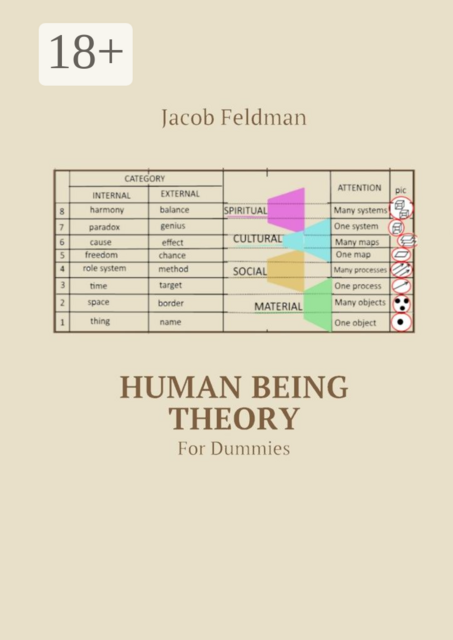



автордың кітабын онлайн тегін оқу Human Being Theory. For Dummies
Jacob Feldman
Human Being Theory
For Dummies
© Jacob Feldman, 2017
© Яков Адольфович Фельдман, cover design, 2017
Time goes fast, new questions arise about human life, society, history, education, family, happiness… Old philosophy, old psychology have no instruments (concepts, methods, ideas) to answer these questions. New concepts like Levels-of-Mind model and Big-Triplet model plus minor models like Worlds-of-Life and Layers-of-Being wait you here. Use it to answers tough questions about the Time and the Life.
ISBN 978-5-4483-4271-4
Created with intellectual publishing system Ridero
Contents
- Human Being Theory
- 1.Prologue
- Preface
- Questions we will find answers for
- Practical recommendations
- Disclaimer
- 2.Minor models
- We need instruments
- First look at the problems
- Second look at the problems
- Why philosophy still in the game?
- Communication
- Between science and philosophy
- When we have a model
- When we have no model
- How many worlds do you know?
- Why values are so stable
- Culture, brains and more
- Four kinds of pointers
- Myth, Religion, Science
- 3.Main model: levels of mind
- Every model is a Heaven’s gift
- Levels-of-Mind Theory
- Person to Task game
- Person to Group game
- Person-to-Person game
- Group to Group game
- Interpretation begins
- Levels of Attention
- Arts and Crafts
- Subject areas
- Music
- Chess
- Driving
- A teacher in the classroom
- Logics and Methodology
- Consciousness and Social Behavior
- Self-applicability
- Why?
- Levels and Strategies
- Army vs. Science
- Mystery of 7 and 8
- Keywords
- Levels and Epochs
- Renaissance
- Reformation
- Politics and Economics
- 4.Philosophy: how levels could help
- Matter and Spirit
- 37. Layers of Being
- 38. Good and Evil
- Cases ONE and TWO
- Case THREE
- Case FOUR
- Case FIVE
- Case SIX
- Case SEVEN
- How to keep a Dialog
- Another-One
- Personality
- 5.Politics: how levels could help
- British puzzle
- About Globalization
- About Moratorium
- Keywords of Today
- Keywords of the Past
- Liberte, Egalite, Fraternite
- Orthodoxy, autocracy, nationality
- Power to councils, land to peasants, peace to nations, bread to starving
- Social Sphere and Political sphere
- Art vs. Politics
- Levels in Politics
- State of Mr. Putin
- British puzzle
- 6.Education and Nurturing: how levels could help
- What about School?
- Child Development
- Why early years are out of the plan
- National system of Education
- What about contents?
- Education for Ukraine
- About content and process
- About assessments
- About textbooks
- About teachers
- Best Job for You
- 7.Second model: big triplet
- Old Psychology vs. New Psychology
- Laugh and Tears
- Tears
- Examples of tears
- Laughter
- Examples of laughter
- Classical theories of laughter
- Superiority
- Non-compliance
- Compensation
- Hemispheres
- Warming-up vs. Temperament
- Double Temperament
- Warming-up and Levels
- Lines of subsystems
- More about Modalities
- First line
- Second line
- Third line
- Big Triplet
- Personality Card
- Task Card
- Rating
- Never scan them in public
- Ready scenarios
- Quasi-conflict
- Translation
- Love and Marriage
- 8.How to be Happy
- Two Pyramids
- Fit-in
- Happiness by Card
- Circles of Support
- Epilogue
- Two Pyramids
The time is out of joint. O cursèd spite,
That ever I was born to set it right!
William Shakespeare, Hamlet
1.Prologue
Preface
I have a son. He is 26 years old now.
When I send him a message about very IMHO important reading, his usual answer is: TLTR — too long to read.
Therefore, first, if I want to be readable for young generation I must be brief.
Second, we all live in the world full of vacuum cleaners and dishwashers.
Therefore, good book must be as clear as an instruction for dishwasher (or vacuum cleaner, if you please).
Third, it must be new. Not as new as a newborn child, because a very new child is born on the planet every second, but as new as a good effective drug for illness
not curable before.
Fourth, it must be useful for everybody who is smart enough, useful for everyday life, like a teaspoon. Are you smart enough for a teaspoon to use?
So, let us begin.
Some of pictures in the book are omitted — but you can find them here>> to pictures
Questions we will find answers for
How to be happy?
How to keep dialog?
How to choose the spouse?
How to keep marriage happy?
How to find the job of your dream? In addition, how to get it?
How to hire good team for the project?
How to understand, what politicians say, and what do they really mean?
How to nurture your own children?
What is a good education?
Does human history have a direction? And, if yes,
Where this direction is pointing?
Does it give us any reason to be an optimist?
How this historical movement could be measured?
How can we help the movement?
What is philosophy?
Do we need philosophy in the modern world? For what purpose?
How philosophy should look today?
What is the difference between science, religion and myth?
How our thinking works?
What is good and evil?
Could we understand what happens in modern world? And, if yes,
How could we?
Practical recommendations
Usually, whenever I lecture this stuff, I draw on the flipchart and explain the drawing step by step. Then I record video and load it on Internet. You can find my video-lectures (most in Russian) at my channel. After that I write it down as a text, make pictures and load as html-pages on my site. Pictures at the site show drawings step by step. However, in the book I place only final drawing. That’s why I strongly recommend you, whatever chapter you read, find the final drawing, copy it by pencil at your copy-book, and, while reading the text, mark over step by step new details by pen. Otherwise, I suppose it will be hard for you to understand my message completely.
Disclaimer
Is it possible at all — to answer so many hard questions in so thin book like that? Is it a fraud of some kind? No, it is not.
First, the answers we will see are not the only possible ones. You can find other versions from other authors.
Second, to make some answer working in your personal case, probably additional investigation may be needed. This investigation could be hard to do. So, probably, the life is not so easy as it means to be.
Third, you can find some parameters I have missed. Anyway, let us be friends and cooperate on the subject for common good.
2.Minor models
We need instruments
One apple up on top!
Two apples up on top!
Look, you,
I can do it too.
Look! See! I can do three!
But I can do more!
You have three!
But I have four!
Ten Apples Up on Top
by Dr.Seuss
Imagine you have a table.
Imagine you have on your table an old watch. Like this one.
Fig. 1. Old Watch
Imagine this watch is working badly, and you know how to fix it.
But if so, you need some special instruments to do it up.
Glasses, screwdriver, tweezers, toolbox, … like that.
Fig.2. Glasses
Fig.3. Screwdriver
Fig.4. Tweezers
Fig.5. Toolbox
Now. Imagine you have on your table the world of human beings, like that.
Fig.6. The Globe
It works badly and you know how to fix it.
But what instruments do you need for that?
I recommend you four mental instruments to begin with.
Recognize-and-name-it operation (RNO) = glasses.
Distinguish-and-separate-it operation (DSO) = screwdriver.
Enumerate-and-sort-it operation (ENS) = tweezers.
Put-in-lines operation (PLO) = toolbox.
From now, I will say:
«apply ONE» instead of «recognize and name it»,
«apply TWO» instead of «distinguish and separate it»,
«apply THREE» instead of «enumerate and sort it»,
«apply FOUR» instead of «put it in lines».