



автордың кітабын онлайн тегін оқу The Splendid Outcast
THE SPLENDID OUTCAST
This ebook is for the use of anyone anywhere in the United States and most other parts of the world at no cost and with almost no restrictions whatsoever. You may copy it, give it away or re-use it under the terms of the Project Gutenberg License included with this ebook or online at http://www.gutenberg.org/license. If you are not located in the United States, you'll have to check the laws of the country where you are located before using this ebook.
Title: The Splendid Outcast Author: George Gibbs Release Date: January 06, 2015 [EBook #47900] Language: English Character set encoding: UTF-8
*** START OF THIS PROJECT GUTENBERG EBOOK THE SPLENDID OUTCAST ***
Produced by Al Haines.
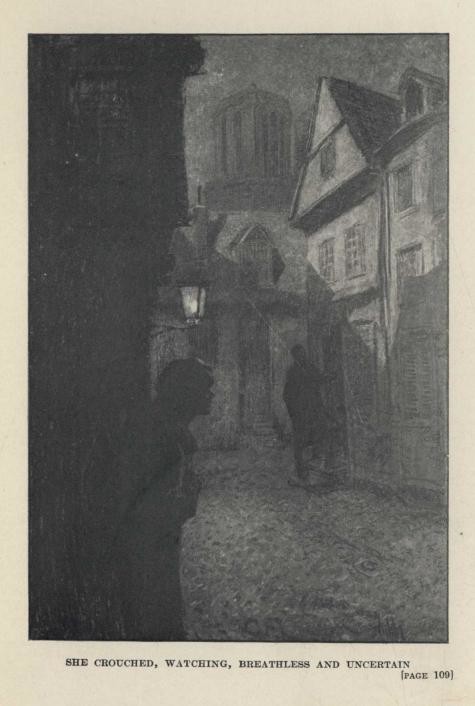
SHE CROUCHED, WATCHING, BREATHLESS AND UNCERTAIN. (PAGE 109)
The SPLENDID OUTCAST
BY
GEORGE GIBBS
AUTHOR OF "THE SECRET WITNESS," "THE GOLDEN BOUGH," "THE YELLOW DOVE," ETC.
ILLUSTRATED BY GEORGE GIBBS
D. APPLETON AND COMPANY NEW YORK LONDON 1920
COPYRIGHT, 1920, BY D. APPLETON AND COMPANY
Copyright, 1919, by THE RED BOOK CORPORATION
CONTENTS
CHAPTER
-
The Convalescent
-
The Mystery Deepens
-
The Goose
-
Outcast
-
Piquette
-
Youth Triumphant
-
Awakening
-
Threats
-
Piquette Takes a Hand
-
The Samaritan
-
Confessions
-
Quinlevin Speaks
-
Beginning a Journey
-
A Night Attack
-
Green Eyes
-
Nora Speaks
-
Jim Makes a Guess
-
At Bay
-
In the Dark
-
Freedom
-
The Petit Bleu
-
Mystery
-
Escape
-
The Clue
-
The Conclusion
ILLUSTRATIONS
She crouched, watching, breathless and uncertain . . . Frontispiece
Moira talked gayly
Through Moira's clear intelligence the epic filtered
The mirror sent her back a haggard reflection, pale and somber
THE SPLENDID OUTCAST
CHAPTER I
THE CONVALESCENT
Jim Horton awoke in high fever and great pain but the operation upon his skull had been successful and it was believed that he would recover. Something as to the facts of the exploit of the wounded man had come to the hospital and he was an object of especial solicitude by both surgeons and nurses. They had worked hard to save him that he might be alive for the decoration that was sure to come and the night had brought a distinct improvement in his condition. The nurse still watched his breathing eagerly and wrote down the new and favorable record upon the chart by his bedside. Miss Newberry was not in the least sentimental and the war had blunted her sensibilities, but there was no denying the fact that when the dressing was removed from his head the patient was extremely good to look at. He rewarded her on the morrow with a smile.
"How long have I been here?" he murmured hazily.
"Six days," she replied; "but you mustn't talk."
"Six—? Wounded——"
"Sh—. In the head, shoulder and leg, but you're doing nicely."
"Won't you tell me——?" he began.
But she soothed him gently. "Not now—later perhaps. You must sleep again. Drink this—please."
Horton obeyed, for he found himself too weak to oppose her. It was very restful here; he wriggled his toes luxuriously against the soft sheets for a moment. If things would only stop whirling around.... And the pain ... but that seemed to cease again and he slept. Indeed his awakening was only to half-consciousness. Other days and nights followed when he lay in a sort of doze, aware of much suffering and a great confusion of thought. But slowly, as he grew stronger, the facts of his present position emerged from the dimness and with them a mild curiosity, scarcely lucid as yet, as to how he had gotten there. At last there came a morning when the fog upon his memory seemed to roll aside and he began to recall one by one the incidents that had preceded his unconsciousness.
There had been a fight. Some fight that was. Huns all over the place—in a ring around the rocks, up in the branches of the trees—everywhere. But he had held on until the Boches had started to run when the American line advanced. He remembered that the Engineers could do other things besides build saps and bridges. Good old Engineers! Something was wrong—somewhere.
Out of his clouded brain, slowly, the facts came to him—things that had happened before the fight—just before. Harry—his twin brother Harry, lying in the ditch just behind Jim's squad of Engineers, a coward, in a blue funk—afraid to carry out his Major's orders to go forward and investigate. A coward, of course! Harry would be. He had always been a coward.
Jim Horton sighed, his mind, ambling weakly into vacancy, suddenly arrested by a query.
What else?—What else had happened? Something to do with the remarkable likeness between himself and Harry? The likeness,—so strong that only their own mother had been able to tell them apart.
Memory came to him with a rush. He remembered now what had happened in the darkness, what he had done. Taken Harry's lieutenant's uniform, giving the coward his own corporal's outfit. Then he, Jim Horton, had gone on and carried out the Major's orders, leaving the coward writhing in the ditch.
By George!——the fight—he, Jim Horton, had won the victory at Boissière Wood for the —th Infantry—for Harry!—as Harry!
Perhaps, he was really Harry and not Jim Horton at all? He glanced around him curiously, as though somewhat amused at the metempyschosis. And then thoughtfully shook his head.
No. He was Jim Horton, all right—Jim Horton. There was no mistake about that.
But Harry! Imagine meeting Harry in a situation like that after all these years! A coward! Not that that was a very surprising thing. Harry had always been a quitter. There was nothing that Harry could do or be that wasn't utterly despicable in the eyes of his brother Jim, and after having spent the best part of five years trying to live the memory of Harry down——
The nurse appeared silently and looked into Jim Horton's eyes. He closed them a moment and then smiled at her.
"How do you feel?" she asked.
"Better—lots better," he answered; "you see, I can really think——"
"I wouldn't try to do that—not yet."
"Oh, I'm all right." And the nurse was ready for the first time to believe that her patient was to remain this side of the border line of the dim realm into which she had seen so many go, for his eyes were clear and he spoke with definite assurance. But the question that he asked made her dubious again.
"I say, nurse, would you mind telling me what my name is?"
She gazed at him a moment as though a little disappointed and then replied quietly: "Lieutenant Henry G. Horton, of the —th Infantry."
"Oh," said the patient, "I see."
"I think you'd better sleep a while, then I want the Major to see you."
"Oh, don't bother; I'm coming through all right, now. I'm sure of it. But I want to tell you——"
The nurse silenced him gently, then felt his pulse and after another glance at him moved to the next bed. It had been a wonderful operation, but then they couldn't expect the impossible.
Jim Horton closed his eyes, but he didn't sleep. With the shadow of death still hovering over him, he was trying to think charitably of Harry, of the man who had worked such havoc in the lives of those nearest him. The five years that had passed since the death of their mother—poor, tired soul who until the end believed the whole thing a mistake—could not have been fruitful in anything but evil in the life of the reprobate twin-brother who had robbed the family of what had been left of the estate and then fled away from the small town where they lived to the gay lights of New York. And now here he was—an officer of the United States Army where commissions do not come without merit. What did it mean? Harry was always clever enough, too clever by half. Had he quit drinking? Was he living straight? There seemed but one answer to these questions, or he could not have held his job in the army. His job! His commission wouldn't last long if his commanding officer knew what Jim Horton did.
They all thought that the patient in the hospital bed was Harry Horton, a Lieutenant of the —th Infantry, The corporal had won the lieutenant some glory, it seemed, instead of the ruin that awaited the discovery of the cowardice and disobedience of orders. But the substitution would be discovered unless Jim Horton could find his brother Harry. And how was he going to manage that from his hospital bed?
A gentle perspiration exuded from Jim Horton's pores. Being surrounded by Boches in the wood was distinctly less hazardous than this. And so when the nurse returned with the Major, he did his best to straighten out the tangle. The Major was much pleased at the patient's progress, made a suggestion or two about a change in the treatment and was on the point of turning away when Horton spoke.
"Would you mind, sir—just a word?"
"Of course. Something bothering you?"
"Yes. You see——" the patient hesitated again, his lip twisting, "this whole thing is a mistake."
The doctor eyed the sick man narrowly.
"A mistake?" And then kindly, "I don't understand."
Horton frowned at the bed-rail. "You see, sir, I'm not Henry G. Horton. I—I'm somebody else."
He saw the nurse and the doctor exchange glances,
"Ah, well," said the medical man with a smile, "I wouldn't bother about it."
"But I do bother about it, sir. I've got to tell you. I'm another man. I changed uniforms with—with another fellow in the dark," he finished uneasily.
The same look passed between nurse and surgeon and then he saw Miss Newberry's head move slightly from left to right. The doctor rose.
"Oh, very well. Don't let it bother you, my man. We'll get you all untangled presently. Just try not to think; you're doing nicely."
And the Major moved slowly down the ward.
Jim Horton frowned at the medical officer's broad back.
"Thinks I'm nutty," he muttered to himself, and then grinned. The story was a little wild.
When the Major had left the ward, the nurse came back and smoothed Horton's pillow. "You're to be very quiet," she said gently, "and sleep all you can."
"But, nurse," he protested, "I don't want to sleep any more. I told him the truth. I've taken another man's place."
"You did it very well, from all accounts," she said with a smile; "and you'll take another man's before long, they say."
"What do you mean?"
"Promotion," she laughed; "but you won't get it if you have a relapse."
"I'm not going to have a relapse. I'm all right. Better every day, and I'd like you to understand that I know exactly what I'm saying. I took another man's job. He was—was sick and I took his place. I'm not Lieutenant Horton, nurse."
"You may be whatever you please, if you'll only go to sleep."
"Bless your heart! That isn't going to change my identity."
His positiveness rather startled her and made her pause and stare at him soberly. But in a moment her lips curved into a smile, rather tender and sympathetic. It wouldn't do to let this illusion grow, so gently she said: "Your authenticity is well vouched for. The report of your company Captain—the Sergeant-Major of your battalion. You see, you've become rather a famous person in the —th. I've seen some of your papers, they're all quite regular. Even your identification disk. It's here in the drawer with some other things that were in your pockets, so please relax and sleep again, won't you? I mustn't talk to you. It's contrary to orders."
"But nurse——"
She patted him gently on the arm, put a warning finger to her lips, and silently stole away. His gaze followed her the length of the room until she disappeared through the door when he sank back on his pillows with a groan.
"Nutty!" he muttered to himself; "wonder if I am." He touched the bandage and realized that his head was beginning to throb again. "No, I'm Jim Horton all right, there's no doubt about that, but how I'm going to make these seraphic idiots believe it is more than I can see. That Sergeant! And the men.... By George! And the Sergeant-Major. Probably looked me over at the dressing station. Oh, Lord, what a mess!"
Things began whirling around and Jim Horton closed his eyes; he wasn't quite as strong as he thought he was, and after a while he slept again.
Downstairs in the Major's office two surgeons and the nurse in charge were discussing the case.
"Queer obsession that. Thinks he's another man. There may be some pressure there yet. It ought to have cleared up by this."
"It's shock, sir, I think. He'll come out of it. He's coming on, Miss Newberry?"
"Splendidly. That's what I can't understand. He looks as though he knew what he was saying."
"Any chance of there being a mistake?"
"None at all, sir. Doctor Rawson came down with him in the ambulance, his own company captain was there when the patient was given first aid. He would have known his own lieutenant, sir. There can't be any mistake, but he has scarcely any fever——"
"Never mind, keep an extra eye on him. The wound is healing nicely. He'll come through all right."
So Nurse Newberry returned to the ward, somewhat gratified to find her charge again peacefully asleep.
The next day the patient did not revert to his obsession, but lay very quiet looking out of the window. His failure to reveal his secret left him moody and thoughtful. But his temperature was normal and he was without pain.
"You say there were some things in the pockets of—of my blouse," he asked of the nurse.
"Yes, would you like to have them?" The patient nodded and she gave them to him, the identification disk, a wrist watch, some money, a note-book and some papers. He looked them over in an abstracted way, sinking back on his pillow at last, holding the letters in his hand. Then at last as though coming to a difficult decision, he took one of the letters out of its envelope and began reading.
It was in a feminine hand and added more heavily to the burden of his responsibilities.
"Dear Harry" (it ran):
"I'm just back to my room, a wife of three hours with a honeymoon in a railway station! It all seems such a mistake—without even an old shoe to bless myself with. If I've helped you I'm glad of it. But I'm not going to lie just to square us two with the Almighty for the mockery I've been through. I don't love you, Harry, and you know that. I did what Dad asked me to do and I'd do it again if he asked me.
"He seems restless to-night, and talks about going back to Paris. I suppose I could do something over there for I've lost all impulse for my work. Perhaps we'll come and then you could run up and see us. I'll try to be nice to you, Harry, I will really. You know there's always been something lacking in me. I seem to have given everything to my painting, so there's very little left for you, which is the Irish in me saying I'm a heartless hussy.
"Soon I'll be sending you the pair of gray socks which I knitted with my own hands. They're bunchy in spots and there's a knot or two here and there, but I hope you can wear them—for the Deil's own time I had making them. Good-night. I suppose that I should be feeling proud at my sacrifice; I don't, somehow, but I'll be feeling glad if you have another bar to your shoulder. That might make me proud, knowing that I'd helped.
MOIRA."
"P. S. Don't be getting killed or anything; I never wanted to marry anybody but I don't want you done away with. Besides, I've a horror of crêpe.
M."
Jim Horton read the letter through furtively with a growing sense of intrusion. It was like listening at a confessional or peering through a keyhole. And somehow its ingenuous frankness aroused his interest. Harry had been married to this girl who didn't love him and she had consented because her father had wanted her to. He felt unaccountably indignant on her account against Harry and the father. Pretty name—Moira! Like something out of a book. She seemed to breathe both youth and hope tinged horribly with regret. He liked her handwriting which had dashed into her thoughts impulsively, and he also liked the slight scent of sachet which still clung to the paper. He liked the girl better, pitied her the more, because her instinct had been so unerring. If she had thrown herself away she had done it with her eyes wide open. A girl who could make such a sacrifice from lofty motives, would hardly condone the thing that Harry had been guilty of. A coward....
There was another letter, of a much later date, in a masculine hand. Jim Horton hesitated for a moment! and then took it out of its envelope.
"Harry boy," he read, "so far as I can see at this writing the whole thing has gone to the demnition bow-wows. Suddenly, without a by-your-leave, the money stopped coming. I wrote de V. and cabled, but the devil of a reply did he give. So I'm coming to Paris with Moira at once and it looks as though we'd have to put the screws on. But I'd be feeling better if the papers were all ship-shape and Bristol fashion. You'll have to help. Maybe the uniform will turn the odd trick. If it don't we'll find some way.
"I feel guilty as Hell about Moira. If you ever make her unhappy I'll have the blood of your heart. But I'm hoping that the love will come if you play the game straight with her.
"Meanwhile we'll feather the nest if we can. He's got to 'come across.' There's some agency working against us—and I've got to be on the scene to ferret—instanter. Moira got some portraits to do or we wouldn't have had the wherewithal for the passage. As it is, I'll be having to make the move with considerable skill, leaving some obligations behind. But it can't be helped, and Moira won't know. The world is but a poor place for the man who doesn't make it give him a living. Mine has been wretched enough, God knows, and the whisky one buys over the bar in New York is an insult to an Irishman's intelligence, to say nothing of being a plague upon his vitals.
"Enough of this. Come to the Rue de Tavennes, No. 7, in your next furlough, and we'll make a move. By that time I'll have a plan. Moira sends her love.
"Yours very faithfully,
"BARRY QUINLEVIN.
P. S. There was a pretty squall brewing over the Stamford affair, but I reefed sail and weathered it. So you can sleep in peace.
B. Q."
Jim Horton lay for a while thinking and then read the two letters again. The masculine correspondent was the girl's father. Barry Quinlevin, it seemed, was a scoundrel of sorts—and the girl adored him. Many of the passages in the letter were mystifying. Who was de V——? And what was Harry's connection with this affair? It was none of Jim Horton's business, but in spite of himself he began feeling an intense sympathy for the girl Moira, who was wrapped in the coils of what seemed on its face to be an ugly intrigue, if it wasn't something worse.
Strange name, Quinlevin. It was Moira's name too, Irish. The phrase about having Harry's heart's blood showed that Barry Quinlevin wasn't beyond compunctions about the girl. But why had he connived at this loveless marriage? There must have been a reason for that.
Jim Morton put the letters in the drawer and gave the problem up. It wasn't his business whom Harry had married or why. The main thing was to get well and out of the hospital so that he could find his brother and set the tangle straight.
He couldn't imagine just how the substitution was to be accomplished, but if Harry had played the game there was a chance that it might yet be done. He didn't want Harry's job. And he silently cursed himself for the unfortunate impetuous moment that had brought about all the trouble. But how had he known that he was going to be hit? If he had only succeeded in getting back to the spot where Harry was waiting for him, no one would ever have been the wiser. No one knew now, but of course the masquerade couldn't last forever. The situation was impossible.
Meanwhile what was Harry doing? Had he succeeded in playing out the game during Jim Horton's sickness, or had he found himself in a tight place and quit? It would have been easy enough. Horton shivered slightly. Desertion, flight, ignominy, disgrace. And it wasn't Harry Horton's good name that would be in question, but his own, that of Jim Horton, Corporal of Engineers. As a name, it didn't stand for much yet, even out in Kansas City, but he had never done anything to dishonor it and he didn't want the few friends he had to think of him as a quitter. Nobody had ever accused him of being that. What a fool he had been to take such a chance for a man like Harry!
In the midst of these troublesome meditations, he was aware of Nurse Newberry approaching from the end of the ward. Following her were two people who stopped at his bed, a man and a girl. The man was strong, with grizzled hair, a bobbed Imperial and a waxed mustache. The girl had black hair and slate-blue eyes. And even as Jim Horton stared at them, he was aware of the man confidently approaching and taking his hand.
"Well, Harry, don't you know me?" a voice said. "Rather hazy, eh? I don't wonder...."
Who the devil were these people? There must be a mistake. Jim Horton mumbled something. The visitor's eyes were very dark brown shot with tiny streaks of yellow and he looked like an amiable satyr.
"I've brought Moira—thought ye'd like to see her."
The patient started—then recovered himself. He had forgotten the lapse of time since the letters had been written.
"Moira," he muttered.
The girl advanced slowly as the man made place. Her expression had been serious, but as she came forward she smiled softly.
"Harry," she was whispering, as he stared at her loveliness, "don't you know me?"
"Moira!" he muttered weakly. "I'm not——" But his hands made no movement toward her and a warm flush spread over the part of his face that was visible.
"You've been very sick, Harry. But we came as soon as they'd let us. And you're going to get well, thank the Holy Virgin, and then——"
"I'm not——" the words stuck in Jim Horton's throat. And he couldn't utter them.
"You're not what?" she questioned anxiously.
Another pause of uncertainty.
"I—I'm not—very strong yet," he muttered weakly, turning his head to one side.
And as he said it, he knew that in sheer weakness of fiber, spiritual as well as physical, he had made a decision.
The Satyr behind her laughed softly.
"Naturally," he said, "but ye're going to be well very soon."
They were both looking at him and something seemed to be required of him. So with an effort,
"How long—how long have you been in France?" he asked.
"Only three weeks," said Quinlevin, "watching the bulletins daily for news of you. I found out a week ago, but they wouldn't let us in until to-day. And we can stay only five minutes."
Then Moira spoke again, with a different note in her voice.
"Are you glad that I came?" she asked. "It was the least I could do."
"Glad!"
The word seemed sufficient. Jim Horton seemed glad to utter it. If she would only recognize the imposture and relieve him of the terrible moment of confession. But she didn't. She had accepted him as Quinlevin, as all the others had done, for his face value, without a sign of doubt.
And Barry Quinlevin stood beaming upon them both, his bright eyes snapping benevolence.
"If ye get the V.C., Harry boy, she'll sure be worshiping ye."
Jim Horton's gaze, fixed as though fascinated upon the quiet slate-blue eyes, saw them close for a moment in trouble, while a quick little frown puckered the white forehead. And when she spoke again, her voice uttered the truth that was in her heart.
"One cannot deny valor," she said coolly. "It is the greatest thing in the world."
She wanted no misunderstandings. She only wanted Harry Horton to know that love was not for her or for him. The fakir under the bed clothes understood. She preferred to speak of valor. Valor! If she only knew!
Jim Horton gathered courage. If he wasn't to tell the truth he would have to play his part.
"Everybody is brave—out there," he said, with a gesture.
"But not brave enough for mention," said Quinlevin genially. "It won't do, Harry boy. A hero ye were and a hero ye'll remain."
Horton felt the girl's calm gaze upon his face.
"I'm so glad you've made good, Harry. I am. And I want you to believe it."
"Thanks," he muttered.
Why did she gaze at him so steadily? It almost seemed as though she had read his secret. He hoped that she had. It would have simplified things enormously. But she turned away with a smile.
"You're to come to us, of course, as soon as they let you out," she said quietly.
"Well, rather," laughed Quinlevin.
The nurse had approached and the girl Moira had moved to the foot of the bed. Barry Quinlevin paused a moment, putting a slip of paper in Horton's hand.
"Well, au revoir, old lad. In a few days again——"
The wounded man's gaze followed the girl. She smiled back once at him and then followed the nurse down the ward. Jim Horton sank back into his pillows with a gasp.
"Well—now you've done it. Now you have gone and done it," he muttered.
CHAPTER II
THE MYSTERY DEEPENS
In a courageous moment, a day or so later, the patient requested Nurse Newberry to try to get what information she could as to the whereabouts of his cousin, Corporal James Horton, B Company, —th Engineers, and waited with some impatience and anxiety the result of her inquiries. She discovered that Corporal James Horton had been last seen in the fight for Boissière Wood, but was now reported as missing.
Missing!
The blank expression on the face of her patient was rather pitiful.
"It probably means that he's a prisoner. He may be all right. H.Q. is pretty cold-blooded with its information."
But the patient knew that Corporal Horton wasn't a prisoner. If he was missing, it was because he had gone to the rear—nothing less than a deserter. Nevertheless the information, even indefinite as it was, brought him comfort. He clung rather greedily to its very indefiniteness. In the eyes of the army or of the world "missing" meant "dead" or "prisoner," and until Harry revealed himself, the good name of the corporal of Engineers was safe. That was something.
And the information brought the wounded man abruptly to the point of realizing that he was now definitely committed to play the role he had unwittingly chosen. He had done his best to explain, but they hadn't listened to him. And when confronted with the only witnesses whose opinions seemed to matter (always excepting Harry himself), he had miserably failed in carrying out his first intentions. He tried to think of the whole thing as a joke, but he found himself confronted with possibilities which were far from amusing.
The slate-blue Irish eyes of Harry's war-bride haunted him. They were eyes meant to be tender and yet were not. Her fine lips were meant for the full throated laughter of happiness, and yet had only wreathed in faint uncertain smiles.
Barry Quinlevin was a less agreeable figure to contemplate. If Jim Horton hadn't read his letter to Harry he would have found it easier to be beguiled by the man's genial air of good fellowship and sympathy, but he couldn't forget the incautious phrases of that communication, and having first formed an unfavorable impression, found no desire to correct it.
To his surprise it was Moira who came the following week to the hospital at Neuilly on visitors' day. Jim Horton had decided on a course of action, but when she approached his bed, all redolent with the joy of out of doors, he quite forgot what he meant to say to her. In Moira, too, he seemed to feel an effort to do her duty to him with a good grace, which almost if not quite effaced the impression of her earlier visit. She took his thin hand in her own for a moment while she examined him with a kindly interest, which he repaid with a fraternal smile.
"Father sent me in his place," she said. "I've put him to bed with a cold."
"I'm so glad——" said Horton, and then stopped with a short laugh. "I mean—I'm glad you're here. I'm sorry he's ill. Nothing serious?"
"Oh, no. He's a bit run down, that's all. And you—you're feeling better?"
He liked the soft way she slithered over the last syllable.
"Oh, yes—of course."
All the while he felt her level gaze upon him, cool and intensely serious.
"You are out of danger entirely, they tell me. I see they've taken the bandage off."
"Yesterday," he said. "I'm coming along very fast."
"I'm glad."
"They promise before long that I can get out into the air in a wheel-chair."
"That will do you all the good in the world."
In spite of himself, he knew that his eyes were regarding her too intently, noting the well modeled nose, the short upper lip, firm red mouth and resolute chin, all tempered with the softness of youth and exquisite femininity. He saw her chin lowered slightly as her gaze dropped and turned aside while the slightest possible compression of her lips indicated a thought in which he could have no share.
"I have brought you some roses," she said quietly.
"They are very beautiful. They will remind me of you until you come again."
The sudden raising of her eyes as she looked at him over the blossoms was something of a revelation, for they smiled at him with splendid directness.
"You are improving," she laughed, "or you've a Blarney Stone under the pillow. I can't remember when you've said anything so nice as that at all."
He was thoughtful for a moment.
"Perhaps I have a new vision," he said at last. "The bullet in my head may have helped. It has probably affected my optic nerve."
She smiled with him.
"You really do seem different, somehow," she broke in. "I can't exactly explain it. Perhaps it's the pallor that makes the eyes look dark and your voice—it's softer—entirely."
"Really——!" he muttered, uncomfortably, his gaze on the gray blanket. "Well, you see, I suppose it's what I've been through. My eyes would seem darker, wouldn't they, against white, and then my voice—er—it isn't very strong yet."
"Yes, that's it," she replied.
Her eyes daunted him from his purpose a little, and he knew that he would have to use extreme caution, but he had resolved whatever came to see the game through. After all, if she discovered his secret, it was only what he had tried in vain to tell her.
"I'm sure of it," he went on. "When a fellow comes as near death as I've been, it makes him different. I seem to think in a new way about a lot of things—you, for instance."
"Me——?" He fancied that there was a hard note in her voice, a little toss, scarcely perceptible, of the rounded chin.
"Yes. You see, you oughtn't ever to have married me. You're too good for me. I'm just a plain rotter and you—oh, what's the use?"
He paused, hoping that she would speak. She did, after a silence and a shrug.
"Father wanted it. It was one way of paying what he owed you. I don't know how much that was, but I'm still thinking I went pretty cheap." She halted abruptly and then went on coolly, "I didn't come here to be thinking unpleasant thoughts—or to be uttering them. So long as we understand each other——"
"We do," he put in eagerly, almost appealingly. "I want you to believe that I have no claim upon you—that my—my relations with Barry Quinlevin will have nothing to do with you."
"And if I fell in love with another man— That never seems to have occurred to either of you——"
He laughed her soberness aside. "As far as I'm concerned, divorce or suicide. I'll leave the choice to you."
He gained his purpose, which was to bring the smile to her lips again.
"Your wounds have inoculated you with a sense of humor, at any rate," she said, fingering the roses. "You've always been lacking in that, you know."
"I feel that I can laugh at them now. But it might have been better for you if I hadn't come out of the ether."
"No. I don't like your saying that. I haven't the slightest intention of falling in love with any man at all. I shan't be wanting to marry—really marry——" she added, coloring a little. "I've begun my work. It needed Paris again. And I'm going to succeed. You'll see."
"I haven't a doubt of it. You were made for success—and for happiness."
"Sure and I think that I was—now that you mention it," she put in quaintly.
"I won't bother you. You can be certain of that," he finished positively. And then cautiously, "Things have not gone well—financially, I mean?"
"No. And of course father's worried about it. Our income from Ireland has stopped coming—something about repairs, he says. But then, I suppose we will get it again some day. Dad never did tell me anything, you know."
Horton thought for a moment.
"He doesn't want to worry you, of course. And you oughtn't to be worried. Things will come out all right."
"I intend that they shall. Father always gave me the best when he had it. I'll see that he doesn't suffer now."
"But that's my job, Moira. We'll get some money together—some way—when I get out."
"Thanks. But I'm hoping to do a lot of painting. I've got one portrait to begin on—and it doesn't cost much in the Quartier."
Horton sat up in bed and looked out of the window.
"I'll get money," he said. "Don't you worry."
He saw her eyes studying him quietly and he sank back at once in bed out of the glare of the sunlight. He wondered if he had gone too far. But he had found out one of the things that he had wanted to know. She knew nothing of what Barry Quinlevin was doing.
Her next remark was disquieting.
"It's very strange, the way I'm thinking about you. You've grown different in the army—or is it the sickness? There's a sweeter look to your mouth, and a firmer turn to your jaw. Your gaze is wider and your heart has grown soft, with the suffering. It's like another man, I'm seeing somehow, Harry, and I'm glad."
"Suffering—yes, perhaps," he muttered.
She leaned forward impulsively and put her hand over his, smiling brightly at him.
"We'll be good friends now, alanah. I'm sure of it."
"You like me a little better——?"
"Sure and I wouldn't be sitting here holding hands if I didn't," she laughed. Then with a quick glance at her wrist watch she rose. "And now I must be going back to father. Here is the nurse. Time is up."
"You will come soon again?" he asked slowly.
"Yes—with better news, I hope. Au revoir, mon brave."
And she was gone.
The visit gave him more food for thought. But he hadn't learned much. What he did know now was that the girl Moira trusted Barry Quinlevin implicitly and that he had managed to keep her in ignorance as to the real sources of his livelihood. The Irish rents had failed to reach them! Were there any Irish rents? And if so, what had "de V" to do with them? He took Quinlevin's letter from under the pillow and re-read it carefully. Nothing about Irish rents there. Perhaps other letters had followed, that Harry had destroyed. In any case he would have to play the game carefully with the girl's father or Quinlevin would find him out before Horton discovered what he wanted to know. The quiet eyes of the girl Moira disturbed him. Her eyes, her intuitions, were shrewd, yet he had succeeded so far. If he could pass muster with the daughter, why shouldn't he succeed with the father? The weakness, the failing memory of a sick man, could be trusted to bridge difficulties. If there had only been a few more letters he would have been better equipped for the interview with Barry Quinlevin, which must soon follow. He inquired of Miss Newberry, but she had given him everything that had been found in his uniform. He scrutinized the notebook carefully, which contained only an expense account, some addresses in Paris, and a few military notes, and so he discarded it. It seemed that until Quinlevin came to the hospital "de V" must remain one of the unsolved mysteries of his versatile brother.
But Moira's innocence, while it failed to enlighten him as to the mystery, made him more certain that her loveless marriage with Harry had something to do with the suspected intrigue. Did Harry love the girl? It seemed scarcely possible that any man who was half a man could be much with her without loving her. It wasn't like Harry to marry any girl unless he had something to gain by it. The conversation he had just had with Moira showed exactly the relationship between them, if he had needed any further evidence than her letter.
As to his own personal relations with Moira, he found it necessary to fortify himself against a more than strictly fraternal interest in her personality. She was extremely agreeable to look at and he had to admit that her very presence had cheered up his particular part of the hospital ward amazingly. Her quaintness, her quiet directness and her modest demeanor, were inherent characteristics, but they could not disguise the overflowing vitality and humor that struggled against the limitations she had imposed. Her roses, which Nurse Newberry had arranged in a bowl by the bedside, were unnecessary reminders of the giver. Like them, she was fragrant, pristine and beautiful—altogether a much-to-be-desired sister-in-law.
The visit of Barry Quinlevin was not long delayed and Jim Horton received him in his wheel chair by an open window in the convalescent ward. He came in with a white silk handkerchief tied about his neck, but barring a husky voice showed no ill effects of his indisposition. He was an amiable looking rogue, and if the shade of Whistler will forgive me, resembled much that illustrious person in all the physical graces. It would be quite easy to imagine that Barry Quinlevin could be quite as dangerous an enemy.
"Well, Harry boy, here I am," he announced, throwing open his coat with something of an air, and loosening his scarf. "No worse than the devil made me. And ye're well again, they tell me, or so near it that ye're no longer interesting."
"Stronger every day," replied Horton cautiously.
"Then we can have a talk, maybe, without danger of it breaking the spring in yer belfry?"
"Ah, yes,—but I'm a bit hazy at times," added Horton.
"Well, when the fog comes down, say the word and I'll be going."
"Don't worry. I want to hear the news."
Quinlevin frowned at his walking stick. "It's little enough, God knows." Then glanced toward the invalid at the next window and lowered his voice a trifle.
"The spalpeen says not a word—or he's afflicted with pen-paralysis, for I've written him three times—twice since I reached Paris, giving him the address. So we'll have to make a move."
"What will you do?"
"Go to see him—or you can. At first, ye see, I thought maybe he'd gone away or died or something. But I watched the Hôtel de Vautrin in the Rue de Bac until I saw him with my own eyes. That's how I took this bronchitis—in the night air with devil a drink within a mile of me. I saw him, I tell you, as hale and hearty as ye please, and debonair like a new laid egg, with me, Barry Quinlevin, in the rain, not four paces from the carriage way."
The visitor paused as though for a comment, and Horton offered it.
"He didn't see you?"
"Devil a one of me. For the moment I thought of bracing him then and there. But I didn't—though I was reduced to a small matter of a hundred francs or so."
"Things are as bad as that——?"
Quinlevin shrugged. "I bettered myself a bit the next night and I'll find a way——"
He broke off with a shrug.
"But I'm not going to be wasting my talents on the little officer-boys in Guillaume's. Besides, 'twould be most unpatriotic. I'm out for bigger game, me son, that spells itself in seven figures. Nothing less than a coup d'état will satisfy the ambitions of Barry Quinlevin!"
"Well?" asked Horton shrewdly.
"For the present ye're to stay where ye are, till yer head is as tight as a drum, giving me the benefit of yer sage advice. We'll worry along. The rent of the apartment and studio is a meager two hundred francs and the food—well, we will eat enough. And Moira has some work to do. But we can't be letting the Duc forget I've ever existed. A man with a reputation in jeopardy and twenty millions of francs, you'll admit, is not to be found growing on every mulberry bush."
Horton nodded. It was blackmail then. The Duc de Vautrin——
"You wrote that you had a plan," he said. "What is it?"
Barry Quinlevin waved a careless hand.
"Fair means, as one gentleman uses to another, if he explains his negligence and remits the small balance due. Otherwise, we'll have to squeeze him. A letter from a good lawyer—if it wasn't for the testimony of Nora Burke!"
He was silent in a moment of puzzled retrospection and his glittering generalities only piqued Jim Horton's curiosity, so that his eagerness led him into an error that nearly undid him.
"Nora Burke——" he put in slowly.
"I wrote ye what happened——"
"I couldn't have received the letter——"
He stopped abruptly, for Quinlevin was staring at him in astonishment.
"Then how the devil could ye have answered it?"
Horton covered the awkward moment by closing his eyes and passing his fingers across his brow.
"Answered it! Funny I don't remember."
The Irishman regarded him a moment soberly, and then smiled in deprecation.
"Of course—ye've slipped a cog——"
Then suddenly he clapped a hand on Horton's knee.
"Why, man alive,—Nora Burke—the Irish nurse who provides the necessary testimony—Moira's nurse, d'ye mind, when she was a baby, who saw the Duc's child die—now do ye remember——?"
Horton ran his fingers over his hair thoughtfully and bent his head again.
"Nora Burke—Moira's nurse—who saw the Duc's child die," he repeated parrot-like, "and the Duc—de Vautrin——" he muttered and paused.
"Thinks his child by this early marriage is still alive——" said Quinlevin, regarding him dubiously.
"Yes, yes," said Horton eagerly. "It's coming back to me now. And de Vautrin's money——"
"He'll pay through the nose to keep the thing quiet—unless——"
Barry Quinlevin paused.
"Unless—what?"
There was a moment of silence in which the visitor frowned out of the window.
"I don't like the look of things, I tell ye, Harry. Ye're in no fit shape to help 'til the fog clears up, but I've a mind that somebody's slipped a finger into the pie. Nora Burke wants more money—five hundred pounds to tell a straight story and where I'm going to get it—the devil himself only knows."
"Nora Burke—five hundred pounds!" muttered Horton vaguely, for he was thinking deeply, "that's a lot of money."
"Ye're right—when ye haven't got it. And de Vautrin's shutting down at the same time. It looks suspicious, I tell ye."
He broke off and fixed his iridescent gaze on Horton. "Ye're sure ye said nothing to any one in Paris before ye went to the front?"
Of this at least Jim Horton was sure.
"Nothing," he replied.
"Not to Piquette Morin?"
Here was dangerous ground again.
"Nothing," he repeated slowly, "nothing."
"And ye wouldn't be remembering it if ye had," said Quinlevin peevishly as he rose. "Oh, well—I'll have to raise this money some way or go to Galway to put the gag on Nora Burke until we play the trick——"
"I—I'm sorry I can't help——" said Horton, "but you see—I'm not——"
"Oh, yes, I see," said Quinlevin more affably. "I shouldn't be bothering ye so soon, but may the devil take me if I know which way to turn."
"Will you see de Vautrin?"
"Perhaps. But I may go to Ireland first. I've got to do some thinking—alone. Good bye. Ye're not up to the mark. Be careful when Moira comes, or ye may let the cat out of the bag. D'ye hear?"
"Don't worry—I won't," said Horton soberly.
He watched the tall figure of Quinlevin until it disappeared into the outer hall and then turned a frowning gaze out of the window.
Her pulses were throbbing violently, but the terror of her surroundings had passed. And she tried to convince herself that she did not fear Harry.... And yet she hesitated to confront him, fascinated by her discovery.... The brother—Jim—was here—she was as sure of it as though she had seen him. She knew that she must intercede in some way, but she was very helpless. How many were there in this house? And if she revealed herself, would not the warning give them time to carry out whatever plan they had in mind? And so she crouched watching, breathless and uncertain.
CHAPTER III
THE GOOSE
Jim Horton had had a narrow escape from discovery. But in spite of his precarious position and the pitfalls that seemed to lay to right and left, he had become, if anything, more determined than ever to follow the fate to which he had committed himself. There now seemed no doubt that Moira was in all innocence involved in some way in the blackmailing scheme which had been the main source of livelihood for the Quinlevin family for many years. And Moira did not know, for the Duc de Vautrin, of course, was the source of the Irish rents to which she had alluded. And now he was refusing to pay.
It was clear that something unpleasant hung in the air, an ill wind for the Duc de Vautrin and for the plotters, Moira's father and Jim Horton's precious brother. And it seemed quite necessary in the interests of honesty that he, Jim Horton, should remain for the present in the game and divert if possible the currents of evil which encompassed his interesting sister-in-law.
One thing he had learned—that by taking refuge behind the barriers of his failing memory, it might be possible to keep up the deception, at least until he was out of the hospital and a crisis of some sort came to relieve him of his responsibility. Indeed there was something most agreeable in the friendly regard of his brother's loveless wife, and under other circumstances, the calls of this charming person would have been the source of unalloyed delight. For as the days passed, more and more she threw off the restraint of her earlier visits and they had now reached a relationship of understanding and good-fellowship, most delightful and unusual in its informality.
Jim Horton was progressing rapidly and except for occasional lapses of memory, easily explained and perfectly understood by his visitors, gained health and strength until it was no longer a question of weeks but of days when he should be able to leave the hospital and accept the invitation of his newly discovered relatives to visit the studio apartment. He had made further efforts through the hospital authorities to find some trace of the missing man but without success, and in default of any definite plan of action chose to follow the line of least resistance until something should happen. Barry Quinlevin visited him twice, but spoke little of the affair of the Duc de Vautrin which it seemed was being held in abeyance for the moment, preferring to wait until the brain and body of the injured man could help him to plan and to execute. And Jim Horton, finding that safety lay in silence or fatigue, did little further to encourage his confidences.
Thus it was that after several weeks he impatiently awaited Moira outside the hospital. It was a gorgeous afternoon of blue and gold with the haze of Indian Summer hanging lazily over the peaceful autumn landscape. An aromatic odor of burning leaves was in the air and about him aged men and women worked in road and garden as though the alarms of war had never come to their ears. The signing of the armistice, which had taken place while Horton was still in his bed, had been the cause of much quiet joy throughout the hospital. But with the return of health, Jim Horton had begun wondering what effect the peace was to have upon his strange fortunes—and upon Harry's. He knew that for the present he had been granted a furlough which he was to spend with the Quinlevins in Paris, but after that, what was to happen? He was a little dubious too about his relations with Moira.... But when he saw her coming down the path to the open air pavilion with Nurse Newberry, all flushed with the prospect of carrying him off in triumph in the ancient fiacre from which she had descended, he could not deny a thrill of pleasure that was not all fraternal.
"Behold, mon ami," she cried in greeting, "I've come to take you prisoner."
He laughed gayly as he took her hand.
"And there's a goose in the pantry, bought at a fabulous price, just waiting for the pan——"
"Be sure you don't kill your prisoner with kindness," put in Nurse Newberry.
"I'll take that risk," said Horton genially.
"Sure and he must," put in Moira. "It isn't every day one brings a conquering hero home."
"Especially when he's your husband," said the artless Miss Newberry wistfully.
Jim Horton had a glimpse of the color that ran like a flame up Moira's throat to her brow but he glanced quickly away and busied himself with a buckle at his belt.
"I want to thank you, Miss Newberry," he said soberly, "for all that you've done for me. I'll never forget."
"Nor I, Lieutenant Horton. But you're in better hands than mine now. A week or so and you'll be as strong as ever."
"I've never felt better in my life," he replied.
They moved toward the conveyance, shook hands with the nurse, and with Harry's baggage (which had just been sent down from regimental headquarters) upon the box beside the rubicund and rotund cocher, they drove out of the gates and toward the long finger of the Eiffel Tower which seemed to be beckoning to them across the blue haze above the roof tops.
Neither of them spoke for a moment. In the ward, in the convalescent rooms or even in the grounds of the hospital, Moira had been a visitor with a mission of charity and cheer. Here in the fiacre the basis of their relationship seemed suddenly and quite mysteriously to change. Whether Moira felt it or not he did not know, for she looked out of her window at the passing scene and her partly averted profile revealed nothing of her thoughts. But the fact that they were for the first time really alone and driving to Moira's Paris apartment gave him a qualm of guilt on account of the impossible situation that he had created. He had, he thought, shown her deep gratitude and respect—and had succeeded in winning the friendship that Harry had perhaps taken too much for granted. It had given Jim Horton pleasure to think that Moira now really liked him for himself alone, and the whole-heartedness of her good fellowship had given him every token of her spirit of conciliation. She had had her moods of reserve before, like the one of her present silence, but the abundance of her vitality and sense of humor had responded unconsciously to his own and they had drawn closer with the artless grace of two children thrown upon their own resources. And now, here in the ramshackle vehicle, for the first time alone, Jim Horton would have very much liked to take her by the hand (which lay most temptingly upon the seat beside him) and tell her the truth. But that meant Harry's disgrace—the anguish of her discovering that such a friendship as this with her own husband could never be; for in her eyes Jim Horton had seen her own courage and a contempt for all things that Harry was or could ever hope to be. And so, with an effort he folded his arms resolutely and stared out of his window.
It was then that her voice recalled him.
"Can't you smell that goose, Harry dear?" she said.
He flashed a quick smile at her.
"Just can't I!" he laughed.
"And you're to help me cook it—and vegetables and coffee. You know"—she finished, "nothing ever tastes quite so good as when you cook it yourself."
"And you do all the cooking——?" he asked thoughtfully.
"Sometimes—but more often we go to a café. Sometimes Madame Toupin helps, the concierge—but father thinks my cooking is the best."
"I don't doubt it. I shall, too." And then, "where is your father to-day?"
She looked at him, eyes wide as though suddenly reminded.
"I forgot," she gasped. "He asked me to tell you that he was obliged to be leaving for Ireland—about the Irish rents. Isn't it tiresome?"
"Oh," said Horton quietly. "I see."
He turned his thoughtful gaze out of the carriage window into the Avenue de Neuilly. The situation had its charm, but he had counted on the presence of Barry Quinlevin.
"How long will he be gone?" he asked.
"I don't know," she replied, "a week or more perhaps. But I'll try to make you comfortable. I've wanted so to have everything nice."
He smiled at her warmth. "You forget that—that I've learned to be a soldier, Moira. A blanket on the floor of the studio and I'll be as happy as a king——"
"No. You shall have the best that there is—the very best—mon ami——"
"I don't propose to let you work for me, Moira. I can get some money. I can find a pension somewhere near and——"
She turned toward him suddenly, her eyes very close to tears. "Do you wish to make me unhappy—when I've tried so hard to—to——"
"Moira!" He caught her hand to his lips and kissed it gently, "I didn't mean——"
"I've wanted so for you to forget how unkind I had been to you—to make this seem like a real homecoming after all you've been through. And now to hear you talking of going to a pension——"
"Moira—I thought it might be inconvenient—that it might be more pleasant for you——"
He broke down miserably. She released her fingers gently and turned away. "Sure Alanah, and I think that I should be the judge of that," she said.
"We'll say no more about it," he muttered. "But I—I'm very grateful."
Moira's lips wreathed into an adorable smile.
"I've been thinking the war has done something to you, Harry. And now I'm sure of it. You've been learning to think of somebody beside yourself."
"I'd be pretty rotten if I hadn't learned to do some thinking about you," he said, as he looked into her eyes with more hardihood than wisdom.
She met his gaze for the fraction of a minute and then raised her chin and laughed merrily up at the broad back of the cocher.
"Yes, you've changed, Harry dear. God knows how or why—but you've changed. You'll be paying me some compliments upon my pulchritude and heavenly virtues by and by."
"Why shouldn't I?" he insisted soberly when her laughter subsided. "Your loveliness is only the outward and visible sign of the inward and spiritual grace. I'm so sure of it that I don't care whether you laugh or not."
"Am I lovely? You think so? Well—it's nice to hear even if it only makes conversation. Also that my nose is not so bad, even if it does turn piously to Heaven—but there's a deep dent in my chin which means that I've got a bit of the devil in me—bad cess to him—so that you'd better do just what I want you to—or we'll have a falling out. And that would be a pity—because of the goose."
He laughed as gayly as she had done.
"I've a notion, Moira," he said, "that it's my goose you're going to cook."
"And I've a notion," she said poising a slim gloved finger for a second upon his knee, "I've a notion that we're both going to cook him."
It seemed too much like a prophecy to be quite to his liking. Her moods were Protean and her rapid transitions bewildered. And yet, under them all, he realized how sane she was, how honest with him and with herself and how free from any guile. She trusted him entirely as one good friend would trust another and the thought of any evil coming to her through his strange venture into Harry's shoes made him most unhappy. But her pretty dream of a husband with whom she could at least be on terms of friendship must some day come to an end ... And yet ... suppose the report that Harry was missing meant that he was dead. A bit of shrapnel—a bullet—he didn't wish it—but that chance was within the range of the possible.
They had passed down the avenue of the Grande Armée, into the place de l'Étoile, and were now in the magnificent reaches of the Champs Élysées. Jim Horton had only been in Paris for five hours between trains, little more than long enough to open an account at a bank, but Moira chattered on gayly with the point of view of an intime, showing him the places which they must visit together, throwing in a word of history here, an incident or adventure there, giving the places they passed, the personality of her point of view, highly tinged with the artist's idealism. From her talk he gathered that she had lived much in Paris during all her student days and except for the little corner in Ireland where she had been born and which she had visited from time to time, loved it better than any place in the world.
"And I shall teach you to speak French, Harry—the real argot of the Quartier—and you shall love it as I do——"
"I do speak it a little already," he ventured.
"Really! And who was your instructress?"
The dropping intonation was sudden and very direct.
Jim Horton looked out of the window. He was sure that Harry wouldn't have been able to meet her gaze.
"No one," he muttered, "at least no girl. That's the truth. We had books and things."
"Oh," she finished dryly.
Her attitude in this matter was a revelation. The incident seemed to clarify their relations and in a new way, for in a moment she was conversing again in a manner most unconcerned. Friendly she might be with Harry for the sake of the things that he had accomplished, companionable and kind for the sake of the things he had suffered, but as for any deeper feeling—-that was another matter. Moira was no fool.
But at least she trusted him now. She dared to trust him. Otherwise, why did she conduct him with such an air of unconcern to the apartment in the Rue de Tavennes? But he couldn't be unaware of the alertness in her unconcern, an occasional quick and furtive side glance which showed that, however friendly, she was still on her guard. Perhaps she wanted to study this newly-discovered Harry at closer range. But why had she chosen the venture? He had given her her chance. Why had she refused to take it?
The answers to these questions were still puzzling him when they drove up the hill by the Boulevard St. Michel—Boul' Miché she called it—reached the Luxembourg Gardens and then turning into a smaller street were presently deposited at their porte cochère. Her air of gayety was infectious and she presented him to the good Madame Toupin, who came out to meet them with the air of one greeting an ambassador.
"Welcome, Monsieur le Lieutenant. Madame Horton has promised us this visit since a long time."
"Merci, Madame."
"Enter, Monsieur—this house is honored. Thank the bon Dieu for the Americans."
Jim Horton bowed and followed Moira into the small court and up the stairway, experiencing a new sense of guilt at having his name coupled so familiarly with Moira's. Harry's name too—. And yet the circumstances of the marriage were so strange, the facts as to her actual relations with her husband so patent, that he found himself resenting Moira's placid acceptance of the appellation. There was something back of it all that he did not know.... But Moira gave him no time to think of the matter, conducting him into the large studio and showing him through the bedroom and kitchen, where she proudly exhibited her goose (and Jim Horton's) that she was to cook. And after he had deposited his luggage in a room nearby which he was to occupy, she removed her gloves in a business-like manner, took off her hat and coat, and invited him into the kitchen.
"Allons, Monsieur," she said gayly in French, as she rolled up her sleeves.
"We shall now cook a goose, in this modern apparatus so kindly furnished by the Compagnie de Gaz. There's a large knife in the drawer. You will now help me to cut up the potatoes—Julienne,—and the carrots which we shall stew. Then some lettuce and a beautiful dessert from the pâtisserie—and a demi-tasse. What more can the soul of man desire?"
"Rien," he replied with a triumphant grin of understanding from behind the dish pan. "Absolument rien."
"Ah, you do understand," she cried in English. "Was she a blonde—cendrée? Or dark with sloe-eyes? Or red-haired? If she was red-haired, Harry, I'll be scratching her eyes out. No?"
He shook his head and laughed.
"She was black and white and her name was Ollendorff."
"You'll still persist in that deception?"
"I do."
"You're almost too proficient."
"You had better not try me too far."
She smiled brightly at him over the fowl which she was getting ready for the pan, stuffing it with a dressing already prepared.
"I wonder how far I might be trying you, Harry dear," she said mischievously.
He glanced at her.
"I don't know," he said quietly "but I think I've learned something of the meaning of patience in the army."
"Then God be praised!" she ejaculated with air of piety, putting the fowl into the pan.
"Here. Cut. Slice to your heart's content, thin—like jack-straws. But spare your fingers."
She sat him in a chair and saw him begin while she prepared the salad.
"Patience is by way of being a virtue," she resumed quizzically, her pink fingers weaving among the lettuce-leaves. And then, "so they taught you that in the Army?"
"They did."
"And did you never get tired of being patient, Harry dear?"
He met the issue squarely. "You may try me as far as you like, Moira," he said quietly, "I owe you that."
She hadn't bargained for such a counter.
"Oh," she muttered, and diligently examined a doubtful lettuce leaf by the fading light of the small window, while Horton sliced scrupulously at his potato. And when the goose was safely over the flame she quickly disappeared into the studio.
He couldn't make her out. It seemed that a devil was in her, a mischievous, beautiful, tantalizing, little Irish she-devil, bent on psychological investigation. Also he had never before seen her with her hat off and he discovered that he liked her hair. It had bluish tints that precisely matched her eyes. He finished his last potato with meticulous diligence and then quickly rose and followed her into the studio where a transformation had already taken place. A table over which a white cloth had been thrown, had been drawn out near the big easel and upon it were plates, glasses, knives and forks and candles with rose-colored shades, and there was even a bowl of flowers. In the hearth fagots were crackling and warmed the cool shadows from the big north light, already violet with the falling dusk.
"Voilà, Monsieur—we are now chez nous. Is it not pleasant?"
It was, and he said so.
"You like my studio?"
"It's great. And the portrait—may I see?"
"No—it doesn't go—on sent le souffle—a French dowager who braved the Fokkers when all her family were froussards—fled in terror. She deserves immortality."
"And you—were you not afraid of the bombardments?"
"Hardly—not after all the trouble we had getting here—Horrors!" she broke off suddenly and catching him by the hand dashed for the kitchen whence came an appetizing odor—"The goose! we've forgotten the goose," she cried, and proceeded to baste it skillfully. She commended his potatoes and bade him stir them in the pan while she made the salad dressing—much oil, a little vinegar, paprika, salt in a bowl with a piece of ice at the end of a fork.
He watched her curiously with the eyes of inexperience as she brought all the various operations neatly to a focus.
"Allons! It is done," she said finally—in French. "Go thou and sit at the table and I will serve."
But he wouldn't do that and helped her to dish the dinner, bringing it in and placing it on the table.
And at last they were seated vis-à-vis, Horton with his back to the fire, the glow of which played a pretty game of hide and seek with the shadows of her face. He let her carve the goose, and she did it skillfully, while he served the vegetables. They ate and drank to each other in vin ordinaire which was all that Moira could afford—after the prodigal expenditure for the pièce de résistance. Moira, her face a little flushed, talked gayly, while the spurious husband opposite sat watching her and grinning comfortably. He couldn't remember when he had been quite so happy in his life, or quite so conscience-stricken. And so he fell silent after a while, every impulse urging confession and yet not daring it.
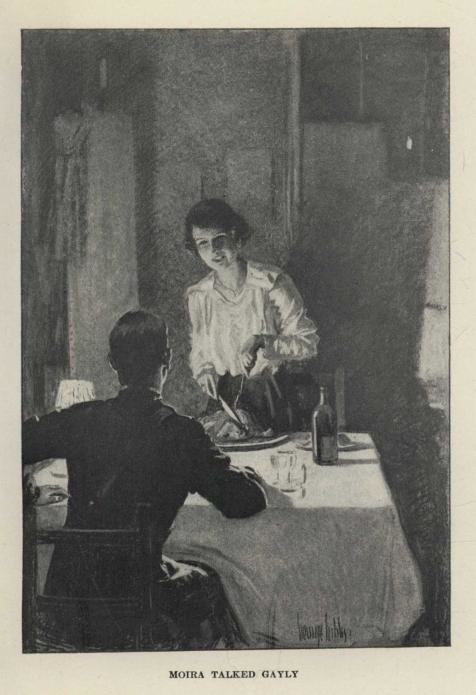
MOIRA TALKED GAYLY
They took their coffee by the embers of the fire. The light from the great north window had long since expired and the mellow glow of the candles flickered softly on polished surfaces.
Suddenly Moira stopped talking and realized that as she did so silence had fallen. Her companion had sunk deep into his chair, his gaze on the gallery above, a frown tangling his forehead. She glanced at him quickly and then looked away. Something was required of him and so,
"Why have you done all this for me?" he asked gently.
She smiled and their glances met.
"Because—because——"
"Because you thought it a duty?"
"No——," easily, "it wasn't really that. Duty is such a tiresome word. To do one's duty is to do something one does not want to do. Don't I seem to be having a good time?"
"I hope you are. I'm not likely to forget your charity—your——"
"Charity! I don't like that word."
"It is charity, Moira. I don't deserve it."
The words were casual but they seemed to illumine the path ahead, for she broke out impetuously.
"I didn't think you did—I pitied you—over there—for what you had been and almost if not quite loathed you, for the hold you seemed to have on father. I don't know what the secret was, or how much he owed you, but I know that he was miserable. I think I must have been hating you a great deal, Harry dear—and yet I married you."
"Why did you?" he muttered. "I had no right to ask—even a war marriage."
"God knows," she said with a quick gasp as she bowed her head, "you had made good at the Camp. I think it was the regimental band at Yaphank that brought me around. And then you seemed so pathetic and wishful, I got to thinking you might be killed. Father wanted it. And so——" she paused and sighed deeply. "Well—I did it.... It was the most that I could give—for Liberty...."
She raised her head proudly, and stared into the glowing embers.
"For Liberty—you gave your own freedom——" he murmured.
"It was mad—Quixotic——" she broke in again, "a horrible sacrilege. I did not love, could not honor, had no intention of obeying you...." She stopped suddenly, and hid her face in her hands. He thought that she was in tears but he did not dare to touch her, though he leaned toward her, his fingers groping. Presently she took her hands down and threw them out in a wild gesture. "It is merciless—what I am saying to you—but you let loose the floodgates and I had to speak."
He leaned closer and laid his fingers over hers.
"It was a mistake——" he said. "I would do anything to repair it."
He meant what he said and the deep tones of his voice vibrated close to her ear. She did not turn to look at him and kept her gaze on the fire, but she breathed uneasily and then closed her eyes a moment as though in deep thought.
"Don't you believe me, Moira?"
She glanced at him and then leaned forward, away—toward the fire.
"I believe that I do," she replied slowly. "I don't know why it is that I should be thinking so differently about you, but I do. You see, if I hadn't trusted you we'd never have been sitting here this night."
"I gave you your chance to be alone——"
"Yes. You did that. But I couldn't let you be going to a pension, Harry. I think it was the pity for your pale face against the pillows."
"Nothing else?" he asked quietly.
His hand had taken the fingers on the chair arm and she did not withdraw them at once.
"Sure and maybe it was the blarney."
"I've meant what I've said," he whispered in spite of himself, "you're the loveliest girl in all the world."
There was a moment of silence in which her hand fluttered uneasily in his, while a gentle color came into her face.
Then abruptly she withdrew her fingers and sprang up, her face aflame.
"Go along with you! You'll be making love to me next."
He sank back into his chair, silent, perturbed, as he realized that this was just what was in his heart.
"Come," she laughed, "we've got all the dishes to wash. And then you're to be getting to bed, or your head will be aching in the morning. Allons!"
She brought him to himself with the clear, cool note of camaraderie, and with a short laugh and a shrug which hid a complexity of feeling, he followed her into the kitchen with the dishes. But a restraint had fallen between them. Moira worked with a business-like air, rather overdoing it. And Jim Horton, sure that he was a blackguard of sorts, wiped the dishes she handed to him and then obediently followed her to the room off the hall where his baggage had been carried.
She put the candle on the table and gave him her frankest smile.
"Sleep sound, my dear. For to-morrow I'll be showing you the sights."
"Good-night, Moira," he said gently.
"Dormez bien."
And she was gone.
He stood staring at the closed door, aware of the sharp click of the latch and the faint firm tap of her high heels diminishing along the hall—then the closing of the studio door. For a long while he stood there, not moving, and then mechanically took out a cigarette, tapping it against the back of his hand. Only the urge of a light for his cigarette from the candle at last made him turn away. Then he sank upon the edge of the bed and smoked for awhile, his brows furrowed in thought. Nothing that Harry had ever done seemed more despicable than the part that he had chosen to play. He was winning her friendship, her esteem, something even finer than these, perhaps—for Harry—as Harry, borrowing from their tragic marriage the right to this strange intimacy. If her dislike of him had only continued, if she had tolerated him, even, or if she had been other than she was, his path would have been smoother. But she was making it very difficult for him.
He paced the floor again for awhile, until his cigarette burnt his fingers, then he walked to the window, opened it and looked out. It was early yet—only eleven o'clock. The thought of sleep annoyed him. So he took up his cap, blew out the candle and went quietly out into the hall and down the stairs.
He wanted to be alone with his thoughts away from the associations of the studio, to assume his true guise as an alien and an enemy to this girl who had learned to trust him. The cool air of the court-yard seemed to clear his thoughts. In all honor—in all decency, he must discover some way of finding his brother Harry, expose the ugly intrigue and then take Harry's place and go out into the darkness of ignominy and disgrace. That would require some courage, he could see, more than it had taken to go out against the Boche machine gunners in the darkness of Boissière Wood, but there didn't seem to be anything else to do, if he wanted to preserve his own self-respect....
But of what value was self-respect to a man publicly disgraced? And unless he could devise some miracle that would enable him to come back from the dead, a miracle that would stand the test of a rigid army investigation, the penalty of his action was death—or at the least a long term of imprisonment in a Federal prison, from which he would emerge a broken and ruined man of middle age. This alternative was not cheering and yet he faced it bravely. He would have to find Harry.
* * * * *
The feat was not difficult, for as he emerged from the gate of the porte cochère of the concierge and turned thoughtfully down the darkened street outside, a man in a battered slouch hat and civilian clothes approached from the angle of a wall and faced him.
"What the H—— are you doing at No. 7 Rue de Tavennes?" said a voice gruffly.
Jim Horton started back at the sound, now aware that Fortune had presented him with his alternative. For the man in the slouch hat was his brother, Harry!
CHAPTER IV
OUTCAST
When Jim Horton, Corporal of Engineers, took his twin brother's uniform and moved off into the darkness toward the German lines, Harry Horton remained as his brother had left him, bewildered, angry, and still very much afraid. The idea of taking Jim Horton's place with his squad nearby did not appeal to him. The danger of discovery was too obvious—and soon perhaps the squad would have to advance into the dreadful curtain of black that would spout fire and death. He was fed up with it. The baptism of fire in the afternoon had shaken him when they lay in the field. It was the grinning head of Levinski of the fourth squad that had done the business. He had found it staring at him in the wheat as the platoon crawled forward. It wasn't so much that it was an isolated head, as that it was the isolated head of Levinski, for he hadn't liked Levinski and he knew that the man had hated him. And now Levinski had had his revenge. Harry had been deathly ill at the stomach, and had not gone forward with the platoon. He had seen the whites of the eyes of his men as they had glanced aside at him—and spat.
Why the H—— he had ever gone into the thing ... And now ... suppose Jim didn't come back! What should he do? Why had the Major picked him out for this duty! His thoughts wandered wildly from one fancied injury to another. And Jim—it was like him to turn up and plunge into this wild venture that would probably bring them both to court-martial. And if Jim was shot, what the devil was he to do? Go on through the service as Jim Horton, Corporal of Engineers? He cursed silently while he groveled in the gully waiting for the shots that were to decide his fate.
For a moment he gathered nerve enough to pick up Jim's rifle and accoutrement with the intention of joining the squad of engineers. But just at that moment there were sounds of shots within the wood, followed by others closer at hand, and then bullets ripped viciously through the foliage just above him. By a movement just ahead of him he knew that the line was advancing. He couldn't ... his knees refused him ... so he crawled into the thicket along the gully and lay upon the ground among the fallen leaves. More shots. Cries all about him. A grunt of pain after a shrapnel burst nearby ... the rush of feet as the second wave filtered through ... then the rapid crackle of the engagement in the wood. Jim was there—in his uniform. He'd be taking long chances too. He had always been a fool....
From his cover he marked the dawn while the fighting raged—then sunrise. The fire seemed to slacken and then move farther away. The line was still advancing and only the wounded were coming in—some of them walking cases, with bandaged heads and arms. He eyed them through the bushes furtively—vengefully. Why couldn't he have gotten a wound like that—in the afternoon in the wheat field—instead of finding the head of Levinski and the terror that it had brought? Other wounded were coming on stretchers now. The gully near him made an easy path to the plain below and many of them passed near him ... but he lay very still beneath the leaves. What if Jim came back on a stretcher...! What should he do?
Then suddenly as though in answer to his question two men emerged from the hollow above and approached, carrying something between them. There was a man of Harry's own platoon and a sergeant of the company. He heard their voices and at the sound of them he cowered lower.
"Some say he showed yellow yesterday in the wheat field," said the private.
"Yellow! They'd better not let me hear 'em sayin' it——"
They were talking about him—Harry Horton. And the figure, lying awkwardly, a shapeless mass——?
At the risk of discovery, the coward straightened and peered down into the white face ... Jim!
Harry Horton didn't remember anything very distinctly for a while after that, for his thoughts were much confused. But out of the chaos emerged the persistent instinct of self preservation. There was no use trying to find Jim's squad now. He wouldn't know them if he saw them. And how could he explain his absence with no wound to show? For a moment the desperate expedient occurred to him of thrusting himself through the leg with the bayonet. He even took Jim's weapon out of its scabbard. But the blue steel gave him a touch of the nausea that had come over him in the wheat field.... That wouldn't do. And what was the use? They had Harry Horton lying near death on the stretcher. What mattered what happened to the brother? There was no chance now to exchange identities. Perhaps there was never to be a chance.
He sank down again into the thicket, pulling the leaves about him. He would find a way. It could be managed. "Missing"—that was the safest way out.
That night, limping slightly, he emerged and made his way to the rear. It was ridiculously easy. Of the men he met he asked the way to the billets of the —th Regiment. But he didn't go where they told him. He followed their instructions until out of sight of them, and then went in the opposite direction.
He managed at last to get some food at a small farm house and under the pretext of having been sent to borrow peasant clothing for the Intelligence department, managed to get a pair of trousers, shirt, coat and hat. He had buried his rifle the night before and now when the opportunity came he dropped the bundle of Jim Horton's corporal's uniform, weighted by a stone, into deep water from a bridge over a river. With the splash Corporal James Horton of the Engineers had ceased to exist.
At the end of two weeks, thanks to some money that he had found in Jim's uniform—and a great deal of good luck—he was safe in a quiet pastoral country far from the battle line. Here he saw no uniforms—only old men and women in blouses and sabots, occupying themselves with the harvest, aware only that the Boches were in retreat and that their own fields were forever safe from invasion. He represented himself as an American art student of Paris, driven by poverty from the city, and offered to work for board and lodging. They took him, and there he stayed for awhile. There was a girl in the family. It was very pleasant. The nearest town was St. Florentin, and Paris was a hundred miles away. But after a few weeks he wearied of it, and of the girl, and having twenty francs left in his pockets stole away in the middle of the night.
Paris was the place for him. There identities were not questioned. He knew something of Paris. Piquette Morin! He could get her help without telling any unnecessary facts. As to Barry Quinlevin and Moira—that was different. It wouldn't be pleasant to fall completely in the power of a man like Barry Quinlevin—even if he was now his father-in-law. And Moira ... No. Moira mustn't ever know if he could prevent it. And yet if Jim Horton in Harry's uniform had been killed Harry would be officially dead. He was already dead, to Moira, if Jim Horton had revived enough to tell the truth. It wasn't a pretty story to be spread around. But if Jim were alive ... what then?
There were ways of getting along in Paris. He would find a way even if ... Moira! He would have liked to be able to go to Moira. She was the one creature in the world whose opinion seemed to matter now. She would have been his on the next furlough. He knew women. If you couldn't get them one way you could another. Already her letters had been gentler—more conciliatory. His wife—the wife of an outcast! God! Why had he ever gone into the service? How had he known back there that he wouldn't have been able to stand up under fire—that he would have found the grinning head of the hated Levinski in the wheat field? Waves of goose flesh went over him and left him cold and weak.... A sullen mood followed, dull, embittered, and vengeful, against all the world, with only one hope.... If Jim were alive—and silent!
That opened possibilities—to substitute with his brother and come back to his own—with all the honors of the fool performance! It was his name, his job that Jim had taken, and his brother couldn't keep him out of them. He could make Jim give them up—he'd make him. If he couldn't come back himself, he would drag Jim down with him—they would be outcast together. In the dark that night he would have managed in some way to carry out the Major's orders if Jim hadn't found him just at the worst moment. What right had Jim to go butting in and making a fool of them both! D—n him!
He found his way into Paris at the end of a dreary day of tramping. He had a few francs left but he was tired and very hungry. With a lie framed he went straight to the apartment of Piquette Morin. She had gone out of town for a few days.
That failure baffled him. He had a deposit in a bank, but he dared not draw it out. So he trudged the weary way up to Montmartre, saving his sous, and hired a bed into which he dropped more dead than alive.
Thus it was that two nights later, unable yet to bring himself to the point of begging from passersby, with scant hope indeed of success, his weary feet brought him at last to the Rue de Tavennes. Hiding his face under the shadow of his hat he inquired of the concierge and found that the apartment of Madame Horton was au troisième. He strolled past the porte cochère and walked on, looking hungrily up at the lighted windows of the studio. Moira was there—his wife, Barry Quinlevin perhaps. Who else? He heard sounds of laughter from somewhere upstairs. Laughter! The bitterness of it! But it didn't sound like Moira's voice. He walked to and fro watching the lighted windows and the entrance of the concierge, trying to keep up the circulation of his blood, for the night was chill and his clothing thin. He had no plan—but he was very hungry and his resolution to remain unknown was weakening. A man couldn't let himself slowly starve, and yet to seek out any one he knew meant discovery and the horrible publicity that must follow. The lights of the troisième étage held a fascination for him, like that of a flame for a moth. He saw a figure come to a window and throw open the sash. He stared, unable to believe his eyes. It was a man in the uniform of an officer of the United States Army—his own uniform and the man who wore it was his brother Jim! Alive—well, covered with honors perhaps—here—in Moira's apartment? What had happened to bring his brother here? And Moira ...
His head whirled with weakness and he stood for a moment leaning against the wall, but his strength came back to him in a moment, and he peered up at the window again. The light had gone out. Jim masquerading in his shoes—with Moira—as her husband—alone, perhaps, in the apartment! And Moira? The words of conciliation in her last letters which had seemed to promise so much for the future, had a different significance here. Fury shook him like a leaf, the fury of desperation, that for the moment drove from his craven heart all fear of an encounter with his brother.
There was a sound of a door shutting and in a moment he saw the man in uniform emerge by the gate of the concierge. He walked toward the outcast, his head bent in deep meditation. There was no doubt about its being Jim. With clenched fists Harry barred his way, the thought that was uppermost in his mind finding utterance.
Jim Horton stopped, stepped back a pace and then peered at the man in civilian clothing from beneath his broad army hat-brim.
"Harry!" he muttered, almost inaudibly.
"What are you doing here—in this house?" raged Harry in a voice thick with passion. And then, as no reply came, "Answer me! Answer me!"
One of Harry's fists threatened but his brother caught him by the wrist and with ridiculous ease twisted his arm aside. He was surprised as Harry sank back weakly against the wall with a snarl of pain. "D—n you," he groaned.
This wouldn't do. Any commotion would surely arouse the curiosity of Madame Toupin, the concierge.
"Keep a civil tongue in your head, Harry," he muttered, "and I'll talk to you."
He caught him firmly by the arm, but Harry still leaned against the wall, muttering vaguely.
"A civil tongue—me? You—you dare ask me?"
"Yes," said Jim gently, "I've been trying to find you."
"Where?" leered Harry, "in my wife's studio?"
Jim Horton turned suddenly furious, but shocked into silence and inertia by the terrible significance of the suspicion. But he pulled himself together with an effort.
"Come," he said quietly. "Let's get away from here."
He felt Harry yield to the pressure of his fingers and slowly they moved into the shadows down the street away from the gas lamps. A moment later Harry was twitching at his arm.
"G-get me something to cat. I—I'm hungry," he gasped.
"Hungry! How long——?"
"Since yesterday morning—a crust of bread——"
And Jim had been eating goose——! The new sense of his own guilt appalled him.
"Since yesterday——!" he muttered in a quick gush of compassion. "We'll find something—a café——"
"There's a place in the Rue Berthe—Javet's," he said weakly.
Jim Horton caught his brother under an elbow and helped him down the street, aware for the first time of the cause of his weakness. He marked, too, the haggard lines in Harry's face, and the two weeks' growth of beard that effectually concealed all evidence of respectability. There seemed little danger of any one's discovering the likeness between the neatly garbed lieutenant and the civilian who accompanied him. But it was well to be careful. They passed a brilliantly lighted restaurant, but in a nearby street after awhile they came to a small café, not too brightly lighted, and they entered. There was a polished zinc bar which ran the length of a room with low, smoke-stained ceilings. At the bar were two cochers, in shirt sleeves, their yellow-glazed hats on the backs of their heads, sipping grenadine. There was a winding stair which led to the living quarters above, but through a doorway beside it, there was a glimpse of an inner room with tables unoccupied. They entered and Jim Horton ordered a substantial meal which was presently set before the hungry man. The coffee revived him and he ate greedily in moody silence while Jim Horton sat, frowning at the opposite wall. For the present each was deeply engrossed—Jim in the definite problem that had suddenly presented itself, and the possible courses of action open to do what was to be required of him; Harry in his food, beyond which life at present held no other interest. But after a while, which seemed interminable to Jim, his brother gave a gasp of satisfaction, and pushed back his dishes.
"Give me a cigarette," he demanded with something of an air.
Jim obeyed and even furnished a light, not missing the evidences of Dutch courage Harry had acquired from the stimulation of food and coffee.
It was curious what little difference the amenities seemed to matter. They were purely mechanical—nor would it matter what Harry was to say to him. The main thing was to try to think clearly, obliterating his own animus against his brother and the contempt in which he held him.
Harry sank back into his chair for a moment, inhaling luxuriously.
"Well," he said at last, "maybe you've got a word to say about how the devil you got here."
"Yes," said Jim quickly. "It's very simple. I was hit. I took your identity in the hospital. There wasn't anything else to do."
Harry glowered at the ash of his cigarette and then shrugged heavily.
"I see. They think you're me. That was nice of you, Jim," he sneered, "very decent indeed, very kind and brotherly——"
"You'd better 'can' the irony," Jim broke in briefly. "They'd have found us out—both of us. And I reckon you know what that would have meant."
"H—m. Maybe I do, maybe I don't," he said shrewdly. "It was you who found me—er—sick. Nobody else did."
"We needn't speak of that."
"We might as well. I'd have come around all right, if you hadn't butted in."
"Oh, would you?"
"Yes," said Harry sullenly.
Jim Horton carefully lighted a cigarette from the butt of the other, and then said coolly:
"We're not getting anywhere, Harry."
"I think we are. I'm trying to show you that you're in wrong on this thing from start to finish. And it looks as though you might get just what was coming to you."
"Meaning what?"
"That you'll take my place again. This——!" exhibiting with a grin his worn garments. "You took mine without a by-your-leave. Now you'll give it back to me."
An ugly look came into Jim Horton's jaw.
"I'm not so sure about that," he said in a tone dangerously quiet.
"What! You mean that——" The bluster trailed off into silence at the warning fire in his brother's eyes. But he raised his head in a moment, laughing disagreeably. "I see. The promotion has got into your head. Some promotion—Lieutenant right off the reel—from Corporal, too. Living soft in the hospital and now——" He paused and swallowed uneasily. "How did you get to the Rue de Tavennes?"
"They came to the hospital—Mr. Quinlevin and—and your wife. I—I fooled them. They don't suspect."
"How—how did you know Moira was my wife?"
"Some letters. I read them."
"Oh, I see. You read them," he frowned and then, "Barry Quinlevin's too?"
"Yes—his too. I had to have facts. I got them—some I wasn't looking for——"
"About——?"
"About the Duc de Vautrin," Jim broke in dryly. "That's one of the reasons why I'm still Harry Horton and why I'm going to stay Harry Horton—for the present."
If Jim had needed any assurance as to his brother's share in this intrigue he had it now. For Harry went red and then pale, refusing to meet his gaze.
"I see," he muttered, "Quinlevin's been talking."
"Yes," said Jim craftily, "he has. It's a pretty plan, but it won't come off. You always were a rotter, Harry. But you're not going to hurt Moira, if I can prevent."
It was a half-random shot but it hit the mark.
"Moira," muttered Harry somberly. "I see. You haven't been wasting any time."
"I'm not wasting time when I can keep her—or even you—from getting mixed up in dirty blackmail. That's my answer. And that's why I'm not going to quit until I'm ready."
Harry Horton frowned at the soiled table cover, his fingers twitching at his fork, and then reached for the coffee pot and quickly poured himself another cup.
"Clever, Jim," he said with a cynical laugh. "I take off my hat to you. I never would have thought you had it in you. But you'll admit that living in my wife's apartment and impersonating her husband is going a bit too far."
The laughter didn't serve to conceal either his fear or his fury. But it stopped short as Jim's fingers suddenly closed over his wrist and held it in a grip of iron.
"Don't bring her into this," he whispered tensely. "Do you hear?" And after a moment of struggle with himself as he withdrew his hand, "You dared to think yourself worthy of her. You!"
"Be careful what you say to me," said Harry, trying bravado. "She's my wife."
"She won't be your wife long, when I tell her what I know about you," finished Jim angrily.
He saw Harry's face go pale again as he tried to meet his gaze, saw the fire flicker out of him, as he groped pitiably for Jim's hand.
"Jim! You—you wouldn't do that?" he muttered.
Jim released his hand, shrugged and leaned back in his chair.
"Not if you play straight with me—and with her. You want me to pay the penalty of what I did for you—to go out into the world—an outcast in your place. Perhaps I owe it to you. I don't know. But you owe me something too—promotion—the Croix de Guerre——"
"The Croix de Guerre! Me——?"
"Lieutenant Harry G. Horton to be gazetted captain—me!" put in Jim, with some pride. "Not you."
A brief silence in which Harry rubbed his scrawny beard with his long fingers.
"That might be difficult to prove to my Company captain," he said at last.
"You forget my wounds," laughed Jim. "Oh, they're my wounds all right." And then, with a shrug, "You see, Harry, it won't work. You're helpless. If I chose to keep on the job, you'd be left out in the cold."
"You won't dare——"
"I don't know what I'd dare. It depends on you."
"What do you mean?" broke in Harry with some spirit. "I couldn't be any worse off than I am now, even if I told the truth."
Jim laughed. "I tried to tell in the hospital and they thought I was bug-house. Try it if you like."
Harry frowned and reached for another cigarette.
And then after awhile, "Well—what do you want me to do?"
His brother examined him steadily for a moment, and then went on.
"I don't know whether you've learned anything in the army or not. But it ought to have taught you that you've got to live straight with your buddy or you can't get on."
"Straight!" sneered Harry, "like you. You call this straight—what you're doing?"
"No," Jim admitted. "It's not straight. It's crooked as hell, but if it wasn't, you'd have been drummed out of the Service by now. I don't want you to think I care about you. I didn't—out there. It was only the honor of the service I was thinking about. I'd do it again if I had to. But I do care about this girl you've bamboozled into marrying you—you and Quinlevin. And whatever the dirty arrangement between you that made it possible, I want to make it clear to you here and now that she isn't going to be mixed up in any of your rotten deals. She isn't your sort and you couldn't drag her down to your level if you tried. I'll know more when Quinlevin gets back and then——"
Jim Horton paused as he realized that he had said too much, for he saw his brother start and then stare at him.
"Ah, Barry Quinlevin—is away!"
Jim nodded. "Yes," he said, "in Ireland."
Harry had risen, glowering.
"And you think I'm going to slink off to-night to my kennel and let you go back to the studio. You in my uniform—as me—to Moira."
Jim Horton thought deeply for a moment and then rose and coolly straightened his military blouse.
"Very well," he said, "we'll go back to her together."
He took out some money and carelessly walked toward the bar in the front room. But Harry followed quickly and caught him by the arm.
"Jim," he muttered, "you won't do that!"
"We'll tell her the truth—I guess you're right. She ought to know."
"Wait a minute——"
His hand was trembling on the officer's sleeve and the dark beard seemed to make the face look ghastly under its tan.
"Not yet, Jim. Not to-night. We—we'll have to let things be for awhile. Just sit down again for a minute. We've got to find a way to straighten this thing out—to get you back into your old job——"
"How?" dryly.
"I—I don't know just now, but we can work it somehow——"
"It's too late——"
"You could have been captured by the Boches. We can find a way, when you let me have my uniform."
Jim Horton grinned unsympathetically.
"There are two wounds in that too, Harry," he said. "Where are yours?"
And he moved toward the door.
"Listen, Jim. We'll let things be as they are for the present. Barry Quinlevin mustn't know—you've got to play the part. I see. Come and sit down a minute."
His brother obeyed mechanically.
"Well," he said.
"I'll do what you say—until—until we can think of something." He tried a smile and failed. "I know it's a good deal to ask you—to take my place—to go out into the world and be what I am, but you won't have to do it. You won't have to. We'll manage something—some way. You go back to the studio——" he paused uncertainly, "You're not——?" he paused.
Jim Horton read his meaning.
"Making love to your wife? And if I was, it would only be what you deserve. She doesn't love you any too much, as it is."
Harry frowned at the floor, and was silent, but his brother's answer satisfied him.
"All right. You go back—but I've got to get some money. I can't starve."
"I don't want you to," Jim fumbled in his pockets and brought out some bills. "Here—take these. They're yours anyway. We'll arrange for more later. I've an account at a bank here——"
"And so have I—but I don't dare——"
"Very good. What's your bank?"
"Hartjes & Cie."
"All right. I'll get some checks to-morrow and you can make one payable to yourself. I'll cash it and give you the money. And I'll make one out at my bank for the same amount, dated back into October, before the Boissière fight, payable to bearer. You can get it cashed?"
"Yes."
"Who?"
"A woman I know."
Jim shrugged. "All right. But be careful. I'll meet you here to-morrow night. And don't shave."
Harry nodded and put the bills into his pocket while Jim rose again.
"You play the game straight with me," he said, "and I'll put this thing right, even if——"
He paused suddenly in the doorway, his sentence unfinished, for just in front of him stood a very handsome girl, who had abandoned her companion and stood, both hands outstretched, in greeting.
"'Arry 'Orton," she was saying joyously in broken English. "You don seem to know me. It is I—Piquette."
The name Quinlevin had spoke in the hospital!
Jim glanced over his shoulder into the shadow where Harry had been, but his brother had disappeared.
CHAPTER V
PIQUETTE
She wore a black velvet toque which bore upon its front two large crimson wings, poised for flight, and they seemed to typify the girl herself—alert, on tip-toe, a bird of passage. She had a nose very slightly retroussé, black eyes, rather small but expressive, with brows and lids skillfully tinted; her figure was graceful, svelte, and extraordinarily well groomed, from her white gloves to the tips of her slender shiny boots, and seemed out of place in the shadows of these murky surroundings. For the rest, she was mischievous, tingling with vitality and joyous at this unexpected meeting.
Horton glanced past her and saw a figure in a slouch hat go out of the door, then from the darkness turn and beckon. But Jim Horton was given no opportunity to escape and Harry's warning gesture, if anything, served to increase his curiosity as to this lovely apparition.
"Monsieur Valcourt—Monsieur 'Orton," she said, indicating her companion with a wave of the hand. And then, as he shook hands with her companion, a handsome man with a well-trimmed grayish mustache, "Monsieur Valcourt is one day de greatest sculptor in de world—Monsieur 'Orton is de 'ero of Boissière wood."
"You know of the fight in Boissière——?" put in Jim.
"And who does not? It is all in le Matin to-day—an' 'ere I find you trying to 'ide yourself in the obscure café of Monsieur Javet."
She stopped suddenly and before he realized what she was about had thrown her arms over his shoulders and kissed him squarely upon the lips. He felt a good deal of a fool with Monsieur Valcourt and the villainous-looking Javet grinning at them, but the experience was not unpleasant and he returned her greeting whole heartedly, wondering what was to come next.
And when laughing gayly she released him, he turned toward Monsieur Valcourt, who was regarding her with a dubious smile.
"For all her prosperity, Monsieur 'Orton," Valcourt was saying, in French, "she is still a gamine."
"And who would wonder, mon vieux! To live expensively is very comfortable, but even comfort is tedious. Does not one wish to laugh with a full throat, to kick one's toes or to put one's heels upon a table? La la! I do not intend to grow too respectable, I assure you."
Jim Horton laughed. She had spoken partly in English, partly in French, translating for both, and then, "Let me assure you, Madame," said Valcourt with a stately bow, "that you are not in the slightest danger of that."
But she was already turning to Horton again.
"A 'ero. The world is full of 'eros to-day, but not one like my 'Arry 'Orton. Allons! I mus' 'ave a talk with you alone. Lucien," she said sharply, turning to Valcourt, "I will come to de studio to-morrow. Monsieur le Duc t'inks I am gone away, but now I would be a poor creature not to give my brave soldier a welcome."
"If Monsieur will excuse me——" said Valcourt, offering his hand.
Jim Horton took it, wondering where the adventure was to lead. She was a very remarkable person and her élan had already carried him off his feet. Taking his hand in hers, with a charming simplicity, she led him into the room at the rear, now occupied by a number of persons of both sexes, and bade Monsieur Javet himself serve them. And when they were seated at a table, her hand still in his, she examined him with a new interest.
"It is indeed you," she said gayly, "and yet you seem different—more calm, more silent. What is it?"
"I've had two months in the hospital."
"And you're quite strong again?"
"Oh yes. And you have been well—Piquette?"
"Well—but so ennuyée. It is why I come back here to de Quartier to get a breath of fresh air. I've been posing for Monsieur Valcourt—La Liberté. He says my figure is better than ever. And Valcourt knows."
"I'm sure you are very lovely."
"La, la, mon vieux, but you are the grand serieux. Of course I am lovely. It is my business. But you do not show me 'ow lovely I am, for you are so quiet—so cool——"
Jim Horton laughed and caught her fingers to his lips.
"You are—Piquette. That is enough."
"C'est mieux. But you are change'. One does not look deat' in de eyes wit'out feeling its col' touch. Oh, but I am glad that you are come back to me. You s'all be 'ere long?"
"I don't know—when I shall get my orders."
"But until then—t'ings s'all be as dey were wit' us two, eh, my little one? An' I s'all 'elp you now in de great affair? But Monsieur de Vautrin becomes more onpleasant. He is a very tiresome ol' man...."
Jim Horton started unconsciously. Then remembered that it was in connection with de Vautrin that Quinlevin had mentioned this very girl Piquette. He understood better now the reason for Harry's gesture from the outer darkness. The meeting had been a stroke of Fate. Perhaps she held the key to the riddle.
"Tiresome, yes," he said slowly, "all old men are tiresome——"
"And difficile," she mused, sipping at her glass. "While I am pretty he likes to have me nearby. But I know. He cares not'ing. He will leave me not'ing. I am not content. So I say I want to help in de great affair. You have planned somet'ing in the hospital—you and Monsieur Quinlevin?"
"Er—nothing definite."
"Monsieur le Duc still pays?"
Horton meditated for a moment.
"No," he said, "he has stopped paying."
Piquette Morin leaned further over the table, frowning.
"Ah! Since when?"
"For—er—three months or more."
"Then you t'ink he suspects somet'ing?"
"I don't know. It looks so, doesn't it?"
"Yes, perhaps." She paused a moment and then, "I make him talk about de past, as you ask' me to. I am no saint and de bon Dieu has taught me to look out for myself. I shall continue. If he tries to get rid of me de way he did wit' his wife, he will find me troublesome."
Horton laughed. "I don't doubt it." And then, carefully, "You heard how he got rid of her?" he questioned.
"It was 'er riches, of course. 'E spent 'er 'dot' in a few month gambling at Monte Carlo, and den when 'e came to 'er for more 'e abuse and beat 'er." She paused and her dark eyes snapped viciously. "'E would not have beaten me," she finished.
"And then?" he asked, wondering whither the conversation was leading.
"And den, as you know, she ran away to Ireland——"
"To Ireland——" he muttered eagerly.
"Of course," she said with a glance at him. "And when 'e got enough money 'e sail 'round de worl' enjoying himself. Even now sometimes 'e is a beast. It is den I come back to de Quartier where I am born and bred—to be merry again." She sighed and then laughed gayly. "But to-night we mus' not talk of dis tiresome matter. It is your night, mon vieux, and we s'all make it 'appy."
He kissed the rosy palm she thrust to his lips, with difficulty concealing his curiosity.
"But the child of Monsieur the Duc——" he urged after the moment of badinage. "He said nothing——?"
He paused as though in doubt.
She shrugged carelessly and lighted a cigarette.
"Monsieur is cautious. 'E spoke not'ing of de child, except to say dat it died wit' de mother. De money came to 'im. Dat was all 'e cared about, mon 'Arry."
To Jim Horton no light seemed to dawn. And how to question without arousing the girl's suspicions was more that he could plan. But he remembered Quinlevin's uncertainty in the hospital—his thought that Harry might have talked to this girl. So he took a chance.
"You asked the Duc no questions that might have aroused his suspicions?"
"No. I t'ink not. And yet I remember once 'e ask' me if I know Monsieur Quinlevin."
"And what did you reply?"
"Of course, dat I never heard of 'im."
He frowned at the cigarette in his fingers as Harry would have frowned and imitated as nearly as possible the sullen mood of his brother.
"The money has stopped coming to Quinlevin. We've got to do something."
"Parfaitement," said Piquette carelessly. "De time 'as come to produce de girl Moira and de papers."
Her glance was not upon his face or she would have seen the look of bewilderment and surprise suddenly distend his eyes. But she heard him gasp and turned again toward him. But by this time the missing pieces of the puzzle were at his fingers' ends and he gathered them quickly. It was Moira who all these years had unconsciously impersonated the dead child who would have inherited. And Quinlevin had bled the Duc for years with promises of silence. Harry had connived at the plot and now the coup they planned meant a sum of not less than "seven figures." And Piquette knew all. Blackmail it was—of the blackest.
For a moment he did not dare to speak for fear of betraying himself. And then only assented safely to her suggestion.
"Yes; it is the only thing to be done."
"It mus' be manage' carefully. You are sure de papers are all correct?"
"It is as to that Monsieur Quinlevin has gone to Ireland."
"Ah, I see—we mus' wait until 'e comes back. But I s'all 'elp you, mon ami. You will rely upon me, n'est ce pas?"
"Yes, I will."
His mind was so full of this astonishing revelation that he sat silent and motionless while she changed the subject and chattered on. The charm of the chance encounter was gone. Gamine she might be, and irresponsible like others of her kind in Paris or elsewhere, but she was not for him. He had a standard to measure her by.
"You are so triste, 'Arry," she broke in suddenly. "I do not t'ink I like you so triste. What s'all we care, you and I, for Monsieur le Duc an' 'is money? To be young an' in love——"
She caught both of his hands across the table and held them. "You are not yet well, 'Arry. I can see. It is dat for so long you do not know comfort an' 'appiness. Allons! I s'all make you laugh again, until de triste look come no more into your eyes."
He was about to give some token of his appreciation that would satisfy her when he saw her glance past his shoulder toward the door which led into the bar.
"Your frien' who was wit' you—'e 'as come back again," she whispered.
"Ah——" he turned and saw Harry peering through the door.
"'E wants you to come? C'est embêtant! Sen' 'im away."
"I'm afraid I——" He rose uncertainly and turned. "Wait," he said, "I'll see." And then walked out into the bar where Harry obstinately awaited him.
"I've had enough of this," growled his brother. "You come out of here with me or I'll——"
"Don't be a fool. You could see that I couldn't help it."
"You can help it now——"
"All right. We'll have this thing out, you and I—to-night. You meet me at the corner toward the Boulevard in twenty minutes. I'll get rid of her."
And without waiting for a reply he returned to Piquette, his mind made up.
"I'm sorry," he said to her, "but I've some urgent business with this man. It can't be put off. But I must see you soon——"
She pouted and rose.
"I can't explain—not now. You won't be cross——"
"It is not—anodder woman——?" she asked shrewdly.
"Another——? How can you ask? No. There are no other women in Paris, Piquette."
"You are cruel," she muttered in a low tone, her dark eyes flashing.
"No. It is a matter of importance. Will you let me have your address——?"
"No 82 Boulevard Clichy—de same place."
"Good. To-morrow I will write you."
Without a word she gathered up her cloak and led the way out, looking about curiously for her enemy of the evening. But Harry had disappeared. She said nothing and they went out into the street where Jim Horton found a cab and put her into it.
"Méchant!" she whispered softly.
"It is not my fault, Piquette. Soon——"
He gave the address to the cocher and she was gone.
Jim Horton stood for a moment listening to the sounds of the retreating fiacre as it rattled away over the cobblestones and then turned slowly back, his anger at his discoveries, long repressed by the necessities of his masquerade, suddenly bursting the barriers of his self-control. Moira—innocent—the catspaw, the stool-pigeon for these two rascals! How much did she know? How could Quinlevin have carried the deception out all these years without de Vautrin suspecting something? And if, as it seemed, he was suspicious of them now, who had told? His own duty seemed very clear. Every impulse of honor and decency urged that he find this Duc de Vautrin and tell the whole truth. But there was Moira ... his first duty was to her. But telling her meant revealing the secret of Harry's disgrace and his own part in it. That would be a difficult thing to do, but he would have to do it. He would tell her to-morrow.
As for Harry—he would make short work of him. He went with long determined strides to the appointed spot and Harry met him with a threatening air.
"What the Hell has she been saying?" he muttered.
Jim Horton was angry, but he kept himself well in hand, aware of his own physical superiority to this blustering shell of intrigue, deceit and cowardice, built in his own image. If earlier in the evening he had had his moments of pity for his brother's misfortunes, if he had planned to make restitution for the imprudence that had resulted in their undoing, he had no such gentle feeling or purpose now.
As he didn't reply, his brother continued angrily. "You've gone about your limit, I tell you. What did she tell you?"
"Everything. I've got the whole story. And I'd like to tell you before we go any further that you're just about the crookedest——" He broke off with a shrug.
"What's the use? The worst thing I could say would be a compliment. But you've come to the end of your tether. I don't know why I hoped there might be a chance of getting you to go straight—for her—but I did. The interesting revelations of this charming lady have removed the impression. The money you took from the estate, your questionable deals in America, your habits, put you outside the pale of decency, but the blackmail of the Duc with your own wife as stool-pigeon——"
Harry in a sudden blind fury that took no thought of consequences struck viciously, but Jim, who had been watching for the blow, warded it, tripped his brother neatly and sent him spinning against the wall where he fell and lay motionless. But he was unhurt—only bewildered by the result of his own incapacity.
"Get up!" Jim ordered. "Somebody will be coming along in a moment and we'll both be going with the police."
Harry saw reason in that and slowly got to his feet, pale, still trembling with rage, rubbing his hip joint, but subdued. The place they had chosen was in the shadow and the hour was late, and no one was about, but Jim Horton took a glance up and down the deserted street before he resumed his interrupted remarks.
"I don't want any man's uniform when it's been defiled. You ought to have known that. I'm going to take it off and give it back to you."
He saw the eager surprised look that came into Harry's face and raised his hand in warning—"But not yet. First I'm going to tell your wife the truth and then I'm going to warn the Duc de Vautrin."
Harry started back as though to dodge another blow, the reaction of his venture setting in with the terror of this information.
"Jim!" he whispered, clutching at his arm. "You wouldn't do that, Jim. My God! It's ruin to me—and you too."
"I'm prepared for that——"
"Don't, for God's sake don't! Wait. I've met you half way, haven't I? I'll do anything you say. I'll steer Quinlevin off and drop the thing. It was his idea—not mine. And he wouldn't have thought of it if the old man hadn't shut off the allowance——"
"Tell me the truth," Jim broke in sternly. "How much money did Quinlevin owe you?"
"Twenty thousand dollars——"
"And that was Moira's price——" contemptuously.
"I wanted her. I loved her. I swear to God I did. I love her now. I'd give anything to be able to go to her to-night——"
"You——! You forget what I know."
"It's the truth."
"How much were you to get of this money of the Duc's?"
Harry halted, mumbling, "That wasn't settled."
"Well, it's settled now," said Jim, with an air of finality, turning aside.
"What are you going to do?"
"Tell her—in the morning."
"You can't, Jim. Why, she'd go right to Quinlevin."
"I expect her to—and the Duke."
Harry leaned back against the wall, his fingers working at his trouser legs, but he was speechless.
"That's about all, I think," said Jim dryly. "Good-bye."
"Then you won't listen—not if I promise——"
"What——?"
"Anything. Why, you've got me, Jim. I can't do a thing with you ready to tell Moira—even if I wanted to. What's the use? It only means ruin for you. Wait a few days and we'll have another talk; just wait until to-morrow night. Give me a chance to think. I'll even—I'll even get out of France and go out West somewhere and make a fresh start. I will. I mean it. I did you a dirty trick once, but I'll try to square myself. Give me a chance. Think it over. Meet me to-morrow. I'm all in to-night. Promise you won't speak."
"No," said Jim, after a moment of deliberation. "I'll promise nothing, but I'll meet you to-morrow night at Javet's—at twelve—with the money."
Harry gasped a sigh of relief and straightened, offering his hand. "Thanks, Jim. To-morrow. And you won't tell her, I know. You couldn't. It would be too cruel. She'll suffer—my God! You know her. Can't you see how she'd suffer?"
"I—I didn't start this thing——"
"But you'll finish it, Jim. She believes in him, even if she doesn't believe in me. It will kill her."
He saw that he had made an impression on his brother. Jim stood silent, his head bowed.
"Don't tell her to-morrow, Jim," Harry pleaded. "Promise."
Jim shrugged and turned.
"All right," he said at last. "I'll sleep on it."
He turned away and walked slowly out into the dim light of the street, moving toward the Rue de Tavennes. He did not even turn his head to see what became of his brother. Already he had forgotten him. The heat of his passion had suffered a strange reaction. To resolve to tell Moira the truth, even to threaten to tell her was one thing, but to tell was another. And curiously enough Harry's picture of the consequences, drawn even in the stress of fear, was true enough—Jim knew it—was true. He knew her pride, her spirit. The revelation would kill them—and destroy her.
She was so dependent on him. She didn't know how greatly. And he had been until the present moment so dependent upon her. He realized what her visits had meant to him, how deep had been the joy of their evening alone in the studio. He did not dare to think of her now as he had been thinking of her then—for during the weeks of his convalescence and the culmination of their friendship to-night Harry had seemed far off, vague and impalpable. But their meeting had changed all this and he was thankful that he had had enough manhood to keep his wits when he had been alone with her. Moira—the pity of it—had given him signs (that he might read and run) that the mockery of the marriage was a mockery no longer. And it was her very confession of indifference and pity for Harry as she had known him, that seemed to give Jim the right to care for and protect her. He did care for her, he was now willing to confess in a way far from fraternal. He had always been too busy to think about women, but Moira had crept into his life when he was ill and unnerved, needing the touch of a friendly hand, and their peculiar relationship had given him no chance of escape—nor her. She had captured his imagination and he had succeeded where Harry had not in winning her affection.
It was a dangerous situation and yet it fascinated him. The knowledge that he must cause her suffering had weakened his resolve for a moment, but as he walked into the Rue de Tavennes he saw it for the fool's paradise that it was. He would spend to-morrow with her—just to-morrow—that could do no harm and then—she should know everything.
He found his way into the court and up the stairs. The studio door was closed, implacable as the destiny that barred him from her.
He went into his room, closed the door and slowly undressed. Then lay on the bed, staring for a long while at the reflection of the street-lamp upon the ceiling: Moira ... happiness ... reputation—and dishonor. Or ... outcast ... but honorable.
CHAPTER VI
YOUTH TRIUMPHANT
But weariness and anxiety had to pay tribute at last and he slept. It was broad daylight when he awoke to the sound of a loud hammering upon the door and a high, clear, humorous voice calling his name.
"Lazy bones! Get up! Will you be lying abed all day?"
"A—all right——"
He opened his eyes with an effort and glanced at his wrist watch—— Eight o'clock.
"Coffee in the studio, Harry dear, in ten minutes."
"Oh! All right——"
The hammering stopped, foot-steps retreated and Jim Horton tumbled out, rubbing his eyes and gazing at the golden lozenges of light upon the wall. It was a most inspiriting reveille, arresting as the shrill clarion of camp on a frosty morning; but sweeter far, joyous with promise of the new day. It was only during the progress of his hasty toilet that the douche of cold water over his head and face recalled to him with unpleasant suddenness and distinctness the events of the night before, and he emerged from vigorous rubbing exhilarated but sober. There was a lot of thinking to be done and a difficult resolution to make, and with Moira at his elbow it wasn't going to be easy. But by the time he knocked at the door of the studio, the pleasure of the immediate prospect made ready his good cheer for the morning greeting. He heard her voice calling and entered. A new fire blazed on the hearth, and an odor of coffee filled the air. She emerged from the door of the small kitchen, a coffee-pot and a heaping plateful of brioches in her hands.
"Good morning! I've been waiting for you an hour or more. You've been developing amazing bad habits in the hospital."
"Why didn't you call me before?"
"Sure and I believed you might be thinking I was anxious to see you."
"And aren't you?"
"And do you think I'd be telling—even if I was?"
"You might."
"And I won't. Will you have your coffee with cream and sugar?"
"If you please."
It was real cream and real sugar—some magic of Madame Toupin's, she explained, and the brioches were unsurpassed. And so they sat and ate, Moira chattering gayly of plans for the day, while the ancient dowager upon the easel who had braved the Fokkers and the long-range cannon looked down upon them benignly and with a little touch of pity, too, as though she knew how much of their courage was to be required of them.
Horton ate silently, putting in a word here and there, content to listen to her plans, to watch the deft motions of her fingers and the changing expressions upon her face. Once or twice he caught her looking at him with a puzzled line at her brows, but he let his glance pass and spoke of casual things, the location of the bank where he must get his money, the excellence of the coffee, the kindness of Nurse Newberry, aware that these topics were not the ones uppermost in his mind, or in hers.
"You're a bit subdued this morning, Harry dear," she said at last, whimsically. "Maybe that goose was too much for you."
"Subdued!" he laughed.
"You have all the air of a man with something on his conscience. You used to wear that look in America, and I let you be. But somehow things seemed different with us two. Would you be willing to tell me?"
"There isn't a thing—except—except your kindness. I don't deserve that, you know."
She looked at him seriously and then broke into laughter.
"Would it make you feel more comfortable if I laid you over the shoulders with a mahl stick?"
"I think it would," he grinned.
"Sure and that is one of the few pleasant prerogatives of matrimony—in Ireland."
"And elsewhere——" added Horton.
"But I do want to know if anything's troubling you. Are you still worried——" she took a brioche and smiled at it amiably, "because we're not appropriately chaperoned?"
"No—not so much. I see you're quite able to look out for yourself."
"And you derive some comfort from the fact?" she asked.
He looked at her, their eyes met and they both burst into laughter.
"Moira—you witch! But you'd better not tempt me too far."
"Sure and I'm not afraid of you, alanah," she said, sedate again and very cool, "or of any man," and then, mischievously, "But your doubts needn't have kept you from kissing me a good morning."
"It's not too late now," said Horton, abruptly rising and spilling his coffee. He passed the small table toward her but she held him off with a hand.
"No. The essence is gone. You'll please pick up your coffee-cup and pass the butter. Thanks. It's very nice butter, isn't it?"
"Excellent," he said gloomily.
"And now you're vexed. Is there no pleasing a man?"
"If you'd only stop pleasing—you'd make it easier for me to see a way——"
She was all attention at once, listening. But he paused and set his coffee-cup down with an air of finality.
"Stop pleasing! Sure and you must not ask the impossible," she said, her mouth full.
But he wouldn't smile and only glowered into the fire. "I want you to let me try to pay you what I owe you—to earn your respect and affection——"
"Well, I'm letting you," she smiled over her coffee-cup.
"I—I've gotten you under false pretenses—under the spell of a—a temporary emotion—a sense of duty," he rambled, saying partly what Harry might say and partly what was in his own heart. "I want to win the right to you, to show you that—that I'm not as rotten as you used to think me——" He didn't know how far the thought was leading and in fear of it, rose and walked away, suddenly silent.
"Well," he heard her saying, "I don't think you are."
Was she laughing at him? He turned toward her again but the back of her dark head was very demure. He approached quite close, near enough to touch her, but she held the coffee-cup to her lips, and then when she had drunk, sprang up and away.
"What's the use of thinking about the past or the future, alanah, when we have the present—with a gorgeous morning and happy Paris just at our elbows. Allons! You shall wash the coffee-cups and the pot while I put on my hat, for there's nothing like sticking something into a man's hands to keep them out of mischief. And then we'll be wandering forth, you and I, into the realms of delight."
He was glad at the thought of going out into the air, away from the studio, for here within four walls she was too close to him, their seclusion too intimate. If he only were Harry! He would have taken her tantalizing moods as a husband might and conquered her by strength and tenderness. But as it was, all he could feel beside tenderness was pity for her innocence and helplessness, and contempt and not a little pity for himself.
But the air of out-of-doors was to restore him to sanity. It was one of those late November days of sunshine, warm and hazy, when outer wraps are superfluous, and arm in arm, like two good comrades, and as the custom was in the Quartier, they sauntered forth, in the direction she indicated. There were to be no vehicles for them, she insisted, for fiacres cost much and money was scarce. Life seemed to be coursing very strongly through her veins, and the more he felt the contagion of her youth and joy, the more trying became the task he had set himself. But sober though he was, within, he could not resist the spell of her enthusiasms and he put the evil hour from him. This day at least should be hers as nearly as he could make it, without a flaw. They turned down the Boul' Miche' and into the Boulevard St. Germain, past the Beaux Arts which she wished to show him, then over the Pont des Arts to the Right Bank. They stopped on the quai for a moment to gaze down toward the towers of Notre Dame, while Moira painted for him the glories that were France. He had lived a busy life and had had little time for the romances of great nations, but he remembered what he had read and, through Moira's clear intelligence, the epic filtered, tinctured with its color and idealism.
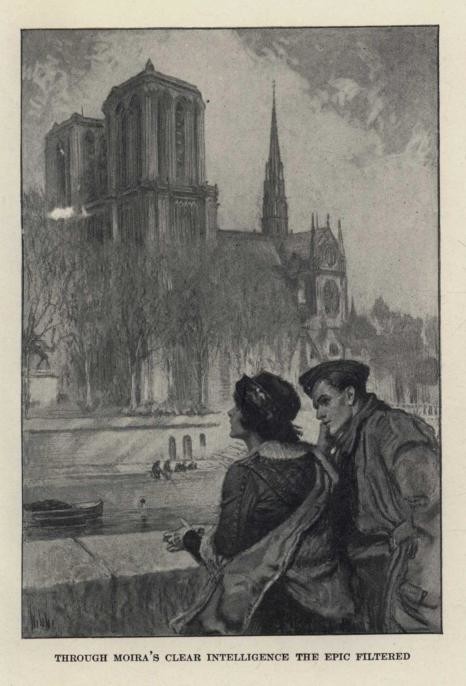
THROUGH MOIRA'S CLEAR INTELLIGENCE THE EPIC FILTERED
Then under the arches of the Louvre to the Avenue de l'Opera, and toward the banking district. All Paris smiled. The blue and brown mingled fraternally and the streets were crowded. Except for the uniforms, which were seen everywhere, it was difficult to believe that hardly a month ago the most terrible war in history had been fought, almost at the city's gates.
When he reached his bank, which was in the Boulevard des Italiens, near the Opera, Jim Horton had to move with caution. But Moira fortunately had some shopping to do and in her absence he contrived to get some checks, and going into the Grand Hotel drew a check signed with his own name, and payable to Henry G. Horton, and this he presented for payment. There was some delay and a few questions, for the amount was large—three thousand francs—but he showed the letters from Moira and Quinlevin. It was with a sigh of relief that he went out and met Moira near the Opera. With a grin he caught her by the arm, exhibiting a large packet of bank-notes, and led the way down the avenue by which they had come.
"And where now, Harry dear?"
"I'm hungry. To the most expensive restaurant in Paris for déjeuner. If I'm not mistaken we passed it just here."
"But you must not—I won't permit——"
He only grinned and led her inside.
"For to-day at least, Moira, we shall live."
"But to see Paris, en Anglais, that is not to live——"
"We shall see."
The tempting meal that he ordered with her assistance, did much to mollify her prudence and frugality and they breakfasted in state on the best that the market provided.
Afternoon found them back in the Boulevard St. Germain again, after an eventful interim which Jim Horton had filled, above her protests, in a drive through the Bois and a visit, much less expensive, to a cinema show, during which she held his hand. And now a little weary of all the world, but happy in each other, they drifted like the flotsam of all lovers of the Rive Gauche toward the Gardens of the Luxembourg. They sat side by side on the balustrade overlooking the esplanade and lawn in front of the Palace, watching the passers-by, always paired, piou-piou and milliner, workman and bonne, flaneur and grisette, for the warm weather had brought them out. There was no military band playing, but they needed no music in their hearts, which were already beating in time to the most exquisite of interludes. Twilight was falling, the Paris dusk, full of mystery and elusive charm; lights beyond the trees flickered into being, and the roar of the city beyond their breathing-spot diminished into a low murmur. For a while their conversation had relapsed into short sentences and monosyllables, as though the gayety of their talk was no longer sufficient to conceal their thoughts, which, throwing off subterfuge, spoke in the silences. At last Moira shivered slightly and rose.
"Come," she said gently, "we must be going," and led the way toward the exit from the Gardens on the Boulevard St. Michel. Horton followed silently—heavily, for the end of his perfect day was drawing near and with it the duty which was to bring disillusionment and distress to Moira and ostracism and hell to him.
But when they reached the studio Moira set with alacrity at putting things to rights and preparing the evening meal.
"We shall be having cold goose and a bit of salad, you extravagant person," she said. "I feel as though I had no right to be eating again for a week."
And so they dined upon the remains of their feast, but warmed by the cheerful blaze, both conscious of the imminent hour of seclusion and affinity. Moira had little to say and in the silences Jim caught her gaze upon him once or twice as though in inquiry or incomprehension, and wondered whether in their long day together, he had said or done anything which might have led her to suspect the truth. But he had been cautious, following her leads in conversation, and playing his discreditable role with rather creditable skill. The end was near. He would see Harry to-night at Javet's and to-morrow he would tell her, but it was like the thought of death to him—after to-day—and he failed to hide from her the traces of his misery.
"I wish that you would tell me what worries you," she said gently, after a long silence.
He started forward in his chair by the fire. "Er—nothing," he stammered, "there's nothing."
"Yes, there is," she said, evenly. "I know. I've felt it all day—even when you seemed most happy." And then quickly, "Is it me that you're worrying about?"
"About you?" he asked to gain time, and then, grasping at the straw she threw him, "about—you—yes—Moira," he said quietly.
It was the first definite return to the topic of the morning, which they had both banished as though by an understanding. But Moira was persistent.
"Why?" she asked.
"Because—because I don't deserve—all this—from you."
She smiled softly from her chair nearby.
"Don't you think I'm the best judge of that?"
"No," he said miserably. "No."
"You can't deny a woman the faith of her intuitions."
"And if I proved your intuitions false——"
"Sure and I'd never speak to you again," she put in quaintly.
"It might be better if you didn't," he muttered, half aloud.
She heard him, or seemed to, for she turned quickly and laid her hand over his.
"Don't be spoiling our day, dear," she said earnestly. "God has been good in bringing you back to me. Whatever happens I won't be regretting it."
His fingers caught and pressed hers and then quickly relinquished them as he rose, struggling for his composure.
"You will regret it," he said fiercely. "I tell you you can't thank God for me, because I'm not what you want to think me. I'm what the Harry you knew in America was, only worse—a liar, a cheat——"
He paused as she rose, saving himself the revelation on the tip of his tongue by the sight of her face in the firelight as she turned. It was transfigured by her new faith in him, and in her joy in the possession. She came to him quickly, and put her soft fingers over his lips, while the other arm went around his shoulders.
"Hush, alanah," she said.
"No—you mustn't, Moira," he muttered, taking her hands down and clasping them both in his. "You mustn't." And then, at the look of disappointment that came into her eyes, caught both her hands to his lips and covered them with kisses. Against the sweet allure of her he struggled, sure that never mortal man had been so tried before, but surer still that the love he bore for her was greater than all temptation.
She looked at him, flushed at the warmth of this formal caress, which left no doubt of him, but marveling at his renunciation of her lips, which had been so near.
"I can't be listening when you call yourself such names."
"You don't understand—and I can't tell you—anything more just now. I haven't—the will."
He noted the look of alarm which was a token of the suffering he must cause her and he led her to his chair and made her sit.
"I can't make you unhappy—not to-night. I—I'm sorry you read my thoughts. I shouldn't have let you see."
He had turned to the fire and leaned against the chimney piece. And after a moment, clear and very tender, he heard her voice.
"You must tell me everything, alanah. I've got the right to it now."
He shook his head in silent misery.
"But you must."
"No. I can't."
"Yes. You see, things are different with us two. You've made me know to-day how different. Last night I called to your mind the mockery we'd been through, calling it marriage. But it was a marriage, and the dear God has willed that my heart should beat for you as gently as that of any mother for its babe. It softened in the hospital, dear, when I saw you lying there so pale and weak against the pillows, and I knew that if God spared you for me I would make amends——"
"You—make amends——" he gasped.
"By giving you all that I had of faith, hope and charity. Whatever you were, whatever you are, dear, you're mine, for better or for worse, and I believe in you. And your troubles, whatever they are—I'll take my half of them."
"You can't——" he groaned.
"Not if they concern me," she continued simply, "for they're mine already."
He took a pace or two away from her.
"You mustn't speak to me like this."
"And why not? You're mine to speak to as I please. Is it that you don't love me enough, alanah?"
He knew that she wouldn't have asked that question, if she hadn't already seen the answer in his eyes.
"Love you——?" he began, his eyes shining like stars. And then suddenly, as though their very glow had burned them out, they turned away, dull and lusterless. She watched him anxiously for a moment and then rose and faced him.
"Well——" she said softly, "I'm waiting for your answer."
"I—I can't give you an answer," he said in a colorless voice.
"Then I'll be giving the answer for you, my dear, for I'm not without eyes in my head. I know you love me and I've been knowing it for many days. And it's the kind of love that a woman wants, the love that gives and asks nothing." She paused, breathing with difficulty, the warm color rising to her temples, and then went on gently, proudly, as though in joy of her confession. "And I—it is the same with me. I've tried to make you understand.... It is not for you to give only...." She halted in her speech a moment and then came close to him, her clear gaze seeking his. "I love you, not for what you have suffered, dear——" she whispered, "but for what you are to me—not because you are my husband, but because you are you—the only one in all the world for me."
"Moira," he whispered, tensely, as his arms went about her. "God forgive me—I worship you."
"God will forgive you that, alanah," he heard her say happily, "since I do."
He touched his lips to her brow tenderly ... then her lips.
"You love me," he muttered. "Me? You're sure that it's me that you love?"
Her eyes opened, startled at his tone.
"If it isn't you that I love, then I'm sure that I can't be loving any one at all."
"And you'll believe in me—whatever happens?"
"I will——" she repeated proudly. "Whatever happens—since this has happened to us both."
"Some day—you'll know," he muttered painfully, "that I—I'm not what I seem to be. And then I want you to remember this hour, this moment, Moira, as it is to me.... I want you to remember how you came into my arms when I hadn't the strength to repel you, remember the touch of my lips in tenderness—and in reverence—Moira ... that love was too strong for me ... for it has made me false to myself ... false to you...."
She drew away from him a little, deeply perturbed. "You frighten me, alanah."
"I—I don't want to. To-morrow——" he paused, searching for strength to speak. But it did not come.
"To-morrow. What do you mean?"
The repetition of the word seemed like a confirmation of his resolution and shocked him into action. Quietly he took her hands down from his shoulders, kissed them in farewell, and turned away.
"What do you mean?" she repeated.
"That—that to-morrow—you shall judge me."
The tense expression of her anxiety relaxed and she smiled.
"You needn't fear what that will be."
He did not reply but stood staring fixedly into the fire. She came around to him and laid her fingers over his. "Why should we bother about to-morrow, dear? To-day was yesterday's to-morrow and see what's happened to us."
"But it shouldn't have happened," he groaned, "it shouldn't have happened."
"Then why should I thank God for it——?"
"Don't——"
"Yes. Everything will be right. A woman knows of these things."
He smiled at her tenderly, but he didn't attempt to take her in his arms.
"Come," she said, "let us sit down by the fire near the blaze, and we will not speak of to-morrow—just of to-day and yesterday and the day before, when you and I were learning this wonderful thing."
But he did not dare.
"Moira, I—I've got to go out for awhile—a matter of duty——"
"Now?" she faltered.
"I must. An engagement. I'm in honor bound——"
Now really alarmed, she caught him by the elbows and looked into his eyes.
"An engagement—to-night! And to-morrow——?"
His meaning seemed to come to her with a rush.
"Harry——! This engagement to-night has something to do with us—with me. To-morrow——! What is it, Harry? Speak!"
"I can't. I've promised."
"I won't let you go, Harry. It is something that has come between us——"
"It has always been—between us——" he muttered.
She clung to him and held him as he moved toward the door.
"Nothing—nothing shall come between us. Nothing can. I don't care what it is. 'Until death us do part'—Don't you understand what that means, Harry?"
The repetition of his brother's name, the phrase from the marriage service, gave him resolution to avert his face from the piteous pleading in her eyes.
"It is because I understand what it means that I have—the courage to go—now—before you despise me."
"I have said that nothing makes any difference. I swear it. I love you, dear. There's some mistake. You'll never be different in my eyes, whatever happens—whatever has happened."
"Good-bye, Moira," he whispered, his hands clasping her arms.
"No, no. Not now—not to-night. I knew that to-day was too beautiful to last. You—you've frightened me. Don't go—please don't go."
"Yes," he said firmly. "I must."
But she was strong, and greater than her strength was her tenderness.
"Look me in the eyes, dear, while I'm pleading with you. If your love were as great a thing as mine——"
To look in her eyes, he knew, was fatal. One brief struggle and then he caught her in his arms and held her close for a long moment, while he whispered in broken sentences.
"My love! ... if you hadn't said that! You've got to know what my love means ... sacrifice.... This moment ... is mine.... Remember it, dear—as it is ... its terrible sweetness—its sanctity—remember that, too ... because that's the essence of it ... sanctity. God bless you, Moira—whatever happens——"
"Whatever happens?"
As in a daze he straightened and looked around. Then almost roughly broke away from her and rushed to the door, taking up his cap and overcoat on the way.
"Harry——!"
"Good-bye," he called hoarsely as he opened the door and went out.
She rushed after him but he was already running furiously down the stairs into the dark.
"Harry," she called, "Harry—come back!"
But the name of his brother made him rush on the more blindly, the echoes following him down into the court and past the open gate of Madame Toupin. He hadn't any definite idea of what he was going to do. The only thing that he was sure of was that he must get away—anywhere—away from Moira ... from the reproach of her innocent eyes, of her confessions, of her tributes of submission and surrender. On he plunged blindly down the street toward the Luxembourg Gardens, into the outer darkness where he must lose himself away from her—to-night, to-morrow,—for all time.
He had failed. He had trusted himself too far—trusted her too far. Fool that he was not to have seen that love, begun by trivial happenings, had been gathering strength and momentum and like an avalanche had swept down and engulfed them both. In a moment of reaction, of guilty triumph, he rejoiced, defiant of the conscience that drove him forth, that it was him that she loved—not Harry; his lips that had taken tribute—his ears that had received her confessions, meant for them alone.
But reason returned after awhile ... and with it the sense of his dishonor. The thing was over, definitely. There would be scorn enough in her eyes for him to-morrow, when he told her all the truth. He comforted himself with that thought and yet it brought him a pang too, for he knew that it was Moira who was to suffer most.
He seemed to be the only person in the gardens, for the night was chill and a thin mist of rain was falling. From time to time there were footsteps here and there, and the murmur of voices, and through the turmoil of his thoughts he was conscious of them vaguely. But they meant nothing to him. He went on into the darkness, his head bowed, in the conflict of his happiness and his remorse, reaching a dimly lighted spot near the Rue d'Assas, when he heard quick footsteps behind him. He turned just in time to dodge the blow of a stick aimed at his head, which fell heavily on his shoulder. He struck out but another man caught him around the waist, bearing him to the ground. He struggled to one knee, striking viciously, but they were too many for him. He got a glimpse of an automatic pistol which flashed before his eyes and then something heavy struck him on the head. The last thing he noted before losing consciousness was the pale face of the man with the automatic. It was his brother—Harry.
CHAPTER VII
AWAKENING
Moira moved about in a daze, attempting in the commonplaces of the daily routine to forget the thought of the revelation which she knew could not be long delayed. She had lain all night on the divan in the studio, listening and waiting for the return of the soldier, and at last, toward daylight, from sheer exhaustion of mind and body, had fallen asleep. When she awoke, her first impulse was to go to the room in the hallway and knock. She opened the door. The bed had not been occupied.
Slowly, thoughtfully, she went back to the studio and the business of preparing the coffee—for herself—and for Harry—when he should arrive. Her mind was filled with strange doubts,—not of him, because she had learned to have a complete, a perfect faith in this soldier that she had married, who had left New York under a cloud of uncertainties and suspicions and had come back to her spiritually reborn. The doubts in her mind were those that he had purposely created in it, and fragments of phrases that he had uttered in their moments of tenderness came back to alarm and disturb her, because if he hadn't thought it necessary to alarm and disturb her, he would have remained silent and permitted himself to enjoy with her the hours that had been theirs together. Yes ... there was something that had come to thrust itself between them—some impediment to their union. She smiled softly at the memory of the restraint in his caresses, the purity of his smile and the gentleness of his abnegation.... He had underestimated the quality of her new faith in him.
Was this shadow out of the past? Perhaps. But it wouldn't matter. Together they would exorcise it. Only the future mattered now—their future together.
She stopped for a moment in her work of putting the studio to rights and listened. She thought that she heard a step upon the stair. She waited a while and then went to the door and peered out. No one. It was a little cruel that he had not sent her a message—a note, a petit bleu even, telling when she must expect him, whatever his appearance might bring. For this, she realized, was the "to-morrow" of which he had spoken yesterday ... the day of revelations....
She tried to sing at her work but the effort was a failure. A morbid fear of the thing that was to happen, if it hadn't already happened, obsessed and held her. Nine—ten o'clock—eleven.... With a courage born of desperation she went into her room and put on her hat. It was insupportable, the suspense. There were some things to buy. She must order them. And leaving word with Madame Toupin that she would return within the hour, she walked briskly forth, breasting the keen air and trying to smile. But even her walk was a failure, and in a short while she was back, eagerly questioning Madame Toupin. No, Monsieur le Lieutenant had not arrived. No doubt he was busy about the ceremony of the presentation of the medals. Moira inquired and Madame Toupin showed her an article in the paper about the honors to be given both French and American officers next week in the Place de la Concord. There was his name, "Henry G. Horton—Croix de Guerre." Madame Toupin let her have the paper and she ran up to the studio, where she read it eagerly, thrilling with pride.
Of course he had his reasons for not coming to her and telling her everything. She must be patient—her faith in him unwavering. He would come to her to-night again—and whatever he told her was to make no difference in her love and faith in him—whatever he told her—she swore it.
* * * * *
Late that night he came. She had built a fire of fagots against the chill of the night and was sitting in the big armchair by the hearth when she heard a knock at the studio door. With a cry of welcome she rose and rushed to greet him, throwing herself impulsively into his arms.
"Harry," she gasped happily, "at last!"
She couldn't help noting the slight movement of recoil before her tenderness. Then, bending his head,
"Hello, Moira," he muttered.
She helped him off with his overcoat and led him over to the fire, making him sit in the big arm-chair. He obeyed awkwardly, as one in a daze, his brows frowning. The light was uncertain, but what she saw alarmed her.
"Harry! What has happened to you?" she cried, catching him by the hands and holding them. "You're ill—your fingers are cold—you look as though—— What has happened?"
"Nothing," he murmured with an attempt at a smile. "Nothing at all." But even the smile was different, as though the muscles acted in obedience to an effort.
She had struck a match to make a light.
"What—what are you doing?" he asked.
"I'm going to see what's the matter with you. You look sick. You need medicine."
"No," he protested. "I'm just tired. A drink of whisky if you've got one——"
She went into Barry Quinlevin's room and brought forth a bottle, a glass and a pitcher of water. With a hand that trembled a little, he poured himself a drink and took it at a draught, and then gave a gasp of relief. She had sat down near him and was regarding him with an expression of intentness and eagerness, though the pucker at her brows indicated a doubt and a fear. The gas light was at his back and she could not clearly see his face, but there was something strange about him that she had missed at his first entrance, a brooding sullenness, remote, self-centered, that even the smile could not temper with sweetness. And even while she watched he poured out another glass of whisky.
"What is it, Harry?" she asked. "Tell me."
"It's nothing," he said. "I'm all in, I've had some worries. I'll be all right.'
"Have you had something to eat?"
"Yes. I'm not hungry."
His voice too ... thin, weary, somber.
Now greatly alarmed, she caught his hand in both of hers.
"You must tell me everything, Harry. I don't care what it is—I—I've got to know. You told me that you'd tell me to-day—to-night, and now you must keep your promise. I've tried so hard not to worry and—and when you didn't come back to me last night, I—I was really frightened——"
"Were you?" he said, with a frown. "I was all right."
"I'm glad. But it was cruel of you not to send me a message."
"I couldn't. But I'm here now, Moira. So there's no need worrying any more."
He put his hand over hers and leaned toward her. His words, which last night would have given her happiness, seemed somehow to mean nothing to her to-night. For his very presence in this condition was a threat against her peace of mind. And his fingers might have been wax for all that their touch meant to her.
"You—you're trying to make things seem better than they are," she said steadily, wondering at her own words. "I—I'm not easily deceived. Last night I knew that something had come between us. I know now that it's still between us, Harry, whatever you say."
He turned away toward the glass at his elbow,
"No," he murmured, "that difficulty—has been removed."
He couldn't repress the smile of triumph as he took his drink, and she saw it. It wasn't a pleasant smile.
"Come," he went on more easily, "aren't you glad to see me?"
"I—God knows whether I am or not. Something has happened to you—to me.... You've been through something terrible—since yesterday—something that has burnt the soul of you. What is it? What is it? The touch of your fingers—your voice, they come from a distance-like, with nothing of you in them. Am I ill that I should be thinking of you so? Take me in your arms, Harry, and shield me from this terror that you're not yourself, but some one else."
He obeyed, putting his arms around her and holding her close to him. But at the touch of his lips to hers, she struggled free and faced him by the hearth, pale as death. The look of bewilderment at her brows had intensified into a steady gaze, almost of terror at the thought that had suddenly mastered her. And yet she did not dare give utterance to it. It was so outlandish, so mad and incomprehensible.
She saw the frown of anger, quickly masked in a smile of patience as she broke away from him, and that confirmed her in her madness. She was reading him keenly now from top to toe, missing nothing. And the thought that dominated her was that the man with whom she had mated during the past weeks, the man who had passed through the shadow of death, reborn in body and spirit, the Harry that she had recently learned to love—was dead; and that this man who had come to take his place—this man—was what he might have been if God's grace had not fallen on him. Madness? Perhaps. And yet how otherwise would the touch of his lips, which last night she had sought in tenderness, have been so repellent to her? Harry—her husband—unregenerate—the same Harry that....
She kept her gaze fixed upon him and she saw his look flicker and fade.
If this reality was Harry, her husband, then were all the weeks that had passed since she found him in the hospital merely a dream, was yesterday a dream—last night?
"I—I don't know—what is the matter," she said at last, passing a hand across her brows. "I—I am not well, perhaps. But you—you're not the—not the same. I know it. The thoughts that I have of you frighten me."
He forced a laugh and sank into his chair again, lighting a cigarette with an assumption of ease.
"I'm sorry," he said quietly.
She only stood staring at him, her deep blue eyes never wavering from his face, which was still averted from the light. He met that gaze once—a second time, and then looked away, but still they stared at him, wide like a child's, but full of a dawning wisdom.
"You—you are Harry Horton—my—my husband?" she whispered in a kind of daze.
"Well, rather."
She paused another long moment as though on the verge of a difficult decision and then spoke searchingly.
"If you are Harry—my husband—then who—who is the other?"
Harry Horton started. "The other——?"
"The other—who was here with me yesterday, who was ill in the hospital at Neuilly, wounded—the hero of Boissière wood?"
"Moira," he said, rising, "this is serious. There has been no other here."
"Yes," she repeated doggedly, "the other has been here—your twin——" The word seemed born of her necessity. "Your twin," she repeated.
He winced at the word and she saw the change in his expression.
"Tell me the truth of this thing," she went on quickly, "he said yesterday that something was to come between us. It was you." And then, as he made no reply, "For God's sake, speak——"
He turned away from the light.
"I'm your husband," he muttered hoarsely.
"Show me your wounds," she gasped suddenly, reasoning with singular directness.
He glanced at her once, then bent forward. There upon the left side of his head in a shaved spot was a cross of adhesive tape. She touched it aimlessly with her fingers and then suddenly, before he could rise, with a quick deft movement tore it away from his skull. And quickly as he straightened she had seen enough.
There was no wound.
"What's this deviltry?" he muttered, his face an angry red.
But the look that he met in her eyes pierced all subterfuge.
"You have not been wounded," she gasped.
He leaned forward in his fury as though to strike her, but she stood up to him resolutely until the color faded from his face and he straightened slowly.
"Well," he muttered with a shrug, "I haven't." And then, folding his arms he found her gaze. "What of it?" he asked shortly.
She glanced down at the slips of adhesive tape and then let them fall through her fingers.
"I'm glad," she said coolly, "that you've decided not to carry on the lie——"
He laughed again. "Well, it looks as though it were hardly worth while."
Already all her thoughts were beyond him.
"Who—who is the other?" she asked at last, with a cold precision that might have come from a disembodied spirit.
He waited a moment before replying and then his tone matched her own.
"I can hardly wonder at your interest after the warmth of your greeting when I came in."
The shot told and she colored painfully.
"Who—who is he?" she repeated with an effort.
He smiled. "There's no harm in your knowing, since you've guessed the rest. He's my twin brother, Jim Horton."
"Jim," she gasped below her breath.
"We met in the confusion on the battlefield," he went on. "I had been shell-shocked and he put on my uniform to lead my men——"
"Shell—shock——"
"Yes. He took my uniform. It was a fool proceeding. When I came to, everything was in confusion. He would have been courtmartialed and shot if I had turned up, so I went back to the lines and came to Paris——"
"While he won you the Croix de Guerre. And you're going to step into his shoes——"
"They're my shoes. It's not my fault——"
"And he—what's to become of him?"
"That's his lookout. He merely disappears from the scene."
She leaned heavily against the mantel shelf, breathing fast. But she had no reply, and so he went on unpleasantly.
"Now, perhaps you would like to explain."
"I have nothing to explain."
"Not the joy in your eyes when I came in? The kisses you gave me that you thought were for him?"
"I ask no forgiveness," she said in a hollow tone.
"Of course you thought he was your husband. And he let you think so."
"Yes. He let me think so," she repeated, parrot-like.
And all the while her horror of her situation increased—her anger at "the other" who had dared to place her in this false position.
She saw her husband's bony fingers clasp the chair arm.
"You were easily deceived," he went on. "It's hardly flattering to me. I would like to know——"
He stopped suddenly, his question in abeyance before the challenge in her eyes, aroused by the tone of his voice. She read his thought and answered him.
"He came here from the hospital night before last. He wanted to go to a pension but I would not permit it——"
"That was kind of you. But I'm not blind. And your kisses for him were warm on your lips when you greeted me."
She paled and drooped in her shame.
"What have you to say about that?" he went on tensely. "Do you think that I'm the kind to stand by idly and see a man take my wife's kisses?"
"No. You're not," she answered slowly. "You've already answered me." And then, with a painful effort, "What have you done with him?"
He sank into the armchair with a laugh. "With him? Nothing. He has gone. That's all."
"I don't believe you."
"That's your privilege. He has gone. He thought he had gone about far enough. And I'm almost ready to believe that you agree with him."
"No," she stammered, pleading against her own will, against her outraged pride. "There was a reason for what he did—an honorable reason. There must have been."
"The marks of it are not very clear to me. If you can see anything honorable in trying to steal the love of one's brother's wife——"
He paused, for he saw the danger signals flying in her eyes, and tried to shrug his anger off. "What's the use? I'm no fool. Whether he tried to win you or not, it's clear that neither of you was over-scrupulous about me."
She didn't reply at once and when she did speak her words came slowly and with dignity.
"I don't know why it is that he should have kept silent about you. He has done me a hurt—irreparable. When I visited him in the hospital, it was you that I visited, you that I went to cheer, to take my place by your side. I thanked God when I saw you that you had grown to be—what you were, what I had wanted you to be. And I loved you for what you had suffered."
He started up from his chair.
"Moira——"
"Wait a moment," she insisted, still struggling to give her thoughts expression. "I want you to understand. I thought that it was you who had come back to me—as I wished you to come back—in honor and pride of your service of your country. And instead of you I find—another—with your wounds, your honors—if it was your brother—in spite of the false position he's placed me in—I honor him for those wounds as I would have honored you—and I honor him still more—because he has thought enough of his honor and of mine—to give up everything that he has won and gone out into the darkness—alone."
At this, Harry Horton's fury relaxed in a laugh. He poured himself out another drink.
"You can spare him these new honors."
She glanced at him keenly but he was too angry to notice.
"He went—away—because he had to," he muttered.
"What do you mean?"
"What I say. It was getting too hot for him."
The meaning under his words came to her slowly. She watched him for a moment curiously, leaning toward him, studying the ugly lines at lip and brow that he no longer took pains to conceal. And then she guessed at the truth.
"What have you done with him?" she whispered.
"N—nothing."
"You lie." She knew no fear of him now, and leaned forward, clutching at his shoulder. "You've dealt unfairly with him—you've——" She halted in terror of her thoughts.
"He got what he deserved," he muttered sullenly.
"What have you done?" she repeated.
"Put him where he won't mess in my affairs again. See here, Moira," he caught her wrists and held her, "I'm just about fed up with this. I've been patient about long enough. You're my wife. And I'm going to keep you. Do you think after all I've suffered I'm going to stand for this kind of treatment now?"
"Let go my wrists—you're hurting me——"
"No——" Instead, he drew her closer to him. "I don't care about this foolishness with Jim. I think you can see that you've made a fool of yourself and of me. But I'm willing to forget it, if you'll do the square thing. I'm back here and I'm back to stay—and I'm going to make you love me whether you want to or not."
"Let me go, Harry."
"Kiss me."
"No." She struggled in his arms, but he only held her the more closely. "Moira. I want you. You're mine. You belong to me by every law——"
"No—no."
But he mastered her, pressing her throat back and kissing her upon the lips. She lay quiet in his arms, weak from the struggle. He took her immobility for acquiescence and caught her more tightly in his arms.
"Let me go," she gasped. "Do you hear?"
A saner man would have caught the warning note. But Harry Horton was beyond warnings. She fought with renewed strength and then, all else failing, struck him full in the face with her clenched fist.
His arms relaxed in astonishment and she sprang away, putting a small table between them.
Breathing rapidly, she saw him put his fingers to his cheek and then look at them in a bewildered way.
"I see," she heard him muttering to himself, "so that's the way of it——"
The blow brought him to his senses, and he stared at her for a moment as though at a person he had never seen before. Her eyes burned like a blue flame in the pallor of her face and the hand that clutched the table trembled violently. And yet it was not the fear of him that made her tremble, but the fear of herself and of the sudden dreadful awakening at the edge of the chasm that yawned between them.
CHAPTER VIII
THREATS
The silence seemed endless and yet she dared not trust herself to speak. Her throat closed and it seemed that the blood from her heart was drowning her. And yet she watched him tensely, aware of the crisis, aware too of the revelations that seemed to have laid her heart bare to all the world.
Her husband reached the large table and poured out what remained of the whisky. Then she heard his laugh again, and saw him leering at her over his glass.
"Lucky dog, I am. Pretty little devil to come home to. Love tap!" He shrugged and raised his glass. "To our better acquaintance!"
She made no sound, but while her eyes watched, her mind was working rapidly. His air was braggart, but she could see that he wasn't any too sure of himself. He had thought to come here and by the ruse of the adhesive plaster merge his identity into that of his brother Jim. The lapse of time since she had seen him and the illness had deceived her in the hospital. And so he had figured on the remarkable resemblance to his brother to help him carry off this situation with a careless hand. But he hadn't reckoned with the alertness of her woman's intuitions, or—God help her—the tenderness of yesterday, which held the image of the brother so close to her heart. Something of what was passing in her mind seemed to come to him.
"So you've fallen in love with my pretty brother?" he muttered.
"No."
"Complaisant husband—mari complaisant. You wanted Jim to take you in his arms—and you only had me. You don't care for my kisses. Why not? We're just alike—as like as two peas in a pod. What's the difference? Come now. Tell me. I'll be a good sport."
"We—we've got to come to an understanding——" she gasped at last desperately.
"Exactly—an understanding. That's what I'm getting at——" he laughed and sank into a chair by the lay figure. "Oh, don't be disturbed. I'm not going to try to kiss you again. It's too dangerous."
She watched him intently while he took out a package of cigarettes and lighted one. And then, with a wave of the hand, "An understanding—by all means. Fire away."
"It isn't necessary to go into the past, except to say what you know already—that our marriage was a horrible mistake. But we did have an understanding then—that you were to wait—that you were to—to make good—and that I was to try to—to care for you."
"Quite so. And we've both failed?"
"Thanks. We—we have both failed," she repeated. "I can't say I ever really believed we should succeed until——"
"Until you went to the hospital."
She bent her head. "The main thing is," she went on more evenly as she gathered courage, "that whatever my hopes were for you, now at least you've forfeited all claim to consideration."
"Why? Because I take a fancy to my own uniform—my own personality?"
"Because you——" she paused to catch her breath, "because you've stooped to something—something unworthy—something vile and terrible, perhaps—God knows, to get rid of a man—your own brother,—who did you a service; and because you'll dare to receive honors that don't belong to you." And then, as he started up, "One moment. I don't know what happened on the battlefield. If you were injured, it was a glorious—foolish thing Jim Horton did for you. But whatever he did and whatever his motive, it deserves something of you—something different from what you've confessed. Tell me what you have done with him and I'll try to believe you."
"He's quit, I told you," he protested. "There wasn't anything else for him——"
"Where is he?"
"What does it matter? He's out of your life—out of mine."
"No—not out of your life——" she paused.
"What do you mean?"
"Merely that the truth of this thing must be told."
"Impossible. It would ruin us both."
She gave a little gasp of relief.
"Tell me where he is."
"He's safe——"
She deliberated a moment.
"You've got to prove it to me. He said he was coming back to the studio to-day. Instead, you came—in the uniform he wore. He didn't give it to you willingly——"
"Yes," he lied sullenly. "He gave it to me. There wasn't anything else to do when I turned up. He realized he couldn't stay here—with you." And then, "Oh, he was square enough about it."
There was a long pause. He didn't ring true. She had almost forgotten, as he had, what he had said in the fury of his jealousy. She was aware that he had risen unsteadily from his chair and was approaching her.
"So here, Moira," he said in an ingratiating tone. "I'm not a bad sort—really I'm not. I—I was out of my head awhile ago—the way you came up to me, thinking I was him. I guess I wanted to hurt you—the way you had hurt me. I'm sorry. I won't touch your fingers even, if you don't want me to. I was a rotter to try to kiss you. I ought to have known you didn't want me to—when I—I had had one or two too many. I've been worried too—devilish worried about the whole thing. Let's forget it and talk the thing over sensibly. There may be a way out. I don't want any honors that don't belong to me, but I don't want to be dismissed from the service, either, or shot—on Jim's account. But we've got to keep this thing quiet."
She understood his drift. The facts in her possession made her dangerous.
"It can't be kept quiet, so long as Jim Horton is in danger."
"Who said he was in danger? I said he'd quit——"
"But you lied. He hasn't quit. He isn't the quitting kind. He was to have come to me to-day, and told me the truth—I didn't know what it all meant then. But I do now. He has got to have his chance."
She saw him glare at her somberly.
"What do you want me to do?"
"Take me to him—to-night."
"That's impossible. I couldn't find him."
"Yes. You can find him. Or he would have found me."
He smeared out the ash of his cigarette in a receiver and rose, his face livid.
"You seem very sure of him—and of yourself. And if I don't find him for you, what are you going to do?"
"I shall tell what I know to the proper authorities."
He stood for a moment balked and then before she knew what he was about he stumbled to the studio door and turning the key in the lock put it in his pocket. She was frightened by the significance of the action, and ran quickly toward the door of her own room. He turned and moved to intercept her but awkwardly and she slammed the door in his face, catching the bolt on the inside.
She was frightened now, desperately frightened, but resolved to escape and tell what she knew. The brother—Jim—was in danger—a prisoner somewhere—otherwise he would have come to her. Much as his silence had injured her, deeply as her pride was hurt at the position in which he had placed her, she knew now that he had intended to tell the truth from his own lips and warn her of Harry's return before he left her and went away alone. He loved her.... It was his love that had sought to spare her the humiliation of this very knowledge that had come to her. Shell-shock! There was another reason for the substitution. What? But whatever it was, there seemed little difficulty in choosing between them. The other—Jim—the man she loved ... she acknowledged it in every impulse ... would have come to her. She had to find him. Just what she meant to do she didn't know, except to get away from Harry. He was hammering on the door now—pleading with her. But she didn't answer. Catching up her hat and a heavy coat, she went quietly to her own door into the hall, and, while he still hammered and pleaded, fled quickly down the stairs and into the lodge of the concierge.
Madame Toupin, aroused suddenly from her doze, started up in amazement.
"Madame Horton, what is it?" she asked in French.
"It is a game we play, Madame Toupin. You shall hide me in your closet. And when Monsieur le Lieutenant comes you shall say that I have run out into the street. You understand?"
"Parfaitement, Madame. Ah, les jeux d'amour. Entrez vite." And she opened the door of the closet which Moira entered quickly.
Then Madame Toupin with a smile of wisdom composed herself to read her paper. And in a moment a clatter of boots upon the stairway and the sound of footsteps upon the paving of the courtyard announced the approach of the officer. Through a crack in the door Moira listened to the conversation which Madame conducted with her amiable smile, and presently Harry Horton withdrew frowning and went out hurriedly into the Rue de Tavennes.
But while she stood upright in the closet listening, Moira had formulated a plan. It was clear from the tone of Harry's voice and his haste to go that her escape had frightened him. For his judgment was not amiss when he decided that Moira was fully capable of carrying out her threat to tell the whole story to the military authorities. But instead of clinging to her original intention, a new idea had come to her.
If she followed him, she could perhaps get a clue to the mystery of Jim Horton's disappearance. She couldn't understand yet—couldn't make herself believe that this man that she had married could be capable of a thing so vile. But the evidence—his own words stammered in his fury, were damning. The familiar formulas seemed to have no bearing now. The war had made men demi-gods or devils and Harry.... It did not seem very difficult to decide to-night what Harry was.
She slipped on her heavy coat and the hat she had brought and with a word of explanation and caution to Madame Toupin, she went out into the street. Far down upon the opposite sidewalk she saw a tall figure striding away into the darkness. She followed, keeping at a distance, her coat collar turned up and her broad-brimmed hat pushed well down over her eyes. She hurried along, keeping in the shadow of the opposite side of the street, trembling with the excitement of her venture and wondering what was to be its outcome, but sure from his gait that the situation she had created had developed in Harry Horton's hazy brain some definite plan of action. She noticed too that he no longer swayed or stumbled and that he glanced furtively to left and right at the street corners, peering back toward her from time to time. But she matched her wits to his, crouching into corners as he turned and then running forward breathlessly in the dark places, keeping him in sight. He turned into the narrow reaches of the Rue de Monsieur le Prince, past the Lycée and the École de Médicine, and crossed the Boulevard St. Germain into the network of small streets in the direction of the river, twisting and turning in a way which confirmed her belief in the dishonesty of his purposes. It was now long after midnight, and the streets into which they moved were quiet and almost deserted. From the direction of the Boule' Miche' came a rumble of vehicles, the glare of lights, the distant grunt of an automobile-horn, the clatter of a cab horse down an echoing street. The neighborhood was unfamiliar to her, a part of old Paris near the Isle de la Cité, where the houses, relics of antiquity, were huddled into ghostly groups, clinging to one another, illumined fitfully by murky bracket-lamps which only served to make their grim façades more somber and fantastic. Dark shapes emerged from darker shadows and leered at her—evil figures, bent and bedraggled, or painted and bedizened, the foul night-creatures of the city, the scavengers, the female birds of prey, the nighthawks, the lepers. Twice she was accosted, once by a vile hag that clutched at her arm with skinny talons, and again by a man who tried to bar her way, but with a strength born of her desperation she thrust him aside and ran on, her gaze seeking the tall figure that she followed.
More than once she lost sight of him as he plunged deeper and deeper into the maze and she paused trembling in the shadows, not knowing which way to turn, but gathering courage again hurried on to catch the glint of a street light on his brown overcoat in the distance.
Above the roofs, almost hanging over her, she caught a glimpse of the grim towers of Notre Dame, the sentinels of a thousand years of time, and the sight of them gave her courage in this region of despair. With an effort she threw off her terror of the evil that seemed to hang in every shadow, trying to remember that this was Paris, her Paris, with familiar places close at hand; and that this man whom she followed was no creature of the middle ages, but Harry, her husband; that this was the Twentieth Century, and that here was the very heart of the civilization of the world. But the facts that had come to her were amazing, and Harry's confessions damnable. It was clear that his position was desperate and his intentions none less so. Here somewhere, hidden, she believed, Jim Horton lay, helpless and injured, if not by his brother's hand by that of some one in his employ. It was the only answer to the riddle of his failure to come back to her. She must find him—before they took him away—before they ... Her thoughts terrified her again. Harry wouldn't dare. He was a coward at heart. She knew it now. Besides, there must be some spark of decency and manhood left to restrain him from so desperate, so terrible an expedient to save himself.
She crept cautiously to the corner of a small street into which Harry Horton had turned. It was scarcely more than an alley-way—a vestige of the old city, hedged in by squat stone houses with peaked roofs, deserted it seemed and unoccupied. Beyond she could see the Quai, the loom of the Hôtel Dieu and Notre Dame. The house at which he had stopped was but a few yards from the river front. She stole into the blackness of an angle of wall and watched. He was knocking upon the door—three quick taps followed by two slower ones. For awhile he waited impatiently and then, as no one answered the summons, he tried the window and then started up a small passage at the side not twenty feet from where she crouched.
Her pulses were throbbing violently, but the terror of her surroundings had passed. And she tried to convince herself that she did not fear Harry.... And yet she hesitated to confront him, fascinated by her discovery.... The brother—Jim—was here—she was as sure of it as though she had seen him. She knew that she must intercede in some way, but she was very helpless. How many were there in this house? And if she revealed herself, would not the warning give them time to carry out whatever plan they had in mind? And so she crouched watching, breathless and uncertain.
She saw him go back to the door and repeat the knock more loudly, cursing under his breath and, calling a name at the key-hole.
"Tricot!" he called. "Tricot! Tricot!"
And in a moment she heard a sound at the door, which was opened a few inches.
"C'est moi, Tricot," she heard Harry say, and then the door was opened wide, giving her a glimpse of a short man with tousled hair and a diabolic face, holding a lantern.
"Oh, Monsieur——" growled the man with the lantern, stepping aside as Harry Horton entered. And just as Moira sprang up, her husband's name on her lips, the door was closed and bolted. She ran to it and then paused in uncertainty, trying to plan what it was best to do. She felt very small, very helpless, for the sight of the villainous looking man with the lantern frightened her terribly. He seemed to typify all the evil in all the world—to explain in a glimpse all that was sinister and terrifying in the disappearance of Jim Horton. An ugly creature of the world of underground, an apache! There were others like him here. And Harry....
There was no time to be lost. Her thoughts seemed to clear, her courage to return as she cautiously returned by the way that she had come—out into the wider street, up which she hurried, turning in the direction of the Boule' Miche'. Her one idea now was to find a policeman,—any one with a vestige of authority. Men she met but she shrank away from them as she saw what they were and what they thought she was. Ten—fifteen minutes of rapid searching without result and she turned toward the Quai and, failing there, over the Petit Pont to the Island and the Prefecture de Police. It was curious that she had not thought of it before. The buildings were dark but she found at last a man in uniform to whom excitedly she told her story. He listened with maddening politeness and at last took her to an office where several other men in uniform were sitting around a stove. More alarmed than ever at the passage of time, she told her story again. Here she seemed to make some impression at last, for an older man, who sat at a desk, finally aroused himself and gave some orders. And in a few moments with two of the policemen she was leading the way back to the Quai St. Michel. She was almost running now in her eagerness so that the men had to take their longest strides to keep up with her, but more than ten minutes had already passed, it seemed an eternity to Moira, and there was still some distance to go.
"What was the name this man spoke at the door?" asked one of the policemen.
She told him.
"Ah, Tricot! Parbleu! I think perhaps, Mademoiselle, that there may be some reason in your anxiety."
"You know——?"
"An apache of the old régime, Mademoiselle. We would do well to find him."
And so, explaining her fears, but not yet revealing all the reasons for them, she led the way down the streets by which she had come and to the house which Harry Horton had entered.
The older man knocked loudly upon the door. There was no response. Again. Silence. The other man went up the alley way on the side and called to them. There was a shutter and a window open. Without hesitation, he drew a weapon and crawled over the sill, the other man following, leaving Moira alone. She listened, as they moved about inside, saw the glint of an electric torch and then heard the bolts of the door shot back and the police officer calling to her.
"Enter, Mademoiselle," he said, when she had come around. "You are sure that this is the house?"
"Yes, Monsieur."
"There is no one here. The house is deserted. It is a street of deserted houses."
"That is impossible——" she stammered. "With my own eyes, less than an hour ago, this Tricot met the other at the door."
"Allons! We will search a little further, then."
She followed them up the rickety stairway and then they found evidences of recent occupation—two pallets of straw—some food—a bottle containing absinthe.
"Mademoiselle, you are right. This bottle is not yet empty. There's something suspicious here."
And now moving with more rapidity they explored the house thoroughly, descending at last into the cellar, with, weapons drawn, Moira, half-hoping, half-fearing, following just behind them, her gaze searching the shadows. The place smelled of the earth and the walls were damp to the touch, but a quick examination with the torch showed the marks of many foot-prints in the earthen floor. The astonishing feature of the cellar was its size, for it seemed to extend under two houses, and its vaulted ceiling of rough stone of great antiquity was upheld by huge piers, that might at one time have supported the walls of a great edifice. At first they could make out nothing but a litter of papers, bottles and packing cases, but as the torch of the police officer searched the shadows in a distant corner, they heard his exclamation of astonishment. There was another pallet of straw here covered with rags and quite distinctly there came to their nostrils the odor of chloroform. Moira peering over the shoulders of the man with the light saw him bend over and pick up a rag and examine it carefully. There were dark stains upon it. And then with another exclamation he picked up some pieces of rope.
"Some one lay here but a short while ago," he muttered positively, "tied hand and foot. The bed is still warm."
"They can't have gone far then——"
"But the door was bolted on the inside——"
"The window——"
"There would hardly have been time, is it not so, Mademoiselle?"
"I don't know," whispered Moira in dismay. "Is there no outlet to this place? There must be. The light, Monsieur—yonder, in the corners beyond the stone-work——"
The man with the torch, his professional instincts now thoroughly alive, obeyed. They sounded the walls, first one side and then on the other, coming at last, in the further corner, toward the river, upon a stone arch over some steps leading into a dark opening. The man who held the light suddenly extinguished it and a warning sound came from his lips.
"Listen," he whispered.
Scarcely able to breathe, Moira obeyed. From the passage-way at a distance, there came the sounds of voices.
"Come, follow me, Dupuy! Mademoiselle had better remain."
And with that, turning his light into the dark hole, he descended, the other following. But the thought of remaining alone in this terrible house frightened her and she clutched at the hand of the second policeman.
"I dare not stay here, Monsieur. I must go with you."
"Bien. But I warn you it may be dangerous."
And yet what could be more dangerous than remaining in the cellar of the apache, Tricot? With shaking limbs she followed down the passage, stumbling and clinging to the shoulder of the gallant policeman. The man who led them disappeared beyond a turn in the passage, but they reached it and as they turned the corner felt the chill of the night air beating in their faces. And in a moment they came out on the shore of the river near a boat landing.
"Tonnerre de Dieu!" shouted the man with the light, and started running toward the steps that led to the Quai above. The other had reached the boat landing and stared for a moment down into the dark mists above the river. Then he ran up the steps after his companion.
Frightened and mystified, Moira followed up the steps where after a moment the two men joined her.
"We have missed them. We were too late——"
"But the captive—the prisoner," pleaded Moira, in an agony of apprehension.
"That's the point—the prisoner," said the younger man. "Wait a moment, Mademoiselle."
And he ran down the steps to the boat landing again, peering eagerly down the stream. Already far away, merely a blotch in the shadows beyond the Pont Neuf, there was a boat at the Quai du Louvre.
"Vite, Dupuy. There may be yet time."
And the two of them started running toward the distant bridge, leaving Moira to follow as fast as she could.
When Moira reached them on the opposite side of the river, breathless and almost dead of apprehension, they were questioning a man on the Quai du Louvre. He reported that a man had attempted suicide by drowning and that a woman had saved him just as he was about to leap into the water. She herself had asked his assistance and together they had hailed a passing fiacre in which the woman had driven away.
"Did you notice anything extraordinary about the rescued man?" questioned Dupuy.
"Nothing, except that he was very pale. Also that there was an odor of chloroform on his clothing."
"Chloroform! Are you sure?"
The man shrugged. "You may smell for yourself."
And he extended a hand and arm upon which the odor was unmistakable.
She heard the officer take the address of the witness and then turn to her.
"Mademoiselle is no doubt weary. There is nothing more that can be done to-night. If you will permit me to conduct you home."
A woman? Who?
Moira nodded in a bewildered way.
"A fiacre, Monsieur, if you please," she stammered. "I—I am very tired."
CHAPTER IX
PIQUETTE TAKES A HAND
As Monsieur Valcourt, the sculptor, had said, Piquette Morin was a gamine. She liked the warm nest in the Boulevard Clichy, with which the Duc de Vautrin had provided her, because it satisfied a craving for the creature comforts which she had been so long denied, and because it filled the hearts of other young women of her acquaintance with envy. But she was not happy. After all was she not young and had she not her life to live?
It was enough indeed to have grown in a few short years from a seller of flowers and a model for the figure into a lady of fashion, but her heart was still in the Rive Gauche and there she went when she pleased, searching out her old haunts, and the companions of her days of want, with whom she could throw off the restraint of her gilded cage and laugh with an open throat at the ancient jests and dance her way again into happiness. Life she loved, all shades of it, from the somber in which she had been born to the brilliant artificial high lights of café and restaurant. All sorts of people she knew—cochers, bandits, dancers, poet-singers, satirists, artists, journalists, and she rejoiced in them for what they taught her of the grande vie.
Quite unhampered by morals of any sort, trusting entirely to her impulses, which were often good, the creature of her birth and surroundings, she was a pupil in the school of the world, speaking, after a fashion, three languages. She discovered that she had a brain, and the war had made her think. Without the help of the Americans, France must fall, and so when they came she rejoiced in their splendid soldierly appearance and the promise they gave of rescue and help for France. She met Harry Horton in the Taverne du Pantheon. He was quite drunk and didn't seem to have any Hôtel, so she took him to the Boulevard Clichy in a fiacre and put him to bed. According to her own lights, it was the only natural, the only decent thing for her to do.
Thus it happened that Harry Horton found himself, to his surprise, on excellent terms with a friend of the Duc de Vautrin, about whom Barry Quinlevin had been writing him, the source of the Irishman's income. In a reckless moment he confided to Piquette Barry Quinlevin's secret. And as the Duc de Vautrin had provoked her that afternoon by refusing her the money for a hat that she particularly admired, she turned against her patron, entering with interest into a plan which eventually seemed to promise much. That she repented of her disloyalty the next day when Monsieur de Vautrin relented was a disappointment to Harry Horton, who saw a way in which she could be useful to him. Also, Harry Horton was sure that he had talked too much, for it was hardly safe to make a confidante of a weathervane.
When Harry Horton left Paris to join his regiment, Piquette shrugged her pretty shoulders and in a few days he was only a memory. He had been her bel ami, but ... enfin, even in the Quartier, one got drunk like a gentleman.
The meeting in the restaurant of Leon Javet came at an opportune moment. The Duc had again developed a habit of meticulous inquiry; also, for reasons of his own, had reduced her allowance. The familiar figure in brown was pleasing after the day of labor in the studio of Monsieur Valcourt. He represented a part of life that she could not taste—and this very morning she had read of him in the bulletins as the hero of Boissière wood. And so she had welcomed him in her joyous way, sure, in spite of his deficiencies, that their friendship had been no mistake. A hero. Saperlotte! Of course she was glad to see him.
But the reserve in his manner had mystified her. He was like another man. He was quieter, finer, gentler and yet very brave and strong. A little triste, perhaps, but more deep, more interesting, and touched with the dignity of one who faces death for a noble purpose. But Piquette had not lived in the streets of Paris all these years for nothing. A few months of warfare would not change a man's soul. What was this strangeness? What had come over him? He had packed her home in a fiacre, just when she was becoming most interested in this extraordinary transformation. She had never before suffered from pique, and it annoyed her that he shouldn't have been more eager to resume their ancient fellowship. Who was this unshaven fellow with the slouch hat and worn clothing who had so great a claim upon his attention? His figure too had a familiar look. His manner had been urgent—threatening even, and Harry had obeyed the summons, banishing her, Piquette, to the outer darkness of the Boulevard Clichy.
And he had not written her or telephoned. All day she waited in, expecting to hear from him, and expectation increased her interest and her disappointment. Also, meditation gave her a perspective. They were curious, these second thoughts, deepening the impression of a striking difference between this Harry Horton and the one who had gotten drunk in the Taverne du Pantheon. Idiosyncrasies that had escaped her during the few moments they had been together at Javet's, came to her now with startling clearness, the slow direct gaze, the deliberate motions of the hands, their touch on hers—and parbleu!
She started upright as a thought came to her like a coup de foudre. The twisted little finger he had broken that night at the Pantheon. It had bothered him only a few days and it had never been set. She remembered now the fingers of the right hand of the visitor on his wine glass at Javet's, remarking how strong they were. The little finger was straight!
It was curious that such a trifle should come to her with such significance. It was also curious that she hadn't noticed it at the time. Could she be mistaken? When night came and she had not heard from Harry she went out and made her way across the river, leaving word where she was to be found if the visitor called, and went straight to the café of Gabriel Pochard.
She and Gabriel were friends of long standing. Many years ago, when she was but a child-model for Fabien, Gabriel Pochard had posed around the studios with long hair, for prophets and saints. But he had married some money and opened the café which bore his name.
It was not a beautiful place, and as she knew was frequented by persons not of the vrai type, the gamblers, the sharpers, the wealthy outcasts of all kinds, who knew a good omelette when they tasted one and relished a particular kind of seclusion. For here no questions were asked. It was at Gabriel Pochard's that Harry Horton spent much time, for he had come with a letter to Gabriel from Monsieur Quinlevin, who had known Pochard since the days of posing for the great Monsieur Gerôme. It was here that she would find Harry Horton or news of him, and information which would perhaps answer the strange sequence of questions that had come rising to her mind. She had the French passion for the mysterious, the unexplainable, and with her own pride as the stake, she meant to leave no stone unturned which would help her to a solution of the problem.
She found Gabriel, wearing a sober air, busy with his bottles and the café was blue with tobacco smoke.
"All, mon vieux," she said in the argot. "You wear a worried look. Has Leon Javet been stealing away your customers?"
"Ah, c'est toi, petite! What brings you here alone?"
"Ma foi, my legs, if you would know the truth—and a woman's curiosity."
"Tiens! That is nothing new. How can I help you?"
"I want you tell me what you know of 'Arry 'Orton."
Gabriel frowned and glanced about him cautiously.
"Sh——," he said warningly. And then, in a whisper, "Who told you that Monsieur 'Orton was here?"
She laughed. "Did I not see him myself with my own eyes last night?"
"Where?"
"At Javet's." And then, in a meaning tone, as she looked him in the eyes, "Him—or another."
He glanced at her, his face, which still showed traces of great beauty, twisted unpleasantly, and then beckoned her to follow him through a door nearby into his office. And when they were seated, "What did you mean, Piquette?"
"What I said," put in Piquette, lighting a cigarette. "Him—or another." And then, as Gabriel's frown deepened, she shot straight at her mark. "There are two 'Arry 'Ortons, Gabriel Pochard," she said coolly.
The effect of her words on Gabriel was not lost on her. He looked around him furtively and caught her by the wrist.
"Who told you this?"
"It's true, then?" asked Piquette.
"Who told you?"
"My own eyes. The visitor at Javet's had no twisted little finger."
"And no one else has noticed?"
"Not so far as I am aware."
Gabriel Pochard gave a great gasp of relief.
"Ma foi, child, but you have sharp eyes!"
"If they weren't sharp, mon vieux, I would still be selling flowers outside the Café Soufflet. Tell me the truth of this thing, Gabriel," she said, settling herself in her chair with the air of one who has come to stay, "it is what I came here to find out."
He glanced at her, then frowned at the floor and shook his head.
"Oh, yes, mon vieux, you will tell me that it is none of my business," she said firmly. "Eh, bien, it is my business—my right to know." And then, as he remained silent, "You are aware that I am not one to be refused."
Gabriel rose from the chair at the desk and paced up and down the narrow apartment, but still he did not speak. And then at last, "What devil put it into your head to come here inquiring of this matter?"
"The devil himself—I——," she said with a gesture. And then, with a little shrug and a sober mien, "You may trust me, Gabriel."
He stopped and sat in his chair again.
"Eh, bien! As you have said. It is your right. But it is no matter to be breathed outside this room."
"It will not be the first time I have kept your secrets."
"I should not tell you."
"Speak——"
Gabriel Pochard shrugged. "Last night, late, a man came in here to see me, a man wearing old clothing and a three weeks' growth of beard. It was Monsieur 'Orton. He was very much excited and told me a remarkable story that rivals the tales of Monsieur Hugo."
"Yes, I understand. Go on."
"He said he was wounded upon the battlefield at night, when out of the darkness appeared just beside him the very image of himself. It was his twin brother, whom he had not seen for five years, a brother with whom he did not speak."
"Ah—it was what I thought——"
"The brother took from Monsieur 'Orton his uniform and went on, leading his men to victory. It was the fight of Boissière Wood. You have heard?"
Piquette nodded.
"This interloper took Monsieur 'Orton's uniform, his rank and identity, and now comes back to Paris—to Monsieur 'Orton's own apartment, and Monsieur 'Orton's wife——"
Piquette had started to her feet, her fingers grasping the shoulder of Gabriel.
"His wife!" she broke in.
"Parfaitement, his wife," repeated Pochard. "You did not know?"
"He never told me," she stammered. "Who——?"
"The daughter of my ancient friend, Monsieur Barry Quinlevin," said Pochard with a shrug.
"You're sure?"
"As certain as I sit here, ma petite."
Piquette sank into her chair, frowning deeply.
"Go on," she muttered.
"They had met last night on the street in the dark. Monsieur 'Orton demanded of his brother to relinquish his identity. He refused. Monsieur 'Orton came to me. It was an act of injustice. Monsieur 'Orton was outcast. Something had to be done. I helped him. Voilà tout."
Piquette had been listening intently, thinking deeply the while. As Pochard finished, she searched his face keenly—her frown deepening.
"There's something at the back of this, Pochard. Tell me the rest."
Pochard hesitated, scratched his head and shrugged a. shoulder. "I do not like it, you understand. It has worried me all day—an American—a soldier. One cannot tell what would happen if the police——"
Piquette understood at once. Her fingers closed again over the arm of Pochard.
"What have you done with him?"
Pochard bent forward, whispering. "He lies in the house in the Rue Charron by the river. A knock on the head—c'est tout—and chloroform."
Piquette was silent, staring at the wall. Then she fixed her wide gaze on the conspirator.
"Bah! You are a fool, Pochard!" she shot at him. "They will catch you sure. How much?"
"Two thousand francs."
"And you get half," contemptuously. "Who did it?"
"Tricot and Le Singe Anglais."
"Tricot!"
Piquette got up and paced the length of the room, turning quickly.
"You are an idiot, Pochard," she stormed at him furiously. "An American! Don't you know what you have done? It is the hero of Boissière Wood that you have struck down. An American—who has risked his life for you and me——"
"But Monsieur 'Orton——"
"He has lied to you. I do not believe——" She broke off, caught Pochard by the arm again and shook him. "When did this happen?"
"L-late last right——"
"And 'Arry 'Orton?"
"Was here—this afternoon——"
"Drunk——?"
Pochard shrugged. "No—not bad. He was in uniform."
"Where is he now?"
"I think he has gone to find his wife."
"His wife!"
Piquette sank into her chair, took out a cigarette and smoked rapidly for a moment. And then,
"What were you going to do with this—this twin brother?"
"I?" Pochard gave a gesture of abnegation. "Nothing. I am through. That is the affair of Monsieur 'Orton."
"All, mon ami, but you can't wriggle out so easily. You've received money—blood money——"
Pochard put his hands deep in his pockets and extended his long legs, frowning at the floor.
"I am sorry now. It is a bad business——"
"The man is safe?"
"So far, yes——"
"But Tricot?"
"He waits for orders."
Piquette ground her cigarette under her heel and rose abruptly with an air of decision.
"This American must be liberated at once!"
Pochard rose and faced her. "It's too late," he growled,
"No. It's not too late. I know the sort that Tricot is—with the river just there—at his elbow."
"I can do nothing. That's what worries me. Tricot and Le Singe will look after their own skins now."
"You mean," she paused significantly. "The Seine——"
He nodded somberly.
"It is the solution of many problems."
She caught him by the shoulders and shook him.
"But not of this problem. You understand. It will not do. I will not have it."
"You," he laughed. "What can you do?"
"You shall go with me now—and liberate him——"
He took her hands from his arms roughly and turned away. "No," he growled, "not I. Have I not told you that I am through?"
"Yes. You will be through, when the police come to find out what you know about the matter."
"They will not find out."
"Don't be too sure. 'Arry 'Orton is a fool when he drinks. He will betray you——"
Pochard scowled. "And betray himself——?"
"You can't be too sure."
"I can't. But I must trust to luck."
Piquette stamped her foot.
"I've no patience with you." And then, "You will not liberate him?"
"No. I refuse to have anything more to do with the matter."
"You will regret it."
"Perhaps. That will be my own lookout."
She stared at him in a moment of indecision, and then with a shrug, turned toward the door into the café.
"You are an idiot, Gabriel."
Pochard grunted as he followed her.
"You will say nothing?"
"Naturellement," scornfully. "I am not an informer. But I should like to knock you on the head too."
She put her hand on the knob of the door.
"Where are you going?" he asked.
"To the Rue Charron."
He caught her hand away from the knob and held her.
"You——! Why should you intrude in this affair?"
"It amuses me."
"I warn you that you will run into danger."
"They will not harm me."
"You must not go."
"Yes. I shall save you from the results of your cupidity—since you will not save yourself."
"I will not permit it——"
"You have nothing to say in the matter—since you've washed your hands of it."
She threw his hand off and opened the door.
"Piquette!" he called, but she went rapidly into the other room before he could intercept her, ran quickly out into the street and disappeared in the darkness.
She was throbbing now, deep with purpose. It was only in moments like these that life ran swiftly in her veins. The excitement of the venture was like a tonic, and she went on rapidly toward the Boule' Miche'.
As she walked she went over in detail the conversation she had had last night in the Café Javet. It was not surprising that she had not guessed the truth last night, for the new Harry Horton's information as to his brother's affairs had blinded her to the physical differences such as there were, between them. Perhaps it was the glamor that his heroism had thrown about him, perhaps it was his gravity, or perhaps the depth of his voice or the penetrating quality of his steady gaze, but she had not been able to deny all day a new and extraordinary appreciation of the newcomer, whose virtues, half guessed at, seemed to bring Harry Horton's deficiencies into higher relief. And the mystery of his sudden appearance and the strange tale of Gabriel Pochard provided the added touches to stimulate her interest in him. As she had told Gabriel, there was something back of this mystery of dual identity, and she meant to discover the truth. As to one thing she was resolved, the beautiful young soldier of the Café Javet should not die, if there was anything that she could do to prevent it.
Tricot was a bad one. So was Le Singe Anglais. Either of them was capable of anything. She was acquainted with them both, but she did not fear them, for she knew the freemasonry of their evil calling and had even been in the little room of Gabriel Pochard when they had discussed their business affairs. But this matter concerned a human being in whom she was interested. No harm should come to him. It could not be. She wanted him for herself.
And so at last, having decided that she must move with caution and leave the rest to chance and opportunity, she went toward the house in the Rue Charron. She had been there before some years ago with Gabriel Pochard, when the boat-load of champagne from up the river had been smuggled in. Thus it was that she knew the secret of the old passage to the river bank, hidden from the opposite shore by a barricade of old timber. So instead of approaching the house by way of the Rue Charron she went down toward the river and turned in to the Quai des Augustins. There were a few people about but she watched her opportunity and when she reached the steps descended to the boat landing, where she found herself alone and unobserved, hidden from the lights above by the shadow of the retaining wall. Here she paused a moment to think and plan. According to all the rules of the underworld the prisoner would be in the cellar of the house in the Rue Charron. But if Tricot or Le Singe were taking turns guarding him there, her problem would be difficult. Because it meant a scene in which her persuasions and promises of immunity might fail, and Tricot could be ugly. Money? Yes, perhaps, if everything else failed. But she had a sense of pride in the belief that with luck favoring her she could accomplish this rescue alone.
At any rate she meant to make the attempt—and so, she found the end of the tunnel and with some difficulty and damage to her gloves and clothing, wrenched at the boarding. The timbers were old and rotten, as she knew, and it was not difficult to make a passage. It was so easy in fact that she began to believe that Tricot had more wisely kept his prisoner upstairs, but as she moved forward cautiously, one hand steadying her progress over the rough masonry, she caught the first dull glimmer of yellow light. As she came to a turn in the passage she paused a moment and then stole forward quietly, to the foot of the steps, peering up into the cellar.
At first she could see nothing but a litter of boxes, bottles and waste paper, and then coming up one step at a time, she searched the recesses of the cavern one by one. A smoke-stained lantern burned dimly near the foot of the flight of steps, leading to the floor above, but there was no sign of any one watching. And so she emerged cautiously from the dark hole and stood up. In a moment she found what she was looking for. Huddled in the corner to her right, she made out the contours of a human figure. With another quick glance toward the steps and a moment to listen for any sound above, she approached noiselessly. He was trussed with a rope from head to foot, his hands tied behind him. But he was the man she sought. She bent over him, noticing his heavy breathing and the odor of the drug. At the touch of her hand he stirred slightly and she saw the blood upon his face.
"Monsieur!" she whispered quickly, "it is I—Piquette—and I have come to help you."
He stirred again and tried to move, but the drug was heavy in his blood. So she shook him furiously, trying to arouse him.
"It is Piquette," she whispered again.
His lips moved and his eyelids fluttered open. "Piquette——!" he muttered, and then breathed stertorously.
This was encouraging. She shook him again and again, fighting the lethargy. He moved and groaned. It seemed almost certain that his guardians must hear him.
"Sh——," she whispered, "Silence!"
Meanwhile she was struggling with the knots of the cord that bound his wrists. At last she managed to get his arms free and moved them backward and forward with all her strength, trying to restore his circulation. Then she unfastened the cords at his feet and pulled his knees up, thumping him from time to time and whispering at his ear.
"Wake up, Monsieur! You mus' get out of dis wit' me——"
His lips moved again. "Who——"
"It's Piquette, Monsieur," she repeated, prodding at him and shaking his shoulders.
This time his eyelids opened wider, and he looked at her vaguely. But his lips muttered her name.
"You mus' rouse yourself—you mus'! We are going out of here—at once."
With an effort he struggled up to a sitting posture while she supported him, pinching his shoulders and arms. Then she saw for the first time an earthen pitcher on a stool nearby. There was still some water in it, and she threw it in his face. He sputtered and choked, but she silenced him.
"Quiet—for your life! Dey're upstairs, aren't dey?"
"Yes—upstairs. I—I'm weak as a cat."
"Naturally, but you've got to 'elp yourself. I can't carry you."
"Carry me—no——" He toppled sideways and would have fallen, but she caught him and held him, shaking and pinching him again.
"No. You've got to wake up. Do you hear?" she whispered desperately. "They may come down 'ere at any moment."
A dim notion of what she was talking about seemed to come to him, for with an effort he threw off the heaviness that was coming over him again.
"You—Piquette—How did you——?"
"By an old passage from dis cellar to de river. You mus' go out dat way. Do you on'erstand me?"
He nodded feebly. "River——" he muttered.
There was another struggle against the drug and another, but at last she got him to understand. He was very weak, but managed to support himself with an effort, sitting upright, while Piquette ran over toward the foot of the steps and listened intently, for if Tricot and the Englishman were listening, they must surely have heard something of the commotion she had made. But there was no sound.
She went back to the injured man. Would he be able to walk? She shook him again and pointed to the way by which she had come.
"It is dere—in de corner—the way of escape. You mus' make de effort."
She helped him struggle to his knees, one of his arms around her shoulders, but when she attempted to get him to his feet, his knees gave out and he fell, dragging her down with him.
It was at this moment of failure, that a sudden clamor of knocking at the street door upstairs came, with terrifying clearness, to her ears. And the sound of a masculine voice calling the name of Tricot. There was no time to be lost, yet what was she to do? She was strong, but she could not lift the American bodily and he had collapsed again upon the floor. For an agonized moment she listened. A long silence and then the knocking was renewed, followed by the sound of another voice upstairs and the tread of heavy feet going toward the door. Desperate now, and aware that only the American's own efforts could save him, she lifted him again by sheer strength to his knees.
"Dey'll be down 'ere in a moment," she stammered in his ear. "You've got to help yourself. You've got to. Crawl—on your knees—toward de corner beyond de pillar. I will 'elp you."
He seemed to understand and struggled a few feet, paused in weakness, then struggled on again. And all the while Piquette was listening to the sounds upstairs, the voices which now seemed to be near the head of the stairway, coming to her ears distinctly.
"We've got to get him away from here—out into the country somewhere—and lose him." Harry Horton's voice.
"Why?" growled a voice in English.
"Moira Quinlevin knows the truth."
An oath from Tricot as the other translated.
"Who told her?"
"No one. She guessed it."
"Parbleu! We shall take no chances then."
"You must take him away—a cab—out into the country," said Harry's voice again.
"And leave him to recover and set the police on us? Not much. He'll have to go the long road."
"My God! No. Not that!" cried Harry.
"The river!" growled Tricot.
And then the other voice.
"You started this thing. And it's got to be finished. Did you bring the money?"
"To-morrow. But—I can't——"
There was the beginning of a violent discussion in which Tricot's advice seemed to prevail. Harry's opinions wouldn't matter much to these precious villains.
But Piquette had heard enough. It seemed that they were about to descend the stairs to the prisoner, and glancing backward she labored with the injured man until they reached the shadows of the pillar into which she pushed and dragged him until they were both hidden from the light of the lantern. But the steps into the passage were still ten feet away. Already there were footsteps on the stair, where one of the men stood, still arguing with Harry Horton. With a final effort, she urged the drugged man toward the opening and then tumbled him down into the darkness.
She heard the steps coming down the stairs, heard them pause and a voice again raised in argument. But she listened no more. The situation was desperate, for in a few seconds at the least, the escape of the prisoner would be discovered, so forgetting caution, she pinched and shook him, by main strength of her strong young arms, urging him forward. Something of the imminence of his danger seemed to come to him, for he crawled to the corner and then stumbled in some fashion to his feet, clinging to her. The air beyond the turn in the passage seemed to revive him and in a moment, swaying and struggling against his weakness, he stood outside the opening upon the river-bank, leaning against the wall, while Piquette thrust the boards across the opening.
She heard a cry now from beyond the passage and with the injured man's arm around her shoulders, led the way down the bank to the landing. He caught her intention. There was a boat there and she got him into it and pushed off from the shore into the stream. She was almost exhausted by this time, but managed to get out the oars and make some progress down the river before the timbers fell from before the opening in the wall and three men appeared—Tricot, Harry and the Englishman. She saw their shapes dimly in the shadow of the wall.
But a strange thing happened then. For the three figures went flying up the steps to the Quai and then ran as though for their lives in the direction of the Pont St. Michel.
But she managed at last to reach the Quai du Louvre, where with the help of a belated passer-by, she managed to get the man she had rescued into a fiacre and so to the Boulevard Clichy.
CHAPTER X
THE SAMARITAN
When Jim Horton came to his senses after his rescue, he found himself in a small room overlooking a pleasant façade of gray stone, tinted softly by the pale morning sunlight. It was some moments before he managed to gather his scattered wits together and out of the haze and darkness in which he had been groping for two nights and a day, recall the incidents of his escape. Piquette! He remembered.... But what was this room? There had been a cab-drive late in the night—he had been carried up a flight of stairs ... As he turned in the bed he was aware of a figure which rose from the corner of the room and approached him. It was an oldish woman in the neat uniform of a maid.
She smiled. "Monsieur is awake?" And then, moving toward the door, "Madame shall come at once."
But when Piquette entered the small room, attired in a gorgeous pink lounging robe of silk and lace and wearing a boudoir-cap embroidered with silken flowers and golden thread, she dazzled him for a moment with her splendor, and he did not recognize her. She came forward to him quickly and laid her cool hand on his brow.
"Ah, mon petit, c'est mieux." And then, in English, "'Ow do you feel?"
"Better. But everything doesn't seem—very clear to me yet."
"Naturellement. You mus' 'ave some food and de doctor will be 'ere soon."
Jim Horton glanced about the small room.
"Would you mind telling me where I am?" he asked.
"Dis room is in de hallway adjoining my apartment——"
"You brought me here——?"
"Las' night," she said, with a smile, "an' a beautiful time we had getting you up de stair——"
"I—I remember—a man with a lantern—and then a struggle—with you helping—through a passage—to the river—a boat——"
"A voiture an' den—here," she added as he paused.
He put out his hand and fingered the lace of her sleeve.
"Why—why did you do this for me, Piquette?"
She caught his hand, pressed it in hers, and then rose abruptly.
"What does it matter? You s'all talk no more until after de doctor 'as seen you. Sh——"
Later in the day after Jim Horton had slept again, Piquette visited him, dressed for the street. In a few words she told him how she had guessed at the double identity—then confirmed it, and then how she had discovered the means Harry Horton had employed to get his brother out of the way. She dwelt lightly on his rescue from the house in the Rue Charron and explained quite frankly her own relations with the criminals.
"C'est la grande vie, Monsieur l'Americain," she said with an expressive gesture. "You remember perhaps what Monsieur Valcourt 'as said. I am still de vrai gamine. I know dat vilain Pochard since I am so high."
"But why have you done this for me, Piquette? When you found out that I was not my brother——"
"Oh, la, la! Who can tell? Perhaps I like' you a little de night in Javet's. De thought of de adventure—perhaps, but more dat Tricot and Le Singe Anglais—dey would 'ave t'rown you in de river, Monsieur."
"You saved my life——"
"Yes. You see, Monsieur—Monsieur," she paused in search of a name.
"My name is Jim Horton."
"Jeem! C'est bon ça. Jeem 'Orton, dere wasn' anyt'ing else for me to do. You were a good Americain—who 'ad fought at La Boissière for France and for me. An' he had not. It could not be dat you should die. But dere are many t'ings I do not yet on'erstand. If you would tell me——?"
Jim Horton was silent a moment, thinking deeply.
"You were a friend of my brother's."
He put it more in the form of a statement than a question.
"Yes, Jeem 'Orton," she said, "before 'e went to de front. Dat does not matter now, I can assure you. What 'appen' at Boissière Wood, mon ami? Pochard tol' me what 'Arry 'Orton said——" And she related it as nearly as possible in Pochard's own words.
Jim Horton listened, smiling slightly, until she had finished. And then,
"I had intended to keep silent about this thing, Piquette. But I'm not going to keep silent now. I'm going to tell the truth, whatever happens to Harry or to me. He would have killed me——"
"No," she broke in. "I t'ink 'Arry was frighten' at what he 'ad done——"
"He wasn't too frightened to get those chaps to knock me in the head," he put in dryly, then broke off with a sudden sense of the situation. "I hope, Madame, that you do not care for him."
She had been watching him intently and now put her hand over his.
"No—no, Jeem 'Orton," she said carelessly. "But tell me de truth——"
He looked at her for a long moment.
"No one has a better right to know it than you."
And then, without ornamentation, he related the facts from the unfortunate moment that night when he had put on Harry's uniform and gone into the fight until he had met his brother in the Rue de Tavennes. She heard him through to the end.
"You 'ave not told me everyt'ing, Jeem 'Orton," And then, significantly, "About Madame—Madame 'Orton?"
He frowned and then went on with an assumption of carelessness.
"The situation was impossible, as you will see. I would have gone away——" he shrugged, "if Harry hadn't saved me the need of it. But now——"
He paused and clenched a fist. "He has much to answer to me for."
She was silent for a while, watching him.
"A coward! I might 'ave known," she murmured after a moment.
In the conversation that followed many things were revealed to Jim Horton, many things to Piquette. He learned from her own lips every detail of the story of Quinlevin's plot against the Duc and what was to be Moira's share in it, and he listened in anger and amazement. As to her relations with de Vautrin, she spoke with the utmost frankness. He was not a pleasant person, and to her mind, for all his money and position, possessed fewer virtues even than the outrageous Pochard and his crew, who at least were good-natured villains and made no pretenses. The Duc was stingy—cruel, self-obsessed and degenerate. Que ça m'embête ça! Why she had not cut loose from him and gone back to live in the Quartier she did not know, except that it was comfortable in the Boulevard Clichy and she was tired of working hard.
He found himself regarding Piquette with interest. The type was new to him, but he liked her immensely. She might betray her Duc, but in her own mind she would have perfectly adequate reasons for doing so.
As to Moira, little enough was said. If she suspected anything of his tenderness in that quarter she gave not a sign of it. But he could see that the facts as to his brother's marriage had come as a surprise to her.
"An' now, Jeem 'Orton," said Piquette the next morning, when he had strength enough to sit in a chair by the window, "what are you going to do about it?"
He thought for a moment.
"You have given me my life. I should dislike to do anything that would give you unhappiness."
"As to that, mon petit," she said carelessly, "you s'all do what you t'ink bes'. You know perhaps dat to-morrow in de Place de la Concorde, your brother 'Arry is to receive de Croix de Guerre?"
He had forgotten, but the announcement had no effect upon him.
"It does not matter," he muttered. What he had been thinking in his moments of wakefulness was of Harry going to the studio in the Rue de Tavennes. Moira was his wife. Would she, like Piquette, learn at once of the deception? Or would she accept him...?
"You do not care for de honors you have won?" asked Piquette, breaking on his thought.
"They weren't my honors——"
"But you bear de wounds——"
"Yes, and they're proofs my brother will find it hard to answer. But tell me, Piquette, what you have heard. Do they suspect you of having carried me off?"
Piquette laughed. "No. I saw Émile Pochard las' night. 'E does not dare speak. Tricot, 'Arry, Le Singe—I saw dem at Pochard's. Dey t'ink you are a devil. It is de police worries dem mos'."
"The police?"
"Some one followed 'Arry 'Orton to de house in de Rue Charron and tol' de police. Dey came jus' as we escape'. Your brother was lucky to get away."
"Who could this have been?"
"I don' know. But what does it matter since you are safe?" And then, after a long pause, "No harm 'as been done except to your poor head. We mus' let de matter drop, Jeem 'Orton. It is better so."
"If that is your wish, Piquette——"
"Yes. It will be safer for us both, for you because you mus' keep in hiding—for me—because I 'ave a reputation at stake."
His eager look inquired her meaning.
"Émile Pochard would never trus' me again."
He laughed. "And you value the friendship of Monsieur Tricot?"
"No. But I know de law of de apache. It would not be pleasant to 'ave one's t'roat cut an' be t'rown in de Seine."
The true meaning of the danger that she had run for him gave Jim Horton a new and lively sense of his obligations and responsibilities to this strange creature. He caught her hand to his lips and kissed it warmly.
"How can I ever repay you?" he blurted out.
Her face flushed gently and she regarded him with eyes almost maternal.
"What a boy you are!" she laughed.
"But a stranger to you. To have run such risks—to have made such a struggle just because you knew I was helpless."
"It amuse' me, Jeem 'Orton. Sometimes I t'ink it is fear dat is de grande passion—when one has tasted everyt'ing else in life. Fear. To succeed in an adventure like this—Et nous voilà! Quite safe and comfortable—an' each of us 'as made a friend. Is not dees wort' all de trouble?"
"Piquette!" he said, "you're a wonder! I'll never forget——"
"Ah, yes, you will, mon petit," she broke in with a shrug, "you are different from 'Arry. You are always le grand serieux. It was what I noticed at Javet's. You will love much, but you will never lie jus' to make a woman 'appy. And me—you will forget, Jeem 'Orton."
"Never," he said stoutly, "never, Piquette. You're the bravest, squarest woman in the world."
She laughed again. "Allons! For dat—I shall kees you, mon ami."
And she did, with a friendly frankness, upon the mouth.
It was a very pleasant sanctuary, this, into which fortune had thrown him, but deep in his heart Jim Horton knew that Piquette had read him truly. He was no panderer to women's caprices, and he could not forget the tragedy of the woman he loved, which might almost be laid at his door.
"You do not mind my keesing you, mon petit?" she asked.
"No. I like it," said Horton with a laugh.
But Piquette knew. Life in the streets of Paris had given her a sense of the fourth dimension. And curiously enough her prescience only quieted her, made her a little graver, matching her mind—her mood to his. He provided a new sensation, this outcast hero who owed her his life and yet was to pay her only in gratitude.
* * * * *
Jim Horton was penniless, for with an irony not lost on him, the money he had gotten from the bank had gone to pay Tricot and Le Singe their price for his knock on the head. The clothing he found himself in had been none too good when Harry had worn it, and the incarceration in the filthy cellar had done nothing to improve it. Outcast he might be, but he meant while he had money in bank at least to look presentable. So Piquette got him a blank check from the bank which he made out and Piquette cashed, and the next day when he was able to go out, he bought himself a suit. He came back in the afternoon and with much pride exhibited his purchase.
She gave the clothing her approval and then shrugged.
"An' now, mon Jeem, you will be going away, n'est ce pas?"
"Is it not better, Piquette? I have not the honor of Monsieur de Vautrin's acquaintance."
"Oh, ça!" she said with a quick gesture. "Il est bête. He would never know."
Jim Horton put his hands on her shoulders and made her look in his eyes.
"That's not the way, Piquette. You are too fine not to see. I can't be an object of your charity any longer—because it's his charity. I owe you my life. I want to pay—but not like this. I want you to see my gratitude in my eyes, the depth of my friendship, I want you to know that what you've done for me has given a new meaning to courage and unselfishness."
She turned her head away as he paused, and then gently took his hands from her shoulders.
"I can pay, Piquette," he insisted quietly. "You do not love the Duc de Vautrin. Come away from here with me. I have a little money. I can get more from America. We will find you a place in the Quartier where you will be happy until you have the home you deserve——"
"And you——," she faltered.
"What I do doesn't matter. An outcast——"
She started.
"You will leave Paris?"
"I do not know."
She released her fingers quickly and went to the window, looking over the rooftops in a long significant moment of silence.
"And de oder woman——"
She spoke the words distinctly, and yet he thought he must have misunderstood.
"Piquette, I——"
"What 'appens between you an' your brother's wife?" she asked quietly.
He had no reply and while he hesitated she turned slowly and faced him.
"I know, mon petit," she said with a smile. "I 'ave known it from de firs'. You love 'er. C'est dommage. It is a pity. She is ver' beautiful, dey say."
"I am a fool, Piquette."
"You are not de firs' in de worl'——"
He sank on the edge of the bed, wondering at his own confession.
"I was sorry for her—for her innocence, married to a man like that. She was kind to me. I played the part and kept silence. They were going to use her—palm her off as de Vautrin's child——"
He paused and looked up at Piquette, aware that the topic that he had not dared to broach now suddenly loomed between them.
Piquette faced him gravely.
"Yes, mon ami," she said, and the rising inflection was very gentle.
"I do not know what you wish to do, Piquette, and it is not for me to say. But before I was hurt, I had planned to find out all the facts of this conspiracy and tell both Harry's wife and the Duc de Vautrin. You have given me the facts. Do you want me to use them?"
Piquette was silent a moment, regarding him with a smile.
"Well, mon ami, 'as anyt'ing 'appen' to make you change your mind?"
He looked up at her in wonder.
"Piquette, I thought——" he began. But she broke in lightly.
"You s'all do what you wish, but it is a difficult game you play an' dangereux. You do not know Monsieur Quinlevin. If Tricot is de wolf an' Émile Pochard de fox, it is Barry Quinlevin who is de tiger. 'Arry 'Orton knows. 'E is afraid—what you call—eat out of his 'and."
"I've got to beat him, Piquette."
"Eh, bien! But remember, 'e is not a man to be easily vanquished. 'E is ver' quiet, ver' cool, le vrai gentilhomme, but 'e 'as sharp claws, Jeem 'Orton."
"A thief——"
"And de Vautrin?" she broke in. "Monsieur le Duc is no better dan he. He did not care 'ow 'e got de money."
Horton paced the room slowly, in deep abstraction, but in a moment stopped before her and caught her hands in his.
"Piquette," he said gravely, "you were in this thing—I don't know why or how, because a woman with a soul as big as yours oughtn't to be stooping to this kind of rottenness."
For a long while she made no reply, but she turned her head away and looked out of the window.
"I can't change de way I was born, Jeem 'Orton," she said quietly.
He was silent, aware of the false situation, and thinking deeply.
"I've got to tell her the truth, Piquette," he said at last.
Another moment of silence and then Piquette turned toward him, both arms outstretched.
"You are right, mon petit Jeem. You s'all go to 'er and tell 'er——"
"Piquette——!"
"Je ne me fiche pas. Go. It's nothing to me."
Jim Horton had risen and put his arms around her, turning her face up to his and kissing her gently. She made no resistance, but she did not return his caress.
"You are too good for him, Piquette."
She stirred uneasily in his arms and then released herself.
"Go, Jeem——", she said. "Go."
"Will you meet me to-night at Javet's?"
"Yes. Au revoir, mon brave."
She watched him go down the stair and then turned in at the door of her own apartment.
* * * * *
Jim Horton was no squire of dames, but he couldn't be unaware of the attractions of this lovely pagan. Like her he was an outcast and their ways perhaps lay along the same paths to oblivion, but before he started down that road he had a duty still to perform, a wrong to set right, and he meant to do it without delay. If Harry had succeeded in ingratiating himself with Moira he knew that she must despise him for his betrayal of her credulity. But he meant to seek her out just the same and tell her the truth about Barry Quinlevin as he knew it. He wanted to see her again—just this once, in order to try and justify himself in her eyes for his imposture, and then he would go—he didn't much care where.
But he realized as he crossed the river that it was not going to be an easy matter to reach her unobserved. He knew that Harry must be passing some uneasy moments and it was better that Harry didn't see him just yet. But there was the watchful Madame Toupin to pass and it was still half an hour until dusk when he hoped to slip through the gate and up the stairs. Meanwhile he found himself a lodging in an obscure street and then with his hat-brim pulled down walked into the Rue de Tavennes and boldly approached the familiar gate.
"Madame Horton?" he asked.
"Oui, Monsieur. She is in. Do you know the way?"
Nothing could have been more simple. Madame Toupin had pulled the latch without even looking up at him.
CHAPTER XI
CONFESSIONS
It all seemed like a horrible dream to Moira—the revelation of Harry's vileness—the prison by the river, the police, the escape of Jim Horton with the unknown woman, the homeward ride with the police officer, and the night in the studio-apartment with locked doors, waiting—listening for Harry's return, until at last through sheer exhaustion of mind and body she had fallen asleep. And then, the visit the next day of the police officer, the questions that she had to answer. But he got nothing from her beyond the mere skeleton of the tale which she had given the night before. She wouldn't tell how she got to the Rue Charron, some instinct still sealing her lips as to her husband's share in the adventure, and inventing a tale that seemed to satisfy the requirements of the interview. No crime had been actually committed though all the circumstances were suspicious. The officer told her that a search would be made for the man named Tricot and that Madame Horton should hold herself in readiness to appear against him, if necessary, at some future time.
The return of Harry Horton, her husband, the next afternoon, contrite and humility itself, was unpleasant, but they reached an understanding, pending the return of Barry Quinlevin from Ireland. She kept the secret of her visit to the house in the Rue Charron and her knowledge of the escape of the prisoner. She saw that her husband was worried and furtive and she had no difficulty in exacting from him a promise not to molest her. In return she promised silence, and he departed with every protestation of friendship and good will, somewhat reassured as to her intentions.
As to Jim Horton, the twin brother who had worked such havoc in her life, Moira was very much troubled and disturbed. The hurt to her pride was grievous but the joy she had in the very thought of him seemed to assuage all wounds. She knew now that if he had died in the house in the Rue Charron that night she would have worshiped him all her life as a martyr to their unfortunate affection. And the memories of Jim Horton's tenderness on the day of their parting, the gentleness of his abnegation, his struggle against the temptation of her nearness—all these thoughts of him obliterating the horrors that had followed, returned and engulfed her with pity. Their love had seemed so perfect a thing! But now—a mockery!
She felt very friendless in the big studio, very much alone. And yet—could she confess to her father her love for this brother who had come in and taken Harry's place? The hurt to her pride burned again angrily. Her father, like herself, had been deceived by the brother at the hospital and what sympathy could she expect from him? He would be furious at the deception that had been practiced upon them both, and would perhaps take Harry's part against her.
Moira clenched her hands and stared long into the gray cinders of the fireplace. If it was to be war, she would fight. She had married Harry in a moment of pity because her father had wished it, but the understanding had been definite. And now she would rather run away—even from her father—than to fulfill the terrible vows she had taken. Jim Horton—she wanted to hear his side of the story. Reviving faith in him made her sure that if he were alive he would come to her and tell her everything....
A cautious step on the stair outside—a knock. She went over quickly, turned the key in the lock, opened the door, then stood staring, unable to speak.
"It's I, Moira," said Jim Horton gently.
"You—," she faltered.
"I said that I would come back, but I—I was detained," he said coolly.
If he had expected her to be surprised at his appearance out of uniform she gave no sign of it. She opened wide the door and stood aside.
"I—I know," she murmured.
"I won't stay long, but there were some things I wanted you to know—some facts in extenuation of my conduct, that may make you think less bitterly of me——"
"You look ill," she said, staring at him. "It is all too horrible to think about——"
"Horrible, if you like," he said slowly, misinterpreting her meaning, "but done in a weak moment with a good motive——"
"Oh, not that. I mean, what they did to you—the danger you passed through——"
"You know of that?"
"Yes. I followed Harry, and got the police——"
"It was you? Good God!"
"It was the least that I could do—after I found out—from him—what had happened."
He stared at her in incomprehension.
"You mean that he confessed to you?"
She nodded and then laughed nervously.
"I don't know why I should be keeping you standing on the door-sill—like a model. If you've much to say you'd better say it sitting, Jim Horton."
He started and stared at her, but she had closed the door behind him and led the way with an assumption of carelessness to the chairs by the dead fire, as though aware of its symbolism.
"You know—the truth?"
She shrugged. "What Harry—what my husband—has told me, no more—no less."
He marveled at her ease, at the cruelty of her chosen phrases. And yet he could not cavil at them. It was clear that she meant that there were to be no further misunderstandings, that she was shifting the burden to his shoulders where it belonged. The sense of his culpability weighed upon him and he did not look at her, and so he missed the quick, anxious sensitive glances that searched his face for the truth in his heart. But he bent his head forward and stared into the ashes that had glowed so warmly a few nights ago.
"I have come to speak the truth," he began, his voice deep, resonant and trembling with his emotion. "A visit of confession and renunciation——"
"It's rather late, isn't it?" she said in a hard little voice that he scarcely recognized as her own. He knew that he deserved this of her and more, but it cut him none the less.
"I will tell you the truth," he went on firmly. "And then you shall judge for yourself. I owe it to you to tell the facts, but I owe it to myself, too."
She nodded and sat. And so, quietly, neglecting no detail, he told her of Harry, from the moment of their meeting on the battlefield until they had met outside in the Rue de Tavennes. He heard Moira gasp at the mention of Harry's cowardice, but he went on to the end, without pause.
"Something of what followed, you know," he went on quietly. "I tried to tell them the truth in the hospital. I said I wasn't Harry Horton. They didn't believe me. They thought I was still out of my head. And so I lay there for a while, silent. I think I must have been pretty weak."
He paused a moment to gather his thoughts.
"There were some letters to Harry. I had no right to read them. But I did. A letter from you to him—about your marriage—showing what a farce it was. A letter from Barry Quinlevin——" He paused and frowned. "It was an invasion of your privacy—and his—but you were nothing to me—then. I was sure that I would never meet you. I thought that I would wait a few days before I tried to tell the officers of the hospital who I was. It was a hard thing to do—because it meant that I would have to pay the penalty of a military crime."
"But sure, after what you'd done," Moira's voice broke in clearly, "they couldn't be punishing you——"
"Disgraceful imprisonment—and for Harry—the penalty of desertion in the face of the enemy. You see there were two of us to consider."
"Yes, I understand."
"Then you came—suddenly—without warning." His voice sank to a deep murmur and he bent his head. "It was a moment for a decision. I hadn't it. I was weak. I let you believe that I was your husband. It—it seemed the easiest way just then. God knows I meant you no harm. And God knows I've suffered for it."
He rose and leaned upon the mantel, his face turned away from her, summoning courage for the harder thing that he still had to say. "And there's something else, that made me do what I did——" he began.
"Something more?" he heard her question. "What do you mean?"
He paused a moment.
"It's hard to tell you—but I must." And then, "Have you ever heard of the Duc de Vautrin?" he asked.
"Yes," she uttered in bewildered tone, "the name is familiar to me. But what——?"
"Mr. Quinlevin—has mentioned him?"
"Yes, I think so. A man he met many years ago in Ireland. But why do you ask?"
"Because his life and yours are bound up in each other——"
"Mine?"
He paused painfully.
"Moira, perhaps I'm breaking all the ties in your life that you had thought most sacred, but I've got to tell you what I know."
"I don't understand—you frighten me——"
"God knows I've given you pain enough already. I'm a bird of ill-omen. But I'm going to go on, if you'll let me."
She sat motionless, her strained white hands gripping the chair arm.
"Under the cover of the dressing table, in the room there, where I slept, are the two letters that I read in my bed in the hospital—the one from you—the one from Barry Quinlevin. I left them there when I went away. Unless some one has removed them, they should be there now——"
In obedience to the suggestion, she rose and went quickly out into the hall and into the deserted room. Harry had not entered it nor had she even told him of the valises containing his impedimenta that had been sent down from headquarters. The letters were there. Trembling with uncertainty she found them and glanced at the familiar handwriting, her own and her father's, and then came back to the door of the studio. There she stood a moment, weighing the letters in her hands. Jim Horton stood as she had left him, leaning upon the mantel-shelf, his gaze upon the extinguished fire. It seemed that lost in his own gloomy reverie he had already forgotten her. Never in all the weeks that she had known him, not even when he had lain in his hospital bed—had he seemed a more pitiful figure than now—needing her as she—God help her—needed him. What did it matter what this letter contained? In her heart she knew that the only thing that mattered to her was the love that this man bore her. She had recognized it in the deep tones of his voice, which had thrilled her again, and in the attitude of submission which had anticipated the change in her sentiments.
It was a moment for decisions, like his moment in the hospital. She had only to tell him to go and she knew that he would have obeyed her. But like Jim Horton, she no longer had the strength. Some instinct told her that here in this outcast soldier—this splendid outcast—was a rock that she could cling to....
She glanced over the stair and then entering the studio quietly, slowly approached him, letters in hand.
"You wish me to read——?" she asked.
"Yes, please, Moira."
She glanced at him and then sank into the armchair and opened Barry Quinlevin's letter. For a long while there was no sound but the rustle of the paper in her fingers. At last he heard her stir slightly and glanced up at her. Her face was deathly pale.
"My father—de V—'The money has stopped coming'—What does it all mean?" she asked. "And what are those papers? What is the agency working against him? And what does he mean by putting the screws on?"
"It means that Barry Quinlevin is—is blackmailing the Duc de Vautrin—has been doing so for years," he said in a suppressed tone.
She rose and faced him, her breast heaving.
"Blackmail! My father——"
He bowed his head.
"Unfortunately it's the truth. He spoke to me of it in the hospital—thinking I was Harry——"
She raised the letter again and read.
"I can't believe—I can't——," but her words trailed off into silence as she read again the damning phrases.
His heart was full of tenderness and pity for her and he caught her by the hand. "Moira, dear," he murmured, "I wouldn't have spoken of this—but you are involved—I couldn't understand for a long while. They're using you as a cat's-paw—a snare—a stool-pigeon. Perhaps you don't even know the meaning of the words—it's too hideous!"
"Using me?" She seemed unaware of her fingers still in his. "How can they use me? I know nothing whatever of this affair."
He led her to her chair again and made her sit. "Listen," he said gently, "and I will tell you all that I've found out about it——"
"I can't believe—Who has told you?"
"Piquette Morin——"
"Piquette—?" Her brows drew together——
"A friend of—of your husband's," he said. "It was she who first discovered our dual identity in the Café Javet—a friend of Harry's—who took pity on me."
"The woman—who—who—helped you to escape?" she gasped, awakening.
"Yes. She shared the secrets of this intrigue. And when they knocked me out, she guessed the truth, found out where they had put me and went in through the passage from the river. It was she who took me back to her apartment and nursed me."
"Oh," she faltered. "I—I see. But what reason have you to believe that she speaks the truth?"
He had taken his place by the mantel again. "Unfortunately—I had already proved it by the mouth of Harry himself." He broke off and met her piteous eyes squarely. "Oh, I wouldn't have cared what they did, if they—if you hadn't been a part of the plan. I would have told you who I was the other night and gone—away.... But it was too cruel. Barry Quinlevin is a strange man. He loves you—perhaps. He wants to see you rich—happy—but he became desperate when the source of his income was cut off——"
"The Irish rents——?"
"There were no Irish rents, Moira. The source of his income, all these years—and yours—has been—the Duc de Vautrin—hush money paid to keep a secret——"
"Holy Virgin—! Then I——?"
She paused, bewildered by the very terror of her thoughts.
"Listen, Moira. You must know it all. As nearly as I can get it, the story is this. Twenty-five years ago the Duc de Vautrin married an Irish heiress from Athlone in Galway named Mary Callonby, receiving with her her immense dot, with the provision from her father's will that if any child was born, the fortune should go to that child in the event of the mother's death."
"Callonby!" whispered Moira half to herself. "Athlone!"
"The Duc de Vautrin was a beast and mistreated his wife, so that she ran away from him into Ireland, where a daughter was born to her—Mary Callonby dying in childbirth." And then softly, "Do you follow me, Moira? It's very important."
"I'm trying—to follow you," she murmured painfully.
"When Mary Callonby left the Duc, de Vautrin went upon a voyage around the world, enjoying himself with her money for two years, and unaware of the death of his wife or of the birth of his little daughter, who was cared for and nursed by a woman named Nora Burke——"
"Nora Burke!" Moira had started up suddenly in her chair, her eyes wide with sudden comprehension.
"You remember her——" he said.
"My old nurse——!"
"Yes. It's here that the story involves your fortunes and—and Barry Quinlevin's. The infant daughter of the Duc de Vautrin died at the end of a few months, without his being aware of it—without his even being aware that a daughter had been born. The death of this child was kept a secret——"
"But why? Why?" pleaded Moira, a glimmering of the intrigue coming to her.
Jim Horton turned away again.
"Because it was necessary that the Duc de Vautrin should remain in ignorance of it."
"Holy Virgin! You mean that Nora——?"
"Nora Burke and Barry Quinlevin. You were of the same age as the child of the Duc de Vautrin. There were few neighbors. Your mother had also died in childbirth. Nora Burke came into Barry Quinlevin's house as nurse."
"Oh, it is impossible!" gasped Moira. "I can't—I can't believe it."
"It is what I'm to help you to prove."
"But there must be papers—birth certificates—witnesses——"
"Perhaps. I don't know, Moira. All of these things seem uncertain. The idea is that Barry Quinlevin, taking pity on the fatherless child of the Duc, and mourning his own child that had died, had brought the little girl into his own house to keep her until the Duc's return——"
"Oh! It is infamous!"
"That was the way Nora Burke came into the house of Barry Quinlevin, and that was the way you became the daughter and heiress of Mary Callonby."
"I—her heiress?"
He nodded.
"I do not know all the facts, but it seems that when the Duc de Vautrin returned to Paris, he was met by Barry Quinlevin with proofs of his daughter's existence. It was to the Duc's interest to keep the matter secret, since the income from the Callonby fortune which he enjoyed would of course go to the child. And from that day to this the matter has been kept a secret and Barry Quinlevin has been paid for keeping it."
Moira had risen and was pacing up and down the length of the studio.
"It is too horrible—it bewilders me. Who told you all this?"
"Piquette Morin—Harry told her."
"And—and Harry—?"
"His interests and yours were the same."
She buried her face in her hands for a moment. "Wait," she gasped. "I must think—think."
So Jim Horton was silent, watching her anguish with pity and anxiety. But at last she grew calmer and sank into the chair, reading Barry Quinlevin's letter to Harry again.
"And yet this might refer to something—something else—" she pleaded, catching at any straw that would save her from this disgrace.
He shook his head.
"I wish I could reassure you—but I can't. The facts are too clear."
She was silent a moment, breathing hard.
"It was terrible for you to have to tell me this."
"Yes—but you understand that I had to, don't you?"
She bowed her head and he went on.
"And now I only want you to tell me how I can help you—how I can make things easier——"
"What shall I do? What can I——" She halted again, intimidated at the thought of her father. And then—
"If I were only sure.... Of course the Duc de Vautrin must be told at once."
"There's no hurry. You must think it over. Verify my statements, when you can——"
"Yes, yes. I must—or refute them. I see that."
"I want to help you. I'll do anything——"
"Yes. I know—" she paused again. "Whom can I trust now?"
He caught her fingers and pressed them softly to his lips.
"It is a terrible situation for you—but you can't go on as a partner in this intrigue——"
"No, of course—I must be finding out—speaking to—to him—to my father—" and then, turning to him, "Whom can I trust—unless it's you!"
He relinquished her fingers and turned away.
"I deceived you, Moira—cheated you——"
"That doesn't matter now—nothing matters——"
"You mean—that you will forgive me?"
He leaned forward toward her, searching her face eagerly.
"Yes—yes," she whispered.
"Moira!"
"God help me! I've the need of you."
He fell to his knees beside the chair and took her in his arms. Her trouble was so great—the crisis in her life so tragic!
"I've tried to make myself believe I didn't care—," she went on, whispering, "that everything should be as it was before you came. I tried——"
"You poor child——"
"But in spite of myself—in spite of everything—my faith in you is just the same."
"Thank God for that. We must find a way out——"
But she shook her head.
"No. There's no way out—I'm sure of that—for me—and you. It's wrong—all wrong——"
But she did not refuse him her lips now and he held her close in his arms.
"Moira," he whispered. "It was meant to be."
"It's wrong—all wrong," she repeated. And then with a sigh, "Its very sweetness—is—terrible——"
He touched her brow tenderly with his lips and then gently released her.
"Do you want me to go?"
But her fingers still held him.
"No—no—not yet—not just yet, Jim. This is our moment—yours and mine. And I've been wanting you so——"
"You knew that I'd come back to you, didn't you, dear?"
"I've been praying that you would—you won't be going, Jim—away—as you said you would?"
"No, dear—not—not if you need me—not if you want me. But I'm a nondescript now—a deserter—an outcast."
"The cruelty of it! You!"
"I got what I deserved," he said with a smile.
"And Harry? I can't be staying here if he's going to be here, Jim. The very touch of his fingers ... the sight of him, knowing what I do——"
"He won't dare—I would have him broken——"
"And give yourself up to the Military Police. No. You can't be thinking of that. I'm not afraid of him—nor of my father. But—they can't be disgracing you. You must keep in hiding. I see it all now. But you won't be going away, Jim. Promise me that you won't go away."
"And you'll let me see you?"
"Yes. I must see you. I can't let you go—not yet, Jim. I know it's wrong. I don't care about the wrong to Harry, but I do think of the wrong I do myself and you. My love for you has been so clean—so beautiful, Jim. it can't be anything else—for either of us."
"I love you, Moira dear. I needn't tell you how——"
"Don't you suppose that I know already, Jim? But it's so hopeless——"
"Your marriage—a joke! It means nothing——"
"A hideous joke—but a marriage just the same!"
"You can't be tied to this man always——"
"I am tied to him. Oh, Jim—!" she broke off in her despair. "Don't be making it more difficult—don't be pleading with me for that—it's impossible. I'd like to be going with you—away—somewhere just you and I—but I can't——"
"I'll have patience. Some day——"
"No, dear. That's the worst of it. It can't be, ever. I have sworn——"
She stopped and they both listened, Moira started—frightened. From somewhere down the stairway outside came the sounds of a laugh and of voices in conversation.
"Harry!" she gasped. And with quick presence of mind ran to the door, turned the key in the lock and then listened. "My father, too—. They mustn't find you here."
"Yes," said Jim coolly. "I think we'd better have this thing out—here and now."
"No—no," she whispered tensely. "It would be the end of all things. Not yet. I must have time to think——"
Already there was a knock upon the door. Moira had caught Jim by the arm and was hurrying him toward a closet in the corner of the room.
"In here, quickly," she whispered. "You must. My father will go in the other rooms."
"But, Moira——"
"As you love me—please—," she pleaded, pushing him in, shutting the door. Then breathless, she turned and faced the door into the hallway.
CHAPTER XII
QUINLEVIN SPEAKS
A moment longer she waited, summoning calm and resolution, when the knocking on the door began again and her name was called.
"Coming," she replied, looking around the studio keenly. And then catching sight of Jim Horton's hat, whisked it under the couch and then opened the door.
Barry Quinlevin came in, Harry carrying his bag. With a gay laugh he caught Moira into his arms.
"Well,—it's joyful I am to be back, dusty and unwashed, but none the less glad to be here. How are ye, child? By the amount of time ye took opening the door, I thought ye might be dead——"
"I'm very tired—," she murmured, "I've not been up to the mark——"
He held her off and looked at her in the dim light from the gas jet.
"A little peaky—eh—too much moping in the dark. Let's have some lights—and a drink of the Irish. 'Twill do none of us harm."
He moved into the studio and Harry Horton set the bag down.
"Did you have a successful trip?" asked Moira, putting more color into her voice than she felt.
"So, so," said Quinlevin. "A bottle, Moira—and some glasses and water," and when she had obeyed, "There—the very sight of it's already making a new man of me. Harry, boy—yer health."
Moira sat and listened while he described the incidents of his trip. Harry could not meet her look, but she saw that he drank sparingly. As for her father, she watched him in silence, aware of his flamboyant grace and charm, again incredulous as to the things she knew of him. But his letter to Harry in her shirtwaist seemed to be burning the fair skin of her breast to remind her of his venality.
On his way to the bottle he pinched her pale cheeks between his long fingers. "Where's yer spirit, girl? Ye look as though ye'd been hearing a banshee. A fine husband ye've got, and all, to be putting lilies in yer cheeks instead of roses!"
"She stays in the studio too much," put in Harry, uneasily.
"A good jumper and a few stone walls of County Galway would set ye right in a jiffy. We'll be taking ye there, one day soon, I'm thinking, if ye don't come to life. What is it, child?"
"Oh—nothing—I'm just tired."
He took his glass and held it to the light with a critical air.
"Maybe it's better if ye go to bed then. I'll just clean up a bit and then come back and have a talk with you, Harry boy."
And finishing his glass, he took up his bag and went into his room to cleanse himself, leaving Moira alone with Harry. She was very uncomfortable, and sat wondering what ruse she could find to get rid of them.
Harry fumbled at his glass nervously.
"You're going to tell him?" he asked.
She shrugged. "Of course," she said coolly, "the farce has gone on long enough."
"Yes," he muttered. "Perhaps you're right. I'll tell him—myself—to-night."
"Thanks," she said quietly, "it would be better."
They seemed to have very little to say. She saw Harry furtively looking at her, but she was oblivious of him, for her thoughts were beyond him, over his head, in the paint closet where Jim Horton sat uncomfortably, awaiting the moment of release But how could she effect it now? It seemed almost enough of luck to have hidden Jim Horton's hat before they had entered. She knew that his predicament was hardly to his liking and in spite of her entreaties, feared that any moment he might be opening the door and facing the situation.
And when Barry Quinlevin returned to the room in a moment, his face shining with his vigorous ablutions, any immediate hopes she may have had of Jim's release were dashed to the ground.
"Ye'd better be going to yer room, child, and get yer beauty sleep," he said. "I want to talk to Harry."
That he wanted to be alone with her husband was evident, and the request was something in the nature of a command. Still wondering what she had better do, she got up and moved slowly toward the door into the kitchen. They would talk—she would watch at the door and listen.
"Very well," she said languidly, "perhaps I'll feel better if I lie down for awhile—" and went out of the room, closing the door behind her. But she did not go into her room. All alive with uncertainty and apprehension, she crouched by the door, listening intently. The keyhole was large. Through it she could see the closet upon the opposite side of the studio where Jim was concealed, and what they said she could hear distinctly.
"Well, Harry boy," said Quinlevin, "here we are again, and with Nora close at hand, ready for the 'coup.' There can't be any haggling or boggling now. A clean million we'll get from it, or my name's not B.Q."
"Did you have any trouble getting Nora to come?"
"A little—but five thousand pounds settles her business. Nora was always a bit of rogue, but she couldn't deny real genius. And then, a bit of blarney——"
"But the birth certificate——"
"Here—," producing his pocket case, "a little mildewed and rumpled from hiding in the mattresses, and the like, but still quite legible. See, Patrice—a little hard to read, ye see. Patricia it is. Patricia Madeleine Aulnay de Vautrin. Female, me boy. Born August 7th, in the year of Our Lord, 1897—signed by the Doctor—Dominick Finucane—and attested by the Parish priest—a little illegible in certain notable places, but all quite straight and proper. He can't go back of that."
"And the other servant—who knew—?"
"Dead as a herring—a fortnight ago—ye'll admit most fortuitously—for I can't keep the whole of County Galway under my hat."
Harry Horton frowned.
"No. And you can't keep Moira there either."
"What d'ye mean?"
"Merely that she'll put a spoke in your wheel if you're not careful."
Quinlevin laughed.
"I won't worry about that bridge until I come to it. She won't object to taking her place in the world as the Duchesse de Vautrin——"
He broke off abruptly. "What's that? Did Moira call?"
"I didn't hear anything."
"I've got the fidgets, then. I'd be having to give her up if Monsieur the Duc should take a fancy to her—but ye needn't fear. He won't. He's too self-centered, and well out of it at a million francs. Ah, he'll wriggle and squirm a bit, on the hook, but he'll pay in the end—or we'll gaff him for the whole estate." He stopped and carefully cut the end from a cigar. "D'ye think, by any chance, that Piquette Morin could have done any talking?"
"Why do you ask?"
"Because four months ago Monsieur the Duc was in Ireland asking questions."
"Who told you this?"
"Nora Burke. He got nothing from her. She knew which side her bread was buttered on. But that's what made her squeamish when my allowance stopped coming to her."
"I see. And you've paid her something?"
"Yes. And the devil's own time I had getting it together. I'm thinking I've squared accounts with you already in all this business."
But Harry Horton had gotten up and poured himself out a stiff drink of the whisky, which he drained hurriedly.
"I don't like it," he muttered uneasily.
"What?"
"This de Vautrin business."
Quinlevin calmly stared at him.
"Yer feet aren't getting cold now?"
Harry took a pace or two, trying to find his words. And then,
"Things haven't been going right, here—since—er—since you left."
"I see," said Quinlevin with a shrug. "You and Moira haven't been hitting it off——"
"No. And it's worse than that."
Barry Quinlevin leaned forward, his shaggy brows thatched unpleasantly.
"What the devil are ye talking about?"
"I—I've got to tell you."
"Ye'd be obliging me if ye would."
Harry met the sharp look of the older man and then his gaze flickered and fell as he sank into his chair again.
"You—you've heard me speak of my twin brother, Jim?" he asked after a moment.
"The railroad man ye quarreled with over the trifling matter of an estate. Well, what of him?"
"He's turned up—here—in—Paris."
"What have you got to do with him?"
"More than you think. I've got to tell you what has happened—and it's plenty. It's been H—— and repeat. D—— him!"
"At least," laughed the Irishman, "he seems to have gained no new place in yer affection."
"No—nor will he in yours when you have the facts."
"Go on. I'm listening."
And slowly, halting here and there for a word or a phrase that would put a better construction on his own share in the affair, he told Quinlevin of the substitution of Jim Horton for himself and of the events that had followed, including his return to Paris and the desperate means he had taken to regain his own identity. Of Moira he spoke nothing, but as the situation was revealed with all its hazards to the success of their intrigue, from an attitude of polite attention with which he had listened at first, Quinlevin became eagerly and anxiously absorbed, interjecting question after question, while his iridescent eyes glowed under his frowning brows and his long, bony fingers clutched his chair arm. By degrees, the full meaning of the revelation came to him—its relation to Harry's future, to the matter of the Duc, to Moira. But as he grew more furious, he grew more pale, more calm, and listened in a silence punctuated by brief questions, to the conclusion of the story, a little contemptuous of the nervousness of his companion, reading below the thin veneer of braggadocio the meanings that the younger man strove to conceal.
"So," he said coolly, "ye've gone and let us all in for a nice mess of broth! Shell-shock! Humph! And ye'll let a man be tearing the uniform off yer very back—winning yer honors for ye."
He rose and stood at his full height, looking down at the figure in the opposite chair. "And Moira—?" he asked.
"He came—here—to this apartment—when he left the hospital——"
"She did not guess?"
"Nor you," said Harry with, some spirit, "since you invited him here——"
"True for ye—I did—bad cess to him." He broke off and took a pace toward the lay figure in the corner and back. And then, "This is a bad business," he said soberly. "And ye don't know where he is at the present moment?"
"No. He got away clean through a passage to the river——"
"You've no idea who helped him?"
"No. And Tricot's no fool—nor Pochard——"
"But they lack imagination—like yerself——"
Harry Horton aroused himself. "He was drugged, I tell you—to the limit. I saw him before I came here to see Moira. He was clean out. Tricot was for dropping him into the river when we 'got' him—but I wouldn't let them do that—no—not that."
"Ye were always lacking in a pinch, Harry——"
"But my brother—my own brother——"
Quinlevin shrugged. "I can see yer scruples. A brother's a brother, even if he does wean away yer wife."
Harry started up, his face livid at the cool, insulting tones.
"And ye can't blame Moira," continued Quinlevin coolly, "if he's turned out a better man than yerself."
His fiery eyes burned in his pale face and challenged the other man—intimidated him until the hot words on Harry's tongue died unuttered.
"A fine mess! And he's no baby—this frolicsome brother of yours! How much does he know of the de Vautrin affair?"
"Enough," muttered Harry sullenly, "from the letters and what you told him in the hospital——"
"He can't go far—" He broke off and then, with a quick change into eager inquiry. "He'd hardly have had time to find the Duc, and if he did——"
"No," said Harry sullenly. "De Vautrin is in Nice."
"Good. Then we'll have time."
"For what?"
"To meet the situation as it should be met. I intend to take a hand in this affair myself."
"What can you do?"
"I'll find a way. There's one thing sure. I don't intend to have the ingenious plans of half a lifetime spoiled by any blundering hay-maker from Kansas City. He's not my brother. I won't have your scruples. And if Moira has learned to be fond of him, so much the worse for her. I asked her to marry you because I didn't want any strange young man to come poking about my affairs or hers. She's a good girl—too good for the likes of either of us. She was never much after the men, being wedded to her art, and I thought you'd do as well as another—that ye'd make good over here and turn out the husband she deserved." He paused to give his words more weight. "Instead of making good—ye've made a mess of it—to say nothing of falling short with Moira. I might have known. But it's too late now for me to be crying over my spilt milk or yours. And whatever happens I'd like ye to know, my boy, that this affair means too much—to be balked for a mere sentiment. If she doesn't love you that's yer own affair. And as for yer brother, Jim—all I say is let him look out for himself."
He had sunk into his chair again, his lips compressed, his eyes closed to narrow slits and his voice, husky a moment ago with his passion, enunciating his words with icy precision.
"But how are you going to find him? Haven't I told you that he's slipped away—lost in Paris? And you know what that means."
"How could he slip away—drugged—after being knocked out and unconscious?" He leaned forward in his chair, his white fist clenched on the table. "Somebody helped him——"
"It's not possible."
"Why not? How do ye know? Ye were all so frightened of the police that ye took to yer heels without a look around."
"But nobody but Pochard's crowd knew about the old passage to the river——"
"Then somebody in Pochard's crowd did the helping."
"It can't be. They're all in on it."
Quinlevin shrugged. "Perhaps, but I'll be looking into that phase of the question myself."
"Go ahead. I wish you luck. But how is that going to help?"
"It'll find Jim Horton. And that's the only matter I'm concerned about."
There was a pause, and another voice broke the silence.
"And when you find him what will you do about it?"
In her place of concealment Moira trembled at the sound. For there was a harsh scraping of chairs as Harry and Quinlevin rose, startled, and faced Jim Horton, who had opened the door of the closet and stood revealed before them.
Harry Horton drew back a pace, leaning on a chair, his face gray, then purple again. Quinlevin stared, one eye squinting, his face distorted in surprise and curiosity at the astonishing apparition.
"So," he said, "the skeleton in the closet!"
"You'll find me far from that," said Jim Horton, striding forward to within a few paces of them. "You thought I might be hard to find. I'll save you that trouble."
"I see," said the Irishman, finding his composure and a smile. "So ye're the interloper—the comic tragedian of the piece, all primed and set for trouble. Well, I can't say that ye'll be disappointed—" He reached deliberately for his trousers pocket and drew out a weapon. But Jim leaped for him at the same time that Moira, rushing into the room, shrieked Quinlevin's name.
The sound disconcerted him and the shot went wild and before he could shoot again Jim Horton had caught his arm and given his wrist a vicious twist which wrenched the weapon away and sent him hurling into a chair. Harry Horton hadn't moved. His feet seemed riveted to the floor.
"Father!" Moira gasped, her face white as paper. "You might have killed him."
"That was the exact intention," said Quinlevin, making a wry face and nursing his wrist.
But Jim Horton, frowning at the two men, held the weapon in his hand, in command of the situation.
"Why did you come out, Jim—why?" Moira pleaded, wringing her fingers and staring from one to the other.
But Jim Horton didn't even hear her. His gaze was fixed steadily on Barry Quinlevin, who had shrugged himself back into self-possession and was smiling up at the intruder as though in appreciation of an admirable joke.
"We'd better have this thing out—you and I," said Jim, coolly, eliminating Harry from the discussion.
"By all means," said Quinlevin. "And I'm glad ye know a real enemy when ye see one."
"You've hardly left any doubt about that. There's not much to say, except that you're not going to drag Moira into this dirty business with the Duc. Do I make myself clear?"
"Perfectly—but ye'll hardly be less perspicuous if the muzzle of the revolver is twisted a bit to one side. It's a hair trigger—thanks. As you were saying——"
"I won't waste words. I gave Harry his warning. Instead of heeding it, he hired a pair of thugs to put me out of business. But I'll take no chances for the future. I'm in no mood to die just yet."
"I like yer nerve, Jim Horton. I may add, it suffers no disadvantage in comparison to yer twin brother." He shrugged and folded his arms. "Well. Ye seem to have turned the odd tricks—the ace of clubs—the ace of hearts. Now what are ye going to be doing with us all entirely?"
"I told Harry what I'd do, and I'll repeat it now. Drop this affair of the Duc de Vautrin—without dragging Moira through the dirty mess, and I quit—leaving Harry with his rank and honors."
"And if I refuse——?"
Jim Horton shrugged carelessly.
"I'll tell the truth—that's all."
"Brevity is the soul of wit. Permit me to say that I admire the succinctness of yer statement. But the alternative is impossible."
"You mean, that you'll go on with this affair——"
"Ye've guessed it, me son—as sure as ever ye find it convenient to remove the imminent and deadly weapon and yerself from my presence."
"That's final?"
Quinlevin laughed and very coolly poured himself out a glass of whisky.
"What's the use of quarreling? By a bit of mistaken heroics ye've fired yerself into the midst of my little family circle and exploded. Maybe ye've done some damage. But I'm an old bird, and I don't scare so easily. Come now. Ye wouldn't kill me out of hand. Ye're not that kind. And so—let's be reasonable. Can I pour ye a drink?"
"No, thanks——"
"As ye please. But ye've got to admit that there are two sides to this question. If the information in my possession is correct, d'ye see, ye're a deserter from the army of the United States. A word to the nearest private of the Military Police and ye're jugged, to do yer explaining to a judge advocate."
"You can't—you won't do that."
Moira seemed to find her speech with an effort, for the rapidity of events and their portentous consequences to her own destiny had robbed her of all initiative. But her courage came back with a rush as she faced this man who had deceived her all these years—and charmed her even now with his reckless grace and magnetism.
"You won't do that," she went on breathlessly. "I can't permit it. I've heard all you said. I've been listening—-there——"
"Ah, you heard," said Quinlevin with a quick glance at her. "Then perhaps it's just as well. I would be having to tell you some day." And then, with quick decision. "Ye're not my daughter. Ye're the child of the Duc de Vautrin."
As he shot this bolt at her, he watched its effect. Moira grew even paler and stared at him as though he were a person she had never seen before.
"The daughter—of the Duc de Vautrin?" she stammered.
"That's not true, Moira," broke in Jim's voice, "but you're not his daughter either. I'll take my oath on it."
She glanced at Jim as though the deep tones of his voice had steadied her for a moment.
"Not his daughter—then who——?" She paused and sought Quinlevin's eyes uncertainly.
"I've told ye the truth, my dear. It was my crime not to have told ye before—but that's all ye can lay against me—that and the love for ye that has made the confession difficult."
Moira faltered. But Barry Quinlevin's eyes were upon her, alive, it seemed, with the old affection. And across her brain flitted quick visions of their careless past, their years of plenty, their years of privation, in which this man, her father she had thought, had always loomed the dominant figure, reckless perhaps, aloof at times—but always kindly—considerate.... But there was Jim Horton just beside her.... She felt his presence too—the strength of him—the honesty and the love of her that gave him the courage to face oblivion for her sake. The silence was deathly, and seemed to have gone on for hours. Jim did not speak. There was Harry too, standing like a pale image, the ghost of her happiness—staring at her. Were they all dumb? Something seemed to be required of her and her instinct answered for her. She moved toward Jim Horton, her fingers seeking his.
"I—I love him," she found herself saying. "I—want you both to know. It has all been a horrible mistake—But it's too late to cry over. It has just happened—that's all. I can never love any one else——"
"Moira——," whispered Jim.
"But I know that—that there's nothing to be done. I only wanted you to know," she finished firmly, "that any one who harms him, harms me——"
"Moira," Jim's voice broke in pleadingly at her ear. "Come away with me—now. You can't stay here. The situation is impossible."
She felt Barry Quinlevin's eyes before he spoke.
"I don't need to remind ye, Moira—of yer vows at the altar——"
"What vows!" broke in Jim, fiercely facing his brother. "A travesty—a cruel hoax. There's no law that will keep it binding——"
"She married me—with her eyes open," muttered Harry. "And unless I release her——"
"Stop! For God's sake," Moira's voice found itself in pity for her own humiliation. "There's no release—no hope for either of us. There's no divorce—except death——"
"I ask nothing of you, Moira," Jim was pleading again, "only to go with me—away from here—to-night—for your own self-respect."
"An outcast——," sneered Quinlevin.
He saw how the game was going, but he went too far. She turned on him defiantly.
"An outcast!" she said. "I would be proud to be facing the world alone with such an outcast as Jim Horton—the shame and the glory of following blindly where my heart was leading me——"
"Come, then," said Jim.
"No. Don't you see? I can't. What Harry says is true. I married with my eyes open. I swore to a lie. And I've got to abide by that lie. I've got to, Jim. For God's sake, have pity."
She sank helplessly into a chair, relinquishing his hand. All hope, all life, it seemed, had gone out of her. Jim Horton stood regarding her for a moment and then silently walked to the door, when he heard her voice again.
"Jim," she cried despairingly.
He turned in the doorway and their glances met for a moment.
"Will you come, Moira?" he asked quietly.
"I can't, Jim. I can't——"
He waited a moment, and then laying Quinlevin's weapon on the table in front of him, turned again and walked out of the door and into the darkness of the corridor.
CHAPTER XIII
BEGINNING A JOURNEY
It would have been easy for Quinlevin to have shot him in the back, and at the moment Jim Horton wouldn't much have cared if he had. He went down the stairs slowly, across the court and out into the street, wandering aimlessly, bare headed, with no sense of any intention or direction. "There's no divorce—but death." Moira's words rang again and again in his brain. That was a part of her creed, her faith, her religion. She had once spoken of what her Church had always meant to her—her Mother, she had called it,—and she was true to her convictions. "There's no divorce—but death." The revelation of her beliefs was not new to him, yet it came to him with a sense of shock that she had chosen at the last to remain with Harry and Quinlevin and all the degradation that the association meant to her. It had been a choice between two degradations, and force of habit had cast the last feather into the balance. In the bitterness of his own situation—isolated, outcast, with no hope of regeneration, he tried to find it in his heart to blame her. But the thought of the pain and bewilderment he had seen in her eyes made him only pitiful for her misfortunes. It seemed as though the shock of the many revelations of the evening had deadened her initiative, enfeebled her fine impulses and made her like a dependent child—at the mercy of custom and tradition. And he could not forget that he had gone to her asking nothing, expecting nothing, and that in spite of all the barriers that she recognized between them, in spite of the deception he had practiced, she had still clung to him and even acknowledged him in the presence of her husband and the man she called her father. Love had glowed in her eyes and in her heart, lifting her for a time above the tragic mystery of her origin and the broken ideals of a lifetime. It was almost enough for him to ask of her.
It didn't seem to matter much now what happened to him. But almost unconsciously he found himself casting an occasional glance over his shoulder to see if he was followed. He had no fear of Harry. His brother had shown to-night in his true colors, but the picturesque scoundrel whose name Moira bore was clearly a person to be reckoned with. Why Quinlevin hadn't taken a pot-shot at him on the stairs was more than Jim Horton could understand, unless some consideration for Moira had held his hand. The impulse of fury that had made him draw his revolver had faded. But their controversy was still unsettled and Jim Horton knew that the one duty left him must be done at once. After he had told what he knew to de Vautrin, Quinlevin could try to kill him if he liked—but not before....
Would the memories of the past prevail in Moira's relations with Quinlevin? Would he be able to convince her that she was the Duc's daughter? He remembered that most of what he had heard from his place of concealment could be susceptible of a double interpretation under the skillful manipulation of the resourceful Irishman.
Jim Horton knew that Piquette had told him the straight story, from Harry's own lips, but he could not violate her confidence by using her name. It meant danger for Piquette from Quinlevin and perhaps a revelation of her breech of Pochard's confidence and a greater danger even from Tricot. He knew that he must move alone and reach the ear of de Vautrin at once with his testimony.
He approached the café of Leon Javet when he heard the light patter of feet behind him and stopped and turned. It was Piquette, divested of her fine raiment and dressed in the simple garb of a midinette.
"Jeem——," she said. "I 'ave been waiting for you—outside——"
"Oh, Piquette——"
"You mus' not go in Javet's—come, mon ami, to de oder side of de street——"
"Why, Piquette?" he asked curiously.
"Because Tricot and Le Singe are looking for you and dey will watch Javet's."
"H-m. Who told you this?"
But he let her take him by the elbow to the darkness opposite.
"Pochard. De house in de Rue Charron is watch' by de police. Dey are afraid you will give de evidence——"
"They needn't worry just now," he muttered. "I've something else to do."
"But you mus' keep away from de Quartier——"
"I expect to. I'm going away, Piquette——"
"Jeem! Where?"
"To Nice. I've got to see your friend de Vautrin, at once."
"Ah—de Vautrin!"
She walked along with him for a moment in silence.
"Where is your 'at, mon ami?"
He ran his fingers through his hair, aware for the first time of his loss.
"I left it——"
"In the Rue de Tavennes?"
"Yes."
"Ah, you mus' tell me. Come to de Boulevard Clichy. It is safer."
"I've taken a lodging in the Rue Jean Paul."
"No," she insisted. "You mus' take no more chances on dis side of de river jus' now—nor mus' I."
"You mean that they suspect——?"
"Not yet—but dey will if dey see us—you and I——"
"You can't run that chance, Piquette."
"We are quite safe in de Boulevard Clichy. Come."
And so he yielded to her persuasions and followed her by a roundabout way across the Pont Carrousel and so toward their destination, while he told her in general terms of the events of the evening. She listened, putting in an exclamation or a brief question here and there, but made no comments until they reached her apartment, where she made him comfortable in her best chair, gave him a cigarette and getting out of her street dress, slipped into her dressing gown. To the western mind, unused to the casual ways of the atelier, this informality might have seemed indecorous. But Jim Horton was deeply absorbed in his own thoughts and for the moment did not think of her. And when she drew her robe around her and took up a cigarette, she seemed for the first time to be aware of his abstraction. To Piquette's mind those things which were natural to her must be natural to every one else, and this, after all, is only the simple philosophy of the child. As she curled herself up on her chaise longue and lighted her cigarette he smiled at her.
"Well, mon Jeem*," she said, "what you t'ink of Monsieur Quinlevin?" (She pronounced it Canl'van.)
"He's just about the smoothest proposition that ever happened," he replied. "He'd have gotten me, if I hadn't moved in close."
"An' 'Arry——? 'E did not'ing?"
"No. Just stood there. He's lost his nerve again. He won't bother me, but the Irishman is in this game for keeps."
"He is dangerous, mon ami. You 'ad better not go on wit' dis affair."
"Yes, Piquette, I must," he said quietly. "I got into this situation by being a moral coward, I'm not going to get out of it by being a physical one. Besides, I've promised."
"Who?"
"Myself. It's a duty I owe——," he paused.
"To Madame 'Orton? An' what t'anks do you get?" She shrugged expressively. "A bullet or a knife in de ribs, perhaps. You 'ave already almos' enough been shot and beaten, mon vieux."
"And yet here I am quite comfortable in your best chair, and none the worse—thanks to you, Piquette."
"But you cannot always be so lucky. I would be ver' onhappy if you were kill', mon Jeem."
"Would you, Piquette?" he said, taking her hand impulsively and kissing it gently.
"An' den it is too late to be onhappy——," she sighed and put her other hand over his. "Oh, mon Jeem, life is so short, so sweet. It is not right to take a chance of dying before one's time."
"I don't want to die just yet, and I don't expect to, but life doesn't mean a whole lot to me. It's too complex, you understand?—difficile——" He gave a sigh and sank back in his chair, relinquishing her fingers. "I guess I was meant for the simple life," he said, with his slow smile.
She was silent for a moment, regarding him soberly.
"What 'as happen', mon ami? She 'as let you go?"
He paused, frowning at the ash of his cigarette.
"What else could she do?" he asked quietly. "I asked nothing—expected nothing of her."
"Then you cannot be disappoint'!" said Piquette dryly. "She is not worth de trouble. You run a risk of being kill', to save 'er from 'er 'usban' who is a vaut rien, you offer 'er de bes' you 'ave an' she send you away alone into de darkness. You t'ink she loves you. Saperlotte! What she knows of love! If I love a man I would go wit' 'im to de end of de worl', no matter what 'e is."
He sat watching her as she spoke—listening to the clear tones of her voice, watching the changes in her expressive features.
"I believe you would, Piquette," he muttered.
"An' you," she went on shrilly, "you who 'ave save' 'er 'usban' from disgrace, you who win 'im de Croix de Guerre an' den go into de darkness an outcas'—she let you go—she let you go——!"
"Sh——," he broke in. "She had to—I understand—she is a Catholic——"
She paused and then went on. "Why 'as she marry your broder if she does not love 'im? La la!" She stopped and shrugged her pretty shoulders. "Perhaps you onderstan' now, mon petit Jeem, why I 'ave not marry. Not onless I love, and den——," her voice sank to a tense whisper, "and den ontil deat' I would be true——"
"Yes, Piquette. You are that sort. But this——," and he glanced about the room.
She shrugged as she caught his meaning.
"Monsieur 'as much money. Why should I not be content as well as some one else?"
Deep in his heart he was sorry for her, but he could see that she was not in the least sorry for herself. And the unconventionality of her views, the total lack of moral sense, seemed somehow less important than the rugged sincerity of her point of view and the steadfastness of her friendship.
"And you have never loved well enough to marry?" he asked.
"No, mon Jeem," she said gently.
Their glances met, his level and friendly. And it was her look that first turned away. "No, mon Jeem," she repeated slowly. "One does not meet such a man, ontil it is too late." She gave a sharp little gasp and sat up facing him. "An' I speak of my troubles when you 'ave greater ones of your own. I want to 'elp you, mon ami. You 'ave in your mind a duty to do with Monsieur the Duc de Vautrin. You 'ave make me t'ink. Perhaps it is my duty too."
"I've got to see him at once, before Quinlevin does."
"Eh bien. He is on the Riviera—Nice. We s'all find 'im."
"We?"
"Parfaitement! Perhaps I can make it easier for you to see him——"
"You'll go with me?"
"Why not? Onless you do not want me——?"
"Of course I'll be only too happy, only——"
"What, mon petit?"
"It seems a great deal to ask. You've already done so much."
"No," she said with a smile. "It will perhaps be safer for both of us away from Paris. An' you are onhappy. Will I perhaps not cheer you up a little?"
"There's no doubt of that, Piquette——"
"I would like to go wit' you. It will give me pleasure—if you do not mind."
"But Monsieur the Duc——"
"Je ne me fiche pas. Besides, shall I not now be doing him a service?"
"Yes, that's true." He stopped as a thought came to him. "The Duc suspects something. What made him go to Ireland and question Nora Burke?"
"Perhaps I talk' a little too much dat night——"
"Has he spoken of it since?"
"Yes. But I tol' 'im not'ing. I did not wish to get 'Arry in trouble. But now——," she shrugged and lighted a fresh cigarette. "I do not care about what 'appen to 'Arry or Monsieur Quinlevin. It is only what 'appens to you dat matters, mon Jeem.
"But in befriending me you've made enemies of all that crowd——"
"Not onless dey find out. It is you who are in danger. After what you 'ave 'eard to-night, you are more dangerous to Quinlevin dan ever."
"I gave him his chance. He didn't take it."
"But he'll make anoder chance. You do not know dat man. Even Tricot is afraid of 'im."
"Well, I'm not. He thinks the world owes him a living. But he wouldn't last half an hour out in the country where I come from. He's clever enough, to put it over Moira all these years——"
"Yes, mon Jeem. An' 'e may 'put it over' still—now dat you go from 'er——"
"Perhaps," he muttered, with a frown. "But that doesn't matter. She's not de Vautrin's daughter—or his—I'd take an oath on it. I've got to clear her skirts of this dirty mess. She wouldn't come. They've got her there now—a prisoner. She can't help herself. I can't be losing any time."
He rose suddenly as though aware of the passage of time and took a few paces away from her.
"Not to-night?" said Piquette.
"The first train. I've got to go and find out."
She glanced at the small enameled clock upon the mantel.
"It is too late. Dere would be no fas' express until de morning."
"Very well. I'll see." And he strode toward the door.
"At de Hotel Gravelotte—at de corner you will find out, but wait——" She had sprung up and running out of the apartment, returned in a moment with a soft hat, which she gave him.
"Thanks, Piquette—you're my good angel. I do seem to need you, don't I?"
"I 'ope you do, mon vieux," she said quietly. And then, "Go an' 'urry back. I will wait for you."
Thus it was that the next day found Jim Horton and Piquette together in a compartment of the Marseilles Express on their way to the Riviera. Jim had managed to get reservations in a train which was now running regularly, and then, after advising Piquette, had returned to his lodgings in the Rue Jean Paul, meeting her at the Gare de Lyon at noon. Piquette seemed to have thought of everything that he had forgotten, and greeted him with an air of gayety which did much to restore his drooping spirits. It was very cozy, very comfortable, in their compartment à deux, and Piquette looked upon the excursion from the angle of the child ready and willing to take a new pleasure in anything. Curiously enough, she had traveled little—only once to the Côte d'Azur, and looked forward with delight to the southern sunshine, the blue of the sea, and the glimpse of the world of fashion which was once more to be seen upon the Promenade des Anglais. The passing landscape she greeted with little childish cries as she recognized familiar scenes—the upper reaches of the Seine, Juvisy, then Arpajon, Etampes and Orleans.
And Jim Horton sat watching her, detached by her magnetism from the gloom of his thoughts, aware of the quality of her devotion to this newly found friend for whom with joyous carelessness she was risking the good-will of her patron, the displeasure of her bloodthirsty friends of earlier days and even perhaps her very life. She was a new event in his experience, giving him a different meaning for many things. There had been no new passages of anything approaching sentiment between them and he watched her curiously. It seemed that what she wished him to understand was that she was merely a good friend that he could tie to and be understood by. Even when he took her hand in his—a natural impulse on Jim's part when it lay for a moment beside him—she only let it rest there a moment and then gave a careless gesture or made a swift useful motion which dispelled illusions and exorcised sentiment. And yet of sentiment of another sort she was full, fairly bubbling over with sympathy and encouragement, inviting him to share her enjoyment of the gray and brown pastoral from the car window, peaceful, beautiful and untouched by the rough hand of war. It was a kind of friendship he couldn't understand and wouldn't have understood perhaps even if he had been skilled in the knowledge of women. And yet, there it was, very real, very vital to him in all its beauty and self-effacement.
Whatever her past, her strange philosophy of life, her unique code of morals, he had to admit to himself that she was a fine young animal, feminine to the last glossy hair of her head, and compact of splendid forces which had been diverted—of virtues which refused to be stifled by the mere accident of environment. But most of all was she that product of the Latin Quarter, which knows and shares poverty and affluence, friendship and enmity,—the gamine, the bonne camarade.
She thought nothing of her exploit in rescuing him from the house in the Rue Charron, nor would she permit a repetition of his admiration and gratitude. The impulse that had driven her to the rescue was spontaneous. He was one she knew, an American soldier, a friend of France, in trouble. Was not that enough?
As the day wore on Piquette grew tired looking at the scenery and after yawning once or twice, laid her head quite frankly upon his shoulder with all the grace of a tired child and immediately went to sleep. Jim Horton smiled down at her with a new sense of pride in this strange friendship, admiring the fine level brows, the shadows on her eye-lids, slightly tinted with blue, the well-turned nose, the scarlet curve of her under lip and the firm line of her jaw and chin. Two outcasts they were, he and she, strangely met and more strangely linked in the common purpose of protecting the destinies of a decadent French gentleman whom Jim Horton had never seen and in whom he had no interest. And Piquette——? What was her motive? Her loyalty to de Vautrin, unlike that which she had shown for him, was spasmodic, actuated by no affection but only by the humor of the moment. She did not love this man. He had never been to her anything more than a convenience.
He smiled. The word suggested a thought to him. Convenience! Was this relation of Piquette to her patron any worse than those marriages of the ambitious girls of his own country, without love, often without hope of love, to bring themselves up in the world? Piquette at least was honest—with the patron and with herself.
The vows at the altar were sacred. He knew how sacred now. He had not dared to think of Moira and he knew that it was well that Piquette had kept his thoughts from her. But now as his companion slept, his arm around her slim figure, he began to think of Moira and the tragic decision that he had given her to make. She had chosen to remain there in the Rue de Tavennes because that was the only home she knew, and in the agony of her mind she felt that she must find sanctuary in her own room with her thoughts and her prayers. And the love she bore him, he knew was not a mere passing fancy, born of their strange romance, but a living flame of pure passion, which could only be dimmed by her duty to her conscience—but not extinguished.
* * * * *
Piquette stirred slightly in her sleep and spoke his name. "Mon Jeem," she muttered, and then settled herself more comfortably against his shoulder. Jim Horton did not move for fear of awakening her, but his gaze passed over her relaxed features and a generous wave of gratitude swept over him for all that she had done for him. What a trump she was! What a loyal little soul to help him with no hope of reward but the same kind of loyalty she had given him. He must not fail her. If there were only some way in which he could help her to happiness. In sleep she was so gentle—so child-like—so confiding. Thinking of all that he owed her, he bent over and kissed her gently on the brow.
She did not waken, and Jim Horton raised his head. Then suddenly, as if in response to an impulse, looked at the small, uncurtained window that let out upon the corridor of the carriage. There, two dark eyes stared at him as though fascinated from a pallid face, the whiter for its frame of dusky hair—the face of Moira Quinlevin. He thought for a moment that the vision was a part of his obsession and for a second did not move—and then started forward, awakening Piquette, for behind the face, in the obscurity of the corridor, he made out another head—and the iridescent eyes of Barry Quinlevin.
CHAPTER XIV
A NIGHT ATTACK
And even as he looked the faces were merged into the obscurity and vanished.
Piquette clung to his arm, whispering.
"I'd such a dreadful dream— Why, Jeem, what is it?"
He started to his feet.
"Barry Quinlevin—there!" he gasped. "With her!"
Her clutch on his arm tightened.
"Here—impossible!"
"I saw them."
"You dreamed, like me. I can't believe——"
"They were there a moment ago. Let me go, Piquette."
"No," she gasped in a frightened whisper. "You mus' not follow——"
"I've got to—to explain," he muttered.
But she only clutched his arm the more firmly and he could not shake her off, for she held him with the strength of desperation.
"Not now, mon Jeem," she pleaded. "I—I am frighten'——"
He glanced at her quickly and it seemed as if this were so, for her face had gone so white that the rouge upon her lips looked like the blood upon an open wound.
"It is jus' what 'e want', mon Jeem, for you to go after him."
"What do you mean?"
"It would give him de excuse he want' to shoot you——"
"Nonsense."
"Defense personnelle. He knows de law. He will kill you, mon Jeem."
"I'm not afraid. I've got to go, Piquette——"
"No. You s'all not. An' leave me here alone——?"
"There's nothing to be frightened about on a train full of people——"
He managed to reach the door with Piquette clinging to him and peered out into the corridor. A guard was approaching.
"Ou est ce monsieur et cette dame——" he stammered,
Ollendorf fashion, and then his French failed him and he floundered helplessly, pleading with Piquette to finish what he wished to say.
But the man understood, rattled off a rapid sentence and disappeared.
"It is dat dey have gone into anoder carriage," she translated. "You see. It will be impossible to find dem."
"No," he muttered, but he knew that the delay had cost him his opportunity.
"You mus' not leave me, mon petit," Piquette pleaded at his ear. "I 'ave fear of him. 'E 'as seen us together. Now 'e knows that it is I who 'ave tol' about Monsieur le Duc—I who 'ave 'elp you from de house in de Rue Charron—everyt'ing. I 'ave fear——"
Jim laid a hand over hers and patted it reassuringly.
"Don't worry. He can't harm you."
"I am not afraid when you are 'ere,——" she whispered.
And she won her way. It was the least that he could do for her; so he sat again thinking of the look in Moira's eyes and frowning out of the window, wondering how best to meet this situation, while Piquette clung to his arm and patted his hand nervously.
"We should 'ave watch' for 'im, mon Jeem—at de Gare de Lyon. I don' on'erstan'——"
"Nor I—how he got her to come with him," muttered Jim fiercely.
"'Ave I not tol' you 'e is a man extraordinaire—a man to be watch'—to be fear'——?"
"How did he get her to come?" Jim repeated, as though to himself. "How did he——?"
There seemed no necessity to find a reply to that, for there she was, in the next carriage, perhaps, with this shrewd rascal, whose power and resource seemed hourly to grow in importance.
It was difficult to believe that Moira had listened to Quinlevin, had believed the story he had chosen to tell her, directly after the convincing proof of his villainy, directly after Jim Horton's own plea to save her. What art—what witchcraft had he employed?
The answer came in a shrewd guess of Piquette's.
"Dis was de firs' fas' express to de Mediterranean," she said. "'E knew you would go to Monsieur de Vautrin. Las' night 'e foun' out I would go wit' you."
"But how——?"
"Who knows——?" she shrugged uneasily.
He turned with a frown and examined Piquette with quick suspicion, but her gaze met his frankly. The thought that had sped through his mind was discreditable to her and to him for thinking it. There was no possibility of her collusion with Quinlevin. Her fear of him was too genuine.
"H-m. He arranged things nicely. To show her me with you——"
"Parfaitement! It is dat only which made 'er come, mon petit."
"Smooth!" muttered Jim. "And she saw me, all right," he finished bitterly.
Piquette was silent for awhile.
"She is ver' 'andsome," she said at last. And then, "An' she foun' me asleep wit' my 'ead on your shoulder."
"Yes," muttered Jim. "She did."
At the moment he could not think how much his words wounded her.
"I am sorry, mon petit," she said gently.
His conscience smote him at the tone of contrition.
"Oh, it doesn't matter, of course," he said. "There was no hope—for me—none. But it complicates things a little."
"Yes, I comprehend. Monsieur hopes to keep you from reaching the Duc."
"He won't succeed—but I'd rather he hadn't seen me in the train."
"Or Madame."
Jim Horton made no reply and was at once enwrapped in his thoughts, which as Piquette could see, excluded her. And after a glance at his face, she too was silent. The train, stopping here and there, rushed on through the darkness, for hours it seemed to Piquette, and her companion still sat, staring at the blank wall before him, absorbed in his problem. He seemed to have forgotten her—and at last she could bear the silence no longer.
"Mon pauvre Jeem, you love 'er so much as dat?" she asked.
He started at the sound of her voice and then turned and laid his hand over hers.
"I'm a fool, Piquette," he muttered.
"Who s'all say?" She shrugged. Then she turned her palm up and clasped his. "I am ver' sorry, mon ami."
The touch of her hand soothed him. In spite of the danger that she now ran, only half suggested by what she had said, she could still find words to comfort him. Selfish brute that he was, not to think of her!
"Piquette! I have gotten you into trouble."
"No. I got myself into it, mon Jeem."
He made no reply—and sat frowning. The train had stopped again. By contrast with the roar to which their ears had become accustomed, the silence was eloquent as though their train had stopped breathless upon the edge of an abyss. Then small sounds emerged from the silence, a complaining voice from an adjoining compartment, the buzzing of an insect, a distant hissing of steam. Then suddenly, the night was split with a crash of sound and glass from the window was sprinkled over them. Another crash. And before Piquette had realized what was happening Jim had seized her bodily and thrown her to the floor of their compartment, and was crouching over her, while the missiles from outside, fired rapidly, were buried in the woodwork above the place where they had sat.
Six shots and then a commotion of voices here, there, everywhere, and the sound of feet running inside the train and out.
"Lucky I pulled that blind," said Jim as he straightened, glancing at the bullet holes.
"Quinlevin," gasped Piquette as she rose to a sitting posture.
Jim Horton got up and opened the door just as the guards came running with excited inquiries, and seeing Piquette upon the floor.
"Madame has been shot——?"
But Piquette immediately reassured them by getting up, frightened but quite unhurt.
"By the window—the shots came," she explained quickly in French, while Jim exhibited the damaged paneling. "Some one outside has fired at us——"
They understood and were off again, out into the darkness where there was much running about with lanterns and many cries of excitement, while the other passengers crowded into the compartment and examined the bullet holes, mouths agape.
"Is it the Boches?" asked an excited mondaine of her compagnon de voyage.
"Not unlikely," replied the other.
But Jim Horton knew better. Consideration for Moira's position had kept him silent and inactive until the present moment, but he was angry now at Quinlevin's dastardly attempt at the murder of either or both of them, so nearly successful. And so, when the officials of the train led by a fussy, stout, black-bearded individual in buttons, returned to question him, he answered freely, his replies quickly translated by Piquette, describing Quinlevin.
"A monsieur with a mustache and Imperiale?" echoed the stout official, taking notes rapidly on a pad. "And mademoiselle had dark hair and blue eyes——?"
"They were of the party of four in the second carriage——," broke in the guard whom Jim had questioned earlier in the day.
"It is impossible, Monsieur. They left the train at St. Etienne."
"A party of four?" questioned Piquette, astonished.
"Oui, Madame. The two you mention besides another man and an older woman."
"What did the other two look like?" asked Jim, thinking of Harry.
"The old woman had reddish hair streaked with gray—the man was small, with a hooked nose."
"And the man with the hooked nose, did he leave at St. Etienne too?" asked Jim.
"Parbleu, now that you mention it——," said the guard, scratching his head, "I think I saw him a while ago at the rear of the train."
Jim Horton scowled. "Find the man with the hooked nose, Monsieur," he muttered.
But the fussy official was now shrugging and gesticulating wildly. It was impossible to do anything more. It was like hunting for a needle in a hay-mow. His train was already an hour late. The search would be taken up in the village where they had stopped, but nothing could be done for the present. The train would be thoroughly searched and then they must go on. In the meanwhile perhaps it would be better for Monsieur and Madame to change to a vacant compartment.
Jim Horton protested, but to no avail. And after another wait, during which there were more waving of lanterns outside and more shouts, the train went on upon its way. He had to confess himself astonished at the desperate measures his enemies had taken to prevent his revelations. Who was the small man with the hooked nose? It wasn't Harry, who was tall—and whose nose was straight. But when they were seated in the new place provided for them, a thought came to Jim and when the guard came around again he questioned.
"Was there anything especially noticeable about the small man with the hooked nose?" asked Jim.
"I don't comprehend, M'sieu."
"Did you notice anything curious in the way he walked for instance?"
"No—yes. Now that you mention it, I think he walked with a slight limp."
Piquette and Jim exchanged quick glances.
"Tricot!" gasped Piquette.
"You're sure he is nowhere on the train?"
"Positive, M'sieu. We have searched everywhere."
It was with a feeling of some security therefore that Jim settled himself again and tried to make Piquette comfortable for the remainder of the journey. Neither of them felt like sleeping now and they talked eagerly of the extraordinary happening. There seemed no reason to doubt that their assailant was Tricot and that the clever brain of Quinlevin had planned the whole affair. There was no doubt either that Quinlevin had told the apache of Piquette's part in the affair of the Rue Charron and that the shots were intended as much for Piquette as for him. This was the danger in the path of those who betrayed the secrets of the underworld. But Piquette having recovered from her fright was now again quite composed.
"It's very clear why Monsieur Quinlevin left the train at St. Etienne with Madame."
"He was afraid she would make trouble."
"Yes, mon Jeem. Also, 'e t'ought Tricot would have success." She caught his hand and held it a moment. "'E would 'ave kill' me if you 'adn' push' me on de floor."
"Pretty clever, sizing us up like that, then letting Tricot do his dirty work. He didn't think I'd see him. But we know what we're up against now. And they'll waste no time in following. I've got to get a 'gun' somewhere, that's sure, and you've got to stop at Marseilles."
"At Marseilles?"
He nodded. "I'm not going to let you run your head any further into this noose. You see what the danger is——"
But Piquette only smiled.
"I knew what de danger was when I offer'd to come, mon ami. I'm not going to stay at Marseilles. I'm going on wit' you, as I promis'."
"But, Piquette——"
She put her fingers over his lips.
"You do not know my great force of mind. Besides," she added, "dey cannot catch us now."
"I can't have you running any more risks," he muttered.
"I s'all run de risk you run, mon Jeem."
He smiled at her gently. There was something animal-like in her devotion.
In the dusk of the soft illumination from above, the shadows at her eyes and lips seemed more than ever wistful and pathetic.
"Why do you dare all this for me, Piquette?"
"Why should I not tell you?" she said gently. "It makes no difference to you, but I t'ink I should like you to know. It is because I love you, mon Jeem."
"Piquette!"
"It's true, mon ami. It 'as never 'appen to me before. Dat's why I know.... No, mon Jeem. It is not necessaire for you to make believe. Voila! You can 'old my 'and. So. But I want you to know. It was from de firs'—at Javet's—'Ow else should I 'ave care' enough to go find you in de Rue Charron? 'Ow else would I care enough to fin' out de difference between you an' 'Arry?" She took a long breath before she went on. "It did not take me long, I assure you—for you, mon ami, were de man I was to love an' 'Arry——" she paused painfully. "'Arry was jus' a mistake."
"I—I'm not what you think I am, Piquette," he broke in awkwardly.
"Let me finish, mon ami," she said with a wave of the hand. "Confession is good for de soul, dey say. I want you to know about me. I am on'y what de bon Dieu make me—a gamine. If 'E wish' me to be fille honnête, 'E would not make a gamine. C'est la destinée."
"Don't, Piquette. I know."
"Mos' men are si bête—always de same. Dey talk of love—Pouf! I know. Toujours la chair.... But you—mon ami—" She held her breath and then gasped gently. "You touch' me gently—wit' respec', like I was a queen—you kiss me on de brows—like I was a fille bonnête. Mon Dieu! What would you? Is it not'ing to be care' for by a man clean like dat?"
"I do care," he said impulsively. "Yes—and like that. I'd give anything to make you happy."
She gently disengaged his arm from about her waist.
"Den care for me like dat—like you say you care," she said gently. "It is what I wish—all I wish, mon petit Jeem."
He touched her hand with his lips but there seemed nothing to say.
"C'est bien," whispered Piquette with a smile. "I t'ink you 'ave taught me somet'ing, mon Jeem——"
"As you've taught me," he blurted out, "but I won't lie to you, Piquette."
"Dat is as it mus' be. An' now we on'erstan' each oder. I am ver' content."
Jim Horton, from embarrassment at the astonishing confession, began to understand its motive and sat silent, Piquette's hand in his, aware of the bond of sympathy between them.
"It's a queer world, Piquette," he said at last, with a dry laugh. "I care for somebody I can't have—you care for me—why, God knows. I've made a fine mess of things and will probably go on making a mess of things—her life, mine, yours—when you and I might have hit it off from the beginning."
"No, mon Jeem, you were not for me."
"Piquette!"
She caught his hand in both of her own and with one of her swift transitions from the womanly to the child-like she pleaded.
"An' now you will not 'ide me away in Marseilles?"
He smiled at her earnestness and it wasn't in his heart any longer to refuse her.
"No, Piquette. You shall go."
And impulsively, with the innocence that was a part of her charm, she kissed him fair upon the lips.
"Ah, mon Jeem. You are ver' good to me."
But at Marseilles he armed himself with a new automatic and with the weapon in his pocket felt a reasonable sense of security, at least until they reached their destination.
Piquette was resourceful. And on the train to Nice found the answer to the problem that neither of them had been able to solve.
"De ol' woman, wit' de gray hair," she said with an air of conviction after a long period of silence—"it is Nora Burke."
"By George!" cried Jim, awakening. "I believe you're right, Piquette. Nora Burke! And he's bringing her along to clinch the thing—down here—at Nice."
She nodded. "But we s'all reach Monsieur le Duc firs', mon Jeem——"
Delays awaited them when they reached the Hôtel Negresco. Piquette was provided with the name which Monsieur the Duc chose to use when traveling. Upon inquiry of the polite gentleman who presided over the destinies of the guests of this newest addition to the luxuries of the Promenade des Anglais, they were informed that Monsieur and Madame Thibaud had gone upon a motor-journey along the Cornice Road.
At the information, Piquette laughed outright and the polite Frenchman frowned.
"Is there anything so extraordinary in a motor-trip with Madame?" he asked frigidly.
"No—nothing, Monsieur," she replied and laughed again. But Jim Horton understood. Monsieur the Duc was relieving Piquette of a great moral responsibility.
They were shown adjoining rooms where they removed the traces of their journey, and then met for dinner, when they held a consultation as to their future plans. If Monsieur the Duc had gone on a motor-trip he might be back that night, or he might be away for a week. They found that Monsieur and Madame had taken only a suitcase and the chances were that they would return to the Negresco by the morrow. But time was precious—and it would not be long before Quinlevin and his queerly assorted company would be arriving in Nice, ready in some nefarious way to interfere with their plans. And so after dinner they took the train for Monte Carlo, hoping that de Vautrin's weakness for gaming would have led him to that earthly paradise of loveliness and iniquity.
It was late when they reached there, but Piquette had made no mistake, for they found their man at the tables, so deeply engrossed that he did not notice their approach or even look up when Piquette, ignoring the wonderfully accoutered lady at his side, addressed him in her most mellifluous tone.
Jim Horton took him in with a quick glance of appraisal—a man still in his fifties, about the age of Barry Quinlevin, but smaller, with a thin nose, sharp, black eyes, a bald head, and a dyed mustache waxed to long points. And the hands upon the green baize of the table wore large rings, one set with a ruby, the other with an emerald. That he was losing some money was indicated by the pucker of his bushy eyebrows and the nervous tapping of his jeweled fingers upon the cloth.
It was not until Piquette had spoken his Christian name several times that he seemed to hear and then looked up, his face a cloud of impatience and ill-temper.
"It is I, Olivier," she repeated—"Piquette."
"You—Madame!" he said with a glance at his companion.
"Yes, Monsieur," said Piquette coolly, "and it seems that I've brought you luck," for at that moment a pile of gold and bank notes was swept in his direction.
"Ah—perhaps," he said confusedly. And then, "But it isn't possible. I was told that you were coming. I can't see you or this monsieur who comes with you. Go away if you please."
His attitude was uncompromising, his announcement bewildering, but Piquette was undismayed.
"The red, Monsieur," she said calmly, and before he could prevent, shoved a pile of the gold coins upon the color. And the Duc, aghast at her impudence, sat for a moment scowling at his pile of money, the gambler in him arrested by the fascinating click of the little ball.
"Red wins," announced Piquette, echoing the croupier. "You see, Monsieur, it will be wise for you to treat me with more politeness."
And as he still sat as though fascinated by the turn of his fortune, and made no motion to prevent her, she put all the money she had won for him on the black. Black won and Piquette laughed gayly, while the woman beside de Vautrin sat in silence.
"It does not do to venture here with strange Goddesses."
She glanced rather scornfully at the Duc's companion and straightened.
"Again, Madame," muttered de Vautrin, "the wheel runs for you."
"I have finished," said Piquette firmly. "It is enough."
"No," growled the Duc, thrusting his winnings again upon the black.
"You will lose," said Piquette calmly, watching the leaping of the little ball. He did—all that she had won for him. He tried again, lost more, then turned on her with a frown.
"Sacré——" he began.
"Sh——," she silenced. "Allons. I did not come to interfere with your games, but if Madame Thibaud will permit us——" and she smiled with diabolical irony at de Vautrin's companion—"I would like to have a word with you at once."
"I will not listen to you—or him." He scowled at Jim. "I know what it's all about. I don't wish to see you."
"Are you mad?"
"No."
"Then what do you mean by this? I've come to save you from a great financial disaster——"
"You——?" he sputtered. "What are you doing here, with this man? It is infamous. I want no more of you. Go."
"No, Olivier. I stay," she said quietly. "You will kindly compose yourself and tell me who has been sending you lying telegrams."
"A—a friend in Paris."
"Ah! What did he say?"
"What does it matter to you what he said?" gasped de Vautrin. "You are in love with this monsieur. Eh bien! Go to him. I don't care. I'm through with you."
"Ah, no, you're not, Olivier," said Piquette, smiling calmly, "not until I'm through with you." And then, soberly: "Don't be a fool. Your petit bleu was sent by Monsieur Quinlevin. He has the best of reasons for not wanting you to see us. Will you listen to me now?"
Quinlevin's name had startled him.
"What do you mean?" he sputtered.
CHAPTER XV
GREEN EYES
For a moment after Jim Horton's departure Moira sat in her arm-chair, her head buried in her arms, more than half stupefied. One horrible revelation had followed another with such rapidity that she was aghast at the complete disruption of all the ties that had made her life. And this last tie—the strongest and the weakest of all—that too had been broken as relentlessly as the others.
She straightened slowly, her face haggard with her suffering, but she did not move from her chair and her fingers clutched its arms fiercely. Her eyes, staring blankly past Quinlevin, were following Jim out into the darkness of the Rue de Tavennes, but her fingers still clung to the chair-arms and her body did not move. It seemed that her limbs refused to obey her will to follow. Then after a moment, she sank down again, crushed, bruised and nerveless.
She felt the touch of Quinlevin's hand upon her shoulder and his voice whispering at her ear.
"There, acushla! I'll be explaining it all to you in the morning. Go to your room now, child, and rest."
She obeyed him silently, mechanically, not replying or looking at him or at Harry. Her throat like her eyes was dry, and parched, as though with fever, but her hands, like her heart, were ice cold. In the sanctuary of her own room with the doors closed, she threw herself headlong upon the bed, racked for a while by shuddering soundless sobs—and then after a while merciful tears came.
"Jim," she whispered hopelessly into the darkness. "Jim, forgive me!"
Her fingers groped for her crucifix and clung to it, seeking strength and courage. And after a long while the spasm of weeping stopped and she lay motionless and soundless, scarcely breathing. She knew in her heart that what she had done was best for Jim's soul's good and her own, but her heart cried out against the cruelty of it. And yet she was sure that if she had followed him beyond the studio door, she would have gone out with him into the world, glorying in her shame. She had chosen. Her one brief, gorgeous, pitiful romance was over.
And what was there left for her here at the studio but the shattered fragments of ruined affections? She had lived a lie—was living it now—like her father.... She started up at the horror that she had forgotten and sat on the edge of the bed, trying to collect her thoughts; then she rose with an effort, groped for the matches and lighted her candle. Her father? By his own admission—her father no longer. Who was she then? A waif? The daughter of de Vautrin? Her mirror sent her back a haggard reflection, pale, somber, but with blue-black eyes that gazed steadily from their swollen lids. Strength she had prayed for, and courage to do what was right to do, and she needed them both now....
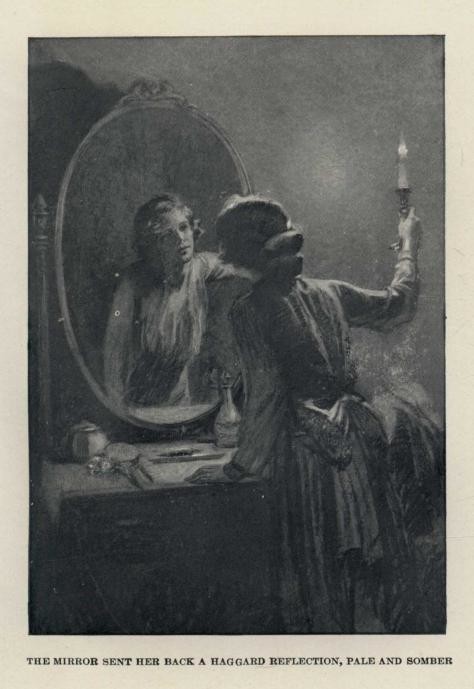
THE MIRROR SENT HER BACK A HAGGARD REFLECTION, PALE AND SOMBER
There was no sound from the studio. She glanced at her clock. For hours it seemed she had lain upon her bed of pain.
With a new resolution she bathed her face and wrists in cold water, then went through the kitchenette into the studio to find Barry Quinlevin. He was not there, but her husband was,—crouched in the armchair by the table and the whisky bottle was empty.
She shuddered a little but approached him resolutely. He tried to rise but, with a dull laugh and fumbling the arm of the chair, fell sideways into a grotesque attitude.
"Where is——?" she began, and halted.
"Gone out," he mumbled, struggling into a straighter posture, "back soon."
"Where has he gone?"
He shook his head. "Dunno. Asked me to stay—take care of you, m'dear."
She turned away from him, in disgust.
"Oh—don' worry," he went on—"not goin' bother you. After t'morr'—won' see me, y'know——"
She turned quickly and he laughed again.
"Goin' join m'regimen'. Furlough up t'morr'."
She whispered a "Thank God" below her breath as she stood looking at him. And then aloud, gently, in a new kind of pity for him.
"You'd better lie down, Harry, and get some sleep," she said, "or you'll be in no condition to go on duty."
"Thanks. Ought to sleep. Haven' slep' f'r weeks, seems to me. Don' seem to care though."
"You'd better. There's a room outside. Your baggage is there too."
"Um—that's nice of you, Moira. R'turnin' good for evil. Baggage. He brought it—didn' he?"
"Yes, Harry."
He paused a moment and then leaned forward in his chair while she watched him curiously.
"Rotten mess! What?" he mumbled.
She didn't reply. And he went on, concentrating thought with difficulty. "He told you I tried—kill him—didn' he?" He wagged his head comically. "I couldn' do that—not kill 'im—wouldn't do y'know—m'own brother—no—not that——"
He put his hands to his eyes a moment and swayed, but Moira steadied him by the shoulder.
"Harry—come. I'll help you. You must go to bed."
"Not yet—in a minute. Somethin'—say."
He groped for her hand on his shoulder, found and clung to it.
"Shame I'm such rotter, Moira. Beas'ly shame. I'm not half bad sort if leave me 'lone. I was sick—out there. Head of Levinski—grinned at me. Gold tooth—grinned at me—in wheatfield——"
"Come, Harry," she broke in again, "lean on me. I'll help you to bed."
"Ah, I was sick awright——" he shuddered, oblivious of her. "Makes me sick now—think of it. Jus' a head, Moira, nothin' else. But God! What a head!"
"It won't do you any good now to think about that," she put in quickly, for he was shivering as though with a chill.
"No. No goo' now. Awf' rotter, ain't I?"
"Come——"
He stumbled to his feet and she helped him to support himself.
"Will you forgive me, Moira?"
"Of course."
And as she urged him out of the door toward the vacant room, "Knew y'would," he mumbled. And then, "Goo' ol' Moira!"
In the room she helped him off with his coat, puttees and shoes and then pulling a blanket over him left him to his own devices and went back to the studio to wait for Barry Quinlevin.
But she wasn't weary now. From the same reserve force from which she drew the strength to stand for hours and paint even when her sitters were weary, she gained new courage and resolution for the return of Quinlevin. But for a moment she was tempted again. The way was clear. What was to prevent her from going and finding Jim? For a moment only. Then she sank, into the chair by the fireplace—to fight her battle with herself and wait. Her glance restlessly passed from one familiar object to another, the portrait on the easel, the lay figure in the corner in its fantastic pose and heterogeneous costume, the draperies for her backgrounds, hanging just as they had hung this afternoon, and yet all so strangely changed. The door of the closet where Jim had been hidden remained open, exhibiting its untidy interior. Instinctively she rose and closed it, her sense of order triumphant even over her mental sufferings. Then she went back and sat down to think. There was much that she and her—that she and Barry Quinlevin would have to say to each other.
He came at last, expecting to find Harry and not the straight figure of the woman who faced him like a pale fury. The shadows of pain at her eyes were gone, lost in deeper shadows of anger and determination.
"You! Moira," he said in surprise.
"Yes, I——"
"Where's Harry?"
"I put him to bed. He was drunk," she said shortly.
"The devil he was!" He frowned darkly and then seemed as ever, quite the master of himself. If the glance he cast at her discovered her state of mind, he gave no sign of uneasiness. He approached her with his easy air as if nothing unusual had happened, but when he spoke again his voice was pitched low and his eyes were soft.
"I thought you'd be in bed, child——"
"I've something to say to you——" she cut in quickly.
"Oh, very well,—say on, my dear. You don't mind if I smoke a cigarette?"
As she made no reply he lighted one and sank into the most comfortable chair with a sigh of content.
"At least you owe me something, Barry Quinlevin," she began tensely, trying to keep her voice under control, and announcing her leit motif, so to speak, in her first phrase. "I'm no chattel of yours, no infant any longer, to be bandied about as a dupe in your wild plans for the future. It's my future you're dealing with just as you've dealt with my past——"
"Have ye had any cause to complain of my treatment of ye?" he broke in calmly.
"You've cheated me—lied to me all my life—isn't that enough? Kept me in ignorance of the source of our livelihood—God knows what else—made me a partner in a crime—without my knowledge—made me help you to get dishonest money——"
"Hardly," he said. "It was yer own money."
"I don't believe you," she said icily, "if it was my money you would have gotten it for me—all of it—long ago."
"And lost yerself, my dear, to the Duc de Vautrin," he countered quickly.
She started slightly. That possibility hadn't occurred to her. But she went on rapidly.
"You forget that I heard what you said to Harry—That I know what has been in your heart all these years. I was your decoy and you used me as you pleased, glad of my working, which kept me busy so that I couldn't be inquiring what was going on. You forget that I heard why you wanted me to marry Harry, but I can't forget it—would to God I could—and you'd dare to ask me if I have anything to complain of, knowing all that and knowing that I know it. Do you think I'm a mere piece of furniture without a soul, not to care what my heritage is, not to cherish my traditions——? You've built my life on a lie, destroyed my very identity in a breath, torn down all the sacred idols of my girlhood and young womanhood and ground them under your feet. You!"
She caught at her heart and took a step nearer him.
"My mother—who was my mother?" she gasped.
He shrugged. "Mary Callonby—the Duchesse de Vautrin," he said easily. "And you are Patricia Madeline Aulnoy de Vautrin."
"Impossible. I'm no longer credulous."
"You'll have to believe the truth!"
"And who are you to ask me to believe? You who dared to speak to me of the sanctity of motherhood, who taught me that I was your own daughter—and that my mother, your wife——"
She broke off with a sob, quickly controlled.
"It was because I loved ye, Moira dear," he said very quietly.
She halted, aghast at this tenderness, the familiar tones of which made her wonder for a moment whether she weren't dreaming all the dreadful accusations on her tongue's end. But a pain shot through her heart to remind her of her sufferings.
"And was it because you loved me that you dared obliterate me, sneered at my pitiful love affair—the only passion I've had in my life or will have—and even tried to murder in cold blood—the—the object—of it? Answer me that—Barry Quinlevin!"
The Irishman's manner now changed. His brows drew together in a tight knot and the long fingers upon the chair-arm clenched until the knuckles were white.
"I'll answer ye that," he said abruptly. "And more. I've heard what ye had to say with patience and chagrin. I'll take the blame for me sins of omission where blame is due, trusting to yer conscience to be forgiving me presently for yer harsh tones to one who sinned for the very love of ye. But when ye speak of this other man who by a trick forces his way into yer lodgings and yer affections, learns yer family secrets and mine, reads yer letters and mine, makes love to his own brother's wife behind his back,—yer own brother-in-law, mind ye—and then tells one lie after another to make his story good, its time there was a man about the place to protect ye, if ye can't protect yerself——"
"Stop——!"
"No. I've heard you. Now ye'll be listening to me. If Harry isn't man enough to be looking out fer what belongs to him, then I am. Ye've given this man yer heart, acknowledged yer affections before us all. God be praised that's all it amounts to! But when ye hear me out, ye'll be wishing yer tongue had rotted before ye'd made such an admission."
He saw her shrink and he rose from his chair, following up his advantage quickly. "There—there my dear, Ye've almost had enough of trouble for one night——"
"Go on," she murmured stanchly, "but if you're going to speak ill of Jim Horton I won't believe you."
"Ye can do as ye please about that, but I'll be telling ye what I know of him just the same. And when I tell ye I wish I'd shot him dead before yer eyes, I'd only be satisfying the conscience of yer life-long guardian and protector——"
"Conscience! You!" she laughed hysterically. "Go on."
"I will, little as ye'll like it. When I went from here where d'ye suppose I went? To Pochard. And I wrung from him the truth about yer friend Jim Horton. It was Piquette Morin who helped him from the house in the Rue Charron——"
"I know it. I thank God for it."
"It was Piquette Morin who took him back to her apartment in the Boulevard Clichy and kept him there until he recovered."
"I know that too. Go on——"
"But ye didn't know that Piquette Morin was a woman without a shred of conscience or morals, a woman of the streets, who glories in her infidelities to the Duc de Vautrin, whose mistress she is——"
"I care nothing for that," stammered Moira.
"Ye may not care, since Jim Horton has lied about that too, but ye will care about the relations that exist between the two of them."
"I won't listen," said Moira, making for the door. But he barred her way.
"Oh, yes, ye'll listen, Moira dear, and I'll be giving ye all the proofs ye need before I'm through."
"Proofs! I dare you."
"All in good time. If ye'll be patient. Where do ye think I went from Pochard's? To the Boulevard Clichy, where yer precious friend had returned to the arms of Madame Morin——"
She waved a hand in protest.
"I watched the door of the apartment. He came out. I followed, and where do you suppose he went? To the ticket office where he booked a compartment for two—on the twelve o'clock train to-morrow for Marseilles."
"And what of that?" she stammered.
"Merely that yer friend Jim Horton, failing of success with his brother's wife, has decided upon a honeymoon to the Riviera with a lady who is more complaisante than yerself."
"I don't believe it."
"Ye'd find it less difficult to believe if ye guessed how mad she was for him, how handsome she is and how skilled in the wily arts of her sex and trade," he said keenly. "Oh," he said, with a shrug, "it could only have been a great passion that would have dared the rescue from the house in the Rue Charron. And no man remains long ungrateful for such an act of unselfishness."
Moira leaned against the mantel-shelf, staring at him wide-eyed, but he met her look with one more steady than hers, hardy, indignant, but injured and grieved too at her attitude. Skillfully he had baited his hook with a truth that she knew. He saw the fleeting question in her eyes and answered it quickly.
"If ye want the proofs——go to the Boulevard Clichy now." He paused to give the suggestion weight, "Or if ye've no heart to-night for such a brutal encounter—to-morrow—on the train to Marseilles."
He had caught her ear. He knew it by the sudden shutting of her teeth over her words, the proud lift of her chin, the hard look that came into her eyes. And though she answered him still defiantly, her tone had no body in it and trembled with the new uncertainty.
"I don't believe you."
"I don't ask ye to. But ye will believe in the evidence of yer eyes, and I'll be providing ye with that, my dear."
"How you hate him!" she gasped.
He shrugged and turned half toward her.
"Hate? Hardly. I merely despise him. I would have killed him to-night with a clean conscience, knowing what I do." He dropped the cigarette he had taken up and approached her a pace or two. "Oh, Moira, alanah, won't ye see? Is it blind ye are to the truth that lies before yer very eyes——? Can't ye see that it's the love of ye that drives me to protect yer happiness? Have I ever failed ye, all these years? Haven't I given ye yer share of all I had? Answer me that—aye—even when there was not too much for the both of us?"
"I—I've heard enough—to-night," she said wearily.
"I'm sorry. I—I've done what I thought was the best. I'm still yer guardian—until ye come into yer own——"
"I can't listen to that," she shuddered. "De Vautrin—my father!"
He bowed his head with tragic grace.
"The same—bad cess to him."
She sank into a chair, bewildered and helpless.
"I want nothing—only to go away somewhere alone. I've heard enough."
"That you shall do presently, alanah," he said, touching her gently, the familiar voice close at her ear. "But now you must be going to bed and trying to sleep. 'Tis a cruel day ye've had—cruel! But to-morrow when ye've had some rest——"
"To-morrow——?" she raised a despairing face.
"Ye've got to be facing it. But no more to-night. Come."
She let him take her by the arm to the door.
"Forgive me, acushla," he whispered.
But she made no reply and left him standing there. And Quinlevin watched her merge into the darkness within, then turned and picked up the cigarette he had dropped, lighted it with great care, and sat and smoked, ruminating over the ashes in the fireplace.
But he had played his cards with the true gambler's knowledge, of the psychology of his victim. Jealousy! Such a weapon at his very hand. It was almost a pity to use it. Poor child. As if she hadn't already suffered enough! But there was no choice. And she would get over it. Love never killed—only hate ... only hate. He finished one cigarette and then glanced toward the door through which Moira had passed. Then lighted another and composed himself for awhile longer.
It was not until he was near the end of this cigarette that a slight sound caused him to look up over his shoulder. Framed against the black opening Moira stood, pale, dark eyed, her black hair streaming over her flimsy dressing-gown, and then came forward noiselessly.
"Moira, child——!" he cried, rising, with an air of surprise.
"You must show me the proof——," she stammered, "what you said—to-morrow."
"Yes. If ye insist——"
"I do. It's a test—of the truth—between you and—and him——"
"I'll provide it. Ye'll leave with me on the twelve o'clock train for Marseilles?"
"Yes—anything."
"Very well," he muttered. "I'll arrange for it. I've some business in Nice. It's just as well if you come along."
"Anything——," she whispered, shivering and still protesting, "but I don't believe—I don't believe——"
"Go to bed again, child. I'll call ye in the morning."
As she disappeared he turned toward the mantel, hiding the smile of triumph that crossed his lips. Then he leaned for a long while looking into the hearth.
"Poor child!" he whispered. "'Tis a cruel pity, but—" He paused and then turned toward the bottle upon the table, which he raised and examined carefully, then set down with an air of disgust. "The drunken scut!" he muttered, then swore softly below his breath.
* * * * *
What remained of Quinlevin's task was not difficult, for he had already anticipated his success with Moira by making arrangements with Nora Burke and Tricot, Nora to face de Vautrin with her confession and her evidence, Tricot to help him in keeping Jim Horton from reaching the Duke.
By the expression of Moira's face when they met in the studio in the morning, he discovered that his poison had worked its slow course through her veins. Irish she was—all Irish now—slow to love and quick to jealousy—proud to the quick, and capable of a fine hatred when the proofs were brought as Barry Quinlevin intended to bring them. She listened with an abstracted air as he told her that her old nurse, Nora Burke, and a man, a friend of his, were to be the other members of their party. She showed some surprise and then a mild interest, but he could see that to Moira her companions meant very little. She was thinking, brooding somberly over what he had told her, and his air of confidence in his undertaking did nothing to give her courage for her decision. And yet he knew that she would abide by it—a choice between Jim Horton and himself. And he knew already what that choice was to be. For reasons of his own it was important that Jim Horton and Piquette should not see him on the train; nor that Moira should be presented merely with the evidence of the two of them entering the train. The evidence must be condemnatory. He would wait and trust to circumstances.
The thing was simplicity itself. The window into the corridor was like a dispensation. He passed the compartment once or twice to make sure that the shade of the little window had not been drawn and then when it grew dark saw that Piquette had gone fast asleep with her head on Horton's shoulder. Then he acted quickly.
"Come," he said to Moira. "It is time I showed you who is the liar."
And resolutely she followed him, looked—and saw.
* * * * *
Nothing seemed to matter to her after that. Incredulity, surprise and then guilt, all expressed so clearly in Jim Horton's face in the brief moment when their glances had met. The pretty painted face upon his shoulder, the arm that he withdrew from around the woman's waist, her sudden awakening as he started—all these brief impressions so vivid, so terrible in their significance, armed her with new strength and courage to hide her pain from Nora Burke and Barry Quinlevin. He watched her with admiration. Her heart might be breaking but she'd never whimper now. He knew her.
"Are ye satisfied, my dear?" he asked.
"Yes. Quite," she gasped.
"And you'll be listening to Nora while she tells ye the truth?"
"I will."
"Good. I must be leaving ye for a while to talk with my friend. And don't be distrusting me again, alanah."
Moira was silent and gazed out of the window into the darkness until Nora came. And she listened to the tale that Nora Burke told, or seemed to listen, and thus Quinlevin found them later, the girl's hand in that of her old nurse.
The announcement that they were to get out of the train at St. Etienne created no astonishment. Moira moved as in a dream, obeying blindly as she had always been accustomed to obey the suggestions of her protector, caring nothing for their significance and reassured as to the integrity of his intentions with regard to herself. There was no doubting that he loved her in his strange way. And the fury he had expended upon Jim Horton seemed scarcely less than that she now felt for him. A man could kill—but a woman could only despise.
She was at least thankful when she saw the train bearing the couple pass out of her sight into the darkness, and followed Quinlevin where he led—to a hotel for the night—to another train in the morning, to Marseilles, to Nice, and the Hôtel Ruhl, where in the privacy of a room of her own, she threw herself upon the bed and gazed dry-eyed at the ceiling.
CHAPTER XVI
NORA SPEAKS
The attention of Monsieur de Vautrin having been attracted by Piquette's news of the immediate threat against his fortune, it was no longer difficult to persuade him to listen to what Jim Horton had to say. Madame Thibaud was therefore conducted with scant ceremony to an apartment in the Hôtel de Paris, after which the Duc rejoined Piquette and Jim in the Casino. The unflattering opinion Jim Horton had formed of this French nobleman was, upon closer acquaintance, in no way modified. The peevish and supercilious air with which he had greeted Piquette had changed to one scarcely less unpleasant,—a fidgety anxiety and apprehension which revealed weaknesses of fiber one would not have expected to discover between the points of so long and so imposing a mustache. He gave Jim the impression of being very weary in the pursuit of a will-o'-the-wisp. And in repose, his face bore the scars worn by those who live for pleasure alone. Altogether he seemed a person scarcely worth borrowing so much trouble about. His attitude of suspicion toward Jim Horton was illy concealed, but he listened, frowning and questioning, until at last convinced of the reality of his danger at the hands of the renegade Irish adventurer to whose venial cleverness he had so long paid handsome tribute.
"But they can do nothing," he said at last in excellent English, with an air of bravado which was meant to be effective, and which was only pitiful.
"I'm not so sure about that," said Jim, "the mere fact of your having paid for the support of the child for so many years makes it seem as though you believed in the thing."
"What do I care? I have the money. Let them take it if they can."
"Oh, they'll take it all right, if you don't find some way to meet their evidence."
"Lies."
"Yes, of course. But you've got to prove that they are. Where's your defense? You didn't even know you had a daughter until Barry Quinlevin told you you had. What proof have you that your own child died? And if you believed Quinlevin then, why shouldn't you believe him now——?"
"I had my suspicions——"
"Pardon me. Suspicions won't satisfy an Irish court or a French one. What proof have you that Madame Horton isn't your own child? None? Exactly! But everybody who could have known anything about the matter is dead except Nora Burke, and you've already heard what she has to say."
"H—m. And what is your interest in this matter, Monsieur?"
"That's a fair question," said Jim slowly. "I'll give you a fair answer. Madame Horton is my brother's wife. The story I've given you is straight—as Piquette will tell you since she heard much of it from my brother. Your daughter died shortly after her mother, your wife. My interest in this affair is personal to this extent. I don't intend to have Madame Horton used any longer by an unprincipled blackmailer."
"Surely then you would have told Madame Horton the truth and saved me this unpleasantness——"
"Yes—I've told her," said Jim slowly, "but she's helpless. Can't you see, Monsieur? It has all been very sudden—for her. She doesn't know what to believe. Besides, Monsieur Quinlevin has the birth certificate and the testimony of the nurse."
"But if Madame Horton is an honorable woman——"
"You can count on that," put in Horton quickly. "She doesn't want your money—she isn't Quinlevin's kind——"
"Then why doesn't she renounce him?"
"She might—but what difference would that make? She might permit herself to think she was Joan of Arc, but that wouldn't make her any one but Patricia Madeleine Aulnoy de Vautrin, if Barry Quinlevin has evidence enough to prove that she is...."
De Vautrin frowned darkly and twitched his jeweled fingers.
"But she would have something to say about her own desires in the matter," he said.
"Her own desires haven't anything to do with it. See here, Monsieur de Vautrin—Barry Quinlevin proves her birth by a certificate; he also proves by the nurse that she was the child brought into his house, and the child he has brought up as his ward, bearing his name and accepting your money for twenty-one years—hush money, monsieur, that you paid to keep her out of a fortune you thought belonged to her."
"But it doesn't belong to her," cried de Vautrin, gesticulating. "It's mine since the child is dead. Monsieur Harry Horton——"
Piquette broke in. "Monsieur 'Arry 'Orton could be call' to the stan' of course, but 'is testimony is not to be relied upon."
"Your brother, Monsieur——?"
"Yes, Monsieur de Vautrin," replied Jim, "my brother—but an intimate of Barry Quinlevin's——"
"Ah, I comprehend—an accomplice?"
"You might call him that—if you like." He shrugged and turned aside. "We don't get along, my brother and I, but I don't think you'll find much to gain by putting him on the witness stand. Besides, it won't look very pretty in the papers. It's as much to my interest as yours to keep it out."
The Duc eyed him suspiciously again.
"But you must have some other interest besides this in wishing to help me. What's the ax you have to grind, Monsieur?"
Jim Horton grinned and shrugged.
"For myself—nothing."
"That is difficult to believe."
"Then I would advise you to tax your imagination to the utmost. I don't want Madame Horton to figure in an affair that she will regret the rest of her life."
"But why——?"
"Monsieur is in love wit' Madame 'Orton——" Piquette's voice broke in very calmly.
There was a silence for a moment in which Jim Horton looked at Piquette, Piquette gazed at de Vautrin and de Vautrin stared from one to the other in astonishment.
His knowledge of the world had given him no instinct to appraise a situation such as this. But Piquette met his gaze clearly.
"It is de trut', Olivier," she repeated. "An' now perhaps you on'erstan'."
"It is extraordinary," he gasped. "And you two——?"
"I brought 'im to you. Your interests are de same—and mine, wit' both."
"Parbleu! If I could believe it——!"
Jim Horton rose, aware of a desire to pull the waxed mustaches to see if they were real.
"You needn't believe it, if you don't want to," he said carelessly. "And you don't have to believe my story. But I've given you your warning. Barry Quinlevin may be in Nice now, with his birth certificate and his Nora Burke." He buttoned his overcoat and turned toward the door. "I think I'll be going back to Nice, Piquette," he said coolly, and then to the bewildered Frenchman, "Good-night, Monsieur."
"One moment," gasped the Duc, toddling after him and catching him by the hand, "I believe you, Monsieur. Why should I not believe you since what you say is what I wish to believe? It is all very bewildering. I should have thanked you long ago for your kindness."
Jim Horton turned with a smile.
"It's about time. And it ought to be fairly clear that I have little interest in your fortune or even in you, Monsieur. I don't mind being shot at for my interference in Mr. Quinlevin's affairs, but I might have been hit—or Piquette might—which would have been worse, and I don't relish having my word doubted—or hers."
"I beg forgiveness. You have been shot at?"
Piquette explained quickly while de Vautrin's watery eyes grew larger.
"Mon Dieu! And you say they are coming here?"
"Yes. If their dinky little train ever reaches its destination. I'm afraid you're in for it, Monsieur de Vautrin."
De Vautrin threw out his arms wildly.
"I will not see them. I will go away."
Jim Horton nodded. "That's all right—but it's only putting off the evil moment. When they get their evidence working you'll have to meet it, someway. And then what will you do?"
De Vautrin had caught Jim by the coatsleeve and pulled him down into the seat beside him. And then with a pseudo-dramatic air which failed of conviction,
"I shall fight, Monsieur."
"With what?"
"With the evidence you've given me."
"It's not enough."
Horton shook his head and laughed.
"It looks to me as though you were elected President of the Quinlevin Endowment Association."
"But there must be some way of getting at the truth," cried the Frenchman, now really pitiful in his alarm.
"Ah, that's it," laughed Jim. "You know Madame Horton is not your daughter and I know it, but that doesn't beat Quinlevin."
"What then, Monsieur?"
"You've got to kill his evidence."
"But how?"
"With stronger evidence of your own. You haven't it, or any prospect of getting it that I can see. So there's only one course open."
"And that, Monsieur?" asked de Vautrin eagerly.
"To break down Quinlevin's. I'm no lawyer, but that's only common sense. Nora Burke is a liar bribed with five thousand pounds. And there never was a lie that didn't have its weak points. You've got to make her speak the truth——"
"How?"
"I don't know. But I wouldn't mind trying. Then you've got to get that birth certificate——"
"I don't see how you expect to do that."
"Neither do I—Quinlevin is no fool, but then he's not super-natural either."
The Duc was silent, appalled by the undertaking which had presented itself. And the calm way in which his visitor discussed his projects filled him with wonder.
"Justice, Monsieur de Vautrin, is on your side. Will you fight for it?"
"Assuredly, Monsieur—if you will but help."
Jim Horton laughed.
"Then you no longer believe I have an ax to grind?"
"No—no, Monsieur."
"And you no longer cherish evil thoughts of Piquette?"
"Upon my honor," said the Duc, a jeweled hand at his heart. "And yet, Monsieur, you can hardly blame me for some irritation at meeting her here with you."
Jim Horton glanced toward the door significantly. And then dryly, "You hardly deserve her, Monsieur de Vautrin. I am proud of her friendship. It's the finest thing in my life."
De Vautrin wagged his head foolishly and then shrugged a futile shoulder.
"What do you want me to do, Monsieur?" he asked peevishly.
Horton lighted a cigarette carefully and took Piquette by the hand.
"First, Monsieur de Vautrin," he said coolly, "you will send Madame Thibaud about her business——"
"Monsieur!" said the Duc with a show of dignity.
"Suit yourself. But she's in the way. This is no time for fooling. Does she go or doesn't she?"
De Vautrin's injured dignity trembled in the balance for a moment and then fell away, merged in his apprehension for the immediate future.
"That can—can doubtless be arranged," he said with a frown.
"Good," said Horton jovially. "And the sooner the better. It will clear the atmosphere amazingly. Then we will prepare to fight Monsieur Quinlevin with his own weapons."
"Yes. You—I—Piquette. That's what we came here for. You've made the mistake of under-rating Barry Quinlevin. He's desperate. He is playing a big game and if you don't want to be the goat you'll do what I advise."
"I'm listening."
"If I'm not mistaken he will reach here to-morrow afternoon with Madame Horton and Nora Burke. And you've got to see them."
"I—Monsieur?"
"Yes—you—here in your rooms in the Hôtel de Paris. You will give it out that you are here for a week. They must take rooms in Monte Carlo. Then you will listen politely to everything Quinlevin has to say—to everything Nora Burke has to say, but you yourself will say nothing."
"But you, Monsieur?"
"I shall be in an adjoining room, but they must not know it."
"But Barry Quinlevin will discover that you have been here."
"Of course. You will tell him that. They will tell you that I have lied. But you won't believe them. And then you will tell them that I have gone away."
"But when will you come in to my assistance?"
"That depends upon what I hear through the keyhole."
"But would it not be simpler to pay this Nora Burke for telling the truth?"
Horton laughed. "It does seem simple, doesn't it? I don't know much about French law, but I wouldn't want to be caught at it out where I come from. Let's play this game straight and trust to luck. If Quinlevin is too sharp for us we'll try something else. Do you agree?"
"Of course, Monsieur."
And so it was settled. On the following morning Madame Thibaud was sent back to Paris. And Piquette and Jim Horton ostentatiously took the train for Nice, returning subsequently by automobile to Monte Carlo, where they were hidden in rooms in the Hôtel de Paris. In this they were aided by an official of the Hotel who proved to be an old acquaintance of Piquette's in Paris. And so when Barry Quinlevin arrived from Nice in the afternoon, with Moira and Nora Burke, inquiring for the Duc, the information was conveyed directly to Horton, who was happy to learn that Tricot had not yet caught up with the party.
Monsieur de Vautrin, who had been carefully rehearsed in the part he was to play, seemed to enter into the game with some spirit, and was sent over to the Casino to play trente et quarante where after awhile Barry Quinlevin found him, deeply absorbed in his game of chance. The Duc manifested polite surprise, Quinlevin polite insistence, and then they talked for awhile, the Duc indifferently, Quinlevin impressively,—to the end that an appointment was made for an hour later the following afternoon in the Duc's apartment, where he would listen in all good nature and tolerance to what his visitors would have to say. He hoped his "daughter" was handsome. It would be a pity if all this money was to go to one who could not use it with dignity. All this in an ironic and jocular mood which only brought a dour smile upon Quinlevin's face.
But the main object of the preliminary encounter was achieved, for Barry Quinlevin accepted without reservation the Duc's assertion that Jim Horton, having performed his mission, had returned to Paris.
When the hour of the appointment arrived, Jim Horton sat behind the door into the bedroom of Monsieur de Vautrin, carefully studying the pages of an English-French dictionary. The Duc sat over his paper with an air of unconcern he was far from feeling. Piquette, at the American's instructions, was elsewhere.
Quinlevin, shown to the door of the room by a servant of the hotel, met the Duc with his most amiable smile and introduced the women of his party. Moira was pale, Nora Burke uncomfortable but arrogant.
"Monsieur de Vautrin," Quinlevin began with something of an air, "permit me to present to ye yer daughter, Patricia Madeleine Aulnoy de Vautrin."
The Duc smiled politely, bowed—and stared. Moira, who, as though in duty, had taken a step toward him, paused. And then as she saw the look that Monsieur de Vautrin swept over her, the color flamed into her cheeks. The Duc's rebuff gave for the first time a true perception of the position in which she had voluntarily placed herself. If she were a mere adventuress he could not have accused her more eloquently and the admiration in his impudent stare was even more insulting. This man—this effete boulevardier—her father——? Impossible! And the repulsion she felt at the sight of him made her wish only to go anywhere away from the sight of him. What else she had expected, she didn't know, for even Barry Quinlevin had not been too explicit as to what would be likely to happen. But there was her mentor at her side, a gentle hand upon her elbow urging her forward into the arm-chair by the window, which Monsieur de Vautrin was indicating with a rather exaggerated gesture of formality.
"Thanks, Monsieur," said Quinlevin with an easy laugh, sinking into another chair. "Ye're not to be blamed for not flying to each other's arms after all these years, when yer acquaintance in the beginning was to say the least a most trivial affair. But in a while, perhaps, ye'll be knowing each other better and I'm sure, Monsieur, ye'll be finding my ward as I have done, a fine creature capable of a most filial devotion."
"Ah," said de Vautrin. "I don't doubt that. It would truly be a great pleasure to me to discover so beautiful a creature to be a daughter of mine, but the facts of the matter unfortunately——"
"One moment, Monsieur," broke in Quinlevin, "before we arrive at the facts in the matter. Ye must be aware that this situation is none of my ward's choosing. She came because she knew that it was a sacred duty which she owed to the memory of her mother. Many years have passed since yer affairs—er—called ye away from Ireland and she lays no fault to yerself for yer desertion, for which I have taken all the blame. She knows that ye've provided for her comfortably, and that I have made it my pleasure to act as yer substitute, as well as I could. But the time has come when she must take her place in the world to which she belongs, and it's my duty to be putting her there. To this end, as ye'll see, I've brought with me her old nurse, Nora Burke, with whom ye're already acquainted, and who will be answering any questions that ye would like to put to her."
Monsieur de Vautrin frowned and moved his gaze from Moira to the servant who stood, her large hands, badly gloved, folded upon her stomach, her feet shifting uneasily.
"I've heard something of Nora Burke's story," said de Vautrin dryly, "but there are parts of it that I have not heard."
"Ye're quite at liberty to question, Monsieur," put in Quinlevin, "Nora too is merely an instrument of truth in the hand of Providence."
"Since Providence has ceased providing," said the Duc dryly, "I comprehend. But I will listen to this extraordinary tale again, since I have promised to do so. It can do no harm. Allons! Proceed, Nora Burke. My poor wife, you say, engaged you some weeks before my daughter was born?"
"She did, yer Highness——" And, as the woman hesitated——
"Go on, Nora," said Quinlevin.
"The choild was born, this very girl they call Moira Quinlevin, who sits before ye, a beautiful choild she was, fine and healthy that the poor Duchesse never lived to see, for she died that night, God rest her soul, faded away before our very eyes."
"And who was there beside yourself," asked the Duc coolly.
"Dominick Finucane, the doctor from Athlone, and Father Reilly, the priest who gave her Absolution——"
"And who has since died," said de Vautrin dryly.
"Yes, yer Highness—but the birth certificate I was afther kapin' since no father came near us, nor any relation. Mary Callonby was a lonely kind and when she came back to Galway took to living solitary-like on the small farm with only the one servant, Mrs. Boyle, to look afther her."
"And Mrs. Boyle is also dead?" put in de Vautrin keenly.
"She is."
"It's very unfortunate that all the witnesses have seen fit to die."
"All but me, yer Highness," said Nora assertively.
De Vautrin shrugged. "Well. What happened then?"
"Well, Mrs. Boyle and meself, we didn't know what to be afther doing, so we just followed the advice of Father Reilly."
"And what did he tell you to do?"
Nora glanced at Quinlevin, who nodded.
"In a whoile he brought Mr. Barry Quinlevin—this gentleman here—who lived on the only place nearby, and tould us to be going to his home. Mr. Quinlevin was afther bein' very lonely, he said, his own wife and colleen havin' died a few months before."
"That was kind of Mr. Quinlevin."
"We thought so—yer Highness—but it was kind of Father Reilly too—for nobody was afther coming to see about the poor choild and Mr. Quinlevin was that grateful—he watched the babby like it was his own——"
"That's true enough. He would," sneered the Duc. "And what happened then?"
"Mrs. Boyle and I we lived in the house of Mr. Quinlevin, her as cook and me as nurse, bringin' up the choild as Miss Moira Quinlevin,—alone in the house for wakes at a toime, when Mr. Quinlevin was afther bein' away to London or Paris on business. But all the whoile I was kapin' the birth certificate an' all the whoile tryin' me best to take the place of poor Mary Callonby."
"And you were well paid for this service?" asked de Vautrin.
"I had me wages. It was enough."
"And when you heard that Mr. Quinlevin had seen me in Paris, two years afterward, you received more money?"
Nora's glance sought Quinlevin, who broke in calmly.
"I gave Nora as well as Mrs. Boyle a bit more, ye understand—a proper share of the sum for the support of the child. And they agreed to say nothing." He fingered in his pocket and brought forth a paper. "This, as ye can plainly see, is a copy of the birth certificate of yer child."
"And the original?" asked the Duc.
"Will be produced at the proper time," said Quinlevin shrewdly.
De Vautrin took the paper and read it carefully.
"And where is Mrs. Boyle at the present moment?" he asked. "Dead also?"
"Three weeks ago," said Quinlevin calmly. "It's most unfortunate—but her signature can be verified."
"H—m. And Father Reilly also. Of course," said the Duc with a quick glance toward his bedroom door. "And there are other papers?"
"Yes," said Quinlevin. "Letters from you—accompanying yer checks—which guarantee yer verbal agreement in Paris. The will of Patrick Callonby and a few other trifles which are important to ye."
"And you think your case is complete?"
"Oh, yes, quite. An Irish court won't hesitate very long just at this time in carrying out the provisions of this will."
Monsieur de Vautrin smiled. "And what do you wish me to do?" he asked quietly.
"To perform merely an act of restitution, an act of justice to yer own. Ye know the terms of the will. In the event of the mother dying, her fortune was to revert unconditionally to the child. But she's to be considerate of yer age and the relation that exists between ye, which however strange it may seem to ye both at this time, is that of father and only daughter. Ye've both formed the habits of yer lives—yerself living bachelor-fashion in Paris and London. Yer daughter is disposed to be generous and does not wish to interfere with yer plans for the future. She will, if you please, still keep the matter secret, and go on living with me—yerself to continue in the comfortable life of yer bachelorhood."
"And your terms?" asked de Vautrin quietly.
Barry Quinlevin pocketed the copy of the birth certificate which Monsieur de Vautrin had put upon the table.
"As to terms, that won't be made difficult. The estate of Patrick Callonby was reckoned at a million pounds sterling—we'll say twenty millions of francs or thereabouts—since ye're not a man of business and allowing for depreciation. Give yer daughter proper securities to the amount of one third of her fortune and she will assign the other two thirds to you——"
Quinlevin paused, for when the terms were mentioned Monsieur de Vautrin had begun to smile and now burst into an unpleasant laugh.
"Well, Monsieur de Vautrin," broke off Quinlevin angrily.
"It's merely," he replied, "that you don't figure enough for depreciation."
"What do ye mean?"
"Twenty-one years is a long while. And you are right when you say that I am no man of business. My fortune has diminished year by year and since the war—pouf! it has vanished into thin air. The estate of Patrick Callonby, Monsieur, is now a myth."
Barry Quinlevin rose, trying to keep his temper.
"There are ways of verifying yer statements, Monsieur."
"Of course. I commend you to them. And Nora Burke, who might have told me the truth last summer in Ireland, when I was disposed to be generous."
"I've tould the truth," asserted Nora doggedly, in spite of her bewilderment.
"And how much more will you tell when there's no money for the telling?" said de Vautrin, rising.
For at this moment the door into the adjoining room opened and Jim Horton strode quickly into the room.


