



автордың кітабын онлайн тегін оқу The Silent Battle
THE SILENT BATTLE
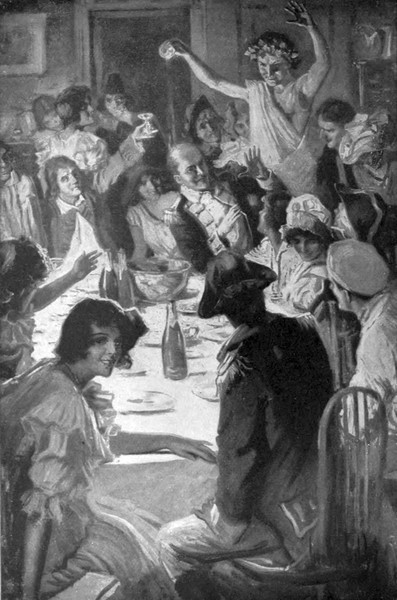
“The table rang from end to end with joke and laughter.”
THE
SILENT BATTLE
BY
GEORGE GIBBS
AUTHOR OF
THE BOLTED DOOR,
THE FORBIDDEN WAY, ETC.
ILLUSTRATED

NEW YORK
GROSSET & DUNLAP
PUBLISHERS
Copyright, 1913, by
D. APPLETON AND COMPANY
Copyright, 1912, 1913, by the Pictorial Review Company
Printed in the United States of America
CONTENTS
CHAPTER
PAGE
I.
Lost1
II.
Babes in the Woods11
III.
Voices22
IV.
Eden33
V.
Woman and Man46
VI.
The Shadow60
VII.
Allegro73
VIII.
Chicot, the Jester84
IX.
The Lorings95
X.
Mr. Van Duyn Rides Forth109
XI.
The Cedarcroft Set122
XII.
Nellie Pennington Cuts In136
XIII.
Mrs. Pennington’s Brougham151
XIV.
The Junior Member166
XV.
Discovered177
XVI.
Behind the Enemy’s Back190
XVII.
“The Pot and Kettle”200
XVIII.
The Enemy and a Friend212
XIX.
Love on Crutches225
XX.
The Intruder236
XXI.
Temptation247
XXII.
Smoke and Fire261
XXIII.
The Mouse and the Lion273
XXIV.
Diamond Cut Diamond285
XXV.
Deep Water297
XXVI.
Big Business310
XXVII.
Mr. Loring Reflects323
XXVIII.
The Lodestar338
XXIX.
Arcadia Again350
LIST OF ILLUSTRATIONS
“The table rang from end to end with joke and laughter.” “‘Do tell me something more, Nina. Was she young and pretty?’” “‘And you never cared for any one else?’” “‘Father!’ Jane’s ... whisper was at his ear.”THE SILENT BATTLE
I
LOST
Gallatin wearily lowered the creel from his shoulders and dropped it by his rod at the foot of a tree. He knew that he was lost—had known it, in fact, for an hour or more, but with the certainty that there was no way out until morning, perhaps not even then, came a feeling of relief, and with the creel, he dropped the mental burden which for the last hour had been plaguing him, first with fear and then more recently with a kind of ironical amusement.
What did it matter, after all? He realized that for twenty-eight years he had made a mess of most of the things he had attempted, and that if he ever got back to civilization, he would probably go diligently on in the way he had begun. There was time enough to think about that to-morrow. At present he was so tired that all he wanted was a place to throw his weary limbs. He had penetrated miles into the wilderness, he knew, but in what direction the nearest settlement lay he hadn’t the vaguest notion—to the southward probably, since his guide had borne him steadily northward for more than two weeks.
That blessed guide! With the omniscience of the inexperienced, Gallatin had left Joe Keegón alone at camp after breakfast, with a general and hazy notion of whipping unfished trout pools. He had disregarded his mentor’s warning to keep his eye on the sun and bear to his left hand, and in the joy of the game, had lost all sense of time and direction. He realized now from his aching legs that he had walked many miles farther than he had wanted to walk, and that, at the last, the fish in his creel had grown perceptibly heavier. The six weeks at Mulready’s had hardened him for the work, but never, even at White Meadows, had his muscles ached as they did now. He was hungry, too, ravenously hungry, and a breeze which roamed beneath the pines advised him that it was time to make a fire.
It was a wonderful hunger that he had, a healthful, beastlike hunger—not the gnawing fever, for that seemed to have left him, but a craving for Joe’s biscuits and bacon (at which he had at first turned up his pampered aristocratic nose), which now almost amounted to an obsession. Good old Joe! Gallatin remembered how, during the first week of their pilgrimage, he had lain like the sluggard that he was, against the bole of a tree, weary of the ache within and rebellious against the conditions which had sent him forth, cursing in his heart at the old Indian for his taciturnity, while he watched the skillful brown fingers moving unceasingly at the evening task. Later he had begun to learn with delight of his own growing capabilities, and as the habit of analysis fell upon him, to understand the dignity of the vast silences of which the man was a part.
Not that Gallatin himself was undignified in the worldly way, for he had lived as his father and his father’s fathers before him had lived, deeply imbued with the traditions of his class, which meant large virtues, civic pride, high business integrity, social punctilio, and the only gentlemanly vice the Gallatin blood had ever been heir to. But a new idea of nobility had come to him in the woods, a new idea of life itself, which his conquest of his own energy had made possible. The deep aisles of the woods had spoken the message, the spell of the silent places, the mystery of the eternal which hung on every lichened rock, which sang in every wind that swayed the boughs above.
Heigho! This was no time for moralizing. There was a fire to light, a shelter of some sort to build and a bed to make. Gallatin got up wearily, stretching his tired muscles and cast about in search of a spot for his camp. He found two young trees on a high piece of ground within a stone’s throw of the stream, which would serve as supports for a roof of boughs, and was in the act of gathering the wood for his fire, when he caught the crackling of a dry twig in the bushes at some distance away. Three weeks ago, perhaps, he would not have heard or noticed, but his ear, now trained to the accustomed sounds, gave warning that a living thing, a deer or a black bear, perhaps, was moving in the undergrowth. He put his armful of wood down and hid himself behind a tree, drawing meanwhile an automatic, the only weapon he possessed, from his hip pocket. He had enough of woodcraft to know that no beast of the woods, unless in full flight, would come down against the wind toward a human being, making such a racket as this. The crackling grew louder and the rapid swish of feet in the dry leaves was plainly audible. His eye now caught the movement of branches and in a moment he made out the dim bulk of a figure moving directly toward him. He had even raised the hand which held his Colt and was in the act of aiming it when from the shelter of the moose-wood there emerged—a girl.
She wore a blue flannel blouse, a short skirt and long leather gaiters and over one hip hung a creel like his own. Her dress was smart and sportsmanlike, but her hat was gone; her hair had burst its confines and hung in a pitiful confusion about her shoulders. She suggested to him the thought of Syrinx pursued by the satyrs; for her cheeks were flushed with the speed of her flight and her eyes were wide with fear.
Comely and frightened Dryads who order their clothes from Fifth Avenue, are not found every day in the heart of the Canadian wilderness; and Gallatin half expected that if he stepped forward like Pan to test her tangibility, she would vanish into empty air. Indeed such a metamorphosis was about to take place; for as he emerged from behind his tree, the girl turned one terrified look in his direction and disappeared in the bushes.
For a brief moment Gallatin paused. He had had visions before, and the thought came into his mind that this was one like the others, born of his overtaxed strength and the rigors of the day. But as he gazed at the spot where the Dryad had stood, branches of young trees swayed, showing the direction in which she was passing and the sounds in the crackling underbrush, ever diminishing, assured him that the sudden apparition was no vision at all, but very delectable flesh and blood, fleeing from him in terror. He remembered, then, a tale that Joe Keegón had told him of a tenderfoot, who when lost in the woods was stricken suddenly mad with fear and, ended like a frightened animal running away from the guides that had been sent for him. Fear had not come to Gallatin yet. He had acknowledged bewilderment and a vague sense of the monstrous vastness of the thing he had chosen for his summer plaything. He had been surprised when the streams began running up hill instead of down, and when the sun appeared suddenly in a new quarter of the heavens, but he had not been frightened. He was too indifferent for that. But he knew from the one brief look he had had of the eyes of the girl, that the forest had mastered her, and that, like the fellow in Joe’s tale, she had stampeded in fright.
Hurriedly locking his Colt, Gallatin plunged headlong into the bushes where the girl had disappeared. For a moment he thought he had lost her, for the tangle of underbrush was thick and the going rough, but in a rift in the bushes he saw the dark blouse again and went forward eagerly. He lost it, found it again and then suddenly saw it no more. He stopped and leaned against a tree listening. There were no sounds but the murmur of the rising wind and the note of a bird. He climbed over a fallen log and went on toward the slope where he had last seen her, stopping, listening, his eyes peering from one side to the other. He knew that she could not be far away, for ahead of him the brush was thinner, and the young trees offered little cover. A tiny gorge, rock strewn, but half filled with leaves, lay before him, and it was not until he had stumbled halfway across it that he saw her, lying face downward, her head in her hands, trembling and dumb with fear.
From the position in which she lay he saw that she had caught her foot in a hidden root and, in her mad haste to escape she knew not what, had fallen headlong. She did not move as he approached; but as he bent over her about to speak, she shuddered and bent her head more deeply in her arms, as though in expectation of a blow.
“I’m not going to hurt you,” he said softly.
At the sound of his voice she trembled again, but he leaned over and touched her on the shoulder.
“I’m very sorry I frightened you,” he said again. And then after a moment, “Have you lost your way?”
She painfully freed one arm, and looked up; then quickly buried her head again in her hands, her shoulders heaving convulsively, her slender body racked by childish sobs.
Gallatin straightened in some confusion. He had never, to his knowledge, been considered a bugaboo among the women of his acquaintance. But, as he rubbed his chin pensively, he remembered that it was a week or more since he had had a shave, and that a stiff dark stubble discolored his chin. His brown slouch hat was broken and dirty, his blue flannel shirt from contact with the briers was tattered and worn, and he realized that he was hardly an object to inspire confidence in the heart of a frightened girl. So, with a discretion which did credit to his knowledge of her sex, he sat down on a near-by rock and waited for the storm to pass.
His patience was rewarded, for in a little while her sobs were spent, and she raised her head and glanced at him. This time his appearance reassured her, for Gallatin had taken off his hat, and his eyes, no longer darkly mysterious in shadow, were looking at her very kindly.
“I want to try and help you, if I can,” he was saying gently. “I’m about to make a camp over here, and if you’ll join me——”
Something in the tones of his voice and in his manner of expressing himself, caused her to sit suddenly up and examine him more minutely. When she had done so, her hands made two graceful gestures—one toward her disarranged hair and the other toward her disarranged skirt. Gallatin would have laughed at this instinctive manifestation of the eternal feminine, which even in direst woe could not altogether be forgotten, but instead he only smiled, for after all she looked so childishly forlorn and unhappy.
“I’m not really going to eat you, you know,” he said again, smiling.
“I—I’m glad,” she stammered with a queer little smile. “I didn’t know what you were. I’m afraid I—I’ve been very much frightened.”
“You were lost, weren’t you?”
“Yes.” She struggled to her knees and then sank back again.
“Well, there’s really nothing to be frightened about. It’s almost too late to try to find your friends to-night, but if you’ll come with me I’ll do my best to make you comfortable.”
He had risen and offered her his hand, but when she tried to rise she winced with pain.
“I—I’m afraid I can’t,” she said. “I think I—I’ve twisted my ankle.”
“Oh, that’s awkward,” in concern. “Does it hurt you very much?”
“I—I think it does. I can’t seem to use it at all.” She moved her foot and her face grew white with the pain of it.
Gallatin looked around him vaguely, as though in expectation that Joe Keegón or somebody else might miraculously appear to help him, and then for the first time since he had seen her, was alive again to the rigors of his own predicament.
“I’m awfully sorry,” he stammered helplessly. “Don’t you think you can stand on it?”
He offered her his hand and shoulder and she bravely tried to rise, but the effort cost her pain and with a little cry she sank back in the leaves, her face buried in her arms. She seemed so small, so helpless that his heart was filled with a very genuine pity. She was not crying now, but the hand which held her moist handkerchief was so tightly clenched that her knuckles were outlined in white against the tan. He watched her a moment in silence, his mind working rapidly.
“Come,” he said at last in quick cheerful notes of decision. “This won’t do at all. We’ve got to get out of here. You must take that shoe off. Then we’ll get you over yonder and you can bathe it in the stream. Try and get your gaiter off, too, won’t you?”
His peremptory accents startled her a little, but she sat up obediently while he supported her shoulders, and wincing again as she moved, at last undid her legging. Gallatin then drew his hasp-knife and carefully slit the laces of her shoe from top to bottom, succeeding in getting it safely off.
“Your ankle is swelling,” he said. “You must bathe it at once.”
She looked around helplessly.
“Where?”
“At the stream. I’m going to carry you there.”
“You couldn’t. Is it far?”
“No. Only a hundred yards or so. Come along.”
He bent over to silence her protests and lifted her by the armpits. Then while she supported herself for a moment upright, lifted her in his arms and made his way up the slope.
Marvelous is the recuperative power of the muscular system! Ten minutes ago Gallatin had been, to all intents and purposes of practical utility, at the point of exhaustion. Now, without heart-breaking effort, he found it possible to carry a burden of one hundred and thirty pounds a considerable distance through rough timber without mishap! His muscles ached no more than they had done before, and the only thing he could think of just then was that she was absurdly slender to weigh so much. One of her arms encircled his shoulders and the fingers of one small brown hand clutched tightly at the collar of his shirt. Her eyes peered before her into the brush, and her face was almost hidden by the tangled mass of her hair. But into the pale cheek which was just visible, a gentle color was rising which matched the rosy glow that was spreading over the heavens.
“I’m afraid I—I’m awfully heavy,” she said, as he made his way around the fallen giant over which a short while ago they had both clambered. “Don’t you think I had better get down for a moment?”
“Oh, no,” he panted. “Not at all. It—it isn’t far now. I’m afraid you’d hurt your foot. Does it—does it pain you so much now?”
“N-o, I think not,” she murmured bravely. “But I’m afraid you’re dreadfully tired.”
“N-not at all,” he stammered. “We’ll be there soon now.”
When he came to the spot he had marked for his camp, he bore to the right and in a moment they had reached the stream which gushed musically among the boulders, half hidden in the underbrush. It was not until he had carefully chosen a place for her that he consented to put her on the ground. Then with a knee on the bank and a foot in the stream, he lowered her gently to a mossy bank within reach of the water.
“You’re very kind,” she whispered, her cheeks flaming as she looked up at him. “I’m awfully sorry.”
“Nothing of the sort,” he laughed. “I’d have let you carry me—if you could.” And then, with the hurried air of a man who has much to do: “You take off your stocking and dangle your foot in the water. Wiggle your toes if you can and then try to rub the blood into your ankle. I’m going to build a fire and cook some fish. Are you hungry?”
“I don’t know. I—I think I am.”
“Good!” he said smiling pleasantly. “We’ll have supper in a minute.”
He was turning to go, when she questioned: “You spoke of a camp. Is—is it near here?”
“N-o. It isn’t,” he hesitated, “but it soon will be.”
“I’m afraid I don’t understand.”
He laughed. “Well, you see, the fact of the matter is, I’m lost, too. I don’t think it’s anything to be very much frightened about, though. I left my guide early this morning at the fork of two streams a pretty long distance from here. I’ve been walking hard all day. I fished up one of the streams for half of the day and then cut across through the forest where I thought I would find it again. I found a stream but it seems it wasn’t the same one, for after I had gone down it for an hour or so I didn’t seem to get anywhere. Then I plunged around hunting and at last had to give it up.”
“Don’t you think you could find it again?”
“Oh, I think so,” confidently. “But not to-night. I’m afraid you’ll have to put up with what I can offer you.”
“Of course—and I’m very grateful—but I’m sorry to be such a burden to you.”
“Oh, that’s nonsense.” He turned away abruptly and made his way up the bank. “I’m right here in the trees and I can hear you. So if I can help you I want you to call.”
“Thank you,” she said quietly, “I will.”
II
BABES IN THE WOODS
Gallatin’s responsibilities to his Creator had been multiplied by two.
Less than an hour ago he had dropped his rod and creel more than half convinced that it didn’t matter to him or to anybody else whether he got back to Joe Keegón or not. Now, he suddenly found himself hustling busily in the underbrush, newly alive to the exigencies of the occasion, surprised even at the fact that he could take so extraordinary an interest in the mere building of a fire. Back and forth from the glade to the deep woods he hurried, bringing dry leaves, twigs, and timber. These he piled against a fallen tree in the lee of the spot he had chosen for his shelter and in a moment a fire was going. Many things bothered him. He had no axe and the blade of his hasp-knife was hardly suited to the task he found before him. If his hands were not so tender as they had been a month ago, and if into his faculties a glimmering of woodcraft had found its way, the fact remained that this blade, his Colt, fishing-rod and his wits (such as they were), were all that he possessed in the uneven match against the forces of Nature. Something of the calm ruthlessness of the mighty wilderness came to him at this moment. The immutable trees rose before him as symbols of a merciless creed which all the forces around him uttered with the terrible eloquence of silence. He was an intruder from an alien land, of no importance in the changeless scheme of things—less important than the squirrel which peeped at him slyly from the branch above his head or the chickadee which piped flutelike in the thicket. The playfellow of his strange summer had become his enemy, only jocular and ironical as yet, but still an enemy, with which he must do battle with what weapons he could find.
It was the first time in his life that he had been placed in a position of complete dependence upon his own efforts—the first time another had been dependent on him. He and Joe had traveled light; for this, he had learned, was the way to play the game fairly. Nevertheless, he had a guilty feeling that until the present moment he had modified his city methods only so far as was necessary to suit the conditions the man of the wilderness had imposed upon him and that Joe, after all, had done the work. He realized now that he was fronting primeval forces with a naked soul—as naked and almost as helpless as on the day when he had been born. It seemed that the capital of his manhood was now for the first time to be drawn upon in a hazardous venture, the outcome of which was to depend upon his own ingenuity and resourcefulness alone.
And yet the fire was sparkling merrily.
He eyed the blade in his hand as he finished making two roof supports and sighed for Joe Keegón’s little axe. His hands were red and blistered already and the lean-to only begun. There were still the boughs and birch-bark for a roof and the cedar twigs for a bed to be cut. He worked steadily, but it was an hour before he found time to go down to the stream to see how his fugitive fared. She was still sitting as he had left her, on the bank of the stream, gazing into the depths of the pool.
“How are you getting on?” he asked.
“I—I’m all right,” she murmured.
“Is the ankle any better? I think I’d better be getting you up to the fire now. Perhaps, you’d be willing to cook the fish while I hustle for twigs.”
“Of—of course.”
He noticed the catch in her voice, and when he came near her discovered that she was trembling from head to foot.
“Are you suffering still?” he questioned anxiously.
“N-no, not so much. But I—I’m very cold.”
“That’s too bad. We’ll have you all right in a minute. Put your arms around my neck. So.” And bending over, with care for her injured foot, he lifted her again in his arms and carried her up the hill. This time she yielded without a word, nor did she speak until he had put her down on his coat before the fire.
“I don’t know how—to thank you—” she began.
“Then don’t. Put your foot out toward the blaze and rub it again. You’re not so cold now, are you?”
“No—no. I think it’s just n-nervousness that makes me shiver,” she sighed softly. “I never knew what a fire meant before. It’s awfully good—the w-warmth of it.”
He watched her curiously. The fire was bringing a warm tint to her cheeks and scarlet was making more decisive the lines of her well-modeled lips. It did not take Gallatin long to decide that it was very agreeable to look at her. As he paused, she glanced up at him and caught the end of his gaze, which was more intense in its directness than he had meant it to be, and bent her head quickly toward the fire, her lips drawn more firmly together—a second acknowledgment of her sense of the situation, a manifestation of her convincing femininity which confirmed a previous impression.
There was quick refuge in the practical.
“I’m going to clean the fish,” he said carelessly, and turned away.
“I’d like to help, if I could,” she murmured.
“You’d better nurse your ankle for a while,” he said.
“It’s much better now,” she put in. “I can move it without much pain.” She thrust her stockinged foot farther toward the blaze and worked the toes slowly up and down, but as she did so she flinched again. “I’m not of much use, am I?” she asked ruefully. “But while you’re doing other things, I might prepare the fish.”
“Oh, no. I’ll do that. Let’s see. We need some sticks to spit them on.”
“Let me make them;” she put her hand into the pocket of her dress and drew forth a knife. “You see I can help.”
“Great!” he cried delightedly. “You haven’t got a teapot, a frying-pan, some cups and forks and spoons hidden anywhere have you?”
She looked up at him and laughed for the first time, a fine generous laugh which established at once a new relationship between them.
“No—I haven’t—but I’ve a saucepan.”
“Where?” in amazement.
“Tied to my creel—over there,” and she pointed, “and a small package of tea and some biscuits. I take my own lunch when I fish. I didn’t eat any to-day.”
“Wonderful! A saucepan! I was wondering how—tied to your creel, you say?” and he started off rapidly in the direction of the spot where he had found her.
“And please b-bring my rod—and—and my shoe,” she cried.
He nodded and was off through the brush, finding the place without difficulty. It was a very tiny saucepan, which would hold at the most two cupfuls of liquid, but it would serve. He hurried back eagerly, anxious to complete his arrangements for the meal, and found her propped up against the back log, his creel beside her, industriously preparing the fish.
“How did you get over there?” he asked.
“Crawled. I couldn’t abide just sitting. I feel a lot better already.”
“That was very imprudent,” he said quickly. “We’ll never get out of here until you can use that foot.”
“Oh! I hadn’t thought of that,” demurely. “I’ll try to be careful. Did you bring my shoe—and legging?”
He held them out for her inspection.
“You’d better not try to put them on—not to-night, anyway. To-morrow, perhaps——”
“To-morrow!” She looked up at him, and then at the frames of the lean-to, as though the thought that she must spend the night in the woods had for the first time occurred to her. A deep purple shadow was crawling slowly up from the eastward and only the very tops of the tallest trees above them were catching the warm light of the declining sun. The woods were dimmer now and distant trees which a moment ago had been visible were merged in shadow. Some of the birds, too, were beginning to trill their even-song.
“Yes,” he went on, “you see it’s getting late. There’s hardly a chance of any one finding us to-night. But we’re going to make out nicely. If you really insist on cleaning those fish——”
“I do—and on making some tea——”
“Then I must get the stuff for your bed before it’s too dark to see.”
He filled the saucepan with water at the stream, then turned back into the woods for the cedar twigs.
“The bed comes first,” he muttered to himself. “That’s what Joe would say. There’s caribou moss up on the slope and the balsam is handy. It isn’t going to rain to-night, but I’ll try to build a shelter anyway—boughs now—and canoe birches to-morrow, if I can find any. But I’ve got to hustle.”
Six pilgrimages he made into the woods, bringing back each time armloads of boughs and twigs. He was conscious presently of a delicious odor of cooking food; and long before he had brought in his last armful, she pleaded with him to come and eat. But he only shook his head and plunged again into the bushes. It was almost dark when he finished and threw the last load on the pile he had made. When he approached he found her sitting motionless, watching him, both creels beside her, her hand holding up to the fire a stick which stuck through the fish she had cooked. The saucepan was simmering in the ashes.
“How do they taste?” he asked cheerfully.
“I haven’t eaten any.”
“Why not?”
“I was waiting for you.”
“Oh, you mustn’t do that,” sharply. “I didn’t want you to wait.”
“You know,” she interrupted, “I’m your guest.”
“I didn’t know it,” he laughed. “I thought I was yours. It’s your saucepan——”
“But your fish—” she added, and then indicating a little mischievously, “except that biggest one—which was mine. But I’m afraid they’ll be cold—I’ve waited so long. You must eat at once, you’re awfully tired.”
“Oh, no, I’ve still got a lot to do. I’ll just take a bite and——”
“Please sit down—you must, really.”
Her fingers touched the sleeve of his shirt and he yielded, sinking beside her with an unconscious sigh of relaxation which was more like a groan. He was dead-tired—how tired he had not known until he had yielded. She saw the haggard look in his eyes and the lines which the firelight was drawing around his cheek-bones, and at the corners of his mouth; and it came to her suddenly that he might not be so strong as she had thought him. If he was an invalid from the South, the burden of carrying her through the woods might easily have taxed his strength. She examined his face critically for a moment, and then fumbling quickly in the pocket of her dress drew forth a small, new-looking flask, which gleamed brightly in the firelight.
“Here,” she said kindly, “take some of this, it will do you good.”
Gallatin followed her motion wearily. Her hand had even reached the cap of the bottle and had given it a preparatory twist before he understood what it all meant. Then he started suddenly upright and put his fingers over hers.
“No!” he muttered huskily. “Not that—I—I don’t—I won’t have anything—thank you.”
And as she watched his lowering brows and tightly drawn lips—puzzled and not a little curious, he stumbled to his feet and hurriedly replaced a log which had fallen from the fire. But when a moment later he returned to his place, his features bore no signs of discomposure.
“I think I’m only hungry,” he mumbled.
She unhooked the largest fish from the stick and handed it to him daintily.
“There, that’s yours. I’ve been saving it for you—just to convince you that I’m the better fisherman.”
“I don’t doubt it,” he said soberly. “I’m a good deal of a duffer at this game.”
“But then,” she put in generously, “you caught more than I did, and that evens matters.”
They had begun eating now, and in a moment it seemed that food was the only thing they had lacked. As became two healthy young animals, they ate ravenously of the biscuits she had carried and all of the fish she had prepared, and then Gallatin cooked more. The girl removed the metal cup from the bottom of her flask and taking turn and turn about with the tiny vessel they drank the steaming tea. In this familiar act they seemed to have reached at once a definite and satisfactory understanding. Gallatin was thankful for that, and he was careful to put her still further at her ease by a somewhat obtrusive air of indifference. She repaid him for this consideration by the frankness of her smile. He examined her furtively when he could and was conscious that when his face was turned in profile, she, too, was studying him anxiously, as only a woman in such a situation might. Whatever it was that she learned was not unpleasing to her, for, as he raised his hand to carry the tea to his lips, her voice was raised in a different tone.
“Your hands!” she said. “They’re all cut and bleeding.”
He glanced at his broken knuckles impersonally.
“Are they? I hadn’t noticed before. You see, I hadn’t any hatchet.”
“Won’t you let me—hadn’t you better bathe them in the water?”
“A bath wouldn’t hurt them, would it?”
“I didn’t mean that. Don’t they hurt?”
“No, not at all. But I wish I had Joe’s axe.”
“Who’s Joe?”
“My guide.”
“Oh.”
She questioned no further; for here, she realized instinctively, were the ends of the essential, the beginnings of the personal. And so the conversation quickly turned to practical considerations. Of one thing she was now assured—her companion was a gentleman. What kind of a gentleman she had not guessed, for there were many kinds, she had discovered; but there was nothing unduly alarming in his manner or appearance and she concluded for the present to accept him, with reservations, upon his face value.
His body fed, Gallatin felt singularly comfortable. The problems that had hung so thickly around his head a while ago, were going up with the smoke of the fire. Here were meat, drink and society. Were not these, after all, the end and aim of human existence? Had the hoary earth with all its vast treasures ever been able to produce more? He took his pouch from his pocket, and asking if he might smoke, lit his pipe with a coal from the fire (for matches were precious) and sank back at the girl’s feet. The time for confidences, were there to be any, had arrived. She felt it in the sudden stoppage of the desultory flow of comment and in the polite, if appraising steadiness of his gaze.
“I suppose you have a right to know what I’m doing here,” she said flushing a little, “but there isn’t anything to tell. I left our camp—as you did, to fish. I’ve done it before, often. Sometimes alone—sometimes with a party. I—I wasn’t alone this morning and I—I—” she hesitated, frowning. “It doesn’t matter in the least about that, of course,” she went on quickly. “I—I got separated from my—my companion and went farther into the brush than I had intended to do. When I found that I had lost my way, I called again and again. Nobody answered. Then something happened to me, I don’t know what. I think it must have been the sound of the echoes of my own voice that frightened me, for suddenly I seemed to go mad with terror. After that I don’t remember anything, except that I felt I must reach the end of the woods, so that I could see beyond the barrier of trees which seemed to be closing in about me like living things. It was frightful. I only knew that I went on and on—until I saw you. And after that—” her words were slower, her voice dropped a note and then stopped altogether—“and that is all,” she finished.
“It’s enough, God knows,” he said, sitting upright. “You must have suffered.”
“I did—I wonder what got into me. I’ve never been frightened in the woods before.” She turned her head over her shoulder and peered into the shadows. “I don’t seem to be frightened now.”
“I’m glad. I’m going to try to make you forget that. You’re in no danger here. To-morrow I’ll try to find my back trail—or Joe Keegón may follow mine. In the meanwhile”—and he started to his feet, “I’ve got a lot to do. Just sit quietly there and nurse your ankle while I make your bed. And if I don’t make it properly, the way you’re used to having it, just tell me. Won’t you?”
“Hair, please, with linen sheets, and a down pillow,” she enjoined.
“I’ll try,” he said with a laugh, for he knew now that the tone she used was only a cloak to hide the shrinking of her spirit. She sat as he had commanded, leaning as comfortably as she could against the tree trunk, watching his dim figure as it moved back and forth among the shadows. First he trod upon and scraped the ground, picking up small stones and twigs and throwing them into the darkness until he had cleared a level spot. Then piece by piece he laid the caribou moss as evenly as he could. He had seen Joe do this some days ago when they had made their three-day camp. The cedar came next; and, beginning at the foot and laying the twig ends upward, he advanced to the head, a layer at a time, thus successively covering the stub ends and making a soft and level couch. When it was finished, he lay on it, and made some slight adjustments.
“I’m sorry it’s not a pneumatic—and about the blankets—but I’m afraid it will have to do.”
“It looks beautiful,” she assented, “and I hate pneumatics. I’ll be quite warm enough, I’m sure.”
To make the matter of warmth more certain, he pitched two of the biggest logs on the flames, and then made a rough thatch of the larger boughs over the supports that he had set in position. When he had finished, he stood before her smiling.
“There’s nothing left, I think—but to get to bed. I’m going off for enough firewood to last us until morning. Shall I carry you over now or——”
“Oh, I think I can manage,” she said, her lips dropping demurely. “I did before—while you were away, you know.” She straightened and her brows drew together. “What I’m puzzled about now is about you. Where are you going to sleep?”
“Me? That’s easy. Out here by the fire.”
“Oh!” she said thoughtfully.
III
VOICES
Dragging his lagging feet, Gallatin struggled on until his task was finished. He took the saucepan and cup to the stream, washed them carefully, and filled them with water. Then he untied the handkerchief from around his neck and washed that, too. When he got back to the fire, he found the girl lying on the couch, her head pillowed on her arm, her eyes gazing into the fire.
“I’ve brought some water. I thought you might like to wash your face,” he said.
“Thanks,” gratefully. “You’re very thoughtful.”
He mended the fire for the night, and waiting until she had finished her impromptu toilet, took the saucepan to the stream and rinsed it again. Then he cleared the remains of the fish away, hung the creels together on the limb of a tree and, without looking toward the shelter, threw himself down beside the fire, utterly exhausted.
“Good night,” she said. He turned his head toward her. The firelight was dancing in her eyes, which were as wide open as his own.
“Good night,” he said pleasantly, “and pleasant dreams.”
“I don’t seem to be a bit sleepy—are you?”
“No, not yet. Aren’t you comfortable?”
“Oh, yes. It isn’t that. I think I’m too tired to sleep.”
He changed his position a little to ease his joints.
“I believe I am, too,” he smiled. “You’d better try though. You’ve had a bad day.”
“I will. Good night.”
“Good night.”
But try as he might, he could not sleep. Each particular muscle was clamoring in indignant protest at its unaccustomed usage. The ground, too, he was forced to admit was not as soft as it might have been, and he was sure from the way his hip bone ached, that it was on the point of coming through his flesh. He raised his body and removed a small flat stone which had been the cause of the discomfort. As he did so he heard her voice again.
“You’re dreadfully unhappy. I don’t see why——”
“Oh, no, I’m not. This is fine. Please go to sleep.”
“I can’t. Why didn’t you make another bed for yourself?”
“I didn’t think about it,” he said, wondering now why the thought had never occurred to him. “You see,” he lied cautiously, “I’m used to this sort of thing. I sleep this way very often. I like it.”
“Oh!”
What an expressive interjection it was as she used it. It ran a soft arpeggio up the scale of her voice and down again, in curiosity rather than surprise, in protest rather than acquiescence. This time it was mildly skeptical.
“It’s true—really. I like it here. Now I insist that you go to sleep.”
“If you use that tone, I suppose I must.” She closed her eyes, settled one soft cheek against the palm of her hand.
“Good night,” she said again.
“Good night,” he repeated.
Gallatin turned away from her so that she might not see his face and lay again at full length with his head pillowed on his arms, looking into the fire. His mental faculties were keenly alive, more perhaps by reason of the silence and physical inaction than they had been at any time during the day. Never in his life before, it seemed, had he been so broadly awake. His mind flitted with meddlesome agility from one thought to another; and so before he had lain long, he was aware that he was entirely at the mercy of his imagination.
One by one the pictures emerged—the girl’s flight, the wild disorder of her appearance, her slender figure lying helpless in the leaves, the pathos of her streaming eyes, and the diminutive proportions of her slender foot. It was curious, too, how completely his own difficulties and discomforts had been forgotten in the mitigation of hers. Their situation he was forced to admit was not as satisfactory as his confident words of assurance had promised.
He had not forgotten that most of his back-trail had been laid in water, and it was not to be expected that Joe Keegón could perform the impossible. Their getting out by the way he had come must largely depend upon his own efforts in finding the spot up-stream where he had come through. The help that could be expected from her own people was also problematical. She had come a long distance. That was apparent from the condition of her gaiters. For all Gallatin knew, her camp might be ten, or even fifteen miles away. Something more than a mild curiosity possessed him as to this camp and the people who were using it; for there was a mystery in her sudden separation from the “companion” to whom she had so haltingly and vaguely alluded.
It was none of his business, of course, who this girl was or where she came from; he was aware, at this moment of vagrant visions, of an unequivocal and not unpleasant interest in this hapless waif whom fortune, with more humor than discretion, had so unceremoniously thrust upon his mercies. She was very good to look at. He had decided that back in the gorge where she had first raised her elfin head from the leaves. And yet, now as he lay there in the dark, he could not for the life of him guess even at the color of her eyes or hair. Her hair at first had seemed quite dark until a shaft of the declining light in the west had caught it, when he had decided that it was golden. Her eyes had been too light to be brown and yet—yes, they had been quite too dark to be blue. The past perfect tense seemed to be the only one which suited her, for in spite of the evidences of her tangibility close at hand, he still associated her with the wild things of the forest, the timid things one often heard at night but seldom glimpsed by day. Cautiously he turned his head and looked into the shelter. She lay as he had seen her last, her eyes closed, her breath scarcely stirring her slender body. Her knees were huddled under her skirt and she looked no larger than a child. He remembered that when she had stood upright she had been almost as tall as he, and this metamorphosis only added another to the number of his illusions.
With an effort, at last, he lowered his head and closed his eyes, in angry determination. What the devil had the troubles of this unfortunate female to do with him? What difference did it make to him if her hair and eyes changed color or that she could become grown up or childish at will? Wasn’t one fool who lost himself in the woods enough in all conscience! Besides he had a right to get himself lost if he wanted to. He was his own master and it didn’t matter to any one but himself what became of him. Why couldn’t the little idiot have stayed where she belonged? A woman had no business in the woods, anyway.
With his eyes closed it was easy to shut out sight, but the voices of the night persisted. An owl called, and far off in the distance a solitary mournful loon took up the plaint. There were sounds close at hand, too, stealthy footfalls of minute paws, sniffs from the impertinent noses of smaller animals; the downward fluttering of leaves and twigs all magnified a thousandfold, pricked upon the velvety background of the vast silence. He tried to relax his muscles and tipped his head back upon the ground. As he did so his lids flew up like those of a doll laid upon its back. The moon was climbing now, so close to the tree tops that the leaves and branches looked like painted scrolls upon its surface. In the thicket shapes were moving. They were only the tossing shadows from his fire, he knew, but they interested him and he watched them for a long time. It pleased him to think of them as the shadows of lost travelers. He could hear them whispering softly, too, in the intervals between the other sounds, and in the distance, farther even than the call of the whippoorwill, he could hear them singing:
À la claire fontaine M’en allant promener J’ai trouvé l’eau si belle Que je m’y suis baigné Il y a longtemps que le t’aime Jamais je ne t’oublierai.
The sound of the rapids, too, or was it only the tinkle of the stream?
He raised his head and peered around him to right and left. As he did so a voice joined the lesser voices, its suddenness breaking the stillness like the impact of a blow.
“Aren’t you asleep?” She lay as he had seen her before, with her cheek pillowed upon her hand, but the firelight danced in her wide-open eyes.
“No,” he said, straightening slowly. “I don’t seem to be sleepy.”
“Neither am I. Did you hear them—the voices?”
“Yes,” in surprise. “Did you? You’re not frightened at all, are you?”
“Not at the voices. Other things seem to bother me much more. The little sounds close at hand, I can understand, too. There was a four-legged thing out there where you threw the fish offal a while ago. But you didn’t see him——”
“I heard him—but he won’t bother us.”
“No. I’m not frightened—not at that.”
“At what, then?”
“I don’t—I don’t think I really know.”
“There’s nothing to be frightened at.”
“It—it’s just that I’m frightened at—nothing—nothing at all.”
A pause.
“I wish you’d go to sleep.”
“I suppose I shall after a while.”
“How is your foot?”
“Oh, better. I’m not conscious of it at all. It isn’t my foot that keeps me awake. It’s the hush of the stillnesses between the other sounds,” she whispered, as though the silence might hear her. “You never get those distinctions sleeping in a tent. I don’t think I’ve ever really known the woods before—or the meaning of silence. The world is poised in space holding its breath on the brink of some awful abyss. So I can’t help holding mine, too.”
She sat upright and faced him.
“You don’t mind if I talk, do you? I suppose you’ll think I’m very cowardly and foolish, but I want to hear a human voice. It makes things real somehow——”
“Of course,” he laughed. He took out his watch and held it toward the fire with a practical air. “Besides it’s only ten o’clock.”
“Oh,” she sighed, “I thought it was almost morning.”
He silently rose and kicked the fire into a blaze.
“It’s too bad you’re so nervous.”
“That’s it. I’m glad you called it by a name. I’m glad you looked at your watch and that you kicked the fire. I had almost forgotten that there were such things as watches. I seem to have been poised in space, too, waiting and listening for something—I don’t know what—as though I had asked a great question which must in some way be answered.”
Gallatin glanced at her silently, then slowly took out his pipe and tobacco.
“Let’s talk,” he said quietly.
But instead of taking his old place beside the fire, he sank at the foot of one of the young beech trees that formed a part of the structure of her shelter near the head of her balsam bed.
“I know what you mean,” he said soothingly. “I felt it, too. The trouble is—there’s never any answer. They’d like to tell us many things—those people out there,” and he waved his hand. “They’d like to, but they can’t. It’s a pity, isn’t it? The sounds are cheerful, though. They say they’re the voyagers singing as they shoot the rapids.”
She watched his face narrowly, not doubtfully as she had done earlier, but eagerly, as though seeking the other half of a thought which conformed to her own.
“I’m glad you heard,” she said quickly. “I thought I must have dreamed—which would have been strange, since I haven’t been asleep. It gives me a greater faith in myself. I haven’t been really frightened, I hope. Only filled with wonder that such things could be.”
“They can’t really, you know,” he drawled. “Some people never hear the voices.”
“I never did before.”
“The woods people hear them often. It means,” he said with a smile, “that you and I are initiated into the Immortal Fellowship.”
“Oh!” in a whisper, almost of awe.
“Yes,” he reassured her gaily, “you belong to the Clan of Mak-wa, the Bear, and Kee-way-din, the North-Wind. The trees are keeping watch. Nothing can harm you now.”
Her eyes lifted to his, and a hesitating smile suddenly wreathed her lips.
“You’re very comforting,” she said, in a doubtful tone which showed her far from comforted. “I really would try to believe you,” with a glance over her shoulder, “if it wasn’t for the menace of the silence when the voices stop.”
“The menace——”
“Yes. I can’t explain. It’s like a sudden hush of terror—as though the pulse of Nature had stopped beating—was waiting on some immortal decision.”
“Yes,” he assented quietly, his gaze on the fire. “I know. I felt that, too.”
“Did you? I’m glad. It makes me more satisfied.”
She was sitting up on her bed of twigs now, leaning toward him, her eyes alight with a strange excitement, her body leaning toward his own, as she listened. The firelight danced upon her hair and lit her face with a weird, wild beauty. She was very near him at that moment—spiritually—physically. In a gush of pity he put his hand over hers and held it tightly in his own, his voice reassuring her gently.
“No harm can come to you here, child. Don’t you understand? There are no voices—but yours and mine. See! The woods are filled with moonlight. It is as bright as day.”
She had put one arm before her eyes as though by physical effort to obliterate the fancies that possessed her. Her hand was ice-cold and her fingers unconsciously groped in his, seeking strength in his warm clasp. With an effort she raised her head and looked more calmly into the shadows.
“No, there are no voices now,” she repeated. “I am—foolish.” And then aware of his fingers still holding hers, she withdrew her hand abruptly and straightened her slender figure. “I—I’m all right, I think.”
He straightened slowly, and his matter of fact tone reassured her.
“I didn’t know you were really frightened or I shouldn’t have spoken so. I’m sorry.”
“But you heard,” she persisted.
Gallatin took up his pipe and put it in his mouth before he replied.
“The wilderness is no place for nerves—or imaginations. It seems that you have the one and I the other. There were no sounds.”
“What did I hear then?”
“The stream and the leaves overhead. I’d rather prove it to you by daylight.”
“Will the day never come?”
“Oh, yes. I suppose so. It usually does.”
There was no smile on his lips and another note in his voice caused her to look at him keenly. The bowl of his pipe had dropped and his gaze was fixed upon the fire. It was a new—and distinct impression that he made upon her now—a not altogether pleasant one. Until a moment ago, he had been merely a man in the woods—a kindly person of intelligence with a talent for the building of balsam beds; in the last few minutes he had developed an outline, a quite too visible personality, and instinctively she withdrew from the contact.
“I think I can sleep now,” she said.
He understood. His place was at the fireside and he took it without reluctance, aware of a sense of self-reproach. It had been her privilege to be a fool—but not his. He threw a careless glance at her over his shoulder.
“If you’re still timid, I’ll sit up and watch.”
“No, you mustn’t do that.” But by this time he had taken another coal for his pipe and sitting, Indian-fashion, was calmly puffing.
“I’m going to, anyway,” he said. “Don’t bother about me, please.”
Without reply she stretched herself on the couch and disposed herself again to sleep. This time she buried her head in her arms and lay immovable. He knew that she was not asleep and that she was still listening for the menace of the silences; but he knew, too, that if suffer she must, he could not help her. A moment ago he had been on the point of taking her in his arms and soothing her as he would have done a child. They had been very close in spirit at that moment, drawn together like two vessels alone in a calm waste of water. It was the appeal of her helplessness to his strength, his strength to her helplessness, of course, and yet——
For a long while Gallatin watched the flames as they rose and fell and the column of smoke that drifted upward on the still night air and lost itself among the leaves overhead. The voices he heard no more. The fire crackled, a vagrant breeze sighed, a bird called somewhere, but he realized that he was listening for another sound. The girl had not moved since he had last spoken, and now he heard the rhythmic breathing which told him that at last she was asleep. He waited some moments more, then softly arose, took up his coat, which he had thrown over a log, and laid it gently over her shoulders. Then he crept back to his fire.
IV
EDEN
Dawn stalked solemnly forth and the heavens were rosy with light. Gallatin stirred uneasily, then raised his head stiffly, peered around and with difficulty got himself into a sitting posture. Fire still glowed in the chinks of the largest log, but the air was chill. He took out his watch and looked at it, winding it carefully. He had slept five hours, without moving.
He was now accustomed to the convention of awaking early, with all his faculties keenly alive; and he rose to his feet, rubbing the stiffness out of his limbs and back, smiling joyously up at the gracious day. In the shelter, her back toward the fire, her head hidden in her arms, the girl still slept soundly. Cautiously Gallatin replenished the fire, piling on the last of his wood. Save for a little stiffness in his back, there were, it seemed, no penalties to be imposed for his night in the open.
A shaft of sunlight shot across the topmost branches of the trees, and instantly, as though at a signal, the woods were alive with sound. There was a mad scampering in the pine boughs above him, and a squirrel leapt into the air, scurried through the branches of a maple and disappeared; two tiny wrens engaged in a noisy discussion about the family breakfast, a blue-jay screamed and a woodpecker tattoed the call to the business of the day. This, Gallatin knew, was meant for him. There was much to be done, but he fell to with a will, his muscles eager for the task, his mind cleared of the fogs of doubt and speculation which had dimmed it the night before. There were no problems he could not solve alone, no difficulties his ingenuity could not surmount. The old blood of his race, which years before had conquered this same wilderness, or another one like it, surged new in his veins and he rejoiced in the chance to test his strength against the unhandselled matter which opposed him. The forest smiled upon him, already gracious in defeat.
He returned to camp after a turn through the woods, and in one hand was a clean sliver of birch-bark, filled with blueberries. He put them safely in a hollow place in the fallen tree, filled the saucepan with water and placed it in the fire to boil. Then he cleaned fish.
He worked noiselessly, bringing more firewood, plenty of which was still close at hand; and after a glance at the sleeping girl, he unsheathed his knife and went again into the brush. There, after a search, he found what he was looking for—a straight young oak tree, about two inches in diameter. He succeeded at last, with much pains and care for his knife, in cutting it through and trimming off the small branches. At the upper end of this club was a V-shaped crotch, made by two strong forking branches, which he cut and whittled until they were to his liking. Returning to the fire, he emptied his fly-hook, took his rod and unreeled a good length of line, which he cut off and placed on the log beside him. Then with the line, he bound the fly-hook, stuffed with caribou moss, into the fork of his stick, wrapping the strong cord carefully until he had made a serviceable crutch. He was hobbling around near the fire on it, testing its utility when he heard a gasp of amazement. He had been so engrossed in his task that he had not thought of the object of these attentions, and when he glanced toward the shelter, she was sitting upright, regarding him curiously.
“What on earth are you doing?”
He laughed gayly.
“Good morning! Hobbling, I believe. Don’t I do it nicely?”
“You—you’ve hurt yourself?”
He took the crutch from under his arm and looked at it admiringly.
“Oh, no—but you have.”
“I! Oh, yes. I forgot. I don’t think I’ll need it at all. I—” She started up and tried to put her foot down and then sank back in dismay. “It seems to still hurt me a little,” she said quietly.
“Of course it does. You don’t get over that sort of thing in a minute. It will be better when the blood gets into it. Meanwhile,” he handed her the stick, “you must use this. Breakfast will be ready in a minute, so if you feel like making a toilet——”
“Oh, yes, of course,” she glanced around her at the patines of gold the sun had laid over the floor of their breakfast-room and asked the time.
“Half past seven.”
“Then I’ve slept——”
“Nearly nine hours.”
He started forward to help her to her feet and as he did so, she saw his coat, which had fallen from her shoulders.
“You shouldn’t have given me your coat. You must have frozen.”
“On the contrary, I was quite comfortable. The night was balmy—besides, I was nearer the fire.”
“I’m very much obliged,” she said. After one or two clumsy efforts she managed to master her crutch and, refusing his aid, made her way to the stream without difficulty.
Gallatin spitted the fish on the charred sticks of yesterday and held them up to the fire, his appetite pleasantly assertive at the first delicious odor. When the girl joined him a while later, all was ready, the last of the tea darkening the simmering pot, the cooked fish lying in a row on a flat stone in the fire.
As she hobbled up he rose and offered her a place on the log beside him.
“I hope you’re hungry. I am. Our menu is small but most select—blueberries Ojibway, trout sauté, and Bohea en casserole. The biscuits, I’m ashamed to say, are no more.”
She reflected his manner admirably. “Splendid! I fairly dote on blueberries. Where did you get them? You’re really a very wonderful person. For luncheon, of course, cress and dandelion salad, fish and a venison pasty. For dinner——”
“Don’t be too sure,” he laughed. “Let’s eat what we’ve got and be thankful.”
“I am thankful,” she said, picking at the blueberries. “I might have been still lying over there in the leaves.” She turned her face confidingly to his. “Do you know, I thought you were a bear.”
“Did you?”
“Until you pointed a pistol at me—and then I thought you were an Indian.”
“I’m very sorry. I didn’t know what you were—I don’t think I quite know yet.”
She took the cup of tea from his fingers before she replied.
“I? Oh, I’m just—just a girl. It doesn’t matter much who or what.”
“I didn’t mean to be inquisitive,” he said quickly.
“But you were—” she insisted.
“Yes,” he admitted, “I’m afraid I was.”
“Names don’t matter—here, do they? The woods are impersonal. Can’t you and I be impersonal, too?”
“I suppose so, but my curiosity is rather natural—under the circumstances.”
“I don’t intend to gratify it.”
“Why not? My name——”
“Because—I prefer not,” she said firmly. And then: “These fish are delicious. Some more tea, please!”
He looked at her while she drank and then took the cup from her hand without replying. Her chin he discovered could fall very quickly into lines of determination. Her attitude amused him. She was, it seemed, a person in the habit of having things her own way and it even flattered him that she had discerned that he must acquiesce.
“You shall have your own way,” he laughed amusedly, “but if I call you ‘Hey, there,’ don’t be surprised.”
“I won’t,” she smiled.
When they had finished the last of the tea he got up, washed the two dishes at the stream, and relit the ashes of last night’s pipe.
“The Committee of Ways and Means will now go into executive session,” he began. “I haven’t the least idea where we are. I may have traveled ten miles yesterday or twenty. I’ve lost my bearings, that’s sure, and so have you. There are two things to do—one of them is to find our way out by ourselves and the other is to let somebody find it for us. The first plan isn’t feasible until you are able to walk——”
“I could manage with my crutch.”
“No, I’m afraid that won’t do. There’s no use starting off until we know where we’re going.”
“But you said you thought you could——”
“I still think so,” he put in quickly, noting the sudden anxious query in her eyes. “I’ll find my back-trail, but it may take time. Meanwhile you’ve got to eat, and keep dry.”
“It isn’t going to rain.”
“Not now, but it may any time. I’ll get you comfortable here and then I’ll take to the woods——”
“And leave me alone?”
“I’m afraid I’ll have to. We have four fish remaining—little ones. Judging by my appetite they’re not quite enough for lunch—and we must have more for supper.”
“I’ll catch them.”
“No, you must rest to-day. I have my automatic, too,” he went on. “I’m not a bad shot. Perhaps, I may bring some meat.”
“But I can’t stay here and—do nothing.”
“You can help fix the shack. I’ll get the birch now.”
He was moving off into the brush when she called him back.
“I hope you didn’t think me discourteous awhile ago. I really didn’t mean to be. You—you’ve been very good. I don’t think I realized that we might have to be here long. You understand—under the circumstances, I thought I’d rather not—have you know anything about me. It doesn’t matter, really, I suppose.”
“Oh, no, not at all,” politely, and he went into the underbrush, leaving her sitting at the fire. When he came back with his first armful of canoe birches, she was still sitting there; but he went on gathering birch and firewood, whistling cheerfully the while. She watched him for a moment and then silently got up with the aid of her crutch and reached for her rod and creel. She had hobbled past him before he realized her intention.
“I wish you wouldn’t,” he protested.
“I must do my share——”
“You’d do it better by saving your foot.”
“I won’t hurt my foot. I can use it a little now.”
“If you slipped, things might go badly with you.”
“I won’t fall. I’m going down stream to get the fish for lunch.”
She adjusted her crutch and moved on. Her voice was even gay, but there was no denying the quality of her resolution. He shrugged his shoulders lightly and watched her until she had disappeared in the bushes, and when he had finished his tasks, he took up rod and creel and followed the stream in the opposite direction.
Of course, she had every right to keep her identity a secret, if she chose, but it annoyed him a little to think that he had laid himself open even to so slight a rebuff. Morning seemed to have made a difference in the relations, a difference he was as yet at some pains to define. Last night he had been merely a chance protector, upon whose hospitality she had been forced against her will and he had done only what common humanity demanded of him. The belief that her predicament was only temporary, had for the time given her the assurance the situation required; but with the morning, which had failed to bring aid she had expected from her people, her obligations to him were increasing with the hours. If, as he had indicated, it might be several days or even more before she could find her way to camp, she must indeed expect to find herself completely upon his mercies. Gallatin smiled as he cast his line. With its other compensations daylight had not brought him or his companion the pleasure of an introduction! Silly little fool! Of what value were introductions in the heart of the ancient wood—or elsewhere for that matter! No mere spoken words could purge his heart—or any man’s! Vain conventions! The hoary earth was mocking at them.
A swirl in the brown pool below him, a flash of light! Gallatin swore softly. Two pounds and a half at least! And he had lost him!
This wouldn’t do. He was fishing for his dinner now—their dinner. He couldn’t afford to make many more mistakes like that—not with another mouth to fill. Why should he care who or what she was! The Gallatins had never been of a curious disposition and he wondered that he should care anything about the identity of this chance female thrown upon his protection. She was not in any way unusual. He was quite sure that any morning in New York he would have passed a hundred like her on the street without a second glance. She had come with the falling evening, wrapped in mystery and had shaken his rather somber philosophy out of its bearings. Night had not diminished the illusion; and once, when the spell of the woods had held them for a moment in its thrall, he had been on the point of taking her in his arms. Did she know how near she had been to that jeopardy? He fancied so. That was why things were different to-day. It was the sanity of nine o’clock in the morning, when there was no firelight to throw shadows among the trees and the voyageurs no longer sang among the rapids. In an unguarded moment she had shown him a shadowed corner of her spirit and was now resenting it. A woman’s chief business in life, he realized, was the hiding of her own frailties, the sources of impulse and the repression of unusual emotions. She had violated these canons of her sex and justly feared that he might misinterpret her. What could she know of him, what expect—of a casual stranger into whose arms her helpless plight had literally thrown her? He was forced to admit, at the last, that to a modest woman the situation was trying.
He fished moodily, impatiently and unsuccessfully, losing another fish in the pool above. Things were getting serious. His mind now intent, he cast again farther up, dropping the fly skillfully just above a tiny rapid. There he was rewarded; for a fish struck viciously, not so large a one as the first, but large enough for one meal for his companion at least. His spirits rose. He was at peace again with the world, in the elysium of the true fisher who has landed the first fish of the day.
A moment ago he had thought her commonplace. He admitted now that he had been mistaken. A moment ago he had been trying to localize her by the token of some treacherous trick of speech or intonation and had almost been ready to assign her to that limbo of all superior indigenous New Yorkers—“the West”; now he was even willing to admit that she was to all intents and purposes a cosmopolitan. The sanity of nine o’clock in the morning had done away with all myth and moonshine, but daylight had, it seemed, taken nothing from her elfin comeliness. Her hair had at last decided to be brown, her eyes a dark blue, her figure slim, her limbs well proportioned, her motions graceful. Altogether she had detracted nothing from the purely ornamental character of the landscape.
These few unimportant facts clearly established, Gallatin gave himself up more carefully to the business in hand, and by the time he reached the head of the gorge, had caught an even dozen. If fish were to serve them for diet, they would not go hungry on this day at least. As he went higher up into the hills he kept his eyes open for the landmarks of yesterday. He remembered the two big rocks in the gorge, and it surprised him that they were no nearer to his camp. The task of finding his back trail to Joe Keegón would be more difficult than he had supposed, and he knew now that the point where he had first fished this stream was many miles above. But he saw no reason to be unduly alarmed. He had served his apprenticeship; and with an axe and a frying pan, a kettle, some flour, tea, and a tin cup or two, his position would have had no terrors.
Beyond the gorge he had a shot at a deer and the echoes derided him, for he missed it. He shot again at smaller things and had the luck to bring down two squirrels; then realizing that his cartridges were precious, made his way back to camp.
The girl was already at the fire, her crutch beside her against the fallen log.
“I thought you were never coming.” She smiled. “I heard your shooting and it frightened me.”
Gallatin held the squirrels out for her inspection.
“There!” he said.
“Poor little things, what a pity! They were all so happy up there this morning.”
“I’m afraid it can’t be helped. We must eat, you know. Did you have any luck?”
She opened her creel and showed him.
Again she had caught more than he.
He laughed delightedly. “From this moment you are appointed Fish-wife Extraordinary. I fish no more. When my cartridges are used I’ll have nothing to do but sit by the fire.”
“Did you find your trail?” she asked anxiously.
“I followed it for a mile or so. I’m afraid I’ll have to start early to-morrow. I want to see you comfortable first.”
His manner was practical, but she did not fail to catch the note of uncertainty in his voice. She bent her gaze on the ground, and spoke slowly.
“You’re very kind to try to keep me in ignorance, but I think I understand now. We will be here a long time.”
“Oh, I didn’t mean that. I don’t think that,” cheerfully. “If I were more experienced, I would promise to find my own guide to-morrow. I’m going to do the best I can. I won’t come back here until I have to acknowledge myself beaten. Meanwhile, many things may happen. Your people will surely——”
“We are lost, both of us—hopelessly,” she persisted. “The fish strike here as though these streams had never been fished before. My people will find me, if they can; if they can’t—I—I—must make the best of my position.”
She spoke bravely, but there was a catch in her voice that he had heard before.
“I’ll do the best I can. I want you to believe that. Three or four days at the most and I’m sure I can promise you——”
“I’d rather you wouldn’t promise,” she said. “We’ll get out someway, of course, and if it wasn’t for this provoking foot——”
“Isn’t it better?”
“Oh, yes—better. But, of course, I can’t bear my weight on it. It’s so tiresome.”
She seemed on the point of tears, and while he was trying to think of something to say to console her, she reached for her crutch and bravely rose.
“I’m not going to cry. I abominate whining women. Give me something to do, and I won’t trouble you with tears.”
“You’re plucky, that’s certain,” he said admiringly. “The lunch must be cooked. We’ll save the squirrels for supper. I’m going to work on your house. I’m afraid there’s no tea—no real tea, but we might try arbor-vitæ. They say its palatable.”
She insisted on cleaning the fish and preparing the meal while he sat beside her and began sewing two rolls of thick birch-bark together with white spruce-roots. Between whiles she watched him with interest.
“I never heard of sewing a roof before,” she said with a smile.
“It’s either sewing the roof or reaping the whirlwind,” he laughed. “It may not rain before we get out of here, but I think it’s best not to take any chances. The woods are not friendly when they’re wet. Besides, I’d rather not have any doctor’s bills.”
“That’s not likely here,” she laughed. “And the lunch is ready,” she announced.
All that afternoon he worked upon her shelter and by sunset it was weather-tight. On three sides and top it was covered with birches, and over the opening toward the fire was a projecting eave which could be lowered over one side as a protection from the wind. When he had finished it he stood at one side and examined his handiwork with an approving eye.
She had already thanked him many times.
“Of course, I don’t know how to show my gratitude,” she said again.
“Then don’t try.”
“But you can’t sleep out again.”
“Oh, yes, I can. I’m going to anyway.”
“You mustn’t.”
He glanced up at her quizzically.
“Why not?”
“I want to take my share.”
“I’m afraid you can’t. That house is yours. You’re going to sleep there. I’m afraid you’ll have to obey orders,” he finished. “You see, I’m bigger than you are.”
Her eyes measured his long limbs and her lips curved in a crooked little smile.
“I don’t like to obey orders.”
“I’m afraid you must.”
“You haven’t any right to make yourself uncomfortable.”
“Oh, yes, I have,” he said. “Might is right—in the woods.”
Something in the way he spoke caused her to examine his face minutely, but his eyes were laughing at her.
“Oh!” she said meekly.
V
WOMAN AND MAN
There were no voices in the woods that night, or if there were any the girl in the lean-to did not hear them. The sun had already found its way past the protecting flap of her shack before she awoke. The first thing she discovered was that at some time during the night he had put his coat over her again. She held it for a moment in her fingers thinking, before she rose; then got up quickly and peered out. The morning was chill, but the fire showed signs of recent attention and on the saucepan which had been placed near the fire a piece of birch-bark was lying. She picked it up curiously to read a hastily pencilled scrawl:
“I’m off up country. I must go far, so don’t be frightened if I’m not back for supper. Be careful with your foot—and keep the fire going. There are fish and firewood enough to last. Nothing can harm you. With luck I’ll bring my guide and duffel-bag.”
She glanced quickly over her shoulder into the depths of the pine-woods in the direction he must have taken as though she hoped to see him walking there; then, the birch-bark still in her hands, sat down on the log, read the message over again, smiling. She had begun to understand this tall young man, with the grim, unshaven face and somber, peering eyes. Those eyes had frightened her at first; and even now the memory of them haunted her until she recalled just what they did when he smiled, and then remembered that she was not to be frightened any more.
He had been gone for several hours. She knew this by the condition of the fire, but wondered why he had not spoken more definitely about his plans the night before. Possibly he had been afraid that she would not have slept. She had slept, soundly, dreamlessly, and she found herself wondering how she could have done so. The last thing she could recall was looking out through sleepy eyes at his profile as he sat motionless by the fire staring into the shadows. She knew then that fear of him had passed and that had she slept under a city roof she could not have been more contented to sleep securely.
He would be gone all day, of course, and she must depend upon her own exertions. First she filled the little saucepan with water and put it between the two flat stones that served for its hearth, and then took from the creel two fish that he had cleaned the night before. Half way to the fire she paused, her crutch in mid-air, balancing herself safely without its aid. She peered to right and left among the branches and then put the fish back into the creel in quick decision.
A bath! She had been longing for it for two days! Her resolution made, she took up her crutch and hobbled down the stream, turning her head back over her shoulder in the direction of the camp as if she still feared she might have misread the birch-bark message. Warm with expectancy and the delight of the venture, she found a sheltered pool beneath the dense foliage and bathed her lithe young body in the icy water. Gasping for breath she splashed across the sandy pool and back again with half uttered cries of delight; and the Naiads and Oreads flitted fearfully among the trees whispering and peering cautiously at the slim white creature which had intruded so fearlessly upon their secret preserves. The water was cold! Oh, so cold! With one last plunge which set her teeth chattering, the bather clambered up the bank into the sunlight chilled to the bone, but glowing suddenly with the swift rush of new blood along her rosy limbs. Upright upon the bank she moved vigorously back and forth, and releasing her hair, let it clothe and warm her, while she stood drying, her face toward the sun. Apollo looked with favor on this Clytië and sent his warmest rays that she might not have gazed at him in vain.
A miracle had happened to her ankle, too, for she moved quite without pain. Dressing and making her way back to the fire, using her crutch only as a staff, she gathered cedar by the way, for her morning tea. Her mentor had made some of it for her the night before and her lips twisted at the thought of drinking it again; but the essence of the woods, their balsam, their fragrance, their elixir had permeated her and even this bitter physic seemed palatable now. She remembered his couplet last night:
A quart of arbor-vitæ To make you big and mighty.
At the fire she spitted her fish, leaning back against the log, her hair drying in the sun and wind, the warm fire bringing a warm glow throughout her body. She ate and then stretched her arms toward the kindly trees. It was good to be strong and young, with life just ripening. At that moment it did not matter just what was to become of her. She was sure that she no longer felt any uneasiness as to the end of her adventure. Her guardian had gone to find a way out. He would come back to-night. In time she would go back to camp. She didn’t care when—the present seemed sufficient.
In all ways save one—she had no mirror. She combed her hair with her back comb and braided it carefully with fingers long accustomed. Instinct demanded that she look at her face; circumstance refused her the privilege, for of Vanity Boxes she had none. And, when, like Narcissus, she knelt at the brink of the pool and looked into its depths, the water was full of iridescent wrinkles and she only saw the mocking pebbles upon the bottom, having not only her labor, but a wetting for her pains. But she accepted the reproof calmly and finished her toilet secundum naturam.
The larder was full, but she fished again—up stream this time, for evening might bring another mouth to feed. The morning dragged wearily enough and she came back to her fire early, with but four fish to her credit account. She hung the creel in its accustomed place and resumed her seat by the fire, her look moving restlessly from one object to another. At last it fell upon his coat which she had left on the couch in the shelter. She got up, brought it forth into the light and brushed it carefully. Several objects fell from its pockets—a tobacco pouch nearly empty, a disreputable and badly charred briarwood pipe and some papers. She picked up the objects one by one and put them back. As she did so her eye caught the superscription of a letter. She drew it forth quickly and examined it again as though she had not been certain that she had read it correctly; then the other envelope, scanning them both eagerly. They were inscribed with the same name and address—all written with the same feminine scrawl, and the paper smelt of heliotrope. She held them in her fingers a moment, her lips compressed, her brow thoughtful and then abruptly thrust them into the pocket again and put the coat into the shelter.
She sat for a long while, her chin in her hand, looking into the ashes of the fire. A cloud moved slowly across the face of the sun, and its shadow darkened the glade. A hush fell upon the trees as though all living things had stopped to listen. The girl glanced at the sky and saw that the heavens were dark with the portent of a storm, when some new thought suddenly struck her, for she rose quickly, her look moving from the shack to the trees beside it, a pine and a maple tree, measuring the distance and the ground between them. Of one thing she was now certain, another shelter must be built at once.
Her crutch in her hand she made her way into the thicket, her small pearl handled knife clutched resolutely in her palm, attacking vigorously the first straight limb within reach. At the end of ten minutes she had cut only half way through it, and her tender hands were red and blistered. But she put her weight on the bough and snapped it, cutting at last through the tough fibers and dragging it into the open. Ten minutes more of cutting at the twigs and her roof joist was in position. Her next attempt was unfortunate; for she had hardly begun to cut a notch in the branch she had selected, when the knife-blade broke and the handle twisted in her hand, the jagged edge cutting a gash in her thumb. She cried out with pain, dropping the knife from trembling fingers. It was not a serious wound, but the few drops of blood made her think it so; and, pale and a little frightened, she made her way to the stream and dipped it into the cooling water, bathing and bandaging it with her handkerchief.
She had learned something. The woods were only friendly to those who knew how to cope with them. She did not know how to cope with them, and at this moment hated them blindly. There seemed to be nothing left but to sit by the fire and have a cry. This done, she felt better, but she made no further attempt to build the hut.
The sky darkened rapidly and a few drops of rain pattered noisily among the dry leaves. She had no means of learning the hour of the day. She guessed that it would soon be time to prepare supper, but for a long while she did not move. She was conquered by the inevitable facts of nature and her eyes plaintively regarded the beginnings of the house which might have been, but was not.
The fire, like her spirits of the morning, had sunk. But she rose now, her face set in hard little lines of determination, and laid on fresh logs. As the cheerful flames arose her spirits kindled, too, and she lifted the creels from the limb and sat down again in her accustomed place to prepare the scanty meal. Her eyes sought the up-country trail more frequently and more anxiously, but the shadows of the night had fallen thickly before she decided to cook her solitary meal. She was not hungry as she had been in the morning and even the odor of the cooking fish was not appetizing. She only cooked because cooking at this time seemed part of the established order of things and because cooking was something that belonged to the things that she could do.
She ate mechanically, rose and washed her utensils without interest. The rain was falling steadily; but she did not seem to care, and only when she had finished her tasks did she seek the shelter of the hut. Even then she stood leaning against the young birch-tree looking out at the darkness and listening, her brows puckered in tiny wrinkles of worry. At last with a sigh, she sank on her balsam bed and closed her eyes.
The night was sombrous and the rain had been falling for an hour. The girl sat beneath the shelter of her projecting eave upon the ground, where she might look out up the stream, her chin on her knees, her hands clasped about her ankles, watching the rain drops fall glistening into the circle of firelight and hiss spitefully among the fretting flames. She had been crying again and her eyes were dark with apprehension. Her hair hung in moist wisps about her brow and temples and her lips were drawn in plaintive lines. She listened intently. A dead branch in the distance cracked and fell. She started up and peered out for the hundredth time in the direction from which she might expect his approach. Only the soft patter of the rain on the soaked foliage and the ominous blackness of before! She went out into the wet, heaping more logs upon the flames. The fire at least must be kept burning. He had asked that of her. That was her duty and she did it unquestioning like the solitary cliff-woman, awaiting in anxious expectation the return of her lord. She would not lie down upon her balsam bed; for that would mean that she denied the belief that he would return, and so she sat, her forehead now bent upon her knees, her eyes closed, only her ears acutely alive to the slightest distant sounds.
Suddenly she raised her head, her eyes alight. She heard sounds now, human sounds, the crunch of footfalls in the moist earth, the snapping of fallen twigs. She ran out into the rain and called joyously. A voice answered. She ran forward to meet him. He emerged into the light striding heavily, bent forward under the weight of something he was carrying.
“Oh, I’m so glad,” she cried, her voice trembling. “I had begun to fear—I don’t know what. I thought—you—you—weren’t coming back.”
He grinned wearily. “I believe I’d almost begun to think so myself. Phew! But the thing is heavy!”
He lowered it from his shoulders and threw it heavily near the fire.
“W—what is it?” she asked timidly.
“A deer. I shot it,” he said laconically.
He straightened slowly, getting the kinks out of his muscles with an effort; and she saw that his face was streaked with grime and sweat and that his body in the firelight was streaming with moisture. His eyes peered darkly from deep caverns.
“Oh! You’re so tired,” she cried. “Sit down by the fire at once, while I cook your supper.” And, as he made no move to obey her, she seized him by the arms and led him into the shelter of the hut and pushed him gently down upon the couch. “You’re not to bother about anything,” she went on in a businesslike way. “I’ll have you something hot in a jiffy. I’m so—so sorry for you.”
He sat in the bunk, with a drooping head, his long legs stretched toward the blaze.
“Oh, I’m all right,” he grunted. But he watched her flitting to and fro with dull eyes and took the cup of water she offered him without protest. She spitted the fish skillfully, crouching on the wet log as she broiled them, while he watched her, half asleep with the grateful sense of warmth and relaxation. He did not realize until now that he had been on the move with little rest for nearly eighteen hours, during four of which he had carried a double burden.
The cedar tea she brought him first. He made a wry face but emptied the saucepan.
“By George, that’s good! I never tasted anything better.” He ate hungrily—like an animal, grumbling at the fish bones, while she cooked more fish, smiling at him. There was some of the squirrel left and he ate that, too, not stopping to question why she had not eaten it herself. Another saucepan of the tea, and he gave a great sigh of satisfaction and moved as though to rise. But she pushed him gently down again, fumbling meanwhile in the pockets of his coat which lay beside the bed.
“Your pipe—and tobacco,” she said, handing them to him with a smile. “I insist, you deserve them,” she went to the fire and brought him a glowing pine twig, and blew it for him until the tobacco was ready. In a moment he was puffing mechanically.
She sank quickly upon the dry ground beside him and he looked at her in amazement.
“I forgot,” he muttered. “Your ankle!”
“It’s well,” she smiled. “I had forgotten it, too. I haven’t used the crutch since morning.”
“I’m glad of that, a day or two of rest and we’ll soon be out of here.”
He had not spoken of their predicament before, nor had she. It seemed as though in the delight of having him (or some one) near her, she had forgotten the object of his pilgrimage. He had not forgotten. His mind and body ached too sorely for him to forget his failure. She saw the tangle at his brows and questioned timidly.
“You had—had no luck?”
“No, I hadn’t, and I went almost to the headwaters. I found no signs of travel anywhere, though I searched the right bank carefully. I thought I could remember—” he put his hand to his brow and drew his long fingers down his temple, “but I didn’t.”
“Don’t worry about it. I’m not frightened now. In a day or two when I’m quite sure of my foot, we’ll go out together. I think I really am—getting a little tired of fish,” she finished smiling.
“I don’t wonder. How would a venison steak strike you?”
“Ah, I forgot. Delicious! You must be a very good shot.”
“Pure luck. You see my eyes were pretty wide open to-day and the breeze was favoring. I got quite close to her and fired three times before she could start. After I shot she got away but I found some blood and followed. She didn’t get far.”
“Poor thing!” she said softly, her eyes seeking the dark shadow beyond the fire. “Poor little thing!”
He looked down at her, a new expression in his eyes; yesterday she had been a petulant, and self-willed child, creating a false position where none need have existed, diffident and pretentious by turns, self-conscious and over-natural. To-night she was all woman. Under his tired lids he could see that—tender, compassionate, gentle, but strong—always strong. There were lines in her face, too, that he had not seen before. She had been crying. One of her hands, too, was bound with a handkerchief.
“You’ve hurt yourself again?” he asked.
“No—only a scratch. My knife—I—I was cutting”—hesitating—“cutting sticks for the fish.”
If she had not hesitated, he might not have examined her so minutely. As it was she looked up at him irresolutely and then away. Over her head, beyond the edge of the shack, he saw the young pine-tree that she had placed for a roof support.
“Ah!” he muttered. But he understood. And knocking his pipe out against his heel, quietly rose. It was raining still, not gently and fitfully, as it had done earlier in the evening, but steadily, as though nature had determined to compensate with good measure for the weeks of clear skies that had been apportioned.
“I’ve got to get to work,” he said resolutely.
“At what?”
“The shack you began——”
“No.”
She answered so shortly that he glanced at her. Her head was turned away from him.
“I mean it,” she insisted, still looking into the darkness. “You can do no more to-night. You must sleep here.”
“You’re very kind,” he began slowly.
“No—I’m only just—” she went on firmly. “You’re so tired that you can hardly get up. I’m not going to let you build that shack. Besides, you couldn’t. Everything is soaking. Won’t you sit down again? I want to talk to you.”
Slowly he obeyed, dumb with fatigue, but inexpressibly grateful.
“I don’t want you to think I’m a little fool,” she said with petulant abruptness, as though denying an imputation. “I think I had a right to be timid yesterday and the day before. I was very much frightened and I felt very strangely. I don’t know very many—many men. I was brought up in a convent. I don’t think I quite knew what to—to expect of you. But I think I do now.” She turned her gaze very frankly to his, a gaze that did not waver or quibble with the issue any more than her words did. “You’ve been very thoughtful—very considerate of me and you’ve done all that strength could do to make things easier for me. I want you to know that I’m very—very thankful.”
He began to speak—but her gesture silenced him.
“It seems to me that the least I can do is to try and accept my position sensibly——”
“I’m sure you’re doing that——”
“I’m trying to. I don’t want you to think I’ve any nonsense left in my head—or false consciousness. I want you to treat me as you’d treat a man. I’ll do my share if you’ll show me how.”
“You’re more likely to show me how,” he said.
“No. I can show you nothing but appreciation. I do that, don’t I?”
“Yes—I hope I’ll deserve it.”
“I’m taking that risk,” she said, with a winning laugh. “I’d have to be pretty sure of you, or I wouldn’t be sitting here flattering you so.”
“I hope you’ll keep on,” drowsily. “I like it.”
“There! I knew it. I’ve spoiled you already. You’ll be making me haul the firewood to-morrow.”
“And cook breakfast,” he put in sleepily. “Of course, I’ll not stir out of here all day if you talk like this.”
“Then I won’t talk any more.”
“Do, please, it’s very soothing.”
“I actually believe you’re falling asleep.”
“No—just dreaming.”
“Of what?”
“Of the time a thousand years ago when you and I did all this before.”
She looked at him with startled eyes.
“What made you say that?”
“Because I dreamed it.”
“It’s nonsense.”
“I suppose it is. I’m—half—asleep.”
She was silent a moment—her wide gaze on the fire.
“It’s curious that you should say that.”
“Why is it? I only told what I was dreaming of.”
“You haven’t any business dreaming such things.”
“It all happened—all happened before,” he muttered again. His head was nodding. He slept as he sat. She got up noiselessly and taking him by the shoulders lowered him gently to the bed. His lips babbled protestingly, but he did not wake, and in a moment he was breathing heavily in the deep sleep of exhaustion.
She stood beside him for a moment, smiling, and then softly sank upon the ground by his side, still watching. The rain had stopped falling, but outside the glistening circle of the firelight the water from the heavy branches dripped heavily. The heavens lightened and a bleary cloud opened a single eye and, blinking a moment, at last let the moonlight through. From every tree pendants of diamonds, festoons of opals were hung and flashed their radiance in the rising breeze, falling in splendid profusion. Over her head the drops pattered noisily upon the roof. After awhile, she heard them singly and at last silence fell again upon the forest.
It was her night of vigil and the girl kept it long. She was not frightened now. Kee-way-din crooned a lullaby, and she knew that the trees which repeated it were her friends. It was a night of mystery, of dreams and of a melancholy so sweet that she was willing even then to die with the pain of it.
And in the distance a voice sang faintly:
Le jour bien souvent dans nos bois Hélas! le cœur plein de souffrance, Je cherche ta si doux voix Mais tout se tait, tout est silence Oh! loin de toi, de toi que j’aime, Dans les ennuis, ô mes amours, Dans les regrets, douleur extreme, Loin de toi je passe mes jours.
The girl at last slept uneasily, her head pillowed upon the cedar twigs beside the body of the man, who lay as he had first fallen, prone, his arms and legs sprawling. Twice during the night she got up and rebuilt the fire, for it was cold. Once a wolf sat just outside the circle of firelight grinning at her, not even moving at her approach, but she threw a stick at him and he slunk away. After that, she pulled the carcass of the deer into the opening of the hut and mounted guard over it until she was sure the wolf would not return. Then she lay down again and listened to the breathing of the man.
VI
THE SHADOW
The third morning rose cold and clear. Kee-way-din had brushed the heavens clean, and the rising sun was burnishing them. Orange and rose color vied for precedence in the splendid procession across the zenith, putting to flight the shadows of violet and purple which retreated westward in rout before the gorgeous pageantry of the dawn.
The girl stirred and started up at once, smiling hopefully at the radiant sky. Each tree awoke; each leaf and bough sent forth its fragrant tribute. Nature had wept, was drying her tears; and all the woods were glad.
The man still slept. The girl listened again for the sounds of his breathing, and then rose slowly and walked out. She shivered with the cold and dampness, for her feet had been wet the night before and were not yet dry, but the fire still glowed warmly. The damp twigs sputtered in protest as she put them on and a shaft of white smoke slanted down the wind, but presently the grateful crackling was followed by a burst of flame.
The explosion of a pine-knot awoke the sleeper in the hut, who rolled over on his couch, looking around him with heavy eyes, unable to put his thoughts together. A ray of sunlight fell upon the girl’s face and rested there; and he saw that she was pale and that her hair had fallen in disorder about her shoulders. He understood then. He had slept upon her bed while she—for all he knew—had spent the night where he now saw her. He straightened, struggled stiffly to his feet and stumbled out, rubbing his eyes.
She greeted him with a wan smile.
“Good morning,” she said. “I awoke first, you see.”
“I c-can’t forgive myself.”
“Oh, yes, you can, since I do.”
“I don’t know what to say to you.”
“You might say ‘good morning.’”
“I’ve been asleep,” he went on with a slow shake of his head, “while you lay—on the ground. I didn’t know. I only remember sitting there. I meant to get up——”
She laughed deliciously.
“But you couldn’t have—unless you had walked in your sleep.”
“I remember nothing.” He ran his blackened fingers through his hair. “Oh, yes, the trail—the deer—and—you cooking fish—and then—after that—we talked, didn’t we?”
He was awake now, and blundered forward eagerly to take the branch which she had lifted from the wood-pile. But she yielded grudgingly.
“I’m to do my share—that we agreed——”
“No—you’re a woman. You shall do nothing—go into the hut and rest.”
“I’m not tired.”
Her appearance belied her words. He looked down at her tenderly and laid his hand gently on her shoulder.
“You have not slept?”
“Oh, yes, I slept,” looking away.
“Why didn’t you wake me?”
“It wasn’t necessary.”
She smiled, but did not meet his gaze, which she felt was bent eagerly in search of her own.
“Where did you sleep?” he asked again.
“In the shelter—beside you.”
“And I did not know! Do you think you can forgive me?”
She put her hand to her shoulder and gently removed his fingers. But his own seized hers firmly and would not let them go.
“Listen, please,” he pleaded, “won’t you? I want you to understand—many things. I want you to know that I wouldn’t willingly have slept there for anything in the world. It’s a matter of pride with me to make you comfortable. I’m under a moral obligation to myself—it goes deeper than you can ever guess—to bring you safely out of this, and give you to your people. You don’t know how I’ve blessed the chance that threw you in my way—here—since I’ve been in the woods—that it happened to be my opportunity instead of some one else’s who didn’t need it as I did. I did need it. I can’t tell you how or why, but I did. It doesn’t matter who I am, but I want you to appreciate this much, at least, that I never knew anything of the joy of living until I found it here, the delight of the struggle to satisfy the mere pangs of healthy hunger—yours and mine, the wonderful ache of muscles stretched to the snapping point.” He stopped, with a sharp sigh.
“Oh, I know you can’t understand all this. I don’t think I want you to—or why it hurts me to know that for one night at least you have suffered——”
“I do understand, I think,” she murmured slowly. She had not looked at him, and her gaze sought the distant trees. “I did not suffer, though,” she added.
“You had been crying—they hurt me, too, those anxious eyes of yours.”
“I was afraid you might not come back, that was all,” she said frankly. “I’m rather useless, you see.”
He took her other hand and made her look at him.
“You felt the need of me?” he queried.
“Yes, of course,” she said simply. “What would I have done without you?”
He laughed happily, “What wouldn’t you have done—if you hadn’t cut your finger?”
She colored and her eyes, in some confusion, sought the two trees which still bore the evidence of her ill-fated building operation.
“Yesterday, when I was away you started to build a shack for me,” he went on. “It was your right, of course——”
“No, no,” she protested, lowering her head. “I thought you’d like it so, I——”
“I understand,” gently. “But it seems——”
“It was a selfish motive after all,” she broke in again. “Your strength is more important than mine——”
He smiled and shook his head.
“You can’t mislead me. Last night I learned something of what you are—gentle, courageous, motherly, self-effacing. I’ll remember you so—always.”
She disengaged her hands abruptly and took up the saucepan.
“Meanwhile, the breakfast is to be cooked—” she said coolly. There was no reproof in her tone, only good fellowship, a deliberate confirmation of her promises of the night before.
With a smile he took the saucepan from her hand and went about his work. It seemed that his failure yesterday to find a way out meant more to him this morning than it did to her. His limbs were heavy, too, and his body ached from top to toe; but he went to the brook and washed, then searched the woods for the blueberries that she liked and silently cooked the meal.
As he did not eat she asked him, “Aren’t you hungry?”
“Not very.”
He took up a fish and turned it over in his fingers. “I think I’ll wait for the venison pasty.”
“Don’t you feel well?”
“Just a little loggy,” that’s all. “I think I slept too long.”
She looked up at him suddenly, and then with friendly solicitude, laid her fingers lightly along his brow. The gesture was natural, gentle, so exquisitely feminine, that he closed his eyes delightedly, conscious of the agreeable softness of her fingers and the coolness of their touch.
“Your brow is hot,” she said quickly.
“Is it?” he asked. “That’s queer, I feel chilly.”
“You’ve caught a bad cold, I’m afraid,” she said, removing her fingers. “It’s very—very imprudent of you.”
Not satisfied with the rapidity of her diagnosis, he thrust his hand toward her for confirmation.
“I haven’t any fever, have I?”
Her fingers lightly touched his wrist.
“I’m afraid so. Your pulse is thumping pretty fast.”
“Very fast?”
“Yes.”
“You must be mistaken.”
“No, you have fever. You’ll have to rest to-day.”
“I don’t want to rest. I couldn’t if I wanted to.”
“You must!” she said peremptorily. “There’s nothing but the firewood. I can get that.”
“There’s the shack to build,” he said.
“The shack must wait,” she replied.
“And the deer to be butchered?”
She looked at the carcass and then put her fingers over her eyes. But she looked up at him resolutely.
“Yes,” she persisted, “I’ll do that, too—if you’ll show me how.”
He looked at her a moment with a soft light in his deep-set eyes and then rose heavily to his feet.
“It’s very kind of you to want to make me an invalid,” he said, “but that can’t be. There’s nothing wrong with me. What I want is work. The more I have the better I’ll feel. I’m going to skin the deer.” And disregarding her protests, he leaned over and caught up the hind-legs of the creature, dragging it into the bushes.
The effort cost him a violent throbbing in the head and pains like little needle pricks through his body. His eyes swam and the hand that held his knife was trembling; but after a while he finished his work, and cutting a strong young twig, thrust it through the tendons of the hind legs and carried the meat back to camp, hanging it high on a projecting branch near the fire.
She watched him moving slowly about, but covered her eyes at the sight of his red hands and the erubescent carcass.
“Don’t you feel like a murderer?” she asked.
“Yes,” he admitted, “I think I do; half of me does—but the hunter, the primitive man in me is rejoicing. There’s an instinct in all of us that belongs to a lower order of creation.”
“But it—it’s unclean——”
“Then all meat is unclean. The reproach is on the race—not on us. After all we are only first cousins to the South-Sea gentlemen who eat one another,” he laughed.
“I don’t believe I can eat it,” she shuddered.
“Oh, yes, you will—when you’re hungry.”
“I’ll never eat meat again,” she insisted. “Never! The brutality of it!”
“What’s the difference?” he laughed. “In town we pay a butcher to do our dirty work—here we do it ourselves. Our responsibilities are just as great there as here.”
“That’s true—I never thought of that, but I can’t forget that creature’s eyes.” And while she looked soberly into the fire, he went down to the stream and cleansed himself, washing away all traces of his unpleasant task. When he returned she still sat as before.
“Why is it?” she asked thoughtfully, “that the animal appetites are so repellent, since we ourselves are animals? And yet we tolerate gluttony—drunkenness among our kind? We’re only in a larva state after all.”
He had sunk on the log beside her for the comfort of the blaze, and as she spoke the shadows under his brows darkened with his frown and the chin beneath its stubble hardened in deep lines.
“I sometimes think that Thoreau had the right idea of life,” she said slowly. “There are infinite degrees of gluttony—infinite degrees of drunkenness. I felt shame for you just now—for myself—for the blood on your hands. I can’t explain it. It seemed different from everything else that you have done here in the woods, for the forest is clean, sweet-smelling. I did not like to feel ashamed for you. You see,” she smiled, “I’ve been rating you very highly.”
“No,” he groaned, his head in his hands. “Don’t! You mustn’t do that!”
At the somber note she turned and looked at him keenly. She could not see his face, but the fingers that hid it were trembling.
“You’re ill!” she gasped. “Your body is shaking.”
He sat up with an effort and his face was the color of ashes.
“No, it’s nothing. Just a chill, I think. I’ll be all right in a minute.”
But she put her arm around him and made him sit on the log nearest to the fire.
“This won’t do at all,” she said anxiously. “You’ve got to take care of yourself—to let me take care of you. Here! You must drink this.”
She had taken the flask from her pocket and before he knew it had thrust it to his lips. He hesitated a moment, his eyes staring into space and then without question, drank deep, his eyes closed.
And as the leaping fires went sparkling through his body, he set the vessel down, screwed on the lid and put it on the log beside him. Two dark spots appeared beneath the tan and mounted slowly to his temples, two red spots like the flush of shame. An involuntary shudder or two and the trembling ceased. Then he sat up and looked at her.
“A mustard foot-bath and some quinine, please,” he asked with a queer laugh.
But she refused to smile. “You slept in your soaking clothes last night,” severely.
He shrugged his shoulders and laughed again.
“That’s nothing. I’ve done that often. Besides, what else could I do? If you had wakened me——”
“That is unkind.”
She was on the verge of tears. So he got to his feet quickly and shaking himself like a shaggy dog, faced her almost jauntily.
“I’m right as a trivet,” he announced. “And I’m going to call you Hebe—the cup-bearer to the gods—or Euphrosyne. Which do you like the best?”
“I don’t like either,” she said with a pucker at her brow. And then with the demureness which so became her. “My name is—is Jane.”
“Jane!” he exclaimed. “Jane! of course. Do you know I’ve been wondering, ever since we’ve been here what name suited you best, Phyllis, Millicent, Elizabeth, and a dozen others I’ve tried them all; but I’m sure now that Jane suits you best of all. Jane!” he chuckled gleefully. “Yes, it does—why, it’s you. How could I ever have thought of anything else?”
Her lips pouted reluctantly and finally broke into laughter, which showed her even white teeth and discovered new dimples.
“Do you really like it?”
“How could I help it? It’s you, I tell you—so sound, sane, determined and a little prim, too.”
“I’m not prim.”
“Yes,” he decided, “you’re prim—when you think that you ought to be.”
“Oh.”
He seated himself beside her, looking at her quizzically as though she was a person he had never seen before—as though the half-identity she provided had invested her with new and unexpected attributes.
“It was nice of you to tell me. My name is Phil,” he said.
“Is it?” she asked almost mechanically.
“Yes, don’t you like it?”
Her glance moved quickly from one object to another—the shelter, the balsam bed, and the crutch which leaned against the door flap.
“Don’t you like it?” he repeated eagerly.
“No,” quietly. “It isn’t like you at all.”
Probed for a reason, she would give none, except the woman’s reason which was no reason at all. Only when he ceased probing did she give it, and then voluntarily.
“I’m afraid I’ll have to change it then,” he laughed.
“Yes, change it, please. The only Phils I’ve ever known were men of a different stripe—men without purposes, without ambitions.” And then, after a pause, “I believe you to be different.”
“No! I have no purposes—no ambitions,” he said glowering again at the fire.
“That is not true.”
“How do you know?”
“Because you have ideals—of purity, of virtue, of courage.”
“No,” he mumbled, “I have no ideals. Life is a joke—without a point. If it has any, I haven’t discovered it yet.”
Her eyes sought his face in a vague disquiet, but he would not meet her look. The flush on his cheek had deepened, his gaze roved dully from one object to another and his fingers moved aimlessly upon his knees. She had proved him for three days, she thought, with the test of acid and the fire, but she did not know him at this moment. The thing that she had discovered and recognized as the clean white light of his inner genius had been suddenly smothered. She could not understand. His words were less disturbing than his manner, and his voice sounded gruff and unfamiliar to her ears.
She rose quietly and moved away, and he did not follow her. He did not even turn his head and for all she knew was not aware that she had gone. This was unlike him, for there had never been a moment since they had met when she could have questioned his chivalry, his courtesy or good manners. Her mind was troubled vaguely, like the surface of a lake which trembles at the distant storm.
A walk through the forest soothed her. The brook—her brook and his—sang as musically as before, the long drawn aisles had not changed, and the note of praise still swelled among the fretted vaults above. The birds made light of their troubles, too, and the leaves were whispering joyously the last gossip of the wood. What they said she could not guess, but she knew by the warm flush that had risen to her cheeks that it must be personal.
When she returned to camp her arms were full of asters and cardinal flowers. He greeted her gravely, with an almost too elaborate politeness.
“I hope you’ll forgive me,” he begged her. “I don’t think I’m quite myself to-day.”
“Are you feeling better?” she questioned.
“Yes, I’m quite—quite comfortable. I was afraid I had offended you.”
“Oh, no, I didn’t understand you for a moment. That was all.” She lifted the flowers so that he might see them better. “I’ve brought these for our lunch-table.”
But he did not look at them. His eyes, still glowing unfamiliarly, sought only hers.
“Will you forgive me?”
“Yes, of course,” lightly.
“I want—I want your friendship. I can’t tell you how much. I didn’t say anything that offended you, did I? I felt pretty seedy. Everything seemed to be slipping away from me.”
“Not now?”
“Oh, no. I’m all right.”
He took the flowers from her arms and laid them at the foot of a tree. Then coming forward he thrust out both his hands suddenly and took her by the elbows.
“Jane!” he cried, “Jane! Look up into my eyes! I want you to see what you’ve written there. Why haven’t you ever seen it? Why wouldn’t you look and read? It’s madness, perhaps; but if it’s madness, then madness is sweet—and all the world is mad with me. There isn’t any world. There’s nothing but you and me—and Arcadia.”
She had turned her gaze to the ground and would not look at him but she struggled faintly in his embrace. The color was gone from her cheeks now and beneath the long lashes that swept her cheek—one great tear trembled and fell.
“No, no—you mustn’t,” she whispered, stifling. “It can’t—it mustn’t be. I don’t——”
But he had seized her more closely in his arms and shackled her lips with his kisses.
“I’m mad—I know—but I want you, Jane. I love you—I love you—I want the woods to hear——”
She wrenched one arm free and pushed away, her eyes wide, for the horror of him had dawned slowly.
“Oh!” she gasped. “You!”
As he seized her again, she drew back, mad with fear, shrunken within herself, like a snake in a thicket coiling itself to thrust and then struck viciously.
He felt the impact of a blow full in the face and staggered back releasing her. And her accents, sharp, cruel, vicious, clove the silence like sword-cuts.
“You cad! You brute! You utter brute!”
He came forward like a blind man, mumbling incoherently, but she avoided him easily, and fled.
“Jane!” he called hoarsely. “Come back to me, Jane. Come back to me! Oh, God!”
He stumbled and fell; then rose again, putting his hands to his face and running heavily toward the spot where she had vanished into the bushes—the very spot where three days ago she had appeared to him. He caught a glimpse of her ahead of him and blundered on, calling for forgiveness. There was no reply but the echo of his own voice, nor any glimpse of her. After that he remembered little, except that he went on and on, tripping, falling, tearing his face and clothes in the briars, getting to his feet and going on again, mad with the terror of losing her—an instinct only, an animal in search of its wounded mate.
He did not know how long he strove or how far, but there came a time when he fell headlong among some boulders and could rise no more.
That morning two Indian guides in search of a woman who had been lost, met another Indian at the headwaters of a stream, and together they followed a fresh trail—the trail of a big man wearing hob-nailed boots and carrying a burden. In the afternoon they found an empty shack beside which a fire was burning. Two creels hung side by side near the fire and upon the limb of a tree was the carcass of a deer. There were many trails into the woods—some made by the feet of a woman, some by the feet of a man.
The three guides sat at the fire for awhile and smoked, waiting.
Then two of them got up and after examining the smaller foot-marks silently disappeared. When they had gone the third guide, a puzzled look on his face, picked up an object which had fallen under a log and examined it with minute interest. Then with a single guttural sound from his throat, put the object in his pocket and bending well forward, his eyes upon the ground, glided noiselessly through the underbrush after them.
VII
ALLEGRO
A storm of wind and rain had fallen out of the Northwest, and in a night had blown seaward the lingering tokens of Autumn. The air was chill, the sunshine pale as calcium light, and distant buildings came into focus, cleanly cut against the sparkling sky at the northern end of the Avenue; jets of steam appeared overhead and vanished at once into space; flags quivered tensely at their poles; fast flying squadrons of clouds whirled on to their distant rendezvous, their shadows leaping skyward along the sunlit walls. In a stride Winter had come. The city had taken a new tempo. The adagio of Indian Summer had come to a pause in the night; and with the morning, the baton of winter quickened its beat as the orchestra of city sounds swung into the presto movement. Upon the Avenue shop-windows bloomed suddenly with finery; limousines and broughams, new or refurbished, with a glistening of polished nickel and brass, drew up along the curbs to discharge their occupants who descended, briskly intent on the business of the minute, in search of properties and backgrounds for the winter drama.
In the Fifth Avenue window of the Cosmos Club, some of the walking gentlemen gathered in the afternoon and were already rehearsing the familiar choruses. All summer they had played the fashionable circuit of house-parties at Narragansett, Newport and other brief stands, and all recounted the tales of the road, glad at last to be back in their own corners, using the old lines, the old gestures, the old cues with which they had long been familiar.
If its summer pilgrimage had worked any hardship, the chorus at the windows of the Cosmos Club gave no sign of it. It was a well-fed chorus, well-groomed, well-tailored and prosperous. Few members of it had ever played a “lead” or wished to; for the tribulations of star-dom were great and the rewards uncertain, so they played their parts comfortably far up-stage against the colorful background.
Colonel Broadhurst took up the glass which Percy Endicott had ordered and regarded it ponderously.
“Pretty, aren’t they?” he asked sententiously of no one in particular, “pretty, innocent, winking bubbles! Little hopes rising and bursting.”
“Hope deferred maketh the heart sick,” put in the thirsty Percy promptly. “Luck, Colonel!” and drank.
With a long sigh the Colonel lifted his glass. “Why do we do it?” he asked again. “There’s nothing—positively nothing in it.”
“You never said a truer thing,” laughed Ogden Spencer, for the Colonel had set his empty glass upon the table.
“Oh, for the days of sunburnt mirth—of youth and the joyful Hippocrene!” the Colonel sighed again.
“Write—note—Chairman—House Committee,” said Coleman Van Duyn, arousing from slumber, thickly, “mighty poor stuff here lately.”
“Go back to sleep, Coley,” laughed Spencer. “It’s not your cue.”
Van Duyn lurched heavily forward for his glass, and drank silently. “Hippocrene?” he asked. “What’s Hippocrene?”
“Nectar, my boy,” said the Colonel pityingly, “the water of the gods.”
“Water!” and with a groan, “Oh, the Devil!”
He joined good naturedly in the laugh which followed and settled back in his leather chair.
“Oh, you laugh, you fellows. It’s no joke. Drank nothing but water for two months this summer. Doctors orders. Drove the water wagon, I did—two long months. Think of it!” The retrospect was so unpleasant that Mr. Van Duyn leaned forward immediately and laid his finger on the bell.
“Climb off, Coley?” asked Spencer.
“No, jumped,” he grinned. “Horse ran away.”
“You’re looking fit.”
“I am. Got a new doctor—sensible chap, young, ambitious, all that sort of thing. Believes in alcohol. Some people need it, you know. Can’t be too careful in choice of doctor. Wants me to drink Lithia water, though. What’s this Hippo—hippo——”
“Chondriac!” put in Percy.
“Hippocrene,” said Broadhurst severely.
“Sounds like a parlor car—or—er—a skin food. Any good, Colonel?”
“No,” said Colonel Broadhurst with another sigh, “It wouldn’t suit your case, Coley.”
A servant entered silently, took the orders and removed the empty glasses.
“Where were you, Coley?” asked Percy.
“Woods—Canada.”
“Fishing?”
“Yep—some.”
“See anything of Phil Gallatin?”
“No. I was with a big outfit—ten guides, call ’em servants, if you like. Air mattresses, cold storage plant, chef, bottled asparagus tips, Charlotte Russe—fine camp that!”
“Whose?”
“Henry K. Loring. You know—coal.”
“Oh—I see. There’s a girl, isn’t there?”
“Yes.”
Van Duyn reached for his glass and lapsed into surly silence.
But Percy Endicott was always voluble in the afternoon.
“You didn’t hear about Phil?”
“No—not another——”
“Oh, no, he hasn’t touched a drop for weeks. Got lost up there. I heard the story at Tuxedo from young Benson who just come down. He had it from a guide. It seems that Phil got twisted somehow in the heart of the Kawagama country and couldn’t find his way back to camp. He’s not much of a woodsman—hadn’t ever been up there before, and the guide couldn’t pick up his trail——”
“Didn’t he lose his nerve?”
“Not he. He couldn’t, you see. There was a girl with him.”
“A girl! The plot thickens. Go on.”
“They met in the woods. She was lost, too, so Phil built a lean-to and they lived there together. Lucky dog! Idyllic—what?”
“Well, rather! Arcadia to the minute. But how did they get on?” asked the Colonel.
“Famously——”
“But they couldn’t live on love.”
“Oh, they fished and ate berries, and Gallatin shot a deer.”
“Lucky, lucky dog!”
“They’d be there now, if the guides hadn’t found them.”
“His guides?”
“Yes, and hers.”
“Hers! She wasn’t a native then?”
“Not on your life. A New Yorker—and a clinker. That’s the mystery. Her guide came from the eastward but her camp must have been—why, what’s the matter, Coley?”
Mr. Van Duyn had put his glass upon the table and had risen heavily from his easy chair, his pale blue eyes unpleasantly prominent. He pulled at his collar-band and gasped.
“Heat—damn heat!” and walked away muttering.
It was just in the doorway that he met Phil Gallatin, who, with a smile, was extending the hand of fellowship. He glowered at the newcomer, touched the extended fingers flabbily and departed, while Gallatin watched him go, not knowing whether to be angry or only amused. But he shrugged a shoulder and joined the group near the window.
The greetings were cordial and the Colonel motioned to the servant to take Gallatin’s order.
“No, thanks, Colonel,” said Gallatin, his lips slightly compressed.
“Really! Glad to hear it, my boy. It’s a silly business.” And then to the waiting-man: “Make mine a Swissesse this time. It’s ruination, sir, this drinking when you don’t want it—just because some silly ass punches the bell.”
“But suppose you do want it,” laughed Spencer.
“Then all the more reason to refuse.”
Gallatin sank into the chair that Van Duyn had vacated. These were his accustomed haunts, these were his associates, but he now felt ill at ease and out of place in their company. He came here in the afternoons sometimes, but the club only made his difficulties greater. He listened silently to the gossip of the widening group of men, of somebody’s coup down town, of Larry Kane’s trip to the Rockies, of the opening of the hunting season on Long Island, the prospects of a gay winter and the thousand and one happenings that made up the life of the leisurely group of men about him. The servant brought the tray and laid the glasses.
“Won’t change your mind, Phil?” asked Colonel Broadhurst again.
Gallatin straightened. “No, thanks,” he repeated.
“That’s right,” laughed the Colonel jovially. “The true secret of drinking is to drink when you don’t want it—and refuse when you do.”
“Gad! Crosby, for a man who never refuses—” began Kane.
“It only shows what a martyr I am to the usages of society,” concluded the Colonel with a chuckle.
“How’s the crop of buds this year?” queried Larry Kane.
“Ask ‘Bibby’ Worthington,” suggested Percy Endicott. “He’s got ’em all down, looks, condition, action, pedigree——”
“Bigger than usual,” said the gentleman appealed to, “queens, too, some of ’em.”
“And have you picked out the lucky one already?” laughed Spencer.
“Bibby” Worthington, as everybody knew, had been “coming out” for ten years, with each season’s crop of debutantes, and each season had offered his hand and heart to the newest of them.
But the question touched his dignity in more than one tender spot, and he refused to reply.
“They’re all queens,” sighed the Colonel, raising his glass. “I love ’em all, God bless ’em, their rosy faces, their round limpid eyes——”
“And the smell of bread and jam from the nursery,” put in Spencer, the materialist, dryly. “Some newcomers, aren’t there, Billy?”
“Oh, yes, a few Westerners.”
“Oh, well, we need the money, you know.”
The crowd broke up into groups of two and three, each with its own interests. Gallatin rose and joined Kane and Endicott at the window, where the three sat for awhile watching the endless procession of vehicles and pedestrians moving up and down the Avenue.
“Good sport in Canada, I hear, Phil,” said Percy in a pause of conversation.
Gallatin glanced quickly at his companion.
“Fishing—yes,” he said quietly, unable to control the flush that had risen unbidden to his temples. “No shooting.”
“That’s funny,” went on the blissful Endicott with a laugh. “I heard you got a deer, Phil.”
“Oh, yes, one——”
“A two-legged one—with skirts.”
Gallatin started—his face pale.
“Who told you that?” he asked, his jaw setting.
“Oh, don’t get sore, Phil. Somebody’s brought the story down from Montreal—about your being lost in the woods—and—and all that,” he finished lamely. “Sorry I butted in.”
“So am I,” said Gallatin, stiffly.
Percy’s face crimsoned, and he stammered out an apology. He knew he had made a mistake. Gossip that he was, he did not make it a habit to intrude upon other men’s personal affairs, especially men like Gallatin who were intolerant of meddlers; but the story was now common property and to that extent at least he was justified.
“Don’t be unpleasant, Phil, there’s a good chap. I only thought——”
“Oh, it doesn’t matter in the least,” said Gallatin, rising, suddenly aware of the fact that the whole incident would only draw his adventure into further notoriety. “Somebody’s made a good story of it,” he laughed. “I did meet a—a girl in the woods and she stayed at my camp until her guides found her, that’s all. I don’t even know who she was,” he finished truthfully.
Percy Endicott wriggled away, glad to be let off so easily; and after a word with Kane, Gallatin went quietly out.
He reached the street and turning the corner walked northward blindly, in dull resentment against Percy Endicott, and the world that he typified. Their story of his adventure, it appeared, was common property, and was being handed with God knows what hyperbole from one chattering group to another. It didn’t matter about himself, of course. He realized grimly that this was not the first time his name had played shuttlecock to the fashionable battledore. It was of her he was thinking—of Jane. Thank God, they hadn’t found a name to couple with his. What they were telling was doubtless bad enough without that, and the mere fact that his secret was known had already taken away some of the idyllic quality with which he had invested it. He knew what fellows like Ogden Spencer and Larry Kane were saying. Had he not himself in times past assisted at the post mortems of dead reputations, and wielded his scalpel with as lively a skill as the rest of them?
Two months had passed since that day in the woods when he had lost her, but there wasn’t a day of that time when he had not hoped that some miracle would bring them together again. In Canada he had made inquiries at the camps he had passed, and poor Joe Keegón, who had spent a day with her guides, had come in for his share of recrimination. The party had come from the eastward, and had made a permanent camp; there were many people and many guides, but no names had passed. Joe Keegón was not in the habit of asking needless questions.
One thing alone that had belonged to her remained to Gallatin—a small gold flask which bore, upon its surface in delicate script, the letters J.L. On the day that they had broken camp Joe Keegón had silently handed it to him, his face more masklike than ever. Gallatin had thrust it into his coat-pocket with an air of indifference he was far from feeling, and had brought it southward to New York, where it now stood upon the desk in the room of his boyhood, so that he could see it each day, the token of a great happiness—the symbol of an ineffable disgrace.
It seemed now that Gallatin had not needed that reminder, for since he had been back in the city he had been working hard. It surprised him what few avenues of escape were open to him, for when he went abroad and did the things he had always done, there at his elbow was the Bowl. But his resolution was still unshaken, and difficult as he found the task, he went the round of his clubs at the usual hours and joined perfunctorily in the conversation. Always companionable, his fellows now found him reticent, more reserved and less prone to make engagements. Bridge he had foresworn and the card room at the Cosmos saw him no more. He stopped in at the club on the way home as he had done to-day, sometimes leaving his associates with an abruptness which caused comment.
But already he was finding the trial he had set for himself less difficult; and as the habit of resistance grew on him, he realized that little by little he was drifting away from the associations which had always meant so much to him. He had not given up the hope of finding Jane. From a chance phrase, which he had treasured, he knew that New York was familiar to her and that some day he would see her. He was as sure of that as though Jane herself had promised it to him. She owed him nothing, of course, for in the hour of his madness he had thrown away the small claims he had upon her gratitude, and the only memory she could have of him was that which had been expressed in the look of fear and loathing he had last seen in her eyes. To her, of course, time and distance had only magnified that horror and he knew that when he met her, there was little to expect from her generosity, little that he would even dare ask of it except that she would listen while he told her of the enemy in his house and of the battle that was still raging in his heart. He wanted her to know about that. It was his right to tell her, not so much to clear himself of blame, as to justify her for the liberality of her confidence before the tide of battle had turned against him—against them both.
Time and distance had played strange tricks with Jane’s image and at times it seemed very difficult for Gallatin to reconstruct the picture which he had destroyed. Sometimes she appeared a Dryad, as when he had first seen her, running frightened through the wood, sometimes the forlorn child with the injured ankle, sometimes the cliff-woman; but most often he pictured her as when he had seen her last, running in terror and dismay from the sight of him. And the other Jane, the Jane that he knew best, was hidden behind the eyes of terror. The memory was so vague that he sometimes wondered whether he would even know her if he met her dressed in the mode of the city. Somehow he could not associate her with the thought of fashionable clothes. She had worn no hat nor had she needed one. She belonged to the deep woods, where dress means only warmth and art means only artificiality. He always thought of her hatless, in her tattered shirtwaist and skirt, and upon Fifth Avenue was as much at a loss as to the kind of figure he must look for as though he were in the land of the great Cham.
Yes, he would know her, her slender figure, her straight carriage, the poise of her head, her brown hair, her deep blue eyes. No fripperies could conceal them. These were Jane. He would know them anywhere.
VIII
CHICOT, THE JESTER
Philip Gallatin had been mistaken. He did not know Jane when he saw her. For, ten minutes later, he met her face to face in one of the paths of the Park—looked her in the face and passed on unknowing. Like the hound in the fable, he was so intent upon the reflection in the pool that he let slip the substance. He was conscious that a girl had passed him going in the opposite direction, a girl dressed in a dark gray tailor-made suit, with a fur at her neck and a dark muff swinging in one hand—a slender girl beside whom two French poodles frisked and scampered, a handsome girl in fashionable attire, taking her dogs for an airing. He walked on and sat down on a bench which overlooked the lake. The sun had fallen below the Jersey hills and only the tops of the tall buildings to the eastward held its dying glow. The lawns were swathed in shadow and the branches of the trees, already half denuded of their foliage, emerged in solemn silhouette like a pattern of Irish lace against the purpling sky. A hush had suddenly fallen on the distant traffic and Gallatin was alone.
Out of the half-light an inky figure came bounding up to him and sniffed eagerly at his knees. It was a black poodle. Gallatin patted the dog encouragingly, upon which it whined, put its paws on his lap and looked up into his face.
“Too bad, old man,” he said. “Lost, aren’t you?” Then, as the memory came to him, “By George, your mistress will be hunting. I wonder if we can find her.” He turned the nickel collar in his fingers and examined the name-plate. There in script was the name of the owner, and an address. Gallatin thrust the crook of his stick through the dog’s collar and rose. He must find Miss Jane Loring or return the animal to its home. Jane Loring? Jane—?
He stopped, bent over the excited dog and looked at the name plate again. Jane Loring—“J. L.” Why—it was Jane’s dog! He had passed her a moment ago—here—in the park. More perturbed even than the wriggling poodle, he rose and hurried along the path down which he had come. There could be no mistake. Of course, it was Jane! There was no possible doubt about it! That blessed poodle!
“Hi! there! Let up, will you?” he cried, as the dog twisted and squirmed away from him. A whistle had sounded shrilly upon Gallatin’s left and before he knew it the dog had escaped him and was dashing hotfoot through the leaves toward the spot where a dark figure with another dog on a leash was rapidly moving.
Gallatin followed briskly and came up a moment later, in the midst of the excitement of reunion and reconciliation.
“Down, Chicot, down, I say,” the girl was commanding. “Aren’t you ashamed of yourself to be giving so much trouble!” And as Gallatin approached, breathlessly, hat in hand, “I’m ever so much obliged. I ought to have had him in leash. He’s only a puppy and—” She stopped, mouth open, eyes wide as she recognized him. He saw the look she gave him and bowed his head.
“Jane!” he said, humbly. “Jane!”
The dogs were leaping around them both and Chicot was biting joyously at his gloved hand, but Miss Loring had drawn back.
“You!” she said.
“Yes,” softly. “I—I’m so glad to see you.”
He held his hand before him as though to parry an expected blow.
“Don’t,” he muttered. “Give me a chance. There’s so much I’ve got to say,—so much——”
“There’s nothing for you to say,” she said decisively. “If you’ll excuse me—I—I must be going at once.”
She turned away quickly, but the dogs were putting her dignity in jeopardy for the puppy still nosed Gallatin’s hand and showed a determination to linger for his caress.
“You’ve got to listen,” he murmured. “I’m not going to lose you again——”
“Come, Chicot,” said the girl in a voice which was meant to be peremptory, but which sounded curiously ineffective. Chicot would not go until Gallatin caught him by the collar and followed.
“You see,” he laughed, “you’ve got to stand for me—or lose the puppy.”
But Miss Loring had turned abruptly and was moving rapidly toward the distant Avenue. Gallatin put on his hat and walked at her side.
“I want you to know—how it all happened to me—up there in the woods,” he muttered, through set lips. “It’s only justice to me—and to you.”
“Will you please leave me!” she said, in a stifled voice, her head stiffly set, her eyes looking straight down the path before her.
“No,” he replied, more calmly. “I’m not going to leave you.”
“Oh, that you would dare!”
“Don’t, Jane!” he pleaded. “Can’t you see that I’ve got to go with you whether——”
“My name is Loring,” she interrupted coldly, strongly accenting the word.
“Won’t you listen to me?”
“I’m entirely at your mercy—unfortunately. I’ve always thought that a girl was safe from intrusion here in the Park.”
“Don’t call it that. I’ll go in a moment, if you’ll only hear what I’ve got to say.”
“You’d offer an apology for—for that!” She could not find a tone that suited her scorn of him.
“No—not apology,” he said steadily. “One doesn’t apologize for the things beyond one’s power to prevent. It’s the miserere, Jane—the de profundis——”
“It comes too late,” she said, but she stole a glance at him in spite of herself. His head bent slightly forward, he was gazing, under lowered brows directly before him into the falling dusk. She remembered that look. He had worn it when he had sat by their camp-fire the night they had heard the voices.
“Yes, I know,” he went on slowly. “Too late for you to understand—too late to help, and yet——”
“I beg that you will not go on,” she broke in quickly. “It can do no good.”
“I must go on. I’ve got so much to say and such a little time to say it in. Perhaps, I won’t see you again. At least I won’t see you unless you wish it.”
“Then you’ll not see me again.”
He turned his head and examined her soberly.
“That, of course, is your privilege. Don’t be too hard, if you can help it. Try and remember me, if you can, as I was before——”
“I shall not remember you at all, Mr. Gallatin.”
He started as she spoke his name. “You knew?”
“Yes, I knew. You—your name was familiar to me.”
“You mean that you had heard of me?” he asked wonderingly.
She knew that she had said too much, but she went on coldly.
“In New York one hears of Philip Gallatin. I knew—there in the woods. I discovered your name by accident—upon your letters.”
She spoke shortly—hesitantly, as if every word was wrung from her by an effort of will.
“I see,” he said, “and what you heard of me—was not good?”
“No,” she said. “It was not good. But I had known you two days then, and I—I thought there must—have been some mistake—until—” she broke off passionately. “Oh, what is the use of all this?” she gasped. “It’s lowering to your pride and to mine. If I have said more than I meant to say, it is because I want you to know why I never want to see you—to hear of you again.”
He bowed his head beneath the storm. He deserved it, he knew, and there was even a bitter pleasure in his retribution, for her indifference had been hardest to bear.
“I understand,” he said quietly. “I will go in a moment. But first I mean that you shall hear what I have to say.”
She remembered that tone of command. He had used it when he had lifted her in his arms and carried her helpless to his camp-fire. The memory of it shamed her, as his presence did now, and she walked on more rapidly. Their path had been deserted, but they were now approaching the Avenue where the hurrying pedestrians and vehicles proclaimed the end of privacy. A deserted bench was before them.
“Please stop here a moment,” he pleaded. “I won’t keep you long.” And when she would have gone on he laid a hand on her arm. “You must!” he insisted passionately. “You’ve got to, Jane. You’ll do me a great wrong if you don’t. I’ve kept the faith with you since then—since I was mad there in the wilderness. You didn’t know or care, but I’ve kept the faith—the good you’ve done—don’t undo it now.”
A passer-by was regarding them curiously and so she sat, for Gallatin’s look compelled her. She did not understand what he meant, and in her heart she knew she could not care whose faith he kept, or why, but she recognized in his voice the note of a deep emotion, and was conscious of its echo in her own spirit. Outwardly she was as disdainful as before, and her silence, while it gave him consent, was anything but encouraging. As he sat down beside her the puppy, “Chicot,” put his head upon Gallatin’s knees and looked up into his eyes, so Gallatin put his hand on the dog’s head and kept it there.
“I want you to know something about my people—about—the Gallatins——”
“I know enough, I think.”
“No—you’re mistaken. We are not all that you think we are. Let me go on,” calmly. “The Gallatins have always stood for truth of speech and honesty of purpose, and whatever their failings they have all been called honorable men. Upon the Bench, at the Bar, in the Executive chair, no word has ever been breathed against their professional integrity or their civic pride. My great grandfather was a Justice of the Supreme Court of the United States, my grandfather a Governor of the State of New York, my father——”
Miss Loring made a gesture of protest.
“Wait,” he insisted. “My father was a great lawyer—one of the greatest this City and State have ever known—and yet all of these men, mental giants of their day and generation—had—had a weakness—the same weakness—the weakness that I have. To one of them it meant the loss of the only woman he had ever loved—his wife and his children; to another the sacrifice of his highest political ambition; to my father a lingering illness of which he subsequently died. That is my pedigree—of great honor—and greater shame. History has dealt kindly because their faults were those of their blood and race, for which they themselves were not accountable. This may seem strange to you because you have only learned to judge men by their performances. The phenomenon of heredity is new to you. People are taught to see the physical resemblances of the members of a family to its ancestors—but of the spiritual resemblance one knows nothing—unless—” his voice sunk until it was scarcely audible, “unless the spiritual resemblance is so strong that even Time itself cannot efface it.”
The girl did not speak. Her head was bowed but her chin was still set firmly, and her eyes, though they looked afar, were stern and unyielding.
“When I went to the woods, I was—was recovering—from an illness. I went up there at the doctor’s orders. I had to go, and I—I got better after a while. Then you came, and I learned that there was something else in life besides what I had found in it. I had never known——”
“I can’t see why I should listen to this, Mr. Gallatin.”
“Because what happened after that, you were a part of.”
“I?”
“It was you who showed me how to be well. That’s all,” he finished quietly. He rubbed the dog’s ears between his fingers and got some comfort from Chicot’s sympathy, but went on in a constrained voice. “I was hoping you might understand, that you might give me charity—if only the charity you once gave to the carcass of a dead deer.”
There was a long silence during which he watched her downcast profile, but when at last she lifted her head, he knew that she was still unyielding.
“You ask too much, Mr. Gallatin,” she said constrainedly. “If you were dead you might have my pity—even my tears, but living—living I can only—only hold you in—abhorrence.”
She rose from the bench quickly and shortened in the leashes of her dogs.
“You—you dislike me so much as that?” he asked dully.
“Dislike and—and fear you, Mr. Gallatin. If you’ll excuse me——”
She turned away and Gallatin started up. Dusk had fallen and they were quite alone.
“I can’t let you go like this,” he whispered, standing in front of her so that she could not pass him. “I can’t. You mean that you fear me because of what—happened—My God! Haven’t I proved to you that it was madness, the madness of the Gallatin blood, which strikes at the happiness of those it loves the best? I love you, Jane. It’s true. Night and day——”
“You’ve told me that before,” she broke in fearlessly. “Must you insult me again. For shame! Let me pass, please.”
It was the assurance of utter contempt. Gallatin bowed his head and drew aside. There was nothing left to do.
He stood there in the dusk, his head uncovered, and watched her slender figure as it merged into the darkness. Only the dog, Chicot, stopped, struggling, at his leash, but its mistress moved on hurriedly without even turning her head and was lost in the crowd upon the street. Gallatin lingered a moment longer immovable and then turned slowly and walked into the depths of the Park, his face pale, his dark eyes staring like those of a blind man.
Night had fallen swiftly, but not more swiftly than the shadows on his spirit, among which he groped vaguely for the elements that had supported him. He crept into the night like a stricken thing, his feet instinctively guiding him away from the moving tide of his fellow-beings—one of whom had just denied him charity—without which his own reviving faith in himself was again in jeopardy. For two months he had fought his battle silently with her image in his mind—the image of a girl who had once given him faith and friendship, whose fingers had soothed him in fever, and whose eyes had been dark with compassion—the girl who had taught him the uses of responsibility and the glorification of the labor of his hands. That silent battle had magnified the image, vested it with sovereign rights, given it the gentle strength by which he had conjured, and he had fought joyfully, with a new belief in his own destiny, a real delight in conquest. His heart glowed with a dull wrath. Was it nothing that he had come to her clean-handed again? The image that he had conjured was fading in the sullen glow in the West out of which she had come to him. Was this Jane? The Jane he knew had sorrowed with the falling of a bird, mourned the killing of a squirrel and wept over the glazed eyes of a dead deer. Was this Jane? This disdainful woman with the modish hat and cold blue eye, this scornful daughter of convention who sneered at sin and mocked at the tokens of repentance?
The image was gone from his shrine, and in its place a Nemesis sat enthroned—a Nemesis in dark gray who looked at him with the eyes of contempt and who called herself Miss Loring. He was resentful of her name as at an intrusion. It typified the pedantry of the conventional and commonplace.
The arc lamps died and flared, their shadows leaping like gnomes in and out of the obscurity. High in the air, lights punctured the darkness where the hotels loomed. Beside him on the drive gay turnouts hurried. The roar of the city came nearer. Arcadia was not even a memory.
The Pride of the Gallatins was a sorry thing that night. This Gallatin had bared it frankly, torn away its rugged coverings, that a woman might see and know him for what he was—the best and the worst of him. Even now he did not regret it; for bitter as the retribution had been, he knew that he had owed her that candor, for it was a part of the lesson he had learned with Jane—the other Jane—among the woods. This Jane remembered not; for she had struck and had not spared him, and each stinging phrase still pierced and quivered in the wound that it had made.
Out of the blackness of his thoughts reason came slowly. It was her right, of course, to deny him the privileges of her regard—the rights of fellowship—this he had deserved and had expected, but the carelessness of her contempt had been hard to bear. Mockery he had known in women, and intolerance, but no one of his blood had ever brooked contempt. His cheeks burned with the sudden flush of anger and his hand upon his stick grew rigid. A man might pay for such a thing as that—but a girl!
His muscles relaxed and he laughed outright. A snip of a girl that he’d kissed in the woods, who now came out dressed in broadcloth and sanctimony! How should it matter what she thought of him? Absurd little Puritan! Girls had been kissed before and had lived to be merry over it. He was a fool to have built this enchanted fabric into his brain, this castle of Micomicon which swayed and toppled about his ears. Miss Loring, forsooth!
He took out his cigarette case in leisurely fashion and struck a match, and its reflection sparkled gayly in his eyes. He inhaled deeply and bent his steps toward the nearest lights beyond the trees.


