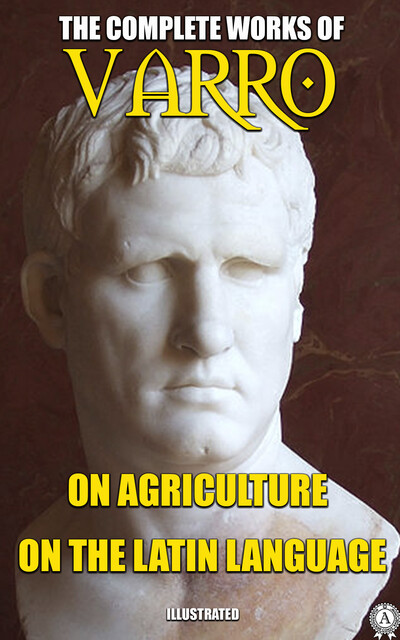



автордың кітабын онлайн тегін оқу The Complete Works of Marcus Terentius Varro. Illustrated
The Complete Works of Marcus Terentius Varro
Illustrated
On Agriculture
On the Latin Language
Varro proved to be a highly productive writer and turned out more than 74 Latin works on a variety of topics. Among his many works, two stand out for historians; Nine Books of Disciplines and his compilation of the Varronian chronology. His Nine Books of Disciplines became a model for later encyclopedists, especially Pliny the Elder.
Varro`s only complete work extant, Rerum rusticarum libri tres (Three Books on Agriculture), has been described as "the well digested system of an experienced and successful farmer who has seen and practised all that he records."
The compilation of the Varronian chronology was an attempt to determine an exact year-by-year timeline of Roman history up to his time.
Varro was recognized as an important source by many other ancient authors, among them Cicero, Pliny the Elder, Virgil in the Georgics, Columella, Aulus Gellius, Macrobius, Augustine, and Vitruvius.
One noteworthy aspect of the work is his anticipation of microbiology and epidemiology. Varro warned his contemporaries to avoid swamps and marshland, since in such areas “...there are bred certain minute creatures which cannot be seen by the eyes, but which float in the air and enter the body through the mouth and nose and cause serious diseas.”
On Agriculture
On the Latin Language
ON AGRICULTURE
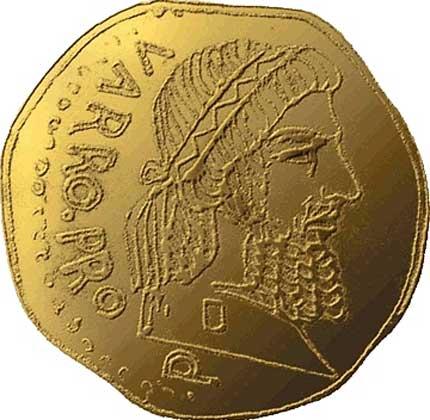
Varro was born in Reate, now Rieti, to a family of equestrian rank, which owned a large farm in the Reatine plain, near Lago di Ripa Sottile. He supported Pompey, reaching the office of praetor, after having been tribune of the people, quaestor and curule aedile. Varro’s literary output was prolific; with scholars estimating him to have produced 74 works in approximately 620 books, of which only one work survives complete, although we possess numerous fragments of the others, many contained in Gellius’ Attic Nights. Regarded as “the most learned of the Romans” by Quintilian (Inst. Or. X.1.95), Varro was recognised as an important source by many other ancient authors, including Cicero, Pliny the Elder, Virgil, Aulus Gellius, Macrobius, Augustine and Vitruvius, who credits him with a book on architecture.
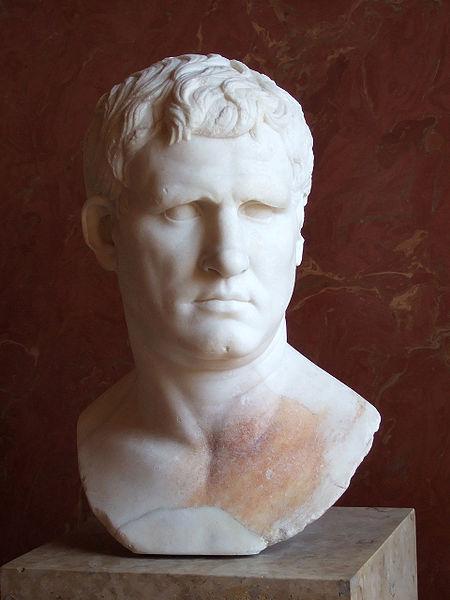
Varro’s only complete extant work is Rerum rusticarum libri tres (On Agriculture), formed of three books. The work concerns country affairs, opening with an effective setting of the agricultural scene, while also employing dialogue. The first book covers the themes of agriculture and farm management, the second deals with sheep and oxen, while the third concludes with poultry and the keeping of other animals, including bees and fishponds. The text is notable for its lively interludes, as well as graphic background detail concerning political events, of which Varro was a key figure.
LOEB CLASSICAL LIBRARY TRANSLATION (HOOPER)
Translated by William Davis Hooper and Revised by Harrison Boyd Ash
BOOK I
[1.1] Had I possessed the leisure, Fundania, I should write in a more serviceable form what now I must set forth as I can, reflecting that I must hasten; for if man is a bubble, as the proverb has it, all the more so is an old man. For my eightieth year admonishes me to gather up my pack before I set forth from life. [2] Wherefore, since you have bought an estate and wish to make it profitable by good cultivation, and ask that I concern myself with the matter, I will make the attempt; and in such wise as to advise you with regard to the proper practice not only while I live but even after my death. [3] And I cannot allow the Sibyl to have uttered prophecies which benefited mankind not only while she lived, but even after she had passed away, and that too people whom she never knew — for so many years later we are wont officially to consult her books when we desire to know what we should do after some portent — and not do something, even while I am alive, to help my friends and kinsfolk. [4] Therefore I shall write for you three handbooks to which you may turn whenever you wish to know, in a given case, how you ought to proceed in farming. And since, as told, the gods help those who call upon them, I will first invoke them — not the Muses, as Homer and Ennius do, but the twelve councillor-gods; and I do not mean those urban gods, whose images stand around the forum, bedecked with gold, six male and a like number female, but those twelve gods who are the special patrons of husbandmen. [5] First, then, I invoke Jupiter and Tellus, who, by means of the sky and the earth, embrace all the fruits of agriculture; and hence, as we are told that they are the universal parents, Jupiter is called “the Father,” and Tellus is called “Mother Earth.” And second, Sol and Luna, whose courses are watched in all matters of planting and harvesting. Third, Ceres and Liber, because their fruits are most necessary for life; for it is by their favour that food and drink come from the farm. [6] Fourth, Robigus and Flora; for when they are propitious the rust will not harm the grain and the trees, and they will not fail to bloom in their season; wherefore, in honour of Robigus has been established the solemn feast of the Robigalia, and in honour of Flora the games called the Floralia. Likewise I beseech Minerva and Venus, of whom the one protects the oliveyard and the other the garden; and in her honour the rustic Vinalia has been established. And I shall not fail to pray also to Lympha and Bonus Eventus, since without moisture all tilling of the ground is parched and barren, and without success and “good issue” it is not tillage but vexation. [7] Having now duly invoked these divinities, I shall relate the conversations which we had recently about agriculture, from which you may learn what you ought to do; and if matters in which you are interested are not treated, I shall indicate the writers, both Greek and Roman, from whom you may learn them.
Those who have written various separate treatises in Greek, one on one subject, another on another, are more than fifty in number. [8] The following are those whom you can call to your aid when you wish to consider any point: Hiero of Sicily and Attalus Philometor; of the philosophers, Democritus the naturalist, Xenophon the Socratic, Aristotle and Theophrastus the Peripatetics, Archytas the Pythagorean, and likewise Amphilochus of Athens, Anaxipolis of Thasos, Apollodorus of Lemnos, Aristophanes of Mallos, Antigonus of Cyme, Agathocles of Chios, Apollonius of Pergamum, Aristandrus of Athens, Bacchius of Miletus, Bion of Soli, Chaerestus and Chaereas of Athens, Diodorus of Priene, Dion of Colophon, Diophanes of Nicaea, Epigenes of Rhodes, Euagon of Thasos, the two Euphronii, one of Athens and the other of Amphipolis, Hegesias of Maronea, the two Menanders, one of Priene and the other of Heraclea, Nicesius of Maronea, and Pythion of Rhodes. [9] Among other writers, whose birthplace I have not learned, are: Androtion, Aeschrion, Aristomenes, Athenagoras, Crates, Dadis, Dionysius, Euphiton, Euphorion, Eubulus, Lysimachus, Mnaseas, Menestratus, Plentiphanes, Persis, Theophilus. All these whom I have named are prose writers; others have treated the same subjects in verse, as Hesiod of Ascra and Menecrates of Ephesus. [10] All these are surpassed in reputation by Mago of Carthage, who gathered into twenty-eight books, written in the Punic tongue, the subjects they had dealt with separately. These Cassius Dionysius of Utica translated into Greek and published in twenty books, dedicated to the praetor Sextilius. In these volumes he added not a little from the Greek writers whom I have named, taking from Mago’s writings an amount equivalent to eight books. Diophanes, in Bithynia, further abridged these in convenient form into six books, dedicated to King Deiotarus. [11] I shall attempt to be even briefer and treat the subject in three books, one on agriculture proper, the second on animal husbandry, the third on the husbandry of the steading, omitting in this book all subjects which I do not think have a bearing on agriculture. And so, after first showing what matter should be omitted, I shall treat of the subject, following the natural divisions. My remarks will be derived from three sources: what I have myself observed by practice on my own land, what I have read, and what I have heard from experts.
[2.1] On the festival of the Sementivae I had gone to the temple of Tellus at the invitation of the aeditumnus (sacristan), as we have been taught by our fathers to call him, or of the aedituus, as we are being set right on the word by our modern purists. I found there Gaius Fundanius, my father-in-law, Gaius Agrius, a Roman knight of the Socratic school, and Publius Agrasius, the tax-farmer, examining a map of Italy painted on the wall. “What are you doing here?” said I. “Has the festival of the Sementivae brought you here to spend your holiday, as it used to bring our fathers and grandfathers?” [2] “I take it,” replied Agrius, “that the same reason brought us which brought you — the invitation of the sacristan. If I am correct, as your nod implies, you will have to await with us his return; he was summoned by the aedile who has supervision of this temple, and has not yet returned; and he left a man to ask us to wait for him. Do you wish us then meanwhile to follow the old proverb, ‘the Roman wins by sitting still,’ until he returns?” “By all means,” replied Agrius; and reflecting that the longest part of the journey is said to be the passing of the gate, he walked to a bench, with us in his train.
[3] When we had taken our seats Agrasius opened the conversation: “You have all travelled through many lands; have you seen any land more fully cultivated than Italy?” “For my part,” replied Agrius, “I think there is none which is so wholly under cultivation. Consider first: Eratosthenes, following a most natural division, has divided the earth into two parts, [4] one to the south and the other to the north; and since the northern part is undoubtedly more healthful than the southern, while the part which is more healthful is more fruitful, we must agree that Italy at least was more suited to cultivation than Asia. In the first place, it is in Europe; and in the next place, this part of Europe has a more temperate climate than we find farther inland. For the winter is almost continuous in the interior, and no wonder, since its lands lie between the arctic circle and the pole, where the sun is not visible for six months at a time; wherefore we are told that even navigation in the ocean is not possible in that region because of the frozen sea.” [5] “Well,” remarked Fundanius, “do you think that anything can germinate in such a land, or mature if it does germinate? That was a true saying of Pacuvius, that if either day or night be uninterrupted, all the fruits of the earth perish, from the fiery vapour or from the cold. For my part, I could not live even here, where the night and the day alternate at moderate intervals, if I did not break the summer day with my regular midday nap; [6] but there, where the day and the night are each six months long, how can anything be planted, or grow, or be harvested? On the other hand, what useful product is there which not only does not grow in Italy, but even grow to perfection? What spelt shall I compare to the Campanian, what wheat to the Apulian, what wine to the Falernian, what oil to the Venafran? Is not Italy so covered with trees that the whole land seems to be an orchard? [7] Is that Phrygia, which Homer calls ‘the vine-clad,’ more covered with vines than this land, or Argos, which the same poet calls ‘the rich in corn,’º more covered with wheat? In what land does one iugerum bear ten and fifteen cullei of wine, as do some sections of Italy? Or does not Marcus Cato use this language in his Origines? ‘The land lying this side of Ariminum and beyond the district of Picenum, which was allotted to colonists, is called Gallo-Roman. In that district, at several places, ten cullei of wine are produced to the iugerum.’ Is not the same true of the district of Faventia? The vines there are called by this writer trecenariae, from the fact that the iugerum yields three hundred amphorae.” And he added, turning to me, “At least your friend, Marcius Libo, the engineer officer, used to tell me that the vines on his estate at Faventia bore this quantity. [8] The Italian seems to have had two things particularly in view in his farming: whether the land would yield a fair return for the investment in money and labour, and whether the situation was healthful or not. If either of these elements is lacking, any man who, in spite of that fact, desires to farm has lost his wits, and should be taken in charge by his kinsmen and family. For no sane man should be willing to undergo the expense and outlay of cultivation if he sees that it cannot be recouped; or, supposing that he can raise a crop, if he sees that it will be destroyed by the unwholesomeness of the situation. [9] But, I think, there are some gentlemen present who can speak with more authority on these subjects; for I see Gaius Licinius Stolo and Gnaeus Tremelius Scrofa approaching, one of them a man whose ancestors originated the bill to regulate the holding of land (for that law which forbids a Roman citizen to hold more than 500 iugera was proposed by a Stolo), and who has proved the appropriateness of the family name by his diligence in farming; he used to dig around his trees so thoroughly that there could not be found on his farm a single one of those suckers which spring up from the roots and are called stolones. Of the same farm was that Gaius Licinius who, when he was tribune of the plebs, 365 years after the expulsion of the kings, was the first to lead people, for the hearing of laws, from the comitium into the “farm” of the forum. [10] The other whom I see coming is your colleague, who was of the Commission of Twenty for parcelling the Campanian lands, Gnaeus Tremelius Scrofa, a man distinguished by all virtues, who is esteemed the Roman most skilled in agriculture.” “And justly so,” I exclaimed. “For his estates, because of their high cultivation, are a more pleasing sight to many than the country seats of others, furnished in a princely style. When people come to inspect his farmsteads, it is not to see collections of pictures, as at Lucullus’s, but collections of fruit. The top of the Via Sacra,” I added, “where fruit brings its weight in gold, is a very picture of his orchard.”
[11] While we were speaking they came up, and Stolo inquired: “We haven’t arrived too late for dinner? For I do not see Lucius Fundilius, our host.” “Do not be alarmed,” replied Agrius, “for not only has that egg which shows the last lap of the chariot race at the games in the circus not been taken down, but we have not even seen that other egg which usually heads the procession at dinner. [12] And so, while you and we are waiting to see the latter, and our sacristan is returning, tell us what end agriculture has in view, profit, or pleasure, or both; for we are told that you are now the past-master of agriculture, and that Stolo formerly was.” “First,” remarked Scrofa, “we should determine whether we are to include under agriculture only things planted, or also other things, such as sheep and cattle, which are brought on to the land. [13] For I observe that those who have written on agriculture, whether in Punic, or Greek, or Latin, have wandered too far from the subject.” “For my part,” replied Stolo, “I do not think that they are to be imitated in every respect, but that certain of them have acted wisely in confining the subject to narrower limits, and excluding matters which do not bear directly on this topic. Thus the whole subject of grazing, which many writers include under agriculture, seems to me to concern the herdsman rather than the farmer. [14] For that reason the persons who are placed in charge of the two occupations have different names, one being called vilicus, and the other magister pecoris. The vilicus is appointed for the purpose of tilling the ground, and the name is derived from villa, the place into which the crops are hauled (vehuntur), and out of which they are hauled by him when they are sold. For this reason the peasants even now call a road veha, because of the hauling; and they call the place to which and from which they haul vella and not villa. In the same way, those who make a living by hauling are said facere velaturam.” [15] “Certainly,” said Fundanius, “grazing and agriculture are different things, though akin; just as the right pipe of the tibia is different from the left, but still in a way united, inasmuch as the one is the treble, while the other plays the accompaniment of the same air.” [16] “You may even add this,” said I, “that the shepherd’s life is the treble, and the farmer’s plays the accompaniment, if we may trust that most learned man, Dicaearchus. In his sketch of Greek life from the earliest times, he says that in the primitive period, when people led a pastoral life, they were ignorant even of ploughing, of planting trees, and of pruning, and that agriculture was adopted by them only at a later period. Wherefore the art of agriculture ‘accompanies’ the pastoral because it is subordinate, as the left pipe is to the stops of the right.” [17] “You and your piping,” retorted Agrius, “are not only robbing the master of his flock and the slaves of their peculium — the grazing which their master allows them — but you are even abrogating the homestead laws, among which we find one reciting that the shepherd may not graze a young orchard with the offspring of the she-goat, a race which astrology, too, has placed in the heavens, not far from the Bull.” [18] “Be careful, Agrius,” interrupted Fundanius, “that your citation cannot be wide of the mark; for it is also written in the law, ‘a certain kind of flock.’ For certain kinds of animals are the foes of plants, and even poisonous, such as the goats of which you spoke; for they destroy all young plants by their browsing, and especially vines and olives. [19] Accordingly there arose a custom, from opposite reasons, that a victim from the goat family might be led to the altar of one god, but might not be sacrificed on the altar of another; since, because of the same hatred, the one was not willing to see a goat, while the other was pleased to see him die. So it was that he-goats were offered to father Bacchus, the discoverer of the vine, so that they might pay with their lives for the injuries they do him; while, on the other hand, no member of the goat family was sacrificed to Minerva on account of the olive, because it is said that any olive plant which they bite becomes sterile; for their spittle is poisonous to its fruit. [20] For this reason, also, they are not driven into the acropolis at Athens except once a year, for a necessary sacrifice — to avoid the danger of having the olive tree, which is said to have originated there, touched by a she-goat.” “Cattle are not properly included in a discussion on agriculture,” said I, “except those which enhance the cultivation of the land by their labour, such as those which can plough under the yoke.” [21] “If that is so,” replied Agrasius, “how can cattle be kept off the land, when manure, which enhances its value very greatly, is supplied by the herds?” “By that method of reasoning,” retorted Agrius, “we may assert that slave-trading is a branch of agriculture, if we decide to keep a gang for that purpose. The error lies in the assumption that, because cattle can be kept on the land and be a source of profit there, they are part of agriculture. It does not follow; for by that reasoning we should have to embrace other things quite foreign to agriculture; as, for instance, you might keep on your farm a number of spinners, weavers, and other artisans.”
“Very well,” said Scrofa, “let us exclude grazing from agriculture, and whatever else anyone wishes.” [22] “Am I, then,” said I, “to follow the writings of the elder and the younger Saserna, and consider that how to manage clay-pits is more related to agriculture than mining for silver or other mining such as undoubtedly is carried out on some land? [23] But as quarries for stone or sand-pits are not related to agriculture, so too clay-pits. This is not to say that they are not to be worked on land where it is suitable and profitable; as further, for instance, if the farm lies along a road and the site is convenient for travellers, a tavern might be built; however profitable it might be, still it would form no part of agriculture. For it does not follow that whatever profit the owner makes on account of the land, or even on the land, should be credited to the account of agriculture, but only that which, as the result of sowing, is born of the earth for our enjoyment.” [24] “You are jealous of that great writer,” interrupted Stolo, “and you attack his potteries carpingly, while passing over the excellent observations he makes bearing very closely on agriculture, so as not to praise them.” [25] This brought a smile from Scrofa, who knew the books and despised them; and Agrasius, thinking that he alone knew them, asked Stolo to give a quotation. “This is his recipe for killing bugs,” he said: “ ‘Soak a wild cucumber in water, and wherever you sprinkle the water the bugs will not come.’ And again, ‘Grease your bed with ox gall, mixed with vinegar.’ “ [26] “And still it is good advice,” said Fundanius, glancing at Scrofa, “even if he did write it in a book on agriculture.” “Just as good, by Hercules,” he replied, “as this one for the making of a depilatory: ‘Throw a yellow frog into water, boil it down to one-third, and rub the body with it.’ “ “It would be better for you to quote from that book,” said I, “a passage which bears more closely on the trouble from which Fundanius suffers; for his feet are always hurting him and bringing wrinkles to his brow.” [27] “Tell me, pray,” exclaimed Fundanius; “I would rather hear about my feet than how beet-roots ought to be planted.” “I will tell you,” said Stolo, with a smile, “in the very words in which he wrote it (at least I have heard Tarquenna say that when a man’s feet begin to hurt he may be cured if he will think of you): ‘I am thinking of you, cure my feet. The pain go in the ground, and may my feet be sound.’ He bids you chant this thrice nine times, touch the ground, spit on it, and be fasting while you chant.” [28] “You will find many other marvels in the books of the Sasernas,” said I, “which are all just as far away from agriculture and therefore to be disregarded.” “Just as if,” said he, “such things are not found in other writers also. Why, are there not many such items in the book of the renowned Cato, which he published on the subject of agriculture, such as his recipes for placenta, for libum, and for the salting of hams?” “You do not mention that famous one of his composing,” said Agrius: “ ‘If you wish to drink deep at a feast and to have a good appetite, eat some half-dozen leaves of raw cabbage with vinegar before dinner.’”
[3.1] “Well, then,” said Agrasius, “since we have decided the nature of the subjects which are to be excluded from agriculture, tell us whether the knowledge of those things used in agriculture is an art or not, and trace its course from starting-point to goal.” Glancing at Scrofa, Stolo said: “You are our superior in age, in position, and in knowledge, so you ought to speak.” And he, nothing loath, began: “In the first place, it is not only an art but an important and noble art. It is, as well, a science, which teaches what crops are to be planted in each kind of soil, and what operations are to be carried on, in order that the land may regularly produce the largest crops.
[4.1] “Its elements are the same as those which Ennius says are the elements of the universe — water, earth, air, and fire. You should have some knowledge of these before you cast your seed, which is the first step in all production. Equipped with this knowledge, the farmer should aim at two goals, profit and pleasure; the object of the first is material return, and of the second enjoyment. The profitable plays a more important rôle than the pleasurable; [2] and yet for the most part the methods of cultivation which improve the aspect of the land, such as the planting of fruit and olive trees in rows, make it not only more profitable but also more saleable, and add to the value of the estate. For any man would rather pay more for a piece of land which is attractive than for one of the same value which, though profitable, is unsightly. [3] Further, land which is more wholesome is more valuable, because on it the profit is certain; while, on the other hand, on land that is unwholesome, however rich it may be, misfortune does not permit the farmer to reap a profit. For where the reckoning is with death, not only is the profit uncertain, but also the life of the farmers; so that, lacking wholesomeness, agriculture becomes nothing else than a game of chance, in which the life and the property of the owner are at stake. [4] And yet this risk can be lessened by science; for, granting that healthfulness, being a product of climate and soil, is not in our power but in that of nature, still it depends greatly on us, because we can, by care, lessen the evil effects. For if the farm is unwholesome on account of the nature of the land or the water, from the miasma which is exhaled in some spots; or if, on account of the climate, the land is too hot or the wind is not salubrious, these faults can be alleviated by the science and the outlay of the owner. The situation of the buildings, their size, the exposure of the galleries, the doors, and the windows, are matters of the highest importance. [5] Did not that famous physician, Hippocrates, during a great pestilence save not one farm but many cities by his skill? But why do I cite him? Did not our friend Varro here, when the army and fleet were at Corcyra, and all the houses were crowded with the sick and the dead, by cutting new windows to admit the north wind, and shutting out the infected winds, by changing the position of doors, and other precautions of the same kind, bring back his comrades and his servants in good health?
[5.1] “But as I have stated the origin and the limits of the science, it remains to determine the number of its divisions.” “Really,” said Agrius, “it seems to me that they are endless, when I read the many books of Theophrastus, those which are entitled ‘The History of Plants’ and ‘The Causes of Vegetation.’ “ [2] “His books,” replied Stolo, “are not so well adapted to those who wish to tend land as to those who wish to attend the schools of the philosophers; which is not to say that they do not contain matter which is both profitable and of general interest. [3] So, then, do you rather explain to us the divisions of the subject.” “The chief divisions of agriculture are four in number,” resumed Scrofa: “First, a knowledge of the farm, comprising the nature of the soil and its constituents; second, the equipment needed for the operation of the farm in question; third, the operations to be carried out on the place in the way of tilling; and fourth, the proper season for each of these operations. [4] Each of these four general divisions is divided into at least two subdivisions the first comprises questions with regard to the soil as such, and those which pertain to housing and stabling. The second division, comprising the movable equipment which is needed for the cultivation of the farm, is also subdivided into two: the persons who are to do the farming, and the other equipment. The third, which covers operations, is subdivided: the plans to be made for each operation, and where each is to be carried on. The fourth, covering the seasons, is subdivided: those which are determined by the annual revolution of the sun, and those determined by the monthly revolution of the moon. I shall discuss first the four chief divisions, and then the eight subdivisions in more detail.
[6.1] “First, then, with respect to the soil of the farm, four points must be considered: the conformation of the land, the quality of the soil, its extent, and in what way it is naturally protected. As there are two kinds of conformation, the natural and that which is added by cultivation, in the former case one piece of land being naturally good, another naturally bad, and in the latter case one being well tilled, another badly, I shall discuss first the natural conformation. [2] There are, then, with respect to the topography, three simple types of land — plain, hill, and mountain; though there is a fourth type consisting of a combination of these, as, for instance, on a farm which may contain two or three of those named, as may be seen in many places. Of these three simple types, undoubtedly a different system is applicable to the lowlands than to the mountains, because the former are hotter than the latter; and the same is true of hillsides, because they are more temperate than either the plains or the mountains. [3] These qualities are more apparent in broad stretches, when they are uniform; thus the heat is greater where there are broad plains, and hence in Apulia the climate is hotter and more humid, while in mountain regions, as on Vesuvius, the air is lighter and therefore more wholesome. Those who live in the lowlands suffer more in summer; those who live in the uplands suffer more in winter; the same crops are planted earlier in the spring in the lowlands than in the uplands, and are harvested earlier, while both sowing and reaping come later in the uplands. [4] Certain trees, such as the fir and the pine, flourish best and are sturdiest in the mountains on account of the cold climate, while the poplar and the willow thrive here where the climate is warmer; the arbute and the oak do better in the upland, the almond and the mariscan fig in the lowlands. On the foothills the growth is nearer akin to that of the plains than to that of the mountains; on the higher hills the opposite is true. [5] Owing to these three types of configuration different crops are planted, grain being considered best adapted to the plains, vines to the hills, and forests to the mountains. Usually the winter is better for those who live in the plains, because at that season the pastures are fresh, and pruning can be carried on in more comfort. On the other hand, the summer is better in the mountains, because there is abundant forage at that time, whereas it is dry in the plains, and the cultivation of the trees is more convenient because of the cooler air. [6] A lowland farm that everywhere slopes regularly in one direction is better than one that is perfectly level, because the latter, having no outlet for the water, tends to become marshy. Even more unfavourable is one that is irregular, because pools are liable to form in the depressions. These points and the like have their differing importance for the cultivation of the three types of configuration.”
[7.1] “So far as concerns the natural situation,” said Stolo, “it seems to me that Cato was quite right when he said that the best farm was one that was situated at the foot of a mountain, facing south.” [2] Scrofa continued: “With regard to the conformation due to cultivation, I maintain that the more regard is had for appearances the greater will be the profits: as, for instance, if those who have orchards plant them in quincunxes, with regular rows and at moderate intervals. Thus our ancestors, on the same amount of land but not so well laid out, made less wine and grain than we do, and of a poorer quality; for plants which are placed exactly where each should be take up less ground and screen each other less from the sun, the moon, and the air. [3] You may prove this by one of several experiments; for instance, a quantity of nuts which you can hold in a modius measure with their shells whole, because the shells naturally keep them compacted, you can scarcely pack into a modius and a half when they are cracked. [4] As to the second point, trees which are planted in a row are warmed by the sun and the moon equally on all sides, with the result that more grapes and olives form, and that they ripen earlier; which double result has the double consequence that they yield more must and oil, and of greater value.
[5] “We come now to the second division of the subject, the type of soil of which the farm is composed. It is in respect of this chiefly that a farm is considered good or bad; for it determines what crops, and of what variety, can be planted and raised on it, as not all crops can be raised with equal success on the same land. As one type is suited to the vine and another to grain, so of others — one is suited to one crop, another to another. [6] Thus near Cortynia, in Crete, there is said to be a plane tree which does not shed its leaves in winter, and another in Cyprus, according to Theophrastus. Likewise at Sybaris, which is now called Thurii, there is said to be an oak tree of like character, in sight of the town; and that near Elephantine neither the fig nor the vine sheds its leaves — which is quite the opposite of what happens with us. For the same reason there are many trees which bear two crops a year, such as the vine on the coast near Smyrna, and the apple in the district of Consentia. [7] The fact that trees produce more fruit in uncultivated spots, and better fruit under cultivation, proves the same thing. For the same reason there are plants which cannot live except in marshy ground, or actually in the water and not in every kind of water. Some grow in ponds, as the reeds near Reate, others in streams, as the alder trees in Epirus, and still others in the sea, as the palms and squills of which Theophrastus writes. [8] When I was in command of the army in the interior of Transalpine Gaul near the Rhine, I visited a number of spots where neither vines nor olives nor fruit trees grew; where they fertilized the land with a white chalk which they dug; where they had no salt, either mineral or marine, but instead of it used salty coals obtained by burning certain kinds of wood.” [9] “Cato, you know,” interjected Stolo, “in arranging plots according to the degree of existence, formed nine categories: first, land on which vines can bear a large quantity of wine of good quality; second, land suited for a watered garden; third, for an osier bed; fourth, for olives; fifth, for meadows; sixth, for a grain field; seventh, for a wood lot: eighth, for an orchard; ninth, for a mast grove.” [10] “I know he wrote that,” replied Scrofa, “but all authorities do not agree with him on this point. There are some who assign the first place to good meadows, and I am one of them. Hence our ancestors gave the name prata to meadow-land as being ready (parata). Caesar Vopiscus, once an aedile, in pleading a case before the censors, spoke of the plains of Rosea as the nursing-ground of Italy, such that if a rod were left there overnight, it would be lost the next morning on account of the growth of the grass.
[8.1] “As an argument against the vineyard, there are those who claim that the cost of upkeep swallows up the profits. In my opinion, it depends on the kind of vineyard, for there are several: for some are low-growing and without props, as in Spain; others tall, which are called ‘yoked,’ as generally in Italy. For this latter class there are two names, pedamenta and iuga: those on which the vine runs vertically are called pedamenta (stakes), and those on which it runs transversely are called iuga (yokes); and from this comes the name ‘yoked vines.’ [2] Four kinds of ‘yokes’ are usually employed, made respectively of poles, of reeds, of cords, and of vines: the first of these, for example, around Falernum, the second around Arpi, the third around Brundisium, the fourth around Mediolanum. There are two forms of this trellising: in straight lines, as in the district of Canusium, or yoked lengthways and sideways in the form of the compluvium, as is the practice generally in Italy. If the material grows on the place the vineyard does not mind the expense; and it is not burdensome if much of it can be obtained in the neighbourhood. [3] The first class I have named requires chiefly a willow thicket, the second a reed thicket, the third a rush bed or some material of the kind. For the fourth you must have an arbustum, where trellises can be made of the vines, as the people of Mediolanum do on the trees which they call opuli (maples), and the Canusians on lattice-work in fig trees. [4] Likewise, there are, as a rule, four types of props. The best for common use in the vineyard is a stout post, called ridica, made of oak or juniper. The second best is a stake made from a branch, and preferably from a tough one, so that it will last longer; when one end has rotted in the ground the stake is reversed, what had been the top becoming the bottom. The third, which is used only as a substitute when the others are lacking, is formed of reeds; bundles of these, tied together with bark, are planted in what they call cuspides, earthenware pipes with open bottoms so that the casual water can run out. The fourth is the natural prop, where the vineyard is formed of vines growing across from tree to tree; such traverses are called by some rumpi. [5] The limit to the height of the vineyard is the height of a man, and the intervals between the props should be sufficient to allow a yoke of oxen to plough between. The most economical type of vineyard is that which furnishes wine to beaker without the aid of trellises. There are two kinds of these: one in which the ground serves as a bed for the grapes, as in many parts of Asia. The foxes often share the harvest with man in such vineyards, and if the land breeds mice the yield is cut short unless you fill the whole vineyard with traps, as they do in the island Pandateria. [6] In the other type only those branches are raised from the ground which give promise of producing fruit. These are propped on forked sticks about two feet long, at the time when the grapes form, so that they may not wait until the harvest is over to learn to hang in a bunch by means of a string or the fastening which our fathers called a cestus. In such a vineyard, as soon as the master sees the back of the vintager he takes his forks back to hibernate under cover so that he may be able to enjoy their assistance without cost the next year. In Italy the people of Reate practise this custom. [7] This variation in culture is caused chiefly by the fact that the nature of the soil makes a great difference; where this is naturally humid the vine must be trained higher, because while the wine is forming and ripening it does not need water, as it does in the cup, but sun. And that is the chief reason, I think, that the vines climb up trees.
[9.1] “The nature of the soil, I say, makes a great difference, in determining to what it is or is not adapted. The word terra is used in three senses, the general, the specific, and the mixed. It is used in the general sense when we speak of the orbis terrae, or of the terra of Italy or any other country; for in that designation are included rock, and sand, and other such things. The word is used specifically in the second sense when it is employed without the addition of a qualifying word or epithet. [2] It is used in the third or mixed sense, of the element in which seed can be planted and germinate — such as clay soil, rocky soil, etc. In this last sense of the word there are as many varieties of earth as when it is used in the general sense, on account of the different combinations of substances. For there are many substances in the soil, varying in consistency and strength, such as rock, marble, rubble, sand, loam, clay, red ochre, dust, chalk, ash, carbuncle (that is, when the ground becomes so hot from the sun that it chars the roots of plants); [3] and soil, using the word in its specific sense, is called chalky or . . . according as one of these elements predominates — and so of other types of soil. The classes of these vary in such a way that there are, besides other subdivisions, at least three for each type: rocky soil, for instance, may be very rocky, or moderately rocky, or almost free of rocks, and in the case of other varieties of mixed soil the same three grades are distinguished. [4] And further, each of these three grades contains three grades: one may be very wet, one very dry, one intermediate. And these distinctions are not without the greatest importance for the crops; thus the intelligent farmer plants spelt rather than wheat on wet land, and on the other hand barley rather than spelt on dry land, while he plants either on the intermediate. [5] Furthermore, even finer distinctions are made in all these classes, as, for instance, in loamy soil it makes a difference whether the loam be white or red, as the whitish loam is not suited to nurseries, while the reddish is well adapted. Thus there are three chief distinctions in soil, according as it is poor, rich, or medium; the rich being able to produce many kinds of vegetation, and the poor quite the opposite. In thin soil, as, for instance, in Pupinia, you see no sturdy trees, nor vigorous vines, nor stout straw, nor mariscan figs, and most of the trees are covered with moss, as are the parched meadows. [6] On the other hand, in rich soil, like that in Etruria, you can see rich crops, land that can be worked steadily, sturdy trees, and no moss anywhere. In the case of medium soil, however, such as that near Tibur, the nearer it comes to not being thin than to being sterile, the more it is suited to all kinds of growth than if it inclined to the poorer type.” [7] “Diophanes of Bithynia makes a good point,” remarked Stolo, “when he writes that you can judge whether land is fit for cultivation or not, either from the soil itself or from the vegetation growing on it: from the soil according as it is white or black, light and crumbling easily when it is dug, of a consistency not ashy and not excessively heavy; from the wild vegetation growing on it if it is luxuriant and bearing abundantly its natural products. But proceed to your third topic, that of measurement.”
[10.1] Scrofa resumed: “Each country has its own method of measuring land. Thus in farther Spain the unit of measure is the iugum, in Campania the versus, with us here in the district of Rome and in Latium the iugerum. The iugum is the amount of land which a yoke of oxen can plough in a day; the versus is an area 100 feet square; [2] the iugerum an area containing two square actus. The square actus, which is an area 120 feet in each direction, is called in Latin acnua. The smallest section of the iugerum, an area ten feet square, is called a scripulum; and hence surveyors sometimes speak of the odd fractions of land above the iugerum as an uncia or a sextans, or the like; for the iugerum contains 288 scripula, which was the weight of the old pound before the Punic War. Two iugera form a haeredium, from the fact that this amount was said to have been first allotted to each citizen by Romulus, as the amount that could be transmitted by will. Later on 100 haeredia were called a centuria; this is a square area, each side being 2400 feet long. Further, four such centuriae, united in such a way that there are two on each side, are called a saltus in the distribution of public lands.
[11.1] “Many errors result from the failure to observe the measurement of the farm, some building a steading smaller and some larger than the dimensions demand — each of which is prejudicial to the estate and its revenue. For buildings which are too large cost us too much for construction and require too great a sum for upkeep; and if they are smaller than the farm requires the products are usually ruined. [2] There is no doubt, for instance, that a larger wine cellar should be built on an estate where there is a vineyard, and larger granaries if it is a grain farm.
“The steading should be so built that it will have water, if possible, within the enclosure, or at least very near by. The best arrangement is to have a spring on the place, or, failing this, a perennial stream. If no running water is available, cisterns should be built under cover and a reservoir in the open, the one for the use of people and the other for cattle.
[12.1] “Especial care should be taken, in locating the steading, to place it at the foot of a wooded hill, where there are broad pastures, and so as to be exposed to the most healthful winds that blow in the region. A steading facing the east has the best situation, as it has the shade in summer and the sun in winter. If you are forced to build on the bank of a river, be careful not to let the steading face the river, as it will be extremely cold in winter, and unwholesome in summer. [2] Precautions must also be taken in the neighbourhood of swamps, both for the reasons given, and because there are bred certain minute creatures which cannot be seen by the eyes, which float in the air and enter the body through the mouth and nose and there cause serious diseases.” “What can I do,” asked Fundanius, “to prevent disease if I should inherit a farm of that kind?” “Even I can answer that question,” replied Agrius; “sell it for the highest cash price; or if you can’t sell it, abandon it.” [3] Scrofa, however, replied: “See that the steading does not face in the direction from which the infected wind usually comes, and do not build in a hollow, but rather on elevated ground, as a well-ventilated place is more easily cleared if anything obnoxious is brought in. Furthermore, being exposed to the sun during the whole day, it is more wholesome, as any animalculae which are bred near by and brought in are either blown away or quickly die from the lack of humidity. [4] Sudden rains and swollen streams are dangerous to those who have their buildings in low-lying depressions, as are also the sudden raids of robber bands, who can more easily take advantage of those who are off their guard. Against both these dangers the more elevated situations are safer.
[13.1] “In laying out the steading, you should arrange the stables so that the cow-stalls will be at the place which will be warmest in winter. Such liquid products as wine and oil should be set away in store-rooms on level ground, and jars for oil and wine should be provided; while dry products, such as beans and hay, should be stored in a floored space. A place should be provided for the hands to stay in when they are tired from work or from cold or heat, where they can recover in comfort. [2] The overseer’s room should be next to the entrance, where he can know who comes in or goes out at night and what he takes; and especially if there is no porter. Especially should care be taken that the kitchen be conveniently placed, because there in winter there is a great deal going on before daylight, in the preparation and eating of food. Sheds of sufficient size should also be provided in the barnyard for the carts and all other implements which are injured by rain; for if these are kept in an enclosure inside the walls, but in the open, they will not have to fear thieves, yet they will be exposed to injurious weather. [3] On a large farm it is better to have two farm-yards: one, containing an outdoor reservoir — a pond with running water, which, surrounded by columns, if you like, will form a sort of fish-pond; for here the cattle will drink, and here they will bathe themselves when brought in from ploughing in the summer, not to mention the geese and hogs and pigs when they come from pasture; and in the outer yard there should be a pond for the soaking of lupines and other products which are rendered more fit for use by being immersed in water. [4] As the outer yard is often covered with chaff and straw trampled by the cattle, it becomes the handmaid of the farm because of what is cleaned off it. Hard by the steading there should be two manure pits, or one pit divided into two parts; into one part should be cast the fresh manure and from the other the rotted manure should be hauled into the field; for manure is not so good when it is put in fresh as when it is well rotted. The best type of manure pit is that in which the top and sides are protected from the sun by branches and leaves; for the sun ought not to dry out the essence which the land needs. It is for this reason that experienced farmers arrange it, when possible, so that water will collect there, for in this way the strength is best retained; and some people place the privies for the servants on it. [5] You should build a shed large enough to store the whole yield of the farm under cover. This shed, which is sometimes called a nubilarium, should be built hard by the floor on which you are to thresh the grain; it should be of a size proportioned to that of the farm, and open only on one side, that next to the threshing floor, so that you can easily throw out the grain for threshing, and quickly throw it back again, if it begins to ‘get cloudy.’ You should have windows on the side from which it can be ventilated most easily.” [6] “A farm is undoubtedly more profitable, so far as the buildings are concerned,” said Fundanius, “if you construct them more according to the thrift of the ancients than the luxury of the moderns; for the former built to suit the size of their crops, while the latter build to suit their unbridled luxury. Hence their farms cost more than their dwelling-houses, while now the opposite is usually the case. In those days a steading was praised if it had a good kitchen, roomy stables, and cellars for wine and oil in proportion to the size of the farm, with a floor sloping to a reservoir, because often, after the new wine is laid by, not only the butts which they use in Spain but also the jars which are used in Italy are burst by the fermentation of the must. [7] In like manner they took care that the steading should have everything else that was required for agriculture; while in these times, on the other hand, the effort is to have as large and handsome a dwelling-house as possible; and they vie with the ‘farm houses’ of Metellus and Lucullus, which they have built to the great damage of the state. What men of our day aim at is to have their summer dining-rooms face the cool east and their winter dining-rooms face the west, rather than, as the ancients did, to see on what side the wine and oil cellars have their windows; for in a cellar wine requires cooler air on the jars, while oil requires warmer. Likewise you should see that, if there be a hill, the house, unless something prevents, should be placed there by preference.”
[14.1] “Now I shall speak of the enclosures which are constructed for the protection of the farm as a whole, or its divisions. There are four types of such defences: the natural, the rustic, the military, and the masonry type; and each of these types has several varieties. The first type, the natural, is a hedge, usually planted with brush or thorn, having roots and being alive, and so with nothing to fear from the flaming torch of a mischievous passer-by. [2] The second type, the rustic, is made of wood, but is not alive. It is built either of stakes planted close and intertwined with brush; or of thick posts with holes bored through, having rails, usually two or three to the panel, thrust into the openings; or of trimmed trees placed end to end, with the branches driven into the ground. The third, or military type, is a trench and bank of earth; but the trench is adequate only if it can hold all the rain water, or has a slope sufficient to enable it to drain the water off the land. [3] The bank is serviceable which is close to the ditch on the inside, or so steep that it is not easy to climb. This type of enclosure is usually built along public roads and along streams. At several points along the Via Salaria, in the district of Crustumeria, one may see banks combined with trenches to prevent the river from injuring the fields. Banks built without trenches, such as occur in the district of Reate, are sometimes called walls. [4] The fourth and last type of fence, that of masonry, is a wall, and there are usually four varieties: that which is built of stone, such as occurs in the district of Tusculum; that of burned brick, such as occurs in the Ager Gallicus; that of sun-dried brick, such as occurs in the Sabine country; and that formed of earth and gravel in mounds, such as occurs in Spain and the district of Tarentum.
[15.1] “Furthermore, if there are no enclosures, the boundaries of the estate are made more secure by the planting of trees, which prevent the servants from quarrelling with the neighbours, and make it unnecessary to fix the boundaries by lawsuits. Some plant pines around the edges, as my wife has done on her Sabine farms; others plant cypresses, as I did on my place on Vesuvius; and still others plant elms, as many have done near Crustumeria. Where that is possible, as it is there because it is a plain, there is no tree better for planting; it is extremely profitable, as it often supports and gathers many a basket of grapes, yields a most agreeable foliage for sheep and cattle, and furnishes rails for fencing, and wood for hearth and furnace.
“These points, then, which I have discussed,” continued Scrofa, “are the four which are to be observed by the farmer: the topography of the land, the nature of the soil, the size of the plot, and the protection of the boundaries.
[16.1] “It remains to discuss the second topic, the conditions surrounding the farm, for they too vitally concern agriculture because of their relation to it. These considerations are the same in number: whether the neighbourhood is unsafe; whether it is such that it is not profitable to transport our products to it, or to bring back from it what we need; third, whether roads or streams for transportation are either wanting or inadequate; and fourth, whether conditions on the neighbouring farms are such as to benefit or injure our land. [2] Taking up the first of the four: the safety or lack of safety of the neighbourhood is important; for there are many excellent farms which it is not advisable to cultivate because of the brigandage in the neighbourhood, as in Sardinia certain farms near . . . . , and in Spain on the borders of Lusitania. Farms which have near by suitable means of transporting their products to market and convenient means of transporting thence those things needed on the farm, are for that reason profitable. For many have among their holdings some into which grain or wine or the like which they lack must be brought, and on the other hand not a few have those from which a surplus must be sent away. [3] And so it is profitable near a city to have gardens on a large scale; for instance, of violets and roses and many other products for which there is a demand in the city; while it would not be profitable to raise the same products on a distant farm where there is no market to which its products can be carried. Again, if there are towns or villages in the neighbourhood, or even well-furnished lands and farmsteads of rich owners, from which you can purchase at a reasonable price what you need for the farm, and to which you can sell your surplus, such as props, or poles, or reeds, the farm will be more profitable than if they must be fetched from a distance; sometimes, in fact, more so than if you can supply them yourself by raising them on your own place. [4] For this reason farmers in such circumstances prefer to have in their neighbourhood men whose services they can call upon under a yearly contract — physicians, fullers, and other artisans — rather than to have such men of their own on the farm; for sometimes the death of one artisan wipes out the profit of a farm. This department of a great estate rich owners are wont to entrust to their own people; for if towns or villages are too far away from the estate, they supply themselves with smiths and other necessary artisans to keep on the place, so that their farm hands may not leave their work and lounge around holiday-making on working days, rather than make the farm more profitable by attending to their duties. [5] It is for this reason, therefore, that Saserna’s book lays down the rule that no person shall leave the farm except the overseer, the butler, and one person whom the overseer may designate; if one leaves against this rule he shall not go unpunished, and if he does, the overseer shall be punished. The rule should rather be stated thus: that no one shall leave the farm without the direction of the overseer, nor the overseer without the direction of the master, on an errand which will prevent his return this day, and that no oftener than is necessary for the farm business. [6] A farm is rendered more profitable by convenience of transportation: if there are roads on which carts can easily be driven, or navigable rivers near by. We know that transportation to and from many farms is carried on by both these methods. The manner in which your neighbour keeps the land on the boundary planted is also of importance to your profits. For instance, if he has an oak grove near the boundary, you cannot well plant olives along such a forest; for it is so hostile in its nature that your trees will not only be less productive, but will actually bend so far away as to lean inward toward the ground, as the vine is wont to do when planted near the cabbage. As the oak, so large numbers of large walnut trees close by render the border of the farm sterile.
[17.1] “I have now discussed the four divisions of the estate which are concerned with the soil, and the second four, which are exterior to the soil but concern its cultivation; now I turn to the means by which land is tilled. Some divide these into two parts: men, and those aids to men without which they cannot cultivate; others into three: the class of instruments which is articulate, the inarticulate, and the mute; the articulate comprising the slaves, the inarticulate comprising the cattle, and the mute comprising the vehicles. [2] All agriculture is carried on by men — slaves, or freemen, or both; by freemen, when they till the ground themselves, as many poor people do with the help of their families; or hired hands, when the heavier farm operations, such as the vintage and the haying, are carried on by the hiring of freemen; and those whom our people called obaerarii and of whom there are still many in Asia, in Egypt, and in Illyricum. [3] With regard to these in general this is my opinion: it is more profitable to work unwholesome lands with hired hands than with slaves; and even in wholesome places it is more profitable thus to carry out the heavier farm operations, such as storing the products of the vintage or harvest. As to the character of such hands Cassius gives this advice: that such hands should be selected as can bear heavy work, are not less than twenty-two years old, and show some aptitude for farm labour. You may judge of this by the way they carry out their other orders, and, in the case of new hands, by asking one of them what they were in the habit of doing for their former master.
“Slaves should be neither cowed nor high-spirited. [4] They ought to have men over them who know how to read and write and have some little education, who are dependable and older than the hands whom I have mentioned; for they will be more respectful to these than to men who are younger. Furthermore, it is especially important that the foremen be men who are experienced in farm operations; for the foreman must not only give orders but also take part in the work, so that his subordinates may follow his example, and also understand that there is good reason for his being over them — the fact that he is superior to them in knowledge. [5] They are not to be allowed to control their men with whips rather than with words, if only you can achieve the same result. Avoid having too many slaves of the same nation, for this is a fertile source of domestic quarrels. The foremen are to be made more zealous by rewards, and care must be taken that they have a bit of property of their own, and mates from among their fellow-slaves to bear them children; for by this means they are made more steady and more attached to the place. Thus, it is on account of such relationships that slave families of Epirus have the best reputation and bring the highest prices. [6] The good will of the foremen should be won by treating them with some degree of consideration; and those of the hands who excel the others should also be consulted as to the work to be done. When this is done they are less inclined to think that they are looked down upon, and rather think that they are held in some esteem by the master. [7] They are made to take more interest in their work by being treated more liberally in respect either of food, or of more clothing, or of exemption from work, or of permission to graze some cattle of their own on the farm, or other things of this kind; so that, if some unusually heavy task is imposed, or punishment inflicted on them in some way, their loyalty and kindly feeling to the master may be restored by the consolation derived from such measures.
[18.1] “With regard to the number of slaves required, Cato has in view two bases of calculation: the size of the place, and the nature of the crop grown. Writing of oliveyards and vineyards, he gives two formulas. The first is one in which he shows how an oliveyard of 240 iugera should be equipped; on a place of this size he says that the following thirteen slaves should be kept: an overseer, a housekeeper, five labourers, three teamsters, one muleteer, one swineherd, one shepherd. The second he gives for a vineyard of 100 iugera, on which he says should be kept the following fifteen slaves: an overseer, a housekeeper, ten labourers, a teamster, a muleteer, a swineherd. [2] Saserna states that one man is enough for eight iugera, and that he ought to dig over that amount in forty-five days, although he can dig over a single iugerum with four days’ work; but he says that he allows thirteen days extra for such things as illness, bad weather, idleness, and laxness. [3] Neither of these writers has left us a very clearly expressed rule. For if Cato wished to do this, he should have stated it in such a way that we add or subtract from the number proportionately as the farm is larger or smaller. Further, he should have named the overseer and the housekeeper outside of the number of slaves; for if you cultivate less than 240 iugera of olives you cannot get along with less than one overseer, nor if you cultivate twice as large a place or more will you have to keep two or three overseers. [4] It is only the labourers and teamsters that are to be added proportionately to larger bodies of land; and even then only if the land is uniform. But if it is so varied that it cannot all be ploughed, as, for instance, if it is very broken or very steep, fewer oxen and teamsters will be needed. I pass over the fact that the 240 iugera instanced is a plot which is neither a unit nor standard (the standard unit is the century, containing 200 iugera); [5] when one-sixth, or 40 iugera, is deducted from this 240, I do not see how, according to his rule, I shall take one-sixth also from thirteen slaves, or, if I leave out the overseer and the housekeeper, how I shall take one-sixth from the eleven. As to his saying that on 100 iugera of vineyard you should have fifteen slaves; if one has a century, half vineyard and half oliveyard, it will follow that he should have two overseers and two housekeepers, which is absurd. [6] Wherefore the proper number and variety of slaves must be determined by another method, and Saserna is more to be approved in this matter; he says that each iugerum is enough to furnish four days’ work for one hand. But if this applied to Saserna’s farm in Gaul, it does not necessarily follow that the same would hold good for a farm in the mountains of Liguria. Therefore you will most accurately determine the number of slaves and other equipment which you should provide [7] if you observe three things carefully: the character of the farms in the neighbourhood and their size; the number of hands employed on each; and how many hands should be added or subtracted in order to keep your cultivation better or worse. For nature has given us two routes to agriculture, experiment and imitation. The most ancient farmers determined many of the practices by experiment, their descendants for the most part by imitation. [8] We ought to do both — imitate others and attempt by experiment to do some things in a different way, following not chance but some system: as, for instance, if we plough a second time, more or less deeply than others, to see what effect this will have. This was the method they followed in weeding a second and third time, and those who put off the grafting of figs from spring-time to summer.
[19.1] “With regard to the second division of equipment, to which I have given the name of inarticulate, Saserna says that two yoke of oxen are enough for 200 iugera of cultivated land, while Cato states that three yoke are needed for 240 iugera of olive-yard. Hence, if Saserna is right, one yoke is needed for every 100 iugera; if Cato is right, one of every 80. My own opinion is that neither of these standards will fit every piece of land, and that each will fit some particular piece. One piece, for instance, may be easier or harder to work than another, [2] and there are places which oxen cannot break unless they are unusually powerful, and frequently they leave the plough in the field with broken beam. Wherefore on each farm, so long as we are unacquainted with it, we should follow a threefold guide: the practice of the former owner, the practice of neighbouring owners, and a degree of experimentation. [3] As to his addition of three donkeys to haul manure and one for the mill (for a vineyard of 100 iugera, a yoke of oxen, a pair of donkeys, and one for the mill); under this head of inarticulate equipment it is to be added that of other animals only those that are to be kept which are of service in agriculture, and the few which are usually allowed as the private property of the slaves for their more comfortable support and to make them more diligent in their work. Of such animals, not only owners who have meadows prefer to keep sheep rather than swine because of their manure, but also those who keep animals for other reasons than the benefit of the meadows. As to dogs, they must be kept as a matter of course, for no farm is safe without them.
[20.1] “The first consideration, then, in the matter of quadrupeds, is the proper kind of ox to be purchased for ploughing. You should purchase them unbroken, not less than three years old and not more than four; they should be powerful and equally matched, so that the stronger will not exhaust the weaker when they work together; they should have large horns, black for choice, a broad face, flat nose, deep chest, and heavy quarters. [2] Oxen that have reached maturity on level ground should not be bought for rough and mountainous country; moreover, if the opposite happens to be the case, it should be avoided. When you have bought young steers, if you will fasten forked sticks loosely around their necks and give them food, within a few days they will grow gentle and fit for breaking to the plough. This breaking should consist in letting them grow accustomed to the work gradually, in yoking the raw ox to a broken one (for the training by imitation is easier), and in driving them first on level ground without a plough, then with a light one, and at first in sandy or rather light soil. [3] Draught cattle should be trained in a similar way, first drawing an empty cart, and if possible through a village or town. The constant noise and the variety of objects, by frequent repetition, accustom them to their work. The ox which you have put on the right should not remain continuously on that side, because if he is changed in turn to the left, he finds rest by working on alternate sides. [4] In light soils, as in Campania, the ploughing is done, not with heavy steers, but with cows or donkeys; and hence they can more easily be adapted to a light plough or a mill, and to doing the ordinary hauling of the farm. For this purpose some employ donkeys, others cows or mules, according to the fodder available; for a donkey requires less feed than a cow, but the latter is more profitable. [5] In this matter the farmer must keep in mind the conformation of his land; in broken and heavy land stronger animals must be got, and preferably those which, while doing the same amount of work, can themselves return some profit.
[21.1] “As to dogs, you should keep a few active ones of good traits rather than a pack, and train them rather to keep watch at night and sleep indoors during the day. With regard to unbroken animals and flocks; if the owner has meadow-lands on the farm and no cattle, the best practice is, after selling the forage, to feed and fold the flocks of a neighbour on the farm.
[22.1] “With regard to the rest of the equipment— ‘the mute’, a term which includes baskets, jars, and the like — the following rules may be laid down: nothing should be bought which can be raised on the place or made by men on the farm, in general articles which are made of withes and of wood, such as hampers, baskets, threshing-sledges, fans, and rakes; so too articles which are made of hemp, flax, rush, palm fibre, and bulrush, such as ropes, cordages, and mats. [2] Articles which cannot be got from the place, if purchased with a view to utility rather than for show, will not cut too deeply into the profits; and the more so if care is taken to buy them where they can be had of good quality, near by and at the same lowest price. The several kinds of such equipment and their number are determined by the size of the place, more being needed if the farm is extensive. [3] Accordingly,” said Stolo, “under this head Cato, fixing a definite size for his farm, writes that one who had under cultivation 240 iugera of olive land should equip it by assembling five complete sets of oil-pressing equipment; and he itemizes such equipment, as, copper kettles, pots, a pitcher with three spouts, and so forth; then implements made of wood and iron, as three large carts, six ploughs and ploughshares, four manure hampers, and so forth; then the kind and number of iron tools needed, as eight forks, as many hoes, half as many shovels, and so forth. [4] He likewise gives a second schedule for a vineyard, in which he writes that if it be one of 100 iugera it should have three complete pressing equipments, vats and covers to hold 800 cullei, twenty grape hampers, twenty grain hampers, and other like implements. Other authorities, it is true, give smaller numbers, but I imagine he fixed the number of cullei so high in order that the farmer might not be forced to sell his wine every year; for old wine brings a better price than new, and the same wine a better price at one time than at another. [5] He likewise says much of the several kinds of tools, giving the kind and number needed, such as hooks, shovels, harrows, and so forth; some classes of which have several subdivisions, such as the hooks — thus the same author says there will be needed forty pruning-hooks for vines, five for rushes, three for trees, ten for brambles.” So far Stolo; [6] and Scrofa resumed: “The master should keep, both in town and on the place, a complete inventory of tools and equipment of the farm, while the overseer on the place should keep all tools stored near the steading, each in its own place. Those that cannot be kept under lock and key he should manage to keep in sight so far as possible, and especially those that are used only at intervals; for instance, the implements which are used at vintage, such as baskets and the like; for articles which are seen every day run less risk from the thief.”
[23.1] Agrasius remarked: “And since we have the first two of the fourfold division, the farm and the equipment with which it is usually worked, I am waiting for the third topic.” “Since I hold,” continued Scrofa, “that the profit of the farm is that which arises from it as the result of planting for a useful purpose, two items are to be considered: what it is most expedient to plant and in what place. For some spots are suited to hay, some to grain, others to vines, others to olive, and so of forage crops, including clover, mixed forage, vetch, alfalfa, snail clover, and lupines. [2] It is not good practice to plant every kind of crop on rich soil, nor to plant nothing on poor soil; for it is better to plant in thinner soil those crops which do not need much nutriment, such as clover and the legumes, except the chick pea, which is also a legume, as are all those plants which are pulled from the ground and not mowed, and are called legumes from the fact that they are ‘gathered’ (leguntur) in this way. In rich soil it is better to plant those requiring more food, as cabbage, wheat, winter wheat, and flax. [3] Some crops are also to be planted not so much for the immediate return as with a view to the year later, as when cut down and left on the ground they enrich it. Thus, it is customary to plough under lupines as they begin to pod — and sometimes field beans before the pods have formed so far that it is profitable to harvest the beans — in place of dung, if the soil is rather thin. [4] And also in planting selection should be made of those things which are profitable for the pleasure they afford, such as those plots which are called orchards and flower gardens, and also of those which do not contribute either to the sustenance of man or to the pleasure of his senses, but are not without value to the farm. So a suitable place is to be chosen for planting a willow bed and a reed thicket, [5] together with other plants which prefer humid ground; and on the other hand places best suited for planting grain crops, beans, and other plants which like dry ground. Similarly, you should plant some crops in shady spots, as, for instance, the wild asparagus, because the asparagus prefers that type; while sunny ground should be chosen for planting violets and laying out gardens, as these flourish in the sun, and so forth. In still another place should be planted thickets, so that you may have withes with which to weave such articles as wicker wagon bodies, winnowing baskets, and hampers; and in another plant and tend a wood-lot, [6] in another a wood for fowling; and have a place for hemp, flax, rush, and Spanish broom, from which to make shoes for cattle, thread, cord, and rope. Some places are suitable at the same time for the planting of other crops; thus in young orchards, when the seedlings have been planted and the young trees have been set in rows, during the early years before the roots have spread very far, some plant garden crops, and others plant other crops; but they do not do this after the trees have gained strength, for fear of injuring the roots.”
[24.1] “What Cato says about planting,” said Stolo, “is very much to the point on this subject: ‘Soil that is heavy, rich, and treeless should be used for grain; and the same soil, if subject to fogs, should preferably be planted in rape, turnips, millet, and panic-grass. In heavy, warm soil plant olives — those for pickling, the long variety, the Sallentine, the orcites, the posea, the Sergian, the Colminian, and the waxy; choose especially the varieties which are commonly agreed to be the best for these districts. Land which is suitable for olive planting is that which faces the west and is exposed to the sun; no other will be good. [2] In colder and thinner soil the Licinian olive should be planted. If you plant it in rich or warm soil the yield will be worthless, the tree will exhaust itself in bearing, and a reddish scale will injure it.’ [3] A hostus is what they call the yield of oil from one factus; and a factus (‘making’) is the amount they make up at one time. Some say this is 160 modii, others reduce it so far as 120 modii, according to the number and size of the equipment they have for making it. As to Cato’s remark that elms and poplars should be planted around the farm to supply leaves for sheep and cattle, and timber (but this is not necessary on all farms, and where it is necessary it is not chiefly for the forage), they may safely be planted on the northern edge, because there they do not cut off the sun.”
[4] Scrofa gave the following advice from the same author: “ ‘Wherever there is wet ground, poplar cuttings and a reed thicket should be planted. The ground should first be turned with the mattock and then the eyes of the reed should be planted three feet apart; . . . the same cultivation is adapted pretty much to each. The Greek willow should be planted along the border of the thicket, so that you may have withes for tying up vines.
[25.1] ‘Soil for laying out a vineyard should be chosen by the following rules: In soil which is best adapted for grapes and which is exposed to the sun the small Aminnian, the double eugeneum, and the small parti-coloured should be planted; in soil that is heavy or more subject to fogs the large Aminnian, the Murgentian, the Apician, and the Lucanian. The other varieties, and especially the hybrids, grow well anywhere.’
[26.1] “In every vineyard they are careful to see that the vine is protected toward the north by the prop; and if they plant live cypresses to serve as props they plant them in alternate rows, yet do not allow the rows to grow higher than the props, and are careful not to plant vines near them, because they are hostile to each other.”
“I am afraid,” remarked Agrius to Fundanius, “that the sacristan will com back before our friend comes to the fourth act; for I am awaiting the vintage.” “Be of good cheer,” replied Scrofa, “and get ready the baskets and jar.”
[27.1] “And since we have two measures of time, one annual which the sun bounds by its circuit, the other monthly which the moon embraces as it circles, I shall speak first of the sun. Its annual course is divided first into four periods of about three months each up to its completion, and more narrowly into eight periods of a month and a half each; the fourfold division embraces spring, summon, autumn, and winter. [2] For the spring plantings the untilled ground should be broken up so that the weeds which have sprung from it may be rooted up before any seed falls from them; and at the same time, when the clods have been thoroughly dried by the sun, to make them more accessible to the rain and easier to work when they have been thus broken up; and there should be not less than two ploughings, and preferably three. [3] In summer the grain should be gathered, and in autumn, when the weather is dry, the grapes; and this is the best time for the woods to be cleared, the trees being cut close to the ground, while the roots should be dug out at the time of the early rains, so that they cannot sprout again. In winter trees should be pruned, provided it is done when the bark is free from the chill of rain and ice.
[28.1] “The first day of spring occurs [when the sun is] in Aquarius, that of summer when it is in Taurus, of autumn when it is in Leo, of winter when it is in Scorpio. As the twenty-third day of each one of these four signs is the first day of the four seasons, this makes spring contain 91 days, summer 94, autumn 91, winter 89, which numbers, reduced to the official calendar now in force, fix the beginning of spring on February 7, of summer on May 9, of autumn on August 11, of winter on November 10. [2] But in the more exact divisions certain things are to be taken into account, which cause an eightfold division: the first from the rising of the west wind to the vernal equinox, 45 days, thence to the rising of the Pleiades 44 days, thence to the solstice 48 days, thence to the rising of the Dog Star 27 days, thence to the autumnal equinox 67 days, from there to the setting of the Pleiades 32 days, hence to the winter solstice 57 days, and back to the rising of the west wind 45 days.
[29.1] “These are things which should be done in the first period, from the rising of the west wind to the vernal equinox: — All kinds of nurseries should be set out, orchards pruned, meadows manured, vines trenched and outcropping roots removed, meadows cleared, willow beds planted, grain-land weeded. The word seges is used of ploughed land which has been sowed, arvum of ploughed land not yet sowed, novalis of land where there has been a crop before it is “renewed” (novatur) by a second ploughing. [2] When they plough the first time they say they are ‘breaking up,’ the second time that they are ‘breaking down,’ because at the first ploughing large clods are usually turned up, and when the ploughing is repeated they call it ‘breaking down.’ When they plough the third time, after the seed has been broadcast, the oxen are said to ‘ridge’; that is, with mould boards attached to the ploughshare they both cover the broadcast seed in ridges, and at the same time cut ditches to let the rain-water drain off. Some farmers, who have fields which are not very large, as in Apulia and farms of that kind, have the custom later on of breaking up with hoes any large clods which have been left on the ridges. [3] Where the plough makes a hollow or channel with the share, it is called a ‘furrow.’ The space between two furrows, the raised dirt, is called porca, because that part of the field presents (porricit) the grain; so they also used to employ the word porricere when they offered the entrails to the gods.
[30.1] “In the second period, between the vernal equinox and the rising of the Pleiades, these operations should be carried out: — Crops should be weeded, that is, the grass cleared from the crops, oxen should break up the ground, willows should be cut, and meadows fenced. What should have been done in the former period but was not completed should be done before the plants begin to bud and flower, because if those which are deciduous once begin to frond, they are at once unsuited for planting. Olives should be planted and pruned.
[31.1] “In the third period, between the rising of the Pleiades and the solstice, these operations should be carried out: — Digging or ploughing the young vines and then forking them, that is, breaking the ground so that there will be no clods. This is called occare because they crush (occidunt) the ground. The vines should be thinned (for that is better than pruning), but by an expert, and this should be done not in the orchard but in the vineyard. [2] Thinning consists in leaving the first and second, sometimes even the third of the strongest shoots with spring from the stock and picking off the rest, lest the stock be not strong enough to furnish sap to the shoots if all are left. For that reason, in the vine-nursery when the vine first comes out, it is the practice for the whole to be cut back, so that it may come from the ground with a sturdier stock and have greater strength in sending out shoots. [3] For a slender stock, on account of weakness, is sterile and cannot put out the vine, which, when it is smaller, they call flagellum, while the larger from which the grapes spring they call palma. The first word by the change of one letter is derived from flatus, the blowing of the wind, so that they call it flagellum instead of flabellum. The second word seems at first to have been called parilema, from parere, to bear, because the shoot is sent out to bear grapes; [4] thence, by change of letters, as in many words, it got to be called palma. On the other side, it bears a tendril; this is a vine twig twisted like a curl. It is by means of these tendrils that the vine holds the support on which it creeps to grasp a place, from which grasping (capere) it is called capreolus. All fodder crops should be cut, first clover, mixed fodder, and vetch, and last hay. Ocinum is derived, as is the garden clover (ocimum), from the Greek word ὠκέως, which means ‘quickly.’ It is called ocinum for the further reason that it moves (citat) the bowels of cattle, and is fed to them on that account, as a purgative. It is cut green from the bean crop before it forms pods. [5] Farrago, on the other hand, is so called from a crop where a mixture of barley, vetch, and legumes has been sowed for green feed, either because it is cut with the steel (ferrum, ferrago) or for the reason that it was first sowed in a spelt (far) field. It is with this that horses and other animals are purged and fattened in the spring. Vetch is so called from vincire, to bind, because it also has tendrils as the vine has, with which, when it creeps up to cling to the stalk of the lupine or some other plant, it usually binds (vincit) it. If you have meadows to be irrigated, as soon as you have gathered the hay, irrigate them. During droughts water should be given every evening to the fruit trees that are grafted. It may be that they are called poma from the fact that they need drink (potus).
[32.1] “In the fourth period, between the solstice and the Dog Star, most farmers harvest, because it is a saying that the grain is in the sheath for fifteen days, blooms for fifteen days, dries for fifteen days, and is then ripe. Ploughing should be completed, and it will be more valuable in proportion as it is done in warm ground; if you are ‘breaking up’ the ground it should be crushed, that is, gone over a second time so that the clods may be broken; for in the first ploughing large clods are cut from the ground. [2] You should sow vetch, lentils, small peas, pulse, and other plants, which some call legumes, and others, like some Gallic farmers, call legarica, both words being derived from legere, because these are not reaped, but are gathered by pulling. Hoe old vines a second time, young ones even a third time, if there are clods still left.
[33.1] “In the fifth period, between the Dog Star and the autumnal equinox, the straw should be cut and stacks built, ploughed land harrowed, leaf-fodder gathered, and irrigated meadows mowed a second time.
[34.1] “In the sixth period, from the autumnal equinox, the authorities state that sowing should begin and continue up to the ninety-first day. After the winter solstice, unless necessity requires, there should be no sowing — a point of such importance that seeds which, when planted before the solstice, sprout in seven days, hardly sprout in forty if sowed after the solstice. And they hold that sowing should not begin before the equinox, because, if unfavourable seasons follow, the seeds usually rot. Beans are sowed to best advantage at the time of the setting of the Pleiades: [2] while the gathering of the grapes and the making of the vintage falls between the autumnal equinox and the setting of the Pleiades; then the pruning and layering of vines and the planting of fruit trees should begin. In some localities, where severe frosts come earlier, these operations are best carried on in spring.
[35.1] “In the seventh period, between the setting of the Pleiades and the winter solstice, they say that these operations should be carried out: — Planting of lilies and crocus. A rose which has already formed a root is cut from the root up into twigs a palm-breadth long and planted; later on the same twig is transplanted when it has made a living root. It is not profitable to plant violet beds on a farm for the reason that beds must be formed by heaping up the soil, and irrigation and heavy rains wash these away and thus make the ground poorer. [2] From the beginning of the west wind to the rising of Arcturus, it is proper to transplant from the nursery wild thyme, which gets its name (serpillum) from the fact that it ‘creeps’ (serpit). Dig new ditches, clear old ones, prune vineyards and orchards, provided you do not do this, or in fact most things, during the fifteen days preceding and following the solstice. And yet some trees, such as the elm, are properly planted at that time.
[36.1] “In the eighth period, between the solstice and the beginning of the west wind, these operations should be carried out: — Any water in the grain lands should be drained, but if there is a drought and the land is friable, harrow. Prune vineyards and orchards. When work cannot be carried out on the land, indoor tasks should be completed then in the early winter mornings. You should keep the rules I have laid down written and posted in the farmstead, in order that the overseer particularly may know them.
[37.1] “The lunar periods also must be taken into account; these are roughly twofold, as the moon waxes from the new to the full and then wanes again toward the new, until it reaches the intermenstruum, or time ‘between two months,’ on which day the moon is said to be ‘last and first’; hence, at Athens they call this day ἕνην καὶ νέαν, or ‘old and new,’ while others call it τριακάδα, or the ‘thirtieth.’ Some operations should be carried out on the land during the waxing rather than the waning of the moon, while there are certain crops which you should gather in the opposite phase, such as grain and firewood.” [2] “I learned this rule from my father,” said Agrasius, “and I keep it not only in shearing my sheep but in cutting my hair, for fear that if I have it done when the moon is waxing I may become bald.” “After what method is the moon divided into quarters,” asked Agrius, “and what influence has that division on farming?” [3] “Have you never heard in the country,” replied Tremelius, “the expressions ‘eight days before the waxing of the moon,’ and ‘eight days before the waning of the moon,’ and that of the things which should be done when the moon is waxing some are nevertheless better done after this ‘eight days before the waxing’ than before it; and that the things which should be done when she is waning are better done the less light that heavenly body has? I have discussed the fourfold division in agriculture.”
[4] “There is,” said Stolo, “a second, a sixfold-division of seasons of which may be said to bear a relation to the sun and moon, because almost every product comes to perfection in five stages and reaches jar and basket in the farmstead, and from these is brought forth for use in the sixth. The first stage is the preparation, the second the planting, the third the cultivation, the fourth the harvesting, the fifth the storing, the sixth the marketing. In the matter of preparation: for some crops you must make trenches or dig thoroughly or draw furrows, as when you wish to make an arbustum or an orchard; for others you must plough or spade, as when you starting a grain field; [5] for some the earth must be turned more or less deeply with the trenching spade. For some trees, such as the cypress, spread their roots less, and others, such as the plane, more; so much, indeed, that Theophrastus mentions a plane tree in the Lyceum at Athens which, even when it was quite young, had thrown out its roots to a spread of thirty-three cubits. Certain land, when you have broken it with oxen and plough, must be worked a second time before you broadcast the seed. Any preparation that is made in the matter of meadows consists in closing them from grazing, a practice which is usually observed from the time of the blooming of the pear trees; and if they are irrigated, in turning in the water at the proper time.
[38.1] “We must observe what parts of the land must be manured, how the manure is to be applied, and the best kind to use; for there are several varieties. Cassius states that the best manure is that of birds, except marsh- and sea-fowl; and that the dung of pigeons is the best of these, because it has the most heat and causes the ground to ferment. This should be broadcast on the land like seed, and not placed in piles like cattle dung. [2] My own opinion is that the best dung is from aviaries of thrushes and blackbirds, as it is not only good for the land, but is excellent food both for cattle and swine, to fatten them. Hence those who lease aviaries with the owner’s stipulation that the dung shall remain on the place pay less rent than those who have the use of it. Cassius states that next to pigeon dung human excrement is the best, and in the third place goat, sheep, and ass dung; [3] that horse dung is least valuable, but good on grain land; for on meadows it is the most valuable of all, as is that of all draught animals which feed on barley, because it produces a quantity of grass. The farmer should make a dung-hill near the steading, so that the manure may be cleared out with the least labour. They say that if an oak stake is driven into the middle of it no serpent will breed there.
[39.1] “The second step, that of planting, requires care as to the season of planting which is suited to the nature of each seed. For in a field it is important to note the exposure of every section, and also the season at which each plant grows best. Do we not observe that some blossom in spring, some in summer, and that the autumn growth is not the same as the winter? [2] Thus some plants are sown and grafted and harvested earlier or later than others; and while most are grafted in spring rather than in autumn, figs are grafted near the solstice, and cherries actually in mid-winter. [3] Now as seeds are, in general, of four kinds — those furnished by nature, those which are transplanted from one piece of ground to another as rooted slips, cuttings from trees planted in the ground, and grafts from tree to tree — you should observe what separate operation should be carried out at each season and in each locality.
[40.1] “In the first place, the seed, which is the origin of growth, is of two kinds, one being invisible, the other visible. There are invisible seed, if, as the naturalist Anaxagoras holds, they are in the air, and if the water which flows on the land carries them, as Theophrastus writes. The seed which can be seen should be carefully watched by the farmer; for some seed, such as that of the cypress, though capable of generating, is so small that it can hardly be seen; (for the pods which it bears, that look like little balls of bark, are not the seeds but contain them). [2] The original seeds were given by nature, while the later were discovered in the experiments of the farmer. The first are those which, without the aid of the farmer, grow without being sown; the second are those which, derived from these, do not grow without being sown. In the case of the first, care should be taken to see that they are not dried out from age, and that they are clean and not mixed with seed of similar appearance. The age of the seed is of such importance in the case of some plants that it alters their nature; thus from the planting of old cabbage seeds it is said that rape grows, and on the other hand that cabbage grows from old rape seed. [3] In the case of the second class of seed, you should be careful not to transplant them too early or too late. The proper time is that given by Theophrastus — spring, autumn, and at the rising of the Dog Star — but the time is not the same for all localities and all species. In ground that is dry, thin, or clayey, spring is the proper season, because it is less humid; in good, rich land the autumn, because in spring it is very wet. Some authorities allow about thirty days for such planting. [4] In the third method, which consists in transferring shoots from a tree into the ground, if the shoot is buried in the earth, you must be careful, in the case of some, that the shoot be removed at the proper time — that is, before it shows any sign of budding or blossoming; and that what you transplant from the tree you tear from the stock rather than break off a limb, as the heel of a shoot is steadier, or the wider it is the more easily it puts out roots. They are thrust into the ground at once, before the sap dries out. In the case of olive cuttings, care must be taken that they be from a tender branch, sharpened evenly at both ends. Such cuttings, about a foot in length, are called by some clavolae, and by others taleae. [5] In the fourth method, which consists in running a shoot from one tree to another, the points to be observed are the nature of the tree, the season, and the method of fastening. You cannot, for instance, graft a pear on an oak, even though you can on an apple. This is a matter of importance to many people who pay considerable attention to the soothsayers; for these have a saying that when a tree has been grafted with several varieties, the one that attracts the lightning turns into as many bolts as there are varieties, though the stroke is a single one. No matter how good the pear shoot which you graft on a wild pear, the fruit will not be as well flavoured as if you graft it on a cultivated pear. [6] It is a general rule in grafting, if the shoot and the tree are of the same species, as, for instance, if both are of the apple family, that for the effect on the fruit the grafting should be of a such a nature that the shoot is of a better type than the tree on which it is grafted. There is a second method of grafting from tree to tree which has recently been developed, under conditions where the trees stand close to each other. From the tree from which you wish to take the shoot a small branch is run to the tree on which you wish to graft and is inserted in a branch of the latter which has been cut off and split; the part which fits into the branch having first been sharpened on both sides with the knife so that one side the part which will be exposed to the weather will have bark fitted accurately to bark. Care is taken to have the tip of the grafted shoot point straight up. The next year, after it has taken firm hold, it is cut off the parent stem.
[41.1] “As to the proper season for grafting, this must be especially observed: that some plants which formerly were grafted in spring are now grafted in mid-summer also, such as the fig, which, as the wood is not hard, requires warm weather; it is for this reason that fig groves cannot be planted in cold localities. Moisture is harmful to a fresh graft, for it causes the tender shoot to decay quickly, [2] and hence it is the common view that this tree is best grafted in the dog days. In the case of plants which are not so soft, however, a vessel is fastened above the graft in such a way that water may drip slowly to keep the shoot from drying out before it unites with the tree. The bark of the shoot must be kept uninjured, and the shoot itself be sharpened in such a way as not to bare the pith. To prevent moisture or excessive heat from injuring it on the surface its be smeared with clay and tied up with bark. [3] For this reason the vine is cut off three days before grafting, so that any excessive moisture in it may run out before it is grafted; or else a cut is made in the branch on which the graft is made a little lower than the graft, so as to allow casual water to run off. On the other hand, figs, pomegranates, and plants of a drier nature are grafted at once. In other graftings, such as of figs, care must be taken that the shoot contains a bud.
[4] “Of these four forms of propagation it is better to use quicksets in the case of some slow-growing plants, as is the practice in fig groves; for the natural seed of the fig is on the inside of the fruit which we eat, in the form of very small grains. As the seedling can scarcely spring from these small grains — for all things which are small and dry grow slowly, while those which are of looser texture are also of more rapid growth, as, for instance, the female grows more rapidly than the male, a rule which holds good also in plants to some extent, the fig, the pomegranate, and the vine being, on account of their feminine softness, of rapid growth, while, on the other hand, the palm, the cypress, and the olive are of slow growth; [5] for in this respect the humid [are quicker] than the dry — it is therefore better to plant in the nursery shoots from the fig tree than grains from the fruit; unless this is impracticable, as when you wish to ship seeds overseas or import them thence. In this case we pass a string through the figs when they are ripe for eating, and after they have dried they are tied in bundles and may be sent where we will; and there they are planted in a nursery and reproduce. [6] It was in this manner that the Chian, Chalcidian, Lydian, African, and other varieties of over-sea figs were imported into Italy. For a similar reason, the seed of the olive being a nut, we prefer to plant in our nurseries the cuttings which I have described, as the stem was found to spring more slowly from the olive nut than from others.
[42.1] “Be especially careful not to plant in ground that is very dry or very wet, but rather in moderately moist ground. Authorities state that the proper amount of alfalfa is a modius and a half to the iugerum, if the ground is by nature moderately moist; the method of sowing is to broadcast the seed, as is done in sowing forage crops and grain.
[43.1] “Snail-clover is sowed on land that has been thoroughly worked, like cabbage seed; then it is transplanted at intervals of a foot and a half, or, when the plant is more mature, shoots are detached, and it is set out in planting as above.
[44.1] “Beans are sowed 4 modii to the iugerum, wheat 5, barley 6, spelt 10, the amount being a little more or less in some localities; more being sowed on rich ground and less on thin. You should therefore note the amount that is usually sowed in the district and follow this practice; for the locality and the type of soil is so important that the same seed in one district yields tenfold and in another fifteen-fold — as at some places in Etruria. [2] Around Sybaris in Italy the normal yield is said to be even a hundred to one, and a like yield is reported near Gadara in Syria, and for the district of Byzacium in Africa. It also makes a great difference whether the planting is on virgin soil or on what is called restibilis — land cultivated every year — or on vervactum, which is allowed sometimes to lie fallow between crops.” [3] “In Olynthia,” remarked Agrius, “they say that the land is cropped every year, but in such a way that a richer crop is produced every other year.” “Land ought to be left every other year with somewhat lighter crops,” rejoined Licinius; “I mean by that crops which are less exhausting to the land.”
“Tell us now,” said Agrius, “of the third step, the nurture and feeding of the plant.” [4] “All plants,” resumed Stolo, “grow in the soil, and when mature conceive, and when the time of gestation is complete bear fruit or ear, or the like; and the seed returns whence it came. Thus, if you pluck the blossom or an unripe pear, or the like, no second one will grown on the same spot in the same year, as the same plant cannot have two periods of gestation. For trees and plants, just as women, have a definite period from conception to birth.
[45.1] “Barley usually appears in seven days, wheat not much later; legumes usually in four or five days, except the bean, which is somewhat slower in appearing. Millet also, and sesame, and similar plants appear in about the same number of days, except in cases where the locality or the weather prevents this from occurring. [2] Seedlings in the nursery should be covered with leaves or straw during the winter if the locality is at all cold, as they are tender; and if rains follow, water must not be allowed to stand anywhere, for frost is baneful to the tender rootlets. [3] Plants do not grow at the same rate below and above ground; thus roots grow faster below than does the part above ground in autumn and in winter because, being covered, they are nourished by the heat of the earth, while the part above ground is checked by the colder air. Wild plants which have not been touched by the planter show that this is true; for roots grow before the plant which comes from them, but they go no deeper than the point to which the sun’s warmth reaches. The growth of roots is determined by two factors: that nature thrusts one kind of wood to a greater distance than another; and that one kind of soil yields more readily than another.
[46.1] “As a result of factors of this kind there are several remarkable differences of character; so that, for instance, the season may be told from the leaves of such trees as the olive, the silver poplar, and the willow, by the direction in which they lie; thus when the leaves of these trees turn over it is said that the summer solstice has passed. No less remarkable is the behaviour of the flowers which are called ‘heliotropes’ from the fact that they face the rising sun in the morning and follow his course until the setting, facing him the whole time.
[47.1] “Plants such as the olive and fig, such, reared in the nursery from shoots and naturally somewhat delicate on top, should be protected at the top by two boards tied right and left; and the weeds should be cleared. These should be pulled while they are young; for after they become dry they resist more strongly, and break off more readily than they yield. On the other hand, growth that springs up on a meadow for haying must not only not be plucked while it is maturing, but also must not be trampled. For this reason flocks, and every sort of animal, including even man, must be kept off a meadow; for the foot of man is death to grass and marks the beginning of a path.
[48.1] “Now, in the case of grain crops, that by which the stalk puts forth the grain is the head. If is this “hornless,” as in barley and wheat, it has three components: the grain, the husk, and the beard — and the sheath, also, when the ear first appears. The hard inner part is called the grain; the husk is its envelope; and the beard is the part which rises from the husk like a long, slender needle, just as if the husk and bead formed a peaked cap for the grain. [2] ‘Beard’ and ‘grain’ are familiar words to most people, but ‘husk’ (gluma) to few; thus the only place where it occurs, to my knowledge, is in Ennius, in his translation of Euhemerus. The word (gluma) seems to be derived from glubere, ‘strip,’ because the grain is stripped (deglubitur) from this envelope; so the same word is used for the envelope of the edible fruit of the fig tree. The beard is called arista from the fact that it is the first part to dry (arescere). The grain is so called from gerere; for the seed is planted that the ear may ‘bear’ (gerat) the grain, not the husk of the beard; just as the vine is planted not to bear leaves but grapes. The ear, however, which the peasants, in their old-fashioned way, call speca, seems to have got its name from spes; for it is because they hope (sperant) to have this grow that they plant. [3] An ear which has no bears is said to be ‘hornless,’ as the beard may be said to be the ‘horns’ of the ear. When these are just forming and are not yet quite visible, the green envelope under which they are hidden is called the sheath, being like the sheath in which a sword is encased. The part at the top of the full-grown ear, which is smaller than the grain, is called frit; while the part, also smaller than the grain, at the bottom of the ear where it joins the top of the stalk is called urru.”
[49.1] Stolo paused at this point, and, judging from the fact that no questions were asked that no further discussion of nutrition was desired, he continued: “I shall discuss next the subject of harvesting the ripe crops. First the grass on the hay-meadows should be cut close with the sickle when it ceases to grow and begins to dry out with the heat, and turned with the fork while it is drying out; when it is quite dry it should be made into bundles and hauled to the barn. Then the loose hay from the meadows should be raked up and added to the hay-pile. [2] After doing this you should ‘sickle’ the meadows — that is, cut with the sickle what the mowers have passed over, leaving the field humped, as it were, with tufts of grass. I suppose the verb sicilire, used with meadow as object, is derived from this cutting (sectio).
[50.1] “The word messis is properly employed of the crops which we ‘measure’ (metimur), especially of grain; and this, I suggest, is the derivation of the word. There are three methods of harvesting grain: the first, employed in Umbria, in which the stalk is cut close to the ground with the hook, and each bundle, as it is cut, is laid on the ground. When a number of bundles are formed, they go over them again, and cut the ears from each close to the stalk. The ears are cast into the basket and carried to the threshing-floor, while the straw is left in the field and afterwards stacked. [2] In the second method, employed in Picenum, they use a curved handle of wood with a small iron saw attached to the end; when this catches a bundle of ears it cuts them off and leaves the straw standing in the field to be cut later. In the third method, employed near Rome and in numerous other places, seizing the top with the left hand they cut the straw in the middle; and I suggest that the word messis is derived from this middle (medium) which they cut. The part of the stalk below the hand remains attached to the ground, and is cut later; [3] while the part which is attached to the ear is carried to the threshing-floor in baskets. The name for straw, palea, may be derived from the fact that there, in an uncovered place, it is detached ‘openly’ (palam); some derive the other word, stramentum, from stare, as they do also the word stamen, and others from stratus, because it is ‘spread’ (substernitur) under cattle. The grain should be cut when it is ripe; and on easily worked land it is held that the reaping of one iugerum is approximately a day’s work for one man — this should include the carrying of the reaped ears to the threshing-floor in baskets.
[51.1] “The threshing-floor should be on the place, in a somewhat elevated spot, so that the wind can sweep over it; the size should be determined by the size of the harvest. It should preferably be round, with a slight elevation at the centre, so that, if it rains, water will not stand but be able to run off the floor in the shortest line — and of course in a circle the shortest line is from the centre to the circumference. It should be built of solid dirt, well packed, and especially if it is of clay, so that it may not crack in the heat and allow the grain to hide, or take in water and open the door to mice and ants. For this reason it is customary to coat it with amurca, which is poison to weeds, ants, and moles. [2] Some farmers build up the floor with stone to make it solid, or even pave it. Others, such as the Bagienni, go so far as to build a shelter over the floors, because in that country rain-storms frequently occur at threshing time. When the floor is without a roof and the climate is hot, a shelter should be built hard by, to which the hands may go at midday in hot weather.
[52.1] “On the threshing-floor the largest and best ears should be placed apart, to furnish the best seed, and the grain should be threshed on the floor. This is done in some districts by means of a yoke of steers and a sledge. The latter is constructed either of a board made rough with stones or iron, which separates the grain from the ear when it is dragged by a yoke of steers with the driver or a heavy weight on it; or of a toothed axle running on low wheels, called a Punic cart, the driver sitting on it and driving the steers which drag it — a contrivance in use in Hither Spain and other places. [2] Among other peoples the threshing is done by turning in cattle and driving them around with goads, the grain being separated from the beards by their hoofs. After the threshing the grain should be tossed from the ground when the wind is blowing gently, with winnowing fans or forks. The result is that the lightest part of it, called acus and palea, is fanned outside the floor, while the grain, being heavy, comes clean to the basket.
[53.1] “When the harvest is over the gleaning should be let, or the loose stalks gathered with your own force, or, if the ears left are few and the cost of labour high, it should be pastured. For the thing to be kept in view in this matter is that the expense shall not exceed the profit.
[54.1] “As to vineyards, the vintage should begin when the grapes are ripe; and you must choose the variety of grapes and the part of the vineyard with which to begin. For the early grapes, and the hybrids, the so-called black, ripen much earlier and so must be gathered sooner; and the part of the plantation and vineyard which is sunnier should have its vines stripped first. [2] At the vintage the careful farmer not only gathers but selects his grapes; he gathers for drinking and selects for eating. So those gathered are carried to the wine-yard, thence to go into the empty jar; those selected are carried to a separate basket, to be placed thence in small pots and thrust into jars filled with wine dregs, while others are plunged into the pond in a jar sealed with pitch, and still others go up to their place in the larder. When the grapes have been trodden, the stalks and skins should be placed under the press, so that whatever must remains in them may be pressed out into the same vat. [3] When the flow ceases under the press, some people trim around the edges of the mass and press again; this second pressing is called circumsicium, and the juice is kept separate because it tastes of the knife. The pressed grape-skins are turned into jars and water is added; this liquid is called lora, from the fact that the skins are washed (lota), and it is issued to the labourers in winter instead of wine.
[55.1] “With regard to the olive harvest: the olives which can be reached from the ground or by ladders should be picked rather than shaken down, because the fruit which has been bruised dries out and does not yield so much oil. Those picked with bare fingers are better than those picked with gloves, as the hard gloves not only bruise the berry [2] but also tear the bark from the branches and leave them exposed to the frost. Those which cannot be reached with the hand should be beaten down; but a reed should be used rather than a pole, as the heavier blow renders necessary the work of the tree-doctor. The one who is beating should not strike the olive directly; [3] for an olive struck in this way often tears away the shoot with it, and the fruit of the next year is lost. This is not the least reason for the saying that the olive fails to bear a crop every other year, or does not bear so full a crop. [4] The olive reaches the steading by the same two roads as the grape, one portion for food, and one to gush forth and anoint the body not only within but also without, thus following the master into the bath and into the gymnasium. [5] The portion from which oil is made is usually heaped on a flooring in piles as it comes in from day to day, so that it may mellow a little; and the piles pass in the same order through the jars and the olive vessels to the trapeta, which is an olive-mill fitted with hard stones roughened on the surface. [6] If the olives, after being picked, lie too long in the piles, they spoil from the heat and the oil becomes rancid; hence, if you cannot work them up promptly they should be aired by moving them about in the piles. [7] The olive yields two products: oil, well known to all, and amurca. As most people are ignorant of the value of the latter, you may see it flowing out from the olive presses on to the fields, and not only blackening the ground but rendering it barren when there is a large quantity of it; whereas, in moderate quantities, this fluid is not only extremely valuable for many purposes, but is especially valuable in agriculture, as it is usually poured around the roots of trees, chiefly olive trees, and where noxious weeds grow in the fields.”
[56.1] “I have been sitting in the steading for a long time,” exclaimed Agrius, “waiting, key in hand, Stolo, for you to bring the crops into the barn.” “Well,” replied Stolo, “here I am. I am coming up to the threshold; open the doors. First, it is better to stow the hay crop under cover than in stacks, as by this method it makes better fodder — as is proved by the fact that when both kinds are offered them, cattle prefer the former.
[57.1] “Wheat should be stored in granaries, above ground, open to the draught on the east and north, and not exposed to damp air rising in the vicinity. The walls and floor are to be coated with marble cement, [2] or at least with clay mixed with grain-chaff and amurca, as this both keeps out mice and worms and makes the grain more solid and firm. Some farmers sprinkle the wheat, too, with amurca, using a quadrantal to about a thousand modii. Different farmers use different powders or sprays, such as Chalcidian or Carian chalk, or wormwood, and other things of this kind. Some use underground caves as granaries, the so-called sirus, such as occur in Cappadocia and Thrace; and still others use wells, as in the Carthaginian and Oscensian districts in Hither Spain. They cover the bottom of these with straw, and are careful not to let moisture or air touch them, except when the grain is removed for use; for the weevil does not breed where air does not reach. Wheat stored in this way keeps as long as fifty years, and millet more than a hundred. [3] Some people, as in Hither Spain and in Apulia, build granaries in the field, above ground, so constructed that the wind can cool them not only from the sides, through windows, but also beneath from the ground. Beans and legumes are kept fresh for a very long time in olive jars sealed with ashes.
[58.1] “Cato says that smaller and larger Aminnian grape, and the Apician, are best stored in jars, and that the same grapes keep well also in boiled or plain must; and that the best ones for drying are the hard grapes and the Aminnian.
[59.1] “The varieties of apples for preserving are the smaller and larger quinces, the Scantian, the Scaudian, the small round, and those formerly called must-apples, but now called honey-apples. It is thought that all these keep well in a dry and cool place, laid on straw. For this reason those who build fruit-houses are careful to let them have windows facing the north and open to the wind; but they have shutters, to keep the fruit from shrivelling after losing its juice, when the wind blows steadily. [2] And it is for this reason, too — to make it cooler — that they coat the ceilings, walls, and floors with marble cement. Some people even spread a dining-table in it to dine there; and, in fact, if luxury allows people to do this in a picture gallery, where the scene is set by art, why should they not enjoy a scene set by nature, in a charming arrangement of fruit? Provided always that you do not follow the example set by some, of buying fruit in Rome and carrying it to the country to pile it up in the fruit-gallery for a dinner-party. [3] Some think that apples keep quite well in the gallery if placed on boards on the cement, but others lay them on straw, or even on wool; that pomegranates are preserved by burying their stems in a jar of sand, and large and small quinces in hanging baskets; while, on the other hand, late Anician pears keep best when put down in boiled must. Some hold that boiled sorbs keep best when cut up and dried in the sun, like pears; and that sorbs are easily kept just as they are, wherever they are put, if the place is dry; that rape should be cut up and preserved in mustard, walnuts in sand. Pomegranates are also kept in sand if they are stored freshly gathered and ripe; green ones also, if you keep them on the branch, put them in a pot with no bottom, bury them in the ground, and seal the ends of the branches so that no outside air can reach them; such fruits will be taken out not only sound but even larger than they would ever be if they had hung on the tree.
[60.1] “Of the olives, Cato writes that the table olives, the orcites, and the posea are best preserved either green or in brine, or, when bruised, in mastic oil. The black orcites, if they are covered with salt for five days after being dried, and then, after the salt has been shaken off, are exposed to the sun for two days, usually keep sound; and that the same varieties may be satisfactorily preserved unsalted in boiled must.
[61.1] “Experienced farmers store their amurca in jars, just as they do oil and wine. The method of preserving is: as soon as it flows out from the press, two-thirds of it is boiled away, and when it is cool it is stored in vessels. There are also other methods, such as that in which must is added.
[62.1] “As no one stores the products of the farm except to bring them forth later, a few remarks must be made about this, the sixth step. Preserved things are brought out of storage because they are to be either protected or consumed or sold. As the three operations are for different purposes, the protecting and the consuming take place at different times.
[63.1] “Grain which the weevil has begun to infest should be brought out for protection. When it is brought out, bowls of water should be placed around in the sun; the weevils will congregate at these and drown themselves. Those who keep their grain under ground in the pits which they call sirus should remove the grain some time after the pits are opened, as it is dangerous to enter them immediately, some people having been suffocated while doing so. Spelt which you have stored in the ear at harvest-time and wish to prepare for food should be brought out in winter, so that it may be ground in the mill and parched.
[64.1] “Amurca, which is a watery fluid, after it is pressed from the olives is stored along with the dregs in an earthenware vessel. Some farmers use the following method for preserving it: After fifteen days the dregs which, being lighter, have risen to the top are blown off, and the fluid is turned into other vessels; this operation is repeated at the same intervals twelve times during the next six months, the last cleansing being done preferably when the moon is waning. Then they boil in copper vessels over a slow fire until it is reduced to two-thirds its volume. It is then fit to be drawn off for use.
[65.1] “Must which is stored in jars to make wine should not be brought out while it is fermenting, and not even after the fermentation has gone far enough to make wine. If you wish to drink old wine (and wine is not old enough until a year has been added to its age), it should be brought out when it is a year old. But if it is of the variety of grapes that sours quickly, it must be used up or sold before the next vintage. There are brands of wine, the Falernian for instance, which are the more valuable when brought out the more years you have kept them in store.
[66.1] “If you take out the preserved white olives soon, while they are fresh, the palate will reject them because of the bitter taste; and likewise the black olives, unless you first steep them in salt so that they may be taken into the mouth without distaste.
[67.1] “As for the walnut, the date, and the Sabine fig, the sooner you use them the better the flavour; for with time the fig gets too pale, the date too soft, and the nut too dry.
[68.1] “Fruits that are hung, such as grapes, apples, and sorbs, themselves indicate the proper time for consumption; for by the change of colour and the shrivelling of the skin they put you on notice that if you do not take them down to eat they will come down to be thrown away. If you store sorbs which are ripe and soft, you must use them quickly; those hung up when sour may wait, for they mean, before ripening, to reach in the house a degree of maturity which they cannot reach on the tree.
[69.1] “The part of the spelt harvest which you wish to have ready for food should be taken out in winter to be roasted at the mill; while the part reserved for seed should be taken out when the land is ready to receive it. With regard to seed in general, each kind should be taken out at its proper time. As to the crops intended for market, care must be used as to the proper time for taking out each; thus you should take out and sell at once those which do not stand storage before they spoil, while you should sell those which keep well when the price is high. For often products which have been stored quite a long time will not only pay interest on the storage, but even double the profit if they are marketed at the right time.”
[2] While he was speaking the sacristan’s freedman runs up to us with tears in his eyes and begs us to pardon him keeping us so long, and asks us to go to a funeral for him the next day. We spring to our feet and cry out in chorus: “What? To a funeral? What funeral? What has happened?” Bursting into tears, he tells us that his master had been stabbed with a knife by someone, and had fallen to the ground; that in the crowd he could not tell who it was, but had only heard a voice saying that a mistake had been made. [3] As he had carried his old master home and sent the servants to find a surgeon and bring him with all speed, he hoped he might be pardoned for attending to his duty rather than coming to us; and though he had not been able to keep him from breathing his last a few moments later, he thought that he had acted rightly. We had no fault to find with him, and walking down from the temple we went our several ways, rather blaming the mischances of life than being surprised that such a thing had occurred in Rome.
BOOK II
It was not without pleasure that those great men, our ancestors, put the Romans who lived in the country ahead of those who lived in the city. For as in the country those who live in the villa are lazier than those who are engaged in carrying out work on the land, so they thought that those who settled in town were more indolent than those who dwelt in the country. Hence they so divided the year that they attended to their town affairs only on the ninth days, and dwelt in the country on the remaining seven. [2] So long as they kept up this practice they attained both objects — keeping their lands most productive by cultivation, and themselves enjoying better health and not requiring the citified gymnasia of the Greeks. In these days one such gymnasium is hardly enough, and they do not think they have a real villa unless it rings with many resounding Greek names, places severally called procoetion (ante-room), palaestra (exercise-room), apodyterion (dressing-room), peristylon (colonnade), ornithon (aviary), peripteros (pergola), oporotheca (fruit-room). [3] As therefore in these days practically all the heads of families have sneaked within the walls, abandoning the sickle and the plough, and would rather busy their hands in the theatre and in the circus than in the grain-fields and the vineyards, we hire a man to bring us from Africa and Sardinia the grain with which to fill our stomachs, and the vintage we store comes in ships from the islands of Cos and Chios.
[4] And so, in a land where shepherds who founded the city taught their offspring the cultivation of the earth, there, on the contrary, their descendants, from greed and in the face of the laws, have made pastures out of grain lands — not knowing that agriculture and grazing are not the same thing. For the shepherd is one thing and the ploughman another; and it does not follow that because cattle can graze in a field the herdsman is the same as the ploughman. For grazing cattle do not produce what grows on the land, but tear it off with their teeth; while on the other hand the domestic ox becomes the cause why the grain grows more easily in the ploughed land, and the fodder in the fallow land. [5] The skill and knowledge of the farmer, I repeat, are one thing, and those of the herdsman another; in the province of the farmer are those things which are made to spring from the earth by cultivation of the land; in that of the herdsman, however, those that spring from the herd. As the association between them is very close, inasmuch as it is frequently more profitable to the owner of the farm to feed the fodder on the place than to sell it, and inasmuch as manure is admirably adapted to the fruits of the earth, and cattle especially fitted to produce it, one who owns a farm ought to have a knowledge of both pursuits, agriculture and cattle-raising, and also of the husbandry of the steading. For from it, too, no little revenue can be derived — from the poultry-yards, the rabbit-hutches, and the fishponds. [6] And since I have written a book for my wife, Fundania, on one of these subjects, that of agriculture, on account of her owning a farm, for you, my dear Turranius Niger, who take keen delight in cattle, inasmuch as your feet often carry you, on buying bent, to market at Campi Macri, that you may more easily meet the outlay incurred by the many demands made upon you, I shall run over briefly and summarily the subject of cattle-raising; and I shall the more readily do this because I have myself owned large stocks of cattle, sheep in Apulia and horses in the district of Reate. I shall take as the foundation the conversations I had with extensive cattle-owners in Epirus, at the time when, during the war with the pirates, I was in command of the Greek fleets operating between Delos and Sicily. At this point I shall begin. . . .
[1.1] When Menates had left, Cossinius remarked to me: “We shall not let you go until you have set forth those three topics of which you had begun to speak when we were interrupted.” “Which three?” inquired Murrius; “do you mean what you were saying to me yesterday about animal husbandry?” “The points our friend here had begun to discuss,” said he, “the origin, the dignity, and science. . .” [2] “Well,” said I, “I shall speak at least of the historical side and tell what I have learned of the two topics first mentioned — the origin and the dignity. Scrofa will take up the tale at the third division, when it becomes a science. He is, if I may quote Greek to half-Greek shepherds, ‘a much better man than I am.’ For he is the man who taught your son-in-law, Gaius Lucilius Hirtius, whose flocks in the country of the Bruttii are renowned.” “But you shall have this discussion by us,” said Scrofa, “only on condition that you, who are the cattle-raising champions of Epirus, shall repay us by disclosing what you know of the subject; for no man can know everything.” [3] When I had accepted the proposal and was to open the play — not that I do not own flocks myself in Italy, but not all who own a harp are harpers” — I began: “As it is a necessity of nature that people and flocks have always existed (whether there was an original generating principle of animals, as Thales of Miletus and Zeno of Citium thought, or, on the contrary, as was the view of Pythagoras of Samos and of Aristotle of Stagira, there was no point of beginning for them), it is a necessity that from the remotest antiquity of human life they have come down, as Dicaearchus teaches, step by step to our age, and that the most distant stage was that state of nature [4] in which man lived on those products which the virgin earth brought forth of her own accord; they descended from this stage into the second, the pastoral, in which they gathered for their use acorns, arbutus berries, mulberries, and other fruits by plucking them from wild and uncultivated trees and bushes, and likewise caught, shut up, and tamed such wild animals as they could for the like advantage. There is good reason to suppose that, of these, sheep were first taken, both because they are useful and because they are tractable; for these are naturally most placid and most adapted to the life of man. For to his food they brought milk and cheese, and to his body wool and skins for clothing. [5] Then by a third stage man came from the pastoral life to that of the tiller of the soil; in this they retained much of the former two stages, and after reaching it they went far before reaching our stage. Even now there are several species of wild animals in various places: as of sheep in Phrygia, where numerous flocks are seen, and in Samothrace those goats which are called in Latin rotae; for there are many wild goats in Italy in the vicinity of Mount Fiscellum and Mount Tetrica. As to swine, everybody knows — except those who think that wild boars ought not to be called swine. There are even now many quite wild cattle in Dardania, Maedica, and Thrace; wild asses in Phrygia and Lycaonia, and wild horses at several points in Hither Spain.
[6] “The origin is as I have given it; the dignity, as I shall now show. Of the ancients the most illustrious were all shepherds, as appears in both Greek and Latin literature, and in the ancient poets, who call some men ‘rich in flocks,’ others ‘rich in sheep,’ others ‘rich in herds’; and they have related that on account of their costliness some sheep actually had fleeces of gold — as at Argos the one which Atreus complains that Thyestes stole from him; or as in the realm of Aeetes in Colchis, the ram in search of whose golden fleece the Argonauts of royal blood are said to have fared forth; or as among the Hesperides in Libya, from which Hercules brought from Africa to Greece golden mala, which is the ancient manner of naming goats and sheep. For the Greeks called these mela from the sound of their bleating; [7] and in fact our people give them a similar name from the same bleating, but with a different consonant (for the bleating seems to give the sound be, and not me), and they call the bleating of sheep baelare, and hence later, by the excision of a letter, as occurs in many words, balare. But if the flock had not been held in high honour among the ancients, the astronomers, in laying out the heavens, would not have called by their names the signs of the zodiac; they not only did not hesitate to give such names, but many of them begin their enumeration of the twelve signs with the names of the Ram and the Bull, placing them ahead of Apollo and Hercules. For those gods follow them, but are called the Twins. [8] And they were not content to have one-sixth of the twelve signs bear the names of domestic animals, but added Capricornus, so that one-fourth might have them. And besides this, they added of the domestic animals the she-goat, the kid, and the dog. Or are not tracts on land and sea also known by the names of animals? For instance, they named a sea Aegean from the word for goats, a mountain on the border of Syria, Taurus, a mountain in the Sabine country, Cantherius, and two straits Bosphorus (ox-ford) — the Thracian and the Cimmerian. [9] Did they not give such names to many places on land, as, for instance, the city in Greece called ‘Hippion (horse-rearing) Argos’? And, finally, is not Italy named from vituli (bullocks), as Piso states? Further, does not everyone agree that the Roman people is sprung from shepherds? Is there anyone who does not know that Faustulus, the foster-father who reared Romulus and Remus, was a shepherd? Will not the fact that they chose exactly the Parilia as the time to found a city demonstrate that they were themselves shepherds? Is not the same thing proved by the following facts: that up to this day a fine is assessed after the ancient fashion in oxen and sheep; that the oldest copper coins are marked with cattle; [10] that when the city was founded the position of walls and gates was marked out by a bull and a cow; that when the Roman people is purified by the suovetaurilia, a boar, a ram, and a bull are driven around; that many of our family names are derived from both classes, the larger and the smaller, such as Porcius, Ovinius, Caprilius from the smaller, and Equitius, Taurius, Asinius from the larger; and that the so-called cognomina [surnames] prove the same thing, as, for instance, the Annii Caprae, the Statilii Tauri, the Pomponii Vituli, and many others, derived from the names of domestic animals?
[11] “It remains to speak of the science of animal husbandry, and our friend, Scrofa, to whom this generation presents the palm in all agricultural matters, and who is therefore better fitted, will discuss it.” When the eyes of all were turned on him Scrofa began:— “Well, there is a science of assembling and feeding cattle in such fashion as to secure the greatest returns from them; the very word for money is derived from them, for cattle are the basis of all wealth. [12] The science embraces nine divisions under three topics of three divisions each: the topic of the smaller animals, with its three divisions, sheep, goats, swine; the second topic, that of the larger animals, with likewise its three classes naturally separate, oxen, asses, horses. The third topic comprises animals which are kept not for the profit derived from them, but for the purpose of the above groups, or as a result of them, mules, dogs, and herdsmen. Each one of these divisions includes at least nine general subdivisions; and of these four are necessarily involved in assembling and an equal number in feeding; while one is common to both. There are, then, at the lowest 81 subdivisions, all of them important and not one insignificant. [13] First: in order to assemble a sound flock one must know one item — at what age it is profitable to get and keep each several kind. Thus, in the matter of cattle, they can be purchased at a lower price below the age of one year and beyond that of ten years, for they begin to yield a profit after the age of two or three, and do not continue to do so much beyond the age of ten years — [14] the earliest youth and extreme age of all animals being barren. The second of the first four heads is a knowledge of the proper characteristics of each species of animal, as this has a very important bearing on the profit. Thus, one buys an ox with dark rather than with white horns, a full-bodied she-goat rather than a thin one, and swine with long bodies provided the head is small. The third point of inquiry is as to the breed; it is for this reason that in Greece the asses of Arcadia are noted, and in Italy those of Reate — so much so that within my recollection an ass fetched 60,000 sesterces, and one team of four at Rome sold for 400,000. [15] The fourth topic is the law of purchase — the proper legal form to be followed in the purchase of each separate species. In order that the property of another may become mine an intermediate step is necessary, and not in all purchases is an agreement or the payment of money sufficient to effect a change of ownership; and in a purchase it is sometimes to be stipulated that the animal is sound, sometimes that it is from a sound flock, while at other times neither stipulation is made.
[16] “After the purchase has been made we come to the second group of four points which are to be observed: they are those concerned with pasturage, breeding, feeding, and health. Of pasturage, which is the first point, there are three divisions: the preferable locality for the pasturage of the several species, the time, and the manner; thus, it is better to pasture goats on a bushy hillside than on a grassy plain, while the opposite is true of mares. Again, the same localities are not equally suited in summer and winter to the pasturing of all species. Hence, flocks of sheep are driven all the way from Apulia into Samnium for summering, and are reported to the tax-collectors, for fear of offending against the censorial regulation forbidding the pasturing of unregistered flocks; [17] and mules are driven in summer from the level Rosea into the high mountains of Burbur. One must also consider the preferable method of pasturing each species — by which I do not mean merely that a horse or an ox is content with hay, but that barley and beans should be fed at intervals to some of them, and that lupines should be fed to oxen, and alfalfa and clover to milch cows; and besides that for thirty days before mating more food should be given rams and bulls to increase their vigour, and food should be lessened for the females, because it is claimed that they conceive more readily when they are thin. [18] The second topic is that of breeding — by which I mean the process from conception to birth, these being the limits of pregnancy. The first point to be observed, therefore, is that of mating — the time at which opportunity for coition should be allowed each species; thus, the period from the beginning of the west wind to the vernal equinox is deemed best suited to swine, while that from the setting of Arcturus to the setting of Aquila is considered best for sheep. Consideration should also be given to the proper period before breeding begins, during which the males should be kept away from the females — a period which both stockmen and shepherds usually fix at two months for all animals. [19] The second division comprises the points to be watched in breeding, arising from the difference among species in the period of gestation; thus, the mare carries her young twelve months, the cow ten, the sheep and the goat five, the sow four. (Speaking of breeding, there is a story from Spain which, though incredible, is quite authentic, that on the shore of the ocean in Lusitania, in the district in which is situated the town of Olisipo, certain mares on Mount Taurus, at a particular time of year, are impregnated by the wind; just as in this country frequently occurs in the case of those hens the eggs of which are called hypenemia. But the foals of these mares do not live beyond three years.) Care must be taken that the young which have gone the full time or longer have a clean, soft place to stand in, and that they be not trampled. Lambs which are born after the full period are called cordi, the name being derived from the fact that they have remained in those deep-lying folds which are called chorion. [20] There is a third item — the practice to be observed in the matter of feeding, including the number of days on which the young may have the teat, at what times, and where; and if the mother is deficient in milk, that the young be allowed to suckle the udder of another mother. Such animals are called subrumi, ‘under the udder,’ the udder being called rumis, as I suppose, in old Latin. As a rule, lambs are not weaned under four months, kids under three, and pigs under two. Those of the last named which are pure for sacrifice and may be offered up, used to be called sacres; Plautus uses the term in his sentence: ‘What’s the price of sacred pigs?’ Similarly, oxen, fattened for public offerings, are called opimi, fatlings. [21] The fourth division is that of health — a complicated but extremely important matter, inasmuch as a sickly herd is a losing investment, and men frequently come to grief because it is not strong. There are two divisions of such knowledge, as there are in the treatment of human beings: in the one case the physician should be called in, while in the other even an attentive herdsman is competent to give the treatment. The topic has three heads: we must observe the cause of the several diseases, the symptoms displayed by such causes, and the proper method of treatment to be followed for each disease. [22] In general, sickness is caused by the fact that the animals are suffering from heat or from cold, or else from excessive work, or, on the other hand, from lack of exercise; or in case food or drink has been given them immediately after working, without a period of rest. The symptoms are that those which have fever from overwork keep the mouth open, pant fast with moist breath, and have hot bodies. The following is the treatment in such cases: [23] The animal is drenched with water, rubbed down with oil and warm wine, and, further, is sustained with food, and a covering is thrown over it to prevent a chill; in case of thirst tepid water is administered. If improvement is not obtained by such treatment, blood is let, usually from the head. Other diseases have other causes and other symptoms, and the man in charge of the herd should keep them all in written form.
[24] “There remains the ninth point I have mentioned, common to both divisions — the proper number. For the man who is feeding a herd must decide on the size, determining how many herds and how large he is going to graze, so that his pasturage will not run short, and so that he will not have idle pasturage and hence lose his profit. He must also decide how many females to have in the flock for breeding, how many males, how many young of each sex, and how many culls are to be cut out. In the matter of feeding, if too many young are born you should follow the practice of some breeders, and wean some of them; the result usually being that the rest grow better.”
[25] “Don’t get confused,” said Atticus, “and let your ninefold division get away from the matter of smaller and larger animals. How will you get a ninefold division in the case of mules and herdsmen, where there is neither breeding nor bearing? [26] I see how you can use it in the case of dogs. I grant you also that even in the case of the humans the ninefold division can be retained, as they keep women in their huts in the winter ranches, and some have them even in the summer, thinking that this is worth while in order the more easily to keep the herdsmen with their herds; and by the natural increase they enlarge their slave gangs and make the cattle-raising more profitable.” “The number,” I remark, “is not to be taken as precisely accurate, just as we do not mean to be taken exactly when we say that a thousand ships set forth against Troy, or speak of the centumviral court at Rome. So, if you wish, subtract two of the topics, coition and foaling, when you speak of mules.” [27] “Foaling?” asked Vaccius; “why, don’t you know that it has several times been asserted that a mule has borne a colt at Rome?” To back up his statement, I add that both Mago and Dionysius remark that the mule and the mare bring forth in the twelfth month after conception. Hence we must not expect all lands to agree, even if it is considered a portent when a mule bears young here in Italy. Swallows and storks, for instance, which bear in Italy, do not bear in all lands. Surely you are aware that the date-palms of Syria bear fruit in Judea but cannot in Italy. [28] Scrofa, however, remarked: “If you insist on having 81 sub-heads, omitting the breeding and feeding of mules, you may easily fill that double gap; two very important sources of revenue fall outside the enumeration. There is the shearing — the clipping or pulling of wool and goat hair — and another, which is even more important, the matter of milk and cheese. The Greek authorities treat this as a separate topic, calling it tyropoiia (cheese-making), and have had a great deal to say about it.
[2.1] “But since I have completed my task, and the subject of stock-raising has been sketched in outline, you gentlemen of Epirus should take up the tale in your turn and let us see what the shepherds from Pergamis and Maledos can tell us under each head.” [2] Then Atticus, who at the time bore the name Titus Pomponius, but is now called Quintus Cornelius though he retains the same cognomen, began: “I suppose I should start the discussion, as you all seem to be looking to me, and I shall speak of the earliest branch of animal husbandry, as you claim that sheep were the first of the wild animals to be caught and tamed by man. The first consideration is that these be in good condition when purchased; with respect to age that they be neither too old nor mere lambs, the latter being not yet, and the former no longer profitable — though the age which is followed by hope is better than the one which is followed by death. [3] As to form, sheep should be full-bodied, with abundant soft fleece, with fibres long and thick over the whole body, especially about the shoulders and neck, and should have a shaggy belly also. In fact, sheep which did not have this our ancestors called ‘bald’ (apicas), and would have none of them. The legs should be short; and observe that the tail should be long in Italy but short in Syria. The most important point to watch is to have a flock from good stock. [4] This can usually be judged by two points — the form and the progeny; by the form if the ram have a full coating of fleece on the forehead, have flat horns curving towards the muzzle, grey eyes, and ears overgrown with wool; if they are full-bodied, with wide chest, shoulders, and hind-quarters, and a wide, long tail. A black or spotted tongue is also to be avoided, for rams with such a tongue usually beget black or spotted lambs. The stock is determined by the progeny if they beget handsome lambs. [5] In purchasing we take advantage of the variation which the law allows, some making more and others fewer exceptions; thus, some purchasers, when the price is fixed by the head, stipulate that two late-born lambs count as one sheep, and in the case of those which have lost their teeth from age, that they also be reckoned two for one. With this exception, the ancient formula is generally employed: when the purchaser has said, ‘They are sold at such a price?’ and the seller has replied, ‘Yes,’ and the money has passed, the purchaser, using the old formula, says: [6] ‘You guarantee that the sheep in question are perfectly sound, up to the standard of a flock which is perfectly sound, excepting those blind of one eye, deaf, or minae (that is, with belly bare of wool), that they do not come from a diseased flock, and that title may legally pass — that all this may be properly done?’ Even after this has been agreed on, the flock does not change owners unless the money has been counted; and the purchaser still has the right to obtain a judgment against the vendor against the law of purchase and sale if he does not make delivery, even though no money has passed; just as the vendor may obtain a judgment against the purchaser under the same law if he does not make payment.
[7] “I shall discuss next the remaining four points — pasturage, breeding, feeding, health. It is first to be arranged that they feed properly the year round, indoors and out. The fold should be placed in a suitable situation, protected from the wind, and facing the east rather than the south. The ground on which they are to stand should be clear of undergrowth and sloping, so that it can easily be swept and kept clean; for the moisture of the ground injures not only the fleece of the sheep but their hoofs as well, and causes them to become scabby. [8] When they have been standing for some days, fresh brush should be spread for them, to give them a softer bed and keep them cleaner; for this increases their appetite. Separate enclosures should also be built, so that you may take the pregnant ones away from the flock, and also those that are sick. These measures concern most the flocks which are folded at the steading. [9] On the other hand, in the case of those that feed on the ranges and are far from cover, hurdles or nets are carried with which to make enclosures in a desolate district, as well as other necessary things; for they usually graze far and wide in all sorts of places, so that frequently the winter grazing grounds are many miles away from the summer.” “I am well aware of that,” said I, “for I had flocks that wintered in Apulia and summered in the mountains around Reate, these two widely separated ranges being connected by public cattle-trails, as a pair of buckets by their yoke.” [10] “Such flocks, even when they feed in the same locality, are treated differently at different seasons; thus, in summer they begin feeding at daybreak, because at that time the grass, filled with dew, is superior to the grass of midday, which is drier. At sunrise they are driven to water, to make them more eager to graze when they come back. [11] During the midday heat they are driven under shady cliffs and wide-spreading trees to cool off until the day grows cooler; and they feed again in the evening until sunset. Sheep should be headed in grazing in such a way as to have the sun behind them, as the head of the sheep is its weakest part. A short time after sunset they are driven to water, and then again they graze until it becomes quite dark; for at this time the succulence comes again to the grass. This practice is usually kept up from the rising of the Pleiades until the autumnal equinox. [12] It is profitable to drive them into stubble fields for two reasons: they get their fill of the ears that have fallen, and make the crop better the next year by trampling the straw and by their dung. The feeding during the rest of the year, winter and spring, varies from this, in that when the frost has melted they are driven out to feed and range the whole day, and it is considered sufficient for them to be driven to water only once, at midday.
[13] “With regard to pasturage the foregoing remarks will suffice; the following apply to breeding. The rams which are to be used for breeding are to be removed from the flock two months ahead, and fed more generously. If barley is fed them on their return to the pens from the pasture, they are strengthened for the work before them. The best time for mating is from the setting of Arcturus to the setting of Aquila; as lambs which are conceived after that time grow undersized and weak. [14] As the period of pregnancy of the sheep is 150 days, the birth thus occurs at the close of autumn, when the air is fairly temperate, and the grass which is called forth by the early rains is just growing. During the whole time of breeding they should drink the same water, as a change of water causes the wool to spot and is injurious to the womb. When all the ewes have conceived, the rams should again be removed, as they are troublesome in worrying the ewes which have now become pregnant. Ewes less than two years old should not be allowed to breed, for the offspring of these is not sturdy and the ewes themselves are injured; and no others are better than the three-year-olds for breeding. They may be protected from the male by binding behind them baskets made of rushes or other material; but they are protected more easily if they feed apart.
[15] “As to feeding: when they begin to bear they are driven into the pens which are kept separate for that purpose; and there the new-born lambs are placed near a fire until they get their strength. They are kept penned for two or three days, while they are learning to recognise their dams and are getting their fill of nourishment. Then the dams go to pasture with the flock, and the lambs are kept penned; when the dams are brought back to them toward evening, the lambs are suckled by them and are again separated to keep them from being trampled by the dams during the night. The same thing takes place in the morning, before the dams go out to pasture, so that the lambs may be filled with milk. [16] When about ten days have passed, stakes are set to which the lambs are fastened at intervals by bark or other smooth ropes, so that the tender young things may not knock the skin off any of their legs while frisking about together during the whole day. If the lamb will not come to its dam’s udder, it should be held close and its lips smeared with butter or hog’s lard and the lips be given the savour of milk. A few days later ground vetch or tender grass is thrown out to them before they go out to pasture and when they come back; [17] and this feeding is continued until they are four months old. During this time some breeders do not milk the dams; and it is even better not to milk them at all, as they both yield more wool and bear more lambs. When the lambs are removed from the dams, care must be taken that they do not sicken from the separation; and so in feeding they must be coaxed by the daintiness of the food and guarded from being harmed by cold and heat. [18] They must be driven into the flock only after they no longer miss the dam, because they have forgotten the taste of milk. Lambs should be castrated not earlier than the fifth month, and then not until the heat or the cold has broken. Those they wish to rear for rams are chosen preferably from the young of dams which usually bear twins. The treatment is, in general, the same in the case of jacketed sheep — those which, on account of the excellence of the wool, are jacketed with skins, as is the practice at Tarentum and in Attica, to prevent the fleece from being soiled, in which case it cannot be so well dyed, or washed and bleached. [19] More care is employed in the case of these than in the case of rough-fleeced sheep, to keep the folds and stalls clean; and so they are covered with a stone pavement so that the urine may not stand anywhere in the stalls. To these the food which they prefer, such as fig leaves, straw, grape dregs, and bran, is fed in moderate quantities, to avoid under-feeding or over-feeding; either of which is harmful to their fattening, while alfalfa and snail-clover are both beneficial, as these fatten them very easily and produce milk.
[20] “In the matter of health there are many rules; but, as I said, the head shepherd keeps these written down in a book, and carries with him the remedies he may need. The only remaining division is that of number, and some make this larger, others smaller; for there are no natural limits in this respect. Our almost universal practice in Epirus is not to have less than one shepherd to the hundred rough-fleeced sheep, and two to the hundred jacketed sheep.”
[3.1] Cossinius, addressing him, said: “As you have bleated long enough, my dear Faustulus, now hear from me, as from Homer’s Melanthius born out of due season, with regard to goats; and learn how one ought to speak, briefly and to the point. One who decides to assemble a flock of goats should, in choosing his animals, have regard first to age, picking those of the age which is already capable of bringing in a profit, and this age preferably the one which can bring it longer; for the young goat is more profitable than the old. [2] As to conformation, see that they be strong and large, and have a smooth coat with thick hair, unless, to be sure, they belong to the hairless breed, for there are two breeds of goats. They should have two teat-like growths hanging under the chin, as such goats are more fertile; they should have rather large udders, so that they may give a greater quantity of milk and of richer quality in proportion. The buck should have hair which is rather soft and by preference white; short shoulders and neck; and a somewhat long throat. The flock is better if it is not formed of animals bought here and there, but of those which are accustomed to run together. [3] As to the breed, I make the remark which Atticus made with regard to sheep; with this exception, that the race of sheep is more quiet, inasmuch as they are gentler, while on the other hand that of goats is more nimble. As to their activity, Cato says in his Origines: ‘On Soracte and Fiscellum there are wild goats which make leaps of more than sixty feet from the cliffs.’ For just as the domesticated sheep is sprung from the wild sheep, so the domesticated goat is sprung from the wild goat; and the island Caprasia, off the coast of Italy, derives its name from these. [4] As she-goats which bear twins are of better stock, it is from these, preferably, that the males are usually chosen for service. Some owners are even careful to import she-goats from the island Melia, because it is thought that the largest and finest kids are produced there.
[5] “With regard to purchase, my rule is different from the usual practice, as no man sound of mind guarantees that goats (which are never free of fever) are sound of body. And so the bargain is struck with only a few exceptions made, after a formula derived from the code of Manilius: ‘Do you guarantee that the said goats are to-day in good condition and able to drink, and that the title is in proper form?’ There is a remarkable thing about these animals, and even Archelaus is authority for the statement: some shepherds who have watched quite closely claim that goats do not breathe, as other animals do, through the nostrils, but through the ears.
[6] “Of the other four points, I have this to say with regard to feeding: It is better to have the goat stalls face the sunrise in winter, as the animals feel the cold acutely. Such stalls, and in fact all stalls, should be floored with stone or tile, to prevent the goat-house from being wet and muddy. When they have to spend the night outdoors, their pens should face in the same direction, and they should be bedded down with twigs so that they may not be muddied. The care of this animal in the matter of feeding is about the same as that of the sheep, though each has certain peculiarities; [7] thus, the goat prefers wooded glades to meadows, as it eats eagerly the field bushes and crops the undergrowth on cultivated land. Indeed, their name capra is derived from carpere, to crop. It is because of this fact that in a contract for the lease of a farm the exception is usually made that the renter may not pasture the offspring of a goat on the place. For their teeth are injurious to all forms of growth; and though the astronomers have placed them in the sky, they have put them outside the circle of the twelve signs — there are two kids and a she-goat not far from Taurus. [8] As to breeding, at the close of autumn, while the herd is at pasture, the bucks are driven from it into the goat-houses, as was directed with regard to rams. The female which has conceived drops her kid four months later, during the spring. As to rearing, when the kids reach the age of three months they are turned out and begin to form part of the flock. What can I say of the health of animals which are never healthy? I can only make one remark: that the head goatherds keep written directions as to the remedies to be used for some of their diseases and for flesh wounds which they frequently receive, as they are always fighting one another with their horns, and as they crop in thorny places. [9] One topic remains — that of number. This is smaller in the goat herd than in the flock, as goats are wanton and scatter widely, while sheep, on the contrary, huddle together and crowd into the same space. Hence in the Ager Gallicus breeders keep numerous herds rather than large ones, because in large herds an epidemic quickly spreads, and this may ruin the owner. [10] A flock of about fifty is considered quite large enough. The experience of the Roman knight, Gaberius, is thought to prove this: He had a place containing 1000 iugera near the city, and hearing from a certain goatherd who drove ten goats to the city that they yielded him a denarius a day per head, he bought 1000 goats, hoping that he would make 1000 denarii a day profit. In which he was sadly mistaken, for within a short time he lost the whole flock by disease. Among the Sallentini, however, and around Casinum, they have herds running as high as 100. As to the proportion of males to females, there is about the same difference of opinion, some (and this is my own practice) keeping one buck to every ten does; others, such as Menas, one to fifteen; and still others, such as Murrius, one to twenty.
[4.1] “But who sails forth from harbour, and preferably from an Italian harbour, to discourse about swine? I need hardly ask, for that Scrofa should be chosen to speak on that subject this surname of his indicates.” “You seem,” said Tremelius in reply, “not to know why I have the nickname Scrofa. That these gentlemen, too, may learn the reason while you are being enlightened, you must know that my family does not bear a swinish surname, and that I am no descendant of Eumaeus. My grandfather was the first to be called Scrofa. He was quaestor to the praetor Licinius Nerva, in the province of Macedonia, and was left in command of the army until the return of the praetor. The enemy, thinking that they