


автордың кітабын онлайн тегін оқу Bolshevism and the United States


Copyright 1919 Tmb Bobbs-Mbrrill Company
Printed in the Vnited Staiee of America
''There is no human wisdom but collective wisdom. There is no basis for human government except the consent of the governed."
CONTENTS
CHAPtER
I The Seeds of the New Faith .
II The First Call to Arms • .
Ill The Passing of the Ballot Box
rV What is Bolshevism? . . .
y Rights and Liberties Under the New
OzSTEM •••••••
VI Bolshevism and the Peasants VII Governmental Efficiency . . VIII Labor and Transportation . . IX The Old Autocracy and the New X In the Test Tube of Practice . XI A Cloth) of Witnesses . . . XII Rise and Progress of American Bolshevism
XIII Paluatives and Remedies . .
VAGZ
1 20 49 66
106 136 153 176 200 245 261
296 327

H
.7P
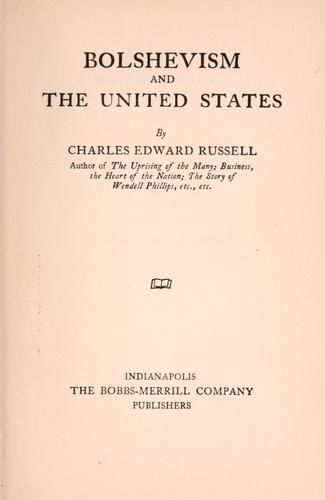
BOLSHEVISM
AND
THE UNITED STATES
The outline of this magical and anomalous story that seems so far out of our time and psychology, may be gaged between two adjacent facts. On March 23, 1917, all the persons in all the world that had ever heard of Bolshevism as a doctrine may have numbered a thousand. On January 23, 1919, when the chief apostles of the new faith issued their call for the first international Bolshevic congress these were the groups that were summoned:
1. The Spartacus League of Germany.
2. The Communist (or Bolshevist) party of Russia.
3. The Communist party of German Austria.
4. The Communist party of Hungary.
5. The Communist party of Finland.
6. The Communist party of Poland.
7. The Communist i)arty of Esthonia.
8. The Commimist party of Lettonia.
9. The Communist party of Lithuania.
10. The Communist party erf White Russia.
11. The Communist party of XJkrainia.
12. The Revolutionary Element among the Tchecko-Slovaks.
13. The Social Democratic party of Bulgaria.
14. The Social Democratic party of Roumania.
15. The Left Wing of the Social Democratic party of Serbia.
16. The Left Wing of the Social Dejnocratic party of Sweden.
17. The Social Democratic party of Norway.
18. A Revolutionary group in Denmark.
19. The Communist party of Holland.
20. Tho Revolutionary element of the Labor party of Belgium.
21. The Revolutionary group in the Socialist party of France.
22. The Revolutionary element of the Syndicalists of France.
23. The Left Wing of the Social Democratic party of Switzer-
land.
24. The Socialist i)arty of Italy.
25. The Left Wing of the Socialist party of Spain.
26. The Left Wing of the Socialist party of Portugal.
27. The Socialist party of Great Britain (Glasgow movement).'
28. The Independent Social Revolutionary party of Great
Britain.
29. The I. W. W. K. of England.
30. The I. W. W. of England.
31. The Revolutionary elements in Ireland.
32. The Revolutionary elements among the Shop Stewards
of Great Britain.
33. The Socialist Labor party of the United States.
34. The Left Wing of the Socialist party of the United States,
represented by Debs and the Socialist Propaganda League.
35. The I. W. W. of the United States.
36. The I. W. W. of Australia.
37. The American Workers' International Industrial Union
of the United States.
38. The Socialist groups of Tokio and Samoa.
39. The Young People's International Socialist League.
From what might be called a student's cell in the city of Cracow, Austria, to the utmost Orient and the islands of the South Seas, taking in much territory between, and all in these few months—^wonderful is the flight, all must admit it to be so! The creed of one man become already the creed of millions and still going on to other millions and to others—^it is plain as day that about the new faith is something powerfully appealing to the latent inclinations of a part of each community. It has something that formulates what many men feel or wish to feel or are willing tp feeL He has struck a new chord somewhere, this Nicolai Lenine; he is entitled to the credit. Let him die even now and he will have an enduring place in history. He said something new and caused millions to believe it and thousands to be ready to die for it.
Who is this extraordinary person! For extraordinary I think you would call him, even to look at him, if you are fair-minded. I have known some of those that hated him to contend nothing was remarkable about his face and figure, but in the old National Council of Russia strangers invariably singled biTn for their inquiries. The great doming head, the excellent forehead, the long, lean jaws, the expres-
sion of mastery, of quiet strength, self-possession, iron-will; the look of a man accustomed to deal with emergencies and to outwit his fellows; the watchful, wary eyes, distinguished him to any observation. Frantic caricatures have drawn him a fiend of cruelty, malignity, ferocity; I protest to you that these are baseless libels. He has the voice, the mien, the manners, the language of a man of culture and research; he will not rant, he will not use extravagant language, he will show no trait of the demagogue or tyrant. He will seem always to have weighed, deliberated, considered and to be speaking without a touch of insincerity the findings of his inquest. And yet there will be always something about him that eludes you and something you do not understand.
Like him or dislike him (and men seem apt to do one or the other beyond reason), certainly here is a great figure, his shadow already falling half-way around the globe. What has been his career! Some of it, like his character, escapes common knowledge. His real name is Vladimir Ulianov. He was bom about fifty years ago at Simbirsk on the river Volga. His family has been incorrectly classified as of the Eussian nobility, but of the Eussian gentry would better describe it, since it had an ancient
inheritance of a landed estate but no title. His father held the office of a local judge.
Vladimir Ulianov was inducted early into Eevolutionary atmosphere. When he was still a lad his elder brother, already of some note among the Terrorists, killed a civil officer of high rank and was hanged. The event is said, reasonably enough, to have embittered and darkened all of Vladimir's life. At least he swung at once into the extreme, irreconcilable group in the liberty movement, and at the University of Petrograd, which he soon entered, he won repute, even in that hotbed of radicalism, for the virulence of his radical views; not the less genuine because they must be covertly expressed.
In these same years, or before them, he is supposed to have imbibed from some experiences of his land-holding family, that implacable hatred and contempt of the Bussian peasant that until he came into power he was never at the least pains to conceal. It is in Bussia the surest stamp of caste; as sure as in India the significant turban twist. All the Bussian landlords and landed families have it. Fifty-eight years ago the peasant was fast bound in serfdom : from that overflowing well-spring of evil comes the inherited hatred of the land-owning
class, that and none other. All peoples that have been slaves carry with them for generations thereafter the taint of the slave pen, the invisible mark of the lash; so much we must expect. But it would not be in nature if the class hatred thus bred did not tend to suffocate in the hearts that entertained it the very soul of democracy; and of all the schools for a future leader of reforms in a world struggling up to democratic light none could possibly be worse than to be reared in a household where former owners railed against former slaves.
Vladimir Ulianov left the university without taking a degree. The next few years he -devoted to the writing of books on Bussian economics; and so great was his gift in powerful expression that he succeeded in illuminating even wastes so bloomless as these. "Dinin'* was the name he chose for his adventures in authorship;, he had not lived long before he made it famous in Bussia, for the excellence and clarity of his style and for his studies. It was not his only literary alias. Another name he assumed was **Nicolai Lenine,'' and this he finally adopted, discarding aU the others until he came to be known by it alone, in and out of literature.
At this time he was an active member of the
Social Democratic party, one of the two greatest popular political organizations in Bnssia. Its rival was the Social Revolutionary, of which we are to hear more hereafter. Another prominent Social Democrat of that time was PlechanofF, for years a champion that the whole democratic world held in honor. As is usual with Eussian parties the Social Democracy was split into wings. Right and Left; Left meaning always the more radical and anarchistic element and Right signifying the conservatives. Plechanoff was leader of the Right wing and before long young Vladimir Ulianov came to be the acknowledged leader of the fiery Left.
In 1902 the division became irremediable over an issue that PlechanofF, at least, regarded as vital. It was whether the party should be ruled by majority vote or whether it should be directed from the top by a few men of as-sumably superior gifts. Plechanoff stood for majority rule; Ulianov for the sway of the gifted few. The younger man won, a fact not now deemed so remarkable as it then was. Whether the democratic sense was weak in the organization or he had merely exercised the rare power over men with which he is gifted I do not know, but more than half of the mem-
bership endorsed a proposition that made the very name of their party a jest.
This was the origin of the term Bolshevic as applied to his f oUowers, It means a member of the majority. The defeated faction was called Menshevic, or belonging to the minority. For years the wings fought each other on issues cognate to democracy. After a time Ulianov's victory was reversed and the minority became the majority, but the names were not changed and the red and fiery Left continued to be called the Bolshevics or majority long after they had dwindled to a fraction of the party's numerical strength.*
After 1902 TJlianov's life for some years did not differ much from that of the average Eus-sian Revolutionist of those times. He was often in flight or hiding and sometimes in jail; like every other leader of the people he dwelt always in danger, with a police hound at his heels and a spy eavesdropping upon every word. If a great and ineffaceable bitterness had not entered his soul he would have been made
* It wiU be clear from this fhat the words ''Bolshevic*' and '^Bolshevist" are absurd as applied to the followers of Lenine in these days and that the attempt in the United States to create the impression that the movement is respectable because it means the rule of the majority is sheer Impudence.
10 BOLSHEVISM AND THE UNITED STATES
differently from other men. With him as with others of like experience a binding, choking sense of hideous injustice and wrong came to coil around his heart and mind and soul like the cold rings of great snakes around every limb. He could not move, he could not breathe nor speak nor write without reminder of the incubus. There was no occupation and no diversion that could cause him to forget for an instant the cold, slimy thing. He looked about him and saw millions of his countrymen bowed under the same affliction, millions of lives darkened and poisoned by a system that for savage cruelty has no parallel in all the records of human government since the dawn of civilization, and of which tilie essential principle had been obsolete elsewhere in Europe for fifteen hundred years. He looked abroad and saw other peoples that boasted of the sunlight of free institutions, that professed to go erect and move steadily to larger freedom and greater spiritaal development. He looked at home again and saw himself and his fellows cheated of the joy of life, crawling to the grave with bits in their mouths and saddles upon their backs, ridden and spurred and beaten by an arrogant and filthy-minded aristocracy whose one claim to superiority was the acci-
dent of birih. He was bom to these things, he grew np among them, the time came when he felt on his own back the lash of the general oppression, in his own sonl the sting of exile and the misery of Bussian jails; and the mind within him was steadily warped and perverted out of accepted human semblance. Certain of onr writers in the Western world have expressed mnch wonder as to the origin of an intellectual make-up at once so well-informed and so cruel, 80 powerful and so callous. Surely the origin is plain enough. The tree is not more directly the offspring of the seed than Nicolai Lenifie is the offspring of Gzarism.
The same effect, in varying degrees, was being produced upon thousands of other minds. That in this mind it was so much more marked and startling is merely because this mind was stronger than the others, more original, more daring. From his youth he seems to have been accustomed to think for himself and to see clear through the weaknesses of the conventional theories of life and society. It is evident that in all the years when he was a Bevo-lutionary agitator, exile, prisoner, he was meditating possible remedies for the existing horrors, and as much as twelve years before his sensational entrance upon the stage of in-
12 BOLSHEVISM AND THB TTNITED STATES
temational politics he told his friends that he had found the infallible cure.
Learned economist, able writer though he was, he wrote no books about his discovery and made no speeches upon it. He seemed rather to have brooded over it, year after year, building it and testing it by supposititious crises, turning it to and fro until it seemed to him xmassailable. According to those that know him best the idea grew in his vision to the proportions of a new religion, an entirely new system of government and social order, the hope of a distressed and sorrowful world to which he was destined to bear the light. He had become the seer and prophet as well as, in his mind, the creator and titular bishop of the world's final cult.
As an exile he lived for a time in Finland, for a time in Switzerland. From Finland he sent forth an acrid Revolutionary journal called The Spark. When the ill-fated Revolution of 1905 broke he returned to Russia to take his share in the uprisings. With the collapse of the people's cause he fled to Cracow in Austria, not far from the Russian border. Here he dwelt for years in safety although Austria and Germany were seizing and returning by thousands other Russian refugees that had sought
similar asylum. This congenial cooperation of the three autocracies to sustain in Europe the autocratic cause has been very little noted, although nothing of the times was more significant or boded more eviL While in the United States former subjects of Austria and Germany were fiercely assailing the American government for so much as appearing to entertain a proposal for the return of escaped Revolutionists, Austria and Germany had flung to the winds the ancient rights of the political refugee and were joining the agents of the Czar in a huge rabbit hunt for Russian republicans. The fact that it never came near Lenine has been cited as evidence that he was even then in the service of either the German or the Austrian government. Scores of his former associates were taken in Cracow itself, almost before his eyes; no governmental sleuth ever bothered him. But I think that as a matter of fact there was neither corruption nor collusion in this. The German, if not the Austrian, government must have perceived that here was one molded exactly to the German needs: it would have been foolish to molest a man with a faith so useful to the German propaganda.
Among the documents printed by the French government in its ** Diplomatic Correspondence
14 B0L8HXVISM AND THE TTNTTED STATES
Preceding the War'* is a secret memorandum prepared by the most expert political and military strategists of Germany as to her wisest course to bring on the war and insure her success in it One of the expedients upon which stress is laid is to excite and covertly to support Bevolutionary movements in Russia. With joy the German government seems to have laid hold of advice so congenial to it. Its spies that already swarmed in Russia must have minutely reported upon Lenine and his Great Idea. If the German government had not instantly perceived the potentialities of value that lay in such a man it would have lost its cunning. Lenine safe in Cracow was a thousand times more valuable to autocracy than Lenine on a Russian scaffold. Probably no man, therefore, was more secure.
After the man hunt had ceased, the Revolution being sufficiently expiated in torrents of blood, he returned to Finland, where his sojourn was brief. For some outbreak of Revolutionary fervor he deemed it wise to make a midnight flitting to Switzerland, where he lived at Geneva and functioned in a small way, and after the manner of absent treatment, as the high priest of the cult he had started with his Great Idea. He was still in Switzerland
when the world war started and it was not old when it gave to him his unequaled opportunity for conspicuous trouble-making.
For he was undoubtedly the originator of Zimmerwald; the gnats and wasps that issued from that place and buzzed about the heads of the Allied statesmen swarmed out of plots of his devising. In September, 1915, when von Mackensen was crushing Serbia, when the western front was hopelessly deadlocked and the cause of the Allies was almost at its lowest, he called to meet at Zimmerwald, a small town near Berne, a congress of labor and radical representatives from all the belligerent and neutral nations. Germany and Austria responded, wearing beUs; two notorious defeatists and semi-anarchists came from France; Lenine himself purported to represent Russia; several persons were on hand from neutral countries. And there amid all these delegates met ostensibly to discuss peace, sat unidentified, no less a person than Azeff, the most celebrated, most sMlfxQ and most unscrupulous of all the police agents of the old Russia regime.
The presence at such a place of such an abnormality throws a singular light upon Lenine's mental make-up. For his own purpose he was willing to use any effective tool, even
16 BOLSHEVISM AND THE UNITED STATES
this creatnre with hands and soul black with blood. For this was the man that used to plan and instigate assassinations that he might drag down the Revolutionists he was paid to destroy; this was he that nsed to betray the police to the patriots and then the patriots to the police. To millions of Russians his name is a sign of shuddering horror; to Lenine he was useful for the Great Idea or he was nothing.
The conference announced a program for immediate peace. Nothing could be simpler. The workers in every belligerent country were to go on a general strike until their respective governments should be willing to sign a peace treaty. At once the war would be over, the soldiers would throw down fheir arms and come home, all would be joy and harmony. But there must be no annexations and no indemnities. Whether Germany was to surrender the territory she had grabbed was not made clear, but anyway, no annexations, no indemnities, not even for mutilated Belgium.
This was the origin of that famous phrase that presently went echoing around the world. I have no doubt Lenine himself invented it. In the original it was ^^no annexations, no contributions," but as nobody was able to guess what that might mean those that helped
to speed it on its way amended it into its more familiar form. Even at that nobody understood exactly what was intended, but the sound was dulcet in a million ears. We may surmise that to be effective and successful a phrase should never be of the order that anybody can well comprehend, or it will lose all the potent charm of mystery. Lenine doubtless understood this perfectly; like the camel driver, he had not in vain considered this complex creature that is called man.
Anyway, this phrase was immensely successful and presently confronted the helmsmen of every Allied ship. No annexations, no indemnities. And inmiediate peace. Proclaimed by an international congress of workingmen and social reformers, at Zimmerwald, in Switzerland. Before long the origin of it came to be forgotten; all that the world knew was that some eminent authority had said there must be no annexations, no indemnities. It reverberated, it grew steadily in favor; and if the United States had not, soon after it came into the war, given to the conflict an entirely new aspect as the crusade of liberty and democracy those words would have played the devil's own part in making the terms of peace.
I have no doubt that Zimmerwald was planned
18 BOLSHEVISM AND THB UNITED STATES
on fhe basis of its possible openings for fhe Oreat Idea. All along Lenine believed that the war was the chiefest obstacle to the application of his remedy. While the war was on no one would pay any attention to anything else. But Zimmerwaldy while it made trouble, failed to make peace. The next year he repeated the attempt with a similar congress at Kienthaly similarly attended, and with similar results. But the next year came the Russian Revolution and with the news Lenine must have se6n at last his real chance opening before him. Almost overnight he started for Petrograd, in a sumptuous private car furnished by the Oerman government, and with his pockets full of Oerman money.
It is this part of his career that is most relied upon to prove his essential depravity. With vigorous fanfaring documents have been printed purporting to show that he had been for a considerable time in receipt of much gold from the German government. It was hardly necessary to dig up the documents to establish this fact. Probably Lenine himself, if asked, would have furnished all the needed proofs; he never attempted to deny the transactions. He said, without the least hesitation, that he took money from the German government and
:y
wonld take money from any other source that offered it; but the money he took was spent wholly for propaganda purposes: he kept not a doit for his own uses. The cause he had inaugurated could advance only with money; he had no means and no access to those that had; and he had not the least objection to accepting money from an enemy, nor to using the same money against the same enemy when occasion should arise. Any careful study of the man will show this to be wholly probable and consistent with his character. I believe he had the same feelings about the voiture de lva>e in which he rode to Russia. He ardently wished to be on his way for the Great Idea. The German government offered to put him into Russia quickly, comfortably, without expense. He accepted the offer, knowing all the time and full well that if the plan he was turning over in his mind should ever succeed, the German government that thought to gain by him would crumple up like so much punk.
He must have thought of this, as he jaunted along in that luxurious coach, and if he is capable of laughter, which I have never divined, he must have laughed at the overcunning fooler that he believed was soon to be fooled.
i
CHAPTER n
THE FIBST CALL TO ABMS
Hb arrived at Petrograd in those first days after the downfall of the ancient tyranny, when the world was still dazed and wondering at the magnitude of the achievement. All his plans seem to have been made with precision; he knew exactly what he wished to do. A revolution is like a cyclone in the South Seas; the first great wave is always followed by a second, much higher; and upon this second wave, which he purposed to start and engineer, he could see the Oreat Idea sweeping over all Russia and thence across the world.
And what was the Great Idea?
Most compendiously it has been described as the Dictatorship of the Proletariat. And exactly what is the meaning of that somewhat startling phrase—^the Dictatorship of the Pro-letariatf
To make this clear we had better go back to Simbirsk and the days of Vladimir Ulianov's
youth. From his early studies in economics and sociology he seems to have accepted these concepts as fundamental principles:
Man's concern upon this earth is that he shall have his material wants supplied, his food, shelter, clothing, artificial heat, artificial light. These are the essentials. Culture he may have if he can get it, but culture is not a scientific essential.
Production and distribution of the essentials of life are the objects of any social system and only those engaged in the producing and distributing of essentials are useful to society.
Only those useful to society are entitled to any consideration at the hands of society. Consequently government should be controlled exclusively for the benefit of producers and distributers.
Production and distribution mean work with the hands. Therefore the chief objects of a reasonable government's care are the hand workers. Their labor is the essential of life; without it the race would perish. All men live either upon their own labor or upon that of others. Nature is ready to do her part for man's life but she furnishes nothing that is available without hand labor. Yet society, as at present organized, seems to pursue with a
i
22 BOLSHEVISM AND THE XTNITED STATES
fiendish hatred all those that follow the nsefnl and necessary pursuits. In every country, in even the countries that are called the freest, there is some palpable stigma upon labor.
From this as a beginning, sanctioned by many a revered authority in the dismal science that he pursued, he seems to have wandered upon strange and erratic paths wherein half-truths shone as realities and philosophy became a series of deductions from these. He saw that in his own country labor was frankly despised and spat upon. In the so-called democracies men that worked and served society were never admitted to places of importance or power. Governments everywhere were made up and conducted by idlers or parasites. In Great Britain, which boasted most of its democracy, a large part of the working element was directly excluded from the franchise. In the republics of France and the United States the propertied classes were able to work their will and hold over the country an imperial sway. Whatever these classes wanted they had, no matter how small might be their numbers in comparison with the workers.
Hence, the only salvation was to reverse this system and put the hand workers in the places and power now held by the propertied classes.
Out of these conditions arose war and most of the other evils that afflicted mankind The workers in all countries were brothers and had no interests except the interests of their class, recognizing no national bonndaries and no na-tional obligations. Wars were made only because the parasite classes desired war for the sake of profits. Under the accepted system of government these classes were able to compel the producing classes to go forth to fight. The producing classes did not wish to fight and cared nothing about the pretended issue involved in any war, but with the existing style of government the producers were the slaves of the parasites and consequently must fight when they were told to fight
These must have been the main ideas of his philosophy, for they came shortly after to be vehemently asserted by his followers. It seemed to him, viewing all these conditions together, that what was called democracy was for the workers a total failure. Twelve years before in talking of his plans he had made no secret of his intentions to proceed without it. What is democracy, he used to ask, but the hypnotic phrase with which in your so-called free countries the majorities are lulled into quiescence? Behold, in France, in Great
24 BOLSHEVISM AND THE UNITED STATES
Britain, in the United States, the workers endowed with the ballot to which they have been induced to ascribe magical virtues. What is it in reality but a pretty plaything? With it they romp about, trundle to and fro, play at voting, play at being members of this party or that, roll the hoop called the franchise around the circle called politics, chortle, gibber and quarrel, while their masters fatten upon the world's larder properly belonging to the toilers.
Democracies, he said to an interviewer in 1907, were in fact the toilers' curse and bane. Given an absolute monarchy and as it had little now to offer that could distract the toiler's mind there was always a chance that he would arise, cast it off and come truly into his own. But given a pseudondemocracy, a bourgeois republic like France, a capitalistic side show like the United States, and the toiler would continue to be charmed with empty phrases and stand like a yokel at a fair gaping at foolish tricks.
In all these countries, he said, the workers were the majority. Yet in all these countries the workers were ruled, exploited, plundered and kept submerged by the minority. To talk then about democracy as an advantage to the race was absurd. That part of the community
that alone was important to it, the part npon whose toil all the rest existed, was condemned everywhere to scanty fare, miserable dwellings, fonl air, dreary lives. The part that contributed nothing to society, that made nothing, produced nothing, helped nothing, that part lived in luxury and even superfluity. And all the time the wretched producers that wasted their lives for the others constituted the majority of the population, and if the theory of democracy were correct should have been able to oust the idlers and take for themselves the comforts of life to which their social service entitled them.
The Dictatorship of the Proletariat would rectify these wrongs. It would bring in the time wl^en the producers, as the only important members of the community, should have all the luxuries of life and the idlers should have the penury and hardships; when the idlers should eat of the dish of humiliation and wrong they now set before labor; when the producers should possess the government and the idlers and parasites be excluded.
But he would have such a government erected in a new way and without this democracy, which had proved to be only a delusion to the workers and an additional weapon in the hands
m
26 BOLBHEVISM AND THE UNITED STATES
of the parasite class. He would have a benevolent despotism conducted in the interest of the workers by men wholly devoted to the workers' welfare. He would have a kind-hearted autocracy, its kindness limited strictly to the working class. The ballot box had failed; let it cease to daflf and swindle the toiler. Put all power into the hands of a good, sympathetic despot; that was the essence of his theory, and without doubt he knew all the time where a despot of that kind could be had.
And yet we should beware of the temptation to think that he was planning, working or contriving for himself. If we must think but evil of one with whom we disagree it would be most easy to construct a false Lenine, ascribe to him the lowest motive of selfishness and hold him to the world's scorn, a shallow gamester and trickster. Believe me, this is no such man. I have not the least doubt that if at any time he could find a person as much imbued as he with this new faith of emancipation for the working class and as competent to give orders he would gladly retire from the machine he has constructed.
What then does he wantt What is his foible, and for what advantage to himself does he pursue his course? Does he want money?
All trustworthy accounts agree that for himself he is immune to it; he knows nothing and cares nothing about it. He could have secured for himself money in unlimited quantities; the treasury of the country, or what was left of it, was open to him. He could have had millions from Germany, not in wall-papering roubles but in gold, actual gold, become now the greatest of all Europe's curiosities; and still, so far as can be ascertained, he is personally without means. There is in this country a common belief, unfortunately created and more unfortunately fostered, that he is no better than a grafter. It is a great error. Men that underestimate their enemy usually walk the old Braddock trail to the like defeat. This is no grafter, this is no mercenary with a country to sell out. If he were the stage would long ago have been freed of his presence. Strange that this obvious fact seems never to have occurred to those that malign and belittle him. Easy would be the problem of Russia if organized society had nothing to deal with there but grafters and bribe eaters I
What then? Is it power that he seeks? Has he a picture of himself as the ruler of the World's workers, seated upon a wonder-making throne, sceptering it over an empire far greater
4
28' BOLBHEYISH AND THE UNITED STATES
than Germany ever dreamed of, the working class everywhere hanging npon his beck and nod, a new kind of emperor of a new kind of empire, all Hie govermng power of all the world in the control of the proletariat and he in the proletariat's sole command, a conqueror greater than Kublai Khan and Napoleon in one, an administrator endowed with almost inconceivable power t
He has no snch dreams, no such desire. Once more the problem he has made for the world wonld be much simpler if he wonld but respond to the common conceptions of him. What makes it so hard is that with entire sincerity and resignation this man looks forward to martyrdom!
Martyrdom—^he expects it and desires it. Hence he does not care, he has no fear, he has no appetites nor lusts, he has no human avenue of approach. He has convinced himself that he is to be killed for the cause of the proletariat and his soul is at peace with this outlook. A week he may live, or a year. He does not know; very likely he does not speculate; he knows only that it will happen. The Bussian fatalism has him fast bound; his destiny it is to be offered a sacrifice to the great cause of emancipation, but from his blood will
spring an overmastering spirit that will everywhere trumpet the proletariat to arms and victory. Strong, then, to its opportunity, it will rest not nntil it has won for all the world the realization of the New State, the Earthly Paradise, the Perfected Civilization of which he, Vladimir XJlianov, otherwise Nicolai Lenine, was the sole discoverer, author and originator.
Then his fame will be world-wide and eternal. Then the regenerated social system will bear forever his name. Centuries hence men will go back to every incident of his Uf e. They will recount his struggles and dwell upon his words and glorify him, martyr of the human cause, redeemer of mankind.
Cast aside every other conception you may have formed of this man and hold only to this, for this alone is true and alone gives you any clue to the riddle. Why should he be daunted by threats ? Nothing can stop, after his martyrdom, the onward sweep of the Lenine philosophy. Why should he concern himself with anything else, with the futilities of democracy, the outworn devices of organized labor, the notion that the hunger of economic needs can be satisfied with the stone of a ballot? The way to freedom is ordained and fixed and he is ad-

30 BOLBHEVISM AND THE UNTTEP STATES
vancing upon it. Why should he take money t Yet a few days, a few weeks, a few months and he will be dead. Why, finally, should he hesitate to order the killing of others ? He himself is about to give his body a willing sacrifice that the workers may have justice and the world have peace.
He goes even further than a foreknowledge of his own fate. He believes that the movement he has started will be temporarily overwhelmed. He sees the downfall of the whole structure he has built. **It is necessary that we should make our start in Russia,'' he used to say twelve years ago, **but the start we shall make will be crushed there. The capitalistic forces of other nations will crowd in upon us to destroy our organization." He foresees now, or thinks he foresees, the troops oi the Allies marching into Bussia, the defeat of the Bolshevics, the restoration of the old regime, the dishonoring of his ashes, for he will then have perished. But in the recesses of his gloomy mind he has decided that all this is needful. In no other way can the proletariat of the world be aroused. To-day it knows not the forces that oppress it. When it shall learn that the only worMngmen's government ever erected upon this earth has been crushed out in Bussia by the savage power of
the combined capitalistic governments, every worker will spring up fired with a deathless purpose to destroy forever the terrible monster of capitalism, blood-dripping with crime.
Then in universal battle and struggle, capitalism will be annihilated and the principle of the Great Idea will be recognized everywhere, the principle of the Dictatorship of the Proletariat that he discovered, he then lying dead in his grave, but honored as no other man has been honored in history.
He said much of this twelve years ago. He saw it all then as clearly as now. I have not known anything more uncanny, but so far, cer-taLoly, his predictions have been verified, letter perfect. Twelve years ago he predicted the downfall of the Czar, the rise of the Bolshevics, the suppression of the peasants. It is not within the power of the sane and orderly mind to conceive of the fulfilling of the rest of his vision but so far as a prophet he is of a record unimpeachable.
We can easily pass off such a man with a shrugged comment that he is but a demagogue or a power seeker or lustful for his own glory. No such formula will fit this case. We shall never get hold of Bolshevism as it really is until we come to see that it is largely a psychological
J
32 BOLSHEVISM AND THB UNITED STATES
phenomenon. Yon might ahnost say fhat a new order of mind has been discovered; certainly a new kind of mental engine has come into working in the affairs of men; likewise a new kind of ethics, a new style of motive, a new standard of conduct Is it not really sot Go back, for instance, to Lenine's relations with Germany, the private car, the stacks of gold. Judge now by all yon have experienced hitherto of men and motives. Would it not be impossible for an agitator or popular leader to remain perfectly independent after accepting from an interested source favors so conspicuous t Not for Vladimir Ulianov, otherwise Nicolai Lenine. He took money from Germany. With exactly the same readiness he would have taken money from Great Britain or France or America; with equal readiness thereafter he would have turned against his purse bearer, whatever nation it might be. He had no affection for Germany; he hated it as he hated all other existing forms of government, as he hated republics, constitutional monarchies, democracy, the ballot box and aught else that he conceived to be holding the proletariat in chains. To his mind less obligation was involved in these favors than he would feel toward a man that held a door open for him or got out of his way in the street. The
^
next moment he would order the man that brought him the car to be shot or the government that supplied it to be obliterated in blood and fire if either the man or the government got in the way of the Great Idea. Similarly, he would combine with man or government that promised any aid to that Idea and then throw either over the side or to the wolves when either ceased to be a help.
The truth is that with entire sincerity he had formulated first, then accepted, and later forced upon his colleagues, this new conception of life —simple, neat, effective. What was good! Anything that furthered the Great Idea, the Dictatorship of the Proletariat. What was evilt Anything that hampered the Great Idea, the Dictatorship of the Proletariat. Every other standard was abolished. Murder became good or bad solely as it affected the real issue; property rights were to be respected or scorned on the basis of what would advantage the cause; individuals were good or bad as they were related to that cause. I think he would order his 43on, if he had one, to be shot and stand unmoved at the sight if his son had put himself in the way of the Great Idea. No, do not deem me extravagant; from many witnesses, from many documents, premeditated and unpremeditated,
M
34 BOLSHEVISM AND THB UNITED STATES
and from much observation I have formed this deliberate estimate of the most remarkable man of the times. I think he came to have no feel* ing except for the Idea, no affection for anybody or anything, no antagonisms except in regard to what he had conceived as his mission, absolntely no fear, absolntely no hesitation. He looked npon himself as an instmment, chosen and shaped for this work; life had nothing else. I donbt if the man ever had any pleasure or was capable of understanding it. He rose, slept, ate, drank, walked, breathed, in the name of the Great Idea, the Dictatorship of the Proletariat —^administered from the top.
It may be, too, that the Bolshevic movement is pathological as well as psychological, and that the heart of the mystery is this strange and powerful mind that would not think along any of the accepted lines of ratiocination but introduced a process as much his own as the Great Idea. It was a process that defied every consideration of logic and coherence. Thus, for instance, this great change to which he was committed was nominally the supremacy of the workers. Yet he did not for a moment believe in the ability of that class to govern; even to govern its own ideas. Some one with absolute power must govern in their behalf. This, of
course, in another man wonid be bnt another evidence of cheap demagogy; behold a would-be autocrat maneuvering to get power into his own hands for his own selfish purposes. And before we have that conclusion formulated, we are reminded once more of the crushing fact that this man expects to be shot and his whole structure of government in Russia to be overthrown. The thing is not in nature, you will say, but there it is. Hence, a new order of mind has come upon the world, invulnerable to reason or to facts, indomitable, quick, capable, resourceful, relentless, as iron as fate.
One other fact that is to be added to this might be deemed to transfer the whole study from the realm of the merely strange to the realm of the weird. His philosophy looked for the supremacy of the working class, so called, but only those engaged in industrial callings, that is to say, factory hands, transport workers, railroad men and the like were deemed to be included in the working class. His view was most marvelously limited to industrial development ; the rest of the world he seemed hardly to see. There were at that time fifty governments or provinces in Russia. Of these not more than six could be said to be industrially developed. The rest were chiefly or entirely
I
36 BOLSHEVISM AND THE UNITED STATES
peasant. Six out of fifty—^the pyramid was to stand upon its head. At a later day he found something that he thought would attract the despised peasants to some liking of his stupendous project, but he had nothing for them at this time except his inherent contempt, and it seems to be a fact that in all the years he was meditating the Great Idea he assumed that six of the fifty provinces could be so managed as to manage the rest.
For this most amazing notion there can be, in a man of his mental endowment, but two possible explanations. He designed an industrial form of government for a country having almost no industrialism. Either, then, he believed that his form of government would spread to countries where there was industrialism, or he had become so saturated with the writings of men in other countries protesting against the industrial wrongs about them that he imagined such conditions where they did not exist. Taine said that Milton's ^^Paradise Losf was the dream of a Puritan that had fallen asleep over his Bible. I should think the Dictatorship of the Proletariat might be the dream of a Russian that had fallen asleep over his German economists.
When Lenine arrived at Petrograd in the first
glad days after the destruction of Czarism he resumed at once his old place as leader of the Left wing of the Social Democratic party, and was chosen to a seat in the National Council of Workmen's, Soldiers' and Peasants' Deputies, otherwise the All-Russia Soviet, which was soon the controlling force in the new democracy. The first requisite in his plan was to get Russia out of the war and the soldiers home. To this end he worked without ceasing to spread pacifism and increase the distaste for the struggle. Not, as he subsequently proved, because he had any objection to war on its own accoimt; what he said about pacifism was largely in the day's work. But he knew he could do nothing toward his great objective so long as Russia was fighting.
For the Allies the situation that now arose was one of the greatest of their crises. About 2,400,000 German and Austrian troops were on the Russian front from Riga to Roumania. If Russia continued to function in the war, the French and British on the western front could hold that line until the United States should have time to marshal her forces and come to the winning of the victory. If Russia should collapse or withdraw from the conflict great masses of German and Austrian forces would
I
38 BOLSHEVISM AND THB UNITED STATES
be released from the Bnssian front to pile up a huge avalanche on the western line. Those that knew the actnal Allied strength on that line knew well enongh that there was no force then effective .that could resist snch an onslaught* The whole cmx of the war therefore seemed to turn upon the action of Russia, and Lenine, the most powerful and subtle mind in the country, was working night and day to induce Russia to draw out.
Against him were pitted in fateful combat the representatives in Russia of the Allied powers. It is not too much to say that he overwhelmed them with a memorable defeat. True, he was greatly helped by the contributions of the Allied representatives, most of whom had no understanding of the real situation and continually made the plays that were most to his desires. In spite of the obvious fact that the old enginery of government had been utterly wrecked and ditched, they persisted, with pathetic foolishness, in paying their court to the junk heap. In spite of the other obvious fact that the Russian people regarded all the Czar's engagements as cancelled when they dismissed the Czar, the Allies urged upon them the Czar's military undertakings. If Lenine himself had dictated their course he could have
devised nothing better for his objects. Bnt in truth, they were never a match for him: in his hands they seemed like children. To take a figare from yachting, while they were long over-standing the mark he outpointed, outmaneu-vered and outsailed them. By the middle of June it was apparent that nothing could save them except swift and radical action by the United States, and in view of the distance and the difficulty of arousing the American nation to an issue so remote and so unusual the necessary assistance from the United States was hardly possible.
There were 830 delegates in the National Soviet. Of these Lenine had at the most not more than one-sixth. Yet he managed these with such skill that he always appeared far more formidable than he really was and steadily increased his strength and improved his position.
The first government erected upon the fall of Gzarism was well enough, but of the order of make-shifl It was headed by Miliukoff, who was a well-enough little man for any ordinary task, but no better fitted to this situation than an English Tory squire would have been. He was succeeded soon by a government headed by Prince Luvoff, of high character and first-
i
40 BOLSHEVISM AND THE UNITED STATES
class ability, but handicapped by his title and origin. If he could have remained in his post Bnssia would have won to sanity and security. Kerensky was his war minister; at that time very popular because of his powerful oratory and his services before the Revolution. Luvoflf and the other ministers had their offices in the Marinsky Palace, opposite the cathedral of St. Isaac, but the seat of the real government was the Cadetsky Corpus, which was on the other side of the Neva, for there sat the National Council or Soviet.
Lenine and his lieutenants continued with all possible diligence to arouse a feeling against the whole of what had been the governing class in Russia and against those likewise that had sat upon its steps or prospered under its shadow. Many men ranked as nobles or as wealthy had sympathized whole-heartedly with the Revolution and some had made for it prodigious sacrifices. In the propaganda of the Great Idea all this counted for nothing. Such men belonged to the **bourgeoisie,*' which now, under the tutelage of Lenine and his friends, began to loom upon the horizon of popular thought as the frightful demon of a nightmare. One of the ablest members of Luvoff's cabinet was Tereschenko, the minister
of foreign affairs. But he was very rich and his father had been rich before him. Some other members were of the professional or propertied classes and as bourgeois therefore as anything going. These became the especial targets for the Lenine attack. Sunday, July 1, 1917, in Petrograd was given up to an immense demonstration by persons of all parties, all creeds, all theories, near theories and fads. All day long they paraded about to their ineffable satisfaction, relieving the sur* charged breast with loud cries and with the carrying of many banners. Those of the Anarchist section carried banners of black; the rest had red. Every banner expressed some opinion or sentiment; about three banners in five demanded that all power be concentrated in the hands of the Soviet or that the bourgeois ministry should get its conge and that without waiting. Some even denounced the offending bourgeois ministers by name.
There is no doubt that Lenine and his lieutenants saw with assiduous care to these manifestations.
He had now chosen as his first adjutant the famous Leon Trotsky, whose real name is Leon Bronstein. It may be remarked in passing that if the game once proposed in a California min-
d
42 BOLSHEVISM AND THE XTNTTED STATES
ing camp that night when enchre and seven-np had grown tiresome, the game of "Each Fellow Tell His Real Name/' should ever be introduced in Russia some remarkable transformations would occur, names there being as handy as hats and as easily put on and off. Mr. Bron-stein was a fanatic after Mr. Ulianov's own heart and was also an orator of extraordinary power in a popular assemblage, which the chief of the Bolshevics certainly never was. Besides, Bronstein had been much about the world, had lived in the United States and in England, and possessed an unusual mind, perceptive but not reasoning (which was exactly suited to the needs of the hour), and he wielded a powerful and original pen. I suspected afterward that some of the mottoes we read on the banners that July Sunday were specimens of the work of that pen.
Mr. Bronstein had lately distinguished himself by writing some powerful newspaper articles supporting the cause of the Allies, articles wherein he showed Russia's security and interest to be in continuing the war on that side. To a mind narrower than Lenine's this might constitute an objection, in view of the work there was in hand. To Lenine all was one, Bernstein, Azeff, Rjevsky the police agent,
^
Dzrjinsky the anti-police agent, so long as they conld be made useful to his purpose, and Trotsky Bronstein of the eloquent tongue and facile pen—^who could be more useful!
After that Sunday *s showing all observing men knew well enough that the situation was becoming desperate for the existing government The attitude of the Soviet grew more and more unfriendly. Little could be done without its sanction and it fell to criticizing rather than to sanctioning; a condition produced in part by an unfortunate lack of business coordination between the real and the apparent government. In these straits Kerensky tried a bold stroke. He ordered an advance of the Russian forces where the German line was supposed to be weakest.
The movement was executed with some spirit; the Germans were driven back and lost prisoners and guns. A strong effort, like a forlorn hope, was made to utilize this occasion for a national triumph that might bring back the old spirit. In the streets of Petrograd a procession, organized with difficulty, moved down to the great square in front of the Marinsky. Plechanoflf spoke from the balcony of the palace. The occasion must have moved him strongly. For months in his excel-
i
44 BOLSHEVISM AND THE UNITED STATES
lent newspaper and in public addresses he had been arguing and pleading that Russia's one chance for safety, democracy and progress lay in the defeat of Germany. With all his old-time fire and eloquence he raised now the pean of victory. But it was like a man striking at nothing. The response of the crowd that heard him, the response of the people in the street, was perfunctory; and when that night in the Soviet a half-hearted resolution of rejoicing brought forth the largest opposition vote that had yet been cast it was plain that the end was not far off unless sudden measures were taken to head off Lenine and his group. There was still a chance to appeal to the people and cause them to understand their vital interests in the war. It was not taken and the government slowly sank before the steadily increasing blows of the Bolshevics.
Aided, of course, and in every way abetted by the German propaganda, which had long been sowing disaffection among the soldiers as among the populace, and had sent whole divisions homeward by spreading the historic falsehood about the impending distribution of land.
An ominous sign was that when a few days later the Germans counter-attacked and for miles bent in the Russian line before them
there was no repercussion from the public mind and no particular objection that certain of the Bolshevics made a display of their content. Another manifestation still more sinister now oppressed the general sense. Lenine made his long expected rising against the government. Of a sudden, that July afternoon accompanied by Trotsky, he led the Bolshevic and Anarchist workmen from the factories and the Anarchist sailors from the naval station at Kronstadt. They seized and possessed the fortress of Peter and Paul and then marched across the bridges to capture the rest of the city. The alleged pretext was to demonstrate in the name of the proletariat, or the part of it that Lenine controlled, against the plan of admitting any representatives of the bourgeoisie to a share in the government. Any other pretext would have served as well, for the real hope was that the masses would rise, overthrow the existing administration and declare at once the Dictatorship of the Proletariat.
This hope failed, but there was vicious fighting in the streets before Lenine perceived that the populace was not rallying to him. He had prepared armored cars with machine guns and filled these with hard-fisted sailors from Kronstadt For two days the street fighting con-
J
46 BOLSHEVISM AND THE X7NITED STATES
tinned. Then the government forces overpowered the BolshevicB and the Anarchist sailors went back to their waterside hannts.
It was perfectly characteristic and Bnssian that Lenine and Zenoviev, his lieutenant, fled f roni Petrograd on this fiasco and were not pursued, that Trotsky was put into jail for a time and then released, and that Lenine came back in safety, became a candidate for the Constituent Assembly and was allowed to take his seat. **Everything goes here except sanity,'* said a disgusted American, viewing these preparations for the eclipse.
Luvoff resigned his premiership and Alexander Kerensky succeeded him. It is common to blame Kerensky for weakness in allowing Lenine and Trotsky to escape all consequences for their treason. I have never been convinced that Kerensky was personally to blame or that he could have made a better performance. He subsequently thought it necessary to issue an elaborate defense, which may be of greater historic than present-day importance. Any one that knew Russia at the time knew that it was still in a state of dreamy exaltation about the dawn of an idealistic society in which there should be no restraint upon word and little upon deed. Millions of persons that had no sympathy
with Lenine 's Great Id^a would have rallied to him at any attempt to interfere with his freedom of speech. The phrase as applied to the street fighting he had brought about and led wiU seem to the uninitiated merely grotesque, but so it would have been interpreted. Lenine had been merely demonstrating. Is not demonstrating a form of expression and to be included with freedom of speech? The government itself had so decided in the case of the great and unlimited demonstration of July 1. Those that could not sufl5ciently express their ideas in oratory must have the right to express them in parades.
In those days the utmost license was allowed to speakers and likewise to the press, which was every day printing matter that in England, France or America would have resulted in the editor's imprisonment; not because of its immorality but because of its rank sedition. When the danger of such publications at such a time was i)ointed out to a Eussian he invariably replied that such were the privileges belonging to democracy, nor did he seem able to perceive that even a democratic state might have to defend its existence from foes within as well as foes without. As to the shooting of Lenine, now viewed by some authorities as
i
48 BOLSHEYISM AND THE UNITED STATES
fhe one thing needfnl to save the situation, if Kerensky had attempted that he wonld have no more than pulled the foundations from under his house and brought down in August the catastrophe that fell upon him in November.
In truth what was wanted was not a firing squad but a means to combat the German and Bolshevic propaganda, and neither Kerensky nor any other Russian oould supply that need.

CHAPTER m
THB PASSING OF THE BALLOT BOX
Thb govemment went from bad to worse, the Bolshevics not unskilfully pointing its downward way, along which it was liberally assisted by additional misplays of the Allies. Some of these went to the length of supporting the ridiculous Komiloflf revolt, which was no better than a poor order of opera bouffe and obviously doomed to failure. They thereby greatly weakened what was left of Kerensky's strength, whereas wisdom for them was in every way to increase and sustain it But some of the Allies could never divorce themselves from the hope that the monarchy might be restored and they looked upon Komiloff as the man to restore it. From the beginning this fantastic notion, obstinately pursued by Allies that had monarchs at home, had been the blight of the Allied cause. It was now revived to wreck or rot the last Allied chance in Bussia.
49
i
50 BOLSHEVISM AND THE TTNITED STATES
So long as Lenine deemed his health to require his absence from the country he continued to direct through his associates the course of his party. By the end of October he saw that the time had coine to strike. A Constituent Assembly, elected by the free vote of all the people of Russia, men and women, would soon meet in Petrograd to determine upon the final form of government and adopt its constitution. He knew well enough that in that convention his Idea would never muster more than a fraction of the delegates. Once let a constitution be adopted and be stamped with popular approval, the resulting government could not, certainly in his time, be overthrown. In effect, then, it was for him now or never.
In all that followed it is to be remembered that he never had the shadow or semblance of any warrant or mandate from the people at large. This is the fact, no matter what you may have heard or read. He had no more popular warrant than had Louis Napoleon, whose methods he closely imitated. I have heard eminent authority praise the one that would most certainly abhor the other, but consistency is a hob-goblin haunting probably few minds of this persuasion. If there be any choice between these two distinguished practitioners
of the coup d'etat the advantage is clearly with Napoleon the Little. He had at least the vote of France back of him to make him president. Lenine had nothing except one-sixth of the National Council and nine-tenths of the Petrograd Soviet. He had no more and could get no more. His action is defended on the ground that he wished to do good to the workers of Russia. The plea is almost obscenely trite. It has been used by every usurper from the beginning of time, and most of all by that strange French-Dutch adventurer that Lenine imitated and history scorns.
Nevertheless, as to all this the record of events is the best conmientary. Lenine was sure of the garrisons of Petrograd and Moscow; under constant schooling, projmganda and his own inspiration they had become about ninety per cent. Bolshevic. He was sure also of the sympathy of the majority of the citizens of both places and had therefore the needed back-groimd of civilian support. Petrograd was an industrial center; its industrial development had for years been proceeding apace. Moscow was something of an industrial center; so was E[ieff. Outside of these cities, in which either a majority or a large part of the population was directly or indirectly, by employment or trade
J
52 BOLSHEYISIC AND THE X7NITBD STATES
or economic sympathy, comiected with industrial production and distribution, Lenine had no followers. Indeed, why should he have support elsewhere? Nothing he had proposed meant anything to the peasant—^not lands nor better returns nor the easing of toil; all the advantages were for the industrial worker.
Petrograd city was with him. At every election it had shown a growing Bolshevic majority. All the government oflBces were in Petrograd. The government machinery therefore stood improtected in the midst of government enemies. While I was still in Petrograd an effort was made to shift the garrison and replace it with one not hostile to the existing administration. There followed a plain intimation that at any such attempt the whole garrison would mutiny, and the government did not dare to risk the issue. A wise American long familiar with Russia strongly advised the government to meet the situation by moving the capital to Moscow. Most unfortunately this was rejected on the ground that it would be interpreted as a sign of weakness, and the drama moved to its foolish climax.
Before daylight of November 7 companies of Bolshevist soldiers seized the bridges, the telephone office, the army headquarters and began
to occupy the streets of Petrograd. They drew up before the two principal government offices, the Marinsky and the Czar^s old red Winter Palace. They broke into the Marinsky and drove ont the Council of the Republic, which was sitting there. They laid siege to the Winter Palace and brought a small gunboat up the Neva Eiver to fire futile shots at it. A newly elected Soviet was beginning its session in another part of the city. A majority of its members was anti-Bolshevist. Trotsky maneuvered it so that it dissolved itself and faded out of the way. The Winter Palace was captured. All the ministers were there except Kerensky, who being warned in time had made his escape. The rest were marched to the Peter and Paul fortress and locked into filthy dungeons for the crime of having held office under another than Bolshevic government. Some were afterward shot, some stayed there for months in daily expectation of being shot,* and some eventually managed to get out of the country.
The moment the Winter Palace fell into their hands the Bolshevics proclaimed the Dictatorship of the Proletariat and Lenine as its prime minister. All opposition was beaten down with
*V]adimir Bourtzeff, Lei Deuw FUaux du Monde, page 84.
I
m/Kehine gims, armored esis and tiie nffies «C tlie Bolsheviat aoldi^j. Men Iisve apexes «C I3ii8 as '^Uoodleaa SevointioiL'' aod praised tkt aioderation of ^e BevofaitiaiiistsL Unfortaft-ately it was far from bloodless^ There was H^M figjiting b^ore the surprised, htuSj and badly eommsnded gufenuneiat
for<;es woald yield; heaps of slain cfombcfed tb^ square by tiie Winter Plalace^ the snow Hien was erimscm with blood and more than one pla<$e along the Nevaky was bearily scored wi& bullets.
Bat the Bolshevists won and Lonine in^ me<fia^y formed his eabinet. The title of If inister was abolished. Cabinet officers were ap^yw Commissaries. Lenine became Peoi^'s Commissary of Commissaries, and Trotsky Feoiple's Commissary for Foreign Affidrs.
Kerensky was hnnted about the country like the most desperate criminal and escaped aft^r weeks of all but incredible adventures.
Miss Bessie Beatty* quotes the following proelttnation aunonneing the new day:
''To Btrssuir Cttizbhs:
^^The power has gone over to the organ of the Petrograd Council of Workmen's and
^The Bed Heart of lUuHa, page 205.
<-\
THB PASSING OF THE BALLOT BOX 65
Soldier's Deputies, the War Bevolutionary Committeey which is at the head of the Petro-grad proletariat and garrison.
"The cause for which the people strive, immediate democratic peace, abolition of pomi-eschik property* on land, workmen's control, the creation of a Soviet government—^this business is done.
"Long live the Revolution of workmen, soldiers and peasants!
"War Bevolutionary Committee.''
It is to be observed in this that only the Petrograd Soviet is mentioned and no other authority is cited for the overthrow of the government of aU Russia. Upon this minute basis and none other rested the new Republic of 180,000,000 people.
Four days after the Bolshevist power had been made secure in Petrograd it was made equally secure by the same methods in Moscow and Lenine and Trotsky were able to proceed with their plans. Their first move was to open negotiations for what they called peace but meant in reality only the withdrawal of Russia from the war. To this goal they moved without resting until they had achieved the treaty
^Agricultural landownenf property.
i
56 BOLfiHEVISaiC AND THE UNITED 8TATB8
of Bmi-Iitovsky with all the fruitless hmnilia-tion it involyed. Many things doubtless Lenine and Trotsky knew welL They did not know what was most important for them to know, which was the reserve potentiality of the United States, the wiU of its people and the fact that the Germany to which they abjectly surrendered was already no more than a hollow shelL
Meantime, there appeared a rather indefinite plan for the division of authority and the administration of public business. All power having once been formally declared to lie in the National Soviet that body was largely forgotten; which was but natural, since it had no particular function to perform. There was a Coundl of People's Commissaries, supposed to have the purposes of a cabinet, and there was a Central Executive Committee that seemed of indefinite attributes; but the real governing power soon appeared in an Extraordinary Committee to Combat the Counter-Bevolution, which took the decrees of Lenine, represented them to be vital to the life of the Revolution and as such justifying any means for their enforcement and with armed soldiery carried them out. From this the step was easy to a condition in which the Extraordinary Com-
mittee saw the Eevolution threatened by any man, men, party, newspaper, corporation, factory or other agency it did not like and thns made nse in any wild way it might please of the unlimited and nnscmtinized power with which it was clothed. The Dictatorship of the Proletariat was complete.
It had not been launched without a desperate struggle nor without still other scenes incompatible with the orderly and benevolent reformation it has been pictured.
When soon after the beginning of the war the Czar had proclaimed prohibition, the hotels, fashionable restaurants and many of the wealthy residents secreted in cellars great stores of various beverages that both cheer and inebriate. This fact was suspected by the populace but the location of the caches was not generally known. In the first days after the proclamation of the Great Idea thirsty crowds. Red Guardsmen and others, roamed the streets looking for handy wine cellars. The practice had already begun of evicting the well-to-do from their homes and turning these over to the workers or those that pretended to be of that order. When the new tenants discovered a wine cellar on the premises they were unable to conceal the joyous fact. The result
I
58 BOLSHEVISM ANB THE UNITED STATES
«
Was that a crowd gathered, broke its way to the bottles and speedily becoming drunk attracted another crowd and more drunkenness. I think it a fact in nature that the average Russian ought never to drink anything that has alcohol in it; he has good brains for other things but very poor for drinking. The soldiers that went upon these debauches seemed transformed into raging wild beasts. They so threatened the whole city that for some hours the life of Lenine's idea seemed likely to perish at its beginning, drowned in butts of wine.
When the People's Commissary for War heard of what was going on he sent other troops to arrest the drunkards. When these Bed Guards would appear upon the scene they would drive oflf the revelers, often after a battle in which some would be shot, and then proceed to attack what was left of the refreshments. This in turn would bring down a new detachment of the Bed Guards who would give battle to the first, drive them off and betake themselves to the winebags. For these reasons there were many neighborhoods that for days together did not lack excitement; between the howling drunkards and the Guards overliberal with their cold lead something was going on every hour of the day and night. At one such center
of interest four snccessive detachments of troops having driven away the preceding ar-rivals only to fall themselves victims to the Bum Fiend, the directing mind, whoever it was, had a glimmer of sense and called out the firemen. These turned the hose upon the bibulous and dispersed thenu The dramatic unities demand that the incident should close with the intoxication of the firemen, but it appears that before long the wine was all gone. Perhaps, however, report does injustice to their virtue. It is to be observed that at least in some places the firemen poured wine into the streets. No one can deny that in still other respects what had happened resembled Mexico. I revert once more to the fact, that a minority had by force of arms and brute strength snatched the lever from the hands of the majority. The Bolshevics were a minority in the nation, in the last National Soviet (which they had been compelled to dissolve), and in the Soviet's Central Executive Committee, which, when the parent body was not in session, was the source of national authority. They had a majority in the local Soviet of Petrograd, a great and whole-hearted majority. But the local Soviet of Petrograd was nothing more than a city council and its authority in the nation was like
i
60 BOLSHEVISM AND THE UNITED STATES
that of the New York Board of Aldermen. The false position in which he stood now led Lenine npon three acts that vitiated any pretense of a purpose to rule by moral right or principle. He ordered all the i)eople except the Eed Guards and the known Bolshevics to be disarmed, disbanding all the army except the Eed Guards; he arranged a preference in the distributing of food for his political supporters; and he arranged to disperse the Constituent Assembly, the only voice of the Russian people. It is here that his supi)orters stumble and eulogy goes dumb. Let us suppose his plan to have all the merits they think they see in it; let us suppose the supremacy of the minority to be the highest wisdom, and a dictatorship the best attainable form of government. Let us admit everything that has been said of the purity and unselfishness of Lenine ^s motives. The better his case the stronger the reason why he should have awaited the judgment of the Constituent Assembly, representing the Russian people. If his plan was of sudh supernal importance to mankind he could have no difficulty in persuading a majority of the Assembly of that fact. It would then have been adopted without trouble and without bloodshed. Just, righteous and worthy causes never need to be
^
imposed with guns npon deliberating men. Nothing has need of fraud except another frand.
The Constituent Assembly met on January 18,1918. It had been scheduled for an earlier date but postponed because Lenine had seized some of its most important members and thrust them in jail. Some light upon his methods is afforded by the fact that before his accession to power he and his followers were wont bitterly to assail the existing government for not calling the very Constituent Assembly that once in power he most desired to suppress.* Even more subtly illuminating is the fact that on January 16, two days before the Assembly was to convene, he caused to be scattered through Petrograd a proclamation of the most alarming character, announcing to the citizens that the meeting of the Assembly was to be the signal for the desperate uprising of the worst reac-
* Bourtzeff, Les Deux FUauw du Monde, page 43.
In Lenlne's The Lessons of the Revolution, at page 5, occurs this significant passage: "Peasants are being led by the nose [September, 1917] being told to wait for the Constituent Assembly. Tet the calling of this assembly the capitaUsts are delaying. Now when the caU, under the Influence of the demands of the Bolshevists, is fixed for September 80, [1917] the capitalists scream that that is impossible.'
».
d
62 BOLSHEVISM AND THE UNITED STATES
tionaiy forces in Eussia and an attempt to bring back the old regime. ** Citizens 1 The Revolution is in danger 1 Be on your guard!'' At that old cry most Russians were supposed to lose reason and sense and to be ready to shoot down their own mothers. In the same proclamation certain zones of the city were bounded in which no demonstration nor parades would be allowed. As this device was new in Petrograd's experience and as the forbidden zones were hard to distinguish and remember, the incident was exceedingly sinister. It framed the whole situation for trouble. [ I A parade had already been arranged in honor of the meeting of the Assembly. It stepped over the line into one of the forbidden zones. The Red Guards opened fire with machine guns and killed fifteen of the paraders and wounded scores. The survivors fled in terror. Then the Assembly opened—^with jumping nerves. A test vote showed the Bolshevics in a hopeless minority. They stormed out of the building. The rest remained and tried to do business until a guard of sailors from Kronstadt put them into the street. The terrible uprising of reactionary forces in the cause of the counterrevolution never materialized. With such tricks was the Great Idea launched. Nothing
better illustrates the truth that its support requires a peculiar order of mind than the ingenuity with which these ugly facts are sidestepped in this country. The sailors showing into the streets the elected representatives of the people of Russia might have paraphrased another emissary of the same idea on a previous and historic occasion. ** Democracy doesnH go herel'* would have been a fitting word in their lips. From that time on there was no democracy in Russia.
Lenine had won to his goal: there was no rule of the ballot box in his Utopia. The All-Russia Soviet or National Council continued to be the nominal legislative body of the country but he took such measures as insured a Soviet exactly according to his will, a Soviet of the familiar rubber-stamp kind. A new Soviet was about to be elected; when chosen according to his approved formula, of which I am to speak hereafter, there was no room for doubt as to its excellence in the line he desired.
The government the Bolshevics had in this manner overthrown was a Socialistic government. Kerensky was an ardent Socialist of many years' adherence to the faith; so were nearly all of his colleagues. The principles upon which their government was promulgated
64 BOLSHEVISM AND THS UNITED STATES
were essentially Socialistic principles. The program they had adopted was a Socialist program. The flag they flew was a Socialist flag. The party to which most of them belonged was an old-time Socialist party. In the beginning the Bolshevics also had professed Socialism. When they had attacked and defeated the existing Socialist government they abandoned Socialism, adopted the philosophy of Communism and called themselves henceforward the Communist party of Bussia.
Communism, that is to say, carefully denuded of democracy.
On the principles of Communism they now proceeded to declare that important businesses should become at once the property of the government; all banks, many factories, some kinds of wholesale and retail concerns. Armed guards marched into the banks and seized them; agents of the Dictatorship informed the owners of factories that henceforth such institutions would be operated by and for the Soviet Republic. At the same time dwellers in large and comfortable houses were forcibly evicted, and the families of loyal Bolshevics or faithful factory workers installed in their stead.
About eighty per cent, of the population of
Bnssia was peasant. The avowed beneficiaries of the new order were factory workers and the like. It was for their sake that the changes were made as it was in their name that the Socialist government had been battered down. Meantime, less than one-sixth* of the population was nominally supreme over the other five-sixths in a country where nine or ten months before autocracy had been banished, forever, men thought, and democracy had been hailed in its most dazzling and hopeful triumph. And behind the one-sixth sat one man whose mind directed the whole. Modem history can show nothing like this.
*Tlils Is to take as correct the highest estimate of Bol-Bhevic strength in the days of the movement's greatest prosperity, which was after Lenine's appeal to the cupidity of the peasants. If the total of his adherents was ever anything like one-sixth of the population, certainly the period was short It is Ukely that on January 23, 1919, when he issued his call for the Ck)mmunist International, he had not the voices of one-twelfth of the people.
CHAPTER IV
WHAT IS BOLSHEVISM f
One feature of Lenine's trimnph in November, 1917, that was always mysterious to Americans, was the ease with which it was accomplished. To them it seemed as if on one day the Provisional Government was proceeding along sure lines to the solution of Russia's difficulties and the next as if the people on a whim had allowed one man with a new, untried and apparently fantastic scheme of society to push over the whole structure of sanity.
This is not fair because although Lenine never had a majority of the people with him, nor anything like a majority, he was loyally supported and followed by a very considerable, well-disciplined and resolute body, whom he had drawn to him by the strength of his arguments and the power of his magnetism.
We are to remember that a great part of the population had been marvelously exalted by the Revolution. Do you imagine that in all the
years when Bussia was a reproach to the world and a by-word among the nations a singularly sensitive and impressionable people had failed to feel the sting thereof t And now the old shame was gone forever, and Russia stood forth splendid in the eyes of all mankind and destined to lead other democracies to a new order of life. About all such things some equilibria appear; by so much as they had been humiliated and depressed they should now be uplifted. They saw a world remade for man, and Bussia foremost in it. They saw the old darkness of injustice and hatred disappearing and Bussia bearing the light. No estimate of the importance to the world of Bussia's emancipation seemed to them extravagant; in all sincerity they believed that no event in history compared with this. They were prepared for any consequences of splendor and freedom; they saw the New Day ushered upon earth, the day of universal brotherhood, peace, good will, fellowship; some new and better system of society was to be brought in and established while bands played The Marseillaise. All the generosity of a naturally fine people rose and exulted; they wanted everybody else to be as happy as they were. Millions that felt this infectious and won-
68 BOLSHEVISM AND THE UNITED STATES
derful Sursum Corda had only the vaguest idea or none at all as to the shape the new dispensation would have. For generations the policy of the masters of the country had been to keep the common people in dense ignorance lest by any chance the common people should learn enough to revolt and thus shake the masters out of their comfortable seats. Upon this lump of ignorance in some places and upon naive inexperience in others came now Lenine preaching his Great Idea as the expected gospel of redemption, not alone for Bussia; for all the human race. It is no wonder that imaginations already stirred by the sudden sun-burst of freedom should take fire at his proposals. Like freedom now for other countries, a reversal of the ancient empire of wrong, the nobleman and the capitalist to the hovel, the worker and the producer to the palace—^Land, Peace, Liberty! To some souls this seemed the summit of wholesome Revolutionary doctrine and Nicolai Lenine its prophet.
There was also the other fact that essentially Bussia was sick and tired of a war she never understood and never had interest in. Her sons had been driven like cattle by the old ruling class into such human slaughter as never had been known. Millions of households had been
darkened; the towns and villages abounded with widows and orphans, maimed men and blinded. Along came Lenine and promised I>eace; peace at once for Bussia, beaten, shattered Bussia, and peace for all the other fighting conntries. For it should not be overlooked that Bussia had been beaten to a pulp. Her soldiers, second to none in bravery, had been badly equipped or not equipped at all, and badly led. William G. Shepherd, who was one of the wisest of the observers of Bussia in this I)eriod, wrote that she was like a boy that at half past five o 'clock in the afternoon gets into a fight with another boy much stronger, and when he finds that he is beaten suddenly remembers that at six he must go for the cows and thinks he hears his mother calling. It was a good figure of speech: the thought of fight had gone out of the typical Bussian and left him limp and gasping.
Take note, too, of this physical condition falling in aptly with the new propaganda, that for many months great populations had been struggling with want and misery always growing worse. Even in the Czar's time they had drifted within view of starvation; week by week they now approached it. Millions of people in Petrograd, Moscow, Kieff had been
70 BOLSHEVISM AND THE T7NITED STATES
for three years nndemonrished and for what little food they had been able to win had undergone hardships such as no people with any power of protest could be expected to endure. For nearly everything they ate or wore they must stand in line, sometimes for hours in snow and ice, to receive at last but a pittance of the thing they needed.
Yet they knew all the time that there was food enough in the country—enough with over-measure. They had some notion, perhaps often misty, that for all these sufferings the men in charge of the government were responsible; there was even some perception that the source of the trouble was faulty distribution. The truth is that for years before the great war, Russia's economic organization had been slowly cracking. We shall see how it was with agri-cultural production, the life of eighty per cent, of the people; how the old land system had placed around the nation's throat a noose that drew constantly tighter. Added to this calamity was the decline of the railroad system under the ceaseless pilfering and mismanagement of the most corrupt government ever seen in the world. There had never been anything like enough railroad line in Russia; much of what existed was becoming crippled. The
Provisional Government under LuvofiE and Kerensky recognized these menaces and planned to deal with them, but while it planned the food grew scarcer and the bread lines longer. In the minds of most persons it was the war that made all the trouble; the Czar's war in which they had no interest, the Czar's war that had drenched the land in tears. They wanted the Provisional Government to make peace. It insisted upon the fighting of which so many were sick. Along came Lenine with his promise of Peace, Land, Liberty, as the first fruits of the Great Idea. Many persons hailed it as the sign of a new Moses in the wilderness, and the only wonder is that the number was not greater. Surely this people must have reserve powers of reflective good sense, let calumny say of them what it will I
Also, we ought not to leave this subject without dwelling once more on that stem law of historic justice and retribution that seemed so strong a factor in the trouble that followed. Perhaps all the other causes were incidental; perhaps this alone would have produced some upheaval. Every oppression must bear its crop of violence and sorrow: blood will have blood. Wrongs do not come into the world of themselves; they are the products of other
72 BOLSHEVISM AND THE UNITED STATES
wrongs. Betribution treads after tyranny, grim, inevitable, relentless. If not in one generation, then in the next or the next, it will overtake its quarry. There seems to be no such thing as a social crime that goes unpunished; the gentlemen that commit it may die in their beds full of bread, wine and satisfaction with themselves, but the grinding of retribution will take it out of their grandchildren or their grand-children's grandchildren. The rise of man has been one long story of hideous misuse of power followed by revolt, and the violence of the revolt has always been attuned to the violence of the wrong against which it reacted.
Under the old system, Russia had been the most horrible region on earth. For all except an inconsiderable fraction of its inhabitants, life had been but a span of suffering, acute in those that had been detected in revolt, chronic in the rest. The land lay in the cold unmoving shadow of fear. For the most part people were bom into fear, reared with fear, in all their lives drew not one breath unchoked with fear. A monstrous tyranny, sharpened to an abnormal delight in cruelty for cruelty's own sake, conducted by a family afflicted with hereditary madness, had held its sway through the sole means of terror and slaughter. Its
blood-stained yoke rested upon the necks of 180,000,000 people. For most of these, joy was assassinated and light denied. There is no other crime in history comparable to this. If it conld pass without retributive outbreaks nature would have to reverse itself.
Moreover, people that all their lives have been inured to fearful sights and grown callous to suffering could not be expected to have delicate scruples about the disposal of such enemies as fell into their hands. Their most impressive experience with government had revealed to them a great, soulless, onward crashing machine before which human bodies toppled like reeds and were to be as little considered. Along came Lenine with his Dictatorship of the Proletariat. With dictators they had been well acquainted all their lives. The new order proposed that the tables should be turned, that the oppressed should visit upon their former masters something of the pain and sorrow the poor and the weak had previously known. The wonder is that more Bussians did not face about to follow the pied pipers that came with such a song.
The truth is we have been overready with our acrid criticism of Russia and strangely averse to consider the conditions that have pro-
74 BOIiSHEVISM AND THE UNITED STATES
duced these results. Little has happened there since March, 1917, that was not a direct and natural result of well-known causes. It was not because the lowly Russians were so different from other peoples that they embraced Bolshevism but because they were like other peoplesI
Consider what, upon a fairly sensitive mind, must be the effect of the environment into which these people were bom. In spite of itself such a mind must be forced to something abnormal; unless it were become merely brutish and sodden it would imbibe and absorb wild yearnings for revenge, wild visions of some world where there were no such horrors, where chains should be broken and the wronged should in their turn press the full draught of hatred to the lips that now commanded it for others. Perverted plantings, perverted fruitage; it is the changeless law. In one case beginning with a mind impressionable, strong and fine, years of brooding upon the miseries of Bussia in chains had made it cold, calculating, steady, ruthless, impenetrable, a figure of fate, clear sighted to its own strange goal, not to be turned aside, maybe pushed on by the irresistible force it had itself created; and we have Lenine. In thousands of other minds
less gifted the product was a passion for a sjrstem wherein such things should be impossible, and to these Lenine was a soul sent for their leadership.
And exactly what was this promised land toward which he led themt How would he or they define the Dictatorship of the Proletariat he was so sure would redeem Bussia and the world and bring comfort in the place of misery, a comfort flavored, as we have seen, with a certain pungency of revenge? It is difficult to say in plain and understandable terms. This is one of the strangest features of the whole strange story. Say that a man thirsted after exact knowledge of the theory, scope and working plans of Bolshevism, he would find it hard to come by the lore of his desire. Here is Leon Trotsky's book, The Bolsheviki and World Peace. Admirably written in limpid, powerful English, so that you wonder at the man, you might almost say that it deals with everything else except the Bolshevics. You read with pleasure the clever, sub-acid analyses of the Balkan question, of tne futile arguments for defensive warfare, of Socialist politics, of the collapse of the International. It is all most interesting; but what has it to do with Bolshevism? At the end I
76 BOLSHEVISM AND THE UNITED STATES
find tliis paragraph which alone has any reference to the question on which the world wishes enlightenment:
**The Revolutionary epoch will create new forms of organization out of the inexhaustible resources of proletarian Socialism, new forms that will be equal to the greatness of the new tasks. To this world we will apply ourselves at once, amid the mad roaring of machine guns, the crashing of cathedrals, and the patriotic howling of the capitalist jackals. We will keep our minds clear amid this hellish death music, our undimmed vision. We feel ourselves to be the only creative force of the future. Already there are many of us, more than it may seem. To-morrow there will be more of ns than to-day. And the day after to-morrow, millions will rise up under our banner, millions who, even now, sixty-seven years after the Communist Manifesto, have nothing to lose but their chains."
No doubt this is to be admired as rhetoric and noted as prophecy, but it leaves the world cold so far as the actual proposals of Bolshevism are concerned. Very likely there are to be new forms of organization, as this para-
graph suggests, but one would like to know what they are to be; that is, approximately, if not absolutely.
Research in other literature of the New Day is not more satisfying. The small pamphlet by Lenine contains able argnments against the existing system and in favor of a change, bnt throws no light on the operations of society in the new political state he proposes. Doubtless he has been too busy to continue his labors with the pen or we might have expected from him something permanently enlightening. Miss Louise Bryant has written an excellent book, Six Red Months in Russia, a frank and powerful defense of the beginning of the Bolshevic regime, but unfortunately omitting to say anything of its projects. She carries the Bolshevic history to February 1,1918, but of course much of it has been made since then and perhaps not always exactly as she had expected. I find a most clever and interesting pamphlet by Albert Rhys Williams, The Bolsheviks and the Soviets^ composed of arguments in the form of questioni and answer for the Lenine style of government as practised in Russia. It contains a great deal of new, not to say startling, information on many matters, but it does not tell anything
78 BOLSHEVISM AND TH£ UNITED STATES
about the Bolshevic conception of society nor about the chart by which the Bolshevics would steer if they had command of the world ship. It may be useful here^ as showing what I mean^ to reproduce one of Mr. Williams's illuminating pages:
"What are some of the things which the Soviet government has accomplished!
** First.—^It nationalized all the national resources, the forests, mines, waterways, etc.
** Second.—It gave all the land to the peasants. Each family was given as much land as it could work. This has made the peasants very happy and glad to support the Soviet.
"Third.—^It organized a great Bed Army.
"Fourth.—*It swept the Secret Treaties into the ash barrel of history.'
"Fifth.—It stirred up the great Bevolution in Germany and pulled the Kaiser from his throne.
"Sixth.—^It gave the factories, shops and min^s to the workers. Some of them were owned by the State; others came directly under workmen's controL . . .
"What else has the Soviet done for which all America should be grateful!
*' It has saved hundred of thousands of American lives, some say 500,000; others say more.
"Why do the Russian people continue to keep the Bolshevics in office!
**(a) Because they have proved able and good leaders who did what the people wanted. (6) Because most of the Bolshevic leaders came out of the ranks of the people themselves and understand the people's ideas and speak the people's language, (c) Because the capitalists have called them * murderers and German agents.' The people know that these are lies and that the Bolshevic leaders are the most honest and most sacrificing men in the world."
One of the best of the books on Bolshevism is Miss Bessie Beatty's The Red Heart of Russia. It is brilliantly written; you hang with fascinated interest upon its pages. Vivid description follows vivid description; you feel as you read as if you were in the scene taking part in the fighting. You gather from it that the Bolshevics are great, splendid, kind, generous, chivalric fellows, brave as lions and full of the noblest fervor. If they have a fault it is perhaps that they carry chivalry to excess. You learn this with thoughtful gratitude. But you do not learn what they are fighting for. Perhaps that is not necessary. Perhaps
80 BOLSHEVISM AND THE UNITED STATES
all that is necessary is that we should fight, fight gloriously, fight a great deal. Nevertheless, plain old-fashioned people that have not been electrified by sacrificial Bolshevism, might not be satisfied with this. If they are to start ont to kill everybody they might possibly wish to know what the killing was to be for, and from all the Bolshevic writings I have been able to find they would assuredly come away with that question unanswered.
Others more prosaic but not less important fail equally to stir a responsive chord in the Bolshevic bosom. For instance, under the Dictatorship of the Proletariat how will men, women and children get daily bread! I admit that this question may savor of the detestable bourgeoisie and therefore on principle deserve nothing but contempt. But as most persons have an aversion to starving I am forced to regard it as pertinent and so far I have never been able to discover any other answer to it than the appalling death lists of Petrograd and Moscow.
I mean that we have now a certain system by which the essentials of life are produced by and for and distributed among the inhabitants of earth. No doubt it is a bad system; nevertheless, it does function, however poorly.
What system did Bolshevism propose f How, mider Bolshevism, would man's bread and meat be produced and brought to himT Sweeping changes it purposed in the existing arrangements; they were all of the nature of destruction. Yet the fact remained that men must continue to live by an interchange of products, often at a great distance, and how that was to be accomplished after the existing structure should have been torn down there was nothing to indicate.
The first approach to a Bolshevic steering chart was to be noted in the brief days of the Constituent Assembly. When the duly authorized and regularly mandated representatives of the Bussian people's will were in session the Bolshevics presented a declaration of policy which they demanded the Assembly should adopt. It was when the motion to adopt it was defeated that the Bolshevics marched out of the hall and at four o'clock in the morning the sailors with their rifles ushered the Assembly into the streets and out of existence forever. I have heard the assertion in America that this action committed upon a body elected by the free vote of all Russia was a better indication of Bolshevic theories than any printed exposition
82 BOLSHEVISM AND THE UNITED STATES
could bOy but that must remain a question for individual judgment
The document the Bolshevics handed to the Constituent Assembly was called a '^ Declaration of the Bights of the Toiling and Exploited People.'' It announced Russia to be * * a republic of the Workers', Soldiers', and Peasants' Soviets," **based on the free federation of free peoples, on the federation of National Soviet Eepublics,"
'* Assuming as its duty the destruction of all exploitation of the workers," the declaration then favors these measures:
1. The socialization of land; the private ownership of land to be abolished, **all the land to be proclaimed the common property of the people and turned over to the toiling masses without compensation on the basis of equal right to the use of the land."
2. ''All forests, mines, and waters, which are of social importance, as well as all living and other forms of property and all agricultural enterprises, to be declared national property."
3. Inspection of working conditions, which is described as **the first step in achieving the ownership by the Soviet of the factories, mines, railroads and means of production and transportation.''
4. All banks to be transferred to the ownership of the Soviet Republic, **as one of the steps in the freeing of the toiling masses from the yoke of capitalism/'
5. *'To enforce compulsory labor in order to destroy the class of parasites and to reorganize the economic life/'
6. The toiling masses to be armed and the exploiting classes to be disarmed.
7. To publish all secret treaties, *Ho organize the most extensive fraternization be-tween the workers and peasants of the warring armies and by Revolutionary methods to bring about a democratic peace,'' adding, significantly, **at any price."
8. Complete separation from **the brutal policy of the bourgeoisie which furthers the well-being of the exploiters in a few selected nations by enslaving hundreds of millions of the toiling peoples of the colonies and the small nations generally."
9. All foreign loans made by the governments of the Czar, the landowners and the bourgeoisie to be annulled and the Soviet government **to continue firmly on this road until the final victory from the yoke of capitalism is won through international workers' revolt." I give this as it appears. There is no explana-
84 BOLSHEVISM AND THE UNITED STATES
tion of how the repudiating of foreign indebtedness, pnblic and private, can be a road through international workers* revolt to victory from the yoke of capitalism, but anyway this is what was demanded.
10. The Constituent Assembly to contract itself not to oppose the Soviet power for the remarkable reason that the Assembly having been elected before the Bolshevic coup of November 7, the people had not yet risen against their exploiters and did not know their own power,
11. No exploiter to have a seat in any gov-^ emment organization or institution.
12. ''Supporting the Soviet rule and accepting the orders of the Council of People's Commissars, the Constituent Assembly acknowledges its duty to outline a form for the reorganization of society.'^
''Striving at the same time to organize a free and voluntary, and thereby a complete and strong union among the toiling classes of all the Russian nations, the Constituent Assembly limits itself to outlining the bases of the federation of Russian Soviet Republics, leaving to the people, to the workers and soldiers, to decide for themselves, in their own Soviet meetings, if they are willing and on what con-
ditions they prefer, to join the federated government and other federations of Soviet enterprise.
* * These general principles are to be published without delay, and the official representatives of the Soviet are required to read them at the opening of the Constituent Assembly/'*
That was all. The ''form for the reorganization of society'* was not ''outlined" in this document, nor in any other of Bolshevic origin that I have been able to find although it is the very point about which information is most required. We are left to the conclusion that society was to be reorganized by being reorganized.
Supposing a majority of the Constituent Assembly to be normally minded one can hardly see what it could do with this document except to reject it. Perhaps it was composed to that end; let us try to think that it was. Laying aside the requirements that the Assembly should place itself under the orders of the Soviet and limit itself to the outlining of a basis for the federation of the Soviet Republics, the proposals about property were enough to suggest an expedition from a madhouse. It may
* Condensed from Miss Bryant's Six Red Montht in Ru98ia, pp. 92 to 97, where it is given in fulL
86 BOLSHEVISM AND THB UNITED STATES
be well enough that "all forests, mines and waters which [that] are of social importance,'' should become the national possession, but the suggestion that **all living and other forms of property and all agricultural enterprises'' should go the same way exceeds anything ever heard outside the back room of Paul Lieber-grief's saloon where the Anarchist Verein used to meet. Even there I doubt if they could be heard before one a.m. and then in thick and husky voices. Doubtless, according to Anarchist doctrine, there should be no private possessions, but if we are to have any form of organized government and it is to assume the sole ownership of all the horses, mules and jacks, cows, whether milch or otherwise, goats, dogs, cats, parrots and canary birds, I should think it might have quite a task
It is much to be regretted that the Bolshevic writers in this and other countries, many of them exceedingly able and gifted, have never helped us to an elucidation of these mysteries. **A11 agricultural enterprises," for example. Does that mean that after seizing the farms, as outlined in a previous paragraph, the government is to carry on the operations of plowing, seeding, weeding, harvesting! If so, what was the use of dividing the land among the
peasants? As the govermnent is to have all the land anyway and do all the work, a peasant need have no care about the land or anything else. In fact, when we come to think of that, how can yon divide the land among the peasants and at the same time keep it all for the government T I suppose this can be done, because the Bolshevics proposed to do it, but the exact method of the operation is what fascinates me. It would seem to render so simple the old difficulty of eating a cake and keeping it too.
Also, I have not yet been able to see how the inspection of working conditions is a step toward the ownership of factories, mines, and railroads. It may be, of course, and probably is, but I wish the point had been made clearer. We have had inspection of working conditions in New York now for many years but we have never copped off a single railroad from it, so far as I know. It is to be supposed that we do not go at the task rightly. If there is a charm about it we have not the secret of the charm. Far be it from me to suggest any criticism of the excellent minds and sincere reformers that are engaged in teaching the arcana of Bolshe-vic salvation to untutored America. I should be unworthy of such a work. But it does seem as if they might some day cease from the
88 BOLSHBVISM AND THE UNITED STATES
hymnal of praise long enough to explain some of these things so that the average mind conld see them.
AlsOy while I am quite prepared to see much virtue in a banking business conducted by the state, to speak in this swift and airy way of * * transferring all banks to the ownership of the Soviet Republic'* is rather puzzling. To most of us, I think, that have lived observantly in this world a bank seems a rather complicated piece of mechanism and not like a baseball to be tossed back and forth. We may not care much for banks as they are generally conducted, but the fact remains that in an ordered system of society they play an indispensable part in the work of production and distribution. If we are to turn them thus overnight into the hands of the Soviets I should think some important questions would arise. Who is to manage them, supervise them, see that they make no bad loans, accept no bad paper, suffer no serious overdrafts, maintain the confidence of their depositors!
Certainly nobody connected with the Soviets. Men that at present well understand the banking business belong to that "exploiting dass" ruled out of any connection with the government and even debarred from voting. It
may perhaps be answered fhat tinder the Soviet ownership the old bank presidents and cashiers will be retained, and that, of course, is conceiv-able. Fat if they are it will assuredly be compulsory and unwelcome labor, performed without interest and without efficiency, for what attention to the work in hand can be expected in a class expressly stigmatized as unworthy and expressly shut out of the franchise? It would occur to the ordinary mind, I should say, that if you are going to constitute a new class of helots in your society you must not expect ihem to perform well the most difficult and delicate tasks of business management.
Moreover, the banks are to be seized without any compensation to the owners. Without debating the morals or justice of this proposal, I beg leave to point out that except where the state inaugurates or by purchase secures a bank the capital necessary to enable it to fulfill its functions to society is owned by the men that put money into the enterprise on exactly the same basis as that on which the depositors own their deposits. If the ownership of the capital in the bank is wrong and without validity, then the ownership of the deposits by the depositors must be equally wrong and invalid, and if the Soviets can seize one they can
90 BOLSHEVIBM AND THB T7NITED STATES
seize the other. The gentlemen that proposed this innovation must have been unaware that a bank, whether owned by the state or by private citizens, can do business only by virtue of the confidence of its depositors, and equally unaware of the proportionate relations of deposits to capital.
If you can wipe otit capital you can wipe out deposits and if you have or profess to have the mere right to wipe out deposits there is no more banking.
If the Bolshevics had desired to abolish the bank as an instrument of human society that would be another matter. There was a time in human society when there were no banks. If we should return to the state of savage nomadic tribes wandering about with our flocks and herds, it is conceivable we could get along without banks. To force mankind to resume the economic and social organization of Abraham and Lot would be a considerable undertaking, but I should think the authors of the declaration I have been quoting from would regard it as easy—skin clothes, stone hatchets and all.
Personally, I most regret that no elucidation has been furnished about the proposal to enforce compulsory labor, which after all is the most interesting part of the program. I had
been under the impression that mankind had nniversally set the seal of its condemnation on this condition, tiiie United States having fought fonr years of terribly costly war to abolish it and all other civilized nations having professed abhorrence for it. I had supposed that any proposal to revive it would meet with widespread and bitter protest, and am the more astounded to find that estimable and presumably thoughtful persons in this country and Great Britain seem quite indifferent about it. I am willing to admit that the men and women to be enslaved under this device belong or used to belong to the parasite and exploiting classes, but the idea of condemning them to slavery to punish them for a system and environment for which they were never responsible seems to go rather far, I know well that when the parasites were in power they went quite as far or farther. I have not forgotten and am not likely to forget the million that gasped out their lives in the horrors of Siberia for no crime except service for liberty. But the persons responsible for those iniquities are not the persons that would be enslaved under this plan, and even if they were this would be no way to deal with them because this is not justice, it is revenge; and
02 BOLSHEVISM AND THE UNITED STATES
if human existence has proved anything it is the huge waste and folly of revenge.
It is the same way about the exploiting class. Exploitation deserves nothing of mankind except to be uprooted and cast forth forever, but wherein shall it profit us to execute upon its beneficiaries a blind and senseless vengeance? It is not their will nor their fault that the present system, product of centuries of development, has been erected. We need not be oblivious or indifferent to the slum and all its horrors to see that we shall gain nothing by shooting landlords or hanging millionaires. The spirit is that of a lynching party and nothing has ever been gained from a lynching party except shame, degradation and the fateful seeds of trouble.
If, therefore, all the rest of the declaration were wise and possible this one provision would prove it to be the work of men without practical wisdom or any knowledge of life as it really is and must be. And could such men found a state f
Yet I ought to say in fairness that the document we have been discussing is not to be taken in all its details as a definite statement of Bolshevism in theory and practice. Possibly it is not to be regarded as more serious in this re-
spect than a good natured forecast of the world a million years hence^ and again it may have been nothing more than a political maneuver, like the ultimatum of Austria^ to produce an impossible demand and provide a reasonable occasion for the bayonets. In that case we are to search again for a satisfying verbal answer to the question. What is Bolshevism? Other kinds of answers abound^ and these we shall observe later; but chronologically, we ought first to note that the next utterance of Bolshevic policy came close upon the coup of November 7, 1917, in the proclamation of a Constitution for the Soviet Republic This document being too long to quote in full I will ojffer the excellent summary prepared by the Appeal to Reason.
**Article 1 sets forth the ^declaration of rights of the laboring and exploited people.' Broadly, the character of the Bolshevic government is stated as follows: 1. Russia is declared to be a Republic of the Soviet of Workers', Soldiers' and Peasants' Deputies. All the central and local power belongs to these Soviets. 2. The Russian Soviet Republic is organized on the basis of a free union of free nations, as a federation of Soviet National Republics.
94 BOLSHEVISM AND THB UNITED STATES
**Tlie essential purpose of the Soviet regime is sweepingly declared to be 'the entire abolition of the division of the people into classes, the suppression of exploiters, the establishment of a Socialist society and the victory of Socialism in all lands/ Toward this end Eevolution-ary measures are adopted.
** Private property in land is abolished, the land is proclaimed national property and is thrown open to the use of the people without compensation to the dispossessed landlords, each being given the use of as much land as he can till with his own labor.
** All natural resources—such as forests, minerals, water power, etc.—are recognized as national property.
**With a view to complete ownership of industry by the Soviet Eepublic, the workmen are placed directly in control of the mills and factories, etc., under the general supervision of the Supreme Soviet of National Economy.
''As a defensive financial measure, the wiping out of loans negotiated by the government of the Czar, by the landowners and by the bourgeoisie is proposed.
''All banks are placed into the hands of the people's government.
**A11 must work, it is declared; no parasites will be tolerated.
**To protect the workers' republic from aggression by the exploiters, the organization of a Socialist Red Army and the disarming of the propertied class are decreed.
**A11 secret treaties of the Czar are repudiated.
** As a means of keeping the Revolution in the hands of its friends, exploiters are prohibited from holding any positions in the government and denied any power, which *must belong entirely to the toiling masses.'
* * The right is granted to the various peoples of Russia to choose whether they will participate in the general Soviet government.
** Article 2 outlines * general provisions.' All power is declared to rest in the working people of city and country. Self-government through their own Soviets is extended to regions whose life and interests differ from the general life and interest, with the right to unite with the general govenmient on this basis.
* * The church is completely separated from the State and the right of religious or anti-religious propaganda is given to every citizen.
** Freedom of the press is safeguarded by the government placing in the hands of ^the work-
96 BOLSHEVISM AND THE UNITED STATES
ing people and the poorest peasantry all technical and material means of publication of newspapers, books, pamphlets,' etc., and the government 'guarantees their free circulation throughout the country.' Halls are also freely provided and maintained in order that the people may hold free public meetings everywhere.
** Assistance is offered by the government to any union or organization of the workers or the peasantry.
**Free education is to be given to the people through the efforts of the government.
** Foreigners living in Russia have the same rights as citizens provided they *are engaged in toil and belong to the toiling class.'
** Article 3 gives the details of the political form of the Soviet government. These details cannot be given in full in this brief summary, but must be reduced to generalities. The All-Bussian Congress is the highest assembly of the people and is composed of representatives from the local Soviets; it meets at least twice a year, with a provision for special meetings of the Congress. This All-Bussian Congress elects the All-Bussian Central Executive Committee which is the supreme active governing body of Bussia. The work of this committee is to direct generally the activities of the people through
the various Soviets. The technical administration of affairs rests with the Council of People's Commissars, which is formed by the Central Committee. There are seventeen People's Commissars having charge of different departments of national business. These Commissars are responsible to the Central Committee, which in turn is responsible to the All-Russian Congress. Each Commissar has a college of assistants or conferees to whom he must deliver reports, and this College may appeal decisions of the Commissar to the Central Committee. The All-Russian Congress and the Central Committee deal with all the broad affairs of state, both domestic and foreign.
** Lower assemblies of the people consist of regional, provincial, county and rural Congresses of Soviets. Representatives to these Congresses are apportioned on the basis of membership in the urban (city), county, rural and village Soviets. Each Congress has an executive committee similar to the Central Committee of the All-Russian Congress, which call the Congresses, at least twice a year. The Congress is the supreme local power in its particular territory and the committee is the supreme administrative body. Soviets are formed in cities, villages^ and rural sections with membership on
98 BOLSHEVISM AND THB UKITBD STATES
fhe basis of popnlation, and fhe depnties constituting these Soviets are elected for a term of three months. Local Soviets also have executive committees. The Soviets meet at least once a week in cities and twice a week in the rural sections.
** Article 4 gives voting rights and election procedure. The right to vote is granted to the following citizens without restrictions: All citizens who earn their living through useful labor, including housekeepers and tillers of the soil who have no hired help that they exploit; all soldiers of the army and navy of the Soviets; and all citizens of these two classes who are incapacitated for work. Both sexes may vote upon reaching the age of eighteen years. The following citizens are denied the right to vote or hold office.
** Persons who employ hired labor in order to obtain from it an increase in profits.
* * Persons who have an income without doing any work, such as interest from capital, receipts from property, etc.
** Private merchants, trade and commercial brokers.
** Monks and clergy of all denominations.
** Employees and agents of the former police, the gendarme corps, and the Okhrana [Czar's
secret service], also members of the former reigning dynasty.
** Persons who have in legal form been declared demented or mentally deficient, and also persons under guardianship.
* * Persons who have been deprived by a Soviet of their rights of citizenship because of selfish or dishonorable offenses, for the period fixed by the sentence.*'
The days on which elections are to be held are decided by the local Soviets, and are conducted in the presence of an election committee and representative of the local Soviet. An account of the conduct and the results of elections is to be prepared and signed by the election committee and the Soviet representative. Instructions regarding elections are issued by the local Soviets. The Soviets pass upon the reports of elections. A deputy to a Soviet may be recalled by the voters who elected him, and another deputy chosen in his place by a new election.
* * Article 5 outlines the financial policy of the Eussian Soviet Government. Mainly it describes the manner in which the various Soviet organizations may raise funds and make .ez-
loo BOLSHEVISM AND THE UNITED STATES
penditures, the provisions of which appear very liberal. The Soviet government guarantees to supply all Soviet bodies with necessary funds and to do this * without regard to private property rights' but with regard to *the fundamental purpose of expropriation of the bourgeoisie and the preparation of conditions necessary for the equality of all citizens of Russia in the production and distribution of wealth.''
Perhaps it would be unfair to ask that such a document should indicate how the wealth is to be produced under such a system, and by whom; but we have to note that all other sources of knowledge on this subject are as barren as this Constitution. The present system of production and distribution is abolished, nothing is provided to take its place, and as we shall presently see it is upon this rock that the ship of Lenine's hopes has foundered.
Fourteen months of experience seem to have brought the commanders no nearer to a solution of the difficulty. In the call issued January 23, 1919, for the first International Communist Congress, mentioned in the first chapter, there is the following statement of Communist or Bol-shevie aims, which certainly has no help for
the eager searcher for light about these matters:
**The Congress of the International Commune has deemed it necessary and urgent to convoke the first congress of the New Eevolu-tionary International. While the war has brought about the complete bankruptcy of both the Socialist and Social Democratic parties, it has also revealed the danger that the Revolution may now be stifled by an alliance of the capitalists of the different countries who coalesce against it under the hypocritical device of a League of Nations. The attempts of the elements that have proved traitors to Socialism to tmite among themselves that they may once more aid their governments and their bourgeoisie to deceive the working class, the Revolutionary experience already gained, the hope to internationalize the whole of the Revolutionary movement—all these motives impel to the calling now of an international assembly of the Revolutionary proletariat of the world.
**For the International we declare our belief that the following principles should be the platform of such a congress:
**1. The present period is the period of the

102 BOLSHEVISM AND THB UNITED STATES
dissolution and fall of the entire capitaKstio system of the world.
* * 2. The task of the proletariat of to-day is to take possession of the governmental power in order to replace it with the machinery of proletarian rule.
**3. This new machinery must embody the dictatorship of the working class and in some places that of the small farmers and agricultural workers, that it may be the instrument of the systematic ruin of the exploiting classes.
**4. The dictatorship of the working class must pursue the immediate expropriation of capitalism [put it out of all its possessions] and the suppression of private ownership in the means of production; which signifies under the name of Socialism, the suppression of private property and its transfer to the proletarian state under the Socialist administration of the working class; also the abolition of capitalist agricultural production, and the monopolization of the great commercial houses and lines of business.
**5. To ensure the social revolution the disarmament of the bourgeoisie and its agents and the general arming of the proletariat are necessary.
'^6. The fundamental condition of the strug-
gle is the mass action of the proletariat, extending even to open war with the iron fist against the governmental power of capitalism.
* * 7. The old International is broken into three principal groups: the Socialists openly patriotic, who, through all the years of the imperialistic war, 1914 to 1918, supported their own bourgeoisie; the minority Socialists, now changed into the Center, of whom the real chief is Kautsky, and who are a group composed of elements always too hesitating and incapable to have any directing force; and finally, the Left or Revolutionary wing.
**8. Against the Socialist patriots that through the war and even in the most critical moments have borne arms against the Bevolu-tion, only one course is possible and that is war without mercy. As to the Center (Kautsky type) the tactics are to consist of separating from them the Revolutionary element, pitilessly criticizing their chiefs and spreading divisions among their adherents. These tactics become absolutely necessary when we reach a certain stage of development.
**9. As to the rest it is necessary to act in solid agreement with the Revolutionary elements among the working class that no matter what party they may have hitherto belonged to are
104 BOLSHEVISM AND THE UNITED STATES
now ready to adopt the Dictatorship of the Proletariat under the power of the Soviets; including the Syndicalist elements in the labor movement.
* * 10. Finally, it is necessary to rally the labor groups and organizations that although they may not have joined as yet the Eevolutionary element of the Left have shown a tendency to move in that direction.'^
There follows next the list I previously cited of the thirty-nine groups in twenty-nine countries that are expected to send delegates to the Congress.
But all the information herein contained is political (or prophetic); none of it is economic; none of it deals in any way with the plain, prosaic, but unavoidable questions of daily bread and butter; the same lack that has shown itself in all the other utterances from similar sources. Still, we need not grope in the darkness of ignorance. There is one source of knowledge as to the practical side of Bolshevism that is complete, infallible and as convincing as even the ablest writers in the cause could make it. The element that accepts the creed above outlined, although constituting to-day not one-tenth of the people of Russia, has been since November
7,1917, in absolute control of the affairs of the country. The means by which it has maintained that control are yet to be described in detail, but may be surmised. For almost a year and a half the Bolshevist chiefs have had every opportunity to test their theories in practice and show us the exact methods by which they would bring about the New Day, the Glad Utopia, the emancipation of an exploited and down-trodden race, and any one that will study this demonstration will, I am sure, deem it to be sufficient.
CHAPTER y
BIGHTS AND UBEBTIES UNDFB THE NEW SYSTEM
We will begin, if you please, with the innovations wrought in the government. These have been hailed by a part of the press of America, and that not of the least fondness for Revolution, as constituting * * the ideal democracy of the world/^ If they are, no American certainly should oppose or hesitate about endorsing them.
The Bolshevic literature I have quoted makes repeated reference to the power of the Soviet. This somewhat formidable word means merely a legislative and governing assembly of elected delegates. A city council, a board of county commissioners, a state legislature or the Congress of the United States might be a Soviet.
At the time of the Revolution of March, 1917, the soldiers formed many Soviets to look out for their interests. To these workingmen were subsequently admitted and in some cases the peasants.
Soviets quickly took the place of the old
UBBRTIBS UNDER THE NEW SYSTEM 107
mimicipal conncils in the towns and cities. Every government (or province) has its Soviet, ostensibly elected by the vote of the people. The Provincial Soviets elect delegates to the All-Bussia or National Soviet, which meets about every three to six months.
Before the Bolshevic coup of November 7, 1917, the All-Eussia Soviet, composed of the representatives of all the people and freely chosen was a popular and efficient body and for quick, intelligent action merited the praise it received from all observers.
After the Bolshevics had seized the government offices and proclaimed Lenine as prime minister a change was made in the franchise and the system of election. It had been the boast of intelligent Eussians that after the Eevolution all citizens of Eussia, men or women, stood upon one plane of equality in an absolute democracy. They were not long allowed such a distinction. The new system adopted after the Bolshevic coup provided that delegates to the Provincial Soviets (which elected the delegates to the National Soviet) should be chosen on this basis:
For every 125 soldiers, or Red Guards as they were called after Lenine's triumph, one delegate;
108 BOLSHEVISM AND THE UNITED STATES
For every 1000 factory workers or others belonging to what was called the working class, one delegate;
For every Volost, or union of peasants' vil-lageSy two delegates.
Perhaps you do not get the whole meaning of this until you know that a volost may contain from 10,000 to 100,000 inhabitants, and seldom has fewer than 15,000, Say the average is 20,000, which is a low estimate, the popular franchise in Bussia would work out thus:
Every soldier has one vote.
Every factory worker has one-eighth of fr vote.
Every peasant has one-eightieth of a vote.
For this arrangement, I hardly have need to point out, there is no warrant in the Constitution that we examined in the foregoing chapter. To be quite fair, the point is unimportant, for the reason that the whole Constitution was practically abolished soon after it was promulgated, and now sleeps among the forgotten dust of the Smolney. I will not venture to say why it was ever adopted, but certainly as to its speedy eclipse there can be no mystery. The philosophy of Lenine is in the last analysis chiefly Anarchistic and nothing could be more incongruous than for an Anarchistic community to
have a constitution. One diflSculty about judging the instrument is the constant uncertainty as to Lenine's motives in promulgating it, an uncertainty he himself created by his use of so many devices like the wolf cry of the counterrevolution. But its value as an indication of the Bolshevic theory of what might constitute a Republic is undeniable^ as we shall see if we refer once more to Article 4, defining the qualifications of citizenship. By this article all persons are excluded from the franchise that employ hired labor to obtain an increase in profits; all persons that have an income not provided by their work; all private merchants; all clergymen of whatsoever denominations; and finally all persons that have been deprived by a Soviet of their rights of citizenship.
This last and most astonishing provision put the citizenship of every person wholly at the mercy of a Soviet, and thereby, of course, made all citizenship merely farcical. A Soviet with a Bolshevic majority of one could disfranchise every Social Eevolutionary or any other opponent in the province. It could rule with a mightier and less responsible power than the Czar ever had.
The Constitution declared with emphasis against class government and then proceeded to
110 BOLSHEVISM AND THB UNITBD STATES
erect the most strictly guarded class government that had ever been devised, for the effect of Article 4 was to disfranchise millions of small cultivators, even though they might employ but one, two or three farm hands; millions of small artisans that employed helpers, many carpenters, joiners, shoemakers, master masons, all hotel and inn-keepers, millions of men in other occupations. Practically all merchants are in the same category, with all commercial travelers, agents, brokers, forwarders, commission men, no matter how useful might be their services to society. Almost all professional men are ruled out. Even the smallest storekeeper is disfranchised if he has a sin{;^Ie assistant.
This may be ideal, but assuredly to call it democratic is to lose all sense of the meaning of words. We do not go back one hundred years and call the land-owning oligarchy that then controlled England a democracy, and this arrangement is still farther away.
One, at least, of its effects was manifest at once. Twelve years before Lenine had denounced the peasant as the great stumbling block in the way of the industrial revolution. He had said without the least concealment that when the proletarian uprising should come radi-
cal steps must be taken to keep the peasant out of the government and these are the steps he took. They would seem to be fairly effective to disfranchise millions of peasants and give to the rest one-eightieth of the power in the government assigned to soldiers.
The provision about the soldiers' vote was almost equally transparent. The Bed Guards were devoted to Lenine, received high pay, a disproportionate allowance of the scanty food, and many privileges; they could be depended upon to do his will. He had not read in vain the history of the Roman Empire.
It was to centralize and simplify the governing machine that Lenine created the Committee to Combat the Counter-Revolution, and it soon became the real government of the country, aside from the mind of Lenine himself. Under the plea of circumventing a counter-revolution the committee could do any stricken thing; it had 9,bsolute powers. Anything that could be mentioned or imagined, from censoring letters to summary sentencing to death, could be deemed important to prevent a counter-revolution. An obnoxious person could be removed more quickly and easily than in the worst days of the Bastile; it was but necessary to declare that he favored the counter-revolution. Say a

112 BOLBHBVISM AND THB ITNITBD 8TATE8
family coveted the dwelling of another family; do but intimate that the second family is involved in a plot to bring in the counter-revolution and the thing is done, the obnoxious family is evicted. To the unscrupulous with motives of rivalry, jealousy, covetousness, interest, whim, caprice or mere cruelty the door stood open and was presently thronged. So under the like conditions would it be anywhere. Unrestrained, unobserved, unlimited and irresponsible power of life and death—^what has the world invariably known of that?
The committee, in the interests of protection against the counter-revolution, supervised the lists of the delegates elected to the Provincial Soviets, and any delegates that seemed likely not to go along and be quiet were discovered to be conspirators in disguise and promptly turned down. In the spring of 1918 a community on the Don elected to the Provincial Soviet two members of the Social Revolutionary party. It appears that nothing else was known against them but this was enough. The two delegates were sent home and the community disfranchised.
Mexico under Diaz showed nothing freer from the prejudices of democracy.
The various Commissaries of the People for
this and that department of government were supposed to take the place of the ministries that in the old days functioned in charge. It is to be remarked that in this Dictatorship of the Proletariat scarcely any of these Commissaries from Lenine down were of the working class that they were to benefit; none had any experience or fitness for the task in hand^ and one at leasts a Commissary of Justice, came to be under grave charges of worse than incompetence. In such conditions it is not astonishing that nothing went well. In a few months the simplest operations of the departments seemed threatened with collapse. No one was more disgusted than Lenine himself. He said that of every one hundred so-called Bolshevics he had to work with sixty were imbeciles, thirty-nine were rascals and one was a Bolshevic by conviction.* If he was right he could do no better. But the real point was something different. Social processes had become too involved. More was required in him that should engineer them than the fact that he was in favor of exterminating the bourgeoisie, and it was here that the dream went first and last to its ending. *'A11 Power to the Soviet!'' The demon-
* Bourtzeff, page 40.
114 BOLSHBVISM AND THB UNITBD STATES
strators were now in a position to judge of the effectiveness of that power. Nominally, these People's Commissaries were elected by the Soviet. In reality Soviets constituted in the manner I have described amounted to no more than places of registry* for Lenine's decrees and no Soviet was in any position to interfere with the effective workings of the Dictatorship.
Nothing, in fact, interfered with that. Lenine seems to have known very well his Boman history and to have planned a state on the ideas of Tiberius or Caligula. The obsequious functions of the Soviet duplicated those of the Boman Senate, the Bed Guard duplicated the Pretorians, the elections were simi-larly farcical, the plea of public safety that justified the unlimited powers of the Committee Against the Counter-Bevolution was exactly that on which the Imperators stood to claim their authority. The parallel is completed with the fundamental theory of Lenine's government. That there should be some show and pretense of democracy and a plentiful use of its nomenclature and yet the actual power
♦It is not my phrasa •'The Soviets," says a manifesto of the Russian Social Democratic party, of which Lenine was once a leader, "are nothing more than re£:istration chambers."
UBEBTIBS TTNDBR THE NEW SYSTEM 115
should be imlimited in the hands of the few men specially gifted to rule and to divert the masses—^what could more perfectly agree with the philosophy of Boman imperialism? Even the pretense, or conviction, that this arrangement was for the best interests of those same masses was identical. Lenine had been a careful and laborious student of history. It is a safe conclusion that his.Gibbon and his Momm-sen have been well thumbed. Years ago, when he was unknown outside of Bussia, a somber dreamer walking up and down the banks of the Volga, he never hesitated to express his profound contempt for democracy. He is not to be accused of inconsistency; when he came to be clothed with power he was flawlessly loyal to that conviction.
One of the first essentials of a dictatorship, if it is to be of working efficiency, is that it shall not be hampered by expressions of a hostile public opinion. All dictators from Nero to Louis Napoleon have found this to be true; you cannot dictate in the best form if agitators, orators or, in these days, the reptile newspapers, are allowed to attack you. The Bevo-lution created in Bussia an extraordinary feeling for the complete freedom of the press and of speech. Such a crop of newspapers as
116 BOLSHEVISM AND THB UNITED STATES
sprang np in Petrograd in those first free and happy days has never been seen anywhere else on earthy and all with the most delicious lack of restraint in their utterances. "This is a free country now/' said the writers and editors, and resented any suggestion of moderation, whether on the grounds of morals or otherwise. Bussia was still in a state of war, but when I was in Petrograd the opposition press was openly urging the soldiers to desert and copies of Petrograd journals containing sedition were bought by the German propaganda and scattered through the Bussian trenches, visibly increasing the discontent and disorder. I have noted as an odd fact that in our country the same persons that advocate a similar state of unrestricted license for the press in time of war advocate also Lenine's theory and practice of government, a piquant little inconsistency the taste of which will be more perceptible as we proceed.
Concerning the functions and limitations of the press Nicolai Lenine was under none of the hallucinations that seemed to beset the Provisional Government. He knew the perils of uncontrolled utterances and how to guard against them. The new machinery of government, installed after the Bolshevic coup of
November 7, 1917, comprised a Eevolution-ary Tribunal to take the place of the courts, which having been created and ruled by capitalistic influence for capitalistic purposes were unsuited to the state of emancipation. On March 25 following, all the newspapers were notified that the control of the press in Russia had been given over to this Tribunal, Section of Political Crimes,
The decree conveying this news read as follows:
The Revolutionaby Tribunal of the Pbbss.
1. Under the Revolutionary Tribunal is created a Revolutionary Tribunal of the Press. This Tribunal will have jurisdiction of crimes and offenses against the people committed by means of the press.
2. Crimes and offenses by means of the press are the publication and circulation of any false or perverted reports and information about events of public life, in so far as they constitute an attempt upon the rights and interests of the Revolutionary people.
3. The Revolutionary Tribunal of the Press consists of three members, elected for a period not longer than three months by the Soviet of
t
118 BOLBHSYISIC AND THB X7NITED STATES
Workmen % Soldiers' and Peasants' Deputies. These members are charged with the conduct of the preliminary investigation as well as the trial of the case.
4. The following serve as grounds for instituting proceedings: reports of legal or administrative institutions, public organizations or private i)ersons.
5. The prosecution and defense are conducted on the principles laid down in the instructions to the general Revolutionary Tribunal.
6. The sessions of the Revolutionary Tribunal of the Press are public.
7. The decisions of the Revolutionary Tribunal of the Press are final and are not subject to appeal.
8. The Revolutionary Tribunal imposes the following penalties: (1) fine, (2) expression of public censure, which with the convicted organ of the press brings to the general knowledge in a way indicated by the Tribunal, (3) the publication in a prominent place or in a special edition of a denial of the false report, (4) temporary or permanent suppression of the publication or its exclusion from circulation, (5) confiscation to national ownership of the printing-shop or property of the organ of the press if it belongs to fhe convicted parties.
UBBRTIES T7NDBR THE NEW 8T8TEM 119
9. The trial of an organ of the press by the Revolutionary Tribunal of the Press does not absolve the guilty persons from general criminal responsibility.
As the Tribunal was the sole and final judge of what might constitute ^ ^ an attempt upon the rights and interests of the Revolutionary people/' and as the Tribunal was appointed by the Lenine group, it will be seen that here was provided a perfect machinery to control the entire press.
The law was, moreover, an apt illustration of the new style of government in actual practice. Although it was a law directly affecting the population in one of its most vital interests, it comes to us in the shape of a decree or ukase and was therefore never legislation; the population it affected had never anything to do with the making of it.
At that time every political party, near party or faction in the country had its newspaper organ or organs. The Revolutionary Tribunal, Section of Political Crimes, seems to have been a prompt and efficient body. I will give a few examples. It began its supervision on March 25. The next day a journal called the Outre Rossii, which had printed something
120 BOLSHEVISM AND THB UNITED STATES
offensive to Trotsky, was brought before the Tribunal and fined 10,000 roubles. This shook much of the starch out of the freedom of the press of which Bussians had been so proud, but on the next Sunday a journal called the Bousskia Vedomosty printed a signed article from a contributor in which Lenine and one Natanson (alias Bobrov), a leader of the Bol-shevic faction of the Social Bevolutionary party were discussed as traitors to Bussia. The next day the Bousskia Vedomosty was suppressed, then arraigned before the Tribunal and fined.*
The next offender was no less a person than Martoff, himself a Bevolutionist who had taken a prominent part in the meeting at Zimmerwald, where he had been reckoned as a leader of the Left or Badical group. He wrote something in Vperiod against the Bolshevic regime and was promptly brought before the Tribunal, Section of Political Crimes, and found guilty of a crime against the power of the people. The next day appeared in some of the newspapers the following resolution:
*La V^fiU 9ur let BoUhevihi. Documents and Notes of a Witness, by Charles Dumas, p. 75. The citations are from the Vperiod, organ of the Menshevic Internationalists, liaidEi29» 1918.
**The Menshevic group of the Soviet of Workmen's Deputies of Moscow protests ener-geticaUy against the campaign undertaken by the Bolshevic government against the journal of the workmen of the Social Democracy, Vperiod, defender of the interests of the working class. The group considers this campaign to be an attack upon one of the most importimt achievements of the Bevolution, the freedom of the press. And it deems this attempt to gag the press as all the more dangerous because it is made in the name of the working class itself.'^
The Bevolutionary Tribunal, Section of Political Crimes, continued nevertheless to perform its allotted labors. The Nache Slovo was condemned to pay a fine of 25,000 roubles; the Ranee Outro, for printing an article entitled **The Lettish Shootings,'^ to which some objeo» tion was raised, was fined 25,000 roubles. The Novosti Dnia was fined 25,000 roubles. The Vetchernia Jizn was fined 50,000 roubles and suppressed. The Vsiegda Vperiod was suppressed and forbidden ever to appear again under another name. Only one issue of it had been printed and that had appeared the night before the Tribunal took this action, so it is
122 BOLSHEVISM AND THE UNITED STATES
to be supposed the Vsiegda Vperiod was strong against the Dictatorship. On the same day that this judgment was recorded one of the organs of the Social Revolutionary party, the Plamia, was suppressed and forbidden to reappear under another name. It had previously undergone suppression as the ZemUia Ivolia, so this time it was permanently put out of business.
Charles Dumas, former Socialist member of the French Chamber, spent fifteen months in Bussia, covering the period in which these things happened. It is from his record that I cite them. He points out the interesting fact that to a certain extent Lenine's views about the proper conduct of the press reacted upon himself. Not quite daring to adopt outright the policy of suppressing all criticism the Tribimal sought to ruin with heavy fines all newspapers not of the Bolshevic faith. The result was that scores of journals that were the organs and sometimes the property of political factions of workingmen went down imder the fines they had to pay, and only the newspapers secretly subsidized by members of the bourgeoisie, Lenine 's most hated enemy, could appear.
Manifestly this was a condition that could not last and after a few weeks of it the government adopted a measure that effected the result at which it aimed. It issued a decree forbid-
ding the printing of advertisements in any except the official journals, and I do not see how it is possible to withhold the tribute of admiration from a device so ably conceived. It amounted to almost the last word in press regu-lation, and thereafter most of the journals that were not official, heavily subsidized, or thoroughly Bolshevic, dried up and blew away, their going hastened by the suppressing of some that showed a disposition to linger.
A small daily newspaper in the French language, Le Journal de Petrograd, was suppressed outright; its manager, Ludovic Nau-deau, of whom Mr. Dumas speaks very highly, was arrested and thrown into one of the worst of the prison cells, where he suffered for months isolated from any communication with his friends. A new publication called The Mir appeared in Moscow, warmly welcomed and supported by the Izvestia, the official organ. The men employed upon it seem to have become suspicious and made inquiries concerning the source of its funds, when they discovered that the money was furnished directly by the imperial chancellory of Germany. Thereupon the staff quit and for some days The Mir was im-able to appear. Then it secured a new staff and resumed publication.*
*La VMt^ 8ur les BoUheviki, p. 80.
124 BOLSHEVISM AND THE UNITED STATES
On June 1 the journal Velikaia, of which only one nmnber had appeared, was forbidden to appear again. On June 26 the Menshevics, whose organ, the Nach Oolos, had been suppressed some weeks before, ventured out again with a newspaper called the Iskra, which was of one day and full of trouble, receiving at once the official garrote.
This was the work that went on in every part of Russia. On June 7 the newspaper Rodina reviewed the achievements in its province of the press supervision of the Revolutionary Tribunal, Section of Political Crimes, and seemed to find that against at least this branch of the new government no charge of inefficiency could lie. It recorded that of all the newspapers existing in the province under the former regime, only one, the Voronejeski Telegraph, was still alive. Of the 254 journals published in the province before the Revolution, five or six were of monarchist sympathies and cjuickly disappeared. For the rest, 247 had been sup-pressed by the Dictatorship of the Proletariat, Revolutionary Tribunal, Section of Political Crimes. In the entire province on that date, June 1, 1918, there were not ten independent journals.
About that time a decree was published
UBBBTIES UNDER THE NEW SYSTEM 125
nationaliziiig the sale of newspapers and Mr. Dmnas cites some of its provisions. Unanthor-ized persons were forbidden to obtain newspapers for sale. Newspaper dealers mnst become functionaries of the government with definite terms of appointment.
"Article 3. Subscriptions to the bourgeois and pseudo-Socialist newspapers are suppressed and will not hereafter be accepted at the post office. Issues of these journals that may be mailed will not be delivered at their destinations.
"Newspapers of the bourgeoisie will be subject to a tax which may be as great as three roubles for each number. Pseudo-Socialist journals such as the Vperiod and the Troud Vlast Narods [these were organs of the Men-shevics and the Social Revolutionists] will be subject to the same tax.^^
For candor this certainly left nothing to be desired.
By a subsequent device every business house in Petrograd was compelled to subscribe for Izvestia, the official organ.
The proletariat, in whose behalf and for whose betterment all these strange develop-

126 BOLSHEVISM AND THE UNITED STATES
ments were excused, did not seem always to regard them with enthusiasm. Not long after the last decree regarding the control of the press, a meeting of workmen's delegates in Pet-rograd, said to represent more than one hundred thousand organized workers, passed unanimously a resolution protesting against the policy of gag that the government had adopted. Never, said the resolution, had there heen a more brutal repression, and never had there heen such need of a free and honest press as in these critical days * * to struggle with the most desperate resolution now when the country, the Bevolution and the working class itself are threatened with total destruction. The workers of Petrograd are abandoned to their fate, without the power to sustain their cause, since they are not allowed the liberty of their press.'*
**In view of these considerations, we workers of Petrograd address a proclamation and an appeal to the proletariat of Russia to undertake without delay the struggle against this decree of the government against press liberty. And we propose to take up this question at all our meetings and to send delegates to Smolney [the Bolshevic headquarters] and to the associations of the press to urge our protest. . . .
"The workiiig class must know the truth, the whole truth and nothing but the truth/'
It seems difficult to imagine how such a result was to be achieved through the journals that were allowed to survive after the passing of these steam rollers. They were either edited outright in the interest of the Dictatorship or so closely censored that not a line discordant with the theories of Bolshevism could be published. This was the case even with the semi-official journals and some of the undisguised organs. I have before me now a copy of one of these newspapers after the censor had be^i over it, and the space occupied by the matter he cut out of the type is greater than the matter he allowed to appear. Many of the ardent souls in the United States that sincerely support Bolshevism believe that it represents an advance in human liberty far greater than anything this country, with which they are wholly dissatisfied, has ever known. May I venture in passing to remind these well-meaning persons that at the time when this newspaper I have before me was printed, the inferior United States, a coun-try at war, had no censorship, and superior Bolshevic Russia, with anti-press laws that in severity far exceeded anything the Czar ever
128 BOLSHEVISM AND THE X7NITED STATES
enacted, and with a censor thns indefatigably busy, was, after Brest-Litovsk, a nation at peacet
The right of free speech is the right with which all other rights are preserved. Having abolished a free press the Extraordinary Committee and the Revolutionary Tribunal, Section of Political Crimes, had littie difficulty in suppressing the right of free assembly. The Northern Commune of September 13 publishes the decree of Zinoviev, one of Lenine 's most active and famous assistants, covering this matter. Decrees, it may be observed, had now openly taken the place of any action by the National Soviet. These are the chief points in Zinoviev ^s law of assembly:
1. All societies, unions, and associations— political, economic, artistic, religious, etc.— formed on the territory of the Union of the Commune of the Northern Region must be registered at the corresponding Soviets or Committees of the Village Poor.
2. The constitution of the union or society, a list of founders and members of the committee, with names and addresses, and a list of all members, with their names and addresses, must be submitted at registration.
kept at the disposal of representatives of the Soviet power for purposes of revision.
4. Three days' notice must be given to the Soviet, or to the Committee of the Village Poor, of all public and private meetings.
5. All meetings must be open to the representatives of the Soviet power—^viz., the representatives of the Central and District Soviet, the Committee of the Poor, and the Kommandatur of the Revolutionary Secret Police Force [Okhrana].
6. Unions and societies which do not comply with those regulations will be regarded as counter-revolutionary organizations, and prosecuted.
A Russian writer observes about this that those familiar with European affairs will have no difficulty in recognizing it, for it is simply the old Prussian law of public meetings transferred to Russia with only such changes as were necessary to substitute the "Committees of the Poor*' for the Royal police. It is thus that we combat the imperialism of which so many good Americans professed alarm when the United States entered the war.
Gorky's Novaia Jizn expressed some opinion to the effect that the ruthless suppression of the Socialist opposition press, suppression of meet-
130 BOLBHBVIBM AND THE UNITED STATES
ings and the like had gone pretty far and seemed to doubt whether the tyranny under the Czar were not liberty by comparison. But the Novaia Jizn did not long survive these and other candid utterances.
Sometimes the meetings were dispersed; sometimes, as in an internationally conspicuous case I am to tell hereafter, those participating in the undesirable assembly were locked up and held incommunicado. The regulation adopted by the Extraordinary Committee on this subject was terse but comprehensive. It read:
** Any person that shall speak against the rule of the Soviets shall be brought before the Revolutionary Tribunal.'^
As to what he was likely to experience there we can put aside all newspaper reports and travelers' tales and accept only the decree on the subject issued by Uritsky, the president of the Extraordinary Committee:
**1. The Committee will not furnish any information concerning its researches or concerning the arrests that it may make. Persons that insist upon obtaining such information will be arrested.
"2. While the inquiry is on no person will be allowed to see the prisoners.
**3. At the end of the inquiry brief information will be given to the newspapers on each affair and each person arrested, to discourage arrests through error or malice.
**4. Persons known to have been guilty of attempts to corrupt the members of the Committee or their assistants will incur the most severe penalties and can even be shot.
**5. For every attempted act of violence against the members of the Committee or its assistants the assailants will be shot instantly.''
Not upon conviction or after inquiry or proceedings to make sure there is no mistake in identity, but at once and on the spot. I do not know how a wider opportunity could be given to malice, personal revenge or the madness of blood thirst.
And again, we inquired in an earlier chapter concerning the meaning of that phrase, ** compulsory labor/^ The official Bolshevic press now furnishes us with answer complete and clear. The Izvestia of October 19 prints this, a despatch from Orel:
** To-day the Orel bourgeoisie began compul-
132 BOLSHEVISM AND THB UNITED STATES
sory work to which it was made liable. Parties of the bourgeoisie, thus made to work, are cleaning the streets and squares from rubbish and dirt.''
The Prahvda of October 6 contains this:
**Chembar.—^The bourgeoisie put to compulsory work is repairing the pavements and the roads.''
It appears that in Petrograd the intellectuals, including former professors in the universities, were set to work at tasks purposely and needlessly made degrading and filthy. Zinoviev, Lenine's lieutenant, was moved by these things to malicious mirth. In a speech at Moscow he invited his hearers to come to Petrograd to see these employments. The Prahvda reports him as saying: "I wish you could see how well they unload coal on the Neva and clean the barracks."
Most assuredly there is no good reason why the arduous and repulsive toil requisite for social existence should be reserved for any one class, but the plight of the bourgeoisie is not the point here. The point is that the labor, according to the official press, is performed without compensation and at the point of rifles.
That is to say, slavery in its plainest, baldest terms.
The plea on which this is defended is that in former days the state of the workers was of practical slavery.
Admitting this to be true, three facts occnr instantly to the sane mind:
1. The unfortunate bourgeoisie that now work under the rifle in the latrines and cesspools of Petrograd had not the least responsibility for the system that in the old days used to oppress the workers.
2. If it is right for superior force to enslave the bourgeoisie now it-was right for superior force to enslave the workers then.
3. If a system of society thus founded upon and openly endorsing the most ignoble and savage ideals of revenge could endure, human nature would be untrue to itself and all the conclusions of history would be falsified.
But it is plain that what we have here is a startling reversion to the systems and instincts of primitive man. Instead of being in any way new the essence of it is a leap into the backward abysm of time. Since men began to have newspapers and books, schools and pictures, they have not in the mass thrown away all other guidance than the promptings of primitive
134 BOLSHEVISM AND THE UNITED STATES
passions. That this manifestation should have come now is of intense interest to anthropologists but makes nothing for precept or example to the rest of mankind.
Looking over these acts that take away the right of free utterance, of free assembly, of free labor and the rest, it is clear that there is no difference between a Dictatorship of the Proletariat and any other kind of a dictatorship. I do not know why any one should think or imagine or dream there was, is, or could be, but that idea seems to have been spread in some quarters. We could no more have a dictatorship without giving up everything man has gained for his freedom than we could reverse the law of gravitation.
For a time, it is true, some measure of prosperity attended these delvings backward into pre-historic society. But with all his wisdom and shrewdness it seems likely that Lenine fumbled his work when he rolled the chariot of the Revolutionary Tribunal over every organ of criticism and opposition. In the long run, nothing succeeds like the truth. Indeed, the practice of lying seems much like sailing a pirate ship. So long as you are not found out all goes well, but the uncomfortable fact is that you have to come to port sooner or later; you
cannot keep at sea always. It was one of the fundamental theories of the Lenine government that Germany was certain to win the war. If anything seemed not to agree with this theory, so much the worse for that piece of news—in the view of the Bolshevic censor. So late as Jnly, 1918, when the German line was being smashed backward day after day and the end was in sight to all men that wonld look, Lenine addressed the people of Russia in an article in the official Izvestia in which he assured them that the French army, having; been converted to Bolshevism, was about to refuse to carry the war any farther and had decided to turn its arms against its own government. The day came at last when the truth could no longer be suppressed, when the people had to know that Germany was crushed, the Allied army was on the Rhine, and Paris, London and New York were celebrating the greatest victory in history. The disclosure could not be otherwise than a deadly blow at Lenine's prestige. Not in Russia nor anywhere else will the spheres be long shaken by a prophet that continually gets on the wrong side of the event
CHAPTER VI
BOLSHEVISM AND THE PEASANTS
EvEBYTHiNQ elsG in Russia must come back at some time to the land question.
When the serfs were freed in 1861 the land was owned chiefly in great estates; the landowners, whether nobles, gentry or otherwise, were a privileged class; and the peasants were their chattels. To provide the freedmen with a chance to make a living the government purchased for them a great deal of the land on which they had worked and arranged for them to repay the purchase on easy terms.
In the great majority of instances, the land thus bought was held in conmion by all the dwellers in each village that had been serfs, and the farms were allotted for cultivation, either by vote or drawing of lots or some other system that would insure the rotation of the most desirable farms.
But this method had unforeseen and fatal defects. First, the farming population in-
136

creased, but there were no more fields to be divided among the additions. Second, elsewhere agriculture improved and began to be prosecuted upon a much larger scale than had ever been known, but the fields under the Bussian system were too small and the farmers too poor to allow of the use of improved machinery and enlarged methods. .Yet as the population of the whole country, city as well as village, multiplied, the demand for in-creased production became imperative, and Russia was being slowly strangled by a land system beautiful in theory but impossible in modem practice.
But while the peasants had not enough land to keep themselves decently alive there was no end of untilled land in Russia. The nobles still held great estates; the Czar had the equivalent of a kingdom in the land he never used nor looked at but still was called his. As the economic pressure increased upon the peasants so grew the bitterness of their complaints. All men that studied the question knew well enough that the existing condition was impossible and could not last. The plain remedy was to divide the private estates and the Crown lands. This had long been a cardinal doctrine among those stem old Revolutionists
138 BOLSHEVISM AND THE UNITED STATES
that at the peril of their lives had labored among the peasants to spread the love and hope of liberty. When the Eevolution of March, 1917, came to the freeing of Eussia the peasants expected the realization of the reformers' theories. **Land and Liberty I'* and ** Liberty and Land!'* were the favorite texts that in the rural regions adorned the banners of the enfranchised.
The thing was not so easy as it seemed. While on the maps and in the statistical reports there were vast areas of nntilled land in Russia, this was in fact for the most part either forest or swamp land, or it lay at such a distance from any railroad or other means of commxmication that it was practically worthless to the farmer.
The Social Revolutionary party, which contained many of the best minds in Russia, including Kerensky, Catherine Breshkowskaya, and Marie Spirodonovo, had made a study of this problem and worked out what was, in fact, the only practical solution. It proposed that the government should first undertake to reclaim the swamp lands, to clear the forests and to extend the railroads and highways into the remote regions so as to make the lands accessible for settlement. In the meantime the
government should take up the education of the peasants so that they could make the most of what lands they had imtil the others should be available. When the Kerensky government came into power it adopted this policy and so far as I could judge, when I was in Russia, had sincere purpose to carry it out.
If it had been able to do so it would have saved Bussia.
But the German propagandists, who knew the Russian land situation perfectly, as they knew whatever else was to their advantage, had been playing adroitly on the feelings and appetites of the peasants. It was they that printed and scattered along the Russian front those handbills containing the spurious news that the peasant's land troubles were over. The long expected division of the land was about to take place, said this announcement; the great estates and the Czar's holdings were about to be distributed, but only to those that were on the spot. Whoever wished to get his share must hasten home at oncer The bulk of the Russian army was composed of peasants. When they heard of this news, which apparently was official, hundreds of thousands dropped their guns and rushed home. They arrived to find they had been deluded and their
.M
140 BOLSHSVISH AND THE TTNITBD STATES
resentment often turned against the government that equally with themselves had been victimized by the forgery.
The demand for land relief steadily in-creased, and the short-lived Constituent Assembly, whose fate sealed the death of Eussia^s present chances for regeneration, had prepared a plan unconventional enough to suit almost any radicaL Just before the Assembly was dispersed, at the point of the bayonet, it had passed a series of resolutions on the land question declaring that the right to the private ownership of land within the boundaries of the Bussian republic was abolished forever; that all such land with all mines, forests and waters was become the property of the nation; that the use of all such land, mines, forests and waters was free to all citizens of the Republic xmder the restrictions to be adopted by the central and local governments; that the purpose of such restrictions must be in the interest of utilization. It even declared that all land, mines, forests and waters at that time owned or possessed by individuals, associations or corporations should be confiscated without compensation.
When the Constituent Assembly was dissolved this plan went with it. Lenine, there-
fore, was left facing a serious problem. He despised the peasants and always said so without the least hesitation, but they were nevertheless the great majority of the people of Russia. Even when they had been disarmed they must still be an element of doubt and trouble. So far they had shown only hostility to the Bolshevic idea. They were now clamoring for something to take the place of the land policy favored by the Constituent Assembly. Lenine therefore announced his solution of the whole land problem. It was short, simple, vivid. **Go and take the land,'* he said, **it belongs to you." Instantly a wild scramble began for the private estates. Not understanding what was really meant and really involved, many persons, peasant and otherwise, that had not been enthusiastic 8upx>orters of Lenine turned to him now; among them Marie Spiro-donovo, the most popular and influential woman in Russia. She declared that the day the land was turned over to the peasants meant Paradise for Russia. She was later to entertain a very different view of this Paradise. For all his wonderful cleverness and really excellent mind, Lenine had made the greatest misstep of his career. I cannot believe he was not folly aware of the facts, but how any one
142 BOLSHEVISM AND THB UNITED STATES
that knew them could have gone so far astray about them is wholly mysterious. The peasants^ rush for the land was brief and bloody. They descended upon the great landowners, dispossessed them, killed them if they made the slightest resistance, and mastered their property. In hundreds of places civil war attended the process. Say, for instance, that a noble or landed proprietor had an estate near one of the peasants' villages. Before their eyes lay some of the land they had so long coveted. A party from this village would proceed at night to the dwelling of the owner, drive him forth or kill him and take possession of the estate. But the people of another village about the same distance away had likewise planned to annex this same estate and sent an expedition of their own, perchance upon the self-same night, to seize it. Battle followed between the two forces, sometimes lasting days and attended with shocking scenes. Often the buildings of the estate in dispute were burned; sometimes whole villages were destroyed; sometimes after a village had seized and divided an estate a larger village laid claim to it and the only result was another war.
When all was over the peasants came upon the fact that the prize they thought they had
,.*
won vas illusive. It was too small to change their condition or ease the bnrden of their complaint Lenine had told them that the land to be divided among them amounted to twenty per cent, of their existing holdings. It was nothing like that amount. This is the most remarkable fact of all. The dullest of cheap politicians knows too much to make promises to the people that he cannot fulfill. As a matter of fact, comparatively little land made up the peasants' prize. A great deal of it had been already seized. What was left fell far short of the expectations of the peasants, and the resalt was in the end only an increased dissatisfaction.
Lenine's plan, furthermore, had encountered the stubborn fact of which I have spoken before, that while in the surveys and the books there is an immense amount of untilled land in Russia there is very little that at present is susceptible of being tilled. That he, one of the greatest of Russian economists, did not know all of this is impossible. He must have known it better than any other man in Kussia. To offer starving peasants some square miles of swamp or forest was but to insure their revolt BO soon as they understood the trickery and could lay hands upon any kind of weapons.
144 BOLSHEVISM AND THB UNITED STATES
Most of the vacant land was in Northern Bns-sia, where there were the fewest railroads and the bad wagon roads were at their worst. What should a peasant do in that vast solitude, -even supposing he could get to itt Forty miles from a railroad is about as far as one can venture if one intends to practise agriculture for any purpose but that of amusement. Indeed, forty miles in Bussia are almost prohibitive, what with the bad roads and the notoriously inferior quality of the horses. The spectacle of the poor little Bussian horses trying to drag a cart forty miles over the mountainous ruts and through the sloughs that make up a Bussian highway would be just occasion for the interference of the Bergh Society. Few of the peasants have more than one of the stunted beasts. Lenine himself has defined a rich peasant as one that has two horses. If, then, his plan had any meaning for any peasants it was only for those already rich, and this alone would to the reflective mind have been enough to kill such a device. When we add now the fact that while most of the land was in Northern Bussia most of the peasants Lenine wanted to win were in South-em and Central Bussia, and even if the land in Northern Bussia had been within hauling
I
distance of a railroad the peasant in Southern Russia could never get to it, there seems left no rational explanation of a step that produced great and always increasing trouble and foreshadowed nothing but ruin. I can only suppose in justice to a mind so powerful and original that he had some other purpose that has never been disclosed and for the sake of which he was willing to risk even the disaster of a break with the peasants.
Similarly as to the railroads it is not to be believed that the leading economist of Bussia did not know their pivotal importance to the life of the coimtry. He must have known as well that they were breaking down and their wrecking meant the starvation of a large part of the population; but he did nothing to meet this emergency. Transportation went to ruin with that other necessary adjunct of modem life, a monetary system. **The most practical man in Bussia," some admirers have called him. Here, at least, John-a-Dreams could have done no worse.
A year after the forcible dissolution of the Constituent Assembly the peasants were almost solidly against the Lenine government. **Go and take the land, it is yours I" had fully reacted upon the head of its originator. Those
146 BOLSHEVISBf AND THE UNITED STATES
that had secured land under this simple ukase had been transformed into landed proprietors who now demanded a stable and conservative government that they might be protected in their holdings. Their demand was not for any more experiments with a Dictatorship of the Proletariat, but for a government that would give them title deeds to their possessions and then defend them therein. What Lenine had created by his land policy was not a body of peasant supporters but two bodies of peasant opponents. One having, thanks to his act, secured land now swelled that bourgeoisie he hated and wished to destroy; and the other, having been unable to secure any land, was bitterly and implacably incensed.
Other causes had come in to multiply the peasant's discontent. There had been an inflation of the currency beyond anything ever dreamed of even in the fairy land of finance. Of this I am to speak in detail in another chapter, but as to the peasants I need no more than to point out this fact that while the exchange value of the rouble, under inflation and the extraordinary financiering of the Bolshevic government, had declined to ten cents on the dollar, the prices the farmer received for his produce had not increased in any like proper-
tion. The brunt of the economic burden therefore rested upon him, as so often it does. Before there had been a full year of Bolshevic rule the peasants, wherever they dared, refused to take the paper rouble at all. In some localities it circulated by weight. **Why should I take any more of that paperf asked one farmer. **I cannot find room for it;*' and he exhibited a pile of roubles that weighed several pounds. At the country stores some commodities once in daily use now sold weight for weight in roubles. All paper, for there was no other money. Everything else had disappeared long before.
Meantime Petrograd and Moscow were starving. What would have relieved them was the repairing of the railroad system. The government being incapable of this seems to have been able to devise nothing but to snatch by force the grain the farmers were supposed to have. On May 30,1918, the Council of People's Commissaries issued the following manifesto:
**The Central Executive Committee has ordered the Soviets of Moscow and Petrograd to mobilize 10,000 workers, to arm them and to equip them for a campaign for the conquest of wheat from the rapacious and the mon-
148 BOLSHEVISM AND THE UNITED STATES
oX>olists. This order must be put into operation within a week. Every worker called to take up arms must perform his duty without a murmur/'
Mr. Dumas quotes from Maxim Gorky's newspaper, the Novaia Jizn, the following comment on this proceeding:
"The war is declared, the city against the coxmtry, a war that allows an infamous propaganda to say that the worker is to snatch his last morsel of bread from the half-starved peasant and to give him in return nothing but Communist bullets and monetary emblems without value. Cruel war is declared, and what is the more terrible, a war without an aim. The granaries of Bussia are outside of the Communistic Paradise but rural Bussia suffers as much from famine as urban Bussia.
**We are profoundly persuaded—^and Lenine and many of the intelligent Bolshevics know this very well—that to collect wheat through these methods that recall in a maimer so striking those employed by General Eichom [a Prussian general of enduring memory for cruelty] in TJkrainia, will never solve the food crisis. They know that the return to democ-
racy and the work of the local autonomies will give the best results, and meantime they have taken this decisive step on the road to folly/'
The article was entitled **The Policy of Despair.'' It appeared a short time before the newspaper was suppressed.
To assist in the campaign against the peasant, local bodies were formed called Committees of the Poor, whose business was to search the farmers' bams for grain and to see if any farmers were occupying too much land. The operations of these conmaittees, which were thus invested with all the powers of the hated spies of old time, produced bitter feeling among the peasants but apparently little grain. Essentially, the entire campaign was a failure. The famine in the cities was not relieved, but the work of the Eed Guards in the country speedily justified the worst misgivings of Novaia Jizn. Some of the results showed in strong relief the fatal absurdity of such a policy. The Eed Guards established a rule that each individual was to be allowed twelve poods a year (480 pounds) of produce of all kinds, and the rest was to be conunandeered for the government. But the twelve poods included fodder for the live stock, seed for the next planting and the
150 BOLSHEVISM AND THB UNITED STATES
surplus by the sale of which the fanner was able to secure the things he did not grow. The rule worked great hardship,* and in the end defeated itself. Many farmers refused to plant more seed than would produce the twelve poods allowed for each member of his household. Others declared that as they would upon such an allowance be without seed grain by the following spring they would not plant at all.
Years before, discerning men had seen plainly that the agricultural regeneration of Russia was becoming a world problem. In some way, production must be enormously in-
*The peasants are now confronted with new cares. By their new experience they have become convinced that the seizure of land in no way assures them food and a peaceful existence. Instead of the old-time police, there have appeared their more terrible successors—the Bolshevic commissaries. The "Committees of the Poorest Peasants'* rob their better-off neighbors. "Food," "Punitive," "Working," etc., detachments, armed sailors and Red Guards, forcibly take away their grain, cattle, vegetables, and enforce contributions, and those who resist them are shot. The peasants long for peaceful conditions, to settle down to what they have won, to be assured against any attempt to deprive them of the land either by the landowners or by the strangers from the towns—^those landless seekers of an easy life who appear in the country under the guise of "Poorest Peasants." Their only hope is, therefore, a government which would ensure them a settlement of the land question and introduce order. Such a government they would support with aU their strength.—Dr. A. A. TUoff*
creased, the crooked stick be supplanted by modern machinery, the peasant enabled to get enough land to support him, ways must be foimd to get his produce to market, his dwarf live stock must be replaced with normal horses and kine; otherwise terrible famine must re-suit. Every condition, bad before, has now become much worse. It has also become more difficult to handle. While experimentation has been made with the Dictatorship of the Proletariat, the peasant, the backbone of the country, has been sliding down to an inevitable smash, and when the experimentation is all over one of the tasks that will confront and appal civilization will be to put the Bussian peasant into a state where he will not perish of hunger or be kept alive only by the organized charity of the world.
But from this survey of the basic facts it is evident that the Bolshevic government can by no possibility be said to represent the people of Bussia. The overwhelming majority of those people are peasants. They had never conferred upon the existing government any semblance of authority; consequently it could n^er represent them in a political sense. A new use of the word seems to have grown up in literature on this subject; a use in which a
152 BOLSHEVISM AND THE UNITED STATES
govenunent is said to **represent'* the people if it does something for their benefit. Even this new definition here falls to the ground. The existing government in Bussia has done nothing for the masses of the peasants except to multiply their woes. As for the accepted meaning of the wordy if the peasants had a free and equal ballot with the other classes in the country and if their suffrages could be honestly taken and have normal effect the Dictatorship of the Proletariat, in Bussia at least, would be of few days.
CHAPTER Vn
GOVBBNMENTAL EFFICIENCY
The well-to-do in this world usually do the most of the talking about good government, but as a matter of fact it is a subject far more important to the poor. From any ill-governed city, for instance, the rich can always escape; the poor by their very poverty are anchored to the spot. If the streets are uncleaned the poor must breathe the efiBluvia; if epidemics are rife the poor must stay and chance them. Even as to that old frayed and tattered subject of taxation, governmental extravagance and incompetence mean much more to the poor than to the rich. The rich can get along; they have the agile shoulder and can thrust the tax burden to others; the poor must work and sweat to support it.
If, therefore, we are to pay in our governments any real and useful attention to the interests of the proletariat the chief concern
154 B0L8HEVIBM AND THE UNITED STATES
must be that government shall be efficient, economical, expert and wise.
The first performance of the Dictatorship of the Proletariat was to cast out of the important oflSces whatever capable men might have been employed there on the ground that such men, having been tainted with capitalism under the hated Kerensky (who was about as much of a capitalist as Eugene V. Debs), were unfit to have anything to do with the pure article of government about to be offered. Their places were filled, as before observed, with men of Lenine's and Trotsky's selection, warm, ardent proletarians, no doubt, and fully alive to the blessings of the Great Idea, but unfortunately not familiar with the methods of government and apparently incapable of learning them. With the exception of the police every department, within three months, was afloat on a wide, wide sea of chaos. The police, indeed, functioned, but after a manner new and not viewed by the populace with unmixed admira-tion. The theory was to shoot anybody that did not seem to be on legitimate errand bent. I refrain from quoting the description of this system given to me by one of the last Americans to leave Petrograd, but all accounts agree that life in the city had no lack of interest.
There is excuse for the police. Petrograd and Moscow were now overrun with thieves. In the cities where at first property and life had been so safe that visitors marveled, bandits now roamed, pillaging and murdering. All night long the guns were gomg in the Nevsky and the Liteiny, and there can be no doubt that in the early period of the Bolshevic rule many persons killed by the police and said to be political victims were merely prowling robbers. The time was to come when that would no longer be true; but assuredly it was true at first.
Policing was a task of simple proportions, easily understood. It was in the complexities of the other departments that confusion took up its home. To give an adequate idea of its clamorous reign is difficult. If we can imagine a hundred steamships crossing the Atlantic together, a mutiny occurring on each, on each the mutineers throwing all the officers and engineers into the sea and placing ship and engine in the sole control of men that had never before seen navigable water we can gather some glimpse of what followed. The fires ran down, the propellers stopped, the ships began to roll about in the seas and nothing but the proverbial luck of the drunken and the de-
156 BOLSHEVISM AND THE UNITED STATES
mented kept them from collision and total wreck.
One of the fundamental principles of the Great Idea was that important lines of business should be nationalized. So they were declared to be nationalized. There is no doubt that in an organized society a great many of them would be much better conducted under national than under private control, but the task of conducting a great industry is not completed when a shaggy gentleman appears in the office and announces that the people have taken possession of that factory. There was still the necessity of determining what should be done next, and in many instances that detail had been forgotten. At first some of the proprietors or managers showed a disposition to resent the seizure of the works, but when these had been led out and shot the rest desisted from comment and let the representatives of Tiberius do as they pleased. In some cases the employees selected a manager from among themselves, and it is only fair to say that instances are on record where the choice was successful and the work proceeded. In other instances the workers themselves insisted upon calling back the former management after it had become
apparent that the processes of the Dictatorship would mean the ruin of the shop.
The nationalization of certain lines of wholesale and retail business was instituted by sweeping decrees that forbade private trafficking and made the tradesman nominally a functionary of the state. The thing was of course largely farcical; a system of business growing up through thousands of years of human practice is hardly to be overthrown with a piece of paper and a vision-of a Red Guard. One of the announced purposes of the nationaliza-tion was to rescue the suffering and exploited people from the predations of the bourgeoisie and other scoundrels. If the government did the business the government would fix the prices. It never occurred to these economists that if they sold bread they would have to buy wheat and the price at which they bought the wheat would determine the price of the bread, dictatorship or no dictatorship. Also they seem never to have considered the fact that they could not forever go on printing roubles without having the purchasing power of the rouble decline, no matter how many decrees might be issued to the contrary, and that the one end to that road was collapse.
Meantime the finances of the country had
158 BOLSHEVISM AND THE UNITED STATES
been put into the hands of a Commissary of the People for Finance and he was proceeding to wonderful things. On a certain morning, as I have before related, he reached out and nationalized all the banks of the country. Lenine many years before having discov-ered and recorded the certain fact that the ownership of the banks in any country means the ownership of its greatest power, the move on the banks was accredited to some of his wisdom. Unfortunately, the gentleman selected to carry on this branch of human activity after the banks had been nationalized seemed unable to distinguish between banks of money and banks of sand. The country being free he could see no reason why a bank should not cash anything submitted to it; checks for instance, whether they were drawn on actual or imaginary accounts. He therefore discontinued the practice of making inquiry about such matters and had everything cashed that came along. Before many days the glad news circulated among discerning but unscrupulous persons and they went into the banks with baskets to bring the money out. Before the new management discovered that checks really ought to have some kind of an account back
- -- ---
of them, millions and millions of roubles had been irretrievably lost.
Having learned a useful lesson about the nature of checks some one in the management now conceived that they offered a good chance to harass the low, contemptible bourgeoisie, always to be hated and spumed, so a rule was made that only 150 roubles a week could be drawn from most accounts. In 1914 a rouble had been worth 52 cents. It was now worth in domestic exchange 2% cents. What would have once been $78 was now become $3.75. Even in Bussia families do not know sufficiency on $3.75 a week. To obtain this the depositors must stand in line, in some places forty-eight hours. Having observed in these same streets long lines of the poorest people standing for many hours waiting for bread, I find it difficult to become greatly exercised about the plight of the unfortunate depositors in this respect; but all that aside, the fact of the gross incompetence of the management is the point here. Organized society proceeds by intercommunication; intercommunication requires some system analogous to finance; if the crutch of modem society that we call banking is to be pulled out something else must be substituted. The Bolshevics did
160 BOLSHEVISM AND THE UNITED STATES
not substitute anything. Their idea seemed to be that they had fulfilled all the requirements of modem man when they had cursed the bourgeoisie.
They seem, also, with a naive and rather touching sincerity, to have believed that in this stage of human development it is possible for one nation to live like a hermit crab having no communication and no commerce with its neighbors. They must have had this notion or else they had never once thought about the world and life in it. It is, of course, conceivable that if Bussia could live within itself and neither buy nor sell outside of its borders, repudiation, however immoral, might be feasible. But Bussia could not possibly live the hermit crab; commerce with her neighbors was indispensable to her. The simplest of all observations about commerce is that it proceeds upon confidence and where there is repudiation there is no confidence and no commerce.
If then the dream of the wandering student of Simbirsk could have been realized in all other respects, if he could have built his proletarian state and had his will and eliminated peasants and all others but the hand workers, it would have smashed eventually upon this one deadly reef that man's life in
this world has become too complex and international relations far too intimate to allow the isolation of any country.
When the Bolshevics took charge of the government engine, Bussia owed about twenty-nine billion dollars. So great are her natural resources that she could support even this huge debt but only with skilful and experi-enced management. The time came when the Bolshevic leaders themselves admitted what if they had been fitted to govern they would have known from the beginning, that repudiation of this debt was impossible. What kind of management was now applied to the nation's twisted financial problems appeared when the Bolshevics had been in control six months. On May 23, 1918, the Commissary of the People for Finance then made up a statement of the condition of the Treasury which showed that the revenues for half a year amounted to 4,500,000,000 roubles and the expenses to the trifling sum of 22,000,000,000 roubles. Already a deficit of 18,000,000,000 had been incurred. For the coming year the Commissary looked forward to an expense account of more than 100,000,000,000 roubles, while the revenues would amount to about 9,000,000,000. I have
162 BOLSHEVISM AND THB UNITED STATES
called this the fairy land of finance. It ought rather to be called the delirium tremens.
In this emergency nothing seems to have occurred to the Commissary of the People for Finance except to work the printing press and issue more roubles. So long as the paper stock and the ink barrel held out that fountain of wealth would certainly not run dry. For some time the presses clanged away at the rate of 200,000,000 roubles a week, at which point in the history of the Dictatorship roubles were being estimated by the kilo. By January 1,1919, there had been put afloat in Russia close to 120,000,-000,000 of paper roubles, and a condition had been created for which there is no precedent in history. In some parts of the country exchange had come to an end because the people refused on any terms (short of the bayonet's point) to accept the government's paper; in others men resorted to the primitive conditions of barter—so many potatoes for so many cabbages. Where the government was able to force the acceptance of its paper stock, as in Petro-grad and Moscow, the cheapest suit of clothes cost 1000 roubles; a pair of shoes, 600 roubles; a hat, 500 roubles; a collar, 20 roubles. Meat, when it could be had at all, cost about 120
roubles a pound. A rouble should be worth about 52 cents of American money.
In the meantime there was developing one of the greatest disasters ever known among men. When the Bolshevics seized the control of the government starvation had begun; under the chaos that now fell upon the country famine walked the streets and hunted in the villages. Not since the Black Plague of the Middle Ages has there been anywhere in Europe so fearful a toll of lives. The little children died by the thousand; seven in ten of those under five years of age perished. Horses fell dead in the streets for lack of nourishment and were instantly surrounded by a swarm of hungry wretches that cut and hacked at the body to get something that could be eaten, fighting with swarms of famished dogs and with one another for a chance to tear oS a morsel of flesh. About all these horrors as about all other conditions in Russia I steadily reject the anonymous reports printed in the American press. **A traveler recently returned to Stockholm from Moscow'* means nothing to me. The interests to be served by painting Bolshevic Russia as black as possible are too obvious. I have accepted only known witnesses and the verified reports.
With the coming of summer Asiatic cholera
164 BOLSHEVISM AND THB UNFTBD STATES
broke out in these dreadful places. The people, emaciated, enfeebled, having neither strength in their bodies nor hope in Uieir minds, a huge population that for weeks had been fed upon nothing but cucumbers and raw cabbages, were swept away like flies before a furnace blast. A terrible feature of the situation was that there were no medicines with which to treat the sick; in all the land not a spoonful of the simplest remedy, no, not for the little children that died faster than they could be buried. The doctors could do nothing but stand and watch their patients die. There was no milk for the children, no meat, often no bread, and the wails of the starving echoed in the tenements all day and all night. Summer passed and winter came on, the almost arctic winter. There was little fuel, little food, little clothing. In rags the poor creatures shivered and huddled and froze. Then an epidemic of typhoid fever came, followed by the deadly typhus, and in Petrograd alone the deaths reached two thousand a day.
Civilization had broken down; men living in the houses and in the cities of civilization, dependent upon its inventions, beset with its wants, were suddenly thrust back upon a barren rock of primitive conditions to perish miserably. To this utter and memorable wreck had
come the New Utopia; this was the end of that dreaming. In place of the blessed state promised for the proletariat if only that one class could gain control of the country what had descended was starvation and death.
There could be no escape from the stem terms of the disaster. Starving in Bussiaf Monstrous I For Bussia had plenty of food. Great stacks of wheat stood by the railroad line in the south and east; long piles as high as a two-story house, some of it there two years and some three. Freezing in Bussiaf Absurd! For what are these endless leagues upon leagues of forest! Not the war, not the machinations of the bourgeoisie, not the deviltries of the capitalists had brought upon the country this measureless calamity, but only the incompetence, ignorance and inexperience of those that had taken command of the government. To save the life of Bussia there was demanded careful scientific, intelligent attention to the present, and the future and they thought about nothing except revenge for the past.
The products of the factories as well as the products of the farm declined rapidly. Emaciated, half-fed men refused to work or were unable. The government began to be threatened with the lack of materials that it must have to
166 BOLSHEVISM AND THB UNITED STATES
exist; ammunitioii for the Red Guards, clothing to keep them from freezing while they overawed the villages. Workingmen began to go on strike against living conditions that were almost intolerable, since it was not possible to secure increases of wages that would equalize the decline in the purchasing power of the rouble. The principle of Anarchism having been introduced among them, the more fortunate and best paid workingmen worked only when they felt so disposed. To those familiar with the labor history of the United States in the last ten years I do not know how one could give a better notion of Lenine at this crisis than to mention the fact that the only remedy he proposed was to introduce in the factories the Taylor system of speeding up—the hated Taylor system, denounced by organized labor and social reformers from one end of the United States to the other, pilloried as the perfect example of the cruelty of capitalism to the working class, and now advocated for the proletariat of Russia by the prophet and magician of their emancipation!
Naturally, in the midst of this debacle there sprang up the most monstrous corruption. At a meeting of the financial sections (or committees) of the Soviets at Moscow, May 17, 1918,
astonishing revelations were made of the conduct of the Bed Guards at all the frontiers. Their practice, it seemed, was to go through every traveler and take from him all he had, if they dared, or what they thought the traffic would bear if he seemed to be a person likely to have influence. It must have been among the sacred perquisites of the Pretorians; complaints came from all directions of their rapacity and cruelty but they continued to grow in power. Persons appointed to enforce the food laws, the laws regulating banks, and holding other places in touch with the people, took money right and left. The bank supervisors had a regular tariff at which they were ready to violate the law, usually twenty per cent, of the amount of the transaction. Almost every day in Moscow one of these bank officers was arrested, but the practice throve none the less.
Vladimir Bourtzeff, the old-time Bevolution-ist, the most hated of all the exiles of the old regime, the stem souled leader of so many years of desperate fighting for Bussian freedom, gives astounding details of the carnival of venality that swept over the new order. He was a long time a prisoner in the fortress of Peter and Paul for the crime of belonging to the Social Bevolutionary party; he saw men
168 BOLSHEVISM AND THE UNITED STATES
that he had exposed as police agents of the Czar occupying high positions with the Bol-shevics and using their place to practise extortion upon the most unfortunate of mankind. ^ ^ I exaggerate nothing,'* says Mr. Bourtzeff, **I speak of the crimes of which I have been an eyewitness. I have seen the Bolshevics in my own prison, where they came and went as in all the others, address themselves to our visitors and debate with them the price at which they would set at liberty parents or friends. I have seen the Bolshevics take money to relax somewhat the rigid rules of the prisons, to authorize a removal from one prison to another, release on parole, the stopping of prosecutions and the like. I have seen them extort from some of my companions in misfortune sums ranging from 10,000 to 100,000 roubles for their liberation, and these sums were furnished to them because they all lay under the perpetual menace of death at their hands. I have convincing proofs in a dozen cases of theft committed in the prisons by the Bolshevics.'**
He cites as one illustration of the prevalent methods the case of a banker named Vyschne-gradsky, who was arrested and thrust into the fortress. The Bolshevics demanded 1,000,000
roubles for his release, but finally compromised for 100,000. **It was the People's Commissary Uritsky,'' writes Mr. Bourtzeflf, ** president of one of the committees of instruction, that obtained Mr. Vyschnegradsky's money, the same Uritsky that recently was arrested in Denmark, where they took the prints of his fingers as they would with a dangerous criminal/* He adds that a protege of Uritsky, also People's Commissary and a brother of one of the Bolshevic ambassadors, is now sought by the Bolshevics themselves on a charge of theft. He says that if all the men that have been robbed in the way the banker was robbed should demand restitution the scandal would surpass anything ever known in the history of bribery and extortion.
Such a scandal actually came to light at Kron-stadt, where much of the local administration finally got into court on charges ranging from blackmail to theft. He gives the names of the accused. They included Vassilief, the head of the department of justice, Egoroff, president of the local committee on instruction, the secretary of the department of justice, members of the municipal council and others. Among the charges made against some of these men was that to extort money they had organized a system of terror upon the peaceable citizens, who
170 BOLSHEVISM AND THE UNITED STATES
lived in ceaseless alarms, expecting every moment to be taken from their homes and shot.
**According to the record of the trial/' says Mr. Bourtzeflf, **the crimes of the minister of justice, VassiUef, and the president of the committee of instruction, Egoroff, consisted in the organization of bands of malefactors whose business was to introduce themselves surreptitiously among the citizens that had been de-nounced or were suspected. From such citizens, according to the testimony, these bandits were able to secure thousands of roubles by blackmail, false accusations, illegal arrests, abuse of power and intimidation.'*
He adds that Vassilief demanded from the Soviet the authority to shoot anybody he pleased within his jurisdiction and when this was granted he terrorized the whole region to such an extent that no one dared for one's life to make any complaint about his performances.
When Bourtzeff had been a Revolutionary agitator before the downfall of Czarism his specialty was the exposure of the Czar's secret agents, for whom he had an apparently infallible scent. It was he that ran down Azeff, whose almost incredible career I have
before related. Two of the worst of the police spies that Bourtzeff disclosed were famous operators named Guerasimof and Stchejeglovitof. But he declared that not even these would have dared to do the things that eminent Bolshevics did in the plenitude of their power. He cites for example, Dzrjinsky, who was at one time the head of Lenine's Extraordinary Committee to Combat the Counter-Bevolution. He says that in this capacity he was surrounded by a gang of thieves, brigands, master blackmailers and professional assassins. For the unfortunate that fell into his hands he invented a veritable torture chamber. His prisoners were subjected to a treatment that far surpassed in abomination anything known in the ancient dungeons, and while the Tribunal was in session the judges took care to keep their revolvers in hand.
** While I was imprisoned in Petrograd,'* Bourtzeff goes on, **the newspapers reported several cases of persons that were killed at the end of a hearing before the Revolutionary Tribunal for the simple reason that they had refused to testify.
** Finally, one of these assassins was arrested, charged with killing a man in the course of a
172 BOLSHEVISM AND THE UNITED STATES
trial. He cynically confessed his atrocious deed, but no tribunal dared to condemn him and the affair was hushed up,**
Mr. Bourtzeff says that the most active member of Dzrjinsky's committee was Boris Bjev-sky, not long before a mere agent of the police. The last service he had rendered in that capacity was to go, on the account and with the money of the Czar's government, to Sweden and Norway in search of the man that was supposed to have killed the monk Basputin. Bourtzeff has published in Bussia and in France the record of this man's huge extortions in his capacity as a Bolshevic committeeman. Finally, he was arrested charged with the killing of a gambler that he had locked up. Ejevsky was put into the same prison that Bourtzeff was then inhabiting. **We all expected that he would be shot,'' says Bourtzeff. **His wife had been informed that she would never see him again. But one day he received a visit from Dzrjinsky. What passed between themf Did Bjevsky possess documents that compromised Dzrjinsky? It seemed probable, for Ejevsky was set at liberty and resumed his place among the Bolshevics."
He goes down the list of the committee. One
called himself a lieutenant although he had never seen any military service. The next was never anything but an adventurer, a thief and a swindler. The next was a notorious reactionary under the old regime, who had been made by the Bolshevics an inspector of the Bed Guard and then chairman of a committee named to visit all the clubs in the capital. The object seema, obscure until we learn the use he made of his assignment. This was to organize sudden researches on the premises for the extorting of money and the confiscating of valuables. Another of his illegal sources of revenue was from the forbidden sale of wine.
Among the methods of the Committee to Combat the Counter-Revolution was to arrest men and then grant them respite on condition that they would work for the committee in dragging down other persons. When they caught a victim that had money the spy received a fourth and sometimes a third of the amount.
"The most famous of the secret agents of the committee was one named F. Vergilesof, whose transactions concerning gold and alcohol compromised a great number of official persons and caused the fall of many others. He provided himself with false documents for his transac-
174 BOLSHEVISM AND THB UNITED STATES
tions in sugar and had recourse to other criminal proceedings. The Dzrjinsky committee had him arrested, not to arraign and condemn him but to set him at liberty as one of its agents/**
He proceeded to organize a system of commissaries that haunted the cafes, restaurants, clubs and disorderly resorts in search of rich victims. His agents would engage these in a game of cards and then of a sudden whip out revolvers or even hand grenades and demand first whatever money the victims had and next their signatures to confessions of plottings. The confessions were sent to the committee to be used as a basis for further extortions and the bandits kept the money.
At one time there were approximately three hundred persons in the prison at Viborg that had been put there by the sole machinations of Vergilesof. He himself was finally arrested and honest men began to hope that he was about to have the justice long overdue him. But the Tribunal acquitted him through the strange interventions of Dzrjinsky.t
To struggle against the down sweeping tide of confusion and ruin a favorite device was to
♦Page 53. f Pages 53-55.
appoint a commission to investigate some branch of the subject, probably thereby providing an excuse against other action. The same trick is familiar enough in other governments, but was hardly to have been expected in one formed upon the ideas of Lenine, Soon Commissions and Commissaries of all kind were going about the country assuming various func-tions and exercising a power that sometimes caused more astonishment than joy. At Perm, for instance, a Conmiissary of Food was proved to have been an arrant thief and was arrested. Another Conmiissary was sent to take his place, and in a few weeks seems to have stolen everything he could lay hands upon. He likewise was arrested and a third Conmiissary appeared to take the place. This, by all accounts, proved to be the worst thief of all. After he had been arrested the local Soviet adopted the following laconic minute:
''That it being apparent that all the Commissaries sent here have stolen, are stealing or will steal, we request the re-establishment in his functions of the third Commissary that has been arrested, for he has at least this advantage that he knows his business.*'

CHAPTER Vm
LABOR AKD TBANSPOBTATION
The condition of the Russian toilers nnder the yoke of the Czars had been appallingly bad. It is no wonder that in minds like Lenine's was bred a consuming and unquenchable passion for retaliation. The wages were so low that they provided worse shelter than pigs usually had and relatively far worse food* Some factory workers did not receive more than 65 kopeks (about 32 cents) a day. Wages in great and profitable industries were often as low as 27 to 28 roubles (about $15) a month and sometimes the most skilled workers were fortunate if they received as much as $1.40 a day. As the cost of living was always above anything that would be commensurate with such incomes, and had a tendency to rise while wages stood still, these were conditions of unmitigated hardship. From the beginning of the war wages slowly advanced, and in January, 1917, just before the Revolution, were at unpre-
cedented figures. Even then weavers, except in Petrograd, were working sixteen hours a day and receiving 65 roubles a month, or about $33.00. In some trades, however, wages had doubled. A work day of fourteen and even of sixteen hours was common.
Mr. M. D. Bosenblum,* who has studied these conditions, gives the following specimen table of daily wages (in roubles) before the war, and before and soon after the Revolution:
s
a Trade. •
I
Jewelry mounter.... 2.25
Fireman 1.10
Oiler 1.20
Mason's laborer 0,55
Blacksmith 1.10
Blacksmith's helper.. 0.80
Saddler 1.00
Locksmith 1.10
Turner 1.40
Carpenter . • 1.20
* In One Tear of the Russian Revolution. AU the figures relating to wages given above are from his work.
178 BOLSHBVISM AND THX UNITED BTATBS
Before the Beyolntion of 1905, which history sets down as a f ailnrei trade union organization was not allowed in Enssia. The Revolution beat into the dull head of government the right of labor to organize; also another thing no less important, the right of the people to free education. But labor organization proceeded under the stem observation of the government and was no factor in the industrisJ situation until after the Revolution of March, 1917, when Russian labor entered upon what promised to be its era of greatest prosperity.
The Bolshevic experiment quickly ended this fair outlook. Of all the people of Russia that suffered because of the overthrowing of the Provisional GJovemment those that suffered most were the workers in whose name it was overthrown. After the Revolution of March, 1917, the interest of labor had seemed to be recognized from the most advanced point of view and trade unions were encouraged. When I was in Russia in the summer of that year the forming of such unions was going on apace. The Metal Workers' Union of Petrograd had more than 100,000 members and other great unions were cited as bulwarks of labor's strength. I was often asked for blanks, forms and instructions to help
in such organizations, and James Dnncan, first vice-president of the American Federation of Labor, who was with me, was continnally in demand for advice and help. By October 1 of that year the membership of the Petrograd Metal Workers' Union had passed 180,000; the Textile Workers' Union of Moscow had 80,000 members, the Metal Workers of Moscow 40,000, the Porters' Union 7,000, the Chanffenrs 7,000, the Water Works Employees 2,00^, the Gold and Silver Workers 4,000.
The administrations of Lnvolf and Kerensky had for Minister of Labor M. Skobeloff, who had both skill and sympathy for his job. He cooperated enthusiastically with the trade unions to institute labor reforms. One of them was collective bargaining and the collective contract,* both of which he saw successfully introduced. Another was boards of conciliation for the settling of labor disputes. He secured laws recognizing and protecting the unions, recognizing and defining the rights of workmen's eonunittees, dividing the country into labor districts for the better supervision of labor affairs, laws for the establishing of government labor exchanges, for workmen's insurance against
* One Year of the Bmiiian BevoMian.
r f
180 BOLSHEVISM AND THE UNITED STATES
sickness and accident, forbidding employers to levy fines npon workers and the like.
The Dictatorship of the Proletariat came and swept away most of these advantages as useless in a state where everything was to be managed for the worker. Under the Bolshevic government the trade unions were declared state organizations and lost all their independence and potency. Even the right to strike was taken from them, so far as irresponsible government can take away any inherent right. Their collective bargaining and collective contracts were in effect abolished, being supplanted with government decrees. The unions, under these conditions, rapidly dissolved. Within six months the Metal Workers' Union of Petrograd had declined to 60,000, and the Union of Chemical Workers, which had secured 40,000 members, had lost all except 10,000.
Meantime, because of the closing of the factories, tmemplojnoient had become a public menace. In June, 1918, of 12,000 textile machines in Moscow only 6,000 were working; of thirty great factories, fifteen were cold be-cause they could not get raw material. In Petrograd 100,000 metal workers were idle.*
*Mr. Rosenblum's figures.
The lack of coal and the lack of raw material were the chief causes for closing the factories. Sometimes the unprofitable nature of the business, the high wage scales, the decline in workmanship, and the cessation of munition orders were causes more or less contributary, but the principal source of trouble remained the breaking down of the system of transportation. It was strangling Russian industry while it starved the Russian people.
In other words, here was sternly revealed to all the world the great basic fact that modem man cannot live without a system of communication. The dream of the Dictatorship of the Proletariat contained no provision for any such system. How a mind so powerful and thoughtful as Lenine's, a mind long the master of the whole subject of economics, could have missed or underestimated this vital point I am unable to imagine. At its best under the Czar the railroad system of Russia, as I have said, had been inadequate, badly operated and looted by the expert thieves and grafters with which the government was infested; yet with all its defects it was the arterial system of Russia's body. By means of the railroad, food and fuel were distributed, the factories were enabled to
182 BOLSHEVISM AND THE UNITBD STATES
operate, the workers had employment, the peasants were able to sell their crops, the cities were fed and warmed.
With a better railroad system Bussia would have done better. With what railroad system it had it managed to live and slowly to develop.
The war came and crippled the poor railroads in two ways. It swept oflf great quantities of rolling stock to the battle fronts and it swept oflf to the ranks the mechanics of the railroad repair shops.
In a few months the side tracks began to be choked with disabled locomotives and cars that awaited repairs. In June, 1917, the available equipment was only about sixty-five per cent, of normal and it was for this reason and this alone that Petrograd and Moscow must live on rations. There was plenty of food in Bussia but the means of distributing it were insufficient.
This was where the American Bailroad Commission, headed by John F. Stevens, had an opportimity for usefulness such as few other bodies of men have had in our times, and rose to it with conspicuous ability. A complete plan was prepared for the rehabilitating of the Bussian railroads, a practical, simple, feasible
plan to make them work and perform their normal function. The Provisional Government accepted this plan and began to work upon it If it had been carried out Russia would not have starved, there would have been no frightful epidemics, typhus and cholera would not have swept oflf their exhausted victims by the thousands, the promise of Bussian democracy would have been fulfilled.
The Bolshevic upheaval came; all the plans were cast aside. Mr. Stevens and his associates were driven out of the country as the tools and emissaries of American capitalism, whatever of competence or ability might have shone in the management of the railroads seems to have been ejected upon some theory of proletarian purity, some doubtless worthy men that were perfect proletarians but did not know a locomotive from a wheelbarrow were put in charge, and the poor old railroad system slipped down to an almost inconceivable ruin.
I have here the figures proving that such was indeed its fate. They are figures furnished by the Bolshevist railroad department and printed in Bolshevist journals. They must therefore be correct.
184 BOLSHEVISM AND THE UNITED STATES
yersts* of railroad line in operation:
October 1, 1917 52,597
October 1, 1918 21,800
Available locomotives:
October 1, 1917 15,732
October 1, 1918 5,037
Available freight cars:
October 1, 1917 521,591
October 1, 1918 227,274
This was all that had happened to the Bnssian railroad system in eleven months of Bolshevic management. It was enongh. Any one familiar with the Bnssian needs and conditions wonld say at once that any government making such a record with the vital railroad problem npon which all else hinged was utterly impossible and capable of only ruin and dis* aster. If it could do nothing about transportation it could achieve nothing in any other respect. If it did not understand that the life of Bussia hung upon the restoration of its highways it could understand nothing. In civilized society the object of government is not to provide a weapon with which one class may revenge itself upon another, but to make safe and efficient the means whereby people
^A Tent l8 about two-ihirds of a inile.
may live and seek their happiness. Any so-called government that, is carried on for another purpose is no government at all and its operations, so long as they last, can produce only misery and peril.
Such a forecast in the case of the Bol-shevic regime was quickly verified. The railroads under monumental governing incapacity practically ceased to work. Foreign trade stopped short: people outside of Russia refused to accept the paper rouble, even by the bale, and if they had been willing to weigh it into their store-rooms there were neither railroad cars nor ships in which to carry it. No coal came for the factories, and no raw material; the proletariat without work was left to gnaw its fingers and warm itself in the fictitious belief that it was now the dictator and sat in the seats of the mighty. With much of Eastern Russia abounding in food Northern and Western Russia literally starved to death. With boundless forests, with illimitable coal mines, there was not fuel enough in Petrograd to cook meals or to keep an ordinary household warm. No stranger spectacle was ever seen on this earth. The Extraordinary Commission to Combat the Counter-Revolution sat in earnest council day by day, condemning
186 BOLSHEVISM AND THE UNITED STATES
to death members of the bourgeoisie and of opposing political parties. Lenine appeared from time to time, deus ex machina. The able Trotsky assured the world in many telling phrases that the Dictatorship of the Proletariat was triumphing over all its enemies. The Revolutionary Tribunal confiscated newspapers and silenced criticism. And all the time there was not enough executive ability in the government to move a freight car or have a locomotive repaired.* No one need try to tell us that the administration succumbed to adverse
*The Rassian raUwajTS were completely disorganized dnr-ing demobilization. The raUway service, inadequate enough in normal times, collapsed entirely during the war. At present the raUways are a waste of broken engines, a desert devoid of the irrigating moisture of lubricants and fueL The old army of railway employ^, oppressed by the Bolshevic reign of terror and pillage, is stiU there, however. The menace of death from starvation has disciplined and united them.
The restoration of the railway traffic could be accomplished in a short time if the rolling stock and the materials for repair were suppUed from abroad. This new blood must immediately be infused into the veins of the raUways in order to restore regular circulation. Then it will be possible to feed the population of the towns and to carry raw materials to the factories. The fundamental function of normal economic life, which is the supply of the villages with manufactured articles and the export of the great stocks of grain and other food-stuffs, will then become possible.— Dr, A, A. TUoff, a dUtinguUhed ecanomUt and one of the leaders of the People*s SocialUt party.
—• I ^ .»
conditions. It is to overcome adverse conditions that governments are established among men, and after a personal investigation of the railroad problem in Bussia, with which I have some acquaintance, I am prepared to state that there was no difficulty in those problems that could not have been fairly overcome by any government that knew how to govern or had another concern than combatting a phantom counter-revolution and keeping in power an administration repudiated by the great majority of the people. For it was exactly there that the trouble lay and not in any difficult physical conditions. When the raging Bolshevics, blinded with their anti-bourgeois passions, drove away the American railroad experts and surrendered into the hands of ignorance, incompetence and savage prejudice the most delicate and important of social machineries they doomed millions of people to lingering death.
Similar disasters in differing degrees attended the whole plan of giving over to the untrained and the uninformed the control of vital supplies. To November, 1918, the governments had seized 513 industrial establishments in Bussia; factories and the like. Of these about one hundred had been taken by the n^onal authorities, and the rest had been con-
188 BOLSHEVISM AND THE UNITED STATES
fiscated by the local Soviets. In the first quarter of 1918, the State was obliged to spend more than TSO^OOO^OOO roubles to pay the deficits incurred in working these enterprises with men that did not understand them. This was in the early stages of Utopia. It appears that the annual sum now required to meet the deficit on operation amounts to billions of roubles.
Industry after industry went down under these conditions. With so great a shortage of iron, steel and coal, the simplest operation of factory repair, replacement or maintenance became impossible.
''The setting up of a boiler and engine alone costs now from 60,000 to 80,000 roubles, and the repairs of a single locomotive cost 560,000 roubles. The chemical industry no longer exists. The postal and telegraphic services are in a state of complete anarchy, and a letter may take from four to six weeks to get from Moscow to Petrograd, if it gets there at all. The number of unemployed is terrible."*
*Thi8 enUghtening paragraph and the figures about the factories are taken from Dioneo's recent survey in a London newspaper of the present economic condition of Russia.
'^Instead of Socialism/' said the Berlin Vorwarts, the great German Socialist daily, reviewing these things, ^^we have a madhouse. Hundreds of thousands of workmen are maintained at the cost of the State whose undertakings not only bring in no revenue but demand colossal subsidies."
The final confession of the failure of all this came on January 17, 1919, from a witness so unimpeachable as Lenine himself. On that day he promulgated a decree restoring the right of private business to most of the lines of enterprise his government had sought to nationalize and withdrawing the State as a partner in others. In announcing this memorable change he said in a public address:
**If each peasant would consent to reduce his consumption of products to a point a little less than his needs and turn over the remainder to the State and if we were able to distribute that remainder regularly, we could go on, assuring the population a food supply, insufficient, it is true, but enough to avoid famine.
**This last is, however, beyond our strength, due to our disorganization. The people, ex-
190 BOLSHEVISM AND THE TJNITBD STATES
hausted by famine, show the most extreme impatience. Assuredly, we have our food policy, but the essential of it is that the decrees should be executed. Although they were promulgated long ago, the decrees relative to the distribution of food products by the State never have been executed because the peasants will sell nothing for paper money. ^^ ''It is better to tell the truth. The conditions require that we should pitilessly, relentlessly force our local organizations to obey the central power. This, again, is difficult because millions of our inhabitants are accustomed to regard any central power as an organization of exploiters and brigands. They have no confidence in us and without confidence it is impossible to institute an economic regime.
**The crisis in food supplies, aggravated by the breakdown of transportation, explains the terrible situation that confronts us. At Petrograd the condition of the transportation service is desperate. The rolling stock is unusable."
After fourteen months' uninterrupted and unlimited sway of the Dictatorship of the Proletariat to this state of melancholy collapse
had come the whole bright structure of his vision. It was John-a-Dreams's awakening.
And it is not to be supposed, as some of us seem inclined to suppose, that the cause of the collapse is racial; that the Bolshevic government could not function merely because it was Russian; that Russians can never handle anything that needs organizing power. At the same time that chaos reigned supreme in the Council of People's Commissaries, Russians elsewhere were giving a most remarkable exhibition of the power to organize and to achieve. The Lenine government could do nothing with the problem of food supply nor with production. The great Russian cooperative societies, which had nothing to do with the government and were chiefly composed of the government's opponents, undertook both problems and to a great extent solved them.
After the Revolution of March, 1917, when the Czar was driven out, cooperation in Russia began to make great advances. Its increase has been steady even under the Dictatorship although the Bolshevists gave it no support nor coimtenance, for cooperation and the Lenine philosophy are, of course, incompatible. The following table exhibits its growth:
192 BOLSHEVISM AND THB UNITED STATES
Nature of Soeietief
inigos.
Credit and Loan
Savings 1,434
Consumers 1,000
Agricultural 1,275
Artels and Butter-making 2,000
Total 5,709 30,831 46,057
By 1918 the total number of cooperative societies was estimated, in the absence of any returns, at 50,000 and the total membership at 20,000,000, but it is certain that both these totals are now far exceeded and one may reasonably believe that there are 30,000,000 co-operators in Russia.
The business these societies can do is to be gathered from these facts:
In 1917 the turnover of the All-Bussian Union of Consumers* Societies was more than 200,000,000 roubles; Society of Wholesale Purchases, 30,000,000 roubles; tiie Ural Union of Cooperative Stores, for the first half of 1917, more than 6,000,000 roubles; Union of Siberian Cooperative Unions, about 40,000,000 roubles; of the Narodny (People's) bank of Moscow, 3,000,000,000 roubles.
The cooperators, through their national congress^ have distinctly condemned Bolshevism and demanded the calling of a Constituent Assembly.
On January 1, 1919, it wias estimated that only forty per cent, of the factories of Bussia were in operation, that these were turning out only forty per cent of their normal product, and that outside of the war munitions practically the whole of such factory production as still continued was in the hands of the cooperators.
One difficulty about factory operation was the lack of coal, and the only cause of coal shortage was the breakdown of the railroads. There is a plenty of coal in Bussia. The co-operators went into the coal fields, made up their own trains and brought coal under their own guard to their factory doors. Their incompetent government having failed to fimc-tion, they took up the work themselves and performed it. Where water transportation was required they hunted up the steamboats and operated them. They not only got coal for themselves but in some of these places they had coal to spare for others, the oidy coal in sight.
Similarly the government of Archangel,
194 BOLSHEVISM AND THB X7NITED STATES
under the able presidency of Nioolai Tschai-kowsky, the old-time Socialist leader^ was giving an example of Russian efficiency. Tschaikowsky had steadfastly opposed the Bolshevic idea and repeatedly warned his countrymen that it was unworkable. He showed himself to be prophet as well as economist and student, for he foretold exactly what happened in regard to every essential feature of Bolshevic rule. Overwhelmed by the coup of November 7, 1917, he escaped with some difficulty the fate that fell upon so many other able men of his views, and made his way to Archaugel. When Archangel refused to be governed by the Leninists and set up its own government, Tschaikowsky was made its president.
Although naturally in a worse position in regard to food and fuel supplies than Petrograd or Moscow, there has been no suffering in Archangel. The business of life has gone on without interruption. There have been no shootings and no Red Terrors. Transportation has been organized; order has been maintained. Yet the government has had more to contend with than food shortage, as one incident will illustrate.
There was very little grain in Archaugel and
the terrific arctic winter was in sight. The government sent to the Southeast where there was plenty of wheat and contracted for a sufficient supply. This it arranged to have brought down the river in boats to the ocean, then in the face of the greatest difficulties organized its own transport service and got the wheat to Archangel.
Yet in one respect the collapse of the Lenine dream was a defeat to all persons having part in or sympathy with the long struggle of labor for justice. With doubtless oidy the best of intentions the blunderers of Petrograd and their followers had inflicted upon that cause and the cause of true democracy everywhere a memorable injury. The theory of the governing class is essentially the same theory by which the injustice wrought upon labor is defended. It is that a few men are sent into the world endowed with superior minds entitling them to rule in the one case and to possess the fruits of other men's toil in the other. Men that work with their hands are incapable of government; hence we must have kings or the like. Men that work with their hands are incapable of carrying on the world's business; hence we must have multimillionaires.
196 BOLSHEVISlf AND THB X7NITBD STATES
This pernicious theory, black with ancient bloodshed, the Bolshevics have revived, strengthened and prolonged when it was all but dying of inanition. Henceforth all reactionaries that use it will be fortified with powerful example. Men that work with their hands were here entrusted with full and sole control both of government and of business. They made of both such wrecks as will be enduring landmarks in the world's history, and they made these wrecks simply because of innate incompetence. They did not know and they could not learn. So it will be said in every comer of the earth.
One of the countries certain to feel this particular phase of the evil is our own. The form of the old reactionary faith that has taken root here is that only the legal mind can be trusted to take charge of public affairs, and while we seldom think of the fact, the practice of that theory is to exclude the workers as effectually as if by statute.
The symbol of our governing class is a law book.
Yet if we are to have a democracy there can be no governing class, whether as a result of a fetich or of a law. The democratic emancipation of the world has proceeded and can pro-
ceed only by the elimination of all class lines and the equal participation of all people in the government. In this direction it was moving even in our country when some god of misrule sent to the dreamer of Simbirsk the vision of the Dictatorship of the Proletariat. In the same direction it will move again when this unhealthy dream shall have been forgotten; but in the meantime democrats all about the world will find their task the harder and the longer because of him.
In spite of all the arguments to the contrary that reactionaries will draw from these records of failure and defeat, it is not true that men that work with their hands have less capacity for government or business than any other men. The reason they failed in Russia was because they never had a chance. Government there was not carried on by but only for the workers. It was never for a moment a government that the workers had chosen and in which they had, with all the population, a free and democratic voice. It was a government imposed upon them by fraud and force. It was merely autocracy by another name, Czar-ism with a different label. Only by the rankest misrepresentation can any other idea of it be put upon the world, and yet the interests
198 BOLSHEVISM AND THE UNITED STATES
that will seek such misrepresentation will be so strong and have snch powerful influences to serve we may be sure the attempt will continue. There has been enough of it already to warn us of what it can do.
Against the failure of the Dictatorship of the Proletariat in Russia we may well set the success of the democracy of labor in Australia. The most efficient and capable government Australia had known up to the days of the war was composed of a locomotive engineer for prime minister, a cook for attorney-general, a hatter for treasurer, a carpenter for head of the war office, a bank clerk for secretary of the interior and a miner for postmaster-general. The same carpenter secretary of war throughout the recent struggle marshaled and equipped the Australian armies that gave such brilliant account of themselves on the western front These achievements are no phenomena in Australia, where a man has worked as a mason on the capitol building and then sat in it as premier.
But in all such instances the men that won the successes were backed by the free choice and collective wisdom of a majority of the voters; they were men fortified in advance by study of the world of actuality with its prob-
lems and its machinery; and they were animated with the purpose of best providing society with what it must have to go on and not with the purpose of wreaking vengeance for any past wrong.
J
CHAPTER rx
THE OLD AUTOCRACY AND THE NEW
In America the belief is general that the Bol-shevics, whatever may have been their excesses and blunders, are Russian Revolutionists; that they are of the men that so many years planned, hoped, struggled and sacrificed to rid Russia of the ancient curse of the Czar.
But if this were true we should all be under obligation to speak with tolerance of Bolshevism and to await with patience the return of a better wisdom. Because the old Russian Revolutionist was the greatest of all the heroes of democracy. Not even Oaribaldi and Mazzini rose to such heights of service and self-abnegation. To fight the forces of autocracy in the open, man to man, with the knowledge of glory and ultimate success even if you fail to win a particular battle, commands a hot courage and much devotion; but to go on year after year striving and devising, delving and counter-min-
THE OLD AUTOCRACY AND THE NEW 201
ing, working in snb-cellars, trying to surpass in cunning the most cunning creatures of earth, spying upon spies, dwelling always under the shadow of the gallows and Siberia, looking forward to the certainty of detection and a shameful death, the lime pit for one's body and oblivion for one's name, there are no glamours of romance or fame about such a contest; it requires pure sacrifice and selfless devotion.
But in truth, while the Bolshevic extravagances were the direct reaction from the old regime, very few of the old-time Revolutionist leaders had any other connection with Bolshevism than to fight it. Lenine, of course, is, in a way, an exception;, he had suffered and known exile. But most of his associates had viewed the great struggle from extremely safe seats, New York, London, or other salubrious climes where the knout was unknown and Siberia but a word. So soon as they heard of the Revolution, were well assured that it was indeed a success and therefore that the police agents walked the streets no more, they crowded the boats and trains for Russia, singing Revolutionary hymns, sometimes quite new to their lips. Many of them were Anarchists, many were plain trouble makers delighting in trouble for its own sake, liking the taste of it,
202 BOLSHEVISM AND THE UNITED STATES
and some no donbt had an honest bnt vague belief that in some way a new dispensation had arrived and they were appointed to be its heralds and horn blowers.
The old Bevolntionists were all with the Provisional Government, which Bolshevism overthrew. On the whole, their faith was justified: the Provisional Government comprised some of the most competent minds in Russia, and, as we have seen, if it had been allowed to work out its own plans with the support of the Soviet would have met the most pressing, at least, of the problems that beset the country. It had a program adequate to meet the worst of the food situation, to restore the railroads, to solve the land problem, to increase agricultural production, to combat illiteracy, to bring Bus-sia to its due place among the nations. Upon this situation the inroad of the Bolshevics was like a herd of wild cattle breaking into an architect's studio.
It was a tragic ending to so great a story. Plechanoff died of grief and disappointment ; he had been the first man in Petrograd to unfurl the flag of the Bevolution. Prince Krapotkine, the aged leader, whose writings have been translated into almost every modem language, stood out in bold opposition to the
■ .-y

THE OLD AXJTOCRACT AND THE NEW 203
Bolshevic dictatorship^ and was thrust into the fortress of Peter and Paul, One would have
»
thonght his gray hairs and great services to the Bevolutionary canse would have made him immune to any vengeance. He had grown so feeble that his voice had lost all its old-time ring, but he raised it first to celebrate the Revolution and then to plead against Bolshevism, and so went back to jail. Peter and Paul— fifty years before he had been confined in that gloomy dungeon by the order of the Czar because he had spoken for human liberty. His daring escape is one of the deathless records of the historic place; how he fooled his guards and threw himself suddenly into the Neva as if to drown; how he floated so long with the tide, his nose just above the water. And now he is back again in the same old fortress and maybe in the same old cell.
Marie Spirodonovo, the saint and martyr of the Revolution, the most wonderful soul that Revolution ever produced, whose all but incredible sufferings at the hands of the fiends of the Czar will be told so long as any chapter of the Bevolutionary story is told anywhere—^the Bol-shevics did not hesitate to lay hands upon even her. She is the idol of the peasants, whose cause she has frequently championed. At first

204 BOLSHEVISM AND THE UNITED STATES
she was much attracted to Bolshevism, particularly in view of Lenine's idea of the way to solve the land problem. She had understood well how the peasants were constricted by the lack of land; she had seen them slowly sinking to lower depths of poverty that no industry or skill of theirs could better. Now that they were to have the land they needed she thought to see an end of suffering among them. This was in the early spring of 1918. Before July came it was apparent that the plan, so to call it, had failed. Some peasants had secured land; many more had secured none, and the great problem was as far as ever from solution. Disillusion had come to Marie Spirodonovo, not only about this, but about other pretenses of Lenine, He had not been the Revolutionary savior of Russia, he had not brought peace, liberty nor light. Being without the sense of fear it was necessary to her that she should make a declaration of her changed conception of Bolshevism and make it in the face of the nation.
The occasion she chose was a public meeting at the largest theater in Moscow. Lenine was there, sitting in a box. Trotsky and other eminent Bolshevics attended. The place was crowded. Marie Spirodonovo was on the stage.
THE OLD AUTOCRACY AND THE NEW 205
When she got a chance to speak she utilized to its utmost resources what I suppose to be the greatest oratorical gift possessed by man or woman of her day. She is small and slight, and apparently in ill health, but by all accounts she made that theater ring that night. For twenty minutes the scoria of her wrath inun-dated Lenine, and as she proceeded he became more visibly affected by it. She strode across the stage and thrust her small finger into his face and denounced him to all the world as the false prophet, the faithless leader of the people, the betrayer of the peasants, the traitor to liberty.
The audience sat in breathless astonishment, appalled at the probable fate of the daring woman. Thousands of persons had been shot in their tracks and thousands of others had mysteriously disappeared for saying a modicum of what she had said. Lenine, his face burning with anger, made answer to her. For the first time on record he seems to have lost the cold self-command and faultless aplomb that are famous in him; for the first time also he met attack upon his policies by descending to personal insult and worse.* What should be
*Wliat this was in this instance can hardly be Indicated, much less reported. Those that know the terrible
206 BOLSHEVISM AND THB UNITED STATES
her punishment at the hands of the Dictatorship became now the question on all lips. If any one else had said what she had said the question would have been easily answered. But Marie Spirodonovo, the most noted martyr of the Bevolution, the popular saint, the idol of the peasants, to whom it was said some of them actually prayed—^that was a different matter. Marie Spirodonovo—she could not be whisked away and disposed of in a cell or thrown into the Neva.
For a few days she was unmolested. Then she was quietly brought before some tribunal no doubt convoked for the purpose, adjudged to be insane, and confined in an asylum. On February 1, 1919, she was reported still a prisoner in this place.
Prince Luvoff, for a time the head of the Provisional Government, whose life had been spent in altruistic work for the peasants, almost the father of the zemstvo, or peasants' union, to whose unselfish labors millions of Bussians owed the only safeguard between them and annihilation. He was not a member of the Provisional Government when it fell. In four
story of Marie Spirodonovo may gaess something of It when I say that aU things considered It was probably the vilest remark ever made by any man to any woman.
THE OLD AUTOCKACY AND THE NEW 207
months he had taken no part in pnblic affairs but had gone back to his zemstvos and his cooperatives. He was singled out as a special object of hatred; not because of any offense he had committed but because he belonged to the class that had been set apart for extermination. He smuggled himself into the country and for some months tramped the woods and across the steppes making his way east. After wild adventures, often at the point of being taken and often concealed by the peasants, he emerged at a place of safety clothed in rags and so matted with beard and hair his friends did not know him. It is an odd fact to remember that his escape closely followed the story of more than one of the Revolutionist leaders of the old days that had managed to win free from the bloodhounds and police spies of the old regime following indefatigably on their trail. If he had been one of the governing class of those days I should waste no time recording his experiences. But this was a foe of that governing class, a fervent democrat, one of those that helped to pull the old structure of autocracy about the ears of parasites; and to try to put such a man to death was mere homicidal mania. Admiral Schastny. This was one of the striking episodes of the red story of the Dicta-
208 BOLSHEVISM AND THE UNITED STATES
torship and an apt iUnstration of the same blood lust He was himself if not a Bolshevic at least sympathetic with the Bolshevic ideas. He had been in command for the Bolshevic government of the whole Baltic fleet, after four years of honorable service in the war. At the time of the German inroad in Finland he had shown his capacity by saving two hundred Bnssian ships at Helsingfors, and it was probably due to his foresight and wisdom that Bnssia had any Baltic fleet left. Some one that did not happen to like him seems to have accused him of what was called '^ plotting against the Bevoln-tion,'' a Charge of the most elastic consistency. It might cover anything from failing to be impressed with murder as a means of grace to blowing one's nose.
He was brought before the Bevolutionary Tribunal and tried on this charge. Mr. Dumas says that the records of the trial may be searched in vain for any evidence of his guilt • and he himself stoutly denied the charge. Only one witness appeared against him, the redoubtable Trotsky, whom he seems somehow to have offended, and who arraigned him with such vehemence that the prosecutor was left with
*La VM,U 9ur le9 BoUheviki, p. 127.
THE OLD AUTOCRACY AND THE NEW 209
nothing to say. Schastny summoned witnesses to his innocence; the Tribunal refused to hear them. He submitted documents from witnesses unable to attend the trial; the Tribunal refused to consider them. The accusation against him was finally flixed at insubordination to the orders of his superiors and disobedience to the rules and propaganda of the Soviet. On these charges he was convicted on June 21,1918, and sentenced to death.
The sentence was to be carried out after twenty-four hours. The news of it aroused even the Social Eevolutionists of the Left, who were more or less in sympathy with the government, and the Central Committee of the party sent to the People's Commissaries an eloquent protest. The only result was an order to put Schastny to death at once. The next day the official organ of the government contained a brief announcement that he had been shot.
Fanny Bo'id, better known to the world by her assumed name of Dora Caplan. This was another heroine of the pre-Eevolutionary struggle, only second in public esteem to Marie Spirodonovo, Mother Catherine and Dora Fig-ner. At the time of the first Revolution, 1905, when she was nineteen year& old, she had tried to assassinate one of tiiose peculiarly hateful
210 BOLSHEVISli AND THB UNITBD 8TATBC
officers of the Czar that had developed an expert taste for cruelty. She failed in her attempt and was sentenced to life imprisonment in Siberia. like Marie Spirodonovo she passed eleven years in one of those hideons prisons that made the very name of Siberia odious, and was released by the Bevolution of March, 1917. With exuberant joy she made her way to Petrograd to see achieved at last the liberty for which she had risked her life. After the Bolshevic coup she began to suspect that Bus-sia had merely exchanged one kind of tyranny for another. When the treaty of Brest-Latovsk was revealed she denounced it as a betrayal of the country and a badge of shame and servitude. She brooded over it for some days and then took a pistol and tried to shoot Lenine, crying:
^'I wish to strike down the hangman of Bus-sia and of Socialism I''
She missed her mark. Three days later the Isvestia printed this announcement:
* ^ Last night Fanny Bo'id was shot.''
That was all. There was never any record of her trial, sentence or its execution. It is not known where she was killed nor by whose order.
„-.i^.
THE OLD AUTOCRACY AND THE NEW 211
**Last night Fanny Eoi'd was shot" The New Day was more ferocious than the hated old system of the Czar.
In the case of Admiral Schastny the People's Commissaries refused to give even his widow any information about him, to deliver his body to her or to tell her where he was buried. Mr. Dimias says he was put to death without a witness, without a priest and without notice to his counsel.
Vladimir Bourtzeff, whose great services to the Revolutionary cause I have mentioned, was arrested by the Bolshevics and spent months in prison. Chingarev and Kokochkine, after being long imprisoned in Peter and Paul, were taken out and shot. Nicolai Tschaikowsky, the time honored hero, as I have already related, narrowly escaped with his life. Dr. Nigonov, Archanguelsky, Oabritchevsky and many others were shot.
In common with many of my countrymen I refused so long as I could to believe in the Bolshevic reign of terror. In these days of enlightenment and education the utter foUy of such a thing, not to mention its cruelty and savagery, seemed impossible. Men tiiat knew enough to put together any form of government must know enough history to know that any
212 BOIBHEYIBM AND THE UNITED STATES
form of government fonnded npon wholesale murder conld not endure. Moreover it was to be remembered that the initial impulse of the Bolshevics was, or was declared to be, the ideal of universal brotherhood, good will and peaoe^ and however fantastic might be their notions of the way to bring these into being the object seemed to appeal for a withholding of judgment. Reports of Bolshevic atrocities were branded by the Bolshevic advocates in the United States as '^capitalistic lies." So long as I could I tried to think that they were even so. It was obvious that the beneficiaries of the existing social system would wish to have the experiment of working-class government end in wreck, and equally certain, as I knew from long observation and experience, that these interests were able to influence newspapers and to color despatches. But the cumulative evidence was too great and too direct; in the end it came to be indubitable and furnished straight by the Bolshevics themselves. While many assiduous and doubtless sincere advocates in America of the Bolshevic doctrines were denouncing the stories of slaughter as false, the Bolshevics were declaring the stories to be true and rather glorying in them. On July 31, 1918, at a plenary meeting at Moscow of the Main Executive Gonunittee of
THE OLD AUTOCRACY AND THE NEW 213
the Bolshevic govemment, resolutions were adopted about the policy that should be f olio wed, and this is one of them:
** Fourth.—^Vigilance must be increased against the bourgeoisie, who everywhere are joining the counter-revolutionists. The Soviet govemment must protect itself, and to that end the bourgeoisie must be placed under control and mass terror put into practice against them.''
That is the phrase—^'^mass terror.'' It signifies the shooting down at sight of anybody that is or is said to be of an opinion different from that of the Proletarian Dictatorship, Supreme and Unassailable.
** Fifth.—^The general watchword must be death or victory, with mass expeditions for bread, mass military organization, the arming of workmen, and the exertion of all strength to fight against the counter-revolutionary bourgeoisie.''
**Mass expeditions for bread" were the bands of Bed Guards that went out to shoot the peasants and to rob their granaries.
214 BOLSHEVISM AND THE UNITED STATES
In a letter written in December, 1918, to President Wilson by Litvinoff, formerly Bolshevic representative at London, explicit admission is made of the existence of the Bed Terror, but the writer says that it was a result of the Allied intervention in Bussia and threatens that it will increase in violence if the intervention continues. The same assertion has been made repeatedly in the United States and in some measure still persists. As a matter of fact, <*mass terror'' was in full operation before intervention was decided upon. One might as easily and as reasonably say that the wholesale corruption into which the Dictatorship descended was the result of intervention. Both were equally the results of the existing conditions. There had been suddenly thrust into the control of the huge machine of government many men without experience and some without character. Under the style of government that had been adopted they were clothed with great power and had no responsibility. There never has been an instance where corruption, cruelty and oppression did not spring from such conditions and there probably never will be.
The rapidly developing blood lust was equally to be expected by any one acquainted with the base facts. Often the men in charge
THE OLD AXJTOCRACT AND THB NEW 215
of jEtffairs had brooded over what they believed to be the wrongs of the working class and the rank injustice of modem social conditions until they had lost all sense of perspective. To their minds capitalists that took the fruits of other men's labors were all robbers and at heart murderers. The possession of money was proof that it had been secured by crimes against the proletariat. They felt and sometimes they reasoned that to shoot a bullet through a man's head was far less of a murder than to condemn him to drag out his days in the horrors of a slum. In their belief the capitalists had committed untold thousands of murders of the one sort; they had no right to complain now about a few of the other when those others were absolutely demanded for the security of the Eevolution and the soul of the Dictatorship. What was the life of any capitalist compared with the life of an idea that was to be so beneficial to the producers! Moreover, the capitalists in their time of power had never shown any mercy. They had never cared how many poor wretches died of consumption or were shot in a strike. The tables were turned now; the proletariat, or the self-appointed government erected in the name of the proletariat, had succeeded to the power the
I
216 BOLSHSVISM AND THB ITNITBD STATES
capitalists formerly swayed, and there was no reason why it should be any more merciful than the capitalists had been.
But whenever we seek the canses of the phenomena we are returned to that pregnant fact that here was power exercised without responsibility and without limit. All voice of criticism had been stilled with the dragooning of the press; even a i)erson that spoke to his neighbor against the Dictatorship was likely to find a file of Red Guards at his door the next day. Public opinion had ceased from its wholesome function of restraint upon the powerful. Under such circumstances any other results would have been most improbable. Nothing is more certain than that the appetite for cruelty grows by what it feeds on. The Extraordinary Committee to Combat the Counter-Revolution began by putting to death men that might on fair grounds be suspected of counterrevolutionary plots; before long it had developed the habit of putting to death anybody that it did not happen to like.
And back of even these powerful considerations we are to remember the old regime. While the typical Russian is capable of great kindness and tenderness, long usage has also possessed him of an astonishing hardihood
■■*■
THE OLD AUTOCRACY AND THE NEW 217
about cruelty. What should you expect? The Czar's government was the most cruel and bloodthirsty that has existed anywhere since the Dark Ages. We read about the hundreds of thousands of poor wretches that were driven, herded and prodded into Siberia, of the horrible beatings, burnings, mutilations, fiendish tortures; we read about the Revolutionists that dragged out a living death in the mines or in that unforgettable camp at the mouth of the Lena River, where their sufferings so often drove them insane. We shudder over these things but do not stop to think of the certain retribution they must involve nor of their effect upon the psychology of the people. Cruelty, slaughter and bloodshed were the attributes of power as they had known it. When power came to the possession of persons reared in such an atmosphere, filled with an old hatred and inspired to revenge, what would naturally happen?
To say then that intervention produced the Terror is not only to traverse every logical probability but the proved facts as well. I have no doubt that intervention greatly strengthened the hands of the Bolshevic government, gathering to its support many persons that otherwise would have opposed it, but
218 BOLSHSnSM AND THB ITNITBD STATES
the era of cmelty and bloodshed long antedated intervention. As to this, if we lacked other testimony that supplied by the Bolshe-vies themselves is ample and convincing. For instance, at the Congress of the Soviets, held in Jnly, 1918, before any Allied troops had been sent into Russia, Sverdloff, the president of the Central Committee, made a report which ended with these words:
**We have no intention to urge the Soviets to moderate, but on the contrary we urge them to increase the Terror, however revolting it may be, that it may be greater instead of less."
While the Red Cross was still oi)erating in Russia occurred one of the pogroms or orgai^. ized slaughters of the Social Revolutionaries. This time about three hundred of these were killed for no reason except that they had, or were said to have, opinions against the Dictatorship. The circumstances were so revolting that the chief executive of the Red Cross in Russia was moved to write a letter of earnest remonstrance and protest to Tchitcherine, one of the Bolshevic governing committee. Tchitcherine's answer admits in the plainest terms the killing of these men and women, and at-
■■•J
THE OLD AX7T0CRACT AND THE NEW 219
tempts to justify it on the ground that when the capitalists were in power they also killed persons.
Months after that letter was written fervent young pro-Bolshevists in America were asserting that the Bolshevics had not put one person to death for political reasons and that the only shootings had been of robbers and bandits. In this, doubtless, they were wholly sincere, being misled by such assertions as that of Litvinoflf to President Wilson. These errors easily arise. The ardent spirit will always be inclined to believe what is conformable to its hopes and to shut the mind to whatever is inconsistent therewith. But such an incomplete mental operation is no good reason for a general misunderstanding and the facts about the Bed Terror ought not to be obscured by propaganda, conscious or unconscious.
It is also natural for such sympathizers with the Bolshevic experiment to denoimce the ordinary reports of Bolshevic outrage as the invention of the hostile American newspaper. I have, therefore, the more satisfaction in presenting about the Red Terror testimony that needs no support and a witness that no Bolshevic sympathizer in America or elsewhere
220 B0U9HEVISM AND THB UNITED STATES
will doubt or discredit. I summon the Bolshevic press of Russia.
The Bolshevic govermnent publishes an official daily newspaper called the Severnaia Com-muna, which is in English, the Northern Com-mune. It has morning and evening editions. In the evening edition of September 10, 1918, appears the following:
**Jaroslav, Sept. 9.—^In the whole of the Jaroslav government [province] a strict registration of the bourgeoisie and its partisans has been organized. Manifestly anti-Soviet elements are being shot; suspected persons are interned in concentration camps; non-working sections of the population are subjected to compulsory labor/'
The same issue contains also this:
"Twer, Sept. 9.—The Extraordinary Commission has arrested and sent to concentration camps more than 130 hostages from among the bourgeoisie. The prisoners include members of the Cadet party [Constitutional Democrats], Social Eevolutionists of the Right [liiinimal-ists], former officers, well-lmown members of the propertied class and policemen."
THE OLD AUTOCRACY AND THE NEW 221
On September 19, fhe Commune printed a report of a speech delivered before a Bolshevic conference at Petrograd from which is taken these remarks:
**To overcome our enemies we must have our own Socialist Militarism. We must win over to our side ninety millions of the one hundred millions of population of Russia under the Soviets. As to the rest, we have nothing to say to them; they must be annihilated."
In the evening edition of the Northern Commune for September 18, appears an account of a meeting of the First District Soviet of Petrograd at which this resolution was adopted:
^^The meeting welcomes the fact that mass terror is being used against the White Guards and higher bourgeois classes, and declares that every attempt on the life of any of our leaders will be answered by the proletariat by shooting down not only hundreds, as is the case now, but thousands of White Guards, bankers, manufacturers and cadets."
The same issue contained the following from Moscow:
222 BOIBHEVISM AND THB UNITED STATES
**By the decision of the Extraordinary Committee the Social Bevolutionary Firsoff has been shot. Firsoff was executed for writing and distributing leaflets in which the Social Bevolutionaries invited workingmen to give their allegiance to the Archangel government.' *
The morning issue of the same newspaper, same date, contained this:
^' In Astrakhan the Extraordinary Committee has shot ten Social Bevolutionists of the Bight involved in a plot against the Soviet power. In Karamyshev a priest named Lubimoff and a deacon named Kvintil have been shot for Revolutionary agitation against the decree separating the Church from the State and for an appeal to overthrow the Soviet government. In Perm, in retaliation for the assassination of Uritzsky, [in Petrograd] and the attempt on Lenine, fifty hostages from among the bourgeois classes and the White Guards were shot. In Sebesh a priest named Kirkevich was shot for counter-revolutionary propaganda and for having said masses for the late Nicholas Romanoff.''
From the Northern Commune of September
THE OLD AUTOCRACY AND THE NSW 223
16 is taken also this, relating an incident at Borisoglebsk:
'^For an attempt to organize a movement in opposition to the Soviet power nine local connter-revolutionaries were shot, namely, two rich landowners, six merchants and the local *Com King' Vasilev/'
On September 19, the Northern Commv/ne published this:
"The following telegram has been received from the Cavalry Corps staff:
" ^Additional arrests have been made in connection with the affair of former officers and Civil Service officials bribed by the British and involved in preparing a rising in Vologda. When the plot was discovered they fled to Archangel and to Murmansk. The prisoners were caught disguised as peasants; all had forged papers on them. The political department of the corps has in its possession receipts for sums of money received by the arrested persons from the British through Colonel Kurtenkoff. In connection with this affair fifteen have been shot, mostly military men. Among them were General Astashoff, Military
224 BOIBHEVISM AND THB tTNITBD STATES
Engineer Bodrovolsky, Captain Nikitin and two Socialist Bevolutionaries of the Left— Sudotin and Tourba. Apart from these the commander of the Expeditionary Detachment, the sailor Shimansky, who was not equal to the situation, was also shot.' "
That is to say, a sailor, under the system of the Dictatorship of the Proletariat^ was chosen to command the expedition of Bolshevic forces, and when he did not prove * * equal to the situation'' he was killed. The official despatch of the Cavalry Corps staff says so; it is no abominable falsehood of the lying American press, it is not a concoction of the evil-minded persons that are trying to prejudice American readers against an ideal democracy. It is the veritable report of subordinates to their superior officers in the government. I am curious to know in what respect the sailor, who may never before have commanded anything more important than a marlin spike, proved to be **not equal to the situation.'' If he was not equal to the killing of the fifteen that were shot, **mostly military men" (as the report says nonchalantly), his incompetence is understandable.
The official Izvestia of October 19 contains
THE OLD AT7T0CRACT AND THB NEW 225
this item in its account of a meeting of the Extraordinary Committee to CSombat the Oounter-Revolution:
"Comrade Bokiy gave details of the work of the Petrograd District Committee since the removal of the National Extraordinary Committee to Moscow. The total number of arrested persons was 6220. Eight hundred were shot.'*
The Northern Commune of September 12 printed this:
**Atkarsk, Sept. 11.—^Yesterday martial law was proclaimed in the town. Eight counterrevolutionaries were shot.'*
The Izvestia of November 5 contained this from Tambov:
"A riot occurred in the Kirsanoff district. The rioters shouted *Down with the Soviets.' They dissolved the Soviet and the Committee of tihte Ullage.* The riot was suppressed by
*Tlie new body of secret poUoe for domiciliary Tlsltatlon under the Bolsbevic government sometimes bore this misleading name. Sometimes it was called, not with inten-
226 B0U9HEVISM AND THB UNITED STATES
a detachment of the Soviet troops. The case is under examination.''
The report of arrests and shootings given above refers, it should be noted, to only the Petrograd District and covers only a part of the time that Petrograd has been under Bol-shevic rule. To arrive at the number of arrests and shootings in all Russia we should have to multiply these figures many times. There is a National or All-Bussian Extraordinary Committee and then there are local Extraordinary Committees for each town and district, constituting the real government. The Petrograd Council is apparently willing to make known the totals of its labors. The National Committee has never imitated this frankness. Its reports are read at secret meetings. The Izvestia of October 17 gives an account of a meeting of the Central Executive Council of the Moscow Soviet, in which it says:
^^Then a report was made about the All-Russian Extraordinary Committee. Both the
tional humor, the Committee of the Poor. Its activitieB Beem to differ not In the least from those of the hateful secret police of the Czar.
THE OLD AUTOCRACY AND THB NEW 227
report and the discussion of it were proceeded with in camara and will not be published. After the debate the doors of the Session hall were reopened for the public/'
These star chamber proceedings do not always meet with approval even from fiery Bolshevics. In the Prahvda, the oldest of the Bolshevic organs, under date of October 8, appeared a letter from a prominent Bolshevic named Alminsky in which he says:
**The work of the Extraordinary Committee is most responsible and calls for the greatest restraint of their members. Do they possess this restraint! Unfortunately, I cannot discuss here whether and how far all the arrests and executions carried out in various places by the Extraordinary Committees were really necessary. On this point there are differences of opinion in the party.
**The absence of the necessary restraint makes one feel appalled at the 'instruction' issued by the All-Bussian Extraordinary Committee to *A11 Provincial Extraordinary Committees,' which says: *The All-Bussian Extraordinary Committee is perfectly independent in its work, carrying out house
228 BOLSHEVISM AND THE UNITED STATES
searches, arrests, executions, of which it afterward reports to the Council of the People's Oommissaries and to the Central Executive Council.' Further, the Provincial and District Extraordinary Committees *are independent in their activities, and when called upon by the local Executive Council present a report of their work/ In so far as house searches and arrests are concerned, a report made afterward may result in putting right irregularities committed owing to lack of restraint. The same cannot be said of executions. ... It can also be seen from the * instruction' that personal safety is to a certain extent guaranteed only to members of the government, of the Central Executive Council and of the local Executive Committees. With the exception of these few persons all members of the local committees of the [Bol-shevic] party, of the Control Committees and of the Executive Committee of the party may be shot at any time by the decision of any Extraordinary Committee of a small district town if they happen to be on its territory, and a report of it made afterward."
Shoot and ask questions afterward. This seems to illuminate the whole subject of the
THB OLD AUTOCRACT AND THE NEW 229
Bolshevic procedure and practice much better than any ordinary description. **The same cannot be said of executions," observes Mr. Ahninsky. The only difference between this system and the lettres de cachet is that this is worse.
Nicolai Tschaikowsky, a Revolutionist of flawless record and a seasoned observer in many lands, makes this deliberate summary:
** Bolshevism is, regrettably, not only a Russian but an international danger. It is a danger of an usurpation of the state power by an infinitesimal minority of the population, which, with the help of the armed forces of a rebellious army and navy, compels the majority to bow to the will of the leaders of a single party not recognized by the population and not elected by it to rule the country. . . . In Russia this usurpation is the continuation of the gov-ermnent with which the Czarist regime, in peace time, held the country in an iron grip from 1889 to 1917 with but one short interval, in 1905 to 1906, during the first Revolution. The Soviet government inaugurated this same r^ime after the coup d'etat of 1917. From then onward the Soviet government succeeded in accomplishing more crimes and more vio-
230 BOLSHEVISM AND THE UNITBD STATES
lence than the Czarist government in the whole twenty-seven years of its military dictatorship/'
The Izvestia of October 6 says:
^'In Penza onr comrade Egoroff was killed; 152 counter-revolutionaries were shot for thaf
It adds that twenty other ** counter-revolutionists'' mostly officers and priests, were shot in Krasnoslobodsk.
On this a Bussian friend of mine comments as follows:
'^This makes a total of 172 put to death to appease the manes of Egoroff. The Mohicans when they ranged the North American forests were satisfied to send along one or two of their enemies for this purpose; the Bolshevics apparently have larger aims. It is to be noted that the Mohicans slew their enemies in open fight. They did not slaughter helpless prisoners."
**I am half afraid to tell the truth," said !Amot Dosch Fleurot, one of the ablest and most conscientious newspaper correspondents I have ever known, ** because of the intense
THB OLD AUTOCRACT AND THB NEW 231
anxiety it mnst axonse in the Allied nations, whose citizens, left behind in Petrograd, are hi extreme peril of their lives.'* He had just made his own escape and arrived at Stockholm.
Charles Dmnas, the French author from whom I have quoted before, after his return from many months in many Bussian towns and cities, wrote a memorandum, Rrissia under the Bolshevic Regime in which he says: "It is eight weeks since I left Bussia but I have still before my eyes the frightful things I have seen.''
From all these witnesses, many of them Bolshevists, all of them trustworthy, it appears certain that the cruel and wanton murder of Captain Cromier, the British military attach^, was but typical of the spirit that possessed a large part of the Bolshevist control and led it into act after act that could have no relation to the triumph or even the safety oj^ the revolt, but only to an awakened thirst for murder on its own account The Bussian writer Dioneo is evidently of that opinion. He estimates that the Terror has resulted so far in the killing of 2,500 officers alone in Eaeff; in Yalta, 1,800; in Bestov, 3,400; in Novo-Tcherkask, 2,000. **How many persons were killed in Moscow, Petrograd and Kronstadt, nobody knows. The Bolshevics took hostages in almost every town in Bussia and murdered many of them,
i
232 BOLSHEVISM AND THE UNITED STATES
men and women, civilians and officers. Among them were Generals Bnssky and Badko Dmit-rieff/'
General Bnssky was one of the ablest and most popular of the Russian commanders. He had retired months before on account of ill health and had no part nor interest in Bol-shevic nor Menshevic. He had been living for many weeks at a small health resort in the remote Caucasus when a body of Bed Guards hunted him out and slew him.
Among the eight hundred shot by order of the Petrograd Committee were many Socialists. Indeed it seems that the members of the Social Revolutionary party were hunted and killed with much more pleasure than even the bourgeoisie.
**'^0T the murder of Uritzky/' writes Dioneo, **not only the murderer, Kanegizer, was shot, but also about 1,000 hostages in many towns of Russia. In October 150 hostages were shot in Penza because of the murder of a Bolshevic prison warden. Among the murdered are not only priests, merchants^ officers, teachers, etc., but also workmen. *'
On July 23 there assembled in Petrograd a
THB OLD AUTOCRACY AND THE NEW 233
Labor Conference consisting of delegates from the working-class organizations of eleven important cities of Bussia called to make arrangements for an AU-Bussia Labor Congress. The meeting was held in Cooperation Hall. It had not proceeded long when a file of Bol-shevic soldiers burst into the place and arrested all the delegates who were, without a warrant or a hearing, thrust into jail. The Bolshevic press on July 27 referred to the arrest as resulting from **a secret counter-revolutionary plot organized by well-to-do people and intellectuals.'' Beyond a doubt this is a perfect specimen of the counter-revolution that haunted these minds. I do not know how long the unfortunate delegates were kept in prison but they were still there on August 7, when they sent or tried to send the following protest to the executive committees of all Socialist parties of Europe and America:
** Forty delegates elected by workmen of various towns to a conference for the purpose of making arrangements for the convocation of a Labor Congress have been arrested and committed for trial by the Supreme Bevolu-tionary Tribunal, created to pass death sentences without the ordinary guarantees of a
234 BOLSHEVISM AND THE X7NITED STATES
fair trial. They are falsely and calumnioTisly accused of organizing a counter-revolutionary plot. Among the arrested are the most prominent workers of the Social Democratic Labor movement, as, for instance, Abramovitch, member of the Central Executive Committee of the Russian Social Democratic Labor party and of the *Bund' [the Jewish Socialist organization] , who is personally well known to many foreign comrades; Alter, member of the Executive Committee of the Bund; SmimolBf, member of last year's Soviet delegation to the western countries; Vezkaln, Lettish Social Democratic party; Volkoflf, chairman of the Petrograd Union of Workmen's Cooperative Societies; Zakharoff, secretary of the Petrograd Union of Chemical Workers, and other prominent workers of the trade union and cooperative movement.
"We demand inmiediate intervention of all Socialist parties to avert the shameful and criminal proceeding. *'
All this was but the literal execution of the ideas of Lenine himself. On August 20, 1918, he addressed to the American people a letter in which he said:
THE OLD AUTOCRACT AND THE NEW 235
**At the time of a revolution the struggle between the classes has always and everywhere taken the form of civil war and civil war is impossible without the most frightful destruction and the bloodiest terror. Only, those unctuous priests, ecclesiastic or lay, the Socialist hangers-on around parliaments and salons, are incapable of seeing this necessity, of under-stan^ng it or of seizing it"
It was after and in consequence of the first serious attempt to assassinate Lenine that the Terror grew to its worst. Innocent men hundreds of miles from Moscow that could have no connection with the attempt and had never heard of it were taken out and shot in a wild saturnalia of revenge. It appears from the Bolshevic press that there were indiscriminate shootings at Kolpina, at Jaroslav, Penza, Saratov, Tver, Sormovo, Moscow, Nijni-Nov-gorod, Kursk, Tambov, Orel and many other places. The slaughters began in the cities, Moscow being one of the first, where about five hundred perished. The Bolshevist journal Prahvda reported this event and intimated that the provinces would do well to follow the example set by the metropolis. The provinces, by all reports, responded with great energy.
236 BOLSHEVISM AND THE UNITED STATES
One of the worst records was made at Kron-stadt, where a great many naval officers were still confined as prisoners. So far as is known no charges had been made against them, but they were locked up on general principles and had been for many months. When the news of the attempt on Lenine came these officers were summoned from their cells, stood in long rows and shot down. The terrible work continued all night and by morning nearly a thousand had been put to death. Probably not one in a hundred knew why he was to be killed.
It is not necessary to dwell on the other horrors that have attended the civil war into which Bussia has been plunged. Cities that revolt against Bolshevic rule have been taken and sacked in the medieval manner and the inhabitants put to the sword, but such things heretofore have attended civil war. What the world is entitled to protest against is the slaughter of unoffending persons that have committed no act against the government and are the victims of spite or the machinations of one that covets their goods.
It has also a right to protest against the introduction into modem society of the idea that the punishment of offenders against the government may include the punishment of
THE OLD AUTOCRACY AND THE NEW 237
their relatives. I will not cite any of the instances told in the despatches of horrible vengeance executed npon the fathers, wives and children of the captured enemies of the Dictatorship, These in their details may or may not be true. But what happened to the family of the assassin of Uritsky is well attested and enough. Not one of these had any knowledge of the assassin's plans. Yet all, including the gray-haired father, were summarily put to death while the assassin himself was subjected daily in the fortress of Peter and Paul to the most horrible tortures. So long as these things happen the rest of the world will be justified in its belief that Bolshevism in Russia represents not the proletariat but only men crazed with the taste of blood and reverted to savagery.
In September, 1918, the Bolshevic government arrested every relative of Kerensky, near or remote, and threw all into prison. I happen to know that at the news he was prostrated and hourly expected to hear that all had been put to death. His compatriots in exile were of the same opinion, recalling many other instances where even the cousins of proscribed men had been killed on no ground except their relationship to him that was hated.
238 BOLSHBYISM AND THE UNITED STATES
Mr. Dumas* cites from the Petrograd newspapers of March 18,1918 (after the opposition press had ceased to exist), the account from Koukloff of the events in a neighboring village where the Bolshevics organized a kind of St. Bartholomew's Eve, rose of a sudden and slaughtered about five hundred of the inhabitants. After which all the stores and dwellings in the place were looted. Whole families were destroyed in the massacre and for three days no person was allowed to bury one of the bodies. It appears that in this instance as in so many other similar outrages the Jews suJBfered most; yet many of my Jewish friends that formerly were wont to feel on justifiable grounds the most bitter resentment against the old Russian regime because it tolerated the wholesale murder of Jews have been able to trick themselves into some support of a regime at least as intolerant toward persons of their faith.
Mr. Dumas relates that when he arrived in Petrograd after the Bolshevic system was in full swing he went to call upon three friends of his in the city, but knocked in vain at their doors. He found that two had gone insane
♦ La VMtd 8ur les BoUheviki, p. 125.
THB OLD AXJTOGBACY AND THB NEW 239
from the horror and one had cut his throat with a razor.
"And to-day,'* he continues, **there are those that attempt to put upon the Allied intervention the responsibility for the Red Terror. I cannot allow that perversion pf history to pass unchallenged. Bolshevism had already erected as a permanent institution its reign of terror; it had made massacre a part of its system of government. I have seen with my own eyes, under my own window, at the time of the breaking up of the Constituent Assembly, groups of workingmen and pacifists shot down as they advanced peaceably singing. I have seen on the pavements the agonies of the dying. Massacres became the rule when the Bolshevics gained the mastery. I remind you of the atrocities at Sebastopol in March, 1918, and the fearful resolution of the sailors there, excited by the Bolshevist journals, to cut the throats of all the inhabitants more than five years old.''
At the close of December the Izvestia, organ of the Petrograd Bolshevics, printed the statement that the total number of persons put to death in Bussia since the beginning of Bol-
240 BOLSHBYISM AND THE I7NITBD STATES
Bhevic rule to date was 14,208—outside of Pet-rograd and Moscow. I do not, of course, pretend to judge of the accuracy of these figures, though the authority seems unquestionable, and I cannot guess the probable number of persons killed in the two great cities, which should be added to Izvestia's figures. It appears on repeated testimony that the population of Moscow, which was once about 1,700,000, is now less than 1,000,000, and that Petrograd, which when I knew it had a population of 2,200,000, has now not 700,000 inhabitants. These decreases afford no trustworthy indication of the extent of the shootings, as great numbers of people have fled from both cities and thousands upon thousands have perished of epidemics, starvation and the cold. But as to the existence of the Terror as a general and effective proposition, and as to whether its operations can justly be termed mere **excesses'' I should think the testimony of the official Izvestia must be accepted as fairly conclusive.
There is a summary of the situation in the open letter that the members of the Social Revolutionary party wrote in early December, 1918, to Jean Longuet, the editor of the Paris Socialist journal, Le Populaire. A grandson of Karl Marx, known in Paris as ** Quart-
THE OLD AUTOCRACY AND THE NEW 241
Boche,'* a professed pacifist and practical defeatist, Longuet was in effect the Bolshevic representative in Paris. It was through him that the Bolshevic government communicated with the Peace Conference, and in the columns of his journal Bolshevism was at all times sure of at least one devoted champion. I quote some extracts from the letter of protest:
**In expressing admiration of the Bolshevics you say you regret only one thing, *that there is no unity between the Socialist forces of Russia' and that * certain excesses' have been committed. To that you hasten, however, to add that the Press ha^ certainly much exaggerated these excesses, that it has shown itself too sensitive in respect of a *few drops of bourgeois blood' which have fallen at Moscow and Petrograd.
**You speak of your regrets. We also have 60me bitter regrets. But not solely because our Socialist forces lack unity, so necessary at this historic moment, and consciousness of the immense danger that threatens our country. The bitterness of our regret grows at the thought of Socialists, who have sacrificed so much in the struggle against Czarism and for Socialism being denounced by the Bolshevics
242 BOLSHEVISM AND THB T7NITED STATES
as * enemies of the people' and being driven afresh to clandestine labor [agitation] and being thrown into prison and shot.
* * The blood of which yon speak with so mnch indifference is sacred to ns. It is the blood of the peasant Logvinov, a member of the Peasants* Conncil; of the workman Eremeev; of the Social Revolutionary Grabritchevsky; and of so many others that fell on January 5, the day of the convocation of the Constituent Assembly, by the bullets of the Bed Guards. It is the blood of the Social Revolutionaries, Dr. Nigonov and Arkhanguelsky, who fell during the firing by the Bolshevics on the prisoners in the gaol of Simferopol. It is the blood of those who were shot at Kolpina, at Sormovo, at Jaroslav, at Penza, at Tver, at Moscow, at Saratov.
**You know all that and yet you allow anonymous writers to affirm in your journal that the Bolshevics achieved power * without the shedding of blood.'
**Your journal tries to make the French people believe that the dissolution of the Constituent Assembly has been the purely logical consequence of affairs. Soon you will say it dissolved itself.
**Had it been so, why was it necessary to collect at the Tauride Palace [where the As-
THE OLD AUTOCRACY AND THE NEW 243
sembly met] thonsands of sailors armed to the teeth—^not forgetting hand grenades?
**Why was it necessary to transform Petro-grad into an armed camp? Why were cruisers brought up to Petrograd? Why were demonstrators shot?
* * The Constituent Assembly was dissolved by means of violence, and that was a logical sequence of the fact that the Bolshevics denied democracy and parliamentarianism.
"Do not try to make the contrary believed; the Bolshevics themselves proclaim it openly.
"We know that you are aware of Lenine's speech to the workmen of the Mikhelsov factory before the attempt on his life. In this address the Socialist leader [Lenine] tells the proletariat to disabuse their minds of the illusions of a democratic republic and of the Constituent Assembly, citing in support France, England, and even America, where the whole people is reduced to slavery, asserting that * in the places where democrats dominate, pillage is real, not masked.'''
The letter concludes with a question that in all seriousness we may well put to ourselves. "Is tyranny when it bears the name of the
244 BOLSHEVISM AND THE UNITED STATES
proletariat less bitter, less nnsupportable for any peopled
Surely it is against the fact of tyranny that mankind has struggled and not because the tyrannous supremacy happened to be in the hands of a class of one name rather than in a class of another.
**We have exchanged an autocracy of scoundrels,*^ says Maxim Gorky, **for an autocracy of savages/*
Wherein can one be preferable to the other?
\
CHAPTER X
IN THE TEST TUBE OF PSAOTIGE
So many of these lesions opened in the Lenine scheme of government that before long he began to appear always more complex and puzzling. There were, assuredly, developments that showed him to be more formidable in imagination than in judgment; whereas in a cold, methodical mentality like his, who would expect to find an overbalancing imagination t Some of the lapses, it is not to be denied, were unaccountable in one of his philosophical foregrounds. As, for instance, he desired to erect a government without democracy in which the head or ruler should achieve his own choosing by grace of his superior gifts, personal fitness and devotion to the proletariat. It was in this fashion that he made himself Commissary of Commissaries and chief of the new state. But he must have known that of men of genius thus able to force themselves into and hold positions of power there appears hardly one in a genera-
246 BOLSHEVISM AND THB UNITED STATES
tion. No one can well doubt that he himself is of that order, but his own prognosis of his work shows him about to be martyred for the cause and he must have known that in all Russia there was not one man capable of repeating his exploit Suppose him to be killed, as he expected to be. A head must be chosen for the Bolshevic sovereignty. He had abolished the ballot box as an instrument of government; by what means then should the choice be made? He must have known that without democratic election or without the duplication of himself and of the conditions that made his triumph possible, the only way would be by civil war, of which the outcome must be at best far away and doubtful. No imagination could suggest any other exit from such a difficulty; it must be either free elections or the sword, and he had put elections into the discard.
Likewise it seems strange that he, a Bussian and one of the greatest of his nation, should have been able to believe the Bussian people as a whole willing to exchange one form of tyranny for another or that the militarism of the Bed Army would be more to their taste than the militarism of the old regime they had overthrown. Yet it was solely by means of such militarism that he continued to rule. He had
disarmed, so far as lie could, all the population except the Bolshevics. The search for arms had been conducted with great energy and often with bloody cruelty. The Bed Guards called at each household and inquired about arms. Whatever the dwellers in that house might say the verbal examination was followed by a strict search of the premises. If this revealed any weapons the head of the family was immediately shot. A good Russian friend, one of the escaped leaders of the Social Revolutionary party, has given me a vivid description of the searching of his house. He had a revolver hidden behind the wainscoting and stood watching the searchers as they bored holes in that wainscoting within two inches of the revolver. They did not find it and with it in his pocket he started that night for the border, which he reached in eleven nights of wandering. His next-door neighbor was not so fortunate. The searchers found in his house an old musket and shot him on his door-step.
It is because the Bolshevics have rifles at their back and the rest of the population have, as a rule, only their bare hands; and because, second, their opponents, being deprived of elections and a press, have no moral weapons, that the minority of the people of Russia have been
Ljk.i ■■ ■
248 BOLSHEYISlf AND THE UNITED STATES
able to rule the great majority. This point is not well understood in this country and cannot be in any democracy. According to all our ideas, the fact that there is a general assembly and that one party has been in power eighteen months shows that the people must support that power. It is not the people that support it but the guns of the Bed Guards, now estimated at about 500,000 men,* and the fact that only the Bed Guards and the Bolshevics can carry arms. But every impartial mind knows well enough that these conditions cannot endure in a country like Bussia. If the Czar's tyranny, far better equipped, far more powerful, far better managed, and having the great advantage that in some fashion it fed the people, if this could not continue to maintain itself upon them, be sure that a new and lame autocracy, that feeds only selected groups and the Bed Guards, will not long persist. In spite of the lack of weapons, munitions, supplies, the majority are continually rising against the usurping minority. No sooner have the Bed Guards ruthlessly shot
*Tliis includes Chinese and Buriat mercenaries, whose strength in the Lenine army is variously estimated. The most deliberate among the refugees in Paris think there are more than 100,000 of these hired soldiers serving the Dictatorship.
.:"-f;-j

IN THE TEST TUBE OF PBACTICE 248
to death a revolt in one quarter than they must be hurried to meet revolt in another. The newspaper the Jizn of May 24,1918, contained this illuminating item:
** Events have begun to happen at Savatoff. On May 16 the soldiers of the Bed Army revolted against the authority of the Soviets. On the 17th parleys took place. On the 18th the battle was renewed with rifles, machine guns and cannon. At Louka the town has been declared in a state of siege following anti-Bol-shevic demonstrations. At Kostroma, May 23, the three factories were closed and the workers in a meeting passed a resolution against Bol-shevic rule. On the same date came the news that in all the districts of Moloka the peasants have suppressed the Soviet cantonments and that there are insurrections in the governments [provinces] of Moscow, Nijni-Novgorod, Tver, Kastrome, and Smolensk. The demonstrations of the people in many regions have taken on a savage character, and there have been attempts to bum the Soviets, as was done at Pavlovsk.*^
The workers were continually protesting and their dissatisfaction has not ceased to grow. On March 14, 1918, a meeting was held of the em-
250 BOLSHEVISM AND THE UNITED STATES
ployees in one of the largest chemical factories. Many speakers vehemently criticized the policy of the Council of Commissaries. The authorities ordered the meeting to disperse. The workers refused to be intimidated. Whereupon the Bed Guards fired upon the assembly, killing a few of its members and wounding many.
On April 2,1918, a meeting was called of the railroad workers in the districts of Moscow, Penza and Kasan, which passed many resolu-tions making these demands:
1. Immediate convocation of the Constituent Assembly.
2. Be-establishment of all the dissolved organizations that ensured the autonomy of the zemstvos.
3. Cessation of the civil war.
4. Ee-establishment of the freedom of speech, freedom of the press, and of the inviolability of the person and of the home.
These resolutions were carried unanimously.
On May 16, the workers of Sormovo, near Nijni-Novgorod, by a majority of about 10,000 votes to 50, adopted a resolution condemning the policy of the government and demanding the calling of a Constituent Assembly. The next
IN THE TEST TUBE OF PRACTICE 251
day a strike was declared, presumably to enforce this declaration. It was ended with the shooting of strikers.
At Jaroslav the local Soviet of workingmen was dissolved by order of the superior govern-ment and all members that were of the Menshe-vics and the Social Revolutionaries were arrested. When the Soviet was allowed to be reelected not a seat was won by a Bolshevic.
Mr. Dumas gives the abstract of a resolution of protest voted by ninety-three delegates representing twenty-five factories of Petrograd:
* * The heads of the new government promised us to uphold our interests. In behalf of this government our brothers and our sons have poured out their blood. We have endured hunger and privations, the loss of our liberties and the part suppression of our rights.
*'Four months have passed and we see only that our ideals have been dragged in the dirt and not one promise has been realized. At the least expression of a desire on our part to reelect or re-establish the Soviet of the workers and peasants our meetings are dispersed under the menace of rifles.
**The Soviet of the workers and peasants promised for us a peace just and equitable.
252 BOLSHEVISM AND TEDS UNITED STATES
made through the people, and we see now that this peace is a shamef nl surrender to Oerman capitalism. They have given us a i>eace that breaks forever the working-class movement.
**They have promised us bread, and never has famine been greater or more severe in Russia. They have given us a dvil war that is mining the country.
* * It is the epoch of bribery, shameful speculation and monopolies.
"Our Committees no longer exist.
'*In leaving Petrograd the Soviet has left us, the workers, without protection, without help, closing the factories, throwing us upon the streets without money, without bread, without work, without means of defense and without hope for the future.
**The Soviet promised the freedom of the press and of assembly and we have neither the one nor the other. We live in the age of the guillotine, of wholesale shootings and of the spies that are at the same time the hangmen. And it is for this that the blood flowed, for this that the Constituent Assembly was dissolved; for this that so many men have been deported to Siberia, hanged, or imprisoned; for this that so many lives have been sacrificed.''
IN THE TEST TUBE OF PRACTICE 253
Even the Social Democratic party, of one wing of which Lenine was the old-time leader, turned against him and was proclaimed by his government a public enemy. The Social Revolutionary party, as we have seen in a previous chapter, was expressly nominated in the decrees as so obnoxious that its publications were subject to a ruinous tax. For a time the Social Bevolutionaries of the Left (extreme radicals) attempted to go along with the new order. Gradually most of them fell away and some were imprisoned for candid opposition to the government. It is entirely likely that for every adherent Lenine lost in this way he gained one from the Anarchist element, always considerable in Russia, or from the order of mind that was attracted into the Red Guard service. I think the nature of this service has been sufficiently indicated.
In truth, the defects in the LeninQ philosophy were structural and incurable; however inviting his basic proposition might seem at first, no impartial mind that should weigh it deliberately could fail to see that it was hopeless. Admitting the whole of his first article of faith concerning the importance of production and the producer; admitting also his unselfish desire to right existing wrongs and better the producer's
254 BOLSHEVISM AND THE UNITED STATES
economic state, there was always the glarings fact that factory workers are not the only producers, and a man that in production handles a hoe is as valuable to society as the man that handles a hammer. In many great manufacturing centers of Europe and America factory workers may be conceived of as bearing the worst phases of the general social injustice. But this is, after all, a local condition. All labor suffers wrong. The kind of labor that suffers most wrong varies according to industrial de-Telopments and geographical facts. He would be a bold man that would say that the worst paid factory workers of Europe or America are in any worse state than the ryots of India or the coolies of Japan. The idea that we can relieve the general labor burden by making of one class of workers a despotism over the rest would hardly seem anything for reasoning men to debate, but to exactly this proposal the whole of Lenine's philosophy was reduced when it came to be put into practice.
Student, thinker and most able writer as he unquestionably is, it must be that he is incapable of understanding the greatest study of all, which is human nature, in its emotions essentially the same yesterday, to-day and forever. I am quite ready to admit that he believed sin-
IN THE TEST TUBE OF PRACTICE 255
cerely the launching of his scheme would arouse the proletariat of all the world to rise against its capitalistic exploiters, but that does not explain how he ever managed to live fifty years in the world and learn so little about it. Men are rot led to revolt in any such way. A great deal more is required than a summons from Simbirsk, however loud and eloquent that may be. Systems rock rooted in centuries of development are not overthrown with shouting. He is said by some of his Russian friends to have been greatly cast down because the first clarion of the Russian Bolshevics was not heeded by the proletariat around the world. If he had known man and his history, instead of being cast down he would have been elated. For the kind of an uprising Bolshevism wanted, if it were possible (which it never was), could have meant nothing but vast chaos and primordial night out of which after centuries man would emerge and begin once more the slow ascent back to the place he had gained before.
There was also another consideration that one would have thought most apparent to any student of history. Admitting Lenine's assertion that the workingmen in democratic countries do not as yet make wise use of the power they have in the ballot box, it is perfectly clear

256 BOLSHEVISM AND THE UNITED STATES
that fhey are always makmg better and better use of it and that in it they have a potentiality greater than would be conferred upon them by any armed revolt. The obvious part of wisdom then, to anybody sincerely interested in their welfare and progress, was to further the wise use of the power they had and not the cutting of their exploiters' throats. No, nor an attempt to set up a form of society belonging to the infancy of human development. An American workingman once remarked that there were in this world only two possible styles of government. One was an absolute despotism with God as the despot and the other an absolute democracy. Nothing between these two could possibly endure in a civilization wherein the only celebrated or remembered achievements were connected with the long, slow but always advancing struggle for freedom. Hq was wiser, that workingman, than the learned student of Simbirsk. Not in the teachings of the text books, very likely, but in the only book that really counts much, the book of books, which is the heart of man. He would have known that the race did not win its way all these centuries from tyranny to the dawn of true democracy to turn back now to medieval tyranny. He would also have known that class domination is as surely
doomed and outworn as king domination, no . matter which class shall attempt to exercise it.
There can be no doubt that Lenine and his friends had placed great hope npon a general Bolshevic uprising at the end of the war. The disclosure of the plot they had laid in Holland shows how far they were ready to go in wholesale murder and arson. Doubtless, also, they had expected great things in Germany. A small part of the German working class they succeeded in luring into the so-called Spartacus movement. The desperate nature of the infatuation may be gaged from the furious attacks of handfuls of Spartacans upon the popularly constituted governments in Berlin, Hamburg and Diisseldorf. But when the German masses rose not for Bolshevism but against it and when they put to death the unfortunate man and woman that had most favored the new faith, they automatically disposed of the idea that the Eussian Bolshevists had anything to do with the revolt that drove the Kaiser from the throne or any share in bringing the war to an end.
But the true way to combat Bolshevism is not with guns, after the manner of Berlin, Hamburg and the Allied intervention. It has been proved many times that the soil in which Bolshevism takes the readiest root is a soil over-
r
258 BOLSHEVISM AND THE X7NITED STATES
shadowed with famine. If Bussia were healed of its economic distress she would be healed at the same time of Bolshevism. The only invasion that would do any good now is an invasion with bread wagons. It is much easier and cheaper to choke Bolshevism with food than to shoot it to death* Appalling as are the results of Bolshevism it gives the rest of the world no excuse to interfere forcibly in the internal affairs of Bussia.
Provided only there is to be no Bolshevic tidal wave sweeping away the foundations of civilized Europe, consider that at least four forces are already at work to destroy the Bus-sian Bolshevic structure:
1. The mere fact that the majority of the people are against it.
2. That it has failed to carry on the functions of an organized social state.
3. That being incapable of organizing communication it shuts Bussia from any relations with the rest of the world with which Bussia must have dealings or die.
4. That the essential Bussian character is committed to democracy and determined to have it.
We may well doubt if the artillery of the
IN THE TEST TUBE OF PRACTICE 259
Allies is any power comparable with the power contained in these facts.
Good willy patience, kindness, the unselfish purpose to relieve distress and help the needy are stronger than armed battalions. In the spring of 1919 about one-half of Europe was starving or living within sight of the grim famine specter. By no possiblity could there be better conditions for trouble.
Two things were imperatively demanded for the world *s safety, that these people should be fed and that their aspirations for a better civilization to come out of the war should be gratified. The masses of mankind, sick of war and its horrors, sick, without formulating the fact, of the conditions that produce war, yearned for some definite and tangible advance that would make impossible a recurrence of the horrors of those four years. Not a suspicion of this tremendous fact seems to have penetrated the minds of the ruling classes of Europe. They but sat them down when the war was over to apportion spoils and gains and the masses of ' the people chafed and fretted unobserved.
There was one nation in a position to meet on both its sides the emergency that thus confronted mankind. The United States of America could supply the material assistance needed;
260 BOLSHEVISM AND THE UNITED STATES
if it would practise for the sake of preserving peace the economy and self-denial and put forth the energy it showed for the sake of carrying on the war, it could keep Europe from starving. If it would arise to its moral opportunities it could give the spiritual relief Europe demanded no less than the material. The spectacle at such a juncture of so many American statesmen apparently convinced not only that America had no part to play in the tremendous world crisis but that there was no crisis and nothing to divert us from our old-time preoccupations of profits and more profits, was not exhilarating but truly what we might have expected from the isolation from Europe and its affairs that we had conscientiously preferred.
CHAPTER XI
A CLOUD OF WITNESSES
Despite all the extravagances of Bolshevism, despite the strange features of its psychology, serious minded men in many lands are seriously urging it upon the worid as a new basis for human government and society. Coming thus for judgment it ought to be estimated, so far as possible, soberly on its merits, by its visible works and by the results of its practical testing. Those that wish to know the truth about it must regret that the whole subject has been so often obscured with unfounded attacks, blindly and maliciously made, and with so many gross inventions. For a long time it was the pleasure of certain news agencies to kill Marie Spirodonovo and Catherine Breshkovkaya at the hands of the Bolshevic government every other week, alternating with the weird tales of the ** traveler just returned from Petrograd** of universal slaughter and gutters running blood. The facts are sad enough; they needed no em-
262 BOLSHEVISM AND THE UNITED STATES
broidery of this hectic variety; and the whole case against the Bolshevic philosophy has doubtless been weakened by reckless or panic-stricken fancies.
There is a striking illustration of this in the wild-eyed stories set afloat concerning the so-called **nationalization of women,'' for which has appeared no warrant in any competent testimony, and yet were they solemnly imbedded as fact in the proceedings of a committee of the United States Senate!
In all these cases it is probably the habit of thoughtful men to put aside any testimony except that of known and responsible witnesses. As to such testimony in the present case, there is some conflict. In the early days of the Bolshevic government, before it had shown its real attitude toward democracy and before the period of the Terror, a. certain number of American and English observers were much taken with it. Besides the three able authors that I have already cited. Colonel W. B. Thompson, and Colonel Baymond Bobbins of the Bed Cross; Mr. Bansome, the correspondent of the London Daily News, and Edgar Lee Brown, of the Chicago Daily News, were favorable to it. Mr. Bansome went even so far as to address to the American people an
appeal in its behalf. So far as I am aware, none of these continued an outspoken support of the cause after the Terror had become an undeniable fact. Among the witnesses before the Senate Committee were some that said they believed the Bolshevic experiment should have a fair chance to be tested in Eussia without foreign interference, but they did not advocate the methods of the Extraordinary Conunittee as good for the rest of the world. Apparently some of these again changed their view as to this soon after they left the committee room. It is these transformations (and others) that further the confusion of the public.
But over against the first impressions of generous minds, carried away with visions of the New Jerusalem, we may set the reports of trustworthy witnesses that have seen the later developments of the drama. And we can omit all press despatches, all fugitive reports and rumors concerning outrages in Bolshevic Eussia and believe only what unprejudiced men of good repute tell us they have seen with their own eyes or learned in ways probable to reason.
The first is my friend, John Pollock, whose character turns the point of every charge of exaggeration or malice. With every one else that knows him I understand well that his
264 BOLSHEVISM AND THE UNITED STATES
plain yea and nay are nnassaUable. He and his family have a familiar name in England; his father is that Frederick Pollock so often quoted as an authority on international law, for he is one of the greatest of English lawyers, John Pollock, who, by the way, is a graduate of an American University, has a mind as keen as his father's and a stem and almost Puritanical sense of personal probity. He is not a capitalist; his sympathies are with the people. In the spring of 1915, from a sense of duty he volunteered for Bed Cross work in Russia and went there in charge of the distribution of the British fund for the relief of Polish refugees. His labors were wholly disinterested; he was in Russia merely to do good. In Petrograd he went through the Revolution and the Bolshevic coup without being disturbed in his charitable work, and when the Bolshevic government moved to Moscow he went with it. After August, 1918, he disappeared and for several months his family heard nothing from him so that by many he was given up for lost. In February, 1919, he wrote from the place in Finland to which he had made his escape the following account of his adventures:*
* PubUshed in fuU in the London Daily Express, of February 24, 1919.
** *Sovoepia^ is what the irreverent term the Socialist Federative Republic [Bolshevist regime] or in other words^ the blackest, most brutal tyranny that ever disgraced humanity.
**In August, 1918, when the Bolshevics arrested the Allied representatives, I managed to obtain timely warning, and vanished from my hotel in Moscow. I obtained false papers, posing as a Lettish political emigrant who had spent most of his life in America, and was thus able to continue my work of administering the Polish Refugee Children's Home. The circumstances were most difficult, owing to the obstructions offered to British work, denunciations, requisitions, and fancy food prices.
**Once I was nearly caught, in consequence of a denunciation by a German spy, and fled to Saratov, 530 miles southeast of Moscow. To be a fugitive for my life was preferable to the certainty of a Bolshevic prison and the probability of a fate similar to that of the French prisoners, who were forced to clean the Red Guards' latrines. Some of them were murdered and some died from semi-starvation or disease.
**As the liquidation of the Children's Home [one of his charities] was progressing, I obtained in November the position of producer at a theater in Petrograd. This enabled me to
266 BOLSHEVISM AND THE UNITED STATES
seek an opportunity of escaping to Finland, now evacuated by the Germans, and ultimately I discovered a reliable agent to arrange the journey.
** Formerly it was easier to cross the frontier, but latterly a strict watch had been kept by the Bolshevics, who offered $300 head-money for fugitives, alive or dead. The Finnish peasants are strongly anti-Bolshevic, but sometimes they themselves rob and kill fugitives. Therefore care was necessary.
**When I accompanied my agent to the starting point on the appointed day we learned that the previous party had suffered a mishap and that we must defer the journey and choose another route. It was arranged that I should receive definite instructions at the agent's flat in Petrograd the following day.
* * Next morning I went to the flat. I rang the bell and the door was opened. As I entered I was greeted with the cry * Hands up I' and two revolvers were pointed at my head. Resistance was impossible. I was in the hands of two sailors, a soldier and the Jewish chief agents of the Extraordinary Committee to Combat the Counter-Eevolution, which is the Bolshevic's chief weapon for maintaining and spreading the Red Reign of Terror.
* * The flat had been torn to pieces in the course
of a search. The floor was littered with cushions, hangings, papers and books. The sailors were trying on women's clothes and selecting for their own use the best articles in the wardrobe of the flat's owner.
"I was searched and my money and pocket-book were confiscated. My papers were in perfect order, but the sailors said I had been 'denounced' and that I was known and had been expected. When I maintained that I was an actor, knew nothing concerning Pinlfmd, and bad come innocently to visit an acquaintance (I pretended I did not remember when I had seen him last), one of the sailors thrust his face into mine.
" 'Look here,' he ejaculated, *we are treating you like a comrade. Tell us everything you know; it will be better for yon. If yon do otherwise, wait till I get you at Gorochovaya. You don't remember, don't you? After a few hours I'll make you remember what you ate last year, day by day, and after that, when you have sat in the Troubetskoy Bastion for four or five monttis your best friend will not know you.'
"As I refused to say more they dispatched me in a magnificent Benz limousine, under a special guard, to 6oroehovaya> the head-
268 BOLSHEVISM AND THE UNITED STATES
qnarters of the Extraordinary Committee to Combat the Cotmter-Revohitioii.
**The threat of torture was not idle. In all the prisons^ especially Gorochovaya and the fortress of Peter and Paul, the conditions themselves constitute torture. More than thirty persons are sometimes crowded into a cell measuring 12 feet by 16, and there have been cases where 200 persons have been herded in a space 24 fetet by 20. Often there is no furniture and the prisoners sit on the floors oozing with damp and containing pools of water. If the furniture consists of plank beds—one bed to four or five prisoners—they take turns at lying upon it. The beds are alive with vermin.
**For five or six weeks on end the prisoners are unable to wash, and for months they are unable to change their linen. In consequence they become covered with sores and vermin. In the Troubetskoy Bastion, the worst place in the fortress of Peter and Paul, and in some of the cells at Gorochovaya the latrines are defective or broken.
**I have learned on the evidence of an imprisoned English woman that a drunken commissioner named Heller has women publicly stripped and subjected to obscene treatment and chooses girls to violate at his leisure.
**The food is execrable and insufficient. A whole day^s food for five persons consists of about two quarts of soup made from rotten fishy with maggots floating in it, and a quarter of a pound of bread. In one cell at Goro-chovaya a quarter of a pound of bread daily and no other food was supplied for five weeks. Food sent in by the relatives is kept at the fortress (Peter and Paul) until it is completely rotten, while at Gorochovaya it is not delivered at all.
** Moreover there is little doubt that active torture is employed to extract information. The interrogatories are conducted with the aid of the Eed Guards. On prisoners refusing to give the required answer the Eed Guards fire into the wall over the prisoners' heads, repeating this lower and lower until the nerves of the prisoner entirely succumb. Salt fish is also given to the prisoners to eat and they are denied anything to drink. They are also brutally flogged. It is reported that four grand dukes were abominably beaten before being murdered.
^^The final stage of this abomination is the employment of Chinese torturers, who are also chiefly employed to carry out executions. It is impossible to speak with certainty, since the
270 BOLSHSYISM AND THE UNITED STATES
victims are not allowed to live afterwards, but I confidently believe the statements of credible prisoners who say they have heard the shrieks of the tortured from adjacent cdls.
**The front door at Gorochovaya was shut and I entered through the court On leaving the motor car I asc^ided the back stairs and passed through a kitchen on the second floor and a gallery to the main spiral staircase and down to the room on the first floor where the preliminary examinations took place. The guard passed me into the custody of a loutish hooligan, appMurently sixte^i years old.
^^It is noticeable that all the agents of the Extraordinary Committee are extrcm^ youth-fuL Their faces are more abominable than any others I have seei—a mixture of hardness and bestial cruelty. Doubtless they are all professional criminals.
^^I was searched again and my remaining valuables, including a geld wateh^ were confiscated. Then I was sent downstairs with the hooligan to a corridor wh«e the rooms woe numbered 32 and 38 and I was tcdd to wait. Pres^itly another hooligan introduced my ag^DLt^s wife and partner^ and my lout disap-pearedt leaving us with the newcomer.
^^We were coneoetrog a conmiKui story in
whispers when an officer entered, called, * Prisoners, follow me,' and went out, followed by the guard and my agent's wife and partner, I arose from the bench on which I was sitting, but noticing that the guard had preceded me, I determined to remain and if possible to escape.
** After a minute I went out to the staircase, which I found deserted. I descended to the ground floor, but, discovering that the guard room of the Red Guards was situated there, reascended to the second floor and passed through the gallery and kitchen to the stairs and the court. At the gateway were five Red Guards, who challenged me and demanded my pass. I answered in a confident manner, ^I am from Room 36.' This acted like a charm. I was wearing a military coat and fur hat and they probably took me for a commissioner. I passed through the gate and was free.
**I spent the following week in hiding, closely pursued. I borrowed money, but it was impossible to obtain a new passport. I changed my lodgings four times. Twice the houses were searched after I left; twice I saw spies watching me; once I barely escaped a search in the street, and once I almost fell into a trap. On the eighth day I found means of escape^
272 B(XJ3HX¥ISBf AMD THX VSITED SXAXBS
and I arrived in Finland aftv an dg]it4i0ar drxre by nigbt with the thgmometer a few degrees above lero.
^^It may be asked why the Bdsheries attributed soeh importance to my eaptnre. Doubtless the inf oanoiK that deoooneed me imr ¥«ited the story of a dangeroos British plo^ and profaabty my report e^qpoelng G^nnaaa* BolsheTie intrigues was r^nembered. It is noteworthy that the matroii of my committee's CSnIdreii's Home in Moscow was arrested in December and accused of arranging meetings for British ag«its. Princess Bariatinsiy^ Ae ehairman of the committee^ who left for Finland a week before me^ was shnilarty de-noonced and escaped arrest by the Extraor-£nary Commi^on by a margin of onty one day. The agoits of the Comm^sion tiiat searched my lodgings said that I ^ould be shot immediately.
^^The informer that daoHKUiced me is knowm to me and is prominent in the artistic worid of Petrograd. He is a form«' opera singer^ of Potish natiooaiity, and a tniveled and cxxttnred man. The most oc^oizs evidence of the cor* nrptrcHi prodoced by the devilL^ regime of the Bol^ievics is that w^-bred persons are sometimes laotesioaal inform«& Jn tryiz^ to
catch me the villain did not scruple to have nearly fifteen persons thrown into prison and probably eight or ten of them were shot/'
For such reasons a man whose sole purpose and work in Russia were of the worthiest came to be hunted like.a malefactor and narrowly escaped the firing squad. We should not, however, bring to bear upon these conditions exactly the same standards of judgment we should use elsewhere. The Bolshevics, drunken with blood, had overleaped all reason. A Scotch friend of mine who was serving as a subaltern officer in the Russian army was notified by his men that they were going to shoot him.
"What forf said he. **Have I not been a good officer?''
**Always," said the men, **but you are an Englishman and so we are going to shoot you.''
"But I am not an Englishman," said he, as a forlorn hope. "I am a Scotchman."
"Aren't an Englishman and a Scotchman the same?"
"Oh, no; a Scotchman is very much better than an Englishman. You see he is a higher order of being."
"Is that sot Then, of course, we will not shoot you." So they tossed him in a blanket
274 BOLSHEVISM AND THE UNITED STATES
first and then said he was a good fellow and kissed him on both cheeks and wished to have him promoted.
H. V. Keeling, a member of the Amalgamated Society of Lithographic Artists of London, was employed in Russia as chief photographer to the Committee on Public Education. He received a salary of nine thousand dollars a year and occupied a suite in the Winter Palace at Petrograd. When he found that his salary even when translated into roubles at five cents on the dollar would not buy him enough food to keep him alive he tried to leave Russia. At that time no foreigner was allowed to depart. He stole out of the Palace while the Christmas holidays were on, and marching two days and two nights, working his way past the guards along the road, he got over into Finland. His escape had been discovered and Red Guards were on his trail. Once he hid in a blacksmith's shop while his pursuers searched for him. When he had made his way to England Mr. Keeling gave this testimony about Russia:
**You will gain some idea of the awful conditions there from an incident I witnessed while I was traveling from Petrograd to Vologda some time before I made my escape.
Our train was boarded by Red Guards who searched our effects. A woman in my car had thirty pounds of flour that she had secured at her native town. The soldiers seized it and the poor woman fell on her knees and begged them to let her have even a few pounds for her husband and five children starving in Petrograd.
*' The soldiers—^mere boys and brutal ones at that—^laughed at her. They jeered at her coarsely as she followed them from the train praying them to have mercy. Other women joined their prayers to hers but in vain. Declaring that she could not face her starving family without the flour she threw herself under a passing train and was killed.
**A great many of my personal friends took an active part in both Revolutions and a year ago were among the most active supporters of Bolshevism in principle and in practice. They honestly believed that the Bolshevic rule was the beginning of the kingdom of heaven on earth, and that they would show the rest of the world the way to happiness. They saw nothing wrong in the wholesale killing of the bourgeoisie, whom they considered the parasites of society. These men gladly took oflSice as Bolshevic commissioners.

276 BOLSHEVISM AND THE UNITED STATES
** Their whole attitude has now changed. After fifteen months' experience of this peculiar heaven they are to-day, although still commissioners and officers of the Soviets, the bitterest opponents of the Bolshevist program.
* * Their change of opinion is more than justified. No one can deny that the Bolshevic has had time and opportunity to put his theories into practice. Many of the workingmen believed the statements of the Soviets that the famine in Petrograd was the result of the war, the mismanagement by the old regime and the mistakes of the temporary government. Now, after an unusually good harvest, they find that the famine is worse than ever, and that it has extended from Petrograd to Moscow and to practically every town in the part of Russia that is under the Bolshevic rule.
**This is a complete refutation of the 'land for the people' theory. The land, in fact, is divided only among the villagers—^who have more than enough food—and then only locally, and the townsfolk are starving and will continue to starve. Private trading being absolutely forbidden, and the paper currency being practically worthless, the sufficient food stocks in the country remain in the hands of the peasant proprietors, who have secreted them.
^^ Bolshevism is absolutely discredited in Russia. I can state on excellent authority— a man that sat on the various Soviets—that the majority of the highest Soviets realize that they have come almost to the end of their tether, and would be glad to seize the first opportunity to escape the results of their disastrous experiment. Even Lenine and Trotsky are disappointed—^Lenine especially.''
Mr. Keeling pointed out the fact before mentioned in these pages that there was food enough in Russia and that the only cause of the widespread and terrible famine was the breakdown of the system of transportation and distribution. The towns were without food and the country districts were without manufactured articles.
**As I walked through one of the provinces in November last, covering in my tour many hundreds of miles, I found many cottages where there was only half a pint of kerosene to last until the new year. A large part of the cattle had been slaughtered for the Red Army's needs. In a country where artificial fertilizer is unobtainable the loss of large numbers of cattle is a most serious matter and
278 BOLSHEVISM AND THE UNITED STATES
will undoubtedly result in the spread of famine. Besides this, the peasants are afraid to plow and sow more than is absolutely necessary, for they fear confiscation.
'^Unless something is done soon to help these people to escape from the vicious circle in which they are enclosed, the whole of Soviet Russia will be utterly ruined and become a wilderness controlled by and at the mercy of a brutal soldiery.
* * The Red Army does not contain much more than ten per cent, of convinced Bolshevics. It is kept under control by a ruthless system of terrorism and espionage. No soldier dare say a word against the Bolshevist regime because he knows that a considerable percentage of his comrades are paid spies in the service of masters whom they really hold in contempt. If a man deserts from the Red Guard or shows cowardice his parents or near relatives are mercilessly punished. Desertion is tantamount to signing the death warrant of one^s nearest and dearest. In a word the Bolshevist system is an ideal founded on brutality."
As bearing out Mr. Keeling's testimony about this I may cite a statement certified to be of trustworthy origin and in the possession
A CLOUD OP WITNESSES ?79
of the British anthorities that in the vicinity of the town of Khan the father and sister of a Red Guardsman who had deserted or in some other way been black-listed were crucified.
Oscar Totoi, the first prime minister of democratic Finland, was at one time much taken with Bolshevism and went to Bussia as a Bolshevist ally. What he saw there seems to have converted him from the faith for he has since repudiated the alliance and delivered a verdict that Bolshevism is a failure. He sums up his observations in these words:
**1. The present Soviet government does not represent the Russian people. In comparison with the entire population only a small minority supports the government, and what is worse, to the supporters of the government are rallying all the hooligans, robbers and the like to whom this period of confusion promises a good chance of individual action.
**Even a great part of those who from the beginning could stay with the government and who are still sincere Social Democrats, having seen all this chaos, begin to step aside, or to ally themselves with those openly opposing the government. Naturally, as time goes by, there remains only the worst and most demoralized
280 BOLBHSYISii AND TSE UNITED STATES
element Terror, arbitrary rule and open brigandage become more and more nsnal and the government is not able to prevent them. Naturally only a small part of the people will remain backing such an order.
^'2. Socialism can be established only through a democracy, but not through a Dictatorship of the Proletariat. A Socialist society cannot be brought about nor supi>orted by force of arms, but must be founded on a conscious and living will of an overwhelming majority of the nation, which is able to realize its will without the help of arms.
^'3. Russia has become practically a colony of Germany. Germany, because of her own interests, is comi)elled to supi>ort the Bolshevic rule as long as possible, as Germany from the Bolshevic rule is pressing more and more political and economic advantages, to such an extent even that all Bussia is becoming an economic dependency of Germany.*'
Hans Vorst of the Berlin Tageblatt wrote to his journal from Petrograd:*
**It is clearly proved that the Bolshevic attempt to make the working masses the rulers
* PubUshed in the Tageblatt, October 11, 1018.
of Bnssia and to bring the Socialist ideal into being by means of a coup d^etat has failed completely, . . . The Dictatorship of the Proletariat has destroyed the former economic life of the conntry, and has failed to create anything in its place. If the economic machinery of the Soviet Republic has not reached an absolute standstill the reason is that the mainspring of the old economic system has not quite run down, in spite of the strain put upon it, and the Socialist state is still drawing on the reserves accumulated under the old regime. But such reserves are fast declining; the mo-ment of exhaustion is near at hand, and the machine will come to a halt • • • It is obvious that such a system of economic pillage of the past is condemned to speedy bankruptcy. Sound evolution under such methods is inconceivable. Collapse is only a question of time and the longer it is postponed the deeper the morass of misery into which the land will sink. **The state of affairs is so plain to the eye that even the leaders of the proletarian Revolution, in spite of the optimism to which some of them cling, cannot avoid the prospect before them. . . . The Bolshevics now admit that their only support is in the urban working masses. The so-called class of * poorest peas-
282 BOLSHEVISM AND THE UNITED STATES
ants* is composed, as a matter of fact, of the city workers who have been driven by indus-trial collapse from the cities back to the villages.
**But the tragedy of the Dictatorship of the Proletariat stands out in the most sinister light when we consider that it has brought evil even to the numerically small class in whose name such dictatorship has been brought into being. The workers naturally looked to their own government for an immediate improvement in their undeniably wretched condition. The government of the workers was compelled to recognize this demand; wages were raised and the workday was shortened. Through such procedure the existing crisis in production was accentuated. The rise in prices has kept pace with universal wages, and the general status of the working classes, far from improving, has been growing worse. I have already mentioned how the Bolshevist leaders in the act of raising wages one-half openly confessed that there was no reason to expect better living conditions for the workers. Holzmann, the representative of the Central Committee of Metal Workers, wrote in the Izvestia: *In order to avert, at the same time, counter-revolution and the horrors of famine, the productive

population must work, work, work. The factory chimneys must belch forth their smoke and the machines must strike up anew the hymn of productive victory. ' But this only way out of disorder is now closed, and on factory and machine descends the silence of the grave.
**The question naturally arises why, under such circumstances, the working masses have not turned against their leaders. The reasons are manifold. Continued wage-increases, though they have brought no fundamental amelioration, have nevertheless acted as a palliative. The violent and unremitting preachment of class war has kept the passions alive and served to obscure the physical misery of the moment. The elaborate propaganda machinery of the Soviets has been concentrated on the task of creating ever new hopes among the masses, and keeping alive the faith in a proletarian world revolution. The class-conscious element among the workers is flattered by the thought that they are the masters where once they were the slaves.
**Also there are more than a few working-men whose economic condition has certainly changed for the better. These are the men who are now placemen in the numerous Soviet organs of administration. They have ex-

284 BOLSHEVISM AND THB UNITED STATES
changed the toil of the factory for a comfortable chair in some bnrean or commission. Further, they are the leaders of the Bed Army and the agitators. Thus there has speedily arisen among the working masses an aristocracy of labor, which is most intimately concerned with the maintenance of the Dictatorship of the Proletariat. This new aristocracy naturally comprises the most energetic and best educated workmen and their influence has been strong enough to hold the masses in check.
^'But none of these forces can permanently withstand the pressure of the approaching misery. I have been told by one man who is IB continuous and immediate contact with the working masses: ^Half of them are opi>osed to the Soviet government; the rest are indifferent or resigned.' For the moment this may be an overstatement. But the destitution of the workers grows daily, and the moment is near when the Dictatorship of the Proletariat will rest solely on the above-mentioned aristocracy of labor.''
In July, 1918, the Social Democratic and Social Revolutionary parties of Bussia sent a delegation to England and France for the pur-
pose of arousing the radical thinkers of Western Europe to a knowledge of what was developing in Russia. The most prominent members of this delegation were Paul Axelrod of the Social Democrats and Nicolai Rusanoff of the Social Revolutionaries. Both are well-known leaders. On arriving at Paris they issued to the Socialists of Europe an appeal for sympathy and help in behalf of the oppressed millions of their country. It gives a description of the evils which the Bolshevics have brought upon Russia by destroying industry, disbanding the army, and forcibly preventing aU expression of will or of opinion by the people. Even friends of the Russian democracy, it complains, do not realize the truth. ** Literal statements, such as were issued by Petrograd workmen a few weeks ago, of the effects of Bolshevist tyranny, of the bloody suppression of popular movements, and of the way thousands are dying of hunger and disease, are treated, even in the Socialist press of Western Europe, as imaginative stories, and genuine popular expressions of indignation are indiscriminately disposed of as propaganda of the counter-revolution.''
According to this manifesto the overwhelming mass of workmen and peasants is not only anti-Bolshevist, but on the point of rising in
286 BOLSHEVISM AND THE UNITED STATES
arms against Bolshevist tyranny. In these circumstances the Social Democratic and Social Eevolntionary parties consider it their duty to propose the creation of an international commission consisting of representatives of all Socialist parties, to visit Bussia, accompanied by trustworthy interpreters, and, after inquiries on the spot, to give clear answers to the following questions:
**1. Are we right, yes or no, when we declare that the Bolshevist government has degenerated into an instrument of reaction and, although it hides behind the words *the will of the workmen and peasants,' does not shrink from the most extreme and violent measures of oppression directed against these same workmen and peasants?
**2. Are we right when we declare that the Bolshevist government has now no other aim than to preserve at all costs its own power, and that with this object it is ready to sacrifice all the conquests of the Revolution and take refuge in a state of terrorism directed, not against the bourgeoisie, but against the other Socialist parties and the mass of the proletariat and peasants whom they represent, and that, finally, eager to justify itself in the eyes of the foreign

conqueror, it has not hesitated in connection with the Mirbach * incident to lay at his feet the dead bodies of 200 of its own Social Bevo-Intionary countrymen?
**3. Are we right when we declare that Bolshevism has done nothing to apply Socialist principles and has only succeeded in destroying industry and bringing about imiversal imem-ployment and starvation?
"4. Are we right when we declare that the Bolshevist government denies us every possibility to open discussion or to struggle for what we consider to be Eussia's only hope of salvation, namely, the summoning of the Constituent Assembly and the re-establishing of popular means of local administration—^in a word, the placing of all power in the hands of the people?
**5. Are the Bolshevics right when they assert that all other Bussian Socialist parties are seeking, not to free the working classes from
*Ck>unt Mirbach was the first German ambassador to Russia after the Brest-Litovsk treaty. He was assassinated by fanatical Russians. AU accounts agree that the assassination was followed by hundreds of summary executions without trial in aU parts of Russia, many of the victims being prominent Socialists of unimpeachable records, while many others were persons that had never heard of Mirbach.
288 BOLSHSVISM AND TEE UNITED STATES
the despotic oppression of a small minority, but, in concert with the bourgeois and monarchist elements, to bring about a counter-revolution f "
In making this proposal for a commission of inquiry, the appeal continues:
'*We are concerned for the honor of the International. We consider it absolutely insufferable that influential sections of the international labor movement without having made the least effort to obtain satisfactory and impartial information should give their moral support to the anti-democratic policy of the Bolshevics and be involuntary accessories to an unprecedented historical crime.
^^ Again and again have the Socialist parties of Eussia proposed to the Bolshevics that the problem should be solved in a free, democratic manner by an appeal to the people in the shape of a referendum or a new election for the Constituent Assembly, and the stubborn refusal of the Bolshevics to accept any such proposal or to admit any limitation of their despotic powers has created a situation from which, exactly as was the case under Czarism, there is no way out except through force.
^^It must not happen that the International,
by giving its moral support to the Bolshevics, weaken the Socialist opposition and so help the reactionary elements to bring about the liquidation of Bolshevism in their own interests, which are diametrically opposed to those of Socialism and democracy.
** We are convinced that the International will do all possible to establish a commission of inquiry and send it to Russia, and in doing so it will fulfill its duty not only to the Bussian proletariat, but to the proletariat of all countries/'
In December, 1918, prominent men in the Republic of Esthonia addressed to Bamsay Macdonald, the British pacifist and former member of Parliament, an open letter of protest, containing testimony that the Western world might well ponder. They said:
"Democracy can no more live side by side with Bolshevism than with the Prussian Junkers. No sooner did the Esthonian Nation get free from the Oerman heel and form a provisional government on democratic lines out of a Libersd-Socialist coalition, than the Bolshevics assailed them without reason.
"Under the cry of the self-determination of nations, the Oermans in Esthonia obtained self-
290 BOLSHEVISM AND THE UNITED STATES
determination for the Baltic German nobility, and the Bolshevics determined themselves. At the general election organized last January in Esthonia by the Bolshevics, the latter fonnd themselves in a decided minority, but with violence and the aid of foreign bayonets they clung to power.
^* International law is only a scrap of paper to Junkers and Bolshevics alike, and the latter's fleet, flying the Swedish flag, went to Narva on November 28, where they landed troops, occupied the town, and instigated wholesale carnage. The Pan-Germans adapted Socialism to their own aims. At the time of the occupation, Oerman Socialists came to Esthonia praising the Baltic Oerman nobility and abusing the Esthonians as Great Britain's hirelings. The only productive force of this parody of Socialism was the establishment of machinery for printing bank notes.
** Owing to the destruction of farms and the closing of mills, the proletariat can enjoy the dictatorship by dying of hunger or by joining the red robber army.
** British workmen could learn something of Bolshevist freedom from you, Mr. Bamsay Macdonald. Maxim Gorky's paper [the Novaia Jizn], of which you were a correspondent, has
long since been suppressed, like the whole of the anti-Bolshevist press.
"We advise European Socialists that are courting Bolshevism to make a nearer acquaintance of it, but we fear they will find tiiemselves in the torture chambers of the Bolshevics* extraordinary commissions. Bussian Bolshevism and Prussian Junkerism are children of the same spirit of violence, tyranny and perjury.
**If Western democracy does not end both, but leaves the nations of Eastern Europe to be stripped by Anarchical bands, the whole world will be exhausted and civilization will be destroyed. The Esthonian people appeal to the great old democracies of the West and hope that the nations which saved Belgium and Serbia will not leave them in the lurch. *'
. In February, 1919, at the invitation of Lenine, the Socialist party of Norway sent a committee to Bussia to investigate practical workings of Bolshevism in its original habitat. On their way back they passed through Stockholm, where the newspaper called the Social Demo--Jcraten published statements from them embodying their conclusions. As the Social Demokraten is the organ of the Socialist party
292 BOLSHEVISM AND THE UNITED STATES
of Sweden there is no Jikelihood that it misquoted or colored the findings.
The committee foimd that the Bed Terror continued unabated '^ Soldiers belonging to the Bed army lived mostly by exactions of plunder and levying of blackmaiL A summary court was unceasingly at work emptying the prisons of hostages/'
**The President of one of the revolutionary tribunals is named Peters.* He told the committee that the tribunals together had not put to death more than 3,000 persons, but the committee found later that this was a great underestimation of the facts as there were over 500 of this class of tribunals at work, each of which must be credited some with hundreds, some with thousands, of summary executions.
^Peters figures In Miss Beatty*s book, page 222 and elae-wbere. For those that insist tbat every man must be aU of a piece I offer the fact that, diief execationer of the BolsheTic r^;ime as he Is, he has still warmth and tenderness of nature and in the midst of his eniiloynient revolts mentally against It and wishes he were ba<i[ in his rose garden in England. He has an English wife and idiildren of whom he Is devotedly fond. I believe it to be a fact that nothing keeps him at his dreadful woik but a sense of duty and I should think it might be of more value to society to discover the spring of that sense of duty than to invent new ways of cursing Bolshevism.
"As regards the workers, they could not be worse off than in Petrograd and Moscow, where they have no work and are starving. Starvation, moreover, is general, and it is no vain word. It is impossible to imagine anything more pitiful than conditions prevailing in both capitals.
** Complaints against the Soviet government are bitter despite the severity of the police measures and the spying system in force. Wail-ings and grumblings are heard everywhere from almost everybody one talks to.
**The starvation is mostly due to faulty administration and the deplorable state of the railroad communications.
*^They were told that of 7,000 locomotives more than 4,500 were out of commission while waiting for repairs. One of the committee asked a railroad oflScer why they were not repaired. He said that the men were too weakened by hunger to be able to carry out such fatiguing work. It takes five men to lift a weight one man could raise easily before. They cannot work at even light jobs more than a couple of hours a day.
**Men are starving because the locomotives are sick, and the locomotives continue sick because the workmen are starving. This condi-
294 BOLSHEVISM AND THE UNITED STATES
tion is now met with constantly in everything Russian except in the vivid imagination of the Bolshevist leaders who continue to boast that Bolshevism is conquering the world, and that all peoples are being converted to its tenets, imposing them by force on reactionary governments. ''
The testimony of Mr. Oudendyk, for many years the minister of Holland to Bussia, may fittingly close this chapter. On arriving at London after his escape from Moscow he said:
**I wish to give a solemn warning to the working classes of all nations. Bolshevism, I say without exaggeration, is the end of civilization. I have known Bussia intimately for twenty years, and never have the working classes of Bussia suffered as they are suffering at the present moment. I have never seen or dreamed of the possibility of such corruption, tyranny, and the absence of all semblance of freedom as there is in Bussia as at present ruled. Translated into practice the five points of Bolshevism really come to this: (1) High wages; (2) don't work; (3) take other people's property; (4) no punishment; (5) no taxation; and I suppose there will always be a
certain irnmber of people who will adopt a program which in practice amounts to this. That is why, having seen myself the disastrous effects of this policy on all classes of society, I take the first opportunity on my arrival in England to warn the public. The bulk of the workmen in Bussia are to-day far and away worse off than they ever have been, and the state of unemployment is simply terrible. When I left Petrograd the situation was one of utter starvation, and most people hardly knew how they would exist through the following day. Wherever Bolshevism rules the nation has been beaten to a pulp, and is utterly helpless."
CHAPTER Xn
BISB AND PBOGBESS OF AMERICAN BOLSHEVISM
Fbom the foregoing it is clear that Bolshevism and the traditional, accepted American conception of life and society are irreconcilable.
Bolshevism decries and denies democracy, and democracy is the foundation of American life. Bolshevism frankly proclaims a dictatorship and we have lately concluded an appallingly expensive war to prevent the spread of autocracy. Bolshevism favors violence, which we abhor, and war, whereas we are in the mass committed to peace. It abolishes the methods of order that are almost formulas with us. It is basically Anarchistic whereas we more than any other people have professed hostility to Anarchism. It recognizes class and class government, whereas we have argued that in a republic classes have no place. It is grossly and incurably ineflScient and we profess eflBi-ciency as our materiaUstic reUgion.
PROGRESS OF AMERICAN BOLSHEVISM 297
Its record for disaster is incomparable among all the movements known of men. It blighted the one hope that Russia, horribly mangled by war, might be restored to health and strength. As we have seen in the foregoing records it destroyed a democracy of singularly bright promise launched upon a plan more advanced than any other men had known. It overturned a government that had begun to deal intelligently with the great Eussian problems of landy. illiteracy and distribution and threw all these problems into such chaos that even the ablest management and most e£Bicient could not in years of effort straighten them.
It wrecked economic production and distribution, was the first or second cause for the starving of huge populations, and by February 1, 1919, it seemed likely to produce the irretrievable ruin of Bussia so that henceforth she would be but so much inert flesh to be carved at wiU by Germany and Japan.
Yet on that same date there were in the United States thousands of persons, many of them of exalted personal character, that believed or thought they believed in Bolshevism and professed a desire to see it spread to other lands, including their own.
Here is a phenomenon for which there is no
298 BOLSHEVISM AND THE UNITED STATES
possible explanation except that offered in a foregoing chapter.
In the last analysis, Bolshevism is not really a creed or a doctrine or a system. Bolshevism is an order of mind. I neither jest nor would I try to throw the slightest discredit on the many sincere, npright, con-Bcientions men and women that have embraced Bolshevism with the honest thought of the general good. But I think it is e^ddent from the foregoing records that if we separate from the mass of the American Bolshevists those that are not aware of the thing they advocate there is nothing to predicate about the rest except an unfinished mental operation. And that I believe is the key to the Lenine mystery, to all his works and to most of his followers. With the utmost sincerity, with a dream of a working-class Utopia, with at bottom a kind and generous impulse, they are unable to see that the inevitable consequence of the methods they advocate always must be a chaos far worse for the working class than the present injustice it suffers. It was better for the workers of Petro-grad to continue to live under a system that robbed them of a part of the wealth they created than to starve to death; it was better to live in poor quarters than to have none at alL It was
PKOGRESS OF AMERICAN BOLSHEVISM 299
better to have the old capitalistic machinery for production and distribution, wrong and accursed and halting as that was, than to have no machinery at all and to watch the infinite misery of millions deprived of that production and distribution. It is better to have a poor system of society than none, and even inefficiency is not so bad as chaos.
Not all the Americans that are sympathetic with Bolshevism or the Bolshevic cause would insist that a Bolshevic government be established here. I may reiterate that statement. Yet if we count together Bolshevists, pro-Bolshevists and near Bolshevists, temperamental, emotional and all, we have a total of potential Bolshevist activity much greater than is generally believed. As to that, let me cite the facts:
«
1. Socialists. At a meeting of Socialists held in a large hall in Chicago about November 18, 1918, Mr. Victor Berger, for many years a well-known Socialist leader and but a short time before elected to Congress on the Socialist ticket, declared that he was a Bolshevist and that whoever professed Socialism and was not a Bolshevist was not a Socialist. According to the published reports the sentiment was re-
300 BOlSHJSyJEM AND THE UNITED STATES
ceived with rapturous applause by the audience and reiterated by other speakers.
Most of the Socialist newspapers of the United States are avowedly Bolshevist in their sympathies and tendencies. Eminent writers and speakers of the Socialist party frankly defend or laud the Bolshevist idea.
K, then, Mr. Berger was right, as every reason indicates, a large part, at least, of the Socialist party of America must be Bolshevist. In 1912 that party cast 1,000,000 votes. In 1916 the number had diminished to about 600,000, but in 1917 147,000 votes, about one-fourth of the total, were cast for the Socialist candidate for mayor of New York. It is evident, then, that here is a considerable element of Bolshevist strength, despite the fact that the war split the Socialist party of America into two groups and that the wing loyal to the United States is utterly opposed to Bolshevisnu
2. The S(h€aUed Pacifists. The term is misleading, because all good men are xmdfists. But it means here i>ersons that opposed the declaration of war by the United States in April, 1917. A great many of these are now Bolshevists. Some, undoubtedty, were stung into this i>osition by a feeling of resentm^rt against the goveniment that despite all protest
PBOGRESS OF AMERICAN BOLSHEVISM 301
insisted upon getting on with the wax, resentment against the espionage act and its enforcement, resentment against the summary dealings with Germans and German apologists. Conceivably, also, the manifest failure of all their predictions tended in no way to allay this resentment. Any retrospect now shows that the entrance of the United States into the war was not a blunder, but one of the greatest boons ever conferred upon mankind; that if we had followed the pacifist desire and held aloof the world woxdd have groaned on under years of bloody strife ending at last in the triumph of huge rascality and despotism and the practical death of the principles of democracy by which alone human progress is possible. All this is apparent now even to the pacifist observation; but it was just as apparent April 6, 1917, to any person that would take the trouble to look and to think. Some of those that were unable to achieve these simple operations subsequently found themselves strong advocates of Brest-Litovsk. This was the way to make peace; peace without victory and leaving no ill-will, they described it; and by this declension they came to be the champions of the men that endowed the world with Brest-Litovsk, the same being Lenine and Trotsky.
302 BOLSHEVISM AND THE UNITED STATES
The explanation, I admit, seems inadequate, but how otherwise are we to account for the presence among the pro-Bolshevists of eminent pacifists that have never before taken the slightest interest in any proletarian movement; nay, who have been esteemed among the bitterest enemies of labor and its organizations f Yet a few years ago and no one else would have been so horrified at the suggestion of working-class government. In no other respect have they undergone reformations so far as I am aware. The change must be due to some great convulsion and none other is so great as this. C'est la guerre, let us say in charity and so conclude a speculation otherwise hopeless.
3. A considerable group of men and women, hy conviction sympathetic with labor but not of it, that instinctively feel an interest in any movement that purports to be for what is termed the working class. Bolshevism is called, however unjustly, a movement for working-class government and probably that one phrase has won to it a larger support in the United States than any other feature connected with it.
4. Certain intellectuals, clergymen, university professors, educators, writers and artists. These are generally men of liberal in-
PROGRESS OF AMERICAN BOLSHEVISM 303
clinings, doubtless, but never before lined up with a radical cause.
For them, I ought to say, exists a certain excuse.
We may as well admit that the exterior of Bolshevism possesses to the fervent and unre-flective mind some aspects that are alluring, and one that is still more. To the proposal that representation in legislative bodies shall be on the basis of occupation and not on the basis of geography I have not heard of a logi-cal objection. The suggestion did not originate with any Bolshevic; it was old before Bolshevism was bom; but the Bolshevic movement is nevertheless entitled to credit for its support. In truth, our civilization has become industrial while our political machinery is all rural and feudalistic. The anomaly will have to be abolished some day and this is the best substitute so far devised. There is much more sense in allowing the carpenters, to have their Congressman and the iron molders theirs, and the brick layers theirs, than in taking a map and putting all the people in one neighborhood or one state into one miscellaneous mess, allowing them to scramble out with a Congressman that nobody knows and that knows noth-
904 BOLSHEVISli AND TOE UNITBD STATES
ing abont them or the real problems of their daily lives.
Bnt to believe in this excellent and salutary reform yon are not also obligated to believe in government by one-sixth of the population, nor to extenuate murder, pillage, arson, autocracy and waste. Many of the intellectual American Bolshevists seem to have thought this necessary, but it is not We shall have the rectification of our- political system and we shall have industrial justice and all without barricades in the streets or wading through blood.
And I may pause here to protest also against the notion, somewhat zealously spread in America, that this change in the legislative basis (called without the least reason, the Soviet form of government) constitutes Bolshevism, that one opposes it who opposes Bolshevism, that Bolshevists have any kind of patent upon it or exclusive rights in it, that their triumph means its adoption. These are singularly boyish subterfuges for a movement that is hailed as the regeneration of mankind. Students and thinkers in all parts of the world have supported and will continue to support a change so salutary, but they will be unable to think that it can be made to cohere with the

PROGRESS OF AMERICAN BOLSHEVISM 305
Lenine theory of government for the simple reason that under a dictatorship the manner in which elections are held can make not the least difference nor be of the least importance.
And this brings me to another fact I mark while passing, that many of these intellectnalSy and of course all the pacifists, are by conviction absolutely opposed to war and yet they tolerate, and easily (if one may judge by their comments), an organization that makes war and makes it with methods the most savage, cruel and ruthless. A very small part of the shuddering horror with which these excellent persons denounced America's entry into the conflict if now devoted to the kind of war the Bolshevic government of Russia makes, would do much to better the general opinion of the pacifist judgment; but so far I have been unable to discern any utterances of this kind Even when the Bolshevics made wanton and senseless war on Poland, Ukrainia and Boumania, even when they enacted an espionage law that made ours look like the regulations of a Sunday-school, even when they instituted universal military service with a penalty of death for those that held back, came from these quarters no word of objection. I can only suppose that war is to be regarded as a crime when car-
tk&e.
306 BOLSHEYISM AND ISS UNITBD STATES
ried on by the United States, but otherwise is negligible or even praiseworthy.
But besides the excellent salient of industrial representation in the Bolshevic program it had another feature that excused a certain measure of sympathetic support from those not well informed about it.
The place of labor in the present organization of society is highly illogical. Labor creates all the wealth of the world and gets but a small part of the wealth it creates. Labor is the indispensable part of all social effort and it stands at the bottom of the social scale. Labor is the business of the overwhelming majority of the population and its voice is the least regarded in government. Labor bears all else upon its shoulders and too often dwells in poverty, darkness and want.
In a rational world the useful would be the honorable. In our world the honorable has been the parasitic aud the useless.
Strong in the minds of all just men must be the recoil against such a system. Here comes a movement that promises to set right the ancient wrong. Instead of government by the fortunate and the propertied it proposes government by the working class. It is a thing long a vague, but much admired shibboleth
308 BOLSHEVISM AND THE UNITED STATES
anywhere by the substituting of one brand of autocracy for another, the rule of one class in the community for the rule of another. It will gain nothing by taking on the philosophy of revenge. It will gain nothing by tearing to pieces the machinery by whidi at present society is fed and housed, and building no machinery in the place thereof. There is no room for doubt that the present machinery is old, lumbering and mischief making. But it does in a costly and thumb-handed way enable mankind to go on and so must any machine that may be offered in its place. Theories are a poor substitute for bread and meat.
We need not overlook also the influence of a strange revolt, often in minds where it was not to be expected, against democracy. We see that the measure of democracy so far reached has not abolished poverty, inequality, misery and darkness. Hence, impatient souls leap to the conclusion that it is a failure and are weary of it. Government of the people, by the people, for the people does not work. The people do not know how to govern. You have had in the United States one hundred and forty years, or thereabout, of this democracy and to-day the overwhelming majority of the people go to the polls and vote for the suprem-

PROGRESS OF AMERICAN BOLSHEVISM 309
acy of their exploiters instead of voting for themselves. In Great Britain the governing class governs exactly as much as when it alone had the franchise. The people need a dictatorship. Lenine calls it the Dictatorship of the Proletariat. What difference does a name make? The main thing is to get the {)ower concentrated into the hands of a few men that will use it efficiently. Let ns have a state in which the worker gets all the wealth he creates and it will not be necessary for him to vote. There is even in the labor movement, and conspicnously in the labor movement of England, a reaction against democratic progress. You will not nsually talk long with an English labor leader, especially if yon are an American, without hearing some jibes at the doctrine of equality and some doubts, at least, about the worth of political democracy. For the present the war has accentuated this skepticism. After so great sacrifices to keep democracy alive and such vigorous defense of it, such a reaction, superficial and temporary, was to be expected. Men demanded of it impossible things and professed disappointment that it did not cure influenza or make everybody rich. And thus was provided an excellent atmos-
-ts.
310 BOLSHEVISM AND THE UNITED STATES
phere in which to show forth the wizardry of the new order.
Besides these we have in every commnnity an element that is congenitally alien to democracy. The marrow of their bones has never given np the instinct of the monarchy bred into generations of their ancestors. After all, democracy is a new thing in this world. Two or three generations of it could not be expected to outweigh the atavism of countless centuries of the other thing. The same recrudescence that abroad produces that strange creature, the American snob on his travels; the same surviving instinct that has at times so weird a showing in the American educated woman and the American Association Opposed to Woman Suffrage, for instance, lays hold with joy on the suggestion of Lenine. A few are sent into the world endowed with superior intelligence. Let these few rule.
5. The Anarchists, philosophical and those that adhere to the Propaganda of the Deed.
Both were in equal measure delighted with the Lenine proposals. To the average person an Anarchist means a man with long hair and an aversion to soap who with bombs and pistols threatens the peace of the world. The average person might be somewhat astonished to know
FB00RE8S OF AMERICAN BOLSHBTKU 311
beneath vhat impc^mg roofs tbe vagrant now shelters. Philosophical Anarchy has become in some places a fad. It has a piquant taste to it, for one thing, and then, what a powerful ezcnsel When a well-groomed gentleman in perfect evening form announces to his gaests, all of his own order, that he is an Anaxohist, an enjoyable shudder runs through the assembly and a reputation for deviltry is cheaply and swiftly achieved. And armed with philosophical Anarchism one se^ns to escape all responsibility for existing conditions. If the world were wise and Anarchistic it wonld have none of these troubles. Therefore, pull the bedclothes of Anarchism over yonr head and go to sleep.
The philosophical Anarchist seems to have hailed Lenine as a long lost brother, he coming to npset things and protest agunst whatever exists. It was safe hailing—all the way from America to Bnssia. Confronted with Bolshevism as it really is, with grim starvation looking in at the window and a Bed Guard searching the house, it is to be donbted if the salutation would have been equally joyous. However, there was and is plenty of the long distance order of sympathy among intellectual- ^
312 BOLSHEVISM AND THE UNITED STATES
men and women that had no idea of indnding horse steaks in their own diet.
Physical force Anarchists applanded the new movement because it was to them all in their line of work. It meant trouble and upheaval, riot and chaos, all of which they had conceived to make for their own particular doctrine. While Lenine could not be accounted a disciple of theirs he held some views in common with them and they saw plainly that Bolshevism was a station on their road. In Bussia most of the black-flag Anarchists were enthusiastic supporters of the Bolshevic regime. In the United States any Bolshevic manifestation would be secure of Anarchist cooperation.
The possibilities of the physical force Anarchists may be guessed from the attempted assassination of Premier Clemenceau — and some narrow escapes by other men of prominence.
6. Certain elements among the Reactionaries. This is a force not usually accounted with, and yet for a time, at least, it might be a powerful factor. Already it has made itself felt in ways not publicly revealed. There is reason to be-Ueve that some persons whose convictions and interests coincide toward the most extreme conservatism look with secret satisfaction upon
PROGRESS OF AMERICAN BOLSHEVISM 313
the Bolshevic experiment because they believe its total manifest failure will make for the safety of feudalistic ideals. This is the explanation of the active support the Bolshevics have had in some unexpected American quarters—shall we include Wall Street itself! Every organization in America that has sought to furnish economic relief to Eussia or made other efforts calculated to cut the Bolshevic growth before it has fully ripened has been opposed by some overt but powerful agency. Whether the men engaged in these futile enterprises are right in ascribing their troubles wholly to definite reactionary interests I do not know, but the fact of some degree of conservative sympathy and even cooperation is certain. In England and France it is well known and equally understandable. In these countries investors, chiefly banks, hold great quantities of Eussiaa bonds. The Eussian national debt is about twenty-nine billion dollars of which the most powerful banks in America hold about one billion dollars and the rest is held in England and France. There the banks continue to advance to other holders the semi-annual interest on these bonds, charging the payments against some Eussian government yet to be. Here, then, is a great force constantly grow-

314 BOLSHEVISM AND THE tTNITED STATES
ing greater. In the deliberate view of these interests, or most of them, there is no chance for the payment of the bonds and the interest charges except through a return of Eussia to the monarchical form of government. The reasoning is simple but effective. So long as Eussia was a monarchy it paid its debts and the interest thereon. When it ceased to be a monarchy it ceased to pay its debts and the interest thereon. We absolutely must have these debts paid; also the interest thereon. Hence, let us have a monarchy in Eussia. For some months these interests in England and France listened with pleasure to the dulcet murmurings of the Eussian nobles and other wealthy refugees that outlined various plans by which the old regime could be restored. More than one act of more than one government was influenced in consequence; to a great extent we owe to this source the movement for intervention. But when it became apparent that while the exiled nobles were very choice fellows and adorned any drawing-room, their vision of another chapter of Czarism in Eussia was but of the air whereto it was kin, hard-headed business men began to seek more practical ways of insuring their bonds. One way to do this would be to let the Bolshevic
PROGRESS OF AMERICAN BOLSHEVISM 315
sway run its inevitable course to complete smash from which may come that denouement most desired by the conservative mind, a con-stitutional monarchy.
It is also conceivable that careful observers among the most conservative element have taken note of the storm signals now flying in so many parts of the world and concluded that the surest antidote to labor unrest and demagogic agitation would be the spectacle of a proletarian government that having full opportunity had ended in a memorable disaster.
These are, in a way, only speculations, so far as this country is concerned. Abroad is a different matter. But even here the fact is apparent that extremes are meeting in Bolshevic support, Anarchists and certain wealthy men or interests ordinarily the farthest possible re-moved from Anarchy, and while the origin may be mere guesswork the conjunction remains sinister.
7. The Industrial Workers of the World. It is to be assumed that the entire force of this organization is of Bolshevic faith or inclining. The assumption may not be strictly accurate for all of the members do not seem to be of one mind as to policy or principles. But es-sentially they are either Syndicalists or
316 BOLSHEVISM AND THE UNITED STATES
Anarchists^ and Bolshevism is first cousin to Syndicalism on one side and to Anarchism on the other. How much actual numerical strength the order adds to the possible Bolshevist forces of the United States I do not know. Three or four years ago it had more than 25,000 farm workers alone and its total membership must have been close to 100,000. It still remains strong in the Pacific Northwest, but elsewhere in the country has lately lost followers. Yet we should be foolish to deny the power of its members to make trouble, which is out of all proi)ortion to their numbers. The municipalities that have engaged in warfare with them need not be reminded of this fact. They are persistent, resourceful and fearless fighters. Many of them have been so-called hoboes or tramping vagrants and in that capacity have traveled the country from end to end and gathered an intimate knowledge of localities and populations. If, therefore, we should ever come to an outbreak of violence over this issue, the Industrial Workers of the World would assuredly be a factor not to be overlooked.
But if we should ever come to that point or near it there might be other factors much
FR0GBE8B OF AllEBICAN BOLSHEVISM 317
less expected and much more powerful. The great majority of organized labor in this country is strongly anti-Bolshevic. Yet so complicate is this problem and so many sided in its possibilities that we might see a condition arising in which organized labor and all persons sympathetic with it might be compelled to take sides with a Bolshevic or the Bol-shevics.
Follow me for a moment and see if this is not a fact. We have seen in the United States many terrible and bitter struggles between workingmen and their employers. I wiU cite from the records of two years, 1913 and 1914, three compelling examples. They are the strikes of the coal miners in West Virginia, of the copper miners in the Calumet region of Michigan and of the coal miners in Colorado.
Each of these conflicts was in plain terms civil war. Battles were fought, forces maneuvered, laws defied. Shocking acts of violence were committed. In West Virginia an armored railroad car was sent through a town inhabited by the families of the striking miners and from it riflemen showered bullets upon the sleeping and defenseless women and children. In Michigan men were seized, beaten, shot and
A
318 BOLSHEVISM AND THB UNITBD STATES
deported In Colorado the warfare culminated in the horror of Ludlow,* an atrocity com-
*It seems that these things are easUy forgotten. Perhaps by a large part of the community they are never learned; or if read they are but scanned and leave no impression. Only a few years have passed since these tragic disasters and already they are doubted. Let me say then that the comments I have offered above are not mine but those of many investigators, some of them ofQcial, including committees of the Congress of the United States and an important Federal commission. Without exception each of these investigating agencies found dvU war, abominable lawlessness and shocking cruelties. As to West Virginia I quote this passage from the report of the sub-committee of the United States Senate Ck)mmittee on Education and Labor, which In 1918 made a careful inquiry into what was called the Paint Greek strike:
'The investigation disclosed that large quantities of ammunition, pistols, shot guns, rifles and machine guns were brought into the district by both parties to the controversy and freely used.
The conditions existing in this district for many nH>ntlui were most deplorable. The hostility became so intense, the conflict so fierce, that there existed in this district for some time weU armed forces fighting for supremacy. Separate camps, organized, armed and guarded were established. There was much violence and some murders. Pitched battles were fought by the contending forces. Law and order disappeared and life was insecure for both sides. Operation and business practicaUy ceased."
As to the armored car, which now seems so improbable to persons sitting at their ease in full security, the subcommittee gathered indubitable testimony about that. It
PBOQRBSS OF AMEBICAK BOLSHBVISM 319
parable to some of the deeds of the Germans in Belgium, women and children being
was a car of the Chesapeake & Ohio railroad, lined with steel and carrying a machine gun.
Charles D. Elliott, adjutant general of the state of West Virginia and actively engaged in the field of war against the strikers, furnishes at pages 103-4 of the printed testimony a description of this car. He said that the machine gun stood in the center and could be fired from the door on either side. On the night of February 7, 1913, the strike being then in full progress, this car was run about eighteen miles over the Chesapeake & Ohio tracks carrying some sheriff's officers. As it passed through the town of Holly Grove, inhabited by the striking miners, it <HPei^^ ^^ with its machine guns on the houses, in many of which were sleeping women and children. Here are some extracts from the testimony of Mrs. Maud Estep, to be found at pages 400 and following:
''Mr. Belcher [examining attorney]. 'How long have you lived at HoUy Grove?*
"Mrs. Estep. 'I have lived there since last AprIL*
"Mr. Belcher. 'Is your husband living?*
"Mrs. Estep. 'No sir.'
'*Mr. Belcher. 'When did he die?'
"Mrs. Estep. The 7th of February.'
"Mr. Belcher. 'What caused his death, if you know?*
"Mrs. Estep. 'WeU, he was shot from the train, I suppose. The train was up there and they were shooting from the train at the house.'
"Mr. Belcher. 'At what time of the night was this, Mfi. Estepr
**Mrs. Estep. 'Between 10 and 11 o'clock sometime.'
"Mr. Belcher. 'What was your husband doing immediately before he was shot?*

320 BOLSHEVISM AND THE UNITED STATES
burned alive by armed men enlisted against strikers.
"Mrs. Estep. *He was in the house when the train commenced shooting down on the other side. We were aU in the house, sitting there, carrying on and talking. We heard the train come shooting, and he hollered for us to go to the cellar, and he went out the front door.'
"Senator Kenyon. *When did you know your husband was shot?*
"Mrs. Estep. 'I didn't know he was killed untU after the train quit shooting, and I heard some of them speak to him and call his name and I never heard him answer.* **
The civil war in Blichigan was investigated by two committees, of one of which I had the honor to be a member. From one of these reports I take the following account of the deportation of two men, the president and auditor of the Western Federation of Miners:
"We have carefully investigated this event, of which it is difficult to speak with the restraint and moderation that we feel is incumbent upon us in reporting on these grave mat* ters. No shadow of doubt is left in our minds that Mr. Moyer*s account of the outrage is exactly true, except in the particular that he much understated its brutality and savage cruelty, a fact understandable from his weakened condition after the treatment he had received. It is beyond question that a mob in which were many citizens of Hancock and vicinity deemed to be extremely respectable people, entered Mr. Moyer's room [in a hotel], seized him, beat him, shot him in the back, hustled him through the streets and across the bridge to the railroad station, beating him while he was pinioned and defenseless. Finally, he was thrust upon a railroad train and carried under an armed guard out of the state, being threatened with instant death if he returned. His companion, Charles H.
FBOOREBB OF AUEBICAN BOLSHEVISM 321
In each instance the basic rights guaranteed by the American Constitution were by the sheer
Tanner, auditor of the Western FederatloD, received alnwBt eqoallf inhuman treatment and was deported witb him."
Ur. Tanner's stor; wlU be found la full In the "Hearings before a Subcommittee of tiie Gonunittee on Mines and Mining, House of Bepresentattves. Sixty-third God-gress, second session, pages 1300 to 1306."
There were also shootings and sldrmlshes fn which lives were lost.
As to Colorado and the burning of the tent colony at Ludlow, I take the testimony of Lieutenant Colond Edward J. Bonghton, of the National Guard of Colorado, t^ven In volume VII, beginning at page 6019 of the B^wrt of the Federal Commission on Industrial Relations. Colonel Bou^iton, like Qenerel Elliott, was active In the war Bgainst the miners and cannot therefore be accused of being prejudiced In thdr favor.
"Mr. Boughton. 'At'the time of the beginning of the battle In the morning. It was & ten to one proposition. There were 350, at least, by a conservative estimate, of the adversaries armed. There were 34 militiamen, but during the day the mUlUamen were reinforced. Thejr were reinforced from Trinidad with another machine gun, also placed on Water Tank BllL'
"diairman Walsh. 'How many were there of tlie National Guard at the time Mr. Ttkas loet his UfeT
"Mr. Boui^iton. 'Of the National Guard and their allies, over 100. After the episode of the klUli^ of Tikas, tlie battle proceeded to the taking of the steel bridges over the arroyo; and that ended the engagement. The troops, about 10 o'clock at night, then returned to the tent colony, partlaUy destroyed by flre. A brisk wind was blowing from the west, but the aillsted men and dvlllans—^I will
324 BOLSHEVISM AND THE UNITED STATES
ing class that in such an event all organized labor in this country and all the radical element, no matter how much opposed to Bolshevism as a doctrine, would be on that Bolshevist's side, and fighting for him.
Clearly, then, this is a delicate situation that we face and if we are to come out of it safely there must be absolutely a spirit of concession, good-will and kindness on the part of all employers. We want no violence in this country, no street fighting, no barricades and no class warfare. Not merely because we have a constitutional prejudice against war but because progress is to be made only through the conditions and methods of peace. Violence achieves nothing but early or late disaster; the world is to be bettered by steadily gaining point upon point and not by pulling down good and bad together into the dust of the desert But violence is exactly what impends unless with wide-open eyes and minds we recognize the changed conditions that have come from the war.
We think that in this country we are secure against the Bolshevic infection: no Bolshevics or Spartacists for us. Strange delusion! Let us suppose again a bitterly fought strike growing out of an attempt to reduce wages. Here
PROGRESS OF AMERICAN BOLSHEVISM 325
comes a Bolshevic agitator and to desperate men, smarting under the acute sense of injustice and wrong, the victims of lawless private aggression, shot at and beaten by private and unauthorized armies, watching before their eyes the whole system of legal protection dissolve before the mere might of dollars, he preaches the Bolshevic creed, a condition of society in which labor is to turn the tables upon its wrongers, in which the producers are to have the power now exercised by the non-producers, in which the producers are to be supreme and possess all the fruits of industry. Men would be more than flesh and blood if they did not at such a time listen to such preachments.
Imagine also that at such a juncture there should appear some of the Intellectual Bolshe-vics or jAjiarchists, clergymen or former clergymen, writers, college professors, reformers, and should add their authority, knowledge and eloquence to the Bolshevic appeal. An outbreak of Bolshevism would be as sure as the sun's rising. And who will be bold enough to say that this very combination of conditions is not the likeliest of all possibilities?
Of course, that does not mean that there will be an American Lenine, nor that Bolshevism
328 BOLSHEVISM AND THE XTNITED STATES
dly and the Council is nothing more nor less than a Soviet on the Bolshevic plan—^in full working order in the heart of England I
For many years it has been the custom of many employers in this country and England to curse the trade union as the bane of business. They did not know when they were well off. Those that have any wit ought now to turn to and help, support and cherish the trade union, for it is their best friend. It stands between them and the Shop Steward; between them and a turbulent control of industry compared with which the worst thing ever alleged against a trade union would seem like a joy. The trade union proceeds with method, system, deliberation. It does not order a strike without debate and the verdict of the ballot box. It has responsible officers; it has a constitution and a discernible policy. The Shop Steward orders a strike the moment the fancy takes him and for any cause that appeals to his own mind. At the waving of his hand the work stops. Gentlemen of the employing order, what think you of that contrast?
As I write the returning soldiers are beginning to mass up in Great Britain and every day reveals the restless spirit that has possessed them. Soldiers on leave are ceasing to salute
their oflBcers. In the month of February two ugly mutinies occurred among soldiers that had been ordered to return to the front. I do not know how anything could be more sinister than a mutiny among British troops; nothing of the kind has been known for generations. At the same moment the situation in some parts of the continent was so bad that in at least one of the Allied countries it was regarded as an even chance whether the winter would pass without a Bolshevic uprising, and if it should come the effect of it would inevitably spread to England, whence all the world would be likely to feel something of it.
To workingmen so minded no one need say that the Bolshevic experiment has been a failure. Let it be granted that the failure is complete and monumental and that would mean little. The great point is that it was nevertheless government in the name of the working class; it did for a year and a half control all the affairs of Bussia. That it failed, agitators will say, was probably because the Bussians did not know how to manage it. Other people, more gifted and experienced, would make a success of it, and in any event all other forms of government have proved to be of no use nor protection to the workers; we are in favor of this
330 BOLSHBYISM AND THB UNITED STATES
form because it puts all the power into our hands.
Such is the peril. What is the remedy? Force?
Nothing could be more foolish or more disastrous. Attempts to suppress Bolshevism will merely elevate it into a world-wide cause. Let the existing governments of the world turn to war on Bolshevism and they will make Bolshevism the passionate creed of millions that now care nothing for it. I have read with astonishment some of the arguments that urge upon the United States this pregnant form of trouble making. The gentlemen that propose it do not seem to be aware that they are parroting the arguments used in 1792 by the reactionaries of Europe against the French Revolution. In exactly the same words the Revolutionary patriots were denounced as the enemies of mankind, the beasts whose crime cried to heaven and all the gracious kings of Europe for punishment. Do you remember? So the gracious kings started out to punish these crimes and restore the gracious Bourbons, and the world has excellent reason to bear in mind what followed. France strung with a sublime enthusiasm doing battle against all the armies of the gracious kings and beating them to bits.
332 BOLSHEVISM AND THE T7NITED STATES
And after all, this Bolshevism—^it did not come into being of itself. It was not a sporadic emption from accidental causes and we shall have now to surrender our once pleasing dream that it was but racial—^the low, inferior and ignorant Russian and so on. When we see some of the foremost minds of Germany fighting for it and dying for it we know that it is no peculiar product of any one race. What is it tiien? I think I have shown that one secret of its hold is psychological if not pathological, but far back of all that, it is the product of the monstrous injustice that labor suffers; it embodies a protest. It is an indication that labor will not continue always to produce the wealth of the world and accept a very small part of the wealth it produces. The doom of the wage system is foreshadowed in these developments. We need not try to steel ourselves to the solemn dread warning of these events. Bolshevism may not be the weapon with which that system is slain. Let us earnestly hope that it will not be, for Bolshevism means chaos. Not merely the wage system but the whole structure of organized society would go down before it. Civilization would revert to something akin to the Stone Age and human progress would have to start again from a new mark in the jungle.
And another thing. Do not imagine that any-considerable nranber of men believe they are substantially wronged without some reason for that belief. One man might imagine a grievance and hold to it year in and year out, but not a million men—no, not by any hmnan possibility. And the fact that you cannot see what they are unhappy about is but trivial. You are happy and contented and therefore why do they complaint They complain because they create wealth and get none of it. Because they bear the world upon their shoulders and have its contempt and derision. Because their children are denied a fair chance for education and happiness. Because they have in no way recognition in proportion to their usefulness to society. And nntil some of this injustice is corrected there will be only a succession of red specters like Bolshevism or else the universal wreck.
But the sane way to deal with the Bolshevic menace is to acknowledge the justice of labor's cause and the real position, hitherto obscured, that labor occupies in the world's affairs. We may as well recognize the fact that the thesis with which Lenine started is substantially sound. Far as he went astray in the aia^j^ tion, strange as have been his wand< regions of i
334 BOLSHBVISIC AND THE UNITED STATES
truths. Hitherto industry in this world has been arranged, as he said, on a basis lop-sided and unfair. The notion that capital is more important than labor is without a supporting fact. Labor is, always was and always must be more important than capitaL Yet in all the world inferior capital has the larger share of both honors and rewards. In that arrangement is neither justice, truth, reason nor safety. We have come to a point where we can no longer proceed under it. The question is whether we shall do away with it justly and soberly, after the manner of reasoning men, or whether we shall cling to it until in Bolshevism or another eruption still more terrible the key to the world's treasury is snatched from hands that have clutched it too long.
I mean that there ought to be a much fairer distribution of the fruits of industry and a much fairer recognition of labor in government, public affairs, social and political institutions. I mean that in all industry the larger share of the returns should go to those that labor in it and the smaller share of the returns to those that merely invest money in it. At present the basis is all the other way; we shall have to reverse the present basis. I mean also that the men that work in any industry ought to have
the same voice in the management of that industry as the men that pnt money into it. And I mean that the producers ought to be represented in every legislative body and every phase of the government in proportion to their numbers.
If these seem to the conservative mind suggestions too radical and sweeping I can only say that the volcano with which Europe is now threatened is much more radical and sweeping; also in many other respects undesirable. I had much rather see the house of civilization altered, even with radical and sweeping changes, than to see the whole thing fall into the cellar, and it will be either one or the other.
Men that believe they are fairly and honestly treated do not listen to Bolshevism. Populations that dwell on a basis of equality have nothing to revolt about. Where there is no wrong there is nothing to revenge. The true bulwark against Bolshevism, Anarchism and all other foes of society is not guns and bullets but good-will, kindness, equity, the democratizing of industry no less than of government, the equalizing of opportunities for culture, light, happiness, the realities of living. If there is one thing that these recent red years have demonstrated it is that society cannot go on producing slums and ignoring them, condemning
336 BOLSHEVIfilC Al^nO THS UNITED STATES
the majority of mankiiid to insufficiency and scorning them, maintaining at one and the same time senseless Inxnry for a few and senseless degradation for the many. Hitherto those that have uttered warnings against this abnormal and perilous condition have been viewed as doctrinaires or demagogues or pestilent trouble makers. Time has verified all their forecasts. It is not they now that stand and declaim against the unfair distribution of the fruits of industry. It is the specter of red ruin, loosed upon the world to shake down the fair houses of the fortunate and eclipse our civilisation in a darker gloom than has swallowed up the others.
I have set down here the outline of a strange and terrible chapter in the history of human delusions with the hope that the record may serve in some way to warn my countrymen. Bolshevism has revealed to us in startling fashion the widespread existence among intelligent and educated persons of an order of mind not before connoted. It is a mind that does not coordinate, is able to act but not to reflect, can by specious cries be led into strange fanaticisms, accepts labels without inquiry as to the thing within, sincerely and unselfishly gives itself to the propaganda of half truth. It is a

mind that will instantly undertake the most difficult and recondite tasks of government although innocent of knowledge or means whereby those tasks can be performed. It is a mind that bums with enthusiasm for a movement of to-day but is congenitally unable to see the consequences upon to-morrow. The existence in cloisters of some hundreds or thousands of such minds would disturb society little. The grave fact that Bolshevism has disclosed to us is that these minds exist by the million and are active, voluble and potent in public affairs.
But greater still is the profound lesson of men's interdependence. Taught by these disasters we may now see clearly that the time has long gone by when man could be suflBcient unto himself in his way of daily life; as long gone by as the time when in the freedom of the jungle or the desert he could be a law unto himself. His daily life now depends upon thousands of other men and other men's lives upon him. We are to be on our guard against any theory of society that ignores this pivotal fact. For centuries there has been developing a vast, intricate, complex system by which individual men labor to produce single commodities where and how these can be produced best and other men operate the machinery by which these prod-
338 BOLSHEVISM AND THE UNITED STATES
acts are distributed. The development of this system and of this machinery has gone on silently and unobserved far beyond the ken of any of us. Of a sudden the fact is laid bare that with this system and this machinery modem man sustains the life in his body. Nothing else in a material way is so important to him.
As it is with individuals so it is with nations. There was a time when Holland lived within herself, raising on her rich black soil whatever fed her people. To-day she is the helpless dependent upon steamships and railroads. Interfere with either and her people begin to starve and die. In 1918, menaced by the submarine in the great war, having no bread, she began to raise wheat In one week the government slaughtered 50,000 cattle to keep them from starving; there was no more cattle fodder. If she raises wheat she must import fodder; if she raises fodder she must import wheat. As a result of the necessary slaughter of cattle the people of Holland were eighteen months without meat, lived upon an allowance of one-half pound in ten days of fats of all kinds, one-tenth of a litre of milk a day, two pounds of bread in five days, the bread being made of potatoes, beans, peas, linseed, anything that could be swept together, while consumption, dysentery
and famine fattened the graveyards, and shortly before the war closed men looked into one another's faces with blank despair.
Yet Holland was accounted before the war a rich country; it had prospered and developed marvelously. Yes, but its development had been along these strict lines that each man should produce the one thing he could produce best and then there should be an interchange of products.
Similarly, in Oreat Britain. Before 1846 it was largely an agricultural country and men still clung to the notion that it should feed itself. When once that notion was definitely given over, Great Britain changed with marvelous rapidity from an agricultural to a manufacturing country. In 1905 only one-seventh as much land was cultivated as had been cultivated in 1846. In vain uneasy souls declared the change fraught with deadly danger, pointing out that the nation now lived from hand to mouth dependent upon ocean transport to bring it from other countries the food supplies it no longer raised for itself. Yet it was in fact but keeping step with evolution's march; it was producing that which it could produce best and exchanging this with other countries for the food it was no longer fitted to bring forth.
When the war came and even partly dislo-

340 BOLSHEVISM AND THE UNITED STATES
cated this machinery of distribution, Great Britain stood face to face with the shape of famine. Yet so firmly was the system fixed upon it that despite the most vigorous and the most ably directed efforts the country could not again produce the food it used to produce.
This is the system by which civilized man lias come to live. Say that it is inadequate, dumsy, foolish, extravagant. Say that it wastes, that it is a ceaseless source of misery. Yet poor as it is, it manages to do a part of the work, it keeps most of us alive. And the great fact now made clear to us is that whosoever would change it must have ready another system at least as well organized to take its place. He cannot abolish this and trust to luck that out of the chaos will arise another.
Changed this must be, and will be, but not by Bolshevism and Anarchism; not by shooting men and starving children. The doom of the competitive system is inevitable and not far off; the cooperative system that will take its place is already in sight. By no possibility can the substitution of the one for the other be prevented if civilization is to continue, for the one great, all-sufficient reason that competition is discord and cooperation is harmony. But the change will be made by constructive, not by de-
structive means. Bloodshed and violence will not hasten but only hold it back. Fragment by f ragmenty sometimes quickly, sometimes slowly, the old system will be crumbled and discarded, but the instruments that will displace it will be reason and not guns, love and not revenge. Device by device the old outworn services will disappear as new and better services are constructed, but peacefully, without convulsions, that man may live and not die.
THE END
;AM 2 0 i9Z0
' ft
5Aft*«v«a7^
3 901^ nn/o-. ""— -^<:'-j
^1
5Aa**W«97^

3 9015 00481 2338
1
/
f^te