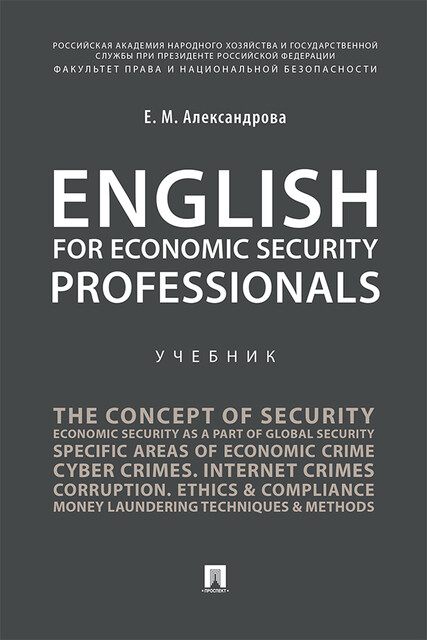



автордың кітабын онлайн тегін оқу English for Economic Security Professionals

Информация о книге
УДК 811.111(075.8)
ББК 81.2Англ-923
А46
Резензенты:
Широглазова Н. С., кандидат филологических наук, заведующая кафедрой зарубежной филологии и лингводидактики ЧОУ ВПО «Российская христианская гуманитарная академия»;
Пивкина Н. Н., кандидат филологических наук, доцент кафедры иностранных языков ФГБОУ ВПО «Российский государственный аграрный заочный университет».
Автор:
Александрова Е. М.
Учебник предназначен для студентов специалитета и магистратуры, обучающихся по направлениям «Экономическая безопасность», «Правовое обеспечение национальной безопасности», «Государственное управление и национальная безопасность» и др.
Работа с книгой направлена на развитие умений профессионального общения на английском языке через систему лексических, фонетических, рецептивных, репродуктивных и продуктивных коммуникативных упражнений к текстам профессионально ориентированного характера.
Учебник отражает международный подход к рассматриваемым темам, что позволяет обучающимся расширить понимание стандартов, принципов и подходов, существующих в сфере экономической безопасности в разных странах мира.
УДК 811.111(075.8)
ББК 81.2Англ-923
© Александрова Е. М., 2018
© ООО «Проспект», 2018
Предисловие
Учебник предназначен для студентов бакалавриата и магистратуры, обучающихся по направлениям «Экономическая безопасность», «Государственное управление и национальная безопасность», «Правовое обеспечение национальной безопасности», а также слушателей программ дополнительного профессионального образования «Переводчик в сфере экономической безопасности», «Переводчик в сфере юриспруденции и правового обеспечения национальной безопасности» и др.
В основе учебника лежит компетентностный подход, предполагающий формирование личности, обладающей компетентностью в сфере иноязычного общения на международном уровне. Данный подход определяет следующие цели курса:
1. Развитие языковой компетенции, включающей языковые знания, умения и навыки, соответствующие темам, сферам и задачам общения на конкретном этапе, и предполагающей готовность овладевать ими и использовать для достижения целей общения.
2. Развитие речевой компетенции, включающей речевые умения и навыки – чтения, аудирования, говорения и письменной речи, а также перевода, и предполагающей готовность их реализовывать в репродуктивной и продуктивной речевой деятельности в соответствии с коммуникативными задачами.
3. Развитие социокультурной компетенции, предполагающей знание культуры (в широком ее понимании): культуры своей страны, страны изучаемого языка и других стран мира; умение находить общее среди разных культур и видеть их отличие от своей культуры; умение и готовность использовать эти знания в процессе общения с представителями других культур на английском языке; готовность принимать культурное разнообразие и право на иной образ мыслей и жизни, при этом отстаивая свою позицию, сохраняя чувство собственного достоинства и не унижая достоинства представителей иных культур.
4. Развитие системно-аналитической информационной компетенции, включающей знания о современных источниках информации, умение и готовность работать с ними для извлечения, анализа (определения достоверности / новизны / важности), обработки, сохранения и эффективного использования информации в профессиональной и познавательной деятельности.
Данные цели обусловливают задачи курса:
– расширение активного и пассивного словарного запаса по изучаемым темам;
– совершенствование и активизация необходимого для усвоения изучаемой темы грамматического материала;
– развитие умений и навыков ознакомительного, поискового и аналитического чтения;
– развитие произносительных навыков;
– развитие умений и навыков разных видов говорения, ведения беседы и дискуссии, выступления с сообщением;
– развитие умений и навыков поиска и обработки информации лингвистического и иного плана с использованием традиционных и электронных носителей.
Основные воспитательные задачи курса:
– формирование гражданской позиции;
– формирование умений и навыков работы в команде;
– формирование качеств лидера.
Указанные задачи определяют структуру учебника, который содержит двенадцать глав, охватывающих такие темы, как: понятие безопасности, уровни безопасности, глобальная и национальная безопасность, глобальная экономическая безопасность, социально-экономическая безопасность, экономические преступления, статистика экономических преступлений, киберпреступность, коррупция, отмывание денег, методы и техники отмывания денег, этапы отмывания денег.
Учебник отражает международный подход к рассматриваемым темам. Это позволяет слушателям расширить понимание стандартов, принципов и подходов, существующих в сфере экономической безопасности в разных странах мира, что в дальнейшем сможет им дать значительное конкурентное преимущество.
Материал каждой главы направлен на поэтапное усвоение темы (4–6 часов) и включает:
– словарь по теме с транскрипцией;
– основной текст раздела;
– задания на проверку понимания, лексико-грамматические упражнения, направленные на тренировку и закрепление материала, условно-речевые и речевые упражнения и т. д.;
– дополнительные тексты по теме.
Материал, представленный в учебнике, является современным и информативным, обеспечивая развитие эрудиции и культуры будущего специалиста; языковой материал включает данные, необходимые для будущей профессиональной деятельности.
Работа с данным учебником направлена на формирование и совершенствование навыков чтения и перевода текстов по специальности, расширение и закрепление у обучающихся лексического запаса по специальности.
Контекст учебных материалов соответствует контексту специальностей, что, без сомнения, может способствовать увеличению заинтересованности студентов и повышению мотивации к изучению профессионального иностранного языка.
Пособие обеспечивает гибкость учебного процесса. Учебник может быть плодотворно использован при любой форме обучения: очной, очно-заочной (вечерней), заочной. По предпочтению преподавателя и студентов, в соответствии с особенностями конкретной аудитории, может осуществляться как выбор глав, так и выбор траектории самостоятельной работы студента.
В аудитории рекомендуется выполнять в первую очередь упражнения коммуникативной направленности.
В пособии представлены тесты, а также справочные материалы, необходимые для выполнения упражнений.
UNIT I. The concept of security
Vocabulary
| 1. concept [‘kɔnsept] 2. phenomenon [fɪ’nɔmɪnən] n 3. agenda [ə’ʤendə] от agendum n 4. manifestation [ˌmænɪfes’teɪʃ(ə)n] n 5. security policy 6. threat [θret] n 7. realm [relm] n 8. day-to-day [‘deɪtə’deɪ] 9. refer [rɪ’fɜː] (refer to) 10. secure [sɪ’kjuə] adj 11. tool [tuːl] n 12. certain [‘sɜːt(ə)n] adj 13. priority [praɪ’ɔrətɪ] n 14. interaction [ˌɪntər’ækʃ(ə)n] n 15. significant [sɪg’nɪfɪkənt] adj 16. invention [ɪn’venʃ(ə)n] n 17. National Security Council NSC 18. conduct [kən’dʌkt] v 19. pursue [pə’sjuː] v 20. encompass [ɪn’kʌmpəs, en-] v 21. nation state 22. attempt [ə’tempt] v 23. pursuit [pə’sjuːt] n 24. securities n pl 25. bonds [bɔnd] n 26. debenture [dɪ’benʧə] n 27. note [nəut] n 28. option [‘ɔpʃ(ə)n] n 29. share [ʃeə] n |
– понятие, идея; общее представление; концепция – событие, феномен, явление – программа (работы), план (мероприятий) – проявление; пример (чего-л.) – политика безопасности – опасность, угроза – сфера, область – будничный, обыденный, повседневный – отсылать (к кому-л. / чему-л.) – безопасный – инструмент – определенный – преимущество, приоритет – взаимодействие – значительный, важный – изобретение – Совет национальной безопасности, СНБ – вести, проводить – заниматься – выполнять, осуществлять – национальное государство – пытаться, стараться – преследование; занятие – ценные бумаги – облигации; боны – долговое обязательство, долговая расписка – простой вексель; долговая расписка – опцион – акция |
| 30. warrant [‘wɔr(ə)nt] n 31. stock exchange [‘stɔkɪksˌʧeɪnʤ] 32. pledged asset [‘æset] 33. in compliance [kəm’plaɪən(t)s] 34. lender [‘lendə] n 35. obligee [ˌɔblɪ’ʤiː] n 36. default [dɪ’fɔːlt] n 37. foreclosure [fɔː’kləuʒə] 38. interception [ˌɪntə’sepʃ(ə)n] 39. occurrences 40. deliberate action |
– удостоверение, свидетельство, варрант (документ, подтверждающий право своего владельца на получение каких-л. товаров, услуг и т. д.) – фондовая биржа – заложенный актив – в соответствии – заимодавец, кредитор – лицо, в отношении которого принято обязательство, кредитор – невыполнение (обязательств) – лишение права выкупа закладной – перехватывание; перехват; прослушивание (телефонных разговоров) – происшествия – сознательный поступок |
Security (definitions) ■ the state of being free from danger or threat; ■ the safety of a state or organization against criminal activity such as terrorism, theft, or espionage; ■ procedures followed or measures taken to ensure the security of a state or organization; ■ the state of feeling safe, stable, and free from fear or anxiety.
“Security” as a concept and as a phenomenon at the end of the cold war has taken on new forms. There are new security agendas, new security manifestations, and new rules of the game for security policy. Security is a word in common use, used in relation to a wide variety of personal and collective activities and conditions. One can distinguish between security in normal daily activities (job, economy, sex, transport, food), security for positive, desirable conditions (democracy, freedom, prosperity, development, a good life), and security against negative conditions (war, pollution, crime, all kinds of threats).
In a way we have three different realms for the term “security.” First, the broad, day-to-day use of the word, referring to a position aspired to: of being safe, secure, protected. Second, the political use of the word, referring to political actions, processes, or structures that can secure the safety of a political unit. In the political sphere the term “security” is used as a political tool, for example, to provide a certain phenomenon with a specific priority by placing it in the realm of high politics. Finally, “security” can be used as an analytical concept to identify, describe, understand, explain, or even predict phenomena in the general social realm; phenomena such as “security policy,” “security-policy interaction,” or “security institutions and structures.”
A significant change in the political use of the term “security” was, however, the invention of the concept of security policy. The United States, as one of the most important unit in the international system, was the initiator. In 1947 the US administration introduced the National Security Council, which became a model for several countries around the world. This also involved the introduction of a new concept, “security policy.” Now it became possible for states, in linguistic terms, to conduct or pursue a security policy. Security policy was more than defense policy, more than military policy, more than a policy aimed at being prepared for war. Security policy also aimed at avoiding war. Security policy encompassed internal, domestic security, economic-development policy, and policy for influencing the international system so as to create a peaceful environment, regionally as well as globally, including foreign aid to developing countries.
Security policy became an important tool for individual nation states to further their national interests by attempting to influence the international system. The pursuit of international security policy was the task of the United Nations (UN). The political notion of security was extended, from referring primarily to matters related to defense and the military, such as the avoidance of military aggression, to dealing with economic, political, and societal matters, domestic as well as international1.
1. Finance: A financing or investment instrument issued by a company or government agency that denotes an ownership interest and provides evidence of a debt, a right to share in the earnings of the issuer, or a right in the distribution of a property. Securities include bonds, debentures, notes, options, shares, and warrants but not insurance policies, and may be traded in financial markets such as stock exchanges.
2. Banking: An asset pledged to guaranty the repayment of a loan, satisfaction of an obligation, or in compliance of an agreement. Security gives a lender or obligee a legal right of access to the pledged asset and to take their possession and title in case of default for a foreclosure sale.
3. Computing: The extent to which a computer system is protected from data corruption, destruction, interception, loss, or unauthorized access.
4. The prevention of and protection against assault, damage, fire, fraud, invasion of privacy, theft, unlawful entry, and other such occurrences caused by deliberate action2.
I. Read the text. Say if the following sentences are true or false (t/f). Correct the false statements.
1. There are new security agendas, new security manifestations, and new rules of the game for security agency. ___
2. Security is a word used in relation to a wide variety of personal and collective activities and conditions. ___
3. One can distinguish between security in normal daily activities, security for positive, desirable conditions, and security against negative conditions. ___
4. There are four different realms for the term “security.” ___
5. The broad, day-to-day use of the word, refer to a position aspired to: political actions, processes, or structures that can secure the safety of a political unit. ___
6. The political use of the word refers to: of being safe, secure, protected. ___
7. “Security” can be used as an analytical concept to identify, describe, understand, explain, or even predict phenomena in the general social realm. ___
8. A significant change in the political use of the term “security” was, however, the invention of the concept of security policy. ___
9. In 1947 the UK administration introduced the National Security Council. ___
10. Securities include bonds, debentures, notes, options, shares, and warrants but not insurance policies, and may be traded in financial markets such as stock exchanges. ___
II. Match the words with their definitions.
| 1) security 2) threat 3) realm 4) tool 5) nation state 6) UN 7) NSC 8) securities 9) debenture 10) default |
a) an organization which most countries belong to; its role is to encourage international peace, co-operation, and friendship b) a body created by Congress after the Second World War to advise the President (who chairs it) on issues relating to national security in domestic, foreign, and military policy c) a field or domain of activity or interest d) a thing used to help perform a job e) the state of being free from danger or threat f) a statement of an intention to inflict pain, injury, damage, or other hostile action on someone in retribution for something done or not done g) a sovereign state of which most of the citizens or subjects are united also by factors which define a nation, such as language or common descent h) failure to fulfil an obligation, especially to repay a loan or appear in a law court i) a certificate attesting credit, the ownership of stocks or bonds, or the right to ownership connected with tradable derivatives j) a long-term security yielding a fixed rate of interest, issued by a company and secured against assets |
III. Make up word combinations in accordance with the text and translate them.
| 1) criminal 2) cold 3) security 4) desirable 5) certain 6) specific 7) realm 8) peaceful 9) foreign 10) nation 11) military 12) investment 13) ownership 14) insurance 15) stock 16) pledged 17) unauthorized 18) deliberate |
a) of high politics b) states c) activity d) war e) environment f) aid g) policy h) access i) action j) conditions k) instrument l) interest m) policies n) exchange o) phenomenon p) priority q) aggression r) asset |
IV. Find 10 words on the topic in the letter box and translate them.
| w |
s |
e |
c |
u |
r |
i |
t |
y |
t |
q |
| d |
e |
f |
a |
u |
l |
t |
h |
q |
g |
w |
| e |
r |
w |
t |
i |
y |
u |
r |
w |
f |
e |
| b |
d |
a |
o |
n |
a |
d |
e |
e |
d |
r |
| e |
s |
r |
b |
t |
s |
h |
a |
r |
e |
t |
| n |
f |
r |
l |
e |
t |
r |
t |
o |
o |
l |
| t |
g |
a |
i |
r |
o |
a |
g |
j |
q |
e |
| u |
h |
n |
g |
a |
c |
s |
f |
k |
w |
n |
| r |
j |
t |
e |
c |
k |
d |
h |
l |
e |
d |
| e |
k |
x |
e |
t |
c |
v |
b |
n |
m |
e |
| z |
l |
m |
i |
l |
i |
t |
a |
r |
y |
r |
V. Complete the sentences.
1. Securities include ________________________________.
2. Security gives a lender or obligee a legal right of __________________.
3. The extent to which a computer system is protected from __________.
VI. Fill in the gaps.
1. “Security” as a ___________ and as a __________ at the end of the cold war has taken on new forms.
2. There are new security _________, new security ________, and new rules of the game for ________ policy.
3. One can distinguish between security in normal daily __________ (job, economy, sex, transport, food), security _______ positive, desirable conditions (democracy, freedom, prosperity, development, a good life), and security _______ negative conditions (war, pollution, crime, all kinds of threats).
4. The United States, as the most important unit in the international system, was the _________. In ________ the US administration introduced the National Security Council.
5. Security policy also aimed at ____________ war.
6. Security policy became an important tool for individual nation ________ to further their national interests by attempting to influence the international system.
7. The pursuit of international security policy was the task of the ______ _______ (UN).
8. Securities include bonds, debentures, notes, options, shares, and warrants but not insurance policies, and may be traded in financial markets such as ________ exchanges.
9. An asset pledged to guaranty the repayment of a _______, satisfaction of an _______, or in compliance of an _________.
10. The extent to which a computer system is protected from data ________, destruction, interception, loss, or unauthorized ___________.
VII. Answer the questions. Think of more questions of your own.
1. What new forms has the concept of “Security” taken?
2. What is the common use of the word “security”?
3. What are the three different realms for the term “security”?
4. What was the role of the invention of the concept of security policy?
5. When did the United States administration introduced the National Security Council?
6. What is the difference between security policy, defense policy, and military policy?
7. What types of policy did security policy encompass?
8. What was the task of the United Nations (UN)?
9. Why is security important in Finance? Banking? Computing?
VIII. Write headings for the paragraphs.
IX. Make up a dialogue.
X. Give a summary of the text.
XI. Conversation questions.
1. What comes to mind when you hear the word ‘security’?
2. Do you have all the security you need?
3. What would life be like with little security?
4. What does the UN Security Council do? How effective is it?
Supplementary texts
Read and translate the text.
Money Laundering Example Cases
Money laundering is not uncommon, but some money laundering cases have met the spotlight due to the severity of the act, or the amount of money involved in the crime. Large-scale money laundering cases often involve global transactions. Below are some famous examples of money laundering cases.
• In 2012, HSBC Holdings, a London-based company, paid nearly $2 billion in fines after it was discovered that the financial institution laundered money for drug traffickers, terrorists, and other organized crime groups throughout Iran. The laundering went on for many years before the activity was detected.
• In 2014, BNP Paribas, a French bank with global headquarters in London, pled guilty to falsifying business records after it was discovered the institution violated U.S. sanctions against Cuba, Sudan, and Iran. As a result, BNP was forced to pay a fine of $8.9 billion which is the largest fine ever imposed for violating those sanctions3.
[3] http: //legaldictionary.net/money-laundering/.
[2] http://www.businessdictionary.com/definition/security.html.
[1] Bertel H., Bertel K. International Relations. Vol.II – International Security – Encyclopedia of Life Support Systems (EOLSS).
UNIT II. Six levels of security actors
Vocabulary
| 1. framework [‘freɪmwɜːk] n 2. distinguish [dɪ’stɪŋgwɪʃ] v 3. actor [‘æktə] n 4. victim [‘vɪktɪm] n 5. coherent [kə(u)’hɪər(ə)nt] adj 6. globe [‘gləub] n 7. assertion [ə’sɜːʃ(ə)n] n 8. vital [‘vaɪt(ə)l] adj 9. claim [kleɪm] n 10. survival [sə’vaɪv(ə)l] n 11. coercion [kəu’ɜːʃ(ə)n] n 12. violence [‘vaɪəl(ə)n(t)s] n 13. victimize [‘vɪktɪmaɪz] v 14. identity [aɪ’dentətɪ] n 15. sovereignty [‘sɔvr(ə)ntɪ] n 16. permanence [‘pɜːm(ə)nən(t)s] n 17. anarchic(al) [æ’nɑːkɪk((ə)l)] adj 18. sustainability [səˌsteɪnə’bɪlətɪ] n |
– структура, строение – проводить различие – деятель, личность – жертва – сцепленный, связанный – а) (the globe) Земля б) планета – утверждение – (жизненно) важный, насущный – требование – выживание – принуждение, насилие – жестокость, насилие – мучить; вводить в заблуждение – идентичность, индивидуальность – независимость, суверенитет, суверенность – постоянство, стабильность – анархичный, беспорядочный – устойчивость; устойчивое развитие |
In order to establish a general understanding of the analytical concept of security we would like to introduce a simple model. It is not our purpose to provide a new framework, rather the opposite: traditional dividing lines are re-used and re-combined.
A useful and rewarding exercise is to distinguish between six levels of security, each defined by the security actors that at the same time are victims of the security-related threats at that level:
1. Security for the individual (individual security).
2. Security for the social group, the community, “nation,” organized national or ethnic entity (societal security).
3. Security for the state or “nation,” in the US terminology (national security).
4. Security for the region, that is, a coherent security region, not necessarily one based on proximity (regional security).
5. Security for the society of nations or what could be referred to as “international society,” consisting of all, or most states in the world (international security).
6. Security for the globe, meaning “Spaceship Earth” or the planet (global security).
The fundamental assertion is that the all-over general threat deals with the simple existence of the political unit in question. As to the specific vital threats to the six levels of units, the basic claims are the following.
To the single individual the vital threat seems to be that to physical and economic survival. It has to do with coercion and violence in physical and economic terms. You cannot be a “political man” if you are heavily victimized by these threats.
To the national society the vital element is identity, which is the basic constructive element of society. Without identity there is no society.
To the state, the vital threat is to sovereignty. Without sovereignty, a socio-political entity cannot be recognized as a state.
For the region, stability and coherence are the main factors. Again, there is no regional organization without these vital elements.
To the international society, a threat to the system’s permanence, to the way that generally recognized norms and rules can exist in a basically anarchic order, is the essential one.
Finally, to the globe as a kind of security unit, sustainability is considered to be the vital factor exposed to threats4.
I. Read the text. Say if the following sentences are true or false (t/f). Correct the false statements.
1. A useful and rewarding exercise is to distinguish between the levels of security, each defined by the security victims. ___
2. There are seven levels of security. ___
3. For the security for the individual the basic constructive element is identity. ___
4. Security for the social group, the community, “nation,” organized national or ethnic entity has to do with coercion and violence in physical and economic terms. ___
5. To the security for the state or “nation,” the vital threat is to sovereignty. ___
6. To the region, stability and coherence are the main factors. ___
7. To the security for the society of nations sustainability is considered to be the vital factor. ___
8. To the globe, a threat to the system’s permanence is the essential one. ___
II. Match the words with their definitions.
| 1) actor 2) individual 3) community 4) state 5) region 6) international 7) globe |
a) a group of people living in the same place or having a particular characteristic in common b) a single human being as distinct from a group c) an area, especially part of a country or the world having definable characteristics but not always fixed boundaries d) a group consisting of all, or most states in the world e) a nation or territory considered as an organized political community under one government f) a participant in an action or process g) the earth |
III. Make up word combinations in accordance with the text and translate them.
| 1) simple 2) new 3) security-related 4) Spaceship 5) fundamental 6) basic 7) survival 8) constructive 9) political 10) anarchic |
a) model b) assertion c) framework d) economic e) entity f) order g) threats h) Earth i) claims j) element |
IV. Match the columns.
|
level of security |
the vital threats is to |
| 1) security for the individual 2) security for the social group 3) security for the state 4) security for the region 5) security for the “international society” 6) security for the globe |
a) the system’s permanence b) physical and economic survival c) sustainability d) identity e) sovereignty f) stability and coherence |
V. Complete the sentences.
1. A useful and rewarding exercise is to distinguish between six levels of security: __________________________________________________.
2. As to the specific vital threats to the six levels of units are the following __________________________________________________________.
VI. Fill in the gaps.
1. A useful and rewarding exercise is to distinguish between six levels of security, each defined by the security _________ that at the same time are ___________.
2. Security for the individual (___________ security).
3. Security for the social group, the community, “nation,” organized national or ethnic entity (__________ security).
4. Security for the state or “nation,” in the US terminology (________ security).
5. Security for the region, that is, a coherent security region, not necessarily one based on proximity (____________ security).
6. Security for the society of nations or what could be referred to as “international society,” consisting of all, or most states in the world (___________ security).
7. Security for the globe, meaning “Spaceship Earth” or the planet (_________ security).
8. To the single individual the vital threat seems to be that to physical and economic ________.
9. To the national society the vital element is _____________________.
10. To the state, the vital threat is to ________________.
11. For the region, ________ and ____________ are the main factors.
12. To the international society, a threat to the system’s _________.
VII. Find 11 words on the topic in the letter box and translate them.
| i |
c |
s |
i |
d |
e |
n |
t |
i |
t |
y |
| n |
x |
o |
c |
q |
p |
v |
i |
t |
a |
l |
| d |
s |
v |
o |
e |
r |
i |
k |
o |
s |
b |
| i |
o |
e |
h |
w |
o |
a |
e |
p |
s |
c |
| v |
c |
r |
e |
r |
x |
s |
a |
v |
e |
l |
| i |
i |
e |
r |
t |
i |
d |
r |
c |
r |
a |
| d |
e |
i |
e |
y |
m |
f |
t |
x |
t |
i |
| u |
t |
g |
n |
u |
i |
g |
h |
z |
i |
m |
| a |
a |
n |
c |
a |
t |
h |
k |
l |
o |
n |
| l |
l |
t |
e |
q |
y |
j |
z |
x |
n |
m |
| r |
e |
y |
w |
g |
l |
o |
b |
e |
c |
b |
VIII. Answer the questions. Think of more questions of your own.
1. How many levels of security can be distinguished?
2. How are the levels of security defined?
3. What are the vital threats to the individual security?
4. What are the threats to the societal security?
5. What are the threats to the national security?
6. What are the threats to the international security?
7. What are the threats to the regional security?
8. What are the threats to the global security?
IX. Make up a dialogue.
X. Give a summary of the text.
XI. Conversation questions.
1. If you had to choose between security and freedom, which would you go for?
2. Do you worry about job security?
3. What kinds of security are there in life?
4. Does your country provide good social security if you have no job or home?
Supplementary texts
Read and translate the texts.
California Woman Sentenced for Role in Offshore Sweepstakes Scheme On Aug. 11, 2015, in Asheville, North Carolina, Patricia Diane Clark, of Sacramento, California, was sentenced to 130 months in prison and ordered to pay $642,032 in restitution and to forfeit the same amount jointly with her co-defendants. Clark pleaded guilty to conspiracy to commit wire fraud, wire fraud and conspiracy to commit money laundering. According to court documents, from about 2007 through February 2013, Clark and her coconspirators called U.S. residents from Costa Rican call centers, falsely informing them that they had won a cash “sweepstakes.” The victims, many of whom were elderly, were told that in order to receive the prize, they had to send money for a purported “refundable insurance fee.” Clark picked up money from the victims and sent it to her co-conspirators in Costa Rica. Clark also managed others who picked up money from the victims in the US and she kept a portion of the victims’ payments. Once the victims sent money, Clark’s co-conspirators contacted the individuals again and falsely informed them that the prize amount had increased, either because of a clerical error or because another prize winner was disqualified. The victims then had to send more money to pay for “new” fees to receive the larger sweepstakes prize. The attempts to collect additional money from the victims continued until an individual either ran out of money or discovered the fraudulent nature of the scheme. Clark, along with her co-conspirators, was responsible for approximately $640,000 in losses to more than a hundred U.S. citizens5.
Businessman Sentenced for Conspiracy to Misbrand a Product for Human Consumption, Money Laundering
On Aug. 5, 2015, in Providence, Rhode Island, Tayfun Karauzum, of Newport Beach, California, was sentenced to 60 months in prison and three years of supervised release. On Jan. 30, 2015, Karauzum pleaded guilty to conspiracy to misbrand a product for human consumption and money laundering. According to court documents, Karauzum manufactured, marketed and distributed for human consumption Potion 9, a product containing butanediol, an industrial solvent that rapidly metabolizes into gammahydroxybutyric acid (GHB) – commonly referred to as a “club drug” or “date rape drug.” Karauzum was the owner of Max American Distribution LLC in Newport Beach, California, through which he marketed and distributed between $1 million and $2.5 million dollars’ worth of Potion 9 through online sales and dietary supplement companies. Karauzum caused nearly 13.5 million milliliters of the misbranded product Potion 9 to be manufactured and available for distribution. Karauzum routinely transferred proceeds from the sale of Potion 9 sales in increments in excess of $10,000 from his business’ PayPal account into a personal bank account6.
[6] https: //www.irs.gov/uac/Examples-of-Money-Laundering-Investigations-Fiscal-Year-2014.
[5] https: //www.irs.gov/uac/Examples-of-Money-Laundering-Investigations-Fiscal-Year-2014.
[4] Bertel H., Bertel K. Op. cit.
UNIT III. Global and national security
Vocabulary
| 1. divide [dɪ’vaɪd] n 2. to cater for 3. citizenry [‘sɪtɪz(ə)nrɪ] n 4. contend [kən’tend] v 5. breed [briːd] v 6. rivalry [‘raɪv(ə)lrɪ] n 7. remedy [‘remədɪ] n 8. dignity [‘dɪgnətɪ] n 9. malnutrition [ˌmælnjuː’trɪʃ(ə)n] n 10. depletion [dɪ’pliːʃ(ə)n] n 11. tensions 12. capacity [kə’pæsətɪ] n 13. prosperity [prɔs’perətɪ] n 14. consequence [‘kɔn(t)sɪkwən(t)s] n 15. refugee [ˌrefju’ʤiː] n 16. transcend [træn’send, trɑːn-] v 17. contiguity [ˌkɔntɪ’gjuːətɪ] n 18. aftermath [‘ɑːftəmɑːθ] n 19. disarmament [dɪs’ɑːməmənt] n 20. non-proliferation n 21. acquisition [ˌækwɪ’zɪʃ(ə)n] n |
– граница; различие – обслуживать – гражданское население, граждане – соперничать; противостоять – порождать, вызывать – соперничество; конкуренция – средство, мера (против чего-л.) – достоинство – недоедание – истощение (ресурсов) – противоречия – способность (что-л. делать) – преуспевание, процветание – последствие – беженец – переступать пределы – соседство, близость, контакт – последствия (событий) – демилитаризация, разоружение – нераспространение (ядерного оружия) – приобретение |
In many forums on the topic of security, there has been an attempt to establish a divide between national and global security. National security has been described as the ability of a state to cater for the protection and defence of its citizenry. Global security, on the other hand, evolved from the necessity that nature and many other activities, particularly globalization, have placed on states.
One of the major challenges that the field of global security has to contend with is the concept of security complex7, a situation in which the security concerns of states are deeply interconnected to the point that one state’s security needs cannot be realistically considered without taking into consideration the security needs of the other states8. The fear or threat content of security complex breeds rivalry among states. The remedy for such rivalry lies in cooperation which can only be found in global security initiatives among states.
With the advocacy of the United Nations Office for the Coordination of Humanitarian Affairs (OCHA) human security elements have acquired a wider dimension, for they go beyond military protection and engage threats to human dignity. Accordingly, it has become necessary for states to make conscious efforts towards building links with other states and to consciously engage in global security initiatives. OCHA’s expanded definition of security calls for a wide range of security areas:
1. Economic: creation of employment and measures against poverty.
2. Food: measures against hunger and famine.
3. Health: measures against disease, unsafe food, malnutrition and lack of access to basic health care.
4. Environmental: measures against environmental degradation, resource depletion, natural disasters and pollution.
...