Values
All people have values and treasure them very much. But some things are valuable to one person and absolutely indifferent to the other. So why do we assign the value to some things and phenomena, but not to others? Value means importance, significance, benefit. On the one hand, it seems that value is a real characteristic of an object or phenomenon and significance and usefulness are not inherited from nature, but they are our subjective measures. We consider the value important and valuable only if it is involved in our life and we are truly interested in it, and therefore need.
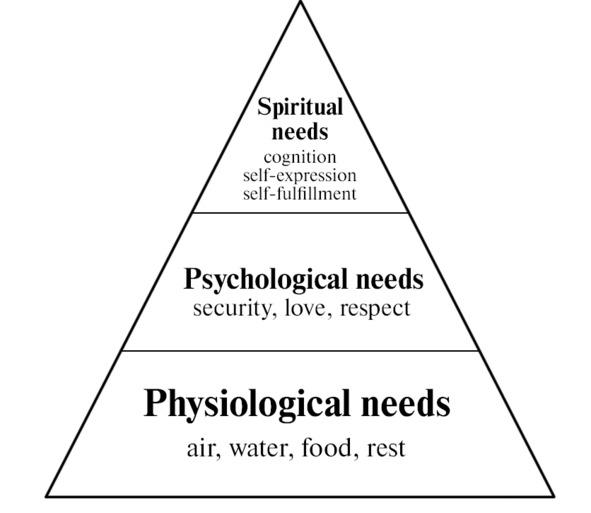
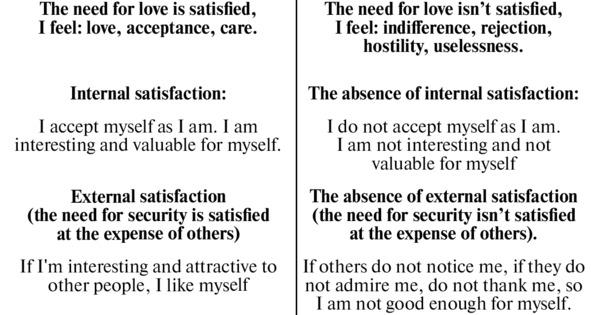
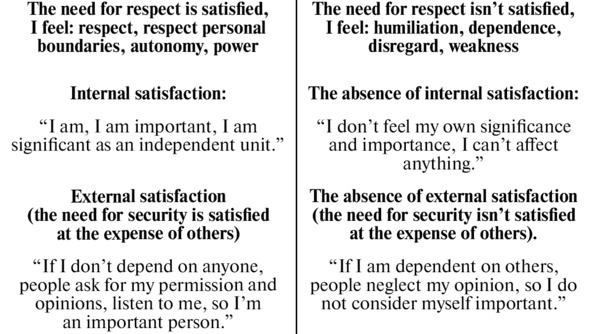
All values can be divided into three groups. It is connected, as you may guess, with the existence of three psychological needs. One group of values satisfies security needs, receiving them, we feel calm and anxiety is releasing. Another list of values satisfies the need for love, receiving which we feel acceptance, we feel a deep connection with the object, we feel beautiful. And the third group of values — values that satisfy the need for respect, having received it, we feel strong, large, significant, cool.
It means that values serve our needs.
The existence of valuable, in our view, things and phenomena in our lives leads to satisfaction, and the absence, on the contrary, causes states of depression and dissatisfaction with life and ourselves. There are a lot of such values in our life; it is a whole system in which there is a hierarchy. We make all our decisions on the basis of this hierarchy of values from buying products in the store to choosing a partner for business or family life.
The hierarchy of values is a system of guidelines in all spheres of human life. Usually, if you ask a person what is important to him, you can hear the answer: family, children, work, travel, etc. These are all spheres of life, contexts in which we satisfy our needs for safety, love and respect.
There is also a hierarchy in the spheres of our life, someone devotes himself completely to work, and someone to the family. The truth is that the more spheres of life which we are realized in, the happier we are. Speaking of values, we, first of all, talk about the quality of life. To understand your values, you need to answer these questions:
What is important for me in my work?
What is important for me in relations with my parents?
What is important for me in relationships
with my partner?
What is important for me in relations with my children?
What does this subjective value depend on? Why does one person, buying a chair, pay attention to its reliability and durability, another to beauty and elegance, and the third one to the price. Moreover, it’s important for someone to buy cheaper to save resources, and for someone more expensive to emphasize their capabilities and significance.
The individual internal hierarchy of psychological needs prioritizes values exactly.
Nominalization
You must have noticed that different people, speaking the same definitions, often mean the different experiences that lie behind them. For example, when you say “I will be soon”, what period of time do you mean? “Soon” — it is when? Is it 5—10 minutes, 1—1.5 hours, immediately? To feel what we are talking about, answer yourself this question, and then ask it to your relatives.
Nominalization means words that do not denote a specific object, their meaning is often subjective and can be interpreted in different ways. Examples: happiness, support, individuality, control — each of these concepts can be understood in different ways by different people.
To estimate your values, you need to be as sincere with yourself as possible, it is 100% individual work, you have to unveil on your own what experience and meaning are behind such words as “love”, “support”, “freedom”, “responsibility”, “respect”, “justice”, etc. Sometimes people say: “I need your support”, but actually they feel the lack of love, presence, the other person’s attention and call all these things “support”.
“Support” as a value which means the need for security, is not only the presence or approval of another person, support implies very often specific actions, assistance in some business, taking on some responsibility. In this case, support will have a broader meaning. Of course, there are situations when it’s enough to be near and just say: “Well done! Everything is Ok! Do as you do.” Such support helps to resolve internal doubts which sound something like this: “Am I on the right way? Am I looking in the right direction? Am I normal? Am I good?” In this case, approval really gives strength, because confirmation from a significant person weakens doubts and self-confidence increases.
“Attention” means the need for love, and when it comes to this, it is enough just the presence of another person nearby. A man can do nothing for you now, but if he looks at you with a keen look, catches your every word, at the very moment you feel loved, special, beautiful internally and externally. There is a message “you are what I need now”, it creates a very favorable state and satisfies the need for communication and acceptance.
In the same way we very often put different concepts into the word “freedom”. The value of “freedom” is more related to the need for respect. Freedom is to do what I want, I decide what I do, no one can limit me in making decisions, in actions, in movements. It is important to understand that such freedom cannot exist without responsibility. If I’m in charge, I make decisions, so I’m responsible for everything. Thus, the need for respect is satisfied and in this case:
However, there is another kind of freedom that satisfies the need for security. In this case, a person feels safe when he is free FROM expectations, FROM responsibility, FROM obligations. We also call such freedom “childish freedom”.
Freedom = Carelessness, the absence of responsibility
How do Values Form and Where do they Come from?
Why is one kind of values important and other kinds are not so significant? Why do different people have different values?
Someone, for example, is ready to shout aloud, give up relations, leave work, remain without means of living in order to prove justice. This behavior will indicate that for a person at the moment the most important is the need for respect.
Another person will remain silent in the same situation, tolerate the fact that nobody listens to his opinion, it will be more important for him that he knows where he will be tomorrow, what he will eat and that somebody will take care of him if such a need arises. This is about the need for security.
And the third case, when the need for love is leading: “My God, it doesn’t matter if I have any justice or work, I can give up it at any time, if my love requires me to go to the world’s end, the main thing is that we are together, together we can cope with anything.”
These examples are a bit exaggerated to demonstrate the difference in the attitude towards life according to the basic psychological needs.
Depending on leading psychological needs, the values
relating to this need are in the limelight.
How do leading needs form? Where do they originate?
First of all, each person has all three psychological needs. As an analogy we can draw your attention to the body needs, which are more obvious and understandable. We have a need to sleep, a need to eat, a need to breathe, all of them are vital. It’s impossible to decide what’s best for you — sleeping or eating, breathing or drinking. It is all necessary for survival. But! Having a certain level of satisfaction, when you cope with the satisfaction of all these needs, you will give preference to one of them. You can bother more about what you eat than whether your sleep is full, and the other person will not pay so much attention to food (it doesn’t matter if he eats or not), but will take care of his healthy dream: “If I sleep well, I won’t care whether I eat or not, I’ll have a good mood, I’ll feel good.”
Psychological needs work in the same way. One person may be indifferent what others think of him, what kind of relationships he has with his colleagues, what he is wearing. A coffee stain on trousers, a dingy yesterday shirt for someone can be nonsense, and someone can bother so much about his look that he will not leave the house in this form. These are our inner preferences.
As a rule, a hierarchy among needs arises genetically, i.e. there is a certain predisposition as a result of events that took place before our birth. It is usually said about children: “He looks like his grandmother / grandfather / mother / father”, i.e. there is a certain similarity of characters with a member of the family system, there is a certain transmission of information through genes. This genetic predisposition to a certain temperament, and therefore to certain needs, comes from birth.
And then the period of childhood and education that parents give us comes into force. We are brought up at the level of beliefs, thoughts that our parents offer us every day, talking about this, declaring some values, ideas, meanings. And it is inserted into us very clearly, as if it doesn’t exist in other way.
For example, parents broadcast to the child that it is not necessary to make a bed every day, but when guests come to the house, the bed needs to be made up. It means it’s not important whether you make the bed or not it’s important what people say. This belief is quite safe in the context of the bed, but it is insensibly woven into other contexts of life. No matter what you think and feel, the main thing is how it looks in the eyes of others. And then a person in an effort to receive acceptance and approval may contradict his desires and principles.
If a child was born with a leading need for love, he will pay a lot of attention to relationships with other people, be interested in creative work, will strive to decorate the space where he lives, he will pay attention to his appearance. But if the parent has a leading need for security, he sees danger everywhere and every day he says to the child: “Caution! You may hit here. Do not go there, there may be a deep puddle. Around the corner you are waiting for an evil man. A monster will come for you. Trust no man”, and with the passing of time, having a leading need for love, the need for security becomes the next in the hierarchy. And the values from the security group will also become important, because the person was taught this way, these values were inserted into him. The experience gained in childhood is personal, this experience had already existed in your life before your birth.
For at least 12 years, our psychological needs and their satisfaction lie entirely in the responsibility of the parents.
To grow their children, it is important to create a safe space, an atmosphere of acceptance and opportunities for achievement.
• Safe space is a feeling that there are enough resources to cope with any situation that may arise (there is always something to eat, there is where to sleep, the doors in the house are closed). The internal routine in the family also creates a sense of security: we go to bed at a certain time, we have dinner at a certain time, etc. If you don’t have enough money, resources for safety, if your parent is constantly under pressure and anxious, thinks where to get money to buy food, shoes, textbooks, then, of course, this situations affects a child’s life (and there are also situations in which parents do not care about these things, i.e. the child is left alone with these problems). In this case, the need for security becomes very urgent for him, and an adult child will think about it all his life, even when he has all the resources to compensate for his childhood experience.
• Love, acceptance — it is a feeling that you are exactly the very person as your parent imagined in the most beautiful dreams. Any free time is given to me and a parent’s face has a slight smile and a gentle, friendly, interested look. A sense of unity, communication through joint activities, praise, a sense of self-worth and exclusivity in the life of the parent. If the child is not paid attention, shoved by one, the other nanny, then the need for love and acceptance is not satisfied, the child does not receive communication with the parents.
• To satisfy a child’s need for respect, parents must create a space in which he understands that he is doing something what he is able to do. It is worth giving small tasks for a child to help him to demonstrate his independence, improve and cultivate self-esteem. Children of 2—3 years old are trying to get the pots off the table, stir something on their own, sweep, carry. Boys of 7—9 years old want to hammer a nail, saw off something on their own. Girls of 7—9 years old want to cook, sew, clean. If parents create such a space for the child, he gets the experience “I can. I manage to do it by myself. I am independent” — this directly refers to respect. Often adults ask the child what he wants to do, where he wants to go, offer a choice of purchases, etc. If at the same time the adult does not listen to his opinion, this attitude shows disrespect. Therefore, if you are ready to give responsibility to the child for something, so that he feels more mature, more meaningful, so do as he said, as he chose. After all, it often happens that the choice of a child does not coincide with those criteria that the adult determined himself, as a result it turns out that his opinion is not important. Children, through their desire to be adults, may begin to demand something, to discuss, but this, ultimately, will not be useful for them. Up to 12 years old, important, big decisions should not be given to children, it is better to act as wizards and create space for them in a magical way, without involving them in all kinds of household activities (for example, buying furniture, choosing a school, choosing a place for spending vacations). A very cool space to content the need for respect is sports, dancing, creativity. These are areas where there are results and they are obvious. All sports clubs organize competitions where the child gets the obvious results — whether he was able or not, whether he succeeded or not. Thus, a child can give himself feedback in an adult way, because respect is always associated with a certain completed action. The competition system is loyal to children, almost always all participants receive medals or certificates. By the way, certificates on the wall or a place of honor at home with awards — this is what gradually creates a base of respect. At the end of stage performances, there are always recordings; after the concert, the child feels the process is complete and at home he can review how it was.
In conclusion we summarize the forming conditions of a leading psychological need:
1. Genetic predisposition.
2. Education and the process of growing up.
We are born with a certain type of personality, i.e. with some predispositions, and we acquire the level of personality development as we get older. When parents educate us in some way, a certain level of development is formed. The level of personality development depends on the process of growing up. We go into adulthood, each of us do it at different time, someone at 18, someone at 20, 25, or 40 — this is an individual process. We come out the parent system as a formed personality, and further we can develop ourselves independently. The further contentment of our needs is only our responsibility. Dad and mom did everything they could. It is worth accepting that they did everything right as much as they could do. In order to be happy, you need to be able to value your life on the conditions under which we got it and with the conditions of growing up that we were.
A Great Delusion
Many people unconsciously actually devote their whole lives to satisfying their leading psychological need. Someone is throwing all his strength into creating external conditions that allow them to feel safe. For others, the meaning of life is the search for another person and love. Someone’s life is dedicated to seeking outward recognition and respect. But such a path, such a meaning of life is almost always pure Utopia. It is impossible to become happy by satisfying only your leading need. As the need is leading, we have a conviction in our subconscious that this is the most important thing in life, we make all efforts to get this satisfaction, and whatever you do, you have the feeling that it is not enough. The paradoxical way out is the satisfaction of another, not leading psychological need, this is a necessary condition for personal growth.
How does it work?
• If a person has the leading need for security, there is an illusive idea that a happy life will begin only when he organizes a stable life full of material resources, when he is supported by trusty partners, when he collects all the necessary information, when he double-checks everything. And only then he will become calm and a happy life will begin.
However, a person can fully satisfy the need for security only when he refuses it for some time and takes bold steps towards his goals (for this they need to be known and set). Having achieved these goals, first of all he will satisfy the need for respect. Step by step, cultivating your self-respect, at one moment you realize that you are big, you have a lot of internal resources, you can cope with everything, you become an authority for yourself, and suddenly that same security comes to you that you needed so much. And then you begin to build relationships with loved ones in an adult way, stop being afraid to fall into some kind of dependence, you find a safe connection in these relationships, you want and are ready to take responsibility and bear it. At the same time, you decide what you will be responsible for and easily give up responsibility that you do not want to bear, without fear of losing the support of authority.
A sense of security arises inside, a longing for it outside leaves. If you have ever met people who are filled with inner strength and tranquility, you probably noticed that you want to create relationships with them and go towards the common goals because “They will do to take along!” (such people are very reliable)
• If a person has the leading need for love, there is a deceptive idea that you can find a person for whom you will be exceptional, who will endlessly look at you and will devote all his free time only to you.
This is also a kind of Utopia, it is impossible to achieve such relationships, they can only be reached by rejecting them, which is paradoxical. Often the way out of such a utopian thinking lies in satisfying the need for security. When you can say to yourself: “You are like others. So, you have enough power inside to cope with everything, like other people”, you turn your attention to other aspects of life. When you redistribute your attention and organize your life in such a way that you can cope with it by yourself (at least at the level of simple survival: to have a job that will provide your minimum needs, take care of your health, be able to relax, constantly learn to go up with the times), then a person appears in your space who doesn’t have a desire to get love from him, and he begins to want to be near you in this safe space.
Love arises within, the longing desire to receive it from the outside leaves. In this case, a strong developing connection arises in the relationship, because energy is redistributed. Otherwise, if all energy is directed only to one sphere of life, it turns out to be too much a burden for another person and literally strangles him, limits his freedom. If you have ever met creative people who learn to look at life in a realistic and pragmatic way, who can organize their own comfort, you probably noticed that you just want to be with them, live and build your life with them.
• With a leading need for respect, a person unconsciously believes that if others respect him, then I myself can respect. A person who is striving to meet the need for respect spends his time and energy maximally to prove to the whole world: “I am big. I am significant. Listen to me. Here are just my rules.”
But no matter how much he does, he does not come to the conclusion that he is truly an authority for everyone around him. There will always be some person who can devalue your influence, your achievements, and this will always be perceived painfully. Here the solution lies through shifting one’s attention to satisfying the need for love. First of all, love for yourself, perhaps for that part of yourself that you consider small and fragile. Building close relationships redistributes excessive energy directed towards respect and achievement. When you really know how to respect yourself from within, to respect your weakness and your strength, relaxation appears, this is a completely different level of life quality. Respect arises within, a longing desire to get it outside leaves. If you have ever met people who are worthy of respect and respect themselves, as a rule, they do not seek to prove anything to anyone, they are calm and very sincere. A strong person who respects himself has the courage to be sincere even in front of a wide audience. Sincerity is a value that satisfies the need for love, and it is through love we come to a sufficient level of respect.
When you excessively want to be very strong, this can only mean one thing — you want to hide your weakness, because a strong person does not reflect on how strong he is. A brave man does not say that he is not afraid of anything, he simply does not think about it. A person who loves himself does not bother with how he looks in the eyes of others.
Value-forming
The information above is more about the formation of actual needs. Values, in fact, are people, objects and objects in the outside world that can somehow satisfy our need.
Values were formed in the process of choosing strategies with which we learned to satisfy our needs. Parents offered us some strategies in the process of upbringing, others we developed on our own in order to cope with life.
A habitual strategy or pattern is a usual, constantly repeating way of thinking, acting and handling emotions. It means that in thinking, emotional response and behavior there are repeating patterns, we are doing the same things over and over again, despite the fact that situations can change. For example, if I’m used to suppressing my emotions, this is my strategy for using emotions. They “stepped on my foot”, and I think: “Well, that’s okay.” On the subconscious, with the help of such a strategy, the need for security is satisfied — “I will tolerate, and I will not cause a conflict or scandal.”
All our strategies (and therefore values) appear for a reason, they are developed as a result of the fact that you got what you needed by behaving in a specific way at some moment of your life. You needed security, behaved “as quiet as a lamb” and nothing bad happened — it means success! This is how a successful strategy for satisfying security needs is formed. And if your parents, grandparents used this strategy, then your attempts to act differently in order to satisfy the need for security will subconsciously mean the fear of death. When you go beyond such a behavior, you will feel such discomfort that you will always want to go back, do it the way your parents did.
It is very difficult to overstep an established strategy of behavior, for this you need a high level of awareness and will.
For example, you want to realize yourself in a professional activity, and at business meetings you sit quietly and are afraid to express your opinion, promote an idea. By such behavior, such a strategy, you hardly take a leadership position. And if you have far-reaching plans and they include leadership activities, then you will have to raise your hand and say, “I want to express my opinion on such an issue.” In order to start declaring, you will have to give up security for some time. At first, your voice will be shy and diffident (thus, fear affects the ability to speak), but the more you force yourself to take this step with your willpower, the more likely that a new strategy will take root. You declared yourself once, you already have one fact that nothing bad happened, the more such confirmations will be, the greater the chances will be.
Asserting yourself, expressing your opinion is unsafe. This is just about what was discussed above — you need to give up a little security for a while in order to get more. When you asserted yourself and received the support of a leader, you get a large portion of security. When you repeat this 5-10-20 times, they will tell you: “You are good at your work, you have leadership abilities and you are an initiative person.” A leadership position implies an increasing level of responsibility, which, again, is unsafe, but at the same time, you get more resources for this responsibility, therefore, there is more security.
In this example:
• Need — Security
• Value — peace of mind
• The strategy is to sit and not to push yourself forward
• The way out of the situation is through the need for respect:
a. goal setting
b. development of a new model of behavior
c. repetition of actions from a new model of behavior
• New value — professionalism
• Strategies for getting it — assert yourself
The goal setting in our example is to assert oneself, to become more significant. When we consciously set such a goal, automatically the values of the need for respect take higher priority. Then you need to be strong, your voice should become louder, you should speak bluntly (the strategy of smoothing corners is not about respect, but about security), you should have your opinion, your vision, you must have goals. All of the mentioned values are about respect. When you draw up such a plan of action for yourself, the values come out of the need for respect, and as a result, your need for security is satisfied to a greater extent, instead of little security you will get much security.
Security. Strategies and Values
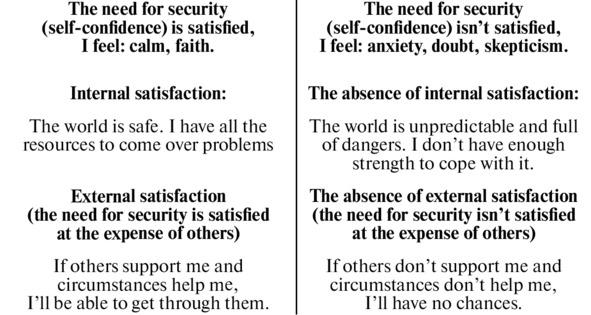
Let’s look at the values from the need for security. What makes our life safer? What is valuable when security is relevant right now? This is what will bring more peace to life — these are resources. They can be tangible and intangible.
Values from the need for security:
• Money. It is important to have money in my pocket, in some sufficient amount for peace of mind. It is important to know that I have enough money to eat tomorrow, in two days, and preferably in two months. The longer this period of calm will be, the better it will be for me.
• Information. I must understand that I have enough knowledge and possess the necessary material to cope with a specific job. It is important for me to know what will happen tomorrow. All that concerns information is about the need for security. A simple exa