


автордың кітабын онлайн тегін оқу Brush up your English (Совершенствуйте знания английского языка)
Елизавета Хундаева
Brush up your English (Совершенствуйте знания английского языка)
Шрифты предоставлены компанией «ПараТайп»
© Елизавета Хундаева, 2017
Учебное пособие посвящено некоторым лексико-грамматическим трудностям речевого общения на английском языке в различных ситуациях повседневной жизни. Материал содержит речевые образцы по разным тематическим разделам, а также структурированные модели продуктивных видов речевой деятельности, включая образцы реплицирования. Предназначено желающим научиться общению на английском языке.
12+
ISBN 978-5-4483-5442-7
Создано в интеллектуальной издательской системе Ridero
Оглавление
- Brush up your English (Совершенствуйте знания английского языка)
- Dialogue 1
- Revision (Повторение)
- Dialogue 2
- Dialogue 3
- Conversation 1
- Conversation 2
- At the congress (symposium)
- Registering the participants
- Checking in at the hotel (Устройство в гостинице)
- Discussing the program
- Showing around the lab (Знакомство с лабораторией)
- Presiding over (председательствовать на) a meeting
- For the participants of the debate
- Speaking on the phone
- Interview
- Short talks
- Speech patterns
- Useful expressions to be used when talking (Полезные выражения, которые можно использовать в беседе)
- A casual (случайный) meeting
- Shopping
- At the Grocer’s (В бакалейном отделе)
- At the Ready-made Clothes Department (В отделе готового платья)
- At the Shoe Department
- At the Outfitter’s (отдел готовой и спецодежды)
- Holiday
- At the souvenir shop
- On business
- Selected vocabulary (выборочный словарь)
- Conversation
- Some useful phrases
- Reservation
- At a formal meeting
- Travelling
- At the accounting department and in the Bank
- Selected vocabulary
- Sending the money
- Applying for the visa
- Completing (выполнение) a project for a grant
- Exercises
Dialogue 1
1. Pronounce, please
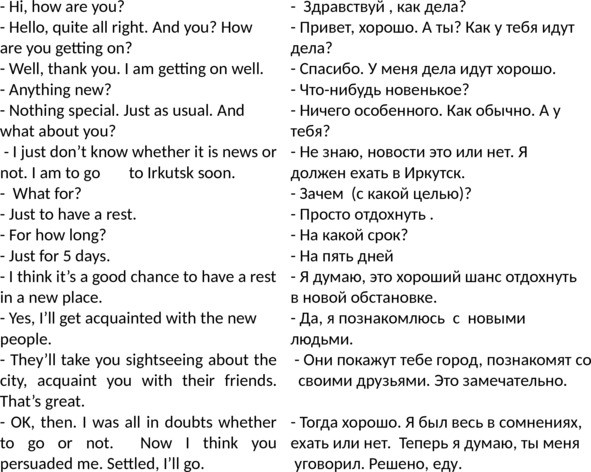
How are you getting on? Well, thank you. I am getting on well. Anything new? Nothing new. Just as usual. And what about you? I just don’t know whether it is news or not. I am to go to Irkutsk. What for? On a business trip (в командировку).
She goes on a business trip. She wants me to go there (Она хочет, чтобы я поехала туда). For how long? (На какой срок?) Just for 5 days. She’ll work there. What will you do? My aunt lives there. Mother wants me to spend (мама хочет, чтобы я провел) a few (несколько) days at her place (у неё). I think it’s a good chance. I think it’s a good chance to spend a few days in a new place. I’ll get acquainted with my uncle and cousins. They’ll take you sightseeing about the city. They’ll acquaint you with their friends. That’s great. OK, then. I was all in doubts whether to go or not. Now I think you persuaded me. Settled, I’ll go.
2. Will you give the English equivalents, please?
Решено. Я поеду в Москву. Я думаю, это хороший шанс. Они меня уговорили ехать. Я весь в сомнениях. Я не знаю, ехать или нет. Я не знаю, хороший это фильм или нет. Это прекрасно. Вполне хорошо. Как у тебя дела? Что-нибудь новое? Ничего особенного. Как обычно.
А как у тебя дела? Хорошо. Я должен ехать в Санкт-Петербург. Я должен написать письмо. Зачем? Они едут в командировку. Они едут на экскурсию. Они едут в экспедицию. На какое время (срок)? Да на неделю. На месяц. На год. На две недели. Мой дядя живет там. Я хочу познакомиться с кузеном. Я хочу провести несколько дней в новом месте. Я покажу тебе город. Хорошо тогда.
3. Pronounce, please.
Uncle (дядя), cousin [кузен, кузина, двоюродный брат (сестра)], niece (племянница), nephew (племянник), aunt (тетя), mother, father, grandmother, grandfather, son (сын), daughter (дочь), sister, brother, elder (старший), older (старше), younger (младший, моложе).
4. Will you speak about your family and relatives using the given words and expressions: What is she? How old is he (сколько ему лет)? Where does she live? What does he do?
5. Will you please translate the following?
— Hello.
— Hi.
— How are you?
— I’m OK. And you?
— Very nice. Is the weather nice?
— Oh, it’s very nice.
— What are you going to do?
— I think I’ll watch TV.
— What is on (Что идет; что показывают)?
— Nothing special (Ничего особенного). All the usual things (Все, как обычно).
— Then why should (должен) you waste (тратить) time? Let’s go and see (навестить) my friends. I want to acquaint (познакомить) you with them.
— Thank you. That’s a good idea (мысль). Let’s.
— Come on then. Let’s hurry up or else (иначе; в противном случае) they’ll leave (уходить, уехать).
— I’m ready (я готов). Come on.
6. Please, pronounce.
A good idea. I’m OK. Is the weather nice? It’s very good. Where are you going? What is on? There are all the usual things. Why should you waste your time? Let’s go. Come on. Hurry up. Let’s hurry up or else they’ll leave. I’m ready. Good.
7. Will you please translate the following?
Как идут дела? Очень хорошо. Хорошая мысль. Погода хорошая. Куда ты идешь? Я иду в школу. Он идет в кино. Она идет в театр. Мы идем на стадион. Вы идете в библиотеку. Они идут в магазин. Я иду домой. Ты идешь к другу. Он идет к дяде. Она идет к тете. Он идет к кузену (двоюродному брату). Аня идет к племяннице. Они идут к племяннику. Катя идет к старшей сестре. Они идут к старшему брату. Что идет по телевизору (What’s on TV)? Да обычные вещи (как обычно). Зачем тратить попусту время? Давай пойдем на стадион. Пошли. Поспешим, иначе они уйдут. Поторопимся, иначе мы опоздаем (or else we’ll be late). Я готов.
8. Read the dialogue in pairs, please.
9. Would you speak on the topics close to those in the dialogues given above?
10. Please, talk about your affairs, the weather, friends, family, relatives, trips, plans for the future, etc.
It would be nice if you used the conversational formulas like: I think, I hope, I don’t think so, by the way, what about…
Revision (Повторение)
How are you getting on? — Как продвигаются дела?
I am getting on quite well. — У меня дела идут хорошо.
I just don’t know whether it is news or not. — Не знаю, новость это или нет.
I am to go there. — Я должен идти (ехать) туда.
What for? — С какой целью?
She goes there on a business trip. — Она едет туда в командировку.
For how long? — На какой срок?
For a couple of weeks. — На пару недель.
What will you do? — Что ты будешь делать?
What are you going to do? — Что ты собираешься делать?
She wants me to learn English. — Она хочет, чтобы я учила английский язык.
I want you to spend a few days at our place. — Я хочу, чтобы ты провел несколько дней у нас.
They’ll take Pete sightseeing. — Они покажут Пете город.
I’ll acquaint you with my friends. — Я познакомлю тебя с моими друзьями.
I am all in doubts. — Я весь в сомнениях.
I don’t know whether she’ll come or not. — Я не знаю, приедет она или нет.
She persuaded me. — Она убедила меня.
Settled. — Решено.
Is the weather nice? — Погода хорошая?
Yes, it is good.
Dialogue 2
1. How are you getting on? (Как дела?)
2. So-so (Так себе; ни то ни сё). And how are you? (А у тебя?)
1. Not bad (Неплохо). What do you think of the weather? (Что ты думаешь о погоде)?
2. It is a little bit stuffy, isn’t it? (Немного душно, не так ли?)
1. Maybe (Может), it’s going to rain (будет дождь).
2. Just imagine how cold it was in May. (Только представь себе, как холодно было в мае).
1. At nights it is nice, much cooler (Вечерами хорошо, намного прохладнее).
2. Is there any news? (Есть какие-нибудь новости?)
1. I think there is none (Думаю, что нет).
2. Have you got the tickets for the football match? (Ты достал билеты на футбольный матч?)
1. Yes, I’ve got. (Да, достал).
2. You know, I’ve got a parcel from Nick. (Ты знаешь, я получил бандероль от Ника).
1. He must be sending you the new discs. (Он, должно быть, посылает тебе новые диски).
2. I think so. (Думаю, что да).
1. Please, pronounce.
Whether, news, what for, on a business trip, learn, for how long, fortnight, spend, a few days, at our place, at their place, at his place, at her place, sightseeing, doubts, grand, persuade, settled, weather, watch the TV, hurry up, or else, be late, ready, come, came. So-so, not bad, stuffy, maybe, rain, imagine, much cooler, is there, none, have got, ticket, football match, Saturday, you know, parcel, really, must be sending, records, think so, think not.
2. Now, please, give the Russian equivalents of the words above.
3. Dramatize the dialogue, please.
4. Would you translate the following, please?
What do you think of your new disc? It’s a little bit cold, isn’t it? May be it’s g
...