A New Approach To The Analysis Of Nuclear Reactions Under The Influence Of High-Energy Particles On A Stationary Target Nucleus In The Physics Of Resonant Nuclear Reactions
UDK:53.08
Ibratjon Aliyev1, G’olibjon Qo’ldashov2, Sultonali Abdurakhmonov3, Inomjon Bilolov4 and Sharobiddin Isroilov4
1 SRI «PRNR», Electron Laboratory LLC, 151100, Margilan, Fergana region, Republic of Uzbekistan
2 National Research of «Renewable Energy Sources» under the Ministry of Energy of the Republic of Uzbekistan, 100000, Tashkent region, Tashkent, Republic of Uzbekistan
3 Fergana Polytechnic Institute, 150100, Fergana, Fergana region, Republic of Uzbekistan
4 Fergana branch of Tashkent University of Information Technologies named after Mukhammad al-Khwarizmi, 150118, Fergana, Fergana region, Republic of Uzbekistan
Abstract. The paper presents a new form of complex analysis of nuclear reactions brought to a state of resonance. This state of nuclear reactions is investigated according to the model of physics of resonant nuclear reactions. The study examines each channel of the nuclear reaction, calculates the nuclear effective cross-section of each of the channels before and after reduction. During the analysis, attention is drawn to the theoretical study of the energy characteristics of the products of each of the reaction channels, with a percentage ratio. The temperature gradients of the nuclei and targets formed at different stages of the reaction are determined. As a result, a complete model has been formed to create a complete description of the nuclear reaction being produced and analyzed, which makes it possible to theoretically predict the outcome of any nuclear reaction. The analysis concludes with the final result in the form of all parameters of the nuclear reaction products at all stages.
Keywords: nuclear reaction channels, nuclear effective cross section, probabilistic nuclear reaction channels, nuclear reaction analysis.
Introduction
The implementation of a nuclear reaction is the bombardment of a beam of charged particles — ionized nuclei, leptons, elementary particles of other categories with selected parameters of the target nuclei. To date, in order to study nuclear reactions [1—2] occurring during bombardment by high-energy charged particles of stationary target nuclei, experimental research is primarily being conducted using charged particle accelerators at different beam energies with different levels of monochromatization [3—4; 8]. In this case, the accelerator can be in the form of various designs, depending on the specified parameters.
A common case when using this method is the use of several channels of acceleration lines, where the beam is separated by a separator, often electromagnetic, into separate beams that collide with the target in different chambers [5]. Thus, to calculate the nuclear effective cross section of the reaction, it is necessary to use a special chamber with a dense insulating, more often lead shell and separate detectors. Cylindrical chamber designs are used to analyze the reaction results with the additional possibility of studying the Rutherford scattering effect [6—7].
Based on this, it is clearly seen that these reactions require a sufficient amount of time to prepare and direct the corresponding energy costs. Therefore, sufficient preparatory time, material and energy costs are required to study the interaction of beams with target nuclei in various combinations [9—10; 15]. After the experiment, the results are processed using the available theoretical analysis methodology, which is described in many research papers [11—12]. However, in order to accelerate research work in the field of nuclear reactions, a new approach is needed that outputs results when certain initial and boundary conditions change — the parameters of the accelerator, beam and target, therefore, the creation of a new approach that accelerates the obtaining of results in nuclear reactions is relevant.
A separate problem today is the complexity of studying a new type of reaction, resonant nuclear reactions. Such reactions can be carried out on accelerators with high beam monochromacy [13]. So today, on cyclotrons, synchrotrons, phasotrons, and linear accelerators, monochromaticity reaches 5 keV at a beam energy of 20 MeV [14—15; 18]. An increase in this degree is possible with rigid separation, which leads to a large loss of beam current by 70—80% [16; 19—20]. Van de Graaf accelerators with a beam monochromaticity of 1 keV at the same maximum beam energy are considered the most accurate [15—17; 21].
An increase in this degree is possible with a more accurate selection of energy using nano-electrodes and special monochromotic devices that are at the design stage [18; 22]. However, it is important to create a mathematical model beforehand that allows not only predicting the implementation of nuclear reactions, but also all their varieties, including resonant nuclear reactions with great accuracy. Based on this, the task is also relevant.
Materials and methods of research
In the course of the research, the method of solving boundary and initial conditions in the form of accelerator system parameters, the method of classification, analysis, and mathematical modeling was used.
Research
The analysis of nuclear reactions can be carried out in a variety of ways and using different algorithms; however, the purpose of the analysis remains unchanged — to create a complete picture of the analyzed nuclear reaction. In the early analysis model [1], initially one nuclear reaction was isolated, one specific channel of it was analyzed — its energy characteristic, nuclear effective cross-section, percentages and other parameters were determined, and only after the study moved to the stage of analyzing other channels of the nuclear reaction, and at the same time the initially analyzed channel remained isolated. Each time, the chosen channel in the exo-energy reactions had a large nuclear effective cross-section, which seemed inexplicable.
The problem was that the initial channel was selected more often for the energy of the Coulomb barrier, as a result, it was observed that the reaction was carried out in an area with a large percentage, which turned out to be the main channel with a large reaction yield, since the main criterion for selected nuclear reactions in early analyses relative to the previous algorithm was the efficiency in the reaction output. In the new model of reaction analysis, the solution to this problem plays a special role, presented in the following form.
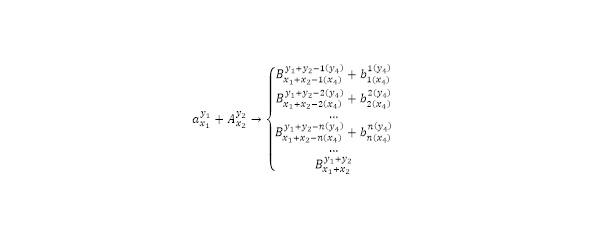
Suppose that a nuclear reaction c with its own channels (1) is initially set.
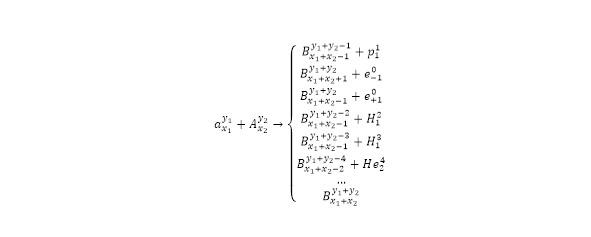
Which can also be converted to (2).
Initially, the analysis assumes the determination of the radius of the target core being bombarded (3), in order to further determine the Coulomb incoming barrier (4).
After determining the Coulomb incoming barrier, which can most often be higher than the threshold of a nuclear reaction, the energy of the incoming particle is determined, and as the energy approaches, it becomes possible to increase the probability of a larger number of nuclear reactions. However, in each case, more than one nuclear reaction channel is considered (1), among which there are reaction channels that are maximally probabilistic (5).
Such channels include channels with outgoing elementary particles or relatively light nuclei, among which one can single out a proton as the nucleus of a hydrogen atom, a deuteron and a triton as the nuclei of deuterium and tritium, respectively, as well as alpha particles.
But also, together with the above-mentioned probabilistic reaction channels, it is possible to carry out reactions with the departure of lighter reactions if, compared with heavy nuclei, the departing nucleus is with sufficiently small masses, however, it is the channels with the departing particles in (5) that are most often determined. In the early analysis, the situation with energies not reaching the surface was not considered. the value up to the Coulomb barrier, however, in this case, if necessary, this moment is considered.
To study this variation, a Rutherford scattering variant is demonstrated, where the scattering angle (6) is initially determined, which determines the ratio from the cross-sectional area of the incident beam to the total area of a sphere with a radius equal to the beam radius, which makes it possible to determine in steradians the angle from which the beam is directed towards the core, demonstrating a one-sided The direction of the beam is different than in the cases of special accelerators with multiple accelerator systems, which include a system for starting a thermonuclear reaction with a large angle.
Also, at the same time, the boundary velocity of the incoming beam (7) is determined, which is calculated on the condition that the energy of the beam is exactly equal to the energy of the Coulomb barrier, as a result of which, after passing, the particle simply would not have kinetic energy left.
In addition to the factor of determining the boundary velocity, it is worth adding that the beam velocity cannot be exactly equal to the boundary velocity due to the impossibility of ensuring zero monochromatization in the accelerator, as well as due to the law of the impossibility of having zero kinetic energy in particles. After determining the necessary ratios in (6—7), they are substituted into the expression for calculating the effective cross section, which is derived in equation (8).
Along with this, in order to determine the minimum distance between the incoming beam and the core (10), an additional parameter of the electro