Stephan Fakeer
Brain. Manual
Fonts by «ParaType»
Illustrator Stephan Fakeer
© Stephan Fakeer, 2025
© Stephan Fakeer, illustrations, 2025
Ever wondered how your brain works? This manual reveals its secrets: where memories hide, why studying is hard but essential, and how to boost focus, creativity, and even flirting skills! Based on cutting-edge neuroscience, this isn’t just a book — it’s a brain upgrade. The perfect gift for anyone with a brain (or those who should start using it).
ISBN 978-5-0067-4267-3
Created with Ridero smart publishing system
Contents
Congratulations! You are now the proud owner of the most brilliant organ on the planet. Yes, that’s right — your brain! That magical thing that dreams, creates, imagines, solves problems, and (usually) keeps you from forgetting your keys at home. Thanks to its tireless work, you are you! And it has the power to take you to incredible creative heights. Rest assured — your brain is absolutely one of a kind.
Shaped by a unique mix of genes, experiences, environment, and education, it makes your thoughts and talents as original as itself. This remarkable organ comes with limitless potential.
Your brain is your personal HQ for thoughts, memories, emotions, and creative outbursts. Its superpower? The ability to change and adapt (yes, that’s neuroplasticity!) — helping you learn, grow, and even come up with excuses when you’re late for meetings.
Oh, and one more thing: your brain is so precious that nature wrapped it in a sturdy skull and installed a blood-brain barrier — just in case your immune system ever gets… creative and decides to turn against you.
SPECIFICATIONS
— Weight: 1 to 2kg, averaging 1,340g (Your brain is almost 1.5kg of pure potential, unless you’re on a diet of course).
— Composition: 60% fat. (Yes, most of your thoughts are born in fat).
— Fuel: Glucose and oxygen, greedily absorbing up to 25% of your body’s energy. (So while you’re sitting still, your brain is having a feast).
— Blood vessels: If stretched in a single line, they would circle the Earth four times — over 160,000 kilometres! (Obviously your brain is a traveller, even if it rarely leaves your skull).
— Neurons: Over 100 billion — enough for a lively “party’. Each neuron is like a smartphone, so technically your brain has more “devices’ than the entire planet.
— Axons: Trillions of them connect neurons, with a total length of about 1 million kilometres — that’s like three trips to the moon and back. (Apparently your brain has a secret deal with NASA).
— Nerve fibres: 500,000 kilometres. (That’s practically the entire Rostelecom internet network, but inside your head).
— Cortical area: 20 square metres. (That’s the size of a cosy studio flat!)
— Nerve impulse speed: 288 kilometres per hour. (Faster than the moment you realise you forgot to buy milk).
— Memory capacity: 2.5 to 6 petabytes. That’s enough to watch HD films non-stop for 300 years! (Yes, that’s a lot more than your computer can store.)
1. Brain Structure — Simply Explained
Imagine a massive forest, say, somewhere in Siberia — a sprawling taiga filled with all kinds of trees. Each tree represents a neuron, the main nerve cell in your brain. And the number of neurons in your head rivals the number of trees in the Siberian taiga — over 100 billion. Impressive, right? Oh, and here’s the kicker: every tree has its own high-tech smartphone, and there are more of these in your brain than there are smartphones on Earth.
Just like in the taiga, neurons come in all sorts: pines, spruces, firs, and birches. One neuron handles vision, another takes care of smell, and a third makes sure you can move your legs. Imagine a birch grove as your sense of smell, while the pine forest is your ability to sprint for the bus. Every tree stays in its own area and doesn’t meddle in its neighbor’s business.
But trees won’t thrive without care. That’s where the gardeners, called glial cells, step in. They feed the trees, water them, supply oxygen, and even clean up fallen leaves. There’s one gardener for every tree, ensuring that each neuron is in good hands.
However, a single tree without its neighbors is just a tree — not a forest. Your brain thinks and functions only when neurons connect into an immense network, like a forest where every tree is linked to countless others. One tree (or neuron) can have up to a million such connections, all constantly communicating with each other — and sometimes even with your organs. Truly, a forest of thought!
The cerebral cortex is a six-story forest. It’s not just the width but also the height that matters! Each “floor” of this forest has its own important role. The more trees in a specific area, the greater a person’s natural abilities, which, with the right effort, can grow into talents. That’s how geniuses are born: Pyotr Tchaikovsky, Grigori Perelman, Sergey Korolev, Igor Sikorsky, Pavel Durov. Look at what neurons can accomplish when they’re properly nurtured!
2. Neurons — Trees and Smartphones
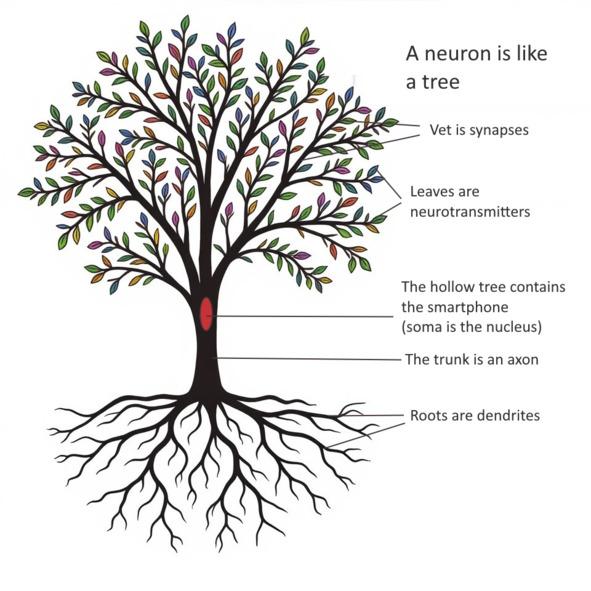
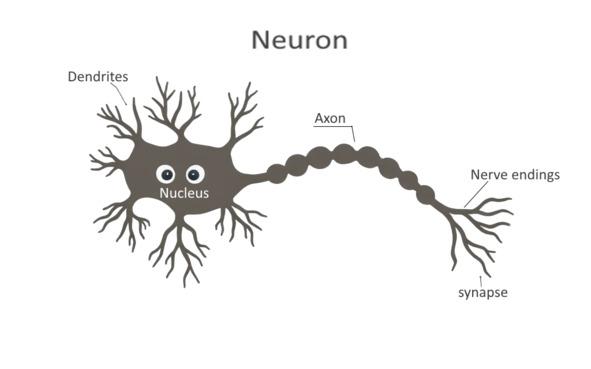
To make it easier to picture, imagine a neuron as a tree. It has roots, a trunk, branches, and leaves. The roots are the dendrites, which receive information and pass it to the tree (neuron). The trunk is the axon, connecting the tree to other trees (neurons) or to the body’s organs. The branches are the synapses, the communication hubs between trees (neurons), and the leaves are the neurotransmitters, sending signals across the synapse.
And if we imagine that the tree has a smartphone, that would be the soma — the neuron’s nucleus, responsible for keeping all vital functions in check.
Trees (Neurons) Come in Many Varieties
Trees (neurons) come in over 200 different “species,” each with its own “purpose” and “design.” They communicate with one another using electric impulses and chemical signals — and they do it at mind-blowing speed.
The roots (dendrites) of a tree receive information from the branches and leaves of other trees (neurons). This information is sent to the tree’s smartphone — the soma, or the nucleus of the neuron — where it’s processed. Then, the message is transmitted through the tree’s trunk (axon), branches, and leaves to other trees. And voilà, across the whole forest — or let’s say the taiga of your brain — a full-blown search operation begins! Memory zones get activated, and boom — the thought process is in full swing.
Roots (dendrites) and branches (synapses) grow endlessly — from birth until the very twilight years. They’re constantly seeking new connections and solutions. But here’s the rub: when certain brain regions sit idle for too long, these connections start breaking down, like old ropes. This is where our gardeners, the glial cells, step in — they happily recycle the remnants of those lost connections to clear space.
The smartphone (soma — the nucleus of the neuron) acts as the control center for the entire tree (neuron). From here, all the orders are issued: when to supply energy, how to grow, how to build new connections with other trees, and what to do with the information received. It’s essentially the manager of the forest, always in the know.
The trunk (axon) is a one-of-a-kind powerhouse and can be over a meter long — like the one responsible for moving your little toe. It’s covered in a protective “bark” (myelin), and the thicker the bark, the faster the signal travels. If there’s lots of traffic, the bark gets thicker. But if not, it thins out, which can lead to problems — sometimes so severe the trunk might even stop working altogether.
Branches (synapses) act like wires, connecting neurons to other neurons and body organs. These branches link up with the roots (dendrites) of other trees (neurons) or with muscles and organs. And here’s the crazy part — up to 150 billion of these wires can work at the same time! So when you’re solving an important problem or delivering a lecture to a room full of students, all these synapses are firing at full capacity, like a giant Siberian taiga working overtime just for you.
Leaves (neurotransmitters) are the real magicians of the thought process. These tiny marvels sit at the tips of the branches and roots of the trees. What’s fascinating is that they don’t actually touch each other. Instead, they leave a tiny space between them where a spectacular electro-chemical show unfolds — like a symphony orchestra performing at every connection. And believe it or not, trillions of these orchestras are playing simultaneously. That’s how thoughts are born!
3. The Limbic System — Your “I Want”
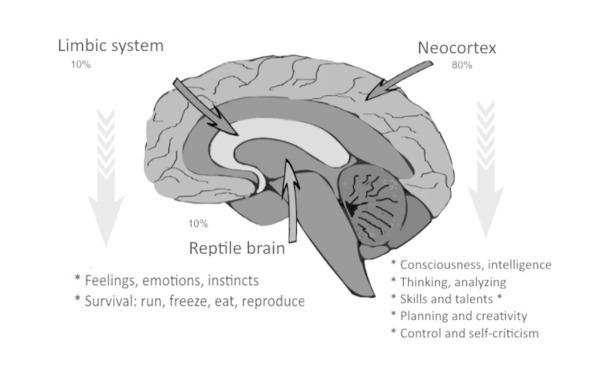
The mountains of our brain landscape emerged long before the forests, just like the limbic system — a primordial structure that predates our shiny new neocortex. Think of the limbic system as those ancient mountains, occupying 20% of the brain’s area and consuming 10% of the body’s energy. Within these neural mountains (trees), there are four times more neurons than in the neocortex. This is where all the magic happens — breathing, eating, and yes, even that sudden, head-over-heels feeling of falling in love.
These mountains (limbs) handle reflexes and emotions for us. They work on autopilot: you slip but don’t fall, dodge a snowball without thinking, grab a hot pan and immediately let go. It all happens without your conscious input. Feeling tired? They’ll send you to bed to recharge. And of course, they nudge you toward romance and family life — because let’s face it, love runs the show. All incoming information passes through these mountains, and outgoing commands to muscles and organs travel the same path.
The mountains work around the clock, creating emotional wonders like joy, fear, love, or disappointment. They also fine-tune your blood pressure, manage pain, and act like a maestro conducting the orchestra of your body.
Let’s take a hike through some highlights of these mountains:
The Cerebellum — About the size of a ping-pong ball, this little powerhouse is a command center in its own right. Here, neurons are four times more plentiful than in the neocortex, and they’re tinier than you can imagine. The cerebellum is in charge of all your movements — from perfect penmanship to acing a tennis serve. Without it, playing a virtuoso piano solo would be impossible!
Thalamus — The modest walnut that acts as the grand central hub for all sensory signals — except smell. It’s your brain’s tireless “postman,” delivering signals back and forth between the brain and the body with precision and speed.
Amygdala — These two almond-shaped buddies, tucked away in your temporal lobes on both the left and right sides, are the ultimate emotion processors. They don’t just react to your emotions — they save them to memory. Fear, the superstar survival emotion, is their primary concern. Visual, auditory, olfactory, or pain-related signals flood in, get processed, and trigger orders to your muscles and cardiovascular system: freeze or flee, as stress hormones leap into action.
Hippocampus — A twin organ resembling a seahorse, the hippocampus is your trusty navigator for memory and spatial orientation. Without it, you’d have a hard time remembering where you left your keys or how to find your way home!
Hypothalamus — At just 4 grams, this little powerhouse runs your body’s life cycles. Deep within the hypothalamic-pituitary system, it produces endogenous opiates — your body’s natural feel-good chemicals. With these, it regulates emotions, motivation, attachment, habits, stress, and pain, as well as hunger and satiety. A multitasking maestro!
Hypophysis — The boss of the endocrine system. This tiny overlord produces hormones that govern nearly every aspect of life: cell regeneration, stress and pain management, love, milk production, and even sexual development. A true ruler of the body’s inner kingdom!
In summary: The limbic system is the guardian of our health, survival, reflexes, and emotions. It works automatically, beyond our control, from the moment of our birth until our last breath. In those final moments, it sends powerful impulses to the lungs, heart, and other organs, making one last attempt to sustain life.
Taking up 20% of the brain’s volume and consuming 10% of the body’s energy, the limbic system is essential. It can even override the rational part of the brain in critical situations, prioritizing survival. However, a well-trained human mind has the potential to regulate and influence the limbic system’s functions.
4. Neocortex — Your “Must-Do” Brain
The neocortex is the cerebral cortex, resembling a forest of trees (neurons) marked by grooves and ridges. Picture a
- Басты
- ⭐️Journalism
- Stephan Fakeer
- Brain. Manual
- 📖Тегін фрагмент