


автордың кітабын онлайн тегін оқу English for Psychotherapy and Counselling: Handbook for Practitioners. Английский для психотерапии и консультирования: практическое руководство
Ирина Архипова
English for Psychotherapy and Counselling: Handbook for Practitioners
Английский для психотерапии и консультирования: практическое руководство
Fonts by «ParaType»
© Ирина Архипова, 2026
Преодолейте языковой барьер в психотерапии! Практическое руководство для специалистов, которые хотят интегрироваться в международное профессиональное сообщество, читать актуальные исследования, участвовать в конференциях, общаться и обзавестись клиентами по всему миру. Профессиональная терминология, контексты из практики, разговорник терапевта, протоколы сессий — все для быстрого старта. Не просто учебник английского, а инструмент для расширения ваших профессиональных возможностей.
ISBN 978-5-0068-9652-9
Created with Ridero smart publishing system
Contents
Предисловие
Дорогой читатель, добро пожаловать на страницы этой книги!
Скажу несколько слов, прежде чем перейдем к основной части.
В психологию меня привела моя первая профессия — лингвистика. В прошлом я работала преподавателем и переводчиком английского языка и однажды решила перевести с английского книгу для друзей-психологов, которая была им очень нужна. Впрочем, психологией я увлекалась задолго до этого. Конечно, хотелось понять себя, других и как это все устроено. Однако именно спортивный интерес при переводе поспособствовал тому, что через время я пошла обучаться на психолога-консультанта, преподавателя психологии, а позже — на клинического психолога. Практиковать начала еще во время учебы, и с тех пор психология окончательно стала моей основной сферой деятельности. Собственно, тогда же, когда я проштудировала существующие учебные материалы по английскому для психологов, у меня зародилась идея о создании учебника, пособия или глоссария. Не хватало практикоориентированных материалов, особенно с учетом огромного количества терминов в области психологии и психотерапии, пришедших из англоязычного контекста, и с учетом большого числа непереведенных на русский язык книг психотерапевтической тематики.
Давайте рассмотрим подробнее структуру этой книги и для кого и чем она будет полезна.
Структура
В книге 10 юнитов (или 10 глав). Каждый юнит состоит из следующих секций:
Lead-in — вводная секция, где вы активизируете свои знания, знакомитесь с ключевой темой и настраиваетесь на работу в рамках юнита.
Reading — профессионально ориентированный текст с аутентичной лексикой и примерами.
Vocabulary — работа с ключевыми терминами, выражениями и профессиональными словосочетаниями, необходимыми для понимания и ведения профессионального диалога.
Grammar Focus — изучение грамматических конструкций на материале профессиональных тем, с акцентом на формы и структуры, часто используемые в психотерапевтической практике.
Communication — практика коммуникативных навыков: анализ и разыгрывание типичных профессиональных диалогов, ситуаций из сессий и интервью, развитие языковой гибкости.
Professional Practice — применение изученных структур и терминов в практических заданиях: самопрезентация, описание случаев, упражнения для закрепления профессионального языка.
Vocabulary and Collocations — подборка ключевой лексики юнита и профессиональных устойчивых оборотов с переводом на русский язык для быстрого повторения и удобного использования в работе.
Руководство предназначено для специалистов с уровнем английского языка B1–B2 (Intermediate — Upper-Intermediate). Однако благодаря подробным справочным материалам и структурированной подаче знакомой профессиональной тематики руководство будет интересно также специалистам с уровнем английского A-2 (Pre-Intermediate).
Руководство построено на принципе i+1 (comprehensible input) Стивена Крашена: вы встречаете языковой материал чуть выше текущего уровня, что стимулирует естественное языковое развитие.
Тексты в секции Reading содержат более сложную грамматику и разнообразные структуры, чем изучаемые в секции Grammar Focus. Вы встречаете новые языковые явления в профессиональном контексте, где они понятны благодаря знакомой профессиональной тематике, ключевой лексике из Vocabulary, контексту и предварительной работе в Lead-in.
Руководство следует коммуникативной методике (Communicative Approach), которая лежит в основе всех современных аутентичных курсов английского языка, таких как Headway, New English File, Total English. Это означает, что все материалы юнитов — тексты, задания, инструкции и упражнения — представлены исключительно на английском языке, что создает эффект языкового погружения и помогает развивать способность думать на английском без мысленного перевода. В структуре самого руководства русский язык используется в секции Vocabulary and Collocations в конце каждого юнита, а также в приложениях.
Представленные задания и упражнения могут быть использованы как для групповой, так и для самостоятельной работы.
В конце руководства вы также найдете четыре приложения, которые служат справочными материалами для самостоятельной работы и практики:
Appendix 1. Vocabulary and Collocations — полный список ключевой профессиональной лексики и устойчивых словосочетаний по теме конкретного юнита с переводом на русский язык. Используйте это приложение для быстрого поиска терминов и повторения материала.
Appendix 2. Grammar Reference — справочник по грамматическим темам, изученным в руководстве, с правилами и примерами из профессиональных контекстов. Обращайтесь к нему при выполнении заданий или для систематизации грамматических знаний.
Appendix 3. Therapist’s Phrasebook — набор готовых профессиональных фраз и выражений для различных ситуаций и контекстов в терапевтической практике: от начала сессии до работы с сопротивлением клиента. Есть перевод на русский язык. Этот разговорник поможет вам почувствовать себя увереннее в реальной коммуникации.
Appendix 4. Protocols — образцы протоколов терапевтических сессий с примерами формулировок для документирования работы с клиентами в соответствии с международными стандартами.
Какие задачи поможет решить это руководство?
Это руководство поможет психологу-консультанту, психотерапевту, клиническому психологу решить следующие практические задачи:
В работе с клиентами*:
• Провести первичную консультацию (intake interview) на английском языке
• Собрать анамнез и задать диагностические вопросы с использованием точной профессиональной лексики
• Объяснить клиенту суть терапевтического подхода и техник на понятном английском
• Выстроить терапевтические границы и обсудить условия работы
• Вести протоколы сессий и документировать случаи по международным стандартам
ㅤ
В профессиональном развитии:
• Читать актуальные исследования и профессиональную литературу в оригинале
• Участвовать в англоязычных супервизиях и получать обратную связь от зарубежных коллег
• Представлять клинические случаи (case presentations) на профессиональных встречах
• Участвовать в международных конференциях, семинарах и тренингах
• Проходить дополнительное обучение у международных специалистов без языкового барьера
В повседневной практике:
• Использовать готовые профессиональные фразы для важных моментов сессии (эмпатия, конфронтация, завершение)
• Применять со знанием дела специализированную терминологию психодинамического, когнитивно-поведенческого и экзистенциально-гуманистического подходов
• Понимать культурные особенности профессиональной коммуникации с англоязычными клиентами и коллегами
* Здесь и далее мы будем использовать именно термин “клиент”, а не “пациент”. В англоязычной практике термин “клиент” является общепринятым в консультировании и большинстве направлений психотерапии. Клиент — это активный участник терапевтического процесса, в котором отношения строятся на принципах партнерства и сотрудничества. Поскольку цель руководства – подготовить вас к работе в международной среде, мы будем придерживаться этой терминологической нормы
Для кого будет полезна эта книга?
ㅤ
Практикующие специалисты:
• Психотерапевты и психологи-консультанты, планирующие работать с англоязычными клиентами
• Консультанты, переехавшие в англоязычные страны или работающие онлайн с международной аудиторией
• Клинические психологи, желающие расширить свою практику на англоязычный рынок
• Специалисты, проходящие сертификацию или супервизию у зарубежных коллег
Студенты и обучающиеся:
• Студенты психологических и психотерапевтических программ, готовящиеся к стажировкам за рубежом
• Слушатели программ переподготовки по психотерапии с намерением практиковать на английском
• Психологи, поступающие на магистерские или аспирантские программы в англоязычных университетах
Исследователи и преподаватели:
• Преподаватели психологии, ведущие занятия на английском языке
• Исследователи, публикующие работы в международных журналах
• Специалисты, участвующие в международных конференциях и научных обменах
Специалисты смежных областей:
• Коучи, работающие с психологическими аспектами развития личности
• Специалисты по ментальному здоровью в международных организациях
С большой благодарностью всем моим учителям и близким, которые поддерживали меня на этом пути!
Приятного изучения!
UNIT 1.
INTRODUCTION TO PSYCHOTHERAPY
LEAD-IN:
Mental Health Professionals and Their Roles
Activity 1: What Do You Know?
Look at the list of mental health professionals below and think about the questions:
Mental health professionals:
• Clinical psychologist
• Psychiatrist
• Counselling psychologist
• Psychotherapist
Think about:
• What do you know about each professional? What do they do?
• How are they different? (education, methods, types of problems)
• Which specialist would you recommend for: anxiety, depression, relationship issues, serious mental illness?
Activity 2: Vocabulary brainstorm
Work in small groups. You have 3 minutes to write down as many words as you can related to mental health and therapy.
Example: therapy, counselling, treatment, session, assessment, diagnosis…
Activity 3: Discussion questions
Discuss these questions with your partner:
1. What comes to mind when you hear the word “psychotherapy”?
2. Do you think psychotherapy is different from psychology? How?
3. What do psychotherapists do?
4. What is the difference between a clinical psychologist and other psychologists?
5. Why do people go to therapy?
6. Are there different types of psychotherapy? What do you know about them?
Key vocabulary for this unit:
Match the words with their definitions:
1. Psychology
2. Counselling
3. Psychotherapy
4. Psychiatry
5. Mental health
6. Clinical psychology
a) Medical specialty dealing with diagnosis and treatment of mental disorders
b) The scientific study of the mind and behaviour
c) Treatment using psychological methods through regular interaction
d) Professional guidance to help people cope with specific problems
e) A person’s condition regarding their psychological and emotional well-being
f) Branch of psychology focused on assessment and treatment of mental health disorders
READING:
Mental Health Professionals: Who Does What?
Pre-reading task
Before you read, discuss:
1. What do you think is the main difference between these four professions?
2. What does a clinical psychologist do that other psychologists might not do?
3. Which profession requires medical training?
4. Which focuses on short-term problems?
ㅤ
Mental Health Professionals: Who Does What?
When people experience emotional difficulties, mental health problems, or simply want to understand themselves better, they often wonder: “Who should I see?” The field of mental health includes several types of professionals, and while their work overlaps, there are important distinctions between them.
Psychology is the scientific study of the mind, behaviour, and mental processes. Psychologists are trained professionals who typically hold a doctoral degree (PhD or PsyD) in psychology. They use evidence-based methods to assess, diagnose, and treat mental health conditions. Unlike psychiatrists, psychologists in most countries do not prescribe medication; instead, they focus on psychological interventions and therapy.
Clinical Psychology is a specialized branch of psychology that focuses on the assessment, diagnosis, and treatment of mental health disorders and psychological distress. Clinical psychologists work with individuals, couples, families, and groups to address a wide range of psychological issues, from mild adjustment problems to severe mental disorders such as schizophrenia, bipolar disorder, and severe depression.
What makes clinical psychologists unique is their extensive training in psychological assessment. They are skilled in using various assessment tools, including clinical interviews, behavioural observations, and standardized psychometric tests. A clinical psychologist conducts comprehensive psychological evaluations to understand the nature and severity of a client’s difficulties, considering biological, psychological, and social factors.
Clinical psychologists provide evidence-based psychological therapies and interventions. They work in diverse settings including hospitals, mental health clinics, rehabilitation centers, private practices, universities, and research institutions. Many clinical psychologists also conduct research to develop new treatments and improve existing interventions. Additionally, they often supervise other mental health professionals and contribute to training programs.
The work of a clinical psychologist typically involves:
• Conducting detailed psychological assessments and diagnostic evaluations
• Developing individualized treatment plans based on assessment findings
• Providing various forms of psychotherapy (CBT, psychodynamic, family therapy, etc.)
• Monitoring client progress and adjusting treatment as needed
• Working collaboratively with other healthcare professionals
• Conducting applied research and contributing to evidence-based practice
• Providing clinical supervision to trainees and other professionals
Counselling Psychology is another branch of psychology that shares some similarities with clinical psychology but has a different focus. Counselling psychologists typically work with clients experiencing less severe psychological distress and focus more on personal development, life transitions, and adjustment issues. While clinical psychologists often work with severe psychopathology, counselling psychologists emphasize wellness, growth, and helping people function better in their daily lives.
Counselling (as a profession distinct from counselling psychology) is a helping profession that focuses on specific problems or life transitions. Counsellors, who usually have a master’s degree in counselling or a related field, help clients cope with immediate issues such as career decisions, academic stress, grief, or relationship conflicts. Counselling is typically shorter-term than psychotherapy and more solution-focused. It emphasizes practical coping strategies and goals rather than deep exploration of underlying emotional patterns.
Psychotherapy, often called talk therapy, is a treatment intervention that uses psychological methods through regular personal interaction to help people change behaviour, increase well-being, and overcome problems. While clinical psychologists, counselling psychologists, and counsellors may all provide psychotherapy, the term “psychotherapist” often refers to professionals who engage in more in-depth, long-term therapeutic work. Psychotherapy explores deeper emotional issues, past experiences, and unconscious patterns that influence present behaviour.
Psychiatry is a medical specialty focused on the diagnosis, treatment, and prevention of mental, emotional, and behavioural disorders. Psychiatrists are medical doctors (MDs) who complete medical school followed by specialized training in psychiatry. Because of their medical background, psychiatrists can prescribe medication and may use biological treatments. While some psychiatrists provide psychotherapy, many focus primarily on medication management, especially in contemporary practice where they often work collaboratively with clinical psychologists and other therapists.
Three Main Approaches in Psychotherapy
Within psychotherapy (practised by clinical psychologists and other therapists), three major theoretical approaches have shaped modern practice:
Cognitive-Behavioural Therapy (CBT) is a structured, goal-oriented approach that focuses on the connection between thoughts, feelings, and behaviours. CBT therapists help clients identify negative automatic thoughts and cognitive distortions, then work to challenge and change these patterns. This approach is typically short-term and emphasizes practical homework assignments and skills development. CBT has strong research support for treating anxiety, depression, and many other conditions. Clinical psychologists often use CBT because of its evidence-based effectiveness.
Psychodynamic Therapy has its roots in psychoanalytic theory and emphasizes the role of unconscious processes, early childhood experiences, and relationship patterns. Psychodynamic therapists explore how past experiences shape current behaviour and help clients gain insight into recurring patterns. This approach pays particular attention to the therapeutic relationship itself, including transference (when clients project feelings onto the therapist) and countertransference (the therapist’s emotional reactions to the client). Psychodynamic therapy is usually longer-term than CBT and is often used by clinical psychologists working with complex personality issues and trauma.
Existential-Humanistic Therapy emphasizes personal growth, self-actualization, and the client’s inherent capacity for healing. This approach, which includes person-centered therapy and Gestalt therapy, focuses on the here-and-now experience, authenticity, and the therapeutic relationship. Humanistic therapists provide unconditional positive regard, empathy, and congruence, creating a safe space where clients can explore their feelings and develop self-awareness. Rather than directive techniques, this approach follows the client’s lead and trusts their inner wisdom.
Each approach has its strengths, and many modern clinical psychologists and therapists integrate elements from different schools of thought, practising what is called “integrative” or “eclectic” therapy. The choice of approach often depends on the client’s needs, the assessment findings, and the nature of their difficulties.
Comprehension questions:
1. What is the main educational difference between psychologists and psychiatrists?
2. What makes clinical psychology different from other branches of psychology?
3. According to the text, how does counselling differ from psychotherapy in terms of focus and duration?
4. What is the difference between clinical psychology and counselling psychology?
5. Which professional can prescribe medication? Why?
6. What are the three main approaches to psychotherapy mentioned in the text?
7. Which therapeutic approach focuses on thoughts, feelings, and behaviours?
8. What does “transference” mean in psychodynamic therapy?
9. Which approach emphasizes personal growth and self-actualization? ㅤ
VOCABULARY:
Professional Terminology and Collocations
A. Find words in the text that match these definitions:
1. Based on scientific research and proven methods
(paragraph 2): _______
2. A wide range of psychological issues and conditions that clinical psychologists assess (paragraph 3): _______
3. A complete evaluation of someone’s psychological condition (paragraph 4): _______
4. Tests that measure psychological variables like intelligence or personality (paragraph 4): _______
5. Concentrating on finding practical answers to current problems (paragraph 7): _______
6. Mental processes that happen without our awareness (paragraph 11): _______
7. Inborn, natural, existing from birth (paragraph 12): _______
8. Being genuine and true to oneself (paragraph 12): _______
B. Complete the collocations from the text. More than one answer may be possible:
1. mental health _______
2. psychological _______
3. evidence-_______ methods
4. _______ plans
5. _______ strategies
6. therapeutic _______
7. clinical _______
8. automatic _______
9. personal _______
10. assessment _______
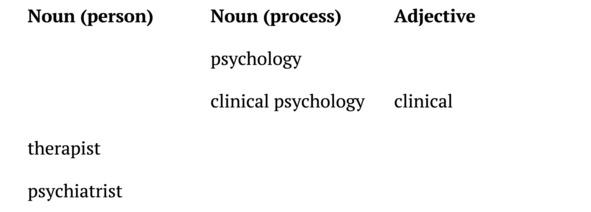
C. Word families
Complete the table:
Discussion questions:
1. In your country, which mental health professional do people usually consult first?
2. What is the role of clinical psychologists in your healthcare system?
3. Do you think the distinctions between these professions are clear in your language?
4. Which therapeutic approach appeals to you most? Why?
5. Should all clinical psychologists be trained in all three approaches, or specialize in one?
6. What are the advantages of seeing a clinical psychologist vs. a psychiatrist?
GRAMMAR FOCUS:
Present Simple for definitions and descriptions / Comparative structures
A. Present Simple for Definitions and Professional Descriptions
We use Present Simple to define concepts and describe what professionals do:
Form:
• Affirmative: Subject + verb (+ s/es for he/she/it)
• Negative: Subject + don’t/doesn’t + main verb
• Questions: Do/Does + subject + main verb?
ㅤ
Examples from Psychology:
• Psychology studies human behaviour and mental processes.
• Clinical psychologists assess and treat mental health disorders.
• Psychotherapists help clients manage emotional difficulties.
• A psychiatrist prescribes medication for mental health conditions.
• Counselling focuses on specific life problems.
ㅤ
Exercise 1: Complete the sentences
Use the correct form of the verb in brackets:
1. Clinical psychologists _______ (assess) mental health conditions using psychometric tests.
2. Psychotherapy _______ (involve) regular communication between therapist and client.
3. Clinical psychologists _______ (not prescribe) medication.
4. _______ (do) clinical psychologists conduct research? Yes, many of them _______ (do).
5. Humanistic therapy _______ (emphasize) personal growth and self-actualization.
6. A counselling psychologist _______ (focus) more on life transitions than severe pathology.
B. Comparative Structures
We use comparative structures to show differences and similarities between concepts:
ㅤ
Structures:
• as + adjective + as (equally)
• more/less + adjective + than
• adjective + -er + than
Examples from Psychology:
• Psychotherapy is more intensive than counselling.
• Clinical psychology is as important as psychiatry in mental healthcare.
• Psychoanalysis is less directive than CBT.
• Clinical psychology training is longer than counselling psychology training.
ㅤ
Exercise 2: Compare the professionals
Complete the sentences using comparative structures:
1. A psychiatrist’s training is _______ (long) than a clinical psychologist’s.
2. Clinical psychologists typically work with _______ (severe) mental health problems than counselling psychologists.
3. A clinical psychologist’s assessment is _______ (detailed) than a counsellor’s initial interview.
4. Counselling sessions are usually _______ (short) than psychotherapy sessions.
5. Clinical psychology is not _______ (medical) as psychiatry.
6. Psychotherapy can be _______ (effective) than medication for some conditions.
7. Clinical psychologists do _______ (much) research than general counsellors.
8. Assessment skills are _______ (important) in clinical psychology than in some other areas.
Exercise 3: Correct the mistakes
Find and correct the mistakes in these sentences:
1. A clinical psychologist are working with complex mental health conditions.
2. Psychiatrist training is more longer than counselling training.
3. Does psychiatrists prescribes medication?
4. A psychotherapist don’t just provide therapy; they also works with emotions.
5. Psychological assessment is as important than medication in clinical practice.
6. What a counselling psychologist do during a first session?
7. Clinical psychologists works in hospitals, clinics, and private practice.
8. Is clinical psychology more scientific than counselling psychology?
9. A counsellor are helping clients with mild to moderate difficulties.
10. Psychiatrists is medical doctors who can prescribe medications.
11. Does a psychotherapist needs a doctoral degree?
12. Counselling psychologists provides talk therapy and don’t diagnose conditions.
COMMUNICATION: Understanding Mental Health Professionals: An Interview with Dr. Sarah Mitchell
Participants: Rebecca Williams (Reporter, Mental Health Today Magazine) and Dr. Sarah Mitchell (Clinical Psychologist, Private Practice)
Reporter: Good morning, Dr. Mitchell. Thank you for agreeing to talk with us today. Our readers are often confused about the differences between mental health professionals. Can you help us understand who does what?
Dr. Mitchell: Of course! I’m happy to clarify. It’s a common confusion, and it’s actually quite important to understand the distinctions.
Reporter: Let’s start with psychiatrists. How are they different from psychologists?
Dr. Mitchell: Well, the main difference is their training and what they can do. Psychiatrists are medical doctors. They go to medical school and can prescribe medication. They focus mainly on the biological aspects of mental health — things like brain chemistry and medications that can help with conditions like depression or anxiety.
Reporter: I see. And what about clinical psychologists? That’s your specialty, right?
Dr. Mitchell: Yes, exactly. Clinical psychologists have a doctoral degree in psychology, not medicine. We can’t prescribe medication, but we’re trained to diagnose mental health conditions and provide therapy. We also do psychological assessments and testing to understand what’s going on with a person’s mental health.
Reporter: So, you both diagnose, but only psychiatrists prescribe?
Dr. Mitchell: Correct. And I should mention counselling psychologists too. They’re similar to clinical psychologists, but they typically work with less severe issues — like relationship problems, stress management, or life transitions. They focus more on helping people with everyday challenges rather than serious mental disorders.
Reporter: That’s helpful. What about psychotherapists? Where do they fit in?
Dr. Mitchell: Psychotherapist is actually a more general term. It can include clinical psychologists, counseling psychologists, and other professionals who provide talk therapy. The key is that psychotherapists use various therapeutic approaches to help people change their thoughts, feelings, and behaviours.
Reporter: Speaking of approaches, can you briefly explain the main types of psychotherapy?
Dr. Mitchell: Sure! There are three major approaches we commonly use. The first is psychodynamic therapy, which comes from Freud’s work. It focuses on unconscious thoughts and how our past, especially childhood, experiences affect us today. It’s often long-term therapy.
Reporter: And the second approach?
Dr. Mitchell: That’s cognitive-behavioural therapy, or CBT. This is very popular today because it’s practical and usually shorter. CBT helps people identify negative thought patterns and change them. The idea is that if you change how you think, you’ll change how you feel and behave. It works really well for anxiety and depression.
Reporter: I’ve heard a lot about CBT, and what’s the third approach?
Dr. Mitchell: The third is humanistic therapy, which includes person-centered therapy. This approach believes that everyone has the potential to grow and solve their own problems. The therapist creates a supportive, non-judgmental environment where clients can explore their feelings and find their own solutions. Carl Rogers developed this approach.
Reporter: So different approaches for different people?
Dr. Mitchell: Exactly. Some people benefit more from exploring their past, others need practical strategies they can use right away, and some just need a safe space to figure things out themselves. Many therapists today actually combine approaches based on what each client needs.
Reporter: That makes sense. One last question — if someone is struggling with mental health issues, how do they know which professional to see?
Dr. Mitchell: Good question! If you think you might need medication, start with a psychiatrist. If you want therapy and psychological testing, a clinical psychologist is a good choice. For relationship issues or life stress, a counselling psychologist or counsellor works well. And remember, many people see both a psychiatrist for medication and a psychologist for psychotherapy.
Reporter: Dr. Mitchell, thank you so much for making this clearer for our readers.
Dr. Mitchell: My pleasure. The most important thing is that people get the help they need, no matter which professional they choose!
ㅤ
TASK 1: True / False / Not Mentioned
Instructions: Read the statements below about the interview. Decide if each statement is:
• TRUE (T) – the statement agrees with the information in the interview
• FALSE (F) – the statement contradicts the information in the interview
• NOT MENTIONED (N/M) – the information is not given in the interview
ㅤ
Statements:
1. Psychiatrists go to medical school and can prescribe medication.
2. Clinical psychologists work only in hospitals.
3. CBT is the oldest approach to psychotherapy.
4. Counselling psychologists typically work with serious mental disorders.
5. Dr. Mitchell has a doctoral degree in psychology.
6. Psychotherapist is another name for psychiatrist.
7. Clinical psychologists can do psychological assessments and testing.
8. Dr. Mitchell thinks medication is more effective than therapy.
9. Psychiatrists focus on the biological aspects of mental health.
10. Psychodynamic therapy focuses on childhood experiences and unconscious thoughts.
ㅤ
Task 2: Personal Response
Discuss: which professional would you prefer to see and why? Which therapy approach sounds most interesting to you?
Task 3: Creating a Comparison Chart
Try to create a visual comparison chart of the four professionals (education, what they can do, typical clients/patients, work settings).
PROFESSIONAL PRACTICE:
Self-Introduction as a Psychology Professional
Sample Introductions
ㅤ
Counselling Psychologist
Hello, my name is Sarah Mitchell, and I’m a counselling psychologist. I work with individuals and couples who are experiencing difficulties in their personal relationships or facing challenging life transitions. My approach focuses on helping clients develop coping strategies and build resilience. I specialize in stress management and career counselling. I’ve been practicing for eight years, and I currently work at a community mental health center. I believe in creating a supportive, non-judgmental environment where clients feel comfortable exploring their concerns.
Psychiatrist
Good morning. I’m Dr. James Chen, a psychiatrist at St. Mary’s Hospital. I assess, diagnose, and treat mental health conditions from a medical perspective. My work involves evaluating patients’ symptoms, prescribing medication when appropriate, and monitoring treatment progress. I specialize in mood disorders and anxiety-related conditions. In addition to medication management, I collaborate with psychologists and therapists to ensure comprehensive care for my patients. I completed my medical degree and psychiatric residency at Johns Hopkins University.
Clinical Psychologist
Hi, I’m Dr. Emma Rodriguez. I’m a clinical psychologist specializing in assessment and treatment of psychological disorders. I conduct psychological evaluations, administer diagnostic tests, and provide evidence-based therapy for individuals with various mental health conditions. My areas of expertise include depression, trauma, and personality disorders. I use cognitive-behavioural therapy and psychodynamic approaches in my practice. I work both in private practice and as a consultant at a local psychiatric hospital.
Psychotherapist
Hello, I’m Michael Thompson, a licensed psychotherapist. I provide talk therapy to help people understand their thoughts, feelings, and behaviours. I work with clients dealing with anxiety, relationship issues, and personal growth challenges. My therapeutic approach is integrative, drawing from humanistic and existential traditions. I’ve been in practice for twelve years and currently see clients in both individual and group therapy settings. My goal is to help people gain insight and make meaningful changes in their lives.
ㅤ
Useful Phrases for Self-Presentation
Stating Your Name and Title
• My name is…, and I’m a…
• I’m Dr./Mr./Ms. …, a licensed/qualified…
• You can call me… I work as a…
Describing Your Role
• I specialize in…
• My main focus is…
• I work with clients/patients who…
• My area of expertise is…
• I primarily deal with…
Explaining Your Approach
• I use/practice…
• My approach is based on…
• I combine… with…
• I believe in…
• My therapeutic style is…
Mentioning Your Experience
• I’ve been practising for… years
• I have… years of experience in…
• I completed my training at…
• I previously worked at/as…
Describing Your Work Setting
• I work at/in…
• I’m currently based at…
• I maintain a private practice in…
• I see clients both in… and…
Highlighting Your Goals
• My goal is to help clients…
• I aim to support people in…
• I focus on helping patients…
• I work towards…
ㅤ
Practice Exercises
ㅤ
Exercise 1: Complete Your Introduction
Fill in the blanks with information about yourself to create your own professional introduction.
Hello, my name is __________, and I’m a __________. I work with __________ who are experiencing __________. My approach focuses on __________. I specialize in __________. I’ve been practising/studying for __________, and I currently work/study at __________. I believe in __________.
Exercise 2: Match and Complete
Match the sentence starters with appropriate endings, then write three sentences about yourself.
Sentence starters:
• My main focus is…
• I’ve been practising for…
• My therapeutic approach is based on…
• I work with clients who…
• My goal is to help…
Possible endings:
• ...are struggling with anxiety and stress
• ...cognitive-behavioural principles
• ...supporting people through difficult transitions
• ...five years in various clinical settings
• …working with children and adolescents
Exercise 3: Build Your Introduction (Step-by-Step)
Write one sentence for each category to build your complete introduction:
1. Name and title: _________________________________
2. Who you work with: _________________________________
3. Your specialization: _________________________________
4. Your approach/methods: _________________________________
5. Your experience/education: _________________________________
6. Your workplace: _________________________________
7. Your professional philosophy: ______________________________
ㅤ
Exercise 4: Listening and Note-Taking
Listen to your partner’s introduction and complete the information:
• Name and title: _________________________________
• Specialization: _________________________________
• Type of clients: _________________________________
• Approach/methods: _________________________________
• Experience: _________________________________
• Current workplace: _________________________________
Vocabulary and collocations for Unit 1
psychology — психология
counselling — консультирование
psychotherapy — психотерапия
psychiatry — психиатрия
mental health — психическое здоровье
clinical psychology — клиническая психология
clinical psychologist — клинический психолог
psychiatrist — психиатр
counselling psychologist — психолог-консультант
psychotherapist — психотерапевт
emotional difficulties — эмоциональные трудности
mental health problems — проблемы психического здоровья
mental health professionals — специалисты по психическому здоровью
evidence-based methods — методы, основанные на научных данных
prescribe medication — назначать лекарства
psychological interventions — психологические вмешательства/интервенции
mental health disorders — расстройства психического здоровья
psychological distress — психологический дистресс
adjustment problems — проблемы адаптации
severe mental disorders — тяжелые психические расстройства
psychological assessment — психологическая оценка
assessment tools — инструменты оценки
clinical interview — клиническое интервью
behavioural observations — поведенческие наблюдения
psychometric tests — психометрические тесты
comprehensive psychological evaluation — всесторонняя психологическая оценка
mental health clinics — клиники психического здоровья
rehabilitation centers — реабилитационные центры
private practice — частная практика
treatment plans — планы лечения
assessment findings — результаты оценки
monitor client progress — отслеживать прогресс клиента
adjust treatment — корректировать лечение
healthcare professionals — медицинские специалисты
clinical supervision — клиническая супервизия
personal development — личностное развитие
life transitions — жизненные переходы
adjustment issues — проблемы адаптации
cope with — справляться с
relationship conflicts — конфликты в отношениях
coping strategies — стратегии совладания
solution-focused — ориентированный на решение
underlying emotional patterns — скрытые эмоциональные паттерны
psychological methods — психологические методы
change behaviourehavior — изменить поведение
increase well-being — повысить благополучие
overcome problems — преодолеть проблемы
unconscious patterns — бессознательные паттерны
biological treatments — биологические методы лечения
negative automatic thoughts — негативные автоматические мысли
cognitive distortions — когнитивные искажения
unconscious processes — бессознательные процессы
childhood experiences — детские переживания
relationship patterns — паттерны отношений
gain insight — обрести/получить инсайт
therapeutic relationship — терапевтические отношения
transference — перенос
countertransference — контрперенос
personal growth — личностный рост
self-actualization — самоактуализация
inherent capacity — врожденная способность
unconditional positive regard — безусловное позитивное принятие
self-awareness — самосознание
authenticity — аутентичность
psychopathology — психопатология
mental health condition — состояние психического здоровья
UNIT 2.
FIRST CONTACT AND BUILDING RAPPORT
LEAD-IN:
First Impressions and Creating a Safe Space
Activity 1: First Impressions Matter
Think about your own experiences. Reflect individually for 2 minutes, then share with a partner:
• What makes you feel comfortable when meeting someone new in a professional setting?
• Can you remember a time when someone made you feel welcome immediately? What did they do?
• What might make a person feel nervous about meeting a psychologist for the first time?
• How quickly do you form an impression of a new person? Do first impressions change?
Activity 2: Creating a Safe Space
Work in small groups. Look at these scenarios and discuss: Which therapist behaviours help build trust? Which might create barriers?
Scenario A: The therapist greets the client warmly, offers them a choice of where to sit, and begins by saying, “I’m glad you’re here. Take your time to settle in”.
Scenario B: The therapist immediately starts asking detailed questions about the client’s problems without any introduction.
Scenario C: The therapist explains what will happen in today’s session and checks if the client has any questions before beginning.
Scenario D: The therapist talks extensively about their own qualifications and achievements.
Activity 3: Think-Pair-Share
Think (1 minute): What questions might a client have when they first meet a psychologist?
Pair (3 minutes): Share your ideas with a partner and add to your list.
Share (5 minutes): Groups share with the class. Create a master list on the board.
Key vocabulary for this unit:
Match the words with their definitions:
1. Rapport
2. Therapeutic alliance
3. Confidentiality
4. Boundaries
5. Informed consent
6. Safe space
a) The agreement to protect private information shared in therapy
b) Professional limits that define the therapeutic relationship
c) A trusting connection between therapist and client
d) Permission given by a client after receiving full information about treatment
e) The collaborative relationship between therapist and client working toward goals
f) An environment where a client feels comfortable expressing themselves
READING:
The First Meeting with a Client: Building Trust and Therapeutic Alliance
Pre-reading task
Before you read, discuss with a partner:
1. What do you think happens in the first therapy session?
2. What information should a therapist provide for a new client?
3. How might a client feel during their first meeting with a psychologist?
4. What makes a good first impression in a professional helping relationship?
ㅤ
The First Meeting with a Client: Building Trust and Therapeutic Alliance
The initial therapy session is unlike any other professional encounter. For the client, it often represents a significant step — one that may have taken weeks or months of consideration before they finally picked up the phone to make an appointment. Many clients arrive feeling anxious, uncertain, or vulnerable. They may be wondering: “Will this person understand me? Can they really help? What if I’m judged?” For the therapist, the first session is an opportunity to create a foundation of trust and safety that will support all future therapeutic work.
Creating the Right Environment
The first impression begins before any words are spoken. Research shows that the therapeutic alliance — the collaborative relationship between therapist and client — is often established in the first session and remains stable throughout treatment. This means that what happens in the initial meeting matters tremendously.
When greeting a new client, warmth and professionalism are equally important. A therapist typically welcomes the client in the waiting area, makes eye contact, offers a warm greeting, and invites them to follow to the therapy room. Some therapists offer a brief tour, which helps the client orient themselves and reduces anxiety. Simple gestures like offering the client a choice of where to sit can give them a sense of control and comfort.
The therapy room itself should feel safe and private. Comfortable seating, appropriate lighting, and the absence of distractions all contribute to creating what therapists call a “safe space” — an environment where clients feel they can speak freely.
The Opening Conversation
Once seated, the therapist typically begins by acknowledging that first sessions can feel uncomfortable. A statement like, “I know it can feel strange talking to someone you’ve just met about personal matters. That’s completely normal, and we’ll take things at your pace,” can immediately reduce anxiety.
Before diving into the client’s concerns, the therapist explains what will happen during this first session. This might sound something like: “Today, we have about 50 minutes together. We’ll spend some time going over important information about confidentiality and how therapy works, and then I’d like to hear from you about what brings you here. Do you have any questions before we begin?”
Informed Consent and Confidentiality
A critical component of the first session is discussing informed consent. This isn’t just a legal formality — it’s an ethical cornerstone that empowers clients and establishes transparency. Informed consent means ensuring the client fully understands what they’re agreeing to before therapy begins.
The therapist explains several key elements:
The nature of therapy: What therapy involves, the approaches the therapist uses, and what clients can generally expect from the process.
Confidentiality: Everything discussed in therapy remains private and confidential. This principle is essential because clients need to trust that their information is safe in order to speak openly. However, there are important limits to confidentiality that must be clearly explained:
• If the client is at risk of harming themselves
• If the client is at risk of harming someone else
• If there is suspected abuse or neglect of a child, elderly person, or dependent adult
• If records are subpoenaed by a court
• If the client provides written permission to share information
Most therapists say something like: “What we discuss here is confidential, which means I won’t share this information with anyone without your permission. However, there are a few exceptions where I’m legally required to break confidentiality, particularly if there’s a risk of harm to you or someone else. Does that make sense? Do you have any questions about confidentiality?”
Risks and benefits: while therapy is generally beneficial, it can sometimes be uncomfortable as clients explore difficult emotions or memories. The therapist discusses both potential benefits and any risks.
Practical matters: this includes session frequency, length, fees, cancellation policies, and what to do in case of emergency.
Client rights: clients have the right to ask questions, refuse any intervention, seek a second opinion, and end therapy at any time.
While many therapists provide written consent forms, the verbal discussion is equally important. The therapist should invite questions and check for understanding throughout this explanation.
Establishing Therapeutic Boundaries
Boundaries are the professional limits that define the therapeutic relationship. Clear boundaries create safety and help clients know what to expect. Boundaries are established from the very first contact and are maintained throughout treatment.
Therapeutic boundaries include:
• Session structure (length, frequency, location)
• Contact between sessions (whether clients can call or email, and under what circumstances)
• Social media policies (most therapists maintain strict boundaries around social media connections with clients)
• Physical boundaries (professional, appropriate physical space)
• Role clarity (the therapist is not a friend, but a trained professional providing treatment)
Boundaries are not meant to be cold or distant. Rather, they create a consistent, safe framework within which the therapeutic relationship can develop. Good boundaries actually build trust because clients learn that the therapist is reliable, consistent, and professionally committed to their wellbeing.
Building Rapport
Once the administrative matters are addressed, the therapist invites the client to share their story. This is typically done with an open-ended question such as, “What brings you to therapy at this time?” or “Tell me a bit about what’s been going on for you”.
Building rapport — a sense of connection and trust — is the primary goal of the first session. The therapist does this through:
• Active listening: giving full attention, avoiding interruptions, and showing through body language that they’re engaged
• Empathy: trying to understand the client’s experience from their perspective
• Unconditional positive regard: accepting the client without judgment
• Validation: acknowledging the client’s feelings and experiences as real and understandable
• Appropriate self-disclosure: occasionally sharing relevant professional experiences (but keeping the focus on the client)
Research consistently shows that the quality of the therapeutic relationship is one of the strongest predictors of positive therapy outcomes. A strong therapeutic alliance means the therapist and client are working together collaboratively toward agreed-upon goals.
Collaborative Goal-Setting
Toward the end of the first session, the therapist and client begin discussing goals. What does the client hope to achieve through therapy? What would improvement look like for them? This collaborative goal-setting ensures that therapy is focused and meaningful.
The therapist might ask, “If our work together is successful, what will be different in your life?” or “What would you like to focus on first?”. These goals provide direction and help both therapist and client track progress over time.
Closing the First Session
As the session draws to a close, the therapist typically summarizes what has been discussed. This might include acknowledging the main concerns the client has shared, highlighting any strengths noticed, and outlining the next steps.
The therapist provides encouragement, recognizing the courage it takes to seek help. They discuss the frequency of future sessions and schedule the next appointment. Many therapists also check in about how the client is feeling: “How are you feeling about our meeting today? Do you have any questions or concerns?”.
The goal is for the client to leave the first session feeling heard, hopeful, and clear about what to expect moving forward. While one session cannot solve all problems, a strong first meeting creates the foundation for meaningful therapeutic work to come.
Comprehension Questions
1. According to the text, why do many clients feel anxious before their first therapy session?
2. Why is the first impression so important in therapy?
3. What is a “safe space” and why is it important?
4. What are the main elements that therapists explain during informed consent?
5. What are the limits to confidentiality that therapists must explain?
6. How do therapeutic boundaries help clients?
7. What are the ways to help therapists build rapport with new clients?
8. What is the therapeutic alliance and when is it typically established?
9. Why is collaborative goal-setting important in the first session?
10. What should happen at the end of the first session?
VOCABULARY:
Rapport, Boundaries, and Therapeutic Relationship Terms
A. Find words or phrases in the text that match these definitions:
• Easily hurt physically or emotionally (paragraph 1): _______
• The person receiving therapy (used throughout): _______
• Agreement and permission based on full information
(paragraph 5): _______
• The quality of being open and honest (paragraph 5): _______
• Listening with full attention and engagement
(paragraph 11): _______
• Understanding and sharing another person’s feelings
(paragraph 11): _______
• Acceptance without criticism (paragraph 11): _______
• Working together toward a common goal
(paragraph 13): _______
ㅤ
B. Complete the collocations from the text:
1. therapeutic _______
2. _______ spaces
3. informed _______
4. _______ consent
5. build _______
6. establish _______
7. _______ listening
8. open-_______ question
9. _______ regard
10. collaborative _______-setting
C. Word families
Complete the table: