


автордың кітабын онлайн тегін оқу The Motor Boys After a Fortune; or, The Hut on Snake Island
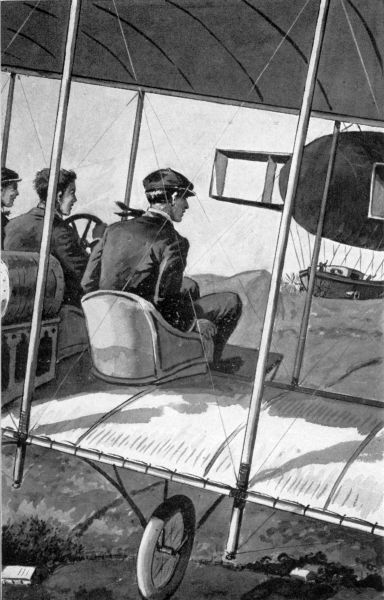
JERRY SENT THE CHASER DIRECTLY AT THE COMET.
THE MOTOR BOYS
AFTER A FORTUNE
Or
The Hut on Snake Island
BY
CLARENCE YOUNG
Author of “The Racer Boys Series” and “The Jack Ranger Series.”
ILLUSTRATED
NEW YORK
CUPPLES & LEON COMPANY
BOOKS BY CLARENCE YOUNG
THE MOTOR BOYS SERIES
12mo. Illustrated.
Price per volume, 60 cents, postpaid.
- THE MOTOR BOYS
- THE MOTOR BOYS OVERLAND
- THE MOTOR BOYS IN MEXICO
- THE MOTOR BOYS ACROSS THE PLAINS
- THE MOTOR BOYS AFLOAT
- THE MOTOR BOYS ON THE ATLANTIC
- THE MOTOR BOYS IN STRANGE WATERS
- THE MOTOR BOYS ON THE PACIFIC
- THE MOTOR BOYS IN THE CLOUDS
- THE MOTOR BOYS OVER THE ROCKIES
- THE MOTOR BOYS OVER THE OCEAN
- THE MOTOR BOYS ON THE WING
- THE MOTOR BOYS AFTER A FORTUNE
THE JACK RANGER SERIES
12mo. Finely Illustrated.
Price per volume, $1.00, postpaid.
- JACK RANGER’S SCHOOLDAYS
- JACK RANGER’S WESTERN TRIP
- JACK RANGER’S SCHOOL VICTORIES
- JACK RANGER’S OCEAN CRUISE
- JACK RANGER’S GUN CLUB
- JACK RANGER’S TREASURE BOX
Copyright, 1912, by
Cupples & Leon Company
The Motor Boys After A Fortune
CONTENTS
CHAPTER
PAGE
I.
To the Rescue1
II.
The Saving of Noddy11
III.
Noddy Begins Plotting22
IV.
Planning a Fortune Hunt33
V.
Noddy’s Plot Develops40
VI.
Off for Pittsburg51
VII.
In Danger58
VIII.
Down the Alleghany69
IX.
Off in the Auto77
X.
Held Up85
XI.
Noddy in Advance92
XII.
Disappointment104
XIII.
The Professor’s Lunch115
XIV.
The Wreck of the Limited121
XV.
The Express Ahead129
XVI.
The Airship Gone138
XVII.
An Unexpected Offer144
XVIII.
On the Trail152
XIX.
A Desperate Race159
XX.
A Game in the Air168
XXI.
Off for the Canyon174
XXII.
Over the Great Chasm182
XXIII.
The Boat in the Rapids189
XXIV.
Strange Ghosts196
XXV.
A Nest of Serpents205
XXVI.
Live Wires212
XXVII.
The Transporting of Noddy217
XXVIII.
The Rising Flood224
XXIX.
In the Cave230
XXX.
The Radium Treasure—Conclusion238
LIST OF ILLUSTRATIONS
JERRY SENT THE CHASER DIRECTLY AT THE COMET. WITH SURE AIM, NED SENT THE LIFE PRESERVER TOWARD NODDY. A MOMENT LATER A CAR SHOT PAST. SUDDENLY ONE OF THE CONDUCTORS TOUCHED A MASS OF SNAKES.PREFACE
Dear Boys:—
I wonder if any of you are superstitious, or if you believe in “signs”? I, myself, do not, but as this happens to be the thirteenth book in the Motor Boys series, I just thought I’d mention it, more as a joke than anything else.
You know some persons think thirteen is unlucky. I do not, and I am sure you do not, either. So I venture to hope that I have been lucky enough to write for you, in this thirteenth volume, a book you will like better than any of the preceding ones that I have been happy to pen.
Certainly, Jerry, Ned and Bob, when they went after the radium treasure, on Snake Island, in the Grand Canyon of the Colorado, had a chance to believe in “signs” if they were so inclined. But when they saw the strange “ghosts” they were not a bit frightened, and, later on, they discovered the cause of them.
This story, though a complete tale in itself, is linked with the others in the series. It tells how the Motor Boys, hearing through Professor Snodgrass, of a place where radium was supposed to be located, set off to find it. They had many adventures, and were in not a little danger. Then, too, they had to proceed against Noddy Nixon, who had unlawfully taken their motorship.
I venture to hope that you will like this story, and that you will care for more about the boys, whom I have come to regard as very good friends of mine. I should dislike, very much indeed, saying good-bye to them.
So, wishing you all the pleasure possible in the reading of this story, I remain,
Yours cordially,
Clarence Young.
THE MOTOR BOYS AFTER A FORTUNE
CHAPTER I
TO THE RESCUE
“But, Professor, do you really think it’s true?” asked Ned Slade, looking at the elderly gentleman, whose bald head glistened in the sunlight, as he sat leafing the pages of a scientific book.
“Is what true, Ned?” inquired Jerry Hopkins, who had crossed the room to look out of a window.
“What Professor Snodgrass was telling just now, about a fortune in radium being on a lonely little island in the Colorado River, somewhere in the Grand Canyon.”
“Radium!” gasped Bob Baker, turning slowly in a big chair.
“Yes, radium,” answered Ned, at whose house the other motor boy chums had called to meet their old friend, the professor, who was paying a short visit to Mr. Slade. “Radium, Bob. Do you get the idea, or are you still trying to figure out how long it will be until lunch time?”
“Aw, quit it,” begged the fat lad. “I guess I can think of something besides grub, once in a while. But I wasn’t listening very closely. What is it about radium? That’s the stuff they use to set diamonds in, instead of gold; isn’t it?”
“Say, what’s the matter with you, Bob?” cried Jerry, a tall, and well-built lad, as he wheeled around from the window. “Set diamonds in radium? You’re thinking of platinum, I guess.”
“Oh, that’s right!” admitted Bob.
“Radium!” broke in Ned. “I guess they’d be more likely to set radium in a diamond, if they could; eh, Professor?”
“Well,” admitted the little scientist with a smile, “it’s valuable enough to be set in diamonds, but I’m afraid it would be too dangerous to carry around that way. It can’t be exposed carelessly, you know.”
“Dangerous?” asked Bob. “How’s that?”
“Radium, that wonderful metal, as it is sometimes called, and about which so much has been written, yet about which even the greatest scientists admit that they know very little, can cause very severe burns if brought near a person, and not protected in some way.
“The rays, or emanations from it, pass through almost all substances, you know, and not only does it cause burns, but also forms of mental diseases. It is a dangerous, as well as very valuable, metal.”
“But what’s this Ned said about some being on an island in the Grand Canyon of the Colorado?” persisted Bob. “That sounds interesting. Maybe there’s a chance for us to take a trip, and get some. Let’s hear more about it, Professor, please.”
“Well, I don’t know that I can say much,” came from the scientist. “I just happened to see a mention of radium in this book I was looking at, and I just told Ned that there was said to be a valuable deposit of it on this island—Snake Island, I believe it is called—though I don’t know why. Probably from some Indian name.”
“And I asked him if he believed it was true,” added Ned.
“As to that I can’t say,” resumed Uriah Snodgrass. “All I know is that some years ago a scientific expedition from Hartwell College set out to learn if the rumor about the radium was true. They had the story, I understand, from some prospectors who were searching for gold. The prospectors landed on this island, because their boat was wrecked, and one of them picked up a piece of stone, whether it was hornblende or pitchblende I can’t recall, but you know radium is often found in those substances.
“At any rate, one of the prospectors kept this piece of mineral, and when he and his friends left the island he took it with him, not knowing what it was. Later he gave it to a scientist, as a curiosity, and the latter at once recognized what it was, and learned where it came from.
“It was sent to Hartwell College, with which the scientist was connected, and aroused a great deal of interest. An expedition was at once fitted up, and about a year ago started for Snake Island.”
“Did they get there?” asked Bob eagerly. “And did they get any gold?”
“They did not, I regret to say,” replied the professor rather solemnly. “As for gold, they would scarcely have picked it up, had there been any, if there was radium to be had, for there is no comparison in the values of the two. With radium at ten thousand dollars, or so, an ounce, you can easily figure what a little bit would be worth.
“At any rate, the expedition never even got to Snake Island. They started down the Colorado in a boat, but it was wrecked, and the party barely escaped alive. This so discouraged them that they returned, and as far as I know, no one since has set foot on the place where the radium is supposed to be. Yes, it was a sad piece of business.”
“Why sad?” asked Jerry Hopkins. “Because science missed the chance to get the radium?”
“Well, yes, in a way, but one of the searching party was lost.”
“Drowned?” asked Ned.
“As to that no one ever knew. He fell into the water when the boat was wrecked, and none of his friends ever saw him again. They had a watch kept on the river below, but the body was never seen. The man disappeared completely. He was quite a friend of mine, too, in a way, for we corresponded, and exchanged scientific books, though I only saw him a few times. Hartley Bentwell was his name, and he was one of the best authorities on radium that I ever heard of. I often wonder what became of him. He gave his life up in the interests of science.”
“And do you really believe there is radium there?” asked Ned, after a pause.
“Yes, I think I do,” answered the professor quietly. “I had the good fortune to see the piece of mineral, containing some, that the prospector picked up years ago. There was no doubt but that it contained radium, for all the manifestations were present. And if there was one bit of radium on that island, there must be more.”
“Unless it’s all evaporated by this time,” put in Bob.
“Radium doesn’t evaporate,” said the professor with a smile. “The smallest piece you can imagine, will give off what you might call ‘rays’ or ‘sparks’ for thousands of years, and, at the end of that time, the most delicate scales would show no loss of weight. It’s the same way with pure musk. A grain of it has been known to scent, say a box, or chest of drawers, for fifty years, and, at the end of that time, the whole grain of musk was still there.”
“That’s strange,” murmured Jerry.
“Oh, that’s not nearly all the strange facts about radium,” went on Mr. Snodgrass. “I could talk to you for hours about it and not half finish.”
“Tell us more about Snake Island,” suggested Ned.
“That’s all I know,” and the professor closed the book that had started the conversation. “I only heard what I have told you. It was because I was interested in Mr. Bentwell, and felt his loss so much that the tale impressed me. I often thought I would like to have a try for that radium myself, not because of the fortune, but because of the scientific value of the metal, or mineral, whichever you choose to call it. But I never seemed to get the time, and I had so many other things to do, gathering——”
The professor suddenly stopped talking, and made a dive for a certain spot on the carpet. He came down on his hands and knees, holding his palms together.
“I got it!” he cried triumphantly. “Ned, please get my smallest insect case. It’s in my right hand coat pocket,” and the scientist remained on his knees, a look of joy on his face.
“Did you fall?” asked Bob innocently.
“No, indeed, I jumped,” replied the professor. “As I was speaking I happened to see a new variety of pink-winged moth fluttering on the carpet, and as this moth——”
“Moths in my carpet!” cried Mrs. Slade, entering the room at that moment. “Oh, Professor! Let me kill it at once! Where is it?”
“I have it safe,” answered Mr. Snodgrass with a smile. “As for killing it, I’ll do that, but it must be carefully done, so as not to crush it. Have you the box, Ned?”
“Yes, here it is,” and the lad drew out a small, glass-topped case from the professor’s pocket.
“Well, as long as you have the moth, I suppose it can’t eat holes in my new carpet,” said Mrs. Slade. “I must put some cedar oil around, and kill the horrid things.”
“Oh, I beg of you, if you see any more to save them for me!” implored the professor. “There you are, my little pink beauty!” he exclaimed, as he put the moth in the case where it soon died, for the box contained cyanide of potassium, the fumes from which are almost instantly fatal to insect life. “That is worth many dollars to my college collection,” went on the scientist. “I would not have missed that for the world. This has been a lucky day for me. Let me see, what was I talking about?” and he looked at the boys through his powerful spectacles, while he absent-mindedly brushed the dust from his trousers.
“It was radium, and you said you’d like to go to Snake Island,” suggested Ned.
“Oh, yes, and I had told you about how my friend lost his life seeking the place. Indeed I would like to go, but I am afraid it is out of the question. However, I suppose some one will get the fortune some day,” and the professor carefully put the insect box in his pocket, looking the while, carefully over the carpet for more specimens.
“Well, that surely was a queer yarn,” remarked Bob. “I say, Ned, what do you say if we have something to eat on it. I’m hungry, and——”
“You don’t care who knows it!” finished Jerry with a laugh.
“That’s all right,” put in Ned good-naturedly, for the chums were almost like brothers, and made themselves perfectly at home in each other’s houses. “I guess it must be almost lunch time. I’ll go see if it isn’t ready. I reckon we can all eat some, even Professor Snodgrass, if he can spare the time from his specimens.”
“Oh, yes,” laughed the scientist. “I am ready——”
At that moment there came an interruption in the shape of a small boy, very excited, and out of breath, who dashed up on the porch, on which opened the library windows of the room where the three chums and the professor had been talking.
“Whoop!” yelled the small lad.
“Andy Rush!” cried Ned.
“Wow!” yelled Andy, getting his second wind. “Come on, fellows—’sawful—dam’s busted—river’s got loose—houses being washed away—people in the water—dogs—chickens—boats—fearful—terrible excitement—come on—don’t lose a minute—the whole place may go—big flood—whoop—come on—don’t wait—wow!”
For a moment the three chums gazed at the excited small lad. Then Jerry asked, sternly:
“Andy, is this true, or are you joking?”
“True? Of course it’s true! Come on—rescue—big damage—dam’s busted—save lives!”
“Fellows, I guess we’d better go!” cried Jerry, and, followed by his chums, and the professor, he rushed from the room, Andy coming after, and giving vent to excited whoops at every other breath.
CHAPTER II
THE SAVING OF NODDY
“How did it happen, Andy?” asked Jerry, as he ran along.
“Yes, tell us more about it,” urged Bob.
“Is it the big reservoir dam that’s broken?” asked Ned. “If it is, there’ll be a lot of damage, and yet I don’t hear any great excitement,” and he paused a moment to listen if he could catch the roar of rushing waters. But there came no unusual sound from the direction of the river which bordered the town of Cresville, where the boys lived.
“I don’t know—didn’t see it!” panted Andy. “Old Pete Bumps told me—said it was the dam—terrible—everything washed away—come on—wow!”
“Oh, if it was old Pete Bumps, our hired man, who told you, it can’t be so bad,” returned Bob Baker. “Pete always makes a big fuss over everything. Let’s take it easy, fellows.”
“You can’t tell,” interposed Jerry. “Something must have happened. I see a lot of fellows running toward the river,” and he nodded toward a side street, through which could be had a glimpse of a thoroughfare parallel to the one on which our friends were, both extending to the stream. “Come on,” finished the tall lad. “We’ll see what it is,” and he increased his pace, his companions doing likewise.
While I have just a few moments before the boys reach the river, and in which time they are doing nothing but running, and wondering what has happened, I will take the opportunity to tell you something about the chums, and the various books, previous to this one, in which they have figured.
The first volume of the series entitled, “The Motor Boys,” told how the chums got together, and entered a bicycle race. Later on they got motor-cycles, and then an automobile in which they had many adventures. They took a long trip overland, got possession of a gold mine, and later went to Mexico, where they were in great danger. But they managed to escape, and, on a long trip across the plains they rescued the hermit of Lost Lake.
After these adventures, our heroes decided that motor boating would suit them, and they succeeded in getting a fine craft. In the volume named, “The Motor Boys Afloat,” is told how the lads cruised in the Dartaway, and succeeded in finding the robbers who had broken into Mr. Slade’s department store.
The lads liked motor boating so well that they took a cruise on the Atlantic, during which they solved the mystery of the lighthouse, and, later on, they went to the strange waters of the Florida Everglades.
Naturally, after their adventures on the Atlantic, they turned their attention to the other ocean, the Pacific, and there they succeeded in locating a lost derelict.
By this time the science of navigating the air was becoming better known, and aeroplanes and dirigible balloons were being perfected. It could not be expected that such lads as the motor boys could be kept from this field of activity, and with the assistance of an old balloonist of experience, Rupert Glassford, Bob, Ned and Jerry built a motorship. In the book called “The Motor Boys in the Clouds,” I told how they made a great trip for fame and fortune, and, some time later they went over the Rocky Mountains, and solved the mystery of the air.
Thrilling indeed were the adventures that happened next, for when they made their voyage over the ocean they succeeded in rescuing from mid-air a certain Mr. Jackson, who was trying out a new kind of balloon. He and his crew were rendered unconscious by escaping gas, but they were brought around all right after hard work.
In the next book, “The Motor Boys on the Wing,” I told how the three chums sought and found the bank robbers, and recovered the stolen money. They had been home from this trip some little time, when the incident narrated in the first chapter of the present volume took place.
I might add that the three chums lived in the town of Cresville, not far from Boston. Their names you are already familiar with. Bob Baker, the fat lad, was the son of Mr. Andrew Baker, a well-known banker. Ned Slade’s father was Aaron Slade, a wealthy department store owner, while Jerry Hopkins was the son of a rich widow, Mrs. Julia Hopkins. The three lads were about the same age, full of fun, grit and the love of adventure.
Many times, though, their fun was spoiled by a mean, bullying lad of the town, Noddy Nixon by name, and his crony, Bill Berry. But the motor boys generally managed to get the best of Noddy in the end. In this they were sometimes aided by Andy Rush, the excitable little chap, who had given the alarm about the bursting dam. Andy was always excited, and sometimes by the slightest cause.
Professor Uriah Snodgrass was a well-known scientist. He often went with the boys on their trips, and he was continually on the lookout for rare bugs, or other specimens. He was employed by a well-known college, to get various articles for its museum, and often the professor would do odd things for the sake of getting a choice insect or reptile. He was a great friend of the boys, and often visited them at their houses. He had spent some time with Mr. Slade, who was one of the trustees of the college to which the professor was attached, and Mr. Snodgrass was about to return to his duties when, in a talk with Ned, the conversation turned to radium, as I have mentioned. But now all thoughts of that, and of Snake Island, were forgotten in the alarm raised by Andy.
“What do you think can have happened, anyhow?” asked Ned, as he raced along beside Jerry.
“I give it up; but it’s something, anyhow,” was the tall lad’s answer, “and that, in spite of the fact that you’ve usually got to discount what Andy says. Look at the crowd!”
As Jerry spoke he and the others reached the end of the street, and came in sight of the river. They could see that something out of the ordinary was taking place, but the stream did not seem to be unusually high, though it had risen somewhat on account of heavy spring rains.
“The big dam hasn’t burst, or we’d hear the roar of waters,” declared Ned.
“Yes, and we’d see ’em, too,” added Bob.
“Well, something busted, because Pete Bumps told me!” insisted Andy. “Maybe the bottom dropped out of the river—water may be all running away—ground sunk in—we’ll all fall through—whoop!”
“Andy!” cried Jerry. “Stop, or you’ll burst! Cool down; can’t you?”
“I can’t seem to,” answered the small lad. “Hey!” he cried, “there goes one house, anyhow,” and he pointed to a structure floating down the stream.
“That’s so!” agreed Bob. “It’s a boathouse, too. I wonder what’s up?”
They saw a moment later. Just above where the street on which they were running came out on the river front, was a small stream that joined the main one. This little stream had been dammed up, to provide a flow of water for an old-fashioned iron mill that used a turbine wheel. Part of this mill-dam had given way because of the heavy rains, and the waters that were held back had suddenly been released, to flow into the river proper.
There was quite a crowd collected on the both banks of the river, and employees from the mill were endeavoring to repair the break in the dam, by putting timbers in it, and filling in the gap with stones, sod and earth.
“Say, this isn’t such an awful flood!” cried Jerry as he took in the scene. “I thought you said the whole town was being washed away, Andy?”
“And you said houses were being carried down,” added Ned.
“Well, there’s one house washed away, anyhow,” declared the small, excitable chap, as if to justify himself.
“That’s so!” cried Bob, “and it’s Noddy Nixon’s boathouse. It’s been washed away, and it’s going right down the river.”
“It didn’t take much to wash it away,” said Jerry. “It was built too far out in the water, anyhow, and the piles it stood on weren’t much bigger than clothes poles. I always thought it would wash away if the water got high, and now it has.”
Noddy Nixon had recently built a new boathouse on a piece of land near the river. It was just below the mill dam, and, naturally, when the rush of waters came, the structure was carried away, for it was not securely built. It was now floating down the stream, careening from side to side in the rushing waters.
“Somebody ought to save that boathouse!” cried Andy.
“Let Noddy do it then,” answered Jerry. “It isn’t worth an awful lot, and it will be worth less when this flood gets through with it.”
“Look!” suddenly exclaimed Ned. “Some one is in the boathouse!”
He pointed toward it, and, at the same time a cry arose from the crowds on either bank.
“Some one’s in the house!” was the shout. “He’ll be drowned!”
“It’s a man!” yelled Andy.
“It’s Noddy himself!” cried Bob.
The figure on the narrow platform in front of the floating boathouse could now be plainly seen. It was that of Noddy, as Bob had said, and the bully who had been endeavoring, by means of a long pole, to push his house toward shore, now threw up his hands, and cried for help.
“It’s time he did that before,” commented Ned. “The current’s got him now, and he’ll never get that house to land.”
“Where was he all this while?” asked Bob. “I didn’t notice him at first.”
“Guess he must have been on the other side, out of sight,” spoke Jerry.
Noddy was now frantically rushing up and down, calling at the top of his voice:
“Help! Help!”
“Say!” suddenly cried Ned. “The rapids! He’ll be down in them soon, and they’re dangerous with the water as high as it is now! That house will be knocked to pieces!”
“That’s so!” agreed Jerry. “Noddy ought to swim ashore while he has the chance. Otherwise he may be hurt! I forgot about the rapids.”
The “rapids” were really not very dangerous at low water, but when the river rose, and dashed over the jagged rocks, about a mile below town, they formed eddies and whirlpools that were exceedingly risky to navigate. In fact no boats dare risk them with the stream at flood.
It was toward these rapids that Noddy’s boathouse, torn away by the waters, was rapidly drifting. The crowd soon realized this and began shouting advice.
“Swim ashore!”
“Get a boat and save him!”
“Jump off!”
“Throw him a rope!”
These were some of the expressions called to Noddy, but he paid no heed to them, continuing to race up and down on the platform, waving his hands, and yelling for help.
“Say, something ought to be done to help him,” remarked Ned in a low voice.
“Yes,” agreed Jerry. “It’s Noddy Nixon, and he’s been pretty mean to us, but I suppose——”
“Our motor boat!” interrupted Bob, pointing to a fine boathouse a little distance up the stream. It was where the boys kept their craft, and was above the point where the swollen mill stream joined the river, and so, consequently, was in no danger.
“I guess it’s up to us to save him,” said Jerry slowly. “Nobody else seems to have sense enough to do it. There aren’t any other motor boats near by.”
“Where’s Noddy’s, I wonder?” asked Mr. Snodgrass, for he knew that the bully owned a power craft.
“He had a collision with the dock the other day, and sprung a leak,” explained Andy Rush, who had cooled down somewhat. “His boat is laid up for repairs.”
“Like our auto,” put in Ned, for the machine of our heroes was across the river, in a distant town, being overhauled.
“Well, if we’re going to save Noddy Nixon, we’d better be getting a move on!” cried Jerry. “Come on, fellows!”
He raced toward their boathouse, followed by his two chums, the professor and Andy Rush. It was the work of but a few minutes to unchain the motor boat, run it out into the stream, start the engine and steer down after the floating boathouse with the frantic figure racing about on the platform.
“Hurrah!” yelled the crowd, when they saw our heroes start out. “The motor boys to the rescue! Noddy’ll be saved now, all right!”
“Help! Help!” yelled the bully, as his boathouse careened dangerously, almost throwing him into the water.
“The flood’s getting higher,” said Ned in a low voice, as he looked over the side of the boat. They were opposite the dam now, and in the grip of the rushing waters.
“Yes, there goes another slice of the dam!” cried Bob, as they saw a large portion of it slip into the water. The men on top, who had been endeavoring to stop the gap, had to race for shore.
“Say, we’re going to have our work cut out for us saving Noddy!” cried Jerry as he held the wheel in a firmer grasp.
CHAPTER III
NODDY BEGINS PLOTTING
“Ned, give me a little richer mixture!” cried Jerry, as the motor boat shot down the current, pitching and rolling in the waves caused by the influx of the mill stream. “I need all the power I can get. Cut down the air a bit, and turn on a little more gasolene!”
Ned bent over the carburetor, and adjusted it, while Jerry watched his own steering to see that he did not run the boat into the many floating logs and boards that had been carried into the river by the flood.
“Need any help?” sung out Bob.
“Not up here, but I wish you’d sit on the other side, Chunky,” replied the steersman, giving Bob the nickname that had been applied to him because of his stoutness. “That will trim the boat better, and she’ll ride easier. Professor, would you mind moving up nearer the stern. I want to get the bow as high as I can.”
“Just a moment!” exclaimed the scientist. “I thought I saw a new kind of water spider. Yes, there it is! Hold the boat back a moment, Jerry.”
“Can’t do it!” cried the tall lad. “This current is fierce!”
The professor suddenly made a lunge over the side with outstretched hands, and the boat careened dangerously.
“Look out!” cried Jerry.
“I’ve got him!” answered the professor. “Oh, it’s a fine specimen! I never had one so good. Where’s my spider-box?” and with one hand tightly clasped, holding the water insect, the scientist, with the other, began searching in his pockets for the box to contain his prize.
“I’ll get it for you,” volunteered Bob.
“It’s in my left hand coat pocket,” said the professor.
The insect was soon in captivity and then, as the boat shot ahead under increased power, due to the change in the gasolene mixture, all on board gazed at the floating boathouse, and the unfortunate owner of it, who was still rushing about, unable to do anything to help himself.
“Look!” cried Andy. “It’s going to flop over!”
It did seem as if the structure would turn turtle, but a swirl in the current righted it, and once more it floated on a level keel, so to speak.
“Help! Help!” cried Noddy, waving his hands at the boys in the motor boat.
“We’re coming!” shouted Ned. “Keep cool!”
“Wow! Steady! We’ll save you—don’t jump—it’s all right—not as bad as it might be—hold fast!” excitedly cried Andy Rush.
“Keep still!” ordered Jerry. “You’ll have him jumping overboard next, Andy.”
“All right,” agreed the little lad, sitting down on the cushions, and holding to the rail to keep his nerves in control.
The motor boat was now well down the flooded river, and aided by the current and her engine, was rapidly approaching the floating boathouse. The latter structure was whirling about, careening from side to side, now on one edge of the stream, and now on the other.
“It’ll soon be in the rapids,” spoke Ned in a low voice.
“We’ll get there before that,” said Jerry confidently.
“How you going to get him off?” asked Bob. “Run along side and have him jump, or make fast?”
“I’m certainly not going to make fast to that house,” replied Jerry. “It would pull us over the rocks, I’m afraid. I guess Noddy will have to jump, and swim for it. Then we can pick him up. Ned, stand ready with that life preserver, and see that it’s fast to the rope.”
“Aye, aye, sir!” answered Ned, seaman fashion.
He made ready the cork ring, with its accompanying line, and took his place in the bow, ready to cast it when Jerry should give the word for Noddy to jump. The lad on the boathouse platform was standing, and looking at the approaching motor craft, waving his hands frantically, and occasionally calling for help.
“Why doesn’t he keep still?” spoke Jerry. “We’re coming as fast as we can.”
“Better not go much nearer,” advised Ned. “I can hear the roar of the rapids. They’re just around that turn.”
“I’m going to tell him to jump now,” said Jerry. “He’s a pretty good swimmer, and he can keep afloat until we can pick him up. Get ready with that ring, Ned.”
“All ready!”
Jerry stood up, and, bracing one knee against the wheel, to aid his hands in holding it steady, he shouted:
“Jump, Noddy! Jump! We’ll pick you up! Jump!”
“I—I’m afraid to,” whimpered the bully.
“You’ve got to!” yelled the tall steersman determinedly.
“I—I——” Noddy looked as though he were going to slump down on his knees, but a sudden swirl of the current saved him the necessity of jumping, for he was thrown off the slanting platform into the water.
“There he goes!” cried Bob.
“The ring! The ring! Throw him the ring!” shouted Jerry.
As Noddy went under the swirling waters, Ned leaped out on the bow deck of the boat, with the ring in his hand, watching for the reappearance of the bully.
“There he is!” cried Andy Rush.
With sure aim Ned sent the life preserver toward Noddy. It fell true, almost over his head, and, a moment later, he had grasped it with a desperation born of despair.
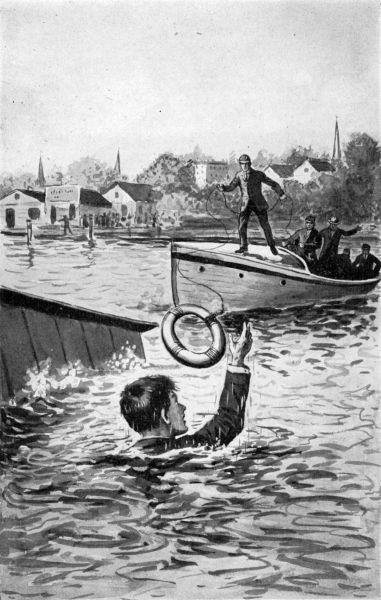
WITH SURE AIM, NED SENT THE LIFE PRESERVER TOWARD NODDY.
“Pull him in!” ordered Jerry, and Ned and Bob began hauling on the line. A few seconds later, half unconscious, pale, and with closed eyes, Noddy was pulled on board.
“He’s dead!” cried Andy.
“Nonsense!” exclaimed Jerry, as he began to turn the boat toward shore. “He wasn’t in the water more than three minutes. He’s fainted, I guess.”
“Better get him to shore as soon as possible,” suggested Professor Snodgrass. “He may have been injured.”
“I’m heading for that dock over there,” remarked Jerry, pointing to one on the Cresville side of the river. “We can lay him out there, and give first aid to the injured, and, if he’s swallowed any water, we can drain it out of him. Keep his head low and his feet high, fellows,” he said to Bob and Ned, who were holding Noddy. The rescued lad had not opened his eyes.
It was a hard fight against the powerful current of the flooded river to gain the dock, but Jerry made it, for the engine of our heroes’ craft was a fine one.
“Get him out now!” cried the tall lad, as he made the boat fast on the lower side of the dock, where the swirl of the river would not affect it. “Use artificial respiration.”
The motor boys knew how to do this, and in a little while they saw that Noddy was breathing more strongly. It developed later that he had been hit on the head by a piece of driftwood, rendering him partly unconscious, so that he swallowed more water than he would ordinarily have done.
“I guess he’s coming around all right now,” said Ned, as he noticed a fluttering of Noddy’s eyelids.
“Here comes Dr. Preston!” added Bob, as he saw a young man, accompanied by a small throng of persons, racing toward the dock. “He’ll know what to do.”
Dr. Preston, who had been summoned by some one of the crowd who had witnessed the rescue, was soon working over Noddy.
“He’s out of danger now, though he’s not fully conscious yet,” said the doctor, after a few minutes. “It’s a wonder he had strength enough to hold on to the ring as you pulled him in.”
“Well, when Noddy gets hold of a thing, he hates to let go,” remarked Ned. “Say, fellows,” he added to his two chums, “a lot has happened since we started to talk about that radium deposit on Snake Island, in the Colorado canyon; hasn’t there?” he asked. “It seems like a week, but it hasn’t been half an hour.”
“That’s right,” agreed Bob. “I want to hear more about that radium. Let’s go back home, and the Professor can tell us. Noddy’s all right now. If we could go to Snake Island and get some radium——”
“Hush!” suddenly exclaimed Jerry, nudging his chum.
“What’s the matter?” demanded the stout youth.
“No use talking about that, where every one can hear you,” went on Jerry in a low voice. “Besides, Noddy is coming to, now. His eyes are open.”
The rescued lad was much better now, and was sitting up, held by the doctor, who was administering a stimulant.
“That’s so, I guess I had better keep quiet,” admitted Bob in a low voice.
Quite a crowd had collected on the dock, and one man, who had a carriage, offered to take Noddy home. This was decided on, and soon, in the care of the physician, the bully was taken away. He had not recovered sufficiently to thank his rescuers, but the motor boys felt that the less they had to do with Noddy the better for them. They had done their duty, and were content to let it go at that.
“Think we can go up against the current?” asked Ned of Jerry.
“I’m not going to try it. The river will soon go down, for the water in the mill pond will all be out by night. We’ll just leave our boat tied up here. No use taking any chances on hitting a floating log, and stoving a hole in the Dartaway. We’ll come down and get her to-night.”
The motor boys made their way out of the crowd, from the members of which came murmurs of praise at the plucky act of our heroes. Noddy’s boathouse disappeared around the bend of the stream, and, a little later, was pounded to pieces in the rapids.
The three chums, with the professor and Andy Rush, made their way back to Ned’s house, talking on the way of what had happened.
“Well, it’s all over,” remarked Ned, as they came opposite the broken dam. “See, the pond is almost emptied. They can mend the break now. That was an exciting time while it lasted.”
“That’s right,” agreed the others.
“Let’s get that lunch we were starting on when Andy interrupted us,” suggested Bob.
“Chunky, you’re hopeless!” cried Jerry. “You’d eat if the world was coming to an end, I believe.”
“I would if I had time,” admitted the fat lad. “But there’s no use letting the lunch spoil; is there, Ned?” and he appealed to his other chum.
“No, I guess not,” agreed the merchant’s son. “Come on, Andy, have a bite with us, but don’t you get excited or you may choke on a piece of custard pie.”
“And while we’re eating maybe Professor Snodgrass will tell us more about the radium on Snake Island,” suggested Bob.
“I think I’ve told you all that I know,” replied the scientist, “but you may ask me any questions you like,” and, shortly afterward, while still at the table, the little man was fairly bombarded with inquiries about radium, its general properties, and in particular about the kind that was to be found on Snake Island.
Meanwhile, Noddy was taken home, and nursed. He was weak and ill, but this did not prevent him, as he lay in bed, from doing some hard thinking.
“Radium; that was what those motor boys were talking of,” he murmured to himself, as he felt of the bandage on his head. “Radium on some place in a canyon. Canyon—canyon—Grand Canyon. I wonder where that is? Radium; I know that stuff. It’s worth millions—but that canyon—Oh, I know—the Grand Canyon of the Colorado! That’s it. Snake Island! That must be a place in the river. I wonder if I could find it?”
Noddy dozed off for a moment. Suddenly he sat up in bed.
“I’m going to do it!” he exclaimed. “There’s no reason why they should have it! I’ll get ahead of them! I’ve got as good a right to it as they have!”
He was in deep thought for a minute.
“That college professor knows about it,” he resumed. “And if he knows, other scientists know too. Radium is used in colleges for experiments. I’ll do it! I’ll get Bill Berry, and we’ll find some other college professor, and start after that radium ourselves. I’ll get ahead of the motor boys for once in my life! Radium! It may be worth millions!” and Noddy’s eyes gleamed as he unfolded to himself the plot he was hatching against our heroes.
“I’ll start as soon as I can,” he went on. “It isn’t very far to that Colorado canyon. That’s what I’ll do. Me and Bill will get that radium. I guess I can find Snake Island as well as Jerry, Ned or Bob. They didn’t think I heard them, but I did. I just kept my eyes shut. Oh, I’ll fool ’em!”
And, mean bully that he was, forgetting that the motor boys had saved his life, Noddy Nixon began making plans for going to Snake Island after the deposit of radium, which was worth such a fortune.
CHAPTER IV
PLANNING A FORTUNE HUNT
“Well, I feel better now,” remarked Bob with a sigh of satisfaction, as he pushed back his chair from the table.
“You look better, too,” spoke Jerry, with a laugh. “You haven’t that worn and hungry appearance you had a while ago, and I guess the rest of us can have a little peace now.”
“Peace? What do you mean?” demanded the stout youth indignantly.
“I mean that you won’t continually be talking about something to eat.”
“I guess you were hungry, too,” went on Bob. “I notice that your plate is empty.”
“Here, you two quit scrapping,” advised Ned good-naturedly. “I guess we were all hungry. It was the excitement over rescuing Noddy that caused it.”
“That’s right!” chimed in Andy Rush. “Whoop! That was exciting all right. Let’s go back and see if they’ve got the busted dam mended—maybe there’s a lot of men drowned—maybe we can see where Noddy’s boathouse went to pieces in the rapids—wow—some excitement all right—I’m going—come on, fellows!”
“No, we’ve got business on hand,” answered Ned, a bit soberly. “But don’t let us keep you, Andy.”
“All right, I’m going—I like excitement—maybe they’ll let me help mend the dam,” and taking Ned’s words as a sort of gentle hint, the excitable little lad arose from the table and was soon hurrying down the street.
“I guess they’ll keep him away from the dam if they know what’s good for it,” remarked Jerry, as he watched Andy hurrying away. “He might talk so much that he’d put another hole in it. But what business did you mean, Ned?” and he looked across at his chum.
“The radium business, of course,” returned Ned promptly. “You fellows don’t mean to say you’re going to let a chance like this slip!”
“What!” cried Bob, “do you intend to go after it, Ned?”
“Well, I’m willing, if you and Jerry are, and if the professor would like to go along——”
“Go where?” asked Uriah Snodgrass, looking up from a scientific book he had started to read as soon as the meal was over. “Where do you want me to go?”
“After the radium on Snake Island,” put in Jerry. “Ned thinks we can get it, but I don’t know that it’s possible, after what you have told us about how hard it is to get down into the Grand Canyon.”
“It is hard,” said the professor seriously. “I haven’t in the least made up my mind to go on the expedition, but whoever does go, ought not to risk going in a boat, as the other scientists did. It is almost certain death. I really don’t know how one could make the descent into the canyon. The island, as I understand it, is in the middle of the river, near a place where there are dangerous rapids and whirlpools. The cliffs on either bank of the stream are impossible to scale.
“Of course at certain points it is possible to make a descent into that great canyon. I remember reading an article on it and it stated that there were several trails that could be used, Bright Angel Trail is one, and then there are Bass’s, Boucher’s, Berry’s and the Red Canyon Trail. Berry’s is near Grand View, as it’s called, and Snake Island lies somewhere between that point and Bright Angel Trail. Oh, a boat is out of the question, I think.”
“Then what’s the matter with our airship?” asked Ned quickly.
“That’s it!” cried Bob eagerly. “Why didn’t we think of that before? We’ll go in the airship, fellows, and get that radium! It will be just the thing! Here it is almost vacation time, school will close in a couple of weeks, and that will be our summer outing—to go after the radium fortune in our airship.”
“You forget that the airship is in Denver,” put in Jerry. “You know we loaned it to Mr. Glassford to give an exhibition at the international aero meet, and in his last letter he said he has won several prizes with it.”
“But the meet is over; isn’t it?” asked Ned, who seemed unusually excited over the prospective trip.
“Yes, and I suppose Mr. Glassford will soon be sending our motorship back,” admitted Jerry. “But——”
“Oh, don’t go to finding a lot of objections,” broke in Bob. “What’s the matter with leaving the airship out in Denver?”
“And walk out there to use it?” inquired the tall lad sarcastically.
“No, motor out there. Our auto will soon be out of the repair shop, and we could have a fine time going West in it. Say, things couldn’t happen better; could they, Professor?” and Bob began pacing up and down the room.
“What has happened?” asked the scientist suddenly, for he had again become absorbed in his book, and had paid no attention to the talk of the boys. “Is anything the matter?”
“We’re still talking radium,” explained Ned. “Trying to get Jerry enthused enough to go to Snake Island.”
“Oh, I’ll go if the rest of you do,” agreed the widow’s son. “Only it doesn’t sound feasible. Our airship isn’t at hand, the motor is laid up for repairs, and——”
“But we have the motor boat,” broke in Ned. “We can use that.”
“On dry land!” laughed Jerry. “Say, you fellows have great ideas—great!”
“Give us some of yours then,” suggested Bob.
“Well, my notion is——”
“I’ve got it! I’ve got it!” fairly yelled Professor Snodgrass, leaping from his chair, and holding the book above his head. “I’ve got it!”
“What is it this time?” asked Jerry. “A pink-eyed toad or a blue-nosed grasshopper?” for the scientist was continually on the lookout for strange and rare insects or reptiles.
“Neither one,” answered Mr. Snodgrass, “but I have just found, in this book, an article telling about a strange double-tailed toad, very rare, which is said to be a native of New Mexico. It is a species of the horned toad, but very different. For years I have been investigating, trying to get on the trail of this sort of toad, and now, most unexpectedly, I come upon a clew. Boys, this has indeed been a fortunate day for me. I shall start right away for New Mexico. I must telegraph the college president at once that I can get a most valuable specimen to add to our collection. Oh, this is indeed fortunate!”
The professor was rapidly making notes from the article in the book. The boys looked at one another. Then Ned spoke.
“Fellows,” he said, “this just fits in. New Mexico is on the way to the Grand Canyon—or at least it won’t be much out of our way to go there. We can have a try for the radium fortune and at the same time the professor can look for his tailless toad. How about it?”
“Two-tailed toad! Two-tailed!” cried the little scientist. “Don’t make that mistake, Ned. But I think that will be a good plan. I was undecided about it before, but, since you are going, I will go with you, and I’ll do all I can to help you get to Snake Island.”
“And we’ll help hunt the two-tailed toad,” added Bob. “Now, how about you, Jerry?”
“Oh, I’m game. I’ll go along, but we’ve got to straighten out about our auto and motorship. First we’ll write to Mr. Glassford, asking him to hold the Comet in Denver for us. Then we must hurry the repairs on the auto.”
Mr. Glassford, as my old readers probably remember, was the man who first helped our heroes to construct their motorship. He had recently borrowed their latest and largest craft for exhibition purposes.
“Well, get busy,” advised Ned. “Here is some paper. Take my fountain pen and write some letters. It’s decided then; we’ll have a try for the radium, and we’ve got to get a move on to get ready.”
“Here comes the postman,” spoke Bob. “I’ll get the mail, Ned.”
The stout lad came back with several letters. One was for Ned Slade. He quickly tore it open, and, as he read it he gave a startled cry.
“What’s the matter—bad news?” asked Jerry.
“Sort of that way,” replied his chum. “This letter is from the man who was repairing our auto. He says he discovered a flaw in the back axle, and, in order to have a new one properly fitted in he sent the car to Pittsburg, where there is a firm that makes a specialty of such things. Our auto is in Pittsburg!”
“Then it’s all up with using it on the trip west!” exclaimed Jerry. “We’ll have to go by train I guess.”
“No we won’t!” cried Bob eagerly. “Fellows, I’ve got a plan.”
CHAPTER V
NODDY’S PLOT DEVELOPS
There was a moment of silence following Bob’s announcement. Then Jerry remarked:
“Well, go ahead, Chunky, and let’s see what you’ve got up your sleeve. Are you going to suggest a wireless airship ride, or a motorless auto?”
“Neither one,” said Bob. “But I was going to say I didn’t see why we couldn’t go in our motor boat as far as Pittsburg, pick up the auto there, when it’s finished, go on in that to Denver, get the airship and then keep on to Snake Island. I think——”
“Say, that’s all to the ice cream!” burst out Ned. “Bob, you have got a head on your shoulders after all. That’s a fine idea, I think.”
“So do I,” agreed Jerry. “But can we go all the way to Pittsburg by water?”
“Sure,” declared Bob. “Where’s a map? Ned, hunt up a geography.” One was soon found and then the boys, bending over it, saw that by using the river that flowed past their town for a number of miles, getting into a little lake, and thence into another river, they could, by means of a small canal get into a small river flowing into the Alleghany.
“We’d have to have the boat carted about five miles, but all the rest of the way we can go by water,” explained Bob. “As soon as we hit the Alleghany we’ll be all right. What do you say, Professor?”
“Anything you boys decide on will suit me,” answered the scientist, who was still busy making notes. “I want to get that two-tailed toad, and I’ll do anything in reason to secure a specimen. It strikes me that Bob’s plan is a good one.”
“It won’t be monotonous, at any rate,” commented Ned. “A motor boat, an auto and an aeroplane and dirigible balloon combined, ought to furnish a variety of travel that would suit almost any one. I think it’s just the cheese, myself.”
“Then we’ll do it,” decided Jerry. “I’ll write to Mr. Glassford, and the auto firm right away, and we can mail the letters on our way home, Bob. I’ve got to be going soon. I told mother I’d go calling with her this afternoon, but I’ve been here nearly all day.”
The letters were soon written, and then Jerry and Bob taking leave of Ned, started for their homes. Professor Snodgrass also sent word of the prospective trip to the college authorities by whom he was engaged. The scientist arranged to stay at Ned’s house until the time of starting.
“Let’s go have a look at the broken dam,” proposed Bob when Jerry had dropped the letters in the box. Accordingly they went a short distance out of their way, down to the river. The excitement of the morning had passed, and there was only a small crowd watching the mill men at work. The waters had now subsided, but it would be some time before the dam would be in shape to again hold back the stream, and provide power for the turbine.
“It was a hot time while it lasted,” remarked Jerry.
“It sure was,” agreed his chum. “I wonder how Noddy is getting on?”
“Oh, all right, I guess. He’s so tough it takes a good deal to hurt him. I suppose we’ll hear from his folks.”
The motor boys did, a few days later, Mr. Nixon sending Bob, Ned and Jerry a formal note of thanks for what they had done for his son. Noddy was getting on all right, his father said, and would soon be out of bed. From Noddy himself no word came.
“I don’t wish him any bad luck,” spoke Ned, “but I hope he stays in bed a couple of weeks.”
“Why?” asked Jerry.
“So he won’t have a chance to interfere with us. I’d like to get started on our radium trip before he’s up and nosing around.”
“Why, he doesn’t even know we’re thinking of it,” put in Bob. “How can he interfere?”
“Well, somehow or other, he has always, more or less, made trouble for us whenever we go off on trips,” went on Ned. “I don’t know how it is, but it generally happens. Maybe this will be an exception.”
“How soon before we can start?” asked Bob.
“Not for a couple of weeks,” replied Jerry. “School closes a week from to-day, and then it will take us a week to get ready after that. We haven’t much time now, on account of examinations. I’ve got to do some hard studying to pass.”
“So have I,” admitted Bob. “Well, then, we’ll say in a couple of weeks. Maybe Noddy won’t be around by then, and we’ll be all right. Did you hear from Mr. Glassford, Jerry?”
“Yes, and he says he’ll have the Comet all ready for us. He won’t be there himself, as he has to come east, but he’s paid a man to take charge of the motorship for us. The auto will be ready in two weeks, also, for I had a letter from the factory where they’re repairing it. I wrote to ’em to make a few changes in it, to bring it up to date. Our motor boat, the Dartaway, needs a little overhauling, and then that will be in shape.”
Following the smashing of the original Dartaway in the freight wreck, the boys had bought a much larger and finer craft, with a cabin, and had named it after their first boat.
Their auto I have described in previous books. It was a large touring car, with plenty of room for the passengers and also compartments where food and supplies could be carried, and also a small tent with folding cots, so that in case they desired they could camp out wherever night overtook them. Recently a closed body had been put on the car, so that it was very comfortable to travel in, even during a storm.
The motorship Comet I have also described in other books, so I will only mention it briefly here. It was a combination of an aeroplane and dirigible balloon, and could be used as either or both.
The gas used in the bag was manufactured on board, as needed, and there was a comfortable cabin, sleeping berths and an engine room, fairly filled with motors, dynamos, air pumps, a gas generator and many other mechanical contrivances. The motorship could be kept aloft a number of days, and plenty of food and supplies could be carried, in addition to several passengers. It was an ideal craft of the air.
In the days that followed the motor boys were kept busy. When they were not “boning” away over their lessons they were getting the Dartaway in readiness for the trip. Professor Snodgrass remained as the guest of Mr. Slade, and the scientist spent most of his time wandering about the woods and fields looking for rare bugs.
“I’m just as anxious to start as you boys are,” he said to them one day, when he had paid a visit to the dock where the boat was tied up, and where Bob, Ned and Jerry were cleaning the engine, and overhauling the mechanism.
“Well, it won’t be long now,” remarked Jerry. “To-morrow ends school, and then—for the best vacation we ever had!”
“And the radium fortune!” added Bob.
“Hush!” suddenly exclaimed the tall lad.
“What’s the matter? Did you see Noddy Nixon?”
“No, but there’s his crony, Bill Berry, in that boat,” and Jerry nodded toward a rowing craft which a shabbily dressed man was propelling up stream. “He’s pretending to be fishing,” went on Jerry in a low voice, “but I believe he’s just spying around here to see what we’re up to.”
“That’s so,” admitted Bob. “I must keep quiet. But I’m glad it wasn’t Noddy. I guess he isn’t out of bed yet,” and the boys kept on with their work, the professor strolling off to see if he could get any specimens, while Bill Berry rowed around a bend of the river, and so out of sight.
But Bob was mistaken about Noddy not being out of bed. That bully had gotten up for the first time that day, and, even while our heroes were talking of him, he was sitting in the parlor of his father’s house, trying to evolve in his mind a plan for learning more about the radium, said to be located on Snake Island.
“I’ll need some one to help me,” mused Noddy. “I can take Bill Berry, of course, but I need some scientific fellow who will know radium when he sees it, for I don’t, and Bill certainly couldn’t tell it from a lump of coal. I wonder what I can do?”
At that moment the door bell rang, and, as the servant happened to be out, Noddy answered it. He saw, standing on the steps, a tall, lank man, whom the word “sleek” seemed to describe better than any other. The caller wore a long black coat, a flowing black tie, and had a tall hat, while he carried a small valise in his hand.
“Ah, good afternoon,” began the stranger, smiling at Noddy. “I believe I am speaking to the owner of the house?”
“No, my father owns it,” replied Noddy, not a little proud of being taken for the head of the home. “But I can do any business, I guess. I often help my father. His name is Nixon—I’m Noddy Nixon.”
“Oh, yes, I have heard of you. Your father is known to me by reputation, and I have called to see him, as I have in the case of a number of the most prominent men in town. But I fear I will have to see Mr. Nixon personally.”
“Won’t I do?” asked Noddy. “I know a lot about my father’s affairs.”
“Well, I’ll tell you, and you can judge for yourself,” went on the man, as he entered the parlor and sat down. “I am Dr. Kirk Belgrade, head of the Mortaby Scientific School, a very important institution of learning. I am traveling about, seeking to enlarge the scope of our work, and, naturally I came to Mr. Nixon. I understand that he was one of the endowers of a number of colleges, and I thought perhaps he would give us a contribution. We confer degrees on those who aid us financially, and there are a number of scholarships available. Perhaps you yourself might be interested in taking up a new line of study.”
“I don’t know,” replied Noddy. “I go to a boarding school now, but it isn’t very good. I might change. Where is your school?”
“Well—er—that is—well, to be frank we have no fixed place or headquarters,” said Dr. Belgrade. “The Mortaby Scientific School is a sort of correspondence institution. Our pupils are located all over the world, and they get their lessons by mail, and also recite by mail. There is a good profit in it, and I’m sure if your father invested he would get a large return for his money. Some of the other prominent men in town have given me encouragement.”
“Did you go to Mr. Slade, or Mr. Baker—or to Mrs. Hopkins—she’s a rich widow?” asked Jerry.
“I did call on Mr. Slade and Mr. Baker, but I regret to say that they—er—they turned me down,” replied the educator with an oily smile. “They said they did not believe in my methods. But I assure you that they are most up to date. I will call on Mrs. Hopkins, at your suggestion, however.”
“Better not,” advised Noddy with a grin. “She and the Slades and Bakers are all alike. They don’t want anything new. I know ’em. But maybe my father would invest. He’ll soon be home, and you can wait if you like.”
“Very well, I will. I’ll show you some of our literature. I am one of the principal instructors. In fact I may say that I am the whole school, for all the other instructors come to me for advice. Just to show you how up to date we are, I will mention that we have a small laboratory——”
“Oh, say,” interrupted Noddy eagerly. “Do you happen to know anything about radium?”
“Radium?” replied the visitor. “Of course I do—a great deal. Why, to show you how advanced my college course is, let me say that we have a small quantity of radium for experimental purposes.”
“You have!” exclaimed the bully, with increased eagerness. “The real article?”
“Radium, I do assure you, the genuine article,” said Dr. Belgrade. “I do not care to state just how I came into possession of it, but it is in our laboratory.”
“But I thought you said you had no school building,” said Noddy, suspiciously.
“Well, the laboratory is in my house, next to the bath room,” explained the instructor. “It is not a very large laboratory, but I hope to extend it soon. I need money, and I hope——”
“Radium!” interrupted Noddy. “Radium is worth money; isn’t it?”
“I should say it was, Mr. Nixon.”
“Would you like to know where to get some?”
“Would I? I would give up my present plans, turn my students over to an assistant, and travel a long way if I knew where to find some. Why do you ask?” and the man looked eagerly at Noddy.
“Do you know radium when you see it?” asked the bully.
“Indeed I do. I have made a special study of it, and I can detect it in any form. I am not boasting when I say that there are few who are any better informed about radium than I am. But what do you mean? Is it possible that you have some radium?”
“I haven’t it,” said Noddy in a low voice, “but I know where there is some. I’m glad you happened to call. I’ll tell you all about it, and maybe we can go together.” Noddy got up and closed the parlor door, shutting himself in the room with the sleek educator. Next he quickly unfolded to him the plot he had formed, after having overheard what our heroes had said about Snake Island.
“Is it possible!” gasped Dr. Belgrade, when Noddy had finished. “Is it possible!”
“It must be, or those fellows wouldn’t plan to go after it,” replied Noddy. “But I’m going to get ahead of them, if you’ll help me. Will you?”
“Will I? Well, I guess I will! Now let’s make some plans. With your father to finance our expedition, we may all become millionaires!” and the head of the correspondence college rubbed his hands together and smiled at Noddy encouragingly.
CHAPTER VI
OFF FOR PITTSBURG
“So we start to-morrow,” observed Professor Snodgrass one evening, when the three chums were gathered about a table in the library of Ned’s home. “It seems like a month ago that we decided to make the trip.”
“And yet it was only about two weeks,” returned Jerry. “We have had a lot to do in the meanwhile, though.”
“But everything is in good shape,” remarked Bob. “We’ve got enough grub aboard to last until we get to Pittsburg, I think.”
“Oh, of course!” laughed Jerry. “You can trust Bob to look out for the ‘eats’ every time. I think we’ll make him the permanent commissary general.”
“Well, I notice you always come around when the dinner bell rings,” remarked the fat lad significantly.
“He’s got us there,” admitted Ned. “But it’s a good thing Bob does look after the food, for we’re always sure to have enough. Now let’s see where we’re at. Hand me that list, Bob, and we’ll check things off. If we’re going to start to-morrow we will have to get any last things we need to-night.”
The three chums went over the list together, the professor poring deeply into a scientific book, making occasional notes, and at times thinking of the two-tailed toad he hoped to get as a result of the trip.
“Well, so far Noddy hasn’t bothered us any,” remarked Ned, when they had completed the checking of the list, and found that everything needed was on the boat, or in readiness to stow away.
“He’s out and around,” remarked Jerry. “I saw him down the street this afternoon.”
“You did! And did he speak to you?” asked Bob.
“Just sort of nodded and thanked me for the way we fellows pulled him out of the water. He wasn’t very enthusiastic over it, though, and he looked rather thin and pale, I thought.”
“Maybe he was hurt worse than we imagined,” suggested Bob. “Well, if he doesn’t make any trouble for us, I’ll be satisfied. But I guess it’s time I went home. I want to get plenty of sleep, for I’m going to get up early.”
“Same here,” said Jerry. “I guess everything is in shape. We’ll meet at my house, as that’s nearest the river, and then we’ll get started as early as we can.”
“It’s all settled then; is it?” asked Professor Snodgrass.
“Everything,” replied Ned. “We’ll go by motor boat to Pittsburg, get our auto there, and ride across to Denver, and from there make the rest of the trip by airship. I guess that’s the best way to get down into the Grand Canyon.”
“It’s really the only way,” said Mr. Snodgrass. “Boats are almost out of the question, and to follow the trails down the sides of the big chasm wouldn’t help us much, for Snake Island is far off from any of the places by which you can get down to the river’s edge. But with an airship we can descend as well as if we were in an elevator. Yes, I think you boys have made the best possible plan.”
Bob and Jerry left Ned’s house soon after this, and, on the way to their homes they went past the Nixon residence. Bob, looking up, exclaimed:
“Noddy’s sitting up late to-night. There’s a light in his room.”
“So I see,” replied Jerry. “Well, if he stays up late he’ll sleep late, and we’ll get off before he knows it.”
“Why, are you worried about him?” asked the stout lad.
“Yes, I don’t mind telling you that I am.”
“Why?”
“Well, because I’ve seen Bill Berry hanging around lately. You know how thick he and Noddy are, and I shouldn’t be a bit surprised but what Bill was trying to find out where we are headed for this time.”
“Why would he do that?”
“Oh, just so he and Noddy could make trouble for us. It wouldn’t be the first time they have camped on our trail.”
“No, that’s right. But I guess we’ll fool ’em this time.”
But if Bob and Jerry could have looked into Noddy’s room at that minute, they would have been made aware that they had plenty of cause for suspicion.
For, as our two heroes passed on to their homes, glancing back momentarily at the light in Noddy’s window, that bully was in close conversation with a certain sleek individual, who, for the present, chose to masquerade under the name of Dr. Kirk Belgrade.
“Do you think you can find out when they go, and where they are headed for—I mean exactly?” asked the correspondence school man.
“Sure I can,” declared Noddy. “I’ve had Bill Berry on the watch for the past week. They’re going to start in their motor boat to-morrow morning.”
“To where?”
“Well, that I don’t know exactly. I’ve tried to find out but I can’t. Bill sort of fell down on that job. But I’ll get wind of it somehow. I know where their auto was sent to be fixed, and the man there knows my father. He’ll tell me where they are headed for, I’m sure. But even if we don’t find out, we can go West on our own hook, and locate Snake Island. The rest will be easy, and we’ll get that radium before they do.”
“I hope so,” spoke the educator. “I certainly need the money, and I have given up everything for this chance. The Mortaby Scientific School will have to get along without me for a time, but when I come back, with a fortune, I will build a real college.”
“First we’ve got to get the radium, and beat the motor boys!” exclaimed Noddy, as he grinned in anticipation of the trick he expected to play.
“You don’t like them, then?”
“I hate ’em all!” snarled the bully, “even if they did pull me from the river. If they hadn’t, someone else would.”
“Well, I hope we can soon start West,” went on the sleek individual. “When will your father give me some money?”
“To-morrow or the next day,” replied Noddy. “He is willing that I should undertake the trip. I told him I needed it for my health.”
Then the two talked over the details of their plot, sitting up until late in the night, while our heroes peacefully slumbered, and dreamed of strange adventures on Snake Island in the Grand Canyon of the Colorado.
Bright and early the next morning Bob and Ned, with the professor, assembled at Jerry’s house. The last preparations had been made, good-byes had been said, and the motor boat looked over for the last time. She was pulling uneasily at the mooring lines, which held her fast to the dock, for there had been a heavy rain, and the river was much swollen. It was as if the boat was anxious for the boys to come aboard.
“All ready?” asked Jerry.
“All ready,” replied Ned, and then, waving good-byes to Mrs. Hopkins, they started for the pier. It did not take them long to put their handbags aboard, and, once the professor was comfortably settled aft, in the open cockpit, he began scanning the water for rare insects.
“All aboard!” cried Jerry, as he took his place at the wheel.
“All aboard,” answered Ned.
“Then let her go,” ordered the steersman, and Ned turned over the fly wheel to start the motor.
There was a cheer from the little crowd that had gathered on the dock to see our heroes start. Andy Rush was among them.
“That’s the stuff!” cried the excitable little chap. “Off you go—wish I was along—never say die—blow up the boiler—whoop—off for Pittsburg!”
“Say, I wonder if he ever will calm down?” remarked Bob, helplessly.
“I’m afraid not,” commented Ned.
“I wish he hadn’t said that last,” said Jerry in a serious tone.
“Why not?” asked Ned, as the Dartaway swung out from the dock.
“Because I’d just as leave everyone wouldn’t know where we are going. It might get to the ears of——”
“Look!” cried Bob in a low, tense voice.
“What is it?” asked Ned.
“There’s Bill Berry, and Noddy Nixon is with him,” went on the stout lad, pointing across the water, to where, a short distance away, there floated a rowboat, containing the two enemies of the motor boys.
CHAPTER VII
IN DANGER
Jerry, Ned and Bob were gazing straight into the faces of Bill Berry and Noddy Nixon. The two cronies, in turn, returned the stare, and to our friends it seemed as if there was an insolent look on Noddy’s face—a sort of half smile of triumph, as if he had divined their plans, and was going to try to frustrate them.
“Mind your wheel!” suddenly called Ned sharply to the tall steersman. “There’s a rock just ahead of you, Jerry!”
“That’s so, I forgot about that,” and Jerry twisted the rudder about so that the Dartaway swung toward the middle of the stream, missing the rock by a narrow margin.
“Too close for comfort,” murmured Bob.
“That’s right,” agreed Jerry. “I don’t know why I should have stared so at Noddy.”
“It looks as if he and Bill came out on purpose to see us off,” commented Ned, as the motor boat rapidly opened up a gap between herself and the rowing craft. “I wonder if he heard what Andy said about Pittsburg?”
“I’m afraid so,” said the tall lad. “Sounds carry very clearly over the water, you know, and Andy has rather a loud voice. Well, it can’t be helped, and I suppose the only thing for us to do is to be on our guard.”
“That’s all,” agreed Ned, and by this time they had gone around a bend, losing sight of the rowboat, and the dock from which they had started. The last glimpse they had of Andy Rush was when that excitable chap was dancing up and down, waving his hands to them, and doubtless letting off all sorts of explosive expressions.
Professor Snodgrass, during this episode, had taken no part in the conversation, remaining quietly in his place, scanning the water for a glimpse of some rare aquatic insect. At times he would dip into the river a small net he carried, and, bringing it up filled with mosquito wrigglers, or other forms of life, he would gravely examine his catch through a magnifying glass.
“Ah, here is a rare one!” he would occasionally cry. “A triple-jointed worm. But I don’t understand how it got into the water, as it is a form of land life. This is very puzzling. I must make notes on this. Perhaps the worm, having lived on land all its life, is going to become aquatic in his habits, as the whale did centuries ago. It is very strange.”
“Let’s see the worm, Professor?” requested Ned, when he had adjusted the motor to work smoothly, and while Jerry was steering in and out to avoid floating logs.
“There it is,” said the scientist, lifting the specimen out of one of the glass-topped boxes. “A beautiful creature! Most perfect! And yet I cannot account for it being in the water. I shall devote a good deal of space in my new book to this find. Perhaps I am the first to discover it, and, if so, I shall be made an honorary member of the Society for Advanced Scientific Research. A most beautiful and perfect specimen!”
“Why, it’s an angle worm—a fish worm!” cried Bob, as he caught sight of the wriggling creature. “A common, ordinary angle worm!”
“Of course it is,” agreed the professor. “I know that. It is, as you say, an angle worm—angulus vermis it might be called or even vermis lophius piscatorius. The first Latin words being merely indicative of angle and worm, while the latter, which I prefer, indicates the curious fish known as the angler, and which is said to catch other fish by angling for them with some attachment to its head, which resembles a baited hook. Of course it’s an angle worm, Bob, but the funny part of it is how did it get in the water?”
“Easily enough,” spoke Ned. “The river is much higher than usual, and I suppose it has overflowed some bank, and washed the poor worms out. I’m afraid, Professor, that you can’t claim to be the discoverer of a new kind of worm.”
“Oh pshaw! I guess you’re right!” exclaimed Uriah Snodgrass in disappointed tones. “That accounts for it. Well, I don’t want the specimen then,” and he tossed it back into the water. There was a little swirl, amid the muddy waves, and something grabbed the floating worm.
“Fish!” cried Bob. “There are lots of fish around here, fellows. I’m going to catch some for dinner.”
“There he goes again!” cried Ned with a laugh. “We’ve just had breakfast, and yet he’s thinking of the next meal. Oh, Bob! You’re hopeless.”
“All right, you don’t have to eat the fish,” retorted the stout lad, as he got out his line and some bait he had thought to bring along. “I’ll catch ’em, and Jerry and I and the professor will eat ’em. You can live on canned sardines.”
“You won’t catch any with the water as high and as muddy as it is to-day,” predicted Ned.
“Just you watch,” was all Bob replied.
He cast in, as Jerry steered the boat, the tall lad having to give his whole attention to it, for the stream was filled with floating débris that had been carried down by the rising water, and it required skill to avoid collisions. But Jerry knew his business, and rarely did a log scrape the Dartaway ever so gently.
Bob went out on the little after-deck to fish, while the professor also took his place there to look for more valuable specimens than angle worms. Ned busied himself about the engine, and got out some packages of food, and the dishes that would be needed for the mid-day meal.
Bob did have pretty good luck fishing, and, when noon came, he had a number of good-sized specimens. In order that Jerry could enjoy his meal without having to eat with one hand and steer with the other, the boat was tied up in a little cove and there Bob proceeded to get dinner on the gasolene stove that was in a small galley off the main cabin.
“Um! But this is good!” murmured the stout lad with his mouth fairly well filled.
“It’s a bad habit for cooks to praise their own broth,” remarked Ned.
“Well, isn’t it good?” demanded Bob.
“Of course it is,” put in Jerry. “It’s a good meal, Chunky, and Ned is only jealous. Don’t mind him.”
“I don’t intend to,” declared the stout lad, helping himself to more fish.
They started off again after dinner, and making good speed, aided by the current of the river, they found themselves that night on a small lake into which the stream emptied. They tied up near shore, and, the collapsible bunks being let down, they retired, after sitting up for a while, talking over the events of the day.
“This sure is sport,” declared Ned, as he pulled the blankets over him, for, while the day was warm it was cool at night on the water.
“It’s the right way to spend a vacation,” agreed Bob.
“And when we get in the auto, and the airship, we’ll have more fun yet,” predicted Jerry. “I’m anxious to get to Snake Island.”
“I hope that place doesn’t get its name from the fact that it’s filled with snakes,” commented Ned, in sleepy tones. “I hate the things.”
“I hope there are a lot of the reptiles,” spoke the professor. “I may be able to get a few specimens. And I certainly do want to get that two-tailed toad.”
“And I want some radium,” added Jerry.
The next day’s trip was without incident, and by night they had crossed the lake to its outlet, down which they expected to proceed for about a hundred miles.
The first part of this trip was delightful, but on the third day it rained hard, and they had to stay cooped up in the cabin, which was not much fun. But the storm could not last forever, and the sun finally came out, to the satisfaction of all.
“Well, we’ll soon have to take a little land journey,” remarked Ned, at the close of the fifth day of their trip.
“How’s that?” asked the professor. “Are you going to desert the boat?”
“No,” spoke Bob, “but by to-morrow noon we’ll come to the end of water travel, for a short space. That is, we’ll need to have the boat hauled over land to the canal that connects with the river by which we will get on the Alleghany. I wrote to a man who is going to move the boat, and he promised to be on hand with a big truck, and some helpers. We’ll run the Dartaway up on the truck, drive over to the canal, and float her again. Then it will be smooth sailing to Pittsburg.”
“And we haven’t seen a sign of Noddy Nixon,” remarked Ned.
“I hope we don’t—the whole trip,” spoke Jerry earnestly.
It was a little before noon when they had gone as far as was practical up the stream on which they were then motoring.
“The dock where the truck is to meet us must be around here somewhere,” said Ned, who was steering.
“There’s a man just ahead, who seems to be waving to us,” put in Jerry.
“That’s the place!” cried the merchant’s son. “Now we’re all right.”
It was no easy work to get the Dartaway out of the water, and upon the truck, but finally it was accomplished by means of tackle and windlass.
“Are you boys going to walk, or ride on the truck to the canal?” asked the teamster, as he gathered up the reins of the four powerful horses.
“Guess we might as well ride,” decided Ned. “We’ll be there as soon as you are then.”
Accordingly the boys climbed up on the truck, and seated themselves in the cabin of their boat. The professor accompanied them, and the men who were to help unload the boat dispersed themselves about the big vehicle.
It was about a two hours’ ride to the canal, with so heavy a load, as part of the distance was up hill. When about half of the journey had been accomplished one of the men discovered that the boat was slipping down toward the end of the truck, and a halt had to be called to shift it forward.
“We don’t want it sliding off, and trying to navigate in the dust!” exclaimed the truckman with a laugh.
Professor Snodgrass grew restless at the delay and finally climbed down off the vehicle, with an insect net.
“I’m going to walk on ahead,” he remarked. “I may be able to catch a few rare bugs. I think I can find the way to the canal all right, in case you don’t overtake me.”
“It’s a straight road,” called Ned, who had provided himself with maps of their journey.
The professor walked on, swinging his net from side to side in an endeavor to catch a butterfly or bug.
“Has he been that way long?” asked one of the men of Jerry, as there came a pause in the work of shifting the boat.
“What way?”
“Cracked, you know. Crazy—bug-house? Does he get violent?”
“Oh!” laughed the tall lad. “He’s not crazy,” and then he explained what a scientist Mr. Snodgrass was.
“Um,” said the man apparently unconvinced. “It does take queer forms, sometimes. I had a cousin who always wanted to sleep with his shoes on. No accounting for their notions. Come on, now, all together! Heave!”
Jerry gave up the attempt to make the man understand, and, a little later, the boat was shifted back to its place, and the journey resumed.
They were almost at the end of it, and were going down a slight hill, when suddenly a dog, running out from a farmhouse, dashed at the off forward horse, and nipped its leg. The frightened animal reared, crowded its mate, and, a moment later, dashed ahead, breaking one of the reins. The next instant the team of four powerful steeds was in a wild gallop down the hill, the truck swaying from side to side in the road, and the motor boat creaking and groaning as it strained at the ropes that held it fast.
“Stop the horses!” yelled one of the men.
“We’ll have a smash-up in another minute if you don’t!” added Bob.
“The boat is slipping back again!” cried Ned. “Jerry—Bob—help hold her on! If she slips off into the road she’ll be smashed!”
The lads braced themselves against their craft to prevent it sliding off. Some of the men helped them, but, in spite of this, the terrific speed of the truck threatened to bring about the danger they were trying to avoid.
“Stop those horses, Bill!” yelled one of the men.
“I can’t!” cried the truckman. “One line is busted, and if I pull on the other I’ll run them into the ditch, and then we will be in a mess. I’ve got to let ’em run it out.”
“They’ll run us into the canal if they keep on much longer!” cried someone.
“Brace, everybody!” gasped Ned, as he felt the boat slipping nearer and nearer to the end of the truck.
“Put on the brakes!” suggested Bob.
“Got ’em on, but that’s all the good it does,” responded the truckman. “I’m afraid we’re goners, boys! Get ready to jump when you see the water. Whoa, there! Whoa!” he called in vain to the horses, who were still madly galloping down the hill.
“I guess it’s all up with the Dartaway,” murmured Jerry, as he pressed his shoulder against the craft.