


автордың кітабын онлайн тегін оқу The Motor Boys in Strange Waters; or, Lost in a Floating Forest
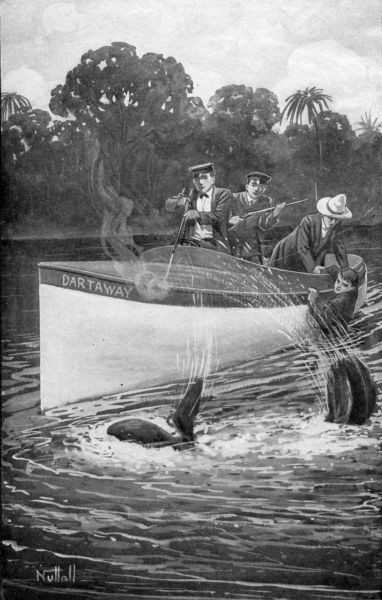
THE CREATURE WAS LASHING ABOUT IN A DEATH STRUGGLE
THE MOTOR BOYS IN
STRANGE WATERS
Or
Lost in a Floating Forest
BY
CLARENCE YOUNG
Author of “The Racer Boys Series” and “The Jack Ranger Series.”
ILLUSTRATED
NEW YORK
CUPPLES & LEON COMPANY
BOOKS BY CLARENCE YOUNG
THE MOTOR BOYS SERIES
(Trade Mark, Reg. U. S. Pat. Of.)
12mo. Illustrated
THE MOTOR BOYS
Or Chums Through Thick and Thin
THE MOTOR BOYS OVERLAND
Or A Long Trip for Fun and Fortune
THE MOTOR BOYS IN MEXICO
Or The Secret of the Buried City
THE MOTOR BOYS ACROSS THE PLAINS
Or The Hermit of Lost Lake
THE MOTOR BOYS AFLOAT
Or The Stirring Cruise of the Dartaway
THE MOTOR BOYS ON THE ATLANTIC
Or The Mystery of the Lighthouse
THE MOTOR BOYS IN STRANGE WATERS
Or Lost in a Floating Forest
THE MOTOR BOYS ON THE PACIFIC
Or The Young Derelict Hunters
THE MOTOR BOYS IN THE CLOUDS
Or A Trip for Fame and Fortune
THE JACK RANGER SERIES
12mo. Finely Illustrated
JACK RANGER’S SCHOOLDAYS
Or The Rivals of Washington Hall
JACK RANGER’S WESTERN TRIP
Or From Boarding School to Ranch and Range
JACK RANGER’S SCHOOL VICTORIES
Or Track, Gridiron and Diamond
JACK RANGER’S OCEAN CRUISE
Or The Wreck of the Polly Ann
JACK RANGER’S GUN CLUB
Or From Schoolroom to Camp and Trail
Copyright, 1909, by
Cupples & Leon Company
The Motor Boys in Strange Waters
Printed in U. S. A.
CONTENTS
CHAPTER
PAGE
I.
Noddy’s Cocoanut Plantation1
II.
Professor Snodgrass Arrives9
III.
Off for Florida22
IV.
The Giant Turtle35
V.
The Professor’s Trick43
VI.
Bob Gets a Scare50
VII.
Killing a Manatee59
VIII.
A Misfortune69
IX.
News of Noddy77
X.
Afloat Once More84
XI.
The Houseboat92
XII.
Jerry Is Hurt100
XIII.
The Seminole Chief109
XIV.
Caught in Saw Grass118
XV.
The Big Snake126
XVI.
An Unexpected Encounter134
XVII.
Into a Strange Lake142
XVIII.
The Wanderer Again152
XIX.
A Plot Foiled159
XX.
Bob Taken Ill168
XXI.
Jerry Seeks Aid175
XXII.
The Receding Water183
XXIII.
The Professor Returns191
XXIV.
In the Floating Forest199
XXV.
A Cry for Help207
XXVI.
The Plight of the Girls215
XXVII.
Ottiby to the Rescue221
XXVIII.
The Hurricane229
XXIX.
Noddy’s Danger234
XXX.
The Butterflies—Conclusion242
LIST OF ILLUSTRATIONS
THE CREATURE WAS LASHING ABOUT IN A DEATH STRUGGLE THE TURTLE KEPT TURNING TO REACH THE MEAT THERE WAS A CONFUSED TANGLE OF MAN AND SNAKE ON THE GROUND NODDY GAVE ONE LOOK AT THE WRITHING SAURIANTHE MOTOR BOYS IN STRANGE WATERS
CHAPTER I
NODDY’S COCOANUT PLANTATION
“Shut your eyes,” called Bob Baker to his friend Jerry Hopkins, as the two boys sat in the library of Bob’s home.
“What for?”
“Never mind. Just shut ’em; that’s all.”
“No tricks now. I don’t want a mouthful of salt, or find that I’m all tangled up in a folding chair.”
“No, this is something on my own account. Shut your eyes.”
“All right. Here goes.”
Jerry accommodatingly closed his eyelids. He opened them almost immediately as he heard a loud thump in the room.
“What was that?” he asked.
“That was yours truly,” explained Bob.
“What doing?”
“I threw my Latin grammar and my algebra over there behind the bookcase.”
“What in the world did you do that for?”
“Because I don’t want to see ’em again until after vacation, and I didn’t want to see where they fell for fear I’d be tempted to do some studying to work off my conditions. And I didn’t want you to see where they went to for fear you’d tell me. So I just shut my eyes and let ’em go. They’re safe, and when they clean house in the fall they’ll find ’em. It’ll be time enough then to begin studying. Vacation’s here! Hurrah for a good time with nothing to do but have fun!”
“That’s so; to-day is the last one for school for more than two months,” remarked Jerry.
“As if you’d forgotten it!”
“Well, I wasn’t thinking of it, though I’m glad we don’t have to do any more studying for a while. There’ll only be the closing exercises this afternoon and then—”
“Yes, then what?” asked Bob. “What are we going to do with ourselves this vacation?”
“Go somewhere in our motor boat I guess,” replied Jerry. “But isn’t that a Latin grammar I see sticking out under the edge of the bookcase?” and he pretended to start to pull forth the volume.
“Don’t you dare touch it!” cried Bob. “Shut your eyes so you can’t see it!”
Jerry, however, dodging Bob’s outstretched arms, reached for the book.
“It’s a sea story!” he exclaimed. “Looks like a good one, too, from the pictures.”
“Give it to me! I was looking all over for that. Guess I must have dislodged it when I threw my school books back there. It is a corking good yarn.”
“Well, Chunky,” went on Jerry (giving Bob the nickname fastened on him because of his overabundance of flesh), “are the adventures in that anything like those we had last summer down at Harmon Beach?”
“Couldn’t touch ’em! Those were ‘adventures as were adventures,’ as Salt-Water Sam would say,” remarked Bob, giving his trousers a nautical hitch in memory of the odd character to which he referred. “I only hope we are as lucky in striking a good time this summer as we were on the Atlantic coast.”
“We generally have been pretty fortunate in that respect,” said Jerry. “I haven’t thought much about it this year. I studied rather hard to win the prize scholarship.”
“Yes, and you got it, which is more to the point, Jerry. As for me, the harder I bone away the less I seem to know. I don’t want to hear school mentioned again for three months. What do you say to having something to eat?”
“Just had my breakfast. Besides it’s most time to go to—Oh, I forgot, you don’t want me to mention school. Well, I’ll call it the place of learning.”
“Nobody will be on time this last day,” responded Bob. “I had breakfast myself, but it was an early one, and I can eat again.”
“Never saw the time when you couldn’t,” observed Jerry, taking care to get beyond the reach of Bob’s fist.
“Have a glass of milk, Jerry.”
“Well, I don’t mind that.”
“I’m going to have some and a bit of bread and jam,” went on Bob, as he disappeared in the direction of the kitchen.
He came back presently with what looked like enough for a substantial meal for two hungry boys. Jerry said nothing, as he was familiar with the eating capacity of his chum.
“Here comes Ned!” exclaimed Jerry as he finished his glass of milk. “Better get some more jam, Bob.”
“I will,” and before Jerry could stop him Bob had hurried off again. He returned with more refreshments just as Ned Slade came in.
“Are you fellows going to school to-day?” asked the newcomer. “It’s almost nine o’clock.”
“Breakfast is now being served in the dining car!” cried Jerry, imitating the porters on the Pullman coaches. “It’s Bob’s second attempt,” he explained.
“You did your share,” retorted Bob. “Have some, Ned?”
“No, thanks. Three meals a day are enough for me,” and Ned sat down in a chair to watch Bob eat.
“What’s the matter?” asked Jerry. “You look excited.”
“I met Noddy Nixon, on my way here.”
“You don’t mean it! So he’s back in town again. Did you have a quarrel with him?”
“Not exactly,—but we had a discussion. I can’t stand him. He makes me mad every time I meet him, and when I thought of how he and Bill Berry tried to wreck that vessel down on the coast,—though I guess Noddy didn’t realize what a game Bill was playing—why I feel as though I wanted to thrash Noddy.”
“Don’t blame you,” said Bob, finishing the last of the jam and bread and butter. “What did he have to say?”
“Oh, a lot of things, but principally that he was going down to Florida to take possession of a cocoanut plantation he’s purchased, or which he thinks he’s bought. I think it’s all in his mind.”
“Cocoanut plantation!” exclaimed Bob.
“Down in Florida?” inquired Jerry.
“Yes. This is how he happened to mention it,” went on Ned. “I was going past him on the street without speaking, though I was so surprised at seeing him that I wanted to ask where he came from. However, he saved me the trouble. He hailed me and, in that sneering way of his, he said he had something that was better than the gold mine in which we own shares. I didn’t ask him what it was, but he told me. Said he had bought a cocoanut grove or farm, or whatever they call ’em, and was going to get rich. He said he was going down in a week or so to live on the land and be a wealthy man.”
“Do you s’pose he meant it?” asked Bob. “I’m very fond of cocoanut pie.”
“Go ahead,” remarked Jerry with a laugh. “You’ve got Chunky interested, Ned, as soon as you mention something good to eat.”
“I guess Noddy was in earnest all right,” went on Ned. “He insisted on showing me a lot of papers. It appears he bought the land through seeing an advertisement in a magazine. You pay so much down and so much a month, and the advertisement says you can make enough raising cocoanuts to meet all your monthly installments. Noddy said he had secured a big tract down there.”
“Where’d he get the money?” asked Bob.
“From his father, I s’pose. Mr. Nixon is rich, and Noddy is the only child. That’s what makes him spoiled.”
“When’s he going down to the land of the everglades?” inquired Jerry.
“He starts in a week.”
“In what part of Florida is his cocoanut plantation located?” asked Bob.
“Near Lake Okeechobee.”
“I’d like to go to Florida,” observed Bob. “It’s a nice place to read about. Lovely climate, nothing to do but gather oranges, bananas and cocoanuts, watch the manatees and turtles, lie in the shade and—and—”
“Get eaten up with sand fleas,” put in Jerry. “They have ’em down there as big as sparrows.”
“I guess if we’re going anywhere we’d better be starting for school!” exclaimed Ned. “It’s after nine o’clock.”
The three chums left Bob’s house and strolled along the street in the direction of the academy they attended. Ned continued his recital of his encounter with Noddy, the town bully who, on more than one occasion, had proved himself the enemy of the three friends.
“Oh, he talked a lot about how rich he was going to be,” went on Ned. “He thinks his cocoanut grove is going to put our gold mine in the shade. Says he’ll buy us out in a few months. He was so excited that I guess he forgot all about how he acted down at Harmon Beach last summer until I asked him if he calculated to wreck any steamers on the Florida coast. That made him mad and we had quite a discussion. That’s what ruffled me up. I left him spouting about what he expected to do with his cocoanuts.”
“I guess all the cocoanuts he’ll raise wouldn’t make enough pies to satisfy Bob’s appetite,” remarked Jerry. “But we’d better hurry, if we want to get to school before noon.”
None of the chums realized what a part Noddy and his cocoanut plantation were to play in their experiences that summer, nor in what an unexpected manner they were to render the bully a service.
CHAPTER II
PROFESSOR SNODGRASS ARRIVES
The three chums quickened their pace and were soon at the academy, where they were greeted by a number of boy friends.
“Where are you fellows going this vacation? Out west, down to Mexico or the North Pole? Lots of fun—never say die—right side up with care—automobiles—motor boats—flying machines—don’t stop—red flag—danger—never mind—go on—whoop!”
“Let up, Andy Rush!” exclaimed Jerry, laughing. “Give us a chance to catch our breath, please,” and he looked at a small boy who, in the stress of excitement, (which was the state he was continually in), was trying to talk to the three chums at once.
“But I want to know,” insisted Andy.
“We don’t know ourselves,” replied Bob. “Go get a drink of ice water, Andy. Your windpipe must be hot after all that.”
There was a general laugh at the small boy’s expense, and then the pupils went inside. While they are thus off the stage for a brief period opportunity will be afforded to make the reader better acquainted with them.
The three chums, who, because of their long association with each other, and the part an automobile and motor boat had played in their adventures, had come to be known as the “Motor Boys,” lived in the town of Cresville, not far from Boston. They were Jerry Hopkins, son of a widow who was well-to-do, Ned Slade, whose father owned a large department store, and Bob Baker, the offspring of a rich banker.
In the first volume of this series, entitled “The Motor Boys,” was related how the chums became possessed of motor cycles and how, by taking part in races, they won a large touring car. Their adventures on the motor cycles were more than equalled by those that happened to them when they had their auto, as was told in the second book, “The Motor Boys Overland.” They conducted a successful search for a gold mine in Nevada, and aided an old prospector in securing it, though Noddy Nixon and his crony Bill Berry tried to get it away from them. It was on this trip that the boys became acquainted with Professor Uriah Snodgrass, a learned man whose hobby was collecting bugs and butterflies.
In recognition of their aid the boys were given shares in the gold mine, which paid well. It was this mine to which Noddy referred when he boasted to Ned of his cocoanut grove.
At the suggestion of Professor Snodgrass the boys decided to take another trip, as described in the third volume of this series, “The Motor Boys in Mexico.” In this they discovered a buried ancient city, had fights with the Mexicans, and Bob was kidnapped but escaped.
Deciding to visit their mine on their way back to the United States, the three chums had rather a hard time of it. Their doings and the things that happened to them are told in the fourth book of the series, “The Motor Boys Across the Plains.” They rescued a small boy from the hands of a bad gang of men, and this boy proved to be the son of a queer hermit, who lived on the shores of a lake.
The boys reached home safely, and with quite a sum of money to their credit. With part of this they purchased a fine, large motor boat, called the Dartaway. In her they had a series of adventures on river and lake, as related in “The Motor Boys Afloat.” They took part in races, won a prize, discovered the mystery of a strange schooner and cleared up the robbery of Mr. Slade’s department store.
But more exciting times awaited them. Their next vacation (for all their fun was had during the summers when there was no school) was spent at Harmon Beach, on the Atlantic coast, as recorded by me in “The Motor Boys on the Atlantic.” There they made the acquaintance of “Salt-Water Sam,” an old sailor and whaler, and with him made a successful chase after a whale and a shark. They also uncovered a plot to change the signals in a lighthouse, so that a steamer might be lured on the rocks, foiling the men, and aiding the aged keeper and his niece Jess.
Noddy Nixon, as the partner of Bill Berry (though Noddy claimed he did not know of the enormity of the offense) had a hand in the lighthouse plot. As soon as it failed Bill Berry disappeared and Noddy was not to be found for some time. Then, as there was no charge against him, Noddy returned to his home. His father would believe nothing wrong concerning him, and the bully was soon as bold as before. Being well supplied with money he had spent some of it in buying land in Florida, as Ned has already related. Bill Berry did not come back to Cresville, which fact made the three chums rejoice, for they did not wish to see that rascal again.
“Closing exercises this afternoon, which will be short and sweet,” observed Bob, as he and his friends came from the academy at noon, “and then to map out a summer campaign.”
“Yes, we want to get busy,” said Ned. “No use wasting time. You fellows come to my house to-night and we’ll look over some maps and plan a cruise. The motor boat is better than ever with the improvements we put on her last fall.”
“I’ll be there,” called Jerry, as he left his two chums. “I’ve got to go on an errand for my mother now, but I’ll be on hand after supper.”
“So will I,” added Bob. “I may be a little late though, because—”
“Because he has to eat so much supper; eh, Chunky?” and Jerry laughed as he shot that parting shaft.
“I promise to provide a light lunch at ten o’clock if you’ll stay that late,” called Ned. “So long!”
The afternoon exercises passed off successfully, and with farewells from their teachers the three chums, as well as all the lads in the academy, bade good-bye to the place of learning and scattered for the long summer vacation. The motor boys, who were all in the same class, walked down the street, arm in arm, as three fine lads as one could wish for,—tall, strong, full of recourse in times of danger, brave and fearless—excellent types of the American Boy.
“Let’s each think of some plan for a trip,” proposed Ned, as they parted to go to their several homes. “We can talk ’em all over to-night.”
A few hours later the three chums were at Ned’s house. On the library table he had spread out a number of geographies, guide books and maps, and the boys were soon pouring over them. They talked a perfect babble, the only things that could be distinguished now and then being such expressions as:
“How about a trip to Maine?”
“What’s the matter with doing the Gulf of Mexico?”
“We could go to Cuba if the weather kept good.”
“The Bermudas aren’t so very far off.”
“Say, we’ll never settle anything this way,” called Ned after an hour had been spent in fruitless discussion. “I’ve got a plan.”
“What is it?” asked Jerry.
“Let each one write on a slip of paper the place he’d like to go to. We’ll drop the slips in a hat and one of us, blindfolded, can pull a slip out. We’ll go wherever the slip says.”
“Suits me,” exclaimed Bob, and Jerry nodded assent.
Pencils and paper were provided, and the boys were about to write down their choices when there came a knock on the library door. A moment later the portal opened and Mr. Slade was looking in on the chums.
“A visitor to see you,” he announced.
“To see who?” asked Ned.
“All three of you. Let me present Professor Uriah Snodgrass.”
“Professor Snodgrass!” exclaimed the three boys in a surprised chorus. “Where did he come from?”
“I just arrived,” announced a little man with very large spectacles, as he stepped past Mr. Slade and bowed to the boys. “I reached town this afternoon, and inquired for Mr. Slade’s store, as I had some business to transact. He heard my name, and remembered me. He invited me to call this evening, and—here I am.”
“Yes, and just in time, too,” cried Ned.
“How is that? Have you just captured a rare specimen of a mosquito or a June bug for me?” and the professor was ready at once to mount his hobby and start off on a scientific discussion.
“Not exactly,” answered Ned, “but we are trying to decide where to go in our motor boat for our vacation. Perhaps you can help us out.”
“I’m afraid not,” the professor replied. “I never took a vacation in my life, and I do not know where would be a good place to spend one. I know where I am going this summer.”
“Where?” asked Jerry.
“I am going to Florida, to search for a very rare butterfly. It is pink, with blue and gold wings, and a certain museum has offered me five thousand dollars for a perfect specimen. It is to be found in Florida only, and I am off for the everglades next week.”
“That’s a lot of money for a butterfly,” remarked Ned.
“Yes, but the museum can afford it,” went on the scientist. “No other scientific place in the world has this kind of a butterfly and the museum I speak of will be the envy of all the others. But it is not only for the money that would come to me that I would like to get that butterfly.
“If I succeed I hope to get a position with the museum. A sort of commission to travel for them into all parts of the world after curious bugs and relics. That is my ambition, and that is why I am going to try for this butterfly. It means a great deal to me, as, all my life, I have wanted to be on the staff of some good museum, in order to search for curiosities for it. So you see it is not only the five thousand dollars I am after, though, of course that sum will be very acceptable.”
“Do you think you can find the butterfly?” asked Mr. Slade, much interested.
“I hope so,” replied Uriah Snodgrass. “As I have said, it is very rare, and very difficult to catch. I have read of a number of specimens being found but they were in poor condition, or discolored, and it is for the rare coloring of this species that it is desired by the museum.”
“I hope you are successful,” answered Ned’s father. “I have often wondered, when looking at the collection of insects in a museum, how they got so many different kinds. Now I understand. It is due to the efforts of such men as you.”
Jerry arose from his chair. The light of excitement gleamed in his eyes.
“I have it, fellows,” he cried.
“What! Not that rare pink butterfly?” cried the professor, showing great interest.
“No, but a plan. Let’s go to Florida in the Dartaway. It will be a fine trip. We’ll take you with us, Professor. There’s lots of room.”
For a moment no one spoke. Jerry stood up looking from his chums to the professor, and then to Mr. Slade.
“I would like nothing better than to go with you boys,” Mr. Snodgrass answered. “When can you start?”
“To-morrow!” cried Ned. “That’s a fine idea, Jerry! That beats drawing papers from a hat. Florida it is! What do you say, Bob?”
“Couldn’t be better. I always was fond of oranges and cocoanuts.”
“Then we’re off for the everglades!” exclaimed Ned, beginning to do a dance around the room. “Can we go, father?”
“Well, I presume it’s no use saying no, so I may as well consent,” answered Mr. Slade. “But I guess it will take you longer than until to-morrow to get ready.”
“We can start next week,” put in Jerry. “That will suit the professor.”
“Excellent,” spoke the scientist, as he began creeping up on an unsuspecting June bug that was crawling on the table.
“That settles it!” remarked Ned. “Now let’s get a geography and lay out a line of march.”
“Is my son here?” asked a woman’s voice, and the boys looked up to see Jerry’s mother and Mrs. Slade standing in the library door.
“Here I am,” replied Jerry. “What is it, mother?”
“I was calling in this neighborhood,” went on Mrs. Hopkins. “I knew you were here and I thought I’d step in and ask you to take me home.”
“Of course I will, mother. We were just planning another cruise.”
“You’re always doing that,” said Mrs. Hopkins with a sigh. “I can’t see why you boys don’t stay home one vacation.”
“We want to see the world,” declared Ned. “This time we are going to Florida.”
“Florida?” asked Mrs. Hopkins as if surprised.
“Why not, mother?” asked Jerry.
“Oh, I suppose that place is as safe as any. I was just thinking of something,” Mrs. Hopkins went on. “I once bought some land in Florida, but after I got the deed I received word that the property was practically worthless and I never did anything about it. I have the old deed home now.”
“Where is this land, mother?” asked Jerry. “I never heard you speak of it.”
“No, because I was sorry I lost the money I paid for it. The land is somewhere in the central part of the state I believe. I’ll show you the deed when we get home.”
“Yes, and if we get to Florida we’ll look up this property,” went on the widow’s son. “Perhaps it has increased in value. This gives us another reason for going to the everglades,” and he laughed.
Once more the three boys began scanning the maps and guide books, while Mrs. Hopkins and Mrs. Slade conversed about household matters. A little later Jerry escorted his mother home and she showed him the old deed, of which he took possession.
“Who knows but what it may prove valuable,” he said.
“I hope it does,” remarked Mrs. Hopkins. “I would like to get my money back.”
Jerry returned to Ned’s house, promising his mother to come home again as soon as more details of the proposed trip were settled.
“Don’t lose that deed,” cautioned Mrs. Hopkins.
Jerry, with a laugh, promised to keep it safely. He found his chums still discussing the best means of getting to the land of the everglades. They little realized what lay before them, nor what was to happen before they reached Cresville again.
CHAPTER III
OFF FOR FLORIDA
At first the boys had an idea they could go down the Atlantic coast in their motor boat, and so reach the beautiful land for which they were bound. But the professor pointed out the terrors of Cape Hatteras, which is a menace to even big vessels, so the chums decided on another plan. They would ship the boat from Cresville to St. Augustine and travel there themselves by rail. From St. Augustine they could start down the coast, and go up the Indian river.
“Can’t we stop there a while?” asked Bob at this point.
“What for?” inquired Jerry.
“Why that’s where the best oranges in the world grow,” explained Bob, as if that was reason enough. “Indian river oranges are fine!”
“You can stay there,” said Jerry. “We’ll go on to the everglades.”
“I’m not going to stay all alone,” remonstrated Bob. “You might wait while a fellow gathered a few oranges, though,” and he assumed an injured air.
“The trouble is your idea of a ‘few’ would mean a boat load,” came from Ned. “But I guess we can gather some as we sail along.”
“Where do you plan to go from Indian River?” asked Mr. Slade.
“We’ll land at Titusville,” replied Jerry, running his finger along the map, “and then—”
He was interrupted by a sudden movement on the part of Professor Snodgrass, who had ceased to take part in the conversation, and an instant later the room was in darkness.
“I’ve got him!” cried the scientist eagerly. “He’s in my hand on the table, but I’m tangled up in the gas lamp hose. I must have touched the stop-cock and turned off the light. Don’t move, please, any of you. Some one strike a light so I can see to put my prize safely away.”
“What is it?” asked Mr. Slade as he ignited one of the gas jets of the chandelier.
“One of the rarest specimens of June bugs,” was the professor’s answer. “I saw him crawling on the table and I made a grab for him. He was right under the gas hose hanging down from the chandelier to the table lamp, but I didn’t think of that. I hope I didn’t hurt any one.”
“No, you only scared Bob out of his appetite,” said Ned.
“No, you didn’t!” exclaimed Bob. “I’m as hungry as—I thought you said you were going to give us a lunch, Ned? I’m ready—” Then he stopped, in confusion, for the others burst out into a laugh at him.
“Don’t worry, Chunky. You’ll get your lunch in time,” spoke Ned. “But let’s get this trip settled first. Have you ever traveled in Florida, Professor?”
“I caught some of the finest snakes there you ever saw,” replied the scientist. “I have been over a considerable part of the state, and I’ll be glad to renew my acquaintance with it again.”
“Then you can tell us if our plan is a good one,” went on Ned, informing Mr. Snodgrass of what the boys proposed to do. From Titusville, Ned explained, they would go by rail, with their boat, to Lake Tohopekaliga, through the canal connecting that body of water with Lake Hatchenana, across the latter lake, and again by canal to Lake Kissimmee. From there they would go by the Kissimmee river to Lake Okeechobee.
“That will give you plenty of opportunity for testing your motor boat,” said the professor. “I think the route is a good one. The lower part of Lake Okeechobee is wild enough to suit any one, and I may be able to find there the rare butterfly for which I am searching. I will be very glad to go with you, and I’ll be ready to start any time you boys fix.”
Having given that much attention to the proposed trip, the scientist devoted himself to the June bug, which was struggling to escape from his hand. Mr. Snodgrass produced a small box, with a perforated cover, and in it shut the protesting captive.
That done he jotted down in his note book certain facts about the bug, its size, date of capture and the circumstances under which the catch was made. The professor was nothing if not methodical.
“Then the first thing to be done,” observed Ned, when he and his chums had once more gone over the map to see if they had selected the best route, “is to get the boat ready for the trip by rail. I fancy the Dartaway doesn’t like being shipped on a car. She likes the water too well.”
“No help for it,” remarked Jerry. “Some day we’ll have a big enough boat to sail half way round the world in, and we’ll not have to depend on trains.”
“I wonder if we’ll meet Noddy when we get to Florida,” mused Bob. “Where did he say his cocoanut grove was, Ned?”
“He didn’t say, exactly, except that it wasn’t far from Lake Okeechobee, and I didn’t care enough to ask him. It’s somewhere in the lower part, I believe. But I hardly think we’ll meet him. Hope we don’t, for we always have bad luck as soon as he or Bill Berry turns up.”
“I guess Bill will keep out of sight for some time to come,” remarked Mr. Slade, who was listening to the talk of the boys. “I understand the United States government is after him for his part in the lighthouse plot, and when Uncle Sam wants a man he generally gets him. So I think Bill will not trouble you this trip. Well, have you settled everything?”
“Pretty nearly,” answered Ned. “All except that I’ll have to have some money for my share of the expenses.”
“I expected that!” exclaimed Mr. Slade with a laugh. “It takes money, as well as gasoline, to make a motor boat go. Well I don’t mind, as long as you boys take care of yourselves and don’t get into mischief.”
As the parents of the boys were well off there was no difficulty on the score of funds, though, for that matter, the lads’ shares in the gold mine were more than sufficient to pay their way on the various trips they made.
They discussed their plans in detail, now and then appealing to Professor Snodgrass for his opinion, but the scientist was busy looking for a specimen of a black snapping bug which had flown in through a hole in the screen to get at the light, so he paid little attention to what the boys were saying.
“Well, I guess that’s all,” announced Ned, as he closed the big geography. “We’ll start getting the boat crated up to-morrow.”
“Is that all?” asked Bob, with rather a blank look.
“Yes, what else is there to discuss?” inquired Ned.
“Chunky would like to discuss that lunch you promised,” said Jerry with a laugh. “Eh, Chunky?”
“Well—” began Bob, looking somewhat sheepishly at Mr. Slade.
“Don’t mind me,” put in that gentleman. “Go ahead with whatever you had planned. The professor and I will go out on the porch. I’ll smoke a cigar to drive the mosquitoes over to Mr. Snodgrass so he can catch ’em and sell ’em to a museum,” and he laughed.
The boys had their lunch, and, in justice to Bob it must be said that Ned and Jerry ate almost as much as he did. They talked, between bites, of their trip, and indulged in all sorts of conjectures as to what adventures might lie before them. They imagined strange enough ones, but they were as nothing to what really befell them when they got to the land of the everglades.
The little party broke up about midnight, with mutual promises on the part of the chums to meet early the next morning and get the Dartaway in shape for the long trip.
They met at the river dock, where their boat was kept, and gave the craft a good overhauling. Some changes had been made in the craft since the trip on the Atlantic coast. The boat was more powerful, and was so arranged that they could sleep on board, for it had a portable awning and side curtains that could completely enclose the craft. Larger bunkers for the stowing away of provisions and water had been put in, the machinery had been overhauled and, save for a few minor changes, the Dartaway was ready for a long trip. These changes were made during the next two days, and then the boat was enclosed in a stout cradle. It was put aboard a flat car and, at the end of the week, had started on the journey to St. Augustine.
As the boys were walking up the street from the depot they met a man with a small gray moustache, who looked sharply at them.
“Excuse me,” he said, “but can you tell me where I can find a Mr. Noddy Nixon? I’m a stranger in town, and I want to see him on business.”
“We can show you where he lives,” replied Jerry, “but he isn’t home.”
“Where has he gone?” and the man looked surprised at the news.
“He told me he was going to Florida, to look at a cocoanut grove he had purchased,” interposed Ned.
“What part, if I may ask?”
“Near Lake Okeechobee.”
“That’s where we’re going,” put in Bob, who was rather impetuous.
“Indeed! Are you friends of his?”
“Not exactly,” replied Ned, stiffly.
“Then you’re not going together?”
“No, he has already started. We’re going from St. Augustine in our motor boat,” came from Bob.
“Do you expect to see young Nixon there?”
“I don’t believe we will,” remarked Jerry, wondering at the man’s questions.
“If you do I wish you would hand him this paper—no, I think perhaps I had better try and send it through the regular channels,” and the man seemed in doubt. “Would you give him a message if you saw him?” he asked.
“We’d be glad to do you a favor,” said Ned. “What’s it about?”
“Just tell him to come home at once,” was the answer, and the man seemed very much in earnest. “It is very important. I can’t tell you just what, but say to him that if he does not come voluntarily we will have to—. No, perhaps you had better not say that. It might frighten him, and we don’t want to do that. Just tell him to come home to attend to a matter of which he has already received official notice,” and the man returned a bundle of papers to his pocket.
“We’ll do it,” spoke up Ned, “though we’re not sure of seeing him.”
“I understand. It’s only a chance, but I will be glad to take advantage of it, and I will appreciate it very much if you can get that message to him.”
The man moved off up the street, leaving the three boys somewhat puzzled.
“I wonder who he was?” asked Bob.
“Don’t you know?” inquired Jerry.
“No; who was he?”
“One of the government inspectors of lighthouses. I saw him down at Harmon Beach after Noddy and Bill, and the others in the gang, tried to wreck the steamer by showing false lights.”
“Then he’s after Noddy for his part in that!” exclaimed Ned. “But I thought they weren’t going to prosecute Noddy?”
“Maybe they want him for a witness against Bill Berry,” suggested Jerry. “At any rate we’ll give him the message if we see him. He’s to come home to attend to a matter of which he has already received official notice. Probably he’s been subpœnaed and has skipped out for fear of arrest. Maybe that’s why he said he was going to his cocoanut grove. Say, boys, I’ll wager Noddy has gone to Florida to hide!”
“But why doesn’t the government attend to its own affairs and not ask us to tell Noddy to come back?” inquired Ned. “That’s a queer way of doing business.”
“Perhaps they haven’t any officials down near Lake Okeechobee,” replied Jerry. “It’s rather desolate down there, I guess, and it would be hard work to hunt around for an unknown cocoanut plantation and locate Noddy. Maybe the matter is not of much importance, and that man may think we’ll do to deliver the message. Anyway I believe I’m right and that Noddy has fled from Cresville because he’s afraid of something in connection with the attempt to wreck the steamer, and his part in the attack on Mr. Hardack, the lighthouse keeper.”
“I’d like to see Noddy get his desserts,” interposed Bob. “He’s done us a lot of mean turns, but, somehow or other he always manages to sneak out of the consequences. If I get a chance I’ll scare him with this message. I’ll tell him the government detectives are after him with a pack of bloodhounds.”
“Better wait until we find him,” advised Jerry. “Lake Okeechobee is a big place and there’s a slim chance that we will meet Noddy.”
“I thought there was something more than a new cocoanut plantation that made him want to hurry out of town,” spoke Ned. “I remember now he acted, while he was talking to me, as if he was afraid of some one.”
“That was your imagination,” said Jerry with a laugh. “But come on; let’s go home and get ready for the trip, and let Noddy’s affairs take care of themselves.”
The boys packed their belongings, bade their friends good-bye and, on Wednesday of the following week, were ready to start on their trip to the quaint old city of St. Augustine.
“I hope the boat is there, waiting for us,” remarked Bob.
“Yes. It wouldn’t be much of a joke if it went astray,” agreed Jerry.
“All ready?” asked Professor Snodgrass, as he came down to the depot.
“All ready,” replied Ned.
The scientist seemed to have suddenly increased in size, for he bulged out on all sides.
“What is it?” asked Jerry, looking in wonder at his learned friend.
“What? Oh, those are specimen boxes I put in my pockets. I had no room for them in my trunks,” Mr. Snodgrass answered. “I also have a portable net for capturing insects with. I must lose no opportunities. I may see some valuable insects on my way down.”
“Here comes the train!” exclaimed Bob, as a whistle sounded in the distance. “Get your baggage together!”
There was a confused scramble, as there always is at the last minute, no matter what preliminary preparations have been made. The boys and the professor gathered up their grips, for their trunks had been checked. The train rolled into the station. They scrambled up the steps, and got seats together. Just as the train was pulling out of the depot the boys heard some one yelling at them.
“Hold on! Wait a minute! Stop! I want to speak to you!” was the cry.
CHAPTER IV
THE GIANT TURTLE
The three chums thrust their heads from the windows nearest them.
“It’s Andy Rush!” exclaimed Jerry, as he caught sight of the boyish figure running down the station platform. “Wonder what he wants?”
By this time Andy was under the windows on the side of the car where the boys sat. The train had not yet gathered much headway.
“What is it?” asked Ned. “Has anything happened?” for the small chap seemed quite excited.
“I wanted to see you last night—couldn’t—had too much to do—got up early this morning—came down here on the run—saw the train moving—yelled—engineer wouldn’t stop—say—if you catch any manatees down there—Florida I mean—save me a little one—I want to tame it—will—you—please—can’t talk any—more! Out—of—breath!”
By this time Andy was being distanced by the train and his wind was almost expended.
“I’ll bring you one!” cried Bob, who was good natured and always ready to accommodate a friend. “I’ll bring you one, Andy,” and he waved his hand to the excited boy.
“I say, Professor,” went on Bob, a little later, “are there any manatees in Florida?”
“There used to be quite a number but I’m afraid they have been mostly killed off. Still there may be a few. Why?”
“A friend of mine wants one and I promised to bring him a little one. If you happen to see any, please let me know.”
“I wonder if Bob has any idea of the size of a manatee or sea-cow?” put in Jerry, with a little smile. “How large do they grow, Professor?”
“Well I have seen them weighing nearly a thousand pounds, but I suppose the average is nearer eight hundred.”
“There you are, Bob!” exclaimed Ned with a laugh. “You see what you’ve promised to send to Andy.”
“I meant a baby one,” and Bob seemed confused.
“I think even a baby manatee will be beyond your abilities to ship up North,” Mr. Snodgrass answered. “They are of good size but rather delicate. They have to be transported in tanks of salt water and even the museums have difficulty in getting them and keeping them alive. I’m afraid Andy will have to be content with some other kind of pet.”
“I hadn’t any idea they were as big as that,” murmured Bob. “Never mind, I’ll get him something else.”
“Try a nice pine snake, about ten feet long, or a copper-head, or a wild loon, or a turtle,” suggested Ned. “Andy won’t care what you bring, as long as it’s a souvenir from Florida. Ship him a chunk of the everglades.”
“Well, I guess you make mistakes sometimes, so you needn’t be so smart!” exclaimed Bob, a bit sensitive at the fun being poked at him.
“That’s all right, Chunky,” consoled Jerry. “I see they have a dining car on this train so you needn’t go hungry, at all events.”
“Is there, really?” asked Bob. “That’ll be fine. I always like to eat in a dining car. I wish it was time for dinner.”
The journey by train was an uneventful one. In due time the travelers arrived at St. Augustine, and found that their boat had reached there in good condition. They arranged to have the empty cradle sent to Titusville, where they would again begin to travel by train until they reached Kissimmee City, on the shores of Lake Tohopekaliga.
“Then for a long voyage on water!” exclaimed Ned, as they left the freight house, having seen to the transportation of their boat to the harbor of St. Augustine.
They spent one day in St. Augustine, buying provisions and a supply of gasoline for the Dartaway. The boat, too, needed soaking in the water to close the seams which had dried open on the journey overland.
Bright and early one morning the three boys and the professor, having placed all their baggage on board, took possession of the Dartaway.
“We’re off!” cried Jerry as he gave a long toot to the compressed air whistle. “Now for the manatees, Chunky!”
“Let up on manatees!” pleaded Bob. “Can’t you forget ’em?”
“Yes, but think how disappointed Andy will be,” and Jerry laughed as he gave the wheel a turn, shoved over the gasoline and sparking levers, while Ned cranked the engine.
There was a sort of sigh from the Dartaway’s motor, a cough, a wheeze, and then a series of throbs that told that the engine was in working order. A mass of foam appeared at the stern where the screw was churning the water, and the boat moved out of the harbor of the historic city.
It was a beautiful day and the boys were in excellent spirits over the successful start of their trip. The engine was working to a charm, and the Dartaway seemed like a thing alive, so well did she answer to the slightest turn of the steering wheel.
“Isn’t this glorious!” exclaimed Jerry, as he sat in the bow. “Can you beat this, fellows?”
“Not in a thousand years!” cried Ned enthusiastically. “Let Noddy Nixon have his cocoanut groves, but give me a motor boat and a trip to Florida!”
“Wait a minute! Hold on! Stop the boat!” cried the professor suddenly.
“What’s the matter?” asked Jerry, slowing down the engine. “Did you lose something?”
The scientist seemed to be struggling to get at something in the bottom of the boat.
“It’s a very rare dragon fly,” he said as he brought out a butterfly net. “I just saw him floating on a bit of wood. I must have him for my collection. He’s worth a hundred dollars!”
The professor made a sudden lunge, thrusting his long-handled net over the side of the craft. He would have gone overboard had not Ned caught him by the waist and held him.
The net went into the water with a splash, but, despite his undignified position the professor managed to bring it aboard. He looked into it anxiously.
“I got him!” he exclaimed. “A perfect specimen! Oh, boys, this voyage has started most excellently for me!”
“It would have been the other kind of a start if I hadn’t caught you,” observed Ned.
“Thank you, my dear young friend,” spoke the professor, as he carefully dried the dragon fly and placed it in his cyanide bottle to kill it painlessly for preservation. “I appreciate what you did for me, but I would rather fall overboard a dozen times than miss this beautiful specimen.”
Jerry started the engine again, and soon the Dartaway was cutting through the water at a fast speed. Jerry had asked the advice of some sea captains in St. Augustine and they had told him to keep in the Matanzas river instead of standing out to sea, and, on reaching Matanzas inlet to use that as a means of getting out on the Atlantic. This plan was followed, and at noon they emerged on the ocean, which they greeted with a cheer.
“Here we are again!” cried Ned. “Guess you haven’t forgotten us, Old Salt Horse! How’s Father Neptune, anyhow? We had some tussles with you last year when Salt-Water Sam was aboard. If he was here he’d sing this song,” and Ned, hitching his trousers up in true nautical fashion, delivered himself of this classic which the old sailor used to sing:
“It was on the isle of Nankum, Near the land of Timbuctoo That poor old Sam fell overboard one night. There was a great commotion In the middle of the ocean Sure he gave the sharks and whales A terrible fright.”
“Good!” cried Bob. “Give us the second verse.”
“There isn’t any second verse.”
“Oh, well, the third then. I’m not particular,” and Bob began to investigate one of the food lockers.
“Here! Keep out of there until dinner time,” called Jerry.
“It’s dinner time now. Long past noon,” remarked Bob.
“Wait until we make that point of land then, and—”
What Jerry was going to say he never finished, for at that instant the Dartaway hit something with a force that threw Ned, who was standing up, off his feet and into the bottom of the craft.
“What’s that?” cried Bob.
“Must have hit a rock!” exclaimed Ned.
“Is the boat sinking? If it is let me put a life preserver on my specimen boxes!” begged the professor.
Jerry had instantly shut off the power and was peering over the bow.
“Don’t seem to be any rock,” he murmured. “We have deep water here.”
Then, to the surprise of all on board, the Dartaway began to move through the water at a fast rate.
“Did you turn on the power?” cried Jerry to Ned, who was nearest the engine.
“No! The motor isn’t going!”
“But we are!”
The professor looked over the side of the boat. Then, pointing to something in the water just ahead, he said:
“We are being towed by a giant turtle!”
CHAPTER V
THE PROFESSOR’S TRICK
The boys looked to where the scientist pointed. Some large shape could be seen just under the surface of the water, which was being churned into foam by the action of the creature’s flippers.
“How did that get hold of us?” asked Bob. “Has it got us in its mouth?”
“The anchor got loose and dangled over the side,” explained Jerry as he made a hasty examination. “One of the flukes must have caught under the turtle’s shell after we rammed it. Now the creature is carrying us out to sea!”
“Cut the rope!” cried Ned. “He’ll swamp us!”
“No! No!” shouted Jerry. “We can’t afford to lose our anchor. We’ll need it later on.”
“But how are we going to get rid of the turtle?” asked Bob. “He’ll swamp us if he gets us away out in the rough water.”
The situation was indeed a grave one. The turtle, doubtless imagining it had the best of some enemy, was increasing its speed. With the anchor caught under a forward flipper, where it offered no impediment to swimming, the big creature was towing the Dartaway as easily as it might a piece of driftwood.
“Reverse the engine!” suggested Ned.
“I don’t want to do that,” objected Jerry. “He’s pulling so strong that if we start the motor on the reverse we may damage the boat.”
“But we’ve got to do something,” put in Bob.
“I have it!” cried Jerry. “I’ll shoot the turtle!”
He made his way to the stern of the craft, where in a locker the boys had stowed their guns. Jerry took out his repeating rifle and loaded it. By this time the boat was well out from shore, close to which the craft had been kept because the water was not so rough there.
“What are you going to do?” asked the professor. After his first glimpse of the turtle he had, apparently, taken no further interest in it, but was intently watching the gyrations of a swarm of little gnats that were flying about the boat.
“Going to shoot the turtle,” replied Jerry. “We can’t get rid of him any other way, and there’s no telling where he’ll take us.”
“But you can’t shoot him,” said the scientist, steadying himself against the rocking of the boat, which was now among some big rollers.
“Why not?”
“In the first place he is so far down under the water that the bullets would glance off, and never touch him. And, if by some chance they should hit him, his shell is thick enough to make them seem like dried peas.”
“I’ll aim at his head,” proposed Jerry, anxious to use his rifle on the creature.
“I fancy he has his head well drawn back under his protecting shell,” Mr. Snodgrass went on.
“Try for a flipper,” put in Ned.
“His flippers are mostly only muscle and cartilage,” declared the professor. “He wouldn’t mind a bullet through them any more than you would if you stuck a pin in the calloused part of the palm of your hand.”
“Then what can we do?” asked Jerry, who was beginning to be a little frightened at the prospect before them. The turtle seemed tireless.
“I’ll have to try a trick,” the scientist announced. “Have you a fishing rod aboard?”
“Several of them,” replied Jerry. “But do you think you can catch him on a hook and line?”
“Scarcely. But get the longest pole you have, please. I’ll show you something that I think will make Mr. Turtle let go of our anchor.”
Wondering what their friend was about to do the boys watched him select a strong line from the supply they had brought along. Next the professor fastened on a large hook, using a strong wire snell.
“Got any meat aboard,” was the scientist’s next question.
“Some canned stuff,” replied Bob, who could be depended on to know what was in the larder.
“That will do. Get me a large firm piece.”
Bob opened some corned beef, and soon the professor had baited the hook. Then he took his position in the bow and, with the rod extended at the end of which dangled the line, hook and meat, he prepared to put his trick into operation.
Fortunately the rope to which the anchor was attached had caught on a cleat after paying out a little as the turtle fouled the fluke. This permitted the creature to go but a short distance ahead of the Dartaway which it was towing. Otherwise the scientist might have been unable to do as he did.
While the boys watched him Uriah Snodgrass lowered the bait into the water, just ahead of the little ripples that indicated where the turtle’s head was located.
“He’s surely going to try to catch the turtle,” said Bob in a low voice. “I hope he does. I’ve heard that turtle soup and steaks are fine eating.”
“Can’t you let up on eating at a time like this?” demanded Jerry in a sharp whisper.
The professor was leaning forward in an expectant attitude. It did look as though he hoped to catch the turtle as one angles after a wary fish. To a certain extent, that was what happened. The big creature saw the bait dangling in front of it. The rush of the water through which it was gliding swept the meat nearer. It liked the smell of the canned corned beef, though probably it was a new item on the turtle’s bill of fare. At any rate the matter of towing that troublesome object, which persisted in following it need not interfere with a meal. The turtle decided to take the meat.
Just as it was about to grasp the bait in the horny beak, strong enough to shear through a man’s foot, the professor, who was on the watch with sharp eyes, moved it ahead a little, and then to one side. The turtle doubtless thought the thing was alive and this made it all the more anxious to get the food. There was a flurry of the strong flippers. The turtle turned to one side to follow the tempting morsel.
Cautiously the professor moved the rod and bait until he was holding it over the side of the boat instead of out from the bow. The turtle kept turning to reach the meat which was held just a few inches beyond its nose.
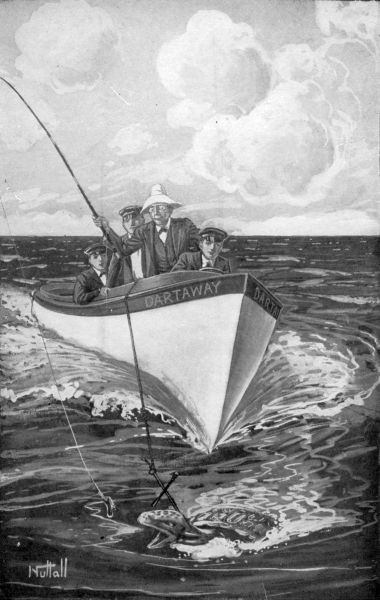
THE TURTLE KEPT TURNING TO REACH THE MEAT
Suddenly there was a rush in the water and the pole bent almost double. The reel sent out a shrill screech.
“I’ve hooked him!” cried the professor. “He’s free from the rope now! Start the engine, Jerry!”
Jerry lost no time in doing this. The chug-chug of the motor was soon heard and the Dartaway forged ahead, freed from its deep-sea captor.
“Haul up the anchor!” called the professor to Ned. “We don’t want any more happenings like that. Bob, put the wheel around and send us toward shore. It’s too rough out here.”
The three boys were busy attending to the boat, while the scientist was still holding the tauted line and the bent pole over the side of the craft. An instant later there sounded a sharp snap.
“The line’s broken!” cried the professor. “There goes the turtle!”
He pointed ahead to where a flurry in the water indicated the presence of the creature. “Well, I hope he likes his canned beef with hook dressing. At any rate we’re well rid of him, though I would liked to have had him for a specimen.”
“That was quite a trick,” observed Jerry, as he took charge of the steering wheel.
CHAPTER VI
BOB GETS A SCARE
Professor Snodgrass wound back on the reel what remained of the line. Then he unjointed the pole.
“Yes,” he remarked. “I thought that was about the only way we could make the turtle let go of the rope. I enticed him around to one side, and that, naturally, made the rope drop from under his flipper. We’ll have to be more careful after this.”
Speeding the motor up, Jerry soon had the boat near shore, and he directed the course along the coast in comparatively quiet water.
They came into a small sheltered bay and, in a little cove where palm trees came down almost to the water’s edge, forming an ideal spot to rest, they went ashore.
“I think I’ll take a little walk into the interior while you boys get dinner,” remarked the professor, taking his butterfly net and the cyanide bottle which he used for painlessly killing insects he captured.
“Don’t get lost,” advised Ned.
“If you see any orange groves let me know,” called Bob.
The three boys were soon busy setting up their portable stove and preparing a meal, using the canned provisions they had brought along.
“How about fish?” asked Ned. “Looks as though there ought to be some in this cove.”
“Try your luck,” said Jerry.
Ned got out his tackle and soon was casting in off a small point of land that stuck out into deep water. In a little while he had caught several fine specimens, and they were soon in the frying pan with some strips of bacon.
“Smells just like a restaurant,” spoke Bob, taking long breaths.
“It will be better if it tastes like one,” observed Jerry, who was superintending the cooking. “I am a little out of practice.”
“Wonder why the professor doesn’t come back,” remarked Ned, when dinner was ready to serve. “I think he must be hungry.”
“Probably he is, but he doesn’t know it,” suggested Bob. “Very likely he’s chasing after a red, white and blue ant.”
“I’ll go after him,” volunteered Jerry. “You fellows go on eating. Don’t wait for me.”
He started off in the direction taken by the professor while Bob, too hungry to stand on ceremony, began to do ample justice to the food. Ned joined him, and they were nearly finished before the scientist and Jerry appeared coming through the grove of palm trees.
“What’s Jerry got in his arms?” asked Ned.
“I don’t know. The professor is laden down with the same thing, evidently.”
“They’re oranges!” cried Bob, as he caught sight of the yellow objects. “They’ve found a grove of orange trees! I wish I’d gone along!”
“Here are some of the specimens the professor captured,” remarked Jerry with a laugh, and he placed his fruit on the grass.
“Where do they grow?” asked Bob eagerly, beginning to extract the juice from a large orange.
“About half a mile back,” Mr. Snodgrass replied. “I met the owner of the grove and he invited me to take as many as I wanted.”
After dinner they took up their journey again, and that night slept on the boat, anchored in a little harbor about forty miles further down the coast.
They had an early breakfast and after making some minor adjustments to the engine started off again. The weather continued pleasant, though there was quite a swell on, and riding in the boat was not as comfortable as it had been the previous day.
“We’ll reach Mosquito Inlet about noon,” announced Jerry looking at the map in the guide book.
“Very good,” said the professor.
“I’d say it was very bad,” put in Ned, making a wry face. “I’m not very fond of mosquitoes.”
“I need a few more specimens to complete my collection,” the scientist added.
“What is Mosquito Inlet?” asked Bob.
“It’s an entrance from the ocean to what is called Hillsborough river,” replied Jerry. “It’s really a part of the sea, but the book says it’s a fine route for boats, and we’ll take it. From there, by means of the Haulover Canal, we can get right into Indian river and reach Titusville.”
“Then let’s do it by all means,” suggested Bob. “This motion is a little too much for me.”
In fact the rolling and pitching of the Dartaway under the influence of the ocean swell, was not very agreeable, and all the travelers were glad when they reached the inlet and speeded through it to the quiet waters of Hillsborough River.
They ate lunch aboard without stopping, as it was low tide, and not easy to go ashore across the stretch of mud revealed by the receding water. That evening they emerged into Indian River, a beautiful stretch of water about one hundred and fifty miles long, almost as straight as an arrow, and separated from the sea by a narrow strip of land. Its waters are salt like the ocean, and it is affected by the tides.
As dusk settled down the boys found the scene one of much beauty. On their left they could catch occasional glimpses of the masts of ocean vessels sailing close to the coast to avoid the powerful Gulf stream. On their right was a forest of palmetto and other trees, forming a sort of screen for the orange groves beyond.
“It smells just like—just like—” and Bob paused for a comparison.
“Just like a wedding party,” finished Jerry as he took in deep breaths of the orange-perfumed air.
The river was widening as they advanced, and the air was filled with flocks of ducks and geese returning from their feeding grounds.
“I’m going to try for some!” exclaimed Bob, preparing to get out his shot gun.
“Better not to-night,” advised the professor. “It’s getting dark and you couldn’t see to pick them up if they fell into the water.”
“I’ll have some to-morrow,” declared Bob. “I’m very fond of roast duck.”
It seemed to grow dark suddenly with the quickness that is always noticed in southern countries. Ned, who had taken his place at the steering wheel, looked down at the water and gave a startled cry.
“What is it?” asked Jerry.
“It’s on fire!” exclaimed Bob, as he glanced over the side.
Indeed it did seem as though the river was ablaze. For a space of a hundred feet or more ahead of the bow, and on either side, there were long lines and streamers of fire, crossed and recrossed as though some giant lace-making machine was weaving a pattern in colors of glowing, golden yellow.
“A beautiful display of the phosphorescent qualities of this stream,” observed the professor. “Very beautiful. It is caused by the fish swimming about,” the scientist explained. “They agitate the water, which possesses suspended in it a quantity of phosphorous and when it is disturbed it seems to glow like fire. I have often read about it, but I have seldom witnessed it. It is almost light enough to see to catch specimens by.”
“The guide book speaks of it,” said Jerry. “I ought to have known what it was. But I guess we’d better think of camping. We can’t go any farther to-night.”
Lanterns were lighted, and with the searchlight glowing in the bow, to enable them to select a good place to land, the boat was sent toward shore. All the way there they seemed to be moving through a river of fire.
They found a good landing place, and soon had their camp arranged for the night. It was decided to sleep ashore as it was somewhat crowded on board. Accordingly, mosquito canopies were arranged, and after supper the boys prepared their beds under a shelter tent which was erected.
“I’m going to make me a mattress,” said Bob, as, carrying a lantern, he went down to the edge of the river.
“What of; Spanish moss?” asked Ned. “I’ve read there’s lots of that in Florida.”
“That would be fine,” replied Chunky. “But I don’t see any around. No, I’m going to make it of grass.”
He proceeded to pull a lot of long bladed herbage from the bank of the river, and soon had himself a soft nest under the shelter of the tent.
“Guess I’ll beat you all at sleeping to-night,” said Bob, as he stretched out in his clothes on the grass. The others had wrapped themselves up in their blankets.
“Go ahead,” murmured Ned. “I’m satisfied with what I’ve got. I could sleep on a bare plank.”
Soon deep breathing told that all the occupants of the camp were far off in slumber-land. It was after midnight when all the others were suddenly aroused by a series of frightened yells from Bob.
“Something’s got me! It’s got hold of my foot! It’s dragging me to the river!” he cried.
Ned and Jerry leaped to their feet. Jerry grabbed his gun which was near him on the ground. The professor snatched down the lantern from a pole in front of the tent and flashed it in Bob’s direction.
“It’s an alligator!” yelled Ned, pointing to some big black object. “Fire, Jerry!”
Jerry raised his rifle, but, as he did so Bob pulled his foot away from whatever creature had hold of him and ran toward his companions who had gathered in a group some distance from the tent.
“Shoot it! It tried to eat me up!” he yelled.
Jerry fired point blank, but he evidently missed for the black object, dimly seen in the shadows cast by the lantern seemed to flop away. An instant later a loud splash told that it had entered the river.
CHAPTER VII
KILLING A MANATEE
“What was it?” cried Jerry.
“I don’t know,” answered Bob, who was almost too frightened to speak. “I was dreaming one of you fellows was pulling me from bed by my foot and I woke up to discover that some animal had me. I looked and saw something black! Then I yelled.”
“Let’s make an examination,” suggested the professor. “Is your foot much hurt?”
“A little,” admitted Bob.
But an investigation showed that though his shoe was dented as if by the marks of broad teeth, the leather had not been penetrated, and, on taking off his shoe, Bob found his foot was only bruised.
“There are the tracks of where the beast came from the river,” said Jerry, pointing to the unmistakable path of some large animal. It had come up the river bank, straight to the bed Bob had so carefully made.
“Must have been a crocodile,” insisted Ned.
“There aren’t any in Florida,” said the professor. “The alligators are not found in this region, either. Whatever it was Bob, you baited it yourself.”
“How?”
“Why, when you pulled that grass you left a long trail of it from the river bank right to the tent. The creature simply followed it up, eating as it went, and when it struck your bunk I suppose it thought it had quite a feast. I guess the taking hold of your foot was only accidental.”
“Maybe it was a sort of walking fish,” suggested Jerry.
“I have an idea what it was,” the professor answered.
“A snake?” asked Bob, and he turned paler than before.
“No, not a snake. I’ll tell you in the morning. Better go to bed now. We’ll light several more lanterns and I think they will keep away any other creatures.”
Bob declared he had had enough of his grass bed, so he got some blankets from the boat and stretched out under the tent between Ned and Jerry, and as far as possible from the river.
“Whatever it was, it’s not going to nab me again,” he said, as he fell into an uneasy slumber.
There were no further disturbances that night, and in the morning the boys gazed curiously at the broad path made by Bob’s midnight visitor.
“Looks as though it was as big as a cow,” said Jerry as he saw the marks.
“Maybe it was,” remarked the professor.
“Don’t see what cows would be doing in the river,” observed Ned, but Mr. Snodgrass only smiled.
“What’s the program this morning?” asked Bob after breakfast had been disposed of and the things packed back into the boat. “Where are we going, Jerry?”
“Let’s keep right on down this river,” suggested Ned. “It’s a fine place.”
“Not for me!” exclaimed Bob. “At least if we do I’m going to sleep on the boat. No more cows for mine.”
“We’re going to Titusville,” declared Jerry. “Of course it would be nice to voyage down this river, and, according to my guide book it’s a beautiful sail. But if we want to get to Lake Okeechobee we’ll have to change to rail transportation for a while and embark again on Lake Tohopekaliga.”
“I guess that will suit me as well,” the professor announced. “I must soon begin to look for that rare butterfly. It is found in the region of the lakes, and I may be fortunate enough to run across a specimen very soon.”
“How are you going to know it when you see it?” asked Ned.
“By its color, for one thing. It is pink, and has blue and gold wings. Then it feeds in a peculiar manner. It spreads its wings out when taking nectar from a flower, and is frequently mistaken for a blossom. I hope I shall find several such butterflies.”
“We’ll help you look for them,” offered Jerry, as he started the boat.
It was but a short run from the head of the Indian river, where the travelers had entered, to Titusville, and, in order to enjoy the unusual scenery, Jerry ran the craft at slow speed. The boys watched the river as it stretched out before them, now narrowing and again widening, while they puffed slowly past groves of palmetto trees that the orange growers depended on as a screen for their groves, which might otherwise be frosted by the cold winds from the Atlantic.
“Can’t we go ashore and get some fruit?” asked Bob, when they had traveled some miles.
“I guess the owners would have no objection if we took some,” said the professor. “I understand they always invite visitors to help themselves.”
The boys decided to act on this suggestion, and soon the boat was anchored at the shore and the four voyagers went inland until they found an orange grove. They met an overseer who invited them to gather all they could eat.
“These are much better than the others we had,” spoke Bob, biting into a luscious fruit.
“He’s getting to be quite an expert,” declared Jerry.
Once more they boarded the boat and Jerry put it well out toward the middle of the river which was very broad at this point.
“There, I guess I’ve had all the juice there is in that orange!” exclaimed Bob, as he tossed the mass of skin and pulp overboard. “Hand me another, Ned.”
As the orange which Bob threw away struck the water, there was a sudden rush as though some large creature had grabbed the pulp.
“What was that?” cried Bob, as he saw some big object swimming just beneath the surface.
“Made enough fuss for a whale or shark,” observed Ned.
“It was after the orange, but I guess it didn’t like it, for it didn’t eat it.”
“Throw another in,” suggested the professor. “We’ll see what it is.”
Jerry tossed some fruit overboard. There was a swirl in the river, and a mass of foam, just ahead of the Dartaway. The creature seemed to inspect the floating oranges, and then ignore them.
“Look out!” cried Ned suddenly. “It’s coming this way, Jerry!”
Jerry saw something approaching the craft. He whirled the wheel over, and speeded up the engine, just in time to avoid whatever it was.
“That’s an ugly beast,” remarked Bob. “Mad, I guess, because we didn’t give it something it liked to eat.”
“Here it comes again!” yelled Ned, and this time the boys saw the creature, just under the surface of the water, approaching the boat on the port side.
“He’s going to hit us!” yelled Bob. “Look out, Jerry!”
Jerry gave a glance over his shoulder. He saw the mass of water piled up in front of the on-rushing creature. He increased the speed of the boat, and endeavored to steer it out of the path of the animal, whatever it was. But the creature was not going to let the boat escape. It changed its course, and, an instant later, the Dartaway careened under a violent shock.
There was a splash, as of some heavy object striking the water.
“Bob’s overboard!” yelled Ned, throwing his chum a cork ring, attached to a rope. “He’s going to ram us again, Jerry!”
There was great confusion on the Dartaway. Jerry had reversed the engine, and was looking about to catch sight of Bob, who was floundering around in the water.
“There it comes!” shouted Ned.
Once more the creature was returning to the attack. But this time it did not strike the boat. The reversing of the engine had brought the craft to a stop, and it was beginning to go astern. This caused the creature to shoot just across the bows.
“It’s a seal!” yelled Jerry, who caught a passing glimpse of a big brown body just under the water. “Hand me a gun and I’ll shoot it!”
By this time Bob had grasped the cork ring, and the professor, who had hold of the rope, was pulling the boy aboard. Ned reached a rifle from the locker and passed it to Jerry, who had shut off the power so he would not have to steer the boat.
“Can you see it?” cried Ned.
“He’s coming at us again,” replied Jerry.
“Shoot it in the head!” called the professor, not desisting from his work of rescuing Bob.
“You take a gun, Ned!” shouted Jerry. “I may miss!”
Ned secured another weapon, and hurried to the bow to stand beside his chum. Both boys could see where the creature was by reason of the disturbance in the water.
“I see its head!” spoke Ned in a whisper. “It’s just like a seal.”
He took as careful aim as he could, as also did Jerry. The two rifles were discharged together, and as the bullets struck the water they sent up little jets of spray. Then followed a great commotion, and the river in that vicinity was churned to foam.
“We must have hit him!” yelled Jerry.
“We sure did!” added Ned. “The water is red!”
The crimson color was spreading over the surface. The creature was lashing about evidently in a death struggle.
“Once more!” cried Ned, as he worked the lever of his repeating rifle, and Jerry followed his example. They fired again.
This time they could hear the thud of the bullets as they struck. There was a cessation of the beast’s struggles, and the water grew quieter.
“Guess that finished him,” observed Jerry, peering forward. “He’s done for.”
“What was it?” asked Ned.
“Give me a hand here!” called the professor. “I want to lift Bob in.”
The two marksmen turned from their inspection of the thing in the water at the bow of the Dartaway to assist in getting their chum aboard.
“Did you think you needed a bath, Chunky?” asked Ned.
“I—I got—one—whether—I needed it—or—or not,” spluttered Bob, as he got rid of the water in his eyes, nose, ears and mouth. “Give me a hand.”
They helped him into the boat, dripping wet, but otherwise uninjured, as Bob was fat, and floated well, in spite of the handicap of his clothes.
“What was it, a whale?” asked the wet one. “Did he put a hole in the boat?”
“Guess we’re not much damaged,” replied Jerry. “But I haven’t yet seen what the thing was, unless it’s a seal.”
“There it is,” observed Mr. Snodgrass, as he pointed to a big brown object floating on the water. “It’s a manatee or sea-cow. I didn’t expect to meet with any, as they are almost gone from this part of the world.”
“A manatee!” exclaimed Bob, in consternation. “It’s a good thing I didn’t try to bring one to Andy Rush!”
CHAPTER VIII
A MISFORTUNE
Jerry started the engine, and, at slow speed, put the boat close over to the big creature, which was now quite dead.
“I hadn’t any idea they were so large,” said Ned.
“As I told you before, they sometimes weigh nearly a thousand pounds,” the professor said. “They are harmless, but I suppose this one must be an old one, and a sort of king of this section of the river. Very likely he didn’t like our boat to disturb his feeding ground. By the way, Bob, I think he’s a friend of yours.”
“A friend of mine?”
“Yes, that one, or one just like it, tried to bite your foot last night.”
“Was that what had hold of my foot?”
“That was the creature,” replied the scientist. “I was pretty sure of it before, but I didn’t want to say so until I had some proof. I had no idea there were any in this river, and I fancy we shall see no more. Well, boys, you had quite an experience. Many hunters would give a good deal for the chance of killing a manatee, though I don’t see much sport in it myself.”
“What are they good for?” asked Jerry.
“Various purposes. I suppose some years ago the Seminole Indians were very glad to eat them. But I don’t believe we’ll take it along with us. It would be too much trouble. If it was alive a museum might pay a good price for it. But, Bob, I hope you’re not in danger of taking cold from your bath.”
“Not in the least,” replied Chunky with a laugh. “It’s so warm in the water that I’d like to stay in all day.”
They helped him wring out his clothes and they were hung up to dry, while he donned some spare garments.
“Now for Titusville!” cried Jerry, as he speeded up the motor.
They reached the city about noon, and as they wanted to get the boat ready for another overland journey they decided to have dinner on board before going ashore to make their arrangements.
When they got to the freight office they found that the cradle, in which the Dartaway was to be shipped, had arrived. They engaged men to get the boat from the water, and, having seen it safely put on a flat car for shipment, they bought their tickets for Kissimmee City, where they were again to begin water travel.
Though the railway journey was interesting, and gave the boys glimpses of persons and scenery they were unfamiliar with, they were anxious for it to be over so they might again feel the throb of the Dartaway’s engine.
Owing to a wreck on the road they missed connections and they had to lay over one night at a small village. The next day travel was slow, and they did not reach Kissimmee City until nightfall.
“I hope our boat’s here,” said Jerry as he got off the train. “These railroads don’t have enough travel to make them as fast as those in the north.”
“Maybe it was in the freight wreck that delayed us,” suggested Bob.
“There you go, Old Calamity Howler!” exclaimed Ned. “What do you want to go suggesting any such thing as that for?”
“I didn’t mean anything,” responded Bob, rather surprised at Ned’s explosion.
“I was just thinking the same thing myself,” Ned went, “and I didn’t want my bad presentment to be seconded.”
“You fellows are talking nonsense,” spoke Jerry. “Come on until we find a hotel. Then I’ll inquire about the boat. But where is the professor?”
“He was here a moment ago,” replied Ned.
“There he is,” said Bob, pointing to the figure of the scientist. Mr. Snodgrass was on his hands and knees on the depot platform, while near him, in the glare of a lamp, stood a small crowd.
“Is he hurt?” asked Bob, in some alarm.
“More likely he’s trying to catch a new specimen of a hop-toad,” was Jerry’s idea.
As the boys approached the professor they saw he had in his hand a small net with which he was endeavoring to capture something.
“Did yo’ lose anything, stranger?” asked a tall langy southerner, as he observed the professor. “If yo’ did, say the word and we’ll all jine in an’ help yo’ look for it, suah!”
“Thank you,” replied the scientist, not looking up from his occupation. “I just saw a very rare specimen of a red flea, and I want to catch it for my collection.”
“A flea!” exclaimed the southerner, while the others in the crowd looked as though they thought the professor had gone crazy.
“Yes, a beautiful red flea, and very rare.”
“Excuse me, stranger,” went on the man who had first spoken, “no offense, yo’ understand, but if yo’ want about seven million of them fleas I reckon we can accommodate yo’. I’ve got a dog that’d give a good bit to git rid of ’em, an’ I reckon as how some others I know can supply yo’. Take ’em all, an’ welcome, but don’t turn ’em loose again in Kissimmee City.”
“Thank you,” replied the scientist, as though some one had presented him with a large sum of money. “I only require one or two. The kind I seek is not as common as you think. There! I have him,” and he made a sudden movement with the tiny net, imprisoning the hopping red captive.
“All kinds of fleas is too common around heah,” observed the tall man.
“That’s right,” chorused his companions.
But the professor was intent only on his captive. He carefully placed it in a bottle and then turned to look for the boys. He had been oblivious to everything, save the red flea, since he had first seen the creature.
The travelers found a hotel and, after arranging for their rooms, the three boys decided to visit the freight station and inquire about the Dartaway.
They found the office deserted, and, after tramping about the platform, and calling out in vain for some one of whom they might make inquiries, they saw, approaching, a little colored boy.
“Wuz yo’ uns a-lookin’ fer any one?” he asked.
“Where’s the freight agent?” asked Jerry.
“Oh, he’s over to Buck Johnson’s.”
“Where’s Johnson’s?”
“Down the road, about two hoots an’ a holler.”
“How far is that?” asked Ned, to whom this description of distance was new.
“I doan’t rightly know, but ef yo’ go twice as fur as yo’ kin hoot, an’ then as fur as yo’ kin holler, yo’ll find him, but I don’t guess he’ll come.”
“Why not?”
“’Cause he’s at a dorg fight, an’ he hates t’ come away from a dorg fight.”
“Can you tell him we’d like to see him about our boat?” inquired Jerry, holding up a shining quarter.
“Mister, I’d go fo’ miles fer two bits,” replied the little darky, calling the twenty-five cent piece by its southern name. He seized the money as though he feared it would vanish, and started off on a run.
Whether “two hoots and a holler” was only a short distance, or whether the freight agent hurried away from the dog fight because of the small negro’s description of the three travelers who were so lavish with “two-bit pieces” was not disclosed. At any rate a man was soon seen slouching down the platform.
“Was yo’-uns lookin’ fer me?” he asked.
“Are you the freight agent?” inquired Jerry.
“That’s what I be. I’m here nights, but Jim Peterson is here day times. We don’t do much business nights, an’ I jest took an hour or so off—er—fer amusement,” he added. “We was havin’ a sort of athletic contest. What kin I do fer yo’? Was yo’ expectin’ some freight?”
Jerry smiled at the man’s idea of an athletic contest in conjunction with a dog fight, and answered:
“We’re expecting a motor boat, shipped from Titusville.”
“A motor boat?”
“It’s called the Dartaway,” added Ned, to help the agent’s memory.
“A boat, eh?” and he seemed provokingly slow. “Well, now, I’m terrible sorry to disappoint yo’ gentlemen.”
“Hasn’t it come?” asked Bob.
“No, an’ guess it won’t,” said the agent in drawling tones. “I got word last night that some boat that was comin’ heah was all busted to pieces in a freight wreck!”
“The Dartaway smashed!” exclaimed Jerry, and the hearts of all the lads sank at the news of such a misfortune.