


автордың кітабын онлайн тегін оқу The Motor Boys in the Clouds; or, A Trip for Fame and Fortune
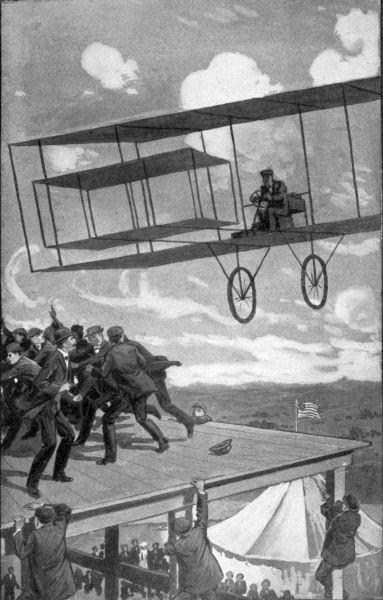
“THE AEROPLANE WAS NOW WITHIN TEN FEET OF THE PLATFORM.”
THE MOTOR BOYS
IN THE CLOUDS
Or
A Trip for Fame and Fortune
BY
CLARENCE YOUNG
AUTHOR OF “THE MOTOR BOYS,” “THE MOTOR BOYS OVERLAND,”
“THE MOTOR BOYS AFLOAT,” “JACK RANGER’S SCHOOLDAYS,”
“JACK RANGER’S OCEAN CRUISE,” ETC.
ILLUSTRATED
NEW YORK
CUPPLES & LEON COMPANY
BOOKS BY CLARENCE YOUNG
THE MOTOR BOYS SERIES
(Trade Mark, Reg. U. S. Patent Office.)
12mo. Illustrated
Price per volume, 60 cents, postpaid
THE MOTOR BOYS
Or Chums Through Thick and Thin
THE MOTOR BOYS OVERLAND
Or A Long Trip for Fun and Fortune
THE MOTOR BOYS IN MEXICO
Or The Secret of the Buried City
THE MOTOR BOYS ACROSS THE PLAINS
Or The Hermit of Lost Lake
THE MOTOR BOYS AFLOAT
Or The Stirring Cruise of the Dartaway
THE MOTOR BOYS ON THE ATLANTIC
Or The Mystery of the Lighthouse
THE MOTOR BOYS IN STRANGE WATERS
Or Lost in a Floating Forest
THE MOTOR BOYS ON THE PACIFIC
Or The Young Derelict Hunters
THE MOTOR BOYS IN THE CLOUDS
Or A Trip for Fame and Fortune
THE JACK RANGER SERIES
12mo. Finely Illustrated
Price per volume, $1.00, postpaid
JACK RANGER’S SCHOOLDAYS
Or The Rivals of Washington Hall
JACK RANGER’S WESTERN TRIP
Or From Boarding School to Ranch and Range
JACK RANGER’S SCHOOL VICTORIES
Or Track, Gridiron and Diamond
JACK RANGER’S OCEAN CRUISE
Or The Wreck of the Polly Ann
JACK RANGER’S GUN CLUB
Or From Schoolroom to Camp and Trail
Copyright, 1910, by
Cupples & Leon Company
The Motor Boys in the Clouds
PREFACE
Dear Boys:
In this, the ninth of the books in the “Motor Boys Series,” Jerry, Ned and Bob decide that as they have had a number of adventures on land and water, the only place left for them to see sights is up in the air, above the clouds. At first this plan was considered rather dubious, as, though considerable progress has been made toward men sailing about in the upper regions by means of dirigible balloons or aeroplanes, the science is still far from perfected.
But when the boys had attended an aero carnival, and witnessed the flight of a large dirigible balloon, they decided there was nothing for them to do but to attempt a trip that way themselves.
They formed the acquaintance of a veteran balloon constructor, who had a plan for a novel motor ship. This combined a dirigible balloon and an aeroplane, and after some consideration the boys furnished him the money to build one.
All was not smooth sailing, literally as well as figuratively speaking. They had a number of difficulties, not the least of which were caused by their old enemy, Noddy Nixon. How they finally started, the accidents that befell them, and the long trip they made for fame, and not a little fortune, in the shape of a substantial prize, you will find set down in the succeeding pages.
The welcome you boys have accorded the previous books in this series makes me hope that you will also like this one. The conquest of the air is coming nearer every year, and who knows but that the Motor Boys may be the ones who will be among the first to solve it.
Yours cordially,
Clarence Young.
CONTENTS
CHAPTER
PAGE
I
Noddy Nixon’s Tin Fly1
II
Off to the Carnival11
III
Amid the Airships19
IV
The Fat Man’s Wager29
V
A Disastrous Flight39
VI
Noddy in a Row47
VII
In Great Peril54
VIII
The Dirigible Balloons66
IX
A Race in the Air74
X
Planning a Motor Ship81
XI
Building the Comet87
XII
Noddy Makes Trouble96
XIII
Joffy Sees a “Ghost”105
XIV
Professor Snodgrass on Hand113
XV
The Motor Ship Sails121
XVI
Noddy’s Plot130
XVII
A Successful Flight141
XVIII
A Perilous Trip150
XIX
Starting for the Race159
XX
Held Up166
XXI
Searching for Evidence175
XXII
Noddy is Trapped184
XXIII
The Stolen Lever190
XXIV
“They’re Off!”198
XXV
Noddy Gets His Deserts208
XXVI
In a Heavy Storm214
XXVII
After a Strange Bird222
XXVIII
The Red Balloon228
XXIX
Over the Mississippi235
XXX
Winning the Prizes—Conclusion240
LIST OF ILLUSTRATIONS
“THE AEROPLANE WAS NOW WITHIN TEN FEET OF THE PLATFORM.” “THERE WAS A RESOUNDING CRASH!” “OH! THE GHOST, THE GHOST!” SHOUTED JOFFY. “THE GREAT RACE WAS UNDER WAY.”THE MOTOR BOYS IN THE CLOUDS
CHAPTER I
NODDY NIXON’S TIN FLY
“Hello, Ned! Say, Jerry, have you heard the news?”
“What news, Chunky?”
“Why, about the carnival. It’s going to be great. I thought sure you’d heard about it. Why, there’s going to be——”
“Look here, Bob Baker,” remarked Jerry Hopkins, rolling over in the grass, where he was stretched out under a big maple tree, “do you know it’s about ninety in the shade to-day?”
“Sure I know it,” replied Bob, breathing rather quickly, for he was quite stout, as his nickname of “Chunky” implied; and he had hurried from his house to see his two chums, Jerry Hopkins and Ned Slade.
“Well, then, if you’re aware of that interesting and very evident fact, why do you come around here, puffing like a steam engine, and making all sorts of a row, while Ned and I are trying to keep cool and improve our minds?” asked Jerry, pretending to be angry. “Why do you do it, I ask?”
“I thought you’d be anxious to hear the news.”
“What news?”
“Oh, don’t bother, Chunky,” put in Ned, stretching and yawning. “The best news you could tell us now would be that there was a freezer full of ice cream somewhere within easy reach. If you’re not ready to tell us something like that, why, take a stretch down here in the shade, and don’t puff so. You make me warm.”
“Well, say, if you don’t want to hear this, all right,” replied Bob, a little put out at the manner in which his announcement had been received.
“Oh, don’t bother with him, Chunky,” yawned Jerry. “If you have any news to tell, let it go. I’m listening. What’s it about? Has our gold mine failed, or has Professor Snodgrass discovered some new species of man-eating hoptoad?”
“It’s got nothing to do with Professor Snodgrass, or our gold mine, either,” responded Bob. “But there’s going to be a great carnival at Broadlands, and I thought maybe——”
“Carnival? You mean a county fair, I suppose,” interrupted Ned. “Excuse me. I can see all the cattle and mowing machines I want right here at home.”
“I guess your dad must have made you mow the front lawn this morning, eh, Ned?” inquired Jerry with a grin.
“That’s what he did, and it’s no front parlor of a lawn, either. I don’t ever want to see a lawn-mower again. But here comes Bob, all excited over a county fair, where all they have to eat is frankfurters, popcorn and ice cream cones.”
“Oh, is that so?” retorted the stout youth rather indignantly. “Well, if you’re so smart, did you ever hear of a county fair in July, before the crops are in?”
“He’s got you there, Ned,” said Jerry.
“Well, what kind of a carnival is it?” asked the youth who had endeavored to discount Bob’s news. “Why don’t you tell us your story, instead of hemming and hawing around here, like an automobile that’s run out of gasolene and has a spark-plug that’s gone on the fritz? Why don’t you, eh?”
“I will, if you’ll give me a chance. There’s going to be a carnival over at Broadlands and——”
“You said that once before,” reminded Ned.
“Go ahead, don’t mind him,” advised Jerry.
“It’s going to be a balloon and aeroplane carnival,” went on Chunky. “All sorts of airships are to be exhibited, and there are going to be races. It’s going to be great! They’re just putting up the posters all around town.”
“Is that straight?” asked Ned, for Bob was sometimes inclined to joke.
“Sure it is. Come on and I’ll show you the posters. There’s one on our side fence. I let the man stick it there.”
“And maybe your dad will make you take it off,” said Jerry.
“I don’t care. I wanted to have a chance to read it. But this carnival is going to be all right. As soon as I heard of it I ran to find you two fellows. Why can’t we go and take it in? It’s only about seventy-five miles to Broadlands. There are good roads, and we can go in our auto.”
“That’s the stuff! When is it?” asked Jerry.
“Next week. It lasts six days.”
“If it’s as hot as this the gas balloons will explode with the heat,” predicted Ned.
“Oh, it’ll cool off before then,” declared Jerry. “But what else, Bob? Did you look to see who any of the entries were by? Are the Wright brothers going to compete? Will Zeppelin send his big, long aluminum balloon over from Germany? Captain Baldwin ought to be on hand, anyhow.”
“I didn’t notice any of those names. I don’t believe any of those big inventors will be on hand, but I can tell you one person who’s going to have an entry.”
Bob’s manner was so earnest, and he seemed so worked up over his news, that both Ned and Jerry lost their half-bantering air, and began to be seriously interested.
“Who is it?” inquired Jerry.
“Noddy Nixon.”
“What? Noddy? That chump going to exhibit an airship?”
“I don’t know that it’s exactly an airship,” answered Bob. “But it’s some sort of a machine for sailing above the earth, or it wouldn’t be allowed at the carnival.”
“But Noddy Nixon, of all the fellows in the world!” commented Jerry.
“It does seem sort of queer,” admitted Bob. “That’s what drew my attention to the posters. I saw Noddy’s name on them.”
“Is his name on the posters?” chorused his two companions.
“Sure. He’s one of the entrants; I believe that’s the proper word,” said Bob, grinning. “His machine is called the Firefly.”
“Does he expect to sail it himself?”
“What sort of a shebang is it?”
“Why didn’t you tell us before?”
“Queer we didn’t hear anything about it. He must have been keeping it quiet.”
“Where did he get the gumption to invent it?”
These, and other questions and comments, Bob’s two chums asked of him so quickly that he had no chance to reply.
“That’s all I know about it,” he said, when Ned and Jerry had to stop to get their breaths. “What’s the matter with taking a run over to Broadlands and finding out more about it? Maybe we could get up a machine ourselves.”
“Not if the carnival takes place next week,” replied Jerry, though there was a new look on his face—a look which his companions knew indicated that he was thinking deeply. Indeed, Bob’s news had created quite an impression on Jerry, and in a measure it was responsible for a series of strange happenings which took place after that, and in which the motor boys played conspicuous parts.
“And is that all you can tell us?” asked Ned. “What sort of a machine has Noddy?”
The interest of Ned and his two companions, in what Noddy was about to take part in, was not lessened by the fact that young Nixon, the town bully, was their enemy, and, in the past, had done much to annoy and injure them, though, usually, his mean schemes went for naught, because of the bravery and activity of the three boys against whom he had a grudge.
“That’s all I know—what the posters said,” replied Ned. “His name is only one of about twenty, I guess. There are pictures of all sorts of airships, but I didn’t see any that looked like a firefly.”
“Queer,” murmured Jerry. “I wonder what sort of a machine Noddy has?”
“I can tell you,” exclaimed a voice behind the motor boys. “It’s great—regular fly—tin wings—flop up and down—faster than you can count—whoop! there they go—up goes the machine—down again—round in a circle—flip-flap-flop! Start the motor—twist the rudder—look out—here she comes—that’s the way!”
And the speaker, a small youth, very much excited, had to stop, for he was out of breath, so rapidly had he talked.
“Oh, it’s Andy Rush. No need to turn around to tell that, boys,” remarked Jerry, stretching out in the grass again. “Well, Andy, aren’t some of your cylinders hot after that sprint?”
“I guess so—I don’t know—heard you talking about Noddy Nixon—his airship—thought you wouldn’t mind—I came up closer—I heard about it—I’ve seen it—it’s great—say——”
“Have an ice-cream soda,” interrupted Ned, pretending to hand one to the excited little fellow.
“Aw, quit,” begged Andy reproachfully.
“That’s right, let him tell us about it,” suggested Jerry. “Now just shut off a little of your gasolene, retard your spark a bit, and you’ll do better. How did you come to know about Noddy’s machine?”
“Because he wanted me to try a flight in it. He needs some one who is light, and he asked me. But I wouldn’t do it. I’m afraid,” answered Andy Rush.
“Did you see it?” asked Ned eagerly.
“Sure. He had it built in Jenkinson’s machine shop. But he’s been keeping quiet about it. I guess he didn’t want you fellows to get on to it, for fear you’d beat him out. He’s been working on it for some time. Ever since he heard about the carnival.”
Andy was speaking more quietly now, and his three auditors listened intently.
“And is it really shaped like a fly?” asked Jerry.
“It sure is. He took me over and showed it to me yesterday. That’s when he wanted me to sail it for him. It’s a big tin fly, with wings and everything. Oh, it’s a queer-looking shebang. It’s big, too.”
“How does it run?” asked Bob.
“He’s got a little motor on it, one he took out of his old auto, I guess. It makes the wings flap up and down.”
“And he really thinks he can fly in it?” asked Ned.
“He’s sure of it,” replied Andy. “He told me how many flaps the wings made every second, but I’ve forgotten.”
“What does he expect will make the machine rise in the air?” asked Jerry. “Has he aeroplanes or a balloon attached to it?”
“Nope. Nothing but a sort of car, shaped like a fly’s body, and two wings on each side, with a tail in back like that of a fish. He says the flopping of the wings will make it rise up, same as a bird flies.”
“Well, if that isn’t the limit!” exclaimed Jerry. “He must be crazy. It is a heavy machine, Andy?”
“Sure. It takes four men to lift it.”
“And he expects to make it rise up by vibrating tin wings,” went on Jerry. “Well, he is a chump!”
“I am, eh? Well, maybe when you see me sailing along through the air you won’t be so fresh!” exclaimed a new voice, and the four boys, looking up, saw Noddy Nixon, their enemy, standing not far away. He had come up through the fields back of Jerry Hopkins’ house, where the chums were resting in the shade of a little grove, and he had overheard the closing sentences of their conversation.
“I’m a chump, am I?” he went on angrily. “Well, I’ve gotten the best of you more than once, Jerry Hopkins, and I’ll do it again. The Firefly will fly, and I know it, and if you slander me or my machine any more I’ll sue you for damages. I’ll fix you, Andy Rush, for giving my secrets away!” and with an angry look on his mean, crafty face, Noddy Nixon advanced toward the little fellow.
CHAPTER II
OFF TO THE CARNIVAL
Andy Rush well knew Noddy’s character, and he had no notion of remaining to be chastised by the bully. He leaped to his feet and started to run, Noddy taking after him. Andy fell on a slippery patch of dried grass, and Noddy was almost upon him when Jerry ran up.
“That’ll do you,” he said. “Let Andy alone.”
“I will not.”
“Yes, you will.”
“No, I won’t.”
“I’ll punch your head if you touch him.”
Noddy knew Jerry was as good as his word, and as the bully had, more than once, felt Jerry’s fists, he backed off.
“He hasn’t got any right to make fun of my machine,” he muttered.
“He wasn’t making fun of it,” replied Jerry. “I was laughing at the idea of you expecting to sail through the air with a machine so heavy it takes four men to lift it, especially when you haven’t any lifting power.”
“Oh, I s’pose you know a lot about airships?” sneered Noddy.
“I know enough about ’em to know that a machine heavier than air can’t rise unless there’s something to give it a lift.”
“Aw, you think you’re awful smart. But you wait. When you see me sailing around at the carnival you’ll sing a different tune.”
“Maybe,” admitted Jerry good-naturedly. “I hope you do fly, Noddy, and don’t break your neck.”
“I—I didn’t know you didn’t want me to tell about the Firefly, Noddy,” remarked Andy, peering out from around Jerry’s stocky form.
“Yes, you did, and I’ll fix you the first chance I get. You wait.”
“Andy, if he bothers you just let me know,” spoke Jerry significantly. “Don’t let him worry you. If you attempt to injure Andy for what he said to-day you’ll have to reckon with us, and you can put that in your gasolene engine and use it for fish bait,” added Jerry, looking at the bully.
“Aw, you think you’re smart,” was Noddy’s half-growled retort. “But I’ll show folks what I can do. You’ll wish you had a machine like mine when you see how it works. You’re jealous, that’s all. You’re mad because you haven’t got an airship.”
“Sure we are, Noddy,” answered Bob with a smile. “But we’re going to have one.”
Bob’s companions looked at him in some wonder.
“We’re going to make one with our motor boat that was smashed, and use some old auto tires, filled with gas, to raise us. Then we’ll have a race with your Firefly,” went on Bob with a cheerful grin. “Ta-ta! Here’s your hat, what’s your hurry?” and he slumped down on the grass, selecting the most shady spot he could find, for it was quite hot, and the sun was strong.
“That’s all right—I’ll show you,” murmured Noddy as he turned away.
“Humph!” exclaimed Jerry, when the bully had passed out of sight. “Talk about trolley cars and you’ll hear the fare register. But say, fellows, this airship business has set me to thinking. We’ll have to take in the carnival.”
“We sure will,” agreed Ned. “Let’s go and see that poster Bob was talking about.”
“It’s too hot,” declared Bob. “I can tell you all that’s on it. Besides, the fellow who was putting it up gave me some circulars.”
“Well, why didn’t you say so at first?” demanded Jerry. “Pass ’em over and I’ll take a squint at ’em.”
Bob pulled some papers from his pocket and handed them over to Ned and Jerry, who were soon deeply interested in the somewhat extravagant statements advertising the carnival.
While they are thus engaged it will be a good opportunity to tell you a little something about them, where they lived and how they came to be known as the “motor boys.”
Bob Baker was the son of Andrew Baker, a wealthy banker, while Ned Slade’s father kept the largest department store in Cresville, and was counted well off. Jerry was the only son of Mrs. Julia Hopkins, a widow, and she had a comfortable income from wise investments made by her husband.
The three boys, who lived in the New England town of Cresville, not far from Boston, had been chums as long as they could remember.
Their early adventures were told of in the first book of this series, entitled “The Motor Boys.”
They gained the name from the fact that they took part in bicycle races, one of them winning a motor cycle. Later all three acquired those speedy machines, and it was not long before they owned an automobile.
In that they made a long trip overland, and later went into Mexico, where, in company with Professor Uriah Snodgrass, a noted scientist, engaged in making a collection of curious bugs and animals, they discovered a buried city. They returned home from Mexico across the plains, and, shortly after that, using some of the funds from their interest in a gold mine they discovered, they purchased a motor boat.
In that boat, named the Dartaway, they had stirring times, as told in the fifth volume of this series, entitled “The Motor Boys Afloat.” Following their adventures around home they made a long trip on the Atlantic, and from there they went into the strange waters of the Florida everglades. Their experiences there were fully equaled by a trip they next made on the Pacific, searching for a mysterious derelict, though they had to make this voyage in a motor boat they hired by the season, as their own was smashed in a railroad wreck as it was being sent home from Florida.
They had returned from California in time to resume their studies at the Cresville Academy, and they had put in a full winter at their books. They had just successfully passed their examinations, and when this story opens, early in July, were still undecided what to do during the long vacation.
It was while Ned was paying a visit to Jerry, under the trees near that lad’s house, that Bob came along with the news of the carnival, with what result you have just been made acquainted.
The boys eagerly perused the hand-bills and circulars which Bob gave them. Even Andy Rush was so interested that he forgot to talk, which was the occupation the little fellow was at most of the time, when he was not asleep or eating.
“Well, what about it, fellows?” asked Bob, as he saw Ned and Jerry thoughtfully folding up the circulars.
“It’s great,” was Jerry’s comment. “We’ve got to take it in, Ned.”
“That’s what I say. We were just wishing we had something to do, and along comes Chunky——”
“Oh, I knew you’d be interested as soon as I saw that poster,” interrupted the stout lad.
“It’s too bad that we let Noddy get ahead of us, though,” continued Jerry.
“Can’t we make some kind of an airship?” asked Bob. “All it needs is some wings and a motor. We can take the one from the auto. It’s almost new, and it has six cylinders,” for they had had a new engine put in their car, and the machine had otherwise been brought up to date.
“I guess it needs more than an engine to make a motor ship,” said Jerry.
“Motor ship! That’s a new one,” commented Ned. “But it’s a good name. I wish we had a motor ship.”
“Maybe we will have—some day,” remarked Jerry with that serious, thoughtful look still on his face. “But it’s too late to think of one for this carnival. However, we can take the show in. We may get some new ideas. Let’s see—to-day is Tuesday. It opens next Monday. We’ll arrange to go in our auto, and stay the whole week. Can you fellows manage it?”
“Sure,” replied Bob, who knew his parents would not object.
“I’ll go along,” added Ned. “I was just wishing we could have some kind of an outing. I was thinking of Florida again.”
“And the Seabury girls, of course,” added Jerry with a laugh.
“Well, I would like to see them. I guess——”
“I guess one would do you—Miss Olivia,” went on Jerry. “How about it, Ned?”
“Aw, cut it out,” and Ned blushed.
“Well, that’s settled. We’ll go to the aero carnival,” declared Bob, fearful, perhaps, lest Jerry should twit him about Miss Rose Seabury, one of three sisters whose acquaintance they had made while in Florida.
Little Andy Rush glanced from one to the other of the three motor boys. There was a wistful look on his face.
“Would you like to go along, Andy?” asked Jerry, guessing the meaning of the small chap’s gaze.
“Would I? Say—would I eat ice cream? Think of it! Airships—above the clouds—balloons—motors bang-bang! up in the air—down to the ground—whoop de deedle-de! over the fence is out—try again—blow up the gas bag—start over—there they go—a race in the sky—O la-la! Whoop!”
“There, I guess you’d like to go, all right. Now cool down, or you might crack a cylinder,” advised Jerry. “Go ask your folks, Andy, and see us later.”
Andy found that he could go, and the following Saturday the three motor boys, with their small guest, started from Cresville in their auto. They intended to put up at a hotel in Broadlands, and remain a week at the carnival.
CHAPTER III
AMID THE AIRSHIPS
“Say, it’s quite an affair, isn’t it?” said Jerry, when, late that Saturday night, they rode past the grounds where the airship exhibition was to take place. The boys were on their way to the hotel, where they had engaged rooms in advance, a necessary precaution, as such a crowd flocked to Broadlands that the accommodations of the place were stretched to the utmost.
“I guess it’s going to be a first-rate show,” commented Ned. “I thought it might be a fake from the way the handbills read.”
“Oh, it’s the real thing, all right,” declared Bob. “An organization of wealthy men is back of it, I heard dad say, and they’ve got some real good machines here. They’re going to give prizes, too.”
“I don’t see any airships flying around,” objected Andy, who, as Jerry halted the machine outside of the grounds, was gazing anxiously aloft.
“Of course not,” replied Ned. “They aren’t going to bring them out before the show opens. I suppose all of them are not here yet. But there are tents and sheds enough to house half a hundred.”
Certainly there were a number of big buildings and tents on the grounds. The buildings were of the flimsiest character, but were all that were needed to shelter dirigible balloons or aeroplanes.
“I wonder where Noddy’s Firefly is?” asked Bob.
“Did he ship it?” asked Ned.
“Oh, yes, he sent it off, all right,” answered Jerry. “I was asking Mr. Hitter, the freight agent at the depot, about it. He said Noddy fussed and fretted for fear it would get broken on the road. It was all taken apart and boxed up, and Noddy threatened to sue the railroad if one piece of his machine was lost or damaged. Mr. Hitter said he nearly bothered the life out of him.”
“I’d like to see it,” said Ned. “I wonder which tent or shed is his?”
“We’ll inquire later,” said Jerry. “But first we’d better get to the hotel and see about our rooms. There’s such a crowd here they may not reserve them for us if we don’t claim them soon.”
Indeed, they did not arrive at the hotel any too quickly, for the clerk was about to ignore the reservation they had telegraphed for, and give their rooms to newcomers. The boys, however, secured two nice, large ones, and were soon installed in them with their suitcases, which held their clothing.
“Let’s go out to the grounds,” proposed Bob, when they had unpacked and enjoyed a good wash, to remove some of the grime and dust of their auto trip.
“I’m with you,” said Jerry. “We’ll see if we can spot Noddy’s Firefly.”
The four boys got into the auto and were soon at the carnival grounds. The place was open, as it was necessary to have such a large field, for the operations of the balloons and aeroplanes, that it would have been impossible to enclose it with a fence. But though the spectators could freely view the ships of the air when they were in flight, they were prevented from noting them at rest, as every one was under some tent or housed in a temporary building.
The place was somewhat in confusion, as new exhibits were constantly arriving; stand owners, who hoped to sell refreshments, were engaged in putting up the booths; and men with big trucks were driving here and there, with immense boxes on their vehicles.
These last were, evidently, parts of airships and were to be assembled under one of the many tents or other structures that dotted the ground.
Here and there could be seen nervous men, who were anxious for the fate of some weird machine that a careless truckman had agreed to deliver. One such man was admonishing the driver of a big wagon, on which was a large case.
“Now be very careful of that—very careful,” the owner was saying. “The least jar will displace some of the delicate springs, and shift the center of gravity, besides disturbing the equilibrium of the centrifugal planes. Careful, now—look out!”
The ground was uneven, and, in driving, the truckman reined his horses into a hollow. The vehicle careened, and the big case was on the verge of falling off.
“Oh! Oh! Catch it! Quick! It will be smashed! The work of ten years will be ruined!” cried the inventor.
He was walking alongside the truck, and he tried to hold the case from sliding off the inclined platform by bracing his hands against it. But it was too heavy for him and continued to move toward the ground.
“Let’s help him,” suggested Jerry, and with one accord the boys jumped from the auto, which Jerry had stopped, and ran to the aid of the man. They managed to stop the case from sliding off, and by that time the driver had urged his horses to a level place.
“I don’t know how to thank you!” exclaimed the inventor to Andy and the motor boys. “If that case had fallen to the ground my airship would have been smashed. I am a thousand times obliged to you. That is my tent over there. Now, be very careful, truckman.”
“Aw, sure I’ll be careful. But I never see such uneven ground. What sort of an airship is it, anyhow, if a little fall like that will smash it? Sure, what’ll yez do when ye falls from the sky? Answer me that.”
Clearly he was not a firm believer in the future of airships.
“A fall, no matter from what height, will not matter when my ship is in operation, for the centrifugal planes and the equalizing balances will render any descent harmless,” declared the inventor. “Now, continue on, Mr. Truckman, if you please. I am very much obliged to you young gentlemen. Are you exhibiting here? If so I may have a race in the air with you.”
“No, we’re only here out of curiosity,” answered Jerry. “But we are very much interested in airships. What kind is yours?”
“Ah, that’s a great secret,” replied the inventor with a sly look. “I can’t tell you. But I will astonish the crowds Monday by making the most successful flight. I don’t mind admitting that my machine is built on the principle of the flying grasshopper. It acquires a start by means of two long shafts, made on the model of the hind legs of a grasshopper. By means of powerful springs my machine is launched into the air, just as a grasshopper leaps forward. Then his wings sustain him, just as the wings, the centrifugal planes and the equalizing weights, will hold up my airship with me on it. I have a great invention. I must go now and put it together. I hope it is not damaged. It is a great risk to bring it here, but I expect to win the grand prize.”
“Do you know anything about any other airships that are here?” inquired Ned as the boys started back to their auto.
“Not much. Why?”
“A fellow from our town has one here. He is Noddy Nixon, and he calls his machine the Firefly. We wanted to see it.”
“The Firefly? Oh, yes, I know about it. Young Nixon was telling me about it. He is a smart youth, but his machine will never fly.”
“That’s what we think,” declared Bob.
“No, it will never fly,” went on the inventor of the machine built on the plan of a grasshopper. “He has the wrong idea. The wings of his fly are not large enough, and are too heavy. But my machine will work. I am positive of it. Come and see me after my first flight, and I may let you go up. Just ask for Morris Abernot. I will be in this tent here,” and he indicated one toward which the truck was slowly being driven.
“Do you know where the Firefly is kept?” asked Ned.
“Yes. Right over in that tent with the yellow flag,” and Mr. Abernot pointed to a canvas shelter some distance away.
“Let’s go over, fellows,” proposed Jerry. “I’d like to see what Noddy really has.”
“Maybe he’ll make trouble,” suggested Bob. “He’s mad at us.”
“Oh, he’s always that way,” put in Ned. “That’s nothing new. I’d like to see the Firefly, too. Maybe he isn’t there, and we can peep into the tent.”
“More likely he’s charging admission to see his freak,” was Jerry’s comment. “That’s what some of these fake inventors are doing. They know their machines will never leave the ground, and their only chance to make money is to charge admission. I’ll bet that’s what Noddy is doing.”
They went over to the tent with the yellow flag, threading their way in the auto between rows of booths and new buildings. When they got near enough they saw that the yellow flag bore the initials “N. N.” for Noddy Nixon.
“He’s doing the thing up in style,” remarked Bob. “Let’s get out of the car and walk over. It’s too rough riding here.”
They approached the large tent where the Firefly was kept. About it was a curious throng, as, indeed, there was about every place where an airship was housed. On the front of the tent was a large sign reading:
Nixon’s Wonderful Firefly Airship. None Like It. Admission 25 Cents.
“Let’s go in,” said Jerry. “I’ve got change. I want to see what Noddy is capable of.”
“He’s got nerve, asking a quarter,” commented Bob. “Most of the places only charge ten cents.”
“‘None like it,’” remarked Ned. “I guess that’s true, all right, unless it’s Professor Abernot’s grasshopper. Well, let’s go in.”
They started for the entrance to the tent and purchased four tickets of the man who stood at the flap. Something about the fellow attracted Jerry’s attention as he paid over the money.
“It’s Bill Berry,” he whispered to his chums. “I know him, even if he’s shaved off his moustache. I haven’t seen him since he tried to wreck the steamer. I wonder how he dare come around here?”
“Maybe the government has given up trying to prosecute him for changing the lanterns in the lighthouse,” suggested Bob. “He’s in with Noddy again, that’s evident. Well, they’re a fine team.”
Bill Berry was a town ne’er-do-well, who more than once had aided Noddy in his schemes to make trouble for the motor boys. But this time Bill, if indeed it was he at the tent flap, seemed to think the boys would not recognize him, for he betrayed no uneasiness.
The four lads passed into the tent, another man being stationed just inside the entrance to take up their tickets. They handed him the pasteboard slips, and had just taken a glimpse of a curious machine in the center of the canvas enclosure, when they saw Noddy Nixon rushing toward them.
“Get out of here!” cried the bully. “I don’t want you in my tent! You can’t come here and make fun of my invention!”
“We paid for our admission,” said Jerry.
“I don’t care if you did! I’m not going to let you in! Get out!”
Noddy drew back his fist to strike Jerry, while the other boys crowded up closer.
CHAPTER IV
THE FAT MAN’S WAGER
For a moment, following Noddy’s excited announcement, it looked as if there would be a fight. The bully was very angry, and he probably thought that the motor boys had come into his tent to make fun of him.
“Are you going to get out?” he cried, as Jerry showed no signs of withdrawing, and the other three lads stood their ground.
“I don’t think so,” replied Jerry.
“Then I’ll make you. Bill—Bill—come in here and help me put them out!”
“That was Bill Berry outside,” murmured Ned.
A second later Bill came running in.
“Put Jerry Hopkins and his gang out! I don’t want them here,” said Noddy.
“How are you, Bill? Wrecked any more steamers lately?” asked Jerry quickly, and Bill, who must have fancied that disguising himself by shaving off his moustache was not sufficient, decided that it was better to retreat.
“Get out of here! Clear out!” ordered Noddy, suddenly rushing at the four boys. They did not attempt to strike him, and Noddy knew better than to run the risk of hostilities by delivering any blows. He only pushed and shoved, and, as he was one against four, he was not succeeding very well.
Suddenly Noddy slipped and stumbled, bumping up against a fat woman who just then had entered the tent. She screamed, and there was some confusion in the place, which contained quite a few people.
A man pushed his way through the throng that was gathered about the entrance, some trying to get out of the way of impending trouble, and others seeking to come in. The man wore a badge on his coat.
“What’s the row?” he asked quickly. “What’s the excitement about?”
“We came in to view this machine, paying our way,” said Jerry, for he noticed that the man’s badge indicated that he was a member of the aero carnival committee. “The owner of the Firefly, Noddy Nixon, refuses to let us see it, after we have paid our money.”
“What’s that?” asked the committee member sternly. “He won’t let you see it? None of that, young man! When you are given an exhibition space on this ground you have to conform to all the rules of the association. Any one who pays admission is entitled to see any machine on the grounds. You can’t do any crooked work like that or we’ll order you off. This is a genuine exhibition.”
“Well, they’ll make fun of me—they’re enemies of mine, and I don’t want ’em here,” whined Noddy.
“That makes no difference. You’ll not be the first inventor who was laughed at—especially those who build airships. If you can’t stand being made fun of you’ve no business to go into this carnival. Now let me hear of no more disturbances in your tent, or I’ll close you up. Of course, you boys can stay. The idea of him trying to prevent you!” and the man looked at Noddy in disgust as he withdrew.
Much crestfallen, Noddy walked into a smaller tent erected within the larger one, and there he nursed his wrath, while Jerry and his chums walked about viewing the Firefly from various sides.
It was a curious machine. There was a metal body or car, about as large as a good-sized clothes basket. This contained a seat for the operator and the motor for working the big wings. These latter were made of sheets of tin, riveted to long skeleton frames of iron. The wings, of which there were four, two on a side, were shaped like those of a butterfly. They worked up and down by means of wheels and pistons, operated by the gasolene motor.
There was a tail in the rear, set like that on a fish, and it could be moved from side to side, presumably to steer the machine, by means of cords, levers and pulleys. The whole affair looked quite heavy, for it was all made of metal. Too heavy, indeed, to fly, as many observers commented, yet from what Noddy had said he evidently expected to make it sail through the air, carrying himself or some other venturesome person.
That the Firefly was not destined for long flights was evident from the contracted space of the car. There was barely room for the operator and the motor, and no supplies for a long trip could be carried.
“Well,” remarked Jerry, when he and his chums had spent some time examining the metal “fly,” during which interim Noddy had not shown himself, “well, that’s a queer arrangement, sure enough. I want to see it in motion.”
“Oh, you’ll see it, all right,” declared a young man, whom Noddy had evidently hired to help him. “Professor Nixon will make his first flight Monday, the opening of the carnival. Professor Nixon will challenge all the other inventors to a race.”
“Get on to that, would you?” whispered Ned to Bob. “‘Professor Nixon!’ Why doesn’t he change his name?”
“We’ll be here to see him fly on Monday,” added Jerry. “Come on, fellows; I guess we’ve seen enough now.”
They left the tent, looking curiously as they went out for a sign of Bill Berry. But that individual had evidently gone into hiding, and he was replaced by another unprepossessing chap, who was selling tickets.
It was getting dusk now, and the crowds that had gathered to see the carnival put in shape and the exhibits arranged were beginning to leave.
The boys went back to their hotel, and the next day they took a pleasant auto ride in the suburbs of Broadlands, which was quite a large city. They passed the carnival grounds, and saw that there was little activity on them, few of the exhibitors caring to do any more than was necessary on Sunday.
“They’ll not be in very good shape by to-morrow,” commented Ned. “Half the things haven’t arrived yet, the hotel man told me.”
“Well, that’s always the way with these affairs,” said Jerry. “About the end of the week things will be in better shape. But we’ll have a good time, and we may get some ideas that will be of value to us.”
“Why, do you expect to have an airship?” asked Bob.
“We might,” answered Jerry slowly. “I don’t see why we couldn’t have one. We made out all right with our auto and our motor boat. What’s the matter with having a motor ship next?”
“Wait until we see how Noddy succeeds,” suggested Ned.
“Yes, I’m anxious to see him fly, though I know he’ll never do it in that contraption,” declared Jerry.
The carnival was formally opened the next afternoon, though, as usual with such affairs, not half the exhibits were in place. But addresses were made, the history of aeronautics was rehearsed by several speakers, others made great predictions for the future, and then it was announced by the chairman of the committee in charge that some of the inventors would try out their apparatus.
“One of the first to make an attempt to fly at this carnival will be Professor Nixon,” went on the chairman. “In his machine, which he calls the Firefly, he will endeavor, so he tells me, to make a complete circuit of the grounds. If you will kindly give your attention to the tent over which is flying the yellow flag you will soon see Professor Nixon and his airship.”
The crowd, including the four boys from Cresville, hurried over to Noddy’s tent. Now, if Noddy was at all bashful, or fearful that his machine would not work, he did not show it. The front of the tent was pulled to one side, and the curious Firefly was revealed. Many thus saw it for the first time.
“Professor Nixon asked me to announce that this machine is entirely his own invention,” went on the chairman, “though he was obliged to hire the most of the work done in a machine shop. He will now fly for us.”
“As long as he doesn’t fly toward us it’ll be all right, Professor,” said a tall man in the crowd. “I wouldn’t want that to fall on me. It must weigh several tons.”
There was a laugh at this.
“That’ll never fly,” was another comment.
“That’s a submarine—that ain’t an airship,” jeered a third.
“Let her go, Professor,” called a boy. “Better get a feather bed to fall on, though. When you come down you’ll come down hard.”
“You people can make all the fun you want,” shouted Noddy, as he and some men he had hired began to wheel the Firefly out of the tent. “But you’ll soon see something that will astonish you.”
The flying machine was wheeled out into the open. It rested on a small truck, and Noddy presently busied himself about the motor.
“Go borrow a balloon somewhere, and maybe you’ll go up,” was a suggestion from a red-haired man.
“You mind your own business!” fired back Noddy.
A fat man waddled through the crowd until he stood in the front rank, close to the machine. The four boys were near him.
“Is that the Firefly?” the fat man asked of no one in particular.
“That’s what it is. It’s my machine,” replied Noddy proudly.
“What’s it for—plowing?”
“Plowing! This is an airship,” answered Noddy indignantly.
“An airship! Good land, that’ll never rise one inch off the earth. It’s too heavy,” declared the fat man.
“Oh, it is, eh?” asked Noddy. “Maybe you know a lot about airships?”
“I do,” replied the man quietly. “I’ve made more than a hundred balloon ascensions, and I tell you that your machine will never fly. What’s to make it go up?”
“What makes a fly go up? The wings, of course.”
“Nonsense!” exclaimed the fat man.
“I’ll show you and all the rest of these knockers!” boasted Noddy.
“Not in a thousand years, the way you’ve got it built,” cried the fat man very earnestly. “Look here; I’ll wager you a hundred dollars that you don’t fly with it.”
“I’ll take you up!” retorted Noddy, pulling a big roll of bills from his pocket. “I’m going to fly in about ten minutes.”
“That’s a go!” declared the fat person, pulling some money from his pocket in turn. “Here, will you hold this?” he asked a man next to him, and the man accepted the wager.
“I’ve made a hundred dollars easy,” commented the fleshy one to those near him. “He’ll never fly.”
“Yes, I will,” asserted Noddy. “You watch me.”
He continued tinkering with his motor, and at last announced that he was ready.
“Clear the track!” cried some of his helpers. “He has to have a long start. Clear the track! Professor Nixon is going to fly in his wonderful invention.”
“He’s going to fly toward the ground like a chunk of lead,” said the fat man with a laugh.
“All ready?” asked Noddy to his principal assistant.
“All ready, Professor.”
“Let her go!” cried Noddy, cranking the motor, which soon began to make a noise like a Gatling gun.
CHAPTER V
A DISASTROUS FLIGHT
“Hold on there! Hold on!” cried the fat man, as Noddy was about to pull some levers, which, presumably, set the gears in mesh and would make the big tin wings flap, though they were motionless now.
“What’s the matter?” asked Noddy angrily, looking up.
“I thought you were going to wager me a hundred dollars that you could fly in that thing?”
“So I am.”
“Well, why don’t you put up the money? Mine’s up.”
“I guess I’m good for it,” murmured Noddy. “The bet stands. Look out, there, I’m going to make a start now! Clear the way! Look out! Look out everybody!”
He turned a little more gasolene into the motor, and the apparatus banged away louder than ever. The whole machine vibrated.
But something seemed to be the matter. Noddy, who had taken his seat in the small car attached to the machine, was vainly pulling on levers and twisting wheels.
“Something’s stuck,” he said.
“You’re stuck,” replied the fat man. “You’re stuck for a hundred dollars; that’s who’s stuck.”
“Oh, let up!” exclaimed Noddy as the fat man began to laugh. “Just you wait!”
“We are waiting,” cried several in the crowd. “Let her go, Professor Nixon.”
“Bring us down one of those clouds,” suggested another.
“Yes, and a little cooler atmosphere from above,” added a third waggish one.
Noddy was red in the face from his exertions in yanking on various levers. He could not seem to get the motor in gear, though the machine was working away at a fast rate. Finally Noddy called to one of his helpers. The man, who was evidently a machinist, soon located the trouble.
“I told you to pull out that catch before you tried to work the starting lever,” he said.
“Guess he doesn’t know much about the machine,” was the fat man’s comment.
“I know more than you, and I’ll show you so in a minute, too,” declared Noddy savagely.
He pulled on a lever with all his force. There was a grinding of cog-wheels, a sort of cough and wheeze from the motor as it took up the load, and then the big wings began to vibrate slowly up and down.
“There she goes!” cried the crowd in some enthusiasm. “Hurrah! He’s off!”
“Well, the wings move, that’s sure,” admitted Jerry to his chums, “but it’s another thing to rise in the air.”
Noddy, however, had not yet turned on full power. He did so a moment later, and the motor seemed to redouble the explosions, which, not being muffled, made a terrific din. The wings went up and down faster than ever, so rapidly, in fact, that they looked only like a bright blur.
Then Noddy pulled a rope, which shifted a sort of box-kite arrangement that was mounted on supports above the wings, and, to the surprise of the motor boys and the others in the crowd, the clumsy-looking tin fly began to move forward, slowly at first, but, gathering speed, it skimmed over the ground, moving along on the wheels of the platform on which it rested.
“There he goes! There he goes!” cried the throng. “He’s going to fly!”
“Not yet, but soon, maybe,” murmured Ned. “Come on, fellows, let’s run after him.”
They hastened forward, following the crowd which was all about the curious machine.
“Keep back! Give me room! Don’t get in the way! Some one may get hurt! Stand back! Keep back!” yelled Noddy, who was much excited.
He turned on more gasolene. The motor was now working so fast that the whole machine seemed ready to fly apart with the violence of the explosions and the vibrations of the tin wings.
“Here I go!” yelled Noddy.
“I thought you’d gone some time ago,” remarked the fat man sarcastically. He was puffing and wheezing, as he ran to keep up with the machine. Noddy did not reply. He pulled on another lever, and then something did happen.
The Firefly lifted itself off the wheeled platform and fairly lurched forward, rising the least bit into the air, which action was necessary before it could leave the platform.
“Look out! Look out!” cried many voices, and the crowd in front of the curious affair ducked and dodged, separating so as to allow a clear passage for the tin fly.
With the motor firing a regular volley of explosions, and Noddy sitting desperately in his narrow seat, the Firefly dashed forward. But if the crowd expected it to sail aloft over their heads they were much disappointed. It continued to lurch forward, and then, whether Noddy pulled the wrong lever or cord, or whether it was the nature of the contrivance, was never clearly established, but it turned squarely about and started back.
“It’s afraid! It’s scared at the crowd!” yelled the fat man, who seemed delighted at Noddy’s discomfiture.
“Look out!” shouted the now excited throng, as the people separated to give the Firefly room to do all the queer stunts it desired.
Noddy was now holding on to the framework about him. He seemed to have given up trying to guide the airship, which was more of a “ground ship,” for it was now resting upon the earth, and hopping forward, by uncertain jerks, like a tired frog.
“Go up! Go up! Why don’t you go up?” panted the fleshy one. “I’m going to win my hundred dollars.”
Noddy reached forward to pull another lever. As he did so the Firefly swerved to one side, narrowly missing knocking over several persons who had approached too close. Then it swung back again, and next began to hop over the ground in real earnest, the flapping of the broad wings, every time they went up and down, serving to lift it with jerks. But as for flying, one might as well expect a man to lift himself by his own boot-straps.
Straight ahead flopped the Firefly, right toward a candy and lemonade stand, which the proprietor had piled high with good things, in anticipation of a brisk trade. The tin wings beat the air, the motor exploded loudly, and the whole affair swayed and trembled.
“Get a balloon!” yelled some one in the crowd.
The owner of the stand, who had been too busy fixing up his place to pay much attention to the airship trials, now looked up. He saw coming toward him the tin fly, and he realized his danger and the danger to his stand.
“Here! Here!” he yelled. “Hold on! Stop her! You’ll run into me! Stop it, I say!”
“Move your stand! This is the Firefly limited, and it mustn’t get off the track,” said the fat man with a laugh.
Noddy was doing his best to stop the motor, but either he did not pull the right lever, or else the machine had become jammed and could not be stopped. It seemed bent on destroying the stand.
“Jump! jump!” cried several to Noddy, as they saw that he was in danger. He stood up, but his legs became tangled in some things in the bottom of the car, and he could not extricate himself.
“I—I can’t jump!” he shouted back.
“Shut off the motor!” yelled his machinist, pushing his way through the crowd.
“I can’t do that either. Something’s the matter with it! It won’t stop!”
The Firefly was approaching nearer and nearer to the lemonade stand. The proprietor was frantically jumping up and down in front of his possessions, as if he could thus ward off the attack of the airship.
“Stop! Stop, I tell you!” he shouted, shaking his fist at the Firefly, which every second was coming nearer.
“Look out!” yelled the crowd. “She’s going to hit!”
And hit she did a moment later. At the last moment Noddy managed to leap, and he did so only just in time, for there was a resounding crash, a rending and splintering of wood. The lemonade and candy stand seemed to crumple up. One side gave way to admit the pointed prow of the Firefly, then the stand seemed to swallow up the airship.
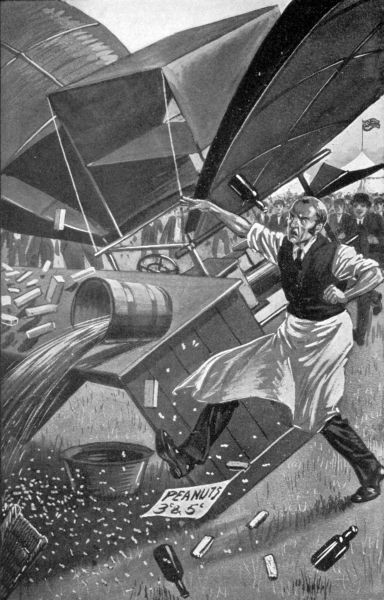
“THERE WAS A RESOUNDING CRASH!”
All at once there flew in all directions packages of candy, popcorn and boxes of other confections. One pail of pink lemonade was tossed high into the air, and, turning over, poured out a crimson flood, which sprinkled the bystanders. Bottles of root-beer and ginger ale mingled with sarsparilla in forming a shower of cooling drinks. There was a hail of peanuts.
The big tin wings, hampered in their movements by the wreck of the stand, came to a stop. But the motor went on. It was now running at full speed, free, and its momentum was terrific. There came several explosions, louder than any that had preceded.
“Look out! She’s going to blow up! The gasolene tank will explode!” cried the fat man.
The crowd, which had gathered about the wreck, scattered on the run.
Once more came a loud explosion.
“There she goes!” yelled several.
But there followed only a whistle, a wheeze, and a sort of apologetic cough from the motor. Then, with a gentle sigh, the overworked machine “went dead” and stopped. But oh what a scene of wreck, ruin and desolation!
CHAPTER VI
NODDY IN A ROW
Following the noise of the swiftly-running motor, the shouts of the crowd and the crash as the lemonade stand was demolished, there came a period of silence. No one seemed to know what to do or say.
Jerry and his chums watched Noddy pick himself up from a pile of soft dirt, where he had leaped just before his tin fly crashed into the stand. The bully was a sorry-looking sight, his clothes being thickly encrusted with soil, and his hands and face grimy. He staggered forward and gazed at the wreck.
“Well, it didn’t fly, and I knew it wouldn’t,” observed the fat man. “I told you it was too heavy.”
“Don’t—don’t speak to me!” exclaimed Noddy wrathfully.
“Don’t speak to you! Well, I like that! I guess I will speak to you long enough to ask you for my hundred dollars. I won it on a fair wager, and I want it. Here,” he said to the man who had held his share of the bet, “give me my money. I’m entitled to his, ain’t I?”
“You sure are,” said several in the crowd who had heard the bargain Noddy had made.
“I wish I’d made him put his money up,” went on the fat man. “Come on now, Professor Nixon, or whatever your name is, fork over that hundred dollars. It will come in handy for me. That thing fly! It’ll never fly in a hundred years!” and he began to laugh, which further nettled Noddy.
“I’ll make it fly yet!” said the bully, gritting his teeth. “Something went wrong with the machinery.”
“I should say it did,” went on the fat man.
“It’ll need a lot of repairs before it will flop its wings again,” observed Andy Rush, who was in the front rank of spectators. Noddy heard him, and turned savagely on the little chap.
“You mind your own business!” he exploded. “If I catch you around my machine I’ll have you arrested. I believe you sneaked in and monkeyed with it so I couldn’t fly. I’ve a good notion to punch your head.”
“Better not try it,” advised Jerry quietly. “And you have no right to say Andy did anything to your machine. He was nowhere near it, except when we were with him.”
“Well, maybe you had a hand in it,” murmured Noddy. “You’re jealous of me, that’s what you are.”
“Here, you drop that kind of talk!” exclaimed Jerry, striding forward. “We know you, Noddy Nixon, and we know your crony, Bill Berry. If you don’t keep a civil tongue in your head we’ll see that you’re put out of this carnival. We never touched your crazy tin fly, and we’re not jealous of you. If we couldn’t get up a better airship than that we wouldn’t have any.”
“That ship is all right. All it needs is a little fixing,” went on Noddy, taking care to keep well away from Jerry.
“Who owns this thing?” suddenly asked the stand owner, as he came from a silent contemplation of the wreck and ruin and approached the crowd.
“He does!” exclaimed half a dozen persons, pointing at Noddy.
“You did that on purpose! You know you did! I saw you steering straight for my stand,” cried the man. “I want damages now—heavy damages! Everything is spoiled, and it cost me fifteen dollars to build the stand, besides all the things I had. I must have damages.”
“Oh, dry up!” retorted Noddy, who had had about all he could stand in the way of misfortune.
“‘Dry up,’ eh? I’ll show you!” cried the man. “Are you going to pay me for my things?”
“It was an accident. I couldn’t help it.”
“What difference does that make to me? That won’t bring back my lemonade. That won’t wrap up the popcorn in packages again. That won’t mend the broken bottles of ginger ale. I want damages, and I’m going to have ’em.”
The man was so insistent, and stood close to Noddy in such a threatening manner, that the bully was alarmed. He shrank back.
“It was an accident,” he repeated. “I couldn’t help it. Something went wrong with the engine. I’m—I’m sorry.”
“A heap of good that does me!” cried the angry stand owner. “I want my things, or I want pay for ’em. I must have fifty dollars, or I’ll have you arrested for malicious mischief. I saw you steer your crazy machine right my way. You could easily have flown above me, instead of landing in my stand.”
“He couldn’t fly—that was the trouble,” said the fat man, chuckling. “He couldn’t fly. I guess we’ll call what’s left of his machine the ‘flyless-fly,’ instead of the Firefly. Ha, ha! Ho, ho!”
“I’ll—I’ll——” spluttered Noddy, but he did not know what to say.
“Well, are you going to pay me damages?” demanded the stand owner. “I want fifty dollars.”
“I—I haven’t any money here,” said Noddy.
“You haven’t any money? And yet you made a wager with me for one hundred dollars!” cried the fleshy individual. “I like your nerve! How were you going to pay me, I’d like to know?”
“I didn’t think I’d lose,” explained Noddy. “I thought I’d fly.”
“And where is my fifty dollars coming from?” again demanded the stand owner. “I want it and I’m going to have it. Here the carnival has opened, and I can’t do any business until I get a new stand. I ought to soak you a hundred dollars.”
“That’s right! Make him pay!” cried the throng.
“Look here!” exclaimed Noddy angrily, “I haven’t any money, and I can’t pay.”
“Then you had no right to make a wager with me,” said the fat man. “I put up my money, and you said you’d put up yours.”
“I want my fifty dollars!” was the burden of the cry set up by the stand owner. “You’re a nice one, to go smashing people’s property, and then not pay! If it had been an automobile man he’d pay me right off, but you airship fellers ain’t no good.”
“Oh, let me alone!” cried Noddy. “If any one bothers me any more I’ll punch his head. Let me get my machine out of that stand.”
“Not until you pay me my fifty dollars,” insisted the lemonade man.
“And I ought to hold at least one wing as security until I get my hundred,” put in the fat man.
Noddy was beside himself with rage. He looked as if he wanted to fight the whole crowd. There was a movement on one edge of the throng, and a man pushed his way through.
“What’s the matter, Noddy?” he asked quietly.
“It’s Mr. Nixon, Noddy’s father,” exclaimed Jerry.
“Oh, I—I had a little accident,” explained Noddy to his parent, who had just arrived on the grounds, expecting to see his son sailing about in an airship, for Noddy had boasted much of his Firefly.
“An accident? I should say you did,” remarked Mr. Nixon, who, though he usually took the part of his bullying son, could at least see such an obvious happening as was spread all about.
“Yes, he busted my stand all to pieces, and I want damages,” said the owner, seeing a possible chance for reimbursement.
“And I’d like the hundred dollars I won from him,” added the stout man.
“That’s right,” chorused the crowd, as Mr. Nixon looked at his son for confirmation of these charges. “He made the bet and he smashed the stand.”
“Hum!” murmured Mr. Nixon. “Very well, I will settle for him. Where is your tent, Noddy?”
The owner of the wrecked Firefly pointed to the canvas structure.
“Come over there,” went on Mr. Nixon to the fat man and the stand owner, “and I will pay you. Come, Noddy.”
“But—but my airship?”
“Let it go. It’s only junk now. You can take the engine out later, and throw the rest on the scrap pile.”
Mr. Nixon led his son away, and the crowd dispersed, for it wanted to see the other sights. Thus ended Noddy’s first attempt to navigate the air. The accident was destined to have an effect on the future of the motor boys, as you shall see.
CHAPTER VII
IN GREAT PERIL
The carnival was now in full swing, though not all the exhibits and flying machines had arrived. There was plenty to attract attention beside the airships, for there were several amusement enterprises on the grounds, and the usual devices to catch the dimes and nickels of the throng.
“Well, let’s take a look around. I guess we saw all we wanted to of Noddy,” said Bob. “Are there any more queer machines?”
“Plenty of them,” replied Jerry, “to judge by the tents where they are charging admission.”
“Let’s take ’em in,” suggested Ned. “We want to get all the ideas we can.”
“Why?” inquired Andy Rush. “Are you going to build one?”
“Maybe—some day,” replied Ned.
“So you’re getting the fever too, eh?” asked Jerry with a smile. “Well, it’s not a bad idea. I want to see the aeroplane trials. I’m interested in them.”
“They’ll come off at ten o’clock,” said Bob, looking at a program he had purchased. “We’ve got an hour yet, and likely more, for they’ll never start on time.”
“Then let’s look at some more of the freaks,” suggested Jerry.
They found several odd machines housed in tents, or hastily constructed buildings, where from ten cents to a quarter was charged for viewing the product of some inventive brain.
One machine was merely a double bicycle, with a sort of roof overhead made of canvas, and a motor attached, which revolved a two-bladed propeller in front. Another was a sort of aeroplane affair, with two propellers in the rear, and still another was the one modeled after a flying grasshopper, shown by Morris Abernot.
The boys noticed that, as a general thing, the propeller or propellers of all the machines were mounted in front, to pull the ships through the air, instead of acting on a boat principle, and pushing them. But, even with all the power that large motors could impart to the blades, it was difficult to see how some of the machines could rise from the earth, so heavy were they.
The boys concluded, and they were not far wrong, that the machines were merely the output of some freakish brain, that was rather warped on the side of air navigation. Some of the affairs had one or more correct principles, but as for ever being practical they were so far from it as to be laughable.
Nor did the crowd hesitate to laugh whenever it saw anything that seemed grotesque, for some of the affairs were weird in the extreme. There were machines built on the models of birds, fishes and insects, which the inventors had doubtless studied with a firm belief that they could successfully imitate nature.
Probably some of the inventors knew their machines would never leave the earth, but, having gone to the expense of making them, they wanted to get a little money back by charging for a sight of them. And, very likely, the management of the carnival knew that the machines would not work, but probably reasoned that the crowd would like to look at them and derive some fun from the crude attempts to navigate the upper regions.
Certainly Noddy’s efforts furnished considerable amusement, and not a little excitement.
It was about ten o’clock when, having made the rounds of the “freaks,” as they called them, the boys strolled toward the section devoted to the aeroplanes. Not all of these machines had arrived yet, but several were on hand, and it was announced that at least one inventor would give his a trial, preparatory to the races the next day, when there were to be competitions for prizes.
“Let’s get good places to see,” proposed Bob.
“The starting platform would be the best place,” said Jerry. “We can get up there for a quarter each, and we’ll have a good view of how they start and manage the planes.”
As is well known, aeroplanes need a sort of flying start in order to become effective. They must get some distance up into the air, like a kite, before they can sustain themselves.
Some machines accomplish this by gliding forward on wheels until they have enough momentum to shoot upward on a plane of air, which catches under the big wings, while others are launched from a high platform or framework by means of men pulling on a long rope, or by weights, springs or similar devices.
At this carnival a high platform had been erected, from which the aeroplanes could shoot off, and once they were started the motor operating the propellers was depended on to keep them in motion, and so up in the air.
The platform was made quite large, to accommodate a crowd, and thither the boys went, getting good places, as they were among the first comers.
“Say, we’ll get a fine view from up here,” declared Bob as he gazed about.
“That’s right—see everything—watch the human birds skim about—swoop this way and that—over our heads—up to the clouds—out of sight—down again——”
“That’ll do, Andy,” spoke Jerry. “Save your wind; you’ll need it later.”
There were to have been tests of two aeroplanes, but at the last minute one inventor sent word that his motor was out of order, and he would have to postpone his trial until the afternoon. There was some disappointment and murmuring by the crowd, but when the canvas front of a shed near the platform opened and a curious machine was wheeled into view, there were exclamations of satisfaction.
“They’re going to have some sort of a test, anyhow,” remarked Bob.
The aeroplane which was being wheeled toward the platform was like many others which you boys have either seen in pictures or actually observed. It consisted of a structure like an immense box-kite, canvas being stretched over a bamboo frame. In front of the main part was a smaller box-kite arrangement, that could be tilted, so as to cause the plane to shoot upward or downward. In the rear was a triangular rudder, and in front, below the device which governed the elevation, were two wooden propellers, worked by a small gasolene motor amidships. There was a sort of box in which the operator could sit.
“This machine,” announced the chairman of the arrangement committee, “is the invention of Professor Dundlass——”
“Seems to me everybody around here is a professor,” murmured Ned. “We’ll have to tack some titles to our names, Professor Hopkins.”
“Listen to what he says,” counseled Jerry.
“He has made successful flights with it,” went on the chairman, “and he will now attempt another. He asks your indulgence, as in a test last week he strained some of the guy wires and bent the rudder, but he will do the best he can. Later he will enter a race.”
“Seems as though there was always some excuse for these airship men,” murmured Ned. “I guess each wants to have something ready to spring on the crowd in case his machine doesn’t work.”
But the boys were now too interested in what was going on to indulge in much talk. They watched the inventor and his men wheel the aeroplane to the foot of the platform, and then, by means of ropes and pulleys, it was hoisted up to where there was a sort of inclined track, whence it could glide off.
The machine looked as if it would work. Certainly if a big box-kite can not only sustain itself in the air but also support heavy flags, banners and even dummy figures, as is often done, a machine built on the same principle, only much larger, ought to hold up a man and a small engine.
“This is more like it,” said Jerry when Professor Dundlass was adjusting his motor. “It’s a wonder Noddy didn’t try something like this.”
“Oh, he wanted to be different,” observed Bob.
“Well, he was,” commented Ned dryly.
The aeroplane was now resting on its runners upon the inclined track, which had been made very slippery with soap and grease, as are the ways when a ship is launched. Several men were detailed to give it a push when the inventor was ready to glide off.
But Professor Dundlass seemed in no hurry. He moved slowly about, looking at wires here, braces there, testing his propellers with his hand, looking at the rudder and putting some more oil on the motor.
“Oh, move the boat!” cried an impatient one.
“I go pretty soon quick now,” replied the inventor, speaking with a German accent. “But first I must be sure I am all rights. It iss no jokes to fall down from der clouds.”
“That’s right,” agreed the throng in a chorus, and thereafter no one urged him to hurry.
There was a big crowd down on the ground around the platform, and as many on that elevated place as could get upon it and still leave room for the aeroplane. The structure was about sixty feet high.
At last the professor announced that all was in readiness. There was not a little nervous feeling among those in the throng, for though some had seen balloon ascensions, this was different—to see a man trust himself to a machine that was much heavier than air.
“Now, you had betterness stant from under ven I start,” called the inventor to those directly in front of the platform. “If I falls on you I might hurt some of you.”
He seemed very cool, in spite of what was evidently a dangerous undertaking that was before him. There were some final instructions to the men who were to shove the plane off, and then the inventor, taking his seat in the little box-like car, told one of his assistants to start the motor. The long-bladed propellers began to whirl around so rapidly that they looked like a yellow haze of light, and the motor, from not being muffled, as that would have made it too heavy, made a terrific racket.
“Shove!” cried the professor suddenly, as he yanked on a lever, and the ten men behind the machine gave a vigorous push.
With a graceful motion, like some great, white-winged bird sailing on a flight from the sky, the aeroplane swooped from the platform. There was a yell from the crowd, and those who, in their enthusiasm, had gathered beneath where it now was hovering over their heads, scrambled to get out of the way, fearing it was falling down on them.
But with a wide sweep, the plane began to ascend. The air caught under the forward box-kite arrangement, and the airship slid upward in a long, graceful curve.
“He’s going up! He’s going up!” cried Jerry in his enthusiasm. “This one works all right!”
“He’s higher than the platform now!” added Ned, and this was so, for the man in the aeroplane was now about seventy feet above the earth. The speed of the motor increased, to judge by the more rapidly recurring explosions, and then, with a shift of the rudder, the inventor changed the course of his machine.
He was now gliding broadside to the platform, and those upon it had an excellent view. There was a great cheer to gladden the heart of the professor.
Once more he shifted his course and made a complete circle. Then he turned and sailed off, directly away from the platform. When several hundred yards off he turned again, and came straight for it.
“He has it under good control,” remarked Ned. He had spoken quietly, but so great was the silence maintained by those watching the airship in flight that his voice almost startled him.
“He’s going to make a landing,” observed Jerry. “He’s coming right for the platform. I wonder if he can come down safely. I should think he’d rather land on the ground.”
They could see the inventor busy with various wheels and levers. The device for changing the elevation of the plane was lowered. On and on came the big affair, right for the platform.
Suddenly there came a powerful gust of wind, which was most unexpected, as there had not been so much of a breeze before that. Those watching the aeroplane saw it tilt to one side.
“It’s going to turn over!” cried several.
Indeed, it did seem so, for it was gliding along at an angle of forty-five degrees. The inventor appeared to be in trouble, and was now clinging with both hands to the sides of his little car.
There came a stronger puff of wind. The aeroplane dived downward and then sailed upward, as does a kite when the tail is not properly adjusted. Then, with a swoop like some gigantic eagle, hurling itself upon its prey, the aeroplane dashed right toward the platform, which was now thronged with people. The inventor had lost control of it in the powerful wind that was now blowing.
“Look out! Here she comes!” was the general cry.
There was a scramble on the part of the throng to get to a place of safety, but there was no place to go. The narrow flight of steps, more like a ladder than anything else, leading from the ground to the top of the platform, was jammed by those seeking to escape.
“It’s going to land right here where we are!” cried Andy Rush. “Let’s jump off!”
“Stand still!” shouted Jerry. “If you jump you’ll be killed. Stand still! He may get control of it again.”
But it did not seem possible, though the inventor was working frantically to change the course of his plane, which was now almost upon the platform, over which it appeared likely to sweep, and only a few feet above it.
In another moment it seemed as if scores of people would be either swept off the high place and dashed to the ground, sixty feet below, or would be hit by the aeroplane. The motor boys and those about them were in great peril.