


автордың кітабын онлайн тегін оқу The Motor Boys on a Ranch; or, Ned, Bob and Jerry Among the Cowboys
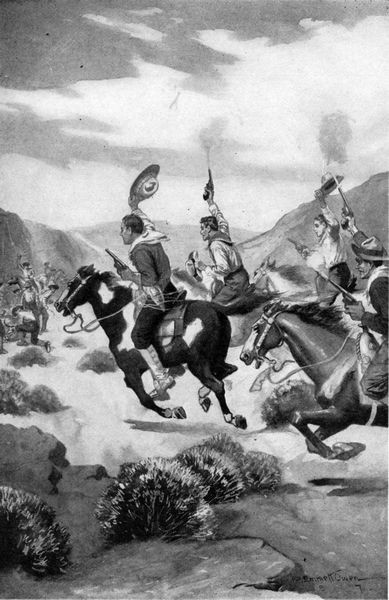
WITH A FUSILLADE OF REVOLVER SHOTS THE RAIDERS RUSHED TO THE ATTACK.
THE MOTOR BOYS
ON A RANCH
OR
Ned, Bob and Jerry Among
the Cowboys
BY
CLARENCE YOUNG
AUTHOR OF “THE MOTOR BOYS SERIES,” “THE JACK
RANGER SERIES,” ETC.
ILLUSTRATED
NEW YORK
CUPPLES & LEON COMPANY
BOOKS BY CLARENCE YOUNG
12mo. Cloth. Illustrated. Colored Jacket.
THE MOTOR BOYS SERIES
- THE MOTOR BOYS
- THE MOTOR BOYS OVERLAND
- THE MOTOR BOYS IN MEXICO
- THE MOTOR BOYS ACROSS THE PLAINS
- THE MOTOR BOYS AFLOAT
- THE MOTOR BOYS ON THE ATLANTIC
- THE MOTOR BOYS IN STRANGE WATERS
- THE MOTOR BOYS ON THE PACIFIC
- THE MOTOR BOYS IN THE CLOUDS
- THE MOTOR BOYS OVER THE ROCKIES
- THE MOTOR BOYS OVER THE OCEAN
- THE MOTOR BOYS ON THE WING
- THE MOTOR BOYS AFTER A FORTUNE
- THE MOTOR BOYS ON THE BORDER
- THE MOTOR BOYS UNDER THE SEA
- THE MOTOR BOYS ON ROAD AND RIVER
- THE MOTOR BOYS AT BOXWOOD HALL
- THE MOTOR BOYS ON A RANCH
- THE MOTOR BOYS IN THE ARMY
- THE MOTOR BOYS ON THE FIRING LINE
- THE MOTOR BOYS BOUND FOR HOME
THE JACK RANGER SERIES
- JACK RANGER’S SCHOOLDAYS
- JACK RANGER’S WESTERN TRIP
- JACK RANGER’S SCHOOL VICTORIES
- JACK RANGER’S OCEAN CRUISE
- JACK RANGER’S GUN CLUB
- JACK RANGER’S TREASURE BOX
Copyright, 1917, by Cupples & Leon Company
The Motor Boys on a Ranch
Printed in U. S. A.
CONTENTS
CHAPTER
PAGE
I.
Disappointment1
II.
Hint of a Mystery11
III.
When the Wheel Came Off18
IV.
“We’ll Stop It!”27
V.
Last Days at Boxwood36
VI.
Off for the West47
VII.
The Stowaway55
VIII.
A Breakdown63
IX.
The Cattle Buyer72
X.
A Midnight Alarm81
XI.
At Square Z Ranch89
XII.
Explanations95
XIII.
A Sensation102
XIV.
An Old Acquaintance111
XV.
Out of the Air118
XVI.
The Wrong Pony127
XVII.
Another Raid135
XVIII.
Two Invalids142
XIX.
Another Attempt151
XX.
The Professor’s Dilemma158
XXI.
Queer Marks167
XXII.
Anxious Days174
XXIII.
Letters from Home180
XXIV.
Questions188
XXV.
Their Last Chance197
XXVI.
Seen from Above203
XXVII.
The Lone Figure210
XXVIII.
The Secret Passage217
XXIX.
The Round-Up223
XXX.
A Final Surprise234
LIST OF ILLUSTRATIONS
WITH A FUSILLADE OF REVOLVER SHOTS THE RAIDERS RUSHED TO THE ATTACK. HE MADE GOOD WORK OF BROILING THE CHICKENS. “THEY’RE NOTHIN’ BUT BOYS AND TENDERFEET AT THAT!” “GO SOME” TURNED AND RUSHED AT THE PROSTRATE, MOTIONLESS FIGURE.NED, BOB AND JERRY ON A RANCH
CHAPTER I
DISAPPOINTMENT
“Might have known it would turn out this way if we let him manage things,” grumbled Ned Slade in disgusted tones as he slumped down on one of the forward lockers of a motor boat that was drifting slowly in the middle of a blue lake. “Why didn’t you look after the details yourself, Jerry?”
“Why, Bob said he would see that everything was all right and——”
“Yes! And this shows how much he ‘saw.’ A chap with compound astigmatism in both blinkers could see better than Bob Baker!”
“Oh, come now,” protested Jerry Hopkins in soothing tones. “Aren’t you a bit rough on our fat chum,” and he glanced toward a stout chap who was bending over the motor of the boat, tinkering with its various parts in an endeavor to set it going again.
“Rough on him?” expostulated Ned. “I should say not! I’m like a piece of silk compared to a bit of sandpaper when I think of the things I could say—and haven’t the heart.”
“Don’t stop on my account!” snapped the heavy-weight, over his shoulder. “Get it out of your system and maybe you’ll feel better.”
“I won’t feel better until you get the engine started, so we won’t have to stay out in this broiling sun. And to think there’s a fine feed waiting us at the other end of the lake if we could only get to it! I should have thought you’d have had common sense enough, Bob, where the eats were concerned, to make sure of getting to them.”
“Say! Look here!” and Bob turned fiercely on his tormentor. He tried to seem angry but the effect of a smudge of oil on one cheek, with a daub of black grease on the end of his nose, while one eye appeared as though it had come off second best in a fistic encounter, caused his two companions to laugh, which altogether spoiled the effect of the vigorous protest on which the youth had started.
“How did I know this was going to happen?” he asked, waving a grimy hand at the engine, while, with the other, he beat a tattoo with a monkey wrench on the nearest cylinder. “Could I tell she was going to break down as soon as we got out in the middle of the lake?”
“Break down nothing!” scoffed Ned. “You’re out of gasoline, that’s what’s the matter. You didn’t have sense enough to see that the tank was full before you started.”
“Huh! I s’pose you never overlook a little matter like that?” sneered Bob.
“Of course not,” and, having spoken thus loftily, not to say superciliously, Ned turned away and gazed across the blue waters of Lake Carmona, now sparkling and rather uncomfortably hot under the June sun.
“Guess you don’t remember the time you invited the girls out in the car and got stalled on Mine hill just because of the same little old fact that you forgot the gas?” asked Bob. “How about that?”
“There was a leak in the tank,” defended Ned.
“It takes you to tell it.”
“Oh, dry up and get started!” exclaimed the other.
“Easy, boys,” counseled tall Jerry Hopkins. “This won’t get us anywhere. Is the gasoline really gone, Bob?”
“I guess it is,” answered the stout lad. “I did forget to have ’em put some in the tank, but I thought there was enough for the trip. Anyhow, you needn’t worry about starving. I put in a little sort of snack, as I thought we might get hungry on the way.”
A smile replaced the frown that had come over his face during the contention with Ned, and Bob brought forth from a locker a large box wrapped in paper.
“Look what he calls a little snack!” mocked Jerry, laughing. “There’s enough for a whole day’s rations.”
“Oh, not quite,” declared the stout lad. “This lake air gives me a wonderful appetite.”
“Never knew you to be without an appetite,” commented Ned, and his voice was more friendly. “I’ll take back some of what I said, Bob. But for the love of sulphur matches, what are we going to do? Eating, pleasurable as it is, isn’t going to move the boat.”
“I’ve a little gasoline in the can that I use for priming the cylinders,” returned Bob, after rummaging in the engine locker. “That might take us a little way.”
“Pooh! not a hundred yards,” scoffed Ned.
“Anyhow, lack of gasoline isn’t the only trouble,” went on Bob. “One of the cylinders doesn’t work. It began missing a while back, before the gas gave out. Even with a tank full I couldn’t run the boat until that’s fixed.”
“You get out!” advised Ned. “You forgot the gasoline and that’s all there is to it. And you wanted to have charge of all the arrangements on this little cruise. Well, you’ve had your way, but you won’t again if I know it.
“There’s nothing to do now but row,” he went on. “Not another boat in sight and there isn’t any likelihood of any coming up to this end of the lake to-day. They’re all down at those races. We’re booked for a row, and we ought to make you do it all, Bob Baker.”
“I’ll do my share,” offered the smutty-faced, fat engineer.
“Break out the oars!” cried Jerry. “Never say die! It might be worse. It’ll give us an appetite—rowing. It might be a whole lot worse.”
Ned went aft to where, in a space along the locker tops, the emergency oars were kept. He turned to Jerry and said:
“It couldn’t be!”
“Couldn’t be what?” the tall youth asked in some wonder.
“Any worse. There aren’t any oars!”
“No oars?” cried Jerry.
“Nary an oar!”
Both lads gazed at Bob. He regarded them with a crestfallen countenance.
“Aren’t—aren’t they there?” he asked falteringly.
“Look!” and Ned pointed to the vacant space.
“Hang it all! I did take them out when I was at the dock,” Bob admitted. “I couldn’t get at what was in the locker with the oars on top, so I laid them on the wharf. I meant to put them back again, but——”
Ned groaned and pretended to weep with his head hidden in his arms. Jerry smiled grimly. Bob scratched his head in perplexity.
“Well, I guess the only thing to do is to let the boat drift and wait for someone to come along and give us a tow,” sighed Jerry. “Meanwhile, there are the eats. Break out the grub, Bob, and we’ll solace ourselves with that.”
“This is the limit!” complained Ned. “If ever I come out with you again, Bob Baker, you’ll know it!”
“And if ever I ask you I’ll kick myself all around the campus,” was the retort.
For a time Ned refused the tasty sandwiches which the stout lad had, with prudent foresight, stowed aboard the motor craft. But the appetizing odor was too much for him and he capitulated, but in no good spirits.
“Cheer up,” advised Jerry. “You’ll get indigestion if you eat with such a sour face, Ned. We’ll get there some time.”
“Yes, and find that my father and Bob’s have gone on with their trip and we have missed seeing them. Dad was going to bring me some dough, too. And I need it,” he added as he turned his pockets inside out. “Not a nickel left, and I want to get tickets for the show to-night.”
For a time the spirit of gloom seemed to settle down over the motor boat and her occupants.
The three chums, Ned, Bob and Jerry, had set off early that afternoon from Boxwood Hall, where they were students, to cross Lake Carmona. They were going to Haredon, a small town on the other side of the body of water, and there Ned and Bob expected to meet their respective fathers who were on a business trip together, and had written that they would stop off to see their sons, and have dinner with them, before resuming their journey.
The boys had hired a large motor boat, as their own, the Neboje, as well as their automobile, had already been shipped to Cresville because of the approach of the summer vacation, and started on the trip. The details of the expedition had been left to Bob. Jolly and good-natured, Bob never thought very far ahead, and the double calamity of not having had the gasoline tank filled and having taken out the oars, by which the boat could have been surely, if slowly, propelled, had left the boys becalmed in the middle of Lake Carmona on a hot day.
Owing to the fact that there were some races being held on this day, nearly all the other students had gathered at the lower end of the lake, as had most of the craft of persons living on the shores. This made the middle and upper end deserted of the usual flotilla; so there was scant chance of the boys getting a tow.
They ate for a while in silence, and then Bob had an inspiration.
“I believe it will work!” he cried.
“What now?” asked Ned. “Have you found some way of getting ashore and buying some gasoline?”
“No, but we can put up a sail,” Bob went on. “Here’s the boat hook, and the canvas cover of the engine is stuffed away in the stern.”
He scrambled aft, hauled out a bundle of canvas, and then got the boat hook. For a few seconds Ned and Jerry watched him. Then the tall lad said:
“I believe it will work at that. Bob, you’re not so worse.”
The motor boat, being heavy, did not move very fast under the small sail area the boys spread. But at least they did move, and it was better than being becalmed under a hot sun.
They sailed on for perhaps two miles when they spied another motor boat which was evidently going to pass near them.
“Hail him!” suggested Ned, and they attracted the attention of the lone skipper by toots on the electric horn. The man was a baker who made the round of the shore resorts delivering bread and pastry. He agreed, for a small sum, to tow them to Haredon and, several hours after they had expected to arrive, the boys reached the hotel where Mr. Baker and Mr. Slade had promised to meet them.
“Your fathers aren’t here now,” the clerk told them. “They waited until the last train, then said they’d have to go. They left a note for you, however,” and he handed over a long envelope.
“It’s for you, Ned,” said Jerry, reading the superscription.
“But there’s something in it for each of us,” Ned declared, opening the envelope.
“Mine’s a letter from mother,” Jerry remarked, as he recognized his parent’s handwriting. Mrs. Hopkins was a widow.
“Mine’s from dad—short and to the point,” chuckled Bob. “He says he reckons I took so much time to eat that I missed connections and couldn’t arrive on time. They’ll be here again next week, though.”
“That’s what my father says,” sighed Ned. “Well, it’s a disappointment,” he went on, turning over the paper in his hand, “especially as I did need that money.”
“Maybe he left some for you with the hotel clerk,” suggested Bob. “Ask, and, if he didn’t, I can lend you some.”
“Thanks,” returned Ned. “I’ll ask.”
The hotel clerk was apologetic enough, but, unfortunately, no money had been left for any of the boys. Ned turned away, disappointment showing on his face. As he was debating with himself what was best to do he saw, on the floor, half concealed by a time-table rack near the front desk, a folded paper.
Half mechanically, he picked it up, unfolded it and, as he glanced over the first few lines of writing, uttered an exclamation of surprise.
“What’s the matter?” inquired Jerry. “Did you find some money after all?”
“Not quite as good as that,” was Ned’s answer. “This seems to be a letter to my father from his ranch foreman. Dad must have dropped it from his pocket when he was standing here paying his bill. And it’s got some news in it, fellows! Listen to this!
“Rustlers have been stealing cattle from the ranch, and the foreman suggests that dad come out in a hurry, or else send someone, to take quick action, as they haven’t been able to get the thieves. This is bad business sure enough!” and Ned’s face took on a serious look.
CHAPTER II
HINT OF A MYSTERY
“What’s that?” asked Jerry Hopkins, sharply. He had been reading over again a portion of his mother’s letter, and had not quite caught what Ned had said. The latter repeated his statement.
“Cattle rustlers! Plain thieves, in other words; eh?” exclaimed Jerry. “That’s no joke out West, I believe. In the early days ranch owners used to suffer big losses from the acts of rustlers, but I thought it had all died out.”
“It doesn’t seem to have done so—not on dad’s ranch,” went on Ned. “This letter from the foreman must have been quite a shock to him. He got it a day or so ago, I guess,” and Ned glanced at the date.
“I didn’t know your father was interested in a Western ranch,” remarked Jerry.
“It’s a comparatively new venture for dad—going into the cattle business,” Ned replied. “He figured, though, that with the price of beef as high as it is, and going higher, he could make money. But I guess if this sort of thing keeps up he’ll come out the little end of the horn. I’ll read the letter to you.”
And while Ned’s chums gather around to hear the letter, which he prepared to explain, I will take just a moment to give my new readers, who may meet Ned, Bob and Jerry for the first time in this volume, an idea of the books that precede this.
Under the name, “The Motor Boys,” our three heroes made their first bow to the public. The boys lived in Cresville, not far from Boston, and had many good times together. Jerry Hopkins was the son of Mrs. Julia Hopkins, a wealthy widow. Aaron Slade, Ned’s father, was a prosperous department store keeper, and Andrew Baker was president of the largest bank in the city where he lived.
The boys’ first experiences with gasoline vehicles had to do with motorcycles, but it was not long before they had an automobile, and in that they took many trips, overland, into Mexico, over the plains and home again. Then the motor boys went in for boating, and sailed not only on the Atlantic and Pacific Oceans but in strange waters.
On many of their trips the boys were accompanied by Professor Uriah Snodgrass, and he did not balk even when they went in for airships, in which line of locomotion they were very successful. Professor Snodgrass—at present an instructor in Boxwood Hall—was a great seeker after queer forms of insect life and his zeal sometimes got him into odd predicaments.
I had the pleasure, in a number of volumes, of telling you of the activities of the motor boys until it seemed there were no more worlds left for them to conquer. But they heard the call of the under sea, and, venturing into a submarine, they found life beneath the waves fully as remarkable as above, if not more so.
The parents of the boys began to think the lads were getting too much idle fun. They wanted their sons to have a better education. So our three heroes had been sent to a boarding school. “The Motor Boys at Boxwood Hall, or, Ned, Bob and Jerry as Freshmen,” the volume immediately preceding this, tells of new adventures for Ned Slade, Bob Baker and Jerry Hopkins.
Of the merry times they had, and how they were instrumental in “putting Boxwood Hall on the map,” in athletics, you may read in that book. This present story opens with the boys coming to an end of their first year in the place, with the prospect of a long summer vacation, and at this moment we find them puzzled over the foreman’s letter to Mr. Slade.
“He says,” began Ned, reading the missive again. “He says——”
“Who’s he?” demanded Jerry.
“Dick Watson, foreman of dad’s Square Z ranch,” explained Ned.
“Square Z ranch—what does that mean?” asked Bob.
“Guess you’ve forgotten all the western lingo you used to know, haven’t you?” Ned asked. “The brand on dad’s cattle is a Z in a hollow square, and his ranch is named that.”
“Cut out the explains,” begged Jerry, “and get down to facts. What about the cattle rustlers?”
“Well, Dick writes dad that a lot of his choice stock has been run off the ranch,” went on Ned, reading the letter and summarizing the information he gathered from it. “It isn’t the first time, it seems, for the thieving had been going on before dad bought the place. Dick was foreman then and dad kept him on,” Ned explained. “He’s one of the best there is, so all reports of him say.
“But he writes that never before were the cattle thieves so bold or so successful. They have wiggled out of every trap set for them and seem to laugh at the cowboys. Dad’s ranch isn’t the only one that has suffered either, for Dick tells of others. He ends up his letter by warning dad that he’ll have to do something if he doesn’t want to lose all he invested in the place.”
“And something ought to be done!” declared Bob. “Think of all the prospective roast beef that’s being stolen! Those cattle thieves ought to be—they ought to be——” and Bob paused to consider a punishment to fit the crime.
“They ought to be kept on a vegetable diet!” laughed Jerry. “That would leave so much more roast beef for Bob—eh, Chunky?”
“Well, I’d like a chance to chase after ’em,” declared the fat lad. “What’s your father going to do, Ned?”
“I don’t know. This is the first I have heard about it. I suppose I’d better send this letter back to him. He may want it to refer to.”
“Too bad we missed him—and my dad, too,” put in Bob. “I’m sorry I forgot about the gas, but——”
“Oh, well, there’s no use worrying about it now,” was Ned’s philosophical comment. He was now in better humor. “If I only had some of the money I’m sure dad would have given me——”
“Here!” cried Bob, eagerly producing a few bills. “Take half of this until you can get yours. I sha’n’t need it. Besides, I’ve got credit with the proctor.”
“I haven’t—worse luck,” grumbled Ned. “Well, I’ll take this, and make you an I. O. U. later. Thanks. And now let’s have a real meal. Ah, I beat you to it!” he exclaimed as he saw Bob about to make the same suggestion. “We’ll eat and go back to Boxwood. Then I’ll write to dad and send him this letter.”
The meal progressed merrily. It was a holiday at the school, the occasion being the regatta on the lower end of the lake, and the boys, having already missed the racing, were in no haste to return.
“Make sure you have plenty of gas this time, Bob,” advised Ned, as the three went down to the dock where the motor boat was tied.
The trip back was uneventful, if we except the fact that Bob nearly fell overboard when making a sudden grab for his hat that had blown off.
“Yes, this sure is queer business,” said Ned, musingly, when the three chums were gathered in his room, which adjoined the apartments of Bob and Jerry.
“What’s queer?” the tall lad questioned, rather absent-mindedly.
“This cattle-stealing out on dad’s ranch,” and Ned glanced over the foreman’s letter again.
“Seems to interest you,” observed Bob.
“Sure! Why wouldn’t it? What gets me, though, is why the foreman or some of his cowboys on the ranch haven’t been able to get on the trail of the thieves. Watson seems to think there is something of a mystery about it.”
“How mystery?” inquired Jerry.
“In the way the rustlers cover their tracks after they run off a bunch of choice steers. There’s something queer about that. I may have to take a trip out there myself, and help clear up the mystery,” and Ned assumed a whimsical air of importance.
“Mystery; eh?” cried Chunky. “Say, I wouldn’t mind taking a chance at that myself!”
“Not so bad,” came drawlingly from Jerry Hopkins. “We haven’t made our vacation plans yet, and trying to find and frustrate a band of mysterious cattle rustlers might not be the worst way of having a good time.”
Something seemed to startle Ned Slade into action. He folded the foreman’s letter, slapped it sharply on the edge of the table and cried:
“Fellows, I’ve got the greatest idea ever! If we three——”
There came an imperative knock on the door, followed by the command:
“Come on! Open up there!”
Startled, the three chums looked at one another.
CHAPTER III
WHEN THE WHEEL CAME OFF
“What was that?” asked Bob, and when it is added that he whispered the question it may better be understood what a hold the finding of the letter had taken on the boys. Already they seemed to be within the mystery at which it hinted.
Then Jerry realized the futility of Bob’s query.
“It sounded very much like a knock on the door,” and his tone was humorously sarcastic.
“Say! are you going to keep me here all day? What’s the matter in there? Open up! I’ve got news for you!”
“It’s Jim Blake!” exclaimed Jerry, now recognizing the voice of the person on the other side of the door.
“Of course it is!” came the reply. “What’s the matter? Is Bob Baker giving one of his spreads? If he is, let a fellow in on it, can’t you? Open the door!”
“Come in; it isn’t locked,” called out Jerry. “But there’s nothing doing in the eats. What’s up?”
“I don’t know,” answered Jim Blake, whose ability to control a slow and fast ball had gained for him the honor of ’varsity pitcher. “I don’t know what it is, but there’s something doing all right.”
“In what way?” Jerry asked, as Jim slumped down in an ancient chair, the joints of which squeaked in protest, thereby moving Jerry to utter a caution.
“Oh, I won’t break it,” said Jim. “But say, do you fellows know that Professor Snodgrass is on his way to pay you chaps a visit?”
“We didn’t know it,” said Bob, coming back from a quiet trip to his own room, meanwhile munching some chocolate, which he generally kept on hand to use in cases of emergency. “No, we didn’t know it, but he’s none the less welcome.”
“Oh, I know he’s quite friendly with you boys,” went on Jim, “but I thought maybe he had it in for you this time.”
“What makes you think so?” asked Ned.
“And how do you know he’s coming here?” was Jerry’s question.
“I’ll answer the last first, like working out some of those tough back-handed problems,” laughed Jim.
“Black-handed, did you say?” came from Bob.
“Pretty nearly that—yes. But the reason I happen to know the professor is coming here is that I passed him in the laboratory hall a few minutes ago. He held something tight in his hand, and he was awfully excited. His clothes were covered with mud, his hat was dented in, his collar torn and his coat was split up the back. He was hurrying along, talking to himself as he often does, and what he said was:
“‘I must get to Ned, Bob and Jerry at once! This is terrible!’”
The three motor boys looked at one another, surprise plainly showing on their faces.
“What——” began Jerry.
“How did he——” Ned commenced.
“Maybe he’s been——” And that was as far as Bob got, for Jim interrupted with:
“I thought maybe you fellows had been up to some game or trick with him, which would account for his condition. And from what he said I thought maybe he was on his way here to have his revenge, one way or another. So I cut on ahead to warn you. Better lock your door and keep quiet. I’ll slip out and——”
“You’ll do nothing of the sort!” exclaimed Jerry. “And we won’t lock our door against Professor Snodgrass. He’s welcome to come in any time he likes.”
“Oh, well, if you’ve made up your minds to take your medicine, why that’s a different proposition,” said Jim with a shrug of his shoulders. “Only I thought I’d tip you off so you could——”
“Thanks, it’s kind of you,” murmured Jerry. “But, as a matter of fact, we haven’t been up to any mischief.”
“But what put the professor in this condition?” Jim demanded. “I know he’s always on the lookout for queer bugs and such things, and that he’ll do almost anything to get a rare specimen. But I never saw him quite so badly off as this before, and he seemed very much in earnest about getting to you. Still you know your own business, I s’pose. Hark!”
They all listened. In the corridor outside the sound of rapidly approaching footsteps could be heard.
“There he is!” exclaimed Jerry, as he opened the door.
In the doorway a queer sight stood revealed. A little bald-headed man gazed unblinkingly through the powerful lenses of his spectacles at the four boys. His condition was just about as Jim had described, and the three chums noted the tightly-clenched hand of the “bugologist,” as the delightful scientist was dubbed behind his back, though with no disrespect attached to it, for the boys were very fond of him.
“Ah, Ned, Bob and Jerry, I am very glad to find you in,” began Professor Snodgrass, with a little jerky bow.
“It’s a good deal better than being found out, sometimes,” murmured Jim. The professor, not having heard the comment, nodded in friendly fashion to the pitcher.
“What has happened?” asked Ned, as he pushed forward a chair for the little man. The teacher seemed rather out of breath and considerably excited.
“What’s the matter?” chimed in Bob. “Is everything all right?”
“Well—yes—I think so—perhaps.” Professor Snodgrass was not quite certain about the matter, it seemed. “At any rate, I have him,” he went on.
“Who?” Jerry gasped. “The person who is responsible for your condition?”
“Oh, no—er—my condition? Oh, I see,” and for the first time the scientist seemed aware that he was greatly disheveled. “I—er—I do seem a bit mussed,” he admitted. That was putting it mildly.
“But I got him,” went on the professor. “Have you a strong box that you aren’t using?” he asked.
The latter, guessing what was coming, produced one that met the professor’s requirements. Then, sliding back the cover, he held his clenched hand over the box and dropped into it something that fell with a thud, like that an inert toad or frog might produce.
“There you are!” exclaimed the scientist, quickly slipping the cover into place. “The finest specimen of a one-spot lizard I have ever caught! I certainly am in luck!”
“One would hardly believe it to look at you,” said Jerry with a laugh. He and his chums were on terms of more or less familiarity with the professor.
The scientist had known the boys a number of years and had made several trips with them. To some his actions might seem grotesque when he was anxiously searching for some rare animal or insect, but the boys knew him well enough to think little of what, to others, might be absurdities. And no one would ever think the professor foolish when once they knew of his attainments. He had written many books, which were authorities on their special topics, and he had more honorary degrees from different schools of learning than he could recall, off-hand.
“You say you caught the lizard, but it looks more as though he had caught you,” laughed Jerry.
“He gave you a pretty good tussle, at all events,” remarked Ned.
“Oh, you are referring to my clothes—and—er—my general condition, I suppose,” said the professor with a smile. “Well, it is not altogether my fault this time. I had little or no difficulty in capturing this lizard, but my appearance is due to what happened when the automobile lost a wheel.”
“Lost a wheel?” chorused the boys. “Were you in an automobile catching lizards?”
“No, I had already captured this fine specimen, and I was riding back with it to the college in the machine, when the wheel came off.”
“What made the wheel come off?” Bob queried. “Must have been a queer kind of machine. Did the wheel just roll off?”
“No, I think it was broken off the axle when the auto toppled down the hill,” said the professor calmly, as he opened the top of the box a trifle to take a peep at his specimen.
“Toppled down the hill! Did an automobile in which you were riding topple down a hill?” asked Jerry in astonishment.
“It did,” the professor answered. “It went over and over. I was made quite dizzy, but I kept tight hold of the lizard. And when we came to a stop, after crashing into a tree, I noticed that the wheel was gone.”
“Great Scott!” cried Ned. “When did all this happen—and where? Aren’t you hurt? Hadn’t you better see a doctor?”
“Ha! I knew there was something I was to remember! It’s a doctor!” cried Professor Snodgrass in triumph. “Your father wants you to send a doctor to him at once, Ned.”
“My father—wants a doctor?” faltered Ned. “What for?”
“Because he was slightly hurt in the same accident when the wheel came off the auto,” gently explained the professor. “It isn’t anything serious, though. He’s at the hotel in town and your father is with him, Bob. That’s what I came to tell you. But there is no need to worry.”
“Well, of all the——” began Ned.
“What in the world——” murmured Bob.
“Don’t stop to talk!” cried Jerry. “Let’s get a machine, hunt up a doctor, and go to the hotel at once. What does it all mean, Professor Snodgrass? No! don’t stop to tell me. You can explain later. Lively, fellows! Come on!”
“Anything I can do?” asked Jim. “Say the word!”
“You might get a machine for us,” suggested Jerry.
“I’ll get Charlie Moore’s,” offered Jim. “He isn’t using it.”
Out he rushed, leaving Ned, Bob and Jerry to get ready, for they had taken off coats, ties and collars on reaching their rooms. They dressed hurriedly, Jerry meanwhile asking Professor Snodgrass if the scientist himself were not in need of medical treatment.
“Not in the least, I assure you,” was the answer. “Fortunately, I was in the rear, among a lot of blankets and cushions, and they made a sort of buffer for me. Your father, Ned, and Mr. Baker were riding in the front seat.”
“But what in the world were they doing in an automobile around here?” Ned questioned. “They were supposed to be in a train making a business trip.”
“They said they had to change their plans, and they were on their way back to Haredon in the auto and, incidentally, they were going to stop off to see you,” explained Professor Snodgrass. “They picked me up along the road. Then the accident happened, and I told them I’d come on and let you boys know. Your father, Ned, said it was very important.”
“Auto’s waiting!” came the hail of Jim from the ground under the chums’ windows, and without waiting for Professor Snodgrass, the boys ran down the stairs.
CHAPTER IV
“WE’LL STOP IT!”
“I can’t understand it,” said Ned, as they swung along in the borrowed car, Jerry driving.
“Nor I,” added Bob. “What are our fathers doing around here now, when they were in such a hurry to be on their way that they couldn’t wait at Haredon when we were an hour or so late?”
The distance from Boxwood Hall to the town of Fordham, the nearest railroad station to the institution, was about two miles, and if speed laws were violated by the boys no one took them to task for it.
Dusk was just settling when they reached the hotel, and the clerk and those in the lobby looked up in surprise as the students rushed across the tiled floor toward the desk.
“Some of that hazing business,” ventured a drummer, as he got out of the way of the rush.
The clerk evidently thought the same thing, and was about to call for the hotel detective and a porter or two (for sometimes the Boxwood lads went in for rather strenuous times), when Ned, noting the looks cast toward them and realizing that their actions were being misconstrued, called out to the clerk before they reached the desk:
“What room is Mr. Slade in?”
“And Mr. Baker, too?” added Bob.
“Oh!” There was distinct relief in the clerk’s voice. “Are you the boys the gentlemen are expecting? Well, you’re to go right up. Front!” he called, and struck a bell which brought a diminutive boy, with two rows of brass buttons down his jacket front, up to the desk on a slide.
“Show these gentlemen up to Number Nineteen,” said the clerk, with a wave of his hand.
“Dis way!” drawled the hotel Mercury, and the three boys followed.
Ned and Bob were, naturally, worried about the physical condition of their fathers, and Jerry was anxious to know what it all meant—Mr. Slade and Mr. Baker coming back unexpectedly from their important business trip to visit their sons at Boxwood Hall.
“Why wouldn’t a letter or a telegram have answered?” Jerry wondered, and Bob and Ned would have wondered also only they were worried lest the accident might have been more serious than the professor had admitted.
A moment later Bob and Ned, with Jerry in the background, stood before the door indicated to them by the bell boy.
“Come in!” called a voice as Ned knocked, and he breathed a sigh of relief as he recognized his father’s tones, their usual vigor indicating that the injuries could not be very serious.
The boys entered to behold Mr. Slade propped up in an easy chair, one leg stretched out in front of him on a pile of cushions placed in another chair, while wound around his head were white bandages.
Mr. Baker sat in another chair, but his legs seemed intact. One arm was in a sling, however, and his face was adorned, or unadorned, if you please, with strips of adhesive plaster.
“Oh, Dad! For the love of football! what have you been doing?” asked Ned, as he advanced toward Mr. Slade with outstretched hand.
“Easy, Son, easy!” cautioned his father. “That leg’s badly bruised. Don’t touch it or inflict any new injury, for I’ll almost have it amputated before I let that doctor touch it again. But sit down, boys, and we’ll talk business.”
“How are you, Dad?” asked Bob.
“All right, Son. Only I’ll have to give you my left hand. My right is cut and scratched, but, fortunately, no bones broken. So you got the professor’s message all right, I see.”
“Yes, we got it—after a fashion,” said Jerry, grimly. “He began with a lizard, worked up to the broken wheel, told about the roll down hill, and finally admitted that you were hurt.”
“He told you by easy stages then,” remarked Mr. Slade. “We asked him not to alarm you.”
“He didn’t,” affirmed Bob. “But what’s it all about?”
“Yes, what?” chimed in Ned. “We can’t, for the life of us, guess. End the suspense, Dad!”
“I lost an important letter, somewhere between the hotel in Haredon, where we stopped to wait for you boys, and Leighton, where I had to make a business call,” explained Mr. Slade. “That is, I missed the letter when I got there.
“I thought possibly I might have left it in the room Mr. Baker and I engaged for a short time at the Haredon hotel, so I ’phoned the clerk and asked him to take a look. He did, he said, but there was no trace of the letter anywhere about the place.
“Then I concluded I might have lost it somewhere along the road, and, too, I had an idea that clerk didn’t make any too careful a search. So Mr. Baker and I decided to come back here, or, rather go back to Haredon. And as we were losing time, anyhow, we concluded we might as well lose more and stop off to see you. We were sorry we missed you, but as things were then we didn’t think we could wait.
“So we started back, hiring a machine to travel in, and—well, I guess the professor told you what happened. It was an unfortunate accident, but it might easily have been worse. Neither of us had any bones broken, though I don’t know but what a bruised leg, like mine, pains almost as much as a broken one. Now you have the whole explanation, boys, as to why we are here. We sent for you, thinking you would be able to help us. I want you, Ned, to go to that hotel and see if you can find the letter.
“It contained some important information that I must act on at once, and I need it to refer to. If you can find it——”
Ned interrupted his father by stepping forward with the missive he had picked up in the hotel lobby.
With surprise showing on his face, Mr. Slade unfolded the missive, and as he realized what it was he cried:
“Where in the world did you get it? Is this a case of mind reading, and did you know what I was coming back for, and go after the letter?”
“Nothing as occult as that,” laughingly answered Ned. “We simply picked it up where you must have dropped it as you paid your bill at the Haredon hotel desk.”
“That’s right!” admitted Mr. Slade. “I did pull out my wallet there to get money to settle for our room and meal. The letter must have come out with it. I’m obliged to you, Ned. This is very important—how important you can hardly guess.”
“I can in part, Dad, for I took the liberty of reading the letter. I didn’t realize what it was at first.”
“Oh, that’s all right. I should have told you, anyhow.”
“But what about a doctor?” Ned asked. “The professor said you wanted us to get one for you, and that’s why we came on with such a rush.”
“Oh, that was my fault,” explained Mr. Baker. “When we got clear of the machine, and were being brought on here by a passing motorist, I suggested that you boys had better be sent for and asked to get us a physician, as you would probably know best which medical man would suit your father, Ned, and myself. But, as it happened, we were both bleeding pretty freely, though not seriously, and the clerk here didn’t want us to wait about having any special physician. He sent for Dr. Mitchell, who did very well by us, I think.”
“The very one we would have picked out!” cried Ned. “He’s considered the best in town.”
“Glad to know we didn’t make any mistake,” said Mr. Slade. “Well, getting back this letter simplifies matters. There’s no need for you to make that trip to Haredon, Ned. Though you might, if you will, telephone the hotel clerk there and tell him I have the paper I was looking for.”
“I will, Dad. Sorry you’re so battered up.”
“Oh, well, it might be worse. It’s going to interfere with my plans, though, for no doubt I’ll be laid up here a few days. I’m getting stiff now, and I know I can’t travel to-morrow.”
“Did you count on going on out to your ranch, Dad, and trying to catch those cattle rustlers yourself?” asked Ned, eagerly.
“Well, I don’t know that I was exactly planning to go myself,” answered Mr. Slade, slowly. “But something has to be done, and soon, too. I didn’t tell you,” he went on, “but I happened to miss this letter when I looked for it after I received a telegram from Watson on my arrival in Leighton.”
“You mean he telegraphed you after he wrote this letter?” Ned asked.
“Yes, a little while ago. His wire was filed this morning, and was to the effect that another choice bunch of my steers was run off last night.”
“Whew!” whistled Ned. “That’s surely bad.”
“It certainly is, Son! And it’s got to stop!”
“How did Watson know where to find you?” asked Ned of his father.
“He didn’t. He telegraphed me at my office, and as they knew my route they sent on the message.”
“I see. But what are you going to do?” and Ned’s voice had in it an eager note.
“Well, that’s one of the reasons we came on to Boxwood,” said Mr. Baker. “Watson suggested, in his wire, that I send out some New York or Boston detective to the ranch to see what he could do. The cowboys, though they’re all right at their own business, don’t seem to be much of a success as sleuths. I happen to know one or two New York private detectives, one of whom did some work for me a few years ago. So I’ve decided to engage him, and what I want you to do, Ned, is to go on to New York, explain matters to him, and hire him. I’d do it myself only I’m laid up, as you see, and Mr. Baker has other matters to engage him. I think you can attend to the detective end of the business as well as I. So, if you can arrange to make the trip, I’ll give you more details which you can pass on to Peck. That’s the detective’s name—Henry Peck.”
“Well, Dad,” returned Ned, slowly, “I suppose I could go to New York all right, but I don’t want to—to be frank with you.”
Ned’s chums looked curiously at him. It was not at all like their friend to object to his father’s wishes.
“You don’t want to go?” repeated Mr. Slade. “Well, Ned, of course I don’t want to take you away from your studies, but——”
“Oh, it isn’t a question of studies, Dad. I’m all through, as far as they are concerned. This is the last week. But I think you don’t need any New York detective.”
“Why not?” demanded Mr. Slade. “Don’t you suppose I want the thefts of my cattle stopped?”
“Sure you do,” and Ned smiled and winked at his chums, who themselves did not quite see his drift.
“Well, then get ready to go to New York and engage that detective,” and Mr. Slade spoke a bit sharply, for his leg pained him.
“Oh, Dad!” cried Ned, his eyes shining as he hurriedly arose from his chair. “Let the sleuth go! As for the stealing of your cattle, we’ll stop it!”
“Who’ll stop it?” repeated Mr. Slade, as if in a daze.
“We’ll stop it, Dad! We were just wondering where we’d spend our summer vacation and now we know. It will be out on your Square Z ranch solving the mystery of the cattle thieves among the cowboys! Hurrah, fellows! Off for the West once again!”
CHAPTER V
LAST DAYS AT BOXWOOD
Mr. Slade glanced across the room at his friend Mr. Baker. The latter returned the look, and, had one observed carefully, he might have seen the shadow of a wink pass between the two men. Then Mr. Slade slowly, but with an evident air of firmness, shook his head.
“What is it?” asked his son.
“I’m sorry, Ned; but we can’t consider your proposition—not for an instant.”
“You mean you won’t let us go out to the ranch to try our luck at discovering the cattle rustlers?”
“That’s it, Son. This is a business proposition—not a vacation lark, as you seem to think.”
“I didn’t say that, Dad. I mean business—we all mean business. Don’t we?” and Ned appealed to his chums.
“Of course we do!” chimed in stout Bob. “Why can’t we go out there and trace the cattle thieves as well as a New York detective who wouldn’t know a prairie dog’s burrow from a dried water hole? Come on, Dad, say something!” and he appealed to his father who, so far, had done little talking. “Let us go out West. We can get to the bottom of the mystery as well as any one. That is, if there is a mystery.”
“Oh, there’s a mystery surely enough,” said Mr. Slade. “There’s no question of that. The rustlers haven’t left the semblance of a trail to follow, if we can believe Watson—and I have every confidence in him. But I wouldn’t, for a moment, think of letting you boys try your hand at this. Why, there’s danger in it! Those rustlers are unscrupulous scoundrels—they shoot first and ask questions afterward. You can’t take any chances with men like that!”
Jerry and Bob saw their chum Ned give himself a little shake. They had observed the same action on other occasions—notably when Ned was at bat in a tight place in a ball game, or when he knew he was going to be called on to take the pigskin in a rush through tackle and guard to make a much-needed touchdown. The same look Ned’s face wore at such times was on it now. He was girding himself for some fray—albeit a mental one.
“Just one moment, Dad,” he said in a quiet voice. “I agree with all you say about this being a man’s job, dangerous and calling for ingenuity. And I’m not going to urge this on you just for the sake of letting us have a little fun. We’ll get some fun out of it—I don’t mean that we won’t—but it isn’t going to be all fun. I’m in earnest when I ask you to let us have a try at this.
“Now give me a few seconds more,” he quickly said, as he observed that his father was about to speak. “As I said, I know it’s a man’s job. But I ask you if we three aren’t equal to one man?”
He indicated by a sweeping gesture himself and his two chums.
“Well, yes, in general appearance, huskiness and ability to take care of yourselves under ordinary circumstances, I’d say you were any one man’s equal, if not more,” conceded Mr. Slade.
“Two and a half, easily,” came from Mr. Baker, who seemed to be enjoying the situation.
“All right, you admit that then,” and Ned seemed to be getting ready for an argument, as he often did in some of the college debates. “Now for point number one. Do you remember, Dad, and you, too, Mr. Baker, how we made out that time we took the trip on the Atlantic in our motor boat? You didn’t think, then, that we’d get what we went after; but we did.”
“Yes, you did,” admitted Mr. Baker, slowly.
“And after that,” went on Ned, like an attorney following up an argument in court, “we made an airship. You said, Dad, you didn’t believe it would go up; but it did.”
“Yes, and we got the fortune in it, too!” added Bob, who had remained silent as long as was possible for him.
“That’s right!” exclaimed Mr. Baker. “The boys certainly turned the trick that time.”
“And then,” went on Ned, relentlessly, “do you recall how we patrolled the border for Uncle Sam, and caught the Canadian smugglers, when nobody else could get a line on them?”
Mr. Slade scratched his head reflectively.
“Well, I do give you credit for that,” he said. “I never thought you’d do it. But——”
“Well, if we caught those smugglers in the air where there wasn’t much of a trail to follow, why can’t we get after the cattle rustlers?” demanded Ned. “This ought to be a whole lot easier.”
“He’s got you there!” laughed Mr. Baker.
The tide seemed to be turning in favor of the boys.
“Just what is it you propose to do?” asked Mr. Slade at length. This much was a concession.
“Go out there, size up the situation, find out what the facts are and then—act,” was Ned’s prompt answer.
“Hum!” said Mr. Slade, musingly. “I admit, Ned, to be perfectly fair, that you boys have certainly done well in the past. But this is a new proposition. You’ve got to deal with cunning and unscrupulous men.”
“It won’t be the first time,” observed Ned. “Look at the trouble we had with our Western mine. It isn’t as though we didn’t know something of men and their ways, Dad, and of the West.”
“No, that’s so. You have been out there. Oh! I don’t know. What do you say, Baker?” and Mr. Slade turned suddenly to his friend.
“I leave it all to you, Slade. You’re more interested than I am. As far as Bob is concerned, if you want to let the lads try their hand, I won’t stand in his way. The more experience he gets the better off in after life—if he takes care of himself.”
“Trying to put the whole burden on me,” said Mr. Slade with a laugh. “I don’t know whether I told you or not,” he went on to his son, “but Mr. Baker has some money invested in this ranch. So he is losing, as well as I, when the cattle rustlers are active.”
“Then let us go out there and stop ’em!” cried Ned. “I’m sure we can do it. You’d go, wouldn’t you, Jerry?”
“Well, I’d like to make the attempt,” said the tall lad quietly, “though I don’t know that we can guarantee results.”
“But we’ll make a big effort!” exclaimed Ned. “Come on, Dad, be nice and say we may go.”
Once more Mr. Slade seemed to be thinking seriously. Then he slowly said:
“All right. As long as friend Baker is willing I’ll give in, though I have a sort of feeling it won’t amount to anything—your going out there.”
“Just you wait and see!” laughed Ned. “We’ll show results before you know it. Say, fellows, this is great! And I have another idea.”
“He’s full of ’em to-day,” commented Jerry, smiling.
“We’ll make the trip in our big car,” went on Ned, not noticing the interruption. “We’ve gone on long tours in it before, and it’s a lot more fun than riding in stuffy trains. We’ll take the auto, and send our airship on ahead of us, to be ready when we get there.”
“Better reverse the process,” suggested Mr. Slade. “If this business is going to be done by you boys, the sooner the better. The longer you wait the more of my cattle will be stolen. Better go on out in your airship, and use your auto when you arrive at Square Z ranch. I don’t believe I can afford the time to have you make the trip in your big car. It would take three weeks at least.”
“All right, we’ll take the airship,” conceded Ned. He and his chums would have agreed to walk to the ranch for the exciting pleasure they expected to have after they arrived. “We’re in just as much of a hurry as you, Dad, to get at the bottom of this mystery.”
“Well, then,” went on Mr. Slade, “I’ll wire Watson you’re coming, and give you a letter of introduction to him. And now one last thing. This is strictly business! I’m letting you go a little against my better judgment, but maybe you’ll produce results. But, remember, business before pleasure, though if you can get any fun out of the trip, why, have it. Only take care of yourselves. Now you had better get your affairs in shape. You’ll soon be through at Boxwood, you say?”
“Yes, we could start West to-morrow if we had to, Dad,” replied Ned.
“Oh, I don’t know that there’s any such rush as that. But the sooner the better. Now we’ll try to be as comfortable here as we can. Run over this evening if you get time. Ouch! but my leg hurts!”
“How did the accident happen?” asked Jerry, as he and his chums prepared to leave for Boxwood Hall.
“Oh, I was driving the car, and I made too sharp a turn in my hurry, I suppose. The first I knew the machine had left the road and was rolling down the hill. We were tossed out and did some separate rolling on our own account, which, probably, saved our lives.”
The chums left, promising to return in the evening, and as the door closed on them Mr. Slade rang for the bell-boy and requested a telegraph blank.
“Going to wire Watson?” asked Mr. Baker.
“No, I’m going to wire Peck.”
“You mean the New York detective?”
“Yes. I think I’ll engage him.”
“But I thought you said you were going to let the boys try to solve the mystery. I was going to ask you, now that they are gone, if you think it wise. But——”
“Oh, well, I’m going to let them try,” said Mr. Slade with a smile. “At the same time I think it’s a good thing to have two strings to your bow. I’ll send the detective on after the boys to sort of watch over them, and he’ll be there on the ground in case they fail. But don’t tell the boys.”
“I won’t,” promised Mr. Baker with a smile, as the bell-boy took the dispatch Mr. Slade had written.
Out on the Boxwood campus bright fires gleamed. Around them circled chanting students casting into the flames various articles, from books, the study of which had ceased, to broken baseball bats, torn gloves and other tokens. The silence of the darkness was broken by more or less weird chants.
It was the closing of the term at Boxwood Hall and the time-honored observance of it was in full swing. It was several days after the accident to Mr. Slade and Mr. Baker. The latter was able to be out, and Mr. Slade had the promise that by the middle of the following week he could walk around on crutches.
Meanwhile, messages had gone to and come from Square Z ranch. The boys had started their preparations and then had entered with zest into the fun of the last days at Boxwood.
“Where are you fellows going to spend your vacation?” asked Tom Bacon of the three inseparables. “I’m getting up a yachting party, and I’d like first rate to have you join.”
“Sorry; but we’re going on a Western trip in our big aeroplane,” said Jerry.
“Hum! That sounds good. Well, some other time then. Look! There goes Prexy for the final,” and he pointed to the figure of Dr. Anderson Cole, head of Boxwood, who, as was the custom, came out to the senior fire to deliver the ancient Greek ode composed in honor of the departing class.
“Mustn’t miss that!” cried Ned, as he, Bob and Jerry started to run toward the biggest blaze. All the other lads paid final tribute to the graduates in this form.
Jerry felt someone tugging at his coat, and, glancing behind him, beheld Professor Snodgrass.
“Oh!” cried Jerry. “I beg your pardon,” though he did not know just why he should say that. “You’re out late, aren’t you?”
“No, Jerry. You see the bright fires attract so many moths and other insects, that I am making a fine collection. I have all my boxes full, and would you mind letting me take your cap to keep this big fellow in,” and he showed his half-closed hand in which something fluttered.
“Sure! take it and welcome,” said Jerry, snatching the cap off. “And say, Professor,” he called back, as he sped away, “we’re going on another Western trip. Maybe you’d like to go along.” But he did not stay to hear the answer.
There was more news awaiting the boys when they went to the hotel that night after the closing scenes at Boxwood Hall.
“I guess, after all, you needn’t be in such a rush to get out to Square Z ranch,” said Mr. Slade, as he read over again a telegram that had recently been received.
“Why not?” asked Ned. “Don’t tell me all your cattle have been run off by the rustlers and there aren’t any left!”
“No, it isn’t as bad as that,” replied his father. “But the gang made a raid on a place not far from mine, and they were caught—at least some were. So Watson thinks there won’t be much more stealing done at our ranch, at least for a time. The rustlers will keep under cover, I fancy. So if you boys still want to go——”
“Want to go!” cried Ned. “Of course we want to go. We’ve made all our plans.”
“Well, you needn’t be in such a hurry,” went on his father. “You don’t need to take your airship. That is, I mean you won’t have to travel in it. Use the big car as you originally intended, and forward the aeroplane if you like.”
“That will be fine!” cried Jerry. “Not that going in the airship wouldn’t be sport, but we can enjoy it more if we don’t have to hurry. Then we’ll just reverse our plans, and make an auto tour of it. I believe we can do it inside of three weeks, though it may take a little longer.”
CHAPTER VI
OFF FOR THE WEST
“Well, everything seems to be in pretty good shape.”
“It surely does,” agreed Jerry to Ned’s observation.
“Except I don’t understand what contraption this is,” and Ned kicked a box that an expressman had just delivered at the Slade homestead in Cresville. “Must be something pretty particular that Bob sent, for he’s marked it ‘Don’t open until I get there.’”
“Something to eat, I’ll wager,” declared Jerry. “He’s getting worse instead of better. Where’d he go, anyhow?”
“Why, we needed that spare part of the carburetor and he said he’d go to town for it.”
“That’s right. Well, it’s time he was back. Oh, here he comes now,” and Jerry pointed down the road, along which a motorcycle was approaching speedily.
“Come on, Chunky. Open it up and pass out the good things!” cried Ned as his stout chum approached, leaving the motorcycle at the side of the garage in front of which Ned and Jerry had been talking.
“Open what up?” demanded Chunky.
“This box of cracker dust, or whatever it is,” and Ned kicked the express package.
“Cracker dust nothing! That’s——”
“Something to eat, of course,” finished Jerry.
“That’s where you get left!” laughed Bob. “Here’s the spare carburetor part. Stick it some place where you won’t forget. I had trouble enough getting it—had to go to four places.”
“Well, the exercise will do you good. But we’re hungry, and we don’t mind admitting it, Chunky, though the failing is more yours than ours. However, be that as it may——”
“Oh, you want me to open that,” and Bob smiled at his chums. “Well, here goes.”
With a hammer he attacked the box, while Ned and Jerry sat on chairs on the shady side of the automobile shed and looked on.
“Just a little roast turkey, with dressing on the side, and a stalk of celery for mine,” suggested Jerry.
“Too much like Thanksgiving,” commented Ned. “I’ll have lobster salad with plenty of mayonnaise and peppers.”
“All to the bill of fare,” was Bob’s murmured response. “There!” and he took off the last board. “How’s that?”
To the disappointed eyes of Jerry and Ned was revealed a small refrigerator of a new style, made especially for automobiles. It was new and—absolutely empty.
Ned and Jerry swallowed hard. They were really hungry, for they had worked all morning going over the big touring car, not even stopping for a full meal at noon, as Mrs. Slade was away and there was no one to insist that they should do so.
“Pretty nifty, eh? What?” asked Bob, looking up at his chums.
“Well, it’s all right in the abstract,” assented Jerry, “but in the concrete it’s a flat failure. We were looking for something good.”
“This is one of the best auto refrigerators made!” was Bob’s indignant retort. “It uses little ice, and has a net low temperature of forty degrees on the hottest days. It will keep uncooked meat——”
“It wouldn’t keep a ham sandwich two seconds—not if I saw it first!” broke in Ned. “Come on, Jerry! If this advance agent for a patent fireless cooker wants to demonstrate the merits of his gas tank let him do it. I’m going on a tour of discovery along the route of the kitchen and the pantry. Come on!”
Bob took off the last of the papers from the miniature refrigerator, looked at it, then at his disappearing chums, and called:
“Hold on! I’m coming!”
“I thought he would,” chuckled Ned.
The boys had been home from Boxwood Hall about a week. Mr. Slade had been able to travel back to Cresville with Mr. Baker, and the two had taken up their business matters again.
Preparations for the boys’ trip West went on apace, and word had come from Dick Watson, foreman of the Square Z ranch, that those who were about to solve the cattle mystery should lose as little time as possible since another theft, this time a small bunch of steers, had occurred.
“We’ll make good time when we get started,” Ned declared.
They were to go in the big touring car in which they had made several extended trips. It was really a sort of traveling hotel, for it contained about double the room of an ordinary car, being of extra length. Storm proof curtains could be let down to the ground at the rear, and in this enclosed space cots could be set up, and cooking done on a solidified-alcohol stove of extra size. So that if the travelers found themselves at night far from a habitation they could be almost as comfortable as though in a hotel.
This car was now in shape for the long trip to Wyoming. When Jerry advised Bob to look at the map he meant that they would take from Boston a route to Square Z ranch that would not carry them near Arizona, a northern trend being followed.
They would cross the lower part of New York State, skirt through Pennsylvania and Ohio and on, running a pretty straight course through Nebraska into Wyoming. Square Z ranch was located in the Great Divide Basin, at the foot of the Green Mountains on Muddy Creek and about a hundred miles, in an air line, from the Medicine Bow Forest Reservation, one of the government wonder-spots. The Union Pacific Railroad ran about thirty miles from the ranch.
“But we’ll be independent of that with our auto and airship,” said Bob, as he finished the cheese and started to eat some cold roast beef Ned had set out for his chums.
The boys had completed arrangements to take one of their air craft. It was not the big, combined dirigible balloon and aeroplane, in which they had had some wonderful adventures, but a biplane which could carry four comfortably, and five when necessary.
This craft would be shipped to Bodley, the nearest railroad station, and there put together by the boys, who felt they would find good use for it over the Western plains.
“And I have a notion,” commented Ned, as they finished the lunch and prepared to resume work on the big automobile, “that the airship will be just what we need to discover the cattle thieves. We can circulate in the clouds and spy down on them when they drive off bunches of dad’s choice steers.”
“It sounds well,” remarked Bob. “What I’m counting on is having some choice steaks roasted over an open fire.”
“It’s a habit with him,” sighed Jerry. “He’ll never get over it.”
“Doesn’t seem so,” agreed Ned.
“Oh, well, it might be worse,” and Bob grinned at his chums. “We might not have anything to eat. I ought to be anxious!”
“Let’s get busy,” suggested Jerry. “We’re losing time. This isn’t exactly a fishing excursion. If the thieves keep on running off bunches of cattle, Ned, your father won’t have any ranch left for us to hike to. Come on!”
Another day saw the preparations completed. The big touring automobile had been put in shape for the long trip. New tires had been put on, and spare ones stowed away. An extra gasoline tank had been slung underneath. The bedding had been provided and Bob’s refrigerator, with a supply of ice that was guaranteed (in the advertisements) to last twice as long as congealed water in any other place, had been given a nook all by itself. To the stocking of the miniature cold storage plant Bob devoted much of his time. But his chums let him have his way.
The airship had been packed and started on its journey there to await the arrival of the boys. The big car was run out of the garage and the chums, looking keenly over every part, had assured themselves that it was never in better trim.
“But I guess he isn’t coming,” said Jerry, as he playfully lifted his mother off her feet and set her down again at her semi-indignant protest.
“Who?” asked Bob, who had given a final look at his patent refrigerator.
“Professor Snodgrass,” was the answer. “You know I invited him to make the trip with us, and he seemed delighted, as he said there were several new varieties of Wyoming bugs he wanted to gather. He promised to be here, but he hasn’t showed up and——”
“I’m afraid you’ll have to go without him,” remarked Mrs. Slade. “Your father is anxious to have you start, Ned, for he really thinks you may accomplish something. And he is so fussy since his accident, I think you had better go.”
“Of course we’ll deliver the goods!” cried Ned, breezily, if a bit slangily. “And dad’s right. We’ve got to get started. I suppose the professor may be circulating around the suburbs of Boston, trying to make a date with a new kind of mosquito. If he comes, tell him to take a train out to the ranch and we’ll see him there. Now it’s—all aboard!”
The respective parents and some friends had gathered at the Slade home to witness the start. And after a last look at everything to make sure that nothing was lacking, the boys kissed their mothers, shook hands with their fathers and friends, and, with Jerry at the wheel, the big car slowly gathered way.
“And whatever you do,” called Mrs. Hopkins after them, “don’t sleep in damp clothes.”
“We’ll dry ’em out in Bob’s refrigerator!” shouted back her son, with a laugh.
And then, amid farewells from the crowd on the Slade lawn, the Motor Boys started away.
“Ho for the West!” cried Bob, swallowing the last of a bit of chocolate he had munched so he would not get hungry. “The West and the cattle mystery!”
CHAPTER VII
THE STOWAWAY
“Like old times, isn’t it?” suggested Ned, who sat beside Jerry.
“It sure is,” agreed the tall lad. “After all, in spite of the fact that we’ve had some cracking good times in our motor boat, and in the airship above the clouds, there’s nothing like a good car for a change. She has great pulling power,” he added, nodding toward the hood of the automobile, where the powerful engine was chugging away. “Watch her take this hill on high,” he went on.
“She’ll never do it,” Ned retorted.
“Watch,” said Jerry, and he steered the machine up an incline on the main highway that led out of Cresville.
“She’s doing it!” commented Bob, who was in a rear seat.
“I take my hat off to you, Jerry,” admitted Ned, as the crest of the hill was reached. “You certainly know how to work her.”
“It’s all in the motor,” said the tall lad. “Having her gone over, and the valves reground, was just what she needed.”
“Well, we’ll need all the power we can crowd into her before we get to the end of this trip,” declared Bob. “We’ve never made such a long journey in this big car before.”
“That’s right,” assented Jerry. “But she’ll do it. And say, maybe we won’t have good times when we get out to the ranch! Your father says there are big level stretches of country there, Ned, just the place for starting and landing our airship.”
“Fine!” cried Ned. “We’ll whoop things up when we get out among the cowboys.”
“They may whoop things up for us,” commented Jerry.
“What do you mean?” asked Bob.
“Oh, nothing, only you know they may class us as tenderfeet, and start to put a few tricks over on us.”
“I’d like to see ’em try it!” blustered the stout lad. “This isn’t our first trip West.”
“No, but they don’t know that,” laughed Jerry. “However, there’s no use crossing a bird in the hand until the well runs dry,” and with this misquoting of proverbs the tall steersman gave his attention to the business before him, which, at that particular moment, consisted in passing a heavily-laden truck at a narrow place in the road.
“Watch your step,” warned Ned.
Jerry nodded his head, but did not answer.
“Better give him a blast, hadn’t you?” suggested Bob. “He’s one of those road hogs, I guess, and there’s a bad dip on the side where we have to pass. Give him a toot.”
Jerry stretched his hand out and pressed the button of the electric horn. Its screeching tone filled the air but the driver of the big auto-truck ahead gave no sign of heeding. His machine chugged on its way.
“He isn’t going to give over,” said Ned in a low voice.
“Guess I’ll have to brush by,” came from the tall lad. “Hold fast everybody!”
With that Jerry pressed down on the accelerator pedal. There was a throbbing burst of speed as the motor took the increased flow of gas. Then Jerry opened the muffler and a sound ensued that was like a small Gatling gun in action. At the same instant, with a great burst of speed, the big car fairly shot past the offending truck, Jerry with steady eyes and hands guiding her neatly. There was, indeed, but barely room to pass, and it was such a close shave that there was but a bare six inches between the left wheels of the boys’ machine and the edge of the road which, at this point fell away in a sharp decline.
But Jerry did it, and as he passed the truck the rear luggage carrier on the touring car brushed the mud guards of the other vehicle. At the same instant Jerry gave a screech on the electric horn, and he and his chums as they rushed past gave a wild yell.
They had a glance of the startled face of the driver who must have thought a runaway locomotive had nearly run him down, for he swerved over to the right so suddenly that his wheels skidded and he had to jam on the brakes to avoid danger.
“Serves him right!” commented Ned. “Next time he’ll use only his half of the road. Good work, Jerry.”
The tall lad nodded grimly and then slowed down the pace. The boys were well out of Cresville now.
“Are we going to stop anywhere?” asked Bob, after a period of talk and speculation on what would happen when they reached the ranch.
“For what?” asked Ned. “Of course we’ve got to stop some time, but we’ve just got started.”
“I guess he means stop to eat,” chuckled Jerry.
“Huh! That’s where you’re away off!” laughed the stout lad. “We don’t need to stop to eat. I’ve got the little refrigerator well filled and there’s lots of other stuff, too. We can keep right on going and eat as we go. I’ll hand you fellows out something now if you want it,” he went on, and there was a trace of eagerness in his voice.
“That’s one thought for us and two for himself!” chuckled Jerry. “I guess he’s hungry again, though how he manages always to keep up an appetite gets me. His system would be worth a fortune to a doctor that had to give his patients a tonic to make them eat. Give us the combination, Bob!”
“I’ll give you a sandwich,” was the retort, and the fleshy youth began delving around in the rear of the car—that portion given over to the stowage of cots and other necessaries used when they camped out for the night.
“Hum! This is funny!” exclaimed Bob a moment later.
“What is?” Ned queried.
“Why, I put a package of sandwiches—some chicken ones mother made—and some of her dandy cookies back here just before we started, but I can’t find it now. You fellows haven’t been grubbing in here, have you?” he asked.
“Nary a grub,” declared Jerry. “Guess you ate ’em yourself, Bob, and forgot about it.”
“I did not! But I’ll take another look and—double-jointed mud turtles!” he cried a second later, while he tumbled backward into the rear seat he had left to delve in the after-part of the car.
“What’s the matter?” demanded Ned and Jerry, together.
“Something—or somebody’s—back there!” Bob sputtered.
“Somebody?” repeated Jerry.
“Back where?” Ned questioned.
“Back in there among the bunks,” was the answer. “I—I put my hand on a face.”
“A face!” cried Jerry. “What in the world is he talking about? Did that chocolate go to your head, Bob?”
“It was a face!” insisted the stout lad. “I—I felt the nose and—and spectacles. It was warm and soft and—and——”
At that moment there was a movement in the rear of the car, in the space behind the seats. Something—or somebody to be more correct—arose and started forward. The boys had a glimpse of a face—the face with a nose as Bob had described it.
And then, as Jerry brought the car to a sudden stop, with an application of the screeching brakes, the boys, looking back, cried in unison:
“Professor Snodgrass!”
“At your service!” beamed the little scientist as he yawned and rubbed his eyes. “I must have fallen asleep,” he added, casually.
“Fallen asleep!” repeated Jerry, wonderingly.
“Where did you come from?” asked Bob.
“And how did you get there?” Ned cried.
“Well, I believe an explanation is due you,” said the professor in his gentle, classroom voice. “You remember inviting me to go with you on this trip, I suppose?” he continued, and it was exactly as though he was about to explain something difficult in a scientific way.
“Sure, I asked you to come with us,” admitted Jerry. “And when you didn’t show up we left word for you to follow us to Wyoming. But we’re glad you’re with us now. Only——”
“No doubt my presence here is puzzling,” went on the bald-headed collector of bugs. “But this morning, when I awakened, I had a very severe headache. I sometimes get them when I mix the chemicals with which I preserve my specimens. I have a headache remedy I use on such occasions, but I must have taken a little too much this time, for when I reached here I felt so weak and faint that I was not able to go into your house.
“Then, too, I did not want to alarm your good mother, Ned. So, as I saw the auto here, and knew from past experience that there were cots in it, I thought it would be a good plan to go in and lie down until I felt better.
“I did so. The medicine stopped my headache, but it evidently threw me into a heavy sleep, for I did not realize anything until just now when I felt something fluttering over my face. I fancied it was a moth I was trying to catch.”
“That was me, feeling around for the sandwiches,” explained Bob, with a laugh. “I touched your face and it startled me.”
“Oh, sandwiches!” exclaimed the professor understandingly. “Some sort of package fell to the floor of the car when I stretched out here. I was too tired to see what it was. Perhaps that was what you were looking for.”
It proved to be, and the boys and the professor were soon eating sociably together, while Bob suggested that if the sandwiches were not sufficient there was a hotel a short distance ahead where they could stop.
“The professor might want to get something else for his headache,” suggested the stout lad.
“Oh, no, thank you. It is quite cured I am glad to say,” remarked the scientist.
“That fact won’t prevent Bob from wanting to stop at the hotel,” laughed Jerry, and it did not. In fact, the sandwiches were none too satisfying for the hungry youths, and even Jerry admitted that the prospect of a hotel meal was not displeasing. So they stopped, much to Bob’s delight.
CHAPTER VIII
A BREAKDOWN
During the meal at the hotel, Professor Snodgrass gave further details of how he had happened to become a stowaway in the big car. He had finished his work at Boxwood Hall and had made his plans to go on the trip with the boys. He had spent the night at the hotel in Cresville, for he had arrived there late, and he said he did not want to go to the Slade home and disturb their domestic arrangements.
But instead of going to bed in the hotel he sat up all night, as he had often done before, preserving his specimens and looking for signs of the rare moth he wanted to add to his collection. Then he went on to Ned’s home in the morning, unconventionally getting into one of the automobile bunks where he fell asleep from the effects of the headache remedy, as described.
“Well, guess we might as well get under way again,” remarked Jerry, at the conclusion of the meal. “Hoist up the anchor, Ned, and I think you’d better take the helm. I want a rest.”
“All right, Cap. Where’s Bob?” Ned asked, for the stout lad was not in sight. He came into the dining-room a moment later, carrying a bulky package, and there was a guilty look on his face as he saw his chums looking at it.
“Well, for the love of butter and eggs!” cried Jerry. “What have you there, Son?”
“This is bait for white-tailed night moths,” Bob answered, grinning. “I got some from the chef to use in the traps the professor is going to set.”
“He has you there, Jerry!” laughed Ned. “Go to it, Bob! I’ll help eat ’em.”
They found Professor Snodgrass eagerly looking along the shady side of the hotel, a large magnifying glass in his hand, and behind him stood a group of men observing him with puzzled eyes.
“I was looking for a small, rare bug, green in color, that I saw crawling on the side of the hotel,” the professor explained. “I have only one in my collection, and if anything should happen to that I would be at a great loss. I saw it crawling here a while ago, but it must have gone down a crack. However, I won’t delay you boys, though I should very much like to have that bug.”
“Is this it?” asked one of the observers, making a sudden grab for something in the air. He brought what he had caught to the professor, and the latter’s eager glance gave way to disappointment when he saw a green grasshopper fly from the opened hand.
“Oh, pshaw!” cried the man. “He’s gone!”
“It wasn’t what I wanted,” returned the professor with a smile. “Thank you, though. I shall have to try again some other time. Now, boys, I’m ready to go on with you.”
The rest of that day passed uneventfully. Good time was made and when evening approached the boys and the professor had put about two hundred miles between themselves and Cresville, and were that much nearer Square Z ranch.
“What’s it going to be—camp out or sleep in a hotel?” asked Ned, who had remained at the wheel since dinner time. “That sign we passed a while ago said there was a hotel about five miles further on.”
“Let’s camp out,” suggested Bob. “It’s nice and warm, and this looks to be a good place,” and he indicated a little group of trees across some green fields that bordered the wood. “We could run the car up in there and be well out of the way.”
“I’m willing,” assented Jerry.
“Then we’ll go to it,” declared Ned. “Let’s see if we can get across the fields safely.”
They stopped the car and walked on a little way. They came to what was evidently a wagon road leading to the woods, and, after taking down the bars of the rail fence, the automobile was driven to the edge of the little patch of woods, being left for the night in a small clearing.
“And now for an old-fashioned camping-out time!” cried Bob, as he leaped from his seat. “We’ll have a fire and everything. I brought a couple of dressed chickens along, and we can broil them over the coals and——”
“Chunky, you’re a lad after my own heart!” cried Jerry. “Forgive all the fun we’ve poked at you.”
“Same here,” echoed Ned.
“Sure!” agreed Bob, good-naturedly. “Now for the fire!”
“I’ll get the wood,” offered Jerry, “and we’ll let you broil the chickens. You can make a better job of it than either Ned or I.”
“Well, I’ll do my best,” and Bob seemed modestly proud of the honor thrust upon him.
“I don’t fancy standing over a bed of coals turning a broiler,” whispered Jerry to Ned as the two set about collecting dry wood. “Let Bob do it.”
“Sure, he’s tickled to pieces,” and Ned chuckled.
To do Bob justice, he made good work of broiling the chickens, as even Professor Snodgrass admitted, and he was a man who cared less about eating than any one the boys knew.
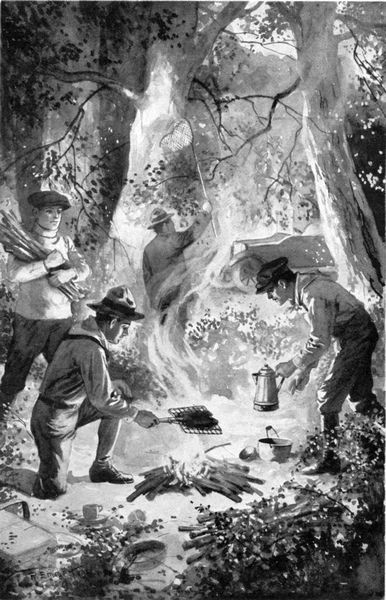
HE MADE GOOD WORK OF BROILING THE CHICKENS.
“Well, this is something like!” exclaimed Ned, as he and his chums sat about the glowing fire after supper and talked over the events of the day, speculating on what lay before them.
“You’ve said it!” agreed Jerry, leaning back comfortably against a tree.
The professor was wandering about with a small net and an electric flashlight, trying to gather bugs in the early twilight.
The tent had been put in place—that is, the curtains had been extended out at the rear and the folding cots had been set up. Two bunks were in the automobile proper and it was agreed that Professor Snodgrass should have one of these, the boys preferring to occupy the tent, in which four could sleep.
“Well, I guess I’ll turn in,” announced Bob, with a sleepy yawn, when their watches showed it was about nine o’clock. “We want to get an early start in the morning.”
“Yes, now that dad has given us the chance to catch the cattle thieves, we don’t want to waste too much time on the road getting to the ranch,” agreed Ned. “No telling what may happen when we’re not there.”
The boys had been up early that morning making arrangements for the start, and they were tired. So it did not take any of them long to drop off to sleep once they had stretched out. Professor Snodgrass said he would stay up a little longer on the chance of gathering some rare night-flying insect, but as he could get to his bunk through the front entrance of the automobile he would not disturb the boys.
Along about the middle of the night, Bob, who slept near the outer entrance to the tent, was awakened by feeling some heavy object fall across him, while a voice cried in his ear:
“I’ve got him!”
Only half awake the stout lad gave a yell.
“Grab ’em, boys! Grab ’em!” he shouted. “Cattle thieves! Grab ’em and hold ’em for the sheriff!”
“For the love of porous plasters!” exclaimed Jerry, sitting on his cot. “What is it?”
“Bob has the nightmare,” suggested Ned, disgustedly.
But as Jerry switched on the little flashlight near the head of his bed the gleam revealed Professor Snodgrass just arising from where he had fallen across Bob, and on the face of the little scientist was a look of triumph.
“I’ve got him!” he cried, holding up a hand which clutched the folds of a small net. “It’s the big white moth I’ve been after, and which I sat up all night to get! I caught him!”
“Oh, I thought you meant you had me!” exclaimed Bob. “It’s all right. No damage done. Guess I must have been dreaming we were out on the ranch after the rustlers.”
“It sounded that way,” commented Jerry with a cheerful grin.
“I’m sorry I disturbed you,” apologized the professor. “I was roaming about outside your tent when I saw this moth alight near the entrance. I didn’t want to miss it, so I made a jump for it, and I suppose I went right on through.”
“Like a fullback going through tackle for a touchdown,” commented Bob. “But there’s no harm done, Professor.”
To any one else the scientist’s actions would, perhaps, have been surprising. But the boys knew his anxiety to get a rare specimen would cause him to do almost anything. The call of science never was unheeded by Professor Snodgrass.
He apologized to the boys for disturbing them, but they made light of the matter, for he was such a good friend and such jolly company in spite of the fact that he was much older than they that they would have done almost anything in the world for him.
Exulting over the prize he had caught, the scientist was content now to retire, and the camp was soon quiet again.
All were up early the next morning, Ned and Jerry being awakened by the aromatic odor of coffee and bacon. They looked out and saw Bob engaged in the preparation of the breakfast at a fire he had kindled.
“Happy New Year!” he called to them as they stuck their heads out of the tent. “Come on! Seven o’clock whistle blew long ago.”
Seldom had a breakfast tasted better, they all agreed, and thus well fortified they again took up their journey.
“Looks like rain,” commented Ned at the wheel, after they had had dinner and saw, with satisfaction, that they had made good progress.
“So it does,” agreed Jerry, with a glance at the clouds. “But it takes more than rain to stop us. We’ll keep on.”
The automobile was well adapted for traveling through a storm, for it could be enclosed completely. It began to drizzle shortly after Ned’s remark, and this soon turned into a regular downpour. They were in a comparatively untraveled section of the country, and were a bit uncertain what road to take when they came to a fork. A man driving a wagon came along in the midst of their indecision, however, and answered their inquiry by saying:
“Both roads go to Falkenburg, but the right’s the shortest.”
“Then we’ll take that,” decided Ned, and once more they were under way. But the shortest way is not always the best, and they had not proceeded more than a mile before they ran into a stretch of sticky, greasy clay on which the car at once began to skid.
“Better put the tire chains on,” suggested Jerry.
Ned, who was steering, hesitated. It was no pleasant undertaking in the downpour.
“I think this bad stretch comes to an end a little farther on,” he said. “I’ll chance it.”
“Drive slow, then,” warned Jerry.
Ned cut down his power and the car proceeded. But it skidded worse than ever and Ned was on the point of stopping to get out and adjust the chains when, with a suddenness that none foresaw, the big vehicle swerved to one side as the brakes were applied and, a moment later, the left rear wheel crashed hard against a big tree at the side of the road. There was a sound of splintering wood and the rear of the automobile sank down.
“Busted!” cried Jerry as he opened the side curtains.