


автордың кітабын онлайн тегін оқу The Motor Boys Under the Sea; or, From Airship to Submarine
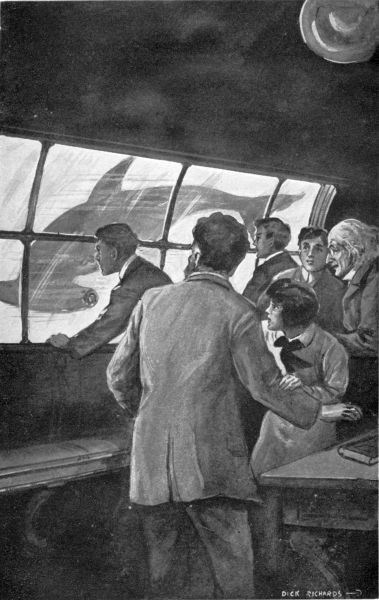
“OH, THERE’S ANOTHER SHARK—A HAMMER-HEAD.”
THE MOTOR BOYS
UNDER THE SEA
Or
From Airship to Submarine
BY
CLARENCE YOUNG
AUTHOR OF “THE MOTOR BOYS,” “THE MOTOR BOYS ON
THE BORDER,” “THE RACER BOYS SERIES,” “THE
JACK RANGER SERIES,” ETC.
ILLUSTRATED
NEW YORK
CUPPLES & LEON COMPANY
BOOKS BY CLARENCE YOUNG
THE MOTOR BOYS SERIES
12mo. Illustrated.
- THE MOTOR BOYS
- THE MOTOR BOYS OVERLAND
- THE MOTOR BOYS IN MEXICO
- THE MOTOR BOYS ACROSS THE PLAINS
- THE MOTOR BOYS AFLOAT
- THE MOTOR BOYS ON THE ATLANTIC
- THE MOTOR BOYS IN STRANGE WATERS
- THE MOTOR BOYS ON THE PACIFIC
- THE MOTOR BOYS IN THE CLOUDS
- THE MOTOR BOYS OVER THE ROCKIES
- THE MOTOR BOYS OVER THE OCEAN
- THE MOTOR BOYS ON THE WING
- THE MOTOR BOYS AFTER A FORTUNE
- THE MOTOR BOYS ON THE BORDER
- THE MOTOR BOYS UNDER THE SEA
THE JACK RANGER SERIES
12mo. Finely Illustrated.
- JACK RANGER’S SCHOOLDAYS
- JACK RANGER’S WESTERN TRIP
- JACK RANGER’S SCHOOL VICTORIES
- JACK RANGER’S OCEAN CRUISE
- JACK RANGER’S GUN CLUB
- JACK RANGER’S TREASURE BOX
THE RACER BOYS SERIES
12mo. Illustrated.
- THE RACER BOYS
- THE RACER BOYS AT BOARDING SCHOOL
- THE RACER BOYS TO THE RESCUE
- THE RACER BOYS ON THE PRAIRIES
- THE RACER BOYS ON GUARD
- THE RACER BOYS FORGING AHEAD
Copyright, 1914, by Cupples & Leon Company
The Motor Boys Under the Sea
Printed in U. S. A.
CONTENTS
CHAPTER
PAGE
I.
A Strange Sight1
II.
A Strange Disappearance9
III.
Through the Storm19
IV.
A New Quest28
V.
A Fearful Gale39
VI.
Bad News46
VII.
Off on a Search54
VIII.
Noddy and Bill63
IX.
The Wreck73
X.
The Lone Sailor80
XI.
A Queer Story87
XII.
The Drifting Boat97
XIII.
The Submarine Again105
XIV.
In Pursuit113
XV.
A Bolt from the Sky119
XVI.
The “Sonderbaar”130
XVII.
A Glad Surprise139
XVIII.
Under Water146
XIX.
A Marvelous Boat154
XX.
A Crazed Captain165
XXI.
Plotting173
XXII.
In Diving Dress181
XXIII.
The Decision191
XXIV.
The Allies200
XXV.
In Chains206
XXVI.
Entangled214
XXVII.
The Escape223
XXVIII.
The Lonely Island230
XXIX.
The End of Dr. Klauss238
XXX.
Homeward Bound242
LIST OF ILLUSTRATIONS
“OH, THERE’S ANOTHER SHARK—A HAMMER-HEAD.” “SHE’S THE SCUD!” SHOUTED BOB. QUICKLY THE FOUR SPRANG TO THE DECK OF THE SUBMARINE. THEN BEGAN A TERRIBLE STRUGGLE AT THE BOTTOM OF THE SEA.THE MOTOR BOYS UNDER THE SEA
CHAPTER I
A STRANGE SIGHT
“Look down there! What do you suppose that is?”
“Must be a whale. See how it’s plowing along through the waves!”
“And right on top of the water, too. But if it’s a whale why doesn’t it spout?”
Three boys, who were sailing over the waters of Massachusetts Bay in a large air craft, had seen a strange sight as they looked down through the glass floor of the cabin of their motorship, and their comments and questions followed rapidly. So engrossed were they with the appearance of what seemed to be some marine monster that, for a few moments, they paid no attention to the course of their boat, which was carrying them along just below the clouds.
It was not until Jerry Hopkins, the oldest of the three lads, called the attention of his companions to the need of giving heed to their craft, that the other two—Ned Slade and Bob Baker—turned their eyes from the strange creature below them—if creature it was.
“I say there, Ned!” exclaimed Jerry, “just throw in a little more gas, will you? or we ourselves will be down in those same waves in a little while. We’re sinking!”
“That’s so!” agreed Bob. “But still we wouldn’t be in much danger, for the automatic air planes would set when we began to fall too fast.”
“Even at that,” went on Jerry, who was steering the Comet, as the motorship was named, “even then I think it’s just as well not to take too many chances. Turn on a little more gas, Ned.”
“Aye, aye, sir!” exclaimed the one addressed, and with a quick motion of one of many shining levers and wheels in the pilot house he sent some of the compressed gas into the lifting-bags of the Comet, thus making her more buoyant.
“There it is again!” cried Bob, once more pointing below. They all looked, Jerry turning his attention away from the wheel that guided the craft. First, however, he looked ahead to make sure there was no danger of a collision, for the boys had come to Boston to attend an aviation meet, and at times there had been so many of the “birdmen” in the sky-space that a collision was really not so unlikely as at first it would seem.
“Yes, it’s there yet,” agreed Ned. “I’m sure it’s a whale!”
“But why doesn’t it spout?” demanded Bob, who had asked that question before. “Then we’d be sure of it. I thought whales had to spout every ten minutes or so, and that one’s been in sight about that time.”
“You’re off on your natural history, Bob,” said Jerry, with a smile. “Whales don’t have to spout oftener than a half-hour. And besides, that’s only when they’ve been swimming under water. This one is on the surface, running awash, you might say, and so doesn’t have to send out a long breath that it’s been holding in a long while. It can breathe naturally.”
“That’s it! I’m never right,” grumbled Bob, whose stout form and good-natured face did not fit well with the scowl with which he regarded his chum. “I guess I know as much about whales as you do, Jerry Hopkins!”
“That isn’t much,” admitted Jerry, frankly. “I don’t claim to be an authority, but I’m sure a whale on the surface doesn’t have to spout—at least, not very often.”
“Are you sure it is a whale?” asked Ned quietly, and there was something in the tone of his voice that caused his companions to look quickly at him. “Why don’t we go lower down so we can have a better look at it. Then we could make certain.”
“I guess that would be the best plan,” admitted Jerry. “We can drop to within a few feet of the surface and——”
“Don’t go too close!” interrupted Bob. “It looks to me like a storm. We may get a squall any minute, and if we go too low down we may not be able to rise quickly enough. I don’t want to see the good old Comet come to grief.”
“Neither do I,” responded Jerry. “But I guess we’ve done harder stunts than that. Get ready to let her down, Ned. See if the rudder planes are all clear.”
“Besides,” went on stout Bob, “we haven’t had lunch yet, and——”
“There he goes!” cried Ned with a laugh, as he left his comfortable seat and prepared to go aft to the motor room. “It wouldn’t be Chunky unless he mentioned the ‘eats’ every so often. I was just waiting to hear you come out with that, Bob.”
“Huh! Well, then, you weren’t disappointed; were you?” demanded the stout lad.
“That’s all right,” interposed Jerry, hastening to pour oil on troubled waters. “Don’t get on your ear, Chunky. Ned didn’t mean anything. Come on, we’ll take a little plane downward, and settle the identity of this mysterious creature of the sea.”
“Listen to him!” exclaimed Ned. “He’s getting poetical!”
“Quit knocking,” advised Jerry. “If Professor Snodgrass were along now he might be able to settle the question for us.”
“Yes, and he’d be sure to want to capture the beast for his private collection,” said Bob, whose ill-humor had disappeared, leaving him with a smile on his round countenance.
“All ready, Ned?” asked Jerry, who was giving his attention to various gear-wheels and levers. “Shall I send her down now?”
“I guess so. Just a minute until I open the gas intake a little wider. You’re going to navigate as a dirigible; aren’t you?”
“No, I was thinking of sailing as an aeroplane,” was the answer.
“Oh, then wait until I throw in the rudder gears.”
The Comet, about which I will tell you more presently (that is, you boys who have had no previous acquaintance with her), could be navigated as a dirigible balloon by means of a powerful lifting-gas stored in reservoirs, or she could sail as a biplane, her powerful propellers sending her along on the principle of all “heavier than air” machines.
While waiting for Ned to adjust the machinery, so that the change from one form to the other could be made, Jerry glanced down toward the heaving waters above which the Comet had been sailing, and amid the waves of which had appeared the strange object that had excited the curiosity of the boys. It was still there, plowing slowly through the water, but the air craft was so high up that a good view could not be had of it.
“All ready!” called Ned from the motor room.
Jerry was about to shut off the supply of gas, sending it into the compressors where it could not exert a lifting force, and had stretched his hand toward the lever of the deflecting rudder, when Bob cried:
“Say, I’ve got an idea! Why didn’t we think of it before, fellows?”
“What is it?” asked Jerry, pausing in his intended operations.
“The telescope,” replied Bob. “We can get a view of the mysterious beast with that, and won’t have to go down at all. I’ll get it,” and he started toward a locker.
“Oh, never mind,” said Jerry. “As long as we’re ready we might as well go down anyhow. Besides, only one of us can use the glass at a time. If we get the Comet near enough we can all see. Let her go, Ned.”
“Going she is!” came from Ned.
There was a hissing as the automatic pumps began compressing the lifting-gas, and a few seconds later Jerry yanked on the lever that would tilt the big rudder to such a position that the ship would dive downward. At the same time the propellers, which had been revolving slowly, to keep the Comet from drifting, were whirled with great rapidity as more power was turned into the motor. While navigating as a dirigible balloon the propellers were not needed to keep the ship afloat, but once the lifting-gas was not used they were vitally necessary, for only by keeping in motion can a “heavier than air” machine be prevented from falling.
Bob, who was looking through the glass floor in the main cabin, tracing the course of the object that had so excited the boys, suddenly looked up at Jerry.
“Something’s wrong!” cried the fat lad, and by his tones it could easily be told that he referred to the motorship, and not to the object below him in the water.
“I should say there was!” gasped Jerry, for the Comet had plunged downward with such abruptness that the boys were fairly dizzy.
“What’s the matter?” yelled Ned, making his way from the motor room by fairly pulling himself along. He had to do this as the ship was tilted at such a sharp angle. “What happened?” Ned went on.
“It’s that deflecting rudder again!” answered Jerry. “I thought we had it adjusted too fine. Now it’s jammed again.”
“Shut off the motors! Stop the propellers!” cried Bob.
“I’m doing it as fast as I can!” returned tall Jerry. He had reached over and snapped off a switch that controlled the electric current which fired the gasoline motor.
“We’re heading straight into the sea—bow down!” cried Ned, taking a hasty observation.
“Turn on the gas again!” ordered Jerry. “That’s the only thing that will stop us now! And do it quick, too! I’ll have a new rudder if we ever get out of this alive!”
Ned, with desperate haste, was opening the gas valves. With an angry hiss the vapor rushed from the condensers it had so recently entered, and began filling the lifting-bags. Still the Comet plunged down toward the ocean, in which could still be seen that strange creature. It was circling about now, as though waiting for the destruction of the motorship.
CHAPTER II
A STRANGE DISAPPEARANCE
“Jerry, we’ve got to do something!” cried Ned.
“And do it quick!” added Bob.
“We’re doing all we can,” responded the tall youth in tense tones. In all the excitement he remained calmer than did his chums, and calmness was a necessary virtue in this emergency. Jerry Hopkins had that one happy faculty of seldom “losing his head.”
Now he was striving desperately, however, in spite of his seeming calm, to prevent the accident which seemed so imminent. And his companions, catching something of his cool self-control, restrained their own excitement and came to Jerry’s aid.
And while strenuous efforts are thus being made to save the Comet from plunging into the sea, I will beg the indulgence of my old readers for a few moments while I describe, for the benefit of my new ones, something about the three chums and their various activities as set forth in the previous books of this series.
As might be guessed the lads were called the “Motor Boys” for obvious reasons. They were always seen on some form of motor, beginning with a bicycle (which in a way is a motor vehicle) and ending with an airship. No, not ending, for the activities of the motor boys are far from ended, I hope.
To describe the boys themselves I will say that Bob Baker was the son of a wealthy banker, while Ned’s father, Aaron Slade, kept a large department store in which Mr. Baker was also interested. The father of Jerry Hopkins was dead, but his mother had been left comfortably off, and by means of wise investments, recommended by Mr. Baker, had managed to accumulate a small fortune. It will thus be seen that my three heroes were well supplied with money to carry out their ideas of sport in motor vehicles. And they did not depend on their parents for all their funds. The boys were part owners of a valuable gold mine, and they received profits from it.
They lived in the New England town of Cresville, not far from Boston, and were well known in the country roundabout, for they made trips far and near. Often on these trips they had unpleasant experiences with Noddy Nixon, a sort of town bully, and his crony, Bill Berry, as well as with Jack Pender, with whom Noddy chummed.
The first book of this series is entitled “The Motor Boys,” and in it is described how our heroes took part in some bicycle races, and eventually obtained motorcycles for themselves, on which they had a number of adventures.
In a later race they won an auto as a prize, and one of their activities was to take a trip overland. Their companion on this, as well as on other journeys, was a certain Professor Uriah Snodgrass, who was an enthusiastic collector of rare specimens of the animal kingdom, from black fleas to luminous snakes. The professor was an odd character, as you will doubtless soon discover.
After an exciting tour the boys went to Mexico, and, coming back from there, they were instrumental in locating the hermit of Lost Lake.
In the fifth book of the series, entitled “The Motor Boys Afloat,” I related what happened when Jerry, Ned and Bob got a motor boat. They had surprising adventures in their voyage on the Atlantic, later in the strange waters of the Florida Everglades, and then on the Pacific.
Naturally, with the gradual perfecting of air craft, the boys turned their thoughts to them, and in the volume called “The Motor Boys in the Clouds,” I had the pleasure of telling you of their adventures above the earth. They had a long trip which ended in both fame and fortune, and in going over the Rockies they solved a mystery of the air, later effecting a rescue near the clouds, over the ocean.
Again they were on the wing, and learning of a strange treasure they went in search of it. In the book that immediately preceded this one, called “The Motor Boys on the Border,” I told how the boys, returning from the Grand Canyon of the Colorado, found new opportunities awaiting them. This was to undertake a search for sixty nuggets of gold that had been secreted by an old prospector when he had to flee from his enemies. He had hidden them in a deep valley, near the border between Montana and Canada, and sought the aid of the boys and their airship to recover them.
How the sixty nuggets were found, how the enemies were outwitted, and how Professor Snodgrass located his luminous snakes—all this you will find set down in the book.
After these adventures the boys returned home, and to while away the time they had again put in commission their motorship Comet and gone to the Boston aviation meet. They had taken some part in it, winning two prizes for all-around efficiency.
Perhaps my new readers will like a brief description of the Comet. It was a craft built for comfort, and for long trips rather than for speed, though it could skim along very fast when necessary. The motorship was, as its name indicates, a veritable ship, and the addition of hydroplanes enabled it to navigate on the water as well as in the air. Wheels could be attached, if desired, so that it could also move along on smooth ground, but this was seldom done, and no great speed was attained that way.
As I have said the Comet could be used either as a biplane, or as a dirigible balloon. There was considerable machinery aboard it—motors, dynamos, gas-producing apparatus; and on board the boys and their friends could live comfortably for many days without descending.
There was a main cabin, sleeping berths, the motor room, where most of the machinery was installed, and a pilot house that contained the guiding levers and wheels. The bottom of part of the craft contained heavy plate glass, so observations of the earth could be made through it.
And I must not forget the kitchen and dining room. These places were the especial delight of Bob Baker, for I think I have already indicated that “Chunky,” as Bob was often called, because of his short and plump conformation, was very fond of eating. His chums joked him about it, but he seldom minded that.
And it was in the Comet that our heroes now were, having decided to navigate for a while over the sea after witnessing some sensational flights at the aviation grounds outside of Boston. And it was also in the Comet that danger had now come to the boys as they sought to descend to get a nearer view of what they thought might be a great whale, but which did not act as a whale should.
“How about it, Jerry? Are we gaining any?” cried Ned, as he stood beside the gas machine, trying to hasten the filling of the lifting-bags.
“I think so,” was the answer. Jerry never took his eyes from the pressure gage that told how much gas was being forced out from the containers.
“But we’re still going down!” cried Bob, who was looking at the height-indicator. “And going down fast, too! We’re only five hundred feet up now!”
“I know it, Chunky,” said Jerry, still quietly. “We are doing all we can. Even if we do hit the water you know we still have the hydroplanes.”
“Oh, it isn’t a question of actually sinking,” called Ned, as he opened the gas valve to the limit. “We’d probably float safely enough, but we’re going down so fast that if we hit at this speed, we’ll be sure to rip the planes off, and do no end of other damage to our boat!”
“That’s the point,” agreed Jerry. “It’s only the speed at which we are falling that I’m afraid of. Ordinarily we could volplane down and take the water easily enough, but the jamming of that deflecting rudder came so suddenly that we couldn’t get in position to make a good descent.”
“We’re on a more even keel now,” observed Ned, as he looked at the indicating pendulum.
“Yes,” agreed Bob, “and we’re going slower, too. We’ve got three hundred feet more, Jerry.”
“Then we can do it, fellows! I guess we’re all right now. Is all the gas out, Ned?”
“About all, yes.”
“And just in time,” murmured the stout lad, his eyes again seeking the height indicator. “Two hundred feet is a pretty close call, as fast as we were falling. We’ve almost stopped now, Jerry.”
“That’s good. We won’t lose any time putting on a new kind of rudder, either. I’ve had it in mind a good while to change ours. I wish I hadn’t delayed so long.”
A moment later the motorship ceased her descent, and was floating on an even keel, a short distance above the rolling waves, blown gently along by the wind, for her propellers were not revolving.
“Well, we may as well start again, and make for shore as a dirigible balloon,” said Jerry, after a little pause, in which they all breathed more freely. It had been an exciting time for them, but they had met the emergency bravely, and with the grit and spunk of true American youths.
“I wonder what has become of the cause of all our trouble?” ventured Ned. “I haven’t thought to look for that whale. Let’s take a peep, fellows.”
Before starting the propellers the boys went out on the partially enclosed deck and looked about them. At first they did not see the strange object that had attracted their attention. Then, as he gazed to the North, Bob cried:
“There she is—and, fellows, as I’m alive it isn’t a whale at all! Look! It’s a submarine! See the men on her decks! They’re looking at us!”
With gasps of astonishment, Ned and Jerry turned toward where Bob pointed.
There, lazily rolling with the action of the waves, was indeed a large submarine boat, of the latest type, as the boys could see, for they were well up on naval matters. The half-rounded deck, the sides and blunt stern and bow of the strange craft glistened from the water that had splashed over her, or perhaps it was wet from just having dived, and come to the surface again.
And, as Bob had said, there were several men on the low deck, that was almost awash. They looked curiously at our heroes. The men appeared to be mechanics, for their clothes were rough and grease-covered. But then, in a submarine, even the officers get that way, for the quarters are very cramped.
“That’s a foreign submarine!” exclaimed Ned, suddenly.
“How do you know?” asked Jerry.
“Because I can tell by her build, and by the look of the men. That’s a foreign submarine, and I shouldn’t be surprised if she was the one——”
Ned stopped suddenly.
“What is it? Why don’t you go on?” asked Jerry, turning to his chum.
“Because I think they can hear us. Sound carries very clearly over water, you know. I’ll tell you later, and——”
“There comes another man on deck!” interrupted Bob. The men on top of the submarine turned their gaze away from the airship as someone, evidently their superior officer, appeared among them, coming up by the deck hatch. They saluted him, and pointed toward the Comet.
Instantly the newcomer turned. The boys could see that he was a large man, with a stern and forbidding face, and his hair and beard were snow-white.
He started as he beheld the craft of our heroes, and evidently gave a command, for the others at once left the deck of the submarine. Then, with a last look at the Comet, the aged commander hurried down through the deck hatch. There was a rattle of metal as the cover was clapped into place, and a second later the submarine disappeared beneath the waters of the bay.
CHAPTER III
THROUGH THE STORM
“What do you know about that?” cried Ned, looking at his wondering companions.
“That sure was a sudden dive,” agreed Jerry.
“They must have their machinery under pretty good control, and be able to work it quickly,” came from Bob. “Why, that old gentleman wasn’t down inside that hatch more than a quarter of a minute before the whole thing was under water. The hatch must have closed automatically when he went down it.”
“I guess that’s it,” said Jerry. “You can’t see so much as a bubble of her now.”
The boys gazed at the surface of the sea. The heaving and rolling waves were all that was visible.
“She must have gone down deep,” observed Ned. “You couldn’t even see her periscopes.”
“She didn’t have any,” asserted Jerry. “If she had they would have stuck up for a second or two, for usually they’re about twenty feet above the deck. She doesn’t use periscopes, that’s evident.”
“What are periscopes?” asked Bob, who usually didn’t take such an interest in mechanics as did his chums. When taunted with this Bob used to say it kept him so busy cooking for Ned and Jerry that he had no time to brush up on the latest inventions.
“Periscopes are the eyes of a submarine, when it is running in about twenty feet of water,” explained Jerry. “I mean at that depth below the surface. They are hollow tubes, and are just above the surface when the boat is down about twenty feet. They run through the deck, and into the pilot house. By looking into the lower end of them the observer can get a view all around him at the surface.”
“I don’t see how,” spoke the stout lad.
“It is done by means of reflecting mirrors, lenses and prisms,” Ned put in. “I looked through one once on a submarine that was being built. It’s great. It beats a telescope all to pieces. A telescope, you know, means an instrument by which you can see far off—‘tele,’ meaning afar, and ‘scope’ to look—Latin or Greek words, I guess.”
“Say, is this a recitation?” asked Bob, with a smile.
“No, I’m just explaining,” answered Ned. “Periscope is made up in the same way, from Latin or Greek words, and it literally means to ‘look all around’.”
“Good!” exclaimed Jerry. “But even looking all around doesn’t seem to show that submarine. It has completely disappeared. And I’d have given a good deal to have a good look at her.”
“So would I,” spoke Ned. “I’d like to have gone aboard.”
“You would!” cried Bob. “Would you go under in her?”
“I would—yes, if I had the chance,” replied Ned. “But I’d prefer one of our own United States boats to that foreign one. I didn’t like the looks of that man with the white beard, and if what I read is true——”
“Say, what was that you started to say?” interrupted Jerry. “You were on the point of remarking it when the craft went to the bottom.”
“Yes, I was,” admitted Ned. “I saw something in the papers not long ago—it was a foreign dispatch, I think—to the effect that a German had perfected a most wonderful and dangerous submarine. It had motors operated by a new electrical chemical, that could be stored in a small space, and the article intimated that the submarine could even cross the ocean.”
“Of course that’s remarkable, in a way,” admitted Jerry, “but you seemed to have something else on your mind. What was it? Loosen up, Ned.”
“Oh, it’s no great secret. I didn’t just want those fellows on the submarine to hear me; that’s all. But this article went on to say that the inventor was a sort of crank, with a very vindictive disposition, and that he imagined all other nations were the enemy of Germany. He seemed to think that if the German war officials took a sufficient number of his submarines the Kaiser would be Lord of the Sea, and could wipe everything else out of existence. That’s one reason I wouldn’t care to go aboard that boat.”
“That is, if it’s the same one,” suggested Bob.
“Oh, yes,” assented Ned. “Of course it’s only a notion of mine that this craft may be the product of the brain of that eccentric German. But he looked like a foreigner, and the way he seemed to get excited when he saw us—acting as though he feared we were spying on him—made me a bit suspicious.”
“But what does he want over here, in American waters?” asked Bob.
“That’s the point,” responded Ned. “What’s his game—if it is he? But we don’t have to worry about it, I guess.”
“I don’t know about that,” spoke Bob, and his tones were serious. “If he’s going to scoot about under water, practicing evolutions for destroying our ships, it may mean trouble for us.”
“For us?” repeated Jerry, looking at his fat chum curiously. “What do you mean?”
“Well, not exactly trouble for you fellows,” explained Bob, “but for my family. Of course it’s quite remote, but it might happen. My Uncle Nelson Sheldon, and his daughter Grace, are on their way to this country from Germany. They are coming in a small steamer, and my uncle is bringing something very valuable with him. That is, valuable to our family.”
“If it was something valuable for you I suppose it would be a full course dinner; eh, Chunky?” asked Ned with a chuckle.
“Oh, let up; can’t you?” begged the stout lad. “It isn’t anything to eat, I’m sure of that, though I’m hungry enough now. I don’t know just what it is, but I overheard father and mother talking about it. It’s something that Uncle Nelson has been on the lookout for a good many years, and at last he found it in Germany.”
“In Germany!” exclaimed Jerry.
“Yes, and that’s what made me speak as I did when I heard what Ned remarked,” went on the fat youth. “If that’s a crazy German in a submarine he may hit the boat my uncle is on.”
“Say, this is getting mysterious, all right,” spoke Ned. “Not that I think there’s the slightest danger though, Bob. Your uncle has a million chances to one in his favor. What steamer is he and his daughter on?”
“The Hassen. It’s a German boat. He said he took that to avoid the crowds. He’s due to land in a few days, I believe, and then I’ll know what it is he’s bringing over that’s so valuable.”
“How about his daughter?” asked Ned. “Have we ever seen her, Chunky?”
“No, and I believe she’s considered a very pretty girl, too,” spoke the stout youth.
“Then you’ve got to introduce us to her as soon as she lands, my boy!” stipulated Jerry. “Pretty girls are too scarce to miss.”
“Oh, you’ll meet her,” said Bob. “I’ve told her about you fellows, and she wants to know you.”
“Good for her!” cried Ned. “Well, we seem to have run into a complication of matters just through sighting that submarine. That’s out of sight, of course, but there’s still your uncle, his pretty daughter, and the mysterious thing he’s bringing over, Bob. It gives us something to look forward to, at any rate.”
“Yes, and we’re going to have something else to look forward to, and that right soon,” spoke Jerry, suddenly.
“What is it?” inquired Bob, looking about. “Is that submarine in sight again?”
“No, but we’re going to have a storm, if I’m any judge, and pretty quickly, too. We’re quite a few miles out to sea, and we’d better run to shore, I think.”
“Same here,” agreed Bob. “But say, what about grub? I can get it while you and Ned manage the Comet.”
“Ha! Ha!” laughed Jerry. “I was waiting for you to say that, Chunky. But there—don’t get riled! Of course you can get up a meal. But let it be a simple one, for we may be in the midst of a blow any minute. And we’ll need your help, now that part of our gear is out of order. So don’t fuss too much, Chunky.”
“I won’t. But I’m awful hungry!”
“Just to show that there are no hard feelings I could eat a bit myself,” added Ned. “Go to it, Bob, my boy.”
“Yes, and we’ll have to get busy ourselves, Ned,” spoke Jerry. “We’d better make everything as snug as we can, and then go up. We may get above the storm centre, but I doubt it. It looks as though it was going to be pretty general.”
The weather had indeed changed suddenly. Gray banks of clouds, fringed with ominous black, hung low on the horizon, while above the sky was a coppery-yellowish cast that seemed to indicate the coming of a great wind.
The sea, too, was heaving restlessly, as if anxious to join in the revel of the elements, and there was a low moaning sound that told of the howling gale to come.
But just at present it was calm enough—the threatening calm before the storm—and Jerry was about to take advantage of it to start toward land.
The Comet was still hovering over the spot where the submarine had disappeared. The motorship was moving slowly, her propellers barely revolving enough to give her steerage-way.
Jerry, with one last look at the surface of the sea, to discern, if possible, whether the strange boat had come to the top again, set about making all snug in preparation for the battle with the elements.
This was soon done, and while Bob was busy in the small galley, getting ready a meal, Ned and Jerry started the boat. The big propellers beat the air fiercely, and, as a dirigible balloon, the Comet darted high above the restless sea, and toward the shores of Boston Harbor, now many miles from sight.
But the craft was not to reach a safe haven without a fight. Scarce two miles had been covered before the storm broke, its fury increasing every minute.
The Comet heeled over until, had she been a water ship, she would have been on her beam ends. Jerry and his chums had to grasp supports to avoid falling.
“Throw in the automatic gyroscope balancer!” yelled the tall lad to Ned. “We’ll turn turtle in a minute if you don’t!”
“In she goes!” cried Ned, springing for the motor room.
The gale howled about them. Below the waves were whipped into sudden foam, and they tossed themselves on high as though reaching for the Comet, which rushed on through the storm like a frightened bird.
“Some blow!” panted Bob, as he jumped aside in time to avoid the contents of the scalding hot coffee pot on the galley stove. “Some blow!”
“Yes, and it’s getting worse every minute!” Jerry cried.
CHAPTER IV
A NEW QUEST
Fortunately for our heroes the Comet was a staunch craft, even though built to navigate the air, and, like others of her kind, light in construction. But the motorship had passed safely through hard blows before, and Jerry and his chums hoped this would be no exception. Also the boys, when the first warnings of the blow were observed, had made everything as snug as possible. Now all they could do was to remain in shelter and navigate their craft as best they might.
And glad indeed were they of shelter, too, for, after the first fury of the blast had whipped the sea into foam, there came a burst of rain, almost tropical in its volume.
“I should say it was a blow!” gasped Bob, as he righted the coffee pot. “Look at that!” he cried. “All wasted!”
“Don’t worry about that,” advised Jerry, who was having all he could do to hold to the steering wheel, which was twisting and turning in his hands as the wind forced the big rudder this way and that. “We’re lucky to be as right as we are, so say nothing about losing a little coffee.”
“Well, I’m hungry!” exclaimed the stout lad who, it seemed, would not be balked of his meal, even in a bad storm. “I’m going to make some more,” he went on. “That is, unless you need me here, Jerry.”
“No,” panted the tall steersman. “I guess Ned and I can manage things for a while, unless something happens. We’re going up fairly well, and perhaps we can get above the storm.”
The Comet was now under better control, and was steadily mounting under the influence of the powerful lifting-gas, and the push of her propellers, the elevating rudder being tilted in the proper direction. Of course she was also headed toward the shore in order to take her from above the dangerous water, but her progress in that direction was not as rapid as it would have been had it not been necessary to mount in an endeavor to rise above the gale. At least, that was what Jerry was trying to do.
Of course the craft, as I have said, was built to navigate on the water by means of pontoons or hydroplanes, but this could be done only on comparatively calm surfaces. With the sea boiling and seething as it now was, the Comet would have been wrecked had she fallen into it.
“I almost wish we were in that submarine,” said Ned, as he came to stand near Jerry, to aid him if necessary.
“Why?” called Bob from the little galley.
“Because then we wouldn’t mind the storm, no matter how hard it blew. Don’t you remember reading that a comparatively short distance below the surface the effect of a storm is not felt? Those fellows can sail along, deep down under the ocean, and not even know a blow is going on up above.”
“Well, they may be safer than we are,” exclaimed Bob, as he put on another pot of coffee, taking care to secure it to the electric stove so it would not spill off, “but, all the same, I don’t go in much for submarines. They’re too likely not to come to the top when you want them to.”
“Not the newest models,” defended Ned, who seemed to have taken a sudden interest in the under-water boats. “They rarely have an accident now-a-days. I’d like to take a chance in one.”
“I think I would too,” spoke Jerry, eagerly.
“Well, if you fellows go, of course I’m not going to back out,” asserted Bob, who, to do him credit, was as full of grit, when the test came, as either of his chums.
“Oh, I don’t know that there is any likelihood of our navigating one,” went on Jerry. “Still, you never can tell. It’s about the only kind of locomotion we haven’t tried yet.”
“Well, I only hope one thing,” spoke Bob, as he began to make some sandwiches for himself and his chums, “and that is that this submarine doesn’t try to blow up, or sink, the Hassen with my uncle and cousin on board.”
“Nonsense! There’s about as much danger of that happening as there is of the moon falling on us,” said Jerry, with a laugh.
“I guess Bob means he doesn’t want the submarine to tackle that ship his uncle is on until he finds out what it is that his respected relative is bringing over,” spoke Ned.
“Or until he introduces us to his pretty cousin,” added Jerry with a smile. “Eh, Bob?”
“Oh, you fellows make me tired. Here, take some of this grub. I’m hungry.”
“Your usual state,” commented Ned, drily.
Perhaps my new readers may think it strange that the boys could talk thus lightly while trying to escape from a bad storm in an airship, but my old friends will understand of what sort of material Bob, Ned and Jerry were made. They were used to danger—not that they courted it, but when it came they could meet it face to face, and they seldom allowed it to get on their nerves. And their talk, in this case, was calculated to restore their own confidence for, in a measure, it took their attention from the fury of the elements.
And there was fury and to spare. The wind seemed to increase in violence every moment, and the rain, beating on the roof of the cabin, almost drowned the sound of their voices, and hushed the hum of the machinery and the whine of the dynamos.
It was fortunate, in a way, that the craft was not manœuvering as an aeroplane, for the broad expanse of the wing and rudder planes would have offered so much resistance to the wind that the Comet might have turned turtle. As it was, some of the planes had been folded back out of the way. This was a new improvement in the boys’ craft, and one that enabled it to be used to better advantage as a dirigible balloon.
True it was that the expanse of the gas-bags offered a large surface to the gale, but this could not be avoided. It was absolutely necessary to have them filled, or the ship would have plunged into the sea.
Jerry was operating to the limit the motor which whirled the great propellers, and all the force at his command was needed to make headway against the wind. The Comet was shooting almost into the teeth of it, which was to her disadvantage.
Holding with one hand each to the steering wheel, Jerry and Ned ate their sandwiches and drank their coffee. The last was not easy as the motorship plunged and swayed, spilling part of the beverage.
“But it’s fine—what I can get of it,” said Jerry.
“That’s right—and the sandwiches are bully!” exclaimed Ned. “You’re all to the mustard, Bob!”
“Glad you like them,” responded the stout youth, evidently well pleased.
There came a sudden burst of fury in the gale, and the craft seemed to plunge downward.
“Look out!” cried Ned, glancing toward the glass floor in the pilot house, through which he could see the crests of the angry waves. “Look out, Jerry!”
The tall lad gave a twist to the elevating rudder, which overcame the downward tendency, and once more the Comet was moving upward. The rain still fell, the wind howled and roared and the lightning now began to play about the ship, while the thunder rolled almost incessantly. But the gallant craft held on in spite of all.
Suddenly there came a sharp, breaking sound, accompanying a brilliant pinkish flash of light, and then came an awful roar. For a moment the boys were almost paralyzed, and they felt a tingling as of pins and needles all over their bodies. Their ear drums seemed burst.
“That bolt passed close to us!” yelled Ned, above the thunder-echoes.
“I should say so,” agreed Jerry. “A little bit more and it would have struck us. Smell the sulphur!”
A pronounced odor was noticeable in the cabin.
“Look!” cried Bob, “it put the small dynamo out of business, too. It short-circuited it!”
“That’s right!” cried Jerry, looking at one of the pieces of apparatus used for generating the powerful lifting-gas. “But we won’t need that now, I guess. We ought to be over land pretty soon and able to make a landing.”
“We can’t in this wind,” said Bob, who went over to make a close inspection of the damaged dynamo. “We’d be blown into a tree or house, and smashed.”
“I’m going to try to get out of the path of the storm,” said Jerry, who well understood the danger of going down to earth in this gale. “I think its path is comparatively narrow. Is she much damaged, Bob?” referring to the dynamo.
“No, those new fuses you put in saved her. It just burned out a couple of them. I can connect it up if you say so. We might need it in a hurry.”
“No, we have some gas in the reserve tank yet, and there is no use taking chances monkeying around a dynamo in a thunder-storm. Come away from it!”
That one terrific stroke, which had come so near to the motorship, seemed to have broken the backbone of the storm, in a measure, and there was a noticeable diminution in the force of the wind, while the rain fell less heavily.
It was late afternoon, and night was coming on, so with the clouds to add to the gloom of the sky, it was so dark that the boys could hardly see the water below them.
A little later, when the storm showed more evidence of dying out, they looked down and saw below them the lights of Boston.
“We’re safe!” cried Jerry. “The bay isn’t under us any more.”
“Good!” cried Bob. “Now we can have a regular supper!”
“You sure are the limit, Chunky!” cried Ned. “But never mind. We won’t rub it in. This has been a strenuous afternoon, all right, from the time we sighted that submarine.”
“I wonder where it is now?” asked Bob, and his chums could see that he really was worrying over the safety of his uncle and cousin.
“No telling,” said Jerry. “I don’t believe we will ever see her again.”
Neither he nor his chums realized what fate had in store for them in connection with that same submarine.
Jerry knew the course he wished to take, though it was necessary to steer by compass, and soon, when the storm had quieted down to only a comparatively gentle blow, the tall steersman guided his craft to the ground in a big open field, some miles from Boston. There it was anchored for the night and the boys prepared to stay on board, as they had often done before. They had come down in a lonely neighborhood, so they were not troubled by curious spectators.
In the morning scarcely a trace of the storm was to be seen.
The boys made some necessary repairs, fixing the refractory rudder so that it could be used temporarily.
“And then I’m done with it,” said Jerry, firmly. “I’m going to attach an entirely different kind.”
Again the Comet soared into the air, and this time her blunt nose was pointed toward Cresville, which the boys reached in record time, no happenings worthy of note occurring on the way.
“Well, I’m glad you boys are home!” exclaimed Mrs. Hopkins, as the airship landed near Jerry’s house. “We were just beginning to get anxious about you.”
“Oh, we’re all right, Mother!” exclaimed the tall lad, as he kissed her. “Had a little blow, that’s all.” He seldom told of the dangers through which he and his chums passed.
“There’s someone here to see you,” went on Mrs. Hopkins, with a smile.
“Is it Bob’s uncle?” asked Ned, with a laugh.
At that moment a voice was heard coming from the house. It said:
“One moment now, Susan! Don’t move. Stand very still!”
“What for? Am I going to have my picture took?” asked a voice Jerry recognized as that of his mother’s maid.
“No, I am not going to photograph you,” was the answer. “But there is a very rare specimen of a blue lady-bug on your left shoulder and I want to get it for——”
“A bug! The saints preserve me! Take it off quick!” cried Susan.
“One moment! There, I have it!” was exclaimed triumphantly, and the boys, with one accord, as they looked at each other cried out:
“Professor Snodgrass!”
It was indeed he, and a moment later the jolly little bald-headed scientist stepped to the door, holding tightly in one hand the new bug he had captured.
“Ah, good morning, boys!” he exclaimed. “Well, you see I came here again, and this time I think you’ll agree that I have a difficult quest under way.”
“Is it to get more luminous snakes?” asked Jerry, as he and his chums shook hands with the professor.
“No, though that commission was hard enough. This time I have an order from the Boston museum to get a specimen—three or four, if I can—of the hermit crab, the Pagurus, or Eupagurus Bernhardus. And to do this I shall have to search on the bottom of the sea. So if you have a submarine boat anywhere around, boys, I’d like to use her, for I must get that specimen!”
Jerry, Ned and Bob looked at one another. The professor’s words stirred strange recollections.
CHAPTER V
A FEARFUL GALE
“Well, boys, you seem to think there is something strange in my new quest,” remarked Professor Snodgrass, looking from one to the other of the motor boys. “Don’t you care to go off on expeditions with me any more? I know you used to be fond of traveling. And now, when I come to you with this proposition, you seem to think it is too much.
“As soon as I received the commission to get a hermit crab—one that lives in the shell of some mollusk—I thought of you boys. I said to myself that you were not afraid to sail through the air, so naturally you wouldn’t back out when it came to going under water. And now——”
“It isn’t that, Professor,” interrupted Jerry, respectfully. “It’s just the suddenness of it, and a peculiar coincidence. We haven’t thought much about a submarine, though I’m sure we could manage one if we tried. It’s just a certain happening that occurred yesterday that made us seem so surprised. We’ll tell you all about it.”
“One moment!” exclaimed Mrs. Hopkins. “I didn’t object very much, Jerry, when you wanted to take up aeroplaning, though I was very anxious. But I am afraid I must draw the line at submarines. I am so afraid of them. Professor Snodgrass, if I had known this was the nature of your new quest, I’d never have let you mention it to the boys,” and she playfully shook her finger at him.
“There will be no danger—no danger in the least, I assure you, Mrs. Hopkins,” said the little scientist, with an old-fashioned bow. “I know the boys are brave and if we do go to the bottom of the sea in a submarine we will come back safely. Don’t worry.”
“I just can’t help it,” Mrs. Hopkins rejoined. “But I feel sure that it will be a long time before the boys will be able to build a submarine and go down in it.”
“I don’t know about that,” answered Jerry, with a smile. “But, Professor, let us tell you how strangely your quest fits in with a little experience we passed through yesterday.”
Then, by turns, each adding something, the boys told of the sight of the submarine, and of the storm through which they had passed.
“Hum! Yes,” said Mr. Snodgrass, when Ned had spoken of reading about the German boat. “I also recollect that. The man’s name is Klauss, I believe.”
“And is his boat really so wonderful?” asked Bob.
“Yes, from the brief accounts I saw of it I should say it was the last word in submarines,” replied the scientist. “I wish I had an opportunity to examine it, and if it is in this country, which seems to be the case, we may get a chance.”
“Not if he acts the way he did when we saw him,” commented Jerry. “He didn’t seem to want to be interviewed, and dived down as soon as he could.”
“Oh, well, maybe he was afraid of the coming storm,” went of Mr. Snodgrass. “Even the best submarine can’t stand being filled with water, you know, and they have very little free-board when running awash. However, let us now consider this new quest of mine. I really must make an attempt to get some of these rare hermit crabs, and the only way I know how to do it is to get to the bottom of the sea in a submarine. If you boys have no idea of making one perhaps I can get someone else. But I would rather go with you.”
“And I think we’d like to go!” cried Jerry, looking about to make sure his mother did not hear him. He knew she would let him go when the time came, after she had been assured of the comparative safety of the cruise.
“Then it’s all settled!” cried the professor, as if that was all that was necessary. “I’ll leave the details to you boys. When you have the submarine ready we will go. Meanwhile, I can be collecting other specimens. At present I must put away this rare lady bug that I got from Susan. It is really quite valuable, and I must make some notes concerning it before I forget them.”
He went into Jerry’s house, where he was always a welcome guest, leaving the boys to stare in surprise at one another.
“Well, if he isn’t the limit!” exclaimed Ned. “He tells us to let him know when the submarine is ready, just as though it was only a call to a meal.”
“Or as if we could produce a submarine at a minute’s notice, the way the magician in the show brings a rabbit out of a hat,” added Jerry. “The professor expects us to do wonders. A submarine, and we haven’t even so much as a ballast tank!”
“Well, maybe we could buy a second-hand submarine, if we could not have one made,” suggested Bob.
“Ha! Chunky is getting up his spunk,” spoke Ned. “Well, we’ll have to think this over. Meanwhile I guess I’d better be getting on home. Come on, Jerry, we’ll put away the Comet and to-morrow, or next day, we can talk over this latest stunt. I’m rather for it, myself.”
“So am I,” said the tall lad.
But the boys were not destined to immediately consider ways and means of obtaining a submarine. Hardly had Jerry and his chums put away the airship in the big shed than the storm through which they had passed, out near Boston, reached Cresville. The blow began gently enough, and for a time it seemed that there would be no special disturbance. But, as the day advanced, the fury of the gale grew until the wind had attained the force of a hurricane.
“Say, we seem to be taking a special course in storms,” remarked Jerry to his mother and the professor that afternoon, when one or two shutters had been blown from the Hopkins house. “This is almost as bad as the one at sea when we saw the submarine.”
But the professor was oblivious to everything but writing out facts concerning the rare lady bug, and with making memoranda concerning the hermit crabs, of which he soon hoped to start in search.
Jerry was kept busy tying back window blinds, and in mending a rain-pipe leader that had become displaced, letting the water flood the cellar.
Attired in a raincoat and rubber boots, the tall lad was working away when Ned came splashing through the storm. He seemed much excited.
“What’s the trouble?” panted Jerry, ceasing from his labors.
“Say, this is a fearful blow!” burst out Ned. “Two or three houses in town have been unroofed, and when I came past the newspaper office just now I saw a bulletin to the effect that out at sea it was much worse. It is feared that a number of ships have been sunk.”
“Then I’m glad we’re safe on land,” remarked Jerry. “Say, lend me a hand for a minute, Ned; will you? Just hold that piece of pipe until I slip this section into it. The wind blew it out of the fastenings.”
“This wind would do almost anything!” cried Ned, as he helped his chum. “I could hardly walk up the street. The chimney blew off the roof of Mr. Black’s house, and some of the bricks just missed me.”
“‘A miss is as good as a mile’,” quoted Jerry with a laugh. “But it sure is some blow, all right! I’m glad we’re not out in it in the Comet.”
“Same here. Whew! That was a fierce one!” cried Ned as a blast of wind almost tore the rain pipe from his grasp.
“Look out!” cried Jerry. “Duck!” and he pushed his chum aside just in time, as a slate from the roof sailed past them and crashed to pieces on the stone walk at their side. Ned turned a little pale.
“Thanks, old man,” he said quietly. “You saved me from a bad cut.”
“I saw it just in time,” returned Jerry. “So the bulletin says the storm is even worse out at sea; eh?”
“It does, and say—Bob’s uncle and cousin! They must be out in it. He said their boat would arrive in a day or so!”
“By Jove!” cried Jerry. “I never thought of that. It may be bad for the Sheldons. I wish we could help them, but I don’t see how we can. Poor old Bob will worry, and——”
“Here he comes now!” interrupted Ned, as he saw a figure splashing along the street. “He acts as though he had news, too!”
CHAPTER VI
BAD NEWS
“What’s the matter, Bob?” yelled Jerry, when his stout chum was near enough to hear above the roar of the wind. “You look worried!”
“I am!” was the answer. “She’s adrift! Come on down and make her fast or she’ll pound to pieces on the rocks!”
“Are you talking about that ship your uncle is supposed to be coming over on?” asked Ned in surprise.
“No! I never thought of them until just now!” panted Bob, coming to a pause. “They are out in this storm, though; aren’t they? I wonder if they’re safe?”
“Then you didn’t mean them?” asked Jerry, who had, by this time, managed to slip the leader pipe into place.
“No, I was speaking about our motor boat!” cried Bob. “Sud Snuffles just yelled at me, as he rushed past our house, that she had chafed through the mooring ropes and was going down stream. Isn’t this an awful storm, though?”
“I should say so!” cried Jerry. “But we’ve got to get busy! Come on, fellows. We don’t want our boat smashed!”
Calling to his mother to let her know where he was going, Jerry led the way, Bob and Ned following through the storm. They had recently purchased a new racing motor boat, in addition to the larger one they used for cruising and general work, and as Bob splashed through the mud and water beside Jerry he informed his tall chum that it was this boat, according to the hasty description of Sud Snuffles (a curious town character), that had gone adrift in the storm.
“That’s too bad!” cried Jerry. “She’s not built for much rough work, and it won’t take much to damage her. I hope she hasn’t gone too far down stream.”
As the motor boys turned out of Jerry’s yard into the street, the three chums almost collided with a small chap, enveloped in a big raincoat, who was coming from the opposite direction.
“Look out!” cried Jerry, catching hold of the small lad so as not to knock him over. Then the newcomer, after a glance into the faces of the three, cried out, gaspingly, and in veritable spasms of words:
“Awful—terrible! Worst storm I ever see! A thousand chimneys blown down! Two houses with no roofs! Whoop! Almost blew me—up a tree! Won’t be any water left in the river! Hear that wind! Great guns! One man caught in barn—it blew down on him—all the ships at sea are sunk! Look out! Hear that rain! Whoop!”
The small lad had to pause for breath, after this outburst, which gave Jerry a chance to say:
“Now then, Andy Rush! Hold on a minute. We’ve got something else to do beside listening to you—at least just now. Our racing boat’s adrift and we’ve got to go after her!”
“Is that so?” cried Andy, who was surely the most easily excited chap in Cresville, or for miles around. “Is that so? Too bad—I’ll go along—I can tie knots well—boat adrift—hundred people drowned—may upset—catch on fire—bang into the dock—knock the dock down—go up on land—blow out a spark plug—what a storm—awful ain’t it! Whoop!”
“Hold him, somebody, and stuff a handkerchief in his mouth,” advised Ned. “Come on, fellows, every second counts!”
“I’ll be good—won’t talk any more—please let me help you!” begged Andy in slower tones. Indeed he had to talk more slowly for his breath was about expended.
“All right, come along,” said Jerry good-naturedly. He and his chums liked Andy Rush, but he sometimes got on their nerves with his rapid, disjointed talking. Occasionally they took him on trips with them.
The four boys hurried on toward the river through the storm, which seemed to be getting worse instead of diminishing. The rain came down in torrents, and, in spite of their waterproof coats the boys were soon drenched.
“Let’s take to the middle of the street,” suggested Ned, when a broken shutter, crashing down, narrowly missed Bob.
“Guess that will be a good idea,” commented Jerry. “It will be a little safer there.”
“Unless a tree falls on us!” put in Andy. “That would be fierce! Smash down—crack your head—pin you fast—make you——”
“Andy!” cried Jerry warningly, “that will do.”
“Oh, yes. I forgot. I’ll remember. I——”
Ned gently, but firmly, placed his hand over the small lad’s mouth as they hurried on.
On every side were evidences of the raging storm. The streets were littered with debris, some thoroughfares being almost blocked. Many chimneys had been blown down, and one or two small frame houses had collapsed. The persons in them had barely escaped with their lives, and several had been injured.
There were pitiful scenes, and the boys made up their minds that they would come back and lend what aid they could to the unfortunates as soon as they had caught and made fast their fine boat.
“This certainly is fierce!” gasped Jerry, as they turned down a street leading to the river and felt the full force of the wind, which, for a space, had been broken by a row of houses. “I’m afraid we’ll never get that boat in time.”
“Oh, yes we will,” asserted Ned, confidently. “Don’t you dare say we won’t, Jerry Hopkins!”
“Well, I don’t want her to smash any more than you do, but just feel that wind, and think what it is out on the river! Even a low motor boat, without any sails, would scud along before it at easily twenty miles an hour. It’s awful!”
“That about describes it,” agreed Bob. “Say, but I’m wet. We’ll all need hot coffee after this.”
The rain and wind were chilling, and this time Bob’s reference to something to eat—or, rather something to drink—passed unnoticed.
A little later the boys were at the river, and soon had taken out their large motor boat, which, fortunately, was all ready to run, and with plenty of gasoline in the tank.
“Now for a chase!” cried Jerry.
“Yes, and a hard one, too,” added Ned. “I wonder which way the Scud went?”
“She could only go one way—that is, with the wind,” declared the tall lad, who had taken his place at the wheel. “No boat, even under power, could make much headway against this gale. Turn her over, boys, and we’ll see what happens.”
With the four lads aboard the staunch motor boat started out on the search, going with the wind. So fierce was the gale, and so swiftly did it send the boat along, that there was hardly need for the propeller, but Jerry kept it going at top speed, for he wanted to make the best time he could, and save the Scud, which was the name of the racing boat, before she pounded herself to pieces on the rocks.
The river was deserted by other craft, and the boys realized the risk they were taking in being out on the water in such a storm. But they were used to taking chances, and they simply had to try to save their fine craft.
In a short time they had covered several miles, and they had looked, unavailingly, all along the way for a sight of the Scud.
“I’m afraid she’s sunk,” said Bob.
“Too bad,” murmured Andy Rush.
“Look! What’s that?” suddenly cried Ned, pointing through the mist of rain to something afloat ahead of them. “That’s some sort of a boat!”
“She’s the Scud!” shouted Bob. “And she’s all right, so far. Hurry up, Jerry!”
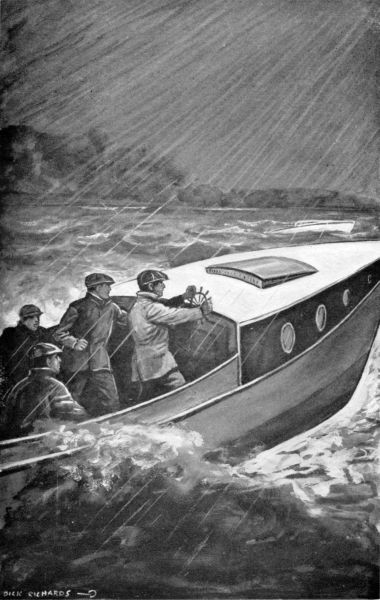
“SHE’S THE SCUD!” SHOUTED BOB.
The tall steersman threw the throttle full over and the motor craft shot ahead, aided by the wind. A little later they were alongside the Scud, and had made her fast to the other boat. The racing craft was somewhat scratched from having come in contact with floating debris, or the rocks in the river, but the damage was comparatively slight.
“It’s good to get her back again!” cried Bob. “Good old Scud!”
“And we didn’t get her any too soon!” exclaimed Jerry. “A little more and she’d have been on those rocks, and she’d have been a wreck when we got her off,” and he pointed to a menacing ledge of stone just ahead. Indeed it required skillful navigating for the boys themselves to get past the danger point, with the strong wind urging them on.
“We’d better not try to work back against this gale,” said Bob. “Can’t we tie the boats up somewhere along here, and go back in a car or train? We can get them later.”
“Good idea,” said Jerry. “We’ll do it.”
They obtained permission from a friendly boatman to leave their two launches tied at his dock, and making sure they were well fastened, the boys set off on their way to Cresville.
They were fortunate in catching a train, for they had come several miles from home, but in due time they were again trudging the streets of their town.
The storm was still at its height, and considerable more damage had been done to the various buildings. A relief corps had been organized, and the boys were about to offer their services when Bob, who had gone over to look at the bulletin in front of the newspaper office, came back with a serious look on his face.
“What is it?” cried Ned.
“Bad news, fellows. There’s a wireless message there, from Boston. It says that several large steamers are in distress, and that a number of small boats have foundered. But that isn’t the worst. The Hassen, with my uncle and cousin on board, has sunk, so the dispatch says,” and the tears came into poor Bob’s eyes.
CHAPTER VII
OFF ON A SEARCH
For a moment Jerry and Ned stared almost uncomprehendingly at the boy who brought such startling news. Then Jerry exclaimed:
“It can’t be possible, Bob! There must be some mistake!”
“I only wish there was,” went on the stout lad. “Not that I want any other vessel to be wrecked, either. But the dispatch says plainly that the Hassen has gone down. It’s a peculiar name, and there’s hardly any likelihood of an error. No, I’m afraid it’s all up with Uncle Nelson and Cousin Grace!”
“Too bad!” sympathized Ned. “Now you won’t know what it was he was bringing over with him.”
“Oh, I fancy my folks know,” said Bob. “But I don’t care so much about that.”
“I should say not,” agreed Jerry. “Think of being out in the ocean in such weather as this! Poor girl!”
“They might have escaped—have taken to the small boats or the life rafts,” suggested Ned. “I wouldn’t give up all hope, Bob, old man.”
“Well, of course there’s a small chance,” admitted the stout youth in a despondent tone; “but not much in such a storm as this. A small boat couldn’t live an hour in such a sea as there must be off this coast. It’s awful!”
“Well, hope for the best,” came from Jerry. “Things are bad enough here. Look at the ruin!” and he gazed about him. The others saw the destruction on every side, caused by the high wind. Scarcely a street but what was littered with debris, and many houses were uninhabitable by reason of being unroofed or through the breaking of water and drain pipes.
“We’ve got to get busy and help!” exclaimed Ned. “See! there’s another volunteer corps being organized. Let’s join it. We can’t get any wetter; and it will help to take Bob’s mind off his trouble,” Ned added in lower tones to Jerry.
“You’re right, old man. Work is the best thing for that. Come on, Bob, let’s get busy. You, too, Andy Rush!”
“That’s what I want to do—help!” cried the excitable lad. “Save lives—put out fire—pump a cellar dry—build up a chimney—here we go—come on, everybody—let her go—whoop!”
“If he keeps on that way he won’t get much done,” commented Bob with a smile.
“Let him go,” advised Jerry. “Talk is his safety valve. I’d hate to think what would happen to him if he couldn’t work off his energy that way.”
Just then Ned saw his father talking to the mayor of the town, and hurried over to them.
“Ah, Ned!” exclaimed Mr. Slade, “we were just beginning to worry about you. This is awful—terrible. I have thrown open my department store to the use of the relief corps. We will house and feed as many there as we can. Other merchants are doing the same. You boys may bring any unfortunates you meet. The salespeople, and everyone there, has orders to spare nothing.”
“That’s bully, Dad!” exclaimed Ned. “We were just going to start in and help. We had to go off after our boat that got adrift.”
“So I understand. Well, I’ll tell your mother you’re all right.”
“And if it wouldn’t be too much trouble, could you let my mother know I’m safe?” asked Jerry. “Then I won’t have to go home.”
“Yes, I’ll do that, and for you and Andy, too, Bob. Now boys, show what sort of stuff you’re made of. This is quite a calamity for Cresville, but other places have suffered worse, and it’s up to us to meet it bravely. Now, Mr. Mayor, don’t fail to call on me for any aid in my power to give.”
“Thank you, Mr. Slade, I’ll remember. You’re a citizen to be proud of. Mr. Baker has offered me all the funds I need.”
“That’s good,” murmured Bob, glad that his father, too, had taken a hand in helping the unfortunates.
“Oh, I almost forgot,” said Mr. Slade. “Mrs. Hopkins telephoned me a little while ago, Mr. Mayor, to the effect that she and some ladies were organizing a nursing corps, so that any injured persons will receive all the medical attention they need.”
“Good!” cried the town executive. “It’s a comfort to have such citizens in Cresville. Now, if you’ll excuse me, I’ll go see how our relief work is coming on.”
“Yes, and I guess it’s up to us to get on the job, too!” added Jerry. “Come on, fellows.”
While Mr. Slade hurried off to send word of the safety of the lads, Jerry and his chums placed themselves at the service of one of the several chairmen of the relief corps that had hastily been organized. The boys found much to do, and it was not easy work, as the storm continued to rage.
“I think it’s slacking up a bit, though,” remarked Bob when there came a chance for him and his chums to take a breathing spell. They had worked hard and faithfully, even the excitable Andy Rush proving a real hero.
“Yes, the wind isn’t quite so strong,” agreed Jerry. “I’ll be glad, though, when we can get on something dry.”
“I wouldn’t mind the wet so much if we could get a hot cup of coffee,” spoke Bob, and his chums were so much of his opinion that they made no reference to his allusion to food.
“Speak of coffee and——” began Ned, not finishing the sentence, for with a wave of his hand he indicated a group of women, attired in men’s rubber coats, who were going about with a small cart, in which stood a steaming wash boiler full of it.
“Say, there’s my mother!” cried Jerry, and, sure enough, the wealthy widow, with some of her friends, was going about giving hot coffee to the drenched and weary workers. “That’s the stuff, Mother!” cried Jerry, heartily. “Got any left?”
“Indeed we have, boys!” answered Mrs. Rutledge, a neighbor of the Hopkinses.
A number of the volunteers surrounded the little cart, and soon the coffee was being enjoyed. Jerry hastily told his mother of saving the boat, and then, as there was still much to be done, the boys resumed their rescue labors.
Fortunately no fires had broken out to add to the horror, or the history of Cresville might have been different. As it was, damage was done that took years to repair.
But the storm was really too fierce to last a great while, and the wind gradually died down, though the rain continued to fall for some time.
But now most of the homeless had been given temporary shelter, and the injured sent to hospitals, or were taken care of in private houses. There was no more for the boys to do, and, at Jerry’s suggestion, they adjourned to his house, which was the nearest. There they put on some of his spare clothes, though Bob looked so funny in them that Ned and Jerry laughed.
“I don’t care,” said Bob. “I’m too worried to mind what you fellows say—or do.”
“You mean about your cousin and uncle?” asked Ned, sympathetically.
“Sure. The news will break mother and dad all up, I’m afraid. My uncle was mother’s brother, you know.”
“Well, maybe there’ll be better news in the morning,” said Jerry. “Even if the Hassen sank, some other steamship may have picked up the passengers.”
“Well, we’ll have to wait and see,” said Bob. “What’s that?” he exclaimed, as the sound of a fall came from the next room.
Jerry rushed out, to return a moment later smiling, and remarked:
“You might have known. It was Professor Snodgrass. He was after some sort of a bug on the library wall, and stumbled over a chair. Mother says he started out with her on the rescue work, but every once in a while he’d see something he wanted as a specimen, and he’d stop to get it. Finally she went on without him.”
“Well, I’m glad this day is over,” said Ned. “It’s been a hard one!”
“That’s right,” agreed Bob. “Say,” he went on, “have you fellows thought any more about that submarine trip the professor wants to take?”
“I haven’t,” confessed Jerry. “There hasn’t been time.”
“I don’t see how we’re going to do it,” spoke Ned. “A submarine boat is quite a big proposition. It isn’t like building an aeroplane.”
“Well, we can think about it later,” suggested Jerry. “Just now I want to lie down and rest,” and he stretched out on a couch near the hearth, where a fire had been built.
Gradually something like order came out of the chaos in Cresville. Many willing hands worked hard to repair the damage, and the next day most of the streets were cleared. Then came the slower process of repairing the damaged buildings and the recovery of the injured. But with that this story has nothing to do.
Eagerly the boys looked for further reports of the steamship Hassen. The bad news was only too soon confirmed. The next day’s papers contained an account of the wreck of several vessels.
Among the dispatches was a story of the foundering of the ship on which Mr. Sheldon and his daughter Grace had sailed from Germany.
“Well, that ends it,” said Bob, mournfully, when, with his two chums, he had read the account. “Poor Uncle Nelson! That’s the last of him. And he was such a jolly man, too. Poor Grace!”
Jerry seemed to be in a brown study. He seemed to neither hear nor see his friends.
“No!” he suddenly exclaimed.
“What do you mean?” asked Ned curiously.
“It isn’t the end, fellows!” vigorously went on Jerry, springing to his feet, and beginning to pace the room. “There may be a chance yet!”
“For whom?” demanded Bob.
“Your uncle!” was the answer. “Even if the vessel did sink he and his daughter may have taken to a boat. And some of those lifeboats can live through a bad storm. Boys, I’ve got a plan. Let’s take the Comet and sail around the place where the Hassen is supposed to have gone down. It’s a bare chance, but it’s worth taking. Are you with me?”
“Of course!” cried Ned. “We’ll start at once. Maybe we can pick them up—and some other castaways, too. Of course we’re with you, Jerry, old man!”
Bob said nothing, but there was more than words in the manner in which he clasped Jerry’s hand.
CHAPTER VIII
NODDY AND BILL
“There, I guess that will do!”
“Should it not be put up a little farther forward?”
“No, it will light up better where it is. Besides, we can’t move it any farther forward, or it will interfere with the hydroplane lever.”
“That’s right.”
The above colloquy took place between Jerry, Ned and Bob in the big shed that housed the motorship Comet, a few hours after their decision to start in their air craft in search of the wreck of the Hassen. The boys had lost no time going over their wonderful craft to put her in the best possible condition for a long, and possibly dangerous, flight.
They had determined to start at once on the search, for well they knew the terrible distress the shipwrecked persons might be in—with nothing but an open boat between them and the vast ocean.
But there were a few needful things to be done, and one was the installation of a large searchlight, and it was concerning this that the talk had been.
Bob was of the opinion that the big lamp should go farther toward the bow, but Jerry had his own reasons for placing it where it was. The light was a new one, much larger than the one heretofore in use, and it had been purchased and installed in a hurry.
“For we may have to stay on the wing all night,” said Ned, “and this light may enable us to locate even a small boat on the ocean.”
“But if we do find my uncle and cousin in a small boat, how can we save them?” asked Bob.
“Easily enough, if the sea isn’t too rough,” replied Jerry. “We can drop the hydroplanes, and descend to them. If it’s too rough we can drop a rope, and haul them up, or even tow the boat if we have to. I’m not worrying about that part of it. The thing to do first is to find them.”
“And that isn’t going to be so easy,” observed Bob, with a sigh.
“Oh, don’t be crossing bridges until you can hear the rustling of their wings,” spoke Ned, with a smile at his chum. “Now let’s get busy, stock up, and set out on this cruise. We’ve lost a lot of time as it is.”
“That’s right,” agreed Jerry. “But we’re doing the best we can.”
“I know that,” spoke Bob, with a grateful look. “Our folks say it’s mighty kind of you boys to take this trouble.”
“Huh! Why wouldn’t we?” demanded Ned. “I guess we’re as much interested in this rescue as you are, Bob Baker.”
“Well, it’s good of you. I’m glad it was the storm that sunk the Hassen, and not that German submarine. If that boat had rammed the steamer she might have gone down so quickly that no one would have had a chance for life.”
“Oh, try to forget that submarine,” protested Jerry. “You’re getting it on the brain.”
“Like Professor Snodgrass,” spoke Ned. “Only a little while ago, when I went in the house, Jerry, to get some of that high tension wire, he asked me if we had started on it yet.”
“What’d you tell him?”
“That we had other fish to fry. I spoke of our trip in the Comet and of course he wanted to come along. He said if he couldn’t get his hermit crab specimens right away he might find some new bugs up in the air. So I told him he was welcome to come.”
“That’s right,” agreed Jerry. “We may need his help if it comes to a rescue.”
“The only trouble is,” remarked Bob, with a smile, “that if we sight that submarine again the professor may insist on being put aboard so he can get to the bottom of the sea. What will we do then?”
“Wait until it happens—worry then,” advised Jerry, with a laugh. “I don’t imagine that submarine is within a thousand miles of us.”
“Me either,” added Ned.
But neither he nor Jerry realized how soon their idle words were to be proven wrong.
All haste was made in preparing the Comet for her rescue trip. The parents of the boys thoroughly approved of it, for the motor lads had undertaken so many strenuous “stunts” in their craft that even Mrs. Hopkins no longer worried much when Jerry and his chums went out in her.
“Well, I guess we’re ready to start,” announced Jerry, a little later, after a look at the airship. Everything had been put in first class shape, and the rudder, that had given so much trouble before, had been replaced by a different one.
“Look who’s there,” said Bob in a low voice, nodding toward the roadway in front of the Hopkins house.
“Noddy Nixon,” muttered Jerry.
“Yes, and Bill Berry is with him,” went on Bob. “They seem to be looking in here pretty sharply.”
“Yes, they probably see that we’re getting ready for a trip,” spoke Ned. “I hope they won’t try to follow us, and make trouble.”
Jerry looked annoyed. Noddy and Bill were staring insolently in the direction of the open shed which housed the airship. Even a passer-by could see that it was in readiness for a flight.
Jerry, who, with his chums, had not seen much of Noddy since the bully and his crony had vainly tried to get the sixty nuggets of gold, as told in the last volume, started toward the front gate. Noddy saw him coming, but did not move.
“Were you looking for me?” asked Jerry, in no friendly voice.
“I don’t know as I was,” returned Noddy, in surly tones.
“If you are,” put in Ned, who had stepped to the side of his chum, “you won’t find any gold nuggets to try and get away from us this time.”
“Huh! Think you’re mighty smart; don’t you?” sneered Bill Berry.
“We were smart enough to fool you and the Dominion police you set on us,” laughed Bob. “Now will you have gravy on your pancakes?”
“Don’t you talk that way to us!” growled Bill. “If you do——”
“Oh, come on, we don’t want anything to do with them,” said Noddy quickly, taking his crony by the arm and leading him to one side.
“Glad you’ve come to that conclusion,” spoke Jerry, as he turned back toward the airship shed. “Come on, fellows,” he added to his chums, “we’d better get started. Bob, ask Professor Snodgrass if he’s ready.”
Noddy and Bill started down the street. They were talking earnestly together.
“They’re going off on another trip, that’s sure,” Noddy said.
“I guess so,” growled Bill. “But I don’t see that it makes any difference to us.”
“Oh, don’t you?” asked Noddy. “Well, it might. I’ve a notion to get out my airship and follow them.”
“What for?”
“What for? Because I need the money; that’s what for.”
“Money? How do you know they’re going after money?”
“Because they ’most always are. Now, Bill, it’s like this. Everything we’ve done, lately, has been a fizzle. We’ve lost out every time.”
“Well, it was as much your fault as mine,” growled Bill.
“Maybe it was,” assented Noddy, who seemed to have some special reason for not wanting to quarrel with his crony. “But when Jerry and his two chums start off it’s ’most always because they can make something out of it. Now I need money.”
“So do I, for that matter.”
“Our last trip didn’t pan out,” went on Noddy, “and my father has shut down on me. I’ve got to get some cash, and the only way I know to get it is to follow these chaps. They may be going out to locate another gold mine.”
“Well, I’m with you then,” agreed Bill. “Is your airship ready to run?”
“I can make her so in a little while. Let’s go back to our house.”
For a time, after getting into trouble, Noddy had left town with his parents, who thought of remaining away permanently, but Mr. Nixon had since moved back to Cresville, though living in a different house than the one he formerly occupied. Noddy, as my former readers know, had a large airship. It was one of several he had owned, and, though it was nowhere near as complete and powerful as the Comet, was quite serviceable.
So, while Noddy and Bill were preparing to follow our friends, in the hope of trailing them to some hidden fortune, Jerry and his chums were getting ready for the rescue flight.
“I’ll be with you in a few minutes!” called Professor Snodgrass when he was told that the start would soon be made. “I just want to get a small net, with a long handle, because I may see some rare insects in the upper air. We’ll have to let the sea crabs go for a time, until you boys can build a submarine.”
“I’m afraid that will be a long while,” said Jerry, as he looked to see that the plane-shifting levers worked properly.
It was decided to navigate at first as an aeroplane, since, after the storm, the weather was very calm. By telegraph, as good a description as possible had been obtained as to where the Hassen had been last seen. The boys intended to cruise around over this spot in ever-increasing circles.
“All aboard!” cried Bob, as he climbed up on the main deck. “We’ve got enough to eat for two weeks.”
“Trust Chunky for that,” commented Ned with a smile. “Are you coming, Professor.”
“Yes!” cried the little scientist. “I think I have everything. I am going——” he had started from the house toward the airship, but stopped suddenly to peer at something on the ground.
“Oh, what a find!” he cried. “Oh, what a lucky find!”
In an instant he was on his knees and was carefully lifting into one of his boxes some little creature.
“What is it?” asked Jerry, with a smile.
“A very rare specimen of a green striped angle-worm,” was the answer. “I have been looking for one for years. Now, if I could only get another,” and the professor began searching on the ground.
“I’m afraid, Professor Snodgrass, that we can’t wait,” said Jerry. “We ought to be under way now.”
“All right,” was the answer. “Though it is a pity to lose this chance. I say, Dick,” called the scientist to the gardener, “if you see a green striped angle-worm——”
“I’ll be sure to kill it, Professor,” interrupted the man. “I know the creatures, eating up the cabbages, and everything else. I’ll kill every one I see.”
“No, no! For the love of science don’t do that!” was the appeal of the professor. “I beg of you not to do that. I will give you two dollars for every one you save for me, Dick!”
“Do you mean that, Professor?”
“I certainly do.”
“Then I’ll search for ’em with a dark lantern to-night,” was the answer. “I’ll have a lot for you when you come back.”
“Ah, what a lucky day!” cried the professor, as he got aboard the Comet.
Good-byes were called to Mrs. Hopkins, and to the mothers of Bob and Ned, who had called at Jerry’s house to see the start. The boys took their places, the professor was in the cabin, writing out a description of his latest find, and all was in readiness.
“Here we go!” cried Jerry, as he swung over the lever that started the propeller motor. The Comet rolled across the smooth starting ground. Then, as the elevating rudder was tilted the craft shot into the air like a bird, soon attaining a good height.
At the same time, off to one side of the town, another aeroplane darted forward, trailing the one carrying our friends.