


автордың кітабын онлайн тегін оқу The Motor Boys in the Army; or, Ned, Bob and Jerry as Volunteers
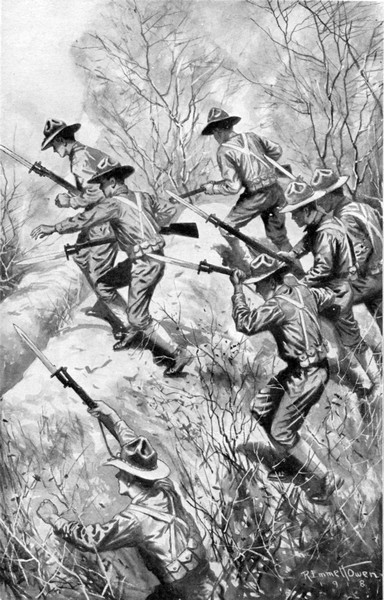
THEY PERFECTED THEMSELVES IN THE USE OF THE RIFLE AND THE BAYONET.
THE MOTOR BOYS
IN THE ARMY
OR
Ned, Bob and Jerry as Volunteers
BY
CLARENCE YOUNG
AUTHOR OF “THE MOTOR BOYS SERIES,” “THE JACK
RANGER SERIES,” ETC.
ILLUSTRATED
NEW YORK
CUPPLES & LEON COMPANY
BOOKS BY CLARENCE YOUNG
12mo. Cloth. Illustrated. Colored Jacket.
THE MOTOR BOYS SERIES
- THE MOTOR BOYS
- THE MOTOR BOYS OVERLAND
- THE MOTOR BOYS IN MEXICO
- THE MOTOR BOYS ACROSS THE PLAINS
- THE MOTOR BOYS AFLOAT
- THE MOTOR BOYS ON THE ATLANTIC
- THE MOTOR BOYS IN STRANGE WATERS
- THE MOTOR BOYS ON THE PACIFIC
- THE MOTOR BOYS IN THE CLOUDS
- THE MOTOR BOYS OVER THE ROCKIES
- THE MOTOR BOYS OVER THE OCEAN
- THE MOTOR BOYS ON THE WING
- THE MOTOR BOYS AFTER A FORTUNE
- THE MOTOR BOYS ON THE BORDER
- THE MOTOR BOYS UNDER THE SEA
- THE MOTOR BOYS ON ROAD AND RIVER
- THE MOTOR BOYS AT BOXWOOD HALL
- THE MOTOR BOYS ON A RANCH
- THE MOTOR BOYS IN THE ARMY
- THE MOTOR BOYS ON THE FIRING LINE
- THE MOTOR BOYS BOUND FOR HOME
THE JACK RANGER SERIES
- JACK RANGER’S SCHOOLDAYS
- JACK RANGER’S WESTERN TRIP
- JACK RANGER’S SCHOOL VICTORIES
- JACK RANGER’S OCEAN CRUISE
- JACK RANGER’S GUN CLUB
- JACK RANGER’S TREASURE BOX
Copyright, 1918, by Cupples & Leon Company
The Motor Boys in the Army
Printed in U. S. A.
CONTENTS
CHAPTER
PAGE
I
The Fire Alarm1
II
The Runaway Engine9
III
“Just As Easy!”16
IV
Crooked Nose24
V
The Odd Man33
VI
First Call for Volunteers42
VII
Chunky’s Trouble51
VIII
A Pro-German Meeting59
IX
A Fight in the Dark68
X
The Parting79
XI
Off to Camp Dixton85
XII
Pug Kennedy91
XIII
In the Camp100
XIV
Somewhat Different108
XV
In Uniform117
XVI
Hot Words125
XVII
A Midnight Meeting132
XVIII
A Stab in the Back141
XIX
A Cave-In152
XX
A Practice March159
XXI
Crooked Nose Again166
XXII
The Accusation174
XXIII
The Minstrel Show183
XXIV
A Black-Face Pursuit190
XXV
“A Prisoner”197
XXVI
A Night Alarm207
XXVII
The Hand Grenade213
XXVIII
The Storm223
XXIX
In the Old Barn229
XXX
The Round-Up237
LIST OF ILLUSTRATIONS
THEY PERFECTED THEMSELVES IN THE USE OF THE RIFLE AND THE BAYONET. “TREASON! TREASON!” CAME THE CRIES FROM ALL OVER THE HALL. NED AND JERRY, HURRYING OVER SAW THE CORPORAL HOLDING PUG KENNEDY. “WE’LL SLIDE DOWN AND GRAB ’EM,” SAID JERRY.NED, BOB AND JERRY IN THE ARMY
CHAPTER I
THE FIRE ALARM
“You’re going, aren’t you, Ned?”
“Surest thing you know!”
“Will you be there, Bob?”
“Of course, Jerry. It ought to be quite a meeting, I should say.”
“You said something!” exclaimed Ned Slade, with an air of conviction. “Things will whoop up in great shape. Why, there hasn’t been so much excitement in Cresville since I can remember.”
“Not since the old lumberyard burned,” added Jerry Hopkins, as he walked down the street, one arm linked in that of Ned Slade on his left, and the other hooked up with Bob Baker’s on his right. “It doesn’t seem possible that we’ve been drawn into this, after all the President did to keep us out; but it’s true.”
“Of course it’s true!” exclaimed Ned. “The President goes before Congress and asks for the whole strength of the nation to back him up, and defy Germany. And he gets it, too!”
“That’s what he does,” added Jerry. “It’s one of the strongest declarations about the war I ever read; and we’ve had a chance to read a few in the last two years. America against Germany! I never expected it, but, now it’s come, we’ll have to get in it good and strong.”
“And we’ve got to hustle, too!” added Bob Baker.
“That’ll be something new for you, Chunky!” observed Jerry Hopkins, with a chuckle. “You’re getting fatter than ever,” and he caught some of his friend’s superfluous flesh between thumb and finger and made Bob squirm.
“Quit it!” the latter begged. “What do you think I’m made of, anyhow?”
“I was just trying to find out,” answered Jerry, innocently. “’Tisn’t as firm as it might be, but when we get back to Boxwood Hall, and you have a little tennis or football to harden you up, I think you’ll feel better.”
“I’d feel better right now if you’d quit pinching me!” exclaimed the tormented one. “Try it on Ned a bit.”
“Oh, he doesn’t need waking up,” laughed Jerry. “But say, do we need tickets for this meeting to-night?”
“I don’t believe so,” remarked Bob, whose nickname of Chunky fitted him well. “But let’s go down the street and read one of the notices. There’s one in front of Porter’s drug store. And while we’re there we can——”
“Get chocolate sodas! I know you were going to say that!” broke in Ned. “Say, I thought you were on a diet, Chunky. The idea of taking chocolate! Don’t you know it’s fattening?”
“Who said anything about chocolate sodas?” demanded the fat one. “I didn’t mention it!” and he glared at Ned. But Jerry was between the two.
“I know you didn’t, little one!” returned Ned sweetly. “But you were going to, and I made it easy for you. However, I don’t believe one chocolate will hurt you; and since you are going to buy——”
“Who said I was?” demanded Bob.
“Why, didn’t you?” asked Ned, with an assumption of innocence. “I’m sure I heard Chunky invite us to have sodas. Didn’t you, Jerry?”
“Sure!” was the ready answer. “Don’t try to back out, Bob. It’s too late.”
“Well, it’s of no use trying to buck up against a conspiracy like this,” sighed the stout youth. “I guess I’ve got the price,” and he rattled some change in his pocket.
The trio of lads, nodding now and then to acquaintances they passed, kept on down the street until they reached Porter’s drug store. In the window was a placard announcing a patriotic meeting to be held in the auditorium that evening, for the purpose, as it stated, of:
“Upholding President Wilson, and proving to him that Cresville approves of his course in declaring a state of war with Germany exists.”
“No tickets needed,” read Jerry. “It’s a case of first come first served, I guess.”
They entered the drug store, and soon were being served, talking, the while, of the coming patriotic meeting.
“Colonel Wentworth is going to preside,” announced Ned.
“Yes, and there’ll be enough rhetorical fireworks to stock a battleship,” observed Jerry.
“Well, the old soldier means all right,” added Bob, who seemed to be of a kind and mellow disposition, now that he was having something to eat. Eating, as may have been guessed, was one of Chunky’s strong points. “There isn’t a more patriotic citizen than Colonel Wentworth,” went on the stout youth, stirring his chocolate ice-cream soda to mix it well before drinking. “He did his share in the Spanish war, and now he’s anxious to volunteer again, I hear.”
“He’s a little too old, isn’t he?” asked Ned.
“Yes, but he’s in fine shape. Well, we’ll go to the meeting, anyhow, and help whoop things up.”
“That’s right!” chimed in Jerry Hopkins. “These are the days to show your colors.”
It will be evident to the reader that the period of the opening of this story was in the spring, following the announcement of war between the United States and Germany.
Of the events leading up to that announcement nothing need be said here, for they are too well known. But even though every one who had closely followed the trend of thought and happenings, knew there was nothing for an honor-loving and conscientious nation to do except take the step advocated by President Wilson, still the actual declaration that a state of war existed, when it was made, came as a shock.
Then followed the reaction. A reaction which resulted in the holding of many meetings, in the organization of many societies and in new activities in many that were already organized.
The New England town of Cresville, the home of Ned, Bob and Jerry, was no exception to this rule. It was a progressive town, or small city if you will, and numbered among its members citizens of worth and patriotism. So it is not strange that a meeting should be called to “back up” the President.
The meeting had its inception with Colonel Wentworth, a Son of the Revolution, an officer in the Spanish-American war, where he had fought with the regulars both in Cuba and in the Philippines, and an all-around true-hearted and red-blooded American. He felt that Cresville should make her position known, and in order to stir her blood, as well as add fuel to his own, he proposed the holding of a patriotic mass meeting, at which a number of speakers should be heard. A United States Senator had promised to come and tell something of the events leading up to the formal declaration of war.
Ned, Bob and Jerry, home from their college, Boxwood Hall, for the Easter vacation, had read the notices of the meeting, and, having followed with interest the course of events in America preceding the entrance of the United States into the war and also having closely observed the course of England, France, Russia and Italy against a common enemy, had decided to attend the meeting.
They had planned to take a motor trip to a distant city, to attend a concert by the Boxwood Hall Glee Club and a dance afterward, at which the boys expected to meet some young ladies in whom they were more than ordinarily interested. But when Jerry had seen the notices posted for the patriotic rally he had said to his chums:
“Fellows, the dance racket is off! We’ve got to show ourselves at the auditorium.”
“That’s right,” Ned had answered. “Dad’s a great friend of the colonel’s, and he’s going with mother. He told me I ought to show myself there, and I guess we’ll have to.”
So it was decided, and, a few hours after having been the guests of Chunky at the soda fountain, Ned and Jerry, with their stout companion, found themselves part of a throng at the door of the town auditorium, a newly constructed meeting place.
“Some push!” exclaimed Ned, as he felt himself being carried forward in the crush, for the doors had just been opened.
“It’s going to be a success all right,” added Jerry. “They’ll never get ’em all in!”
The hall was, indeed, filled, and standing room was at the proverbial premium when Colonel Wentworth, visibly proud of the success of his undertaking, advanced to welcome the gathering and to introduce the first speaker.
There was the speaking usual at such a meeting, only this time it was tinged with a deeper note of seriousness. America had not yet awakened to the realization of what war really meant, and was going to mean. And some of the speakers tried to bring this home to the people of Cresville.
The meeting was rather long, and even though they were as full of fire, zeal, energy and patriotism as any person there, Ned, Bob and Jerry, after two hours of speech-making, began to wish themselves out of the place. They felt they had done their duty, and were longing for a little change, when it came, most unexpectedly.
They were sitting in the rear of the hall, close to the main entrance doors, when Ned heard a sound that made him suddenly sit up.
“Hear that?” he asked, in a whisper, of Jerry.
“What?”
“Fire alarm! It’s from the box down near dad’s store! I’m going to see what it is!”
He rose softly, so as not to disturb the speaker. The sound of the alarm could be plainly heard. Bob and Jerry also arose and made their way out, as did several others. An undercurrent of excitement seemed to pervade the meeting. As the boys reached the door, there came from the street a cry of fear.
CHAPTER II
THE RUNAWAY ENGINE
“Did you hear that?” asked Jerry of his two chums, when they were in the anteroom of the auditorium, and could speak without disturbing the meeting.
“Sounded as if some one was hurt,” added Ned.
A number of men and boys had come out at the same time as had the three friends, and one of them now hurried to the door and looked down the street. There were a number of electric lights, and, as the trees were bare of leaves, a good view could be had.
“Look at that!” cried the man who had made the observation. “Look!”
“What is it?”
“The fire engine horses are running away!” was the excited answer. “The driver’s been thrown off, and the horses are pulling the engine down Hoyt street hill lickity-split! Say, there’ll be a smash-up all right!”
It did seem so, as Ned, Bob and Jerry noted a moment later, when they hurried out in front of the auditorium and gazed down the thoroughfare. The engine could plainly be seen, smoke and sparks pouring from it, for the automatic apparatus, that starts a blaze under the boiler, had been set going by the engineer as the steamer pulled out of its quarters.
The engine was a new one for Cresville, being one of two purchased to replace the old hand-drawn pumping affairs that had so long done duty in the town.
“Come on!” suddenly exclaimed Jerry Hopkins, and he led his two chums over toward his auto, the trio having come to the meeting in the powerful machine.
“What are you going to do?” asked Ned.
“Catch those horses!” replied Jerry as he hurried on.
And in the momentary pause that ensued, while he and his friends were getting in the car, to give pursuit to the runaway fire engine steeds, I will take a brief moment to acquaint my new readers with the chief characters of this story.
Those of you who formed your friendship for the chums in the book called “The Motor Boys,” know Ned, Bob and Jerry full well by this time.
Jerry Hopkins was the son of a rich widow of Cresville, and was the leader of the trio, the three boys having been chums, friends and inseparable companions for many years. Bob Baker, otherwise known as “Chunky,” was the son of Andrew Baker, a banker of the town, while Ned Slade’s father kept the chief department store in Cresville. As already stated, this town, or city, as its more enthusiastic admirers called it, was in New England, not far from Boston.
As may be guessed from the title of the first book, the lads were much interested in machines propelled by gasoline motors. Their initial venture was with motor cycles, after their bicycle days, and then they secured an automobile, in which they went on many a tour, even down into Mexico, as related in other volumes of the “Motor Boys Series.”
They later acquired a motor boat and voyaged on the Atlantic and Pacific, and several books are devoted to their activities in this regard. As might be expected, the perfection of the aeroplane gave the boys a chance for new activities, and they ventured above the clouds more than once.
From the heights to the depths was a natural descent, and a submarine took the motor boys under the ocean where they had more than one thrill. Then they went back to their motor car and boat again; and had more exciting times on road and river.
In “The Motor Boys at Boxwood Hall; or, Ned, Bob and Jerry as Freshmen,” the seventeenth book of this series, you will find our heroes in a new phase. Too long, their parents decided, had they been living a free and careless life, with no systematic studying to fit them for the struggle that lay before them. So they were sent to school again, and Boxwood Hall was the place selected for them.
Because a certain clique there had the idea that these lads regarded themselves too seriously, there was a conspiracy formed against Ned, Bob and Jerry at the school, and they entered under a handicap. How they worked it off, and came in “first under the wire,” will be found fully set down. Also may be read how the faithful trio, at the last moment, turned what might have been an athletic defeat into victory, and, incidentally, helped a fellow student to develop his character along the right lines.
Mr. Slade and Mr. Baker were financially interested in a certain western cattle ranch, and when it was learned that serious thefts had taken place there the motor boys were eager to go out and try to solve the mystery. How they did is told in “The Motor Boys on a Ranch.”
From then on matters at Boxwood Hall went more smoothly, and Ned, Bob and Jerry were accorded the place to which they were entitled.
They had now come home for the Easter vacation, to find their town plunged in war excitement, in which the whole country shared.
“Do you mean you’re going to chase after that engine in this car?” asked Bob, as he managed to fling himself into the rear seat, while Jerry and Ned took the front one and the former started the motor.
“That’s just what I’m going to do,” Jerry answered. “If Jim Foster, the driver, has been thrown off, there’s no one aboard to stop the fire horses.”
“Well, Jim was thrown off all right!” exclaimed Ned. “They’ve picked him up, and are carrying him into Doctor Newton’s place.”
“Hank Tedder, the engineer, is hanging on all right,” added Bob, as he peered down the street and observed a man clinging to the rear of the swaying engine.
“Yes, but he can’t climb over and get into Foster’s seat and stop the horses,” decided Jerry, as he turned on more speed and swung his big touring car after the engine ahead of him. “This is the only way to stop those frightened horses.”
“Unless some one gets in front of ’em and brings ’em up,” added Ned.
“Who’d take a risk like that?” asked Bob, from the rear seat. “In fact, I don’t see how you are going to work it, Jerry.”
“I don’t quite know myself; but I’m going to try. You know the way a mounted policeman stops a runaway team is to ride up alongside of them, get his horse to going at the same speed as the bolters, and then gradually bring them to a stop.”
“And you’re going to try that?” asked Bob, incredulously.
“Sure! Why not? It’s the only thing to do,” answered Jerry, calmly. “If those horses keep on down the Hoyt street hill they’ll go smack into the river! It’s a pity they didn’t get auto engines while they were at it.”
“That’s right!” agreed Ned. “Keep on, Jerry, old man!”
“I will! Hold tight, though, fellows, when it comes to the last lap. There may be an upset!”
Indeed the boys were taking a desperate chance. The frightened horses, hitched to the heavy engine, were pulling it along at top speed, and the downward slope of the street added to their momentum. As yet the grade was gradual, but, a little farther on, the slant was more decided, leading down to the river.
Hoyt street turned at the end, and went along the river bank, but at the speed they were going it would be impossible for the horses to make the turn, the boys thought.
By this time a number of persons, some of whom had left the meeting, were in the street, following after the runaway engine, and shouting wildly. One or two persons in automobiles started after the speeding horses, but Jerry’s car was well in the lead, though the horses had a good start.
The engineer of the steamer, realizing the danger should any pedestrians or persons in vehicles get in the path of the wild horses, pulling the tons of steel and fire behind them, kept the whistle going spasmodically.
The new engine house, as are all those in cities, was fitted with a device to keep steam at ten pounds pressure constantly in the boiler. When the engine pulled out this pressure was enough to operate the whistle, and when the fire was started there was soon steam enough to work the pump, in case it should prove to be needed.
“Do you see anything of the fire?” asked Bob, as Jerry’s car speeded on.
Ned looked up. The number of the alarm box indicated that it was in the neighborhood of his father’s large department store. And he was relieved when he saw no tell-tale glare in the sky. But the danger of the runaway engine was still present. Could Jerry reach and stop the team in time?
CHAPTER III
“JUST AS EASY!”
Down the hill thundered the fire engine, the man on the back step keeping the whistle going. Behind the steamer came the powerful automobile containing Ned, Bob and Jerry, and after them came a crowd of men and boys, while a car or two, not having the speed advantage of the motor boys’ vehicle, trailed after.
“If they make the turn into Water street, a block above the river, they’ll be safe,” said Ned to his tall chum beside him in the seat. “The hill isn’t so steep there. But if they keep on down past Water street——”
“It’s into the water for them!” grimly finished Jerry Hopkins. “We’ll try to stop them before they get there.”
He gave the auto a little more gasoline, and it leaped forward. At the same moment Bob yelled:
“There it is! See the blaze!”
He pointed off to the left, and there a glare in the sky, which increased in brightness as the boys looked, could be observed.
“One of the tenements over in Frogtown!” exclaimed Ned, naming a poor section of Cresville where lived a number of foreigners who worked in the various factories. Of late a number of new industries had sprung up in the place, and the foreigners, who made up a large share of the workmen, were quartered in long rows of tenement houses, on the outskirts of Cresville, the place being styled “Frogtown,” because built on filled land, where once had been a frog-infested pond.
“If those shacks get to going there’ll be some fire,” murmured Ned. “And they’ll get a good start if the engine doesn’t soon reach the place.”
“Some one ought to send in another alarm, and bring out the other engine,” added Bob. “This one won’t be much good if it goes to smash.”
“We’ve no time to send in alarms now,” muttered Jerry. “Let some one else do that. We’ve got to stop those horses if we can!”
Ned and Bob clung to the sides of the car. This was in the lead now, and nothing was between their automobile and the swaying, rumbling engine.
Suddenly Ned gave a cry and pointed to something.
“What is it?” asked Jerry. “Another fire?”
“Look at that old man! Right in the path of the engine! The horses’ll be on him in a minute!”
“That’s right!” chimed in Bob, from the rear seat. “Hi there! Get out the way!” he yelled. “Don’t you see the engine?”
Certainly the man at the side of the road, standing in the full glare of an arc electric light, ought to have heard the rattle of the runaway engine, even if he did not see it, though the place was well illuminated, and there was then no other vehicle in sight, save the automobile of the motor boys. There was something familiar about the odd figure, but neither Ned, Bob nor Jerry had time just then to look closely enough to make out who it was.
“What’s he doing?” asked Jerry, as he skillfully guided his machine and turned on a little more speed, for he was nearing the engine, and wanted to be in a position to stop the runaway horses if he could.
“He seems to be picking up something off the ground, under the light,” went on Ned. “Get out the way! Get out the way!” he yelled.
Then, for the first time, the little man at the side of the street seemed aware of what was going on.
“Look at him!” cried Jerry.
“He’s right in the way of the horses!” added Ned.
“And he’s going to try to stop ’em!” came from Bob. “Oh, boy! what’ll happen to him?”
And it was plain to the three chums that the little man was going to make an effort to stop the runaways. At this point there was a slight upward slant to the street, before it made the turn over the hill down to the river.
The horses had slackened their speed somewhat, but they were still running at a smart pace, when the little man, first laying something carefully down in the grass at a safe distance from the road, stepped out, and began running alongside the runaways.
“He knows something about the game,” murmured Ned. “Lots of folks that try to stop a runaway horse get right in front. The only way to do is to get alongside and grab the reins.”
“That’s what he’s doing! That’s what he’s done!” cried Bob.
And, indeed, the small man had. He ran alongside the off horse, until he could reach up and grab the reins, and then he hung on and let his weight tell. And it did, too, slight as it was. That, and the effect of his voice (for the boys could hear him calling to the steeds to stop), combined with the fact that the horses were tired and had a little hill before them, gradually brought the runaways to a stop. The nigh horse slipped and fell heavily, but the other retained its feet, and so did the little man who had brought the animals to a stop.
“Say, did you see him do it?” cried Jerry to his chums.
“I should say yes!” chimed in Bob.
“Just as easy!” murmured Ned, admiringly. “Just as easy!”
“He certainly did know how to do it,” agreed Jerry, as he brought the automobile to a stop near the throbbing engine, for now there was a good head of steam up. The boys ran to where the little man still stood. Ned was the first to reach him. The boy gave a cry.
“Professor Snodgrass!”
“What’s that?” asked Jerry, in surprise.
“It’s our old friend, Professor Uriah Snodgrass!”
“Great rattlesnakes, so it is!” shouted Bob.
And it was, indeed, the professor, now a member of the faculty of Boxwood Hall, and a companion, more than once, of the boys on their trips.
“Are you hurt, Professor?” asked Jerry, as he hurried to the side of the little scientist, while the fireman of the steamer came forward to relieve Mr. Snodgrass of the care of the standing horse.
“Hurt? No. Why?” asked the surprised scientist.
“Why because you stopped that runaway.”
“Runaway? Was that a runaway?” asked Professor Snodgrass in great surprise.
“Of course it was!” cried Ned. “Didn’t you know it?”
“A runaway? No, my dear boy, I did not. I heard some yelling, and I saw the fire engine coming my way. But the reason I stopped it was because a little while ago I saw, just beyond, in the road, a most curious bug of a kind that only appears early in April in this locality. I was eager to get it, and I was afraid, if the horses and engine trampled the roadway, that I would lose the exceedingly rare specimen. That’s why I stopped the animals. I had no idea that it was a runaway, but I’m glad if I have been of any service. If you’ll excuse me, now, I’ll go and look for that bug,” and, as though it was his custom every evening after supper to stop a runaway fire engine in danger of plunging into the river, Professor Snodgrass turned aside and began searching in the dust for the bug he wanted. Off to one side, in the grass where he had carefully placed it before stepping out to stop the horses, was the collecting box the boys knew so well.
“Isn’t he the limit?” cried Jerry.
“Same old professor. Hasn’t changed a bit,” observed Bob.
“Well, considering it was only about three weeks ago that we left him at Boxwood Hall, there hasn’t been much time for change,” returned Ned, with a laugh. “But say, fellows, what’s to be done?” he went on. “That fire’s growing worse, and it looks as though one of these horses was out of business.”
“He is,” said Hank Tedder, the engineer. “His leg’s broke. He’ll never pull another engine. And how I’m going to get this steamer to the fire—first alarm it’s ever responded to—I don’t know.”
The boys did not either—that is Ned and Bob did not. But Jerry did. He was always resourceful.
“Unhitch the horses!” he cried to Hank. “Push the engine back so it clears, and we’ll tow it to the fire with our auto.”
“Can you?” asked Ned.
“Sure. We’ve got plenty of power, and it’s a level road from here on. Downhill, if anything. You can ride on the seat, Hank, and put on the brake when it’s needed. Come on, boys!”
“All right. And it can’t be any too soon!” murmured Bob, as he looked at the reddening sky.
“They may send the other engine,” said Jake Todger, another fireman who came up in some one’s automobile just then. He worked to free the injured horse while the boys unharnessed the other one. Professor Snodgrass seemed to have forgotten about everything but the bug he was looking for in the dust of the road, under the electric light.
With straps from the harness, and a strong towline carried on the auto, the machine was soon hitched to the steamer, and then Jerry once more took his position at the steering wheel.
“Going to leave the professor here?” asked Bob, as Hank climbed to the driver’s seat of the steamer, while Jake got on behind.
“Guess we’ll have to,” replied Ned. “I didn’t know he was in town. He must have just arrived, and probably he has come to pay one of us a visit. He’ll look us up later—when he’s found that bug. Best to leave him alone.”
“That’s right,” agreed Jake. “Anything to get to the fire. This has been an awful night!”
“And it’s only just begun,” observed Jerry, as he thought of the patriotic meeting he and the others had left to go to see where the fire was.
Off started the powerful automobile pulling the engine, while the red blaze in the sky grew brighter.
CHAPTER IV
CROOKED NOSE
“Some fire, boys!”
“Yes, we aren’t going to get there any too soon.”
“I doubt if we can save any of the old shacks if they get going.”
Thus spoke Ned, Bob and Jerry as they sat in the automobile, pulling the fire engine along the road. It was not as easy as Jerry had thought it would be, and he had to use the utmost power of his car, strong as it was; for the steamer was heavy, and the roads were of dirt. But it was the only solution of the difficulty, with one horse disabled, and no others immediately available.
“Can you make it, boys?” asked Hank, from his seat in front of the throbbing engine.
“We will make it, or bust a cylinder!” exclaimed Jerry, as he turned off the road into a cross street that led to Frogtown, the scene of the fire.
On chugged the automobile, and behind it rumbled the fire engine. The machine was not of the heaviest construction, or perhaps Jerry’s car, powerful as the latter was, could not have pulled it. But, as it happened, it was possible to move it along at good speed, and they were soon at the head of the street on which stood the burning structure.
“It’s one of the big tenements!” cried Ned.
“Yes, and it’s gone beyond saving, I guess,” added Jerry. “The engine didn’t get here in time.”
This was evident to all. The tenement, a long, rambling structure of wood, three stories high, was blazing at one end. Already about half of it had been consumed and had fallen in red ruins. The wind was blowing the flames toward the unburned portion, and it was only a question of time when it would all go.
“Here comes the other engine!” some one shouted, as Jerry drew the one he was pulling up to a fire plug.
“They’d better try to save the rest of the block, and let this shebang go!” exclaimed Jake Todger, as he jumped down and began to attach the big hose from the hydrant to the pump.
Two hose carts were on hand, one belonging to the engine the boys had pulled to the fire, and the members of the department began to attach the line to the engine.
“We’ll have a stream on in a jiffy!” exclaimed Jake. “But the second engine’d better play on the other end of the block to keep that from catchin’.”
This seemed to be the idea of the chief of the fire department, for he came rushing up, and gave orders that the tenement adjoining the one that was ablaze, should be kept wet down.
“You play on the fire itself, Jake!” the chief ordered. “What happened to your engine, and where’s the driver?”
“Pitched off and hurt, I guess. Bad, too. The horses ran away an’ one’s got a busted leg. Jerry Hopkins and his chums pulled the engine here with their auto.”
“Good for them! Well, get busy.”
Jerry ran his car out of the way, and then the engine he had brought to the blaze began pumping. Soon two powerful streams were available, one playing on the blaze itself, and the other forming a curtain of water to prevent the fire from spreading.
“Anybody hurt?” asked Jerry of the chief.
“No, I guess not. We got most of the folks out before your engine got here. I’m much obliged to you. I don’t know what we’d have done if we hadn’t had both engines.”
The fire was a fierce one, and many of the families had hurried out with only a small portion of their possessions. But it was something to have escaped with their lives, for the fire was caused by the explosion of an oil stove a woman was using, and the flames spread rapidly. The woman was badly burned, as was one of her children, and they had been taken to the hospital.
“Think they can save any of it?” asked Bob of Jerry, as they stood watching, having put their automobile in a safe place.
“Not any of the tenement that’s burning, I don’t. They’ll be lucky if the rest of the block doesn’t go.”
“That’s what I think,” added Ned. “Say, hadn’t we better go back to the professor?” he asked. “Maybe he’ll think it funny of us to have gone off and left him.”
“You ought to know him better than that by this time!” exclaimed Jerry, with a laugh. “He won’t think about anything but that bug he’s trying to catch. The idea of stopping a runaway team of fire engine horses, and not knowing it! Just stopped ’em because he thought they’d trample on some insect! And then you think he’ll feel hurt if we don’t come back after him!
“Just let him alone. Sooner or later he’ll show up at one of our homes, and then we can find out what he’s doing in this neighborhood now.”
“Maybe he’s planning some expedition to South America, or some place like that, and he wants us to go with him,” said Bob. “We have had some corking times with him.”
“Nothing like that doing now,” observed Ned. “We’ve got to stick on at Boxwood Hall, I expect. Of course it’s a dandy place, and all that, but I would like a trip off into the wilds. And if we could take Professor Snodgrass along it would be dandy.”
But events were to shape themselves differently for the motor boys. Those of you who have read the previous books of the series need no introduction to Professor Snodgrass. He was a scientist of learning and attainments, and in the boys he had firm friends. They had taken him with them on nearly all of their trips, by automobile, in the airships, in the submarines, and when they journeyed in their motor boats.
The professor had been connected with colleges and museums, for his services as a collector and curator of insects and reptiles were much in demand. He was an enthusiast of the first water, and would do even more desperate and risky things to secure a rare bug than stopping a runaway fire engine.
Of late he had headed a department at Boxwood Hall, and the boys were glad of this, for he proved as good a friend to them there as he had afield on their various trips.
They had left him at Boxwood, about three weeks before, quietly and peacefully cataloging some of his insects, and now they beheld him in the midst of considerable excitement. The professor seldom sent word that he was coming. He just came.
“Look!” suddenly cried Jerry, as he and his chums stood watching the blaze. “What’s the idea over there?” and he pointed to where some firemen were raising a ladder at the still unburned end of the blazing tenement.
“Looks like a rescue,” observed Ned.
“That’s what it is,” said Bob. “They’re taking down an old woman!”
“And some children!” added Jerry.
This was what was going on. Two families, in the top story of the end of the structure not yet directly on fire, had either been overlooked in the other rescues, or they had hidden away in fear, and were not seen.
Now some one had either told of them, or the unfortunates had been seen at the windows, and a call was given for a ladder. One was raised against the wall, and two firemen went up. They succeeded in bringing down the woman and the children, who had been trapped when the stairs burned away.
A cheer greeted the plucky efforts of the firemen, for the rescue was not an easy one. Ned, Bob and Jerry joined in the tribute. All around was the crackle of flames, and thick clouds of smoke rolled here and there, smarting eyes and choking throats. The throbbing and puffing of the steamers mingled with the shouts and orders that flew back and forth.
Suddenly a cry arose at the far end of the burning tenement; the end that could not longer be held back from the flames.
The three chums ran to where the cry sounded, and observed, leaning out of a second story window on the end of the house, an old man. Smoke poured from the window back of him, and behind him could be seen the ruddy flames, ever coming nearer.
“Another one they’ve forgotten,” cried Ned.
“Or else he hid away, or has been unconscious,” added Bob.
“They’ve got to get him soon!” exclaimed Jerry.
But the firemen, and there were none too many of them even with the whole department out, were busy elsewhere. Some were attending the nozzles, others were helping at the engines and some were still carrying to places of safety the women and children brought down from the front of the blazing structure.
“We’ve got to get him down!” cried Jerry.
“If we only had a ladder!” added Ned.
“Here’s one!” shouted Bob, and he pointed to a short one that had been thrown on the ground, evidently as of no use in reaching the women and children who were taken from the floor higher up.
“Will it reach?” asked Ned.
“We’ve got to try,” Jerry yelled. “Bring it over!”
With the aid of his chums, he raised it against the window. Just then part of the house fell in, and the crowd surged back, thinking to get out of danger, so the boys were left comparatively to themselves in making this rescue.
“Hold the ladder at the foot, Bob,” directed Jerry; “it isn’t any too firm. Ned and I’ll go up and see if we can get him down.”
The old man, half choked from smoke, was leaning from the window now, shouting as well as he could with his feeble breath.
“Don’t jump!” yelled Ned. “We’re coming after you!”
Quickly he started up the ladder, followed by Jerry. The old man held out his arms to them imploringly.
Bob braced himself against the foot of the ladder to prevent it from slipping, and for once in his life he was glad that he was fat and heavy. He made a good anchor.
“Keep still! We’re coming! We’re coming!” yelled Jerry.
The aged man was excited and fearful, and small wonder. The smoke, pouring from the window around him, was thicker now, and the flames back of him were brighter.
Up and up went Ned and Jerry. When they came closer they could hear the old man shouting:
“My money! My money! I must get my money and the jewelry!”
They were at the window now, the ladder just reaching to it, with not a foot to spare.
“Never mind about your money and jewelry!” shouted Jerry. “You’ll be lucky to get off with your life. Come on, we’ll help you down!”
“No, I must get my money! I can not afford to lose it! I must go back and get it, and get the jewelry! They took some but I saved the rest.”
He turned as though to hobble back into the smoke filled and fire encircled room.
“You’ll be burned to death if you go!” shouted Jerry.
“Oh, but I must get my money!” whined the aged man. “Crooked Nose came for it, but I hid some of it away from him. I must get it. I don’t want Crooked Nose to get it! Oh, wait until I get my money!” and he disappeared from the casement.
CHAPTER V
THE ODD MAN
“We’ve got to get him!” cried Jerry to Ned.
“Sure thing! He’ll be burned to death in there in less than a minute! What’s he mean about Crooked Nose?”
“Hanged if I know! But don’t stop to ask questions. Go on up. I’ll be right after you. We’ve got to get him. Stand firm, Bob!” Jerry yelled to his chum at the foot of the ladder.
“Right!” answered the stout one, making his voice heard above the various noises of the fire.
Up the ladder went Ned and Jerry, pausing a moment as they got to the point where they could look into the room. The smoke had blown away for the time being.
“There he is!” cried Ned, pointing to a figure huddled on the floor.
The two boys leaped into the room, taking big gulps of fresh air to hold in their lungs as long as possible, for they saw that the wind was blowing the smoke into the room again.
They caught hold of the old man. He appeared to be a Frenchman, though he spoke good English. The boys lifted him up, and this seemed to restore his scattered senses.
“Wait! Wait!” he murmured. “My money! I must get my money. And that jewelry! Crooked Nose got some of it, but I hid the most. He shan’t have it! I must save it. In the iron box! Get it for me! Don’t let Crooked Nose have it!”
“He’s raving!” said Ned.
“Don’t talk! Save your breath!” mumbled Jerry, doing just what he warned his chum against. “Catch hold and——”
He did not finish, but nodded in the direction of the open window. The room was lighted by the reflection of flames outside. Ned understood, and, taking hold of the old man’s legs one of which seemed to be crippled, while Jerry supported his head, they carried him to the casement.
Jerry got out first, while Ned held the old man, who kept muttering something about “Crooked Nose,” and “money and jewelry.” The boys paid little attention then, though the time was to come when the incident would be brought back to them in a startling manner.
Once again on the ladder, Jerry called:
“Now work him out till he hangs over my shoulder like a sack of flour, Ned. I can carry him down that way. He isn’t heavy. Hold him steady until I give the word.”
“All right,” answered his chum, and then the two proceeded to save the old man. Ned shifted the burden until it rested on the window sill. The Frenchman was either unconscious now, or incapable of motion, for he was as limp and inert as Jerry could wish, and he was easier to handle in that way. Getting him over his shoulder, as he might a sack of flour, Jerry started down the ladder with his burden.
Ned gave one last look around the room where the old man seemed to have lived all alone. There was a bed in one corner, and a stove in the other, with a few poor possessions.
“I don’t see anything of Crooked Nose or a box of money, or jewelry either,” murmured Ned. “I guess he was out of his head through fear. I might take another look, but——”
Just then there was a sound indicating that a large portion of the structure had fallen in. This was followed by such a burst of flame and smoke into the room that Ned was almost trapped. He made a dive for the window and got out on the ladder. Down it he hurried, after Jerry and his burden, and he was not a moment too soon, for an instant later the flames burst from the window in a volume sufficient to have overwhelmed any one who had been in the apartment.
“Just in time,” murmured Ned, as he came to the ground, a few seconds after Jerry reached it.
Willing hands took the burden of the old man, and he was carried to a place where volunteer nurses and a physician worked over him.
By this time the tenement house was a mass of flames. The fire involved the end where the old Frenchman had lived, and there was no hope of saving it. The place was like a tinder-box, and soon after Jerry and Ned had left it the roof at that end fell in.
Quickly the fire burned itself out, and then came the problem of caring for the unfortunates who had lost nearly everything, and who were homeless. Kind friends and neighbors took in such as they could.
“How’s our Frenchman?” asked Ned of Jerry, as they were about to go to their automobile and depart for home, since the high point of the excitement had passed.
“I don’t know. We might take a look.”
A policeman directed them to a near-by store, where several firemen and spectators had been treated for cuts from glass or partial smoke suffocation, and there the boys found the old Frenchman. He was a cripple, with a stiff left leg, and had suffered much from shock. He was in great distress of mind.
“These are the boys who brought you down the ladder, who saved you,” said a doctor, pointing to Ned and Jerry.
The man murmured something in his own expressive language, and then, as if realizing that the boys could not understand very well, though they knew some French, he said, in English:
“I can never thank you enough! You saved my life! But tell me, did you see Crooked Nose or my iron box of money and jewelry?”
“No,” answered Jerry gently. He thought the old man was still wandering in his faculties.
“Who is Crooked Nose?” asked Ned.
“He is a villain!” exclaimed the Frenchman, whose name, some one said, was Jules Cardon. “He is a villain who tried to rob me of all I had. He got some of my money and some of the jewelry, but the rest I put in the iron box and locked. Then I hid it. But the fire came and I could not find it. Then I remember no more. But if you find Crooked Nose you will catch a great scoundrel, and perhaps find my money and the precious jewelry.”
“Is Crooked Nose a man?” asked Jerry.
“Yes. He came to see me this evening. He knew me in France—many years ago. He demanded money. I would not give it to him, and he said he would take it, or he would—— Well, he made threats. I hid most of the money and the jewelry, but I forgot where I put it when the fire came. Oh, was it burned?”
“Well, if it was left in there I should say it was,” replied Jerry, as he looked at the glowing ruins. “Nothing much left there.”
“But maybe Crooked Nose took it,” suggested Mr. Cardon. “He is a villain.”
“What’s his name?” asked Bob.
The crippled old Frenchman shook his head.
“It would be of no use to tell you,” he said. “He changes his name too often. Crooked Nose, I call him. He can’t change that!”
The old man seemed much improved, bodily, but his mental anguish was pitiable. Again and again he implored to be allowed to go back and look for his money, but of course this could not be. What was left of the ruins was a mass of blazing wood.
Then, when he seemed to think that all was lost, the old man became calmer, and told a more connected story.
The old Frenchman was an engraver by trade and had worked for many years in New York, doing fine engraving for some leading jewelers. Then he had become crippled by an accident and had moved to Cresville for his health. In Cresville he had managed to pick up considerable work from the local jewelers, doing the engraving on rings, watches, and silver and gold ware for them.
“I have much jewelry to engrave!” he said, with a sorrowful shake of his head. “I have a fine gold watch, and a silver tea set, and a magnificent diamond brooch, and other things. Now—where are they?” and he shrugged his shoulders despairingly.
“Gee, that will be a big loss for somebody!” remarked Ned.
Just before the fire broke out the old Frenchman had had a visitor. This, as he explained, was a “queer stick of a man with a very crooked nose.”
“He got it in a fight in France many years ago,” said Mr. Cardon. “I had not seen him in a long time. How he found me and my money and the jewelry I do not know. But he threatened, and would have hurt me, had I not given him some. But I hid the most of it, and then the fire came. It came after Crooked Nose went out. Maybe he set the blaze. He was wicked enough. Oh, my money is lost—and that jewelry I was trusted with!”
“It is if it was in there. But maybe that fellow you call Crooked Nose got it,” suggested Jerry. “You can have a look in the ruins after they cool.”
There was nothing more the motor boys could do, and, learning that some of the neighbors would care for the old Frenchman, they got ready to go home.
“Hadn’t we better go back and see what has become of Professor Snodgrass?” asked Bob, as they reached their automobile.
“Well, it might be a good plan,” agreed Jerry.
“Some of the bugs he is after may have carried him off,” suggested Ned, with a laugh.
They started for the place where the runaway fire horses had been caught by Mr. Snodgrass.
“This has been what you might call a ‘large’ evening,” remarked Jerry, as he guided the car.
“Somewhat juicy,” added Ned.
“Speaking of juicy reminds me of a broiled steak,” put in Bob. “What do you say to a little supper? I’m hungry.”
“For once I agree with your gastronomic suggestion,” replied Jerry. “What say, Ned?”
“I’m with you. Let’s include the professor if we can find him.”
They reached the scene where they had last observed their friend, but he was not in sight. The horse lay there, having been shot to end its suffering, and then the boys went on into town.
There they telephoned to their people that they were all right and would be home later, at the same time mentioning the fact that Professor Snodgrass was in town, and would probably call if he did not get on some bug-hunting chase that kept him out all night.
As the boys entered a restaurant they almost collided with, or, rather, were fairly run into by, a man who seemed in great haste. He acted in a peculiar manner, turning his face aside as if to escape observation, and hurried on out.
“Well, you’re a gentleman!” angrily murmured Jerry, who had received the full impact of the odd character.
“Didn’t even say: ‘Excuse me!’ did he?” asked Ned.
“Nothing like it. He must be going to catch a train!”
Bob, who was just behind his chums, turned quickly and looked after the man.
“Did you see him?” he asked.
“Did I see him. I felt him!” declared Jerry, with a rueful laugh.
“And did you notice?” went on Bob, in some excitement.
“Notice what?” Ned inquired.
“His crooked nose! It was all on one side of his face. Say, fellows, maybe that’s the man who tried to rob the old Frenchman!” exclaimed Bob in a tense whisper.
CHAPTER VI
FIRST CALL FOR VOLUNTEERS
Jerry and Ned looked at Bob quickly, and then darted glances after the man who had so rudely pushed out of the door, almost upsetting Jerry on his way.
“Did he really have a crooked nose?” asked Ned.
“He sure did! I had a good view of his side face, and his nose looked as though he had been a football player most of his life, and had fallen on his nose instead of on the pigskin.”
Ned darted out to the sidewalk, and looked up and down the street. He came back to report.
“The man, Crooked Nose or not, isn’t in sight,” he said. “But if you think it’s worth while postponing the meal——”
“No, don’t!” hastily begged Bob. “Maybe after we caught up to him it wouldn’t be the right man.”
“I’m inclined to agree with you there,” said Jerry. “We have only this Frenchman’s word for it, and there is probably more than one man with a crooked nose in Cresville. We can’t go up to the first chap we meet who’s decorated that way and accuse him of taking money and jewelry or setting fire to a house. It won’t do.”
“No,” assented Ned. “We might properly call him down for his manner of colliding with us, but that isn’t criminal. I guess we’ll just have to let him go, and second Bob’s motion to hold a grub-fest. I have an appetite, even with all the smoke I swallowed.”
“Same here,” said Jerry. “That Frenchman may have been dreaming. But he tells a funny story, and Crooked Nose, as we’ll call him until we think of a better name, did seem to want to get off without being recognized.”
“He actually seemed afraid of us,” went on Ned. “He came out of here like a shot as soon as he saw us. I’m sure there’s something wrong about him, and there may be more in the Frenchman’s story than has yet come out.”
“We can go and see him to-morrow,” suggested Jerry. “But we’d better look after Professor Snodgrass a little now. He may be at one of our houses expecting us; that is, if he hasn’t found a new colony of bugs.”
So the boys proceeded with their meal, talking meanwhile about the events of the night.
“I wonder how the patriotic meeting made out?” asked Ned.
“We can pass there on our way home,” said Jerry. “I guess there will be plenty of such from now on, since Uncle Sam has decided to take a fall out of the Kaiser.”
But as the boys, in their automobile, rode past the auditorium, it was closed and dark, showing that the meeting was over. That it was a success they heard from several persons to whom they spoke as they rode through the streets of the small city on their way to Jerry’s house, since it was decided to stop there first, to see if Professor Snodgrass was visiting Mrs. Hopkins.
And it was there they found him, talking to Jerry’s mother, who was entertaining the little scientist, meanwhile wondering what was keeping the boys.
“Well, how does it feel to be a hero?” asked Ned, as he greeted the professor.
“A hero?” murmured Mr. Snodgrass, wonderingly.
“Yes. Didn’t he tell you, Mother?” inquired Jerry. “He stopped the team that was running away with the fire engine and——”
“And you never mentioned it, Professor!” exclaimed Mrs. Hopkins.
“Too modest!” murmured Jerry.
“Really, I never gave it a thought,” said the visitor. “In fact, I didn’t notice anything about the vehicle in question. I only saw some horses coming down the road, and I didn’t want them to step on a colony of bugs I wished to investigate. That is all there was to it. But did the fire amount to anything, boys?”
“Yes, it was some fire,” answered Bob. “And, what’s more, Jerry and Ned did a bit of hero work themselves,” and he related the incident of the rescue of the Frenchman.
“Oh, it wasn’t anything!” declared Jerry, as he saw his mother looking proudly at him. “Bob was in it, too. If he hadn’t been so fat he couldn’t have kept the ladder from slipping.”
“That’s right!” chimed in Ned. “I guess we can all congratulate ourselves.”
“How was the meeting?” asked Mrs. Hopkins.
“We didn’t hear much of it,” answered Jerry. “Came out when it was less than half over, to see about the fire, and we’ve been busy ever since. But say, Professor, what do you think about this declaration of war with Germany?”
“I think it was the only thing the people of the United States could do with honor and with a regard for their own rights and the cause of humanity,” was the quick answer. “We’ll all have to get into the fight sooner or later, and in one way or another. I think there are stirring times ahead of us, boys.”
The talk became general, and Professor Snodgrass told of having heard from a fellow scientist that a certain kind of insect was to be found in the vicinity of Cresville, and so he had decided to come on a little expedition in the few days that remained of the Easter vacation.
“We’re glad to see you,” declared Jerry. “Are you counting on going anywhere else after bugs?”
“Not just at present,” answered the scientist. “I have found just what I want right here, so it won’t be necessary to get out the airship or the submarine this time.”
“I wish we could,” sighed Ned. “It seems a shame that all our good times have to be curtailed for a while, and that we have to go back to Boxwood Hall.”
“That’s the place for you boys, for some years yet,” said Mrs. Hopkins. “You have had your share of fun, and you must now be content to do a little serious work.”
“That is right,” chimed in Professor Snodgrass. “But I have not given up all hope of making other trips with you boys. I haven’t forgotten the stirring times we have had. There may be more ahead of us, though when the country actually gets into war every one will have to give up some pleasures.”
The boys related the incidents of the fire, incidentally speaking of the Frenchman’s real or fancied loss of his money and the jewelry and about the man with the crooked nose.
“Oh, I think I know that crippled Frenchman!” cried Mrs. Hopkins suddenly. “He does work for Mr. Martley, the jeweler. Oh, I wonder if it can be true,” and she gave a gasp.
“What is it, Mother?” demanded Jerry, who saw that something was wrong.
“I sent that new diamond brooch I bought last month at Martley’s back to be engraved. Perhaps Mr. Martley let that Frenchman have it.”
“He mentioned a diamond brooch.”
“If it is mine and it is gone!” Mrs. Hopkins clasped her hands. “It cost eight hundred dollars!”
“In that case Martley will have to pay for it,” added Jerry quickly.
“Yes, Jerry. But it will make a lot of trouble,” sighed his mother.
“Was that man’s nose bent to the left?” asked Professor Snodgrass, looking up from a dried bug he was inspecting, for he carried specimens in almost every pocket, and looked at them whenever he had a chance.
“Yes, and it was quite a bend, too,” said Bob. “Why do you ask, Mr. Snodgrass?”
“Because I think I saw the same man shortly after you boys left me to go to the fire, dragging the engine with your auto. I was in the middle of the road, getting some of the insects into my specimen box, when I was almost trodden on by a man who was hurrying past. I looked up to remonstrate with him, and then I saw that he had a very crooked nose. Before I had a chance to say all I wanted to about his manners, or, rather, lack of them, he hurried on.”
“It must have been the same chap,” declared Jerry. “His rudeness shows that. He did the same thing to us. We must keep our eyes open, and, if we see him around town, we’ll find out who he is.”
Professor Snodgrass not only spent the night at Mrs. Hopkins’ house, but his visit extended over several days.
During that time some highly interesting facts came to light.
It was learned that at the time of the fire the old crippled French jeweler had had a great number of things in his possession to engrave, entrusted to him by two of the local jewelers, Mr. Martley and Mr. Jackson.
Among the things given to him by Mr. Martley were the diamond brooch belonging to Mrs. Hopkins and also a gold watch which was the property of Mr. Baker, Bob’s father. Both of these valuable articles were now missing—and even when the ruins of the fire were searched they were not brought to light.
Of course both Mrs. Hopkins and Mr. Baker were much disturbed, and so was Mr. Martley. The jeweler was in a bad way financially, and this made matters worse than ever for him. His creditors came down on him immediately and the next day he had to make an assignment. The other jeweler was better fixed and settled up promptly for his losses.
“It looks as if my father would be out his watch,” said Bob to his chums. “And such a fine timepiece too! It cost a hundred and sixty dollars!”
“That isn’t as bad as my mother’s loss,” returned Jerry. “That diamond brooch cost eight hundred dollars!”
“Martley was a fool to trust the old Frenchman with the things.”
“He knows that—now. Not but what I guess the old man was honest enough. But it was a careless thing to do.”
“Maybe Crooked Nose got the things.”
“If he did, I hope we get Crooked Nose.”
“So do I. I don’t think we’ll get much out of Martley. He’s too deeply in debt, so I’ve heard.”
Professor Snodgrass was still at the Hopkins home and the boys went with him on one or two short trips, looking for bugs. But there was, on their part, not much interest in the work. They were, as was every one else in town, too much absorbed in the exciting events that followed the entrance of the United States into the war against Germany.
It was about a week after the fire, when Ned, Bob and Jerry were out in their automobile, discussing what they would do at the coming term of school, that they passed a newspaper office and stopped to read the bulletin.
“Look at that, fellows!” cried Jerry.
“What is it?” asked Bob, whose view was obstructed by Ned.
“It’s a call for volunteers to fight the Kaiser,” was the answer. “There may be a draft, later, fellows, and the volunteers are the boys who go first!” Jerry rose in his seat to read the bulletin over the heads of the crowd.
“The first call for volunteers,” he murmured. Then, with a suddenness that was startling, he exclaimed:
“Fellows, this hits us! I’m going to offer myself to Uncle Sam! Are you with me?”
CHAPTER VII
CHUNKY’S TROUBLE
Ned Slade clapped Jerry Hopkins on the back with such vigor that the latter almost lost his balance.
“What does that mean?” Jerry asked.
“It means I’m with you!” was the answer. “We’ll all enlist and start for the other side as soon as they’ll let us! I was just wishing for some excuse to get out of going back to Boxwood Hall, and this’ll be it all right!”
“Do you think we can make it?” asked Bob. “I mean will our folks let us cut school?”
“Oh, I guess so,” answered Jerry easily, though, to tell the truth, he had some doubts about it.
“Let’s go somewhere and ask about enlisting,” suggested Ned. “We want to get into this as soon as we can, and the sooner the better. There must be some way of finding out the quickest way of getting into the army.”
“Let’s go and ask Colonel Wentworth,” suggested Jerry. “He’ll know, all right.”
“You said it!” agreed Ned. “Say, this is great! I wonder if——”
He was interrupted by a cheer from the crowd in front of the bulletin board.
“Are they applauding our recent determination to enlist?” asked Jerry, as the car started up the street toward the office of Colonel Wentworth.
“No, it’s just a new item on the bulletin board, about the state militia being mobilized.”
“That means business,” said Jerry. “Oh, boy! but I hope we can get into this game from the very start.”
They drove to the office of Colonel Wentworth, who carried on a real-estate business when he was not making patriotic addresses. They found the old soldier holding forth to a circle of friends about what the United States ought to do, and what it ought to avoid, in the coming conflict.
“Ah, good morning, boys!” he greeted Ned, Bob and Jerry. “Come in and sit down. I’ll attend to you in just a moment. Now, as I was saying, Mr. Benson——”
“Oh, we didn’t come on business; that is, not real-estate business,” said Jerry quickly. “And we don’t want to take up much of your time. We just want to ask where’s the nearest place to go to enlist, and how do you do it.”
The eyes of Colonel Wentworth sparkled brightly. He clasped the hand of Jerry Hopkins and exclaimed:
“What did I tell you, gentlemen? Didn’t I say that the youth of this land would rally to the colors as soon as the call went forth? Here is proof of it! Boys, I’m proud of you! Cresville will be proud of you! And generations to come will be proud of you!”
The colonel seemed starting on one of his orations, but he caught himself in season and said:
“There is no time like the present. There is a recruiting station of the regular army at Richfield,” naming the nearest large city. “I’ll take you over there and see that you sign up. Are you old enough to enlist without the consent of your parents? If you’re not we’ll first stop and see them and——”
“I guess we’d better stop and see them anyhow,” suggested Ned. “We’re none of us twenty-one yet, and I guess it’d be better to get formal permission.”
“Yes, it would,” the colonel told them. “I have not the slightest doubt in the world but what the consent will be given, but it makes it easier if it is first obtained.”
“We’ll go home then,” went on Ned, “and get the consents in writing. What we wanted to know was the nearest place to volunteer, and you’ve told us that.”
“Glad to have done it!” exclaimed the enthusiastic colonel. “Don’t hesitate to call on me if I can be of the slightest assistance to you. Good-bye and good luck!”
And, as they left his office, Ned, Bob and Jerry could hear the former soldier telling his friends:
“That’s the spirit of ’Seventy-six reincarnated! That’s what’s going to beat the Kaiser!”
“I hope we get a shot at him all right,” murmured Jerry, as they went down to their automobile. “What do you think about your folks, Ned? Will they let you go?”
“Oh, I guess so. I heard dad saying the other night he wished he was young enough to enlist, so he ought to be glad to have me take his place.”
“I fear my mother will make a fuss at first,” said Jerry, “but she’ll give in finally, I think. The one trouble will be about school. She has her heart set on having me graduate from Boxwood Hall.”
“Oh, well, you can come back and finish the course,” said Ned. “How does it strike you, Chunky? You won’t be sorry to cut the books, will you?”
“No, I guess not,” was the rather slow answer. “Oh, of course I’ll be glad to get out of going back to Boxwood Hall. It’s nice there, and all that, but I’d rather go to a soldier’s camp.”
There was something in the way Bob spoke that made Ned remark to Jerry, a little later:
“I wonder what’s the matter with Chunky? He didn’t seem to enthuse very much.”
“No, he didn’t, that’s a fact,” admitted Jerry. “Maybe he has a little indigestion.”
“I should think he would have, the way he eats. But I don’t believe it’s indigestion this time. Something’s wrong with Bob, and I’d like to know what it is.”
But Ned was so occupied with his own affairs, wondering whether or not his parents would consent to his enlisting, that he did not give the matter of his stout chum much consideration just then.
As might have been expected, there was a momentary opposition on the part of Mrs. Hopkins as regarded Jerry, and on the part of Mr. and Mrs. Slade and Mr. and Mrs. Baker as to their sons. And it was not from any lack of patriotism. It was merely that they felt the boys were a little too young to be of real service to their country.
“If you were a little older, I’d at once say go,” said Mrs. Hopkins to Jerry. “I want you to serve your country. But I think you can best do it, now, by getting a good education, and enlisting later.”
“It may be too late then, Mother,” said Jerry. “There is talk of a draft, and while those who go under the forced call will be just as good soldiers as the volunteers, I’d like to volunteer.”
“But what about school? I don’t want to see you lose all the advantage your studies will give you.”
“I can take them up later.”
Both Jerry and his mother, as did other boys and other parents, seemed to ignore the chance that there would be many who would not come back. But it is always that way, and it is a good thing it is.
“What are Bob’s parents, and Ned’s, going to do?” asked Mrs. Hopkins.
“I’ll find out,” answered Jerry.
In the end there was a family council, and the matter was gone over in detail. The boys were so much in earnest, as the war fervor swept over the country, that Mr. Slade said:
“Well, I don’t see, as patriotic citizens, that we can do any less than let our boys do their share. They are strong and healthy. There will be no trouble about passing the physical tests, I imagine.”
“The only trouble is about school,” said Mr. Baker. “The spring term is about to begin, and I understand there are some important studies to be taken up in anticipation of the final examinations.”
“There are,” said Ned. “But we aren’t the only ones who will be out of school. Lots of the boys are volunteering. And some have already gone to France to drive ambulances or fly aeroplanes. Fully a score of the fellows we know, and some we aren’t intimate with, won’t come back to Boxwood Hall.”
“Are you sure about this?” asked his father.
“I had it from Professor Snodgrass,” was the answer, for by the time of this family council the scientist had returned to Boxwood Hall. “And, what’s more, a lot of the members of the faculty are going to volunteer, also. Boxwood Hall won’t be the same place it was before the war.”
“Well, in that case,” said Mr. Baker, “probably some rules will be made about those who drop out on account of volunteering. They may be given certain credits, and allowed to make up the lost time by degrees. I don’t see, Mrs. Hopkins and Mr. Slade, but what the boys have won their point.”
“Then are we to consent to their enlisting?” asked Jerry’s mother, and she was not ashamed of the tears in her eyes nor the catch in her voice, for Jerry was an only son and his mother was a widow. When Jerry went there would be only his sister Susie left.
“I shall consent to Ned’s going,” said Mr. Slade.
“And Bob has my permission,” added Mr. Baker. “He’s getting too stout, anyhow. It may do him good.”
“You may go, Jerry,” said Mrs. Hopkins.
“Fine, Mother! I knew you’d say I might! And now, boys, let’s go and see Colonel Wentworth and find out what the next step is.”
They hurried to their automobile and were soon speeding toward the office of the former soldier. He received them with delight, and gave them a letter of introduction to the recruiting officer at Richfield.
“Let’s go right over and sign up!” proposed Ned eagerly.
“Might as well,” added Ned. “How about it, Chunky?”
“Well, I s’pose if we’re going to enlist we’ve got to sign, or do something, but I was thinking we might wait a few days and——”
“Wait?” cried Jerry.
“What for?” demanded Ned.
Bob did not answer at once, but on his face there was a troubled look. His chums wondered what it meant.
CHAPTER VIII
A PRO-GERMAN MEETING
“Look here, Chunky!” exclaimed Jerry, after a quick glance at Ned, “I may as well say what’s on my mind, and get it out of my system. Both Ned and I have been wondering about you, lately.”
“Wondering about me?”
“Yes, about the way you’re acting on this enlistment business. You want to volunteer and join the army, don’t you?”
“Why, yes, sure I do.”
“Well, you don’t act very happy over it,” put in Ned. “You were enthusiastic at the start, and then you simmered out. Are you getting cold feet? You’re not——”
“I’m not afraid, if that’s what you mean!” blurted out Bob.
“No, I wasn’t going to say that,” put in Ned, quickly. “No one who knows you, as Jerry and I know you, would ever accuse you of that. You’ve gone through too many tight and dangerous places with us to have us say that you’re afraid. And yet something has happened, hasn’t it?”
“Well, yes, I s’pose you could call it that,” assented Bob slowly.
“Are you going to renege in the matter of volunteering?” asked Jerry.
“No.”
“But you aren’t as keen on it as you were at first!” declared Ned. “What’s the matter, Bob? Are you in trouble, Chunky, old man?” and he put his arm affectionately over his chum’s shoulder.
“Yes, fellows, I am in trouble,” said Bob, and he spoke desperately. “I almost wish I hadn’t agreed to enlist! That I’d waited for the draft, and then——”
“What are you saying?” cried Jerry in amazement.
“Well, I mean that then I’d have a good excuse to go to war, and I couldn’t help myself,” and Bob floundered a good deal in his explanation.
“Why do you need an excuse?” asked Jerry.
“Oh, well, I suppose I may as well tell you.”
“Wait a minute!” broke in Ned. “Bob, this is getting a bit personal, I know, but the end justifies the means, I think. Have you been to see Miss Schaeffer lately?”
Bob looked up quickly.
“Last night,” he answered. “You ought to know. You left me there in the car.”
“So I did. But I have a reason for asking. Doesn’t her father own some stock in a Boston German paper?”
“I believe he does,” said Bob.
“And the paper has been one of the strongest advocates against the United States taking any part in this war, as I happen to know,” went on Ned. “It came out flatly, and justified the sinking of the Lusitania on the ground that it was carrying munitions to England. The same paper has taunted Uncle Sam, since the declaration of war, with siding with our old enemy, Great Britain. Am I right, Chunky?”
“I suppose it’s true. But Helena hasn’t anything to do with the paper.”
“No, but she can’t help siding with her father, and he helps to dictate the policy of that slanderous German sheet! Bob, tell me the truth; isn’t the Schaeffer family pro-German?”
“Well, I suppose they are. It’s natural——”
“It isn’t natural!” burst out Jerry. “If any so-called German-Americans want to side with the Kaiser let them go back to Germany where they belong. Uncle Sam hasn’t any use for ’em! Bob, I didn’t think this of you!”
“Oh, don’t be too severe on Chunky!” interposed Ned. “He hasn’t done anything yet. I know just what the situation is, I think. Bob, you have come to the parting of the ways. You’ve either got to go with us or stay home. What are you going to do? I can see, of late, that you have been rather cold toward this enlistment proposition. Now that won’t do. If you want to wait for the draft, well and good. That’s your business, of course. But we’d hate to see you do it.”
“I should say so!” agreed Jerry. “I never dreamed of this. What does it all mean?”
“It’s his girl—Helena Schaeffer,” said Ned. “Isn’t it true, Bob, that she has spoken to you against volunteering?”
“Yes, she has, and that’s what makes me worry. I was going to keep still about it, and try to work everything out myself. But I don’t believe I can. You know— Oh, well, I’m awfully fond of Helena, and I think she likes me, a little. This is among friends, of course.”
“Of course,” murmured Jerry and Ned.
“And she’s as good as said that if I enlist to fight against Germany, when her father is so fond of the old Kaiser, and what he represents, that she’ll—well—she and I will have to part company, that’s all!” and Bob blurted out the words.
“What are you going to do?” and Ned asked the question relentlessly. This was no time for half-way measures, he felt.
Bob did not answer for a moment. They were talking in the street in front of Colonel Wentworth’s office. And then, at what seemed a most opportune moment, a phonograph in a near-by store began playing one of the popular songs of the day; a song with the lilt of marching steps and an appeal for every one to do his duty and fight for Uncle Sam.
Bob straightened up. His eyes grew brighter and he squared his shoulders in a way his chums well know.
“Boys!” he exclaimed, “I’ve been a fool to hold back one minute on this thing. If you’ll wait a little while, I’ll come back and give you my answer. And you don’t have to guess what it is, either.”
He started off down the street.
“Where are you going?” demanded Jerry.
“I’m going to have a talk with Helena,” Bob answered.
“Wait and we’ll take you to her corner in the auto. Might as well ride as walk,” called Ned. “We’ll wait for you at my house.”
Jerry and Ned did not say much to Chunky during the ride. They thought it best to let him work out the problem in his own way. And it was better done without suggestion from them.
“See you later,” said Ned, as his stout chum left the car and started down the street toward the Schaeffer home.
“What do you think he’ll do?” asked Jerry, as Ned turned the car in the direction of his own home.
“The right thing,” answered Ned. “Chunky is all right. It’s just that he’s a little fascinated by Helena, who, to do her justice, is a mighty pretty girl. It’s too bad she has pro-German tendencies. And yet it isn’t so much her as it is her father who influences her. She is a nice girl, and mighty sensible, too, except on this one point. I know, for I’ve been there with Chunky. That’s why I happened to know how the bug had bitten him.
“Even before we got into this war against Germany Mr. Schaeffer was ranting about the unneutrality of this country, and declaring that we were favoring England and France and discriminating against the Kaiser. I wish we’d done more of it! We wouldn’t have it so hard as we’re going to have it from now on.”
“But about Chunky. Do you think he’ll tell his friend that he is going to enlist and let her make the best of it?” asked Jerry.
“Or the worst—yes. I think Bob will do just that. He was wobbling the least bit, but I think he’s on his feet now. We’ll wait for him to come back.”
Meanwhile Bob Baker was having his own troubles. He had made the acquaintance of Miss Schaeffer some time before, when it seemed there would be never a question as to what nationality a person claimed. But the war had made a difference.
As Ned had stated, Mr. Schaeffer was one of the owners of a rabid German paper, published in Boston, and the editorial policy was against anything French or English, and against the United States helping the Allies in any way.
When the United States formally entered the war the sheet did not dare come out and openly espouse the cause of Germany, but in underhand ways and by sly insinuations it sought to deprecate the cause of the Allies and tried to say, only too plainly, that the United States had no business entering the war, and that the youth of the land would do well to keep out of it. In other words it discouraged enlisting.
Just what took place between Chunky and Helena, Bob never disclosed in detail. Ned and Jerry felt it would be indelicate to do that, and they never asked much about the matter.
Poor Bob put in a bad quarter of an hour, and when he left the Schaeffer home his step was not as buoyant as when he entered. But there was a look of determination on his face, and he seemed relieved, as though he had got rid of a weight.
“Well?” asked Jerry, as Bob joined his two chums a little later. “How about you?”
“I’m ready to go and sign up whenever you are,” was the quiet answer.
“Good!” exclaimed Ned, clapping Chunky on the back with such right good will that the stout lad almost lost his balance.
“I told you how it would be,” whispered Ned to Jerry, and the latter nodded comprehendingly.
“Have any trouble?” asked Ned. “I mean did she break with you?”
“Oh, not exactly,” answered Bob. “But things are not as pleasant as they were. It’s her father, though, not Helena.”
“That’s what we thought,” said Jerry. “Well, I’m glad it’s over. Now we’ll be three together once more. Too bad it had to happen, Chunky, but it’s better to come out and know where you stand.”
“That’s right,” agreed the stout lad. “I’m going to do my duty. Friendship doesn’t count in this war. It’s duty.”
“You said something!” commented Ned. “And now to take the step that will put us in the fight formally for Uncle Sam and against the Kaiser. We’ll go and volunteer!”
“That’s what I’ve been wanting to do right along,” declared Chunky; “but I didn’t want to break with Helena if I could help it. She says she doesn’t see why I have to enlist, why I can’t wait for the draft, and all that. She says maybe there won’t be any draft if there’s enough opposition to it. But I’m going to volunteer.”
So the three boys started for Richfield, where the nearest enlistment station was located.
As they drove down the street their attention was attracted by a large notice posted on the door of the auditorium.
“Another patriotic meeting?” asked Jerry.
“Wait until I get out and see what it is,” suggested Ned.
He sprang from the car and ran up the steps. When he came back there was a queer look on his face.
“What is it?” asked Bob.
“A rotten pro-German meeting!” was the righteously angry answer. “It’s a meeting at which Mr. Schaeffer is going to preside, and it is called for the purpose of protesting against any person being sent to fight outside of the boundaries of the United States!”
“Do you know, fellows, they oughtn’t to allow ’em to hold that meeting!” exploded Bob, who, now that he had made his decision, was as enthusiastic as his chums.