автордың кітабын онлайн тегін оқу Library of the World's Best Literature, Ancient and Modern, Vol. 9
LIBRARY OF THE
WORLD'S BEST LITERATURE
ANCIENT AND MODERN
CHARLES DUDLEY WARNER
EDITOR
HAMILTON WRIGHT MABIE
LUCIA GILBERT RUNKLE
GEORGE HENRY WARNER
ASSOCIATE EDITORS
Connoisseur Edition
Vol. IX.
NEW YORK
THE INTERNATIONAL SOCIETY
Connoisseur Edition
LIMITED TO FIVE HUNDRED COPIES IN HALF RUSSIA
No. ..........
Copyright, 1896, by
R. S. PEALE AND J. A. HILL
All rights reserved
THE ADVISORY COUNCIL
CRAWFORD H. TOY, A. M., LL. D.,
Professor of Hebrew, Harvard University, Cambridge, Mass.
THOMAS R. LOUNSBURY, LL. D., L. H. D.,
Professor of English in the Sheffield Scientific School of Yale University, New Haven, Conn.
WILLIAM M. SLOANE, Ph. D., L. H. D.,
Professor of History and Political Science, Princeton University, Princeton, N. J.
BRANDER MATTHEWS, A. M., LL. B.,
Professor of Literature, Columbia University, New York City.
JAMES B. ANGELL, LL. D.,
President of the University of Michigan, Ann Arbor, Mich.
WILLARD FISKE, A. M., Ph. D.,
Late Professor of the Germanic and Scandinavian Languages and Literatures, Cornell University, Ithaca, N. Y.
EDWARD S. HOLDEN, A. M., LL. D.,
Director of the Lick Observatory, and Astronomer, University of California, Berkeley, Cal.
ALCÉE FORTIER, LIT. D.,
Professor of the Romance Languages, Tulane University, New Orleans, La.
WILLIAM P. TRENT, M. A.,
Dean of the Department of Arts and Sciences, and Professor of English and History, University of the South, Sewanee, Tenn.
PAUL SHOREY, Ph. D.,
Professor of Greek and Latin Literature, University of Chicago, Chicago, Ill.
WILLIAM T. HARRIS, LL. D.,
United States Commissioner of Education, Bureau of Education, Washington, D. C.
MAURICE FRANCIS EGAN, A. M., LL. D.,
Professor of Literature in the Catholic University of America, Washington, D. C.
TABLE OF CONTENTS
VOL. IX
LIVED PAGE Adelbert Von Chamisso1781-1838
3503
The Bargain ('The Wonderful History of Peter Schlemihl') From 'Woman's Love and Life' William Ellery Channing1780-1842
3513
The Passion for Power ('The Life and Character of Napoleon Bonaparte') The Causes of War ('Discourse before the Congregational Ministers of Massachusetts') Spiritual Freedom ('Discourse on Spiritual Freedom') George Chapman1559?-1634
3523
Ulysses and Nausicaa (Translation of Homer's Odyssey) The Duke of Byron is Condemned to Death ('Tragedy of Charles, Duke of Byron') François René Auguste Châteaubriand1768-1848
3531
Christianity Vindicated ('The Genius of Christianity') Description of a Thunder-Storm in the Forest ('Atala') Thomas Chatterton1752-1770
3539
Final Chorus from 'Goddwyn' The Farewell of Sir Charles Baldwin to His Wife ('The Bristowe Tragedie') Mynstrelles Songe An Excelente Balade of Charitie The Resignation Geoffrey Chaucer13—?-1400
3551
BY THOMAS R. LOUNSBURY
Prologue to the 'Canterbury Tales' From the Knight's Tale From the Wife of Bath's Tale From the Pardoner's Tale The Nun's Priest's Tale Truth—Ballade of Good Counsel André Chénier1762-1794
3601
BY KATHARINE HILLARD
The Young Captive Ode Victor Cherbuliez1829-
3609
The Silent Duel ('Samuel Brohl and Company') Samuel Brohl Gives Up the Play (same) Lord Chesterfield1694-1773
3625
From 'Letters to His Son': Concerning Manners; The Control of One's Countenance; Dress as an Index to Character; Some Remarks on Good Breeding The Choice of a Vocation The Literature of China3629
BY ROBERT K. DOUGLAS
Selected Maxims of Morals, Philosophy of Life, Character, Circumstances, etc. (From the Chinese Moralists) Rufus Choate1799-1859
3649
BY ALBERT STICKNEY
The Puritan in Secular and Religious Life (From Address at Ipswich Centennial, 1834) The New-Englander's Character (same) Of the American Bar (From Address before Cambridge Law School) Daniel Webster (From Eulogy at Dartmouth College) St. John Chrysostom347-407
3665
BY JOHN MALONE
That Real Wealth is from Within On Encouragement During Adversity ('Letters to Olympias') Concerning the Statutes (Homily) Marcus Tullius Cicero106-43 B.C.
3675
BY WILLIAM CRANSTON LAWTON
Of the Offices of Literature and Poetry ('Oration for the Poet Archias') Honors Proposed for the Dead Statesman Sulpicius (Ninth Philippic) Old Friends Better than New ('Dialogue on Friendship') Honored Old Age ('Dialogue on Old Age') Death is Welcome to the Old (same) Great Orators and Their Training ('Dialogue on Oratory') Letters: To Tiro; To Atticus Sulpicius Consoles Cicero after His Daughter Tullia's Death Cicero's Reply to Sulpicius A Homesick Exile Cicero's Vacillation in the Civil War Cicero's Correspondents: Cæsar to Cicero; Cæsar to Cicero; Pompey to Cicero; Cælius in Rome to Cicero in Cilicia; Matins to Cicero The Dream of Scipio The Cid1045?-1099
3725
BY CHARLES SPRAGUE SMITH
From 'The Poem of My Cid': Leaving Burgos; Farewell to His Wife at San Pedro de Cardeña; Battle Scene; The Challenges; Conclusion Earl of Clarendon (Edward Hyde)1609-1674
3737
The Character of Lord Falkland Marcus A. H. Clarke1846-1881
3745
How a Penal System can Work ('His Natural Life') The Valley of the Shadow of Death (same) Matthias Claudius1740-1815
3756
Speculations on New-Year's Day (The Wandsbecker Bote) Rhine Wine Winter Night Song Henry Clay1777-1852
3761
BY JOHN R. PROCTER
Public Spirit in Politics (Speech in 1849) On the Greek Struggle for Independence (Speech in 1824) South-American Independence as Related to the United States (Speech in 1818) From the Valedictory to the Senate in 1842 From the Lexington 'Speech on Retirement to Private Life' Cleanthes331-232 B.C.
3784
Hymn to Zeus Samuel Langhorne Clemens (Mark Twain)1835-
3787
The Child of Calamity ('Life on the Mississippi') A Steamboat Landing at a Small Town (same) The High River: and a Phantom Pilot (same) An Enchanting River Scene (same) The Lightning Pilot (same) An Expedition against Ogres ('A Connecticut Yankee in King Arthur's Court') The True Prince and the Feigned One ('The Prince and the Pauper') Arthur Hugh Clough1819-1861
3821
BY CHARLES ELIOT NORTON
There is No God The Latest Decalogue To the Unknown God Easter Day—Naples, 1849 It Fortifies My Soul to Know Say Not, The Struggle Naught Availeth Come Back As Ships Becalmed The Unknown Course The Gondola The Poet's Place in Life On Keeping within One's Proper Sphere ('The Bothie of Tober-na-Vuolich') Consider It Again Samuel Taylor Coleridge1772-1834
3843
BY GEORGE E. WOODBERRY
Kubla Khan The Albatross ('The Rime of the Ancient Mariner') Time, Real and Imaginary Dejection: An Ode The Three Treasures To a Gentleman Ode to Georgiana, Duchess of Devonshire The Pains of Sleep Song, by Glycine Youth and Age Phantom or Fact William Collins1721-1759
3871
How Sleep the Brave The Passions To Evening Ode on the Death of Thomson William Wilkie Collins1824-1889
3879
The Sleep-Walking ('The Moonstone') Count Fosco ('The Woman in White')FULL-PAGE ILLUSTRATIONS
VOLUME IX
PAGEThe Koran (Colored plate)
Frontispiece
Geoffrey Chaucer (Portrait)3552
Chaucer, Old Title-Page (Fac-simile)3562
Lord Chesterfield (Portrait)3626
Oldest Chinese Writing (Fac-simile)3630
Cicero (Portrait)3676
"Winter" (Photogravure)3760
Henry Clay (Portrait)3762
Samuel L. Clemens (Portrait)3788
"The Gondola" (Photogravure)3838
Samuel Taylor Coleridge (Portrait)3844
VIGNETTE PORTRAITS
Adelbert von Chamisso
William Ellery Channing
George Chapman
François René Auguste Châteaubriand
Thomas Chatterton
Andre Chénier
Victor Cherbuliez
Rufus Choate
Earl of Clarendon
Matthias Claudius
William Collins
William Wilkie Collins
ADELBERT VON CHAMISSO
(1781-1838)
ouis Charles Adelaide de Chamisso, known as Adelbert von Chamisso, the youngest son of Count Louis Marie de Chamisso, was born in the paternal castle of Boncourt, in Champagne, January 30th, 1781. Driven into exile by the Revolution, the family of loyalists sought refuge in the Low Countries and afterward in Germany, settling in Berlin in 1797. In later years the other members of the family returned to France and established themselves once more as Frenchmen in their native land; but Adelbert von Chamisso, German by nature and characteristics as well as by virtue of his early education and environment, struck root in Germany and was the genuine product of German soil. In 1796 the young Chamisso became page to Queen Louise of Prussia, and while at court, by the Queen's directions, he received the most careful education. He was made ensign in 1798 and lieutenant in 1801, in the Regiment von Goetze. A military career was repugnant to him, and his French antecedents did not tend to make his life agreeable among the German officers. That the service was not wholly without interest, however, is shown by the two treatises upon military subjects written by him in 1798 and 1799.
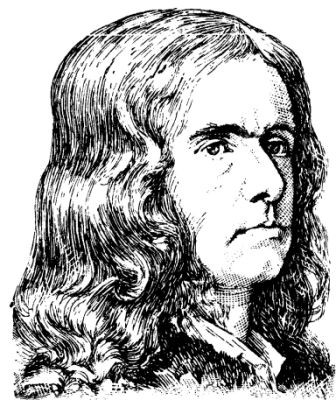
Chamisso
As a young officer he belonged to a romantic brotherhood calling itself "The Polar Star," which counted among its members his lifelong friend Hitzig, Alexander zur Lippe, Varnhagen, and other young writers of the day. He diligently applied himself to the mastery of the German tongue, made translations of poems and dramas, and to relieve the irksomeness of his military life incessantly studied Homer. His most ambitious literary effort of this time was a 'Faust' (1803), a metaphysical, somewhat sophomoric attempt, but the only one of his early poems that he admitted into his collected works.
While still in the Prussian army, he edited with Varnhagen and Neumann a periodical called the Musenalmanach (1804), which existed three years. After repeated but vain efforts to obtain release from the uncongenial military service, the capitulation of Hameln at length set him free (1806). He left Germany and went to France; but, disappointed in his hopes, unsettled and without plans, he returned, and several years were lost in profitless and desultory wanderings. From 1810 to 1812 he was again in France. Here he became acquainted with Alexander von Humboldt and Uhland, and renewed his friendship with Wilhelm Schlegel. With Helmina von Chézy he undertook the translation into French of Schlegel's Vienna lectures upon art and literature. Chamisso was indifferent to the task, and the translation went on but slowly. To expedite the work he was invited to stay at Chaumont, the residence of Madame de Staël, where Schlegel was a member of her household. Here his careless personal habits and his inevitable pipe brought odium upon him in that polished circle.
Madame de Staël was always his friend, and in 1811 he went to her at Coppet, where by a happy chance he took up the study of botany, with August de Staël as instructor. Filled with enthusiasm for his new pursuit, he made excursions through Switzerland, collecting and botanizing. The period of indecision was at an end, and in 1812, at the age of thirty-one, he matriculated as student of medicine at the University of Berlin, and applied himself with resolution to the study of the natural sciences. During the war against Napoleon he sought refuge in Kunersdorf with the Itzenplitz family, where he occupied his time with botany and the instruction of young Itzenplitz. It was during this time (1813) that 'Peter Schlemihl's Wundersame Geschichte' (Peter Schlemihl's Wonderful History) was written,—one of the masterpieces of German literature. His 'Faust' and 'Fortunatus' had in some degree foreshadowed his later and more famous work,—'Faust' in the compact with the devil, 'Fortunatus' in the possession of the magical wishing-bag. The simple motif of popular superstition, the loss of one's shadow, familiar in folk-stories and already developed by Goethe in his 'Tales,' and by Körner in 'Der Teufel von Salamanca' (The Devil of Salamanca), was treated by Chamisso with admirable simplicity, directness of style, and realism of detail.
Chamisso's divided allegiance to France and Germany made the political situation of the times very trying for him, and it was with joy that he welcomed an appointment as scientist to a Russian polar expedition, fitted out under the direction of Count Romanzoff, and commanded by Captain Kotzebue (1815-1818). The record of the scientific results of this expedition, as published by Kotzebue, was full of misstatements; and to correct these, Chamisso wrote the 'Tagebuch' (Journal) in 1835, a work whose pure and plastic style places it in the first order of books of travel, and entitles its author, in point of description, to rank with Von Humboldt among the best writers of travels of the first half of the century.
After three years of voyaging, Chamisso returned to Berlin, and in 1819 he was made a member of the Society of Natural Sciences and received the degree of Ph.D. from the University of Berlin, was appointed adjunct custodian of the botanical garden in New Schöneberg, and in September of the same year he married Antonie Piaste.
An indemnity granted by France to the French emigrants put him in possession of the sum of one hundred thousand francs, and in 1825 he again visited Paris, where he remained some months among old friends and new interests. The period of his great activity was after this date. His life was now peaceful and domestic. Poetry and botany flourished side by side. Chamisso, to his own astonishment, found himself read and admired, and everywhere his songs were sung. To the influence of his wife we owe the cycles of poems, 'Frauen-Liebe und Leben' (Woman's Love and Life), and 'Lebens Lieder und Bilder' (Life's Songs and Pictures), for without her they would have been impossible. The former cycle inspired Robert Schumann in the first days of his happy married life, and the music of these songs has made 'Woman's Love and Life' familiar to all the world. 'Salas y Gomez,' a reminiscence of his voyage around the world, appeared in the Musenalmanach in 1830. The theme of this poem was the development of the romantic possibilities suggested by the sight of the profound loneliness and grandeur of the South Sea island, Salas y Gomez. Chamisso translated Andersen and Béranger, made translations from the Chinese and Tonga, and his version of the Eddic Song of Thrym ('Das Lied von Thrym') is among the best translations from the Icelandic that have been made.
In 1832 he became associate editor of the Berlin Deutscher Musenalmanach, which position he held until his death, and in his hands the periodical attained a high degree of influence and importance. His health failing, he resigned his position at the Botanical Garden, retiring upon full pay. He died at Berlin, August 21st, 1838.
Frenchman though he was, his entire conception of life and the whole character of his writings are purely German, and show none of the French characteristics of his time. Chamisso, as botanist, traveler, poet, and editor, made important contributions in each and every field, although outside of Germany his fame rests chiefly upon his widely known 'Schlemihl,' which has been translated into all the principal languages of Europe.
THE BARGAIN
From 'The Wonderful History of Peter Schlemihl'
After a fortunate, but for me very troublesome voyage, we finally reached the port. The instant that I touched land in the boat, I loaded myself with my few effects, and passing through the swarming people I entered the first and least house before which I saw a sign hang. I requested a room; the boots measured me with a look, and conducted me into the garret. I caused fresh water to be brought, and made him exactly describe to me where I should find Mr. Thomas John.
"Before the north gate; the first country-house on the right hand; a large new house of red and white marble, with many columns."
"Good." It was still early in the day. I opened at once my bundle; took thence my new black-cloth coat; clad myself cleanly in my best apparel; put my letter of introduction into my pocket, and set out on the way to the man who was to promote my modest expectations.
When I had ascended the long North Street, and reached the gate, I soon saw the pillars glimmer through the foliage. "Here it is, then," thought I. I wiped the dust from my feet with my pocket-handkerchief, put my neckcloth in order, and in God's name rang the bell. The door flew open. In the hall I had an examination to undergo; the porter however permitted me to be announced, and I had the honor to be called into the park, where Mr. John was walking with a select party. I recognized the man at once by the lustre of his corpulent self-complacency. He received me very well,—as a rich man receives a poor devil,—even turned towards me, without turning from the rest of the company, and took the offered letter from my hand. "So, so, from my brother. I have heard nothing from him for a long time. But he is well? There," continued he, addressing the company, without waiting for an answer, and pointing with the letter to a hill, "there I am going to erect the new building." He broke the seal without breaking off the conversation, which turned upon riches.
"He that is not master of a million at least," he observed, "is—pardon me the word—a wretch!"
"Oh, how true!" I exclaimed, with a rush of overflowing feeling.
That pleased him. He smiled at me and said, "Stay here, my good friend; in a while I shall perhaps have time to tell you what I think about this." He pointed to the letter, which he then thrust into his pocket, and turned again to the company. He offered his arm to a young lady; the other gentlemen addressed themselves to other fair ones; each found what suited him: and all proceeded towards the rose-blossomed mount.
I slid into the rear without troubling any one, for no one troubled himself any further about me. The company was excessively lively; there was dalliance and playfulness; trifles were sometimes discussed with an important tone, but oftener important matters with levity; and the wit flew with special gayety over absent friends and their circumstances. I was too strange to understand much of all this; too anxious and introverted to take an interest in such riddles.
We had reached the rosery. The lovely Fanny, who seemed the belle of the day, insisted out of obstinacy in breaking off a blossomed stem herself. She wounded herself on a thorn, and the purple streamed from her tender hand as if from the dark roses. This circumstance put the whole party into a flutter. English plaster was sought for. A quiet, thin, lanky, longish, oldish man who stood near, and whom I had not hitherto remarked, put his hand instantly into the tight breast-pocket of his old gray French taffeta coat; produced thence a little pocket-book, opened it, and presented to the lady with a profound obeisance the required article. She took it without noticing the giver, and without thanks; the wound was bound up and we went forward over the hill, from whose back the company could enjoy the wide prospect over the green labyrinth of the park to the boundless ocean.
The view was in reality vast and splendid. A light point appeared on the horizon between the dark flood and the blue of the heaven. "A telescope here!" cried John; and already, before the servants who appeared at the call were in motion, the gray man, modestly bowing, had thrust his hand into his coat pocket, drawn thence a beautiful Dollond, and handed it to Mr. John. Bringing it immediately to his eye, he informed the company that it was the ship which went out yesterday, and was detained in view of port by contrary winds. The telescope passed from hand to hand, but not again into that of its owner. I however gazed in wonder at the man, and could not conceive how the great machine had come out of the narrow pocket; but this seemed to have struck no one else, and nobody troubled himself any further about the gray man than about myself.
Refreshments were handed round; the choicest fruits of every zone, in the costliest vessels. Mr. John did the honors with an easy grace, and a second time addressed a word to me: "Help yourself; you have not had the like at sea." I bowed, but he did not see it; he was already speaking with some one else.
The company would fain have reclined upon the sward on the slope of the hill, opposite to the outstretched landscape, had they not feared the dampness of the earth. "It were divine," observed one of the party, "had we but a Turkey carpet to spread here." The wish was scarcely expressed when the man in the gray coat had his hand in his pocket, and was busied in drawing thence, with a modest and even humble deportment, a rich Turkey carpet interwoven with gold. The servants received it as a matter of course, and opened it on the required spot. The company, without ceremony, took their places upon it; for myself, I looked again in amazement on the man—at the carpet, which measured about twenty paces long and ten in breadth and rubbed my eyes, not knowing what to think of it, especially as nobody saw anything extraordinary in it.
I would fain have had some explanation regarding the man and have asked who he was, but I knew not to whom to address myself, for I was almost more afraid of the gentlemen's servants than of the served gentlemen. At length I took courage, and stepped up to a young man who appeared to me to be of less consideration than the rest, and who had often stood alone. I begged him softly to tell me who the agreeable man in the gray coat there was.
"He there, who looks like an end of thread that has escaped out of a tailor's needle?"
"Yes, he who stands alone."
"I don't know him," he replied, and—in order to avoid a longer conversation with me, apparently—he turned away and spoke of indifferent matters to another.
The sun began now to shine more powerfully, and to inconvenience the ladies. The lovely Fanny addressed carelessly to the gray man—whom, as far as I am aware, no one had yet spoken to—the trifling question whether he "had not, perchance, also a tent by him?" He answered her by an obeisance most profound, as if an unmerited honor were done him, and had already his hand in his pocket, out of which I saw come canvas, poles, cordage, iron-work,—in short, everything which belongs to the most splendid pleasure-tent. The young gentlemen helped to expand it, and it covered the whole extent of the carpet, and nobody found anything remarkable in it.
I had already become uneasy—nay, horrified—at heart; but how completely so, as at the very next wish expressed I saw him pull out of his pocket three roadsters I tell you, three beautiful great black horses, with saddle and caparison. Take it in, for Heaven's sake!—three saddled horses, out of the same pocket from which already a pocket-book, a telescope, an embroidered carpet twenty paces long and ten broad, a pleasure-tent of equal dimensions and all the requisite poles and irons, had come forth! If I did not protest to you that I saw it myself with my own eyes, you could not possibly believe it.
Embarrassed and obsequious as the man himself appeared to be, little as was the attention which had been bestowed upon him, yet to me his grisly aspect, from which I could not turn my eyes, became so fearful that I could bear it no longer.
I resolved to steal away from the company, which from the insignificant part I played in it seemed to me an easy affair. I proposed to myself to return to the city to try my luck again on the morrow with Mr. John, and if I could muster the necessary courage, to question him about the singular gray man. Had I only had the good fortune to escape so well!
I had already actually succeeded in stealing through the rosery, and on descending the hill found myself on a piece of lawn, when, fearing to be encountered in crossing the grass out of the path, I cast an inquiring glance round me. What was my terror to behold the man in the gray coat behind me, and making towards me! The next moment he took off his hat before me, and bowed so low as no one had ever yet done to me. There was no doubt but that he wished to address me, and without being rude I could not prevent it. I also took off my hat, bowed also, and stood there in the sun with bare head as if rooted to the ground. I stared at him full of terror, and was like a bird which a serpent has fascinated. He himself appeared very much embarrassed. He did not raise his eyes, again bowed repeatedly, drew nearer and addressed me with a soft tremulous voice, almost in a tone of supplication:—
"May I hope, sir, that you will pardon my boldness in venturing in so unusual a manner to approach you? but I would ask a favor. Permit me most condescendingly—"
"But in God's name!" exclaimed I in my trepidation, "what can I do for a man who—" we both started, and as I believe, reddened.
After a moment's silence he again resumed:—
"During the short time that I had the happiness to find myself near you, I have, sir, many times,—allow me to say it to you,—really contemplated with inexpressible admiration the beautiful, beautiful shadow which, as it were with a certain noble disdain and without yourself remarking it, you cast from you in the sunshine. The noble shadow at your feet there! Pardon me the bold supposition, but possibly you might not be indisposed to make this shadow over to me."
I was silent, and a mill-wheel seemed to whirl round in my head. What was I to make of this singular proposition to sell my own shadow? He must be mad, thought I; and with an altered tone which was more assimilated to that of his own humility, I answered him thus:—
"Ha! ha! good friend, have not you then enough of your own shadow? I take this for a business of a very singular sort—"
He hastily interrupted me:—"I have many things in my pocket which, sir, might not appear worthless to you; and for this inestimable shadow I hold the very highest price too small."
It struck cold through me again as I was reminded of the pocket. I knew not how I could have called him good friend. I resumed the conversation, and sought to set all right again by excessive politeness if possible.
"But, sir, pardon your most humble servant; I do not understand your meaning. How indeed could my shadow—"
He interrupted me.
"I beg your permission only here on the spot to be allowed to take up this noble shadow and put it in my pocket; how I shall do that, be my care. On the other hand, as a testimony of my grateful acknowledgment to you, I give you the choice of all the treasures which I carry in my pocket,—the genuine 'spring-root,' the 'mandrake-root,' the 'change-penny,' the 'rob-dollar,' the 'napkin of Roland's page,' a 'mandrake-man,' at your own price. But these probably don't interest you; rather 'Fortunatus's wishing-cap,' newly and stoutly repaired, and a lucky-bag such as he had!"
"The luck-purse of Fortunatus!" I exclaimed, interrupting him; and great as my anxiety was, with that one word he had taken my whole mind captive. A dizziness seized me, and double ducats seemed to glitter before my eyes.
"Honored sir, will you do me the favor to view and to make trial of this purse?" He thrust his hand into his pocket and drew out a tolerably large, well-sewed purse of stout Cordovan leather, with two strong strings, and handed it to me. I plunged my hand into it, and drew out ten gold pieces, and again ten. I extended him eagerly my hand. "Agreed! the business is done: for the purse you have my shadow!"
He closed with me; kneeled instantly down before me, and I beheld him, with an admirable dexterity, gently loosen my shadow from top to toe from the grass, lift it up, roll it together, fold it, and finally pocket it. He arose, made me another obeisance, and retreated towards the rosery. I fancied that I heard him there softly laughing to himself, but I held the purse fast by the strings; all round me lay the clear sunshine, and within me was yet no power of reflection.
At length I came to myself, and hastened to quit the place where I had nothing more to expect. In the first place I filled my pockets with gold; then I secured the strings of the purse fast round my neck, and concealed the purse itself in my bosom. I passed unobserved out of the park, reached the highway and took the road to the city. As, sunk in thought, I approached the gate, I heard a cry behind me:
"Young gentleman! eh! young gentleman! hear you!"
I looked round; an old woman called after me.
"Do take care, sir, you have lost your shadow!"
"Thank you, good mother!" I threw her a gold piece for her well-meant intelligence, and stopped under the trees.
At the city gate I was compelled to hear again from the sentinel, "Where has the gentleman left his shadow?" And immediately again from some women, "Jesus Maria! the poor fellow has no shadow!" That began to irritate me, and I became especially careful not to walk in the sun. This could not, however, be accomplished everywhere; for instance, over the broad street I must next take—actually, as mischief would have it, at the very moment the boys came out of school. A cursed hunchbacked rogue—I see him yet—spied out instantly that I had no shadow. He proclaimed the fact with a loud outcry to the whole assembled literary street youth of the suburb, who began forthwith to criticize me and to pelt me with mud. "Decent people are accustomed to take their shadow with them when they go into the sunshine." To defend myself from them I threw whole handfuls of gold amongst them, and sprang into a hackney coach which some compassionate soul procured for me. As soon as I found myself alone in the rolling carriage, I began to weep bitterly. The presentiment must already have arisen in me that on earth, far as gold transcends merit and virtue in estimation, so much higher than gold itself is the shadow valued; and as I had earlier sacrificed wealth to conscience, I had now thrown away the shadow for mere gold. What in the world could and would become of me!
FROM 'WOMAN'S LOVE AND LIFE'
Thou ring upon my finger, My little golden ring, Against my fond bosom I press thee, And to thee my fond lips cling.
My girlhood's dream was ended, Its peaceful, innocent grace, Forlorn I woke, and so lonely, In desolate infinite space.
Thou ring upon my finger, Thou bringest me peace on earth, And thou my eyes hast opened To womanhood's infinite worth.
I'll love and serve him forever, And live for him alone; I'll give him my life, but to find it Transfigured in his own.
Thou ring upon my finger, My little golden ring, Against my fond bosom I press thee, And to thee my fond lips cling.
Translation of Charles Harvey Genung.
WILLIAM ELLERY CHANNING
(1780-1842)
r. Channing, the recognized leader although not the originator of the Unitarian movement in this country, was a man of singular spirituality, sweetness of disposition, purity of life, and nobility of character. He was thought by some to be austere and cold in temperament, and timid in action; but this was rather a misconception of a life given to conscientious study, and an effort to allow due weight to opposing arguments. He was not liable to be swept from his moorings by momentary enthusiasm. As a writer he was clear and direct, admirably perspicuous in style, without great ornament, much addicted to short and simple sentences, though singularly enough an admirer of those which were long and involved. A critic in Fraser's Magazine wrote of him:—"Channing is unquestionably the first writer of the age. From his writings may be extracted some of the richest poetry and richest conceptions, clothed in language—unfortunately for our literature—too little studied in the day in which we live."
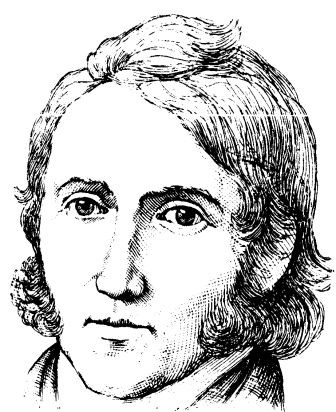
William E. Channing
He was of "blue blood,"—the grandson of William Ellery, one of the signers of the Declaration,—and was born at Newport, Rhode Island, April 7th, 1780. He was graduated at Harvard College with high honors in 1798, and first thought of studying medicine, but was inclined to the direction of the ministry. He became a private tutor in Richmond, Virginia, where he learned to detest slavery. Here he laid the seeds of subsequent physical troubles by imprudent indulgence in asceticism, in a desire to avoid effeminacy. He entered upon the study of theology, which he continued in Cambridge; he was ordained in 1803, and soon became pastor of the Federal Street Church in Boston, in charge of which society he passed his ministerial life. In the following year he was associated with Buckminster and others in the liberal Congregational movement, and this led him into a position of controversy with his orthodox brethren,—one he cordially disliked. But he could not refrain from preaching the doctrines of the dignity of human nature, the supremacy of reason, and religious freedom, of whose truth he was profoundly assured.
It has been truly said that Channing was too much a lover of free thought, and too desirous to hold only what he thought to be true, to allow himself to be bound by any party ties. "I wish," he himself said, "to regard myself as belonging not to a sect but to the community of free minds, of lovers of truth and followers of Christ, both on earth and in heaven. I desire to escape the narrow walls of a particular church, and to stand under the open sky in the broad light, looking far and wide, seeing with my own eyes, hearing with my own ears, and following Truth meekly but resolutely, however arduous or solitary be the path in which she leads."
He was greatly interested in temperance, in the anti-slavery movement, in the elevation of the laboring classes, and other social reforms; and after 1824, when Dr. Gannett became associate pastor, he gave much time to work in these directions. His death occurred at Bennington, Vermont, April 2d, 1842. His literary achievements are mainly or wholly in the line of his work,—sermons, addresses, and essays; but they were prepared with scrupulous care, and have the quality naturally to be expected from a man of broad and catholic spirit, wide interests, and strong love of literature. His works, in six volumes, are issued by the American Unitarian Association, which also publishes a 'Memorial' by his nephew, William Henry Channing, in three volumes.
THE PASSION FOR POWER
From 'The Life and Character of Napoleon Bonaparte'
The passion for ruling, though most completely developed in despotisms, is confined to no forms of government. It is the chief peril of free States, the natural enemy of free institutions. It agitates our own country, and still throws an uncertainty over the great experiment we are making here in behalf of liberty.... It is the distinction of republican institutions, that whilst they compel the passion for power to moderate its pretensions, and to satisfy itself with more limited gratifications, they tend to spread it more widely through the community, and to make it a universal principle. The doors of office being opened to all, crowds burn to rush in. A thousand hands are stretched out to grasp the reins which are denied to none. Perhaps in this boasted and boasting land of liberty, not a few, if called to state the chief good of a republic, would place it in this: that every man is eligible to every office, and that the highest places of power and trust are prizes for universal competition. The superiority attributed by many to our institutions is, not that they secure the greatest freedom, but give every man a chance of ruling; not that they reduce the power of government within the narrowest limits which the safety of the State admits, but throw it into as many hands as possible. The despot's great crime is thought to be that he keeps the delight of dominion to himself, that he makes a monopoly of it; whilst our more generous institutions, by breaking it into parcels and inviting the multitude to scramble for it, spread this joy more widely. The result is that political ambition infects our country and generates a feverish restlessness and discontent, which to the monarchist may seem more than a balance for our forms of liberty. The spirit of intrigue, which in absolute governments is confined to courts, walks abroad through the land; and as individuals can accomplish no political purposes single-handed, they band themselves into parties, ostensibly framed for public ends, but aiming only at the acquisition of power. The nominal sovereign,—that is, the people,—like all other sovereigns, is courted and flattered and told that it can do no wrong. Its pride is pampered, its passions inflamed, its prejudices made inveterate. Such are the processes by which other republics have been subverted, and he must be blind who cannot trace them among ourselves. We mean not to exaggerate our dangers. We rejoice to know that the improvements of society oppose many checks to the love of power. But every wise man who sees its workings must dread it as one chief foe.
This passion derives strength and vehemence in our country from the common idea that political power is the highest prize which society has to offer. We know not a more general delusion, nor is it the least dangerous. Instilled as it is in our youth, it gives infinite excitement to political ambition. It turns the active talents of the country to public station as the supreme good, and makes it restless, intriguing, and unprincipled. It calls out hosts of selfish competitors for comparatively few places, and encourages a bold, unblushing pursuit of personal elevation, which a just moral sense and self-respect in the community would frown upon and cover with shame.
THE CAUSES OF WAR
From a 'Discourse delivered before the Congregational ministers of Massachusetts'
One of the great springs of war may be found in a very strong and general propensity of human nature—in the love of excitement, of emotion, of strong interest; a propensity which gives a charm to those bold and hazardous enterprises which call forth all the energies of our nature. No state of mind, not even positive suffering, is more painful than the want of interesting objects. The vacant soul preys on itself, and often rushes with impatience from the security which demands no effort, to the brink of peril. This part of human nature is seen in the kind of pleasures which have always been preferred. Why has the first rank among sports been given to the chase? Because its difficulties, hardships, hazards, tumults, awaken the mind, and give to it a new consciousness of existence, and a deep feeling of its powers. What is the charm which attaches the statesman to an office which almost weighs him down with labor and an appalling responsibility? He finds much of his compensation in the powerful emotion and interest awakened by the very hardships of his lot, by conflict with vigorous minds, by the opposition of rivals, by the alternations of success and defeat. What hurries to the gaming tables the man of prosperous fortune and ample resources? The dread of apathy, the love of strong feeling and of mental agitation. A deeper interest is felt in hazarding than in securing wealth, and the temptation is irresistible.... Another powerful principle of our nature which is the spring of war, is the passion for superiority, for triumph, for power. The human mind is aspiring, impatient of inferiority, and eager for control. I need not enlarge on the predominance of this passion in rulers, whose love of power is influenced by its possession, and who are ever restless to extend their sway. It is more important to observe that were this desire restrained to the breasts of rulers, war would move with a sluggish pace. But the passion for power and superiority is universal; and as every individual, from his intimate union with the community, is accustomed to appropriate its triumphs to himself, there is a general promptness to engage in any contest by which the community may obtain an ascendency over other nations. The desire that our country should surpass all others would not be criminal, did we understand in what respects it is most honorable for a nation to excel; did we feel that the glory of a State consists in intellectual and moral superiority, in pre-eminence of knowledge, freedom and purity. But to the mass of the people this form of pre-eminence is too refined and unsubstantial. There is another kind of triumph which they better understand: the triumph of physical power, triumph in battle, triumph not over the minds but the territory of another State. Here is a palpable, visible superiority; and for this a people are willing to submit to severe privations. A victory blots out the memory of their sufferings, and in boasting of their extended power they find a compensation for many woes.... Another powerful spring of war is the admiration of the brilliant qualities displayed in war. Many delight in war, not for its carnage and woes, but for its valor and apparent magnanimity, for the self-command of the hero, the fortitude which despises suffering, the resolution which courts danger, the superiority of the mind to the body, to sensation, to fear. Men seldom delight in war, considered merely as a source of misery. When they hear of battles, the picture which rises to their view is not what it should be—a picture of extreme wretchedness, of the wounded, the mangled, the slain; these horrors are hidden under the splendor of those mighty energies which break forth amidst the perils of conflict, and which human nature contemplates with an intense and heart-thrilling delight. Whilst the peaceful sovereign who scatters blessings with the silence and constancy of Providence is received with a faint applause, men assemble in crowds to hail the conqueror,—perhaps a monster in human form, whose private life is blackened with lust and crime, and whose greatness is built on perfidy and usurpation. Thus war is the surest and speediest way to renown; and war will never cease while the field of battle is the field of glory, and the most luxuriant laurels grow from a root nourished with blood.
SPIRITUAL FREEDOM
From the 'Discourse on Spiritual Freedom,' 1830
I consider the freedom or moral strength of the individual mind as the supreme good, and the highest end of government. I am aware that other views are often taken. It is said that government is intended for the public, for the community, not for the individual. The idea of a national interest prevails in the minds of statesmen, and to this it is thought that the individual may be sacrificed. But I would maintain that the individual is not made for the State so much as the State for the individual. A man is not created for political relations as his highest end, but for indefinite spiritual progress, and is placed in political relations as the means of his progress. The human soul is greater, more sacred than the State, and must never be sacrificed to it. The human soul is to outlive all earthly institutions. The distinction of nations is to pass away. Thrones which have stood for ages are to meet the doom pronounced upon all man's works. But the individual mind survives, and the obscurest subject, if true to God, will rise to power never wielded by earthly potentates.
A human being is a member of the community, not as a limb is a member of the body, or as a wheel is a part of a machine, intended only to contribute to some general joint result. He was created not to be merged in the whole, as a drop in the ocean or as a particle of sand on the seashore, and to aid only in composing a mass. He is an ultimate being, made for his own perfection as his highest end; made to maintain an individual existence, and to serve others only as far as consists with his own virtue and progress. Hitherto governments have tended greatly to obscure this importance of the individual, to depress him in his own eyes, to give him the idea of an outward interest more important than the invisible soul, and of an outward authority more sacred than the voice of God in his own secret conscience. Rulers have called the private man the property of the State, meaning generally by the State themselves; and thus the many have been immolated to the few, and have even believed that this was their highest destination. These views cannot be too earnestly withstood. Nothing seems to me so needful as to give to the mind the consciousness, which governments have done so much to suppress, of its own separate worth. Let the individual feel that through his immortality he may concentrate in his own being a greater good than that of nations. Let him feel that he is placed in the community, not to part with his individuality or to become a tool, but that he should find a sphere for his various powers, and a preparation for immortal glory. To me the progress of society consists in nothing more than in bringing out the individual, in giving him a consciousness of his own being, and in quickening him to strengthen and elevate his own mind.
In thus maintaining that the individual is the end of social institutions, I may be thought to discourage public efforts and the sacrifice of private interests to the State. Far from it. No man, I affirm, will serve his fellow-beings so effectually, so fervently, as he who is not their slave; as he who, casting off every other yoke, subjects himself to the law of duty in his own mind. For this law enjoins a disinterested and generous spirit, as man's glory and likeness to his Maker. Individuality, or moral self-subsistence, is the surest foundation of an all-comprehending love. No man so multiplies his bonds with the community, as he who watches most jealously over his own perfection. There is a beautiful harmony between the good of the State and the moral freedom and dignity of the individual. Were it not so, were these interests in any case discordant, were an individual ever called to serve his country by acts debasing his own mind, he ought not to waver a moment as to the good which he should prefer. Property, life, he should joyfully surrender to the State. But his soul he must never stain or enslave. From poverty, pain, the rack, the gibbet, he should not recoil; but for no good of others ought he to part with self-control, or violate the inward law. We speak of the patriot as sacrificing himself to the public weal. Do we mean that he sacrifices what is most properly himself, the principle of piety and virtue? Do we not feel that however great may be the good which through his sufferings accrues to the State, a greater and purer glory redounds to himself; and that the most precious fruit of his disinterested services is the strength of resolution and philanthropy which is accumulated in his own soul?...
The advantages of civilization have their peril. In such a state of society, opinion and law impose salutary restraint, and produce general order and security. But the power of opinion grows into a despotism, which more than all things represses original and free thought, subverts individuality of character, reduces the community to a spiritless monotony, and chills the love of perfection. Religion, considered simply as the principle which balances the power of human opinion, which takes man out of the grasp of custom and fashion, and teaches him to refer himself to a higher tribunal, is an infinite aid to moral strength and elevation.
An important benefit of civilization, of which we hear much from the political economist, is the division of labor, by which arts are perfected. But this, by confining the mind to an unceasing round of petty operations, tends to break it into littleness. We possess improved fabrics, but deteriorated men. Another advantage of civilization is, that manners are refined and accomplishments multiplied; but these are continually seen to supplant simplicity of character, strength of feeling, the love of nature, the love of inward beauty and glory. Under outward courtesy we see a cold selfishness, a spirit of calculation, and little energy of love.
I confess I look round on civilized society with many fears, and with more and more earnest desire that a regenerating spirit from heaven, from religion, may descend upon and pervade it. I particularly fear that various causes are acting powerfully among ourselves, to inflame and madden that enslaving and degrading principle, the passion for property. For example, the absence of hereditary distinctions in our country gives prominence to the distinction of wealth, and holds up this as the chief prize to ambition. Add to this the epicurean, self-indulgent habits which our prosperity has multiplied, and which crave insatiably for enlarging wealth as the only means of gratification. This peril is increased by the spirit of our times, which is a spirit of commerce, industry, internal improvements, mechanical invention, political economy, and peace. Think not that I would disparage commerce, mechanical skill, and especially pacific connections among States. But there is danger that these blessings may by perversion issue in a slavish love of lucre. It seems to me that some of the objects which once moved men most powerfully are gradually losing their sway, and thus the mind is left more open to the excitement of wealth. For example, military distinction is taking the inferior place which it deserves: and the consequence will be that the energy and ambition which have been exhausted in war will seek new directions; and happy shall we be if they do not flow into the channel of gain. So I think that political eminence is to be less and less coveted; and there is danger that the energies absorbed by it will be spent in seeking another kind of dominion, the dominion of property. And if such be the result, what shall we gain by what is called the progress of society? What shall we gain by national peace, if men, instead of meeting on the field of battle, wage with one another the more inglorious strife of dishonest and rapacious traffic? What shall we gain by the waning of political ambition, if the intrigues of the exchange take place of those of the cabinet, and private pomp and luxury be substituted for the splendor of public life? I am no foe to civilization. I rejoice in its progress. But I mean to say that without a pure religion to modify its tendencies, to inspire and refine it, we shall be corrupted, not ennobled by it. It is the excellence of the religious principle, that it aids and carries forward civilization, extends science and arts, multiplies the conveniences and ornaments of life, and at the same time spoils them of their enslaving power, and even converts them into means and ministers of that spiritual freedom which when left to themselves they endanger and destroy.
In order, however, that religion should yield its full and best fruit, one thing is necessary; and the times require that I should state it with great distinctness. It is necessary that religion should be held and professed in a liberal spirit. Just as far as it assumes an intolerant, exclusive, sectarian form, it subverts instead of strengthening the soul's freedom, and becomes the heaviest and most galling yoke which is laid on the intellect and conscience. Religion must be viewed, not as a monopoly of priests, ministers, or sects, not as conferring on any man a right to dictate to his fellow-beings, not as an instrument by which the few may awe the many, not as bestowing on one a prerogative which is not enjoyed by all; but as the property of every human being and as the great subject for every human mind. It must be regarded as the revelation of a common Father to whom all have equal access, who invites all to the like immediate communion, who has no favorites, who has appointed no infallible expounders of his will, who opens his works and word to every eye, and calls upon all to read for themselves, and to follow fearlessly the best convictions of their own understandings. Let religion be seized on by individuals or sects, as their special province; let them clothe themselves with God's prerogative of judgment; let them succeed in enforcing their creed by penalties of law, or penalties of opinion; let them succeed in fixing a brand on virtuous men whose only crime is free investigation—and religion becomes the most blighting tyranny which can establish itself over the mind. You have all heard of the outward evils which religion, when thus turned into tyranny, has inflicted; how it has dug dreary dungeons, kindled fires for the martyr, and invented instruments of exquisite torture. But to me all this is less fearful than its influence over the mind. When I see the superstitions which it has fastened on the conscience, the spiritual terrors with which it has haunted and subdued the ignorant and susceptible, the dark appalling views of God which it has spread far and wide, the dread of inquiry which it has struck into superior understandings, and the servility of spirit which it has made to pass for piety—when I see all this, the fire, the scaffold, and the outward inquisition, terrible as they are, seem to me inferior evils. I look with a solemn joy on the heroic spirits who have met, freely and fearlessly, pain and death in the cause of truth and human rights. But there are other victims of intolerance on whom I look with unmixed sorrow. They are those who, spell-bound by early prejudice or by intimidations from the pulpit and the press, dare not think; who anxiously stifle every doubt or misgiving in regard to their opinions, as if to doubt were a crime; who shrink from the seekers after truth as from infection; who deny all virtue which does not wear the livery of their own sect; who, surrendering to others their best powers, receive unresistingly a teaching which wars against reason and conscience; and who think it a merit to impose on such as live within their influence, the grievous bondage which they bear themselves. How much to be deplored is it, that religion, the very principle which is designed to raise men above the judgment and power of man, should become the chief instrument of usurpation over the soul!
GEORGE CHAPMAN
(1559?-1634)

eorge Chapman, the translator of Homer, is of all the Elizabethan dramatists the most undramatic. He is akin to Marlowe in being more of an epic poet than a playwright; but unlike his young compeer "of the mighty line," who in his successive plays learnt how to subdue an essentially epic genius to the demands of the stage, Chapman never got near the true secret of dramatic composition. Yet he witnessed the growth of the glorious Elizabethan drama, from its feeble beginning in 'Gorbodue' and 'Gammer Gurton's Needle' through its very flowering in the immortal masterpieces. He was born about 1559, five years before Marlowe, the "morning star" of the English drama, and he died in 1634, surviving Shakespeare, in whom it reached its maturity, and Beaumont, Middleton, and Fletcher, whose works foreshadow decay. From his native town Hitchin he passed on to Oxford, where he distinguished himself as a classical scholar. Then for sixteen years nothing definite is known about him. His life has been called one of the great blanks of English literature. He is sometimes sent traveling on the Continent, as a convenient means of accounting for this gap, and also to explain the intimate acquaintance with German manners and customs and the language displayed in his tragedy 'Alphonsus, Emperor of Germany,' which argues at least for a trip to that country. In 1594 he published the two hymns in the 'Shadow of Night'; and soon after he must have begun writing for the stage, for his first extant comedy, 'The Blind Beggar of Alexandria,' was acted in 1596, and two years later he appears in Francis Meres's famous enumeration of the poets and wits of the time. Hereafter his life is to be dated by his publications.
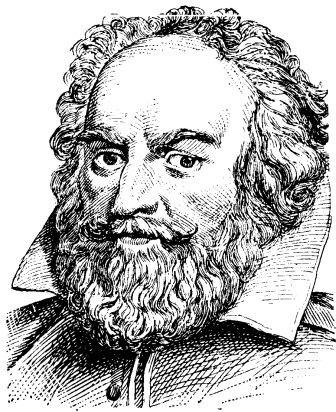
George Chapman
He occupies a position unique among the Elizabethans, because of his wide culture and the diverse character of his work. Though held together by his strong personality, it yet can be divided into the distinct groups of comedies, tragedies, poems, and translations. The first of these is the weakest, for Chapman was not a comic genius. 'The Blind Beggar of Alexandria' and 'An Humorous Day's Mirth' deserve but a passing mention. In 1605 'All Fooles' was published, acted six years earlier under the name 'The World Runs on Wheels.' It is a realistic satire, with some good scenes and character-drawing. 'The Gentleman Usher' is full of poetry and ingenious situations. 'Monsieur D'Oline' contains also some good comedy work. 'The Widow's Tears' tells the well-known story of the Ephesian matron; though coarse, it is handled not without comic talent. In his comedy work Chapman is neither new nor original; he followed in Jonson's footsteps, and suggests moreover Terence, Plautus, Fletcher, and Lyly. He has wit, satire, and sarcasm; but along with these, poor construction and little invention. He was going against his grain, and we have here the frankest expression of "pot-boiling" to be found among the Elizabethan dramatists. Writing for the stage was the only kind of literature that really paid; the playhouse was to the Elizabethan what the paper-covered novel is to a modern reader. This accounts for the enormous dramatic productivity of the time, and also explains why the most finely endowed minds, in need of money, produced dramas instead of other imaginative work. By the time he wrote his comedies, Chapman had already won his place as poet and translator, but it earned him no income. Pope, one hundred and twenty-five years later, made a fortune by his translation of Homer. But then the number of readers had increased, and publishers could afford to give large sums to a popular author. Chapman takes rank among the dramatists mainly by his four chief tragedies: 'Bussy d'Ambois,' 'The Revenge of Bussy d'Ambois,' 'The Conspiracy of Charles, Duke of Byron,' and 'The Tragedy of Charles, Duke of Byron.' They are unique among the plays of the period, in that they deal with almost contemporary events in French history; not with the purpose of exciting any feeling for or against the parties introduced, but in calm ignoring of public opinion, they bring recent happenings on the stage to suit the dramatist's purpose. He drew his material mainly from the 'Historiæ Sui Temporis' of Jacques Auguste de Thou, but he troubled himself little about following it with accuracy, or even painting the characters of the chief actors as true to life. In these tragedies, more than in the comedies, we get sight of Chapman the man; indeed, it is his great failing as playwright that his own individuality is constantly cropping out. He alone, of all the great Elizabethan dramatists, was unable to go outside of himself and enter into the habits and thoughts of his characters. Chapman was too much of a scholar and a thinker to be a successful delineator of men. His is the drama of the man who thinks about life, not of one who lives it in its fullness. He does not get into the hearts of men. He has too many theories. Homer had become the ruling influence in his life, and he looked at things from the Homeric point of view and presented life epically. He is at his best in single didactic or narrative passages, and exquisite bits of poetry are prodigally scattered up and down the pages of his tragedies. Next to Shakespeare he is the most sententious of dramatists. He sounded the depths of things in thought which theretofore only Marlowe had done. He is the most metaphysical of dramatists.
Yet his thought is sometimes too much for him, and he becomes obscure. He packs words as tight as Browning, and the sense is often more difficult to unravel. He is best in the closet drama. 'Cæsar and Pompey,' published in 1631 but never acted, contains some of his finest thoughts.
Chapman also collaborated with other dramatists. 'Eastward Ho,' in 1605, written with Marston and Jonson, is one of the liveliest and best constructed Elizabethan comedies, combining the excellences of the three men without their faults. Some allusion to the Scottish nation offended King James; the authors were confined in Fleet Prison and barely escaped having their ears and noses slit. With Shirley he wrote the comedy 'The Ball' and the tragedy 'Chabot, Admiral of France.'
Chapman wrote comedies to make money, and tragedies because it was the fashion of the day, and he studded these latter with exquisite passages because he was a poet born. But he was above all a scholar with wide and deep learning, not only of the classics but also of the Renaissance literature. From 1613 to 1631 he does not appear to have written for the stage, but was occupied with his translations of Homer, Hesiod, Juvenal, Musæus, Petrarch, and others. In 1614, at the marriage of the Princess Elizabeth, was performed in the most lavish manner the 'Memorable Masque of the two Honorable Houses or Inns of Court; the Middle Temple and Lyncoln Inne.' Chapman also completed Marlowe's unfinished 'Hero and Leander.'
His fame however rests on his version of Homer. The first portion appeared in 1598: 'Seven Bookes of the Iliade of Homer, Prince of Poets; Translated according to the Greeke in judgment of his best Commentaries.' In 1611 the Iliad complete appeared, and in 1615 the whole of the Odyssey; though he by no means reproduces Homer faithfully, he approaches nearest to the original in spirit and grandeur. It is a typical product of the English Renaissance, full of vigor and passion, but also of conceit and fancifulness. It lacks the simplicity and the serenity of the Greek, but has caught its nobleness and rapidity. As has been said, "It is what Homer might have written before he came to years of discretion." Yet with all its shortcomings it remains one of the classics of Elizabethan literature. Pope consulted it diligently, and has been accused of at times re-versifying this instead of the Greek. Coleridge said of it:—
"The Iliad is fine, but less equal in the translation [than the Odyssey], as well as less interesting in itself. What is stupidly said of Shakespeare is really true and appropriate of Chapman: 'Mighty faults counterpoised by mighty beauties.' ... It is as truly an original poem as the 'Faerie Queen';—it will give you small idea of Homer, though a far truer one than Pope's epigrams, or Cowper's cumbersome, most anti-Homeric Miltonisms. For Chapman writes and feels as a poet,—as Homer might have written had he lived in England in the reign of Queen Elizabeth. In short, it is an exquisite poem in spite of its frequent and perverse quaintnesses and awkwardness, which are however amply repaid by almost unexampled sweetness and beauty of language, all over spirit and feeling."
Keats's tribute, the sonnet 'On First Looking into Chapman's Homer,' attests another poet's appreciation of the Elizabethan's paraphrase. Keats diligently explored this "new planet" that swam into his ken, and his own poetical diction is at times touched by the quaintness and fancifulness of the elder poet he admired.
Lamb, that most sympathetic critic of the old dramatists, speaks of him as follows:—
"Webster has happily characterized the 'full and heightened' style of Chapman, who of all the English play-writers perhaps approaches nearest to Shakespeare in the descriptive and didactic, in passages which are less purely dramatic. He could not go out of himself, as Shakespeare could shift at pleasure, to inform and animate other existences, but in himself he had an eye to perceive and a soul to embrace all forms and modes of being. He would have made a great epic poet, if indeed he has not abundantly shown himself to be one; for his 'Homer' is not so properly a translation as the stories of Achilles and Ulysses rewritten. The earnestness and passion which he has put into every part of these poems would be incredible to a reader of more modern translations.... The great obstacle to Chapman's translations being read is their unconquerable quaintness. He pours out in the same breath the most just and natural, and the most violent and crude expressions. He seems to grasp at whatever words come first to hand while the enthusiasm is upon him, as if all others must be inadequate to the divine meaning. But passion (the all-in-all in poetry) is everywhere present, raising the low, dignifying the mean, and putting sense into the absurd. He makes his readers glow, weep, tremble, take any affection which he pleases, be moved by words, or in spite of them be disgusted and overcome their disgust."
ULYSSES AND NAUSICAA
From the Translation of Homer's Odyssey
Straight rose the lovely Morn, that up did raise Fair-veil'd Nausicaa, whose dream her praise To admiration took; who no time spent To give the rapture of her vision vent To her loved parents, whom she found within. Her mother set at fire, who had to spin A rock, whose tincture with sea-purple shined; Her maids about her. But she chanced to find Her father going abroad, to council call'd By his grave Senate; and to him exhaled Her smother'd bosom was:—"Loved sire," said she, "Will you not now command a coach for me, Stately and complete? fit for me to bear To wash at flood the weeds I cannot wear Before re-purified? Yourself it fits To wear fair weeds, as every man that sits In place of council. And five sons you have, Two wed, three bachelors, that must be brave In every day's shift, that they may go dance; For these three last with these things must advance Their states in marriage; and who else but I, Their sister, should their dancing rites supply?" This general cause she shew'd, and would not name Her mind of nuptials to her sire, for shame. He understood her yet, and thus replied:— "Daughter! nor these, nor any grace beside, I either will deny thee, or defer, Mules, nor a coach, of state and circular, Fitting at all parts. Go; my servants shall Serve thy desires, and thy command in all." The servants then commanded soon obey'd, Fetch'd coach, and mules join'd in it. Then the Maid Brought from the chamber her rich weeds, and laid All up in coach; in which her mother placed A maund of victuals, varied well in taste, And other junkets. Wine she likewise fill'd Within a goat-skin bottle, and distill'd Sweet and moist oil into a golden cruse, Both for her daughter's and her handmaid's use, To soften their bright bodies, when they rose Cleansed from their cold baths. Up to coach then goes Th' observed Maid; takes both the scourge and reins; And to her side her handmaid straight attains. Nor these alone, but other virgins, graced The nuptial chariot. The whole bevy placed, Nausicaa scourged to make the coach-mules run, That neigh'd, and paced their usual speed, and soon Both maids and weeds brought to the river-side, Where baths for all the year their use supplied. Whose waters were so pure they would not stain, But still ran fair forth; and did more remain Apt to purge stains, for that purged stain within, Which by the water's pure store was not seen. These, here arrived, the mules uncoach'd, and drave Up the gulfy river's shore, that gave Sweet grass to them. The maids from coach then took Their clothes, and steep'd them in the sable brook; Then put them into springs, and trod them clean With cleanly feet; adventuring wagers then, Who should have soonest and most cleanly done. When having thoroughly cleansed, they spread them on The flood's shore, all in order. And then, where The waves the pebbles wash'd, and ground was clear, They bathed themselves, and all with glittering oil Smooth'd their white skins; refreshing then their toil With pleasant dinner, by the river's side. Yet still watch'd when the sun their clothes had dried. Till which time, having dined, Nausicaa With other virgins did at stool-ball play, Their shoulder-reaching head-tires laying by. Nausicaa, with the wrists of ivory, The liking stroke strook, singing first a song, As custom order'd, and amidst the throng Made such a shew, and so past all was seen, As when the chaste-born, arrow-loving Queen, Along the mountains gliding, either over Spartan Taygetus, whose tops far discover, Or Eurymanthus, in the wild boar's chace, Or swift-hooved hart, and with her Jove's fair race, The field Nymphs, sporting; amongst whom, to see How far Diana had priority (Though all were fair) for fairness; yet of all, (As both by head and forehead being more tall) Latona triumph'd, since the dullest sight Might easily judge whom her pains brought to light; Nausicaa so, whom never husband tamed, Above them all in all the beauties flamed. But when they now made homewards, and array'd, Ordering their weeds; disorder'd as they play'd, Mules and coach ready, then Minerva thought What means to wake Ulysses might be wrought, That he might see this lovely-sighted maid, Whom she intended should become his aid, Bring him to town, and his return advance. Her mean was this, though thought a stool-ball chance: The queen now, for the upstroke, strook the ball Quite wide off th' other maids, and made it fall Amidst the whirlpools. At which outshriek'd all, And with the shriek did wise Ulysses wake; Who, sitting up, was doubtful who should make That sudden outcry, and in mind thus strived:— "On what a people am I now arrived? At civil hospitable men, that fear The gods? or dwell injurious mortals here, Unjust and churlish? Like the female cry Of youth it sounds. What are they? Nymphs bred high On tops of hills, or in the founts of floods, In herby marshes, or in leavy woods? Or are they high-spoke men I now am near? I'll prove and see." With this the wary peer Crept forth the thicket, and an olive bough Broke with his broad hand; which he did bestow In covert of his nakedness, and then Put hasty head out. Look how from his den A mountain lion looks, that, all embrued With drops of trees, and weatherbeaten-hued, Bold of his strength goes on, and in his eye A burning furnace glows, all bent to prey On sheep, or oxen, or the upland hart, His belly charging him, and he must part Stakes with the herdsman in his beasts' attempt, Even where from rape their strengths are most exempt: So wet, so weather-beat, so stung with need, Even to the home-fields of the country's breed Ulysses was to force forth his access, Though merely naked; and his sight did press The eyes of soft-haired virgins. Horrid was His rough appearance to them; the hard pass He had at sea stuck by him. All in flight The virgins scattered, frighted with this sight, About the prominent windings of the flood. All but Nausicaa fled; but she fast stood: Pallas had put a boldness in her breast, And in her fair limbs tender fear comprest. And still she stood him, as resolved to know What man he was; or out of what should grow His strange repair to them.
THE DUKE OF BYRON IS CONDEMNED TO DEATH
From the 'Tragedy of Charles, Duke of Byron'
By horror of death, let me alone in peace, And leave my soul to me, whom it concerns; You have no charge of it; I feel her free: How she doth rouse, and like a falcon stretch Her silver wings; a threatening death with death; At whom I joyfully will cast her off. I know this body but a sink of folly, The groundwork and raised frame of woe and frailty; The bond and bundle of corruption; A quick corse, only sensible of grief, A walking sepulchre, or household thief: A glass of air, broken with less than breath, A slave bound face to face to death, till death. And what said all you more? I know, besides, That life is but a dark and stormy night Of senseless dreams, terrors, and broken sleeps; A tyranny, devising pains to plague And make man long in dying, racks his death; And death is nothing: what can you say more? I bring a long globe and a little earth, Am seated like earth, betwixt both the heavens, That if I rise, to heaven I rise; if fall, I likewise fall to heaven; what stronger faith Hath any of your souls? what say you more? Why lose I time in these things? Talk of knowledge, It serves for inward use. I will not die Like to a clergyman; but like the captain That prayed on horseback, and with sword in hand, Threatened the sun, commanding it to stand; These are but ropes of sand.
FRANÇOIS RENÉ AUGUSTE CHÂTEAUBRIAND
(1768-1848)

iscount de Châteaubriand, the founder of the romantic school in French literature, and one of the most brilliant and polished writers of the first half of the nineteenth century, was born at St. Malo in Brittany, September 14th, 1768. On the paternal side he was a direct descendant of Thierri, grandson of Alain III., who was king of Armorica in the ninth century. Destined for the Church, he became a pronounced skeptic, and entered the army. In his nineteenth year he was presented at court, and became acquainted with men of letters like La Harpe, Le Brun, and Fontanes. At the outbreak of the Revolution he quitted the service, and embarked for America in January, 1791. Tiring of the restraints of civilization, civilization, he plunged into the virgin forests of Canada, and for several months lived with the savages. This remarkable experience inspired his most notable romantic work.
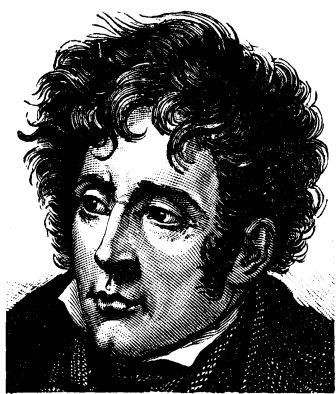
Châteaubriand
Returning to France in 1792, he cast his lot with the Royalists, was wounded at Thionville, and finally retired to England, where for eight years he earned a bare support by teaching and translating. His first book was the 'Essay on Revolutions' (1797), which displayed some imagination, little reflection, and an affectation of misanthropy and skepticism. The subsequent change in his convictions followed on the death of his pious mother in 1798. Returning to France he published 'Atala,' an idyll á la mode, founded on the loves of two young savages. Teeming with glowing descriptions of nature, and marked by elevation of sentiment combined with a sensuousness almost Oriental, this barbaric 'Paul and Virginia' immediately established the author's fame. Thus encouraged, in the following year he gave the world his 'Genius of Christianity,' in which the poetic and symbolic features of Christianity are painted in dazzling colors and with great charm of style. The enormous success of this book during the first decade of the century unquestionably did more to revive French interest in religion than the establishment of the Concordat itself. Napoleon testified his gratitude by appointing the author secretary to the embassy at Rome, and afterward minister plenipotentiary to the Valais. When the Duke d'Enghien was assassinated (March 21st, 1804), Châteaubriand resigned from the diplomatic service, although the ink was scarcely dry in which the First Consul had signed his new commission. Two years later the successful author departed on a sentimental pilgrimage to the Holy Land. He visited Asia Minor, Egypt, and Spain, where amid the ruins of the Alhambra he wrote 'The Last of the Abencerrages.' To this interesting tour the world owes the 'Itinerary from Paris to Jerusalem' (1811), that book which in Saintsbury's opinion remains "the pattern of all the picturesque travels of modern times."
With the publication of the 'Itinerary' the literary career of Châteaubriand virtually closes. On the return of the Bourbons to power, the man of letters was tempted to enter the exciting arena of politics, becoming successively ambassador at Berlin, at the court of St. James, delegate to the Congress of Verona, and Minister of Foreign Affairs. In 1830, unwilling to pledge himself to Louis Philippe, he relinquished the dignity of peer of the realm accorded him in 1815, and retired to a life of comparative poverty, which was brightened by the friendship and devotion of Madame Récamier. Until his death on the 4th of July, 1848, Châteaubriand devoted himself to the completion of his 'Mémoires d'Outre-Tombe,' an auto-biographical work which was published posthumously, and which, although diffuse and even puerile at times, contains much brilliant writing.
His contemporaries pronounced Châteaubriand the foremost man of letters of France, if not of all Europe. During the last half of this century his fame has sensibly diminished both at home and abroad, and in the history of French literature he is chiefly significant as marking the transition from the old classical to the modern romantic school. Yet while admitting the glaring faults, exaggerations, affectations, and egotism of the author of the 'Genius of Christianity,' a fair criticism admits his best passages to be unsurpassed for perfection of style and gorgeousness of coloring. 'Atala' is a classic with real life in it even yet,—powerful, interesting, and even thrilling, in spite of its theatricality, and often magnificent in description.
In 1811 Châteaubriand was elected to the French Academy as the successor of the poet Chénier. Among his works not already mentioned are 'René' (1807), a sort of sequel to 'Atala'; 'The Martyrs' (1810); 'The Natchez' (1826), containing recollections of America; an 'Essay on English Literature' (2 vols.); and a translation of Milton's 'Paradise Lost' (1836).
CHRISTIANITY VINDICATED
From 'The Genius of Christianity'
During the reign of the Emperor Julian commenced a persecution, perhaps more dangerous than violence itself, which consisted in loading the Christians with disgrace and contempt. Julian began his hostility by plundering the churches; he then forbade the faithful to teach or to study the liberal arts and sciences. Sensible, however, of the important advantages of the institutions of Christianity, the emperor determined to establish hospitals and monasteries, and after the example of the gospel system to combine morality with religion; he ordered a kind of sermons to be delivered in the pagan temples....
From the time of Julian to that of Luther, the Church, flourishing in full vigor, had no occasion for apologists; but when the Western schism took place, with new enemies arose new defenders. It cannot be denied that at first the Protestants had the superiority, at least in regard to forms, as Montesquieu has remarked. Erasmus himself was weak when opposed to Luther, and Theodore Beza had a captivating manner of writing, in which his opponents were too often deficient....
It is natural for schism to lead to infidelity, and for heresy to engender atheism. Bayle and Spinoza arose after Calvin, and they found in Clarke and Leibnitz men of sufficient talents to refute their sophistry. Abbadie wrote an apology for religion, remarkable for method and sound argument. Unfortunately his style is feeble, though his ideas are not destitute of brilliancy. "If the ancient philosophers," observes Abbadie, "adored the Virtues, their worship was only a beautiful species of idolatry."
While the Church was yet enjoying her triumph, Voltaire renewed the persecution of Julian. He possessed the baneful art of making infidelity fashionable among a capricious but amiable people. Every species of self-love was pressed into this insensate league. Religion was attacked with every kind of weapon, from the pamphlet to the folio, from the epigram to the sophism. No sooner did a religious book appear than the author was overwhelmed with ridicule, while works which Voltaire was the first to laugh at among his friends were extolled to the skies. Such was his superiority over his disciples that he sometimes could not forbear diverting himself with their irreligious enthusiasm. Meanwhile the destructive system continued to spread throughout France. It was first adopted in those provincial academies, each of which was a focus of bad taste and faction. Women of fashion and grave philosophers alike read lectures on infidelity. It was at length concluded that Christianity was no better than a barbarous system, and that its fall could not happen too soon for the liberty of mankind, the promotion of knowledge, the improvement of the arts, and the general comfort of life.
To say nothing of the abyss into which we were plunged by this aversion to the religion of the gospel, its immediate consequence was a return, more affected than sincere, to that mythology of Greece and Rome to which all the wonders of antiquity were ascribed. People were not ashamed to regret that worship which had transformed mankind into a herd of madmen, monsters of indecency, or ferocious beasts. This could not fail to inspire contempt for the writers of the age of Louis XIV., who however had reached the high perfection which distinguished them only by being religious. If no one ventured to oppose them face to face, on account of their firmly established reputation, they were nevertheless attacked in a thousand indirect ways. It was asserted that they were unbelievers in their hearts; or at least that they would have been much greater characters had they lived in our times. Every author blessed his good fortune for having been born in the glorious age of the Diderots and d'Alemberts, in that age when all the attainments of the human mind were ranged in alphabetical order in the 'Encyclopédie,' that Babel of the sciences and of reason....
It was therefore necessary to prove that on the contrary the Christian religion, of all the religions that ever existed, is the most humane, the most favorable to liberty and to the arts and sciences; that the modern world is indebted to it for every improvement from agriculture to the abstract sciences, from the hospitals for the reception of the unfortunate to the temples reared by the Michael Angelos and embellished by the Raphaels. It was necessary to prove that nothing is more divine than its morality, nothing more lovely and more sublime than its tenets, its doctrine, and its worship; that it encourages genius, corrects the taste, develops the virtuous passions, imparts energy to the ideas, presents noble images to the writer, and perfect models to the artist; that there is no disgrace in being believers with Newton and Bossuet, with Pascal and Racine. In a word, it was necessary to summon all the charms of the imagination and all the interests of the heart to the assistance of that religion against which they had been set in array.
The reader may now have a clear view of the object of our work. All other kinds of apologies are exhausted, and perhaps they would be useless at the present day. Who would now sit down to read a work professedly theological? Possibly a few sincere Christians who are already convinced. But, it may be asked, May there not be some danger in considering religion in a merely human point of view? Why so? Does our religion shrink from the light? Surely one great proof of its divine origin is, that it will bear the test of the fullest and severest scrutiny of reason. Would you have us always open to the reproach of enveloping our tenets in sacred obscurity, lest their falsehood should be detected? Will Christianity be the less true for appearing the more beautiful? Let us banish our weak apprehensions; let us not, by an excess of religion, leave religion to perish. We no longer live in those times when you might say, "Believe without inquiring." People will inquire in spite of us; and our timid silence, in heightening the triumph of the infidel, will diminish the number of believers.
It is time that the world should know to what all those charges of absurdity, vulgarity, and meanness, that are daily alleged against Christianity, may be reduced. It is time to demonstrate that instead of debasing the ideas, it encourages the soul to take the most daring flights, and is capable of enchanting the imagination as divinely as the deities of Homer and Virgil. Our arguments will at least have this advantage, that they will be intelligible to the world at large and will require nothing but common-sense to determine their weight and strength. In works of this kind authors neglect, perhaps rather too much, to speak the language of their readers. It is necessary to be a scholar with a scholar, and a poet with a poet. The Almighty does not forbid us to tread the flowery path, if it serves to lead the wanderer once more to him; nor is it always by the steep and rugged mountain that the lost sheep finds its way back to the fold.
We think that this mode of considering Christianity displays associations of ideas which are but imperfectly known. Sublime in the antiquity of its recollections, which go back to the creation of the world; ineffable in its mysteries, adorable in its sacraments, interesting in its history, celestial in its morality, rich and attractive in its ceremonial,—it is fraught with every species of beauty. Would you follow it in poetry? Tasso, Milton, Corneille, Racine, Voltaire, will depict to you its miraculous effects. In belles-lettres, in oratory, history, and philosophy, what have not Bossuet, Fénélon, Massillon, Bourdaloue, Bacon, Pascal, Euler, Newton, Leibnitz, produced by its inspiration! In the arts, what masterpieces! If you examine it in its worship, what ideas are suggested by its antique Gothic churches, its admirable prayers, its impressive ceremonies! Among its clergy, behold all those scholars who have handed down to you the languages and the works of Greece and Rome; all those anchorets of Thebais; all those asylums for the unfortunate; all those missionaries to China, to Canada, to Paraguay; not forgetting the military orders whence chivalry derived its origin. Everything has been engaged in our cause—the manners of our ancestors, the pictures of days of yore, poetry, even romances themselves. We have called smiles from the cradle, and tears from the tomb. Sometimes, with the Maronite monk, we dwell on the summits of Carmel and Lebanon; at others we watch with the Daughter of Charity at the bedside of the sick. Here two American lovers summon us into the recesses of their deserts; there we listen to the sighs of the virgin in the solitude of the cloister. Homer takes his place by Milton, and Virgil beside Tasso; the ruins of Athens and of Memphis form contrasts with the ruins of Christian monuments, and the tombs of Ossian with our rural churchyards. At St. Denis we visit the ashes of kings; and when our subject requires us to treat of the existence of God, we seek our proofs in the wonders of Nature alone. In short, we endeavor to strike the heart of the infidel in every possible way; but we dare not flatter ourselves that we possess the miraculous rod of religion which caused living streams to burst from the flinty rock.
DESCRIPTION OF A THUNDER-STORM IN THE FOREST
From 'Atala'
It was the twenty-seventh sun since our departure from the Cabins: the lune de fer (month of July) had commenced its course, and all signs indicated the approach of a violent storm. Toward the hour when the Indian matrons hang up the plowshares on the branches of the junipers, and when the paroquets retire into the hollows of the cypress trees, the sky grew overcast. The vague sounds of solitude gradually ceased, the forests were wrapped in universal calm. Suddenly the pealing of distant thunder, re-echoing through these vast woods as old as the world itself, startled the ear with a diapason of noises sublime. Fearing to be overwhelmed in the flood, we hastily disembarked on the river's bank and sought safety in the seclusion of one of the forest glades.
The ground was swampy. We pressed forward with difficulty beneath a roof of smilax, among grape-vines and climbing plants of all kinds, in which our feet were continually entangled. The spongy soil trembled all around us, and every instant we were on the verge of being engulfed in the quagmires. Swarms of insects and enormous bats nearly blinded us; rattlesnakes were heard on all sides; and the wolves, bears, panthers, and badgers which had sought a refuge in this retreat filled the air with their roarings.
Meanwhile the obscurity increased; the lowering clouds entered beneath the shadows of the trees. The heavens were rent, and the lightning traced a flashing zigzag of fire. A furious gale from the west piled up the angry clouds in heavy masses; the mighty trees bowed their heads to the blast. Again and again the sky was rent, and through the yawning crevices one beheld new heavens and vales of fire. What an awful, what a magnificent spectacle! The trees were struck by lightning and ignited; the conflagration spread like a flaming garland; the showers of sparks and the columns of smoke ascended to the very heavens, which vomited their thunders into the sea of fire.
Then the Great Spirit enveloped the mountains in utter darkness; from the midst of this vast chaos came a confused roaring made by the tumult of many winds, the moaning of the trees, the howlings of ferocious beasts, the crackling of the flames, and the descent of balls of fire which hissed as they were extinguished in the water.
The Great Spirit knows the truth of what I now say! At this moment I saw only Atala, I had no thought but for her. Beneath the bent trunk of a birch-tree, I succeeded in protecting her from the torrents of rain. Seated myself under the tree, supporting my well-beloved on my knees, and chafing her bare feet between my hands, I was even happier than the young wife who feels for the first time the consciousness of her motherhood.
THOMAS CHATTERTON
(1752-1770)

o the third quarter of the eighteenth century belongs the tragedy of the life of Thomas Chatterton, who, misunderstood and neglected during his brief seventeen years of poetic revery, has by the force of his genius and by his actual achievement compelled the nineteenth century, through one of its best critics, to acknowledge him as the father of the New Romantic school, and to accord him thereby a place unique among his contemporaries. His family and early surroundings serve in a way to explain his development. He was born at Bristol, a town rich in the traditions and monuments of bygone times. For nearly two hundred years the office of sexton to the church of St. Mary Redcliffe had been handed down in the family. At the time of the poet's birth it was held by a maternal uncle; for his father, a "musical genius, somewhat of a poet, an antiquary and dabbler in occult arts," was the first to aspire to a position above the hereditary one, and had taken charge of the Pyle free schools in Bristol. He died before his son's birth, and left his widow to support her two children by keeping a little school and by needlework. The boy, reserved and given to revery from his earliest years, was at first considered dull, but finally learned to spell by means of the illuminated capitals of an old musical folio and a black-letter Bible. He spent much of his time with his uncle, in and about the church. St. Mary Redcliffe, one of the finest specimens of mediæval church architecture in England, is especially rich in altar tombs with recumbent carved figures of knights, and ecclesiastic and civic dignitaries of bygone days. These became the boy's familiar associates, and he amused himself on his lonely visits by spelling out the old inscriptions on their monuments. There he got hold of some quaint oaken chests in the muniment room over the porch, filled with parchments old as the Wars of the Roses, and these deeds and charters of the Henrys and Edwards became his primers. In 1760 he entered Colston's "Blue-Coat" charity school, located in a fine old building of the Tudor times. The rules of the institution provided for the training of its inmates "in the principles of the Christian religion as laid down in the Church catechism," and in fitting them to be apprenticed in due course to some trade. During the six years of his stay, Chatterton received only the rudiments of a common-school education, and found little to nourish his genius. But being a voracious reader, he went on his small allowance through three circulating libraries, and became acquainted with the older English poets, and also read history and antiquities. He very early entertained dreams of ambition, without however finding any sympathy; so he lived in a world of his own, conceiving before the age of twelve the romance of Thomas Rowley, an imaginary clerk of the fifteenth century, and his patron Master William Canynge, a former mayor of Bristol whose effigy was familiar to him from the tomb in the church. This fiction, which after his death gave rise to the celebrated controversy of the 'Rowley Poems,' matured at this early age as a boy's life-dream, he fashioned into a consistent romance, and wove into it among the prose fragments the ballads and lyrics on which his fame as poet now rests. His earliest literary forgery was a practical joke played on a credulous pewterer at Bristol, for whom he fabricated a pedigree dating back to the time of the Norman Conquest, which he professed to have collected from ancient manuscripts. It is remarkable as the work of a boy not yet fourteen. He was rewarded with a crown piece, and the success of this hoax encouraged him further to play upon the credulity of his townspeople, and to continue writing prose and verse in pseudo-antique style.
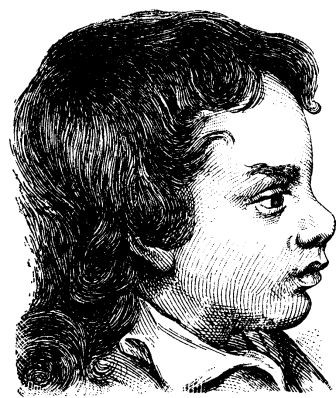
Thomas Chatterton
In 1767 he was bound apprentice to John Lambert, attorney. The office duties were light. He spent his spare time in poetizing, and sent anonymously transcripts from professedly old poems to the local papers. Their authorship being traced to him, he now claimed that his father had found numerous old poems and other manuscripts in a coffer of the muniment room at Redcliffe, and that he had transcribed them. Under guise of this fiction he produced, within the two years of his apprenticeship, a mass of pseudo-antique dramatic, lyric, and descriptive poems, and fragments of local and general history, connected all with his romance of the clerk of Bristol. A scholarly knowledge of Middle English was rare one hundred and thirty years ago, and the self-taught boy easily gulled the local antiquaries. He even deceived Horace Walpole, who, dabbling in mediævalism, had opened the way for prose romances with his 'Castle of Otranto,' a spurious antique of the same time in which Chatterton had placed his fiction. Walpole at first treated him courteously, even offering to print some of the poems. But when Gray and Mason pronounced them modern, he at once gave Chatterton the cold shoulder, entirely forgetting his own imposition on a credulous public.
Chatterton now turned to periodical literature and the politics of the day, and began to contribute to various London magazines. In the spring of 1770 he finally came up to London, to start on the life of a literary adventurer on a capital of less than five pounds. He lived abstemiously and worked incessantly, literally day and night. He had a wonderful versatility; he would write in the manner of any one he chose to imitate, and he tried his hand at every species of book-work. But even under the strain of this incessant productivity he found time to turn back to his boyhood dreams, and produced one of his finest poems, the 'Ballad of Charity.' At first his contributions were freely accepted, but he was poorly paid, and sometimes not at all. Yet out of his scanty earnings he bought costly presents for his mother and sister, as tokens of affection and an earnest of what he hoped to do for them. After scarcely two months in London he was at the end of his resources. He made an attempt to gain a position as surgeon's assistant on board of an African trader, but was unsuccessful. He now found himself face to face with famine; and, too proud to ask for assistance or to accept even the hospitality of a single meal, he on the night of August 25th, 1770, locked himself into his garret, destroyed all his note-books and papers, and swallowed a dose of arsenic. It is believed that he was privately buried in the churchyard of St. Mary Redcliffe. There a monument has been erected, with an inscription from his poem 'Will':—
"To the memory of Thomas Chatterton. Reader! judge not. If thou art a Christian, believe that he shall be judged by a superior power. To that power alone is he now answerable."
His death attracted little notice, for he was regarded merely as the transcriber of the 'Rowley' poems. They were collected after his death, from the various persons to whom he had given the manuscripts, and occasioned a controversy that has lasted almost down to the present generation. But only an age untrained in philological research could ever have received them as genuine productions of the fifteenth century: for Chatterton, who knew little of the old authors antedating Spenser, constructed with the help of Bailey's and Kersey's English dictionaries a lingo of his own; he strung together old words of all periods and dialects, and even coined words himself to suit the metre. His lingo resembles anything rather than Middle English. It is supposed that he wrote first in modern English, and then translated into his own dialect; for the poems do not suffer by retranslation,—on the contrary, they are more intelligible and often more rhythmical. Chatterton had a wonderful memory, and having read enormously, there are frequent though perhaps unconscious plagiarisms from Spenser, Shakespeare, Dryden, Pope, Gray, and others.
Yet after all has been said against the spurious character of the 'Rowley' poems, Chatterton's two volumes of collected writings, produced under the most adverse circumstances, are a record of youthful precocity unparalleled in literary history. He wrote spirited satires at ten, and some of his best old verse before sixteen. 'Ælla' is a dramatic poem of sustained power and originality, and its songs have the true lyric ring; the 'Ode to Liberty,' a fragment from the tragedy of 'Goddwyn,' is with its bold imagery one of the finest martial lyrics in the language; the 'Ballad of Charity,' almost the last poem he wrote, comes in its objectivity and artistic completeness near to some of Keats's best ballad work. But more wonderful perhaps than this early blossoming of his genius is its absolute originality. At a time when Johnson was the literary dictator of London, and Pope's manner still paramount, Chatterton, unmindful of their conventionalities and the current French influence, instinctively turned to earlier models, and sought his inspiration at the true source of English song. Bishop Percy's 'Reliques of Old English Poetry,' published in 1765, first made the people acquainted with their fine old ballads; but by that year Chatterton had already planned the story of the monk of Bristol and written some of the poems. Gifted with a rich vein of romance, he heralded the coming revival of mediæval literature. But he not only divined the new movements of poetry—he was also responsible for one side of its development. He had a poet's ear for metrical effects, and transmitted this gift to the romantic poets through Coleridge; for the latter, deeply interested in the tragedy of the life of the Bristol boy, studied his work; and traces of this study, resulting in freer rhythm and new harmonies, are found in Coleridge's own verse. The influence of the author of 'Christabel' on his brother poets is indisputable; hence his indebtedness to Chatterton gives to the latter at once his rightful position as the father of the New Romantic school. Keats also shows signs of close acquaintance with Chatterton; and he proves moreover by the dedication of his 'Endymion' that he cherished the memory of the unfortunate young poet, with whom he had, as far as the romantic temper on its objective side goes, perhaps the closest spiritual kinship of any poet of his time.
But quite apart from his youthful precocity and his influence on later poets, Chatterton holds no mean place in English literature because of the intrinsic value of his performance. His work, on the one hand, aside from the 'Rowley' poems, shows him a true poet of the eighteenth century, and the best of it entitles him to a fair place among his contemporaries; but on the other hand he stands almost alone in his generation in possessing the highest poetic endowments,—originality of thought, a quick eye to see and note, the gift of expression, sustained power of composition, and a fire and intensity of imagination. In how far he would have fulfilled his early promise it is idle to surmise; yet what poet, in the whole range of English, nay of all literature, at seventeen years and nine months of age, has produced work of such excellence as this "marvelous boy," who, unrecognized and driven by famine, took his own life in a London garret?
FINAL CHORUS FROM 'GODDWYN'
When Freedom, dreste yn blodde-steyned veste, To everie knyghte her warre-songe sunge, Uponne her hedde wylde wedes were spredde; A gorie anlace bye her honge. She dauncèd onne the heathe; She hearde the voice of deathe; Pale-eyned affryghte, hys harte of sylver hue, In vayne assayled her bosomme to acale; She hearde onflemed the shriekynge voice of woe, And sadnesse ynne the owlette shake the dale. She shooke the burled speere, On hie she jeste her sheelde, Her foemen all appere, And flizze alonge the feelde. Power, wythe his heafod straught ynto the skyes, Hys speere a sonne-beame, and hys sheelde a starre, Alyche twaie brendeynge gronfyres rolls hys eyes, Chaftes with hys yronne feete and soundes to war. She syttes upon a rocke, She bendes before hys speere, She ryses from the shocke, Wieldynge her owne yn ayre. Harde as the thonder dothe she drive ytte on, Wytte scillye wympled gies ytte to hys crowne, Hys longe sharpe speere, hys spreddynge sheelde ys gon, He falles, and fallynge rolleth thousandes down. War, goare-faced war, bie envie burld, arist, Hys feerie heaulme noddynge to the ayre, Tenne bloddie arrowes ynne hys streynynge fyste.
THE FAREWELL OF SIR CHARLES BALDWIN TO HIS WIFE
From 'The Bristowe Tragedie'
And nowe the bell beganne to tolle, And claryonnes to sounde; Syr Charles hee herde the horses' feete A-prauncing onne the grounde:
And just before the officers His lovynge wyfe came ynne, Weepynge unfeignèd teeres of woe, Wythe loude and dysmalle dynne.
"Sweet Florence! nowe I praie forbere, Ynne quiet lett mee die; Praie Godde, thatt ev'ry Christian soule May looke onne dethe as I.
"Sweet Florence! why these brinie teeres? Theye washe my soule awaie, And almost make mee wyshe for lyfe, Wythe thee, sweete dame, to staie.
"'Tys butt a journie I shalle goe Untoe the lande of blysse; Nowe, as a proofe of husbande's love, Receive thys holie kysse."
Thenne Florence, fault'ring ynne her saie, Tremblynge these wordyès spoke:— "Ah, cruele Edwarde! bloudie kynge! My herte ys welle nyghe broke:
"Ah, sweete Syr Charles! why wylt thou goe, Wythoute thye lovynge wyfe? The cruelle axe thatt cuttes thye necke, Ytte eke shall ende mye lyfe."
And nowe the officers came ynne To brynge Syr Charles awaie, Whoe turnedd toe hys lovynge wyfe, And thus to her dydd saie:—
"I goe to lyfe, and nott to dethe; Truste thou ynne Godde above, And teache thye sonnes to feare the Lorde, And ynne theyre hertes hym love:
"Teache them to runne the nobile race Thatt I theyre fader runne: Florence! shou'd dethe thee take—adieu! Yee officers, leade onne."
Thenne Florence rav'd as anie madde, And dydd her tresses tere; "Oh! staie, mye husbande! lorde! and lyfe!" Syr Charles thenne dropt a teare.
'Tyll tyrèdd oute wythe ravynge loud, She fellen onne the flore; Syr Charles exerted alle hys myghte, And march'd fromme oute the dore.
Uponne a sledde hee mounted thenne, Wythe lookes fulle brave and swete; Lookes, thatt enshone ne more concern Thanne anie ynne the strete.
MYNSTRELLES SONGE
O! synge untoe mie roundelaie, O! droppe the brynie teare wythe mee, Daunce ne moe atte hallie daie, Lycke a reynynge ryver bee; Mie love ys dedde, Gon to hys deathe-bedde, Al under the wyllowe tree.
Blacke hys cryne as the wyntere nyghte, Whyte hys rode as the sommer snowe, Rodde hys face as the mornynge lyghte, Cale he lyes ynne the grave belowe; Mie love ys dedde, Gon to hys deathe-bedde, Al under the wyllowe tree.
Swote hys tyngue as the throstles note, Quycke ynn daunce as thoughte canne bee, Defte hys taboure, codgelle stote, O! hee lyes bie the wyllowe tree; Mie love ys dedde, Gonne to hys deathe-bedde, Alle underre the wvllowe tree.
Harke! the ravenne flappes hys wynge, In the briered delle belowe; Harke! the dethe-owle loude dothe synge, To the nyghte-mares as heie goe; Mie love ys dedde, Gonne to hys deathe-bedde, Al under the wyllowe tree.
See! the whyte moone sheenes onne hie; Whyterre ys mie true loves shroude; Whyterre yanne the mornynge skie, Whyterre yanne the evenynge cloude; Mie love ys dedde, Gon to hys deathe-bedde, Al under the wyllowe tree.
Heere, uponne mie true loves grave, Schalle the baren fleurs be layde; Nee one hallie Seynete to save Al the eelness of a mayde. Mie love ys dedde, Gonne to hys deathe-bedde, Alle under the wyllowe tree.
Wythe mie hondes I'll dente the brieres Rounde his hallie corse to gre; Ouphante fairie, lyghte youre fyres; Heere mie boddie stylle schalle bee. Mie love ys dedde, Gon to hys deathe-bedde, Al under the wyllowe tree.
Comme, wythe acorne-coppe and thorne, Drayne mie hartys blodde awaie; Lyfe and all yttes goode I scorne, Daunce bie nete, or feaste by daie. Mie love ys dedde, Gon to hys deathe-bedde, Al under the wyllowe tree.
Waterre wytches, crownede wythe reytes, Bere mee to yer leathalle tyde. I die! I come! mie true love waytes. Thus the damselle spake, and died.
AN EXCELENTE BALADE OF CHARITTE
As Wroten bie the Gode Prieste Thomas Rowleie, 1464.
In Virgyne the sweltrie sun gan sheene, And hotte upon the mees did caste his raie: The apple rodded from its palic greene, And the mole peare did bende the leafy spraie; The peede chelandri sunge the livelong daie; 'Twas nowe the pride, the manhode of the yeare, And eke the grounde was dighte in its mose defte aumere.
The sun was glemeing in the midde of daie, Deadde still the aire, and eke the welken blue, When from the sea arist in drear arraie A hepe of cloudes of sable sullen hue, The which full fast unto the woodlande drewe, Hiltring attenes the sunnis fetyve face, And the blacke tempeste swolne and gatherd up apace.
Beneathe an holme, faste by a pathwaieside, Which dyde unto Seynete Godwine's covent lede, A hapless pilgrim moneynge dyd abide; Pore in his viewe, ungentle in his weede, Longe bretful of the miseries of neede, Where from the hail-stone coulde the almer flie? He had no housen theere, ne anie covent nie.
Look in his gloomed face, his sprighte there scanne; Howe woe-be-gone, how withered, forwynd, deade! Haste to thie church-glebe-house, asshrewed manne! Haste to thie kiste, thie onlie dortoure bedde. Cale, as the claie whiche will gre on thie hedde, Is Charitie and Love aminge highe elves; Knightis and Barons live for pleasure and themselves.
The gatherd storme is rype; the bigge drops falle; The forswat meadowes smethe, and drenche the raine; The comyng ghastness do the cattle pall, And the full flockes are drivynge ore the plaine; Dashde from the cloudes the waters flott againe; The welkin opes; the yellow levynne flies; And the hot fierie smothe in the wide lowings dies.
Liste! now the thunder's rattling clymmynge sound Cheves slowlie on, and then embollen clangs; Shakes the hie spyre, and losst, dispended, drown'd, Still on the gallard eare of terroure hanges; The windes are up; the lofty elmen swanges; Again the levynne and the thunder poures, And the full cloudes are braste attenes in stones showers.
Spyrreynge his palfrie oere the watrie plaine, The Abbote of Seynete Godwynes convente came; His chapournette was drented with the reine, And his penete gyrdle met with mickle shame; He aynewarde tolde his bederoll at the same; The storme encreasen, and he drew aside, With the mist almes-craver neere to the holme to bide.
His cope was all of Lyncolne clothe so fyne, With a gold button fasten'd neere his chynne; His autremete was edged with golden twynne, And his shoone pyke a loverds mighte have binne; Full well it shewn he thoughten coste no sinne: The trammels of the palfrye pleasde his sighte, For the horse-millanare his head with roses dighte.
An almes, sir prieste! the droppynge pilgrim saide: O! let me waite within your covente dore, Till the sunne sheneth hie above our heade, And the loude tempeste of the aire is oer; Helpless and ould am I, alas! and poor: No house, ne friend, ne moneie in my pouche; All yatte I calle my owne is this my silver crouche.
Varlet, replyd the Abbatte, cease your dinne; This is no season almes and prayers to give; Mie porter never lets a faitour in; None touch mie rynge who not in honour live. And now the sonne with the blacke cloudes did stryve, And shettynge on the grounde his glairie raie, The Abbatte spurrde his steede, and eftsoones roadde awaie.
Once moe the skie was blacke, the thounder rolde; Faste reyneynge oer the plaine a prieste was seen; Ne dighte full proude, ne buttoned up in golde; His cope and jape were graie, and eke were clene; A Limitoure he was of order seene; And from the pathwaie side then turned hee, Where the pore almer laie binethe the holmen tree.
An almes, sir priest! the droppynge pilgrim sayde, For sweete Seynete Marie and your order sake. The Limitoure then loosen'd his pouche threade, And did thereoute a groate of silver take; The mister pilgrim dyd for halline shake. Here, take this silver, it maie eathe thie care; We are Goddes stewards all, nete of oure owne we bare.
But ah! unhailie pilgrim, lerne of me, Scathe anie give a rentrolle to their Lorde. Here, take my semecope, thou arte bare I see; Tis thyne; the Seynetes will give me mie rewarde. He left the pilgrim, and his waie aborde. Virgynne and hallie Seynete, who sitte yn gloure, Or give the mittee will, or give the gode man power!
THE RESIGNATION
O God! whose thunder shakes the sky, Whose eye this atom-globe surveys, To thee, my only rock, I fly,— Thy mercy in thy justice praise.
The mystic mazes of thy will, The shadows of celestial night, Are past the power of human skill; But what the Eternal acts is right.
O teach me, in the trying hour— When anguish swells the dewy tear— To still my sorrows, own thy power. Thy goodness love, thy justice fear.
If in this bosom aught but thee, Encroaching, sought a boundless sway, Omniscience could the danger see, And Mercy look the cause away.
Then why, my soul, dost thou complain— Why drooping seek the dark recess? Shake off the melancholy chain; For God created all to bless.
But ah! my breast is human still; The rising sigh, the falling tear, My languid vitals' feeble rill, The sickness of my soul declare.
But yet, with fortitude resigned, I'll thank the Inflictor of the blow— Forbid the sigh, compose my mind, Nor let the gush of misery flow.
The gloomy mantle of the night, Which on my sinking spirit steals, Will vanish at the morning light, Which God, my East, my Sun, reveals.
GEOFFREY CHAUCER
(13—?-1400)
BY THOMAS R. LOUNSBURY
nglish literature, in the strict sense of the word, dates its beginning from the latter half of the fourteenth century. Not but an English literature had existed long previous to that period. Furthermore, it reckoned among its possessions works of value, and a few which in the opinion of some display genius. But though the name was the same, the thing was essentially different. A special course of study is required for any comprehension whatever of the productions of that earliest literature; and for the easy understanding of those written even but a half-century or so before the period indicated, a mastery of many peculiar syntactical constructions is demanded and an acquaintance with a vocabulary differing in a large number of words from that now in use.
But by the middle of the fourteenth century this state of things can hardly be said to exist any longer for us. Everything by that time had become ripe for the creation of a literature of a far higher type than had yet been produced. Furthermore, conditions prevailed which, though their results could not then be foreseen, were almost certain to render the literature thus created comparatively easy of comprehension to the modern reader. The Teutonic and Romanic elements that form the groundwork of our present vocabulary had at last become completely fused. Of the various dialects prevailing, the one spoken in the vicinity of the capital had gradually lifted itself up to a pre-eminence it was never afterwards to lose. In this parent of the present literary speech, writers found for the first time at their command a widely accepted and comparatively flexible instrument of expression. As a consequence, the literature then produced fixed definitely for all time the main lines upon which both the grammar and the vocabulary of the English speech were to develop. The result is that it now presents few difficulties for its full comprehension and appreciation that are not easily surmounted. The most effective deterrent to its wide study is one formidable only in appearance. This is the unfamiliar way in which its words are spelled; for orthography then sought to represent pronunciation, and had not in consequence crystallized into fixed forms with constant disregard of any special value to be attached to the signs by which sounds are denoted.
Of the creators of this literature—Wycliffe, Langland, Chaucer, and Gower—Chaucer was altogether the greatest as a man of letters. This is no mere opinion of the present time: there has never been a period since he flourished in which it has not been fully conceded. In his own day, his fame swept beyond the narrow limits of country and became known to the outside world. At home his reputation was firmly established, and seems to have been established early. All the references to him by his contemporaries and immediate successors bear witness to his universally recognized position as the greatest of English poets, though we are not left by him in doubt that he had even then met detractors. Still the general feeling of the men of his time is expressed by his disciple Occleve, who terms him
"The firste finder[1] of our fair langage."
Yet not a single incident of his life has come down to us from the men who admired his personality, who enrolled themselves as his disciples, and who celebrated his praises. With the exception of a few slight references to himself in his writings, all the knowledge we possess of the events of his career is due to the mention made of him in official documents of various kinds and of different degrees of importance. In these it is taken for granted that whenever Geoffrey Chaucer is spoken of, it is the poet who is meant, and not another person of the same name. The assumption almost approaches absolute certainty; it does not quite attain to it. In those days it is clear that there were numerous Chaucers. Still, no one has yet risen to dispute his being the very person spoken of in these official papers. From these documents we discover that Chaucer, besides being a poet, was also a man of affairs. He was a soldier, a negotiator, a diplomatist. He was early employed in the personal service of the king. He held various positions in the civil service. It was a consequence that his name should appear frequently in the records. It is upon them, and the references to him in documents covering transactions in which he bore a part, that the story of his life, so far as it exists for us at all, has been mainly built. It was by them also that the series of fictitious events which for so long a time did duty as the biography of the poet had their impossibility as well as their absurdity exposed.
GEOFFREY CHAUCER.
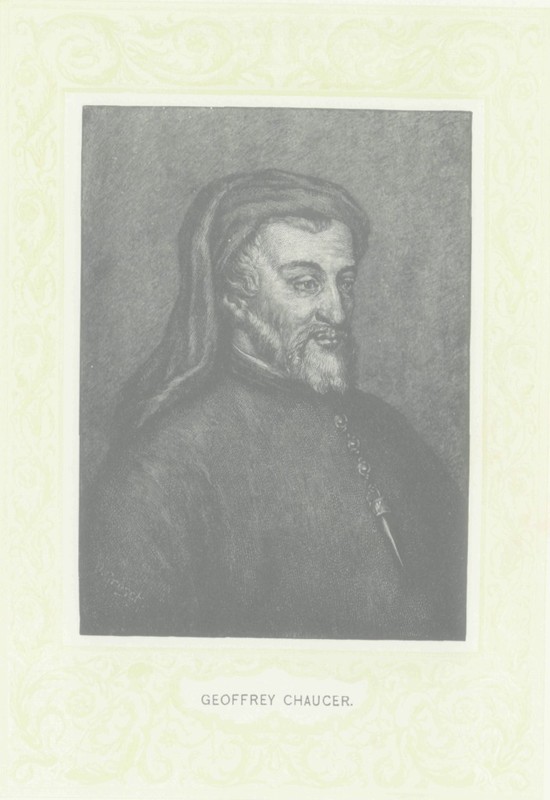
The exact date of Chaucer's birth we do not know. The most that can be said is that it must have been somewhere in the early years of the reign of Edward III. (1327-77). The place of his birth was in all probability London. His father, John Chaucer, was a vintner of that city, and there is evidence to indicate that he was to some extent connected with the court. In a deed dated June 19th, 1380, the poet released his right to his father's former house, which is described as being in Thames Street. The spot, however unsuitable for a dwelling-place now, was then in the very heart of urban life, and in that very neighborhood it is reasonable to suppose that Chaucer's earliest years were spent.
The first positive information we have, however, about the poet himself belongs to 1356. In that year we find him attached to the household of Lionel, Duke of Clarence, the third son of Edward III. He is there in the service of the wife of that prince, but in what position we do not know. It may have been that of a page. He naturally was in attendance upon his mistress during her various journeyings; but most of her time was passed at her residence in Hatfield, Yorkshire. Chaucer next appears as having joined the army of Edward III. in his last invasion of France. This expedition was undertaken in the autumn of 1359, and continued until the peace of Bretigny, concluded in May, 1360. During this campaign he was captured somewhere and somehow—we have no knowledge of anything beyond the bare fact. It took place, however, before the first of March, 1360; for on that date the records show that the King personally contributed sixteen pounds towards his ransom.
From this last-mentioned date Chaucer drops entirely out of our knowledge till June, 1367, when he is mentioned as one of the valets of the King's chamber. In the document stating this fact he is granted a pension—the first of several he received—for services already rendered or to be rendered. It is a natural inference from the language employed, that during these years of which no record exists he was in some situation about the person of Edward III. After this time his name occurs with considerable frequency in the rolls, often in connection with duties to which he was assigned. His services were varied; in some instances certainly they were of importance. From 1370 to 1380 he was sent several times abroad to share in the conduct of negotiations. These missions led him to Flanders, to France, and to Italy. The subjects were very diverse. One of the negotiations in which he was concerned was in reference to the selection of an English port for a Genoese commercial establishment; another was concerning the marriage of the young monarch of England with the daughter of the king of France. It is on his first journey to Italy of which we have any record—the mission of 1372-73 to Genoa and Florence—that everybody hopes and some succeed in having an undoubting belief that Chaucer visited Petrarch at Padua, and there heard from him the story of Griselda, which the Clerk of Oxford in the 'Canterbury Tales' states that he learned from the Italian poet.
But Chaucer's activity was not confined to foreign missions or to diplomacy; he was as constantly employed in the civil service. In 1374 he was made controller of the great customs—that is, of wool, skins, and leather—of the port of London. In 1382 he received also the post in the same port of controller of the petty customs—that is, of wines, candles, and other articles. The regulations of the office required him to write the records with his own hand; and it is this to which Chaucer is supposed to refer in the statement he makes about his official duties in the 'House of Fame.' In that poem the messenger of Jupiter tells him that though he has done so much in the service of the God of Love, yet he has never received for it any compensation. He then goes on to add the following lines, which give a graphic picture of the poet and of his studious life:—
"Wherfore, as I said ywis,[2] Jupiter considereth this, And also, beau sir, other things; That is, that thou hast no tidings Of Lovès folk, if they be glad, Ne of nought ellès, that God made; And nought only from far countree That there no tiding cometh to thee, But of the very neighèboúrs, That dwellen almost at thy doors, Thou hearest neither that nor this; But when thy labor all done is, And hast made all thy reckonings, Instead of rest and newè things, Thou goest home to thine house anon, And also[3] dumb as any stone, Thou sittest at another book, Till fully dazèd is thy look. And livest thus as an eremite, Although thine abstinence is lyte.[4]"
In 1386 Chaucer was elected to Parliament as knight of the shire for the county of Kent. In that same year he lost or gave up both his positions in the customs. The cause we do not know. It may have been due to mismanagement on his own part: it is far more likely that he fell a victim to one of the fierce factional disputes that were going on during the minority of Richard II. At any rate, from this time he again disappears for two years from our knowledge. But in 1389 he is mentioned as having been appointed clerk of the King's works at Westminster and various other places; in 1390 clerk of the works for St. George's chapel at Windsor. Both of these places he held until the middle of 1391. In that last year he was made one of the commissioners to repair the roadway along the Thames, and at about the same time was appointed forester of North Petherton Park in Somerset, a post which he held till his death. After 1386 he seems at times to have been in pecuniary difficulties. To what cause they were owing, or how severe they were, it is the emptiest of speculations to form any conjectures in the obscurity that envelops this portion of his life. Whatever may have been his situation, on the accession of Henry IV. in September, 1399, his fortunes revived. The father of that monarch was John of Gaunt, the fourth son of Edward III. That nobleman had pretty certainly been from the outset the patron of Chaucer; it is possible—as the evidence fails on one side, it cannot be regarded as proved—that by his marriage with Katharine Swynford he became the poet's brother-in-law. Whatever may have been the relationship, if any at all, it is a fact that one of the very first things the new king did was to confer upon Chaucer an additional pension. But the poet did not live long to enjoy the favor of the monarch. On the 24th of December, 1399, he leased for fifty-three years or during the term of his life a tenement in the garden of St. Mary's Chapel, Westminster. But after the 5th of June, 1400, his name appears no longer on any rolls. There is accordingly no reason to question the accuracy of the inscription on his tombstone which represents him as having died October 25th, 1400. He was buried in Westminster Abbey. He was the first, and still remains perhaps the greatest, of the English poets whose bones have there found their last resting-place.
This comprises all the facts of importance we know of Chaucer's life. Before leaving this branch of the subject, however, it may be well to say that many fuller details about his career can be found in all older accounts of the poet, and in spite of the repeated exposure of their falsity still crop up occasionally in modern books of reference. Some are objectionable only upon the ground of being untrue. Of these are such statements as that he was born in 1328; that he was a student of Oxford, to which Cambridge is sometimes added; that he was created poet-laureate; and that he was knighted. But others are objectionable not only on the ground of being false, but of being slanderous besides. Of these the most offensive is the widely circulated and circumstantial story that he was concerned in the conflict that went on in 1382 between the city of London and the court in regard to the election of John of Northampton to the mayoralty; that in consequence of his participation in this contest he was compelled to seek refuge in the island of Zealand; that there he remained for some time, but on his return to England was arrested and thrown into the Tower; and that after having been imprisoned for two or three years he was released at last on the condition of betraying his associates, which he accordingly did. All these details are fictitious. They were made up from inferences drawn from obscure passages in a prose work entitled 'The Testament of Love.' This was once attributed to the poet, but is now known not to have been written by him. Even had it been his, the statements derived from it and applied to the life of the poet would have been entirely unwarranted, as they come into constant conflict with the official records. Not being his, this piece of spurious biography has the additional discredit of constituting an unnecessary libel upon his character.
From Chaucer the man, and the man of affairs, we proceed now to the consideration of Chaucer the writer. He has left behind a body of verse consisting of more than thirty-two thousand lines, and a smaller but still far from inconsiderable quantity of prose. The latter consists mainly if not wholly of translations—one a version of that favorite work of the Middle Ages, the treatise of Boëtius on the 'Consolation of Philosophy'; another the tale of Melibeus in the 'Canterbury Tales,' which is taken directly from the French; thirdly, the Parson's Tale, derived probably from the same quarter, though its original has not as yet been discovered with certainty; and fourthly, an unfinished treatise on the Astrolabe, undertaken for the instruction of his son Lewis. The prose of any literature always lags behind, and sometimes centuries behind, its poetry. It is therefore not surprising to find Chaucer displaying in the former but little of the peculiar excellence which distinguishes his verse. In the latter but little room is found for hostile criticism. In the more than thirty thousand lines of which it is composed there occur of course inferior passages, and some positively weak; but taking it all in all, there is comparatively little in it, considered as a whole, which the lover of literature as literature finds it advisable or necessary to skip. In this respect the poet holds a peculiar position, which makes the task of representation difficult. As Southey remarked, Chaucer with the exception of Shakespeare is the most various of all English authors. He appeals to the most diversified tastes. He wrote love poems, religious poems, allegorical poems, occasional poems, tales of common life, tales of chivalry. His range is so wide that any limited selection from his works can at best give but an inadequate idea of the variety and extent of his powers.
The canon of Chaucer's writings has now been settled with a reasonable degree of certainty. For a long time the fashion existed of imputing to him the composition of any English poem of the century following his death which was floating about without having attached to it the name of any author. The consequence is that the older editions contain a mass of matter which it would have been distinctly discreditable for any one to have produced, let alone a great poet. This has now been gradually dropped, much to the advantage of Chaucer's reputation; though modern scholarship also refuses to admit the production by him of two or three pieces, such as 'The Court of Love,' 'The Flower and the Leaf,' 'The Cuckoo and the Nightingale,' none of which was unworthy of his powers. It is possible indeed that the poet himself may have had some dread of being saddled with the responsibility of having produced pieces which he did not care to father. It is certainly suggestive that he himself took the pains on one occasion to furnish what it seems must have been at the time a fairly complete list of his writings. In the prologue to the 'Legend of Good Women' he gave an idea of the work which up to that period he had accomplished. The God of Love, in the interview which is there described as having taken place, inveighs against the poet for having driven men away from the service due to his deity, by the character of what he had written. He says:—
"Thou mayst it not deny: For in plain text, withouten need of glose,[5] Thou hast translated the Romance of the Rose; That is an heresy agains my law, And makest wisè folk fro me withdraw. And of Cressid thou hast said as thee list; That makest men to women lessè trist,[6] That be as true as ever was any steel."
Against this charge the queen Alcestis is represented as interposing to the god a defense of the poet, in which occurs the following account of Chaucer's writings:—
"Albeit that he cannot well endite, Yet hath he makèd lewèd[7] folk delight To servè you, in praising of your name. He made the book that hight[8] the House of Fame, And eke the Death of Blanche the Duchess, And the Parliament of Fowlès, as I guess, And all the love of Palamon and Arcite Of Thebes, though the story is knowen lyte[9]; And many an hymnè for your holy days That highten[10] ballades, roundels, virelays; And for to speak of other holiness, He hath in prosè translatéd Boece, And made the Life also of Saint Cecile; He made also, gone sithen a great while,[11] Origenes upon the Maudelain[12]: Him oughtè now to have the lessè pain; He hath made many a lay and many a thing."
This prologue is generally conceded to have been written between 1382 and 1385. Though it does not profess to furnish a complete list of Chaucer's writings, it can fairly be assumed that it included all which he then regarded as of importance either on account of their merit or their length. If so, the titles given above would embrace the productions of what may be called the first half of his literary career. In fact, his disciple Lydgate leads us to believe that 'Troilus and Cressida' was a comparatively early production, though it may have undergone and probably did undergo revision before assuming its present form. The 'Legend of Good Women'—in distinction from its prologue—would naturally occupy the time of the poet during the opening period of what is here termed the second half of his literary career. The prologue is the only portion of it, however, that is of distinctly high merit. The work was never completed, and Chaucer pretty certainly came soon to the conclusion that it was not worth completing. It was in the taste of the times; but it did not take him long to perceive that an extended work dealing exclusively with the sorrows of particular individuals was as untrue to art as it was to life. It fell under the ban of that criticism which in the 'Canterbury Tales' he puts into the mouth of the Knight, who interrupts the doleful recital of the tragical tales told by the Monk with these words:—
"'Ho,' quoth the knight, 'good sir, no more of this: That ye have said is right enow, ywis,[13] And muchel[14] more; for little heaviness Is right enow to muchel folk, I guess. I say for me it is a great disease,[15] Where-as men have been in great wealth and ease, To hearen of hir sudden fall, alas! And the contráry is joy and great solas,[16] As when a man hath been in poor estate, And climbeth up and waxeth fortunate, And there abideth in prosperity. Such thing is gladsome, as it thinketh[17] me, And of such thing were goodly for to tell.'"
Accordingly, from the composition of pieces of the one-sided and unsatisfactory character of those contained in the 'Legend of Good Women,' Chaucer turned to the preparation of his great work, the 'Canterbury Tales.' This gave him the fullest opportunity to display all his powers, and must have constituted the main literary occupation of his later life.
It will be noticed that two of the works mentioned in the prologue to the 'Legend of Good Women' are translations, and are so avowed. One is of the 'Roman de la Rose,' and the other of the philosophical treatise of Boëtius. In regard to the version of the former which has come down, it is sufficient to say that there was not long ago a disposition to deny the genuineness of all of it. This now contents itself with denying the genuineness of part of it. The question cannot be considered here: it is enough to say that in the opinion of the present writer, while the subject is attended with certain difficulties, the evidence is strongly in favor of Chaucer's composition of the whole. But setting aside any discussion of this point, there can scarcely be any doubt that Chaucer began his career as a translator. At the period he flourished he could hardly have done otherwise. It was an almost inevitable method of procedure on the part of a man who found neither writers nor writings in his own tongue worthy of imitation, and who could not fail to be struck not merely by the excellence of the Latin classic poets but also by the superior culture of the Continent. In the course of his literary development he would naturally pass from direct translation to adaptation. To the latter practice he assuredly resorted often. He took the work of the foreign author as a basis, discarded what he did not need or care for, and added as little or as much as suited his own convenience. In this way the 5704 lines of the 'Filostrato' of Boccaccio became 8246 in the 'Troilus and Cressida' of Chaucer; but even of the 5704 of the Italian poet, 2974 were not used by the English poet at all, and the 2730 that were used underwent considerable compression. In a similar way he composed the 'Knight's Tale,' probably the most perfect narrative poem in our tongue. It was based upon the 'Theseide' of Boccaccio. But the latter has 9896 lines, while the former comprises but 2250; and of these 2250 fully two-thirds are entirely independent of the Italian poem.
With such free treatment of his material, Chaucer's next step would be to direct composition, independent of any sources, save in that general way in which every author is under obligation to what has been previously produced. This finds its crowning achievement in the 'Canterbury Tales'; though several earlier pieces—such as the 'House of Fame,' the 'Parliament of Fowls,' and the prologue to the 'Legend of Good Women,'—attest that long before he had shown his ability to produce work essentially original. But though in his literary development Chaucer worked himself out of this exact reproduction of his models, through a partial working over of them till he finally attained complete independence, the habits of a translator clung to him to the very end. Even after he had fully justified his claim to being a great original poet, passages occur in his writings which are nothing but the reproduction of passages found in some foreign poem in Latin, or French, or Italian, the three languages with which he was conversant. His translation of them was due to the fact that they had struck his fancy; his insertion of them into his own work was to please others with what had previously pleased himself. Numerous passages of this kind have been pointed out; and doubtless there are others which remain to be pointed out.
There is another important thing to be marked in the history of Chaucer's artistic development. Not only was poetic material lacking in the tongue at the time of his appearance, but also poetic form. The measures in use, while not inadequate for literary expression, were incapable of embodying it in its highest flights. Consequently what Chaucer did not find, he had either to borrow or to invent. He did both. In the lines which have been quoted he speaks of the "ballades, roundels, and virelayes" which he had composed. These were all favorite poetical forms in that Continental country with whose literature Chaucer was mainly conversant. There can be little question that he tried all manner of verse which the ingenuity of the poets of Northern France had devised. As many of his shorter pieces have very certainly disappeared, his success in these various attempts cannot be asserted with positiveness. Still, what have survived show that he was a great literary artist as well as a great poet. His feats of rhyming, in particular in a tongue so little fitted for it as is ours, can be seen in his unfinished poem of 'Queen Anelida and False Arcite,' in the 'Complaint to Venus,' and in the envoy which follows the Clerk's Tale. In this last piece, though there are thirty-six lines, the rhymes are only three; and two of these belong to fifteen lines respectively.
But far more important than such attempts, which prove interest in versification rather than great poetic achievement, are the two measures which he introduced into our tongue. The first was the seven-line stanza. The rhyming lines in it are respectively the first and third; the second, fourth, and fifth; and the sixth and seventh. At a later period this was frequently called "rhyme royal," because the 'Kingis Quair' was written in it. For fully two centuries it was one of the most popular measures in English poetry. Since the sixteenth century, however, it has been but little employed. Far different has been the fate of the line of ten syllables, or rather of five accents. On account of its frequent use in the 'Canterbury Tales' it was called for a long period "riding rhyme"; but it now bears the title of "heroic verse." As employed by Chaucer it varies in slight particulars from the way it is now generally used. With him the couplet character was never made prominent. The sense was not apt to end at the second line, but constantly tended to run over into the line following. There was also frequently with him an unaccented eleventh syllable; and this, though not unknown to modern verse, is not common. Still, the difference between the early and the later form are mere differences of detail, and of comparatively unimportant detail. The introduction of this measure into English may be considered Chaucer's greatest achievement in the matter of versification. The heroic verse may have existed in the tongue before he himself used it. If so, it lurked unseen and uninfluential. He was the first to employ it on a grand scale, if not to employ it at all, and to develop its capabilities. Much the largest proportion of his greatest work is written in that measure. Yet in spite of his example, it found for two centuries comparatively few imitators. It was not till the end of the sixteenth century that the measure started on a new course of life, and entered upon the great part it has since played in English versification.
The most important of what are sometimes called the minor works of Chaucer are the 'Parliament of Fowls,' the 'House of Fame,' 'Troilus and Cressida,' and the 'Legend of Good Women.' These are all favorable examples of his genius. But however good they may be in particular portions and in particular respects, in general excellence they yield place unquestionably to the 'Canterbury Tales.' It seems to have been very clearly the intention of the poet to embody in this crowning achievement of his literary life everything in the shape of a story he had already composed or was purposing to compose. Two of the pieces, the love of Palamon and Arcite and the Life of St. Cecilia, as we know from the words of his already quoted, had appeared long before. The plan of the work itself was most happily conceived; and in spite of most painstaking efforts to find an original for it or suggestion of it somewhere else, there seems no sufficient reason for doubting that the poet himself was equal to the task of having devised it. No one certainly can question the felicity with which the framework for embodying the tales was constructed. All ranks and classes of society are brought together in the company of pilgrims who assemble at the Tabard Inn at Southwark to ride to the shrine of the saint at Canterbury. The military class is represented by the Knight, belonging to the highest order of the nobility, his son the Squire, and his retainer the Yeoman; the church by the Abbot, the Friar, the Parson, the Prioress with her attendant Nun, and the three accompanying Priests, and less distinctly by the Scholar, the Clerk of Oxford, and by the Pardoner and the Summoner. For the other professions are the Doctor of Physic and the Serjeant of Law; for the middle-class landholders the Franklin; and for the various crafts and occupations the Haberdasher, the Carpenter, the Weaver, the Dyer, the Upholsterer, the Cook, the Ploughman, the Sailor, the Reeve, the Manciple, and (joining the party in the course of the pilgrimage) the assistant of the alchemist, who is called the Canon's Yeoman. Into the mouths of these various personages were to be put tales befitting their character and condition. Consequently there was ample space for stories of chivalry, of religion, of love, of magic, and in truth of every aspect of social life in all its highest and lowest manifestations. Between the tales themselves were connecting links, in which the poet had the opportunity to give an account of the incidents that took place on the pilgrimage, the critical opinions expressed by the hearers of what had been told, and the disputes and quarrels that went on between the various members of the party. So far as this portion of his plan was finished, these connecting links furnish some of the most striking passages in the work. In one of them—the prologue to the Wife of Bath's Tale—the genius of the poet reaches along certain lines its highest development; while the general prologue describing the various personages of the party, though not containing the highest poetry of the work as poetry, is the most acute, discriminating, and brilliant picture of men and manners that can be found in our literature.
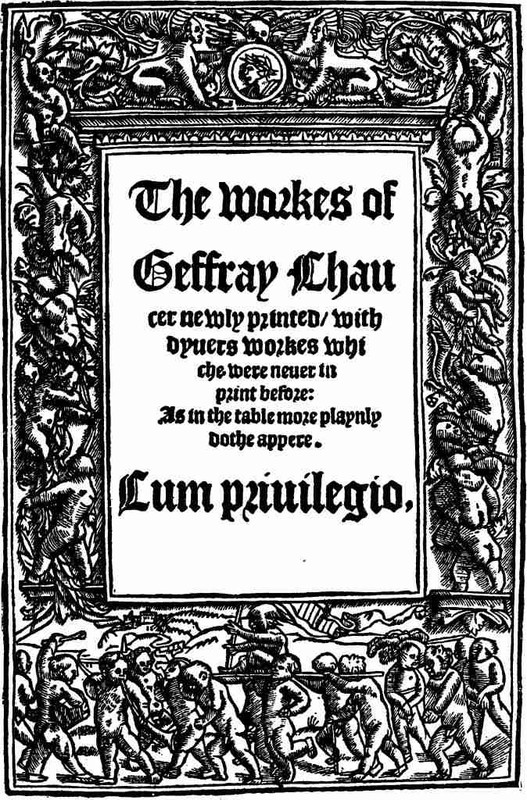
CHAUCER.
Title-page of the first attempt to collect his works into one volume.
The imprint reads:
Imprinted at London by Thomas Godfray,
The yeare of our lorde
M.D.XXXII.
Title:
The Workes of Geffray Chaucer newly printed, with dyuers workes
whiche were neuer in print before: As in the table
more playnly dothe appere.
Cum priuilegio.
Such was the plan of the work. It was laid out on an extensive scale, perhaps on too extensive a scale ever to have been completed. Certain it is that it was very far from ever reaching even remotely that result. According to the scheme set forth in the prologue, the work when finished should have included over one hundred and twenty tales. It actually comprises but twenty-four. Even of these, two are incomplete: the Cook's Tale, which is little more than begun, and the romantic Eastern tale of the Squire, which, in Milton's words, is "left half told." To those that are finished, the connecting links have not been supplied in many cases. Accordingly the work exists not as a perfect whole, but in eight or nine fragmentary parts, each complete in itself, but lacking a close connection with the others, though all are bound together by the unity of a common central interest. The value of what has been done makes doubly keen the regret that so much has been left undone. Politics, religion, literature, manners, are all touched upon in this wide-embracing view, which still never misses what is really essential; and added to this is a skill of portrayal by which the actors, whether narrating the tales themselves, or themselves forming the heroes of the narration, fairly live and breathe before our eyes. Had the work been completed on the scale upon which it was begun, we should have had a picture of life and opinion in the fourteenth century more vivid and exact than has been drawn of any century before or since.
The selections given are partly of extracts and partly of complete pieces. To the former class belong the lines taken from the opening of the 'Canterbury Tales,' with the description of a few of the characters; the description of the temples of Mars, of Venus, and of Diana in the Knight's Tale; and the account of the disappearance of the fairies at the opening of the Wife of Bath's Tale. The complete pieces are the tales of the Pardoner, and of the Nun's Priest. From the first, however, has been dropped the discourse on drunkenness, profanity, and gambling, which, though in keeping with the character of the narrator, has no connection with the development of the story. The second, the tale of the Nun's Priest, was modernized by Dryden under the title of the 'Cock and the Fox.' All of these are in heroic verse. The final selection is the ballade now usually entitled 'Truth.' In it the peculiar ballade construction can be studied—that is, the formation in three stanzas, either with or without an envoy; the same rhymes running through the three stanzas; and the final line of each stanza precisely the same. One of Chaucer's religious poems—the so-called 'A B C'—can be found under Deguileville, from whose 'Pèlerinage la de Vie Humaine' it is translated.
Chaucer's style, like that of all great early writers, is marked by perfect simplicity, and his language is therefore comparatively easy to understand. In the extracts here given the spelling has been modernized, save occasionally at the end of the line, when the rhyme has required the retention of an earlier form. The words themselves and grammatical forms have of course undergone no change. There are two marks used to indicate the pronunciation: first, the acute accent to indicate that a heavier stress than ordinary is to be placed on the syllable over which it stands; and secondly, the grave accent to indicate that the letter or syllable over which it appears, though silent in modern pronunciation, was then sounded. Thus landès, grovès, friendès, knavès, would have the final syllable sounded; and in a similar way timè, Romè, and others ending in e, when the next word begins with a vowel or h mute. The acute accent can be exemplified in words like couráge, reasón, honoúr, translatéd, where the accent would show that the final syllable would either receive the main stress or a heavier stress than is now given it. Again, a word like cre-a-ture consists, in the pronunciation here given, of three syllables and not of two, and is accordingly represented by a grave accent over the a to signify that this vowel forms a separate syllable, and by the acute accent over the ture to indicate that this final syllable should receive more weight of pronunciation than usual. It accordingly appears as creàtúre. In a similar way con-dit-i-on would be a word of four syllables, and its pronunciation would be indicated by this method conditìón. It is never to be forgotten that Chaucer had no superior in the English tongue as a master of melody; and if a verse of his sounds inharmonious, it is either because the line is corrupt or because the reader has not succeeded in pronouncing it correctly.
The explanation of obsolete words or meanings is given in the foot-notes. In addition to these the following variations from modern English that occur constantly, and are therefore not defined, should be noted. Hir and hem stand for 'their' and 'them.' The affix y- is frequently prefixed to the past participle, which itself sometimes omits the final en or -n, as 'ydrawe,' 'yshake.' The imperative plural ends in -th, as 'dreadeth.' The general negative ne is sometimes to be defined by 'not,' sometimes by 'nor'; and connected with forms of the verb 'be' gives us nis, 'is not'; nas, 'was not.' As is often an expletive, and cannot be rendered at all; that before 'one' and 'other' is usually the definite article; there is frequently to be rendered by 'where'; mo always means 'more'; thilke means 'that' or 'that same'; del is 'deal' in the sense of 'bit,' 'whit'; and the comparatives of 'long' and 'strong' are lenger and strenger. Finally it should be borne in mind that the double negative invariably strengthens the negation.

PROLOGUE TO THE 'CANTERBURY TALES'
When that Aprílè with his showers swoot[18] The drought of March hath piercèd to the root, And bathèd every vein in such liqoúr Of which virtue engendered is the flower; When Zephyrús eke with his sweetè breath Inspirèd hath in every holt and heath The tender croppès, and the youngè sun Hath in the Ram his halfè course yrun, And smallè fowlès maken melody, That sleepen all the night with open eye,— So pricketh hem natúre in hir couráges[19]— Then longen folk to go on pilgrimáges, And palmers for to seeken strangè strands, To fernè hallows[20] couth[21] in sundry lands; And specially, from every shirès end Of Engèland, to Canterbury they wend, The holy blissful martyr for to seek, That hem hath holpen when that they were sick. Befell that in that season on a day, In Southwark at the Tabard[22] as I lay, Ready to wenden on my pilgrimáge To Canterbury with full devout couráge, At night were come into that hostelry Well nine and twenty in a company Of sundry folk, by áventúre[23] yfalle In fellowship, and pilgrims were they all, That toward Canterbury woulden ride. The chambers and the stables weren wide, And well we weren easèd[24] at the best. And shortly, when the sunnè was to rest, So had I spoken with hem evereach-one,[25] That I was of hir fellowship anon, And madè forward[26] early for to rise To take our way there-as I you devise.[27] But nathèless, while I have time and space, Ere that I further in this talè pace, Me thinketh it accordant to reasón, To tellen you all the conditìón Of each of hem, so as it seemèd me, And which they weren, and of what degree, And eke in what array that they were in: And at a knight then will I first begin.
The Knight
A knight there was, and that a worthy[28] man, That[29] from the timè that he first began To riden out, he[29] lovèd chivalry, Truth and honoúr, freedom[30] and courtesy. Full worthy was he in his Lordès war, And thereto had he ridden, no man farre,[31] As well in Christendom as in Heatheness, And ever honoured for his worthiness. At Alexandr' he was when it was won; Full oftè time he had the board begun[32] Aboven allè natìóns in Prusse; In Lettowe[33] had he reyséd[34] and in Russe, No Christian man so oft of his degree; In Gernade[35] at the siegè had he be Of Algezir,[36] and ridden in Belmarié.[37] At Lieys[38] was he, and at Satalié,[39] When they were won; and in the Greatè Sea[40] At many a noble army[41] had he be. At mortal battles had he been fifteen, And foughten for our faith at Tramassene[42] In listès thriès, and aye slain his foe. This ilkè[43] worthy knight had been also Sometimè with the lord of Palatié,[44] Again another heathen in Turkéy: And evermore he had a sovereign pris.[45] And though that he were worthy[46] he was wise, And of his port as meek as is a maid. He never yet no villainy[47] ne said In all his life unto no manner wight.[48] He was a very perfect gentle knight. But for to tellen you of his array, His horse were good, but he ne was not gay[49]; Of fustìán he wearèd a gipon,[50] All besmuterèd[51] with his habergeón, For he was late ycome from his viáge.[52] And wentè for to do his pilgrimáge.
The Prioress
There was also a Nun, a Prioress, That of her smiling was full simple and coy; Her greatest oath was but by Sáìnt Loy; And she was clepèd[53] Madame Eglentine. Full well she sang the servicè divine, Entunéd[54] in her nose full seemèly; And French she spake full fair and fetisly[55] After the school of Stratford-at-the-Bow, For French of Paris was to her unknowe. At meatè well ytaught was she withal; She let no morsel from her lippès fall, Ne wet her fingers in her saucè deep. Well could she carry a morsel, and well keep, That no dropè ne fell upon her breast. In courtesy was set full much her lest.[56] Her over-lippè wipèd she so clean, That in her cup there was no farthing[57] seen Of greasè, when she drunken had her draught; Full seemèly after her meat she raught[58]: And sickerly[59] she was of great disport, And full pleasánt and amiable of port, And painèd[60] her to counterfeiten[61] cheer Of court, and to be stately of manére, And to be holden digne[62] of revérence. But for to speaken of her consciénce,[63] She was so charitable and so pitoús, She wouldè weep if that she saw a mouse Caught in a trap, if it were dead or bled; Of smallè houndès had she, that she fed With roasted flesh, or milk and wastel-bread[64]; But soré wept sh' if one of hem were dead,[65] Or if men[66] smote it with a yardè[67] smarte[68]: And all was conscìénce and tender heart. Full seemèly her wimple[69] pinchèd[70] was; Her nosè tretys, her eyen gray as glass, Her mouth full small and thereto soft and red; But sickerly[71] she had a fair forehéad; It was almost a spannè broad, I trow; For hardily[72] she was not undergrowe.[73] Full fetis[74] was her cloak, as I was ware. Of small corál about her arm she bare A pair[75] of beadès gauded all with green[76]; And thereon hung a brooch of gold full sheen, On which ther was first writ a crownèd A, And after, Amor vincit omnia. Another Nunnè with her haddè she, That was her chapèlain,[77] and Priestès three.
The Friar
A Frere there was, a wanton and a merry, A limitoúr,[78] a full solemnè[79] man. In all the orders four is none that can[80] So much of dalliance and fair languáge. He haddè made full many a marrìáge Of youngè women at his owen cost. Unto his order he was a noble post; Full well beloved and fámiliár was he With franklins over-all[81] in his country, And eke with worthy[82] women of the town: For he had powèr of confessìón, As saidè hímself, more than a curáte, For of his order he was licentiáte. Full sweetèly heard he confessìón, And pleasant was his absolutìón. He was an easy man to give penánce, There-as he wist to have[83] a good pittánce; For unto a poor order for to give Is signè that a man is well yshrive; For if he gave, he durstè make avaunt,[84] He wistè that a man was répentánt. For many a man so hard is of his heart, He may not weep although him sorè smart; Therefore instead of weeping and prayérs, Men mote give silver to the poorè freres. His tippet was aye farsèd[85] full of knives And pinnès, for to given fairè wives; And certainly he had a merry note: Well could he sing and playen on a rote[86]; Of yeddings[87] he bare utterly the pris.[88] His neckè white was as the fleur-de-lis. Thereto he strong was as a champión. He knew the taverns well in every town, And every hostèlér[89] and tapèstér, Bet than a lazár[90] or a beggestér[91]; For unto such a worthy man as he Accorded nought, as by his faculty, To have with sickè lazárs ácquaintánce; It is not honest, it may not advance For to dealen with no such poraille,[92] But all with rich and sellers[93] of vitaille.[94] And o'er-all,[95] there-as profit should arise, Courteous he was and lowly of servíce. There was no man nowhere so virtuous[96]; He was the bestè beggar in his house: [And gave a certain farmè[97] for the grant, None of his brethren came there in his haunt.] For though a widow haddè not a shoe, So pleasant was his In principio,[98] Yet would he have a farthing ere he went; His purchase[99] was well better than his rent.[100] And rage[101] he could as it were right a whelp: In lovèdays[102] there could he muchel help; For there he was not like a cloisterér With a threadbare cope, as is a poor scholér; But he was like a master or a pope, Of double worsted was his semicope,[103] That rounded as a bell out of the press. Somewhat he lispèd for his wantonness, To make his English sweet upon his tongue; And in his harping, when that he had sung, His eyen twinkled in his head aright, As do the starrès in the frosty night. This worthy limitour was cleped[104] Hubérd.
The Clerk of Oxford
A Clerk there was of Oxenford[105] also, That unto logic haddè long ygo.[106] As leanè was his horse as is a rake, And he was not right fat, I undertake,[107] But lookèd hollow, and thereto soberly. Full threadbare was his overest[108] courtepy,[109] For he had geten[110] him yet no benefice, Ne was so worldly for to have office. For him was liefer[111] have at his bed's head Twenty bookès clad in black or red, Of Aristotle, and his philosophy, Than robes rich, or fiddle, or gay psaltery. But albe that he was a philosópher, Yet haddè he but little gold in coffer, But all that he might of his friendès hent,[112] On bookès and his learning he it spent, And busily[113] gan for the soulès pray Of hem, that gave him wherewith to scolay[114]; Of study took he most cure and most heed. Not one word spake he morè than was need; And that was said in form and reverence, And short and quick, and full of high senténce.[115] Sounding in moral virtue was his speech, And gladly would he learn and gladly teach.
The Lawyer
A sergeant of the Lawè, ware and wise, That often had ybeen at the Parvys,[116] There was also, full rich of excellence. Discreet he was and of great reverence; He seemèd such, his wordès were so wise; Justice he was full often in assize, By patent and by plein[117] commissìón. For his sciénce, and for his high renown, Of fees and robès had he many one; So great a purchaser[118] was nowhere none; All was fee simple to him in effect, His purchasíng mightè not be infect.[119] Nowhere so busy a man as he there nas, And yet he seemèd busier than he was. In termès had he case and doomès[120] all, That from the time of King Williám were fall. Thereto he could indite, and make a thing, There couldè no wight pinch[121] at his writíng; And every statute could[122] he plein[123] by rote. He rode but homely in a medley[124] coat, Girt with a ceint[125] of silk, with barrès smale[126]; Of his array tell I no lenger tale.
The Shipman
A shipman was there, woning[127] far by West: For aught I wot, he was of Dartèmouth. He rode upon a rouncy,[128] as he couth,[129] In a gown of falding[130] to the knee. A dagger hanging on a lace had he About his neck under his arm adown; The hotè summer had made his hue all brown; And certainly he was a good felláw. Full many a draught of wine had he ydrawe From Bourdeaux-ward, while that the chapman[131] sleep[132]; Of nicè conscìénce took he no keep.[133] If that he fought, and had the higher hand, By water he sent hem home to every land. But of his craft to reckon well his tides, His streamès and his dangers him besides, His harbour and his moon, his lodemanáge,[134] There was none such from Hullè to Cartháge. Hardy he was, and wise to undertake; With many a tempest had his beard been shake. He knew well all the havens, as they were, From Gothland to the Cape of Finisterre, And every creek in Bretagne and in Spain: His barge yelepèd was the Maudelaine.
[1] Poet.
[2] Certainly.
[3] As.
[4] Little.
[5] Commentary.
[6] Trust.
[7] Ignorant.
[8] Is called.
[9] Little.
[10] Are called.
[11] A great while ago.
[12] Origen upon Mary Magdalen.
[13] Certainly.
[14] Much.
[15] Discomfort.
[16] Solace.
[17] Seems.
[18] Sweet.
[19] Hearts.
[20] Distant saints.
[21] Known.
[22] Tabard: sign of the inn at Southwark.
[23] Accident.
[24] Accommodated.
[25] Every one.
[26] Agreement.
[27] Tell.
[28] Of high rank.
[29] That—he = who.
[30] Liberality.
[31] Farther.
[32] Sat at the head of the table.
[33] Lithuania.
[34] Traveled.
[35] Grenada.
[36] Algeciras.
[37] Moorish Kingdom of Africa.
[38] Lieys: in Armenia.
[39] Satalie: ancient Attalia.
[40] Mediterranean.
[41] Armed expedition.
[42] Tramassene: a kingdom in Africa.
[43] Same.
[44] Palatie: Palatine in Anatolia.
[45] Estimation.
[46] Of high rank.
[47] Anything discourteous.
[48] No sort of person.
[49] Richly dressed.
[50] Cassock.
[51] Soiled.
[52] Journey.
[53] Called.
[54] Intoned.
[55] Properly.
[56] Pleasure.
[57] Bit.
[58] Reached.
[59] Certainly.
[60] Took pains.
[61] Imitate.
[62] Worthy.
[63] Tender-heartedness.
[64] Bread of the finest flour.
[65] Died.
[66] One.
[67] Staff.
[68] Smartly.
[69] Covering for the neck.
[70] Plaited.
[71] Certainly.
[72] Certainly.
[73] Undergrown.
[74] Neat.
[75] String.
[76] Having the gaudies, or large beads, green.
[77] Private secretary.
[78] Licensed to beg within certain limits.
[79] Festive.
[80] Knows.
[81] Everywhere.
[82] Of high position.
[83] Where he knew he should have.
[84] Boast.
[85] Stuffed.
[86] A stringed instrument.
[87] Songs.
[88] Estimation.
[89] Innkeeper.
[90] Leper.
[91] Beggar.
[92] Poor people.
[93] Givers.
[94] Victuals.
[95] Everywhere.
[96] Efficient.
[97] Rent.
[98] In principio: In the beginning—the friar's salutation.
[99] Proceeds from begging.
[100] Income.
[101] Toy wantonly.
[102] Days for settling differences.
[103] Short cape.
[104] Called.
[105] Oxford.
[106] Gone.
[107] Venture to say.
[108] Uppermost.
[109] Short cloak.
[110] Gotten.
[111] Rather.
[112] Get.
[113] Earnestly.
[114] To attend school.
[115] Matter.
[116] Parvys: the portico of St. Paul's, frequented by lawyers for consultation.
[117] Full.
[118] Acquirer of property.
[119] Tainted by illegality.
[120] Cases and decisions.
[121] Find a flaw.
[122] Knew.
[123] Fully.
[124] Mixed in color.
[125] Girdle.
[126] Small.
[127] Dwelling.
[128] Hack.
[129] Could.
[130] Coarse cloth.
[131] Supercargo.
[132] Slept.
[133] Heed.
[134] Pilotage.
THE TEMPLES OF VENUS, MARS, AND DIANA
From the Knight's Tale
First in the temple of Venus mayst thou see Wrought on the wall, full piteous to behold, The broken sleepès, and the sighès cold, The sacred tearès, and the waimentíng,[135] The fiery strokès of the désiríng That lovès servants in this life enduren; The oathès, that hir covenánts assuren. Pleasance and hope, desire, foolhardiness, Beauty and youthè, bawdry and richesse, Charmès and force, leasíngs[136] and flattery, Dispencè,[137] business,[138] and jealousy That weared of yellow goldès[139] a garlánd, And a cuckoo sitting on her hand; Feastès, instruments, carólès, dances, Lust and array, and all the circumstances Of love, which that I reckoned have and reckon shall, By order weren painted on the wall, And mo than I can make of mentìón. For soothly all the mount of Citheron, There Venus hath her principal dwellíng, Was showèd on the wall in portrayíng, With all the garden and the lustiness. Nought was forgot the porter Idleness, Ne Narcissus the fair of yore agone, Ne yet the folly of King Solomon, Ne yet the greatè strength of Hercules, The enchantèments of Medea and Circes, N'of Turnús with the hardy fierce couráge, The richè Crœsus caitiff[140] in serváge[141]. Thus may ye see, that wisdom ne richesse, Beauty ne sleightè, strengthè, hardiness, Ne may with Venus holden champarty[142], For as her list the world then may she gye[143]. Lo, all these folk so caught were in her las[144] Till they for woe full often said, "Alas!" Sufficeth here ensamples one or two, And though I couldè reckon a thousand mo. The statue of Venus, glorious for to see, Was naked fleting[145] in the largè sea, And from the navel down all covered was With wavès green, and bright as any glass, A citole[146] in her right hand haddé she, And on her head, full seemly for to see, A rosé garland fresh and well smellíng, Above her head her dovès flickeríng[147]. Before her stood her sonè Cupido, Upon his shoulders wingès had he two; And blind he was, as it is often seen; A bow he bare and arrows bright and keen. Why should I not as well eke tell you all The portraitúre, that was upon the wall Within the temple of mighty Mars the red? All painted was the wall in length and brede[148] Like to the estres[149] of the grisly place, That hight the greatè temple of Mars in Thrace, In thilkè coldè frosty regìón, There-as Mars hath his sovereign mansìón. First on the wall was painted a forést, In which there dwelleth neither man ne beast, With knotty gnarry barren treès old Of stubbès[150] sharp and hideous to behold, In which there ran a rumble and a sough, As though a storm should bresten[151] every bough: And downward from an hill, under a bent,[152] There stood the temple of Mars armipotent, Wrought all of burnèd[153] steel, of which th' entry Was long and strait[154] and ghastly for to see. And thereout came a rage and such a vese,[155] That it made all the gatès for to rese.[156] The northern light in at the doorès shone, For window on the wall ne was there none Through which men mighten any light discern; The doors were all of adamant eterne, Yclenchèd overthwart and endèlong[157] With iron tough, and for to make it strong, Every pillár the temple to sustene Was tunnè-great,[158] of iron bright and sheen. There saw I first the dark imagining Of felony, and all the compassing; The cruel irè, red as any gleed,[159] The pickèpurse, and eke the palè drede[160]; The smiler with the knife under the cloak; The shepen[161] brenning[162] with the blackè smoke; The treason of the murdering in the bed, The open war, with woundès all bebled; Contek[163] with bloody knife and sharp menáce. All full of chirking[164] was that sorry place. The slayer of himself yet saw I there, His heartè-blood hath bathèd all his hair: The nail ydriven in the shode[165] anight; The coldè death, with mouth gapíng upright.[166] Amiddès of the temple sat mischance, With díscomfórt and sorry countenance, Yet saw I woodness[167] laughing in his rage, Armèd complaint, outhees,[168] and fierce outrage; The carrion[169] in the bush, with throat ycorven,[170] A thousand slain, and not of qualm[171] ystorven[172]; The tyrant with the prey by force yreft; The town destroyed, there was nothing left. Yet saw I brent[173] the shippès hoppèsteres,[174] The huntè[175] strangled with the wildè bears: The sowè freten[176] the child right in the cradle; The cook yscalded, for all his longè ladle. Nought was forgotten by th' infortúne of Marte; The carter overridden with his cart; Under the wheel full low he lay adown. There were also of Mars' divisìón, The barber, and the butcher, and the smith That forgeth sharpè swordès on his stith.[177] And all above depainted in a tower Saw I Conquést, sitting in great honóur, With the sharpè sword over his head Hanging by a subtle[178] twinès thread. Depainted was the slaughter of Juliús, Of great Neró, and of Antoniús: Albe that thilkè time they were unborn, Yet was hir death depainted therebeforn, By ménacíng of Mars, right by figúre, So was it showèd in that portraitúre, As is depainted in the stars above, Who shall be slain or ellès dead for love. Sufficeth one ensample in stories old, I may not reckon them allè though I wold. The statue of Mars upon a cartè stood Armèd, and lookèd grim as he were wood,[179] And over his head there shinen two figúres Of starrès, that be clepèd in scriptúres,[180] That one Puella, that other Rubeus.[181] This god of armès was arrayèd thus: A wolf there stood before him at his feet With eyen red, and of a man he eat: With subtle pencil depainted was this story, In redoubting[182] of Mars and of his glory. Now to the temple of Dián the chaste As shortly as I can I will me haste, To tellen you all the descriptìón: Depainted be the wallès up and down Of hunting and of shamefast chastity. There saw I how wofúl Calistope,[183] When that Dian aggrievèd was with her, Was turnèd from a woman to a bear, And after was she made the lodèstar[184]: Thus was it painted, I can say no farre[185]; Her son is eke a star as men may see. There saw I Danè yturnèd till[186] a tree, I meanè not the goddesse Diánè, But Peneus' daughter, which that hightè Danè. There saw I Acteon an hart ymakèd,[187] For vengeance that he saw Dian all naked: I saw how that his houndès have him caught, And freten[188] him for that they knew him naught. Yet painted was a little furthermore, How Atalanta hunted the wild boar, And Meleager, and many another mo, For which Diana wrought him care and woe. There saw I many another wonder story, The which me list not drawen to memóry. This goddess on an hart full highè seet,[189] With smallè houndès all about her feet, And underneath her feet she had a moon, Waxing it was, and shouldè wanen soon. In gaudy-green[190] her statue clothèd was, With bow in hand and arrows in a case. Her eyen castè she full low adown There Pluto hath his darkè regìón. A woman travailing was her beforn, But for her child so longè was unborn Full piteously Lucina[191] gan she call, And saidè, "Help, for thou mayst best of all." Well could he painten lifely[192] that it[193] wrought, With many a florin he the huès bought.
THE PASSING OF THE FAIRIES
From the Wife of Bath's Tale
In th' oldè dayès of the king Arthúr Of which that Britons speaken great honóur, All was this land fulfilled of faèrié; The Elf-queen, with her jolly company, Dancèd full oft in many a greenè mead; This was the old opinion as I read: I speak of many hundred years ago; But now can no man see none elvès mo, For now the greatè charity and prayérs Of limitours[194] and other holy freres, That searchen every land and every stream, As thick as motès in the sunnè-beam, Blessing halles, chambers, kitchenès, bowers, Cities, boroughs, castles, highè towers, Thorpès, barnès, shepens,[195] daìriés, This maketh that there be no faèriés: For there as wont to walken was an elf, There walketh now the limitour himself, In undermelès[196] and in morwènings, And saith his matins and his holy things, As he goeth in his limitatìón,[197] Women may go now safely up and down, In every bush, and under every tree; There is none other incubus but he.
THE PARDONER'S TALE
In Flanders whilom was a company Of youngè folk, that haunteden folly, As riot, hazard, stewès, and tavérns; Whereas with harpès, lutès, and gittérns,[198] They dance and play at dice both day and night, And eat also, and drinken o'er hir might; Through which they do the devil sacrifice Within the devil's temple, in cursed wise, By superfluity abomináble. Hir oathès be so great and so damnáble, That it is grisly[199] for to hear hem swear. Our blessèd Lordès body they to-tear[200]; Hem thoughte[201] Jewès rent him not enough; And each of hem at otherès sinnè lough.[202] And right anon then comen tombesteres[203] Fetis[204] and small, and youngè fruitesteres,[205] Singers with harpès, bawdès, waferérs,[206] Which be the very devil's officérs, To kindle and blow the fire of lechery, That is annexèd unto gluttony.
These riotourès three, of which I tell, Long erst ere[207] primè rung of any bell, Were set hem in a tavern for to drink: And as they sat, they heard a bellè clink Before a corpse, was carried to his grave: That one of hem gan callen to his knave,[208] "Go bet,"[209] quoth he, "and askè readily, What corpse is this, that passeth here forby: And look that thou report his namè well."
"Sir," quoth this boy, "it needeth never a del; It was me told ere ye came here two hours: He was pardie an old fellów of yours, And suddenly he was yslain to-night, Fordrunk[210] as he sat on his bench upright: There came a privy thief, men clepeth[211] Death, That in this country all the people slayéth, And with his spear he smote his heart atwo, And went his way withouten wordès mo. He hath a thousand slain this pestilénce: And, master, ere ye come in his presénce, Methinketh that it werè necessary, For to be ware of such an adversary; Be ready for to meet him evermore: Thus taughtè me my dame; I say no more." "By Saintè Mary," said this tavernér,[212] "The child saith sooth, for he hath slain this year Hence over a mile, within a great villáge, Both man and woman, child, and hine,[213] and page; I trow his habitatìón be there: To be avisèd[214] great wisdóm it were, Ere that he did a man a dishonóur." "Yea, Godès armès," quoth this riotóur, "Is it such peril with him for to meet? I shall him seek by way and eke by street, I make avow to Godès digne[215] bonès. Hearkeneth, fellówès, we three be all onès[216]: Let each of us hold up his hand till other, And each of us becomen otherès brother, And we will slay this falsè traitor Death: He shall be slain, which that so many slayeth, By Godès dignity, ere it be night." Together have these three hir truthès plight To live and dien each of hem for other, As though he were his own yborèn[217] brother. And up they start all drunken, in this rage, And forth they go towárdès that villáge. Of which the taverner had spoke beforn, And many a grisly[218] oath then have they sworn, And Christès blessed body they to-rent;[219] Death shall be dead,[220] if that they may him hent.[221] When they have gone not fully half a mile, Right as they would have trodden o'er a stile, An old man and a poorè with hem met. This oldè man full meekèly hem gret,[222] And saidè thus: "Now, lordès, God you see."[223] The proudest of these riotourès three Answéred again: "What, carl,[224] with sorry grace, Why art thou all forwrappèd[225] save thy face? Why livest thou so long in so great age?" This oldè man gan look on his viságe, And saidè thus: "For I ne cannot find A man, though that I walkèd into Ind, Neither in city, nor in no villáge, That wouldè change his youthè for mine age; And therefore mote I have mine agè still As longè time as it is Godès will. Ne death, alas! ne will not have my life; Thus walk I like a restèless cáìtiff, And on the ground, which is my mother's gate, I knockè with my staff, both early and late, And sayen, 'Liefè[226] mother, let me in. Lo, how I vanish, flesh, and blood, and skin; Alas! when shall my bonès be at rest? Mother, with you would I changen my chest, That in my chamber longè time hath be, Yea, for an hairè clout to wrappè me.' But yet to me she will not do that grace, For which full pale and welkèd[227] is my face. "But, sirs, to you it is no courtesy To speaken to an old man villainy, But[228] he trespass in word or else in deed. In holy writ ye may yourself well read; 'Against[229] an old man, hoar upon his head, Ye should arise:' wherefore I give you rede,[230] Ne do unto an old man none harm now, No morè than ye would men did to you In agè, if that ye so long abide. And God be with you, where ye go or ride; I mote go thither as I have to go." "Nay, oldè churl, by God, thou shalt not so," Saidè this other hazardour anon; "Thou partest not so lightly, by Saint John. Thou spake right now of thilkè traitor Death, That in this country all our friendès slayeth; Have here my truth, as thou art his espy; Tell where he is, or thou shalt it aby,[231] By God and by the holy sacrament; For soothly thou art one of his assent To slay us youngè folk, thou falsè thief." "Now, sirs," quoth he, "if that you be so lief[232] To finden Death, turn up this crooked way, For in that grove I left him, by my fay, Under a tree, and there he will abide; Not for your boast he will him nothing hide. See ye that oak? right there ye shall him find. God savè you, that bought again mankind, And you amend!" thus said this oldè man. And evereach[233] of these riotourès ran, Till he came to that tree, and there they found Of florins fine of gold ycoinèd round, Well nigh an eightè bushels, as hem thought. No lenger then after Death they sought, But each of hem so glad was of that sight, For that the florins be so fair and bright, That down they set hem by this precious hoard. The worst of hem he spake the firstè word. "Brethren," quoth he, "take keepè[234] what I say; My wit is great, though that I bourd[235] and play. This treasure hath fortúne unto us given In mirth and jollity our life to liven, And lightly as it cometh, so will we spend. Hey! Godès precious dignity! who wend[236] To-day, that we should have so fair a grace? But might this gold be carried from this place Home to mine house, or ellès unto yours, For well ye wot that all this gold is ours, Then werè we in high felicity. But trúèly by day it may not be; Men woulden say that we were thievès strong, And for our owen treasure do us hong.[237] This treasure must ycarried be by night As wisely and as slily as it might. Wherefore I rede,[238] that cut[239] among us all Be draw, and let see where the cut will fall: And he that hath the cut, with heartè blithè Shall rennè[240] to the town, and that full swith,[241] And bring us bread and wine full privily; And two of us shall keepen subtlely This treasure well; and if he will not tarry, When it is night, we will this treasure carry By one assent, where as us thinketh best." That one of hem the cut brought in his fist, And bade hem draw and look where it will fall, And it fell on the youngest of hem all: And forth towárd the town he went anon. And also[242] soon as that he was agone, That one of hem spake thus unto that other; "Thou knowest well thou art my sworen brother; Thy profit will I tellen thee anon. Thou wost[243] well that our fellow is agone, And here is gold, and that full great plenty, That shall departed be among us three. But nathèless, if I can shape it so, That it departed were among us two, Had I not done a friendès turn to thee?" That other answered, "I not[244] how that may be: He wot how that the gold is with us tway.[245] What shall we do? what shall we to him say?" "Shall it be counsel?" said the firstè shrew; "And I shall tellen thee in wordès few What we shall do, and bring it well about." "I grantè," quoth that other, "out of doubt, That by my truth I shall thee not bewray." "Now," quoth the first, "thou wost well we be tway, And two of us shall strenger be than one. Look, when that he is set, thou right anon Arise, as though thou wouldest with him play; And I shall rive him through the sidès tway, While that thou strugglest with him as in game, And with thy dagger look thou do the same; And then shall all this gold departed be, My dearè friend, betwixen me and thee: Then may we both our lustès all fulfill, And play at dice right at our owen will." And thus accorded be these shrewès tway To slay the third, as ye have heard me say. This youngest, which that went unto the town, Full oft in heart he rolleth up and down The beauty of these florins new and bright. "O Lord!" quoth he, "if so were that I might Have all this treasure to myself alone, There is no man that liveth under the throne Of God, that shouldè live so merry as I." And the last the fiend, our enemy, Put in his thought that he should poison bey,[246] With which he mightè slay his fellows twaye. Forwhy[247] the fiend found him in such livíng, That he had leavè him to sorrow bring. For this was utterly his full intent To slay hem both, and never to repent. And forth he goeth, no lenger would he tarry, Into the town unto a 'pothecary, And prayèd him that he him wouldè sell Some poison, that he might his rattès quell, And eke there was a polecat in his haw[248] That, as he said, his capons had yslawe[249]; And fain he wouldè wreak[250] him if he might, On vermin, that destroyèd him by night. The 'pothecary answéred, "And thou shalt have A thing that, also[251] God my soulè save, In all this world there nis no créàtúre, That eaten or drunk hath of this cónfectúre, Naught but the mountance[252] of a corn of wheat, That he ne shall his life anon forlete[253]; Yea, sterve[254] he shall, and that in lessè while, Than thou wilt go a pace[255] not but a mile: This poison is so strong and violent." This cursèd man hath in his hand yhent[256] This poison in a box, and sith he ran Into the nextè street unto a man, And borrowed of him largè bottles three; And in the two his poison pourèd he; The third he kept clean for his owen drink, For all the night he shope[257] him for to swink[258] In carrying the gold out of that place. And when this riotour, with sorry grace, Had filled with wine his greatè bottles three, To his fellóws again repaireth he. What needeth it to sermon of it more? For right as they had cast his death before, Right so they have him slain, and that anon. And when that this was done, thus spake that one: "Now let us sit and drink, and make us merry, And afterward we will his body bury." And with that word it happèd him par cas,[259] To take the bottle there the poison was, And drank, and gave his fellow drink also, For which anon they storven[260] bothè two. But certes I suppose that Avicen Wrote never in no canon, n' in no fen,[261] Mo wonder signès of empoisoning, Than had these wretches two ere hir endíng. Thus ended be these homicidès two, And eke the false empoisoner also.
THE NUN'S PRIESTS TALE
[135] Lamentation.
[136] Lies.
[137] Expense.
[138] Anxiety.
[139] The flower turnsol.
[140] Wretched.
[141] Slavery.
[142] Partnership in power.
[143] Guide.
[144] Snare.
[145] Floating.
[146] Musical instrument.
[147] Fluttering.
[148] Breadth.
[149] Interiors.
[150] Projecting old roots.
[151] Burst.
[152] Slope.
[153] Burnished.
[154] Narrow.
[155] Furious rush of wind.
[156] Shake.
[157] Across and lengthways.
[158] Of the circumference of a tun.
[159] Burning coal.
[160] Coward.
[161] Stables.
[162] Burning.
[163] Contention.
[164] Shrieking.
[165] Forehead.
[166] Prone on back.
[167] Madness.
[168] Outcry.
[169] Corpse.
[170] Cut.
[171] Disease.
[172] Having died.
[173] Burnt.
[174] The dancing ships.
[175] Hunter.
[176] Devour.
[177] Anvil.
[178] Fine.
[179] Mad.
[180] Called in writings.
[181] 'Puella' and 'Rubeus': two figures in Geomancy, representing two constellations,—the one signifying Mars retrograde, the other Mars direct.
[182] Reverence.
[183] 'Calistope' or Callisto: daughter of Lycaon—seduced by Jupiter—turned into a bear by Juno (or Diana)—and placed afterwards, with her son, as the Great Bear among the stars.
[184] Pole-star.
[185] Farther.
[186] To.
[187] Made.
[188] Devour.
[189] Sat.
[190] Light-green.
[191] 'Lucina': another name for Diana—as the goddess of child-bearing.
[192] Lifelike.
[193] What.
[194] Begging friars.
[195] Stables.
[196] Afternoons.
[197] Begging district.
[198] Guitars.
[199] Dreadful.
[200] Tear in pieces.
[201] It seemed to them.
[202] Laughed.
[203] Female dancers.
[204] Neat.
[205] Female fruit-sellers.
[206] Sellers of wafer-cakes.
[207] Long first before.
[208] Servant.
[209] Quickly.
[210] Excessively drunk.
[211] Call.
[212] Innkeeper.
[213] Peasant.
[214] Watchful.
[215] Worthy.
[216] At one.
[217] Born.
[218] Dreadful.
[219] Tear in pieces.
[220] Die.
[221] Seize.
[222] Greeted.
[223] Keep in sight, protect.
[224] Churl.
[225] Completely wrapped up.
[226] Dear.
[227] Withered.
[228] Unless.
[229] To meet.
[230] Advice.
[231] Suffer for.
[232] Desirous.
[233] Each one.
[234] Heed.
[235] Joke.
[236] Thought.
[237] Cause us to be hanged.
[238] Advise.
[239] Lot.
[240] Run.
[241] Quickly.
[242] As.
[243] Knowest.
[244] Know not.
[245] Two.
[246] Buy.
[247] Because.
[248] Farm-yard.
[249] Slain.
[250] Revenge.
[251] As.
[252] Amount.
[253] Give up.
[254] Die.
[255] At a footpace.
[256] Seized.
[257] Purposed.
[258] Labor.
[259] By chance.
[260] Died.
[261] 'Fen': the name of the sections of Avicenna's great work entitled 'Canon.'
A poorè widow somedeal stope[262] in age, Was whilom dwelling in a narrow cottàge, Beside a grovè, standing in a dale. This widow, of which I tellè you my tale, Since thilkè day that she was last a wife, In patience led a full simple life. For little was her cattel[263] and her rent[264]: By husbandry[265] of such as God her sent She found[266] herself, and eke her daughtren two. Three largè sowès had she, and no mo; Three kine, and eke a sheep that hightè[267] Mall. Full sooty was her bower, and eke her hall, In which she ate full many a slender meal. Of poignant sauce her needed never a deal.[268] No dainty morsel passèd through her throat; Her diet was accordant to her cote.[269] Repletìón ne made her never sick; Attemper[270] diet was all her physíc, And exercise, and heartès suffisánce.[271] The goutè let[272] her nothing for to dance, N' apoplexy ne shentè[273] not her head. No wine ne drank she, neither white ne red: Her board was servèd most with white and black, Milk and brown bread, in which she found no lack, Seind[274] bacon, and sometime an egg or twey; For she was as it were a manner dey.[275] A yard she had, enclosed all about With stickès, and a dryè ditch without, In which she had a cock hight Chanticleer, In all the land of crowing was none his peer. His voice was merrier than the merry orgón, On massè days that in the churchè gon. Well sikerer[276] was his crowing in his lodge Than is a clock, or an abbéy horloge.[277] By nature he knew each ascensìón Of the equinoctiál in thilké town; For when degrees fifteenè were ascended, Then crew he, that it might not be amended. His comb was redder than the fine corál, And battled,[278] as it were a castle wall. His bill was black, and as the jet it shone; Like azure were his leggès and his ton[279]; His nailès whiter than the lily flower, And like the burned[280] gold was his colóur. This gentle cock had in his governánce Seven hennès, for to do all his pleasánce, Which were his sisters and his paramours, And wonder like to him, as of coloúrs; Of which the fairest huèd on her throat Was clepèd fairè Damosel Partelote. Courteous she was, discreet, and debonair, And cómpanáble,[281] and bare herself so fair, Sin[282] thilkè day that she was sevennight old, That truèly she hath the heart in hold[283] Of Chanticleer, locken[284] in every lith[285]; He loved her so, that well was him therewith. But such a joy was it to hear hem sing, When that the brightè sunnè gan to spring, In sweet accord, 'My lief is faren on land.'[286] For thilkè time, as I have understande, Beastès and birdès couldè speak and sing. And so befell, that in a dawèning, As Chanticleer among his wivès all Sat on his perchè, that was in the hall, And next him sat this fairè Partèlote, This Chanticleer gan groanen in his throat, As man that in his dream is drecchèd[287] sore, And when that Partèlote thus heard him roar, She was aghast, and said, "O heartè dear, What aileth you to groan in this mannére? Ye be a very sleeper, fie, for shame!" And he answéred and saidè thus: "Madáme, I pray you that ye take it not agrief[288]; By God, me met[289] I was in such mischiéf[290] Right now, that yet mine heart is sore affright. Now God," quoth he, "my sweven[291] read[292] aright, And keep my body out of foul prisón. Me met how that I roamèd up and down Within our yard, where-as I saw a beast Was like an hound, and would have made arrest Upon my body, and have had me dead. His colour was betwixè yellow and red; And tippèd was his tail, and both his ears With black, unlike the remnant of his hairs. His snoutè small, with glowing eyen twey; Yet of his look for fear almost I dey[293]: This causèd me my groaning doubteless." "Avoy!" quoth she, "fie on you heartèless! Alas!" quoth she, "for by that God above Now have ye lost mine heart and all my love; I cannot love a coward, by my faith. For certes, what so any woman saith, We all desiren, if it mightè be, To have husbándès, hardy, wise, and free, And secre,[294] and no niggard ne no fool, Ne him that is aghast of every tool, Ne none avantour[295] by that God above. How durst ye say for shame unto your love, That anything might maken you afeard? Have ye no mannès heart, and have a beard? Alas! and can ye be aghast of swevenès[296]? Nothing but vanity, God wot, in sweven is, Swevens engender of repletions, And oft of fume, and of complexións,[297] When humours be too abundant in a wight. Certes this dream, which ye have met[298] to-night, Cometh of the greatè superfluity Of yourè redè colera,[299] pardié, Which causeth folk to dreamen in hir dreams Of arrows, and of fire with redè leames,[300] Of greatè beastes, that they will hem bite, Of contek[301] and of whelpès great and lite[302]; Right as the humour of meláncholy Causeth full many a man in sleep to cry, For fear of blackè beares or bullès blake, Or ellès blackè devils will hem take. Of other humours could I tell also, That worken many a man in sleep full woe: But I will pass as lightly[303] as I can. Lo Cato, which that was so wise a man, Said he not thus? 'Ne do no force[304] of dreams.'" "Now, Sir," quoth she, "when ye fly from the beams, For Godès love, as take some laxative: Up[305] peril of my soul, and of my live, I counsel you the best, I will not lie, That both of choler, and of meláncholy Ye purgè you; and for ye shall not tarry, Though in this town is none apothecary, I shall myself to herbès teachen you, That shall be for your heal[306] and for your prow[307]; And in our yard tho[308] herbès shall I find, The which have of hir property by kind[309] To purgen you beneath, and eke above. Forget not this for Godès owen love; Ye be full choleric of complexìón; Ware the sun in his ascensìón Ne find you not replete of humours hot: And if it do, I dare well lay a groat, That ye shall have a fever tertìán, Or an agúe, that may be yourè bane. A day or two ye shall have dígestives Of wormès, ere ye take your laxatíves, Of lauriol, centaury, and fumetere,[310] Or else of hellebore, that growreth there, Of catapucè,[311] or of gaitres-berríès,[312] Of herb ivy growing in our yard, that merry is: Pick hem up right as they grow, and eat hem in. Be merry, husband, for your father kin Dreadeth no dream; I can say you no more." "Madame," quoth he, "grand mercy of" your lore. But nathèless, as touching Dan Caton, That hath of wisdom such a great renown, Though that he bade no dreamès for to drede, By God, men may in oldè bookès read,[313] Of many a man, more of authority Than ever Cato was, so mote I the,[314] That all the réverse say of this senténce, And have well founden by experiénce, That dreamès be significatìóns As well of joy, as of tribulatìóns, That folk enduren in this life présent. There needeth make of this none argument; The very prevè[315] sheweth it indeed. "One of the greatest authors that men read, Saith thus, that whilom two fellówès went On pilgrimage in a full good intent; And happèd so, they came into a town, Where-as there was such congregatìón Of people, and eke so strait of herbergage,[316] That they ne found as much as one cottáge, In which they bothè might ylodgèd be: Wherefore they musten of necessity, As for that night, departen[317] company; And each of hem goeth to his hostelry, And took his lodging as it wouldè fall. That one of hem was lodgèd in a stall, Far in a yard, with oxen of the plow; That other man was lodgèd well enow, As was his áventúre, or his fortúne, That us govérneth all, as in commúne. And so befell, that, long ere it were day, This man met[318] in his bed, there-as he lay, How that his fellow gan upon him call, And said, 'Alas! for in an oxès stall This night I shall be murdered, there I lie. Now help me, dearè brother, or I die; In allè hastè come to me,' he said. This man out of his sleep for fear abraid[319]; But when that he was wakened of his sleep, He turnèd him, and took of this no keep[320]; Him thought his dream nas but a vanity. Thus twiès in his sleeping dreamèd he. And at the thirdè time yet his felláw Came, as him thought, and said, 'I am now slawe.[321] Behold my bloody woundès, deep and wide. Arise up early, in the morrow tide, And at the west gate of the town,' quoth he, 'A cartè full of dung there shalt thou see, In which my body is hid full privily. Do thilkè cart arresten boldèly. My gold causèd my murder, sooth to sayn.' And told him every point how he was slain With a full piteous facè, pale of hue. And trusteth well, his dream he found full true; For on the morrow, as soon as it was day, To his fellówès inn he took his way: And when that he came to this oxès stall, After his fellow he began to call. The hostèler answérèd him anon, And saidè, 'Sir, your fellow is agone, As soon as day he went out of the town.' "This man gan fallen in suspicìón Remembering on his dreamès that he met,[322] And forth he goeth, no lenger would he let,[323] Unto the west gate of the town, and found A dung cart, as it were to dungè lond, That was arrayèd in that samè wise As ye have heard the deadè man devise: And with an hardy heart he gan to cry, 'Vengeance and justice of this felony: My fellow murdered is this samè night, And in this cart he lieth, gaping upright.[324] I cry out on the ministers,' quoth he, 'That shouldè keep and rulen this city: Harow! alas! here lieth my fellow slain.' What should I more unto this talè sayn? The people out start,[325] and cast the cart to ground, And in the middle of the dung they found The deadè man, that murdered was all new. O blissful God! that art so just and true, Lo, how that thou bewrayest[326] murder alway. Murder will out, that see we day by day. Murder is so wlatsom[327] and abomináble To God, that is so just and reasonáble, That he ne will not suffer it helèd[328] be, Though it abide a year, or two, or three; Murder will out, this is my conclusìón. "And right anon, minísters of that town Have hent[329] the carter, and so sore him pined,[330] And eke the hostèler so sore engíned,[331] That they beknew[332] hir wickedness anon, And were anhangèd by the neckè bone. "Here may men see that dreamès be to dread. And certes in the samè book I read, Right in the nextè chapter after this, (I gabbè[333] not, so have I joy and bliss,) Two men that would have passèd over sea For certain cause into a far country, If that the wind ne haddè been contráry, That made hem in a city for to tarry, That stood full merry upon an haven side. But on a day, again[334] the even tide, The wind gan change, and blew right as hem lest.[335] Jolly and glad they went unto hir rest, And casten hem full early for to sail; But to that one man fell a great marvail. That one of them in sleeping as he lay, He met29999 a wonder dream, again the day: Him thought a man stood by his beddès side, And him commanded that he should abide, And said him thus: 'If thou to-morrow wend, Thou shalt be dreynt[337]; my tale is at an end.' He woke, and told his fellow what he met,[336] And prayed him his voyagè to let[338]; As for that day, he prayed him for to abide. His fellow, that lay by his beddès side, Gan for to laugh, and scorned him full fast. 'No dream,' quoth he, 'may so my heart aghast, That I will letten for to do my things. I settè not a straw by thy dreamíngs, For swevens[339] be but vanities and japes.[340] Men dream all day of owlès or of apes, And eke of many a masè[341] therewithal; Men dream of thing that never was, ne shall. But sith I see that thou wilt here abide, And thus forslothen[342] wilfully thy tide, God wot it rueth[343] me, and have good day.' And thus he took his leave, and went his way. But ere that he had half his course ysailed, Nought I not[344] why, ne what mischance it ailed, But casually the shippès bottom rent, And ship and man under the water went In sight of other shippès there beside, That with hem sailèd at the samè tide. "And therefore, fairè Partèlote so dear, By such ensamples old yet mayst thou lere.[345] That no man shouldè be too reckèless Of dreamès, for I say thee doubtèless, That many a dream full sore is for to dread. "Lo, in the life of Saint Kenelm I read, That was Kenulphus son, the noble king Of Mercenrike,[346] how Kenelm met[347] a thing. A little ere he was murdered, on a day, His murder in his ávisión[348] he say.[349] His norice[350] him expounded every del His sweven, and bade him for to keep him well For[351] treason; but he nas but seven year old, And therefore little tale hath he told[352] Of any dream, so holy was his heart. By God, I haddè liefer than my shirt, That ye had read his legend, as have I. "Dame Partèlote, I say you truèly, Macrobius, that writ the ávisión[353] In Afric of the worthy Scipion, Affirmeth dreamès, and saith that they be Warning of thingès that men after see. And furthermore, I pray you looketh well In the Oldè Testament, of Daniél, If he held dreamès any vanity. Read eke of Joseph, and there shall ye see Where[354] dreamès be sometime (I say not all) Warning of thingès that shall after fall. Look of Egypt the king, Dan Pharao, His baker and his butèler also, Whether they ne felten none effect in dreams. Whoso will seeken acts of sundry remes,[355] May read of dreamès many a wonder thing. Lo Crœsus, which that was of Lydia king, Met[356] he not that he sat upon a tree, Which signified he should anhangèd be? "Lo here, Andromache, Hectórès wife, That day that Hector shouldè lese[357] his life, She dreamèd on the samè night beforn, How that the life of Hector should be lorn,[358] If thilkè day he went into battáil: She warnèd him, but it might not avail; He wentè for to fighten nathèless, And he was slain anon of Achillés. But thilkè tale is all too long to tell, And eke it is nigh day, I may not dwell. "Shortly I say, as for conclusìón, That I shall have of this avisìón Adversity: and I say furthermore, That I ne tell[359] of laxatives no store, For they be venomous, I wot it well: I hem defy, I love hem never a del. "Now let us speak of mirth, and stint all this; Madamè Partèlote, so have I bliss, Of one thing God hath sent me largè grace: For when I see the beauty of your face, Ye be so scarlet red about your eyen, It maketh all my dreadè for to dien, For, also[360] sicker[361] as In principio, Mulier est hominis confusio,— Madam, the sentence[362] of this Latin is, Woman is mannès joy and all his bliss— For when I feel a-night your softè side,
I am so full of joy and of soláce, That I defyè bothè sweven[363] and dream." And with that word he flew down from the beam, For it was day, and eke his hennès all; And with a chuck he gan hem for to call, For he had found a corn, lay in the yard. Royal he was, he was no more afeard;
He looketh as it were a grim lión; And on his toes he roameth up and down, Him deignèd not to set his feet to ground: He chucketh, when he hath a corn yfound, And to him rennen then his wivès all. Thus royal, as a prince is in his hall, Leave I this Chanticleer in his pastúre; And after will I tell his áventúre. When that the month in which the world began, That hightè March, when God first makèd man, Was cómplete, and ypassèd were also, Sithen[364] March began, thirty dayès and two, Befell that Chanticleer in all his pride, His seven wivès walking by his side, Cast up his eyen to the brightè sun, That in the sign of Taurus had yrun Twenty degrees and one, and somewhat more: He knew by kind,[365] and by none other lore, That it was prime, and crew with blissful steven,[366] "The sun," he said, "is clomben up on heaven Forty degrees and one, and more ywis.[367] Madamè Partèlote, my worldès bliss, Hearkeneth these blissful birdès how they sing, And see the freshè flowers how they spring; Full is mine heart of revel and soláce." But suddenly him fell a sorrowful case; For ever the latter end of joy is woe: God wot that worldly joy is soon ago; And if a rethor[368] couldè fair indite, He in a chronique safely might it write, As for a sovereign notability. Now every wise man, let him hearken me: This story is also[369] true, I undertake, As is the book of Launcelot de Lake, That women hold in full great reverénce. Now will I turn again to my senténce. A col fox,[370] full of sly iniquity, That in the grove had wonèd[371] yearès three, By high imaginatìón forncast,[372] The samè night throughout the hedges brast[373] Into the yard, there Chanticleer the fair Was wont, and eke his wivès, to repair; And in a bed of wortès[374] still he lay, Till it was passèd undern[375] of the day, Waiting his time on Chanticleer to fall: As gladly do these homicidès all, That in awaitè lie to murder men. O falsè murderer! lurking in thy den! O newè 'Scariot, newè Genelon! Falsè dissimulour, O Greek Sinon. That broughtest Troy all utterly to sorrow! O Chanticleer! accursèd be that morrow, That thou into that yard flew from the beams, Thou were full well ywarnèd by thy dreams, That thilkè day was perilous to thee. But what that God forewot[376] mote needès be, After the opinìón of certain clerkès. Witness on him that any perfect clerk is, That in school is great altercatìón In this mattér, and great disputison, And hath been of an hundred thousand men. But I ne cannot bolt[377] it to the bren,[378] As can the holy doctor Augustin, Or Boece, or the bishop Bradwardin, Whether that Godès worthy forewïtíng[379] Straineth me needly for to do a thing,— Needly clepe I simple necessity— Or ellès if free choice be granted me To do that samè thing, or do it nought, Though God forewot it ere that it was wrought; Or if his witing[380] straineth never a del, But by necessity conditionèl. I will not have to do of such mattère; My tale is of a cock, as ye may hear, That took his counsel of his wife with sorrow To walken in the yard upon that morrow That he had met[381] the dream, that I of told. Womenès counsels be full often cold; Womanès counsel brought us first to woe, And made Adám from Paradise to go, There as he was full merry, and well at ease. But for I not,[382] to whom it might displease, If I counsél of women wouldè blame, Pass over, for I said it in my game. Read authors, where they treat of such mattére, And what they say of women ye may hear. These be the cockès wordès, and not mine; I can none harm of no woman divine.[383] Fair in the sand, to bathe her merrily, Lieth Partelote, and all her sisters by, Again the sun; and Chanticleer so free Sang merrier than the mermaid in the sea; For Physiologus saith sikerly,[384] How that they singen well and merrily. And so befell that as he cast his eye Among the wortès on a butterfly, He was ware of this fox that lay full low. Nothing ne list him thennè for to crow, But cried anon "Cock! cock!" and up he start,[385] As man that was affrayèd in his heart. For naturally a beast desireth flee From his contráry, if he may it see, Though he ne'er erst[386] had seen it with his eye. This Chanticleer, when he gan him espy, He would have fled, but that the fox anon Said, "Gentle Sir, alas! why will ye gon? Be ye afraid of me that am your friend? Now certes, I were worsè than a fiend, If I to you would harm or villainy. I am not come your counsel for to espy, But truèly the cause of my comíng Was only for to hearken how that ye sing: For truèly ye have as merry a steven,[387] As any angel hath that is in heaven; Therewith ye have in music more feelíng, Than had Boece, or any that can sing. My lord your father! God his soulè bless And eke your mother of her gentillesse, Have in mine house ybeen, to my great ease: And certes, sir, full fain would I you please. But for men speak of singing, I will say, So mote I brooken[388] well my eyen tway, Save you, I heardè never man so sing, As did your father in the morwening. Certes it was of heart all that he sung. And for to make his voice the morè strong, He would so pain him, that with both his eyen He mustè wink, so loud he wouldè crien, And standen on his tipton therewithal, And stretchen forth his neckè long and small. And eke he was of such discretìón, That there nas no man in no regìón, That him in song or wisdom mightè pass. I have well read in Dan Burnel the ass Among his verse, how that there was a cock, For that a priestès son gave him a knock Upon his leg, while he was young and nice,[389] He made him for to lese his benefice. But certain there nis no comparisón Betwix the wisdom and discretìón Of your fathèr, and of his subtilty. Now singeth, sir, for saintè Charity, Let see, can ye your father counterfeit?" This Chanticleer his wingès gan to beat, As man that could his treason not espy, So was he ravished with his flattery. Alas! ye lordès, many a false flatour[390] Is in your courts, and many a losengeour,[390] That pleasen you well morè, by my faith, Than he that soothfastness[391] unto you saith. Readeth Ecclesiast of flattèry, Beware, ye lordès, of hir treachery. This Chanticleer stood high upon his toes Stretching his neck, and held his eyen close, And gan to crowen loudè for the nonce: And Dan Russèl the fox start up at once, And by the garget[392] hentè[393] Chanticleer, And on his back toward the wood him bare. For yet ne was there no man that him sued.[394] O destiny, that mayst not be eschewed! Alas, that Chanticleer flew from the beams! Alas, his wife ne raughtè[395] not of dreams! And on a Friday fell all this mischance. O Venus, that art goddess of pleasánce. Sin that thy servant was this Chanticleer, And in thy service did all his powér, More for delight, than world to multiply, Why wouldst thou suffer him on thy day to die? O Gaufrid, dearè master sovèreígn, That, when thy worthy king Richárd was slain With shot, complainedest his death so sore, Why nad[396] I now thy sentence and thy lore, The Friday for to chide, as diden ye?— For on a Friday soothly slain was he,— Then would I shew you how that I could plain For Chanticleerès dread, and for his pain. Certes such cry, ne lamentatìón Was ne'er of ladies made, when Ilión Was won, and Pyrrhus with his streitè[397] swerd, When he had hent king Priam by the beard, And slain him, as saith us Ænéidós, As maden all the hennès in the close, When they had seen of Chanticleer the sight. But sovereignly Dame Partèlotè shright,[398] Full louder than did Hasdrubalès wife, When that her husband haddè lost his life, And that the Romans haddè burnt Cartháge. She was so full of torment and of rage, That willfully into the fire she start, And brent[399] herselven with a steadfast heart. O woful hennès! right so crieden ye, As when that Nero brentè[399] the city Of Romè, crieden senatorès wives For that their husbands losten all hir lives; Withouten guilt this Nero hath hem slain. Now will I turnè to my tale again; This sely[400] widow, and eke her daughters two, Hearden these hennès cry and maken woe, And out at doorès starten they anon, And saw the fox toward the grovè gon, And bare upon his back the cock away: They crieden, "Out! harow and welawa! Ha, ha! the fox!" and after him they ran, And eke with stavès many another man; Ran Coll our dog, and Talbot, and Garland, And Malkin with a distaff in her hand; Ran cow and calf, and eke the very hoggès, So were they feared for barking of the doggès, And shouting of the men and women eke, They rannen so, hem thought hir heartè breke.[401] They yellèden as fiendès do in hell: The duckès crieden as men would hem quell: The geese for fearè flewen o'er the trees, Out of the hivè came the swarm of bees, So hideous was the noise, a! ben'cite! Certes he Jackè Straw, and his meyné,[402] Ne maden never shoutès half so shrill, When that they woulden any Fleming kill, As thilkè day was made upon the fox. Of brass they broughten beamès[403] and of box, Of horn and bone, in which they blew and poopèd,[404] And therewithal they shriekèd and they hoopèd[405], It seemèd as that heaven shouldè fall. Now, goodè men, I pray you hearkeneth all; Lo, how Fortunè turneth suddenly The hope and pride eke of her enemy. This cock that lay upon the fox's back, In all his dread, unto the fox he spake, And saidè, "Sir, if that I were as ye, Yet would I say, as wis[406] God helpè me, 'Turneth again, ye proudè churlès all; A very pestilence upon you fall! Now am I come unto the woodès side, Maugre your head, the cock shall here abide: I will him eat in faith, and that anon.'" The fox answéred, "In faith, it shall be done:" And as he spake that word, all suddenly This cock brake from his mouth deliverly,[407] And high upon a tree he flew anon. And when the fox saw that he was ygone, "Alas!" quoth he, "O Chanticleer, alas! I have to you," quoth he, "ydone trespáss, Inasmuch as I makèd you afeard, When I you hent,[408] and brought out of the yard; But, sir, I did it of no wicke[409] intent: Come down, and I shall tell you what I meant. I shall say sooth to you, God help me so." "Nay then," quoth he, "I shrew[410] us bothè two. And first I shrew myself, both blood and bonès, If thou beguile me any ofter than onès. Thou shalt no morè through thy flattery Do[411] me to sing and winken with mine eye. For he that winketh when he shouldè see, All willfully, God let him never the[412]!" "Nay," quoth the fox, "but God give him mischance, That is so indiscreet of governánce, That jangleth[413] when he shouldè hold his peace." Lo, such it is for to be reckèless And negligent, and trust on flattery. But ye that holden this tale a folly, As of a fox, or of a cock and hen, Take the morality thereof, good men. For Saint Paul saith, That all that written is, To our doctríne it is ywrit ywis,[414] Taketh the fruit, and let the chaff be still. Now goode God, if that it be thy will, As saith my lord, so make us all good men; And bring us to his highè bliss.—Amen.
[262] Advanced.
[263] Capital.
[264] Income.
[265] Economical management.
[266] Supported.
[267] Was called.
[268] Whit.
[269] Cottage.
[270] Temperate.
[271] Content.
[272] Prevented.
[273] Injured.
[274] Singed, broiled.
[275] A sort of dairy-woman.
[276] Surer.
[277] Clock, horologe.
[278] Battlemented.
[279] Toes.
[280] Burnished.
[281] Companionable.
[282] Since.
[283] Possession.
[284] Locked, inclosed.
[285] Limb.
[286] "My love is gone to the country."
[287] Oppressed.
[288] In offence.
[289] I dreamed.
[290] Misfortune.
[291] Dream.
[292] Interpret.
[293] 3 Die.
[294] Secret.
[295] Boaster of female favor.
[296] Dreams.
[297] Temperaments.
[298] Dreamed.
[299] Bile.
[300] Flames.
[301] Contention.
[302] Little.
[303] Quickly.
[304] Make no account.
[305] Upon.
[306] Health.
[307] Profit.
[308] Those.
[309] Nature.
[310] Fumitory.
[311] Spurge.
[312] Dogwood berries.
[313] Much obliged for.
[314] Thrive.
[315] Trial, experience.
[316] Limited in accommodation.
[317] Part.
[318] Dreamed.
[319] Awoke.
[320] Heed.
[321] Slain.
[322] Dreamed.
[323] Stay.
[324] Prone on his back.
[325] Started.
[326] Revealest.
[327] Loathsome.
[328] Hidden.
[329] Seized.
[330] Tortured.
[331] Racked.
[332] Confessed.
[333] Talk idly.
[334] Toward.
[335] Pleased.
[337] Drowned.
[336] Dreamed.
[338] Stay.
[339] Dreams.
[340] Tricks.
[341] Wild fancy.
[342] Lose by sloth.
[343] Moves my pity.
[344] Know not.
[345] Learn.
[346] Mercia.
[347] Dreamed.
[348] Vision.
[349] Saw.
[350] Nurse.
[351] For fear of.
[352] Account hath he made.
[353] Vision.
[354] Whether.
[355] Realms.
[356] Dreamed.
[357] Lose.
[358] Lost.
[359] Set no store.
[360] As.
[361] Certain.
[362] Meaning.
[363] Dream.
[364] Since.
[365] Instinct.
[366] Voice.
[367] Certainly.
[368] Rhetorician.
[369] As.
[370] Crafty fox.
[371] Dwelt.
[372] Predestined.
[373] Burst.
[374] Herbs.
[375] Mid-day meal time.
[376] Foreknows.
[377] Sift.
[378] Bran.
[379] Foreknowledge.
[380] Knowledge.
[381] Dreamed.
[382] Know not.
[383] Conjecture.
[384] Certainly.
[385] Started.
[386] Before.
[387] Voice.
[388] Enjoy.
[389] Foolish.
[390] Flatterer.
[391] Truth.
[392] Throat.
[393] Seized.
[394] Followed.
[395] Cared.
[396] Had not.
[397] Drawn.
[398] Shrieked.
[399] Burnt.
[400] Simple.
[401] Would break.
[402] Followers.
[403] Trumpets.
[404] Trumpeted.
[405] Whooped.
[406] Surely.
[407] Actively.
[408] Seized.
[409] Wicked.
[410] Curse.
[411] Cause.
[412] Thrive.
[413] Prateth.
[414] Certainly.
TRUTH
BALLADE OF GOOD COUNSEL
Flee from the press, and dwell with soothfastness[415]; Suffice thine owen thing, though it be small; For hoard hath hate, and climbing tickleness,[416] Press hath envy, and weal blent[417] overall[418]; Savour no more than thee behove shall; Rule well thyself, that other folk canst rede[419]; And truthè shall deliver, it is no drede.[420]
Tempest thee not all crooked to redress, In trust of her that turneth as a ball: For great rest stands in little businéss; Beware also to spurn against an awl; Strive not as doth the crockè with the wall; Dauntè thyself that dauntest otherès deed, And truthè shall deliver, it is no drede.[420]
That[421] thee is sent receive in buxomness,[422] The wrestling for this world asketh a fall: Here is none home, here nis[423] but wilderness: Forth, pilgrim, forth! Forth, beast, out of thy stall! Know thy country, look up, thank God of all; Hold the high way, and let thy ghost[424] thee lead, And truthè shall deliver, it is no drede.[420]
ENVOY
Therfore, thou vache,[425] leave thine old wretchedness Unto the worldè; leave now to be thrall; Cry him mercy, that of his high goodnéss Made thee of nought, and in especìál Draw unto him, and pray in generál For thee, and eke for other, heavenly meed, And truthè shall deliver, it is no drede.[420]
[415] Truth.
[416] Unsteadiness, unstability.
[417] Blinds.
[418] Everywhere.
[419] Advise.
[420] Doubt.
[421] What.
[422] Submissiveness.
[423] Is not.
[424] Spirit.
[425] Beast.
FOOTNOTES:
[1] Poet.
[2] Certainly.
[3] As.
[4] Little.
[5] Commentary.
[6] Trust.
[7] Ignorant.
[8] Is called.
[9] Little.
[10] Are called.
[11] A great while ago.
[12] Origen upon Mary Magdalen.
[13] Certainly.
[14] Much.
[15] Discomfort.
[16] Solace.
[17] Seems.
[18] Sweet.
[19] Hearts.
[20] Distant saints.
[21] Known.
[22] Tabard: sign of the inn at Southwark.
[23] Accident.
[24] Accommodated.
[25] Every one.
[26] Agreement.
[27] Tell.
[28] Of high rank.
[29] That—he = who.
[30] Liberality.
[31] Farther.
[32] Sat at the head of the table.
[33] Lithuania.
[34] Traveled.
[35] Grenada.
[36] Algeciras.
[37] Moorish Kingdom of Africa.
[38] Lieys: in Armenia.
[39] Satalie: ancient Attalia.
[40] Mediterranean.
[41] Armed expedition.
[42] Tramassene: a kingdom in Africa.
[43] Same.
[44] Palatie: Palatine in Anatolia.
[45] Estimation.
[46] Of high rank.
[47] Anything discourteous.
[48] No sort of person.
[49] Richly dressed.
[50] Cassock.
[51] Soiled.
[52] Journey.
[53] Called.
[54] Intoned.
[55] Properly.
[56] Pleasure.
[57] Bit.
[58] Reached.
[59] Certainly.
[60] Took pains.
[61] Imitate.
[62] Worthy.
[63] Tender-heartedness.
[64] Bread of the finest flour.
[65] Died.
[66] One.
[67] Staff.
[68] Smartly.
[69] Covering for the neck.
[70] Plaited.
[71] Certainly.
[72] Certainly.
[73] Undergrown.
[74] Neat.
[75] String.
[76] Having the gaudies, or large beads, green.
[77] Private secretary.
[78] Licensed to beg within certain limits.
[79] Festive.
[80] Knows.
[81] Everywhere.
[82] Of high position.
[83] Where he knew he should have.
[84] Boast.
[85] Stuffed.
[86] A stringed instrument.
[87] Songs.
[88] Estimation.
[89] Innkeeper.
[90] Leper.
[91] Beggar.
[92] Poor people.
[93] Givers.
[94] Victuals.
[95] Everywhere.
[96] Efficient.
[97] Rent.
[98] In principio: In the beginning—the friar's salutation.
[99] Proceeds from begging.
[100] Income.
[101] Toy wantonly.
[102] Days for settling differences.
[103] Short cape.
[104] Called.
[105] Oxford.
[106] Gone.
[107] Venture to say.
[108] Uppermost.
[109] Short cloak.
[110] Gotten.
[111] Rather.
[112] Get.
[113] Earnestly.
[114] To attend school.
[115] Matter.
[116] Parvys: the portico of St. Paul's, frequented by lawyers for consultation.
[117] Full.
[118] Acquirer of property.
[119] Tainted by illegality.
[120] Cases and decisions.
[121] Find a flaw.
[122] Knew.
[123] Fully.
[124] Mixed in color.
[125] Girdle.
[126] Small.
[127] Dwelling.
[128] Hack.
[129] Could.
[130] Coarse cloth.
[131] Supercargo.
[132] Slept.
[133] Heed.
[134] Pilotage.
[135] Lamentation.
[136] Lies.
[137] Expense.
[138] Anxiety.
[139] The flower turnsol.
[140] Wretched.
[141] Slavery.
[142] Partnership in power.
[143] Guide.
[144] Snare.
[145] Floating.
[146] Musical instrument.
[147] Fluttering.
[148] Breadth.
[149] Interiors.
[150] Projecting old roots.
[151] Burst.
[152] Slope.
[153] Burnished.
[154] Narrow.
[155] Furious rush of wind.
[156] Shake.
[157] Across and lengthways.
[158] Of the circumference of a tun.
[159] Burning coal.
[160] Coward.
[161] Stables.
[162] Burning.
[163] Contention.
[164] Shrieking.
[165] Forehead.
[166] Prone on back.
[167] Madness.
[168] Outcry.
"The firste finder[1] of our fair langage."
"Wherfore, as I said ywis,[2]
And also[3] dumb as any stone,
Although thine abstinence is lyte.[4]"
For in plain text, withouten need of glose,[5]
That makest men to women lessè trist,[6]
Yet hath he makèd lewèd[7] folk delight
He made the book that hight[8] the House of Fame,
Of Thebes, though the story is knowen lyte[9];
That highten[10] ballades, roundels, virelays;
He made also, gone sithen a great while,[11]
Origenes upon the Maudelain[12]:
That ye have said is right enow, ywis,[13]
And muchel[14] more; for little heaviness
I say for me it is a great disease,[15]
And the contráry is joy and great solas,[16]
Such thing is gladsome, as it thinketh[17] me,
When that Aprílè with his showers swoot[18]
So pricketh hem natúre in hir couráges[19]—
To fernè hallows[20] couth[21] in sundry lands;
To fernè hallows[20] couth[21] in sundry lands;
In Southwark at the Tabard[22] as I lay,
Of sundry folk, by áventúre[23] yfalle
And well we weren easèd[24] at the best.
So had I spoken with hem evereach-one,[25]
And madè forward[26] early for to rise
To take our way there-as I you devise.[27]
A knight there was, and that a worthy[28] man,
That[29] from the timè that he first began
Truth and honoúr, freedom[30] and courtesy.
And thereto had he ridden, no man farre,[31]
Full oftè time he had the board begun[32]
In Lettowe[33] had he reyséd[34] and in Russe,
In Lettowe[33] had he reyséd[34] and in Russe,
In Gernade[35] at the siegè had he be
Of Algezir,[36] and ridden in Belmarié.[37]
Of Algezir,[36] and ridden in Belmarié.[37]
At Lieys[38] was he, and at Satalié,[39]
At Lieys[38] was he, and at Satalié,[39]
When they were won; and in the Greatè Sea[40]
At many a noble army[41] had he be.
And foughten for our faith at Tramassene[42]
This ilkè[43] worthy knight had been also
Sometimè with the lord of Palatié,[44]
And evermore he had a sovereign pris.[45]
And though that he were worthy[46] he was wise,
He never yet no villainy[47] ne said
In all his life unto no manner wight.[48]
His horse were good, but he ne was not gay[49];
Of fustìán he wearèd a gipon,[50]
All besmuterèd[51] with his habergeón,
For he was late ycome from his viáge.[52]
And she was clepèd[53] Madame Eglentine.
Entunéd[54] in her nose full seemèly;
And French she spake full fair and fetisly[55]
In courtesy was set full much her lest.[56]
That in her cup there was no farthing[57] seen
Full seemèly after her meat she raught[58]:
And sickerly[59] she was of great disport,
And painèd[60] her to counterfeiten[61] cheer
And painèd[60] her to counterfeiten[61] cheer
And to be holden digne[62] of revérence.
But for to speaken of her consciénce,[63]
With roasted flesh, or milk and wastel-bread[64];
But soré wept sh' if one of hem were dead,[65]
Or if men[66] smote it with a yardè[67] smarte[68]:
Or if men[66] smote it with a yardè[67] smarte[68]:
Or if men[66] smote it with a yardè[67] smarte[68]:
Full seemèly her wimple[69] pinchèd[70] was;
Full seemèly her wimple[69] pinchèd[70] was;
But sickerly[71] she had a fair forehéad;
For hardily[72] she was not undergrowe.[73]
For hardily[72] she was not undergrowe.[73]
Full fetis[74] was her cloak, as I was ware.
A pair[75] of beadès gauded all with green[76];
A pair[75] of beadès gauded all with green[76];
That was her chapèlain,[77] and Priestès three.
A limitoúr,[78] a full solemnè[79] man.
A limitoúr,[78] a full solemnè[79] man.
In all the orders four is none that can[80]
With franklins over-all[81] in his country,
And eke with worthy[82] women of the town:
There-as he wist to have[83] a good pittánce;
For if he gave, he durstè make avaunt,[84]
His tippet was aye farsèd[85] full of knives
Well could he sing and playen on a rote[86];
Of yeddings[87] he bare utterly the pris.[88]
Of yeddings[87] he bare utterly the pris.[88]
And every hostèlér[89] and tapèstér,
Bet than a lazár[90] or a beggestér[91];
Bet than a lazár[90] or a beggestér[91];
For to dealen with no such poraille,[92]
But all with rich and sellers[93] of vitaille.[94]
But all with rich and sellers[93] of vitaille.[94]
And o'er-all,[95] there-as profit should arise,
There was no man nowhere so virtuous[96];
[And gave a certain farmè[97] for the grant,
So pleasant was his In principio,[98]
His purchase[99] was well better than his rent.[100]
His purchase[99] was well better than his rent.[100]
And rage[101] he could as it were right a whelp:
In lovèdays[102] there could he muchel help;
Of double worsted was his semicope,[103]
This worthy limitour was cleped[104] Hubérd.
A Clerk there was of Oxenford[105] also,
That unto logic haddè long ygo.[106]
And he was not right fat, I undertake,[107]
Full threadbare was his overest[108] courtepy,[109]
Full threadbare was his overest[108] courtepy,[109]
For he had geten[110] him yet no benefice,
For him was liefer[111] have at his bed's head
But all that he might of his friendès hent,[112]
And busily[113] gan for the soulès pray
Of hem, that gave him wherewith to scolay[114];
And short and quick, and full of high senténce.[115]
That often had ybeen at the Parvys,[116]
By patent and by plein[117] commissìón.
So great a purchaser[118] was nowhere none;
His purchasíng mightè not be infect.[119]
In termès had he case and doomès[120] all,
There couldè no wight pinch[121] at his writíng;
And every statute could[122] he plein[123] by rote.
And every statute could[122] he plein[123] by rote.
He rode but homely in a medley[124] coat,
Girt with a ceint[125] of silk, with barrès smale[126];
Girt with a ceint[125] of silk, with barrès smale[126];
A shipman was there, woning[127] far by West:
He rode upon a rouncy,[128] as he couth,[129]
He rode upon a rouncy,[128] as he couth,[129]
In a gown of falding[130] to the knee.
From Bourdeaux-ward, while that the chapman[131] sleep[132];
From Bourdeaux-ward, while that the chapman[131] sleep[132];
Of nicè conscìénce took he no keep.[133]
His harbour and his moon, his lodemanáge,[134]
The sacred tearès, and the waimentíng,[135]
Charmès and force, leasíngs[136] and flattery,
Dispencè,[137] business,[138] and jealousy
Dispencè,[137] business,[138] and jealousy
That weared of yellow goldès[139] a garlánd,
The richè Crœsus caitiff[140] in serváge[141].
The richè Crœsus caitiff[140] in serváge[141].
Ne may with Venus holden champarty[142],
For as her list the world then may she gye[143].
Lo, all these folk so caught were in her las[144]
Was naked fleting[145] in the largè sea,
A citole[146] in her right hand haddé she,
Above her head her dovès flickeríng[147].
All painted was the wall in length and brede[148]
Like to the estres[149] of the grisly place,
Of stubbès[150] sharp and hideous to behold,
As though a storm should bresten[151] every bough:
And downward from an hill, under a bent,[152]
Wrought all of burnèd[153] steel, of which th' entry
Was long and strait[154] and ghastly for to see.
And thereout came a rage and such a vese,[155]
That it made all the gatès for to rese.[156]
Yclenchèd overthwart and endèlong[157]
Was tunnè-great,[158] of iron bright and sheen.
The cruel irè, red as any gleed,[159]
The pickèpurse, and eke the palè drede[160];
The shepen[161] brenning[162] with the blackè smoke;
The shepen[161] brenning[162] with the blackè smoke;
Contek[163] with bloody knife and sharp menáce.
All full of chirking[164] was that sorry place.
The nail ydriven in the shode[165] anight;
The coldè death, with mouth gapíng upright.[166]
Yet saw I woodness[167] laughing in his rage,
Armèd complaint, outhees,[168] and fierce outrage;
[169] Corpse.
[170] Cut.
[171] Disease.
[172] Having died.
[173] Burnt.
[174] The dancing ships.
[175] Hunter.
[176] Devour.
[177] Anvil.
[178] Fine.
[179] Mad.
[180] Called in writings.
[181] 'Puella' and 'Rubeus': two figures in Geomancy, representing two constellations,—the one signifying Mars retrograde, the other Mars direct.
[182] Reverence.
[183] 'Calistope' or Callisto: daughter of Lycaon—seduced by Jupiter—turned into a bear by Juno (or Diana)—and placed afterwards, with her son, as the Great Bear among the stars.
[184] Pole-star.
[185] Farther.
[186] To.
[187] Made.
[188] Devour.
[189] Sat.
[190] Light-green.
[191] 'Lucina': another name for Diana—as the goddess of child-bearing.
[192] Lifelike.
[193] What.
[194] Begging friars.
[195] Stables.
[196] Afternoons.
[197] Begging district.
[198] Guitars.
[199] Dreadful.
[200] Tear in pieces.
[201] It seemed to them.
[202] Laughed.
[203] Female dancers.
[204] Neat.
[205] Female fruit-sellers.
[206] Sellers of wafer-cakes.
[207] Long first before.
[208] Servant.
[209] Quickly.
[210] Excessively drunk.
[211] Call.
[212] Innkeeper.
[213] Peasant.
[214] Watchful.
[215] Worthy.
[216] At one.
[217] Born.
[218] Dreadful.
[219] Tear in pieces.
[220] Die.
[221] Seize.
[222] Greeted.
[223] Keep in sight, protect.
[224] Churl.
[225] Completely wrapped up.
[226] Dear.
[227] Withered.
[228] Unless.
[229] To meet.
[230] Advice.
[231] Suffer for.
[232] Desirous.
[233] Each one.
[234] Heed.
[235] Joke.
[236] Thought.
[237] Cause us to be hanged.
[238] Advise.
[239] Lot.
[240] Run.
[241] Quickly.
[242] As.
[243] Knowest.
[244] Know not.
[245] Two.
[246] Buy.
[247] Because.
[248] Farm-yard.
[249] Slain.
[250] Revenge.
[251] As.
[252] Amount.
[253] Give up.
[254] Die.
[255] At a footpace.
[256] Seized.
[257] Purposed.
[258] Labor.
[259] By chance.
[260] Died.
[261] 'Fen': the name of the sections of Avicenna's great work entitled 'Canon.'
[262] Advanced.
[263] Capital.
[264] Income.
[265] Economical management.
[266] Supported.
[267] Was called.
[268] Whit.
[269] Cottage.
[270] Temperate.
[271] Content.
[272] Prevented.
[273] Injured.
[274] Singed, broiled.
[275] A sort of dairy-woman.
[276] Surer.
[277] Clock, horologe.
[278] Battlemented.
[279] Toes.
[280] Burnished.
[281] Companionable.
[282] Since.
[283] Possession.
[284] Locked, inclosed.
[285] Limb.
[286] "My love is gone to the country."
[287] Oppressed.
[288] In offence.
[289] I dreamed.
[290] Misfortune.
[291] Dream.
[292] Interpret.
[293] 3 Die.
[294] Secret.
[295] Boaster of female favor.
[296] Dreams.
[297] Temperaments.
[298] Dreamed.
[299] Bile.
[300] Flames.
[301] Contention.
[302] Little.
[303] Quickly.
[304] Make no account.
[305] Upon.
[306] Health.
[307] Profit.
[308] Those.
[309] Nature.
[310] Fumitory.
[311] Spurge.
[312] Dogwood berries.
[313] Much obliged for.
[314] Thrive.
[315] Trial, experience.
[316] Limited in accommodation.
[317] Part.
[318] Dreamed.
[319] Awoke.
[320] Heed.
[321] Slain.
[322] Dreamed.
[323] Stay.
[324] Prone on his back.
[325] Started.
[326] Revealest.
[327] Loathsome.
[328] Hidden.
[329] Seized.
[330] Tortured.
[331] Racked.
[332] Confessed.
[333] Talk idly.
[334] Toward.
[335] Pleased.
The carrion[169] in the bush, with throat ycorven,[170]
The carrion[169] in the bush, with throat ycorven,[170]
A thousand slain, and not of qualm[171] ystorven[172];
A thousand slain, and not of qualm[171] ystorven[172];
Yet saw I brent[173] the shippès hoppèsteres,[174]
Yet saw I brent[173] the shippès hoppèsteres,[174]
The huntè[175] strangled with the wildè bears:
The sowè freten[176] the child right in the cradle;
That forgeth sharpè swordès on his stith.[177]
Hanging by a subtle[178] twinès thread.
Armèd, and lookèd grim as he were wood,[179]
Of starrès, that be clepèd in scriptúres,[180]
That one Puella, that other Rubeus.[181]
In redoubting[182] of Mars and of his glory.
There saw I how wofúl Calistope,[183]
And after was she made the lodèstar[184]:
Thus was it painted, I can say no farre[185];
There saw I Danè yturnèd till[186] a tree,
There saw I Acteon an hart ymakèd,[187]
And freten[188] him for that they knew him naught.
This goddess on an hart full highè seet,[189]
In gaudy-green[190] her statue clothèd was,
Full piteously Lucina[191] gan she call,
Well could he painten lifely[192] that it[193] wrought,
Well could he painten lifely[192] that it[193] wrought,
Of limitours[194] and other holy freres,
Thorpès, barnès, shepens,[195] daìriés,
In undermelès[196] and in morwènings,
As he goeth in his limitatìón,[197]
Whereas with harpès, lutès, and gittérns,[198]
That it is grisly[199] for to hear hem swear.
Our blessèd Lordès body they to-tear[200];
Hem thoughte[201] Jewès rent him not enough;
And each of hem at otherès sinnè lough.[202]
And right anon then comen tombesteres[203]
Fetis[204] and small, and youngè fruitesteres,[205]
Fetis[204] and small, and youngè fruitesteres,[205]
Singers with harpès, bawdès, waferérs,[206]
Long erst ere[207] primè rung of any bell,
That one of hem gan callen to his knave,[208]
"Go bet,"[209] quoth he, "and askè readily,
Fordrunk[210] as he sat on his bench upright:
There came a privy thief, men clepeth[211] Death,
"By Saintè Mary," said this tavernér,[212]
Both man and woman, child, and hine,[213] and page;
To be avisèd[214] great wisdóm it were,
I make avow to Godès digne[215] bonès.
Hearkeneth, fellówès, we three be all onès[216]:
As though he were his own yborèn[217] brother.
And many a grisly[218] oath then have they sworn,
And Christès blessed body they to-rent;[219]
Death shall be dead,[220] if that they may him hent.[221]
Death shall be dead,[220] if that they may him hent.[221]
This oldè man full meekèly hem gret,[222]
And saidè thus: "Now, lordès, God you see."[223]
Answéred again: "What, carl,[224] with sorry grace,
Why art thou all forwrappèd[225] save thy face?
And sayen, 'Liefè[226] mother, let me in.
For which full pale and welkèd[227] is my face.
But[228] he trespass in word or else in deed.
'Against[229] an old man, hoar upon his head,
Ye should arise:' wherefore I give you rede,[230]
Tell where he is, or thou shalt it aby,[231]
"Now, sirs," quoth he, "if that you be so lief[232]
And evereach[233] of these riotourès ran,
"Brethren," quoth he, "take keepè[234] what I say;
My wit is great, though that I bourd[235] and play.
Hey! Godès precious dignity! who wend[236]
And for our owen treasure do us hong.[237]
Wherefore I rede,[238] that cut[239] among us all
Wherefore I rede,[238] that cut[239] among us all
Shall rennè[240] to the town, and that full swith,[241]
Shall rennè[240] to the town, and that full swith,[241]
And also[242] soon as that he was agone,
Thou wost[243] well that our fellow is agone,
That other answered, "I not[244] how that may be:
He wot how that the gold is with us tway.[245]
Put in his thought that he should poison bey,[246]
Forwhy[247] the fiend found him in such livíng,
And eke there was a polecat in his haw[248]
That, as he said, his capons had yslawe[249];
And fain he wouldè wreak[250] him if he might,
A thing that, also[251] God my soulè save,
Naught but the mountance[252] of a corn of wheat,
That he ne shall his life anon forlete[253];
Yea, sterve[254] he shall, and that in lessè while,
Than thou wilt go a pace[255] not but a mile:
This cursèd man hath in his hand yhent[256]
For all the night he shope[257] him for to swink[258]
For all the night he shope[257] him for to swink[258]
And with that word it happèd him par cas,[259]
For which anon they storven[260] bothè two.
Wrote never in no canon, n' in no fen,[261]
A poorè widow somedeal stope[262] in age,
For little was her cattel[263] and her rent[264]:
For little was her cattel[263] and her rent[264]:
By husbandry[265] of such as God her sent
She found[266] herself, and eke her daughtren two.
Three kine, and eke a sheep that hightè[267] Mall.
Of poignant sauce her needed never a deal.[268]
Her diet was accordant to her cote.[269]
Attemper[270] diet was all her physíc,
And exercise, and heartès suffisánce.[271]
The goutè let[272] her nothing for to dance,
N' apoplexy ne shentè[273] not her head.
Seind[274] bacon, and sometime an egg or twey;
For she was as it were a manner dey.[275]
Well sikerer[276] was his crowing in his lodge
Than is a clock, or an abbéy horloge.[277]
And battled,[278] as it were a castle wall.
Like azure were his leggès and his ton[279];
And like the burned[280] gold was his colóur.
And cómpanáble,[281] and bare herself so fair,
Sin[282] thilkè day that she was sevennight old,
That truèly she hath the heart in hold[283]
Of Chanticleer, locken[284] in every lith[285];
Of Chanticleer, locken[284] in every lith[285];
In sweet accord, 'My lief is faren on land.'[286]
As man that in his dream is drecchèd[287] sore,
I pray you that ye take it not agrief[288];
By God, me met[289] I was in such mischiéf[290]
By God, me met[289] I was in such mischiéf[290]
Now God," quoth he, "my sweven[291] read[292] aright,
Now God," quoth he, "my sweven[291] read[292] aright,
Yet of his look for fear almost I dey[293]:
And secre,[294] and no niggard ne no fool,
Ne none avantour[295] by that God above.
Alas! and can ye be aghast of swevenès[296]?
And oft of fume, and of complexións,[297]
Certes this dream, which ye have met[298] to-night,
Of yourè redè colera,[299] pardié,
Of arrows, and of fire with redè leames,[300]
Of contek[301] and of whelpès great and lite[302];
Of contek[301] and of whelpès great and lite[302];
But I will pass as lightly[303] as I can.
Said he not thus? 'Ne do no force[304] of dreams.'"
Up[305] peril of my soul, and of my live,
That shall be for your heal[306] and for your prow[307];
That shall be for your heal[306] and for your prow[307];
And in our yard tho[308] herbès shall I find,
The which have of hir property by kind[309]
Of lauriol, centaury, and fumetere,[310]
Of catapucè,[311] or of gaitres-berríès,[312]
Of catapucè,[311] or of gaitres-berríès,[312]
By God, men may in oldè bookès read,[313]
Than ever Cato was, so mote I the,[314]
The very prevè[315] sheweth it indeed.
Of people, and eke so strait of herbergage,[316]
As for that night, departen[317] company;
This man met[318] in his bed, there-as he lay,
This man out of his sleep for fear abraid[319];
He turnèd him, and took of this no keep[320];
Came, as him thought, and said, 'I am now slawe.[321]
Remembering on his dreamès that he met,[322]
And forth he goeth, no lenger would he let,[323]
And in this cart he lieth, gaping upright.[324]
The people out start,[325] and cast the cart to ground,
Lo, how that thou bewrayest[326] murder alway.
Murder is so wlatsom[327] and abomináble
That he ne will not suffer it helèd[328] be,
Have hent[329] the carter, and so sore him pined,[330]
Have hent[329] the carter, and so sore him pined,[330]
And eke the hostèler so sore engíned,[331]
That they beknew[332] hir wickedness anon,
(I gabbè[333] not, so have I joy and bliss,)
But on a day, again[334] the even tide,
The wind gan change, and blew right as hem lest.[335]
[336] Dreamed.
[337] Drowned.
[338] Stay.
[339] Dreams.
[340] Tricks.
[341] Wild fancy.
[342] Lose by sloth.
[343] Moves my pity.
[344] Know not.
[345] Learn.
[346] Mercia.
[347] Dreamed.
[348] Vision.
[349] Saw.
[350] Nurse.
[351] For fear of.
[352] Account hath he made.
[353] Vision.
[354] Whether.
[355] Realms.
[356] Dreamed.
[357] Lose.
[358] Lost.
[359] Set no store.
[360] As.
[361] Certain.
[362] Meaning.
[363] Dream.
[364] Since.
[365] Instinct.
[366] Voice.
[367] Certainly.
[368] Rhetorician.
[369] As.
[370] Crafty fox.
[371] Dwelt.
[372] Predestined.
[373] Burst.
[374] Herbs.
[375] Mid-day meal time.
[376] Foreknows.
[377] Sift.
[378] Bran.
[379] Foreknowledge.
[380] Knowledge.
[381] Dreamed.
[382] Know not.
[383] Conjecture.
[384] Certainly.
[385] Started.
[386] Before.
[387] Voice.
[388] Enjoy.
[389] Foolish.
[390] Flatterer.
[391] Truth.
[392] Throat.
[393] Seized.
[394] Followed.
[395] Cared.
[396] Had not.
[397] Drawn.
[398] Shrieked.
[399] Burnt.
[400] Simple.
[401] Would break.
[402] Followers.
[403] Trumpets.
[404] Trumpeted.
[405] Whooped.
[406] Surely.
[407] Actively.
[408] Seized.
[409] Wicked.
[410] Curse.
[411] Cause.
[412] Thrive.
[413] Prateth.
[414] Certainly.
[415] Truth.
[416] Unsteadiness, unstability.
[417] Blinds.
[418] Everywhere.
[419] Advise.
[420] Doubt.
[421] What.
[422] Submissiveness.
[423] Is not.
[424] Spirit.
[425] Beast.
He woke, and told his fellow what he met,[336]
Thou shalt be dreynt[337]; my tale is at an end.'
And prayed him his voyagè to let[338];
For swevens[339] be but vanities and japes.[340]
For swevens[339] be but vanities and japes.[340]
And eke of many a masè[341] therewithal;
And thus forslothen[342] wilfully thy tide,
God wot it rueth[343] me, and have good day.'
Nought I not[344] why, ne what mischance it ailed,
By such ensamples old yet mayst thou lere.[345]
Of Mercenrike,[346] how Kenelm met[347] a thing.
Of Mercenrike,[346] how Kenelm met[347] a thing.
His murder in his ávisión[348] he say.[349]
His murder in his ávisión[348] he say.[349]
His norice[350] him expounded every del
For[351] treason; but he nas but seven year old,
And therefore little tale hath he told[352]
Macrobius, that writ the ávisión[353]
Where[354] dreamès be sometime (I say not all)
Whoso will seeken acts of sundry remes,[355]
Met[356] he not that he sat upon a tree,
That day that Hector shouldè lese[357] his life,
How that the life of Hector should be lorn,[358]
That I ne tell[359] of laxatives no store,
For, also[360] sicker[361] as In principio,
For, also[360] sicker[361] as In principio,
Madam, the sentence[362] of this Latin is,
That I defyè bothè sweven[363] and dream."
Sithen[364] March began, thirty dayès and two,
He knew by kind,[365] and by none other lore,
That it was prime, and crew with blissful steven,[366]
Forty degrees and one, and more ywis.[367]
And if a rethor[368] couldè fair indite,
This story is also[369] true, I undertake,
A col fox,[370] full of sly iniquity,
That in the grove had wonèd[371] yearès three,
By high imaginatìón forncast,[372]
The samè night throughout the hedges brast[373]
And in a bed of wortès[374] still he lay,
Till it was passèd undern[375] of the day,
But what that God forewot[376] mote needès be,
But I ne cannot bolt[377] it to the bren,[378]
But I ne cannot bolt[377] it to the bren,[378]
Whether that Godès worthy forewïtíng[379]
Or if his witing[380] straineth never a del,
That he had met[381] the dream, that I of told.
But for I not,[382] to whom it might displease,
I can none harm of no woman divine.[383]
For Physiologus saith sikerly,[384]
But cried anon "Cock! cock!" and up he start,[385]
Though he ne'er erst[386] had seen it with his eye.
For truèly ye have as merry a steven,[387]
So mote I brooken[388] well my eyen tway,
Upon his leg, while he was young and nice,[389]
Alas! ye lordès, many a false flatour[390]
Than he that soothfastness[391] unto you saith.
And by the garget[392] hentè[393] Chanticleer,
And by the garget[392] hentè[393] Chanticleer,
For yet ne was there no man that him sued.[394]
Alas, his wife ne raughtè[395] not of dreams!
Why nad[396] I now thy sentence and thy lore,
Was won, and Pyrrhus with his streitè[397] swerd,
But sovereignly Dame Partèlotè shright,[398]
And brent[399] herselven with a steadfast heart.
This sely[400] widow, and eke her daughters two,
They rannen so, hem thought hir heartè breke.[401]
Certes he Jackè Straw, and his meyné,[402]
Of brass they broughten beamès[403] and of box,
Of horn and bone, in which they blew and poopèd,[404]
And therewithal they shriekèd and they hoopèd[405],
Yet would I say, as wis[406] God helpè me,
This cock brake from his mouth deliverly,[407]
When I you hent,[408] and brought out of the yard;
But, sir, I did it of no wicke[409] intent:
"Nay then," quoth he, "I shrew[410] us bothè two.
Do[411] me to sing and winken with mine eye.
All willfully, God let him never the[412]!"
That jangleth[413] when he shouldè hold his peace."
To our doctríne it is ywrit ywis,[414]
Flee from the press, and dwell with soothfastness[415];
For hoard hath hate, and climbing tickleness,[416]
Press hath envy, and weal blent[417] overall[418];
Press hath envy, and weal blent[417] overall[418];
Rule well thyself, that other folk canst rede[419];
And truthè shall deliver, it is no drede.[420]
That[421] thee is sent receive in buxomness,[422]
That[421] thee is sent receive in buxomness,[422]
Here is none home, here nis[423] but wilderness:
Hold the high way, and let thy ghost[424] thee lead,
Therfore, thou vache,[425] leave thine old wretchedness