автордың кітабын онлайн тегін оқу Library of the World's Best Literature, Ancient and Modern, Vol. 15
HOW KRIEMHILD IS LED TO ETZEL.
From the Hundeshagen Nibelungen manuscripts of the 10th century, in the Royal Library at Berlin.
"Let the messenger ride and thus we make Known to you how the queen rode the country."
Kriemhild is the legendary heroine of the "Nibelungenlied," and the rival of Brunhild. She was the wife of Siegfried who was slain by her brothers. Later, as the wife of Etzel (Attila) King of the Huns, she avenged the murder of Siegfried by compassing the death of her brothers, but was herself slain.
LIBRARY OF THE
WORLD'S BEST LITERATURE
ANCIENT AND MODERN
CHARLES DUDLEY WARNER
EDITOR
HAMILTON WRIGHT MABIE
LUCIA GILBERT RUNKLE
GEORGE HENRY WARNER
ASSOCIATE EDITORS
Connoisseur Edition
Vol. XV.
NEW YORK
THE INTERNATIONAL SOCIETY
Connoisseur Edition
LIMITED TO FIVE HUNDRED COPIES IN HALF RUSSIA
No. ..........
Copyright, 1896, by
R. S. PEALE AND J. A. HILL
All rights reserved
THE ADVISORY COUNCIL
CRAWFORD H. TOY, A. M., LL. D.,
Professor of Hebrew, Harvard University, Cambridge, Mass.
THOMAS R. LOUNSBURY, LL. D., L. H. D.,
Professor of English in the Sheffield Scientific School of Yale University, New Haven, Conn.
WILLIAM M. SLOANE, Ph. D., L. H. D.,
Professor of History and Political Science, Princeton University, Princeton, N. J.
BRANDER MATTHEWS, A. M., LL. B.,
Professor of Literature, Columbia University, New York City.
JAMES B. ANGELL, LL. D.,
President of the University of Michigan, Ann Arbor, Mich.
WILLARD FISKE, A. M., Ph. D.,
Late Professor of the Germanic and Scandinavian Languages and Literatures, Cornell University, Ithaca, N. Y.
EDWARD S. HOLDEN, A. M., LL. D.,
Director of the Lick Observatory, and Astronomer, University of California, Berkeley, Cal.
ALCÉE FORTIER, LIT. D.,
Professor of the Romance Languages, Tulane University, New Orleans, La.
WILLIAM P. TRENT, M. A.,
Dean of the Department of Arts and Sciences, and Professor of English and History, University of the South, Sewanee, Tenn.
PAUL SHOREY, Ph. D.,
Professor of Greek and Latin Literature, University of Chicago, Chicago, Ill.
WILLIAM T. HARRIS, LL. D.,
United States Commissioner of Education, Bureau of Education, Washington, D. C.
MAURICE FRANCIS EGAN, A. M., LL. D.,
Professor of Literature in the Catholic University of America, Washington, D. C.
TABLE OF CONTENTS
VOL. XV
LIVED PAGE Folk-Song 5853BY F. B. GUMMERE
Samuel Foote1720-1777
5878 How to be a Lawyer ('The Lame Lover') A Misfortune in Orthography (same) From the 'Memoirs': A Cure for Bad Poetry; The Retort Courteous; On Garrick's Stature; Cape Wine; The Graces; The Debtor; Affectation; Arithmetical Criticism; The Dear Wife; Garrick and the Guinea; Dr. Paul Hifferman; Foote and Macklin; Baron Newman; Mrs. Abington; Garlic-Eaters; Mode of Burying Attorneys in London; Dining Badly; Dibble Davis; An Extraordinary Case; Mutability of the World; An Appropriate Motto; Real Friendship; Anecdote of an Author; Dr. Blair; Advice to a Dramatic Writer; The Grafton Ministry John Ford1586-?
5889 From 'Perkin Warbeck' Penthea's Dying Song ('The Broken Heart') From 'The Lover's Melancholy': Amethus and Menaphon Friedrich, Baron de la Motte Fouqué1777-1843
5895 The Marriage of Undine ('Undine') The Last Appearance of Undine (same) Song from 'Minstrel Lore' Anatole France1844-
5909 In the Gardens ('The Crime of Sylvestre Bonnard') Child-Life ('The Book of my Friend') From the 'Garden of Epicurus' St. Francis d'Assisi1182-1226
5919BY MAURICE FRANCIS EGAN
Order The Canticle of the Sun Benjamin Franklin1706-1790
5925BY JOHN BIGELOW
Of Franklin's Family and Early Life ('Autobiography') Franklin's Journey to Philadelphia: His Arrival There (same) Franklin as a Printer (same) Rules of Health ('Poor Richard's Almanack') The Way to Wealth (same) Speech in the Federal Convention, in Favor of Opening Its Sessions with Prayer On War Revenge: Letter to Madame Helvétius The Ephemera: an Emblem of Human Life A Prophecy (Letter to Lord Kames) Early Marriages (Letter to John Alleyne) The Art of Virtue ('Autobiography') Louis Honoré Fréchette1839-
5964BY MAURICE FRANCIS EGAN
Our History ('Le Légende d'un Peuple') Caughnawaga Louisiana ('Les Feuilles Volantes') The Dream of Life (same) Harold Frederic1856-?
5971 The Last Rite ('The Damnation of Theron Ware') Edward Augustus Freeman1823-1892
5977BY JOHN BACH M
cMASTER
The Altered Aspects of Rome ('Historical Essays') The Continuity of English History (same) Race and Language (same) The Norman Council and the Assembly of Lillebonne ('The History of the Norman Conquest of England') Ferdinand Freiligrath1810-1876
6002 The Emigrants The Lion's Ride Rest in the Beloved Oh, Love so Long as Love Thou Canst Gustav Freytag1816-1895
6011 The German Professor ('The Lost Manuscript') Friedrich Froebel1782-1852
6022BY NORA ARCHIBALD SMITH
The Right of the Child ('Reminiscences of Friedrich Froebel') Evolution ('The Mottoes and Commentaries of Mother Play') The Laws of the Mind ('The Letters of Froebel') For the Children (same) Motives ('The Education of Man') Aphorisms Froissart1337-1410?
6035BY GEORGE M
cLEAN HARPER
From the 'Chronicles': The Invasion of France by King Edward III., and the Battle of Crécy How the King of England Rode through Normandy Of the Great Assembly that the French King Made to Resist the King of England Of the Battle of Caen, and How the Englishmen Took the Town How the French King Followed the King of England in Beauvoisinois Of the Battle of Blanche-Taque Of the Order of the Englishmen at Cressy The Order of the Frenchmen at Cressy, and How They Beheld the Demeanor of the Englishmen Of the Battle of Cressy, August 26th, 1346 James Anthony Froude1818-1894
6059BY CHARLES FREDERICK JOHNSON
The Growth of England's Navy ('English Seamen in the Sixteenth Century') The Death of Colonel Goring ('Two Chiefs of Dunboy') Scientific Method Applied to History ('Short Studies on Great Subjects') The Death of Thomas Becket (same) Character of Henry VIII. ('History of England') On a Siding at a Railway Station ('Short Studies on Great Subjects') Henry B. Fuller1859-
6101 At the Head of the March ('With the Procession') Sarah Margaret Fuller(Marchioness Ossoli)
1810-1850
6119 George Sand ('Memoirs') Americans Abroad in Europe ('At Home and Abroad') A Character Sketch of Carlyle ('Memoirs') Thomas Fuller1608-1661
6129 The King's Children ('The Worthies of England') A Learned Lady (same) Henry de Essex, Standard-Bearer to Henry II. (same) The Good Schoolmaster ('The Holy and Profane State') On Books (same) London ('The Worthies of England') Miscellaneous Sayings Émile Gaboriau1835-1873
6137 The Impostor and the Banker's Wife: The Robbery ('File No. 113') M. Lecoq's System (same) Benito Perez Galdós1845-
6153BY WILLIAM HENRY BISHOP
The First Night of a Famous Play ('The Court of Charles IV.') Doña Perfecta's Daughter ('Doña Perfecta') Above Stairs in a Royal Palace ('La de Bringas') Francis Galton1822-
6174 The Comparative Worth of Different Races ('Hereditary Genius') Arne Garborg1851-
6185 The Conflict of the Creeds ('A Freethinker') Hamlin Garland1860-
6195 A Summer Mood ('Prairie Songs') A Storm on Lake Michigan ('Rose of Butcher's Coolly') Elizabeth Stevenson Gaskell1810-1865
6205 Our Society ('Cranford') Visiting (same) Théophile Gautier1811-1872
6221BY ROBERT SANDERSON
The Entry of Pharaoh into Thebes ('The Romance of a Mummy') From 'The Marsh' From 'The Dragon-Fly' The Doves The Pot of Flowers Prayer The Poet and the Crowd The First Smile of Spring The Veterans ('The Old Guard') John Gay1685-1732
6237 The Hare and Many Friends ('Fables') The Sick Man and the Angel (same) The Juggler (same) Sweet William's Farewell to Black-Eyed Susan From 'What D'ye Call It?' Emanuel von Geibel1815-1884
6248 See'st Thou the Sea? As it will Happen Gondoliera The Woodland Onward At Last the Daylight FadethFULL-PAGE ILLUSTRATIONS
VOLUME XV
PAGE "How Kreimhild is Led to Etzel" (Colored Plate)Frontispiece
Russian Writing (Fac-simile) 5876 Franklin (Portrait) 5925 "Music, Science, and Art" (Photogravure) 5964 Freytag (Portrait) 6011 "The Menagerie" (Photogravure) 6034 "The Wedding Dress" (Photogravure) 6166 "The Juggler" (Photogravure) 6244VIGNETTE PORTRAITS
Foqué Froude France Fuller (Margaret) Frederic Fuller (Thomas) Freeman Garland Freiligrath Gaskell Froebel Gautier Froissart Gay Von GiebelFOLK-SONG
BY F. B. GUMMERE
But there is a more cheerful vein in this sort of song; and the mountain offers pleasanter views:—
Without religious preparation in childhood, no true religion and no union with God is possible for men.
"And who asks the author to introduce all this philosophy?" said the pedant. "What has the theatre to do with moralizing? In the 'Magician of Astrakhan,' in 'Leon and the Asturias Gave Heraldry to Spain,' and in the 'Triumphs of Don Pelayo'—plays that all the world admires—did you ever find a passage that describes how girls are to be brought up?"

s in the case of ballads, or narrative songs, it was important to sunder not only the popular from the artistic, but also the ballad of the people from the ballad for the people; precisely so in the article of communal lyric one must distinguish songs of the folk—songs made by the folk—from those verses of the street or the music hall which are often caught up and sung by the crowd until they pass as genuine folk-song. For true folk-song, as for the genuine ballad, the tests are simplicity, sincerity, mainly oral tradition, and origin in a homogeneous community. The style of such a poem is not only simple, but free from individual stamp; the metaphors, employed sparingly at the best, are like the phrases which constantly occur in narrative ballads, and belong to tradition. The metre is not so uniform as in ballads, but must betray its origin in song. An unsung folk-song is more than a contradiction,—it is an impossibility. Moreover, it is to be assumed that primitive folk-songs were an outcome of the dance, for which originally there was no music save the singing of the dancers. A German critic declares outright that for early times there was "no dance without singing, and no song without a dance; songs for the dance were the earliest of all songs, and melodies for the dance the oldest music of every race." Add to this the undoubted fact that dancing by pairs is a comparatively modern invention, and that primitive dances involved the whole able-bodied primitive community (Jeanroy's assertion that in the early Middle Ages only women danced, is a libel on human nature), and one begins to see what is meant by folk-song; primarily it was made by the singing and dancing throng, at a time when no distinction of lettered and unlettered classes divided the community. Few, if any, of these primitive folk-songs have come down to us; but they exist in survival, with more or less trace of individual and artistic influences. As we cannot apply directly the test of such a communal origin, we must cast about for other and more modern conditions.
When Mr. George Saintsbury deplores "the lack, notorious to this day, of one single original English folk-song of really great beauty," he leaves his readers to their own devices by way of defining this species of poetry. Probably, however, he means the communal lyric in survival, not the ballad, not what Germans would include under volkslied and Frenchmen under chanson populaire. This distinction, so often forgotten by our critics, was laid down for English usage a century ago by no less a person than Joseph Ritson. "With us," he said, "songs of sentiment, expression, or even description, are properly called Songs, in contradistinction to mere narrative compositions, which now denominate Ballads."
Notwithstanding this lucid statement, we have failed to clear the field of all possible causes for error. The song of the folk is differentiated from the song of the individual poet; popular lyric is set over against the artistic, personal lyric. But lyric is commonly assumed to be the expression of individual emotion, and seems in its very essence to exclude all that is not single, personal, and conscious emotion. Professor Barrett Wendell, however, is fain to abandon this time-honored notion of lyric as the subjective element in poetry, the expression of individual emotion, and proposes a definition based upon the essentially musical character of these songs. If we adhere strictly to the older idea, communal lyric, or folk-song, is a contradiction in terms; but as a musical expression, direct and unreflective, of communal emotion, and as offspring of the enthusiasm felt by a festal, dancing multitude, the term is to be allowed. It means the lyric of a throng. Unless one feels this objective note in a lyric, it is certainly no folk-song, but merely an anonymous product of the schools. The artistic and individual lyric, however sincere it may be, is fairly sure to be blended with reflection; but such a subjective tone is foreign to communal verse—whether narrative or purely lyrical. In other words, to study the lyric of the people, one must banish that notion of individuality, of reflection and sentiment, which one is accustomed to associate with all lyrics. To illustrate the matter, it is evident that Shelley's 'O World, O Life, O Time,' and Wordsworth's 'My Heart Leaps Up,' however widely sundered may be the points of view, however varied the character of the emotion, are of the same individual and reflective class. Contrast now with these a third lyric, an English song of the thirteenth century, preserved by some happy chance from the oblivion which claimed most of its fellows; the casual reader would unhesitatingly put it into the same class with Wordsworth's verses as a lyric of "nature," of "joy," or what not,—an outburst of simple and natural emotion. But if this 'Cuckoo Song' be regarded critically, it will be seen that precisely those qualities of the individual and the subjective are wanting. The music of it is fairly clamorous; the refrain counts for as much as the verses; while the emotion seems to spring from the crowd and to represent a community. Written down—no one can say when it was actually composed—not later than the middle of the thirteenth century, along with the music and a Latin hymn interlined in red ink, this song is justly regarded by critics as communal rather than artistic in its character; and while it is set to music in what Chappell calls "the earliest secular composition, in parts, known to exist in any country," yet even this elaborate music was probably "a national song and tune, selected according to the custom of the times as a basis for harmony," and was "not entirely a scholastic composition." It runs in the original:—
Sumer is icumen in. Lhude sing cuccu. Groweth sed And bloweth med And springth the wde nu. Sing cuccu.
Awe bleteth after lomb, Lhouth after calve cu; Bulluc sterteth, Bucke verteth, Murie sing cuccu. Cuccu, cuccu.
Wel singes thu cuccu, Ne swik thu naver nu.
Burden
Sing cuccu nu. Sing cuccu. Sing cuccu. Sing cuccu nu.[1]
The monk, whose passion for music led him to rescue this charming song, probably regretted the rustic quality of the words, and did his best to hide the origin of the air; but behind the complicated music is a tune of the country-side, and if the refrain is here a burden, to be sung throughout the piece by certain voices while others sing the words of the song, we have every right to think of an earlier refrain which almost absorbed the poem and was sung by a dancing multitude. This is a most important consideration. In all parts of Europe, songs for the dance still abound in the shape of a welcome to spring; and a lyrical outburst in praise of the jocund season often occurs by way of prelude to the narrative ballad: witness the beautiful opening of 'Robin Hood and the Monk.' The troubadour of Provence, like the minnesinger of Germany, imitated these invocations to spring. A charming balada of Provence probably takes us beyond the troubadour to the domain of actual folk-song.[2] "At the entrance of the bright season," it runs, "in order to begin joy and to tease the jealous, the queen will show that she is fain to love. As far as to the sea, no maid nor youth but must join the lusty dance which she devises. On the other hand comes the king to break up the dancing, fearful lest some one will rob him of his April queen. Little, however, cares she for the graybeard; a gay young 'bachelor' is there to pleasure her. Whoso might see her as she dances, swaying her fair body, he could say in sooth that nothing in all the world peers the joyous queen!" Then, as after each stanza, for conclusion the wild refrain—like a procul este, profani!—"Away, ye jealous ones, away! Let us dance together, together let us dance!" The interjectional refrain, "eya," a mere cry of joy, is common in French and German songs for the dance, and gives a very echo of the lusty singers. Repetition, refrain, the infectious pace and merriment of this old song, stamp it as a genuine product of the people.[3] The brief but emphatic praise of spring with which it opens is doubtless a survival of those older pagan hymns and songs which greeted the return of summer and were sung by the community in chorus to the dance, now as a religious rite, now merely as the expression of communal rejoicing. What the people once sang in chorus was repeated by the individual poet. Neidhart the German is famous on account of his rustic songs for the dance, which often begin with this lusty welcome to spring: while the dactyls of Walther von der Vogelweide not only echo the cadence of dancing feet, but so nearly exclude the reflective and artistic element that the "I" of the singer counts for little. "Winter," he sings,—
Winter has left us no pleasure at all; Leafage and heather have fled with the fall, Bare is the forest and dumb as a thrall; If the girls by the roadside were tossing the ball, I could prick up my ears for the singing-birds' call![4]
That is, "if spring were here, and the girls were going to the village dance"; for ball-playing was not only a rival of the dance, but was often combined with it. Walther's dactyls are one in spirit with the fragments of communal lyric which have been preserved for us by song-loving "clerks" or theological students, those intellectual tramps of the Middle Ages, who often wrote down such a merry song of May and then turned it more or less freely into their barbarous but not unattractive Latin. For example:—
Now is time for holiday! Let our singing greet the May: Flowers in the breezes play, Every holt and heath is gay.
Let us dance and let us spring With merry song and crying! Joy befits the lusty May: Set the ball a-flying! If I woo my lady-love, Will she be denying?[5]
The steps of the dance are not remote; and the same echo haunts another song of the sort:—
Dance we now the measure, Dance, lady mine! May, the month of pleasure, Comes with sweet sunshine.
Winter vexed the meadow Many weary hours: Fled his chill and shadow,— Lo, the fields are laughing Red with flowers.[6]
Or the song at the dance may set forth some of the preliminaries, as when a girl is supposed to sing:—
Care and sorrow, fly away! On the green field let us play, Playmates gentle, playmates mine, Where we see the bright flowers shine, I say to thee, I say to thee, Playmate mine, O come with me!
Gracious Love, to me incline, Make for me a garland fine,— Garland for the man to wear Who can please a maiden fair. I say to thee, I say to thee, Playmate mine, O come with me![7]
The greeting from youth to maiden, from maiden to youth, was doubtless a favorite bit of folk-song, whether at the dance or as independent lyric. Readers of the 'Library' will find such a greeting incorporated in 'Child Maurice'[8]; only there it is from the son to his mother, and with a somewhat eccentric list of comparisons by way of detail, instead of the terse form known to German tradition:—
Soar, Lady Nightingale, soar above! A hundred thousand times greet my love!
The variations are endless; one of the earliest is found in a charming Latin tale of the eleventh century, 'Rudlieb,' "the oldest known romance in European literature." A few German words are mixed with the Latin; while after the good old ballad way the greeting is first given to the messenger, and repeated when the messenger performs his task:—"I wish thee as much joy as there are leaves on the trees,—and as much delight as birds have, so much love (minna),—and as much honor I wish thee as there are flowers and grass!" Competent critics regard this as a current folk-song of greeting inserted in the romance, and therefore as the oldest example of minnesang in German literature. Of the less known variations of this theme, one may be given from the German of an old song where male singers are supposed to compete for a garland presented by the maidens; the rivals not only sing for the prize but even answer riddles. It is a combination of game and dance, and is evidently of communal origin. The honorable authorities of Freiburg, about 1556, put this practice of "dancing of evenings in the streets, and singing for a garland, and dancing in a throng" under strictest ban. The following is a stanza of greeting in such a song:—
Maiden, thee I fain would greet, From thy head unto thy feet. As many times I greet thee even As there are stars in yonder heaven, As there shall blossom flowers gay, From Easter to St. Michael's day![9]
These competitive verses for the dance and the garland were, as we shall presently see, spontaneous: composed in the throng by lad or lassie, they are certainly entitled to the name of communal lyric. Naturally, the greeting could ban as well as bless; and little Kirstin (Christina) in the Danish ballad sends a greeting of double charge:—
To Denmark's King wish as oft good-night As stars are shining in heaven bright; To Denmark's Queen as oft bad year As the linden hath leaves or the hind hath hair![10]
Folk-song in the primitive stage always had a refrain or chorus. The invocation of spring, met in so many songs of later time, is doubtless a survival of an older communal chorus sung to deities of summer and flooding sunshine and fertility. The well-known Latin 'Pervigilium Veneris,' artistic and elaborate as it is in eulogy of spring and love, owes its refrain and the cadence of its trochaic rhythm to some song of the Roman folk in festival; so that Walter Pater is not far from the truth when he gracefully assumes that the whole poem was suggested by this refrain "caught from the lips of the young men, singing because they could not help it, in the streets of Pisa," during that Indian summer of paganism under the Antonines. This haunting refrain, with its throb of the spring and the festal throng, is ruthlessly tortured into a heroic couplet in Parnell's translation:—
Let those love now who never loved before; Let those who always loved now love the more!
Contrast the original!—
Cras amet qui nunquam amavit; quique amavit cras amet!
This is the trochaic rhythm dear to the common people of Rome and the near provinces, who as every one knows spoke a very different speech from the speech of the patrician, and sang their own songs withal; a few specimens of the latter, notably the soldiers' song about Cæsar, have come down to us.[11]
The refrain itself, of whatever metre, was imitated by classical poets like Catullus; and the earliest traditions of Greece tell of these refrains, with gathering verses of lyric or narrative character, sung in the harvest-field and at the dance. In early Assyrian poetry, even, the refrain plays an important part; while an Egyptian folk-song, sung by the reapers, seems to have been little else than a refrain. Towards the end of the Middle Ages, courtly poets took up the refrain, experimented with it, refined it, and so developed those highly artificial forms of verse known as roundel, triolet, and ballade. The refrain, in short, is corner-stone for all poetry of the people, if not of poetry itself; beginning with inarticulate cries of joy or sorrow, like the eya noted above, mere emotional utterances or imitations of various sounds, then growing in distinctness and compass, until the separation of choral from artistic poetry, and the increasing importance of the latter, reduced the refrain to a merely ancillary function, and finally did away with it altogether. Many refrains are still used for the dance which are mere exclamations, with just enough coherence of words added to make them pass as poetry. Frequently, as in the French, these have a peculiar beauty. Victor Hugo has imitated them with success; but to render them into English is impossible.
The refrain, moreover, is closely allied to those couplets or quatrains composed spontaneously at the dance or other merry-making of the people. In many parts of Germany, the dances of harvest were until recent days enlivened by the so-called schnaderhüpfl, a quatrain sung to a simple air, composed on the spot, and often inclining to the personal and the satiric. In earlier days this power to make a quatrain off-hand seems to have been universal among the peasants of Europe. In Scandinavia such quatrains are known as stev. They are related, so far as their spontaneity, their universal character, and their origin are concerned, to the coplas of Spain, the stornelli of Italy, and the distichs of modern Greece. Of course, the specimens of this poetry which can be found now are rude enough; for the life has gone out of it, and to find it at its best one must go back to conditions which brought the undivided genius of the community into play. What one finds nowadays is such motley as this,—a so-called rundâ from Vogtland, answering to the Bavarian schnaderhüpfl:—
I and my Hans, We go to the dance; And if no one will dance, Dance I and my Hans!
A schnaderhüpfl taken down at Appenzell in 1754, and one of the oldest known, was sung by some lively girl as she danced at the reapers' festival:—
Mine, mine, mine,—O my love is fine, And my favor shall he plainly see; Till the clock strike eight, till the clock strike nine, My door, my door shall open be.
It is evident that the great mass of this poetry died with the occasion that brought it forth, or lingered in oral tradition, exposed to a thousand chances of oblivion. The Church made war upon these songs, partly because of their erotic character, but mainly, one may assume, because of the chain of tradition from heathen times which linked them with feasts in honor of abhorred gods, and with rustic dances at the old pagan harvest-home. A study of all this, however, with material at a minimum, and conjecture or philological combination as the only possible method of investigation, must be relegated to the treatise and the monograph;[12] for present purposes we must confine our exposition and search to songs that shall attract readers as well as students. Yet this can be done only by the admission into our pages of folk-song which already bears witness, more or less, to the touch of an artist working upon material once exclusively communal and popular.
Returning to our English type, the 'Cuckoo Song,' we are now to ask what other communal lyrics with this mark upon them, denoting at once rescue and contamination at the hands of minstrel or wandering clerk, have come down to us from the later Middle Ages. Having answered this question, it will remain to deal with the difficult material accumulated in comparatively recent times. Ballads are far easier to preserve than songs. Ballads have a narrative; and this story in them has proved antiseptic, defying the chances of oral transmission. A good story travels far, and the path which it wanders from people to people is often easy to follow; but the more volatile contents of the popular lyric—we are not speaking of its tune, which is carried in every direction—are easily lost.[13] Such a lyric lives chiefly by its sentiment, and sentiment is a fragile burden. We can however get some notion of this communal song by process of inference, for the earliest lays of the Provençal troubadour, and probably of the German minnesinger, were based upon the older song of the country-side. Again, in England there was little distinction made between the singer who entertained court and castle and the gleeman who sang in the villages and at rural festivals; the latter doubtless taking from the common stock more than he contributed from his own. A certain proof of more aristocratic and distinctly artistic, that is to say, individual origin, and a conclusive reason for refusing the name of folk-song to any one of these lyrics of love, is the fact that it happens to address a married woman. Every one knows that the troubadour and the minnesinger thus addressed their lays; and only the style and general character of their earliest poetry can be considered as borrowed from the popular muse. In other words, however vivacious, objective, vigorous, may be the early lays of the troubadour, however one is tempted to call them mere modifications of an older folk-song, they are excluded by this characteristic from the popular lyric and belong to poetry of the schools. Marriage, says Jeanroy, is always respected in the true folk-song. Moreover, this is only a negative test. In Portugal, many songs which must be referred to the individual and courtly poet are written in praise of the unmarried girl; while in England, whether it be set down to austere morals or to the practical turn of the native mind, one finds little or nothing to match this troubadour and minnesinger poetry in honor of the stately but capricious dame.[14] The folk-song that we seek found few to record it; it sounded at the dance, it was heard in the harvest-field; what seemed to be everywhere, growing spontaneously like violets in spring, called upon no one to preserve it and to give it that protection demanded by exotic poetry of the schools. What is preserved is due mainly to the clerks and gleemen of older times, or else to the curiosity of modern antiquarians, rescuing here and there a belated survival of the species. Where the clerk or the gleeman is in question, he is sure to add a personal element, and thus to remove the song from its true communal setting. Contrast the wonderful little song, admired by Alceste in Molière's 'Misanthrope,' and as impersonal, even in its first-personal guise as any communal lyric ever made,—with a reckless bit of verse sung by some minstrel about the famous Eleanor of Poitou, wife of Henry II. of England. The song so highly commended by Alceste[15] runs, in desperately inadequate translation:—
If the King had made it mine, Paris, his city gay, And I must the love resign Of my bonnie may,[16]—
To King Henry I would say: Take your Paris back, I pray; Better far I love my may,— O joy!— Love my bonnie may!
Let us hear the reckless "clerk":—
If the whole wide world were mine, From the ocean to the Rhine, All I'd be denying If the Queen of England once In my arms were lying![17]
The tone is not directly communal, but it smacks more of the village dance than of the troubadour's harp; for even Bernart of Ventadour did not dare to address Eleanor save in the conventional tone of despair. The clerks and gleemen, however, and even English peasants of modern times,[18] took another view of the matter. The "clerk," that delightful vagabond who made so nice a balance between church and tavern, between breviary and love songs, has probably done more for the preservation of folk-song than all other agents known to us. In the above verses he protests a trifle or so too much about himself; let us hear him again as mere reporter for the communal lyric, in verses that he may have brought from the dance to turn into his inevitable Latin:—
Come, my darling, come to me, I am waiting long for thee,— I am waiting long for thee, Come, my darling, come to me!
Rose-red mouth, so sweet and fain, Come and make me well again;— Come and make me well again, Rose-red mouth, so sweet and fain.[19]
More graceful yet are the anonymous verses quoted in certain Latin love-letters of a manuscript at Munich; and while a few critics rebel at the notion of a folk-song, the pretty lines surely hint more of field and dance than of the study.
Thou art mine, I am thine, Of that may'st certain be; Locked thou art Within my heart, And I have lost the key: There must thou ever be!
Now it happens that this notion of heart and key recurs in later German folk-song. A highly popular song of the fifteenth and sixteenth centuries has these stanzas:[20]
For thy dear sake I'm hither come, Sweetheart, O hear me woo! My hope rests evermore on thee, I love thee well and true. Let me but be thy servant, Thy dear love let me win; Come, ope thy heart, my darling, And lock me fast within!
Where my love's head is lying, There rests a golden shrine; And in it lies, locked hard and fast, This fresh young heart of mine: Oh would to God I had the key,— I'd throw it in the Rhine; What place on earth were more to me, Than with my sweeting fine?
Where my love's feet are lying, A fountain gushes cold, And whoso tastes the fountain Grows young and never old: Full often at the fountain I knelt and quenched my drouth,— Yet tenfold rather would I kiss My darling's rosy mouth!
And in my darling's garden[21] Is many a precious flower; Oh, in this budding season, Would God 'twere now the hour To go and pluck the roses And nevermore to part: I think full sure to win her Who lies within my heart!
Now who this merry roundel Hath sung with such renown? That have two lusty woodsmen At Freiberg in the town,— Have sung it fresh and fairly, And drunk the cool red wine: And who hath sat and listened?— Landlady's daughter fine!
What with the more modern tone, and the lusty woodsmen, one has deserted the actual dance, the actual communal origin of song; but one is still amid communal influences. Another little song about the heart and the key, this time from France, recalls one to the dance itself, and to the simpler tone:—
Shut fast within a rose I ween my heart must be; No locksmith lives in France Who can set it free,— Only my lover Pierre, Who took away the key![22]
Coming back to England, and the search for her folk-song, it is in order to begin with the refrain. A "clerk," in a somewhat artificial lay to his sweetheart, has preserved as refrain what seems to be a bit of communal verse:—
Ever and aye for my love I am in sorrow sore; I think of her I see so seldom any more,[23]—
rather a helpless moan, it must be confessed.
Better by far is the song of another clericus, with a lusty little refrain as fresh as the wind it invokes, as certainly folk-song as anything left to us:—
Blow, northern wind, Send thou me my sweeting! Blow, northern wind, Blow, blow, blow!
The actual song, though overloaded with alliteration, has a good movement. A stanza may be quoted:—
I know a maid in bower so bright That handsome is for any sight, Noble, gracious maid of might, Precious to discover.
In all this wealth of women fair, Maid of beauty to compare With my sweeting found I ne'er All the country over!
Old too is the lullaby used as a burden or refrain for a religious poem printed by Thomas Wright in his 'Songs and Carols':—
Lullay, myn lykyng, my dere sone, myn swetyng, Lullay, my dere herte, myn owyn dere derlyng.[24]
The same English manuscript which has kept the refrain 'Blow, Northern Wind,' offers another song which may be given in modern translation and entire. All these songs were written down about the year 1310, and probably in Herefordshire. As with the carmina burana, the lays of German "clerks," so these English lays represent something between actual communal verse and the poetry of the individual artist; they owe more to folk-song than to the traditions of literature and art. Some of the expressions in this song are taken, if we may trust the critical insight of Ten Brink, directly from the poetry of the people.
A maid as white as ivory bone, A pearl in gold that golden shone, A turtle-dove, a love whereon My heart must cling: Her blitheness nevermore be gone While I can sing!
When she is gay, In all the world no more I pray Than this: alone with her to stay Withouten strife. Could she but know the ills that slay Her lover's life!
Was never woman nobler wrought; And when she blithe to sleep is brought, Well for him who guessed her thought, Proud maid! Yet O, Full well I know she will me nought. My heart is woe.
And how shall I then sweetly sing That thus am marréd with mourning? To death, alas, she will me bring Long ere my day. Greet her well, the sweetë thing, With eyen gray!
Her eyes have wounded me, i-wis. Her arching brows that bring the bliss; Her comely mouth whoso might kiss, In mirth he were; And I would change all mine for his That is her fere.[25]
Her fere, so worthy might I be, Her fere, so noble, stout and free, For this one thing I would give three, Nor haggle aught. From hell to heaven, if one could see, So fine is naught, [Nor half so free;[26] All lovers true, now listen unto me.]
Now hearken to me while I tell, In such a fume I boil and well; There is no fire so hot in hell As his, I trow, Who loves unknown and dares not tell His hidden woe.
I will her well, she wills me woe; I am her friend, and she my foe; Methinks my heart will break in two For sorrow's might; In God's own greeting may she go, That maiden white!
I would I were a throstlecock, A bunting, or a laverock,[27] Sweet maid! Between her kirtle and her smock I'd then be hid!
The reader will easily note the struggle between our poet's conventional and quite literary despair and the fresh communal tone in such passages as we have ventured, despite Leigh Hunt's direful example, to put in italics. This poet was a clerk, or perhaps not even that,—a gleeman; and he dwells, after the manner of his kind, upon a despair which springs from difference of station. But it is England, not France; it is a maiden, not countess or queen, whom he loves; and the tone of his verse is sound and communal at heart. True, the metre, afterwards a favorite with Burns, is one used by the oldest known troubadour of Provence, Count William, as well as by the poets of miracle plays and of such romances as the English 'Octavian'; but like Count William himself, who built on a popular basis, our clerk or gleeman is nearer to the people than to the schools. Indeed, Uhland reminds us that Breton kloer ("clerks") to this day play a leading part as lovers and singers of love in folk-song; and the English clerks in question were not regular priests, consecrated and in responsible positions, but students or unattached followers of theology. They sang with the people; they felt and suffered with the people—as in the case of a far nobler member of the guild, William Langland; and hence sundry political poems which deal with wrongs and suffering endured by the commons of that day. In the struggle of barons and people against Henry III., indignation made verses; and these, too, we owe to the clerks. Such a burst of indignation is the song against Richard of Cornwall, with a turbulent refrain which sounds like a direct loan from the people. One stanza, with this refrain, will suffice. It opens with the traditional "lithe and listen" of the ballad-singer:—
Sit all now still and list to me: The German King, by my loyalty! Thirty thousand pound asked he To make a peace in this country,— And so he did and more!
Refrain
Richard, though thou be ever trichard,[28] Trichen[29] shalt thou nevermore!
This, however, like many a scrap of battle-song, ribaldry exchanged between two armies, and the like, has interest rather for the antiquarian than for the reader. We shall leave such fragments, and turn in conclusion to the folk-song of later times.
The England of Elizabeth was devoted to lyric poetry, and folk-song must have flourished along with its rival of the schools. Few of these songs, however, have been preserved; and indeed there is no final test for the communal quality in such survivals. Certainly some of the songs in the drama of that time are of popular origin; but the majority, as a glance at Mr. Bullen's several collections will prove, are artistic and individual, like the music to which they were sung. Occasionally we get a tantalizing glimpse of another lyrical England, the folk dancing and singing their own lays; but no Autolycus brings these to us in his basket. Even the miracle plays had not despised folk-song; unfortunately the writers are content to mention the songs, like our Acts of Congress, only by title. In the "comedy" called 'The Longer Thou Livest the More Foole Thou Art,' there are snatches of such songs; and a famous list, known to all scholars, is given by Laneham in a letter from Kenilworth in 1575, where he tells of certain songs, "all ancient," owned by one Captain Cox. Again, nobody ever praised songs of the people more sincerely than Shakespeare has praised them; and we may be certain that he used them for the stage. Such is the 'Willow Song' that Desdemona sings,—an "old thing," she calls it; and such perhaps the song in 'As You Like It,'—'It Was a Lover and His Lass.' Nash is credited with the use of folk-songs in his 'Summer's Last Will and Testament'; but while the pretty verses about spring and the tripping lines, 'A-Maying,' have such a note, nothing could be further from the quality of folk-song than the solemn and beautiful 'Adieu, Farewell, Earth's Bliss.' In Beaumont and Fletcher's 'Knight of the Burning Pestle,' however, Merrythought sings some undoubted snatches of popular lyric, just as he sings stanzas from the traditional ballad; for example, his—
[1] For facsimile of the MS., music, and valuable remarks, see Chappell, 'Ballad Literature and Popular Music of the Olden Time,' Vol. i., frontispiece, and pages 21 ff. For pronunciation, see A. J. Ellis, 'Early English Pronunciation,' ii., 419 ff. The translation given by Mr. Ellis is:—
[2] The first stanza in the original will show the structure of this true "ballad" in the primitive sense of a dance-song. There are five of these stanzas, carrying the same rhymes throughout:—
[3] Games and songs of children are still to be found which preserve many of the features of these old dance-songs. The dramatic traits met with in the games point back now to the choral poetry of pagan times, when perhaps a bit of myth was enacted, now to the communal dance where the stealing of a bride may have been imitated.
[4] Unless otherwise credited, translations are by the writer.
[5] From 'Carmina Burana,' a collection of these songs in Latin and German preserved in a MS. of the thirteenth century; edited by J. A. Schmeller, Breslau, 1883. This song is page 181 ff., in German, 'Nu Suln Wir Alle Fröude Hân.'
[6] Ibid., page 178: 'Springe wir den Reigen.'
[7] Ibid., page 213: 'Ich wil Trûren Varen lân.'
[8] Article in 'Ballads,' Vol. iii., page 1340.
[9] Uhland, 'Volkslieder,' i. 12.
[10] Grundtvig, 'Danmarks Gamle Folkeviser,' iii. 161.
[11] We cannot widen our borders so as to include that solitary folk-song rescued from ancient Greek literature, the 'Song of the Swallow,' sung by children of the Island of Rhodes as they went about asking gifts from house to house at the coming of the earliest swallow. The metre is interesting in comparison with the rhythm of later European folk-songs, and there is evident dramatic action. Nor can we include the fragments of communal drama found in the favorite Debates Between Summer and Winter,—from the actual contest, to such lyrical forms as the song at the end of Shakespeare's 'Love's Labor's Lost.' The reader may be reminded of a good specimen of this class in 'Ivy and Holly,' printed by Ritson, 'Ancient Songs and Ballads,' Hazlitt's edition, page 114 ff., with the refrain:—
[12] Folk-lore, mythology, sociology even, must share in this work. The reader may consult for indirect but valuable material such books as Frazer's 'Golden Bough,' or that admirable treatise, Tylor's 'Primitive Culture.'
[13] For early times translation from language to language is out of the question, certainly in the case of lyrics. It is very important to remember that primitive man regarded song as a momentary and spontaneous thing.
[14] Yet even rough Scandinavia took up this brilliant but doubtful love poetry. To one of the Norse kings is attributed a song in which the royal singer informs his "lady" by way of credentials for his wooing,—"I have struck a blow in the Saracen's land; let thy husband do the same!"
[15] 'Le Misanthrope,' i. 2; he calls it a vielle chanson. M. Tiersot concedes it to the popular muse, but thinks it is of the city, not of the country.
[16] May, a favorite ballad word for "maid," "sweetheart."
[17] 'Carm. Bur.,' page 185: "Wær diu werlt alliu mîn."
[18] See Child's Ballads, vi. 257, and Grandfer Cantle's ballad in Mr. Hardy's 'Return of the Native.' See next page.
[19] 'Carm. Bur.,' page 208: "Kume, Kume, geselle min."
[20] Translated from Böhme 'Altdeutsches Liederbuch,' Leipzig, 1877, page 233. Lovers of folk-song will find this book invaluable on account of the carefully edited musical accompaniments. With it and Chappell, the musician has ample material for English and German songs; for French, see Tiersot, 'La Chanson Populaire en France.'
[21] The garden in these later songs is constantly a symbol of love. To pluck the roses, etc., is conventional for making love.
[22] Quoted by Tiersot, page 88, from 'Chansons à Danser en Rond,' gathered before 1704.
[23] Böddeker's 'Old Poems from the Harleian MS. 2253,' with notes, etc., in German; Berlin, 1878, page 179.
[24] See also Ritson, 'Ancient Songs and Ballads,' 3rd Ed., pages xlviii., 202 ff. The Percy folio MS. preserved a cradle song, 'Balow, my Babe, ly Still and Sleepe,' which was published as a broadside, and finally came to be known as 'Lady Anne Bothwell's Lament.' These "balow" lullabies are said by Mr. Ebbsworth to be imitations of a pretty poem first published in 1593, and now printed by Mr. Bullen in his 'Songs from Elizabethan Romances,' page 92.
[25] Fere, companion, lover. "I would give all I have to be her lover."
[26] Superfluous verses; but the MS. makes no distinction. Free means noble, gracious. "If one could see everything between hell and heaven, one would find nothing so fair and noble."
[27] Lark. The poem is translated from Böddeker, page 161 ff.
[28] Traitor.
[29] Betray.
Go from my window, love, go; Go from my window, my dear; The wind and the rain Will drive you back again, You cannot be lodged here,—
is quoted with variations in other plays, and was a favorite of the time,[30] and like many a ballad appears in religious parody. A modern variant, due to tradition, comes from Norwich; the third and fourth lines ran:—
For the wind is in the west, And the cuckoo's in his nest.
From the time of Henry VIII. a pretty song is preserved of this same class:—
Westron wynde, when wyll thou blow! The smalle rain downe doth rayne; Oh if my love were in my armys, Or I in my bed agayne!
This sort of song between the lovers, one without and one within, occurs in French and German at a very early date, and is probably much older than any records of it; as serenade, it found great favor with poets of the city and the court, and is represented in English by Sidney's beautiful lines, admirable for purposes of comparison with the folk-song:—
"Who is it that this dark night Underneath my window plaineth?" "It is one who, from thy sight Being, ah, exiled! disdaineth Every other vulgar light."
The zeal of modern collectors has brought together a mass of material which passes for folk-song. None of it is absolutely communal, for the conditions of primitive lyric have long since been swept away; nevertheless, where isolated communities have retained something of the old homogeneous and simple character, the spirit of folk-song lingers in survival. From Great Britain, from France, and particularly from Germany, where circumstances have favored this survival, a few folk-songs may now be given in inadequate translation. To go further afield, to collect specimens of Italian, Russian, Servian, modern Greek, and so on, would need a book. The songs which follow are sufficiently representative for the purpose.
A pretty little song, popular in Germany to this day, needs no pompous support of literary allusion to explain its simple pathos; still, it is possible that one meets here a distant echo of the tragedy of obstacles told in romance of Hero and Leander. When one hears this song, one understands where Heine found the charm of his best lyrics:—
Over a waste of water The bonnie lover crossed, A-wooing the King's daughter: But all his love was lost.
Ah, Elsie, darling Elsie, Fain were I now with thee; But waters twain are flowing, Dear love, twixt thee and me![31]
Even more of a favorite is the song which represents two girls in the harvest-field, one happy in her love, the other deserted; the noise of the sickle makes a sort of chorus. Uhland placed with the two stanzas of the song a third stanza which really belongs to another tune; the latter, however, may serve to introduce the situation:—
I heard a sickle rustling, Ay, rustling through the corn: I heard a maiden sobbing Because her love was lorn.
"Oh let the sickle rustle! I care not how it go; For I have found a lover, A lover, Where clover and violets blow."
"And hast thou found a lover Where clover and violets blow? I stand here, ah, so lonely, So lonely, And all my heart is woe!"
Two songs may follow, one from France, one from Scotland, bewailing the death of lover or husband. 'The Lowlands of Holland' was published by Herd in his 'Scottish Songs.'[32] A clumsy attempt was made to fix the authorship upon a certain young widow; but the song belies any such origin. It has the marks of tradition:—
My love has built a bonny ship, and set her on the sea, With sevenscore good mariners to bear her company; There's threescore is sunk, and threescore dead at sea, And the Lowlands of Holland has twin'd[33] my love and me.
My love he built another ship, and set her on the main, And nane but twenty mariners for to bring her hame, But the weary wind began to rise, and the sea began to rout; My love then and his bonny ship turned withershins[34] about.
There shall neither coif come on my head nor comb come in my hair; There shall neither coal nor candle-light come in my bower mair; Nor will I love another one until the day I die, For I never loved a love but one, and he's drowned in the sea.
"O haud your tongue, my daughter dear, be still and be content; There are mair lads in Galloway, ye neen nae sair lament." O there is none in Gallow, there's none at a' for me; For I never loved a love but one, and he's drowned in the sea.
The French song[35] has a more tender note:—
Low, low he lies who holds my heart, The sea is rolling fair above; Go, little bird, and tell him this,— Go, little bird, and fear no harm,— Say I am still his faithful love, Say that to him I stretch my arms.
Another song, widely scattered in varying versions throughout France, is of the forsaken and too trustful maid,—'En revenant des Noces.' The narrative in this, as in the Scottish song, makes it approach the ballad.
Back from the wedding-feast, All weary by the way,
I rested by a fount And watched the waters' play;
And at the fount I bathed, So clear the waters' play;
And with a leaf of oak I wiped the drops away.
Upon the highest branch Loud sang the nightingale.
Sing, nightingale, oh sing, Thou hast a heart so gay!
Not gay, this heart of mine: My love has gone away,
Because I gave my rose Too soon, too soon away.
Ah, would to God that rose Yet on the rosebush lay,—
Would that the rosebush, even, Unplanted yet might stay,—
Would that my lover Pierre My favor had to pray![36]
The corresponding Scottish song, beautiful enough for any land or age, is the well-known 'Waly, Waly':—
Oh waly, waly, up the bank, And waly, waly, down the brae, And waly, waly, yon burn-side, Where I and my love wont to gae.
I lean'd my back unto an aik, I thought it was a trusty tree; But first it bowed and syne it brak, Sae my true-love did lightly[37] me.
Oh waly, waly, but love be bonny A little time, while it is new; But when 'tis auld it waxeth cauld, And fades away like morning dew.
Oh wherefore should I busk my head? Or wherefore should I kame my hair? For my true-love has me forsook, And says he'll never love me mair.
Now Arthur's Seat shall be my bed, The sheets shall ne'er be fyled by me; Saint Anton's well shall be my drink, Since my true-love has forsaken me.
Martinmas wind, when wilt thou blaw And shake the green leaves off the tree? O gentle Death, when wilt thou come? For of my life I am weary.
'Tis not the frost that freezes fell, Nor blawing snaw's inclemency; 'Tis not sic cauld that makes me cry, But my love's heart grown cauld to me.
When we came in by Glasgow town, We were a comely sight to see; My love was clad in the black velvet, And I myself in cramasie.
But had I wist, before I kissed, That love had been sae ill to win, I'd locked my heart in a case of gold. And pinned it with a silver pin.
Oh, oh, if my young babe were born, And set upon the nurse's knee, And I myself were dead and gone, [And the green grass growing over me!]
The same ballad touch overweighs even the lyric quality of the verses about Yarrow:—
"Willy's rare, and Willy's fair, And Willy's wondrous bonny, And Willy heght[38] to marry me Gin e'er he married ony.
"Oh came you by yon water-side? Pu'd you the rose or lily? Or came you by yon meadow green? Or saw you my sweet Willy?"
She sought him east, she sought him west, She sought him brade and narrow; Syne, in the clifting of a craig, She found him drowned in Yarrow.[39]
Returning to Germany and to pure lyric, we have a pretty bit which is attached to many different songs.
High up on yonder mountain A mill-wheel clatters round, And, night or day, naught else but love Within the mill is ground.
The mill has gone to ruin, And love has had its day; God bless thee now, my bonnie lass, I wander far away.[40]
But there is a more cheerful vein in this sort of song; and the mountain offers pleasanter views:—
Oh yonder on the mountain, There stands a lofty house, Where morning after morning, Yes, morning, Three maids go in and out.[41]
The first she is my sister, The second well is known, The third, I will not name her, No, name her, And she shall be my own!
Finally, that pearl of German folk-song, 'Innsprück.' The wanderer must leave the town and his sweetheart; but he swears to be true, and prays that his love be kept safe till his return:—
Innsprück, I must forsake thee, My weary way betake me Unto a foreign shore, And all my joy hath vanished, And ne'er while I am banished Shall I behold it more.
I bear a load of sorrow, And comfort can I borrow, Dear love, from thee alone. Ah, let thy pity hover About thy weary lover When he is far from home.
My one true love! Forever Thine will I bide, and never Shall our dear vow be vain. Now must our Lord God ward thee, In peace and honor guard thee, Until I come again.
RUSSIAN CURSIVE WRITING. A public document of Kamtschatka, written on birch bark.
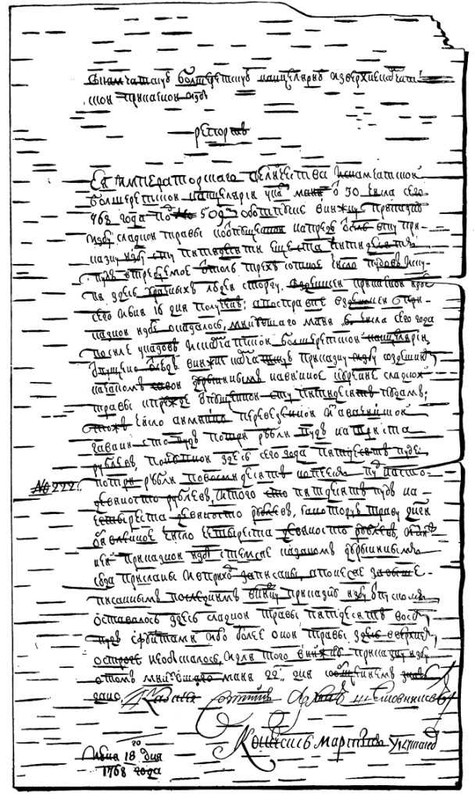
In leaving the subject of folk-song, it is necessary for the reader not only to consider anew the loose and unscientific way in which this term has been employed, but also to bear in mind that few of the above specimens can lay claim to the title in any rigid classification. Long ago, a German critic reminded zealous collectors of his day that when one has dipped a pailful of water from the brook, one has captured no brook; and that when one has written down a folk-song, it has ceased to be that eternally changing, momentary, spontaneous, dance-begotten thing which once flourished everywhere as communal poetry. Always in flux, if it stopped it ceased to be itself. Modern lyric is deliberately composed by some one, mainly to be sung by some one else; the old communal lyric was sung by the throng and was made in the singing. When festal excitement at some great communal rejoicing in the life of clan or tribe "fought its battles o'er again," the result was narrative communal song. A disguised and baffled survival of this most ancient narrative is the popular ballad. Still more disguised, still more baffled, is the purely lyrical survival of that old communal and festal song; and the best one can do is to present those few specimens found under conditions which preserve certain qualities of a vanished world of poetry.
It may be asked why the contemporary songs found among Indian tribes of our continent, or among remote islanders in low stages of culture, should not reproduce for us the old type of communal verse. The answer is simple. Tribes which have remained in low stages of culture do not necessarily retain all the characteristics of primitive life among races which had the germs of rapidly developing culture. That communal poetry which gave life to the later epic of Hellenic or of Germanic song must have differed materially, no matter in what stage of development, from the uninteresting and monotonous chants of the savage. Moreover, the specimens of savage verse which we know retain the characteristics of communal verse, while they lack its nobler and vital quality. The dance, the spontaneous production, repetition,—these are all marked characteristics of savage verse. But savage verse cannot serve as model for our ideas of primitive folk-song.
[1] For facsimile of the MS., music, and valuable remarks, see Chappell, 'Ballad Literature and Popular Music of the Olden Time,' Vol. i., frontispiece, and pages 21 ff. For pronunciation, see A. J. Ellis, 'Early English Pronunciation,' ii., 419 ff. The translation given by Mr. Ellis is:—
"Summer has come in; loudly sing, cuckoo! Grows seed and blossoms mead and springs the wood now. Sing, cuckoo! Ewe bleats after lamb, lows after (its) calf the cow; bullock leaps, buck verts (seeks the green); merrily sing, cuckoo! Cuckoo, cuckoo! Well singest thou, cuckoo; cease thou not never now. Burden.—Sing, cuckoo, now; sing, cuckoo! Sing, cuckoo, sing cuckoo, now."—Lhude, wde (=wude), awe, calve, bucke, are dissyllabic. Mr. Ellis's translation of verteth is very doubtful.
[2] The first stanza in the original will show the structure of this true "ballad" in the primitive sense of a dance-song. There are five of these stanzas, carrying the same rhymes throughout:—
A l'entrada del temps clar,—eya,—
Per joja recomençar,—eya,—
E per jelos irritar,—eya,—
Vol la regina mostrar
Qu' el' est si amoroza.
Refrain
Alavi', alavia, jelos,
laissaz nos, laissaz nos
ballar entre nos, entre nos!
[3] Games and songs of children are still to be found which preserve many of the features of these old dance-songs. The dramatic traits met with in the games point back now to the choral poetry of pagan times, when perhaps a bit of myth was enacted, now to the communal dance where the stealing of a bride may have been imitated.
[4] Unless otherwise credited, translations are by the writer.
[5] From 'Carmina Burana,' a collection of these songs in Latin and German preserved in a MS. of the thirteenth century; edited by J. A. Schmeller, Breslau, 1883. This song is page 181 ff., in German, 'Nu Suln Wir Alle Fröude Hân.'
[6] Ibid., page 178: 'Springe wir den Reigen.'
[7] Ibid., page 213: 'Ich wil Trûren Varen lân.'
[8] Article in 'Ballads,' Vol. iii., page 1340.
[9] Uhland, 'Volkslieder,' i. 12.
[10] Grundtvig, 'Danmarks Gamle Folkeviser,' iii. 161.
[11] We cannot widen our borders so as to include that solitary folk-song rescued from ancient Greek literature, the 'Song of the Swallow,' sung by children of the Island of Rhodes as they went about asking gifts from house to house at the coming of the earliest swallow. The metre is interesting in comparison with the rhythm of later European folk-songs, and there is evident dramatic action. Nor can we include the fragments of communal drama found in the favorite Debates Between Summer and Winter,—from the actual contest, to such lyrical forms as the song at the end of Shakespeare's 'Love's Labor's Lost.' The reader may be reminded of a good specimen of this class in 'Ivy and Holly,' printed by Ritson, 'Ancient Songs and Ballads,' Hazlitt's edition, page 114 ff., with the refrain:—
Nay, Ivy, nay,
Hyt shal not be, I wys;
Let Holy hafe the maystry,
As the maner ys.
[12] Folk-lore, mythology, sociology even, must share in this work. The reader may consult for indirect but valuable material such books as Frazer's 'Golden Bough,' or that admirable treatise, Tylor's 'Primitive Culture.'
[13] For early times translation from language to language is out of the question, certainly in the case of lyrics. It is very important to remember that primitive man regarded song as a momentary and spontaneous thing.
[14] Yet even rough Scandinavia took up this brilliant but doubtful love poetry. To one of the Norse kings is attributed a song in which the royal singer informs his "lady" by way of credentials for his wooing,—"I have struck a blow in the Saracen's land; let thy husband do the same!"
[15] 'Le Misanthrope,' i. 2; he calls it a vielle chanson. M. Tiersot concedes it to the popular muse, but thinks it is of the city, not of the country.
[16] May, a favorite ballad word for "maid," "sweetheart."
[17] 'Carm. Bur.,' page 185: "Wær diu werlt alliu mîn."
[18] See Child's Ballads, vi. 257, and Grandfer Cantle's ballad in Mr. Hardy's 'Return of the Native.' See next page.
[19] 'Carm. Bur.,' page 208: "Kume, Kume, geselle min."
[20] Translated from Böhme 'Altdeutsches Liederbuch,' Leipzig, 1877, page 233. Lovers of folk-song will find this book invaluable on account of the carefully edited musical accompaniments. With it and Chappell, the musician has ample material for English and German songs; for French, see Tiersot, 'La Chanson Populaire en France.'
[21] The garden in these later songs is constantly a symbol of love. To pluck the roses, etc., is conventional for making love.
[22] Quoted by Tiersot, page 88, from 'Chansons à Danser en Rond,' gathered before 1704.
[23] Böddeker's 'Old Poems from the Harleian MS. 2253,' with notes, etc., in German; Berlin, 1878, page 179.
[24] See also Ritson, 'Ancient Songs and Ballads,' 3rd Ed., pages xlviii., 202 ff. The Percy folio MS. preserved a cradle song, 'Balow, my Babe, ly Still and Sleepe,' which was published as a broadside, and finally came to be known as 'Lady Anne Bothwell's Lament.' These "balow" lullabies are said by Mr. Ebbsworth to be imitations of a pretty poem first published in 1593, and now printed by Mr. Bullen in his 'Songs from Elizabethan Romances,' page 92.
[25] Fere, companion, lover. "I would give all I have to be her lover."
[26] Superfluous verses; but the MS. makes no distinction. Free means noble, gracious. "If one could see everything between hell and heaven, one would find nothing so fair and noble."
[27] Lark. The poem is translated from Böddeker, page 161 ff.
[28] Traitor.
[29] Betray.
[30] The music in Chappell, page 141.
[31] Böhme, with music, page 94.
[32] Quoted by Child, 'Ballads,' iv. 318.
[33] Separated, divided.
[34] An equivalent to upside down, "in the wrong direction."
[35] See Tiersot, 'La Chanson Populaire,' p. 103, with the music. The final verses, simple as they are, are not rendered even remotely well. They run:—
Que je suis sa fidèle amie,
Et que vers lui je tends les bras.
[36] Tiersot, p. 90. In many versions there is further complication with king and queen and the lover. This song is extremely popular in Canada.
[37] Lightly (a verb) is to treat with contempt, to undervalue. Compare the burden quoted by Chappell, p. 458, and very old:—
The bonny broome, the well-favored broome,
The broome blooms faire on hill;
What ailed my love to lightly me,
And I working her will?
[38] Promised.
[39] Child's Ballads, vii. 179.
[40] Böhme, p. 271.
[41] The rhyme in German leaves even more to be desired.
SAMUEL FOOTE
(1720-1777)

he name of Samuel Foote suggests a whimsical, plump little man, with a round face, twinkling eyes, and one of the readiest wits of the eighteenth century. This contemporary of the elder Colman, Cumberland, Mrs. Cowley, and the great Garrick, knew many famous men and women, and they admired as well as feared his talents.
Samuel Foote was born at Truro in 1720. He was a young boy when he first exhibited his powers of mimicry at his father's dinner-table. At that time he did not expect to earn his living by them, for he came of well-to-do people, and his mother, who was of aristocratic birth, inherited a comfortable fortune.
Throughout his school days at Worcester and his college days at Worcester College, Oxford, where he did not remain long enough to take a degree, and the idle days when he was supposed to be studying law at the Temple and was in reality frequenting coffee-houses and drawing-rooms as a young man of fashion, he was establishing a reputation for repartee, bons mots, and satiric imitation. So, when the wasteful youth had squandered all his money, he naturally turned to the stage as offering him the best opportunity. Like many another amateur addicted to a mistaken ambition, Foote first tried tragedy, and made his début as Othello. But in this and in other tragedies he was a failure; so he soon took to writing comic plays with parts especially adapted to himself. 'The Diversions of the Morning' was the first of a long series, of which 'The Mayor of Garratt,' 'The Lame Lover,' 'The Nabob,' and 'The Minor,' are among the best known. As these were written from the actor's rather than from the dramatist's point of view, they often seem faulty in construction and crude in literary quality. They are farces rather than true comedies. But they abound in witty dialogue, and in a satire which illuminates contemporary vices and follies.
Foote seems to have been curiously lacking in conscience. He lived his life with a gayety which no poverty, misfortune, or physical suffering could long dampen. When he had money he spent it lavishly, and when the supply ran short he racked his clever brains to make a new hit. To accomplish this he was utterly unscrupulous, and never spared his friends or those to whom he was indebted, if he saw good material in their foibles. His victims smarted, but his ready tongue and personal geniality usually extricated him from consequent unpleasantness. Garrick, who aided him repeatedly, and who dreaded ridicule above all things, was his favorite butt, yet remained his friend. The irate members of the East India Company, who called upon him armed with stout cudgels to administer a castigation for an offensive libel in 'The Nabob,' were so speedily mollified that they laid their cudgels aside with their hats, and accepted his invitation to dinner.
To us, much of his charm has evaporated, for it lay in these very personalities which held well-known people up to ridicule with a precision which made it impossible for the originals to escape recognition. Even irascible Dr. Johnson, who wished to disapprove of him, admitted that there was no one like "that fellow Foote." So this "Aristophanes of the English stage" was mourned when he died at the age of fifty-seven, and a company of his friends and fellow-actors buried him one evening by the dim light of torches in a cloister of Westminster Abbey.
There is often a boisterous unreserve in the plays of Foote, as in other eighteenth-century drama, which revolts modern taste. As they consist of character study rather than incident, mere extracts are apt to appear incomplete and meaningless. Therefore it seems fairer to represent the famous wit not alone by formal citation, but also by some of his bons mots extracted from the collection of William Cooke in his 'Memoirs of Samuel Foote' (2 vols. 1806).
HOW TO BE A LAWYER
From 'The Lame Lover'
Enter Jack
Serjeant—So, Jack, anybody at chambers to-day?
Jack—Fieri Facias from Fetter Lane, about the bill to be filed by Kit Crape against Will Vizard this term.
Serjeant—Praying for an equal partition of plunder?
Jack—Yes, sir.
Serjeant—Strange world we live in, that even highwaymen can't be true to each other! [Half aside to himself.] But we shall make Vizard refund; we'll show him what long hands the law has.
Jack—Facias says that in all the books he can't hit a precedent.
Serjeant—Then I'll make one myself; Aut inveniam, aut faciam, has been always my motto. The charge must be made for partnership profit, by bartering lead and gunpowder against money, watches, and rings, on Epping Forest, Hounslow Heath, and other parts of the kingdom.
Jack—He says if the court should get scent of the scheme, the parties would all stand committed.
Serjeant—Cowardly rascal! but however, the caution mayn't prove amiss. [Aside.] I'll not put my own name to the bill.
Jack—The declaration, too, is delivered in the cause of Roger Rapp'em against Sir Solomon Simple.
Serjeant—What, the affair of the note?
Jack—Yes.
Serjeant—Why, he is clear that his client never gave such a note.
Jack—Defendant never saw plaintiff since the hour he was born; but notwithstanding, they have three witnesses to prove a consideration and signing the note.
Serjeant—They have!
Jack—He is puzzled what plea to put in.
Serjeant—Three witnesses ready, you say?
Jack—Yes.
Serjeant—Tell him Simple must acknowledge the note [Jack starts]; and bid him against the trial comes on, to procure four persons at least to prove the payment at the Crown and Anchor, the 10th of December.
Jack—But then how comes the note to remain in plaintiff's possession?
Serjeant—Well put, Jack: but we have a salvo for that; plaintiff happened not to have the note in his pocket, but promised to deliver it up when called thereunto by defendant.
Jack—That will do rarely.
Serjeant—Let the defense be a secret; for I see we have able people to deal with. But come, child, not to lose time, have you carefully conned those instructions I gave you?
Jack—Yes, sir.
Serjeant—Well, that we shall see. How many points are the great object of practice?
Jack—Two.
Serjeant—Which are they?
Jack—The first is to put a man into possession of what is his right.
Serjeant—The second?
Jack—Either to deprive a man of what is really his right, or to keep him as long as possible out of possession.
Serjeant—Good boy! To gain the last end, what are the best means to be used?
Jack—Various and many are the legal modes of delay.
Serjeant—Name them.
Jack—Injunctions, demurrers, sham pleas, writs of error, rejoinders, sur-rejoinders, rebutters, sur-rebutters, re-plications, exceptions, essoigns, and imparlance.
Serjeant [to himself]—Fine instruments in the hands of a man who knows how to use them. But now, Jack, we come to the point: if an able advocate has his choice in a cause, which if he is in reputation he may readily have, which side should he choose, the right or the wrong?
Jack—A great lawyer's business is always to make choice of the wrong.
Serjeant—And prithee, why so?
Jack—Because a good cause can speak for itself, whilst a bad one demands an able counselor to give it a color.
Serjeant—Very well. But in what respects will this answer to the lawyer himself?
Jack—In a twofold way. Firstly, his fees will be large in proportion to the dirty work he is to do.
Serjeant—Secondly?
Jack—His reputation will rise, by obtaining the victory in a desperate cause.
Serjeant—Right, boy. Are you ready in the case of the cow?
Jack—Pretty well, I believe.
Serjeant—Give it, then.
Jack—First of April, anno seventeen hundred and blank, John a-Nokes was indicted by blank, before blank, in the county of blank, for stealing a cow, contra pacem, etc., and against the statute in that case provided and made, to prevent stealing of cattle.
Serjeant—Go on.
Jack—Said Nokes was convicted upon the said statute.
Serjeant—What followed upon?
Jack—Motion in arrest of judgment, made by Counselor Puzzle. First, because the field from whence the cow was conveyed is laid in the indictment as round, but turned out upon proof to be square.
Serjeant—That's well. A valid objection.
Jack—Secondly, because in said indictment the color of the cow is called red; there being no such things in rerum natura as red cows, no more than black lions, spread eagles, flying griffins, or blue boars.
Serjeant—Well put.
Jack—Thirdly, said Nokes has not offended against form of the statute; because stealing of cattle is there provided against: whereas we are only convicted of stealing a cow. Now, though cattle may be cows, yet it does by no means follow that cows must be cattle.
Serjeant—Bravo, bravo! buss me, you rogue; you are your father's own son! go on and prosper. I am sorry, dear Jack, I must leave thee. If Providence but sends thee life and health, I prophesy thou wilt wrest as much land from the owners, and save as many thieves from the gallows, as any practitioner since the days of King Alfred.
Jack—I'll do my endeavor. [Exit Serjeant.]
A MISFORTUNE IN ORTHOGRAPHY
From 'The Lame Lover'
Sir Luke—A pox o' your law; you make me lose sight of my story. One morning a Welsh coach-maker came with his bill to my lord, whose name was unluckily Lloyd. My lord had the man up: "You are called, I think, Mr. Lloyd?"—"At your Lordship's service, my lord."—"What, Lloyd with an L?"—"It was with an L indeed, my lord."—"Because in your part of the world I have heard that Lloyd and Floyd were synonymous, the very same names."—"Very often indeed, my Lord."—"But you always spell yours with an L?"—"Always."—"That, Mr. Lloyd, is a little unlucky; for you must know I am now paying my debts alphabetically, and in four or five years you might have come in with an F; but I am afraid I can give you no hopes for your L. Ha, ha, ha!"
FROM THE 'MEMOIRS'
A Cure for Bad Poetry
A physician of Bath told him that he had a mind to publish his own poems; but he had so many irons in the fire he did not well know what to do.
"Then take my advice, doctor," said Foote, "and put your poems where your irons are."
The Retort Courteous
Following a man in the street, who did not bear the best of characters, Foote slapped him familiarly on the shoulder, thinking he was an intimate friend. On discovering his mistake he cried out, "Oh, sir, I beg your pardon! I really took you for a gentleman who—"
"Well, sir," said the other, "and am I not a gentleman?"
"Nay, sir," said Foote, "if you take it in that way, I must only beg your pardon a second time."
On Garrick's Stature
Previously to Foote's bringing out his 'Primitive Puppet Show' at the Haymarket Theatre, a lady of fashion asked him, "Pray, sir, are your puppets to be as large as life?"
"Oh dear, madam, no. Not much above the size of Garrick!"
Cape Wine
Being at the dinner-table one day when the Cape was going round in remarkably small glasses, his host was very profuse on the excellence of the wine, its age, etc. "But you don't seem to relish it, Foote, by keeping your glass so long before you."
"Oh, yes, my lord, perfectly well. I am only admiring how little it is, considering its great age."
The Graces
Of an actress who was remarkably awkward with her arms, Foote said that "she kept the Graces at arm's-length."
The Debtor
Of a young gentleman who was rather backward in paying his debts, he said he was "a very promising young gentleman."
Affectation
An assuming, pedantic lady, boasting of the many books which she had read, often quoted 'Locke Upon Understanding,' a work she said she admired above all things, yet there was one word in it which, though often repeated, she could not distinctly make out; and that was the word ide-a (pronouncing it very long): "but I suppose it comes from a Greek derivation."
"You are perfectly right, madam," said Foote, "it comes from the word ideaousky."
"And pray, sir, what does that mean?"
"The feminine of idiot, madam."
Arithmetical Criticism
A mercantile man of his acquaintance, who would read a poem of his to him one day after dinner, pompously began:—
[30] The music in Chappell, page 141.
[31] Böhme, with music, page 94.
[32] Quoted by Child, 'Ballads,' iv. 318.
[33] Separated, divided.
[34] An equivalent to upside down, "in the wrong direction."
[35] See Tiersot, 'La Chanson Populaire,' p. 103, with the music. The final verses, simple as they are, are not rendered even remotely well. They run:—
[36] Tiersot, p. 90. In many versions there is further complication with king and queen and the lover. This song is extremely popular in Canada.
[37] Lightly (a verb) is to treat with contempt, to undervalue. Compare the burden quoted by Chappell, p. 458, and very old:—
[38] Promised.
[39] Child's Ballads, vii. 179.
[40] Böhme, p. 271.
[41] The rhyme in German leaves even more to be desired.
Sing cuccu. Sing cuccu nu.[1]
The monk, whose passion for music led him to rescue this charming song, probably regretted the rustic quality of the words, and did his best to hide the origin of the air; but behind the complicated music is a tune of the country-side, and if the refrain is here a burden, to be sung throughout the piece by certain voices while others sing the words of the song, we have every right to think of an earlier refrain which almost absorbed the poem and was sung by a dancing multitude. This is a most important consideration. In all parts of Europe, songs for the dance still abound in the shape of a welcome to spring; and a lyrical outburst in praise of the jocund season often occurs by way of prelude to the narrative ballad: witness the beautiful opening of 'Robin Hood and the Monk.' The troubadour of Provence, like the minnesinger of Germany, imitated these invocations to spring. A charming balada of Provence probably takes us beyond the troubadour to the domain of actual folk-song.[2] "At the entrance of the bright season," it runs, "in order to begin joy and to tease the jealous, the queen will show that she is fain to love. As far as to the sea, no maid nor youth but must join the lusty dance which she devises. On the other hand comes the king to break up the dancing, fearful lest some one will rob him of his April queen. Little, however, cares she for the graybeard; a gay young 'bachelor' is there to pleasure her. Whoso might see her as she dances, swaying her fair body, he could say in sooth that nothing in all the world peers the joyous queen!" Then, as after each stanza, for conclusion the wild refrain—like a procul este, profani!—"Away, ye jealous ones, away! Let us dance together, together let us dance!" The interjectional refrain, "eya," a mere cry of joy, is common in French and German songs for the dance, and gives a very echo of the lusty singers. Repetition, refrain, the infectious pace and merriment of this old song, stamp it as a genuine product of the people.[3] The brief but emphatic praise of spring with which it opens is doubtless a survival of those older pagan hymns and songs which greeted the return of summer and were sung by the community in chorus to the dance, now as a religious rite, now merely as the expression of communal rejoicing. What the people once sang in chorus was repeated by the individual poet. Neidhart the German is famous on account of his rustic songs for the dance, which often begin with this lusty welcome to spring: while the dactyls of Walther von der Vogelweide not only echo the cadence of dancing feet, but so nearly exclude the reflective and artistic element that the "I" of the singer counts for little. "Winter," he sings,—
The monk, whose passion for music led him to rescue this charming song, probably regretted the rustic quality of the words, and did his best to hide the origin of the air; but behind the complicated music is a tune of the country-side, and if the refrain is here a burden, to be sung throughout the piece by certain voices while others sing the words of the song, we have every right to think of an earlier refrain which almost absorbed the poem and was sung by a dancing multitude. This is a most important consideration. In all parts of Europe, songs for the dance still abound in the shape of a welcome to spring; and a lyrical outburst in praise of the jocund season often occurs by way of prelude to the narrative ballad: witness the beautiful opening of 'Robin Hood and the Monk.' The troubadour of Provence, like the minnesinger of Germany, imitated these invocations to spring. A charming balada of Provence probably takes us beyond the troubadour to the domain of actual folk-song.[2] "At the entrance of the bright season," it runs, "in order to begin joy and to tease the jealous, the queen will show that she is fain to love. As far as to the sea, no maid nor youth but must join the lusty dance which she devises. On the other hand comes the king to break up the dancing, fearful lest some one will rob him of his April queen. Little, however, cares she for the graybeard; a gay young 'bachelor' is there to pleasure her. Whoso might see her as she dances, swaying her fair body, he could say in sooth that nothing in all the world peers the joyous queen!" Then, as after each stanza, for conclusion the wild refrain—like a procul este, profani!—"Away, ye jealous ones, away! Let us dance together, together let us dance!" The interjectional refrain, "eya," a mere cry of joy, is common in French and German songs for the dance, and gives a very echo of the lusty singers. Repetition, refrain, the infectious pace and merriment of this old song, stamp it as a genuine product of the people.[3] The brief but emphatic praise of spring with which it opens is doubtless a survival of those older pagan hymns and songs which greeted the return of summer and were sung by the community in chorus to the dance, now as a religious rite, now merely as the expression of communal rejoicing. What the people once sang in chorus was repeated by the individual poet. Neidhart the German is famous on account of his rustic songs for the dance, which often begin with this lusty welcome to spring: while the dactyls of Walther von der Vogelweide not only echo the cadence of dancing feet, but so nearly exclude the reflective and artistic element that the "I" of the singer counts for little. "Winter," he sings,—
I could prick up my ears for the singing-birds' call![4]
Will she be denying?[5]
Red with flowers.[6]
Playmate mine, O come with me![7]
The greeting from youth to maiden, from maiden to youth, was doubtless a favorite bit of folk-song, whether at the dance or as independent lyric. Readers of the 'Library' will find such a greeting incorporated in 'Child Maurice'[8]; only there it is from the son to his mother, and with a somewhat eccentric list of comparisons by way of detail, instead of the terse form known to German tradition:—
From Easter to St. Michael's day![9]
As the linden hath leaves or the hind hath hair![10]
This is the trochaic rhythm dear to the common people of Rome and the near provinces, who as every one knows spoke a very different speech from the speech of the patrician, and sang their own songs withal; a few specimens of the latter, notably the soldiers' song about Cæsar, have come down to us.[11]
It is evident that the great mass of this poetry died with the occasion that brought it forth, or lingered in oral tradition, exposed to a thousand chances of oblivion. The Church made war upon these songs, partly because of their erotic character, but mainly, one may assume, because of the chain of tradition from heathen times which linked them with feasts in honor of abhorred gods, and with rustic dances at the old pagan harvest-home. A study of all this, however, with material at a minimum, and conjecture or philological combination as the only possible method of investigation, must be relegated to the treatise and the monograph;[12] for present purposes we must confine our exposition and search to songs that shall attract readers as well as students. Yet this can be done only by the admission into our pages of folk-song which already bears witness, more or less, to the touch of an artist working upon material once exclusively communal and popular.
Returning to our English type, the 'Cuckoo Song,' we are now to ask what other communal lyrics with this mark upon them, denoting at once rescue and contamination at the hands of minstrel or wandering clerk, have come down to us from the later Middle Ages. Having answered this question, it will remain to deal with the difficult material accumulated in comparatively recent times. Ballads are far easier to preserve than songs. Ballads have a narrative; and this story in them has proved antiseptic, defying the chances of oral transmission. A good story travels far, and the path which it wanders from people to people is often easy to follow; but the more volatile contents of the popular lyric—we are not speaking of its tune, which is carried in every direction—are easily lost.[13] Such a lyric lives chiefly by its sentiment, and sentiment is a fragile burden. We can however get some notion of this communal song by process of inference, for the earliest lays of the Provençal troubadour, and probably of the German minnesinger, were based upon the older song of the country-side. Again, in England there was little distinction made between the singer who entertained court and castle and the gleeman who sang in the villages and at rural festivals; the latter doubtless taking from the common stock more than he contributed from his own. A certain proof of more aristocratic and distinctly artistic, that is to say, individual origin, and a conclusive reason for refusing the name of folk-song to any one of these lyrics of love, is the fact that it happens to address a married woman. Every one knows that the troubadour and the minnesinger thus addressed their lays; and only the style and general character of their earliest poetry can be considered as borrowed from the popular muse. In other words, however vivacious, objective, vigorous, may be the early lays of the troubadour, however one is tempted to call them mere modifications of an older folk-song, they are excluded by this characteristic from the popular lyric and belong to poetry of the schools. Marriage, says Jeanroy, is always respected in the true folk-song. Moreover, this is only a negative test. In Portugal, many songs which must be referred to the individual and courtly poet are written in praise of the unmarried girl; while in England, whether it be set down to austere morals or to the practical turn of the native mind, one finds little or nothing to match this troubadour and minnesinger poetry in honor of the stately but capricious dame.[14] The folk-song that we seek found few to record it; it sounded at the dance, it was heard in the harvest-field; what seemed to be everywhere, growing spontaneously like violets in spring, called upon no one to preserve it and to give it that protection demanded by exotic poetry of the schools. What is preserved is due mainly to the clerks and gleemen of older times, or else to the curiosity of modern antiquarians, rescuing here and there a belated survival of the species. Where the clerk or the gleeman is in question, he is sure to add a personal element, and thus to remove the song from its true communal setting. Contrast the wonderful little song, admired by Alceste in Molière's 'Misanthrope,' and as impersonal, even in its first-personal guise as any communal lyric ever made,—with a reckless bit of verse sung by some minstrel about the famous Eleanor of Poitou, wife of Henry II. of England. The song so highly commended by Alceste[15] runs, in desperately inadequate translation:—
Returning to our English type, the 'Cuckoo Song,' we are now to ask what other communal lyrics with this mark upon them, denoting at once rescue and contamination at the hands of minstrel or wandering clerk, have come down to us from the later Middle Ages. Having answered this question, it will remain to deal with the difficult material accumulated in comparatively recent times. Ballads are far easier to preserve than songs. Ballads have a narrative; and this story in them has proved antiseptic, defying the chances of oral transmission. A good story travels far, and the path which it wanders from people to people is often easy to follow; but the more volatile contents of the popular lyric—we are not speaking of its tune, which is carried in every direction—are easily lost.[13] Such a lyric lives chiefly by its sentiment, and sentiment is a fragile burden. We can however get some notion of this communal song by process of inference, for the earliest lays of the Provençal troubadour, and probably of the German minnesinger, were based upon the older song of the country-side. Again, in England there was little distinction made between the singer who entertained court and castle and the gleeman who sang in the villages and at rural festivals; the latter doubtless taking from the common stock more than he contributed from his own. A certain proof of more aristocratic and distinctly artistic, that is to say, individual origin, and a conclusive reason for refusing the name of folk-song to any one of these lyrics of love, is the fact that it happens to address a married woman. Every one knows that the troubadour and the minnesinger thus addressed their lays; and only the style and general character of their earliest poetry can be considered as borrowed from the popular muse. In other words, however vivacious, objective, vigorous, may be the early lays of the troubadour, however one is tempted to call them mere modifications of an older folk-song, they are excluded by this characteristic from the popular lyric and belong to poetry of the schools. Marriage, says Jeanroy, is always respected in the true folk-song. Moreover, this is only a negative test. In Portugal, many songs which must be referred to the individual and courtly poet are written in praise of the unmarried girl; while in England, whether it be set down to austere morals or to the practical turn of the native mind, one finds little or nothing to match this troubadour and minnesinger poetry in honor of the stately but capricious dame.[14] The folk-song that we seek found few to record it; it sounded at the dance, it was heard in the harvest-field; what seemed to be everywhere, growing spontaneously like violets in spring, called upon no one to preserve it and to give it that protection demanded by exotic poetry of the schools. What is preserved is due mainly to the clerks and gleemen of older times, or else to the curiosity of modern antiquarians, rescuing here and there a belated survival of the species. Where the clerk or the gleeman is in question, he is sure to add a personal element, and thus to remove the song from its true communal setting. Contrast the wonderful little song, admired by Alceste in Molière's 'Misanthrope,' and as impersonal, even in its first-personal guise as any communal lyric ever made,—with a reckless bit of verse sung by some minstrel about the famous Eleanor of Poitou, wife of Henry II. of England. The song so highly commended by Alceste[15] runs, in desperately inadequate translation:—
Returning to our English type, the 'Cuckoo Song,' we are now to ask what other communal lyrics with this mark upon them, denoting at once rescue and contamination at the hands of minstrel or wandering clerk, have come down to us from the later Middle Ages. Having answered this question, it will remain to deal with the difficult material accumulated in comparatively recent times. Ballads are far easier to preserve than songs. Ballads have a narrative; and this story in them has proved antiseptic, defying the chances of oral transmission. A good story travels far, and the path which it wanders from people to people is often easy to follow; but the more volatile contents of the popular lyric—we are not speaking of its tune, which is carried in every direction—are easily lost.[13] Such a lyric lives chiefly by its sentiment, and sentiment is a fragile burden. We can however get some notion of this communal song by process of inference, for the earliest lays of the Provençal troubadour, and probably of the German minnesinger, were based upon the older song of the country-side. Again, in England there was little distinction made between the singer who entertained court and castle and the gleeman who sang in the villages and at rural festivals; the latter doubtless taking from the common stock more than he contributed from his own. A certain proof of more aristocratic and distinctly artistic, that is to say, individual origin, and a conclusive reason for refusing the name of folk-song to any one of these lyrics of love, is the fact that it happens to address a married woman. Every one knows that the troubadour and the minnesinger thus addressed their lays; and only the style and general character of their earliest poetry can be considered as borrowed from the popular muse. In other words, however vivacious, objective, vigorous, may be the early lays of the troubadour, however one is tempted to call them mere modifications of an older folk-song, they are excluded by this characteristic from the popular lyric and belong to poetry of the schools. Marriage, says Jeanroy, is always respected in the true folk-song. Moreover, this is only a negative test. In Portugal, many songs which must be referred to the individual and courtly poet are written in praise of the unmarried girl; while in England, whether it be set down to austere morals or to the practical turn of the native mind, one finds little or nothing to match this troubadour and minnesinger poetry in honor of the stately but capricious dame.[14] The folk-song that we seek found few to record it; it sounded at the dance, it was heard in the harvest-field; what seemed to be everywhere, growing spontaneously like violets in spring, called upon no one to preserve it and to give it that protection demanded by exotic poetry of the schools. What is preserved is due mainly to the clerks and gleemen of older times, or else to the curiosity of modern antiquarians, rescuing here and there a belated survival of the species. Where the clerk or the gleeman is in question, he is sure to add a personal element, and thus to remove the song from its true communal setting. Contrast the wonderful little song, admired by Alceste in Molière's 'Misanthrope,' and as impersonal, even in its first-personal guise as any communal lyric ever made,—with a reckless bit of verse sung by some minstrel about the famous Eleanor of Poitou, wife of Henry II. of England. The song so highly commended by Alceste[15] runs, in desperately inadequate translation:—
Of my bonnie may,[16]—
In my arms were lying![17]
The tone is not directly communal, but it smacks more of the village dance than of the troubadour's harp; for even Bernart of Ventadour did not dare to address Eleanor save in the conventional tone of despair. The clerks and gleemen, however, and even English peasants of modern times,[18] took another view of the matter. The "clerk," that delightful vagabond who made so nice a balance between church and tavern, between breviary and love songs, has probably done more for the preservation of folk-song than all other agents known to us. In the above verses he protests a trifle or so too much about himself; let us hear him again as mere reporter for the communal lyric, in verses that he may have brought from the dance to turn into his inevitable Latin:—
Rose-red mouth, so sweet and fain.[19]
Now it happens that this notion of heart and key recurs in later German folk-song. A highly popular song of the fifteenth and sixteenth centuries has these stanzas:[20]
And in my darling's garden[21]
Who took away the key![22]
I think of her I see so seldom any more,[23]—
Lullay, my dere herte, myn owyn dere derlyng.[24]
That is her fere.[25]
[Nor half so free;[26]
A bunting, or a laverock,[27]
Richard, though thou be ever trichard,[28]
Trichen[29] shalt thou nevermore!
is quoted with variations in other plays, and was a favorite of the time,[30] and like many a ballad appears in religious parody. A modern variant, due to tradition, comes from Norwich; the third and fourth lines ran:—
Dear love, twixt thee and me![31]
Two songs may follow, one from France, one from Scotland, bewailing the death of lover or husband. 'The Lowlands of Holland' was published by Herd in his 'Scottish Songs.'[32] A clumsy attempt was made to fix the authorship upon a certain young widow; but the song belies any such origin. It has the marks of tradition:—
And the Lowlands of Holland has twin'd[33] my love and me.
My love then and his bonny ship turned withershins[34] about.
The French song[35] has a more tender note:—
My favor had to pray![36]
Sae my true-love did lightly[37] me.
And Willy heght[38] to marry me
She found him drowned in Yarrow.[39]
I wander far away.[40]
Three maids go in and out.[41]
"Hear me, O Phœbus! and ye Muses nine! Pray be attentive."
"I am," said Foote. "Nine and one are ten: go on."
The Dear Wife
A gentleman just married, telling Foote that he had that morning laid out three thousand pounds in jewels for his "dear wife": "Well," said the other, "you have but done her justice, as by your own reckoning she must be a very valuable woman."
Garrick and the Guinea
Foote and Garrick, supping together at the Bedford, the former in pulling out his purse to pay the reckoning dropped a guinea, which rolled in such a direction that they could not readily find it.
"Where the deuce," says Foote, "can it be gone to?"
"Gone to the Devil, I suppose," said Garrick.
"Well said, David; you are always what I took you for, ever contriving to make a guinea go farther than any other man."
Dr. Paul Hifferman
Paul was fond of laying, or rather offering, wagers. One day in the heat of argument he cried out, "I'll lay my head you are wrong upon that point."
"Well," said Foote, "I accept the wager. Any trifle, among friends, has a value."
Foote and Macklin
One night, when Macklin was formally preparing to begin a lecture, hearing Foote rattling away at the lower end of the room, and thinking to silence him at once, he called out in his sarcastic manner, "Pray, young gentleman, do you know what I am going to say?"
"No, sir," said Foote quickly: "do you?"
Baron Newman
This celebrated gambler (well known about town thirty years ago by the title of the left-handed Baron), being detected in the rooms at Bath in the act of secreting a card, the company in the warmth of their resentment threw him out of the window of a one-pair-of-stairs room, where they were playing. The Baron, meeting Foote some time afterward, loudly complained of this usage, and asked him what he should do to repair his injured honor.
"Do?" said the wit; "why, 'tis a plain case: never play so high again as long as you live."
Mrs. Abington
When Mrs. Abington returned from her very first successful trip to Ireland, Foote wished to engage her for his summer theatre; but in the mean time Garrick secured her for Drury Lane. Foote, on hearing this, asked her why she gave Garrick the preference.
"I don't know how it was," said she: "he talked me over by telling me that he would make me immortal, so that I did not know how to refuse him."
"Oh! did he so? Then I'll soon outbid him that way; for come to me and I will give you two pounds a week more, and charge you nothing for immortality."
Garlic-Eaters
Laughing at the imbecilities of a common friend one day, somebody observed, "It was very surprising; and Tom D —— knew him very well, and thought him far from being a fool."
"Ah, poor Tom!" said Foote, "he is like one of those people who eat garlic themselves, and therefore can't smell it in a companion."
Mode of Burying Attorneys in London
A gentleman in the country, who had just buried a rich relation who was an attorney, was complaining to Foote, who happened to be on a visit with him, of the very great expense of a country funeral in respect to carriages, hat-bands, scarves, etc.
"Why, do you bury your attorneys here?" asked Foote gravely.
"Yes, to be sure we do; how else?"
"Oh, we never do that in London."
"No?" said the other much surprised, "how do you manage?"
"Why, when the patient happens to die, we lay him out in a room over night by himself, lock the door, throw open the sash, and in the morning he is entirely off."
"Indeed!" said the other in amazement; "what becomes of him?"
"Why, that we cannot exactly tell, not being acquainted with supernatural causes. All that we know of the matter is, that there's a strong smell of brimstone in the room the next morning."
Dining Badly
Foote, returning from dinner with a lord of the admiralty, was met by a friend, who asked him what sort of a day he had had. "Very indifferent indeed; bad company and a worse dinner."
"I wonder at that," said the other, "as I thought the admiral a good jolly fellow."
"Why, as to that, he may be a good sea lord, but take it from me, he is a very bad landlord."
Dibble Davis
Dibble Davis, one of Foote's butts-in-ordinary, dining with him one day at North-end, observed that "well as he loved porter, he could never drink it without a head."
"That must be a mistake, Dibble," returned his host, "as you have done so to my knowledge alone these twenty years."
An Extraordinary Case
Being at the levee of Lord Townsend, when that nobleman was Lord Lieutenant of Ireland, he thought he saw a person in his Excellency's suite whom he had known to have lived many years a life of expediency in London. To convince himself of the fact, he asked his Excellency who it was.
"That is Mr. T——, one of my gentlemen at large," was the answer. "Do you know him?"
"Oh, yes! perfectly well," said Foote, "and what your Excellency tells me is doubly extraordinary: first, that he is a gentleman; and next, that he is at large."
Mutability of the World
Being at dinner in a mixed company soon after the bankruptcy of one friend and the death of another, the conversation naturally turned on the mutability of the world. "Can you account for this?" said S——, a master builder, who happened to sit next to Foote. "Why, not very clearly," said the other; "except we could suppose the world was built by contract."
An Appropriate Motto
During one of Foote's trips to Dublin, he was much solicited by a silly young man of fashion to assist him in a miscellany of poems and essays which he was about to publish; but when he asked to see the manuscript, the other told him "that at present he had only conceived the different subjects, but had put none of them to paper."
"Oh! if that be the state of the case," replied Foote, "I will give you a motto from Milton for the work in its present state:
'Things unattempted yet in prose or rhyme.'"
Real Friendship
A young gentleman, making an apology to his father for coming late to dinner, said "that he had been visiting a poor friend of his in St. George's Fields." "Ah! a pretty kind of friend indeed," says the father, "to keep us waiting for dinner in this manner."
"Aye, and for the best kind, too," said Foote: "as you know, my dear sir, a friend in need is a friend indeed."
Anecdote of an Author
An author was boasting that as a reviewer he had the power of distributing literary reputations as he liked. "Take care," said Foote, "you are not too prodigal of that, or you may leave none for yourself."
Dr. Blair
When Foote first heard of Dr. Blair's writing 'Notes on Ossian' (a work the reality of which has always been much doubted), he observed, "The publishers ought to allow a great discount to the purchaser, as the notes required such a stretch of credit."
Advice To a Dramatic Writer
A dull dramatic writer, who had often felt the severity of the public, was complaining one day to Foote of the injustice done him by the critics; but added, "I have, however, one way of being even with them, by constantly laughing at all they say."
"You do perfectly right, my friend," said Foote; "for by this method you will not only disappoint your enemies, but lead the merriest life of any man in England."
The Grafton Ministry
A gentleman coming into the Cocoa-Tree one morning during the Duke of Grafton's administration, was observing "that he was afraid the poor ministry were at their wits' end."
"Well, if it should be so," said Foote, "what reason have they to complain of so short a journey?"
JOHN FORD
(1586-?)
he dramatic genius of the English Renaissance had well-nigh spent itself when the sombre creations of John Ford appeared upon a stage over which the clouds of the Civil War were fast gathering. Little is known of this dramatist, who represents the decadent period which followed the age of Shakespeare. He was born in 1586; entered the Middle Temple in 1602; after 1641 he is swallowed up in the turmoil of the time. The few scattered records of his life add nothing to, nor do they take anything from, the John Ford of 'The Broken Heart' and 'Perkin Warbeck.'
His plays are infected with a spirit alien to the poise and beauty of the best Elizabethan drama. His creations tell of oblique vision; of a disillusioned genius, predisposed to abnormal or exaggerated forms of human experience. He breaks through the moral order, in his love for the eccentricities of passion. He weaves the spell of his genius around strange sins.
The problems of despair which Ford propounds but never solves, form the plot of 'The Broken Heart'; Calantha, Ithocles, Penthea, Orgilus, are wan types of the passive suffering which numbs the soul to death. Charles Lamb has eulogized the final scene of this drama. To many critics, the self-possession of Calantha savors of the theatrical. The scene between Penthea and her brother Ithocles, who had forced her to marry Bassanes though she loved Orgilus, is replete with the tenderness, the sense of subdued anguish, of which Ford was a master. He is the dramatist of broken hearts, whose waste places are unrelieved by a touch of sunlight. His love of "passion at war with circumstance" again finds expression in 'Love's Sacrifice,' a drama of moral confusions. In 'The Lover's Melancholy' sorrow has grown pensive. A quiet beauty rests upon the famous scene in which Parthenophil strives with the nightingale for the prize of music.
'The Lady's Trial,' 'The Fancies Chaste and Noble,' 'The Sun's Darling' (written in conjunction with Dekker), are worthy only of passing notice. They leave but a pale impression upon the mind. In 'Perkin Warbeck,' the one historical play of Ford, he exhibits his mastery over straightforward, sinewy verse. 'The Witch of Edmonton,' of which he wrote the first act, gives a signal example of his modern style and spirit.
With the exception of 'Perkin Warbeck,' his dramas are destitute of outlook. This moral contraction heightens the intensity of passion, which in his conception of it has always its ancient significance of suffering. His comic scenes are contemptible. He is at his greatest when dealing with the subtleties of the human heart. Through him we enter into the darker zones of the soul; we apprehend its remoter sufferings. Confusion of spiritual vision, blended with the tyranny of passion, produce his greatest scenes. His are the tragedies of "unfulfilled desire."
The verse of Ford is measured, passionless, polished. There is a subtle music in his lines which haunts the memory.
"Parthenophil is lost, and I would see him; For he is like to something I remember, A great while since, a long, long time ago."
With Ford the sun-born radiance of the noblest Elizabethan drama fades from the stage. An artificial light, thereafter, replaced it.
FROM 'PERKIN WARBECK'
[Perkin Warbeck and his followers are presented to King Henry VII. by Lord Dawbeny as prisoners.]
Dawbeny—
Life to the King, and safety fix his throne. I here present you, royal sir, a shadow Of Majesty, but in effect a substance Of pity; a young man, in nothing grown To ripeness, but th' ambition of your mercy; Perkin, the Christian world's strange wonder!
King Henry—
Dawbeny, We observe no wonder; I behold ('tis true) An ornament of nature, fine and polished, A handsome youth, indeed, but not admire him. How come he to thy hands?
Dawbeny—
From sanctuary. At Bewley, near Southampton; registered, With these few followers, for persons privileged.
King Henry—
I must not thank you, sir! you were to blame To infringe the liberty of houses sacred; Dare we be irreligious?
Dawbeny—
Gracious lord! They voluntarily resigned themselves, Without compulsion.
King Henry—
So? 'twas very well 'Twas very well. Turn now thine eyes, Young man! upon thyself and thy past actions: What revels in combustion through our kingdom A frenzy of aspiring youth has danced; Till wanting breath, thy feet of pride have slipt To break thy neck.
Warbeck—
But not my heart; my heart Will mount till every drop of blood be frozen By death's perpetual winter. If the sun Of Majesty be darkened, let the sun Of life be hid from me, in an eclipse Lasting and universal. Sir, remember There was a shooting in of light when Richmond (Not aiming at the crown) retired, and gladly, For comfort to the Duke of Bretagne's court. Richard, who swayed the sceptre, was reputed A tyrant then; yet then, a dawning glimmer'd To some few wand'ring remnants, promising day When first they ventur'd on a frightful shore At Milford Haven.
Dawbeny—
Whither speeds his boldness? Check his rude tongue, great sir.
King Henry—
Oh, let him range: The player's on the stage still; 'tis his part: He does but act.—What followed?
Warbeck—
Bosworth Field: Where at an instant, to the world's amazement, A morn to Richmond and a night to Richard Appear'd at once. The tale is soon applied: Fate which crowned these attempts, when least assured, Might have befriended others, like resolved.
King Henry—
A pretty gallant! thus your aunt of Burgundy, Your duchess aunt, informed her nephew: so The lesson, prompted, and well conned, was molded Into familiar dialogue, oft rehearsed, Till, learnt by heart, 'tis now received for truth.
Warbeck—
Truth in her pure simplicity wants art To put a feigned blush on; scorn wears only Such fashion as commends to gazers' eyes Sad ulcerated novelty, far beneath; in such a court Wisdom and gravity are proper robes By which the sovereign is best distinguished From zanies to his greatness.
King Henry—
Sirrah, shift Your antic pageantry, and now appear In your own nature; or you'll taste the danger Of fooling out of season.
Warbeck—
I expect No less than what severity calls justice, And politicians safety; let such beg As feed on alms: but if there can be mercy In a protested enemy, then may it Descend to these poor creatures whose engagements To the bettering of their fortunes have incurred A loss of all to them, if any charity Flow from some noble orator; in death I owe the fee of thankfulness.
King Henry—
So brave? What a bold knave is this! We trifle time with follies. Urswick, command the Dukeling and these fellows To Digby, the Lieutenant of the Tower.
Warbeck—
Noble thoughts Meet freedom in captivity: the Tower, Our childhood's dreadful nursery!
King Henry—
Was ever so much impudence in forgery? The custom, sure, of being styled a king Hath fastened in his thought that he is such.
PENTHEA'S DYING SONG
From 'The Broken Heart'
Oh, no more, no more,—too late; Sighs are spent; the burning tapers Of a life as chaste as fate, Pure as are unwritten papers, Are burnt out; no heat, no light Now remains; 'tis ever night. Love is dead; let lovers' eyes Locked in endless dreams, Th' extremes of all extremes, Ope no more, for now Love dies; Now Love dies—implying Love's martyrs must be ever, ever dying.
FROM 'THE LOVER'S MELANCHOLY'
Amethus and Menaphon
Menaphon—
Passing from Italy to Greece, the tales Which poets of an elder time have feigned To glorify their Temple, bred in me Desire of visiting that paradise. To Thessaly I came; and living private Without acquaintance of more sweet companions Than the old inmates to my love, my thoughts, I day by day frequented silent groves And solitary walks. One morning early This accident encountered me: I heard The sweetest and most ravishing contention That art and nature ever were at strife in.
Amethus—
I cannot yet conceive what you infer By art and nature.
Menaphon—
I shall soon resolve ye. A sound of music touched my ears, or rather Indeed entranced my soul. As I stole nearer, Invited by the melody, I saw This youth, this fair-faced youth, upon his lute, With strains of strange variety and harmony, Proclaiming, as it seemed, so bold a challenge To the clear quiristers of the woods, the birds, That, as they flocked about him, all stood silent, Wondering at what they heard: I wondered too.
Amethus—
And so do I: good, on!
Menaphon—
A nightingale, Nature's best skilled musician, undertakes The challenge, and for every several strain The well-shaped youth could touch, she sung her own; He could not run division with more art Upon his quaking instrument than she, The nightingale, did with her various notes Reply to: for a voice and for a sound, Amethus, 'tis much easier to believe That such they were than hope to hear again.
Amethus—
How did the rivals part?
Menaphon—
You term them rightly; For they were rivals, and their mistress harmony. Some time thus spent, the young man grew at last Into a pretty anger, that a bird, Whom art had never taught cliffs, moods, or notes, Should vie with him for mastery, whose study Had busied many hours to perfect practice. To end the controversy, in a rapture Upon his instrument he plays so swiftly So many voluntaries and so quick, That there was curiosity and cunning, Concord in discord, lines of differing method Meeting in one full centre of delight.
Amethus—
Now for the bird.
Menaphon—
The bird, ordained to be Music's first martyr, strove to imitate These several sounds; which when her warbling throat Failed in, for grief down dropped she on his lute, And brake her heart. It was the quaintest sadness, To see the conqueror upon her hearse To weep a funeral elegy of tears; That trust me, my Amethus, I could chide Mine own unmanly weakness that made me A fellow mourner with him.
Amethus—
I believe thee.
Menaphon—
He looked upon the trophies of his art, Then sighed, then wiped his eyes, then sighed and cried:— "Alas, poor creature! I will soon revenge This cruelty upon the author of it; Henceforth this lute, guilty of innocent blood, Shall never more betray a harmless peace To an untimely end:" and in that sorrow, As he was pushing it against a tree, I suddenly stept in.
FRIEDRICH, BARON DE LA MOTTE FOUQUÉ
(1777-1843)
he romantic school had many false and erratic tendencies, but it produced some of the most fanciful and poetic creations of literature. Fouqué was called the Don Quixote of the Romanticists, and his early romances of chivalry were devoured by the public as quickly as they appeared. But his fame proved to be a passing fancy; and his later works scarcely found a publisher. This was owing partly to a change in public taste, and partly to his mannerisms. His descriptions often deteriorate into tediousness, and the narrative is broken by far-fetched digressions. He was so imbued with the spirit of chivalry that he became one-sided, and his scenes were always laid in "the chapel or the tilt-yard." Critics of his time speak of his mediæval romances as "full of sweet strength and lovely virtue." Others say "the heroes are almost absurd, and do not arouse enthusiasm." Heine asserts that Fouqué's laurel is genuine; Coleridge places him above Walter Scott; Thomas Carlyle compares him to Southey, and describes him as a man of genius, with little more than an ordinary share of talent. Fouqué was introduced to romanticism by Wilhelm von Schlegel, and drew his first inspiration from Cervantes. Whatever his shortcomings, it cannot be denied that he succeeded in catching the spirit of chivalry. His knights may be unreal and quixotic, but he delineates his characters with the irresistible touch of a poet, and his work displays noble thoughts and depth of feeling.
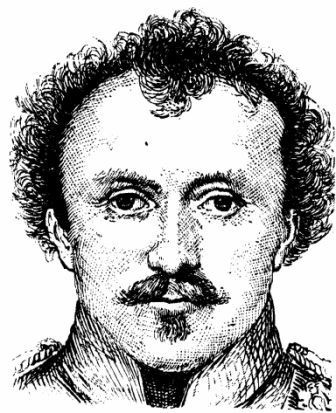
Fouqué
Friedrich, Baron de la Motte Fouqué, was descended from a French family that had emigrated to Prussia, and his grandfather was a general under Frederick the Great. Fouqué was born at Brandenburg, February 12th, 1777, and was a thorough German at heart. He received a military education, and at the age of nineteen proved himself a brave soldier in the campaign of the Rhine. He served under the Duke of Weimar, and his friend, and comrade in arms was the wonderfully gifted but unfortunate Heinrich von Kleist. He was obliged to resign on account of ill health, and withdrawing to his estates he devoted himself to literary pursuits. Once again, however, in the exciting times of the war against Napoleon, his sword defended his country. He enlisted as a volunteer, and was afterwards honorably retired with the rank of major and decorated with the Order of St. John. One of his patriotic poems, 'Frisch auf zum Fröhlichen Jagen' (Come, rouse ye for the merry hunt), with reference to the rising against Napoleon, is still a popular song. In Halle, Fouqué delivered lectures on history and poetry which attracted much attention and admiration. In 1842 he was called to Berlin by Frederick William IV., but his literary efforts were at an end. He died in Berlin, January 23d, 1843.
At the beginning of this century, Fouqué was one of the most celebrated authors. At the present day, with a few brilliant exceptions, all of his plays, romances, and poems have been relegated to oblivion. There is one work, however, a gem in German literature, that has won for its author an enduring place in the memory of readers; and that is the charming and graceful narrative of 'Undine.' It affords an example of the writer's best style of production; it breathes the fresh fragrance of the woods, and is animated by the beautiful thought that peoples the sea and air with nymphs and spirits. With exquisite tenderness Fouqué portrays the beautiful character of Undine. At first her nature reflects all the capriciousness of the elements, then, gradually growing more human through her love, her soul expands and she becomes an ideal of womanly love, devotion, and unselfishness.
The real and unreal are so perfectly blended in this story, that the suffering of Undine excites deep sympathy. Undine, the foster-daughter of a good old fisherman and his wife, is a water nymph, and as such is born without a soul. The knight Huldbrand von Ringstetten is sent by Bertalda in quest of adventure, and riding through an enchanted forest he reaches the fisherman's hut, where he is detained by a storm. He falls in love with the laughing, wayward Undine, and marries her. At once the bewitching maiden gives up her wild pranks, grows gentle, and is devoted to the knight with all her heart; for through her marriage to a human being she receives a soul. Her uncle Kühleborn, a forest brook, tries to entice her back to her native element the sea.
The bridal couple go to their castle, where Bertalda joins them, doing much to disturb their happiness. Huldbrand, though he still loves his beautiful wife, cannot at times suppress an instinctive shudder, and he is attracted to Bertalda, whose nature is more akin to his own.
One day, while they are sailing on the Danube, Kühleborn manages to steal away a necklace with which Bertalda is playing in the water. Undine richly compensates Bertalda for her loss by a much rarer gift, but Huldbrand angrily upbraids her for continuing to hold intercourse with her uncanny relatives. In tears she parts from him, and vanishes in the waves. The knight marries Bertalda, but on the wedding-day, Undine, deeply veiled, rises from the sea to claim her husband, and with a kiss she takes away his life.
Heine says of 'Undine':—
"A wondrous lovely poem. The genius of Poetry kissed slumbering Spring, and smiling he opened his eyes, and all the roses and the nightingales sang; and what the fragrant roses said and what the nightingales sang, our worthy Fouqué put into words and called it 'Undine.'"
THE MARRIAGE OF UNDINE
From 'Undine'
Before the nuptial ceremony, and during its performance, Undine had shown a modest gentleness and maidenly reserve; but it now seemed as if all the wayward freaks that effervesced within her burst forth with an extravagance only the more bold and unrestrained. She teased her bridegroom, her foster-parents, and even the priest, whom she had just now revered so highly, with all sorts of childish tricks; but when the ancient dame was about to reprove her too frolicsome spirit, the knight in a few words imposed silence upon her by speaking of Undine as his wife.
The knight was himself indeed just as little pleased with Undine's childish behavior as the rest; but all his looks and half-reproachful words were to no purpose. It is true, whenever the bride observed the dissatisfaction of her husband—and this occasionally happened—she became more quiet, and placed herself beside him, stroked his face with caressing fondness, whispered something smilingly in his ear, and in this manner smoothed the wrinkles that were gathering on his brow. But the moment after, some wild whim would make her resume her antic movements; and all went worse than before.
The priest then spoke in a kind although serious tone:—
"My fair young maiden, surely no one can look on you without pleasure; but remember betimes so to attune your soul, that it may produce a harmony ever in accordance with the soul of your wedded bridegroom."
"Soul!" cried Undine, with a laugh. "What you say has a remarkably pretty sound; and for most people, too, it may be a very instructive and profitable caution. But when a person has no soul at all, how, I pray you, can such attuning be then possible? And this in truth is just my condition."
The priest was much hurt, but continued silent in holy displeasure, and turned away his face from the maiden in sorrow. She went up to him, however, with the most winning sweetness, and said:—
"Nay, I entreat you, first listen to me, before you are angry with me; for your anger is painful to me, and you ought not to give pain to a creature that has not hurt you. Only have patience with me, and I will explain to you every word of what I meant."
It was evident that she had come to say something important; when she suddenly faltered as if seized with inward shuddering, and burst into a passion of tears. They were none of them able to understand the intenseness of her feelings; and with mingled emotions of fear and anxiety, they gazed on her in silence. Then wiping away her tears and looking earnestly at the priest, she at last said:—
"There must be something lovely, but at the same time something most awful, about a soul. In the name of God, holy man, were it not better that we never shared a gift so mysterious?"
Again she paused, and restrained her tears, as if waiting for an answer. All in the cottage had risen from their seats, and stepped back from her with horror. She, however, seemed to have eyes for no one but the holy man; an awful curiosity was painted on her features, which appeared terrible to the others.
"Heavily must the soul weigh down its possessor," she pursued, when no one returned her any answer—"very heavily! for already its approaching image overshadows me with anguish and mourning. And alas, I have till now been so merry and light-hearted!" and she burst into another flood of tears and covered her face with her veil.
The priest, going up to her with a solemn look, now addressed himself to her, and conjured her, by the name of God most holy, if any spirit of evil possessed her, to remove the light covering from her face. But she sank before him on her knees, and repeated after him every sacred expression he uttered, giving praise to God, and protesting that she "wished well to the whole world."
The priest then spoke to the knight: "Sir bridegroom, I leave you alone with her whom I have united to you in marriage. So far as I can discover there is nothing of evil in her, but assuredly much that is wonderful. What I recommend to you is prudence, love, and fidelity."
Thus speaking, he left the apartment; and the fisherman with his wife followed him, crossing themselves.
Undine had sunk upon her knees. She uncovered her face, and exclaimed, while she looked fearfully round upon Huldbrand, "Alas, you will now refuse to look upon me as your own; and I still have done nothing evil, poor unhappy child that I am!" She spoke these words with a look so infinitely sweet and touching, that her bridegroom forgot both the confession that had shocked and the mystery that had perplexed him; and hastening to her, he raised her in his arms. She smiled through her tears; and that smile was like the morning light playing upon a small stream. "You cannot desert me!" she whispered confidingly, and stroked the knight's cheeks with her little soft hands. He turned away from the frightful thoughts that still lurked in the recesses of his soul, and were persuading him that he had been married to a fairy, or some spiteful and mischievous being of the spirit world. Only the single question, and that almost unawares, escaped from his lips:—
"Dearest Undine, tell me this one thing: what was it you meant by 'spirits of earth' and 'Kühleborn,' when the priest stood knocking at the door?"
"Tales! mere tales of children!" answered Undine laughing, now quite restored to her wonted gayety. "I first frightened you with them, and you frightened me. This is the end of my story, and of our nuptial evening."
"Nay, not so," replied the enamored knight, extinguishing the tapers, and a thousand times kissing his beautiful and beloved bride; while, lighted by the moon that shone brightly through the windows, he bore her into their bridal apartment.
The fresh light of morning woke the young married pair: but Huldbrand lay lost in silent reflection. Whenever, during the night, he had fallen asleep, strange and horrible dreams of spectres had disturbed him; and these shapes, grinning at him by stealth, strove to disguise themselves as beautiful females; and from beautiful females they all at once assumed the appearance of dragons. And when he started up, aroused by the intrusion of these hideous forms, the moonlight shone pale and cold before the windows without. He looked affrighted at Undine, in whose arms he had fallen asleep: and she was reposing in unaltered beauty and sweetness beside him. Then pressing her rosy lips with a light kiss, he again fell into a slumber, only to be awakened by new terrors.
When fully awake he had thought over this connection. He reproached himself for any doubt that could lead him into error in regard to his lovely wife. He also confessed to her his injustice; but she only gave him her fair hand, sighed deeply, and remained silent. Yet a glance of fervent tenderness, an expression of the soul beaming in her eyes, such as he had never witnessed there before, left him in undoubted assurance that Undine bore him no ill-will.
He then rose joyfully, and leaving her, went to the common apartment, where the inmates of the house had already met. The three were sitting round the hearth with an air of anxiety about them, as if they feared trusting themselves to raise their voice above a low, apprehensive undertone. The priest appeared to be praying in his inmost spirit, with a view to avert some fatal calamity. But when they observed the young husband come forth so cheerful, they dispelled the cloud that remained upon their brows: the old fisherman even began to laugh with the knight, till his aged wife herself could not help smiling with great good-humor.
Undine had in the mean time got ready, and now entered the room: all rose to meet her, but remained fixed in perfect admiration—she was so changed, and yet the same. The priest, with paternal affection beaming from his countenance, first went up to her; and as he raised his hand to pronounce a blessing, the beautiful bride sank on her knees before him with religious awe; she begged his pardon in terms both respectful and submissive for any foolish things she might have uttered the evening before, and entreated him with emotion to pray for the welfare of her soul. She then rose, kissed her foster-parents, and after thanking them for all the kindness they had shown her, said:
"Oh, I now feel in my inmost heart how much, how infinitely much, you have done for me, you dear, dear friends of my childhood!"
At first she was wholly unable to tear herself away from their affectionate caresses; but the moment she saw the good old mother busy in getting breakfast, she went to the hearth, applied herself to cooking the food and putting it on the table, and would not suffer her to take the least share in the work.
She continued in this frame of spirit the whole day: calm, kind, attentive—half matronly and half girlish. The three who had been longest acquainted with her expected every instant to see her capricious spirit break out in some whimsical change or sportive vagary. But their fears were quite unnecessary. Undine continued as mild and gentle as an angel. The priest found it all but impossible to remove his eyes from her; and he often said to the bridegroom:—
"The bounty of Heaven, sir, through me its unworthy instrument, intrusted to you yesterday an invaluable treasure: cherish it as you ought, and it will promote your temporal and eternal welfare."
Toward evening Undine was hanging upon the knight's arm with lowly tenderness, while she drew him gently out before the door, where the setting sun shone richly over the fresh grass and upon the high slender boles of the trees. Her emotion was visible; the dew of sadness and love swam in her eyes, while a tender and fearful secret seemed to hover upon her lips, but was only made known by hardly breathed sighs. She led her husband farther and farther onward without speaking. When he asked her questions, she replied only with looks, in which, it is true, there appeared to be no immediate answer to his inquiries, but a whole heaven of love and timid devotion. Thus they reached the margin of the swollen forest stream, and the knight was astonished to see it gliding away with so gentle a murmuring of its waves, that no vestige of its former swell and wildness was now discernible.
"By morning it will be wholly drained off," said the beautiful wife, almost weeping, "and you will then be able to travel, without anything to hinder you, whithersoever you will."
"Not without you, dear Undine," replied the knight, laughing: "think only, were I disposed to leave you, both the Church and the spiritual powers, the emperor and the laws of the realm, would require the fugitive to be seized and restored to you."
"All this depends on you—all depends on you," whispered his little companion, half weeping and half smiling. "But I still feel sure that you will not leave me; I love you too deeply to fear that misery. Now bear me over to that little island which lies before us. There shall the decision be made. I could easily, indeed, glide through that mere rippling of the water without your aid, but it is so sweet to lie in your arms; and should you determine to put me away, I shall have rested in them once more, ... for the last time."
Huldbrand was so full of strange anxiety and emotion, that he knew not what answer to make her. He took her in his arms and carried her over, now first realizing the fact that this was the same little island from which he had borne her back to the old fisherman, the first night of his arrival. On the farther side he placed her upon the soft grass, and was throwing himself lovingly near his beautiful burden; but she said to him:—"Not here, but opposite me. I shall read my doom in your eyes, even before your lips pronounce it; now listen attentively to what I shall relate to you." And she began:—
"You must know, my own love, that there are beings in the elements which bear the strongest resemblance to the human race, and which at the same time but seldom become visible to you. The wonderful salamanders sparkle and sport amid the flames; deep in the earth the meagre and malicious gnomes pursue their revels; the forest spirits belong to the air, and wander in the woods; while in the seas, rivers, and streams live the widespread race of water spirits. These last, beneath resounding domes of crystal, through which the sky can shine with its sun and stars, inhabit a region of light and beauty; lofty coral-trees glow with blue and crimson fruits in their gardens; they walk over the pure sand of the sea, among exquisitely variegated shells, and amid whatever of beauty the old world possessed, such as the present is no more worthy to enjoy,—creations which the floods covered with their secret veils of silver; and now these noble monuments sparkle below, stately and solemn, and bedewed by the water, which loves them, and calls forth from their crevices delicate moss-flowers and enwreathing tufts of sedge.
"Now, the nation that dwell there are very fair and lovely to behold, for the most part more beautiful than human beings. Many a fisherman has been so fortunate as to catch a view of a delicate maiden of the waters, while she was floating and singing upon the deep. He would then spread far the fame of her beauty; and to such wonderful females men are wont to give the name of Undines.—But what need of saying more? You, my dear husband, now actually behold an Undine before you."
The knight would have persuaded himself that his lovely wife was under the influence of one of her odd whims, and that she was only amusing herself and him with her extravagant inventions. He wished it might be so. But with whatever emphasis he said this to himself, he still could not credit the hope for a moment: a strange shivering shot through his soul; unable to utter a word, he gazed upon the sweet speaker with a fixed eye. She shook her head in distress, sighed from her full heart, and then proceeded in the following manner:—
"We should be far superior to you, who are another race of the human family,—for we also call ourselves human beings, as we resemble them in form and features,—had we not one evil peculiar to ourselves. Both we and the beings I have mentioned as inhabiting the other elements vanish into air at death and go out of existence, spirit and body, so that no vestige of us remains; and when you hereafter awake to a purer state of being, we shall remain where sand and sparks and wind and waves remain. Thus, we have no souls; the element moves us, and again is obedient to our will while we live, though it scatters us like dust when we die; and as we have nothing to trouble us, we are as merry as nightingales, little gold-fishes, and other pretty children of nature.
"But all beings aspire to rise in the scale of existence higher than they are. It was therefore the wish of my father, who is a powerful water prince in the Mediterranean Sea, that his only daughter should become possessed of a soul, although she should have to endure many of the sufferings of those who share that gift.
"Now, the race to which I belong have no other means of obtaining a soul than by forming with an individual of your own the most intimate union of love. I am now possessed of a soul, and my soul thanks you, my best beloved, and never shall cease to thank you, if you do not render my whole future life miserable. For what will become of me, if you avoid and reject me? Still, I would not keep you as my own by artifice. And should you decide to cast me off, then do it now, and return alone to the shore. I will plunge into this brook, where my uncle will receive me; my uncle, who here in the forest, far removed from his other friends, passes his strange and solitary existence. But he is powerful, as well as revered and beloved by many great rivers; and as he brought me hither to the fisherman a light-hearted and laughing child, he will take me home to my parents a woman, gifted with a soul, with power to love and to suffer."
She was about to add something more, when Huldbrand with the most heartfelt tenderness and love clasped her in his arms, and again bore her back to the shore. There amid tears and kisses he first swore never to forsake his affectionate wife, and esteemed himself even more happy than Pygmalion, for whom Venus gave life to this beautiful statue, and thus changed it into a beloved wife. Supported by his arm, and in the confidence of affection, Undine returned to the cottage; and now she first realized with her whole heart how little cause she had for regretting what she had left—the crystal palaces of her mysterious father.
THE LAST APPEARANCE OF UNDINE
From 'Undine'
Should I relate to you how passed the marriage feast at Castle Ringstetten, it would be as if you saw a heap of bright and pleasant things, but all overspread with a black mourning crape, through whose darkening veil their brilliancy would appear but a mockery of the nothingness of all earthly joys.
It was not that any spectral delusion disturbed the scene of festivity; for the castle, as we well know, had been secured against the mischief of the water spirits. But the knight, the fisherman, and all the guests were unable to banish the feeling that the chief personage of the feast was still wanting, and that this chief personage could be no other than the gentle and beloved Undine.
Whenever a door was heard to open, all eyes were involuntarily turned in that direction; and if it was nothing but the steward with new dishes, or the cup-bearer with a supply of wine of higher flavor than the last, they again looked down in sadness and disappointment, while the flashes of wit and merriment which had been passing at times from one to another were extinguished by tears of mournful remembrance.
The bride was the least thoughtful of the company, and therefore the most happy; but even to her it sometimes seemed strange that she should be sitting at the head of the table, wearing a green wreath and gold-embroidered robe, while Undine was lying a corpse, stiff and cold, at the bottom of the Danube, or carried out by the current into the ocean. For ever since her father had suggested something of this sort, his words were continually sounding in her ear; and this day in particular, they would neither fade from her memory nor yield to other thoughts.
Evening had scarcely arrived when the company returned to their homes; not dismissed by the impatience of the bridegroom, as wedding parties are sometimes broken up, but constrained solely by heavy sadness and forebodings of evil. Bertalda retired with her maidens, and the knight with his attendants, to undress; but there was no gay laughing company of bridesmaids and bridesmen at this mournful festival.
Bertalda wished to awake more cheerful thoughts: she ordered her maidens to spread before her a brilliant set of jewels, a present from Huldbrand, together with rich apparel and veils, that she might select from among them the brightest and most beautiful for her dress in the morning. The attendants rejoiced at this opportunity of pouring forth good wishes and promises of happiness to their young mistress, and failed not to extol the beauty of the bride with the most glowing eloquence. This went on for a long time, until Bertalda at last, looking in a mirror, said with a sigh:—
"Ah, but do you not see plainly how freckled I am growing? Look here on the side of my neck."
They looked at the place and found the freckles indeed, as their fair mistress had said; but they called them mere beauty-spots, the faintest touches of the sun, such as would only heighten the whiteness of her delicate complexion. Bertalda shook her head, and still viewed them as a blemish.
"And I could remove them," she said at last, sighing. "But the castle fountain is covered, from which I formerly used to have that precious water, so purifying to the skin. Oh, had I this evening only a single flask of it!"
"Is that all?" cried an alert waiting-maid, laughing as she glided out of the apartment.
"She will not be so foolish," said Bertalda, well pleased and surprised, "as to cause the stone cover of the fountain to be taken off this very evening?" That instant they heard the tread of men already passing along the court-yard, and could see from the window where the officious maiden was leading them directly up to the fountain, and that they carried levers and other instruments on their shoulders.
"It is certainly my will," said Bertalda with a smile, "if it does not take them too long." And pleased with the thought that a word from her was now sufficient to accomplish what had formerly been refused with a painful reproof, she looked down upon their operations in the bright moonlit castle court.
The men raised the enormous stone with an effort; some one of the number indeed would occasionally sigh, when he recollected that they were destroying the work of their former beloved mistress. Their labor, however, was much lighter than they had expected. It seemed as if some power from within the fountain itself aided them in raising the stone.
"It appears," said the workmen to one another in astonishment, "as if the confined water had become a springing fountain." And the stone rose more and more, and almost without the assistance of the workpeople, rolled slowly down upon the pavement with a hollow sound. But an appearance from the opening of the fountain filled them with awe, as it rose like a white column of water; at first they imagined it really to be a fountain, until they perceived the rising form to be a pale female, veiled in white. She wept bitterly, raised her hands above her head, wringing them sadly as with slow and solemn step she moved toward the castle. The servants shrank back, and fled from the spring, while the bride, pale and motionless with horror, stood with her maidens at the window. When the figure had now come close beneath their room, it looked up to them sobbing, and Bertalda thought she recognized through the veil the pale features of Undine. But the mourning form passed on, sad, reluctant, and lingering, as if going to the place of execution. Bertalda screamed to her maids to call the knight; not one of them dared to stir from her place; and even the bride herself became again mute, as if trembling at the sound of her own voice.
While they continued standing at the window, motionless as statues, the mysterious wanderer had entered the castle, ascended the well-known stairs, and traversed the well-known halls, in silent tears. Alas, how differently had she once passed through these rooms!
The knight had in the mean time dismissed his attendants. Half undressed and in deep dejection, he was standing before a large mirror; a wax taper burned dimly beside him. At this moment some one tapped at his door very, very softly. Undine had formerly tapped in this way, when she was playing some of her endearing wiles.
"It is all an illusion!" said he to himself. "I must to my nuptial bed."
"You must indeed, but to a cold one!" he heard a voice, choked with sobs, repeat from without; and then he saw in the mirror that the door of his room was slowly, slowly opened, and the white figure entered, and gently closed it behind her.
"They have opened the spring," said she in a low tone; "and now I am here, and you must die."
He felt in his failing breath that this must indeed be; but covering his eyes with his hands, he cried:—"Do not in my death-hour, do not make me mad with terror. If that veil conceals hideous features, do not lift it! Take my life, but let me not see you."
"Alas!" replied the pale figure, "will you not then look upon me once more? I am as fair now as when you wooed me on the island!"
"Oh, if it indeed were so," sighed Huldbrand, "and that I might die by a kiss from you!"
"Most willingly, my own love," said she. She threw back her veil; heavenly fair shone forth her pure countenance. Trembling with love and the awe of approaching death, the knight leant towards her. She kissed him with a holy kiss; but she relaxed not her hold, pressing him more closely in her arms, and weeping as if she would weep away her soul. Tears rushed into the knight's eyes, while a thrill both of bliss and agony shot through his heart, until he at last expired, sinking softly back from her fair arms upon the pillow of his couch a corpse.
"I have wept him to death!" said she to some domestics who met her in the ante-chamber; and passing through the terrified group, she went slowly out, and disappeared in the fountain.
SONG FROM 'MINSTREL LOVE'
Oh welcome, Sir Bolt, to me! And a welcome, Sir Arrow, to thee! But wherefore such pride In your swift airy ride? You're but splints of the ashen tree. When once on earth lying, There's an end of your flying! Lullaby! lullaby! lullaby! But we freshly will wing you And back again swing you, And teach you to wend To your Moorish friend.
Sir Bolt, you have oft been here; And Sir Arrow, you've often flown near; But still from pure haste All your courage would waste On the earth and the streamlet clear. What! over all leaping, In shame are you sleeping? Lullaby! lullaby! lullaby! Or if you smote one, 'Twas but darklingly done, As the grain that winds fling To the bird on the wing.
ANATOLE FRANCE
(1844-)
natole France, whose real name of Thibault is sunk in his literary signature, was born in Paris, April 16th, 1844. His father, a wealthy bookseller, seems to have been a thoughtful, meditative man, and his mother a woman of great refinement and tenderness. Their son shows the result of the double influence. Always fond of books, he early devoted himself to literary work, and made his début as writer in 1868 in a biographical study of Alfred de Vigny. This was shortly followed by two volumes of poetry: 'Les Poèmes Dorés' (Golden Verses) and 'Les Noces Corinthéennes' (Corinthian Revels). Since this work of his youth he has published at least twelve novels and romances, of which the most familiar are: 'Le Crime de Sylvestre Bonnard' (The Crime of Sylvestre Bonnard), 'Le Livre de Mon Ami' (My Friend's Book), 'Le Lys Rouge' (The Red Lily), and 'Les Désirs de Jean Servieu' (Jean Servieu's Wishes). Several volumes of essays, critical introductions to splendid editions of Racine, Molière, La Fontaine, and Le Sage, of 'Manon Lescaut' and 'Paul and Virginia,' numberless studies of men and books for the reviews and journals,—these measure the tireless industry of an incessant worker. In 1876 M. France became an attaché of the Library of the Senate. In December 1896 he was received as member of the French Academy, succeeding to the chair of Ferdinand de Lesseps, whose eulogy he pronounced with exquisite taste and grace.
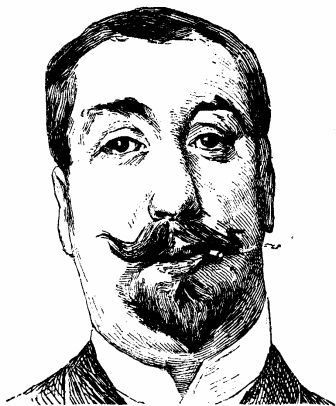
Anatole France
Like Renan, whose disciple he is, this fine artist was formed in the clerical schools. His perfection of style, clear, distinguished, scintillating with wit and fancy, furnishes, as a distinguished French critic remarks, a strong contrast to the painful and heavy periods of the literary products of a State education. He is an enthusiastic humanist, a fervent Neo-Hellenist, delicately sensitive to the beauty of the antique, the magic of words, and the harmony of phrase.
Outside of France, his best known works are 'Le Crime de Sylvestre Bonnard' (crowned by the Academy) and 'Le Livre de Mon Ami.' The first of these expresses the author's Hellenism, sentiment, experience, love of form, and gentle pessimism. Into the character of Sylvestre Bonnard, that intelligent, contemplative, ironical, sweet-natured old philosopher, he has put most of himself. In 'Le Livre de Mon Ami' are reflected the childhood and youth of the author. It is a living book, made out of the impulses of the heart, holding the very essence of moral grace, written with exquisite irony absolutely free from bitterness.
It is to be regretted that in some of his later writings this charming writer has fallen short of the standard of these works, though the versatility of talent he displays is great and admirable. In 'Thaïs' he has painted the magnificent Alexandria of the Ptolemies; in 'Le Lys Rouge' the Florence of to-day. In 'La Rôtisserie de la Reine Pedauque' (The Cook-Shop of the Queen Pedauque) and in 'Les Opinions de M. Jérome Coignard,' Gil Blas, Rabelais, Wilhelm Meister, and Montaigne seem to jostle each other. In 'Le Jardin d'Épicure' (The Garden of Epicurus) a modern Epicurus, discreet, indulgent, listless, listens to lively discussions between the shades of Plato, Origen, Augustine, Hegel, and Schopenhauer, while an Esquimaux refutes Bossuet, a Polynesian develops his theory of the soul, and Cicero and Cousin agree in their estimate of a future life.
In his own words, M. Anatole France has always been inclined to take life as a spectacle, offering no solution of its perplexities, proposing no remedies for its ills. His literary quality, as M. Jules Lemaître observes, owes little or nothing to the spirit or literature of the North. His intelligence is the pure and extreme product of Greek and Latin tradition.
IN THE GARDENS
From 'The Crime of Sylvestre Bonnard.' Copyright, 1890, by Harper & Brothers
April 16.
St. Droctoveus and the early abbots of Saint-Germain-des-Prés have been occupying me for the past forty years; but I do not know whether I shall be able to write their history before I go to join them. It is already quite a long time since I became an old man. One day last year, on the Pont des Arts, one of my fellow-members at the Institute was lamenting before me over the ennui of becoming old.
"Still," Sainte-Beuve replied to him, "it is the only way that has yet been found of living a long time."
I have tried this way, and I know just what it is worth. The trouble of it is not that one lasts too long, but that one sees all about him pass away—mother, wife, friends, children. Nature makes and unmakes all these divine treasures with gloomy indifference, and at last we find that we have not loved,—we have only been embracing shadows. But how sweet some shadows are! If ever creature glided like a shadow through the life of a man, it was certainly that young girl whom I fell in love with when—incredible though it now seems—I was myself a youth.
A Christian sarcophagus from the catacombs of Rome bears a formula of imprecation, the whole terrible meaning of which I only learned with time. It says:—"Whatsoever impious man violates this sepulchre, may he die the last of his own people!" In my capacity of archæologist I have opened tombs and disturbed ashes, in order to collect the shreds of apparel, metal ornaments, or gems that were mingled with those ashes. But I did it only through that scientific curiosity which does not exclude the feelings of reverence and of piety. May that malediction graven by some one of the first followers of the Apostles upon a martyr's tomb never fall upon me! I ought not to fear to survive my own people so long as there are men in the world; for there are always some whom one can love.
But the power of love itself weakens and gradually becomes lost with age, like all the other energies of man. Example proves it; and it is this which terrifies me. Am I sure that I have not myself already suffered this great loss? I should surely have felt it, but for the happy meeting which has rejuvenated me. Poets speak of the Fountain of Youth: it does exist; it gushes up from the earth at every step we take. And one passes by without drinking of it!
The young girl I loved, married of her own choice to a rival, passed, all gray-haired, into the eternal rest. I have found her daughter—so that my life, which before seemed to me without utility, now once more finds a purpose and a reason for being.
To-day I "take the sun," as they say in Provence; I take it on the terrace of the Luxembourg, at the foot of the statue of Marguerite de Navarre. It is a spring sun, intoxicating as young wine. I sit and dream. My thoughts escape from my head like the foam from a bottle of beer. They are light, and their fizzing amuses me. I dream; such a pastime is certainly permissible to an old fellow who has published thirty volumes of texts, and contributed to the Journal des Savants for twenty-six years. I have the satisfaction of feeling that I performed my task as well as it was possible for me, and that I utilized to their fullest extent those mediocre faculties with which nature endowed me. My efforts were not all in vain, and I have contributed, in my own modest way, to that renaissance of historical labors which will remain the honor of this restless century. I shall certainly be counted among those ten or twelve who revealed to France her own literary antiquities. My publication of the poetical works of Gautier de Coincy inaugurated a judicious system and made a date. It is in the austere calm of old age that I decree to myself this deserved credit, and God, who sees my heart, knows whether pride or vanity have aught to do with this self-award of justice.
But I am tired; my eyes are dim; my hand trembles, and I see an image of myself in those old men of Homer, whose weakness excluded them from the battle, and who, seated upon the ramparts, lifted up their voices like crickets among the leaves.
So my thoughts were wandering, when three young men seated themselves near me. I do not know whether each one of them had come in three boats, like the monkey of La Fontaine, but the three certainly displayed themselves over the space of twelve chairs. I took pleasure in watching them, not because they had anything very extraordinary about them, but because I discerned in them that brave joyous manner which is natural to youth. They were from the schools. I was less assured of it by the books they were carrying than by the character of their physiognomy. For all who busy themselves with the things of the mind can be at once recognized by an indescribable something which is common to all of them. I am very fond of young people; and these pleased me, in spite of a certain provoking wild manner which recalled to me my own college days with marvelous vividness. But they did not wear velvet doublets and long hair, as we used to do; they did not walk about, as we used to do, with a death's-head; they did not cry out, as we used to do, "Hell and malediction!" They were quite properly dressed, and neither their costume nor their language had anything suggestive of the Middle Ages. I must also add that they paid considerable attention to the women passing on the terrace, and expressed their admiration of some of them in very animated language. But their reflections, even on this subject, were not of a character to oblige me to flee from my seat. Besides, so long as youth is studious, I think it has a right to its gayeties.
One of them having made some gallant pleasantry which I forget, the smallest and darkest of the three exclaimed, with a slight Gascon accent:—
"What a thing to say! Only physiologists like us have any right to occupy ourselves about living matter. As for you, Gélis, who only live in the past,—like all your fellow archivists and paleographers,—you will do better to confine yourself to those stone women over there, who are your contemporaries."
And he pointed to the statues of the Ladies of Ancient France which towered up, all white, in a half-circle under the trees of the terrace. This joke, though in itself trifling, enabled me to know that the young man called Gélis was a student at the École des Chartes. From the conversation which followed I was able to learn that his neighbor, blond and wan almost to diaphaneity, taciturn and sarcastic, was Boulmier, a fellow-student. Gélis and the future doctor (I hope he will become one some day) discoursed together with much fantasy and spirit. In the midst of the loftiest speculations they would play upon words, and make jokes after the peculiar fashion of really witty persons—that is to say, in a style of enormous absurdity. I need hardly say, I suppose, that they only deigned to maintain the most monstrous kind of paradoxes. They employed all their powers of imagination to make themselves as ludicrous as possible, and all their powers of reasoning to assert the contrary of common-sense. All the better for them! I do not like to see young folks too rational.
The student of medicine, after glancing at the title of the book that Boulmier held in his hand, exclaimed:—
"What!—you read Michelet—you?"
"Yes," replied Boulmier very gravely. "I like novels."
Gélis, who dominated both by his fine stature, imperious gestures, and ready wit, took the book, turned over a few pages rapidly, and said:—
"Michelet always had a great propensity to emotional tenderness. He wept sweet tears over Maillard, that nice little man who introduced la paperasserie into the September massacres. But as emotional tenderness leads to fury, he becomes all at once furious against the victims. There is no help for it. It is the sentimentality of the age. The assassin is pitied, but the victim is considered quite unpardonable. In his later manner Michelet is more Michelet than ever before. There is no common-sense in it; it is simply wonderful! Neither art nor science, neither criticism nor narrative; only furies and fainting spells and epileptic fits over matters which he never deigns to explain. Childish outcries—envies de femme grosse!—and a style, my friends!—not a single finished phrase! It is astounding!"
And he handed the book back to his comrade. "This is amusing madness," I thought to myself, "and not quite so devoid of common-sense as it appears. This young man, though only playing, has sharply touched the defect in the cuirass."
But the Provençal student declared that history was a thoroughly despicable exercise of rhetoric. According to him, the only true history was the natural history of man. Michelet was in the right path when he came in contact with the fistula of Louis XIV., but he fell back into the old rut almost immediately afterwards.
After this judicious expression of opinion, the young physiologist went to join a party of passing friends. The two archivists, less well acquainted in the neighborhood of a garden so far from the Rue Paradis-aux-Marais, remained together, and began to chat about their studies. Gélis, who had completed his third class-year, was preparing a thesis, on the subject of which he expatiated with youthful enthusiasm. Indeed, I thought the subject a very good one, particularly because I had recently thought myself called upon to treat a notable part of it. It was the 'Monasticum Gallicanum.' The young erudite (I give him the name as a presage) wants to describe all the engravings made about 1690 for the work which Dom Michel Germain would have had printed, but for the one irremediable hindrance which is rarely foreseen and never avoided. Dom Michel Germain left his manuscript complete, however, and in good order when he died. Shall I be able to do as much with mine?—but that is not the present question. So far as I am able to understand, M. Gélis intends to devote a brief archæological notice to each of the abbeys pictured by the humble engravers of Dom Michel Germain.
His friend asked him whether he was acquainted with all the manuscripts and printed documents relating to the subject. It was then that I pricked up my ears. They spoke at first of original sources; and I must confess they did so in a satisfactory manner, despite their innumerable and detestable puns. Then they began to speak about contemporary studies on the subject.
"Have you read," asked Boulmier, "the notice of Courajod?"
"Good!" I thought to myself.
"Yes," replied Gélis; "it is accurate."
"Have you read," said Boulmier, "the article by Tamisey de Larroque in the Revue des Questions Historiques?"
"Good!" I thought to myself, for the second time.
"Yes," replied Gélis, "it is full of things...."
"Have you read," said Boulmier, "the 'Tableau des Abbayes Bénédictines en 1600,' by Sylvestre Bonnard?"
"Good!" I said to myself, for the third time.
"Ma foi! no!" replied Gélis. "Bonnard is an idiot!"
Turning my head, I perceived that the shadow had reached the place where I was sitting. It was growing chilly, and I thought to myself what a fool I was to have remained sitting there, at the risk of getting the rheumatism, just to listen to the impertinence of those two young fellows!
"Well! well!" I said to myself as I got up. "Let this prattling fledgeling write his thesis, and sustain it! He will find my colleague Quicherat, or some other professor at the school, to show him what an ignoramus he is. I consider him neither more nor less than a rascal; and really, now that I come to think of it, what he said about Michelet awhile ago was quite insufferable, outrageous! To talk in that way about an old master replete with genius! It was simply abominable!"
CHILD-LIFE
From 'The Book of My Friend'
Everything in immortal nature is a miracle to the little child.
I was happy. A thousand things at once familiar and mysterious filled my imagination, a thousand things which were nothing in themselves, but which made my life. It was very small, that life of mine; but it was a life—which is to say, the centre of all things, the kernel of the world. Do not smile at what I say,—or smile only in sympathy, and reflect: whoever lives, be it only a dog, is at the centre of all things.
Deciding to be a hermit and a saint, and to resign the good things of this world, I threw my toys out of the window.
"The child is a fool!" cried my father, closing the window. I felt anger and shame at hearing myself thus judged. But immediately I considered that my father, not being so holy as I, could never share with me the glory of the blessed, and this thought was for me a great consolation.
Every Saturday we were taken to confession. If any one will tell me why, he will greatly oblige me. The practice inspired me with both respect and weariness. I hardly think it probable that M. le Curé took a lively interest in hearing my sins; but it was certainly disagreeable to me to cite them to him. The first difficulty was to find them. You can perhaps believe me, when I declare that at ten years of age I did not possess the psychic qualities and the methods of analysis which would have made it possible rationally to explore my inmost conscience. Nevertheless it was necessary to have sins: for—no sins, no confession. I had been given, it is true, a little book which contained them all: I had only to choose. But the choice itself was difficult. There was so much obscurely said of "larceny, simony, prevarication"! I read in the little book, "I accuse myself of having despaired; I accuse myself of having listened to evil conversations." Even this furnished little wherewith to burden my conscience. Therefore ordinarily I confined myself to "distractions." Distractions during mass, distractions during meals, distractions in "religious assemblies,"—I avowed all; yet the deplorable emptiness of my conscience filled me with deep shame. I was humiliated at having no sins....
I will tell you what, each year, the stormy skies of autumn, the first dinners by lamplight, the yellowing leaves on the shivering trees, bring to my mind; I will tell you what I see as I cross the Luxembourg garden in the early October days—those sad and beautiful days when the leaves fall, one by one, on the white shoulders of the statues there.
What I see then is a little fellow who with his hands in his pockets is going to school, hopping along like a sparrow. I see him in thought only, for he is but a shadow, a shadow of the "me" as I was twenty-five years ago. Really, he interests me,—this little fellow. When he was living I gave him but little thought, but now that he is no more, I love him well. He was worth altogether more than the rest of the "me's" that I have been since. He was a happy-hearted boy as he crossed the Luxembourg garden in the fresh air of the morning. All that he saw then I see to-day. It is the same sky, and the same earth; the same soul of things is here as before,—that soul that still makes me gay, or sad, or troubled: only he is no more! He was heedless enough, but he was not wicked; and in justice to him I must declare that he has not left me a single harsh memory. He was an innocent child that I have lost. It is natural that I should regret him; it is natural that I should see him in thought, and delight in recalling him to memory....
Nothing is of more value for giving a child a knowledge of the great social machine than the life of the streets. He should see in the morning the milkwomen, the water carriers, the charcoal men; he should look in the shop windows of the grocer, the pork vender, and the wine-seller; he should watch the regiments pass, with the music of the band. In short, he should suck in the air of the streets, that he may learn that the law of labor is Divine, and that each man has his work to do in the world....
Oh! ye sordid old Jews of the Rue Cherche-Midi, and you my masters, simple sellers of old books on the quays, what gratitude do I owe you! More and better than university professors, have you contributed to my intellectual life! You displayed before my ravished eyes the mysterious forms of the life of the past, and every sort of monument of precious human thought. In ferreting among your shelves, in contemplating your dusty display laden with the pathetic relics of our fathers and their noble thoughts, I have been penetrated with the most wholesome of philosophies. In studying the worm-eaten volumes, the rusty iron-work, the worn carvings of your stock, I experienced, child as I was, a profound realization of the fluent, changing nature of things and the nothingness of all, and I have been always since inclined to sadness, to gentleness, and pity.
The open-air school taught me, as you see, great lessons; but the home school was more profitable still. The family repast, so charming when the glasses are clear, the cloth white, and the faces tranquil,—the dinner of each day with its familiar talk,—gives to the child the taste for the humble and holy things of life, the love of loving. He eats day by day that blessed bread which the spiritual Father broke and gave to the pilgrims in the inn at Emmaus, and says, like them, "My heart is warmed within me." Ah! how good a school is the school of home!...
The little fellow of whom I spoke but just now to you, with a sympathy for which you pardon me, perhaps, reflecting that it is not egotistic but is addressed only to a shadow,—the little fellow who crossed the Luxembourg garden, hopping like a sparrow,—became later an enthusiastic humanist.
I studied Homer. I saw Thetis rise like a white mist over the sea, I saw Nausicaa and her companions, and the palm-tree of Delos, and the sky, and the earth, and the sea, and the tearful smile of Andromache. I comprehended, I felt. For six months I lived in the Odyssey. This was the cause of numerous punishments: but what to me were pensums? I was with Ulysses on his violet sea. Alcestis and Antigone gave me more noble dreams than ever child had before. With my head swallowed up in the dictionary on my ink-stained desk, I saw divine forms,—ivory arms falling on white tunics,—and heard voices sweeter than the sweetest music, lamenting harmoniously.
This again cost me fresh punishments. They were just; I was "busying" myself "with things foreign to the class." Alas! the habit remains with me still. In whatever class in life I am put for the rest of my days, I fear yet, old as I am, to encounter again the reproach of my old professor: "Monsieur Pierre Nozièrre, you busy yourself with things foreign to the class."
But the evening falls over the plane-trees of the Luxembourg, and the little phantom which I have evoked disappears in the shadow. Adieu! little "me" whom I have lost, whom I should forever regret, had I not found thee again, beautified, in my son!
Translated for 'A Library of the World's Best Literature.'
FROM 'THE GARDEN OF EPICURUS'
Irony and pity are two good counselors: the one, who smiles, makes life amiable; the other, who weeps, makes it sacred. The Irony that I invoke is not cruel. She mocks neither love nor beauty. She is gentle and benevolent. Her smile calms anger, and it is she who teaches us to laugh at fools and sinners whom, but for her, we might be weak enough to hate.
ST. FRANCIS D'ASSISI
(1182-1226)
BY MAURICE FRANCIS EGAN

rancis d'Assisi was at first called Francis Bernardone. His father Pietro was a merchant of Assisi, much given to the pomps and vanities of the world, a lover of France and of everything French. It was after a visit to France in 1182 that, rejoining his beloved wife Pica in the vale of Umbria, he found that God had given to him a little son. Pica called the boy John, in honor of the playmate of the little Christ; but Pietro commanded that he should be named Francis, because of the bright land from whence he drew the rich silks and thick velvets he liked to handle and to sell.
The vale of Umbria is the place for poets; it should be visited in the summer, when the roses bloom on the trellises which the early Italian painters put as backgrounds to their mothers and children. Florence is not far away; and near is the birthplace of one of the fathers of the sonnet, Fra Guittone, and of another poet, Propertius.
Francis's childhood, boyhood, and later youth were happy. His father denied him no luxury in his power to give; he was sent to the priests of the church of St. George. They taught him some Latin and much of the Provençal tongue,—for at that time there was no Italian language; there were only dialects, and the Provençal was used by the elegant, those who loved poetry. Francis Bernardone was one of these; he sang the popular Provençal songs of the day to the lute, for he had learned music. And so passionately did he long for "excess of it," that, the legend says, he stayed up all one night singing a duet with a nightingale. The bird conquered; and later, Francis made a poem glorifying the Creator who had given such a thrilling voice to it.
Up to the age of twenty-four Francis had been one of the lightest hearted and the lightest headed of the rich young men of Assisi. His father openly rejoiced in his extravagance, and admired the graceful manner with which he wore gay clothes cut in latest fashions of France. Madonna Pica, his mother, trembled for his future, while she adored him and in spite of herself believed in him. Her neighbors reproached her: "Your son throws money away; he is the son of a prince!" And Pica, troubled, answered, "He whom you call the child of a prince will one day be a child of God."
Pietro was delighted to see his son lead in all the sports of the corti of Assisi. The corti were associations of young men addicted to Provençal poetry and music and all sorts of gayety. Folgore da San Gemiano gives, in a series of sonnets, well translated by Dante Gabriel Rossetti, descriptions of their sports arranged according to the months. March was the season for
"—lamprey, salmon, eel, and trout, Dental and dolphin, sturgeon, all the rout Of fish in all the streams that fill the seas."
In April are dances:—
"And through hollow brass A sound of German music on the air."
When summer came, Folgore says the corti had other things:—
"For July, in Siena by the willow-tree I give you barrels of white Tuscan wine, In ice far down your cellars stored supine; And morn and eve to eat, in company, Of those vast jellies dear to you and me; Of partridges and youngling pheasants sweet, Boiled capons, sovereign kids;—and let their treat Be veal and garlic, with whom these agree."
Francis was permeated with the ideas of chivalry, and his language was its phraseology. So much was he in love with chivalry that he became the founder of a new order, whose patroness should be the Lady Poverty. Never had there been a time in Europe since the decay of the Roman empire, when poverty was more derided. Princes, merchants, even many prelates and priests, neglected and contemned the poor. The voices of the outcasts and the leper went up to God, and he sent their terrible echoes to awaken the heart of Francis.
In Sicily, Frederick II.—the Julian of the time—lived among fountains and orange blossoms and gorgeous pomegranate arches,—a type of the arrogant voluptuousness of the time, a voluptuousness which Dante symbolized later as the leopard. Against this luxury Francis put the lady of his love, Poverty. In the 'Poètes Franciscains,' Frederick Ozanam says:—
"He thus designated what had become for him the ideal of all perfection,—the type of all moral beauty. He loved to personify Poverty as the symbolic genius of his time: he imagined her as the daughter of Heaven; and he called her by turns the lady of his thoughts, his affianced, and his bride."
The towns of Italy were continually at war, in 1206 and thereabout. Francis was taken prisoner in a battle of his native townsmen with the Perugians. Restless and depressed, unsatisfied by the revelry of his comrades, he threw himself into the train of the Count de Brienne, who was making war on the German Emperor for the two Sicilies. About this time, he was moved to give his fine military clothes to a shivering soldier. At Spoleto, after this act of charity, he dreamed that the voice of God asked what he valued most in life. "Earthly fame," he said.—"But which of two is better for you,—the Master, or the servant? And why will you forsake the Master for the servant, the Lord for the slave?"—"O Lord, what shall I do?" asked Francis.—"Return unto the city," said the voice, "and there it will be told you what you shall do and how you may interpret this vision."
He obeyed; he left the army; his old companions were glad to see him, and again he joined the corti. But he was paler and more silent. "You are in love!" his companions said, laughingly.
"I am in truth thinking of a bride more noble, more richly dowered, and more beautiful than the world has ever seen."
Pietro was away from home, and his son made donations to the poor. He grew more tranquil, though the Voice had not explained its message. He knelt at the foot of the crucifix one day in the old chapel of St. Damian, and waited. Then the revelation came:—"Francis, go to rebuild my house, which is falling into ruin!"
Francis took this command, which seemed to have come from the lips of his crucified Redeemer, literally. It meant that he should repair the chapel of St. Damian. Later, he accepted it in a broader sense. More important things than the walls of St. Damian were falling into ruin.
Francis was a man of action, and one who took life literally. He went to his father's shop, chose some precious stuffs, and sold them with his horse at Foliquo, for much below their value. Pietro had brought Francis up in a princely fashion: why should he not behave as a prince? And surely the father who had not grudged the richest of his stuffs for the celebrations of the corti, would not object to their sacrifice at the command of the Voice for the repairing of St. Damian! Pietro, who had not heard the Voice, vowed vengeance on his son for his foolishness. The priest at St. Damian's had refused the money; but Francis threw it into the window, and Pietro, finding it, went away swearing that his son had kept some of it. Francis wandered about begging stones for the rebuilding of St. Damian's. Pietro, maddened by the foolishness of his son, appealed to a magistrate. Francis cast off all his garments, and gave them to his father. The Bishop of Assisi covered his nakedness with his own mantle until the gown of a poor laborer was brought to him. Dipping his right hand in a pile of mortar, Francis drew a rough cross upon his breast: "Pietro Bernardone," he said, "until now I have called you my father; henceforth I can truly say, 'Our Father who art in heaven,' for he is my wealth, and in him do I place all my hope."
Francis went away, to build his chapel and sing in the Provençal speech hymns in honor of God and of love for his greatness. In June 1208 he began to preach. He converted two men, one rich and of rank, the other a priest. They gave all to the poor, and took up their abode near a hospital for lepers. They had no home but the chapel of the Angels, near the Portiuncula. This was the beginning of the great order of the Friars Minors, the Franciscans.
Francis was the first poet to use the Italian speech—a poet who was inspired to change the fate of Europe. "He would never," the author of a recent monograph on St. Francis says, "destroy or tread on a written page. If it were Christian writing, it might contain the name of God; even if it were the work of a pagan, it contained the letters that make up the sacred name. When St. Francis, of the people and singing for the people, wrote in the vernacular, he asked Fra Pacifico, who had been a great poet in the world, to reduce his verses to the rules of metre."
St. Bonaventura, Jacomino di Verona, and Jacopone di Todi, the author of the 'Stabat Mater,' were Franciscans who followed in his footsteps. "The Crusades were," to quote again, "defensive as well as offensive. The Sultan, whom St. Francis visited and filled with respect, was not far from Christendom." Frederick of Sicily, with his Saracens, menaced Assisi itself. Hideous doctrines and practices were rife; and the thirty thousand friars who soon enrolled themselves in the band of Francis gained the love of the people, preached Christianity anew, symbolized it rudely for folk that could not read, and, as St. Francis had done, they appealed to the imagination. The legends of St. Francis—one can find them in the 'Little Flowers,' of which there are at least two good English translations—became the tenderest poems of the poor.
If St. Francis had been less of a poet, he would have been less of a saint. He died a poet, on October 4, 1226: he asked to be buried on the Infernal Hill of Assisi, where the crusaders were laid to rest; "and," he said, "sing my 'Canticle of the Sun,' so that I may add a song in praise of my sister Death. The lines," he added, "will be found at the end of the 'Cantico del Sole.'"
Paul Sabatier's 'Life of St. Francis,' and Mrs. Oliphant's, are best known to English-speaking readers. The most exhaustive 'Life' is by the Abbé Leon Le Monnier, in two volumes. It has lately been translated into English.

ORDER
[Our Lord Speaks]
And though I fill thy heart with hottest love, Yet in true order must thy heart love me, For without order can no virtue be; By thine own virtue, then, I from above Stand in thy soul; and so, most earnestly, Must love from turmoil be kept wholly free: The life of fruitful trees, the seasons of The circling year move gently as a dove: I measured all the things upon the earth; Love ordered them, and order kept them fair, And love to order must be truly wed. O soul, why all this heat of little worth? Why cast out order with no thought of care? For by love's heat must love be governed?
Translation of Maurice Francis Egan.
THE CANTICLE OF THE SUN
[The title is 'Incipiunt Laudes Creaturarum quas fecit Franciscus ad Laudem et Honorem Dei cum esset Infirmus ad Sanctum Damianum.' It is sometimes called the 'Canticle of the Creatures.' It is in Italian, and it opens with these words:—"Altissimi, omnipotente, bon Signore, tue so le laude la gloria e l'onore et omne benedictione."]
O Most High, Almighty, good Lord God, to thee belong praise, glory, honor, and all blessing.
Praised be my Lord God, with all his creatures, and specially our brother the sun, who brings us the day and who brings us the light; fair is he, and he shines with a very great splendor. O Lord, he signifies to us thee!
Praised be my Lord for our sister the moon, and for the stars, the which he has set clear and lovely in heaven.
Praised be my Lord for our brother the wind, and for air and clouds, calms and all weather, by which thou upholdest life in all creatures.
Praised be my Lord for our sister water, who is very serviceable to us, and humble and precious and clean.
Praised be my Lord for our brother fire, through whom thou givest us light in the darkness; and he is bright and pleasant, and very mighty and strong.
Praised be my Lord for our mother the earth, the which doth sustain us and keep us, and bringest forth divers fruits, and flowers of many colors, and grass.
Praised be my Lord for all those who pardon one another for love's sake, and who endure weakness and tribulation; blessed are they who peacefully shall endure, for thou, O Most High, wilt give them a crown.
Praised be my Lord for our sister the death of the body, from which no man escapeth. Woe to him who dieth in mortal sin. Blessed are those who die in thy most holy will, for the second death shall have no power to do them harm. Praise ye and bless the Lord, and give thanks to him and serve him with great humility.
[The last stanza, in praise of death, was added to the poem on the day St. Francis left the world, October 4th, 1225.]
Translation of Maurice Francis Egan.
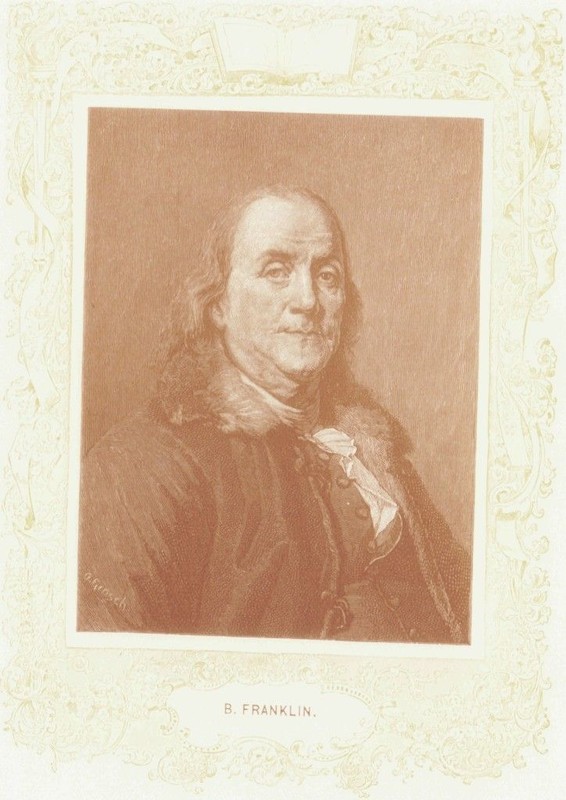
B. FRANKLIN.
BENJAMIN FRANKLIN
(1706-1790)
BY JOHN BIGELOW
he youngest son of the seventeen children of a Boston tallow-chandler named Franklin was born a subject of Queen Anne of England, on the 6th of January, 1706; and on the same day received the baptismal name of Benjamin at the Old South Church in that city. He continued for more than seventy of the eighty-four years of his life a subject of four successive British monarchs. During that period, neither Anne nor either of the three Georges who succeeded her had a subject of whom they had more reason to be proud, nor one whom at his death their people generally supposed they had more reason to detest. No Englishman of his generation can now be said to have established a more enduring fame, in any way, than Franklin established in many ways. As a printer, as a journalist, as a diplomatist, as a statesman, as a philosopher, he was easily first among his peers.
On the other hand, it is no disparagement of the services of any of his contemporaries on either side of the Atlantic, to say that no one of his generation contributed more effectually to the dissolution of the bonds which united the principal British-American colonies to the mother country, and towards conferring upon them independence and a popular government.
As a practical printer Franklin was reported to have had no superiors; as a journalist he exerted an influence not only unrivaled in his day, but more potent, on this continent at least, than either of his sovereigns or their Parliaments. The organization of a police, and later of the militia, for Philadelphia; of companies for extinguishing fires; making the sweeping and paving of the streets a municipal function; the formation of the first public library for Philadelphia, and the establishment of an academy which has matured into the now famous University of Pennsylvania, were among the conspicuous reforms which he planted and watered in the columns of the Philadelphia Gazette. This journal he founded; upon the earnings of it he mainly subsisted during a long life, and any sheet of it to-day would bring a larger price in the open market probably than a single sheet of any other periodical ever published.
Franklin's Almanack, his crowning work in the sphere of journalism, published under the pseudonym of Richard Saunders,—better known since as Poor Richard,—is still one of the marvels of modern literature. Under one or another of many titles the contents of this publication, exclusive of its calendars, have been translated into every tongue having any pretensions to a literature; and have had more readers, probably, than any other publication in the English or indeed in any other language, with the single exception of the Bible. It was the first issue from an American press that found a popular welcome in foreign lands, and it still enjoys the special distinction of being the only almanac ever published that owed its extraordinary popularity entirely to its literary merit.
What adds to the surprise with which we contemplate the fame and fortunes of this unpretentious publication, is the fact that its reputation was established by its first number, and when its author was only twenty-six years of age. For a period of twenty-six years, and until Franklin ceased to edit it, this annual was looked forward to by a larger portion of the colonial population and with more impatience than now awaits a President's annual message to Congress.
Franklin graduated from journalism into diplomacy as naturally as winter glides into spring. This was simply because he was by common acclaim the fittest man for any kind of public service the colony possessed, and especially for any duty requiring talents for persuasion, in which he proved himself to be unquestionably past master among the diplomatists of his time.
The question of taxing the Penn proprietary estates in Pennsylvania, for the defense of the province from the French and Indians, had assumed such an acute stage in 1757 that the Assembly decided to petition the King upon the subject; and selected Franklin, then in the forty-first year of his age, to visit London and present their petition. The next forty-one years of his life were practically all spent in the diplomatic service. He was five years absent on this his first mission. Every interest in London was against him. He finally surmounted all obstacles by a compromise, which pledged the Assembly to pass an act exempting from taxation the unsurveyed lands of the Penn estate,—the surveyed waste lands, however, to be assessed at the usual rate. For his success the Penns and their partisans never forgave him, and his fellow colonists never forgot him.
Franklin returned to Philadelphia in 1762, but not to remain. The question of taxing the colonies without representation was soon thrust upon them in the shape of a stamp duty, and Franklin was sent out again to urge its repeal. He reached London in November 1764, where he remained the next eleven years and until it became apparent that the surrender of the right to arbitrarily tax the colonies would never be made by England during the life of the reigning sovereign, George III. Satisfied that his usefulness in England was at an end, he sailed for Philadelphia on the 21st of March, 1775; and on the morning of his arrival was elected by the Assembly of Pennsylvania a delegate to the Continental Congress which consolidated the armies of the colonies, placed General George Washington in command of them, issued the first Continental currency, and assumed the responsibility of resisting the imperial government; his last hope of maintaining the integrity of the empire having been dissipated by recent collisions between the people and the royalist troops at Concord and Lexington. Franklin served on ten committees in this Congress. He was one of the five who drew up the Declaration of Independence in July 1776, and in September following was chosen unanimously as one of the three commissioners to be sent out to solicit for the infant republic the aid of France and the sympathies of continental Europe. In this mission, the importance of which to his country can hardly be exaggerated, he was greatly favored by the reputation which had preceded him as a man of science. While yet a journalist he had made some experiments in electricity, which established its identity with lightning. The publication by an English correspondent of the letters in which he gave an account of these experiments, secured his election as an honorary member of the Royal Society of London and undisputed rank among the most eminent natural philosophers of his time. When he arrived in Paris, therefore, he was already a member of every important learned society in Europe, one of the managers of the Royal Society of London, and one of the eight foreign members of the Royal Academy in Paris, where three editions of his scientific writings had already been printed. To these advantages must be added another of even greater weight: his errand there was to assist in dismembering the British Empire, than which nothing of a political nature was at this time much nearer every Frenchman's heart.
The history of this mission, and how Franklin succeeded in procuring from the French King financial aid to the amount of twenty-six millions of francs, at times when the very existence of the republic depended upon them, and finally a treaty of peace more favorable to his country than either England or France wished to concede, has been often told; and there is no chapter in the chronicles of this republic with which the world is more familiar.
Franklin's reputation grew with his success. "It was," wrote his colleague John Adams, "more universal than that of Leibnitz or Newton, Frederick the Great or Voltaire, and his character more beloved and esteemed than all of them.... If a collection could be made of all the gazettes of Europe for the latter half of the eighteenth century, a greater number of panegyrical paragraphs upon le grand Franklin would appear, it is believed, than upon any other man that ever lived."
A few weeks after signing the definitive treaty of peace in 1783, Franklin renewed an application which he had previously made just after signing the preliminary treaty, to be relieved of his mission; but it was not until the 7th of March, 1785, that Congress adopted a resolution permitting "the Honorable Benjamin Franklin to return to America as soon as convenient." Three days later, Thomas Jefferson was appointed to succeed him.
On the 13th of September, 1785, and after a sojourn of nearly nine years in the French capital, first in the capacity of commissioner and subsequently of minister plenipotentiary, Franklin once more landed in Philadelphia, on the same wharf on which, sixty-two years before, he had stepped, a friendless and practically penniless runaway apprentice of seventeen.
Though now in his seventy-ninth year, and a prey to infirmities not the necessary incidents of old age, he had scarcely unpacked his trunks after his return when he was chosen a member of the municipal council of Philadelphia, and its chairman. Shortly after, he was elected president of Pennsylvania, his own vote only lacking to make the vote unanimous. "I have not firmness," he wrote to a friend, "to resist the unanimous desire of my countryfolks; and I find myself harnessed again into their service another year. They engrossed the prime of my life; they have eaten my flesh, and seem resolved now to pick my bones."
He was unanimously re-elected to this dignity for the two succeeding years, and while holding that office was chosen a member of the convention which met in May 1787 to frame the Constitution under which the people of the United States are still living.
With the adoption of that instrument, to which he probably contributed as much as any other individual, he retired from official life; though not from the service of the public, to which for the remaining years of his stay on earth his genius and his talents were faithfully consecrated.
Among the fruits of that unfamiliar leisure, always to be remembered among the noblest achievements of his illustrious career, was the part he had in organizing the first anti-slavery society in the world; and as its president, writing and signing the first remonstrance against slavery ever addressed to the Congress of the United States.
In surveying the life of Dr. Franklin as a whole, the thing that most impresses one is his constant study and singleness of purpose to promote the welfare of human society. It was his daily theme as a journalist, and his yearly theme as an almanac-maker. It is that which first occurs to us when we recall his career as a member of the Colonial Assembly; as an agent of the provinces in England; as a diplomatist in France; and as a member of the conventions which crowned the consistent labors of his long life. Nor are there any now so bold as to affirm that there was any other person who could have been depended upon to accomplish for his country or the world, what Franklin did in any of the several stages of his versatile career.
Though holding office for more than half of his life, the office always sought Franklin, not Franklin the office. When sent to England as the agent of the colony, he withdrew from business with a modest competence judiciously invested mostly in real estate. He never seems to have given a thought to its increase. Frugal in his habits, simple in his tastes, wise in his indulgences, he died with a fortune neither too large nor too small for his fame as a citizen or a patriot. For teaching frugality and economy to the colonists, when frugality and economy were indispensable to the conservation of their independence and manhood, he has been sneered at as the teacher of a "candle-end-saving philosophy," and his 'Poor Richard' as a "collection of receipts for laying up treasures on earth rather than in heaven." Franklin never taught, either by precept or example, to lay up treasures on earth. He taught the virtues of industry, thrift, and economy, as the virtues supremely important in his time, to keep people out of debt and to provide the means of educating and dignifying society. He never countenanced the accumulation of wealth for its own sake, but for its uses,—its prompt convertibility into social comforts and refinements. It would be difficult to name another man of any age to whom an ambition to accumulate wealth as an end could be imputed with less propriety. Though probably the most inventive genius of his age, and thus indirectly the founder of many fortunes, he never asked a patent for any of his inventions or discoveries. Though one of the best writers of the English language that his country has yet produced, he never wrote a line for money after he withdrew from the calling by which he made a modest provision for his family.
For the remaining half of his life both at home and abroad, though constantly operating upon public opinion by his pen, he never availed himself of a copyright or received a penny from any publisher or patron for any of these labors. In none of the public positions which he held, even when minister plenipotentiary, did his pay equal his expenditures. He was three years president of Pennsylvania after his return from France, and for his services declined to appropriate to his own use anything beyond his necessary expenditures for stationery, postage, and transportation. It is not by such methods that men justly incur the implied reproach of "laying up treasures on earth," or of teaching a candle-end-saving philosophy.
Franklin courted fame no more than fortune. The best of his writings, after his retirement from journalism, he never gave to the press at all; not even his incomparable autobiography, which is still republished more frequently than any of the writings of Dickens or of Thackeray. He always wrote for a larger purpose than mere personal gratification of any kind. Even his bagatelles and jeux d'esprit read in the salons of Paris, though apparently intended for the eyes of a small circle, were inspired by a desire to make friends and create respect for the struggling people and the great cause he represented. Few if any of them got into print until many years after his decease.
Franklin was from his youth up a leader, a lion in whatever circle he entered, whether in the printing-house, the provincial Assemblies, as agent in England, or as a courtier in France. There was no one too eminent in science or literature, on either side of the Atlantic, not to esteem his acquaintance a privilege. He was an honorary member of every important scientific association in the world, and in friendly correspondence with most of those who conferred upon those bodies any distinction; and all this by force of a personal, not to say planetary, attraction that no one brought within his sphere could long resist.
Pretty much all of importance that we know of Franklin we gather from his private correspondence. His contemporaries wrote or at least printed very little about him; scarcely one of the multitude whose names he embalmed in his 'Autobiography' ever printed a line about him. All that we know of the later half of his life not covered by his autobiography, we owe almost exclusively to his private and official correspondence. Though reckoning among his warm friends and correspondents such men as David Hume, Dr. Joseph Priestley, Dr. Price, Lord Kames, Lord Chatham, Dr. Fothergill, Peter Collinson, Edmund Burke, the Bishop of St. Asaph and his gifted daughters, Voltaire, the habitués of the Helvétius salon, the Marquis de Ségur, the Count de Vergennes, his near neighbors De Chaumont and Le Veillard, the maire of Passy,—all that we learn of his achievements, of his conversation, of his daily life, from these or many other associates of only less prominence in the Old World, might be written on a single foolscap sheet. Nor are we under much greater obligations to his American friends. It is to his own letters (and except his 'Autobiography,' he can hardly be said to have written anything in any other than the epistolary form; and that was written in the form of a letter to his son William, and most of it only began to be published a quarter of a century after his death) that we must turn to learn how full of interest and importance to mankind was this last half-century of his life. Beyond keeping copies of his correspondence, which his official character made a duty as well as a necessity, he appears to have taken no precautions to insure the posthumous fame to which his correspondence during that period was destined to contribute so much. Hence, all the biographies—and they are numberless—owe almost their entire interest and value to his own pen. All, so far as they are biographies, are autobiographies; and for that reason it may be fairly said that all of them are interesting.
It is also quite remarkable that though Franklin's life was a continuous warfare, he had no personal enemies. His extraordinary and even intimate experience of every phase of human life, from the very lowest to the very highest, had made him so tolerant that he regarded differences of opinion and of habits much as he regarded the changes of the weather,—as good or bad for his purposes, but which, though he might sometimes deplore, he had no right to quarrel with or assume personal responsibility for. Hence he never said or did things personally offensive. The causes that he represented had enemies, for he was all his life a reformer. All men who are good for anything have such enemies. "I have, as you observe," wrote Franklin to John Jay the year that he retired from the French mission, "some enemies in England, but they are my enemies as an American; I have also two or three in America who are my enemies as a minister; but I thank God there are not in the whole world any who are my enemies as a man: for by his grace, through a long life, I have been enabled so to conduct myself that there does not exist a human being who can justly say, 'Ben Franklin has wronged me.' This, my friend, is in old age a comfortable reflection. You too have or may have your enemies; but let not that render you unhappy. If you make a right use of them, they will do you more good than harm. They point out to us our faults; they put us upon our guard and help us to live more correctly."
Franklin's place in literature as a writer has not been generally appreciated, probably because with him writing was only a means, never an end, and his ends always dwarfed his means, however effective. He wrote to persuade others, never to parade his literary skill. He never wrote a dull line, and was never nimious. The longest production of his pen was his autobiography, written during the closing years of his life. Nearly all that he wrote besides was in the form of letters, which would hardly average three octavo pages in length. And yet whatever the subject he touched upon, he never left the impression of incompleteness or of inconclusiveness. Of him may be said, perhaps with as much propriety as of any other man, that he never said a word too soon, nor a word too late, nor a word too much. Tons of paper have been devoted to dissuasives from dueling, but the argument was never put more effectively than Franklin put it in these dozen lines of a letter to a Mr. Percival, who had sent him a volume of literary and moral dissertations.
"A gentleman in a coffee-house desired another to sit further from him. 'Why so?'—'Because you stink.'—'That is an affront, and you must fight me.'—'I will fight you if you insist upon it, but I do not see how that will mend the matter. For if you kill me, I shall stink too; and if I kill you, you will stink, if possible, worse than at present.' How can such miserable sinners as we are, entertain so much pride as to conceit that every offense against our imagined honor merits death? These petty princes, in their opinion, would call that sovereign a tyrant who should put one of them to death for a little uncivil language, though pointed at his sacred person; yet every one of them makes himself judge in his own cause, condemns the offender without a jury, and undertakes himself to be the executioner."
Some one wrote him that the people in England were abusing the Americans and speaking all manner of evil against them. Franklin replied that this was natural enough:
"They impute to us the evil they wished us. They are angry with us, and speak all manner of evil of us; but we flourish notwithstanding. They put me in mind of a violent High Church factor, resident in Boston when I was a boy. He had bought upon speculation a Connecticut cargo of onions which he flattered himself he might sell again to great profit; but the price fell, and they lay upon his hands. He was heartily vexed with his bargain, especially when he observed they began to grow in his store he had filled with them. He showed them one day to a friend. 'Here they are,' said he, 'and they are growing too. I damn them every day, but I think they are like the Presbyterians; the more I curse them, the more they grow.'"
Mr. Jefferson tells us that Franklin was sitting by his side in the convention while the delegates were picking his famous declaration of Independence to pieces, and seeing how Jefferson was squirming under their mutilations, comforted him with the following stories, the rare excellence of which has given them a currency which has long since worn off their novelty:—
"'I have made it a rule,' said he, 'whenever in my power, to avoid becoming the draftsman of papers to be reviewed by a public body. I took my lesson from an incident which I will relate to you.
"'When I was a journeyman printer, one of my companions, an apprenticed hatter, having served out his time, was about to open shop for himself. His first concern was to have a handsome sign-board with the proper inscription. He composed it in these words: John Thompson, Hatter, makes and sells Hats for ready Money, with a figure of a hat subjoined. But he thought he would submit it to his friends for their amendments. The first he showed it to thought the word hatter tautologous, because followed by the words makes hats, which showed he was a hatter. It was struck out. The next observed that the word makes might as well be omitted, because his customers would not care who made the hats; if good and to their mind, they would buy, by whomsoever made. He struck it out. A third said he thought the words for ready money were useless, as it was not the custom of the place to sell on credit: every one who purchased expected to pay. They were parted with, and the inscription now stood, John Thompson sells hats. "Sells hats," says his next friend; "why, nobody will expect you to give them away. What then is the use of that word?" It was stricken out, and hats followed, the rather as there was one painted on the board. So his inscription was ultimately reduced to John Thompson, with the figure of a hat subjoined.'"
When the members were about to sign the document, Mr. Hancock is reported to have said, "We must be unanimous; there must be no pulling different ways; we must all hang together." "Yes," replied Franklin, "we must indeed all hang together, or most assuredly we shall all hang separately."
The Doric simplicity of his style; his incomparable facility of condensing a great principle into an apologue or an anecdote, many of which, as he applied them, have become the folk-lore of all nations; his habitual moderation of statement, his aversion to exaggeration, his inflexible logic, and his perfect truthfulness,—made him one of the most persuasive men of his time, and his writings a model which no one can study without profit. A judicious selection from Franklin's writings should constitute a part of the curriculum of every college and high school that aspires to cultivate in its pupils a pure style and correct literary taste.
There was one incident in Franklin's life, which, though more frequently referred to in terms of reproach than any other, will probably count for more in his favor in the Great Assize than any other of his whole life. While yet in his teens he became a father before he was a husband. He never did what men of the loftiest moral pretensions not unfrequently do,—shirk as far as possible any personal responsibility for this indiscretion. On the contrary, he took the fruit of it to his home; gave him the best education the schools of the country then afforded. When he went abroad, this son accompanied him, was presented as his son wherever he went, was presented in all the great houses in which he himself was received; he entered him at the Inns of Court, and in due time had him admitted to the English bar; made him his private secretary, and at an early age caused him to be appointed by the Crown, Governor of New Jersey. The father not only did everything to repair the wrong he had done his son, but at a time when he was at the zenith of his fame and official importance, publicly proclaimed it as one of the great errors of his life. The world has always abounded with bastards; but with the exception of crowned heads claiming to hold their sceptres by Divine right, and therefore beyond the reach of popular criticism or reproach, it would be difficult to name another parent of his generation of anything like corresponding eminence with Franklin, who had the courage and the magnanimity to expiate such a wrong to his offspring so fully and effectively.
Franklin was not a member of the visible Church, nor did he ever become the adherent of any sect. He was three years younger than Jonathan Edwards, and in his youth heard his share of the then prevailing theology of New England, of which Edwards was regarded, and perhaps justly, as the most eminent exponent. The extremes to which Edwards carried those doctrines at last so shocked the people of Massachusetts that he was rather ignominiously expelled from his pulpit at Northampton; and the people of Massachusetts, in very considerable proportions, gradually wandered over into the Unitarian communion. To Jonathan Edwards and the inflexible law of action and reaction, more than to Priestley or any one else of their generation, that sect owes to this day its numerical strength, its influence, and its dignity, in New England. With the creed of that sect Dr. Franklin had more in common than with any other, though he was much too wise a man to suppose that there was but one gate of admission to the Holy City. He believed in one God; that Jesus was the best man that ever lived, and his example the most profitable one ever given us to follow. He never succeeded in accepting the doctrine that Jehovah and Jesus were one person, or that miracles attributed to the latter in the Bible were ever worked. He thought the best service and sufficient worship of God was in doing all the good we can to his creatures. He therefore never occupied himself much with ecclesiastical ceremonies, sectarian differences, or theological subtleties. A reverend candidate for episcopal orders wrote to Franklin, complaining that the Archbishop of Canterbury had refused to ordain him unless he would take the oath of allegiance, which he was too patriotic a Yankee to do. Franklin, in reply, asked what necessity there was for his being connected with the Church of England; if it would not be as well were it the Church of Ireland. Perhaps were he to apply to the Bishop of Derry, who was a man of liberal sentiments, he might give him orders, as of that Church. Should both England and Ireland refuse, Franklin assumed that the Bishops of Sweden and Norway would refuse also, unless the candidates embraced Lutheranism. He then added:—
"Next to becoming Presbyterians, the Episcopalian clergy of America, in my humble opinion, cannot do better than to follow the example of the first clergy of Scotland, soon after the conversion of that country to Christianity. When the King had built the cathedral of St. Andrew's, and requested the King of Northumberland to lend his bishops to ordain one for them, that their clergy might not as heretofore be obliged to go to Northumberland for orders, and their request was refused, they assembled in the cathedral, and the mitre, crosier, and robes of a bishop being laid upon the altar, they after earnest prayers for direction in their choice elected one of their own number; when the King said to him, "Arise, go to the altar, and receive your office at the hand of God." His brethren led him to the altar, robed him, put the crosier in his hand and the mitre on his head, and he became the first Bishop of Scotland.
"If the British islands were sunk in the sea (and the surface of this globe has suffered great changes), you would probably take some such method as this; and if they persist in denying your ordination, it is the same thing. A hundred years hence, when people are more enlightened, it will be wondered at that men in America, qualified by their learning and piety to pray for and instruct their neighbors, should not be permitted to do it till they had made a voyage of six thousand miles out and home, to ask leave of a cross old gentleman at Canterbury."
Franklin, however, was in no sense an agnostic. What he could not understand he did not profess to understand or believe; neither was he guilty of the presumption of holding that what he could not understand, he might not have understood if he had been a wiser and better man. Though impatient of cant and hypocrisy, especially in the pulpit, he never spoke lightly of the Bible, or of the Church and its offices. When his daughter Sally was about to marry, he wrote to her:—
"My dear child, the natural prudence and goodness of heart God has blest you with, make it less necessary for me to be particular in giving you advice. I shall therefore only say, that the more attentively dutiful and tender you are towards your good mamma, the more you will recommend yourself to me. But why should I mention me, when you have so much higher a promise in the Commandments, that such conduct will recommend you to the favor of God? You know I have many enemies, all indeed on the public account (for I cannot recollect that I have in a private capacity given just cause of offense to any one whatever): yet they are enemies, and very bitter ones; and you must expect their enmity will extend in some degree to you, so that your slightest indiscretions will be magnified into crimes, in order the more sensibly to wound and afflict me. It is therefore the more necessary for you to be extremely circumspect in all your behavior, that no advantage may be given to their malevolence.
"Go constantly to church, whoever preaches. The act of devotion in the Common Prayer Book is your principal business there, and if properly attended to will do more towards amending the heart than sermons generally can do. For they were composed by men of much greater piety and wisdom than our common composers of sermons can pretend to be; and therefore I wish you would never miss the prayer days: yet I do not mean you should despise sermons, even of the preachers you dislike, for the discourse is often much better than the man, as sweet and clear waters come through very dirty earth. I am the more particular on this head, as you seemed to express a little before I came away some inclination to leave our church, which I would not have you do."
I cannot more fitly close this imperfect sketch of America's most illustrious citizen, than by quoting from a touching and most affectionate letter from Mrs. Hewson (Margaret Stevenson),—one of Franklin's worthiest, most faithful, and most valued friends,—addressed to one of Franklin's oldest friends in England.
"We have lost that valued, venerable, kind friend whose knowledge enlightened our minds and whose philanthropy warmed our hearts. But we have the consolation to think that if a life well spent in acts of universal benevolence to mankind, a grateful acknowledgment of Divine favor, a patient submission under severe chastisement, and an humble trust in Almighty mercy, can insure the happiness of a future state, our present loss is his gain. I was the faithful witness of the closing scene, which he sustained with that calm fortitude which characterized him through life. No repining, no peevish expression ever escaped him during a confinement of two years, in which, I believe, if every moment of ease could be added together, would not amount to two whole months. When the pain was not too violent to be amused, he employed himself with his books, his pen, or in conversation with his friends; and upon every occasion displayed the clearness of his intellect and the cheerfulness of his temper. Even when the intervals from pain were so short that his words were frequently interrupted, I have known him to hold a discourse in a sublime strain of piety. I say this to you because I know it will give you pleasure.
"I never shall forget one day that I passed with our friend last summer. I found him in bed in great agony; but when that agony abated a little I asked if I should read to him. He said yes; and the first book I met with was Johnson's 'Lives of the Poets.' I read the 'Life of Watts,' who was a favorite author with Dr. Franklin; and instead of lulling him to sleep, it roused him to a display of the powers of his memory and his reason. He repeated several of Watts's 'Lyric Poems,' and descanted upon their sublimity in a strain worthy of them and of their pious author. It is natural for us to wish that an attention to some ceremonies had accompanied that religion of the heart which I am convinced Dr. Franklin always possessed; but let us who feel the benefit of them continue to practice them, without thinking lightly of that piety which could support pain without a murmur, and meet death without terror."
Franklin made a somewhat more definite statement of his views on the subject of religion, in reply to an inquiry from President Styles of Yale College, who expressed a desire to know his opinion of Jesus of Nazareth. Franklin's reply was written the last year of his life, and in the eighty-fourth of his age:—
"You desire to know something of my religion. It is the first time I have been questioned upon it. But I cannot take your curiosity amiss, and shall endeavor in a few words to gratify it. Here is my creed. I believe in one God, the creator of the universe. That he governs it by his Providence. That he ought to be worshiped. That the most acceptable service we render to him is doing good to his other children. That the soul of man is immortal, and will be treated with justice in another life respecting its conduct in this. These I take to be the fundamental points in all sound religion, and I regard them as you do in whatever sect I meet with them.
"As to Jesus of Nazareth, my opinion of whom you particularly desire, I think his system of morals and his religion, as he left them to us, the best the world ever saw or is like to see; but I apprehend it has received various corrupting changes, and I have, with most of the present Dissenters in England, some doubts as to his Divinity; though it is a question I do not dogmatize upon, having never studied it, and think it needless to busy myself with it now, when I expect soon an opportunity of knowing the truth with less trouble. I see no harm, however, in its being believed, if that belief has the good consequence, as probably it has, of making his doctrines more respected and more observed; especially as I do not perceive that the Supreme takes it amiss, by distinguishing the unbelievers in his government of the world with any peculiar marks of his displeasure.
"I shall only add, respecting myself, that, having experienced the goodness of that Being in conducting me prosperously through a long life, I have no doubt of its continuance in the next, though without the smallest conceit of meriting such goodness. My sentiments on this head you will see in the copy of an old letter inclosed, which I wrote in answer to one from an old religionist whom I had relieved in a paralytic case by electricity, and who, being afraid I should grow proud upon it, sent me his serious though rather impertinent caution."

OF FRANKLIN'S FAMILY AND EARLY LIFE
From the 'Autobiography,' in Bigelow's Edition of Franklin's Works
Josiah, my father, married young, and carried his wife with three children into New England about 1682. The conventicles having been forbidden by law and frequently disturbed, induced some considerable men of his acquaintance to remove to that country, and he was prevailed with to accompany them thither, where they expected to enjoy their mode of religion with freedom. By the same wife he had four children more born there, and by a second wife ten more, in all seventeen; of which I remember thirteen sitting at one time at his table, who all grew up to be men and women, and married. I was the youngest son and the youngest child but two, and was born in Boston, New England. My mother, the second wife, was Abiah Folger, daughter of Peter Folger, one of the first settlers of New England, of whom honorable mention is made by Cotton Mather in his church history of that country, entitled 'Magnalia Christi Americana,' as "a goodly, learned Englishman," if I remember the words rightly. I have heard that he wrote sundry small occasional pieces, but only one of them was printed, which I saw now many years since....
My elder brothers were all put apprentices to different trades. I was put to the grammar school at eight years of age, my father intending to devote me, as the tithe of his sons, to the service of the Church. My early readiness in learning to read (which must have been very early, as I do not remember when I could not read), and the opinion of all his friends that I should certainly make a good scholar, encouraged him in this purpose of his. My uncle Benjamin too approved of it, and proposed to give me all his short-hand volumes of sermons,—I suppose as a stock to set up with,—if I would learn his character. I continued, however, at the grammar school not quite one year, though in that time I had risen gradually from the middle of the class of that year to be the head of it, and farther was removed into the next class above it, in order to go with that into the third at the end of the year. But my father in the mean time,—from a view of the expense of a college education, which having so large a family he could not well afford, and the mean living many so educated were afterwards able to obtain,—reasons that he gave to his friends in my hearing,—altered his first intention, took me from the grammar school, and sent me to a school for writing and arithmetic, kept by a then famous man, Mr. George Brownell, very successful in his profession generally, and that by mild, encouraging methods. Under him I acquired fair writing pretty soon, but I failed in the arithmetic, and made no progress in it. At ten years old I was taken home to assist my father in his business, which was that of a tallow-chandler and soap-boiler,—a business he was not bred to, but had assumed on his arrival in New England, and on finding his dyeing trade would not maintain his family, being in little request. Accordingly I was employed in cutting wick for the candles, filling the dipping-mold and the molds for cast candles, attending the shop, going of errands, etc.
I disliked the trade, and had a strong inclination for the sea, but my father declared against it: however, living near the water, I was much in and about it, learnt early to swim well and to manage boats; and when in a boat or canoe with other boys I was commonly allowed to govern, especially in any case of difficulty; and upon other occasions I was generally a leader among the boys, and sometimes led them into scrapes, of which I will mention one instance, as it shows an early projecting public spirit, though not then justly conducted.
There was a salt-marsh that bounded part of the mill-pond, on the edge of which, at high water, we used to stand to fish for minnows. By much trampling we had made it a mere quagmire. My proposal was to build a wharf there, fit for us to stand upon; and I showed my comrades a large heap of stones which were intended for a new house near the marsh, and which would very well suit our purpose. Accordingly, in the evening, when the workmen were gone, I assembled a number of my playfellows, and working with them diligently like so many emmets, sometimes two or three to a stone, we brought them all away and built our little wharf. The next morning the workmen were surprised at missing the stones, which were found in our wharf. Inquiry was made after the removers; we were discovered and complained of; several of us were corrected by our fathers, and though I pleaded the usefulness of the work, mine convinced me that nothing was useful which was not honest.
I continued thus employed in my father's business for two years, that is, till I was twelve years old; and my brother John, who was bred to that business, having left my father, married, and set up for himself at Rhode Island, there was all appearance that I was destined to supply his place and become a tallow-chandler. But my dislike to the trade continuing, my father was under apprehensions that if he did not find one for me more agreeable, I should break away and get to sea, as his son Josiah had done, to his great vexation. He therefore sometimes took me to walk with him, and see joiners, bricklayers, turners, braziers, etc., at their work, that he might observe my inclination, and endeavor to fix it on some trade or other on land. It has ever since been a pleasure to me to see good workmen handle their tools; and it has been useful to me, having learnt so much by it as to be able to do little jobs myself in my house when a workman could not readily be got, and to construct little machines for my experiments, while the intention of making the experiment was fresh and warm in my mind. My father at last fixed upon the cutler's trade, and my uncle Benjamin's son Samuel, who was bred to that business in London, being about that time established in Boston, I was sent to be with him some time on liking. But his expectations of a fee with me displeasing my father, I was taken home again.
From a child I was fond of reading, and all the little money that came into my hands was ever laid out in books. Pleased with the 'Pilgrim's Progress,' my first collection was of John Bunyan's works in separate little volumes. I afterward sold them to enable me to buy R. Burton's 'Historical Collections'; they were small chapmen's books, and cheap, 40 or 50 in all. My father's little library consisted chiefly of books in polemic divinity, most of which I read, and have since often regretted that at a time when I had such a thirst for knowledge, more proper books had not fallen in my way, since it was now resolved I should not be a clergyman. Plutarch's Lives there was, in which I read abundantly, and I still think that time spent to great advantage. There was also a book of De Foe's, called 'An Essay on Projects,' and another of Dr. Mather's, called 'Essays To Do Good,' which perhaps gave me a turn of thinking that had an influence on some of the principal future events of my life.
This bookish inclination at length determined my father to make me a printer, though he had already one son (James) of that profession. In 1717 my brother James returned from England with a press and letters, to set up his business in Boston. I liked it much better than that of my father, but still had a hankering for the sea. To prevent the apprehended effect of such an inclination, my father was impatient to have me bound to my brother. I stood out some time, but at last was persuaded, and signed the indentures when I was yet but twelve years old. I was to serve as an apprentice till I was twenty-one years of age, only I was to be allowed journeyman's wages during the last year. In a little time I made great proficiency in the business, and became a useful hand to my brother. I now had access to better books. An acquaintance with the apprentices of booksellers enabled me sometimes to borrow a small one, which I was careful to return soon and clean. Often I sat up in my room reading the greatest part of the night, when the book was borrowed in the evening and to be returned early in the morning, lest it should be missed or wanted.
FRANKLIN'S JOURNEY TO PHILADELPHIA: HIS ARRIVAL THERE
From the 'Autobiography,' in Bigelow's Edition of Franklin's Works
I proceeded on my journey on foot, having fifty miles to Burlington, where I was told I should find boats that would carry me the rest of the way to Philadelphia.
It rained very hard all the day; I was thoroughly soaked, and by noon a good deal tired; so I stopt at a poor inn, where I stayed all night, beginning now to wish that I had never left home. I cut so miserable a figure too that I found, by the questions asked me, I was suspected to be some runaway servant, and in danger of being taken up on that suspicion. However, I proceeded the next day, and got in the evening to an inn within eight or ten miles of Burlington, kept by one Dr. Brown. He entered into conversation with me while I took some refreshment; and finding I had read a little, became very sociable and friendly. Our acquaintance continued as long as he lived. He had been, I imagine, an itinerant doctor, for there was no town in England or country in Europe of which he could not give a very particular account. He had some letters, and was ingenious, but much of an unbeliever, and wickedly undertook, some years after, to travestie the Bible in doggrel verse, as Cotton had done Virgil. By this means he set many of the facts in a very ridiculous light, and might have hurt weak minds if his work had been published, but it never was.
At his house I lay that night, and the next morning reached Burlington, but had the mortification to find that the regular boats were gone a little before my coming, and no other expected to go before Tuesday, this being Saturday; wherefore I returned to an old woman in the town, of whom I had bought ginger-bread to eat on the water, and asked her advice. She invited me to lodge at her house till a passage by water should offer; and being tired with my foot-traveling, I accepted the invitation. She, understanding I was a printer, would have had me stay at that town and follow my business, being ignorant of the stock necessary to begin with. She was very hospitable, gave me a dinner of ox-cheek with great good-will, accepting only of a pot of ale in return; and I thought myself fixed till Tuesday should come. However, walking in the evening by the side of the river, a boat came by, which I found was going towards Philadelphia, with several people in her. They took me in, and as there was no wind, we rowed all the way; and about midnight, not having yet seen the city, some of the company were confident we must have passed it, and would row no farther; the others knew not where we were; so we put toward the shore, got into a creek, landed near an old fence, with the rails of which we made a fire,—the night being cold, in October,—and there we remained till daylight. Then one of the company knew the place to be Cooper's Creek, a little above Philadelphia, which we saw as soon as we got out of the creek, and arrived there about eight or nine o'clock on the Sunday morning, and landed at the Market Street wharf.
I have been the more particular in this description of my journey, and shall be so of my first entry into that city, that you may in your mind compare such unlike beginnings with the figure I have since made there. I was in my working dress, my best clothes being to come round by sea. I was dirty from my journey; my pockets were stuffed out with shirts and stockings, and I knew no soul nor where to look for lodging. I was fatigued with traveling, rowing, and want of rest; I was very hungry; and my whole stock of cash consisted of a Dutch dollar and about a shilling in copper. The latter I gave the people of the boat for my passage, who at first refused it, on account of my rowing, but I insisted on their taking it; a man being sometimes more generous when he has but a little money than when he has plenty, perhaps through fear of being thought to have but little.
Then I walked up the street, gazing about, till near the market-house I met a boy with bread. I had made many a meal on bread, and inquiring where he got it, I went immediately to the baker's he directed me to, in Second Street, and asked for biscuit, intending such as we had in Boston; but they, it seems, were not made in Philadelphia. Then I asked for a threepenny loaf, and was told they had none such. So, not considering or knowing the difference of money, and the greater cheapness nor the names of his bread, I bade him give me threepenny worth of any sort. He gave me, accordingly, three great puffy rolls. I was surprised at the quantity, but took it, and having no room in my pockets, walked off with a roll under each arm and eating the other. Thus I went up Market Street as far as Fourth Street, passing by the door of Mr. Read, my future wife's father; when she, standing at the door, saw me, and thought I made, as I certainly did, a most awkward, ridiculous appearance. Then I turned and went down Chestnut Street and part of Walnut Street, eating my roll all the way, and coming round found myself again at Market Street wharf, near the boat I came in, to which I went for a draught of the river water; and being filled with one of my rolls, gave the other two to a woman and her child that came down the river in the boat with us, and were waiting to go farther.
Thus refreshed, I walked again up the street, which by this time had many clean-dressed people in it, who were all walking the same way. I joined them, and thereby was led into the great meeting-house of the Quakers near the market. I sat down among them, and after looking round awhile and hearing nothing said, being very drowsy through labor and want of rest the preceding night, I fell fast asleep, and continued so till the meeting broke up, when one was kind enough to rouse me. This was therefore the first house I was in, or slept in, in Philadelphia.
FRANKLIN AS A PRINTER
From the 'Autobiography,' in Bigelow's Edition of Franklin's Works
I now began to think of getting a little money beforehand, and expecting better work, I left Palmer's to work at Watts's, near Lincoln's Inn Fields, a still greater printing-house. Here I continued all the rest of my stay in London.
At my first admission into this printing-house I took to working at press, imagining I felt a want of the bodily exercise I had been used to in America, where presswork is mixed with composing. I drank only water; the other workmen, near fifty in number, were great guzzlers of beer. On occasion, I carried up and down stairs a large form of types in each hand, when others carried but one in both hands. They wondered to see, from this and several instances, that the Water American, as they called me, was stronger than themselves, who drank strong beer! We had an alehouse boy, who attended always in the house to supply the workmen. My companion at the press drank every day a pint before breakfast, a pint at breakfast with his bread and cheese, a pint between breakfast and dinner, a pint at dinner, a pint in the afternoon about six o'clock, and another when he had done his day's work. I thought it a detestable custom; but it was necessary, he supposed, to drink strong beer that he might be strong to labor. I endeavored to convince him that the bodily strength afforded by beer could only be in proportion to the grain or flour of the barley dissolved in the water of which it was made; that there was more flour in a pennyworth of bread; and therefore, if he would eat that with a pint of water, it would give him more strength than a quart of beer. He drank on, however, and had four or five shillings to pay out of his wages every Saturday night for that muddling liquor; an expense I was free from. And thus these poor devils keep themselves always under.
Watts after some weeks desiring to have me in the composing-room, I left the pressmen: a new bien venu or sum for drink, being five shillings, was demanded of me by the compositors. I thought it an imposition, as I had paid below: the master thought so too, and forbade my paying it. I stood out two or three weeks, was accordingly considered as an excommunicate, and had so many little pieces of private mischief done me, by mixing my sorts, transposing my pages, breaking my matter, etc., etc., if I were ever so little out of the room,—and all ascribed to the chappel ghost, which they said ever haunted those not regularly admitted,—that notwithstanding the master's protection I found myself obliged to comply and pay the money, convinced of the folly of being on ill terms with those one is to live with continually.
I was now on a fair footing with them, and soon acquired considerable influence. I proposed some reasonable alterations in their chappel laws, and carried them against all opposition. From my example, a great part of them left their muddling breakfast of beer and bread and cheese, finding they could with me be supplied from a neighboring house with a large porringer of hot water-gruel sprinkled with pepper, crumbed with bread, and a bit of butter in it, for the price of a pint of beer; viz., three half-pence. This was a more comfortable as well as cheaper breakfast, and kept their heads clearer. Those who continued sotting with beer all day were often, by not paying, out of credit at the alehouse, and used to make interest with me to get beer; their light, as they phrased it, being out. I watched the pay-table on Saturday night, and collected what I stood engaged for them, having to pay sometimes near thirty shillings a week on their account. This, and my being esteemed a pretty good rigile,—that is, a jocular verbal satirist,—supported my consequence in the society. My constant attendance (I never making a St. Monday) recommended me to the master; and my uncommon quickness at composing occasioned my being put upon all work of dispatch, which was generally better paid. So I went on now very agreeably.
RULES OF HEALTH
From Poor Richard's Almanack: 1742
Eat and drink such an exact quantity as the constitution of thy body allows of, in reference to the services of the mind.
They that study much ought not to eat as much as those that work hard, their digestion being not so good.
The exact quantity and quality being found out, is to be kept to constantly.
Excess in all other things whatever, as well as in meat and drink, is also to be avoided.
Youth, age, and sick require a different quantity.
And so do those of contrary complexions; for that which is too much for a phlegmatic man, is not sufficient for a choleric.
The measure of food ought to be (as much as possibly may be) exactly proportionable to the quality and condition of the stomach, because the stomach digests it.
That quantity that is sufficient, the stomach can perfectly concoct and digest, and it sufficeth the due nourishment of the body.
A greater quantity of some things may be eaten than of others, some being of lighter digestion than others.
The difficulty lies in finding out an exact measure; but eat for necessity, not pleasure: for lust knows not where necessity ends.
Wouldst thou enjoy a long life, a healthy body, and a vigorous mind, and be acquainted also with the wonderful works of God, labor in the first place to bring thy appetite to reason.
THE WAY TO WEALTH
From Poor Richard's Almanack
Courteous reader, I have heard that nothing gives an author so great pleasure as to find his works respectfully quoted by others. Judge, then, how much I must have been gratified by an incident I am going to relate to you. I stopped my horse lately where a great number of people were collected at an auction of merchants' goods. The hour of the sale not being come, they were conversing on the badness of the times; and one of the company called to a plain, clean old man with white locks: "Pray, Father Abraham, what think you of the times? Will not these heavy taxes quite ruin the country? How shall we ever be able to pay them? What would you advise us to?" Father Abraham stood up and replied, "If you would have my advice, I will give it you in short; for 'A word to the wise is enough,' as Poor Richard says." They joined in desiring him to speak his mind, and gathering round him, he proceeded as follows:—
"Friends," said he, "the taxes are indeed very heavy, and if those laid on by the government were the only ones we had to pay, we might more easily discharge them; but we have many others, and much more grievous to some of us. We are taxed twice as much by our idleness, three times as much by our pride, and four times as much by our folly; and from these taxes the commissioners cannot ease or deliver us by allowing an abatement. However, let us hearken to good advice, and something may be done for us: 'God helps them that help themselves,' as Poor Richard says....
"Beware of little expenses: 'A small leak will sink a great ship,' as Poor Richard says; and again, 'Who dainties love, shall beggars prove;' and moreover, 'Fools make feasts, and wise men eat them.'
"Here you are all got together at this sale of fineries and knick-knacks. You call them goods; but if you do not take care, they will prove evils to some of you. You expect they will be sold cheap, and perhaps they may, for less than they cost; but if you have no occasion for them, they must be dear to you. Remember what Poor Richard says: 'Buy what thou hast no need of, and ere long thou shalt sell thy necessaries.' And again, 'At a great pennyworth pause a while.' He means that perhaps the cheapness is apparent only and not real; or the bargain, by straitening thee in thy business, may do thee more harm than good. For in another place he says, 'Many have been ruined by buying good pennyworths.' Again, 'It is foolish to lay out money in a purchase of repentance;' and yet this folly is practiced every day at auctions, for want of minding the Almanack. Many a one, for the sake of finery on the back, have gone with a hungry belly and half starved their families. 'Silks and satins, scarlet and velvets, put out the kitchen fire,' as Poor Richard says.
"These are not the necessaries of life; they can scarcely be called the conveniences: and yet, only because they look pretty, how many want to have them! By these and other extravagances the genteel are reduced to poverty, and forced to borrow of those whom they formerly despised, but who through industry and frugality have maintained their standing; in which case it appears plainly that 'A plowman on his legs is higher than a gentleman on his knees,' as poor Richard says. Perhaps they have had a small estate left them, which they knew not the getting of; they think, 'It is day, and will never be night;' that a little to be spent out of so much is not worth minding; but 'Always taking out of the meal-tub and never putting in, soon comes to the bottom,' as Poor Richard says; and then, 'When the well is dry, they know the worth of water.' But this they might have known before, if they had taken his advice. 'If you would know the value of money, go and try to borrow some: for he that goes a-borrowing goes a-sorrowing,' as Poor Richard says; and indeed, so does he that lends to such people, when he goes to get it in again. Poor Dick further advises and says:—
'Fond pride of dress is sure a very curse; Ere fancy you consult, consult your purse.'
And again, 'Pride is as loud a beggar as Want, and a great deal more saucy.' When you have bought one fine thing, you must buy ten more, that your appearance may be all of a piece; but Poor Dick says, 'It is easier to suppress the first desire, than to satisfy all that follow it.' And it is as truly folly for the poor to ape the rich, as for the frog to swell in order to equal the ox.
'Vessels large may venture more, But little boats should keep near shore.'
It is however a folly soon punished; for, as Poor Richard says, 'Pride that dines on vanity, sups on contempt. Pride breakfasted with Plenty, dined with Poverty, and supped with Infamy.' And after all, of what use is this pride of appearance, for which so much is risked, so much is suffered? It cannot promote health nor ease pain; it makes no increase of merit in the person; it creates envy; it hastens misfortune.
"But what madness must it be to run in debt for these superfluities! We are offered by the terms of this sale six months' credit; and that perhaps has induced some of us to attend it, because we cannot spare the ready money, and hope now to be fine without it. But ah! think what you do when you run in debt: you give to another power over your liberty. If you cannot pay at the time, you will be ashamed to see your creditor; you will be in fear when you speak to him; you will make poor, pitiful, sneaking excuses, and by degrees come to lose your veracity and sink into base downright lying; for 'The second vice is lying, the first is running in debt,' as Poor Richard says: and again to the same purpose, 'Lying rides upon Debt's back;' whereas a free-born Englishman ought not to be ashamed nor afraid to see or speak to any man living. But poverty often deprives a man of all spirit and virtue. 'It is hard for an empty bag to stand upright.'
"What would you think of that prince or of that government who should issue an edict forbidding you to dress like a gentleman or a gentlewoman, on pain of imprisonment or servitude? Would you not say that you were free, have a right to dress as you please; and that such an edict would be a breach of your privileges, and such a government tyrannical? And yet you are about to put yourself under such tyranny, when you run in debt for such dress! Your creditor has authority, at his pleasure, to deprive you of your liberty by confining you in jail till you shall be able to pay him. When you have got your bargain, you may perhaps think little of payment; but as Poor Richard says, 'Creditors have better memories than debtors; creditors are a superstitious sect, great observers of set days and times.' The day comes round before you are aware, and the demand is made before you are prepared to satisfy it; or if you bear your debt in mind, the term which at first seemed so long will, as it lessens, appear extremely short. Time will seem to have added wings to his heels as well as his shoulders. 'Those have a short Lent who owe money to be paid at Easter.' At present, perhaps, you may think yourselves in thriving circumstances, and that you can bear a little extravagance without injury, but—
'For age and want save while you may; No morning sun lasts a whole day.'
Gain may be temporary and uncertain, but ever while you live, expense is constant and certain; and 'It is easier to build two chimneys than to keep one in fuel,' as Poor Richard says; so, 'Rather go to bed supperless than rise in debt.'
'Get what you can, and what you get hold; 'Tis the stone that will turn all your lead into gold.'
And when you have got the Philosopher's Stone, sure you will no longer complain of bad times or the difficulty of paying taxes.
"This doctrine, my friends, is reason and wisdom: but after all, do not depend too much upon your own industry and frugality and prudence, though excellent things; for they may all be blasted, without the blessing of Heaven; and therefore ask that blessing humbly, and be not uncharitable to those that at present seem to want it; but comfort and help them. Remember, Job suffered and was afterwards prosperous.
"And now, to conclude, 'Experience keeps a dear school, but fools will learn in no other,' as Poor Richard says, and scarce in that; for it is true, 'We may give advice, but we cannot give conduct.' However, remember this: 'They that will not be counseled, cannot be helped;' and further, that 'If you will not hear Reason, she will surely rap your knuckles,' as Poor Richard says."
Thus the old gentleman ended his harangue. The people heard it and approved the doctrine; and immediately practiced the contrary, just as if it had been a common sermon; for the auction opened and they began to buy extravagantly. I found the good man had thoroughly studied my Almanacks, and digested all I had dropped on these topics during the course of twenty-five years. The frequent mention he made of me must have tired any one else; but my vanity was wonderfully delighted with it, though I was conscious that not a tenth part of the wisdom was my own, which he had ascribed to me, but rather the gleanings that I had made of the sense of all ages and nations. However, I resolved to be the better for the echo of it; and though I had at first determined to buy stuff for a new coat, I went away resolved to wear my old one a little longer. Reader, if thou wilt do the same, thy profit will be as great as mine. I am, as ever, thine to serve thee,
Richard Saunders.
SPEECH IN THE FEDERAL CONVENTION, IN FAVOR OF OPENING ITS SESSIONS WITH PRAYER
Mr. President:
The small progress we have made, after four or five weeks' close attendance and continual reasons with each other, our different sentiments on almost every question, several of the last producing as many Noes as Ayes, is, methinks, a melancholy proof of the imperfection of the human understanding. We indeed seem to feel our own want of political wisdom, since we have been running all about in search of it. We have gone back to ancient history for models of government, and examined the different forms of those republics, which, having been originally formed with the seeds of their own dissolution, now no longer exist; and we have viewed modern States all round Europe, but find none of their constitutions suitable to our circumstances.
In this situation of this assembly, groping as it were in the dark to find political truth, and scarce able to distinguish it when presented to us, how has it happened, sir, that we have not hitherto once thought of humbly applying to the Father of Lights to illuminate our understandings? In the beginning of the contest with Britain, when we were sensible of danger, we had daily prayers in this room for the Divine protection. Our prayers, sir, were heard; and they were graciously answered. All of us who were engaged in the struggle must have observed frequent instances of a superintending Providence in our favor. To that kind Providence we owe this happy opportunity of consulting in peace on the means of establishing our future national felicity. And have we now forgotten that powerful Friend? or do we imagine we no longer need its assistance? I have lived, sir, a long time; and the longer I live, the more convincing proofs I see of this truth, that God governs in the affairs of men. And if a sparrow cannot fall to the ground without his notice, is it probable that an empire can rise without his aid? We have been assured, sir, in the sacred writings, that "except the Lord build the house, they labor in vain that build it." I firmly believe this; and I also believe that without his concurring aid, we shall succeed in this political building no better than the builders of Babel: we shall be divided by our little partial local interests, our projects will be confounded, and we ourselves shall become a reproach and a byword down to future ages. And what is worse, mankind may hereafter, from this unfortunate instance, despair of establishing government by human wisdom, and leave it to chance, war, and conquest.
I therefore beg leave to move,—
That henceforth prayers, imploring the assistance of Heaven and its blessing on our deliberations, be held in this assembly every morning before we proceed to business; and that one or more of the clergy of this city be requested to officiate in that service.
ON WAR
I agree with you perfectly in your disapprobation of war. Abstracted from the inhumanity of it, I think it wrong in point of human prudence; for whatever advantage one nation would obtain from another, whether it be part of their territory, the liberty of commerce with them, free passage on their rivers, etc., it would be much cheaper to purchase such advantage with ready money than to pay the expense of acquiring it by war. An army is a devouring monster; and when you have raised it, you have, in order to subsist it, not only the fair charges of pay, clothing, provisions, arms, and ammunition, with numberless other contingent and just charges to answer and satisfy, but you have all the additional knavish charges of the numerous tribe of contractors to defray, with those of every other dealer who furnishes the articles wanted for your army, and takes advantage of that want to demand exorbitant prices. It seems to me that if statesmen had a little more arithmetic, or were more accustomed to calculation, wars would be much less frequent. I am confident that Canada might have been purchased from France for a tenth part of the money England spent in the conquest of it. And if instead of fighting with us for the power of taxing us, she had kept us in good humor by allowing us to dispose of our own money, and now and then giving us a little of hers, by way of donation to colleges, or hospitals, or for cutting canals, or fortifying ports, she might have easily drawn from us much more by our occasional voluntary grants and contributions than ever she could by taxes. Sensible people will give a bucket or two of water to a dry pump, that they may afterwards get from it all they have occasion for. Her ministry were deficient in that little point of common-sense; and so they spent one hundred millions of her money and after all lost what they contended for.
REVENGE
Letter to Madame Helvétius
Mortified at the barbarous resolution pronounced by you so positively yesterday evening,—that you would remain single the rest of your life, as a compliment due to the memory of your husband,—I retired to my chamber. Throwing myself upon my bed, I dreamt that I was dead, and was transported to the Elysian Fields.
I was asked whether I wished to see any persons in particular; to which I replied that I wished to see the philosophers.—"There are two who live here at hand in this garden; they are good neighbors, and very friendly towards one another."—"Who are they?"—"Socrates and Helvétius."—"I esteem them both highly; but let me see Helvétius first, because I understand a little French, but not a word of Greek." I was conducted to him: he received me with much courtesy, having known me, he said, by character, some time past. He asked me a thousand questions relative to the war, the present state of religion, of liberty, of the government in France. "You do not inquire, then," said I, "after your dear friend, Madame Helvétius; yet she loves you exceedingly: I was in her company not more than an hour ago." "Ah," said he, "you make me recur to my past happiness, which ought to be forgotten in order to be happy here. For many years I could think of nothing but her, though at length I am consoled. I have taken another wife, the most like her that I could find; she is not indeed altogether so handsome, but she has a great fund of wit and good sense; and her whole study is to please me. She is at this moment gone to fetch the best nectar and ambrosia to regale me; stay here awhile and you will see her." "I perceive," said I, "that your former friend is more faithful to you than you are to her; she has had several good offers, but refused them all. I will confess to you that I loved her extremely; but she was cruel to me, and rejected me peremptorily for your sake." "I pity you sincerely," said he, "for she is an excellent woman, handsome and amiable. But do not the Abbé de la Roche and the Abbé Morellet visit her?"—"Certainly they do; not one of your friends has dropped her acquaintance."—"If you had gained the Abbé Morellet with a bribe of good coffee and cream, perhaps you would have succeeded: for he is as deep a reasoner as Duns Scotus or St. Thomas: he arranges and methodizes his arguments in such a manner that they are almost irresistible. Or if by a fine edition of some old classic you had gained the Abbé de la Roche to speak against you, that would have been still better; as I always observed that when he recommended anything to her, she had a great inclination to do directly the contrary." As he finished these words the new Madame Helvétius entered with the nectar, and I recognized her immediately as my former American friend Mrs. Franklin! I reclaimed her, but she answered me coldly:—"I was a good wife to you for forty-nine years and four months,—nearly half a century; let that content you. I have formed a new connection here, which will last to eternity."
Indignant at this refusal of my Eurydice, I immediately resolved to quit those ungrateful shades, and return to this good world again, to behold the sun and you! Here I am: let us avenge ourselves!
THE EPHEMERA; AN EMBLEM OF HUMAN LIFE
Letter to Madame Brillon of Passy, written in 1778
You may remember, my dear friend, that when we lately spent that happy day in the delightful garden and sweet society of the Moulin Joly, I stopped a little in one of our walks, and stayed some time behind the company. We had been shown numberless skeletons of a kind of little fly, called an ephemera, whose successive generations, we were told, were bred and expired within the day. I happened to see a living company of them on a leaf, who appeared to be engaged in conversation. You know I understand all the inferior animal tongues. My too great application to the study of them is the best excuse I can give for the little progress I have made in your charming language. I listened through curiosity to the discourse of these little creatures; but as they in their natural vivacity spoke three, or four together, I could make but little of their conversation. I found however by some broken expressions that I heard now and then, they were disputing warmly on the merit of two foreign musicians, one a cousin, the other a moscheto; in which dispute they spent their time, seemingly as regardless of the shortness of life as if they had been sure of living a month. Happy people! thought I; you are certainly under a wise, just, and mild government, since you have no public grievances to complain of, nor any subject of contention but the perfections and imperfections of foreign music. I turned my head from them to an old gray-headed one, who was single on another leaf, and talking to himself. Being amused with his soliloquy, I put it down in writing, in hopes it will likewise amuse her to whom I am so much indebted for the most pleasing of all amusements, her delicious company and heavenly harmony.
"It was," said he, "the opinion of learned philosophers of our race who lived and flourished long before my time, that this vast world, the Moulin Joly, could not itself subsist more than eighteen hours; and I think there was some foundation for that opinion, since by the apparent motion of the great luminary that gives life to all nature, and which in my time has evidently declined considerably towards the ocean at the end of our earth, it must then finish its course, be extinguished in the waters that surround us, and leave the world in cold and darkness, necessarily producing universal death and destruction. I have lived seven of those hours, a great age, being no less than four hundred and twenty minutes of time. How very few of us continue so long! I have seen generations born, flourish, and expire. My present friends are the children and grandchildren of the friends of my youth, who are now, alas, no more! And I must soon follow them; for by the course of nature, though still in health, I cannot expect to live above seven or eight minutes longer. What now avails all my toil and labor in amassing honey-dew on this leaf, which I cannot live to enjoy? What the political struggles I have been engaged in for the good of my compatriot inhabitants of this bush, or my philosophical studies for the benefit of our race in general? for in politics, what can laws do without morals? Our present race of ephemeræ will in a course of minutes become corrupt, like those of other and older bushes, and consequently as wretched. And in philosophy how small our progress! Alas! art is long and life is short! My friends would comfort me with the idea of a name they say I shall leave behind me; and they tell me I have lived long enough to nature and to glory. But what will fame be to an ephemera who no longer exists? and what will become of all history in the eighteenth hour, when the world itself, even the whole Moulin Joly, shall come to its end, and be buried in universal ruin?"
To me, after all my eager pursuits, no solid pleasures now remain but the reflection of a long life spent in meaning well, the sensible conversation of a few good lady ephemeræ, and now and then a kind smile and a tune from the ever amiable Brillante.
A PROPHECY
Letter to Lord Kames, January 3d, 1760
No one can more sincerely rejoice than I do, on the reduction of Canada; and this is not merely as I am a colonist, but as I am a Briton. I have long been of opinion that the foundations of the future grandeur and stability of the British empire lie in America; and though like other foundations they are low and little now, they are nevertheless broad and strong enough to support the greatest political structure that human wisdom ever yet erected. I am therefore by no means for restoring Canada. If we keep it, all the country from the St. Lawrence to the Mississippi will in another century be filled with British people. Britain itself will become vastly more populous, by the immense increase of its commerce; the Atlantic sea will be covered with your trading ships; and your naval power, thence continually increasing, will extend your influence round the whole globe, and awe the world! If the French remain in Canada they will continually harass our colonies by the Indians, and impede if not prevent their growth; your progress to greatness will at best be slow, and give room for many accidents that may forever prevent it. But I refrain, for I see you begin to think my notions extravagant, and look upon them as the ravings of a mad prophet.
EARLY MARRIAGES
Letter to John Alleyne, dated Craven Street, August 9th, 1768
You desire, you say, my impartial thoughts on the subject of an early marriage, by way of answer to the numberless objections that have been made by numerous persons to your own. You may remember, when you consulted me on the occasion, that I thought youth on both sides to be no objection. Indeed, from the marriages that have fallen under my observation, I am rather inclined to think that early ones stand the best chance of happiness. The temper and habits of the young are not become so stiff and uncomplying as when more advanced in life; they form more easily to each other, and hence many occasions of disgust are removed. And if youth has less of that prudence which is necessary to manage a family, yet the parents and elder friends of young married persons are generally at hand to afford their advice, which amply supplies that defect; and by early marriage, youth is sooner formed to regular and useful life; and possibly some of those accidents or connections that might have injured the constitution or reputation, or both, are thereby happily prevented.
Particular circumstances of particular persons may possibly sometimes make it prudent to delay entering into that state; but in general, when nature has rendered our bodies fit for it, the presumption is in nature's favor, that she has not judged amiss in making us desire it. Late marriages are often attended, too, with this further inconvenience: that there is not the same chance that the parents will live to see their offspring educated. "Late children," says the Spanish proverb, "are early orphans." A melancholy reflection to those whose case it may be! With us in America, marriages are generally in the morning of life; our children are therefore educated and settled in the world by noon: and thus, our business being done, we have an afternoon and evening of cheerful leisure to ourselves; such as our friend at present enjoys. By these early marriages we are blessed with more children; and from the mode among us, founded by nature, every mother suckling and nursing her own child, more of them are raised. Thence the swift progress of population among us, unparalleled in Europe.
In fine, I am glad you are married, and congratulate you most cordially upon it. You are now in the way of becoming a useful citizen; and you have escaped the unnatural state of celibacy for life, the fate of many here who never intended it, but who, having too long postponed the change of their condition, find at length that it is too late to think of it, and so live all their lives in a situation that greatly lessens a man's value. An odd volume of a set of books bears not the value of its proportion to the set. What think you of the odd half of a pair of scissors? It cannot well cut anything; it may possibly serve to scrape a trencher.
Pray make my compliments and best wishes acceptable to your bride. I am old and heavy, or I should ere this have presented them in person. I shall make but small use of the old man's privilege, that of giving advice to younger friends. Treat your wife always with respect: it will procure respect to you, not only from her, but from all that observe it. Never use a slighting expression to her, even in jest; for slights in jest, after frequent bandyings, are apt to end in angry earnest. Be studious in your profession, and you will be learned. Be industrious and frugal, and you will be rich. Be sober and temperate, and you will be healthy. Be in general virtuous, and you will be happy: at least, you will, by such conduct, stand the best chance for such consequences. I pray God to bless you both; being ever your affectionate friend.
THE ART OF VIRTUE
From the 'Autobiography,' in Bigelow's Edition of Franklin's Works
We have an English proverb that says, "He that would thrive must ask his wife." It was lucky for me that I had one as much disposed to industry and frugality as myself. She assisted me cheerfully in my business, folding and stitching pamphlets, tending shop, purchasing old linen rags for the paper-makers, etc., etc. We kept no idle servants; our table was plain and simple, our furniture of the cheapest. For instance, my breakfast was a long time bread and milk (no tea), and I ate it out of a twopenny earthen porringer, with a pewter spoon. But mark how luxury will enter families, and make a progress, in spite of principle: being called one morning to breakfast, I found it in a china bowl, with a spoon of silver! They had been bought for me without my knowledge by my wife, and had cost her the enormous sum of three-and-twenty shillings, for which she had no other excuse or apology to make but that she thought her husband deserved a silver spoon and china bowl as well as any of his neighbors. This was the first appearance of plate and china in our house, which afterward, in a course of years, as our wealth increased, augmented gradually to several hundred pounds in value.
I had been religiously educated as a Presbyterian; and though some of the dogmas of that persuasion, such as the eternal decrees of God, election, reprobation, etc., appeared to me unintelligible, others doubtful, and I early absented myself from the public assemblies of the sect (Sunday being my studying day), I never was without some religious principles. I never doubted, for instance, the existence of the Deity; that he made the world, and governed it by his Providence; that the most acceptable service of God was the doing good to man; that our souls are immortal; and that all crime will be punished and virtue rewarded, either here or hereafter. These I esteemed the essentials of every religion; and being to be found in all the religions we had in our country, I respected them all, though with different degrees of respect, as I found them more or less mixed with other articles, which, without any tendency to inspire, promote, or confirm morality, served principally to divide us and make us unfriendly to one another. This respect to all, with an opinion that the worst had some good effects, induced me to avoid all discourse that might tend to lessen the good opinion another might have of his own religion; and as our province increased in people, and new places of worship were continually wanted, and generally erected by voluntary contribution, my mite for such purpose, whatever might be the sect, was never refused.
Though I seldom attended any public worship, I had still an opinion of its propriety, and of its utility when rightly conducted, and I regularly paid my annual subscription for the support of the only Presbyterian minister or meeting we had in Philadelphia. He used to visit me sometimes as a friend, and admonish me to attend his administrations; and I was now and then prevailed on to do so, once for five Sundays successively. Had he been in my opinion a good preacher, perhaps I might have continued, notwithstanding the occasion I had for the Sunday's leisure in my course of study; but his discourses were chiefly either polemic arguments, or explications of the peculiar doctrines of our sect, and were all to me very dry, uninteresting, and unedifying, since not a single moral principle was inculcated or enforced; their aim seeming to be rather to make us Presbyterians than good citizens.
At length he took for his text that verse of the fourth chapter of Philippians, "Finally, brethren, whatsoever things are true, honest, just, pure, lovely, or of good report, if there be any virtue or any praise, think on these things." And I imagined, in a sermon on such a text, we could not miss of having some morality. But he confined himself to five points only, as meant by the Apostle, viz.:—1. Keeping holy the Sabbath day. 2. Being diligent in reading the holy Scriptures. 3. Attending duly the public worship. 4. Partaking of the Sacrament. 5. Paying a due respect to God's ministers.—These might be all good things; but as they were not the kind of good things that I expected from that text, I despaired of ever meeting with them from any other, was disgusted, and attended his preaching no more. I had some years before composed a little liturgy, or form of prayer, for my own private use (viz., in 1728), entitled 'Articles of Belief and Acts of Religion.' I returned to the use of this, and went no more to the public assemblies. My conduct might be blamable, but I leave it, without attempting further to excuse it; my present purpose being to relate facts, and not to make apologies for them.
It was about this time I conceived the bold and arduous project of arriving at moral perfection. I wished to live without committing any fault at any time; I would conquer all that either natural inclination, custom, or company might lead me into. As I knew, or thought I knew, what was right and wrong, I did not see why I might not always do the one and avoid the other....
I made a little book in which I allotted a page for each of the virtues. I ruled each page with red ink so as to have seven columns, one for each day of the week, marking each column with a letter for the day. I crossed these columns with thirteen red lines, marking the beginning of each line with the first letter of one of the virtues, on which line, and in its proper column, I might mark, by a little black spot, every fault I found upon examination to have been committed respecting that virtue upon that day.
And conceiving God to be the fountain of wisdom, I thought it right and necessary to solicit his assistance for obtaining it; to this end I formed the following little prayer, which was prefixed to my tables of examination, for daily use:—
"O powerful Goodness! bountiful Father! merciful Guide! Increase in me that wisdom which discovers my truest interest. Strengthen my resolutions to perform what that wisdom dictates. Accept my kind offices to thy other children as the only return in my power for thy continual favors to me."
I used also sometimes a little prayer which I took from Thomson's Poems, viz.:—
"Father of light and life, thou Good supreme! O teach me what is good; teach me thyself! Save me from folly, vanity, and vice, From every low pursuit; and fill my soul With knowledge, conscious peace, and virtue pure; Sacred, substantial, never-fading bliss!"
I entered upon the execution of this plan for self-examination, and continued it with occasional intermissions for some time. I was surprised to find myself so much fuller of faults than I had imagined; but I had the satisfaction of seeing them diminish.
My scheme of Order gave me the most trouble; and I found that though it might be practicable where a man's business was such as to leave him the disposition of his time,—that of a journeyman printer, for instance,—it was not possible to be exactly observed by a master, who must mix with the world, and often receive people of business at their own hours. Order, too, with regard to places for things, papers, etc., I found extremely difficult to acquire. I had not been early accustomed to it; and having an exceeding good memory, I was not so sensible of the inconvenience attending want of method. This article, therefore, cost me so much painful attention, and my faults in it vexed me so much, and I made so little progress in amendment, and had such frequent relapses, that I was almost ready to give up the attempt, and content myself with a faulty character in that respect; like the man who in buying an axe of a smith, my neighbor, desired to have the whole of its surface as bright as the edge. The smith consented to grind it bright for him if he would turn the wheel; he turned, while the smith pressed the broad face of the axe hard and heavily on the stone, which made the turning of it very fatiguing. The man came every now and then from the wheel to see how the work went on, and at length would take his axe as it was without farther grinding. "No," said the smith, "turn on, turn on; we shall have it bright by-and-by; as yet, it is only speckled." "Yes," says the man, "but I think I like a speckled axe best." And I believe this may have been the case with many who, having for want of some such means as I employed, found the difficulty of obtaining good and breaking bad habits in other points of vice and virtue, have given up the struggle and concluded that "a speckled axe was best": for something that pretended to be reason was every now and then suggesting to me that such extreme nicety as I exacted of myself might be a kind of foppery in morals, which if it were known would make me ridiculous; that a perfect character might be attended with the inconvenience of being envied and hated; and that a benevolent man should allow a few faults in himself, to keep his friends in countenance.
In truth, I found myself incorrigible with respect to order; and now I am grown old, and my memory bad, I feel very sensibly the want of it. But on the whole, though I never arrived at the perfection I had been so ambitious of obtaining, but fell far short of it, yet I was, by the endeavor, a better and a happier man than I otherwise should have been if I had not attempted it; as those who aim at perfect writing by imitating the engraved copies, though they never reach the wished-for excellence of those copies, their hand is mended by the endeavor, and is tolerable while it continues fair and legible.
It may be well my posterity should be informed that to this little artifice, with the blessing of God, their ancestor owed the constant felicity of his life down to his 79th year, in which this is written. What reverses may attend the remainder is in the hand of Providence; but if they arrive, the reflection on past happiness enjoyed ought to help his bearing them with more resignation. To Temperance he ascribes his long-continued health, and what is still left to him of a good constitution; to Industry and Frugality, the early easiness of his circumstances and acquisition of his fortune, with all that knowledge that enabled him to be a useful citizen, and obtained for him some degree of reputation among the learned; to Sincerity and Justice, the confidence of his country, and the honorable employs it conferred upon him; and to the joint influence of the whole mass of the virtues, even in the imperfect state he was able to acquire them, all that evenness of temper, and that cheerfulness in conversation, which makes his company still sought for, and agreeable even to his younger acquaintance. I hope therefore that some of my descendants may follow the example and reap the benefit.
It will be remarked that though my scheme was not wholly without religion, there was in it no mark of any of the distinguishing tenets of any particular sect. I had purposely avoided them; for being fully persuaded of the utility and excellency of my method, and that it might be serviceable to people in all religions, and intending some time or other to publish it, I would not have anything in it that should prejudice any one of any sect against it.
In this piece it was my design to explain and enforce this doctrine: that vicious actions are not hurtful because they are forbidden, but forbidden because they are hurtful, the nature of man alone considered; that it was therefore every one's interest to be virtuous, who wished to be happy even in this world; and I should from this circumstance (there being always in the world a number of rich merchants, nobility, States, and princes who have need of honest instruments for the management of their affairs, and such being so rare) have endeavored to convince young persons that no qualities were so likely to make a poor man's fortune as those of probity and integrity.
My list of virtues contained at first but twelve: but a Quaker friend having kindly informed me that I was generally thought proud; that my pride showed itself frequently in conversation; that I was not content with being in the right when discussing any point, but was overbearing and rather insolent, of which he convinced me by mentioning several instances;—I determined endeavoring to cure myself, if I could, of this vice or folly among the rest, and I added Humility to my list, giving an extensive meaning to the word.
I cannot boast of much success in acquiring the reality of this virtue, but I had a good deal with regard to the appearance of it. I made it a rule to forbear all direct contradiction to the sentiments of others, and all positive assertion of my own. I even forbid myself, agreeably to the old laws of our Junto, the use of every word or expression in the language that imported a fixed opinion, such as certainly, undoubtedly, etc., and I adopted, instead of them, I conceive, I apprehend, or I imagine a thing to be so or so; or it so appears to me at present. When another asserted something that I thought an error, I denied myself the pleasure of contradicting him abruptly, and of showing immediately some absurdity in his proposition; and in answering I began by observing that in certain cases or circumstances his opinion would be right, but in the present case there appeared or seemed to me some difference, etc. I soon found the advantage of this change in my manner; the conversations I engaged in went on more pleasantly. The modest way in which I proposed my opinions procured them a readier reception and less contradiction; I had less mortification when I was found to be in the wrong, and I more easily prevailed with others to give up their mistakes and join with me when I happened to be in the right.
And this mode, which I at first put on with some violence to natural inclination, became at length so easy and so habitual to me, that perhaps for these fifty years past no one has ever heard a dogmatical expression escape me. And to this habit (after my character of integrity) I think it principally owing that I had early so much weight with my fellow-citizens when I proposed new institutions, or alterations in the old, and so much influence in public councils when I became a member; for I was but a bad speaker, never eloquent, subject to much hesitation in my choice of words, hardly correct in language: and yet I generally carried my points.
In reality, there is perhaps no one of our natural passions so hard to subdue as pride. Disguise it, struggle with it, beat it down, stifle it, mortify it as much as one pleases, it is still alive, and will every now and then peep out and show itself; you will see it perhaps often in this history; for even if I could conceive that I had completely overcome it, I should probably be proud of my humility.
MUSIC, SCIENCE AND ART. Photogravure from a Painting by Francois Lafon.
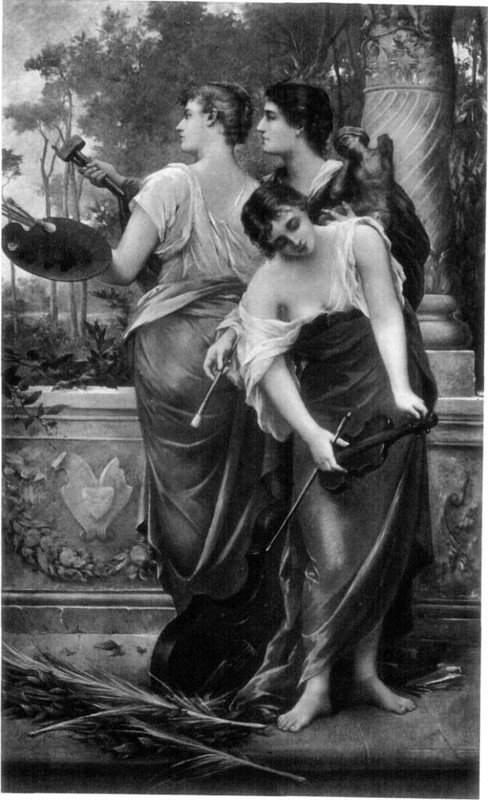
LOUIS HONORÉ FRECHETTE
(1839-)
BY MAURICE FRANCIS EGAN
ouis Honoré Fréchette, the best known of the French-Canadian poets, was born near the forties, at Lévis, a suburb of Quebec. He is patriotic; his genius is plainly that of New France, while the form of it is of that older France which produced the too exquisite sonnets of Voiture; and what counts greatly with the Canadians, he has received the approbation of the Academy; he is a personage in Paris, where he spends a great deal of time. From 'Nos Gens de Lettres' (Our Literary Workers: Montreal, 1873), we learn that the father of M. Fréchette was a man of business, and that he did not encourage his son's poetic tendencies to the detriment of the practical side of his character.
Lévis has traditions which are part of that stirring French-Canadian history now being made known to us by Mrs. Catherwood and Gilbert Parker. And the great St. Lawrence spoke to him in
"All those nameless voices, which are Beating at the heart."
At the age of eight he began to write verses. He was told by his careful father that poets never become rich; but he still continued to make verses. He grew to be a philosopher as well as a poet, and a little later became firmly of Horace's opinion, that a poet to be happy does not need riches gained by work. His father, who no doubt felt that a philosopher of this cult was not fit for the world, sent him to the Seminary at Quebec. At the Seminary he continued to write verses. The teachers there found merit in the verses. The "nameless voices" still beat at his heart, though the desks of the preparatory college had replaced the elms of the St. Lawrence. But poets are so rare that even when one is caught young, his captors doubt his species. The captors in this case determined to see whether Pegasus could trot as well as gallop. "Transport yourself, little Fréchette," they said, "to the Council of Clermont and be a troubadour." What is time to the poet? He became a troubadour: but this was not enough; his preceptors were still in doubt; they locked him in a room and gave him as a subject the arrival of Mgr. de Laval in Canada. An hour passed; the first sufferings of the young poet having abated, he produced his verses. It was evident that Pegasus could acquire any pace. His talent was questioned no more.
As he became older, Fréchette had dreams of becoming a man of action, and began to learn telegraphy at Ogdensburg; but he found the art too long and life too brief. He went back to the seminary and contributed 'Mes Loisirs' (My Spare Hours) to the college paper. From the seminary—the Petit Seminaire, of course,—he went to the College of Ste. Anne, to Nicolet, and finally to Laval University, "singing, and picking up such crumbs of knowledge as suited his taste."
In 1864 M. Fréchette was admitted to practice at the bar of Quebec. He was a poet first and always; but just at this time he was second a journalist, third a politician, and perhaps fourth a barrister. He began to publish a paper, Le Journal de Lévis. It failed: disgusted, he bade farewell to Canada, and began in Chicago the publication of L'Observateur: it died in a day. He poured forth his complaints in 'Voix d'un Exilé' (The Voice of an Exile). "Never," cries M. Darveau in 'Nos Gens de Lettres' (Our Literary Workers), "did Juvenal scar the faces of the corrupt Romans as did Fréchette lash the shoulders of our wretched politicians." His L'Amérique, a journal started in Chicago, had some success, but it temporarily ruined Fréchette, as the Swiss whom he had placed in charge of it suddenly changed its policy, and made it sympathize with Germany in the Franco-Prussian war.
Fréchette's early prose is fiery and eloquent; his admirers compared it to that of Louis Veuillot and Junius, for the reason, probably, that he used it to denounce those whom he hated politically. Fréchette's verse has the lyrical ring. And although M. Camille Doucet insisted that the French Academy in crowning his poems honored a Frenchman, it must be remembered that Fréchette is both an American and a British subject; and these things, not likely to disarm Academical conservatism, made the action the more significant of the poet's value.
There is strong and noble passion in 'La Voix d'un Exilé' and in the 'Ode to the Mississippi.' His arraignment of the Canadian politicians may be forgotten without loss,—no doubt he has by this time forgiven them,—but the real feeling of the poet, who finds in the Mississippi the brother of his beloved St. Lawrence, is permanent:—
"Adieu, vallons ombreux, mes campagnes fleuries, Mes montagnes d'azur et mes blondes prairies, Mon fleuve harmonieux, mon beau del embaumé— Dans les grandes cités, dans les bois, sur les grêves, Ton image flottera dans mes rêves, O mon Canada, bien aimé.
Je n'écouterai plus, dans nos forêts profondes, Dans nos près verdoyants, et sur nos grandes ondes, Toutes ces voix sans nom qui font battre le coeur."
[Farewell, shaded valleys, my flowery meadows, my azure mountains and my pale prairies, my musical stream, my fair sky! In the great towns, in the wood, along the water-sides, thy scenes will float on in my dreams, O Canada, my beloved!
I shall hear no more, in our deep forests, in our verdant meads and upon our broad waters, all those nameless voices which make one's heart throb.]
In 1865 the first book of poems which appealed to the world from French Canada appeared. It was Fréchette's 'Mes Loisirs' (My Spare Hours). Later came 'Pêle-Mêle' (Pell-Mell), full of fine cameo-like poems,—but like cameos that are flushed by an inner and vital fire. Longfellow praised 'Pêle-Mêle': it shows the influence of Hugo and Lamartine; it has the beauty of De Musset, with more freshness and "bloom" than that poet of a glorious past possessed; but there are more traces of Lamartine in 'Pêle-Mêle' than of Hugo.
"Fréchette's imagination," says an admiring countryman of his, "is a chisel that attacks the soulless block; and with it he easily forms a column or a flower." His poems have grown stronger as he has become more mature. There is a great gain in dramatic force, so that it has surprised none of his readers that he should have attempted tragedy with success. He lost some of that quality of daintiness which distinguished 'Le Matin' (Morning), 'La Nuit' (Night), and 'Fleurs Fanées' (Faded Flowers). The 'Pensées d'Hiver' (Winter Reflections) had this quality, but 'La Dernière Iroquoise' (The Last Iroquois) rose above it, and like much of 'Les Fleurs Boréales' (Boreal Flowers) and his latest work, it is powerful in spirit, yet retains the greatest chastity of form.
M. Fréchette translated several of Shakespeare's plays for the Théâtre Français. After 'Les Fleurs Boréales' was crowned by the Academy, there appeared 'Les Oiseaux de Neige' (The Snow-Birds), 'Feuilles Volantes' (Leaves in the Wind), and 'La Forêt Vierge' (The Virgin Forest). The volume which shows the genius of Fréchette at its highest is undoubtedly 'La Légende d'un Peuple' (The Legend of a Race), which has an admirable preface by Jules Claretie.

OUR HISTORY
Fragments from 'La Légende d'un Peuple': translated by Maurice Francis Egan
O history of my country,—set with pearls unknown,— With love I kiss thy pages venerated.
O register immortal, poem of dazzling light Written by France in purest of her blood! Drama ever acting, records full of pictures Of high facts heroic, stories of romance, Annals of the giants, archives where we follow, As each leaf we turn, a life resplendent, And find a name respected or a name beloved, Of men and women of the antique time!
Where the hero of the past and the hero of the future Give the hand of friendship and the kiss of love; Where the crucifix and sword, the plowshare and the volume,— Everything that builds and everything that saves,— Shine, united, living glories of past time And of time that is to be.
The glories of past time, serene and pure before you, O virtues of our day! Hail first to thee, O Cartier, brave and hardy sailor, Whose footstep sounded on the unexplored shores Of our immense St. Lawrence. Hail, Champlain, Maisonneuve, illustrious founders of two cities, Who show above our waves their rival beauties. There was at first only a group of Bretons Brandishing the sword-blade and the woodman's axe, Sea-wolves bronzed by sea-winds at the port of St. Malo; Cradled since their childhood beneath the sky and water. Men of iron and high of heart and stature, They, under eye of God, set sail for what might come. Seeking, in the secrets of the foggy ocean, Not the famous El Dorados, but a soil where they might plant, As symbols of their saving, beside the cross of Christ, The flag of France.
After them came blond-haired Normans And black-eyed Pontevins, robust colonists, To make the path a road, and for this holy work To offer their strong arms: the motive was the same; The dangers that they fronted brought out prodigies of courage. They seemed to know no dangers; or rather, They seemed to seek the ruin that they did not meet. Frightful perils vainly rose before them, And each element against them vainly had conspired: These children of the furrow founded an empire!
Then, conquering the waves of great and stormy lakes, Crossing savannahs with marshes of mud, Piercing the depths of the forests primeval, Here see our founders and preachers of Faith! Apostles of France, princes of our God, Having said farewell to the noise of the world, They came to the bounds of the New World immense To sow the seed of the future, And to bear, as the heralds of eternal law, To the end of the world the torch of progress.
Leaning on his bow, ferociously calm, The child of the forest, bitter at heart, A hunted look mingling with his piercing glance, Sees the strangers pass,—encamped on the plain or ambushed in the woods,— And thinks of the giant spirits he has seen in his dreams. For the first time he trembles and fears— Then casting off his deceitful calm, He will rush forth, uttering his war-cry, To defend, foot by foot, his soil so lately virgin, And ferocious, tomahawk in hand, bar this road to civilization!
A cowardly king, tool of a more cowardly court, Satyr of the Parc aux cerfs, slave at the Trianon, Plunged in the horrors of nameless debauches, At the caprice of Pompadour dancing like an atom,— The blood of his soldiers and the honor of his kingdom, Of our dying heroes hearing he no voice. Montcalm, alas! conquered for the first time, Falling on the field of battle, wrapped in his banner. Lévis, last fighter of the last fight, Tears—avenging France and her pride!— A supreme triumph from fate.
That was all. In front of our tottering towers The stranger planted his insolent colors, And an old flag, wet with bitter tears, Closed its white wings and went across the sea!
CAUGHNAWAGA
Paraphrased by Maurice Francis Egan
A world in agony breathes its last sigh! Gaze on the remnants of an ancient race,— Great kings of desert terrible to face, Crushed by the new weights that upon them lie; Stand near the Falls, and at this storied place You see a humble hamlet;—by-and-by You'll talk of ambuscades and treacherous chase.
Can history or sight a traitor be? Where are the red men of the rolling plains? Ferocious Iroquois,—ah, where is he?— Without concealment (this for all our pains!) The Chief sells groceries for paltry gains, With English tang in speech of Normandy!
LOUISIANA
Paraphrased from 'Les Feuilles Volantes,' by Maurice Francis Egan
Land of the Sun! where Fancy free Weaveth her woof beneath a sky of gold, Another Andalusia, thee I see; Thy charming memories my heart-strings hold, As if the song of birds had o'er them rolled.
In thy fresh groves, where scented orange glows, Circle vague loves about my longing heart; Thy dark banana-trees, when soft wind flows, In concert weird take up their sombre part, As evening shadows, listening, float and dart.
'Neath thy green domes, where the lianas cling, Show tropic flowers with wide-opened eyes, With arteries afire till morn-birds sing; More than old Werthier, in new love's surprise, Stand on the threshold of thy Paradise.
Son of the North, I, of the realm of snows,— Vision afar, but always still a power,— In these soft nights and in the days of rose, Dreaming I feel, e'en in the saddest hour, Within my heart unclose a golden flower.
THE DREAM OF LIFE
To My Son
Paraphrased from 'Les Feuilles Volantes,' by Maurice Francis Egan
At twenty years, a poet lone, I, when the rosy season came, Walked in the woodland, to make moan For some fair dame;
And when the breezes brought to me The lilac spent in fragrant stream, I wove her infidelity In love's young dream.
A lover of illusions, I! Soon other dreams quite filled my heart, And other loves as suddenly Took old love's part.
One Glory, a deceitful fay, Who flies before a man can stir, Surprised my poor heart many a day,— I dreamed of her!
But now that I have grown so old, At lying things I grasp no more. My poor, deceived heart takes hold Of other lore.
Another life before us glows, Casts on all faithful souls its gleam: Late, late, my heart its glory knows,— Of it I dream!
HAROLD FREDERIC
(1856-)

r. Frederic was born in Utica, New York, August 19th, 1856. He spent his boyhood in that neighborhood, and was educated in its schools. The rural Central New York of a half-century ago was a region of rich farms, of conservative ideas, and of strong indigenous types of character. These undoubtedly offered unconscious studies to the future novelist.
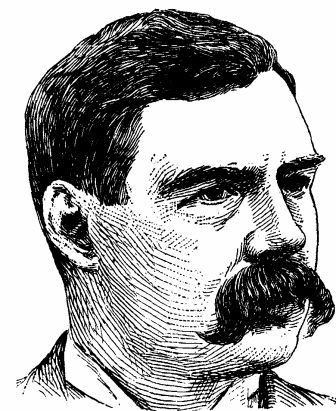
Harold Frederic
Like many of his guild he began writing on a newspaper, rising by degrees from the position of reporter to that of editor. The drill and discipline taught him to make the most of time and opportunity, and he contrived leisure enough to write two or three long stories. Working at journalism in Utica, Albany, and New York, in 1884 he became chief foreign correspondent of the New York Times, making his headquarters in London, where he has since lived.
Mr. Frederic's reputation rests on journalistic correspondence of the higher class, and on his novels, of which he has published six. His stories are distinctively American. He has caught up contrasting elements of local life in the eastern part of the United States, and grouped them with ingenuity and power. His first important story was 'Seth's Brother's Wife,' originally appearing as a serial in Scribner's Magazine. Following this came 'The Lawton Girl,' a study of rustic life; 'In the Valley,' a semi-historical novel, turning on aspects of colonial times along the Mohawk River; 'The Copperhead,' a tale of the Civil War; 'Mukena and Other Stories,' graphic character sketches, displaying humor and insight; 'The Damnation of Theron Ware,' the most serious and carefully studied of his books; and 'March Hares,' a sketch of contemporary society.
A student of the life about him, possessing a dramatic sense and a saving grace of humor, Mr. Frederic in his fiction is often photographic and minute in detail, while he does not forget the importance of the mass which the detail is to explain or embellish. He likes to deal with types of that mixed population peculiar to the farming valleys of Central New York,—German, Irish, and American,—bringing out by contrast their marked social and individual traits. Not a disciple of realism, his books are emphatically "human documents."
There is always moreover a definite plot, often a dramatic development. But it is the attrition of character against character that really interests him. 'Seth's Brother's Wife' and 'The Lawton Girl' leave a definite ethical intention. In the 'Damnation of Theron Ware' is depicted the tragedy of a weak and crude character suddenly put in touch with a higher intellectual and emotional life, which it is too meagre and too untrained to adopt, and through which it suffers shipwreck. In 'In the Valley' the gayety and seriousness of homely life stand out against a savage and martial background.
Mr. Frederic profoundly respects his art, is never careless, and never unconscientious. Of his constructive instinct a distinguished English critic has said that it "ignores nothing that is significant; makes use of nothing that is not significant; and binds every element of character and every incident together in a consistent, coherent, dramatic whole."
THE LAST RITE
From 'The Damnation of Theron Ware.' Copyright 1896, by Stone & Kimball
Walking homeward briskly now, with his eyes on the sidewalk, and his mind all aglow with crowding suggestions for the new work and impatience to be at it, Theron Ware came abruptly upon a group of men and boys who occupied the whole path, and were moving forward so noiselessly that he had not heard them coming. He almost ran into the leader of this little procession, and began a stammering apology, the final words of which were left unspoken, so solemnly heedless of him and his talk were all the faces he saw.
In the centre of the group were four workingmen, bearing between them an extemporized litter of two poles and a blanket hastily secured across them with spikes. Most of what this litter held was covered by another blanket, rounded in coarse folds over a shapeless bulk. From beneath its farther end protruded a big broom-like black beard, thrown upward at such an angle as to hide everything beyond those in front. The tall young minister, stepping aside and standing tiptoe, could see sloping downward, behind this hedge of beard, a pinched and chalk-like face, with wide-open, staring eyes. Its lips, of a dull lilac hue, were moving ceaselessly, and made a dry, clicking sound.
Theron instinctively joined himself to those who followed the litter, a motley dozen of street idlers, chiefly boys. One of these in whispers explained to him that the man was one of Jerry Madden's workmen in the wagonshops, who had been deployed to trim an elm-tree in front of his employer's house, and being unused to such work, had fallen from the top and broken all his bones. They would have cared for him at Madden's house, but he insisted upon being taken home. His name was MacEvoy, and he was Joey MacEvoy's father, and likewise Jim's and Hughey's and Martin's. After a pause, the lad, a bright-eyed, freckled, barefooted wee Irishman, volunteered the further information that his big brother had run to bring "Father Forbess," on the chance that he might be in time to administer "extry munction."
The way of the silent little procession led through back streets,—where women hanging up clothes in the yards hurried to the gates, their aprons full of clothes-pins, to stare open-mouthed at the passers-by,—and came to a halt at last in an irregular and muddy lane, before one of a half-dozen shanties reared among the ash-heaps and débris of the town's most bedraggled outskirts.
A stout, middle-aged, red-armed woman, already warned by some messenger of calamity, stood waiting on the roadside bank. There were whimpering children clinging to her skirts, and a surrounding cluster of women of the neighborhood; some of the more elderly of whom, shriveled little crones in tidy caps, and with their aprons to their eyes, were beginning in a low-murmured minor the wail which presently should rise into the keen of death. Mrs. MacEvoy herself made no moan, and her broad ruddy face was stern in expression rather than sorrowful. When the litter stopped beside her, she laid a hand for an instant on her husband's wet brow, and looked—one could have sworn impassively—into his staring eyes. Then, still without a word, she waved the bearers toward the door, and led the way herself.
Theron, somewhat wonderingly, found himself a minute later inside a dark and ill-smelling room, the air of which was humid with the steam from a boiler of clothes on the stove, and not in other ways improved by the presence of a jostling score of women, all straining their gaze upon the open door of the only other apartment, the bedchamber. Through this they could see the workmen laying MacEvoy on the bed, and standing awkwardly about thereafter, getting in the way of the wife and old Maggie Quirk as they strove to remove the garments from his crushed limbs. As the neighbors watched what could be seen of these proceedings, they whispered among themselves eulogies of the injured man's industry and good temper, his habit of bringing his money home to his wife, and the way he kept his Father Mathew pledge and attended to his religious duties. They admitted freely that by the light of his example, their own husbands and sons left much to be desired; and from this wandered easily off into domestic digressions of their own. But all the while their eyes were bent upon the bedroom door; and Theron made out, after he had grown accustomed to the gloom and the smell, that many of them were telling their beads even while they kept the muttered conversation alive. None of them paid any attention to him, or seemed to regard his presence there as unusual.
Presently he saw enter through the sunlit street doorway a person of a different class. The bright light shone for a passing instant upon a fashionable, flowered hat, and upon some remarkably brilliant shade of red hair beneath it. In another moment there had edged along through the throng, to almost within touch of him, a tall young woman, the owner of this hat and wonderful hair. She was clad in light and pleasing spring attire, and carried a parasol with a long oxidized silver handle of a quaint pattern. She looked at him, and he saw that her face was of a lengthened oval, with a luminous rose-tinted skin, full red lips, and big brown, frank eyes with heavy auburn lashes. She made a grave little inclination of her head toward him, and he bowed in response. Since her arrival, he noted, the chattering of the others had entirely ceased.
"I followed the others in, in the hope that I might be of some assistance," he ventured to explain to her in a low murmur, feeling that at last here was some one to whom an explanation of his presence in this Romish house was due. "I hope they won't feel that I have intruded."
She nodded her head as if she quite understood.
"They'll take the will for the deed," she whispered back. "Father Forbes will be here in a minute. Do you know, is it too late?"
Even as she spoke, the outer doorway was darkened by the commanding bulk of a new-comer's figure. The flash of a silk hat, and the deferential way in which the assembled neighbors fell back to clear a passage, made his identity clear. Theron felt his blood tingle in an unaccustomed way as this priest of a strange Church advanced across the room,—a broad-shouldered, portly man of more than middle height, with a shapely, strong-lined face of almost waxen pallor, and a firm, commanding tread. He carried in his hands, besides his hat, a small leather-bound case. To this and to him the women curtsied and bowed their heads as he passed.
"Come with me," whispered the tall girl with the parasol, to Theron; and he found himself pushing along in her wake until they intercepted the priest just outside the bedroom door. She touched Father Forbes on the arm.
"Just to tell you that I am here," she said. The priest nodded with a grave face, and passed into the other room. In a minute or two the workmen, Mrs. MacEvoy, and her helper came out, and the door was shut behind them.
"He is making his confession," explained the young lady. "Stay here for a minute."
She moved over to where the woman of the house stood, glum-faced and tearless, and whispered something to her. A confused movement among the crowd followed, and out of it presently resulted a small table, covered with a white cloth, and bearing on it two unlighted candles, a basin of water, and a spoon, which was brought forward and placed in readiness before the closed door. Some of those nearest this cleared space were kneeling now, and murmuring a low buzz of prayer to the click of beads on their rosaries.
The door opened, and Theron saw the priest standing in the doorway with an uplifted hand. He wore now a surplice, with a purple band over his shoulders, and on his pale face there shone a tranquil and tender light.
One of the workmen fetched from the stove a brand, lighted the two candles, and bore the table with its contents into the bedroom. The young woman plucked Theron's sleeve, and he dumbly followed her into the chamber of death, making one of the group of a dozen, headed by Mrs. MacEvoy and her children, which filled the little room, and overflowed now outward to the street door. He found himself bowing with the others to receive the sprinkled holy water from the priest's white fingers; kneeling with the others for the prayers; following in impressed silence with the others the strange ceremonial by which the priest traced crosses of holy oil with his thumb upon the eyes, ears, nostrils, lips, hands, and feet of the dying man, wiping off the oil with a piece of cotton-batting each time after he had repeated the invocation to forgiveness for that particular sense. But most of all he was moved by the rich, novel sound of the Latin as the priest rolled it forth in the 'Asperges me, Domine,' and 'Misereatur vestri omnipotens Deus,' with its soft Continental vowels and liquid r's. It seemed to him that he had never really heard Latin before. Then the astonishing young woman with the red hair declaimed the 'Confiteor' vigorously and with a resonant distinctness of enunciation. It was a different Latin, harsher and more sonorous; and while it still dominated the murmured undertone of the other's prayers the last moment came.
Theron had stood face to face with death at many other bed-sides; no other final scene had stirred him like this. It must have been the girl's Latin chant, with its clanging reiteration of the great names,—'beatum Michaelem Archangelum,' 'beatum Joannem Baptistam,' 'sanctos Apostolos Petrum et Paulum,'—invoked with such proud confidence in this squalid little shanty, which so strangely affected him.
He came out with the others at last,—the candles and the folded hands over the crucifix left behind,—and walked as one in a dream. Even by the time that he had gained the outer doorway, and stood blinking at the bright light and filling his lungs with honest air once more, it had begun to seem incredible to him that he had seen and done all this.
EDWARD AUGUSTUS FREEMAN
(1823-1892)
BY JOHN BACH McMASTER

dward Augustus Freeman, one of the most prolific of recent English historians, was born at Harborne in Staffordshire, England, on August 2d, 1823. His early education was received at home and in private schools, from which at the age of eighteen he went up to Oxford, where he was elected a scholar of Trinity College. Four years later (1845) he took his degree and was elected a Fellow of Trinity, an honor which he held till his marriage in 1847 forced him to relinquish it.
Long before this event, Freeman was deep in historical study. His fortune was easy. The injunction that he should eat bread in the sweat of his face had not been laid on him. His time was his own, and was devoted with characteristic zeal and energy to labor in the field of history, which in the course of fifty years was made to yield him a goodly crop.
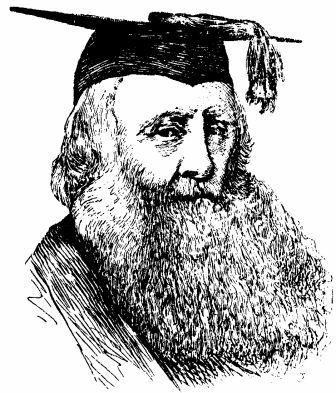
Edward A. Freeman
Year after year he poured forth a steady stream of Essays, Thoughts, Remarks, Suggestions, Lectures, Short Histories on matters of current interest, little monographs on great events or great men,—all covering a range of subjects which bear evidence to most astonishing versatility and learning. Sometimes his topic was a cathedral church, as that of Wells or Leominster Priory; or a cathedral city, as Ely or Norwich. At others it was a grave historical theme, as the 'Unity of History'; or 'Comparative Politics'; or the 'Growth of the English Constitution from the Earliest Times'; or 'Old English History for Children.' His 'General Sketch of European History' is still a standard text book in our high schools and colleges. His 'William the Conqueror' in Macmillan's 'Twelve English Statesmen'; his 'Short History of the Norman Conquest of England' in the Clarendon Press Series; his studies of Godwin, Harold, and the Normans, in the 'Encyclopædia Britannica,' are the best of their kind.
His contributions to the reviews and magazines make a small library, encyclopædic in character. Thirty-one essays were published in the Fortnightly Review; thirty in the Contemporary Review; twenty-seven in Macmillan's Magazine; twelve in the British Quarterly, and as many more in the National Review; while such as are scattered through the other periodicals of Great Britain and the United States swell the list to one hundred and fifty-seven titles. Every conceivable subject is treated,—politics, government, history, field sports, architecture, archaeology, books, linguistics, finance, great men living and dead, questions of the day. But even this list does not comprise all of Freeman's writings, for regularly every week, for more than twenty years, he contributed two long articles to the Saturday Review.
Taken as a whole, this array of publications represents an industry which was simply enormous, and a learning as varied as it was immense. If classified according to their subjects, they fall naturally into six groups. The antiquarian and architectural sketches and addresses are the least valuable and instructive. They are of interest because they exhibit a strong bent of mind which appears constantly in Freeman's works, and because it was by the aid of such remains that he studied the early history of nations. Then come the studies in politics and government, such as the essays on presidential government; on American institutional history; on the House of Lords; the growth of commonwealths, and such elaborate treatises as the six lectures on 'Comparative Politics,' and the 'History of Federal Government,'—all notable because of the liberal spirit and breadth of view that mark them, and because of a positiveness of statement and confidence in the correctness of the author's judgments. Then come the historical essays; then the lectures and addresses; then his occasional pieces, written at the request of publishers or editors to fill some long-felt want; and finally the series of histories on which, in the long run, the reputation of Freeman must rest. These, in the order of merit and value, are the 'Norman Conquest'; the 'Reign of William Rufus,' which is really a supplement to the 'Conquest'; the 'History of Sicily,' which the author did not live to finish.
The roll of his works is enough to show that the kind of history which appealed to Freeman was that of the distant past, and that which dealt with politics rather than with social life. Of ancient history he had a good mastery; English history from its dawn to the thirteenth century he knew minutely: European history of the same period he knew profoundly. After the thirteenth century his interest grew less and less as modern times were approached, and his knowledge smaller and smaller till it became that of a man very well read in history and no more.
Freeman was therefore essentially a historian of the far past; and as such had, it is safe to say, no living superior in England. But in his treatment of the past he presents a small part of the picture. He is concerned with great conquerors, with military leaders, with battles and sieges and systems of government. The mass of the people have no interest for him at all. His books abound in battle-pieces of the age of the long-bow and the javelin, of the battle-axe, the mace, and the spear; of the age when brain went for little and when brawn counted for much; and when the fate of nations depended less on the skill of individual commanders than on the personal prowess of those who met in hand-to-hand encounters. He delights in descriptions of historic buildings; he is never weary of drawing long analogies between one kind of government and another; but for the customs, the manner, the usages, the daily life of the people, he has never a word. "History," said he on one occasion, "is past politics; politics is present history," and to this epigram he is strictly faithful. The England of the serf and the villein, the curfew and the monastery, is brushed aside to leave room for the story of the way in which William of Normandy conquered the Saxons, and of the way in which William Rufus conducted his quarrels with Bishop Anselm.
With all of this no fault is to be found. It was his cast of mind, his point of view; and the questions which alone concern us in any estimate of his work are: Did he do it well? What is its value? Did he make a real contribution to historical knowledge? What are its merits and defects? Judged by the standard he himself set up, Freeman's chief merits, the qualities which mark him out as a great historian, are an intense love of truth and a determination to discover it at any cost; a sincere desire to mete out an even-handed justice to each and every man; unflagging industry, common-sense, broad views, and the power to reproduce the past most graphically.
From these merits comes Freeman's chief defect,—prolixity. His earnest desire to be accurate made him not only say the same thing over and over again, but say it with an unnecessary and useless fullness of detail, and back up his statement with a profusion of notes, which in many cases amount to more than half the text. Indeed, were they printed in the same type as the text, the space they occupy would often exceed it. Thus, in the first volume of the 'Norman Conquest' there are 528 pages of text, with foot-notes occupying from a third to a half of almost every page, and an appendix of notes of 244 pages; in the second volume, the text and foot-notes amount to 512, and the appendix 179; in the third, the text covers 562 and the appendix 206 pages. These notes are always interesting and always instructive. But the end of a volume is not the place for an exhibition of the doubts and fears that have tormented the historian, for a statement of the reasons which have led him to one conclusion rather than another, nor for the denunciation or reputation of the opinions of his predecessors. When the building is finished, we do not want to see the lumber used as the scaffolding piled in the back yard. Mr. Freeman's histories would be all the better for a condensation of the text and an elimination of the long appendices.
With these exceptions, the workmanship is excellent. He entered so thoroughly into the past that it became to him more real and understandable than the present. He was not merely the contemporary but the companion of the men he had to deal with. He knew every spot of ground, every Roman ruin, every mediæval castle, that came in any way to be connected with his story, as well as he knew the topography of the country that stretched beneath his study window, or the arrangement of the house in which he lived.
In his histories, therefore, we are presented at every turn with life-like portraits of the illustrious dead, bearing all the marks of having been taken from life; with descriptions of castles and towers, minsters and abbeys, and of the scenes that have made them memorable; with comparisons of one ruler with another, always sane and just; and with graphic pictures of coronations, of battles, sieges, burnings, and all the havoc and pomp of war.
The essays and studies in politics show Mr. Freeman in a yet more interesting light; many are elaborate reviews of historical works, and therefore cover a wide range of topics, both ancient and of the present time. Now his subject is Mr. Bryce's 'Holy Roman Empire'; now the Flavian Cæsars; now Mr. Gladstone's 'Homer and the Homeric Age'; now Kirk's 'Charles the Bold'; now presidential government; now Athenian democracy; now the Byzantine Empire; now the Eastern Church; now the growth of commonwealths; now the geographical aspects of the Eastern Question.
By so wide a range of topics, an opportunity is afforded for a variety of remarks, analogies, judgments of men and times, far greater than the histories could give. In the main, these judgments may be accepted; but so thoroughly was Freeman a historian of the past, that some of his estimates of contemporary men and things were singularly erroneous. While our Civil War was still raging he began a 'History of Federal Government,' which was to extend from the Achaean League "to the disruption of the United States." A prudent historian would not have taken up the role of prophet. He would have waited for the end of the struggle. But absolute self-confidence in his own good judgment was one of Freeman's most conspicuous traits. His estimate of Lincoln is another instance of inability to understand the times in which he lived. In the 'Essay on Presidential Government,' published in the National Review in 1864 and republished in the first series of 'Historical Essays' in 1871, the greatest President and the grandest public character the United States has yet produced is declared inferior to each and all the Presidents from Washington to John Quincy Adams. A comparison of Lincoln with Monroe or Madison or Jefferson by Freeman would have been entertaining.
Two views of history as set forth in the essays are especially deserving of notice. He is never weary of insisting on the unity and the continuity of history in general and that of England in particular, and he attaches unreasonable importance to the influence of the Teutonic element in English history. This latter was the inevitable result of his method of studying the past along the lines of philology and ethnology, and has carried him to extremes which taken by anybody else he would have been quick to see.
An examination of Freeman's minor contributions to the reviews—such essays, sketches, and discussions as he did not think important enough to republish in book form—is indicative of his interest in current affairs. They made little draft on his learning, yet the point of view is generally the result of his learning. He believed, for instance, that a sound judgment on the Franco-Prussian War could not be found save in the light of history. "The present war," he wrote to the Pall Mall Gazette, "has largely risen out of a misconception of history, out of the dream of a frontier of the Rhine which never existed. The war on the part of Germany is in truth a vigorous setting forth of the historical truth that the Rhine is, and always has been, a German river."
Freeman was still busy with his 'History of Sicily' from the earliest times, and had just finished the preface to the third volume, when he died at Alicante in Spain, March 16th, 1892. Since his death a fourth volume, prepared from his notes, has been published.
But one biography of Freeman has yet appeared, 'The Life and Letters of Edward A. Freeman,' by W. R. W. Stephens, 2 vols., 1895.

THE ALTERED ASPECTS OF ROME
From 'Historical Essays of Edward A. Freeman,' Third Series. London, Macmillan & Co., 1879
The two great phenomena, then, of the general appearance of Rome, are the utter abandonment of so large a part of the ancient city and the general lack of buildings of the Middle Ages. Both of these facts are fully accounted for by the peculiar history of Rome. It may be that the sack and fire under Robert Wiscard—a sack and fire done in the cause of a pope in warfare against an emperor—was the immediate cause of the desolation of a large part of Rome; but if so, the destruction which was then wrought only gave a helping hand to causes which were at work both before and after. A city could not do otherwise than dwindle away, in which neither emperor nor pope nor commonwealth could keep up any lasting form of regular government; a city which had no resources of its own, and which lived, as a place of pilgrimage, on the shadow of its own greatness. Another idea which is sure to suggest itself at Rome is rather a delusion. The amazing extent of ancient ruins at Rome unavoidably fills us with the notion that an unusual amount of destruction has gone on there. When we cannot walk without seeing, besides the more perfect monuments, gigantic masses of ancient wall on every side,—when we stumble at every step on fragments of marble columns or on richly adorned tombs,—we are apt to think that they must have perished in some special havoc unknown in other places. The truth is really the other way. The abundance of ruins and fragments—again setting aside the more perfect monuments—proves that destruction has been much less thorough in Rome than in almost any other Roman city. Elsewhere the ancient buildings have been utterly swept away; at Rome they survive, though mainly in a state of ruin. But by surviving in a state of ruin they remind us of their former existence, which in other places we are inclined to forget. Certainly Rome is, even in proportion to its greatness above all other Roman cities, rich in ancient remains above all other Roman cities. Compare those cities of the West which at one time or another supplanted Rome as the dwelling-places of her own Cæsars,—Milan, Ravenna, York, Trier itself. York may be looked upon as lucky in having kept a tower and some pieces of wall through the havoc of the English conquest. Trier is rich above all the rest, and she has, in her Porta Nigra, one monument of Roman power which Rome herself cannot outdo. But rich as Trier—the second Rome—is, she is certainly not richer in proportion than Rome herself. The Roman remains at Milan hardly extend beyond a single range of columns, and it may be thought that that alone is something, when we remember the overthrow of the city under Frederick Barbarossa. But compare Rome and Ravenna: no city is richer than Ravenna in monuments of its own special class,—Christian Roman, Gothic, Byzantine, but of works of the days of heathen Rome there is no trace—no walls, no gates, no triumphal arch, no temple, no amphitheatre. The city of Placidia and Theodoric is there; but of the city which Augustus made one of the two great maritime stations of Italy there is hardly a trace. Verona, as never being an imperial residence, was not on our list; but rich as Verona is, Rome is—even proportionally—far richer. Provence is probably richer in Roman remains than Italy herself; but even the Provençal cities are hardly so full of Roman remains as Rome herself. The truth is, that there is nothing so destructive to the antiquities of a city as its continued prosperity. A city which has always gone on flourishing according to the standard of each age, which has been always building and rebuilding and spreading itself beyond its ancient bounds, works a gradual destruction of its ancient remains beyond anything that the havoc of any barbarians on earth can work. In such a city a few special monuments may be kept in a perfect or nearly perfect state; but it is impossible that large tracts of ground can be left covered with ruins as they are at Rome. Now, it is the ruins, rather than the perfect buildings, which form the most characteristic feature of Roman scenery and topography, and they have been preserved by the decay of the city; while in other cities they have been swept away by their prosperity. As Rome became Christian, several ancient buildings, temples and others, were turned into churches, and a greater number were destroyed to employ their materials, especially their marble columns, in the building of churches. But though this cause led to the loss of a great many ancient buildings, it had very little to do with the creation of the vast mass of the Roman ruins. The desolation of the Flavian amphitheatre and of the baths of Antoninus Caracalla comes from another cause. As the buildings became disused,—and if we rejoice at the disuse of the amphitheatre, we must both mourn and wonder at the disuse of the baths,—they were sometimes turned into fortresses, sometimes used as quarries for the building of fortresses. Every turbulent noble turned some fragment of the buildings of the ancient city into a stronghold from which he might make war upon his brother nobles, from which he might defy every power which had the slightest shadow of lawful authority, be it emperor, pope, or senator. Fresh havoc followed on every local struggle: destruction came whenever a lawful government was overthrown and whenever a lawful government was restored; for one form of revolution implied the building, the other implied the pulling down, of these nests of robbers. The damage which a lying prejudice attributes to Goths and Vandals was really done by the Romans themselves, and in the Middle Ages mainly by the Roman nobles. As for Goths and Vandals, Genseric undoubtedly did some mischief in the way of carrying off precious objects, but even he is not charged with the actual destruction of any buildings. And it would be hard to show that any Goth, from Alaric to Tovilas, ever did any mischief whatever to any of the monuments of Rome, beyond what might happen through the unavoidable necessities and accidents of warfare. Theodoric of course stands out among all the ages as the great preserver and repairer of the monuments of Ancient Rome. The few marble columns which Charles the Great carried away from Rome, as well as from Ravenna, can have gone but a very little way towards accounting for so vast a havoc. It was almost wholly by Roman hands that buildings which might have defied time and the barbarian were brought to the ruined state in which we now find them.
But the barons of mediæval Rome, great and sad as was the destruction which was wrought by them, were neither the most destructive nor the basest of the enemies at whose hands the buildings of ancient Rome have had to suffer. The mediæval barons simply did according to their kind. Their one notion of life was fighting, and they valued buildings or anything else simply as they might be made use of for that one purpose of life. There is something more revolting in the systematic destruction, disfigurement, and robbery of the ancient monuments of Rome, heathen and Christian, at the hands of her modern rulers and their belongings. Bad as contending barons or invading Normans may have been, both were outdone by the fouler brood of papal nephews. Who that looks on the ruined Coliseum, who that looks on the palace raised out of its ruins, can fail to think of the famous line—
"Quod non fecere barbari, fecere Barberini"?
And well-nigh every other obscure or infamous name in the roll-call of the mushroom nobility of modern Rome has tried its hand at the same evil work. Nothing can be so ancient, nothing so beautiful, nothing so sacred, as to be safe against their destroying hands. The boasted age of the Renaissance, the time when men turned away from all reverence for their own forefathers and professed to recall the forms and the feelings of ages which are forever gone, was the time of all times when the monuments of those very ages were most brutally destroyed. Barons and Normans and Saracens destroyed what they did not understand or care for; the artistic men of the fifteenth, sixteenth, and seventeenth centuries destroyed the very things which they professed to admire and imitate. And when they did not actually destroy, as in the case of statues, sarcophagi, and the like, they did all they could to efface their truest interest, their local and historical association.
A museum or collection of any kind is a dreary place. For some kinds of antiquities, for those which cannot be left in their own places, and which need special scientific classification, such collections are necessary. But surely a statue or a tomb should be left in the spot where it is found, or in the nearest possible place to it. How far nobler would be the associations of Pompey's statue, if the hero had been set up in the nearest open space to his own theatre; even if he had been set up with Marcus and the Great Twin Brethren on the Capitol, instead of being stowed away in an unmeaning corner of a private palace! It is sadder still to wind our way through the recesses of the great Cornelian sepulchre, and to find that sacrilegious hands have rifled the resting-place of the mighty dead; that the real tombs, the real inscriptions, have been stolen away, and that copies only are left in their places. Far more speaking, far more instructive, would it have been to grope out the antique letters of the first of Roman inscriptions, to spell out the name and deeds of "Cornelius Lucius Scipio Barbatus Gnaivod patre prognatus" by the light of a flickering torch in the spot where his kinsfolk and gentiles laid him, than to read it in the full light of the Vatican, numbered as if it stood in a shop to be sold, and bearing a fulsome inscription recording the "munificentia" of the triple-crowned robber who wrought the deed of selfish desecration. Scipio indeed was a heathen; but Christian holy places, places which are the very homes of ecclesiastical history or legend, are no safer than the monuments of heathendom against the desolating fury of ecclesiastical destroyers.
Saddest of all it is to visit the sepulchral church of St. Constantia—be her legend true or false, it makes no difference—to trace out the series of mosaics, where the old emblems of Bacchanalian worship, the vintage and the treading of the wine-press, are turned about to teach a double lesson of Christian mysteries; and then to see the place of the tomb empty, and to find that the tomb itself, the central point of the building, with the series of images which is begun in the pictures and continued in its sculpture, has been torn away from the place where it had meaning and almost life, to stand as number so-and-so among the curiosities of a dreary gallery. Such is the reverence of modern pontiffs for the most sacred antiquities, pagan and Christian, of the city where they have too long worked their destroying will.
In one part however of the city, destruction has been, as in other cities, the consequence of reviving prosperity on the part of the city itself. One of the first lessons to be got by heart on a visit to Rome is the way in which the city has shifted its site. The inhabited parts of ancient and of modern Rome have but a very small space of ground in common. While so large a space within the walls both of Aurelius and of Servius lies desolate, the modern city has spread itself beyond both. The Leonine city beyond the Tiber, the Sixtine city on the Field of Mars—both of them beyond the wall of Servius, the Leonine city largely beyond the wall of Aurelian—together make up the greater part of modern Rome. Here, in a thickly inhabited modern city, there is no space for the ruins which form the main features of the Palatine, Coelian, and Aventine Hills. Such ancient buildings as have been spared remain in a state far less pleasing than that of their ruined fellows. The Pantheon was happily saved by its consecration as a Christian church. But the degraded state in which we see the theatre of Marcellus and the beautiful remains of the portico of Octavia; above all, the still lower fate to which the mighty sepulchre of Augustus has been brought down,—if they enable the moralist to point a lesson, are far more offensive to the student of history than the utter desolation of the Coliseum and the imperial palace. The mole of Hadrian has undergone a somewhat different fate; its successive transformations and disfigurements are a direct part, and a most living and speaking part, of the history of Rome. Such a building, at such a point, could not fail to become a fortress, long before the days of contending Colonnas and Orsini; and if the statues which adorned it were hurled down on the heads of Gothic besiegers, that is a piece of destruction which can hardly be turned to the charge of the Goths. It is in these parts of Rome that the causes which have been at work have been more nearly the same as those which have been at work in other cities. At the same time, it must be remembered that it is only for a much shorter period that they have been fully at work. And wretched as with one great exception is their state, it must be allowed that the actual amount of ancient remains preserved in the Leonine and Sixtine cities is certainly above the average amount of such remains in Roman cities elsewhere.
THE CONTINUITY OF ENGLISH HISTORY
From 'Historical Essays of Edward A. Freeman,' First Series. London, Macmillan & Co., 1871
A comparison between the histories of England, France, and Germany, as regards their political development, would be a subject well worth working out in detail. Each country started with much that was common to all three, while the separate course of each has been wholly different. The distinctive character of English history is its continuity. No broad gap separates the present from the past. If there is any point at which a line between the present and the past is to be drawn, it is at all events not to be drawn at the point where a superficial glance might perhaps induce us to draw it,—at the Norman invasion in 1066. At first sight, that event might seem to separate us from all before it in a way to which there is no analogy in the history either of our own or of kindred lands. Neither France nor Germany ever saw any event to be compared to the Norman Conquest. Neither of them has ever received a permanent dynasty of foreign kings; neither has seen its lands divided among the soldiers of a foreign army, and its native sons shut out from every position of wealth or dignity. England, alone of the three, has undergone a real and permanent foreign conquest. One might have expected that the greatest of all possible historical chasms would have divided the ages before and the ages after such an event. Yet in truth modern England has practically far more to do with the England of the West-Saxon kings than modern France or Germany has to do with the Gaul and Germany of Charles the Great, or even of much more recent times. The England of the age before the Norman Conquest is indeed, in all external respects, widely removed from us. But the England of the age immediately succeeding the Norman Conquest is something more widely removed still. The age when Englishmen dwelt in their own land as a conquered race, when their name and tongue were badges of contempt and slavery, when England was counted for little more than an accession of power to the Duke of Rouen in his struggle with the King of Paris, is an age than which we can conceive none more alien to every feeling and circumstance of our own.
When, then, did the England in which we still live and move have its beginning? Where are we to draw the broad line, if any line is to be drawn, between the present and the past? We answer, In the great creative and destructive age of Europe and of civilized Asia—the thirteenth century. The England of Richard Coeur de Lion is an England which is past forever; but the England of Edward the First is essentially the still living England in which we have our own being. Up to the thirteenth century our history is the domain of antiquaries; from that point it becomes the domain of lawyers. A law of King Ælfred's Witenagemót is a valuable link in the chain of our political progress, but it could not have been alleged as any legal authority by the accusers of Strafford or the defenders of the Seven Bishops. A statute of Edward the First is quite another matter. Unless it can be shown to have been repealed by some later statute, it is just as good to this day as a statute of Queen Victoria. In the earlier period we may indeed trace the rudiments of our laws, our language, our political institutions; but from the thirteenth century onwards we see the things themselves, in that very essence which we all agree in wishing to retain, though successive generations have wrought improvement in many points of detail and may have left many others capable of further improvement still.
Let us illustrate our meaning by the greatest of all examples. Since the first Teutonic settlers landed on her shores, England has never known full and complete submission to a single will. Some Assembly, Witenagemót, Great Council, or Parliament, there has always been, capable of checking the caprices of tyrants and of speaking, with more or less of right, in the name of the nation. From Hengest to Victoria, England has always had what we may fairly call a parliamentary constitution. Normans, Tudors, and Stewarts might suspend or weaken it, but they could not wholly sweep it away. Our Old-English Witenagemóts, our Norman Great Councils, are matters of antiquarian research, whose exact constitution it puzzles our best antiquaries fully to explain. But from the thirteenth century onwards we have a veritable Parliament, essentially as we see it before our own eyes. In the course of the fourteenth century every fundamental constitutional principle becomes fully recognized. The best worthies of the seventeenth century struggled, not for the establishment of anything new, but for the preservation of what even then was already old. It is on the Great Charter that we still rest the foundation of all our rights. And no later parliamentary reformer has ever wrought or proposed so vast a change as when Simon of Montfort, by a single writ, conferred their parliamentary being upon the cities and boroughs of England.
This continuity of English history from the very beginning is a point which cannot be too strongly insisted on, but it is its special continuity from the thirteenth century onwards which forms the most instructive part of the comparison between English history and the history of Germany and France. At the time of the Norman Conquest the many small Teutonic kingdoms in Britain had grown into the one Teutonic kingdom of England, rich in her barbaric greatness and barbaric freedom, with the germs, but as yet only the germs, of every institution which we most dearly prize. At the close of the thirteenth century we see the England with which we are still familiar, young indeed and tender, but still possessing more than the germs,—the very things themselves. She has already King, Lords, and Commons; she has a King, mighty indeed and honored, but who may neither ordain laws nor impose taxes against the will of his people. She has Lords with high hereditary powers, but Lords who are still only the foremost rank of the people, whose children sink into the general mass of Englishmen, and into whose order any Englishman may be raised. She has a Commons still diffident in the exercise of new-born rights; but a Commons whose constitution and whose powers we have altered only by gradual changes of detail; a Commons which, if it sometimes shrank from hard questions of State, was at least resolved that no man should take their money without their leave. The courts of justice, the great offices of State, the chief features of local administration, have assumed, or are rapidly assuming, the form whose essential character they still retain. The struggle with Papal Rome has already begun; doctrines and ceremonies indeed remain as yet unchallenged, but statute after statute is passed to restrain the abuses and exactions of the ever-hateful Roman court. The great middle class of England is rapidly forming; a middle class not, as elsewhere, confined to a few great cities, but spread, in the form of a minor gentry and a wealthy yeomanry, over the whole face of the land. Villanage still exists, but both law and custom are paving the way for that gradual and silent extinction of it, which without any formal abolition of the legal status left, three centuries later, not a legal villain among us.
With this exception, there was in theory equal law for all classes, and imperfectly as the theory may have been carried out, it was at least far less imperfectly so than in any other kingdom. Our language was fast taking its present shape; English, in the main intelligible at the present day, was the speech of the mass of the people, and it was soon to expel French from the halls of princes and nobles. England at the close of the century is, for the first time since the Conquest, ruled by a prince bearing a purely English name, and following a purely English policy. Edward the First was no doubt as despotic as he could be or dared to be; so was every prince of those days who could not practice the superhuman righteousness of St. Lewis. But he ruled over a people who knew how to keep even his despotism within bounds. The legislator of England, the conqueror of Wales and Scotland, seems truly like an old Bretwalda or West-Saxon Basileus, sitting once more on the throne of Cerdic and of Ælfred. The modern English nation is now fully formed; it stands ready for those struggles for French dominion in the two following centuries, which, utterly unjust and fruitless as they were, still proved indirectly the confirmation of our liberties at home, and which forever fixed the national character for good and for evil.
Let us here sketch out a comparison between the history and institutions of England and those of France and Germany. As we before said, our modern Parliament is traced up in an unbroken line to the early Great Council, and to the still earlier Witenagemót. The latter institution, widely different as it is from the earlier, has not been substituted for the earlier, but has grown out of it. It would be ludicrous to look for any such continuity between the Diet of ambassadors which meets at Frankfurt and the Assemblies which met to obey Henry the Third and to depose Henry the Fourth. And how stands the case in France? France has tried constitutional government in all its shapes; in its old Teutonic, in its mediæval, and in all its modern forms—Kings with one Chamber and Kings with two, Republics without Presidents and Republics with, Conventions, Directories, Consulates, and Empires. All of these have been separate experiments; all have failed; there is no historical continuity between any of them. Charles the Great gathered his Great Council around him year by year; his successors in the Eastern Francia, the Kings of the Teutonic Kingdom, went on doing so long afterwards. But in Gaul, in Western Francia, after it fell away from the common centre, no such assembly could be gathered together. The kingdom split into fragments; every province did what was right in its own eyes; Aquitaine and Toulouse had neither fear nor love enough for their nominal King to contribute any members to a Council of his summoning. Philip the Fair, for his own convenience, summoned the States-General. But the States-General were no historical continuation of the old Frankish Assemblies; they were a new institution of his own, devised, it maybe, in imitation of the English Parliament or of the Spanish Cortes. From that time the French States-General ran a brilliant and a fitful course. Very different indeed were they from the homely Parliaments of England. Our stout knights and citizens were altogether guiltless of political theories. They had no longing after great and comprehensive measures. But if they saw any practical abuses in the land, the King could get no money out of them till he set matters right again. If they saw a bad law, they demanded its alteration; if they saw a wicked minister, they demanded his dismissal. It is this sort of bit-by-bit reform, going on for six hundred years, which has saved us alike from magnificent theories and from massacres in the cause of humanity. Both were as familiar in France in the fourteenth and fifteenth centuries as ever they were at the close of the eighteenth. The demands of the States-General, and of what we may call the liberal party in France generally, throughout those two centuries, are as wide in their extent, and as neatly expressed, as any modern constitution from 1791 to 1848. But while the English Parliament, meeting year after year, made almost every year some small addition or other to the mass of our liberties, the States-General, meeting only now and then, effected nothing lasting, and gradually sank into as complete disuse as the old Frankish Assemblies. By the time of the revolution of 1789, their constitution and mode of proceeding had become matters of antiquarian curiosity. Of later attempts, National Assemblies, National Conventions, Chambers of Deputies, we need not speak. They have risen and they have fallen, while the House of Lords and the House of Commons have gone on undisturbed.
RACE AND LANGUAGE
From 'Historical Essays of Edward A. Freeman,' First Series. London, Macmillan & Co., 1871
Having ruled that races and nations, though largely formed by the working of an artificial law, are still real and living things, groups in which the idea of kindred is the idea around which everything has grown,—how are we to define our races and our nations? How are we to mark them off one from the other? Bearing in mind the cautions and qualifications which have been already given, bearing in mind large classes of exceptions which will presently be spoken of, I say unhesitatingly that for practical purposes there is one test, and one only; and that that test is language.
It is hardly needful to show that races and nations cannot be defined by the merely political arrangements which group men under various governments. For some purposes of ordinary language, for some purposes of ordinary politics, we are tempted, sometimes driven, to take this standard. And in some parts of the world, in our own Western Europe for instance, nations and governments do in a rough way fairly answer to one another. And in any case, political divisions are not without their influence on the formation of national divisions, while national divisions ought to have the greatest influence on political divisions. That is to say, primâ facie a nation and a government should coincide. I say only primâ facie, for this is assuredly no inflexible rule; there are often good reasons why it should be otherwise; only, whenever it is otherwise, there should be some good reason forthcoming. It might even be true that in no case did a government and a nation exactly coincide, and yet it would none the less be the rule that a government and a nation should coincide. That is to say, so far as a nation and a government coincide, we accept it as the natural state of things, and ask no question as to the cause; so far as they do not coincide, we mark the case as exceptional by asking what is the cause. And by saying that a government and a nation should coincide, we mean that as far as possible the boundaries of governments should be so laid out as to agree with the boundaries of nations. That is, we assume the nation as something already existing, something primary, to which the secondary arrangements of government should as far as possible conform. How then do we define the nation which is, if there is no special reason to the contrary, to fix the limits of a government? Primarily, I say, as a rule,—but a rule subject to exceptions,—as a primâ facie standard, subject to special reasons to the contrary,—we define the nation by language. We may at least apply the test negatively. It would be unsafe to rule that all speakers of the same language must have a common nationality; but we may safely say that where there is not community of language, there is no common nationality in the highest sense. It is true that without community of language there may be an artificial nationality, a nationality which may be good for all political purposes, and which may engender a common national feeling. Still, this is not quite the same thing as that fuller national unity which is felt where there is community of language.
In fact, mankind instinctively takes language as the badge of nationality. We so far take it as the badge, that we instinctively assume community of language as a nation as the rule, and we set down anything that departs from that rule as an exception. The first idea suggested by the word Frenchman, or German, or any other national name, is that he is a man who speaks French or German as his mother tongue. We take for granted, in the absence of anything to make us think otherwise, that a Frenchman is a speaker of French and that a speaker of French is a Frenchman. Where in any case it is otherwise, we mark that case as an exception, and we ask the special cause. Again, the rule is none the less the rule nor the exceptions the exceptions, because the exceptions may easily outnumber the instances which conform to the rule. The rule is still the rule, because we take the instances which conform to it as a matter of course, while in every case which does not conform to it we ask for the explanation. All the larger countries of Europe provide us with exceptions; but we treat them all as exceptions. We do not ask why a native of France speaks French. But when a native of France speaks as his mother tongue some other tongue than French, when French, or something which popularly passes for French, is spoken as his mother tongue by some one who is not a native of France, we at once ask the reason. And the reason will be found in each case in some special historical cause, which withdraws that case from the operation of the general law. A very good reason can be given why French, or something which popularly passes for French, is spoken in parts of Belgium and Switzerland whose inhabitants are certainly not Frenchmen. But the reason has to be given, and it may fairly be asked.
In the like sort, if we turn to our own country, whenever within the bounds of Great Britain we find any tongue spoken other than English, we at once ask the reason and we learn the special historic cause. In a part of France and a part of Great Britain we find tongues spoken which differ alike from English and from French, but which are strongly akin to one another. We find that these are the survivals of a group of tongues once common to Gaul and Britain, but which the settlement of other nations, the introduction and the growth of other tongues, have brought down to the level of survivals. So again we find islands which both speech and geographical position seem to mark as French, but which are dependencies, and loyal dependencies, of the English crown. We soon learn the cause of the phenomenon which seems so strange. Those islands are the remains of a State and a people which adopted the French tongue, but which, while it remained one, did not become a part of the French State. That people brought England by force of arms under the rule of their own sovereigns. The greater part of that people were afterwards conquered by France, and gradually became French in feeling as well as in language. But a remnant clave to their connection with the land which their forefathers had conquered, and that remnant, while keeping the French tongue, never became French in feeling. This last case, that of the Norman Islands, is a specially instructive one. Normandy and England were politically connected, while language and geography pointed rather to a union between Normandy and France. In the case of Continental Normandy, where the geographical tie was strongest, language and geography together would carry the day, and the Continental Norman became a Frenchman. In the islands, where the geographical tie was less strong, political traditions and manifest interest carried the day against language and a weaker geographical tie. The insular Norman did not become a Frenchman. But neither did he become an Englishman. He alone remained Norman, keeping his own tongue and his own laws, but attached to the English crown by a tie at once of tradition and of advantage. Between States of the relative size of England and the Norman Islands, the relation naturally becomes a relation of dependence on the part of the smaller members of the union. But it is well to remember that our forefathers never conquered the forefathers of the men of the Norman Islands, but that their forefathers did once conquer ours.
These instances and countless others bear out the position, that while community of language is the most obvious sign of common nationality,—while it is the main element, or something more than an element, in the formation of nationality,—the rule is open to exceptions of all kinds; and that the influence of language is at all times liable to be overruled by other influences. But all the exceptions confirm the rule, because we specially remark those cases which contradict the rule, and we do not specially remark those cases which do conform to it.
THE NORMAN COUNCIL AND THE ASSEMBLY OF LILLEBONNE
From 'The History of the Norman Conquest of England'
The case of William had thus to be brought to bear on the minds of his own people, on the minds of the neighboring countries whence he invited and looked for volunteers, on the minds of the foreign princes whose help or at least whose neutrality he asked for, and above all, on the minds of the Roman Pontiff and his advisers. The order of these various negotiations is not very clear, and in all probability all were being carried on at once. But there is little doubt that William's first step, on receiving the refusal of Harold to surrender his crown,—or whatever else was the exact purport of the English King's answer,—was to lay the matter before a select body of his most trusted counselors. The names of most of the men whom William thus honored with his special confidence are already familiar to us. They were the men of his own blood, the friends of his youth, the faithful vassals who had fought at his side against French invaders and Norman rebels. There was his brother, Robert, Count of Mortain, the lord of the castle by the waterfalls, the spoil of the banished Warling. And there was one closer than a brother,—the proud William the son of Osborn, the son of the faithful guardian of his childhood. There, perhaps the only priest in that gathering of warriors, was his other brother, Odo of Bayeux, soon to prove himself a warrior as stout of heart and as strong of arm as any of his race. There too, not otherwise renowned, was Iwun-al-Chapel, the husband of the sister of William, Robert, and Odo. There was a kinsman, nearer in legitimate succession to the stock of Rolf than William himself,—Richard of Evreux, the son of Robert the Archbishop, the grandson of Richard the Fearless. There was the true kinsman and vassal who guarded the frontier fortress of Eu, the brother of the traitor Busac and of the holy prelate of Lisieux. There was Roger of Beaumont, who rid the world of Roger of Toesny, and Ralph, the worthier grandson of that old foe of Normandy and mankind. There was Ralph's companion in banishment, Hugh of Grantmesnil, and Roger of Montgomery, the loyal son-in-law of him who cursed the Bastard in his cradle. There too were the other worthies of the day of Mortemar, Walter Giffard and Hugh of Montfort, and William of Warren, the valiant youth who had received the chiefest guerdon of that memorable ambush. These men, chiefs of the great houses of Normandy, founders, some of them, of greater houses in England, were gathered together at their sovereign's bidding. They were to be the first to share his counsels in the enterprise which he was planning, an enterprise planned against the land which with so many in that assembly was to become a second home, a home perhaps all the more cherished that it was won by the might of their own right hands.
To this select Council the duke made his first appeal. He told them, what some of them at least knew well already, of the wrongs which he had suffered from Harold of England. It was his purpose to cross the sea, in order to assert his rights and to chastise the wrong-doer. With the help of God and with the loyal service of his faithful Normans, he doubted not his power to do what he purposed. He had gathered them together to know their minds upon the matter. Did they approve of his purpose? Did they deem the enterprise within his power? Were they ready themselves to help him to the uttermost to recover his right? The answer of the Norman leaders, the personal kinsmen and friends of their sovereign, was wise and constitutional. They approved his purpose; they deemed that the enterprise was not beyond the power of Normandy to accomplish. The valor of the Norman knighthood, the wealth of the Norman Church, was fully enough to put their duke in possession of all that he claimed. Their own personal service they pledged at once; they would follow him to the war; they would pledge, they would sell, their lands to cover the costs of the expedition. But they would not answer for others. Where all were to share in the work, all ought to share in the counsel. Those whom the duke had gathered together were not the whole baronage of Normandy. There were other wise and brave men in the duchy, whose arms were as strong, and whose counsel would be as sage, as those of the chosen party to whom he spoke. Let the duke call a larger meeting of all the barons of his duchy, and lay his designs before them.
The duke hearkened to this advice, and he at once sent forth a summons for the gathering of a larger Assembly. This is the only time when we come across any details of the proceedings of a Norman Parliament. And we at once see how widely the political condition of Normandy differed from that of England. We see how much further England had advanced, or more truly, how much further Normandy had gone back, in the path of political freedom. The Norman Assembly which assembled to discuss the war against England was a widely different body from the Great Cemór which had voted for the restoration of Godwine. Godwine had made his speech before the King and all the people of the land. That people had met under the canopy of heaven, beneath the walls of the greatest city of the realm. But in William's Assembly we hear of none but barons. The old Teutonic constitution had wholly died away from the memories of the descendants of the men who followed Rolf and Harold Blaatand. The immemorial democracy had passed away, and the later constitution of the mediæval States had not yet arisen. There was no Third Estate, because the personal right of every freeman to attend had altogether vanished, while the idea of the representation of particular privileged towns had not yet been heard of. And if the Third Order was wanting, the First Order was at least less prominent than it was in other lands. The wealth of the Church had been already pointed out as an important element in the duke's ways and means, and both the wealth and the personal prowess of the Norman clergy were, when the day came, freely placed at William's disposal. The peculiar tradition of Norman Assemblies, which shut out the clergy from all share in the national deliberations, seems now to have been relaxed. It is implied rather than asserted that the bishops of Normandy were present in the Assembly which now met; but it is clear that the main stress of the debates fell on the lay barons, and that the spirit of the Assembly was a spirit which was especially theirs.
Narrow as was the constitution of the Assembly, it showed, when it met, no lack either of political foresight or of parliamentary boldness. In a society so aristocratically constituted as that of Normandy was, the nobles are in truth, in a political sense, the people, and we must expect to find in any gathering of nobles both the virtues and the vices of a real Popular Assembly. William had already consulted his Senate; he had now to bring his resolution, fortified by their approval, before the body which came as near as any body in Normandy could come to the character of an Assembly of the Norman people. The valiant gentlemen of Normandy, as wary as they were valiant, proved good guardians of the public purse, trusty keepers of what one knows not whether to call the rights of the nation or the privileges of their order. The duke laid his case before them. He told once more the tale of his own rights and of the wrong which Harold had done him. He said that his own mind was to assert his rights by force of arms. He would fain enter England in the course of the year on which they had entered. But without their help he could do nothing. Of his own he had neither ships enough nor men enough for such an enterprise. He would not ask whether they would help him in such a cause. He took their zeal and loyalty for granted; he asked only how many ships, how many men, each of his hearers would bring as a free-will offering.
A Norman Assembly was not a body to be surprised into a hasty assent, even when the craft and the eloquence of William was brought to bear upon it. The barons asked for time to consider of their answer. They would debate among themselves, and they would let him know the conclusion to which they came. William was obliged to consent to this delay, and the Assembly broke up into knots, greater or smaller, each eagerly discussing the great question. Parties of fifteen, twenty, thirty, forty, sixty, a hundred, gathered round this or that energetic speaker. Some professed their readiness to follow the duke; others were in debt, and were too poor to venture on such hazards. Other speakers set forth the dangers and difficulties of the enterprise. Normandy could not conquer England; their fair and flourishing land would be ruined by the attempt. The conquest of England was an undertaking beyond the power of a Roman emperor. Harold and his land were rich; they had wealth to take foreign kings and dukes into their service; their own forces were in mere numbers such as Normandy could not hope to strive against. They had abundance of tried soldiers, and above all, they had a mighty fleet, with crews skilled beyond other men in all that pertained to the warfare of the sea. How could a fleet be raised, how could the sailors be gathered together, how could they be taught, within a year's space, to cope with such an enemy? The feeling of the Assembly was distinctly against so desperate an enterprise as the invasion of England. It seemed as if the hopes and schemes of William were about to be shattered in their beginning through the opposition of his own subjects.
A daring though cunning attempt was now made by William Fitz-Osbern, the duke's nearest personal friend, to cajole the Assembly into an assent to his master's will. He appealed to their sense of feudal honor; they owed the duke service for their fiefs: let them come forward and do with a good heart all, and more than all, that their tenure of their fiefs bound them to. Let not their sovereign be driven to implore the services of his subjects. Let them rather forestall his will; let them win his favor by ready offerings even beyond their power to fulfill. He enlarged on the character of the lord with whom they had to deal. William's jealous temper would not brook disappointment at their hands. It would be the worse for them in the end, if the duke should ever have to say that he had failed in his enterprise because they had failed in readiness to support him.
The language of William Fitz-Osbern seems to have startled and perplexed even the stout hearts with whom he had to deal. The barons prayed him to be their spokesman with the duke. He knew their minds and could speak for them all, and they would be bound by what he said. But they gave him no direct commission to bind them to any consent to the duke's demand. Their words indeed tended ominously the other way; they feared the sea,—so changed was the race which had once manned the ships of Rolf and Harold Blaatand,—and they were not bound to serve beyond it.
A point seemed to have been gained, by the seeming license given by the Assembly to the duke's most intimate friend to speak as he would in the name of the whole baronage. William Fitz-Osbern now spoke to the duke. He began with an exordium of almost cringing loyalty, setting forth how great was the zeal and affection of the Normans for their prince, and how there was no danger which they would not willingly undergo in his service. But the orator soon overshot his mark. He promised, in the name of the whole Assembly, that every man would not only cross the sea with the duke, but would bring with him double the contingent to which his holding bound him. The lord of twenty knights' fees would serve with forty knights, and the lord of a hundred with two hundred. He himself, of his love and zeal, would furnish sixty ships, well equipped, and filled with fighting men.
The barons now felt themselves taken in a snare. They were in nearly the same case as the king against whom they were called on to march. They had indeed promised; they had commissioned William Fitz-Osbern to speak in their names. But their commission had been stretched beyond all reasonable construction; their spokesman had pledged them to engagements which had never entered into their minds. Loud shouts of dissent rose through the hall. The mention of serving with double the regular contingent awakened special indignation. With a true parliamentary instinct, the Norman barons feared lest a consent to this demand should be drawn into a precedent, and lest their fiefs should be forever burthened with this double service. The shouts grew louder; the whole hall was in confusion; no speaker could be heard; no man would hearken to reason or render a reason for himself.
The rash speech of William Fitz-Osbern had thus destroyed all hope of a regular parliamentary consent on the part of the Assembly. But it is possible that the duke gained in the end by the hazardous experiment of his seneschal. It is even possible that the manœuvre may have been concerted beforehand between him and his master. It was not likely that any persuasion could have brought the Assembly as a body to agree to the lavish offer of volunteer service which was put into its mouth by William Fitz-Osbern. There was no hope of carrying any such vote on a formal division. But the confusion which followed the speech of the seneschal hindered any formal division from being taken. The Assembly, in short, as an assembly, was broken up. The fagot was unloosed, and the sticks could now be broken one by one. The baronage of Normandy had lost all the strength of union; they were brought, one by one, within the reach of the personal fascinations of their sovereign. William conferred with each man apart; he employed all his arts on minds which, when no longer strengthened by the sympathy of a crowd, could not refuse anything that he asked. He pledged himself that the doubling of their services should not become a precedent; no man's fief should be burthened with any charge beyond what it had borne from time immemorial. Men thus personally appealed to, brought in this way within the magic sphere of princely influence, were no longer slack to promise; and having once promised, they were not slack to fulfill. William had more than gained his point. If he had not gained the formal sanction of the Norman baronage to his expedition, he had won over each individual Norman baron to serve him as a volunteer. And wary as ever, William took heed that no man who had promised should draw back from his promise. His scribes and clerks were at hand, and the number of ships and soldiers promised by each baron was at once set down in a book. A Domesday of the conquerors was in short drawn up in the ducal hall at Lillebonne, a forerunner of the greater Domesday of the conquered, which twenty years later was brought to King William of England in his royal palace at Winchester.
FERDINAND FREILIGRATH
(1810-1876)

n times of political degradation the poets of Germany, turning from their own surroundings, have sought poetical material either in the glories of a dim past or in the exotic splendors of remote lands. Goethe, disquieted by the French Revolution, took up Chinese and Persian studies; the romantic poets revivified the picturesqueness of the Middle Ages; and during the second quarter of this century the Orient began to exercise a potent charm. Platen wrote his beautiful 'Gaselen,' Rückert sang in Persian measure and translated the Indian 'Sakuntala,' and Bodenstedt fashioned the dainty songs of "Mirza-Schaffy." Freiligrath too, a child of his time, entered upon his literary career with poems which took their themes from distant climes. Among his earliest verses after 'Moosthee' (Iceland-Moss Tea), written at the age of sixteen, were 'Africa,' 'Der Scheik am Sinai' (The Sheik on Sinai), and 'Der Löwenritt' (The Lion's Ride). Even in these early poems, we find all that brilliancy of Oriental imagery to which he tells us he had been inspired by much poring over an illustrated Bible in his childhood.
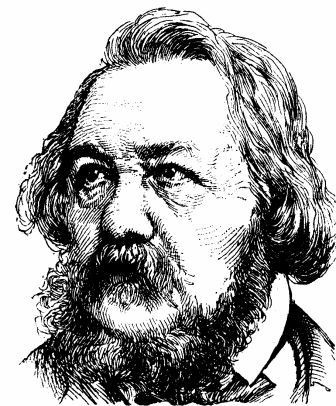
Ferdinand Freiligrath
But Freiligrath, like Uhland and Herwegh, was a man of action and a patriot. The revolution of 1848 had brought fresh breezes into the stagnation of political life; and though they soon were stilled again, the men who had breathed that air ceased to be the dreamers of dreams that the romantic poets had been. They were conscious of a mission, and became the robust heralds of a larger and a freer time.
Freiligrath was a schoolmaster's son; he was born at Detmold on June 17th, 1810, and much against his private inclinations, he was sent in his sixteenth year to an uncle in Soest to prepare himself for a mercantile career. The death of his father threw him upon his own resources, and he took a position in an Amsterdam bank. Here the inspiration of the sea widened the range of his poetic fancy. To Chamisso is due the credit of introducing the poet to the general public through the pages of the Musenalmanach. This was in 1835. In 1838 appeared the first volume of his poems, and it won instant and unusual favor; Gutzkow called him the German Hugo. With this encouragement Freiligrath definitely abandoned mercantile life. In 1841 he married. At the suggestion of Alexander von Humboldt, the King of Prussia granted him a royal pension; and as no conditions were attached, it was accepted. This was a bitter disappointment to the ardent revolutionary poets, who had counted Freiligrath as one of themselves; but the turbulent times which preceded the revolution soon forced him into an open declaration of principles, and although he had said in one of his poems that the poet was above all party, in 1844, influenced by Hoffmann von Fallersleben, he resigned his pension, announced his position, and in May published a volume of revolutionary poems entitled 'Mein Glaubensbekenntniss' (My Confession of Faith). This book created the wildest enthusiasm, and placed its author at once in the front rank of the people's partisans. He fled to Brussels, and in 1846 published under the title of 'Ça Ira' six new songs, which were a trumpet-call to revolution. The poet deemed it prudent to retire to London, and he was about to accept an invitation from Longfellow to cross the ocean when the revolution broke out, and he returned to Düsseldorf to put himself at the head of the democratic party on the Rhine. But he was a poet and not a leader, and he indiscreetly exposed himself to arrest by an inflammatory poem, 'Die Todten an die Lebenden' (The Dead to the Living). The jury however acquitted him, and he at once assumed the management of the New Rhenish Gazette at Cologne.
It is a curious fact that during this agitated time Freiligrath wrote some of his tenderest poetry. In the collection which appeared in 1849 with the title 'Zwischen den Garben' (Between the Sheaves), was included that exquisite hymn to love: 'Oh, Love So Long as Love Thou Canst,' perhaps the most perfect of all his lyrical productions, and certainly evidence that the poet could touch the strings to deep emotions. In the following year both volumes of his 'New Political and Social Poems' were ready. Once more he prudently retired to London; his fears were confirmed by the immediate confiscation of these new volumes, and by the publication of a letter of apprehension. By way of reprisal he wrote his poem 'The Revolution,' which was published in London.
In 1867 the Swiss bank with which Freiligrath was connected closed its London branch, and the poet again faced an uncertain future. His friends on the Rhine, hearing of his difficulties, raised a generous subscription, and taking advantage of a general amnesty, he returned to the fatherland and became associated with the Stuttgart Illustrated Magazine. In 1870 appeared a complete collection of his poems; in 1876, 'New Poems'; and in the latter year, on March 18th, he died at Cannstatt in Würtemburg.
The question which Freiligrath asks the emigrants in his early poem of that name,—'O say, why seek ye other lands?'—was destined to find frequent and bitter answer in his own checkered career; but he never swerved from the liberal principles which he had publicly announced. His political poems were among the most powerful influences of his time, and they have a permanent value as the expression of the spirit of freedom. His translations are marvels of fidelity and beauty. His 'Hiawatha' and 'The Ancient Mariner,' together with his versions of Victor Hugo, are perhaps the best examples of his surpassing skill. His own works have been for the most part excellently translated into English. His daughter published during her father's lifetime a volume of his poems, in which were collected all the best English translations then available. The exotic subjects of his early poems make them seem the most original, as for example 'Der Mohrenfürst' (The Moorish Prince) and 'Der Blumen Rache' (The Revenge of the Flowers); the unusual rhymes hold the attention, and the sonorous melody of the verse delights the ear: but it is in a few of his superb love lyrics that he touches the highest point of his genius, although his fame continues to rest upon his impassioned songs of freedom and his name to be associated with the rich imagery of the Orient.
THE EMIGRANTS
I cannot take my eyes away From you, ye busy, bustling band, Your little all to see you lay Each in the waiting boatman's hand.
Ye men, that from your necks set down Your heavy baskets on the earth, Of bread, from German corn baked brown By German wives on German hearth,—
And you, with braided tresses neat, Black-Forest maidens, slim and brown, How careful on the sloop's green seat You set your pails and pitchers down!
Ah! oft have home's cool shady tanks Those pails and pitchers filled for you; By far Missouri's silent banks Shall these the scenes of home renew,—
The stone-rimmed fount in village street Where oft ye stooped to chat and draw,— The hearth, and each familiar seat,— The pictured tiles your childhood saw.
Soon, in the far and wooded West Shall log-house walls therewith be graced; Soon many a tired tawny guest Shall sweet refreshment from them taste.
From them shall drink the Cherokee, Faint with the hot and dusty chase; No more from German vintage, ye Shall bear them home, in leaf-crowned grace.
O say, why seek ye other lands? The Neckar's vale hath wine and corn; Full of dark firs the Schwarzwald stands; In Spessart rings the Alp-herd's horn.
Ah, in strange forests you will yearn For the green mountains of your home,— To Deutschland's yellow wheat-fields turn,— In spirit o'er her vine-hills roam.
How will the form of days grown pale In golden dreams float softly by, Like some old legendary tale, Before fond memory's moistened eye!
The boatman calls,—go hence in peace! God bless you,—wife, and child, and sire! Bless all your fields with rich increase, And crown each faithful heart's desire!
Translation of C.T. Brooks.
THE LION'S RIDE
What! wilt thou bind him fast with a chain? Wilt bind the king of the cloudy sands? Idiot fool! he has burst from thy hands and bands, And speeds like Storm through his far domain. See! he crouches down in the sedge, By the water's edge, Making the startled sycamore boughs to quiver! Gazelle and giraffe, I think, will shun that river.
Not so! The curtain of evening falls, And the Caffre, mooring his light canoe To the shore, glides down through the hushed karroo, And the watch-fires burn in the Hottentot kraals, And the antelope seeks a bed in the bush Till dawn shall blush, And the zebra stretches his limbs by the tinkling fountain, And the changeful signals fade from the Table Mountain.
Now look through the dusk! What seest thou now? Seest such a tall giraffe! She stalks, All majesty, through the desert walks,— In search of water to cool her tongue and brow. From tract to tract of the limitless waste Behold her haste! Till, bowing her long neck down, she buries her face in The reeds, and kneeling, drinks from the river's basin.
But look again! look! see once more Those globe-eyes glare! The gigantic reeds Lie cloven and trampled like puniest weeds,— The lion leaps on the drinker's neck with a roar! Oh, what a racer! Can any behold, 'Mid the housings of gold In the stables of kings, dyes half so splendid As those on the brindled hide of yon wild animal blended?
Greedily fleshes the lion his teeth In the breast of his writhing prey; around Her neck his loose brown mane is wound. Hark, that hollow cry! She springs up from beneath And in agony flies over plains and heights. See, how she unites, Even under such monstrous and torturing trammel, With the grace of the leopard, the speed of the camel!
She reaches the central moon-lighted plain, That spreadeth around all bare and wide; Meanwhile, adown her spotted side The dusky blood-gouts rush like rain— And her woeful eyeballs, how they stare On the void of air! Yet on she flies—on, on; for her there is no retreating; And the desert can hear the heart of the doomed one beating!
And lo! A stupendous column of sand, A sand-spout out of that sandy ocean, upcurls Behind the pair in eddies and whirls; Most like some colossal brand, Or wandering spirit of wrath On his blasted path, Or the dreadful pillar that lighted the warriors and women Of Israel's land through the wilderness of Yemen.
And the vulture, scenting a coming carouse, Sails, hoarsely screaming, down the sky; The bloody hyena, be sure, is nigh,— Fierce pillager, he, of the charnel-house! The panther, too, who strangles the Cape-Town sheep As they lie asleep, Athirst for his share in the slaughter, follows; While the gore of their victim spreads like a pool in the sandy hollows!
She reels,—but the king of the brutes bestrides His tottering throne to the last: with might He plunges his terrible claws in the bright And delicate cushions of her sides. Yet hold!—fair play!—she rallies again! In vain, in vain! Her struggles but help to drain her life-blood faster; She staggers, gasps, and sinks at the feet of her slayer and master!
She staggers, she falls; she shall struggle no more! The death-rattle slightly convulses her throat; Mayest look thy last on that mangled coat, Besprent with sand, and foam, and gore! Adieu! The orient glimmers afar, And the morning-star Anon will rise over Madagascar brightly.— So rides the lion in Afric's deserts nightly.
REST IN THE BELOVED
(Ruhe in der Geliebten)
From 'Lyrics and Ballads of Heine and Other German Poets.' Copyright 1892, by Frances Hellman. Reprinted by permission of G.P. Putnam's Sons, publishers, New York.
Oh, here forever let me stay, love! Here let my resting-place e'er be; And both thy tender palms then lay, love, Upon my hot brow soothingly. Here at thy feet, before thee kneeling, In heavenly rapture let me rest, And close my eyes, bliss o'er me stealing, Within thine arms, upon thy breast.
I'll open them but to the glances That from thine own in radiance fall; The look that my whole soul entrances, O thou who art my life, my all! I'll open them but at the flowing Of burning tears that upward swell, And joyously, without my knowing, From under drooping lashes well.
Thus am I meek, and kind, and lowly, And good and gentle evermore; I have thee—now I'm blessed wholly; I have thee—now my yearning's o'er. By thy sweet love intoxicated, Within thine arms I'm lulled to rest, And every breath of thine is freighted With slumber songs that soothe my breast.
A life renewed each seems bestowing; Oh, thus to lie day after day, And hearken with a blissful glowing To what each other's heart-beats say! Lost in our love, entranced, enraptured, We disappear from time and space; We rest and dream; our souls lie captured Within oblivion's sweet embrace.
OH, LOVE SO LONG AS LOVE THOU CANST
Oh, love so long as love thou canst! Oh, love so long thy soul have need! The hour will come, the hour will come, When by the grave thy heart shall bleed!
And let thy heart forever glow And throb with love, and hold love's heat, So long on earth another heart Shall echo to its yearning beat.
And who to thee his heart shall show, Oh raise it up and make it glad! Oh make his every moment blithe, And not a moment make him sad!
Guard well thy tongue; a bitter word Soon from the mouth of anger leaps. O God! it was not meant to wound,— But ah! the other goes and weeps.
Oh, love so long as love thou canst! Oh, love so long thy soul have need! The hour will come, the hour will come, When by the grave thy heart shall bleed!
Thou kneelest down upon the grave, And sink'st in agony thine eyes,— They never more the dead shall see,— The silent church-yard hears thy sighs.
Thou mourn'st:—"Oh, look upon this heart, That here doth weep upon this mound! Forgive me if I caused thee pain,— O God, it was not meant to wound!"
But he, he sees and hears thee not; He comes not, he can never know: The mouth that kissed thee once says not, "Friend, I forgave thee long ago!"
He did forgive thee long ago, Though many a hot tear bitter fell For thee and for thy angry word; But still he slumbers soft and well!
Oh, love so long as love thou canst! Oh, love so long thy soul have need! The hour will come, the hour will come, When by the grave thy heart shall bleed!
Translation of Dr. Edward Breck.
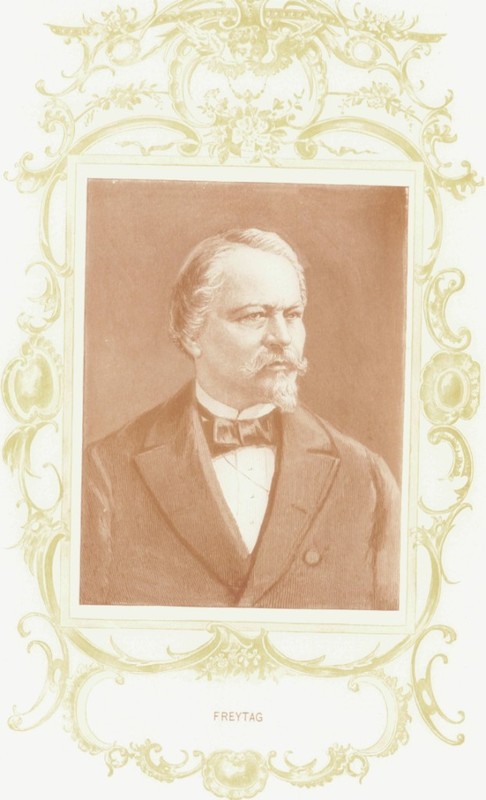
FREYTAG
GUSTAV FREYTAG
(1816-1895)

ustav Freytag, one of the foremost of German novelists, was born July 13th, 1816, in Kreuzburg, Silesia, where his father was a physician. He studied alternately at Breslau and Berlin, at which latter university he was given the degree of a doctor of philosophy in 1838. In 1839 he settled as a privatdocent at the University of Breslau, where he lectured on the German language and literature until 1844, when he resigned his position to devote himself to literature. He removed to Leipzig in 1846, and the following year to Dresden, where he married. In 1848 he returned to Leipzig to edit with Julian Schmidt the weekly journal Die Grenzboten, which he conducted until 1861, and again from 1869 to 1870. In 1867 he became Liberal member for Erfurt in the North German Reichstag. In 1870, on the breaking out of the Franco-Prussian war, he was attached to the staff of the Crown Prince, later the German Emperor Frederick III., and remained in service until after the battle of Sedan. Subsequently to 1870 his journalistic work was chiefly for the newly established weekly periodical Im Neuen Reich. In 1879 he retired from public life and afterward lived in Wiesbaden, except for the summer months, which he spent on his estate Siebleben near Gotha. He died at Wiesbaden, April 30th, 1895.
All of Freytag's earliest work, with the single exception of a volume of poems published in 1845 under the title 'In Breslau,' is dramatic. His first production was a comedy, 'Die Brautfahrt' (The Wedding Journey), published in 1844, which although it was awarded a prize offered by the Royal Theatre in Berlin, found but indifferent popular favor, as did its successor, the one-act tragedy 'Die Gelehrte' (The Scholar). With his next play, 'Die Valentine' (1846), Freytag however was signally successful. This was followed the year after by 'Graf Waldemar.' He attained his highest dramatic success with the comedy 'Die Journalisten' (The Journalists), which appeared in 1853, and since its first production in 1854 has maintained its place as one of the most popular plays on the German stage. But one other play followed, the tragedy 'Die Fabier' (The Fabii), which appeared in 1859.
He had begun in the mean time his career as a novelist with his most famous novel, 'Soll und Haben' (Debit and Credit), which was published in 1855 and met with an immediate and unbounded success. The appearance of this first novel, furthermore, was most significant, for it marked at the same time an era both in German literature and in its author's own career, in that it introduced into the one in its most recent phase one of the profoundest problems of modern life in Germany, and unmistakably pointed out, in the other, the direction which he was subsequently to follow. This latter statement has a twofold bearing. It is not only that as a writer of novels Freytag did his most important and lasting work, but that the whole of this work was in a manner the development of a similar tendency. Although as different as need be in environment, all of his subsequent novels embody inherently the characteristics of 'Debit and Credit,' for like it, they are all well-defined attempts to depict the typical social conditions of the period in which they move, and their characters are the carefully considered types of their time. Freytag, with a philosophic seriousness of purpose perhaps characteristically German, is writing not only novels but the history of civilization, in his early work. Later on, the didactic purpose to a certain extent overshadows the rest; and although he never loses his power of telling a story, it is the history in the end that is paramount.
'Debit and Credit' is a novel of the century, and it takes up the great problem of the century, the position of modern industrialism in the social life of the day. Its principal centre of action is the business house of the wholesale grocer T.O. Schröter, who is an admirable embodiment of the careful, industrious, and successful merchant. In sharp contradistinction to him is the Baron von Rothsattel, the representative of earlier conditions in the organization of the State, which made the nobleman pre-eminently a social force. Freytag's polemic is not only the dignity of labor under present conditions, but the absolute effeteness of the old order of things that despised it. The real hero of the story is Anton Wohlfahrt, who begins his commercial career as a youth in the house of T.O. Schröter, and ends, after some vicissitudes, as a member of the firm. Mercantile life has nowhere been better described in its monotony, its interests, and its aspirations, as the story is developed; and although at first sight no field could be more barren in literary interest, there is in reality no lack of incident and action, whose inevitable sequence makes the plot. Anton's career in the house of Schröter is interrupted by his connection with the Baron von Rothsattel, who has, through his want of a business training and his lack of a knowledge of men, fallen into the hands of a Jew money-lender; by whom he is persuaded to mortgage his land in order to embark in a business undertaking which it is presumed will increase his fortune. His mill fails, however, and he is involved in difficulties from which he is unable to extricate himself. Anton, the intimate friend of the family, is therefore persuaded by the Baroness to undertake the management of matters, and after vainly endeavoring to induce his principal to interest himself in the affair, sacrifices his position to accompany the family to their dilapidated estate in a distant province. The Baron will tolerate no interference, however, and Anton finally returns to the house of Schröter and is reinstated in the business. Lenore, the Baron's daughter, the first cause of Anton's interest, meantime becomes engaged to the young nobleman Fink; who has been an associate of Anton's in the office of T. O. Schröter, has but recently returned from the United States, and who first advances funds for the improvement of the estate and ultimately purchases it.
Fink acts his part in the author's philosophy as a contrast to the Baron von Rothsattel. Although a nobleman, he has adapted himself to the conditions of the century, and is free from any hallucinations of his hereditary rank, even while he is perfectly awake to its traditions. He has entered upon a commercial career not from choice, but from necessity; but he has accepted his fate and has made successful use of his opportunities. Anton marries the sister of T. O. Schröter, and becomes a partner in the business. Fink is however really the one who gains the princess in this modern tale, and is plainly to have the more important share as an actual social force in the future. The old feudal nobility has played its part on the stage of the world; and being so picturesque, and full of romantic opportunity, its loss is doubtless to be regretted. The tamer realities of the modern industrial state have succeeded it. As Freytag solves the problem in 'Soll und Haben,' it is the man who works, the man of the industrial classes alone, to whom the victory belongs in the modern social struggle, be his antecedents bourgeois or aristocratic.
Freytag's second great novel, 'Die Verlorene Handschrift' (The Lost Manuscript), which appeared in 1864, concerns itself with another phase of the same problem. This time, however, instead of the merchant and man of affairs, it is the scholar about whom the action centres. Felix Werner, professor of philology, has come upon unmistakable traces of the lost books of Tacitus, whose recovery is the object of his life. In his search for the manuscript in an old house in the country he finds his future wife Ilse, one of the finest types in all German literature of the true German woman, both while at home a maid in her father's house and subsequently as the professor's wife in the university town. Werner, in his scholarly absorption, unwittingly neglects his wife, whose beauty has attracted the attention of the prince; and there is a series of intrigues which threaten seriously to involve the innocent Ilse, until the prince's evil intentions become evident even to the unsuspecting Werner. The covers of the lost manuscript are actually discovered at last, but the book itself has vanished. In this second novel Freytag displays a most genial humor, unsuspected in the author of 'Debit and Credit,' but apparent enough in 'The Journalists.' The professorial life is admirably drawn with all its lights and shadows; and its motives and ambitions, its peculiar struggles and strivings, have never been more understandingly treated. The story, however, even more than 'Debit and Credit,' displays the author's weaknesses of construction. The plot is so confused by digressions that the main thread is sometimes lost sight of, and the tendency to philosophical generalization, which as a German is to some extent the author's birthright, reaches in these pages an appalling exemplification. What had been an extraordinary novel pruned of these defects, is still not an ordinary novel with them; and as a picture of German university life from the point of view of the professor, 'The Lost Manuscript' stands unrivaled in literature. Again the thesis in this second novel is the dignity of labor, and the nobleman fares no better at the author's hands than in the mercantile environment of the first.
These two novels, which outside of Germany are Freytag's best claim to attention, were followed by the four volumes of 'Bilder aus der Deutschen Vergangenheit' (Pictures from the German Past: 1859-62), a series of studies of German life from different epochs of its history, intended to illustrate the evolution of modern conditions through their successive stages from the remote past. Freytag's early work as a university docent had particularly fitted him for this sort of writing, and some of his best is contained in these books.
More important still, however, was his next great work, the long series of historical novels 'Die Ahnen' (The Ancestors: 1872-80), an ambitious plan, born of the stirring events of the Franco-Prussian War and the resultant awakening of the new spirit of nationality, to trace the development of the German people from the earliest time down to the present day. To carry out this purpose he accordingly selects a typical German family, which he describes under the characteristic conditions of each period, with the most conscientious attention to manners and customs and social environment. The same family thus appears from generation to generation under the changing conditions of the different epochs of German history, and the whole forms together the consecutive Culturgeschichte of the nation.
This whole long series of 'The Ancestors' stands as a monument of careful research into the most minute factors of German life in their time of action. Freytag's antiquarianism is not of the dilettante kind that is content to masquerade modern motives in ancient garb and setting. He was fully conscious of all the elements of his problem, and he sought to reproduce the intellectual point of view of his actors, and to account for their motives of action, as well as to picture accurately their material environment. It is in his super-conscientiousness in these directions that the inherent weakness of the novels of this series lies. They are too palpably reconstructions with a purpose. Their didacticism is wrapped around them like a garment; and much of the time, that is all that is visible upon the surface. As the series advances this fault grows upon them. They are in reality of very unequal interest. 'Ingo' and 'Ingraban' are the sprightliest in action, and have been as a consequence the most widely read of these later works, many of which are, in part at least, far too serious of purpose to play their part conspicuously well as novels.
The novels of 'The Ancestors' are a culmination of Freytag's literary evolution. As a playwright he will no doubt be forgotten except for 'The Journalists'; in which he has, however, left an imperishable play which German critics have not hesitated to call the best comedy of the century. The two novels of modern life from his middle period form together his greatest work, although here, and particularly in 'The Lost Manuscript,' he has overweighted his material with abstract discussion, in which his perspective has sometimes all but disappeared. Subsequently, both the 'Bilder' and 'Die Ahnen' show his decided predilection for historical studies. The struggle in his own case was between the scholar and the man of letters, in which the scholar eventually won possession of the field.
Freytag's other work includes—'Die Technik des Dramas' (The Technique of the Drama: 1863), a consideration of the principles of dramatic construction; the life of his friend Karl Malthy, 1870; and 'Der Kronprinz und die Deutsche Kaiserkrone' (The Crown Prince and the German Imperial Crown: 1889), written after the death of Frederick III., with whom Freytag had had personal relations. To accompany the collected edition of his works (1887-88), he wrote a short autobiography, 'Erinnerungen aus Meinem Leben' (Recollections from My Life).
THE GERMAN PROFESSOR
From 'The Lost Manuscript'
Professors' wives also have trouble with their husbands. Sometimes when Ilse was seated in company with her intimate friends—with Madame Raschke, Madame Struvelius, or little Madame Günther—at one of those confidential coffee parties which they did not altogether despise, many things would come to light.
The conversation with these intellectual women was certainly very interesting. It is true the talk sometimes passed lightly over the heads of the servants, and sometimes housekeeping troubles ventured out of the pond of pleasant talk like croaking frogs. To Ilse's surprise, she found that even Flaminia Struvelius could discourse seriously about preserving little gherkins, and that she sought closely for the marks of youth in a plucked goose. The merry Madame Günther aroused horror and laughter in more experienced married women, when she asserted that she could not endure the crying of little children, and that from the very first she would force her child (which she had not yet got) to proper silence by chastisement. Thus conversation sometimes left greater subjects to stray into this domain. And when unimportant subjects were reviewed, it naturally came about that the men were honored by a quiet discussion. At such times it was evident that although the subject under consideration was men in general, each of the wives was thinking of her own husband, and that each silently carried about a secret bundle of cares, and justified the conclusion of her hearers that that husband too must be difficult to manage.
Madame Raschke's troubles could not be concealed; the whole town knew them. It was notorious that one market day her husband had gone to the university in his dressing-gown—in a brilliant dressing-gown, blue and orange, with a Turkish pattern. His students, who loved him dearly and were well aware of his habits, could not succeed in suppressing a loud laugh; and Raschke had calmly hung the dressing-gown over his pulpit, held his lecture in his shirt-sleeves, and returned home in one of the students' overcoats. Since that time Madame Raschke never let her husband go out without herself inspecting him. It also appeared that all these ten years he had not been able to learn his way about the town, and she dared not change her residence, because she was quite sure that her professor would never remember it, and always return to his old home. Struvelius also occasioned much anxiety. Ilse knew about the last and greatest cause; but it also came to light that he expected his wife to read Latin proof-sheets, as she knew something of that language. Besides, he was quite incapable of refusing commissions to amiable wine merchants. At her marriage Madame Struvelius had found a whole cellar full of large and small wine casks, none of which had been drawn off, while he complained bitterly that no wine was ever brought into his cellar. Even little Madame Günther related that her husband could not give up night work; and that once, when he wandered with a lamp among his books, he came too near the curtain, which caught fire. He tore it off, and in so doing burnt his hands, and burst into the bedroom with blackened fingers in great alarm, and resembling Othello more than a mineralogist....
Raschke was wandering about in the ante-room. Here too was confusion. Gabriel had not yet returned from his distant errand; the cook had left the remains of the meal standing on a side-table till his return; and Raschke had to find his greatcoat by himself. He rummaged among the clothes, and seized hold of a coat and a hat. As he was not so absent-minded as usual to-day, a glance at the despised supper reminded him just in time that he was to eat a fowl; so he seized hold of the newspaper which Gabriel had laid ready for his master, hastily took one of the chickens out of the dish, wrapped it in the journal, and thrust it in his pocket, agreeably surprised at the depth and capaciousness it revealed. Then he rushed past the astonished cook, and out of the house. When he opened the door of the étage he stumbled against something that was crouching on the threshold. He heard a horrible growling behind him, and stormed down the stairs and out of doors.
The words of the friend whom he had left now came into his mind. Werner's whole bearing was very characteristic; and there was something fine about it. It was strange that in a moment of anger Werner's face had acquired a sudden resemblance to a bull-dog's. Here the direct chain of the philosopher's contemplations was crossed by the remembrance of the conversation on animals' souls.
"It is really a pity that it is still so difficult to determine an animal's expression of soul. If we could succeed in that, science would gain. For if we could compare in all their minutiæ the expression and gestures of human beings and higher animals, we might make most interesting deductions from their common peculiarities and their particular differences. In this way the natural origin of their dramatic movements, and perhaps some new laws, would be discovered."
While the philosopher was pondering thus, he felt a continued pulling at his coat-tails. As his wife was in the habit of giving him a gentle pull when he was walking next her absorbed in thought and they met some acquaintance, he took no further notice of it, but took off his hat, and bowing politely towards the railing of the bridge, said "Good-evening."
"These common and original elements in the mimic expression of human beings and higher animals might, if rightly understood, even open out new vistas into the great mystery of life." Another pull. Raschke mechanically took off his hat. Another pull. "Thank you, dear Aurelia, I did bow." As he spoke, the thought crossed his mind that his wife would not pull at his coat so low down. It was not she, but his little daughter Bertha who was pulling; for she often walked gravely next him, and like her mother, pulled at the bell for bows. "That will do, my dear," said he, as Bertha continued to snatch and pull at his coat-tails. "Come here, you little rogue!" and he absently put his hand behind him to seize the little tease. He seized hold of something round and shaggy; he felt sharp teeth on his fingers, and turned with a start. There he saw in the lamplight a reddish monster with a big head, shaggy hair, and a little tassel that fell back into its hind legs in lieu of a tail. His wife and daughter were horribly transformed; and he gazed in surprise on this indistinct creature which seated itself before him, and glared at him in silence.
"A strange adventure!" exclaimed Raschke. "What are you, unknown creature? Presumably a dog. Away with you!" The animal retreated a few steps. Raschke continued his meditations: "If we trace back the expression and gestures of the affections to their original forms in this manner, one of the most active laws would certainly prove to be the endeavor to attract or repel the extraneous. It would be instructive to distinguish, by means of these involuntary movements of men and animals, what is essential and what conventional. Away, dog! Do me a favor and go home. What does he want with me? Evidently he belongs to Werner's domain. The poor creature will assuredly lose itself in the town under the dominion of an idée fixe."
Meantime Speihahn's attacks were becoming more violent; and now he was marching in a quite unnatural and purely conventional manner on his hind legs, while his fore paws were leaning against the professor's back, and his teeth were actually biting into the coat.
A belated shoemaker's boy stood still and beat his leathern apron. "Is not the master ashamed to let his poor apprentice push him along like that?" In truth, the dog behind the man looked like a dwarf pushing a giant along the ice.
Raschke's interest in the dog's thoughts increased. He stood still near a lantern, examined and felt his coat. This coat had developed a velvet collar and very long sleeves, advantages that the philosopher had never yet remarked in his greatcoat. Now the matter became clear to him: absorbed in thought, he had chosen a wrong coat, and the worthy dog insisted on saving his master's garment, and making the thief aware that there was something wrong. Raschke was so pleased with this sagacity that he turned round, addressed some kind words to Speihahn, and made an attempt to stroke his shaggy hair. The dog again snapped at his hand. "You are quite right to be angry with me," replied Raschke; "I will prove to you that I acknowledge my fault." He took off the coat and hung it over his arm. "Yes, it is much heavier than my own." He walked on cheerfully in his thin coat, and observed with satisfaction that the dog abandoned the attacks on his back. But instead, Speihahn sprang upon his side, and again bit at the coat and the hand, and growled unpleasantly.
The professor got angry with the dog, and when he came to a bench on the promenade he laid down the coat, intending to face the dog seriously and drive him home. In this manner he got rid of the dog, but also of the coat. For Speihahn sprang upon the bench with a mighty bound, placed himself astride the coat, and met the professor, who tried to drive him away, with hideous growling and snarling.
"It is Werner's coat," said the professor, "and it is Werner's dog: it would be wrong to beat the poor creature because it is becoming violent in its fidelity, and it would be wrong to leave the dog and the coat." So he remained standing before the dog and speaking kindly to him: but Speihahn no longer took any notice of the professor; he turned against the coat itself, which he scratched, rummaged, and bit. Raschke saw that the coat could not long endure such rage. "He is frantic or mad," said he suspiciously. "I shall have to use force against you after all, poor creature;" and he considered whether he should also jump upon the seat and push the mad creature by a violent kick into the water, or whether it would be better to open the inevitable attack from below. He resolved on the latter course, and looked round to see whether he could anywhere discover a stone or stick to throw at the raging beast. As he looked, he observed the trees and the dark sky above him, and the place seemed quite unfamiliar. "Has magic been at work here?" he exclaimed, with amusement. He turned politely to a solitary wanderer who was passing that way: "Would you kindly tell me in what part of the town we are? And could you perhaps lend me your stick for a moment?"
"Indeed," angrily replied the person addressed, "those are very suspicious questions. I want my stick myself at night. Who are you, sir?" The stranger approached the professor menacingly.
"I am peaceable," replied Raschke, "and by no means inclined to violent attacks. A quarrel has arisen between me and the animal on this seat for the possession of a coat, and I should be much obliged to you if you would drive the dog away from the coat. But I beg you not to hurt the animal any more than is absolutely necessary."
"Is that your coat there?" asked the man.
"Unfortunately I cannot give you an affirmative answer," replied Raschke conscientiously.
"There must be something wrong here," exclaimed the stranger, again eyeing the professor suspiciously.
"There is, indeed," replied Raschke. "The dog is out of his mind; the coat is exchanged, and I do not know where we are."
"Close to the valley gate, Professor Raschke," answered the voice of Gabriel, who hastily joined the group. "Excuse me, but what brings you here?"
"Capital!" exclaimed Raschke joyously. "Pray take charge of this coat and this dog."
Gabriel gazed in amazement at Speihahn, who was now lying on the coat and bending his head before his friend. Gabriel threw down the dog and seized the coat. "Why, that is our greatcoat!" exclaimed he.
"Yes, Gabriel," said the professor, "that was my mistake, and the dog has shown marvelous fidelity to the coat."
"Fidelity!" exclaimed Gabriel indignantly, as he drew a parcel out of the coat pocket. "It was greedy selfishness, sir; there must be some food in this pocket."
"Yes, true," exclaimed Raschke; "it is all the chicken's fault. Give me the parcel, Gabriel; I must eat the fowl myself; and we might bid each other good-night now with mutual satisfaction, if you would just show me my way a little among these trees."
"But you must not go home in the night air without an overcoat," said Gabriel considerately. "We are not far from our house; the best way would really be for you to come back with me, sir."
Raschke considered and laughed.
"You are right, Gabriel; my departure was awkward; and to-day an animal's soul has restored a man's soul to order."
"If you mean this dog," said Gabriel, "it would be the first time he ever did anything good. I see he must have followed you from our door; for I put little bones there for him of an evening."
"Just now he seemed not to be quite in his right mind," said the professor.
"He is cunning enough when he pleases," continued Gabriel mysteriously; "but if I were to speak of my experiences with this dog—"
"Do speak, Gabriel," eagerly exclaimed the philosopher. "There is nothing so valuable concerning animals as a truthful statement from those who have carefully observed them."
"I may say that I have done so," confirmed Gabriel, with satisfaction; "and if you want to know exactly what he is, I can assure you that he is possessed of the devil, he is a thief, he is embittered, and he hates all mankind."
"Ah, indeed!" replied the professor, somewhat disconcerted. "I see it is much more difficult to look into a dog's heart than into a professor's."
Speihahn crept along silent and suppressed, and listened to the praises that fell to his lot; while Professor Raschke, conducted by Gabriel, returned to the house by the park. Gabriel opened the sitting-room door, and announced:—
"Professor Raschke."
Ilse extended both her hands to him.
"Welcome, welcome, dear Professor Raschke!" and led him to her husband's study.
"Here I am again," said Raschke cheerfully, "after wandering as in a fairy tale. What has brought me back were two animals, who showed me the right way,—a roast fowl and an embittered dog."
Felix sprang up; the men greeted one another warmly, shaking hands, and after all misadventures, spent a happy evening.
When Raschke had gone home late, Gabriel said sadly to his mistress, "This was the new coat; the fowl and the dog have put it in a horrible plight."
FRIEDRICH FROEBEL
(1782-1852)
BY NORA ARCHIBALD SMITH
t was Froebel who said, "The clearer the thread that runs through our lives backward to our childhood, the clearer will be our onward glance to the goal;" and in the fragment of autobiography he has left us, he illustrates forcibly the truth of his own saying. The motherless baby who plays alone in the village pastor's quiet house, the dreamy child who wanders solitary in the high-walled garden; the thoughtful lad, neglected, misunderstood, who forgets the harsh realities of life in pondering the mysteries of the flowers, the contradictions of existence, and the dogmas of orthodox theology; who decides in early boyhood that the pleasures of the senses are without enduring influence and therefore on no account to be eagerly pursued;—these presentments of himself, which he summons up for us from the past, show the vividness of his early recollections and indicate the course which the stream of his life is to run.
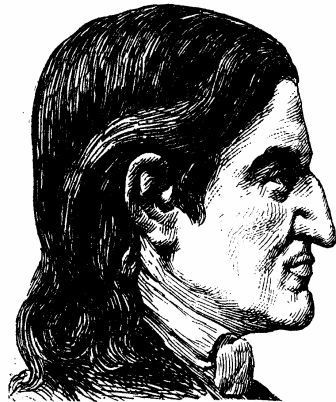
Friedrich Froebel
The coldness and injustice of the new mother who assumed control of the household when he was four years old, his isolation from other children, the merely casual notice he received from the busy father absorbed in his parish work, all tended to turn inward the tide of his mental and spiritual life. He studied himself, not only because it was the bent of his nature, but because he lacked outside objects of interest; and to this early habit of introspection we owe many of the valuable features of his educational philosophy. Whoever has learned thoroughly to understand one child, has conquered a spot of firm ground on which to rest while he studies the world of children; and because the great teacher realized this truth, because he longed to give to others the means of development denied to himself, he turns for us the heart-leaves of his boyhood.
It would appear that Froebel's characteristics were strongly marked and unusual from the beginning. Called by every one "a moon-struck child" in Oberweissbach, the village of his birth, he was just as unanimously considered "an old fool" when, crowned with the experience of seventy years, he played with the village children on the green hills of Thuringia. The intensity of his inward life, the white heat of his convictions, his absolute blindness to any selfish idea or aim, his enthusiasm, the exaltation of his spiritual nature, all furnish so many cogent reasons why the people of any day or of any community should have failed to understand him, and scorned what they could not comprehend. It is the old story of the seers and the prophets repeated as many times as they appear; for "these colossal souls," as Emerson said, "require a long focal distance to be seen."
At ten years old the sensitive boy was fortunately removed from the uncongenial atmosphere of the parental household; and in his uncle's home he spent five free and happy years, being apprenticed at the end of this time to a forester in his native Thuringian woods. Then followed a year's course in the University of Jena, and four years spent in the study of farming, in clerical work of various kinds, and in land-surveying. All these employments, however, Froebel himself felt to be merely provisional; for like the hazel wand in the diviner's hand, his instinct was blindly seeking through these restless years the well-spring of his life.
In Frankfort, where he had gone intending to study architecture, Destiny touched him on the shoulder, and he turned and knew her. Through a curious combination of circumstances he gained employment in Herr Gruner's Model School, and it was found at once that he was what the Germans love to call "a teacher by the grace of God." The first time he met his class of boys he tells us that he felt inexpressibly happy; the hazel wand had found the waters and was fixed at last. From this time on, all the events of his life were connected with his experience as a teacher. Impelled as soon as he had begun his work by a desire for more effective methods, he visited Yverdon, then the centre of educational thought, and studied with Pestalozzi. He went again in 1808, accompanied by three pupils, and spent two years there, alternately studying and teaching.
There was a year of lectures at Göttingen after this, and one at the University of Berlin, accompanied by unceasing study and research both in literary and scientific lines; but in the fateful year 1813 this quiet student life was broken in upon, for impelled by strong moral conviction, Froebel joined Baron von Lützow's famous volunteer corps, formed to harass the French by constant skirmishes and to encourage the smaller German States to rise against Napoleon.
No thirst for glory prompted this action, but a lofty conception of the office of the educator. How could any young man capable of bearing arms, Froebel says, become a teacher of children whose Fatherland he had refused to defend? how could he in after years incite his pupils to do something noble, something calling for sacrifice and unselfishness, without exposing himself to their derision and contempt? The reasoning was perfect, and he made practice follow upon the heels of theory as closely as he had always done since he became master of his fate.
After the Peace of Paris he settled down for a time to a quiet life in the mineralogical museum at the University of Berlin, his duties being the care, arrangement, and investigation of crystals. Surrounded thus by the exquisite formations whose development according to law is so perfect, whose obedience to the promptings of an inward ideal so complete, he could not but learn from their unconscious ethics to look into the depths of his own nature, and there recognize more clearly the purpose it was intended to work out.
In 1816 he quietly gave up his position, and taking as pupils five of his nephews, three of whom were fatherless, he entered upon his life work, the first step in which was the carrying out of his plan for a "Universal German Educational Institute." He was without money, of course, as he had always been and always would be,—his hands were made for giving, not for getting; he slept in a barn on a wisp of straw while arranging for his first school at Griesheim; but outward things were so little real to him in comparison with the life of the spirit, that bodily privations seemed scarcely worth considering. The school at Keilhau, to which he soon removed, the institutions later established in Wartensee and Willisau, the orphanage in Burgdorf, all were most successful educationally, but, it is hardly necessary to say, were never a source of profit to their head and founder.
Through the twenty succeeding years, busy as he was in teaching, in lecturing, in writing, he was constantly shadowed by dissatisfaction with the foundation upon which he was building. A nebulous idea for the betterment of things was floating before him; but it was not until 1836 that it appeared to his eyes as a "definite truth." This definite truth, the discovery of his old age, was of course the kindergarten; and from this time until the end, all other work was laid aside, and his entire strength given to the consummate flower of his educational thought.
The first kindergarten was opened in 1837 at Blankenburg (where a memorial school is now conducted), and in 1850 the institution at Marienthal for the training of kindergartners was founded, Froebel remaining at its head until his death two years after.
With the exception of that remarkable book 'The Education of Man' (1826), his most important literary work was done after 1836; 'Pedagogics of the Kindergarten,' the first great European contribution to the subject of child-study, appearing from 1837 to 1840 in the form of separate essays, and the 'Mutter-und-Kose Lieder' (Mother-Play) in 1843. Many of his educational aphorisms and occasional speeches were preserved by his great disciple the Baroness von Marenholtz-Bülow in her 'Reminiscences of Froebel'; and though two most interesting volumes of his correspondence have been published, there remain a number of letters, as well as essays and educational sketches, not yet rendered into English.
Froebel's literary style is often stiff and involved, its phrases somewhat labored, and its substance exceedingly difficult to translate with spirit and fidelity; yet after all, his mannerisms are of a kind to which one easily becomes accustomed, and the kernel of his thought when reached is found well worth the trouble of removing a layer of husk. He had always an infinitude of things to say, and they were all things of purpose and of meaning; but in writing, as well as in formal speaking, the language to clothe the thought came to him slowly and with difficulty. Yet it appears that in friendly private intercourse he spoke fluently, and one of his students reports that in his classes he was often "overpowering and sublime, the stream of his words pouring forth like fiery rain."
It is probable that in daily life Froebel was not always an agreeable house-mate; for he was a genius, a reformer, and an unworldly enthusiast, believing in himself and in his mission with all the ardor of a heart centred in one fixed purpose. He was quite intolerant of those who doubted or disbelieved in his theories, as well as of those who, believing, did not carry their faith into works. The people who stood nearest him and devoted themselves to the furthering of his ideas slept on no bed of roses, certainly; but although he sometimes sacrificed their private interests to his cause, it must not be forgotten that he first laid himself and all that he had upon the same altar. His nature was one that naturally inspired reverence and loyalty, and drew from his associates the most extraordinary devotion and self-sacrifice. Then, as now, women were peculiarly attracted by his burning enthusiasm, his prophetic utterances, and his lofty views of their sex and its mission; and then, as now, the almost fanatical zeal of his followers is perhaps to be explained by the fact that he gives a new world-view to his students,—one that produces much the same effect upon the character as the spiritual exaltation called "experiencing religion."
He was twice married, in each case to a superior woman of great gifts of mind and character, and both helpmates joyfully took up a life of privation and care that they might be associated with him and with his work. Those memorable words spoken of our Washington,—"Heaven left him childless that a nation might call him father," are even more applicable to Froebel, for his wise and tender fatherhood extends to all the children of the world. When he passed through the village streets of his own country, little ones came running from every doorstep; the babies clinging to his knees and the older ones hanging about his neck and refusing to leave the dear play-master, as they called him. So the kindergartners love to think of him to-day,—the tall spare figure, the long hair, the wise, plain, strong-featured face, the shining eyes, and the little ones clustering about him as they clustered about another Teacher in Galilee, centuries ago.
Froebel's educational creed cannot here be cited at length, but some of its fundamental articles are:—
The education of the child should begin with its birth, and should be threefold, addressing the mental, spiritual, and physical natures.
It should be continued as it has begun, by appealing to the heart and the emotions as the starting-point of the human soul.
There should be sequence, orderly progression, and one continuous purpose throughout the entire scheme of education, from kindergarten to university.
Education should be conducted according to nature, and should be a free, spontaneous growth,—a development from within, never a prescription from without.
The training of the child should be conducted by means of the activities, needs, desires, and delights, which are the common heritage of childhood.
The child should be led from the beginning to feel that one life thrills through every manifestation of the universe, and that he is a part of all that is.
The object of education is the development of the human being in the totality of his powers as a child of nature, a child of man, and a child of God.
These principles of Froebel's, many of them the products of his own mind, others the pure gold of educational currency upon which he has but stamped his own image, are so true and so far-reaching that they have already begun to modify all education and are destined to work greater magic in the future. The great teacher's place in history may be determined, by-and-by, more by the wonderful uplift and impetus he gave to the whole educational world, than by the particular system of child-culture in connection with which he is best known to-day.
Judged by ordinary worldly standards, his life was an unsuccessful one, full of trials and privations, and empty of reward. His death-blow was doubtless struck by the prohibition of kindergartens in Prussia in 1851, an edict which remained nine years in force. His strength had been too sorely tried to resist this final crushing misfortune, and he passed away the following year. His body was borne to the grave through a heavy storm of wind and rain that seemed to symbolize the vicissitudes of his earthly days, while as a forecast of the future the sun shone out at the last moment, and the train of mourners looked back to see the low mound irradiated with glory.
In Thuringia, where the great child-lover was born, the kindergartens, his best memorials, cluster thickly now; and on the face of the cliffs that overhang the bridle-path across the Glockner mountain may be seen in great letters the single word Froebel, hewn deep into the solid rock.
THE RIGHT OF THE CHILD
From 'Reminiscences of Friedrich Froebel,' by Baroness B. von Marenholtz-Bülow. Copyright 1877, by Mary Mann. Reprinted by permission of Lee & Shepard, publishers, Boston.
All that does not grow out of one's inner being, all that is not one's own original feeling and thought, or that at least does not awaken that, oppresses and defaces the individuality of man instead of calling it forth, and nature becomes thereby a caricature. Shall we never cease to stamp human nature, even in childhood, like coins? to overlay it with foreign images and foreign superscriptions, instead of letting it develop itself and grow into form according to the law of life planted in it by God the Father, so that it may be able to bear the stamp of the Divine, and become an image of God?...
This theory of love is to serve as the highest goal and polestar of human education, and must be attended to in the germ of humanity, the child, and truly in his very first impulses. The conquest of self-seeking egoism is the most important task of education; for selfishness isolates the individual from all communion, and kills the life-giving principle of love. Therefore the first object of education is to teach to love, to break up the egoism of the individual, and to lead him from the first stage of communion in the family through all the following stages of social life to the love of humanity, or to the highest self-conquest by which man rises to Divine unity....
Women are to recognize that childhood and womanliness (the care of childhood and the life of women) are inseparably connected; that they form a unit; and that God and nature have placed the protection of the human plant in their hands. Hitherto the female sex could take only a more or less passive part in human history, because great battles and the political organization of nations were not suited to their powers. But at the present stage of culture, nothing is more pressingly required than the cultivation of every human power for the arts of peace and the work of higher civilization. The culture of individuals, and therefore of the whole nation, depends in great part upon the earliest care of childhood. On that account women, as one half of mankind, have to undertake the most important part of the problems of the time, problems that men are not able to solve. If but one half of the work be accomplished, then our epoch, like all others, will fail to reach the appointed goal. As educators of mankind, the women of the present time have the highest duty to perform, while hitherto they have been scarcely more than the beloved mothers of human beings....
But I will protect childhood, that it may not as in earlier generations be pinioned, as in a strait-jacket, in garments of custom and ancient prescription that have become too narrow for the new time. I shall show the way and shape the means, that every human soul may grow of itself, out of its own individuality. But where shall I find allies and helpers if not in women, who as mothers and teachers may put my idea in execution? Only intellectually active women can and will do it. But if these are to be loaded with the ballast of dead knowledge that can take no root in the unprepared ground, if the fountains of their own original life are to be choked up with it, they will not follow my direction nor understand the call of the time for the new task of their sex, but will seek satisfaction in empty superficiality.
To learn to comprehend nature in the child,—is not that to comprehend one's own nature and the nature of mankind? And in this comprehension is there not involved a certain degree of comprehension of all things else? Women cannot learn and take into themselves anything higher and more comprehensive. It should therefore at least be the beginning, and the love of childhood should be awakened in the mind (and in a wider sense, this is the love of humanity), so that a new, free generation of men can grow up by right care.
EVOLUTION
From 'The Mottoes and Commentaries of Mother-Play.' Copyright 1895, by D. Appleton & Co.
What shall we learn from our yearning look into the heart of the flower and the eye of the child? This truth: Whatever develops, be it into flower or tree or man, is from the beginning implicitly that which it has the power to become. The possibility of perfect manhood is what you read in your child's eye, just as the perfect flower is prophesied in the bud, or the giant oak in the tiny acorn. A presentiment that the ideal or generic human being slumbers, dreams, stirs in your unconscious infant—this it is, O mother, which transfigures you as you gaze upon him. Strive to define to yourself what is that generic ideal which is wrapped up in your child. Surely, as your child—or in other words, as child of man—he is destined to live in the past and future as well as in the present. His earthly being implies a past heaven; his birth makes a present heaven; in his soul he holds a future heaven. This threefold heaven, which you also bear within you, shines out on you through your child's eyes.
The beast lives only in the present. Of past and future he knows naught. But to man belong not only the present, but also the future and the past. His thought pierces the heaven of the future, and hope is born. He learns that all human life is one life; that all human joys and sorrows are his joys and sorrows, and through participation enters the present heaven—the heaven of love. He turns his mind towards the past, and out of retrospection wrests a vigorous faith. What soul could fail to conquer an invincible trust in the pure, the good, the holy, the ideally human, the truly Divine, if it would look with single eye into its own past, into the past of history? Could there be a man in whose soul such a contemplation of the past would fail to blossom into devout insight, into self-conscious and self-comprehending faith? Must not such a retrospect unveil the truth? Must not the beauty of the unveiled truth allure him to Divine doing, Divine living? All that is high and holy in human life meets in that faith which is born of the unveiling of a heaven that has always been; in that hope born of a vision of the heaven that shall be; in that love which creates a heaven in the eternal Now. These three heavens shine out upon you through your child's eye. The presentiment that he carries these three heavens within him transfigures your countenance as you gaze upon him. Cherish this premonition, for thereby you will help him to make his life a musical chord wherein are blended the three notes of faith, hope, and love. These celestial virtues will link his life with the Divine life through which all life is one—with the God who is the supernal fountain of life, light, and love....
Higher and more important than the cultivation of man's outer ear, is the culture of that inner sense of harmony whereby the soul learns to perceive sweet accord in soundless things, and to discern within itself harmonies and discords. The importance of wakening the inner ear to this music of the soul can scarcely be exaggerated. Learning to hear it within, the child will strive to give it outer form and expression; and even if in such effort he is only partially successful, he will gain thereby the power to appreciate the more successful effort of others. Thus enriching his own life by the life of others, he solves the problem of development. How else were it possible within the quickly fleeting hours of mortal life to develop our being in all directions, to fathom its depths, scale its heights, measure its boundaries? What we are, what we would be, we must learn to recognize in the mirror of all other lives. By the effort of each, and the recognition of all, the Divine man is revealed in humanity....
Against the bright light which shines on the smooth white wall is thrust a dark object, and straightway appears the form which so delights the child. This is the outward fact; what is the truth which through this fact is dimly hinted to the prophetic mind? Is it not the creative and transforming power of light, that power which brings form and color out of chaos, and makes the beauty which gladdens our hearts? Is it not more than this,—a foreshadowing, perhaps, of the spiritual fact that our darkest experiences may project themselves in forms that will delight and bless, if in our hearts shines the light of God? The sternest crags, the most forbidding chasms, are beautiful in the mellow sunshine; while the fairest landscape loses all charm, and indeed ceases to be, when the light which created it is withdrawn. Is it not thus also with our lives? Yesterday, touched by the light of enthusiastic emotion, all our relationships seemed beautiful and blessed; to-day, when the glow of enthusiasm has faded, they oppress and repulse us. Only the conviction that it is the darkness within us which makes the darkness without, can restore the lost peace of our souls. Be it therefore, O mother, your sacred duty to make your darling early feel the working both of the outer and inner light. Let him see in one the symbol of the other, and tracing light and color to their source in the sun, may he learn to trace the beauty and meaning of his life to their source in God.
Translation of Susan E. Blow.
THE LAWS OF THE MIND
From 'The Letters of Froebel'
I am firmly convinced that all the phenomena of the child-world, those which delight us as well as those which grieve us, depend upon fixed laws as definite as those of the cosmos, the planetary system, and the operations of nature; and it is therefore possible to discover them and examine them. When once we know and have assimilated these laws, we shall be able powerfully to counteract any retrograde and faulty tendencies in the children, and to encourage, at the same time, all that is good and virtuous.
FOR THE CHILDREN
From 'The Letters of Froebel'
I wish you could have been here this evening, and seen the many beautiful and varied forms and lovely patterns which freely and spontaneously developed themselves from some systematic variations of a simple ground form, in stick-playing. No one would believe, without seeing it, how the child soul, the child life, develops when treated as a whole, and in the sense of forming a part of the great connected life of the world, by some skilled kindergarten teacher—nay, even by one who is only simple-hearted, thoughtful, and attentive; nor how it blooms into delicious harmonies like a beautifully tinted flower. Oh, if I could only shout aloud with ten thousand lung-power the truth that I now tell you in silence! Then would I make the ears of a hundred thousand men ring with it! What keenness of sensation, what a soul, what a mind, what force of will and active energy, what dexterity and skill of muscular movement and of perception, and what calm and patience, will not all these things call out in the children!
How is it that parents are so blind and deaf, when they profess to be so eager to work for the welfare, the health, and peace of their children? No! I cannot understand it; and yet a whole generation has passed since this system first delivered its message, first called for educational amendment, first pointed out where the need for it lay, and showed how it could be satisfied.
If I were not afraid of being taken for an idiot or an escaped lunatic, I would run barefoot from one end of Germany to the other and cry aloud to all men:—"Set to work at once for your children's sake on some universally developing plan, aiming at unity of life purpose, and through that at joy and peace." But what good would it do? A Curtman and a Ramsauer, in their stupidity or maliciousness, make it their duty to stigmatize my work as sinful, when I am but quietly corresponding with just my own friends and sympathizers; for they say I am destroying all pleasure in life for the parents: "Who could be so silly as I,—amongst sane men who acknowledge that parents have a right to enjoy life,—I who perpetually call to these parents in tones of imperative demand, 'Come, let us live for our children!'" (Kommt, laszt uns unseren Kindern leben!)
MOTIVES
From 'The Education of Man.' By permission of Josephine Jarvis, the translator, and A. Lovell & Co., publishers
Only in the measure that we are thoroughly penetrated by the pure, spiritual, inward, human relations, and are faithful to them even in the smallest detail in life, do we attain to the complete knowledge and perception of the Divine-human relation; only in that measure do we anticipate them so deeply, vividly, and truly, that every yearning of our whole being is thereby satisfied,—at least receives its whole meaning, and is changed from a constantly unfulfilled yearning to an immediately rewarded effort....
How we degrade and lower the human nature which we should raise, how we weaken those whom we should strengthen, when we hold up to them an inducement to act virtuously, even though we place this inducement in another world! If we employ an outward incentive, though it be the most spiritual, to call forth better life, and leave undeveloped the inner, spontaneous, and independent power of representing pure humanity which rests in each man, we degrade our human nature.
But how wholly different every thing is, if man, especially in boyhood, is made to observe the reflex action of his conduct, not on his outward more or less agreeable position, but on his inner, spontaneous or fettered, clear or clouded, satisfied or dissatisfied condition of spirit and mind! The experiences which proceed from this observation will necessarily more and more awaken the inner sense of man: and then true sense, the greatest treasure of boy and man, comes into his life.
APHORISMS
I see in every child the possibility of a perfect man.
The child-soul is an ever-bubbling fountain in the world of humanity.
The plays of childhood are the heart-leaves of the whole future life.
Childish unconsciousness is rest in God.
From each object of nature and of life, there goes a path toward God.
Perfect human joy is also worship, for it is ordered by God.
The first groundwork of religious life is love—love to God and man—in the bosom of the family.
Childhood is the most important stage of the total development of man and of humanity.
Women must make of their educational calling a priestly office.
Isolation and exclusion destroy life; union and participation create life.
Without religious preparation in childhood, no true religion and no union with God is possible for men.
The tree germ bears within itself the nature of the whole tree; the human being bears in himself the nature of all humanity; and is not therefore humanity born anew in each child?
In the children lies the seed-corn of the future.
The lovingly cared for, and thereby steadily and strongly developed human life, also the cloudless child life, is of itself a Christ-like one.
In all things works one creative life, because the life of all things proceeds from one God.
Let us live with our children: so shall their lives bring peace and joy to us; so shall we begin to be and to become wise.
What boys and girls play in earliest childhood will become by-and-by a beautiful reality of serious life; for they expand into stronger and lovelier youthfulness by seeking on every side appropriate objects to verify the thoughts of their inmost souls.
This earliest age is the most important one for education, because the beginning decides the manner of progress and the end. If national order is to be recognized in later years as a benefit, childhood must first be accustomed to law and order, and therein find the means of freedom. Lawlessness and caprice must rule in no period of life, not even in that of the nursling.
The kindergarten is the free republic of childhood.
A deep feeling of the universal brotherhood of man,—what is it but a true sense of our close filial union with God?
Man must be able to fail, in order to be good and virtuous; and he must be able to become a slave in order to be truly free.
My teachers are the children themselves, with all their purity, their innocence, their unconsciousness, and their irresistible claims; and I follow them like a faithful, trustful scholar.
A story told at the right time is like a looking-glass for the mind.
I wish to cultivate men who stand rooted in nature, with their feet in God's earth, whose heads reach toward and look into the heavens; whose hearts unite the richly formed life of earth and nature, with the purity and peace of heaven,—God's earth and God's heaven.
THE MENAGERIE. Photogravure from a Painting by T. R. Sunderland.
"What boys and girls play in earliest childhood will become by-and-by a beautiful reality of serious life; for they expand into stronger and lovelier youthfulness by seeking on every side appropriate objects to verify the thoughts of their inmost souls."—Froebel.
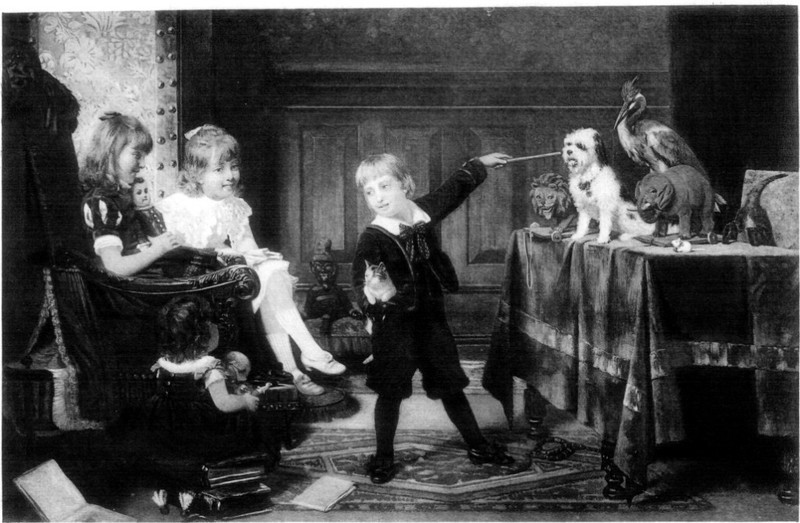
FROISSART
(1337-1410?)
BY GEORGE McLEAN HARPER
roissart is the artist of chivalry. On his pages are painted, with immortal brilliancy, the splendid shows, the coronations, weddings, tourneys, marches, feasts, and battles of the English and French knighthood just before the close of the Middle Ages. "I intend," he says in the Prologue of his chronicle, "to treat and record history and matter of great praise, to the end that the honorable emprises and noble adventures and deeds of arms, which have come about from the wars of France and England, may be notably enregistered and placed in perpetual memory, whereby chevaliers may take example to encourage them in well-doing."
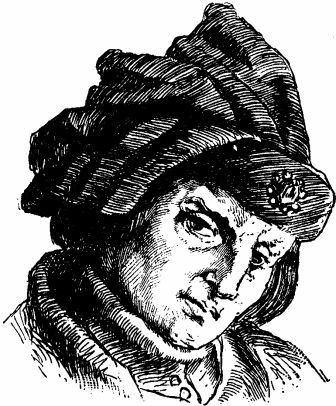
Froissart
Chivalry, in the popular understanding, is the fine flower of feudalism, its bloom of poetic and heroic life. But in reality it was artificial, having grown from an exaggerated respect for certain human qualities, at the expense of others fully as essential and indeed no less beautiful. Courage is good; but it is not rare, and the love of fighting for fighting's sake is made possible only by disregarding large areas of life to which war brings no harvest of happiness, and over which it does not even cast the glamor of romance. The works of civilized communities—agriculture, industry, commerce, art, learning, religion—were nearly at a standstill in the middle of the fourteenth century, when Europe was turned into a playground for steel-clad barbarians.
This perversion of nature could not last. The wretched Hundred Years' War had run but half its course when the misery and disgust among the real people, who thought and wrought, drove them to such despairing efforts as the Jacquerie in France and Wat Tyler's Rebellion in England. It was the English archers, as Froissart reluctantly admits, and not the knights, who won the battle of Poitiers. Gunpowder and cannon, a few years later, doomed the man-at-arms, and the rise of strong monarchies crowded out the feudal system. The thunder of artillery which echoes faintly in the last pages of Froissart is like a parting salvo to all the pageantry the volume holds. From cannon-ball and musket-shot the glittering procession has found refuge there. Into the safe retreat of these illuminated parchments, all the banners and pennons, lances, crests, and tapestries, knights and horses under clanking mail, had time—and but just time—to withdraw. We find them there, fresh as when they hurried in, the colors bright, the trumpets blowing.
Jean Froissart was born at Valenciennes in Hainault, in 1337, the year of his birth almost coinciding with Chaucer's. He tells us in his long autobiographical poem, 'L'Espinette Amoureuse,' that he was fond of play when a boy, and delighted in dances, carols, and poems, and had a liking for all those who loved dogs and birds. In the school where he was sent, he says, there were little girls whom he tried to please by giving them rings of glass, and pins, and apples, and pears. It seemed to him a most worthy thing to acquire their favor, and he wondered when it would be his turn to fall really in love. Much of this poem, which narrates tediously the love affair that was not long in coming, is probably fictitious; but there is no doubt of the accuracy of his description of himself in the opening lines, as fond of pleasure, prone to gallantry, and susceptible to all the bright faces of romance. From love and arms, he says, we are often told that all joy and every honor flow. He informs us elsewhere that he was no sooner out of school than he began to write, putting into verse the wars of his time.
In 1361 he went to England, where Edward III was reigning with Philippa his queen, a daughter of the Count of Hainault. His passport to the favor of his great countrywoman was a book, the result of these rhymings, covering the period from the battle of Poitiers, 1356, to the time of his voyage. This volume is not known to exist, nor any copy of it. The Queen made him a clerk of her chamber. He had abundant opportunity in England to gratify his curiosity and fill his note-book, for the court was full of French noblemen, lately come over as hostages for King Jean of France, who was captured at the battle of Poitiers.
In 1365 he took letters of recommendation from the Queen to David Bruce, King of Scotland, whom he followed for three months in his progress through that realm; spending a fortnight at the castle of William Douglas and making everywhere diligent inquiry about the recent war of 1345. In his delightful little poem 'The Debate between the Horse and the Greyhound,' beginning, "Froissart from Scotland was returning," we have a lifelike figure of the inquisitive young chronicler, pushing unweariedly from inn to inn on a tired horse and leading a footsore dog.
Between his thirtieth and his thirty-fourth year he was sometimes in England and sometimes in various parts of the Continent. In August 1369, while he was abroad, his patroness Queen Philippa died. She had encouraged him to continue his researches and writings, and he had presented her with a second volume, in prose, which has come down to us as a part of the chronicle. He admits that his work was an expansion of the chronicle of Jean le Bel, Canon of Saint Lambert at Liège, for he says:—"As all great rivers are made by the gathering together of many streams and springs, so the sciences also are extracted and compiled by many clerks: what one knows, the other does not."
On hearing of the Queen's death, Froissart settled in his own country of Hainault. There he won favor from princes, as was his custom, by giving them manuscripts of his chronicle, which was growing apace. By the middle of 1373 we find him become a churchman and provided with a living, in which he remained ten years, compiling fresh history and correcting what he had already written and put in circulation. A little later, 1376 to 1383, he made a more thorough revision of his chronicle, going so far as to modify its spirit, which had been favorable to English character and policy, and make it more agreeable to partisans of France. Although Froissart was not a Frenchman, his writings are all in the French language, which was of course his native tongue.
About the beginning of 1384 he was made a canon of the Church, at Chimay, a small town near the French frontier, and in this region he observed the military movements then going on there, and recorded them immediately in Book ii. of his chronicle. Four years of quiet were however too much for his mobile and energetic spirit; and in 1388, hearing that the Count Gaston de Foix, in the Pyrenees, was a man likely to know many details of the English wars in Gascony and Guyenne, he set out to visit him, taking among other presents a book of his poetry and two couples of hounds. When he still had ten days to travel he met a gentleman of Foix, with whom he journeyed the rest of the way, beguiling the time with talk about the sieges the various towns upon their route had suffered.
"At the words which he spoke I was delighted, for they pleased me much, and right well did I retain them all; and as soon as I had dismounted at the hostelries along the road which we traveled together, I wrote them down, at evening as in the morning, to have a better record of them in times to come; for there is nothing so retentive as writing."
Count Gaston received him hospitably, and filled his three months' sojourn with stories of great events. Then Froissart visited many towns of Provence and Languedoc. These peregrinations furnished much of the material for Book iii. Little more is known of his life, except with respect to a visit to England which he made in 1394, and which enabled him to collect material for a large part of Book iv., the last in the chronicle. He is supposed to have died at Chimay, later than 1400, and perhaps, as tradition asserts, in 1410.
It is an engaging picture, this, of a genial, sharp-eyed, somewhat worldly churchman, riding his gray horse over hill and dale in quest of knowledge. We can fancy him arriving at his inn of an evening, and at once asking the obsequious host what knight or other great person dwells in the neighborhood. He loses no time before calling at the castle, and is gladly admitted when he tells his well-known name. He is ready to pay for any historical information with a story from his own collection. He is welcome everywhere, and for his part does not regret the time thus spent, nor the money,—several fortunes, by his own count,—for he has the light heart of the true traveler. It is always sunshine where he goes. The clangor of arms and the blare of trumpets hover ever above the horizon. Around the corner of every hill sits a fair castle by a shining river. From town to town, from province to province, his love of listening draws him on. To realize the charm of journeying in those days, we must remember that the local customs and qualities were almost undisturbed by communication; two French cities only a score of miles apart would often differ from each other as much as Nuremberg does from Venice.
"And I tell you for a truth," we read, "that to make these chronicles I have gone in my time much through the world, both to fulfill my pleasure by seeing the wonders of the earth, and to inquire about the arms and adventures that are written in this book."
So to horse, good Canon of Chimay! Throw aside books; there is news of fighting in the South; after the battle, soldiers will talk. There have been deeds of courage and romance. Hasten thither, while the tale of them is new!
If he were not so celebrated as a chronicler, Froissart would be known as one of the last of the wandering minstrels. He had the roving foot; he lived by charming the rich into generosity with his recitals. And he wrote much poetry, which is little read, except where it has some autobiographical interest. We possess the long poems, 'L'Espinette Amoureuse,' 'Le Buisson de Jeunesse,' 'Le Dit du Florin,' and several shorter pieces, with fragments of his once famous versified romance 'Méliador.'
His great prose work, while professing to be a history, in distinction from the chronicles of previous writers, is however not an orderly narration, nor is it a philosophical treatment of political causes and effects. It is a collection of pictures and stories, without much unity except the constant purpose of exhibiting the prowess of knighthood. There is not much indication even of partisanship or patriotic feeling. Froissart generally gives due meed of praise to the best knight in every bout, the best battalion in every encounter, regardless of sides.
The subjects treated are so numerous and disparate that no general idea of them can be given. They cover the time from 1326 to 1394, and lead us through England, Scotland, Flanders, Hainault, France, Italy, Spain, and Northern Africa. Among the most interesting passages are the story of King Edward's campaign against the Scots; his march through France; the battle of Crécy; the siege of Calais; Wat Tyler's Rebellion, which Froissart the well-fed parasite treats with an odd and inconsistent mingling of horror and contempt; the Jacquerie, which he says was the work of peasant dogs, the scum of the earth; the battle of Poitiers, with a fine description of the Black Prince waiting at table on poor captured King Jean; and the rise and fall of Philip van Artevelde.
Froissart's chronicle used to be regarded as authoritative history. But as might have been expected from his mode of inquiry, it is full of geographical, chronological, and other errors. Getting his information by ear, he wrote proper names phonetically, or turned them into something resembling French. Thus Worcester becomes "Vaucestre," Seymour "Simon," Sutherland "Surlant," Walter Tyler "Vautre Tuilier," Edinburgh "Hedaimbourch," Stirling "Eturmelin." The persons from whom he got his material were generally partisans either of France or of England, and often told him their stories years after the events; so that although he tried to be impartial himself, and to offset one witness by another, he seldom heard a judicial account of a battle or a quarrel. He seems to have consulted few written records, though he might easily have seen the State papers of England and Hainault.
It is useless to blame him, however; for the writing of mere history was not his purpose. With all his fine devotion to his life work,—a devotion which is the more admirable when we consider his pleasure-loving nature,—with all his attention to fairness, his great concern was not so much to instruct as to delight, first himself, secondly the great people of his age, and lastly posterity, on whom he ever and anon cast a shrewd and longing glance. To please his contemporaries, he several times revised his work. Posterity has nearly always preferred what might be called the first edition, which is the most unconscious and entertaining, though the least precise.
But if we must deny him much of the value as a political historian which was once attributed to him, we may still regard him as a great authority for the general aspect of life in the fourteenth century. Manners, customs, morals, as well as armor and dress, are no doubt correctly portrayed in his book. We learn from it what was deemed virtue and what vice; we learn that although religion was sincerely professed by the upper classes, it was not very successfully practiced, and had amazingly little effect upon morals. We are struck, for instance, with the absence of imagination or sympathy which permitted people to witness the horrible tortures inflicted on prisoners and criminals, although their minds were frequently filled with visions of supernatural beings. Froissart unconsciously makes himself, too, a medium for studying human character in his time, by his negative morality, his complacent recording of crimes, his unconcerned mention of horrors. Yet from his bringing up as a poet, and his scholarly associations, and his connection with the Church, it is likely he was a gentler man than nine-tenths of the knights and squires and men-at-arms about him.
There is an indifference colder even than cynicism in his failure to remark on the sufferings of the poor, which were so awful in his age. It is the result of class prejudice, and seems deliberate. The burned village, the trampled grain-field, the cowering women, the starved children, the rotting corpses, the mangled forms of living and agonizing foot-soldiers,—all these consequences of war he sees and occasionally mentions, yet they hardly touch him. But he is forever mourning the death of stricken knights as if it were a woeful loss. Yet for all his association with the governing class, we never find ourselves thinking of him as anything but a commoner raised to fortune by genius and favor. He has not the distinction of Joinville, who was a nobleman in the conventional sense and also in the truest sense.
Froissart's merit, then, is not that he is a great political historian, nor even a great historian of the culture of his time. He did not see accurately enough to be the first, nor broadly and deeply and independently enough to be the second. But kindly Nature made him something else, and enabled him to win that name "which honoreth most and most endureth." She gave him the painter's eye, the poet's fancy, and it is as the artist of chivalry he lives to-day. His chronicle may be often false to historical fact, it may not display a broad and sympathetic intelligence or a generous impatience of conventionality, but it does please, it does enthrall. It is one of those books without moral intent, like the Arabian Nights, which the boys of all ages will persist in reading, and which men delight in if they love good pictures and good story-telling. No more lasting colors have come down to us from Venetian painters than those which rush out from the words on his pages. His scenes do not take shape in our minds as etchings or engravings, but smile themselves into being, like oil-paintings. Sunlight, the glint of steel, red and yellow banners waving, white horses galloping over the sand, flashing armor, glittering spurs, the shining faces of eager men, fill with glory this great pictorial wonder-book of the Middle Ages.