



автордың кітабын онлайн тегін оқу Library of the World's Best Literature, Ancient and Modern — Volume 6
LIBRARY OF THE
WORLD'S BEST LITERATURE
ANCIENT AND MODERN
CHARLES DUDLEY WARNER
EDITOR
HAMILTON WRIGHT MABIE
LUCIA GILBERT RUNKLE
GEORGE HENRY WARNER
ASSOCIATE EDITORS
Connoisseur Edition
VOL. VI.
1896
THE ADVISORY COUNCIL
CRAWFORD H. TOY, A.M., LL.D.,
Professor of Hebrew,
HARVARD UNIVERSITY, Cambridge, Mass.
THOMAS R. LOUNSBURY, LL.D., L.H.D.,
Professor of English in the Sheffield Scientific School of
YALE UNIVERSITY, New Haven, Conn.
WILLIAM M. SLOANE, PH.D., L.H.D.,
Professor of History and Political Science,
PRINCETON UNIVERSITY, Princeton, N.J.
BRANDER MATTHEWS, A.M., LL.B.,
Professor of Literature,
COLUMBIA UNIVERSITY, New York City.
JAMES B. ANGELL, LL.D.,
President of the
UNIVERSITY OF MICHIGAN, Ann Arbor, Mich.
WILLARD FISKE, A.M., PH.D.,
Late Professor of the Germanic and Scandinavian Languages and Literatures,
CORNELL UNIVERSITY, Ithaca, N.Y.
EDWARD S. HOLDEN, A.M., LL.D.,
Director of the Lick Observatory, and Astronomer
UNIVERSITY OF CALIFORNIA, Berkeley, Cal.
ALCÉE FORTIER, LIT.D.,
Professor of the Romance Languages,
TULANE UNIVERSITY, New Orleans, La.
WILLIAM P. TRENT, M.A.,
Dean of the Department of Arts and Sciences, and Professor of English and History,
UNIVERSITY OF THE SOUTH, Sewanee, Tenn.
PAUL SHOREY, PH.D.,
Professor of Greek and Latin Literature,
UNIVERSITY OF CHICAGO, Chicago, Ill.
WILLIAM T. HARRIS, LL.D.,
United States Commissioner of Education,
BUREAU OF EDUCATION, Washington, D.C.
MAURICE FRANCIS EGAN, A.M., LL.D.,
Professor of Literature in the
CATHOLIC UNIVERSITY OF AMERICA, Washington, D.C.
TABLE OF CONTENTS
VOL. VI
THE ABBÉ DE BRANTÔME (Pierre de Bourdeille) -- 1527-1614
The Dancing of Royalty ('Lives of Notable Women')
The Shadow of a Tomb ('Lives of Courtly Women')
M. le Constable Anne de Montmorency
('Lives of Distinguished Men and Great Captains')
Two Famous Entertainments ('Lives of Courtly Women')
FREDRIKA BREMER -- 1801-1865
A Home-Coming ('The Neighbors')
The Landed Proprietor ('The Home')
A Family Picture (same)
CLEMENS BRENTANO -- 1778-1842
The Nurse's Watch
The Castle in Austria
ELISABETH BRENTANO (Bettina von Arnim) -- 1785-1859
Dedication: To Goethe ('Goethe's Correspondence with a Child')
Letter to Goethe
Bettina's Last Meeting with Goethe (Letter to Her Niece)
In Goethe's Garden
JOHN BRIGHT -- 1811-1889
From Speech on the Corn Laws (1843)
From Speech on Incendiarism in Ireland (1844)
From Speech on Non-Recognition of the Southern Confederacy (1861)
From Speech on the State of Ireland (1866)
From Speech on the Irish Established Church (1868)
BRILLAT-SAVARIN -- 1755-1826
From 'Physiology of Taste':
The Privations;
On the Love of Good Living;
On People Fond of Good Living
CHARLOTTE BRONTÉ AND HER SISTERS --1816-1855
Jane Eyre's Wedding-Day ('Jane Eyre')
Madame Beck ('Villette')
A Yorkshire Landscape ('Shirley')
The End of Heathcliff (Emily Bronté's 'Wuthering Heights')
PHILLIPS BROOKS -- 1835-1893
O Little Town of Bethlehem
Personal Character ('Essays and Addresses')
The Courage of Opinions (same)
Literature and Life (same)
CHARLES BROCKDEN BROWN -- 1771-1810
Wieland's Statement ('Wieland')
JOHN BROWN -- 1810-1882
Marjorie Fleming ('Spare Hours')
Death of Thackeray (same)
CHARLES FARRAR BROWNE (Artemus Ward) -- 1834-1867
By Charles F. Johnson
Edwin Forrest as Othello
High-Handed Outrage at Utica
Affairs Round the Village Green
Mr. Pepper ('Artemus Ward: His Travels')
Horace Greeley's Ride to Placerville (same)
SIR THOMAS BROWNE -- 1605-1682
By Francis Bacon
From the 'Religio Medici'
From 'Christian Morals'
From 'Hydriotaphia, or Urn-Burial'
From 'A Fragment on Mummies'
From 'A Letter to a Friend'
Some Relations Whose Truth We Fear ('Pseudoxia Epidemica')
WILLIAM BROWNE -- 1591-1643
Circe's Charm ('Inner Temple Masque')
The Hunted Squirrel ('Britannia's Pastorals')
As Careful Merchants Do Expecting Stand (same)
Song of the Sirens ('Inner Temple Masque')
An Epistle on Parting
Sonnets to Cælia
HENRY HOWARD BROWNELL -- 1820-1872
Annus Memorabilis
Words for the 'Hallelujah Chorus'
Coming
Psychaura
Suspiria Noctis
ELIZABETH BARRETT BROWNING -- 1809-1861
A Musical Instrument
My Heart and I
From 'Catarina to Camoens'
The Sleep
The Cry of the Children
Mother and Poet
A Court Lady
The Prospect
De Profundis
The Cry of the Human
Romance of the Swan's Nest
The Best Thing in the World
Sonnets from the Portuguese
A False Step
A Child's Thought of God
Cheerfulness Taught by Reason
ROBERT BROWNING -- 1812-1889
By E.L. Burlingame
Andrea del Sarto
A Toccata of Galuppi's
Confessions
Love among the Ruins
A Grammarian's Funeral
My Last Duchess
Up at a Villa--Down in the City
In Three Days
In a Year
Evelyn Hope
Prospice
The Patriot
One Word More
ORESTES AUGUSTUS BROWNSON -- 1803-1876
Saint-Simonism ('The Convert')
FERDINAND BRUNETIÈRE -- 1849-
By Adolphe Cohn
Taine and Prince Napoleon
The Literatures of France, England, and Germany
GIORDANO BRUNO --1548-1600
A Discourse of Poets ('The Heroic Enthusiasts')
Canticle of the Shining Ones: A Tribute to English Women ('The Nolan')
Song of the Nine Singers
Of Immensity
Life Well Lost
Parnassus Within
Compensation
Life for Song
WILLIAM CULLEN BRYANT --1794-1878
By George Parsons Lathrop
Thanatopsis
The Crowded Street
Death of the Flowers
The Conqueror's Grave
The Battle-Field
To a Water-fowl
Robert of Lincoln
June
To the Fringed Gentian
The Future Life
To the Past
JAMES BRYCE -- 1838-
Position of Women in the United States ('The American Commonwealth')
Ascent of Ararat ('Trans-Caucasia and Ararat')
The Work of the Roman Empire ('The Holy Roman Empire')
FRANCIS TREVELYAN BUCKLAND -- 1826-1880
A Hunt in a Horse-Pond ('Curiosities of Natural History')
On Rats (same)
Snakes and their Poison (same)
My Monkey Jacko (same)
HENRY THOMAS BUCKLE -- 1821-1862
Moral versus Intellectual Principles in Human Progress
('History of Civilization in England')
Mythical Origin of History (same)
GEORGE LOUIS LE CLERC BUFFON -- 1707-1788
By Spencer Trotter
Nature ('Natural History')
The Humming-Bird (same)
EDWARD BULWER-LYTTON -- 1803-1873
By Julian Hawthorne
The Amphitheatre ('The Last Days of Pompeii')
Kenelm and Lily ('Kenelm Chillingly')
FULL-PAGE ILLUSTRATIONS
VOLUME VI
"Les Satyres"(Colored Plate)
Frontispiece Charlotte Bronté(Portrait)
2382 Phillips Brooks(Portrait)
2418 "The Holy Child of Bethlehem"(Photogravure)
2420 "Circe"(Photogravure)
2514 Robert Browning(Portrait)
2558 William Cullen Bryant(Portrait)
2624 Edward Bulwer-Lytton(Portrait)
2698 "In the Arena"(Photogravure)
2718 "Nydia"(Photogravure)
2720
VIGNETTE PORTRAITS
Abbé de Brantôme
Fredrika Bremer
Elisabeth Brentano
John Bright
Brillat-Savarin
Charles Brockden Brown
John Brown
Charles Farrar Browne
Sir Thomas Browne
Elizabeth Barrett Browning
Orestes Augustus Brownson
Ferdinand Brunetière
James Bryce
George Louis le Clere Buffon
THE ABBÉ DE BRANTÔME (PIERRE DE BOURDEILLE)
(1527-1614)

very historian of the Valois period is indebted to Brantôme for preserving the atmosphere and detail of the brilliant life in which he moved as a dashing courtier, a military adventurer, and a gallant gentleman of high degree. He was not a professional scribe, nor a student; but he took notes unconsciously, and in the evening of his life turned back the pages of his memory to record the scenes through which he had passed and the characters which he had known. He has been termed the "valet de chambre" of history; nevertheless the anecdotes scattered through his works will ever be treasured by all students and historians of that age of luxury and magnificence, art and beauty, beneath which lay the fermentation of great religious and political movements, culminating in the struggle between the Huguenots and Catholics.

Abbé De Brantôme
Brantôme was the third son of the Vicomte de Bourdeille, a Périgord nobleman, whose family had lived long in Guienne, and whose aristocratic lineage was lost in myth. Upon the estate stood the Abbey of Brantôme, founded by Charlemagne, and this Henry II. gave to young Pierre de Bourdeille in recognition of the military deeds of his brother, Jean de Bourdeille, who lost his life in service. Thereafter the lad was to sign his name as the Reverend Father in God, Messire Pierre de Bourdeille, Abbé de Brantôme. Born in the old château in 1527, he was destined for the church, but abandoned this career for arms. At an early age he was sent to court as page to Marguerite, sister of Francis I. and Queen of Navarre; after her death in 1549, he went to Paris to study at the University. His title of Abbé being merely honorary, he served in the army under François de Guise, Duke of Lorraine, and became Gentleman of the Chamber to Charles IX. His career extended through the reigns of Henry II., Francis II., Charles IX., Henry III., and Henry IV., to that of Louis XIII. With the exception of diplomatic missions, service on the battle-field, and voyages for pleasure, he spent his life at court.
About 1594 he retired to his estate, where until his death on July 15th, 1614, he passed his days in contentions with the monks of Brantôme, in lawsuits with his neighbors, and in writing his books: 'Lives of the Illustrious Men and Great Captains of France'; 'Lives of Illustrious Ladies'; 'Lives of Women of Gallantry'; 'Memoirs, containing anecdotes connected with the Court of France'; 'Spanish Rodomontades'; a 'Life' of his father, François de Bourdeille; a 'Funeral Oration' on his sister in-law; and a dialogue in verse, entitled 'The Tomb of Madame de Bourdeille.' These were not published until long after his death, first appearing in Leyden about 1665, at the Hague in 1740, and in Paris in 1787. The best editions are by Fourcault (7 vols., Paris, 1822); by Lacour and Mérimée (3 vols., 1859); and Lalande (10 vols., 1865-'81).
What Brantôme thought of himself may be seen by glancing at that portion of the "testament mystique" which relates to his writings:--
"I will and expressly charge my heirs that they cause to be printed the books which I have composed by my talent and invention. These books will be found covered with velvet, either black, green or blue, and one larger volume, which is that of the Rodomontades, covered with velvet, gilt outside and curiously bound. All have been carefully corrected. There will be found in these books excellent things, such as stories, histories, discourses, and witty sayings, which I flatter myself the world will not disdain to read when once it has had a sight of them. I direct that a sum of money be taken from my estate sufficient to pay for the printing thereof, which certainly cannot be much; for I have known many printers who would have given money rather than charged any for the right of printing them. They print many things without charge which are not at all equal to mine. I will also that the said impression shall be in large type, in order to make the better appearance, and that they should appear with the Royal Privilege, which the King will readily grant. Also care must be taken that the printers do not put on the title-page any supposititious name instead of mine. Otherwise, I should be defrauded of the glory which is my due."
The old man delighted in complimenting himself and talking about his "grandeur d'âme." This greatness of soul may be measured from the command he gave his heirs to annoy a man who had refused to swear homage to him, "it not being reasonable to leave at rest this little wretch, who descends from a low family, and whose grandfather was nothing but a notary." He also commands his nieces and nephews to take the same vengeance upon his enemies "as I should have done in my green and vigorous youth, during which I may boast, and I thank God for it, that I never received an injury without being revenged on the author of it."
Brantôme writes like a "gentleman of the sword," with dash and élan, and as one, to use his own words, who has been "toujours trottant, traversant, et vagabondant le monde" (always trotting, traversing, and tramping the world). Not in the habit of a vagabond, however, for the balls, banquets, tournaments, masques, ballets, and wedding-feasts which he describes so vividly were occasions for the display of sumptuous costumes; and Messire Pierre de Bourdeille doubtless appeared as elegant as any other gallant in silken hose, jeweled doublet, flowing cape, and long rapier. What we value most are his paintings of these festive scenes, and the vivid portraits which he has left of the Valois women, who were largely responsible for the luxuries and the crimes of the period: women who could step without a tremor from a court-masque to a massacre; who could toy with a gallant's ribbons and direct the blow of an assassin; and who could poison a rival with a delicately perfumed gift. Such a court Brantôme calls the "true paradise of the world, school of all honesty and virtue, ornament of France." We like to hear about Catherine de' Medici riding with her famous "squadron of Venus": "You should have seen forty or fifty dames and demoiselles following her, mounted on beautifully accoutred hackneys, their hats adorned with feathers which increased their charm, so well did the flying plumes represent the demand for love or war. Virgil, who undertook to describe the fine apparel of Queen Dido when she went out hunting, has by no means equaled that of our Queen and her ladies."
Charming, too, are such descriptions as "the most beautiful ballet that ever was, composed of sixteen of the fairest and best-trained dames and demoiselles, who appeared in a silvered rock where they were seated in niches, shut in on every side. The sixteen ladies represented the sixteen provinces of France. After having made the round of the hall for parade as in a camp, they all descended, and ranging themselves in the form of a little oddly contrived battalion, some thirty violins began a very pleasant warlike air, to which they danced their ballet." After an hour the ladies presented the King, the Queen-Mother, and others with golden plaques, on which were engraved "the fruits and singularities of each province," the wheat of Champagne, the vines of Burgundy, the lemons and oranges of Provence, etc. He shows us Catherine de' Medici, the elegant, cunning Florentine; her beautiful daughters, Elizabeth of Spain and Marguerite de Valois; Diana of Poitiers, the woman of eternal youth and beauty; Jeanne d'Albret, the mother of Henry IV.; Louise de Vaudemont; the Duchesse d'Étampes; Marie Touchet; and all their satellites,--as they enjoyed their lives.
Very valuable are the data regarding Mary Stuart's departure from France in 1561. Brantôme was one of her suite, and describes her grief when the shores of France faded away, and her arrival in Scotland, where on the first night she was serenaded by Psalm-tunes with a most villainous accompaniment of Scotch music. "Hé! quelle musique!" he exclaims, "et quel repos pour la nuit!"
But of all the gay ladies Brantôme loves to dwell upon, his favorites are the two Marguerites: Marguerite of Angoulême, Queen of Navarre, the sister of Francis I., and Marguerite, daughter of Catherine de' Medici and wife of Henry IV. Of the latter, called familiarly "La Reine Margot," he is always writing. "To speak of the beauty of this rare princess," he says, "I think that all that are, or will be, or have ever been near her are ugly."
Brantôme has been a puzzle to many critics, who cannot explain his "contradictions." He had none. He extolled wicked and immoral characters because he recognized only two merits,--aristocratic birth and hatred of the Huguenots. He is well described by M. de Barante, who says:--"Brantôme expresses the entire character of his country and of his profession. Careless of the difference between good and evil; a courtier who has no idea that anything can be blameworthy in the great, but who sees and narrates their vices and their crimes all the more frankly in that he is not very sure whether what he tells be good or bad; as indifferent to the honor of women as he is to the morality of men; relating scandalous things with no consciousness that they are such, and almost leading his reader into accepting them as the simplest things in the world, so little importance does he attach to them; terming Louis XI., who poisoned his brother, the good King Louis, calling women whose adventures could hardly have been written by any pen save his own, honnêtes dames."
Brantôme must therefore not be regarded as a chronicler who revels in scandals, although his pages reek with them; but as the true mirror of the Valois court and the Valois period.
THE DANCING OF ROYALTY
From 'Lives of Notable Women'
Ah! how the times have changed since I saw them together in the ball-room, expressing the very spirit of the dance! The King always opened the grand ball by leading out his sister, and each equaled the other in majesty and grace. I have often seen them dancing the Pavane d'Espagne, which must be performed with the utmost majesty and grace. The eyes of the entire court were riveted upon them, ravished by this lovely scene; for the measures were so well danced, the steps so intelligently placed, the sudden pauses timed so accurately and making so elegant an effect, that one did not know what to admire most,--the beautiful manner of moving, or the majesty of the halts, now expressing excessive gayety, now a beautiful and haughty disdain. Who could dance with such elegance and grace as the royal brother and sister? None, I believe; and I have watched the King dancing with the Queen of Spain and the Queen of Scotland, each of whom was an excellent dancer.
I have seen them dance the 'Pazzemezzo d'Italie,' walking gravely through the measures, and directing their steps with so graceful and solemn a manner that no other prince nor lady could approach them in dignity. This Queen took great pleasure in performing these grave dances; for she preferred to exhibit dignified grace rather than to express the gayety of the Branle, the Volta, and the Courante. Although she acquired them quickly, she did not think them worthy of her majesty.
I always enjoyed seeing her dance the Branle de la Torche, or du Flambeau. Once, returning from the nuptials of the daughter of the King of Poland, I saw her dance this kind of a Branle at Lyons before the assembled guests from Savoy, Piedmont, Italy, and other places; and every one said he had never seen any sight more captivating than this lovely lady moving with grace of motion and majestic mien, all agreeing that she had no need of the flaming torch which she held in her hand; for the flashing light from her brilliant eyes was sufficient to illuminate the set, and to pierce the dark veil of Night.
THE SHADOW OF A TOMB
From 'Lives of Courtly Women'
Once I had an elder brother who was called Captain Bourdeille, one of the bravest and most valiant soldiers of his time. Although he was my brother, I must praise him, for the record he made in the wars brought him fame. He was the gentilhomme de France who stood first in the science and gallantry of arms. He was killed during the last siege of Hesdin. My brother's parents had destined him for the career of letters, and accordingly sent him at the age of eighteen to study in Italy, where he settled in Ferrara because of Madame Renée de France, Duchess of Ferrara, who ardently loved my mother. He enjoyed life at her court, and soon fell deeply in love with a young French widow,--Mademoiselle de La Roche,--who was in the suite of Madame de Ferrara.
They remained there in the service of love, until my father, seeing that his son was not following literature, ordered him home. She, who loved him, begged him to take her with him to France and to the court of Marguerite of Navarre, whom she had served, and who had given her to Madame Renée when she went to Italy upon her marriage. My brother, who was young, was greatly charmed to have her companionship, and conducted her to Pau. The Queen was glad to welcome her, for the young widow was handsome and accomplished, and indeed considered superior in esprit to the other ladies of the court.
After remaining a few days with my mother and grandmother, who were there, my brother visited his father. In a short time he declared that he was disgusted with letters, and joined the army, serving in the wars of Piedmont and Parma, where he acquired much honor in the space of five or six months; during which time he did not revisit his home. At the end of this period he went to see his mother at Pau. He made his reverence to the Queen of Navarre as she returned from vespers; and she, who was the best princess in the world, received him cordially, and taking his hand, led him about the church for an hour or two. She demanded news regarding the wars of Piedmont and Italy, and many other particulars, to which my brother replied so well that she was greatly pleased with him. He was a very handsome young man of twenty-four years. After talking gravely and engaging him in earnest conversation, walking up and down the church, she directed her steps toward the tomb of Mademoiselle de La Roche, who had been dead for three months. She stopped here, and again took his hand, saying, "My cousin" (thus addressing him because a daughter of D'Albret was married into our family of Bourdeille; but of this I do not boast, for it has not helped me particularly), "do you not feel something move below your feet?"
"No, Madame," he replied.
"But reflect again, my cousin," she insisted.
My brother answered, "Madame, I feel nothing move. I stand upon a solid stone."
"Then I will explain," said the Queen, "without keeping you longer in suspense, that you stand upon the tomb and over the body of your poor dearly-loved Mademoiselle de La Roche, who is interred here; and that our friends may have sentiment for us at our death, render a pious homage here. You cannot doubt that the gentle creature, dying so recently, must have been affected when you approached. In remembrance I beg you to say a paternoster and an Ave Maria and a de profundis, and sprinkle holy water. Thus you will win the name of a very faithful lover and a good Christian."
M. LE CONSTABLE ANNE DE MONTMORENCY
From 'Lives of Distinguished Men and Great Captains'
He never failed to say and keep up his paternosters every morning, whether he remained in the house, or mounted his horse and went out to the field to join the army. It was a common saying among the soldiers that one must "beware the paternosters of the Constable." For as disorders were very frequent, he would say, while mumbling and muttering his paternosters all the time, "Go and fetch that fellow and hang me him up to this tree;" "Out with a file of harquebusiers here before me this instant, for the execution of this man!" "Burn me this village instantly!" "Cut me to pieces at once all these villain peasants, who have dared to hold this church against the king!" All this without ever ceasing from his paternosters till he had finished them--thinking that he would have done very wrong to put them off to another time; so conscientious was he!
TWO FAMOUS ENTERTAINMENTS
From 'Lives of Courtly Women'
I have read in a Spanish book called 'El Viaje del Principe' (The Voyage of the Prince), made by the King of Spain in the Pays-Bas in the time of the Emperor Charles, his father, about the wonderful entertainments given in the rich cities. The most famous was that of the Queen of Hungary in the lovely town of Bains, which passed into a proverb, "Mas bravas que las festas de Bains" (more magnificent than the festivals of Bains). Among the displays which were seen during the siege of a counterfeit castle, she ordered for one day a fête in honor of the Emperor her brother, Queen Eleanor her sister, and the gentlemen and ladies of the court.
Toward the end of the feast a lady appeared with six Oread-nymphs, dressed as huntresses in classic costumes of silver and green, glittering with jewels to imitate the light of the moon. Each one carried a bow and arrows in her hand and wore a quiver on her shoulder; their buskins were of cloth of silver. They entered the hall, leading their dogs after them, and placed on the table in front of the Emperor all kinds of venison pasties, supposed to have been the spoils of the chase. After them came the Goddess of Shepherds and her six nymphs, dressed in cloth of silver, garnished with pearls. They wore knee-breeches beneath their flowing robes, and white pumps, and brought in various products of the dairy.
Then entered the third division--Pomona and her nymphs--bearing fruit of all descriptions. This goddess was the daughter of Donna Beatrix Pacheco, Countess d'Autremont, lady-in-waiting to Queen Eleanor, and was but nine years old. She was now Madame l'Admirale de Chastillon, whom the Admiral married for his second wife. Approaching with her companions, she presented her gifts to the Emperor with an eloquent speech, delivered so beautifully that she received the admiration of the entire assembly, and all predicted that she would become a beautiful, charming, graceful, and captivating lady. She was dressed in cloth of silver and white, with white buskins, and a profusion of precious stones--emeralds, colored like some of the fruit she bore. After making these presentations, she gave the Emperor a Palm of Victory, made of green enamel, the fronds tipped with pearls and jewels. This was very rich and gorgeous. To Queen Eleanor she gave a fan containing a mirror set with gems of great value. Indeed, the Queen of Hungary showed that she was a very excellent lady, and the Emperor was proud of a sister worthy of himself. All the young ladies who impersonated these mythical characters were selected from the suites of France, Hungary, and Madame de Lorraine; and were therefore French, Italian, Flemish, German, and of Lorraine. None of them lacked beauty.
At the same time that these fêtes were taking place at Bains, Henry II. made his entrée in Piedmont and at his garrisons in Lyons, where were assembled the most brilliant of his courtiers and court ladies. If the representation of Diana and her chase given by the Queen of Hungary was found beautiful, the one at Lyons was more beautiful and complete. As the king entered the city, he saw obelisks of antiquity to the right and left, and a wall of six feet was constructed along the road to the courtyard, which was filled with underbrush and planted thickly with trees and shrubbery. In this miniature forest were hidden deer and other animals.
As soon as his Majesty approached, to the sound of horns and trumpets Diana issued forth with her companions, dressed in the fashion of a classic nymph with her quiver at her side and her bow in her hand. Her figure was draped in black and gold sprinkled with silver stars, the sleeves were of crimson satin bordered with gold, and the garment, looped up above the knee, revealed her buskins of crimson satin covered with pearls and embroidery. Her hair was entwined with magnificent strings of rich pearls and gems of much value, and above her brow was placed a crescent of silver, surrounded by little diamonds. Gold could never have suggested half so well as the shining silver the white light of the real crescent. Her companions were attired in classic costumes made of taffetas of various colors, shot with gold, and their ringlets were adorned with all kinds of glittering gems....
Other nymphs carried darts of Brazil-wood tipped with black and white tassels, and carried horns and trumpets suspended by ribbons of white and black. When the King appeared, a lion, which had long been under training, ran from the wood and lay at the feet of the Goddess, who bound him with a leash of white and black and led him to the king, accompanying her action with a poem of ten verses, which she delivered most beautifully. Like the lion--so ran the lines--the city of Lyons lay at his Majesty's feet, gentle, gracious, and obedient to his command. This spoken, Diana and her nymphs made low bows and retired.
Note that Diana and her companions were married women, widows, and young girls, taken from the best society in Lyons, and there was no fault to be found with the way they performed their parts. The King, the princes, and the ladies and gentlemen of the court were ravished. Madame de Valentinois, called Diana of Poitiers,--whom the King served and in whose name the mock chase was arranged,--was not less content.
FREDRIKA BREMER
(1801-1865)

redrika Bremer was born at Tuorla Manor-house, near Åbo, in Finland, on the 17th of August, 1801. In 1804 the family removed to Stockholm, and two years later to a large estate at Årsta, some twenty miles from the capital, which was her subsequent home. At Årsta the father of Fredrika, who had amassed a fortune in the iron industry in Finland, set up an establishment in accord with his means. The manor-house, built two centuries before, had become in some parts dilapidated, but it was ultimately restored and improved beyond its original condition. From its windows on one side the eye stretched over nearly five miles of meadows, fields, and villages belonging to the estate.

Fredrika Bremer
In spite of its surroundings, however, Fredrika's childhood was not a happy one. Her mother was severe and impatient of petty faults, and the child's mind became embittered. Her father was reserved and melancholy. Fredrika herself was restless and passionate, although of an affectionate nature. Among the other children she was the ugly duckling, who was misunderstood, and whose natural development was continually checked and frustrated. Her talents were early exhibited in a variety of directions. Her first verses, in French, to the morn, were written at the age of eight. Subsequently she wrote comedies for home production, prose and verse of all sorts, and kept a journal, which has been preserved. In 1821 the whole family went on a tour abroad, from which they did not return until the following year, having visited in the meantime Germany, Switzerland, and France, and spent the winter in Paris. This year among new scenes and surroundings seems to have brought home to Fredrika, upon the resumption of her old life in the country, its narrowness and its isolation. She was entirely shut off from all desired activity; her illusions vanished one by one. "I was conscious," she says in her short autobiography, "of being born with powerful wings, but I was conscious of their being clipped;" and she fancied that they would remain so.
Her attention, however, was fortunately attracted from herself to the poor and sick in the country round about; and she presently became to the whole region a nurse and a helper, denying herself all sorts of comforts that she might give them to others, and braving storm and hunger on her errands of mercy. In order to earn money for her charities she painted miniature portraits of the Crown Princess and the King, and secretly sold them. Her desire to increase the small sums she thus gained induced her to seek a publisher for a number of sketches she had written. Her brother readily disposed of the manuscript for a hundred rix-dollars; and her first book, 'Teckningar ur Hvardagslifvet' (Sketches of Every-day Life), appeared in 1828, but without the name of the author, of whose identity the publisher himself was left in ignorance. The book was received with such favor that the young author was induced to try again; and what had originally been intended as a second volume of the 'Sketches' appeared in 1830 as 'Familjen H.' (The H. Family). Its success was immediate and unmistakable. It not only was received with applause, but created a sensation, and Swedish literature was congratulated on the acquisition of a new talent among its writers.
The secret of Fredrika's authorship--which had as yet not been confided even to her parents--was presently revealed to the poet (and later bishop) Franzén, an old friend of the family. Shortly afterward the Swedish Academy, of which Franzén was secretary, awarded her its lesser gold medal as a sign of appreciation. A third volume met with even greater success than its predecessors, and seemed definitely to point out the career which she subsequently followed; and from this time until the close of her life she worked diligently in her chosen field. She rapidly acquired an appreciative public in and out of Sweden. Many of her novels and tales were translated into various languages, several of them appearing simultaneously in Swedish and English. In 1844 the Swedish Academy awarded her its great gold medal of merit.
Several long journeys abroad mark the succeeding years: to Denmark and America from 1848 to 1857; to Switzerland, Belgium, France, Italy, Palestine, and Greece, from 1856 to 1861; to Germany in 1862, returning the same year. The summer months of 1864 she spent at Årsta, which since 1853 had passed out of the hands of the family. She removed there the year after, and died there on the 31st of December.
Fredrika Bremer's most successful literary work was in the line of her earliest writings, descriptive of the every-day life of the middle classes. Her novels in this line have an unusual charm of expression, whose definable elements are an unaffected simplicity and a certain quiet humor which admirably fits the chosen milieu. Besides the ones already mentioned, 'Presidentens Döttrar' (The President's Daughters), 'Grannarna' (The Neighbors), 'Hemmet' (The Home), 'Nina,' and others, cultivated this field. Later she drifted into "tendency" fiction, making her novels the vehicles for her opinions on important public questions, such as religion, philanthropy, and above all the equal rights of women. These later productions, of which 'Hertha' and 'Syskonlif' are the most important, are far inferior to her earlier work. She had, however, the satisfaction of seeing the realization of several of the movements which she had so ardently espoused: the law that unmarried women in Sweden should attain their majority at twenty-five years of age; the organization at Stockholm of a seminary for the education of woman teachers; and certain parliamentary reforms.
In addition to her novels and short stories, she wrote some verse, mostly unimportant, and several books of travel, among them 'Hemmen i ny Verlden' (Homes in the New World), containing her experiences of America; 'Life in the Old World'; and 'Greece and the Greeks.'
A HOME-COMING
From 'The Neighbors'
LETTER I.--FRANCISCA W. TO MARIA M.
ROSENVIK, 1st June, 18.
Here I am now, dear Maria, in my own house and home, at my own writing-table, and with my own Bear. And who then is Bear? no doubt you ask. Who else should he be but my own husband? I call him Bear because--it so happens. I am seated at the window. The sun is setting. Two swans are swimming in the lake, and furrow its clear mirror. Three cows--my cows--are standing on the verdant margin, quiet, fat, and pensive, and certainly think of nothing. What excellent cows they are! Now the maid is coming up with the milk-pail. Delicious milk in the country! But what is not good in the country? Air and people, food and feelings, earth and sky, everything there is fresh and cheering.
Now I must introduce you to my place of abode--no! I must begin farther off. Upon yonder hill, from which I first beheld the valley in which Rosenvik lies (the hill is some miles in the interior of Smaaland) do you descry a carriage covered with dust? In it are seated Bear and his wedded wife. The wife is looking out with curiosity, for before her lies a valley so beautiful in the tranquillity of evening! Below are green groves which fringe mirror-clear lakes, fields of standing corn bend in silken undulations round gray mountains, and white buildings glance amid the trees. Round about, pillars of smoke are shooting up vertically from the wood-covered hills to the serene evening sky. This seems to indicate the presence of volcanoes, but in point of fact it is merely the peaceful labor of the husbandmen burning the vegetation, in order to fertilize the soil. At all events, it is an excellent thing, and I am delighted, bend forward, and am just thinking about a happy family in nature,--Paradise, and Adam and Eve,--when suddenly Bear puts his great paws around me, and presses me so that I am near giving up the ghost, while, kissing me, he entreats me to "be comfortable here." I was a little provoked; but when I perceived the heartfelt intention of the embrace, I could not but be satisfied.
In this valley, then, was my permanent home: here my new family was living; here lay Rosenvik; here I was to live with my Bear. We descended the hill, and the carriage rolled rapidly along the level way. Bear told me the names of every estate, both in the neighborhood and at a distance. I listened as if I were dreaming, but was roused from my reverie when he said with a certain stress, "Here is the residence of ma chère mère," and the carriage drove into a courtyard, and stopped before a large and fine stone house.
"What, are we going to alight here?" "Yes, my love." This was by no means an agreeable surprise to me. I would gladly have first driven to my own home, there to prepare myself a little for meeting my husband's stepmother, of whom I was a little afraid, from the accounts I had heard of that lady, and the respect Bear entertained for her. This visit appeared entirely mal àpropos to me, but Bear has his own ideas, and I perceived from his manner that it was not expedient then to offer any resistance.
It was Sunday, and on the carriage drawing up, the tones of a violin became audible to me. "Aha!" said Bear, "so much the better;" made a ponderous leap from the carriage, and lifted me out. Of hat-cases and packages, no manner of account was to be taken. Bear took my hand, ushered me up the steps into the magnificent hall, and dragged me toward the door from whence the sounds of music and dancing were heard. "See," thought I, "now I am to dance in this costume forsooth!" I wished to go into some place where I could shake the dust from my nose and my bonnet; where I could at least view myself in a mirror. Impossible! Bear, leading me by the arm, assured me that I looked "most charming," and entreated me to mirror myself in his eyes. I then needs must be so discourteous as to reply that they were "too small." He protested that they were only the clearer, and opened the door to the ball-room. "Well, since you lead me to the ball, you shall also dance with me, you Bear!" I exclaimed in the gayety of despair, so to speak. "With delight!" cried Bear, and at the same moment we found ourselves in the salon.
My alarm diminished considerably when I perceived in the spacious room only a crowd of cleanly attired maids and serving-men, who were sweeping merrily about with one another. They were so busied with dancing as scarcely to observe us. Bear then conducted me to the upper end of the apartment; and there, on a high seat, I saw a tall and strong lady of about fifty, who was playing on a violin with zealous earnestness, and beating time with her foot, which she stamped with energy. On her head she wore a remarkable and high-projecting cap of black velvet, which I will call a helmet, because that word occurred to my mind at the very first view I had of her, and I know no one more appropriate. She looked well, but singular. It was the lady of General Mansfelt, my husband's stepmother, ma chère mère!
She speedily cast her large dark-brown eyes on me, instantly ceased playing, laid aside the violin, and drew herself up with a proud bearing, but an air of gladness and frankness. Bear led me towards her. I trembled a little, bowed profoundly, and kissed ma chère mère's hand. She kissed my forehead, and for a while regarded me with such a keen glance, that I was compelled to abase my eyes, on which she again kissed me most cordially on lips and forehead, and embraced me almost as lustily as Bear had. Now it was Bear's turn; he kissed the hand of ma chère mère right respectfully; she however offered him her cheek, and they appeared very friendly. "Be welcome, my dear friends!" said ma chère mère, with a loud, masculine voice. "It was handsome in you to come to me before driving to your own home. I thank you for it. I would indeed have given you a better reception had I been prepared; at all events, I know that 'Welcome is the best cheer.' I hope, my friends, you stay the evening here?" Bear excused us, said that we desired to get home soon, that I was fatigued from the journey, but that we would not drive by Carlsfors without paying our respects to ma chère mère.
"Well, very good, well, very good!" said ma chère mère, with satisfaction; "we will shortly talk further about that in the chamber there; but first I must say a few words to the people here. Hark ye, good friends!" and ma chère mère knocked with the bow on the back of the violin, till a general silence ensued in the salon. "My children," she pursued in a solemn manner, "I have to tell you--a plague upon you! will you not be still there, at the lower end?--I have to inform you that my dear son, Lars Anders Werner, has now led home, as his wedded wife, this Francisca Burén whom you see at his side. Marriages are made in heaven, my children, and we will supplicate heaven to complete its work in blessing this conjugal pair. We will this evening together drink a bumper to their prosperity. That will do! Now you can continue your dancing, my children. Olof, come you here, and do your best in playing."
While a murmur of exultation and congratulations went through the assembly, ma chère mère took me by the hand, and led me, together with Bear, into another room. Here she ordered punch and glasses to be brought in. In the interim she thrust her two elbows on the table, placed her clenched hands under her chin, and gazed steadfastly at me, but with a look which was rather gloomy than friendly. Bear, perceiving that ma chère mère's review embarrassed me, broached the subject of the harvest or rural affairs. Ma chère mère vented a few sighs, so deep that they rather resembled groans, appeared to make a violent effort to command herself, answered Bear's questions, and on the arrival of the punch, drank to us, saying, with a serious look and voice, "Son and son's wife, your health!" On this she grew more friendly, and said in a tone of pleasantry, which beseemed her very well, "Lars Anders, I don't think people can say you have bought the calf in the sack. Your wife does not by any means look in bad case, and has a pair of eyes to buy fish with. Little she is, it is true; but 'Little and bold is often more than a match for the great.'"
I laughed, so did ma chère mère also; I began to understand her character and manner. We gossiped a little while together in a lively manner, and I recounted some little adventures of travel, which amused her exceedingly. After the lapse of an hour, we arose to take leave, and ma chère mère said, with a really charming smile, "I will not detain you this evening, delighted as I am to see you. I can well imagine that home is attractive. Stay at home to-morrow, if you will; but the day after to-morrow come and dine with me. As to the rest, you know well that you are at all times welcome. Fill now your glasses, and come and drink the folks' health. Sorrow we should keep to ourselves, but share joy in common."
We went into the dancing-room with full glasses, ma chère mère leading the way as herald. They were awaiting us with bumpers, and ma chère mère addressed the people something in this strain:--"We must not indeed laugh until we get over the brook; but when we set out on the voyage of matrimony with piety and good sense, then may be applied the adage that 'Well begun is half won'; and on that, my friends, we will drink a skoal to this wedded pair you see before you, and wish that both they and their posterity may ever 'sit in the vineyard of our Lord.' Skoal!"
"Skoal! skoal!" resounded from every side. Bear and I emptied our glasses, and went about and shook a multitude of people by the hand, till my head was all confusion. When this was over, and we were preparing to prosecute our journey, ma chère mère came after us on the steps with a packet or bundle in her hand, and said in a friendly manner, "Take this cold roast veal with you, children, for breakfast to-morrow morning. After that, you must fatten and consume your own calves. But forget not, daughter-in-law, that I get back my napkin. No, you shan't carry it, dear child, you have enough to do with your bag and mantle. Lars Anders shall carry the roast veal." And as if Lars Anders had been still a little boy, she charged him with the bundle, showed him how he was to carry it, and Bear did as she said. Her last words were, "Forget not that I get my napkin again!" I looked with some degree of wonder at Bear; but he smiled, and lifted me into the carriage.
THE LANDED PROPRIETOR
From 'The Home'
Louise possessed the quality of being a good listener in a higher degree than any one else in the family, and therefore she heard more than any one else of his Excellency; but not of him only, for Jacobi had always something to tell her, always something to consult her about; and in case she were not too much occupied with her thoughts about the weaving, he could always depend upon the most intense sympathy, and the best advice both with regard to moral questions and economical arrangements, dress, plans for the future, and so forth. He also gave her good advice--which however was very seldom followed--when she was playing Postilion; he also drew patterns for her tapestry work, and was very fond of reading aloud to her--but novels rather than sermons.
But he was not long allowed to sit by her side alone; for very soon a person seated himself at her other side whom we will call the Landed Proprietor, as he was chiefly remarkable for the possession of a large estate in the vicinity of the town.
The Landed Proprietor seemed to be disposed to dispute with the Candidate--let us continue to call him so, as we are all, in one way or the other, Candidates in this world--the place which he possessed. The Landed Proprietor had, besides his estate, a very portly body; round, healthy-looking cheeks; a pair of large gray eyes, remarkable for their want of expression; and a little rosy mouth, which preferred mastication to speaking, which laughed without meaning, and which now began to direct to "Cousin Louise"--for he considered himself related to the Lagman--several short speeches, which we will recapitulate in the following chapter, headed
STRANGE QUESTIONS
"Cousin Louise, are you fond of fish--bream for instance?" asked the Landed Proprietor one evening, as he seated himself by the side of Louise, who was busy working a landscape in tapestry.
"Oh, yes! bream is a very good fish," answered she, phlegmatically, without looking up.
"Oh, with red-wine sauce, delicious! I have splendid fishing on my estate, Oestanvik. Big fellows of bream! I fish for them myself."
"Who is the large fish there?" inquired Jacobi of Henrik, with an impatient sneer; "and what is it to him if your sister Louise is fond of bream or not?"
"Because then she might like him too, mon cher! A very fine and solid fellow is my cousin Thure of Oestanvik. I advise you to cultivate his acquaintance. What now, Gabrielle dear, what now, your Highness?"
"What is that which--"
"Yes, what is it? I shall lose my head over that riddle. Mamma dear, come and help your stupid son!"
"No, no! Mamma knows it already. She must not say it!" exclaimed Gabrielle with fear.
"What king do you place above all other kings, Magister?" asked Petrea for the second time,--having this evening her "raptus" of questioning.
"Charles the Thirteenth," answered the Candidate, and listened for what Louise was going to reply to the Landed Proprietor.
"Do you like birds, Cousin Louise?" asked the Landed Proprietor.
"Oh yes, particularly the throstle," answered Louise.
"Well,--I am glad of that!" said the Landed Proprietor. "On my estate, Oestanvik, there is an immense quantity of throstles. I often go out with my gun, and shoot them for my dinner. Piff, paff! with two shots I have directly a whole dishful."
Petrea, who was asked by no one "Do you like birds, cousin?" and who wished to occupy the Candidate, did not let herself be deterred by his evident confusion, but for the second time put the following question:--"Do you think, Magister, that people before the Flood were really worse than they are nowadays?"
"Oh, much, much better," answered the Candidate.
"Are you fond of roasted hare, Cousin Louise?" asked the Landed Proprietor.
"Are you fond of roasted hare, Magister?" whispered Petrea waggishly to Jacobi.
"Brava, Petrea!" whispered her brother to her.
"Are you fond of cold meat, Cousin Louise?" asked the Landed Proprietor, as he was handing Louise to the supper-table.
"Are you fond of Landed Proprietor?" whispered Henrik to her as she left it.
Louise answered just as a cathedral would have answered: she looked very solemn and was silent.
After supper Petrea was quite excited, and left nobody alone who by any possibility could answer her. "Is reason sufficient for mankind? What is the ground of morals? What is properly the meaning of 'revelation'? Why is everything so badly arranged in the State? Why must there be rich and poor?" etc., etc.
"Dear Petrea!" said Louise, "what use can there be in asking those questions?"
It was an evening for questions; they did not end even when the company had broken up.
"Don't you think, Elise," said the Lagman to his wife when they were alone, "that our little Petrea begins to be disagreeable with her continual questioning and disputing? She leaves no one in peace, and is stirred up herself the whole time. She will make herself ridiculous if she keeps on in this way."
"Yes, if she does keep on so. But I have a feeling that she will change. I have observed her very particularly for some time, and do you know, I think there is really something very uncommon in that girl."
"Yes, yes, there is certainly something uncommon in her. Her liveliness and the many games and schemes which she invents--"
"Yes, don't you think they indicate a decided talent for the fine arts? And then her extraordinary thirst for learning: every morning, between three and four o'clock, she gets up in order to read or write, or to work at her compositions. That is not at all a common thing. And may not her uneasiness, her eagerness to question and dispute, arise from a sort of intellectual hunger? Ah, from such hunger, which many women must suffer throughout their lives, from want of literary food,--from such an emptiness of the soul arise disquiet, discontent, nay, innumerable faults."
"I believe you are right, Elise," said the Lagman, "and no condition in life is sadder, particularly in more advanced years. But this shall not be the lot of our Petrea--that I will promise. What do you think now would benefit her most?"
"My opinion is that a serious and continued plan of study would assist in regulating her mind. She is too much left to herself with her confused tendencies, with her zeal and her inquiry. I am too ignorant myself to lead and instruct her, you have too little time, and she has no one here who can properly direct her young and unregulated mind. Sometimes I almost pity her, for her sisters don't understand at all what is going on within her, and I confess it is often painful to myself; I wish I were more able to assist her. Petrea needs some ground on which to take her stand. Her thoughts require more firmness; from the want of this comes her uneasiness. She is like a flower without roots, which is moved about by wind and waves."
"She shall take root, she shall find ground as sure as it is to be found in the world," said the Lagman, with a serious and beaming eye, at the same time striking his hand on the book containing the law of West Gotha, so that it fell to the ground. "We will consider more of this, Elise," continued he: "Petrea is still too young for us to judge with certainty of her talents and tendencies. But if they turn out to be what they appear, then she shall never feel any hunger as long as I live and can procure bread for my family. You know my friend, the excellent Bishop B----: perhaps we can at first confide our Petrea to his guidance. After a few years we shall see; she is still only a child. Don't you think that we ought to speak to Jacobi, in order to get him to read and converse with her? Apropos, how is it with Jacobi? I imagine that he begins to be too attentive to Louise."
"Well, well! you are not so far wrong; and even our cousin Thure of Oestanvik,--have you perceived anything there?"
"Yes, I did perceive something yesterday evening; what the deuce was his meaning with those stupid questions he put to her? 'Does cousin like this?' or 'Is cousin fond of that?' I don't like that at all myself. Louise is not yet full-grown, and already people come and ask her, 'Does cousin like--?' Well, it may signify very little after all, which would perhaps please me best. What a pity, however, that our cousin is not a little more manly; for he has certainly got a most beautiful estate, and so near us."
"Yes, a pity; because, as he is at present, I am almost sure Louise would find it impossible to give him her hand."
"You do not believe that her inclination is toward Jacobi?"
"To tell the truth, I fancy that this is the case."
"Nay, that would be very unpleasant and very unwise: I am very fond of Jacobi, but he has nothing and is nothing."
"But, my dear, he may get something and become something; I confess, dear Ernst, that I believe he would suit Louise better for a husband than any one else we know, and I would with pleasure call him my son."
"Would you, Elise? then I must also prepare myself to do the same. You have had most trouble and most labor with the children, it is therefore right that you should decide in their affairs."
"Ernst, you are so kind!"
"Say just, Elise; not more than just. Besides, it is my opinion that our thoughts and inclinations will not differ much. I confess that Louise appears to me to be a great treasure, and I know of nobody I could give her to with all my heart; but if Jacobi obtains her affections, I feel that I could not oppose their union, although it would be painful to me on account of his uncertain prospects. He is really dear to me, and we are under great obligations to him on account of Henrik; his excellent heart, his honesty, and his good qualities, will make him as good a citizen as a husband and father, and I consider him to be one of the most agreeable men to associate with daily. But, God bless me! I speak as if I wished the union, but that is far from my desire: I would much rather keep my daughters at home, so long as they find themselves happy with me; but when girls grow up, there is never any peace to depend on. I wish all lovers and questioners a long way off. Here we could live altogether as in a kingdom of heaven, now that we have got everything in such order. Some small improvements may still be wanted, but this will be all right if we are only left in peace. I have been thinking that we could so easily make a wardrobe here: do you see on this side of the wall--don't you think if we were to open--What! are you asleep already, my dear?"
Louise was often teased about Cousin Thure; Cousin Thure was often teased about Cousin Louise. He liked very much to be teased about his Cousin Louise, and it gave him great pleasure to be told that Oestanvik wanted a mistress, that he himself wanted a good wife, and that Louise Frank was decidedly one of the wisest and most amiable girls in the whole neighborhood, and of the most respectable family. The Landed Proprietor was half ready to receive congratulations on his betrothal. What the supposed bride thought about the matter, however, is difficult to divine. Louise was certainly always polite to her "Cousin Thure," but more indifference than attachment seemed to be expressed in this politeness; and she declined, with a decision astonishing to many a person, his constantly repeated invitations to make a tour to Oestanvik in his new landau drawn by "my chestnut horses," four-in-hand. It was said by many that the agreeable and friendly Jacobi was much nearer to Louise's heart than the rich Landed Proprietor. But even towards Jacobi her behavior was so uniform, so quiet, and so unconstrained that nobody knew what to think. Very few knew so well as we do that Louise considered it in accordance with the dignity of a woman to show perfect indifference to the attentions or doux propos of men, until they had openly and fully explained themselves. She despised coquetry to that degree that she feared everything which had the least appearance of it. Her young friends used to joke with her upon her strong notions in this respect, and often told her that she would remain unmarried.
"That may be!" answered Louise calmly.
One day she was told that a gentleman had said, "I will not stand up for any girl who is not a little coquettish!"
"Then he may remain sitting!" answered Louise, with a great deal of dignity.
Louise's views with regard to the dignity of woman, her serious and decided principles, and her manner of expressing them, amused her young friends, at the same time that they inspired them with great regard for her, and caused many little contentions and discussions in which Louise fearlessly, though not without some excess, defended what was right. These contentions, which began in merriment, sometimes ended quite differently.
A young and somewhat coquettish married lady felt herself one day wounded by the severity with which Louise judged the coquetry of her sex, particularly of married ladies, and in revenge she made use of some words which awakened Louise's astonishment and anger at the same time. An explanation followed between the two, the consequence of which was a complete rupture between Louise and the young lady, together with an altered disposition of mind in the former, which she in vain attempted to conceal. She had been unusually joyous and lively during the first days of her stay at Axelholm; but she now became silent and thoughtful, often absent; and some people thought that she seemed less friendly than formerly towards the Candidate, but somewhat more attentive to the Landed Proprietor, although she constantly declined his invitation "to take a tour to Oestanvik."
The evening after this explanation took place, Elise was engaged with Jacobi in a lively conversation in the balcony.
"And if," said Jacobi, "if I endeavor to win her affections, oh, tell me! would her parents, would her mother see it without displeasure? Ah, speak openly with me; the happiness of my life depends upon it!"
"You have my approval and my good wishes," answered Elise; "I tell you now what I have often told my husband, that I should very much like to call you my son!"
"Oh!" exclaimed Jacobi, deeply affected, falling on his knees and pressing Elise's hand to his lips: "oh, that every act in my life might prove my gratitude, my love--!"
At this moment Louise, who had been looking for her mother, approached the balcony; she saw Jacobi's action and heard his words. She withdrew quickly, as if she had been stung by a serpent.
From this time a great change was more and more perceptible in her. Silent, shy, and very pale, she moved about like a dreaming person in the merry circle at Axelholm, and willingly agreed to her mother's proposal to shorten her stay at this place.
Jacobi, who was as much astonished as sorry at Louise's sudden unfriendliness towards him, began to think the place was somehow bewitched, and wished more than once to leave it.
A FAMILY PICTURE
From 'The Home'
The family is assembled in the library; tea is just finished. Louise, at the pressing request of Gabrielle and Petrea, lays out the cards in order to tell the sisters their fortune. The Candidate seats himself beside her, and seems to have made up his mind to be a little more cheerful. But then "the object" looks more like a cathedral than ever. The Landed Proprietor enters, bows, blows his nose, and kisses the hand of his "gracious aunt."
Landed Proprietor--Very cold this evening; I think we shall have frost.
Elise--It is a miserable spring; we have just read a melancholy account of the famine in the northern provinces; these years of dearth are truly unfortunate.
Landed Proprietor--Oh yes, the famine up there. No, let us talk of something else; that is too gloomy. I have had my peas covered with straw. Cousin Louise, are you fond of playing Patience? I am very fond of it myself; it is so composing. At Oestanvik I have got very small cards for Patience; I am quite sure you would like them, Cousin Louise.
The Landed Proprietor seats himself on the other side of Louise. The Candidate is seized with a fit of curious shrugs.
Louise--This is not Patience, but a little conjuring by means of which I can tell future things. Shall I tell your fortune, Cousin Thure?
Landed Proprietor--Oh yes! do tell my fortune; but don't tell me anything disagreeable. If I hear anything disagreeable in the evening, I always dream of it at night. Tell me now from the cards that I shall have a pretty little wife;--a wife beautiful and amiable as Cousin Louise.
The Candidate (with an expression in his eyes as if he would send the Landed Proprietor head-over-heels to Oestanvik)--I don't know whether Miss Louise likes flattery.
Landed Proprietor (who takes no notice of his rival)--Cousin Louise, are you fond of blue?
Louise--Blue? It is a pretty color; but I almost like green better.
Landed Proprietor--Well, that's very droll; it suits exceedingly well. At Oestanvik my drawing-room furniture is blue; beautiful light-blue satin. But in my bedroom I have green moreen. Cousin Louise, I believe really--
The Candidate coughs as though he were going to be suffocated, and rushes out of the room. Louise looks after him and sighs, and afterwards sees in the cards so many misfortunes for Cousin Thure that he is quite frightened. "The peas frosted!"--"conflagration in the drawing-room"--and at last "a basket" ["the mitten"]. The Landed Proprietor declares still laughingly that he will not receive "a basket." The sisters smile and make their remarks.
CLEMENS BRENTANO
(1778-1842)

he intellectual upheaval in Germany at the beginning of this century brought a host of remarkable characters upon the literary stage, and none more gifted, more whimsical, more winning than Clemens Brentano, the erratic son of a brilliant family. Born September 8th, 1778, at Ehrenbreitstein, Brentano spent his youth among the stimulating influences which accompanied the renaissance of German culture. His grandmother, Sophie de la Roche, had been the close friend of Wieland, and his mother the youthful companion of Goethe. Clemens, after a vain attempt to follow in the mercantile footsteps of his father, went to Jena, where he met the Schlegels; and here his brilliant but unsteady literary career began.
In 1803 he married the talented Sophie Mareau, but three years later his happiness was terminated by her death. His next matrimonial venture was, however, a failure: an elopement in 1808 with the daughter of a Frankfort banker was quickly followed by a divorce, and he thereafter led the uncontrolled life of an errant poet. Among his early writings, published under the pseudonym of 'Marie,' were several satires and dramas and a novel entitled 'Godwi,' which he himself called "a romance gone mad." The meeting with Achim von Arnim, who subsequently married his sister Bettina, decided his fate: he embarked in literature once and for all in close association with Von Arnim. Together they compiled a collection of several hundred folk-songs of the sixteenth, seventeenth, and eighteenth centuries, under the name of 'Des Knaben Wunderhorn' (The Boy's Wonderhorn), 1806-1808. That so musical a people as the Germans should be masters of lyric poetry is but natural,--every longing, every impression, every impulse gushes into song; and in 'Des Knaben Wunderhorn' we hear the tuneful voices of a naïve race, singing what they have seen or dreamed or felt during three hundred years. The work is dedicated to Goethe, who wrote an almost enthusiastic review of it for the Literary Gazette of Jena. "Every lover or master of musical art," he says, "should have this volume upon his piano."
The 'Wunderhorn' was greeted by the German public with extraordinary cordiality. It was in fact an epoch-making work, the pioneer in the new field of German folk poetry. It carried out in a purely national spirit the efforts which Herder had made in behalf of the folk-songs of all peoples. It revealed the spirit of the time. 1806 was the year of the battle of Jena, and Germany in her hour of deepest humiliation gave ear to the encouraging voices from out her own past. "The editors of the 'Wunderhorn,'" said their friend Görres, "have deserved of their countrymen a civic crown, for having saved from destruction what yet remained to be saved;" and on this civic crown the poets' laurels are still green.
Brentano's contagious laughter may even now be heard re-echoing through the pages of his book on 'The Philistine' (1811). His dramatic power is evinced in the broadly conceived play 'Die Gründung Prags' (The Founding of Prague: 1815); but it is upon two stories, told in the simple style of the folk-tale, that his widest popularity is founded. 'Die Geschichte vom braven Casperl und der schönen Annerl' (The Story of Good Casper and Pretty Annie) and his fable of 'Gockel, Hinkel, und Gackeleia,' both of the year 1838, are still an indispensable part of the reading of every German boy and girl.
Like his brilliant sister, Brentano is a fascinating figure in literature. He was amiable and winning, full of quips and cranks, and with an inexhaustible fund of stories. Astonishing tales of adventure, related with great circumstantiality of detail, and of which he himself was the hero, played an important part in his conversation. Tieck once said he had never known a better improvisatore than Brentano, nor one who could "lie more gracefully."
When Brentano was forty years of age a total change came over his life. The witty and fascinating man of the world was transformed into a pious and gloomy ascetic. The visions of the stigmatized nun of Dülmen, Katharina Emmerich, attracted him, and he remained under her influence until her death in 1824. These visions he subsequently published as the 'Life of the Virgin Mary.' The eccentricities of his later years bordered upon insanity. He died in the Catholic faith in the year 1842.
THE NURSE'S WATCH
From 'The Boy's Wonderhorn'
The moon it shines,
My darling whines;
The clock strikes twelve:--God cheer
The sick both far and near.
God knoweth all;
Mousy nibbles in the wall;
The clock strikes one:--like day,
Dreams o'er thy pillow play.
The matin-bell
Wakes the nun in convent cell;
The clock strikes two:--they go
To choir in a row.
The wind it blows,
The cock he crows;
The clock strikes three:--the wagoner
In his straw bed begins to stir.
The steed he paws the floor,
Creaks the stable door;
The clock strikes four:--'tis plain
The coachman sifts his grain.
The swallow's laugh the still air shakes,
The sun awakes;
The clock strikes five:--the traveler must be gone,
He puts his stockings on.
The hen is clacking,
The ducks are quacking;
The clock strikes six:--awake, arise,
Thou lazy hag; come, ope thy eyes.
Quick to the baker's run;
The rolls are done;
The clock strikes seven:--
'Tis time the milk were in the oven.
Put in some butter, do,
And some fine sugar, too;
The clock strikes eight:--
Now bring my baby's porridge straight.
Englished by Charles T. Brooks.
THE CASTLE IN AUSTRIA
From 'The Boy's Wonderhorn'
There lies a castle in Austria,
Right goodly to behold,
Walled tip with marble stones so fair,
With silver and with red gold.
Therein lies captive a young boy,
For life and death he lies bound,
Full forty fathoms under the earth,
'Midst vipers and snakes around.
His father came from Rosenberg,
Before the tower he went:--
"My son, my dearest son, how hard
Is thy imprisonment!"
"O father, dearest father mine,
So hardly I am bound,
Full forty fathoms under the earth,
'Midst vipers and snakes around!"
His father went before the lord:--
"Let loose thy captive to me!
I have at home three casks of gold,
And these for the boy I'll gi'e."
"Three casks of gold, they help you not:
That boy, and he must die!
He wears round his neck a golden chain;
Therein doth his ruin lie."
"And if he thus wear a golden chain,
He hath not stolen it; nay!
A maiden good gave it to him
For true love, did she say."
They led the boy forth from the tower,
And the sacrament took he:--
"Help thou, rich Christ, from heaven high,
It's come to an end with me!"
They led him to the scaffold place,
Up the ladder he must go:--
"O headsman, dearest headsman, do
But a short respite allow!"
"A short respite I must not grant;
Thou wouldst escape and fly:
Reach me a silken handkerchief
Around his eyes to tie."
"Oh, do not, do not bind mine eyes!
I must look on the world so fine;
I see it to-day, then never more,
With these weeping eyes of mine."
His father near the scaffold stood,
And his heart, it almost rends:--
"O son, O thou my dearest son,
Thy death I will avenge!"
"O father, dearest father mine!
My death thou shalt not avenge:
'Twould bring to my soul but heavy pains;
Let me die in innocence.
"It is not for this life of mine,
Nor for my body proud;
'Tis but for my dear mother's sake:
At home she weeps aloud."
Not yet three days had passed away,
When an angel from heaven came down:
"Take ye the boy from the scaffold away;
Else the city shall sink under ground!"
And not six months had passed away,
Ere his death was avenged amain;
And upwards of three hundred men
For the boy's life were slain.
Who is it that hath made this lay,
Hath sung it, and so on?
That, in Vienna in Austria,
Three maidens fair have done.
ELISABETH BRENTANO (BETTINA VON ARNIM)
(1785-1859)

o picture of German life at the beginning of this century would be complete which did not include the distinguished women who left their mark upon the time. Among these Bettina von Arnim stands easily foremost. There was something triumphant in her nature, which in her youth manifested itself in her splendid enthusiasm for the two great geniuses who dominated her life,--Goethe and Beethoven,--and which, in the lean years when Germany was overclouded, maintained itself by an inexhaustible optimism. Her merry willfulness and wit covered a warm heart and a vigorous mind; and both of her great idols understood her and took her seriously.
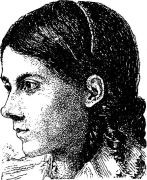
Elisabeth Brentano
Elisabeth Brentano was the daughter of Goethe's friend, Maximiliane de la Roche. She was born at Frankfort-on-the-Main in 1785, and was brought up after the death of her mother under the somewhat peculiar influence of the highly-strung Caroline von Günderode. Through her filial intimacy with Goethe's mother, she came to know the poet; and out of their friendship grew the correspondence which formed the basis of Bettina's famous book, 'Goethe's Briefwechsel mit einem Kinde' (Goethe's Correspondence with a Child). She attached herself with unbounded enthusiasm to Goethe, and he responded with affectionate tact. To him Bettina was the embodiment of the loving grace and willfulness of 'Mignon.'
In 1811 these relations were interrupted, owing to Bettina's attitude toward Goethe's wife. In the same year she married Achim von Arnim, one of the most refined poets and noblest characters of that brilliant circle. The marriage was an ideal one; each cherished and delighted in the genius of the other, but in 1831 the death of Von Arnim brought this happiness to an end. Goethe died in the following year, and Germany went into mourning. Then in 1835 Bettina appeared before the world for the first time as an authoress, in 'Goethe's Correspondence with a Child.' The dithyrambic exaltation, the unrestrained but beautiful enthusiasm of the book came like an electric shock. Into an atmosphere of spiritual stagnation, these letters brought a fresh access of vitality and hope. Bettina's old friendly relations with Goethe had been resumed later in life, and in a letter written to her niece she gives a charming account of the visit to the poet in 1824, which proved to be her last. This letter first saw the light in 1896, and an extract from it has been included below.
The inspiration which went out from Bettina's magnetic nature was profound. She had her part in every great movement of her time, from the liberation of Greece to the fight with cholera in Berlin. During the latter, her devotion to the cause of the suffering poor in Berlin opened her eyes to the miseries of the common people; and she wrote a work full of indignant fervor, 'Dies Buch gehört dem König' (This Book belongs to the King), in consequence of which her welcome at the court of Frederick William IV. grew cool. A subsequent book, written in a similar vein, was suppressed. But Bettina's love of the people, as of every cause in which she was interested, was genuine and not to be quenched; she acted upon the maxim once expressed by Emerson, "Every brave heart must treat society as a child, and never allow it to dictate." Emerson greatly admired Bettina, and Louisa M. Alcott relates that she first made acquaintance with the famous 'Correspondence' when in her girlhood she was left to browse in Emerson's library. Bettina's influence was most keenly felt by the young, and she had the youth of Germany at her feet. She died in 1859.
There is in Weimar a picture in which are represented the literary men of the period, grouped as in Raphael's School of Athens, with Goethe and Schiller occupying the centre. Upon the broad steps which lead to the elevation where they are standing, is the girlish figure of Bettina bending forward and holding a laurel wreath in her hand. This is the position which she occupies in the history of German literature.
DEDICATION: TO GOETHE
From 'Goethe's Correspondence with a Child'
Thou, who knowest love, and the refinement of sentiment, oh how beautiful is everything in thee! How the streams of life rush through thy sensitive heart, and plunge with force into the cold waves of thy time, then boil and bubble up till mountain and vale flush with the glow of life, and the forests stand with glistening boughs upon the shore of thy being, and all upon which rests thy glance is filled with happiness and life! O God, how happy were I with thee! And were I winging my flight far over all times, and far over thee, I would fold my pinions and yield myself wholly to the domination of thine eyes.
Men will never understand thee, and those nearest to thee will most thoroughly disown and betray thee; I look into the future, and I hear them cry, "Stone him!" Now, when thine own inspiration, like a lion, stands beside thee and guards thee, vulgarity ventures not to approach thee. Thy mother said recently, "The men to-day are all like Gerning, who always says, 'We, the superfluous learned';" and she speaks truly, for he is superfluous. Rather be dead than superfluous! But I am not so, for I am thine, because I recognize thee in all things. I know that when the clouds lift themselves up before the sun-god, they will soon be depressed by his fiery hand; I know that he endures no shadow except that which his own fame seeks; the rest of consciousness will overshadow thee. I know, when he descends in the evening, that he will again appear in the morning with golden front. Thou art eternal, therefore it is good for me to be with thee.
When, in the evening, I am alone in my dark room, and the neighbors' lights are thrown upon my wall, they sometimes light up thy bust; or when all is silent in the city, here and there a dog barks or a cock crows: I know not why, but it seems something beyond human to me; I know what I shall do to still my pain.
I would fain speak with thee otherwise than with words; I would fain press myself to thy heart. I feel that my soul is aflame. How fearfully still is the air before the storm! So stand now my thoughts, cold and silent, and my heart surges like the sea. Dear, dear Goethe! A reminiscence of thee breaks the spell; the signs of fire and warfare sink slowly down in my sky, and thou art like the in-streaming moonlight. Thou art great and glorious, and better than all that I have ever known and experienced up to this time. Thy whole life is so good!
TO GOETHE
CASSEL, August 13th, 1807.
Who can interpret and measure what is passing within me? I am happy now in remembrance of the past, which I scarcely was when that past was the present. To my sensitive heart the surprise of being with thee, the coming and going and returning in a few blessed days--this was all like clouds flitting across my heaven; through my too near presence I feared it might be darkened by my shadow, as it is ever darker when it nears the earth; now, in the distance, it is mild and lofty and ever clear.
I would fain press thy dear hand with both of mine to my bosom, and say to thee, "How peace and content have come to me since I have known thee!"
I know that the evening has not come when life's twilight gathers in my heart: oh, would it were so! Would that I had lived out my days, that my wishes and joys were fulfilled, and that they could all be heaped upon thee, that thou mightst be therewith decked and crowned as with evergreen bays.
When I was alone with thee on that evening I could not comprehend thee: thou didst smile at me because I was moved, and laughed at me because I wept; but why? And yet it was thy laughter, the tone of thy laughter, which moved me to tears; and I am content, and see, under the cloak of this riddle, roses burst forth which spring alike from sadness and joy. Yes, thou art right, prophet: I shall yet with light heart struggle up through jest and mirth; I shall weary myself with struggling as I did in my childhood (ah, it seems as if it were but yesterday!) when with the exuberance of joy I wandered through the blossoming fields, pulling up the flowers by the roots and throwing them into the water. But I wish to seek rest in a warm, firm earnestness, and there at hand standest thou, smiling prophet!
I say to thee yet once more: Whoever in this wide world understands what is passing within me, who, am so restful in thee, so silent, so unwavering in my feeling? I could, like the mountains, bear nights and days in the past without disturbing thee in thy reflections! And yet when at times the wind bears the fragrance and the germs together from the blossoming world up to the mountain heights, they will be intoxicated with delight as I was yesterday. Then I loved the world, then I was as glad as a gushing, murmuring spring in which the sun for the first time shines.
Farewell, sublime one who blindest and intimidatest me! From this steep rock upon which my love has in life-danger ventured, I cannot clamber down. I cannot think of descending, for I should break my neck in the attempt.
BETTINA'S LAST MEETING WITH GOETHE
From a Letter to her Niece in 1824, first published in 1896
IN THE evening I was alone again with Goethe. Had any one observed us, he would have had something to tell to posterity. Goethe's peculiarities were exhibited to the full: first he would growl at me, then to make it all up again he would caress me, with the most flattering words. His bottle of wine he kept in the adjoining room, because I had reproached him for his drinking the night before: on some pretext or other he disappeared from the scene half a dozen times in order to drink a glass. I pretended to notice nothing; but at parting I told him that twelve glasses of wine wouldn't hurt him, and that he had had only six. "How do you know that so positively?" he said. "I heard the gurgle of the bottle in the next room, and I heard you drinking, and then you have betrayed yourself to me, as Solomon in the Song of Songs betrayed himself to his beloved, by your breath." "You are an arrant rogue," he said; "now take yourself off," and he brought the candle to light me out. But I sprang in front of him and knelt upon the threshold of the room. "Now I shall see if I can shut you in, and whether you are a good spirit or an evil one, like the rat in Faust; I kiss this threshold and bless it, for over it daily passes the most glorious human spirit and my best friend." "Over you and your love I shall never pass," he answered, "it is too dear to me; and around your spirit I creep so" (and he carefully paced around the spot where I was kneeling), "for you are too artful, and it is better to keep on good terms with you." And so he dismissed me with tears in his eyes. I remained standing in the dark before his door, to gulp down my emotion. I was thinking that this door, which I had closed with my own hand, had separated me from him in all probability forever. Whoever comes near him must confess that his genius has partly passed into goodness; the fiery sun of his spirit is transformed at its setting into a soft purple light.
IN GOETHE'S GARDEN
I from this hillock all my world survey!
Yon vale, bedecked by nature's fairy fingers,
Where the still by-road picturesquely lingers,
The cottage white whose quaint charms grace the way--
These are the scenes that o'er my heart hold sway.
I from this hillock all my world survey!
Though I ascend to heights fair lands dividing,
Where stately ships I see the ocean riding,
While cities gird the view in proud array,
Naught prompts my heart's impulses to obey.
I from this hillock all my world survey!
And could I stand while Paradise descrying,
Still for these verdant meads should I be sighing,
Where thy dear roof-peaks skirt the verdant way:
Beyond these bounds my heart longs not to stray.
JOHN BRIGHT
(1811-1889)
ohn Bright was the modern representative of the ancient Tribunes of the people or Demagogues (in the original and perfectly honorable sense); and a full comparison of his work and position with those of the Cleons or the Gracchi would almost be an outline of the respective peoples, polities, and problems. He was a higher type of man and politician than Cleon,--largely because the English aristocracy is not an unpatriotic and unprincipled clique like the Athenian, ready to use any weapon from murder down or to make their country a province of a foreign empire rather than give up their class monopoly of power; but like his prototype he was a democrat by nature as well as profession, the welfare of the common people at once his passion and his political livelihood, full of faith that popular instincts are both morally right and intellectually sound, and all his own instincts and most of his labors antagonistic to those of the aristocracy. It is a phase of the same fact to say that he also represented the active force of religious feeling in politics, as opposed to pure secular statesmanship.
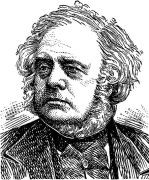
John Bright
The son of a Quaker manufacturer of Rochdale, England, and born near that place November 16th, 1811, he began his public career when a mere boy as a stirring and effective temperance orator, his ready eloquence and intense earnestness prevailing over an ungraceful manner and a bad delivery; he wrought all his life for popular education and for the widest extension of the franchise; and being a Quaker and a member of the Peace Society, he opposed all war on principle, fighting the Crimean War bitterly, and leaving the Gladstone Cabinet in 1882 on account of the bombardment of Alexandria. He was retired from the service of the public for some time on account of his opposition to the Crimean War; but Mr. Gladstone, who differed from him on this point, calls it the action of his life most worthy of honor. He was perhaps the most warlike opponent of war ever high in public life; the pugnacious and aggressive agitator, pouring out floods of fiery oratory to the effect that nobody ought to fight anybody, was a curious paradox.
He was by far the most influential English friend of the North in the Civil War, and the magic of his eloquence and his name was a force of perhaps decisive potency in keeping the working classes on the same side; so that mass meetings of unemployed laborers with half-starving families resolved that they would rather starve altogether than help to perpetuate slavery in America. He shares with Richard Cobden the credit of having obtained free trade for England: Bright's thrilling oratory was second only to Cobden's organizing power in winning the victory, and both had the immense weight of manufacturers opposing their own class. That he opposed the game laws and favored electoral reform is a matter of course.
Mr. Bright entered on an active political career in 1839, when he joined the Anti-Corn-Law League. He first became a member of Parliament in 1843, and illustrates a most valuable feature of English political practice. When a change of feeling in one place prevented his re-election, he selected another which was glad to honor itself by having a great man represent it, so that the country was not robbed of a statesman by a village faction; and there being no spoils system, he did not have to waste his time in office-jobbing to keep his seat. He sat first for Durham, then for Manchester, and finally for Birmingham, remaining in public life over forty years; and never had to make a "deal" or get any one an office in all that period.
He was in Mr. Gladstone's Cabinet from 1868 to 1870, and again from 1873 to 1882. On the Home Rule question the two old friends and long co-workers divided; Mr. Bright, with more than half the oldest and sincerest friends of liberty and haters of oppression in England, holding the step to be political suicide for the British Empire.
As an orator, Mr. Bright stood in a sense alone. He was direct and logical; he carefully collected and massed his facts, and used strong, homely Saxon English, and short crisp words; he was a master of telling epigram whose force lay in its truth as much as in its humor. Several volumes of his speeches have been published: 'On Public Affairs'; 'On Parliamentary Reform'; 'On Questions of Public Policy'; 'On the American Question,' etc. His life has been written by Gilchrist, Smith, Robertson, and others. He died March 27th, 1889.
FROM THE SPEECH ON THE CORN LAWS (1843)
It must not be supposed, because I wish to represent the interest of the many, that I am hostile to the interest of the few.
But is it not perfectly certain that if the foundation of the most magnificent building be destroyed and undermined, the whole fabric itself is in danger? Is it not certain, also, that the vast body of the people who form the foundation of the social fabric, if they are suffering, if they are trampled upon, if they are degraded, if they are discontented, if "their hands are against every man, and every man's hands are against them," if they do not flourish as well, reasonably speaking, as the classes who are above them because they are richer and more powerful,--then are those classes as much in danger as the working classes themselves?
There never was a revolution in any country which destroyed the great body of the people. There have been convulsions of a most dire character which have overturned old-established monarchies and have hurled thrones and sceptres to the dust. There have been revolutions which have brought down most powerful aristocracies, and swept them from the face of the earth forever, but never was there a revolution yet which destroyed the people. And whatever may come as a consequence of the state of things in this country, of this we may rest assured: that the common people, that the great bulk of our countrymen will remain and survive the shock, though it may be that the Crown and the aristocracy and the Church may be leveled with the dust, and rise no more. In seeking to represent the working classes, and in standing up for their rights and liberties, I hold that I am also defending the rights and liberties of the middle and richer classes of society. Doing justice to one class cannot inflict injustice on any other class, and "justice and impartiality to all" is what we all have a right to from government. And we have a right to clamor; and so long as I have breath, so long will I clamor against the oppression which I see to exist, and in favor of the rights of the great body of the people....
What is the condition in which we are? I have already spoken of Ireland. You know that hundreds of thousands meet there, week after week, in various parts of the country, to proclaim to all the world the tyranny under which they suffer. You know that in South Wales, at this moment, there is an insurrection of the most extraordinary character going on, and that the Government is sending, day after day, soldiers and artillery amongst the innocent inhabitants of that mountainous country for the purpose of putting down the insurrection thereby raised and carried on. You know that in the Staffordshire ironworks almost all the workmen are now out and in want of wages, from want of employment and from attempting to resist the inevitable reduction of wages which must follow restriction upon trade. You know that in August last, Lancashire and Yorkshire rose in peaceful insurrection to proclaim to the world, and in face of Heaven, the wrongs of an insulted and oppressed people. I know that my own neighborhood is unsettled and uncomfortable. I know that in your own city your families are suffering. Yes, I have been to your cottages and seen their condition. Thanks to my canvass of Durham, I have been able to see the condition of many honest and independent--or ought-to-be-independent--and industrious artisans. I have seen even freemen of your city sitting, looking disconsolate and sad. Their hands were ready to labor; their skill was ready to produce all that their trade demanded. They were as honest and industrious as any man in this assembly, but no man hired them. They were in a state of involuntary idleness, and were driving fast to the point of pauperism. I have seen their wives, too, with three or four children about them--one in the cradle, one at the breast. I have seen their countenances, and I have seen the signs of their sufferings. I have seen the emblems and symbols of affliction such as I did not expect to see in this city. Ay! and I have seen those little children who at not a distant day will be the men and women of this city of Durham; I have seen their poor little wan faces and anxious looks, as if the furrows of old age were coming upon them before they had escaped from the age of childhood. I have seen all this in this city, and I have seen far more in the neighborhood from which I have come. You have seen, in all probability, people from my neighborhood walking your streets and begging for that bread which the Corn Laws would not allow them to earn.
"Bread-taxed weaver, all can see
What the tax hath done for thee,
And thy children, vilely led,
Singing hymns for shameful bread,
Till the stones of every street
Know their little naked feet."
This is what the Corn Law does for the weavers of my neighborhood, and for the weavers and artisans of yours....
FROM THE SPEECH ON INCENDIARISM IN IRELAND (1844)
The great and all-present evil of the rural districts is this--you have too many people for the work to be done, and you, the landed proprietors, are alone responsible for this state of things; and to speak honestly, I believe many of you know it. I have been charged with saying out-of-doors that this House is a club of land-owners legislating for land-owners. If I had not said it, the public must long ago have found out that fact. My honorable friend the member for Stockport on one occasion proposed that before you passed a law to raise the price of bread, you should consider how far you had the power to raise the rates of wages. What did you say to that? You said that the laborers did not understand political economy, or they would not apply to Parliament to raise wages; that Parliament could not raise wages. And yet the very next thing you did was to pass a law to raise the price of produce of your own land, at the expense of the very class whose wages you confessed your inability to increase.
What is the condition of the county of Suffolk? Is it not notorious that the rents are as high as they were fifty years ago, and probably much higher? But the return for the farmer's capital is much lower, and the condition of the laborer is very much worse. The farmers are subject to the law of competition, and rents are thereby raised from time to time so as to keep their profits down to the lowest point, and the laborers by the competition amongst them are reduced to the point below which life cannot be maintained. Your tenants and laborers are being devoured by this excessive competition, whilst you, their magnanimous landlords, shelter yourselves from all competition by the Corn Law yourselves have passed, and make the competition of all other classes serve still more to swell your rentals. It was for this object the Corn Law was passed, and yet in the face of your countrymen you dare to call it a law for the protection of native industry....
Again, a rural police is kept up by the gentry; the farmers say for the sole use of watching game and frightening poachers, for which formerly they had to pay watchers. Is this true, or is it not? I say, then, you care everything for the rights--and for something beyond the rights--of your own property, but you are oblivious to its duties. How many lives have been sacrificed during the past year to the childish infatuation of preserving game? The noble lord, the member for North Lancashire, could tell of a gamekeeper killed in an affray on his father's estate in that county. For the offense one man was hanged, and four men are now on their way to penal colonies. Six families are thus deprived of husband and father, that this wretched system of game-preserving may be continued in a country densely peopled as this is. The Marquis of Normanby's gamekeeper has been murdered also, and the poacher who shot him only escaped death by the intervention of the Home Secretary. At Godalming, in Surrey, a gamekeeper has been murdered; and at Buckhill, in Buckinghamshire, a person has recently been killed in a poaching affray. This insane system is the cause of a fearful loss of life; it tends to the ruin of your tenantry, and is the fruitful cause of the demoralization of the peasantry. But you are caring for the rights of property; for its most obvious duties you have no concern. With such a policy, what can you expect but that which is now passing before you?
It is the remark of a beautiful writer that "to have known nothing but misery is the most portentous condition under which human nature can start on its course." Has your agricultural laborer ever known anything but misery? He is born in a miserable hovel, which in mockery is termed a house or a home; he is reared in penury: he passes a life of hopeless and unrequited toil, and the jail or the union house is before him as the only asylum on this side of the pauper's grave. Is this the result of your protection to native industry? Have you cared for the laborer till, from a home of comfort, he has but a hovel for shelter? and have you cherished him into starvation and rags? I tell you what your boasted protection is--it is a protection of native idleness at the expense of the impoverishment of native industry.
FROM THE SPEECH ON NON-RECOGNITION OF THE SOUTHERN CONFEDERACY (1861)
I advise you, and I advise the people of England, to abstain from applying to the United States doctrines and principles which we never apply to our own case. At any rate, they [the Americans] have never fought "for the balance of power" in Europe. They have never fought to keep up a decaying empire. They have never squandered the money of their people in such a phantom expedition as we have been engaged in. And now, at this moment, when you are told that they are going to be ruined by their vast expenditure,--why, the sum that they are going to raise in the great emergency of this grievous war is not greater than what we raise every year during a time of peace.
They say they are not going to liberate slaves. No; the object of the Washington government is to maintain their own Constitution and to act legally, as it permits and requires. No man is more in favor of peace than I am; no man has denounced war more than I have, probably, in this country; few men in their public life have suffered more obloquy--I had almost said, more indignity--in consequence of it. But I cannot for the life of me see, upon any of those principles upon which States are governed now,--I say nothing of the literal word of the New Testament,--I cannot see how the state of affairs in America, with regard to the United States government, could have been different from what it is at this moment. We had a Heptarchy in this country, and it was thought to be a good thing to get rid of it, and have a united nation. If the thirty-three or thirty-four States of the American Union can break off whenever they like, I can see nothing but disaster and confusion throughout the whole of that continent. I say that the war, be it successful or not, be it Christian or not, be it wise or not, is a war to sustain the government and to sustain the authority of a great nation; and that the people of England, if they are true to their own sympathies, to their own history, and to their own great act of 1834, to which reference has already been made, will have no sympathy with those who wish to build up a great empire on the perpetual bondage of millions of their fellow-men.
FROM THE SPEECH ON THE STATE OF IRELAND (1866)
I think I was told in 1849, as I stood in the burial ground at Skibbereen, that at least four hundred people who had died of famine were buried within the quarter of an acre of ground on which I was then looking. It is a country, too, from which there has been a greater emigration by sea within a given time than has been known at any time from any other country in the world. It is a country where there has been, for generations past, a general sense of wrong, out of which has grown a chronic state of insurrection; and at this very moment when I speak, the general safeguard of constitutional liberty is withdrawn, and we meet in this hall, and I speak here to-night, rather by the forbearance and permission of the Irish executive than under the protection of the common safeguards of the rights and liberties of the people of the United Kingdom.
I venture to say that this is a miserable and a humiliating picture to draw of this country. Bear in mind that I am not speaking of Poland suffering under the conquest of Russia. There is a gentleman, now a candidate for an Irish county, who is very great upon the wrongs of Poland; but I have found him always in the House of Commons taking sides with that great party which has systematically supported the wrongs of Ireland. I am not speaking of Hungary, or of Venice as she was under the rule of Austria, or of the Greeks under the dominion of the Turk; but I am speaking of Ireland--part of the United Kingdom--part of that which boasts itself to be the most civilized and the most Christian nation in the world. I took the liberty recently, at a meeting in Glasgow, to say that I believed it was impossible for a class to govern a great nation wisely and justly. Now, in Ireland there has been a field in which all the principles of the Tory party have had their complete experiment and development. You have had the country gentleman in all his power. You have had any number of Acts of Parliament which the ancient Parliament of Ireland or the Parliament of the United Kingdom could give him. You have had the Established Church supported by the law, even to the extent, not many years ago, of collecting its revenues by the aid of military force. In point of fact, I believe it would be impossible to imagine a state of things in which the Tory party should have a more entire and complete opportunity for their trial than they have had within the limits of this island. And yet what has happened? This, surely: that the kingdom has been continually weakened, that the harmony of the empire has been disturbed, and that the mischief has not been confined to the United Kingdom, but has spread to the colonies....
I am told--you can answer it if I am wrong--that it is not common in Ireland now to give leases to tenants, especially to Catholic tenants. If that be so, then the security for the property rests only upon the good feeling and favor of the owner of the land; for the laws, as we know, have been made by the land-owners, and many propositions for the advantage of the tenants have unfortunately been too little considered by Parliament. The result is that you have bad farming, bad dwelling-houses, bad temper, and everything bad connected with the occupation and cultivation of land in Ireland. One of the results--a result the most appalling--is this, that your population is fleeing your country and seeking refuge in a distant land. On this point I wish to refer to a letter which I received a few days ago from a most esteemed citizen of Dublin. He told me that he believed that a very large portion of what he called the poor, amongst Irishmen, sympathized with any scheme or any proposition that was adverse to the Imperial Government. He said further that the people here are rather in the country than of it, and that they are looking more to America than they are looking to England. I think there is a good deal in that. When we consider how many Irishmen have found a refuge in America, I do not know how we can wonder at that statement. You will recollect that when the ancient Hebrew prophet prayed in his captivity, he prayed with his window open towards Jerusalem. You know that the followers of Mohammed, when they pray, turn their faces towards Mecca. When the Irish peasant asks for food and freedom and blessing, his eye follows the setting sun, the aspirations of his heart reach beyond the wide Atlantic, and in spirit he grasps hands with the great Republic of the West. If this be so, I say then that the disease is not only serious, but it is desperate; but desperate as it is, I believe there is a certain remedy for it if the people and Parliament of the United Kingdom are willing to apply it....
I believe that at the root of a general discontent there is in all countries a general grievance and general suffering. The surface of society is not incessantly disturbed without a cause. I recollect in the poem of the greatest of Italian poets, he tells us that as he saw in vision the Stygian lake, and stood upon its banks, he observed the constant commotion upon the surface of the pool, and his good instructor and guide explained to him the cause of it:--
"This, too, for certain know, that underneath
The water dwells a multitude, whose sighs
Into these bubbles make the surface heave,
As thine eye tells thee wheresoe'er it turn."
And I say that in Ireland, for generations back, the misery and the wrongs of the people have made their sign, and have found a voice in constant insurrection and disorder. I have said that Ireland is a country of many wrongs and of many sorrows. Her past lies almost in shadow. Her present is full of anxiety and peril. Her future depends on the power of her people to substitute equality and justice for supremacy, and a generous patriotism for the spirit of faction. In the effort now making in Great Britain to create a free representation of the people you have the deepest interest. The people never wish to suffer, and they never wish to inflict injustice. They have no sympathy with the wrong-doer, whether in Great Britain or in Ireland; and when they are fairly represented in the Imperial Parliament, as I hope they will one day be, they will speedily give an effective and final answer to that old question of the Parliament of Kilkenny--"How comes it to pass that the King has never been the richer for Ireland?"
FROM THE SPEECH ON THE IRISH ESTABLISHED CHURCH (1868)
I am one of those who do not believe that the Established Church of Ireland--of which I am not a member--would go to absolute ruin, in the manner of which many of its friends are now so fearful. There was a paper sent to me this morning, called 'An Address from the Protestants of Ireland to their Protestant Brethren of Great Britain.' It is dated "5, Dawson Street," and is signed by "John Trant Hamilton, T.A. Lefroy, and R.W. Gamble." The paper is written in a fair and mild, and I would even say,--for persons who have these opinions,--in a kindly and just spirit. But they have been alarmed, and I would wish, if I can, to offer them consolation. They say they have no interest in protecting any abuses of the Established Church, but they protest against their being now deprived of the Church of their fathers. Now, I am quite of opinion that it would be a most monstrous thing to deprive the Protestants of the Church of their fathers; and there is no man in the world who would more strenuously resist even any step in that direction than I would, unless it were Mr. Gladstone, the author of the famous resolutions. The next sentence goes on to say, "We ask for no ascendancy." Having read that sentence, I think that we must come to the conclusion that these gentlemen are in a better frame of mind than we thought them to be in. I can understand easily that these gentlemen are very sorry and doubtful as to the depths into which they are to be plunged; but I disagree with them in this--that I think there would still be a Protestant Church in Ireland when all is done that Parliament has proposed to do. The only difference will be, that it will not then be an establishment--that it will have no special favor or grant from the State--that it will stand in relation to the State just as your Church does, and just as the churches of the majority of the people of Great Britain at this moment stand. There will then be no Protestant bishops from Ireland to sit in the House of Lords; but he must be the most enthusiastic Protestant and Churchman who believes that there can be any advantage to his Church and to Protestantism generally in Ireland from such a phenomenon.
BRILLAT-SAVARIN
(1755-1826)

rillat-Savarin was a French magistrate and legislator, whose reputation as man of letters rests mainly upon a single volume, his inimitable 'Physiologie du Goût'. Although writing in the present century, he was essentially a Frenchman of the old régime, having been born in 1755 at Belley, almost on the border-line of Savoy, where he afterwards gained distinction as an advocate. In later life he regretted his native province chiefly for its figpeckers, superior in his opinion to ortolans or robins, and for the cuisine of the innkeeper Genin, where "the old-timers of Belley used to gather to eat chestnuts and drink the new white wine known as vin bourru"
Brillat-Savarin
After holding various minor offices in his department, Savarin became mayor of Belley in 1793; but the Reign of Terror soon forced him to flee to Switzerland and join the colony of French refugees at Lausanne. Souvenirs of this period are frequent in his 'Physiologie du Goût', all eminently gastronomic, as befits his subject-matter, but full of interest, as showing his unfailing cheerfulness amidst the vicissitudes and privations of exile. He fled first to Dôle, to "obtain from the Representative Prôt a safe-conduct, which was to save me from going to prison and thence probably to the scaffold," and which he ultimately owed to Madame Prôt, with whom he spent the evening playing duets, and who declared, "Citizen, any one who cultivates the fine arts as you do cannot betray his country!" It was not the safe-conduct, however, but an unexpected dinner which he enjoyed on his route, that made this a red-letter day to Savarin:--"What a good dinner!--I will not give the details, but an honorable mention is due to a fricassée of chicken, of the first order, such as cannot be found except in the provinces, and so richly dowered with truffles that there were enough to put new life into old Tithonus himself."
The whole episode is told in Savarin's happiest vein, and well-nigh justifies his somewhat complacent conclusion that "any one who, with a revolutionary committee at his heels, could so conduct himself, assuredly has the head and the heart of a Frenchman!"
Natural scenery did not appeal to Savarin; to him Switzerland meant the restaurant of the Lion d'Argent, at Lausanne, where "for only 15 batz we passed in review three complete courses;" the table d'hôte of the Rue de Rosny; and the little village of Moudon, where the cheese fondue was so good. Circumstances, however, soon necessitated his departure for the United States, which he always gratefully remembered as having afforded him "an asylum, employment, and tranquillity." For three years he supported himself in New York, giving French lessons and at night playing in a theatre orchestra. "I was so comfortable there," he writes, "that in the moment of emotion which preceded departure, all that I asked of Heaven (a prayer which it has granted) was never to know greater sorrow in the Old World than I had known in the New." Returning to France in 1796, Savarin settled in Paris, and after holding several offices under the Directory, became a Judge in the Cour de Cassation, the French court of last resort, where he remained until his death in 1826.
Although an able and conscientious magistrate, Savarin was better adapted to play the kindly friend and cordial host than the stern and impartial judge. He was a convivial soul, a lover of good cheer and free-handed hospitality; and to-day, while almost forgotten as a jurist, his name has become immortalized as the representative of gastronomic excellence. His 'Physiologic du Goût'--"that olla podrida which defies analysis," as Balzac calls it--belongs, like Walton's 'Compleat Angler', or White's 'Selborne', among those unique gems of literature, too rare in any age, which owe their subtle and imperishable charm primarily to the author's own delightful personality. Savarin spent many years of loving care in polishing his manuscript, often carrying it to court with him, where it was one day mislaid, but--luckily for future generations of epicures--was afterward recovered. The book is a charming badinage, a bizarre ragoût of gastronomic precepts and spicy anecdote, doubly piquant for its prevailing tone of mock seriousness and intentional grandiloquence.
In emulation of the poet Lamartine, Savarin divided his subject into 'Meditations', of which the seventh is consecrated to the 'Theory of Frying', and the twenty-first to 'Corpulence'. In the familiar aphorism, "Tell me what you eat, and I will tell you what you are", he strikes his key-note; man's true superiority lies in his palate! "The pleasure of eating we have in common with the animals; the pleasure of the table is peculiar to the human species." Gastronomy he proclaims the chief of all sciences: "It rules life in its entirety; for the tears of the new-born infant summon the breast of its nurse, and the dying man still receives with some pleasure the final potion, which, alas, he is not destined to digest." Occasionally he affects an epic strain, invoking Gasteria, "the tenth muse, who presides over the pleasures of taste." "It is the fairest of the Muses who inspires me: I will be clearer than an oracle, and my precepts will traverse the centuries." Beneath his pen, soup, "the first consolation of the needy stomach," assumes fresh dignity; and even the humble fowl becomes to the cook "what the canvas is to the painter, or the cap of Fortunatus to the charlatan." But like the worthy epicure that he was, Savarin reserved his highest flights of eloquence for such rare and toothsome viands as the Poularde fine de Bresse, the pheasant, "an enigma of which the key-word is known only to the adepts," a sauté of truffles, "the diamonds of the kitchen," or, best of all, truffled turkeys, "whose reputation and price are ever on the increase! Benign stars, whose apparition renders the gourmands of every category sparkling, radiant, and quivering!" But the true charm of the book lies in Savarin's endless fund of piquant anecdotes, reminiscences of bygone feasts, over which the reader's mouth waters. Who can read without a covetous pang his account of 'The Day at Home with the Bernadins,' or of his entertainment of the Dubois brothers, of the Rue du Bac, "a bonbon which I have put into the reader's mouth to recompense him for his kindness in having read me with pleasure"?
'Physiologic du Goût' was not published until 1825, and then anonymously, presumably because he thought its tone inconsistent with his dignity as magistrate. It would almost seem that he had a presentiment of impending death, for in the midst of his brightest 'Variétés' he has incongruously inserted a dolorous little poem, the burden of each verse being "Je vais mourir." The 'Physiologic du Goût' is now accessible to English readers in the versions of R.E. Anderson (London, 1877), and in a later one published in New York; but there is a subtle flavor to the original which defies translation.
FROM THE 'PHYSIOLOGY OF TASTE'
THE PRIVATIONS
First parents of the human species, whose gormandizing is historic, you who fell for the sake of an apple, what would you not have done for a turkey with truffles? But there were in the terrestrial Paradise neither cooks nor confectioners.
How I pity you!
Mighty kings, who laid proud Troy in ruins, your valor will be handed down from age to age; but your table was poor. Reduced to a rump of beef and a chine of pork, you were ever ignorant of the charms of the matelote and the delights of a fricassée of chicken.
How I pity you!
Aspasia, Chloe, and all of you whose forms the chisel of the Greeks immortalized, to the despair of the belles of to-day, never did your charming mouths enjoy the smoothness of a meringue à la vanille or à la rose; hardly did you rise to the height of a spice-cake.
How I pity you!
Gentle priestesses of Vesta, at one and the same time burdened with so many honors and menaced with such horrible punishments, would that you might at least have tasted those agreeable syrups which refresh the soul, those candied fruits which brave the seasons, those perfumed creams, the marvel of our day!
How I pity you!
Roman financiers, who made the whole known universe pay tribute, never did your far-famed banquet-halls witness the appearance of those succulent jellies, the delight of the indolent, nor those varied ices whose cold would brave the torrid zone.
How I pity you!
Invincible paladins, celebrated by flattering minstrels, when you had cleft in twain the giants, set free the ladies, and exterminated armies, never, alas! never did a dark-eyed captive offer you the sparkling champagne, the malmsey of Madeira, the liqueurs, creation of this great century: you were reduced to ale or to some cheap herb-flavored wine.
How I pity you!
Crosiered and mitred abbots, dispensers of the favors of heaven; and you, terrible Templars, who donned your armor for the extermination of the Saracens,--you knew not the sweetness of chocolate which restores, nor the Arabian bean which promotes thought.
How I pity you!
Superb châtelaines, who during the loneliness of the Crusades raised into highest favor your chaplains and your pages, you never could share with them the charms of the biscuit and the delights of the macaroon.
How I pity you!
And lastly you, gastronomers of 1825, who already find satiety in the lap of abundance, and dream of new preparations, you will not enjoy those discoveries which the sciences have in store for the year 1900, such as esculent minerals and liqueurs resulting from a pressure of a hundred atmospheres; you will not behold the importations which travelers yet unborn shall cause to arrive from that half of the globe which still remains to be discovered or explored.
How I pity you!
ON THE LOVE OF GOOD LIVING
I have consulted the dictionaries under the word gourmandise, and am by no means satisfied with what I find. The love of good living seems to be constantly confounded with gluttony and voracity; whence I infer that our lexicographers, however otherwise estimable, are not to be classed with those good fellows amongst learned men who can put away gracefully a wing of partridge, and then, by raising the little finger, wash it down with a glass of Lafitte or Clos-Vougeot.
They have utterly forgot that social love of good eating which combines in one, Athenian elegance, Roman luxury, and Parisian refinement. It implies discretion to arrange, skill to prepare; it appreciates energetically, and judges profoundly. It is a precious quality, almost deserving to rank as a virtue, and is very certainly the source of much unqualified enjoyment.
Gourmandise, or the love of good living, is an impassioned, rational, and habitual preference for whatever flatters the sense of taste. It is opposed to excess; therefore every man who eats to indigestion, or makes himself drunk, runs the risk of being erased from the list of its votaries. Gourmandise also comprises a love for dainties or tit-bits; which is merely an analogous preference, limited to light, delicate, or small dishes, to pastry, and so forth. It is a modification allowed in favor of the women, or men of feminine tastes.
Regarded from any point of view, the love of good living deserves nothing but praise and encouragement. Physically, it is the result and proof of the digestive organs being healthy and perfect. Morally, it shows implicit resignation to the commands of Nature, who, in ordering man to eat that he may live, gives him appetite to invite, flavor to encourage, and pleasure to reward.
From the political economist's point of view, the love of good living is a tie between nations, uniting them by the interchange of various articles of food which are in constant use. Hence the voyage from Pole to Pole of wines, sugars, fruits, and so forth. What else sustains the hope and emulation of that crowd of fishermen, huntsmen, gardeners, and others who daily stock the most sumptuous larders with the results of their skill and labor? What else supports the industrious army of cooks, pastry-cooks, confectioners, and many other food-preparers, with all their various assistants? These various branches of industry derive their support in a great measure from the largest incomes, but they also rely upon the daily wants of all classes.
As society is at present constituted, it is almost impossible to conceive of a race living solely on bread and vegetables. Such a nation would infallibly be conquered by the armies of some flesh-eating race (like the Hindoos, who have been the prey of all those, one after another, who cared to attack them), or else it would be converted by the cooking of the neighboring nations, as ancient history records of the Boeotians, who acquired a love for good living after the battle of Leuctra.
Good living opens out great resources for replenishing the public purse: it brings contributions to town-dues, to the custom-house, and other indirect contributions. Everything we eat is taxed, and there is no exchequer that is not substantially supported by lovers of good living. Shall we speak of that swarm of cooks who have for ages been annually leaving France, to improve foreign nations in the art of good living? Most of them succeed; and in obedience to an instinct which never dies in a Frenchman's heart, bring back to their country the fruits of their economy. The sum thus imported is greater than might be supposed, and therefore they, like the others, will be honored by posterity.
But if nations were grateful, then Frenchmen, above all other races, ought to raise a temple and altars to "Gourmandise." By the treaty of November, 1815, the allies imposed upon France the condition of paying thirty millions sterling in three years, besides claims for compensation and various requisitions, amounting to nearly as much more. The apprehension, or rather certainty, became general that a national bankruptcy must ensue, more especially as the money was to be paid in specie.
"Alas!" said all who had anything to lose, as they saw the fatal tumbril pass to be filled in the Rue Vivienne, "there is our money emigrating in a lump; next year we shall fall on our knees before a crown-piece; we are about to fall into the condition of a ruined man; speculations of every kind will fail; it will be impossible to borrow; there will be nothing but weakness, exhaustion, civil death."
These terrors were proved false by the result; and to the great astonishment of all engaged in financial matters, the payments were made without difficulty, credit rose, loans were eagerly caught at, and during all the time this "superpurgation" lasted, the balance of exchange was in favor of France. In other words, more money came into the country than went out of it.
What is the power that came to our assistance? Who is the divinity that worked this miracle? The love of good living.
When the Britons, Germans, Teutons, Cimmerians, and Scythians made their irruption into France, they brought a rare voracity, and stomachs of no ordinary capacity. They did not long remain satisfied with the official cheer which a forced hospitality had to supply them with. They aspired to enjoyments of greater refinement; and soon the Queen City was nothing but a huge refectory. Everywhere they were seen eating, those intruders--in the restaurants, the eating-houses, the inns, the taverns, the stalls, and even in the streets. They gorged themselves with flesh, fish, game, truffles, pastry, and especially with fruit. They drank with an avidity equal to their appetite, and always ordered the most expensive wines, in the hope of finding in them some enjoyment hitherto unknown, and seemed quite astonished when they were disappointed. Superficial observers did not know what to think of this menagerie without bounds or limits; but your genuine Parisian laughed and rubbed his hands. "We have them now!" said he; "and to-night they'll have paid us back more than was counted out to them this morning from the public treasury!"
That was a lucky time for those who provide for the enjoyments of the sense of taste. Véry made his fortune; Achard laid the foundation of his; Beauvilliers made a third; and Madame Sullot, whose shop in the Palais Royal was a mere box of a place, sold as many as twelve thousand tarts a day.
The effect still lasts. Foreigners flow in from all quarters of Europe to renew during peace the delightful habits which they contracted during the war. They must come to Paris, and when they are there, they must be regaled at any price. If our funds are in favor, it is due not so much to the higher interest they pay, as to the instinctive confidence which foreigners cannot help placing in a people amongst whom every lover of good living finds so much happiness.
Love of good living is by no means unbecoming in women. It agrees with the delicacy of their organization, and serves as a compensation for some pleasures which they are obliged to abstain from, and for some hardships to which nature seems to have condemned them. There is no more pleasant sight than a pretty gourmande under arms. Her napkin is nicely adjusted; one of her hands rests on the table, the other carries to her mouth little morsels artistically carved, or the wing of a partridge which must be picked. Her eyes sparkle, her lips are glossy, her talk is cheerful, all her movements graceful; nor is there lacking some spice of the coquetry which accompanies all that women do. With so many advantages, she is irresistible, and Cato the Censor himself could not help yielding to the influence.
The love of good living is in some sort instinctive in women, because it is favorable to beauty. It has been proved, by a series of rigorously exact observations, that by a succulent, delicate, and choice regimen, the external appearances of age are kept away for a long time. It gives more brilliancy to the eye, more freshness to the skin, more support to the muscles; and as it is certain in physiology that wrinkles, those formidable enemies of beauty, are caused by the depression of muscle, it is equally true that, other things being equal, those who understand eating are comparatively four years younger than those ignorant of that science. Painters and sculptors are deeply impenetrated with this truth; for in representing those who practice abstinence by choice or duty as misers or anchorites, they always give them the pallor of disease, the leanness of misery, and the wrinkles of decrepitude.
Good living is one of the main links of society, by gradually extending that spirit of conviviality by which different classes are daily brought closer together and welded into one whole; by animating the conversation, and rounding off the angles of conventional inequality. To the same cause we can also ascribe all the efforts a host makes to receive his guests properly, as well as their gratitude for his pains so well bestowed. What disgrace should ever be heaped upon those senseless feeders who, with unpardonable indifference, swallow down morsels of the rarest quality, or gulp with unrighteous carelessness some fine-flavored and sparkling wine.
As a general maxim: Whoever shows a desire to please will be certain of having a delicate compliment paid him by every well-bred man.
Again, when shared, the love of good living has the most marked influence on the happiness of the conjugal state. A wedded pair with this taste in common have once a day at least a pleasant opportunity of meeting. For even when they sleep apart (and a great many do so), they at least eat at the same table, they have a subject of conversation which is ever new, they speak not only of what they are eating, but also of what they have eaten or will eat, of dishes which are in vogue, of novelties, etc. Everybody knows that a familiar chat is delightful.
Music, no doubt, has powerful attractions for those who are fond of it, but one must set about it--it is an exertion. Besides, one sometimes has a cold, the music is mislaid, the instruments are out of tune, one has a fit of the blues, or it is a forbidden day. Whereas, in the other case, a common want summons the spouses to table, the same inclination keeps them there; they naturally show each other these little attentions as a proof of their wish to oblige, and the mode of conducting their meals has a great share in the happiness of their lives.
This observation, though new in France, has not escaped the notice of Richardson, the English moralist. He has worked out the idea in his novel 'Pamela,' by painting the different manner in which two married couples finish their day. The first husband is a lord, an eldest son, and therefore heir to all the family property; the second is his younger brother, the husband of Pamela, who has been disinherited on account of his marriage, and lives on half-pay in a state but little removed from abject poverty.
The lord and lady enter their dining-room by different doors, and salute each other coldly, though they have not met the whole day before. Sitting down at a table which is magnificently covered, surrounded by lackeys in brilliant liveries, they help themselves in silence, and eat without pleasure. As soon, however, as the servants have withdrawn, a sort of conversation is begun between the pair, which quickly shows a bitter tone, passing into a regular fight, and they rise from the table in a fury of anger, and go off to their separate apartments to reflect upon the pleasures of a single life.
The younger brother, on the contrary, is, on reaching his unpretentious home, received with a gentle, loving heartiness and the fondest caresses. He sits down to a frugal meal, but everything he eats is excellent; and how could it be otherwise? It is Pamela herself who has prepared it all. They eat with enjoyment, talking of their affairs, their plans, their love for each other. A half-bottle of Madeira serves to prolong their repast and conversation, and soon after they retire together, to forget in sleep their present hardships, and to dream of a better future.
All honor to the love of good living, such as it is the purpose of this book to describe, so long as it does not come between men and their occupations or duties! For, as all the debaucheries of a Sardanapalus cannot bring disrespect upon womankind in general, so the excesses of a Vitellius need not make us turn our backs upon a well-appointed banquet. Should the love of good living pass into gluttony, voracity, intemperance, it then loses its name and advantages, escapes from our jurisdiction, and falls within that of the moralist to ply it with good counsel, or of the physician who will cure it by his remedies.
ON PEOPLE FOND OF GOOD LIVING
There are individuals to whom nature has denied a refinement of organs, or a continuity of attention, without which the most succulent dishes pass unobserved. Physiology has already recognized the first of these varieties, by showing us the tongue of these unhappy ones, badly furnished with nerves for inhaling and appreciating flavors. These excite in them but an obtuse sentiment; such persons are, with regard to objects of taste, what the blind are with regard to light. The second class are the absent-minded, chatterboxes, persons engrossed in business or ambition, and others who seek to occupy themselves with two things at once, and eat only to be filled. Such, for example, was Napoleon; he was irregular in his meals, and ate fast and badly. But there again was to be traced that absolute will which he carried into everything he did. The moment appetite was felt, it was necessary that it should be satisfied; and his establishment was so arranged that, in any place and at any hour, chicken, cutlets, and coffee might be forthcoming at a word.
There is a privileged class of persons who are summoned to the enjoyments of taste by a physical and organic predisposition. I have always believed in physiognomy and phrenology. Men have inborn tendencies; and since there are some who come into the world seeing, hearing, and walking badly, because they are short-sighted, deaf, or crippled, why should there not be others who are specially predisposed to experience a certain series of sensations? Moreover, even an ordinary observer will constantly discover faces which bear the unmistakable imprint of a ruling passion--such as superciliousness, self-satisfaction, misanthropy, sensuality, and many others. Sometimes, no doubt, we meet with a face that expresses nothing; but when the physiognomy has a marked stamp it is almost always a true index. The passions act upon the muscles, and frequently, although a man says nothing, the various feelings by which he is moved can be read in his face. By this tension, if in the slightest degree habitual, perceptible traces are at last left, and the physiognomy thus assumes its permanent and recognizable characteristics.
Those predisposed to epicurism are for the most part of middling height. They are broad-faced, and have bright eyes, small forehead, short nose, fleshy lips, and rounded chin. The women are plump, chubby, pretty rather than beautiful, with a slight tendency to fullness of figure. It is under such an exterior that we must look for agreeable guests. They accept all that is offered them, eat without hurry, and taste with discrimination. They never make any haste to get away from houses where they have been well treated, but stay for the evening, because they know all the games and other after-dinner amusements.
Those, on the contrary, to whom nature has denied an aptitude for the enjoyments of taste, are long-faced, long-nosed, and long-eyed: whatever their stature, they have something lanky about them. They have dark, lanky hair, and are never in good condition. It was one of them who invented trousers. The women whom nature has afflicted with the same misfortune are angular, feel themselves bored at table, and live on cards and scandal.
This theory of mine can be verified by each reader from his own personal observation. I shall give an instance from my own personal experience:--
Sitting one day at a grand banquet, I had opposite me a very pretty neighbor, whose face showed the predisposition I have described. Leaning to the guest beside me, I said quietly that from her physiognomy, the young lady on the other side of the table must be fond of good eating. "You must be mad!" he answered; "she is but fifteen at most, which is certainly not the age for such a thing. However, let us watch."
At first, things were by no means in my favor, and I was somewhat afraid of having compromised myself, for during the first two courses the young lady quite astonished me by her discretion, and I suspected we had stumbled upon an exception, remembering that there are some for every rule. But at last the dessert came,--a dessert both magnificent and abundant,--and my hopes were again revived. Nor did I hope in vain: not only did she eat of all that was offered her, but she even got dishes brought to her from the farthest parts of the table. In a word, she tasted everything, and my neighbor at last expressed his astonishment that the little stomach could hold so many things. Thus was my diagnosis verified, and once again science triumphed.
Whilst I was writing the above, on a fine winter's evening, M. Cartier, formerly the first violinist at the Opera, paid me a visit, and sat down at the fireside. Being full of my subject, I said, after looking at him attentively for some time, "How does it happen, my dear professor, that you are no epicure, when you have all the features of one?" "I was one," he replied, "and among the foremost; but now I refrain." "On principle, I suppose?" said I; but all the answer I had was a sigh, like one of Sir Walter Scott's--that is to say, almost a groan.
As some are gourmands by predestination, so others become so by their state in society or their calling. There are four classes which I should signalize by way of eminence: the moneyed class, the doctors, men of letters, and the devout.
Inequality of condition implies inequality of wealth, but inequality of wealth does not imply inequality of wants; and he who can afford every day a dinner sufficient for a hundred persons is often satisfied by eating the thigh of a chicken. Hence the necessity for the many devices of art to reanimate that ghost of an appetite by dishes which maintain it without injury, and caress without stifling it.
The causes which act upon doctors are very different, though not less powerful. They become epicures in spite of themselves, and must be made of bronze to resist the seductive power of circumstances. The "dear doctor" is all the more kindly welcomed that health is the most precious of boons; and thus they are always waited for with impatience and received with eagerness. Some are kind to them from hope, others from gratitude. They are fed like pet pigeons. They let things take their course, and in six months the habit is confirmed, and they are gourmands past redemption.
I ventured one day to express this opinion at a banquet in which, with eight others, I took a part, with Dr. Corvisart at the head of the table. It was about the year 1806.
"You!" cried I, with the inspired tone of a Puritan preacher; "you are the last remnant of a body which formerly covered the whole of France. Alas! its members are annihilated or widely scattered. No more fermiers-généraux, no abbés nor knights nor white-coated friars. The members of your profession constitute the whole gastronomic body. Sustain with firmness that great responsibility, even if you must share the fate of the three hundred Spartans at the Pass of Thermopylae."
At the same dinner I observed the following noteworthy fact. The doctor, who, when in the mood, was a most agreeable companion, drank nothing but iced champagne; and therefore in the earlier part of the dinner, whilst others were engaged in eating, he kept talking loudly and telling stories. But at dessert, on the contrary, and when the general conversation began to be lively, he became serious, silent, and sometimes low-spirited.
From this observation, confirmed by many others, I have deduced the following theorem:--"Champagne, though at first exhilarating, ultimately produces stupefying effects;" a result, moreover, which is a well-known characteristic of the carbonic acid which it contains.
Whilst I have the university doctors under my grasp, I must, before I die, reproach them with the extreme severity which they use towards their patients. As soon as one has the misfortune to fall into their hands, he must undergo a whole litany of prohibitions, and give up everything that he is accustomed to think agreeable. I rise up to oppose such interdictions, as being for the most part useless. I say useless, because the patient never longs for what is hurtful. A doctor of judgment will never lose sight of the instinctive tendency of our inclinations, or forget that if painful sensations are naturally fraught with danger, those which are pleasant have a healthy tendency. We have seen a drop of wine, a cup of coffee, or a thimbleful of liqueur, call up a smile to the most Hippocratic face.
Those severe prescribers must, moreover, know very well that their prescriptions remain almost always without result. The patient tries to evade the duty of taking them; those about him easily find a good excuse for humoring him, and thus his death is neither hastened nor retarded. In 1815 the medical allowance of a sick Russian would have made a drayman drunk, and that of an Englishman was enough for a Limousin. Nor was any diminution possible, for there were military inspectors constantly going round our hospitals to examine the supply and the consumption.
I am the more confident in announcing my opinion because it is based upon numerous facts, and the most successful practitioners have used a system closely resembling it.
Canon Rollet, who died some fifty years ago, was a hard drinker, according to the custom of those days. He fell ill, and the doctor's first words were a prohibition of wine in any form. On his very next visit, however, our physician found beside the bed of his patient the corpus delicti itself, to wit, a table covered with a snow-white cloth, a crystal cup, a handsome-looking bottle, and a napkin to wipe the lips. At this sight he flew into a violent passion and spoke of leaving the house, when the wretched canon cried to him in tones of lamentation, "Ah, doctor, remember that in forbidding me to drink, you have not forbidden me the pleasure of looking at the bottle!"
The physician who treated Montlusin of Pont de Veyle was still more severe, for not only did he forbid the use of wine to his patient, but also prescribed large doses of water. Shortly after the doctor's departure, Madame Montlusin, anxious to give full effect to the medical orders and assist in the recovery of her husband's health, offered him a large glass of the finest and clearest water. The patient took it with docility, and began to drink it with resignation; but stopping short at the first mouthful, he handed back the glass to his wife. "Take it, my dear," said he, "and keep it for another time; I have always heard it said that we should not trifle with remedies."
In the domain of gastronomy the men of letters are near neighbors to the doctors. A hundred years ago literary men were all hard drinkers. They followed the fashion, and the memoirs of the period are quite edifying on that subject. At the present day they are gastronomes, and it is a step in the right direction. I by no means agree with the cynical Geoffroy, who used to say that if our modern writings are weak, it is because literary men now drink nothing stronger than lemonade. The present age is rich in talents, and the very number of books probably interferes with their proper appreciation; but posterity, being more calm and judicial, will see amongst them much to admire, just as we ourselves have done justice to the masterpieces of Racine and Molière, which were received by their contemporaries with coldness.
Never has the social position of men of letters been more pleasant than at present. They no longer live in wretched garrets; the fields of literature are become more fertile, and even the study of the Muses has become productive. Received on an equality in any rank of life, they no longer wait for patronage; and to fill up their cup of happiness, good living bestows upon them its dearest favors. Men of letters are invited because of the good opinion men have of their talents; because their conversation has, generally speaking, something piquant in it, and also because now every dinner-party must as a matter of course have its literary man.
Those gentlemen always arrive a little late, but are welcomed, because expected. They are treated as favorites so that they may come again, and regaled that they may shine; and as they find all this very natural, by being accustomed to it they become, are, and remain gastronomes.
Finally, amongst the most faithful in the ranks of gastronomy we must reckon many of the devout--i.e., those spoken of by Louis XIV. and Molière, whose religion consists in outward show;--nothing to do with those who are really pious and charitable.
Let us consider how this comes about. Of those who wish to secure their salvation, the greater number try to find the most pleasant road. Men who flee from society, sleep on the ground, and wear hair-cloth next the skin, have always been, and must ever be, exceptions. Now there are certain things unquestionably to be condemned, and on no account to be indulged in--as balls, theatres, gambling, and other similar amusements; and whilst they and all that practice them are to be hated, good living presents itself insinuatingly in a thoroughly orthodox guise.
By right divine, man is king of nature, and all that the earth produces was created for him. It is for him that the quail is fattened, for him that Mocha possesses so agreeable an aroma, for him that sugar has such wholesome properties. How then neglect to use, within reasonable limits, the good things which Providence presents to us; especially if we continue to regard them as things that perish with the using, especially if they raise our thankfulness towards the Author of all!
Other equally strong reasons come to strengthen these. Can we be too hospitable in receiving those who have charge of our souls, and keep us in the way of safety? Should those meetings with so excellent an object not be made pleasant, and therefore frequent?
Sometimes, also, the gifts of Comus arrive unsought--perhaps a souvenir of college days, a present from an old friend, a peace-offering from a penitent or a college chum recalling himself to one's memory. How refuse to accept such offerings, or to make systematic use of them? It is simply a necessity.
The monasteries were real magazines of charming dainties, which is one reason why certain connoisseurs so bitterly regret them. Several of the monastic orders, especially that of St. Bernard, made a profession of good cheer. The limits of gastronomic art have been extended by the cooks of the clergy, and when M. de Pressigni (afterwards Archbishop of Besançon) returned from the Conclave at the election of Pius VI., he said that the best dinner he had had in Rome was at the table of the head of the Capuchins.
We cannot conclude this article better than by honorably mentioning two classes of men whom we have seen in all their glory, and whom the Revolution has eclipsed--the chevaliers and the abbés. How they enjoyed good living, those dear old fellows! That could be told at a glance by their nervous nostrils, their clear eyes, their moist lips and mobile tongues. Each class had at the same time its own special manner of eating: the chevalier having something military and dignified in his air and attitude; while the abbé gathered himself together, as it were, to be nearer his plate, with his right hand curved inward like the paw of a cat drawing chestnuts from the fire, whilst in every feature was shown enjoyment and an indefinable look of close attention.
So far from good living being hurtful to health, it has been arithmetically proved by Dr. Villermé in an able paper read before the Académie des Sciences, that other things being equal, the gourmands live longer than ordinary men.
CHARLOTTE BRONTÉ AND HER SISTERS
(1816-1855)
he least that can be said of Charlotte Bronté is that she is a unique figure in literature. Nowhere else do we find another personality combining such extraordinary qualities of mind and heart,--qualities strangely contrasted, but still more strangely harmonized. At times they are baffling, but always fascinating. Nowhere else do we find so intimate an association of the personality of the author with the work, so thorough an identification with it of the author's life, even to the smaller details. So true is this in the case of Charlotte Bronté that the four novels 'Jane Eyre,' 'Shirley,' 'Villette,' and 'The Professor' might with some justice be termed 'Charlotte Bronté; her life and her friends.' Her works were in large part an expression of herself; at times the best expression of herself--of her actual self in experience and of her spiritual self in travail and in aspiration. It is manifestly impossible therefore to consider the works of Charlotte Bronté with justice apart from herself. A correct understanding of her books can be obtained only from a study of her remarkable personality and of the sad circumstances of her life.
Public interest in Charlotte Bronté was first roused in 1847. In October of that year there appeared in London a novel that created a sensation, the like of which had not been known since the publication of 'Waverley.' Its stern and paradoxical disregard for the conventional, its masculine energy, and its intense realism, startled the public, and proclaimed to all in accents unmistakable that a new, strange, and splendid power had come into literature, "but yet a woman."
And with the success of 'Jane Eyre' came a lively curiosity to know something of the personality of the author. This was not gratified for some time. There were many conjectures, all of them far amiss. The majority of readers asserted confidently that the work must be that of a man; the touch was unmistakably masculine. In some quarters it met with hearty abuse. The Quarterly Review, in an article still notorious for its brutality, condemned the book as coarse, and stated that if 'Jane Eyre' were really written by a woman, she must be an improper woman, who had forfeited the society of her sex. This was said in December, 1848, of one of the noblest and purest of womankind. It is not a matter of surprise that the identity of this audacious speculator was not revealed. The recent examination into the topic by Mr. Clement Shorter seems, however, to fix the authorship of the notice on Lady Eastlake, at that time Miss Driggs.
But hostile criticism of the book and its mysterious author could not injure its popularity. The story swept all before it--press and public. Whatever might be the source, the work stood there and spoke for itself in commanding terms. At length the mystery was cleared. A shrewd Yorkshireman guessed and published the truth, and the curious world knew that the author of 'Jane Eyre' was the daughter of a clergyman in the little village of Haworth, and that the literary sensation of the day found its source in a nervous, shrinking, awkward, plain, delicate young creature of thirty-one years of age, whose life, with the exception of two years, had been spent on the bleak and dreary moorlands of Yorkshire, and for the most part in the narrow confines of a grim gray stone parsonage. There she had lived a pinched and meagre little life, full of sadness and self-denial, with two sisters more delicate than herself, a dissolute brother, and a father her only parent,--a stern and forbidding father. This was no genial environment for an author, even if helpful to her vivid imagination. Nor was it a temporary condition; it was a permanent one. Nearly all the influences in Charlotte Bronté's life were such as these, which would seem to cramp if not to stifle sensitive talent. Her brother Branwell (physically weaker than herself, though unquestionably talented, and for a time the idol and hope of the family) became dissipated, irresponsible, untruthful, and a ne'er-do-weel, and finally yielding to circumstances, ended miserably a life of failure.
But Charlotte Bronté's nature was one of indomitable courage, that circumstances might shadow but could not obscure. Out of the meagre elements of her narrow life she evolved works that stand among the imperishable things of English literature. It is a paradox that finds its explanation only in a statement of natural sources, primitive, bardic, the sources of the early epics, the sources of such epics as Cædmon and Beowulf bore. She wrote from a sort of necessity; it was in obedience to the commanding authority of an extraordinary genius,--a creative power that struggled for expression,--and much of her work deserves in the best and fullest sense the term "inspired."
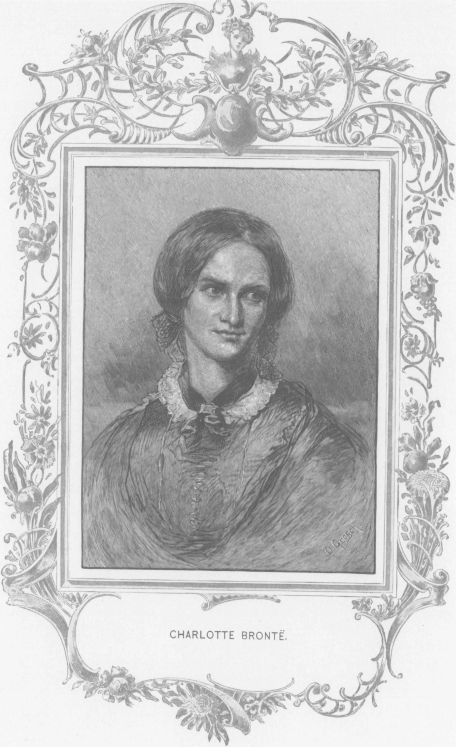
The facts of her life are few in number, but they have a direct and significant bearing on her work. She was born at Thornton, in the parish of Bradford, in 1816. Four years later her father moved to Haworth, to the parsonage now indissolubly associated with her name, and there Mr. Bronté entered upon a long period of pastorate service, that only ended with his death. Charlotte's mother was dead. In 1824 Charlotte and two older sisters, Maria and Elizabeth, went to a school at Cowan's Bridge. It was an institution for clergymen's children, a vivid picture of which appears in 'Jane Eyre.' It was so badly managed and the food was so poor that many of the children fell sick, among them Maria Bronté, who died in 1825. Elizabeth followed her a few months later, and Charlotte returned to Haworth, where she remained for six years, then went to school at Roe Head for a period of three years. She was offered the position of teacher by Miss Wooler, the principal at Roe Head, but considering herself unfit to teach, she resolved to go to Brussels to study French. She spent two years there, and it was there that her intimate and misconstrued friendship for M. Heger developed. The incidents of that period formed the material of a greater portion of her novel 'Villette,' filled twenty-two volumes of from sixty to one hundred pages of fine writing, and consisted of some forty complete novelettes or other stories and childish "magazines."
On returning to Haworth, she endeavored, together with her sister Emily, to establish a school at their home. But pupils were not to be had, and the outlook was discouraging. Two periods of service as governess, and the ill health that had followed, had taught Charlotte the danger that threatened her. Her experiences as a governess in the Sedgwick family were pictured by-and-by in 'Jane Eyre.' In a letter to Miss Ellen Nussey, written at this time, she gives a dark vignette of her situation.
With her two sisters Emily and Anne she lived a quiet and retired life. The harsh realities about them, the rough natures of the Yorkshire people, impelled the three sisters to construct in their home an ideal world of their own, and in this their pent-up natures found expression. Their home was lonely and gloomy. Mr. Clement K. Shorter, in his recent study of the novelist and her family, says that the house is much the same to-day, though its immediate surroundings are brightened. He writes:
"One day Emily confided to Charlotte that she had written some verses. Charlotte answered with a similar confidence, and then Anne acknowledged that she too had been secretly writing. This mutual confession brought about a complete understanding and sympathy, and from that time on the sisters worked together--reading their literary productions to one another and submitting to each other's criticism."
This was however by no means Charlotte's first literary work. She has left a catalogue of books written by her between 1829 and 1830. Her first printed work however appeared in a volume of 'Poems' by Acton, Ellis, and Currer Bell, published in 1846 at the expense of the authors. Under these names the little book of the Bronté sisters went forth to the world, was reviewed with mild favor in some few periodicals, and was lost to sight.
Then came a period of novel-writing. As a result, Emily Bronté's 'Wuthering Heights,' Anne Bronté's 'Agnes Grey,' and Charlotte Bronté's 'The Professor' set out together to find a publisher. The last-named was unsuccessful; but on the day it was returned to her, Charlotte Bronté began writing 'Jane Eyre.' That first masterpiece was shaped during a period of sorrow and discouragement. Her father was ill and in danger of losing his eyesight. Her brother Bran well was sinking into the slough of disgrace. No wonder 'Jane Eyre' is not a story of sunshine and roses. She finished the story in 1847, and it was accepted by the publishers promptly upon examination.
After its publication and the sensation produced, Charlotte Bronté continued her literary work quietly, and unaffected by the furore she had aroused. A few brief visits to London, where attempts were made to lionize her,--very much to her distaste,--a few literary friendships, notably those with Thackeray, George Henry Lewes, Mrs. Gaskell, and Harriet Martineau, were the only features that distinguished her literary life from the simple life she had always led and continued to lead at Haworth. She was ever busy, if not ever at her desk. Success had come; she was sane in the midst of it. She wrote slowly and only as she felt the impulse, and when she knew she had found the proper impression. In 1849 'Shirley' was published. In 1853 appeared 'Villette,' her last finished work, and the one considered by herself the best.
In 1854 she married her father's curate, Mr. A.B. Nicholls. She had lost her brother Branwell and her two sisters Emily and Anne. Sorrow upon sorrow had closed like deepening shadows about her. All happiness in life for her had apparently ended, when this marriage brought a brief ray of sunshine. It was a happy union, and seemed to assure a period of peace and rest for the sorely tried soul. Only a few short months, however, and fate, as if grudging her even the bit of happiness, snapped the slender threads of her life and the whole sad episode of her existence was ended. She died March 31st, 1855, leaving her husband and father to mourn together in the lonely parsonage. She left a literary fragment--the story entitled 'Emma,' which was published with an introduction by Thackeray.
Such are the main facts of this reserved life of Charlotte Bronté. Are they dull and commonplace? Some of them are indeed inexpressibly sad. Tragedy is beneath all the bitter chronicle. The sadness of her days can be appreciated by all who read her books. Through all her stories there is an intense note, especially in treating the pathos of existence, that is unmistakably subjective. There is a keen perception of the darker depths of human nature that could have been revealed to a human heart only by suffering and sorrow.
She did not allow sadness, however, to crush her spirit. She was neither morbid nor melancholy, but on the contrary Charlotte was cheerful and pleasant in disposition and manner. She was a loving sister and devoted daughter, patient and obedient to a parent who afterwards made obedience a severe hardship. There were other sides to her character. She was not always calm. She was not ever tender and a maker of allowances. But who is such? And she had good reason to be impatient with the world as she found it.
Her character and disposition are partially reflected in 'Jane Eyre.' The calm, clear mind, the brave, independent spirit are there. But a fuller and more accurate picture of her character may be found in Lucy Snowe, the heroine of 'Villette.' Here we find especially that note of hopelessness that predominated in Charlotte's character. Mrs. Gaskell, in her admirable biography of Charlotte Bronté, has called attention to this absence of hope in her nature. Charlotte indeed never allowed herself to look forward to happy issues. She had no confidence in the future. The pressure of grief apparently crushed all buoyancy of expectation. It was in this attitude that when literary success greeted her, she made little of it, scarcely allowing herself to believe that the world really set a high value on her work. Throughout all the excitement that her books produced, she was almost indifferent. Brought up as she had been to regard literary work as something beyond the proper limits of her sex, she never could quite rid herself of the belief that in writing successfully, she had made of herself not so much a literary figure as a sort of social curiosity. Nor was that idea wholly foreign to her time.
Personally Charlotte Bronté was not unattractive. Though somewhat too slender and pale, and plain of feature, she had a pleasant expression, and her homelier features were redeemed by a strong massive forehead, luxuriant glossy hair, and handsome eyes. Though she had little faith in her powers of inspiring affection, she attracted people strongly and was well beloved by her friends. That she could stir romantic sentiment too was attested by the fact that she received and rejected three proposals of marriage from as many suitors, before her acceptance of Mr. Nicholls.
Allusion has been made to the work of Charlotte's two sisters, Emily and Anne. Of the two Emily is by far the more remarkable, revealing in the single novel we have from her pen a genius as distinct and individual as that of her more celebrated sister. Had she lived, it is more than likely that her literary achievements would have rivaled Charlotte's.
Emily Bronté has always been something of a puzzle to biographers. She was eccentric, an odd mixture of bashful reserve and unexpected spells of frankness, sweet, gentle, and retiring in disposition, but possessed of great courage. She was two years younger than Charlotte, but taller. She was slender, though well formed, and was pale in complexion, with great gray eyes of remarkable beauty. Emily's literary work is to be found in the volume of "Poems" of her sisters, her share in that work being considered superior in imaginative quality and in finish to that of the others; and in the novel "Wuthering Heights," a weird, horrid story of astonishing power, written when she was twenty-eight years of age. Considered purely as an imaginative work, "Wuthering Heights" is one of the most remarkable stories in English literature, and is worthy to be ranked with the works of Edgar A. Poe. Many will say that it might better not have been written, so utterly repulsive is it, but others will value it as a striking, though distorted, expression of unmistakable genius. It is a ghastly and gruesome creation. Not one bright ray redeems it. It deals with the most evil characters and the most evil phases of human experience. But it fascinates. Heathcliff, the chief figure in the book, is one of the greatest villains in fiction,--an abhorrent creature,--strange, monstrous, Frankensteinesque.
Anne Bronté is known by her share in the book of "Poems" and by two novels, "Agnes Gray" and "The Tenant of Wildfell Hall," both of which are disappointing. The former is based on the author's experiences as a governess, and is written in the usual placid style of romances of the time. "The Tenant of Wildfell Hall" found its suggestion in the wretched career of Branwell Bronté, and presents a sad and depressing picture of a life of degradation. The book was not a success, and would no doubt have sunk long ago into oblivion but for its association with the novels of Emily and Charlotte.
In studying the work of Charlotte Bronté, the gifted older sister of the group, one of the first of the qualities that impress the reader is her actual creative power. To one of her imaginative power, the simplest life was sufficient, the smallest details a fund of material. Mr. Swinburne has called attention to the fact that Charlotte Bronté's characters are individual creations, not types constructed out of elements gathered from a wide observation of human nature, and that they are real creations; that they compel our interest and command our assent because they are true, inevitably true. Perhaps no better example of this individualism could be cited than Rochester. The character is unique. It is not a type, nor has it even a prototype, like so many of Charlotte Bronté's characters. Gossip insisted at one time that the author intended to picture Thackeray in Rochester, but this is groundless. Rochester is an original creation. The character of Jane Eyre, too, while reflecting something of the author's nature, was distinctly individual; and it is interesting to note here that with Jane Eyre came a new heroine into fiction, a woman of calm, clear reason, of firm positive character, and what was most novel, a plain woman, a homely heroine.
"Why is it," Charlotte had once said, "that heroines must always be beautiful?" The hero of romance was always noble and handsome, the heroine lovely and often insipid, and the scenes set in an atmosphere of exaggerated idealism. Against this idealism Charlotte Bronté revolted. Her effort was always toward realism.
In her realism she reveals a second characteristic scarcely less marked than her creative powers,--an extraordinary faculty of observation. She saw the essence, the spirit of things, and the simplest details of life revealed to her the secrets of human nature. What she had herself seen and felt--the plain rugged types of Yorkshire character, the wild scenery of the moorlands--she reflected with living truth. She got the real fact out of every bit of material in humanity and nature that her simple life afforded her. And where her experience could not afford her the necessary material, she drew upon some mysterious resources in her nature, which were apparently not less reliable than actual experience. On being asked once how she could describe so accurately the effects of opium as she does in 'Villette,' she replied that she knew nothing of opium, but that she had followed the process she always adopted in cases of this kind. She had thought intently on the matter for many a night before falling asleep; till at length, after some time, she waked in the morning with all clear before her, just as if she had actually gone through the experience, and then could describe it word for word as it happened.
Her sensitiveness to impressions of nature was exceedingly keen. She had what Swinburne calls "an instinct for the tragic use of landscape." By constant and close observation during her walks she had established a fellowship with nature in all her phases; learning her secrets from the voices of the night, from the whisper of the trees, and from the eerie moaning of the moorland blasts. She studied the cold sky, and had watched the "coming night-clouds trailing low like banners drooping."
Other qualities that distinguish her work are purity, depth and ardor of passion, and spiritual force and fervor. Her genius was lofty and noble, and an exalted moral quality predominates in her stories. She was ethical as sincerely as she was emotional.
We have only to consider her technique, in which she is characteristically original. This originality is noticeable especially in her use of words. There is a sense of fitness that often surprises the reader. Words at times in her hands reveal a new power and significance. In the choice of words Charlotte Bronté was scrupulous. She believed that there was just one word fit to express the idea or shade of meaning she wished to convey, and she never admitted a substitute, sometimes waiting days until the right word came. Her expressions are therefore well fitted and forcible. Though the predominant key is a serious one, there is nevertheless considerable humor in Charlotte Bronté's work. In 'Shirley' especially we find many happy scenes, and much wit in repartee. And yet, with all these merits, one will find at times her style to be lame, stiff, and crude, and even when strongest, occasionally coarse. Not infrequently she is melodramatic and sensational. But through it all there is that pervading sense of reality and it redeems these defects.
Of the unusual, the improbable, the highly colored in Charlotte Bronté's books we shall say little. In criticizing works so true to life and nature as these, one should not be hasty. We feel the presence of a seer. Some one once made an objection in Charlotte Bronté's presence to that part of 'Jane Eyre' in which she hears Rochester's voice calling to her at a great crisis in her life, he being many miles distant from her at the time. Charlotte caught her breath and replied in a low voice:--"But it is a true thing; it really happened." And so it might be said of Charlotte Bronté's work as a whole:--"It is a true thing; it really happened."
JANE EYRE'S WEDDING DAY
From 'Jane Eyre'
Sophie came at seven to dress me. She was very long indeed in accomplishing her task; so long that Mr. Rochester--grown, I suppose, impatient of my delay--sent up to ask why I did not come. She was just fastening my veil (the plain square of blonde, after all) to my hair with a brooch; I hurried from under her hands as soon as I could.
"Stop!" she cried in French, "Look at yourself in the mirror; you have not taken one peep."
So I turned at the door. I saw a robed and veiled figure, so unlike my usual self that it seemed almost the image of a stranger.
"Jane!" called a voice, and I hastened down. I was received at the foot of the stairs by Mr. Rochester. "Lingerer," he said, "my brain is on fire with impatience; and you tarry so long!"
He took me into the dining-room, surveyed me keenly all over, pronounced me "fair as a lily, and not only the pride of his life, but the desire of his eyes"; and then, telling me he would give me but ten minutes to eat some breakfast, he rang the bell. One of his lately hired servants, a footman, answered it.
"Is John getting the carriage ready?"
"Yes, sir."
"Is the luggage brought down?"
"They are bringing it down, sir."
"Go you to the church; see if Mr. Wood" (the clergyman) "and the clerk are there; return and tell me."
The church, as the reader knows, was but just beyond the gates; the footman soon returned.
"Mr. Wood is in the vestry, sir, putting on his surplice."
"And the carriage?"
"The horses are harnessing."
"We shall not want it to go to church; but it must be ready the moment we return--all the boxes and luggage arranged and strapped on, and the coachman in his seat."
"Yes, sir."
"Jane, are you ready?"
I rose. There were no groomsmen, no bridesmaids, no relatives to wait for or marshal; none but Mr. Rochester and I. Mrs. Fairfax stood in the hall as we passed. I would fain have spoken to her, but my hand was held by a grasp of iron; I was hurried along by a stride I could hardly follow; and to look at Mr. Rochester's face was to feel that not a second of delay would be tolerated for any purpose. I wondered what other bridegroom ever looked as he did--so bent up to a purpose, so grimly resolute; or who, under such steadfast brows, ever revealed such flaming and flashing eyes.
I know not whether the day was fair or foul; in descending the drive I gazed neither on sky nor earth; my heart was with my eyes, and both seemed migrated into Mr. Rochester's frame. I wanted to see the invisible thing on which, as we went along, he appeared to fasten a glance fierce and fell. I wanted to feel the thoughts whose force he seemed breasting and resisting.
At the churchyard wicket he stopped; he discovered I was quite out of breath.
"Am I cruel in my love?" he said. "Delay an instant; lean on me, Jane."
And now I can recall the picture of the gray old house of God rising calm before me, of a rook wheeling around the steeple, of a ruddy morning sky beyond. I remember something, too, of the green grave-mounds; and I have not forgotten, either, two figures of strangers, straying among the low hillocks, and reading the mementos graven on the few mossy headstones. I noticed them because as they saw us they passed around to the back of the church; and I doubted not they were going to enter by the side aisle door and witness the ceremony. By Mr. Rochester they were not observed; he was earnestly looking at my face, from which the blood had, I dare say, momentarily fled; for I felt my forehead dewy and my cheeks and lips cold. When I rallied, which I soon did, he walked gently with me up the path to the porch.
We entered the quiet and humble temple; the priest waited in his white surplice at the lowly altar, the clerk beside him. All was still; two shadows only moved in a remote corner. My conjecture had been correct; the strangers had slipped in before us, and they now stood by the vault of the Rochesters, their backs toward us, viewing through the rails the old time-stained marble tomb, where a kneeling angel guarded the remains of Damer de Rochester, slain at Marston Moor in the time of the civil wars, and of Elizabeth his wife.
Our place was taken at the communion-rails. Hearing a cautious step behind me, I glanced over my shoulder; one of the strangers--a gentleman, evidently--was advancing up the chancel. The service began. The explanation of the intent of matrimony was gone through: and then the clergyman came a step farther forward, and bending slightly toward Mr. Rochester, went on:--
"I require and charge you both (as ye will answer at the dreadful day of judgment, when the secrets of all hearts shall be disclosed) that if either of you know any impediment why ye may not lawfully be joined together in matrimony, ye do now confess it; for be ye well assured that so many as are coupled together otherwise than God's word doth allow are not joined together by God, neither is their matrimony lawful."
He paused, as the custom is. When is the pause after that sentence ever broken by reply? Not, perhaps, once in a hundred years. And the clergyman, who had not lifted his eyes from his book, and had held his breath but for a moment, was proceeding; his hand was already stretched toward. Mr. Rochester, as his lips unclosed to ask, "Wilt thou have this woman for thy wedded wife?"--when a distinct and near voice said, "The marriage cannot go on: I declare the existence of an impediment."
The clergyman looked up at the speaker and stood mute: the clerk did the same; Mr. Rochester moved slightly, as if an earthquake had rolled under his feet; taking a firmer footing, and not turning his head or eyes, he said, "Proceed!"
Profound silence fell when he had uttered that word, with deep but low intonation. Presently Mr. Wood said, "I cannot proceed without some investigation into what has been asserted, and evidence of its truth or falsehood."
"The ceremony is quite broken off," subjoined the voice behind us. "I am in a condition to prove my allegation; an insuperable impediment to this marriage exists."
Mr. Rochester heard, but heeded not; he stood stubborn and rigid; making no movement but to possess himself of my hand. What a hot and strong grasp he had!--and how like quarried marble was his pale, firm, massive front at this moment! How his eye shone, still, watchful, and yet wild beneath!
Mr. Wood seemed at a loss. "What is the nature of the impediment?" he asked. "Perhaps it may be got over--explained away?"
"Hardly," was the answer: "I have called it insuperable, and I speak advisedly."
The speaker came forward and leaned on the rails. He continued, uttering each word distinctly, calmly, steadily, but not loudly.
"It simply consists in the existence of a previous marriage. Mr. Rochester has a wife now living."
My nerves vibrated to those low-spoken words as they had never vibrated to thunder; my blood felt their subtle violence as it had never felt frost or fire; but I was collected, and in no danger of swooning. I looked at Mr. Rochester; I made him look at me. His whole face was colorless rock; his eye was both spark and flint. He disavowed nothing; he seemed as if he would defy all things. Without speaking, without smiling, without seeming to recognize in me a human being, he only twined my waist with his arm and riveted me to his side.
"Who are you?" he asked of the intruder.
"My name is Briggs, a solicitor of ---- Street, London."
"And you would thrust on me a wife?"
"I would remind you of your lady's existence, sir, which the law recognizes if you do not."
"Favor me with an account of her--with her name, her parentage, her place of abode."
"Certainly." Mr. Briggs calmly took a paper from his pocket, and read out in a sort of official, nasal voice:--
"I affirm and can prove that on the 20th of October, A.D.--" (a date of fifteen years back), "Edward Fairfax Rochester, of Thornfield Hall, in the county of ----, and of Ferndean Manor, in ---- shire, England, was married to my sister, Bertha Antoinetta Mason, daughter of Jonas Mason, merchant, and of Antoinetta his wife, a Creole, at ---- church, Spanish Town, Jamaica. The record of the marriage will be found in the register of that church--a copy of it is now in my possession. Signed, Richard Mason."
"That, if a genuine document, may prove I have been married, but it does not prove that the woman mentioned therein as my wife is still living."
"She was living three months ago," returned the lawyer.
"How do you know?"
"I have a witness to the fact whose testimony even you, sir, will scarcely controvert."
"Produce him--or go to hell!"
"I will produce him first--he is on the spot: Mr. Mason, have the goodness to step forward."
Mr. Rochester, on hearing the name, set his teeth: he experienced, too, a sort of strong convulsive quiver; near to him as I was, I felt the spasmodic movement of fury or despair run through his frame.
The second stranger, who had hitherto lingered in the background, now drew near; a pale face looked over the solicitor's shoulder--yes, it was Mason himself. Mr. Rochester turned and glared at him. His eye, as I have often said, was a black eye--it had now a tawny, nay, a bloody light in its gloom; and his face flushed--olive cheek and hueless forehead received a glow, as from spreading, ascending heart-fire; and he stirred, lifted his strong arm; he could have struck Mason--dashed him on the church floor--shocked by ruthless blow the breath from his body; but Mason shrank away, and cried faintly, "Good God!" Contempt fell cool on Mr. Rochester--his passion died as if a blight had shriveled it up; he only asked, "What have you to say?"
An inaudible reply escaped Mason's white lips.
"The devil is in it if you cannot answer distinctly. I again demand, what have you to say?"
"Sir--sir," interrupted the clergyman, "do not forget you are in a sacred place." Then addressing Mason, he inquired gently, "Are you aware, sir, whether or not this gentleman's wife is still living?"
"Courage," urged the lawyer; "speak out."
"She is now living at Thornfield Hall," said Mason, in more articulate tones. "I saw her there last April. I am her brother."
"At Thornfield Hall!" ejaculated the clergyman. "Impossible! I am an old resident in this neighborhood, sir, and I never heard of a Mrs. Rochester at Thornfield Hall."
I saw a grim smile contort Mr. Rochester's lip, and he muttered, "No, by God! I took care that none should hear of it, or of her under that name." He mused; for ten minutes he held counsel with himself: he formed his resolve, and announced it:--"Enough; all shall bolt out at once, like a bullet from the barrel. Wood, close your book and take off your surplice; John Green" (to the clerk) "leave the church: there will be no wedding to-day." The man obeyed.
Mr. Rochester continued hardily and recklessly:--"Bigamy is an ugly word! I meant, however, to be a bigamist; but fate has out-manoeuvred me, or Providence has checked me--perhaps the last. I am little better than a devil at this moment; and as my pastor there would tell me, deserve no doubt the sternest judgments of God, even to the quenchless fire and deathless worm.
"Gentlemen, my plan is broken up! what this lawyer and his client say is true: I have been married, and the woman to whom I was married lives! You say you never heard of a Mrs. Rochester at the house up yonder, Wood; but I dare say you have many a time inclined your ear to gossip about the mysterious lunatic kept there under watch and ward. Some have whispered to you that she is my bastard half-sister; some, my cast-off mistress: I now inform you that she is my wife, whom I married fifteen years ago--Bertha Mason by name; sister of this resolute personage who is now, with his quivering limbs and white cheeks, showing you what a stout heart men may bear. Cheer up, Dick! never fear me! I'd almost as soon strike a woman as you. Bertha Mason is mad; and she came of a mad family--idiots and maniacs through three generations! Her mother, the Creole, was both a mad-woman and a drunkard!--as I found out after I had wed the daughter; for they were silent on family secrets before. Bertha, like a dutiful child, copied her parent in both points. I had a charming partner--pure, wise, modest; you can fancy I was a happy man. I went through rich scenes! Oh! my experience has been heavenly, if you only knew it! But I owe you no further explanation. Briggs, Wood, Mason, I invite you all to come up to the house and visit Mrs. Poole's patient, and my wife! You shall see what sort of a being I was cheated into espousing, and judge whether or not I had a right to break the compact, and seek sympathy with something at least human. This girl," he continued, looking at me, "knew no more than you, Wood, of the disgusting secret: she thought all was fair and legal, and never dreamed that she was going to be entrapped into a feigned union with a defrauded wretch, already bound to a bad, mad, and imbruted partner! Come, all of you, follow."
Still holding me fast, he left the church: the three gentlemen came after. At the front door of the hall we found the carriage.
"Take it back to the coach-house, John," said Mr. Rochester, coolly: "it will not be wanted to-day."
At our entrance, Mrs. Fairfax, Adèle, Sophie, Leah, advanced to meet and greet us.
"To the right-about--every soul!" cried the master: "away with your congratulations! Who wants them? Not I! they are fifteen years too late!"
He passed on and ascended the stairs, still holding my hand, and still beckoning the gentlemen to follow him; which they did. We mounted the first staircase, passed up the gallery, proceeded to the third story: the low black door, opened by Mr. Rochester's master-key, admitted us to the tapestried room, with its great bed and its pictorial cabinet.
"You know this place, Mason," said our guide; "she bit and stabbed you here."
He lifted the hangings from the wall, uncovering the second door; this too he opened. In a room without a window there burned a fire, guarded by a high and strong fender, and a lamp suspended from the ceiling by a chain. Grace Poole bent over the fire, apparently cooking something in a saucepan. In the deep shade, at the further end of the room, a figure ran backward and forward. What it was, whether beast or human being, one could not at first sight tell; it groveled, seemingly, on all fours; it snatched and growled like some strange wild animal; but it was covered with clothing; and a quantity of dark grizzled hair, wild as a mane, hid its head and face.
"Good morning, Mrs. Poole," said Mr. Rochester. "How are you? and how is your charge to-day?"
"We're tolerable, sir, I thank you," replied Grace, lifting the boiling mess carefully on to the hob: "rather snappish, but not 'rageous."
A fierce cry seemed to give the lie to her favorable report: the clothed hyena rose up, and stood tall on its hind feet.
"Ah, sir, she sees you!" exclaimed Grace: "you'd better not stay."
"Only a few moments, Grace; you must allow me a few moments."
"Take care then, sir! for God's sake, take care!"
The maniac bellowed; she parted her shaggy locks from her visage, and gazed wildly at her visitors. I recognized well that purple face--those bloated features. Mrs. Poole advanced.
"Keep out of the way," said Mr. Rochester, thrusting her aside; "she has no knife now, I suppose? and I'm on my guard."
"One never knows what she has, sir, she is so cunning; it is not in mortal discretion to fathom her craft."
"We had better leave her," whispered Mason.
"Go to the devil!" was his brother-in-law's recommendation.
"'Ware!" cried Grace. The three gentlemen retreated simultaneously. Mr. Rochester flung me behind him; the lunatic sprang and grappled his throat viciously, and laid her teeth to his cheek; they struggled. She was a big woman, in stature almost equaling her husband, and corpulent besides; she showed virile force in the contest--more than once she almost throttled him, athletic as he was. He could have settled her with a well-planted blow; but he would not strike her; he would only wrestle. At last he mastered her arms; Grace Poole gave him a cord, and he pinioned them behind her; with more rope, which was at hand, he bound her to a chair. The operation was performed amid the fiercest yells and the most convulsive plunges. Mr. Rochester then turned to the spectators; he looked at them with a smile both acrid and desolate.
"That is my wife," said he. "Such is the sole conjugal embrace I am ever to know--such are the endearments which are to solace my leisure hours! And this is what I wished to have" (laying his hand on my shoulder): "this young girl, who stands so grave and quiet at the mouth of hell, looking collectedly at the gambols of a demon. I wanted her just as a change, after that fierce ragoût. Wood and Briggs, look at the difference. Compare these clear eyes with the red balls yonder--this face with that mask--this form with that bulk; then judge me, priest of the Gospel and man of the law, and remember, with what judgment ye judge ye shall be judged! Off with you now: I must shut up my prize."
We all withdrew. Mr. Rochester stayed a moment behind us, to give some further order to Grace Poole. The solicitor addressed me as he descended the stair.
"You, madam," said he, "are cleared from all blame; your uncle will be glad to hear it--if indeed he should be still living--when Mr. Mason returns to Madeira."
"My uncle? What of him? Do you know him?"
"Mr. Mason does; Mr. Eyre has been the Funchal correspondent of his house for some years. When your uncle received your letter intimating the contemplated union between yourself and Mr. Rochester, Mr. Mason, who was staying at Madeira to recruit his health, on his way back to Jamaica happened to be with him. Mr. Eyre mentioned the intelligence; for he knew that my client here was acquainted with a gentleman of the name of Rochester. Mr. Mason, astonished and distressed, as you may suppose, revealed the real state of matters. Your uncle, I am sorry to say, is now on a sick-bed; from which, considering the nature of his disease--decline--and the stage it has reached, it is unlikely he will ever rise. He could not then hasten to England himself, to extricate you from the snare into which you had fallen, but he implored Mr. Mason to lose no time in taking steps to prevent the false marriage. He referred him to me for assistance, I used all dispatch, and am thankful I was not too late: as you, doubtless, must be also. Were I not morally certain that your uncle will be dead ere you reach Madeira, I would advise you to accompany Mr. Mason back; but as it is, I think you had better remain in England till you can hear further, either from or of Mr. Eyre. Have we anything else to stay for?" he inquired of Mr. Mason.
"No, no; let us be gone," was the anxious reply; and without waiting to take leave of Mr. Rochester, they made their exit at the hall door. The clergyman stayed to exchange a few sentences, either of admonition or reproof, with his haughty parishioner: this duty done, he too departed.
I heard him go as I stood at the half-open door of my own room, to which I had now withdrawn. The house cleared, I shut myself in, fastened the bolt that none might intrude, and proceeded--not to weep, not to mourn, I was yet too calm for that, but--mechanically to take off the wedding-dress, and replace if by the stuff gown I had worn yesterday, as I thought for the last time. I then sat down: I felt weak and tired. I leaned my arms on a table, and my head dropped on them. And now I thought: till now I had only heard, seen, moved--followed up and down where I was led or dragged--watched event rush on event, disclosure open beyond disclosure; but now I thought.
The morning had been a quiet morning enough--all except the brief scene with the lunatic. The transaction in the church had not been noisy; there was no explosion of passion, no loud altercation, no dispute, no defiance or challenge, no tears, no sobs: a few words had been spoken, a calmly pronounced objection to the marriage made; some stern, short questions put by Mr. Rochester; answers, explanations given, evidence adduced; an open admission of the truth had been uttered by my master: then the living proof had been seen; the intruders were gone, and all was over.
I was in my own room as usual--just myself, without obvious change; nothing had smitten me, or scathed me, or maimed me. And yet where was the Jane Eyre of yesterday? where was her life? where were her prospects?
Jane Eyre, who had been an ardent, expectant woman--almost a bride--was a cold, solitary girl again: her life was pale; her prospects were desolate. A Christmas frost had come at midsummer; a white December storm had whirled over June; ice glazed the ripe apples; drifts crushed the blowing roses; on hay-field and corn-field lay a frozen shroud; lanes which last night blushed full of flowers, to-day were pathless with untrodden snow; and the woods, which twelve hours since waved leafy and fragrant as groves between the tropics, now spread waste, wild, and white as pine forests in wintry Norway.
My hopes were all dead--struck with a subtle doom, such as in one night fell on all the first-born in the land of Egypt. I looked on my cherished wishes, yesterday so blooming and glowing; they lay stark, chill, livid corpses that could never revive. I looked at my love, that feeling which was my master's--which he had created: it shivered in my heart, like a suffering child in a cold cradle; sickness and anguish had seized it; it could not seek Mr. Rochester's arms--it could not derive warmth from his breast. Oh, never more could it turn to him; for faith was blighted--confidence destroyed! Mr. Rochester was not to me what he had been; for he was not what I had thought him. I would not ascribe vice to him; I would not say he had betrayed me: but the attribute of stainless truth was gone from his idea; and from his presence I must go; that I perceived well. When--how--whither, I could not yet discern; but he himself, I doubted not, would hurry me from Thornfield. Real affection, it seemed, he could not have for me; it had been only fitful passion; that was balked; he would want me no more. I should fear even to cross his path now: my view must be hateful to him. Oh, how blind had been my eyes! how weak my conduct!
MADAME BECK
(From 'Villette')
"You ayre Engliss?" said a voice at my elbow. I almost bounded, so unexpected was the sound; so certain had I been of solitude.
No ghost stood beside me, nor anything of spectral aspect; merely a motherly, dumpy little woman, in a large shawl, a wrapping-gown, and a clean, trim, nightcap.
I said I was English, and immediately, without further prelude, we fell to a most remarkable conversation. Madame Beck (for Madame Beck it was; she had entered by a little door behind me, and being shod with the shoes of silence, I had heard neither her entrance nor approach)--Madame Beck had exhausted her command of insular speech when she said "You ayre Engliss," and she now proceeded to work away volubly in her own tongue. I answered in mine. She partly understood me, but as I did not at all understand her--though we made together an awful clamor (anything like madame's gift of utterance I had not hitherto heard or imagined)--we achieved little progress. She rang, ere long, for aid; which arrived in the shape of a "maîtresse," who had been partly educated in an Irish convent, and was esteemed a perfect adept in the English language. A bluff little personage this maîtresse was--Labasse-courienne from top to toe: and how she did slaughter the speech of Albion! However, I told her a plain tale, which she translated. I told her how I had left my own country, intent on extending my knowledge and gaining my bread; how I was ready to turn my hand to any useful thing, provided it was not wrong or degrading: how I would be a child's nurse or a lady's-maid, and would not refuse even housework adapted to my strength. Madame heard this; and questioning her countenance, I almost thought the tale won her ear.
"Il n'y a que les Anglaises pour ces sortes d'entreprises," said she: "sont-elles done intrépides, ces femmes-là!"
She asked my name, my age; she sat and looked at me--not pityingly, not with interest: never a gleam of sympathy or a shade of compassion crossed her countenance during the interview. I felt she was not one to be led an inch by her feelings: grave and considerate, she gazed, consulting her judgment and studying my narrative....
In the dead of night I suddenly awoke. All was hushed, but a white figure stood in the room--Madame in her night-dress. Moving without perceptible sound, she visited the three children in the three beds; she approached me; I feigned sleep, and she studied me long. A small pantomime ensued, curious enough. I dare say she sat a quarter of an hour on the edge of my bed, gazing at my face. She then drew nearer, bent close over me; slightly raised my cap, and turned back the border so as to expose my hair; she looked at my hand lying on the bed-clothes. This done, she turned to the chair where my clothes lay; it was at the foot of the bed. Hearing her touch and lift them, I opened my eyes with precaution, for I own I felt curious to see how far her taste for research would lead her. It led her a good way: every article did she inspect. I divined her motive for this proceeding; viz., the wish to form from the garments a judgment respecting the wearer, her station, means, neatness, etc. The end was not bad, but the means were hardly fair or justifiable. In my dress was a pocket; she fairly turned it inside out; she counted the money in my purse; she opened a little memorandum-book, coolly perused its contents, and took from between the leaves a small plaited lock of Miss Marchmont's gray hair. To a bunch of three keys, being those of my trunk, desk, and work-box, she accorded special attention: with these, indeed, she withdrew a moment to her own room. I softly rose in my bed and followed her with my eye: these keys, reader, were not brought back till they had left on the toilet of the adjoining room the impress of their wards in wax. All being thus done decently and in order, my property was returned to its place, my clothes were carefully refolded. Of what nature were the conclusions deduced from this scrutiny? Were they favorable or otherwise? Vain question. Madame's face of stone (for of stone in its present night-aspect it looked: it had been human, and as I said before, motherly, in the salon) betrayed no response.
Her duty done--I felt that in her eyes this business was a duty--she rose, noiseless as a shadow: she moved toward her own chamber; at the door she turned, fixing her eyes on the heroine of the bottle, who still slept and loudly snored. Mrs. Svini (I presume this was Mrs. Svini, Anglicé or Hibernicé Sweeny)--Mrs. Sweeny's doom was in Madame Beck's eye--an immutable purpose that eye spoke: madame's visitations for shortcomings might be slow, but they were sure. All this was very un-English: truly I was in a foreign land....
When attired, Madame Beck appeared a personage of a figure rather short and stout, yet still graceful in its own peculiar way: that is, with the grace resulting from proportion of parts. Her complexion was fresh and sanguine, not too rubicund; her eye, blue and serene; her dark silk dress fitted her as a French sempstress alone can make a dress fit; she looked well, though a little bourgeoise, as bourgeoise indeed she was. I know not what of harmony pervaded her whole person; and yet her face offered contrast too: its features were by no means such as are usually seen in conjunction with a complexion of such blended freshness and repose: their outline was stern; her forehead was high but narrow; it expressed capacity and some benevolence, but no expanse; nor did her peaceful yet watchful eye ever know the fire which is kindled in the heart or the softness which flows thence. Her mouth was hard: it could be a little grim; her lips were thin. For sensibility and genius, with all their tenderness and temerity, I felt somehow that madame would be the right sort of Minos in petticoats.
In the long run, I found that she was something else in petticoats too. Her name was Modeste Maria Beck, née Kint: it ought to have been Ignacia. She was a charitable woman, and did a great deal of good. There never was a mistress whose rule was milder. I was told that she never once remonstrated with the intolerable Mrs. Sweeny [the heroine's predecessor], despite her tipsiness, disorder, and general neglect; yet Mrs. Sweeny had to go, the moment her departure became convenient. I was told too that neither masters nor teachers were found fault with in that establishment: yet both masters and teachers were often changed; they vanished and others filled their places, none could well explain how.
The establishment was both a pensionnat and an externat: the externes or day-pupils exceeded one hundred in number; the boarders were about a score. Madame must have possessed high administrative powers: she ruled all these, together with four teachers, eight masters, six servants, and three children, managing at the same time to perfection the pupil's parents and friends; and that without apparent effort, without bustle, fatigue, fever, or any symptom of undue excitement; occupied she always was--busy, rarely. It is true that madame had her own system for managing and regulating this mass of machinery; and a very pretty system it was: the reader has seen a specimen of it in that small affair of turning my pocket inside out and reading my private memoranda. Surveillance, espionnage, these were her watchwords.
Still, madame knew what honesty was, and liked it--that is, when it did not obtrude its clumsy scruples in the way of her will and interest. She had a respect for "Angleterre"; and as to "les Anglaises," she would have the women of no other country about her own children, if she could help it.
Often in the evening, after she had been plotting and counter-plotting, spying and receiving the reports of spies all day, she would come up to my room, a trace of real weariness on her brow, and she would sit down and listen while the children said their little prayers to me in English: the Lord's Prayer and the hymn beginning "Gentle Jesus," these little Catholics were permitted to repeat at my knee; and when I had put them to bed, she would talk to me (I soon gained enough French to be able to understand and even answer her) about England and Englishwomen, and the reason for what she was pleased to term their superior intelligence, and, more real and reliable probity. Very good sense she often showed; very sound opinions she often broached: she seemed to know that keeping girls in distrustful restraint, in blind ignorance, and under a surveillance that left them no moment and no corner for retirement, was not the best way to make them grow up honest and modest women; but she averred that ruinous consequences would ensue if any other method were tried with Continental children--they were so accustomed to restraint that relaxation, however guarded, would be misunderstood and fatally presumed on: she was sick, she would declare, of the means she had to use, but use them she must; and after discoursing, often with dignity and delicacy, to me, she would move away on her "souliers de silence," and glide ghost-like through the house, watching and spying everywhere, peering through every key-hole, listening behind every door.
After all, madame's system was not bad--let me do her justice. Nothing could be better than all her arrangements for the physical well-being of her scholars. No minds were overtasked; the lessons were well distributed and made incomparably easy to the learner; there was a liberty of amusement and a provision for exercise which kept the girls healthy; the food was abundant and good: neither pale nor puny faces were anywhere to be seen in the Rue Fossette. She never grudged a holiday; she allowed plenty of time for sleeping, dressing, washing, eating: her method in all these matters was easy, liberal, salutary, and rational; many an austere English schoolmistress would do vastly well to imitate it--and I believe many would be glad to do so, if exacting English parents would let them.
As Madame Beck ruled by espionage, she of course had her staff of spies; she perfectly knew the quality of the tools she used, and while she would not scruple to handle the dirtiest for a dirty occasion--flinging this sort from her like refuse rind? after the orange has been duly squeezed--I have known her fastidious in seeking pure metal for clean uses; and when once a bloodless and rustless instrument was found, she was careful of the prize, keeping it in silk and cotton-wool. Yet woe be to the man or woman who relied on her one inch beyond the point where it was her interest to be trustworthy; interest was the master-key of madame's nature--the mainspring of her motives--the alpha and omega of her life. I have seen her feelings appealed to, and I have smiled in half-pity, half-scorn at the appellants. None ever gained her ear through that channel, or swayed her purpose by that means. On the contrary, to attempt to touch her heart was the surest way to rouse her antipathy, and to make of her a secret foe. It proved to her that she had no heart to be touched: it reminded her where she was impotent and dead. Never was the distinction between charity and mercy better exemplified than in her. While devoid of sympathy, she had a sufficiency of rational benevolence: she would give in the readiest manner to people she had never seen--rather, however, to classes than to individuals. "Pour les pauvres" she opened her purse freely--against the poor man, as a rule, she kept it closed. In philanthropic schemes, for the benefit of society at large, she took a cheerful part; no private sorrow touched her: no force or mass of suffering concentrated in one heart had power to pierce hers. Not the agony of Gethsemane, not the death on Calvary, could have wrung from her eyes one tear.
I say again, madame was a very great and a very capable woman. That school offered for her powers too limited a sphere: she ought to have swayed a nation; she should have been the leader of a turbulent legislative assembly. Nobody could have browbeaten her, none irritated her nerves, exhausted her patience, or overreached her astuteness. In her own single person, she could have comprised the duties of a first minister and a superintendent of police. Wise, firm, faithless, secret, crafty, passionless; watchful and inscrutable; acute and insensate--withal perfectly decorous--what more could be desired?
A YORKSHIRE LANDSCAPE
From 'Shirley'
"Miss Keeldar, just stand still now, and look down at Nunneley dale and wood."
They both halted on the green brow of the Common. They looked down on the deep valley robed in May raiment; on varied meads, some pearled with daisies and some golden with kingcups: to-day all this young verdure smiled clear in sunlight; transparent emerald and amber gleams played over it. On Nunnwood--the sole remnant of antique British forest in a region whose lowlands were once all sylvan chase, as its highlands were breast-deep heather--slept the shadow of a cloud; the distant hills were dappled, the horizon was shaded and tinted like mother-of-pearl; silvery blues, soft purples, evanescent greens and rose-shades, all melting into fleeces of white cloud, pure as azury snow, allured the eye with a remote glimpse of heaven's foundations. The air blowing on the brow was fresh and sweet and bracing.
"Our England is a bonnie island," said Shirley, "and Yorkshire is one of her bonniest nooks."
"You are a Yorkshire girl too?"
"I am--Yorkshire in blood and birth. Five generations of my race sleep under the aisles of Briarfield Church: I drew my first breath in the old black hall behind us."
Hereupon Caroline presented her hand, which was accordingly taken and shaken. "We are compatriots," said she.
"Yes," agreed Shirley, with a grave nod.
"And that," asked Miss Keeldar, pointing to the forest--"that is Nunnwood?"
"It is."
"Were you ever there?"
"Many a time."
"In the heart of it?"
"Yes."
"What is it like?"
"It is like an encampment of forest sons of Anak. The trees are huge and old. When you stand at their roots, the summits seem in another region: the trunks remain still and firm as pillars, while the boughs sway to every breeze. In the deepest calm their leaves are never quite hushed, and in a high wind a flood rushes--a sea thunders above you."
"Was it not one of Robin Hood's haunts?"
"Yes, and there are mementos of him still existing. To penetrate into Nunnwood, Miss Keeldar, is to go far back into the dim days of old. Can you see a break in the forest, about the centre?"
"Yes, distinctly."
"That break is a dell--a deep hollow cup, lined with turf as green and short as the sod of this Common: the very oldest of the trees, gnarled mighty oaks, crowd about the brink of this dell; in the bottom lie the ruins of a nunnery.
"We will go--you and I alone, Caroline--to that wood, early some fine summer morning, and spend a long day there. We can take pencils and sketch-books, and any interesting reading-book we like; and of course we shall take something to eat. I have two little baskets, in which Mrs. Gill, my house-keeper, might pack our provisions, and we could each carry our own. It would not tire you too much to walk so far?"
"Oh, no; especially if we rested the whole day in the wood; and I know all the pleasantest spots. I know where we could get nuts in nutting time; I know where wild strawberries abound; I know certain lonely, quite untrodden glades, carpeted with strange mosses, some yellow as if gilded, some a sober gray, some gem-green. I know groups of trees that ravish the eye with their perfect, picture-like effects: rude oak, delicate birch, glossy beech, clustered in contrast; and ash-trees, stately as Saul, standing isolated; and superannuated wood-giants clad in bright shrouds of ivy."
THE END OF HEATHCLIFF
From Emily Bronté's 'Wuthering Heights'
For some days after that evening Mr. Heathcliff shunned meeting us at meals; yet he would not consent formally to exclude Hareton and Cathy. He had an aversion to yielding so completely to his feelings, choosing rather to absent himself; and eating once in twenty-four hours seemed sufficient sustenance for him.
One night, after the family were in bed, I heard him go down-stairs and out at the front door; I did not hear him re-enter, and in the morning I found he was still away. We were in April then, the weather was sweet and warm, the grass as green as showers and sun could make it, and the two dwarf apple-trees near the southern wall in full bloom.
After breakfast, Catherine insisted on my bringing a chair and sitting with my work under the fir-trees at the end of the house; and she beguiled Hareton, who had recovered from his accident, to dig and arrange her little garden, which was shifted to that corner by the influence of Joseph's complaints.
I was comfortably reveling in the spring fragrance around, and the beautiful soft blue overhead, when my young lady, who had run down near the gate to procure some primrose roots for a border, returned only half laden, and informed us that Mr. Heathcliff was coming in.
"And he spoke to me," she added with a perplexed look.
"What did he say?" asked Hareton.
"He told me to begone as fast as I could," she answered. "But he looked so different from his usual look that I stopped a moment to stare at him."
"How?" he inquired.
"Why, almost bright and cheerful--no, almost nothing--very much excited, and wild, and glad!" she replied.
"Night-walking amuses him, then," I remarked, affecting a careless manner; in reality as surprised as she was, and anxious to ascertain the truth of her statement--for to see the master looking glad would not be an every-day spectacle; I framed an excuse to go in.
Heathcliff stood at the open door--he was pale, and he trembled; yet certainly he had a strange joyful glitter in his eyes, that altered the aspect of his whole face.
"Will you have some breakfast?" I said. "You must be hungry, rambling about all night!"
I wanted to discover where he had been; but I did not like to ask directly.
"No, I'm not hungry," he answered, averting his head, and speaking rather contemptuously, as if he guessed I was trying to divine the occasion of his good humor.
I felt perplexed--I didn't know whether it were not a proper opportunity to offer a bit of admonition.
"I don't think it right to wander out of doors," I observed, "instead of being in bed; it is not wise, at any rate, this moist season. I daresay you'll catch a bad cold, or a fever--you have something the matter with you now!"
"Nothing but what I can bear," he replied, "and with the greatest pleasure, provided you'll leave me alone--get in, and don't annoy me."
I obeyed; and in passing, I saw he breathed as fast as a cat.
"Yes!" I reflected to myself, "we shall have a fit of illness. I cannot conceive what he has been doing!"
That noon he sat down to dinner with us, and received a heaped-up plate from my hands, as if he intended to make amends for previous fasting.
"I've neither cold nor fever, Nelly," he remarked, in allusion to my morning speech. "And I'm ready to do justice to the food you give me."
He took his knife and fork, and was going to commence eating, when the inclination appeared to become suddenly extinct. He laid them on the table, looked eagerly toward the window, then rose and went out. We saw him walking to and fro in the garden, while we concluded our meal; and Earnshaw said he'd go and ask why he would not dine; he thought we had grieved him some way.
"Well, is he coming?" cried Catherine, when he returned.
"Nay," he answered; "but he's not angry: he seemed rare and pleased indeed; only I made him impatient by speaking to him twice: and then he bid me be off to you; he wondered how I could want the company of anybody else."
I set his plate to keep warm on the fender; and after an hour or two he re-entered, when the room was clear, in no degree calmer: the same unnatural--it was unnatural!--appearance of joy under his black brows; the same bloodless hue; and his teeth visible now and then in a kind of smile; his frame shivering, not as one shivers with chill or weakness, but as a tight-stretched cord vibrates--a strong thrilling, rather than trembling.
"I will ask what is the matter," I thought, "or who should?" And I exclaimed, "Have you heard any good news, Mr. Heathcliff? You look uncommonly animated."
"Where should good news come from to me?" he said. "I'm animated with hunger; and seemingly I must not eat."
"Your dinner is here," I returned: "why won't you get it?"
"I don't want it now," he muttered hastily. "I'll wait till supper. And, Nelly, once for all, let me beg you to warn Hareton and the other away from me. I wish to be troubled by nobody--I wish to have this place to myself."
"Is there some new reason for this banishment?" I inquired. "Tell me why you are so queer, Mr. Heathcliff. Where were you last night? I'm not putting the question through idle curiosity, but--"
"You are putting the question through very idle curiosity," he interrupted, with a laugh. "Yet I'll answer it. Last night I was on the threshold of hell. To-day I am within sight of my heaven--I have my eyes on it--hardly three feet to sever me. And now you'd better go. You'll neither see nor hear anything to frighten you if you refrain from prying."
Having swept the hearth and wiped the table, I departed more perplexed than ever. He did not quit the house again that afternoon, and no one intruded on his solitude till at eight o'clock I deemed it proper, though unsummoned, to carry a candle and his supper to him.
He was leaning against the ledge of an open lattice, but not looking out; his face was turned to the interior gloom. The fire had smoldered to ashes; the room was filled with the damp, mild air of the cloudy evening; and so still, that not only the murmur of the beck down Gimmerton was distinguishable, but its ripples, and its gurgling over the pebbles, or through the large stones which it could not cover.
I uttered an ejaculation of discontent at seeing the dismal grate, and commenced shutting the casements, one after another, till I came to his.
"Must I close this?" I asked, in order to rouse him, for he would not stir.
The light flashed on his features as I spoke. O Mr. Lockwood, I cannot express what a terrible start I got by the momentary view! Those deep black eyes! That smile and ghastly paleness! It appeared to me not Mr. Heathcliff, but a goblin; and in my terror I let the candle bend toward the wall, and it left me in darkness.
"Yes, close it," he replied in his familiar voice. "There, that is pure awkwardness! Why did you hold the candle horizontally? Be quick, and bring another."
I hurried out in a foolish state of dread, and said to Joseph, "The master wishes you to take him a light and rekindle the fire." For I dare not go in myself again just then.
Joseph rattled some fire into the shovel and went; but he brought it back immediately, with the supper tray in his other hand, explaining that Mr. Heathcliff was going to bed, and he wanted nothing to eat till morning.
We heard him mount the stairs directly. He did not proceed to his ordinary chamber, but turned into that with the paneled bed; its window, as I mentioned before, is wide enough for anybody to get through, and it struck me that he plotted another midnight excursion, which he had rather we had no suspicion of.
"Is he a ghoul, or a vampire?" I mused. I had read of such hideous incarnate demons. And then I set myself to reflect how I had tended him in infancy, and watched him grow to youth, and followed him almost through his whole course, and what nonsense it was to yield to that sense of horror.
"But where did he come from, the little dark thing, harbored by a good man to his bane?" muttered Superstition, as I dozed into unconsciousness. And I began, half dreaming, to weary myself with imagining some fit parentage for him: and repeating my waking meditations I tracked his existence over again, with grim variations; at last picturing his death and funeral; of which all I can remember is being exceedingly vexed at having the task of dictating an inscription for his monument, and consulting the sexton about it; and as he had no surname, and we could not tell his age, we were obliged to content ourselves with the single word "Heathcliff." That came true--we were. If you enter the kirkyard, you'll read on his headstone only that, and the date of his death. Dawn restored me to common-sense. I rose, and went into the garden, as soon as I could see, to ascertain if there were any foot-marks under his window. There were none.
"He has staid at home," I thought, "and he'll be all right to-day!"
I prepared breakfast for the household, as was my usual custom, but told Hareton and Catherine to get theirs ere the master came down, for he lay late. They preferred taking it out of doors, under the trees, and I set a little table to accommodate them.
On my re-entrance I found Mr. Heathcliff below. He and Joseph were conversing about some farming business; he gave clear, minute directions concerning the matter discussed, but he spoke rapidly, and turned his head continually aside, and had the same excited expression, even more exaggerated.
When Joseph quitted the room, he took his seat in the place he generally chose, and I put a basin of coffee before him. He drew it nearer, and then rested his arms on the table, and looked at the opposite wall, as I supposed surveying one particular portion, up and down, with glittering, restless eyes, and with such eager interest that he stopped breathing during half a minute together.
"Come now," I exclaimed, pushing some bread against his hand, "eat and drink that while it is hot. It has been waiting near an hour."
He didn't notice me, and yet he smiled. I'd rather have seen him gnash his teeth than smile so.
"Mr. Heathcliff! master!" I cried. "Don't, for God's sake, stare as if you saw an unearthly vision."
"Don't, for God's sake, shout so loud," he replied. "Turn round and tell me, are we by ourselves?"
"Of course," was my answer, "of course we are!"
Still I involuntarily obeyed him, as if I were not quite sure. With a sweep of his hand he cleared a vacant space in front among the breakfast things, and leaned forward to gaze more at his ease.
Now I perceived he was not looking at the wall; for when I regarded him alone, it seemed exactly that he gazed at something within two yards' distance. And, whatever it was, it communicated apparently both pleasure and pain in exquisite extremes; at least the anguished yet raptured expression of his countenance suggested that idea.
The fancied object was not fixed either; his eyes pursued it with unwearied vigilance, and even in speaking to me, were never weaned away.
I vainly reminded him of his protracted abstinence from food. If he stirred to touch anything in compliance with my entreaties--if he stretched his hand out to get a piece of bread--his fingers clenched before they reached it, and remained on the table, forgetful of their aim.
I sat, a model of patience, trying to attract his absorbed attention from its engrossing speculation till he grew irritable and got up, asking why I would not allow him to have his own time in taking his meals? and saying that on the next occasion I needn't wait--I might set the things down and go. Having uttered these words, he left the house, slowly sauntered down the garden path, and disappeared through the gate.
The hours crept anxiously by: another evening came. I did not retire to rest till late, and when I did I could not sleep. He returned after midnight, and instead of going to bed, shut himself into the room beneath. I listened and tossed about, and finally dressed and descended. It was too irksome to lie up there, harassing my brain with a hundred idle misgivings.
I distinguished Mr. Heathcliff's step, restlessly measuring the floor; and he frequently broke the silence by a deep inspiration, resembling a groan. He muttered detached words also; the only one I could catch was the name of Catherine, coupled with some wild term of endearment or suffering, and spoken as one would speak to a person present--low and earnest, and wrung from the depth of his soul.
I had not courage to walk straight into the apartment; but I desired to divert him from his revery, and therefore fell foul of the kitchen fire; stirred it and began to scrape the cinders. It drew him forth sooner than I expected. He opened the door immediately, and said:--
"Nelly, come here--is it morning? Come in with your light."
"It is striking four," I answered; "you want a candle to take upstairs--you might have lighted one at this fire."
"No, I don't wish to go upstairs," he said. "Come in, and kindle me a fire, and do anything there is to do about the room."
"I must blow the coals red first, before I can carry any," I replied, getting a chair and the bellows.
He roamed to and fro, meantime, in a state approaching distraction, his heavy sighs succeeding each other so thick as to leave no space for common breathing between.
"When day breaks, I'll send for Green," he said; "I wish to make some legal inquiries of him, while I can bestow a thought on those matters, and while I can act calmly. I have not written my will yet, and how to leave my property I cannot determine! I wish I could annihilate it from the face of the earth."
"I would not talk so, Mr. Heathcliff," I interposed. "Let your will be a while--you'll be spared to repent of your many injustices yet! I never expected that your nerves would be disordered--they are, at present, marvelously so, however; and almost entirely through your own fault. The way you've passed these last three days might knock up a Titan. Do take some food and some repose. You need only look at yourself in a glass to see how you require both. Your cheeks are hollow and your eyes bloodshot, like a person starving with hunger and going blind with loss of sleep."
"It is not my fault that I cannot eat or rest," he replied. "I assure you it is through no settled designs. I'll do both as soon as I possibly can. But you might as well bid a man struggling in the water rest within arm's-length of the shore! I must reach it first, and then I'll rest. Well, never mind Mr. Green; as to repenting of my injustices, I've done no injustice, and I repent of nothing. I'm too happy, and yet I'm not happy enough. My soul's bliss kills my body, but does not satisfy itself."
"Happy, master?" I cried. "Strange happiness! If you would hear me without being angry, I might offer some advice that would make you happier."
"What is that?" he asked. "Give it."
"You are aware, Mr. Heathcliff," I said, "that from the time you were thirteen years old you have lived a selfish, unchristian life: and probably hardly had a Bible in your hands during all that period. You must have forgotten the contents of the book, and you may not have space to search it now. Could it be hurtful to send for some one--some minister of any denomination, it does not matter which--to explain it, and show you how very far you have erred from its precepts, and how unfit you will be for its heaven, unless a change takes place before you die?"
"I'm rather obliged than angry, Nelly," he said, "for you remind me of the manner that I desire to be buried in. It is to be carried to the churchyard in the evening. You and Hareton may, if you please, accompany me--and mind, particularly, to notice that the sexton obeys my directions concerning the two coffins! No minister need come; nor need anything be said over me. I tell you, I have nearly attained my heaven; and that of others is altogether unvalued and uncoveted by me!"
"And supposing you persevered in your obstinate fast, and died by that means, and they refused to bury you in the precincts of the kirk?" I said, shocked at his godless indifference. "How would you like it?"
"They won't do that," he replied; "if they did, you must have me removed secretly; and if you neglect it, you shall prove practically that the dead are not annihilated!"
As soon as he heard the other members of the family stirring, he retired to his den, and I breathed freer. But in the afternoon, while Joseph and Hareton were at their work, he came into the kitchen again, and with a wild look bid me come and sit in the house--he wanted somebody with him.
I declined, telling him plainly that his strange talk and manner frightened me, and I had neither the nerve nor the will to be his companion alone.
"I believe you think me a fiend!" he said, with his dismal laugh; "something too horrible to live under a decent roof!"
Then turning to Catherine, who was there, and who drew behind me at his approach, he added, half sneeringly:--
"Will you come, chuck? I'll not hurt you. No! to you I've made myself worse than the devil. Well, there is one who won't shrink from my company! By God! she's relentless. Oh, damn it! It's unutterably too much for flesh and blood to bear, even mine."
He solicited the society of no one more. At dusk he went into his chamber. Through the whole night, and far into the morning, we heard him groaning and murmuring to himself. Hareton was anxious to enter, but I bid him fetch Mr. Kenneth, and he should go in and see him.
When he came, and I requested admittance and tried to open the door, I found it locked; and Heathcliff bid us be damned. He was better, and would be left alone; so the doctor went away.
The following evening was very wet; indeed, it poured down till day-dawn; and as I took my morning walk round the house, I observed the master's window swinging open, and the rain driving straight in.
"He cannot be in bed," I thought: "those showers would drench him through! He must be either up or out. But I'll make no more ado; I'll go boldly, and look!"
Having succeeded in obtaining entrance with another key, I ran to unclose the panels, for the chamber was vacant--quickly pushing them aside, I peeped in. Mr. Heathcliff was there--laid on his back. His eyes met mine, so keen and fierce that I started; and then he seemed to smile.
I could not think him dead--but his face and throat were washed with rain; the bed-clothes dripped, and he was perfectly still. The lattice, flapping to and fro, had grazed one hand that rested on the sill--no blood trickled from the broken skin, and when I put my fingers to it I could doubt no more--he was dead and stark!
I hasped the window; I combed his long, black hair from his forehead; I tried to close his eyes--to extinguish, if possible, that frightful, lifelike exultation, before any one else beheld it. They would not shut--they seemed to sneer at my attempts, and his parted lips and sharp white teeth sneered too! Taken with another fit of cowardice, I cried out for Joseph. Joseph shuffled up and made a noise, but resolutely refused to meddle with him. "Th' divil's harried off his soul," he cried, "and he muh hev his carcass intuh t' bargain, for ow't aw care! Ech! what a wicked un he looks, grinning at death!" and the old sinner grinned in mockery.
I thought he intended to cut a caper round the bed; but suddenly composing himself, he fell on his knees and raised his hands, and returned thanks that the lawful master and the ancient stock were restored to their rights.
I felt stunned by the awful event; and my memory unavoidably recurred to former times with a sort of oppressive sadness. But poor Hareton, the most wronged, was the only one that really suffered much. He sat by the corpse all night, weeping in bitter earnest. He pressed its hand, and kissed the sarcastic, savage face that every one else shrank from contemplating; and bemoaned him with that strong grief which springs naturally from a generous heart, though it be tough as tempered steel.
Kenneth was perplexed to pronounce of what disorder the master died. I concealed the fact of his having swallowed nothing for four days, fearing it might lead to trouble; and then, I am persuaded, he did not abstain on purpose: it was the consequence of his strange illness, not the cause.
We buried him, to the scandal of the whole neighborhood, as he had wished. Earnshaw and I, the sexton, and six men to carry the coffin, comprehended the whole attendance.
The six men departed when they had let it down into the grave: we stayed to see it covered. Hareton, with a streaming face, dug green sods and laid them over the brown mold himself. At present it is as smooth and verdant as its companion mounds--and I hope its tenant sleeps as soundly. But the country folks, if you asked them, would swear on their Bibles that he walks. There are those who speak to having met him near the church, and on the moor, and even within this house. Idle tales, you'll say, and so say I. Yet that old man by the kitchen fire affirms he has seen "two on 'em" looking out of his chamber window on every rainy night since his death--and an odd thing happened to me about a month ago.
I was going to the grange one evening--a dark evening threatening thunder--and, just at the turn of the Heights, I encountered a little boy with a sheep and two lambs before him. He was crying terribly, and I supposed the lambs were skittish and would not be guided.
"What is the matter, my little man?" I asked.
"They's Heathcliff and a woman yonder, under t' nab," he blubbered, "un' aw darnut pass 'em."
I saw nothing, but neither the sheep nor he would go on, so I bid him take the road lower down. He probably raised the phantoms from thinking, as he traversed the moors alone, on the nonsense he had heard his parents and companions repeat; yet still I don't like being out in the dark now, and I don't like being left by myself in this grim house. I cannot help it; I shall be glad when they leave it and shift to the Grange!
"They are going to the Grange, then?" I said.
"Yes," answered Mrs. Dean, "as soon as they are married; and that will be on New Year's day."
"And who will live here then?"
"Why, Joseph will take care of the house, and perhaps a lad to keep him company. They will live in the kitchen, and the rest will be shut up."
"For the use of such ghosts as choose to inhabit it," I observed.
"No, Mr. Lockwood," said Nelly, shaking her head. "I believe the dead are at peace, but it is not right to speak of them with levity."
At that moment the garden gate swung to; the ramblers were returning.
"They are afraid of nothing," I grumbled, watching their approach through the window. "Together they would brave Satan and all his legions."
As they stepped upon the door-stones, and halted to take a last look at the moon, or more correctly at each other, by her light, I felt irresistibly impelled to escape them again; and pressing a remembrance into the hands of Mrs. Dean, and disregarding her expostulations at my rudeness, I vanished through the kitchen, as they opened the house-door; and so should have confirmed Joseph in his opinion of his fellow-servant's gay indiscretions, had he not fortunately recognized me for a respectable character by the sweet ring of a sovereign at his feet.
My walk home was lengthened by a diversion in the direction of the kirk. When beneath its walls, I perceived decay had made progress even in seven months--many a window showed black gaps deprived of glass; and slates jutted off, here and there, beyond the right line of the roof, to be gradually worked off in coming autumn storms.
I sought, and soon discovered, the three headstones on the slope next the moor--the middle one, gray, and half buried in the heath--Edgar Linton's only harmonized by the turf and moss creeping up its foot--Heathcliff's still bare.
I lingered round them, under that benign sky; watched the moths fluttering among the heath and harebells; listened to the soft wind breathing through the grass; and wondered how any one could ever imagine unquiet slumbers for the sleepers in that quiet earth.
PHILLIPS BROOKS
(1835-1893)

hillips Brooks was born in Boston, Massachusetts, December 13th, 1835, and died there January 23d, 1893. He inherited the best traditions of New England history, being on the paternal side the direct descendant of John Cotton, and his mother's name, Phillips, standing for high learning and distinction in the Congregational church. Born at a time when the orthodox faith was fighting its bitterest battle with Unitarianism, his parents accepted the dogmas of the new theology, and had him baptized by a Unitarian clergyman. But while refusing certain dogmas of the orthodox church, they were the more thrown back for spiritual support upon the internal evidences of evangelical Christianity. "Holding still," says the Rev. Arthur Brooks, "in a greater or less degree, and with more or less precision, to the old statements, they counted the great fact that these statements enshrined more precious truth than any other." Transition to the Episcopal church was easy; the mother became an Episcopalian, and Phillips Brooks received all his early training in that communion. But heredity had its influence, and in after-life the great Bishop said that the Episcopal church could reap the fruits of the long and bitter controversy which divided the New England church, only as it discerned the spiritual worth of Puritanism, and the value of its contributions to the history of religious thought and character.
Such were the early surroundings of the man, and the subsequent influences of his life tended to foster this liberal spirit. For such a purpose, Boston itself was a good place to live in: it was too large to be wholly provincial, and it was not so large that the individual was lost; and at that time it was moreover the literary centre of America. When Phillips Brooks entered Harvard, he came into an atmosphere of intense intellectual activity. James Walker was the president of the college, and Lowell, Holmes, Agassiz, and Longfellow were among the professors. He graduated with honor in 1855, and soon after entered the Episcopal theological seminary at Alexandria, Virginia.
The transition from Harvard to this college was an abrupt one. The standards of the North and South were radically different. The theology of the Church in Virginia, while tolerant to that of other denominations, was uncompromisingly hostile to what it regarded as heterodox.
When the War was declared he threw himself passionately into the cause of the Union. Yet his affection for his Southern classmates, men from whom he so widely differed, broadened that charity that was one of his finest characteristics, a charity that respected conviction wherever found.
No man, in truth, ever did so much to remove prejudice against a Church that had never been popular in New England. To the old Puritan dislike of Episcopacy and distrust of the English Church as that of the oppressors of the colony, was added a sense of resentment toward its sacerdotal claims and its assumption of ecclesiastical supremacy. But he nevertheless protested against the claim by his own communion to the title of "The American Church," he preached occasionally in other pulpits, he even had among his audiences clergymen of other denominations, and he was able to reconcile men of different creeds into concord on what is essential in all. The breadth and depth of his teaching attracted so large a following that he increased the strength of the Episcopal Church in America far more than he could have done by carrying on an active propaganda in its behalf. Under his pastorate Trinity Church, Boston, became the centre of some of the most vigorous Christian activity in America.
His first charge was the Church of the Advent, in Philadelphia; in two years he became rector of Holy Trinity Church in the same city. In 1869 he was called to Trinity Church, Boston, of which he was rector until his election as bishop of Massachusetts in 1891.
It is impossible to give an idea of Phillips Brooks without a word about his personality, which was almost contradictory. His commanding figure, his wit, the charm of his conversation, and a certain boyish gayety and naturalness, drew people to him as to a powerful magnet. He was one of the best known men in America; people pointed him out to strangers in his own city as they pointed out the Common and the Bunker Hill monument. When he went to England, where he preached before the Queen, men and women of all classes greeted him as a friend. They thronged the churches where he preached, not only to hear him but to see him. Many stories are told of him; some true, some more or less apocryphal, all proving the affectionate sympathy existing between him and his kind. It was said of him that as soon as he entered a pulpit he was absolutely impersonal. There was no trace of individual experience or theological conflict by which he might be labeled. He was simply a messenger of the truth as he held it, a mouthpiece of the gospel as he believed it had been delivered to him.
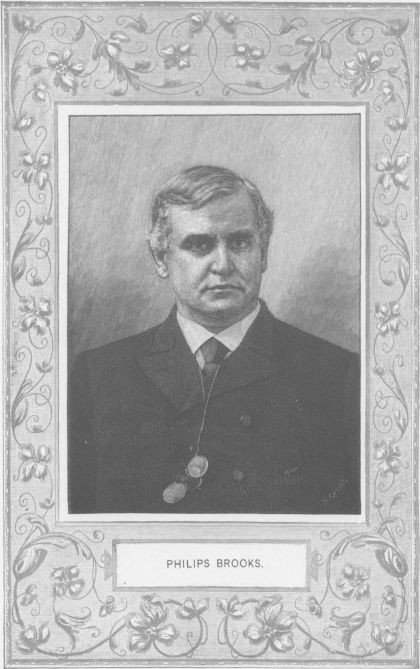
Although in his seminary days his sermons were described as vague and unpractical, Phillips Brooks was as great a preacher when under thirty years of age as he was at any later time. His early sermons, delivered to his first charge in Philadelphia, displayed the same individuality, the same force and completeness and clearness of construction, the same deep, strong undertone of religious thought, as his great discourses preached in Westminster Abbey six months before his death. His sentences are sonorous; his style was characterized by a noble simplicity, impressive, but without a touch showing that dramatic effect was strained for.
He passionately loved nature in all her aspects, and traveled widely in search of the picturesque; but he used his experience with reserve, and his illustrations are used to explain human life. His power of painting a picture in a few bold strokes appears strikingly in the great sermon on the 'Lesson of the Life of Saul,' where he contrasts early promise and final failure; and in that other not less remarkable presentation of the vision of Saint Peter. His treatment of Bible narratives is not a translation into the modern manner, nor is it an adaptation, but a poetical rendering, in which the flavor of the original is not lost though the lesson is made contemporary. And while he did not transcribe nature upon his pages, his sermons are not lacking in decoration. He used figures of speech and drew freely on history and art for illustrations, but not so much to elucidate his subject as to ornament it. His essays on social and literary subjects are written with the aim of directness of statement, pure and simple; but the stuff of which his sermons are woven is of royal purple.
The conviction that religious sentiment should penetrate the whole life showed itself in Phillips Brooks's relation to literature. "Truth bathed in light and uttered in love makes the new unit of power," he says in his essay on literature. It was his task to mediate between literature and theology, and restore theology to the place it lost through the abstractions of the schoolmen. What he would have done if he had devoted himself to literature alone, we can only conjecture by the excellence of his style in essays and sermons. They show his poetical temperament; and his little lyric 'O Little Town of Bethlehem' will be sung as long as Christmas is celebrated. His essays show more clearly even than his sermons his opinions on society, literature, and religion. They place him where he belongs, in that "small transfigured band the world cannot tame,"--the world of Cranmer, Jeremy Taylor, Robertson, Arnold, Maurice. His paper on Dean Stanley discloses his theological views as openly as do his addresses on 'Heresies and Orthodoxy.'
As might be expected of one who, in the word's best sense, was so thoroughly a man, he had great influence with young men and was one of the most popular of Harvard preachers. It was his custom for thirty alternate years to go abroad in the summer, and there, as in America, he was regarded as a great pulpit orator. He took a large view of social questions and was in sympathy with all great popular movements. His advancement to the episcopate was warmly welcomed by all parties, except one branch of his own church with which his principles were at variance, and every denomination delighted in his elevation as if he were the peculiar property of each.
He published several volumes of sermons. His works include 'Lectures on Preaching' (New York, 1877), 'Sermons' (1878-81), 'Bohlen Lectures' (1879), 'Baptism and Confirmation' (1880), 'Sermons Preached in English Churches' (1883), 'The Oldest Schools in America' (Boston, 1885), 'Twenty Sermons' (New York, 1886), 'Tolerance' (1887), 'The Light of the World, and Other Sermons' (1890), and 'Essays and Addresses' (1894). His 'Letters of Travel' show him to be an accurate observer, with a large fund of spontaneous humor. No letters to children are so delightful as those in this volume.
O LITTLE TOWN OF BETHLEHEM
O little town of Bethlehem,
How still we see thee lie!
Above thy deep and dreamless sleep
The silent stars go by.
Yet in thy dark streets shineth
The everlasting Light;
The hopes and fears of all the years
Are met in thee to-night.
O morning stars, together
Proclaim the holy birth!
And praises sing to God the King,
And peace to men on earth.
For Christ is born of Mary,
And gathered all above;
While mortals sleep the angels keep
Their watch of wondering love.
How silently, how silently,
The wondrous gift is given!
So God imparts to human hearts
The blessings of his heaven.
No ear may hear his coming;
But in this world of sin,
Where meek souls will receive him still,
The dear Christ enters in.
Where children pure and happy
Pray to the blessèd Child,
Where Misery cries out to thee,
Son of the Mother mild;
Where Charity stands watching,
And Faith holds wide the door,
The dark night wakes; the glory breaks,
And Christmas comes once more.
O holy Child of Bethlehem,
Descend to us, we pray!
Cast out our sin and enter in;
Be born in us to-day.
We hear the Christmas angels
The great glad tidings tell;
O come to us, abide with us,
Our Lord Emmanuel!
Copyrighted by E.P. Dutton and Company, New York.
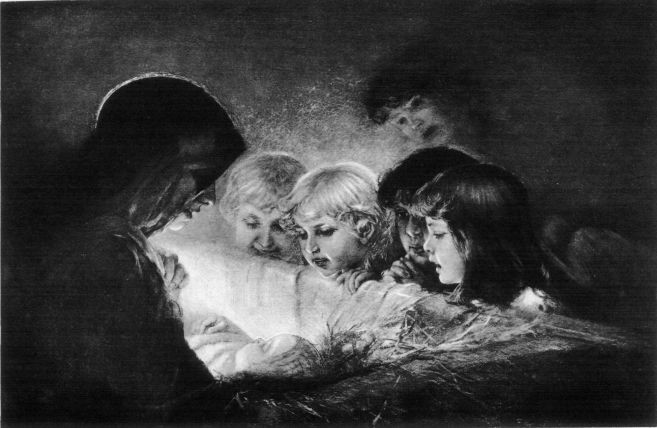
The Holy Child of Bethlehem
Photogravure from a Painting by H. Havenith.
"Where children pure and happy
Pray to the blessed Child."
PERSONAL CHARACTER
From 'Essays and Addresses'
As one looks around the world, and as one looks around our own land to-day, he sees that the one thing we need in high places--the thing whose absence, among those who hold the reins of highest power, is making us all anxious with regard to the progress of the country--is personal character. The trouble is not what we hold to be mistaken ideas with regard to policies of government, but it is the absence of lofty and unselfish character. It is the absence of the complete consecration of a man's self to the public good; it is the willingness of men to bring their personal and private spites into spheres whose elevation ought to shame such things into absolute death; the tendencies of men, even of men whom the nation has put in very high places indeed, to count those high places their privileges, and to try to draw from them, not help for humanity and the community over which they rule, but their own mean personal private advantage.
If there is any power that can elevate human character: if there is any power which, without inspiring men with a supernatural knowledge with regard to policies of government; without making men solve all at once, intuitively, the intricacies of problems of legislation with which they are called upon to deal; without making men see instantly to the very heart of every matter; if there is any power which could permeate to the very bottom of our community, which would make men unselfish and true--why, the errors of men, the mistakes men might make in their judgment, would not be an obstacle in the way of the progress of this great nation in the work which God has given her to do. They would make jolts, but nothing more. Or in the course which God has appointed her to run she would go to her true results. There is no power that man has ever seen that can abide; there is no power of which man has ever dreamed that can regenerate human character except religion; and till the Christian religion, which is the religion of this land--till the Christian religion shall have so far regenerated human character in this land that multitudes of men shall act under its high impulses and principles, so that the men who are not inspired with them shall be shamed at least into an outward conformity with them, there is no security for the great final continuance of the nation.
Copyrighted by E.P. Dutton and Company, New York.
THE COURAGE OF OPINIONS
From 'Essays and Addresses'
We have spoken of physical courage, or the courage of nerves; of moral courage, or the courage of principles. Besides these there is intellectual courage, or the courage of opinions. Let me say a few words upon that, for surely there is nothing which we more need to understand.
The ways in which people form their opinions are most remarkable. Every man, when he begins his reasonable life, finds certain general opinions current in the world. He is shaped by these opinions in one way or another, either directly or by reaction. If he is soft and plastic, like the majority of people, he takes the opinions that are about him for his own. If he is self-asserting and defiant, he takes the opposite of these opinions and gives to them his vehement adherence. We know the two kinds well, and as we ordinarily see them, the fault which is at the root of both is intellectual cowardice. One man clings servilely to the old ready-made opinions which he finds, because he is afraid of being called rash and radical; another rejects the traditions of his people from fear of being thought fearful, and timid, and a slave. The results are very different: one is the tame conservative and the other is the fiery iconoclast; but I beg you to see that the cause in both cases is the same. Both are cowards. Both are equally removed from that brave seeking of the truth which is not set upon either winning or avoiding any name, which will take no opinion for the sake of conformity and reject no opinion for the sake of originality; which is free, therefore--free to gather its own convictions, a slave neither to any compulsion nor to any antagonism. Tell me, have you never seen two teachers, one of them slavishly adopting old methods because he feared to be called "imitator," the other crudely devising new plans because he was afraid of seeming conservative, both of them really cowards, neither of them really thinking out his work? ...
The great vice of our people in their relation to the politics of the land is cowardice. It is not lack of intelligence: our people know the meaning of political conditions with wonderful sagacity. It is not low morality: the great mass of our people apply high standards to the acts of public men. But it is cowardice. It is the disposition of one part of our people to fall in with current ways of working, to run with the mass; and of another part to rush headlong into this or that new scheme or policy of opposition, merely to escape the stigma of conservatism.
LITERATURE AND LIFE
From 'Essays and Addresses'
Life comes before literature, as the material always comes before the work. The hills are full of marble before the world blooms with statues. The forests are full of trees before the sea is thick with ships. So the world abounds in life before men begin to reason and describe and analyze and sing, and literature is born. The fact and the action must come first. This is true in every kind of literature. The mind and its workings are before the metaphysician. Beauty and romance antedate the poet. The nations rise and fall before the historian tells their story. Nature's profusion exists before the first scientific book is written. Even the facts of mathematics must be true before the first diagram is drawn for their demonstration.
To own and recognize this priority of life is the first need of literature. Literature which does not utter a life already existent, more fundamental than itself, is shallow and unreal. I had a schoolmate who at the age of twenty published a volume of poems called 'Life-Memories.' The book died before it was born. There were no real memories, because there had been no life. So every science which does not utter investigated fact, every history which does not tell of experience, every poetry which is not based upon the truth of things, has no real life. It does not perish; it is never born. Therefore men and nations must live before they can make literature. Boys and girls do not write books. Oregon and Van Diemen's Land produce no literature: they are too busy living. The first attempts at literature of any country, as of our own, are apt to be unreal and imitative and transitory, because life has not yet accumulated and presented itself in forms which recommend themselves to literature. The wars must come, the clamorous problems must arise, the new types of character must be evolved, the picturesque social complication must develop, a life must come, and then will be the true time for a literature.... Literature grows feeble and conceited unless it ever recognizes the priority and superiority of life, and stands in genuine awe before the greatness of the men and of the ages which have simply lived.
CHARLES BROCKDEN BROWN
(1771-1810)
ot only was Brockden Brown the first American man-of-letters proper,--one writing for a living before we had any real literature of our own,--but his work possessed a genuine power and originality which gives it some claim to remembrance for its own sake. And it is fair always to remember that a given product from a pioneer indicates a far greater endowment than the same from one of a group in a more developed age. The forerunner lacks not one thing only, but many things, which help his successors. He lacks the mental friction from, the emulation of, the competition with, other writers; he lacks the stimulus and comfort of sympathetic companionship; he lacks an audience to spur him on, and a market to work for; lacks labor-saving conventions, training, and an environment that heartens him instead of merely tolerating him. Like Robinson Crusoe, he must make his tools before he can use them. A meagre result may therefore be a proof of great abilities.
Charles B. Brown
The United States in 1800 was mentally and morally a colony of Great Britain still. A few hundred thousand white families scattered over about as many square miles of territory, much of it refractory wilderness with more refractory inhabitants; with no cities of any size, and no communication save by wretched roads or by sailing vessels; no rich old universities for centres of culture, and no rich leisured society to enjoy it; the energies of the people perforce absorbed in subduing material obstacles, or solidifying a political experiment disbelieved in by the very men who organized it;--neither time nor materials existed then for an independent literary life, which is the growth of security and comfort and leisure if it embraces a whole society, or of endowed college foundations and an aristocracy if it is only of the few. Hence American society took its literary meals at the common table of the English-speaking race, with little or no effort at a separate establishment. There was much writing, but mostly polemic or journalistic. When real literature was attempted, it consisted in general of imitations of British essays, or fiction, or poetry; and in the last two cases not even imitations of the best models in either. The essays were modeled on Addison; the poetry on the heavy imitators of Pope's heroics; the fiction either on the effusive sentimentalists who followed Richardson, or on the pseudo-Orientalists like Walpole and Lewis, or on the pseudo-mediævalists like Mrs. Roche and Mrs. Radcliffe. This sort of work filled the few literary periodicals of the day, but was not read enough to make such publications profitable even then, and is pretty much all unreadable now.
Charles Brockden Brown stands in marked contrast to these second-hand weaklings, not only by his work but still more by his method and temper. In actual achievement he did not quite fulfill the promise of his early books, and cannot be set high among his craft. He was an inferior artist; and though he achieved naturalism of matter, he clung to the theatrical artificiality of style which was in vogue. But if he had broken away from all traditions, he could have gained no hearing whatever; he died young--twenty years more might have left him a much greater figure; and he wrought in disheartening loneliness of spirit. His accomplishment was that of a pioneer. He was the first American author to see that the true field for his fellows was America and not Europe. He realized, as the genius of Châteaubriand realized at almost the same moment, the artistic richness of the material which lay to hand in the silent forest vastnesses, with their unfamiliar life of man and beast, and their possibilities of mystery enough to satisfy the most craving. He was not the equal of the author of 'The Natchez' and 'Atala'; but he had a fresh and daring mind. He turned away from both the emotional orgasms and the stage claptrap of his time, to break ground for all future American novelists. He antedated Cooper in the field of Indian life and character; and he entered the regions of mystic supernaturalism and the disordered human brain in advance of Hawthorne and Poe.
That his choice of material was neither chance nor blind instinct, but deliberate judgment and insight, is shown by the preface to 'Edgar Huntly,' in which he sets forth his views:--
"America has opened new views to the naturalist and politician, but has seldom furnished themes to the moral-pointer. That new springs of action and new motives of curiosity should operate, that the field of investigation opened to us by our own country should differ essentially from those which exist in Europe, may be readily conceived. The sources of amusement to the fancy and instruction to the heart that are peculiar to ourselves are equally numerous and inexhaustible. It is the purpose of this work to profit by some of these sources, to exhibit a series of adventures growing out of the conditions of our country, and connected with one of the most common and wonderful diseases of the human frame. Puerile superstition and exploded manners, Gothic castles and chimeras, are the materials usually employed for this end. The incidents of Indian hostility and the perils of the Western wilderness are far more suitable, and for a native of America to overlook these would admit of no apology. These therefore are in part the ingredients of this tale."
Brown's was an uneventful career. He was much given to solitary rambles and musings, varied by social intercourse with a few congenial friends and the companionship of his affectionate family, and later, many hours spent at his writing-desk or in an editorial chair.
He was born January 17th, 1771, in Philadelphia, of good Quaker stock. A delicate boyhood, keeping him away from the more active life of youths of his own age, fostered, a love for solitude and a taste for reading. He received a good classical education; but poor health prevented him from pursuing his studies at college. At his family's wish he entered a law office instead; but the literary instinct was strong within him. Literature at this time was scarcely considered a profession. Magazine circulations were too limited for publishers to pay for contributions, and all an author usually got or expected to get was some copies to distribute among his friends. To please his prudent home circle, Brown dallied for a while with the law; but a visit to New York, where he was cordially received by the members of the "Friendly Club," opened up avenues of literary work to him, and he removed to New York in 1796 to devote himself to it.
The first important work he produced was 'Wieland: or the Transformation' (1798). It shows at the outset Brown's characteristic traits--independence of British materials and methods. It is in substance a powerful tale of ventriloquism operating on an unbalanced and superstitious mind. Its psychology is acute and searching; the characterization realistic and effective. His second book, 'Ormond: or the Secret Witness' (1799), does not reach the level of 'Wieland.' It is more conventional, and not entirely independent of foreign models, especially Godwin, whom Brown greatly admired. A rapid writer, he soon had the MS. of his next novel in the hands of the publisher. The first part of 'Arthur Mervyn: or Memoirs of the Year 1793' came out in 1799, and the second part in 1800. It is the best known of his six novels. Though the scene is laid in Philadelphia, Brown embodied in it his experience of the yellow fever which raged in New York in 1799. The passage describing this epidemic can stand beside Defoe's or Poe's or Manzoni's similar descriptions, for power in setting forth the horrors of the plague.
In the same year with the first volume of 'Arthur Mervyn' appeared 'Edgar Huntly: or Memoirs of a Sleep-Walker.' Here he deals with the wild life of nature, the rugged solitudes, and the redskins, the field in which he was followed by Cooper. A thrilling scene in which a panther is chief actor was long familiar to American children in their school reading-books.
In 1801 came out his last two novels, 'Clara Howard: In a Series of Letters,' and 'Jane Talbot.' They are a departure from his previous work: instead of dealing with uncanny subjects they treat of quiet domestic and social life. They show also a great advance on his previous books in constructive art. In 1799 Brown became editor of the Monthly Magazine and American Review, and contributed largely to it.
In the autumn of 1801 he returned to Philadelphia, to assume the editorship of Conrad's Literary Magazine and American Review. The duties of this office suspended his own creative work, and he did not live to take up again the novelist's stylus. In 1806 he became editor of the Annual Register. His genuine literary force is best proved by the fact that whatever periodical he took in charge, he raised its standard of quality and made it a success for the time.
He died in February, 1810. The work to which he had given the greater part of his time and strength, especially toward the end of his life, was in its nature not only transitory, but not of a sort to keep his name alive. The magazines were children of a day, and the editor's repute as such could hardly survive them long. The fame which belongs to Charles Brockden Brown, grudgingly accorded by a country that can ill afford to neglect one of its earliest, most devoted, and most original workers, rests on his novels. Judged by standards of the present day, these are far from faultless. The facts are not very coherent, the diction is artificial in the fashion of the day. But when all is said, Brown was a rare story-teller; he interested his readers by the novelty of his material, and he was quite objective in its treatment, never obtruding his own personality. 'Wieland,' 'Edgar Huntly,' and 'Arthur Mervyn,' the trilogy of his best novels, are not to be contemned; and he has the distinction of being in very truth the pioneer of American letters.
WIELAND'S STATEMENT
Theodore Wieland, the prisoner at the bar, was now called upon for his defense. He looked around him for some time in silence, and with a mild countenance. At length he spoke:--
It is strange: I am known to my judges and my auditors. Who is there present a stranger to the character of Wieland? Who knows him not as a husband, as a father, as a friend? Yet here am I arraigned as a criminal. I am charged with diabolical malice; I am accused of the murder of my wife and my children!
It is true, they were slain by me; they all perished by my hand. The task of vindication is ignoble. What is it that I am called to vindicate? and before whom?
You know that they are dead, and that they were killed by me. What more would you have? Would you extort from me a statement of my motives? Have you failed to discover them already? You charge me with malice: but your eyes are not shut; your reason is still vigorous; your memory has not forsaken you. You know whom it is that you thus charge. The habits of his life are known to you; his treatment of his wife and his offspring is known to you; the soundness of his integrity and the unchangeableness of his principles are familiar to your apprehension: yet you persist in this charge! You lead me hither manacled as a felon; you deem me worthy of a vile and tormenting death!
Who are they whom I have devoted to death? My wife--the little ones that drew their being from me--that creature who, as she surpassed them in excellence, claimed a larger affection than those whom natural affinities bound to my heart. Think ye that malice could have urged me to this deed? Hide your audacious fronts from the scrutiny of heaven. Take refuge in some cavern unvisited by human eyes. Ye may deplore your wickedness or folly, but ye cannot expiate it.
Think not that I speak for your sakes. Hug to your hearts this detestable infatuation. Deem me still a murderer, and drag me to untimely death. I make not an effort to dispel your illusion; I utter not a word to cure you of your sanguinary folly: but there are probably some in this assembly who have come from far; for their sakes, whose distance has disabled them from knowing me, I will tell what I have done, and why.
It is needless to say that God is the object of my supreme passion. I have cherished in his presence a single and upright heart. I have thirsted for the knowledge of his will. I have burnt with ardor to approve my faith and my obedience. My days have been spent in searching for the revelation of that will; but my days have been mournful, because my search failed. I solicited direction; I turned on every side where glimmerings of light could be discovered. I have not been wholly uninformed; but my knowledge has always stopped short of certainty. Dissatisfaction has insinuated itself into all my thoughts. My purposes have been pure, my wishes indefatigable; but not till lately were these purposes thoroughly accomplished and these wishes fully gratified.
I thank Thee, my Father, for Thy bounty; that Thou didst not ask a less sacrifice than this; that Thou placedst me in a condition to testify my submission to Thy will! What have I withheld which it was Thy pleasure to exact? Now may I, with dauntless and erect eye, claim my reward, since I have given Thee the treasure of my soul.
I was at my own house; it was late in the evening; my sister had gone to the city, but proposed to return. It was in expectation of her return that my wife and I delayed going to bed beyond the usual hour; the rest of the family, however, were retired. My mind was contemplative and calm--not wholly devoid of apprehension on account of my sister's safety. Recent events, not easily explained, had suggested the existence of some danger; but this danger was without a distinct form in our imagination, and scarcely ruffled our tranquillity.
Time passed, and my sister did not arrive. Her house is at some distance from mine, and though her arrangements had been made with a view of residing with us, it was possible that through forgetfulness, or the occurrence of unforeseen emergencies, she had returned to her own dwelling.
Hence it was conceived proper that I should ascertain the truth by going thither. I went. On my way my mind was full of those ideas which related to my intellectual condition. In the torrent of fervid conceptions I lost sight of my purpose. Sometimes I stood still; sometimes I wandered from my path, and experienced some difficulty, on recovering from my fit of musing, to regain it.
The series of my thoughts is easily traced. At first every vein beat with raptures known only to the man whose parental and conjugal love is without limits, and the cup of whose desires, immense as it is, overflows with gratification. I know not why emotions that were perpetual visitants should now have recurred with unusual energy. The transition was not new from sensations of joy to a consciousness of gratitude. The Author of my being was likewise the dispenser of every gift with which that being was embellished. The service to which a benefactor like this was entitled could not be circumscribed. My social sentiments were indebted to their alliance with devotion for all their value. All passions are base, all joys feeble, all energies malignant, which are not drawn from this source.
For a time my contemplations soared above earth and its inhabitants. I stretched forth my hands; I lifted my eyes, and exclaimed, "Oh, that I might be admitted to thy presence! that mine were the supreme delight of knowing Thy will and of performing it!--the blissful privilege of direct communication with Thee, and of listening to the audible enunciation of Thy pleasure!
"What task would I not undertake, what privation would I not cheerfully endure, to testify my love of Thee? Alas! Thou hidest Thyself from my view; glimpses only of Thy excellence and beauty are afforded me. Would that a momentary emanation from Thy glory would visit me! that some unambiguous token of Thy presence would salute my senses!"
In this mood I entered the house of my sister. It was vacant. Scarcely had I regained recollection of the purpose that brought me hither. Thoughts of a different tendency had such an absolute possession of my mind, that the relations of time and space were almost obliterated from my understanding. These wanderings, however, were restrained, and I ascended to her chamber. I had no light, and might have known by external observation that the house was without any inhabitant. With this, however, I was not satisfied. I entered the room, and the object of my search not appearing, I prepared to return. The darkness required some caution in descending the stair. I stretched out my hand to seize the balustrade, by which I might regulate my steps. How shall I describe the lustre which at that moment burst upon my vision?
I was dazzled. My organs were bereaved of their activity. My eyelids were half closed, and my hands withdrawn from the balustrade. A nameless fear chilled my veins, and I stood motionless. This irradiation did not retire or lessen. It seemed as if some powerful effulgence covered me like a mantle. I opened my eyes and found all about me luminous and glowing. It was the element of heaven that flowed around. Nothing but a fiery stream was at first visible; but anon a shrill voice from behind called upon me to attend.
I turned. It is forbidden to describe what I saw: words, indeed, would be wanting to the task. The lineaments of that Being whose veil was now lifted and whose visage beamed upon my sight, no hues of pencil or of language can portray. As it spoke, the accents thrilled to my heart:--"Thy prayers are heard. In proof of thy faith, render me thy wife. This is the victim I choose. Call her hither, and here let her fall." The sound and visage and light vanished at once.
What demand was this? The blood of Catharine was to be shed! My wife was to perish by my hand! I sought opportunity to attest my virtue. Little did I expect that a proof like this would have been demanded.
"My wife!" I exclaimed: "O God! substitute some other victim. Make me not the butcher of my wife. My own blood is cheap. This will I pour out before Thee with a willing heart; but spare, I beseech Thee, this precious life, or commission some other than her husband to perform the bloody deed."
In vain. The conditions were prescribed; the decree had gone forth, and nothing remained but to execute it. I rushed out of the house and across the intermediate fields, and stopped not till I entered my own parlor. My wife had remained here during my absence, in anxious expectation of my return with some tidings of her sister. I had none to communicate. For a time I was breathless with my speed. This, and the tremors that shook my frame, and the wildness of my looks, alarmed her. She immediately suspected some disaster to have happened to her friend, and her own speech was as much overpowered by emotion as mine. She was silent, but her looks manifested her impatience to hear what I had to communicate. I spoke, but with so much precipitation as scarcely to be understood; catching her at the same time by the arm, and forcibly pulling her from her seat.
"Come along with me; fly; waste not a moment; time will be lost, and the deed will be omitted. Tarry not, question not, but fly with me."
This deportment added afresh to her alarms. Her eyes pursued mine, and she said, "What is the matter? For God's sake, what is the matter? Where would you have me go?"
My eyes were fixed upon her countenance while she spoke. I thought upon her virtues; I viewed her as the mother of my babes; as my wife. I recalled the purpose for which I thus urged her attendance. My heart faltered, and I saw that I must rouse to this work all my faculties. The danger of the least delay was imminent.
I looked away from her, and, again exerting my force, drew her toward the door. "You must go with me; indeed you must."
In her fright she half resisted my efforts, and again exclaimed, "Good heaven! what is it you mean? Where go? What has happened? Have you found Clara?"
"Follow me and you will see," I answered, still urging her reluctant steps forward.
"What frenzy has seized you? Something must needs have happened. Is she sick? Have you found her?"
"Come and see. Follow me and know for yourself."
Still she expostulated and besought me to explain this mysterious behavior. I could not trust myself to answer her, to look at her; but grasping her arm, I drew her after me. She hesitated, rather through confusion of mind than from unwillingness to accompany me. This confusion gradually abated, and she moved forward, but with irresolute footsteps and continual exclamations of wonder and terror. Her interrogations of "What was the matter?" and "Whither was I going?" were ceaseless and vehement.
It was the scope of my efforts not to think; to keep up a conflict and uproar in my mind in which all order and distinctness should be lost; to escape from the sensations produced by her voice. I was therefore silent. I strove to abridge this interval by haste, and to waste all my attention in furious gesticulations.
In this state of mind we reached my sister's door. She looked at the windows and saw that all was desolate. "Why come we here? There is nobody here. I will not go in."
Still I was dumb; but, opening the door, I drew her into the entry. This was the allotted scene; here she was to fall. I let go her hand, and pressing my palms against my forehead, made one mighty effort to work up my soul to the deed.
In vain; it would not be; my courage was appalled, my arms nerveless. I muttered prayers that my strength might be aided from above. They availed nothing.
Horror diffused itself over me. This conviction of my cowardice, my rebellion, fastened upon me, and I stood rigid and cold as marble. From this state I was somewhat relieved by my wife's voice, who renewed her supplications to be told why we come hither and what was the fate of my sister....
The fellness of a gloomy hurricane but faintly resembled the discord that reigned in my mind. To omit this sacrifice must not be; yet my sinews had refused to perform it. No alternative was offered. To rebel against the mandate was impossible; but obedience would render me the executioner of my wife. My will was strong, but my limbs refused their office.
That accents and looks so winning should disarm me of my resolution was to be expected. My thoughts were thrown anew into anarchy. I spread my hand before my eyes that I might not see her, and answered only by groans. She took my other hand between hers, and pressing it to her heart, spoke with that voice which had ever swayed my will and wafted away sorrow:--
"My friend! my soul's friend! tell me thy cause of grief. Do I not merit to partake with thee in thy cares? Am I not thy wife?"
This was too much. I broke from her embrace and retired to a corner of the room. In this pause, courage was once more infused into me. I resolved to execute my duty. She followed me, and renewed her passionate entreaties to know the cause of my distress. I raised my head and regarded her with steadfast looks. I muttered something about death, and the injunctions of my duty. At these words she shrunk back, and looked at me with a new expression of anguish. After a pause, she clasped her hands, and exclaimed:---
"O Wieland! Wieland! God grant that I am mistaken! but something surely is wrong. I see it; it is too plain; thou art undone--lost to me and to thyself." At the same time she gazed on my features with intensest anxiety, in hope that different symptoms would take place. I replied to her with vehemence:--
"Undone! No; my duty is known, and I thank my God that my cowardice is now vanquished and I have power to fulfill it. Catharine, I pity the weakness of thy nature; I pity thee, but must not spare. Thy life is claimed from my hands; thou must die!"
Fear was now added to her grief. "What mean you? Why talk you of death? Bethink yourself, Wieland; bethink yourself, and this fit will pass. Oh, why came I hither? Why did you drag me hither?"
"I brought thee hither to fulfill a divine command. I am appointed thy destroyer, and destroy thee I must." Saying this, I seized her wrists. She shrieked aloud, and endeavored to free herself from my grasp; but her efforts were vain.
"Surely, surely, Wieland, thou dost not mean it. Am I not thy wife? and wouldst thou kill me? Thou wilt not; and yet--I see--thou art Wieland no longer! A fury resistless and horrible possesses thee. Spare me--spare--help--help--"
Till her breath was stopped she shrieked for help, for mercy. When she could speak no longer, her gestures, her looks appealed to my compassion. My accursed hand was irresolute and tremulous. I meant thy death to be sudden, thy struggles to be brief. Alas! my heart was infirm, my resolves mutable. Thrice I slackened my grasp, and life kept its hold, though in the midst of pangs. Her eyeballs started from their sockets. Grimness and distortion took the place of all that used to bewitch me into transport and subdue me into reverence. I was commissioned to kill thee, but not to torment thee with the foresight of thy death; not to multiply thy fears and prolong thy agonies. Haggard and pale and lifeless, at length thou ceasedst to contend with thy destiny.
This was the moment of triumph. Thus had I successfully subdued the stubbornness of human passions: the victim which had been demanded was given; the deed was done past recall.
I lifted the corpse in my arms and laid it on the bed. I gazed upon it with delight. Such was the elation of my thoughts that I even broke into laughter. I clapped my hands and exclaimed, "It is done! My sacred duty is fulfilled! To that I have sacrificed, O my God, Thy last and best gift, my wife!"
For a while I thus soared above frailty. I imagined I had set myself forever beyond the reach of selfishness; but my imaginations were false. This rapture quickly subsided. I looked again at my wife. My joyous ebullitions vanished, and I asked myself who it was whom I saw. Methought it could not be Catharine. It could not be the woman who had lodged for years in my heart; who had slept nightly in my bosom; who had borne in her womb, who had fostered at her breast, the beings who called me father; whom I have watched with delight, and cherished with a fondness ever new and perpetually growing; it could not be the same. Where was her bloom? These deadly and blood-suffused orbs but ill resemble the azure and ecstatic tenderness of her eyes. The lucid stream that meandered over that bosom, the glow of love that was wont to sit upon that cheek, are much unlike these livid stains and this hideous deformity. Alas! these were the traces of agony; the gripe of the assassin had been here!
I will not dwell upon my lapse into desperate and outrageous sorrow. The breath of heaven that sustained me was withdrawn, and I sunk into mere man. I leaped from the floor; I dashed my head against the wall; I uttered screams of horror; I panted after torment and pain. Eternal fire and the bickerings of hell, compared with what I felt, were music and a bed of roses.
I thank my God that this degeneracy was transient--that He deigned once more to raise me aloft. I thought upon what I had done as a sacrifice to duty, and was calm. My wife was dead; but I reflected that though this source of human consolation was closed, yet others were still open. If the transports of a husband were no more, the feelings of a father had still scope for exercise. When remembrance of their mother should excite too keen a pang, I would look upon them and be comforted.
While I revolved these ideas, new warmth flowed in upon my heart. I was wrong. These feelings were the growth of selfishness. Of this I was not aware; and to dispel the mist that obscured my perceptions, a new effulgence and a new mandate were necessary. From these thoughts I was recalled by a ray that was shot into the room. A voice spake like that which I had before heard:--"Thou hast done well. But all is not done--the sacrifice is incomplete--thy children must be offered--they must perish with their mother!--"
Thou, Omnipotent and Holy! Thou knowest that my actions were conformable to Thy will. I know not what is crime; what actions are evil in their ultimate and comprehensive tendency, or what are good. Thy knowledge, as Thy power, is unlimited. I have taken Thee for my guide, and cannot err. To the arms of Thy protection I intrust my safety. In the awards of Thy justice I confide for my recompense.
Come death when it will, I am safe. Let calumny and abhorrence pursue me among men; I shall not be defrauded of my dues. The peace of virtue and the glory of obedience will be my portion hereafter.
JOHN BROWN
(1810-1882)
ohn Brown, the son of a secession-church minister, was born in Biggar, Lanarkshire, Scotland, September 22d, 1810, and died in Edinburgh, May 11th, 1882. He was educated at the Edinburgh High School and at the University, and graduated in medicine in 1833. For a time he was a surgeon's assistant to the great Dr. Syme, the man of whom he said "he never wasted a drop of ink or blood," and whose character he has drawn in one of his most charming biographies. When he began to practice for himself he gradually "got into a good connection," and his patients made him their confidant and adviser. He was considered a fine doctor too, for he had remarkable common-sense, and was said to be unerring in diagnosis.
John Brown
Dr. Brown did not, as is commonly believed, dislike his profession; but later on he took a view of it which seemed non-progressive, and his success as a writer no doubt interfered with his practice. His friend Professor Masson draws a pleasant picture of him when he first settled in practice, as a dark-haired man with soft, fine eyes and a benignant manner, the husband of a singularly beautiful woman, and much liked and sought after in the social circles of Edinburgh. This was partly owing to the charm of his conversation, and partly to the literary reputation he had achieved through some articles on the Academy exhibition and on local artists. Though he had little technical training, he had an eye for color and form, an appreciation of the artist's meaning, and an instinct for discovering genius, as in the case of Noel Paton and David Scott. He soon became an authority among artists, and he gave a new impulse to national art.
He contributed largely to the North British Review. In 1855 he published 'Horæ Subsceivæ,' which contained, among medical biography and medico-literary papers, the immortal Scotch idyl, 'Rab and his Friends.' Up to this time the unique personality of the doctor, with its delightful mixture of humor and sympathy, was known only to his own circle. The appearance of 'Rab and his Friends' revealed it to the world. Brief as it is in form, and simple in outline, Scotland has produced nothing so full of pure, pathetic genius since Scott.
Another volume of 'Horæ Subsceivæ' appeared two years after, and some selections from it, and others from unpublished manuscript, were printed separately in the volume entitled 'Spare Hours.' They met with instant and unprecedented success. In a short time ten thousand copies of 'Minchmoor' and 'James the Doorkeeper' were sold, fifteen thousand copies of 'Pet Marjorie,' and 'Rab' had reached its fiftieth thousand. With all this success and praise, and constantly besought by publishers for his work, he could not be persuaded that his writings were of any permanent value, and was reluctant to publish. In 1882 appeared a third volume of the 'Horæ Subsceivæ,' which included all his writings. A few weeks after its publication he died.
The Doctor's medical essays, which are replete with humor, are written in defense of his special theory, the distinction between the active and the speculative mind. He thought there was too much science and too little intuitive sagacity in the world, and looked back longingly to the old-time common-sense, which he believed modern science had driven away. His own mind was anti-speculative, although he paid just tributes to philosophy and science and admired their achievements. He stigmatized the speculations of the day as the "lust of innovation." But the reader cares little for the opinions of Dr. Brown as arguments: his subject is of little consequence if he will but talk. By the charm of his story-telling these dead Scotch doctors are made to live again. The death-bed of Syme, for instance, is as pathetic as the wonderful paper on Thackeray's death; and to-day many a heart is sore for 'Pet Marjorie,' the ten-year-old child who died in Scotland almost a hundred years ago.
As an essayist, Dr. Brown belongs to the followers of Addison and Charles Lamb, and he blends humor, pathos, and quiet hopefulness with a grave and earnest dignity. He delighted, not like Lamb "in the habitable parts of the earth," but in the lonely moorlands and pastoral hills, over which his silent, stalwart shepherds walked with swinging stride. He had a keen appreciation for anything he felt to be excellent: his usual question concerning a stranger, either in literature or life, was "Has he wecht, sir?"--quoting Dr. Chalmers; and when he wanted to give the highest praise, he said certain writing was "strong meat." He had a warm enthusiasm for the work of other literary men: an artist himself, he was quick to appreciate and seize upon the witty thing or the excellent thing wherever he found it, and he was eager to share his pleasure with the whole world. He reintroduced to the public Henry Vaughn, the quaint seventeenth-century poet; he wrote a sympathetic memoir of Arthur Hallam; he imported 'Modern Painters,' and enlightened Edinburgh as to its merits. His art papers were what Walter Pater would call "appreciations,"--that is to say, he dwelt upon the beauties of what he described rather than upon the defects. What he did not admire he left alone.
As the author of 'Rab' loved the lonely glens on Minchmoor and in the Enterkin, or where Queen Mary's "baby garden" shows its box-row border among the Spanish chestnuts of Lake Monteith, so he loved the Scottish character, "bitter to the taste and sweet to the diaphragm": "Jeemes" the beadle, with his family worship when he himself was all the family; the old Aberdeen Jacobite people; Miss Stirling Graham of Duntrune, who in her day bewitched Edinburgh; Rab, Ailie, and Bob Ainslie. His characters are oddities, but are drawn without a touch of cynicism. What an amount of playful, wayward nonsense lies between these pages, and what depths of melancholy under the fun! Like Sir Walter, he had a great love for dogs, and never went out unaccompanied by one or two of them. They are the heroes of several of his sketches.
Throughout the English-speaking world, he was affectionately known as Dr. John Brown of Edinburgh. He stood aloof from political and ecclesiastical controversies, and was fond of telling a story to illustrate how little reasoning went to forming partisans. A minister catechizing a raw plowboy, after asking the first question, "Who made you?" and getting the answer "God," asked him, "How do you know that God made you?" After some pause and head-scratching, the reply came, "Weel, sir, it's the clash [common talk] o' the kintry." "Ay," Brown added, "I'm afraid that a deal of our belief is founded on just 'the clash o' the kintry.'"
MARJORIE FLEMING
From 'Spare Hours'
One November afternoon in 1810--the year in which 'Waverley' was resumed and laid aside again, to be finished off, its last two volumes in three weeks, and made immortal in 1814; and when its author, by the death of Lord Melville, narrowly escaped getting a civil appointment in India--three men, evidently lawyers, might have been seen escaping like schoolboys from the Parliament House, and speeding arm-in-arm down Bank Street and the Mound in the teeth of a surly blast of sleet.
The three friends sought the bield of the low wall old Edinburgh boys remember well, and sometimes miss now, as they struggle with the stout west wind....
The third we all know. What has he not done for every one of us? Who else ever, except Shakespeare, so diverted mankind, entertained and entertains a world so liberally, so wholesomely? We are fain to say not even Shakespeare, for his is something deeper than diversion, something higher than pleasure; and yet who would care to split this hair?
Had any one watched him closely before and after the parting, what a change he would see! The bright, broad laugh, the shrewd, jovial word, the man of the Parliament House and of the world; and next step, moody, the light of his eye withdrawn, as if seeing things that were invisible; his shut mouth like a child's, so impressionable, so innocent, so sad; he was now all within, as before he was all without; hence his brooding look. As the snow blattered in his face, he muttered, "How it raves and drifts! On-ding o' snaw,--ay, that's the word,--on-ding--" He was now at his own door, "Castle Street, No. 39." He opened the door and went straight to his den; that wondrous workshop, where in one year, 1823, when he was fifty-two, he wrote 'Peveril of the Peak,' 'Quentin Durward,' and 'St. Ronan's Well,' besides much else. We once took the foremost of our novelists--the greatest, we would say, since Scott--into this room, and could not but mark the solemnizing effect of sitting where the great magician sat so often and so long, and looking out upon that little shabby bit of sky, and that back green where faithful dog Camp lies.
He sat down in his large green morocco elbow-chair, drew himself close to his table, and glowered and gloomed at his writing apparatus, "a very handsome old box, richly carved, lined with crimson velvet, and containing ink-bottles, taper-stand, etc., in silver, the whole in such order that it might have come from the silversmith's window half an hour before." He took out his paper, then starting up angrily, said, "'Go spin, you jade, go spin.' No, d---- it, it won't do,--
"'My spinnin' wheel is auld and stiff,
The rock o't wunna stand, sir;
To keep the temper-pin in tiff
Employs ower aft my hand, sir.'
I am off the fang. I can make nothing of 'Waverley' to-day; I'll awa' to Marjorie. Come wi' me, Maida, you thief." The great creature rose slowly, and the pair were off, Scott taking a maud (a plaid) with him. "White as a frosted plum-cake, by jingo!" said he, when he got to the street. Maida gamboled and whisked among the snow, and his master strode across to Young Street, and through it to 1 North Charlotte Street, to the house of his dear friend, Mrs. William Keith, of Corstorphine Hill; niece of Mrs. Keith of Ravelston, of whom he said at her death, eight years after, "Much tradition, and that of the best, has died with this excellent old lady, one of the few persons whose spirits, and cleanliness and freshness of mind and body, made old age lovely and desirable."
Sir Walter was in that house almost every day, and had a key, so in he and the hound went, shaking themselves in the lobby. "Marjorie! Marjorie!" shouted her friend, "where are ye, my bonnie wee croodlin' doo?" In a moment a bright, eager child of seven was in his arms, and he was kissing her all over. Out came Mrs. Keith. "Come your ways in, Wattie." "No, not now. I am going to take Marjorie wi' me, and you may come to your tea in Duncan Roy's sedan, and bring the bairn home in your lap." "Tak' Marjorie, and it on-ding o' snaw!" said Mrs. Keith. He said to himself, "On-ding,'--that's odd,--that is the very word. Hoot, awa'! look here," and he displayed the corner of his plaid, made to hold lambs [the true shepherd's plaid, consisting of two breadths sewed together, and uncut at one end, making a poke or cul-de-sac]. "Tak' your lamb," said she, laughing at the contrivance, and so the Pet was first well happit up, and then put, laughing silently, into the plaid neuk, and the shepherd strode off with his lamb,--Maida gamboling through the snow, and running races in her mirth.
Didn't he face "the angry airt," and make her bield his bosom, and into his own room with her, and lock the door, and out with the warm rosy little wifie, who took it all with great composure! There the two remained for three or more hours, making the house ring with their laughter; you can fancy the big man's and Maidie's laugh. Having made the fire cheery, he set her down in his ample chair, and standing sheepishly before her, began to say his lesson, which happened to be,--"Ziccotty, diccotty, dock, the mouse ran up the clock; the clock struck one, down the mouse ran, ziccotty, diccotty, dock." This done repeatedly till she was pleased, she gave him his new lesson, gravely and slowly, timing it upon her small fingers,--he saying it after her,--
"Wonery, twoery, tickery, seven;
Alibi, crackaby, ten and eleven;
Pin, pan, musky dan;
Tweedle-um, twoddle-um, twenty-wan;
Eerie, orie, ourie,
You, are, out."
He pretended to great difficulty, and she rebuked him with most comical gravity, treating him as a child. He used to say that when he came to Alibi Crackaby he broke down, and Pin-Pan, Musky-Dan, Tweedle-um Twoddle-um made him roar with laughter. He said Musky-Dan especially was beyond endurance, bringing up an Irishman and his hat fresh from the Spice Islands and odoriferous Ind; she getting quite bitter in her displeasure at his ill behavior and stupidness.
Then he would read ballads to her in his own glorious way, the two getting wild with excitement over 'Gil Morrice' or the 'Baron of Smailholm'; and he would take her on his knee, and make her repeat Constance's speech in 'King John,' till he swayed to and fro, sobbing his fill....
Scott used to say that he was amazed at her power over him, saying to Mrs. Keith, "She's the most extraordinary creature I ever met with, and her repeating of Shakespeare overpowers me as nothing else does."
Thanks to the unforgetting sister of this dear child, who has much of the sensibility and fun of her who has been in her small grave these fifty and more years, we have now before us the letters and journals of Pet Marjorie,--before us lies and gleams her rich brown hair, bright and sunny as if yesterday's, with the words on the paper, "Cut out in her last illness," and two pictures of her by her beloved Isabella, whom she worshiped; there are the faded old scraps of paper, hoarded still, over which her warm breath and her warm little heart had poured themselves; there is the old water-mark, "Lingard, 1808." The two portraits are very like each other, but plainly done at different times; it is a chubby, healthy face, deep-set, brooding eyes, as eager to tell what is going on within as to gather in all the glories from without; quick with the wonder and the pride of life; they are eyes that would not be soon satisfied with seeing; eyes that would devour their object, and yet childlike and fearless. And that is a mouth that will not be soon satisfied with love; it has a curious likeness to Scott's own, which has always appeared to us his sweetest, most mobile and speaking feature.
There she is, looking straight at us as she did at him,--fearless and full of love, passionate, wild, willful, fancy's child.
There was an old servant, Jeanie Robertson, who was forty years in her grandfather's family. Marjorie Fleming--or as she is called in the letters and by Sir Walter, Maidie--was the last child she kept. Jeanie's wages never exceeded £3 a year, and when she left service she had saved £40. She was devotedly attached to Maidie, rather despising and ill-using her sister Isabella, a beautiful and gentle child. This partiality made Maidie apt at times to domineer over Isabella. "I mention this," writes her surviving sister, "for the purpose of telling you an instance of Maidie's generous justice. When only five years old, when walking in Raith grounds, the two children had run on before, and old Jeanie remembered they might come too near a dangerous mill-lade. She called to them to turn back. Maidie heeded her not, rushed all the faster on, and fell, and would have been lost, had her sister not pulled her back, saving her life, but tearing her clothes. Jeanie flew on Isabella to 'give it her' for spoiling her favorite's dress; Maidie rushed in between, crying out, 'Pay (whip) Maidie as much as you like, and I'll not say one word; but touch Isy, and I'll roar like a bull!' Years after Maidie was resting in her grave, my mother used to take me to the place, and told the story always in the exact same words." This Jeanie must have been a character. She took great pride in exhibiting Maidie's brother William's Calvinistic acquirements when nineteen months old, to the officers of a militia regiment then quartered in Kirkcaldy. This performance was so amusing that it was often repeated, and the little theologian was presented by them with a cap and feathers. Jeanie's glory was "putting him through the carritch" (catechism) in broad Scotch, beginning at the beginning with "Wha made ye, ma bonnie man?" For the correctness of this and the three next replies, Jeanie had no anxiety; but the tone changed to menace, and the closed nieve (fist) was shaken in the child's face as she demanded, "Of what are you made?" "DIRT," was the answer uniformly given. "Wull ye never learn to say dust, ye thrawn deevil?" with a cuff from the opened hand, was the as inevitable rejoinder.
Here is Maidie's first letter, before she was six, the spelling unaltered, and there are no "commoes."
"MY DEAR ISA--I now sit down to answer all your kind and
beloved letters which you was so good as to write to me. This is the first time I ever wrote a letter in my Life. There are a great many Girls in the Square and they cry just like a pig when we are under the painfull necessity of putting it to Death. Miss Potune a Lady of my acquaintance praises me dreadfully. I repeated something out of Dean Swift and she said I was fit for the stage and you may think I was primmed up with majestick Pride but upon my word I felt myselfe turn a little birsay--birsay is a word which is a word that William composed which is as you may suppose a little enraged. This horrid fat simpliton says that my Aunt is beautifull which is intirely impossible for that is not her nature."
What a peppery little pen we wield! What could that have been out of the sardonic Dean? what other child of that age would have used "beloved" as she does? This power of affection, this faculty of beloving, and wild hunger to be beloved, comes out more and more. She periled her all upon it, and it may have been as well--we know, indeed, that it was far better--for her that this wealth of love was so soon withdrawn to its one only infinite Giver and Receiver. This must have been the law of her earthly life. Love was indeed "her Lord and King"; and it was perhaps well for her that she found so soon that her and our only Lord and King Himself is Love. Here are bits from her Diary at Braehead:--
"The day of my existence here has been delightful and enchanting. On Saturday I expected no less than three well-made Bucks the names of whom is here advertised. Mr. Geo. Crakey [Craigie], and Wm. Keith and Jn. Keith--the first is the funniest of every one of them. Mr. Crakey and I walked to Crakyhall [Craigiehall] hand in hand in Innocence and matitation [meditation] sweet thinking on the kind love which flows in our tender hearted mind which is overflowing with majestic pleasure no one was ever so polite to me in the hole state of my existence. Mr. Craky you must-know is a great Buck and pretty good-looking."
"I am at Ravelston enjoying nature's fresh air. The birds are singing sweetly--the calf doth frisk and nature shows her glorious face."
Here is a confession:
"I confess I have been very more like a little young divil than a creature for when Isabella went up stairs to teach me religion and my multiplication and to be good and all my other lessons I stamped with my foot and threw my new hat which she had made on the ground and was sulky and was dreadfully passionate, but she never whiped me but said Marjory go into another room and think what a great crime you are committing letting your temper git the better of you. But I went so sulkily that the Devil got the better of me but she never never never whips me so that I think I would be the better of it and the next time that I behave ill I think she should do it for she never does it.... Isabella has given me praise for checking my temper for I was sulky even when she was kneeling an hole hour teaching me to write."
Our poor little wifie, she has no doubts of the personality of the Devil!--"Yesterday I behave extremely ill in God's most holy church for I would never attend myself nor let Isabella attend which was a great crime for she often, often tells me that when to or three are geathered together God is in the midst of them, and it was the very same Divil that tempted Job that tempted me I am sure; but he resisted Satan though he had boils and many many other misfortunes which I have escaped.... I am now going to tell you the horible and wretched plaege that my multiplication gives me you can't conceive it the most Devilish thing is 8 times 8 and 7 times 7 it is what nature itself cant endure."
This is delicious; and what harm is there in her "Devilish"? it is strong language merely; even old Rowland Hill used to say "he grudged the Devil those rough and ready words." "I walked to that delightful place Crakyhall with a delightful young man beloved by all his friends especially by me his loveress, but I must not talk any more about him for Isa said it is not proper for to speak of gentalmen but I will never forget him! ... I am very very glad that satan has not given me boils and many other misfortunes--In the holy bible these words are written that the Devil goes like a roaring lyon in search of his pray but the lord lets us escape from him but we" (pauvre petite!) "do not strive with this awfull Spirit.... To-day I pronounced a word which should never come out of a lady's lips it was that I called John a Impudent Bitch. I will tell you what I think made me in so bad a humor is I got one or two of that bad sina [senna] tea to-day,"--a better excuse for bad humor and bad language than most.
She has been reading the Book of Esther:--"It was a dreadful thing that Haman was hanged on the very gallows which he had prepared for Mordecai to hang him and his ten sons thereon and it was very wrong and cruel to hang his sons for they did not commit the crime; but then Jesus was not then come to teach us to be merciful." This is wise and beautiful,--has upon it the very dew of youth and holiness. Out of the mouths of babes and sucklings He perfects his praise.
"This is Saturday and I am very glad of it because I have play half the Day and I get money too but alas I owe Isabella 4 pence for I am finned 2 pence whenever I bite my nails. Isabella is teaching me to make simmecoling nots of interrigations peorids commoes, etc.... As this is Sunday I will meditate upon Senciable and Religious subjects. First I should be very thankful I am not a beggar."
This amount of meditation and thankfulness seems to have been all she was able for.
"I am going to-morrow to a delightfull place, Braehead by name, belonging to Mrs. Crraford, where there is ducks cocks hens bubblyjocks 2 dogs 2 cats and swine which is delightful. I think it is shocking to think that the dog and cat should bear them" (this is a meditation physiological) "and they are drowned after all. I would rather have a man-dog than a woman-dog, because they do not bear like woman-dogs; it is a hard case--it is shocking. I came here to enjoy natures delightful breath it is sweeter than a fial of rose oil."
Braehead is the farm the historical Jock Howison asked and got from our gay James the Fifth, "the gudeman o' Ballengiech," as a reward for the services of his flail when the King had the worst of it at Cramond Brig with the gipsies. The farm is unchanged in size from that time, and still in the unbroken line of the ready and victorious thrasher. Braehead is held on the condition of the possessor being ready to present the King with a ewer and basin to wash his hands, Jock having done this for his unknown king after the splore; and when George the Fourth came to Edinburgh, this ceremony was performed in silver at Holyrood.
It is a lovely neuk, this Braehead, preserved almost as it was two hundred years ago. "Lot and his wife," mentioned by Maidie,--two quaintly cropped yew-trees,--still thrive; the burn runs as it did in her time, and sings the same quiet tune,--as much the same and as different as Now and Then. The house is full of old family relics and pictures, the sun shining on them through the small deep windows with their plate-glass; and there, blinking at the sun and chattering contentedly, is a parrot, that might, for its looks of eld, have been in the ark, and domineered over and deaved the dove. Everything about the place is old and fresh.
This is beautiful:--"I am very sorry to say that I forgot God--that is to say I forgot to pray to-day and Isabella told me that I should be thankful that God did not forget me--if he did, O what would become of me if I was in danger and God not friends with me--I must go to unquenchable fire and if I was tempted to sin--how could I resist it O no I will never do it again--no no--if I can help it." (Canny wee wifie!) "My religion is greatly falling off because I dont pray with so much attention when I am saying my prayers, and my charecter is lost among the Braehead people. I hope I will be religious again--but as for regaining my charecter I despare for it." [Poor little "habit and repute"!]
Her temper, her passion, and her "badness" are almost daily confessed and deplored:--"I will never again trust to my own power, for I see that I cannot be good without God's assistance--. I will not trust in my own selfe, and Isa's health will be quite ruined by me--it will indeed." "Isa has giving me advice, which is, that when I feel Satan beginning to tempt me, that I flea him and he would flea me." "Remorse is the worst thing to bear, and I am afraid that I will fall a marter to it."
Poor dear little sinner!--Here comes the world again:--"In my travels I met with a handsome lad named Charles Balfour Esq., and from him I got ofers of marage--offers of marage, did I say? Nay plenty heard me." A fine scent for "breach of promise"!
This is abrupt and strong:--"The Divil is curced and all works. 'Tis a fine work 'Newton on the profecies.' I wonder if there is another book of poems comes near the Bible. The Divil always girns at the sight of the Bible." "Miss Potune" (her "simpliton" friend) "is very fat; she pretends to be very learned. She says she saw a stone that dropt from the skies; but she is a good Christian."
Here come her views on church government:--"An Anni-babtist is a thing I am not a member of--I am a Pisplekan (Episcopalian) just now, and" (O you little Laodicean and Latitudinarian!) "a Prisbeteran at Kirkcaldy"--(Blandula! Vagula! coelum et animum mutas quoe trans mare [i.e., trans Bodotriam] curris!)--"my native town."
"Sentiment is not what I am acquainted with as yet, though I wish it, and should like to practise it" (!) "I wish I had a great, great deal of gratitude in my heart, in all my body." There is a new novel published, named 'Self-Control' (Mrs. Brunton's)--"a very good maxim forsooth!"
This is shocking:--"Yesterday a marrade man, named Mr. John Balfour, Esq., offered to kiss me, and offered to marry me, though the man" (a fine directness this!) "was espused, and his wife was present and said he must ask her permission; but he did not. I think he was ashamed and confounded before 3 gentelman--Mr. Jobson and 2 Mr. Kings." "Mr. Banesters" (Bannister's) "Budjet is to-night; I hope it will be a good one. A great many authors have expressed themselves too sentimentally." You are right, Marjorie. "A Mr. Burns writes a beautiful song on Mr. Cunhaming, whose wife desarted him--truly it is a most beautiful one." "I like to read the Fabulous historys, about the histerys of Robin, Dickey, flapsay, and Peccay, and it is very amusing, for some were good birds and others bad, but Peccay was the most dutiful and obedient to her parients." "Thomson is a beautiful author, and Pope, but nothing to Shakespear, of which I have a little knolege. 'Macbeth' is a pretty composition, but awful one." "The 'Newgate Calender' is very instructive."(!)
"A sailor called here to say farewell; it must be dreadful to leave his native country when he might get a wife; or perhaps me, for I love him very much. But O I forgot, Isabella forbid me to speak about love." This antiphlogistic regimen and lesson is ill to learn by our Maidie, for here she sins again:--"Love is a very papithatick thing" (it is almost a pity to correct this into pathetic), "as well as troublesome and tiresome--but O Isabella forbid me to speak of it."
Here are her reflections on a pineapple:--"I think the price of a pineapple is very dear: it is a whole bright goulden guinea, that might have sustained a poor family." Here is a new vernal simile:--"The hedges are sprouting like chicks from the eggs when they are newly hatched or, as the vulgar say, clacked". "Doctor Swift's works are very funny; I got some of them by heart." "Moreheads sermons are I hear much praised, but I never read sermons of any kind; but I read novelettes and my Bible, and I never forget it, or my prayers." Brava, Marjorie!
She seems now, when still about six, to have broken out into song:--
EPHIBOL [EPIGRAM OR EPITAPH--WHO KNOWS WHICH?] ON MY DEAR LOVE ISABELLA.
"Here lies sweet Isabel in bed,
With a night-cap on her head;
Her skin is soft, her face is fair,
And she has very pretty hair;
She and I in bed lies nice,
And undisturbed by rats or mice.
She is disgusted with Mr. Worgan,
Though he plays upon the organ.
Her nails are neat, her teeth are white,
Her eyes are very, very bright.
In a conspicuous town she lives,
And to the poor her money gives.
Here ends sweet Isabella's story,
And may it be much to her glory."
Here are some bits at random:--
"Of summer I am very fond,
And love to bathe into a pond:
The look of sunshine dies away,
And will not let me out to play;
I love the morning's sun to spy
Glittering through the casement's eye;
The rays of light are very sweet,
And puts away the taste of meat;
The balmy breeze comes down from heaven,
And makes us like for to be living."
"The casawary is an curious bird, and so is the gigantic crane, and the pelican of the wilderness, whose mouth holds a bucket of fish and water. Fighting is what ladies is not qualyfied for, they would not make a good figure in battle or in a duel. Alas! we females are of little use to our country. The history of all the malcontents as ever was hanged is amusing." Still harping on the Newgate Calendar!
"Braehead is extremely pleasant to me by the companie of swine, geese, cocks, etc., and they are the delight of my soul."
"I am going to tell you of a melancholy story. A young turkie of two or three months old, would you believe it, the father broke its leg, and he killed another! I think he ought to be transported or hanged."
"Queen Street is a very gay one, and so is Princes Street, for all the lads and lasses, besides bucks and beggars, parade there"
"I should like to see a play very much, for I never saw one in all my life, and don't believe I ever shall; but I hope I can be content without going to one. I can be quite happy without my desire being granted."
"Some days ago Isabella had a terrible fit of the toothake, and she walked with a long night-shift at dead of night like a ghost, and I thought she was one. She prayed for nature's sweet restorer--balmy sleep--but did not get it--a ghostly figure indeed she was, enough to make a saint tremble. It made me quiver and shake from top to toe. Superstition is a very mean thing, and should be despised and shunned."
Here is her weakness and her strength again:--"In the love-novels all the heroines are very desperate. Isabella will not allow me to speak about lovers and heroins, and 'tis too refined for my taste." "Miss Egward's [Edgeworth's] tails are very good, particularly some that are very much adapted for youth (!) as Laz Laurance and Tarelton, False Keys, etc., etc."
"Tom Jones and Gray's Elegey in a country churchyard are both excellent, and much spoke of by both sex, particularly by the men." Are our Marjories now-a-days better or worse, because they cannot read 'Tom Jones' unharmed? More better than worse; but who among them can repeat Gray's 'Lines on a Distant Prospect of Eton College' as could our Maidie?
Here is some more of her prattle:--"I went into Isabella's bed to make her smile like the Genius Demedicus [the Venus de' Medicis] or the statute in an ancient Greece, but she fell asleep in my very face, at which my anger broke forth, so that I awoke her from a comfortable nap. All was now hushed up again, but again my anger burst forth at her biding me get up."
She begins thus loftily,--
"Death the righteous love to see,
But from it doth the wicked flee."
Then suddenly breaks off [as if with laughter],--
"I am sure they fly as fast as their legs can carry them!"
"There is a thing I love to see,
That is our monkey catch a flee."
"I love in Isa's bed to lie,
Oh, such a joy and luxury!
The bottom of the bed I sleep,
And with great care within I creep;
Oft I embrace her feet of lillys,
But she has goton all the pillys.
Her neck I never can embrace,
But I do hug her feet in place."
How childish and yet how strong and free is her use of words!--"I lay at the foot of the bed because Isabella said I disturbed her by continial fighting and kicking, but I was very dull, and continially at work reading the Arabian Nights, which I could not have done if I had slept at the top. I am reading the Mysteries of Udolpho. I am much interested in the fate of poor, poor Emily."
Here is one of her swains:--
"Very soft and white his cheeks,
His hair is red, and gray his breeks;
His tooth is like the daisy fair,
His only fault is in his hair."
This is a higher flight:--
DEDICATED TO MRS. H. CRAWFORD BY THE AUTHOR, M.F.
"Three turkeys fair their last have breathed,
And now this world forever leaved;
Their father, and their mother too,
They sigh and weep as well as you;
Indeed, the rats their bones have crunched,
Into eternity theire laanched.
A direful death indeed they had,
As wad put any parent mad;
But she was more than usual calm:
She did not give a single dam."
This last word is saved from all sin by its tender age, not to speak of the want of the n. We fear "she" is the abandoned mother, in spite of her previous sighs and tears.
"Isabella says when we pray we should pray fervently, and not rattel over a prayer--for that we are kneeling at the foot-stool of our Lord and Creator, who saves us from eternal damnation, and from unquestionable fire and brimston."
She has a long poem on Mary Queen of Scots:--
"Queen Mary was much loved by all,
Both by the great and by the small,
But hark! her soul to heaven doth rise?
And I suppose she has gained a prize;
For I do think she would not go
Into the awful place below.
There is a thing that I must tell--
Elizabeth went to fire and hell!
He who would teach her to be civil,
It must be her great friend, the divil!"
She hits off Darnley well:--
"A noble's son,--a handsome lad,--
By some queer way or other, had
Got quite the better of her heart;
With him she always talked apart:
Silly he was, but very fair;
A greater buck was not found there."
"By some queer way or other": is not this the general case and the mystery, young ladies and gentlemen? Goethe's doctrine of "elective affinities" discovered by our Pet Maidie!
SONNET TO A MONKEY
O lively, O most charming pug:
Thy graceful air and heavenly mug!
The beauties of his mind do shine,
And every bit is shaped and fine.
Your teeth are whiter than the snow;
Your a great buck, your a great beau;
Your eyes are of so nice a shape,
More like a Christian's than an ape;
Your cheek is like the rose's blume;
Your hair is like the raven's plume;
His nose's cast is of the Roman:
He is a very pretty woman.
I could not get a rhyme for Roman,
So was obliged to call him woman.
This last joke is good. She repeats it when writing of James the Second being killed at Roxburgh:--
He was killed by a cannon splinter,
Quite in the middle of the winter;
Perhaps it was not at that time,
But I can get no other rhyme.
Here is one of her last letters, dated Kirkcaldy, 12th October, 1811. You can see how her nature is deepening and enriching:--
MY DEAR MOTHER--You will think that I entirely forget you but I assure you that you are greatly mistaken. I think of you always and often sigh to think of the distance between us two loving creatures of nature. We have regular hours for all our occupations first at 7 o'clock we go to the dancing and come home at 8 we then read our Bible and get our repeating and then play till ten then we get our music till 11 when we get our writing and accounts we sew from 12 till 1 after which I get my gramer and then work till five. At 7 we come and knit till 8 when we dont go to the dancing. This is an exact description. I must take a hasty farewell to her whom I love, reverence and doat on and who I hope thinks the same of
MARJORY FLEMING.
P.S.--An old pack of cards (!) would be very exceptible.
This other is a month earlier:--
"MY DEAR LITTLE MAMA--I was truly happy to hear that you were all well. We are surrounded with measles at present on every side, for the Herons got it, and Isabella Heron was near Death's Door, and one night her father lifted her out of bed, and she fell down as they thought lifeless. Mr. Heron said, 'That lassie's deed noo'--'I'm no deed yet.' She then threw up a big worm nine inches and a half long. I have begun dancing, but am not very fond of it, for the boys strikes and mocks me.--I have been another night at the dancing; I like it better. I will write to you as often as I can; but I am afraid not every week. I long for you with the longings of a child to embrace you--to fold you in my arms. I respect you with all the respect due to a mother. You don't know how I love you. So I shall remain, your loving child,
M. FLEMING."
What rich involution of love in the words marked! Here are some lines to her beloved Isabella, in July, 1811:--
"There is a thing that I do want--
With you these beauteous walks to haunt;
We would be happy if you would
Try to come over if you could.
Then I would all quite happy be
Now and for all eternity.
My mother is so very sweet,
And checks my appetite to eat;
My father shows us what to do;
But O I'm sure that I want you.
I have no more of poetry;
O Isa do remember me,
And try to love your Marjory."
In a letter from "Isa" to
Miss Muff Maidie Marjory Fleming,
favored by Rare Rear-Admiral Fleming,"
she says:--"I long much to see you, and talk over all our old stories together, and to hear you read and repeat. I am pining for my old friend Cesario, and poor Lear, and wicked Richard. How is the dear Multiplication table going on? are you still as much attached to 9 times 9 as you used to be?"
But this dainty, bright thing is about to flee,--to come "quick to confusion." The measles she writes of seized her, and she died on the 19th of December, 1811. The day before her death, Sunday, she sat up in bed, worn and thin, her eye gleaming as with the light of a coming world, and with a tremulous, old voice repeated the lines by Burns,--heavy with the shadow of death, and lit with the fantasy of the judgment-seat,--the publican's prayer in paraphrase:--
Why am I loth to leave this earthly scene
It is more affecting than we care to say to read her mother's and Isabella Keith's letters, written immediately after her death. Old and withered, tattered and pale, they are now: but when you read them, how quick, how throbbing with life and love! how rich in that language of affection which only women and Shakespeare and Luther can use,--that power of detaining the soul over the beloved object and its loss....
In her first letter to Miss Keith, Mrs. Fleming says of her dead Maidie:--"Never did I behold so beautiful an object. It resembled the finest wax-work. There was in the countenance an expression of sweetness and serenity which seemed to indicate that the pure spirit had anticipated the joys of heaven ere it quitted the mortal frame. To tell you what your Maidie said of you would fill volumes; for you were the constant theme of her discourse, the subject of her thoughts, and ruler of her actions. The last time she mentioned you was a few hours before all sense save that of suffering was suspended, when she said to Dr. Johnstone, 'If you will let me out at the New Year, I will be quite contented.' I asked what made her so anxious to get out then. 'I want to purchase a New Year's gift for Isa Keith with the sixpence you gave me for being patient in the measles; and I would like to choose it myself.' I do not remember her speaking afterwards, except to complain of her head, till just before she expired, when she articulated, 'O mother! mother!'"
Do we make too much of this little child, who has been in her grave in Abbotshall. Kirkyard these fifty and more years? We may of her cleverness,--not of her affectionateness, her nature. What a picture the animosa infans gives us of herself, her vivacity, her passionateness, her precocious love-making, her passion for nature, for swine, for all living things, her reading, her turn for expression, her satire, her frankness, her little sins and rages, her great repentances. We don't wonder Walter Scott carried her off in the neuk of his plaid, and played himself with her for hours....
We are indebted for the following--and our readers will be not unwilling to share our obligations--to her sister:--"Her birth was 15th January, 1803; her death 19th December, 1811. I take this from her Bibles. I believe she was a child of robust health, of much vigor of body, and beautifully formed arms, and until her last illness, never was an hour in bed. She was niece to Mrs. Keith, residing in No. 1 North Charlotte Street, who was not Mrs. Murray Keith, although very intimately acquainted with that old lady....
"As to my aunt and Scott, they were on a very intimate footing. He asked my aunt to be godmother to his eldest daughter Sophia Charlotte. I had a copy of Miss Edgeworth's 'Rosamond' and 'Harry and Lucy' for long, which was 'a gift to Marjorie from Walter Scott,' probably the first edition of that attractive series, for it wanted 'Frank,' which is always now published as part of the series under the title of 'Early Lessons.' I regret to say these little volumes have disappeared."
Sir Walter was no relation of Marjorie's, but of the Keiths, through the Swintons; and like Marjorie, he stayed much at Ravelstone in his early days, with his grand-aunt Mrs. Keith....
We cannot better end than in words from this same pen:--"I have to ask you to forgive my anxiety in gathering up the fragments of Marjorie's last days, but I have an almost sacred feeling to all that pertains to her. You are quite correct in stating that measles were the cause of her death. My mother was struck by the patient quietness manifested by Marjorie during this illness, unlike her ardent, impulsive nature; but love and poetic feeling were unquenched. When lying very still, her mother asked her if there was anything she wished: 'Oh yes! if you would just leave the room door open a wee bit, and play 'The Land o' the Leal,' and I will lie and think, and enjoy myself' (this is just as stated to me by her mother and mine). Well, the happy day came, alike to parents and child, when Marjorie was allowed to come forth from the nursery to the parlor. It was Sabbath evening, and after tea. My father, who idolized this child, and never afterwards in my hearing mentioned her name, took her in his arms; and while walking up and down the room, she said, 'Father, I will repeat something to you; what would you like?' He said, 'Just choose yourself, Maidie.' She hesitated for a moment between the paraphrase 'Few are thy days, and full of woe,' and the lines of Burns already quoted, but decided on the latter, a remarkable choice for a child. The repeating these lines seemed to stir up the depths of feeling in her soul. She asked to be allowed to write a poem; there was a doubt whether it would be right to allow her, in case of hurting her eyes. She pleaded earnestly, 'Just this once;' the point was yielded, her slate was given her, and with great rapidity she wrote an address of fourteen lines, 'To her loved cousin on the author's recovery,' her last work on earth:--
'Oh! Isa, pain did visit me,
I was at the last extremity;
How often did I think of you,
I wished your graceful form to view,
To clasp you in my weak embrace,
Indeed I thought I'd run my race:
Good care, I'm sure, was of me taken,
But still indeed I was much shaken.
At last I daily strength did gain,
And oh! at last, away went pain;
At length the doctor thought I might
Stay in the parlor all the night;
I now continue so to do;
Farewell to Nancy and to you.'
She went to bed apparently well, awoke in the middle of the night with the old cry of woe to a mother's heart, 'My head, my head!' Three days of the dire malady 'water in the head' followed, and the end came."
"Soft, silken primrose, fading timelessly!"
It is needless, it is impossible to add anything to this; the fervor, the sweetness, the flush of poetic ecstasy, the lovely and glowing eye, the perfect nature of that bright and warm intelligence, that darling child; Lady Nairne's words, and the old tune, stealing up from the depths of the human heart, deep calling unto deep, gentle and strong like the waves of the great sea hushing themselves to sleep in the dark; the words of Burns touching the kindred chord; her last numbers, "wildly sweet," traced with thin and eager fingers, already touched by the last enemy and friend,--moriens canit,--and that love which is so soon to be her everlasting light, is her song's burden to the end.
"She set as sets the morning star, which goes
Not down behind the darkened west, nor hides
Obscured among the tempests of the sky,
But melts away into the light of heaven."
THE DEATH OF THACKERAY
From 'Spare Hours'
We cannot resist here recalling one Sunday evening in December, when he was walking with two friends along the Dean road, to the west of Edinburgh,--one of the noblest outlets to any city. It was a lovely evening,--such a sunset as one never forgets: a rich dark bar of cloud hovered over the sun, going down behind the Highland hills, lying bathed in amethystine bloom; between this cloud and the hills there was a narrow slip of the pure ether, of a tender cowslip color, lucid, and as if it were the very body of heaven in its clearness; every object standing out as if etched upon the sky. The northwest end of Corstorphine Hill, with its trees and rocks, lay in the heart of this pure radiance, and there a wooden crane, used in the quarry below, was so placed as to assume the figure of a cross; there it was, unmistakable, lifted up against the crystalline sky. All three gazed at it silently. As they gazed, he gave utterance in a tremulous, gentle, and rapid voice, to what all were feeling, in the word "CALVARY!" The friends walked on in silence, and then turned to other things. All that evening he was very gentle and serious, speaking, as he seldom did, of divine things,--of death, of sin, of eternity, of salvation; expressing his simple faith in God and in his Savior.
There is a passage at the close of the 'Roundabout Paper' No. 23, 'De Finibus,' in which a sense of the ebb of life is very marked; the whole paper is like a soliloquy. It opens with a drawing of Mr. Punch, with unusually mild eye, retiring for the night; he is putting out his high-heeled shoes, and before disappearing gives a wistful look into the passage, as if bidding it and all else good-night. He will be in bed, his candle out, and in darkness, in five minutes, and his shoes found next morning at his door, the little potentate all the while in his final sleep. The whole paper is worth the most careful study; it reveals not a little of his real nature, and unfolds very curiously the secret of his work, the vitality and abiding power of his own creations; how he "invented a certain Costigan, out of scraps, heel-taps, odds and ends of characters," and met the original the other day, without surprise, in a tavern parlor. The following is beautiful: "Years ago I had a quarrel with a certain well-known person (I believed a statement regarding him which his friends imparted to me, and which turned out to be quite incorrect). To his dying day that quarrel was never quite made up. I said to his brother, 'Why is your brother's soul still dark against me? It is I who ought to be angry and unforgiving, for I was in the wrong.'" Odisse quem læseris was never better contravened. But what we chiefly refer to now is the profound pensiveness of the following strain, as if written with a presentiment of what was not then very far off:--"Another Finis written; another milestone on this journey from birth to the next world. Sure it is a subject for solemn cogitation. Shall we continue this story-telling business, and be voluble to the end of our age?" "Will it not be presently time, O prattler, to hold your tongue?" And thus he ends:--
"Oh, the sad old pages, the dull old pages; oh, the cares, the ennui, the squabbles, the repetitions, the old conversations over and over again! But now and again a kind thought is recalled, and now and again a dear memory. Yet a few chapters more, and then the last; after which, behold Finis itself comes to an end, and the Infinite begins."
He had been suffering on Sunday from an old and cruel enemy. He fixed with his friend and surgeon to come again on Tuesday, but with that dread of anticipated pain which is a common condition of sensibility and genius, he put him off with a note from "yours unfaithfully, W.M.T." He went out on Wednesday for a little, and came home at ten. He went to his room, suffering much, but declining his man's offer to sit with him. He hated to make others suffer. He was heard moving, as if in pain, about twelve, on the eve of--
"That happy morn
Wherein the Son of Heaven's eternal King,
Of wedded maid and virgin-mother born,
Our great redemption from above did bring."
Then all was quiet, and then he must have died--in a moment. Next morning his man went in, and opening the windows found his master dead, his arms behind his head, as if he had tried to take one more breath. We think of him as of our Chalmers, found dead in like manner: the same childlike, unspoiled, open face; the same gentle mouth; the same spaciousness and softness of nature; the same look of power. What a thing to think of,--his lying there alone in the dark, in the midst of his own mighty London; his mother and his daughters asleep, and, it may be, dreaming of his goodness. God help them, and us all! What would become of us, stumbling along this our path of life, if we could not, at our utmost need, stay ourselves on Him?
Long years of sorrow, labor, and pain had killed him before his time. It was found after death how little life he had to live. He looked always fresh, with that abounding silvery hair, and his young, almost infantine face, but he was worn to a shadow, and his hands wasted as if by eighty years. With him it is the end of Ends; finite is over and, infinite begun. What we all felt and feel can never be so well expressed as in his own words of sorrow for the early death of Charles Buller:--
"Who knows the inscrutable design?
Blest He who took and He who gave!
Why should your mother, Charles, not mine,
Be weeping at her darling's grave?
We bow to heaven that willed it so,
That darkly rules the fate of all,
That sends the respite or the blow,
That's free to give or to recall."
CHARLES FARRAR BROWNE (ARTEMUS WARD)
(1834-1867)
BY CHARLES F. JOHNSON

harles Farrar Brown, better known to the public of thirty years ago under his pen-name of Artemus Ward, was born in the little village of Waterford, Maine, on the 26th day of April, 1834. Waterford is a quiet village of about seven hundred inhabitants, lying among the foot-hills of the White Mountains. When Browne was a child it was a station on the western stage-route, and an important depot for lumbermen's supplies. Since the extension of railroads northerly and westerly from the seaboard, it has however shared the fate of many New England villages in being left on one side of the main currents of commercial activity, and gradually assuming a character of repose and leisure, in many regards more attractive than the life and bustle of earlier days. Many persons are still living there who remember the humorist as a quaint and tricksy boy, alternating between laughter and preternatural gravity, and of a surprising ingenuity in devising odd practical jokes in which good nature so far prevailed that even the victims were too much amused to be very angry.
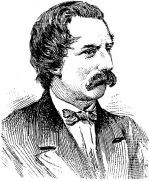
Charles F. Browne
On both sides, he came from original New England stock; and although he was proud of his descent from a very ancient English family, in deference to whom he wrote his name with the final "e," he felt greater pride in his American ancestors, and always said that they were genuine and primitive Yankees,--people of intelligence, activity, and integrity in business, but entirely unaffected by new-fangled ideas. It is interesting to notice that Browne's humor was hereditary on the paternal side, his father especially being noted for his quaint sayings and harmless eccentricities. His cousin Daniel many years later bore a strong resemblance to what Charles had been, and he too possessed a kindred humorous faculty and told a story in much the same solemn manner, bringing out the point as if it were something entirely irrelevant and unimportant and casually remembered. The subject of this sketch, however, was the only member of the family in whom a love for the droll and incongruous was a controlling disposition. As is frequently the case, a family trait was intensified in one individual to the point where talent passes over into genius.
On his mother's side, too, Browne was a thorough-bred New-Englander. His maternal grandfather, Mr. Calvin Farrar, was a man of influence in town and State, and was able to send two of his sons to Bowdoin College. I have mentioned Browne's parentage because his humor is so essentially American. Whether this consists in a peculiar gravity in the humorous attitude towards the subject, rather than playfulness, or in a tendency to exaggerated statement, or in a broad humanitarian standpoint, or in a certain flavor given by a blending of all these, it is very difficult to decide. Probably the peculiar standpoint is the distinguishing note, and American humor is a product of democracy.
Humor is as difficult of definition as is poetry. It is an intimate quality of the mind, which predisposes a man to look for remote and unreal analogies and to present them gravely as if they were valid. It sees that many of the objects valued by men are illusions, and it expresses this conviction by assuming that other manifest trifles are important. It is the deadly enemy of sentimentality and affectation, for its vision is clear. Although it turns everything topsy-turvy in sport, its world is not a chaos nor a child's play-ground, for humor is based on keen perception of truth. There is no method--except the highest poetic treatment--which reveals so distinctly the falsehoods and hypocrisies of the social and economic order as the reductio ad absurdum of humor; for all human institutions have their ridiculous sides, which astonish and amuse us when pointed out, but from viewing which we suddenly become aware of relative values before misunderstood. But just as poetry may degenerate into a musical collection of words and painting into a decorative association of colors, so humor may degenerate into the merely comic or amusing. The laugh which true humor arouses is not far removed from tears. Humor indeed is not always associated with kindliness, for we have the sardonic humor of Carlyle and the savage humor of Swift; but it is naturally dissociated from egotism, and is never more attractive than when, as in the case of Charles Lamb and Oliver Goldsmith, it is based on a loving and generous interest in humanity.
Humor, must rest on a broad human foundation, and cannot be narrowed to the notions of a certain class. But in most English humor,--as indeed in all English literature except the very highest,--the social class to which the writer does not belong is regarded ab extra. In Punch, for instance, not only are servants always given a conventional set of features, but they are given conventional minds, and the jokes are based on a hypothetical conception of personality. Dickens was a great humorist, and understood the nature of the poor because he had been one of them; but his gentlemen and ladies are lay figures. Thackeray's studies of the flunky are capital; but he studies him qua flunky, as a naturalist might study an animal, and hardly ranks him sub specie humanitatis. But to the American humorist all men are primarily men. The waiter and the prince are equally ridiculous to him, because in each he finds similar incongruities between the man and his surroundings; but in England there is a deep impassable gulf between the man at the table and the man behind his chair. This democratic independence of external and adventitious circumstance sometimes gives a tone of irreverence to American persiflage, and the temporary character of class distinctions in America undoubtedly diminishes the amount of literary material "in sight" but when, as in the case of Browne and Clemens, there is in the humorist's mind a basis of reverence for things and persons that are really reverend, it gives a breadth and freedom to the humorous conception that is distinctively American.
We put Clemens and Browne in the same line, because in reading a page of either we feel at once the American touch. Browne of course is not to be compared to Clemens in affluence or in range in depicting humorous character-types; but it must be remembered that Clemens has lived thirty active years longer than his predecessor did. Neither has written a line that he would wish to blot for its foul suggestion, or because it ridiculed things that were lovely and of good report. Both were educated in journalism, and came into direct contact with the strenuous and realistic life of labor. And to repeat, though one was born and bred west of the Mississippi and the other far "down east," both are distinctly American. Had either been born and passed his childhood outside our magic line, this resemblance would not have existed. And yet we cannot say precisely wherein this likeness lies, nor what caused it; so deep, so subtle, so pervading is the influence of nationality. But their original expressions of the American humorous tone are worth ten thousand literary echoes of Sterne or Lamb or Dickens or Thackeray.
The education of young Browne was limited to the strictly preparatory years. At the age of thirteen he was forced by the death of his father to try to earn his living. When about fourteen, he was apprenticed to a Mr. Rex, who published a paper at Lancaster, New Hampshire. He remained there about a year, then worked on various country papers, and finally passed three years in the printing-house of Snow and Wilder, Boston. He then went to Ohio, and after working for some months on the Tiffin Advertiser, went to Toledo, where he remained till the fall of 1857. Thence he went to Cleveland, Ohio, as local editor of the Plain Dealer. Here appeared the humorous letters signed "Artemus Ward" and written in the character of an itinerant showman. In 1860 he went to New York as editor of the comic journal Vanity Fair.
His reputation grew steadily, and his first volume, 'Artemus Ward, His Book,' was brought out in 1862. In 1863 he went to San Francisco by way of the Isthmus and returned overland. This journey was chronicled in a short volume, 'Artemus Ward, His Travels.' He had already undertaken a career of lecturing, and his comic entertainments, given in a style peculiarly his own, became very popular. The mimetic gift is frequently found in the humorist; and Browne's peculiar drawl, his profound gravity and dreamy, far-away expression, the unexpected character of his jokes and the surprise with which he seemed to regard the audience, made a combination of a delightfully quaint absurdity. Browne himself was a very winning personality, and never failed to put his audience in good humor. None who knew him twenty-nine years ago think of him without tenderness. In 1866 he visited England, and became almost as popular there as lecturer and writer for Punch. He died from a pulmonary trouble in Southampton, March 6th, 1867, being not quite thirty-three years old. He was never married.
When we remember that a large part of Browne's mature life was taken up in learning the printer's trade, in which he became a master, we must decide that he had only entered on his career as humorous writer. Much of what he wrote is simply amusing, with little depth or power of suggestion; it is comic, not humorous. He was gaining the ear of the public and training his powers of expression. What he has left consists of a few collections of sketches written for a daily paper. But the subjoined extracts will show, albeit dimly, that he was more than a joker, as under the cap and bells of the fool in Lear we catch a glimpse of the face of a tender-hearted and philosophic friend. Browne's nature was so kindly and sympathetic, so pure and manly, that after he had achieved a reputation and was relieved from immediate pecuniary pressure, he would have felt an ambition to do some worthy work and take time to bring out the best that was in him. As it is, he had only tried his 'prentice hand. Still, the figure of the old showman, though not very solidly painted, is admirably done. He is a sort of sublimated and unoffensive Barnum; perfectly consistent, permeated with his professional view of life, yet quite incapable of anything underhand or mean; radically loyal to the Union, appreciative of the nature of his animals, steady in his humorous attitude toward life: and above all, not a composite of shreds and patches, but a personality. Slight as he is, and unconscious and unpracticed as is the art that went to his creation, he is one of the humorous figures of all literature; and old Sir John Falstaff, Sir Roger de Coverley, Uncle Toby, and Dr. Primrose will not disdain to admit him into their company; for he too is a man, not an abstraction, and need not be ashamed of his parentage nor doubtful of his standing among the "children of the men of wit."
EDWIN FORREST AS OTHELLO
Durin a recent visit to New York the undersined went to see Edwin Forrest. As I am into the moral show biziness myself I ginrally go to Barnum's moral museum, where only moral peeple air admitted, partickly on Wednesday arternoons. But this time I thot I'd go and see Ed. Ed has bin actin out on the stage for many years. There is varis 'pinions about his actin, Englishmen ginrally bleevin that he's far superior to Mister Macready; but on one pint all agree, & that is that Ed draws like a six-ox team. Ed was actin at Niblo's Garding, which looks considerable more like a parster than a garding, but let that pars. I sot down in the pit, took out my spectacles and commenced peroosin the evenin's bill. The awjince was all-fired large & the boxes was full of the elitty of New York. Several opery glasses was leveled at me by Gotham's fairest darters, but I didn't let on as tho I noticed it, tho mebby I did take out my sixteen-dollar silver watch & brandish it round more than was necessary. But the best of us has our weaknesses & if a man has gewelry let him show it. As I was peroosin the bill a grave young man who sot near me axed me if I'd ever seen Forrest dance the Essence of Old Virginny. "He's immense in that," sed the young man. "He also does a fair champion jig," the young man continnered, "but his Big Thing is the Essence of Old Virginny." Sez I, "Fair youth, do you know what I'd do with you if you was my sun?"
"No," sez he.
"Wall," sez I, "I'd appint your funeral to-morrow arternoon, & the korps should be ready. You're too smart to live on this yerth."
He didn't try any more of his capers on me. But another pussylanermuss individooul in a red vest and patent leather boots told me his name was Bill Astor & axed me to lend him 50 cents till early in the mornin. I told him I'd probly send it round to him before he retired to his virtoous couch, but if I didn't he might look for it next fall as soon as I'd cut my corn. The orchestry was now fiddling with all their might & as the peeple didn't understan anything about it they applaudid versifrusly. Presently old Ed cum out. The play was Otheller or More of Veniss. Otheller was writ by Wm. Shakspeer. The seene is laid in Veniss. Otheller was a likely man & was a ginral in the Veniss army. He eloped with Desdemony, a darter of the Hon. Mr. Brabantio, who represented one of the back districks in the Veneshun legislater. Old Brabantio was as mad as thunder at this & tore round considerable, but finally cooled down, tellin Otheller, howsoever, that Desdemony had come it over her par, & that he had better look out or she'd come it over him likewise. Mr. and Mrs. Otheller git along very comfortable-like for a spell. She is sweet-tempered and lovin--a nice, sensible female, never goin in for he-female conventions, green cotton umbrellers, and pickled beats. Otheller is a good provider and thinks all the world of his wife. She has a lazy time of it, the hird girl doin all the cookin and washin. Desdemony in fact don't have to git the water to wash her own hands with. But a low cuss named Iago, who I bleeve wants to git Otheller out of his snug government birth, now goes to work & upsets the Otheller family in most outrajus stile. Iago falls in with a brainless youth named Roderigo & wins all his money at poker. (Iago allers played foul.) He thus got money enuff to carry out his onprincipled skeem. Mike Cassio, a Irishman, is selected as a tool by Iago. Mike was a clever feller & a orficer in Otheller's army. He liked his tods too well, howsoever, & they floored him as they have many other promisin young men. Iago injuces Mike to drink with him, Iago slily throwin his whiskey over his shoulder. Mike gits as drunk as a biled owl & allows that he can lick a yard full of the Veneshun fancy before breakfast, without sweatin a hair. He meets Roderigo & proceeds for to smash him. A feller named Mentano undertakes to slap Cassio, when that infatooated person runs his sword into him. That miserble man, Iago, pretends to be very sorry to see Mike conduck hisself in this way & undertakes to smooth the thing over to Otheller, who rushes in with a drawn sword & wants to know what's up. Iago cunningly tells his story & Otheller tells Mike that he thinks a good deal of him but that he cant train no more in his regiment. Desdemony sympathises with poor Mike & interceds for him with Otheller. Iago makes him bleeve she does this because she thinks more of Mike than she does of hisself. Otheller swallers Iagos lyin tail & goes to makin a noosence of hisself ginrally. He worries poor Desdemony terrible by his vile insinuations & finally smothers her to deth with a piller. Mrs. Iago comes in just as Otheller has finished the fowl deed & givs him fits right & left, showin him that he has been orfully gulled by her miserble cuss of a husband. Iago cums in & his wife commences rakin him down also, when he stabs her. Otheller jaws him a spell & then cuts a small hole in his stummick with his sword. Iago pints to Desdemony's deth bed & goes orf with a sardonic smile onto his countenance. Otheller tells the peple that he has dun the state some service & they know it; axes them to do as fair a thing as they can for him under the circumstances, & kills hisself with a fish-knife, which is the most sensible thing he can do. This is a breef skedule of the synopsis of the play.
Edwin Forrest is a grate acter. I thot I saw Otheller before me all the time he was actin &, when the curtin fell, I found my spectacles was still mistened with salt-water, which had run from my eyes while poor Desdemony was dyin. Betsy Jane--Betsy Jane! let us pray that our domestic bliss may never be busted up by a Iago!
Edwin Forrest makes money actin out on the stage. He gits five hundred dollars a nite & his board & washin. I wish I had such a Forrest in my Garding!
Copyrighted by G.W. Dillingham and Company, New York.
HIGH-HANDED OUTRAGE AT UTICA
In the fall of 1856 I showed my show in Utiky, a trooly grate sitty in the State of New York.
The people gave me a cordyal recepshun. The press was loud in her prases.
1 day as I was givin a descripshun of my Beests and Snaiks in my usual flowry stile, what was my skorn & disgust to see a big burly feller walk up to the cage containin my wax figgers of the Lord's Last Supper, and cease Judas Iscariot by the feet and drag him out on the ground. He then commenced fur to pound him as hard as he cood.
"What under the son are you abowt?" cried I.
Sez he, "What did you bring this pussylanermus cuss here fur?" & he hit the wax figger another tremenjus blow on the hed.
Sez I, "You egrejus ass that air's a wax figger--a representashun of the false 'Postle."
Sez he, "That's all very well fur you to say, but I tell you, old man, that Judas Iscariot can't show hisself in Utiky with impunerty by a darn site!" with which observashun he kaved in Judassis hed. The young man belonged to 1 of the first famerlies in Utiky. I sood him and the Joory brawt in a verdick of Arson in the 3d degree.
Copyrighted by G.W. Dillingham and Company, New York.
AFFAIRS ROUND THE VILLAGE GREEN
And where are the friends of my youth? I have found one of 'em, certainly. I saw him ride in a circus the other day on a bareback horse, and even now his name stares at me from yonder board-fence in green and blue and red and yellow letters. Dashington, the youth with whom I used to read the able orations of Cicero, and who as a declaimer on exhibition days used to wipe the rest of us boys pretty handsomely out--well, Dashington is identified with the halibut and cod interests --drives a fish-cart, in fact, from a certain town on the coast back into the interior. Hurburtson--the utterly stupid boy--the lunkhead who never had his lesson, he's about the ablest lawyer a sister State can boast. Mills is a newspaper man, and is just now editing a Major General down South. Singlingson, the sweet-faced boy whose face was always washed and who was never rude, he is in the penitentiary for putting his uncle's autograph to a financial document. Hawkins, the clergyman's son, is an actor; and Williamson, the good little boy who divided his bread and butter with the beggar-man, is a failing merchant, and makes money by it. Tom Slink, who used to smoke Short Sixes and get acquainted with the little circus boys, is popularly supposed to be the proprietor of a cheap gaming establishment in Boston, where the beautiful but uncertain prop is nightly tossed. Be sure the Army is represented by many of the friends of my youth, the most of whom have given a good account of themselves.
But Chalmerson hasn't done much. No, Chalmerson is rather of a failure. He plays on the guitar and sings love-songs. Not that he is a bad man--a kinder-hearted creature never lived, and they say he hasn't yet got over crying for his little curly-haired sister who died ever so long ago. But he knows nothing about business, politics, the world, and those things. He is dull at trade--indeed, it is the common remark that "Everybody cheats Chalmerson." He came to the party the other evening and brought his guitar. They wouldn't have him for a tenor in the opera, certainly, for he is shaky in his upper notes; but if his simple melodies didn't gush straight from the heart! why, even my trained eyes were wet! And although some of the girls giggled, and some of the men seemed to pity him, I could not help fancying that poor Chalmerson was nearer heaven than any of us all.
Copyrighted by G.W. Dillingham and Company.
MR. PEPPER
From 'Artemus Ward: His Travels'
My arrival at Virginia City was signalized by the following incident:--
I had no sooner achieved my room in the garret of the International Hotel than I was called upon by an intoxicated man, who said he was an Editor. Knowing how rare it is for an Editor to be under the blighting influence of either spirituous or malt liquors, I received this statement doubtfully. But I said:
"What name?"
"Wait!" he said, and went out.
I heard him pacing unsteadily up and down the hall outside.
In ten minutes he returned, and said, "Pepper!"
Pepper was indeed his name. He had been out to see if he could remember it, and he was so flushed with his success that he repeated it joyously several times, and then, with a short laugh, he went away.
I had often heard of a man being "so drunk that he didn't know what town he lived in," but here was a man so hideously inebriated that he didn't know what his name was.
I saw him no more, but I heard from him. For he published a notice of my lecture, in which he said that I had a dissipated air!
HORACE GREELEY'S RIDE TO PLACERVILLE
From 'Artemus Ward: His Travels'
When Mr. Greeley was in California, ovations awaited him at every town. He had written powerful leaders in the Tribune in favor of the Pacific Railroad, which had greatly endeared him to the citizens of the Golden State. And therefore they made much of him when he went to see them.
At one town the enthusiastic populace tore his celebrated white coat to pieces and carried the pieces home to remember him by.
The citizens of Placerville prepared to fête the great journalist, and an extra coach with extra relays of horses was chartered of the California Stage Company to carry him from Folsom to Placerville--distance, forty miles. The extra was in some way delayed, and did not leave Folsom until late in the afternoon. Mr. Greeley was to be fêted at seven o'clock that evening by the citizens of Placerville, and it was altogether necessary that he should be there by that time. So the Stage Company said to Henry Monk, the driver of the extra, "Henry, this great man must be there by seven to-night." And Henry answered, "The great man shall be there."
The roads were in an awful state, and during the first few miles out of Folsom slow progress was made.
"Sir," said Mr. Greeley, "are you aware that I must be in Placerville at seven o'clock to-night?"
"I've got my orders!" laconically replied Henry Monk.
Still the coach dragged slowly forward.
"Sir," said Mr. Greeley, "this is not a trifling matter. I must be there at seven!"
Again came the answer, "I've got my orders!"
But the speed was not increased, and Mr. Greeley chafed away another half-hour; when, as he was again about to remonstrate with the driver, the horses suddenly started into a furious run, and all sorts of encouraging yells filled the air from the throat of Henry Monk.
"That is right, my good fellow," said Mr. Greeley. "I'll give you ten dollars when we get to Placerville. Now we are going!"
They were indeed, and at a terrible speed.
Crack, crack! went the whip, and again "that voice" split the air, "Get up! Hi-yi! G'long! Yip-yip."
And on they tore over stones and ruts, up hill and down, at a rate of speed never before achieved by stage horses.
Mr. Greeley, who had been bouncing from one end of the stage to the other like an India-rubber ball, managed to get his head out of the window, when he said:--
"Do-on't-on't-on't you-u-u think we-e-e-e shall get there by seven if we do-on't-on't go so fast?"
"I've got my orders!" That was all Henry Monk said. And on tore the coach.
It was becoming serious. Already the journalist was extremely sore from the terrible jolting--and again his head "might have been seen from the window."
"Sir," he said, "I don't care-care-air if we don't get there at seven."
"I've got my orders!" Fresh horses--forward again, faster than before--over rocks and stumps, on one of which the coach narrowly escaped turning a summerset.
"See here!" shrieked Mr. Greeley, "I don't care if we don't get there at all."
"I've got my orders! I work fer the California Stage Company, I do. That's wot I work fer. They said, 'Get this man through by seving.' An' this man's goin' through, you bet! Gerlong! Whoo-ep!"
Another frightful jolt, and Mr. Greeley's bald head suddenly found its way through the roof of the coach, amidst the crash of small timbers and the ripping of strong canvas.
"Stop, you--maniac!" he roared.
Again answered Henry Monk:--
"I've got my orders! Keep your seat, Horace!"
At Mud Springs, a village a few miles from Placerville, they met a large delegation of the citizens of Placerville, who had come out to meet the celebrated editor, and escort him into town. There was a military company, a brass band, and a six-horse wagon-load of beautiful damsels in milk-white dresses, representing all the States in the Union. It was nearly dark now, but the delegation was amply provided with torches, and bonfires blazed all along the road to Placerville.
The citizens met the coach in the outskirts of Mud Springs, and Mr. Monk reined in his foam-covered steeds.
"Is Mr. Greeley on board?" asked the chairman of the committee.
"He was, a few miles back!" said Mr. Monk. "Yes," he added, looking down through the hole which the fearful jolting had made in the coach-roof, "Yes, I can see him! He is there!"
"Mr. Greeley," said the chairman of the committee, presenting himself at the window of the coach, "Mr. Greeley, sir! We are come to most cordially welcome you, sir!--Why, God bless me, sir, you are bleeding at the nose!"
"I've got my orders!" cried Mr. Monk. "My orders is as follows: Git him there by seving! It wants a quarter to seving. Stand out of the way!"
"But, sir," exclaimed the committee-man, seizing the off-leader by the reins, "Mr. Monk, we are come to escort him into town! Look at the procession, sir, and the brass-band, and the people, and the young women, sir!"
"I've got my orders!" screamed Mr. Monk. "My orders don't say nothin' about no brass bands and young women. My orders says, 'Git him there by seving.' Let go them lines! Clear the way there! Whoo-ep! Keep your seat, Horace!" and the coach dashed wildly through the procession, upsetting a portion of the brass band, and violently grazing the wagon which contained the beautiful young women in white.
Years hence, gray-haired men who were little boys in this procession will tell their grandchildren how this stage tore through Mud Springs, and how Horace Greeley's bald head ever and anon showed itself like a wild apparition above the coach-roof.
Mr. Monk was on time. There is a tradition that Mr. Greeley was very indignant for a while: then he laughed and finally presented Mr. Monk with a brand-new suit of clothes. Mr. Monk himself is still in the employ of the California Stage Company, and is rather fond of relating a story that has made him famous all over the Pacific coast. But he says he yields to no man in his admiration for Horace Greeley.
SIR THOMAS BROWNE
(1605-1682)
BY FRANCIS BACON

hen Sir Thomas Browne, in the last decade of his life, was asked to furnish data for the writing of his memoirs in Wood's 'Athenæ Oxonienses,' he gave in a letter to his friend Mr. Aubrey in the fewest words his birthplace and the places of his education, his admission as "Socius Honorarius of the College of Physitians in London," the date of his being knighted, and the titles of the four books or tracts which he had printed; and ended with "Have some miscellaneous tracts which may be published."
This account of himself, curter than many an epitaph, and scantier in details than the requirements of a census-taker's blank, may serve, with many other signs that one finds scattered among the pages of this author, to show his rare modesty and effacement of his physical self. He seems, like some other thoughtful and sensitive natures before and since, averse or at least indifferent to being put on record as an eating, digesting, sleeping, and clothes-wearing animal, of that species of which his contemporary Sir Samuel Pepys stands as the classical instance, and which the newspaper interviewer of our own day--that "fellow who would vulgarize the Day of Judgment"--has trained to the most noxious degree of offensiveness.

Sir Thomas Browne
Sir Thomas felt, undoubtedly, that having admitted that select company--"fit audience though few"--who are students of the 'Religio Medici' to a close intimacy with his highest mental processes and conditions, his "separable accidents," affairs of assimilation and secretion as one may say, were business between himself and his grocer and tailor, his cook and his laundress.
The industrious research of Mr. Simon Wilkin, who in 1836 produced the completest edition (William Pickering, London) of the literary remains of Sir Thomas Browne, has gathered from all sources--his own note-books, domestic and friendly correspondence, allusions of contemporary writers and the works of subsequent biographers--all that we are likely, this side of Paradise, to know of this great scholar and admirable man.
The main facts of his life are as follows. He was born in the Parish of St. Michael's Cheap, in London, on the 19th of October, 1605 (the year of the Gunpowder Plot). His father, as is apologetically admitted by a granddaughter, Mrs. Littleton, "was a tradesman, a mercer, though a gentleman of a good family in Cheshire" (generosa familia, says Sir Thomas's own epitaph). That he was the parent of his son's temperament, a devout man with a leaning toward mysticism in religion, is shown by the charming story Mrs. Littleton tells of him, exhibiting traits worthy of the best ages of faith, and more to be expected in the father of a mediæval saint than in a prosperous Cheapside mercer, whose son was to be one of the most learned and philosophical physicians of the age of Harvey and Sydenham:--"His father used to open his breast when he was asleep and kiss it in prayers over him, as 'tis said of Origen's father, that the Holy Ghost would take possession there." Clearly, it was with reverent memory of this good man that Sir Thomas, near the close of his own long life, wrote:--"Among thy multiplied acknowledgments, lift up one hand unto heaven that thou wert born of honest parents; that modesty, humility, patience, and veracity lay in the same egg and came into the world with thee."
This loving father, of whom one would fain know more, died in the early childhood of his son Thomas. He left a handsome estate of £9,000, and a widow not wholly inconsolable with her third portion and a not unduly deferred second marriage to a titled gentleman, Sir Thomas Button,--a knight so scantily and at the same time so variously described, as "a worthy person who had great places," and "a bad member" of "mutinous and unworthy carriage," that one is content to leave him as a problematical character.
The boy Thomas Browne being left to the care of guardians, his estate was despoiled, though to what extent does not appear; nor can it be considered greatly deplorable, since it did not prevent his early schooling at that ancient and noble foundation of Winchester, nor in 1623 his entrance into Pembroke College, Oxford, and in due course his graduation in 1626 as bachelor of arts. With what special assistance or direction he began his studies in medical science, cannot now be ascertained; but after taking his degree of master of arts in 1629, he practiced physic for about two years in some uncertain place in Oxfordshire. He then began a course of travel, unusually extensive for that day. His stepfather upon occasion of his official duties under the government "shewed him all Ireland in some visitation of the forts and castles." It is improbable that Ireland at that time long detained a traveler essentially literary in his tastes. Browne betook himself to France and Italy, where he appears to have spent about two years, residing at Montpellier and Padua, then great centres of medical learning, with students drawn from most parts of Christendom. Returning homeward through Holland, he received the degree of doctor of medicine from the University of Leyden in 1633, and settled in practice at Halifax, England.
At this time--favored probably by the leisure which largely attends the beginning of a medical career, but which is rarely so laudably or productively employed,--he wrote the treatise 'Religio Medici,' which more than any other of his works has established his fame and won the affectionate admiration of thoughtful readers. This production was not printed until seven years later, although some unauthorized manuscript copies, more or less faulty, were in circulation. When in 1642 "it arrived in a most depraved copy at the press," Browne felt it necessary to vindicate himself by publishing a correct edition, although, he protests, its original "intention was not publick: and being a private exercise directed to myself, what is delivered therein was rather a memorial unto me than an example or rule unto any other."
In 1636 he removed to Norwich and permanently established himself there in the practice of physic. There in 1641 he married Dorothy Mileham, a lady of good family in Norfolk; thereby not only improving his social connections, but securing a wife "of such symmetrical proportion to her worthy husband both in the graces of her body and mind, that they seemed to come together by a kind of natural magnetism." Such at least was the view of an intimate friend of more than forty years, Rev. John Whitefoot, in the 'Minutes' which, at the request of the widow, he drew up after Sir Thomas's death, and which contain the most that is known of his personal appearance and manners. Evidently the marriage was a happy one for forty-one years, when the Lady Dorothy was left mæstissima conjux, as her husband's stately epitaph, rich with many an issimus, declares. Twelve children were born of it; and though only four of them survived their parents, such mortality in carefully tended and well-circumstanced families was less remarkable than it would be now, when two centuries more of progress in medical science have added security and length to human life.
The good mother--had she not endeared herself to the modern reader by the affectionate gentleness and the quaint glimpses of domestic life that her family letters reveal--would be irresistible by the ingeniously bad spelling in which she reveled, transgressing even the wide limits then allowed to feminine heterography.
It is noteworthy that Dr. Browne's professional prosperity was not impaired by the suspicion which early attached to him, and soon deepened into conviction, that he was addicted to literary pursuits. He was in high repute as a physician. His practice was extensive, and he was diligent in it, as also in those works of literature and scientific investigation which occupied all "snatches of time," he says, "as medical vacations and the fruitless importunity of uroscopy would permit." His large family was liberally reared; his hospitality and his charities were ample.
In 1646 he printed his second book, the largest and most operose of all his productions: the 'Pseudodoxia Epidemica, or Inquiries into Vulgar and Common Errors' the work evidently of the horæ subsecivæ of many years. In 1658 he gave to the public two smaller but important and most characteristic works, 'Hydriotaphia' and 'The Garden of Cyrus.' Beside these publications he left many manuscripts which appeared posthumously; the most important of them, for its size and general interest, being 'Christian Morals.'
When Sir Thomas's long life drew to its close, it was with all the blessings "which should accompany old age." His domestic life had been one of felicity. His eldest and only surviving son, Edward Browne, had become a scholar after his father's own heart; and though not inheriting his genius, was already renowned in London, one of the physicians to the King, and in a way to become, as afterward he did, President of the College of Physicians. All his daughters who had attained womanhood had been well married. He lived in the society of the honorable and learned, and had received from the King the honor of knighthood[1].
[1] As for this business of the knighting, one hesitates fully to adopt Dr. Johnson's remark that Charles II. "had skill to discover excellence and virtue to reward it, at least with such honorary distinctions as cost him nothing." A candid observer of the walk and conversation of this illustrious monarch finds room for doubt that he was an attentive reader or consistent admirer of the 'Religio Medici,' or 'Christian Morals'; and though his own personal history might have contributed much to a complete catalogue of Vulgar Errors, Browne's treatise so named did not include divagations from common decency in its scope, and so may have failed to impress the royal mind. The fact is that the King on his visit to Norwich, looking about for somebody to knight, intended, as usual on such occasions, to confer the title on the mayor of the city; but this functionary,--some brewer or grocer perhaps, of whom nothing else than this incident is recorded,--declined the honor, whereupon the gap was stopped with Dr. Browne.
Mr. John Evelyn, carrying out a long and cherished plan of seeing one whom he had known and admired by his writings, visited him at Norwich in 1671. He found Sir Thomas among fit surroundings, "his whole house and garden being a paradise and cabinet of rarities, and that of the best collections, especially medails, books, plants, and natural things[2]." Here we have the right background and accessories for Whitefoot's portrait of the central figure:--
"His complexion and hair ... answerable to his name, his stature moderate, and habit of body neither fat nor lean but [Greek: eusarkos;] ... never seen to be transported with mirth or dejected with sadness; always cheerful, but rarely merry at any sensible rate; seldom heard to break a jest, and when he did, ... apt to blush at the levity of it: his gravity was natural without affectation. His modesty ... visible in a natural habitual blush, which was increased upon the least occasion, and oft discovered without any observable cause.... So free from loquacity or much talkativeness, that he was something difficult to be engaged in any discourse; though when he was so, it was always singular and never trite or vulgar."
[2] These two distinguished authors were of congenial tastes, and both cultivated the same Latinistic literary diction. Their meeting must have occasioned a copious effusion of those "long-tailed words in osity and ation" which both had so readily at command or made to order. It is regrettable that Evelyn never completed a work entitled 'Elysium Brittannicum' which he planned, and to which Browne contributed a chapter 'Of Coronary Plants.' It would have taken rank with its author's 'Sylva' among English classics.
A man of character so lofty and self-contained might be expected to leave a life so long, honorable, and beneficent with becoming dignity. Sir Thomas's last sickness, a brief but very painful one, was "endured with exemplary patience founded upon the Christian philosophy," and "with a meek, rational, and religious courage," much to the edification of his friend Whitefoot. One may see even a kind of felicity in his death, falling exactly on the completion of his seventy-seventh year.
He was buried in the church of St. Peter Mancroft, where his monument still claims regard as chief among the memorabilia of that noble sanctuary[3].
[3] In the course of repairs, "in August, 1840, his coffin was broken open by a pickaxe; the bones were found in good preservation, the fine auburn hair had not lost its freshness." It is painful to relate that the cranium was removed and placed in the pathological museum of the Norwich Hospital, labeled as "the gift of" some person (name not recalled), whose own cranium is probably an object of interest solely to its present proprietor. "Who knows the fate of his own bones? ... We insult not over their ashes," says Sir Thomas. The curator of the museum feels that he has a clever joke on the dead man, when with a grin he points to a label bearing these words from the 'Hydriotaphia':--"To be knaved out of our graves, to have our skulls made drinking-bowls, and our bones turned into pipes to delight and sport our enemies, are tragical abominations escaped in burning burials."
At the first appearance of Browne's several publications, they attracted that attention from the learned and thoughtful which they have ever since retained. The 'Religio Medici' was soon translated into several modern languages as well as into Latin, and became the subject of curiously diverse criticism. The book received the distinction of a place in the Roman 'Index Expurgatorius,' while from various points of view its author was regarded as a Romanist, an atheist, a deist, a pantheist, and as bearing the number 666 somewhere about him.
A worthy Quaker, a fellow-townsman, was so impressed by his tone of quietistic mysticism that he felt sure the philosophic doctor was guided by "the inward light," and wrote, sending a godly book, and proposing to clinch his conversion in a personal interview. Such are the perils that environ the man who not only repeats a creed in sincerity, but ventures to do and to utter his own thinking about it.
From Browne's own day to the present time his critics and commentators have been numerous and distinguished; one of the most renowned among them being Dr. Johnson, whose life of the author, prefixed to an edition of the 'Christian Morals' in 1756, is a fine specimen of that facile and effective hack-work of which Johnson was master. In that characteristic way of his, half of patronage, half of reproof, and wholly pedagogical, he summons his subject to the bar of his dialectics, and according to his lights administers justice. He admits that Browne has "great excellencies" and "uncommon sentiments," and that his scholarship and science are admirable, but strongly condemns his style: "It is vigorous, but rugged; it is learned, but pedantic; it is deep, but obscure; it strikes, but does not please; it commands, but does not allure; his tropes are harsh and his combinations uncouth."
Behemoth prescribing rules of locomotion to the swan! By how much would English letters have been the poorer if Browne had learned his art of Johnson!
Notwithstanding such objurgations, some have supposed that the style of Johnson, perhaps without conscious intent, was founded upon that of Browne. A tone of oracular authority, an academic Latinism sometimes disregarding the limitations of the unlearned reader, an elaborate balancing of antitheses in the same period,--these are qualities which the two writers have in common. But the resemblance, such as it is, is skin-deep. Johnson is a polemic by nature, and at his best cogent and triumphant in argument. His thought is carefully kept level with the apprehension of the ordinary reader, while arrayed in a verbal pomp simulating the expression of something weighty and profound. Browne is intuitive and ever averse to controversy, feeling, as he exquisitely says, that "many have too rashly charged the troops of error and remain as trophies unto the enemies of truth. A man may be in as just possession of the truth as of a city, and yet be forced to surrender." Calmly philosophic, he writes for kindred minds, and his concepts satisfying his own intellect, he delivers them with as little passion as an Æolian harp answering the wind, and lingers not for applause or explanation. His being
"Those thoughts that wander through eternity,"
he means that we too shall "have a glimpse of incomprehensibles, and thoughts of things which thoughts but tenderly touch."
How grandly he rounds his pregnant paragraphs with phrases which for stately and compulsive rhythm, sonorous harmony, and sweetly solemn cadences, are almost matchless in English prose, and lack only the mechanism of metre to give them the highest rank as verse.
"Man is a noble animal, splendid in ashes and pompous in the grave, solemnizing nativities and deaths with equal lustre, nor omitting ceremonies of bravery in the infancy of his nature;" "When personations shall cease, and histrionism of happiness be over; when reality shall rule, and all shall be as they shall be forever:"--such passages as these, and the whole of the 'Fragment on Mummies,' one can scarcely recite without falling into something of that chant which the blank verse of Milton and Tennyson seems to enforce.
That the 'Religio Medici' was the work of a gentleman before his thirtieth year, not a recluse nor trained in a cloister, but active in a calling which keeps closest touch with the passions and frailties of humanity, seems to justify his assertion, "I have shaken hands with delight [sc. by way of parting] in my warm blood and canicular days." So uniformly lofty and dignified is its tone, and so austere its morality, that the book might be taken for the fruit of those later and sadder years that bring the philosophic mind. Its frank confessions and calm analysis of motive and action have been compared with Montaigne's: if Montaigne had been graduated after a due education in Purgatory, or if his pedigree had been remotely crossed with a St. Anthony and he had lived to see the fluctus decumanus gathering in the tide of Puritanism, the likeness would have been closer.
"The 'Religio Medici,'" says Coleridge, "is a fine portrait of a handsome man in his best clothes." There is truth in the criticism, and if there is no color of a sneer in it, it is entirely true. Who does not feel, when following Browne into his study or his garden, that here is a kind of cloistral retreat from the common places of the outside world, that the handsome man is a true gentleman and a noble friend, and that his best clothes are his every-day wear?
This aloofness of Browne's, which holds him apart "in the still air of delightful studies," is no affectation; it is an innate quality. He thinks his thoughts in his own way, and "the style is the man" never more truly than with him. One of his family letters mentions the execution of Charles I. as a "horrid murther," and another speaks of Cromwell as a usurper; but nowhere in anything intended for the public eye is there an indication that he lived in the most tumultuous and heroic period of English history. Not a word shows that Shakespeare was of the generation just preceding his, nor that Milton and George Herbert and Henry Vaughan, numerous as are the parallels in their thought and feeling and in his, were his contemporaries. Constant and extensive as are his excursions into ancient literature, it is rare for him to make any reference to writers of his own time.
Yet with all his delight in antiquity and reverence for the great names of former ages, he is keen in the quest for new discoveries. His commonplace books abound in ingenious queries and minute observations regarding physical facts, conceived in the very spirit of our modern school:--"What is the use of dew-claws in dogs?" He does not instantly answer, as a schoolboy in this Darwinian day would, "To carry out an analogy;" but the mere asking of the question sets him ahead of his age. See too his curious inquiries into the left-footedness of parrots and left-handedness of certain monkeys and squirrels. The epoch-making announcement of his fellow-physician Harvey he quickly appreciates at its true value: "his piece 'De Circul. Sang.,' which discovery I prefer to that of Columbus." And here again a truly surprising suggestion of the great results achieved a century and two centuries later by Jenner and Pasteur--concerning canine madness, "whether it holdeth not better at second than at first hand, so that if a dog bite a horse, and that horse a man, the evil proves less considerable." He is the first to observe and describe that curious product of the decomposition of flesh known to modern chemists as adipocere.
He is full of eager anticipation of the future. "Join sense unto reason," he cries, "and experiment unto speculation, and so give life unto embryon truths and verities yet in their chaos.... What libraries of new volumes after-times will behold, and in what a new world of knowledge the eyes of our posterity may be happy, a few ages may joyfully declare."
But acute and active as our author's perceptions were, they did not prevent his sharing the then prevalent theory which assigned to the devil, and to witches who were his ministers, an important part in the economy of the world. This belief affords so easy a solution of some problems otherwise puzzling, that this degenerate age may look back with envy upon those who held it in serene and comfortable possession.
It is to be regretted, however, that the eminent Lord Chief Justice Hale in 1664, presiding at the trial for witchcraft of two women, should have called Dr. Browne, apparently as amicus curiæ, to give his view of the fits which were supposed to be the work of the witches. He was clearly of the opinion that the Devil had even more to do with that case than he has with most cases of hysteria; and consequently the witches, it must be said, fared no better in Sir Matthew Hale's court than many of their kind in various parts of Christendom about the same time. But it would be unreasonable for us to hold the ghost of Sir Thomas deeply culpable because, while he showed in most matters an exceptionally enlightened liberality of opinion and practice, in this one particular he declined to deny the scientific dictum of previous ages and the popular belief of his own time.
The mental attitude of reverent belief in its symbolic value, in which this devout philosopher contemplated the material world, is that of many of those who have since helped most to build the structure of Natural Science. The rapturous exclamation of Linnæus, "My God, I think thy thoughts after thee!" comes like an antiphonal response by "the man of flowers" to these passages in the 'Religio Medici':--"This visible world is but a picture of the invisible, wherein, as in a portrait, things are not truly, but in equivocal shapes, and as they counterfeit some real substance in that invisible fabric." "Things are really true as they correspond unto God's conception; and have so much verity as they hold of conformity unto that intellect, in whose idea they had their first determinations."

FROM THE 'RELIGIO MEDICI'
I could never divide myself from any man upon the difference of an opinion, or be angry with his judgment for not agreeing with me in that from which within a few days I should dissent myself. I have no genius to disputes in religion, and have often thought it wisdom to decline them, especially upon a disadvantage, or when the cause of truth might suffer in the weakness of my patronage. Where we desire to be informed, 'tis good to contest with men above ourselves; but to confirm and establish our opinions, 'tis best to argue with judgments below our own, that the frequent spoils and victories over their reasons may settle in ourselves an esteem and confirmed opinion of our own. Every man is not a proper champion for truth, nor fit to take up the gauntlet in the cause of verity: many from the ignorance of these maxims, and an inconsiderate zeal for truth, have too rashly charged the troops of error, and remain as trophies unto the enemies of truth. A man may be in as just possession of truth as of a city, and yet be forced to surrender; 'tis therefore far better to enjoy her with peace, than to hazard her on a battle: if therefore there rise any doubts in my way, I do forget them, or at least defer them, till my better settled judgment and more manly reason be able to resolve them; for I perceive every man's own reason is his best Oedipus, and will, upon a reasonable truce, find a way to loose those bonds wherewith the subtleties of error have enchained our more flexible and tender judgments. In philosophy, where truth seems double-faced, there is no man more paradoxical than myself: but in divinity I love to keep the road; and though not in an implicit, yet an humble faith, follow the great wheel of the Church, by which I move, not reserving any proper poles or motion from the epicycle of my own brain: by these means I leave no gap for heresy, schisms, or errors.
As for those wingy mysteries in divinity, and airy subtleties in religion, which have unhinged the brains of better heads, they never stretched the pia mater of mine: methinks there be not impossibilities enough in religion for an active faith; the deepest mysteries ours contains have not only been illustrated, but maintained, by syllogism and the rule of reason. I love to lose myself in a mystery, to pursue my reason to an O altitudo! 'Tis my solitary recreation to pose my apprehension with those involved enigmas and riddles of the Trinity, with Incarnation and Resurrection. I can answer all the objections of Satan and my rebellious reason with that odd resolution I learned of Tertullian, "Certum est quia impossible est." I desire to exercise my faith in the difficultest point; for to credit ordinary and visible objects is not faith, but persuasion. Some believe the better for seeing Christ's sepulchre; and when they have seen the Red Sea, doubt not of the miracle. Now contrarily, I bless myself and am thankful that I live not in the days of miracles, that I never saw Christ nor his disciples; I would not have been one of those Israelites that passed the Red Sea, nor one of Christ's patients on whom he wrought his wonders: then had my faith been thrust upon me; nor should I enjoy that greater blessing pronounced to all that believe and saw not. 'Tis an easy and necessary belief, to credit what our eye and sense hath examined: I believe he was dead and buried, and rose again; and desire to see him in his glory, rather than to contemplate him in his cenotaph or sepulchre. Nor is this much to believe; as we have reason, we owe this faith unto history: they only had the advantage of a bold and noble faith who lived before his coming, who upon obscure prophecies and mystical types could raise a belief and expect apparent impossibilities.
In my solitary and retired imagination,
"Neque enim cum lectulus aut me
Porticus excepit, desum mihi"--
I remember I am not alone, and therefore forget not to contemplate Him and his attributes who is ever with me, especially those two mighty ones, His wisdom and eternity: with the one I recreate, with the other I confound my understanding; for who can speak of eternity without a solecism, or think thereof without an ecstasy? Time we may comprehend: it is but five days older than ourselves, and hath the same horoscope with the world; but to retire so far back as to apprehend a beginning, to give such an infinite start forward as to conceive an end in an essence that we affirm hath neither the one nor the other, it puts my reason to St. Paul's sanctuary: my philosophy dares not say the angels can do it; God hath not made a creature that can comprehend him; it is a privilege of his own nature: I am that I am, was his own definition unto Moses; and it was a short one, to confound mortality, that durst question God or ask him what he was. Indeed he only is; all others have and shall be; but in eternity there is no distinction of tenses; and therefore that terrible term predestination, which hath troubled so many weak heads to conceive, and the wisest to explain, is in respect to God no prescious determination of our states to come, but a definitive blast of his will already fulfilled, and at the instant that he first decreed it; for to his eternity, which is indivisible and all together, the last trump, is already sounded, the reprobates in the flame and the blessed in Abraham's bosom. St. Peter speaks modestly when he saith, a thousand years to God are but as one day; for to speak like a philosopher, those continued instances of time which flow into a thousand years make not to him one moment: what to us is to come, to his eternity is present, his whole duration being but one permanent point, without succession, parts, flux, or division.
The world was made to be inhabited by beasts, but studied and contemplated by man; 'tis the debt of our reason we owe unto God, and the homage we pay for not being beasts; without this, the world is still as though it had not been, or as it was before the sixth day, when as yet there was not a creature that could conceive or say there was a world. The wisdom of God receives small honor from those vulgar heads that rudely stare about, and with a gross rusticity admire his works: those highly magnify him whose judicious inquiry into his acts, and deliberate research into his creatures, return the duty of a devout and learned admiration.
"Natura nihil agit frustra," is the only indisputable axiom in philosophy; there are no grotesques in nature; not anything framed to fill up empty cantons and unnecessary spaces: in the most imperfect creatures, and such as were not preserved in the ark, but, having their seeds and principles in the womb of nature, are everywhere where the power of the sun is--in these is the wisdom of His hand discovered; out of this rank Solomon chose the object of his admiration; indeed, what reason may not go to school to the wisdom of bees, ants, and spiders? what wise hand teacheth them to do what reason cannot teach us? Ruder heads stand amazed at those prodigious pieces of nature--whales, elephants, dromedaries, and camels; these, I confess, are the colossi and majestic pieces of her hand: but in these narrow engines there is more curious mathematics; and the civility of these little citizens more neatly sets forth the wisdom of their Maker. Who admires not Regio-Montanus his fly beyond his eagle, or wonders not more at the operation of two souls in those little bodies, than but one in the trunk of a cedar? I could never content my contemplation with those general pieces of wonder, the flux and reflux of the sea, the increase of the Nile, the conversion of the needle to the north; and have studied to match and parallel those in the more obvious and neglected pieces of nature, which without further travel I can do in the cosmography of myself: we carry with us the wonders we seek without us; there is all Africa and her prodigies in us; we are that bold and adventurous piece of nature which he that studies wisely learns in a compendium, what others labor at in a divided piece and endless volume.
Thus there are two books from whence I collect my divinity: besides that written one of God, another of his servant nature, that universal and public manuscript that lies expansed unto the eyes of all; those that never saw him in the one have discovered him in the other. This was the Scripture and Theology of the heathens: the natural motion of the sun made them more admire him than its supernatural station did the children of Israel; the ordinary effect of nature wrought more admiration in them than in the other all his miracles: surely the heathens knew better how to join and read these mystical letters than we Christians, who cast a more careless eye on these common hieroglyphics and disdain to suck divinity from the flowers of nature. Nor do I so forget God as to adore the name of nature; which I define not, with the schools, to be the principle of motion and rest, but that straight and regular line, that settled and constant course the wisdom of God hath ordained the actions of his creatures, according to their several kinds. To make a revolution every day is the nature of the sun, because of that necessary course which God hath ordained it, from which it cannot swerve but by a faculty from that voice which first did give it motion. Now this course of nature God seldom alters or perverts, but, like an excellent artist, hath so contrived his work that with the selfsame instrument, without a new creation, he may effect his obscurest designs. Thus he sweeteneth the water with a wood, preserveth the creatures in the ark, which the blast of his mouth might have as easily created; for God is like a skillful geometrician, who when more easily, and with one stroke of his compass, he might describe or divide a right line, had yet rather to do this in a circle or longer way, according to the constituted and forelaid principles of his art: yet this rule of his he doth sometimes pervert to acquaint the world with his prerogative, lest the arrogancy of our reason should question his power and conclude he could not. And thus I call the effects of nature the works of God, whose hand and instrument she only is; and therefore to ascribe his actions unto her is to devolve the honor of the principal agent upon the instrument; which if with reason we may do, then let our hammers rise up and boast they have built our houses, and our pens receive the honor of our writing. I hold there is a general beauty in the works of God, and therefore no deformity in any kind of species whatsoever: I cannot tell by what logic we call a toad, a bear, or an elephant ugly, they being created in those outward shapes and figures which best express those actions of their inward forms. And having passed that general visitation of God, who saw that all that he had made was good, that is, conformable to his will, which abhors deformity, and is the rule of order and beauty: there is no deformity but in monstrosity, wherein notwithstanding there is a kind of beauty, nature so ingeniously contriving the irregular parts that they become sometimes more remarkable than the principal fabric. To speak yet more narrowly, there was never anything ugly or misshapen but the chaos; wherein, notwithstanding, to speak strictly, there was no deformity, because no form, nor was it yet impregnate by the voice of God; now nature is not at variance with art, nor art with nature, they being both servants of his providence: art is the perfection of nature: were the world now as it was the sixth day, there were yet a chaos; nature hath made one world, and art another. In brief, all things are artificial; for nature is the art of God.
I have heard some with deep sighs lament the lost lines of Cicero; others with as many groans deplore the combustion of the library of Alexandria; for my own part, I think there be too many in the world, and could with patience behold the urn and ashes of the Vatican, could I, with a few others, recover the perished leaves of Solomon. I would not omit a copy of Enoch's Pillars had they many nearer authors than Josephus, or did not relish somewhat of the fable. Some men have written more than others have spoken: Pineda quotes more authors in one work than are necessary in a whole world. Of those three great inventions in Germany, there are two which are not without their incommodities. It is not a melancholy utinam of my own, but the desires of better heads, that there were a general synod; not to unite the incompatible difference of religion, but for the benefit of learning, to reduce it, as it lay at first, in a few and solid authors; and to condemn to the fire those swarms and millions of rhapsodies begotten only to distract and abuse the weaker judgments of scholars, and to maintain the trade and mystery of typographers.
Again, I believe that all that use sorceries, incantations, and spells are not witches, or, as we term them, magicians. I conceive there is a traditional magic not learned immediately from the Devil, but at second hand from his scholars, who, having once the secret betrayed, are able, and do empirically practice without his advice, they both proceeding upon the principles of nature; where actives aptly conjoined to disposed passives will under any master produce their effects. Thus, I think at first a great part of philosophy was witchcraft, which being afterward derived to one another, proved but philosophy, and was indeed no more but the honest effects of nature: what invented by us is philosophy, learned from him is magic. We do surely owe the discovery of many secrets to the discovery of good and bad angels. I could never pass that sentence of Paracelsus without an asterisk or annotation: "Ascendens astrum multa revelat quærentibus magnalia naturæ, i.e., opera Dei." I do think that many mysteries ascribed to our own inventions have been the courteous revelations of spirits,--for those noble essences in heaven bear a friendly regard unto their fellow natures on earth; and therefore believe that those many prodigies and ominous prognostics which forerun the ruins of States, princes, and private persons are the charitable premonitions of good angels, which more careless inquiries term but the effects of chance and nature.
Now, besides these particular and divided spirits there may be (for aught I know) an universal and common spirit to the whole world. It was the opinion of Plato, and it is yet of the Hermetical philosophers: if there be a common nature that unites and ties the scattered and divided individuals into one species, why may there not be one that unites them all? However, I am sure there is a common spirit that plays within us, yet makes no part of us: and that is the Spirit of God, the fire and scintillation of that noble and mighty essence which is the life and radical heat of spirits and those essences that know not the virtue of the sun; a fire quite contrary to the fire of hell: this is that gentle heat that brooded on the waters, and in six days hatched the world; this is that irradiation that dispels the mists of hell, the clouds of horror, fear, sorrow, despair; and preserves the region of the mind in serenity: whosoever feels not the warm gale and gentle ventilation of this spirit (though I feel his pulse) I dare not say he lives; for truly without this, to me there is no heat under the tropic; nor any light, though I dwelt in the body of the sun.
I believe that the whole frame of a beast doth perish, and is left in the same state after death as before it was materialled unto life: that the souls of men know neither contrary nor corruption; that they subsist beyond the body, and outlive death by the privilege of their proper natures, and without a miracle; that the souls of the faithful, as they leave earth, take possession of heaven: that those apparitions and ghosts of departed persons are not the wandering souls of men, but the unquiet walks of devils, prompting and suggesting us into mischief, blood, and villainy; instilling and stealing into our hearts that the blessed spirits are not at rest in their graves, but wander solicitous of the affairs of the world: but that those phantasms appear often, and do frequent cemeteries, charnel-houses, and churches, it is because those are the dormitories of the dead, where the Devil, like an insolent champion, beholds with pride the spoils and trophies of his victory in Adam.
This is that dismal conquest we all deplore, that makes us so often cry, "Adam, quid fecisti?" I thank God I have not those strait ligaments, or narrow obligations to the world, as to dote on life, or be convulsed and tremble at the name of death: not that I am insensible of the dread and horror thereof; or by raking into the bowels of the deceased, continual sight of anatomies, skeletons, or cadaverous reliques, like vespilloes or grave-makers, I am become stupid or have forgot the apprehension of mortality; but that marshaling all the horrors, and contemplating the extremities thereof, I find not anything therein able to daunt the courage of a man, much less a well-resolved Christian; and therefore am not angry at the error of our first parents, or unwilling to bear a part of this common fate, and like the best of them to die--that is, to cease to breathe, to take a farewell of the elements, to be a kind of nothing for a moment, to be within one instant of a spirit. When I take a full view and circle of myself without this reasonable moderator and equal piece of justice, Death, I do conceive myself the miserablest person extant: were there not another life that I hope for, all the vanities of this world should not entreat a moment's breath from me; could the Devil work my belief to imagine I could never die, I would not outlive that very thought. I have so abject a conceit of this common way of existence, this retaining to the sun and elements, I cannot think this to be a man, or to live according to the dignity of humanity. In expectation of a better, I can with patience embrace this life, yet in my best meditations do often defy death: I honor any man that contemns it, nor can I highly love any that is afraid of it: this makes me naturally love a soldier, and honor those tattered and contemptible regiments that will die at the command of a sergeant. For a pagan there may be some motives to be in love with life; but for a Christian to be amazed at death, I see not how he can escape this dilemma--that he is too sensible of this life, or hopeless of the life to come.
I am naturally bashful; nor hath conversation, age, or travel been able to effront or enharden me: yet I have one part of modesty which I have seldom discovered in another, that is (to speak truly) I am not so much afraid of death, as ashamed thereof: 'tis the very disgrace and ignominy of our natures that in a moment can so disfigure us that our nearest friends, wife, and children, stand afraid and start at us. The birds and beasts of the field, that before in a natural fear obeyed us, forgetting all allegiance, begin to prey upon us. This very conceit hath in a tempest disposed and left me willing to be swallowed up in the abyss of waters, wherein I had perished unseen, unpitied, without wondering eyes, tears of pity, lectures of mortality, and none had said, "Quantum mutatus ab illo!" Not that I am ashamed of the anatomy of my parts, or can accuse nature for playing the bungler in any part of me, or my own vicious life for contracting any shameful disease upon me, whereby I might not call myself as wholesome a morsel for the worms as any.
Men commonly set forth the torments of hell by fire and the extremity of corporal afflictions, and describe hell in the same method that Mahomet doth heaven. This indeed makes a noise, and drums in popular ears: but if this be the terrible piece thereof, it is not worthy to stand in diameter with heaven, whose happiness consists in that part that is best able to comprehend it--that immortal essence, that translated divinity and colony of God, the soul. Surely, though we place hell under earth, the Devil's walk and purlieu is about it; men speak too popularly who place it in those flaming mountains which to grosser apprehensions represent hell. The heart of man is the place the Devil dwells in: I feel sometimes a hell within myself; Lucifer keeps his court in my breast; Legion is revived in me. There are as many hells as Anaxarchus conceited worlds: there was more than one hell in Magdalen, when there were seven devils, for every devil is an hell unto himself; he holds enough of torture in his own ubi, and needs not the misery of circumference to afflict him; and thus a distracted conscience here is a shadow or introduction unto hell hereafter. Who can but pity the merciful intention of those hands that do destroy themselves? the Devil, were it in his power, would do the like; which being impossible, his miseries are endless, and he suffers most in that attribute wherein he is impassible, his immortality.
I thank God, and with joy I mention it, I was never afraid of hell, nor never grew pale at the description of that place; I have so fixed my contemplations on heaven, that I have almost forgot the idea of hell, and am afraid rather to lose the joys of the one than endure the misery of the other: to be deprived of them is a perfect hell, and needs, methinks, no addition to complete our afflictions. That terrible term hath never detained me from sin, nor do I owe any good action to the name thereof. I fear God, yet am not afraid of him; his mercies make me ashamed of my sins, before his judgments afraid thereof; these are the forced and secondary method of his wisdom, which he useth but as the last remedy, and upon provocation: a course rather to deter the wicked than incite the virtuous to his worship. I can hardly think there was ever any scared into heaven; they go the fairest way to heaven that would serve God without a hell; other mercenaries, that crouch unto him in fear of hell, though they term themselves the servants, are indeed but the slaves of the Almighty.
That which is the cause of my election I hold to be the cause of my salvation, which was the mercy and beneplacit of God, before I was, or the foundation of the world. "Before Abraham was, I am," is the saying of Christ; yet is it true in some sense, if I say it of myself; for I was not only before myself, but Adam--that is, in the idea of God, and the decree of that synod held from all eternity: and in this sense, I say, the world was before the creation, and at an end before it had a beginning; and thus was I dead before I was alive; though my grave be England, my dying place was Paradise; and Eve miscarried of me before she conceived of Cain.
Now for that other virtue of charity, without which faith is a mere notion and of no existence, I have ever endeavored to nourish the merciful disposition and humane inclination I borrowed from my parents, and regulate it to the written and prescribed laws of charity: and if I hold the true anatomy of myself, I am delineated and naturally framed to such a piece of virtue; for I am of a constitution so general that it consorts and sympathizeth with all things: I have no antipathy, or rather idiosyncrasy, in diet, humor, air, anything. I wonder not at the French for their dishes of frogs, snails, and toadstools; nor at the Jews for locusts and grasshoppers; but being amongst them, make them my common viands, and I find they agree with my stomach as well as theirs. I could digest a salad gathered in a churchyard as well as in a garden. I cannot start at the presence of a serpent, scorpion, lizard, or salamander: at the sight of a toad or viper I find in me no desire to take up a stone to destroy them. I feel not in myself those common antipathies that I can discover in others; those national repugnances do not touch me, nor do I behold with prejudice the French, Italian, Spaniard, or Dutch: but where I find their actions in balance with my countrymen's, I honor, love, and embrace them in the same degree. I was born in the eighth climate, but seem for to be framed and constellated unto all: I am no plant that will not prosper out of a garden; all places, all airs, make unto me one country; I am in England, everywhere, and under any meridian; I have been shipwrecked, yet am not enemy with the sea or winds; I can study, play or sleep in a tempest. In brief, I am averse from nothing: my conscience would give me the lie if I should absolutely detest or hate any essence but the Devil; or so at least abhor anything but that we might come to composition. If there be any among those common objects of hatred I do contemn and laugh at, it is that great enemy of reason, virtue, and religion--the multitude: that numerous piece of monstrosity which, taken asunder, seem men and the reasonable creatures of God, but confused together, make but one great beast and a monstrosity more prodigious than Hydra: it is no breach of charity to call these fools; it is the style all holy writers have afforded them, set down by Solomon in canonical Scripture, and a point of our faith to believe so. Neither in the name of multitude do I only include the base and minor sort of people: there is a rabble even amongst the gentry, a sort of plebeian heads, whose fancy moves with the same wheel as these; men in the same level with mechanics, though their fortunes do somewhat gild their infirmities, and their purses compound for their follies.
I must give no alms to satisfy the hunger of my brother, but to fulfill and accomplish the will and command of my God: I draw not my purse for his sake that demands it, but His that enjoined it; I believe no man upon the rhetoric of his miseries, nor to content mine own commiserating disposition; for this is still but moral charity, and an act that oweth more to passion than reason. He that relieves another upon the bare suggestion and bowels of pity doth not this so much for his sake as for his own; for by compassion we make others' misery our own, and so, by relieving them, we relieve ourselves also. It is as erroneous a conceit to redress other men's misfortunes upon the common considerations of merciful natures, that it may be one day our own case; for this is a sinister and politic kind of charity, whereby we seem to bespeak the pities of men in the like occasions. And truly I have observed that those professed eleemosynaries, though in a crowd or multitude, do yet direct and place their petitions on a few and selected persons: there is surely a physiognomy which those experienced and master mendicants observe, whereby they instantly discover a merciful aspect, and will single out a face wherein they spy the signatures and marks of mercy. For there are mystically in our faces certain characters which carry in them the motto of our souls, wherein he that cannot read ABC may read our natures. I hold moreover that there is a phytognomy, or physiognomy, not only of men, but of plants and vegetables; and in every one of them some outward figures which hang as signs or bushes of their inward forms. The finger of God hath left an inscription upon all his works, not graphical or composed of letters, but of their several forms, constitutions, parts and operations, which, aptly joined together, do make one word that doth express their natures. By these letters God calls the stars by their names; and by this alphabet Adam assigned to every creature a name peculiar to its nature. Now there are, besides these characters in our faces, certain mystical figures in our hands, which I dare not call mere dashes, strokes à la volée, or at random, because delineated by a pencil that never works in vain; and hereof I take more particular notice, because I carry that in mine own hand which I could never read of or discover in another. Aristotle, I confess, in his acute and singular book of physiognomy, hath made no mention of chiromancy; yet I believe the Egyptians, who were nearer addicted to those abstruse and mystical sciences, had a knowledge therein, to which those vagabond and counterfeit Egyptians did after pretend, and perhaps retained a few corrupted principles which sometimes might verify their prognostics.
It is the common wonder of all men, how, among so many millions of faces, there should be none alike. Now, contrary, I wonder as much how there should be any: he that shall consider how many thousand several words have been carelessly and without study composed out of twenty-four letters; withal, how many hundred lines there are to be drawn in the fabric of one man, shall easily find that this variety is necessary; and it will be very hard that they shall so concur as to make one portrait like another. Let a painter carelessly limn out a million of faces, and you shall find them all different; yea, let him have his copy before him, yet after all his art there will remain a sensible distinction; for the pattern or example of everything is the perfectest in that kind, whereof we still come short, though we transcend or go beyond it, because herein it is wide, and agrees not in all points unto its copy. Nor doth the similitude of creatures disparage the variety of nature, nor any way confound the works of God. For even in things alike there is diversity; and those that do seem to accord do manifestly disagree. And thus is man like God; for in the same things that we resemble him we are utterly different from him. There was never anything so like another as in all points to concur; there will ever some reserved difference slip in, to prevent the identity, without which two several things would not be alike, but the same, which is impossible.
Naturally amorous of all that is beautiful, I can look a whole day with delight upon a handsome picture, though it be but of an horse. It is my temper, and I like it the better, to affect all harmony; and sure there is music even in the beauty, and the silent note which Cupid strikes, far sweeter than the sound of an instrument: for there is music wherever there is harmony, order, or, proportion: and thus far we may maintain the music of the spheres; for those well-ordered motions and regular paces, though they give no sound unto the ear, yet to the understanding they strike a note most full of harmony. Whatsoever is harmonically composed, delights in harmony, which makes me much distrust the symmetry of those heads which declaim against all church music. For myself, not only from my obedience, but my particular genius, I do embrace it: for even that vulgar and tavern music, which makes one man merry, another mad, strikes in me a deep fit of devotion and a profound contemplation of the First Composer; there is something in it of divinity more than the ear discovers: it is an hieroglyphical and shadowed lesson of the whole world and creatures of God; such a melody to the ear as the whole world, well understood, would afford the understanding. In brief, it is a sensible fit of that harmony which intellectually sounds in the ears of God. It unties the ligaments of my frame, takes me to pieces, dilates me out of myself, and by degrees, methinks, resolves me into heaven. I will not say, with Plato, the soul is an harmony, but harmonical, and hath its nearest sympathy unto music; thus some, whose temper of body agrees and humors the constitution of their souls, are born poets, though indeed all are naturally inclined unto rhythm.
There is surely a nearer apprehension of anything that delights us in our dreams than in our waked senses: without this, I were unhappy; for my awaked judgment discontents me, ever whispering unto me that I am from my friend; but my friendly dreams in the night requite me, and make me think I am within his arms. I thank God for my happy dreams, as I do for my good rest, for there is a satisfaction in them unto reasonable desires, and such as can be content with a fit of happiness; and surely it is not a melancholy conceit to think we are all asleep in this world, and that the conceits of this life are as mere dreams to those of the next; as the phantasms of the night to the conceits of the day. There is an equal delusion in both, and the one doth but seem to be the emblem or picture of the other; we are somewhat more than ourselves in our sleeps, and the slumber of the body seems to be but the waking of the soul. It is the ligation of sense, but the liberty of reason; and our waking conceptions do not match the fancies of our sleeps. At my nativity my ascendant was the watery sign of Scorpius; I was born in the planetary hour of Saturn, and I think I have a piece of that leaden planet in me. I am no way facetious, nor disposed for the mirth and galliardize of company; yet in one dream I can compose a whole comedy, behold the action, and apprehend the jests, and laugh myself awake at the conceits thereof. Were my memory as faithful as my reason is then fruitful, I would never study but in my dreams, and this time also would I choose for my devotions; but our grosser memories have then so little hold of our abstracted understandings that they forget the story, and can only relate to our awaked souls a confused and broken tale of that that hath passed. Aristotle, who hath written a singular tract of sleep, hath not, methinks, thoroughly defined it; nor yet Galen, though he seem to have corrected it: for those noctambuloes and night-walkers, though in their sleep do yet enjoy the action of their senses; we must therefore say that there is something in us that is not in the jurisdiction of Morpheus; and that those abstracted and ecstatic souls do walk about in their own corps, as spirits with the bodies they assume, wherein they seem to hear, see, and feel, though indeed the organs are destitute of sense, and their natures of those faculties that should inform them. Thus it is observed that men sometimes, upon the hour of their departure, do speak and reason above themselves. For then the soul, beginning to be freed from the ligaments of the body, begins to reason like herself, and to discourse in a strain above mortality.
FROM 'CHRISTIAN MORALS'
When thou lookest upon the imperfections of others, allow one eye for what is laudable in them, and the balance they have from some excellency, which may render them considerable. While we look with fear or hatred upon the teeth of the viper, we may behold his eye with love. In venomous natures something may be amiable: poisons afford anti-poisons: nothing is totally or altogether uselessly bad. Notable virtues are sometimes dashed with notorious vices, and in some vicious tempers have been found illustrious acts of virtue, which makes such observable worth in some actions of King Demetrius, Antonius, and Ahab, as are not to be found in the same kind in Aristides, Numa, or David. Constancy, generosity, clemency, and liberality have been highly conspicuous in some persons not marked out in other concerns for example or imitation. But since goodness is exemplary in all, if others have not our virtues, let us not be wanting in theirs; nor, scorning them for their vices whereof we are free, be condemned by their virtues wherein we are deficient. There is dross, alloy, and embasement in all human tempers; and he flieth without wings, who thinks to find ophir or pure metal in any. For perfection is not, like light, centred in any one body; but, like the dispersed seminalities of vegetables at the creation, scattered through the whole mass of the earth, no place producing all, and almost all some. So that 'tis well if a perfect man can be made out of many men, and to the perfect eye of God, even out of mankind. Time, which perfects some things, imperfects also others. Could we intimately apprehend the ideated man, and as he stood in the intellect of God upon the first exertion by creation, we might more narrowly comprehend our present degeneration, and how widely we are fallen from the pure exemplar and idea of our nature: for after this corruptive elongation, from a primitive and pure creation we are almost lost in degeneration; and Adam hath not only fallen from his Creator, but we ourselves from Adam, our Tycho and primary generator.
If generous honesty, valor, and plain dealing be the cognizance of thy family or characteristic of thy country, hold fast such inclinations sucked in with thy first breath, and which lay in the cradle with thee. Fall not into transforming degenerations, which under the old name create a new nation. Be not an alien in thine own nation; bring not Orontes into Tiber; learn the virtues, not the vices, of thy foreign neighbors, and make thy imitation by discretion, not contagion. Feel something of thyself in the noble acts of thy ancestors, and find in thine own genius that of thy predecessors. Rest not under the expired merits of others; shine by those of thine own. Flame not, like the central fire which enlighteneth no eyes, which no man seeth, and most men think there is no such thing to be seen. Add one ray unto the common lustre; add not only to the number, but the note of thy generation; and prove not a cloud, but an asterisk in thy region.
Since thou hast an alarum in thy breast, which tells thee thou hast a living spirit in thee above two thousand times in an hour, dull not away thy days in slothful supinity and the tediousness of doing nothing. To strenuous minds there is an inquietude in overquietness and no laboriousness in labor; and to tread a mile after the slow pace of a snail, or the heavy measures of the lazy of Brazilia, were a most tiring penance, and worse than a race of some furlongs at the Olympics. The rapid courses of the heavenly bodies are rather imitable by our thoughts than our corporeal motions; yet the solemn motions of our lives amount unto a greater measure than is commonly apprehended. Some few men have surrounded the globe of the earth; yet many, in the set locomotions and movements of their days, have measured the circuit of it, and twenty thousand miles have been exceeded by them. Move circumspectly, not meticulously, and rather carefully solicitous than anxiously solicitudinous. Think not there is a lion in the way, nor walk with leaden sandals in the paths of goodness; but in all virtuous motions let prudence determine thy measures. Strive not to run, like Hercules, a furlong in a breath: festination may prove precipitation; deliberating delay may be wise cunctation, and slowness no slothfulness.
Despise not the obliquities of younger ways, nor despair of better things whereof there is yet no prospect. Who would imagine that Diogenes, who in his younger days was a falsifier of money, should, in the after course of his life, be so great a contemner of metal? Some negroes, who believe the resurrection, think that they shall rise white. Even in this life regeneration may imitate resurrection; our black and vicious tinctures may wear off, and goodness clothe us with candor. Good admonitions knock not always in vain. There will be signal examples of God's mercy, and the angels must not want their charitable rejoices for the conversion of lost sinners. Figures of most angles do nearest approach unto circles, which have no angles at all. Some may be near unto goodness who are conceived far from it; and many things happen not likely to ensue from any promises of antecedencies. Culpable beginnings have found commendable conclusions, and infamous courses pious retractations. Detestable sinners have proved exemplary converts on earth, and may be glorious in the apartment of Mary Magdalen in heaven. Men are not the same through all divisions of their ages: time, experience, self-reflections, and God's mercies, make in some well-tempered minds a kind of translation before death, and men to differ from themselves as well as from other persons. Hereof the old world afforded many examples to the infamy of latter ages, wherein men too often live by the rule of their inclinations; so that, without any astral prediction, the first day gives the last: men are commonly as they were; or rather, as bad dispositions run into worser habits, the evening doth not crown, but sourly conclude, the day.
If the Almighty will not spare us according to his merciful capitulation at Sodom; if his goodness please not to pass over a great deal of bad for a small pittance of good, or to look upon us in the lump, there is slender hope for mercy, or sound presumption of fulfilling half his will, either in persons or nations: they who excel in some virtues being so often defective in others; few men driving at the extent and amplitude of goodness, but computing themselves by their best parts, and others by their worst, are content to rest in those virtues which others commonly want. Which makes this speckled face of honesty in the world; and which was the imperfection of the old philosophers and great pretenders unto virtue; who, well declining the gaping vices of intemperance, incontinency, violence, and oppression, were yet blindly peccant in iniquities of closer faces; were envious, malicious, contemners, scoffers, censurers, and stuffed with vizard vices, no less depraving the ethereal particle and diviner portion of man. For envy, malice, hatred, are the qualities of Satan, close and dark like himself; and where such brands smoke, the soul cannot be white. Vice may be had at all prices; expensive and costly iniquities, which make the noise, cannot be every man's sins; but the soul may be foully inquinated at a very low rate, and a man may be cheaply vicious to the perdition of himself.
Having been long tossed in the ocean of the world, he will by that time feel the in-draught of another, unto which this seems but preparatory and without it of no high value. He will experimentally find the emptiness of all things, and the nothing of what is past; and wisely grounding upon true Christian expectations, finding so much past, will wholly fix upon what is to come. He will long for perpetuity, and live as though he made haste to be happy. The last may prove the prime part of his life, and those his best days which he lived nearest heaven.
Live happy in the Elysium of a virtuously composed mind, and let intellectual contents exceed the delights wherein mere pleasurists place their paradise. Bear not too slack reins upon pleasure, nor let complexion or contagion betray thee unto the exorbitancy of delight. Make pleasure thy recreation or intermissive relaxation, not thy Diana, life, and profession. Voluptuousness is as insatiable as covetousness. Tranquillity is better than jollity, and to appease pain than to invent pleasure. Our hard entrance into the world, our miserable going out of it, our sicknesses, disturbances, and sad rencounters in it, do clamorously tell us we came not into the world to run a race of delight, but to perform the sober acts and serious purposes of man; which to omit were foully to miscarry in the advantage of humanity, to play away an uniterable life, and to have lived in vain. Forget not the capital end, and frustrate not the opportunity of once living. Dream not of any kind of metempsychosis or transanimation, but into thine own body, and that after a long time; and then also unto wail or bliss, according to thy first and fundamental life. Upon a curricle in this world depends a long course of the next, and upon a narrow scene here an endless expansion hereafter. In vain some think to have an end of their beings with their lives. Things cannot get out of their natures, or be, or not be, in despite of their constitutions. Rational existences in heaven perish not at all, and but partially on earth; that which is thus once, will in some way be always; the first living human soul is still alive, and all Adam hath found no period.
Since the stars of heaven do differ in glory; since it hath pleased the Almighty hand to honor the north pole with lights above the south; since there are some stars so bright that they can hardly be looked upon, some so dim that they can scarcely be seen, and vast numbers not to be seen at all even by artificial eyes; read thou the earth in heaven and things below from above. Look contentedly upon the scattered difference of things, and expect not equality in lustre, dignity, or perfection, in regions or persons below; where numerous numbers must be content to stand like lacteous or nebulous stars, little taken notice of, or dim in their generations. All which may be contentedly allowable in the affairs and ends of this world, and in suspension unto what will be in the order of things hereafter, and the new system of mankind which will be in the world to come; when the last may be the first, and the first the last; when Lazarus may sit above Cæsar, and the just, obscure on earth, shall shine like the sun in heaven; when personations shall cease, and histrionism of happiness be over; when reality shall rule, and all shall be as they shall be forever.
FROM 'HYDRIOTAPHIA, OR URN-BURIAL'
In the Jewish Hypogæum and subterranean cell at Rome was little observable beside the variety of lamps and frequent draughts of the holy candlestick. In authentic draughts of Antony and Jerome, we meet with thigh bones and death's-heads; but the cemeterial cells of ancient Christians and martyrs were filled with draughts of Scripture stories; not declining the flourishes of cypress, palms, and olive, and the mystical figures of peacocks, doves, and cocks; but literately affecting the portraits of Enoch, Lazarus, Jonas, and the vision of Ezekiel, as hopeful draughts and hinting imagery of the resurrection--which is the life of the grave and sweetens our habitations in the land of moles and pismires.
The particulars of future beings must needs be dark unto ancient theories, which Christian philosophy yet determines but in a cloud of opinions. A dialogue between two infants in the womb concerning the state of this world, might handsomely illustrate our ignorance of the next, whereof methinks we yet discourse in Plato's den, and are but embryon philosophers.
Pythagoras escapes, in the fabulous hell of Dante, among that swarm of philosophers, wherein, whilst we meet with Plato and Socrates, Cato is to be found in no lower place than Purgatory. Among all the set, Epicurus is most considerable, whom men make honest without an Elysium, who contemned life without encouragement of immortality, and making nothing after death, yet made nothing of the king of terrors.
Were the happiness of the next world as closely apprehended as the felicities of this, it were a martyrdom to live; and unto such as consider none hereafter, it must be more than death to die, which makes us amazed at those audacities that durst be nothing and return into their chaos again. Certainly, such spirits as could contemn death, when they expected no better being after, would have scorned to live had they known any. And therefore we applaud not the judgments of Machiavel that Christianity makes men cowards, or that with the confidence of but half dying, the despised virtues of patience and humility have abased the spirits of men, which pagan principles exalted; but rather regulated the wildness of audacities, in the attempts, grounds, and eternal sequels of death, wherein men of the boldest spirits are often prodigiously temerarious. Nor can we extenuate the valor of ancient martyrs, who contemned death in the uncomfortable scene of their lives, and in their decrepit martyrdoms did probably lose not many months of their days, or parted with life when it was scarce worth the living; for (beside that long time past holds no consideration unto a slender time to come) they had no small disadvantage from the constitution of old age, which naturally makes men fearful, and complexionally superannuated from the bold and courageous thoughts of youth and fervent years. But the contempt of death from corporal animosity promoteth not our felicity. They may sit in the orchestra and noblest seats of heaven who have held up shaking hands in the fire, and humanly contended for glory.
Meanwhile, Epicurus lies deep in Dante's hell, wherein we meet with tombs inclosing souls which denied their immortalities. But whether the virtuous heathen, who lived better than he spake, or, erring in the principles of himself, yet lived above philosophers of more specious maxims, lie so deep as he is placed; at least so low as not to rise against Christians who, believing or knowing that truth, have lastingly denied it in their practice and conversation--were a query too sad to insist on.
But all or most apprehensions rested in opinions of some future being, which, ignorantly or coldly believed, begat those perverted conceptions, ceremonies, sayings, which Christians pity or laugh at. Happy are they which live not in that disadvantage of time, when men could say little for futurity but from reason; whereby the noblest minds fell often upon doubtful deaths and melancholy dissolutions. With those hopes Socrates warmed his doubtful spirits against that cold potion; and Cato, before he durst give the fatal stroke, spent part of the night in reading the immortality of Plato, thereby confirming his wavering hand unto the animosity of that attempt.
It is the heaviest stone that melancholy can throw at a man, to tell him he is at the end of his nature; or that there is no farther state to come, unto which this seems progressional, and otherwise made in vain. Without this accomplishment, the natural expectation and desire of such a state were but a fallacy in nature. Unsatisfied considerators would quarrel at the justice of their constitutions, and rest content that Adam had fallen lower; whereby, by knowing no other original, and deeper ignorance of themselves, they might have enjoyed the happiness of inferior creatures, who in tranquillity possess their constitutions, as having not the apprehension to deplore their own natures; and being framed below the circumference of these hopes, or cognition of better being, the wisdom of God hath necessitated their contentment. But the superior ingredient and obscured part of ourselves, whereto all present felicities afford no resting contentment, will be able at last to tell us we are more than our present selves, and evacuate such hopes in the fruition of their own accomplishments....
But the iniquity of oblivion blindly scattereth her poppy, and deals with the memory of men without distinction to merit of perpetuity. Who can but pity the founder of the pyramids? Erostratus lives that burnt the Temple of Diana; he is almost lost that built it. Time hath spared the epitaph of Adrian's horse, confounded that of himself. In vain we compute our felicities by the advantage of our good names, since bad have equal durations; and Thersites is like to live as long as Agamemnon. Who knows whether the best of men be known, or whether there be not more remarkable persons forgot than any that stand remembered in the known account of time? Without the favor of the everlasting register, the first man had been as unknown as the last, and Methuselah's long life had been his only chronicle.
[1] As for this business of the knighting, one hesitates fully to adopt Dr. Johnson's remark that Charles II. "had skill to discover excellence and virtue to reward it, at least with such honorary distinctions as cost him nothing." A candid observer of the walk and conversation of this illustrious monarch finds room for doubt that he was an attentive reader or consistent admirer of the 'Religio Medici,' or 'Christian Morals'; and though his own personal history might have contributed much to a complete catalogue of Vulgar Errors, Browne's treatise so named did not include divagations from common decency in its scope, and so may have failed to impress the royal mind. The fact is that the King on his visit to Norwich, looking about for somebody to knight, intended, as usual on such occasions, to confer the title on the mayor of the city; but this functionary,--some brewer or grocer perhaps, of whom nothing else than this incident is recorded,--declined the honor, whereupon the gap was stopped with Dr. Browne.
When Sir Thomas's long life drew to its close, it was with all the blessings "which should accompany old age." His domestic life had been one of felicity. His eldest and only surviving son, Edward Browne, had become a scholar after his father's own heart; and though not inheriting his genius, was already renowned in London, one of the physicians to the King, and in a way to become, as afterward he did, President of the College of Physicians. All his daughters who had attained womanhood had been well married. He lived in the society of the honorable and learned, and had received from the King the honor of knighthood[1].
[2] These two distinguished authors were of congenial tastes, and both cultivated the same Latinistic literary diction. Their meeting must have occasioned a copious effusion of those "long-tailed words in osity and ation" which both had so readily at command or made to order. It is regrettable that Evelyn never completed a work entitled 'Elysium Brittannicum' which he planned, and to which Browne contributed a chapter 'Of Coronary Plants.' It would have taken rank with its author's 'Sylva' among English classics.
Mr. John Evelyn, carrying out a long and cherished plan of seeing one whom he had known and admired by his writings, visited him at Norwich in 1671. He found Sir Thomas among fit surroundings, "his whole house and garden being a paradise and cabinet of rarities, and that of the best collections, especially medails, books, plants, and natural things[2]." Here we have the right background and accessories for Whitefoot's portrait of the central figure:--
[3] In the course of repairs, "in August, 1840, his coffin was broken open by a pickaxe; the bones were found in good preservation, the fine auburn hair had not lost its freshness." It is painful to relate that the cranium was removed and placed in the pathological museum of the Norwich Hospital, labeled as "the gift of" some person (name not recalled), whose own cranium is probably an object of interest solely to its present proprietor. "Who knows the fate of his own bones? ... We insult not over their ashes," says Sir Thomas. The curator of the museum feels that he has a clever joke on the dead man, when with a grin he points to a label bearing these words from the 'Hydriotaphia':--"To be knaved out of our graves, to have our skulls made drinking-bowls, and our bones turned into pipes to delight and sport our enemies, are tragical abominations escaped in burning burials."
He was buried in the church of St. Peter Mancroft, where his monument still claims regard as chief among the memorabilia of that noble sanctuary[3].
Oblivion is not to be hired. The greater part must be content to be as though they had not been; to be found in the register of God, not in the record of man. Twenty-seven names make up the first story, and the recorded names ever since contain not one living century. The number of the dead long exceedeth all that shall live. The night of time far surpasseth the day; and who knows when was the equinox? Every hour adds unto that current arithmetic, which scarce stands one moment. And since death must be the Lucina of life, and even pagans could doubt whether thus to live were to die; since our longest sun sets at right declensions, and makes but winter arches, and therefore it cannot be long before we lie down in darkness, and have our light in ashes[4]; since the brother of death daily haunts us with dying mementos, and time, that grows old itself, bids us hope no long duration, diuturnity is a dream and folly of expectation.
[4] According to the custom of the Jews, who placed a lighted wax candle in a pot of ashes by the corpse.
Darkness and light divide the course of time, and oblivion shares with memory a great part even of our living beings. We slightly remember our felicities, and the smartest strokes of affliction leave but short smart upon us. Sense endureth no extremities, and sorrows destroy us or themselves. To weep into stones are fables. Afflictions induce callosities; miseries are slippery, or fall like snow upon us, which notwithstanding is no unhappy stupidity. To be ignorant of evils to come, and forgetful of evils past, is a merciful provision in nature, whereby we digest the mixture of our few and evil days, and our delivered senses not relapsing into cutting remembrances, our sorrows are not kept raw by the edge of repetitions. A great part of antiquity contented their hopes of subsistency with a transmigration of their souls; a good way to continue their memories, while, having the advantage of plural successions, they could not but act something remarkable in such variety of beings, and enjoying the fame of their passed selves, making accumulation of glory unto their last durations. Others, rather than be lost in the uncomfortable night of nothing, were content to recede into the common being, and make one particle of the public soul of all things, which was no more than to return into their unknown and divine original again. Egyptian ingenuity was more unsatisfied, contriving their bodies in sweet consistencies to attend the return of their souls. But all was vanity, feeding the wind and folly. The Egyptian mummies, which Cambyses or time hath spared, avarice now consumeth. Mummy is become merchandise, Mizraim cures wounds, and Pharaoh is sold for balsams....
There is nothing strictly immortal but immortality. Whatever hath no beginning may be confident of no end, which is the peculiar of that necessary essence that cannot destroy itself, and the highest strain of omnipotency to be so powerfully constituted, as not to suffer even from the power of itself. All others have a dependent being, and within the reach of destruction. But the sufficiency of Christian immortality frustrates all earthly glory, and the quality of either state after death makes a folly of posthumous memory. God, who can only destroy our souls, and hath assured our resurrection, either of our bodies or names hath directly promised no duration. Wherein there is so much of chance, that the boldest expectants have found unhappy frustration; and to hold long subsistence seems but a scape in oblivion. But man is a noble animal, splendid in ashes, and pompous in the grave, solemnizing nativities and deaths with equal lustre, nor omitting ceremonies of bravery in the infamy of his nature....
Life is a pure flame, and we live by an invisible sun within us. A small fire sufficeth for life; great flames seemed too little after death, while men vainly affected pyres, and to burn like Sardanapalus. But the wisdom of funeral laws found the folly of prodigal blazes, and reduced undoing fires into the rule of sober obsequies, wherein few could be so mean as not to provide wood, pitch, a mourner, and an urn....
While some have studied monuments, others have studiously declined them; and some have been so vainly boisterous, that they durst not acknowledge their graves; wherein Alaricus seems more subtle, who had a river turned to hide his bones at the bottom. Even Sylla, who thought himself safe in his urn, could not prevent revenging tongues, and stones thrown at his monument. Happy are they whom privacy makes innocent, who deal so with men in this world that they are not afraid to meet them in the next; who when they die make no commotion among the dead, and are not touched with that poetical taunt of Isaiah.
Pyramids, arches, obelisks, were but the irregularities of vainglory and wild enormities of ancient magnanimity. But the most magnanimous resolution rests in the Christian religion, which trampleth upon pride and sits on the neck of ambition, humbly pursuing that infallible perpetuity unto which all others must diminish their diameters, and be poorly seen in angles of contingency.
Pious spirits, who passed their days in raptures of futurity, made little more of this world than the world that was before it, while they lay obscure in the chaos of preordination and night of their forebeings. And if any have been so happy as truly to understand Christian annihilation, ecstasis, exolution, liquefaction, transformation, the kiss of the spouse, gustation of God, and ingression into the divine shadow, they have already had a handsome anticipation of heaven; the glory of the world is surely over, and the earth in ashes unto them.
FROM 'A FRAGMENT ON MUMMIES'
Wise Egypt, prodigal of her embalmments, wrapped up her princes and great commanders in aromatical folds, and, studiously extracting from corruptible bodies their corruption, ambitiously looked forward to immortality; from which vainglory we have become acquainted with many remnants of the old world, who could discourse unto us of the great things of yore, and tell us strange tales of the sons of Mizraim and ancient braveries of Egypt. Wonderful indeed are the preserves of time, which openeth unto us mummies from crypts and pyramids, and mammoth bones from caverns and excavations; whereof man hath found the best preservation, appearing unto us in some sort fleshly, while beasts must be fain of an osseous continuance.
In what original this practice of the Egyptians had root, divers authors dispute; while some place the origin hereof in the desire to prevent the separation of the soul by keeping the body untabified, and alluring the spiritual part to remain by sweet and precious odors. But all this was but fond inconsideration. The soul, having broken its ..., is not stayed by bands and cerecloths, nor to be recalled by Sabaean odors, but fleeth to the place of invisibles, the ubi of spirits, and needeth a surer than Hermes's seal to imprison it to its medicated trunk, which yet subsists anomalously in its indestructible case, and, like a widow looking for her husband, anxiously awaits its return....
That mummy is medicinal, the Arabian Doctor Haly delivereth, and divers confirms; but of the particular uses thereof, there is much discrepancy of opinion. While Hofmannus prescribes the same to epileptics, Johan de Muralto commends the use thereof to gouty persons; Bacon likewise extols it as a stiptic, and Junkenius considers it of efficacy to resolve coagulated blood. Meanwhile, we hardly applaud Francis the First of France, who always carried mummies with him as a panacea against all disorders; and were the efficacy thereof more clearly made out, scarce conceive the use thereof allowable in physic, exceeding the barbarities of Cambyses, and turning old heroes unto unworthy potions. Shall Egypt lend out her ancients unto chirurgeons and apothecaries, and Cheops and Psammitticus be weighed unto us for drugs? Shall we eat of Chamnes and Amosis in electuaries and pills, and be cured by cannibal mixtures? Surely, such diet is dismal vampirism, and exceeds in horror the black banquet of Domitian, not to be paralleled except in those Arabian feasts, wherein Ghoules feed horribly.
But the common opinion of the virtues of mummy bred great consumption thereof, and princes and great men contended for this strange panacea, wherein Jews dealt largely, manufacturing mummies from dead carcasses and giving them the names of kings, while specifics were compounded from crosses and gibbet leavings. There wanted not a set of Arabians who counterfeited mummies so accurately that it needed great skill to distinguish the false from the true. Queasy stomachs would hardly fancy the doubtful potion, wherein one might so easily swallow a cloud for his Juno, and defraud the fowls of the air while in conceit enjoying the conserves of Canopus....
For those dark caves and mummy repositories are Satan's abodes, wherein he speculates and rejoices on human vainglory, and keeps those kings and conquerors, whom alive he bewitched, whole for that great day when he will claim his own, and marshal the kings of Nilus and Thebes in sad procession unto the pit.
Death, that fatal necessity which so many would overlook or blinkingly survey, the old Egyptians held continually before their eyes. Their embalmed ancestors they carried about at their banquets, as holding them still a part of their families, and not thrusting them from their places at feasts. They wanted not likewise a sad preacher at their tables to admonish them daily of death,--surely an unnecessary discourse while they banqueted in sepulchres. Whether this were not making too much of death, as tending to assuefaction, some reason there is to doubt; but certain it is that such practices would hardly be embraced by our modern gourmands, who like not to look on faces of mortua, or be elbowed by mummies.
Yet in those huge structures and pyramidal immensities, of the builders whereof so little is known, they seemed not so much to raise sepulchres or temples to death as to contemn and disdain it, astonishing heaven with their audacities, and looking forward with delight to their interment in those eternal piles. Of their living habitations they made little account, conceiving of them but as hospitia, or inns, while they adorned the sepulchres of the dead, and, planting thereon lasting bases, defied the crumbling touches of time and the misty vaporousness of oblivion. Yet all were but Babel vanities. Time sadly overcometh all things, and is now dominant, and sitteth upon a sphinx, and looketh unto Memphis and old Thebes, while his sister Oblivion reclineth semisomnous on a pyramid, gloriously triumphing, making puzzles of Titanian erections, and turning old glories into dreams. History sinketh beneath her cloud. The traveler, as he paceth amazedly through those deserts, asketh of her, Who builded them? and she mumbleth something, but what it is he heareth not.
Egypt itself is now become the land of obliviousness, and doteth. Her ancient civility is gone, and her glory hath vanished as a phantasma. Her youthful days are over, and her face hath become wrinkled and tetric. She poreth not upon the heavens; astronomy is dead unto her, and knowledge maketh other cycles. Canopus is afar off, Memnon resoundeth not to the sun, and Nilus heareth strange voices. Her monuments are but hieroglyphically sempiternal. Osiris and Anubis, her averruncous deities, have departed, while Orus yet remains dimly shadowing the principle of vicissitude and the effluxion of things, but receiveth little oblation.
FROM 'A LETTER TO A FRIEND'
He was willing to quit the world alone and altogether, leaving no earnest behind him for corruption or after-grave, having small content in that common satisfaction to survive or live in another, but amply satisfied that his disease should die with himself, nor revive in a posterity to puzzle physic, and make sad mementos of their parent hereditary....
In this deliberate and creeping progress unto the grave, he was somewhat too young and of too noble a mind to fall upon that stupid symptom, observable in divers persons near their journey's end, and which may be reckoned among the mortal symptoms of their last disease; that is, to become more narrow-minded, miserable, and tenacious, unready to part with anything when they are ready to part with all, and afraid to want when they have no time to spend; meanwhile physicians, who know that many are mad but in a single depraved imagination, and one prevalent decipiency, and that beside and out of such single deliriums a man may meet with sober actions and good sense in Bedlam, cannot but smile to see the heirs and concerned relations gratulating themselves on the sober departure of their friends; and though they behold such mad covetous passages, content to think they die in good understanding, and in their sober senses.
Avarice, which is not only infidelity but idolatry, either from covetous progeny or questuary education, had no root in his breast, who made good works the expression of his faith, and was big with desires unto public and lasting charities; and surely, where good wishes and charitable intentions exceed abilities, theorical beneficency may be more than a dream. They build not castles in the air who would build churches on earth; and though they leave no such structures here, may lay good foundations in heaven. In brief, his life and death were such that I could not blame them who wished the like, and almost to have been himself: almost, I say; for though we may wish the prosperous appurtenances of others, or to be another in his happy accidents, yet so intrinsical is every man unto himself that some doubt may be made whether any would exchange his being, or substantially become another man.
He had wisely seen the world at home and abroad, and thereby observed under what variety men are deluded in the pursuit of that which is not here to be found. And although he had no opinion of reputed felicities below, and apprehended men widely out in the estimate of such happiness, yet his sober contempt of the world wrought no Democratism or Cynicism, no laughing or snarling at it, as well understanding there are not felicities in this world to satisfy a serious mind; and therefore, to soften the stream of our lives, we are fain to take in the reputed contentions of this world, to unite with the crowd in their beatitudes, and to make ourselves happy by consortion, opinion, or co-existimation: for strictly to separate from received and customary felicities, and to confine unto the rigor of realities, were to contract the consolation of our beings unto too uncomfortable circumscriptions.
Not to be content with life is the unsatisfactory state of those who destroy themselves; who, being afraid to live, run blindly upon their own death, which no man fears by experience: and the Stoics had a notable doctrine to take away the fear thereof; that is, in such extremities, to desire that which is not to be avoided, and wish what might be feared; and so made evils voluntary and to suit with their own desires, which took off the terror of them.
But the ancient martyrs were not encouraged by such fallacies, who, though they feared not death, were afraid to be their own executioners; and therefore thought it more wisdom to crucify their lusts than their bodies, to circumcise than stab their hearts, and to mortify than kill themselves.
His willingness to leave this world about that age when most men think they may best enjoy it, though paradoxical unto worldly ears, was not strange unto mine, who have so often observed that many, though old, oft stick fast unto the world, and seem to be drawn like Cacus's oxen, backward with great struggling and reluctancy unto the grave. The long habit of living makes mere men more hardly to part with life, and all to be nothing, but what is to come. To live at the rate of the old world, when some could scarce remember themselves young, may afford no better digested death than a more moderate period. Many would have thought it an happiness to have had their lot of life in some notable conjunctures of ages past; but the uncertainty of future times hath tempted few to make a part in ages to come. And surely, he that hath taken the true altitude of things, and rightly calculated the degenerate state of this age, is not like to envy those that shall live in the next, much less three or four hundred years hence, when no man can comfortably imagine what face this world will carry; and therefore, since every age makes a step unto the end of all things, and the Scripture affords so hard a character of the last times, quiet minds will be content with their generations, and rather bless ages past than be ambitious of those to come.
Though age had set no seal upon his face, yet a dim eye might clearly discover fifty in his actions; and therefore, since wisdom is the gray hair, and an unspotted life old age, although his years came short, he might have been said to have held up with longer livers, and to have been Solomon's old man. And surely if we deduct all those days of our life which we might wish unlived, and which abate the comfort of those we now live, if we reckon up only those days which God hath accepted of our lives, a life of good years will hardly be a span long; the son in this sense may outlive the father, and none be climacterically old. He that early arriveth unto the parts and prudence of age is happily old without the uncomfortable attendants of it; and 'tis superfluous to live unto gray hairs, when in a precocious temper we anticipate the virtues of them. In brief, he cannot be accounted young who outliveth the old man. He that hath early arrived unto the measure of a perfect stature in Christ, hath already fulfilled the prime and longest intention of his being; and one day lived after the perfect rule of piety is to be preferred before sinning immortality.
Although he attained not unto the years of his predecessors, yet he wanted not those preserving virtues which confirm the thread of weaker constitutions. Cautelous chastity and crafty sobriety were far from him; those jewels were paragon, without flaw, hair, ice, or cloud in him: which affords me a hint to proceed in these good wishes and few mementos unto you.
SOME RELATIONS WHOSE TRUTH WE FEAR
From 'Pseudoxia Epidemica'
Many other accounts like these we meet sometimes in history, scandalous unto Christianity, and even unto humanity; whose verities not only, but whose relations, honest minds do deprecate. For of sins heteroclital, and such as want either name or precedent, there is ofttimes a sin even in their histories. We desire no records of such enormities; sins should be accounted new, that so they may be esteemed monstrous. They amit of monstrosity as they fall from their rarity; for men count it venial to err with their forefathers, and foolishly conceive they divide a sin in its society. The pens of men may sufficiently expatiate without these singularities of villainy; for as they increase the hatred of vice in some, so do they enlarge the theory of wickedness in all. And this is one thing that may make latter ages worse than were the former; for the vicious examples of ages past poison the curiosity of these present, affording a hint of sin unto seducible spirits, and soliciting those unto the imitation of them, whose heads were never so perversely principled as to invent them. In this kind we commend the wisdom and goodness of Galen, who would not leave unto the world too subtle a theory of poisons; unarming thereby the malice of venomous spirits, whose ignorance must be contented with sublimate and arsenic. For surely there are subtler venerations, such as will invisibly destroy, and like the basilisks of heaven. In things of this nature silence commendeth history: 'tis the veniable part of things lost; wherein there must never rise a Pancirollus, nor remain any register but that of hell.
WILLIAM BROWNE
(1591-1643)
mong the English poets fatuous for their imaginative interpretation of nature, high rank must be given to William Browne, who belongs in the list headed by Spenser, and including Thomas Lodge, Michael Drayton, Nicholas Breton, George Wither, and Phineas Fletcher. Although he shows skill and charm of style in various kinds of verse, his name rests chiefly upon his largest work, 'Britannia's Pastorals.' This is much wider in scope than the title suggests, if one follows the definition given by Pope in his 'Discourse on Pastoral Poetry.' He says:--"A Pastoral is an imitation of the action of a shepherd or one considered under that character. The form of this imitation is dramatic, or narrated, or mixed of both; the fable simple, the manners not too polite nor too rustic; the thoughts are plain, yet admit a little quickness and passion.... If we would copy Nature, it may be useful to take this Idea along with us: that Pastoral is an image of what they call the Golden Age. So that we are not to describe our shepherds as shepherds at this day really are, but as they may be conceived then to have been when the best of men followed the employment.... We must therefore use some illusion to render a Pastoral delightful, and this consists in exposing the best side only of a shepherd's life, and in concealing its miseries."
In his 'Shepherd's Pipe,' a series of 'Eclogues' Browne follows this plan; but 'Britannia's Pastorals' contains rambling stories of Hamadryads and Oreads; figures which are too shadowy to seem real, yet stand in exquisite woodland landscapes. When the story passes to the yellow sands and "froth-girt rocks," washed by the crisped and curling waves from "Neptune's silver, ever-shaking breast," or when it touches the mysteries of the ocean world, over which "Thetis drives her silver throne," the poet's fancy is as delicate as when he revels in the earthy smell of the woods, where the leaves, golden and green, hide from sight the feathered choir; where glow the hips of scarlet berries; where is heard the dropping of nuts; and where the active bright-eyed squirrels leap from tree to tree.
The loves, hardships, and adventures of Marina, Celadyne, Redmond, Fida, Philocel, Aletheia, Metanoia, and Amintas do not hold the reader from delight in descriptions of the blackbird and dove calling from the dewy branches; crystal streams lisping through banks purple with violets, rosy with eglantine, or sweet with wild thyme; thickets where the rabbits hide; sequestered nooks on which the elms and alders throw long shadows; circles of green grass made by dancing elves; rounded hills shut in by oaks, pines, birches, and laurel, where shepherds pipe on oaten straws, or shag-haired satyrs frolic and sleep; and meadows, whose carpets of cowslip and mint are freshened daily by nymphs pouring out gentle streams from crystal urns. Every now and then, huntsmen in green dash through his sombre woods with their hounds in full cry; anglers are seated by still pools, shepherds dance around the May-pole, and shepherdesses gather flowers for garlands. Gloomy caves appear, surrounded by hawthorn and holly that "outdares cold winter's ire," and sheltering old hermits, skilled in simples and the secret power of herbs. Sometimes the poet describes a choir where the tiny wren sings the treble, Robin Redbreast the mean, the thrush the tenor, and the nightingale the counter-tenor, while droning bees fill in the bass; and shows us fairy haunts and customs with a delicacy only equaled by Drayton and Herrick.
Several lyric songs of high order are scattered through the 'Pastorals,' and the famous 'Palinode on Man' is imbedded in the Third Book as follows:--
"I truly know
How men are born and whither they shall go;
I know that like to silkworms of one year,
Or like a kind and wronged lover's tear,
Or on the pathless waves a rudder's dint,
Or like the little sparkles of a flint,
Or like to thin round cakes with cost perfum'd,
Or fireworks only made to be consum'd:
I know that such is man, and all that trust
In that weak piece of animated dust.
The silkworm droops, the lover's tears soon shed,
The ship's way quickly lost, the sparkle dead;
The cake burns out in haste, the firework's done,
And man as soon as these as quickly gone."
Little is known of Browne's life. He was a native of Tavistock, Devonshire; born, it is thought, in 1591, the son of Thomas Browne, who is supposed by Prince in his 'Worthies of Devon' to have belonged to a knightly family. According to Wood, who says "he had a great mind in a little body," he was sent to Exeter College, Oxford, "about the beginning of the reign of James I." Leaving Oxford without a degree, he was admitted in 1612 to the Inner Temple, London, and a little later he is discovered at Oxford, engaged as private tutor to Robert Dormer, afterward Earl of Carnarvon. In 1624 he received his degree of Master of Arts from Oxford. He appears to have settled in Dorking, and after 1640 nothing more is heard of him. Wood thinks he died in 1645, but there is an entry in the Tavistock register, dated March 27th, 1643, and reading "William Browne was buried" on that day. That he was devoted to the streams, dales, and downs of his native Devonshire is shown in the Pastorals, where he sings:--
"Hail, thou my native soil! thou blessèd plot
Whose equal all the world affordeth not!
Show me who can, so many crystal rills,
Such sweet-cloth'd valleys or aspiring hills;
Such wood-ground, pastures, quarries, wealthy mines;
Such rocks in whom the diamond fairly shines."
And in another place he says:--
"And Tavy in my rhymes
Challenge a due; let it thy glory be
That famous Drake and I were born by thee."
The First Book of 'Britannia's Pastorals' was written before its author was twenty, and was published in 1631. The Second Book appeared in 1616, and both were reprinted in 1625. The Third Book was not published during Browne's life. The 'Shepherd's Pipe' was published in 1614, and 'The Inner Temple Masque,' written on the story of Ulysses and Circe, for representation in 1614, was first published in Thomas Davies's edition of Browne's works (3 vols., 1772). Two critical editions of value have been brought out in recent years: one by W. Carew Hazlitt (London, 1868-69); and the other by Gordon Goodwin and A.H. Bullen (1894).
"In the third song of the Second Book," says Mr. Bullen in his preface,--
"There is a description of a delightful grove, perfumed with 'odoriferous buds and herbs of price,' where fruits hang in gallant clusters from the trees, and birds tune their notes to the music of running water; so fair a pleasaunce
'that you are fain
Where you last walked to turn and walk again.'
A generous reader might apply that description to Browne's poetry; he might urge that the breezes which blew down these leafy alleys and over those trim parterres were not more grateful than the fragrance exhaled from the 'Pastorals'; that the brooks and birds babble and twitter in the printed page not less blithely than in that western Paradise. What so pleasant as to read of May-games, true-love knots, and shepherds piping in the shade? of pixies and fairy-circles? of rustic bridals and junketings? of angling, hunting the squirrel, nut-gathering? Of such subjects William Browne treats, singing like the shepherd in the 'Arcadia,' as though he would never grow old. He was a happy poet. It was his good fortune to grow up among wholesome surroundings whose gracious influences sank into his spirit. He loved the hills and dales round Tavistock, and lovingly described them in his verse. Frequently he indulges in descriptions of sunrise and sunset; they leave no vivid impression, but charm the reader by their quiet beauty. It cannot be denied that his fondness for simple, homely images sometimes led him into sheer fatuity; and candid admirers must also admit that, despite his study of simplicity, he could not refrain from hunting (as the manner was) after far-fetched outrageous conceits."
Browne is a poet's poet. Drayton, Wither, Herbert, and John Davies of Hereford, wrote his praises. Mrs. Browning includes him in her 'Vision of Poets,' where she says:--
"Drayton and Browne,--with smiles they drew
From outward Nature, still kept new
From their own inward nature true."
Milton studied him carefully, and just as his influence is perceived in the work of Keats, so is it found in 'Comus' and in 'Lycidas.' Browne acknowledges Spenser and Sidney as his masters, and his work shows that he loved Chaucer and Shakespeare.
CIRCE'S CHARM
Song from the 'Inner Temple Masque'
Son of Erebus and night,
Hie away; and aim thy flight
Where consort none other fowl
Than the bat and sullen owl;
Where upon thy limber grass,
Poppy and mandragoras,
With like simples not a few,
Hang forever drops of dew;
Where flows Lethe without coil
Softly like a stream of oil.
Hie thee hither, gentle sleep:
With this Greek no longer keep.
Thrice I charge thee by my wand,
Thrice with moly from my hand
Do I touch Ulysses's eyes,
And with the jaspis: then arise,
Sagest Greek!
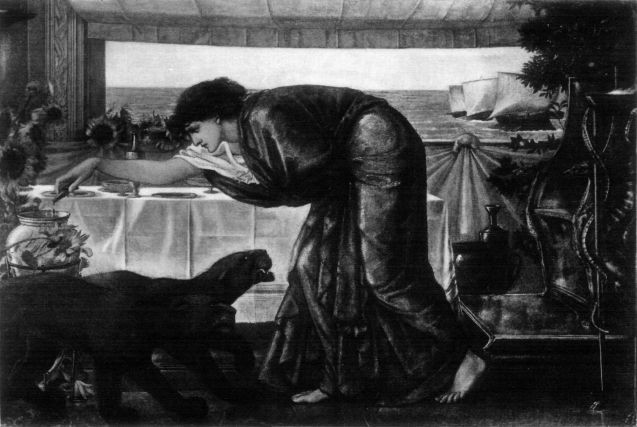
Circe.
Photogravure from a Painting by E Burne-Jones.
THE HUNTED SQUIRREL
From 'Britannia's Pastorals'
Then as a nimble squirrel from the wood
Ranging the hedges for his filbert food
Sits pertly on a bough, his brown nuts cracking,
And from the shell the sweet white kernel taking;
Till with their crooks and bags a sort of boys
To share with him come with so great a noise
That he is forced to leave a nut nigh broke,
And for his life leap to a neighbor oak,
Thence to a beach, thence to a row of ashes;
Whilst through the quagmires and red water plashes
The boys run dabbling through thick and thin;
One tears his hose, another breaks his shin;
This, torn and tattered, hath with much ado
Got by the briars; and that hath lost his shoe;
This drops his band; that headlong falls for haste;
Another cries behind for being last:
With sticks and stones and many a sounding holloa
The little fool with no small sport they follow,
Whilst he from tree to tree, from spray to spray
Gets to the woods and hides him in his dray.
AS CAREFUL MERCHANTS DO EXPECTING STAND
From 'Britannia's Pastorals'
As careful merchants do expecting stand,
After long time and merry gales of wind,
Upon the place where their brave ships must land,
So wait I for the vessel of my mind.
Upon a great adventure is it bound,
Whose safe return will valued be at more
Than all the wealthy prizes which have crowned
The golden wishes of an age before.
Out of the East jewels of worth she brings;
The unvalued diamond of her sparkling eye
Wants in the treasures of all Europe's kings;
And were it mine, they nor their crowns should buy.
The sapphires ringèd on her panting breast
Run as rich veins of ore about the mold,
And are in sickness with a pale possessed;
So true for them I should disvalue gold.
The melting rubies on her cherry lip
Are of such power to hold, that as one day
Cupid flew thirsty by, he stooped to sip:
And, fastened there, could never get away.
The sweets of Candy are no sweets to me
Where hers I taste: nor the perfumes of price,
Robbed from the happy shrubs of Araby,
As her sweet breath so powerful to entice.
O hasten then! and if thou be not gone
Unto that wicked traffic through the main,
My powerful sigh shall quickly drive thee on,
And then begin to draw thee back again.
If, in the mean, rude waves have it opprest,
It shall suffice, I ventured at the best.
SONG OF THE SIRENS
From 'The Inner Temple Masque'
Steer hither, steer your wingèd pines,
All beaten mariners!
Here lie love's undiscovered mines,
A prey to passengers:
Perfumes far sweeter than the best
Which make the Phoenix's urn and nest.
Fear not your ships,
Nor any to oppose you save our lips,
But come on shore,
Where no joy dies till love hath gotten more.
For swelling waves our panting breasts,
Where never storms arise,
Exchange, and be awhile our guests:
For stars, gaze on our eyes.
The compass love shall hourly sing,
And as he goes about the ring,
We will not miss
To tell each point he nameth with a kiss.
Then come on shore,
Where no joy dies till love hath gotten more.
AN EPISTLE ON PARTING
From 'Epistles'
Dear soul, the time is come, and we must part;
Yet, ere I go, in these lines read my heart:
A heart so just, so loving, and so true,
So full of sorrow and so full of you,
That all I speak or write or pray or mean,--
And, which is all I can, all that I dream,--
Is not without a sigh, a thought of you,
And as your beauties are, so are they true.
Seven summers now are fully spent and gone,
Since first I loved, loved you, and you alone;
And should mine eyes as many hundreds see,
Yet none but you should claim a right in me;
A right so placed that time shall never hear
Of one so vowed, or any loved so dear.
When I am gone, if ever prayers moved you,
Relate to none that I so well have loved you:
For all that know your beauty and desert,
Would swear he never loved that knew to part.
Why part we then? That spring, which but this day
Met some sweet river, in his bed can play,
And with a dimpled cheek smile at their bliss,
Who never know what separation is.
The amorous vine with wanton interlaces
Clips still the rough elm in her kind embraces:
Doves with their doves sit billing in the groves,
And woo the lesser birds to sing their loves:
Whilst hapless we in griefful absence sit,
Yet dare not ask a hand to lessen it.
SONNETS TO CÆLIA
Fairest, when by the rules of palmistry,
You took my hand to try if you could guess,
By lines therein, if any wight there be
Ordained to make me know some happiness:
I wished that those charácters could explain,
Whom I will never wrong with hope to win;
Or that by them a copy might be ta'en,
By you alone what thoughts I have within.
But since the hand of nature did not set
(As providently loath to have it known)
The means to find that hidden alphabet,
Mine eyes shall be the interpreters alone:
By them conceive my thoughts, and tell me, fair,
If now you see her that doth love me, there.
Were't not for you, here should my pen have rest,
And take a long leave of sweet poesy;
Britannia's swains, and rivers far by west,
Should hear no more my oaten melody.
Yet shall the song I sung of them awhile
Unperfect lie, and make no further known
The happy loves of this our pleasant Isle,
Till I have left some record of mine own.
You are the subject now, and, writing you,
I well may versify, not poetize:
Here needs no fiction; for the graces true
And virtues clip not with base flatteries.
Here should I write what you deserve of praise;
Others might wear, but I should win, the bays.
Fairest, when I am gone, as now the glass
Of Time is marked how long I have to stay,
Let me entreat you, ere from hence I pass,
Perhaps from you for ever more away,--
Think that no common love hath fired my breast,
No base desire, but virtue truly known,
Which I may love, and wish to have possessed,
Were you the highest as fairest of any one.
'Tis not your lovely eye enforcing flames,
Nor beauteous red beneath a snowy skin,
That so much binds me yours, or makes your fame's,
As the pure light and beauty shrined within:
Yet outward parts I must affect of duty,
As for the smell we like the rose's beauty.
HENRY HOWARD BROWNELL
(1820-1872)
his poet, prominent among those who gained their chief inspiration from the stirring events of the Civil War, was born in Providence, Rhode Island, February 6th, 1820, and died in East Hartford, Connecticut, October 31st, 1872. He was graduated at Trinity College, Hartford, studied law, and was admitted to the bar; but instead of the legal profession adopted that of a teacher, and made his home in Hartford, which was the residence of his uncle, the Bishop of Connecticut. Although Mr. Brownell soon became known as a writer of verse, both grave and humorous, it was not till the coming on of the Civil War that his muse found truest and noblest expression. With a poet's sensitiveness he foresaw the coming storm, and predicted it in verse that has the ring of an ancient prophet; and when the crash came he sang of the great deeds of warriors in the old heroic strain. Many of these poems, like 'Annus Memorabilis' and 'Coming,' were born of the great passion of patriotism which took possession of him, and were regarded only as the visions of a heated imagination. But when the storm burst it was seen that he had the true vision. As the dreadful drama unrolled, Brownell rose to greater issues, and became the war-poet par excellence, the vigorous chronicler of great actions.
He was fond of the sea, and ardently longed for the opportunity to witness, if not to participate in, a sea-fight. His desire was gratified in a singular way. He had printed in a Hartford paper a very felicitous versification of Farragut's 'General Orders' in the fight at the mouth of the Mississippi. This attracted Farragut's attention, and he took steps to learn the name of the author. When it was given, Commodore Farragut (he was not then Admiral) offered Mr. Brownell the position of master's-mate on board the Hartford, and attached the poet to him in the character of a private secretary. Thus he was present at the fight of Mobile Bay. After the war he accompanied the Admiral in his cruise in European waters.
Although Brownell was best known to the country by his descriptive poems, 'The River Fight' and 'The Bay Fight,' which appear in his volume of collected works, 'War Lyrics,' his title to be considered a true poet does not rest upon these only. He was unequal in his performance and occasionally was betrayed by a grotesque humor into disregard of dignity and finish; but he had both the vision and the lyric grace of the builder of lasting verse.
ANNUS MEMORABILIS
(CONGRESS, 1860-61)
Stand strong and calm as Fate! not a breath of scorn or hate--
Of taunt for the base, or of menace for the strong--
Since our fortunes must be sealed on that old and famous Field
Where the Right is set in battle with the Wrong.
'Tis coming, with the loom of Khamsin or Simoom,
The tempest that shall try if we are of God or no--
Its roar is in the sky,--and they there be which cry,
"Let us cower, and the storm may over-blow."
Now, nay! stand firm and fast! (that was a spiteful blast!)
This is not a war of men, but of Angels Good and Ill--
'Tis hell that storms at heaven--'tis the black and deadly Seven,
Sworn 'gainst the Shining Ones to work their damnèd will!
How the Ether glooms and burns, as the tide of combat turns,
And the smoke and dust above it whirl and float!
It eddies and it streams--and, certes, oft it seems
As the Sins had the Seraphs fairly by the throat.
But we all have read (in that Legend grand and dread),
How Michael and his host met the Serpent and his crew--
Naught has reached us of the Fight--but if I have dreamed aright,
'Twas a loud one and a long, as ever thundered through!
Right stiffly, past a doubt, the Dragon fought it out,
And his Angels, each and all, did for Tophet their devoir--
There was creak of iron wings, and whirl of scorpion stings,
Hiss of bifid tongues, and the Pit in full uproar!
But, naught thereof enscrolled, in one brief line 'tis told
(Calm as dew the Apocalyptic Pen),
That on the Infinite Shore their place was found no more.
God send the like on this our earth! Amen.
Houghton, Mifflin and Company, Boston.
WORDS FOR THE 'HALLELUJAH CHORUS'
Old John Brown lies a-moldering in the grave,
Old John Brown lies slumbering in his grave--
But John Brown's soul is marching with the brave,
His soul is marching on.
Glory, glory, hallelujah!
Glory, glory, hallelujah!
Glory, glory, hallelujah!
His soul is marching on.
He has gone to be a soldier in the Army of the Lord;
He is sworn as a private in the ranks of the Lord,--
He shall stand at Armageddon with his brave old sword,
When Heaven is marching on.
He shall file in front where the lines of battle form,
He shall face to front when the squares of battle form--
Time with the column, and charge in the storm,
Where men are marching on.
Ah, foul Tyrants! do ye hear him where he comes?
Ah, black traitors! do ye know him as he comes,
In thunder of the cannon and roll of the drums,
As we go marching on?
Men may die, and molder in the dust--
Men may die, and arise again from dust,
Shoulder to shoulder, in the ranks of the Just,
When Heaven is marching on.
Glory, glory, hallelujah!
Glory, glory, hallelujah!
Glory, glory, hallelujah!
His soul is marching on.
COMING
(APRIL, 1861)
World, are thou 'ware of a storm?
Hark to the ominous sound;
How the far-off gales their battle form,
And the great sea-swells feel ground!
It comes, the Typhoon of Death--
Nearer and nearer it comes!
The horizon thunder of cannon-breath
And the roar of angry drums!
Hurtle, Terror sublime!
Swoop o'er the Land to-day--
So the mist of wrong and crime,
The breath of our Evil Time
Be swept, as by fire, away!
PSYCHAURA
The wind of an autumn midnight
Is moaning around my door--
The curtains wave at the window,
The carpet lifts on the floor.
There are sounds like startled footfalls
In the distant chambers now,
And the touching of airy ringers
Is busy on hand and brow.
'Tis thus, in the Soul's dark dwelling--
By the moody host unsought--
Through the chambers of memory wander
The invisible airs of thought.
For it bloweth where it listeth,
With a murmur loud or low;
Whence it cometh--whither it goeth--
None tell us, and none may know.
Now wearying round the portals
Of the vacant, desolate mind--
As the doors of a ruined mansion,
That creak in the cold night wind.
And anon an awful memory
Sweeps over it fierce and high--
Like the roar of a mountain forest
When the midnight gale goes by.
Then its voice subsides in wailing,
And, ere the dawning of day,
Murmuring fainter and fainter,
In the distance dies away.
SUSPIRIA NOCTIS
Reading, and reading--little is the gain
Long dwelling with the minds of dead men leaves.
List rather to the melancholy rain,
Drop--dropping from the eaves.
Still the old tale--how hardly worth the telling!
Hark to the wind!--again that mournful sound,
That all night long, around this lonely dwelling,
Moans like a dying hound.
ELIZABETH BARRETT BROWNING
(1809-1861)
t is interesting to step back sixty years into the lives of Miss Mitford and her "dear young friend Miss Barrett," when the -esses of "authoresses" and "poetesses" and "editresses" and "hermitesses" make the pages sibilant; when 'Books of Beauty,' and 'Keepsakes,' and the extraordinary methods of "Finden's Tableaux" make us wonder that literature survived; when Mr. Kenyon, taking Miss Mitford "to the giraffes and the Diorama," called for "Miss Barrett, a hermitess in Gloucester Place, who reads Greek as I do French, who has published some translations from Æschylus, and some most striking poems,"--"Our sweet Miss Barrett! to think of virtue and genius is to think of her." Of her own life Mrs. Browning writes:--"As to stories, my story amounts to the knife-grinder's, with nothing at all for a catastrophe. A bird in a cage would have as good a story; most of my events and nearly all my intense pleasure have passed in my thoughts."
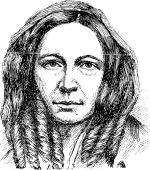
Mrs. Browning
She was born at Burn Hall, Durham, on March 6th, 1809, and passed a happy childhood and youth in her father's country house at Hope End, Herefordshire. She was remarkably precocious, reading Homer in the original at eight years of age. She said that in those days "the Greeks were her demigods. She dreamed more of Agamemnon than of Moses, her black pony." "I wrote verses very early, at eight years old and earlier. But what is less common, the early fancy turned into a will, and remained with me." At seventeen years of age she published the 'Essay on Mind,' and translated the 'Prometheus' of Æschylus. Some years later the family removed to London, and here Elizabeth, on account of her continued delicate health, was kept in her room for months at a time. The shock following on the death of her brother, who was drowned before her eyes in Torquay, whither she had gone for rest, completely shattered her physically. Now her life of seclusion in her London home began. For years she lay upon a couch in a large, comfortably darkened room, seeing only the immediate members of her family and a few privileged friends, and spending her days in writing and study, "reading," Miss Mitford says, "almost every book worth reading in almost every language." Here Robert Browning met her. They were married in 1846, against the will of her father. Going abroad immediately, they finally settled in Florence at the Casa Guidi, made famous by her poem bearing the same name. Their home became the centre of attraction to visitors in Florence, and many of the finest minds in the literary and artistic world were among their friends. Hawthorne, who visited them, describes Mrs. Browning as "a pale, small person, scarcely embodied at all, at any rate only substantial enough to put forth her slender fingers to be grasped, and to speak with a shrill yet sweet tenuity of voice. It is wonderful to see how small she is, how pale her cheek, how bright and dark her eyes. There is not such another figure in the world, and her black ringlets cluster down in her neck and make her face look whiter." She died in Florence on the 30th of June, 1861, and the citizens of Florence placed a tablet to her memory on the walls of Casa Guidi.
The life and personality of Elizabeth Barrett Browning seem to explain her poetry. It is a life "without a catastrophe," except perhaps to her devoted father. And it is to this father's devotion that some of Mrs. Browning's poetical sins are due; for by him she was so pampered and shielded from every outside touch, that all the woes common to humanity grew for her into awful tragedies. Her life was abnormal and unreal,--an unreality that passed more or less into everything she did. Indeed, her resuscitation after meeting Robert Browning would mount into a miracle, unless it were realized that nothing in her former life had been quite as woful as it seemed. That Mrs. Browning was "a woman of real genius," even Edward Fitzgerald allowed; and in speaking of Shelley, Walter Savage Landor said, "With the exception of Burns, he [Shelley] and Keats were inspired with a stronger spirit of poetry than any other poet since Milton. I sometimes fancy that Elizabeth Barrett Browning comes next." This is very high praise from very high authority, but none too high for Mrs. Browning, for her best work has the true lyric ring, that spontaneity of thought and expression which comes when the singer forgets himself in his song and becomes tuneful under the stress of the moment's inspiration. All of Mrs. Browning's work is buoyed up by her luxurious and overflowing imagination. With all its imperfections of technique, its lapses of taste and faults of expression, it always remains poetry, throbbing with passion and emotion and rich in color and sound. She wrote because she must. Her own assertions notwithstanding, one cannot think of Mrs. Browning as sitting down in cold blood to compose a poem according to fixed rules of art. This is the secret of her shortcomings, as it is also the source of her strength, and in her best work raises her high above those who, with more technical skill, have less of the true poet's divine fire and overflowing imagination.
So in the 'Sonnets from the Portuguese,' written at a time when her woman's nature was thrilled to its very depths by the love of her "most gracious singer of high poems," and put forth as translations from another writer and tongue--in these her imperfections drop away, and she soars to marvelous heights of song. Such a lyric outburst as this, which reveals with magnificent frankness the innermost secrets of an ardently loving woman's heart, is unequaled in literature. Here the woman-poet is strong and sane; here she is free from obscurity and mannerism, and from grotesque rhymes. She has stepped out from her life of visions and of morbid woes into a life of wholesome reality and of "sweet reasonableness." Their literary excellence is due also to the fact that in the sonnet Mrs. Browning was held to a rigid form, and was obliged to curb her imagination and restrain her tendency to diffuseness of expression. Mr. Saintsbury goes so far as to say that the sonnet beginning--
"If thou wilt love me, let it be for naught
Except for love's sake only--"
does not fall far short of Shakespeare.
'Aurora Leigh' gives rise to the old question, Is it advisable to turn a three-volume novel into verse? Yet Landor wrote about it:--"I am reading a poem full of thought and fascinating with fancy--Mrs. Browning's (Aurora Leigh.) In many places there is the wild imagination of Shakespeare.... I am half drunk with it. Never did I think I should have a good draught of poetry again." Ruskin somewhere considered it the greatest poem of the nineteenth century, "with enough imagination to set up a dozen lesser poets"; and Stedman calls it "a representative and original creation: representative in a versatile, kaleidoscopic presentment of modern life and issues; original, because the most idiosyncratic of its author's poems. An audacious speculative freedom pervades it, which smacks of the New World rather than the Old.... 'Aurora Leigh' is a mirror of contemporary life, while its learned and beautiful illustrations make it almost a handbook of literature and the arts.... Although a most uneven production, full of ups and downs, of capricious or prosaic episodes, it nevertheless contains poetry as fine as its author has given us elsewhere, and enough spare inspiration to set up a dozen smaller poets. The flexible verse is noticeably her own, and often handled with as much spirit as freedom." Mrs. Browning herself declared it the most mature of her works, "and the one into which my highest convictions upon life and art have entered." Consider this:--
"For 'tis not in mere death that men die most:
And after our first girding of the loins
In youth's fine linen and fair broidery,
To run up-hill and meet the rising sun,
We are apt to sit tired, patient as a fool,
While others gird us with the violent bands
Of social figments, feints, and formalisms,
Reversing our straight nature, lifting up
Our base needs, keeping down our lofty thoughts,
Head downwards on the cross-sticks of the world.
Yet He can pluck us from that shameful cross.
God, set our feet low and our foreheads high,
And teach us how a man was made to walk!"
Or this:--
"I've waked and slept through many nights and days
Since then--but still that day will catch my breath
Like a nightmare. There are fatal days, indeed,
In which the fibrous years have taken root
So deeply, that they quiver to their tops
Whene'er you stir the dust of such a day."
Again:--
"Passion is
But something suffered after all--
. . . . . While Art
Sets action on the top of suffering."
And this:--
"Nothing is small!
No lily-muffled hum of summer-bee
But finds some coupling with the spinning stars;
No pebble at your foot but proves a sphere:
. . . . . Earth's crammed with Heaven,
And every common bush afire with God;
But only he who sees, takes off his shoes."
Among Mrs. Browning's smaller poems, 'Crowned and Buried' is, notwithstanding serious defects of technique, one of the most virile things she has written; indeed, some of her finest lines are to be found in it. In 'The Cry of the Children' and in 'Cowper's Grave' the pathos is most true and deep. 'Lord Walter's Wife' is an even more courageous vindication of the feminine essence than 'Aurora Leigh'; and her 'Vision of Poets' is said to "vie in beauty with Tennyson's own." The fine thought and haunting beauty of 'A Musical Instrument,' with its matchless climax, need not be dwelt on.
During her fifteen years' residence in Florence she threw herself with great enthusiasm into Italian affairs, and wrote some political poems of varying merit, whose interest necessarily faded away when the occasion passed. But among those poems inspired by the struggle for freedom, 'Casa Guidi Windows' comes close to the 'Sonnets from the Portuguese' and 'Aurora Leigh,' and holds an enduring place for its high poetry, its musical, sonorous verse, and the sustained intellectual vigor of composition. Her volume of 'Last Poems' contains, among much inferior matter, some of her finest and most touching work, as 'A Musical Instrument,' 'The Forced Recruit,' and 'Mother and Poet,' Peter Bayne says of her in his 'Great Englishwomen':--"In melodiousness and splendor of poetic gift Mrs. Browning stands ... first among women. She may not have the knowledge of life, the insight into character, the comprehensiveness of some, but we must all agree that a poet's far more essential qualities are hers: usefulness, fervor, a noble aspiration, and above all a tender, far-reaching nature, loving and beloved, and touching the hearts of her readers with some virtue from its depths. She seemed even in her life something of a spirit; and her view of life's sorrow and shame, of its hearty and eternal hope, is something like that which one might imagine a spirit's to be." Whether political, or sociological, or mystical, or sentimental, or impossible, there is about all that Mrs. Browning has written an enduring charm of picturesqueness, of romance, and of a pure enthusiasm for art. "Art for Art," she cries,
"And good for God, himself the essential Good!
We'll keep our aims sublime, our eyes erect,
Although our woman-hands should shake and fail."
This was her achievement--her hands did not fail!
Her husband's words will furnish, perhaps, the best conclusion to this slight study:--"You are wrong," he said, "quite wrong--she has genius; I am only a painstaking fellow. Can't you imagine a clever sort of angel who plots and plans, and tries to build up something,--he wants to make you see it as he sees it, shows you one point of view, carries you off to another, hammering into your head the thing he wants you to understand; and whilst this bother is going on, God Almighty turns you off a little star--that's the difference between us. The true creative power is hers, not mine."
A MUSICAL INSTRUMENT
WHAT was he doing, the great god Pan,
Down in the reeds by the river?
Spreading ruin and scattering ban,
Splashing and paddling with hoofs of a goat,
And breaking the golden lilies afloat
With the dragon-fly on the river.
He tore out a reed, the great god Pan,
From the deep, cool bed of the river.
The limpid water turbidly ran,
And the broken lilies a-dying lay,
And the dragon-fly had fled away,
Ere he brought it out of the river.
High on the shore sat the great god Pan,
While turbidly flowed the river,
And hacked and hewed as a great god can,
With his hard bleak steel at the patient reed,
Till there was not a sign of the leaf indeed
To prove it fresh from the river.
He cut it short, did the great god Pan,
(How tall it stood in the river!)
Then drew the pith, like the heart of a man,
Steadily from the outside ring,
And notched the poor, dry, empty thing
In holes as he sat by the river.
"This is the way," laughed the great god Pan,
(Laughed while he sat by the river,)
"The only way, since gods began
To make sweet music, they could succeed."
Then, dropping his mouth to a hole in the reed,
He blew in power by the river.
Sweet, sweet, sweet, O Pan,
Piercing sweet by the river!
Blinding sweet, O great god Pan!
The sun on the hill forgot to die,
And the lilies revived, and the dragon-fly
Came back to dream on the river.
Yet half a beast is the great god Pan,
To laugh as he sits by the river,
Making a poet out of a man:
The true gods sigh for the cost and the pain,--
For the reed which grows nevermore again
As a reed with the reeds in the river.
MY HEART AND I
Enough! we're tired, my heart and I.
We sit beside the headstone thus,
And wish that name were carved for us.
The moss reprints more tenderly
The hard types of the mason's knife,
As heaven's sweet life renews earth's life
With which we're tired, my heart and I.
You see we're tired, my heart and I.
We dealt with books, we trusted men,
And in our own blood drenched the pen,
As if such colors could not fly.
We walked too straight for fortune's end,
We loved too true to keep a friend:
At last we're tired, my heart and I.
How tired we feel, my heart and I!
We seem of no use in the world;
Our fancies hang gray and uncurled
About men's eyes indifferently;
Our voice, which thrilled you so, will let
You sleep; our tears are only wet:
What do we here, my heart and I?
So tired, so tired, my heart and I!
It was not thus in that old time
When Ralph sat with me 'neath the lime
To watch the sunset from the sky.
"Dear love, you're looking tired," he said;
I, smiling at him, shook my head:
'Tis now we're tired, my heart and I.
So tired, so tired, my heart and I!
Though now none takes me on his arm
To fold me close and kiss me warm
Till each quick breath end in a sigh
Of happy languor. Now, alone,
We lean upon this graveyard stone,
Uncheered, unkissed, my heart and I.
Tired out we are, my heart and I.
Suppose the world brought diadems
To tempt us, crusted with loose gems
Of powers and pleasures? Let it try.
We scarcely care to look at even
A pretty child, or God's blue heaven,
We feel so tired, my heart and I.
Yet who complains? My heart and I?
In this abundant earth, no doubt,
Is little room for things worn out:
Disdain them, break them, throw them by!
And if, before the days grew rough,
We once were loved, used,--well enough
I think we've fared, my heart and I.
[4] According to the custom of the Jews, who placed a lighted wax candle in a pot of ashes by the corpse.
Oblivion is not to be hired. The greater part must be content to be as though they had not been; to be found in the register of God, not in the record of man. Twenty-seven names make up the first story, and the recorded names ever since contain not one living century. The number of the dead long exceedeth all that shall live. The night of time far surpasseth the day; and who knows when was the equinox? Every hour adds unto that current arithmetic, which scarce stands one moment. And since death must be the Lucina of life, and even pagans could doubt whether thus to live were to die; since our longest sun sets at right declensions, and makes but winter arches, and therefore it cannot be long before we lie down in darkness, and have our light in ashes[4]; since the brother of death daily haunts us with dying mementos, and time, that grows old itself, bids us hope no long duration, diuturnity is a dream and folly of expectation.


