автордың кітабын онлайн тегін оқу Library of the World's Best Literature, Ancient and Modern — Volume 3
LIBRARY OF THE
WORLD'S BEST LITERATURE
ANCIENT AND MODERN
CHARLES DUDLEY WARNER
EDITOR
HAMILTON WRIGHT MABIE
LUCIA GILBERT RUNKLE
GEORGE HENRY WARNER
ASSOCIATE EDITORS
Connoisseur Edition
VOL. III.
1896
THE ADVISORY COUNCIL
CRAWFORD H. TOY, A.M., LL.D.,
Professor of Hebrew,
HARVARD UNIVERSITY, Cambridge, Mass.
THOMAS R. LOUNSBURY, LL.D., L.H.D.,
Professor of English in the Sheffield Scientific School of
YALE UNIVERSITY, New Haven, Conn.
WILLIAM M. SLOANE, PH.D., L.H.D.,
Professor of History and Political Science,
PRINCETON UNIVERSITY, Princeton, N.J.
BRANDER MATTHEWS, A.M., LL.B.,
Professor of Literature,
COLUMBIA UNIVERSITY, New York City.
JAMES B. ANGELL, LL.D.,
President of the
UNIVERSITY OF MICHIGAN, Ann Arbor, Mich.
WILLARD FISKE, A.M., PH.D.,
Late Professor of the Germanic and Scandinavian Languages and Literatures,
CORNELL UNIVERSITY, Ithaca, N.Y.
EDWARD S. HOLDEN, A.M., LL.D.,
Director of the Lick Observatory, and Astronomer
UNIVERSITY OF CALIFORNIA, Berkeley, Cal.
ALCÉE FORTIER, LIT.D.,
Professor of the Romance Languages,
TULANE UNIVERSITY, New Orleans, La.
WILLIAM P. TRENT, M.A.,
Dean of the Department of Arts and Sciences, and Professor of English and History,
UNIVERSITY OF THE SOUTH, Sewanee, Tenn.
PAUL SHOREY, PH.D.,
Professor of Greek and Latin Literature,
UNIVERSITY OF CHICAGO, Chicago, Ill.
WILLIAM T. HARRIS, LL.D.,
United States Commissioner of Education,
BUREAU OF EDUCATION, Washington, D.C.
MAURICE FRANCIS EGAN, A.M., LL.D.,
Professor of Literature in the
CATHOLIC UNIVERSITY OF AMERICA, Washington, D.C.
TABLE OF CONTENTS
VOL. III.
BERTHOLD AUERBACH--Continued: -- 1812-1882
The First False Step ('On the Heights')
The New Home and the Old One (same)
The Court Physician's Philosophy (same)
In Countess Irma's Diary (same)
ÉMILE AUGIER -- 1820-1889
A Conversation with a Purpose ('Giboyer's Boy')
A Severe Young Judge ('The Adventuress')
A Contented Idler ('M. Poirier's Son-in-Law')
Feelings of an Artist (same)
A Contest of Wills ('The Fourchambaults')
ST. AUGUSTINE OF HIPPO (by Samuel Hart) -- 354-430
The Godly Sorrow that Worketh Repentance ('The Confessions')
Consolation (same)
The Foes of the City ('The City of God')
The Praise of God (same)
A Prayer ('The Trinity')
MARCUS AURELIUS ANTONINUS -- A.D. 121-180
Reflections
JANE AUSTEN -- 1775-1817
An Offer of Marriage ('Pride and Prejudice')
Mother and Daughter (same)
A Letter of Condolence (same)
A Well-Matched Sister and Brother ('Northanger Abbey')
Family Doctors ('Emma')
Family Training ('Mansfield Park')
Private Theatricals (same)
Fruitless Regrets and Apples of Sodom (same)
AVERROËS -- 1126-1198
THE AVESTA (by A.V. Williams Jackson)
Psalm of Zoroaster
Prayer for Knowledge
The Angel of Divine Obedience
To the Fire
The Goddess of the Waters
Guardian Spirits
An Ancient Sindbad
The Wise Man
Invocation to Rain
Prayer for Healing
Fragment
AVICEBRON -- 1028-?1058
On Matter and Form ('The Fountain of Life')
ROBERT AYTOUN -- 1570-1638
Inconstancy Upbraided
Lines to an Inconstant Mistress (with Burns's Adaptation)
WILLIAM EDMONSTOUNE AYTOUN -- 1813-1865
Burial March of Dundee ('Lays of the Scottish Cavaliers')
Execution of Montrose (same)
The Broken Pitcher ('Bon Gaultier Ballads')
Sonnet to Britain. "By the Duke of Wellington" (same)
A Ball in the Upper Circles ('The Modern Endymion')
A Highland Tramp ('Norman Sinclair')
MASSIMO TAPARELLI D'AZEGLIO -- 1798-1866
A Happy Childhood ('My Recollections')
The Priesthood (same)
My First Venture in Romance (same)
BABER (by Edward S. Holden) -- 1482-1530
From Baber's 'Memoirs'
BABRIUS -- First Century A.D.
The North Wind and the Sun
Jupiter and the Monkey
The Mouse that Fell into the Pot
The Fox and the Grapes
The Carter and Hercules
The Young Cocks
The Arab and the Camel
The Nightingale and the Swallow
The Husbandman and the stork
The Pine
The Woman and Her Maid-Servants
The Lamp
The Tortoise and the Hare
FRANCIS BACON (by Charlton T. Lewis) -- 1561-1626
Of Truth ('Essays')
Of Revenge (same)
Of Simulation and Dissimulation (same)
Of Travel (same)
Of Friendship (same)
Defects of the Universities ('The Advancement of Learning')
To My Lord Treasurer Burghley
In Praise of Knowledge
To the Lord Chancellor
To Villiers on his Patent as a Viscount
Charge to Justice Hutton
A Prayer, or Psalm
From the 'Apophthegms'
Translation of the 137th Psalm
The World's a Bubble
WALTER BAGEHOT (by Forrest Morgan) -- 1826-1877
The Virtues of Stupidity ('Letters on the French Coup d'État')
Review Writing ('The First Edinburgh Reviewers')
Lord Eldon (same)
Taste ('Wordsworth, Tennyson, and Browning')
Causes of the Sterility of Literature ('Shakespeare')
The Search for Happiness ('William Cowper')
On Early Reading ('Edward Gibbon')
The Cavaliers ('Thomas Babington Macaulay')
Morality and Fear ('Bishop Butler')
The Tyranny of Convention ('Sir Robert Peel')
How to Be an Influential Politician ('Bolingbroke')
Conditions of Cabinet Government ('The English Constitution')
Why Early Societies could not be Free ('Physics and Politics')
Benefits of Free Discussion in Modern Times (same)
Origin of Deposit Banking ('Lombard Street')
JENS BAGGESEN -- 1764-1826
A Cosmopolitan ('The Labyrinth')
Philosophy on the Heath (same)
There was a Time when I was Very Little
PHILIP JAMES BAILEY -- 1816-
From "Festus": Life: The Passing-Bell; Thoughts;
Dreams; Chorus of the Saved
JOANNA BAILLIE -- 1762-1851
Woo'd and Married and A'
It Was on a Morn when We were Thrang
Fy, Let Us A' to the Wedding
The Weary Pund o' Tow
From 'De Montfort'
To Mrs. Siddons
A Scotch Song
Song, 'Poverty Parts Good Company'
The Kitten
HENRY MARTYN BAIRD -- 1832-
The Battle of Ivry ('The Huguenots and Henry of Navarre')
SIR SAMUEL WHITE BAKER -- 1821-1893
Hunting in Abyssinia ('The Nile Tributaries of Abyssinia')
The Sources of the Nile ('The Albert Nyanza')
ARTHUR JAMES BALFOUR -- 1848-
The Pleasures of Reading (Rectorial Address)
THE BALLAD (by F.B. Gummere)
Robin Hood and Guy of Gisborne
The Hunting of the Cheviot
Johnie Cock
Sir Patrick Spens
The Bonny Earl of Murray
Mary Hamilton
Bonnie George Campbell
Bessie Bell and Mary Gray
The Three Ravens
Lord Randal
Edward
The Twa Brothers
Babylon
Childe Maurice
The Wife of Usher's Well
Sweet William's Ghost
HONORÉ DE BALZAC (by William P. Trent) -- 1799-1850
The Meeting in the Convent ('The Duchess of Langeais')
An Episode Under the Terror
A Passion in the Desert
The Napoleon of the People ('The Country Doctor')
GEORGE BANCROFT (by Austin Scott) -- 1800-1891
The Beginnings of Virginia ('History of the United States')
Men and Government in Early Massachusetts (same)
King Philip's War (same)
The New Netherland (same)
Franklin (same)
FULL-PAGE ILLUSTRATIONS
VOLUME III.
Ancient Irish Miniature (Colored Plate)
Frontispiece
"St. Augustine and His Mother" (Photogravure)
1014Papyrus, Sermons of St. Augustine (Fac-simile)
1018Marcus Aurelius (Portrait)
1022The Zend Avesta (Fac-simile)
1084Francis Bacon (Portrait)
1156"The Cavaliers" (Photogravure)
1218Honoré de Balzac (Portrait)
1348George Bancroft (Portrait)
1432
VIGNETTE PORTRAITS
Émile Augier
Jane Austen
Robert Aytoun
Walter Bagehot
Jens Baggesen
Philip James Bailey
Joanna Baillie
Henry Martyn Baird
Sir Samuel White Baker
Arthur James Balfour
BERTHOLD AUERBACH--(Continued from Volume II)
"Do you imagine that every one is kindly disposed towards you? Take my word for it, a palace contains people of all sorts, good and bad. All the vices abound in such a place. And there are many other matters of which you have no idea, and of which you will, I trust, ever remain ignorant. But all you meet are wondrous polite. Try to remain just as you now are, and when you leave the palace, let it be as the same Walpurga you were when you came here."
Walpurga stared at her in surprise. Who could change her?
Word came that the Queen was awake and desired Walpurga to bring the Crown Prince to her.
Accompanied by Doctor Gunther, Mademoiselle Kramer, and two waiting-women, she proceeded to the Queen's bedchamber. The Queen lay there, calm and beautiful, and with a smile of greeting, turned her face towards those who had entered. The curtains had been partially drawn aside, and a broad, slanting ray of light shone into the apartment, which seemed still more peaceful than during the breathless silence of the previous night.
"Good morning!" said the Queen, with a voice full of feeling. "Let me have my child!" She looked down at the babe that rested in her arms, and then, without noticing any one in the room, lifted her glance on high and faintly murmured:--
"This is the first time I behold my child in the daylight!"
All were silent; it seemed as if there was naught in the apartment except the broad slanting ray of light that streamed in at the window.
"Have you slept well?" inquired the Queen. Walpurga was glad the Queen had asked a question, for now she could answer. Casting a hurried glance at Mademoiselle Kramer, she said:--
"Yes, indeed! Sleep's the first, the last, and the best thing in the world."
"She's clever," said the Queen, addressing Doctor Gunther in French.
Walpurga's heart sank within her. Whenever she heard them speak French, she felt as if they were betraying her; as if they had put on an invisible cap, like that worn by the goblins in the fairy-tale, and could thus speak without being heard.
"Did the Prince sleep well?" asked the Queen.
Walpurga passed her hand over her face, as if to brush away a spider that had been creeping there. The Queen doesn't speak of her "child" or her "son," but only of "the Crown Prince."
Walpurga answered:--
"Yes, quite well, thank God! That is, I couldn't hear him, and I only wanted to say that I'd like to act towards the--" she could not say "the Prince"--"that is, towards him, as I'd do with my own child. We began on the very first day. My mother taught me that. Such a child has a will of its own from the very start, and it won't do to give way to it. It won't do to take it from the cradle, or to feed it, whenever it pleases; there ought to be regular times for all those things. It'll soon get used to that, and it won't harm it either, to let it cry once in a while. On the contrary, that expands the chest."
"Does he cry?" asked the Queen.
The infant answered the question for itself, for it at once began to cry most lustily.
"Take him and quiet him," begged the Queen.
The King entered the apartment before the child had stopped crying.
"He will have a good voice of command," said he, kissing the Queen's hand.
Walpurga quieted the child, and she and Mademoiselle Kramer were sent back to their apartments.
The King informed the Queen of the dispatches that had been received, and of the sponsors who had been decided upon. She was perfectly satisfied with the arrangements that had been made.
When Walpurga had returned to her room and had placed the child in the cradle, she walked up and down and seemed quite agitated.
"There are no angels in this world!" said she. "They're all just like the rest of us, and who knows but--" She was vexed at the Queen: "Why won't she listen patiently when her child cries? We must take all our children bring us, whether it be joy or pain."
She stepped out into the passage-way and heard the tones of the organ in the palace-chapel. For the first time in her life these sounds displeased her. "It don't belong in the house," thought she, "where all sorts of things are going on. The church ought to stand by itself."
When she returned to the room, she found a stranger there. Mademoiselle Kramer informed her that this was the tailor to the Queen.
Walpurga laughed outright at the notion of a "tailor to the Queen." The elegantly attired person looked at her in amazement, while Mademoiselle Kramer explained to her that this was the dressmaker to her Majesty the Queen, and that he had come to take her measure for three new dresses.
"Am I to wear city clothes?"
"God forbid! You're to wear the dress of your neighborhood, and can order a stomacher in red, blue, green, or any color that you like best."
"I hardly know what to say; but I'd like to have a workday suit too. Sunday clothes on week-days--that won't do."
"At court one always wears Sunday clothes, and when her Majesty drives out again you will have to accompany her."
"A11 right, then. I won't object."
While he took her measure, Walpurga laughed incessantly, and he was at last obliged to ask her to hold still, so that he might go on with his work. Putting his measure into his pocket, he informed Mademoiselle Kramer that he had ordered an exact model, and that the master of ceremonies had favored him with several drawings, so that there might be no doubt of success.
Finally he asked permission to see the Crown Prince. Mademoiselle Kramer was about to let him do so, but Walpurga objected.
"Before the child is christened," said she, "no one shall look at it just out of curiosity, and least of all a tailor, or else the child will never turn out the right sort of man."
The tailor took his leave, Mademoiselle Kramer having politely hinted to him that nothing could be done with the superstition of the lower orders, and that it would not do to irritate the nurse.
This occurrence induced Walpurga to administer the first serious reprimand to Mademoiselle Kramer. She could not understand why she was so willing to make an exhibition of the child. "Nothing does a child more harm than to let strangers look at it in its sleep, and a tailor at that."
All the wild fun with which, in popular songs, tailors are held up to scorn and ridicule, found vent in Walpurga, and she began singing:--
"Just list, ye braves, who love to roam!
A snail was chasing a tailor home.
And if Old Shears hadn't run so fast,
The snail would surely have caught him at last."
Mademoiselle Kramer's acquaintance with the court tailor had lowered her in Walpurga's esteem; and with an evident effort to mollify the latter, Mademoiselle Kramer asked:--
"Does the idea of your new and beautiful clothes really afford you no pleasure?"
"To be frank with you, no! I don't wear them for my own sake, but for that of others, who dress me to please themselves. It's all the same to me, however! I've given myself up to them, and suppose I must submit."
"May I come in?" asked a pleasant voice. Countess Irma entered the room. Extending both her hands to Walpurga, she said:--
"God greet you, my countrywoman! I am also from the Highlands, seven hours distance from your village. I know it well, and once sailed over the lake with your father. Does he still live?"
"Alas! no: he was drowned, and the lake hasn't given up its dead."
"He was a fine-looking old man, and you are the very image of him."
"I am glad to find some one else here who knew my father. The court tailor--I mean the court doctor--knew him too. Yes, search the land through, you couldn't have found a better man than my father, and no one can help but admit it."
"Yes: I've often heard as much."
"May I ask your Ladyship's name?"
"Countess Wildenort."
"Wildenort? I've heard the name before. Yes, I remember my mother's mentioning it. Your father was known as a very kind and benevolent man. Has he been dead a long while?"
"No, he is still living."
"Is he here too?"
"No."
"And as what are you here, Countess?"
"As maid of honor."
"And what is that?"
"Being attached to the Queen's person; or what, in your part of the country, would be called a companion."
"Indeed! And is your father willing to let them use you that way?"
Irma, who was somewhat annoyed by her questions, said:--
"I wished to ask you something--Can you write?"
"I once could, but I've quite forgotten how."
"Then I've just hit it! that's the very reason for my coming here. Now, whenever you wish to write home, you can dictate your letter to me, and I will write whatever you tell me to."
"I could have done that too," suggested Mademoiselle Kramer, timidly; "and your Ladyship would not have needed to trouble yourself."
"No, the Countess will write for me. Shall it be now?"
"Certainly."
But Walpurga had to go to the child. While she was in the next room, Countess Irma and Mademoiselle Kramer engaged each other in conversation.
When Walpurga returned, she found Irma, pen in hand, and at once began to dictate.
Translation of S.A. Stern.
THE FIRST FALSE STEP
From 'On the Heights'
The ball was to be given in the palace and the adjoining winter garden. The intendant now informed Irma of his plan, and was delighted to find that she approved of it. At the end of the garden he intended to erect a large fountain, ornamented with antique groups. In the foreground he meant to have trees and shrubbery and various kinds of rocks, so that none could approach too closely; and the background was to be a Grecian landscape, painted in the grand style.
Irma promised to keep his secret. Suddenly she exclaimed, "We are all of us no better than lackeys and kitchen-maids. We are kept busy stewing, roasting, and cooking for weeks, in order to prepare a dish that may please their Majesties."
The intendant made no reply.
"Do you remember," continued Irma, "how, when we were at the lake, we spoke of the fact that man possessed the advantage of being able to change his dress, and thus to alter his appearance? While yet a child, masquerading was my greatest delight. The soul wings its flight in callow infancy. A bal costumé is indeed one of the noblest fruits of culture. The love of coquetry which is innate with all of us displays itself there undisguised."
The intendant took his leave. While walking away, his mind was filled with his old thoughts about Irma.
"No," said he to himself, "such a woman would be a constant strain, and would require one to be brilliant and intellectual all day long. She would exhaust one," said he, almost aloud.
No one knew what character Irma intended to appear in, although many supposed that it would be as "Victory," since it was well known that she had stood for the model of the statue that surmounted the arsenal. They were busy conjecturing how she could assume that character without violating the social proprieties.
Irma spent much of her time in the atelier, and worked assiduously. She was unable to escape a feeling of unrest, far greater than that she had experienced years ago when looking forward to her first ball. She could not reconcile herself to the idea of preparing for the fête so long beforehand, and would like to have had it take place in the very next hour, so that something else might be taken up at once. The long delay tried her patience. She almost envied those beings to whom the preparation for pleasure affords the greatest part of the enjoyment. Work alone calmed her unrest. She had something to do, and this prevented the thoughts of the festival from engaging her mind during the day. It was only in the evening that she would recompense herself for the day's work, by giving full swing to her fancy.
The statue of Victory was still in the atelier and was almost finished. High ladders were placed beside it. The artist was still chiseling at the figure, and would now and then hurry down to observe the general effect, and then hastily mount the ladder again in order to add a touch here or there. Irma scarcely ventured to look up at this effigy of herself in Grecian costume--transformed and yet herself. The idea of being thus translated into the purest of art's forms filled her with a tremor, half joy, half fear.
It was on a winter afternoon. Irma was working assiduously at a copy of a bust of Theseus, for it was growing dark. Near her stood her preceptor's marble bust of Doctor Gunther. All was silent; not a sound was heard save now and then the picking or scratching of the chisel.
At that moment the master descended the ladder, and drawing a deep breath, said:--
"There--that will do. One can never finish. I shall not put another stroke to it. I am afraid that retouching would only injure it. It is done."
In the master's words and manner, struggling effort and calm content seemed mingled. He laid the chisel aside. Irma looked at him earnestly and said:--
"You are a happy man; but I can imagine that you are still unsatisfied. I don't believe that even Raphael or Michael Angelo was ever satisfied with the work he had completed. The remnant of dissatisfaction which an artist feels at the completion of a work is the germ of a new creation."
The master nodded his approval of her words. His eyes expressed his thanks. He went to the water-tap and washed his hands. Then he placed himself near Irma and looked at her, while telling her that in every work an artist parts with a portion of his life; that the figure will never again inspire the same feelings that it did while in the workshop. Viewed from afar, and serving as an ornament, no regard would be had to the care bestowed upon details. But the artist's great satisfaction in his work is in having pleased himself; and yet no one can accurately determine how, or to what extent, a conscientious working up of details will influence the general effect.
While the master was speaking, the King was announced. Irma hurriedly spread a damp cloth over her clay model.
The King entered. He was unattended, and begged Irma not to allow herself to be disturbed in her work. Without looking up, she went on with her modeling. The King was earnest in his praise of the master's work.
"The grandeur that dwells in this figure will show posterity what our days have beheld. I am proud of such contemporaries."
Irma felt that the words applied to her as well. Her heart throbbed. The plaster which stood before her suddenly seemed to gaze at her with a strange expression.
"I should like to compare the finished work with the first models," said the king to the artist.
"I regret that the experimental models are in my small atelier. Does your Majesty wish me to have them brought here?"
"If you will be good enough to do so."
The master left. The King and Irma were alone. With rapid steps the King mounted the ladder, and exclaimed in a tremulous voice:--
"I ascend into heaven--I ascend to you. Irma, I kiss you, I kiss your image, and may this kiss forever rest upon those lips, enduring beyond all time. I kiss thee with the kiss of eternity." He stood aloft and kissed the lips of the statue. Irma could not help looking up, and just at that moment a slanting sunbeam fell on the King and on the face of the marble figure, making it glow as if with life.
Irma felt as if wrapped in a fiery cloud, bearing her away into eternity.
The King descended and placed himself beside her. His breathing was short and quick. She did not dare to look up; she stood as silent and as immovable as a statue. Then the King embraced her--and living lips kissed each other.
Translation of S.A. Stern.
THE NEW HOME AND THE OLD ONE
From 'On the Heights'
Hansei received various offers for his cottage, and was always provoked when it was spoken of as a 'tumble-down old shanty.' He always looked as if he meant to say, "Don't take it ill of me, good old house: the people only abuse you so that they may get you cheap." Hansei stood his ground. He would not sell his home for a penny less than it was worth; and besides that, he owned the fishing-right, which was also worth something. Grubersepp at last took the house off his hands, with the design of putting a servant of his, who intended to marry in the fall, in possession of the place.
All the villagers were kind and friendly to them,--doubly so since they were about to leave,--and Hansei said:--
"It hurts me to think that I must leave a single enemy behind me, I'd like to make it up with the innkeeper."
Walpurga agreed with him, and said that she would go along; that she had really been the cause of the trouble, and that if the innkeeper wanted to scold any one, he might as well scold her too.
Hansei did not want his wife to go along, but she insisted upon it.
It was in the last evening in August that they went up into the village. Their hearts beat violently while they drew near to the inn. There was no light in the room. They groped about the porch, but not a soul was to be seen. Dachsel and Wachsel, however, were making a heathenish racket. Hansei called out:
"Is there no one at home?"
"No. There's no one at home," answered a voice from the dark room.
"Well, then tell the host, when he returns, that Hansei and his wife were here, and that they came to ask him to forgive them if they've done him any wrong; and to say that they forgive him too, and wish him luck."
"A11 right: I'll tell him," said the voice. The door was again slammed to, and Dachsel and Wachsel began barking again.
Hansei and Walpurga returned homeward.
"Do you know who that was?" asked Hansei.
"Why, yes: 'twas the innkeeper himself."
"Well, we've done all we could."
They found it sad to part from all the villagers. They listened to the lovely tones of the bell which they had heard every hour since childhood. Although their hearts were full, they did not say a word about the sadness of parting. Hansei at last broke silence:--"Our new home isn't out of the world: we can often come here."
When they reached the cottage they found that nearly all of the villagers had assembled in order to bid them farewell, but every one added, "I'll see you again in the morning."
Grubersepp also came again. He had been proud enough before; but now he was doubly so, for he had made a man of his neighbor, or at all events had helped to do so. He did not give way to tender sentiment. He condensed all his knowledge of life into a few sentences, which he delivered himself of most bluntly.
"I only want to tell you," said he, "you'll have lots of servants now. Take my word for it, the best of them are good for nothing; but something may be made of them for all that. He who would have his servants mow well, must take the scythe in hand himself. And since you got your riches so quickly, don't forget the proverb: 'Light come, light go.' Keep steady, or it'll go ill with you."
He gave him much more good advice, and Hansei accompanied him all the way back to his house. With a silent pressure of the hand they took leave of each other.
The house seemed empty, for quite a number of chests and boxes had been sent in advance by a boat that was already crossing the lake. On the following morning two teams would be in waiting on the other side.
"So this is the last time that we go to bed in this house," said the mother. They were all fatigued with work and excitement, and yet none of them cared to go to bed. At last, however, they could not help doing so, although they slept but little.
The next morning they were up and about at an early hour. Having attired themselves in their best clothes, they bundled up the beds and carried them into the boat. The mother kindled the last fire on the hearth. The cows were led out and put into the boat, the chickens were also taken along in a coop, and the dog was constantly running to and fro.
The hour of parting had come.
The mother uttered a prayer, and then called all of them into the kitchen. She scooped up some water from the pail and poured it into the fire, with these words:--"May all that's evil be thus poured out and extinguished, and let those who light a fire after us find nothing but health in their home."
Hansei, Walpurga, and Gundel were each of them obliged to pour a ladleful of water into the fire, and the grandmother guided the child's hand while it did the same thing.
After they had all silently performed this ceremony, the grandmother prayed aloud:--
"Take from us, O Lord our God, all heartache and home-sickness and all trouble, and grant us health and a happy home where we next kindle our fire."
She was the first to cross the threshold. She had the child in her arms and covered its eyes with her hands while she called out to the others:--
"Don't look back when you go out."
"Just wait a moment," said Hansei to Walpurga when he found himself alone with her. "Before we cross this threshold for the last time, I've something to tell you. I must tell it. I mean to be a righteous man and to keep nothing concealed from you. I must tell you this, Walpurga. While you were away and Black Esther lived up yonder, I once came very near being wicked--and unfaithful--thank God, I wasn't. But it torments me to think that I ever wanted to be bad; and now, Walpurga, forgive me and God will forgive me, too. Now I've told you, and have nothing more to tell. If I were to appear before God this moment, I'd know of nothing more."
Walpurga embraced him, and sobbing, said, "You're my dear good husband!" and they crossed the threshold for the last time.
When they reached the garden, Hansei paused, looked up at the cherry-tree, and said:--
"And so you remain here. Won't you come with us? We've always been good friends, and spent many an hour together. But wait! I'll take you with me, after all," cried he, joyfully, "and I'll plant you in my new home."
He carefully dug out a shoot that was sprouting up from one of the roots of the tree. He stuck it in his hat-band, and went to join his wife at the boat.
From the landing-place on the bank were heard the merry sounds of fiddles, clarinets, and trumpets.
Hansei hastened to the landing-place. The whole village had congregated there, and with it the full band of music. Tailor Schneck's son, he who had been one of, the cuirassiers at the christening of the crown prince, had arranged and was now conducting the parting ceremonies. Schneck, who was scraping his bass-viol, was the first to see Hansei, and called out in the midst of the music:--
"Long live farmer Hansei and the one he loves best! Hip, hip, hurrah!"
The early dawn resounded with their cheers. There was a flourish of trumpets, and the salutes fired from several small mortars were echoed back from the mountains. The large boat in which their household furniture, the two cows, and the fowls were placed, was adorned with wreaths of fir and oak. Walpurga was standing in the middle of the boat, and with both hands held the child aloft, so that it might see the great crowd of friends and the lake sparkling in the rosy dawn.
"My master's best respects," said one of Grubersepp's servants, leading a snow-white colt by the halter: "he sends you this to remember him by."
Grubersepp was not present. He disliked noise and crowds. He was of a solitary and self-contained temperament. Nevertheless he sent a present which was not only of intrinsic value, but was also a most flattering souvenir; for a colt is usually given by a rich farmer to a younger brother when about to depart. In the eyes of all the world--that is to say, the whole village--Hansei appeared as the younger brother of Grubersepp.
Little Burgei shouted for joy when she saw them leading the snow-white foal into the boat. Gruberwaldl, who was but six years old, stood by the whinnying colt, stroking it and speaking kindly to it.
"Would you like to go to the farm with me and be my servant?" asked Hansei of Gruberwaldl.
"Yes, indeed, if you'll take me."
"See what a boy he is," said Hansei to his wife. "What a boy!"
Walpurga made no answer, but busied herself with the child.
Hansei shook hands with every one at parting. His hand trembled, but he did not forget to give a couple of crown thalers to the musicians.
At last he got into the boat and exclaimed:--
"Kind friends! I thank you all. Don't forget us, and we shan't forget you. Farewell! may God protect you all."
Walpurga and her mother were in tears.
"And now, in God's name, let us start!" The chains were loosened; the boat put off. Music, shouting, singing, and the firing of cannon resounded while the boat quietly moved away from the shore. The sun burst forth in all his glory.
The mother sat there, with her hands clasped. All were silent. The only sound heard was the neighing of the foal.
Walpurga was the first to break the silence. "O dear Lord! if people would only show each other half as much love during life as they do when one dies or moves away."
The grandmother, who was in the middle of a prayer, shook her head. She quickly finished her prayer and said:--
"That's more than one has the right to ask. It won't do to go about all day long with your heart in your hand. But remember, I've always told you that the people are good enough at heart, even if there are a few bad ones among them."
Hansei bestowed an admiring glance upon his wife, who had so many different thoughts about almost everything. He supposed it was caused by her having been away from home. But his heart was full, too, although in a different way.
"I can hardly realize," said Hansei, taking a long breath and putting the pipe, which he had intended to light, back into his pocket, "what has become of all the years that I spent there and all that I went through during the time. Look, Walpurga! the road you see there leads to my home. I know every hill and every hollow. My mother's buried there. Do you see the pines growing on the hill over yonder? That hill was quite bare; every tree was cut down when the French were here; and see how fine and hardy the trees are now. I planted most of them myself. I was a little boy about eleven or twelve years old when the forester hired me. He had fresh soil brought for the whole place and covered the rocky spots with moss. In the spring I worked from six in the morning till seven in the evening, putting in the little plants. My left hand was almost frozen, for I had to keep putting it into a tub of wet loam, with which I covered the roots. I was scantily clothed into the bargain, and had nothing to eat all day long but a piece of bread. In the morning it was cold enough to freeze the marrow in one's bones, and at noon I was almost roasted by the hot sun beating on the rocks. It was a hard life. Yes, I had a hard time of it when I was young. Thank God, it hasn't harmed me any. But I shan't forget it; and let's be right industrious and give all we can to the poor. I never would have believed that I'd live to call a single tree or a handful of earth my own; and now that God has given me so much, let's try and deserve it all."
Hansei's eyes blinked, as if there was something in them, and he pulled his hat down over his forehead. Now, while he was pulling himself up by the roots as it were, he could not help thinking of how thoroughly he had become engrafted into the neighborhood by the work of his hands and by habit. He had felled many a tree, but he knew full well how hard it was to remove the stumps.
The foal grew restive. Gruberwaldl, who had come with them in order to hold it, was not strong enough, and one of the boatmen was obliged to go to his assistance.
"Stay with the foal," said Hansei. "I'll take the oar."
"And I too," cried Walpurga. "Who knows when I'll have another chance? Ah! how often I've rowed on the lake with you and my blessed father."
Hansei and Walpurga sat side by side plying their oars in perfect time. It did them both good to have some employment which would enable them to work off the excitement.
"I shall miss the water," said Walpurga; "without the lake, life'll seem so dull and dry. I felt that, while I was in the city."
Hansei did not answer.
"At the summer palace there's a pond with swans swimming about in it," said she, but still received no answer. She looked around, and a feeling of anger arose within her. When she said anything at the palace, it was always listened to.
In a sorrowful tone she added, "It would have been better if we'd moved in the spring; it would have been much easier to get used to things."
"Maybe it would," replied Hansei, at last, "but I've got to hew wood in the winter. Walpurga, let's make life pleasant to each other, and not sad. I shall have enough on my shoulders, and can't have you and your palace thoughts besides."
Walpurga quickly answered, "I'll throw this ring, which the Queen gave me, into the lake, to prove that I've stopped thinking of the palace."
"There's no need of that. The ring's worth a nice sum, and besides that it's an honorable keepsake. You must do just as I do."
"Yes; only remain strong and true."
The grandmother suddenly stood up before them. Her features were illumined with a strange expression, and she said:--
"Children! Hold fast to the good fortune that you have. You've gone through fire and water together; for it was fire when you were surrounded by joy and love and every one greeted you with kindness--and you passed through the water, when the wickedness of others stung you to the soul. At that time the water was up to your neck, and yet you weren't drowned. Now you've got over it all. And when my last hour comes, don't weep for me; for through you I've enjoyed all the happiness a mother's heart can have in this world."
She knelt down, scooped up some water with her hand, and sprinkled it over Hansei's and also over Walpurga's face.
They rowed on in silence. The grandmother laid her head on a roll of bedding and closed her eyes. Her face wore a strange expression. After a while she opened her eyes again, and casting a glance full of happiness on her children, she said:
"Sing and be merry. Sing the song that father and I so often sang together; that one verse, the good one."
Hansei and Walpurga plied the oars while they sang:--
"Ah, blissful is the tender tie
That binds me, love, to thee;
And swiftly speed the hours by,
When thou art near to me."
They repeated the verse again, although at times the joyous shouting of the child and the neighing of the foal bade fair to interrupt it.
As they drew near the house, they could hear the neighing of the white foal.
"That's a good beginning," cried Hansei.
The grandmother placed the child on the ground, and got her hymn-book out of the chest. Pressing the book against her breast with both hands, she went into the house, being the first to enter. Hansei, who was standing near the stable, took a piece of chalk from his pocket and wrote the letters C.M.B., and the date, on the stable door. Then he too went into the house,--his wife, Irma, and the child following him.
Before going into the sitting-room the grandmother knocked thrice at the door. When she had entered she placed the open hymn-book upon the open window-sill, so that the sun might read in it. There were no tables or chairs in the room.
Hansei shook hands with his wife and said, "God be with you, freeholder's wife."
From that moment Walpurga was known as the "freeholder's wife," and was never called by any other name.
And now they showed Irma her room. The view extended over meadow and brook and the neighboring forest. She examined the room. There was naught but a green Dutch oven and bare walls, and she had brought nothing with her. In her paternal mansion, and at the castle, there were chairs and tables, horses and carriages; but here--None of these follow the dead.
Irma knelt by the window and gazed out over meadow and forest, where the sun was now shining.
How was it yesterday--was it only yesterday when you saw the sun go down?
Her thoughts were confused and indistinct. She pressed her hand to her forehead; the white handkerchief was still there. A bird looked up to her from the meadow, and when her glance rested upon it it flew away into the woods.
"The bird has its nest," said she to herself, "and I--"
Suddenly she drew herself up. Hansei had walked out to the grass plot in front of Irma's window, removed the slip of the cherry-tree from his hat, and planted it in the ground.
The grandmother stood by and said, "I trust that you'll be alive and hearty long enough to climb this tree and gather cherries from it, and that your children and grandchildren may do the same."
There was much to do and to set to rights in the house, and on such occasions it usually happens that those who are dearest to one another are as much in each other's way as closets and tables which have not yet been placed where they belong. The best proof of the amiability of these folks was that they assisted each other cheerfully, and indeed with jest and song.
Walpurga moved her best furniture into Irma's room. Hansei did not interpose a word. "Aren't you too lonely here?" asked Walpurga, after she had arranged everything as well as possible in so short a time.
"Not at all. There is no place in all the world lonely enough for me. You've so much to do now; don't worry about me. I must now arrange things within myself. I see how good you and yours are; fate has directed me kindly."
"Oh, don't talk in that way. If you hadn't given me the money, how could we have bought the farm? This is really your own."
"Don't speak of that," said Irma, with a sudden start. "Never mention that money to me again."
Walpurga promised, and merely added that Irma needn't be alarmed at the old man who lived in the room above hers, and who at times would talk to himself and make a loud noise. He was old and blind. The children teased and worried him, but he wasn't bad and would harm no one. Walpurga offered at all events to leave Gundel with Irma for the first night; but Irma preferred to be alone.
"You'll stay with us, won't you?" said Walpurga hesitatingly. "You won't have such bad thoughts again?"
"No, never. But don't talk now: my voice pains me, and so does yours too. Good-night! leave me alone."
Irma sat by the window and gazed out into the dark night. Was it only a day since she had passed through such terrors? Suddenly she sprang from her seat with a shudder. She had seen Black Esther's head rising out of the darkness, had again heard her dying shriek, had beheld the distorted face and the wild black tresses.--Her hair stood on end. Her thoughts carried her to the bottom of the lake, where she now lay dead. She opened the window and inhaled the soft, balmy air. She sat by the open casement for a long while, and suddenly heard some one laughing in the room above her.
"Ha! ha! I won't do you the favor! I won't die! I won't die! Pooh, pooh! I'll live till I'm a hundred years old, and then I'll get a new lease of life."
It was the old pensioner. After a while he continued:--
"I'm not so stupid; I know that it's night now, and the freeholder and his wife are come. I'll give them lots of trouble. I'm Jochem. Jochem's my name, and what the people don't like, I do for spite. Ha! ha! I don't use any light, and they must make me an allowance for that. I'll insist on it, if I have to go to the King himself about it."
Irma started when she heard the King mentioned.
"Yes, I'll go to the King, to the King! to the King!" cried the old man overhead, as if he knew that the word tortured Irma.
She heard him close the window and move a chair. The old man went to bed.
Irma looked out into the dark night. Not a star was to be seen. There was no light anywhere; nothing was heard but the roaring of the mountain stream and the rustling of the trees. The night seemed like a dark abyss.
"Are you still awake?" asked a soft voice without. It was the grandmother.
"I was once a servant at this farm," said she. "That was forty years ago; and now I'm the mother of the freeholder's wife, and almost the head one on the farm. But I keep thinking of you all the time. I keep trying to think how it is in your heart. I've something to tell you. Come out again. I'll take you where it'll do you good to be. Come!"
Irma went out into the dark night with the old woman. How different this guide from the one she had had the day before!
The old woman led her to the fountain. She had brought a cup with her and gave it to Irma. "Come, drink; good cold water's the best. Water comforts the body; it cools and quiets us; it's like bathing one's soul. I know what sorrow is too. One's insides burn as if they were afire."
Irma drank some of the water of the mountain spring. It seemed like a healing dew, whose influence was diffused through her whole frame.
The grandmother led her back to her room and said, "You've still got the shirt on that you wore at the palace. You'll never stop thinking of that place till you've burned that shirt."
The old woman would listen to no denial, and Irma was as docile as a little child. The grandmother hurried to get a coarse shirt for her, and after Irma had put it on, brought wood and a light and burnt the other at the open fire. Irma was also obliged to cut off her long nails and throw them into the fire. Then Beate disappeared for a few moments, and returned with Irma's riding-habit. "You must have been shot; for there are balls in this," said she, spreading out the long blue habit.
A smile passed over Irma's face, as she felt the balls that had been sewed into the lower part of the habit, so that it might hang more gracefully. Beate had also brought something very useful,--a deerskin. "Hansei sends you this," said she. "He thinks that maybe you're used to having something soft for your feet to rest on. He shot the deer himself."
Irma appreciated the kindness of the man who could show such affection to one who was both a stranger and a mystery to him.
The grandmother remained at Irma's bedside until she fell asleep. Then she breathed thrice on the sleeper and left the room.
It was late at night when Irma awoke.
"To the King! to the King! to the King!" The words had been uttered thrice in a loud voice. Was it hers, or that of the man overhead? Irma pressed her hand to her forehead and felt the bandage. Was it sea-grass that had gathered there? Was she lying alive at the bottom of the lake? Gradually all that had happened became clear to her.
Alone, in the dark and silent night, she wept. And these were the first tears she had shed since the terrible events through which she had passed.
It was evening when Irma awoke. She put her hand to her forehead. A wet cloth had been bound round it. She had been sleeping nearly twenty-four hours. The grandmother was sitting by her bed.
"You've a strong constitution," said the old woman, "and that helped you. It's all right now."
Irma arose. She felt strong, and guided by the grandmother, walked over to the dwelling-house.
"God be praised that you're well again," said Walpurga, who was standing there with her husband; and Hansei added, "yes, that's right."
Irma thanked them, and looked up at the gable of the house. What words there met her eye?
"Don't you think the house has a good motto written on its forehead?" asked Hansei.
Irma started. On the gable of the house she read the following inscription:--
EAT AND DRINK: FORGET NOT GOD: THINE HONOR GUARD:
OF ALL THY STORE,
THOU'LT CARRY HENCE
A WINDING-SHEET
AND NOTHING MORE.
Translation of S.A. Stern.
THE COURT PHYSICIAN'S PHILOSOPHY
From 'On the Heights'
Gunther continued, "I am only a physician, who has held many a hand hot with fever or stiff in death in his own. The healing art might serve as an illustration. We help all who need our help, and do not stop to ask who they are, whence they come, or whether when restored to health they persist in their evil courses. Our actions are incomplete, fragmentary; thought alone is complete and all-embracing. Our deeds and ourselves are but fragments--the whole is God."
"I think I grasp your meaning [replied the Queen]. But our life, as you say, is indeed a mere fraction of life as a whole; and how is each one to bear up under the portion of suffering that falls to his individual lot? Can one--I mean it in its best sense--always be outside of one's self?"
"I am well aware, your Majesty, that passions and emotions cannot be regulated by ideas; for they grow in a different soil, or, to express myself correctly, move in entirely different spheres. It is but a few days since I closed the eyes of my old friend Eberhard. Even he never fully succeeded in subordinating his temperament to his philosophy; but in his dying hour he rose beyond the terrible grief that broke his heart--grief for his child. He summoned the thoughts of better hours to his aid,--hours when his perception of the truth had been undimmed by sorrow or passion,--and he died a noble, peaceful death. Your Majesty must still live and labor, elevating yourself and others, at one and the same time. Permit me to remind you of the moment when, seated under the weeping ash, your heart was filled with pity for the poor child that from the time it enters into the world is doubly helpless. Do you still remember how you refused to rob it of its mother? I appeal to the pure and genuine impulse of that moment. You were noble and forgiving then, because you had not yet suffered. You cast no stone at the fallen; you loved, and therefore you forgave."
"O God!" cried the Queen, "and what has happened to me? The woman on whose bosom my child rested is the most abandoned of creatures. I loved her just as if she belonged to another world--a world of innocence. And now I am satisfied that she was the go-between, and that her naïveté was a mere mask concealing an unparalleled hypocrite. I imagined that truth and purity still dwelt in the simple rustic world--but everything is perverted and corrupt. The world of simplicity is base; aye, far worse than that of corruption!"
"I am not arguing about individuals. I think you mistaken in regard to Walpurga; but admitting that you are right, of this at least we can be sure: morality does not depend upon so-called education or ignorance, belief or unbelief. The heart and mind which have regained purity and steadfastness alone possess true knowledge. Extend your view beyond details and take in the whole--that alone can comfort and reconcile you."
"I see where you are, but I cannot get up there. I can't always be looking through your telescope that shows naught but blue sky. I am too weak. I know what you mean; you say in effect, 'Rise above these few people, above this span of space known as a kingdom: compared with the universe, they are but as so many blades of grass or a mere clod of earth.'"
Gunther nodded a pleased assent: but the Queen, in a sad voice, added:--
"Yes, but this space and these people constitute my world. Is purity merely imaginary? If it be not about us, where can it be found?"
"Within ourselves," replied Gunther. "If it dwell within us, it is everywhere; if not, it is nowhere. He who asks for more has not yet passed the threshold. His heart is not yet what it should be. True love for the things of this earth, and for God, the final cause of all, does not ask for love in return. We love the divine spark that dwells in creatures themselves unconscious of it: creatures who are wretched, debased, and as the church has it, unredeemed. My Master taught me that the purest joys arise from this love of God or of eternally pure nature. I made this truth my own, and you can and ought to do likewise. This park is yours; but the birds that dwell in it, the air, the light, its beauty, are not yours alone, but are shared with you by all. So long as the world is ours, in the vulgar sense of the word, we may love it; but when we have made it our own, in a purer and better sense, no one can take it from us. The great thing is to be strong and to know that hatred is death, that love alone is life, and that the amount of love that we possess is the measure of the life and the divinity that dwells within us."
Gunther rose and was about to withdraw. He feared lest excessive thought might over-agitate the Queen, who, however, motioned him to remain. He sat down again.
"You cannot imagine--" said the Queen after a long pause, "--but that is one of the cant phrases that we have learned by heart. I mean just the reverse of what I have said. You can imagine the change that your words have effected in me."
"I can conceive it."
"Let me ask a few more questions. I believe--nay, I am sure--that on the height you occupy, and toward which you would fain lead me, there dwells eternal peace. But it seems so cold and lonely up there. I am oppressed with a sense of fear, just as if I were in a balloon ascending into a rarer atmosphere, while more and more ballast was ever being thrown out. I don't know how to make my meaning clear to you. I don't understand how to keep up affectionate relations with those about me, and yet regard them from a distance, as it were,--looking upon their deeds as the mere action and reaction of natural forces. It seems to me as if, at that height, every sound and every image must vanish into thin air."
"Certainly, your Majesty. There is a realm of thought in which hearing and sight do not exist, where there is pure thought and nothing more."
"But are not the thoughts that there abound projected from the realm of death into that of life, and is that any better than monastic self-mortification?"
"It is just the contrary. They praise death, or at all events extol it, because after it life is to begin. I am not one of those who deny a future life. I only say, in the words of my Master, 'Our knowledge is of life and not of death,' and where my knowledge ceases my thoughts must cease. Our labors, our love, are all of this life. And because God is in this world and in all that exist in it, and only in those things, have we to liberate the divine essence wherever it exists. The law of love should rule. What the law of nature is in regard to matter, the moral law is to man."
"I cannot reconcile myself to your dividing the divine power into millions of parts. When a stone is crushed, every fragment still remains a stone; but when a flower is torn to pieces, the parts are no longer flowers."
"Let us take your simile as an illustration, although in truth no example is adequate. The world, the firmament, the creatures that live on the face of the earth, are not divided--they are one; thought regards them as a whole. Take for instance the flower. The idea of divinity which it suggests to us, and the fragrance which ascends from it, are yet part and parcel of the flower; attributes without which it is impossible for us to conceive of its existence. The works of all poets, all thinkers, all heroes, may be likened to streams of fragrance wafted through time and space. It is in the flower that they live forever. Although the eternal spirit dwells in the cell of every tree or flower and in every human heart, it is undivided and in its unity fills the world. He whose thoughts dwell in the infinite regards the world as the mighty corolla from which the thought of God exhales."
Translation of S.A. Stern.
IN COUNTESS IRMA'S DIARY
From 'On the Heights'
Yesterday was a year since I lay at the foot of the rock. I could not write a word. My brain whirled with the thoughts of that day; but now it is over.
I don't think I shall write much more. I have now experienced all the seasons in my new world. The circle is complete. There is nothing new to come from without. I know all that exists about me, or that can happen. I am at home in my new world.
Unto Jesus the Scribes and Pharisees brought a woman who was to be stoned to death, and He said unto them, "Let him that is without sin among you cast the first stone."
Thus it is written.
But I ask: How did she continue to live--she who was saved from being stoned to death; she who was pardoned--that is, condemned to live? How did she live on? Did she return to her home? How did she stand with the world? And how with her own heart?
No answer. None.
I must find the answer in my own experience
"Let him that is without sin among you cast the first stone." These are the noblest, the greatest words ever uttered by human lips, or heard by human ear. They divide the history of the human race into two parts. They are the "Let there be light" of the second creation. They divide and heal my little life too, and create me anew.
Has one who is not wholly without sin a right to offer precepts and reflections to others?
Look into your own heart. What are you?
Behold my hands. They are hardened by toil. I have done more than merely lift them in prayer.
Since I am alone I have not seen a letter of print. I have no book and wish for none; and this is not in order to mortify myself, but because I wish to be perfectly alone.
She who renounces the world, and in her loneliness still cherishes the thought of eternity, has assumed a heavy burden.
Convent life is not without its advantages. The different voices that join in the chorale sustain each other; and when the tone at last ceases, it seems to float away on the air and vanish by degrees. But here I am quite alone. I am priest and church, organ and congregation, confessor and penitent, all in one; and my heart is often so heavy, as if I must needs have another to help me bear the load. "Take me up and carry me, I cannot go further!" cries my soul. But then I rouse myself again, seize my scrip and my pilgrim's staff and wander on, solitary and alone; and while I wander, strength returns to me.
It often seems to me as if it were sinful thus to bury myself alive. My voice is no longer heard in song, and much more that dwells within me has become mute.
Is this right?
If my only object in life were to be at peace with myself, it would be well enough; but I long to labor and to do something for others. Yet where and what shall it be?
When I first heard that the beautifully carved furniture of the great and wealthy is the work of prisoners, it made me shudder. And now, although I am not deprived of freedom, I am in much the same condition. Those who have disfigured life should, as an act of expiation, help to make life more beautiful for others. The thought that I am doing this comforts and sustains me.
My work prospers. But last winter's wood is not yet fit for use. My little pitchman has brought me some that is old, excellent, and well seasoned, having been part of the rafters of an old house that has just been torn down. We work together cheerfully, and our earnings are considerable.
Vice is the same everywhere, except that here it is more open. Among the masses, vice is characterized by coarseness; among the upper classes, by meanness.
The latter shake off the consequences of their evil deeds, while the former are obliged to bear them.
The rude manners of these people are necessary, and are far preferable to polite deceit. They must needs be rough and rude. If it were not for its coarse, thick bark, the oak could not withstand the storm.
I have found that this rough bark covers more tenderness and sincerity than does the smoothest surface.
Jochem told me, to-day, that he is still quite a good walker, but that a blind man finds it very troublesome to go anywhere; for at every step he is obliged to grope about, so that he may feel sure of his ground before he firmly plants his foot on the earth.
Is it not the same with me? Am I not obliged to be sure of the ground before I take a step?
Such is the way of the fallen.
Ah! why does everything I see or hear become a symbol of my life?
I have now been here between two and three years. I have formed a resolve which it will be difficult to carry out. I shall go out into the world once more. I must again behold the scenes of my past life. I have tested myself severely.
May it not be a love of adventure, that genteel yet vulgar desire to undertake what is unusual or fraught with peril? Or is it a morbid desire to wander through the world after having died, as it were?
No; far from it. What can it be? An intense longing to roam again, if it be only for a few days. I must kill the desire, lest it kill me.
Whence arises this sudden longing?
Every tool that I use while at work burns my hand.
I must go.
I shall obey the impulse, without worrying myself with speculations as to its cause. I am subject to the rules of no order. My will is my only law. I harm no one by obeying it. I feel myself free; the world has no power over me.
I dreaded informing Walpurga of my intention. When I did so, her tone, her words, her whole manner, and the fact that she for the first time called me "child," made it seem as if her mother were still speaking to me.
"Child," said she, "you're right! Go! It'll do you good. I believe that you'll come back and will stay with us; but if you don't, and another life opens up to you--your expiation has been a bitter one, far heavier than your sin."
Uncle Peter was quite happy when he learned that we were to be gone from one Sunday to the Sunday following. When I asked him whether he was curious as to where we were going, he replied:--
"It's all one to me. I'd travel over the whole world with you, wherever you'd care to go; and if you were to drive me away, I'd follow you like a dog and find you again."
I shall take my journal with me, and will note down every day.
[By the lake.]--I find it difficult to write a word.
The threshold I am obliged to cross, in order to go out into the world, is my own gravestone.
I am equal to it.
How pleasant it was to descend toward the valley. Uncle Peter sang; and melodies suggested themselves to me, but I did not sing. Suddenly he interrupted himself and said:--
"In the inns you'll be my niece, won't you?"
"Yes."
"But you must call me 'uncle' when we're there?"
"Of course, dear uncle."
He kept nodding to himself for the rest of the way, and was quite happy.
We reached the inn at the landing. He drank, and I drank too, from the same glass.
"Where are you going?" asked the hostess.
"To the capital," said he, although I had not said a word to him about it. Then he said to me in a whisper:--
"If you intend to go elsewhere, the people needn't know everything."
I let him have his own way.
I looked for the place where I had wandered at that time. There--there was the rock--and on it a cross, bearing in golden characters the inscription:--
HERE PERISHED
IRMA, COUNTESS VON WILDENORT,
IN THE TWENTY-FIRST YEAR
OF HER LIFE.
Traveler, pray for her and honor her memory.
I never rightly knew why I was always dissatisfied, and yearning for the next hour, the next day, the next year, hoping that it would bring me that which I could not find in the present. It was not love, for love does not satisfy. I desired to live in the passing moment, but could not. It always seemed as if something were waiting for me without the door, and calling me. What could it have been?
I know now; it was a desire to be at one with myself, to understand myself. Myself in the world, and the world in me.
The vain man is the loneliest of human beings. He is constantly longing to be seen, understood, acknowledged, admired, and loved.
I could say much on the subject, for I too was once vain. It was only in actual solitude that I conquered the loneliness of vanity. It is enough for me that I exist.
How far removed this is from all that is mere show.
Now I understand my father's last act. He did not mean to punish me. His only desire was to arouse me; to lead me to self-consciousness; to the knowledge which, teaching us to become different from what we are, saves us.
I understand the inscription in my father's library:--"When I am alone, then am I least alone."
Yes; when alone, one can more perfectly lose himself in the life universal. I have lived and have come to know the truth. I can now die.
He who is at one with himself, possesses all....
I believe that I know what I have done. I have no compassion for myself. This is my full confession.
I have sinned--not against nature, but against the world's rules. Is that sin? Look at the tall pines in yonder forest. The higher the tree grows, the more do the lower branches die away; and thus the tree in the thick forest is protected and sheltered by its fellows, but can nevertheless not perfect itself in all directions.
I desired to lead a full and complete life and yet to be in the forest, to be in the world and yet in society. But he who means to live thus, must remain in solitude. As soon as we become members of society, we cease to be mere creatures of nature. Nature and morality have equal rights, and must form a compact with each other; and where there are two powers with equal rights, there must be mutual concessions.
Herein lies my sin.
He who desires to live a life of nature alone, must withdraw himself from the protection of morality. I did not fully desire either the one or the other; hence I was crushed and shattered.
My father's last action was right. He avenged the moral law, which is just as human as the law of nature. The animal world knows neither father nor mother, so soon as the young is able to take care of itself. The human world does know them and must hold them sacred.
I see it all quite clearly. My sufferings and my expiation are deserved. I was a thief! I stole the highest treasures of all: confidence, love, honor, respect, splendor.
How noble and exalted the tender souls appear to themselves when a poor rogue is sent to jail for having committed a theft! But what are all possessions which can be carried away, when compared with those that are intangible!
Those who are summoned to the bar of justice are not always the basest of mankind.
I acknowledge my sin, and my repentance is sincere.
My fatal sin, the sin for which I now atone, was that I dissembled, that I denied and extenuated that which I represented to myself as a natural right. Against the Queen I have sinned worst of all. To me she represents that moral order which I violated and yet wished to enjoy.
To you, O Queen, to you--lovely, good, and deeply injured one--do I confess all this!
If I die before you,--and I hope that I may,--these pages are to be given to you.
I can now accurately tell the season of the year, and often the hour of the day, by the way in which the first sunbeams fall into my room and on my work-bench in the morning. My chisel hangs before me on the wall, and is my index.
The drizzling spring showers now fall on the trees; and thus it is with me. It seems as if there were a new delight in store for me. What can it be? I shall patiently wait!
A strange feeling comes over me, as if I were lifted up from the chair on which I am sitting, and were flying, I know not whither! What is it? I feel as if dwelling in eternity.
Everything seems flying toward me: the sunlight and the sunshine, the rustling of the forests and the forest breezes, beings of all ages and of all kinds--all seem beautiful and rendered transparent by the sun's glow.
I am!
I am in God!
If I could only die now and be wafted through this joy to dissolution and redemption!
But I will live on until my hour comes.
Come, thou dark hour, whenever thou wilt! To me thou art light!
I feel that there is light within me. O Eternal Spirit of the universe, I am one with thee!
I was dead, and I live--I shall die and yet live.
Everything has been forgiven and blotted out.--There was dust on my wings.--I soar aloft into the sun and into infinite space. I shall die singing from the fullness of my soul. Shall I sing!
Enough.
I know that I shall again be gloomy and depressed and drag along a weary existence; but I have once soared into infinity and have felt a ray of eternity within me. That I shall never lose again. I should like to go to a convent, to some quiet, cloistered cell, where I might know nothing of the world, and could live on within myself until death shall call me. But it is not to be. I am destined to live on in freedom and to labor; to live with my fellow-beings and to work for them.
The results of my handiwork and of my powers of imagination belong to you; but what I am within myself is mine alone.
I have taken leave of everything here; of my quiet room, of my summer bench; for I know not whether I shall ever return. And if I do, who knows but what everything may have become strange to me?
(Last page written in pencil.)--It is my wish that when I am dead, I may be wrapped in a simple linen cloth, placed in a rough unplaned coffin, and buried under the apple-tree, on the road that leads to my paternal mansion. I desire that my brother and other relatives may be apprised of my death at once, and that they shall not disturb my grave by the wayside.
No stone, no name, is to mark my grave.
ÉMILE AUGIER
(1820-1889)

s an observer of society, a satirist, and a painter of types and characters of modern life, Émile Augier ranks among the greatest French dramatists of this century. Critics consider him in the line of direct descent from Molière and Beaumarchais. His collected works ('Theatre Complet') number twenty-seven plays, of which nine are in verse. Eight of these were written with a literary partner. Three are now called classics: 'Le Gendre de M. Poirier' (M. Poirier's Son-in-Law), 'L'Aventurière' (The Adventuress), and 'Fils de Giboyer' (Giboyer's Boy). 'Le Gendre de M. Poirier' was written with Jules Sandeau, but the admirers of Augier have proved by internal evidence that his share in its composition was the greater. It is a comedy of manners based on the old antagonism between vulgar ignorant energy and ability on the one side, and lazy empty birth and breeding on the other; embodied in Poirier, a wealthy shopkeeper, and M. de Presles, his son-in-law, an impoverished nobleman. Guillaume Victor Émile Augier was born in Valence, France, September 17th, 1820, and was intended for the law; but inheriting literary tastes from his grandfather, Pigault Lebrun the romance writer, he devoted himself to letters. When his first play, 'La Ciguë' (The Hemlock),--in the preface to which he defended his grandfather's memory,--was presented at the Odéon in 1844, it made the author famous. Théophile Gautier describes it at length in Vol. iii. of his 'Art Dramatique,' and compares it to Shakespeare's 'Timon of Athens.' It is a classic play, and the hero closes his career by a draught of hemlock.
Augier's works are:--'Un Homme de Bien' (A Good Man); 'L'Aventurière' (The Adventuress); 'Gabrielle'; 'Le Joueur de Flute' (The Flute Player); 'Diane' (Diana), a romantic play on the same theme as Victor Hugo's 'Marion Delorme,' written for and played by Rachel; 'La Pierre de Touche' (The Touchstone), with Jules Sandeau; 'Philberte,' a comedy of the last century; 'Le Mariage d'Olympe' (Olympia's Marriage); 'Le Gendre de M. Poirier' (M. Poirier's Son-in-Law); 'Ceinture Dorée' (The Golden Belt), with Edouard Foussier; 'La Jeunesse' (Youth); 'Les Lionnes Pauvres' (Ambition and Poverty),--a bold story of social life in Paris during the Second Empire, also with Foussier; 'Les Effrontés' (Brass), an attack on the worship of money; 'Le Fils de Giboyer' (Giboyer's Boy), the story of a father's devotion, ambitions, and self-sacrifice; 'Maître Guérin' (Guérin the Notary), the hero being an inventor; 'La Contagion' (Contagion), the theme of which is skepticism; 'Paul Forestier,' the story of a young artist; 'Le Post-Scriptum' (The Postscript); 'Lions et Renards' (Lions and Foxes), whose motive is love of power; 'Jean Thommeray,' the hero of which is drawn from Sandeau's novel of the same title; 'Madame Caverlet,' hinging on the divorce question; 'Les Fourchambault' (The Fourchambaults), a plea for family union; 'La Chasse au Roman' (Pursuit of a Romance), and 'L'Habit Vert' (The Green Coat), with Sandeau and Alfred de Musset; and the libretto for Gounod's opera 'Sappho.' Augier wrote one volume of verse, which he modestly called 'Pariétaire,' the name of a common little vine, the English danewort. In 1858 he was elected to the French Academy, and in 1868 became a Commander of the Legion of Honor. He died at Croissy, October 25th, 1889. An analysis of his dramas by Émile Montégut is published in the Revue de Deux Mondes for April, 1878.
A CONVERSATION WITH A PURPOSE
From 'Giboyer's Boy'
Marquis--Well, dear Baroness, what has an old bachelor like me done to deserve so charming a visit?
Baroness--That's what I wonder myself, Marquis. Now I see you I don't know why I've come, and I've a great mind to go straight back.
Marquis--Sit down, vexatious one!
Baroness--No. So you close your door for a week; your servants all look tragic; your friends put on mourning in anticipation; I, disconsolate, come to inquire--and behold, I find you at table!
Marquis--I'm an old flirt, and wouldn't show myself for an empire when I'm in a bad temper. You wouldn't recognize your agreeable friend when he has the gout;--that's why I hide.
Baroness--I shall rush off to reassure your friend.
Marquis--They are not so anxious as all that. Tell me something of them.
Baroness--But somebody's waiting in my carriage.
Marquis--I'll send to ask him up.
Baroness--But I'm not sure that you know him.
Marquis--His name?
Baroness--I met him by chance.
Marquis--And you brought him by chance. [He rings.] You are a mother to me. [To Dubois.] You will find an ecclesiastic in Madame's carriage. Tell him I'm much obliged for his kind alacrity, but I think I won't die this morning.
Baroness--O Marquis! what would our friends say if they heard you?
Marquis--Bah! I'm the black sheep of the party, its spoiled child; that's taken for granted. Dubois, you may say also that Madame begs the Abbé to drive home, and to send her carriage back for her.
Baroness--Allow me--
Marquis--Go along, Dubois.--Now you are my prisoner.
Baroness--But, Marquis, this is very unconventional.
Marquis [kissing her hand]--Flatterer! Now sit down, and let's talk about serious things. [Taking a newspaper from the table.] The gout hasn't kept me from reading the news. Do you know that poor Déodat's death is a serious mishap?
Baroness--What a loss to our cause!
Marquis--I have wept for him.
Baroness--Such talent! Such spirit! Such sarcasm!
Marquis--He was the hussar of orthodoxy. He will live in history as the angelic pamphleteer. And now that we have settled his noble ghost--
Baroness--You speak very lightly about it, Marquis.
Marquis--I tell you I've wept for him.--Now let's think of some one to replace him.
Baroness--Say to succeed him. Heaven doesn't create two such men at the same time.
Marquis--What if I tell you that I have found such another? Yes, Baroness, I've unearthed a wicked, cynical, virulent pen, that spits and splashes; a fellow who would lard his own father with epigrams for a consideration, and who would eat him with salt for five francs more.
Baroness--Déodat had sincere convictions.
Marquis--That's because he fought for them. There are no more mercenaries. The blows they get convince them. I'll give this fellow a week to belong to us body and soul.
Baroness--If you haven't any other proofs of his faithfulness--
Marquis--But I have.
Baroness--Where from?
Marquis--Never mind. I have it.
Baroness--And why do you wait before presenting him?
Marquis--For him in the first place, and then for his consent. He lives in Lyons, and I expect him to-day or to-morrow. As soon as he is presentable, I'll introduce him.
Baroness--Meanwhile, I'll tell the committee of your find.
Marquis--I beg you, no. With regard to the committee, dear Baroness, I wish you'd use your influence in a matter which touches me.
Baroness--I have not much influence--
Marquis--Is that modesty, or the exordium of a refusal?
Baroness--If either, it's modesty.
Marquis--Very well, my charming friend. Don't you know that these gentlemen owe you too much to refuse you anything?
Baroness--Because they meet in my parlor?
Marquis--That, yes; but the true, great, inestimable service you render every day is to possess such superb eyes.
Baroness--It's well for you to pay attention to such things!
Marquis--Well for me, but better for these Solons whose compliments don't exceed a certain romantic intensity.
Baroness--You are dreaming.
Marquis--What I say is true. That's why serious societies always rally in the parlor of a woman, sometimes clever, sometimes beautiful. You are both, Madame: judge then of your power!
Baroness--You are too complimentary: your cause must be detestable.
Marquis--If it was good I could win it for myself.
Baroness--Come, tell me, tell me.
Marquis--Well, then: we must choose an orator to the Chamber for our Campaign against the University. I want them to choose--
Baroness--Monsieur Maréchal?
Marquis--You are right.
Baroness--Do you really think so, Marquis? Monsieur Maréchal?
Marquis--Yes, I know. But we don't need a bolt of eloquence, since we'll furnish the address. Maréchal reads well enough, I assure you.
Baroness--We made him deputy on your recommendation. That was a good deal.
Marquis--Maréchal is an excellent recruit.
Baroness--So you say.
Marquis--How disgusted you are! An old subscriber to the Constitutionnel, a liberal, a Voltairean, who comes over to the enemy bag and baggage. What would you have? Monsieur Maréchal is not a man, my dear: it's the stout bourgeoisie itself coming over to us. I love this honest bourgeoisie, which hates the revolution, since there is no more to be gotten out of it; which wants to stem the tide which brought it, and make over a little feudal France to its own profit. Let it draw our chestnuts from the fire if it wants to. This pleasant sight makes me enjoy politics. Long live Monsieur Maréchal and his likes, bourgeois of the right divine. Let us heap these precious allies with honor and glory until our triumph ships them off to their mills again.
Baroness--Several of our deputies are birds of the same feather. Why choose the least capable for orator?
Marquis--It's not a question of capacity.
Baroness--You're a warm patron of Monsieur Maréchal!
Marquis--I regard him as a kind of family protégé. His grandfather was farmer to mine. I'm his daughter's guardian. These are bonds.
Baroness--You don't tell everything.
Marquis--All that I know.
Baroness--Then let me complete your information. They say that in old times you fell in love with the first Madame Maréchal.
Marquis--I hope you don't believe this silly story?
Baroness--Faith, you do so much to please Monsieur Maréchal--
Marquis--That it seems as if I must have injured him? Good heavens! Who is safe from malice? Nobody. Not even you, dear Baroness.
Baroness--I'd like to know what they can say of me.
Marquis--Foolish things that I certainly won't repeat.
Baroness--Then you believe them?
Marquis--God forbid! That your dead husband married his mother's companion? It made me so angry!
Baroness--Too much honor for such wretched gossip.
Marquis--I answered strongly enough, I can tell you.
Baroness--I don't doubt it.
Marquis--But you are right in wanting to marry again.
Baroness--Who says I want to?
Marquis--Ah! you don't treat me as a friend. I deserve your confidence all the more for understanding you as if you had given it. The aid of a sorcerer is not to be despised, Baroness.
Baroness [sitting down by the table]--Prove your sorcery.
Marquis [sitting down opposite]--Willingly! Give me your hand.
Baroness [removing her glove]--You'll give it back again.
Marquis--And help you dispose of it, which is more. [Examining her hand.] You are beautiful, rich, and a widow.
Baroness--I could believe myself at Mademoiselle Lenormand's!
Marquis--While it is so easy, not to say tempting, for you to lead a brilliant, frivolous life, you have chosen a rôle almost austere with its irreproachable morals.
Baroness--If it was a rôle, you'll admit that it was much like a penitence.
Marquis--Not for you.
Baroness--What do you know about it?
Marquis--I read it in your hand. I even see that the contrary would cost you more, for nature has gifted your heart with unalterable calmness.
Baroness [drawing away her hand]--Say at once that I'm a monster.
Marquis--Time enough! The credulous think you a saint; the skeptics say you desire power; I, Guy François Condorier, Marquis d'Auberive, think you a clever little German, trying to build a throne for yourself in the Faubourg Saint-Germain. You have conquered the men, but the women resist you: your reputation offends them; and for want of a better weapon they use this miserable rumor I've just repeated. In short, your flag's inadequate and you're looking for a larger one. Henry IV. said that Paris was worth a mass. You think so too.
Baroness--They say sleep-walkers shouldn't be contradicted. However, do let me say that if I really wanted a husband--with my money and my social position, I might already have found twenty.
Marquis--Twenty, yes; but not one. You forget this little devil of a rumor.
Baroness [rising]--Only fools believe that.
Marquis [rising]--There's the hic. It's only very clever men, too clever, who court you, and you want a fool.
Baroness--Why?
Marquis--Because you don't want a master. You want a husband whom you can keep in your parlor, like a family portrait, nothing more.
Baroness--Have you finished, dear diviner? What you have just said lacks common-sense, but you are amusing, and I can refuse you nothing.
Marquis--Maréchal shall have the oration?
Baroness--Or I'll lose my name.
Marquis--And you shall lose your name--I promise you.
A SEVERE YOUNG JUDGE
From 'The Adventuress'
Clorinde [softly]--Here's Célie. Look at her clear eyes. I love her, innocent child!
Annibal--Yes, yes, yes! [He sits down in a corner.]
Clorinde [approaching Célie, who has paused in the doorway]--My child, you would not avoid me to-day if you knew how happy you make me!
Célie--My father has ordered me to come to you.
Clorinde--Ordered you? Did you need an order? Are we really on such terms? Tell me, do you think I do not love you, that you should look upon me as your enemy? Dear, if you could read my heart you would find there the tenderest attachment.
Célie--I do not know whether you are sincere, Madame. I hope that you are not, for it distresses one to be loved by those--
Clorinde--Whom one does not love? They must have painted me black indeed, that you are so reluctant to believe in my friendship.
Célie--They have told me--what I have heard, thanks to you, Madame, was not fit for my young ears. This interview is cruel--Please let me--
Clorinde--No, no! Stay, Mademoiselle. For this interview, painful to us both, nevertheless concerns us both.
Célie--I am not your judge, Madame.
Clorinde--Nevertheless you do judge me, and severely! Yes, my life has been blameworthy; I confess it. But you know nothing of its temptations. How should you know, sweet soul, to whom life is happy and goodness easy? Child, you have your family to guard you. You have happiness to keep watch and ward for you. How should you know what poverty whispers to young ears on cold evenings! You, who have never been hungry, how should you understand the price that is asked for a mouthful of bread?
Célie--I don't know the pleadings of poverty, but one need not listen to them. There are many poor girls who go hungry and cold and keep from harm.
Clorinde--Child, their courage is sublime. Honor them if you will, but pity the cowards.
Célie--Yes, for choosing infamy rather than work, hunger, or death! Yes, for losing the respect of all honest souls! Yes, I can pity them for not being worthier of pity.
Clorinde--So that's your Christian charity! So nothing in the world--bitter repentance or agonies of suffering, or vows of sanctity for all time to come--may obliterate the past?
Célie--You force me to speak without knowledge. But--since I must give judgment--who really hates a fault will hate the fruit of it. If you keep this place, Madame, you will not expect me to believe in the genuineness of your renunciations.
Clorinde--I do not dishonor it. There is no reason why I should leave it. I have already proved my sincerity by high-minded and generous acts. I bear myself as my place demands. My conscience is at rest.
Célie--Your good action--for I believe you--is only the beginning of expiation. Virtue seems to me like a holy temple. You may leave it by a door with a single step, but to enter again you must climb up a hundred on your knees, beating your breast.
Clorinde--How rigid you all are, and how your parents train their first-born never to open the ranks! Oh, fortunate race! impenetrable phalanx of respectability, who make it impossible for the sinner to reform! You keep the way of repentance so rough that the foot of poor humanity cannot tread it. God will demand from you the lost souls whom your hardness has driven back to sin.
Célie--God, do you say? When good people forgive they betray his justice. For punishment is not retribution only, but the acknowledgment and recompense of those fighting ones that brave hunger and cold in a garret, Madame, yet do not surrender.
Clorinde--Go, child! I cannot bear more--
Célie--I have said more than I meant to say. Good-by. This is the first and last time that I shall ever speak of this.
[She goes.]
A CONTENTED IDLER
From 'M. Poirier's Son-in-Law'
[The party are leaving the dining-room.]
Gaston--Well, Hector! What do you think of it? The house is just as you see it now, every day in the year. Do you believe there is a happier man in the world than I?
Duke--Faith! I envy you; you reconcile me to marriage.
Antoinette [in a low voice to Verdelet]--Monsieur de Montmeyran is a charming young man!
Verdelet [in a low voice]--He pleases me.
Gaston [to Poirier, who comes in last]--Monsieur Poirier, I must tell you once for all how much I esteem you. Don't think I'm ungrateful.
Poirier--Oh! Monsieur!
Gaston--Why the devil don't you call me Gaston? And you, too, dear Monsieur Verdelet, I'm very glad to see you.
Antoinette--He is one of the family, Gaston.
Gaston--Shake hands then, Uncle.
Verdelet [aside, giving him his hand]--He's not a bad fellow.
Gaston--Agree, Hector, that I've been lucky. Monsieur Poirier, I feel guilty. You make my life one long fête and never give me a chance in return. Try to think of something I can do for you.
Poirier--Very well, if that's the way you feel, give me a quarter of an hour. I should like to have a serious talk with you.
Duke--I'll withdraw.
Poirier--No, stay, Monsieur. We are going to hold a kind of family council. Neither you nor Verdelet will be in the way.
Gaston--The deuce, my dear father-in-law. A family council! You embarrass me!
Poirier--Not at all, dear Gaston. Let us sit down.
[They seat themselves around the fireplace.]
Gaston--Begin, Monsieur Poirier.
Poirier--You say you are happy, dear Gaston, and that is my greatest recompense.
Gaston--I'm willing to double your gratification.
Poirier--But now that three months have been given to the joys of the honeymoon, I think that there has been romance enough, and that it's time to think about history.
Gaston--You talk like a book. Certainly, we'll think about history if you wish. I'm willing.
Poirier--What do you intend to do?
Gaston--To-day?
Poirier--And to-morrow, and in the future. You must have some idea.
Gaston--True, my plans are made. I expect to do to-day what I did yesterday, and to-morrow what I shall do to-day. I'm not versatile, in spite of my light air; and if the future is only like the present I'll be satisfied.
Poirier--But you are too sensible to think that the honeymoon can last forever.
Gaston--Too sensible, and too good an astronomer. But you've probably read Heine?
Poirier--You must have read that, Verdelet?
Verdelet--Yes; I've read him.
Poirier--Perhaps he spent his life at playing truant.
Gaston--Well, Heine, when he was asked what became of the old full moons, said that they were broken up to make the stars.
Poirier--I don't understand.
Gaston--When our honeymoon is old, we'll break it up and there'll be enough to make a whole Milky Way.
Poirier--That is a clever idea, of course.
Gaston--Its only merit is simplicity.
Poirier--But seriously, don't you think that the idle life you lead may jeopardize the happiness of a young household?
Gaston--Not at all.
Verdelet--A man of your capacity can't mean to idle all his life.
Gaston--With resignation.
Antoinette--Don't you think you'll find it dull after a time, Gaston?
Gaston--You calumniate yourself, my dear.
Antoinette--I'm not vain enough to suppose that I can fill your whole existence, and I admit that I'd like to see you follow the example of Monsieur de Montmeyran.
Gaston [rising and leaning against the mantelpiece]--Perhaps you want me to fight?
Antoinette--No, of course not.
Gaston--What then?
Poirier--We want you to take a position worthy of your name.
Gaston--There are only three positions which my name permits me: soldier, bishop, or husbandman. Choose.
Poirier--We owe everything to France. France is our mother.
Verdelet--I understand the vexation of a son whose mother remarries; I understand why he doesn't go to the wedding: but if he has the right kind of heart he won't turn sulky. If the second husband makes her happy, he'll soon offer him a friendly hand.
Poirier--The nobility cannot always hold itself aloof, as it begins to perceive. More than one illustrious name has set the example: Monsieur de Valcherrière, Monsieur de Chazerolles, Monsieur de Mont Louis--
Gaston--These men have done as they thought best. I don't judge them, but I cannot imitate them.
Antoinette--Why not, Gaston?
Gaston--Ask Montmeyran.
Verdelet--The Duke's uniform answers for him.
Duke--Excuse me, a soldier has but one opinion--his duty; but one adversary--the enemy.
Poirier--However, Monsieur--
Gaston--Enough, it isn't a matter of politics, Monsieur Poirier. One may discuss opinions, but not sentiments. I am bound by gratitude. My fidelity is that of a servant and of a friend. Not another word. [To the Duke.] I beg your pardon, my dear fellow. This is the first time we've talked politics here, and I promise you it shall be the last.
The Duke [in a low voice to Antoinette]--You've been forced into making a mistake, Madame.
Antoinette--I know it, now that it's too late.
Verdelet [softly, to Poirier]--Now you're in a fine fix.
Poirier [in same tone]--He's repulsed the first assault, but I don't raise the siege.
Gaston--I'm not resentful, Monsieur Poirier. Perhaps I spoke a little too strongly, but this is a tender point with me, and unintentionally you wounded me. Shake hands.
Poirier--You are very kind.
A Servant--There are some people in the little parlor who say they have an appointment with Monsieur Poirier.
Poirier--Very well, ask them to wait a moment. [The servant goes out.] Your creditors, son-in-law.
Gaston--Yours, my dear father-in-law. I've turned them over to you.
Duke--As a wedding present.
THE FEELINGS OF AN ARTIST
From 'M. Poirier's Son-in-Law'
Poirier [alone]--How vexatious he is, that son-in-law of mine! and there's no way to get rid of him. He'll die a nobleman, for he will do nothing and he is good for nothing.--There's no end to the money he costs me.--He is master of my house.--I'll put a stop to it. [He rings. Enter a servant.] Send up the porter and the cook. We shall see my son-in-law! I have set up my back. I've unsheathed my velvet paws. You will make no concessions, eh, my fine gentleman? Take your comfort! I will not yield either: you may remain marquis, and I will again become a bourgeois. At least I'll have the pleasure of living to my fancy.
The Porter--Monsieur has sent for me?
Poirier--Yes, François, Monsieur has sent for you. You can put the sign on the door at once.
The Porter--The sign?
Poirier--"To let immediately, a magnificent apartment on the first floor, with stables and carriage houses."
The Porter--The apartment of Monsieur le Marquis?
Poirier--You have said it, François.
The Porter--But Monsieur le Marquis has not given the order.
Poirier--Who is the master here, donkey? Who owns this mansion?
The Porter--You, Monsieur.
Poirier--Then do what I tell you without arguing.
The Porter--Yes, Monsieur. [Enter Vatel.]
Poirier--Go, François. [Exit Porter.] Come in, Monsieur Vatel: you are getting up a big dinner for to-morrow?
Vatel--Yes, Monsieur, and I venture to say that the menu would not be disowned by my illustrious ancestor himself. It is really a work of art, and Monsieur Poirier will be astonished.
Poirier--Have you the menu with you?
Vatel--No, Monsieur, it is being copied; but I know it by heart.
Poirier--Then recite it to me.
Vatel--Le potage aux ravioles à l'Italienne et le potage à l'orge à la Marie Stuart.
Poirier--You will replace these unknown concoctions by a good meat soup, with some vegetables on a plate.
Vatel--What, Monsieur?
Poirier--I mean it. Go on.
Vatel--Relevé. La carpe du Rhin à la Lithuanienne, les poulardes à la Godard--le filet de boeuf braisé aux raisins à la Napolitaine, le jambon de Westphalie, rotie madère.
Poirier--Here is a simpler and far more sensible fish course: brill with caper sauce--then Bayonne ham with spinach, and a savory stew of bird, with well-browned rabbit.
Vatel--But, Monsieur Poirier--I will never consent.
Poirier--I am master--do you hear? Go on.
Vatel--Entrées. Les filets de volaille à la concordat--les croustades de truffe garniés de foies à la royale, le faison étoffe à la Montpensier, les perdreaux rouges farcis à la bohemienne.
Poirier--In place of these side dishes we will have nothing at all, and we will go at once to the roast,--that is the only essential.
Vatel--That is against the precepts of art.
Poirier--I'll take the blame of that: let us have your roasts.
Vatel--It is not worth while, Monsieur: my ancestor would have run his sword through his body for a less affront. I offer my resignation.
Poirier--And I was about to ask for it, my good friend; but as one has eight days to replace a servant--
Vatel--A servant, Monsieur? I am an artist!
Poirier--I will fill your place by a woman. But in the mean time, as you still have eight days in my service, I wish you to prepare my menu.
Vatel--I will blow my brains out before I dishonor my name.
Poirier [aside]--Another fellow who adores his name! [Aloud.] You may burn your brains, Monsieur Vatel, but don't burn your sauces.--Well, bon jour! [Exit Vatel.] And now to write invitations to my old cronies of the Rue des Bourdonnais. Monsieur le Marquis de Presles, I'll soon take the starch out of you.
[He goes out whistling the first couplet of 'Monsieur and Madame Denis.']
A CONTEST OF WILLS
From 'The Fourchambaults'
Madame Fourchambault--Why do you follow me?
Fourchambault--I'm not following you: I'm accompanying you.
Madame Fourchambault--I despise you; let me alone. Oh! my poor mother little thought what a life of privation would be mine when she gave me to you with a dowry of eight hundred thousand francs!
Fourchambault--A life of privation--because I refuse you a yacht!
Madame Fourchambault--I thought my dowry permitted me to indulge a few whims, but it seems I was wrong.
Fourchambault--A whim costing eight thousand francs!
Madame Fourchambault--Would you have to pay for it?
Fourchambault--That's the kind of reasoning that's ruining me.
Madame Fourchambault--Now he says I'm ruining him! His whole fortune comes from me.
Fourchambault--Now don't get angry, my dear. I want you to have everything in reason, but you must understand the situation.
Madame Fourchambault--The situation?
Fourchambault--I ought to be a rich man; but thanks to the continual expenses you incur in the name of your dowry, I can barely rub along from day to day. If there should be a sudden fall in stocks, I have no reserve with which to meet it.
Madame Fourchambault--That can't be true! Tell me at once that it isn't true, for if it were so you would be without excuse.
Fourchambault--I or you?
Madame Fourchambault--This is too much! Is it my fault that you don't understand business? If you haven't had the wit to make the best use of your way of living and your family connections--any one else--
Fourchambault--Quite likely! But I am petty enough to be a scrupulous man, and to wish to remain one.
Madame Fourchambault--Pooh! That's the excuse of all the dolts who can't succeed. They set up to be the only honest fellows in business. In my opinion, Monsieur, a timid and mediocre man should not insist upon remaining at the head of a bank, but should turn the position over to his son.
Fourchambault--You are still harping on that? But, my dear, you might as well bury me alive! Already I'm a mere cipher in my family.
Madame Fourchambault--You do not choose your time well to pose as a victim, when like a tyrant you are refusing me a mere trifle.
Fourchambault--I refuse you nothing. I merely explain my position. Now do as you like. It is useless to expostulate.
Madame Fourchambault--At last! But you have wounded me to the heart, Adrien, and just when I had a surprise for you--
Fourchambault--What is your surprise? [Aside: It makes me tremble.]
Madame Fourchambault--Thanks to me, the Fourchambaults are going to triumph over the Duhamels.
Fourchambault--How?
Madame Fourchambault--Madame Duhamel has been determined this long time to marry her daughter to the son of the prefect.
Fourchambault--I knew it. What about it?
Madame Fourchambault--While she was making a goose of herself so publicly, I was quietly negotiating, and Baron Rastiboulois is coming to ask our daughter's hand.
Fourchambault--That will never do! I'm planning quite a different match for her.
Madame Fourchambault--You? I should like to know--
Fourchambault--He's a fine fellow of our own set, who loves Blanche, and whom she loves if I'm not mistaken.
Madame Fourchambault--You are entirely mistaken. You mean Victor Chauvet, Monsieur Bernard's clerk?
Fourchambault--His right arm, rather. His alter ego.
Madame Fourchambault--Blanche did think of him at one time. But her fancy was just a morning mist, which I easily dispelled. She has forgotten all about him, and I advise you to follow her example.
Fourchambault--What fault can you find with this young man?
Madame Fourchambault--Nothing and everything. Even his name is absurd. I never would have consented to be called Madame Chauvet, and Blanche is as proud as I was. But that is only a detail; the truth is, I won't have her marry a clerk.
Fourchambault--You won't have! You won't have! But there are two of us.
Madame Fourchambault--Are you going to portion Blanche?
Fourchambault--I? No.
Madame Fourchambault--Then you see there are not two of us. As I am going to portion her, it is my privilege to choose my son-in-law.
Fourchambault--And mine to refuse him. I tell you I won't have your little baron at any price.
Madame Fourchambault--Now it is your turn. What fault can you find with him, except his title?
Fourchambault--He's fast, a gambler, worn out by dissipation.
Madame Fourchambault--Blanche likes him just as he is.
Fourchambault--Heavens! He's not even handsome.
Madame Fourchambault--What does that matter? Haven't I been the happiest of wives?
Fourchambault--What? One word is as good as a hundred. I won't have him. Blanche need not take Chauvet, but she shan't marry Rastiboulois either. That's all I have to say.
Madame Fourchambault--But, Monsieur--
Fourchambault--That's all I have to say.
[He goes out.]
ST. AUGUSTINE OF HIPPO
(354-430)
BY SAMUEL HART

t. Augustine of Hippo (Aurelius Augustinus) was born at Tagaste in Numidia, November 13th, 354. The story of his life has been told by himself in that wonderful book addressed to God which he called the 'Confessions'. He gained but little from his father Patricius; he owed almost everything to his loving and saintly mother Monica. Though she was a Christian, she did not venture to bring her son to baptism; and he went away from home with only the echo of the name of Jesus Christ in his soul, as it had been spoken by his mother's lips. He fell deeply into the sins of youth, but found no satisfaction in them, nor was he satisfied by the studies of literature to which for a while he devoted himself. The reading of Cicero's 'Hortensius' partly called him back to himself; but before he was twenty years old he was carried away into Manichæism, a strange system of belief which united traces of Christian teaching with Persian doctrines of two antagonistic principles, practically two gods, a good god of the spiritual world and an evil god of the material world. From this he passed after a while into less gross forms of philosophical speculation, and presently began to lecture on rhetoric at Tagaste and at Carthage. When nearly thirty years of age he went to Rome, only to be disappointed in his hopes for glory as a rhetorician; and after two years his mother joined him at Milan.
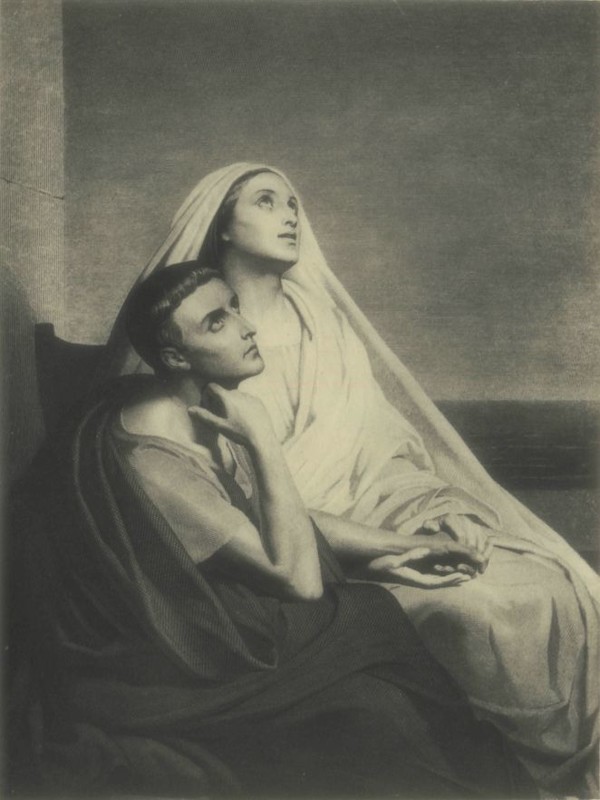
St. Augustine and His Mother
Photogravure from a Painting by Ary Scheffer
The great Ambrose had been called from the magistrate's chair to be bishop of this important city; and his character and ability made a great impression on Augustine. But Augustine was kept from acknowledging and submitting to the truth, not by the intellectual difficulties which he propounded as an excuse, but by his unwillingness to submit to the moral demands which Christianity made upon him. At last there came one great struggle, described in a passage from the 'Confessions' which is given below; and Monica's hopes and prayers were answered in the conversion of her son to the faith and obedience of Jesus Christ. On Easter Day, 387, in the thirty-third year of his life, he was baptized, an unsubstantiated tradition assigning to this occasion the composition and first use of the Te Deum. His mother died at Ostia as they were setting out for Africa; and he returned to his native land, with the hope that he might there live a life of retirement and of simple Christian obedience. But this might not be: on the occasion of Augustine's visit to Hippo in 391, the bishop of that city persuaded him to receive ordination to the priesthood and to remain with him as an adviser; and four years later he was consecrated as colleague or coadjutor in the episcopate. Thus he entered on a busy public life of thirty-five years, which called for the exercise of all his powers as a Christian, a metaphysician, a man of letters, a theologian, an ecclesiastic, and an administrator.
Into the details of that life it is impossible to enter here; it must suffice to indicate some of the ways in which as a writer he gained and still holds a high place in Western Christendom, having had an influence which can be paralleled, from among uninspired men, only by that of Aristotle. He maintained the unity of the Church, and its true breadth, against the Donatists; he argued, as he so well could argue, against the irreligion of the Manichaeans; when the great Pelagian heresy arose, he defended the truth of the doctrine of divine grace as no one could have done who had not learned by experience its power in the regeneration and conversion of his own soul; he brought out from the treasures of Holy Scripture ample lessons of truth and duty, in simple exposition and exhortation; and in full treatises he stated and enforced the great doctrines of Christianity.
Augustine was not alone or chiefly the stern theologian whom men picture to themselves when they are told that he was the Calvin of those early days, or when they read from his voluminous and often illogical writings quotations which have a hard sound. If he taught a stern doctrine of predestinarianism, he taught also the great power of sacramental grace; if he dwelt at times on the awfulness of the divine justice, he spoke also from the depths of his experience of the power of the divine love; and his influence on the ages has been rather that of the 'Confessions'--taking their key-note from the words of the first chapter, "Thou, O Lord, hast made us for Thy-*self, and our heart is unquiet until it find rest in Thee"--than that of the writings which have earned for their author the foremost place among the Doctors of the Western Church. But his greatest work, without any doubt, is the treatise on the 'City of God.' The Roman empire, as Augustine's life passed on, was hastening to its end. Moral and political declension had doubtless been arrested by the good influence which had been brought to bear upon it; but it was impossible to avert its fall. "Men's hearts," as well among the heathen as among the Christians, were "failing them for fear and for looking after those things that were coming on the earth." And Christianity was called to meet the argument drawn from the fact that the visible declension seemed to date from the time when the new religion was introduced into the Roman world, and that the most rapid decline had been from the time when it had been accepted as the religion of the State. It fell to the Bishop of Hippo to write in reply one of the greatest works ever written by a Christian. Eloquence and learning, argument and irony, appeals to history and earnest entreaties, are united to move enemies to acknowledge the truth and to strengthen the faithful in maintaining it. The writer sets over against each other the city of the world and the city of God, and in varied ways draws the contrast between them; and while mourning over the ruin that is coming upon the great city that had become a world-empire, he tells of the holy beauty and enduring strength of "the city that hath the foundations."
Apart from the interest attaching to the great subjects handled by St. Augustine in his many works, and from the literary attractions of writings which unite high moral earnestness and the use of a cultivated rhetorical style, his works formed a model for Latin theologians as long as that language continued to be habitually used by Western scholars; and to-day both the spirit and the style of the great man have a wide influence on the devotional and the controversial style of writers on sacred subjects.
He died at Hippo, August 28th, 430.
The selections are from the 'Library of Nicene and Post-Nicene Fathers,' by permission of the Christian Literature Company.
THE GODLY SORROW THAT WORKETH REPENTANCE
From the 'Confessions'
Such was the story of Pontitianus: but thou, O Lord, while he was speaking, didst turn me round towards myself, taking me from behind my back, when I had placed myself, unwilling to observe myself; and setting me before my face, that I might see how foul I was, how crooked and defiled, bespotted and ulcerous. And I beheld and stood aghast; and whither to flee from myself I found not. And if I sought to turn mine eye from off myself, he went on with his relation, and thou didst again set me over against myself, and thrusted me before my eyes, that I might find out mine iniquity and hate it. I had known it, but made as though I saw it not, winked at it, and forgot it.
But now, the more ardently I loved those whose healthful affections I heard of, that they had resigned themselves wholly to thee to be cured, the more did I abhor myself when compared with them. For many of my years (some twelve) had now run out with me since my nineteenth, when, upon the reading of Cicero's 'Hortensius,' I was stirred to an earnest love of wisdom; and still I was deferring to reject mere earthly felicity and to give myself to search out that, whereof not the finding only, but the very search, was to be preferred to the treasures and kingdoms of the world, though already found, and to the pleasures of the body, though spread around me at my will. But I, wretched, most wretched, in the very beginning of my early youth, had begged chastity of thee, and said, "Give me chastity and continency, only not yet." For I feared lest thou shouldest hear me soon, and soon cure me of the disease of concupiscence, which I wished to have satisfied, rather than extinguished. And I had wandered through crooked ways in a sacrilegious superstition, not indeed assured thereof, but as preferring it to the others which I did not seek religiously, but opposed maliciously.
But when a deep consideration had, from the secret bottom of my soul, drawn together and heaped up all my misery in the sight of my heart, there arose a mighty storm, bringing a mighty shower of tears. And that I might pour it forth wholly in its natural expressions, I rose from Alypius: solitude was suggested to me as fitter for the business of weeping; and I retired so far that even his presence could not be a burden to me. Thus was it then with me, and he perceived something of it; for something I suppose he had spoken, wherein the tones of my voice appeared choked with weeping, and so had risen up. He then remained where we were sitting, most extremely astonished. I cast myself down I know not how, under a fig-tree, giving full vent to my tears; and the floods of mine eyes gushed out, an acceptable sacrifice to thee. And, not indeed in these words, yet to this purpose, spake I much unto thee:--"And thou, O Lord, how long? how long, Lord, wilt thou be angry--forever? Remember not our former iniquities," for I felt that I was held by them. I sent up these sorrowful words: "How long? how long? To-morrow and to-morrow? Why not now? why is there not this hour an end to my uncleanness?"
CONSOLATION
From the 'Confessions'
So was I speaking, and weeping, in the most bitter contrition of my heart, when lo! I heard from a neighboring house a voice, as of boy or girl (I could not tell which), chanting and oft repeating, "Take up and read; take up and read." Instantly my countenance altered, and I began to think most intently whether any were wont in any kind of play to sing such words, nor could I remember ever to have heard the like. So, checking the torrent of my tears, I arose; interpreting it to be no other than a command from God, to open the book and read the first chapter I should find. Eagerly then I returned to the place where Alypius was sitting; for there had I laid the volume of the Epistles when I arose thence. I seized, opened, and in silence read that section on which my eyes first fell:--"Not in rioting and drunkenness, not in chambering and wantonness, not in strife and envying; but put ye on the Lord Jesus Christ, and make not provision for the flesh, to fulfill the lusts thereof." No further would I read; nor heeded I, for instantly at the end of this sentence, by a light, as it were, of serenity infused into my heart, all the darkness of doubt vanished away.
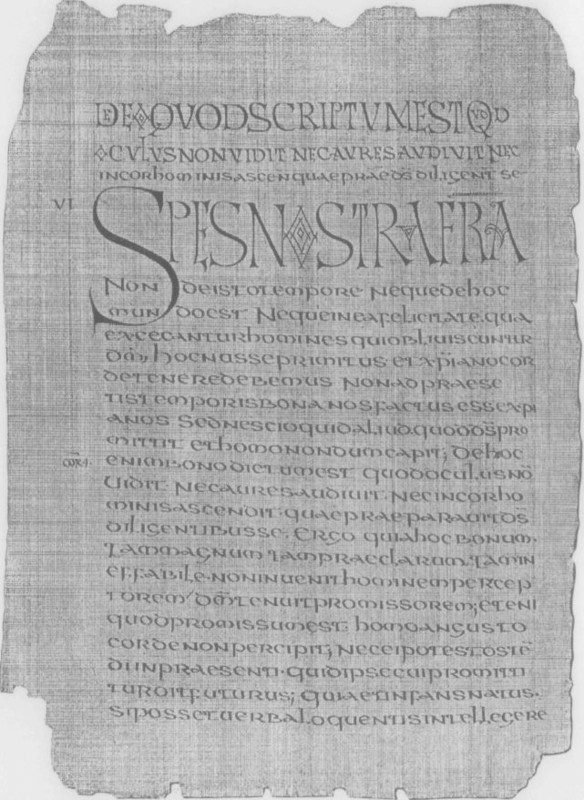
PAPYRUS.
Reduced facsimile of a Latin manuscript containing the
SERMONS OF ST. AUGUSTINE.
Sixth Century. In the National Library at Paris.
A fine specimen of sixth-century writing upon sheets formed of two thin layers of
longitudinal strips of the stem or pith of the papyrus plant pressed
together at right angles to each other.
Then putting my finger between (or some other mark), I shut the volume, and with a calmed countenance, made it known to Alypius. And what was wrought in him, which I know not, he thus shewed me. He asked to see what I had read; I shewed him, and he looked even farther than I had read, and I knew not what followed. This followed: "Him that is weak in the faith, receive ye"; which he applied to himself and disclosed to me. And by this admonition was he strengthened; and by a good resolution and purpose, and most corresponding to his character, wherein he did always far differ from me for the better, without any turbulent delay he joined me. Thence we go to my mother: we tell her; she rejoiceth: we relate in order how it took place; she leapeth for joy, and triumpheth and blesseth thee, "who art able to do above all that we ask or think": for she perceived that thou hadst given her more for me than she was wont to beg by her pitiful and most sorrowful groanings.
THE FOES OF THE CITY
From 'The City of God'
Let these and similar answers (if any fuller and fitter answers can be found) be given to their enemies by the redeemed family of the Lord Christ, and by the pilgrim city of the King Christ. But let this city bear in mind that among her enemies lie hid those who are destined to be fellow-citizens, that she may not think it a fruitless labor to bear what they inflict as enemies, till they become confessors of the faith. So also, as long as she is a stranger in the world, the city of God has in her communion, and bound to her by the sacraments, some who shall not eternally dwell in the lot of the saints. Of these, some are not now recognized; others declare themselves, and do not hesitate to make common cause with our enemies in murmuring against God, whose sacramental badge they wear. These men you may see to-day thronging the churches with us, to-morrow crowding the theatres with the godless. But we have the less reason to despair of the reclamation of even such persons, if among our most declared enemies there are now some, unknown to themselves, who are destined to become our friends. In truth, these two cities are entangled together in this world, and intermingled until the last judgment shall effect their separation. I now proceed to speak, as God shall help me, of the rise and progress and end of these two cities; and what I write, I write for the glory of the city of God, that being placed in comparison with the other, it may shine with a brighter lustre.
THE PRAISE OF GOD
From 'The City of God'
Wherefore it may very well be, and it is perfectly credible, that we shall in the future world see the material forms of the new heavens and the new earth, in such a way that we shall most distinctly recognize God everywhere present, and governing all things, material as well as spiritual; and shall see Him, not as we now understand the invisible things of God, by the things that are made, and see Him darkly as in a mirror and in part, and rather by faith than by bodily vision of material appearances, but by means of the bodies which we shall wear and which we shall see wherever we turn our eyes. As we do not believe, but see, that the living men around us who are exercising the functions of life are alive, although we cannot see their life without their bodies, but see it most distinctly by means of their bodies, so, wherever we shall look with the spiritual eyes of our future bodies, we shall also, by means of bodily substances, behold God, though a spirit, ruling all things. Either, therefore, the eyes shall possess some quality similar to that of the mind, by which they shall be able to discern spiritual things, and among them God,--a supposition for which it is difficult or even impossible to find any support in Scripture,--or what is more easy to comprehend, God will be so known by us, and so much before us, that we shall see Him by the spirit in ourselves, in one another, in Himself, in the new heavens and the new earth, in every created thing that shall then exist; and that also by the body we shall see Him in every bodily thing which the keen vision of the eye of the spiritual body shall reach. Our thoughts also shall be visible to all, for then shall be fulfilled the words of the Apostle, "Judge nothing before the time, until the Lord come, who both will bring to light the hidden things of darkness, and will make manifest the counsels of the hearts; and then shall every man have praise of God." How great shall be that felicity, which shall be tainted with no evil, which shall lack no good, and which shall afford leisure for the praises of God, who shall be all in all! For I know not what other employment there can be where no weariness shall slacken activity, nor any want stimulate to labor. I am admonished also by the sacred song, in which I read or hear the words, "Blessed are they that dwell in Thy house; they will be alway praising Thee."
A PRAYER
From 'The Trinity'
O Lord our God, directing my purpose by the rule of faith, so far as I have been able, so far as Thou hast made me able, I have sought Thee, and have desired to see with my understanding what I have believed; and I have argued and labored much. O Lord my God, my only hope, hearken to me, lest through weariness I be unwilling to seek Thee, but that I may always ardently seek Thy face. Do Thou give me strength to seek, who hast led me to find Thee, and hast given the hope of finding Thee more and more. My strength and my weakness are in Thy sight; preserve my strength and heal my weakness. My knowledge and my ignorance are in Thy sight; when Thou hast opened to me, receive me as I enter; when Thou hast closed, open to me as I knock. May I remember Thee, understand Thee, love Thee. Increase these things in me, until Thou renew me wholly. But oh, that I might speak only in preaching Thy word and in praising Thee. But many are my thoughts, such as Thou knowest, "thoughts of man, that are vain." Let them not so prevail in me, that anything in my acts should proceed from them; but at least that my judgment and my conscience be safe from them under Thy protection. When the wise man spake of Thee in his book, which is now called by the special name of Ecclesiasticus, "We speak," he says, "much, and yet come short; and in sum of words, He is all." When therefore we shall have come to Thee, these very many things that we speak, and yet come short, shall cease; and Thou, as One, shalt remain "all in all." And we shall say one thing without end, in praising Thee as One, ourselves also made one in Thee. O Lord, the one God, God the Trinity, whatever I have said in these books that is of Thine, may they acknowledge who are Thine; if I have said anything of my own, may it be pardoned both by Thee and by those who are Thine. Amen.
The three immediately preceding citations, from 'A Select Library of the Nicene and Post-Nicene Fathers of the Christian Church, First Series,' are reprinted by permission of the Christian Literature Company, New York.
MARCUS AURELIUS ANTONINUS
(121-180 A.D.)
BY JAMES FRASER GLUCK

arcus Aurelius, one of the most illustrious emperors of Rome, and, according to Canon Farrar, "the noblest of pagan emperors", was born at Rome April 20th, A.D. 121, and died at Vindobona--the modern Vienna--March 17th, A.D. 180, in the twentieth year of his reign and the fifty-ninth year of his age.
His right to an honored place in literature depends upon a small volume written in Greek, and usually called 'The Meditations of Marcus Aurelius.' The work consists of mere memoranda, notes, disconnected reflections and confessions, and also of excerpts from the Emperor's favorite authors. It was evidently a mere private diary or note-book written in great haste, which readily accounts for its repetitions, its occasional obscurity, and its frequently elliptical style of expression. In its pages the Emperor gives his aspirations, and his sorrow for his inability to realize them in his daily life; he expresses his tentative opinions concerning the problems of creation, life, and death; his reflections upon the deceitfulness of riches, pomp, and power, and his conviction of the vanity of all things except the performance of duty. The work contains what has been called by a distinguished scholar "the common creed of wise men, from which all other views may well seem mere deflections on the side of an unwarranted credulity or of an exaggerated despair." From the pomp and circumstance of state surrounding him, from the manifold cares of his exalted rank, from the tumult of protracted wars, the Emperor retired into the pages of this book as into the sanctuary of his soul, and there found in sane and rational reflection the peace that the world could not give and could never take away. The tone and temper of the work is unique among books of its class. It is sweet yet dignified, courageous yet resigned, philosophical and speculative, yet above all, intensely practical.
Through all the ages from the time when the Emperor Diocletian prescribed a distinct ritual for Aurelius as one of the gods; from the time when the monks of the Middle Ages treasured the 'Meditations' as carefully as they kept their manuscripts of the Gospels, the work has been recognized as the precious life-blood of a master spirit. An adequate English translation would constitute to-day a most valuable vade mecum of devotional feeling and of religious inspiration. It would prove a strong moral tonic to hundreds of minds now sinking into agnosticism or materialism.
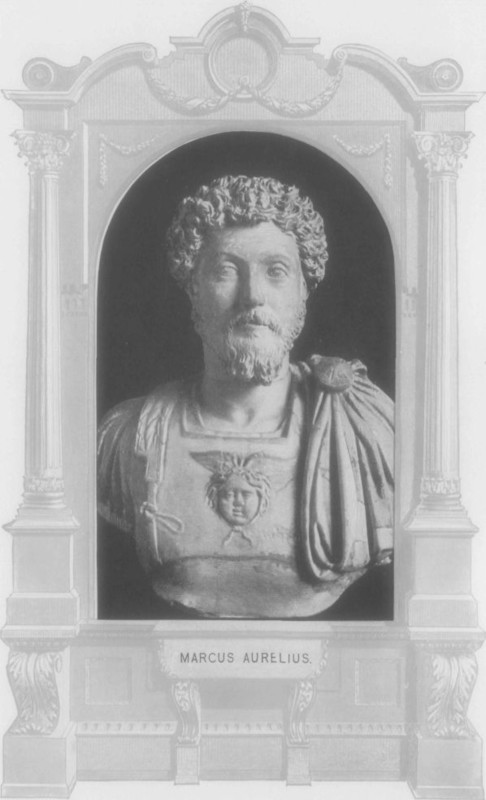
The distinguished French writer M. Martha observes that in the 'Meditations of Marcus Aurelius' "we find a pure serenity, sweetness, and docility to the commands of God, which before him were unknown, and which Christian grace has alone surpassed. One cannot read the book without thinking of the sadness of Pascal and the gentleness of Fénelon. We must pause before this soul, so lofty and so pure, to contemplate ancient virtue in its softest brilliancy, to see the moral delicacy to which profane doctrines have attained."
Those in the past who have found solace in its pages have not been limited to any one country, creed, or condition in life. The distinguished Cardinal Francis Barberini the elder occupied his last years in translating the 'Meditations' into Italian; so that, as he said, "the thoughts of the pious pagan might quicken the faith of the faithful." He dedicated the work to his own soul, so that it "might blush deeper than the scarlet of the cardinal robe as it looked upon the nobility of the pagan." The venerable and learned English scholar Thomas Gataker, of the religious faith of Cromwell and Milton, spent the last years of his life in translating the work into Latin as the noblest preparation for death. The book was the constant companion of Captain John Smith, the discoverer of Virginia, who found in it "sweet refreshment in his seasons of despondency." Jean Paul Richter speaks of it as a vital help in "the deepest floods of adversity." The French translator Pierron says that it exalted his soul into a serene region, above all petty cares and rivalries. Montesquieu declares, in speaking of Marcus Aurelius, "He produces such an effect upon our minds that we think better of ourselves, because he inspires us with a better opinion of mankind." The great German historian Niebuhr says of the Emperor, as revealed in this work, "I know of no other man who combined such unaffected kindness, mildness, and humility with such conscientiousness and severity toward himself." Renan declares the book to be "a veritable gospel. It will never grow old, for it asserts no dogma. Though science were to destroy God and the soul, the 'Meditations of Marcus Aurelius' would remain forever young and immortally true." The eminent English critic Matthew Arnold was found on the morning after the death of his eldest son engaged in the perusal of his favorite Marcus Aurelius, wherein alone he found comfort and consolation.
The 'Meditations of Marcus Aurelius' embrace not only moral reflections; they include, as before remarked, speculations upon the origin and evolution of the universe and of man. They rest upon a philosophy. This philosophy is that of the Stoic school as broadly distinguished from the Epicurean. Stoicism, at all times, inculcated the supreme virtues of moderation and resignation; the subjugation of corporeal desires; the faithful performance of duty; indifference to one's own pain and suffering, and the disregard of material luxuries. With these principles there was, originally, in the Stoic philosophy conjoined a considerable body of logic, cosmogony, and paradox. But in Marcus Aurelius these doctrines no longer stain the pure current of eternal truth which ever flowed through the history of Stoicism. It still speculated about the immortality of the soul and the government of the universe by a supernatural Intelligence, but on these subjects proposed no dogma and offered no final authoritative solution. It did not forbid man to hope for a future life, but it emphasized the duties of the present life. On purely rational grounds it sought to show men that they should always live nobly and heroicly, and how best to do so. It recognized the significance of death, and attempted to teach how men could meet it under any and all circumstances with perfect equanimity.
Marcus Aurelius was descended from an illustrious line which tradition declared extended to the good Numa, the second King of Rome. In the descendant Marcus were certainly to be found, with a great increment of many centuries of noble life, all the virtues of his illustrious ancestor. Doubtless the cruel persecutions of the infamous Emperors who preceded Hadrian account for the fact that the ancestors of Aurelius left the imperial city and found safety in Hispania Baetica, where in a town called Succubo--not far from the present city of Cordova--the Emperor's great-grandfather, Annius Verus, was born. From Spain also came the family of the Emperor Hadrian, who was an intimate friend of Annius Verus. The death of the father of Marcus Aurelius when the lad was of tender years led to his adoption by his grandfather and subsequently by Antoninus Pius. By Antoninus he was subsequently named as joint heir to the Imperial dignity with Commodus, the son of Aelius Caesar, who had previously been adopted by Hadrian.
From his earliest youth Marcus was distinguished for his sincerity and truthfulness. His was a docile and a serious nature. "Hadrian's bad and sinful habits left him," says Niebuhr, "when he gazed on the sweetness of that innocent child. Punning on the boy's paternal name of Verus, he called him Verissimus, 'the most true.'" Among the many statues of Marcus extant is one representing him at the tender age of eight years offering sacrifice. He was even then a priest of Mars. It was the hand of Marcus alone that threw the crown so carefully and skillfully that it invariably alighted upon the head of the statue of the god. The entire ritual he knew by heart. The great Emperor Antoninus Pius lived in the most simple and unostentatious manner; yet even this did not satisfy the exacting, lofty spirit of Marcus. At twelve years of age he began to practice all the austerities of Stoicism. He became a veritable ascetic. He ate most sparingly; slept little, and when he did so it was upon a bed of boards. Only the repeated entreaties of his mother induced him to spread a few skins upon his couch. His health was seriously affected for a time; and it was, perhaps, to this extreme privation that his subsequent feebleness was largely due. His education was of the highest order of excellence. His tutors, like Nero's, were the most distinguished teachers of the age; but unlike Nero, the lad was in every way worthy of his instructors. His letters to his dearly beloved teacher Fronto are still extant, and in a very striking and charming way they illustrate the extreme simplicity of life in the imperial household in the villa of Antoninus Pius at Lorium by the sea. They also indicate the lad's deep devotion to his studies and the sincerity of his love for his relatives and friends.
When his predecessor and adoptive father Antoninus felt the approach of death, he gave to the tribune who asked him for the watchword for the night the reply "Equanimity," directed that the golden statue of Fortune that always stood in the Emperor's chamber be transferred to that of Marcus Aurelius, and then turned his face and passed away as peacefully as if he had fallen asleep. The watchword of the father became the life-word of the son, who pronounced upon that father in the 'Meditations' one of the noblest eulogies ever written. "We should," says Renan, "have known nothing of Antoninus if Marcus Aurelius had not handed down to us that exquisite portrait of his adopted father, in which he seems, by reason of humility, to have applied himself to paint an image superior to what he himself was. Antoninus resembled a Christ who would not have had an evangel; Marcus Aurelius a Christ who would have written his own."
It would be impossible here to detail even briefly all the manifold public services rendered by Marcus Aurelius to the Empire during his reign of twenty years. Among his good works were these: the establishment, upon eternal foundation, of the noble fabric of the Civil Law--the prototype and basis of Justinian's task; the founding of schools for the education of poor children; the endowment of hospitals and homes for orphans of both sexes; the creation of trust companies to receive and distribute legacies and endowments; the just government of the provinces; the complete reform of the system of collecting taxes; the abolition of the cruelty of the criminal laws and the mitigation of sentences unnecessarily severe; the regulation of gladiatorial exhibitions; the diminution of the absolute power possessed by fathers over their children and of masters over their slaves; the admission of women to equal rights to succession to property from their children; the rigid suppression of spies and informers; and the adoption of the principle that merit, as distinguished from rank or political friendship, alone justified promotion in the public service.
But the greatest reform was the reform in the Imperial Dignity itself, as exemplified in the life and character of the Emperor. It is this fact which gives to the 'Meditations' their distinctive value. The infinite charm, the tenderness and sweetness of their moral teachings, and their broad humanity, are chiefly noteworthy because the Emperor himself practiced in his daily life the principles of which he speaks, and because tenderness and sweetness, patience and pity, suffused his daily conduct and permeated his actions. The horrible cruelties of the reigns of Nero and Domitian seemed only awful dreams under the benignant rule of Marcus Aurelius.
It is not surprising that the deification of a deceased emperor, usually regarded by Senate and people as a hollow mockery, became a veritable fact upon the death of Marcus Aurelius. He was not regarded in any sense as mortal. All men said he had but returned to his heavenly place among the immortal gods. As his body passed, in the pomp of an imperial funeral, to its last resting-place, the tomb of Hadrian,--the modern Castle of St. Angelo at Rome,--thousands invoked the divine blessing of Antoninus. His memory was sacredly cherished. His portrait was preserved as an inspiration in innumerable homes. His statue was almost universally given an honored place among the household gods. And all this continued during successive generations of men.
Marcus Aurelius has been censured for two acts: the first, the massacre of the Christians which took place during his reign; the second, the selection of his son Commodus as his successor. Of the massacre of the Christians it may be said, that when the conditions surrounding the Emperor are once properly understood, no just cause for condemnation of his course remains. A prejudice against the sect was doubtless acquired by him through the teachings of his dearly beloved instructor and friend Fronto. In the writings of the revered Epictetus he found severe condemnation of the Christians as fanatics. Stoicism enjoined upon men obedience to the law, endurance of evil conditions, and patience under misfortunes. The Christians openly defied the laws; they struck the images of the gods, they scoffed at the established religion and its ministers. They welcomed death; they invited it. To Marcus Aurelius, as he says in his 'Meditations,' death had no terrors. The wise man stood, like the trained soldier, ready to be called into action, ready to depart from life when the Supreme Ruler called him; but it was also, according to the Stoic, no less the duty of a man to remain until he was called, and it certainly was not his duty to invite destruction by abuse of all other religions and by contempt for the distinctive deities of the Roman faith. The Roman State was tolerant of all religions so long as they were tolerant of others. Christianity was intolerant of all other religions; it condemned them all. In persecuting what he regarded as a "pernicious sect" the Emperor regarded himself only as the conservator of the peace and the welfare of the realm. The truth is, that Marcus Aurelius enacted no new laws on the subject of the Christians. He even lessened the dangers to which they were exposed. On this subject one of the Fathers of the Church, Tertullian, bears witness. He says in his address to the Roman officials:--"Consult your annals, and you will find that the princes who have been cruel to us are those whom it was held an honor to have as persecutors. On the contrary, of all princes who have known human and Divine law, name one of them who has persecuted the Christians. We might even cite one of them who declared himself their protector,--the wise Marcus Aurelius. If he did not openly revoke the edicts against our brethren, he destroyed the effect of them by the severe penalties he instituted against their accusers." This statement would seem to dispose effectually of the charge of cruel persecution brought so often against the kindly and tender-hearted Emperor.
Of the appointment of Commodus as his successor, it may be said that the paternal heart hoped against hope for filial excellence. Marcus Aurelius believed, as clearly appears from many passages in the 'Meditations,' that men did not do evil willingly but through ignorance; and that when the exceeding beauty of goodness had been fully disclosed to them, the depravity of evil conduct would appear no less clearly. The Emperor who, when the head of his rebellious general was brought to him, grieved because that general had not lived to be forgiven; the ruler who burned unread all treasonable correspondence, would not, nay, could not believe in the existence of such an inhuman monster as Commodus proved himself to be. The appointment of Commodus was a calamity of the most terrific character; but it testifies in trumpet tones to the nobility of the Emperor's heart, the sincerity of his own belief in the triumph of right and justice.
The volume of the 'Meditations' is the best mirror of the Emperor's soul. Therein will be found expressed delicately but unmistakably much of the sorrow that darkened his life. As the book proceeds the shadows deepen, and in the latter portion his loneliness is painfully apparent. Yet he never lost hope or faith, or failed for one moment in his duty as a man, a philosopher, and an Emperor. In the deadly marshes and in the great forests which stretched beside the Danube, in his mortal sickness, in the long nights when weakness and pain rendered sleep impossible, it is not difficult to imagine him in his tent, writing, by the light of his solitary lamp, the immortal thoughts which alone soothed his soul; thoughts which have out-lived the centuries--not perhaps wholly by chance--to reveal to men in nations then unborn, on continents whose very existence was then unknown, the Godlike qualities of one of the noblest of the sons of men.
The best literal translation of the work into English thus far made is that of George Long. It is published by Little, Brown & Co. of Boston. A most admirable work, 'The Life of Marcus Aurelius,' by Paul Barron Watson, published by Harper & Brothers, New York, will repay careful reading. Other general works to be consulted are as follows:--'Seekers After God,' by Rev. F.W. Farrar, Macmillan & Co. (1890); and 'Classical Essays,' by F.W.H. Myers, Macmillan & Co. (1888). Both of these contain excellent articles upon the Emperor. Consult also Renan's 'History of the Origins of Christianity,' Book vii., Marcus Aurelius, translation published by Mathieson & Co. (London, 1896); 'Essay on Marcus Aurelius' by Matthew Arnold, in his 'Essays in Criticism,' Macmillan & Co. Further information may also be had in Montesquieu's 'Decadence of the Romans,' Sismondi's 'Fall of the Roman Empire,' and Gibbon's 'Decline and Fall of the Roman Empire.'

EXCERPTS FROM THE 'MEDITATIONS'
THE BROTHERHOOD OF MAN
Begin thy morning with these thoughts: I shall meet the meddler, the ingrate, the scorner, the hypocrite, the envious man, the cynic. These men are such because they know not to discern the difference between good and evil. But I know that Goodness is Beauty and that Evil is Loathsomeness: I know that the real nature of the evil-doer is akin to mine, not only physically but in a unity of intelligence and in participation in the Divine Nature. Therefore I know that I cannot be harmed by such persons, nor can they thrust upon me what is base. I know, too, that I should not be angry with my kinsmen nor hate them, because we are all made to work together fitly like the feet, the hands, the eyelids, the rows of the upper and the lower teeth. To be at strife one with another is therefore contrary to our real nature; and to be angry with one another, to despise one another, is to be at strife one with another. (Book ii,§ I.)
Fashion thyself to the circumstances of thy lot. The men whom Fate hath made thy comrades here, love; and love them in sincerity and in truth. (Book vi., § 39.)
This is distinctive of men,--to love those who do wrong. And this thou shalt do if thou forget not that they are thy kinsmen, and that they do wrong through ignorance and not through design; that ere long thou and they will be dead; and more than all, that the evil-doer hath really done thee no evil, since he hath left thy conscience unharmed. (Book viii., §22.)
THE SUPREME NOBILITY OF DUTY
As A Roman and as a man, strive steadfastly every moment to do thy duty, with dignity, sincerity, and loving-kindness, freely and justly, and freed from all disquieting thought concerning any other thing. And from such thought thou wilt be free if every act be done as though it were thy last, putting away from thee slothfulness, all loathing to do what Reason bids thee, all dissimulation, selfishness, and discontent with thine appointed lot. Behold, then, how few are the things needful for a life which will flow onward like a quiet stream, blessed even as the life of the gods. For he who so lives, fulfills their will. (Book ii., §5.)
So long as thou art doing thy duty, heed not warmth nor cold, drowsiness nor wakefulness, life, nor impending death; nay, even in the very act of death, which is indeed only one of the acts of life, it suffices to do well what then remains to be done. (Book vi., § 2.)
I strive to do my duty; to all other considerations I am indifferent, whether they be material things or unreasoning and ignorant people. (Book vi., §22.)
THE FUTURE LIFE. IMMORTALITY
This very moment thou mayest die. Think, act, as if this were now to befall thee. Yet fear not death. If there are gods they will do thee no evil. If there are not gods, or if they care not for the welfare of men, why should I care to live in a Universe that is devoid of Divine beings or of any providential care? But, verily, there are Divine beings, and they do concern themselves with the welfare of men; and they have given unto him all power not to fall into any real evil. If, indeed, what men call misfortunes were really evils, then from these things also, man would have been given the power to free himself. But--thou sayest--are not death, dishonor, pain, really evils? Reflect that if they were, it is incredible that the Ruler of the Universe has, through ignorance, overlooked these things, or has not had the power or the skill to prevent them; and that thereby what is real evil befalls good and bad alike. For true it is that life and death, honor and dishonor, pain and pleasure, come impartially to the good and to the bad. But none of these things can affect our lives if they do not affect our true selves. Now our real selves they do not affect either for better or for worse; and therefore such things are not really good or evil. (Book ii., §11.)
If our spirits live, how does Space suffice for all during all the ages? Well, how does the earth contain the bodies of those who have been buried therein during all the ages? In the latter case, the decomposition and--after a certain period--the dispersion of the bodies already buried, affords room for other bodies; so, in the former case, the souls which pass into Space, after a certain period are purged of their grosser elements and become ethereal, and glow with the glory of flame as they meet and mingle with the Creative Energy of the world. And thereby there is room for other souls which in their turn pass into Space. This, then, is the explanation that may be given, if souls continue to exist at all.
Moreover, in thinking of all the bodies which the earth contains, we must have in mind not only the bodies which are buried therein, but also the vast number of animals which are the daily food of ourselves and also of the entire animal creation itself. Yet these, too, Space contains; for on the one hand they are changed into blood which becomes part of the bodies that are buried in the earth, and on the other hand these are changed into the ultimate elements of fire or air. (Book iv., §21.)
I am spirit and body: neither will pass into nothingness, since neither came therefrom; and therefore every part of me, though changed in form, will continue to be a part of the Universe, and that part will change into another part, and so on through all the ages. And therefore, through such changes I myself exist; and, in like manner, those who preceded me and those who will follow me will exist forever,--a conclusion equally true though the Universe itself be dissipated at prescribed cycles of time. (Book v., § 13.)
How can it be that the gods, who have clothed the Universe with such beauty and ordered all things with such loving-kindness for the welfare of man, have neglected this alone, that the best men--the men who walked as it were with the Divine Being, and who, by their acts of righteousness and by their reverent service, dwelt ever in his presence--should never live again when once they have died? If this be really true, then be satisfied that it is best that it should be so, else it would have been otherwise ordained. For whatever is right and just is possible; and therefore, if it were in accord with the will of the Divine Being that we should live after death--so it would have been. But because it is otherwise,--if indeed it be otherwise,--rest thou satisfied that this also is just and right.
Moreover, is it not manifest to thee that in inquiring so curiously concerning these things, thou art questioning God himself as to what is right, and that this thou wouldst not do didst thou not believe in his supreme goodness and wisdom? Therefore, since in these we believe, we may also believe that in the government of the Universe nothing that is right and just has been overlooked or forgotten. (Book xii., § 5.)
THE UNIVERSAL BEAUTY OF THE WORLD
To him who hath a true insight into the real nature of the Universe, every change in everything therein that is a part thereof seems appropriate and delightful. The bread that is over-baked so that it cracks and bursts asunder hath not the form desired by the baker; yet none the less it hath a beauty of its own, and is most tempting to the palate. Figs bursting in their ripeness, olives near even unto decay, have yet in their broken ripeness a distinctive beauty. Shocks of corn bending down in their fullness, the lion's mane, the wild boar's mouth all flecked with foam, and many other things of the same kind, though perhaps not pleasing in and of themselves, yet as necessary parts of the Universe created by the Divine Being they add to the beauty of the Universe, and inspire a feeling of pleasure. So that if a man hath appreciation of and an insight into the purpose of the Universe, there is scarcely a portion thereof that will not to him in a sense seem adapted to give delight. In this sense the open jaws of wild beasts will appear no less pleasing than their prototypes in the realm of art. Even in old men and women he will be able to perceive a distinctive maturity and seemliness, while the winsome bloom of youth he can contemplate with eyes free from lascivious desire. And in like manner it will be with very many things which to every one may not seem pleasing, but which will certainly rejoice the man who is a true student of Nature and her works. (Book iii., § 2.)
THE GOOD MAN
In the mind of him who is pure and good will be found neither corruption nor defilement nor any malignant taint. Unlike the actor who leaves the stage before his part is played, the life of such a man is complete whenever death may come. He is neither cowardly nor presuming; not enslaved to life nor indifferent to its duties; and in him is found nothing worthy of condemnation nor that which putteth to shame. (Book iii., § 8.)
Test by a trial how excellent is the life of the good man;--the man who rejoices at the portion given him in the universal lot and abides therein, content; just in all his ways and kindly minded toward all men. (Book iv., § 25.)
This is moral perfection: to live each day as though it were the last; to be tranquil, sincere, yet not indifferent to one's fate. (Book vii., § 69.)
THE BREVITY OF LIFE
Cast from thee all other things and hold fast to a few precepts such as these: forget not that every man's real life is but the present moment,--an indivisible point of time,--and that all the rest of his life hath either passed away or is uncertain. Short, then, the time that any man may live; and small the earthly niche wherein he hath his home; and short is longest fame,--a whisper passed from race to race of dying men, ignorant concerning themselves, and much less really knowing thee, who died so long ago. (Book iii., § 10.)
VANITY OF LIFE
Many are the doctors who have knit their brows over their patients and now are dead themselves; many are the astrologers who in their day esteemed themselves renowned in foretelling the death of others, yet now they too are dead. Many are the philosophers who have held countless discussions upon death and immortality, and yet themselves have shared the common lot; many the valiant warriors who have slain their thousands and yet have themselves been slain by Death; many are the rulers and the kings of the earth, who, in their arrogance, have exercised over others the power of life or death as though they were themselves beyond the hazard of Fate, and yet themselves have, in their turn, felt Death's remorseless power. Nay, even great cities--Helice, Pompeii, Herculaneum--have, so to speak, died utterly. Recall, one by one, the names of thy friends who have died; how many of these, having closed the eyes of their kinsmen, have in a brief time been buried also. To conclude: keep ever before thee the brevity and vanity of human life and all that is therein; for man is conceived to-day, and to-morrow will be a mummy or ashes. Pass, therefore, this moment of life in accord with the will of Nature, and depart in peace: even as does the olive, which in its season, fully ripe, drops to the ground, blessing its mother, the earth, which bore it, and giving thanks to the tree which put it forth. (Book iv., § 48.)
A simple yet potent help to enable one to despise Death is to recall those who, in their greed for life, tarried the longest here. Wherein had they really more than those who were cut off untimely in their bloom? Together, at last, somewhere, they all repose in death. Cadicianus, Fabius, Julianus, Lepidus, or any like them, who bore forth so many to the tomb, were, in their turn, borne thither also. Their longer span was but trivial! Think too, of the cares thereof, of the people with whom it was passed, of the infirmities of the flesh! All vanity! Think of the infinite deeps of Time in the past, of the infinite depths to be! And in that vast profound of Time, what difference is there between a life of three centuries and the three days' life of a little child! (Book iv., § 50.)
Think of the Universe of matter!--an atom thou! Think of the eternity of Time--thy predestined time but a moment! Reflect upon the great plan of Fate--how trivial this destiny of thine! (Book v., § 24.)
All things are enveloped in such darkness that they have seemed utterly incomprehensible to those who have led the philosophic life--and those too not a few in number, nor of ill-repute. Nay, even to the Stoics the course of affairs seems an enigma. Indeed, every conclusion reached seems tentative; for where is the man to be found who does not change his conclusions? Think too of the things men most desire,--riches, reputation, and the like,--and consider how ephemeral they are, how vain! A vile wretch, a common strumpet, or a thief, may possess them. Then think of the habits and manners of those about thee--how difficult it is to endure the least offensive of such people--nay how difficult, most of all, it is to endure one's self!
Amidst such darkness, then, and such unworthiness, amidst this eternal change, with all temporal things and even Time itself passing away, with all things moving in eternal motion, I cannot imagine what, in all this, is worthy of a man's esteem or serious effort. (Book v., § 10.)
DEATH
To cease from bodily activity, to end all efforts of will and of thought, to stop all these forever, is no evil. For do but contemplate thine own life as a child, a growing lad, a youth, an old man: the change to each of these periods was the death of the period which preceded it. Why then fear the death of all these--the death of thyself? Think too of thy life under the care of thy grandfather, then of thy life under the care of thy mother, then under the care of thy father, and so on with every change that hath occurred in thy life, and then ask thyself concerning any change that hath yet to be, Is there anything to fear? And then shall all fear, even of the great change,--the change of death itself,--vanish and flee away. (Book ix., §21.)
FAME
Contemplate men as from some lofty height. How innumerable seem the swarms of men! How infinite their pomps and ceremonies! How they wander to and fro upon the deep in fair weather and in storm! How varied their fate in their births, in their lives, in their deaths! Think of the lives of those who lived long ago, of those who shall follow thee, of those who now live in uncivilized lands who have not even heard of thy name, and, of those who have heard it, how many will soon forget it; of how many there are who now praise thee who will soon malign thee,--and thence conclude the vanity of fame, glory, reputation. (Book ix., §30.)
PRAYER
The gods are all-powerful or they are not. If they are not, why pray to them at all? If they are, why dost thou not pray to them to remove from thee all desire and all fear, rather than to ask from them the things thou longest for, or the removal of those things of which thou art in fear? For if the gods can aid men at all, surely they will grant this request. Wilt thou say that the removal of all fear and of all desire is within thine own power? If so, is it not better, then, to use the strength the gods have given, rather than in a servile and fawning way to long for those things which our will cannot obtain? And who hath said to thee that the gods will not strengthen thy will? I say unto thee, begin to pray that this may come to pass, and thou shalt see what shall befall thee. One man prays that he may enjoy a certain woman: let thy prayer be to not have even the desire so to do. Another man prays that he may not be forced to do his duty: let thy prayer be that thou mayest not even desire to be relieved of its performance. Another man prays that he may not lose his beloved son: let thy prayer be that even the fear of losing him may be taken away. Let these be thy prayers, and thou shalt see what good will befall thee. (Book ix., §41.)
FAITH
The Universe is either a chaos or a fortuitous aggregation and dispersion of atoms; or else it is builded in order and harmony and ruled by Wisdom. If then it is the former, why should one wish to tarry in a hap-hazard disordered mass? Why should I be concerned except to know how soon I may cease to be? Why should I be disquieted concerning what I do, since whatever I may do, the elements of which I am composed will at last, at last be scattered? But if the latter thought be true, then I reverence the Divine One; I trust; I possess my soul in peace. (Book vi., § 10.)
PAIN
If pain cannot be borne, we die. If it continue a long time it becomes endurable; and the mind, retiring into itself, can keep its own tranquillity and the true self be still unharmed. If the body feel the pain, let the body make its moan. (Book vii., §30.)
LOVE AND FORGIVENESS FOR THE EVIL-DOER
If it be in thy power, teach men to do better. If not, remember it is always in thy power to forgive. The gods are so merciful to those who err, that for some purposes they grant their aid to such men by conferring upon them health, riches, and honor. What prevents thee from doing likewise? (Book ix., §11.)
ETERNAL CHANGE THE LAW OF THE UNIVERSE
Think, often, of how swiftly all things pass away and are no more--the works of Nature and the works of man. The substance of the Universe--matter--is like unto a river that flows on forever. All things are not only in a constant state of change, but they are the cause of constant and infinite change in other things. Upon a narrow ledge thou standest! Behind thee, the bottomless abyss of the Past! In front of thee, the Future that will swallow up all things that now are! Over what things, then, in this present life, wilt thou, O foolish man, be disquieted or exalted--making thyself wretched; seeing that they can vex thee only for a time--a brief, brief time! (Book v., §23.)
THE PERFECT LIBERTY OF THE GOOD MAN
Peradventure men may curse thee, torture thee, kill thee; yet can all these things not prevent thee from keeping at all times thy thoughts pure, considerate, sober, and just. If one should stand beside a limpid stream and cease not to revile it, would the spring stop pouring forth its refreshing waters? Nay, if such an one should even cast into the stream mud and mire, would not the stream quickly scatter it, and so bear it away that not even a trace would remain? How then wilt thou be able to have within thee not a mere well that may fail thee, but a fountain that shall never cease to flow? By wonting thyself every moment to independence in judgment, joined together with serenity of thought and simplicity in act and bearing. (Book viii., §51.)
THE HARMONY AND UNITY OF THE UNIVERSE
O divine Spirit of the Universe, Thy will, Thy wish is mine! Calmly I wait Thy appointed times, which cannot come too early or too late! Thy providences are all fruitful to me! Thou art the source, Thou art the stay, Thou art the end of all things. The poet says of his native city, "Dear city of Cecrops"; and shall I not say of the Universe, "Beloved City of God"? (Book iv., §23.)
Either there is a predestined order in the Universe, or else it is mere aggregation, fortuitous yet not without a certain kind of order. For how within thyself can a certain system exist and yet the entire Universe be chaos? And especially when in the Universe all things, though separate and divided, yet work together in unity? (Book iv., §27.)
Think always of the Universe as one living organism, composed of one material substance and one soul. Observe how all things are the product of a single conception--the conception of a living organism. Observe how one force is the cause of the motion of all things: that all existing things are the concurrent causes of all that is to be--the eternal warp and woof of the ever-weaving web of existence. (Book iv., §40.)
THE CONDUCT OF LIFE
Country houses, retreats in the mountains or by the sea--these things men seek out for themselves; and often thou, too, dost most eagerly desire such things. But this does but betoken the greatest ignorance; for thou art able, when thou desirest, to retreat into thyself. No otherwhere can a man find a retreat more quiet and free from care than in his own soul; and most of all, when he hath such rules of conduct that if faithfully remembered, they will give to him perfect equanimity,--for equanimity is naught else than a mind harmoniously disciplined. Cease not then to betake thyself to this retreat, there to refresh thyself. Let thy rules of conduct be few and well settled; so that when thou hast thought thereon, straightway they will suffice to thoroughly purify the soul that possesses them, and to send thee back, restless no more, to the things to the which thou must return. With what indeed art thou disquieted? With the wickedness of men? Meditate on the thought that men do not do evil of set purpose. Remember also how many in the past, who, after living in enmity, suspicion, hatred, and strife one with another, now lie prone in death and are but ashes. Fret then no more. But perhaps thou art troubled concerning the portion decreed to thee in the Universe? Remember this alternative: either there is a Providence or simply matter! Recall all the proofs that the world is, as it were, a city or a commonwealth! But perhaps the desires of the body still torment thee? Forget not, then, that the mind, when conscious of its real self, when self-reliant, shares not the agitations of the body, be they great or small. Recall too all thou hast learned (and now holdest as true) concerning pleasure and pain. But perhaps what men call Fame allures thee? Behold how quickly all things are forgotten! Before us, after us, the formless Void of endless ages! How vain is human praise! How fickle and undiscriminating those who seem to praise! How limited the sphere of the greatest fame! For the whole earth is but a point in space, thy dwelling-place a tiny nook therein. How few are those who dwell therein, and what manner of men are those who will praise thee!
Therefore, forget not to retire into thine own little country place,--thyself. Above all, be not diverted from thy course. Be serene, be free, contemplate all things as a man, as a lover of his kind, and of his country--yet withal as a being born to die. Have readiest to thy hand, above all others, these two thoughts: one, that things cannot touch the soul; the other, that things are perpetually changing and ceasing to be. Remember how many of these changes thou thyself hast seen! The Universe is change. But as thy thoughts are, so thy life shall be. (Book iv., §3.)
All things that befall thee should seem to thee as natural as roses in spring or fruits in autumn: such things, I mean, as disease, death, slander, dissimulation, and all other things which give pleasure or pain to foolish men. (Book iv., §44.)
Be thou like a lofty headland. Endlessly against it dash the waves; yet it stands unshaken, and lulls to rest the fury of the sea. (Book iv., §49.)
"Unhappy me upon whom this misfortune hath fallen!"--nay, rather thou shouldst say, "Fortunate I, that having met with such a misfortune, I am able to endure it without complaining; in the present not dismayed, in the future dreading no evil. Such a misadventure might have befallen a man who could not, perchance, have endured it without grievous suffering." Why then shouldst thou call anything that befalls thee a misfortune, and not the rather a blessing? Is that a "misfortune," in all cases, which does not defeat the purpose of man's nature? and does that defeat man's nature which his Will can accept? And what that Will can accept, thou knowest. Can this misadventure, then, prevent thy Will from being just, magnanimous, temperate, circumspect, free from rashness or error, considerate, independent? Can it prevent thy Will from being, in short, all that becomes a man? Remember, then, should anything befall thee which might cause thee to complain, to fortify thyself with this truth: this is not a misfortune, while to endure it nobly is a blessing. (Book iv., §49.)
Be not annoyed or dismayed or despondent if thou art not able to do all things in accord with the rules of right conduct. When thou hast not succeeded, renew thy efforts, and be serene if, in most things, thy conduct is such as becomes a man. Love and pursue the philosophic life. Seek Philosophy, not as thy taskmaster but to find a medicine for all thy ills, as thou wouldst seek balm for thine eyes, a bandage for a sprain, a lotion for a fever. So it shall come to pass that the voice of Reason shall guide thee and bring to thee rest and peace. Remember, too, that Philosophy enjoins only such things as are in accord with thy better nature. The trouble is, that in thy heart thou prefer-rest those things which are not in accord with thy better nature. For thou sayest, "What can be more delightful than these things?" But is not the word "delightful" in this sense misleading? Are not magnanimity, broad-mindedness, sincerity, equanimity, and a reverent spirit more "delightful"? Indeed, what is more "delightful" than Wisdom, if so be thou wilt but reflect upon the strength and contentment of mind and the happiness of life that spring from the exercise of the powers of thy reason and thine intelligence? (Book v., §9.)
As are thy wonted thoughts, so is thy mind; and the soul is tinged by the coloring of the mind. Let then thy mind be constantly suffused with such thoughts as these: Where it is possible for a man to live, there he can live nobly. But suppose he must live in a palace? Be it so; even there he can live nobly. (Book v., §16.)
Live with the gods! And he so lives who at all times makes it manifest that he is content with his predestined lot, fulfilling the entire will of the indwelling spirit given to man by the Divine Ruler, and which is in truth nothing else than the Understanding--the Reason of man. (Book v., §27.)
Seek the solitude of thy spirit. This is the law of the indwelling Reason--to be self-content and to abide in peace when what is right and just hath been done. (Book vii., § 28.)
Let thine eyes follow the stars in their courses as though their movements were thine own. Meditate on the eternal transformation of Matter. Such thoughts purge the mind of earthly passion and desire. (Book vii., § 45.)
Search thou thy heart! Therein is the fountain of good! Do thou but dig, and abundantly the stream shall gush forth. (Book vii., § 59.)
Be not unmindful of the graces of life. Let thy body be stalwart, yet not ungainly either in motion or in repose. Let not thy face alone, but thy whole body, make manifest the alertness of thy mind. Yet let all this be without affectation. (Book vii., § 60.)
Thy breath is part of the all-encircling air, and is one with it. Let thy mind be part, no less, of that Supreme Mind comprehending all things. For verily, to him who is willing to be inspired thereby, the Supreme Mind flows through all things and permeates all things as truly as the air exists for him who will but breathe. (Book viii., § 54.)
Men are created that they may live for each other. Teach them to be better or bear with them as they are. (Book viii., § 59.)
Write no more, Antoninus, about what a good man is or what he ought to do. Be a good man. (Book x., § 16.)
Look steadfastly at any created thing. See! it is changing, melting into corruption, and ready to be dissolved. In its essential nature, it was born but to die. (Book x., § 18.)
Co-workers are we all, toward one result. Some, consciously and of set purpose; others, unwittingly even as men who sleep,--of whom Heraclitus (I think it is he) says they also are co-workers in the events of the Universe. In diverse fashion also men work; and abundantly, too, work the fault-finders and the hinderers,--for even of such as these the Universe hath need. It rests then with thee to determine with what workers thou wilt place thyself; for He who governs all things will without failure place thee at thy proper task, and will welcome thee to some station among those who work and act together. (Book vi., §42.)
Unconstrained and in supreme joyousness of soul thou mayest live though all men revile thee as they list, and though wild beasts rend in pieces the unworthy garment--thy body. For what prevents thee, in the midst of all this, from keeping thyself in profound calm, with a true judgment of thy surroundings and a helpful knowledge of the things that are seen? So that the Judgment may say to whatever presents itself, "In truth this is what thou really art, howsoever thou appearest to men;" and thy Knowledge may say to whatsoever may come beneath its vision, "Thee I sought; for whatever presents itself to me is fit material for nobility in personal thought and public conduct; in short, for skill in work for man or for God." For all things which befall us are related to God or to man, and are not new to us or hard to work upon, but familiar and serviceable. (Book vii., §68.)
When thou art annoyed at some one's impudence, straightway ask thyself, "Is it possible that there should be no impudent men in the world?" It is impossible. Ask not then the impossible. For such an one is but one of these impudent persons who needs must be in the world. Keep before thee like conclusions also concerning the rascal, the untrustworthy one, and all evil-doers. Then, when it is quite clear to thy mind that such men must needs exist, thou shalt be the more forgiving toward each one of their number. This also will aid thee to observe, whensoever occasion comes, what power for good, Nature hath given to man to frustrate such viciousness. She hath bestowed upon man Patience as an antidote to the stupid man, and against another man some other power for good. Besides, it is wholly in thine own power to teach new things to the one who hath erred, for every one who errs hath but missed the appointed path and wandered away. Reflect, and thou wilt discover that no one of these with whom thou art annoyed hath done aught to debase thy mind, and that is the only real evil that can befall thee.
Moreover, wherein is it wicked or surprising that the ignorant man should act ignorantly? Is not the error really thine own in not foreseeing that such an one would do as he did? If thou hadst but taken thought thou wouldst have known he would be prone to err, and it is only because thou hast forgotten to use thy Reason that thou art surprised at his deed. Above all, when thou condemnest another as untruthful, examine thyself closely; for upon thee rests the blame, in that thou dost trust to such an one to keep his promise. If thou didst bestow upon him thy bounty, thine is the blame not to have given it freely, and without expectation of good to thee, save the doing of the act itself. What more dost thou wish than to do good to man? Doth not this suffice,--that thou hast done what conforms to thy true nature? Must thou then have a reward, as though the eyes demanded pay for seeing or the feet for walking? For even as these are formed for such work, and by co-operating in their distinctive duty come into their own, even so man (by his real nature disposed to do good), when he hath done some good deed, or in any other way furthered the Commonweal, acts according to his own nature, and in so doing hath all that is truly his own. (Book ix., §42.)
O Man, thou hast been a citizen of this great State, the Universe! What matters what thy prescribed time hath been, five years or three? What the law prescribes is just to every one.
Why complain, then, if thou art sent away from the State, not by a tyrant or an unjust judge, but by Nature who led thee thither,--even as the manager excuses from the stage an actor whom he hath employed?
"But I have played three acts only?"
True. But in the drama of thy life three acts conclude the play. For what its conclusion shall be, He determines who created it and now ends it; and with either of these thou hast naught to do. Depart thou, then, well pleased; for He who dismisses thee is well pleased also. (Book xii., §36.)
Be not disquieted lest, in the days to come, some misadventure befall thee. The Reason which now sufficeth thee will then be with thee, should there be the need. (Book vii., §8.)
To the wise man the dictates of Reason seem the instincts of Nature. (Book vii., §11)
My true self--the philosophic mind--hath but one dread: the dread lest I do something unworthy of a man, or that I may act in an unseemly way or at an improper time. (Book vii., §20.)
Accept with joy the Fate that befalls thee. Thine it is and not another's. What then could be better for thee? (Book vii., §57)
See to it that thou art humane to those who are not humane. (Book vii., §65.)
He who does not act, often commits as great a wrong as he who acts. (Book ix., §5.)
The wrong that another has done--let alone! Add not to it thine own. (Book ix., §20.)
How powerful is man! He is able to do all that God wishes him to do. He is able to accept all that God sends upon him. (Book xii., §11.)
A lamp sends forth its light until it is completely extinguished. Shall Truth and Justice and Equanimity suffer abatement in thee until all are extinguished in death? (Book xii., §15.)
JANE AUSTEN
(1775-1817)

he biography of one of the greatest English novelists might be written in a dozen lines, so simple, so tranquil, so fortunate was her life. Jane Austen, the second daughter of an English clergyman, was born at Steventon, in Hampshire, in 1775. Her father had been known at Oxford as "the handsome proctor," and all his children inherited good looks. He was accomplished enough to fit his boys for the University, and the atmosphere of the household was that of culture, good breeding, and healthy fun. Mrs. Austen was a clever woman, full of epigram and humor in conversation, and rather famous in her own coterie for improvised verses and satirical hits at her friends. The elder daughter, Cassandra, adored by Jane, who was three years her junior, seems to have had a rare balance and common-sense which exercised great influence over the more brilliant younger sister. Their mother declared that of the two girls, Cassandra had the merit of having her temper always under her control; and Jane the happiness of a temper that never required to be commanded.
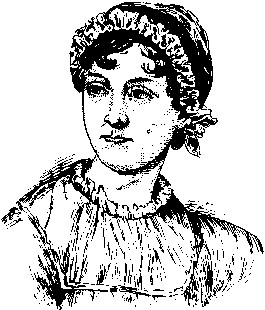
JANE AUSTEN
From her cradle, Jane Austen was used to hearing agreeable household talk, and the freest personal criticism on the men and women who made up her small, secluded world. The family circumstances were easy, and the family friendliness unlimited,--conditions determining, perhaps, the cheerful tone, the unexciting course, the sly fun and good-fellowship of her stories.
It was in this Steventon rectory, in the family room where the boys might be building their toy boats, or the parish poor folk complaining to "passon's madam," or the county ladies paying visits of ceremony, in monstrous muffs, heelless slippers laced over open-worked silk stockings, short flounced skirts, and lutestring pelisses trimmed with "Irish," or where tradesmen might be explaining their delinquencies, or farmers' wives growing voluble over foxes and young chickens--it was in the midst of this busy and noisy publicity, where nobody respected her employment, and where she was interrupted twenty times in an hour, that the shrewd and smiling social critic managed, before she was twenty-one, to write her famous 'Pride and Prejudice.' Here too 'Sense and Sensibility' was finished in 1797, and 'Northanger Abbey' in 1798. The first of these, submitted to a London publisher, was declined as unavailable, by return of post. The second, the gay and mocking 'Northanger Abbey,' was sold to a Bath bookseller for £10, and several years later bought back again, still unpublished, by one of Miss Austen's brothers. For the third story she seems not even to have sought a publisher. These three books, all written before she was twenty-five, were evidently the employment and delight of her leisure. The serious business of life was that which occupied other pretty girls of her time and her social position,--dressing, dancing, flirting, learning a new stitch at the embroidery frame, or a new air on "the instrument"; while all the time she was observing, with those soft hazel eyes of hers, what honest Nym calls the "humors" of the world about her. In 1801, the family removed to Bath, then the most fashionable watering-place in England. The gay life of the brilliant little city, the etiquette of the Pump Room and the Assemblies, regulated by the autocratic Beau Nash, the drives, the routs, the card parties, the toilets, the shops, the Parade, the general frivolity, pretension, and display of the eighteenth century Vanity Fair, had already been studied by the good-natured satirist on occasional visits, and already immortalized in the swiftly changing comedy scenes of 'Northanger Abbey.' But they tickled her fancy none the less, now that she lived among them, and she made use of them again in her later novel, 'Persuasion.'
For a period of eight years, spent in Bath and in Southampton, Miss Austen wrote nothing save some fragments of 'Lady Susan' and 'The Watsons,' neither of them of great importance. In 1809 the lessened household, composed of the mother and her two daughters only, removed to the village of Chawton, on the estate of Mrs. Austen's third son; and here, in a rustic cottage, now become a place of pilgrimage, Jane Austen again took up her pen. She rewrote 'Pride and Prejudice.' She revised 'Sense and Sensibility,' and between February 1811 and August 1816 she completed 'Mansfield Park,' 'Emma,' and 'Persuasion.' At Chawton, as at Steventon, she had no study, and her stories were written on a little mahogany desk near a window in the family sitting-room, where she must often have been interrupted by the prototypes of her Mrs. Allen, Mrs. Bennet, Miss Bates, Mr. Collins, or Mrs. Norris. When at last she began to publish, her stories appeared in rapid succession: 'Sense and Sensibility' in 1811; 'Pride and Prejudice' early in 1813; 'Mansfield Park' in 1814; 'Emma' in 1816; 'Northanger Abbey' and 'Persuasion' in 1818, the year following her death. In January 1813 she wrote to her beloved Cassandra:--"I want to tell you that I have got my own darling child 'Pride and Prejudice' from London. We fairly set at it and read half the first volume to Miss B. She was amused, poor soul! ... but she really does seem to admire Elizabeth. I must confess that I think her as delightful a creature as ever appeared in print, and how I shall be able to tolerate those who do not like her at least, I do not know." A month later she wrote:--"Upon the whole, however, I am quite vain enough, and well satisfied enough. The work is rather too light, and bright, and sparkling: it wants shade; it wants to be stretched out here and there with a long chapter of sense, if it could be had; if not, of solemn, specious nonsense, about something unconnected with the story; an essay on writing, a critique on Walter Scott, or the history of Bonaparte, or something that would form a contrast, and bring the reader with increased delight to the playfulness and epigrammatism of the general style!"
Thus she who laughed at everybody else laughed at herself, and set her critical instinct to estimate her own capacity. To Mr. Clarke, the librarian of Carlton House, who had requested her to "delineate a clergyman" of earnestness, enthusiasm, and learning, she replied:--"I am quite honored by your thinking me capable of drawing such a clergyman as you gave the sketch of in your note. But I assure you I am not. The comic part of the character I might be equal to, but not the good, the enthusiastic, the literary.... I think I may boast myself to be, with all possible vanity, the most unlearned and uninformed female who ever dared to be an authoress." And when the same remarkable bibliophile suggested to her, on the approach of the marriage of the Princess Charlotte with Prince Leopold, that "an historical romance, illustrative of the august House of Coburg, would just now be very interesting," she answered:--"I am fully sensible that an historical romance, founded on the House of Saxe-Coburg, might be much more to the purpose of profit or popularity than such pictures of domestic life in country villages as I deal in. But I could no more write a romance than an epic poem. I could not sit seriously down to write a serious romance under any other motive than to save my life; and if it were indispensable to keep it up, and never relax into laughing at myself or at other people, I am sure that I should be hung before I had finished the first chapter. No! I must keep to my own style, and go on in my own way: and though I may never succeed again in that, I am convinced that I shall totally fail in any other." And again she writes: "What shall I do with your 'strong, manly, vigorous sketches, full of variety and glow'? How could I possibly join them on to the little bit (two inches wide) of ivory on which I work with so fine a brush as produces little effect, after much labor?"
Miss Austen read very little. She "detested quartos." Richardson, Johnson, Crabbe, and Cowper seem to have been the only authors for whom she had an appreciation. She would sometimes say, in jest, that "if ever she married at all, she could fancy being Mrs. Crabbe!" But her bent of original composition, her amazing power of observation, her inexhaustible sense of humor, her absorbing interest in what she saw about her, were so strong that she needed no reinforcement of culture. It was no more in her power than it was in Wordsworth's to "gather a posy of other men's thoughts."
During her lifetime she had not a single literary friend. Other women novelists possessed their sponsors and devotees. Miss Ferrier was the delight of a brilliant Edinboro' coterie. Miss Edgeworth was feasted and flattered, not only in England, but on the Continent; Miss Burney counted Johnson, Burke, Garrick, Windham, Sheridan, among the admiring friends who assured her that no flight in fiction or the drama was beyond her powers. But the creator of Elizabeth Bennet, of Emma, and of Mr. Collins, never met an author of eminence, received no encouragement to write except that of her own family, heard no literary talk, and obtained in her lifetime but the slightest literary recognition. It was long after her death that Walter Scott wrote in his journal:--"Read again, and for the third time at least, Miss Austen's finely written novel of Pride and Prejudice. That young lady had a talent for describing the involvements and feelings and characters of ordinary life which is to me the most wonderful I ever met with. The Big Bow-wow strain I can do myself, like any now going; but the exquisite touch which renders commonplace things and characters interesting from the truth of the description and the sentiment is denied to me." It was still later that Macaulay made his famous estimate of her genius:--"Shakespeare has neither equal nor second; but among those who, in the point we have noticed (the delineation of character), approached nearest the great master, we have no hesitation in placing Jane Austen as a woman of whom England may justly be proud. She has given us a multitude of characters, all, in a certain sense, commonplace, all such as we meet every day. Yet they are all as perfectly discriminated from each other as if they were the most eccentric of human beings.... And all this is done by touches so delicate that they elude analysis, that they defy the powers of description, and that we know them to exist only by the general effect to which they have contributed." And a new generation had almost forgotten her name before the exacting Lewes wrote:--"To make our meaning precise, we would say that Fielding and Jane Austen are the greatest novelists in the English language.... We would rather have written 'Pride and Prejudice' or 'Tom Jones,' than any of the Waverley novels.... The greatness of Miss Austen (her marvelous dramatic power) seems more than anything in Scott akin to Shakespeare."
The six novels which have made so great a reputation for their author relate the least sensational of histories in the least sensational way. 'Sense and Sensibility' might be called a novel with a purpose, that purpose being to portray the dangerous haste with which sentiment degenerates into sentimentality; and because of its purpose, the story discloses a less excellent art than its fellows. 'Pride and Prejudice' finds its motive in the crass pride of birth and place that characterize the really generous and high-minded hero, Darcy, and the fierce resentment of his claims to love and respect on the part of the clever, high-tempered, and chivalrous heroine, Elizabeth Bennet. 'Northanger Abbey' is a laughing skit at the school of Mrs. Radcliffe; 'Persuasion,' a simple story of upper middle-class society, of which the most charming of her charming girls, Anne Elliot, is the heroine; 'Mansfield Park' a new and fun-loving version of 'Cinderella'; and finally 'Emma,'--the favorite with most readers, concerning which Miss Austen said, "I am going to take a heroine whom no one but myself will much like,"--the history of the blunders of a bright, kind-hearted, and really clever girl, who contrives as much discomfort for her friends as stupidity or ill-nature could devise.
Numberless as are the novelist's characters, no two clergymen, no two British matrons, no two fussy spinsters, no two men of fashion, no two heavy fathers, no two smart young ladies, no two heroines, are alike. And this variety results from the absolute fidelity of each character to the law of its own development, each one growing from within and not being simply described from without. Nor are the circumstances which she permits herself to use less genuine than her people. What surrounds them is what one must expect; what happens to them is seen to be inevitable.
The low and quiet key in which her "situations" are pitched produces one artistic gain which countervails its own loss of immediate intensity: the least touch of color shows strongly against that subdued background. A very slight catastrophe among those orderly scenes of peaceful life has more effect than the noisier incidents and contrived convulsions of more melodramatic novels. Thus, in 'Mansfield Park' the result of private theatricals, including many rehearsals of stage love-making, among a group of young people who show no very strong principles or firmness of character, appears in a couple of elopements which break up a family, occasion a pitiable scandal, and spoil the career of an able, generous, and highly promising young man. To most novelists an incident of this sort would seem too ineffective: in her hands it strikes us as what in fact it is--a tragic misfortune and the ruin of two lives.
In a word, it is life which Miss Austen sees with unerring vision and draws with unerring touch; so that above all other writers of English fiction she seems entitled to the tribute which an Athenian critic gave to an earlier and more famous realist,--
"O life! O Menander!
Which of you two is the plagiarist?"
AN OFFER OF MARRIAGE
From 'Pride and Prejudice'
The next day opened a new scene at Longbourn. Mr. Collins made his declaration in form. Having resolved to do it without loss of time, as his leave of absence extended only to the following Saturday, and having no feelings of diffidence to make it distressing to himself even at the moment, he set about it in a very orderly manner, with all the observances which he supposed a regular part of the business. On finding Mrs. Bennet, Elizabeth, and one of the younger girls together, soon after breakfast, he addressed the mother in these words:--
"May I hope, madam, for your interest with your fair daughter Elizabeth, when I solicit for the honor of a private audience with her in the course of this morning?"
Before Elizabeth had time for anything but a blush of surprise, Mrs. Bennet instantly answered: "Oh, dear. Yes; certainly. I am sure Lizzy will be very happy--I am sure she can have no objection. Come, Kitty, I want you upstairs." And, gathering her work together, she was hastening away, when Elizabeth called out:--
"Dear ma'am, do not go. I beg you will not go. Mr. Collins must excuse me. He can have nothing to say to me that anybody need not hear. I am going away myself."
"No, no; nonsense, Lizzy. I desire you will stay where you are." And upon Elizabeth's seeming really, with vexed and embarrassed looks, about to escape, she added, "Lizzy, I insist upon your staying and hearing Mr. Collins."
Elizabeth would not oppose such an injunction; and a moment's consideration making her also sensible that it would be wisest to get it over as soon and as quietly as possible, she sat down again, and tried to conceal by incessant employment the feelings which were divided between distress and diversion. Mrs. Bennet and Kitty walked off; and as soon as they were gone, Mr. Collins began:--
"Believe me, my dear Miss Elizabeth, that your modesty, so far from doing you any disservice, rather adds to your other perfections. You would have been less amiable in my eyes had there not been this little unwillingness; but allow me to assure you that I have your respected mother's permission for this address. You can hardly doubt the purport of my discourse, however your natural delicacy may lead you to dissemble: my attentions have been too marked to be mistaken. Almost as soon as I entered the house I singled you out as the companion of my future life. But before I am run away with by my feelings on this subject, perhaps it will be advisable for me to state my reasons for marrying--and moreover, for coming into Hertfordshire with the design of selecting a wife, as I certainly did."
The idea of Mr. Collins, with all his solemn composure, being run away with by his feelings, made Elizabeth so near laughing that she could not use the short pause he allowed in any attempt to stop him further, and he continued:--
"My reasons for marrying are, first, that I think it a right thing for every clergyman in easy circumstances (like myself) to set the example of matrimony in his parish; secondly, that I am convinced it will add very greatly to my happiness; and thirdly,--which perhaps I ought to have mentioned earlier,--that it is the particular advice and recommendation of the very noble lady whom I have the honor of calling patroness. Twice has she condescended to give me her opinion (unasked, too!) on this subject; and it was but the very Saturday night before I left Hunsford--between our pools at quadrille, while Mrs. Jenkinson was arranging Miss de Bourgh's footstool--that she said, 'Mr. Collins, you must marry. A clergyman like you must marry. Choose properly, choose a gentlewoman, for my sake; and for your own, let her be an active, useful sort of person, not brought up high, but able to make a small income go a good way. This is my advice. Find such a woman as soon as you can, bring her to Hunsford, and I will visit her!' Allow me, by the way, to observe, my fair cousin, that I do not reckon the notice and kindness of Lady Catherine de Bourgh as among the least of the advantages in my power to offer. You will find her manners beyond anything I can describe; and your wit and vivacity, I think, must be acceptable to her, especially when tempered with the silence and respect which her rank will inevitably excite. Thus much for my general intention in favor of matrimony; it remains to be told why my views are directed to Longbourn instead of my own neighborhood, where, I assure you, there are many amiable young women. But the fact is, that being, as I am, to inherit this estate after the death of your honored father (who, however, may live many years longer), I could not satisfy myself without resolving to choose a wife from among his daughters, that the loss to them might be as little as possible, when the melancholy event takes place,--which, however, as I have already said, may not be for several years. This has been my motive, my fair cousin, and I flatter myself it will not sink me in your esteem. And now, nothing remains for me but to assure you, in the most animated language, of the violence of my affection. To fortune I am perfectly indifferent, and shall make no demand of that nature on your father, since I am well aware that it could not be complied with; and that one thousand pounds in the four per cents., which will not be yours till after your mother's decease, is all that you may ever be entitled to. On that head, therefore, I shall be uniformly silent; and you may assure yourself that no ungenerous reproach shall ever pass my lips when we are married."
It was absolutely necessary to interrupt him now.
"You are too hasty, sir," she cried. "You forget that I have made no answer. Let me do it without further loss of time. Accept my thanks for the compliment you are paying me. I am very sensible of the honor of your proposals, but it is impossible for me to do otherwise than decline them."
"I am not now to learn," replied Mr. Collins, with a formal wave of the hand, "that it is usual with young ladies to reject the addresses of the man whom they secretly mean to accept, when he first applies for their favor; and that sometimes the refusal is repeated a second, or even a third time. I am therefore by no means discouraged by what you have just said, and shall hope to lead you to the altar ere long."
"Upon my word, sir," cried Elizabeth, "your hope is rather an extraordinary one, after my declaration. I do assure you that I am not one of those young ladies (if such young ladies there are) who are so daring as to risk their happiness on the chance of being asked a second time. I am perfectly serious in my refusal. You could not make me happy, and I am convinced that I am the last woman in the world who would make you so. Nay, were your friend Lady Catherine to know me, I am persuaded she would find me in every respect ill qualified for the situation."
"Were it certain that Lady Catherine would think so," said Mr. Collins, very gravely--"but I cannot imagine that her ladyship would at all disapprove of you. And you may be certain that when I have the honor of seeing her again, I shall speak in the highest terms of your modesty, economy, and other amiable qualifications."
"Indeed, Mr. Collins, all praise of me will be unnecessary. You must give me leave to judge for myself, and pay me the compliment of believing what I say. I wish you very happy and very rich, and by refusing your hand do all in my power to prevent your being otherwise. In making me the offer, you must have satisfied the delicacy of your feelings with regard to my family, and may take possession of Longbourn estate whenever it falls, without any self-reproach. This matter may be considered, therefore, as finally settled." And rising as she thus spoke, she would have quitted the room had not Mr. Collins thus addressed her:--
"When I do myself the honor of speaking to you next on the subject, I shall hope to receive a more favorable answer than you have now given me: though I am far from accusing you of cruelty at present, because I know it to be the established custom of your sex to reject a man on the first application; and perhaps you have even now said as much to encourage my suit as would be consistent with the true delicacy of the female character."
"Really, Mr. Collins," cried Elizabeth, with some warmth, "you puzzle me exceedingly. If what I have hitherto said can appear to you in the form of encouragement, I know not how to express my refusal in such a way as may convince you of its being one."
"You must give me leave to flatter myself, my dear cousin, that your refusal of my addresses is merely a thing of course. My reasons for believing it are briefly these:--It does not appear to me that my hand is unworthy your acceptance, or that the establishment I can offer would be any other than highly desirable. My situation in life, my connections with the family of De Bourgh, and my relationship to your own, are circumstances highly in my favor; and you should take it into further consideration that, in spite of your manifold attractions, it is by no means certain that another offer of marriage may ever be made you. Your portion is unhappily so small that it will in all likelihood undo the effects of your loveliness and amiable qualifications. As I must therefore conclude that you are not serious in your rejection of me, I shall choose to attribute it to your wish of increasing my love by suspense, according to the usual practice of elegant females."
"I do assure you, sir, that I have no pretensions whatever to that kind of elegance which consists in tormenting a respectable man. I would rather be paid the compliment of being believed sincere. I thank you again and again for the honor you have done me in your proposals, but to accept them is absolutely impossible. My feelings in every respect forbid it. Can I speak plainer? Do not consider me now as an elegant female intending to plague you, but as a rational creature speaking the truth from her heart."
"You are uniformly charming!" cried he, with an air of awkward gallantry; "and I am persuaded that when sanctioned by the express authority of both your excellent parents, my proposals will not fail of being acceptable."
To such perseverance in willful self-deception Elizabeth would make no reply, and immediately and in silence withdrew; determined, if he persisted in considering her repeated refusals as flattering encouragement, to apply to her father, whose negative might be uttered in such a manner as must be decisive, and whose behavior at least could not be mistaken for the affectation and coquetry of an elegant female.
MOTHER AND DAUGHTER
From 'Pride and Prejudice'
[Lydia Bennet has eloped with the worthless rake Wickham, who has no intention of marrying her.]
Mrs. Bennet, to whose apartment they all repaired, after a few minutes' conversation together, received them exactly as might be expected: with tears and lamentations of regret, invectives against the villainous conduct of Wickham, and complaints of her own suffering and ill-usage;--blaming everybody but the person to whose ill-judging indulgence the errors of her daughter must be principally owing.
"If I had been able," said she, "to carry my point in going to Brighton with all my family, this would not have happened; but poor, dear Lydia had nobody to take care of her. Why did the Forsters ever let her go out of their sight? I am sure there was some great neglect or other on their side, for she is not the kind of girl to do such a thing, if she had been well looked after. I always thought they were very unfit to have the charge of her; but I was overruled, as I always am. Poor, dear child! And now here's Mr. Bennet gone away, and I know he will fight Wickham, wherever he meets him, and then he will be killed, and what is to become of us all? The Collinses will turn us out, before he is cold in his grave; and if you are not kind to us, brother, I do not know what we shall do."
They all exclaimed against such terrific ideas; and Mr. Gardiner, after general assurances of his affection for her and all her family, told her that he meant to be in London the very next day, and would assist Mr. Bennet in every endeavor for recovering Lydia.
"Do not give way to useless alarm," added he: "though it is right to be prepared for the worst, there is no occasion to look on it as certain. It is not quite a week since they left Brighton. In a few days more, we may gain some news of them; and till we know that they are not married, and have no design of marrying, do not let us give the matter over as lost. As soon as I get to town, I shall go to my brother, and make him come home with me, to Grace-church-street, and then we may consult together as to what is to be done."
"Oh! my dear brother," replied Mrs. Bennet, "that is exactly what I could most wish for. And now do, when you get to town, find them out, wherever they may be; and if they are not married already, make them marry. And as for wedding clothes, do not let them wait for that, but tell Lydia she shall have as much money as she chooses to buy them, after they are married. And above all things, keep Mr. Bennet from fighting. Tell him what a dreadful state I am in--that I am frightened out of my wits; and have such tremblings, such flutterings, all over me, such spasms in my side, and pains in my head, and such beatings at heart, that I can get no rest by night nor by day. And tell my dear Lydia not to give any directions about her clothes till she has seen me, for she does not know which are the best warehouses. Oh! brother, how kind you are! I know you will contrive it all."
But Mr. Gardiner, though he assured her again of his earnest endeavors in the cause, could not avoid recommending moderation to her, as well in her hopes as her fears; and after talking with her in this manner till dinner was on the table, they left her to vent all her feelings on the housekeeper, who attended, in the absence of her daughters.
Though her brother and sister were persuaded that there was no real occasion for such a seclusion from the family, they did not attempt to oppose it, for they knew that she had not prudence enough to hold her tongue before the servants, while they waited at table, and judged it better that one only of the household, and the one whom they could most trust, should comprehend all her fears and solicitude on the subject.
In the dining-room they were soon joined by Mary and Kitty, who had been too busily engaged in their separate apartments to make their appearance before. One came from her books, and the other from her toilette. The faces of both, however, were tolerably calm; and no change was visible in either, except that the loss of her favorite sister, or the anger which she had herself incurred in the business, had given something more of fretfulness than usual to the accents of Kitty. As for Mary, she was mistress enough of herself to whisper to Elizabeth, with a countenance of grave reflection, soon after they were seated at table:--
"This is a most unfortunate affair; and will probably be much talked of. But we must stem the tide of malice, and pour into the wounded bosoms of each other the balm of sisterly consolation."
Then, perceiving in Elizabeth no inclination of replying, she added, "Unhappy as the event must be for Lydia, we may draw from it this useful lesson: that loss of virtue in a female is irretrievable--that one false step involves her in endless ruin--that her reputation is no less brittle than it is beautiful--and that she cannot be too much guarded in her behavior towards the undeserving of the other sex."
Elizabeth lifted up her eyes in amazement, but was too much oppressed to make any reply.
A LETTER OF CONDOLENCE
From 'Pride and Prejudice'
MR. COLLINS TO MR. BENNET, ON HIS DAUGHTER'S ELOPEMENT WITH A RAKE
My Dear Sir:
I feel myself called upon, by our relationship and my situation in life, to condole with you on the grievous affliction you are now suffering under, of which we were yesterday informed by letter from Hertfordshire. Be assured, my dear sir, that Mrs. Collins and myself sincerely sympathize with you, and all your respectable family, in your present distress, which must be of the bitterest kind, because proceeding from a cause which no time can remove. No arguments shall be wanting, on my part, that can alleviate so severe a misfortune; or that may comfort you under a circumstance that must be of all others most afflicting to a parent's mind. The death of your daughter would have been a blessing in comparison of this. And it is the more to be lamented because there is reason to suppose, as my dear Charlotte informs me, that this licentiousness of behavior in your daughter has proceeded from a faulty degree of indulgence; though at the same time, for the consolation of yourself and Mrs. Bennet, I am inclined to think that her own disposition must be naturally bad, or she could not be guilty of such an enormity at so early an age. Howsoever that may be, you are grievously to be pitied, in which opinion I am not only joined by Mrs. Collins, but likewise by Lady Catherine and her daughter, to whom I have related the affair. They agree with me in apprehending that this false step in one daughter will be injurious to the fortunes of all the others; for who, as Lady Catherine herself condescendingly says, will connect themselves with such a family? And this consideration leads me, moreover, to reflect with augmented satisfaction on a certain event of last November; for had it been otherwise, I must have been involved in all your sorrows and disgrace. Let me advise you, then, my dear sir, to console yourself as much as possible, to throw off your unworthy child from your affection forever, and leave her to reap the fruits of her own heinous offense.
I am, dear sir, etc., etc.
A WELL-MATCHED SISTER AND BROTHER
From 'Northanger Abbey'
"My dearest Catherine, have you settled what to wear on your head to-night? I am determined, at all events, to be dressed exactly like you. The men take notice of that sometimes, you know."
"But it does not signify if they do," said Catherine, very innocently.
"Signify! oh, heavens! I make it a rule never to mind what they say. They are very often amazingly impertinent, if you do not treat them with spirit, and make them keep their distance."
"Are they? Well I never observed that. They always behave very well to me."
"Oh! they give themselves such airs. They are the most conceited creatures in the world, and think themselves of so much importance! By the by, though I have thought of it a hundred times, I have always forgot to ask you what is your favorite complexion in a man. Do you like them best dark or fair?"
"I hardly know. I never much thought about it. Something between both, I think--brown: not fair, and not very dark."
"Very well, Catherine. That is exactly he. I have not forgot your description of Mr. Tilney: 'a brown skin, with dark eyes, and rather dark hair.' Well, my taste is different. I prefer light eyes; and as to complexion, do you know, I like a sallow better than any other. You must not betray me, if you should ever meet with one of your acquaintance answering that description."
"Betray you! What do you mean?"
"Nay, do not distress me. I believe I have said too much. Let us drop the subject."
Catherine, in some amazement, complied; and after remaining a few moments silent, was on the point of reverting to what interested her at that time rather more than anything else in the world, Laurentina's skeleton, when her friend prevented her by saying, "For Heaven's sake! let us move away from this end of the room. Do you know, there are two odious young men who have been staring at me this half-hour. They really put me quite out of countenance. Let us go and look at the arrivals. They will hardly follow us there."
Away they walked to the book; and while Isabella examined the names, it was Catherine's employment to watch the proceedings of these alarming young men.
"They are not coming this way, are they? I hope they are not so impertinent as to follow us. Pray let me know if they are coming. I am determined I will not look up."
In a few moments Catherine, with unaffected pleasure, assured her that she need not be longer uneasy, as the gentlemen had just left the Pump-room.
"And which way are they gone?" said Isabella, turning hastily round. "One was a very good-looking young man."
"They went towards the churchyard."
"Well, I am amazingly glad I have got rid of them! And now what say you to going to Edgar's Buildings with me, and looking at my new hat? You said you should like to see it."
Catherine readily agreed. "Only," she added, "perhaps we may overtake the two young men."
"Oh! never mind that. If we make haste, we shall pass by them presently, and I am dying to show you my hat."
"But if we only wait a few minutes, there will be no danger of our seeing them at all."
"I shall not pay them any such compliment, I assure you. I have no notion of treating men with such respect. That is the way to spoil them."
Catherine had nothing to oppose against such reasoning; and therefore, to show the independence of Miss Thorpe, and her resolution of humbling the sex, they set off immediately, as fast as they could walk, in pursuit of the two young men.
Half a minute conducted them through the Pump-yard to the archway, opposite Union Passage; but here they were stopped. Everybody acquainted with Bath may remember the difficulties of crossing Cheap Street at this point; it is indeed a street of so impertinent a nature, so unfortunately connected with the great London and Oxford roads, and the principal inn of the city, that a day never passes in which parties of ladies, however important their business, whether in quest of pastry, millinery, or even (as in the present case) of young men, are not detained on one side or other by carriages, horsemen, or carts. This evil had been felt and lamented, at least three times a day, by Isabella since her residence in Bath: and she was now fated to feel and lament it once more; for at the very moment of coming opposite to Union Passage, and within view of the two gentlemen who were proceeding through the crowds and treading the gutters of that interesting alley, they were prevented crossing by the approach of a gig, driven along on bad pavements by a most knowing-looking coachman, with all the vehemence that could most fitly endanger the lives of himself, his companion, and his horse.
"Oh, these odious gigs!" said Isabella, looking up, "how I detest them!" But this detestation, though so just, was of short duration, for she looked again, and exclaimed, "Delightful! Mr. Morland and my brother!"
"Good Heaven! 'tis James!" was uttered at the same moment by Catherine; and on catching the young men's eyes, the horse was immediately checked with a violence which almost threw him on his haunches; and the servant having now scampered up, the gentlemen jumped out, and the equipage was delivered to his care.
Catherine, by whom this meeting was wholly unexpected, received her brother with the liveliest pleasure; and he, being of a very amiable disposition, and sincerely attached to her, gave every proof on his side of equal satisfaction, which he could have leisure to do, while the bright eyes of Miss Thorpe were incessantly challenging his notice; and to her his devoirs were speedily paid, with a mixture of joy and embarrassment which might have informed Catherine, had she been more expert in the development of other people's feelings, and less simply engrossed by her own, that her brother thought her friend quite as pretty as she could do herself.
John Thorpe, who in the mean time had been giving orders about the horse, soon joined them, and from him she directly received the amends which were her due; for while he slightly and carelessly touched the hand of Isabella, on her he bestowed a whole scrape and half a short bow. He was a stout young man, of middling height, who, with a plain face and ungraceful form, seemed fearful of being too handsome unless he wore the dress of a groom, and too much like a gentleman unless he were easy where he ought to be civil, and impudent where he might be allowed to be easy. He took out his watch:--"How long do you think we have been running in from Tetbury, Miss Morland?"
"I do not know the distance." Her brother told her that it was twenty-three miles.
"Three-and-twenty!" cried Thorpe; "five-and-twenty if it is an inch." Morland remonstrated, pleaded the authority of road-books, innkeepers, and milestones: but his friend disregarded them all; he had a surer test of distance. "I know it must be five-and-twenty," said he, "by the time we have been doing it." "It is now half after one; we drove out of the inn-yard at Tetbury as the town-clock struck eleven; and I defy any man in England to make my horse go less than ten miles an hour in harness; that makes it exactly twenty-five."
"You have lost an hour," said Morland: "it was only ten o'clock when we came from Tetbury."
"Ten o'clock! it was eleven, upon my soul! I counted every stroke. This brother of yours would persuade me out of my senses, Miss Morland. Do but look at my horse: did you ever see an animal so made for speed in your life?" (The servant had just mounted the carriage and was driving off.) "Such true blood! Three hours and a half, indeed, coming only three-and-twenty miles! Look at that creature, and suppose it possible, if you can!"
"He does look very hot, to be sure."
"Hot! he had not turned a hair till we came to Walcot Church: but look at his forehand; look at his loins; only see how he moves: that horse cannot go less than ten miles an hour; tie his legs, and he will get on. What do you think of my gig, Miss Morland? A neat one, is it not? Well hung; town built: I have not had it a month. It was built for a Christ Church man, a friend of mine, a very good sort of fellow; he ran it a few weeks, till, I believe, it was convenient to have done with it. I happened just then to be looking out for some light thing of the kind, though I had pretty well determined on a curricle too; but I chanced to meet him on Magdalen Bridge, as he was driving into Oxford, last term: 'Ah, Thorpe,' said he, 'do you happen to want such a little thing as this? It is a capital one of the kind, but I am cursed tired of it.' 'Oh! d----,' said I, 'I am your man; what do you ask?' And how much do you think he did, Miss Morland?"
"I am sure I cannot guess at all."
"Curricle-hung, you see; seat, trunk, sword-case, splashing-board, lamps, silver molding, all, you see, complete; the ironwork as good as new, or better. He asked fifty guineas: I closed with him directly, threw down the money, and the carriage was mine."
"And I am sure," said Catherine, "I know so little of such things, that I cannot judge whether it was cheap or dear."
"Neither one nor t'other; I might have got it for less, I dare say; but I hate haggling, and poor Freeman wanted cash."
"That was very good-natured of you," said Catherine, quite pleased.
"Oh! d---- it, when one has the means of doing a kind thing by a friend, I hate to be pitiful."
An inquiry now took place into the intended movements of the young ladies; and on finding whither they were going, it was decided that the gentlemen should accompany them to Edgar's Buildings, and pay their respects to Mrs. Thorpe. James and Isabella led the way; and so well satisfied was the latter with her lot, so contentedly was she endeavoring to insure a pleasant walk to him who brought the double recommendation of being her brother's friend and her friend's brother, so pure and uncoquettish were her feelings, that though they overtook and passed the two offending young men in Milsom Street, she was so far from seeking to attract their notice that she looked back at them only three times.
John Thorpe kept of course with Catherine, and after a few minutes' silence renewed the conversation about his gig:--"You will find, however, Miss Morland, it would be reckoned a cheap thing by some people, for I might have sold it for ten guineas more the next day; Jackson of Oriel bid me sixty at once; Morland was with me at the time."
"Yes," said Morland, who overheard this; "bet you forgot that your horse was included."
"My horse! oh, d---- it! I would not sell my horse for a hundred. Are you fond of an open carriage, Miss Morland?"
"Yes, very: I have hardly ever an opportunity of being in one; but I am particularly fond of it."
"I am glad of it: I will drive you out in mine every day."
"Thank you," said Catherine, in some distress, from a doubt of the propriety of accepting such an offer.
"I will drive you up Lansdown Hill to-morrow."
"Thank you; but will not your horse want rest?"
"Rest! he has only come three-and-twenty miles to-day; all nonsense: nothing ruins horses so much as rest; nothing knocks them up so soon. No, no: I shall exercise mine at the average of four hours every day while I am here."
"Shall you, indeed!" said Catherine, very seriously: "that will be forty miles a day."
"Forty! ay, fifty, for what I care. Well, I will drive you up Lansdown to-morrow; mind, I am engaged."
"How delightful that will be!" cried Isabella, turning round; "my dearest Catherine, I quite envy you; but I am afraid, brother, you will not have room for a third."
"A third, indeed! no, no; I did not come to Bath to drive my sisters about: that would be a good joke, faith! Morland must take care of you."
This brought on a dialogue of civilities between the other two; but Catherine heard neither the particulars nor the result. Her companion's discourse now sunk from its hitherto animated pitch to nothing more than a short, decisive sentence of praise or condemnation on the face of every women they met; and Catherine, after listening and agreeing as long as she could, with all the civility and deference of the youthful female mind, fearful of hazarding an opinion of its own in opposition to that of a self-assured man, especially where the beauty of her own sex is concerned, ventured at length to vary the subject by a question which had been long uppermost in her thoughts. It was, "Have you ever read 'Udolpho,' Mr. Thorpe?"
"'Udolpho'! O Lord! not I: I never read novels; I have something else to do."
Catherine, humbled and ashamed, was going to apologize for her question; but he prevented her by saying, "Novels are all so full of nonsense and stuff! there has not been a tolerable decent one come out since 'Tom Jones,' except the 'Monk'; I read that t'other day: but as for all the others, they are the stupidest things in creation."
"I think you must like 'Udolpho,' if you were to read it: it is so very interesting."
"Not I, faith! No, if I read any, it shall be Mrs. Radcliffe's; her novels are amusing enough: they are worth reading; some fun and nature in them.
"'Udolpho' was written by Mrs. Radcliffe," said Catherine, with some hesitation, from the fear of mortifying him.
"No, sure; was it? Ay, I remember, so it was; I was thinking of that other stupid book, written by that woman they made such a fuss about; she who married the French emigrant."
"I suppose you mean 'Camilla'?"
"Yes, that's the book: such unnatural stuff! An old man playing at see-saw: I took up the first volume once, and looked it over, but I soon found it would not do; indeed, I guessed what sort of stuff it must be before I saw it; as soon as I heard she had married an emigrant, I was sure I should never be able to get through it."
"I have never read it."
"You have no loss, I assure you; it is the horridest nonsense you can imagine: there is nothing in the world in it but an old man's playing at see-saw and learning Latin; upon my soul, there is not."
This critique, the justness of which was unfortunately lost on poor Catherine, brought them to the door of Mrs. Thorpe's lodgings, and the feelings of the discerning and unprejudiced reader of 'Camilla' gave way to the feelings of the dutiful and affectionate son, as they met Mrs. Thorpe, who had descried them from above, in the passage. "Ah, mother, how do you do?" said he, giving her a hearty shake of the hand; "where did you get that quiz of a hat? it makes you look like an old witch. Here is Morland and I come to stay a few days with you; so you must look out for a couple of good beds somewhere near." And this address seemed to satisfy all the fondest wishes of the mother's heart, for she received him with the most delighted and exulting affection. On his two younger sisters he then bestowed an equal portion of his fraternal tenderness, for he asked each of them how they did, and observed that they both looked very ugly.
FAMILY DOCTORS
From 'Emma'
While they were thus comfortably occupied, Mr. Woodhouse was enjoying a full flow of happy regrets and tearful affection with his daughter.
"My poor, dear Isabella," said he, fondly taking her hand, and interrupting for a few moments her busy labors for some one of her five children, "how long it is, how terribly long since you were here! And how tired you must be after your journey! You must go to bed early, my dear,--and I recommend a little gruel to you before you go. You and I will have a nice basin of gruel together. My dear Emma, suppose we all have a little gruel."
Emma could not suppose any such thing, knowing as she did that both the Mr. Knightleys were as unpersuadable on that article as herself, and two basins only were ordered. After a little more discourse in praise of gruel, with some wondering at its not being taken every evening by everybody, he proceeded to say, with an air of grave reflection:--
"It was an awkward business, my dear, your spending the autumn at South End instead of coming here. I never had much opinion of the sea air."
"Mr. Wingfield most strenuously recommended it, sir, or we should not have gone. He recommended it for all the children, but particularly for the weakness in little Bella's throat,--both sea air and bathing."
"Ah, my dear, but Perry had many doubts about the sea doing her any good; and as to myself, I have been long perfectly convinced, though perhaps I never told you so before, that the sea is very rarely of use to anybody. I am sure it almost killed me once."
"Come, come," cried Emma, feeling this to be an unsafe subject, "I must beg you not to talk of the sea. It makes me envious and miserable; I who have never seen it! South End is prohibited, if you please. My dear Isabella, I have not heard you make one inquiry after Mr. Perry yet; and he never forgets you."
"Oh, good Mr. Perry, how is he, sir?"
"Why, pretty well; but not quite well. Poor Perry is bilious, and he has not time to take care of himself; he tells me he has not time to take care of himself--which is very sad--but he is always wanted all round the country. I suppose there is not a man in such practice anywhere. But then, there is not so clever a man anywhere."
"And Mrs. Perry and the children, how are they? Do the children grow? I have a great regard for Mr. Perry. I hope he will be calling soon. He will be so pleased to see my little ones."
"I hope he will be here to-morrow, for I have a question or two to ask him about myself of some consequence. And, my dear, whenever he comes, you had better let him look at little Bella's throat."
"Oh, my dear sir, her throat is so much better that I have hardly any uneasiness about it. Either bathing has been of the greatest service to her, or else it is to be attributed to an excellent embrocation of Mr. Wingfield's, which we have been applying at times ever since August."
"It is not very likely, my dear, that bathing should have been of use to her; and if I had known you were wanting an embrocation, I would have spoken to--"
"You seem to me to have forgotten Mrs. and Miss Bates," said Emma: "I have not heard one inquiry after them."
"Oh, the good Bateses--I am quite ashamed of myself; but you mention them in most of your letters. I hope they are quite well. Good old Mrs. Bates. I will call upon her to-morrow, and take my children. They are always so pleased to see my children. And that excellent Miss Bates!--such thorough worthy people! How are they, sir?"
"Why, pretty well, my dear, upon the whole. But poor Mrs. Bates had a bad cold about a month ago."
"How sorry I am! but colds were never so prevalent as they have been this autumn. Mr. Wingfield told me that he had never known them more general or heavy, except when it has been quite an influenza."
"That has been a good deal the case, my dear, but not to the degree you mention. Perry says that colds have been very general, but not so heavy as he has very often known them in November. Perry does not call it altogether a sickly season."
"No, I do not know that Mr. Wingfield considers it very sickly, except--"
"Ah, my poor, dear child, the truth is, that in London it is always a sickly season. Nobody is healthy in London, nobody can be. It is a dreadful thing to have you forced to live there;--so far off!--and the air so bad!"
"No, indeed, we are not at all in a bad air. Our part of London is so very superior to most others. You must not confound us with London in general, my dear sir. The neighborhood of Brunswick Square is very different from almost all the rest. We are so very airy! I should be unwilling, I own, to live in any other part of the town; there is hardly any other that I could be satisfied to have my children in: but we are so remarkably airy! Mr. Wingfield thinks the vicinity of Brunswick Square decidedly the most favorable as to air."
"Ah, my dear, it is not like Hartfield. You make the best of it--but after you have been a week at Hartfield, you are all of you different creatures; you do not look like the same. Now, I cannot say that I think you are any of you looking well at present."
"I am sorry to hear you say so, sir; but I assure you, excepting those little nervous headaches and palpitations which I am never entirely free from anywhere, I am quite well myself; and if the children were rather pale before they went to bed, it was only because they were a little more tired than usual from their journey and the happiness of coming. I hope you will think better of their looks to-morrow; for I assure you Mr. Wingfield told me that he did not believe he had ever sent us off, altogether, in such good case. I trust at least that you do not think Mr. Knightley looking ill," turning her eyes with affectionate anxiety toward her husband.
"Middling, my dear; I cannot compliment you. I think Mr. John Knightley very far from looking well."
"What is the matter, sir? Did you speak to me?" cried Mr. John Knightley, hearing his own name.
"I am sorry to find, my love, that my father does not think you looking well; but I hope it is only from being a little fatigued. I could have wished, however, as you know, that you had seen Mr. Wingfield before you left home."
"My dear Isabella," exclaimed he hastily, "pray do not concern yourself about my looks. Be satisfied with doctoring and coddling yourself and the children, and let me look as I choose."
"I did not thoroughly understand what you were telling your brother," cried Emma, "about your friend Mr. Graham's intending to have a bailiff from Scotland to look after his new estate. But will it answer? Will not the old prejudice be too strong?"
And she talked in this way so long and successfully that, when forced to give her attention again to her father and sister, she had nothing worse to hear than Isabella's kind inquiry after Jane Fairfax; and Jane Fairfax, though no great favorite with her in general, she was at that moment very happy to assist in praising.
"That sweet, amiable Jane Fairfax!" said Mrs. John Knightley. "It is so long since I have seen her, except now and then for a moment accidentally in town. What happiness it must be to her good old grandmother and excellent aunt when she comes to visit them! I always regret excessively, on dear Emma's account, that she cannot be more at Highbury; but now their daughter is married I suppose Colonel and Mrs. Campbell will not be able to part with her at all. She would be such a delightful companion for Emma."
Mr. Woodhouse agreed to it all, but added:--
"Our little friend Harriet Smith, however, is just such another pretty kind of young person. You will like Harriet. Emma could not have a better companion than Harriet."
"I am most happy to hear it; but only Jane Fairfax one knows to be so very accomplished and superior, and exactly Emma's age."
This topic was discussed very happily, and others succeeded of similar moment, and passed away with similar harmony; but the evening did not close without a little return of agitation. The gruel came and supplied a great deal to be said--much praise and many comments--undoubting decision of its wholesomeness for every constitution, and pretty severe philippies upon the many houses where it was never met with tolerably; but unfortunately, among the failures which the daughter had to instance, the most recent and therefore most prominent was in her own cook at South End, a young woman hired for the time, who never had been able to understand what she meant by a basin of nice smooth gruel, thin, but not too thin. Often as she had wished for and ordered it, she had never been able to get anything tolerable. Here was a dangerous opening.
"Ah," said Mr. Woodhouse, shaking his head, and fixing his eyes on her with tender concern. The ejaculation in Emma's ear expressed, "Ah, there is no end of the sad consequences of your going to South End. It does not bear talking of." And for a little while she hoped he would not talk of it, and that a silent rumination might suffice to restore him to the relish of his own smooth gruel. After an interval of some minutes, however, he began with--
"I shall always be very sorry that you went to the sea this autumn, instead of coming here."
"But why should you be sorry, sir? I assure you it did the children a great deal of good."
"And moreover, if you must go to the sea, it had better not have been to South End. South End is an unhealthy place. Perry was surprised to hear you had fixed upon South End."
"I know there is such an idea with many people, but indeed it is quite a mistake, sir. We all had our health perfectly well there, never found the least inconvenience from the mud, and Mr. Wingfield says it is entirely a mistake to suppose the place unhealthy; and I am sure he may be depended on, for he thoroughly understands the nature of the air, and his own brother and family have been there repeatedly."
"You should have gone to Cromer, my dear, if you went anywhere. Perry was a week at Cromer once, and he holds it to be the best of all the sea-bathing places. A fine open sea, he says, and very pure air. And by what I understand, you might have had lodgings there quite away from the sea--a quarter of a mile off--very comfortable. You should have consulted Perry."
"But my dear sir, the difference of the journey: only consider how great it would have been. A hundred miles, perhaps, instead of forty."
"Ah, my dear, as Perry says, where health is at stake, nothing else should be considered; and if one is to travel, there is not much to choose between forty miles and a hundred. Better not move at all, better stay in London altogether than travel forty miles to get into a worse air. This is just what Perry said. It seemed to him a very ill-judged measure."
Emma's attempts to stop her father had been vain; and when he had reached such a point as this, she could not wonder at her brother-in-law's breaking out.
"Mr. Perry," said he, in a voice of very strong displeasure, "would do as well to keep his opinion till it is asked for. Why does he make it any business of his to wonder at what I do at my taking my family to one part of the coast or another? I may be allowed, I hope, the use of my judgment as well as Mr. Perry. I want his directions no more than his drugs." He paused, and growing cooler in a moment, added, with only sarcastic dryness, "If Mr. Perry can tell me how to convey a wife and five children a distance of a hundred and thirty miles with no greater expense or inconvenience than a distance of forty, I should be as willing to prefer Cromer to South End as he could himself."
"True, true," cried Mr. Knightley, with most ready interposition, "very true. That's a consideration, indeed. But, John, as to what I was telling you of my idea of moving the path to Langham, of turning it more to the right that it may not cut through the home meadows, I cannot conceive any difficulty. I should not attempt it, if it were to be the means of inconvenience to the Highbury people, but if you call to mind exactly the present light of the path--The only way of proving it, however, will be to turn to our maps. I shall see you at the Abbey to-morrow morning, I hope, and then we will look them over, and you shall give me your opinion."
Mr. Woodhouse was rather agitated by such harsh reflections on his friend Perry, to whom he had in fact, though unconsciously, been attributing many of his own feelings and expressions; but the soothing attentions of his daughters gradually removed the present evil, and the immediate alertness of one brother, and better recollections of the other, prevented any renewal of it.
FAMILY TRAINING
From 'Mansfield Park'
As her [Fanny Price's] appearance and spirits improved, Sir Thomas and Mrs. Norris thought with greater satisfaction of their benevolent plan; and it was pretty soon decided between them, that though far from clever, she showed a tractable disposition, and seemed likely to give them little trouble. A mean opinion of her abilities was not confined to them. Fanny could read, work, and write, but she had been taught nothing more; and as her cousins found her ignorant of many things with which they had been long familiar, they thought her prodigiously stupid, and for the first two or three weeks were continually bringing some fresh report of it into the drawing-room.
"Dear mamma, only think, my cousin cannot put the map of Europe together"--or "my cousin cannot tell the principal rivers in Russia"--or "she never heard of Asia Minor"--or "she does not know the difference between water-colors and crayons! How strange! Did you ever hear anything so stupid?"
"My dear," their aunt would reply, "it is very bad, but you must not expect everybody to be as quick at learning as yourself."
"But, aunt, she is really so very ignorant! Do you know, we asked her last night which way she would go to get to Ireland; and she said she should cross to the Isle of Wight. She thinks of nothing but the Isle of Wight, and she calls it the Island, as if there were no other island in the world. I am sure I should have been ashamed of myself, if I had not known better long before I was so old as she is. I cannot remember the time when I did not know a great deal that she has not the least notion of yet. How long ago it is, aunt, since we used to repeat the chronological order of the kings of England, with the dates of their accession, and most of the principal events of their reigns!"
"Yes," added the other; "and of the Roman emperors as low as Severus; besides a great deal of the heathen mythology, and all the metals, semi-metals, planets, and distinguished philosophers."
"Very true, indeed, my dears, but you are blessed with wonderful memories, and your poor cousin has probably none at all. There is a vast deal of difference in memories, as well as in everything else; and therefore you must make allowance for your cousin, and pity her deficiency. And remember that if you are ever so forward and clever yourselves, you should always be modest, for, much as you know already, there is a great deal more for you to learn."
"Yes, I know there is, till I am seventeen. But I must tell you another thing of Fanny, so odd and so stupid. Do you know, she says she does not want to learn either music or drawing?"
"To be sure, my dear, that is very stupid indeed, and shows a great want of genius and emulation. But, all things considered, I do not know whether it is not as well that it should be so: for though you know (owing to me) your papa and mamma are so good as to bring her up with you, it is not at all necessary that she should be as accomplished as you are; on the contrary, it is much more desirable that there should be a difference."
Such were the counsels by which Mrs. Norris assisted to form her nieces' minds; and it is not very wonderful that, with all their promising talents and early information, they should be entirely deficient in the less common acquirements of self-knowledge, generosity, and humility. In everything but disposition, they were admirably taught. Sir Thomas did not know what was wanting, because, though a truly anxious father, he was not outwardly affectionate, and the reserve of his manner repressed all the flow of their spirits before him.
PRIVATE THEATRICALS
From 'Mansfield Park'
Fanny looked on and listened, not unamused to observe the selfishness which, more or less disguised, seemed to govern them all, and wondering how it would end.
Three of the characters were now cast, besides Mr. Rushworth, who was always answered for by Maria as willing to do anything; when Julia, meaning, like her sister, to be Agatha, began to be scrupulous on Miss Crawford's account.
"This is not behaving well by the absent," said she. "Here are not women enough. Amelia and Agatha may do for Maria and me, but here is nothing for your sister, Mr. Crawford."
Mr. Crawford desired that might not be thought of; he was very sure his sister had no wish of acting but as she might be useful, and that she would not allow herself to be considered in the present case. But this was immediately opposed by Tom Bertram, who asserted the part of Amelia to be in every respect the property of Miss Crawford, if she would accept it. "It falls as naturally as necessarily to her," said he, "as Agatha does to one or other of my sisters. It can be no sacrifice on their side, for it is highly comic."
A short silence followed. Each sister looked anxious; for each felt the best claim to Agatha, and was hoping to have it pressed on her by the rest. Henry Crawford, who meanwhile had taken up the play, and with seeming carelessness was turning over the first act, soon settled the business.
"I must entreat Miss Julia Bertram," said he, "not to engage in the part of Agatha, or it will be the ruin of all my solemnity. You must not, indeed you must not [turning to her]. I could not stand your countenance dressed up in woe and paleness. The many laughs we have had together would infallibly come across me, and Frederick and his knapsack would be obliged to run away."
Pleasantly, courteously, it was spoken; but the manner was lost in the matter to Julia's feelings. She saw a glance at Maria, which confirmed the injury to herself: it was a scheme, a trick; she was slighted, Maria was preferred; the smile of triumph which Maria was trying to suppress showed how well it was understood: and before Julia could command herself enough to speak, her brother gave his weight against her too, by saying, "Oh yes! Maria must be Agatha. Maria will be the best Agatha. Though Julia fancies she prefers tragedy, I would not trust her in it. There is nothing of tragedy about her. She has not the look of it. Her features are not tragic features, and she walks too quick, and speaks too quick, and would not keep her countenance. She had better do the old countrywoman--the Cottager's wife; you had, indeed, Julia. Cottager's wife is a very pretty part, I assure you. The old lady relieves the high-flown benevolence of her husband with a good deal of spirit. You shall be the Cottager's wife."
"Cottager's wife!" cried Mr. Yates. "What are you talking of? The most trivial, paltry, insignificant part; the merest commonplace; not a tolerable speech in the whole. Your sister do that! It is an insult to propose it. At Ecclesford the governess was to have done it. We all agreed that it could not be offered to anybody else. A little more justice, Mr. Manager, if you please. You do not deserve the office if you cannot appreciate the talents of your company a little better."
"Why, as to that, my good friends, till I and my company have really acted, there must be some guesswork; but I mean no disparagement to Julia. We cannot have two Agathas, and we must have one Cottager's wife; and I am sure I set her the example of moderation myself in being satisfied with the old Butler. If the part is trifling she will have more credit in making something of it: and if she is so desperately bent against everything humorous, let her take Cottager's speeches instead of Cottager's wife's, and so change the parts all through; he is solemn and pathetic enough, I am sure. It could make no difference in the play; and as for Cottager himself, when he has got his wife's speeches, I would undertake him with all my heart."
"With all your partiality for Cottager's wife," said Henry Crawford, "it will be impossible to make anything of it fit for your sister, and we must not suffer her good nature to be imposed on. We must not allow her to accept the part. She must not be left to her own complaisance. Her talents will be wanted in Amelia. Amelia is a character more difficult to be well represented than even Agatha. I consider Amelia as the most difficult character in the whole piece. It requires great powers, great nicety, to give her playfulness and simplicity without extravagance. I have seen good actresses fail in the part. Simplicity, indeed, is beyond the reach of almost every actress by profession. It requires a delicacy of feeling which they have not. It requires a gentlewoman--a Julia Bertram. You will undertake it, I hope?" turning to her with a look of anxious entreaty, which softened her a little; but while she hesitated what to say, her brother again interposed with Miss Crawford's better claim.
"No, no, Julia must not be Amelia. It is not at all the part for her. She would not like it. She would not do well. She is too tall and robust. Amelia should be a small, light, girlish, skipping figure. It is fit for Miss Crawford, and Miss Crawford only. She looks the part, and I am persuaded will do it admirably."
Without attending to this, Henry Crawford continued his supplication. "You must oblige us," said he, "indeed you must. When you have studied the character I am sure you will feel it suits you. Tragedy may be your choice, but it will certainly appear that comedy chooses you. You will have to visit me in prison with a basket of provisions; you will not refuse to visit me in prison? I think I see you coming in with your basket."
The influence of his voice was felt. Julia wavered; but was he only trying to soothe and pacify her, and make her overlook the previous affront? She distrusted him. The slight had been most determined. He was, perhaps, but at treacherous play with her. She looked suspiciously at her sister; Maria's countenance was to decide it; if she were vexed and alarmed--but Maria looked all serenity and satisfaction, and Julia well knew that on this ground Maria could not be happy but at her expense. With hasty indignation, therefore, and a tremulous voice, she said to him, "You do not seem afraid of not keeping your countenance when I come in with a basket of provisions--though one might have supposed--but it is only as Agatha that I was to be so overpowering!" She stopped, Henry Crawford looked rather foolish, and as if he did not know what to say. Tom Bertram began again:--
"Miss Crawford must be Amelia. She will be an excellent Amelia."
"Do not be afraid of my wanting the character," cried Julia, with angry quickness: "I am not to be Agatha, and I am sure I will do nothing else; and as to Amelia, it is of all parts in the world the most disgusting to me. I quite detest her. An odious little, pert, unnatural, impudent girl. I have always protested against comedy, and this is comedy in its worst form." And so saying, she walked hastily out of the room, leaving awkward feelings to more than one, but exciting small compassion in any except Fanny, who had been a quiet auditor of the whole, and who could not think of her as under the agitations of jealousy without great pity....
The inattention of the two brothers and the aunt to Julia's discomposure, and their blindness to its true cause, must be imputed to the fullness of their own minds. They were totally preoccupied. Tom was engrossed by the concerns of his theatre, and saw nothing that did not immediately relate to it. Edmund, between his theatrical and his real part--between Miss Crawford's claims and his own conduct--between love and consistency, was equally unobservant: and Mrs. Norris was too busy in contriving and directing the general little matters of the company, superintending their various dresses with economical expedients, for which nobody thanked her, and saving, with delighted integrity, half-a-crown here and there to the absent Sir Thomas, to have leisure for watching the behavior, or guarding the happiness, of his daughters.
FRUITLESS REGRETS AND APPLES OF SODOM
From 'Mansfield Park'
These were the circumstances and the hopes which gradually brought their alleviation to Sir Thomas, deadening his sense of what was lost, and in part reconciling him to himself; though the anguish arising from the conviction of his own errors in the education of his daughters was never to be entirely done away.
Too late he became aware how unfavorable to the character of any young people must be the totally opposite treatment which Maria and Julia had been always experiencing at home, where the excessive indulgence and flattery of their aunt had been continually contrasted with his own severity. He saw how ill he had judged, in expecting to counteract what was wrong in Mrs. Norris by its reverse in himself, clearly saw that he had but increased the evil, by teaching them to repress their spirits in his presence so as to make their real disposition unknown to him, and sending them for all their indulgences to a person who had been able to attach them only by the blindness of her affection and the excess of her praise.
Here had been grievous mismanagement; but, bad as it was, he gradually grew to feel that it had not been the most direful mistake in his plan of education. Something must have been wanting within, or time would have worn away much of its ill effect. He feared that principle, active principle, had been wanting; that they had never been properly taught to govern their inclinations and tempers, by that sense of duty which can alone suffice. They had been instructed theoretically in their religion, but never required to bring it into daily practice. To be distinguished for elegance and accomplishments--the authorized object of their youth--could have had no useful influence that way, no moral effect on the mind. He had meant them to be good, but his cares had been directed to the understanding and manners, not the disposition; and of the necessity of self-denial and humility, he feared they had never heard from any lips that could profit them.
Bitterly did he deplore a deficiency which now he could scarcely comprehend to have been possible. Wretchedly did he feel, that with all the cost and care of an anxious and expensive education, he had brought up his daughters without their understanding their first duties, or his being acquainted with their character and temper.
The high spirit and strong passions of Mrs. Rushworth especially were made known to him only in their sad result. She was not to be prevailed on to leave Mr. Crawford. She hoped to marry him, and they continued together till she was obliged to be convinced that such hope was vain, and till the disappointment and wretchedness arising from the conviction rendered her temper so bad, and her feelings for him so like hatred, as to make them for a while each other's punishment, and then induce a voluntary separation.
She had lived with him to be reproached as the ruin of all his happiness in Fanny, and carried away no better consolation in leaving him, than that she had divided them. What can exceed the misery of such a mind in such a situation!
Mr. Rushworth had no difficulty in procuring a divorce; and so ended a marriage contracted under such circumstances as to make any better end the effect of good luck, not to be reckoned on. She had despised him, and loved another--and he had been very much aware that it was so. The indignities of stupidity, and the disappointments of selfish passion, can excite little pity. His punishment followed his conduct, as did a deeper punishment the deeper guilt of his wife. He was released from the engagement, to be mortified and unhappy till some other pretty girl could attract him into matrimony again, and he might set forward on a second, and it is to be hoped more prosperous trial of the state--if duped, to be duped at least with good humor and good luck; while she must withdraw with infinitely stronger feelings, to a retirement and reproach which could allow no second spring of hope or character.
Where she could be placed, became a subject of most melancholy and momentous consultation. Mrs. Norris, whose attachment seemed to augment with the demerits of her niece, would have had her received at home and countenanced by them all. Sir Thomas would not hear of it; and Mrs. Norris's anger against Fanny was so much the greater, from considering her residence there as the motive. She persisted in placing his scruples to her account, though Sir Thomas very solemnly assured her that had there been no young woman in question, had there been no young person of either sex belonging to him, to be endangered by the society or hurt by the character of Mrs. Rushworth, he would never have offered so great an insult to the neighborhood as to expect it to notice her. As a daughter--he hoped a penitent one--she should be protected by him, and secured in every comfort and supported by every encouragement to do right which their relative situations admitted; but farther than that he would not go. Maria had destroyed her own character; and he would not, by a vain attempt to restore what never could be restored, be affording his sanction to vice, or, in seeking to lessen its disgrace, be anywise accessory to introducing such misery in another man's family as he had known himself....
Henry Crawford, ruined by early independence and bad domestic example, indulged in the freaks of a cold-blooded vanity a little too long. Once it had, by an opening undesigned and unmerited, led him into the way of happiness. Could he have been satisfied with the conquest of one amiable woman's affections, could he have found sufficient exultation in overcoming the reluctance, in working himself into the esteem and tenderness of Fanny Price, there would have been every probability of success and felicity for him. His affection had already done something. Her influence over him had already given him some influence over her. Would he have deserved more, there can be no doubt that more would have been obtained; especially when that marriage had taken place, which would have given him the assistance of her conscience in subduing her first inclination, and brought them very often together. Would he have persevered, and uprightly, Fanny must have been his reward--and a reward very voluntarily bestowed--within a reasonable period from Edmund's marrying Mary. Had he done as he intended, and as he knew he ought, by going down to Everingham after his return from Portsmouth, he might have been deciding his own happy destiny. But he was pressed to stay for Mrs. Fraser's party: his staying was made of flattering consequence, and he was to meet Mrs. Rushworth there. Curiosity and vanity were both engaged, and the temptation of immediate pleasure was too strong for a mind unused to make any sacrifice to right; he resolved to defer his Norfolk journey, resolved that writing should answer the purpose of it, or that its purpose was unimportant--and staid. He saw Mrs. Rushworth, was received by her with a coldness which ought to have been repulsive, and have established apparent indifference between them for ever: but he was mortified, he could not bear to be thrown off by the woman whose smiles had been so wholly at his command; he must exert himself to subdue so proud a display of resentment: it was anger on Fanny's account; he must get the better of it, and make Mrs. Rushworth Maria Bertram again in her treatment of himself.
In this spirit he began the attack; and by animated perseverance had soon re-established the sort of familiar intercourse--of gallantry--of flirtation--which bounded his views: but in triumphing over the discretion, which, though beginning in anger, might have saved them both, he had put himself in the power of feelings on her side more strong than he had supposed. She loved him; there was no withdrawing attentions avowedly dear to her. He was entangled by his own vanity, with as little excuse of love as possible, and without the smallest inconstancy of mind towards her cousin. To keep Fanny and the Bertrams from a knowledge of what was passing became his first object. Secrecy could not have been more desirable for Mrs. Rushworth's credit than he felt it for his own. When he returned from Richmond, he would have been glad to see Mrs. Rushworth no more. All that followed was the result of her imprudence; and he went off with her at last because he could not help it, regretting Fanny even at the moment, but regretting her infinitely more when all the bustle of the intrigue was over, and a very few months had taught him, by the force of contrast, to place a yet higher value on the sweetness of her temper, the purity of her mind, and the excellence of her principles.
That punishment, the public punishment of disgrace, should in a just measure attend his share of the offense, is, we know, not one of the barriers which society gives to virtue. In this world, the penalty is less equal than could be wished; but without presuming to look forward to a juster appointment hereafter, we may fairly consider a man of sense, like Henry Crawford, to be providing for himself no small portion of vexation and regret--vexation that must rise sometimes to self-reproach, and regret to wretchedness--in having so requited hospitality, so injured family peace, so forfeited his best, most estimable, and endeared acquaintance, and so lost the woman whom he had rationally as well as passionately loved.
AVERROËS
(1126-1198)
verroës (Abu 'l Walid Muhammad, ibn Achmad, ibn Muhammad, IBN RUSHD; or more in English, Abu 'l Walid Muhammed, the son of Achmet, the son of Muhammed, the son of Rushd) was born in 1126 at Cordova, Spain. His father and grandfather, the latter a celebrated jurist and canonist, had been judges in that city. He first studied theology and canon law, and later medicine and philosophy; thus, like Faust, covering the whole field of mediæal science. His life was cast in the most brilliant period of Western Muslim culture, in the splendor of that rationalism which preceded the great darkness of religious fanaticism. As a young man, he was introduced by Ibn Tufail (Abubacer), author of the famous 'Hayy al-Yukdhan,' a philosophical 'Robinson Crusoe,' to the enlightened Khalif Abu Ya'kub Yusuf (1163-84), as a fit expounder of the then popular philosophy of Aristotle. This position he filled with so much success as to become a favorite with the Prince, and finally his private physician. He likewise filled the important office of judge, first at Seville, later at Cordova.
He enjoyed even greater consideration under the next Khalif, Ya'kub al-Mansur, until the year 1195, when the jealousy of his rivals and the fanaticism of the Berbers led to his being accused of championing philosophy to the detriment of religion. Though Averroës always professed great respect for religion, and especially for Islam, as a valuable popular substitute for science and philosophy, the charge could hardly be rebutted (as will be shown later), and the Amir of the Faithful could scarcely afford openly to favor a heretic. Averroës was accordingly deprived of his honors, and banished to Lacena, a Jewish settlement near Cordova--a fact which gives coloring to the belief that he was of Jewish descent. To satisfy his fanatical subjects for the moment, the Khalif published severe edicts not only against Averroës, but against all learned men and all learning as hostile to religion. For a time the poor philosopher could not appear in public without being mobbed; but after two years, a less fanatical party having come into power, the Prince revoked his edicts, and Averroës was restored to favor. This event he did not long survive. He died on 10th December 1198, in Marocco. Here too he was buried; but his body was afterward transported to Cordova, and laid in the tomb of his fathers. He left several sons, more than one of whom came to occupy important positions.
Averroës was the last great Muslim thinker, summing up and carrying to its conclusions the thought of four hundred years. The philosophy of Islam, which flourished first in the East, in Basra and Bagdad (800-1100), and then in the West, Cordova, Toledo, etc. (1100-1200), was a mixture of Aristotelianism and Neo-Platonism, borrowed, under the earlier Persianizing Khalifs, from the Christian (mainly Nestorian) monks of Syria and Mesopotamia, being consequently a naturalistic system. In it God was acknowledged only as the supreme abstraction; while eternal matter, law, and impersonal intelligence played the principal part. It was necessarily irreconcilable with Muslim orthodoxy, in which a crudely conceived, intensely personal God is all in all. While Persian influence was potent, philosophy flourished, produced some really great scholars and thinkers, made considerable headway against Muslim fatalism and predestination, and seemed in a fair way to bring about a free and rational civilization, eminent in science and art. But no sooner did the fanatical or scholastic element get the upper hand than philosophy vanished, and with it all hope of a great Muslim civilization in the East. This change was marked by Al-Ghazzali, and his book 'The Destruction of the Philosophers.' He died in A.D. 1111, and then the works of Al-Farabi, Ibn-Sina, and the "Brothers of Purity," wandered out to the far West, to seek for appreciation among the Muslim, Jews, and Christians of Spain. And for a brief time they found it there, and in the twelfth century found also eloquent expounders at the mosque-schools of Cordova, Toledo, Seville, and Saragossa. Of these the most famous were Ibn Baja, Ibn Tufail, and Ibn Rushd (Averroës).
During its progress, Muslim philosophy had gradually been eliminating the Neo-Platonic, mystic element, and returning to pure Aristotelianism. In Averroës, who professed to be merely a commentator on Aristotle, this tendency reached its climax; and though he still regarded the pseudo-Aristotelian works as genuine, and did not entirely escape their influence, he is by far the least mystic of Muslim thinkers. The two fundamental doctrines upon which he always insisted, and which long made his name famous, not to say notorious, the eternity of matter and of the world (involving a denial of the doctrine of creation), and the oneness of the active intellect in all men (involving the mortality of the individual soul and the impossibility of resurrection and judgment), are both of Aristotelian origin. It was no wonder that he came into conflict with the orthodox Muslim; for in the warfare between Arab prophetism, with its shallow apologetic scholasticism, and Greek philosophy, with its earnest endeavor to find truth, and its belief in reason as the sole revealer thereof, he unhesitatingly took the side of the latter. He held that man is made to discover truth, and that the serious study of God and his works is the noblest form of worship.
However little one may agree with his chief tenets, there can be no doubt that he was the most enlightened man of the entire Middle Age, in Europe at least; and if his spirit and work had been continued, Western Islâm might have become a great permanent civilizing power. But here again, after a brief period of extraordinary philosophic brilliancy, fanaticism got the upper hand. With the death of Averroës the last hope of a beneficent Muslim civilization came to an end. Since then, Islam has been a synonym for blind fanaticism and cruel bigotry. In many parts of the Muslim world, "philosopher" is a term of reproach, like "miscreant."
But though Islam rejected its philosopher, Averroës's work was by no means without its effect. It was through his commentaries on Aristotle that the thought of that greatest of ancient thinkers became known to the western world, both Jewish and Christian. Among the Jews, his writings soon acquired almost canonical authority. His system found expression in the works of the best known of Hebrew thinkers, Maimonides (1135-1204), "the second Moses" works which, despite all orthodox opposition, dominated Jewish thought for nearly three hundred years, and made the Jews during that time the chief promoters of rationalism. When Muslim persecution forced a large number of Jews to leave Spain and settle in Southern France, the works of Averroës and Maimonides were translated into Hebrew, which thenceforth became the vehicle of Jewish thought; and thus Muslim Aristotelianism came into direct contact with Christianity.
Among the Christians, the works of Averroës, translated by Michael Scott, "wizard of dreaded fame," Hermann the German, and others, acted at once like a mighty solvent. Heresy followed in their track, and shook the Church to her very foundations. Recognizing that her existence was at stake, she put forth all her power to crush the intruder. The Order of Preachers, initiated by St. Dominic of Calahorra (1170-1221), was founded; the Inquisition was legalized (about 1220). The writings of Aristotle and his Arab commentators were condemned to the flames (1209, 1215, 1231). Later, when all this proved unavailing, the best intellects in Christendom, such as Albertus Magnus (1193-1280), and Thomas Aquinas (1227-74), undertook to repel the new doctrine with its own weapons; that is, by submitting the thought of Aristotle and his Arab commentators to rational discussion. Thus was introduced the second or palmy period of Christian Scholasticism, whose chief industry, we may fairly say, was directed to the refutation of the two leading doctrines of Averroës. Aiming at this, Thomas Aquinas threw the whole dogmatic system of the Church into the forms of Aristotle, and thus produced that colossal system of theology which still prevails in the Roman Catholic world; witness the Encyclical Æterni Patris of Leo XIII., issued in 1879.
By the great thinkers of the thirteenth century, Averroës, though regarded as heretical and dangerous in religion, was looked up to as an able thinker, and the commentator par excellence; so much so that St. Thomas borrowed from him the very form of his own Commentaries, and Dante assigned him a distinguished place, beside Plato and Aristotle, in the limbo of ancient sages ('Inferno,' iv. 143). But in the following century--mainly, no doubt, because he was chosen as the patron of certain strongly heretical movements, such as those instigated by the arch-rationalist Frederic II--he came to be regarded as the precursor of Antichrist, if not that personage himself: being credited with the awful blasphemy of having spoken of the founders of the three current religions--Moses, Jesus, and Muhammad--as "the three impostors." Whatever truth there may be in this, so much is certain, that infidelity, in the sense of an utter disbelief in Christianity as a revealed religion, or in any sense specially true, dates from the thirteenth century, and is due in large measure to the influence of Averroës. Yet he was a great favorite with the Franciscans, and for a time exercised a profound influence on the universities of Paris and Oxford, finding a strong admirer even in Roger Bacon. His thought was also a powerful element in the mysticism of Meister Eckhart and his followers; a mysticism which incurred the censure of the Church.
Thus both the leading forms of heresy which characterized the thirteenth century--naturalism with its tendency to magic, astrology, alchemy, etc., etc., and mysticism with its dreams of beatific visions, its self-torture and its lawlessness (see Görres, 'Die Christliche Mystik')--were due largely to Averroës. In spite of this, his commentaries on Aristotle maintained their credit, their influence being greatest in the fourteenth century, when his doctrines were openly professed. After the invention of printing, they appeared in numberless editions,--several times in connection with the text of Aristotle. As the age of the Renaissance and of Protestantism approached, they gradually lost their prestige. The chief humanists, like Petrarch, as well as the chief reformers, were bitterly hostile to them. Nevertheless, they contributed important elements to both movements.
Averroism survived longest in Northern Italy, especially in the University of Padua, where it was professed until the seventeenth century, and where, as a doctrine hostile to supernaturalism, it paved the way for the study of nature and the rise of modern science. Thus Averroës may fairly be said to have had a share in every movement toward freedom, wise and unwise, for the last seven hundred years. In truth, free thought in Europe owes more to him than to any other man except Abélard. His last declared follower was the impetuous Lucilio Vanini, who was burned for atheism at Toulouse in 1619.
The best work on Averroës is Renan's 'Averroës et l'Averroïsme' (fourth edition, Paris, 1893). This contains, on pages 58-79, a complete list both of his commentaries and his original writings.
THE AVESTA
(From about B.C. Sixth Century)
BY A.V. WILLIAMS JACKSON
vesta, or Zend-Avesta, an interesting monument of antiquity, is the Bible of Zoroaster, the sacred book of ancient Iran, and holy scripture of the modern Parsis. The exact meaning of the name "Avesta" is not certain; it may perhaps signify "law," "text," or, more doubtfully, "wisdom," "revelation." The modern familiar designation of the book as Zend-Avesta is not strictly accurate; if used at all, it should rather be Avesta-Zend, like "Bible and Commentary," as zand signifies "explanation," "commentary," and Avesta u Zand is employed in some Persian allusions to the Zoroastrian scriptures as a designation denoting the text of the Avesta accompanied by the Pahlavi version or interpretation.
The story of the recovery of the Avesta, or rather the discovery of the Avesta, by the enthusiastic young French scholar Anquetil du Perron, who was the first to open to the western world the ancient records of Zoroastrianism, reads almost like a romance. Du Perron's own account of his departure for India in 1754, of his experiences with the dasturs (or priests) during a seven years' residence among them, of his various difficulties and annoyances, setbacks and successes, is entertainingly presented in the introductory volume of his work 'Zend-Avesta, Ouvrage de Zoroastre' (3 Vols., Paris, 1771). This was the first translation of the ancient Persian books published in a European language. Its appearance formed one of those epochs which are marked by an addition to the literary, religious, or philosophical wealth of our time; a new contribution was added to the riches of the West from the treasures of the East. The field thus thrown open, although worked imperfectly at first, has yielded abundant harvests to the hands of later gleaners.
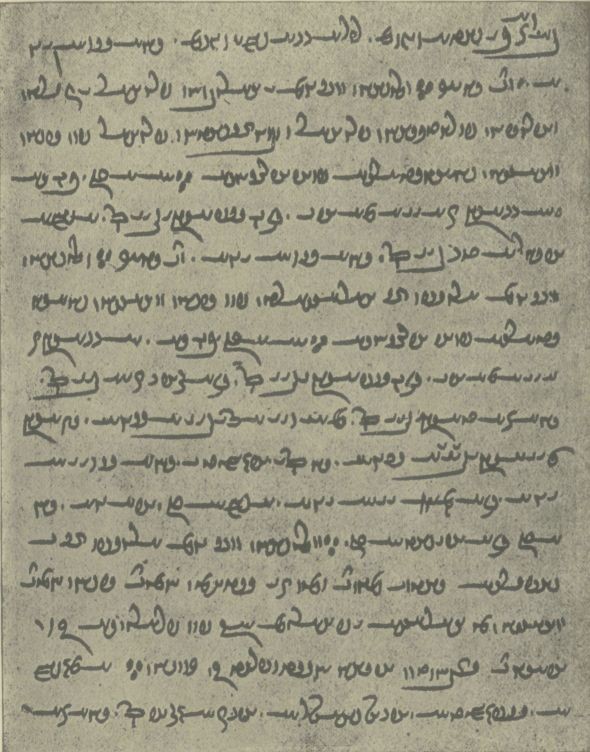
THE ZEND-AVESTA.
Facsimile of a Page of the
AVESTA;
from the oldest preserved manuscript containing the
YAÇNA.
A.D. 1325. In the Royal Library at Copenhagen.
The Zend-Avesta--more properly the Avesta-Zend, i.e., "Text and Commentary"
is the "Bible" of the Persians. The four parts into
which it is divided are called Yaçna, Vispered,
Vendidad, and Khordah-Avesta.
With the growth of our knowledge of the language of the sacred texts, we have now a clear idea also of the history of Zoroastrian literature and of the changes and chances through which with varying fortunes the scriptures have passed. The original Zoroastrian Avesta, according to tradition, was in itself a literature of vast dimensions. Pliny, in his 'Natural History,' speaks of two million verses of Zoroaster; to which may be added the Persian assertion that the original copy of the scriptures was written upon twelve thousand parchments, with gold illuminated letters, and was deposited in the library at Persepolis. But what was the fate of this archetype? Parsi tradition has an answer. Alexander the Great--"the accursed Iskander," as he is called--is responsible for its destruction. At the request of the beautiful Thais, as the story goes, he allowed the palace of Persepolis to be burned, and the precious treasure perished in the flames. Whatever view we may take of the different sides of this story, one thing cannot be denied: the invasion of Alexander and the subjugation of Iran was indirectly or directly the cause of a certain religious decadence which followed upon the disruption of the Persian Empire, and was answerable for the fact that a great part of the scriptures was forgotten or fell into disuse. Persian tradition lays at the doors of the Greeks the loss of another copy of the original ancient texts, but does not explain in what manner this happened; nor has it any account to give of copies of the prophet's works which Semitic writers say were translated into nearly a dozen different languages. One of these versions was perhaps Greek, for it is generally acknowledged that in the fourth century B.C. the philosopher Theopompus spent much time in giving in his own tongue the contents of the sacred Magian books.
Tradition is unanimous on one point at least: it is that the original Avesta comprised twenty-one Nasks, or books, a statement which there is no good reason to doubt. The same tradition which was acquainted with the general character of these Nasks professes also to tell exactly how many of them survived the inroad of Alexander; for although the sacred text itself was destroyed, its contents were lost only in part, the priests preserving large portions of the precious scriptures. These met with many vicissitudes in the five centuries that intervened between the conquest of Alexander and the great restoration of Zoroastrianism in the third century of our era, under the Sassanian dynasty. At this period all obtainable Zoroastrian scriptures were collected, the compilation was codified, and a detailed notice made of the contents of each of the original Nasks compared with the portions then surviving. The original Avesta was, it would appear, a sort of encyclopaedic work; not of religion alone, but of useful knowledge relating to law, to the arts, science, the professions, and to every-day life. If we may judge from the existing table of contents of these Nasks, the zealous Sassanians, even in the time of the collecting (A. D. 226-380), were able to restore but a fragment of the archetype, perhaps a fourth part of the original Avesta. Nor was this remnant destined to escape misfortune. The Mohammedan invasion, in the seventh century of our era added a final and crushing blow. Much of the religion that might otherwise have been handed down to us, despite "the accursed Iskander's" conquest, now perished through the sword and the Koran. Its loss, we must remember, is in part compensated by the Pahlavi religious literature of Sassanian days.
Fragmentary and disjointed as are the remnants of the Avesta, we are fortunate in possessing even this moiety of the Bible of Zoroaster, whose compass is about one tenth that of our own sacred book. A grouping of the existing texts is here presented:--1. Yasna (including Gathas). 2. Visperad. 3. Yashts. 4. Minor Texts. 5. Vendidad. 6. Fragments.
Even these texts no single manuscript in our time contains complete. The present collection is made by combining various Avestan codexes. In spite of the great antiquity of the literature, all the existing manuscripts are comparatively young. None is older than the thirteenth century of our own era, while the direct history of only one or two can be followed back to about the tenth century. This mere external circumstance has of course no bearing on the actual early age of the Zoroastrian scriptures. It must be kept in mind that Zoroaster lived at least six centuries before the birth of Christ.
Among the six divisions of our present Avesta, the Yasna, Visperad, and Vendidad are closely connected. They are employed in the daily ritual, and they are also accompanied by a version or interpretation in the Pahlavi language, which serves at the same time as a sort of commentary. The three divisions are often found combined into a sort of prayer-book, called Vendidad-Sadah (Vendidad Pure); i.e., Avesta text without the Pahlavi rendering. The chapters in this case are arranged with special reference to liturgical usage.
Some idea of the character of the Avesta as it now exists may be derived from the following sketch of its contents and from the illustrative selections presented:--
1. Yasna (sacrifice, worship), the chief liturgical work of the sacred canon. It consists mainly of ascriptions of praise and of prayer, and corresponds nearly to our idea of a prayer-book. The Yasna comprises seventy-two chapters; these fall into three nearly equal parts. The middle, or oldest part, is the section of Gathas below described.
The meaning of the word yasna as above gives at once some conception of the nature of the texts. The Yasna chapters were recited at the sacrifice: a sacrifice that consisted not in blood-offerings, but in an offering of praise and thanksgiving, accompanied by ritual observances. The white-robed priest, girt with the sacred cord and wearing a veil, the paitidana, before his lips in the presence of the holy fire, begins the service by an invocation of Ahura Mazda (Ormazd) and the heavenly hierarchy; he then consecrates the zaothra water, the myazda or oblation, and the baresma or bundle of sacred twigs. He and his assistant now prepare the haoma (the soma of the Hindus), or juice of a sacred plant, the drinking of which formed part of the religious rite. At the ninth chapter of the book, the rhythmical chanting of the praises of Haoma is begun. This deified being, a personification of the consecrated drink, is supposed to have appeared before the prophet himself, and to have described to him the blessings which the haoma bestows upon its pious worshiper. The lines are metrical, as in fact they commonly are in the older parts of the Avesta, and the rhythm somewhat recalls the Kalevala verse of Longfellow's 'Hiawatha.' A specimen is here presented in translation:--
At the time of morning-worship
Haoma came to Zoroaster,
Who was serving at the Fire
And the holy Psalms intoning.
"What man art thou (asked the Prophet),
Who of all the world material
Art the fairest I have e'er seen
In my life, bright and immortal?"
The image of the sacred plant responds, and bids the priest prepare the holy extract.
Haoma then to me gave answer,
Haoma righteous, death-destroying:--
"Zoroaster, I am Haoma,
Righteous Haoma, death-destroying.
Do thou gather me, Spitama,
And prepare me as a potion;
Praise me, aye as shall hereafter
In their praise the Saviors praise me."
Zoroaster again inquires, wishing to know of the pious men of old who worshiped Haoma and obtained blessings for their religious zeal. Among these, as is learned from Haoma, one was King Yima, whose reign was the time of the Golden Age; those were the happy days when a father looked as young as his children.
In the reign of princely Yima,
Heat there was not, cold there was not,
Neither age nor death existed,
Nor disease the work of Demons;
Son and father walked together
Fifteen years old, each in figure,
Long as Vivanghvat's son Yima,
The good Shepherd, ruled as sovereign.
For two chapters more, Haoma is extolled. Then follows the Avestan Creed (Yasna 12), a prose chapter that was repeated by those who joined in the early Zoroastrian faith, forsook the old marauding and nomadic habits that still characterize the modern Kurds, and adopted an agricultural habit of life, devoting themselves peaceably to cattle-raising, irrigation, and cultivation of the fields. The greater part of the Yasna book is of a liturgic or ritualistic nature, and need not here be further described. Special mention, however, must be made of the middle section of the Yasna, which is constituted by "the Five Gathas" (hymns, psalms), a division containing the seventeen sacred psalms, sayings, sermons, or teachings of Zoroaster himself. These Gathas form the oldest part of the entire canon of the Avesta. In them we see before our eyes the prophet of the new faith speaking with the fervor of the Psalmist of the Bible. In them we feel the thrill of ardor that characterizes a new and struggling religious band; we are warmed by the burning zeal of the preacher of a church militant. Now, however, comes a cry of despondency, a moment of faint-heartedness at the present triumph of evil, at the success of the wicked and the misery of the righteous; but this gives way to a clarion burst of hopefulness, the trumpet note of a prophet filled with the promise of ultimate victory, the triumph of good over evil. The end of the world cannot be far away; the final overthrow of Ahriman (Anra Mainyu) by Ormazd (Ahura Mazda) is assured; the establishment of a new order of things is certain; at the founding of this "kingdom" the resurrection of the dead will take place and the life eternal will be entered upon.
The third Gatha, Yasna 30, may be chosen by way of illustration. This is a sort of Mazdian Sermon on the Mount. Zoroaster preaches the doctrine of dualism, the warfare of good and evil in the world, and exhorts the faithful to choose aright and to combat Satan. The archangels Good Thought (Vohu Manah), Righteousness (Asha), Kingdom (Khshathra), appear as the helpers of Man (Maretan); for whose soul, as in the old English morality play, the Demons (Dævas) are contending. Allusions to the resurrection and final judgment, and to the new dispensation, are easily recognized in the spirited words of the prophet. A prose rendering of this metrical psalm is here attempted; the verse order, however, is preserved, though without rhythm.
A PSALM OF ZOROASTER: YASNA 30
Now shall I speak of things which ye who seek them shall bear in mind,
Namely, the praises of Ahura Mazda and the worship of Good Thought,
And the joy of [lit. through] Righteousness which is manifested through Light.
2
Hearken with your ears to what is best; with clear understanding perceive it.
Awakening to our advising every man, personally, of the distinction
Between the two creeds, before the Great Event [i.e., the Resurrection].
3
Now, Two Spirits primeval there were twins which became known through their activity,
To wit, the Good and the Evil, in thought, word, and deed.
The wise have rightly distinguished between these two; not so the unwise.
4
And, now, when these Two Spirits first came together, they established
Life and destruction, and ordained how the world hereafter shall be,
To wit, the Worst World [Hell] for the wicked, but the Best Thought [Heaven] for the righteous.
5
The Wicked One [Ahriman] of these Two Spirits chose to do evil,
The Holiest Spirit [Ormazd]--who wears the solid heavens as a robe--chose Righteousness [Asha],
And [so also those] who zealously gratified Ormazd by virtuous deeds.
6
Not rightly did the Demons distinguish these Two Spirits; for Delusion came
Upon them, as they were deliberating, so that they chose the Worst Thought [Hell].
And away they rushed to Wrath [the Fiend] in order to corrupt the life of Man [Maretan].
7
And to him [i.e., to Gaya Maretan] came Khshathra [Kingdom], Vohu Manah [Good Thought] and Asha [Righteousness],
And Armaiti [Archangel of Earth] gave [to him] bodily endurance unceasingly;
Of these, Thy [creatures], when Thou earnest with Thy creations, he [i.e., Gaya Maretan] was the first.
8
But when the retribution of the sinful shall come to pass,
Then shall Good Thought distribute Thy Kingdom,
Shall fulfill it for those who shall deliver Satan [Druj] into the hand of Righteousness [Asha].
9
And so may we be such as make the world renewed,
And may Ahura Mazda and Righteousness lend their aid,
That our thoughts may there be [set] where Faith is abiding.
10
For at the [final] Dispensation, the blow of annihilation to Satan shall come to pass;
But those who participate in a good report [in the Life Record] shall meet together
In the happy home of Good Thought, and of Mazda, and of Righteousness.
11
If, O ye men, ye mark these doctrines which Mazda gave,
And [mark] the weal and the woe--namely, the long torment of the wicked,
And the welfare of the righteous--then in accordance with these [doctrines] there will be happiness hereafter.
The Visperad (all the masters) is a short collection of prosaic invocations and laudations of sacred things. Its twenty-four sections form a supplement to the Yasna. Whatever interest this division of the Avesta possesses lies entirely on the side of the ritual, and not in the field of literature. In this respect it differs widely from the book of the Yashts, which is next to be mentioned.
The Yashts (praises of worship) form a poetical book of twenty-one hymns in which the angels of the religion, "the worshipful ones" (Yazatas, Izads), are glorified, and the heroes of former days. Much of the material of the Yashts is evidently drawn from pre-Zoroastrian sagas which have been remodeled and adopted, worked over and modified, and incorporated into the canon of the new-founded religion. There is a mythological and legendary atmosphere about the Yashts, and Firdausi's 'Shah Nameh' serves to throw light on many of the events portrayed in them, or allusions that would otherwise be obscure. All the longer Yashts are in verse, and some of them have poetic merit. Chiefly to be mentioned among the longer ones are: first, the one in praise of Ardvi Sura Anahita, or the stream celestial (Yt. 5); second, the Yasht which exalts the star Tishtrya and his victory over the demon of drought (Yt. 8); then the one devoted to the Fravashis or glorified souls of the righteous (Yt. 13) as well as the Yasht in honor of Verethraghna, the incarnation of Victory (Yt. 14). Selections from the others, Yt. 10 and Yt. 19, which are among the noblest, are here given.
The first of the two chosen (Yt. 10) is dedicated to the great divinity Mithra, the genius who presides over light, truth, and the sun (Yt. 10, 13).
Foremost he, the celestial angel,
Mounts above Mount Hara (Alborz)
In advance of the sun immortal
Which is drawn by fleeting horses;
He it is, in gold adornment
First ascends the beauteous summits
Thence beneficent he glances
Over all the abode of Aryans.
As the god of light and of truth and as one of the judges of the dead, he rides out in lordly array to the battle and takes an active part in the conflict, wreaking vengeance upon those who at any time in their life have spoken falsely, belied their oath, or broken their pledge. His war-chariot and panoply are described in mingled lines of verse and prose, which may thus be rendered (Yt. 10, 128-132):--
By the side of Mithra's chariot,
Mithra, lord of the wide pastures,
Stand a thousand bows well-fashioned
(The bow has a string of cowgut).
By his chariot also are standing a thousand vulture-feathered, gold-notched, lead-poised, well-fashioned arrows (the barb is of iron); likewise a thousand spears well-fashioned and sharp-piercing, and a thousand steel battle-axes, two-edged and well-fashioned; also a thousand bronze clubs well-fashioned.
And by Mithra's chariot also
Stands a mace, fair and well-striking,
With a hundred knobs and edges,
Dashing forward, felling heroes;
Out of golden bronze 'tis molded.
The second illustrative extract will be taken from Yasht 19, which magnifies in glowing strains the praises of the Kingly Glory. This "kingly glory" (kavaem hvareno) is a sort of halo, radiance, or mark of divine right, which was believed to be possessed by the kings and heroes of Iran in the long line of its early history. One hero who bore the glory was the mighty warrior Thraetaona (Feridun), the vanquisher of the serpent-monster Azhi Dahaka (Zohak), who was depopulating the world by his fearful daily banquet of the brains of two children. The victory was a glorious triumph for Thraetaona (Yt. 19, 37):--
He who slew Azhi Dahaka,
Three-jawed monster, triple-headed,
With six eyes and myriad senses,
Fiend demoniac, full of power,
Evil to the world, and wicked.
This fiend full of power, the Devil
Anra Mainyu had created,
Fatal to the world material,
Deadly to the world of Righteousness.
Of equal puissance was another noble champion, the valiant Keresaspa, who dispatched a raging demon who, though not yet grown to man's estate, was threatening the world. The monster's thrasonical boasting is thus given (Yt. 19, 43):--
I am yet only a stripling,
But if ever I come to manhood
I shall make the earth my chariot
And shall make a wheel of heaven.
I shall drive the Holy Spirit
Down from out the shining heaven,
I shall rout the Evil Spirit
Up from out the dark abysm;
They as steeds shall draw my chariot,
God and Devil yoked together.
Passing over a collection of shorter petitions, praises, and blessings which may conveniently be grouped together as 'Minor Prayers,' for they answer somewhat to our idea of a daily manual of morning devotion, we may turn to the Vendidad (law against the demons), the Iranian Pentateuch. Tradition asserts that in the Vendidad we have preserved a specimen of one of the original Nasks. This may be true, but even the superficial student will see that it is in any case a fragmentary remnant. Interesting as the Vendidad is to the student of early rites, observances, manners, and customs, it is nevertheless a barren field for the student of literature, who will find in it little more than wearisome prescriptions like certain chapters of Leviticus, Numbers, and Deuteronomy. It need only be added that at the close of the colloquy between Zoroaster and Ormazd given in Vend. 6, he will find the origin of the modern Parsi "Towers of Silence."
Among the Avestan Fragments, attention might finally be called to one which we must be glad has not been lost. It is an old metrical bit (Frag. 4, 1-3) in praise of the Airyama Ishya Prayer (Yt. 54, 1). This is the prayer that shall be intoned by the Savior and his companions at the end of the world, when the resurrection will take place; and it will serve as a sort of last trump, at the sound of which the dead rise from their graves and evil is banished from the world. Ormazd himself says to Zoroaster (Frag. 4, 1-3):--
The Airyama Ishya prayer, I tell thee,
Upright, holy Zoroaster,
Is the greatest of all prayers.
Verily among all prayers
It is this one which I gifted
With revivifying powers.
This prayer shall the Saoshyants, Saviors,
Chant, and at the chanting of it
I shall rule over my creatures,
I who am Ahura Mazda.
Not shall Ahriman have power,
Anra Mainyu, o'er my creatures,
He (the fiend) of foul religion.
In the earth shall Ahriman hide,
In the earth the demons hide.
Up the dead again shall rise,
And within their lifeless bodies
Incorporate life shall be restored.
Inadequate as brief extracts must be to represent the sacred books of a people, the citations here given will serve to show that the Avesta which is still recited in solemn tones by the white-robed priests of Bombay, the modern representatives of Zoroaster, the Prophet of ancient days, is a survival not without value to those who appreciate whatever has been preserved for us of the world's earlier literature. For readers who are interested in the subject there are several translations of the Avesta. The best (except for the Gathas, where the translation is weak) is the French version by Darmesteter, 'Le Zend Avesta,' published in the 'Annales du Musée Guimet' (Paris, 1892-93). An English rendering by Darmesteter and Mills is contained in the 'Sacred Books of the East,' Vols. iv., xxiii., xxxi.
A PRAYER FOR KNOWLEDGE
This I ask Thee, O Ahura! tell me aright: when praise is to be offered, how shall I complete the praise of the One like You, O Mazda? Let the One like Thee declare it earnestly to the friend who is such as I, thus through Thy Righteousness within us to offer friendly help to us, so that the One like Thee may draw near us through Thy Good Mind within the Soul.
2. This I ask Thee, O Ahura! tell me aright how, in pleasing Him, may we serve the Supreme One of the better world; yea, how to serve that chief who may grant us those blessings of his grace and who will seek for grateful requitals at our hands; for He, bountiful as He is through the Righteous Order, will hold off ruin from us all, guardian as He is for both the worlds, O Spirit Mazda! and a friend.
3. This I ask Thee, O Ahura! tell me aright: Who by generation is the first father of the Righteous Order within the world? Who gave the recurring sun and stars their undeviating way? Who established that whereby the moon waxes, and whereby she wanes, save Thee? These things, O Great Creator! would I know, and others likewise still.
4. This I ask Thee, O Ahura! tell me aright: Who from beneath hath sustained the earth and the clouds above that they do not fall? Who made the waters and the plants? Who to the wind has yoked on the storm-clouds the swift and fleetest two? Who, O Great Creator! is the inspirer of the good thoughts within our souls?
5. This I ask Thee, O Ahura! tell me aright: Who, as a skillful artisan, hath made the lights and the darkness? Who, as thus skillful, hath made sleep and the zest of waking hours? Who spread the Auroras, the noontides and midnight, monitors to discerning man, duty's true guides?
6. This I ask Thee, O Ahura! tell me aright these things which I shall speak forth, if they are truly thus. Doth the Piety which we cherish in reality increase the sacred orderliness within our actions? To these Thy true saints hath she given the Realm through the Good Mind? For whom hast thou made the Mother-kine, the produce of joy?
7. This I ask Thee, O Ahura! tell me aright: Who fashioned Aramaiti (our piety) the beloved, together with Thy Sovereign Power? Who, through his guiding wisdom, hath made the son revering the father? Who made him beloved? With questions such as these, so abundant, O Mazda! I press Thee, O bountiful Spirit, Thou maker of all!
Yasna xliv.: Translation of L.H. Mills.
THE ANGEL OF DIVINE OBEDIENCE
We worship Sraosha [Obedience] the blessed, whom four racers draw in harness, white and shining, beautiful and (27) powerful, quick to learn and fleet, obeying before speech, heeding orders from the mind, with their hoofs of horn gold-covered, (28) fleeter than [our] horses, swifter than the winds, more rapid than the rain [drops as they fall]; yea, fleeter than the clouds, or well-winged birds, or the well-shot arrow as it flies, (29) which overtake these swift ones all, as they fly after them pursuing, but which are never overtaken when they flee, which plunge away from both the weapons [hurled on this side and on that] and draw Sraosha with them, the good Sraosha and the blessed; which from both the weapons [those on this side and on that] bear the good Obedience the blessed, plunging forward in their zeal, when he takes his course from India on the East and when he lights down in the West.
Yasna lvii. 27-29: Translation of L.H. Mills.
TO THE FIRE
I offer my sacrifice and homage to thee, the Fire, as a good offering, and an offering with our hail of salvation, even as an offering of praise with benedictions, to thee, the Fire, O Ahura, Mazda's son! Meet for sacrifice art thou, and worthy of [our] homage. And as meet for sacrifice, and thus worthy of our homage, may'st thou be in the houses of men [who worship Mazda]. Salvation be to this man who worships thee in verity and truth, with wood in hand and baresma [sacred twigs] ready, with flesh in hand and holding too the mortar. 2. And mayst thou be [ever] fed with wood as the prescription orders. Yea, mayst thou have thy perfume justly, and thy sacred butter without fail, and thine andirons regularly placed. Be of full age as to thy nourishment, of the canon's age as to the measure of thy food. O Fire, Ahura, Mazda's son! 3. Be now aflame within this house; be ever without fail in flame; be all ashine within this house: for long time be thou thus to the furtherance of the heroic [renovation], to the completion of [all] progress, yea, even till the good heroic [millennial] time when that renovation shall have become complete. 4. Give me, O Fire, Ahura, Mazda's son! a speedy glory, speedy nourishment and speedy booty and abundant glory, abundant nourishment, abundant booty, an expanded mind, and nimbleness of tongue and soul and understanding, even an understanding continually growing in its largeness, and that never wanders.
Yasna lxii. 1-4: Translation of L.H. Mills.
THE GODDESS OF THE WATERS
Offer up a sacrifice unto this spring of mine, Ardvi Sura Anahita (the exalted, mighty, and undefiled, image of the (128) stream celestial), who stands carried forth in the shape of a maid, fair of body, most strong, tall-formed, high-girded, pure, nobly born of a glorious race, wearing a mantle fully embroidered with gold. 129. Ever holding the baresma in her hand, according to the rules; she wears square golden ear-rings on her ears bored, and a golden necklace around her beautiful neck, she, the nobly born Ardvi Sura Anahita; and she girded her waist tightly, so that her breasts may be well shaped, that they may be tightly pressed. 128. Upon her head Ardvi Sura Anahita bound a golden crown, with a hundred stars, with eight rays, a fine well-made crown, with fillets streaming down. 129. She is clothed with garments of beaver, Ardvi Sura Anahita; with the skin of thirty beavers, of those that bear four young ones, that are the finest kind of beavers; for the skin of the beaver that lives in water is the finest colored of all skins, and when worked at the right time it shines to the eye with full sheen of silver and gold.
Yasht v. 126-129: Translation of J. Darmesteter.
GUARDIAN SPIRITS
We worship the good, strong, beneficent Fravashis [guardian spirits] of the faithful; with helms of brass, with weapons (45) of brass, with armor of brass; who struggle in the fights for victory in garments of light, arraying the battles and bringing them forwards, to kill thousands of Dævas [demons]. 46. When the wind blows from behind them and brings their breath unto men, then men know where blows the breath of victory: and they pay pious homage unto the good, strong, beneficent Fravashis of the faithful, with their hearts prepared and their arms uplifted. 47. Whichever side they have been first worshiped in the fulness of faith of a devoted heart, to that side turn the awful Fravashis of the faithful along with Mithra [angel of truth and light] and Rashnu [Justice] and the awful cursing thought of the wise and the victorious wind.
Yasht xiii. 45-47: Translation of J. Darmesteter.
AN ANCIENT SINDBAD
The manly-hearted Keresaspa was the sturdiest of the men of strength, for Manly Courage clave unto him. We worship [this] Manly Courage, firm of foot, unsleeping, quick to rise, and fully awake, that clave unto Keresaspa [the hero], who killed the snake Srvara, the horse-devouring, man-devouring, yellow poisonous snake, over which yellow poison flowed a thumb's breadth thick. Upon him Kerasaspa was cooking his food in a brass vessel, at the time of noon. The fiend felt the heat and darted away; he rushed from under the brass vessel and upset the boiling water: the manly-hearted Keresaspa fell back affrighted.
Yasht xix. 38-40: Translation of J. Darmesteter.
THE WISE MAN
Verily I say it unto thee, O Spitama Zoroaster! the man who has a wife is far above him who lives in continence; he who keeps a house is far above him who has none; he who has children is far above the childless man; he who has riches is far above him who has none.
And of two men, he who fills himself with meat receives in him good spirit [Vohu Mano] much more than he who does not do so; the latter is all but dead; the former is above him by the worth of a sheep, by the worth of an ox, by the worth of a man.
It is this man that can strive against the onsets of death; that can strive against the well-darted arrow; that can strive against the winter fiend with thinnest garment on; that can strive against the wicked tyrant and smite him on the head; it is this man that can strive against the ungodly fasting Ashemaogha [the fiends and heretics who do not eat].
Vendidad iv. 47-49: Translation of J. Darmesteter.
INVOCATION TO RAIN
"Come on, O clouds, along the sky, through the air, down on the earth, by thousands of drops, by myriads of drops," thus say, O holy Zoroaster! "to destroy sickness altogether, to destroy death altogether, to destroy altogether the sickness made by the Gaini, to destroy altogether the death made by Gaini, to destroy altogether Gadha and Apagadha.
"If death come at eve, may healing come at daybreak!
"If death come at daybreak, may healing come at night!
"If death come at night, may healing come at dawn!
"Let showers shower down new waters, new earth, new trees, new health, and new healing powers."
Vendidad xxi. 2: Translation of J. Darmesteter.
A PRAYER FOR HEALING
Ahura Mazda spake unto Spitama Zoroaster, saying, "I, Ahura Mazda, the Maker of all good things, when I made this mansion, the beautiful, the shining, seen afar (there may I go up, there may I arrive)!"
Then the ruffian looked at me; the ruffian Anra Mainyu, the deadly, wrought against me nine diseases and ninety, and nine hundred, and nine thousand, and nine times ten thousand diseases. So mayest thou heal me, O Holy Word, thou most glorious one!
Unto thee will I give in return a thousand fleet, swift-running steeds; I offer thee up a sacrifice, O good Saoka, made by Mazda and holy.
Unto thee will I give in return a thousand fleet, high-humped camels; I offer thee up a sacrifice, O good Saoka, made by Mazda and holy.
Unto thee will I give in return a thousand brown faultless oxen; I offer thee up a sacrifice, O good Saoka, made by Mazda and holy.
Unto thee will I give in return a thousand young of all species of small cattle; I offer thee up a sacrifice, O good Saoka, made by Mazda and holy.
And I will bless thee with the fair blessing-spell of the righteous, the friendly blessing-spell of the righteous, that makes the empty swell to fullness and the full to overflowing, that comes to help him who was sickening, and makes the sick man sound again. Vendidad xxii. 1-5: Translation of J. Darmesteter.
FRAGMENT
All good thoughts, and all good words, and all good deeds are thought and spoken and done with intelligence; and all evil thoughts and words and deeds are thought and spoken and done with folly.
2. And let [the men who think and speak and do] all good thoughts and words and deeds inhabit Heaven [as their home]. And let those who think and speak and do evil thoughts and words and deeds abide in Hell. For to all who think good thoughts, speak good words, and do good deeds, Heaven, the best world, belongs. And this is evident and as of course. Avesta, Fragment iii.: Translation of L.H. Mills.
AVICEBRON
(1028-? 1058)
vicebron, or Avicebrol (properly Solomon ben Judah ibn Gabirol), one of the most famous of Jewish poets, and the most original of Jewish thinkers, was born at Cordova, in Spain, about A.D. 1028. Of the events of his life we know little; and it was only in 1845 that Munk, in the 'Literaturblatt des Orient,' proved the Jewish poet Ibn Gabirol to be one and the same person with Avicebron, so often quoted by the Schoolmen as an Arab philosopher. He was educated at Saragossa, spent some years at Malaga, and died, hardly thirty years old, about 1058. His disposition seems to have been rather melancholy.
Of his philosophic works, which were written in Arabic, by far the most important, and that which lent lustre to his name, was the 'Fountain of Life'; a long treatise in the form of a dialogue between teacher and pupil, on what was then regarded as the fundamental question in philosophy, the nature and relations of Matter and Form. The original, which seems never to have been popular with either Jews or Arabs, is not known to exist; but there exists a complete Latin translation (the work having found appreciation among Christians), which has recently been edited with great care by Professor Bäumker of Breslau, under the title 'Avencebrolis Fons Vitae, ex Arabico in Latinum translatus ab Johanne Hispano et Dominico Gundissalino' (Münster, 1895). There is also a series of extracts from it in Hebrew. Besides this, he wrote a half-popular work, 'On the Improvement of Character,' in which he brings the different virtues into relation with the five senses. He is, further, the reputed author of a work 'On the Soul,' and the reputed compiler of a famous anthology, 'A Choice of Pearls,' which appeared, with an English translation by B.H. Ascher, in London, in 1859. In his poetry, which, like that of other mediæval Hebrew poets, Moses ben Ezra, Judah Halévy, etc., is partly liturgical, partly worldly, he abandons native forms, such as we find in the Psalms, and follows artificial Arabic models, with complicated rhythms and rhyme, unsuited to Hebrew, which, unlike Arabic, is poor in inflections. Nevertheless, many of his liturgical pieces are still used in the services of the synagogue, while his worldly ditties find admirers elsewhere. (See A. Geiger, 'Ibn Gabirol und seine Dichtungen,' Leipzig, 1867.)
The philosophy of Ibn Gabirol is a compound of Hebrew monotheism and that Neo-Platonic Aristotelianism which for two hundred years had been current in the Muslim schools at Bagdad, Basra, etc., and which the learned Jews were largely instrumental in carrying to the Muslims of Spain. For it must never be forgotten that the great translators and intellectual purveyors of the Middle Ages were the Jews. (See Steinschneider, 'Die Hebräischen Uebersetzungen des Mittelalters, und die Juden als Dolmetscher,' 2 vols., Berlin, 1893.)
The aim of Ibn Gabirol, like that of the other three noted Hebrew thinkers, Philo, Maimonides, and Spinoza, was--given God, to account for creation; and this he tried to do by means of Neo-Platonic Aristotelianism, such as he found in the Pseudo-Pythagoras, Pseudo-Empedocles, Pseudo-Aristotelian 'Theology' (an abstract from Plotinus), and 'Book on Causes' (an abstract from Proclus's 'Institutio Theologica'). It is well known that Aristotle, who made God a "thinking of thinking," and placed matter, as something eternal, over against him, never succeeded in bringing God into effective connection with the world (see K. Elser, 'Die Lehredes Aristotles über das Wirken Gottes,' Münster, 1893); and this defect the Greeks never afterward remedied until the time of Plotinus, who, without propounding a doctrine of emanation, arranged the universe as a hierarchy of existence, beginning with the Good, and descending through correlated Being and Intelligence, to Soul or Life, which produces Nature with all its multiplicity, and so stands on "the horizon" between undivided and divided being. In the famous encyclopaedia of the "Brothers of Purity," written in the East about A.D. 1000, and representing Muslim thought at its best, the hierarchy takes this form: God, Intelligence, Soul, Primal Matter, Secondary Matter, World, Nature, the Elements, Material Things. (See Dieterici, 'Die Philosophic der Araber im X. Jahrhundert n. Chr.,' 2 vols., Leipzig, 1876-79.) In the hands of Ibn Gabirol, this is transformed thus: God, Will, Primal Matter, Form, Intelligence, Soul--vegetable, animal, rational, Nature, the source of the visible world. If we compare these hierarchies, we shall see that Ibn Gabirol makes two very important changes: first, he introduces an altogether new element, viz., the Will; second, instead of placing Intelligence second in rank, next to God, he puts Will, Matter, and Form before it. Thus, whereas the earliest thinkers, drawing on Aristotle, had sought for an explanation of the world in Intelligence, he seeks for it in Will, thus approaching the standpoint of Schopenhauer. Moreover, whereas they had made Matter and Form originate in Intelligence, he includes the latter, together with the material world, among things compounded of Matter and Form. Hence, everything, save God and His Will, which is but the expression of Him, is compounded of Matter and Form (cf. Dante, 'Paradiso,' i. 104 seq.). Had he concluded from this that God, in order to occupy this exceptional position, must be pure matter (or substance), he would have reached the standpoint of Spinoza. As it is, he stands entirely alone in the Middle Age, in making the world the product of Will, and not of Intelligence, as the Schoolmen and the classical philosophers of Germany held.
The 'Fountain of Life' is divided into five books, whose subjects are as follows:--I. Matter and Form, and their various kinds. II. Matter as the bearer of body, and the subject of the categories. III. Separate Substances, in the created intellect, standing between God and the World. IV. Matter and Form in simple substances. V. Universal Matter and Universal Form, with a discussion of the Divine Will, which, by producing and uniting Matter and Form, brings being out of non-being, and so is the 'Fountain of Life.' Though the author is influenced by Jewish cosmogony, his system, as such, is almost purely Neo-Platonic. It remains one of the most considerable attempts that have ever been made to find in spirit the explanation of the world; not only making all matter at bottom one, but also maintaining that while form is due to the divine will, matter is due to the divine essence, so that both are equally spiritual. It is especially interesting as showing us, by contrast, how far Christian thinking, which rested on much the same foundation with it, was influenced and confined by Christian dogmas, especially by those of the Trinity and the Incarnation.
Ibn Gabirol's thought exerted a profound influence, not only on subsequent Hebrew thinkers, like Joseph ben Saddig, Maimonides, Spinoza, but also on the Christian Schoolmen, by whom he is often quoted, and on Giordano Bruno. Through Spinoza and Bruno this influence has passed into the modern world, where it still lives. Dante, though naming many Arab philosophers, never alludes to Ibn Gabirol; yet he borrowed more of his sublimest thoughts from the 'Fountain of Life' than from any other book. (Cf. Ibn Gabirol's 'Bedeutung für die Geschichte der Philosophie,' appendix to Vol. i. of M. Joël's 'Beiträge zur Gesch. der Philos.,' Breslau, 1876.) If we set aside the hypostatic form in which Ibn Gabirol puts forward his ideas, we shall find a remarkable similarity between his system and that of Kant, not to speak of that of Schopenhauer. For the whole subject, see J. Guttman's 'Die Philosophic des Salomon Ibn Gabirol' (Göttingen, 1889).
ON MATTER AND FORM
From the 'Fountain of Life,' Fifth Treatise
Intelligence is finite in both directions: on the upper side, by reason of will, which is above it; on the lower, by reason of matter, which is outside of its essence. Hence, spiritual substances are finite with respect to matter, because they differ through it, and distinction is the cause of finitude; in respect to forms they are infinite on the lower side, because one form flows from another. And we must bear in mind that that part of matter which is above heaven, the more it ascends from it to the principle of creation, becomes the more spiritual in form, whereas that part which descends lower than the heaven toward quiet will be more corporeal in form. Matter, intelligence, and soul comprehend heaven, and heaven comprehends the elements. And just as, if you imagine your soul standing at the extreme height of heaven, and looking back upon the earth, the earth will seem but a point, in comparison with the heaven, so are corporeal and spiritual substance in comparison with the will. And first matter is stable in the knowledge of God, as the earth in the midst of heaven. And the form diffused through it is as the light diffused through the air....
We must bear in mind that the unity induced by the will (we might say, the will itself) binds matter to form. Hence that union is stable, firm, and perpetual from the beginning of its creation; and thus unity sustains all things.
Matter is movable, in order that it may receive form, in conformity with its appetite for receiving goodness and delight through the reception of form. In like manner, everything that is, desires to move, in order that it may attain something of the goodness of the primal being; and the nearer anything is to the primal being, the more easily it reaches this, and the further off it is, the more slowly and with the longer motion and time it does so. And the motion of matter and other substances is nothing but appetite and love for the mover toward which it moves, as, for example, matter moves toward form, through desire for the primal being; for matter requires light from that which is in the essence of will, which compels matter to move toward will and to desire it: and herein will and matter are alike. And because matter is receptive of the form that has flowed down into it by the flux of violence and necessity, matter must necessarily move to receive form; and therefore things are constrained by will and obedience in turn. Hence by the light which it has from will, matter moves toward will and desires it; but when it receives form, it lacks nothing necessary for knowing and desiring it, and nothing remains for it to seek for. For example, in the morning the air has an imperfect splendor from the sun; but at noon it has a perfect splendor, and there remains nothing for it to demand of the sun. Hence the desire for the first motion is a likeness between all substances and the first Maker, because it is impressed upon all things to move toward the first; because particular matter desires particular form, and the matter of plants and animals, which, in generating, move toward the forms of plants and animals, are also influenced by the particular form acting in them. In like manner the sensible soul moves toward sensible forms, and the rational soul to intelligible forms, because the particular soul, which is called the first intellect, while it is in its principle, is susceptible of form; but when it shall have received the form of universal intelligence, which is the second intellect, and shall become intelligence, then it will be strong to act, and will be called the second intellect; and since particular souls have such a desire, it follows that universal souls must have a desire for universal forms. The same thing must be said of natural matter,--that is, the substance which sustains the nine categories; because this matter moves to take on the first qualities, then to the mineral form, then to the vegetable, then to the sensible, then to the rational, then to the intelligible, until at last it is united to the form of universal intelligence. And this primal matter desires primal form; and all things that are, desire union and commixture, that so they may be assimilated to their principle; and therefore, genera, species, differentiae, and contraries are united through something in singulars.
Thus, matter is like an empty schedule and a wax tablet; whereas form is like a painted shape and words set down, from which the reader reaches the end of science. And when the soul knows these, it desires to know the wonderful painter of them, to whose essence it is impossible to ascend. Thus matter and form are the two closed gates of intelligence, which it is hard for intelligence to open and pass through, because the substance of intelligence is below them, and made up of them. And when the soul has subtilized itself, until it can penetrate them, it arrives at the word, that is, at perfect will; and then its motion ceases, and its joy remains.
An analogy to the fact that the universal will actualizes universal form in the matter of intelligence is the fact that the particular will actualizes the particular form in the soul without time, and life and essential motion in the matter of the soul, and local motion and other motions in the matter of nature. But all these motions are derived from the will; and so all things are moved by the will, just as the soul causes rest or motion in the body according to its will. And this motion is different according to the greater or less proximity of things to the will. And if we remove action from the will, the will will be identical with the primal essence; whereas, with action, it is different from it. Hence, will is as the painter of all forms; the matter of each thing as a tablet; and the form of each thing as the picture on the tablet. It binds form to matter, and is diffused through the whole of matter, from highest to lowest, as the soul through the body; and as the virtue of the sun, diffusing its light, unites with the light, and with it descends into the air, so the virtue of the will unites with the form which it imparts to all things, and descends with it. On this ground it is said that the first cause is in all things, and that there is nothing without it.
The will holds all things together by means of form; whence we likewise say that form holds all things together. Thus, form is intermediate between will and matter, receiving from will, and giving to matter. And will acts without time or motion, through its own might. If the action of soul and intelligence, and the infusion of light are instantaneous, much more so is that of will.
Creation comes from the high creator, and is an emanation, like the issue of water flowing from its source; but whereas water follows water without intermission or rest, creation is without motion or time. The sealing of form upon matter, as it flows in from the will, is like the sealing or reflection of a form in a mirror, when it is seen. And as sense receives the form of the felt without the matter, so everything that acts upon another acts solely through its own form, which it simply impresses upon that other. Hence genus, species, differentia, property, accident, and all forms in matter are merely an impression made by wisdom.
The created soul is gifted with the knowledge which is proper to it; but after it is united to the body, it is withdrawn from receiving those impressions which are proper to it, by reason of the very darkness of the body, covering and extinguishing its light, and blurring it, just as in the case of a clear mirror: when dense substance is put over it its light is obscured. And therefore God, by the subtlety of his substance, formed this world, and arranged it according to this most beautiful order, in which it is, and equipped the soul with senses, wherein, when it uses them, that which is hidden in it is manifested in act; and the soul, in apprehending sensible things, is like a man who sees many things, and when he departs from them, finds that nothing remains with him but the vision of imagination and memory.
We must also bear in mind that, while matter is made by essence, form is made by will. And it is said that matter is the seat of God, and that will, the giver of form, sits on it and rests upon it. And through the knowledge of these things we ascend to those things which are behind them, that is, to the cause why there is anything; and this is a knowledge of the world of deity, which is the greatest whole: whatever is below it is very small in comparison with it.
ROBERT AYTOUN
(1570-1638)
his Scottish poet was born in his father's castle of Kinaldie, near St. Andrews, Fifeshire, in 1570. He was descended from the Norman family of De Vescy, a younger son of which settled in Scotland and received from Robert Bruce the lands of Aytoun in Berwickshire. Kincardie came into the family about 1539. Robert Aytoun was educated at St. Andrews, taking his degree in 1588, traveled on the Continent like other wealthy Scottish gentlemen, and studied law at the University of Paris. Returning in 1603, he delighted James I. by a Latin poem congratulating him on his accession to the English throne. Thereupon the poet received an invitation to court as Groom of the Privy Chamber. He rose rapidly, was knighted in 1612, and made Gentleman of the Bedchamber to King James and private secretary to Queen Anne. When Charles I. ascended the throne, Aytoun was retained, and held many important posts. According to Aubrey, "he was acquainted with all the witts of his time in England." Sir Robert was essentially a court poet, and belonged to the cultivated circle of Scottish favorites that James gathered around him; yet there is no mention of him in the gossipy diaries of the period, and almost none in the State papers. He seems, however, to have been popular: Ben Jonson boasts that Aytoun "loved me dearly." It is not surprising that his mild verses should have faded in the glorious light of the contemporary poets.
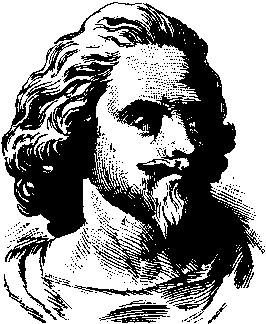
ROBERT AYTOUN
He wrote in Greek and French, and many of his Latin poems were published under the title 'Delitiae Poetarum Scotorum' (Amsterdam, 1637). His English poems on such themes as a 'Love Dirge,' 'The Poet Forsaken,' 'The Lover's Remonstrance,' 'Address to an Inconstant Mistress,' etc., do not show depth of emotion. He says of himself:--
"Yet have I been a lover by report,
Yea, I have died for love as others do;
But praised be God, it was in such a sort
That I revived within an hour or two."
The lines beginning "I do confess thou'rt smooth and fair," quoted below with their adaptation by Burns, do not appear in his MSS., collected by his heir Sir John Aytoun, nor in the edition of his works with a memoir prepared by Dr. Charles Rogers, published in Edinburgh in 1844 and reprinted privately in 1871. Dean Stanley, in his 'Memorials of Westminster Abbey,' accords to him the original of 'Auld Lang Syne,' which Rogers includes in his edition. Burns's song follows the version attributed to Francis Temple.
Aytoun passed his entire life in luxury, died in Whitehall Palace in 1638, and was the first Scottish poet buried in Westminster Abbey. His memorial bust was taken from a portrait by Vandyke.
INCONSTANCY UPBRAIDED
I loved thee once, I'll love no more;
Thine be the grief as is the blame:
Thou art not what thou wast before,
What reason I should be the same?
He that can love unloved again,
Hath better store of love than brain;
God send me love my debts to pay,
While unthrifts fool their love away.
Nothing could have my love o'erthrown,
If thou hadst still continued mine;
Yea, if thou hadst remained thy own,
I might perchance have yet been thine.
But thou thy freedom didst recall,
That it thou might elsewhere inthrall;
And then how could I but disdain
A captive's captive to remain?
When new desires had conquered thee,
And changed the object of thy will,
It had been lethargy in me,
Not constancy, to love thee still.
Yea, it had been a sin to go
And prostitute affection so;
Since we are taught no prayers to say
To such as must to others pray.
Yet do thou glory in thy choice,
Thy choice of his good fortune boast;
I'll neither grieve nor yet rejoice
To see him gain what I have lost.
The height of my disdain shall be
To laugh at him, to blush for thee;
To love thee still, but go no more
A-begging to a beggar's door.
LINES TO AN INCONSTANT MISTRESS
I do confess thou'rt smooth and fair,
And I might have gone near to love thee,
Had I not found the slightest prayer
That lips could speak had power to move thee.
But I can let thee now alone,
As worthy to be loved by none.
I do confess thou'rt sweet, yet find
Thee such an unthrift of thy sweets,
Thy favors are but like the wind
Which kisseth everything it meets!
And since thou canst love more than one,
Thou'rt worthy to be loved by none.
The morning rose that untouched stands,
Armed with her briers, how sweet she smells!
But plucked and strained through ruder hands,
Her scent no longer with her dwells.
But scent and beauty both are gone,
And leaves fall from her one by one.
Such fate ere long will thee betide,
When thou hast handled been awhile,
Like fair flowers to be thrown aside;
And thou shalt sigh while I shall smile,
To see thy love to every one
Hath brought thee to be loved by none.
BURNS'S ADAPTATION
I do confess thou art sae fair,
I wad been ower the lugs in love
Had I na found the slightest prayer
That lips could speak, thy heart could move.
I do confess thee sweet--but find
Thou art sae thriftless o' thy sweets,
Thy favors are the silly wind,
That kisses ilka thing it meets.
See yonder rosebud rich in dew,
Among its native briers sae coy,
How sune it tines its scent and hue
When pu'd and worn a common toy.
Sic fate, ere lang, shall thee betide,
Tho' thou may gaily bloom awhile;
Yet sune thou shalt be thrown aside
Like any common weed and vile.
WILLIAM EDMONSTOUNE AYTOUN
(1813-1865)
ytoun the second, balladist, humorist, and Tory, in proportions of about equal importance,--one of the group of wits and devotees of the status quo who made Blackwood's Magazine so famous in its early days,--was born in Edinburgh, June 21st, 1813. He was the son of Roger Aytoun, "writer to the Signet"; and a descendant of Sir Robert Aytoun (1570-1638), the poet and friend of Ben Jonson, who followed James VI. from Scotland and who is buried in Westminster Abbey. Both Aytoun's parents were literary. His mother, who knew Sir Walter Scott, and who gave Lockhart many details for his biography, helped the lad in his poems. She seemed to him to know all the ballads ever sung. His earliest verses were praised by Professor John Wilson ("Christopher North"), the first editor of Blackwood's, whose daughter he married in 1849. At the age of nineteen he published his 'Poland, Homer, and Other Poems' (Edinburgh, 1832). After leaving the University of Edinburgh, he studied law in London, visited Germany, and returning to Scotland, was called to the bar in 1840. He disliked the profession, and used to say that though he followed the law he never could overtake it.
While in Germany he translated the first part of 'Faust' in blank verse, which was never published. Many of his translations from Uhland and Homer appeared in Blackwood's from 1836 to 1840, and many of his early writings were signed "Augustus Dunshunner." In 1844 he joined the editorial staff of Blackwood's, to which for many years he contributed political articles, verse, translations of Goethe, and humorous sketches. In 1845 he became Professor of Rhetoric and Literature in the University of Edinburgh, a place which he held until 1864. About 1841 he became acquainted with Theodore Martin, and in association with him wrote a series of light papers interspersed with burlesque verses, which, reprinted from Blackwood's, became popular as the 'Bon Gaultier Ballads.' Published in London in 1855, they reached their thirteenth edition in 1877.
"Some papers of a humorous kind, which I had published under the nom de plume of Bon Gaultier," says Theodore Martin in his 'Memoir of Aytoun,' "had hit Aytoun's fancy; and when I proposed to go on with others in a similar vein, he fell readily into the plan, and agreed to assist in it. In this way a kind of a Beaumont-and-Fletcher partnership commenced in a series of humorous papers, which appeared in Tait's and Fraser's magazines from 1842 to 1844. In these papers, in which we ran a-tilt, with all the recklessness of youthful spirits, against such of the tastes or follies of the day as presented an opening for ridicule or mirth,--at the same time that we did not altogether lose sight of a purpose higher than mere amusement,--appeared the verses, with a few exceptions, which subsequently became popular, and to a degree we then little contemplated, as the 'Bon Gaultier Ballads.' Some of the best of these were exclusively Aytoun's, such as 'The Massacre of the McPherson,' 'The Rhyme of Sir Launcelot Bogle,' 'The Broken Pitcher,' 'The Red Friar and Little John,' 'The Lay of Mr. Colt,' and that best of all imitations of the Scottish ballad, 'The Queen in France.' Some were wholly mine, and the rest were produced by us jointly. Fortunately for our purpose, there were then living not a few poets whose style and manner of thought were sufficiently marked to make imitation easy, and sufficiently popular for a parody of their characteristics to be readily recognized. Macaulay's 'Lays of Rome' and his two other fine ballads were still in the freshness of their fame. Lockhart's 'Spanish Ballads' were as familiar in the drawing-room as in the study. Tennyson and Mrs. Browning were opening up new veins of poetry. These, with Wordsworth, Moore, Uhland, and others of minor note, lay ready to our hands,--as Scott, Byron, Crabbe, Coleridge, Wordsworth, and Southey had done to James and Horace Smith in 1812, when writing the 'Rejected Addresses.' Never, probably, were verses thrown off with a keener sense of enjoyment."
With Theodore Martin he published also 'Poems and Ballads of Goethe' (London, 1858). Mr. Aytoun's fame as a poet rests on his 'Lays of the Cavaliers,' the themes of which are selected from stirring incidents of Scottish history, ranging from Flodden Field to the Battle of Culloden. The favorites in popular memory are 'The Execution of Montrose' and 'The Burial March of Dundee.' This book, published in London and Edinburgh in 1849, has gone through twenty-nine editions.
His dramatic poem, 'Firmilian: a Spasmodic Tragedy,' written to ridicule the style of Bailey, Dobell, and Alexander Smith, and published in 1854, had so many excellent qualities that it was received as a serious production instead of a caricature. Aytoun introduced this in Blackwood's Magazine as a pretended review of an unpublished tragedy (as with the 'Rolliad,' and as Lockhart had done in the case of "Peter's Letters," so successfully that he had to write the book itself as a "second edition" to answer the demand for it). This review was so cleverly done that "most of the newspaper critics took the part of the poet against the reviewer, never suspecting the identity of both, and maintained the poetry to be fine poetry and the critic a dunce." The sarcasm of 'Firmilian' is so delicate that only those familiar with the school it is intended to satirize can fairly appreciate its qualities. The drama opens showing Firmilian in his study, planning the composition of 'Cain: a Tragedy'; and being infused with the spirit of the hero, he starts on a career of crime. Among his deeds is the destruction of the cathedral of Badajoz, which first appears in his mental vision thus:--
"Methought I saw the solid vaults give way,
And the entire cathedral rise in air,
As if it leaped from Pandemonium's jaws."
To effect this he employs--
"Some twenty barrels of the dusky grain
The secret of whose framing in an hour
Of diabolic jollity and mirth
Old Roger Bacon wormed from Beelzebub."
When the horror is accomplished, at a moment when the inhabitants of Badajoz are at prayer, Firmilian rather enjoys the scene:--
"Pillars and altar, organ loft and screen,
With a singed swarm of mortals intermixed,
Whirling in anguish to the shuddering stars."
"'Firmilian,'" to quote from Aytoun's biographer again, "deserves to keep its place in literature, if only as showing how easy it is for a man of real poetic power to throw off, in sport, pages of sonorous and sparkling verse, simply by ignoring the fetters of nature and common-sense and dashing headlong on Pegasus through the wilderness of fancy." Its extravagances of rhetoric can be imagined from the following brief extract, somewhat reminiscent of Marlowe:--
"And shall I then take Celsus for my guide,
Confound my brain with dull Justinian tomes,
Or stir the dust that lies o'er Augustine?
Not I, in faith! I've leaped into the air,
And clove my way through ether like a bird
That flits beneath the glimpses of the moon,
Right eastward, till I lighted at the foot
Of holy Helicon, and drank my fill
At the clear spout of Aganippe's stream;
I've rolled my limbs in ecstasy along
The selfsame turf on which old Homer lay
That night he dreamed of Helen and of Troy:
And I have heard, at midnight, the sweet strains
Come quiring from the hilltop, where, enshrined
In the rich foldings of a silver cloud,
The Muses sang Apollo into sleep."
In 1856 was printed 'Bothwell,' a poetic monologue on Mary Stuart's lover. Of Aytoun's humorous sketches, the most humorous are 'My First Spec in the Biggleswades,' and 'How We Got Up the Glen Mutchkin Railway'; tales written during the railway mania of 1845, which treat of the folly and dishonesty of its promoters, and show many typical Scottish characters. His 'Ballads of Scotland' was issued in 1858; it is an edition of the best ancient minstrelsy, with preface and notes. In 1861 appeared 'Norman Sinclair,' a novel published first in Blackwood's, and giving interesting pictures of society in Scotland and personal experiences.
After Professor Wilson's death, Aytoun was considered the leading man of letters in Scotland; a rank which he modestly accepted by writing in 1838 to a friend:--"I am getting a kind of fame as the literary man of Scotland. Thirty years ago, in the North countries, a fellow achieved an immense reputation as 'The Tollman,' being the solitary individual entitled by law to levy blackmail at a ferry." In 1860 he was made Honorary President of the Associated Societies of the University of Edinburgh, his competitor being Thackeray. This was the place held afterward by Lord Lytton, Sir David Brewster, Carlyle, and Gladstone. Aytoun wrote the 'The Life and Times of Richard the First' (London, 1840), and in 1863 a 'Nuptial Ode on the Marriage of the Prince of Wales.'
Aytoun was a man of great charm and geniality in society; even to Americans, though he detested America with the energy of fear--the fear of all who see its prosperity sapping the foundations of their class society. He died in 1865; and in 1867 his biography was published by Sir Theodore Martin, his collaborator. Martin's definition of Aytoun's place in literature is felicitous:--
"Fashions in poetry may alter, but so long as the themes with which they deal have an interest for his countrymen, his 'Lays' will find, as they do now, a wide circle of admirers. His powers as a humorist were perhaps greater than as a poet. They have certainly been more widely appreciated. His immediate contemporaries owe him much, for he has contributed largely to that kindly mirth without which the strain and struggle of modern life would be intolerable. Much that is excellent in his humorous writings may very possibly cease to retain a place in literature from the circumstance that he deals with characters and peculiarities which are in some measure local, and phases of life and feeling and literature which are more or less ephemeral. But much will certainly continue to be read and enjoyed by the sons and grandsons of those for whom it was originally written; and his name will be coupled with those of Wilson, Lockhart, Sydney Smith, Peacock, Jerrold, Mahony, and Hood, as that of a man gifted with humor as genuine and original as theirs, however opinions may vary as to the order of their relative merits."
'The Modern Endymion,' from which an extract is given, is a parody on Disraeli's earlier manner.
THE BURIAL MARCH OF DUNDEE
From the 'Lays of the Scottish Cavaliers'
I
Sound the fife and cry the slogan;
Let the pibroch shake the air
With its wild, triumphant music,
Worthy of the freight we bear.
Let the ancient hills of Scotland
Hear once more the battle-song
Swell within their glens and valleys
As the clansmen march along!
Never from the field of combat,
Never from the deadly fray,
Was a nobler trophy carried
Than we bring with us to-day;
Never since the valiant Douglas
On his dauntless bosom bore
Good King Robert's heart--the priceless--
To our dear Redeemer's shore!
Lo! we bring with us the hero--
Lo! we bring the conquering Graeme,
Crowned as best beseems a victor
From the altar of his fame;
Fresh and bleeding from the battle
Whence his spirit took its flight,
'Midst the crashing charge of squadrons,
And the thunder of the fight!
Strike, I say, the notes of triumph,
As we march o'er moor and lea!
Is there any here will venture
To bewail our dead Dundee?
Let the widows of the traitors
Weep until their eyes are dim!
Wail ye may full well for Scotland--
Let none dare to mourn for him!
See! above his glorious body
Lies the royal banner's fold--
See! his valiant blood is mingled
With its crimson and its gold.
See how calm he looks and stately,
Like a warrior on his shield,
Waiting till the flush of morning
Breaks along the battle-field!
See--oh, never more, my comrades,
Shall we see that falcon eye
Redden with its inward lightning,
As the hour of fight drew nigh!
Never shall we hear the voice that,
Clearer than the trumpet's call,
Bade us strike for king and country,
Bade us win the field, or fall!
II
On the heights of Killiecrankie
Yester-morn our army lay:
Slowly rose the mist in columns
From the river's broken way;
Hoarsely roared the swollen torrent,
And the Pass was wrapped in gloom,
When the clansmen rose together
From their lair amidst the broom.
Then we belted on our tartans,
And our bonnets down we drew,
As we felt our broadswords' edges,
And we proved them to be true;
And we prayed the prayer of soldiers,
And we cried the gathering-cry,
And we clasped the hands of kinsmen,
And we swore to do or die!
Then our leader rode before us,
On his war-horse black as night--
Well the Cameronian rebels
Knew that charger in the fight!--
And a cry of exultation
From the bearded warrior rose;
For we loved the house of Claver'se,
And we thought of good Montrose.
But he raised his hand for silence--
"Soldiers! I have sworn a vow;
Ere the evening star shall glisten
On Schehallion's lofty brow,
Either we shall rest in triumph,
Or another of the Graemes
Shall have died in battle-harness
For his country and King James!
Think upon the royal martyr--
Think of what his race endure--
Think on him whom butchers murdered
On the field of Magus Muir[1]:
By his sacred blood I charge ye,
By the ruined hearth and shrine--
By the blighted hopes of Scotland,
By your injuries and mine--
Strike this day as if the anvil
Lay beneath your blows the while,
Be they Covenanting traitors,
Or the blood of false Argyle!
Strike! and drive the trembling rebels
Backwards o'er the stormy Forth;
Let them tell their pale Convention
How they fared within the North.
Let them tell that Highland honor
Is not to be bought nor sold;
That we scorn their prince's anger,
As we loathe his foreign gold.
Strike! and when the fight is over,
If you look in vain for me,
Where the dead are lying thickest
Search for him that was Dundee!"
[1] Archbishop Sharp, Lord Primate of Scotland.
III
Loudly then the hills re-echoed
With our answer to his call,
But a deeper echo sounded
In the bosoms of us all.
For the lands of wide Breadalbane,
Not a man who heard him speak
Would that day have left the battle.
Burning eye and flushing cheek
Told the clansmen's fierce emotion,
And they harder drew their breath;
For their souls were strong within them,
Stronger than the grasp of Death.
Soon we heard a challenge trumpet
Sounding in the Pass below,
And the distant tramp of horses,
And the voices of the foe;
Down we crouched amid the bracken,
Till the Lowland ranks drew near,
Panting like the hounds in summer,
When they scent the stately deer.
From the dark defile emerging,
Next we saw the squadrons come,
Leslie's foot and Leven's troopers
Marching to the tuck of drum;
Through the scattered wood of birches,
O'er the broken ground and heath,
Wound the long battalion slowly,
Till they gained the field beneath;
Then we bounded from our covert,--
Judge how looked the Saxons then,
When they saw the rugged mountain
Start to life with armèd men!
Like a tempest down the ridges
Swept the hurricane of steel,
Rose the slogan of Macdonald--
Flashed the broadsword of Lochiel!
Vainly sped the withering volley
'Mongst the foremost of our band--
On we poured until we met them
Foot to foot and hand to hand.
Horse and man went down like drift-wood
When the floods are black at Yule,
And their carcasses are whirling
In the Garry's deepest pool.
Horse and man went down before us--
Living foe there tarried none
On the field of Killiecrankie,
When that stubborn fight was done!
IV
And the evening star was shining
On Schehallion's distant head,
When we wiped our bloody broadswords,
And returned to count the dead.
There we found him gashed and gory,
Stretched upon the cumbered plain,
As he told us where to seek him,
In the thickest of the slain.
And a smile was on his visage,
For within his dying ear
Pealed the joyful note of triumph
And the clansmen's clamorous cheer:
So, amidst the battle's thunder,
Shot, and steel, and scorching flame,
In the glory of his manhood
Passed the spirit of the Graeme!
V
Open wide the vaults of Athol,
Where the bones of heroes rest--
Open wide the hallowed portals
To receive another guest!
Last of Scots, and last of freemen--
Last of all that dauntless race
Who would rather die unsullied,
Than outlive the land's disgrace!
O thou lion-hearted warrior!
Reck not of the after-time:
Honor may be deemed dishonor,
Loyalty be called a crime.
Sleep in peace with kindred ashes
Of the noble and the true,
Hands that never failed their country,
Hearts that never baseness knew.
Sleep!--and till the latest trumpet
Wakes the dead from earth and sea,
Scotland shall not boast a braver
Chieftain than our own Dundee!
THE EXECUTION OF MONTROSE
From 'Lays of the Scottish Cavaliers'
Come hither, Evan Cameron!
Come, stand beside my knee--
I hear the river roaring down
Toward the wintry sea.
There's shouting on the mountain-side,
There's war within the blast--
Old faces look upon me,
Old forms go trooping past.
I hear the pibroch wailing
Amidst the din of fight,
And my dim spirit wakes again
Upon the verge of night.
'Twas I that led the Highland host
Through wild Lochaber's snows,
What time the plaided clans came down
To battle with Montrose.
I've told thee how the Southrons fell
Beneath the broad claymore,
And how we smote the Campbell clan
By Inverlochy's shore;
I've told thee how we swept Dundee,
And tamed the Lindsays' pride:
But never have I told thee yet
How the great Marquis died.
A traitor sold him to his foes;--
A deed of deathless shame!
I charge thee, boy, if e'er thou meet
With one of Assynt's name,--
Be it upon the mountain's side
Or yet within the glen,
Stand he in martial gear alone,
Or backed by arméd men,--
Face him, as thou wouldst face the man
Who wronged thy sire's renown;
Remember of what blood thou art,
And strike the caitiff down!
They brought him to the Watergate,
Hard bound with hempen span,
As though they held a lion there,
And not a fenceless man.
They set him high upon a cart,--
The hangman rode below,--
They drew his hands behind his back
And bared his noble brow.
Then, as a hound is slipped from leash,
They cheered, the common throng,
And blew the note with yell and shout,
And bade him pass along.
It would have made a brave man's heart
Grow sad and sick that day,
To watch the keen malignant eyes
Bent down on that array.
There stood the Whig West-country lords
In balcony and bow;
There sat their gaunt and withered dames,
And their daughters all arow.
And every open window
Was full as full might be
With black-robed Covenanting carles,
That goodly sport to see!
But when he came, though pale and wan,
He looked so great and high,
So noble was his manly front,
So calm his steadfast eye,--
The rabble rout forbore to shout,
And each man held his breath,
For well they knew the hero's soul
Was face to face with death.
And then a mournful shudder
Through all the people crept,
And some that came to scoff at him
Now turned aside and wept.
But onwards--always onwards,
In silence and in gloom,
The dreary pageant labored,
Till it reached the house of doom.
Then first a woman's voice was heard
In jeer and laughter loud,
And an angry cry and hiss arose
From the heart of the tossing crowd;
Then, as the Graeme looked upwards,
He saw the ugly smile
Of him who sold his king for gold--
The master-fiend Argyle!
The Marquis gazed a moment,
And nothing did he say,
But the cheek of Argyle grew ghastly pale,
And he turned his eyes away.
The painted harlot by his side,
She shook through every limb,
For a roar like thunder swept the street,
And hands were clenched at him;
And a Saxon soldier cried aloud,
"Back, coward, from thy place!
For seven long years thou hast not dared
To look him in the face."
Had I been there with sword in hand,
And fifty Camerons by,
That day through high Dunedin's streets
Had pealed the slogan-cry.
Not all their troops of trampling horse,
Nor might of mailèd men--
Not all the rebels in the South
Had borne us backward then!
Once more his foot on Highland heath
Had trod as free as air,
Or I, and all who bore my name,
Been laid around him there!
It might not be. They placed him next
Within the solemn hall,
Where once the Scottish kings were throned
Amidst their nobles all.
But there was dust of vulgar feet
On that polluted floor,
And perjured traitors filled the place
Where good men sate before.
With savage glee came Warriston
To read the murderous doom;
And then uprose the great Montrose
In the middle of the room.
"Now, by my faith as belted knight,
And by the name I bear,
And by the bright Saint Andrew's cross
That waves above us there,--
Yea, by a greater, mightier oath--
And oh, that such should be!--By
that dark stream of royal blood
That lies 'twixt you and me,--
have not sought in battle-field
A wreath of such renown,
Nor dared I hope on my dying day
To win the martyr's crown.
"There is a chamber far away
Where sleep the good and brave,
But a better place ye have named for me
Than by my father's grave.
For truth and right, 'gainst treason's might,
This hand hath always striven,
And ye raise it up for a witness still
In the eye of earth and heaven.
Then nail my head on yonder tower--
Give every town a limb--And
God who made shall gather them:
I go from you to Him!"
The morning dawned full darkly,
The rain came flashing down,
And the jagged streak of the levin-bolt
Lit up the gloomy town.
The thunder crashed across the heaven,
The fatal hour was come;
Yet aye broke in, with muffled beat,
The larum of the drum.
There was madness on the earth below
And anger in the sky,
And young and old, and rich and poor,
Come forth to see him die.
Ah, God! that ghastly gibbet!
How dismal 'tis to see
The great tall spectral skeleton,
The ladder and the tree!
Hark! hark! it is the clash of arms--
The bells begin to toll--
"He is coming! he is coming!
God's mercy on his soul!"
One long last peal of thunder--
The clouds are cleared away,
And the glorious sun once more looks down
Amidst the dazzling day.
"He is coming! he is coming!"
Like a bridegroom from his room,
Came the hero from his prison,
To the scaffold and the doom.
There was glory on his forehead,
There was lustre in his eye,
And he never walked to battle
More proudly than to die;
There was color in his visage,
Though the cheeks of all were wan,
And they marveled as they saw him pass,
That great and goodly man!
He mounted up the scaffold,
And he turned him to the crowd;
But they dared not trust the people,
So he might not speak aloud.
But looked upon the heavens
And they were clear and blue,
And in the liquid ether
The eye of God shone through:
Yet a black and murky battlement
Lay resting on the hill,
As though the thunder slept within--
All else was calm and still.
The grim Geneva ministers
With anxious scowl drew near,
As you have seen the ravens flock
Around the dying deer.
He would not deign them word nor sign,
But alone he bent the knee,
And veiled his face for Christ's dear grace
Beneath the gallows-tree.
Then radiant and serene he rose,
And cast his cloak away;
For he had ta'en his latest look
Of earth and sun and day.
A beam of light fell o'er him,
Like a glory round the shriven,
And he climbed the lofty ladder
As it were the path to heaven.
Then came a flash from out the cloud,
And a stunning thunder-roll;
And no man dared to look aloft,
For fear was on every soul.
There was another heavy sound,
A hush and then a groan;
And darkness swept across the sky--
The work of death was done!
[1] Archbishop Sharp, Lord Primate of Scotland.
On the field of Magus Muir[1]:
THE BROKEN PITCHER
From the 'Bon Gaultier Ballads'
It was a Moorish maiden was sitting by a well,
And what that maiden thought of, I cannot, cannot tell,
When by there rode a valiant knight, from the town of Oviedo--
Alphonso Guzman was he hight, the Count of Desparedo.
"O maiden, Moorish maiden! why sitt'st thou by the spring?
Say, dost thou seek a lover, or any other thing?
Why gazest thou upon me, with eyes so large and wide,
And wherefore doth the pitcher lie broken by thy side?"
"I do not seek a lover, thou Christian knight so gay,
Because an article like that hath never come my way;
But why I gaze upon you, I cannot, cannot tell,
Except that in your iron hose you look uncommon swell.
"My pitcher it is broken, and this the reason is--
A shepherd came behind me, and tried to snatch a kiss;
I would not stand his nonsense, so ne'er a word I spoke,
But scored him on the costard, and so the jug was broke.
"My uncle, the Alcaydè, he waits for me at home,
And will not take his tumbler until Zorayda come.
I cannot bring him water,--the pitcher is in pieces;
And so I'm sure to catch it, 'cos he wallops all his nieces.
"O maiden, Moorish maiden! wilt thou be ruled by me?
So wipe thine eyes and rosy lips, and give me kisses three;
And I'll give thee my helmet, thou kind and courteous lady,
To carry home the water to thy uncle, the Alcaydè."
He lighted down from off his steed--he tied him to a tree--
He bowed him to the maiden, and took his kisses three:
"To wrong thee, sweet Zorayda, I swear would be a sin!"
He knelt him at the fountain, and dipped his helmet in.
Up rose the Moorish maiden--behind the knight she steals,
And caught Alphonso Guzman up tightly by the heels;
She tipped him in, and held him down beneath the bubbling water,--
"Now, take thou that for venturing to kiss Al Hamet's daughter!"
A Christian maid is weeping in the town of Oviedo;
She waits the coming of her love, the Count of Desparedo.
I pray you all in charity, that you will never tell
How he met the Moorish maiden beside the lonely well.
SONNET TO BRITAIN
"BY THE DUKE OF WELLINGTON"
Halt! Shoulder arms! Recover! As you were!
Right wheel! Eyes left! Attention! Stand at ease!
O Britain! O my country! Words like these
Have made thy name a terror and a fear
To all the nations. Witness Ebro's banks,
Assaye, Toulouse, Nivelle, and Waterloo,
Where the grim despot muttered, Sauve qui pent!
And Ney fled darkling.--Silence in the ranks!
Inspired by these, amidst the iron crash
Of armies, in the centre of his troop
The soldier stands--unmovable, not rash--
Until the forces of the foemen droop;
Then knocks the Frenchmen to eternal smash,
Pounding them into mummy. Shoulder, hoop!
A BALL IN THE UPPER CIRCLES
From "The Modern Endymion"
'Twas a hot season in the skies. Sirius held the ascendant, and under his influence even the radiant band of the Celestials began to droop, while the great ball-room of Olympus grew gradually more and more deserted. For nearly a week had Orpheus, the leader of the heavenly orchestra, played to a deserted floor. The élite would no longer figure in the waltz.
Juno obstinately kept her room, complaining of headache and ill-temper. Ceres, who had lately joined a dissenting congregation, objected generally to all frivolous amusements; and Minerva had established, in opposition, a series of literary soirees, at which Pluto nightly lectured on the fine arts and phrenology, to a brilliant and fashionable audience. The Muses, with Hebe and some of the younger deities, alone frequented the assemblies; but with all their attractions there was still a sad lack of partners. The younger gods had of late become remarkably dissipated, messed three times a week at least with Mars in the barracks, and seldom separated sober. Bacchus had been sent to Coventry by the ladies, for appearing one night in the ball-room, after a hard sederunt, so drunk that he measured his length upon the floor after a vain attempt at a mazurka; and they likewise eschewed the company of Pan, who had become an abandoned smoker, and always smelt infamously of cheroots. But the most serious defection, as also the most unaccountable, was that of the beautiful Diana, par excellence the belle of the season, and assuredly the most graceful nymph that ever tripped along the halls of heaven. She had gone off suddenly to the country, without alleging any intelligible excuse, and with her the last attraction of the ball-room seemed to have disappeared. Even Venus, the perpetual lady patroness, saw that the affair was desperate.
"Ganymede, mon beau garcon," said she, one evening at an unusually thin assembly, "we must really give it up at last. Matters are growing worse and worse, and in another week we shall positively not have enough to get up a tolerable gallopade. Look at these seven poor Muses sitting together on the sofa. Not a soul has spoken to them to-night, except that horrid Silenus, who dances nothing but Scotch reels."
"Pardieu!" replied the young Trojan, fixing his glass in his eye. "There may be a reason for that. The girls are decidedly passées, and most inveterate blues. But there's dear little Hebe, who never wants partners, though that clumsy Hercules insists upon his conjugal rights, and keeps moving after her like an enormous shadow. 'Pon my soul, I've a great mind--Do you think, ma belle tante, that anything might be done in that quarter?"
"Oh fie, Ganymede--fie for shame!" said Flora, who was sitting close to the Queen of Love, and overheard the conversation. "You horrid, naughty man, how can you talk so?"
"Pardon, ma chère!" replied the exquisite with a languid smile. "You must excuse my badinage; and indeed, a glance of your fair eyes were enough at any time to recall me to my senses. By the way, what a beautiful bouquet you have there. Parole d'honneur, I am quite jealous. May I ask who sent it?"
"What a goose you are!" said Flora, in evident confusion: "how should I know? Some general admirer like yourself, I suppose."
"Apollo is remarkably fond of hyacinths, I believe," said Ganymede, looking significantly at Venus. "Ah, well! I see how it is. We poor detrimentals must break our hearts in silence. It is clear we have no chance with the preux chevalier of heaven."
"Really, Ganymede, you are very severe this evening," said Venus with a smile; "but tell me, have you heard anything of Diana?"
"Ah! la belle Diane? They say she is living in the country somewhere about Caria, at a place they call Latmos Cottage, cultivating her faded roses--what a color Hebe has!--and studying the sentimental."
"Tant pis! She is a great loss to us," said Venus. "Apropos, you will be at Neptune's fête champétre to-morrow, n'est ce pas? We shall then finally determine about abandoning the assemblies. But I must go home now. The carriage has been waiting this hour, and my doves may catch cold. I suppose that boy Cupid will not be home till all hours of the morning."
"Why, I believe the Rainbow Club does meet to-night, after the dancing," said Ganymede significantly. "This is the last oyster-night of the season."
"Gracious goodness! The boy will be quite tipsy," said Venus. "Do, dear Ganymede! try to keep him sober. But now, give me your arm to the cloak-room."
"Volontiers!" said the exquisite.
As Venus rose to go, there was a rush of persons to the further end of the room, and the music ceased. Presently, two or three voices were heard calling for Aesculapius.
"What's the row?" asked that learned individual, advancing leisurely from the refreshment table, where he had been cramming himself with tea and cakes.
"Leda's fainted!" shrieked Calliope, who rushed past with her vinaigrette in hand.
"Gammon!" growled the Abernethy of heaven, as he followed her.
"Poor Leda!" said Venus, as her cavalier adjusted her shawl. "These fainting fits are decidedly alarming. I hope it is nothing more serious than the weather."
"I hope so, too," said Ganymede. "Let me put on the scarf. But people will talk. Pray heaven it be not a second edition of that old scandal about the eggs!"
"Fi done! You odious creature! How can you? But after all, stranger things have happened. There now, have done. Good-night!" and she stepped into her chariot.
"Bon soir" said the exquisite, kissing his hand as it rolled away. "'Pon my soul, that's a splendid woman. I've a great mind--but there's no hurry about that. Revenons à nos oeufs. I must learn something more about this fainting fit." So saying, Ganymede re-ascended the stairs.
A HIGHLAND TRAMP
From 'Norman Sinclair'
When summer came--for in Scotland, alas! there is no spring, winter rolling itself remorselessly, like a huge polar bear, over what should be the beds of the early flowers, and crushing them ere they develop--when summer came, and the trees put on their pale-green liveries, and the brakes were blue with the wood-hyacinth, and the ferns unfolded their curl, what ecstasy it was to steal an occasional holiday, and wander, rod in hand, by some quiet stream up in the moorlands, inhaling health from every breeze, nor seeking shelter from the gentle shower as it dropped its manna from the heavens! And then the long holidays, when the town was utterly deserted--how I enjoyed these, as they can only be enjoyed by the possess-ors of the double talisman of strength and youth! No more care--no more trouble--no more task-work--no thought even of the graver themes suggested by my later studies! Look--standing on the Calton Hill, behold yon blue range of mountains to the west--cannot you name each pinnacle from its form? Benledi, Benvoirlich, Benlomond! Oh, the beautiful land, the elysium that lies round the base of those distant giants! The forest of Glenfinlas, Loch Achray with its weeping birches, the grand defiles of the Trosachs, and Ellen's Isle, the pearl of the one lake that genius has forever hallowed! Up, sluggard! Place your knapsack on your back; but stow it not with unnecessary gear, for you have still further to go, and your rod also must be your companion, if you mean to penetrate the region beyond. Money? Little money suffices him who travels on foot, who can bring his own fare to the shepherd's bothy where he is to sleep, and who sleeps there better and sounder than the tourist who rolls from station to station in his barouche, grumbling because the hotels are overcrowded, and miserable about the airing of his sheets. Money? You would laugh if you heard me mention the sum which has sufficed for my expenditure during a long summer month; for the pedestrian, humble though he be, has his own especial privileges, and not the least of these is that he is exempted from all extortion. Donald--God bless him!--has a knack of putting on the prices; and when an English family comes posting up to the door of his inn, clamorously demanding every sort of accommodation which a metropolitan hotel could afford, grumbling at the lack of attendance, sneering at the quality of the food, and turning the whole establishment upside down for their own selfish gratification, he not unreasonably determines that the extra trouble shall be paid for in that gold which rarely crosses his fingers except during the short season when tourists and sportsmen abound. But Donald, who is descended from the M'Gregor, does not make spoil of the poor. The sketcher or the angler who come to his door, with the sweat upon their brow and the dust of the highway or the pollen of the heather on their feet, meet with a hearty welcome; and though the room in which their meals are served is but low in the roof, and the floor strewn with sand, and the attic wherein they lie is garnished with two beds and a shake-down, yet are the viands wholesome, the sheets clean, and the tariff so undeniably moderate that even parsimony cannot complain. So up in the morning early, so soon as the first beams of the sun slant into the chamber--down to the loch or river, and with a headlong plunge scrape acquaintance with the pebbles at the bottom; then rising with a hearty gasp, strike out for the islet or the further bank, to the astonishment of the otter, who, thief that he is, is skulking back to his hole below the old saugh-tree, from a midnight foray up the burns. Huzza! The mallard, dozing among the reeds, has taken fright, and tucking up his legs under his round fat rump, flies quacking to a remoter marsh.
"By the pricking of my thumbs,
Something wicked this way comes,"
and lo! Dugald the keeper, on his way to the hill, is arrested by the aquatic phenomenon, and half believes that he is witnessing the frolics of an Urisk! Then make your toilet on the green-sward, swing your knapsack over your shoulders, and cover ten good miles of road before you halt before breakfast with more than the appetite of an ogre.
In this way I made the circuit of well-nigh the whole of the Scottish Highlands, penetrating as far as Cape Wrath and the wild district of Edderachylis, nor leaving unvisited the grand scenery of Loch Corruisk, and the stormy peaks of Skye; and more than one delightful week did I spend each summer, exploring Gameshope, or the Linns of Talla, where the Covenanters of old held their gathering; or clambering up the steep ascent by the Grey Mare's Tail to lonely and lovely Loch Skene, or casting for trout in the silver waters of St. Mary's.
MASSIMO TAPARELLI D'AZEGLIO
(1798-1866)
assimo Taparelli, Marquis d'Azeglio, like his greater colleague and sometime rival in the Sardinian Ministry, Cavour, wielded a graceful and forcible pen, and might have won no slight distinction in the peaceful paths of literature and art as well, had he not been before everything else a patriot. Of ancient and noble Piedmontese stock, he was born at Turin in October, 1798. In his fifteenth year the youth accompanied his father to Rome, where the latter had been appointed ambassador, and thus early he was inspired with the passion for painting and music which never left him. In accordance with the paternal wish he entered on a military career, but soon abandoned the service to devote himself to art. But after a residence of eight years (1821-29) in the papal capital, having acquired both skill and fame as a landscape painter, D'Azeglio began to direct his thoughts to letters and politics.
After the death of his father in 1830 he settled in Milan, where he formed the acquaintance of the poet and novelist Alessandro Manzoni, whose daughter he married, and under whose influence he became deeply interested in literature, especially in its relation to the political events of those stirring times. The agitation against Austrian domination was especially marked in the north of Italy, where Manzoni had made himself prominent; and so it came to pass that Massimo d'Azeglio plunged into literature with the ardent hope of stimulating the national sense of independence and unity.
In 1833 he published, not without misgivings, 'Ettore Fieramosca,' his first romance, in which he aimed to teach Italians how to fight for national honor. The work achieved an immediate and splendid success, and unquestionably served as a powerful aid to the awakening of Italy's ancient patriotism. It was followed in 1841 by 'Nicolo de' Lapi,' a story conceived in similar vein, with somewhat greater pretensions to literary finish. D'Azeglio now became known as one of the foremost representatives of the moderate party, and exerted the potent influence of his voice as well as of his pen in diffusing liberal propaganda. In 1846 he published the bold pamphlet 'Gli Ultimi Casi di Romagna' (On the Recent Events in Romagna), in which he showed the danger and utter futility of ill-advised republican outbreaks, and the paramount necessity of adopting thereafter a wiser and more practical policy to gain the great end desired. Numerous trenchant political articles issued from his pen during the next two years. The year 1849 found him a member of the first Sardinian parliament, and in March of that year Victor Emmanuel called him to the presidency of the Council with the portfolio of Foreign Affairs. Obliged to give way three years later before the rising genius of Cavour, he served his country with distinction on several important diplomatic missions after the peace of Villafranca, and died in his native city on the 15th of January, 1866.
In 1867 appeared D'Azeglio's autobiography, 'I Miei Ricordi,' translated into English by Count Maffei under title of 'My Recollections' which is undeniably the most interesting and thoroughly delightful product of his pen. "He was a 'character,'" said an English critic at the time: "a man of whims and oddities, of hobbies and crotchets.... This character of individuality, which impressed its stamp on his whole life, is charmingly revealed in every sentence of the memoirs which he has left behind him; so that, more than any of his previous writings, their mingled homeliness and wit and wisdom justify the epithet which I once before ventured to give him when I described him as 'the Giusti of Italian prose.'" As a polemic writer D'Azeglio was recognized as one of the chief forces in molding public opinion. If he had not been both patriot and statesman, this versatile genius, as before intimated, would not improbably have gained an enviable reputation in the realm of art; and although his few novels are--perhaps with justice--no longer remembered, they deeply stirred the hearts of his countrymen in their day, and to say the least are characterized by good sense, facility of execution, and a refined imaginative power.
A HAPPY CHILDHOOD
From 'My Recollections'
The distribution of our daily occupations was strictly laid down for Matilde and me in black and white, and these rules were not to be broken with impunity. We were thus accustomed to habits of order, and never to make anybody wait for our convenience; a fault which is one of the most troublesome that can be committed either by great people or small.
I remember one day that Matilde, having gone out with Teresa, came home when we had been at dinner some time. It was winter, and snow was falling. The two culprits sat down a little confused, and their soup was brought them in two plates, which had been kept hot; but can you guess where? On the balcony; so that the contents were not only below freezing-point, but actually had a thick covering of snow!
At dinner, of course my sister and I sat perfectly silent, waiting our turn, without right of petition or remonstrance. As to the other proprieties of behavior, such as neatness, and not being noisy or boisterous, we knew well that the slightest infraction would have entailed banishment for the rest of the day at least. Our great anxiety was to eclipse ourselves as much as possible; and I assure you that under this system we never fancied ourselves the central points of importance round which all the rest of the world was to revolve,--an idea which, thanks to absurd indulgence and flattery, is often forcibly thrust, I may say, into poor little brains, which if left to themselves would never have lost their natural simplicity.
The lessons of 'Galateo' were not enforced at dinner only. Even at other times we were forbidden to raise our voices or interrupt the conversation of our elders, still more to quarrel with each other. If sometimes as we went to dinner I rushed forward before Matilde, my father would take me by the arm and make me come last, saying, "There is no need to be uncivil because she is your sister." The old generation in many parts of Italy have the habit of shouting and raising their voices as if their interlocutor were deaf, interrupting him as if he had no right to speak, and poking him in the ribs and otherwise, as if he could only be convinced by sensations of bodily pain. The regulations observed in my family were therefore by no means superfluous; and would to Heaven they were universally adopted as the law of the land!
On another occasion my excellent mother gave me a lesson of humility, which I shall never forget any more than the place where I received it.
In the open part of the Cascine, which was once used as a race-course, to the right of the space where the carriages stand, there is a walk alongside the wood. I was walking there one day with my mother, followed by an old servant, a countryman of Pylades; less heroic than the latter, but a very good fellow too. I forget why, but I raised a little cane I had in my hand, and I am afraid I struck him. My mother, before all the passers-by, obliged me to kneel down and beg his pardon. I can still see poor Giacolin taking off his hat with a face of utter bewilderment, quite unable to comprehend how it was that the Chevalier Massimo Taparelli d'Azeglio came to be at his feet.
An indifference to bodily pain was another of the precepts most carefully instilled by our father; and as usual, the lesson was made more impressive by example whenever an opportunity presented itself. If, for instance, we complained of any slight pain or accident, our father used to say, half in fun, half in earnest, "When a Piedmontese has both his arms and legs broken, and has received two sword-thrusts in the body, he may be allowed to say, but not till then, 'Really, I almost think I am not quite well.'"
The moral authority he had acquired over me was so great that in no case would I have disobeyed him, even had he ordered me to jump out of window.
I recollect that when my first tooth was drawn, I was in an agony of fright as we went to the dentist; but outwardly I was brave enough, and tried to seem as indifferent as possible. On another occasion my childish courage and also my father's firmness were put to a more serious test. He had hired a house called the Villa Billi, which stands about half a mile from San Domenico di Fiesole, on the right winding up toward the hill. Only two years ago I visited the place, and found the same family of peasants still there, and my two old playmates, Nando and Sandro,--who had both become even greater fogies than myself,--and we had a hearty chat together about bygone times.
Whilst living at this villa, our father was accustomed to take us out for long walks, which were the subject of special regulations. We were strictly forbidden to ask, "Have we far to go?"--"What time is it?" or to say, "I am thirsty; I am hungry; I am tired:" but in everything else we had full liberty of speech and action. Returning from one of these excursions, we one day found ourselves below Castel di Poggio, a rugged stony path leading towards Vincigliata. In one hand I had a nosegay of wild flowers, gathered by the way, and in the other a stick, when I happened to stumble, and fell awkwardly. My father sprang forward to pick me up, and seeing that one arm pained me, he examined it and found that in fact the bone was broken below the elbow. All this time my eyes were fixed upon him, and I could see his countenance change, and assume such an expression of tenderness and anxiety that he no longer appeared to be the same man. He bound up my arm as well as he could, and we then continued our way homewards. After a few moments, during which my father had resumed his usual calmness, he said to me:--
"Listen, Mammolino: your mother is not well. If she knows you are hurt it will make her worse. You must be brave, my boy: to-morrow morning we will go to Florence, where all that is needful can be done for you; but this evening you must not show you are in pain. Do you understand?"
All this was said with his usual firmness and authority, but also with the greatest affection. I was only too glad to have so important and difficult a task intrusted to me. The whole evening I sat quietly in a corner, supporting my poor little broken arm as best I could, and my mother only thought me tired by the long walk, and had no suspicion of the truth.
The next day I was taken to Florence, and my arm was set; but to complete the cure I had to be sent to the Baths of Vinadio a few years afterward. Some people may, in this instance, think my father was cruel. I remember the fact as if it were but yesterday, and I am sure such an idea never for one minute entered my mind. The expression of ineffable tenderness which I had read in his eyes had so delighted me, it seemed so reasonable to avoid alarming my mother, that I looked on the hard task allotted me as a fine opportunity of displaying my courage. I did so because I had not been spoilt, and good principles had been early implanted within me: and now that I am an old man and have known the world, I bless the severity of my father; and I could wish every Italian child might have one like him, and derive more profit than I did,--in thirty years' time Italy would then be the first of nations.
Moreover, it is a fact that children are much more observant than is commonly supposed, and never regard as hostile a just but affectionate severity. I have always seen them disposed to prefer persons who keep them in order to those who constantly yield to their caprices; and soldiers are just the same in this respect.
The following is another example to prove that my father did not deserve to be called cruel:--
He thought it a bad practice to awaken children suddenly, or to let their sleep be abruptly disturbed. If we had to rise early for a journey, he would come to my bedside and softly hum a popular song, two lines of which still ring in my ears:--
"Chi vuol veder l'aurora
Lasci le molli plume."
(He who the early dawn would view
Downy pillows must eschew.)
And by gradually raising his voice, he awoke me without the slightest start. In truth, with all his severity, Heaven knows how I loved him.
THE PRIESTHOOD
From 'My Recollections'
My occupations in Rome were not entirely confined to the domains of poetry and imagination. It must not be forgotten that I was also a diplomatist; and in that capacity I had social as well as official duties to perform.
The Holy Alliance had accepted the confession and repentance of Murat, and had granted him absolution; but as the new convert inspired little confidence, he was closely watched, in the expectation--and perhaps the hope--of an opportunity of crowning the work by the infliction of penance.
The penance intended was to deprive him of his crown and sceptre, and to turn him out of the pale. Like all the other diplomatists resident in Rome, we kept our court well informed of all that could be known or surmised regarding the intentions of the Neapolitan government; and I had the lively occupation of copying page after page of incomprehensible cipher for the newborn archives of our legation. Such was my life at that time; and in spite of the cipher, I soon found it pleasant enough. Dinner-parties, balls, routs, and fashionable society did not then inspire me with the holy horror which now keeps me away from them. Having never before experienced or enjoyed anything of the kind, I was satisfied. But in the midst of my pleasure, our successor--Marquis San Saturnino--made his appearance, and we had to prepare for our departure. One consolation, however, remained. I had just then been appointed to the high rank of cornet in the crack dragoon regiment "Royal Piedmont." I had never seen its uniform, but I cherished a vague hope of being destined by Fortune to wear a helmet; and the prospect of realizing this splendid dream of my infancy prevented me from regretting my Roman acquaintances overmuch.
The Society of Jesus had meanwhile been restored, and my brother was on the eve of taking the vows. He availed himself of the last days left him before that ceremony to sit for his portrait to the painter Landi. This is one of that artist's best works, who, poor man, cannot boast of many; and it now belongs to my nephew Emanuel.
The day of the ceremony at length arrived, and I accompanied my brother to the Convent of Monte Cavallo, where it was to take place.
The Jesuits at that time were all greatly rejoicing at the revival of their order; and as may be inferred, they were mostly old men, with only a few young novices among them.
We entered an oratory fragrant with the flowers adorning the altar, full of silver ornaments, holy images, and burning wax-lights, with half-closed windows and carefully drawn blinds; for it is a certain, although unexplained, fact that men are more devout in the dark than in the light, at night than in the day-time, and with their eyes closed rather than open. We were received by the General of the order, Father Panizzoni, a little old man bent double with age, his eyes encircled with red, half blind, and I believe almost in his dotage. He was shedding tears of joy, and we all maintained the pious and serious aspect suited to the occasion, until the time arrived for the novice to step forward, when, lo! Father Panizzoni advanced with open arms toward the place where I stood, mistaking me for my brother; a blunder which for a moment imperiled the solemnity of the assembly.
Had I yielded to the embrace of Father Panizzoni, it would have been a wonderful bargain both for him and me. But this was not the only invitation I then received to enter upon a sacerdotal career. Monsignor Morozzo, my great-uncle and god-father, then secretary to the bishops and regular monks, one day proposed that I should enter the Ecclesiastical Academy, and follow the career of the prelacy under his patronage. The idea seemed so absurd that I could not help laughing heartily, and the subject was never revived.
Had I accepted these overtures, I might in the lapse of time have long since been a cardinal, and perhaps even Pope. And if so, I should have drawn the world after me, as the shepherd entices a lamb with a lump of salt. It was very wrong in me to refuse. Doubtless the habit of expressing my opinion to every one, and on all occasions, would have led me into many difficulties. I must either have greatly changed, or a very few years would have seen an end of me.
We left Rome at last, in the middle of winter, in an open carriage, and traveling chiefly by night, as was my father's habit. While the horses are trotting on, I will sum up the impressions of Rome and the Roman world which I was carrying away. The clearest idea present to my mind was that the priests of Rome and their religion had very little in common with my father and Don Andreis, or with the religion professed by them and by the priests and the devout laity of Turin. I had not been able to detect the slightest trace of that which in the language of asceticism is called unction. I know not why, but that grave and downcast aspect, enlivened only by a few occasional flashes of ponderous clerical wit, the atmosphere depressing as the plumbeus auster of Horace, in which I had been brought up under the rule of my priest,--all seemed unknown at Rome. There I never met with a monsignore or a priest who did not step out with a pert and jaunty air, his head erect, showing off a well-made leg, and daintily attired in the garb of a clerical dandy. Their conversation turned upon every possible subject, and sometimes upon quibusdam aliis, to such a degree that it was evident my father was perpetually on thorns. I remember a certain prelate, whom I will not name, and whose conduct was, I believe, sufficiently free and easy, who at a dinner-party at a villa near Porta Pia related laughingly some matrimonial anecdotes, which I at that time did not fully understand. And I remember also my poor father's manifest distress, and his strenuous endeavors to change the conversation and direct it into a different channel.
The prelates and priests whom I used to meet in less orthodox companies than those frequented by my father seemed to me still more free and easy. Either in the present or in the past, in theory or in practice, with more or less or even no concealment, they all alike were sailing or had sailed on the sweet fleuve du tendre. For instance, I met one old canon bound to a venerable dame by a tie of many years' standing. I also met a young prelate with a pink-and-white complexion and eyes expressive of anything but holiness; he was a desperate votary of the fair sex, and swaggered about paying his homage right and left. Will it be believed, this gay apostle actually told me, without circumlocution, that in the monastery of Tor di Specchi there dwelt a young lady who was in love with me? I, who of course desired no better, took the hint instantly, and had her pointed out to me. Then began an interchange of silly messages, of languishing looks, and a hundred absurdities of the same kind; all cut short by the pair of post-horses which carried us out of the Porta del Popolo....
The opinions of my father respecting the clergy and the Court of Rome were certainly narrow and prejudiced; but with his good sense it was impossible for him not to perceive what was manifest even to a blind man. During our journey he kept insinuating (without appearing, however, to attach much importance to it) that it was always advisable to speak with proper respect of a country where we had been well received, even if we had noticed a great many abuses and disorders. To a certain extent, this counsel was well worthy of attention. He was doubtless much grieved at the want of decency apparent in one section of that society, or, to use a modern expression, at its absence of respectability; but he consoled himself by thinking, like Abraham the Jew in the 'Decameron,' that no better proof can be given of the truth of the religion professed by Rome than the fact of its enduring in such hands.
This reasoning, however, is not quite conclusive; for if Boccaccio had had patience to wait another forty years, he would have learnt, first from John Huss, and then from Luther and his followers, that although in certain hands things may last a while, it is only till they are worn out. What Boccaccio and the Jew would say now if they came back, I do not venture to surmise,
MY FIRST VENTURE IN ROMANCE
From 'My Recollections'
While striving to acquire a good artistic position in my new residence, I had still continued to work at my 'Fieramosca,' which was now almost completed. Letters were at that time represented at Milan by Manzoni, Grossi, Torti, Pompeo Litta, etc. The memories of the period of Monti, Parini, Foscolo, Porta, Pellico, Verri, Beccaria, were still fresh; and however much the living literary and scientific men might be inclined to lead a secluded life, intrenched in their own houses, with the shyness of people who disliked much intercourse with the world, yet by a little tact those who wished for their company could overcome their reserve. As Manzoni's son-in-law, I found myself naturally brought into contact with them. I knew them all; but Grossi and I became particularly intimate, and our close and uninterrupted friendship lasted until the day of his but too premature death. I longed to show my work to him, and especially to Manzoni, and ask their advice; but fear this time, not artistic but literary, had again caught hold of me. Still, a resolve was necessary, and was taken at last. I disclosed my secret, imploring forbearance and advice, but no indulgence. I wanted the truth, the whole truth, and nothing but the truth. I preferred the blame of a couple of trusted friends to that of the public. Both seemed to have expected something a great deal worse than what they heard, to judge by their startled but also approving countenances, when my novel was read to them. Manzoni remarked with a smile, "We literary men have a strange profession indeed--any one can take it up in a day. Here is Massimo: the whim of writing a novel seizes him, and upon my word he does not do badly, after all!"
This high approbation inspired me with leonine courage, and I set to work again in earnest, so that in 1833 the work was ready for publication. On thinking it over now, it strikes me that I was guilty of great impertinence in thus bringing out and publishing with undaunted assurance my little novel among all those literary big-wigs; I who had never done or written anything before. But it was successful; and this is an answer to every objection.
The day I carried my bundle of manuscript to San Pietro all' Orto, and, as Berni expresses it,--
"--ritrovato
Un che di stampar opere lavora,
Dissi, Stampami questa alla malora!"
(--having
Discovered one, a publisher by trade,
'Print me this book, bad luck to it!' I said.)
I was in a still greater funk than on the two previous occasions. But I had yet to experience the worst I ever felt in the whole course of my life, and that was on the day of publication; when I went out in the morning, and read my illustrious name placarded in large letters on the street walls! I felt blinded by a thousand sparks. Now indeed alea jacta erat, and my fleet was burnt to ashes.
This great fear of the public may, with good-will, be taken for modesty; but I hold that at bottom it is downright vanity. Of course I am speaking of people endowed with a sufficient dose of talent and common-sense; with fools, on the contrary, vanity takes the shape of impudent self-confidence. Hence all the daily published amount of nonsense; which would convey a strange idea of us to Europe, if it were not our good fortune that Italian is not much understood abroad. As regards our internal affairs, the two excesses are almost equally noxious. In Parliament, for instance, the first, those of the timidly vain genus, might give their opinion a little oftener with general advantage; while if the others, the impudently vain, were not always brawling, discussions would be more brief and rational, and public business better and more quickly dispatched. The same reflection applies to other branches--to journalism, literature, society, etc.; for vanity is the bad weed which chokes up our political field; and as it is a plant of hardy growth, blooming among us all the year round, it is just as well to be on our guard.
Timid vanity was terribly at work within me the day 'Fieramosca' was published. For the first twenty-four hours it was impossible to learn anything; for even the most zealous require at least a day to form some idea of a book. Next morning, on first going out, I encountered a friend of mine, a young fellow then and now a man of mature age, who has never had a suspicion of the cruel blow he unconsciously dealt me. I met him in Piazza San Fedele, where I lived; and after a few words, he said, "By the by, I hear you have published a novel. Well done!" and then talked away about something quite different with the utmost heedlessness. Not a drop of blood was left in my veins, and I said to myself, "Mercy on me! I am done for: not even a word is said about my poor 'Fieramosca!'" It seemed incredible that he, who belonged to a very numerous family, connected with the best society of the town, should have heard nothing, if the slightest notice had been taken of it. As he was besides an excellent fellow and a friend, it seemed equally incredible that if a word had been said and heard, he should not have repeated it to me. Therefore, it was a failure; the worst of failures, that of silence. With a bitter feeling at heart, I hardly knew where I went; but this feeling soon changed, and the bitterness was superseded by quite an opposite sensation.
'Fieramosca' succeeded, and succeeded so well that I felt abasourdi, as the French express it; indeed, I could say "Je n'aurais jamais cru être si fort savant." My success went on in an increasing ratio: it passed from the papers and from the masculine half to the feminine half of society; it found its way to the studios and the stage. I became the vade-mecum of every prima-donna and tenor, the hidden treat of school-girls; I penetrated between the pillow and the mattress of college, boys, of the military academy cadet; and my apotheosis reached such a height that some newspapers asserted it to be Manzoni's work. It is superfluous to add that only the ignorant could entertain such an idea; those who were better informed would never have made such a blunder.
My aim, as I said, was to take the initiative in the slow work of the regeneration of national character. I had no wish but to awaken high and noble sentiments in Italian hearts; and if all the literary men in the world had assembled to condemn me in virtue of strict rules, I should not have cared a jot, if, in defiance of all existing rules, I succeeded in inflaming the heart of one single individual. And I will also add, who can say that what causes durable emotion is unorthodox? It may be at variance with some rules and in harmony with others; and those which move hearts and captivate intellects do not appear to me to be the worst.
BABER
(1482-1530)
BY EDWARD S. HOLDEN
he emperor Baber was sixth in descent from Tamerlane, who died in 1405. Tamerlane's conquests were world-wide, but they never formed a homogeneous empire. Even in his lifetime he parceled them out to sons and grandsons. Half a century later Trans-oxiana was divided into many independent kingdoms each governed by a descendant of the great conqueror.
When Baber was born (1482), an uncle was King of Samarkand and Bokhara; another uncle ruled Badakhshan; another was King of Kabul. A relative was the powerful King of Khorasan. These princes were of the family of Tamerlane, as was Baber's father,--Sultan Omer Sheikh Mirza, who was the King of Ferghana. Two of Baber's maternal uncles, descendants of Chengiz Khan, ruled the Moghul tribes to the west and north of Ferghana; and two of their sisters had married the Kings of Samarkand and Badakhshan. The third sister was Baber's mother, wife of the King of Ferghana.
The capitals of their countries were cities like Samarkand, Bokhara, and Herat. Tamerlane's grandson--Ulugh Beg--built at Samarkand the chief astronomical observatory of the world, a century and a half before Tycho Brahe (1576) erected Uranibourg in Denmark. The town was filled with noble buildings,--mosques, tombs, and colleges. Its walls were five miles in circumference[2].
[2] Paris was walled in 1358; so Froissart tells us.
Its streets were paved (the streets of Paris were not paved till the time of Henri IV.), and running water was distributed in pipes. Its markets overflowed with fruits. Its cooks and bakers were noted for their skill. Its colleges were full of learned men, poets[3], and doctors of the law. The observatory counted more than a hundred observers and calculators in its corps of astronomers. The products of China, of India, and of Persia flowed to the bazaars.
[3] "In Samarkand, the Odes of Baiesanghar Mirza are so popular, that there is not a house in which a copy of them may not be found."--Baber's. 'Memoirs.'
Bokhara has always been the home of learning. Herat was at that time the most magnificent and refined city of the world[4]. The court was splendid, polite, intelligent, and liberal. Poetry, history, philosophy, science, and the arts of painting and music were cultivated by noblemen and scholars alike. Baber himself was a poet of no mean rank. The religion was that of Islam, and the sect the orthodox Sunni; but the practice was less precise than in Arabia. Wine was drunk; poetry was prized; artists were encouraged. The mother-language of Baber was Turki (of which the Turkish of Constantinople is a dialect). Arabic was the language of science and of theology. Persian was the accepted literary language, though Baber's verses are in Turki as well.
[4] Baber spent twenty days in visiting its various palaces, towers, mosques, gardens, colleges--and gives a list of more than fifty such sights.
We possess Baber's 'Memoirs' in the original Turki and in Persian translations also. In what follows, the extracts will be taken from Erskine's translation[5], which preserves their direct and manly charm.
[5] 'Memoirs of Baber, Emperor of Hindustan, written by himself, and translated by Leyden and Erskine,' etc. London, 1826, quarto.
To understand them, the foregoing slight introduction is necessary. A connected sketch of Baber's life and a brief history of his conquests can be found in 'The Mogul Emperors of Hindustan[6].' We are here more especially concerned with his literary work. To comprehend it, something of his history and surroundings must be known.
[6] By Edward S. Holden, New York, 1895, 8vo, illustrated.
FROM BABER'S 'MEMOIRS'
In the month, of Ramzan, in the year 899 [A. D. 1494], and in the twelfth year of my age, I became King of Ferghana.
The country of Ferghana is situated in the fifth climate, on the extreme boundary of the habitable world. On the east it has Kashgar; on the west, Samarkand; on the south, the hill country; on the north, in former times there were cities, yet at the present time, in consequence of the incursions of the Usbeks, no population remains. Ferghana is a country of small extent, abounding in grain and fruits. The revenues may suffice, without oppressing the country, to maintain three or four thousand troops.
My father, Omer Sheikh Mirza, was of low stature, had a short, bushy beard, brownish hair, and was very corpulent. As for his opinions and habits, he was of the sect of Hanifah, and strict in his belief. He never neglected the five regular and stated prayers. He read elegantly, and he was particularly fond of reading the 'Shahnameh[7].' Though he had a turn for poetry, he did not cultivate it. He was so strictly just, that when the caravan from [China] had once reached the hill country to the east of Ardejan, and the snow fell so deep as to bury it, so that of the whole only two persons escaped; he no sooner received information of the occurrence than he dispatched overseers to take charge of all the property, and he placed it under guard and preserved it untouched, till in the course of one or two years, the heirs coming from Khorasan, he delivered back the goods safe into their hands. His generosity was large, and so was his whole soul; he was of an excellent temper, affable, eloquent, and sweet in his conversation, yet brave withal and manly.
[7] The 'Book of Kings,' by the Persian poet Firdausi.
The early portion of Baber's 'Memoirs' is given to portraits of the officers of his court and country. A few of these may be quoted.
Khosrou Shah, though a Turk, applied his attention to the mode of raising his revenues, and he spent them liberally. At the death of Sultan Mahmud Mirza, he reached the highest pitch of greatness, and his retainers rose to the number of twenty thousand. Though he prayed regularly and abstained from forbidden foods, yet he was black-hearted and vicious, of mean understanding and slender talents, faithless and a traitor. For the sake of the short and fleeting pomp of this vain world, he put out the eyes of one and murdered another of the sons of the benefactor in whose service he had been, and by whom he had been protected; rendering himself accursed of God, abhorred of men, and worthy of execration and shame till the day of final retribution. These crimes he perpetrated merely to secure the enjoyment of some poor worldly vanities; yet with all the power of his many and populous territories, in spite of his magazines of warlike stores, he had not the spirit to face a barnyard chicken. He will often be mentioned in these memoirs.
Ali Shir Beg was celebrated for the elegance of his manners; and this elegance and polish were ascribed to the conscious pride of high fortune: but this was not the case; they were natural to him. Indeed, Ali Shir Beg was an incomparable person. From the time that poetry was first written in the Turki language, no man has written so much and so well. He has also left excellent pieces of music; they are excellent both as to the airs themselves and as to the preludes. There is not upon record in history any man who was a greater patron and protector of men of talent than he. He had no son nor daughter, nor wife nor family; he passed through the world single and unincumbered.
Another poet was Sheikhem Beg. He composed a sort of verses, in which both the words and the sense are terrifying and correspond with each other. The following is one of his couplets:--
[2] Paris was walled in 1358; so Froissart tells us.
The capitals of their countries were cities like Samarkand, Bokhara, and Herat. Tamerlane's grandson--Ulugh Beg--built at Samarkand the chief astronomical observatory of the world, a century and a half before Tycho Brahe (1576) erected Uranibourg in Denmark. The town was filled with noble buildings,--mosques, tombs, and colleges. Its walls were five miles in circumference[2].
[3] "In Samarkand, the Odes of Baiesanghar Mirza are so popular, that there is not a house in which a copy of them may not be found."--Baber's. 'Memoirs.'
Its streets were paved (the streets of Paris were not paved till the time of Henri IV.), and running water was distributed in pipes. Its markets overflowed with fruits. Its cooks and bakers were noted for their skill. Its colleges were full of learned men, poets[3], and doctors of the law. The observatory counted more than a hundred observers and calculators in its corps of astronomers. The products of China, of India, and of Persia flowed to the bazaars.
[4] Baber spent twenty days in visiting its various palaces, towers, mosques, gardens, colleges--and gives a list of more than fifty such sights.
Bokhara has always been the home of learning. Herat was at that time the most magnificent and refined city of the world[4]. The court was splendid, polite, intelligent, and liberal. Poetry, history, philosophy, science, and the arts of painting and music were cultivated by noblemen and scholars alike. Baber himself was a poet of no mean rank. The religion was that of Islam, and the sect the orthodox Sunni; but the practice was less precise than in Arabia. Wine was drunk; poetry was prized; artists were encouraged. The mother-language of Baber was Turki (of which the Turkish of Constantinople is a dialect). Arabic was the language of science and of theology. Persian was the accepted literary language, though Baber's verses are in Turki as well.
[5] 'Memoirs of Baber, Emperor of Hindustan, written by himself, and translated by Leyden and Erskine,' etc. London, 1826, quarto.
We possess Baber's 'Memoirs' in the original Turki and in Persian translations also. In what follows, the extracts will be taken from Erskine's translation[5], which preserves their direct and manly charm.
[6] By Edward S. Holden, New York, 1895, 8vo, illustrated.
To understand them, the foregoing slight introduction is necessary. A connected sketch of Baber's life and a brief history of his conquests can be found in 'The Mogul Emperors of Hindustan[6].' We are here more especially concerned with his literary work. To comprehend it, something of his history and surroundings must be known.
[7] The 'Book of Kings,' by the Persian poet Firdausi.
My father, Omer Sheikh Mirza, was of low stature, had a short, bushy beard, brownish hair, and was very corpulent. As for his opinions and habits, he was of the sect of Hanifah, and strict in his belief. He never neglected the five regular and stated prayers. He read elegantly, and he was particularly fond of reading the 'Shahnameh[7].' Though he had a turn for poetry, he did not cultivate it. He was so strictly just, that when the caravan from [China] had once reached the hill country to the east of Ardejan, and the snow fell so deep as to bury it, so that of the whole only two persons escaped; he no sooner received information of the occurrence than he dispatched overseers to take charge of all the property, and he placed it under guard and preserved it untouched, till in the course of one or two years, the heirs coming from Khorasan, he delivered back the goods safe into their hands. His generosity was large, and so was his whole soul; he was of an excellent temper, affable, eloquent, and sweet in his conversation, yet brave withal and manly.
During my sorrows of the night, the whirlpool of my sighs bears
the firmament from its place;
The dragons of the inundations of my tears bear down the four
quarters of the habitable world!
It is well known that on one occasion, having repeated these verses to Moulana Abdal Rahman Jami, the Mulla said, "Are you repeating poetry, or are you terrifying folks?"
A good many men who wrote verses happened to be present. During the party the following verse of Muhammed Salikh was repeated:--
What can one do to regulate his thoughts, with a mistress possessed
of every blandishment?
Where you are, how is it possible for our thoughts to wander to
another?
It was agreed that every one should make an extempore couplet to the same rhyme and measure. Every one accordingly repeated his verse. As we had been very merry, I repeated the following extempore satirical verses:--
What can one do with a drunken sot like you?
What can be done with one foolish as a she-ass?
Before this, whatever had come into my head, good or bad, I had always committed it to writing. On the present occasion, when I had composed these lines, my mind led me to reflections, and my heart was struck with regret that a tongue which could repeat the sublimest productions should bestow any trouble on such unworthy verses; that it was melancholy that a heart elevated to nobler conceptions should submit to occupy itself with these meaner and despicable fancies. From that time forward I religiously abstained from satirical poetry. I had not then formed my resolution, nor considered how objectionable the practice was.
TRANSACTIONS OF THE YEAR 904 [A.D. 1498-99]
Having failed in repeated expeditions against Samarkand and Ardejan, I once more returned to Khojend. Khojend is but a small place; and it is difficult for one to support two hundred retainers in it. How then could a [young] man, ambitious of empire, set himself down contentedly in so insignificant a place? As soon as I received advice that the garrison of Ardejan had declared for me, I made no delay. And thus, by the grace of the Most High, I recovered my paternal kingdom, of which I had been deprived nearly two years. An order was issued that such as had accompanied me in my campaigns might resume possession of whatever part of their property they recognized. Although the order seemed reasonable and just in itself, yet it was issued with too much precipitation. It was a senseless thing to exasperate so many men with arms in their hands. In war and in affairs of state, though things may appear just and reasonable at first sight, no matter ought to be finally decided without being well weighed and considered in a hundred different lights. From my issuing this single order without sufficient foresight, what commotions and mutinies arose! This inconsiderate order of mine was in reality the ultimate cause of my being a second time expelled from Ardejan.
Baber's next campaign was most arduous, but in passing by a spring he had the leisure to have these verses of Saadi inscribed on its brink:--
I have heard that the exalted Jemshid
Inscribed on a stone beside a fountain:--
"Many a man like us has rested by this fountain,
And disappeared in the twinkling of an eye.
Should we conquer the whole world by our manhood and strength,
Yet could we not carry it with us to the grave."
Of another fountain he says:--"I directed this fountain to be built round with stone, and formed a cistern. At the time when the Arghwan flowers begin to blow, I do not know that any place in the world is to be compared to it." On its sides he engraved these verses:--
Sweet is the return of the new year;
Sweet is the smiling spring;
Sweet is the juice of the mellow grape;
Sweeter far the voice of love.
Strive, O Baber! to secure the joys of life,
Which, alas! once departed, never more return.
From these flowers Baber and his army marched into the passes of the high mountains.
His narrative goes on:--
It was at this time that I composed the following verses:--
There is no violence or injury of fortune that I have not experienced;
This broken heart has endured them all. Alas! is there one left
that I have not encountered?
For about a week we continued pressing down the snow without being able to advance more than two or three miles. I myself assisted in trampling down the snow. Every step we sank up to the middle or the breast, but we still went on, trampling it down. As the strength of the person who went first was generally exhausted after he had advanced a few paces, he stood still, while another took his place. The ten, fifteen, or twenty people who worked in trampling down the snow, next succeeded in dragging on a horse without a rider. Drawing this horse aside, we brought on another, and in this way ten, fifteen, or twenty of us contrived to bring forward the horses of all our number. The rest of the troops, even our best men, advanced along the road that had been beaten for them, hanging their heads. This was no time for plaguing them or employing authority. Every man who possesses spirit or emulation hastens to such works of himself. Continuing to advance by a track which we beat in the snow in this manner, we reached a cave at the foot of the Zirrin pass. That day the storm of wind was dreadful. The snow fell in such quantities that we all expected to meet death together. The cave seemed to be small. I took a hoe and made for myself at the mouth of the cave a resting-place about the size of a prayer-carpet. I dug down in the snow as deep as my breast, and yet did not reach the ground. This hole afforded me some shelter from the wind, and I sat down in it. Some desired me to go into the cavern, but I would not go. I felt that for me to be in a warm dwelling, while my men were in the, midst of snow and drift,--for me to be within, enjoying sleep and ease, while my followers were in trouble and distress,--would be inconsistent with what I owed them, and a deviation from that society in suffering which was their due. I continued, therefore, to sit in the drift.
Ambition admits not of inaction;
The world is his who exerts himself;
In wisdom's eye, every condition
May find repose save royalty alone.
By leadership like this, the descendant of Tamerlane became the ruler of Kabul. He celebrates its charms in verse:--
Its verdure and flowers render Kabul, in spring, a heaven.--
but this kingdom was too small for a man of Baber's stamp. He used it as a stepping-stone to the conquest of India (1526).
Return a hundred thanks, O Baber! for the bounty of the merciful God
Has given you Sind, Hind, and numerous kingdoms;
If, unable to stand the heat, you long for cold,
You have only to recollect the frost and cold of Ghazni.
In spite of these verses, Baber did not love India, and his monarchy was an exile to him. Let the last extract from his memoirs be a part of a letter written in 1529 to an old and trusted friend in Kabul. It is an outpouring of the griefs of his inmost heart to his friend. He says:--
My solicitude to visit my western dominions (Kabul) is boundless and great beyond expression. I trust in Almighty Allah that the time is near at hand when everything will be completely settled in this country. As soon as matters are brought to that state, I shall, with the permission of Allah, set out for your quarters without a moment's delay. How is it possible that the delights of those lands should ever be erased from the heart? How is it possible to forget the delicious melons and grapes of that pleasant region? They very recently brought me a single muskmelon from Kabul. While cutting it up, I felt myself affected with a strong feeling of loneliness and a sense of my exile from my native country, and I could not help shedding tears. [He gives long instructions on the military and political matters to be attended to, and continues without a break:--] At the southwest of Besteh I formed a plantation of trees; and as the prospect from it was very fine, I called it Nazergah [the view]. You must there plant some beautiful trees, and all around sow beautiful and sweet-smelling flowers and shrubs. [And he goes straight on:--] Syed Kasim will accompany the artillery. [After more details of the government he quotes fondly a little trivial incident of former days and friends, and says:--] Do not think amiss of me for deviating into these fooleries. I conclude with every good wish. /#
The 'Memoirs' of Baber deserve a place beside the writings of the greatest of generals and conquerors. He is not unworthy to be classed with Caesar as a general and as a man of letters. His character was more human, more frank, more lovable, more ardent. His fellow in our western world is not Caesar, but Henri IV. of France and Navarre.

BABRIUS
(First Century A.D.)

abrius, also referred to as Babrias and Gabrias, was the writer of that metrical version of the folk-fables, commonly referred to Aesop, which delights our childhood. Until the time of Richard Bentley he was commonly thought of merely as a fabulist whose remains had been preserved by a few grammarians. Bentley, in the first draft (1697) of the part of his famous 'Dissertation' treating of the fables of Aesop, speaks thus of Babrius, and goes not far out of his way to give a rap at Planudes, a late Greek, who turned works of Ovid, Cato, and Caesar into Greek:--
"... came one Babrius, that gave a new turn of the fables into choliambics. Nobody that I know of mentions him but Suidas, Avienus, and Tzetzes. There's one Gabrias, indeed, yet extant, that has comprised each fable in four sorry iambics. But our Babrius is a writer of another size and quality; and were his book now extant, it might justly be opposed, if not preferred, to the Latin of Phaedrus. There's a whole fable of his yet preserved at the end of Gabrias, of 'The Swallow and the Nightingale.' Suidas brings many citations out of him, all which show him an excellent poet.... There are two parcels of the present fables; the one, which are the more ancient, one hundred and thirty-six in number, were first published out of the Heidelberg Library by Neveletus, 1610. The editor himself well observed that they were falsely ascribed to Aesop, because they mention holy monks. To which I will add another remark,--that there is a sentence out of Job.... Thus I have proved one-half of the fables now extant that carry the name of Aesop to be above a thousand years more recent than he. And the other half, that were public before Neveletus, will be found yet more modern, and the latest of all.... This collection, therefore, is more recent than that other; and, coming first abroad with Aesop's 'Life,' written by Planudes, 'tis justly believed to be owing to the same writer. That idiot of a monk has given us a book which he calls 'The Life of Aesop,' that perhaps cannot be matched in any language for ignorance and nonsense. He had picked up two or three true stories,--that Aesop was a slave to a Xanthus, carried a burthen of bread, conversed with Croesus, and was put to death at Delphi; but the circumstances of these and all his other tales are pure invention.... But of all his injuries to Aesop, that which can least be forgiven him is the making such a monster of him for ugliness,--an abuse that has found credit so universally that all the modern painters since the time of Planudes have drawn him in the worst shapes and features that fancy could invent. 'Twas an old tradition among the Greeks that Aesop revived again and lived a second life. Should he revive once more and see the picture before the book that carries his name, could he think it drawn for himself?--or for the monkey, or some strange beast introduced in the 'Fables'? But what revelation had this monk about Aesop's deformity? For he must have it by dream or vision, and not by ordinary methods of knowledge. He lived about two thousand years after him, and in all that tract of time there's not a single author that has given the least hint that Aesop was ugly."
Thus Bentley; but to return to Babrius. Tyrwhitt, in 1776, followed this calculation of Bentley by collecting the remains of Babrius. A publication in 1809 of fables from a Florentine manuscript foreran the collection (1832) of all the fables which could be entirely restored. In 1835 a German scholar, Knoch, published whatever had up to that time been written on Babrius, or as far as then known by him. So much had been accomplished by modern scholarship. The calculation was not unlike the mathematical computation that a star should, from an apparent disturbance, be in a certain quarter of the heavens at a certain time. The manuscript of Babrius, it became clear, must have existed. In 1842 M. Mynas, a Greek, who had already discovered the 'Philosophoumena' of Hippolytus, came upon the parchment in the convent of St. Lama on Mount Athos. He was employed by the French government, and the duty of giving the new ancient to the world fell to French scholars. The date of the manuscript they referred to the tenth century. There were contained in it one hundred and twenty-three of the supposed one hundred and sixty fables, the arrangement being alphabetical and ending with the letter O. Again, in 1857 M. Mynas announced another discovery. Ninety-four fables and a prooemium were still in a convent at Mount Athos; but the monks, who made difficulty about parting with the first parchment, refused to let the second go abroad. M. Mynas forwarded a transcript which he sold to the British Museum. It was after examination pronounced to be the work of a forger, and not even what it purported to be--the tinkering of a writer who had turned the original of Babrius into barbarous Greek and halting metre. Suggestions were made that the forger was Mynas himself. And there were scholars who accounted the manuscript as genuine.
The discovery of the first part added substantially to the remains which we have of the poetry of ancient Greece. The terseness, simplicity, and humor of the poems belong to the popular classic all the world over, in whatever tongue it appears; and the purity of the Greek shows that Babrius lived at a time when the influence of the classical age was still vital. He is placed at various times. Bergk fixes him so far back as B.C. 250, while others place him at the same number of years in our own era. Both French and German criticism has claimed that he was a Roman. There is no trace of his fables earlier than the Emperor Julian, and no metrical version of the Aesopean fables existed before the writing of Babrius. Socrates tried his hand at a version or two. But when such Greek writers as Xenophon and Aristotle refer to old folk-tales and legends, it is always in their own words. His fables are written in choliambic verse; that is, imperfect iambic which has a spondee in the last foot and is fitted for the satire for which it was originally used.
The fables of Babrius have been edited, with an interesting and valuable introduction, by W.G. Rutherford (1883), and by F.G. Schneidewin (1880). They have been turned into English metre by James Davies, M.A. (1860). The reader is also referred to the article 'Aesop' in the present work.
THE NORTH WIND AND THE SUN
Betwixt the North wind and the Sun arose
A contest, which would soonest of his clothes
Strip a wayfaring clown, so runs the tale.
First, Boreas blows an almost Thracian gale,
Thinking, perforce, to steal the man's capote:
He loosed it not; but as the cold wind smote
More sharply, tighter round him drew the folds,
And sheltered by a crag his station holds.
But now the Sun at first peered gently forth,
And thawed the chills of the uncanny North;
Then in their turn his beams more amply plied,
Till sudden heat the clown's endurance tried;
Stripping himself, away his cloak he flung:
The Sun from Boreas thus a triumph wrung.
The fable means, "My son, at mildness aim:
Persuasion more results than force may claim."
JUPITER AND THE MONKEY
A baby-show with prizes Jove decreed
For all the beasts, and gave the choice due heed.
A monkey-mother came among the rest;
A naked, snub-nosed pug upon her breast
She bore, in mother's fashion. At the sight
Assembled gods were moved to laugh outright.
Said she, "Jove knoweth where his prize will fall!
I know my child's the beauty of them all."
This fable will a general law attest,
That each one deems that what's his own, is best.
THE MOUSE THAT FELL INTO THE POT
A mouse into a lidless broth-pot fell;
Choked with the grease, and bidding life farewell,
He said, "My fill of meat and drink have I
And all good things: 'Tis time that I should die."
Thou art that dainty mouse among mankind,
If hurtful sweets are not by thee declined.
THE FOX AND THE GRAPES
There hung some bunches of the purple grape
On a hillside. A cunning fox, agape
For these full clusters, many times essayed
To cull their dark bloom, many vain leaps made.
They were quite ripe, and for the vintage fit;
But when his leaps did not avail a whit,
He journeyed on, and thus his grief composed:--
"The bunch was sour, not ripe, as I supposed."
THE CARTER AND HERCULES
A carter from the village drove his wain:
And when it fell into a rugged lane,
Inactive stood, nor lent a helping hand;
But to that god, whom of the heavenly band
He really honored most, Alcides, prayed:
"Push at your wheels," the god appearing said,
"And goad your team; but when you pray again,
Help yourself likewise, or you'll pray in vain."
THE YOUNG COCKS
Two Tanagraean cocks a fight began;
Their spirit is, 'tis said, as that of man:
Of these the beaten bird, a mass of blows,
For shame into a corner creeping goes;
The other to the housetop quickly flew,
And there in triumph flapped his wings and crew.
But him an eagle lifted from the roof,
And bore away. His fellow gained a proof
That oft the wages of defeat are best,--
None else remained the hens to interest.
WHEREFORE, O man, beware of boastfulness:
Should fortune lift thee, others to depress,
Many are saved by lack of her caress.
THE ARAB AND THE CAMEL
An Arab, having heaped his camel's back,
Asked if he chose to take the upward track
Or downward; and the beast had sense to say
"Am I cut off then from the level way?"
THE NIGHTINGALE AND THE SWALLOW
Far from men's fields the swallow forth had flown,
When she espied amid the woodlands lone
The nightingale, sweet songstress. Her lament
Was Itys to his doom untimely sent.
Each knew the other through the mournful strain,
Flew to embrace, and in sweet talk remain.
Then said the swallow, "Dearest, liv'st thou still?
Ne'er have I seen thee, since thy Thracian ill.
Some cruel fate hath ever come between;
Our virgin lives till now apart have been.
Come to the fields; revisit homes of men;
Come dwell with me, a comrade dear, again,
Where thou shalt charm the swains, no savage brood:
Dwell near men's haunts, and quit the open wood:
One roof, one chamber, sure, can house the two,
Or dost prefer the nightly frozen dew,
And day-god's heat? a wild-wood life and drear?
Come, clever songstress, to the light more near."
To whom the sweet-voiced nightingale replied:--
"Still on these lonesome ridges let me bide;
Nor seek to part me from the mountain glen:--
I shun, since Athens, man, and haunts of men;
To mix with them, their dwelling-place to view,
Stirs up old grief, and opens woes anew."
Some consolation for an evil lot
Lies in wise words, in song, in crowds forgot.
But sore the pang, when, where you once were great,
Again men see you, housed in mean estate.
THE HUSBANDMAN AND THE STORK
Thin nets a farmer o'er his furrows spread,
And caught the cranes that on his tillage fed;
And him a limping stork began to pray,
Who fell with them into the farmer's way:--
"I am no crane: I don't consume the grain:
That I'm a stork is from my color plain;
A stork, than which no better bird doth live;
I to my father aid and succor give."
The man replied:--"Good stork, I cannot tell
Your way of life: but this I know full well,
I caught you with the spoilers of my seed;
With them, with whom I found you, you must bleed."
Walk with the bad, and hate will be as strong
'Gainst you as them, e'en though you no man wrong.
THE PINE
Some woodmen, bent a forest pine to split,
Into each fissure sundry wedges fit,
To keep the void and render work more light.
Out groaned the pine, "Why should I vent my spite
Against the axe which never touched my root,
So much as these cursed wedges, mine own fruit;
Which rend me through, inserted here and there!"
A fable this, intended to declare
That not so dreadful is a stranger's blow
As wrongs which men receive from those they know.
THE WOMAN AND HER MAID-SERVANTS
A very careful dame, of busy way,
Kept maids at home, and these, ere break of day,
She used to raise as early as cock-crow.
They thought 'twas hard to be awakened so,
And o'er wool-spinning be at work so long;
Hence grew within them all a purpose strong
To kill the house-cock, whom they thought to blame
For all their wrongs. But no advantage came;
Worse treatment than the former them befell:
For when the hour their mistress could not tell
At which by night the cock was wont to crow,
She roused them earlier, to their work to go.
A harder lot the wretched maids endured.
Bad judgment oft hath such results procured.
THE LAMP
A lamp that swam with oil, began to boast
At eve, that it outshone the starry host,
And gave more light to all. Her boast was heard:
Soon the wind whistled; soon the breezes stirred,
And quenched its light. A man rekindled it,
And said, "Brief is the faint lamp's boasting fit,
But the starlight ne'er needs to be re-lit."
THE TORTOISE AND THE HARE
To the shy hare the tortoise smiling spoke,
When he about her feet began to joke:
"I'll pass thee by, though fleeter than the gale."
"Pooh!" said the hare, "I don't believe thy tale.
Try but one course, and thou my speed shalt know."
"Who'll fix the prize, and whither we shall go?"
Of the fleet-footed hare the tortoise asked.
To whom he answered, "Reynard shall be tasked
With this; that subtle fox, whom thou dost see."
The tortoise then (no hesitater she!)
Kept jogging on, but earliest reached the post;
The hare, relying on his fleetness, lost
Space, during sleep, he thought he could recover
When he awoke. But then the race was over;
The tortoise gained her aim, and slept her sleep.
From negligence doth care the vantage reap.
FRANCIS BACON
(1561-1626)
BY CHARLTON T. LEWIS
he startling contrasts of splendor and humiliation which marked the life of Bacon, and the seemingly incredible inconsistencies which hasty observers find in his character, have been the themes of much rhetorical declamation, and even of serious and learned debate. From Ben Jonson in his own day, to James Spedding the friend of Tennyson, he has not lacked eminent eulogists, who look up to him as not only the greatest and wisest, but as among the noblest and most worthy of mankind: while the famous epigram of Pope, expanded by Macaulay into a stately and eloquent essay, has impressed on the popular mind the lowest estimate of his moral nature; and even such careful scholars as Charles de Rémusat and Dean Church, who have devoted careful and instructive volumes to the survey of Bacon's career and works, insist that with all his intellectual supremacy, he was a servile courtier, a false friend, and a corrupt judge. Yet there are few important names in human history of men who have left us so complete materials for a just judgment of their conduct; and it is only a lover of paradox who can read these and still regard Bacon's character as an unsolved problem.
Mr. Spedding has given a long life of intelligent labor to the collection of every fact and document throwing light upon the motives, aims, and thoughts of the great "Chancellor of Nature," from the cradle to the grave. The results are before us in the seven volumes of 'The Letters and the Life of Francis Bacon,' which form perhaps the most complete biography ever written. It is a book of absolute candor as well as infinite research, giving with equal distinctness all the evidence which makes for its hero's dishonor and that which tends to justify the writer's reverence for him. Another work by Mr. Spedding, 'Evenings with a Reviewer,' in two volumes, is an elaborate refutation, from the original and authentic records, of the most damning charges brought by Lord Macaulay against Bacon's good fame. It is a complete and overwhelming exposure of false coloring, of rhetorical artifices, and of the abuse of evidence, in the famous essay. As one of the most entertaining and instructive pieces of controversy in our literature, it deserves to be widely read. The unbiased reader cannot accept the special pleading by which, in his comments, Spedding makes every failing of Bacon "lean to virtue's side"; but will form upon the unquestioned facts presented a clear conception of him, will come to know him as no other man of an age so remote is known, and will find in his many-sided and magnificent nature a full explanation of the impressions which partial views of it have made upon his worshipers and his detractors.
It is only in his maturity, indeed, that we are privileged to enter into his mind and read his heart. But enough is known of the formative period of his life to show us the sources of his weaknesses and of his strength. The child whom high authorities have regarded as endowed with the mightiest intellect of the human race was born at York House, on the Strand, in the third year of Elizabeth's reign, January 22d, 1561. He was the son of the Queen's Lord Keeper of the Seals, Sir Nicholas Bacon, and his second wife Anne, daughter of Sir Anthony Cook, formerly tutor of King Edward VI. Mildred, an elder daughter of the same scholar, was the wife of William Cecil, Lord Burghley, who for the first forty years of her reign was Elizabeth's chief minister. As a child Bacon was a favorite at court, and tradition represents him as something of a pet of the Queen, who called him "my young Lord Keeper." His mother was among the most learned women of an age when, among women of rank, great learning was as common and as highly prized as great beauty; and her influence was a potent intellectual stimulus to the boy, although he revolted in early youth from the narrow creed which her fierce Puritan zeal strove to impose on her household. Outside of the nursery, the atmosphere of his world was that of craft, all directed to one end; for the Queen was the source of honor, power, and wealth, and advancement in life meant only a share in the grace distributed through her ministers and favorites. Apart from the harsh and forbidding religious teachings of his mother, young Francis had before him neither precept nor example of an ambition more worthy than that of courting the smiles of power.
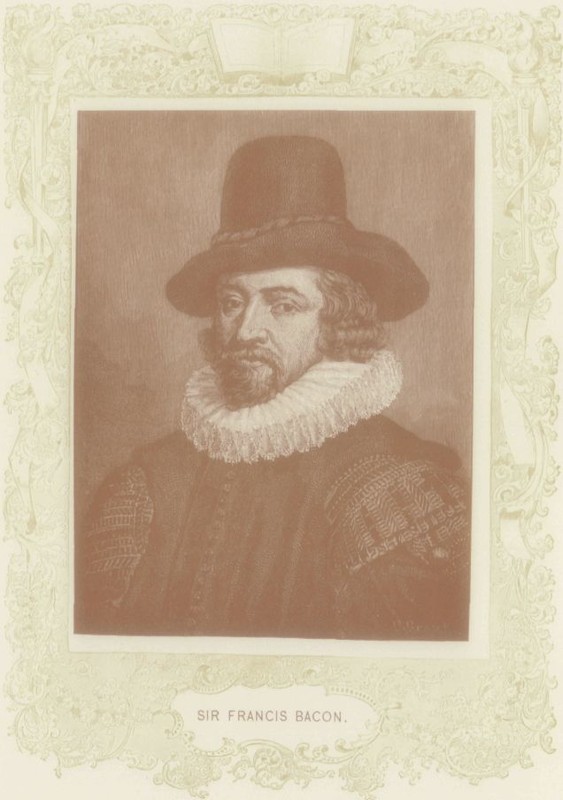
At the age of twelve he entered Trinity College, Cambridge (April, 1573), and left it before he was fifteen (Christmas, 1575); the institution meanwhile having been broken up for more than half a year (August, 1574, to March, 1575) by the plague, so that his intermittent university career summed up less than fourteen months. There is no record of his studies, and the names of his teachers are unknown; for though Bacon in later years called himself a pupil of Whitgift, and his biographers assumed that the relation was direct and personal, yet that great master of Trinity had certainly ended his teaching days before Bacon went to Cambridge, and had entered as Dean of Lincoln on his splendid ecclesiastical career. University life was very different from that of our times. The statutes of Cambridge forbade a student, under penalties, to use in conversation with another any language but Latin, Greek, or Hebrew, unless in his private apartments and in hours of leisure. It was a regular custom at Trinity to bring before the assembled undergraduates every Thursday evening at seven o'clock such junior students as had been detected in breaches of the rules during the week, and to flog them. It would be interesting to know in what languages young Bacon conversed, and what experiences of discipline befell him; but his subsequent achievements at least suggest that Cambridge in the sixteenth century may have afforded more efficient educational influences than our knowledge of its resources and methods can explain. For it is certain that, at an age when our most promising youths are beginning serious study, Bacon's mind was already formed, his habits and modes of research were fixed, the universe of knowledge was an open field before him. Thenceforth he was no man's pupil, but in intellectual independence and solitude he rapidly matured into the supreme scholar of his age.
After registering as a student of law at Gray's Inn, apparently for the purpose of a nominal connection with a profession which might aid his patrons in promoting him at court, Bacon was sent in June, 1576, to France in the train of the British Ambassador, Sir Amyas Paulet; and for nearly three years followed the roving embassy around the great cities of that kingdom. The massacre of St. Bartholomew had taken place four years before, and the boy's recorded observations on the troubled society of France and of Europe show remarkable insight into the character of princes and the sources of political movements. Sir Nicholas had hitherto directed his son's education and associations with the purpose of making him an ornament of the court, and had set aside a fund to provide Francis at the proper time with a handsome estate. But he died suddenly, February 20th, 1579, without giving legal effect to this provision, and the sum designed for the young student was divided equally among the five children, while Francis was excluded from a share in the rest of the family fortune; and was thus called home to England to find himself a poor man.
He made himself a bachelor's home at Gray's Inn, and devoted his energies to the law, with such success that he was soon recognized as one of the most promising members of the profession. In 1584 he entered Parliament for Melcombe Regis in Somersetshire, and two years later sat for Liverpool. During these years the schism between his inner and his outer life continued to widen. Drawing his first breath in the atmosphere of the court, bred in the faith that honor and greatness come from princes' favor, with a native taste for luxury and magnificence which was fostered by delicate health, he steadily looked for advancement through the influence of Burghley and the smiles of the Queen. But Burghley had no sympathy with speculative thought, and distrusted him for his confidences concerning his higher studies, while he probably feared in Bacon a dangerous rival of his own son; so that with expressions of kind interest, he refrained from giving his nephew practical aid. Elizabeth, too, suspected that a young man who knew so many things could not be trusted to know his own business well, and preferred for important professional work others who were lawyers and nothing besides. Thus Bacon appeared to the world as a disappointed and uneasy courtier, struggling to keep up a certain splendor of appearance and associations under a growing load of debt, and servile to a Queen on whose caprice his prospects of a career must depend. His unquestioned power at the bar was exercised only in minor causes; his eloquence and political dexterity found slow recognition in Parliament, where they represented only themselves; and the question whether he would ever be a man of note in the kingdom seemed for twenty-five years to turn upon what the Crown might do for its humble suitor.
Meanwhile this laborious advocate and indefatigable courtier, whose labors at the bar and in attendance upon his great friends were enough to fill the days of two ordinary men, led his real life in secret, unknown to the world, and uncomprehended even by the few in whom he had divined a capacity for great thought, and whom he had selected for his confidants. From his childhood at the university, where he felt the emptiness of the Aristotelian logic, the instrument for attaining truth which traditional learning had consecrated, he had gradually formed the conception of a more fruitful process. He had become convinced that the learning of all past ages was but a poor result of the intellectual capacities and labors which had been employed upon it; that the human mind had never yet been properly used; that the methods hitherto adopted in research were but treadmill work, returning upon itself, or at best could produce but fragmentary and accidental additions to the sum of knowledge. All nature is crammed with truth, he believed, which it concerns man to discover; the intellect of man is constructed for its discovery, and needs but to be purged of errors of every kind, and directed in the most efficient employment of its faculties, to make sure that all the secrets of nature will be revealed, and its powers made tributary to the health, comfort, enjoyment, and progressive improvement of mankind.
This stupendous conception, of a revolution which should transform the world, seems to have taken definite form in Bacon's mind as early as his twenty-fifth year, when he embodied the outline of it in a Latin treatise; which he destroyed in later life, unpublished, as immature, and partly no doubt because he came to recognize in it an unbecoming arrogance of tone, for its title was 'Temporis Partus Maximus' (The Greatest Birth of Time.) But six years later he defines these "vast contemplative ends" in his famous letter to Burghley, asking for preferment which will enable him to prosecute his grand scheme and to employ other minds in aid of it. "For I have taken all knowledge to be my province," he says, "and if I could purge it of two sorts of rovers, whereof the one with frivolous disputations, confutations, and verbosities, the other with blind experiments and auricular traditions and impostures, hath committed so many spoils, I hope I should bring in industrious observations, grounded conclusions, and profitable inventions and discoveries: the best state of that province. This, whether it be curiosity or vain glory, or nature, or (if one take it favorably) philanthropia is so fixed in my mind as it cannot be removed."
This letter reveals the secret of Bacon's life, and all that we know of him, read in the light of it, forms a consistent and harmonious whole. He was possessed by his vast scheme, for a reformation of the intellectual world, and through it, of the world of human experience, as fully as was ever apostle by his faith. Implicitly believing in his own ability to accomplish it, at least in its grand outlines, and to leave at his death the community of mind at work, by the method and for the purposes which he had defined, with the perfection of all science in full view, he subordinated every other ambition to this; and in seeking and enjoying place, power, and wealth, still regarded them mainly as aids in prosecuting his master purpose, and in introducing it to the world. With this clearly in mind, it is easy to understand his subsequent career. Its external details may be read in any of the score of biographies which writers of all grades of merit and demerit have devoted to him, and there is no space for them here. For our purpose it is necessary to refer only to the principal crises in his public life.
Until the death of Elizabeth, Bacon had no place in the royal service worthy of his abilities as a lawyer. Many who, even in the narrowest professional sense, were far inferior to him, were preferred before him. Yet he obtained a position recognized by all, and second only in legal learning to his lifelong rival and constant adversary, Sir Edward Coke. To-day, it is probable that if the two greatest names in the history of the common law were to be selected by the suffrages of the profession, the great majority would be cast for Coke and Bacon. As a master of the intricacies of precedent and an authority upon the detailed formulas of "the perfection of reason," the former is unrivaled still; but in the comprehensive grasp of the law as a system for the maintenance of social order and the protection of individual rights, Bacon rose far above him. The cherished aim of his professional career was to survey the whole body of the laws of England, to produce a digest of them which should result in a harmonious code, to do away with all that was found obsolete or inconsistent with the principles of the system, and thus to adapt the living, progressive body of the law to the wants of the growing nation. This magnificent plan was beyond the power of any one man, had his life no other task, but he suggested the method and the aim; and while for six generations after these legal giants passed away, the minute, accurate, and profound learning of Coke remained the acknowledged chief storehouse of British traditional jurisprudence, the seventh generation took up the work of revision and reform, and from the time of Bentham and Austin the progress of legal science has been toward codification. The contest between the aggregation of empirical rules and formulated customs which Coke taught as the common law, and the broad, harmonious application of scientific reason to the definition and enforcement of rights, still goes on; but with constant gains on the side of the reformers, all of whom with one consent confess that no general and complete reconstruction of legal doctrine as a science is possible, except upon the lines laid down by Bacon.
The most memorable case in which Bacon was employed to represent the Crown during Elizabeth's life was the prosecution of the Earl of Essex for treason. Essex had been Bacon's friend, patron, and benefactor; and as long as the earl remained faithful to the Queen and retained her favor, Bacon served him with ready zeal and splendid efficiency, and showed himself the wisest and most sincere of counselors. When Essex rejected his advice, forfeited the Queen's confidence by the follies from which Bacon had earnestly striven to deter him, and finally plunged into wanton and reckless rebellion, Bacon, with whom loyalty to his sovereign had always been the supreme duty, accepted a retainer from the Crown, and assisted Coke in the prosecution. The crime of Essex was the greatest of which a subject was capable; it lacked no circumstance of aggravation; if the most astounding instance of ingratitude and disloyalty to friendship ever known is to be sought in that age, it will be found in the conduct of Essex to Bacon's royal mistress. Yet writers of eloquence have exhausted their rhetorical powers in denouncing Bacon's faithlessness to his friend. But no impartial reader of the full story in the documents of the time can doubt that throughout these events Bacon did his duty and no more, and that in doing it he not merely made a voluntary sacrifice of his popularity, but a far more painful sacrifice of his personal feelings.
In 1603 James I. came to the throne, and in spite of the efforts of his most trusted ministers to keep Bacon in obscurity, soon discovered in him a man whom he needed. In 1607 he was made Solicitor-General; in 1613 Attorney-General; in March 1617, on the death of Lord Ellesmere, he received the seals as Lord Keeper; and in January following was made Lord Chancellor of England. In July 1618 he was raised to the permanent peerage as Baron Verulam, and in January 1621 received the title of Viscount St. Albans. During these three years he was the first subject in the kingdom in dignity, and ought to have been the first in influence. His advice to the King, and to the Duke of Buckingham who was the King's king, was always judicious. In certain cardinal points of policy, it was of the highest statesmanship; and had it been followed, the history of the Stuart dynasty would have been different, and the Crown and the Parliament would have wrought together for the good and the honor of the nation, at least through a generation to come. But the upstart Buckingham was supreme. He had studied Bacon's strength and weakness, had laid him under great obligations, had at the same time attached him by the strongest tie of friendship to his person, and impressed upon his consciousness the fact that the fate of Bacon was at all times in his hands. The new Chancellor had entered on his great office with a fixed purpose to reform its abuses, to speed and cheapen justice, to free its administration from every influence of wealth and power. In the first three months of service he brought up the large arrears of business, tried every cause, heard every petition, and acquired a splendid reputation as an upright and diligent judge. But Buckingham was his evil angel. He was without sense of the sanctity of the judicial character; and regarded the bench, like every other public office, as an instrument of his own interests and will. On the other hand, to Bacon the voice of Buckingham was the voice of the King, and he had been taught from infancy as the beginning of his political creed that the king can do no wrong. Buckingham began at once to solicit from Bacon favors for his friends and dependants, and the Chancellor was weak enough to listen and to answer him. There is no evidence that in any one instance the favorite asked for the violation of law or the perversion of justice; much less that Bacon would or did accede to such a request. But the Duke demanded for one suitor a speedy hearing, for another a consideration of facts which might not be in evidence, for a third all the favor consistent with law; and Bacon reported to him the result, and how far he had been able to oblige him. This persistent tampering with the source of justice was a disturbing influence in the Chancellor's court, and unquestionably lowered the dignity of his attitude and weakened his judicial conscience.
Notwithstanding this, when the Lord Chancellor opened the Parliament in January, 1621, with a speech in praise of his King and in honor of the nation, he seemed to be at the summit of earthly prosperity. No voice had been lifted to question his purity and worth. He was the friend of the King, one of the chief supports of the throne, a champion indeed of high prerogative, but an orator of power, a writer of fame, whose advancement to the highest dignities had been welcomed by public opinion. Four months later he was a convicted criminal, sentenced for judicial corruption to imprisonment at the King's pleasure, to a fine of £40,000, and to perpetual incapacity for any public employment. Vicissitudes of fortune are commonplaces of history. Many a man once seemingly pinnacled on the top of greatness has "shot from the zenith like a falling star," and become a proverb of the fickleness of fate. Some are torn down by the very traits of mind, passion, or temper, which have raised them: ambition which overleaps itself, rashness which hazards all on chances it cannot control, vast abilities not great enough to achieve the impossible. The plunge of Icarus into the sea, the murder of Caesar, the imprisonment of Coeur de Lion, the abdication of Napoleon, the apprehension as a criminal of Jefferson Davis, each was a startling and impressive contrast to the glory which it followed, yet each was the natural result of causes which lay in the character and life of the sufferer, and made his story a consistent whole. But the pathos of Bacon's fall is the sudden moral ruin of a life which had been built up in honor for sixty years. An intellect of the first rank, which from boyhood to old age had been steadfast in the pursuit of truth and in the noblest services to mankind, which in a feeble body had been sustained in vigor by all the virtues of prudence and self-reverence; a genial nature, winning the affection and admiration of associates, hardly paralleled in the industry with which its energies were devoted to useful work, a soul exceptional among its contemporaries for piety and philanthropy--this man is represented to us by popular writers as having habitually sold justice for money, and as having become in office "the meanest of mankind."
But this picture, as so often drawn, and as seemingly fixed in the popular mind, is not only impossible, but is demonstrably false. To review all the facts which correct it in detail would lead us far beyond our limits. It must suffice to refer to the great work of Spedding, in which the entire records of the case are found, and which would long ago have made the world just to Bacon's fame, but that the author's comment on his own complete and fair record is itself partial and extravagant. But the materials for a final judgment are accessible to all in Spedding's volumes, and a candid reading of them solves the enigma. Bacon was condemned without a trial, on his own confession, and this confession was consistent with the tenor of his life. Its substance was that he had failed to put a stop effectually to the immemorial custom in his court of receiving presents from suitors, but that he had never deviated from justice in his decrees. There was no instance in which he was accused of yielding to the influence of gifts, or passing judgment for a bribe. No act of his as Chancellor was impeached as illegal, or reversed as corrupt. Suitors complained that they had sent sums of money or valuable presents to his court, and had been disappointed in the result; but no one complained of injustice in a decision. Bacon was a conspicuous member of the royal party; and when the storm of popular fury broke in Parliament upon the court, the King and the ministry abandoned him. He had stood all his life upon the royal favor as the basis of his strength and hope; and when it was gone from under him, he sank helplessly, and refused to attempt a defense. But he still in his humiliation found comfort in the reflection that his ruin would put an end to "anything that is in the likeness of corruption" among the judges. And he wrote, in the hour of his deepest distress, that he had been "the justest Chancellor that hath been in the five changes that have been since Sir Nicholas Bacon's time." Nor did any man of his time venture to contradict him, when in later years he summed up his case in the words, "I was the justest judge that was in England these fifty years. But it was the justest censure in Parliament that was these two hundred years."
No revolution of modern times has been more complete than that which the last two centuries have silently wrought in the customary morality of British public life, and in the standards by which it is judged. Under James I. every office of state was held as the private property of its occupant. The highest places in the government were conferred only on condition of large payments to the King. He openly sold the honors and dignities of which he was the source. "The making of a baron," that is, the right to sell to some rich plebeian a patent of nobility, was a common grant to favorites, and was actually bestowed on Bacon, to aid him in maintaining the state of his office. We have the testimony of James himself that all the lawyers, of whom the judges of the realm were made, were "so bred and nursed in corruption that they cannot leave it." But the line between what the King called corruption and that which he and all his ministers practiced openly and habitually, as part of the regular work of government, is dim and hard to define. The mind of the community had not yet firmly grasped the conception of public office as a trust for the public good, and the general opinion which stimulates and sustains the official conscience in holding this trust sacred was still unformed. The courts of justice were the first branch of the government to feel the pressure of public opinion, and to respond to the demand for impersonal and impartial right. But this process had only begun when Bacon, who had never before served as judge, was called to preside in Chancery. The Chancellor's office was a gradual development: originally political and administrative rather than judicial, and with no salary or reward for hearing causes, save the voluntary presents of suitors who asked its interference with the ordinary courts, it step by step became the highest tribunal of the equity which limits and corrects the routine of law, and still the custom of gifts was unchecked. A careful study of Bacon's career shows that in this, as every other branch of thought, his theoretic convictions were in advance of his age; and in his advice to the King and in his inaugural promises as Chancellor, he foreshadows all the principles on which the wisest reformers of the public service now insist. But he failed to apply them with that heroic self-sacrifice which alone would have availed him, and the forces of custom and example continually encroached upon his views of duty. Having through a long life sought advancement and wealth for the purpose of using leisure and independence to carry out his beneficent plans on the largest scale, he eagerly accepted the traditional emoluments of his new position, in the conviction that they would become in his hands the means of vast good to mankind. It was only the public exposure which fully awakened him to a sense of the inconsistency and wrong of his conduct; and then he was himself his severest judge, and made every reparation in his power, by the most unreserved confession, by pointing out the danger to society of such weakness as his own in language to whose effectiveness nothing could be added, and by devoting the remainder of his life to the noblest work for humanity.
During the years of Bacon's splendor as a member of the government and as spokesman for the throne, his real life as a thinker, inspired by the loftiest ambition which ever entered the mind of man, that of creating a new and better civilization, was not interrupted. It was probably in 1603 that he wrote his fragmentary 'Prooemium de Interpretatione Naturae,' or 'Preface to a Treatise on Interpreting Nature,' which is the only piece of autobiography he has left us. It was found among his papers after his death; and its candor, dignity, and enthusiasm of tone are in harmony with the imaginative grasp and magnificent suggestiveness of its thought. Commending the original Latin to all who can appreciate its eloquence, we cite the first sentences of it in English:--
"Believing that I was born for the service of mankind, and regarding the care of the Commonwealth as a kind of common property which, like the air and water, belongs to everybody, I set myself to consider in what way mankind might be best served, and what service I was myself best fitted by nature to perform.
"Now, among all the benefits that could be conferred upon mankind, I found none so great as the discovery of new arts for the bettering of human life. For I saw that among the rude people of early times, inventors and discoverers were reckoned as gods. It was seen that the works of founders of States, law-givers, tyrant-destroyers, and heroes cover but narrow spaces and endure but for a time; while the work of the inventor, though of less pomp, is felt everywhere and lasts forever. But above all, if a man could, I do not say devise some invention, however useful, but kindle a light in nature--a light which, even in rising, should touch and illuminate the borders of existing knowledge, and spreading further on should bring to light all that is most secret--that man, in my view, would be indeed the benefactor of mankind, the extender of man's empire over nature, the champion of freedom, the conqueror of fate.
"For myself, I found that I was fitted for nothing so well as for the study of Truth: as having a mind nimble and versatile enough to discern resemblances in things (the main point), and yet steady enough to distinguish the subtle differences in them; as being endowed with zeal to seek, patience to doubt, love of meditation, slowness of assertion, readiness to reconsider, carefulness to arrange and set in order; and as being a man that affects not the new nor admires the old, but hates all imposture. So I thought my nature had a certain familiarity and kindred with Truth."
During the next two years he applied himself to the composition of the treatise on the 'Advancement of Learning,' the greatest of his English writings, and one which contains the seed-thoughts and outline principles of all his philosophy. From the time of its publication in 1605 to his fall in 1621, he continued to frame the plan of his 'Great Instauration' of human knowledge, and to write out chapters, books, passages, sketches, designed to take their places in it as essential parts. It was to include six great divisions: first, a general survey of existing knowledge; second, a guide to the use of the intellect in research, purging it of sources of error, and furnishing it with the new instrument of inductive logic by which all the laws of nature might be ascertained; third, a structure of the phenomena of nature, included in one hundred and thirty particular branches of natural history, as the materials for the new logic; fourth, a series of types and models of the entire mental process of discovering truth, "selecting various and remarkable instances"; fifth, specimens of the new philosophy, or anticipations of its results, in fragmentary contributions to the sixth and crowning division, which was to set forth the new philosophy in its completeness, comprehending the truths to be discovered by a perfected instrument of reasoning, in interpreting all the phenomena of the world. Well aware that the scheme, especially in its concluding part, was far beyond the power and time of any one man, he yet hoped to be the architect of the final edifice of science, by drawing its plans and making them intelligible, leaving their perfect execution to an intellectual world which could not fail to be moved to its supreme effort by a comprehension of the work before it. The 'Novum Organum,' itself but a fragment of the second division of the 'Instauration,' the key to the use of the intellect in the discovery of truth, was published in Latin at the height of his splendor as Lord Chancellor, in 1620, and is his most memorable achievement in philosophy. It contains a multitude of suggestive thoughts on the whole field of science, but is mainly the exposition of the fallacies by which the intellect is deceived and misled, and from which it must be purged in order to attain final truth, and of the new doctrine of "prerogative instances," or crucial observations and experiments in the work of discovery.
In short, Bacon's entire achievement in science is a plan for an impossible universe of knowledge. As far as he attempted to advance particular sciences by applying his method to their detailed phenomena, he wrought with imperfect knowledge of what had been done, and with cumbrous and usually misdirected efforts to fill the gaps he recognized. In a few instances, by what seems an almost superhuman instinct for truth, rather than the laborious process of investigation which he taught, he anticipated brilliant discoveries of later centuries. For example, he clearly pointed out the necessity of regarding heat as a form of motion in the molecules of matter, and thus foreshadowed, without any conception of the means of proving it, that which, for investigators of the nineteenth century, has proved the most direct way to the secrets of nature. But the testimony of the great teachers of science is unanimous, that Bacon was not a skilled observer of phenomena, nor a discoverer of scientific inductions; that he contributed no important new truth, in the sense of an established law, to any department of knowledge; and that his method of research and reasoning is not, in its essential features, that which is fruitfully pursued by them in extending the boundaries of science, nor was his mind wholly purged of those "idols of the cave," or forms of personal bias, whose varying forms as hindrances to the "dry light" of sound reason he was the first to expose. He never appreciated the mathematics as the basis of physics, but valued their elements mainly as a mental discipline. Astronomy meant little to him, since he failed to connect it directly with human well-being and improvement; to the system of Copernicus, the beginning of our insight into the heavens, he was hostile, or at least indifferent; and the splendid discoveries successively made by Tycho Brahe, Galileo, and Kepler, and brought to his ears while the 'Great Instauration' filled his mind and heart, met with but a feeble welcome with him, or none. Why is it, then, that Bacon's is the foremost name in the history of English, and perhaps, as many insist, of all modern thought? Why is it that "the Baconian philosophy" is another phrase, in all the languages of Europe, for that splendid development of the study and knowledge of the visible universe which since his time has changed the life of mankind?
A candid answer to these questions will expose an error as wide in the popular estimate of Bacon's intellectual greatness as that which has prevailed so generally regarding his character. He is called the inventor of inductive reasoning, the reformer of logic, the lawgiver of the world of thought; but he was no one of these. His grasp of the inductive method was defective; his logic was clumsy and impractical; his plan for registering all phenomena and selecting and generalizing from them, making the discovery of truth almost a mechanical process, was worthless. In short, it is not as a philosopher nor as a man of science that Bacon has carved his name in the high places of enduring fame, but rather as a man of letters; as on the whole the greatest writer of the modern world, outside of the province of imaginative art; as the Shakespeare of English prose. Does this seem a paradox to the reader who remembers that Bacon distrusted all modern languages, and thought to make his 'Advancement of Learning' "live, and be a citizen of the world," by giving it a Latin form? That his lifelong ambition was to reconstruct methods of thought, and guide intellect in the way of work serviceable to comfort and happiness? That the books in which his English style appears in its perfection, the 'History of Henry VII.,' the 'Essays,' and the papers on public affairs, were but incidents and avocations of a life absorbed by a master purpose?
But what is literature? It is creative mind, addressing itself in worthy expression to the common receptive mind of mankind. Its note is universality, as distinguished from all that is technical, limited, and narrow. Thought whose interest is as broad as humanity, suitably clothed in the language of real life, and thus fitted for access to the general intelligence, constitutes true literature, to the exclusion of that which, by its nature or by its expression, appeals only to a special class or school. The 'Opus Anglicanum' of Duns Scotus, Newton's 'Principia,' Lavoisier's treatise 'Sur la Combustion,' Kant's 'Kritik der Reinen Vernunft' (Critique of Pure Reason), each made an epoch in some vast domain of knowledge or belief; but none of them is literature. Yet the thoughts they, through a limited and specially trained class of students, introduced to the world, were gradually taken up into the common stock of mankind, and found their broad, effective, complete expression in the literature of after generations. If we apply this test to Bacon's life work, we shall find sufficient justification for honoring him above all special workers in narrower fields, as next to Shakespeare the greatest name in the greatest period of English literature.
It was not as an experimenter, investigator, or technical teacher, but as a thinker and a writer, that he rendered his great service to the world. This consisted essentially in the contribution of two magnificent ideas to the common stock of thought: the idea of the utility of science, as able to subjugate the forces of nature to the use of man; and the idea of continued and boundless progress in the comfort and happiness of the individual life, and in the order and dignity of human society. It has been shown how, from early manhood, he was inspired by the conception of infinite resources in the material world, for the discovery and employment of which the human mind is adapted. He never wearied of pointing out the imperfection and fruitlessness of the methods of inquiry and of invention hitherto in use, and the splendid results which could be rapidly attained if a combined and systematic effort were made to enlarge the boundaries of knowledge. This led him directly to the conception of an improved and advancing civilization; to the utterance, in a thousand varied, impressive, and fascinating forms, of that idea of human progress which is the inspiration, the characteristic, and the hope of the modern world. Bacon was the first of men to grasp these ideas in all their comprehensiveness as feasible purposes, as practical aims; to teach the development of them as the supreme duty and ambition of his contemporaries, and to look forward instead of behind him for the Golden Age. Enforcing and applying these thoughts with a wealth of learning, a keenness of wit, a soundness of judgment, and a suggestiveness of illustration unequaled by any writer before him, he became the greatest literary power of modern times to stimulate minds in every department of life to their noblest efforts and their worthiest achievements.
Literature has a twofold aspect: its ideal is pure truth, which is the noblest thought embodied in perfect beauty of form. It is the union of science and art, the final wedding in which are merged the knowledge worthy to be known and the highest imagination presenting it. There is a school calling itself that of pure art, to which substance is nothing and form is everything. Its measure of merit is applied to the manner only; and the meanest of subjects, the most trivial and even the most degraded of ideas or facts, is welcomed to its high places if clothed in a satisfying garb. But this school, though arrogant in the other arts of expression, has not yet been welcomed to the judgment-seat in literature, where indeed it is passing even now to contempt and oblivion. Bacon's instinct was for substance. His strongest passion was for utility. The artistic side of his nature was receptive rather than creative. Splendid passages in the 'Advancement' and 'De Augmentis' show his profound appreciation of all the arts of expression, but show likewise his inability to glorify them above that which they express. In his mind, language is subordinate to thought, and the painting to the picture, just as the frame is to the painting or the binding to the book. He writes always in the grand style. He reminds us of "the large utterance of the early gods." His sentences are weighted with thought, as suggestive as Plato, as condensed as Thucydides. Full of wit, keen in discerning analogies, rich in intellectual ornament, he is yet too concentrated in his attention to the idea to care for the melody of language. He decorates with fruits, not with flowers. For metrical movement, for rhythmic harmony, he has no ear nor sense. Inconceivable as it is that Shakespeare could have written one aphorism of the 'Novum Organum,' it would be far more absurd to imagine Bacon writing a line of the Sonnets. With the loftiest imagination, the liveliest fancy, the keenest sense of precision and appropriateness in words, he lacks the special gift of poetic form, the faculty divine which finds new inspiration in the very limitations of measured language, and whose natural expression is music alike to the ear and to the mind. His powers were cramped by the fetters of metre, and his attempts to versify even rich thought and deep feeling were puerile. But his prose is by far the weightiest, the most lucid, effective, and pleasing of his day. The poet Sprat justly says:--
"He was a man of strong, clear, and powerful imaginations; his genius was searching and inimitable; and of this I need give no other proof than his style itself, which as for the most part it describes men's minds as well as pictures do their bodies, so it did his above all men living."
And Ben Jonson, who knew him well, describes his eloquence in terms which are confirmed by all we know of his Parliamentary career:--
"One, though he be excellent and the chief, is not to be imitated alone; for no imitator ever grew up to his author: likeness is always on this side truth. Yet there happened in my time one noble speaker, who was full of gravity in his speaking. His language (when he could spare or pass by a jest) was nobly censorious. No man ever spake more neatly, more rightly, more weightily, or suffered less emptiness, less idleness in what he uttered. No member of his speech but consisted of his own graces. His hearers could not cough or look aside from him without loss. He commanded when he spoke, and had his judges angry and pleased at his devotion. No man had their affections more in his power. The fear of every man that heard him was lest he should make an end."
The speeches of Bacon are almost wholly lost, his philosophy is an undeciphered heap of fragments, the ambitions of his life lay in ruins about his dishonored old age; yet his intellect is one of the great moving and still vital forces of the modern world, and he remains, for all ages to come, in the literature which is the final storehouse of the chief treasures of mankind, one of
"The dead yet sceptered sovereigns who still rule
Our spirits from their urns."