автордың кітабын онлайн тегін оқу Library of the World's Best Literature, Ancient and Modern — Volume 1
E-text prepared by Juliet Sutherland, Charlie Kirschner,
and the Project Gutenberg Online Distributed Proofreading Team
LIBRARY OF THE
WORLD'S BEST LITERATURE
ANCIENT AND MODERN
VOL. I.
CHARLES DUDLEY WARNER
EDITOR
HAMILTON WRIGHT MABIE
LUCIA GILBERT RUNKLE
GEORGE HENRY WARNER
ASSOCIATE EDITORS
Connoisseur Edition
PREFACE
he plan of this Work is simple, and yet it is novel. In its distinctive features it differs from any compilation that has yet been made. Its main purpose is to present to American households a mass of good reading. But it goes much beyond this. For in selecting this reading it draws upon all literatures of all time and of every race, and thus becomes a conspectus of the thought and intellectual evolution of man from the beginning. Another and scarcely less important purpose is the interpretation of this literature in essays by scholars and authors competent to speak with authority.
The title, "A Library of the World's Best Literature," is strictly descriptive. It means that what is offered to the reader is taken from the best authors, and is fairly representative of the best literature and of all literatures. It may be important historically, or because at one time it expressed the thought and feeling of a nation, or because it has the character of universality, or because the readers of to-day will find it instructive, entertaining, or amusing. The Work aims to suit a great variety of tastes, and thus to commend itself as a household companion for any mood and any hour. There is no intention of presenting merely a mass of historical material, however important it is in its place, which is commonly of the sort that people recommend others to read and do not read themselves. It is not a library of reference only, but a library to be read. The selections do not represent the partialities and prejudices and cultivation of any one person, or of a group of editors even; but, under the necessary editorial supervision, the sober judgment of almost as many minds as have assisted in the preparation of these volumes. By this method, breadth of appreciation has been sought.
The arrangement is not chronological, but alphabetical, under the names of the authors, and, in some cases, of literatures and special subjects. Thus, in each volume a certain variety is secured, the heaviness or sameness of a mass of antique, classical, or mediaeval material is avoided, and the reader obtains a sense of the varieties and contrasts of different periods. But the work is not an encyclopaedia, or merely a dictionary of authors. Comprehensive information as to all writers of importance may be included in a supplementary reference volume; but the attempt to quote from all would destroy the Work for reading purposes, and reduce it to a herbarium of specimens.
In order to present a view of the entire literary field, and to make these volumes especially useful to persons who have not access to large libraries, as well as to treat certain literatures or subjects when the names of writers are unknown or would have no significance to the reader, it has been found necessary to make groups of certain nationalities, periods, and special topics. For instance, if the reader would like to know something of ancient and remote literatures which cannot well be treated under the alphabetical list of authors, he will find special essays by competent scholars on the Accadian-Babylonian literature, on the Egyptian, the Hindu, the Chinese, the Japanese, the Icelandic, the Celtic, and others, followed by selections many of which have been specially translated for this Work. In these literatures names of ascertained authors are given in the Index. The intention of the essays is to acquaint the reader with the spirit, purpose, and tendency of these writings, in order that he may have a comparative view of the continuity of thought and the value of tradition in the world. Some subjects, like the Arthurian Legends, the Nibelungen Lied, the Holy Grail, Provençal Poetry, the Chansons and Romances, and the Gesta Romanorum, receive a similar treatment. Single poems upon which the authors' title to fame mainly rests, familiar and dear hymns, and occasional and modern verse of value, are also grouped together under an appropriate heading, with reference in the Index whenever the poet is known.
It will thus be evident to the reader that the Library is fairly comprehensive and representative, and that it has an educational value, while offering constant and varied entertainment. This comprehensive feature, which gives the Work distinction, is, however, supplemented by another of scarcely less importance; namely, the critical interpretive and biographical comments upon the authors and their writings and their place in literature, not by one mind, or by a small editorial staff, but by a great number of writers and scholars, specialists and literary critics, who are able to speak from knowledge and with authority. Thus the Library becomes in a way representative of the scholarship and wide judgment of our own time. But the essays have another value. They give information for the guidance of the reader. If he becomes interested in any selections here given, and would like a fuller knowledge of the author's works, he can turn to the essay and find brief observations and characterizations which will assist him in making his choice of books from a library.
The selections are made for household and general reading; in the belief that the best literature contains enough that is pure and elevating and at the same time readable, to satisfy any taste that should be encouraged. Of course selection implies choice and exclusion. It is hoped that what is given will be generally approved; yet it may well happen that some readers will miss the names of authors whom they desire to read. But this Work, like every other, has its necessary limits; and in a general compilation the classic writings, and those productions that the world has set its seal on as among the best, must predominate over contemporary literature that is still on its trial. It should be said, however, that many writers of present note and popularity are omitted simply for lack of space. The editors are compelled to keep constantly in view the wider field. The general purpose is to give only literature; and where authors are cited who are generally known as philosophers, theologians, publicists, or scientists, it is because they have distinct literary quality, or because their influence upon literature itself has been so profound that the progress of the race could not be accounted for without them.
These volumes contain not only or mainly the literature of the past, but they aim to give, within the limits imposed by such a view, an idea of contemporary achievement and tendencies in all civilized countries. In this view of the modern world the literary product of America and Great Britain occupies the largest space.
It should be said that the plan of this Work could not have been carried out without the assistance of specialists in many departments of learning, and of writers of skill and insight, both in this country and in Europe. This assistance has been most cordially given, with a full recognition of the value of the enterprise and of the aid that the Library may give in encouraging and broadening literary tastes. Perhaps no better service could be rendered the American public at this period than the offer of an opportunity for a comprehensive study of the older and the greater literatures of other nations. By this comparison it can gain a just view of its own literature, and of its possible mission in the world of letters.

THE ADVISORY COUNCIL
CRAWFORD H. TOY, A.M., LL.D.,
Professor of Hebrew,
HARVARD UNIVERSITY, Cambridge, Mass.
THOMAS R. LOUNSBURY, LL.D., L.H.D.,
Professor of English in the Sheffield Scientific School of
YALE UNIVERSITY, New Haven, Conn.
WILLIAM M. SLOANE, PH.D., L.H.D.,
Professor of History and Political Science,
PRINCETON UNIVERSITY, Princeton, N.J.
BRANDER MATTHEWS, A.M., LL.B.,
Professor of Literature,
COLUMBIA UNIVERSITY, New York City.
JAMES B. ANGELL, LL.D.,
President of the
UNIVERSITY OF MICHIGAN, Ann Arbor, Mich.
WILLARD FISKE, A.M., PH.D.,
Late Professor of the Germanic and Scandinavian Languages and Literatures,
CORNELL UNIVERSITY, Ithaca, N.Y.
EDWARD S. HOLDEN, A.M., LL.D.,
Director of the Lick Observatory, and Astronomer
UNIVERSITY OF CALIFORNIA, Berkeley, Cal.
ALCÉE FORTIER, LIT.D.,
Professor of the Romance Languages,
TULANE UNIVERSITY, New Orleans, La.
WILLIAM P. TRENT, M.A.,
Dean of the Department of Arts and Sciences, and Professor of English and History,
UNIVERSITY OF THE SOUTH, Sewanee, Tenn.
PAUL SHOREY, PH.D.,
Professor of Greek and Latin Literature,
UNIVERSITY OF CHICAGO, Chicago, Ill.
WILLIAM T. HARRIS, LL.D.,
United States Commissioner of Education,
BUREAU OF EDUCATION, Washington, D.C.
MAURICE FRANCIS EGAN, A.M., LL.D.,
Professor of Literature in the
CATHOLIC UNIVERSITY OF AMERICA, Washington, D.C.
NOTE OF ACKNOWLEDGMENT

wing to the many changes in the assignment of topics and engaging of writers incident to so extended a publication as the Library of the World's Best Literature, the Editor finds it impossible, before the completion of the work, adequately to recognize the very great aid which he has received from a large number of persons. A full list of contributors will be given in one of the concluding volumes. He will expressly acknowledge also his debt to those who have assisted him editorially, or in other special ways, in the preparation of these volumes.
Both Editor and Publishers have endeavored to give full credit to every author quoted, and to accompany every citation with ample notice of copyright ownership. At the close of the work it is their purpose to express in a more formal way their sense of obligation to the many publishers who have so courteously given permission for this use of their property, and whose rights of ownership it is intended thoroughly to protect.
TABLE OF CONTENTS
VOL. I
ABÉLARD AND HÉLOISE (by Thomas Davidson) -- 1079-1142
Letter of Héloise to Abélard
Abélard's Answer to Héloise
Vesper Hymn of Abélard
EDMOND ABOUT -- 1828-1885
The Capture ('The King of the Mountains')
Hadgi-Stavros (same)
The Victim ('The Man with the Broken Ear')
The Man without a Country (same)
ACCADIAN-BABYLONIAN AND ASSYRIAN LITERATURE (by Crawford H. Toy)
Theogony
Revolt of Tiamat
Descent to the Underworld
The Flood
The Eagle and the Snake
The Flight of Etana
The God Zu
Adapa and the Southwind
Penitential Psalms
Inscription of Sennacherib
Invocation to the Goddess Beltis
Oracles of Ishtar of Arbela
An Erechite's Lament
ABIGAIL ADAMS (by Lucia Gilbert Runkle) -- 1744-1818
Letters--To her Husband:
May 24, 1775; June 15, 1775; June 18, 1775;
Nov. 27, 1775; April 20, 1777; June 8, 1779
To her Sister:
Sept. 5, 1784; May 10, 1785;
July 24, 1784; June 24, 1785
To her Niece
HENRY ADAMS -- 1838-
Auspices of the War of 1812
What the War of 1812 Demonstrated
Battle between the Constitution and the Guerrière
JOHN ADAMS -- 1735-1826
At the French Court ('Diary')
Character of Franklin (Letter to the Boston Patriot)
JOHN QUINCY ADAMS -- 1767-1848
Letter to his Father, at the Age of Ten
From the Memoirs, at the Age of Eighteen
From the Memoirs, Jan. 14, 1831; June 7, 1833; Sept. 9, 1833
The Mission of America (Fourth of July Oration, 1821)
The Right of Petition (Speech in Congress)
Nullification (Fourth of July Oration, 1831)
SARAH FLOWER ADAMS -- 1805-1848
He Sendeth Sun, He Sendeth Shower
Nearer, My God, to Thee
JOSEPH ADDISON (by Hamilton Wright Mabie) -- 1672-1720
Sir Roger de Coverley at the Play
Visit to Sir Roger de Coverley
Vanity of Human Life
Essay on Fans
Hymn, 'The Spacious Firmament'
AELIANUS CLAUDIUS -- Second Century
Of Certain Notable Men that made themselves Playfellowes with Children
Of a Certaine Sicilian whose Eyesight was Woonderfull Sharpe and Quick
The Lawe of the Lacedaemonians against Covetousness
That Sleep is the Brother of Death, and of Gorgias drawing to his End
Of the Voluntary and Willing Death of Calanus
Of Delicate Dinners, Sumptuous Suppers, and Prodigall Banqueting
Of Bestowing Time, and how Walking Up and Downe was not Allowable among the Lacedaemonians
How Socrates Suppressed the Pryde and Hautinesse of Alcibiades
Of Certaine Wastgoodes and Spendthriftes
AESCHINES -- B.C. 389-314
A Defense and an Attack ('Oration against Ctesiphon')
AESCHYLUS (by John Williams White) -- B.C. 525-456
Complaint of Prometheus ('Prometheus')
Prayer to Artemis ('The Suppliants')
Defiance of Eteocles ('The Seven against Thebes')
Vision of Cassandra ('Agamemnon')
Lament of the Old Nurse ('The Libation-Pourers')
Decree of Athena ('The Eumenides')
AESOP (by Harry Thurston Peck) -- Seventh Century B.C.
The Fox and the Lion
The Ass in the Lion's Skin
The Ass Eating Thistles
The Wolf in Sheep's Clothing
The Countryman and the Snake
The Belly and the Members
The Satyr and the Traveler
The Lion and the other Beasts
The Ass and the Little Dog
The Country Mouse and the City Mouse
The Dog and the Wolf
JEAN LOUIS RODOLPHE AGASSIZ -- 1807-1873
The Silurian Beach ('Geological Sketches')
Voices ('Methods of Study in Natural History')
Formation of Coral Reefs (same)
AGATHIAS -- A.D. 536-581
Apostrophe to Plutarch
GRACE AGUILAR -- 1816-1847
Greatness of Friendship ('Woman's Friendship')
Order of Knighthood ('The Days of Bruce')
Culprit and Judge ('Home Influence')
WILLIAM HARRISON AINSWORTH -- 1805-1882
Students of Paris ('Crichton')
MARK AKENSIDE -- 1721-1770
From the Epistle to Curio
Aspirations after the Infinite ('Pleasures of the Imagination')
On a Sermon against Glory
PEDRO ANTONIO DE ALARCÓN -- 1833-1891
A Woman Viewed from Without ('The Three-Cornered Hat')
How the Orphan Manuel gained his Sobriquet ('The Child of the Ball')
ALCAEUS -- Sixth Century B.C.
The Palace
A Banquet Song
An Invitation
The Storm
The Poor Fisherman
The State
Poverty
BALTÁZAR DE ALCÁZAR -- 1530?-1606
Sleep
The Jovial Supper
ALCIPHRON (by Harry Thurston Peck) -- Second Century
From a Mercenary Girl--Petala to Simalion
Pleasures of Athens--Euthydicus to Epiphanio
From an Anxious Mother--Phyllis to Thrasonides
From a Curious Youth--Philocomus to Thestylus
From a Professional Diner-out--Capnosphrantes to Aristomachus
Unlucky Luck--Chytrolictes to Patellocharon
ALCMAN -- Seventh Century B.C.
Poem on Night
LOUISA MAY ALCOTT -- 1832-1888
The Night Ward ('Hospital Sketches')
Amy's Valley of Humiliation ('Little Women')
Thoreau's Flute (Atlantic Monthly)
Song from the Suds ('Little Women')
ALCUIN (by William H. Carpenter) -- 735?-8o4
On the Saints of the Church at York ('Alcuin and the Rise of the Christian Schools')
Disputation between Pepin, the Most Noble and Royal Youth, and Albinus the Scholastic
A Letter from Alcuin to Charlemagne
HENRY M. ALDEN -- 1836-
A Dedication--To My Beloved Wife ('A Study of Death')
The Dove and the Serpent (same)
Death and Sleep (same)
The Parable of the Prodigal (same)
THOMAS BAILEY ALDRICH -- 1837-
Destiny
Identity
Prescience
Alec Yeaton's Son
Memory
Tennyson (1890)
Sweetheart, Sigh No More
Broken Music
Elmwood
Sea Longings
A Shadow of the Night
Outward Bound
Reminiscence
Père Antoine's Date-Palm
Miss Mehetabel's Son
ALEARDO ALEARDI -- 1812-1878
Cowards ('The Primal Histories')
The Harvesters ('Monte Circello')
The Death of the Year ('An Hour of My Youth')
JEAN LE ROND D'ALEMBERT -- 1717-1783
Montesquieu (Eulogy in the 'Encyclopédie')
VITTORIO ALFIERI (by L. Oscar Kuhns) -- 1749-1803
Scenes from 'Agamemnon'
ALFONSO THE WISE -- 1221-1284
What Meaneth a Tyrant, and How he Useth his Power ('Las Siete Partidas')
On the Turks, and Why they are So Called ('La Gran Conquista de Ultramar')
To the Month of Mary ('Cantigas')
ALFRED THE GREAT -- 849-901
King Alfred on King-Craft
Alfred's Preface to the Version of Pope Gregory's 'Pastoral Care'
From Boethius
Blossom Gatherings from St. Augustine
CHARLES GRANT ALLEN -- 1848-
The Coloration of Flowers ('The Colors of Flowers')
Among the Heather ('The Evolutionist at Large')
The Heron's Haunt ('Vignettes from Nature')
JAMES LANE ALLEN -- 1850-
A Courtship ('A Summer in Arcady')
Old King Solomon's Coronation ('Flute and Violin')
WILLIAM ALLINGHAM -- 1828-1889
The Ruined Chapel
The Winter Pear
O Spirit of the Summer-time
The Bubble
St. Margaret's Eve
The Fairies
Robin Redbreast
An Evening
Daffodil
Lovely Mary Donnelly
KARL JONAS LUDVIG ALMQUIST -- 1793-1866
Characteristics of Cattle
A New Undine (from 'The Book of the Rose')
God's War
JOHANNA AMBROSIUS -- 1854-
A Peasant's Thoughts
Struggle and Peace
Do Thou Love, Too!
Invitation
EDMONDO DE AMICIS -- 1846-
The Light ('Constantinople')
Resemblances (same)
Birds (same)
Cordova ('Spain')
The Land of Pluck ('Holland and Its People')
The Dutch Masters ('Holland and Its People')
HENRI FRÉDÉRIC AMIEL (by Richard Burton) -- 1821-1881
Extracts from Amiel's Journal:
Christ's Real Message
Duty
Joubert
Greeks vs. Moderns
Nature, and Teutonic and Scandinavian Poetry
Training of Children
Mozart and Beethoven
FULL-PAGE ILLUSTRATIONS
VOLUME I.
The Book of the Dead (Colored Plate).
First English Printing (Fac-simile).
Assyrian Clay Tablet (Fac-simile).
John Adams (Portrait).
John Quincy Adams (Portrait).
Joseph Addison (Portrait).
Louis Agassiz (Portrait).
"Poetry" (Photogravure).
Vittorio Alfieri (Portrait).
"A Courtship" (Photogravure).
"A Dutch Girl" (Photogravure).
VIGNETTE PORTRAITS
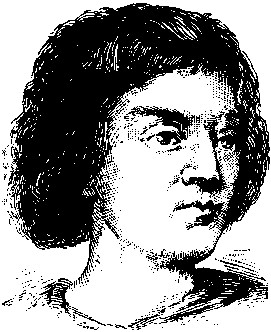
Pierre Abélard.
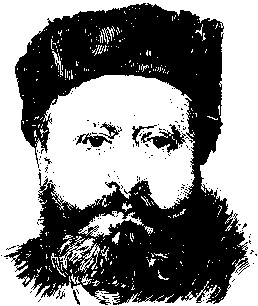
Edmond About.
Abigail Adams.
Aeschines.
Aeschylus.
Aesop.
Grace Aguilar.
William Harrison Ainsworth.
Mark Akenside.
Alcaeus.
Louisa May Alcott.
Thomas Bailey Aldrich.
Jean le Rond D'Alembert.
Edmondo de Amicis.
Books are not absolutely dead things, but do contain a potency of life in them to be as active as that soul was whose progeny they are; nay, they do preserve as in a vial the purest efficacy and extraction of that living intellect that bred them. I know they are as lively, and as vigorously productive, as those fabulous dragon's teeth; and being sown up and down, may chance to spring up armed men. And yet on the other hand, unless wariness be used, as good almost kill a man as kill a good book: who kills a man kills a reasonable creature, God's image; but he who destroys a good book, kills reason itself, kills the image of God, as it were in the eye. Many a man lives a burden to the earth; but a good book is the precious life-blood of a master-spirit, embalmed and treasured up on purpose to a life beyond life.
JOHN MILTON.
CAXTON.
Reduced facsimile of the first page of the only copy extant of
GODEFREY OF BOLOYNE
or
LAST SIEGE AND CONQUESTE OF JHERUSALEM.
The Prologue, at top of page, begins:
Here begynneth the boke Intituled Eracles, and also Godefrey of Boloyne,
the whiche speketh of the Conquest of the holy lande of Jherusalem.
Printed by Caxton, London, 1481. In the British Museum.
A good specimen page of the earliest English printing. Caxton's first
printed book, and the first book printed in English, was "The Game and
Play of the Chess," which was printed in 1474. The blank
space on this page was for the insertion by
hand of an illuminated initial T.
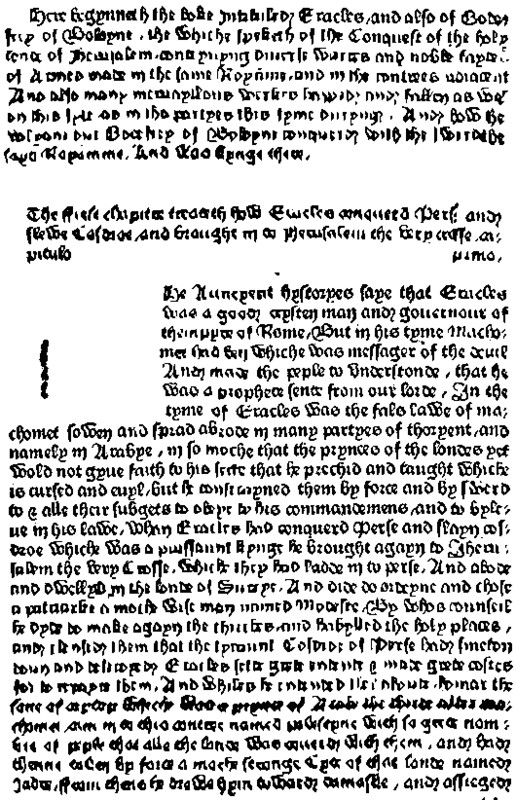
First English Printing (Fac-simile).
ABÉLARD
(1079--1142)
BY THOMAS DAVIDSON

ierre, the eldest son of Bérenger and Lucie (Abélard?) was born at Palais, near Nantes and the frontier of Brittany, in 1079. His knightly father, having in his youth been a student, was anxious to give his family, and especially his favorite Pierre, a liberal education. The boy was accordingly sent to school, under a teacher who at that time was making his mark in the world,--Roscellin, the reputed father of Nominalism. As the whole import and tragedy of his life may be traced back to this man's teaching, and the relation which it bore to the thought of the time, we must pause to consider these.
In the early centuries of our era, the two fundamental articles of the Gentile-Christian creed, the Trinity and the Incarnation, neither of them Jewish, were formulated in terms of Platonic philosophy, of which the distinctive tenet is, that the real and eternal is the universal, not the individual. On this assumption it was possible to say that the same real substance could exist in three, or indeed in any number of persons. In the case of God, the dogma-builders were careful to say, essence is one with existence, and therefore in Him the individuals are as real as the universal. Platonism, having lent the formula for the Trinity, became the favorite philosophy of many of the Church fathers, and so introduced into Christian thought and life the Platonic dualism, that sharp distinction between the temporal and the eternal which belittles the practical life and glorifies the contemplative.
This distinction, as aggravated by Neo-Platonism, further affected Eastern Christianity in the sixth century, and Western Christianity in the ninth, chiefly through the writings of (the pseudo-) Dionysius Areopagita, and gave rise to Christian mysticism. It was then erected into a rule of conduct through the efforts of Pope Gregory VII., who strove to subject practical and civil life entirely to the control of ecclesiastics and monks, standing for contemplative, supernatural life. The latter included all purely mental work, which more and more tended to concentrate itself upon religion and confine itself to the clergy. In this way it came to be considered an utter disgrace for any man engaged in mental work to take any part in the institutions of civil life, and particularly to marry. He might indeed enter into illicit relations, and rear a family of "nephews" and "nieces," without losing prestige; but to marry was to commit suicide. Such was the condition of things in the days of Abélard.
But while Platonism, with its real universals, was celebrating its ascetic, unearthly triumphs in the West, Aristotelianism, which maintains that the individual is the real, was making its way in the East. Banished as heresy beyond the limits of the Catholic Church, in the fifth and sixth centuries, in the persons of Nestorius and others, it took refuge in Syria, where it flourished for many years in the schools of Edessa and Nisibis, the foremost of the time. From these it found its way among the Arabs, and even to the illiterate Muhammad, who gave it (1) theoretic theological expression in the cxii. surah of the Koran: "He is One God, God the Eternal; He neither begets nor is begotten; and to Him there is no peer," in which both the fundamental dogmas of Christianity are denied, and that too on the ground of revelation; (2) practical expression, by forbidding asceticism and monasticism, and encouraging a robust, though somewhat coarse, natural life. Islam, indeed, was an attempt to rehabilitate the human.
In Abélard's time Arab Aristotelianism, with its consequences for thought and life, was filtering into Europe and forcing Christian thinkers to defend the bases of their faith. Since these, so far as defensible at all, depended upon the Platonic doctrine of universals, and this could be maintained only by dialectic, this science became extremely popular,--indeed, almost the rage. Little of the real Aristotle was at that time known in the West; but in Porphyry's Introduction to Aristotle's Logic was a famous passage, in which all the difficulties with regard to universals were stated without being solved. Over this the intellectual battles of the first age of Scholasticism were fought. The more clerical and mystic thinkers, like Anselm and Bernard, of course sided with Plato; but the more worldly, robust thinkers inclined to accept Aristotle, not seeing that his doctrine is fatal to the Trinity.
Prominent among these was a Breton, Roscellin, the early instructor of Abélard. From him the brilliant, fearless boy learnt two terrible lessons: (1) that universals, instead of being real substances, external and superior to individual things, are mere names (hence Nominalism) for common qualities of things as recognized by the human mind; (2) that since universals are the tools and criteria of thought, the human mind, in which alone these exist, is the judge of all truth,--a lesson which leads directly to pure rationalism, and indeed to the rehabilitation of the human as against the superhuman. No wonder that Roscellin came into conflict with the church authorities, and had to flee to England. Abélard afterwards modified his nominalism and behaved somewhat unhandsomely to him, but never escaped from the influence of his teaching. Abélard was a rationalist and an asserter of the human. Accordingly, when, definitely adopting the vocation of the scholar, he went to Paris to study dialectic under the then famous William of Champeaux, a declared Platonist, or realist as the designation then was, he gave his teacher infinite trouble by his subtle objections, and not seldom got the better of him.
These victories, which made him disliked both by his teacher and his fellow-pupils, went to increase his natural self-appreciation, and induced him, though a mere youth, to leave William and set up a rival school at Mélun. Here his splendid personality, his confidence, and his brilliant powers of reasoning and statement, drew to him a large number of admiring pupils, so that he was soon induced to move his school to Corbeil, near Paris, where his impetuous dialectic found a wider field. Here he worked so hard that he fell ill, and was compelled to return home to his family. With them he remained for several years, devoting himself to study,--not only of dialectic, but plainly also of theology. Returning to Paris, he went to study rhetoric under his old enemy, William of Champeaux, who had meanwhile, to increase his prestige, taken holy orders, and had been made bishop of Châlons. The old feud was renewed, and Abélard, being now better armed than before, compelled his master openly to withdraw from his extreme realistic position with regard to universals, and assume one more nearly approaching that of Aristotle.
This victory greatly diminished the fame of William, and increased that of Abélard; so that when the former left his chair and appointed a successor, the latter gave way to Abélard and became his pupil (1113). This was too much for William, who removed his successor, and so forced Abélard to retire again to Mélun. Here he remained but a short time; for, William having on account of unpopularity removed his school from Paris Abélard returned thither and opened a school outside the city, on Mont Ste. Généviève. William, hearing this, returned to Paris and tried to put him down, but in vain. Abélard was completely victorious.
After a time he returned once more to Palais, to see his mother, who was about to enter the cloister, as his father had done some time before. When this visit was over, instead of returning to Paris to lecture on dialectic, he went to Laon to study theology under the then famous Anselm. Here, convinced of the showy superficiality of Anselm, he once more got into difficulty, by undertaking to expound a chapter of Ezekiel without having studied it under any teacher. Though at first derided by his fellow-students, he succeeded so well as to draw a crowd of them to hear him, and so excited the envy of Anselm that the latter forbade him to teach in Laon. Abélard accordingly returned once more to Paris, convinced that he was fit to shine as a lecturer, not only on dialectic, but also on theology. And his audiences thought so also; for his lectures on Ezekiel were very popular and drew crowds. He was now at the height of his fame (1118).
The result of all these triumphs over dialecticians and theologians was unfortunate. He not only felt himself the intellectual superior of any living man, which he probably was, but he also began to look down upon the current thought of his time as obsolete and unworthy, and to set at naught even current opinion. He was now on the verge of forty, and his life had so far been one of spotless purity; but now, under the influence of vanity, this too gave way. Having no further conquests to make in the intellectual world, he began to consider whether, with his great personal beauty, manly bearing, and confident address, he might not make conquests in the social world, and arrived at the conclusion that no woman could reject him or refuse him her favor.
It was just at this unfortunate juncture that he went to live in the house of a certain Canon Fulbert, of the cathedral, whose brilliant niece, Héloïse, had at the age of seventeen just returned from a convent at Argenteuil, where she had been at school. Fulbert, who was proud of her talents, and glad to get the price of Abélard's board, took the latter into his house and intrusted him with the full care of Héloïse's further education, telling him even to chastise her if necessary. So complete was Fulbert's confidence in Abélard, that no restriction was put upon the companionship of teacher and pupil. The result was that Abélard and Héloïse, both equally inexperienced in matters of the heart, soon conceived for each other an overwhelming passion, comparable only to that of Faust and Gretchen. And the result in both cases was the same. Abélard, as a great scholar, could not think of marriage; and if he had, Héloïse would have refused to ruin his career by marrying him. So it came to pass that when their secret, never very carefully guarded, became no longer a secret, and threatened the safety of Héloïse, the only thing that her lover could do for her was to carry her off secretly to his home in Palais, and place her in charge of his sister. Here she remained until the birth of her child, which received the name of Astralabius, Abélard meanwhile continuing his work in Paris. And here all the nobility of his character comes out. Though Fulbert and his friends were, naturally enough, furious at what they regarded as his utter treachery, and though they tried to murder him, he protected himself, and as soon as Héloïse was fit to travel, hastened to Palais, and insisted upon removing her to Paris and making her his lawful wife. Héloïse used every argument which her fertile mind could suggest to dissuade him from a step which she felt must be his ruin, at the same time expressing her entire willingness to stand in a less honored relation to him. But Abélard was inexorable. Taking her to Paris, he procured the consent of her relatives to the marriage (which they agreed to keep secret), and even their presence at the ceremony, which was performed one morning before daybreak, after the two had spent a night of vigils in the church.
After the marriage, they parted and for some time saw little of each other. When Héloïse's relatives divulged the secret, and she was taxed with being Abélard's lawful wife, she "anathematized and swore that it was absolutely false." As the facts were too patent, however, Abélard removed her from Paris, and placed her in the convent at Argenteuil, where she had been educated. Here she assumed the garb of a novice. Her relatives, thinking that he must have done this in order to rid himself of her, furiously vowed vengeance, which they took in the meanest and most brutal form of personal violence. It was not a time of fine sensibilities, justice, or mercy; but even the public of those days was horrified, and gave expression to its horror. Abélard, overwhelmed with shame, despair, and remorse, could now think of nothing better than to abandon the world. Without any vocation, as he well knew, he assumed the monkish habit and retired to the monastery of St. Denis, while Héloïse, by his order, took the veil at Argenteuil. Her devotion and heroism on this occasion Abélard has described in touching terms. Thus supernaturalism had done its worst for these two strong, impetuous human souls.
If Abélard had entered the cloister in the hope of finding peace, he soon discovered his mistake. The dissolute life of the monks utterly disgusted him, while the clergy stormed him with petitions to continue his lectures. Yielding to these, he was soon again surrounded by crowds of students--so great that the monks at St. Denis were glad to get rid of him. He accordingly retired to a lonely cell, to which he was followed by more admirers than could find shelter or food. As the schools of Paris were thereby emptied, his rivals did everything in their power to put a stop to his teaching, declaring that as a monk he ought not to teach profane science, nor as a layman in theology sacred science. In order to legitimatize his claim to teach the latter, he now wrote a theological treatise, regarding which he says:--
"It so happened that I first endeavored to illuminate the basis of our faith by similitudes drawn from human reason, and to compose for our students a treatise on 'The Divine Unity and Trinity,' because they kept asking for human and philosophic reasons, and demanding rather what could be understood than what could be said, declaring that the mere utterance of words was useless unless followed by understanding; that nothing could be believed that was not first understood, and that it was ridiculous for any one to preach what neither he nor those he taught could comprehend, God himself calling such people blind leaders of the blind."
Here we have Abélard's central position, exactly the opposite to that of his realist contemporary, Anselm of Canterbury, whose principle was "Credo ut intelligam" (I believe, that I may understand). We must not suppose, however, that Abélard, with his rationalism, dreamed of undermining Christian dogma. Very far from it! He believed it to be rational, and thought he could prove it so. No wonder that the book gave offense, in an age when faith and ecstasy were placed above reason. Indeed, his rivals could have wished for nothing better than this book, which gave them a weapon to use against him. Led on by two old enemies, Alberich and Lotulf, they caused an ecclesiastical council to be called at Soissons, to pass judgment upon the book (1121). This judgment was a foregone conclusion, the trial being the merest farce, in which the pursuers were the judges, the Papal legate allowing his better reason to be overruled by their passion. Abélard was condemned to burn his book in public, and to read the Athanasian Creed as his confession of faith (which he did in tears), and then to be confined permanently in the monastery of St. Médard as a dangerous heretic.
His enemies seemed to have triumphed and to have silenced him forever. Soon after, however, the Papal legate, ashamed of the part he had taken in the transaction, restored him to liberty and allowed him to return to his own monastery at St. Denis. Here once more his rationalistic, critical spirit brought him into trouble with the bigoted, licentious monks. Having maintained, on the authority of Beda, that Dionysius, the patron saint of the monastery, was bishop of Corinth and not of Athens, he raised such a storm that he was forced to flee, and took refuge on a neighboring estate, whose proprietor, Count Thibauld, was friendly to him. Here he was cordially received by the monks of Troyes, and allowed to occupy a retreat belonging to them.
After some time, and with great difficulty, he obtained leave from the abbot of St. Denis to live where he chose, on condition of not joining any other order. Being now practically a free man, he retired to a lonely spot near Nogent-sur-Seine, on the banks of the Ardusson. There, having received a gift of a piece of land, he established himself along with a friendly cleric, building a small oratory of clay and reeds to the Holy Trinity. No sooner, however, was his place of retreat known than he was followed into the wilderness by hosts of students of all ranks, who lived in tents, slept on the ground, and underwent every kind of hardship, in order to listen to him (1123). These supplied his wants, and built a chapel, which he dedicated to the "Paraclete,"--a name at which his enemies, furious over his success, were greatly scandalized, but which ever after designated the whole establishment.
So incessant and unrelenting were the persecutions he suffered from those enemies, and so deep his indignation at their baseness, that for some time he seriously thought of escaping beyond the bounds of Christendom, and seeking refuge among the Muslim. But just then (1125) he was offered an important position, the abbotship of the monastery of St. Gildas-de-Rhuys, in Lower Brittany, on the lonely, inhospitable shore of the Atlantic. Eager for rest and a position promising influence, Abélard accepted the offer and left the Paraclete, not knowing what he was doing.
His position at St. Gildas was little less than slow martyrdom. The country was wild, the inhabitants were half barbarous, speaking a language unintelligible to him; the monks were violent, unruly, and dissolute, openly living with concubines; the lands of the monastery were subjected to intolerable burdens by the neighboring lord, leaving the monks in poverty and discontent. Instead of finding a home of God-fearing men, eager for enlightenment, he found a nest of greed and corruption. His attempts to introduce discipline, or even decency, among his "sons," only stirred up rebellion and placed his life in danger. Many times he was menaced with the sword, many times with poison. In spite of all that, he clung to his office, and labored to do his duty. Meanwhile the jealous abbot of St. Denis succeeded in establishing a claim to the lands of the convent at Argenteuil,--of which Héloïse, long since famous not only for learning but also for saintliness, was now the head,--and she and her nuns were violently evicted and cast on the world. Hearing of this with indignation, Abélard at once offered the homeless sisters the deserted Paraclete and all its belongings. The offer was thankfully accepted, and Héloïse with her family removed there to spend the remainder of her life. It does not appear that Abélard and Héloïse ever saw each other at this time, although he used every means in his power to provide for her safety and comfort. This was in 1129. Two years later the Paraclete was confirmed to Héloïse by a Papal bull. It remained a convent, and a famous one, for over six hundred years.
After this Abélard paid several visits to the convent, which he justly regarded as his foundation, in order to arrange a rule of life for its inmates, and to encourage them in their vocation. Although on these occasions he saw nothing of Héloïse, he did not escape the malignant suspicions of the world, nor of his own flock, which now became more unruly than ever,--so much so that he was compelled to live outside the monastery. Excommunication was tried in vain, and even the efforts of a Papal legate failed to restore order. For Abélard there was nothing but "fear within and conflict without." It was at this time, about 1132, that he wrote his famous 'Historia Calamitatum,' from which most of the above account of his life has been taken. In 1134, after nine years of painful struggle, he definitely left St. Gildas, without, however, resigning the abbotship. For the next two years he seems to have led a retired life, revising his old works and composing new ones.
Meanwhile, by some chance, his 'History of Calamities' fell into the hands of Héloïse at the Paraclete, was devoured with breathless interest, and rekindled the flame that seemed to have smoldered in her bosom for thirteen long years. Overcome with compassion for her husband, for such he really was, she at once wrote to him a letter which reveals the first healthy human heart-beat that had found expression in Christendom for a thousand years. Thus began a correspondence which, for genuine tragic pathos and human interest, has no equal in the world's literature. In Abélard, the scholarly monk has completely replaced the man; in Héloïse, the saintly nun is but a veil assumed in loving obedience to him, to conceal the deep-hearted, faithful, devoted flesh-and-blood woman. And such a woman! It may well be doubted if, for all that constitutes genuine womanhood, she ever had an equal. If there is salvation in love, Héloïse is in the heaven of heavens. She does not try to express her love in poems, as Mrs. Browning did; but her simple, straightforward expression of a love that would share Francesca's fate with her lover, rather than go to heaven without him, yields, and has yielded, matter for a hundred poems. She looks forward to no salvation; for her chief love is for him. Domino specialiter, sua singulariter: "As a member of the species woman I am the Lord's, as Héloïse I am yours"--nominalism with a vengeance!
But to return to Abélard. Permanent quiet in obscurity was plainly impossible for him; and so in 1136 we find him back at Ste. Généviève, lecturing to crowds of enthusiastic students. He probably thought that during the long years of his exile, the envy and hatred of his enemies had died out; but he soon discovered that he was greatly mistaken. He was too marked a character, and the tendency of his thought too dangerous, for that. Besides, he emptied the schools of his rivals, and adopted no conciliatory tone toward them. The natural result followed. In the year 1140, his enemies, headed by St. Bernard, who had long regarded him with suspicion, raised a cry of heresy against him, as subjecting everything to reason. Bernard, who was nothing if not a fanatic, and who managed to give vent to all his passions by placing them in the service of his God, at once denounced him to the Pope, to cardinals, and to bishops, in passionate letters, full of rhetoric, demanding his condemnation as a perverter of the bases of the faith.
At that time a great ecclesiastical council was about to assemble at Sens; and Abélard, feeling certain that his writings contained nothing which he could not show to be strictly orthodox, demanded that he should be allowed to explain and dialectically defend his position, in open dispute, before it. But this was above all things what his enemies dreaded. They felt that nothing was safe before his brilliant dialectic. Bernard even refused to enter the lists with him; and preferred to draw up a list of his heresies, in the form of sentences sundered from their context in his works,--some of them, indeed, from works which he never wrote,--and to call upon the council to condemn them. (These theses may be found in Denzinger's 'Enchiridion Symbolorum et Definitionum,' pp. 109 seq.) Abélard, clearly understanding the scheme, feeling its unfairness, and knowing the effect of Bernard's lachrymose pulpit rhetoric upon sympathetic ecclesiastics who believed in his power to work miracles, appeared before the council, only to appeal from its authority to Rome. The council, though somewhat disconcerted by this, proceeded to condemn the disputed theses, and sent a notice of its action to the Pope. Fearing that Abélard, who had friends in Rome, might proceed thither and obtain a reversal of the verdict, Bernard set every agency at work to obtain a confirmation of it before his victim could reach the Eternal City. And he succeeded.
The result was for a time kept secret from Abélard, who, now over sixty years old, set out on his painful journey. Stopping on his way at the famous, hospitable Abbey of Cluny, he was most kindly entertained by its noble abbot, who well deserved the name of Peter the Venerable. Here, apparently, he learned that he had been condemned and excommunicated; for he went no further. Peter offered the weary man an asylum in his house, which was gladly accepted; and Abélard, at last convinced of the vanity of all worldly ambition, settled down to a life of humiliation, meditation, study, and prayer. Soon afterward Bernard made advances toward reconciliation, which Abélard accepted; whereupon his excommunication was removed. Then the once proud Abélard, shattered in body and broken in spirit, had nothing more to do but to prepare for another life. And the end was not far off. He died at St. Marcel, on the 21st of April, 1142, at the age of sixty-three. His generous host, in a letter to Héloïse, gives a touching account of his closing days, which were mostly spent in a retreat provided for him on the banks of the Saône. There he read, wrote, dictated, and prayed, in the only quiet days which his life ever knew.
The body of Abélard was placed in a monolith coffin and buried in the chapel of the monastery of St. Marcel; but Peter the Venerable twenty-two years afterward allowed it to be secretly removed, and carried to the Paraclete, where Abélard had wished to lie. When Héloïse, world-famous for learning, virtue, and saintliness, passed away, and her body was laid beside his, he opened his arms and clasped her in close embrace. So says the legend, and who would not believe it? The united remains of the immortal lovers, after many vicissitudes, found at last (let us hope), in 1817, a permanent resting place, in the Parisian cemetery of Père Lachaise, having been placed together in Abélard's monolith coffin. "In death they were not divided."
Abélard's character may be summed up in a few words. He was one of the most brilliant and variously gifted men that ever lived, a sincere lover of truth and champion of freedom. But unfortunately, his extraordinary personal beauty and charm of manner made him the object of so much attention and adulation that he soon became unable to live without seeing himself mirrored in the admiration and love of others. Hence his restlessness, irritability, craving for publicity, fondness for dialectic triumph, and inability to live in fruitful obscurity; hence, too, his intrigue with Héloïse, his continual struggles and disappointments, his final humiliation and tragic end. Not having conquered the world, he cannot claim the crown of the martyr.
Abélard's works were collected by Cousin, and published in three 4to volumes (Paris, 1836, 1849, 1859). They include, besides the correspondence with Héloïse, and a number of sermons, hymns, answers to questions, etc., written for her, the following:--(1) 'Sic et Non,' a collection of (often contradictory) statements of the Fathers concerning the chief dogmas of religion, (2) 'Dialectic,' (3) 'On Genera and Species,' (4) Glosses to Porphyry's 'Introduction,' Aristotle's 'Categories and Interpretation,' and Boethius's 'Topics,' (5) 'Introduction to Theology,' (6) 'Christian Theology,' (7) 'Commentary on the Epistle to the Romans,' (9) 'Abstract of Christian Theology,' (10) 'Ethics, or Know Thyself,' (11) 'Dialogue between a Philosopher, a Jew, and a Christian,' (12) 'On the Intellects,' (12) 'On the Hexameron,' with a few short and unimportant fragments and tracts. None of Abélard's numerous poems in the vernacular, in which he celebrated his love for Héloïse, which he sang ravishingly (for he was a famous singer), and which at once became widely popular, seem to have come down to us; but we have a somewhat lengthy poem, of considerable merit (though of doubtful authenticity), addressed to his son Astralabius, who grew to manhood, became a cleric, and died, it seems, as abbot of Hauterive in Switzerland, in 1162.
Of Abélard's philosophy, little need be added to what has been already said. It is, on the whole, the philosophy of the Middle Age, with this difference: that he insists upon making theology rational, and thus may truly be called the founder of modern rationalism, and the initiator of the struggle against the tyrannic authority of blind faith. To have been so is his crowning merit, and is one that can hardly be overestimated. At the same time it must be borne in mind that he was a loyal son of the Church, and never dreamed of opposing or undermining her. His greatest originality is in 'Ethics,' in which, by placing the essence of morality in the intent and not in the action, he anticipated Kant and much modern speculation. Here he did admirable work. Abélard founded no school, strictly speaking; nevertheless, he determined the method and aim of Scholasticism, and exercised a boundless influence, which is not dead. Descartes and Kant are his children. Among his immediate disciples were a pope, twenty-nine cardinals, and more than fifty bishops. His two greatest pupils were Peter the Lombard, bishop of Paris, and author of the 'Sentences,' the theological text-book of the schools for hundreds of years; and Arnold of Brescia, one of the noblest champions of human liberty, though condemned and banished by the second Council of the Lateran.
The best biography of Abélard is that by Charles de Rémusat (2 vols., 8vo, Paris, 1845). See also, in English, Wight's 'Abelard and Eloise' (New York, 1853).
HÉLOÏSE TO ABÉLARD
A letter of yours sent to a friend, best beloved, to console him in affliction, was lately, almost by a chance, put into my hands. Seeing the superscription, guess how eagerly I seized it! I had lost the reality; I hoped to draw some comfort from this faint image of you. But alas!--for I well remember--every line was written with gall and wormwood.
How you retold our sorrowful history, and dwelt on your incessant afflictions! Well did you fulfill that promise to your friend, that, in comparison with your own, his misfortunes should seem but as trifles. You recalled the persecutions of your masters, the cruelty of my uncle, and the fierce hostility of your fellow-pupils, Albericus of Rheims, and Lotulphus of Lombardy--how through their plottings that glorious book your Theology was burned, and you confined and disgraced--you went on to the machinations of the Abbot of St. Denys and of your false brethren of the convent, and the calumnies of those wretches, Norbert and Bernard, who envy and hate you. It was even, you say, imputed to you as an offense to have given the name of Paraclete, contrary to the common practice, to the Oratory you had founded.
The persecutions of that cruel tyrant of St. Gildas, and of those execrable monks,--monks out of greed only, whom notwithstanding you call your children,--which still harass you, close the miserable history. Nobody could read or hear these things and not be moved to tears. What then must they mean to me?
We all despair of your life, and our trembling hearts dread to hear the tidings of your murder. For Christ's sake, who has thus far protected you,--write to us, as to His handmaids and yours, every circumstance of your present dangers. I and my sisters alone remain of all who were your friends. Let us be sharers of your joys and sorrows. Sympathy brings some relief, and a load laid on many shoulders is lighter. And write the more surely, if your letters may be messengers of joy. Whatever message they bring, at least they will show that you remember us. You can write to comfort your friend: while you soothe his wounds, you inflame mine. Heal, I pray you, those you yourself have made, you who bustle about to cure those for which you are not responsible. You cultivate a vineyard you did not plant, which grows nothing. Give heed to what you owe your own. You who spend so much on the obstinate, consider what you owe the obedient. You who lavish pains on your enemies, reflect on what you owe your daughters. And, counting nothing else, think how you are bound to me! What you owe to all devoted women, pay to her who is most devoted.
You know better than I how many treatises the holy fathers of the Church have written for our instruction; how they have labored to inform, to advise, and to console us. Is my ignorance to suggest knowledge to the learned Abélard? Long ago, indeed, your neglect astonished me. Neither religion, nor love of me, nor the example of the holy fathers, moved you to try to fix my struggling soul. Never, even when long grief had worn me down, did you come to see me, or send me one line of comfort,--me, to whom you were bound by marriage, and who clasp you about with a measureless love! And for the sake of this love have I no right to even a thought of yours?
You well know, dearest, how much I lost in losing you, and that the manner of it put me to double torture. You only can comfort me. By you I was wounded, and by you I must be healed. And it is only you on whom the debt rests. I have obeyed the last tittle of your commands; and if you bade me, I would sacrifice my soul.
To please you my love gave up the only thing in the universe it valued--the hope of your presence--and that forever. The instant I received your commands I quitted the habit of the world, and denied all the wishes of my nature. I meant to give up, for your sake, whatever I had once a right to call my own.
God knows it was always you, and you only that I thought of. I looked for no dowry, no alliance of marriage. And if the name of wife is holier and more exalted, the name of friend always remained sweeter to me, or if you would not be angry, a meaner title; since the more I gave up, the less should I injure your present renown, and the more deserve your love.
Nor had you yourself forgotten this in that letter which I recall. You are ready enough to set forth some of the reasons which I used to you, to persuade you not to fetter your freedom, but you pass over most of the pleas I made to withhold you from our ill-fated wedlock. I call God to witness that if Augustus, ruler of the world, should think me worthy the honor of marriage, and settle the whole globe on me to rule forever, it would seem dearer and prouder to me to be called your mistress than his empress.
Not because a man is rich or powerful is he better: riches and power may come from luck, constancy is from virtue. I hold that woman base who weds a rich man rather than a poor one, and takes a husband for her own gain. Whoever marries with such a motive--why, she will follow his prosperity rather than the man, and be willing to sell herself to a richer suitor.
That happiness which others imagine, best beloved, I experienced. Other women might think their husbands perfect, and be happy in the idea, but I knew that you were so and the universe knew the same. What philosopher, what king, could rival your fame? What village, city, kingdom, was not on fire to see you? When you appeared in public, who did not run to behold you? Wives and maidens alike recognized your beauty and grace. Queens envied Héloïse her Abélard.
Two gifts you had to lead captive the proudest soul, your voice that made all your teaching a delight, and your singing, which was like no other. Do you forget those tender songs you wrote for me, which all the world caught up and sang,--but not like you,--those songs that kept your name ever floating in the air, and made me known through many lands, the envy and the scorn of women?
What gifts of mind, what gifts of person glorified you! Oh, my loss! Who would change places with me now!
And you know, Abelard, that though I am the great cause of your misfortunes, I am most innocent. For a consequence is no part of a crime. Justice weighs not the thing done, but the intention. And how pure was my intention toward you, you alone can judge. Judge me! I will submit.
But how happens it, tell me, that since my profession of the life which you alone determined, I have been so neglected and so forgotten that you will neither see me nor write to me? Make me understand it, if you can, or I must tell you what everybody says: that it was not a pure love like mine that held your heart, and that your coarser feeling vanished with absence and ill-report. Would that to me alone this seemed so, best beloved, and not to all the world! Would that I could hear others excuse you, or devise excuses myself!
The things I ask ought to seem very small and easy to you. While I starve for you, do, now and then, by words, bring back your presence to me! How can you be generous in deeds if you are so avaricious in words? I have done everything for your sake. It was not religion that dragged me, a young girl, so fond of life, so ardent, to the harshness of the convent, but only your command. If I deserve nothing from you, how vain is my labor! God will not recompense me, for whose love I have done nothing.
When you resolved to take the vows, I followed,--rather, I ran before. You had the image of Lot's wife before your eyes; you feared I might look back, and therefore you deeded me to God by the sacred vestments and irrevocable vows before you took them yourself. For this, I own, I grieved, bitterly ashamed that I could depend on you so little, when I would lead or follow you straight to perdition. For my soul is always with you and no longer mine own. And if it is not with you in these last wretched years, it is nowhere. Do receive it kindly. Oh, if only you had returned favor for favor, even a little for the much, words for things! Would, beloved, that your affection would not take my tenderness and obedience always for granted; that it might be more anxious! But just because I have poured out all I have and am, you give me nothing. Remember, oh, remember how much you owe!
There was a time when people doubted whether I had given you all my heart, asking nothing. But the end shows how I began. I have denied myself a life which promised at least peace and work in the world, only to obey your hard exactions. I have kept back nothing for myself, except the comfort of pleasing you. How hard and cruel are you then, when I ask so little and that little is so easy for you to give!
In the name of God, to whom you are dedicate, send me some lines of consolation. Help me to learn obedience! When you wooed me because earthly love was beautiful, you sent me letter after letter. With your divine singing every street and house echoed my name! How much more ought you now to persuade to God her whom then you turned from Him! Heed what I ask; think what you owe. I have written a long letter, but the ending shall be short. Farewell, darling!
ABÉLARD'S ANSWER TO HÉLOÏSE
To Héloïse, his best beloved Sister in Christ,
Abélard, her Brother in Him:
If, since we resigned the world I have not written to you, it was because of the high opinion I have ever entertained of your wisdom and prudence. How could I think that she stood in need of help on whom Heaven had showered its best gifts? You were able, I knew, by example as by word, to instruct the ignorant, to comfort the timid, to kindle the lukewarm.
When prioress of Argenteuil, you practiced all these duties; and if you give the same attention to your daughters that you then gave to your sisters, it is enough. All my exhortations would be needless. But if, in your humility, you think otherwise, and if my words can avail you anything, tell me on what subjects you would have me write, and as God shall direct me I will instruct you. I thank God that the constant dangers to which I am exposed rouse your sympathies. Thus I may hope, under the divine protection of your prayers, to see Satan bruised under my feet.
Therefore I hasten to send you the form of prayer you beseech of me--you, my sister, once dear to me in the world, but now far dearer in Christ. Offer to God a constant sacrifice of prayer. Urge him to pardon our great and manifold sins, and to avert the dangers which threaten me. We know how powerful before God and his saints are the prayers of the faithful, but chiefly of faithful women for their friends, and of wives for their husbands. The Apostle admonishes us to pray without ceasing.... But I will not insist on the supplications of your sisterhood, day and night devoted to the service of their Maker; to you only do I turn. I well know how powerful your intercession may be. I pray you, exert it in this my need. In your prayers, then, ever remember him who, in a special sense, is yours. Urge your entreaties, for it is just that you should be heard. An equitable judge cannot refuse it.
In former days, you remember, best beloved, how fervently you recommended me to the care of Providence. Often in the day you uttered a special petition. Removed now from the Paraclete, and surrounded by perils, how much greater my need! Convince me of the sincerity of your regard, I entreat, I implore you.
[The Prayer:] "O God, who by Thy servant didst here assemble Thy handmaids in Thy Holy Name, grant, we beseech Thee, that he be protected from all adversity, and be restored safe to us, Thy handmaids."
If Heaven permit my enemies to destroy me, or if I perish by accident, see that my body is conveyed to the Paraclete. There, my daughters, or rather my sisters in Christ, seeing my tomb, will not cease to implore Heaven for me. No resting-place is so safe for the grieving soul, forsaken in the wilderness of its sins, none so full of hope as that which is dedicated to the Paraclete--that is, the Comforter.
Where could a Christian find a more peaceful grave than in the society of holy women, consecrated by God? They, as the Gospel tells us, would not leave their divine Master; they embalmed His body with precious spices; they followed Him to the tomb, and there they held their vigil. In return, it was to them that the angel of the resurrection appeared for their consolation.
Finally, let me entreat you that the solicitude you now too strongly feel for my life you will extend to the repose of my soul. Carry into my grave the love you showed me when alive; that is, never forget to pray Heaven for me.
Long life, farewell! Long life, farewell, to your sisters also! Remember me, but let it be in Christ!
Translated for the 'World's Best Literature.'
THE VESPER HYMN OF ABÉLARD
Oh, what shall be, oh, when shall be that holy Sabbath day,
Which heavenly care shall ever keep and celebrate alway,
When rest is found for weary limbs, when labor hath reward,
When everything forevermore is joyful in the Lord?
The true Jerusalem above, the holy town, is there,
Whose duties are so full of joy, whose joy so free from care;
Where disappointment cometh not to check the longing heart,
And where the heart, in ecstasy, hath gained her better part.
O glorious King, O happy state, O palace of the blest!
O sacred place and holy joy, and perfect, heavenly rest!
To thee aspire thy citizens in glory's bright array,
And what they feel and what they know they strive in vain to say.
For while we wait and long for home, it shall be ours to raise
Our songs and chants and vows and prayers in that dear country's praise;
And from these Babylonian streams to lift our weary eyes,
And view the city that we love descending from the skies.
There, there, secure from every ill, in freedom we shall sing
The songs of Zion, hindered here by days of suffering,
And unto Thee, our gracious Lord, our praises shall confess
That all our sorrow hath been good, and Thou by pain canst bless.
There Sabbath day to Sabbath day sheds on a ceaseless light,
Eternal pleasure of the saints who keep that Sabbath bright;
Nor shall the chant ineffable decline, nor ever cease,
Which we with all the angels sing in that sweet realm of peace.
Translation of Dr. Samuel W. Duffield.
EDMOND ABOUT
(1828-1885)

arly in the reign of Louis Napoleon, a serial story called 'Tolla,' a vivid study of social life in Rome, delighted the readers of the Revue des Deux Mondes. When published in book form in 1855 it drew a storm of opprobrium upon its young author, who was accused of offering as his own creation a translation of the Italian work 'Vittoria Savorelli.' This charge, undoubtedly unjust, he indignantly refuted. It served at least to make his name well known. Another book, 'La Question Romaine,' a brilliant if somewhat superficial argument against the temporal power of pope and priests, was a philosophic employment of the same material. Appearing in 1860, about the epoch of the French invasion of Austrian Italy, its tone agreed with popular sentiment and it was favorably received.
Edmond François Valentin About had a freakish, evasive, many-sided personality, a nature drawn in too many directions to achieve in any one of these the success his talents warranted. He was born in Dreuze, and like most French boys of literary ambition, soon found his way to Paris, where he studied at the Lycée Charlemagne. Here he won the honor prize; and in 1851 was sent to Athens to study archaeology at the École Française. He loved change and out-of-the-way experiences, and two studies resulted from this trip: 'La Grèce Contemporaine,' a book of charming philosophic description; and the delightful story 'Le Roi des Montagnes' (The King of the Mountains). This tale of the long-limbed German student, enveloped in the smoke from his porcelain pipe as he recounts a series of impossible adventures,--those of himself and two Englishwomen, captured for ransom by Hadgi Stavros, brigand king in the Grecian mountains,--is especially characteristic of About in the humorous atmosphere of every situation.
About wrote stories so easily and well that his early desertion of fiction is surprising. His mocking spirit has often suggested comparison with Voltaire, whom he studied and admired. He too is a skeptic and an idol-breaker; but his is a kindlier irony, a less incisive philosophy. Perhaps, however, this influence led to lack of faith in his own work, to his loss of an ideal, which Zola thinks the real secret of his sudden change from novelist to journalist. Voltaire taught him to scoff and disbelieve, to demand "à quoi bon?" and that took the heart out of him. He was rather fond of exposing abuses, a habit that appears in those witty letters to the Gaulois which in 1878 obliged him to suspend that journal. His was a positive mind, interested in political affairs, and with something always ready to say upon them. In 1872 he founded a radical newspaper, Le XIXme Siècle (The Nineteenth Century), in association with another aggressive spirit, that of Francisque Sarcey. For many years he proved his ability as editor, business man, and keen polemist.
He tried drama, too, inevitable ambition of young French authors; but after the failure of 'Guillery' at the Théâtre Française and 'Gaétena' at the Odéon, renounced the theatre. Indeed, his power is in odd conceptions, in the covert laugh and humorous suggestion of the phrasing, rather than in plot or characterization. He will always be best known for the tales and novels in that thoroughly French style--clear, concise, and witty--which in 1878 elected him president of the Société des Gens de Lettres, and in 1884 won him a seat in the Academy.
About wrote a number of novels, most of them as well known in translation to English and American readers as to his French audience. The bright stories originally published in the Moniteur, afterward collected with the title 'Les Mariages de Paris' had a conspicuous success, and were followed by a companion volume, 'Les Mariages de Province.' 'L'Homme à l'Oreille Cassée' (The Man with the Broken Ear)--the story of a mummy resuscitated to a world of new conditions after many years of apparent death--shows his freakish delight in oddity. So does 'Le Nez du Notaire' (The Notary's Nose), a gruesome tale of the tribulations of a handsome society man, whose nose is struck off in a duel by a revengeful Turk. The victim buys a bit of living skin from a poor water-carrier, and obtains a new nose by successful grafting. But he can nevermore get rid of the uncongenial Aquarius, who exercises occult influence over the skin with which he has parted. When he drinks too much, the Notary's nose is red; when he starves, it dwindles away; when he loses the arm from which the graft was made, the important feature drops off altogether, and the sufferer must needs buy a silver one. About's latest novel, 'Le Roman d'un Brave Homme' (The Story of an Honest Man), is in quite another vein, a charming picture of bourgeois virtue in revolutionary days. 'Madelon' and 'La Vielle Roche' (The Old School) are also popular.
French critics have not found much to say of this non-evolutionist of letters, who is neither pure realist nor pure romanticist, and who has no new theory of art. Some, indeed, may have scorned him for the wise taste which refuses to tread the debatable ground common to French fiction. But the reading public has received him with less conscious analysis, and has delighted in him. If he sees only what any clever man may see, and is no profound psychologist, yet he tells what he sees and what he imagines with delightful spirit and delightful wit, and tinges the fabric of his fancy with the ever-changing colors of his own versatile personality, fanciful suggestions, homely realism, and bright antithesis. Above all, he has the great gift of the story-teller.
THE CAPTURE
From 'The King of the Mountains'
"ST! ST!"
I raised my eyes. Two thickets of mastic-trees and arbutus enclosed the road on the right and left. From each tuft of trees protruded three or four musket-barrels. A voice cried out in Greek, "Seat yourselves on the ground!" This operation was the more easy to me, as my legs gave way under me. But I consoled myself by thinking that Ajax, Agamemnon, and the fiery Achilles, if they had found themselves in the same situation, would not have refused the seat that was offered.
The musket-barrels were leveled upon us. It seemed to me that they stretched out immeasurably, and that their muzzles were about to join above our heads. It was not that fear disturbed my vision; but I had never remarked so sensibly the desperate length of the Greek muskets! The whole arsenal soon debouched into the road, and every barrel showed its stock and its master.
The only difference which exists between devils and brigands is, that devils are less black than they are said to be, and brigands more dirty than people suppose. The eight bullies, who packed themselves in a circle around us, were so filthy in appearance that I should have wished to give them my money with a pair of tongs. You might guess, with a little effort, that their caps had been red; but lye-wash itself could not have restored the original color of their clothes. All the rocks of the kingdom had stained their cotton shirts, and their vests preserved a sample of the different soils on which they had reposed. Their hands, their faces, and even their moustachios were of a reddish-gray, like the soil which supports them. Every animal is colored according to its abode and its habits: the foxes of Greenland are of the color of snow; lions, of the desert; partridges, of the furrow; Greek brigands, of the highway.
The chief of the little troop which had made us prisoners was distinguished by no outward mark. Perhaps, however, his face, his hands, and his clothes were richer in dust than those of his comrades. He leaned toward us from the height of his tall figure, and examined us so closely that I felt the grazing of his moustachios. You would have pronounced him a tiger, who smells of his prey before tasting it. When his curiosity was satisfied, he said to Dimitri, "Empty your pockets!"
Dimitri did not give him cause to repeat the order: he threw down before him a knife, a tobacco-pouch, and three Mexican dollars, which compose a sum of about sixteen francs.
"Is that all?" demanded the brigand.
"Yes, brother."
"You are the servant?"
"Yes, brother."
"Take back one dollar. You must not return to the city without money."
Dimitri haggled. "You could well allow me two," said he: "I have two horses below; they are hired from the riding-school; I shall have to pay for the day."
"You will explain to Zimmerman that we have taken your money from you."
"And if he wishes to be paid, notwithstanding?"
"Answer that he is lucky enough to see his horses again."
"He knows very well that you do not take horses. What would you do with them in the mountains?"
"Enough! What is this big raw-boned animal next you?"
I answered for myself: "An honest German, whose spoils will not enrich you."
"You speak Greek well. Empty your pockets."
I deposited on the road a score of francs, my tobacco, my pipe, and my handkerchief.
"What is that?" asked the grand inquisitor.
"A handkerchief."
"For what purpose?"
"To wipe my nose."
"Why did you tell me that you were poor? It is only milords who wipe their noses with handkerchiefs. Take off the box which you have behind your back. Good! Open it!"
My box contained some plants, a book, a knife, a little package of arsenic, a gourd nearly empty, and the remnants of my breakfast, which kindled a look of covetousness in the eyes of Mrs. Simons. I had the assurance to offer them to her before my baggage changed masters. She accepted greedily, and began to devour the bread and meat. To my great astonishment, this act of gluttony scandalized our robbers, who murmured among themselves the word "Schismatic:" The monk made half a dozen signs of the cross, according to the rite of the Greek Church.
"You must have a watch," said the brigand: "put it with the rest."
I gave up my silver watch, a hereditary toy of the weight of four ounces. The villains passed it from hand to hand, and thought it very beautiful. I was in hopes that admiration, which makes men better, would dispose them to restore me something, and I begged their chief to let me have my tin box. He imposed silence upon me roughly. "At least," said I, "give me back two crowns for my return to the city!" He answered with a sardonic smile, "You will not have need of them."
The turn of Mrs. Simons had come. Before putting her hand in her pocket, she warned our conquerors in the language of her fathers. The English is one of those rare idioms which one can speak with a mouth full. "Reflect well on what you are going to do," said she, in a menacing tone. "I am an Englishwoman, and English subjects are inviolable in all the countries of the world. What you will take from me will serve you little, and will cost you dear. England will avenge me, and you will all be hanged, to say the least. Now if you wish my money, you have only to speak; but it will burn your fingers: it is English money!"
"What does she say?" asked the spokesman of the brigands.
Dimitri answered, "She says that she is English."
"So much the better! All the English are rich. Tell her to do as you have done."
The poor lady emptied on the sand a purse, which contained twelve sovereigns. As her watch was not in sight, and as they made no show of searching us, she kept it. The clemency of the conquerors left her her pocket-handkerchief.
Mary Ann threw down her watch, with a whole bunch of charms against the evil eye. She cast before her, by a movement full of mute grace, a shagreen bag, which she carried in her belt. The brigand opened it with the eagerness of a custom-house officer. He drew from it a little English dressing-case, a vial of English salts, a box of pastilles of English mint, and a hundred and some odd francs in English money.
"Now," said the impatient beauty, "you can let us go: we have nothing more for you." They indicated to her, by a menacing gesture, that the session was not ended. The chief of the band squatted down before our spoils, called "the good old man," counted the money in his presence, and delivered to him the sum of forty-five francs. Mrs. Simons nudged me on the elbow. "You see," said she, "the monk and Dimitri have betrayed us: he is dividing the spoils with them."
"No, madam," replied I, immediately. "Dimitri has received a mere pittance from that which they had stolen from him. It is a thing which is done everywhere. On the banks of the Rhine, when a traveler is ruined at roulette, the conductor of the game gives him something wherewith to return home."
"But the monk?"
"He has received a tenth part of the booty in virtue of an immemorial custom. Do not reproach him, but rather be thankful to him for having wished to save us, when his convent was interested in our capture."
This discussion was interrupted by the farewells of Dimitri. They had just set him at liberty.
"Wait for me," said I to him: "we will return together." He shook his head sadly, and answered me in English, so as to be understood by the ladies:-- "You are prisoners for some days, and you will not see Athens again before paying a ransom. I am going to inform the milord. Have these ladies any messages to give me for him?"
"Tell him," cried Mrs. Simons, "to run to the embassy, to go then to the Piraeus and find the admiral, to complain at the foreign office, to write to Lord Palmerston! They shall take us away from here by force of arms, or by public authority, but I do not intend that they shall disburse a penny for my liberty."
"As for me," replied I, without so much passion, "I beg you to tell my friends in what hands you have left me. If some hundreds of drachms are necessary to ransom a poor devil of a naturalist, they will find them without trouble. These gentlemen of the highway cannot rate me very high. I have a mind, while you are still here, to ask them what I am worth at the lowest price."
"It would be useless, my dear Mr. Hermann! It is not they who fix the figures of your ransom."
"And who then?"
"Their chief, Hadgi-Stavros."
HADGI-STAVROS
From 'The King of the Mountains'
The camp of the King was a plateau, covering a surface of seven or eight hundred metres. I looked in vain for the tents of our conquerors. The brigands are not sybarites, and they sleep under the open sky on the 30th of April. I saw neither spoils heaped up nor treasures displayed, nor any of those things which one expects to find at the headquarters of a band of robbers. Hadgi-Stavros makes it his business to have the booty sold; every man receives his pay in money, and employs it as he chooses. Some make investments in commerce, others take mortgages on houses in Athens, others buy land in their villages; no one squanders the products of robbery. Our arrival interrupted the breakfast of twenty-five or thirty men, who flocked around us with their bread and cheese. The chief supports his soldiers; there is distributed to them every day one ration of bread, oil, wine, cheese, caviare, allspice, bitter olives, and meat when their religion permits it. The epicures who wish to eat mallows or other herbs are at liberty to gather delicacies in the mountains.
The office of the King was as much like an office as the camp of the robbers was like a camp. Neither tables nor chairs nor movables of any sort were to be seen there. Hadgi-Stavros was seated cross-legged on a square carpet in the shade of a fir-tree. Four secretaries and two servants were grouped around him. A boy of sixteen or eighteen was occupied incessantly in filling, lighting, and cleaning the chibouk of his master. He carried in his belt a tobacco-pouch, embroidered with gold and fine mother-of-pearl, and a pair of silver pincers intended for taking up coals. Another servant passed the day in preparing cups of coffee, glasses of water, and sweetmeats to refresh the royal mouth. The secretaries, seated on the bare rock, wrote on their knees, with pens made of reeds. Each of them had at hand a long copper box containing reeds, penknife, and inkhorn. Some tin cylinders, like those in which our soldiers roll up their discharges, served as a depository for the archives. The paper was not of native manufacture, and for a good reason, Every leaf bore the word BATH in capital letters.
The King was a fine old man, marvelously well preserved, straight, slim, supple as a spring, spruce and shining as a new sabre. His long white moustachios hung under his chin like two marble stalactites. The rest of his face was carefully shaved, the skull bare even to the occiput, where a long tress of white hair was rolled up under his hat. The expression of his features appeared to me calm and thoughtful. A pair of small, clear blue eyes and a square chin announced an indomitable will. His face was long, and the position of the wrinkles lengthened it still more. All the creases of the forehead were broken in the middle, and seemed to direct themselves toward the meeting of the eyebrows; two wide and deep furrows descended perpendicularly to the corners of the lips, as if the weight of the moustachios had drawn in the muscles of the face.
I have seen a good many septuagenarians; I have even dissected one who would have reached a hundred years, if the diligence of Osnabrück had not passed over his body: but I do not remember to have observed a more green and robust old age than that of Hadgi-Stavros. He wore the dress of Tino and of all the islands of the Archipelago. His red cap formed a large crease at its base around his forehead. He had a vest of black cloth, faced with black silk, immense blue pantaloons which contained more than twenty metres of cotton cloth, and great boots of Russia leather, elastic and stout. The only rich thing in his costume was a scarf embroidered with gold and precious stones, which might be worth two or three thousand francs. It inclosed in its folds an embroidered cashmere purse, a Damascus sanjar in a silver sheath, a long pistol mounted in gold and rubies, and the appropriate baton.
Quietly seated in the midst of his employees, Hadgi-Stavros moved only the ends of his fingers and his lips; the lips to dictate his correspondence, the fingers to count the beads in his chaplet. It was one of those beautiful chaplets of milky amber which do not serve to number prayers, but to amuse the solemn idleness of the Turk.
He raised his head at our approach, guessed at a glance the occurrence which had brought us there, and said to us, with a gravity which had in it nothing ironical, "You are welcome! Be seated."
"Sir," cried Mrs. Simons, "I am an Englishwoman, and--" He interrupted the discourse by making his tongue smack against the teeth of his upper jaw--superb teeth, indeed! "Presently," said he: "I am occupied." He understood only Greek, and Mrs. Simons knew only English; but the physiognomy of the King was so speaking that the good lady comprehended easily without the aid of an interpreter.
Selections from 'The King of the Mountains' used by permission of J.E. Tilton and Company.
THE VICTIM
From 'The Man with the Broken Ear': by permission of Henry Holt, the Translator.
Léon took his bunch of keys and opened the long oak box on which he had been seated. The lid being raised, they saw a great leaden casket which inclosed a magnificent walnut box carefully polished on the outside, lined on the inside with white silk, and padded.
The others brought their lamps and candles near, and the colonel of the Twenty-third of the line appeared as if he were in a chapel illuminated for his lying in state.
One would have said that the man was asleep. The perfect preservation of the body attested the paternal care of the murderer. It was truly a remarkable preparation, and would have borne comparison with the finest European mummies described by Vicq d'Azyr in 1779, and by the younger Puymaurin in 1787. The part best preserved, as is always the case, was the face. All the features had maintained a proud and manly expression. If any old friend of the colonel had been at the opening of the third box, he would have recognized him at first sight. Undoubtedly the point of the nose was a little sharper, the nostrils less expanded and thinner, and the bridge a little more marked, than in the year 1813. The eyelids were thinned, the lips pinched, the corners of the mouth drawn down, the cheek bones too prominent, and the neck visibly shrunken, which exaggerated the prominence of the chin and larynx. But the eyelids were closed without contraction, and the sockets much less hollow than one could have expected; the mouth was not at all distorted, like the mouth of a corpse; the skin was slightly wrinkled, but had not changed color,--it had only become a little more transparent, showing after a fashion the color of the tendons, the fat, and the muscles, wherever it rested directly upon them. It also had a rosy tint which is not ordinarily seen in embalmed corpses. Dr. Martout explained this anomaly by saying that if the colonel had actually been dried alive, the globules of the blood were not decomposed, but simply collected in the capillary vessels of the skin and subjacent tissues, where they still preserved their proper color, and could be seen more easily than otherwise on account of the semi-transparency of the skin.
The uniform had become much too large, as may be readily understood, though it did not seem at a casual glance that the members had become deformed. The hands were dry and angular, but the nails, although a little bent inward toward the root, had preserved all their freshness. The only very noticeable change was the excessive depression of the abdominal walls, which seemed crowded downward to the posterior side; at the right, a slight elevation indicated the place of the liver. A tap of the finger on the various parts of the body produced a sound like that from dry leather. While Léon was pointing out these details to his audience and doing the honors of his mummy, he awkwardly broke off the lower part of the right ear, and a little piece of the colonel remained in his hand. This trifling accident might have passed unnoticed had not Clémentine, who followed with visible emotion all the movements of her lover, dropped her candle and uttered a cry of affright. All gathered around her. Léon took her in his arms and carried her to a chair. M. Renault ran after salts. She was as pale as death, and seemed on the point of fainting. She soon recovered, however, and reassured them all by a charming smile.
"Pardon me," she said, "for such a ridiculous exhibition of terror; but what Monsieur Léon was saying to us--and then--that figure which seemed sleeping--it appeared to me that the poor man was going to open his mouth and cry out, when he was injured."
Léon hastened to close the walnut box, while M. Martout picked up the piece of ear and put it in his pocket. But Clémentine, while continuing to smile and make apologies, was overcome by a fresh access of emotion and melted into tears. The engineer threw himself at her feet, poured forth excuses and tender phrases, and did all he could to console her inexplicable grief.
Clémentine dried her eyes, looked prettier than ever, and sighed fit to break her heart, without knowing why.
"Beast that I am!" muttered Léon, tearing his hair. "On the day when I see her again after three years' absence, I can think of nothing more soul-inspiring than showing her mummies!" He launched a kick at the triple coffin of the colonel, saying, "I wish the devil had the confounded colonel!"
"No!" cried Clémentine, with redoubled energy and emotion. "Do not curse him, Monsieur Léon! He has suffered so much! Ah! poor, poor, unfortunate man!"
Mlle. Sambucco felt a little ashamed. She made excuses for her niece, and declared that never, since her tenderest childhood, had she manifested such extreme sensitiveness ... Clémentine was no sensitive plant. She was not even a romantic school-girl. Her youth had not been nourished by Anne Radcliffe, she did not trouble herself about ghosts, and she would go through the house very tranquilly at ten o'clock at night without a candle. When her mother died, some months before Léon's departure, she did not wish to have any one share with her the sad satisfaction of watching and praying in the death chamber.
"This will teach us," said the aunt, "what staying up after ten o'clock does. What! it is midnight, within a quarter of an hour! Come, my child; you will recover fast enough after you get to bed."
Clémentine arose submissively; but at the moment of leaving the laboratory she retraced her steps, and with a caprice more inexplicable than her grief, she absolutely demanded to see the mummy of the colonel again. Her aunt scolded in vain; in spite of the remarks of Mlle. Sambucco and all the others present, she reopened the walnut box, knelt down beside the mummy, and kissed it on the forehead.
"Poor man!" said she, rising. "How cold he is! Monsieur Léon, promise me that if he is dead you will have him laid in consecrated ground!"
"As you please, mademoiselle. I intended to send him to the anthropological museum, with my father's permission; but you know that we can refuse you nothing."
Selections from 'The Man with the Broken Ear' used by permission of Henry Holt and Company.
THE MAN WITHOUT A COUNTRY
From 'The Man with the Broken Ear': by permission of Henry Holt, the Translator.
Forthwith the colonel marched and opened the windows with a precipitation which upset the gazers among the crowd.
"People," said he, "I have knocked down a hundred beggarly pandours, who respect neither sex nor infirmity. For the benefit of those who are not satisfied, I will state that I call myself Colonel Fougas of the Twenty-third. And Vive l'Empéreur!"
A confused mixture of plaudits, cries, laughs, and jeers answered this unprecedented allocution. Léon Renault hastened out to make apologies to all to whom they were due. He invited a few friends to dine the same evening with the terrible colonel, and of course he did not forget to send a special messenger to Clémentine. Fougas, after speaking to the people, returned to his hosts, swinging himself along with a swaggering air, set himself astride a chair, took hold of the ends of his mustache, and said:--
"Well! Come, let's talk this over. I've been sick, then?"
"Very sick."
"That's incredible! I feel entirely well; I'm hungry; and moreover, while waiting for dinner I'll try a glass of your schnick."
Mme. Renault went out, gave an order, and returned in an instant.
"But tell me, then, where I am?" resumed the colonel. "By these paraphernalia of work, I recognize a disciple of Urania; possibly a friend of Monge and Berthollet. But the cordial friendliness impressed on your countenances proves to me that you are not natives of this land of sauerkraut. Yes, I believe it from the beatings of my heart. Friends, we have the same fatherland. The kindness of your reception, even were there no other indications, would have satisfied me that you are French. What accidents have brought you so far from our native soil? Children of my country, what tempest has thrown you upon this inhospitable shore?"
"My dear colonel," replied M. Nibor, "if you want to become very wise, you will not ask so many questions at once. Allow us the pleasure of instructing you quietly and in order, for you have a great many things to learn."
The colonel flushed with anger, and answered sharply:--
"At all events, you are not the man to teach them to me, my little gentleman!"
A drop of blood which fell on his hand changed the current of his thoughts.
"Hold on!" said he: "am I bleeding?"
"That will amount to nothing: circulation is re-established, and--and your broken ear--"
He quickly carried his hand to his ear, and said:--
"It's certainly so. But devil take me if I recollect this accident!"
"I'll make you a little dressing, and in a couple of days there will be no trace of it left."
"Don't give yourself the trouble, my dear Hippocrates: a pinch of powder is a sovereign cure!"
M. Nibor set to work to dress the ear in a little less military fashion. During his operations Léon re-entered.
"Ah! ah!" said he to the doctor: "you are repairing the harm I did."
"Thunderation!" cried Fougas, escaping from the hands of M. Nibor so as to seize Léon by the collar, "was it you, you rascal, that hurt my ear?"
Léon was very good-natured, but his patience failed him. He pushed his man roughly aside.
"Yes, sir: it was I who tore your ear, in pulling it; and if that little misfortune had not happened to me, it is certain that you would have been to-day six feet under ground. It is I who saved your life, after buying you with my money when you were not valued at more than twenty-five louis. It is I who have passed three days and two nights in cramming charcoal under your boiler. It is my father who gave you the clothes you now have on. You are in our house. Drink the little glass of brandy Gothon just brought you; but for God's sake give up the habit of calling me rascal, of calling my mother 'Good Mother,' and of flinging our friends into the street and calling them beggarly pandours!"
The colonel, all dumbfounded, held out his hand to Léon, M. Renault, and the doctor, gallantly kissed the hand of Mme. Renault, swallowed at a gulp a claret glass filled to the brim with brandy, and said, in a subdued voice:--
"Most excellent friends, forget the vagaries of an impulsive but generous soul. To subdue my passions shall hereafter be my law. After conquering all the nations in the universe, it is well to conquer one's self."
This said, he submitted his ear to M. Nibor, who finished dressing it.
"But," said he, summoning up his recollections, "they did not shoot me, then?"
"No."
"And I wasn't frozen to death in the tower?"
"Not quite."
"Why has my uniform been taken off? I see! I am a prisoner!"
"You are free."
"Free! Vive l'Empéreur! But then there's not a moment to lose! How many leagues is it to Dantzic?"
"It's very far."
"What do you call this chicken-coop of a town?"
"Fontainebleau."
"Fontainebleau! In France?"
"Prefecture of Seine-et-Marne. We are going to introduce to you the sub-préfect, whom you just pitched into the street."
"What the devil are your sub-prefects to me? I have a message from the Emperor to General Rapp, and I must start this very day for Dantzic. God knows whether I'll be there in time!"
"My poor colonel, you will arrive too late. Dantzic is given up."
"That's impossible! Since when?"
"About forty-six years ago."
"Thunder! I did not understand that you were--mocking me!"
M. Nibor placed in his hand a calendar, and said, "See for yourself! It is now the 17th of August, 1859; you went to sleep in the tower of Liebenfeld on the 11th of November, 1813: there have been, then, forty-six years, within three months, during which the world has moved on without you."
"Twenty-four and forty-six: but then I would be seventy years old, according to your statement!"
"Your vitality clearly shows that you are still twenty-four."
He shrugged his shoulders, tore up the calendar, and said, beating the floor with his foot, "Your almanac is a humbug!"
M. Renault ran to his library, took up half a dozen books at haphazard, and made him read, at the foot of the title-pages, the dates 1826, 1833, 1847, and 1858.
"Pardon me!" said Fougas, burying his head in his hands. "What has happened to me is so new! I do not think that another human being was ever subjected to such a trial. I am seventy years old!"
Good Mme. Renault went and got a looking-glass from the bath-room and gave it to him, saying:--
"Look!"
He took the glass in both hands, and was silently occupied in resuming acquaintance with himself, when a hand-organ came into the court and began playing 'Partant pour la Syrie.'
Fougas threw the mirror to the ground, and cried out:--
"What is that you are telling me? I hear the little song of Queen Hortense!"
M. Renault patiently explained to him, while picking up the pieces of the mirror, that the pretty little song of Queen Hortense had become a national air, and even an official one, since the regimental bands had substituted that gentle melody for the fierce 'Marseillaise'; and that our soldiers, strange to say, had not fought any the worse for it. But the colonel had already opened the window, and was crying out to the Savoyard with the organ:--
"Eh! Friend! A napoleon for you if you will tell me in what year I am drawing the breath of life!"
The artist began dancing as lightly as possible, playing on his musical instrument.
"Advance at the order!" cried the colonel, "and keep that devilish machine still!"
"A little penny, my good monsieur!"
"It is not a penny that I'll give you, but a napoleon, if you'll tell what year it is."
"Oh, but that's funny! Hi--hi--hi!"
"And if you don't tell me quicker than this amounts to, I'll cut your ears off!"
The Savoyard ran away, but he came back pretty soon, having meditated, during his flight, on the maxim "Nothing risk, nothing gain."
"Monsieur," said he, in a wheedling voice, "this is the year eighteen hundred and fifty-nine."
"Good!" cried Fougas. He felt in his pockets for money, and found nothing there. Léon saw his predicament, and flung twenty francs into the court. Before shutting the window, he pointed out, to the right, the façade of a pretty little new building, where the colonel could distinctly read:--
AUDRET ARCHITECTE
MDCCCLIX
A perfectly satisfactory piece of evidence, and one which did not cost twenty francs.
Fougas, a little confused, pressed Léon's hand and said to him:--
"My friend, I do not forget that Confidence is the first duty from Gratitude toward Beneficence. But tell me of our country! I tread the sacred soil where I received my being, and I am ignorant of the career of my native land. France is still the queen of the world, is she not?"
"Certainly," said Léon.
"How is the Emperor?"
"Well."
"And the Empress?"
"Very well."
"And the King of Rome?"
"The Prince Imperial? He is a very fine child."
"How? A fine child! And you have the face to say that this is 1859!"
M. Nibor took up the conversation, and explained in a few words that the reigning sovereign of France was not Napoleon I., but Napoleon III.
"But then," cried Fougas, "my Emperor is dead!"
"Yes."
"Impossible! Tell me anything you will but that! My Emperor is immortal."
M. Nibor and the Renaults, who were not quite professional historians, were obliged to give him a summary of the history of our century. Some one went after a big book, written by M. de Norvins and illustrated with fine engravings by Raffet. He only believed in the presence of Truth when he could touch her with his hand, and still cried out almost every moment, "That's impossible! This is not history that you are reading to me: it is a romance written to make soldiers weep!"
This young man must indeed have had a strong and well-tempered soul; for he learned in forty minutes all the woful events which fortune had scattered through eighteen years, from the first abdication up to the death of the King of Rome. Less happy than his old companions in arms, he had no interval of repose between these terrible and repeated shocks, all beating upon his heart at the same time. One could have feared that the blow might prove mortal, and poor Fougas die in the first hour of his recovered life. But the imp of a fellow yielded and recovered himself in quick succession like a spring. He cried out with admiration on hearing of the five battles of the campaign in France; he reddened with grief at the farewells of Fontainebleau. The return from the Isle of Elba transfigured his handsome and noble countenance; at Waterloo his heart rushed in with the last army of the Empire, and there shattered itself. Then he clenched his fists and said between his teeth, "If I had been there at the head of the Twenty-Third, Blücher and Wellington would have seen another fate!" The invasion, the truce, the martyr of St. Helena, the ghastly terror of Europe, the murder of Murat,--the idol of the cavalry,--the deaths of Ney, Bruno, Mouton-Duvernet, and so many other whole-souled men whom he had known, admired, and loved, threw him into a series of paroxysms of rage; but nothing crushed him. In hearing of the death of Napoleon, he swore that he would eat the heart of England; the slow agony of the pale and interesting heir of the Empire inspired him with a passion to tear the vitals out of Austria. When the drama was over, and the curtain fell on Schönbrunn, he dashed away his tears and said, "It is well. I have lived in a moment a man's entire life. Now show me the map of France!"
Léon began to turn over the leaves of an atlas, while M. Renault attempted to continue narrating to the colonel the history of the Restoration, and of the monarchy of 1830. But Fougas's interest was in other things.
"What do I care," said he, "if a couple of hundred babblers of deputies put one king in place of another? Kings! I've seen enough of them in the dirt. If the Empire had lasted ten years longer, I could have had a king for a bootblack."
When the atlas was placed before him, he at once cried out with profound disdain, "That France?" But soon two tears of pitying affection, escaping from his eyes, swelled the rivers Ardèche and Gironde. He kissed the map and said, with an emotion which communicated itself to nearly all those who were present:--
"Forgive me, poor old love, for insulting your misfortunes. Those scoundrels whom we always whipped have profited by my sleep to pare down your frontiers; but little or great, rich or poor, you are my mother, and I love you as a faithful son! Here is Corsica, where the giant of our age was born; here is Toulouse, where I first saw the light; here is Nancy, where I felt my heart awakened--where, perhaps, she whom I call my Aeglé waits for me still! France! Thou hast a temple in my soul; this arm is thine; thou shalt find me ever ready to shed my blood to the last drop in defending or avenging thee!"
ACCADIAN-BABYLONIAN AND ASSYRIAN LITERATURE
BY CRAWFORD H. TOY

ecent discoveries have carried the beginnings of civilization farther and farther back into the remote past. Scholars are not agreed as to what region can lay claim to the greatest literary antiquity. The oldest historical records are found in Egypt and Babylonia, and each of these lands has its advocates, who claim for it priority in culture. The data now at our command are not sufficient for the decision of this question. It may be doubted whether any one spot on the globe will ever be shown to have precedence in time over all others,--whether, that is, it will appear that the civilization of the world has proceeded from a single centre. But though we are yet far from having reached the very beginnings of culture, we know that they lie farther back than the wildest dreams of half a century ago would have imagined. Established kingdoms existed in Babylonia in the fourth millennium before the beginning of our era; royal inscriptions have been found which are with great probability assigned to about the year 3800 B.C. These are, it is true, of the simplest description, consisting of a few sentences of praise to a deity or brief notices of a campaign or of the building of a temple; but they show that the art of writing was known, and that the custom existed of recording events of the national history. We may thence infer the existence of a settled civilization and of some sort of literary productiveness.
The Babylonian-Assyrian writings with which we are acquainted may be divided into the two classes of prose and poetry. The former class consists of royal inscriptions (relating to military campaigns and the construction of temples), chronological tables (eponym canons), legal documents (sales, suits, etc.), grammatical tables (paradigms and vocabularies), lists of omens and lucky and unlucky days, and letters and reports passing between kings and governors; the latter class includes cosmogonic poems, an epic poem in twelve books, detached mythical narratives, magic formulas and incantations, and prayers to deities (belonging to the ritual service of the temples). The prose pieces, with scarcely an exception, belong to the historical period, and may be dated with something like accuracy. The same thing is true of a part of the poetical material, particularly the prayers; but the cosmogonic and other mythical poems appear to go back, at least so far as their material is concerned, to a very remote antiquity, and it is difficult to assign them a definite date.
Whether this oldest poetical material belongs to the Semitic Babylonians or to a non-Semitic (Sumerian-Accadian) people is a question not yet definitely decided. The material which comes into consideration for the solution of this problem is mainly linguistic. Along with the inscriptions, which are obviously in the Semitic-Babylonian language, are found others composed of words apparently strange. These are held by some scholars to represent a priestly, cryptographic writing, by others to be true Semitic words in slightly altered form, and by others still to belong to a non-Semitic tongue. This last view supposes that the ancient poetry comes, in substance at any rate, from a non-Semitic people who spoke this tongue; while on the other hand, it is maintained that this poetry is so interwoven into Semitic life that it is impossible to regard it as of foreign origin. The majority of Semitic scholars are now of the opinion that the origin of this early literature is foreign. However this may be, it comes to us in Babylonian dress, it has been elaborated by Babylonian hands, has thence found its way into the literature of other Semitic peoples, and for our purposes may be accepted as Babylonian. In any case it carries us back to very early religious conceptions.
The cosmogonic poetry is in its outlines not unlike that of Hesiod, but develops the ruder ideas at greater length. In the shortest (but probably not the earliest) form of the cosmogony, the beginning of all things is found in the watery abyss. Two abysmal powers (Tiamat and Apsu), represented as female and male, mingle their waters, and from them proceed the gods. The list of deities (as in the Greek cosmogony) seems to represent several dynasties, a conception which may embody the belief in the gradual organization of the world. After two less-known gods, called Lahmu and Lahamu, come the more familiar figures of later Babylonian writing, Anu and Ea. At this point the list unfortunately breaks off, and the creative function which may have been assigned to the gods is lost, or has not yet been discovered. The general similarity between this account and that of Gen. i. is obvious: both begin with the abysmal chaos. Other agreements between the two cosmogonies will be pointed out below. The most interesting figure in this fragment is that of Tiamat. We shall presently see her in the character of the enemy of the gods. The two conceptions of her do not agree together perfectly, and the priority in time must be assigned to the latter. The idea that the world of gods and men and material things issued out of the womb of the abyss is a philosophic generalization that is more naturally assigned to a period of reflection.
In the second cosmogonic poem the account is more similar to that of the second chapter of Genesis, and its present form originated in or near Babylon. Here we have nothing of the primeval deep, but are told how the gods made a beautiful land, with rivers and trees; how Babylon was built and Marduk created man, and the Tigris and the Euphrates, and the beasts and cities and temples. This also must be looked on as a comparatively late form of the myth, since its hero is Marduk, god of Babylon. As in the Bible account, men are created before beasts, and the region of their first abode seems to be the same as the Eden of Genesis.
Let us now turn to the poem in which the combat between Tiamat and Marduk forms the principal feature. For some unexplained reason Tiamat rebels against the gods. Collecting her hosts, among them frightful demon shapes of all imaginable forms, she advances for the purpose of expelling the gods from their seats. The affrighted deities turn for protection to the high gods, Anu and Ea, who, however, recoil in terror from the hosts of the dragon Tiamat. Anshar then applies to Marduk. The gods are invited to a feast, the situation is described, and Marduk is invited to lead the heavenly hosts against the foe. He agrees on condition that he shall be clothed with absolute power, so that he shall only have to say "Let it be," and it shall be. To this the gods assent: a garment is placed before him, to which he says "Vanish," and it vanishes, and when he commands it to appear, it is present. The hero then dons his armor and advances against the enemy. He takes Tiamat and slays her, routs her host, kills her consort Kingu, and utterly destroys the rebellion. Tiamat he cuts in twain. Out of one half of her he forms the heavens, out of the other half the earth, and for the gods Anu and Bel and Ea he makes a heavenly palace, like the abyss itself in extent. To the great gods also he assigns positions, forms the stars, establishes the year and month and the day. At this point the history is interrupted, the tablet being broken. The creation of the heavenly bodies is to be compared with the similar account in Gen. i.; whether this poem narrates the creation of the rest of the world it is impossible to say.
In this history of the rebellion of Tiamat against the gods we have a mythical picture of some natural phenomenon, perhaps of the conflict between the winter and the enlivening sun of summer. The poem appears to contain elements of different dates. The rude character of some of the procedures suggests an early time: Marduk slays Tiamat by driving the wind into her body; the warriors who accompany her have those composite forms familiar to us from Babylonian and Egyptian statues, paintings, and seals, which are the product of that early thought for which there was no essential difference between man and beast. The festival in which the gods carouse is of a piece with the divine Ethiopian feasts of Homer. On the other hand, the idea of the omnipotence of the divine word, when Marduk makes the garment disappear and reappear, is scarcely a primitive one. It is substantially identical with the Biblical "Let it be, and it was." It is probable that the poem had a long career, and in successive recensions received the coloring of different generations. Tiamat herself has a long history. Here she is a dragon who assaults the gods; elsewhere, as we have seen, she is the mother of the gods; here also her body forms the heaven and the earth. She appears in Gen. i. 2 as the Tehom, the primeval abyss. In the form of the hostile dragon she is found in numerous passages of the Old Testament, though under different names. She is an enemy of Yahwe, god of Israel, and in the New Testament (Rev. xii.) the combat between Marduk and Tiamat is represented under the form of a fight between Michael and the Dragon. In Christian literature Michael has been replaced by St. George. The old Babylonian conception has been fruitful of poetry, representing, as it does, in grand form the struggle between the chaotic and the formative forces of the universe.
The most considerable of the old Babylonian poems, so far as length and literary form are concerned, is that which has been commonly known as the Izdubar epic. The form of the name is not certain: Mr. Pinches has recently proposed, on the authority of a Babylonian text, to write it Gilgamesh, and this form has been adopted by a number of scholars. The poem (discovered by George Smith in 1872) is inscribed on twelve tablets, each tablet apparently containing a separate episode.
The first tablet introduces the hero as the deliverer of his country from the Elamites, an event which seems to have taken place before 2000 B.C. Of the second, third, fourth, and fifth tablets, only fragments exist, but it appears that Gilgamesh slays the Elamite tyrant.
The sixth tablet recounts the love of Ishtar for the hero, to whom she proposes marriage, offering him the tribute of the land. The reason he assigns for his rejection of the goddess is the number and fatal character of her loves. Among the objects of her affection were a wild eagle, a lion, a war-horse, a ruler, and a husbandman; and all these came to grief. Ishtar, angry at her rejection, complains to her father, Anu, and her mother, Anatu, and begs them to avenge her wrong. Anu creates a divine bull and sends it against Gilgamesh, who, however, with the aid of his friend Eabani, slays the bull. Ishtar curses Gilgamesh, but Eabani turns the curse against her.
The seventh tablet recounts how Ishtar descends to the underworld seeking some better way of attacking the hero. The description of the Babylonian Sheol is one of the most effective portions of the poem, and with it George Smith connects a well-known poem which relates the descent of Ishtar to the underworld. The goddess goes down to the house of darkness from which there is no exit, and demands admittance of the keeper; who, however, by command of the queen of the lower world, requires her to submit to the conditions imposed on all who enter. There are seven gates, at each of which he removes some portion of her ornaments and dress. Ishtar, thus unclothed, enters and becomes a prisoner. Meantime the upper earth has felt her absence. All love and life has ceased. Yielding to the persuasions of the gods, Ea sends a messenger to demand the release of the goddess. The latter passes out, receiving at each gate a portion of her clothing. This story of Ishtar's love belongs to one of the earliest stages of religious belief. Not only do the gods appear as under the control of ordinary human passions, but there is no consciousness of material difference between man and beast. The Greek parallels are familiar to all. Of these ideas we find no trace in the later Babylonian and Assyrian literature, and the poem was doubtless interpreted by the Babylonian sages in allegorical fashion.
In the eighth and ninth tablets the death of Eabani is recorded, and the grief of Gilgamesh. The latter then wanders forth in search of Hasisadra, the hero of the Flood-story. After various adventures he reaches the abode of the divinized man, and from him learns the story of the Flood, which is given in the eleventh tablet.
This story is almost identical with that of the Book of Genesis. The God Bel is determined to destroy mankind, and Hasisadra receives directions from Ea to build a ship, and take into it provisions and goods and slaves and beasts of the field. The ship is covered with bitumen. The flood is sent by Shamash (the sun-god). Hasisadra enters the ship and shuts the door. So dreadful is the tempest that the gods in affright ascend for protection to the heaven of Anu. Six days the storm lasts. On the seventh conies calm. Hasisadra opens a window and sees the mountain of Nizir, sends forth a dove, which returns; then a swallow, which returns; then a raven, which does not return; then, knowing that the flood has passed, sends out the animals, builds an altar, and offers sacrifice, over which the gods gather like flies. Ea remonstrates with Bel, and urges that hereafter, when he is angry with men, instead of sending a deluge, he shall send wild beasts, who shall destroy them. Thereupon Bel makes a compact with Hasisadra, and the gods take him and his wife and people and place them in a remote spot at the mouth of the rivers. It is now generally agreed that the Hebrew story of the Flood is taken from the Babylonian, either mediately through the Canaanites (for the Babylonians had occupied Canaan before the sixteenth century B.C.), or immediately during the exile in the sixth century. The Babylonian account is more picturesque, the Hebrew more restrained and solemn. The early polytheistic features have been excluded by the Jewish editors.
In addition to these longer stories there are a number of legends of no little poetical and mythical interest. In the cycle devoted to the eagle there is a story of the struggle between the eagle and the serpent. The latter complains to the sun-god that the eagle has eaten his young. The god suggests a plan whereby the hostile bird may be caught: the body of a wild ox is to be set as a snare. Out of this plot, however, the eagle extricates himself by his sagacity. In the second story the eagle comes to the help of a woman who is struggling to bring a man-child (apparently Etana) into the world. In the third is portrayed the ambition of the hero Etana to ascend to heaven. The eagle promises to aid him in accomplishing his design. Clinging to the bird, he rises with him higher and higher toward the heavenly space, reaching the abode of Anu, and then the abode of Ishtar. As they rise to height after height the eagle describes the appearance of the world lying stretched out beneath: at first it rises like a huge mountain out of the sea; then the ocean appears as a girdle encircling the land, and finally but as a ditch a gardener digs to irrigate his land. When they have risen so high that the earth is scarcely visible, Etana cries to the eagle to stop; so he does, but his strength is exhausted, and bird and man fall to the earth.
Another cycle of stories deals with the winds. The god Zu longs to have absolute power over the world. To that end he lurks about the door of the sun-god, the possessor of the tablets of fate whereby he controls all things. Each morning before beginning his journey, the sun-god steps out to send light showers over the world. Watching his opportunity, Zu glides in, seizes the tablets of fate, and flies away and hides himself in the mountains. So great horror comes over the world: it is likely to be scorched by the sun-god's burning beams. Anu calls on the storm-god Ramman to conquer Zu, but he is frightened and declines the task, as do other gods. Here, unfortunately, the tablet is broken, so that we do not know by whom the normal order was finally restored.
In the collection of cuneiform tablets disinterred at Amarna in 1887 was found the curious story of Adapa. The demigod Adapa, the son of Ea, fishing in the sea for the family of his lord, is overwhelmed by the stormy south wind and cast under the waves. In anger he breaks the wings of the wind, that it may no longer rage in the storm. Anu, informed that the south wind no longer blows, summons Adapa to his presence. Ea instructs his son to put on apparel of mourning, present himself at Anu's gate, and there make friends with the porters, Tammuz and Iszida, so that they may speak a word for him to Anu; going into the presence of the royal deity, he will be offered food and drink which he must reject, and raiment and oil which he must accept. Adapa carries out the instructions of his father to the letter. Anu is appeased, but laments that Adapa, by rejecting heavenly food and drink, has lost the opportunity to become immortal. This story, the record of which is earlier than the sixteenth century B.C., appears to contain two conceptions: it is a mythical description of the history of the south wind, but its conclusion presents a certain parallelism with the end of the story of Eden in Genesis; as there Adam, so here Adapa, fails of immortality because he infringes the divine command concerning the divine food. We have here a suggestion that the story in Genesis is one of the cycle which dealt with the common earthly fact of man's mortality.
The legend of Dibbarra seems to have a historical basis. The god Dibbarra has devastated the cities of Babylonia with bloody wars. Against Babylon he has brought a hostile host and slain its people, so that Marduk, the god of Babylon, curses him. And in like manner he has raged against Erech, and is cursed by its goddess Ishtar. He is charged with confounding the righteous and unrighteous in indiscriminate destruction. But Dibbarra determines to advance against the dwelling of the king of the gods, and Babylonia is to be further desolated by civil war. It is a poetical account of devastating wars as the production of a hostile diety. It is obvious that these legends have many features in common with those of other lands, myths of conflict between wind and sun, and the ambition of heroes to scale the heights of heaven. How far these similarities are the independent products of similar situations, and how far the results of loans, cannot at present be determined.
The moral-religious literature of the Babylonians is not inferior in interest to the stories just mentioned. The hymns to the gods are characterized by a sublimity and depth of feeling which remind us of the odes of the Hebrew Psalter. The penitential hymns appear to contain expressions of sorrow for sin, which would indicate a high development of the religious consciousness. These hymns, apparently a part of the temple ritual, probably belong to a relatively late stage of history; but they are none the less proof that devotional feeling in ancient times was not limited to any one country.
Other productions, such as the hymn to the seven evil spirits (celebrating their mysterious power), indicate a lower stage of religious feeling; this is specially visible in the magic formulas, which portray a very early stratum of religious history. They recall the Shamanism of Central Asia and the rites of savage tribes; but there is no reason to doubt that the Semitic religion in its early stages contained this magic element, which is found all the world over.
Riddles and Proverbs are found among the Babylonians, as among all peoples. Comparatively few have been discovered, and these present nothing of peculiar interest. The following may serve as specimens:--"What is that which becomes pregnant without conceiving, fat without eating?" The answer seems to be "A cloud." "My coal-brazier clothes me with a divine garment, my rock is founded in the sea" (a volcano). "I dwell in a house of pitch and brick, but over me glide the boats" (a canal). "He that says, 'Oh, that I might exceedingly avenge myself!' draws from a waterless well, and rubs the skin without oiling it." "When sickness is incurable and hunger unappeasable, silver and gold cannot restore health nor appease hunger." "As the oven waxes old, so the foe tires of enmity." "The life of yesterday goes on every day." "When the seed is not good, no sprout comes forth."
The poetical form of all these pieces is characterized by that parallelism of members with which we are familiar in the poetry of the Old Testament. It is rhythmical, but apparently not metrical: the harmonious flow of syllables in any one line, with more or less beats or cadences, is obvious; but it does not appear that syllables were combined into feet, or that there was any fixed rule for the number of syllables or beats in a line. So also strophic divisions may be observed, such divisions naturally resulting from the nature of all narratives. Sometimes the strophe seems to contain four lines, sometimes more. No strophic rule has yet been established; but it seems not unlikely that when the longer poetical pieces shall have been more definitely fixed in form, certain principles of poetical composition will present themselves. The thought of the mythical pieces and the prayers and hymns is elevated and imaginative. Some of this poetry appears to have belonged to a period earlier than 2000 B.C. Yet the Babylonians constructed no epic poem like the (Iliad,) or at any rate none such has yet been found. Their genius rather expressed itself in brief or fragmentary pieces, like the Hebrews and the Arabs.
The Babylonian prose literature consists almost entirely of short chronicles and annals. Royal inscriptions have been found covering the period from 3000 B.C. to 539 B.C. There are eponym canons, statistical lists, diplomatic letters, military reports; but none of these rise to the dignity of history. Several connected books of chronicles have indeed been found; there is a synchronistic book of annals of Babylonia and Assyria, there is a long Assyrian chronicle, and there are annalistic fragments. But there is no digested historical narrative, which gives a clear picture of the general civil and political situation, or any analysis of the characters of kings, generals, and governors, or any inquiry into causes of events. It is possible that narratives having a better claim to the name of history may yet be discovered, resembling those of the Biblical Book of Kings; yet the Book of Kings is scarcely history--neither the Jews nor the Babylonians and Assyrians seem to have had great power in this direction.
One of the most interesting collections of historical pieces is that recently discovered at Amarna. Here, out of a mound which represents a palace of the Egyptian King Amenhotep IV., were dug up numerous letters which were exchanged between the kings of Babylonia and Egypt in the fifteenth and sixteenth centuries, and numerous reports sent to the Egyptian government by Egyptian governors of Canaanite cities. These tablets show that at this early time there was lively communication between the Euphrates and the Nile, and they give a vivid picture of the chaotic state of affairs in Canaan, which was exposed to the assaults of enemies on all sides. This country was then in possession of Egypt, but at a still earlier period it must have been occupied by the Babylonians. Only in this way can we account for the surprising fact that the Babylonian cuneiform script and the Babylonian language form the means of communication between the east and west and between Egypt and Canaan. The literary value of these letters is not great; their interest is chiefly historic and linguistic. The same thing is true of the contract tablets, which are legal documents: these cover the whole area of Babylonian history, and show that civil law attained a high state of perfection; they are couched in the usual legal phrases.
The literary monuments mentioned above are all contained in tablets, which have the merit of giving in general contemporaneous records of the things described. But an account of Babylonian literature would be incomplete without mention of the priest Berosus. Having, as priest of Bel, access to the records of the temples, he wrote a history of his native land, in which he preserved the substance of a number of poetical narratives, as well as the ancient accounts of the political history. The fragments of his work which have been preserved (see Cory's 'Ancient Fragments') exhibit a number of parallels with the contents of the cuneiform tablets. Though he wrote in Greek (he lived in the time of Alexander the Great), and was probably trained in the Greek learning of his time, his work doubtless represents the spirit of Babylonian historical writing. So far as can be judged from the remains which have come down to us, its style is of the annalistic sort which appears in the old inscriptions and in the historical books of the Bible.
The Babylonian literature above described must be understood to include the Assyrian. Civilization was first established in Babylonia, and there apparently were produced the great epic poems and the legends. But Assyria, when she succeeded to the headship of the Mesopotamian valley, in the twelfth century B.C., adopted the literature of her southern sister. A great part of the old poetry has been found in the library of Assurbanipal, at Nineveh (seventh century B.C.), where a host of scribes occupied themselves with the study of the ancient literature. They seem to have had almost all the apparatus of modern critical work. Tablets were edited, sometimes with revisions. There are bilingual tablets, presenting in parallel columns the older texts (called Sumerian-Accadian) and the modern version. There are numerous grammatical and lexicographical lists. The records were accessible, and often consulted. Assurbanipal, in bringing back a statue of the goddess Nana from the Elamite region, says that it was carried off by the Elamites 1635 years before; and Nabonidus, the last king of Babylon (circa B.C. 550), a man devoted to temple restoration, refers to an inscription of King Naram-Sin, of Agane, who, he says, reigned 3200 years before. In recent discoveries made at Nippur, by the American Babylonian Expedition, some Assyriologists find evidence of the existence of a Babylonian civilization many centuries before B.C. 4000 (the dates B.C. 5000 and B.C. 6000 have been mentioned); the material is now undergoing examination, and it is too early to make definite statements of date. See Peters in American Journal of Archaeology for January-March, 1895, and July-September, 1895; and Hilprecht, 'The Babylonian Expedition of the University of Pennsylvania,' Vol. i., Part 2, 1896.
The Assyrian and Babylonian historical inscriptions, covering as they do the whole period of Jewish history down to the capture of Babylon by Cyrus, are of very great value for the illustration of the Old Testament. They have a literary interest also. Many of them are written in semi-rhythmical style, a form which was favored by the inscriptional mode of writing. The sentences are composed of short parallel clauses, and the nature of the material induced a division into paragraphs which resemble strophes. They are characterized also by precision and pithiness of statement, and are probably as trust-worthy as official records ever are.
I. THEOGONY
In the time when above the heaven was not named,
The earth beneath bore no name,
When the ocean, the primeval parent of both,
The abyss Tiamat the mother of both....
The waters of both mingled in one.
No fields as yet were tilled, no moors to be seen,
When as yet of the gods not one had been produced,
No names they bore, no titles they had,
Then were born of the gods....
Lachmu Lachamu came into existence.
Many ages past....
Anshar, Kishar were born.
Many days went by. Anu....
[Here there is a long lacuna. The lost lines completed the history of the creation of the gods, and gave the reason for the uprising of Tiamat with her hosts. What it was that divided the divine society into two hostile camps can only be conjectured; probably Tiamat, who represents the unfriendly or chaotic forces of nature, saw that her domain was being encroached on by the light-gods, who stand for cosmic order.]
II. REVOLT OF TIAMAT
To her came flocking all the gods,
They gathered together, they came to Tiamat;
Angry they plan, restless by night and by day,
Prepare for war with gestures of rage and hate,
With combined might to begin the battle.
The mother of the abyss, she who created them all,
Unconquerable warriors, gave them giant snakes,
Sharp of tooth, pitiless in might,
With poison like blood she filled their bodies,
Huge poisonous adders raging, she clothed them with dread,
Filled them with splendor....
He who sees them shuddering shall seize him,
They rear their bodies, none can resist their breast.
Vipers she made, terrible snakes....
... raging dogs, scorpion-men ... fish men....
Bearing invincible arms, fearless in the fight.
Stern are her commands, not to be resisted.
Of all the first-born gods, because he gave her help,
She raised up Kingu in the midst, she made him the greatest,
To march in front of the host, to lead the whole,
To begin the war of arms, to advance the attack,
Forward in the fight to be the triumpher.
This she gave into his hand, made him sit on the throne:--
By my command I make thee great in the circle of the gods;
Rule over all the gods I have given to thee,
The greatest shalt thou be, thou my chosen consort;
Be thy name made great over all the earth.
She gave him the tablets of fate, laid them on his breast.
Thy command be not gainsaid, thy word stand fast.
Thus lifted up on high, endued with Anu's rank,
Among the gods her children Kingu did bear rule.
[The gods, dismayed, first appeal to Anu for aid against Tiamat, but he refuses to lead the attack. Anshar then sends to invite the gods to a feast.]
Anshar opened his mouth,
To Gaga, his servant, spake he:--
Go, O Gaga, my servant thou who delightest my soul,
To Lachmu Lachamu I will send thee...
That the gods may sit at the feast,
Bread to eat, wine to drink,
To give the rule to Marduk.
Up Gaga, to them go,
And tell what I say to thee:--
Anshar, your son, has sent me,
Told me the desire of his heart.
[He repeats the preceding description of Tiamat's preparations, and announces that Marduk has agreed to face the foe.]
I sent Anu, naught can he against her.
Nudimmud was afraid and turned cowering back,
Marduk accepted the task, the ruler of gods, your son,
Against Tiamat to march his heart impels him.
So speaks he to me:
If I succeed, I, your avenger,
Conquer Tiamat and save your lives.
Come, ye all, and declare me supreme,
In Upsukkenaku enter ye joyfully all.
With my mouth will I bear rule,
Unchangeable be whate'er I do,
The word of my lips be never reversed or gainsaid.
Come and to him give over the rule,
That he may go and meet the evil foe.
Gaga went, strode on his way,
Humbly before Lachmu and Lachamu, the gods, his fathers,
He paid his homage and kissed the ground,
Bent lowly down and to them spake:--
Anshar, your son, has sent me,
Told me the desire of his heart.
[Gaga then repeats Anshar's message at length, and the narrative proceeds.]
Lachmu and Lachamu heard and were afraid,
The Igigi all lamented sore:
What change has come about that she thus hates us?
We cannot understand this deed of Tiamat.
With hurry and haste they went,
The great gods, all the dealers of fate,
... with eager tongue, sat themselves down to the feast.
Bread they ate, wine they drank,
The sweet wine entered their souls,
They drank their fill, full were their bodies.
[In this happy state they were ready to accept Marduk's conditions.]
To Marduk, their avenger, they gave over the rule.
They lifted him up on a lofty throne,
Above his fathers he took his place as judge:--
Most honored be thou among the great gods,
Unequaled thy rule, thy word is Anu.
From this time forth thy command be not gainsaid;
To lift up and cast down be the work of thy hand;
The speech of thy mouth stand fast, thy word be irresistible,
None of the gods shall intrude on thy domain,
Fullness of wealth, the desire of the temples of the gods,
Be the portion of thy shrine, though they be in need.
Marduk, thou, our avenger,
Thine be the kingdom over all forever.
Sit thee down in might, noble be thy word,
Thy arms shall never yield, the foes they shall crush.
O lord, he who trusts in thee, him grant thou life,
But the deity who set evil on foot, her life pour out.
Then in the midst they placed a garment.
To Marduk their first-born thus spake they:--
Thy rule, O lord, be chief among the gods,
To destroy and to create--speak and let it be.
Open thy mouth, let the garment vanish.
Utter again thy command, let the garment appear.
He spake with his mouth, vanished the garment;
Again he commanded, and the garment appeared.
When the gods, his fathers, saw thus his word fulfilled,
Joyful were they and did homage: Marduk is king.
On him conferred sceptre and throne....
Gave him invincible arms to crush them that hate him.
Now go and cut short the life of Tiamat,
May the winds into a secret place carry her blood.
The ruler of the gods they made him, the gods, his fathers,
Wished him success and glory in the way on which he went.
He made ready a bow, prepared it for use,
Made ready a spear to be his weapon.
He took the ... seized it in his right hand,
Bow and quiver hung at his side,
Lightning he fashioned flashing before him,
With glowing flame he filled its body,
A net he prepared to seize Tiamat,
Guarded the four corners of the world that nothing of her should escape,
On South and North, on East and West
He laid the net, his father Anu's gift.
He fashioned the evil wind, the south blast, the tornado,
The four-and-seven wind, the wind of destruction and woe,
Sent forth the seven winds which he had made
Tiamat's body to destroy, after him they followed.
Then seized the lord the thunderbolt, his mighty weapon,
The irresistible chariot, the terrible, he mounted,
To it four horses he harnessed, pitiless, fiery, swift,
Their teeth were full of venom covered with foam.
On it mounted Marduk the mighty in battle.
To right and left he looked, lifting his eye.
His terrible brightness surrounded his head.
Against her he advanced, went on his way,
To Tiamat lifted his face.
They looked at him, at him looked the gods,
The gods, his fathers, looked at him; at him looked the gods.
And nearer pressed the lord, with his eye piercing Tiamat.
On Kingu her consort rested his look.
As he so looked, every way is stopped.
His senses Kingu loses, vanishes his thought,
And the gods, his helpers, who stood by his side
Saw their leader powerless....
But Tiamat stood, not turning her back.
With fierce lips to him she spake:--
Then grasped the lord his thunderbolt, his mighty weapon,
Angry at Tiamat he hurled his words:--
When Tiamat heard these words,
She fell into fury, beside herself was she.
Tiamat cried wild and loud
Till through and through her body shook.
She utters her magic formula, speaks her word,
And the gods of battle rush to arms.
Then advance Tiamat, and Marduk the ruler of the gods
To battle they rush, come on to the fight.
His wide-stretched net over her the lord did cast,
The evil wind from behind him he let loose in her face.
Tiamat opened her throat as wide as she might,
Into it he sent the evil wind before she could close her lips.
The terrible winds filled her body,
Her senses she lost, wide open stood her throat.
He seized his spear, through her body he ran it,
Her inward parts he hewed, cut to pieces her heart.
Her he overcame, put an end to her life,
Cast away her corpse and on it stood.
So he, the leader, slew Tiamat,
Her power he crushed, her might he destroyed.
Then the gods, her helpers, who stood at her side,
Fear and trembling seized them, their backs they turned,
Away they fled to save their lives.
Fast were they girt, escape they could not,
Captive he took them, broke in pieces their arms.
They were caught in the net, sat in the toils,
All the earth they filled with their cry.
Their doom they bore, held fast in prison,
And the eleven creatures, clothed with dread,
A herd of demons who with her went,
These he subdued, destroyed their power,
Crushed their valor, trod them under foot;
And Kingu, who had grown great over them all,
Him he overcame with the god Kugga,
Took from him the tablets of fate which were not rightfully his,
Stamped thereon his seal, and hung them on his breast.
When thus the doughty Marduk had conquered his foes,
His proud adversary to shame had brought,
Had completed Anshar's triumph over the enemy,
Had fulfilled Nudimmud's will,
Then the conquered gods he put in prison,
And to Tiamat, whom he had conquered, returned.
Under his foot the lord Tiamat's body trod,
With his irresistible club he shattered her skull,
Through the veins of her blood he cut;
Commanded the north wind to bear it to a secret place.
His fathers saw it, rejoiced and shouted.
Gifts and offerings to him they brought.
The lord was appeased seeing her corpse.
Dividing her body, wise plans he laid.
Into two halves like a fish he divided her,
Out of one half he made the vault of heaven,
A bar he set and guards he posted,
Gave them command that the waters pass not through.
Through the heaven he strode, viewed its spaces,
Near the deep placed Nudimmud's dwelling.
And the lord measured the domain of the deep,
A palace like it, Eshara, he built,
The palace Eshara which he fashioned as heaven.
Therein made he Anu, Bel, and Ea to dwell.
He established the station of the great gods,
Stars which were like them, constellations he set,
The year he established, marked off its parts,
Divided twelve months by three stars,
From the day that begins the year to the day that ends it
He established the station Nibir to mark its limits.
That no harm come, no one go astray,
The stations of Bel and Ea be set by its side.
Great doors he made on this side and that,
Closed them fast on left and right.
The moon-god he summoned, to him committed the night.
[Here the account breaks off; there probably followed the history of the creation of the earth and of man.]
III. FRAGMENTS OF A DESCENT TO THE UNDERWORLD
To the underworld I turn,
I spread my wings like a bird,
I descend to the house of darkness, to the dwelling of Irkalla,
To the house from which there is no exit,
The road on which there is no return,
To the house whose dwellers long for light,
Dust is their nourishment and mud their food,
Whose chiefs are like feathered birds,
Where light is never seen, in darkness they dwell.
In the house which I will enter
There is treasured up for me a crown,
With the crowned ones who of old ruled the earth,
To whom Anu and Bel have given terrible names,
Carrion is their food, their drink stagnant water.
There dwell the chiefs and unconquered ones,
There dwell the bards and the mighty men,
Monsters of the deep of the great gods.
It is the dwelling of Etana, the dwelling of Ner,
Of Ninkigal, the queen of the underworld....
Her I will approach and she will see me.
ISHTAR'S DESCENT TO THE UNDERWORLD
[After a description substantially identical with the first half of the preceding poem, the story goes on:--]
To the gate of the underworld Ishtar came,
To the keeper of the gate her command she addressed:--
Keeper of the waters, open thy gate,
Open thy gate that I may enter.
If thou open not the gate and let me in,
I will strike the door, the posts I will shatter,
I will strike the hinges, burst open the doors,
I will raise up the dead devourers of the living,
Over the living the dead shall triumph.
The keeper opened his mouth and spake,
To the Princess Ishtar he cried:--
Stay, lady, do not thus,
Let me go and repeat thy words to Queen Ninkigal.
[He goes and gets the terrible queen's permission for Ishtar to enter on certain conditions.]
Through the first gate he caused her to pass
The crown of her head he took away.
Why, O keeper, takest thou away the great crown of my head?
Thus, O lady, the goddess of the underworld doeth to all her visitors at the entrance.
Through the second gate he caused her to pass,
The earrings of her ears he took away.
Why, O keeper, takest thou away the earrings of my ears?
So, O lady, the goddess of the underworld doeth to all that enter her realm.
[And so at each gate till she is stripped of clothing. A long time Ninkigal holds her prisoner, and in the upper world love vanishes and men and gods mourn. Ea sees that Ishtar must return, and sends his messenger to bring her.]
Go forth, O messenger,
Toward the gates of the underworld set thy face,
Let the seven gates of Hades be opened at thy presence,
Let Ninkigal see thee and rejoice at thy arrival,
That her heart be satisfied and her anger be removed.
Appease her by the names of the great gods . . .
Ninkigal, when this she heard,
Beat her breast and wrung her hands,
Turned away, no comfort would she take.
Go, thou messenger,
Let the great jailer keep thee,
The refuse of the city be thy food,
The drains of the city thy drink,
The shadow of the dungeon be thy resting-place,
The slab of stone be thy seat.
Ninkigal opened her mouth and spake,
To Simtar, her attendant, her command she gave.
Go, Simtar, strike the palace of judgment,
Pour over Ishtar the water of life, and bring her before me.
Simtar went and struck the palace of judgment,
On Ishtar he poured the water of life and brought her.
Through the first gate he caused her to pass,
And restored to her her covering cloak.
[And so through the seven gates till all her ornaments are restored. The result of the visit to the underworld is not described.]
IV. THE FLOOD
[The hero Gilgamesh (Izdubar), wandering in search of healing for his sickness, finds Hasisadra (Xisuthros), the Babylonian Noah, who tells him the story of the Flood.]
Hasisadra spake to him, to Gilgamesh:---
To thee I will reveal, Gilgamesh, the story of my deliverance,
And the oracle of the gods I will make known to thee.
The city Surippak, which, as thou knowest,
Lies on the Euphrates' bank,
Already old was this city
When the gods that therein dwell
To send a flood their heart impelled them,
All the great gods: their father Anu,
Their counsellor the warlike Bel,
Adar their throne-bearer and the Prince Ennugi.
The lord of boundless wisdom,
Ea, sat with them in council.
Their resolve he announced and so he spake:--
O thou of Surippak, son of Ubaratutu,
Leave thy house and build a ship.
They will destroy the seed of life.
Do thou preserve in life, and hither bring the seed of life
Of every sort into the ship.
[Here follows a statement of the dimensions of the ship, but the numbers are lost.]
When this I heard to Ea my lord I spake:--
The building of the ship, O lord, which thou commandest
If I perform it, people and elders will mock me.
Ea opened his mouth and spake,
Spake to me, his servant:--
[The text is here mutilated: Hasisadra is ordered to threaten the mockers with Ea's vengeance.]
Thou, however, shut not thy door till I shall send thee word.
Then pass through the door and bring
All grain and goods and wealth,
Family, servants and maids and all thy kin,
The cattle of the field, the beasts of the field.
Hasisadra opened his mouth, to Ea his lord he said:--
O my lord, a ship in this wise hath no one ever built....
[Hasisadra tells how he built the ship according to Ea's directions.]
All that I had I brought together,
All of silver and all of gold,
And all of the seed of life into the ship I brought.
And my household, men and women,
The cattle of the field, the beasts of the field,
And all my kin I caused to enter.
Then when the sun the destined time brought on,
To me he said at even-fall:--
Destruction shall the heaven rain.
Enter the ship and close the door.
With sorrow on that day I saw the sun go down.
The day on which I was to enter the ship I was afraid.
Yet into the ship I went, behind me the door I closed.
Into the hands of the steersman I gave the ship with its cargo.
Then from the heaven's horizon rose the dark cloud
Raman uttered his thunder,
Nabu and Sarru rushed on,
Over hill and dale strode the throne-bearers,
Adar sent ceaseless streams, floods the Anunnaki brought.
Their power shakes the earth,
Raman's billows up to heaven mount,
All light to darkness is turned.
Brother looks not after brother, no man for another cares.
The gods in heaven are frightened, refuge they seek,
Upward they mount to the heaven of Anu.
Like a dog in his lair,
So cower the gods together at the bars of heaven.
Ishtar cries out in pain, loud cries the exalted goddess:--
All is turned to mire.
This evil to the gods I announced, to the gods foretold the evil.
This exterminating war foretold
Against my race of mankind.
Not for this bare I men that like the brood of the fishes
They should fill the sea.
Then wept the gods with her over the Anunnaki,
In lamentation sat the gods, their lips hard pressed together.
Six days and seven nights ruled wind and flood and storm.
But when the seventh day broke, subsided the storm, and the flood
ASSYRIAN CLAY TABLET,
Containing a part of the story of the flood, from the library of
Assurbanipal. Found in recent explorations in Ancient Babylon, London:
British Museum,
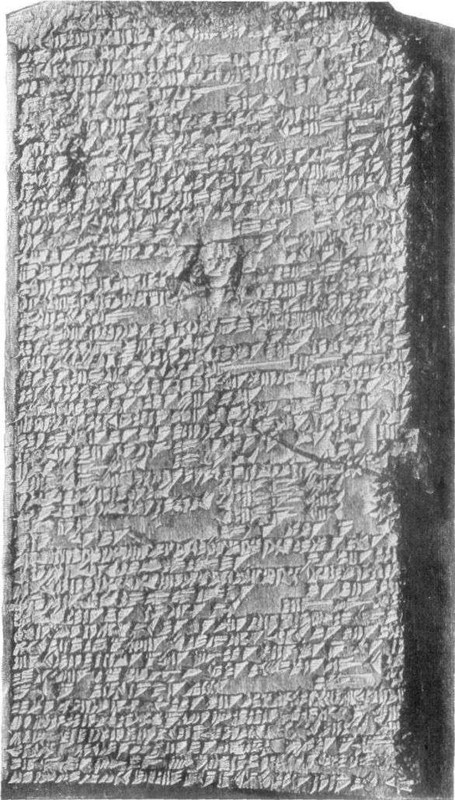
Assyrian Clay Tablet (Fac-simile).
Which raged like a mighty host, settled itself to quiet.
Down went the sea, ceased storm and flood.
Through the sea I rode lamenting.
The upper dwellings of men were ruined,
Corpses floated like trees.
A window I opened, on my face the daylight fell.
I shuddered and sat me down weeping,
Over my face flowed my tears.
I rode over regions of land, on a terrible sea.
Then rose one piece of land twelve measures high.
To the land Nizir the ship was steered,
The mountain Nizir held the ship fast, and let it no more go.
At the dawn of the seventh day
I took a dove and sent it forth.
Hither and thither flew the dove,
No resting-place it found, back to me it came.
A swallow I took and sent it forth,
No resting-place it found, and back to me it came.
A raven I took and sent it forth,
Forth flew the raven and saw that the water had fallen,
Carefully waded on but came not back.
All the animals then to the four winds I sent.
A sacrifice I offered,
An altar I built on the mountain-top,
By sevens I placed the vessels,
Under them spread sweet cane and cedar.
The gods inhaled the smoke, inhaled the sweet-smelling smoke,
Like flies the gods collected over the offering.
Thither then came Ishtar,
Lifted on high her bow, which Anu had made:--
These days I will not forget, will keep them in remembrance,
Them I will never forget.
Let the gods come to the altar,
But let not Bel to the altar come,
Because he heedlessly wrought, the flood he brought on,
To destruction my people gave over.
Thither came Bel and saw the ship,
Full of anger was he
Against the gods and the spirits of heaven:--
What soul has escaped!
In the destruction no man shall live.
Then Adar opened his mouth and spake,
Spake to the warlike Bel:--
Who but Ea knew it?
He knew and all he hath told.
Then Ea opened his mouth,
Spake to the warlike Bel:--
Thou art the valiant leader of the gods,
Why hast thou heedlessly wrought, and brought on the flood?
Let the sinner bear his sin, the wrongdoer his wrong;
Yield to our request, that he be not wholly destroyed.
Instead of sending a flood, send lions that men be reduced;
Instead of sending a flood, send hyenas that men be reduced;
Instead of sending a flood, send flames to waste the land;
Instead of sending a flood, send pestilence that men be reduced.
The counsel of the great gods to him I did not impart;
A dream to Hasisadra I sent, and the will of the gods he learned.
Then came right reason to Bel,
Into the ship he entered,
Took my hand and lifted me up,
Raised my wife and laid her hand in mine,
To us he turned, between us he stepped,
His blessing he gave.
Human Hasisadra has been,
But he and his wife united
Now to the gods shall be raised,
And Hasisadra shall dwell far off at the mouth of the streams.
Then they took me and placed me
Far off at the mouth of the streams.
V. THE EAGLE AND THE SNAKE
To Samas came the snake and said:--
The eagle has come to my nest, my young are scattered.
See, O Samas, what evil he has done me.
Help me, thy nest is as broad as the earth,
Thy snare is like the heavens,
Who can escape out of thy net?
Hearing the snake's complaint,
Samas opened his mouth and spake:--
Get thee on thy way, go to the mountain.
A wild ox shall be thy hiding-place.
Open his body, tear out his inward parts,
Make thy dwelling within him.
All the birds of heaven will descend, with them will come the eagle,
Heedless and hurrying on the flesh he will swoop,
Thinking of that which is hidden inside.
So soon as he enters the ox, seize his wing,
Tear off his wing-feathers and claws,
Pull him to pieces and cast him away,
Let him die of hunger and thirst.
So as the mighty Samas commanded,
Rose the snake, went to the mountain,
There he found a wild ox,
Opened his body, tore out his inward parts,
Entered and dwelt within him.
And the birds of heaven descended, with them came the eagle.
Yet the eagle, fearing a snare, ate not of the flesh with the birds.
The eagle spake to his young:--
We will not fly down, nor eat of the flesh of the wild ox.
An eaglet, keen of eye, thus to his father spake:--
In the flesh of the ox lurks the snake
[The rest is lost.]
VI. THE FLIGHT OF ETANA
The priests have offered my sacrifice
With joyful hearts to the gods.
O Lord, issue thy command,
Give me the plant of birth, show me the plant of birth,
Bring the child into the world, grant me a son.
Samas opened his mouth and spake to Etana:--
Away with thee, go to the mountain....
The eagle opened his mouth and spake to Etana:--
Wherefore art thou come?
Etana opened his mouth and said to the eagle:--
My friend, give me the plant of birth, show me the plant of birth,
Bring the child into the world, grant me a son....
To Etana then spake the eagle:--
My friend, be of good cheer.
Come, let me bear thee to Anu's heaven,
On my breast lay thy breast,
Grasp with thy hands the feathers of my wings.
On my side lay thy side.
On his breast he laid his breast,
On his feathers he placed his hands,
On his side laid his side,
Firmly he clung, great was his weight.
Two hours he bore him on high.
The eagle spake to him, to Etana:--
See my friend, the land, how it lies,
Look at the sea, the ocean-girded,
Like a mountain looks the land, the sea like petty waters.
Two hours more he bore him up.
The eagle spake to him, to Etana:--
See my friend the land, how it lies,
The sea is like the girdle of the land.
Two hours more he bore him up.
The eagle spake to him, to Etana:--
See my friend the land, how it lies,
The sea is like the gardener's ditches.
Up they rose to Anu's heaven,
Came to the gate of Anu, Bel and Ea....
Come, my friend, let me bear thee to Ishtar,
To Ishtar, the queen, shalt thou go, and dwell at her feet.
On my side lay thy side,
Grasp my wing-feathers with thy hands.
On his side he laid his side,
His feathers he grasped with his hands.
Two hours he bore him on high.
My friend see the land, how it lies,
How it spreads itself out.
The broad sea is as great as a court.
Two hours he bore him on high.
My friend see the land, how it lies,
The land is like the bed of a garden,
The broad sea is as great as a [.]
Two hours he bore him on high.
My friend see the land, how it lies.
[Etana, frightened, begs the eagle to ascend no further; then, as it seems, the bird's strength is exhausted.]
To the earth the eagle fell down
Shattered upon the ground.
VII. THE GOD ZU
He sees the badges of rule,
His royal crown, his raiment divine.
On the tablets of fate of the god Zu fixes his look.
On the father of the gods, the god of Duranki, Zu fixes his gaze.
Lust after rule enters into his soul.
I will take the tablets of fate of the gods,
Will determine the oracle of all the gods,
Will set up my throne, all orders control,
Will rule all the heavenly spirits.
His heart was set on combat.
At the entrance of the hall he stands, waiting the break of day,
When Bel dispensed the tender rains,
Sat on his throne, put off his crown,
He snatched the tablets of fate from his hands,
Seized the power, the control of commands.
Down flew Zu, in a mountain he hid.
There was anguish and crying.
On the earth Bel poured out his wrath.
Anu opened his mouth and spake,
Said to the gods his children:--
Who will conquer Zu?
Great shall be his name among the dwellers of all lands.
They called for Ramman, the mighty, Anu's son.
To him gives Anu command:--
Up, Ramman, my son, thou hero,
From thine attack desist not, conquer Zu with thy weapons,
That thy name may be great in the assembly of the great gods.
Among the gods thy brethren, none shall be thy equal,
Thy shrines on high shall be built;
Found thee cities in all the world;
Thy cities shall reach to the mountain of the world;
Show thyself strong for the gods, strong be thy name!
To Anu his father's command Ramman answered and spake:--
My father, who shall come to the inaccessible mound?
Who is like unto Zu among the gods thy sons?
The tablets of fate he has snatched from his hands,
Seized on the power, the control of commands.
Zu has fled and hides in his mountain.
[The rest is lost.]
VIII. ADAPA AND THE SOUTHWIND
Under the water the Southwind blew him
Sunk him to the home of the fishes.
O Southwind, ill hast thou used me, thy wings I will break.
As thus with his mouth he spake the wings of the Southwind were broken.
Seven days long the Southwind over the earth blew no more.
To his messenger Ila-Abrat
Anu then spake thus:--
Why for seven days long
Blows the Southwind no more on the earth?
His messenger Ila-Abrat answered and said: My lord,
Adapa, Ea's son, hath broken the wings of the Southwind.
When Anu heard these words,
"Aha!" he cried, and went forth.
[Ea, the ocean-god, then directs his son how to proceed in order to avert Anu's wrath. Some lines are mutilated.]
At the gate of Anu stand.
The gods Tammuz and Iszida will see thee and ask:--
Why lookest thou thus, Adapa,
For whom wearest thou garments of mourning?
From the earth two gods have vanished, therefore do I thus.
Who are these two gods who from the earth have vanished?
At each other they will look, Tammuz and Iszida, and lament.
A friendly word they will speak to Anu
Anu's sacred face they will show thee.
When thou to Anu comest,
Food of death will be offered thee, eat not thereof.
Water of death will be offered thee, drink not thereof.
A garment will be offered thee, put it on.
Oil will be offered thee, anoint thyself therewith.
What I tell thee neglect not, keep my word in mind.
Then came Anu's messenger:--
The wing of the Southwind Adapa has broken,
Deliver him up to me.
Up to heaven he came, approached the gate of Anu.
At Anu's gate Tammuz and Iszida stand,
Adapa they see, and "Aha!" they cry.
O Adapa, wherefore lookest thou thus,
For whom wearest thou apparel of mourning?
From the earth two gods have vanished
Therefore I wear apparel of mourning.
Who are these two gods who from the earth have vanished?
At one another look Tammuz and Iszida and lament.
Adapa go hence to Anu.
When he came, Anu at him looked, saying, O Adapa,
Why hast thou broken the Southwind's wing?
Adapa answered: My lord,
'Fore my lord's house I was fishing,
In the midst of the sea, it was smooth,
Then the Southwind began to blow
Under it forced me, to the home of the fishes I sank.
[By this speech Ann's anger is turned away.]
A beaker he set before him.
What shall we offer him? Food of life
Prepare for him that he may eat.
Food of life was brought for him, but he ate not.
Water of life was brought for him, but he drank not.
A garment was brought him, he put it on,
Oil they gave him, he anointed himself therewith.
Anu looked at him and mourned:--
And now, Adapa, wherefore
Has thou not eaten or drunken?
Now canst thou not live forever ...
Ea, my lord, commanded me:--
Thou shalt not eat nor drink.
IX. PENITENTIAL PSALMS
I
The Suppliant:
I, thy servant, full of sin cry to thee.
The sinner's earnest prayer thou dost accept,
The man on whom thou lookest lives,
Mistress of all, queen of mankind,
Merciful one, to whom it is good to turn,
Who acceptest the sigh of the heart.
The Priest:
Because his god and his goddess are angry, he cries to thee.
To him turn thy face, take his hand.
The Suppliant: Beside thee there is no god to guide me.
Look in mercy on me, accept my sigh,
Say why do I wait so long.
Let thy face be softened!
How long, O my lady!
May thy kindness be turned to me!
Like a dove I mourn, full of sighing.
The Priest: With sorrow and woe
His soul is full of sighing,
Tears he sheds, he pours out laments.
II
O mother of the gods, who performest the commands of Bel,
Who makest the young grass sprout, queen of mankind,
Creator of all, guide of every birth,
Mother Ishtar, whose might no god approaches,
Exalted mistress, mighty in command!
A prayer I will utter, let her do what seems her good.
O my lady, make me to know my doing,
Food I have not eaten, weeping was my nourishment,
Water I have not drunk, tears were my drink,
My heart has not been joyful nor my spirits glad.
Many are my sins, sorrowful my soul.
O my lady, make me to know my doing,
Make me a place of rest,
Cleanse my sin, lift up my face.
May my god, the lord of prayer, before thee set my prayer!
May my goddess, the lady of supplication, before thee set my supplication!
May the storm-god set my prayer before thee!
[The intercession of a number of gods is here invoked.]
Let thy eye rest graciously on me....
Turn thy face graciously to me....
Let thy heart be gentle, thy spirit mild....
III
O lady, in sorrow of heart sore oppressed I cry to thee.
O lady, to thy servant favor show.
Let thy heart be favorable,
To thy servant full of sorrow show thy pity,
Turn to him thy face, accept his prayer.
IV
To thy servant with whom thou art angry graciously turn.
May the anger of my lord be appeased,
Appeased the god I know not!
The goddess I know, the goddess I know not,
The god who was angry with me,
The goddess who was angry with me be appeased!
The sin which I have committed I know not.
May my god name a gracious name,
My goddess name a gracious name,
The god I know, the god I know not
Name a gracious name,
The goddess I know, the goddess I know not
Name a gracious name!
Pure food I have not eaten,
Pure water I have not drunk,
The wrath of my god, though I knew it not, was my food,
The anger of my goddess, though I knew it not, cast me down.
O lord, many are my sins, great my misdeeds.
[These phrases are repeated many times.]
The lord has looked on me in anger,
The god has punished me in wrath,
The goddess was angry with me and hath brought me to sorrow.
I sought for help, but no one took my hand,
I wept, but no one to me came,
I cry aloud, there is none that hears me,
Sorrowful I lie on the ground, look not up.
To my merciful god I turn, I sigh aloud,
The feet of my goddess I kiss [.]
To the known and unknown god I loud do sigh,
To the known and unknown goddess I loud do sigh,
O lord, look on me, hear my prayer,
O goddess, look on me, hear my prayer.
Men are perverse, nothing they know.
Men of every name, what do they know?
Do they good or ill, nothing they know.
O lord, cast not down thy servant!
Him, plunged into the flood, seize by the hand!
The sin I have committed turn thou to favor!
The evil I have done may the wind carry it away!
Tear in pieces my wrong-doings like a garment!
My god, my sins are seven times seven--forgive my sins!
My goddess, my sins are seven times seven--forgive my sins!
Known and unknown god, my sins are seven times seven--forgive my sins!
Known and unknown goddess, my sins are seven times seven--forgive my sins!
Forgive my sins, and I will humbly bow before thee.
V
May the lord, the mighty ruler Adar, announce my prayer to thee!
May the suppliant lady Nippur announce my prayer to thee!
May the lord of heaven and earth, the lord of Eridu, announce my prayer to thee!
The mother of the great house, the goddess Damkina, announce my prayer to thee!
May Marduk, the lord of Babylon, announce my prayer to thee!
May his consort, the exalted child of heaven and earth, announce my prayer to thee!
May the exalted minister, the god who names the good name, announce my prayer to thee!
May the bride, the first-born of the god, announce my prayer to thee!
May the god of storm-flood, the lord Harsaga, announce my prayer to thee!
May the gracious lady of the land announce my prayer to thee!
X. INSCRIPTION OF SENNACHERIB
(Taylor-cylinder, B.C. 701. Cf. 2 Kings xviii., xix.)
Sennacherib, the great king, the powerful king,
The king of the world, the king of Assyria,
The king of the four zones,
The wise shepherd, the favorite of the great gods,
The protector of justice, the lover of righteousness,
The giver of help, the aider of the weak,
The perfect hero, the stalwart warrior, the first of princes,
The destroyer of the rebellious, the destroyer of enemies,
Assur, the mighty rock, a kingdom without rival has granted me.
Over all who sit on sacred seats he has exalted my arms,
From the upper sea of the setting sun
To the lower sea of the rising sun,
All the blackheaded people he has cast beneath my feet,
The rebellious princes shun battle with me.
They forsook their dwellings; like a falcon
Which dwells in the clefts, they fled alone to an inaccessible place.
To the city of Ekron I went,
The governors and princes who had done evil I slew,
I bound their corpses to poles around the city.
The inhabitants of the city who had done evil I reckoned as spoil;
To the rest who had done no wrong I spoke peace.
Padi, their king, I brought from Jerusalem,
King over them I made him.
The tribute of my lordship I laid upon him.
Hezekiah of Judah, who had not submitted to me,
Forty-six of his strong cities, small cities without number, I besieged.
Casting down the walls, advancing engines, by assault I took them.
Two hundred thousand, one hundred and fifty men and women, young and old,
Horses, mules, asses, camels, oxen, sheep,
I brought out and reckoned as spoil.
Hezekiah himself I shut up like a caged bird
In Jerusalem, his royal city,
The walls I fortified against him,
Whoever came out of the gates I turned him back.
His cities which I had plundered I divided from his land
And gave them to Mitinti, king of Ashdod,
To Padi, king of Ekron, and to Silbal, king of Gaza.
To the former tribute paid yearly
I added the tribute of alliance of my lordship and
Laid that upon him. Hezekiah himself
Was overwhelmed by the fear of the brightness of my lordship.
The Arabians and his other faithful warriors
Whom, for the defence of Jerusalem, his royal city,
He had brought in, fell into fear,
With thirty talents of gold and eight hundred talents of silver, precious stones,
Couches of ivory, thrones of ivory,
And his daughters, his women of the palace,
The young men and the young women, to Nineveh, the city of my lordship,
I caused to be brought after me, and he sent his ambassadors
To give tribute and to pay homage.
XI. INVOCATION TO THE GODDESS BELTIS
To Beltis, the great Lady, chief of heaven and earth,
Queen of all the gods, mighty in all the lands.
Honored is her festival among the Ishtars.
She surpasses her offspring in power.
She, the shining one, like her brother, the sun,
Enlightens Heaven and earth,
Mistress of the spirits of the underworld,
First-born of Anu, great among the gods,
Ruler over her enemies,
The seas she stirs up,
The wooded mountains tramples under foot.
Mistress of the spirits of upper air,
Goddess of battle and fight,
Without whom the heavenly temple
None would render obedience,
She, the bestower of strength, grants the desire of the faithful,
Prayers she hears, supplication receives, entreaty accepts.
Ishtar, the perfect light, all-powerful,
Who enlightens Heaven and earth,
Her name is proclaimed throughout all the lands,
Esarhaddon, king of lands, fear not.
To her it is good to pray.
XII. ORACLES OF ISHTAR OF ARBELA
(B.C. 680-668)
Esarhaddon, king of lands, fear not.
The lord, the spirit who speaks to thee
I speak to him, I have not kept it back.
Thine enemies, like the floods of Sivan
Before thee flee perpetually.
I the great goddess, Ishtar of Arbela
Have put thine enemies to flight.
Where are the words I spake to thee?
Thou hast not trusted them.
I, Ishtar of Arbela, thy foes
Into thy hands I give
In the van and by thy side I go, fear not
In the midst of thy princes thou art.
In the midst of my host I advance and rest.
O Esarhaddon, fear not.
Sixty great gods are with me to guard thee,
The Moon-god on thy right, the Sun-god on thy left,
Around thee stand the sixty great gods,
And make the centre firm.
Trust not to man, look thou to me
Honor me and fear not.
To Esarhaddon, my king,
Long days and length of years I give.
Thy throne beneath the heavens I have established;
In a golden dwelling thee I will guard in heaven
Guard like the diadem of my head.
The former word which I spake thou didst not trust,
But trust thou now this later word and glorify me,
When the day dawns bright complete thy sacrifice.
Pure food thou shalt eat, pure waters drink,
In thy palace thou shalt be pure.
Thy son, thy son's son the kingdom
By the blessing of Nergal shall rule.
XIII. AN ERECHITE'S LAMENT
How long, O my Lady, shall the strong enemy hold thy sanctuary?
There is want in Erech, thy principal city;
Blood is flowing like water in Eulbar, the house of thy oracle;
He has kindled and poured out fire like hailstones on all thy lands.
My Lady, sorely am I fettered by misfortune;
My Lady, thou hast surrounded me, and brought me to grief.
The mighty enemy has smitten me down like a single reed.
Not wise myself, I cannot take counsel;
I mourn day and night like the fields.
I, thy servant, pray to thee.
Let thy heart take rest, let thy disposition be softened.
ABIGAIL ADAMS
(1744-1818)
BY LUCIA GILBERT RUNKLE

he Constitution of the State of Massachusetts, adopted in the year 1780, contains an article for the Encouragement of Literature, which, it declares, should be fostered because its influence is "to countenance and inculcate the principles of humanity and general benevolence, public and private charity, industry and frugality, honesty and punctuality in dealings, sincerity and good humor, and all social affections and generous sentiments among the people." In these words, as in a mirror, is reflected the Massachusetts of the eighteenth century, where households like the Adamses', the Warrens', the Otises', made the standard of citizenship. Six years before this remarkable document was framed, Abigail Adams had written to her husband, then engaged in nation-making in Philadelphia:--"I most sincerely wish that some more liberal plan might be laid and executed for the benefit of the rising generation, and that our new Constitution may be distinguished for encouraging learning and virtue." And he, spending his days and nights for his country, sacrificing his profession, giving up the hope of wealth, writes her:--"I believe my children will think that I might as well have labored a little, night and day, for their benefit. But I will tell them that I studied and labored to procure a free constitution of government for them to solace themselves under; and if they do not prefer this to ample fortune, to ease and elegance, they are not my children. They shall live upon thin diet, wear mean clothes, and work hard with cheerful hearts and free spirits, or they may be the children of the earth, or of no one, for me."
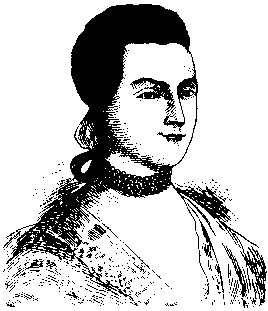
In old Weymouth, one of those quiet Massachusetts towns, half-hidden among the umbrageous hills, where the meeting-house and the school-house rose before the settlers' cabins were built, where the one elm-shaded main street stretches its breadth between two lines of self-respecting, isolated frame houses, each with its grassy dooryard, its lilac bushes, its fresh-painted offices, its decorous wood-pile laid with architectural balance and symmetry,--there, in the dignified parsonage, on the 11th of November, 1744, was born to Parson William Smith and Elizabeth his wife, Abigail, the second of three beautiful daughters. Her mother was a Quincy, of a distinguished line, and her mother was a Norton, of a strain not less honorable. Nor were the Smiths unimportant.
In that day girls had little instruction. Abigail says of herself, in one of her letters:--"I never was sent to any school. Female education, in the best families, went no further than writing and arithmetic; in some few and rare instances, music and dancing. It was fashionable to ridicule female learning." But the household was bookish. Her mother knew the "British Poets" and all the literature of Queen Anne's Augustan age. Her beloved grandmother Quincy, at Mount Wollaston, seems to have had both learning and wisdom, and to her father she owed the sense of fun, the shrewdness, the clever way of putting things which make her letters so delightful.
The good parson was skillful in adapting Scripture to special exigencies, and throughout the Revolution he astonished his hearers by the peculiar fitness of his texts to political uses. It is related of him that when his eldest daughter married Richard Cranch, he preached to his people from Luke, tenth chapter, forty-second verse: "And Mary hath chosen that good part which shall not be taken away from her." When, a year later, young John Adams came courting the brilliant Abigail, the parish, which assumed a right to be heard on the question of the destiny of the minister's daughter, grimly objected. He was upright, singularly abstemious, studious; but he was poor, he was the son of a small farmer, and she was of the gentry. He was hot-headed and somewhat tactless, and offended his critics. Worst of all, he was a lawyer, and the prejudice of colonial society reckoned a lawyer hardly honest. He won this most important of his cases, however, and Parson Smith's marriage sermon for the bride of nineteen was preached from the text, "For John came neither eating bread nor drinking wine, and ye say, He hath a devil."
For ten years Mrs. Adams seems to have lived a most happy life, either in Boston or Braintree, her greatest grief being the frequent absences of her husband on circuit. His letters to her are many and delightful, expressing again and again, in the somewhat formal phrases of the period, his affection and admiration. She wrote seldom, her household duties and the care of the children, of whom there were four in ten years, occupying her busy hands.
Meanwhile, the clouds were growing black in the political sky. Mr. Adams wrote arguments and appeals in the news journals over Latin signatures, papers of instructions to Representatives to the General Court, and legal portions of the controversy between the delegates and Governor Hutchinson. In all this work Mrs. Adams constantly sympathized and advised. In August, 1774, he went to Philadelphia as a delegate to a general council of the colonies called to concert measures for united action. And now begins the famous correspondence, which goes on for a period of nine years, which was intended to be seen only by the eyes of her husband, which she begs him, again and again, to destroy as not worth the keeping, yet which has given her a name and place among the world's most charming letter-writers.
Her courage, her cheerfulness, her patriotism, her patience never fail her. Braintree, where, with her little brood, she is to stay, is close to the British lines. Raids and foraging expeditions are imminent. Hopes of a peaceful settlement grow dim. "What course you can or will take," she writes her husband, "is all wrapped in the bosom of futurity. Uncertainty and expectation leave the mind great scope. Did ever any kingdom or State regain its liberty, when once it was invaded, without bloodshed? I cannot think of it without horror. Yet we are told that all the misfortunes of Sparta were occasioned by their too great solicitude for present tranquillity, and, from an excessive love of peace, they neglected the means of making it sure and lasting. They ought to have reflected, says Polybius, that, 'as there is nothing more desirable or advantageous than peace, when founded in justice and honor, so there is nothing more shameful, and at the same time more pernicious, when attained by bad measures, and purchased at the price of liberty.'"
Thus in the high Roman fashion she faces danger; yet her sense of fun never deserts her, and in the very next letter she writes, parodying her husband's documents:--"The drouth has been very severe. My poor cows will certainly prefer a petition to you, setting forth their grievances, and informing you that they have been deprived of their ancient privileges, whereby they are become great sufferers, and desiring that these may be restored to them. More especially as their living, by reason of the drouth, is all taken from them, and their property which they hold elsewhere is decaying, they humbly pray that you would consider them, lest hunger should break through stone walls."
By midsummer the small hardships entailed by the British occupation of Boston were most vexatious. "We shall very soon have no coffee, nor sugar, nor pepper, but whortleberries and milk we are not obliged to commerce for," she writes, and in letter after letter she begs for pins. Needles are desperately needed, but without pins how can domestic life go on, and not a pin in the province!
On the 14th of September she describes the excitement in Boston, the Governor mounting cannon on Beacon Hill, digging intrenchments on the Neck, planting guns, throwing up breastworks, encamping a regiment. In consequence of the powder being taken from Charlestown, she goes on to say, a general alarm spread through all the towns and was soon caught in Braintree. And then she describes one of the most extraordinary scenes in history. About eight o'clock on Sunday evening, she writes to her husband, at least two hundred men, preceded by a horse-cart, passed by her door in dead silence, and marched down to the powder-house, whence they took out the town's powder, because they dared not trust it where there were so many Tories, carried it into the other parish, and there secreted it. On their way they captured a notorious "King's man," and found on him two warrants aimed at the Commonwealth. When their patriotic trust was discharged, they turned their attention to the trembling Briton. Profoundly excited and indignant though they were, they never thought of mob violence, but, true to the inherited instincts of their race, they resolved themselves into a public meeting! The hostile warrants being produced and exhibited, it was put to a vote whether they should be burned or preserved. The majority voted for burning them. Then the two hundred gathered in a circle round the single lantern, and maintained a rigid silence while the offending papers were consumed. That done--the blazing eyes in that grim circle of patriots watching the blazing writs--"they called a vote whether they should huzza; but, it being Sunday evening, it passed in the negative!"
Only in the New England of John Winthrop and the Mathers, of John Quincy and the Adamses, would such a scene have been possible: a land of self-conquest and self-control, of a deep love of the public welfare and a willingness to take trouble for a public object.
A little later Mrs. Adams writes her husband that there has been a conspiracy among the negroes, though it has been kept quiet, "I wish most sincerely," she adds, "that there was not a slave in the province. It always appeared a most iniquitous scheme to me--to fight ourselves for what we are daily robbing and plundering from those who have as good a right to freedom as we have."
Nor were the sympathies of this clever logician confined to the slaves. A month or two before the Declaration of Independence was made she writes her constructive statesman:--"I long to hear that you have declared an independence. And by the way, in the new code of laws which I suppose it will be necessary for you to make, I desire you would remember the ladies, and be more generous and favorable to them than your ancestors. Do not put such unlimited power into the hands of the husbands! Remember, all men would be tyrants if they could! If particular care and attention is not paid to the ladies, we are determined to foment a rebellion, and will not hold ourselves bound by any laws in which we have no voice or representation. That your sex are naturally tyrannical is a truth so thoroughly established as to admit of no dispute; but such of you as wish to be happy willingly give up the harsh title of master for the more tender and endearing one of friend. Why, then, not put it out of the power of the vicious and the lawless to use us with cruelty and indignity with impunity? Men of sense in all ages abhor those customs which treat us only as the vassals of your sex. Regard us, then, as being placed by Providence under your protection; and in imitation of the Supreme Being, make use of that power only for our happiness."--a declaration of principles which the practical housewife follows up by saying:--"I have not yet attempted making salt-petre, but after soap-making, believe I shall make the experiment. I find as much as I can do to manufacture clothing for my family, which would else be naked. I have lately seen a small manuscript describing the proportions of the various sorts of powder fit for cannon, small arms, and pistols. If it would be of any service your way, I will get it transcribed and send it to you."
She is interested in everything, and she writes about everything in the same whole-hearted way,--farming, paper money, the making of molasses from corn-stalks, the new remedy of inoculation, 'Common Sense' and its author, the children's handwriting, the state of Harvard College, the rate of taxes, the most helpful methods of enlistment, Chesterfield's Letters, the town elections, the higher education of women, and the getting of homespun enough for Mr. Adams's new suit.
She manages, with astonishing skill, to keep the household in comfort. She goes through trials of sickness, death, agonizing suspense, and ever with the same heroic cheerfulness, that her anxious husband may be spared the pangs which she endures. When he is sent to France and Holland, she accepts the new parting as another service pledged to her country. She sees her darling boy of ten go with his father, aware that at the best she must bear months of silence, knowing that they may perish at sea or fall into the hands of privateers; but she writes with indomitable cheer, sending the lad tender letters of good advice, a little didactic to modern taste, but throbbing with affection. "Dear as you are to me," says this tender mother, "I would much rather you should have found your grave in the ocean you have crossed than see you an immoral, profligate, or graceless child."
It was the lot of this country parson's daughter to spend three years in London as wife of the first American minister, to see her husband Vice-President of the United States for eight years and President for four, and to greet her son as the eminent Monroe's valued Secretary of State, though she died, "seventy-four years young," before he became President. She could not, in any station, be more truly a lady than when she made soap and chopped kindling on her Braintree farm. At Braintree she was no more simply modest than at the Court of St. James or in the Executive Mansion. Her letters exactly reflect her ardent, sincere, energetic nature. She shows a charming delight when her husband tells her that his affairs could not possibly be better managed than she manages them, and that she shines not less as a statesman than as a farmeress. And though she was greatly admired and complimented, no praise so pleased her as his declaration that for all the ingratitude, calumnies, and misunderstandings that he had endured,--and they were numberless,--her perfect comprehension of him had been his sufficient compensation.

TO HER HUSBAND
BRAINTREE, May 24th, 1775.
My Dearest Friend:
Our house has been, upon this alarm, in the same scene of confusion that it was upon the former. Soldiers coming in for a lodging, for breakfast, for supper, for drink, etc. Sometimes refugees from Boston, tired and fatigued, seek an asylum for a day, a night, a week. You can hardly imagine how we live; yet--
"To the houseless child of want,
Our doors are open still;
And though our portions are but scant,
We give them with good will."
My best wishes attend you, both for your health and happiness, and that you may be directed into the wisest and best measures for our safety and the security of our posterity. I wish you were nearer to us: we know not what a day will bring forth, nor what distress one hour may throw us into. Hitherto I have been able to maintain a calmness and presence of mind, and hope I shall, let the exigency of the time be what it will. Adieu, breakfast calls.
Your affectionate
PORTIA.
WEYMOUTH, June 15th, 1775.
I hope we shall see each other again, and rejoice together in happier days; the little ones are well, and send duty to papa. Don't fail of letting me hear from you by every opportunity. Every line is like a precious relic of the saints.
I have a request to make of you; something like the barrel of sand, I suppose you will think it, but really of much more importance to me. It is, that you would send out Mr. Bass, and purchase me a bundle of pins and put them in your trunk for me. The cry for pins is so great that what I used to buy for seven shillings and sixpence are now twenty shillings, and not to be had for that. A bundle contains six thousand, for which I used to give a dollar; but if you can procure them for fifty shillings, or three pounds, pray let me have them. I am, with the tenderest regard,
Your PORTIA.
BRAINTREE, June 18th, 1775.
My Dearest Friend:
The day--perhaps the decisive day is come, on which the fate of America depends. My bursting heart must find vent at my pen. I have just heard that our dear friend, Dr. Warren, is no more, but fell gloriously fighting for his country, saying, "Better to die honorably in the field than ignominiously hang upon the gallows." Great is our loss. He has distinguished himself in every engagement by his courage and fortitude, by animating the soldiers, and leading them on by his own example. A particular account of these dreadful but, I hope, glorious days, will be transmitted you, no doubt, in the exactest manner.
"The race is not to the swift, nor the battle to the strong; but the God of Israel is He that giveth strength and power unto His people. Trust in Him at all times, ye people: pour out your hearts before Him; God is a refuge for us." Charlestown is laid in ashes. The battle began upon our intrenchments upon Bunker's Hill, Saturday morning about three o'clock, and has not ceased yet, and it is now three o'clock Sabbath afternoon.
It is expected they will come out over the Neck to-night, and a dreadful battle must ensue. Almighty God, cover the heads of our countrymen, and be a shield to our dear friends! How many have fallen we know not. The constant roar of the cannon is so distressing that we cannot eat, drink, or sleep. May we be supported and sustained in the dreadful conflict. I shall tarry here till it is thought unsafe by my friends, and then I have secured myself a retreat at your brother's, who has kindly offered me part of his house. I cannot compose myself to write any further at present. I will add more as I hear further.
Your PORTIA.
BRAINTREE, November 27th, 1775.
Colonel Warren returned last week to Plymouth, so that I shall not hear anything from you until he goes back again, which will not be till the last of this month. He damped my spirits greatly by telling me that the court had prolonged your stay another month. I was pleasing myself with the thought that you would soon be upon your return. It is in vain to repine. I hope the public will reap what I sacrifice.
I wish I knew what mighty things were fabricating. If a form of government is to be established here, what one will be assumed? Will it be left to our Assemblies to choose one? And will not many men have many minds? And shall we not run into dissensions among ourselves?
I am more and more convinced that man is a dangerous creature; and that power, whether vested in many or a few, is ever grasping, and, like the grave, cries, "Give, give!" The great fish swallow up the small; and he who is most strenuous for the rights of the people, when vested with power, is as eager after the prerogatives of government. You tell me of degrees of perfection to which human nature is capable of arriving, and I believe it, but at the same time lament that our admiration should arise from the scarcity of the instances.
The building up a great empire, which was only hinted at by my correspondent, may now, I suppose, be realized even by the unbelievers; yet will not ten thousand difficulties arise in the formation of it? The reins of government have been so long slackened that I fear the people will not quietly submit to those restraints which are necessary for the peace and security of the community. If we separate from Britain, what code of laws will be established? How shall we be governed so as to retain our liberties? Can any government be free which is not administered by general stated laws? Who shall frame these laws? Who will give them force and energy? It is true, your resolutions, as a body, have hitherto had the force of laws; but will they continue to have?
When I consider these things, and the prejudices of people in favor of ancient customs and regulations, I feel anxious for the fate of our monarchy, or democracy, or whatever is to take place. I soon get lost in the labyrinth of perplexities; but, whatever occurs, may justice and righteousness be the stability of our times, and order arise out of confusion. Great difficulties may be surmounted by patience and perseverance.
I believe I have tired you with politics. As to news, we have not any at all. I shudder at the approach of winter, when I think I am to remain desolate.
I must bid you good-night; 'tis late for me, who am much of an invalid. I was disappointed last week in receiving a packet by post, and, upon unsealing it, finding only four newspapers. I think you are more cautious than you need be. All letters, I believe, have come safe to hand. I have sixteen from you, and wish I had as many more.
Your PORTIA.
[By permission of the family.]
BRAIN TREE, April 20th, 1777.
There is a general cry against the merchants, against monopolizers, etc., who, 'tis said, have created a partial scarcity. That a scarcity prevails of every article, not only of luxury but even the necessaries of life, is a certain fact. Everything bears an exorbitant price. The Act, which was in some measure regarded and stemmed the torrent of oppression, is now no more heeded than if it had never been made. Indian corn at five shillings; rye, eleven and twelve shillings, but scarcely any to be had even at that price; beef, eightpence; veal, sixpence and eightpence; butter, one and sixpence; mutton, none; lamb, none; pork, none; mean sugar, four pounds per hundred; molasses, none; cotton-wool, none; New England rum, eight shillings per gallon; coffee, two and sixpence per pound; chocolate, three shillings.
What can be done? Will gold and silver remedy this evil? By your accounts of board, housekeeping, etc., I fancy you are not better off than we are here. I live in hopes that we see the most difficult time we have to experience. Why is Carolina so much better furnished than any other State, and at so reasonable prices?
Your PORTIA.
BRAINTREE, June 8th, 1779.
Six months have already elapsed since I heard a syllable from you or my dear son, and five since I have had one single opportunity of conveying a line to you. Letters of various dates have lain months at the Navy Board, and a packet and frigate, both ready to sail at an hour's warning, have been months waiting the orders of Congress. They no doubt have their reasons, or ought to have, for detaining them. I must patiently wait their motions, however painful it is; and that it is so, your own feelings will testify. Yet I know not but you are less a sufferer than you would be to hear from us, to know our distresses, and yet be unable to relieve them. The universal cry for bread, to a humane heart, is painful beyond description, and the great price demanded and given for it verifies that pathetic passage of Sacred Writ, "All that a man hath will he give for his life." Yet He who miraculously fed a multitude with five loaves and two fishes has graciously interposed in our favor, and delivered many of the enemy's supplies into our hands, so that our distresses have been mitigated. I have been able as yet to supply my own family, sparingly, but at a price that would astonish you. Corn is sold at four dollars, hard money, per bushel, which is equal to eighty at the rate of exchange.
Labor is at eight dollars per day, and in three weeks it will be at twelve, it is probable, or it will be more stable than anything else. Goods of all kinds are at such a price that I hardly dare mention it. Linens are sold at twenty dollars per yard; the most ordinary sort of calicoes at thirty and forty; broadcloths at forty pounds per yard; West India goods full as high; molasses at twenty dollars per gallon; sugar, four dollars per pound; Bohea tea at forty dollars; and our own produce in proportion; butcher's meat at six and eight shillings per pound; board at fifty and sixty dollars per week; rates high. That, I suppose, you will rejoice at; so would I, did it remedy the evil. I pay five hundred dollars, and a new Continental rate has just appeared, my proportion of which will be two hundred more. I have come to this determination,--to sell no more bills, unless I can procure hard money for them, although I shall be obliged to allow a discount. If I sell for paper, I throw away more than half, so rapid is the depreciation; nor do I know that it will be received long. I sold a bill to Blodget at five for one, which was looked upon as high at that time. The week after I received it, two emissions were taken out of circulation, and the greater part of what I had proved to be of that sort; so that those to whom I was indebted are obliged to wait, and before it becomes due, or is exchanged, it will be good for--as much as it will fetch, which will be nothing, if it goes on as it has done for this three months past. I will not tire your patience any longer. I have not drawn any further upon you. I mean to wait the return of the Alliance, which with longing eyes I look for. God grant it may bring me comfortable tidings from my dear, dear friend, whose welfare is so essential to my happiness that it is entwined around my heart, and cannot be impaired or separated from it without rending it asunder.
I cannot say that I think our affairs go very well here. Our currency seems to be the source of all our evils. We cannot fill up our Continental army by means of it. No bounty will prevail with them. What can be done with it? It will sink in less than a year. The advantage the enemy daily gains over us is owing to this. Most truly did you prophesy, when you said that they would do all the mischief in their power with the forces they had here.
My tenderest regards ever attend you. In all places and situations, know me to be ever, ever yours.
TO HER SISTER
AUTEUIL, 5th September, 1784.
My, Dear Sister:
Auteuil is a village four miles distant from Paris, and one from Passy. The house we have taken is large, commodious, and agreeably situated near the woods of Boulogne, which belong to the King, and which Mr. Adams calls his park, for he walks an hour or two every day in them. The house is much larger than we have need of; upon occasion, forty beds may be made in it. I fancy it must be very cold in winter. There are few houses with the privilege which this enjoys, that of having the salon, as it is called, the apartment where we receive company, upon the first floor. This room is very elegant, and about a third larger than General Warren's hall. The dining-room is upon the right hand, and the salon upon the left, of the entry, which has large glass doors opposite to each other, one opening into the court, as they call it, the other into a large and beautiful garden. Out of the dining-room you pass through an entry into the kitchen, which is rather small for so large a house. In this entry are stairs which you ascend, at the top of which is a long gallery fronting the street, with six windows, and opposite to each window you open into the chambers, which all look into the garden.
But with an expense of thirty thousand livres in looking-glasses, there is no table in the house better than an oak board, nor a carpet belonging to the house. The floors I abhor, made of red tiles in the shape of Mrs. Quincy's floor-cloth tiles. These floors will by no means bear water, so that the method of cleaning them is to have them waxed, and then a manservant with foot brushes drives round your room, dancing here and there like a Merry Andrew. This is calculated to take from your foot every atom of dirt, and leave the room in a few moments as he found it. The house must be exceedingly cold in winter. The dining-rooms, of which you make no other use, are laid with small stones, like the red tiles for shape and size. The servants' apartments are generally upon the first floor, and the stairs which you commonly have to ascend to get into the family apartments are so dirty that I have been obliged to hold up my clothes as though I was passing through a cow-yard.
I have been but little abroad. It is customary in this country for strangers to make the first visit. As I cannot speak the language, I think I should make rather an awkward figure. I have dined abroad several times with Mr. Adams's particular friends, the Abbés, who are very polite and civil,--three sensible and worthy men. The Abbé de Mably has lately published a book, which he has dedicated to Mr. Adams. This gentleman is nearly eighty years old; the Abbé Chalut, seventy-five; and Arnoux about fifty, a fine sprightly man, who takes great pleasure in obliging his friends. Their apartments were really nice. I have dined once at Dr. Franklin's, and once at Mr. Barclay's, our consul, who has a very agreeable woman for his wife, and where I feel like being with a friend. Mrs. Barclay has assisted me in my purchases, gone with me to different shops, etc. To-morrow I am to dine at Monsieur Grand's; but I have really felt so happy within doors, and am so pleasingly situated, that I have had little inclination to change the scene. I have not been to one public amusement as yet, not even the opera, though we have one very near us.
You may easily suppose I have been fully employed, beginning housekeeping anew, and arranging my family to our no small expenses and trouble; for I have had bed-linen and table-linen to purchase and make, spoons and forks to get made of silver,--three dozen of each,--besides tea furniture, china for the table, servants to procure, etc. The expense of living abroad I always supposed to be high, but my ideas were nowise adequate to the thing. I could have furnished myself in the town of Boston with everything I have, twenty or thirty per cent, cheaper than I have been able to do it here. Everything which will bear the name of elegant is imported from England, and if you will have it, you must pay for it, duties and all. I cannot get a dozen handsome wineglasses under three guineas, nor a pair of small decanters for less than a guinea and a half. The only gauze fit to wear is English, at a crown a yard; so that really a guinea goes no further than a copper with us. For this house, garden, stables, etc., we give two hundred guineas a year. Wood is two guineas and a half per cord; coal, six livres the basket of about two bushels; this article of firing we calculate at one hundred guineas a year. The difference between coming upon this negotiation to France, and remaining at the Hague, where the house was already furnished at the expense of a thousand pounds sterling, will increase the expense here to six or seven hundred guineas; at a time, too, when Congress has cut off five hundred guineas from what they have heretofore given. For our coachman and horses alone (Mr. Adams purchased a coach in England) we give fifteen guineas a month. It is the policy of this country to oblige you to a certain number of servants, and one will not touch what belongs to the business of another, though he or she has time enough to perform the whole. In the first place, there is a coachman who does not an individual thing but attend to the carriages and horses; then the gardener, who has business enough; then comes the cook; then the maitre d'hotel,--his business is to purchase articles in the family, and oversee that nobody cheats but himself; a valet de chambre,--John serves in this capacity; a femme de chambre,--Esther serves for this, and is worth a dozen others; a coiffeuse,--for this place I have a French girl about nineteen, whom I have been upon the point of turning-away, because madam will not brush a chamber: "it is not de fashion, it is not her business." I would not have kept her a day longer, but found, upon inquiry, that I could not better myself, and hair-dressing here is very expensive unless you keep such a madam in the house. She sews tolerably well, so I make her as useful as I can. She is more particularly devoted to mademoiselle. Esther diverted me yesterday evening by telling me that she heard her go muttering by her chamber door, after she had been assisting Abby in dressing. "Ah, mon Dieu, 'tis provoking"--(she talks a little English).--"Why, what is the matter, Pauline: what is provoking?"--"Why, Mademoiselle look so pretty, I so mauvais." There is another indispensable servant, who is called a frotteur: his business is to rub the floors.
We have a servant who acts as maitre d'hotel, whom I like at present, and who is so very gracious as to act as footman too, to save the expense of another servant, upon condition that we give him a gentleman's suit of clothes in lieu of a livery. Thus, with seven servants and hiring a charwoman upon occasion of company, we may possibly make out to keep house; with less, we should be hooted at as ridiculous, and could not entertain any company. To tell this in our own country would be considered as extravagance; but would they send a person here in a public character to be a public jest? At lodgings in Paris last year, during Mr. Adams's negotiation for a peace, it was as expensive to him as it is now at housekeeping, without half the accommodations.
Washing is another expensive article: the servants are all allowed theirs, besides their wages; our own costs us a guinea a week. I have become steward and bookkeeper, determined to know with accuracy what our expenses are, to prevail with Mr. Adams to return to America if he finds himself straitened, as I think he must be. Mr. Jay went home because he could not support his family here with the whole salary; what then can be done, curtailed as it now is, with the additional expense? Mr. Adams is determined to keep as little company as he possibly can; but some entertainments we must make, and it is no unusual thing for them to amount to fifty or sixty guineas at a time. More is to be performed by way of negotiation, many times, at one of these entertainments, than at twenty serious conversations; but the policy of our country has been, and still is, to be penny-wise and pound-foolish. We stand in sufficient need of economy, and in the curtailment of other salaries I suppose they thought it absolutely necessary to cut off their foreign ministers. But, my own interest apart, the system is bad; for that nation which degrades their own ministers by obliging them to live in narrow circumstances, cannot expect to be held in high estimation themselves. We spend no evenings abroad, make no suppers, attend very few public entertainments,--or spectacles, as they are called,--and avoid every expense that is not held indispensable. Yet I cannot but think it hard that a gentleman who has devoted so great a part of his life to the service of the public, who has been the means, in a great measure, of procuring such extensive territories to his country, who saved their fisheries, and who is still laboring to procure them further advantages, should find it necessary so cautiously to calculate his pence, for fear of overrunning them. I will add one more expense. There is now a court mourning, and every foreign minister, with his family, must go into mourning for a Prince of eight years old, whose father is an ally to the King of France. This mourning is ordered by the Court, and is to be worn eleven days only. Poor Mr. Jefferson had to his away for a tailor to get a whole black-silk suit made up in two days; and at the end of eleven days, should another death happen, he will be obliged to have a new suit of mourning, of cloth, because that is the season when silk must be left off. We may groan and scold, but these are expenses which cannot be avoided; for fashion is the deity every one worships in this country, and from the highest to the lowest, you must submit. Even poor John and Esther had no comfort among the servants, being constantly the subjects of ridicule, until we were obliged to direct them to have their hair dressed. Esther had several crying fits upon the occasion, that she should be forced to be so much of a fool; but there was no way to keep them from being trampled upon but this, and now that they are à la mode de Paris, they are much respected. To be out of fashion is more criminal than to be seen in a state of nature, to which the Parisians are not averse.
AUTEUIL, NEAR PARIS, 10th May, 1785.
Did you ever, my dear Betsey, see a person in real life such as your imagination formed of Sir Charles Grandison? The Baron de Staël, the Swedish Ambassador, comes nearest to that character, in his manners and personal appearance, of any gentleman I ever saw. The first time I saw him I was prejudiced in his favor, for his countenance commands your good opinion: it is animated, intelligent, sensible, affable, and without being perfectly beautiful, is most perfectly agreeable; add to this a fine figure, and who can fail in being charmed with the Baron de Staël? He lives in a grand hotel, and his suite of apartments, his furniture, and his table, are the most elegant of anything I have seen. Although you dine upon plate in every noble house in France, I cannot say that you may see your face in it; but here the whole furniture of the table was burnished, and shone with regal splendor. Seventy thousand livres in plate will make no small figure; and that is what his Majesty gave him. The dessert was served on the richest china, with knives, forks, and spoons of gold. As you enter his apartments, you pass through files of servants into his ante-chamber, in which is a throne covered with green velvet, upon which is a chair of state, over which hangs the picture of his royal master. These thrones are common to all ambassadors of the first order, as they are immediate representatives of the king. Through this ante-chamber you pass into the grand salon, which is elegantly adorned with architecture, a beautiful lustre hanging from the middle. Settees, chairs, and hangings of the richest silk, embroidered with gold; marble slabs upon Muted pillars, round which wreaths of artificial flowers in gold entwine. It is usual to find in all houses of fashion, as in this, several dozens of chairs, all of which have stuffed backs and cushions, standing in double rows round the rooms. The dining-room was equally beautiful, being hung with Gobelin tapestry, the colors and figures of which resemble the most elegant painting. In this room were hair-bottom mahogany-backed chairs, and the first I have seen since I came to France. Two small statues of a Venus de Medicis, and a Venus de ---- (ask Miss Paine for the other name), were upon the mantelpiece. The latter, however, was the most modest of the kind, having something like a loose robe thrown partly over her. From the Swedish Ambassador's we went to visit the Duchess d'Enville, who is mother to the Duke de Rochefoucault. We found the old lady sitting in an easy-chair; around her sat a circle of Academicians, and by her side a young lady. Your uncle presented us, and the old lady rose, and, as usual, gave us a salute. As she had no paint, I could put up with it; but when she approached your cousin I could think of nothing but Death taking hold of Hebe. The duchess is near eighty, very tall and lean. She was dressed in a silk chemise, with very large sleeves, coming half-way down her arm, a large cape, no stays, a black-velvet girdle round her waist, some very rich lace in her chemise, round her neck, and in her sleeves; but the lace was not sufficient to cover the upper part of her neck, which old Time had harrowed; she had no cap on, but a little gauze bonnet, which did not reach her ears, and tied under her chin, her venerable white hairs in full view. The dress of old women and young girls in this country is detestable, to speak in the French style; the latter at the age of seven being clothed exactly like a woman of twenty, and the former have such a fantastical appearance that I cannot endure it. The old lady has all the vivacity of a young one. She is the most learned woman in France; her house is the resort of all men of literature, with whom she converses upon the most abstruse subjects. She is of one of the most ancient, as well as the richest families in the kingdom. She asked very archly when Dr. Franklin was going to America. Upon being told, says she, "I have heard that he is a prophet there;" alluding to that text of Scripture, "A prophet is not without honor," etc. It was her husband who commanded the fleet which once spread such terror in our country.
LONDON, Friday, 24th July 1784.
My Dear Sister:
I am not a little surprised to find dress, unless upon public occasions, so little regarded here. The gentlemen are very plainly dressed, and the ladies much more so than with us. 'Tis true, you must put a hoop on and have your hair dressed; but a common straw hat, no cap, with only a ribbon upon the crown, is thought dress sufficient to go into company. Muslins are much in taste; no silks but lutestrings worn; but send not to London for any article you want: you may purchase anything you can name much lower in Boston. I went yesterday into Cheapside to purchase a few articles, but found everything higher than in Boston. Silks are in a particular manner so; they say, when they are exported, there is a drawback upon them, which makes them lower with us. Our country, alas, our country! they are extravagant to astonishment in entertainments compared with what Mr. Smith and Mr. Storer tell me of this. You will not find at a gentleman's table more than two dishes of meat, though invited several days beforehand. Mrs. Atkinson went out with me yesterday, and Mrs. Hay, to the shops. I returned and dined with Mrs. Atkinson, by her invitation the evening before, in company with Mr. Smith, Mrs. Hay, Mr. Appleton. We had a turbot, a soup, and a roast leg of lamb, with a cherry pie....
The wind has prevented the arrival of the post. The city of London is pleasanter than I expected; the buildings more regular, the streets much wider, and more sunshine than I thought to have found: but this, they tell me, is the pleasantest season to be in the city. At my lodgings I am as quiet as at any place in Boston; nor do I feel as if it could be any other place than Boston. Dr. Clark visits us every day; says he cannot feel at home anywhere else: declares he has not seen a handsome woman since he came into the city; that every old woman looks like Mrs. H----, and every young one like--like the D---l. They paint here nearly as much as in France, but with more art. The head-dress disfigures them in the eyes of an American. I have seen many ladies, but not one elegant one since I came; there is not to me that neatness in their appearance which you see in our ladies.
The American ladies are much admired here by the gentlemen, I am told, and in truth I wonder not at it. Oh, my country, my country! preserve, preserve the little purity and simplicity of manners you yet possess. Believe me, they are jewels of inestimable value; the softness, peculiarly characteristic of our sex, and which is so pleasing to the gentlemen, is wholly laid aside here for the masculine attire and manners of Amazonians.
LONDON, BATH HOTEL, WESTMINSTER, 24th June, 1785.
My Dear Sister:
I have been here a month without writing a single line to my American friends. On or about the twenty-eighth of May we reached London, and expected to have gone into our old quiet lodgings at the Adelphi; but we found every hotel full. The sitting of Parliament, the birthday of the King, and the famous celebration of the music of Handel, at Westminster Abbey, had drawn together such a concourse of people that we were glad to get into lodgings at the moderate price of a guinea per day, for two rooms and two chambers, at the Bath Hotel, Westminster, Piccadilly, where we yet are. This being the Court end of the city, it is the resort of a vast concourse of carriages. It is too public and noisy for pleasure, but necessity is without law. The ceremony of presentation, upon one week to the King, and the next to the Queen, was to take place, after which I was to prepare for mine. It is customary, upon presentation, to receive visits from all the foreign ministers; so that we could not exchange our lodgings for more private ones, as we might and should, had we been only in a private character. The foreign ministers and several English lords and earls have paid their compliments here, and all hitherto is civil and polite. I was a fortnight, all the time I could get, looking at different houses, but could not find any one fit to inhabit under £200, beside the taxes, which mount up to £50 or £60. At last my good genius carried me to one in Grosvenor Square, which was not let, because the person who had the care of it could let it only for the remaining lease, which was one year and three-quarters. The price, which is not quite two hundred pounds, the situation, and all together, induced us to close the bargain, and I have prevailed upon the person who lets it to paint two rooms, which will put it into decent order; so that, as soon as our furniture comes, I shall again commence housekeeping. Living at a hotel is, I think, more expensive than housekeeping, in proportion to what one has for his money. We have never had more than two dishes at a time upon our table, and have not pretended to ask any company, and yet we live at a greater expense than twenty-five guineas per week. The wages of servants, horse hire, house rent, and provisions are much dearer here than in France. Servants of various sorts, and for different departments, are to be procured; their characters are to be inquired into, and this I take upon me, even to the coachman, You can hardly form an idea how much I miss my son on this, as well as on many other accounts; but I cannot bear to trouble Mr. Adams with anything of a domestic kind, who, from morning until evening, has sufficient to occupy all his time. You can have no idea of the petitions, letters, and private applications for assistance, which crowd our doors. Every person represents his case as dismal. Some may really be objects of compassion, and some we assist; but one must have an inexhaustible purse to supply them all. Besides, there are so many gross impositions practiced, as we have found in more instances than one, that it would take the whole of a person's time to trace all their stories. Many pretend to have been American soldiers, some have served as officers. A most glaring instance of falsehood, however, Colonel Smith detected in a man of these pretensions, who sent to Mr. Adams from the King's Bench prison, and modestly desired five guineas; a qualified cheat, but evidently a man of letters and abilities: but if it is to continue in this way, a galley slave would have an easier task.
The Tory venom has begun to spit itself forth in the public papers, as I expected, bursting with envy that an American minister should be received here with the same marks of attention, politeness, and civility, which are shown to the ministers of any other power. When a minister delivers his credentials to the King, it is always in his private closet, attended only by the Minister for Foreign Affairs, which is called a private audience, and the minister presented makes some little address to his Majesty, and the same ceremony to the Queen, whose reply was in these words: "Sir, I thank you for your civility to me and my family, and I am glad to see you in this country;" then she very politely inquired whether he had got a house yet. The answer of his Majesty was much longer; but I am not at liberty to say more respecting it, than that it was civil and polite, and that his Majesty said he was glad the choice of his country had fallen upon him. The news-liars know nothing of the matter; they represent it just to answer their purpose. Last Thursday, Colonel Smith was presented at Court, and to-morrow, at the Queen's circle, my ladyship and your niece make our compliments. There is no other presentation in Europe in which I should feel as much as in this. Your own reflections will easily suggest the reasons.
I have received a very friendly and polite visit from the Countess of Effingham. She called, and not finding me at home, left a card. I returned her visit, but was obliged to do it by leaving my card too, as she was gone out of town; but when her ladyship returned, she sent her compliments and word that if agreeable she would take a dish of tea with me, and named her day. She accordingly came, and appeared a very polite, sensible woman. She is about forty, a good person, though a little masculine, elegant in her appearance, very easy and social. The Earl of Effingham is too well remembered by America to need any particular recital of his character. His mother is first lady to the Queen. When her ladyship took leave, she desired I would let her know the day I would favor her with a visit, as she should be loath to be absent. She resides, in summer, a little distance from town. The Earl is a member of Parliament, which obliges him now to be in town, and she usually comes with him, and resides at a hotel a little distance from this.
I find a good many ladies belonging to the Southern States here, many of whom have visited me; I have exchanged visits with several, yet neither of us have met. The custom is, however, here much more agreeable than in France, for it is as with us: the stranger is first visited.
The ceremony of presentation here is considered as indispensable. There are four minister-plenipotentiaries' ladies here; but one ambassador, and he has no lady. In France, the ladies of ambassadors only are presented. One is obliged here to attend the circles of the Queen, which are held in summer once a fortnight, but once a week the rest of the year; and what renders it exceedingly expensive is, that you cannot go twice the same season in the same dress, and a Court dress you cannot make use of anywhere else. I directed my mantuamaker to let my dress be elegant, but plain as I could possibly appear, with decency; accordingly, it is white lutestring, covered and full trimmed with white crape, festooned with lilac ribbon and mock point lace, over a hoop of enormous extent; there is only a narrow train of about three yards in length to the gown waist, which is put into a ribbon upon the left side, the Queen only having her train borne. Ruffle cuffs for married ladies, treble lace lappets, two white plumes, and a blond lace handkerchief. This is my rigging, I should have mentioned two pearl pins in my hair, earrings and necklace of the same kind.
THURSDAY MORNING.
My head is dressed for St. James's, and in my opinion looks very tasty. While my daughter's is undergoing the same operation, I set myself down composedly to write you a few lines. "Well," methinks I hear Betsey and Lucy say, "what is cousin's dress?" White, my dear girls, like your aunt's, only differently trimmed and ornamented: her train being wholly of white crape, and trimmed with white ribbon; the petticoat, which is the most showy part of the dress, covered and drawn up in what are called festoons, with light wreaths of beautiful flowers; the sleeves white crape, drawn over the silk, with a row of lace round the sleeve near the shoulder, another half-way down the arm, and a third upon the top of the ruffle, a little flower stuck between; a kind of hat-cap, with three large feathers and a bunch of flowers; a wreath of flowers upon the hair. Thus equipped, we go in our own carriage, and Mr. Adams and Colonel Smith in his. But I must quit my pen to put myself in order for the ceremony, which begins at two o'clock. When I return, I will relate to you my reception; but do not let it circulate, as there may be persons eager to catch at everything, and as much given to misrepresentation as here. I would gladly be excused the ceremony.
FRIDAY MORNING.
Congratulate me, my dear sister: it is over. I was too much fatigued to write a line last evening. At two o'clock we went to the circle, which is in the drawing-room of the Queen. We passed through several apartments, lined as usual with spectators upon these occasions. Upon entering the ante-chamber, the Baron de Lynden, the Dutch Minister, who has been often here, came and spoke with me. A Count Sarsfield, a French nobleman, with whom I was acquainted, paid his compliments. As I passed into the drawing-room, Lord Carmarthen and Sir Clement Cotterel Dormer were presented to me. Though they had been several times here, I had never seen them before. The Swedish and the Polish Ministers made their compliments, and several other gentlemen; but not a single lady did I know until the Countess of Effingham came, who was very civil. There were three young ladies, daughters of the Marquis of Lothian, who were to be presented at the same time, and two brides. We were placed in a circle round the drawing-room, which was very full; I believe two hundred persons present. Only think of the task! The royal family have to go round to every person and find small talk enough to speak to them all, though they very prudently speak in a whisper, so that only the person who stands next to you can hear what is said. The King enters the room and goes round to the right; the Queen and Princesses to the left. The lord-in-waiting presents you to the King; and the lady-in-waiting does the same to her Majesty. The King is a personable man; but, my dear sister, he has a certain countenance, which you and I have often remarked: a red face and white eyebrows. The Queen has a similar countenance, and the numerous royal family confirm the observation. Persons are not placed according to their rank in the drawing-room, but promiscuously; and when the King comes in, he takes persons as they stand. When he came to me, Lord Onslow said, "Mrs. Adams;" upon which I drew off my right-hand glove, and his Majesty saluted my left cheek; then asked me if I had taken a walk to-day. I could have told his Majesty that I had been all the morning preparing to wait upon him; but I replied, "No, Sire." "Why, don't you love walking?" says he. I answered that I was rather indolent in that respect. He then bowed, and passed on. It was more than two hours after this before it came to my turn to be presented to the Queen. The circle was so large that the company were four hours standing. The Queen was evidently embarrassed when I was presented to her. I had disagreeable feelings, too. She, however, said, "Mrs. Adams, have you got into your house? Pray, how do you like the situation of it?" While the Princess Royal looked compassionate, and asked me if I was not much fatigued; and observed, that it was a very full drawing-room. Her sister, who came next, Princess Augusta, after having asked your niece if she was ever in England before, and her answering "Yes," inquired of me how long ago, and supposed it was when she was very young. All this is said with much affability, and the ease and freedom of old acquaintance. The manner in which they make their tour round the room is, first, the Queen, the lady-in-waiting behind her, holding up her train; next to her, the Princess Royal; after her, Princess Augusta, and their lady-in-waiting behind them. They are pretty, rather than beautiful; well-shaped, fair complexions, and a tincture of the King's countenance. The two sisters look much alike; they were both dressed in black and silver silk, with silver netting upon the coat, and their heads full of diamond pins. The Queen was in purple and silver. She is not well shaped nor handsome. As to the ladies of the Court, rank and title may compensate for want of personal charms; but they are, in general, very plain, ill-shaped, and ugly; but don't you tell anybody that I say so. If one wants to see beauty, one must go to Ranelagh; there it is collected, in one bright constellation. There were two ladies very elegant, at Court,--Lady Salisbury and Lady Talbot; but the observation did not in general hold good that fine feathers make fine birds. I saw many who were vastly richer dressed than your friends, but I will venture to say that I saw none neater or more elegant: which praise I ascribe to the taste of Mrs. Temple and my mantuamaker; for, after having declared that I would not have any foil or tinsel about me, they fixed upon the dress I have described.
[Inclosure to her niece]
My Dear Betsey:
I believe I once promised to give you an account of that kind of visiting called a ladies' rout. There are two kinds; one where a lady sets apart a particular day in the week to see company. These are held only five months in the year, it being quite out of fashion to be seen in London during the summer. When a lady returns from the country she goes round and leaves a card with all her acquaintance, and then sends them an invitation to attend her routs during the season. The other kind is where a lady sends to you for certain evenings, and the cards are always addressed in her own name, both to gentlemen and ladies. The rooms are all set open, and card tables set in each room, the lady of the house receiving her company at the door of the drawing-room, where a set number of courtesies are given and received, with as much order as is necessary for a soldier who goes through the different evolutions of his exercise. The visitor then proceeds into the room without appearing to notice any other person, and takes her seat at the card table.
"Nor can the muse her aid impart,
Unskilled in all the terms of art,
Nor in harmonious numbers put
The deal, the shuffle, and the cut.
Go, Tom, and light the ladies up,
It must be one before we sup."
At these parties it is usual for each lady to play a rubber, as it is termed, when you must lose or win a few guineas. To give each a fair chance, the lady then rises and gives her seat to another set. It is no unusual thing to have your rooms so crowded that not more than half the company can sit at once, yet this is called society and polite life. They treat their company with coffee, tea, lemonade, orgeat, and cake. I know of but one agreeable circumstance attending these parties, which is, that you may go away when you please without disturbing anybody. I was early in the winter invited to Madame de Pinto's, the Portuguese Minister's. I went accordingly. There were about two hundred persons present. I knew not a single lady but by sight, having met them at Court; and it is an established rule, though you were to meet as often as three nights in the week, never to speak together, or know each other unless particularly introduced. I was, however, at no loss for conversation, Madame de Pinto being very polite, and the foreign ministers being the most of them present, who had dined with us, and to whom I had been early introduced. It being Sunday evening, I declined playing cards; indeed, I always get excused when I can. And Heaven forbid I should
"Catch the manners living as they rise."
Yet I must submit to a party or two of this kind. Having attended several, I must return the compliment in the same way. Yesterday we dined at Mrs. Paradice's. I refer you to Mr. Storer for an account of this family. Mr. Jefferson, Colonel Smith, the Prussian and Venetian ministers, were of the company, and several other persons who were strangers. At eight o'clock we returned home in order to dress ourselves for the ball at the French Ambassador's, to which we had received an invitation a fortnight before. He has been absent ever since our arrival here, till three weeks ago. He has a levee every Sunday evening, at which there are usually several hundred persons. The Hotel de France is beautifully situated, fronting St. James's Park, one end of the house standing upon Hyde Park. It is a most superb building. About half-past nine we went, and found some company collected. Many very brilliant ladies of the first distinction were present. The dancing commenced about ten, and the rooms soon filled. The room which he had built for this purpose is large enough for five or six hundred persons. It is most elegantly decorated, hung with a gold tissue, ornamented with twelve brilliant cut lustres, each containing twenty-four candles. At one end there are two large arches; these were adorned with wreaths and bunches of artificial flowers upon the walls; in the alcoves were cornucopiae loaded with oranges, sweetmeats, and other trifles. Coffee, tea, lemonade, orgeat, and so forth, were taken here by every person who chose to go for them. There were covered seats all around the room for those who chose to dance. In the other rooms, card tables, and a large faro table, were set; this is a new kind of game, which is much practiced here. Many of the company who did not dance retired here to amuse themselves. The whole style of the house and furniture is such as becomes the ambassador from one of the first monarchies in Europe. He had twenty thousand guineas allowed him in the first instance to furnish his house, and an annual salary of ten thousand more. He has agreeably blended the magnificence and splendor of France with the neatness and elegance of England. Your cousin had unfortunately taken a cold a few days before, and was very unfit to go out. She appeared so unwell that about one we retired without staying for supper, the sight of which only I regretted, as it was, in style, no doubt, superior to anything I have seen. The Prince of Wales came about eleven o'clock. Mrs. Fitzherbert was also present, but I could not distinguish her. But who is this lady? methinks I hear you say. She is a lady to whom, against the laws of the realm, the Prince of Wales is privately married, as is universally believed. She appears with him in all public parties, and he avows his marriage wherever he dares. They have been the topic of conversation in all companies for a long time, and it is now said that a young George may be expected in the course of the summer. She was a widow of about thirty-two years of age, whom he a long time persecuted in order to get her upon his own terms; but finding he could not succeed, he quieted her conscience by matrimony, which, however valid in the eye of heaven, is set aside by the laws of the land, which forbids a prince of the blood to marry a subject. As to dresses, I believe I must leave them to be described to your sister. I am sorry I have nothing better to send you than a sash and a Vandyke ribbon. The narrow is to put round the edge of a hat, or you may trim whatever you please with it.
HENRY ADAMS
(1838-)
he gifts of expression and literary taste which have always characterized the Adams family are most prominently represented by this historian. He has also its great memory, power of acquisition, intellectual independence, and energy of nature. The latter is tempered in him with inherited self-control, the moderation of judgment bred by wide historical knowledge, and a pervasive atmosphere of literary good-breeding which constantly substitutes allusive irony for crude statement, the rapier for the tomahawk.
Henry Adams is the third son of Charles Francis Adams, Sr.,--the able Minister to England during the Civil War,--and grandson of John Quincy Adams. He was born in Boston, February 16th, 1838, graduated from Harvard in 1858, and served as private secretary to his father in England. In 1870 he became editor of the North American Review and Professor of History at Harvard, in which place he won wide repute for originality and power of inspiring enthusiasm for research in his pupils. He has written several essays and books on historical subjects, and edited others,--'Essays on Anglo-Saxon Law' (1876), 'Documents Relating to New England Federalism' (1877), 'Albert Gallatin' (1879), 'Writings of Albert Gallatin' (1879), 'John Randolph' (1882) in the 'American Statesmen' Series, and 'Historical Essays'; but his great life-work and monument is his 'History of the United States, 1801-17' (the Jefferson and Madison administrations), to write which he left his professorship in 1877, and after passing many years in London, in other foreign capitals, in Washington, and elsewhere, studying archives, family papers, published works, shipyards, and many other things, in preparation for it, published the first volume in 1889, and the last in 1891. It is in nine volumes, of which the introductory chapters and the index make up one.
The work in its inception (though not in its execution) is a polemic tract--a family vindication, an act of pious duty; its sub-title might be, 'A Justification of John Quincy Adams for Breaking with the Federalist Party.' So taken, the reader who loves historical fights and seriously desires truth should read the chapters on the Hartford Convention and its preliminaries side by side with the corresponding pages in Henry Cabot Lodge's 'Life of George Cabot.' If he cannot judge from the pleadings of these two able advocates with briefs for different sides, it is not for lack of full exposition.
But the 'History' is far more and higher than a piece of special pleading. It is in the main, both as to domestic and international matters, a resolutely cool and impartial presentation of facts and judgments on all sides of a period where passionate partisanship lies almost in the very essence of the questions--a tone contrasting oddly with the political action and feeling of the two Presidents. Even where, as toward the New England Federalists, many readers will consider him unfair in his deductions, he never tampers with or unfairly proportions the facts.
The work is a model of patient study, not alone of what is conventionally accepted as historic material, but of all subsidiary matter necessary to expert discussion of the problems involved. He goes deeply into economic and social facts; he has instructed himself in military science like a West Point student, in army needs like a quartermaster, in naval construction, equipment, and management like a naval officer. Of purely literary qualities, the history presents a high order of constructive art in amassing minute details without obscuring the main outlines; luminous statement; and the results of a very powerful memory, which enables him to keep before his vision every incident of the long chronicle with its involved groupings, so that an armory of instructive comparisons, as well as of polemic missiles, is constantly ready to his hand. He follows the latest historical canons as to giving authorities.
The history advances many novel views, and controverts many accepted facts. The relation of Napoleon's warfare against Hayti and Toussaint to the great Continental struggle, and the position he assigns it as the turning point of that greater contest, is perhaps the most important of these. But almost as striking are his views on the impressment problem and the provocations to the War of 1812; wherein he leads to the most unexpected deduction,--namely, that the grievances on both sides were much greater than is generally supposed. He shows that the profit and security of the American merchant service drew thousands of English seamen into it, where they changed their names and passed for American citizens, greatly embarrassing English naval operations. On the other hand, he shows that English outrages and insults were so gross that no nation with spirit enough to be entitled to separate existence ought to have endured them. He reverses the severe popular judgment on Madison for consenting to the war--on the assumed ground of coveting another term as President--which every other historian and biographer from Hildreth to Sydney Howard Gay has pronounced, and which has become a stock historical convention; holds Jackson's campaign ending at New Orleans an imbecile undertaking redeemed only by an act of instinctive pugnacity at the end; gives Scott and Jacob Brown the honor they have never before received in fair measure; and in many other points redistributes praise and blame with entire independence, and with curious effect on many popular ideas. His views on the Hartford Convention of 1814 are part of the Federalist controversy already referred to.
THE AUSPICES OF THE WAR OF 1812
From 'History of the United States': 1890, by Charles Scribner's Sons.
The American declaration of war against England, July 18th, 1812, annoyed those European nations that were gathering their utmost resources for resistance to Napoleon's attack. Russia could not but regard it as an unfriendly act, equally bad for political and commercial interests. Spain and Portugal, whose armies were fed largely if not chiefly on American grain imported by British money under British protection, dreaded to see their supplies cut off. Germany, waiting only for strength to recover her freedom, had to reckon against one more element in Napoleon's vast military resources. England needed to make greater efforts in order to maintain the advantages she had gained in Russia and Spain. Even in America no one doubted the earnestness of England's wish for peace; and if Madison and Monroe insisted on her acquiescence in their terms, they insisted because they believed that their military position entitled them to expect it. The reconquest of Russia and Spain by Napoleon, an event almost certain to happen, could hardly fail to force from England the concessions, not in themselves unreasonable, which the United States required.
This was, as Madison to the end of his life maintained, "a fair calculation;" but it was exasperating to England, who thought that America ought to be equally interested with Europe in overthrowing the military despotism of Napoleon, and should not conspire with him for gain. At first the new war disconcerted the feeble Ministry that remained in office on the death of Spencer Perceval: they counted on preventing it, and did their utmost to stop it after it was begun. The tone of arrogance which had so long characterized government and press disappeared for the moment. Obscure newspapers, like the London Evening Star, still sneered at the idea that Great Britain was to be "driven from the proud pre-eminence which the blood and treasure of her sons have attained for her among the nations, by a piece of striped bunting flying at the mastheads of a few fir-built frigates, manned by a handful of bastards and outlaws,"--a phrase which had great success in America,--but such defiances expressed a temper studiously held in restraint previous to the moment when the war was seen to be inevitable.
The realization that no escape could be found from an American war was forced on the British public at a moment of much discouragement. Almost simultaneously a series of misfortunes occurred which brought the stoutest and most intelligent Englishmen to the verge of despair. In Spain Wellington, after winning the battle of Salamanca in July, occupied Madrid in August, and obliged Soult to evacuate Andalusia; but his siege of Burgos failed, and as the French generals concentrated their scattered forces, Wellington was obliged to abandon Madrid once more. October 21st he was again in full retreat on Portugal. The apparent failure of his campaign was almost simultaneous with the apparent success of Napoleon's; for the Emperor entered Moscow September 14th, and the news of this triumph, probably decisive of Russian submission, reached England about October 3d. Three days later arrived intelligence of William Hull's surrender at Detroit; but this success was counterbalanced by simultaneous news of Isaac Hull's startling capture of the Guerrière, and the certainty of a prolonged war.
In the desponding condition of the British people,--with a deficient harvest, bad weather, wheat at nearly five dollars a bushel, and the American supply likely to be cut off; consols at 57 1/2, gold at thirty per cent premium; a Ministry without credit or authority, and a general consciousness of blunders, incompetence, and corruption,--every new tale of disaster sank the hopes of England and called out wails of despair. In that state of mind the loss of the Guerrière assumed portentous dimensions. The Times was especially loud in lamenting the capture:--
"We witnessed the gloom which that event cast over high and honorable minds.... Never before in the history of the world did an English frigate strike to an American; and though we cannot say that Captain Dacres, under all circumstances, is punishable for this act, yet we do say there are commanders in the English navy who would a thousand times rather have gone down with their colors flying, than have set their fellow sailors so fatal an example."
No country newspaper in America, railing at Hull's cowardice and treachery, showed less knowledge or judgment than the London Times, which had written of nothing but war since its name had been known in England. Any American could have assured the English press that British frigates before the Guerrière had struck to American; and even in England men had not forgotten the name of the British frigate Serapis, or that of the American captain Paul Jones. Yet the Times's ignorance was less unreasonable than its requirement that Dacres should have gone down with his ship,--a cry of passion the more unjust to Dacres because he fought his ship as long as she could float. Such sensitiveness seemed extravagant in a society which had been hardened by centuries of warfare; yet the Times reflected fairly the feelings of Englishmen. George Canning, speaking in open Parliament not long afterward, said that the loss of the Guerrière and the Macedonian produced a sensation in the country scarcely to be equaled by the most violent convulsions of nature. "Neither can I agree with those who complain of the shock of consternation throughout Great Britain as having been greater than the occasion required.... It cannot be too deeply felt that the sacred spell of the invincibility of the British navy was broken by those unfortunate captures."
Of all spells that could be cast on a nation, that of believing itself invincible was perhaps the one most profitably broken; but the process of recovering its senses was agreeable to no nation, and to England, at that moment of distress, it was as painful as Canning described. The matter was not mended by the Courier and Morning Post, who, taking their tone from the Admiralty, complained of the enormous superiority of the American frigates, and called them "line-of-battle ships in disguise." Certainly the American forty-four was a much heavier ship than the British thirty-eight, but the difference had been as well known in the British navy before these actions as it was afterward; and Captain Dacres himself, the Englishman who best knew the relative force of the ships, told his court of inquiry a different story:--"I am so well aware that the success of my opponent was owing to fortune, that it is my earnest wish, and would be the happiest period of my life, to be once more opposed to the Constitution, with them [the old crew] under my command, in a frigate of similar force with the Guerrière." After all had been said, the unpleasant result remained that in future, British frigates, like other frigates, could safely fight only their inferiors in force. What applied to the Guerrière and Macedonian against the Constitution and United States, where the British force was inferior, applied equally to the Frolic against the Wasp, where no inferiority could be shown. The British newspapers thenceforward admitted what America wished to prove, that, ship for ship, British were no more than the equals of Americans.
Society soon learned to take a more sensible view of the subject; but as the first depression passed away, a consciousness of personal wrong took its place. The United States were supposed to have stabbed England in the back at the moment when her hands were tied, when her existence was in the most deadly peril and her anxieties were most heavy. England never could forgive treason so base and cowardice so vile. That Madison had been from the first a tool and accomplice of Bonaparte was thenceforward so fixed an idea in British history that time could not shake it. Indeed, so complicated and so historical had the causes of war become that no one even in America could explain or understand them, while Englishmen could see only that America required England as the price of peace to destroy herself by abandoning her naval power, and that England preferred to die fighting rather than to die by her own hand. The American party in England was extinguished; no further protest was heard against the war; and the British people thought moodily of revenge.
This result was unfortunate for both parties, but was doubly unfortunate for America, because her mode of making the issue told in her enemy's favor. The same impressions which silenced in England open sympathy with America, stimulated in America acute sympathy with England. Argument was useless against people in a passion, convinced of their own injuries. Neither Englishmen nor Federalists were open to reasoning. They found their action easy from the moment they classed the United States as an ally of France, like Bavaria or Saxony; and they had no scruples of conscience, for the practical alliance was clear, and the fact proved sufficiently the intent....
The loss of two or three thirty-eight-gun frigates on the ocean was a matter of trifling consequence to the British government, which had a force of four ships-of-the-line and six or eight frigates in Chesapeake Bay alone, and which built every year dozens of ships-of-the-line and frigates to replace those lost or worn out; but although American privateers wrought more injury to British interests than was caused or could be caused by the American navy, the pride of England cared little about mercantile losses, and cared immensely for its fighting reputation. The theory that the American was a degenerate Englishman--a theory chiefly due to American teachings--lay at the bottom of British politics. Even the late British minister at Washington, Foster, a man of average intelligence, thought it manifest good taste and good sense to say of the Americans in his speech of February 18th, 1813, in Parliament, that "generally speaking, they were not a people we should be proud to acknowledge as our relations." Decatur and Hull were engaged in a social rather than in a political contest, and were aware that the serious work on their hands had little to do with England's power, but much to do with her manners. The mortification of England at the capture of her frigates was the measure of her previous arrogance....
Every country must begin war by asserting that it will never give way; and of all countries England, which had waged innumerable wars, knew best when perseverance cost more than concession. Even at that early moment Parliament was evidently perplexed, and would willingly have yielded had it seen means of escape from its naval fetich, impressment. Perhaps the perplexity was more evident in the Commons than in the Lords; for Castlereagh, while defending his own course with elaborate care, visibly stumbled over the right of impressment. Even while claiming that its abandonment would have been "vitally dangerous if not fatal" to England's security, he added that he "would be the last man in the world to underrate the inconvenience which the Americans sustained in consequence of our assertion of the right of search." The embarrassment became still plainer when he narrowed the question to one of statistics, and showed that the whole contest was waged over the forcible retention of some eight hundred seamen among one hundred and forty-five thousand employed in British service. Granting the number were twice as great, he continued, "would the House believe that there was any man so infatuated, or that the British empire was driven to such straits that for such a paltry consideration as seventeen hundred sailors, his Majesty's government would needlessly irritate the pride of a neutral nation or violate that justice which was due to one country from another?" If Liverpool's argument explained the causes of war, Castlereagh's explained its inevitable result; for since the war must cost England at least 10,000,000 pounds a year, could Parliament be so infatuated as to pay 10,000 pounds a year for each American sailor detained in service, when one-tenth of the amount, if employed in raising the wages of the British sailor, would bring any required number of seamen back to their ships? The whole British navy in 1812 cost 20,000,000 pounds; the pay-roll amounted to only 3,000,000 pounds; the common sailor was paid four pounds bounty and eighteen pounds a year, which might have been trebled at half the cost of an American war.
WHAT THE WAR OF 1812 DEMONSTRATED
From 'History of the United States': 1890, by Charles Scribner's Sons.
A people whose chief trait was antipathy to war, and to any system organized with military energy, could scarcely develop great results in national administration; yet the Americans prided themselves chiefly on their political capacity. Even the war did not undeceive them, although the incapacity brought into evidence by the war was undisputed, and was most remarkable among the communities which believed themselves to be most gifted with political sagacity. Virginia and Massachusetts by turns admitted failure in dealing with issues so simple that the newest societies, like Tennessee and Ohio, understood them by instinct. That incapacity in national politics should appear as a leading trait in American character was unexpected by Americans, but might naturally result from their conditions. The better test of American character was not political but social, and was to be found not in the government but in the people.
The sixteen years of Jefferson and Madison's rule furnished international tests of popular intelligence upon which Americans could depend. The ocean was the only open field for competition among nations. Americans enjoyed there no natural or artificial advantages over Englishmen, Frenchmen, or Spaniards; indeed, all these countries possessed navies, resources, and experience greater than were to be found in the United States. Yet the Americans developed, in the course of twenty years, a surprising degree of skill in naval affairs. The evidence of their success was to be found nowhere so complete as in the avowals of Englishmen who knew best the history of naval progress. The American invention of the fast-sailing schooner or clipper was the more remarkable because, of all American inventions, this alone sprang from direct competition with Europe. During ten centuries of struggle the nations of Europe had labored to obtain superiority over each other in ship-construction; yet Americans instantly made improvements which gave them superiority, and which Europeans were unable immediately to imitate even after seeing them. Not only were American vessels better in model, faster in sailing, easier and quicker in handling, and more economical in working than the European, but they were also better equipped. The English complained as a grievance that the Americans adopted new and unwarranted devices in naval warfare; that their vessels were heavier and better constructed, and their missiles of unusual shape and improper use. The Americans resorted to expedients that had not been tried before, and excited a mixture of irritation and respect in the English service, until "Yankee smartness" became a national misdemeanor.
The English admitted themselves to be slow to change their habits, but the French were both quick and scientific; yet Americans did on the ocean what the French, under stronger inducements, failed to do. The French privateer preyed upon British commerce for twenty years without seriously injuring it; but no sooner did the American privateer sail from French ports than the rates of insurance doubled in London, and an outcry for protection arose among English shippers which the Admiralty could not calm. The British newspapers were filled with assertions that the American cruiser was the superior of any vessel of its class, and threatened to overthrow England's supremacy on the ocean.
Another test of relative intelligence was furnished by the battles at sea. Instantly after the loss of the Guerrière the English discovered and complained that American gunnery was superior to their own. They explained their inferiority by the length of time that had elapsed since their navy had found on the ocean an enemy to fight. Every vestige of hostile fleets had been swept away, until, after the battle of Trafalgar, British frigates ceased practice with their guns. Doubtless the British navy had become somewhat careless in the absence of a dangerous enemy, but Englishmen were themselves aware that some other cause must have affected their losses. Nothing showed that Nelson's line-of-battle ships, frigates, or sloops were, as a rule, better fought than the Macedonian and Java, the Avon and Reindeer. Sir Howard Douglas, the chief authority on the subject, attempted in vain to explain British reverses by the deterioration of British gunnery. His analysis showed only that American gunnery was extraordinarily good. Of all vessels, the sloop-of-war--on account of its smallness, its quick motion, and its more accurate armament of thirty-two-pound carronades--offered the best test of relative gunnery, and Sir Howard Douglas in commenting upon the destruction of the Peacock and Avon could only say:--"In these two actions it is clear that the fire of the British vessels was thrown too high, and that the ordnance of their opponents were expressly and carefully aimed at and took effect chiefly in the hull."
The battle of the Hornet and Penguin, as well as those of the Reindeer and Avon, showed that the excellence of American gunnery continued till the close of the war. Whether at point-blank range or at long-distance practice, the Americans used guns as they had never been used at sea before.
None of the reports of former British victories showed that the British fire had been more destructive at any previous time than in 1812, and no report of any commander since the British navy existed showed so much damage inflicted on an opponent in so short a time as was proved to have been inflicted on themselves by the reports of British commanders in the American war. The strongest proof of American superiority was given by the best British officers, like Broke, who strained every nerve to maintain an equality with American gunnery. So instantaneous and energetic was the effort that according to the British historian of the war, "A British forty-six-gun frigate of 1813 was half as effective again as a British forty-six-gun frigate of 1812;" and as he justly said, "the slaughtered crews and the shattered hulks" of the captured British ships proved that no want of their old fighting qualities accounted for their repeated and almost habitual mortifications.
Unwilling as the English were to admit the superior skill of Americans on the ocean, they did not hesitate to admit it, in certain respects, on land. The American rifle in American hands was affirmed to have no equal in the world. This admission could scarcely be withheld after the lists of killed and wounded which followed almost every battle; but the admission served to check a wider inquiry. In truth, the rifle played but a small part in the war. Winchester's men at the river Raisin may have owed their over-confidence, as the British Forty-first owed its losses, to that weapon, and at New Orleans five or six hundred of Coffee's men, who were out of range, were armed with the rifle; but the surprising losses of the British were commonly due to artillery and musketry fire. At New Orleans the artillery was chiefly engaged. The artillery battle of January 1st, according to British accounts, amply proved the superiority of American gunnery on that occasion, which was probably the fairest test during the war. The battle of January 8th was also chiefly an artillery battle: the main British column never arrived within fair musket range; Pakenham was killed by a grape-shot, and the main column of his troops halted more than one hundred yards from the parapet.
The best test of British and American military qualities, both for men and weapons, was Scott's battle of Chippawa. Nothing intervened to throw a doubt over the fairness of the trial. Two parallel lines of regular soldiers, practically equal in numbers, armed with similar weapons, moved in close order toward each other across a wide, open plain, without cover or advantage of position, stopping at intervals to load and fire, until one line broke and retired. At the same time two three-gun batteries, the British being the heavier, maintained a steady fire from positions opposite each other. According to the reports, the two infantry lines in the centre never came nearer than eighty yards. Major-General Riall reported that then, owing to severe losses, his troops broke and could not be rallied. Comparison of official reports showed that the British lost in killed and wounded four hundred and sixty-nine men; the Americans, two hundred and ninety-six. Some doubts always affect the returns of wounded, because the severity of the wound cannot be known; but dead men tell their own tale. Riall reported one hundred and forty-eight killed; Scott reported sixty-one. The severity of the losses showed that the battle was sharply contested, and proved the personal bravery of both armies. Marksmanship decided the result, and the returns proved that the American fire was superior to that of the British in the proportion of more than fifty per cent, if estimated by the entire loss, and of two hundred and forty-two to one hundred if estimated by the deaths alone.
The conclusion seemed incredible, but it was supported by the results of the naval battles. The Americans showed superiority amounting in some cases to twice the efficiency of their enemies in the use of weapons. The best French critic of the naval war, Jurien de la Gravière, said:--"An enormous superiority in the rapidity and precision of their fire can alone explain the difference in the losses sustained by the combatants." So far from denying this conclusion, the British press constantly alleged it, and the British officers complained of it. The discovery caused great surprise, and in both British services much attention was at once directed to improvement in artillery and musketry. Nothing could exceed the frankness with which Englishmen avowed their inferiority. According to Sir Francis Head, "gunnery was in naval warfare in the extraordinary state of ignorance we have just described, when our lean children, the American people, taught us, rod in hand, our first lesson in the art." The English text-book on Naval Gunnery, written by Major-General Sir Howard Douglas immediately after the peace, devoted more attention to the short American war than to all the battles of Napoleon, and began by admitting that Great Britain had "entered with too great confidence on war with a marine much more expert than that of any of our European enemies." The admission appeared "objectionable" even to the author; but he did not add, what was equally true, that it applied as well to the land as to the sea service.
No one questioned the bravery of the British forces, or the ease with which they often routed larger bodies of militia; but the losses they inflicted were rarely as great as those they suffered. Even at Bladensburg, where they met little resistance, their loss was several times greater than that of the Americans. At Plattsburg, where the intelligence and quickness of Macdonough and his men alone won the victory, his ships were in effect stationary batteries, and enjoyed the same superiority in gunnery. "The Saratoga," said his official report, "had fifty-five round-shot in her hull; the Confiance, one hundred and five. The enemy's shot passed principally just over our heads, as there were not twenty whole hammocks in the nettings at the close of the action."
The greater skill of the Americans was not due to special training; for the British service was better trained in gunnery, as in everything else, than the motley armies and fleets that fought at New Orleans and on the Lakes. Critics constantly said that every American had learned from his childhood the use of the rifle; but he certainly had not learned to use cannon in shooting birds or hunting deer, and he knew less than the Englishman about the handling of artillery and muskets. The same intelligence that selected the rifle and the long pivot-gun for favorite weapons was shown in handling the carronade, and every other instrument however clumsy.
Another significant result of the war was the sudden development of scientific engineering in the United States. This branch of the military service owed its efficiency and almost its existence to the military school at West Point, established in 1802. The school was at first much neglected by government. The number of graduates before the year 1812 was very small; but at the outbreak of the war the corps of engineers was already efficient. Its chief was Colonel Joseph Gardner Swift, of Massachusetts, the first graduate of the academy: Colonel Swift planned the defenses of New York Harbor. The lieutenant-colonel in 1812 was Walker Keith Armistead, of Virginia,--the third graduate, who planned the defenses of Norfolk. Major William McRee, of North Carolina, became chief engineer to General Brown and constructed the fortifications at Fort Erie, which cost the British General Gordon Drummond the loss of half his army, besides the mortification of defeat. Captain Eleazer Derby Wood, of New York, constructed Fort Meigs, which enabled Harrison to defeat the attack of Proctor in May, 1813. Captain Joseph Gilbert Totten, of New York, was chief engineer to General Izard at Plattsburg, where he directed the fortifications that stopped the advance of Prevost's great army. None of the works constructed by a graduate of West Point was captured by the enemy; and had an engineer been employed at Washington by Armstrong and Winder, the city would have been easily saved.
Perhaps without exaggeration the West Point Academy might be said to have decided, next to the navy, the result of the war. The works at New Orleans were simple in character, and as far as they were due to engineering skill were directed by Major Latour, a Frenchman; but the war was already ended when the battle of New Orleans was fought. During the critical campaign of 1814, the West Point engineers doubled the capacity of the little American army for resistance, and introduced a new and scientific character into American life.
THE BATTLE BETWEEN THE CONSTITUTION AND THE GUERRIÈRE
From 'History of the United States': 1890, by Charles Scribner's Sons.
As Broke's squadron swept along the coast it seized whatever it met, and on July 16th caught one of President Jefferson's sixteen-gun brigs, the Nautilus. The next day it came on a richer prize. The American navy seemed ready to outstrip the army in the race for disaster. The Constitution, the best frigate in the United States service, sailed into the midst of Broke's five ships. Captain Isaac Hull, in command of the Constitution, had been detained at Annapolis shipping a new crew until July 5th, the day when Broke's squadron left Halifax; then the ship got under way and stood down Chesapeake Bay on her voyage to New York. The wind was ahead and very light. Not until July 10th did the ship anchor off Cape Henry lighthouse, and not till sunrise of July 12th did she stand to the eastward and northward. Light head winds and a strong current delayed her progress till July 17th, when at two o'clock in the afternoon, off Barnegat on the New Jersey coast, the lookout at the masthead discovered four sails to the northward, and two hours later a fifth sail to the northeast. Hull took them for Rodgers's squadron. The wind was light, and Hull being to windward determined to speak the nearest vessel, the last to come in sight. The afternoon passed without bringing the ships together, and at ten o'clock in the evening, finding that the nearest ship could not answer the night signal, Hull decided to lose no time in escaping.
Then followed one of the most exciting and sustained chases recorded in naval history. At daybreak the next morning one British frigate was astern within five or six miles, two more were to leeward, and the rest of the fleet some ten miles astern, all making chase. Hull put out his boats to tow the Constitution; Broke summoned the boats of the squadron to tow the Shannon. Hull then bent all his spare rope to the cables, dropped a small anchor half a mile ahead, in twenty-six fathoms of water, and warped his ship along. Broke quickly imitated the device, and slowly gained on the chase. The Guerrière crept so near Hull's lee beam as to open fire, but her shot fell short. Fortunately the wind, though slight, favored Hull. All night the British and American crews toiled on, and when morning came the Belvidera, proving to be the best sailer, got in advance of her consorts, working two kedge anchors, until at two o'clock in the afternoon she tried in her turn to reach the Constitution with her bow guns, but in vain. Hull expected capture, but the Belvidera could not approach nearer without bringing her boats under the Constitution's stern guns; and the wearied crews toiled on, towing and kedging, the ships barely out of gunshot, till another morning came. The breeze, though still light, then allowed Hull to take in his boats, the Belvidera being two and a half miles in his wake, the Shannon three and a half miles on his lee, and the three other frigates well to leeward. The wind freshened, and the Constitution drew ahead, until, toward seven o'clock in the evening of July 19th, a heavy rain squall struck the ship, and by taking skillful advantage of it Hull left the Belvidera and Shannon far astern; yet until eight o'clock the next morning they were still in sight, keeping up the chase.
Perhaps nothing during the war tested American seamanship more thoroughly than these three days of combined skill and endurance in the face of the irresistible enemy. The result showed that Hull and the Constitution had nothing to fear in these respects. There remained the question whether the superiority extended to his guns; and such was the contempt of the British naval officers for American ships, that with this expedience before their eyes they still believed one of their thirty-eight-gun frigates to be more than a match for an American forty-four, although the American, besides the heavier armament, had proved his capacity to outsail and out-manoeuvre the Englishman. Both parties became more eager than ever for the test. For once, even the Federalists of New England felt their blood stir; for their own President and their own votes had called these frigates into existence, and a victory won by the Constitution, which had been built by their hands, was in their eyes a greater victory over their political opponents than over the British. With no half-hearted spirit the seagoing Bostonians showered well-weighed praises on Hull when his ship entered Boston Harbor, July 26th, after its narrow escape, and when he sailed again New England waited with keen interest to learn his fate.
Hull could not expect to keep command of the Constitution. Bainbridge was much his senior, and had the right to a preference in active service. Bainbridge then held and was ordered to retain command of the Constellation, fitting out at the Washington Navy Yard; but Secretary Hamilton, July 28th, ordered him to take command also of the Constitution on her arrival in port. Doubtless Hull expected this change, and probably the expectation induced him to risk a dangerous experiment; for without bringing his ship to the Charlestown Navy Yard, but remaining in the outer harbor, after obtaining such supplies as he needed, August 2d, he set sail without orders, and stood to the eastward. Having reached Cape Race without meeting an enemy, he turned southward, until on the night of August 18th he spoke a privateer, which told him of a British frigate near at hand. Following the privateersman's directions, the Constitution the next day, August 19th, [1812,] at two o'clock in the afternoon, latitude 41 deg. 42 min., longitude 55 deg. 48 min., sighted the Guerrière.
The meeting was welcome on both sides. Only three days before, Captain Dacres had entered on the log of a merchantman a challenge to any American frigate to meet him off Sandy Hook. Not only had the Guerrière for a long time been extremely offensive to every seafaring American, but the mistake which caused the Little Belt to suffer so seriously for the misfortune of being taken for the Guerrière had caused a corresponding feeling of anger in the officers of the British frigate. The meeting of August 19th had the character of a preconcerted duel.
The wind was blowing fresh from the northwest, with the sea running high. Dacres backed his main topsail and waited. Hull shortened sail, and ran down before the wind. For about an hour the two ships wore and wore again, trying to get advantage of position; until at last, a few minutes before six o'clock, they came together side by side, within pistol shot, the wind almost astern, and running before it, they pounded each other with all their strength. As rapidly as the guns could be worked, the Constitution poured in broadside after broadside, double-shotted with round and grape; and without exaggeration, the echo of these guns startled the world. "In less than thirty minutes from the time we got alongside of the enemy," reported Hull, "she was left without a spar standing, and the hull cut to pieces in such a manner as to make it difficult to keep her above water."
That Dacres should have been defeated was not surprising; that he should have expected to win was an example of British arrogance that explained and excused the war. The length of the Constitution was one hundred and seventy-three feet, that of the Guerrière was one hundred and fifty-six feet; the extreme breadth of the Constitution was forty-four feet, that of the Guerrière was forty feet: or within a few inches in both cases. The Constitution carried thirty-two long twenty-four-pounders, the Guerrière thirty long eighteen-pounders and two long twelve-pounders; the Constitution carried twenty thirty-two-pound carronades, the Guerrière sixteen. In every respect, and in proportion of ten to seven, the Constitution was the better ship; her crew was more numerous in proportion of ten to six. Dacres knew this very nearly as well as it was known to Hull, yet he sought a duel. What he did not know was that in a still greater proportion the American officers and crew were better and more intelligent seamen than the British, and that their passionate wish to repay old scores gave them extraordinary energy. So much greater was the moral superiority than the physical, that while the Guerrière's force counted as seven against ten, her losses counted as though her force were only two against ten.
Dacres's error cost him dear; for among the Guerrière's crew of two hundred and seventy-two, seventy-nine were killed or wounded, and the ship was injured beyond saving before Dacres realized his mistake, although he needed only thirty minutes of close fighting for the purpose. He never fully understood the causes of his defeat, and never excused it by pleading, as he might have done, the great superiority of his enemy.
Hull took his prisoners on board the Constitution, and after blowing up the Guerrière sailed for Boston, where he arrived on the morning of August 30th. The Sunday silence of the Puritan city broke into excitement as the news passed through the quiet streets that the Constitution was below in the outer harbor with Dacres and his crew prisoners on board. No experience of history ever went to the heart of New England more directly than this victory, so peculiarly its own: but the delight was not confined to New England, and extreme though it seemed, it was still not extravagant; for however small the affair might appear on the general scale of the world's battles, it raised the United States in one half-hour to the rank of a first class Power in the world.
Selections used by permission of Charles Scribner's Sons, Publishers.
JOHN ADAMS
(1735-1826)

ohn Adams, second President of the United States, was born at Braintree, Mass., October 19th, 1735, and died there July 4th, 1826, the year after his son too was inaugurated President. He was the first conspicuous member of an enduringly powerful and individual family. The Adams race have mostly been vehement, proud, pugnacious, and independent, with hot tempers and strong wills; but with high ideals, dramatic devotion to duty, and the intense democratic sentiment so often found united with personal aristocracy of feeling. They have been men of affairs first, with large practical ability, but with a deep strain of the man of letters which in this generation has outshone the other faculties; strong-headed and hard-working students, with powerful memories and fluent gifts of expression.
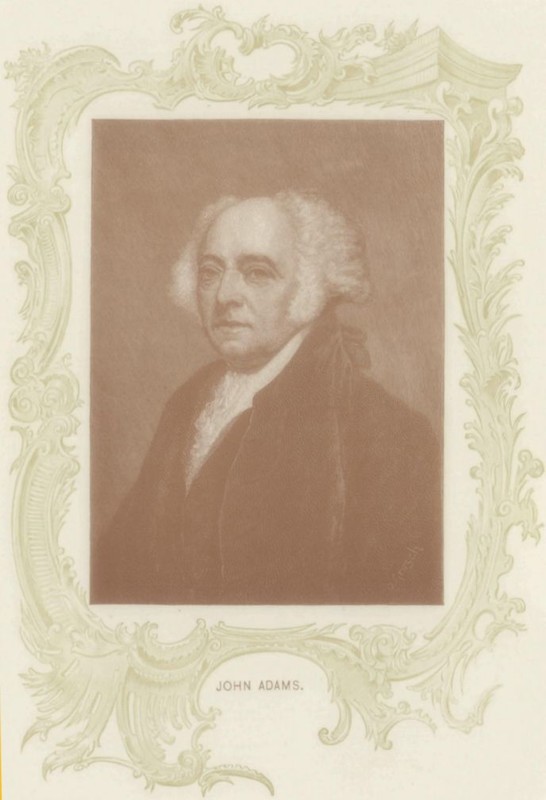
All these characteristics went to make up John Adams; but their enumeration does not furnish a complete picture of him, or reveal the virile, choleric, masterful man. And he was far more lovable and far more popular than his equally great son, also a typical Adams, from the same cause which produced some of his worst blunders and misfortunes,--a generous impulsiveness of feeling which made it impossible for him to hold his tongue at the wrong time and place for talking. But so fervid, combative, and opinionated a man was sure to gain much more hate than love; because love results from comprehension, which only the few close to him could have, while hate--toward an honest man--is the outcome of ignorance, which most of the world cannot avoid. Admiration and respect, however, he had from the majority of his party at the worst of times; and the best encomium on him is that the closer his public acts are examined, the more credit they reflect not only on his abilities but on his unselfishness.
Born of a line of Massachusetts farmers, he graduated from Harvard in 1755. After teaching a grammar school and beginning to read theology, he studied law and began practice in 1758, soon becoming a leader at the bar and in public life. In 1764 he married the noble and delightful woman whose letters furnish unconscious testimony to his lovable qualities. All through the germinal years of the Revolution he was one of the foremost patriots, steadily opposing any abandonment or compromise of essential rights. In 1765 he was counsel for Boston with Otis and Gridley to support the town's memorial against the Stamp Act. In 1766 he was selectman. In 1768 the royal government offered him the post of advocate-general in the Court of Admiralty,--a lucrative bribe to desert the opposition; but he refused it. Yet in 1770, as a matter of high professional duty, he became counsel (successfully) for the British soldiers on trial for the "Boston Massacre." Though there was a present uproar of abuse, Mr. Adams was shortly after elected Representative to the General Court by more than three to one. In March, 1774, he contemplated writing the "History of the Contest between Britain and America!" On June 17th he presided over the meeting at Faneuil Hall to consider the Boston Port Bill, and at the same hour was elected Representative to the first Congress at Philadelphia (September 1) by the Provincial Assembly held in defiance of the government. Returning thence, he engaged in newspaper debate on the political issues till the battle of Lexington.
Shortly after, he again journeyed to Philadelphia to the Congress of May 5th, 1775; where he did on his own motion, to the disgust of his Northern associates and the reluctance even of the Southerners, one of the most important and decisive acts of the Revolution,--induced Congress to adopt the forces in New England as a national army and put George Washington of Virginia at its head, thus engaging the Southern colonies irrevocably in the war and securing the one man who could make it a success. In 1776 he was a chief agent in carrying a declaration of independence. He remained in Congress till November, 1777, as head of the War Department, very useful and laborious though making one dreadful mistake: he was largely responsible for the disastrous policy of ignoring the just claims and decent dignity of the military commanders, which lost the country some of its best officers and led directly to Arnold's treason. His reasons, exactly contrary to his wont, were good abstract logic but thorough practical nonsense.
In December, 1777, he was appointed commissioner to France to succeed Silas Deane, and after being chased by an English man-of-war (which he wanted to fight) arrived at Paris in safety. There he reformed a very bad state of affairs; but thinking it absurd to keep three envoys at one court (Dr. Franklin and Arthur Lee were there before him), he induced Congress to abolish his office, and returned in 1779. Chosen a delegate to the Massachusetts constitutional convention, he was called away from it to be sent again to France. There he remained as Franklin's colleague, detesting and distrusting him and the French foreign minister, Vergennes, embroiling himself with both and earning a cordial return of his warmest dislike from both, till July, 1780. He then went to Holland as volunteer minister, and in 1782 was formally recognized as from an independent nation. Meantime Vergennes intrigued with all his might to have Adams recalled, and actually succeeded in so tying his hands that half the advantages of independence would have been lost but for his contumacious persistence. In the final negotiations for peace, he persisted against his instructions in making the New England fisheries an ultimatum, and saved them. In 1783 he was commissioned to negotiate a commercial treaty with Great Britain, and in 1785 was made minister to that power. The wretched state of American affairs under the Confederation made it impossible to obtain any advantages for his country, and the vindictive feeling of the English made his life a purgatory, so that he was glad to come home in 1788.
In the first Presidential election of that year he was elected Vice-President on the ticket with Washington; and began a feud with Alexander Hamilton, the mighty leader of the Federalist party and chief organizer of our governmental machine, which ended in the overthrow of the party years before its time, and had momentous personal and literary results as well. He was as good a Federalist as Hamilton, and felt as much right to be leader if he could; Hamilton would not surrender his leadership, and the rivalry never ended till Hamilton's murder. In 1796 he was elected President against Jefferson. His Presidency is recognized as one of the ablest and most useful on the roll; but its personal memoirs are most painful and scandalous. The cabinet were nearly all Hamiltonians, regularly laid all the official secrets before Hamilton, and took advice from him to thwart the President. They disliked Mr. Adams's overbearing ways and obtrusive vanity, considered his policy destructive to the party and injurious to the country, and felt that loyalty to these involved and justified disloyalty to him. Finally his best act brought on an explosion. The French Directory had provoked a war with this country, which the Hamiltonian section of the leaders and much of the party hailed with delight; but showing signs of a better spirit, Mr. Adams, without consulting his Cabinet, who he knew would oppose it almost or quite unanimously, nominated a commission to frame a treaty with France. The storm of fury that broke on him from his party has rarely been surpassed, even in the case of traitors outright, and he was charged with being little better. He was renominated for President in 1800, but beaten by Jefferson, owing to the defections in his own party, largely of Hamilton's producing. The Federalist party never won another election; the Hamilton section laid its death to Mr. Adams, and American history is hot with the fires of this battle even yet.
Mr. Adams's later years were spent at home, where he was always interested in public affairs and sometimes much too free in comments on them; where he read immensely and wrote somewhat. He heartily approved his son's break with the Federalists on the Embargo. He died on the same day as Jefferson, both on the fiftieth anniversary of the Declaration of Independence.
As a writer, Mr. Adams's powers show best in the work which can hardly be classed as literature,--his forcible and bitter political letters, diatribes, and polemics. As in his life, his merits and defects not only lie side by side, but spring from the same source,--his vehemence, self-confidence, and impatience of obstruction. He writes impetuously because he feels impetuously. With little literary grace, he possesses the charm that belongs to clear and energetic thought and sense transfused with hot emotion. John Fiske goes so far as to say that "as a writer of English, John Adams in many respects surpassed all his American contemporaries." He was by no means without humor,--a characteristic which shows in some of his portraits,--and sometimes realized the humorous aspects of his own intense and exaggerative temperament. His remark about Timothy Pickering, that "under the simple appearance of a bald head and straight hair, he conceals the most ambitious designs," is perfectly self-conscious in its quaint naiveté.
His 'Life and Works,' edited by his grandson, Charles Francis Adams, Sr., in ten volumes, is the great storehouse of his writings. The best popular account of his life is by John T. Morse, Jr., in the 'American Statesmen' series.
AT THE FRENCH COURT
From his Diary, June 7th, 1778, with his later comments in brackets.
Went to Versailles, in company with Mr. Lee, Mr. Izard and his lady, Mr. Lloyd and his lady, and Mr. François. Saw the grand procession of the Knights du Saint-Esprit, or du Cordon Bleu. At nine o'clock at night, went to the grand convert, and saw the king, queen, and royal family, at supper; had a fine seat and situation close by the royal family, and had a distinct and full view of the royal pair.
[Our objects were to see the ceremonies of the knights, and in the evening the public supper of the royal family. The kneelings, the bows, and the courtesies of the knights, the dresses and decorations, the king seated on his throne, his investiture of a new created knight with the badges and ornaments of the order, and his majesty's profound and reverential bow before the altar as he retired, were novelties and curiosities to me, but surprised me much less than the patience and perseverance with which they all kneeled, for two hours together, upon the hard marble of which the floor of the chapel was made. The distinction of the blue ribbon was very dearly purchased at the price of enduring this painful operation four times in a year, The Count de Vergennes confessed to me that he was almost dead with the pain of it. And the only insinuation I ever heard, that the king was in any degree touched by the philosophy of the age, was, that he never discovered so much impatience, under any of the occurrences of his life, as in going through those tedious ceremonies of religion, to which so many hours of his life were condemned by the catholic church.
The queen was attended by her ladies to the gallery opposite to the altar, placed in the centre of the seat, and there left alone by the other ladies, who all retired. She was an object too sublime and beautiful for my dull pen to describe. I leave this enterprise to Mr. Burke. But in his description, there is more of the orator than of the philosopher. Her dress was everything that art and wealth could make it. One of the maids of honor told me she had diamonds upon her person to the value of eighteen millions of livres; and I always thought her majesty much beholden to her dress. Mr. Burke saw her probably but once. I have seen her fifty times perhaps, and in all the varieties of her dresses. She had a fine complexion, indicating perfect health, and was a handsome woman in her face and figure. But I have seen beauties much superior, both in countenance and form, in France, England, and America.
After the ceremonies of this institution are over, there is a collection for the poor; and that this closing scene may be as elegant as any of the former, a young lady of some of the first families in France is appointed to present the box to the knights. Her dress must be as rich and elegant, in proportion, as the Queen's, and her hair, motions, and curtsies must have as much dignity and grace as those of the knights. It was a curious entertainment to observe the easy air, the graceful bow, and the conscious dignity of the knight, in presenting his contribution; and the corresponding ease, grace, and dignity of the lady, in receiving it, were not less charming. Every muscle, nerve, and fibre of both seemed perfectly disciplined to perform its functions. The elevation of the arm, the bend of the elbow, and every finger in the hand of the knight, in putting his louis d'ors into the box appeared to be perfectly studied, because it was perfectly natural. How much devotion there was in all this I know not, but it was a consummate school to teach the rising generation the perfection of the French air, and external politeness and good-breeding. I have seen nothing to be compared to it in any other country....
At nine o'clock we went and saw the king, queen, and royal family, at the grand couvert. Whether M. François, a gentleman who undertook upon this occasion to conduct us, had contrived a plot to gratify the curiosity of the spectators, or whether the royal family had a fancy to see the raw American at their leisure, or whether they were willing to gratify him with a convenient seat, in which he might see all the royal family, and all the splendors of the place, I know not; but the scheme could not have been carried into execution, certainly, without the orders of the king. I was selected, and summoned indeed, from all my company, and ordered to a seat close beside the royal family. The seats on both sides of the hall, arranged like the seats in a theatre, were all full of ladies of the first rank and fashion in the kingdom, and there was no room or place for me but in the midst of them. It was not easy to make room for one more person. However, room was made, and I was situated between two ladies, with rows and ranks of ladies above and below me, and on the right hand and on the left, and ladies only. My dress was a decent French dress, becoming the station I held, but not to be compared with the gold, and diamonds, and embroidery, about me. I could neither speak nor understand the language in a manner to support a conversation, but I had soon the satisfaction to find it was a silent meeting, and that nobody spoke a word but the royal family to each other, and they said very little. The eyes of all the assembly were turned upon me, and I felt sufficiently humble and mortified, for I was not a proper object for the criticisms of such a company. I found myself gazed at, as we in America used to gaze at the sachems who came to make speeches to us in Congress; but I thought it very hard if I could not command as much power of face as one of the chiefs of the Six Nations, and therefore determined that I would assume a cheerful countenance, enjoy the scene around me, and observe it as coolly as an astronomer contemplates the stars. Inscriptions of Fructus Belli were seen on the ceiling and all about the walls of the room, among paintings of the trophies of war; probably done by the order of Louis XIV., who confessed in his dying hour, as his successor and exemplar Napoleon will probably do, that he had been too fond of war. The king was the royal carver for himself and all his family. His majesty ate like a king, and made a royal supper of solid beef, and other things in proportion. The queen took a large spoonful of soup, and displayed her fine person and graceful manners, in alternately looking at the company in various parts of the hall, and ordering several kinds of seasoning to be brought to her, by which she fitted her supper to her taste.]
THE CHARACTER OF FRANKLIN
From Letter to the Boston Patriot, May 15th, 1811
Franklin had a great genius, original, sagacious, and inventive, capable of discoveries in science no less than of improvements in the fine arts and the mechanic arts. He had a vast imagination, equal to the comprehension of the greatest objects, and capable of a cool and steady comprehension of them. He had wit at will. He had humor that when he pleased was delicate and delightful. He had a satire that was good-natured or caustic, Horace or Juvenal, Swift or Rabelais, at his pleasure. He had talents for irony, allegory, and fable, that he could adapt with great skill to the promotion of moral and political truth. He was master of that infantine simplicity which the French call naiveté which never fails to charm in Phaedrus and La Fontaine, from the cradle to the grave. Had he been blessed with the same advantages of scholastic education in his early youth, and pursued a course of studies as unembarrassed with occupations of public and private life as Sir Isaac Newton, he might have emulated the first philosopher. Although I am not ignorant that most of his positions and hypotheses have been controverted, I cannot but think he has added much to the mass of natural knowledge, and contributed largely to the progress of the human mind, both by his own writings and by the controversies and experiments he has excited in all parts of Europe. He had abilities for investigating statistical questions, and in some parts of his life has written pamphlets and essays upon public topics with great ingenuity and success; but after my acquaintance with him, which commenced in Congress in 1775, his excellence as a legislator, a politician, or a negotiator most certainly never appeared. No sentiment more weak and superficial was ever avowed by the most absurd philosopher than some of his, particularly one that he procured to be inserted in the first constitution of Pennsylvania, and for which he had such a fondness as to insert it in his will. I call it weak, for so it must have been, or hypocritical; unless he meant by one satiric touch to ridicule his own republic, or throw it into everlasting contempt.
I must acknowledge, after all, that nothing in life has mortified or grieved me more than the necessity which compelled me to oppose him so often as I have. He was a man with whom I always wished to live in friendship, and for that purpose omitted no demonstration of respect, esteem, and veneration in my power, until I had unequivocal proofs of his hatred, for no other reason under the sun but because I gave my judgment in opposition to his in many points which materially affected the interests of our country, and in many more which essentially concerned our happiness, safety, and well-being. I could not and would not sacrifice the clearest dictates of my understanding and the purest principles of morals and policy in compliance to Dr. Franklin.
JOHN QUINCY ADAMS
(1767-1848)
he chief distinction in character between John Adams and his son is the strangest one imaginable, when one remembers that to the fiery, combative, bristling Adams blood was added an equal strain from the gay, genial, affectionate Abigail Smith. The son, though of deep inner affections, and even hungering for good-will if it would come without his help, was on the surface incomparably colder, harsher, and thornier than his father, with all the socially repellent traits of the race and none of the softer ones. The father could never control his tongue or his temper, and not always his head; the son never lost the bridle of either, and much of his terrible power in debate came from his ability to make others lose theirs while perfectly keeping his own. The father had plenty of warm friends and allies,--at the worst he worked with half a party; the son in the most superb part of his career had no friends, no allies, no party except the group of constituents who kept him in Congress. The father's self-confidence deepened in the son to a solitary and even contemptuous gladiatorship against the entire government of the country, for long years of hate and peril. The father's irritable though generous vanity changed in the son to an icy contempt or white-hot scorn of nearly all around him. The father's spasms of acrimonious judgment steadied in the son to a constant rancor always finding new objects. But only John Quincy Adams could have done the work awaiting John Quincy Adams, and each of his unamiable qualities strengthened his fibre to do it. And if a man is to be judged by his fruits, Mr. Morse is justified in saying that he was "not only pre-eminent in ability and acquirements, but even more to be honored for profound, immutable honesty of purpose, and broad, noble humanity of aims."
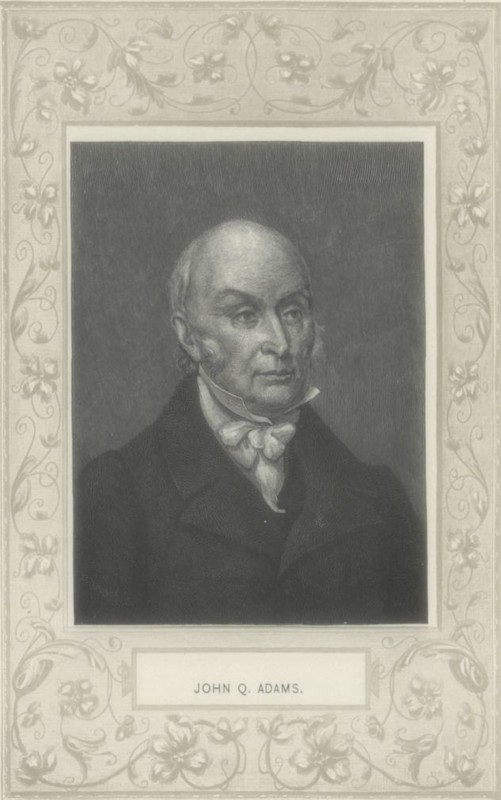
It might almost be said that the sixth President of the United States was cradled in statesmanship. Born July 11th, 1767, he was a little lad of ten when he accompanied his father on the French mission. Eighteen months elapsed before he returned, and three months later he was again upon the water, bound once more for the French capital. There were school days in Paris, and other school days in Amsterdam and in Leyden; but the boy was only fourteen,--the mature old child!--when he went to St. Petersburg as private secretary and interpreter to Francis Dana, just appointed minister plenipotentiary to the court of the Empress Catherine. Such was his apprenticeship to a public career which began in earnest in 1794, and lasted, with slight interruptions, for fifty-four years. Minister to the United Netherlands, to Russia, to Prussia, and to England; commissioner to frame the Treaty of Ghent which ended the war of 1812; State Senator, United States Senator; Secretary of State, a position in which he made the treaty with Spain which conceded Florida, and enunciated the Monroe Doctrine before Monroe and far more thoroughly than he; President, and then for many years Member of the National House of Representatives,--it is strange to find this man writing in his later years, "My whole life has been a succession of disappointments. I can scarcely recollect a single instance of success to anything that I ever undertook."
It is true, however, that his successes and even his glories always had some bitter ingredient to spoil their flavor. As United States Senator he was practically "boycotted" for years, even by his own party members, because he was an Adams. In 1807 he definitely broke with the Federalist party--for what he regarded as its slavish crouching under English outrages, conduct which had been for years estranging him--by supporting Jefferson's Embargo, as better than no show of resistance at all; and was for a generation denounced by the New England Federalists as a renegade for the sake of office and a traitor to New England. The Massachusetts Legislature practically censured him in 1808, and he resigned.
His winning of the Presidency brought pain instead of pleasure: he valued it only as a token of national confidence, got it only as a minority candidate in a divided party, and was denounced by the Jacksonians as a corrupt political bargainer. And his later Congressional career, though his chief title to glory, was one long martyrdom (even though its worst pains were self-inflicted), and he never knew the immense victory he had actually won. The "old man eloquent," after ceasing to be President, was elected in 1830 by his home district a Representative in Congress, and regularly re-elected till his death. For a long time he bore the anti-slavery standard almost alone in the halls of Congress, a unique and picturesque figure, rousing every demon of hatred in his fellow-members, in constant and envenomed battle with them, and more than a match for them all. He fought single-handed for the right of petition as an indefeasible right, not hesitating to submit a petition from citizens of Virginia praying for his own expulsion from Congress as a nuisance. In 1836 he presented a petition from one hundred and fifty-eight ladies, citizens of Massachusetts, "for, I said, I had not yet brought myself to doubt whether females were citizens." After eight years of persistent struggle against the "Atherton gag law," which practically denied the right of petition in matters relating to slavery, he carried a vote rescinding it, and nothing of the kind was again enacted. He had a fatal stroke of paralysis on the floor of Congress February 21st, 1848, and died two days later.
As a writer he was perspicuous, vigorous, and straightforward. He had entered Harvard in the middle of the college course, and been graduated with honors. He had then studied and practiced law. He was Professor of Rhetoric and Oratory at Harvard from 1806 to 1809, and was well drilled in the use of language, but was too downright in his temper and purposes to spend much labor upon artistic effects. He kept an elaborate diary during the greater part of his life,--since published in twelve volumes of "Memoirs" by his son Charles Francis Adams; a vast storehouse of material relating to the political history of the country, but, as published, largely restricted to public affairs. He delivered orations on Lafayette, on Madison, on Monroe, on Independence, and on the Constitution; published essays on the Masonic Institution and various other matters; a report on weights and measures, of enormous labor and permanent value; Lectures on Rhetoric and Oratory; a tale in verse on the Conquest of Ireland, with the title 'Dermot MacMorrogh'; an account of Travels in Silesia; and a volume of 'Poems of Religion and Society.' He had some facility in rhyme, but his judgment was not at fault in informing him that he was not a poet. Mr. Morse says that "No man can have been more utterly void of a sense of humor or an appreciation of wit"; and yet he very fairly anticipated Holmes in his poem on 'The Wants of Man,' and hits rather neatly a familiar foible in the verse with which he begins 'Dermot MacMorrogh':--
"'Tis strange how often readers will indulge
Their wits a mystic meaning to discover;
Secrets ne'er dreamt of by the bard divulge,
And where he shoots a cluck, will find a plover;
Satiric shafts from every line promulge,
Detect a tyrant where he draws a lover:
Nay, so intent his hidden thoughts to see,
Cry, if he paint a scoundrel--'That means me.'"
Selections from Letters and Memoirs used by permission of J.B. Lippincott Company.
LETTER TO HIS FATHER
(At the Age of Ten)
DEAR SIR,--I love to receive letters very well; much better than I love to write them. I make but a poor figure at composition, my head is too fickle, my thoughts are running after birds eggs play and trifles, till I get vexed with myself. Mamma has a troublesome task to keep me steady, and I own I am ashamed of myself. I have but just entered the third volume of Smollett, tho' I had designed to have got it half through by this time. I have determined this week to be more diligent, as Mr. Thaxter will be absent at Court, and I cannot pursue my other studies. I have Set myself a Stent and determine to read the 3rd volume Half out. If I can but keep my resolution, I will write again at the end of the week and give a better account of myself. I wish, Sir, you would give me some instructions, with regard to my time, and advise me how to proportion my Studies and my Play, in writing, and I will keep them by me, and endeavor to follow them. I am, dear Sir, with a present determination of growing better, yours.
P.S.--Sir, if you will be so good as to favor me with a Blank Book, I will transcribe the most remarkable occurances I meet with in my reading, which will serve to fix them upon my mind.
FROM THE MEMOIRS
(At the Age of Eighteen)
April 26th, 1785.--A letter from Mr. Gerry of Feb. 25th Says that Mr. Adams is appointed Minister to the Court of London.
I believe he will promote the interests of the United States, as much as any man, but I fear his duty will induce him to make exertions which may be detrimental to his health. I wish however it may be otherwise. Were I now to go with him, probably my immediate satisfaction might be greater than it will be in returning to America. After having been traveling for these seven years almost all over Europe, and having been in the World, and among company, for three; to return to spend one or two years in the pale of a College, subjected to all the rules which I have so long been freed from; then to plunge into the dry and tedious study of the Law for three years; and afterwards not expect (however good an opinion I may have of myself) to bring myself into notice under three or four years more; if ever! It is really a prospect somewhat discouraging for a youth of my ambition (for I have ambition, though I hope its object is laudable). But still
"Oh! how wretched
Is that poor Man, that hangs on Princes' favors"
or on those of anybody else. I am determined that so long as I shall be able to get my own living in an honorable manner, I will depend upon no one. My Father has been so much taken up all his lifetime with the interests of the public, that his own fortune has suffered by it; so that his children will have to provide for themselves, which I shall never be able to do, if I loiter away my precious time in Europe and shun going home until I am forced to it. With an ordinary share of Common sense which I hope I enjoy, at least in America I can live independent and free; and rather than live otherwise I would wish to die before the time when I shall be left at my own discretion. I have before me a striking example of the distressing and humiliating situation a person is reduced to by adopting a different line of conduct, and I am determined not to fall into the same error.
FROM THE MEMOIRS
JANUARY 14TH, 1831.--I received a letter from John C. Calhoun, now Vice-President of the United States, relating to his present controversy with President Jackson and William H. Crawford. He questions me concerning the letter of General Jackson to Mr. Monroe which Crawford alleges to have been produced at the Cabinet meetings on the Seminole War, and asks for copies, if I think proper to give them, of Crawford's letter to me which I received last summer, and of my answer. I answered Mr. Calhoun's letter immediately, rigorously confining myself to the direct object of his inquiries. This is a new bursting out of the old and rancorous feud between Crawford and Calhoun, both parties to which, after suspending their animosities and combining together to effect my ruin, are appealing to me for testimony to sustain themselves each against the other. This is one of the occasions upon which I shall eminently need the direction of a higher power to guide me in every step of my conduct. I see my duty to discard all consideration of their treatment of me; to adhere, in everything that I shall say or write, to the truth; to assert nothing positively of which I am not absolutely certain; to deny nothing upon which there remains a scruple of doubt upon my memory; to conceal nothing which it may be lawful to divulge, and which may promote truth and justice between the parties. With these principles, I see further the necessity for caution and prudence in the course I shall take. The bitter enmity of all three of the parties--Jackson, Calhoun, and Crawford--against me, an enmity the more virulent because kindled by their own ingratitude and injustice to me; the interest which every one of them, and all their partisans, have in keeping up that load of obloquy and public odium which their foul calumnies have brought down upon me; and the disfavor in which I stand before a majority of the people, excited against me by their artifices;--their demerits to me are proportioned to the obligations to me--Jackson's the greatest, Crawford's the next, Calhoun's the least of positive obligation, but darkened by his double-faced setting himself up as a candidate for the Presidency against me in 1821, his prevarications between Jackson and me in 1824, and his icy-hearted dereliction of all the decencies of social intercourse with me, solely from the terror of Jackson, since the 4th of March, 1829. I walk between burning ploughshares; let me be mindful where I place my foot.
FROM THE MEMOIRS
JUNE 7TH, 1833.--The first seedling apple-tree that I had observed on my return here just out of the ground was on the 22d of April. It had grown slowly but constantly since, and had put out five or six leaves. Last evening, after my return from Boston, I saw it perfectly sound. This morning I found it broken off, leaving one lobe of the seed-leaves, and one leaf over it. This may have been the work of a bug, or perhaps of a caterpillar. It would not be imaginable to any person free from hobby-horse or fanciful attachments, how much mortification such an incident occasions. St. Evremond, after removing into the country, returned to a city life because he found himself in despair for the loss of a pigeon. His conclusion was, that rural life induced exorbitant attachment to insignificant objects. My experience is conformable to this. My natural propensity was to raise trees, fruit and forest, from the seed. I had it in early youth, but the course of my life deprived me of the means of pursuing the bent of my inclination. One shellbark-walnut-tree in my garden, the root of which I planted 8th October, 1804, and one Mazzard cherry-tree in the grounds north of the house, the stone of which I planted about the same time, are the only remains of my experiments of so ancient a date. Had my life been spent in the country, and my experiments commenced while I was at College, I should now have a large fruit garden, flourishing orchards of native fruit, and very valuable forests; instead of which I have a nursery of about half an acre of ground, half full of seedlings, from five years to five days old, bearing for the first time perhaps twenty peaches, and a few blossoms of apricots and cherries; and hundreds of seedlings of the present year perishing from day to day before my eyes.
FROM THE MEMOIRS
SEPTEMBER 9TH, 1833.--Cold and cloudy day, clearing off toward evening. In the multitudinous whimseys of a disabled mind and body, the thick-coming fancies often come to me that the events which affect my life and adventures are specially shaped to disappoint my purposes. My whole life has been a succession of disappointments. I can scarcely recollect a single instance of success to anything that I ever undertook. Yet, with fervent gratitude to God, I confess that my life has been equally marked by great and signal successes which I neither aimed at nor anticipated. Fortune, by which I understand Providence, has showered blessings upon me profusely. But they have been blessings unforeseen and unsought. "Non nobis Domine, non nobis, sed nomini tuo da gloriam!" I ought to have been taught by it three lessons:--1. Of implicit reliance upon Providence. 2. Of humility and humiliation; the thorough conviction of my own impotence to accomplish anything. 3. Of resignation; and not to set my heart upon anything which can be taken from me or denied.
THE MISSION OF AMERICA
From his Fourth of July Oration at Washington, 1821
And now, friends and countrymen, if the wise and learned philosophers of the older world, the first observers of nutation and aberration, the discoverers of maddening ether and invisible planets, the inventors of Congreve rockets and shrapnel shells, should find their hearts disposed to inquire, What has America done for mankind? let our answer be this:--America, with the same voice which spoke herself into existence as a nation, proclaimed to mankind the inextinguishable rights of human nature, and the only lawful foundations of government. America, in the assembly of nations, since her admission among them, has invariably, though often fruitlessly, held forth to them the hand of honest friendship, of equal freedom, of generous reciprocity. She has uniformly spoken among them, though often to heedless and often to disdainful ears, the language of equal liberty, equal justice, and equal rights. She has, in the lapse of nearly half a century, without a single exception, respected the independence of other nations, while asserting and maintaining her own. She has abstained from interference in the concerns of others, even when the conflict has been for principles to which she clings, as to the last vital drop that visits the heart. She has seen that probably for centuries to come, all the contests of that Aceldama, the European World, will be contests between inveterate power and emerging right. Wherever the standard of freedom and independence has been or shall be unfurled, there will her heart, her benedictions, and her prayers be. But she goes not abroad in search of monsters to destroy. She is the well-wisher to the freedom and independence of all. She is the champion and vindicator only of her own. She will recommend the general cause, by the countenance of her voice, and the benignant sympathy of her example. She well knows that by once enlisting under other banners than her own, were they even the banners of foreign independence, she would involve herself, beyond the power of extrication, in all the wars of interest and intrigue, of individual avarice, envy, and ambition, which assume the colors and usurp the standard of freedom. The fundamental maxims of her policy would insensibly change from liberty to force. The frontlet upon her brows would no longer beam with the ineffable splendor of freedom and independence; but in its stead would soon be substituted an imperial diadem, flashing in false and tarnished lustre the murky radiance of dominion and power. She might become the dictatress of the world; she would no longer be the ruler of her own spirit.
THE RIGHT OF PETITION
Quoted in Memoir by Josiah Quincy.
Sir, it is ... well known that, from the time I entered this house, down to the present day, I have felt it a sacred duty to present any petition, couched in respectful language, from any citizen of the United States, be its object what it may,--be the prayer of it that in which I could concur, or that to which I was utterly opposed. I adhere to the right of petition; and let me say here that, let the petition be, as the gentleman from Virginia has stated, from free negroes, prostitutes, as he supposes,--for he says there is one put on this paper, and he infers that the rest are of the same description,--that has not altered my opinion at all. Where is your law that says that the mean, the low, and the degraded, shall be deprived of the right of petition, if their moral character is not good? Where, in the land of free-men, was the right of petition ever placed on the exclusive basis of morality and virtue? Petition is supplication--it is entreaty--it is prayer! And where is the degree of vice or immorality which shall deprive the citizen of the right to supplicate for a boon, or to pray for mercy? Where is such a law to be found? It does not belong to the most abject despotism. There is no absolute monarch on earth who is not compelled, by the constitution of his country, to receive the petitions of his people, whosoever they may be. The Sultan of Constantinople cannot walk the streets and refuse to receive petitions from the meanest and vilest in the land. This is the law even of despotism; and what does your law say? Does it say, that, before presenting a petition, you shall look into it and see whether it comes from the virtuous, and the great, and the mighty? No, sir; it says no such thing. The right of petition belongs to all; and so far from refusing to present a petition because it might come from those low in the estimation of the world, it would be an additional incentive, if such an incentive were wanting.
NULLIFICATION
From his Fourth of July Oration at Quincy, 1831
Nullification is the provocation to that brutal and foul contest of force, which has hitherto baffled all the efforts of the European and Southern American nations, to introduce among them constitutional governments of liberty and order. It strips us of that peculiar and unimitated characteristic of all our legislation--free debate; it makes the bayonet the arbiter of law; it has no argument but the thunderbolt. It were senseless to imagine that twenty-three States of the Union would suffer their laws to be trampled upon by the despotic mandate of one. The act of nullification would itself be null and void. Force must be called in to execute the law of the Union. Force must be applied by the nullifying State to resist its execution--
"Ate, hot from Hell,
Cries Havoc! and lets slip the dogs of war."
The blood of brethren is shed by each other. The citizen of the nullifying State is a traitor to his country, by obedience to the law of his State; a traitor to his State, by obedience to the law of his country. The scaffold and the battle-field stream alternately with the blood of their victims. Let this agent but once intrude upon your deliberations, and Freedom will take her flight for heaven. The Declaration of Independence will become a philosophical dream, and uncontrolled, despotic sovereignties will trample with impunity, through a long career of after ages, at interminable or exterminating war with one another, upon the indefeasible and unalienable rights of man.
The event of a conflict of arms, between the Union and one of its members, whether terminating in victory or defeat, would be but an alternative of calamity to all. In the holy records of antiquity, we have two examples of a confederation ruptured by the severance of its members; one of which resulted, after three desperate battles, in the extermination of the seceding tribe. And the victorious people, instead of exulting in shouts of triumph, "came to the House of God, and abode there till even before God; and lifted up their voices, and wept sore, and said,--O Lord God of Israel, why is this come to pass in Israel, that there should be to-day one tribe lacking in Israel?" The other was a successful example of resistance against tyrannical taxation, and severed forever the confederacy, the fragments forming separate kingdoms; and from that day, their history presents an unbroken series of disastrous alliances and exterminating wars--of assassinations, conspiracies, revolts, and rebellions, until both parts of the confederacy sunk in tributary servitude to the nations around them; till the countrymen of David and Solomon hung their harps upon the willows of Babylon, and were totally lost among the multitudes of the Chaldean and Assyrian monarchies, "the most despised portion of their slaves."
In these mournful memorials of their fate, we may behold the sure, too sure prognostication of our own, from the hour when force shall be substituted for deliberation in the settlement of our Constitutional questions. This is the deplorable alternative--the extirpation of the seceding member, or the never-ceasing struggle of two rival confederacies, ultimately bending the neck of both under the yoke of foreign domination, or the despotic sovereignty of a conqueror at home. May Heaven avert the omen! The destinies of not only our posterity, but of the human race, are at stake.
Let no such melancholy forebodings intrude upon the festivities of this anniversary. Serene skies and balmy breezes are not congenial to the climate of freedom. Progressive improvement in the condition of man is apparently the purpose of a superintending Providence. That purpose will not be disappointed. In no delusion of national vanity, but with a feeling of profound gratitude to the God of our Fathers, let us indulge the cheering hope and belief, that our country and her people have been selected as instruments for preparing and maturing much of the good yet in reserve for the welfare and happiness of the human race. Much good has already been effected by the solemn proclamation of our principles, much more by the illustration of our example. The tempest which threatens desolation, may be destined only to purify the atmosphere. It is not in tranquil ease and enjoyment that the active energies of mankind are displayed. Toils and dangers are the trials of the soul. Doomed to the first by his sentence at the fall, man, by his submission, converts them into pleasures. The last are since the fall the condition of his existence. To see them in advance, to guard against them by all the suggestions of prudence, to meet them with the composure of unyielding resistance, and to abide with firm resignation the final dispensation of Him who rules the ball,--these are the dictates of philosophy--these are the precepts of religion--these are the principles and consolations of patriotism; these remain when all is lost--and of these is composed the spirit of independence--the spirit embodied in that beautiful personification of the poet, which may each of you, my countrymen, to the last hour of his life, apply to himself:--
"Thy spirit, Independence, let me share,
Lord of the lion heart and eagle eye!
Thy steps I follow, with my bosom bare,
Nor heed the storm that howls along the sky."
In the course of nature, the voice which now addresses you must soon cease to be heard upon earth. Life and all which it inherits, lose of their value as it draws toward its close. But for most of you, my friends and neighbors, long and many years of futurity are yet in store. May they be years of freedom--years of prosperity--years of happiness, ripening for immortality! But, were the breath which now gives utterance to my feelings, the last vital air I should draw, my expiring words to you and your children should be, INDEPENDENCE AND UNION FOREVER!
SARAH FLOWER ADAMS
(1805--1848)
his English poet, whose hymn, 'Nearer, my God, to Thee,' is known wherever the English language is spoken, was born at Great Harlow, Essex, England, in 1805. She was the daughter of Benjamin Flower, who in 1799 was prosecuted for plain speaking in his paper, the Cambridge Intelligencer. From the outcome of his trial is to be dated the liberty of political discussion in England. Her mother was Eliza Gould, who first met her future husband in jail, whither she had gone on a visit to assure him of her sympathy. She also had suffered for liberal opinions. From their parents two daughters inherited a distinguished nobility and purity of character. Eliza excelled in the composition of music for congregational worship, and arranged a musical service for the Unitarian South Place Chapel, London. Sarah contributed first to the Monthly Repository, conducted by W.J. Fox, her Unitarian pastor, in whose family she lived after her father's death. In 1834 she married William Bridges Adams. Her delicate health gave way under the shock of her sister's death in 1846, and she died of decline in 1848.
Her poetic genius found expression both in the drama and in hymns. Her play, 'Vivia Perpetua' (1841), tells of the author's rapt aspiration after an ideal, symbolized in a pagan's conversion to Christianity. She published also 'The Royal Progress,' a ballad (1845), on the giving tip of the feudal privileges of the Isle of Wight to Edward I.; and poems upon the humanitarian interests which the Anti-Corn-Law League endeavored to further. Her hymns are the happiest expressions of the religious trust, resignation, and sweetness of her nature.
'Nearer, my God, to Thee,' was written for the South Place Chapel service. There are stories of its echoes having been heard from a dilapidated log cabin in Arkansas, from a remote corner of the north of England, and from the Heights of Benjamin in the Holy Land. But even its devotion and humility have not escaped censure--arising, perhaps, from denominational bias. The fault found with it is the fault of Addison's 'How are thy servants blessed, O Lord,' and the fault of the Psalmody begun by Sternhold and Hopkins, which, published in Geneva in 1556, electrified the congregation of six thousand souls in Elizabeth's reign,--it has no direct reference to Jesus. Compilers of hymn-books have sought to rectify what they deem a lapse in Christian spirit by the substitution of a verse begining "Christ alone beareth me." But the quality of the interpolated verse is so inferior to the lyric itself that it has not found general acceptance. Others, again, with an excess of zeal, have endeavored to substitute "the Cross" for "a cross" in the first stanza.
An even share of its extraordinary vogue must in bare justice be credited to the tune which Dr. Lowell Mason has made an inseparable part of it; though this does not detract in the least from its own high merit, or its capacity to satisfy the feelings of a devout soul. A taking melody is the first condition of even the loveliest song's obtaining popularity; and this hymn was sung for many years to various tunes, including chants, with no general recognition of its quality. It was Dr. Mason's tune, written about 1860, which sent it at once into the hearts of the people.
HE SENDETH SUN, HE SENDETH SHOWER
He sendeth sun, he sendeth shower,
Alike they're needful to the flower;
And joys and tears alike are sent
To give the soul fit nourishment.
As comes to me or cloud or sun,
Father! thy will, not mine, be done.
Can loving children e'er reprove
With murmurs, whom they trust and love?
Creator, I would ever be
A trusting, loving child to thee:
As comes to me or cloud or sun,
Father! thy will, not mine, be done.
Oh, ne'er will I at life repine,--
Enough that thou hast made it mine.
When falls the shadow cold of death,
I yet will sing with parting breath,
As comes to me or cloud or sun,
Father! thy will, not mine, be done.
NEARER, MY GOD, TO THEE
Nearer, my God, to thee,
Nearer to thee!
E'en though it be a cross
That raiseth me;
Still all my song shall be,--
Nearer, my God, to thee,
Nearer to thee!
Though, like a wanderer,
The sun gone down,
Darkness be over me,
My rest a stone;
Yet in my dreams I'd be
Nearer, my God, to thee,
Nearer to thee!
There let the way appear
Steps unto heaven;
All that thou sendest me
In mercy given;
Angels to beckon me
Nearer, my God, to thee,
Nearer to thee!
Then with my waking thoughts
Bright with thy praise,
Out of my stony griefs
Bethel I'll raise;
So by my woes to be
Nearer, my God, to thee,
Nearer to thee!
Or if on joyful wing,
Cleaving the sky,
Sun, moon, and stars forgot,
Upward I fly;
Still all my song shall be,--
Nearer, my God, to thee,
Nearer to thee!
From 'Adoration, Aspiration, and Belief.'
JOSEPH ADDISON
(1672-1719)
BY HAMILTON WRIGHT MABIE
here are few figures in literary history more dignified and attractive than Joseph Addison; few men more eminently representative, not only of literature as a profession, but of literature as an art. It has happened more than once that literary gifts of a high order have been lodged in very frail moral tenements; that taste, feeling, and felicity of expression have been divorced from general intellectual power, from intimate acquaintance with the best in thought and art, from grace of manner and dignity of life. There have been writers of force and originality who failed to attain a representative eminence, to identify themselves with their art in the memory of the world. There have been other writers without claim to the possession of gifts of the highest order, who have secured this distinction by virtue of harmony of character and work, of breadth of interest, and of that fine intelligence which instinctively allies itself with the best in its time. Of this class Addison is an illustrious example. His gifts are not of the highest order; there was none of the spontaneity, abandon, or fertility of genius in him; his thought made no lasting contribution to the highest intellectual life; he set no pulses beating by his eloquence of style, and fired no imagination by the insight and emotion of his verse; he was not a scholar in the technical sense: and yet, in an age which was stirred and stung by the immense satiric force of Swift, charmed by the wit and elegance of Pope, moved by the tenderness of Steele, and enchanted by the fresh realism of De Foe, Addison holds the most representative place. He is, above all others, the Man of Letters of his time; his name instantly evokes the literature of his period.
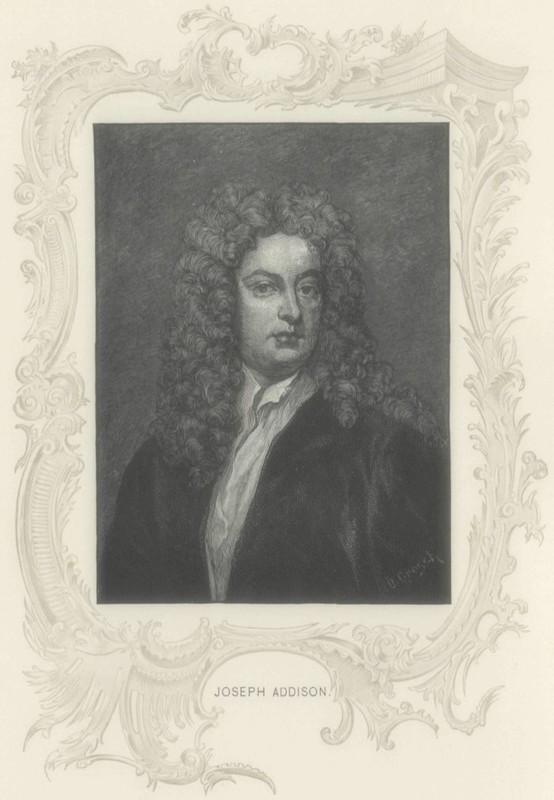
Born in the rectory at Milston, Wiltshire, on May Day, 1672, it was Addison's fortune to take up the profession of Letters at the very moment when it was becoming a recognized profession, with a field of its own, and with emoluments sufficient in kind to make decency of living possible, and so related to a man's work that their acceptance involved loss neither of dignity nor of independence. He was contemporary with the first English publisher, Jacob Tonson. He was also contemporary with the notable reorganization of English prose which freed it from exaggeration, complexity, and obscurity; and he contributed not a little to the flexibility, charm, balance, and ease which have since characterized its best examples. He saw the rise of polite society in its modern sense; the development of the social resources of the city; the enlargement of what is called "the reading class" to embrace all classes in the community and all orders in the nation. And he was one of the first, following the logic of a free press, an organized business for the sale of books, and the appearance of popular interest in literature, to undertake that work of translating the best thought, feeling, sentiment, and knowledge of his time, and of all times, into the language of the drawing-room, the club, and the street, which has done so much to humanize and civilize the modern world.
To recognize these various opportunities, to feel intuitively the drift of sentiment and conviction, and so to adjust the uses of art to life as to exalt the one, and enrich and refine the other, involved not only the possession of gifts of a high order, but that training which puts a man in command of himself and of his materials. Addison was fortunate in that incomparably important education which assails a child through every sense, and above all through the imagination--in the atmosphere of a home, frugal in its service to the body, but prodigal in its ministry to the spirit. His father was a man of generous culture: an Oxford scholar, who had stood frankly for the Monarchy and Episcopacy in Puritan times; a voluminous and agreeable writer; of whom Steele says that he bred his five children "with all the care imaginable in a liberal and generous way." From this most influential of schools Addison passed on to other masters: from the Grammar School at Lichfield, to the well-known Charter House; and thence to Oxford, where he first entered Queen's College, and later, became a member of Magdalen, to the beauty of whose architecture and natural situation the tradition of his walks and personality adds no small charm. He was a close student, shy in manner, given to late hours of work. His literary tastes and appetite were early disclosed, and in his twenty-second year he was already known in London, had written an 'Account of the Greatest English Poets,' and had addressed some complimentary verses to Dryden, then the recognized head of English Letters.
While Addison was hesitating what profession to follow, the leaders of the political parties were casting about for men of literary power. A new force had appeared in English politics--the force of public opinion; and in their experiments to control and direct this novel force, politicians were eager to secure the aid of men of Letters. The shifting of power to the House of Commons involved a radical readjustment, not only of the mechanism of political action, but of the attitude of public men to the nation. They felt the need of trained and persuasive interpreters and advocates; of the resources of wit, satire, and humor. It was this very practical service which literature was in the way of rendering to political parties, rather than any deep regard for literature itself, which brought about a brief but brilliant alliance between groups of men who have not often worked together to mutual advantage. It must be said, however, that there was among the great Whig and Tory leaders of the time a certain liberality of taste, and a care for those things which give public life dignity and elegance, which were entirely absent from Robert Walpole and the leaders of the two succeeding reigns, when literature and politics were completely divorced, and the government knew little and cared less for the welfare of the arts. Addison came on the stage at the very moment when the government was not only ready but eager to foster such talents as his. He was a Whig of pronounced although modern type, and the Whigs were in power.
Lord Somers and Charles Montagu, better known later as Lord Halifax, were the heads of the ministry, and his personal friends as well. They were men of culture, lovers of Letters, and not unappreciative of the personal distinction which already stamped the studious and dignified Magdalen scholar. A Latin poem on the Peace of Ryswick, dedicated to Montagu, happily combined Virgilian elegance and felicity with Whig sentiment and achievement. It confirmed the judgment already formed of Addison's ability; and, setting aside with friendly insistence the plan of putting that ability into the service of the Church, Montagu secured a pension of £300 for the purpose of enabling Addison to fit himself for public employment abroad by thorough study of the French language, and of manners, methods, and institutions on the Continent. With eight Latin poems, published in the second volume of the 'Musae Anglicanae,' as an introduction to foreign scholars, and armed with letters of introduction from Montagu to many distinguished personages, Addison left Oxford in the summer of 1699, and, after a prolonged stay at Blois for purposes of study, visited many cities and interesting localities in France, Italy, Switzerland, Austria, Germany, and Holland. The shy, reticent, but observing young traveler was everywhere received with the courtesy which early in the century had made so deep an impression on the young Milton. He studied hard, saw much, and meditated more. He was not only fitting himself for public service, but for that delicate portraiture of manners which was later to become his distinctive work. Clarendon had already drawn a series of lifelike portraits of men of action in the stormy period of the Revolution: Addison was to sketch the society of his time with a touch at once delicate and firm; to exhibit its life in those aspects which emphasize individual humor and personal quality, against a carefully wrought background of habit, manners, usage, and social condition. The habit of observation and the wide acquaintance with cultivated and elegant social life which was a necessary part of the training for the work which was later to appear in the pages of the Spectator, were perhaps the richest educational results of these years of travel and study; for Addison the official is a comparatively obscure figure, but Addison the writer is one of the most admirable and attractive figures in English history.
Addison returned to England in 1703 with clouded prospects. The accession of Queen Anne had been followed by the dismissal of the Whigs from office; his pension was stopped, his opportunity of advancement gone, and his father dead. The skies soon brightened, however: the support of the Whigs became necessary to the Government; the brilliant victory of Blenheim shed lustre not only on Marlborough, but on the men with whom he was politically affiliated; and there was great dearth of poetic ability in the Tory ranks at the very moment when a notable achievement called for brave and splendid verse. Lord Godolphin, that easy-going and eminently successful politician of whom Charles the Second once shrewdly said that he was "never in the way and never out of it," was directed to Addison in this emergency; and the story goes that the Chancellor of the Exchequer, afterward Lord Carleton, who was sent to express to the needy scholar the wishes of the Government, found him lodged in a garret over a small shop. The result of this memorable embassy from politics to literature was 'The Campaign': an eminently successful poem of the formal, "occasional" order, which celebrated the victor of Blenheim with tact and taste, pleased the ministry, delighted the public, and brought reputation and fortune to its unknown writer. Its excellence is in skillful avoidance of fulsome adulation, in the exclusion of the well-worn classical allusions, and in a straightforward celebration of those really great qualities in Marlborough which set his military career in brilliant contrast with his private life. The poem closed with a simile which took the world by storm:--
"So when an angel, by divine command,
With rising tempests shakes a guilty land,
(Such as of late o'er pale Britannia passed,)
Calm and serene he drives the furious blast;
And, pleased the Almighty's orders to perform,
Rides in the whirlwind and directs the storm."
"Addison left off at a good moment," says Thackeray. "That simile was pronounced to be the greatest ever produced in poetry. That angel, that good angel, flew off with Mr. Addison, and landed him in the place of Commissioner of Appeals--vice Mr. Locke, providentially promoted. In the following year Mr. Addison went to Hanover with Lord Halifax, and the year after was made Under-Secretary of State. O angel visits! You come 'few and far between' to literary gentlemen's lodgings! Your wings seldom quiver at the second-floor windows now!"
The prize poem was followed by a narrative of travel in Italy, happily written, full of felicitous description, and touched by a humor which, in quality and manner, was new to English readers. Then came one of those indiscretions of the imagination which showed that the dignified and somewhat sober young poet, the "parson in a tye-wig," as he was called at a later day, was not lacking in gayety of mood. The opera 'Rosamond' was not a popular success, mainly because the music to which it was set fell so far below it in grace and ease. It must be added, however, that Addison lacked the qualities of a successful libretto writer. He was too serious, and despite the lightness of his touch, there was a certain rigidity in him which made him unapt at versification which required quickness, agility, and variety. When he attempted to give his verse gayety of manner, he did not get beyond awkward simulation of an ease which nature had denied him:--
"Since conjugal passion
Is come into fashion,
And marriage so blest on the throne is,
Like a Venus I'll shine,
Be fond and be fine,
And Sir Trusty shall be my Adonis."
Meantime, in spite of occasional clouds, Addison's fortunes were steadily advancing. The Earl of Wharton was appointed Lord Lieutenant of Ireland, and Addison accepted the lucrative post of Secretary. Spenser had found time and place, during a similar service in the same country, to complete the 'Faery Queene'; although the fair land in which the loveliest of English poems has its action was not unvexed by the chronic turbulence of a mercurial and badly used race. Irish residence was coincident in Addison's case, not only with prosperous fortunes and with important friendships, but also with the beginning of the work on which his fame securely rests. In Ireland the acquaintance he had already made in London with Swift ripened into a generous friendship, which for a time resisted political differences when such differences were the constant occasion of personal animosity and bitterness. The two men represented the age in an uncommonly complete way. Swift had the greater genius: he was, indeed, in respect of natural endowment, the foremost man of his time; but his nature was undisciplined, his temper uncertain, and his great powers quite as much at the service of his passions as of his principles. He made himself respected, feared, and finally hated; his lack of restraint and balance, his ferocity of spirit when opposed, and the violence with which he assailed his enemies, neutralized his splendid gifts, marred his fortune, and sent him into lonely exile at Dublin, where he longed for the ampler world of London. Few figures in literary history are more pathetic than that of the old Dean of St. Patrick's, broken in spirit, failing in health, his noble faculties gone into premature decay, forsaken, bitter, and remorseful. At the time of Addison's stay in Ireland, the days of Swift's eclipse were, however, far distant; both men were in their prime. That Swift loved Addison is clear enough; and it is easy to understand the qualities which made Addison one of the most deeply loved men of his time. He was of an eminently social temper, although averse to large companies and shy and silent in their presence. "There is no such thing," he once said, "as real conversation but between two persons." He was free from malice, meanness, or jealousy, Pope to the contrary notwithstanding. He was absolutely loyal to his principles and to his friends, in a time when many men changed both with as little compunction as they changed wigs and swords. His personality was singularly winning; his features regular, and full of refinement and intelligence; his bearing dignified and graceful; his temper kindly and in perfect control; his character without a stain; his conversation enchanting, its charm confessed by persons so diverse in taste as Pope, Swift, Steele, and Young. Lady Mary Montagu declared that he was the best company she had ever known. He had two faults of which the world has heard much: he loved the company of men who flattered him, and at times he used wine too freely. The first of these defects was venial, and did not blind his judgment either of himself or his friends; the second defect was so common among the men of his time that Addison's occasional over-indulgence, in contrast with the excesses of others, seems like temperance itself.
The harmony and symmetry of this winning personality has, in a sense, told against it; for men are prone to call the well-balanced nature cold and the well-regulated life Pharisaic. Addison did not escape charges of this kind from the wild livers of his own time, who could not dissociate genius from profligacy nor generosity of nature from prodigality. It was one of the great services of Addison to his generation and to all generations, that in an age of violent passions, he showed how a strong man could govern himself. In a time of reckless living, he illustrated the power which flows from subordination of pleasure to duty. In a day when wit was identified with malice, he brought out its power to entertain, surprise, and delight, without taking on the irreverent levity of Voltaire, the bitterness of Swift, or the malice of Pope.
It was during Addison's stay in Ireland that Richard Steele projected the Tatler, and brought out the first number in 1709. His friendship for Addison amounted almost to a passion; their intimacy was cemented by harmony of tastes and diversity of character. Steele was ardent, impulsive, warm-hearted, mercurial; full of aspiration and beset by lamentable weaknesses,--preaching the highest morality and constantly falling into the prevalent vices of his time; a man so lovable of temper, so generous a spirit, and so frank a nature, that his faults seem to humanize his character rather than to weaken and stain it. Steele's gifts were many, and they were always at the service of his feelings; he had an Irish warmth of sympathy and an Irish readiness of humor, with great facility of inventiveness, and an inexhaustible interest in all aspects of human experience. There had been political journals in England since the time of the Revolution, but Steele conceived the idea of a journal which should comment on the events and characteristics of the time in a bright and humorous way; using freedom with judgment and taste, and attacking the vices and follies of the time with the light equipment of wit rather than with the heavy armament of the formal moralist. The time was ripe for such an enterprise. London was full of men and women of brilliant parts, whose manners, tastes, and talk presented rich material for humorous report and delineation or for satiric comment. Society, in the modern sense, was fast taking form, and the resources of social intercourse were being rapidly developed. Men in public life were intimately allied with society and sensitive to its opinion; and men of all interests--public, fashionable, literary--gathered in groups at the different chocolate or coffee houses, and formed a kind of organized community. It was distinctly an aristocratic society: elegant in dress, punctilious in manner, exacting in taste, ready to be amused, and not indifferent to criticism when it took the form of sprightly badinage or of keen and trenchant satire. The informal organization of society, which made it possible to reach and affect the Town as a whole, is suggested by the division of the Tatler:--
"All accounts of Gallantry, Pleasure, and Entertainment, shall be under the article of White's Chocolate-House; Poetry under that of Will's Coffee-House; Learning under the title of Grecian; Foreign and Domestic News you will have from St. James's Coffee-House; and what else I have to offer on any other subject shall be dated from my own apartment."
So wrote Steele in his introduction to the readers of the new journal, which was to appear three times a week, at the cost of a penny. Of the coffee-houses enumerated, St. James's and White's were the headquarters of men of fashion and of politics; the Grecian of men of legal learning; Will's of men of Letters. The Tatler was successful from the start. It was novel in form and in spirit; it was sprightly without being frivolous, witty without being indecent, keen without being libelous or malicious. In the general license and coarseness of the time, so close to the Restoration and the powerful reaction against Puritanism, the cleanness, courtesy, and good taste which characterized the journal had all the charm of a new diversion. In paper No. 18, Addison made his appearance as a contributor, and gave the world the first of those inimitable essays which influenced their own time so widely, and which have become the solace and delight of all times. To Addison's influence may perhaps be traced the change which came over the Tatler, and which is seen in the gradual disappearance of the news element, and the steady drift of the paper away from journalism and toward literature. Society soon felt the full force of the extraordinary talent at the command of the new censor of contemporary manners and morals. There was a well-directed and incessant fire of wit against the prevailing taste of dramatic art; against the vices of gambling and dueling; against extravagance and affectation of dress and manner: and there was also criticism of a new order.
The Tatler was discontinued in January, 1711, and the first number of the Spectator appeared in March. The new journal was issued daily, but it made no pretensions to newspaper timeliness or interest; it aimed to set a new standard in manners, morals, and taste, without assuming the airs of a teacher. "It was said of Socrates," wrote Addison, in a memorable chapter in the new journal, "that he brought Philosophy down from heaven to inhabit among men; and I shall be happy to have it said of me that I have brought Philosophy out of closets and libraries, schools and colleges, to dwell in clubs and assemblies, at tea-tables and in coffee-houses." For more than two years the Spectator discharged with inimitable skill and success the difficult function of chiding, reproving, and correcting, without irritating, wounding, or causing strife. Swift found the paper too gentle, but its influence was due in no small measure to its persuasiveness. Addison studied his method of attack as carefully as Matthew Arnold, who undertook a similar educational work in our own time, studied his means of approach to a public indifferent or hostile to his ideas. The two hundred and seventy-four papers furnished by Addison to the columns of the Spectator may be said to mark the full development of English prose as a free, flexible, clear, and elegant medium of expressing the most varied and delicate shades of thought. They mark also the perfection of the essay form in our literature; revealing clear perception of its limitations and of its resources; easy mastery of its possibilities of serious exposition and of pervading charm; ability to employ its full capacity of conveying serious thought in a manner at once easy and authoritative. They mark also the beginning of a deeper and more intelligent criticism; for their exposition of Milton may be said to point the way to a new quality of literary judgment and a new order of literary comment. These papers mark, finally, the beginnings of the English novel; for they contain a series of character-studies full of insight, delicacy of drawing, true feeling, and sureness of touch. Addison was not content to satirize the follies, attack the vices, and picture the manners of his times: he created a group of figures which stand out as distinctly as those which were drawn more than a century later by the hand of Thackeray, our greatest painter of manners. De Foe had not yet published the first of the great modern novels of incident and adventure in 'Robinson Crusoe,' and Richardson, Fielding, and Smollett were unborn or unknown, when Addison was sketching Sir Roger de Coverley and Will Honeycomb, and filling in the background with charming studies of life in London and in the country. The world has instinctively selected Sir Roger de Coverley as the truest of all the creations of Addison's imagination; and it sheds clear light on the fineness of Addison's nature that among the four characters in fiction whom English readers have agreed to accept as typical gentlemen,--Don Quixote, Sir Roger de Coverley, Henry Esmond, and Colonel Newcombe,--the old English baronet holds a secure place.
Finished in style, but genuinely human in feeling, betraying the nicest choice of words and the most studied care for elegant and effective arrangement, and yet penetrated by geniality, enlivened by humor, elevated by high moral aims, often using the dangerous weapons of irony and satire, and yet always well-mannered and kindly,--these papers reveal the sensitive nature of Addison and the delicate but thoroughly tempered art which he had at his command.
Rarely has literature of so high an order had such instant success; for the popularity of the Spectator has been rivaled in English literature only by that of the Waverley novels or of the novels of Dickens. Its influence was felt not only in the sentiment of the day, and in the crowd of imitators which followed in its wake, but also across the Channel. In Germany, especially, the genius and methods of Addison made a deep and lasting impression.
No man could reach such eminence in the first quarter of the last century without being tempted to try his hand at play-writing; and the friendly fortune which seemed to serve Addison at every turn reached its climax in the applause which greeted the production of 'Cato.' The motive of this tragedy, constructed on what were then held to be classic lines, is found in the two lines of the Prologue: it was an endeavor to portray
"A brave man struggling in the storms of fate,
And greatly falling with a falling State."
The play was full of striking lines which were instantly caught up and applied to the existing political situation; the theatre was crowded night after night, and the resources of Europe in the way of translations, plaudits, and favorable criticisms were exhausted in the endeavor to express the general approval. The judgment of a later period has, however, assigned 'Cato' a secondary place, and it is remembered mainly on account of its many felicitous passages. It lacks real dramatic unity and vitality; the character of Cato is essentially an abstraction; there is little dramatic necessity in the situations and incidents. It is rhetorical rather than poetic, declamatory rather than dramatic. Johnson aptly described it as "rather a poem in dialogue than a drama, rather a succession of just sentiments in elegant language than a representation of natural affections, or of any state probable or possible in human life."
Addison's popularity touched its highest point in the production of 'Cato.' Even his conciliatory nature could not disarm the envy which such brilliant success naturally aroused, nor wholly escape the bitterness which the intense political feeling of the time constantly bred between ambitious and able men. Political differences separated him from Swift, and Steele's uncertain character and inconsistent course blighted what was probably the most delightful intimacy of his life. Pope doubtless believed that he had good ground for charging Addison with jealousy and insincerity, and in 1715 an open rupture took place between them. The story of the famous quarrel was first told by Pope, and his version was long accepted in many quarters as final; but later opinion inclines to hold Addison guiltless of the grave accusations brought against him. Pope was morbidly sensitive to slights, morbidly eager for praise, and extremely irritable. To a man of such temper, trifles light as air became significant of malice and hatred. Such trifles unhappily confirmed Pope's suspicions; his self-love was wounded, sensitiveness became animosity, and animosity became hate, which in the end inspired the most stinging bit of satire in the language:--
"Should such a one, resolved to reign alone,
Bear, like the Turk, no brother near the throne,
View him with jealous yet with scornful eyes,
Hate him for arts that caused himself to rise,
Damn with faint praise, assent with civil leer,
And, without sneering, teach the rest to sneer;
Alike unused to blame or to commend,
A timorous foe and a suspicious friend,
Fearing e'en fools, by flatterers besieged,
And so obliging that he ne'er obliged;
Willing to wound, and yet afraid to strike."
There was just enough semblance of truth in these inimitable lines to give them lasting stinging power; but that they were grossly unjust is now generally conceded. Addison was human, and therefore not free from the frailties of men of his profession; but there was no meanness in him.
Addison's loyalty to the Whig party and his ability to serve it kept him in intimate relations with its leaders and bound him to its fortunes. He served the Whig cause in Parliament, and filled many positions which required tact and judgment, attaining at last the very dignified post of Secretary of State. A long attachment for the Countess of Warwick culminated in marriage in 1716, and Addison took up his residence in Holland House; a house famous for its association with men of distinction in politics and letters. The marriage was not happy, if report is to be trusted. The union of the ill-adapted pair was, in any event, short-lived; for three years later, in 1719, Addison died in his early prime, not yet having completed his forty-eighth year. On his death-bed, Young tells us, he called his stepson to his side and said, "See in what peace a Christian can die." His body was laid in Westminster Abbey; his work is one of the permanent possessions of the English-speaking race; his character is one of its finest traditions. He was, as truly as Sir Philip Sidney, a gentleman in the sweetness of his spirit, the courage of his convictions, the refinement of his bearing, and the purity of his life. He was unspoiled by fortune and applause; uncorrupted by the tempting chances of his time; stainless in the use of gifts which in the hands of a man less true would have caught the contagion of Pope's malice or of Swift's corroding cynicism.

SIR ROGER DE COVERLEY AT THE PLAY
From the Spectator, No. 335
My friend Sir Roger de Coverley, when we last met together at the Club, told me, that he had a great mind to see the new Tragedy with me, assuring me at the same time that he had not been at a Play these twenty Years. The last I saw, said Sir Roger, was the Committee, which I should not have gone to neither, had not I been told beforehand that it was a good Church-of-England Comedy. He then proceeded to enquire of me who this Distrest Mother was; and upon hearing that she was Hector's Widow, he told me that her Husband was a brave Man, and that when he was a Schoolboy he had read his Life at the end of the Dictionary. My friend asked me in the next place, if there would not be some danger in coming home late, in case the Mohocks[1] should be Abroad. I assure you, says he, I thought I had fallen into their Hands last Night; for I observed two or three lusty black Men that follow'd me half way up Fleet-street, and mended their pace behind me, in proportion as I put on to get away from them. You must know, continu'd the Knight with a Smile, I fancied they had a mind to hunt me; for I remember an honest Gentleman in my Neighbourhood, who was served such a trick in King Charles the Second's time; for which reason he has not ventured himself in Town ever since. I might have shown them very good Sport, had this been their Design; for as I am an old Fox-hunter, I should have turned and dodg'd, and have play'd them a thousand tricks they had never seen in their Lives before. Sir Roger added, that if these gentlemen had any such Intention, they did not succeed very well in it: for I threw them out, says he, at the End of Norfolk street, where I doubled the Corner, and got shelter in my Lodgings before they could imagine what was become of me. However, says the Knight, if Captain Sentry will make one with us to-morrow night, and if you will both of you call upon me about four a Clock, that we may be at the House before it is full, I will have my own Coach in readiness to attend you, for John tells me he has got the Fore-Wheels mended.
[1] London "bucks" who disguised themselves as savages and roamed the streets at night, committing outrages on persons and property.
The Captain, who did not fail to meet me there at the appointed Hour, bid Sir Roger fear nothing, for that he had put on the same Sword which he made use of at the Battel of Steenkirk. Sir Roger's Servants, and among the rest my old Friend the Butler, had, I found, provided themselves with good Oaken Plants, to attend their Master upon this occasion. When he had placed him in his Coach, with my self at his Left-Hand, the Captain before him, and his Butler at the Head of his Footmen in the Rear, we convoy'd him in safety to the Play-house, where, after having marched up the Entry in good order, the Captain and I went in with him, and seated him betwixt us in the Pit. As soon as the House was full, and the Candles lighted, my old Friend stood up and looked about him with that Pleasure, which a Mind seasoned with Humanity naturally feels in its self, at the sight of a Multitude of People who seem pleased with one another, and partake of the same common Entertainment. I could not but fancy to myself, as the old Man stood up in the middle of the Pit, that he made a very proper Center to a Tragick Audience. Upon the entring of Pyrrhus, the Knight told me that he did not believe the King of France himself had a better Strut. I was indeed very attentive to my old Friend's Remarks, because I looked upon them as a Piece of natural Criticism, and was well pleased to hear him at the Conclusion of almost every Scene, telling me that he could not imagine how the Play would end. One while he appeared much concerned for Andromache; and a little while after as much for Hermione: and was extremely puzzled to think what would become of Pyrrhus.
When Sir Roger saw Andromache's obstinate Refusal to her Lover's importunities, he whisper'd me in the Ear, that he was sure she would never have him; to which he added, with a more than ordinary Vehemence, You can't imagine, Sir, what 'tis to have to do with a Widow. Upon Pyrrhus his threatning afterwards to leave her, the Knight shook his Head, and muttered to himself, Ay, do if you can. This Part dwelt so much upon my Friend's Imagination, that at the close of the Third Act, as I was thinking of something else, he whispered in my Ear, These Widows, Sir, are the most perverse Creatures in the World. But pray, says he, you that are a Critick, is this Play according to your Dramatick Rules, as you call them? Should your People in Tragedy always talk to be understood? Why, there is not a single Sentence in this Play that I do not know the Meaning of.
The Fourth Act very luckily begun before I had time to give the old Gentleman an Answer: Well, says the Knight, sitting down with great Satisfaction, I suppose we are now to see Hector's Ghost. He then renewed his Attention, and, from time to time, fell a praising the Widow. He made, indeed, a little Mistake as to one of her Pages, whom at his first entering, he took for Astyanax; but he quickly set himself right in that Particular, though, at the same time, he owned he should have been very glad to have seen the little Boy, who, says he, must needs be a very fine Child by the Account that is given of him. Upon Hermione's going off with a Menace to Pyrrhus, the Audience gave a loud Clap; to which Sir Roger added, On my Word, a notable young Baggage!
As there was a very remarkable Silence and Stillness in the Audience during the whole Action, it was natural for them to take the Opportunity of these Intervals between the Acts, to express their Opinion of the Players, and of their respective Parts. Sir Roger hearing a Cluster of them praise Orestes, struck in with them, and told them, that he thought his Friend Pylades was a very sensible Man; as they were afterwards applauding Pyrrhus, Sir Roger put in a second time; And let me tell you, says he, though he speaks but little, I like the old Fellow in Whiskers as well as any of them. Captain Sentry seeing two or three Waggs who sat near us, lean with an attentive Ear towards Sir Roger, and fearing lest they should Smoke the Knight, pluck'd him by the Elbow, and whisper'd something in his Ear, that lasted till the Opening of the Fifth Act. The Knight was wonderfully attentive to the Account which Orestes gives of Pyrrhus his Death, and at the Conclusion of it, told me it was such a bloody Piece of Work, that he was glad it was not done upon the Stage. Seeing afterwards Orestes in his raving Fit, he grew more than ordinary serious, and took occasion to moralize (in his way) upon an Evil Conscience, adding, that Orestes, in his Madness, looked as if he saw something.
As we were the first that came into the House, so we were the last that went out of it; being resolved to have a clear Passage for our old Friend, whom we did not care to venture among the justling of the Crowd. Sir Roger went out fully satisfied with his Entertainment, and we guarded him to his Lodgings in the same manner that we brought him to the Playhouse; being highly pleased, for my own part, not only with the Performance of the excellent Piece which had been Presented, but with the Satisfaction which it had given to the good old Man. L.
A VISIT TO SIR ROGER DE COVERLEY
From the Spectator, No. 106
Having often received an Invitation from my Friend Sir Roger de Coverley to pass away a Month with him in the Country, I last Week accompanied him thither, and am settled with him for some time at his Country-house, where I intend to form several of my ensuing Speculations. Sir Roger, who is very well acquainted with my Humour, lets me rise and go to Bed when I please, dine at his own Table or in my Chamber as I think fit, sit still and say nothing without bidding me be merry. When the Gentlemen of the Country come to see him, he only shews me at a distance: As I have been walking in his Fields I have observed them stealing a Sight of me over an Hedge, and have heard the Knight desiring them not to let me see them, for that I hated to be stared at.
I am the more at Ease in Sir Roger's Family, because it consists of sober and staid Persons: for as the Knight is the best Master in the World, he seldom changes his Servants; and as he is beloved by all about him, his Servants never care for leaving him: by this means his Domesticks are all in years, and grown old with their Master. You would take his Valet de Chambre for his Brother, his Butler is grey-headed, his Groom is one of the Gravest men that I have ever seen, and his Coachman has the Looks of a Privy-Counsellor. You see the Goodness of the Master even in the old House-dog, and in a grey Pad that is kept in the Stable with great Care and Tenderness out of Regard to his past Services, tho' he has been useless for several Years.
I could not but observe with a great deal of pleasure the Joy that appeared in the Countenances of these ancient Domesticks upon my Friend's Arrival at his Country-Seat. Some of them could not refrain from Tears at the Sight of their old Master; every one of them press'd forward to do something for him, and seemed discouraged if they were not employed. At the same time the good old Knight, with a Mixture of the Father and the Master of the Family, tempered the Enquiries after his own Affairs with several kind Questions relating to themselves. This Humanity and good Nature engages every Body to him, so that when he is pleasant upon any of them, all his Family are in good Humour, and none so much as the Person whom he diverts himself with: On the contrary, if he coughs, or betrays any Infirmity of old Age, it is easy for a Stander-by to observe a secret Concern in the Looks of all his Servants.
My worthy Friend has put me under the particular Care of his Butler, who is a very prudent Man, and, as well as the rest of his Fellow-Servants, wonderfully desirous of pleasing me, because they have often heard their Master talk of me as of his particular Friend.
My chief Companion, when Sir Roger is diverting himself in the Woods or the Fields, is a very venerable man who is ever with Sir Roger, and has lived at his House in the Nature of a Chaplain above thirty Years. This Gentleman is a Person of good Sense and some Learning, of a very regular Life and obliging Conversation: He heartily loves Sir Roger, and knows that he is very much in the old Knight's Esteem, so that he lives in the Family rather as a Relation than a Dependent.
I have observed in several of my Papers, that my Friend Sir Roger, amidst all his good Qualities, is something of an Humourist; and that his Virtues, as well as Imperfections, are as it were tinged by a certain Extravagance, which makes them particularly his, and distinguishes them from those of other Men. This Cast of Mind, as it is generally very innocent in it self, so it renders his Conversation highly agreeable, and more delightful than the same Degree of Sense and Virtue would appear in their common and ordinary Colours. As I was walking with him last Night, he asked me how I liked the good Man whom I have just now mentioned? and without staying for my Answer told me, That he was afraid of being insulted with Latin and Greek at his own Table; for which Reason he desired a particular Friend of his at the University to find him out a Clergyman rather of plain Sense than much Learning, of a good Aspect, a clear Voice, a sociable Temper, and, if possible, a Man that understood a little of Back-Gammon. My Friend, says Sir Roger, found me out this Gentleman, who, besides the Endowments required of him, is, they tell me, a good Scholar, tho' he does not show it. I have given him the Parsonage of the Parish; and because I know his Value have settled upon him a good Annuity for Life. If he outlives me, he shall find that he was higher in my Esteem than perhaps he thinks he is. He has now been with me thirty Years; and tho' he does not know I have taken Notice of it, has never in all that time asked anything of me for himself, tho' he is every Day soliciting me for something in behalf of one or other of my Tenants his Parishioners. There has not been a Law-suit in the Parish since he has liv'd among them: If any Dispute arises they apply themselves to him for the Decision, if they do not acquiesce in his Judgment, which I think never happened above once or twice at most, they appeal to me. At his first settling with me, I made him a Present of all the good Sermons which have been printed in English, and only begg'd of him that every Sunday he would pronounce one of them in the Pulpit. Accordingly, he has digested them into such a Series, that they follow one another naturally, and make a continued System of practical Divinity.
As Sir Roger was going on in his Story, the Gentleman we were talking of came up to us; and upon the Knight's asking him who preached to morrow (for it was Saturday Night) told us, the Bishop of St. Asaph in the Morning, and Dr. South in the Afternoon. He then shewed us his List of Preachers for the whole Year, where I saw with a great deal of Pleasure Archbishop Tillotson, Bishop Saunderson, Doctor Barrow, Doctor Calamy, with several living Authors who have published Discourses of Practical Divinity. I no sooner saw this venerable Man in the Pulpit, but I very much approved of my Friend's insisting upon the Qualifications of a good Aspect and a clear Voice; for I was so charmed with the Gracefulness of his Figure and Delivery, as well as with the Discourses he pronounced, that I think I never passed any Time more to my Satisfaction. A Sermon repeated after this Manner, is like the Composition of a Poet in the Mouth of a graceful Actor.
I could heartily wish that more of our Country Clergy would follow this Example; and in stead of wasting their Spirits in laborious Compositions of their own, would endeavour after a handsome Elocution, and all those other Talents that are proper to enforce what has been penned by greater Masters. This would not only be more easy to themselves, but more edifying to the People.
THE VANITY OF HUMAN LIFE
'The Vision of Mirzah,' from the Spectator, No. 159
When I was at Grand Cairo, I picked up several Oriental Manuscripts, which I have still by me. Among others I met with one entitled, The Visions of Mirzah, which I have read over with great Pleasure. I intend to give it to the Publick when I have no other entertainment for them; and shall begin with the first Vision, which I have translated Word for Word as follows.
On the fifth Day of the Moon, which according to the Custom of my Forefathers I always keep holy, after having washed my self, and offered up my Morning Devotions, I ascended the high hills of Bagdat, in order to pass the rest of the Day in Meditation and Prayer. As I was here airing my self on the Tops of the Mountains, I fell into a profound Contemplation on the Vanity of human Life; and passing from one Thought to another, Surely, said I, Man is but a Shadow and Life a Dream. Whilst I was thus musing, I cast my eyes towards the Summit of a Rock that was not far from me, where I discovered one in the Habit of a Shepherd, with a little Musical Instrument in his Hand. As I looked upon him he applied it to his Lips, and began to play upon it. The sound of it was exceeding sweet, and wrought into a Variety of Tunes that were inexpressibly melodious, and altogether different from any thing I had ever heard. They put me in mind of those heavenly Airs that are played to the departed Souls of good Men upon their first Arrival in Paradise, to wear out the Impressions of the last Agonies, and qualify them for the Pleasures of that happy Place. My Heart melted away in secret Raptures.
I had been often told that the Rock before me was the Haunt of a Genius; and that several had been entertained with Musick who had passed by it, but never heard that the Musician had before made himself visible. When he had raised my Thoughts by those transporting Airs which he played, to taste the Pleasures of his Conversation, as I looked upon him like one astonished, he beckoned to me, and by the waving of his Hand directed me to approach the Place where he sat. I drew near with that Reverence which is due to a superior Nature; and as my heart was entirely subdued by the captivating Strains I heard, I fell down at his Feet and wept. The Genius smiled upon me with a Look of Compassion and Affability that familiarized him to my Imagination, and at once dispelled all the Fears and Apprehensions with which I approached him. He lifted me from the Ground, and taking me by the hand, Mirzah, said he, I have heard thee in thy Soliloquies; follow me.
He then led me to the highest Pinnacle of the Rock, and placing me on the Top of it, Cast thy Eyes Eastward, said he, and tell me what thou seest. I see, said I, a huge Valley, and a prodigious Tide of Water rolling through it. The Valley that thou seest, said he, is the Vale of Misery, and the Tide of Water that thou seest is part of the great Tide of Eternity. What is the Reason, said I, that the Tide I see rises out of a thick Mist at one End, and again loses itself in a thick Mist at the other? What thou seest, said he, is that Portion of Eternity which is called Time, measured out by the Sun, and reaching from the Beginning of the World to its Consummation. Examine now, said he, this Sea that is bounded with darkness at both Ends, and tell me what thou discoverest in it. I see a Bridge, said I, standing in the Midst of the Tide. The Bridge thou seest, said he, is human Life, consider it attentively. Upon a more leisurely Survey of it, I found that it consisted of threescore and ten entire Arches, with several broken Arches, which added to those that were entire, made up the Number about an hundred. As I was counting the Arches, the Genius told me that this Bridge consisted at first of a thousand Arches; but that a great Flood swept away the rest, and left the Bridge in the ruinous Condition I now beheld it: But tell me further, said he, what thou discoverest on it. I see Multitudes of People passing over it, said I, and a black Cloud hanging on each End of it. As I looked more attentively, I saw several of the Passengers dropping thro' the Bridge, into the great Tide that flowed underneath it; and upon farther Examination, perceived there were innumerable Trap-doors that lay concealed in the Bridge, which the Passengers no sooner trod upon, but they fell thro' them into the Tide and immediately disappeared. These hidden Pit-falls were set very thick at the Entrance of the Bridge, so that the Throngs of People no sooner broke through the Cloud, but many of them fell into them. They grew thinner towards the Middle, but multiplied and lay closer together toward the End of the Arches that were entire. There were indeed some Persons, but their number was very small, that continued a kind of a hobbling March on the broken Arches, but fell through one after another, being quite tired and spent with so long a Walk.
I passed some Time in the Contemplation of this wonderful Structure, and the great Variety of Objects which it presented. My heart was filled with a deep Melancholy to see several dropping unexpectedly in the midst of Mirth and Jollity, and catching at every thing that stood by them to save themselves. Some were looking up towards the Heavens in a thoughtful Posture, and in the midst of a Speculation stumbled and fell out of Sight. Multitudes were very busy in the Pursuit of Bubbles that glittered in their Eyes and danced before them; but often when they thought themselves within the reach of them their Footing failed and down they sunk. In this Confusion of Objects, I observed some with Scymetars in their Hands, and others with Urinals, who ran to and fro upon the Bridge, thrusting several Persons on Trap-doors which did not seem to lie in their way, and which they might have escaped had they not been forced upon them.
The Genius seeing me indulge my self in this melancholy Prospect, told me I had dwelt long enough upon it: Take thine Eyes off the Bridge, said he, and tell me if thou yet seest any thing thou dost not comprehend. Upon looking up, What mean, said I, those great Flights of Birds that are perpetually hovering about the Bridge, and settling upon it from time to time? I see Vultures, Harpyes, Ravens, Cormorants, and among many other feather'd Creatures several little winged Boys, that perch in great Numbers upon the middle Arches. These, said the Genius, are Envy, Avarice, Superstition, Despair, Love, with the like Cares and Passions that infest human Life.
I here fetched a deep Sigh, Alas, said I, Man was made in vain! How is he given away to Misery and Mortality! tortured in Life, and swallowed up in Death! The Genius being moved with Compassion towards me, bid me quit so uncomfortable a Prospect: Look no more, said he, on Man in the first Stage of his Existence, in his setting out for Eternity; but cast thine Eye on that thick Mist into which the Tide bears the several Generations of Mortals that fall into it. I directed my Sight as I was ordered, and (whether or no the good Genius strengthened it with any supernatural Force, or dissipated Part of the Mist that was before too thick for the Eye to penetrate) I saw the Valley opening at the farther End, and spreading forth into an immense Ocean, that had a huge Rock of Adamant running through the Midst of it, and dividing it into two equal parts. The Clouds still rested on one Half of it, insomuch that I could discover nothing in it: But the other appeared to me a vast Ocean planted with innumerable Islands, that were covered with Fruits and Flowers, and interwoven with a thousand little shining Seas that ran among them. I could see Persons dressed in glorious Habits with Garlands upon their Heads, passing among the Trees, lying down by the Side of Fountains, or resting on Beds of Flowers; and could hear a confused Harmony of singing Birds, falling Waters, human Voices, and musical Instruments. Gladness grew in me upon the Discovery of so delightful a Scene. I wished for the Wings of an Eagle, that I might fly away to those happy Seats; but the Genius told me there was no Passage to them, except through the Gates of Death that I saw opening every Moment upon the Bridge. The Islands, said he, that lie so fresh and green before thee, and with which the whole Face of the Ocean appears spotted as far as thou canst see, are more in number than the Sands on the Sea-shore; there are Myriads of Islands behind those which thou here discoverest, reaching further than thine Eye, or even thine Imagination can extend it self. These are the Mansions of good Men after Death, who according to the Degree and Kinds of Virtue in which they excelled, are distributed among these several Islands, which abound with Pleasures of different Kinds and Degrees, suitable to the Relishes and Perfections of those who are settled in them; every Island is a Paradise accommodated to its respective Inhabitants. Are not these, O Mirzah, Habitations worth contending for? Does Life appear miserable, that gives thee Opportunities of earning such a Reward? Is Death to be feared, that will convey thee to so happy an Existence? Think not Man was made in vain, who has such an Eternity reserved for him. I gazed with inexpressible Pleasure on these happy Islands. At length, said I, shew me now, I beseech thee, the Secrets that lie hid under those dark Clouds which cover the Ocean on the other side of the Rock of Adamant. The Genius making me no Answer, I turned about to address myself to him a second time, but I found that he had left me; I then turned again to the Vision which I had been so long contemplating; but Instead of the rolling Tide, the arched Bridge, and the happy Islands, I saw nothing but the long hollow Valley of Bagdat, with Oxen, Sheep, and Camels grazing upon the Sides of it.
AN ESSAY ON FANS
From the Spectator, No. 102
I do not know whether to call the following Letter a Satyr upon Coquets, or a Representation of their several fantastical Accomplishments, or what other Title to give it; but as it is I shall communicate it to the Publick. It will sufficiently explain its own Intentions, so that I shall give it my Reader at Length, without either Preface or Postscript.
Mr. Spectator:
Women are armed with Fans as Men with Swords, and sometimes do more Execution with them. To the end therefore that Ladies may be entire Mistresses of the Weapon which they bear, I have erected an Academy for the training up of young Women in the Exercise of the Fan, according to the most fashionable Airs and Motions that are now practis'd at Court. The Ladies who carry Fans under me are drawn up twice a-day in my great Hall, where they are instructed in the Use of their Arms, and exercised by the following Words of Command,
Handle your Fans,
Unfurl your Fans,
Discharge your Fans,
Ground your Fans,
Recover your Fans,
Flutter your Fans.
By the right Observation of these few plain Words of Command, a Woman of a tolerable Genius, who will apply herself diligently to her Exercise for the Space of but one half Year, shall be able to give her Fan all the Graces that can possibly enter into that little modish Machine.
But to the end that my Readers may form to themselves a right Notion of this Exercise, I beg leave to explain it to them in all its Parts. When my Female Regiment is drawn up in Array, with every one her Weapon in her Hand, upon my giving the Word to handle their Fans, each of them shakes her Fan at me with a Smile, then gives her Right-hand Woman a Tap upon the Shoulder, then presses her Lips with the Extremity of her Fan, then lets her Arms fall in an easy Motion, and stands in a Readiness to receive the next Word of Command. All this is done with a close Fan, and is generally learned in the first Week.
The next Motion is that of unfurling the Fan, in which are comprehended several little Flirts and Vibrations, as also gradual and deliberate Openings, with many voluntary Fallings asunder in the Fan itself, that are seldom learned under a Month's Practice. This part of the Exercise pleases the Spectators more than any other, as it discovers on a sudden an infinite Number of Cupids, [Garlands,] Altars, Birds, Beasts, Rainbows, and the like agreeable Figures, that display themselves to View, whilst every one in the Regiment holds a Picture in her Hand.
Upon my giving the Word to discharge their Fans, they give one general Crack that may be heard at a considerable distance when the Wind sits fair. This is one of the most difficult parts of the Exercise; but I have several ladies with me who at their first Entrance could not give a Pop loud enough to be heard at the further end of a Room, who can now discharge a Fan in such a manner that it shall make a Report like a Pocket-Pistol. I have likewise taken care (in order to hinder young Women from letting off their Fans in wrong Places or unsuitable Occasions) to shew upon what Subject the Crack of a Fan may come in properly: I have likewise invented a Fan, with which a Girl of Sixteen, by the help of a little Wind which is inclosed about one of the largest Sticks, can make as loud a Crack as a Woman of Fifty with an ordinary Fan.
When the Fans are thus discharged, the Word of Command in course is to ground their Fans. This teaches a Lady to quit her Fan gracefully, when she throws it aside in order to take up a Pack of Cards, adjust a Curl of Hair, replace a falling Pin, or apply her self to any other Matter of Importance. This Part of the Exercise, as it only consists in tossing a Fan with an Air upon a long Table (which stands by for that Purpose) may be learned in two Days Time as well as in a Twelvemonth.
When my Female Regiment is thus disarmed, I generally let them walk about the Room for some Time; when on a sudden (like Ladies that look upon their Watches after a long Visit) they all of them hasten to their Arms, catch them up in a Hurry, and place themselves in their proper Stations upon my calling out Recover your Fans. This Part of the Exercise is not difficult, provided a Woman applies her Thoughts to it.
The Fluttering of the Fan is the last, and indeed the Masterpiece of the whole Exercise; but if a Lady does not mis-spend her Time, she may make herself Mistress of it in three Months. I generally lay aside the Dog-days and the hot Time of the Summer for the teaching this Part of the Exercise; for as soon as ever I pronounce Flutter your Fans, the Place is fill'd with so many Zephyrs and gentle Breezes as are very refreshing in that Season of the Year, tho' they might be dangerous to Ladies of a tender Constitution in any other.
There is an infinite variety of Motions to be made use of in the Flutter of a Fan. There is an Angry Flutter, the modest Flutter, the timorous Flutter, the confused Flutter, the merry Flutter, and the amorous Flutter. Not to be tedious, there is scarce any Emotion in the Mind which does not produce a suitable Agitation in the Fan; insomuch, that if I only see the Fan of a disciplin'd Lady, I know very well whether she laughs, frowns, or blushes. I have seen a Fan so very Angry, that it would have been dangerous for the absent Lover who provoked it to have come within the Wind of it; and at other times so very languishing, that I have been glad for the Lady's sake the Lover was at a sufficient Distance from it. I need not add, that a Fan is either a Prude or Coquet according to the Nature of the Person who bears it. To conclude my Letter, I must acquaint you that I have from my own Observations compiled a little Treatise for the use of my Scholars, entitled The Passions of the Fan; which I will communicate to you, if you think it may be of use to the Publick. I shall have a general Review on Thursday next; to which you shall be very welcome if you will honour it with your Presence.
I am, &c.
P.S. I teach young Gentlemen the whole Art of Gallanting a Fan.
N.B. I have several little plain Fans made for this Use, to avoid Expence.
L.
HYMN
From the Spectator, No. 465
The Spacious Firmament on high
With all the blue Etherial Sky,
And Spangled Heav'ns, a Shining Frame,
Their great Original proclaim:
Th' unwearied Sun, from Day to Day,
Does his Creator's Pow'r display,
And publishes to every Land
The Work of an Almighty Hand.
Soon as the Evening Shades prevail,
The Moon takes up the wondrous Tale,
And nightly to the list'ning Earth,
Repeats the Story of her Birth:
While all the Stars that round her burn,
And all the Planets in their Turn,
Confirm the Tidings as they rowl,
And spread the Truth from Pole to Pole.
What though, in solemn Silence, all
Move round the dark terrestrial Ball?
What tho' nor real Voice nor Sound
Amid their radiant Orbs be found?
In Reason's Ear they all rejoice,
And titter forth a glorious Voice,
For ever singing, as they shine,
"The Hand that made us is Divine."
AELIANUS CLAUDIUS
(Second Century A.D.)

ccording to his 'Varia Historia,' Aelianus Claudius was a native of Praeneste and a citizen of Rome, at the time of the emperor Hadrian. He taught Greek rhetoric at Rome, and hence was known as "the Sophist." He spoke and wrote Greek with the fluency and ease of a native Athenian, and gained thereby the epithet of "the honey-tongued". He lived to be sixty years of age, and never married because he would not incur the responsibility of children.
The 'Varia Historia' is the most noteworthy of his works. It is a curious and interesting collection of short narratives, anecdotes, and other historical, biographical, and antiquarian matter, selected from the Greek authors whom he said he loved to study. And it is valuable because it preserves scraps of works now lost. The extracts are either in the words of the original, or give the compiler's version; for, as he says, he liked to have his own way and to follow his own taste. They are grouped without method; but in this very lack of order--which shows that "browsing" instinct which Charles Lamb declared to be essential to a right feeling for literature--the charm of the book lies. This habit of straying, and his lack of style, prove Aelianus more of a vagabond in the domain of letters than a rhetorician.
His other important book, 'De Animalium Natura' (On the Nature of Animals), is a medley of his own observations, both in Italy and during his travels as far as Egypt. For several hundred years it was a popular and standard book on zoölogy; and even as late as the fourteenth century, Manuel Philes, a Byzantine poet, founded upon it a poem on animals. Like the 'Varia Historia', it is scrappy and gossiping. He leaps from subject to subject: from elephants to dragons, from the liver of mice to the uses of oxen. There was, however, method in this disorder; for as he says, he sought thereby to give variety and hold his reader's attention. The book is interesting, moreover, as giving us a personal glimpse of the man and of his methods of work; for in a concluding chapter he states the general principle on which he composed: that he has spent great labor, thought, and care in writing it; that he has preferred the pursuit of knowledge to the pursuit of wealth; that for his part, he found more pleasure in observing the habits of the lion, the panther, and the fox, in listening to the song of the nightingale, and in studying the migrations of cranes, than in mere heaping up of riches and finding himself numbered among the great; and that throughout his work he has sought to adhere to the truth.
Aelianus was more of a moralizer than an artist in words; his style has no distinctive literary qualities, and in both of his chief works is the evident intention to set forth religious and moral principles. He wrote, moreover, some treatises expressly on religious and philosophic subjects, and some letters on husbandry.
The 'Varia Historia' has been twice translated into English: by Abraham Fleming in 1576, and by Thomas Stanley, son of the poet and philosopher Stanley, in 1665. Fleming was a poet and scholar of the English Renaissance, who translated from the ancients, and made a digest of Holinshed's 'Historie of England.' His version of Aelianus loses nothing by its quaint wording, as will be seen from the subjoined stories. The full title of the book is 'A Registre of Hystories containing martiall Exploits of worthy Warriours, politique Practices and civil Magistrates, wise Sentences of famous Philosophers, and other Matters manifolde and memorable written in Greek by Aelianus Claudius and delivered in English by Abraham Fleming' (1576).
[All the selections following are from 'A Registre of Hystories']
OF CERTAIN NOTABLE MEN THAT MADE THEMSELVES PLAYFELLOWES WITH CHILDREN
Hercules (as some say) assuaged the tediousness of his labors, which he sustayned in open and common games, with playing. This Hercules, I say, being an incomparable warriour, and the sonne of Jupiter and Latona, made himselfe a playfellowe with boys. Euripides the poet introduceth, and bringeth in, the selfe same god speaking in his owne person, and saying, "I play because choyce and chaunge of labors is delectable and sweete unto me," whiche wordes he uttered holdinge a boy by the hande. Socrates also was espied of Alcibiades upon a time, playing with Lamprocles, who was in manner but a childe. Agesilaus riding upon a rude, or cock-horse as they terme it, played with his sonne beeing but a boy: and when a certayn man passing by sawe him so doe and laughed there withall, Agesilaus sayde thus, Now hold thy peace and say nothing; but when thou art a father I doubt not thou wilt doe as fathers should doe with their children. Architas Tarentinus being both in authoritie in the commonwealth, that is to say a magestrat, and also a philosopher, not of the obscurest sorte, but a precise lover of wisdom, at that time he was a housband, a housekeeper, and maintained many servauntes, he was greatly delighted with their younglinges, used to play oftentimes with his servauntes' children, and was wonte, when he was at dinner and supper, to rejoyce in the sight and presence of them: yet was Tarentinus (as all men knowe) a man of famous memorie and noble name.
OF A CERTAINE SICILIAN WHOSE EYSIGHT WAS WOONDERFULL SHARPE AND QUICK
There was in Sicilia a certaine man indued with such sharpnesse, quicknesse, and clearnesse of sight (if report may challenge credite) that hee coulde see from Lilybaeus to Carthage with such perfection and constancy that his eies coulde not be deceived: and that he tooke true and just account of all ships and vessels which went under sayle from Carthage, over-skipping not so much as one in the universall number.
Something straunge it is that is recorded of Argus, a man that had no lesse than an hundred eyes, unto whose custody Juno committed Io, the daughter of Inachus, being transformed into a young heifer: while Argus (his luck being such) was slaine sleeping, but the Goddess Juno so provided that all his eyes (whatsoever became of his carkasse) should be placed on the pecock's taile; wherupon (sithence it came to passe) the pecock is called Avis Junonia, or Lady Juno Birde. This historic is notable, but yet the former (in mine opinion) is more memorable.
THE LAWE OF THE LACEDAEMONIANS AGAINST COVETOUSNESS
A certain young man of Lacedaemonia having bought a plot of land for a small and easy price (and, as they say, dogge cheape) was arrested to appear before the magistrates, and after the trial of his matter he was charged with a penalty. The reason why hee was judged worthy this punishment was because he being but a young man gaped so gredely after gain and yawned after filthy covetousness. For yt was a most commendable thing among the Lacedaemonians not only to fighte against the enemie in battell manfully; but also to wrestle and struggle with covetousness (that misschievous monster) valliauntly.
THAT SLEEP IS THE BROTHER OF DEATH, AND OF GORGIAS DRAWING TO HIS END
Gorgias Leontinus looking towardes the end of his life and beeing wasted with the weaknes and wearysomenesse of drooping olde age, falling into sharp and sore sicknesse upon a time slumbered and slept upon his soft pillowe a little season. Unto whose chamber a familiar freend of his resorting to visit him in his sicknes demaunded how he felt himself affected in body. To whom Gorgias Leontinus made this pithy and plausible answeer, "Now Sleep beginneth to deliver me up into the jurisdiction of his brother-germane, Death."
OF THE VOLUNTARY AND WILLING DEATH OF CALANUS
The ende of Calanus deserveth no lesse commendation than it procureth admiration; it is no less praiseworthy than it was worthy wonder. The manner, therefore, was thus. The within-named Calanus, being a sophister of India, when he had taken his long leave and last farewell of Alexander, King of Macedonia, and of his life in lyke manner, being willing, desirous, and earnest to set himselfe at lybertie from the cloggs, chaines, barres, boults, and fetters of the prison of the body, pyled up a bonnefire in the suburbs of Babylon of dry woodde and chosen sticks provided of purpose to give a sweete savour and an odoriferous smell in burning. The kindes of woodde which hee used to serve his turne in this case were these: Cedre, Rosemary, Cipres, Mirtle, and Laurell. These things duely ordered, he buckled himselfe to his accustomed exercise, namely, running and leaping into the middest of the wodstack he stoode bolte upright, having about his head a garlande made of the greene leaves of reedes, the sunne shining full in his face, as he stoode in the pile of stycks, whose glorious majesty, glittering with bright beams of amiable beuty, he adored and worshipped. Furthermore he gave a token and signe to the Macedonians to kindle the fire, which, when they had done accordingly, hee beeing compassed round about with flickering flames, stoode stoutly and valiauntly in one and the selfe same place, and dyd not shrincke one foote, until hee gave up the ghost, whereat Alexander unvailyng, as at a rare strange sight and worldes wonder, saide (as the voice goes) these words:--"Calanus hath subdued, overcome, and vanquished stronger enemies than I. For Alexander made warre against Porus, Taxiles, and Darius. But Calanus did denounce and did battell to labor and fought fearcely and manfully with death."
OF DELICATE DINNERS, SUMPTUOUS SUPPERS, AND PRODIGALL BANQUETING
Timothy, the son of Conon, captain of the Athenians, leaving his sumptuous fare and royall banqueting, beeing desired and intertained of Plato to a feast philosophicall, seasoned with contentation and musick, at his returning home from that supper of Plato, he said unto his familiar freends:--"They whiche suppe with Plato, this night, are not sick or out of temper the next day following;" and presently upon the enunciation of that speech, Timothy took occasion to finde fault with great dinners, suppers, feasts, and banquets, furnished with excessive fare, immoderate consuming of meats, delicates, dainties, toothsome junkets, and such like, which abridge the next dayes joy, gladnes, delight, mirth, and pleasantnes. Yea, that sentence is consonant and agreeable to the former, and importeth the same sense notwithstanding in words it hath a little difference. That the within named Timothy meeting the next day after with Plato said to him:--"You philosophers, freend Plato, sup better the day following than the night present."
OF BESTOWING TIME, AND HOW WALKING UP AND DOWNE WAS NOT ALLOWABLE AMONG THE LACEDAEMONIANS
The Lacedaemonians were of this judgment, that measureable spending of time was greatly to be esteemed, and therefore did they conforme and apply themselves to any kinde of laboure moste earnestly and painfully, not withdrawing their hands from works of much bodyly mooving, not permitting any particular person, beeing a citizen, to spend the time in idlenes, to waste it in unthrifty gaming, to consume it in trifling, in vain toyes and lewd loytering, all whiche are at variance and enmity with vertue. Of this latter among many testimonyes, take this for one.
When it was reported to the magistrates of the Lacedaemonians called Ephori, in manner of complaint, that the inhabitants of Deceleia used afternoone walkings, they sent unto them messengers with their commandmente, saying:--"Go not up and doune like loyterers, nor walke not abrode at your pleasure, pampering the wantonnes of your natures rather than accustoming yourself to exercises of activity. For it becometh the Lacedaemonians to regarde their health and to maintaine their safety not with walking to and fro, but with bodily labours."
HOW SOCRATES SUPPRESSED THE PRYDE AND HAUTINESSE OF ALCIBIADES
Socrates, seeing Alcibiades puft up with pryde and broyling in ambitious behavioure (because possessor of such great wealth and lorde of so large lands) brought him to a place where a table did hang containing a discription of the worlde universall. Then did Socrates will Alcibiades to seeke out the situation of Athens, which when he found Socrates proceeded further and willed him to point out that plot of ground where his lands and lordships lay. Alcibiades, having sought a long time and yet never the nearer, sayde to Socrates that his livings were not set forth in that table, nor any discription of his possession therein made evident. When Socrates, rebuked with this secret quip: "And art thou so arrogant (sayeth he) and so hautie in heart for that which is no parcell of the world?"
OF CERTAINE WASTGOODES AND SPENDTHRIFTES
Prodigall lavishing of substance, unthrifty and wastifull spending, voluptuousness of life and palpable sensuality brought Pericles, Callias, the sonne of Hipponicus, and Nicias not only to necessitie, but to povertie and beggerie. Who, after their money waxed scant, and turned to a very lowe ebbe, they three drinking a poysoned potion one to another (which was the last cuppe that they kissed with their lippes) passed out of this life (as it were from a banquet) to the powers infernall.
AESCHINES
(389-314 B.C.)
he life and oratory of Aeschines fall fittingly into that period of Greek history when the free spirit of the people which had created the arts of Pindar and Sophocles, Pericles, Phidias, and Plato, was becoming the spirit of slaves and of savants, who sought to forget the freedom of their fathers in learning, luxury, and the formalism of deducers of rules. To this slavery Aeschines himself contributed, both in action with Philip of Macedon and in speech. Philip had entered upon a career of conquest; a policy legitimate in itself and beneficial as judged by its larger fruits, but ruinous to the advanced civilization existing in the Greek City-States below, whose high culture was practically confiscated to spread out over a waste of semi-barbarism and mix with alien cultures. Among his Greek sympathizers, Aeschines was perhaps his chief support in the conquest of the Greek world that lay to the south within his reach.
Aeschines was born in 389 B.C., six years before his lifelong rival Demosthenes. If we may trust that rival's elaborate details of his early life, his father taught a primary school and his mother was overseer of certain initiatory rites, to both of which occupations Aeschines gave his youthful hand and assistance. He became in time a third-rate actor, and the duties of clerk or scribe presently made him familiar with the executive and legislative affairs of Athens. Both vocations served as an apprenticeship to the public speaking toward which his ambition was turning. We hear of his serving as a heavy-armed soldier in various Athenian expeditions, and of his being privileged to carry to Athens, in 349 B.C., the first news of the victory of Tamynae, in Euboea, in reward for the bravery he had shown in the battle.
Two years afterward he was sent as an envoy into the Peloponnesus, with the object of forming a union of the Greeks against Philip for the defense of their liberties. But his mission was unsuccessful. Toward the end of the same year he served as one of the ten ambassadors sent to Philip to discuss terms of peace. The harangues of the Athenians at this meeting were followed in turn by a speech of Philip, whose openness of manner, pertinent arguments, and pretended desire for a settlement led to a second embassy, empowered to receive from him the oath of allegiance and peace. It was during this second embassy that Demothenes says he discovered the philippizing spirit and foul play of Aeschines. Upon their return to Athens, Aeschines rose before the assembly to assure the people that Philip had come to Thermopylae as the friend and ally of Athens. "We, your envoys, have satisfied him," said Aeschines. "You will hear of benefits still more direct which we have determined Philip to confer upon you, but which it would not be prudent as yet to specify."
But the alarm of the Athenians at the presence of Philip within the gates was not allayed. The king, however, anxious to temporize with them until he could receive his army supplies by sea, suborned Aeschines, who assured his countrymen of Philip's peaceful intentions. On another occasion, by an inflammatory speech at Delphi, he so played upon the susceptibilities of the rude Amphictyones that they rushed forth, uprooted their neighbors' harvest fields, and began a devastating war of Greek against Greek. Internal dissensions promised the shrewd Macedonian the conquest he sought. At length, in August, 338, came Philip's victory at Chaeronea, and the complete prostration of Greek power. Aeschines, who had hitherto disclaimed all connection with Philip, now boasted of his intimacy with the king. As Philip's friend, while yet an Athenian, he offered himself as ambassador to entreat leniency from the victor toward the unhappy citizens.
The memorable defense of Demosthenes against the attack of Aeschines was delivered in 330 B.C. Seven years before this, Ctesiphon had proposed to the Senate that the patriotic devotion and labors of Demosthenes should be acknowledged by the gift of a golden crown--a recognition willingly accorded. But as this decision, to be legal, must be confirmed by the Assembly, Aeschines gave notice that he would proceed against Ctesiphon for proposing an unconstitutional measure. He managed to postpone action on the notice for six years. At last he seized a moment when the victories of Philip's son and successor, Alexander, were swaying popular feeling, to deliver a bitter harangue against the whole life and policy of his political opponent. Demosthenes answered in that magnificent oration called by the Latin writers 'De Corona' Aeschines was not upheld by the people's vote. He retired to Asia, and, it is said, opened a school of rhetoric at Rhodes. There is a legend that after he had one day delivered in his school the masterpiece of his enemy, his students broke into applause: "What," he exclaimed, "if you had heard the wild beast thunder it out himself!"
Aeschines was what we call nowadays a self-made man. The great faults of his life, his philippizing policy and his confessed corruption, arose, doubtless, from the results of youthful poverty: a covetousness growing out of want, and a lack of principles of conduct which a broader education would have instilled. As an orator he was second only to Demosthenes; and while he may at times be compared to his rival in intellectual force and persuasiveness, his moral defects--which it must be remembered that he himself acknowledged--make a comparison of character impossible.
His chief works remaining to us are the speeches 'Against Timarchus,' 'On the Embassy,' 'Against Ctesiphon,' and letters, which are included in the edition of G.E. Benseler (1855-60). In his 'History of Greece,' Grote discusses at length--of course adversely--the influence of Aeschines; especially controverting Mitford's favorable view and his denunciation of Demosthenes and the patriotic party. The trend of recent writing is toward Mitford's estimate of Philip's policy, and therefore less blame for the Greek statesmen who supported it, though without Mitford's virulence toward its opponents. Mahaffy ('Greek Life and Thought') holds the whole contest over the crown to be mere academic threshing of old straw, the fundamental issues being obsolete by the rise of a new world under Alexander.
A DEFENSE AND AN ATTACK
[1] London "bucks" who disguised themselves as savages and roamed the streets at night, committing outrages on persons and property.
My friend Sir Roger de Coverley, when we last met together at the Club, told me, that he had a great mind to see the new Tragedy with me, assuring me at the same time that he had not been at a Play these twenty Years. The last I saw, said Sir Roger, was the Committee, which I should not have gone to neither, had not I been told beforehand that it was a good Church-of-England Comedy. He then proceeded to enquire of me who this Distrest Mother was; and upon hearing that she was Hector's Widow, he told me that her Husband was a brave Man, and that when he was a Schoolboy he had read his Life at the end of the Dictionary. My friend asked me in the next place, if there would not be some danger in coming home late, in case the Mohocks[1] should be Abroad. I assure you, says he, I thought I had fallen into their Hands last Night; for I observed two or three lusty black Men that follow'd me half way up Fleet-street, and mended their pace behind me, in proportion as I put on to get away from them. You must know, continu'd the Knight with a Smile, I fancied they had a mind to hunt me; for I remember an honest Gentleman in my Neighbourhood, who was served such a trick in King Charles the Second's time; for which reason he has not ventured himself in Town ever since. I might have shown them very good Sport, had this been their Design; for as I am an old Fox-hunter, I should have turned and dodg'd, and have play'd them a thousand tricks they had never seen in their Lives before. Sir Roger added, that if these gentlemen had any such Intention, they did not succeed very well in it: for I threw them out, says he, at the End of Norfolk street, where I doubled the Corner, and got shelter in my Lodgings before they could imagine what was become of me. However, says the Knight, if Captain Sentry will make one with us to-morrow night, and if you will both of you call upon me about four a Clock, that we may be at the House before it is full, I will have my own Coach in readiness to attend you, for John tells me he has got the Fore-Wheels mended.
From the 'Oration against Ctesiphon'
In regard to the calumnies with which I am attacked, I wish to say a word or two before Demosthenes speaks. He will allege, I am told, that the State has received distinguished services from him, while from me it has suffered injury on many occasions; and that the deeds of Philip and Alexander, and the crimes to which they gave rise, are to be imputed to me. Demosthenes is so clever in the art of speaking that he does not bring accusation against me, against any point in my conduct of affairs or any counsels I may have brought to our public meetings; but he rather casts reflections upon my private life, and charges me with a criminal silence.
Moreover, in order that no circumstance may escape his calumny, he attacks my habits of life when I was in school with my young companions; and even in the introduction of his speech he will say that I have begun this prosecution, not for the benefit of the State, but because I want to make a show of myself to Alexander and gratify Alexander's resentment against him. He purposes, as I learn, to ask why I blame his administration as a whole, and yet never hindered or indicted any one separate act; why, after a considerable interval of attention to public affairs, I now return to prosecute this action....
But what I am now about to notice--a matter which I hear Demosthenes will speak of--about this, by the Olympian deities, I cannot but feel a righteous indignation. He will liken my speech to the Sirens', it seems, and the legend anent their art is that those who listen to them are not charmed, but destroyed; wherefore the music of the Sirens is not in good repute. Even so he will aver that knowledge of my words and myself is a source of injury to those who listen to me. I, for my part, think it becomes no one to urge such allegations against me; for it is a shame if one who makes charges cannot point to facts as full evidence. And if such charges must be made, the making surely does not become Demosthenes, but rather some military man--some man of action--who has done good work for the State, and who, in his untried speech, vies with the skill of antagonists because he is conscious that he can tell no one of his deeds, and because he sees his accusers able to show his audience that he had done what in fact he never had done. But when a man made up entirely of words,--of sharp words and overwrought sentences,--when he takes refuge in simplicity and plain facts, who then can endure it?--whose tongue is like a flute, inasmuch as if you take it away the rest is nothing....
This man thinks himself worthy of a crown--that his honor should be proclaimed. But should you not rather send into exile this common pest of the Greeks? Or will you not seize upon him as a thief, and avenge yourself upon him whose mouthings have enabled him to bear full sail through our commonwealth? Remember the season in which you cast your vote. In a few days the Pythian Games will come round, and the convention of the Hellenic States will hold its sessions. Our State has been concerned on account of the measures of Demosthenes regarding present crises. You will appear, if you crown him, accessory to those who broke the general peace. But if, on the other hand, you refuse the crown, you will free the State from blame. Do not take counsel as if it were for an alien, but as if it concerned, as it does, the private interest of your city; and do not dispense your honors carelessly, but with judgment; and let your public gifts be the distinctive possession of men most worthy. Not only hear, but also look around you and consider who are the men who support Demosthenes. Are they his fellow-hunters, or his associates in old athletic sports? No, by Olympian Zeus, he was never engaged in hunting the wild boar, nor in care for the well-being of his body; but he was toiling at the art of those who keep up possessions.
Take into consideration also his art of juggling, when he says that by his embassy he wrested Byzantium from the hands of Philip, and that his eloquence led the Acarnanians to revolt, and struck dumb the Thebans. He thinks, forsooth, that you have fallen to such a degree of weakness that he can persuade you that you have been entertaining Persuasion herself in your city, and not a vile slanderer. And when at the conclusion of his argument he calls upon his partners in bribe-taking, then fancy that you see upon these steps, from which I now address you, the benefactors of your State arrayed against the insolence of those men. Solon, who adorned our commonwealth with most noble laws, a man who loved wisdom, a worthy legislator, asking you in dignified and sober manner, as became his character, not to follow the pleading of Demosthenes rather than your oaths and laws. Aristides, who assigned to the Greeks their tributes, to whose daughters after he had died the people gave portions--imagine Aristides complaining bitterly at the insult to public justice, and asking if you are not ashamed that when your fathers banished Arthurias the Zelian, who brought gold from the Medes (although while he was sojourning in the city and a guest of the people of Athens they were scarce restrained from killing him, and by proclamation forbade him the city and any dominion the Athenians had power over), nevertheless that you are going to crown Demosthenes, who did not indeed bring gold from the Medes, but who received bribes and has them still in his possession. And Themistocles and those who died at Marathon and at Plataea, and the very graves of your ancestors--will they not cry out if you venture to grant a crown to one who confesses that he united with the barbarians against the Greeks?
And now, O earth and sun! virtue and intelligence! and thou, O genius of the humanities, who teachest us to judge between the noble and the ignoble, I have come to your succor and I have done. If I have made my pleading with dignity and worthily, as I looked to the flagrant wrong which called it forth, I have spoken as I wished. If I have done ill, it was as I was able. Do you weigh well my words and all that is left unsaid, and vote in accordance with justice and the interests of the city!
AESCHYLUS
(B.C. 525-456)
BY JOHN WILLIAMS WHITE
he mightiest of Greek tragic poets was the son of Euphorion, an Athenian noble, and was born B.C. 525. When he was a lad of eleven, the tyrant Hipparchus fell in a public street of Athens under the daggers of Harmodius and Aristogeiton. Later, Aeschylus saw the family of tyrants, which for fifty years had ruled Attica with varying fortunes, banished from the land. With a boy's eager interest he followed the establishment of the Athenian democracy by Cleisthenes. He grew to manhood in stirring times. The new State was engaged in war with the powerful neighboring island of Aegina; on the eastern horizon was gathering the cloud that was to burst in storm at Marathon, Aeschylus was trained in that early school of Athenian greatness whose masters were Miltiades, Aristides, and Themistocles.
During the struggle with Persia, fought out on Greek soil, the poet was at the height of his physical powers, and we may feel confidence in the tradition that he fought not only at Marathon, but also at Salamis. Two of his extant tragedies breathe the very spirit of war, and show a soldier's experience; and the epitaph upon his tomb, which was said to have been written by himself, recorded how he had been one of those who met the barbarians in the first shock of the great struggle and had helped to save his country.
"How brave in battle was Euphorion's son,
The long-haired Mede can tell who fell at Marathon."
Before Aeschylus, Attic tragedy had been essentially lyrical. It arose from the dithyrambic chorus that was sung at the festivals of Dionysus. Thespis had introduced the first actor, who, in the pauses of the choral song, related in monologue the adventures of the god or engaged in dialogue with the leader of the chorus. To Aeschylus is due the invention of the second actor. This essentially changed the character of the performance. The dialogue could now be carried on by the two actors, who were thus able to enact a complete story. The functions of the chorus became less important, and the lyrical element was subordinated to the action. (The word "drama" signifies action.) The number of actors was subsequently increased to three, and Aeschylus in his later plays used this number. This restriction imposed upon the Greek playwright does not mean that he was limited to two or three characters in his play, but that only two, or at the most three, of these might take part in the action at once. The same actor might assume different parts. The introduction of the second actor was so capital an innovation that it rightly entitles Aeschylus to be regarded as the creator of the drama, for in his hands tragedy first became essentially dramatic. This is his great distinction, but his powerful genius wrought other changes. He perfected, if he did not discover, the practice of introducing three plays upon a connected theme (technically named a trilogy), with an after-piece of lighter character. He invented the tragic dress and buskin, and perfected the tragic mask. He improved the tragic dance, and by his use of scenic decoration and stage machinery, secured effects that were unknown before him. His chief claim to superior excellence, however, lies after all in his poetry. Splendid in diction, vivid in the portraiture of character, and powerful in the expression of passion, he is regarded by many competent critics as the greatest tragic poet of all time.
The Greek lexicographer, Suidas, reports that Aeschylus wrote ninety plays. The titles of seventy-two of these have been handed down in an ancient register. He brought out the first of these at the age of twenty-five, and as he died at the age of sixty-nine, he wrote on an average two plays each year throughout his lifetime. Such fertility would be incredible, were not similar facts authentically recorded of the older tragic poets of Greece. The Greek drama, moreover, made unusual demands on the creative powers of the poet. It was lyrical, and the lyrics were accompanied by the dance. All these elements--poetry, song, and dance--the poet contributed; and we gain a new sense of the force of the word "poet" (it means "creator"), when we contemplate his triple function. Moreover, he often "staged" the play himself, and sometimes he acted in it. Aeschylus was singularly successful in an age that produced many great poets. He took the first prize at least thirteen times; and as he brought out four plays at each contest, more than half his plays were adjudged by his contemporaries to be of the highest quality. After the poet's death, plays which he had written, but which had not been acted in his lifetime, were brought out by his sons and a nephew. It is on record that his son Euphorion took the first prize four times with plays of his father; so the poet's art lived after him and suffered no eclipse.
Only seven complete plays of Aeschylus are still extant. The best present source of the text of these is a manuscript preserved in the Laurentian Library, at Florence in Italy, which was written in the tenth or eleventh century after Christ. The number of plays still extant is small, but fortunately, among them is the only complete Greek trilogy that we possess, and luckily also the other four serve to mark successive stages in the poet's artistic development. The trilogy of the 'Oresteia' is certainly his masterpiece; in some of the other plays he is clearly seen to be still bound by the limitations which hampered the earlier writers of Greek tragedy. In the following analysis the seven plays will be presented in their probable chronological order.
The Greeks signally defeated Xerxes in the great sea fight in the bay of Salamis, B.C. 480. The poet made this victory the theme of his 'Persians.' This is the only historical Greek tragedy which we now possess: the subjects of all the rest are drawn from mythology. But Aeschylus had a model for his historical play in the 'Phoenician Women' of his predecessor Phrynichus, which dealt with the same theme. Aeschylus, indeed, is said to have imitated it closely in the 'Persians.' Plagiarism was thought to be a venial fault by the ancients, just as in the Homeric times piracy was not considered a disgrace. The scene of the play is not Athens, as one might expect, but Susa. It opens without set prologue. The Chorus consists of Persian elders, to whom the government of the country has been committed in the absence of the King. These venerable men gather in front of the royal palace, and their leader opens the play with expressions of apprehension: no news has come from the host absent in Greece. The Chorus at first express full confidence in the resistless might of the great army; but remembering that the gods are jealous of vast power and success in men, yield to gloomy forebodings. These grow stronger when Atossa, the aged mother of Xerxes, appears from the palace and relates the evil dreams which she has had on the previous night, and the omen that followed. The Chorus beseech her to make prayer to the gods, to offer libations to the dead, and especially to invoke the spirit of Darius to avert the evil which threatens his ancient kingdom. Too late! A messenger arrives and announces that all is lost. By one fell stroke the might of Persia has been laid low at Salamis. At Atossa's request, the messenger, interrupted at first by the lamentations of the Chorus, recounts what has befallen. His description of the battle in the straits is a passage of signal power, and is justly celebrated. The Queen retires, and the Chorus sing a song full of gloomy reflections. The Queen reappears, and the ghost of Darius is invoked from the lower world. He hears from Atossa what has happened, sees in this the fulfillment of certain ancient prophecies, foretells disaster still to come, and warns the Chorus against further attempts upon Greece. As he departs to the underworld, the Chorus sing in praise of the wisdom of his reign. Atossa has withdrawn. Xerxes now appears with attendants, laments with the Chorus the disaster that has overtaken him, and finally enters the palace.
The economy of the play is simple: only two actors are required. The first played the parts of Atossa and Xerxes, the second that of the messenger and the ghost of Darius. The play well illustrates the conditions under which Aeschylus at this period wrote. The Chorus was still of first importance; the ratio of the choral parts in the play to the dialogue is about one to two.
The exact date of the 'Suppliants' cannot be determined; but the simplicity of its plot, the lack of a prologue, the paucity of its characters, and the prominence of the Chorus, show that it is an early play. The scene is Argos. The Chorus consists of the daughters of Danaüs, and there are only three characters,--Danaüs, a Herald, and Pelasgus King of Argos.
Danaüs and Aegyptus, brothers, and descendants of Io and Epaphus, had settled near Canopus at the mouth of the Nile. Aegyptus sought to unite his fifty sons in marriage with the fifty daughters of the brother. The daughters fled with their father to Argos. Here his play opens. The Chorus appeal for protection to the country, once the home of Io, and to its gods and heroes. Pelasgus, with the consent of the Argive people, grants them refuge, and at the end of the play repels the attempt to seize them made by the Herald of the sons of Aegyptus.
A part of one of the choruses is of singular beauty, and it is doubtless to them that the preservation of the play is due. The play hardly seems to be a tragedy, for it ends without bloodshed. Further, it lacks dramatic interest, for the action almost stands still. It is a cantata rather than a tragedy. Both considerations, however, are sufficiently explained by the fact that this was the first play of a trilogy. The remaining plays must have furnished, in the death of forty-nine of the sons of Aegyptus, both action and tragedy in sufficient measure to satisfy the most exacting demands.
The 'Seven Against Thebes' deals with the gloomy myth of the house of Laïus. The tetralogy to which it belonged consisted of the 'Laïus,' 'Oedipus,' 'Seven Against Thebes,' and 'Sphinx.' The themes of Greek tragedy were drawn from the national mythology, but the myths were treated with a free hand. In his portrayal of the fortunes of this doomed race, Aeschylus departed in important particulars, with gain in dramatic effect, from the story as it is read in Homer.
Oedipus had pronounced an awful curse upon his sons, Eteocles and Polynices, for their unfilial neglect,--"they should one day divide their land by steel." They thereupon agreed to reign in turn, each for a year; but Eteocles, the elder, refused at the end of the first year to give up the throne. Polynices appealed to Adrastus King of Argos for help, and seven chiefs appeared before the walls of Thebes to enforce his claim, and beleaguered the town. Here the play opens, with an appeal addressed by Eteocles to the citizens of Thebes to prove themselves stout defenders of their State in its hour of peril. A messenger enters, and describes the sacrifice and oath of the seven chiefs. The Chorus of Theban maidens enter in confusion and sing the first ode. The hostile army is hurrying from its camp against the town; the Chorus hear their shouts and the rattling din of their arms, and are overcome by terror. Eteocles reproves them for their fears, and bids them sing a paean that shall hearten the people. The messenger, in a noteworthy scene, describes the appearance of each hostile chief. The seventh and last is Polynices. Eteocles, although conscious of his father's curse, nevertheless declares with gloomy resoluteness that he will meet his brother in single combat, and, resisting the entreaties of the Chorus, goes forth to his doom. The attack on the town is repelled, but the brothers fall, each by the other's hand. Thus is the curse fulfilled. Presently their bodies are wheeled in. Their sisters, Antigone and Ismene, follow and sing a lament over the dead. A herald announces that the Theban Senate forbid the burial of Polynices; his body shall be cast forth as prey of dogs. Antigone declares her resolution to brave their mandate, and perform the last sad rites for her brother.
"Dread tie, the common womb from which we sprang,--
Of wretched mother born and hapless sire."
The Chorus divides. The first semi-chorus sides with Antigone; the second declares its resolution to follow to its last resting-place the body of Eteocles. And thus the play ends. The theme is here sketched, just at the close of the play, in outline, that Sophocles has developed with such pathetic effect in his 'Antigone.'
The 'Prometheus' transports the reader to another world. The characters are gods, the time is the remote past, the place a desolate waste in Scythia, on the confines of the Northern Ocean. Prometheus had sinned against the authority of Zeus. Zeus wished to destroy the old race of mankind; but Prometheus gave them fire, taught them arts and handicrafts, developed in them thought and consciousness, and so assured both their existence and their happiness. The play deals with his punishment. Prometheus is borne upon the scene by Force and Strength, and is nailed to a lofty cliff by Hephaestus. His appeal to Nature, when his tormentors depart and he is left alone, is peculiarly pathetic. The daughters of Oceanus, constituting the Chorus, who have heard the sound of the hammer in their ocean cave, are now borne in aloft on a winged car, and bewail the fate of the outraged god. Oceanus appears upon a winged steed, and offers his mediation; but this is scornfully rejected. The resolution of Prometheus to resist Zeus to the last is strengthened by the coming of Io. She too, as it seems, is a victim of the Ruler of the Universe; driven by the jealous wrath of Hera, she roams from land to land. She tells the tale of her sad wandering, and finally rushes from the scene in frenzy, crazed by the sting of the gadfly that Hera has sent to torment her. Prometheus knows a secret full of menace to Zeus. Relying on this, he prophesies his overthrow, and defies him to do his worst. Hermes is sent to demand with threats its revelation, but fails to accomplish his purpose. Prometheus insults and taunts him. Hermes warns the Chorus to leave, for Zeus is about to display his wrath. At first they refuse, but then fly affrighted: the cliff is rending and sinking, the elements are in wild tumult. As he sinks, about to be engulfed in the bowels of the earth, Prometheus cries:--
"Earth is rocking in space!
And the thunders crash up with a roar upon roar,
And the eddying lightnings flash fire in my face,
And the whirlwinds are whirling the dust round and round,
And the blasts of the winds universal leap free
And blow each upon each with a passion of sound,
And aether goes mingling in storm with the sea."
The play is Titanic. Its huge shapes, its weird effects, its mighty passions, its wild display of the forces of earth and air,--these impress us chiefly at first; but its ethical interest is far greater. Zeus is apparently represented in it as relentless, cruel, and unjust,--a lawless ruler, who knows only his own will,--whereas in all the other plays of Aeschylus he is just and righteous, although sometimes severe. Aeschylus, we know, was a religious man. It seems incredible that he should have had two contradictory conceptions of the character of Zeus. The solution of this problem is to be found in the fact that this 'Prometheus' was the first play of the trilogy. In the second play, the 'Prometheus Unbound,' of which we have only fragments, these apparent contradictions must have been reconciled. Long ages are supposed to elapse between the plays. Prometheus yields. He reveals the secret and is freed from his bonds. What before seemed to be relentless wanton cruelty is now seen to have been only the harsh but necessary severity of a ruler newly established on his throne. By the reconciliation of this stern ruler with the wise Titan, the giver of good gifts to men, order is restored to the universe. Prometheus acknowledges his guilt, and the course of Zeus is vindicated; but the loss of the second play of the trilogy leaves much in doubt, and an extraordinary number of solutions of the problem has been proposed. The reader must not look for one of these, however, in the 'Prometheus Unbound' of Shelley, who deliberately rejected the supposition of a reconciliation.
The three remaining plays are founded on the woful myth of the house of Atreus, son of Pelops, a theme much treated by the Greek tragic poets. They constitute the only existing Greek trilogy, and are the last and greatest work of the poet. They were brought out at Athens, B.C. 458, two years after the author's death. The 'Agamemnon' sets forth the crime,--the murder, by his wife, of the great King, on his return home from Troy; the 'Choëphori,' the vengeance taken on the guilty wife by her own son; the 'Eumenides,' the atonement made by that son in expiation of his mother's murder.
Agamemnon on departing for Troy left behind him in his palace a son and a daughter, Orestes and Electra. Orestes was exiled from home by his mother Clytemnestra, who in Agamemnon's absence lived in guilty union with Aegisthus, own cousin of the King, and who could no longer endure to look upon the face of her son.
The scene of the 'Agamemnon' is the royal palace in Argos. The time is night. A watchman is discovered on the flat roof of the palace. For a year he has kept weary vigil there, waiting for the beacon-fire that, sped from mountain-top to mountain-top, shall announce the fall of Troy. The signal comes at last, and joyously he proclaims the welcome news. The sacrificial fires which have been made ready in anticipation of the event are set alight throughout the city. The play naturally falls into three divisions. The first introduces the Chorus of Argive elders, Clytemnestra, and a Herald who tells of the hardships of the siege and of the calamitous return, and ends with the triumphal entrance of Agamemnon with Cassandra, and his welcome by the Queen; the second comprehends the prophecy of the frenzied Cassandra of the doom about to fall upon the house and the murder of the King; the third the conflict between the Chorus, still faithful to the murdered King, and Clytemnestra, beside whom stands her paramour Aegisthus.
Interest centres in Clytemnestra. Crafty, unscrupulous, resolute, remorseless, she veils her deadly hatred for her lord, and welcomes him home in tender speech:--
"So now, dear lord, I bid thee welcome home--
True as the faithful watchdog of the fold,
Strong as the mainstay of the laboring bark,
Stately as column, fond as only child,
Dear as the land to shipwrecked mariner,
Bright as fair sunshine after winter's storms,
Sweet as fresh fount to thirsty wanderer--
All this, and more, thou art, dear love, to me."
Agamemnon passes within the palace; she slays him in his bath, enmeshed in a net, and then, reappearing, vaunts her bloody deed:
"I smote him, and he bellowed; and again
I smote, and with a groan his knees gave way;
And as he fell before me, with a third
And last libation from the deadly mace,
I pledged the crowning draught to Hades due,
That subterranean Saviour--of the dead!
At which he spouted up the Ghost in such
A flood of purple as, bespattered with,
No less did I rejoice than the green ear
Rejoices in the largesse of the skies
That fleeting Iris follows as it flies."
Aeschylus departs from the Homeric account, which was followed by other poets, in making the action of the next play, the 'Choëphori,' follow closer upon that of the 'Agamemnon.' Orestes has heard in Phocis of his father's murder, and returns in secret, with his friend Pylades, to exact vengeance. The scene is still Argos, but Agamemnon's tomb is now seen in front of the palace. The Chorus consists of captive women, who aid and abet the attempt. The play sets forth the recognition of Orestes by Electra; the plot by which Orestes gains admission to the palace; the deceit of the old Nurse, a homely but capital character, by whom Aegisthus is induced to come to the palace without armed attendants; the death of Aegisthus and Clytemnestra; the appearance of the avenging Furies; and the flight of Orestes.
The last play of the trilogy, the 'Eumenides,' has many singular features. The Chorus of Furies seemed even to the ancients to be a weird and terrible invention; the scene of the play shifts from Delphi to Athens; the poet introduces into the play a trial scene; and he had in it a distinct political purpose, whose development occupies one-half of the drama.
Orestes, pursued by the avenging Furies, "Gorgon-like, vested in sable stoles, their locks entwined with clustering snakes," has fled to Delphi to invoke the aid of Apollo. He clasps the navel-stone and in his exhaustion falls asleep. Around him sleep the Furies. The play opens with a prayer made by the Pythian priestess at an altar in front of the temple. The interior of the sanctuary is then laid bare. Orestes is awake, but the Furies sleep on. Apollo, standing beside Orestes, promises to protect him, but bids him make all haste to Athens, and there clasp, as a suppliant, the image of Athena. Orestes flies. The ghost of Clytemnestra rises from the underworld, and calls upon the Chorus to pursue. Overcome by their toil, they moan in their sleep, but finally start to their feet. Apollo bids them quit the temple.
The scene changes to the ancient temple of Athena on the Acropolis at Athens, where Orestes is seen clasping the image of the goddess. The Chorus enter in pursuit of their victim, and sing an ode descriptive of their powers.
Athena appears, and learns from the Chorus and from Orestes the reasons for their presence. She declares the issue to be too grave even for her to decide, and determines to choose judges of the murder, who shall become a solemn tribunal for all future time. These are to be the best of the citizens of Athens. After an ode by the Chorus, she returns, the court is established, and the trial proceeds in due form. Apollo appears for the defense of Orestes. When the arguments have been presented, Athena proclaims, before the vote has been taken, the establishment of the court as a permanent tribunal for the trial of cases of bloodshed. Its seat shall be the Areopagus. The votes are cast and Orestes is acquitted. He departs for Argos. The Furies break forth in anger and threaten woes to the land, but are appeased by Athena, who establishes their worship forever in Attica. Heretofore they have been the Erinnyes, or Furies; henceforth they shall be the Eumenides, or Gracious Goddesses. The Eumenides are escorted from the scene in solemn procession.
Any analysis of the plays so brief as the preceding is necessarily inadequate. The English reader is referred to the histories of Greek Literature by K.O. Müller and by J.P. Mahaffy, to the striking chapter on Aeschylus in J.A. Symonds's 'Greek Poets,' and, for the trilogy, to Moulton's 'Ancient Classical Drama.' If he knows French, he should add Croiset's 'Histoire de la Littérature Grecque,' and should by all means read M. Patin's volume on Aeschylus in his 'Études sur les Tragique Grècs.' There are translations in English of the poet's complete works by Potter, by Plumptre, by Blackie, and by Miss Swanwick. Flaxman illustrated the plays. Ancient illustrations are easily accessible in Baumeister's 'Denkmäler,' under the names of the different characters in the plays. There is a translation of the 'Prometheus' by Mrs. Browning, and of the 'Suppliants' by Morshead, who has also translated the Atridean trilogy under the title of 'The House of Atreus.' Goldwin Smith has translated portions of six of the plays in his 'Specimens of Greek Tragedy.' Many translations of the 'Agamemnon' have been made, among others by Milman, by Symmons, by Lord Carnarvon, and by Fitzgerald. Robert Browning also translated the play, with appalling literalness.
THE COMPLAINT OF PROMETHEUS
PROMETHEUS (alone)
O holy Aether, and swift-winged Winds,
And River-wells, and laughter innumerous
Of yon Sea-waves! Earth, mother of us all,
And all-viewing cyclic Sun, I cry on you,--
Behold me a god, what I endure from gods!
Behold, with throe on throe,
How, wasted by this woe,
I wrestle down the myriad years of Time!
Behold, how fast around me
The new King of the happy ones sublime
Has flung the chain he forged, has shamed and bound me!
Woe, woe! to-day's woe and the coming morrow's
I cover with one groan. And where is found me
A limit to these sorrows?
And yet what word do I say? I have foreknown
Clearly all things that should be; nothing done
Comes sudden to my soul--and I must bear
What is ordained with patience, being aware
Necessity doth front the universe
With an invincible gesture. Yet this curse
Which strikes me now, I find it hard to brave
In silence or in speech. Because I gave
Honor to mortals, I have yoked my soul
To this compelling fate. Because I stole
The secret fount of fire, whose bubbles went
Over the ferrule's brim, and manward sent
Art's mighty means and perfect rudiment,
That sin I expiate in this agony,
Hung here in fetters, 'neath the blanching sky.
Ah, ah me! what a sound,
What a fragrance sweeps up from a pinion unseen
Of a god, or a mortal, or nature between,
Sweeping up to this rock where the earth has her bound,
To have sight of my pangs, or some guerdon obtain--
Lo, a god in the anguish, a god in the chain!
The god Zeus hateth sore,
And his gods hate again,
As many as tread on his glorified floor,
Because I loved mortals too much evermore.
Alas me! what a murmur and motion I hear,
As of birds flying near!
And the air undersings
The light stroke of their wings--
And all life that approaches I wait for in fear.
From E.B. Browning's Translation of 'Prometheus.'
A PRAYER TO ARTEMIS
STROPHE IV
Though Zeus plan all things right,
Yet is his heart's desire full hard to trace;
Nathless in every place
Brightly it gleameth, e'en in darkest night,
Fraught with black fate to man's speech-gifted race.
ANTISTROPHE IV
Steadfast, ne'er thrown in fight,
The deed in brow of Zeus to ripeness brought;
For wrapt in shadowy night,
Tangled, unscanned by mortal sight,
Extend the pathways of his secret thought.
STROPHE V
From towering hopes mortals he hurleth prone
To utter doom; but for their fall
No force arrayeth he; for all
That gods devise is without effort wrought.
A mindful Spirit aloft on holy throne
By inborn energy achieves his thought.
ANTISTROPHE V
But let him mortal insolence behold:--
How with proud contumacy rife,
Wantons the stem in lusty life
My marriage craving;--frenzy over-bold,
Spur ever-pricking, goads them on to fate,
By ruin taught their folly all too late.
STROPHE VI
Thus I complain, in piteous strain,
Grief-laden, tear-evoking, shrill;
Ah woe is me! woe! woe!
Dirge-like it sounds; mine own death-trill
I pour, yet breathing vital air.
Hear, hill-crowned Apia, hear my prayer!
Full well, O land,
My voice barbaric thou canst understand;
While oft with rendings I assail
My byssine vesture and Sidonian veil.
ANTISTROPHE VI
My nuptial right in Heaven's pure sight
Pollution were, death-laden, rude;
Ah woe is me! woe! woe!
Alas for sorrow's murky brood!
Where will this billow hurl me? Where?
Hear, hill-crowned Apia, hear my prayer;
ull well, O land,
My voice barbaric thou canst understand,
While oft with rendings I assail
My byssine vesture and Sidonian veil.
STROPHE VII
The oar indeed and home with sails
Flax-tissued, swelled with favoring gales,
Staunch to the wave, from spear-storm free,
Have to this shore escorted me,
Nor so far blame I destiny.
But may the all-seeing Father send
In fitting time propitious end;
So our dread Mother's mighty brood,
The lordly couch may 'scape, ah me,
Unwedded, unsubdued!
ANTISTROPHE VII
Meeting my will with will divine,
Daughter of Zeus, who here dost hold
Steadfast thy sacred shrine,--
Me, Artemis unstained, behold,
Do thou, who sovereign might dost wield,
Virgin thyself, a virgin shield;
So our dread Mother's mighty brood
The lordly couch may 'scape, ah me,
Unwedded, unsubdued!
From Miss Swanwick's Translation of 'The Suppliants.'
THE DEFIANCE OF ETEOCLES
MESSENGER
Now at the Seventh Gate the seventh chief,
Thy proper mother's son, I will announce,
What fortune for this city, for himself,
With curses he invoketh:--on the walls
Ascending, heralded as king, to stand,
With paeans for their capture; then with thee
To fight, and either slaying near thee die,
Or thee, who wronged him, chasing forth alive,
Requite in kind his proper banishment.
Such words he shouts, and calls upon the gods
Who o'er his race preside and Fatherland,
With gracious eye to look upon his prayers.
A well-wrought buckler, newly forged, he bears,
With twofold blazon riveted thereon,
For there a woman leads, with sober mien,
A mailèd warrior, enchased in gold;
Justice her style, and thus the legend speaks:--
"This man I will restore, and he shall hold
The city and his father's palace homes."
Such the devices of the hostile chiefs.
'Tis for thyself to choose whom thou wilt send;
But never shalt thou blame my herald-words.
To guide the rudder of the State be thine!
ETEOCLES
O heaven-demented race of Oedipus,
My race, tear-fraught, detested of the gods!
Alas, our father's curses now bear fruit.
But it beseems not to lament or weep,
Lest lamentations sadder still be born.
For him, too truly Polyneikes named,--
What his device will work we soon shall know;
Whether his braggart words, with madness fraught,
Gold-blazoned on his shield, shall lead him back.
Hath Justice communed with, or claimed him hers,
Guided his deeds and thoughts, this might have been;
But neither when he fled the darksome womb,
Or in his childhood, or in youth's fair prime,
Or when the hair thick gathered on his chin,
Hath Justice communed with, or claimed him hers,
Nor in this outrage on his Fatherland
Deem I she now beside him deigns to stand.
For Justice would in sooth belie her name,
Did she with this all-daring man consort.
In these regards confiding will I go,
Myself will meet him. Who with better right?
Brother to brother, chieftain against chief,
Foeman to foe, I'll stand. Quick, bring my spear,
My greaves, and armor, bulwark against stones.
From Miss Swanwick's Translation of 'The Seven Against Thebes.'
THE VISION OF CASSANDRA
CASSANDRA
Phoebus Apollo!
CHORUS
Hark!
The lips at last unlocking.
CASSANDRA
Phoebus! Phoebus!
CHORUS
Well, what of Phoebus, maiden? though a name
'Tis but disparagement to call upon
In misery.
CASSANDRA
Apollo! Apollo! Again!
Oh, the burning arrow through the brain!
Phoebus Apollo! Apollo!
CHORUS
Seemingly
Possessed indeed--whether by--
CASSANDRA
Phoebus! Phoebus!
Through trampled ashes, blood, and fiery rain,
Over water seething, and behind the breathing
War-horse in the darkness--till you rose again,
Took the helm--took the rein--
CHORUS
As one that half asleep at dawn recalls
A night of Horror!
CASSANDRA
Hither, whither, Phoebus? And with whom,
Leading me, lighting me--
CHORUS
I can answer that--
CASSANDRA
Down to what slaughter-house!
Foh! the smell of carnage through the door
Scares me from it--drags me toward it--
Phoebus Apollo! Apollo!
CHORUS
One of the dismal prophet-pack, it seems,
That hunt the trail of blood. But here at fault--
This is no den of slaughter, but the house
Of Agamemnon.
CASSANDRA
Down upon the towers,
Phantoms of two mangled children hover--and a famished man,
At an empty table glaring, seizes and devours!
CHORUS
Thyestes and his children! Strange enough
For any maiden from abroad to know,
Or, knowing--
CASSANDRA
And look! in the chamber below
The terrible Woman, listening, watching,
Under a mask, preparing the blow
In the fold of her robe--
CHORUS
Nay, but again at fault:
For in the tragic story of this House--
Unless, indeed the fatal Helen--
No woman--
CASSANDRA
No Woman--Tisiphone! Daughter
Of Tartarus--love-grinning Woman above,
Dragon-tailed under--honey-tongued, Harpy-clawed,
Into the glittering meshes of slaughter
She wheedles, entices him into the poisonous
Fold of the serpent--
CHORUS
Peace, mad woman, peace!
Whose stony lips once open vomit out
Such uncouth horrors.
CASSANDRA
I tell you the lioness
Slaughters the Lion asleep; and lifting
Her blood-dripping fangs buried deep in his mane,
Glaring about her insatiable, bellowing,
Bounds hither--Phoebus Apollo, Apollo, Apollo!
Whither have you led me, under night alive with fire,
Through the trampled ashes of the city of my sire,
From my slaughtered kinsmen, fallen throne, insulted shrine,
Slave-like to be butchered, the daughter of a royal line!
From Edward Fitzgerald's Version of the 'Agamemnon.'
THE LAMENT OF THE OLD NURSE
NURSE
Our mistress bids me with all speed to call
Aegisthus to the strangers, that he come
And hear more clearly, as a man from man,
This newly brought report. Before her slaves,
Under set eyes of melancholy cast,
She hid her inner chuckle at the events
That have been brought to pass--too well for her,
But for this house and hearth most miserably,--
As in the tale the strangers clearly told.
He, when he hears and learns the story's gist,
Will joy, I trow, in heart. Ah, wretched me!
How those old troubles, of all sorts made up,
Most hard to bear, in Atreus's palace-halls
Have made my heart full heavy in my breast!
But never have I known a woe like this.
For other ills I bore full patiently,
But as for dear Orestes, my sweet charge,
Whom from his mother I received and nursed . . .
And then the shrill cries rousing me o' nights,
And many and unprofitable toils
For me who bore them. For one needs must rear
The heedless infant like an animal,
(How can it else be?) as his humor serve
For while a child is yet in swaddling clothes,
It speaketh not, if either hunger comes,
Or passing thirst, or lower calls of need;
And children's stomach works its own content.
And I, though I foresaw this, call to mind,
How I was cheated, washing swaddling clothes,
And nurse and laundress did the selfsame work.
I then with these my double handicrafts,
Brought up Orestes for his father dear;
And now, woe's me! I learn that he is dead,
And go to fetch the man that mars this house;
And gladly will he hear these words of mine.
From Plumptre's Translation of 'The Libation-Pourers.'
THE DECREE OF ATHENA
Hear ye my statute, men of Attica--
Ye who of bloodshed judge this primal cause;
Yea, and in future age shall Aegeus's host
Revere this court of jurors. This the hill
Of Ares, seat of Amazons, their tent,
What time 'gainst Theseus, breathing hate, they came,
Waging fierce battle, and their towers upreared,
A counter-fortress to Acropolis;--
To Ares they did sacrifice, and hence
This rock is titled Areopagus.
Here then shall sacred Awe, to Fear allied,
By day and night my lieges hold from wrong,
Save if themselves do innovate my laws,
If thou with mud, or influx base, bedim
The sparkling water, nought thou'lt find to drink.
Nor Anarchy, nor Tyrant's lawless rule
Commend I to my people's reverence;--
Nor let them banish from their city Fear;
For who 'mong men, uncurbed by fear, is just?
Thus holding Awe in seemly reverence,
A bulwark for your State shall ye possess,
A safeguard to protect your city walls,
Such as no mortals otherwhere can boast,
Neither in Scythia, nor in Pelops's realm.
Behold! This Court august, untouched by bribes,
Sharp to avenge, wakeful for those who sleep,
Establish I, a bulwark to this land.
This charge, extending to all future time,
I give my lieges. Meet it as ye rise,
Assume the pebbles, and decide the cause,
Your oath revering. All hath now been said.
From Miss Swanwick's Translation of 'The Eumenides.'
AESOP
(Seventh Century B.C.)
BY HARRY THURSTON PECK

ike Homer, the greatest of the world's epic poets, Aesop (Aesopus), the most famous of the world's fabulists, has been regarded by certain scholars as a wholly mythical personage. The many improbable stories that are told about him gain some credence for this theory, which is set forth in detail by the Italian scholar Vico, who says:--"Aesop, regarded philosophically, will be found not to have been an actually existing man, but rather an abstraction representing a class,"--in other words, merely a convenient invention of the later Greeks, who ascribed to him all the fables of which they could find no certain author.
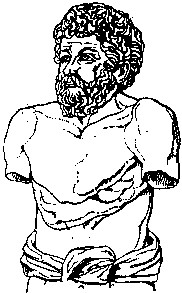
The only narrative upon which the ancient writers are in the main agreed represents Aesop as living in the seventh century before Christ. As with Homer, so with Aesop, several cities of Asia Minor claimed the honor of having been his birthplace. Born a slave and hideously ugly, his keen wit led his admiring master to set him free; after which he traveled, visiting Athens, where he is said to have told his fable of King Log and King Stork to the citizens who were complaining of the rule of Pisistratus. Still later, having won the favor of King Croesus of Lydia, he was sent by him to Delphi with a gift of money for the citizens of that place; but in the course of a dispute as to its distribution, he was slain by the Delphians, who threw him over a precipice.
The fables that bore his name seem not to have been committed by him to writing, but for a long time were handed down from generation to generation by oral tradition; so that the same fables are sometimes found quoted in slightly different forms, and we hear of men learning them in conversation rather than from books. They were, however, universally popular. Socrates while in prison amused himself by turning some of them into verse. Aristophanes cites them in his plays; and he tells how certain suitors once tried to win favor of a judge by repeating to him some of the amusing stories of Aesop. The Athenians even erected a statue in his honor. At a later period, the fables were gathered together and published by the Athenian statesman and orator, Demetrius Phalereus, in B.C. 320, and were versified by Babrius (of uncertain date), whose collection is the only one in Greek of which any substantial portion still survives. They were often translated by the Romans, and the Latin version by Phaedrus, the freedman of Augustus Caesar, is still preserved and still used as a school-book. Forty-two of them are likewise found in a Latin work by one Avianus, dating from the fifth century after Christ. During the Middle Ages, when much of the classical literature had been lost or forgotten, Aesop, who was called by the mediaevals "Isopet," was still read in various forms; and in modern times he has served as a model for a great number of imitations, of which the most successful are those in French by Lafontaine and those in English by John Gay.
Whether or not such a person as Aesop ever lived, and whether or not he actually narrated the fables that are ascribed to him, it is certain that he did not himself invent them, but merely gave them currency in Greece; for they can be shown to have existed long before his time, and in fact to antedate even the beginnings of Hellenic civilization. With some changes of form they are found in the oldest literature of the Chinese; similar stories are preserved on the inscribed Babylonian bricks; and an Egyptian papyrus of about the year 1200 B.C. gives the fable of 'The Lion and the Mouse' in its finished form. Other Aesopic apologues are essentially identical with the Jatakas or Buddhist stories of India, and occur also in the great Sanskrit story-book, the 'Panchatantra,' which is the very oldest monument of Hindu literature.
The so-called Aesopic Fables are in fact only a part of the primitive folk-lore, that springs up in prehistoric times, and passes from country to country and from race to race by the process of popular story-telling. They reached Greece, undoubtedly through Egypt and Persia, and even in their present form they still retain certain Oriental, or at any rate non-Hellenic elements, such as the introduction of Eastern animals,--the panther, the peacock, and the ape. They represent the beginnings of conscious literary effort, when man first tried to enforce some maxim of practical wisdom and to teach some useful truth through the fascinating medium of a story. The Fable embodies a half-unconscious desire to give concrete form to an abstract principle, and a childish love for the picturesque and striking, which endows rocks and stones and trees with life, and gives the power of speech to animals.
That beasts with the attributes of human beings should figure in these tales involves, from the standpoint of primeval man, only a very slight divergence from probability. In nothing, perhaps, has civilization so changed us as in our mental attitude toward animals. It has fixed a great gulf between us and them--a gulf far greater than that which divided them from our first ancestors. In the early ages of the world, when men lived by the chase, and gnawed the raw flesh of their prey, and slept in lairs amid the jungle, the purely animal virtues were the only ones they knew and exercised. They adored courage and strength, and swiftness and endurance. They respected keenness of scent and vision, and admired cunning. The possession of these qualities was the very condition of existence, and they valued them accordingly; but in each one of them they found their equals, and in fact their superiors, among the brutes. A lion was stronger than the strongest man. The hare was swifter. The eagle was more keen-sighted. The fox was more cunning. Hence, so far from looking down upon the animals from the remotely superior height that a hundred centuries of civilization have erected for us, the primitive savage looked up to the beast, studied his ways, copied him, and went to school to him. The man, then, was not in those days the lord of creation, and the beast was not his servant; but they were almost brothers in the subtle sympathy between them, like that which united Mowgli, the wolf-nursed shikarri, and his hairy brethren, in that most weirdly wonderful of all Mr. Kipling's inventions--the one that carries us back, not as his other stories do, to the India of the cities and the bazaars, of the supercilious tourist and the sleek Babu, but to the older India of unbroken jungle, darkling at noonday through its green mist of tangled leaves, and haunted by memories of the world's long infancy when man and brute crouched close together on the earthy breast of the great mother.
The Aesopic Fables, then, are the oldest representative that we have of the literary art of primitive man. The charm that they have always possessed springs in part from their utter simplicity, their naiveté, and their directness; and in part from the fact that their teachings are the teachings of universal experience, and therefore appeal irresistibly to the consciousness of every one who hears them, whether he be savage or scholar, child or sage. They are the literary antipodes of the last great effort of genius and art working upon the same material, and found in Mr. Kipling's Jungle Books. The Fables show only the first stirrings of the literary instinct, the Jungle Stories bring to bear the full development of the fictive art,--creative imagination, psychological insight, brilliantly picturesque description, and the touch of one who is a daring master of vivid language; so that no better theme can be given to a student of literary history than the critical comparison of these two allied forms of composition, representing as they do the two extremes of actual development.
The best general account in English of the origin of the Greek Fable is that of Rutherford in the introduction to his 'Babrius' (London, 1883). An excellent special study of the history of the Aesopic Fables is that by Joseph Jacobs in the first volume of his 'Aesop' (London, 1889). The various ancient accounts of Aesop's life are collected by Simrock in 'Aesops Leben' (1864). The best scientific edition of the two hundred and ten fables is that of Halm (Leipzig, 1887). Good disquisitions on their history during the Middle Ages are those of Du Méril in French (Paris, 1854) and Bruno in German (Bamberg, 1892). See also the articles in the present work under the titles 'Babrius,' 'Bidpai,' 'John Gay,' 'Lafontaine,' 'Lokman,' 'Panchatantra,' 'Phaedrus,' 'Reynard the Fox.'

THE FOX AND THE LION
The first time the Fox saw the Lion, he fell down at his feet, and was ready to die of fear. The second time, he took courage and could even bear to look upon him. The third time, he had the impudence to come up to him, to salute him, and to enter into familiar conversation with him.
THE ASS IN THE LION'S SKIN
An Ass, finding the skin of a Lion, put it on; and, going into the woods and pastures, threw all the flocks and herds into a terrible consternation. At last, meeting his owner, he would have frightened him also; but the good man, seeing his long ears stick out, presently knew him, and with a good cudgel made him sensible that, notwithstanding his being dressed in a Lion's skin, he was really no more than an Ass.
THE ASS EATING THISTLES
An Ass was loaded with good provisions of several sorts, which, in time of harvest, he was carrying into the field for his master and the reapers to dine upon. On the way he met with a fine large thistle, and being very hungry, began to mumble it; which while he was doing, he entered into this reflection:--"How many greedy epicures would think themselves happy, amidst such a variety of delicate viands as I now carry! But to me this bitter, prickly thistle is more savory and relishing than the most exquisite and sumptuous banquet."
THE WOLF IN SHEEP'S CLOTHING
A Wolf, clothing himself in the skin of a sheep, and getting in among the flock, by this means took the opportunity to devour many of them. At last the shepherd discovered him, and cunningly fastening a rope about his neck, tied him up to a tree which stood hard by. Some other shepherds happening to pass that way, and observing what he was about, drew near, and expressed their admiration at it. "What!" says one of them, "brother, do you make hanging of a sheep?" "No," replied the other, "but I make hanging of a Wolf whenever I catch him, though in the habit and garb of a sheep." Then he showed them their mistake, and they applauded the justice of the execution.
THE COUNTRYMAN AND THE SNAKE
A Villager, in a frosty, snowy winter, found a Snake under a hedge, almost dead with cold. He could not help having a compassion for the poor creature, so brought it home, and laid it upon the hearth, near the fire; but it had not lain there long, before (being revived with the heat) it began to erect itself, and fly at his wife and children, filling the whole cottage with dreadful hissings. The Countryman heard an outcry, and perceiving what the matter was, catched up a mattock and soon dispatched him; upbraiding him at the same time in these words:--"Is this, vile wretch, the reward you make to him that saved your life? Die as you deserve; but a single death is too good for you."
THE BELLY AND THE MEMBERS
In former days, when the Belly and the other parts of the body enjoyed the faculty of speech, and had separate views and designs of their own, each part, it seems, in particular for himself, and in the name of the whole, took exception to the conduct of the Belly, and were resolved to grant him supplies no longer. They said they thought it very hard that he should lead an idle, good-for-nothing life, spending and squandering away, upon his own ungodly guts, all the fruits of their labor; and that, in short, they were resolved, for the future, to strike off his allowance, and let him shift for himself as well as he could. The Hands protested they would not lift up a finger to keep him from starving; and the Mouth wished he might never speak again if he took in the least bit of nourishment for him as long as he lived; and, said the Teeth, may we be rotten if ever we chew a morsel for him for the future. This solemn league and covenant was kept as long as anything of that kind can be kept, which was until each of the rebel members pined away to skin and bone, and could hold out no longer. Then they found there was no doing without the Belly, and that, idle and insignificant as he seemed, he contributed as much to the maintenance and welfare of all the other parts as they did to his.
THE SATYR AND THE TRAVELER
A Satyr, as he was ranging the forest in an exceeding cold, snowy season, met with a Traveler half-starved with the extremity of the weather. He took compassion on him, and kindly invited him home to a warm, comfortable cave he had in the hollow of a rock. As soon as they had entered and sat down, notwithstanding there was a good fire in the place, the chilly Traveler could not forbear blowing his fingers' ends. Upon the Satyr's asking why he did so, he answered, that he did it to warm his hands. The honest sylvan having seen little of the world, admired a man who was master of so valuable a quality as that of blowing heat, and therefore was resolved to entertain him in the best manner he could. He spread the table before him with dried fruits of several sorts; and produced a remnant of cold wine, which as the rigor of the season made very proper, he mulled with some warm spices, infused over the fire, and presented to his shivering guest. But this the Traveler thought fit to blow likewise; and upon the Satyr's demanding a reason why he blowed again, he replied, to cool his dish. This second answer provoked the Satyr's indignation as much as the first had kindled his surprise: so, taking the man by the shoulder, he thrust him out of doors, saying he would have nothing to do with a wretch who had so vile a quality as to blow hot and cold with the same mouth.
THE LION AND THE OTHER BEASTS
The Lion and several other beasts entered into an alliance, offensive and defensive, and were to live very sociably together in the forest. One day, having made a sort of an excursion by way of hunting, they took a very fine, large, fat deer, which was divided into four parts; there happening to be then present his Majesty the Lion, and only three others. After the division was made, and the parts were set out, his Majesty, advancing forward some steps and pointing to one of the shares, was pleased to declare himself after the following manner:-- "This I seize and take possession of as my right, which devolves to me, as I am descended by a true, lineal, hereditary succession from the royal family of Lion. That [pointing to the second] I claim by, I think, no unreasonable demand; considering that all the engagements you have with the enemy turn chiefly upon my courage and conduct, and you very well know that wars are too expensive to be carried on without proper supplies. Then [nodding his head toward the third] that I shall take by virtue of my prerogative; to which, I make no question but so dutiful and loyal a people will pay all the deference and regard that I can desire. Now, as for the remaining part, the necessity of our present affairs is so very urgent, our stock so low, and our credit so impaired and weakened, that I must insist upon your granting that, without any hesitation or demur; and hereof fail not at your peril."
THE ASS AND THE LITTLE DOG
The Ass, observing how great a favorite the little Dog was with his Master, how much caressed and fondled, and fed with good bits at every meal; and for no other reason, as he could perceive, but for skipping and frisking about, wagging his tail, and leaping up into his Master's lap: he was resolved to imitate the same, and see whether such a behavior would not procure him the same favors. Accordingly, the Master was no sooner come home from walking about his fields and gardens, and was seated in his easy-chair, but the Ass, who observed him, came gamboling and braying towards him, in a very awkward manner. The Master could not help laughing aloud at the odd sight. But his jest was soon turned into earnest, when he felt the rough salute of the Ass's fore-feet, who, raising himself upon his hinder legs, pawed against his breast with a most loving air, and would fain have jumped into his lap. The good man, terrified at this outrageous behavior, and unable to endure the weight of so heavy a beast, cried out; upon which, one of his servants running in with a good stick, and laying on heartily upon the bones of the poor Ass, soon convinced him that every one who desires it is not qualified to be a favorite.
THE COUNTRY MOUSE AND THE CITY MOUSE
An honest, plain, sensible Country Mouse is said to have entertained at his hole one day a fine Mouse of the Town. Having formerly been playfellows together, they were old acquaintances, which served as an apology for the visit. However, as master of the house, he thought himself obliged to do the honors of it in all respects, and to make as great a stranger of his guest as he possibly could. In order to do this he set before him a reserve of delicate gray pease and bacon, a dish of fine oatmeal, some parings of new cheese, and, to crown all with a dessert, a remnant of a charming mellow apple. In good manners, he forbore to eat any himself, lest the stranger should not have enough; but that he might seem to bear the other company, sat and nibbled a piece of a wheaten straw very busily. At last, says the spark of the town:--"Old crony, give me leave to be a little free with you: how can you bear to live in this nasty, dirty, melancholy hole here, with nothing but woods, and meadows, and mountains, and rivulets about you? Do not you prefer the conversation of the world to the chirping of birds, and the splendor of a court to the rude aspect of an uncultivated desert? Come, take my word for it, you will find it a change for the better. Never stand considering, but away this moment. Remember, we are not immortal, and therefore have no time to lose. Make sure of to-day, and spend it as agreeably as you can: you know not what may happen to-morrow." In short, these and such like arguments prevailed, and his Country Acquaintance was resolved to go to town that night. So they both set out upon their journey together, proposing to sneak in after the close of the evening. They did so; and about midnight made their entry into a certain great house, where there had been an extraordinary entertainment the day before, and several tit-bits, which some of the servants had purloined, were hid under the seat of a window. The Country Guest was immediately placed in the midst of a rich Persian carpet: and now it was the Courtier's turn to entertain; who indeed acquitted himself in that capacity with the utmost readiness and address, changing the courses as elegantly, and tasting everything first as judiciously, as any clerk of the kitchen. The other sat and enjoyed himself like a delighted epicure, tickled to the last degree with this new turn of his affairs; when on a sudden, a noise of somebody opening the door made them start from their seats, and scuttle in confusion about the dining-room. Our Country Friend, in particular, was ready to die with fear at the barking of a huge mastiff or two, which opened their throats just about the same time, and made the whole house echo. At last, recovering himself:--"Well," says he, "if this be your town-life, much good may you do with it: give me my poor, quiet hole again, with my homely but comfortable gray pease."
THE DOG AND THE WOLF
A lean, hungry, half-starved Wolf happened, one moonshiny night, to meet with a jolly, plump, well-fed Mastiff; and after the first compliments were passed, says the Wolf:--"You look extremely well. I protest, I think I never saw a more graceful, comely person; but how comes it about, I beseech you, that you should live so much better than I? I may say, without vanity, that I venture fifty times more than you do; and yet I am almost ready to perish with hunger." The Dog answered very bluntly, "Why, you may live as well, if you will do the same for it that I do."--"Indeed? what is that?" says he.--"Why," says the Dog, "only to guard the house a-nights, and keep it from thieves."--"With all my heart," replies the Wolf, "for at present I have but a sorry time of it; and I think to change my hard lodging in the woods, where I endure rain, frost, and snow, for a warm roof over my head, and a bellyful of good victuals, will be no bad bargain."--"True," says the Dog; "therefore you have nothing more to do but to follow me." Now, as they were jogging on together, the Wolf spied a crease in the Dog's neck, and having a strange curiosity, could not forbear asking him what it meant. "Pooh! nothing," says the Dog.--"Nay, but pray--" says the Wolf.--"Why," says the Dog, "if you must know, I am tied up in the daytime, because I am a little fierce, for fear I should bite people, and am only let loose a-nights. But this is done with design to make me sleep a-days, more than anything else, and that I may watch the better in the night-time; for as soon as ever the twilight appears, out I am turned, and may go where I please. Then my master brings me plates of bones from the table with his own hands, and whatever scraps are left by any of the family, all fall to my share; for you must know I am a favorite with everybody. So you see how you are to live. Come, come along: what is the matter with you?"--"No," replied the Wolf, "I beg your pardon: keep your happiness all to yourself. Liberty is the word with me; and I would not be a king upon the terms you mention."
JEAN LOUIS RODOLPHE AGASSIZ
(1807-1873)
t first, when a mere boy, twelve years of age," writes the great Swiss naturalist, "I did what most beginners do. I picked up whatever I could lay my hands on, and tried, by such books and authorities as I had at my command, to find the names of these objects. My highest ambition at that time, was to be able to designate the plants and animals of my native country correctly by a Latin name, and to extend gradually a similar knowledge in its application to the productions of other countries. This seemed to me, in those days, the legitimate aim and proper work of a naturalist. I still possess manuscript volumes in which I entered the names of all the animals and plants with which I became acquainted, and I well remember that I then ardently hoped to acquire the same superficial familiarity with the whole creation. I did not then know how much more important it is to the naturalist to understand the structure of a few animals than to command the whole field of scientific nomenclature. Since I have become a teacher, and have watched the progress of students, I have seen that they all begin in the same way. But how many have grown old in the pursuit, without ever rising to any higher conception of the study of nature, spending their life in the determination of species, and in extending scientific terminology! Long before I went to the university, and before I began to study natural history under the guidance of men who were masters in the science during the early part of this century, I perceived that though nomenclature and classification, as then understood, formed an important part of the study, being, in fact, its technical language, the study of living beings in their natural element was of infinitely greater value. At that age--namely, about fifteen--I spent most of the time I could spare from classical and mathematical studies in hunting the neighboring woods and meadows for birds, insects, and land and fresh-water shells. My room became a little menagerie, while the stone basin under the fountain in our yard was my reservoir for all the fishes I could catch. Indeed, collecting, fishing, and raising caterpillars, from which I reared fresh, beautiful butterflies, were then my chief pastimes. What I know of the habits of the fresh-water fishes of Central Europe I mostly learned at that time; and I may add, that when afterward I obtained access to a large library and could consult the works of Bloch and Lacépède, the only extensive works on fishes then in existence. I wondered that they contained so little about their habits, natural attitudes, and mode of action, with which I was so familiar."
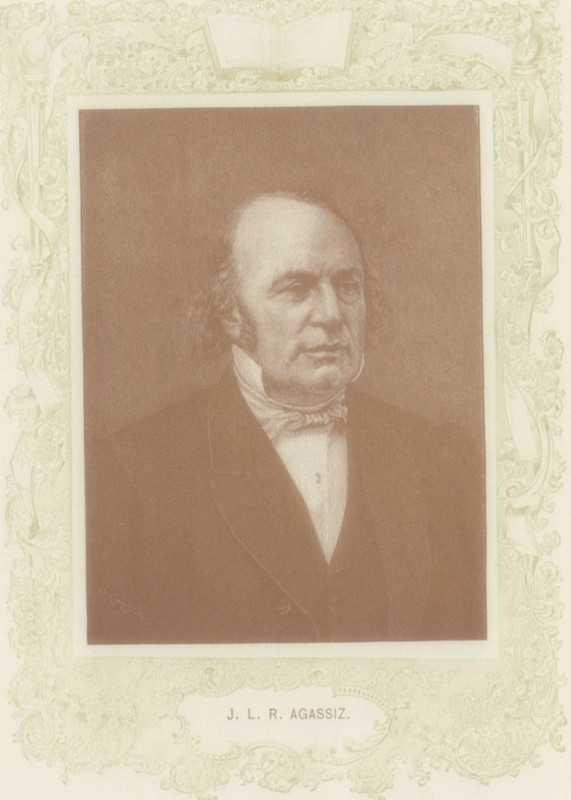
It is this way of looking at things that gives to Agassiz's writings their literary and popular interest. He was born in Mortier, Canton Fribourg, May 28th, 1807, the son of a clergyman, who sent his gifted son to the Universities of Zürich, Heidelberg, and Munich, where he acquired reputation for his brilliant powers, and entered into the enthusiastic, intellectual, and merry student-life, taking his place in the formal duels, and becoming known as a champion fencer. Agassiz was an influence in every centre that he touched; and in Munich, his room and his laboratory, thick with clouds of smoke from the long-stemmed German pipes, was a gathering-place for the young scientific aspirants, who affectionately called it "The Little Academy." At the age of twenty-two, he had published his 'Fishes of Brazil,' a folio that brought him into immediate recognition. Cuvier, the greatest ichthyologist of his time, to whom the first volume was dedicated, received him as a pupil, and gave to him all the material that he had been collecting during fifteen years for a contemplated work on Fossil Fishes. In Paris Agassiz also won the friendship of Humboldt, who, learning that he stood in need of money, presented him with so generous a sum as to enable the ambitious young naturalist to work with a free and buoyant spirit.
His practical career began in 1832, when he was installed at Neufchâtel, from which point he easily studied the Alps. Two years later, after the 'Poissons fossiles' (Fossil Fishes) appeared, he visited England to lecture. Then returning to his picturesque home, he applied himself to original investigation, and through his lectures and publications won honors and degrees. His daring opinions, however, sometimes provoked ardent discussion and angry comment.
Agassiz's passion for investigation frequently led him into dangers that imperiled both life and limb. In the summer of 1841, for example, he was lowered into a deep crevasse bristling with huge stalactites of ice, to reach the heart of a glacier moving at the rate of forty feet a day. While he was observing the blue bands on the glittering ice, he suddenly touched a well of water, and only after great difficulty made his companions understand his signal for rescue. These Alpine experiences are well described by Mrs. Elizabeth Gary Agassiz, and also by Edouard Desors in his 'Séjours dans les Glaciers' (Sojourn among the Glaciers: Neufchâtel, 1844). Interesting particulars of these glacial studies ('Études des Glaciers') were soon issued, and Agassiz received many gifts from lovers of science, among whom was numbered the King of Prussia. His zoölogical and geological investigations were continued, and important works on 'Fossil Mollusks,' 'Tertiary Shells,' and 'Living and Fossil Echinoderms' date from this period.
He had long desired to visit America, when he realized this wish in 1846 by an arrangement with the Lowell Institute of Boston, where he gave a series of lectures, afterwards repeated in various cities. So attractive did he find the fauna and flora of America, and so vast a field did he perceive here for his individual studies and instruction, that he returned the following year. In 1848 the Prussian government, which had borne the expenses of his scientific mission,--a cruise along our Atlantic coast to study its marine life,--released him from further obligation that he might accept the chair of geology in the Lawrence Scientific School of Harvard University. His cruises, his explorations, and his methods, combined with his attractive personality, gave him unique power as a teacher; and many of his biographers think that of all his gifts, the ability to instruct was the most conspicuous. He needed no text-books, for he went directly to Nature, and did not believe in those technical, dry-as-dust terms which lead to nothing and which are swept away by the next generation. Many noted American men of science remember the awakening influence of his laboratories in Charleston and Cambridge, his museum at Harvard, and his summer school at Penikese Island in Buzzard's Bay, Massachusetts, where natural history was studied under ideal conditions. It was here that he said to his class:--"A laboratory of natural history is a sanctuary where nothing profane should be tolerated." Whittier has left a poem called "The Prayer of Agassiz," describing
"The isle of Penikese
Ranged about by sapphire seas."
Just as he was realizing two of his ambitions, the establishment of a great museum and a practical school of zoölogy, he died, December 14th, 1873, at his home in Cambridge, and was buried at Mount Auburn beneath pine-trees sent from Switzerland, while a bowlder from the glacier of the Aar was selected to mark his resting-place.
Agassiz was greatly beloved by his pupils and associates, and was identified with the brilliant group--Emerson, Longfellow, Holmes, and Lowell,--each of whom has written of him. Lowell considered his 'Elegy on Agassiz,' written in Florence in 1874, among his best verses; Longfellow wrote a poem for 'The Fiftieth Birthday of Agassiz,' and Holmes 'A Farewell to Agassiz' on his departure for the Andes, whose affectionate and humorous strain thus closes:--
"Till their glorious raid is o'er,
And they touch our ransomed shore!
Then the welcome of a nation,
With its shout of exultation,
Shall awake the dumb creation,
And the shapes of buried aeons
Join the living creatures' paeans,
While the mighty megalosaurus
Leads the palaeozoic chorus,--
God bless the great Professor,
And the land its proud possessor,--
Bless them now and evermore!"
Numerous biographies and monographs of Agassiz exist in many languages, a complete list of which is given in the last published 'Life of Agassiz,' by Jules Marcou (New York and London, 1896), and also in the 'Life of Agassiz,' by Charles F. Holder (New York, 1893). Complete lists of Agassiz's works are also given in these biographies, and these titles show how versatile was his taste and how deep and wide his research. His principal contributions to science are in French and Latin, but his most popular books appeared in English. These include 'The Structure of Animal Life,' 'Methods of Study,' 'Geological Sketches,' and 'Journey in Brazil,' the latter written with Mrs. Agassiz. His 'Contributions to the Natural History of the United States,' planned to be in ten large books, only reached four volumes.
In his 'Researches concerning Fossil Fishes,' Agassiz expressed the views that made him a lifelong opponent of the Darwinian theories, although he was a warm friend of Darwin. Considering the demands upon his time as teacher, lecturer, and investigator, the excellence not less than the amount of the great naturalist's work is remarkable, and won such admiration that he was made a member of nearly every scientific society in the world. One of his favorite pastimes was deep-sea dredging, which embraced the excitement of finding strange specimens and studying their singular habits.
Of his love and gift for instructing, Mrs. Agassiz says in her 'Life' (Boston, 1885):--
"Teaching was a passion with him, and his power over his pupils might be measured by his own enthusiasm. He was, intellectually as well as socially, a democrat in the best sense. He delighted to scatter broadcast the highest results of thought and research, and to adapt them even to the youngest and most uninformed minds. In his later American travels he would talk of glacial phenomena to the driver of a country stage-coach among the mountains, or to some workman splitting rock at the roadside, with as much earnestness as if he had been discussing problems with a brother geologist; he would take the common fisherman into his scientific confidence, telling him the intimate secrets of fish-culture or fish-embryology, till the man in his turn grew enthusiastic and began to pour out information from the stores of his own rough and untaught habits of observation. Agassiz's general faith in the susceptibility of the popular intelligence, however untaught, to the highest truths of nature, was contagious, and he created or developed that in which he believed."
The following citations exhibit his powers of observation, and that happy method of stating scientific facts which interests the specialist and general reader alike.
THE SILURIAN BEACH
From 'Geological Sketches'
With what interest do we look upon any relic of early human history! The monument that tells of a civilization whose hieroglyphic records we cannot even decipher, the slightest trace of a nation that vanished and left no sign of its life except the rough tools and utensils buried in the old site of its towns or villages, arouses our imagination and excites our curiosity. Men gaze with awe at the inscription on an ancient Egyptian or Assyrian stone; they hold with reverential touch the yellow parchment-roll whose dim, defaced characters record the meagre learning of a buried nationality; and the announcement that for centuries the tropical forests of Central America have hidden within their tangled growth the ruined homes and temples of a past race, stirs the civilized world with a strange, deep wonder.
To me it seems, that to look on the first land that was ever lifted above the wasted waters, to follow the shore where the earliest animals and plants were created when the thought of God first expressed itself in organic forms, to hold in one's hand a bit of stone from an old sea-beach, hardened into rock thousands of centuries ago, and studded with the beings that once crept upon its surface or were stranded there by some retreating wave, is even of deeper interest to men than the relics of their own race, for these things tell more directly of the thoughts and creative acts of God.
The statement that different sets of animals and plants have characterized the successive epochs is often understood as indicating a difference of another kind than that which distinguishes animals now living in different parts of the world. This is a mistake. They are so-called representative types all over the globe, united to each other by structural relations and separated by specific differences of the same kind as those that unite and separate animals of different geological periods. Take, for instance, mud-flats or sandy shores in the same latitudes of Europe and America: we find living on each, animals of the same structural character and of the same general appearance, but with certain specific differences, as of color, size, external appendages, etc. They represent each other on the two continents. The American wolves, foxes, bears, rabbits, are not the same as the European. but those of one continent are as true to their respective types as those of the other; under a somewhat different aspect they represent the same groups of animals. In certain latitudes, or under conditions of nearer proximity, these differences may be less marked. It is well known that there is a great monotony of type, not only among animals and plants but in the human races also, throughout the Arctic regions; and some animals characteristic of the high North reappear under such identical forms in the neighborhood of the snow-fields in lofty mountains, that to trace the difference between the ptarmigans, rabbits, and other gnawing animals of the Alps, for instance, and those of the Arctics, is among the most difficult problems of modern science.
And so is it also with the animated world of past ages: in similar deposits of sand, mud, or lime, in adjoining regions of the same geological age, identical remains of animals and plants may be found; while at greater distances, but under similar circumstances, representative species may occur. In very remote regions, however, whether the circumstances be similar or dissimilar, the general aspect of the organic world differs greatly, remoteness in space being thus in some measure an indication of the degree of affinity between different faunae. In deposits of different geological periods immediately following each other, we sometimes find remains of animals and plants so closely allied to those of earlier or later periods that at first sight the specific differences are hardly discernible. The difficulty of solving these questions, and of appreciating correctly the differences and similarities between such closely allied organisms, explains the antagonistic views of many naturalists respecting the range of existence of animals, during longer or shorter geological periods; and the superficial way in which discussions concerning the transition of species are carried on, is mainly owing to an ignorance of the conditions above alluded to. My own personal observation and experience in these matters have led me to the conviction that every geological period has had its own representatives, and that no single species has been repeated in successive ages.
The laws regulating the geographical distribution of animals, and their combination into distinct zoölogical provinces called faunae, with definite limits, are very imperfectly understood as yet; but so closely are all things linked together from the beginning till to-day, that I am convinced we shall never find the clew to their meaning till we carry on our investigations in the past and the present simultaneously. The same principle according to which animal and vegetable life is distributed over the surface of the earth now, prevailed in the earliest geological periods. The geological deposits of all times have had their characteristic faunae under various zones, their zoölogical provinces presenting special combinations of animal and vegetable life over certain regions, and their representative types reproducing in different countries, but under similar latitudes, the same groups with specific differences.
Of course, the nearer we approach the beginning of organic life, the less marked do we find the differences to be; and for a very obvious reason. The inequalities of the earth's surface, her mountain-barriers protecting whole continents from the Arctic winds, her open plains exposing others to the full force of the polar blasts, her snug valleys and her lofty heights, her tablelands and rolling prairies, her river-systems and her dry deserts, her cold ocean-currents pouring down from the high North on some of her shores, while warm ones from tropical seas carry their softer influence to others,--in short, all the contrasts in the external configuration of the globe, with the physical conditions attendant upon them, are naturally accompanied by a corresponding variety in animal and vegetable life.
But in the Silurian age, when there were no elevations higher than the Canadian hills, when water covered the face of the earth with the exception of a few isolated portions lifted above the almost universal ocean, how monotonous must have been the conditions of life! And what should we expect to find on those first shores? If we are walking on a sea-beach to-day, we do not look for animals that haunt the forests or roam over the open plains, or for those that live in sheltered valleys or in inland regions or on mountain-heights. We look for Shells, for Mussels and Barnacles, for Crabs, for Shrimps, for Marine Worms, for Star-Fishes and Sea-Urchins, and we may find here and there a fish stranded on the sand or strangled in the sea-weed. Let us remember, then, that in the Silurian period the world, so far as it was raised above the ocean, was a beach; and let us seek there for such creatures as God has made to live on seashores, and not belittle the Creative work, or say that He first scattered the seeds of life in meagre or stinted measure, because we do not find air-breathing animals when there was no fitting atmosphere to feed their lungs, insects with no terrestrial plants to live upon, reptiles without marshes, birds without trees, cattle without grass,--all things, in short, without the essential conditions for their existence....
I have spoken of the Silurian beach as if there were but one, not only because I wished to limit my sketch, and to attempt at least to give it the vividness of a special locality, but also because a single such shore will give us as good an idea of the characteristic fauna of the time as if we drew our material from a wider range. There are, however, a great number of parallel ridges belonging to the Silurian and Devonian periods, running from east to west, not only through the State of New York, but far beyond, through the States of Michigan and Wisconsin into Minnesota; one may follow nine or ten such successive shores in unbroken lines, from the neighborhood of Lake Champlain to the Far West. They have all the irregularities of modern seashores, running up to form little bays here, and jutting out in promontories there....
Although the early geological periods are more legible in North America, because they are exposed over such extensive tracts of land, yet they have been studied in many other parts of the globe. In Norway, in Germany, in France, in Russia, in Siberia, in Kamchatka, in parts of South America,--in short, wherever the civilization of the white race has extended, Silurian deposits have been observed, and everywhere they bear the same testimony to a profuse and varied creation. The earth was teeming then with life as now; and in whatever corner of its surface the geologist finds the old strata, they hold a dead fauna as numerous as that which lives and moves above it. Nor do we find that there was any gradual increase or decrease of any organic forms at the beginning and close of the successive periods. On the contrary, the opening scenes of every chapter in the world's history have been crowded with life, and its last leaves as full and varied as its first.
VOICES
From 'Methods of Study in Natural History'
There is a chapter in the Natural History of animals that has hardly been touched upon as yet, and that will be especially interesting with reference to families. The voices of animals have a family character not to be mistaken. All the Canidae bark and howl!--the fox, the wolf, the dog, have the same kind of utterance, though on a somewhat different pitch. All the bears growl, from the white bear of the Arctic snows to the small black bear of the Andes. All the cats meow, from our quiet fireside companion to the lions and tigers and panthers of the forests and jungle. This last may seem a strange assertion; but to any one who has listened critically to their sounds and analyzed their voices, the roar of the lion is but a gigantic meow, bearing about the same proportion to that of a cat as its stately and majestic form does to the smaller, softer, more peaceful aspect of the cat. Yet notwithstanding the difference in their size, who can look at the lion, whether in his more sleepy mood, as he lies curled up in the corner of his cage, or in his fiercer moments of hunger or of rage, without being reminded of a cat? And this is not merely the resemblance of one carnivorous animal to another; for no one was ever reminded of a dog or wolf by a lion.
Again, all the horses and donkeys neigh; for the bray of a donkey is only a harsher neigh, pitched on a different key, it is true, but a sound of the same character--as the donkey himself is but a clumsy and dwarfish horse. All the cows low, from the buffalo roaming the prairie, the musk-ox of the Arctic ice-fields, or the yak of Asia, to the cattle feeding in our pastures.
Among the birds, this similarity of voice in families is still more marked. We need only recall the harsh and noisy parrots, so similar in their peculiar utterance. Or, take as an example the web-footed family: Do not all the geese and the innumerable host of ducks quack? Does not every member of the crow family caw, whether it be the jackdaw, the jay, or the magpie, the rook in some green rookery of the Old World, or the crow of our woods, with its long, melancholy caw that seems to make the silence and solitude deeper? Compare all the sweet warblers of the songster family--the nightingales, the thrushes, the mocking-birds, the robins; they differ in the greater or less perfection of their note, but the same kind of voice runs through the whole group.
These affinities of the vocal systems among the animals form a subject well worthy of the deepest study, not only as another character by which to classify the animal kingdom correctly, but as bearing indirectly also on the question of the origin of animals. Can we suppose that characteristics like these have been communicated from one animal to another? When we find that all the members of one zoölogical family, however widely scattered over the surface of the earth, inhabiting different continents and even different hemispheres, speak with one voice, must we not believe that they have originated in the places where they now occur, with all their distinctive peculiarities? Who taught the American thrush to sing like his European relative? He surely did not learn it from his cousin over the waters. Those who would have us believe that all animals originated from common centres and single pairs, and have been thence distributed over the world, will find it difficult to explain the tenacity of such characters, and their recurrence and repetition under circumstances that seem to preclude the possibility of any communication, on any other supposition than that of their creation in the different regions where they are now found. We have much yet to learn, from investigations of this kind, with reference not only to families among animals, but to nationalities among men also....
The similarity of motion in families is another subject well worth the consideration of the naturalist: the soaring of the birds of prey,--the heavy flapping of the wings in the gallinaceous birds,--the floating of the swallows, with their short cuts and angular turns,--the hopping of the sparrows,--the deliberate walk of the hens and the strut of the cocks,--the waddle of the ducks and geese,--the slow, heavy creeping of the land-turtle,--the graceful flight of the sea-turtle under the water,--the leaping and swimming of the frog,--the swift run of the lizard, like a flash of green or red light in the sunshine,--the lateral undulation of the serpent,--the dart of the pickerel,--the leap of the trout,--the rush of the hawk-moth through the air,--the fluttering flight of the butterfly,--the quivering poise of the humming-bird,--the arrow-like shooting of the squid through the water,--the slow crawling of the snail on the land,--the sideway movement of the sand-crab,--the backward walk of the crawfish,--the almost imperceptible gliding of the sea-anemone over the rock,--the graceful, rapid motion of the Pleurobrachia, with its endless change of curve and spiral. In short, every family of animals has its characteristic action and its peculiar voice; and yet so little is this endless variety of rhythm and cadence both of motion and sound in the organic world understood, that we lack words to express one-half its richness and beauty.
FORMATION OF CORAL REEFS
From 'Methods of Study in Natural History'
For a long time it was supposed that the reef-builders inhabited very deep waters; for they were sometimes brought up upon sounding-lines from a depth of many hundreds or even thousands of feet, and it was taken for granted that they must have had their home where they were found: but the facts recently ascertained respecting the subsidence of ocean-bottoms have shown that the foundation of a coral-wall may have sunk far below the place where it was laid. And it is now proved, beyond a doubt, that no reef-building coral can thrive at a depth of more than fifteen fathoms, though corals of other kinds occur far lower, and that the dead reef-corals, sometimes brought to the surface from much greater depths, are only broken fragments of some reef that has subsided with the bottom on which it was growing. But though fifteen fathoms is the maximum depth at which any reef-builder can prosper, there are many which will not sustain even that degree of pressure; and this fact has, as we shall see, an important influence on the structure of the reef.
Imagine now a sloping shore on some tropical coast descending gradually below the surface of the sea. Upon that slope, at a depth of from ten to twelve or fifteen fathoms, and two or three or more miles from the mainland, according to the shelving of the shore, we will suppose that one of those little coral animals, to whom a home in such deep waters is congenial, has established itself. How it happens that such a being, which we know is immovably attached to the ground, and forms the foundation of a solid wall, was ever able to swim freely about in the water till it found a suitable resting-place, I shall explain hereafter, when I say something of the mode of reproduction of these animals. Accept, for the moment, my unsustained assertion, and plant our little coral on this sloping shore, some twelve or fifteen fathoms below the surface of the sea.
The internal structure of such a coral corresponds to that of the sea-anemone. The body is divided by vertical partitions from top to bottom, leaving open chambers between; while in the centre hangs the digestive cavity, connected by an opening in the bottom with all these chambers. At the top is an aperture serving as a mouth, surrounded by a wreath of hollow tentacles, each one of which connects at its base with one of the chambers, so that all parts of the animal communicate freely with each other. But though the structure of the coral is identical in all its parts with the sea-anemone, it nevertheless presents one important difference. The body of the sea-anemone is soft, while that of the coral is hard.
It is well known that all animals and plants have the power of appropriating to themselves and assimilating the materials they need, each selecting from the surrounding elements whatever contributes to its well-being. Now, corals possess in an extraordinary degree, the power of assimilating to themselves the lime contained in the salt water around them; and as soon as our little coral is established on a firm foundation, a lime deposit begins to form in all the walls of its body, so that its base, its partitions, and its outer wall, which in the sea-anemone remain always soft, become perfectly solid in the polyp coral, and form a frame as hard as bone.
It may naturally be asked where the lime comes from in the sea which the corals absorb in such quantities. As far as the living corals are concerned the answer is easy, for an immense deal of lime is brought down to the ocean by rivers that wear away the lime deposits through which they pass. The Mississippi, whose course lies through extensive lime regions, brings down yearly lime enough to supply all the animals living in the Gulf of Mexico. But behind this lies a question, not so easily settled, as to the origin of the extensive deposits of limestone found at the very beginning of life upon earth. This problem brings us to the threshold of astronomy; for the base of limestone is metallic in character, susceptible therefore of fusion, and may have formed a part of the materials of our earth, even in an incandescent state, when the worlds were forming. But though this investigation as to the origin of lime does not belong either to the naturalist or the geologist, its suggestion reminds us that the time has come when all the sciences and their results are so intimately connected that no one can be carried on independently of the others. Since the study of the rocks has revealed a crowded life whose records are hoarded within them, the work of the geologist and the naturalist has become one and the same; and at that border-land where the first crust of the earth was condensed out of the igneous mass of materials which formed its earliest condition, their investigation mingles with that of the astronomer, and we cannot trace the limestone in a little coral without going back to the creation of our solar system, when the worlds that compose it were thrown off from a central mass in a gaseous condition.
When the coral has become in this way permeated with lime, all parts of the body are rigid, with the exception of the upper margin, the stomach, and the tentacles. The tentacles are soft and waving, projected or drawn in at will; they retain their flexible character through life, and decompose when the animal dies. For this reason the dried specimens of corals preserved in museums do not give us the least idea of the living corals, in which every one of the millions of beings composing such a community is crowned by a waving wreath of white or green or rose-colored tentacles.
As soon as the little coral is fairly established and solidly attached to the ground, it begins to bud. This may take place in a variety of ways, dividing at the top or budding from the base or from the sides, till the primitive animal is surrounded by a number of individuals like itself, of which it forms the nucleus, and which now begin to bud in their turn, each one surrounding itself with a numerous progeny, all remaining, however, attached to the parent. Such a community increases till its individuals are numbered by millions, and I have myself counted no less than fourteen millions of individuals in a coral mass of Porites measuring not more than twelve feet in diameter. The so-called coral heads, which make the foundation of a coral wall, and seem by their massive character and regular form especially adapted to give a strong, solid base to the whole structure, are known in our classification as the Astraeans, so named on account of the little [star-shaped] pits crowded upon their surface, each one of which marks the place of a single more or less isolated individual in such a community.
Selections used by permission of Houghton, Mifflin & Company, Publishers.
AGATHIAS
(536-581)
gathas tells us, in his 'Prooemium,' that he was born at Myrina, Asia Minor, that his father's name was Memnonius, and his own profession the law of the Romans and practice in courts of justice. He was born about A.D. 536, and was educated at Alexandria. In Constantinople he studied and practiced his profession, and won his surname of "Scholasticus," a title then given to a lawyer. He died, it is believed, at the age of forty-four or forty-five. He was a Christian, as he testifies in his epigrams. In the sketch of his life prefixed to his works, Niebuhr collates the friendships he himself mentions, with his fellow-poet Paulus Silentiarius, with Theodorus the decemvir, and Macedonius the ex-consul. To these men he dedicated some of his writings.
Of his works, he says in his 'Prooemium' that he wrote in his youth the 'Daphniaca,' a volume of short poems in hexameters, set off with love-tales. His 'Anthology,' or 'Cyclus,' was a collection of poems of early writers, and also compositions of his friend Paulus Silentiarius and others of his time. A number of his epigrams, preserved because they were written before or after his publication of the 'Cyclus,' have come down to us and are contained in the 'Anthologia Graeca.' His principal work is his 'Historia,' which is an account of the conquest of Italy by Narses, of the first war between the Greeks and Franks, of the great earthquakes and plagues, of the war between the Greeks and Persians, and the deeds of Belisarius in his contest with the Huns,--of all that was happening in the world Agathias knew between 553 and 558 A.D., while he was a young man. He tells, for instance, of the rebuilding of the great Church of St. Sophia by Justinian, and he adds:--"If any one who happens to live in some place remote from the city wishes to get a clear notion of every part, as though he were there, let him read what Paulus [Silentiarius] has composed in hexameter verse."
The history of Agathias is valuable as a chronicle. It shows that the writer had little knowledge of geography, and was not enough of a philosopher to look behind events and trace the causes from which they proceeded. He is merely a simple and honest writer, and his history is a business-like entry of facts. He dwells upon himself and his wishes with a minuteness that might seem self-conscious, but is really naif; and goes so far in his outspokenness as to say that if for the sake of a livelihood he took up another profession, his taste would have led him to devote himself to the Muses and Graces.
He wrote in the Ionic dialect of his time. The best edition of his 'Historia' is that of Niebuhr (1828). Those of his epigrams preserved in the Greek anthology have not infrequently been turned into English; the happiest translation of all is that of Dryden, in his 'Life of Plutarch.'
ON PLUTARCH
Cheronean Plutarch, to thy deathless praise
Does martial Rome this grateful statue raise;
Because both Greece and she thy fame have shar'd
(Their heroes written, and their lives compar'd);
But thou thyself could'st never write thy own:
Their lives have parallels, but thine has none.
GRACE AGUILAR
(1816-1847)

ifty years ago a Jewish writer of English fiction was a new and interesting figure in English literature. Disraeli, indeed, had flashed into the literary world with 'Coningsby,' that eloquent vindication of the Jewish race. His grandiose 'Tancred' had revealed to an astonished public the strange life of the Desert, of the mysterious vastness whence swept forth the tribes who became the Moors of Spain and the Jews of Palestine. Disraeli, however, stood in no category, and established no precedent. But when Miss Aguilar's stories began to appear, they were eagerly welcomed by a public with whom she had already won reputation and favor as the defender and interpreter of her faith.
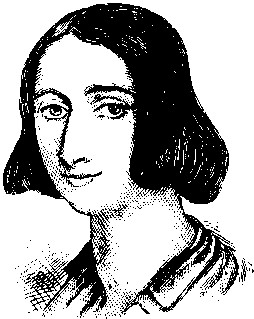
The youngest child of a rich and refined household, Grace Aguilar was born in 1816 at Hackney, near London, of that historic strain of Spanish-Jewish blood which for generations had produced not only beauty and artistic sensibility, but intellect. Her ancestors were refugees from persecution, and in her burned that ardor of faith which persecution kindles. Fragile and sensitive, she was educated at home, by her cultivated father and mother, under whose solicitous training she developed an alarming precocity. At the age of twelve she had written a heroic drama on her favorite hero, Gustavus Vasa. At fourteen she had published a volume of poems. At twenty-four she accomplished her chief work on the Jewish religion, 'The Spirit of Judaism,' a book republished in America with preface and notes by a well-known rabbi, Dr. Isaac Leeser of Philadelphia. Although the orthodox priest found much in the book to criticize, he was forced to commend its ability.--It insists on the importance of the spiritual and moral aspects of the faith delivered to Abraham, and deprecates a superstitious reverence for the mere letter of the law. It presents Judaism as a religion of love, and the Old Testament as the inspiration of the teachings of Jesus. Written more than half a century ago, the book is widely read to-day by students of the Jewish religion.
Four years later Miss Aguilar published 'The Jewish Faith: Its Spiritual Consolation, Moral Guidance, and Immortal Hope,' and 'The Women of Israel,' a series of essays on Biblical history, which was followed by 'Essays and Miscellanies.' So great was the influence of her writings that the Jewesses of London gave her a public testimonial, and addressed her as "the first woman who had stood forth as the public advocate of the faith of Israel." While on her way to visit a brother then residing at Schwalbach, Germany, she was taken ill at Frankfurt, and died there, at the early age of thirty-one.
The earliest and the best known of Miss Aguilar's novels is 'Home Influence,' which rapidly passed through thirty editions, and is still a favorite book with young girls. There is little incident in the story, which is the history of the development of character in a household of six or seven young persons of very different endowments and tendencies. It was the fashion of the day to be didactic, and Mrs. Hamilton, from whom the "home influence" radiates, seems to the modern reader somewhat inclined to preach, in season and out of season. But the story is interesting, and the characters are distinctly individualized, while at least one episode is dramatically treated.
'The Mother's Recompense' is a sequel to 'Home Influence,' wherein the further fortunes of the Hamilton family are so set forth that the wordly-minded reader is driven to the inference that the brilliant marriages of her children are a sensible part of Mrs. Hamilton's "recompense." The story is vividly and agreeably told.
Of a different order is 'The Days of Bruce,' a historic romance of the late thirteenth century, which is less historic than romantic, and in whose mirror the rugged chieftain would hardly recognize his angularities.
'The Vale of Cedars' is a historic tale of the persecution of the Jews in Spain under the Inquisition. It is told with intense feeling, with much imagination, and with a strong love of local color. It is said that family traditions are woven into the story. This book, as well as 'Home Influence,' had a wide popularity in a German version.
In reading Grace Aguilar it is not easy to believe her the contemporary of Currer Bell and George Eliot. Both her manner and her method are earlier. Her lengthy and artificial periods, the rounded and decorative sentences that she puts into the mouths of her characters under the extremest pressure of emotion or suffering, the italics, the sentimentalities, are of another age than the sinewy English and hard sense of 'Jane Eyre' or 'Adam Bede.' Doubtless her peculiar, sheltered training, her delicate health, and a luxuriant imagination that had seldom been measured against the realities of life, account for the old-fashioned air of her work. But however antiquated their form may become, the substance of all her tales is sweet and sound, their charm for young girls is abiding, their atmosphere is pure, and the spirit that inspires them is touched only to fine issues.
The citation from 'The Days of Bruce' illustrates her narrative style; that from 'Woman's Friendship' her habit of disquisition; and the passage from 'Home Influence' her rendering of conversation.
THE GREATNESS OF FRIENDSHIP
From 'Woman's Friendship'
It is the fashion to deride woman's influence over woman, to laugh at female friendship, to look with scorn on all those who profess it; but perhaps the world at large little knows the effect of this influence,--how often the unformed character of a young, timid, and gentle girl may be influenced for good or evil by the power of an intimate female friend. There is always to me a doubt of the warmth, the strength, and purity of her feelings, when a young girl merges into womanhood, passing over the threshold of actual life, seeking only the admiration of the other sex; watching, pining, for a husband, or lovers, perhaps, and looking down on all female friendship as romance and folly. No young spirit was ever yet satisfied with the love of nature.
Friendship, or love, gratifies self-love; for it tacitly acknowledges that we must possess some good qualities to attract beyond the mere love of nature. Coleridge justly observes, "that it is well ordered that the amiable and estimable should have a fainter perception of their own qualities than their friends have, otherwise they would love themselves." Now, friendship, or love, permits their doing this unconsciously: mutual affection is a tacit avowal and appreciation of mutual good qualities,--perhaps friendship yet more than love, for the latter is far more an aspiration, a passion, than the former, and influences the permanent character much less. Under the magic of love a girl is generally in a feverish state of excitement, often in a wrong position, deeming herself the goddess, her lover the adorer; whereas it is her will that must bend to his, herself be abnegated for him. Friendship neither permits the former nor demands the latter. It influences silently, often unconsciously; perhaps its power is never known till years afterwards. A girl who stands alone, without acting or feeling friendship, is generally a cold unamiable being, so wrapt in self as to have no room for any person else, except perhaps a lover, whom she only seeks and values as offering his devotion to that same idol, self. Female friendship may be abused, may be but a name for gossip, letter-writing, romance, nay worse, for absolute evil: but that Shakespeare, the mighty wizard of human hearts, thought highly and beautifully of female friendship, we have his exquisite portraits of Rosalind and Celia, Helen and the Countess, undeniably to prove; and if he, who could portray every human passion, every subtle feeling of humanity, from the whelming tempest of love to the fiendish influences of envy and jealousy and hate; from the incomprehensible mystery of Hamlet's wondrous spirit, to the simplicity of the gentle Miranda, the dove-like innocence of Ophelia, who could be crushed by her weight of love, but not reveal it;--if Shakespeare scorned not to picture the sweet influences of female friendship, shall women pass by it as a theme too tame, too idle for their pens?
THE ORDER OF KNIGHTHOOD
From 'The Days of Bruce'
A right noble and glorious scene did the great hall of the palace present the morning which followed this eventful night. The king, surrounded by his highest prelates and nobles, mingling indiscriminately with the high-born dames and maidens of his court, all splendidly attired, occupied the upper part of the hall, the rest of which was crowded by both his military followers and many of the good citizens of Scone, who flocked in great numbers to behold the august ceremony of the day. Two immense oaken doors at the south side of the hall were flung open, and through them was discerned the large space forming the palace yard, prepared as a tilting-ground, where the new-made knights were to prove their skill. The storm had given place to a soft, breezy morning, the cool freshness of which appeared peculiarly grateful from the oppressiveness of the night; light downy clouds sailed over the blue expanse of heaven, tempering without clouding the brilliant rays of the sun. Every face was clothed with smiles, and the loud shouts which hailed the youthful candidates for knighthood, as they severally entered, told well the feeling with which the patriots of Scotland were regarded.
Some twenty youths received the envied honor at the hand of their sovereign this day; but our limits forbid a minute scrutiny of the bearing of any, however well deserving, save of the two whose vigils have already detained us so long. A yet longer and louder shout proclaimed the appearance of the youngest scion of the house of Bruce and his companion. The daring patriotism of Isabella of Buchan had enshrined her in every heart, and so disposed all men towards her children that the name of their traitorous father was forgotten.
Led by their godfathers, Nigel by his brother-in-law Sir Christopher Seaton, and Alan by the Earl of Lennox, their swords, which had been blessed by the abbot at the altar, slung round their necks, they advanced up the hall. There was a glow on the cheek of the young Alan, in which pride and modesty were mingled; his step at first was unsteady and his lip was seen to quiver from very bashfulness, as he first glanced round the hall and felt that every eye was turned toward him; but when that glance met his mother's fixed on him, and breathing that might of love that filled her heart, all boyish tremors fled, the calm, staid resolve of manhood took the place of the varying glow upon his cheek, the quivering lip became compressed and firm, and his step faltered not again.
The cheek of Nigel Bruce was pale, but there was firmness in the glance of his bright eye, and a smile unclouded in its joyance on his lip. The frivolous lightness of the courtier, the mad bravado of knight-errantry, which was not uncommon to the times, indeed, were not there. It was the quiet courage of the resolved warrior, the calm of a spirit at peace with itself, shedding its own high feeling and poetic glory over all around him.
On reaching the foot of King Robert's throne, both youths knelt and laid their sheathed swords at his feet. Their armor-bearers then approached, and the ceremony of clothing the candidates in steel commenced; the golden spur was fastened on the left foot of each by his respective godfather, while Athol, Hay, and other nobles advanced to do honor to the youths, by aiding in the ceremony. Nor was it warriors alone.
"Is this permitted, lady?" demanded the king, smiling, as the Countess of Buchan approached the martial group, and, aided by Lennox, fastened the polished cuirass on the form of her son. "Is it permitted for a matron to arm a youthful knight? Is there no maiden to do such inspiring office?"
"Yes, when the knight is one like this, my liege," she answered, in the same tone. "Let a matron arm him, good my liege," she added, sadly: "let a mother's hand enwrap his boyish limbs in steel, a mother's blessing mark him thine and Scotland's, that those who watch his bearing in the battle-field may know who sent him there, may thrill his heart with memories of her who stands alone of her ancestral line, that though he bears the name of Comyn, the blood of Fife flows reddest in his veins!"
"Arm him and welcome, noble lady," answered the king, and a buzz of approbation ran through the hall; "and may thy noble spirit and dauntless loyalty inspire him: we shall not need a trusty follower while such as he are around us. Yet, in very deed, my youthful knight must have a lady fair for whom he tilts to-day. Come hither, Isoline, thou lookest verily inclined to envy thy sweet friend her office, and nothing loth to have a loyal knight thyself. Come, come, my pretty one, no blushing now. Lennox, guide those tiny hands aright."
Laughing and blushing, Isoline, the daughter of Lady Campbell, a sister of the Bruce, a graceful child of some thirteen summers, advanced nothing loth, to obey her royal uncle's summons; and an arch smile of real enjoyment irresistibly stole over the countenance of Alan, dispersing the emotion his mother's words produced.
"Nay, tremble not, sweet one," the king continued, in a lower and yet kinder tone, as he turned from the one youth to the other, and observed that Agnes, overpowered by emotion, had scarcely power to perform her part, despite the whispered words of encouraging affection Nigel murmured in her ear. One by one the cuirass and shoulder-pieces, the greaves and gauntlets, the gorget and brassards, the joints of which were so beautifully burnished that they shone as mirrors, and so flexible that every limb had its free use, enveloped those manly forms. Their swords once again girt to their sides, and once more kneeling, the king descended from his throne, alternately dubbing them knight in the name of God, St. Michael, and St. George.