автордың кітабын онлайн тегін оқу Library of the World's Best Literature, Ancient and Modern, Vol. 16
LIBRARY OF THE
WORLD'S BEST LITERATURE
ANCIENT AND MODERN
CHARLES DUDLEY WARNER
EDITOR
HAMILTON WRIGHT MABIE
LUCIA GILBERT RUNKLE
GEORGE HENRY WARNER
ASSOCIATE EDITORS
Connoisseur Edition
Vol. XVI.
NEW YORK
THE INTERNATIONAL SOCIETY
Connoisseur Edition
LIMITED TO FIVE HUNDRED COPIES IN HALF RUSSIA
No. ..........
Copyright, 1896, by
R. S. PEALE AND J. A. HILL
All rights reserved
THE ADVISORY COUNCIL
CRAWFORD H. TOY, A. M., LL. D.,
Professor of Hebrew, Harvard University, Cambridge, Mass.
THOMAS R. LOUNSBURY, LL. D., L. H. D.,
Professor of English in the Sheffield Scientific School of Yale University, New Haven, Conn.
WILLIAM M. SLOANE, Ph. D., L. H. D.,
Professor of History and Political Science, Princeton University, Princeton, N. J.
BRANDER MATTHEWS, A. M., LL. B.,
Professor of Literature, Columbia University, New York City.
JAMES B. ANGELL, LL. D.,
President of the University of Michigan, Ann Arbor, Mich.
WILLARD FISKE, A. M., Ph. D.,
Late Professor of the Germanic and Scandinavian Languages and Literatures, Cornell University, Ithaca, N. Y.
EDWARD S. HOLDEN, A. M., LL. D.,
Director of the Lick Observatory, and Astronomer, University of California, Berkeley, Cal.
ALCÉE FORTIER, LIT. D.,
Professor of the Romance Languages, Tulane University, New Orleans, La.
WILLIAM P. TRENT, M. A.,
Dean of the Department of Arts and Sciences, and Professor of English and History, University of the South, Sewanee, Tenn.
PAUL SHOREY, Ph. D.,
Professor of Greek and Latin Literature, University of Chicago, Chicago, Ill.
WILLIAM T. HARRIS, LL. D.,
United States Commissioner of Education, Bureau of Education, Washington, D. C.
MAURICE FRANCIS EGAN, A. M., LL. D.,
Professor of Literature in the Catholic University of America, Washington, D. C.
TABLE OF CONTENTS
VOL. XVI
LIVED PAGE Aulus GelliusSecond Century A.D.
6253 From 'Attic Nights': Origin, and Plan of the Book; The Vestal Virgins; The Secrets of the Senate; Plutarch and his Slave; Discussion on One of Solon's Laws; The Nature of Sight; Earliest Libraries; Realistic Acting; The Athlete's End Gesta Romanorum 6261 Theodosius the Emperoure Moralite Ancelmus the Emperour Moralite How an Anchoress was Tempted by the Devil Edward Gibbon1737-1794
6271BY W. E. H. LECKY
Zenobia Foundation of Constantinople Character of Constantine Death of Julian Fall of Rome Silk Mahomet's Death and Character The Alexandrian Library Final Ruin of Rome All from the 'Decline and Fall of the Roman Empire' William Schwenck Gilbert1836-
6333 Captain Reece The Yarn of the Nancy Bell The Bishop of Rum-ti-foo Gentle Alice Brown The Captain and the Mermaids All from the 'Bab Ballads' Richard Watson Gilder1844-
6347 Two Songs from 'The New Day' "Rose-Dark the Solemn Sunset" The Celestial Passion Non Sine Dolore On the Life Mask of Abraham Lincoln From 'The Great Remembrance' Giuseppe Giusti1809-1850
6355 Lullaby ('Gingillino') The Steam Guillotine William Ewart Gladstone1809-
6359 Macaulay ('Gleanings of Past Years') Edwin Lawrence Godkin1831-
6373 The Duty of Criticism in a Democracy ('Problems of Modern Democracy') Goethe1749-1832
6385BY EDWARD DOWDEN
From 'Faust,' Shelley's Translation Scenes from 'Faust', Bayard Taylor's Translation Mignon's Love and Longing ('Wilhelm Meister's Apprenticeship') Wilhelm Meister's Introduction to Shakespeare (same) Wilhelm Meister's Analysis of Hamlet (same) The Indenture (same) The Harper's Songs (same) Mignon's Song (same) Philina's Song (same) Prometheus Wanderer's Night Songs The Elfin-King From 'The Wanderer's Storm Song' The Godlike Solitude Ergo Bibamus! Alexis and Dora Maxims and Reflections Nature Nikolai Vasilievitch Gogol1809-1852
6455BY ISABEL F. HAPGOOD
From 'The Inspector' Old-Fashioned Gentry ('Mirgorod') Carlo Goldoni1707-1793
6475BY WILLIAM CRANSTON LAWTON
First Love and Parting ('Memoirs of Carlo Goldoni') The Origin of Masks in the Italian Comedy (same) Purists and Pedantry (same) A Poet's Old Age (same) The Café Meïr Aaron Goldschmidt1819-1887
6493 Assar and Mirjam ('Love Stories from Many Countries') Oliver Goldsmith1728-1774
6501BY CHARLES MILLS GAYLEY
The Vicar's Family Become Ambitious ('The Vicar of Wakefield') New Misfortunes: But Offenses are Easily Pardoned Where There is Love at Bottom (same) Pictures from 'The Deserted Village' Contrasted National Types ('The Traveller') Ivan Aleksandrovitch Goncharóf1812-
6533BY NATHAN HASKELL DOLE
Oblómof The Brothers De Goncourt 6549Edmond
1822-1896
Jules
1830-1870
Two Famous Men ('Journal of the De Goncourts') The Suicide ('Sister Philomène') The Awakening ('Renée Mauperin') Edmund Gosse1849-
6565 February in Rome Desiderium Lying in the Grass Rudolf von Gottschall1823-
6571 Heinrich Heine ('Portraits and Studies') John Gower1325?-1408
6579 Petronella ('Confessio Amantis') Ulysses S. Grant1822-1885
6593BY HAMLIN GARLAND
Early Life ('Personal Memoirs of U. S. Grant') Grant's Courtship (same) A Texan Experience (same) The Surrender of General Lee (same) Henry Grattan1746-1820
6615 On the Character of Chatham Of the Injustice of Disqualification of Catholics (Speech in Parliament) On the Downfall of Bonaparte (Speech in Parliament) Thomas Gray1716-1771
6623BY GEORGE PARSONS LATHROP
Elegy Written in a Country Church-yard Ode on the Spring On a Distant Prospect of Eton College The Bard The Greek Anthology 6637BY TALCOTT WILLIAMS
On the Athenian Dead at Platæa (Simonides); On the Lacedæmonian Dead at Platæa (Simonides); On a Sleeping Satyr (Plato); A Poet's Epitaph (Simmias of Thebes); Worship in Spring (Theætetus); Spring on the Coast (Leonidas of Tarentum); A Young Hero's Epitaph (Dioscorides); Love (Posidippus); Sorrow's Barren Grave (Heracleitus); To a Coy Maiden (Asclepiades); The Emptied Quiver (Mnesalcus); the Tale of Troy (Alpheus); Heaven Hath its Stars (Marcus Argentarius); Pan of the Sea-Cliff (Archias); Anacreon's Grave (Antipater of Sidon); Rest at Noon (Meleager); "In the Spring a Young Man's Fancy" (Meleager); Meleager's Own Epitaph (Meleager); Epilogue (Philodemus); Doctor and Divinity (Nicarchus); Love's Immortality (Strato); As the Flowers of the Field (Strato); Summer Sailing (Antiphilus); The Great Mysteries (Crinagoras); To Priapus of the Shore (Mæcius); The Common Lot (Ammianus); "To-morrow, and To-morrow" (Macedonius); The Palace Garden (Arabius); The Young Wife (Julianus Ægyptius); A Nameless Grave (Paulus Silentiarius); Resignation (Joannes Barbucallus); The House of the Righteous (Macedonius); Love's Ferriage (Agathias); On a Fowler (Isidorus). Anonymous: Youth and Riches; The Singing Reed; First Love again Remembered; Slave and Philosopher; Good-by to Childhood; Wishing; Hope and Experience; The Service of God; The Pure in Heart; The Water of Purity; Rose and Thorn; A Life's WanderingFULL-PAGE ILLUSTRATIONS
VOLUME XVI
PAGEThe Alexander Romance (Colored Plate)
Frontispiece
Gibbon (Portrait) 6271 Ruined Rome (Photograph) 6316 Gladstone (Portrait) 6359 Goethe (Portrait) 6385 "Faust and Margaret in Prison" (Photogravure) 6408"The Bride's Toilet" (Photogravure)
6466 Goldoni (Portrait) 6475 Goldsmith (Portrait) 6501 Grant (Portrait) 6593 Gray (Portrait) 6623 "Stoke Poges Church and Churchyard" (Photogravure) 6626VIGNETTE PORTRAITS
Gilbert Goncharof Gilder De Goncourt Giusti Gottschall Godkin Gower Gogol Grattan GoldschmidtAULUS GELLIUS
(Second Century A. D.)
erhaps Gellius's 'Attic Nights' may claim especial mention here, as one of the earliest extant forerunners of this 'Library.' In the original preface (given first among the citations), Gellius explains very clearly the origin and scope of his work. It is not, however, a mere scrap-book. There is original matter in many chapters. In particular, an ethical or philosophic excerpt has often been framed in a little scene,—doubtless imaginary,—and cast in the form of a dialogue. We get, even, pleasant glimpses of autobiography from time to time. The author is not, however, a deep or forceful character, on the whole. His heart is mostly set on trifles.
Yet Gellius has been an assiduous student, both in Greece and Italy; and his book gives us an agreeable, probably an adequate, view of the fields which are included in the general culture of his time. Despite its title, the work is chiefly Roman. In history, biography, antiquities, grammar, literary criticism, his materials and authors are prevailingly Latin. He is perhaps most widely known and quoted on early Roman life and usages. Thus, one of his chapters gives a mass of curious information as to the choice of the Vestal Virgins. We are also largely indebted to him for citations from lost authors. We have already quoted under Ennius the sketch, in eighteen hexameters, of a scholar-soldier, believed to be a genial self-portraiture. These lines are the finest specimen we have of the 'Annales.' Similarly, under Cato, we have quoted the chief fragment of the great Censor's Roman history. For both these treasures we must thank Gellius. Indeed, throughout the wide fields of Roman antiquities, history of literature, grammar, etc., we have to depend chiefly upon various late Latin scrap-books and compilations, most of which are not even made up at first hand from creative classical authors. To Gellius, also, the imposing array of writers so constantly named by him was evidently known chiefly through compendiums and handbooks. It is suspicious, for instance, that he hardly quotes a poet within a century of his own time. Repetitions, contradictions, etc., are numerous.
Despite its twenty "books" and nearly four hundred (short) chapters, the work is not only light and readable for the most part, but quite modest in total bulk: five hundred and fifty pages in the small page and generous type of Hertz's Teubner text. There is an English translation by Rev. W. Beloe, first printed in 1795, from which we quote below. Professor Nettleship's (in his 'Essays in Latin Literature') has no literary quality, but gives a careful analysis of Gellius's subjects and probable sources. There is a revival of interest in this author in recent years. We decidedly recommend Hertz's attractive volume to any Latin student who wishes to browse beyond the narrow classical limits.
FROM 'ATTIC NIGHTS'
Origin and Plan of the Book
More pleasing works than the present may certainly be found: my object in writing this was to provide my children, as well as myself, with that kind of amusement in which they might properly relax and indulge themselves at the intervals from more important business. I have preserved the same accidental arrangement which I had before used in making the collection. Whatever book came into my hand, whether it was Greek or Latin, or whatever I heard that was either worthy of being recorded or agreeable to my fancy, I wrote down without distinction and without order. These things I treasured up to aid my memory, as it were by a store-house of learning; so that when I wanted to refer to any particular circumstance or word which I had at the moment forgotten, and the books from which they were taken happened not to be at hand, I could easily find and apply it. Thus the same irregularity will appear in these commentaries as existed in the original annotations, which were concisely written down without any method or arrangement in the course of what I at different times had heard or read. As these observations at first constituted my business and my amusement through many long winter nights which I spent in Attica, I have given them the name of 'Attic Nights.' ... It is an old proverb, "A jay has no concern with music, nor a hog with perfumes:" but that the ill-humor and invidiousness of certain ill-taught people may be still more exasperated, I shall borrow a few verses from a chorus of Aristophanes; and what he, a man of most exquisite humor, proposed as a law to the spectators of his play, I also recommend to the readers of this volume, that the vulgar and unhallowed herd, who are averse to the sports of the Muses, may not touch nor even approach it. The verses are these:—
Chief—How do I feel? I'm not afraid; and yet I am,—a little. The merchants and citizens cause me some anxiety. They say I have been hard with them; but God knows, if I have ever taken anything from them it was not out of malice. I even think [takes him by the arm and leads him aside]—I even think there may be a sort of complaint against me. Why, in fact, is the Inspector coming to us? Listen, Ivan Kusmitch: why can't you—for our common good, you know—open every letter which passes through your office, going or coming, and read it, to see whether it contains a complaint or is simply correspondence? If it does not, then you can seal it up again. Besides, you could even deliver the letter unsealed.
Silent be they, and far from hence remove, By scenes like ours not likely to improve, Who never paid the honored Muse her rights, Who senseless live in wild, impure delights; I bid them once, I bid them twice begone, I bid them thrice, in still a louder tone: Far hence depart, whilst ye with dance and song Our solemn feast, our tuneful nights prolong.
The Vestal Virgins
The writers on the subject of taking a Vestal Virgin, of whom Labeo Antistius is the most elaborate, have asserted that no one could be taken who was less than six or more than ten years old. Neither could she be taken unless both her father and mother were alive, if she had any defect of voice or hearing, or indeed any personal blemish, or if she herself or father had been made free; or if under the protection of her grandfather, her father being alive; if one or both of her parents were in actual servitude, or employed in mean occupations. She whose sister was in this character might plead exemption, as might she whose father was flamen, augur, one of the fifteen who had care of the sacred books, or one of the seventeen who regulated the sacred feasts, or a priest of Mars. Exemption was also granted to her who was betrothed to a pontiff, and to the daughter of the sacred trumpeter. Capito Ateius has also observed that the daughter of a man was ineligible who had no establishment in Italy, and that his daughter might be excused who had three children. But as soon as a Vestal Virgin is taken, conducted to the vestibule of Vesta, and delivered to the pontiffs, she is from that moment removed from her father's authority, without any form of emancipation or loss of rank, and has also the right of making her will. No more ancient records remain concerning the form and ceremony of taking a virgin, except that the first virgin was taken by King Numa. But we find a Papian law which provides that at the will of the supreme pontiff twenty virgins should be chosen from the people; that these should draw lots in the public assembly; and that the supreme pontiff might take her whose lot it was, to become the servant of Vesta. But this drawing of lots by the Papian law does not now seem necessary; for if any person of ingenuous birth goes to the pontiff and offers his daughter for this ministry, if she may be accepted without any violation of what the ceremonies of religion enjoin, the Senate dispenses with the Papian law. Moreover, a virgin is said to be taken, because she is taken by the hand of the high priest from that parent under whose authority she is, and led away as a captive in war. In the first book of Fabius Pictor, we have the form of words which the supreme pontiff is to repeat when he takes a virgin. It is this:—
"I take thee, beloved, as a priestess of Vesta, to perform religious service, to discharge those duties with respect to the whole body of the Roman people which the law most wisely requires of a priestess of Vesta."
It is also said in those commentaries of Labeo which he wrote on the Twelve Tables:—
"No Vestal Virgin can be heiress to any intestate person of either sex. Such effects are said to belong to the public. It is inquired by what right this is done?" When taken she is called amata, or beloved, by the high priest; because Amata is said to have been the name of her who was first taken.
The Secrets of the Senate
It was formerly usual for the senators of Rome to enter the Senate-house accompanied by their sons who had taken the prætexta. When something of superior importance was discussed in the Senate, and the further consideration adjourned to the day following, it was resolved that no one should divulge the subject of their debates till it should be formally decreed. The mother of the young Papirius, who had accompanied his father to the Senate-house, inquired of her son what the senators had been doing. The youth replied that he had been enjoined silence, and was not at liberty to say. The woman became more anxious to know; the secretness of the thing, and the silence of the youth, did but inflame her curiosity. She therefore urged him with more vehement earnestness. The young man, on the importunity of his mother, determined on a humorous and pleasant fallacy: he said it was discussed in the Senate, which would be most beneficial to the State—for one man to have two wives, or for one woman to have two husbands. As soon as she heard this she was much agitated, and leaving her house in great trepidation, went to tell the other matrons what she had learned. The next day a troop of matrons went to the Senate-house, and with tears and entreaties implored that one woman might be suffered to have two husbands, rather than one man to have two wives. The senators on entering the house were astonished, and wondered what this intemperate proceeding of the women, and their petition, could mean. The young Papirius, advancing to the midst of the Senate, explained the pressing importunity of his mother, his answer, and the matter as it was. The Senate, delighted with the honor and ingenuity of the youth, made a decree that from that time no youth should be suffered to enter the Senate with his father, this Papirius alone excepted.
Plutarch and His Slave
Plutarch once ordered a slave, who was an impudent and worthless fellow, but who had paid some attention to books and philosophical disputations, to be stripped (I know not for what fault) and whipped. As soon as his punishment began, he averred that he did not deserve to be beaten; that he had been guilty of no offense or crime. As they went on whipping him, he called out louder, not with any cry of suffering or complaint, but gravely reproaching his master. Such behavior, he said, was unworthy of Plutarch; that anger disgraced a philosopher; that he had often disputed on the mischiefs of anger; that he had written a very excellent book about not giving place to anger; but that whatever he had said in that book was now contradicted by the furious and ungovernable anger with which he had now ordered him to be severely beaten. Plutarch then replied with deliberate calmness:—"But why, rascal, do I now seem to you to be in anger? Is it from my countenance, my voice, my color, or my words, that you conceive me to be angry? I cannot think that my eyes betray any ferocity, nor is my countenance disturbed or my voice boisterous; neither do I foam at the mouth, nor are my cheeks red; nor do I say anything indecent or to be repented of; nor do I tremble or seem greatly agitated. These, though you may not know it, are the usual signs of anger." Then, turning to the person who was whipping him: "Whilst this man and I," said he, "are disputing, do you go on with your employment."
Discussion on One of Solon's Laws
In those very ancient laws of Solon which were inscribed at Athens on wooden tables, and which, from veneration to him, the Athenians, to render eternal, had sanctioned with punishments and religious oaths, Aristotle relates there was one to this effect: If in any tumultuous dissension a sedition should ensue, and the people divide themselves into two parties, and from this irritation of their minds both sides should take arms and fight; then he who in this unfortunate period of civil discord should join himself to neither party, but should individually withdraw himself from the common calamity of the city, should be deprived of his house, his family and fortunes, and be driven into exile from his country. When I had read this law of Solon, who was eminent for his wisdom, I was at first impressed with great astonishment, wondering for what reason he should think those men deserving of punishment who withdrew themselves from sedition and a civil war. Then a person who had profoundly and carefully examined the use and purport of this law, affirmed that it was calculated not to increase but terminate sedition; and indeed it really is so, for if all the more respectable, who were at first unable to check sedition, and could not overawe the divided and infatuated people, join themselves to one part or other, it will happen that when they are divided on both sides, and each party begins to be ruled and moderated by them, as men of superior influence, harmony will by their means be sooner restored and confirmed; for whilst they regulate and temper their own parties respectively, they would rather see their opponents conciliated than destroyed. Favorinus the philosopher was of opinion that the same thing ought to be done in the disputes of brothers and of friends: that they who are benevolently inclined to both sides, but have little influence in restoring harmony, from being considered as doubtful friends, should decidedly take one part or other; by which act they will obtain more effectual power in restoring harmony to both. At present, says he, the friends of both think they do well by leaving and deserting both, thus giving them up to malignant or sordid lawyers, who inflame their resentments and disputes from animosity or from avarice.
The Nature of Sight
I have remarked various opinions among philosophers concerning the causes of sight and the nature of vision. The Stoics affirm the causes of sight to be an emission of radii from the eyes against those things which are capable of being seen, with an expansion at the same time of the air. But Epicurus thinks that there proceed from all bodies certain images of the bodies themselves, and that these impress themselves upon the eyes, and that thence arises the sense of sight. Plato is of opinion that a species of fire and light issues from the eyes, and that this, being united and continued either with the light of the sun or the light of some other fire, by its own, added to the external force, enables us to see whatever it meets and illuminates.
But on these things it is not worth while to trifle further; and I recur to an opinion of the Neoptolemus of Ennius, whom I have before mentioned: he thinks that we should taste of philosophy, but not plunge in it over head and ears.
Earliest Libraries
Pisistratus the tyrant is said to have been the first who supplied books of the liberal sciences at Athens for public use. Afterwards the Athenians themselves with great care and pains increased their number; but all this multitude of books, Xerxes, when he obtained possession of Athens and burned the whole of the city except the citadel, seized and carried away to Persia. But King Seleucus, who was called Nicanor, many years afterwards, was careful that all of them should be again carried back to Athens.
A prodigious number of books were in succeeding times collected by the Ptolemies in Egypt, to the amount of near seven hundred thousand volumes. But in the first Alexandrine war the whole library, during the plunder of the city, was destroyed by fire; not by any concerted design, but accidentally by the auxiliary soldiers.
Realistic Acting
There was an actor in Greece of great celebrity, superior to the rest in the grace and harmony of his voice and action. His name, it is said, was Polus, and he acted in the tragedies of the more eminent poets, with great knowledge and accuracy. This Polus lost by death his only and beloved son. When he had sufficiently indulged his natural grief, he returned to his employment. Being at this time to act the 'Electra' of Sophocles at Athens, it was his part to carry an urn as containing the bones of Orestes. The argument of the fable is so imagined that Electra, who is presumed to carry the relics of her brother, laments and commiserates his end, who is believed to have died a violent death. Polus, therefore, clad in the mourning habit of Electra, took from the tomb the bones and urn of his son, and as if embracing Orestes, filled the place, not with the image and imitation, but with the sighs and lamentations of unfeigned sorrow. Therefore, when a fable seemed to be represented, real grief was displayed.
The Athlete's End
Milo of Crotona, a celebrated wrestler, who as is recorded was crowned in the fiftieth Olympiad, met with a lamentable and extraordinary death. When, now an old man, he had desisted from his athletic art and was journeying alone in the woody parts of Italy, he saw an oak very near the roadside, gaping in the middle of the trunk, with its branches extended: willing, I suppose, to try what strength he had left, he put his fingers into the fissure of the tree, and attempted to pluck aside and separate the oak, and did actually tear and divide it in the middle; but when the oak was thus split in two, and he relaxed his hold as having accomplished his intention, upon a cessation of the force it returned to its natural position, and left the man, when it united, with his hands confined, to be torn by wild beasts.
Translation of Rev. W. Beloe.
GESTA ROMANORUM

hat are the 'Gesta Romanorum'? The most curious and interesting of all collections of popular tales. Negatively, one thing they are not: that is, they are not Deeds of the Romans, the acts of the heirs of the Cæsars. All such allusions are the purest fantasy. The great "citee of Rome," and some oddly dubbed emperor thereof, indeed the entire background, are in truth as unhistorical and imaginary as the tale itself.
Such stories are very old. So far back did they spring that it would be idle to conjecture their origin. In the centuries long before Caxton, the centuries before manuscript-writing filled up the leisure hours of the monks, the 'Gesta,' both in the Orient and in the Occident, were brought forth. Plain, direct, and unvarnished, they are the form in which the men of ideas of those rude times approached and entertained, by accounts of human joy and woe, their brother men of action. Every race of historic importance, from the eastern Turanians to the western Celts, has produced such legends. Sometimes they delight the lover of folk-lore; sometimes they belong to the Dryasdust antiquarian. But our 'Gesta,' with their directness and naïveté, with their occasional beauty of diction and fine touches of sympathy and imagination,—even with their Northern lack of grace,—are properly a part of literature. In these 'Deeds' is found the plot or ground-plan of such master works as 'King Lear' and the 'Merchant of Venice,' and the first cast of material refined by Chaucer, Gower, Lydgate, Schiller, and other writers.
Among the people in mediaeval times such tales evidently passed from mouth to mouth. They were the common food of fancy and delight to our forefathers, as they gathered round the fire in stormy weather. Their recital enlivened the women's unnumbered hours of spinning, weaving, and embroidery. As the short days of the year came on, there must have been calls for 'The Knights of Baldak and Lombardy,' 'The Three Caskets,' or 'The White and Black Daughters,' as nowadays we go to our book-shelves for the stories that the race still loves, and ungraciously enjoy the silent telling.
Such folk-stories as those in the 'Gesta' are in the main made of, must have passed from district to district and even from nation to nation, by many channels,—chief among them the constant wanderings of monks and minstrels,—becoming the common heritage of many peoples, and passing from secular to sacerdotal use. The mediæval Church, with the acuteness that characterized it, seized on the pretty tales, and adding to them the moralizing which a crude system of ethics enjoined, carried its spoils to the pulpit. Even the fables of pagan Æsop were thus employed.
In the twelfth century the ecclesiastical forces were appropriating to their use whatever secular rights and possessions came within their grasp. A common ardor permitted and sustained this aggrandizement, and the devotion that founded and swelled the mendicant orders of Francis and Dominic, and led the populace to carry with prayers and psalm-singing the stones of which great cathedrals were built, readily gave their hearth-tales to illustrate texts and inculcate doctrines. A habit of interpreting moral and religious precepts by allegory led to the far-fetched, sometimes droll, and always naive "moralities" which commonly follow each one of the 'Gesta.' The more popular the tale, the more easily it held the attention; and the priests with telling directness brought home the moral to the simple-minded. The innocent joys and sad offenses of humanity interpreted the Church's whole system of theology, and the stories, committed to writing by the priests, were thus preserved.
The secular tales must have been used in the pulpit for some time before their systematic collection was undertaken. The zeal for compiling probably reached its height in the age of Pierre Bercheure, who died in 1362. To Bercheure, prior of the Benedictine Convent of St. Eloi at Paris, the collection of 'Gesta Romanorum' has been ascribed. A German scholar, however, Herr Österley, who published in 1872 the result of an investigation of one hundred and sixty-five manuscripts, asserts that the 'Gesta' were originally compiled towards the end of the thirteenth century in England, from which country they were taken to the Continent, there undergoing various alterations. "The popularity of the original 'Gesta,'" says Sir F. Madden, "not only on the Continent but among the English clergy, appears to have induced some person, apparently in the reign of Richard the Second, to undertake a similar compilation in this country." The 'Anglo-Latin Gesta' is the immediate original of the early English translation from which the following stories are taken, with slight verbal changes.
The word Gesta, in mediæval Latin, means notable or historic act or exploit. The Church, drawing all power, consequence, and grace from Rome, naturally looked back to the Roman empire for historic examples. In this fact we find the reason of the name. The tales betray an entire ignorance of history. In one, for example, a statue is raised to Julius Cæsar twenty-two years after the founding of Rome; while in another, Socrates, Alexander, and the Emperor Claudius are living together in Rome.
It is a pleasant picture which such legends bring before our eyes. The old parish church of England, which with its yards is a common meeting-place for the people's fairs and wakes, and even for their beer-brewing; the simple rustics forming the congregation; the tonsured head of the priest rising above the pulpit,—a monk from the neighboring abbey, who earns his brown bread and ale and venison by endeavors to move the moral sentiments which lie at the root of the Anglo-Saxon character and beneath the apparent stolidity of each yokel. Many of the tales are unfit for reproduction in our more mincing times. The faithlessness of wives—with no reference whatever to the faithlessness of husbands—is a favorite theme with these ancient cenobites.
It is possible, Herr Österley thinks, that the conjecture of Francis Douce may be true, and the 'Gesta' may after all have been compiled in Germany. But the bulk of the evidence goes to prove an English origin. The earliest editions were published at Utrecht and at Cologne. The English translation, from the text of the Latin of the reign of Richard II., was first printed by Wynkyn de Worde between 1510 and 1515. In 1577 Richard Robinson published a revised edition of Wynkyn de Worde's. The work became again popular, and between 1648 and 1703 at least eight issues were sold. An English translation by Charles Swan from the Latin text was first published in 1824, and reissued under the editorship of Thomas Wright in 1872 as a part of Bohn's Library.
THEODOSIUS THE EMPEROURE[A]
Theodosius reigned a wise emperour in the cite of Rome, and mighty he was of power; the which emperoure had three doughters. So it liked to this emperour to knowe which of his doughters loved him best; and then he said to the eldest doughter, "How much lovest thou me?" "Forsoth," quoth she, "more than I do myself." "Therefore," quoth he, "thou shalt be heighly advanced;" and married her to a riche and mighty kyng. Then he came to the second, and said to her, "Doughter, how muche lovest thou me?" "As muche forsoth," she said, "as I do myself." So the emperoure married her to a duke. And then he said to the third doughter, "How much lovest thou me?" "Forsoth," quoth she, "as muche as ye be worthy, and no more." Then said the emperoure, "Doughter, since thou lovest me no more, thou shalt not be married so richely as thy sisters be." And then he married her to an earl.
After this it happened that the emperour held battle against the Kyng of Egipt, and the kyng drove the emperour oute of the empire, in so muche that the emperour had no place to abide inne. So he wrote lettres ensealed with his ryng to his first doughter that said that she loved him more than her self, for to pray her of succoring in that great need, bycause he was put out of his empire. And when the doughter had red these lettres she told it to the kyng her husband. Then quoth the kyng, "It is good that we succor him in his need. I shall," quoth he, "gather an host and help him in all that I can or may; and that will not be done withoute great costage." "Yea," quoth she, "it were sufficiant if that we would graunt him V knyghtes to be fellowship with him while he is oute of his empire." And so it was done indeed; and the doughter wrote again to the fader that other help might he not have, but V knyghtes of the kynges to be in his fellowship, at the coste of the kyng her husband.
And when the emperour heard this he was hevy in his hert and said, "Alas! alas! all my trust was in her; for she said she loved me more than herself, and therefore I advanced her so high."
Then he wrote to the second, that said she loved him as much as her self. And when she had herd his lettres she shewed his erand to her husband, and gave him in counsel that he should find him mete and drink and clothing, honestly as for the state of such a lord, during tyme of his nede; and when this was graunted she wrote lettres agein to hir fadir.
The Emperour was hevy with this answere, and said, "Since my two doughters have thus grieved me, in sooth I shall prove the third."
And so he wrote to the third that she loved him as muche as he was worthy; and prayed her of succor in his nede, and told her the answere of her two sisters. So the third doughter, when she considered the mischief of her fader, she told her husbond in this fourme: "My worshipful lord, do succor me now in this great nede; my fadir is put out of his empire and his heritage." Then spake he, "What were thy will I did thereto?" "That ye gather a great host," quoth she, "and help him to fight against his enemys." "I shall fulfill thy will," said the earl; and gathered a greate hoste and wente with the emperour at his owne costage to the battle, and had the victorye, and set the emperour again in his heritage.
And then said the emperour, "Blessed be the hour I gat my yonest doughter! I loved her lesse than any of the others, and now in my nede she hath succored me, and the others have failed me, and therefore after my deth she shall have mine empire." And so it was done in dede; for after the deth of the emperour the youngest doughter reigned in his sted, and ended peacefully.
Moralite
Dere Frendis, this emperour may be called each worldly man, the which hath three doughters. The first doughter, that saith, "I love my fadir more than my self," is the worlde, whom a man loveth so well that he expendeth all his life about it; but what tyme he shall be in nede of deth, scarcely if the world will for all his love give him five knyghtes, scil. v. boards for a coffin to lay his body inne in the sepulcre. The second doughter, that loveth her fader as muche as her selfe, is thy wife or thy children or thy kin, the whiche will haply find thee in thy nede to the tyme that thou be put in the erthe. And the third doughter, that loveth thee as muche as thou art worthy, is our Lord God, whom we love too little. But if we come to him in tyme of oure nede with a clene hert and mynd, withoute doute we shall have help of him against the Kyng of Egipt, scil. the Devil; and he shall set us in our owne heritage, scil. the kyngdome of heven. Ad quod nos [etc.].
ANCELMUS THE EMPEROUR[B]
Ancelmus reigned emperour in the cite of Rome, and he wedded to wife the Kinges doughter of Jerusalem, the which was a faire woman and long dwelte in his company.
... Happing in a certaine evening as he walked after his supper in a fair green, and thought of all the worlde, and especially that he had no heir, and how that the Kinge of Naples strongly therefore noyed [harmed] him each year; and so whenne it was night he went to bed and took a sleep and dreamed this: He saw the firmament in its most clearnesse, and more clear than it was wont to be, and the moon was more pale; and on a parte of the moon was a faire-colored bird, and beside her stood two beasts, the which nourished the bird with their heat and breath. After this came divers beasts and birds flying, and they sang so sweetly that the emperour was with the song awaked.
Thenne on the morrow the emperoure had great marvel of his sweven [dream], and called to him divinours [soothsayers] and lords of all the empire, and saide to them, "Deere frendes, telleth me what is the interpretation of my sweven, and I shall reward you; and but if ye do, ye shall be dead." And then they saide, "Lord, show to us this dream, and we shall tell thee the interpretation of it." And then the emperour told them as is saide before, from beginning to ending. And then they were glad, and with a great gladnesse spake to him and saide, "Sir, this was a good sweven. For the firmament that thou sawe so clear is the empire, the which henceforth shall be in prosperity; the pale moon is the empresse.... The little bird is the faire son whom the empresse shall bryng forth, when time cometh; the two beasts been riche men and wise men that shall be obedient to thy childe; the other beasts been other folke, that never made homage and nowe shall be subject to thy sone; the birds that sang so sweetly is the empire of Rome, that shall joy of thy child's birth: and sir, this is the interpretacion of your dream."
When the empresse heard this she was glad enough; and soon she bare a faire sone, and thereof was made much joy. And when the King of Naples heard that, he thought to himselfe: "I have longe time holden war against the emperour, and it may not be but that it will be told to his son, when that he cometh to his full age, howe that I have fought all my life against his fader. Yea," thought he, "he is now a child, and it is good that I procure for peace, that I may have rest of him when he is in his best and I in my worste."
So he wrote lettres to the emperour for peace to be had; and the emperour seeing that he did that more for cause of dread than of love, he sent him worde again, and saide that he would make him surety of peace, with condition that he would be in his servitude and yield him homage all his life, each year. Thenne the kyng called his counsel and asked of them what was best to do; and the lordes of his kyngdom saide that it was goode to follow the emperour in his will:—"In the first ye aske of him surety of peace; to that we say thus: Thou hast a doughter and he hath a son; let matrimony be made between them, and so there shall be good sikernesse [sureness]; also it is good to make him homage and yield him rents." Thenne the kyng sent word to the emperour and saide that he would fulfill his will in all points, and give his doughter to his son in wife, if that it were pleasing to him.
This answer liked well the emperour. So lettres were made of this covenaunt; and he made a shippe to be adeyned [prepared], to lead his doughter with a certain of knightes and ladies to the emperour to be married with his sone. And whenne they were in the shippe and hadde far passed from the lande, there rose up a great horrible tempest, and drowned all that were in the ship, except the maid. Thenne the maide set all her hope strongly in God; and at the last the tempest ceased; but then followed strongly a great whale to devoure this maid. And whenne she saw that, she muche dreaded; and when the night come, the maid, dreading that the whale would have swallowed the ship, smote fire at a stone, and had great plenty of fire; and as long as the fire lasted the whale durst come not near, but about cock's crow the mayde, for great vexacion that she had with the tempest, fell asleep, and in her sleep the fire went out; and when it was out the whale came nigh and swallowed both the ship and the mayde. And when the mayde felt that she was in the womb of a whale, she smote and made great fire, and grievously wounded the whale with a little knife, in so much that the whale drew to the land and died; for that is the kind to draw to the land when he shall die.
And in this time there was an earl named Pirius, and he walked in his disport by the sea, and afore him he sawe the whale come toward the land. He gathered great help and strength of men; and with diverse instruments they smote the whale in every part of him. And when the damsell heard the great strokes she cried with an high voice and saide, "Gentle sirs, have pity on me, for I am the doughter of a king, and a mayde have been since I was born." Whenne the earl heard this he marveled greatly, and opened the whale and took oute the damsell. Thenne the maide tolde by order how that she was a kyng's doughter, and how she lost her goods in the sea, and how she should be married to the son of the emperour. And when the earl heard these words he was glad, and helde the maide with him a great while, till tyme that she was well comforted; and then he sent her solemnly to the emperour. And whenne he saw her coming, and heard that she had tribulacions in the sea, he had great compassion for her in his heart, and saide to her, "Goode damsell, thou hast suffered muche anger for the love of my son; nevertheless, if that thou be worthy to have him I shall soon prove."
The emperour had made III. vessells, and the first was of clean [pure] golde and full of precious stones outwarde, and within full of dead bones; and it had a superscription in these words: They that choose me shall find in me that they deserve. The second vessell was all of clean silver, and full of worms: and outwarde it had this superscription: They that choose me shall find in me that nature and kind desireth. And the third vessell was of lead and within was full of precious stones, and without was set this scripture [inscription]: They that choose me shall find in me that God hath disposed. These III. vessells tooke the emperour and showed the maide, saying, "Lo! deer damsell, here are three worthy vessellys, and if thou choose [the] one of these wherein is profit and right to be chosen, then thou shalt have my son to husband; and if thou choose that that is not profitable to thee nor to no other, forsooth, thenne thou shalt not have him."
Whenne the doughter heard this and saw the three vessells, she lifted up her eyes to God and saide:—"Thou, Lord, that knowest all things, graunt me thy grace now in the need of this time, scil. that I may choose at this time, wherethrough [through which] I may joy the son of the emperour and have him to husband." Thenne she beheld the first vessell that was so subtly [cunningly] made, and read the superscription; and thenne she thought, "What have I deserved for to have so precious a vessell? and though it be never so gay without, I know not how foul it is within;" so she tolde the emperour that she would by no way choose that. Thenne she looked to the second, that was of silver, and read the superscription; and thenne she said, "My nature and kind asketh but delectation of the flesh, forsooth, sir," quoth she; "and I refuse this." Thenne she looked to the third, that was of lead, and read the superscription, and then she, saide, "In sooth, God disposed never evil; forsooth, that which God hath disposed will I take and choose."
And when the emperour sawe that he saide, "Goode damesell, open now that vessell and see what thou hast found." And when it was opened it was full of gold and precious stones. And thenne the emperour saide to her again, "Damesell, thou hast wisely chosen and won my son to thine husband." So the day was set of their bridal, and great joy was made; and the son reigned after the decease of the fadir, the which made faire ende. Ad quod nos perducat! Amen.
Moralite
Deere frendis, this emperour is the Father of Heaven, the whiche made man ere he tooke flesh. The empress that conceived was the blessed Virgin, that conceived by the annunciation of the angel. The firmament was set in his most clearnesse, scil. the world was lighted in all its parts by the concepcion of the empress Our Lady.... The little bird that passed from the side of the moon is our Lord Jesus Christ, that was born at midnight and lapped [wrapped] in clothes and set in the crib. The two beasts are the oxen and the asses. The beasts that come from far parts are the herds [shepherds] to whom the angels saide, Ecce annuncio vobis gaudium magnum,—"Lo! I shew you a great joy." The birds that sang so sweetly are angels of heaven, that sang Gloria in excelsis Deo. The king that held such war is mankind, that was contrary to God while that it was in power of the Devil; but when our Lord Jesus Christ was born, then mankind inclined to God, and sent for peace to be had, when he took baptism and saide that he gave him to God and forsook the Devil. Now the king gave his doughter to the son of the emperour, scil. each one of us ought to give to God our soul in matrimony; for he is ready to receive her to his spouse [etc.].
HOW AN ANCHORESS WAS TEMPTED BY THE DEVIL
There was a woman some time in the world living that sawe the wretchedness, the sins, and the unstableness that was in the worlde; therefore she left all the worlde, and wente into the deserte, and lived there many years with roots and grasse, and such fruit as she might gete; and dranke water of the welle-spryng, for othere livelihood had she none. Atte laste, when she had longe dwelled there in that place, the Devil in likenesse of a woman, come to this holy woman's place; and when he come there he knocked at the door. The holy woman come to the door and asked what she would? She saide, "I pray thee, dame, that thou wilt harbor me this night; for this day is at an end, and I am afeard that wild beasts should devour me." The good woman saide, "For God's love ye are welcome to me; and take such as God sendeth." They sat them down together, and the good woman sat and read saints' lives and other good things, till she come to this writing, "Every tree that bringeth not forth good fruit shall be caste downe, and burnt in helle." "That is sooth," saide the Fiend, "and therefore I am adread; for if we lead oure life alone, therefore we shall have little meed, for when we dwelle alone we profit none but oure self. Therefore it were better, me thinketh, to go and dwelle among folke, for to give example to man and woman dwelling in this worlde. Then shall we have much meed." When this was saide they went to reste. This good woman thought faste in her heart that she might not sleep nor have no rest, for the thing that the Fiend had said. Anon this woman arose and saide to the other woman, "This night might I have no reste for the words that thou saide yester even. Therefore I wot never what is best to be done for us." Then the Devil said to her again, "It is best to go forth to profit to othere that shall be glad of oure coming, for that is much more worth than to live alone." Then saide the woman to the Fiend, "Go we now forthe on oure way, for me thinketh it is not evil to essay." And when she should go oute at the door, she stood still, and said thus, "Now, sweet Lady, Mother of mercy, and help at all need, now counsell me the beste, and keep me both body and soule from deadly sin." When she had said these words with good heart and with good will, oure Lady come and laide her hande on her breast, and put her in again, and bade her that she should abide there, and not be led by falsehood of oure Enemy. The Fiend anon went away that she saw him no more there. Then she was full fain that she was kept and not beguiled of her enemy. Then she said on this wise to oure Blessed Lady that is full of mercy and goodnesse, "I thanke thee nowe with all my heart, specially for this keeping and many more that thou hast done to me oft since; and good Lady, keep me from henceforward." Lo! here may men and women see how ready this good Lady is to help her servants at all their need, when they call to her for help, that they fall not in sin bestirring of the wicked enemy the false Fiend.
EDWARD GIBBON.
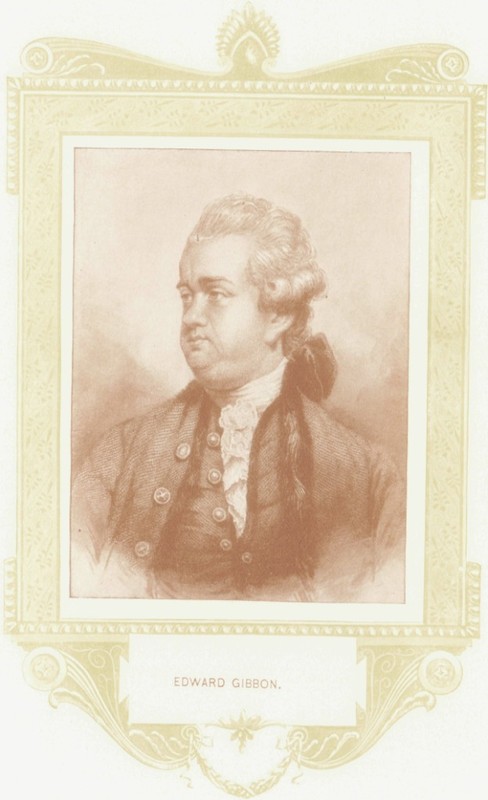
EDWARD GIBBON
(1737-1794)
BY W. E. H. LECKY

he history of Gibbon has been described by John Stuart Mill as the only eighteenth-century history that has withstood nineteenth-century criticism; and whatever objections modern critics may bring against some of its parts, the substantial justice of this verdict will scarcely be contested. No other history of that century has been so often reprinted, annotated, and discussed, or remains to the present day a capital authority on the great period of which it treats. As a composition it stands unchallenged and conspicuous among the masterpieces of English literature, while as a history it covers a space of more than twelve hundred years, including some of the most momentous events in the annals of mankind.
Gibbon was born at Putney, Surrey, April 27th, 1737. Though his father was a member of Parliament and the owner of a moderate competence, the author of this great work was essentially a self-educated man. Weak health and almost constant illness in early boyhood broke up his school life,—which appears to have been fitfully and most imperfectly conducted,—withdrew him from boyish games, but also gave him, as it has given to many other shy and sedentary boys, an early and inveterate passion for reading. His reading, however, was very unlike that of an ordinary boy. He has given a graphic picture of the ardor with which, when he was only fourteen, he flung himself into serious but unguided study; which was at first purely desultory, but gradually contracted into historic lines, and soon concentrated itself mainly on that Oriental history which he was one day so brilliantly to illuminate. "Before I was sixteen," he says, "I had exhausted all that could be learned in English of the Arabs and Persians, the Tartars and Turks; and the same ardor led me to guess at the French of D'Herbelot, and to construe the barbarous Latin of Pocock's 'Abulfaragius.'"
His health however gradually improved, and when he entered Magdalen College, Oxford, it might have been expected that a new period of intellectual development would have begun; but Oxford had at this time sunk to the lowest depth of stagnation, and to Gibbon it proved extremely uncongenial. He complained that he found no guidance, no stimulus, and no discipline, and that the fourteen months he spent there were the most idle and unprofitable of his life. They were very unexpectedly cut short by his conversion to the Roman Catholic faith, which he formally adopted at the age of sixteen.
This conversion is, on the whole, the most surprising incident of his calm and uneventful life. The tendencies of the time, both in England and on the Continent, were in a wholly different direction. The more spiritual and emotional natures were now passing into the religious revival of Wesley and Whitefield, which was slowly transforming the character of the Anglican Church and laying the foundations of the great Evangelical party. In other quarters the predominant tendencies were towards unbelief, skepticism, or indifference. Nature seldom formed a more skeptical intellect than that of Gibbon, and he was utterly without the spiritual insight, or spiritual cravings, or overmastering enthusiasms, that produce and explain most religious changes. Nor was he in the least drawn towards Catholicism on its aesthetic side. He had never come in contact with its worship or its professors; and to his unimaginative, unimpassioned, and profoundly intellectual temperament, no ideal type could be more uncongenial than that of the saint. He had however from early youth been keenly interested in theological controversies. He argued, like Lardner and Paley, that miracles are the Divine attestation of orthodoxy. Middleton convinced him that unless the Patristic writers were wholly undeserving of credit, the gift of miracles continued in the Church during the fourth and fifth centuries; and he was unable to resist the conclusion that during that period many of the leading doctrines of Catholicism had passed into the Church. The writings of the Jesuit Parsons, and still more the writings of Bossuet, completed the work which Middleton had begun. Having arrived at this conclusion, Gibbon acted on it with characteristic honesty, and was received into the Church on the 8th of June, 1753.
The English universities were at this time purely Anglican bodies, and the conversion of Gibbon excluded him from Oxford. His father judiciously sent him to Lausanne to study with a Swiss pastor named Pavilliard, with whom he spent five happy and profitable years. The theological episode was soon terminated. Partly under the influence of his teacher, but much more through his own reading and reflections, he soon disentangled the purely intellectual ties that bound him to the Church of Rome; and on Christmas Day, 1754, he received the sacrament in the Protestant church of Lausanne.
His residence at Lausanne was very useful to him. He had access to books in abundance, and his tutor, who was a man of great good sense and amiability but of no remarkable capacity, very judiciously left his industrious pupil to pursue his studies in his own way. "Hiving wisdom with each studious year," as Byron so truly says, he speedily amassed a store of learning which has seldom been equaled. His insatiable love of knowledge, his rare capacity for concentrated, accurate, and fruitful study, guided by a singularly sure and masculine judgment, soon made him, in the true sense of the word, one of the best scholars of his time. His learning, however, was not altogether of the kind that may be found in a great university professor. Though the classical languages became familiar to him, he never acquired or greatly valued the minute and finished scholarship which is the boast of the chief English schools; and careful students have observed that in following Greek books he must have very largely used the Latin translations. Perhaps in his capacity of historian this deficiency was rather an advantage than the reverse. It saved him from the exaggerated value of classical form, and from the neglect of the more corrupt literatures, to which English scholars have been often prone. Gibbon always valued books mainly for what they contained, and he had early learned the lesson which all good historians should learn: that some of his most valuable materials will be found in literatures that have no artistic merit; in writers who, without theory and almost without criticism, simply relate the facts which they have seen, and express in unsophisticated language the beliefs and impressions of their time.
Lausanne and not Oxford was the real birthplace of his intellect, and he returned from it almost a foreigner. French had become as familiar to him as his own tongue; and his first book, a somewhat superficial essay on the study of literature, was published in the French language. The noble contemporary French literature filled him with delight, and he found on the borders of the Lake of Geneva a highly cultivated society to which he was soon introduced, and which probably gave him more real pleasure than any in which he afterwards moved. With Voltaire himself he had some slight acquaintance, and he at one time looked on him with profound admiration; though fuller knowledge made him sensible of the flaws in that splendid intellect. I am here concerned with the life of Gibbon only in as far as it discloses the influences that contributed to his master work, and among these influences the foreign element holds a prominent place. There was little in Gibbon that was distinctively English; his mind was essentially cosmopolitan. His tastes, ideals, and modes of thought and feeling turned instinctively to the Continent.
In one respect this foreign type was of great advantage to his work. Gibbon excels all other English historians in symmetry, proportion, perspective, and arrangement, which are also the pre-eminent and characteristic merits of the best French literature. We find in his writing nothing of the great miscalculations of space that were made by such writers as Macaulay and Buckle; nothing of the awkward repetitions, the confused arrangement, the semi-detached and disjointed episodes that mar the beauty of many other histories of no small merit. Vast and multifarious as are the subjects which he has treated, his work is a great whole, admirably woven in all its parts. On the other hand, his foreign taste may perhaps be seen in his neglect of the Saxon element, which is the most vigorous and homely element in English prose. Probably in no other English writer does the Latin element so entirely predominate. Gibbon never wrote an unmeaning and very seldom an obscure sentence; he could always paint with sustained and stately eloquence an illustrious character or a splendid scene: but he was wholly wanting in the grace of simplicity, and a monotony of glitter and of mannerism is the great defect of his style. He possessed, to a degree which even Tacitus and Bacon had hardly surpassed, the supreme literary gift of condensation, and it gives an admirable force and vividness to his narrative; but it is sometimes carried to excess. Not unfrequently it is attained by an excessive allusiveness, and a wide knowledge of the subject is needed to enable the reader to perceive the full import and meaning conveyed or hinted at by a mere turn of phrase. But though his style is artificial and pedantic, and greatly wanting in flexibility, it has a rare power of clinging to the memory, and it has profoundly influenced English prose. That excellent judge Cardinal Newman has said of Gibbon, "I seem to trace his vigorous condensation and peculiar rhythm at every turn in the literature of the present day."
It is not necessary to relate here in any detail the later events of the life of Gibbon. There was his enlistment as captain in the Hampshire militia. It involved two and a half years of active service, extending from May 1760 to December 1762; and as Gibbon afterwards acknowledged, if it interrupted his studies and brought him into very uncongenial duties and societies, it at least greatly enlarged his acquaintance with English life, and also gave him a knowledge of the rudiments of military science, which was not without its use to the historian of so many battles. There was a long journey, lasting for two years and five months, in France and Italy, which greatly confirmed his foreign tendencies. In Paris he moved familiarly in some of the best French literary society; and in Rome, as he tells us in a well-known passage, while he sat "musing amidst the ruins of the Capitol while the barefooted friars were singing vespers in the Temple of Jupiter" (which is now the Church of the Ara Cœli),—on October 15th, 1764,—he first conceived the idea of writing the history of the decline and fall of Rome.
There was also that very curious episode in his life, lasting from 1774 to 1782,—his appearance in the House of Commons. He had declined an offer of his father's to purchase a seat for him in 1760; and fourteen years later, when his father was dead, when his own circumstances were considerably contracted, he received and accepted at the hands of a family connection the offer of a seat. His Parliamentary career was entirely undistinguished, and he never even opened his mouth in debate,—a fact which was not forgotten when very recently another historian was candidate for a seat in Parliament. In truth, this somewhat shy and reserved scholar, with his fastidious taste, his eminently judicial mind, and his highly condensed and elaborate style, was singularly unfit for the rough work of Parliamentary discussion. No one can read his books without perceiving that his English was not that of a debater; and he has candidly admitted that he entered Parliament without public spirit or serious interest in politics, and that he valued it chiefly as leading to an office which might restore the fortune which the extravagance of his father had greatly impaired. His only real public service was the composition in French of a reply to the French manifesto which was issued at the beginning of the war of 1778. He voted steadily and placidly as a Tory, and it is not probable that in doing so he did any violence to his opinions. Like Hume, he shrank with an instinctive dislike from all popular agitations, from all turbulence, passion, exaggeration, and enthusiasm; and a temperate and well-ordered despotism was evidently his ideal. He showed it in the well-known passage in which he extols the benevolent despotism of the Antonines as without exception the happiest period in the history of mankind, and in the unmixed horror with which he looked upon the French Revolution that broke up the old landmarks of Europe, For three years he held an office in the Board of Trade, which added considerably to his income without adding greatly to his labors, and he supported steadily the American policy of Lord North and the Coalition ministry of North and Fox; but the loss of his office and the retirement of North soon drove him from Parliament, and he shortly after took up his residence at Lausanne.
But before this time a considerable part of his great work had been accomplished. The first quarto volume of the 'Decline and Fall' appeared in February 1776. As is usually the case with historical works, it occupied a much longer period than its successors, and was the fruit of about ten years of labor. It passed rapidly through three editions, received the enthusiastic eulogy of Hume and Robertson, and was no doubt greatly assisted in its circulation by the storm of controversy that arose about his Fifteenth and Sixteenth Chapters. In April 1781 two more volumes appeared, and the three concluding volumes were published together on the 8th of May, 1788, being the fifty-first birthday of the author.
A work of such magnitude, dealing with so vast a variety of subjects, was certain to exhibit some flaws. The controversy at first turned mainly upon its religious tendency. The complete skepticism of the author, his aversion to the ecclesiastical type which dominated in the period of which he wrote, and his unalterable conviction that Christianity, by diverting the strength and enthusiasm of the Empire from civic into ascetic and ecclesiastical channels, was a main cause of the downfall of the Empire and of the triumph of barbarism, gave him a bias which it was impossible to overlook. On no other subject is his irony more bitter or his contempt so manifestly displayed. Few good critics will deny that the growth of the ascetic spirit had a large part in corroding and enfeebling the civic virtues of the Empire; but the part which it played was that of intensifying a disease that had already begun, and Gibbon, while exaggerating the amount of the evil, has very imperfectly described the great services rendered even by a monastic Church in laying the basis of another civilization and in mitigating the calamities of the barbarian invasion. The causes he has given of the spread of Christianity in the Fifteenth Chapter were for the most part true causes, but there were others of which he was wholly insensible. The strong moral enthusiasms that transform the character and inspire or accelerate all great religious changes lay wholly beyond the sphere of his realizations. His language about the Christian martyrs is the most repulsive portion of his work; and his comparison of the sufferings caused by pagan and Christian persecutions is greatly vitiated by the fact that he only takes account of the number of deaths, and lays no stress on the profuse employment of atrocious tortures, which was one of the most distinct features of the pagan persecutions. At the same time, though Gibbon displays in this field a manifest and a distorting bias, he never, like some of his French contemporaries, sinks into the mere partisan, awarding to one side unqualified eulogy and to the other unqualified contempt. Let the reader who doubts this examine and compare his masterly portraits of Julian and of Athanasius, and he will perceive how clearly the great historian could recognize weaknesses in the characters by which he was most attracted, and elements of true greatness in those by which he was most repelled. A modern writer, in treating of the history of religions, would have given a larger space to comparative religion, and to the gradual, unconscious, and spontaneous growth of myths in the twilight periods of the human mind. These however were subjects which were scarcely known in the days of Gibbon, and he cannot be blamed for not having discussed them.
Another class of objections which has been brought against him is that he is weak upon the philosophical side, and deals with history mainly as a mere chronicle of events, and not as a chain of causes and consequences, a series of problems to be solved, a gradual evolution which it is the task of the historian to explain. Coleridge, who detested Gibbon and spoke of him with gross injustice, has put this objection in the strongest form. He accuses him of having reduced history to a mere collection of splendid anecdotes; of noting nothing but what may produce an effect; of skipping from eminence to eminence without ever taking his readers through the valleys between; of having never made a single philosophical attempt to fathom the ultimate causes of the decline and fall of the Roman Empire, which is the very subject of his history. That such charges are grossly exaggerated will be apparent to any one who will carefully read the Second and Third Chapters, describing the state and tendencies of the Empire under the Antonines; or the chapters devoted to the rise and character of the barbarians, to the spread of Christianity, to the influence of monasticism, to the jurisprudence of the republic and of the Empire; nor would it be difficult to collect many acute and profound philosophical remarks from other portions of the history. Still, it may be admitted that the philosophical side is not its strongest part. Social and economical changes are sometimes inadequately examined and explained, and we often desire fuller information about the manners and life of the masses of the people. As far as concerns the age of the Antonines, this want has been amply supplied by the great work of Friedländer.
History, like many other things in our generation, has fallen largely into the hands of specialists; and it is inevitable that men who have devoted their lives to a minute examination of short periods should be able to detect some deficiencies and errors in a writer who traversed a period of more than twelve hundred years. Many generations of scholars have arisen since Gibbon; many new sources of knowledge have become available, and archæology especially has thrown a flood of new light on some of the subjects he treated. Though his knowledge and his narrative are on the whole admirably sustained, there are periods which he knew less well and treated less fully than others. His account of the Crusades is generally acknowledged to be one of the most conspicuous of these, and within the last few years there has arisen a school of historians who protest against the low opinion of the Byzantine Empire which was held by Gibbon, and was almost universal among scholars till the present generation. That these writers have brought into relief certain merits of the Lower Empire which Gibbon had neglected, will not be denied; but it is perhaps too early to decide whether the reaction has not, like most reactions, been carried to extravagance, and whether in its general features the estimate of Gibbon is not nearer the truth than some of those which are now put forward to replace it.
Much must no doubt be added to the work of Gibbon in order to bring it up to the level of our present knowledge; but there is no sign that any single work is likely to supersede it or to render it useless to the student; nor does its survival depend only or even mainly on its great literary qualities, which have made it one of the classics of the language. In some of these qualities Hume was the equal of Gibbon and in others his superior, and he brought to his history a more penetrating and philosophical intellect and an equally calm and unenthusiastic nature; but the study which Hume bestowed on his subject was so superficial and his statements were often so inaccurate, that his work is now never quoted as an authority. With Gibbon it is quite otherwise. His marvelous industry, his almost unrivaled accuracy of detail, his sincere love of truth, his rare discrimination and insight in weighing testimony and in judging character, have given him a secure place among the greatest historians of the world.
His life lasted only fifty-six years; he died in London on January 15th, 1794. With a single exception his history is his only work of real importance. That exception is his admirable autobiography. Gibbon left behind him six distinct sketches, which his friend Lord Sheffield put together with singular skill. It is one of the best specimens of self-portraiture in the language, reflecting with pellucid clearness both the life and character, the merits and defects, of its author. He was certainly neither a hero nor a saint; nor did he possess the moral and intellectual qualities that dominate in the great conflicts of life, sway the passions of men, appeal powerfully to the imagination, or dazzle and impress in social intercourse. He was a little slow, a little pompous, a little affected and pedantic. In the general type of his mind and character he bore much more resemblance to Hume, Adam Smith, or Reynolds, than to Johnson or Burke. A reserved scholar, who was rather proud of being a man of the world; a confirmed bachelor, much wedded to his comforts though caring nothing for luxury, he was eminently moderate in his ambitions, and there was not a trace of passion or enthusiasm in his nature. Such a man was not likely to inspire any strong devotion. But his temper was most kindly, equable, and contented; he was a steady friend, and he appears to have been always liked and honored in the cultivated and uncontentious society in which he delighted. His life was not a great one, but it was in all essentials blameless and happy. He found the work which was most congenial to him. He pursued it with admirable industry and with brilliant success, and he left behind him a book which is not likely to be forgotten while the English language endures.
[A] The story of King Lear and his three daughters.
[B] The story of the three caskets in 'The Merchant of Venice.'
ZENOBIA
Aurelian had no sooner secured the person and provinces of Tetricus, than he turned his arms against Zenobia, the celebrated queen of Palmyra and the East. Modern Europe has produced several illustrious women who have sustained with glory the weight of empire; nor is our own age destitute of such distinguished characters. But if we except the doubtful achievements of Semiramis, Zenobia is perhaps the only female whose superior genius broke through the servile indolence imposed on her sex by the climate and manners of Asia. She claimed her descent from the Macedonian kings of Egypt, equaled in beauty her ancestor Cleopatra, and far surpassed that princess in chastity and valor. Zenobia was esteemed the most lovely as well as the most heroic of her sex. She was of a dark complexion (for in speaking of a lady these trifles become important). Her teeth were of a pearly whiteness, and her large black eyes sparkled with uncommon fire, tempered by the most attractive sweetness. Her voice was strong and harmonious. Her manly understanding was strengthened and adorned by study. She was not ignorant of the Latin tongue, but possessed in equal perfection the Greek, the Syriac, and the Egyptian languages. She had drawn up for her own use an epitome of Oriental history, and familiarly compared the beauties of Homer and Plato under the tuition of the sublime Longinus.
This accomplished woman gave her hand to Odenathus, who, from a private station, raised himself to the dominion of the East. She soon became the friend and companion of a hero. In the intervals of war, Odenathus passionately delighted in the exercise of hunting; he pursued with ardor the wild beasts of the desert,—lions, panthers, and bears; and the ardor of Zenobia in that dangerous amusement was not inferior to his own. She had inured her constitution to fatigue, disdained the use of a covered carriage, generally appeared on horseback in a military habit, and sometimes marched several miles on foot at the head of the troops. The success of Odenathus was in a great measure ascribed to her incomparable prudence and fortitude. Their splendid victories over the Great King, whom they twice pursued as far as the gates of Ctesiphon, laid the foundations of their united fame and power. The armies which they commanded, and the provinces which they had saved, acknowledged not any other sovereigns than their invincible chiefs. The Senate and people of Rome revered a stranger who had avenged their captive emperor, and even the insensible son of Valerian accepted Odenathus for his legitimate colleague.
After a successful expedition against the Gothic plunderers of Asia, the Palmyrenian prince returned to the city of Emesa in Syria. Invincible in war, he was there cut off by domestic treason; and his favorite amusement of hunting was the cause, or at least the occasion, of his death. His nephew Mæonius presumed to dart his javelin before that of his uncle; and though admonished of his error, repeated the same insolence. As a monarch and as a sportsman, Odenathus was provoked, took away his horse, a mark of ignominy among the barbarians, and chastised the rash youth by a short confinement. The offense was soon forgot, but the punishment was remembered; and Mæonius, with a few daring associates, assassinated his uncle in the midst of a great entertainment. Herod, the son of Odenathus, though not of Zenobia, a young man of a soft and effeminate temper, was killed with his father. But Mæonius obtained only the pleasure of revenge by this bloody deed. He had scarcely time to assume the title of Augustus, before he was sacrificed by Zenobia to the memory of her husband.
With the assistance of his most faithful friends, she immediately filled the vacant throne, and governed with manly counsels Palmyra, Syria, and the East, above five years. By the death of Odenathus, that authority was at an end which the Senate had granted him only as a personal distinction; but his martial widow, disdaining both the Senate and Gallienus, obliged one of the Roman generals who was sent against her to retreat into Europe, with the loss of his army and his reputation. Instead of the little passions which so frequently perplex a female reign, the steady administration of Zenobia was guided by the most judicious maxims of policy. If it was expedient to pardon, she could calm her resentment; if it was necessary to punish, she could impose silence on the voice of pity. Her strict economy was accused of avarice; yet on every proper occasion she appeared magnificent and liberal. The neighboring States of Arabia, Armenia, and Persia dreaded her enmity and solicited her alliance. To the dominions of Odenathus, which extended from the Euphrates to the frontiers of Bithynia, his widow added the inheritance of her ancestors, the populous and fertile kingdom of Egypt. The Emperor Claudius acknowledged her merit, and was content that while he pursued the Gothic war, she should assert the dignity of the Empire in the East. The conduct however of Zenobia was attended with some ambiguity, nor is it unlikely that she had conceived the design of erecting an independent and hostile monarchy. She blended with the popular manners of Roman princes the stately pomp of the courts of Asia, and exacted from her subjects the same adoration that was paid to the successors of Cyrus. She bestowed on her three sons a Latin education, and often showed them to the troops adorned with the imperial purple. For herself she reserved the diadem, with the splendid but doubtful title of Queen of the East.
When Aurelian passed over into Asia against an adversary whose sex alone could render her an object of contempt, his presence restored obedience to the province of Bithynia, already shaken by the arms and intrigues of Zenobia. Advancing at the head of his legions, he accepted the submission of Ancyra, and was admitted into Tyana, after an obstinate siege, by the help of a perfidious citizen. The generous though fierce temper of Aurelian abandoned the traitor to the rage of the soldiers: a superstitious reverence induced him to treat with lenity the countrymen of Apollonius the philosopher. Antioch was deserted on his approach, till the Emperor, by his salutary edicts, recalled the fugitives, and granted a general pardon to all who from necessity rather than choice had been engaged in the service of the Palmyrenian Queen. The unexpected mildness of such a conduct reconciled the minds of the Syrians, and as far as the gates of Emesa the wishes of the people seconded the terror of his arms.
Zenobia would have ill deserved her reputation, had she indolently permitted the Emperor of the West to approach within a hundred miles of her capital. The fate of the East was decided in two great battles, so similar in almost every circumstance that we can scarcely distinguish them from each other, except by observing that the first was fought near Antioch and the second near Emesa. In both the Queen of Palmyra animated the armies by her presence, and devolved the execution of her orders on Zabdas, who had already signalized his military talents by the conquest of Egypt. The numerous forces of Zenobia consisted for the most part of light archers, and of heavy cavalry clothed in complete steel. The Moorish and Illyrian horse of Aurelian were unable to sustain the ponderous charge of their antagonists. They fled in real or affected disorder, engaged the Palmyrenians in a laborious pursuit, harassed them by a desultory combat, and at length discomfited this impenetrable but unwieldy body of cavalry. The light infantry, in the mean time, when they had exhausted their quivers, remaining without protection against a closer onset, exposed their naked sides to the swords of the legions. Aurelian had chosen these veteran troops, who were usually stationed on the Upper Danube, and whose valor had been severely tried in the Alemannic war. After the defeat of Emesa, Zenobia found it impossible to collect a third army. As far as the frontier of Egypt, the nations subject to her empire had joined the standard of the conqueror, who detached Probus, the bravest of his generals, to possess himself of the Egyptian provinces. Palmyra was the last resource of the widow of Odenathus. She retired within the walls of her capital, made every preparation for a vigorous resistance, and declared, with the intrepidity of a heroine, that the last moment of her reign and of her life should be the same.
Amid the barren deserts of Arabia, a few cultivated spots rise like islands out of the sandy ocean. Even the name of Tadmor, or Palmyra, by its signification in the Syriac as well as in the Latin language, denoted the multitude of palm-trees which afforded shade and verdure to that temperate region. The air was pure, and the soil, watered by some invaluable springs, was capable of producing fruits as well as corn. A place possessed of such singular advantages, and situated at a convenient distance between the Gulf of Persia and the Mediterranean,[C] was soon frequented by the caravans which conveyed to the nations of Europe a considerable part of the rich commodities of India. Palmyra insensibly increased into an opulent and independent city, and connecting the Roman and the Parthian monarchies by the mutual benefits of commerce, was suffered to observe a humble neutrality, till at length after the victories of Trajan the little republic sunk into the bosom of Rome, and flourished more than one hundred and fifty years in the subordinate though honorable rank of a colony. It was during that peaceful period, if we may judge from a few remaining inscriptions, that the wealthy Palmyrenians constructed those temples, palaces, and porticos of Grecian architecture whose ruins, scattered over an extent of several miles, have deserved the curiosity of our travelers. The elevation of Odenathus and Zenobia appeared to reflect new splendor on their country, and Palmyra for a while stood forth the rival of Rome: but the competition was fatal, and ages of prosperity were sacrificed to a moment of glory.
In his march over the sandy desert between Emesa and Palmyra, the Emperor Aurelian was perpetually harassed by the Arabs; nor could he always defend his army, and especially his baggage, from those flying troops of active and daring robbers who watched the moment of surprise and eluded the slow pursuit of the legions. The siege of Palmyra was an object far more difficult and important, and the Emperor, who with incessant vigor pressed the attacks in person, was himself wounded with a dart. "The Roman people," says Aurelian, in an original letter, "speak with contempt of the war which I am waging against a woman. They are ignorant both of the character and of the power of Zenobia. It is impossible to enumerate her warlike preparations of stones, of arrows, and of every species of missile weapons. Every part of the walls is provided with two or three balistæ, and artificial fires are thrown from her military engines. The fear of punishment has armed her with a desperate courage. Yet still I trust in the protecting deities of Rome, who have hitherto been favorable to all my undertakings." Doubtful, however, of the protection of the gods and of the event of the siege, Aurelian judged it more prudent to offer terms of an advantageous capitulation: to the Queen, a splendid retreat; to the citizens, their ancient privileges. His proposals were obstinately rejected, and the refusal was accompanied with insult.
The firmness of Zenobia was supported by the hope that in a very short time famine would compel the Roman army to repass the desert, and by the reasonable expectation that the kings of the East, and particularly the Persian monarch, would arm in the defense of their most natural ally. But fortune and the perseverance of Aurelian overcame every obstacle. The death of Sapor, which happened about this time, distracted the counsels of Persia, and the inconsiderable succors that attempted to relieve Palmyra were easily intercepted either by the arms or the liberality of the Emperor. From every part of Syria a regular succession of convoys safely arrived in the camp, which was increased by the return of Probus with his victorious troops from the conquest of Egypt. It was then that Zenobia resolved to fly. She mounted the fleetest of her dromedaries, and had already reached the banks of the Euphrates, about sixty miles from Palmyra, when she was overtaken by the pursuit of Aurelian's light horse, seized, and brought back a captive to the feet of the Emperor. Her capital soon afterwards surrendered, and was treated with unexpected lenity. The arms, horses, and camels, with an immense treasure of gold, silver, silk, and precious stones, were all delivered to the conqueror, who, leaving only a garrison of six hundred archers, returned to Emesa and employed some time in the distribution of rewards and punishments at the end of so memorable a war, which restored to the obedience of Rome those provinces that had renounced their allegiance since the captivity of Valerian.
When the Syrian Queen was brought into the presence of Aurelian he sternly asked her, How she had presumed to rise in arms against the emperors of Rome! The answer of Zenobia was a prudent mixture of respect and firmness: "Because I disdained to consider as Roman emperors an Aureolus or a Gallienus. You alone I acknowledge as my conqueror and my sovereign." But as female fortitude is commonly artificial, so it is seldom steady or consistent. The courage of Zenobia deserted her in the hour of trial; she trembled at the angry clamors of the soldiers, who called aloud for her immediate execution, forgot the generous despair of Cleopatra which she had proposed as her model, and ignominiously purchased life by the sacrifice of her fame and her friends. It was to their counsels, which governed the weakness of her sex, that she imputed the guilt of her obstinate resistance; it was on their heads that she directed the vengeance of the cruel Aurelian. The fame of Longinus, who was included among the numerous and perhaps innocent victims of her fear, will survive that of the Queen who betrayed or the tyrant who condemned him. Genius and learning were incapable of moving a fierce unlettered soldier, but they had served to elevate and harmonize the soul of Longinus. Without uttering a complaint he calmly followed the executioner, pitying his unhappy mistress, and bestowing comfort on his afflicted friends....
But, however in the treatment of his unfortunate rivals Aurelian might indulge his pride, he behaved towards them with a generous clemency which was seldom exercised by the ancient conquerors. Princes who without success had defended their throne or freedom, were frequently strangled in prison as soon as the triumphal pomp ascended the Capitol. These usurpers, whom their defeat had convicted of the crime of treason, were permitted to spend their lives in affluence and honorable repose. The Emperor presented Zenobia with an elegant villa at Tibur, or Tivoli, about twenty miles from the capital; the Syrian queen insensibly sunk into a Roman matron, her daughters married into noble families, and her race was not yet extinct in the fifth century.
FOUNDATION OF CONSTANTINOPLE
We are at present qualified to view the advantageous position of Constantinople, which appears to have been formed by nature for the centre and capital of a great monarchy. Situated in the forty-first degree of latitude, the imperial city commanded from her seven hills the opposite shores of Europe and Asia; the climate was healthy and temperate, the soil fertile, the harbor secure and capacious; and the approach on the side of the continent was of small extent and easy defense. The Bosphorus and the Hellespont may be considered as the two gates of Constantinople; and the prince who possessed those important passages could always shut them against a naval enemy and open them to the fleets of commerce. The preservation of the eastern provinces may in some degree be ascribed to the policy of Constantine, as the barbarians of the Euxine, who in the preceding age had poured their armaments into the heart of the Mediterranean, soon desisted from the exercise of piracy, and despaired of forcing this insurmountable barrier. When the gates of the Hellespont and Bosphorus were shut, the capital still enjoyed within their spacious inclosure every production which could supply the wants or gratify the luxury of its numerous inhabitants. The sea-coasts of Thrace and Bithynia, which languish under the weight of Turkish oppression, still exhibit a rich prospect of vineyards, of gardens, and of plentiful harvests; and the Propontis has ever been renowned for an inexhaustible store of the most exquisite fish, that are taken in their stated seasons without skill and almost without labor. But when the passages of the straits were thrown open for trade, they alternately admitted the natural and artificial riches of the North and South, of the Euxine and of the Mediterranean. Whatever rude commodities were collected in the forests of Germany and Scythia, as far as the sources of the Tanais and the Borysthenes; whatsoever was manufactured by the skill of Europe or Asia; the corn of Egypt, and the gems and spices of the farthest India, were brought by the varying winds into the port of Constantinople, which for many ages attracted the commerce of the ancient world.
The prospect of beauty, of safety, and of wealth, united in a single spot, was sufficient to justify the choice of Constantine. But as some decent mixture of prodigy and fable has in every age been supposed to reflect a becoming majesty on the origin of great cities, the Emperor was desirous of ascribing his resolution, not so much to the uncertain counsels of human policy as to the infallible and eternal decrees of Divine wisdom. In one of his laws he has been careful to instruct posterity that in obedience to the commands of God he laid the everlasting foundations of Constantinople: and though he has not condescended to relate in what manner the celestial inspiration was communicated to his mind, the defect of his modest silence has been liberally supplied by the ingenuity of succeeding writers, who describe the nocturnal vision which appeared to the fancy of Constantine as he slept within the walls of Byzantium. The tutelar genius of the city, a venerable matron sinking under the weight of years and infirmities, was suddenly transformed into a blooming maid, whom his own hands adorned with all the symbols of imperial greatness. The monarch awoke, interpreted the auspicious omen, and obeyed without hesitation the will of Heaven. The day which gave birth to a city or colony was celebrated by the Romans with such ceremonies as had been ordained by a generous superstition; and though Constantine might omit some rites which savored too strongly of their pagan origin, yet he was anxious to leave a deep impression of hope and respect on the minds of the spectators. On foot, with a lance in his hand, the Emperor himself led the solemn procession, and directed the line which was traced as the boundary of the destined capital; till the growing circumference was observed with astonishment by the assistants, who at length ventured to observe that he had already exceeded the most ample measure of a great city. "I shall still advance," replied Constantine, "till He, the invisible guide who marches before me, thinks proper to stop." Without presuming to investigate the nature or motives of this extraordinary conductor, we shall content ourselves with the more humble task of describing the extent and limits of Constantinople.
In the actual state of the city, the palace and gardens of the Seraglio occupy the eastern promontory, the first of the seven hills, and cover about one hundred and fifty acres of our own measure. The seat of Turkish jealousy and despotism is erected on the foundations of a Grecian republic; but it may be supposed that the Byzantines were tempted by the conveniency of the harbor to extend their habitations on that side beyond the modern limits of the Seraglio. The new walls of Constantine stretched from the port to the Propontis across the enlarged breadth of the triangle, at a distance of fifteen stadia from the ancient fortification; and with the city of Byzantium they inclosed five of the seven hills which, to the eyes of those who approach Constantinople, appear to rise above each other in beautiful order. About a century after the death of the founder, the new buildings, extending on one side up the harbor and on the other along the Propontis, already covered the narrow ridge of the sixth and the broad summit of the seventh hill. The necessity of protecting those suburbs from the incessant inroads of the barbarians engaged the younger Theodosius to surround his capital with an adequate and permanent inclosure of walls. From the eastern promontory to the Golden Gate, the extreme length of Constantinople was about three Roman miles; the circumference measured between ten and eleven, and the surface might be computed as equal to about two thousand English acres. It is impossible to justify the vain and credulous exaggerations of modern travelers, who have sometimes stretched the limits of Constantinople over the adjacent villages of the European, and even of the Asiatic coast. But the suburbs of Pera and Galata, though situate beyond the harbor, may deserve to be considered as a part of the city; and this addition may perhaps authorize the measure of a Byzantine historian, who assigns sixteen Greek (about fourteen Roman) miles for the circumference of his native city. Such an extent may not seem unworthy of an imperial residence. Yet Constantinople must yield to Babylon and Thebes, to ancient Rome, to London, and even to Paris.
The master of the Roman world, who aspired to erect an eternal monument of the glories of his reign, could employ in the prosecution of that great work the wealth, the labor, and all that yet remained of the genius of obedient millions. Some estimate may be formed of the expense bestowed with imperial liberality on the foundation of Constantinople, by the allowance of about two millions five hundred thousand pounds for the construction of the walls, the porticos, and the aqueducts. The forests that overshadowed the shores of the Euxine, and the celebrated quarries of white marble in the little island of Proconnesus, supplied an inexhaustible stock of materials, ready to be conveyed, by the convenience of a short water carriage, to the harbor of Byzantium. A multitude of laborers and artificers urged the conclusion of the work with incessant toil; but the impatience of Constantine soon discovered that, in the decline of the arts, the skill as well as numbers of his architects bore a very unequal proportion to the greatness of his designs. The magistrates of the most distant provinces were therefore directed to institute schools, to appoint professors, and by the hopes of rewards and privileges to engage in the study and practice of architecture a sufficient number of ingenious youths who had received a liberal education. The buildings of the new city were executed by such artificers as the reign of Constantine could afford; but they were decorated by the hands of the most celebrated masters of the age of Pericles and Alexander. To revive the genius of Phidias and Lysippus surpassed indeed the power of a Roman emperor; but the immortal productions which they had bequeathed to posterity were exposed without defense to the rapacious vanity of a despot. By his commands the cities of Greece and Asia were despoiled of their most valuable ornaments. The trophies of memorable wars, the objects of religious veneration, the most finished statues of the gods and heroes, of the sages and poets of ancient times, contributed to the splendid triumph of Constantinople, and gave occasion to the remark of the historian Cedrenus, who observes with some enthusiasm that nothing seemed wanting except the souls of the illustrious men whom these admirable monuments were intended to represent. But it is not in the city of Constantine, nor in the declining period of an empire, when the human mind was depressed by civil and religious slavery, that we should seek for the souls of Homer and of Demosthenes.
During the siege of Byzantium, the conqueror had pitched his tent on the commanding eminence of the second hill. To perpetuate the memory of his success, he chose the same advantageous position for the principal Forum, which appears to have been of a circular or rather elliptical form. The two opposite entrances formed triumphal arches; the porticos which inclosed it on every side were filled with statues; and the centre of the Forum was occupied by a lofty column, of which a mutilated fragment is now degraded by the appellation of the burnt pillar. This column was erected on a pedestal of white marble twenty feet high, and was composed of ten pieces of porphyry, each of which measured about ten feet in height and about thirty-three in circumference. On the summit of the pillar, above one hundred and twenty feet from the ground, stood the colossal statue of Apollo. It was of bronze, had been transported either from Athens or from a town of Phrygia, and was supposed to be the work of Phidias. The artist had represented the god of day, or as it was afterwards interpreted, the Emperor Constantine himself with a sceptre in his right hand, the globe of the world in his left, and a crown of rays glittering on his head. The Circus, or Hippodrome, was a stately building about four hundred paces in length and one hundred in breadth. The space between the two metæ or goals was filled with statues and obelisks; and we may still remark a very singular fragment of antiquity—the bodies of three serpents twisted into one pillar of brass. Their triple heads had once supported the golden tripod which, after the defeat of Xerxes, was consecrated in the temple of Delphi by the victorious Greeks. The beauty of the Hippodrome has been long since defaced by the rude hands of the Turkish conquerors; but under the similar appellation of Atmeidan, it still serves as a place of exercise for their horses. From the throne whence the Emperor viewed the Circensian games, a winding staircase descended to the palace: a magnificent edifice which scarcely yielded to the residence of Rome itself, and which, together with the dependent courts, gardens, and porticos, covered a considerable extent of ground upon the banks of the Propontis between the Hippodrome and the church of St. Sophia. We might likewise celebrate the baths, which still retained the name of Zeuxippus, after they had been enriched by the munificence of Constantine with lofty columns, various marbles, and above threescore statues of bronze. But we should deviate from the design of this history if we attempted minutely to describe the different buildings or quarters of the city. It may be sufficient to observe that whatever could adorn the dignity of a great capital, or contribute to the benefit or pleasure of its numerous inhabitants, was contained within the walls of Constantinople. A particular description, composed about a century after its foundation, enumerates a capitol or school of learning, a circus, two theatres, eight public and one hundred and fifty-three private baths, fifty-two porticos, five granaries, eight aqueducts or reservoirs of water, four spacious halls for the meetings of the senate or courts of justice, fourteen churches, fourteen palaces, and four thousand three hundred and eighty-eight houses which for their size or beauty deserved to be distinguished from the multitude of plebeian habitations.
The populousness of his favored city was the next and most serious object of the attention of its founder. In the dark ages which succeeded the translation of the empire, the remote and the immediate consequences of that memorable event were strangely confounded by the vanity of the Greeks and the credulity of the Latins. It was asserted and believed that all the noble families of Rome, the Senate, and the equestrian order, with their innumerable attendants, had followed their Emperor to the banks of the Propontis; that a spurious race of strangers and plebeians was left to possess the solitude of the ancient capital; and that the lands of Italy, long since converted into gardens, were at once deprived of cultivation and inhabitants. In the course of this history such exaggerations will be reduced to their just value: yet, since the growth of Constantinople cannot be ascribed to the general increase of mankind and of industry, it must be admitted that this artificial colony was raised at the expense of the ancient cities of the empire. Many opulent senators of Rome and of the eastern provinces were probably invited by Constantine to adopt for their country the fortunate spot which he had chosen for his own residence. The invitations of a master are scarcely to be distinguished from commands; and the liberality of the Emperor obtained a ready and cheerful obedience. He bestowed on his favorites the palaces which he had built in the several quarters of the city, assigned them lands and pensions for the support of their dignity, and alienated the demesnes of Pontus and Asia to grant hereditary estates by the easy tenure of maintaining a house in the capital. But these encouragements and obligations soon became superfluous, and were gradually abolished. Wherever the seat of government is fixed, a considerable part of the public revenue will be expended by the prince himself, by his ministers, by the officers of justice, and by the domestics of the palace. The most wealthy of the provincials will be attracted by the powerful motives of interest and duty, of amusement and curiosity. A third and more numerous class of inhabitants will insensibly be formed, of servants, of artificers, and of merchants, who derive their subsistence from their own labor and from the wants or luxury of the superior ranks. In less than a century Constantinople disputed with Rome itself the pre-eminence of riches and numbers. New piles of buildings, crowded together with too little regard to health or convenience, scarcely allowed the intervals of narrow streets for the perpetual throng of men, of horses, and of carriages. The allotted space of ground was insufficient to contain the increasing people; and the additional foundations, which on either side were advanced into the sea, might alone have composed a very considerable city.
The frequent and regular distributions of wine and oil, of corn or bread, of money or provisions, had almost exempted the poorer citizens of Rome from the necessity of labor. The magnificence of the first Cæsars was in some measure imitated by the founder of Constantinople; but his liberality, however it might excite the applause of the people, has incurred the censure of posterity. A nation of legislators and conquerors might assert their claim to the harvests of Africa, which had been purchased with their blood; and it was artfully contrived by Augustus that in the enjoyment of plenty the Romans should lose the memory of freedom. But the prodigality of Constantine could not be excused by any consideration either of public or private interest; and the annual tribute of corn imposed upon Egypt for the benefit of his new capital was applied to feed a lazy and insolent populace at the expense of the husbandmen of an industrious province. Some other regulations of this Emperor are less liable to blame, but they are less deserving of notice. He divided Constantinople into fourteen regions or quarters, dignified the public council with the appellation of senate, communicated to the citizens the privileges of Italy, and bestowed on the rising city the title of colony, the first and most favored daughter of ancient Rome. The venerable parent still maintained the legal and acknowledged supremacy which was due to her age, her dignity, and to the remembrance of her former greatness.
As Constantine urged the progress of the work with the impatience of a lover, the walls, the porticos, and the principal edifices were completed in a few years, or according to another account, in a few months; but this extraordinary diligence should excite the less admiration, since many of the buildings were finished in so hasty and imperfect a manner that under the succeeding reign they were preserved with difficulty from impending ruin. But while they displayed the vigor and freshness of youth, the founder prepared to celebrate the dedication of his city. The games and largesses which crowned the pomp of this memorable festival may easily be supposed; but there is one circumstance of a more singular and permanent nature which ought not entirely to be overlooked. As often as the birthday of the city returned, the statue of Constantine, framed by his order, of gilt wood, and bearing in its right hand a small image of the genius of the place, was erected on a triumphal car. The guards, carrying white tapers and clothed in their richest apparel, accompanied the solemn procession as it moved through the Hippodrome. When it was opposite to the throne of the reigning emperor, he rose from his seat, and with grateful reverence adored the memory of his predecessor. At the festival of the dedication an edict, engraved on a column of marble, bestowed the title of Second or New Rome on the city of Constantine. But the name of Constantinople has prevailed over that honorable epithet, and after the revolution of fourteen centuries still perpetuates the fame of its author.
CHARACTER OF CONSTANTINE
The character of the prince who removed the seat of empire, and introduced such important changes into the civil and religious constitution of his country, has fixed the attention and divided the opinions of mankind. By the grateful zeal of the Christians, the deliverer of the Church has been decorated with every attribute of a hero and even of a saint, while the discontent of the vanquished party has compared Constantine to the most abhorred of those tyrants who by their vice and weakness dishonored the imperial purple. The same passions have in some degree been perpetuated to succeeding generations, and the character of Constantine is considered, even in the present age, as an object either of satire or of panegyric. By the impartial union of those defects which are confessed by his warmest admirers, and of those virtues which are acknowledged by his most implacable enemies, we might hope to delineate a just portrait of that extraordinary man which the truth and candor of history should adopt without a blush. But it would soon appear, that the vain attempt to blend such discordant colors and to reconcile such inconsistent qualities must produce a figure monstrous rather than human, unless it is viewed in its proper and distinct lights, by a careful separation of the different periods of the reign of Constantine.
The person as well as the mind of Constantine had been enriched by nature with her choicest endowments. His stature was lofty, his countenance majestic, his deportment graceful, his strength and activity were displayed in every manly exercise, and from his earliest youth to a very advanced season of life he preserved the vigor of his constitution by a strict adherence to the domestic virtues of chastity and temperance. He delighted in the social intercourse of familiar conversation; and though he might sometimes indulge his disposition to raillery with less reserve than was required by the severe dignity of his station, the courtesy and liberality of his manners gained the hearts of all who approached him. The sincerity of his friendship has been suspected; yet he showed on some occasions that he was not incapable of a warm and lasting attachment. The disadvantage of an illiterate education had not prevented him from forming a just estimate of the value of learning; and the arts and sciences derived some encouragement from the munificent protection of Constantine. In the dispatch of business, his diligence was indefatigable; and the active powers of his mind were almost continually exercised in reading, writing, or meditating, in giving audience to ambassadors, and in examining the complaints of his subjects. Even those who censured the propriety of his measures were compelled to acknowledge that he possessed magnanimity to conceive and patience to execute the most arduous designs, without being checked either by the prejudices of education or by the clamors of the multitude. In the field he infused his own intrepid spirit into the troops, whom he conducted with the talents of a consummate general; and to his abilities, rather than to his fortune, we may ascribe the signal victories which he obtained over the foreign and domestic foes of the republic. He loved glory as the reward, perhaps as the motive, of his labors. The boundless ambition which, from the moment of his accepting the purple at York, appears as the ruling passion of his soul, may be justified by the dangers of his own situation, by the character of his rivals, by the consciousness of superior merit, and by the prospect that his success would enable him to restore peace and order to the distracted empire. In his civil wars against Maxentius and Licinius he had engaged on his side the inclinations of the people, who compared the undissembled vices of those tyrants with the spirit of wisdom and justice which seemed to direct the general tenor of the administration of Constantine.
Had Constantine fallen on the banks of the Tiber, or even in the plains of Hadrianople, such is the character which, with a few exceptions, he might have transmitted to posterity. But the conclusion of his reign (according to the moderate and indeed tender sentence of a writer of the same age) degraded him from the rank which he had acquired among the most deserving of the Roman princes. In the life of Augustus we behold the tyrant of the republic converted, almost by imperceptible degrees, into the father of his country and of human kind. In that of Constantine we may contemplate a hero who had so long inspired his subjects with love and his enemies with terror, degenerating into a cruel and dissolute monarch, corrupted by his fortune or raised by conquest above the necessity of dissimulation. The general peace which he maintained during the last fourteen years of his reign was a period of apparent splendor rather than of real prosperity; and the old age of Constantine was disgraced by the opposite yet reconcilable vices of rapaciousness and prodigality. The accumulated treasures found in the palaces of Maxentius and Licinius were lavishly consumed; the various innovations introduced by the conqueror were attended with an increasing expense; the cost of his buildings, his court, and his festivals required an immediate and plentiful supply; and the oppression of the people was the only fund which could support the magnificence of the sovereign. His unworthy favorites, enriched by the boundless liberality of their master, usurped with impunity the privilege of rapine and corruption. A secret but universal decay was felt in every part of the public administration; and the Emperor himself, though he still retained the obedience, gradually lost the esteem of his subjects. The dress and manners which towards the decline of life he chose to affect, served only to degrade him in the eyes of mankind. The Asiatic pomp which had been adopted by the pride of Diocletian assumed an air of softness and effeminacy in the person of Constantine. He is represented with false hair of various colors, laboriously arranged by the skillful artists of the times; a diadem of a new and more expensive fashion; a profusion of gems and pearls, of collars and bracelets, and a variegated flowing robe of silk, most curiously embroidered with flowers of gold. In such apparel, scarcely to be excused by the youth and folly of Elagabulus, we are at a loss to discover the wisdom of an aged monarch and the simplicity of a Roman veteran. A mind thus relaxed by prosperity and indulgence was incapable of rising to that magnanimity which disdains suspicion and dares to forgive. The deaths of Maximian and Licinius may perhaps be justified by the maxims of policy as they are taught in the schools of tyrants; but an impartial narrative of the executions, or rather murders, which sullied the declining age of Constantine, will suggest to our most candid thoughts the idea of a prince who could sacrifice without reluctance the laws of justice and the feelings of nature, to the dictates either of his passions or of his interest.
The same fortune which so invariably followed the standard of Constantine seemed to secure the hopes and comforts of his domestic life. Those among his predecessors who had enjoyed the longest and most prosperous reigns, Augustus, Trajan, and Diocletian, had been disappointed of posterity; and the frequent revolutions had never allowed sufficient time for any imperial family to grow up and multiply under the shade of the purple. But the royalty of the Flavian line, which had been first ennobled by the Gothic Claudius, descended through several generations; and Constantine himself derived from his royal father the hereditary honors which he transmitted to his children. The Emperor had been twice married. Minervina, the obscure but lawful object of his youthful attachment, had left him only one son, who was called Crispus. By Fausta, the daughter of Maximian, he had three daughters, and three sons known by the kindred names of Constantine, Constantius, and Constans. The unambitious brothers of the great Constantine, Julius Constantius, Dalmatius, and Hannibalianus, were permitted to enjoy the most honorable rank and the most affluent fortune that could be consistent with a private station. The youngest of the three lived without a name and died without posterity. His two elder brothers obtained in marriage the daughters of wealthy senators, and propagated new branches of the imperial race. Gallus and Julian afterwards became the most illustrious of the children of Julius Constantius the Patrician. The two sons of Dalmatius, who had been decorated with the vain title of censor, were named Dalmatius and Hannibalianus. The two sisters of the great Constantine, Anastasia and Eutropia, were bestowed on Optatus and Nepotianus, two senators of noble birth and of consular dignity. His third sister, Constantia, was distinguished by her pre-eminence of greatness and of misery. She remained the widow of the vanquished Licinius; and it was by her entreaties that an innocent boy, the offspring of their marriage, preserved for some time his life, the title of Caesar, and a precarious hope of the succession. Besides the females and the allies of the Flavian house, ten or twelve males to whom the language of modern courts would apply the title of princes of the blood, seemed, according to the order of their birth, to be destined either to inherit or to support the throne of Constantine. But in less than thirty years this numerous and increasing family was reduced to the persons of Constantius and Julian, who alone had survived a series of crimes and calamities such as the tragic poets have deplored in the devoted lines of Pelops and of Cadmus.
DEATH OF JULIAN
While Julian struggled with the almost insuperable difficulties of his situation, the silent hours of the night were still devoted to study and contemplation. Whenever he closed his eyes in short and interrupted slumbers, his mind was agitated with painful anxiety; nor can it be thought surprising that the Genius of the Empire should once more appear before him, covering with a funeral veil his head and his horn of abundance, and slowly retiring from the imperial tent. The monarch started from his couch, and stepping forth to refresh his wearied spirits with the coolness of the midnight air, he beheld a fiery meteor which shot athwart the sky and suddenly vanished. Julian was convinced that he had seen the menacing countenance of the god of war; the council which he summoned of Tuscan Haruspices unanimously pronounced that he should abstain from action; but on this occasion necessity and reason were more prevalent than superstition, and the trumpets sounded at the break of day. The army marched through a hilly country, and the hills had been secretly occupied by the Persians. Julian led the van with the skill and attention of a consummate general; he was alarmed by the intelligence that his rear was suddenly attacked. The heat of the weather had tempted him to lay aside his cuirass; but he snatched a shield from one of his attendants and hastened with a sufficient reinforcement to the relief of the rear guard. A similar danger recalled the intrepid prince to the defense of the front; and as he galloped between the columns, the centre of the left was attacked and almost overpowered by a furious charge of the Persian cavalry and elephants. This huge body was soon defeated by the well-timed evolution of the light infantry, who aimed their weapons, with dexterity and effect, against the backs of the horsemen and the legs of the elephants. The Barbarians fled; and Julian, who was foremost in every danger, animated the pursuit with his voice and gestures. His trembling guards, scattered and oppressed by the disorderly throng of friends and enemies, reminded their fearless sovereign that he was without armor, and conjured him to decline the fall of the impending ruin. As they exclaimed, a cloud of darts and arrows was discharged from the flying squadrons; and a javelin, after razing the skin of his arm, transpierced the ribs and fixed in the inferior part of the liver. Julian attempted to draw the deadly weapon from his side, but his fingers were cut by the sharpness of the steel, and he fell senseless from his horse. His guards flew to his relief, and the wounded Emperor was gently raised from the ground and conveyed out of the tumult of the battle into an adjacent tent. The report of the melancholy event passed from rank to rank; but the grief of the Romans inspired them with invincible valor and the desire of revenge. The bloody and obstinate conflict was maintained by the two armies till they were separated by the total darkness of the night. The Persians derived some honor from the advantage which they obtained against the left wing, where Anatolius, master of the offices, was slain, and the præfect Sallust very narrowly escaped. But the event of the day was adverse to the Barbarians. They abandoned the field, their two generals Meranes and Nohordates, fifty nobles or satraps, and a multitude of their bravest soldiers; and the success of the Romans, if Julian had survived, might have been improved into a decisive and useful victory.
The first words that Julian uttered after his recovery from the fainting fit into which he had been thrown by loss of blood, were expressive of his martial spirit. He called for his horse and arms, and was impatient to rush into the battle. His remaining strength was exhausted by the painful effort, and the surgeons who examined his wound discovered the symptoms of approaching death. He employed the awful moments with the firm temper of a hero and a sage; the philosophers who had accompanied him in this fatal expedition compared the tent of Julian with the prison of Socrates; and the spectators whom duty or friendship or curiosity had assembled round his couch listened with respectful grief to the funeral oration of their dying emperor:—"Friends and fellow soldiers, the seasonable period of my departure is now arrived, and I discharge, with the cheerfulness of a ready debtor, the demands of nature. I have learned from philosophy how much the soul is more excellent than the body; and that the separation of the nobler substance should be the subject of joy rather than of affliction. I have learned from religion that an earthly death has often been the reward of piety; and I accept, as a favor of the gods, the mortal stroke that secures me from the danger of disgracing a character which has hitherto been supported by virtue and fortitude. I die without remorse, as I have lived without guilt. I am pleased to reflect on the innocence of my private life; and I can affirm with confidence that the supreme authority, that emanation of the Divine power, has been preserved in my hands pure and immaculate. Detesting the corrupt and destructive maxims of despotism, I have considered the happiness of the people as the end of government. Submitting my actions to the laws of prudence, of justice, and of moderation, I have trusted the event to the care of Providence. Peace was the object of my counsels as long as peace was consistent with the public welfare; but when the imperious voice of my country summoned me to arms, I exposed my person to the dangers of war with the clear foreknowledge (which I had acquired from the art of divination) that I was destined to fall by the sword. I now offer my tribute of gratitude to the Eternal Being, who has not suffered me to perish by the cruelty of a tyrant, by the secret dagger of conspiracy, or by the slow tortures of lingering disease. He has given me, in the midst of an honorable career, a splendid and glorious departure from this world; and I hold it equally absurd, equally base, to solicit or to decline the stroke of fate. Thus much I have attempted to say; but my strength fails me, and I feel the approach of death. I shall cautiously refrain from any word that may tend to influence your suffrages in the election of an emperor. My choice might be imprudent or injudicious; and if it should not be ratified by the consent of the army, it might be fatal to the person whom I should recommend. I shall only, as a good citizen, express my hopes that the Romans may be blessed with the government of a virtuous sovereign." After this discourse, which Julian pronounced in a firm and gentle tone of voice, he distributed by a military testament the remains of his private fortune; and making some inquiry why Anatolius was not present, he understood from the answer of Sallust that Anatolius was killed, and bewailed with amiable inconsistency the loss of his friend. At the same time he reproved the immoderate grief of the spectators, and conjured them not to disgrace by unmanly tears the fate of a prince who in a few moments would be united with heaven and with the stars. The spectators were silent; and Julian entered into a metaphysical argument with the philosophers Priscus and Maximus on the nature of the soul. The efforts which he made, of mind as well as body, most probably hastened his death. His wound began to bleed with fresh violence; his respiration was embarrassed by the swelling of the veins; he called for a draught of cold water, and as soon as he had drunk it expired without pain, about the hour of midnight. Such was the end of that extraordinary man, in the thirty-second year of his age, after a reign of one year and about eight months from the death of Constantius. In his last moments he displayed, perhaps with some ostentation, the love of virtue and of fame which had been the ruling passions of his life.
THE FALL OF ROME
At the hour of midnight the Salarian gate was silently opened, and the inhabitants were awakened by the tremendous sound of the Gothic trumpet. Eleven hundred and sixty-three years after the foundation of Rome, the imperial city which had subdued and civilized so considerable a part of mankind was delivered to the licentious fury of the tribes of Germany and Scythia.
The proclamation of Alaric, when he forced his entrance into a vanquished city, discovered however some regard for the laws of humanity and religion. He encouraged his troops boldly to seize the rewards of valor, and to enrich themselves with the spoils of a wealthy and effeminate people; but he exhorted them at the same time to spare the lives of the unresisting citizens, and to respect the churches of the apostles St. Peter and St. Paul as holy and inviolable sanctuaries. Amidst the horrors of a nocturnal tumult, several of the Christian Goths displayed the fervor of a recent conversion; and some instances of their uncommon piety and moderation are related, and perhaps adorned, by the zeal of ecclesiastical writers. While the Barbarians roamed through the city in quest of prey, the humble dwelling of an aged virgin who had devoted her life to the service of the altar was forced open by one of the powerful Goths. He immediately demanded, though in civil language, all the gold and silver in her possession; and was astonished at the readiness with which she conducted him to a splendid hoard of massy plate of the richest materials and the most curious workmanship. The Barbarian viewed with wonder and delight this valuable acquisition, till he was interrupted by a serious admonition addressed to him in the following words: "These," said she, "are the consecrated vessels belonging to St. Peter; if you presume to touch them, the sacrilegious deed will remain on your conscience. For my part, I dare not keep what I am unable to defend." The Gothic captain, struck with reverential awe, dispatched a messenger to inform the King of the treasure which he had discovered, and received a peremptory order from Alaric that all the consecrated plate and ornaments should be transported, without damage or delay, to the church of the Apostle. From the extremity, perhaps, of the Quirinal hill, to the distant quarter of the Vatican, a numerous detachment of Goths, marching in order of battle through the principal streets, protected with glittering arms the long train of their devout companions, who bore aloft on their heads the sacred vessels of gold and silver; and the martial shouts of the Barbarians were mingled with the sound of religious psalmody. From all the adjacent houses a crowd of Christians hastened to join this edifying procession; and a multitude of fugitives, without distinction of age, or rank, or even of sect, had the good fortune to escape to the secure and hospitable sanctuary of the Vatican. The learned work 'Concerning the City of God' was professedly composed by St. Augustine to justify the ways of Providence in the destruction of the Roman greatness. He celebrates with peculiar satisfaction this memorable triumph of Christ, and insults his adversaries by challenging them to produce some similar example of a town taken by storm, in which the fabulous gods of antiquity had been able to protect either themselves or their deluded votaries.
In the sack of Rome, some rare and extraordinary examples of Barbarian virtue have been deservedly applauded. But the holy precincts of the Vatican and the Apostolic churches could receive a very small proportion of the Roman people; many thousand warriors, more especially of the Huns who served under the standard of Alaric, were strangers to the name, or at least to the faith, of Christ; and we may suspect without any breach of charity or candor that in the hour of savage license, when every passion was inflamed and every restraint was removed, the precepts of the gospel seldom influenced the behavior of the Gothic Christians. The writers the best disposed to exaggerate their clemency have freely confessed that a cruel slaughter was made of the Romans, and that the streets of the city were filled with dead bodies, which remained without burial during the general consternation. The despair of the citizens was sometimes converted into fury; and whenever the Barbarians were provoked by opposition, they extended the promiscuous massacre to the feeble, the innocent, and the helpless. The private revenge of forty thousand slaves was exercised without pity or remorse; and the ignominious lashes which they had formerly received were washed away in the blood of the guilty or obnoxious families. The matrons and virgins of Rome were exposed to injuries more dreadful, in the apprehension of chastity, than death itself....
The want of youth, or beauty, or chastity protected the greatest part of the Roman women from the danger of a rape. But avarice is an insatiate and universal passion, since the enjoyment of almost every object that can afford pleasure to the different tastes and tempers of mankind may be procured by the possession of wealth. In the pillage of Rome, a just preference was given to gold and jewels, which contain the greatest value in the smallest compass and weight; but after these portable riches had been removed by the more diligent robbers, the palaces of Rome were rudely stripped of their splendid and costly furniture. The sideboards of massy plate, and the variegated wardrobes of silk and purple, were irregularly piled in the wagons that always followed the march of a Gothic army. The most exquisite works of art were roughly handled or wantonly destroyed; many a statue was melted for the sake of the precious materials; and many a vase, in the division of the spoil, was shivered into fragments by the stroke of a battle-axe. The acquisition of riches served only to stimulate the avarice of the rapacious Barbarians, who proceeded by threats, by blows, and by tortures, to force from their prisoners the confession of hidden treasure. Visible splendor and expense were alleged as the proof of a plentiful fortune; the appearance of poverty was imputed to a parsimonious disposition; and the obstinacy of some misers, who endured the most cruel torments before they would discover the secret object of their affection, was fatal to many unhappy wretches, who expired under the lash for refusing to reveal their imaginary treasures. The edifices of Rome, though the damage has been much exaggerated, received some injury from the violence of the Goths. At their entrance through the Salarian gate, they fired the adjacent houses to guide their march and to distract the attention of the citizens; the flames, which encountered no obstacle in the disorder of the night, consumed many private and public buildings; and the ruins of the palace of Sallust remained, in the age of Justinian, a stately monument of the Gothic conflagration. Yet a contemporary historian has observed that fire could scarcely consume the enormous beams of solid brass, and that the strength of man was insufficient to subvert the foundations of ancient structures. Some truth may possibly be concealed in his devout assertion that the wrath of Heaven supplied the imperfections of hostile rage, and that the proud Forum of Rome, decorated with the statues of so many gods and heroes, was leveled in the dust by the stroke of lightning....
It was not easy to compute the multitudes who, from an honorable station and a prosperous future, were suddenly reduced to the miserable condition of captives and exiles.... The nations who invaded the Roman empire had driven before them into Italy whole troops of hungry and affrighted provincials, less apprehensive of servitude than of famine. The calamities of Rome and Italy dispersed the inhabitants to the most lonely, the most secure, the most distant places of refuge.... The Italian fugitives were dispersed through the provinces, along the coast of Egypt and Asia, as far as Constantinople and Jerusalem; and the village of Bethlem, the solitary residence of St. Jerom and his female converts, was crowded with illustrious beggars of either sex and every age, who excited the public compassion by the remembrance of their past fortune. This awful catastrophe of Rome filled the astonished empire with grief and terror. So interesting a contrast of greatness and ruin disposed the fond credulity of the people to deplore, and even to exaggerate, the afflictions of the queen of cities. The clergy, who applied to recent events the lofty metaphors of Oriental prophecy, were sometimes tempted to confound the destruction of the capital and the dissolution of the globe.
SILK
I need not explain that silk is originally spun from the bowels of a caterpillar, and that it composes the golden tomb from whence a worm emerges in the form of a butterfly. Till the reign of Justinian, the silkworms who feed on the leaves of the white mulberry-tree were confined to China; those of the pine, the oak, and the ash were common in the forests both of Asia and Europe: but as their education is more difficult, and their produce more uncertain, they were generally neglected, except in the little island of Ceos, near the coast of Attica. A thin gauze was procured from their webs, and this Cean manufacture, the invention of a woman, for female use, was long admired both in the East and at Rome. Whatever suspicions may be raised by the garments of the Medes and Assyrians, Virgil is the most ancient writer who expressly mentions the soft wool which was combed from the trees of the Seres or Chinese; and this natural error, less marvelous than the truth, was slowly corrected by the knowledge of a valuable insect, the first artificer of the luxury of nations. That rare and elegant luxury was censured, in the reign of Tiberius, by the gravest of the Romans; and Pliny, in affected though forcible language, has condemned the thirst of gain which explores the last confines of the earth for the pernicious purpose of exposing to the public eye naked draperies and transparent matrons. A dress which showed the turn of the limbs, the color of the skin, might gratify vanity or provoke desire; the silks which had been closely woven in China were sometimes unraveled by the Phœnician women, and the precious materials were multiplied by a looser texture and the intermixture of linen threads. Two hundred years after the age of Pliny the use of pure or even of mixed silks was confined to the female sex, till the opulent citizens of Rome and the provinces were insensibly familiarized with the example of Elagabalus, the first who, by this effeminate habit, had sullied the dignity of an emperor and a man. Aurelian complained that a pound of silk was sold at Rome for twelve ounces of gold; but the supply increased with the demand, and the price diminished with the supply. If accident or monopoly sometimes raised the value even above the standard of Aurelian, the manufacturers of Tyre and Berytus were sometimes compelled, by the operation of the same causes, to content themselves with a ninth part of that extravagant rate. A law was thought necessary to discriminate the dress of comedians from that of senators; and of the silk exported from its native country the far greater part was consumed by the subjects of Justinian. They were still more intimately acquainted with a shell-fish of the Mediterranean, surnamed the silkworm of the sea: the fine wool or hair by which the mother-of-pearl affixes itself to the rock is now manufactured for curiosity rather than use; and a robe obtained from the same singular materials was the gift of the Roman Emperor to the satraps of Armenia.
A valuable merchandise of small bulk is capable of defraying the expense of land carriage; and the caravans traversed the whole latitude of Asia in two hundred and forty-three days from the Chinese Ocean to the sea-coast of Syria. Silk was immediately delivered to the Romans by the Persian merchants who frequented the fairs of Armenia and Nisibis; but this trade, which in the intervals of truce was oppressed by avarice and jealousy, was totally interrupted by the long wars of the rival monarchies. The great king might proudly number Sogdiana, and even Serica, among the provinces of his empire: but his real dominion was bounded by the Oxus; and his useful intercourse with the Sogdoites beyond the river depended on the pleasure of their conquerors the white Huns, and the Turks, who successively reigned over that industrious people. Yet the most savage dominion has not extirpated the seeds of agriculture and commerce, in a region which is celebrated as one of the four gardens of Asia; the cities of Samarcand and Bochara are advantageously seated for the exchange of its various productions; and their merchants purchased from the Chinese the raw or manufactured silk which they transported into Persia for the use of the Roman Empire. In the vain capital of China, the Sogdian caravans were entertained as the suppliant embassies of tributary kingdoms; and if they returned in safety, the bold adventure was rewarded with exorbitant gain. But the difficult and perilous march from Samarcand to the first town of Shensi could not be performed in less than sixty, eighty, or one hundred days: as soon as they had passed the Jaxartes they entered the desert; and the wandering hordes, unless they are restrained by armies and garrisons, have always considered the citizen and the traveler as the objects of lawful rapine. To escape the Tartar robbers and the tyrants of Persia, the silk caravans explored a more southern road; they traversed the mountains of Thibet, descended the streams of the Ganges or the Indus, and patiently expected, in the ports of Guzerat and Malabar, the annual fleets of the West. But the dangers of the desert were found less intolerable than toil, hunger, and the loss of time; the attempt was seldom renewed, and the only European who has passed that unfrequented way applauds his own diligence, that in nine months after his departure from Pekin, he reached the mouth of the Indus. The ocean, however, was open to the free communication of mankind. From the great river to the tropic of Cancer, the provinces of China were subdued and civilized by the emperors of the North; they were filled about the time of the Christian era with cities and men, mulberry-trees and their precious inhabitants; and if the Chinese, with the knowledge of the compass, had possessed the genius of the Greeks or Phœnicians, they might have spread their discoveries over the southern hemisphere. I am not qualified to examine, and I am not disposed to believe, their distant voyages to the Persian Gulf or the Cape of Good Hope; but their ancestors might equal the labors and success of the present race, and the sphere of their navigation might extend from the Isles of Japan to the Straits of Malacca,—the pillars, if we may apply that name, of an Oriental Hercules. Without losing sight of land, they might sail along the coast to the extreme promontory of Achin, which is annually visited by ten or twelve ships laden with the productions, the manufactures, and even the artificers of China; the Island of Sumatra and the opposite peninsula are faintly delineated as the regions of gold and silver; and the trading cities named in the geography of Ptolemy may indicate that this wealth was not solely derived from the mines. The direct interval between Sumatra and Ceylon is about three hundred leagues: the Chinese and Indian navigators were conducted by the flight of birds and periodical winds; and the ocean might be securely traversed in square-built ships, which instead of iron were sewed together with the strong thread of the cocoanut. Ceylon, Serendib, or Taprobana, was divided between two hostile princes; one of whom possessed the mountains, the elephants, and the luminous carbuncle, and the other enjoyed the more solid riches of domestic industry, foreign trade, and the capacious harbor of Trinquemale, which received and dismissed the fleets of the East and West. In this hospitable isle, at an equal distance (as it was computed) from their respective countries, the silk merchants of China, who had collected in their voyages aloes, cloves, nutmeg, and sandal-wood, maintained a free and beneficial commerce with the inhabitants of the Persian Gulf. The subjects of the great king exalted, without a rival, his power and magnificence; and the Roman, who confounded their vanity by comparing his paltry coin with a gold medal of the Emperor Anastasius, had sailed to Ceylon in an Æthiopian ship as a simple passenger.
As silk became of indispensable use, the Emperor Justinian saw with concern that the Persians had occupied by land and sea the monopoly of this important supply, and that the wealth of his subjects was continually drained by a nation of enemies and idolaters. An active government would have restored the trade of Egypt and the navigation of the Red Sea, which had decayed with the prosperity of the empire; and the Roman vessels might have sailed, for the purchase of silk, to the ports of Ceylon, of Malacca, or even of China. Justinian embraced a more humble expedient, and solicited the aid of his Christian allies, the Æthiopians of Abyssinia, who had recently acquired the arts of navigation, the spirit of trade, and the seaport of Adulis, still decorated with the trophies of a Grecian conqueror. Along the African coast they penetrated to the Equator in search of gold, emeralds, and aromatics; but they wisely declined an unequal competition, in which they must be always prevented by the vicinity of the Persians to the markets of India; and the Emperor submitted to the disappointment till his wishes were gratified by an unexpected event. The gospel had been preached to the Indians; a bishop already governed the Christians of St. Thomas on the pepper coast of Malabar; a church was planted in Ceylon, and the missionaries pursued the footsteps of commerce to the extremities of Asia. Two Persian monks had long resided in China, perhaps in the royal city of Nankin, the seat of a monarch addicted to foreign superstitions, and who actually received an embassy from the Isle of Ceylon. Amidst their pious occupations they viewed with a curious eye the common dress of the Chinese, the manufactures of silk, and the myriads of silkworms, whose education (either on trees or in houses) had once been considered as the labor of queens. They soon discovered that it was impracticable to transport the short-lived insect, but that in the eggs a numerous progeny might be preserved and multiplied in a distant climate. Religion or interest had more power over the Persian monks than the love of their country: after a long journey they arrived at Constantinople, imparted their project to the Emperor, and were liberally encouraged by the gifts and promises of Justinian. To the historians of that prince, a campaign at the foot of Mount Caucasus has seemed more deserving of a minute relation than the labors of these missionaries of commerce, who again entered China, deceived a jealous people by concealing the eggs of the silkworm in a hollow cane, and returned in triumph with the spoils of the East. Under their direction the eggs were hatched at the proper season by the artificial heat of dung; the worms were fed with mulberry leaves; they lived and labored in a foreign climate; a sufficient number of butterflies were saved to propagate the race, and trees were planted to supply the nourishment of the rising generations. Experience and reflection corrected the errors of a new attempt, and the Sogdoite ambassadors acknowledged in the succeeding reign that the Romans were not inferior to the natives of China in the education of the insects and the manufactures of silk, in which both China and Constantinople have been surpassed by the industry of modern Europe. I am not insensible of the benefits of elegant luxury; yet I reflect with some pain that if the importers of silk had introduced the art of printing, already practiced by the Chinese, the comedies of Menander and the entire decades of Livy would have been perpetuated in the editions of the sixth century.
[C] Five hundred and thirty-seven miles from Seleucia, two hundred and three from the nearest coast of Syria, according to Pliny.
MAHOMET'S DEATH AND CHARACTER
Till the age of sixty-three years, the strength of Mahomet was equal to the temporal and spiritual fatigues of his mission. His epileptic fits, an absurd calumny of the Greeks, would be an object of pity rather than abhorrence; but he seriously believed that he was poisoned at Chaibar by the revenge of a Jewish female. During four years the health of the prophet declined; his infirmities increased; but his mortal disease was a fever of fourteen days which deprived him by intervals of the use of reason. As soon as he was conscious of his danger, he edified his brethren by the humility of his virtue or penitence. "If there be any man," said the apostle from the pulpit, "whom I have unjustly scourged, I submit my own back to the lash of retaliation. Have I aspersed the reputation of a Mussulman? let him proclaim my thoughts in the face of the congregation. Has any one been despoiled of his goods? the little that I possess shall compensate the principal and the interest of the debt." "Yes," replied a voice from the crowd, "I am entitled to three drams of silver." Mahomet heard the complaint, satisfied the demand, and thanked his creditor for accusing him in this world rather than at the day of judgment. He beheld with temperate firmness the approach of death; enfranchised his slaves (seventeen men, as they are named, and eleven women), minutely directed the order of his funeral, and moderated the lamentations of his weeping friends, on whom he bestowed the benediction of peace. Till the third day before his death, he regularly performed the function of public prayer: the choice of Abubeker to supply his place appeared to mark that ancient and faithful friend as his successor in the sacerdotal and regal office; but he prudently declined the risk and envy of a more explicit nomination. At a moment when his faculties were visibly impaired, he called for pen and ink to write, or more properly, to dictate, a Divine book, the sum and accomplishment of all his revelations: a dispute arose in the chamber whether he should be allowed to supersede the authority of the Koran, and the prophet was forced to reprove the indecent vehemence of his disciples. If the slightest credit may be afforded to the traditions of his wives and companions, he maintained, in the bosom of his family, and to the last moments of his life, the dignity of an apostle and the faith of an enthusiast; described the visits of Gabriel, who bade an everlasting farewell to the earth, and expressed his lively confidence not only of the mercy but of the favor of the Supreme Being. In a familiar discourse he had mentioned his special prerogative, that the angel of death was not allowed to take his soul till he had respectfully asked the permission of the prophet. The request was granted; and Mahomet immediately fell into the agony of his dissolution: his head was reclined on the lap of Ayesha, the best beloved of all his wives; he fainted with the violence of pain; recovering his spirits, he raised his eyes towards the roof of the house, and with a steady look, though a faltering voice, uttered the last broken though articulate words:—"O God! ... pardon my sins ... Yes ... I come ... among my fellow-citizens on high;" and thus peaceably expired on a carpet spread upon the floor. An expedition for the conquest of Syria was stopped by this mournful event: the army halted at the gates of Medina, the chiefs were assembled round their dying master. The city, more especially the house, of the prophet, was a scene of clamorous sorrow or silent despair: fanaticism alone could suggest a ray of hope and consolation. "How can he be dead—our witness, our intercessor, our mediator with God? By God, he is not dead: like Moses and Jesus, he is wrapped in a holy trance, and speedily will he return to his faithful people." The evidence of sense was disregarded, and Omar, unsheathing his cimeter, threatened to strike off the heads of the infidels who should dare to affirm that the prophet was no more. The tumult was appeased by the weight and moderation of Abubeker. "Is it Mahomet," said he to Omar and the multitude, "or the God of Mahomet, whom you worship? The God of Mahomet liveth forever; but the apostle was a mortal like ourselves, and according to his own prediction, he has experienced the common fate of mortality." He was piously interred by the hands of his nearest kinsman, on the same spot on which he expired. Medina has been sanctified by the death and burial of Mahomet, and the innumerable pilgrims of Mecca often turn aside from the way, to bow in voluntary devotion before the simple tomb of the prophet.
At the conclusion of the life of Mahomet it may perhaps be expected that I should balance his faults and virtues, that I should decide whether the title of enthusiast or impostor more properly belongs to that extraordinary man. Had I been intimately conversant with the son of Abdallah, the task would still be difficult and the success uncertain: at the distance of twelve centuries, I darkly contemplate his shade through a cloud of religious incense; and could I truly delineate the portrait of an hour, the fleeting resemblance would not equally apply to the solitary of Mount Hera, to the preacher of Mecca, and to the conqueror of Arabia. The author of a mighty revolution appears to have been endowed with a pious and contemplative disposition; so soon as marriage had raised him above the pressure of want, he avoided the paths of ambition and avarice; and till the age of forty he lived with innocence, and would have died without a name. The unity of God is an idea most congenial to nature and reason; and a slight conversation with the Jews and Christians would teach him to despise and detest the idolatry of Mecca. It was the duty of a man and a citizen to impart the doctrine of salvation, to rescue his country from the dominion of sin and error. The energy of a mind incessantly bent on the same object would convert a general obligation into a particular call; the warm suggestions of the understanding or the fancy would be felt as the inspirations of Heaven; the labor of thought would expire in rapture and vision; and the inward sensation, the invisible monitor, would be described with the form and attributes of an angel of God. From enthusiasm to imposture the step is perilous and slippery: the dæmon of Socrates affords a memorable instance how a wise man may deceive himself, how a good man may deceive others, how the conscience may slumber in a mixed and middle state between self-illusion and voluntary fraud. Charity may believe that the original motives of Mahomet were those of pure and genuine benevolence; but a human missionary is incapable of cherishing the obstinate unbelievers who reject his claims, despise his arguments, and persecute his life; he might forgive his personal adversaries, he may lawfully hate the enemies of God; the stern passions of pride and revenge were kindled in the bosom of Mahomet, and he sighed, like the prophet of Nineveh, for the destruction of the rebels whom he had condemned. The injustice of Mecca and the choice of Medina transformed the citizen into a prince, the humble preacher into the leader of armies; but his sword was consecrated by the example of the saints, and the same God who afflicts a sinful world with pestilence and earthquakes might inspire for their conversion or chastisement the valor of his servants. In the exercise of political government, he was compelled to abate of the stern rigor of fanaticism, to comply in some measure with the prejudices and passions of his followers, and to employ even the vices of mankind as the instruments of their salvation. The use of fraud and perfidy, of cruelty and injustice, were often subservient to the propagation of the faith; and Mahomet commanded or approved the assassination of the Jews and idolaters who had escaped from the field of battle. By the repetition of such acts the character of Mahomet must have been gradually stained; and the influence of such pernicious habits would be poorly compensated by the practice of the personal and social virtues which are necessary to maintain the reputation of a prophet among his sectaries and friends. Of his last years, ambition was the ruling passion; and a politician will suspect that he secretly smiled (the victorious impostor!) at the enthusiasm of his youth and the credulity of his proselytes. A philosopher will observe that their credulity and his success would tend more strongly to fortify the assurance of his Divine mission; that his interest and religion were inseparately connected; and that his conscience would be soothed by the persuasion that he alone was absolved by the Deity from the obligation of positive and moral laws. If he retained any vestige of his native innocence, the sins of Mahomet may be allowed as an evidence of his sincerity. In the support of truth, the arts of fraud and fiction may be deemed less criminal; and he would have started at the foulness of the means, had he not been satisfied of the importance and justice of the end. Even in a conqueror or a priest, I can surprise a word or action of unaffected humanity; and the decree of Mahomet that in the sale of captives the mothers should never be separated from their children, may suspend or moderate the censure of the historian.
The good sense of Mahomet despised the pomp of royalty; the apostle of God submitted to the menial offices of the family; he kindled the fire, swept the floor, milked the ewes, and mended with his own hands his shoes and his woolen garment. Disdaining the penance and merit of a hermit, he observed, without effort or vanity, the abstemious diet of an Arab and a soldier. On solemn occasions he feasted his companions with rustic and hospitable plenty; but in his domestic life, many weeks would elapse without a fire being kindled on the hearth of the prophet. The interdiction of wine was confirmed by his example; his hunger was appeased with a sparing allowance of barley bread; he delighted in the taste of milk and honey, but his ordinary food consisted of dates and water. Perfumes and women were the two sensual enjoyments which his nature required and his religion did not forbid; and Mahomet affirmed that the fervor of his devotion was increased by these innocent pleasures. The heat of the climate inflames the blood of the Arabs, and their libidinous complexion has been noticed by the writers of antiquity. Their incontinence was regulated by the civil and religious laws of the Koran; their incestuous alliances were blamed; the boundless license of polygamy was reduced to four legitimate wives or concubines: their rights both of bed and of dowry were equitably determined; the freedom of divorce was discouraged; adultery was condemned as a capital offense; and fornication in either sex was punished with a hundred stripes. Such were the calm and rational precepts of the legislator, but in his private conduct Mahomet indulged the appetites of a man and abused the claims of a prophet. A special revelation dispensed him from the laws which he had imposed on his nation: the female sex, without reserve, was abandoned to his desires; and this singular prerogative excited the envy rather than the scandal, the veneration rather than the envy, of the devout Mussulmans. If we remember the seven hundred wives and three hundred concubines of the wise Solomon, we shall applaud the modesty of the Arabian, who espoused no more than seventeen or fifteen wives; eleven are enumerated, who occupied at Medina their separate apartments round the house of the apostle, and enjoyed in their turns the favor of his conjugal society. What is singular enough, they were all widows, excepting only Ayesha, the daughter of Abubeker. She was doubtless a virgin, since Mahomet consummated his nuptials (such is the premature ripeness of the climate) when she was only nine years of age. The youth, the beauty, the spirit of Ayesha gave her a superior ascendant; she was beloved and trusted by the prophet, and after his death the daughter of Abubeker was long revered as the mother of the faithful. Her behavior had been ambiguous and indiscreet; in a nocturnal march she was accidentally left behind, and in the morning Ayesha returned to the camp with a man. The temper of Mahomet was inclined to jealousy; but a Divine revelation assured him of her innocence: he chastised her accusers, and published a law of domestic peace, that no woman should be condemned unless four male witnesses had seen her in the act of adultery. In his adventures with Zeineb the wife of Zeid, and with Mary, an Egyptian captive, the amorous prophet forgot the interest of his reputation. At the house of Zeid, his freedman and adopted son, he beheld in a loose undress the beauty of Zeineb, and burst forth into an ejaculation of devotion and desire. The servile, or grateful, freedman understood the hint, and yielded without hesitation to the love of his benefactor. But as the filial relation had excited some doubt and scandal, the angel Gabriel descended from heaven to ratify the deed, to annul the adoption, and gently to reprove the apostle for distrusting the indulgence of his God. One of his wives, Hafna the daughter of Omar, surprised him on her own bed, in the embraces of his Egyptian captive: she promised secrecy and forgiveness; he swore that he would renounce the possession of Mary. Both parties forgot their engagements; and Gabriel again descended with a chapter of the Koran, to absolve him from his oath and to exhort him freely to enjoy his captives and concubines, without listening to the clamors of his wives. In a solitary retreat of thirty days, he labored, alone with Mary, to fulfill the commands of the angel. When his love and revenge were satiated, he summoned to his presence his eleven wives, reproached their disobedience and indiscretion, and threatened them with a sentence of divorce, both in this world and in the next; a dreadful sentence, since those who had ascended the bed of the prophet were forever excluded from the hope of a second marriage. Perhaps the incontinence of Mahomet may be palliated by the tradition of his natural or preternatural gifts; he united the manly virtue of thirty of the children of Adam; and the apostle might rival the thirteenth labor of the Grecian Hercules. A more serious and decent excuse may be drawn from his fidelity to Cadijah. During the twenty-four years of their marriage, her youthful husband abstained from the right of polygamy, and the pride or tenderness of the venerable matron was never insulted by the society of a rival. After her death he placed her in the rank of the four perfect women, with the sister of Moses, the mother of Jesus, and Fatima, the best beloved of his daughters. "Was she not old?" said Ayesha, with the insolence of a blooming beauty: "has not God given you a better in her place?" "No, by God," said Mahomet, with an effusion of honest gratitude, "there never can be a better! She believed in me when men despised me; she relieved my wants when I was poor and persecuted by the world."
THE ALEXANDRIAN LIBRARY
I should deceive the expectation of the reader if I passed in silence the fate of the Alexandrian library as it is described by the learned Abulpharagius. The spirit of Amrou was more curious and liberal than that of his brethren, and in his leisure hours the Arabian chief was pleased with the conversation of John, the last disciple of Ammonius, and who derived the surname of Philoponus from his laborious studies of grammar and philosophy. Emboldened by this familiar intercourse, Philoponus presumed to solicit a gift, inestimable in his opinion, contemptible in that of the Barbarians—the royal library, which alone among the spoils of Alexandria had not been appropriated by the visit and the seal of the conqueror. Amrou was inclined to gratify the wish of the grammarian, but his rigid integrity refused to alienate the minutest object without the consent of the caliph; and the well-known answer of Omar was inspired by the ignorance of a fanatic: "If these writings of the Greeks agree with the book of God, they are useless, and need not be preserved; if they disagree, they are pernicious, and ought to be destroyed." The sentence was executed with blind obedience, the volumes of paper or parchment were distributed to the four thousand baths of the city; and such was their incredible multitude, that six months were barely sufficient for the consumption of this precious fuel. Since the Dynasties of Abulpharagius have been given to the world in a Latin version, the tale has been repeatedly transcribed; and every scholar, with pious indignation, has deplored the irreparable shipwreck of the learning, the arts, and the genius, of antiquity. For my own part, I am strongly tempted to deny both the fact and the consequences. The fact is indeed marvelous. "Read and wonder!" says the historian himself; and the solitary report of a stranger who wrote at the end of six hundred years on the confines of Media is overbalanced by the silence of two annalists of a more early date, both Christians, both natives of Egypt, and the most ancient of whom, the patriarch Eutychius, has amply described the conquest of Alexandria. The rigid sentence of Omar is repugnant to the sound and orthodox precept of the Mahometan casuists: they expressly declare that the religious books of the Jews and Christians which are acquired by the right of war should never be committed to the flames; and that the works of profane science, historians or poets, physicians or philosophers, may be lawfully applied to the use of the faithful. A more destructive zeal may perhaps be attributed to the first successors of Mahomet; yet in this instance, the conflagration would have speedily expired in the deficiency of materials. I shall not recapitulate the disasters of the Alexandrian library, the involuntary flame that was kindled by Cæsar in his own defense, or the mischievous bigotry of the Christians, who studied to destroy the monuments of idolatry. But if we gradually descend from the age of the Antonines to that of Theodosius, we shall learn from a chain of contemporary witnesses that the royal palace and the temple of Serapis no longer contained the four, or the seven, hundred thousand volumes which had been assembled by the curiosity and magnificence of the Ptolemies. Perhaps the church and seat of the patriarchs might be enriched with a repository of books; but if the ponderous mass of Arian and Monophysite controversy were indeed consumed in the public baths, a philosopher may allow, with a smile, that it was ultimately devoted to the benefit of mankind. I sincerely regret the more valuable libraries which have been involved in the ruin of the Roman Empire; but when I seriously compute the lapse of ages, the waste of ignorance, and the calamities of war, our treasures, rather than our losses, are the objects of my surprise. Many curious and interesting facts are buried in oblivion; the three great historians of Rome have been transmitted to our hands in a mutilated state, and we are deprived of many pleasing compositions of the lyric, iambic, and dramatic poetry of the Greeks. Yet we should gratefully remember that the mischances of time and accident have spared the classic works to which the suffrage of antiquity had adjudged the first place of genius and glory; the teachers of ancient knowledge who are still extant had perused and compared the writings of their predecessors; nor can it fairly be presumed that any important truth, any useful discovery in art or nature, has been snatched away from the curiosity of modern ages.
RUINED ROME.
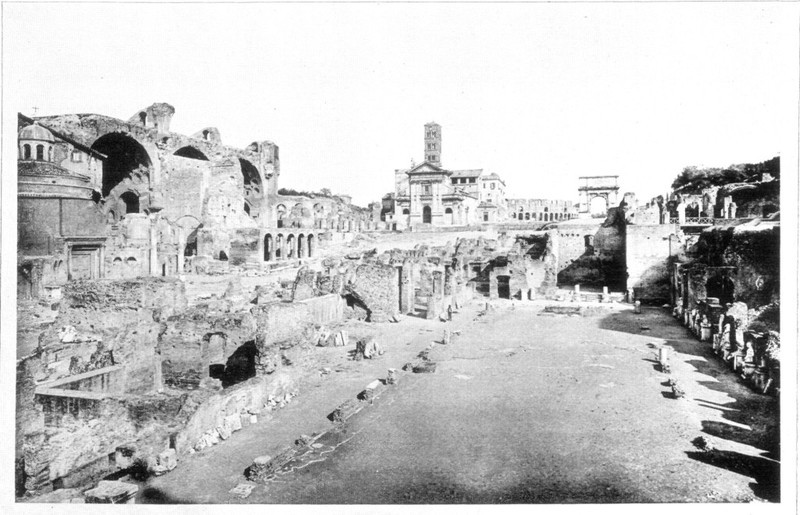
From a Photograph.
Temple of Romulus Basilica of Constantine Colosseum Arch of Titus
THE FINAL RUIN OF ROME
In the last days of Pope Eugenius the Fourth, two of his servants, the learned Poggius and a friend, ascended the Capitoline Hill, reposed themselves among the ruins of columns and temples, and viewed from that commanding spot the wide and various prospect of desolation. The place and the object gave ample scope for moralizing on the vicissitudes of fortune, which spares neither man nor the proudest of his works, which buries empires and cities in a common grave; and it was agreed that in proportion to her former greatness the fall of Rome was the more awful and deplorable. "Her primeval state, such as she might appear in a remote age, when Evander entertained the stranger of Troy, has been delineated by the fancy of Virgil. This Tarpeian Rock was then a savage and solitary thicket; in the time of the poet it was crowned with the golden roofs of a temple; the temple is overthrown, the gold has been pillaged, the wheel of fortune has accomplished her revolution, and the sacred ground is again disfigured with thorns and brambles. The hill of the Capitol, on which we sit, was formerly the head of the Roman Empire, the citadel of the earth, the terror of kings; illustrated by the footsteps of so many triumphs, enriched with the spoils and tributes of so many nations. This spectacle of the world, how is it fallen! how changed! how defaced! The path of victory is obliterated by vines, and the benches of the senators are concealed by a dunghill. Cast your eyes on the Palatine Hill, and seek among the shapeless and enormous fragments the marble theatre, the obelisks, the colossal statues, the porticos of Nero's palace; survey the other hills of the city,—the vacant space is interrupted only by ruins and gardens. The Forum of the Roman people, where they assembled to enact their laws and elect their magistrates, is now inclosed for the cultivation of pot-herbs, or thrown open for the reception of swine and buffaloes. The public and private edifices that were founded for eternity lie prostrate, naked, and broken, like the limbs of a mighty giant; and the ruin is the more visible, from the stupendous relics that have survived the injuries of time and fortune."
These relics are minutely described by Poggius, one of the first who raised his eyes from the monuments of legendary to those of classic superstition. 1. Besides a bridge, an arch, a sepulchre, and the pyramid of Cestius, he could discern, of the age of the republic, a double row of vaults in the salt office of the Capitol, which were inscribed with the name and munificence of Catulus. 2. Eleven temples were visible in some degree, from the perfect form of the Pantheon to the three arches and a marble column of the temple of Peace which Vespasian erected after the civil wars and the Jewish triumph. 3. Of the number which he rashly defines, of seven thermæ, or public baths, none were sufficiently entire to represent the use and distribution of the several parts; but those of Diocletian and Antoninus Caracalla still retained the titles of the founders and astonished the curious spectator who in observing their solidity and extent, the variety of marbles, the size and multitude of the columns, compared the labor and expense with the use and importance. Of the baths of Constantine, of Alexander, of Domitian, or rather of Titus, some vestige might yet be found. 4. The triumphal arches of Titus, Severus, and Constantine were entire, both the structure and the inscriptions; a falling fragment was honored with the name of Trajan; and two arches then extant in the Flaminian Way have been ascribed to the baser memory of Faustina and Gallienus. 5. After the wonder of the Coliseum, Poggius might have overlooked a small amphitheatre of brick, most probably for the use of the prætorian camp; the theatres of Marcellus and Pompey were occupied in a great measure by public and private buildings; and in the Circus, Agonalis and Maximus, little more than the situation and the form could be investigated. 6. The columns of Trajan and Antonine were still erect; but the Egyptian obelisks were broken or buried. A people of gods and heroes, the workmanship of art, was reduced to one equestrian figure of gilt brass and to five marble statues, of which the most conspicuous were the two horses of Phidias and Praxiteles. 7. The two mausoleums or sepulchres of Augustus and Hadrian could not totally be lost; but the former was only visible as a mound of earth, and the latter, the castle of St. Angelo, had acquired the name and appearance of a modern fortress. With the addition of some separate and nameless columns, such were the remains of the ancient city; for the marks of a more recent structure might be detected in the walls, which formed a circumference of ten miles, included three hundred and seventy-nine turrets, and opened into the country by thirteen gates.
This melancholy picture was drawn above nine hundred years after the fall of the Western Empire, and even of the Gothic kingdom of Italy. A long period of distress and anarchy, in which empire, and arts, and riches had migrated from the banks of the Tiber, was incapable of restoring or adorning the city; and as all that is human must retrograde if it do not advance, every successive age must have hastened the ruin of the works of antiquity. To measure the progress of decay, and to ascertain, at each era, the state of each edifice, would be an endless and a useless labor; and I shall content myself with two observations which will introduce a short inquiry into the general causes and effects. 1. Two hundred years before the eloquent complaint of Poggius, an anonymous writer composed a description of Rome. His ignorance may repeat the same objects under strange and fabulous names. Yet this barbarous topographer had eyes and ears; he could observe the visible remains; he could listen to the tradition of the people; and he distinctly enumerates seven theatres, eleven baths, twelve arches, and eighteen palaces, of which many had disappeared before the time of Poggius. It is apparent that many stately monuments of antiquity survived till a late period, and that the principles of destruction acted with vigorous and increasing energy in the thirteenth and fourteenth centuries. 2. The same reflection must be applied to the three last ages; and we should vainly seek the Septizonium of Severus, which is celebrated by Petrarch and the antiquarians of the sixteenth century. While the Roman edifices were still entire, the first blows, however weighty and impetuous, were resisted by the solidity of the mass and the harmony of the parts; but the slightest touch would precipitate the fragments of arches and columns that already nodded to their fall.
After a diligent inquiry, I can discern four principal causes of the ruin of Rome, which continued to operate in a period of more than a thousand years. I. The injuries of time and nature. II. The hostile attacks of the Barbarians and Christians. III. The use and abuse of the materials. And IV. The domestic quarrels of the Romans.
I. The art of man is able to construct monuments far more permanent than the narrow span of his own existence; yet these monuments, like himself, are perishable and frail; and in the boundless annals of time his life and his labors must equally be measured as a fleeting moment. Of a simple and solid edifice it is not easy, however, to circumscribe the duration. As the wonders of ancient days, the Pyramids attracted the curiosity of the ancients: a hundred generations, the leaves of autumn, have dropped into the grave; and after the fall of the Pharaohs and Ptolemies, the Cæsars and caliphs, the same Pyramids stand erect and unshaken above the floods of the Nile. A complex figure of various and minute parts is more accessible to injury and decay; and the silent lapse of time is often accelerated by hurricanes and earthquakes, by fires and inundations. The air and earth have doubtless been shaken, and the lofty turrets of Rome have tottered from their foundations, but the seven hills do not appear to be placed on the great cavities of the globe; nor has the city in any age been exposed to the convulsions of nature which in the climate of Antioch, Lisbon, or Lima, have crumbled in a few moments the works of ages in the dust. Fire is the most powerful agent of life and death: the rapid mischief may be kindled and propagated by the industry or negligence of mankind; and every period of the Roman annals is marked by the repetition of similar calamities. A memorable conflagration, the guilt or misfortune of Nero's reign, continued, though with unequal fury, either six or nine days. Innumerable buildings, crowded in close and crooked streets, supplied perpetual fuel for the flames; and when they ceased, four only of the fourteen regions were left entire; three were totally destroyed, and seven were deformed by the relics of smoking and lacerated edifices. In the full meridian of empire, the metropolis arose with fresh beauty from her ashes; yet the memory of the old deplored the irreparable losses, the arts of Greece, the trophies of victory, the monuments of primitive or fabulous antiquity. In the days of distress and anarchy every wound is mortal, every fall irretrievable; nor can the damage be restored either by the public care of government or the activity of private interest. Yet two causes may be alleged, which render the calamity of fire more destructive to a flourishing than a decayed city. 1. The more combustible materials of brick, timber, and metals are first melted and consumed, but the flames may play without injury or effect on the naked walls and massy arches that have been despoiled of their ornaments. 2. It is among the common and plebeian habitations that a mischievous spark is most easily blown to a conflagration; but as soon as they are devoured, the greater edifices which have resisted or escaped are left as so many islands in a state of solitude and safety. From her situation, Rome is exposed to the danger of frequent inundations. Without excepting the Tiber, the rivers that descend from either side of the Apennine have a short and irregular course; a shallow stream in the summer heats; an impetuous torrent when it is swelled in the spring or winter by the fall of rain and the melting of the snows. When the current is repelled from the sea by adverse winds, when the ordinary bed is inadequate to the weight of waters, they rise above the banks and overspread without limits or control the plains and cities of the adjacent country. Soon after the triumph of the first Punic War, the Tiber was increased by unusual rains; and the inundation, surpassing all former measure of time and place, destroyed all the buildings that were situate below the hills of Rome. According to the variety of ground, the same mischief was produced by different means; and the edifices were either swept away by the sudden impulse, or dissolved and undermined by the long continuance of the flood. Under the reign of Augustus the same calamity was renewed: the lawless river overturned the palaces and temples on its banks; and after the labors of the Emperor in cleansing and widening the bed that was incumbered with ruins, the vigilance of his successors was exercised by similar dangers and designs. The project of diverting into new channels the Tiber itself, or some of the dependent streams, was long opposed by superstition and local interests; nor did the use compensate the toil and costs of the tardy and imperfect execution. The servitude of rivers is the noblest and most important victory which man has obtained over the licentiousness of nature; and if such were the ravages of the Tiber under a firm and active government, what could oppose, or who can enumerate, the injuries of the city after the fall of the Western Empire? A remedy was at length produced by the evil itself: the accumulation of rubbish and the earth that has been washed down from the hills is supposed to have elevated the plain of Rome fourteen or fifteen feet perhaps above the ancient level: and the modern city is less accessible to the attacks of the river.
II. The crowd of writers of every nation who impute the destruction of the Roman monuments to the Goths and the Christians, have neglected to inquire how far they were animated by a hostile principle, and how far they possessed the means and the leisure to satiate their enmity. In the preceding volumes of this history I have described the triumph of barbarism and religion; and I can only resume in a few words their real or imaginary connection with the ruin of ancient Rome. Our fancy may create or adopt a pleasing romance: that the Goths and Vandals sallied from Scandinavia, ardent to avenge the flight of Odin, to break the chains and to chastise the oppressors of mankind; that they wished to burn the records of classic literature, and to found their national architecture on the broken members of the Tuscan and Corinthian orders. But in simple truth, the Northern conquerors were neither sufficiently savage nor sufficiently refined to entertain such aspiring ideas of destruction and revenge. The shepherds of Scythia and Germany had been educated in the armies of the Empire, whose discipline they acquired and whose weakness they invaded; with the familiar use of the Latin tongue, they had learned to reverence the name and titles of Rome; and though incapable of emulating, they were more inclined to admire than to abolish the arts and studies of a brighter period. In the transient possession of a rich and unresisting capital, the soldiers of Alaric and Genseric were stimulated by the passions of a victorious army; amidst the wanton indulgence of lust or cruelty, portable wealth was the object of their search; nor could they derive either pride or pleasure from the unprofitable reflection that they had battered to the ground the works of the consuls and Cæsars. Their moments were indeed precious: the Goths evacuated Rome on the sixth, the Vandals on the fifteenth day, and though it be far more difficult to build than to destroy, their hasty assault would have made a slight impression on the solid piles of antiquity. We may remember that both Alaric and Genseric affected to spare the buildings of the city; that they subsisted in strength and beauty under the auspicious government of Theodoric; and that the momentary resentment of Totila was disarmed by his own temper and the advice of his friends and enemies. From these innocent Barbarians the reproach may be transferred to the Catholics of Rome. The statues, altars, and houses of the dæmons were an abomination in their eyes; and in the absolute command of the city, they might labor with zeal and perseverance to erase the idolatry of their ancestors. The demolition of the temples in the East affords to them an example of conduct, and to us an argument of belief; and it is probable that a portion of guilt or merit may be imputed with justice to the Roman proselytes. Yet their abhorrence was confined to the monuments of heathen superstition; and the civil structures that were dedicated to the business or pleasure of society might be preserved without injury or scandal. The change of religion was accomplished not by a popular tumult, but by the decrees of the emperors, of the Senate, and of time. Of the Christian hierarchy, the bishops of Rome were commonly the most prudent and least fanatic; nor can any positive charge be opposed to the meritorious act of saving and converting the majestic structure of the Pantheon.
III. The value of any object that supplies the wants or pleasures of mankind is compounded of its substance and its form, of the materials and the manufacture. Its price must depend on the number of persons by whom it may be acquired and used; on the extent of the market; and consequently on the ease or difficulty of remote exportation according to the nature of the commodity, its local situation, and the temporary circumstances of the world. The Barbarian conquerors of Rome usurped in a moment the toil and treasure of successive ages; but except the luxuries of immediate consumption, they must view without desire all that could not be removed from the city in the Gothic wagons or the fleet of the Vandals. Gold and silver were the first objects of their avarice; as in every country, and in the smallest compass, they represent the most ample command of the industry and possessions of mankind. A vase or a statue of those precious metals might tempt the vanity of some Barbarian chief; but the grosser multitude, regardless of the form, was tenacious only of the substance; and the melted ingots might be readily divided and stamped into the current coin of the empire. The less active or less fortunate robbers were reduced to the baser plunder of brass, lead, iron, and copper: whatever had escaped the Goths and Vandals was pillaged by the Greek tyrants; and the Emperor Constans in his rapacious visit stripped the bronze tiles from the roof of the Pantheon. The edifices of Rome might be considered as a vast and various mine: the first labor of extracting the materials was already performed; the metals were purified and cast; the marbles were hewn and polished; and after foreign and domestic rapine had been satiated, the remains of the city, could a purchaser have been found, were still venal. The monuments of antiquity had been left naked of their precious ornaments; but the Romans would demolish with their own hands the arches and walls, if the hope of profit could surpass the cost of the labor and exportation. If Charlemagne had fixed in Italy the seat of the Western Empire, his genius would have aspired to restore, rather than to violate, the works of the Cæsars: but policy confined the French monarch to the forests of Germany; his taste could be gratified only by destruction; and the new palace of Aix-la-Chapelle was decorated with the marbles of Ravenna and Rome. Five hundred years after Charlemagne, a king of Sicily, Robert,—the wisest and most liberal sovereign of the age,—was supplied with the same materials by the easy navigation of the Tiber and the sea; and Petrarch sighs an indignant complaint that the ancient capital of the world should adorn from her own bowels the slothful luxury of Naples. But these examples of plunder or purchase were rare in the darker ages; and the Romans, alone and unenvied, might have applied to their private or public use the remaining structures of antiquity, if in their present form and situation they had not been useless in a great measure to the city and its inhabitants. The walls still described the old circumference, but the city had descended from the seven hills into the Campus Martius; and some of the noblest monuments which had braved the injuries of time were left in a desert, far remote from the habitations of mankind. The palaces of the senators were no longer adapted to the manners or fortunes of their indigent successors: the use of baths and porticos was forgotten; in the sixth century the games of the theatre, amphitheatre, and circus had been interrupted; some temples were devoted to the prevailing worship, but the Christian churches preferred the holy figure of the cross; and fashion, or reason, had distributed after a peculiar model the cells and offices of the cloister. Under the ecclesiastical reign, the number of these pious foundations was enormously multiplied; and the city was crowded with forty monasteries of men, twenty of women, and sixty chapters and colleges of canons and priests, who aggravated instead of relieving the depopulation of the tenth century. But if the forms of ancient architecture were disregarded by a people insensible of their use and beauty, the plentiful materials were applied to every call of necessity or superstition; till the fairest columns of the Ionic and Corinthian orders, the richest marbles of Paros and Numidia, were degraded, perhaps to the support of a convent or a stable. The daily havoc which is perpetrated by the Turks in the cities of Greece and Asia may afford a melancholy example; and in the gradual destruction of the monuments of Rome, Sixtus the Fifth may alone be excused for employing the stones of the Septizonium in the glorious edifice of St. Peter's. A fragment, a ruin, howsoever mangled or profaned, may be viewed with pleasure and regret; but the greater part of the marble was deprived of substance, as well as of place and proportion: it was burnt to lime for the purpose of cement. Since the arrival of Poggius, the temple of Concord and many capital structures had vanished from his eyes; and an epigram of the same age expresses a just and pious fear that the continuance of this practice would finally annihilate all the monuments of antiquity. The smallness of their numbers was the sole check on the demands and depredations of the Romans. The imagination of Petrarch might create the presence of a mighty people; and I hesitate to believe that even in the fourteenth century they could be reduced to a contemptible list of thirty-three thousand inhabitants. From that period to the reign of Leo the Tenth, if they multiplied to the amount of eighty-five thousand, the increase of citizens was in some degree pernicious to the ancient city.
IV. I have reserved for the last, the most potent and forcible cause of destruction, the domestic hostilities of the Romans themselves. Under the dominion of the Greek and French emperors, the peace of the city was disturbed by accidental though frequent seditions: it is from the decline of the latter, from the beginning of the tenth century, that we may date the licentiousness of private war, which violated with impunity the laws of the Code and the gospel, without respecting the majesty of the absent sovereign or the presence and person of the vicar of Christ. In a dark period of five hundred years, Rome was perpetually afflicted by the sanguinary quarrels of the nobles and the people, the Guelphs and Ghibelines, the Colonna and Ursini; and if much has escaped the knowledge, and much is unworthy of the notice, of history, I have exposed in the two preceding chapters the causes and effects of the public disorders. At such a time, when every quarrel was decided by the sword and none could trust their lives or properties to the impotence of law, the powerful citizens were armed for safety, or offense, against the domestic enemies whom they feared or hated. Except Venice alone, the same dangers and designs were common to all the free republics of Italy; and the nobles usurped the prerogative of fortifying their houses and erecting strong towers that were capable of resisting a sudden attack. The cities were filled with these hostile edifices; and the example of Lucca, which contained three hundred towers, her law which confined their height to the measure of fourscore feet, may be extended with suitable latitude to the more opulent and populous States. The first step of the senator Brancaleone in the establishment of peace and justice, was to demolish (as we have already seen) one hundred and forty of the towers of Rome; and in the last days of anarchy and discord, as late as the reign of Martin the Fifth, forty-four still stood in one of the thirteen or fourteen regions of the city. To this mischievous purpose the remains of antiquity were most readily adapted: the temples and arches afforded a broad and solid basis for the new structures of brick and stone; and we can name the modern turrets that were raised on the triumphal monuments of Julius Cæsar, Titus, and the Antonines. With some slight alterations, a theatre, an amphitheatre, a mausoleum, was transformed into a strong and spacious citadel. I need not repeat that the mole of Adrian has assumed the title and form of the castle of St. Angelo; the Septizonium of Severus was capable of standing against a royal army; the sepulchre of Metella has sunk under its outworks; the theatres of Pompey and Marcellus were occupied by the Savelli and Ursini families; and the rough fortress has been gradually softened to the splendor and elegance of an Italian palace. Even the churches were encompassed with arms and bulwarks, and the military engines on the roof of St. Peter's were the terror of the Vatican and the scandal of the Christian world. Whatever is fortified will be attacked; and whatever is attacked may be destroyed. Could the Romans have wrested from the popes the castle of St. Angelo, they had resolved by a public decree to annihilate that monument of servitude. Every building of defense was exposed to a siege; and in every siege the arts and engines of destruction were laboriously employed. After the death of Nicholas the Fourth, Rome, without a sovereign or a senate, was abandoned six months to the fury of civil war. "The houses," says a cardinal and poet of the times, "were crushed by the weight and velocity of enormous stones; the walls were perforated by the strokes of the battering-ram; the towers were involved in fire and smoke; and the assailants were stimulated by rapine and revenge." The work was consummated by the tyranny of the laws; and the factions of Italy alternately exercised a blind and thoughtless vengeance on their adversaries, whose houses and castles they razed to the ground. In comparing the days of foreign, with the ages of domestic hostility, we must pronounce that the latter have been far more ruinous to the city; and our opinion is confirmed by the evidence of Petrarch. "Behold," says the laureate, "the relics of Rome, the image of her pristine greatness! neither time nor the Barbarian can boast the merit of this stupendous destruction: it was perpetrated by her own citizens, by the most illustrious of her sons; and your ancestors [he writes to a noble Annibaldi] have done with battering-ram what the Punic hero could not accomplish with the sword." The influence of the two last principles of decay must in some degree be multiplied by each other, since the houses and towers which were subverted by civil war required a new and perpetual supply from the monuments of antiquity.
These general observations may be separately applied to the amphitheatre of Titus, which has obtained the name of the Coliseum, either from its magnitude or from Nero's colossal statue; an edifice, had it been left to time and nature, which might perhaps have claimed an eternal duration. The curious antiquaries who have computed the numbers and seats are disposed to believe that above the upper row of stone steps the amphitheatre was encircled and elevated with several stages of wooden galleries, which were repeatedly consumed by fire, and restored by the emperors. Whatever was precious, or portable, or profane, the statues of gods and heroes, and the costly ornaments of sculpture which were cast in brass or overspread with leaves of silver and gold, became the first prey of conquest or fanaticism, of the avarice of the Barbarians or the Christians. In the massy stones of the Coliseum, many holes are discerned; and the two most probable conjectures represent the various accidents of its decay. These stones were connected by solid links of brass or iron, nor had the eye of rapine overlooked the value of the baser metals; the vacant space was converted into a fair or market; the artisans of the Coliseum are mentioned in an ancient survey; and the chasms were perforated or enlarged to receive the poles that supported the shops or tents of the mechanic trades. Reduced to its naked majesty, the Flavian amphitheatre was contemplated with awe and admiration by the pilgrims of the North; and their rude enthusiasm broke forth in a sublime proverbial expression, which is recorded in the eighth century, in the fragments of the venerable Bede: "As long as the Coliseum stands, Rome shall stand; when the Coliseum falls, Rome will fall; when Rome falls, the world will fall." In the modern system of war a situation commanded by the three hills would not be chosen for a fortress: but the strength of the walls and arches could resist the engines of assault; a numerous garrison might be lodged in the inclosure; and while one faction occupied the Vatican and the Capitol, the other was intrenched in the Lateran and the Coliseum.
The abolition at Rome of the ancient games must be understood with some latitude; and the carnival sports of the Testacean Mount and the Circus Agonalis were regulated by the law or custom of the city. The senator presided with dignity and pomp to adjudge and distribute the prizes, the gold ring, or the pallium, as it was styled, of cloth or silk. A tribute on the Jews supplied the annual expense; and the races on foot, on horseback, or in chariots, were ennobled by a tilt and tournament of seventy-two of the Roman youth. In the year 1332 a bull-feast, after the fashion of the Moors and Spaniards, was celebrated in the Coliseum itself; and the living manners are painted in a diary of the times. A convenient order of benches was restored, and a general proclamation as far as Rimini and Ravenna invited the nobles to exercise their skill and courage in this perilous adventure. The Roman ladies were marshaled in three squadrons and seated in three balconies, which on this day, the third of September, were lined with scarlet cloth. The fair Jacova di Rovere led the matrons from beyond the Tiber, a pure and native race who still represent the features and character of antiquity. The remainder of the city was divided as usual between the Colonna and Ursini: the two factions were proud of the number and beauty of their female bands: the charms of Savella Ursini are mentioned with praise, and the Colonna regretted the absence of the youngest of their house, who had sprained her ankle in the garden of Nero's tower. The lots of the champions were drawn by an old and respectable citizen; and they descended into the arena, or pit, to encounter the wild bulls, on foot as it should seem, with a single spear. Amidst the crowd, our annalist has selected the names, colors, and devices of twenty of the most conspicuous knights. Several of the names are the most illustrious of Rome and the ecclesiastical State: Malatesta, Polenta, Della Valle, Cafarello, Savelli, Capoccio, Conti, Annibaldi, Altieri, Corsi: the colors were adapted to their taste and situation: the devices are expressive of hope or despair, and breathe the spirit of gallantry and arms. "I am alone, like the youngest of the Horatii," the confidence of an intrepid stranger; "I live disconsolate," a weeping widower; "I burn under the ashes," a discreet lover; "I adore Lavinia, or Lucretia," the ambiguous declaration of a modern passion; "My faith is as pure," the motto of a white livery; "Who is stronger than myself?" of a lion's hide; "If I am drowned in blood, what a pleasant death!" the wish of ferocious courage. The pride or prudence of the Ursini restrained them from the field, which was occupied by three of their hereditary rivals, whose inscriptions denoted the lofty greatness of the Colonna name: "Though sad, I am strong;" "Strong as I am great;" "If I fall," addressing himself to the spectators, "you fall with me"—intimating (says the contemporary writer) that while the other families were the subjects of the Vatican, they alone were the supporters of the Capitol. The combats of the amphitheatre were dangerous and bloody. Every champion successively encountered a wild bull; and the victory may be ascribed to the quadrupeds, since no more than eleven were left on the field, with the loss of nine wounded and eighteen killed on the side of their adversaries. Some of the noblest families might mourn; but the pomp of the funerals in the churches of St. John Lateran and Sta. Maria Maggiore afforded a second holiday to the people. Doubtless it was not in such conflicts that the blood of the Romans should have been shed: yet in blaming their rashness we are compelled to applaud their gallantry; and the noble volunteers who display their magnificence and risk their lives under the balconies of the fair, excite a more generous sympathy than the thousands of captives and malefactors who were reluctantly dragged to the scene of slaughter.
This use of the amphitheatre was a rare, perhaps a singular, festival: the demand for the materials was a daily and continual want which the citizens could gratify without restraint or remorse. In the fourteenth century a scandalous act of concord secured to both factions the privilege of extracting stones from the free and common quarry of the Coliseum; and Poggius laments that the greater part of these stones had been burnt to lime by the folly of the Romans. To check this abuse, and to prevent the nocturnal crimes that might be perpetrated in the vast and gloomy recess, Eugenius the Fourth surrounded it with a wall; and by a charter long extant, granted both the ground and edifice to the monks of an adjacent convent. After his death the wall was overthrown in a tumult of the people; and had they themselves respected the noblest monument of their fathers, they might have justified the resolve that it should never be degraded to private property. The inside was damaged; but in the middle of the sixteenth century, an era of taste and learning, the exterior circumference of one thousand six hundred and twelve feet was still entire and inviolate; a triple elevation of fourscore arches which rose to the height of one hundred and eight feet. Of the present ruin, the nephews of Paul the Third are the guilty agents; and every traveler who views the Farnese palace may curse the sacrilege and luxury of these upstart princes. A similar reproach is applied to the Barberini; and the repetition of injury might be dreaded from every reign, till the Coliseum was placed under the safeguard of religion by the most liberal of the pontiffs, Benedict the Fourteenth, who consecrated a spot which persecution and fable had stained with the blood of so many Christian martyrs.
When Petrarch first gratified his eyes with a view of those monuments, whose scattered fragments so far surpass the most eloquent descriptions, he was astonished at the supine indifference of the Romans themselves; he was humbled rather than elated by the discovery that, except his friend Rienzi and one of the Colonna, a stranger of the Rhône was more conversant with these antiquities than the nobles and natives of the metropolis. The ignorance and credulity of the Romans are elaborately displayed in the old survey of the city, which was composed about the beginning of the thirteenth century; and without dwelling on the manifold errors of name and place, the legend of the Capitol may provoke a smile of contempt and indignation. "The Capitol," says the anonymous writer, "is so named as being the head of the world, where the consuls and senators formerly resided for the government of the city and the globe. The strong and lofty walls were covered with glass and gold, and crowned with a roof of the richest and most curious carving. Below the citadel stood a palace, of gold for the greatest part, decorated with precious stones, and whose value might be esteemed at one-third of the world itself. The statues of all the provinces were arranged in order, each with a small bell suspended from its neck; and such was the contrivance of art magic, that if the province rebelled against Rome the statue turned round to that quarter of the heavens, the bell rang, the prophet of the Capitol reported the prodigy, and the Senate was admonished of the impending danger." A second example, of less importance though of equal absurdity, may be drawn from the two marble horses, led by two naked youths, which have since been transported from the baths of Constantine to the Quirinal Hill. The groundless application of the names of Phidias and Praxiteles may perhaps be excused: but these Grecian sculptors should not have been removed above four hundred years from the age of Pericles to that of Tiberius; they should not have been transformed into two philosophers or magicians, whose nakedness was the symbol of truth or knowledge, who revealed to the Emperor his most secret actions, and after refusing all pecuniary recompense, solicited the honor of leaving this eternal monument of themselves. Thus, awake to the power of magic, the Romans were insensible to the beauties of art: no more than five statues were visible to the eyes of Poggius; and of the multitudes which chance or design had buried under the ruins, the resurrection was fortunately delayed till a safer and more enlightened age. The Nile, which now adorns the Vatican, had been explored by some laborers in digging a vineyard near the temple, or convent, of the Minerva: but the impatient proprietor, who was tormented by some visits of curiosity, restored the unprofitable marble to its former grave. The discovery of the statue of Pompey, ten feet in length, was the occasion of a lawsuit. It had been found under a partition wall: the equitable judge had pronounced that the head should be separated from the body to satisfy the claims of the contiguous owners; and the sentence would have been executed if the intercession of a cardinal and the liberality of a pope had not rescued the Roman hero from the hands of his barbarous countrymen.
But the clouds of barbarism were gradually dispelled, and the peaceful authority of Martin the Fifth and his successors restored the ornaments of the city as well as the order of the ecclesiastical State. The improvements of Rome since the fifteenth century have not been the spontaneous produce of freedom and industry. The first and most natural root of a great city is the labor and populousness of the adjacent country, which supplies the materials of subsistence, of manufactures, and of foreign trade. But the greater part of the Campagna of Rome is reduced to a dreary and desolate wilderness; the overgrown estates of the princes and the clergy are cultivated by the lazy hands of indigent and hopeless vassals; and the scanty harvests are confined or exported for the benefit of a monopoly. A second and more artificial cause of the growth of a metropolis is the residence of a monarch, the expense of a luxurious court, and the tributes of dependent provinces. Those provinces and tributes had been lost in the fall of the Empire: and if some streams of the silver of Peru and the gold of Brazil have been attracted by the Vatican, the revenues of the cardinals, the fees of office, the oblations of pilgrims and clients, and the remnant of ecclesiastical taxes, afford a poor and precarious supply, which maintains however the idleness of the court and city. The population of Rome, far below the measure of the great capitals of Europe, does not exceed one hundred and seventy thousand inhabitants; and within the spacious inclosure of the walls the largest portion of the seven hills is overspread with vineyards and ruins. The beauty and splendor of the modern city may be ascribed to the abuses of the government, to the influence of superstition. Each reign (the exceptions are rare) has been marked by the rapid elevation of a new family, enriched by the childless pontiff at the expense of the Church and country. The palaces of these fortunate nephews are the most costly monuments of elegance and servitude: the perfect arts of architecture, painting, and sculpture have been prostituted in their service; and their galleries and gardens are decorated with the most precious works of antiquity which taste or vanity has prompted them to collect. The ecclesiastical revenues were more decently employed by the popes themselves in the pomp of the Catholic worship; but it is superfluous to enumerate their pious foundations of altars, chapels, and churches, since these lesser stars are eclipsed by the sun of the Vatican, by the dome of St. Peter, the most glorious structure that ever has been applied to the use of religion. The fame of Julius the Second, Leo the Tenth, and Sixtus the Fifth is accompanied by the superior merit of Bramante and Fontana, of Raphael and Michael Angelo; and the same munificence which had been displayed in palaces and temples was directed with equal zeal to revive and emulate the labors of antiquity. Prostrate obelisks were raised from the ground and erected in the most conspicuous places; of the eleven aqueducts of the Cæsars and consuls, three were restored; the artificial rivers were conducted over a long series of old, or of new arches, to discharge into marble basins a flood of salubrious and refreshing waters: and the spectator, impatient to ascend the steps of St. Peter's, is detained by a column of Egyptian granite, which rises between two lofty and perpetual fountains to the height of one hundred and twenty feet. The map, the description, the monuments of ancient Rome have been elucidated by the diligence of the antiquarian and the student; and the footsteps of heroes, the relics, not of superstition but of empire, are devoutly visited by a new race of pilgrims from the remote and once savage countries of the North.
All the foregoing selections are made from 'The History of the Decline and Fall of the Roman Empire'
WILLIAM SCHWENCK GILBERT
(1836-)
hen, after appearing from time to time in the London Fun, the 'Bab Ballads' were published in book form in 1870, everybody, young and old, found them provocative of hearty laughter. "Much sound and little sense," was the title-page motto. Perhaps the fact that Mr. Gilbert's readers did not know why they laughed was one great charm of the ballads. The humor was felt, not analyzed, and involved no mental fatigue. If there was "little sense," no continuity of meaning, there was usually significant suggestion; and social foibles were touched off with good-natured irony in a delightfully inconsequent fashion. The "much sound" was a spirited lyric swing which clung to the memory, a rich rhythm, and a rollicking spontaneity, which disregarded considerations of grammar and pronunciation in a way that only added to the fun.
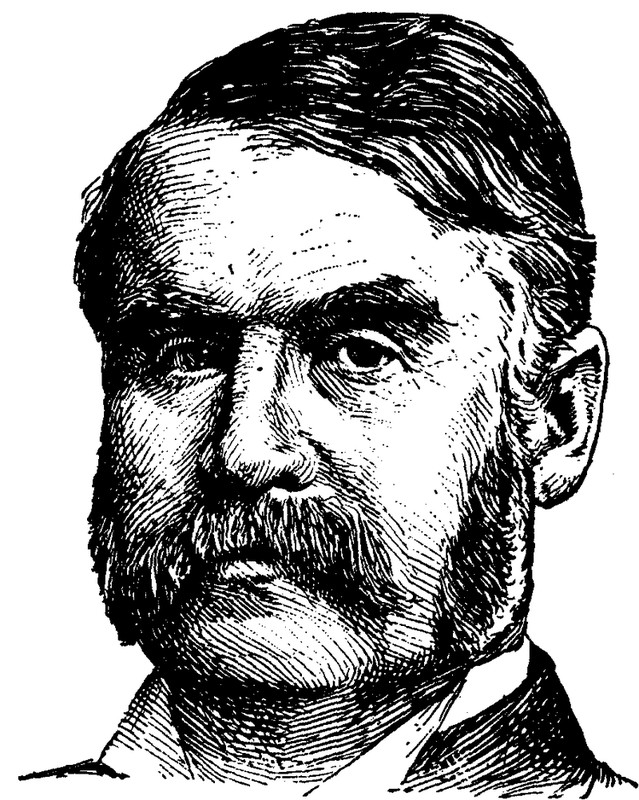
William S. Gilbert
The 'Bab Ballads,' and 'More Bab Ballads' which appeared in 1872, have become classic. In many of them may be found the germs of the librettos which have made Gilbert famous in comic opera. 'Pinafore,' 'The Mikado,' 'Patience,' and many others of a long and well-known list written to Sir Arthur Sullivan's music, have furnished the public with many popular songs. A volume of dainty lyrics has been made up from them; and, entitled 'Songs of a Savoyard' (from the Savoy Theatre of London, where the operas were first represented), was published in 1890.
Mr. Gilbert was born in London November 18th, 1836, and educated in that city; after his graduation from the University of London he studied law, and was called to the bar of the Inner Temple in 1863. Five years later he became a captain of the Royal Aberdeenshire Highlanders. The success of his first play, 'Dulcamara,' in 1866, led him to abandon the law, and he has since devoted himself to authorship.
CAPTAIN REECE
Of all the ships upon the blue, No ship contained a better crew Than that of worthy Captain Reece, Commanding of The Mantlepiece.
He was adored by all his men, For worthy Captain Reece, R.N., Did all that lay within him to Promote the comfort of his crew.
If ever they were dull or sad, Their captain danced to them like mad, Or told, to make the time pass by, Droll legends of his infancy.
A feather-bed had every man, Warm slippers and hot-water can, Brown Windsor from the captain's store; A valet, too, to every four.
Did they with thirst in summer burn, Lo! seltzogenes at every turn; And on all very sultry days Cream ices handed round on trays.
Then, currant wine and ginger pops Stood handily on all the "tops"; And also, with amusement rife, A "Zoetrope, or Wheel of Life."
New volumes came across the sea From Mr. Mudie's libraree; The Times and Saturday Review Beguiled the leisure of the crew.
Kind-hearted Captain Reece, R.N., Was quite devoted to his men; In point of fact, good Captain Reece Beatified The Mantelpiece.
One summer eve, at half-past ten, He said (addressing all his men):— "Come, tell me, please, what I can do To please and gratify my crew.
"By any reasonable plan I'll make you happy if I can,— My own convenience count as nil: It is my duty, and I will."
Then up and answered William Lee (The kindly captain's coxwain he, A nervous, shy, low-spoken man); He cleared his throat, and thus began:—
"You have a daughter, Captain Reece, Ten female cousins and a niece, A ma, if what I'm told is true, Six sisters, and an aunt or two.
"Now, somehow, sir, it seems to me, More friendly-like we all should be, If you united of 'em to Unmarried members of the crew.
"If you'd ameliorate our life, Let each select from them a wife; And as for nervous me, old pal, Give me your own enchanting gal!"
Good Captain Reece, that worthy man, Debated on his coxwain's plan:— "I quite agree," he said, "O Bill: It is my duty, and I will.
"My daughter, that enchanting gurl, Has just been promised to an Earl, And all my other familee To peers of various degree.
"But what are dukes and viscounts to The happiness of all my crew? The word I gave you I'll fulfill; It is my duty, and I will.
"As you desire it shall befall; I'll settle thousands on you all, And I shall be, despite my hoard, The only bachelor on board."
The boatswain of the Mantelpiece, He blushed and spoke to Captain Reece:— "I beg your Honor's leave," he said:— "If you would wish to go and wed,
"I have a widowed mother who Would be the very thing for you— She long has loved you from afar: She washes for you, Captain R."
The captain saw the dame that day— Addressed her in his playful way:— "And did it want a wedding ring? It was a tempting ickle sing!
"Well, well, the chaplain I will seek, We'll all be married this day week At yonder church upon the hill; It is my duty, and I will!"
The sisters, cousins, aunts, and niece, And widowed ma of Captain Reece, Attended there as they were bid: It was their duty, and they did.
THE YARN OF THE NANCY BELL
'Twas on the shores that round our coast From Deal to Ramsgate span, That I found alone on a piece of stone An elderly naval man.
His hair was weedy, his beard was long, And weedy and long was he; And I heard this wight on the shore recite, In a singular minor key:—
"Oh, I am a cook, and a captain bold, And the mate of the Nancy brig, And a bo'sun tight, and a midshipmite, And the crew of the captain's gig."
And he shook his fists and he tore his hair, Till I really felt afraid, For I couldn't help thinking the man had been drinking, And so I simply said:—
"O elderly man, it's little I know Of the duties of men of the sea, And I'll eat my hand if I understand However you can be
"At once a cook, and a captain bold, And the mate of the Nancy brig, And a bo'sun tight, and a midshipmite, And the crew of the captain's gig."
And he gave a hitch to his trousers, which Is a trick all seamen larn, And having got rid of a thumping quid, He spun his painful yarn:—
"'Twas in the good ship Nancy Bell That we sailed to the Indian Sea, And there on a reef we come to grief, Which has often occurred to me.
"And pretty nigh all the crew was drowned (There was seventy-seven o' soul), And only ten of the Nancy's men Said 'Here!' to the muster-roll.
"There was me and the cook and the captain bold, And the mate of the Nancy brig, And the bo'sun tight, and a midshipmite, And the crew of the captain's gig.
"For a month we'd neither wittles nor drink, Till a-hungry we did feel; So we drawed a lot, and accordin', shot The captain for our meal.
"The next lot fell to the Nancy's mate, And a delicate dish he made; Then our appetite with the midshipmite We seven survivors stayed.
"And then we murdered the bo'sun tight, And he much resembled pig; Then we wittled free, did the cook and me On the crew of the captain's gig.
"Then only the cook and me was left, And the delicate question, 'Which Of us two goes to the kettle?' arose, And we argued it out as sich.
"For I loved that cook as a brother, I did, And the cook he worshiped me; But we'd both be blowed if we'd either be stowed In the other chap's hold, you see.
"'I'll be eat if you dines off me,' says Tom; 'Yes, that,' says I, 'you'll be: I'm boiled if I die, my friend,' quoth I; And 'Exactly so,' quoth he.
"Says he, 'Dear James, to murder me Were a foolish thing to do, For don't you see that you can't cook me, While I can—and will—cook you?'
"So he boils the water, and takes the salt And the pepper in portions true (Which he never forgot), and some chopped shalot, And some sage and parsley too.
"'Come here,' says he, with a proper pride, Which his smiling features tell; "'Twill soothing be if I let you see How extremely nice you'll smell.'
"And he stirred it round and round and round, And he sniffed at the foaming froth; When I ups with his heels, and smothers his squeals In the scum of the boiling broth.
"And I eat that cook in a week or less, And—as I eating be The last of his chops, why, I almost drops, For a wessel in sight I see!
"And I never larf, and I never smile, And I never lark nor play, But sit and croak, and a single joke I have—which is to say:—
"'Oh, I am a cook, and a captain bold, And the mate of the Nancy brig, And a bo'sun tight, and a midshipmite, And the crew of the captain's gig!'"
THE BISHOP OF RUM-TI-FOO
From east and south the holy clan Of bishops gathered to a man; To Synod, called Pan-Anglican, In flocking crowds they came. Among them was a bishop who Had lately been appointed to The balmy isle of Rum-ti-Foo, And Peter was his name.
His people—twenty-three in sum— They played the eloquent tum-tum, And lived on scalps served up in rum— The only sauce they knew. When first good Bishop Peter came (For Peter was that bishop's name), To humor them, he did the same As they of Rum-ti-Foo.
His flock, I've often heard him tell, (His name was Peter) loved him well, And summoned by the sound of bell, In crowds together came. "Oh, massa, why you go away? Oh, Massa Peter, please to stay." (They called him Peter, people say, Because it was his name.)
He told them all good boys to be, And sailed away across the sea; At London Bridge that bishop he Arrived one Tuesday night; And as that night he homeward strode To his Pan-Anglican abode, He passed along the Borough Road, And saw a gruesome sight.
He saw a crowd assembled round A person dancing on the ground, Who straight began to leap and bound With all his might and main. To see that dancing man he stopped, Who twirled and wriggled, skipped and hopped, Then down incontinently dropped, And then sprang up again.
The bishop chuckled at the sight. "This style of dancing would delight A simple Rum-ti-Foozleite: I'll learn it if I can, To please the tribe when I get back." He begged the man to teach his knack. "Right reverend sir, in half a crack!" Replied that dancing man.
The dancing man he worked away, And taught the bishop every day; The dancer skipped like any fay— Good Peter did the same. The bishop buckled to his task, With battements and pas de basque. (I'll tell you, if you care to ask, That Peter was his name.)
"Come, walk like this," the dancer said; "Stick out your toes—stick in your head, Stalk on with quick, galvanic tread— Your fingers thus extend; The attitude's considered quaint." The weary bishop, feeling faint, Replied, "I do not say it ain't, But 'Time!' my Christian friend!"
"We now proceed to something new: Dance as the Paynes and Lauris do, Like this—one, two—one, two—one, two." The bishop, never proud, But in an overwhelming heat (His name was Peter, I repeat) Performed the Payne and Lauri feat, And puffed his thanks aloud.
Another game the dancer planned: "Just take your ankle in your hand, And try, my lord, if you can stand— Your body stiff and stark. If when revisiting your see You learnt to hop on shore, like me, The novelty would striking be, And must attract remark."
"No," said the worthy bishop, "no; That is a length to which, I trow, Colonial bishops cannot go. You may express surprise At finding bishops deal in pride— But if that trick I ever tried, I should appear undignified In Rum-ti-Foozle's eyes.
"The islanders of Rum-ti-Foo Are well-conducted persons, who Approve a joke as much as you, And laugh at it as such; But if they saw their bishop land, His leg supported in his hand, The joke they wouldn't understand— 'Twould pain them very much!"
GENTLE ALICE BROWN
It was a robber's daughter, and her name was Alice Brown; Her father was the terror of a small Italian town; Her mother was a foolish, weak, but amiable old thing: But it isn't of her parents that I'm going for to sing.
As Alice was a-sitting at her window-sill one day, A beautiful young gentleman he chanced to pass that way; She cast her eyes upon him, and he looked so good and true, That she thought, "I could be happy with a gentleman like you!"
And every morning passed her house that cream of gentlemen; She knew she might expect him at a quarter unto ten; A sorter in the Custom-house, it was his daily road (The Custom-house was fifteen minutes' walk from her abode).
But Alice was a pious girl, who knew it wasn't wise To look at strange young sorters with expressive purple eyes; So she sought the village priest to whom her family confessed, The priest by whom their little sins were carefully assessed.
"O holy father," Alice said, "'twould grieve you, would it not, To discover that I was a most disreputable lot? Of all unhappy sinners I'm the most unhappy one!" The padre said, "Whatever have you been and gone and done?"
"I have helped mamma to steal a little kiddy from its dad, I've assisted dear papa in cutting up a little lad, I've planned a little burglary and forged a little cheque, And slain a little baby for the coral on its neck!"
The worthy pastor heaved a sigh, and dropped a silent tear, And said, "You mustn't judge yourself too heavily, my dear: It's wrong to murder babies, little corals for to fleece; But sins like these one expiates at half-a-crown apiece.
"Girls will be girls—you're very young, and flighty in your mind; Old heads upon young shoulders we must not expect to find; We mustn't be too hard upon these little girlish tricks— Let's see—five crimes at half-a-crown—exactly twelve-and-six."
"O father," little Alice cried, "your kindness makes me weep, You do these little things for me so singularly cheap; Your thoughtful liberality I never can forget; But oh! there is another crime I haven't mentioned yet!
"A pleasant-looking gentleman, with pretty purple eyes, I've noticed at my window, as I've sat a-catching flies; He passes by it every day as certain as can be— I blush to say I've winked at him and he has winked at me!"
"For shame!" said Father Paul, "my erring daughter! On my word, This is the most distressing news that I have ever heard. Why, naughty girl, your excellent papa has pledged your hand To a promising young robber, the lieutenant of his band!
"This dreadful piece of news will pain your worthy parents so! They are the most remunerative customers I know; For many, many years they've kept starvation from my doors: I never knew so criminal a family as yours!
"The common country folk in this insipid neighborhood Have nothing to confess, they're so ridiculously good; And if you marry any one respectable at all, Why, you'll reform, and what will then become of Father Paul?"
The worthy priest, he up and drew his cowl upon his crown, And started off in haste to tell the news to Robber Brown— To tell him how his daughter, who was now for marriage fit, Had winked upon a sorter, who reciprocated it.
Good Robber Brown he muffled up his anger pretty well; He said, "I have a notion, and that notion I will tell: I will nab this gay young sorter, terrify him into fits, And get my gentle wife to chop him into little bits.
"I've studied human nature, and I know a thing or two: Though a girl may fondly love a living gent, as many do— A feeling of disgust upon her senses there will fall When she looks upon his body chopped particularly small."
He traced that gallant sorter to a still suburban square; He watched his opportunity, and seized him unaware; He took a life-preserver and he hit him on the head, And Mrs. Brown dissected him before she went to bed.
And pretty little Alice grew more settled in her mind; She never more was guilty of a weakness of the kind; Until at length good Robber Brown bestowed her pretty hand On the promising young robber, the lieutenant of his band.
THE CAPTAIN AND THE MERMAIDS
I sing a legend of the sea, So hard-a-port upon your lee! A ship on starboard tack! She's bound upon a private cruise— (This is the kind of spice I use To give a salt-sea smack).
Behold, on every afternoon (Save in a gale or strong monsoon) Great Captain Capel Cleggs (Great morally, though rather short) Sat at an open weather-port And aired his shapely legs.
And mermaids hung around in flocks, On cable chains and distant rocks, To gaze upon those limbs; For legs like those, of flesh and bone, Are things "not generally known" To any merman timbs.
But mermen didn't seem to care Much time (as far as I'm aware) With Cleggs's legs to spend; Though mermaids swam around all day And gazed, exclaiming, "That's the way A gentleman should end!
"A pair of legs with well-cut knees, And calves and ankles such as these Which we in rapture hail, Are far more eloquent, it's clear (When clothed in silk and kerseymere), Than any nasty tail."
And Cleggs—a worthy, kind old boy— Rejoiced to add to others' joy, And when the day was dry, Because it pleased the lookers-on, He sat from morn till night—though con- Stitutionally shy.
At first the mermen laughed, "Pooh! pooh!" But finally they jealous grew, And sounded loud recalls; But vainly. So these fishy males Declared they too would clothe their tails In silken hose and smalls.
They set to work, these watermen, And made their nether robes—but when They drew with dainty touch The kerseymere upon their tails, They found it scraped against their scales, And hurt them very much.
The silk, besides, with which they chose To deck their tails by way of hose (They never thought of shoon) For such a use was much too thin,— It tore against the caudal fin, And "went in ladders" soon.
So they designed another plan: They sent their most seductive man, This note to him to show:— "Our Monarch sends to Captain Cleggs His humble compliments, and begs He'll join him down below;
"We've pleasant homes below the sea— Besides, if Captain Cleggs should be (As our advices say) A judge of mermaids, he will find Our lady fish of every kind Inspection will repay."
Good Capel sent a kind reply, For Capel thought he could descry An admirable plan To study all their ways and laws— (But not their lady fish, because He was a married man).
The merman sank—the captain too Jumped overboard, and dropped from view Like stone from catapult; And when he reached the merman's lair, He certainly was welcomed there, But ah! with what result!
They didn't let him learn their law, Or make a note of what he saw, Or interesting mem.; The lady fish he couldn't find, But that, of course, he didn't mind— He didn't come for them.
For though when Captain Capel sank, The mermen drawn in double rank Gave him a hearty hail, Yet when secure of Captain Cleggs, They cut off both his lovely legs, And gave him such a tail!
When Captain Cleggs returned aboard, His blithesome crew convulsive roar'd, To see him altered so. The admiralty did insist That he upon the half-pay list Immediately should go.
In vain declared the poor old salt, "It's my misfortune—not my fault," With tear and trembling lip— In vain poor Capel begged and begged. "A man must be completely legged Who rules a British ship."
So spake the stern First Lord aloud,— He was a wag, though very proud,— And much rejoiced to say, "You're only half a captain now— And so, my worthy friend, I vow You'll only get half-pay!"
All the above selections are made from 'Fifty Bab Ballads.'
RICHARD WATSON GILDER
(1844-)

ichard Watson Gilder is the son of a clergyman, the Rev. William H. Gilder, who published two literary reviews in Philadelphia. He was born in Bordentown, New Jersey, February 8th, 1844, and with such ancestry and home influence came easily to journalism and literary work. He got his schooling in the Bellevue Seminary, which was founded by his father. As with so many young Americans of the time, the war came to interrupt his studies; and in 1863 he served in the "Emergency Corps," in the defense of Carlisle, Pennsylvania. Mr. Gilder is one of the American writers who have successfully combined journalism and literature. He began by doing newspaper work, and then by a natural transition became in 1869 editor of Hours at Home, and shortly thereafter associate editor of Scribner's Magazine with Dr. J. G. Holland. This representative monthly was changed in name to The Century, and upon the death of Dr. Holland in 1881 Mr. Gilder became its editor-in-chief. His influence in this conspicuous position has been wholesome and helpful in the encouraging of literature, and in the discussion of current questions of importance through a popular medium which reaches great numbers of the American people. The Century under his direction has been receptive to young writers and artists of ability, and many since known to fame made their maiden appearance in its pages.
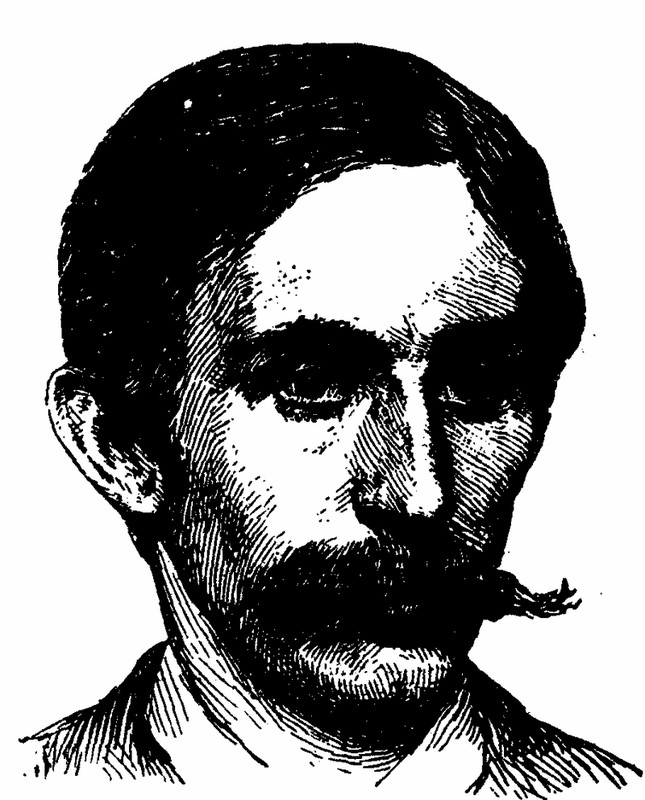
Richard W. Gilder
In addition to his influence on the literary movement, Mr. Gilder has been active in philanthropic and political work. He has secured legislation for the improvement of tenements in cities; he has taken interest in the formation of public kindergartens; and given of his time and strength to further other reforms. His influence in New York City, too, has been a factor in developing the social aspects of literary and art life there. From Dickinson College he has received the degree of LL.D., and from Princeton that of L.H.D.
Mr. Gilder's reputation as a writer is based upon his verse. Only very occasionally does he publish an essay, though thoughtful, strongly written editorials from his pen in his magazine are frequent. But it is his verse-writing that has given him his place—a distinct and honorable one—in American letters. The fine quality and promise of his work was recognized upon the publication of 'The New Day' in 1875, a first volume which was warmly received. It showed the influence of Italian studies, and contained lyric work of much imaginative beauty. The musicalness of it and the delicately ideal treatment of the love passion were noticeable characteristics. In his subsequent books—'The Celestial Passion,' 1887; 'Lyrics,' 1885 and 1887; 'Two Worlds, and Other Poems,' 1891; 'The Great Remembrance, and Other Poems,' 1893: the contents of these being gathered finally into the one volume 'Five Books of Song,' 1894—he has given further proof of his genuine lyric gift, his work in later years having a wider range of themes, a broadening vision and deepening purpose. He remains nevertheless essentially a lyrist, a maker of songs; a thorough artist who has seriousness, dignity, and charm. His is an earnest nature, sensitive alike to vital contemporaneous problems and to the honey-sweet voice of the Ideal.
[All the following citations from Mr. Gilder's poems are copyrighted, and are reprinted here by special permission of the author and his publishers.]
TWO SONGS FROM 'THE NEW DAY'
I
Not from the whole wide world I chose thee, Sweetheart, light of the land and the sea! The wide, wide world could not inclose thee— For thou art the whole wide world to me.
II
Years have flown since I knew thee first, And I know thee as water is known of thirst; Yet I knew thee of old at the first sweet sight, And thou art strange to me, Love, to-night.
"ROSE-DARK THE SOLEMN SUNSET"
Rose-dark the solemn sunset That holds my thought of thee; With one star in the heavens And one star in the sea.
On high no lamp is lighted, Nor where the long waves flow. Save the one star of evening And the shadow star below.
Light of my life, the darkness Comes with the twilight dream; Thou art the bright star shining, And I but the shadowy gleam.
NON SINE DOLORE
What, then, is Life,—what Death? Thus the Answerer saith; O faithless mortal, bend thy head and listen:
Down o'er the vibrant strings, That thrill, and moan, and mourn, and glisten, The Master draws his bow. A voiceless pause: then upward, see, it springs, Free as a bird with unimprisoned wings! In twain the chord was cloven, While, shaken with woe, With breaks of instant joy all interwoven, Piercing the heart with lyric knife, On, on the ceaseless music sings, Restless, intense, serene;— Life is the downward stroke; the upward, Life; Death but the pause between.
Then spake the Questioner: If 't were only this, Ah, who could face the abyss That plunges steep athwart each human breath? If the new birth of Death Meant only more of Life as mortals know it, What priestly balm, what song of highest poet, Could heal one sentient soul's immitigable pain? All, all were vain! If, having soared pure spirit at the last, Free from the impertinence and warp of flesh We find half joy, half pain, on every blast; Are caught again in closer-woven mesh— Ah! who would care to die From out these fields and hills, and this familiar sky; These firm, sure hands that compass us, this dear humanity?
Again the Answerer saith:— O ye of little faith, Shall then the spirit prove craven, And Death's divine deliverance but give A summer rest and haven? By all most noble in us, by the light that streams Into our waking dreams, Ah, we who know what Life is, let us live! Clearer and freer, who shall doubt? Something of dust and darkness cast forever out; But Life, still Life, that leads to higher Life, Even though the highest be not free from immortal strife.
The highest! Soul of man, oh be thou bold, And to the brink of thought draw near, behold! Where, on the earth's green sod, Where, where in all the universe of God, Hath strife forever ceased? When hath not some great orb flashed into space The terror of its doom? When hath no human face Turned earthward in despair, For that some horrid sin had stamped its image there?
If at our passing Life be Life increased, And we ourselves flame pure unfettered soul, Like the Eternal Power that made the whole And lives in all he made From shore of matter to the unknown spirit shore; If, sire to son, and tree to limb, Cycle on countless cycle more and more We grow to be like him; If he lives on, serene and unafraid, Through all his light, his love, his living thought, One with the sufferer, be it soul or star; If he escape not pain, what beings that are Can e'er escape while Life leads on and up the unseen way and far? If he escape not, by whom all was wrought, Then shall not we, Whate'er of godlike solace still may be,— For in all worlds there is no Life without a pang, and can be naught.
No Life without a pang! It were not Life, If ended were the strife— Man were not man, nor God were truly God! See from the sod The lark thrill skyward in an arrow of song: Even so from pain and wrong Upsprings the exultant spirit, wild and free. He knows not all the joy of liberty Who never yet was crushed 'neath heavy woe. He doth not know, Nor can, the bliss of being brave Who never hath faced death, nor with unquailing eye Hath measured his own grave. Courage, and pity, and divinest scorn— Self-scorn, self-pity, and high courage of the soul; The passion for the goal; The strength to never yield though all be lost— All these are born Of endless strife; this is the eternal cost Of every lovely thought that through the portal Of human minds doth pass with following light. Blanch not, O trembling mortal! But with extreme and terrible delight Know thou the truth, Nor let thy heart be heavy with false ruth.
No passing burden is our earthly sorrow, That shall depart in some mysterious morrow. 'Tis His one universe where'er we are— One changeless law from sun to viewless star. Were sorrow evil here, evil it were forever, Beyond the scope and help of our most keen endeavor God doth not dote, His everlasting purpose shall not fail. Here where our ears are weary with the wail And weeping of the sufferers; there where the Pleiads float— Here, there, forever, pain most dread and dire Doth bring the intensest bliss, the dearest and most sure. 'Tis not from Life aside, it doth endure Deep in the secret heart of all existence. It is the inward fire, The heavenly urge, and the divine insistence. Uplift thine eyes, O Questioner, from the sod! It were no longer Life, If ended were the strife; Man were not man, God were not truly God.
"HOW PADEREWSKI PLAYS"
I
If songs were perfume, color, wild desire; If poets' words were fire That burned to blood in purple-pulsing veins; If with a bird-like thrill the moments throbbed to hours; If summer's rains Turned drop by drop to shy, sweet, maiden flowers; If God made flowers with light and music in them, And saddened hearts could win them; If loosened petals touched the ground With a caressing sound; If love's eyes uttered word No listening lover e'er before had heard; If silent thoughts spake with a bugle's voice; If flame passed into song and cried, "Rejoice! Rejoice!" If words could picture life's, hope's, heaven's eclipse When the last kiss has fallen on dying eyes and lips; If all of mortal woe Struck on one heart with breathless blow on blow; If melody were tears, and tears were starry gleams That shone in evening's amethystine dreams; Ah yes, if notes were stars, each star a different hue, Trembling to earth in dew; Or if the boreal pulsings, rose and white, Made a majestic music in the night; If all the orbs lost in the light of day In the deep, silent blue began their harps to play; And when in frightening skies the lightnings flashed And storm-clouds crashed, If every stroke of light and sound were but excess of beauty; If human syllables could e'er refashion That fierce electric passion; If other art could match (as were the poet's duty) The grieving, and the rapture, and the thunder Of that keen hour of wonder,— That light as if of heaven, that blackness as of hell,— How Paderewski plays then might I dare to tell.
II
How Paderewski plays! And was it he Or some disbodied spirit which had rushed From silence into singing; and had crushed Into one startled hour a life's felicity, And highest bliss of knowledge—that all life, grief, wrong, Turn at the last to beauty and to song!
THE SONNET
What is a sonnet? 'Tis the pearly shell That murmurs of the far-off murmuring sea; A precious jewel carved most curiously; It is a little picture painted well. What is a sonnet? 'Tis the tear that fell From a great poet's hidden ecstasy; A two-edged sword, a star, a song—ah me! Sometimes a heavy-tolling funeral bell. This was the flame that shook with Dante's breath; The solemn organ whereon Milton played, And the clear glass where Shakespeare's shadow falls: A sea this is—beware who ventureth! For like a fiord the narrow floor is laid Mid-ocean deep to the sheer mountain walls.
AMERICA
From 'The Great Remembrance'
Land that we love! Thou Future of the World! Thou refuge of the noble heart oppressed! Oh, never be thy shining image hurled From its high place in the adoring breast Of him who worships thee with jealous love! Keep thou thy starry forehead as the dove All white, and to the eternal Dawn inclined! Thou art not for thyself, but for mankind, And to despair of thee were to despair Of man, of man's high destiny, of God! Of thee should man despair, the journey trod Upward, through unknown eons, stair on stair, By this our race, with bleeding feet and slow, Were but the pathway to a darker woe Than yet was visioned by the heavy heart Of prophet. To despair of thee! Ah no! For thou thyself art Hope; Hope of the World thou art!
ON THE LIFE-MASK OF ABRAHAM LINCOLN
This bronze doth keep the very form and mold Of our great martyr's face. Yes, this is he: That brow all wisdom, all benignity; That human, humorous mouth; those cheeks that hold Like some harsh landscape all the summer's gold; That spirit fit for sorrow, as the sea For storms to beat on; the lone agony Those silent, patient lips too well foretold. Yes, this is he who ruled a world of men As might some prophet of the elder day— Brooding above the tempest and the fray With deep-eyed thought and more than mortal ken. A power was his beyond the touch of art Or armèd strength—his pure and mighty heart.
"CALL ME NOT DEAD"
Call me not dead when I, indeed, have gone Into the company of the ever-living High and most glorious poets! Let thanksgiving Rather be made. Say:—"He at last hath won Rest and release, converse supreme and wise, Music and song and light of immortal faces; To-day, perhaps, wandering in starry places, He hath met Keats, and known him by his eyes. To-morrow (who can say?) Shakespeare may pass, And our lost friend just catch one syllable Of that three-centuried wit that kept so well; Or Milton; or Dante, looking on the grass Thinking of Beatrice, and listening still To chanted hymns that sound from the heavenly hill."
AFTER-SONG
From 'The New Day'
Through love to light! Oh, wonderful the way That leads from darkness to the perfect day! From darkness and from sorrow of the night To morning that comes singing o'er the sea. Through love to light! Through light, O God, to thee, Who art the love of love, the eternal light of light!
GIUSEPPE GIUSTI
(1809-1850)

iuseppe Giusti, an Italian satirical poet, was born of an influential family, May 12th, 1809, in the little village of Monsummano, which lies between Pistoja and Pescia, and was in every fibre of his nature a Tuscan. As a child he imbibed the healthful, sunny atmosphere of that Campagna, and grew up loving the world and his comrades, but with a dislike of study which convinced himself and his friends that he was born to no purpose. He was early destined to the bar, and began his law studies in Pistoja and Lucca, completing them a number of years later at Pisa, where he obtained his degree of doctor.
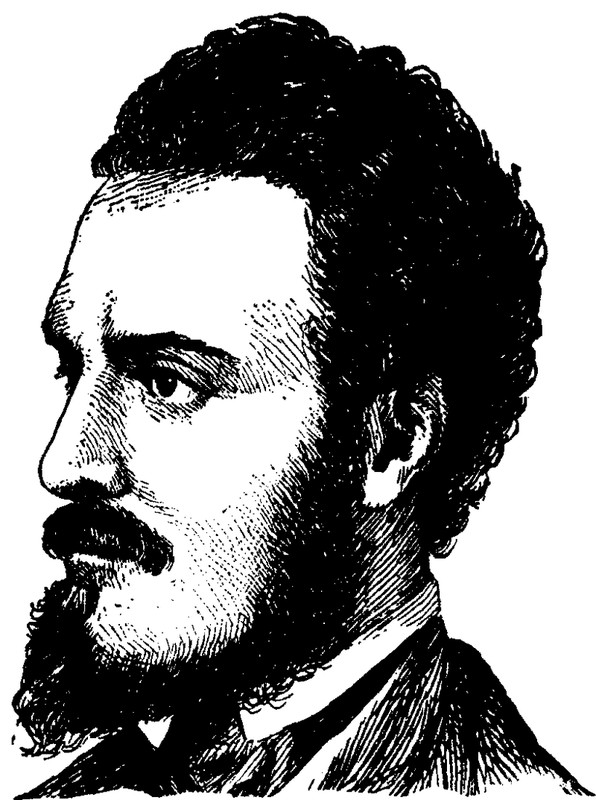
Giuseppe Giusti
In 1834 he went to Florence, under pretence of practicing with the advocate Capoquadri; but here as elsewhere he spent his time in the world of gayety, whose fascination and whose absurdity he seems to have felt with equal keenness. His dislike of study found its exception in his love of Dante, of whom he was a reverent student. He was himself continually versifying, and his early romantic lyrics are inspired by lofty thought. His penetrating humor, however, and his instinctive sarcasm, whose expression was never unkind, led him soon to abandon idealism and to distinguish himself in the field of satire, which has no purer representative than he. His compositions are short and terse, and are seldom blemished by personalities. He was wont to say that absurd persons did not merit even the fame of infamy. He leveled his wit against the lethargy and immoralities of the times, and revealed them clear-cut in the light of his own stern principles and patriotism.
The admiration and confidence which he now began to receive from the public was to him a matter almost of consternation, wont as he was to consider himself a good-for-nothing. He confesses somewhat bashfully however that there was always within him, half afraid of itself, an instinct of power which led him to say in his heart, Who knows what I may be with time? His frail constitution and almost incessant physical suffering account for a natural indolence against which he constantly inveighs, but above which he was powerless to rise except at vehement intervals. No carelessness, however, marks his work. He was a tireless reviser, and possessed the rare power of cutting, polishing, and finishing his work with exquisite nicety, without robbing it of vigor. His writings exerted a distinct political and moral influence. His is not alone the voice of pitiless and mocking irony, but it is that of the humanitarian, who in overthrow and destruction sees only the first step toward the creation of something better. When war broke out he laid aside his pen, saying that this was no time for a poet to pull down, and that his was not the power to build up. His health forbade his entering the army, which was a cause of poignant sorrow to him. His faith in Italy and her people and in the final triumph of unity remained unshaken and sublime in the midst of every reverse.
His mastery of the Tuscan dialect and his elegance of idiom won him membership in the Accademia della Crusca; but his love for Tuscany was always subservient to his love for Italy. To those who favored the division of the peninsula, he used to reply that he had but one fatherland, and that was a unit. He died in Florence, March 31, 1850, at the home of his devoted friend the Marquis Gino Capponi. In the teeth of Austrian prohibition, a throng of grateful and loving citizens followed his body to the church of San Miniato al Monte, remembering that at a time when freedom of thought was deemed treason, this man had fearlessly raised the battle-cry and prepared the way for the insurrection of 1848. Besides his satires, Giusti has left us a life of the poet Giuseppe Parini, a collection of Tuscan proverbs, and an unedited essay on the 'Divine Comedy.'
LULLABY
From 'Gingillino'
[The poem of 'Gingillino,' one of Giusti's finest satires, is full of personal hits, greatly enjoyed by the author's countrymen. The 'Lullaby' is sung by a number of personified Vices round the cradle of the infant Gingillino, who, having come into the world naked and possessed of nothing, is admonished how to behave if he would go out of it well dressed and rich. A few verses only are given out of the many. The whole poem was one of the most popular of all Giusti's satires.]
Cry not, dear baby, Of nothing possessed; But if thou wouldst, dear, Expire well dressed....
Let nothing vex thee,— Love's silly story, Ghosts of grand festivals Spectres of glory;
Let naught annoy thee: The burdens of fame, The manifold perils That wait on a name.
Content thyself, baby, With learning to read: Don't be vainglorious; That's all thou canst need.
All promptings of genius Confine in thy breast, If thou wouldst, baby, Expire well dressed....
Let not God nor Devil Concern thy poor wits, And tell no more truth Than politeness permits.
With thy soul and thy body, Still worship the Real; Nor ever attempt To pursue the Ideal.
As for thy scruples, Let them be suppressed, If thou wouldst, baby, Expire well dressed.
Translated for 'A Library of the World's Best Literature.'
THE STEAM-GUILLOTINE
[The monarch satirized in this poem was Francesco IV., Duke of Modena, a petty Nero, who executed not a few of the Italian patriots of 1831.]
A most wonderful steam-machine, One time set up in China-land, Outdid the insatiate guillotine, For in three hours, you understand, It cut off a hundred thousand heads In a row, like hospital beds.
This innovation stirred a breeze, And some of the bonzes even thought Their barbarous country by degrees To civilization might be brought, Leaving Europeans, with their schools, Looking like fools.
The Emperor was an honest man— A little stiff, and dull of pate; Like other asses, hard and slow. He loved his subjects and the State, And patronized all clever men Within his ken.
His people did not like to pay Their taxes and their other dues,— They cheated the revenue, sad to say: So their good ruler thought he'd choose As the best argument he'd seen, This sweet machine.
The thing's achievements were so great, They gained a pension for the man,— The executioner of State,— Who got a patent for his plan, Besides becoming a Mandarin Of great Pekin.
A courtier cried: "Good guillotine! Let's up and christen it, I say!" "Ah, why," cries to his counselor keen A Nero of our present day, "Why was not born within my State A man so great?"
Translated for 'A Library of the World's Best Literature.'
WILLIAM E. GLADSTONE.
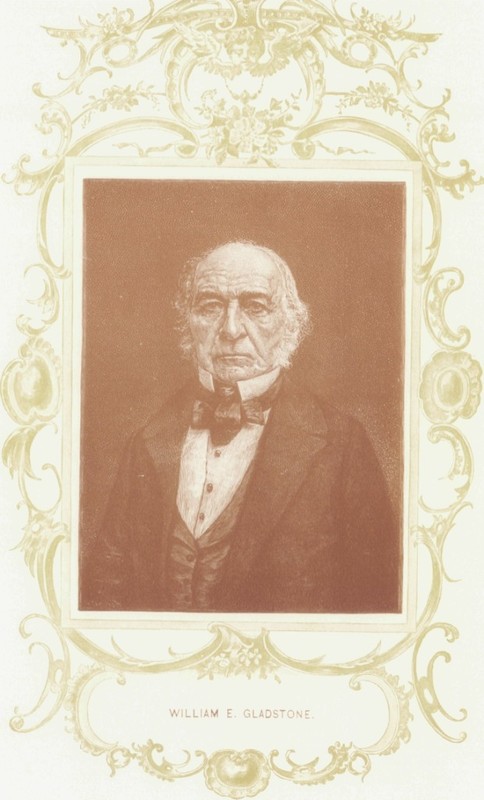
WILLIAM EWART GLADSTONE
(1809-)

n view of his distinguished career, it is interesting to know that it is a part of Mr. Gladstone's unresting ambition to take a place among the literary men of the time, and to guide the thoughts of his countrymen in literary as well as in political, social, and economic subjects. Mr. Gladstone's preparation to become a man of letters was extensive. Born in Liverpool December 29th, 1809, he was sent to Eton and afterwards to Oxford, where he took the highest honors, and was the most remarkable graduate of his generation. His fellow students carried away a vivid recollection of his viva voce examination for his degree: the tall figure, the flashing eye, the mobile countenance, in the midst of the crowd who pressed to hear him, while the examiners plied him with questions till, tested in some difficult point in theology, the candidate exclaimed, "Not yet, if you please" and began to pour forth a fresh store of learning and argument.
From the university Mr. Gladstone carried away two passions—the one for Greek literature, especially Greek poetry, the other for Christian theology. The Oxford that formed these tastes was intensely conservative in politics, representing the aristocratic system of English society and the exclusiveness of the Established Church, whose creed was that of the fourth century. Ecclesiasticism is not friendly to literature; but how far Oxford's most loyal son was permeated by ecclesiasticism is a matter of opinion. Fortunately, personality is stronger than dogma, and ideas than literary form; and Mr. Gladstone, than whom few men outside the profession of letters have written more, is always sure of an intelligent hearing. His discussion of a subject seems to invest it with some of his own marvelous vitality; and when he selects a book for review, he is said to make the fortune of both publisher and author, if only the title be used as a crotchet to hang his sermon on.
And this not merely because curiosity is excited concerning the opinion of the greatest living Englishman (for notwithstanding his political vacillations, his views on inward and higher subjects have little changed since his Oxford days, and may easily be prognosticated), but on account of the subtlety and fertility of his mind and the adroitness of his argument. Plunging into the heart of the subject, he is at the same time working round it, holding it up for inspection in one light and then in another, reasoning from this premise and that; while the string of elucidations and explanations grows longer and longer, and the atmosphere of complexity thickens. It was out of such an atmosphere that a barrister advised his client, a bigamist, to get Mr. Gladstone to explain away one of his wives.
When Mr. Gladstone made his debut as an author, he locked horns with Macaulay in the characteristic paper 'Church and State' (1837). He published his 'Studies in Homer and the Homeric Age' in 1858, 'Juventus Mundi' in 1869, 'Homeric Synchronism' in 1857. In 1879 most of his essays, political, social, economic, religious, and literary, written between 1843 and 1879, were collected in seven volumes, and appeared under the title of 'Gleanings of Past Years.' He has published a very great number of smaller writings not reprinted.
From that time to the present, neither his industry nor his energy has abated; but he is probably at his best in the several remarkable essays on Blanco White, Bishop Patterson, Tennyson, Leopardi, and the position of the Church of England. The reader spoiled for the Scotch quality of weight by the "light touch" which is the graceful weapon of the age, wonders, when reading these essays, that Mr. Gladstone has not more assiduously cultivated the instinct of style,—sentence-making. Milton himself has not a higher conception of the business of literature; and when discussing these congenial themes, Mr. Gladstone's enthusiasm does not degenerate into vehemence, nor does he descend from the high moral plane from which he views the world.
It is the province of the specialist to appraise Mr. Gladstone's Homeric writings; but even the specialist will not, perhaps, forbear to quote the axiom of the pugilist in the Iliad concerning the fate of him who would be skillful in all arts. No man is less a Greek in temperament, but no man cherishes deeper admiration for the Greek genius, and nowhere else is a more vivid picture of the life and politics of the heroic age held up to the unlearned. While the critic may question technical accuracy, or plausible structures built on insufficient data, the laity will remember how earnestly Mr. Gladstone insists that Homer is his own best interpreter, and that the student of the Iliad must go to the Greek text and not elsewhere for accurate knowledge.
But Greek literature is only one of Mr. Gladstone's two passions, and not the paramount one. That he would have been a great theologian had he been other than Mr. Gladstone, is generally admitted. And it is interesting to note that while he glories in the combats of the heroes of Hellas, his enthusiasm is as quickly kindled by the humilities of the early Church. He recognizes the prophetic quality of Homer, but he bows before the sublimer genius of an Isaiah, and sees in the lives and writings of the early Fathers the perfect bloom of human genius and character.
MACAULAY
From 'Gleanings of Past Years'
Lord Macaulay lived a life of no more than fifty-nine years and three months. But it was an extraordinarily full life, of sustained exertion; a high table-land, without depressions. If in its outer aspect there be anything wearisome, it is only the wearisomeness of reiterated splendors, and of success so uniform as to be almost monotonous. He speaks of himself as idle; but his idleness was more active, and carried with it hour by hour a greater expenditure of brain power, than what most men regard as their serious employments. He might well have been, in his mental career, the spoiled child of fortune; for all he tried succeeded, all he touched turned into gems and gold. In a happy childhood he evinced extreme precocity. His academical career gave sufficient, though not redundant, promise of after celebrity. The new Golden Age he imparted to the Edinburgh Review, and his first and most important, if not best, Parliamentary speeches in the grand crisis of the first Reform Bill, achieved for him, years before he had reached the middle point of life, what may justly be termed an immense distinction.
For a century and more, perhaps no man in this country, with the exceptions of Mr. Pitt and of Lord Byron, had attained at thirty-two the fame of Macaulay. His Parliamentary success and his literary eminence were each of them enough, as they stood at this date, to intoxicate any brain and heart of a meaner order. But to these was added, in his case, an amount and quality of social attentions such as invariably partake of adulation and idolatry, and as perhaps the high circles of London never before or since have lavished on a man whose claims lay only in himself, and not in his descent, his rank, or his possessions....
One of the very first things that must strike the observer of this man is, that he was very unlike to any other man. And yet this unlikeness, this monopoly of the model in which he was made, did not spring from violent or eccentric features of originality, for eccentricity he had none whatever, but from the peculiar mode in which the ingredients were put together to make up the composition. In one sense, beyond doubt, such powers as his famous memory, his rare power of illustration, his command of language, separated him broadly from others: but gifts like these do not make the man; and we now for the first time know that he possessed, in a far larger sense, the stamp of a real and strong individuality. The most splendid and complete assemblage of intellectual endowments does not of itself suffice to create an interest of the kind that is, and will be, now felt in Macaulay. It is from ethical gifts alone that such an interest can spring.
These existed in him not only in abundance, but in forms distant from and even contrasted with the fashion of his intellectual faculties, and in conjunctions which come near to paradox. Behind the mask of splendor lay a singular simplicity; behind a literary severity which sometimes approached to vengeance, an extreme tenderness; behind a rigid repudiation of the sentimental, a sensibility at all times quick, and in the latest times almost threatening to sap, though never sapping, his manhood. He who as speaker and writer seemed above all others to represent the age and the world, had the real centre of his being in the simplest domestic tastes and joys. He for whom the mysteries of human life, thought, and destiny appear to have neither charm nor terror, and whose writings seem audibly to boast in every page of being bounded by the visible horizon of the practical and work-day sphere, yet in his virtues and in the combination of them; in his freshness, bounty, bravery; in his unshrinking devotion both to causes and to persons; and most of all, perhaps, in the thoroughly inborn and spontaneous character of all these gifts,—really recalls the age of chivalry and the lineaments of the ideal. The peculiarity, the differentia (so to speak) of Macaulay seems to us to lie in this: that while as we frankly think, there is much to question—nay, much here and there to regret or even censure—in his writings, the excess, or defect, or whatever it may be, is never really ethical, but is in all cases due to something in the structure and habits of his intellect. And again, it is pretty plain that the faults of that intellect were immediately associated with its excellences: it was in some sense, to use the language of his own Milton, "dark with excessive bright."...
His moderation in luxuries and pleasures is the more notable and praiseworthy because he was a man who, with extreme healthiness of faculty, enjoyed keenly what he enjoyed at all. Take in proof the following hearty notice of a dinner a quattr' occhi to his friend: "Ellis came to dinner at seven. I gave him a lobster curry, woodcock, and macaroni. I think that I will note dinners, as honest Pepys did."
His love of books was intense, and was curiously developed. In a walk he would devour a play or a volume. Once, indeed, his performance embraced no less than fourteen Books of the Odyssey. "His way of life," says Mr. Trevelyan, "would have been deemed solitary by others; but it was not solitary to him." This development blossomed into a peculiar specialism. Henderson's 'Iceland' was "a favorite breakfast-book" with him. "Some books which I would never dream of opening at dinner please me at breakfast, and vice versá!" There is more subtlety in this distinction than could easily be found in any passage of his writings. But how quietly both meals are handed over to the dominion of the master propensity! This devotion, however, was not without its drawbacks. Thought, apart from books and from composition, perhaps he disliked; certainly he eschewed. Crossing that evil-minded sea the Irish Channel at night in rough weather, he is disabled from reading; he wraps himself in a pea-jacket and sits upon the deck. What is his employment? He cannot sleep, or does not. What an opportunity for moving onward in the processes of thought, which ought to weigh on the historian! The wild yet soothing music of the waves would have helped him to watch the verging this way or that of the judicial scales, or to dive into the problems of human life and action which history continually is called upon to sound. No, he cared for none of this. He set about the marvelous feat of going over 'Paradise Lost' from memory, when he found he could still repeat half of it. In a word, he was always conversing, or recollecting, or reading, or composing; but reflecting never.
The laboriousness of Macaulay as an author demands our gratitude; all the more because his natural speech was in sentences of set and ordered structure, well-nigh ready for the press. It is delightful to find that the most successful prose writer of the day was also the most painstaking. Here is indeed a literary conscience. The very same gratification may be expressed with reference to our most successful poet, Mr. Tennyson. Great is the praise due to the poet; still greater, from the nature of the case, that share which falls to the lot of Macaulay. For a poet's diligence is, all along, a honeyed work. He is ever traveling in flowery meads. Macaulay, on the other hand, unshrinkingly went through an immense mass of inquiry, which even he sometimes felt to be irksome, and which to most men would have been intolerable. He was perpetually picking the grain of corn out of the bushel of chaff. He freely chose to undergo the dust and heat and strain of battle, before he would challenge from the public the crown of victory. And in every way it was remarkable that he should maintain his lofty standard of conception and performance. Mediocrity is now, as formerly, dangerous, commonly fatal, to the poet; but among even the successful writers of prose, those who rise sensibly above it are the very rarest exceptions. The tests of excellence in prose are as much less palpable as the public appetite is less fastidious. Moreover, we are moving downward in this respect. The proportion of middling to good writing constantly and rapidly increases. With the average of performance, the standard of judgment progressively declines. The inexorable conscientiousness of Macaulay, his determination to put out nothing from his hand which his hand was still capable of improving, was a perfect godsend to the best hopes of our slipshod generation.
It was naturally consequent upon this habit of treating composition in the spirit of art, that he should extend to the body of his books much of the regard and care which he so profusely bestowed upon their soul. We have accordingly had in him, at the time when the need was greatest, a most vigilant guardian of the language. We seem to detect rare and slight evidences of carelessness in his Journal: of which we can only say that in a production of the moment, written for himself alone, we are surprised that they are not more numerous and considerable. In general society, carelessness of usage is almost universal, and it is exceedingly difficult for an individual, however vigilant, to avoid catching some of the trashy or faulty usages which are continually in his ear. But in his published works his grammar, his orthography, nay, his punctuation (too often surrendered to the printer), are faultless. On these questions, and on the lawfulness or unlawfulness of a word, he may even be called an authority without appeal; and we cannot doubt that we owe it to his works, and to their boundless circulation, that we have not in this age witnessed a more rapid corruption and degeneration of the language.
To the literary success of Macaulay it would be difficult to find a parallel in the history of recent authorship. For this and probably for all future centuries, we are to regard the public as the patron of literary men; and as a patron abler than any that went before to heap both fame and fortune on its favorites. Setting aside works of which the primary purpose was entertainment, Tennyson alone among the writers of our age, in point of public favor and of emolument following upon it, comes near to Macaulay. But Tennyson was laboriously cultivating his gifts for many years before he acquired a position in the eye of the nation. Macaulay, fresh from college in 1825, astonished the world by his brilliant and most imposing essay on Milton. Full-orbed, he was seen above the horizon; and full-orbed after thirty-five years of constantly emitted splendor, he sank beneath it.
His gains from literature were extraordinary. The check for £20,000 is known to all. But his accumulation was reduced by his bounty; and his profits would, it is evident, have been far larger still had he dealt with the products of his mind on the principles of economic science (which however he heartily professed), and sold his wares in the dearest market, as he undoubtedly acquired them in the cheapest. No one can measure the elevation of Macaulay's character above the mercenary level, without bearing in mind that for ten years after 1825 he was a poor and a contented man, though ministering to the wants of a father and a family reduced in circumstances; though in the blaze of literary and political success; and though he must have been conscious from the first of the possession of a gift which by a less congenial and more compulsory use would have rapidly led him to opulence. Yet of the comforts and advantages, both social and physical, from which he thus forbore, it is so plain that he at all times formed no misanthropic or ascetic, but on the contrary a very liberal and genial estimate. It is truly touching to find that never, except as a minister, until 1851, when he had already lived fifty years of his fifty-nine, did this favorite of fortune, this idol of society, allow himself the luxury of a carriage.
It has been observed that neither in art nor letters did Macaulay display that faculty of the higher criticism which depends upon certain refined perceptions and the power of subtle analysis. His analysis was always rough, hasty, and sweeping, and his perceptions robust. By these properties it was that he was so eminently [Greek: phortikos], not in the vulgar sense of an appeal to spurious sentiment, but as one bearing his reader along by violence, as the River Scamander tried to bear Achilles. Yet he was never pretentious; and he said frankly of himself that a criticism like that of Lessing in his 'Laocoön,' or of Goethe on 'Hamlet,' filled him with wonder and despair. His intense devotion to the great work of Dante is not perhaps in keeping with the general tenor of his tastes and attachments, but is in itself a circumstance of much interest.
We remember however at least one observation of Macaulay's in regard to art, which is worth preserving. He observed that the mixture of gold with ivory in great works of ancient art—for example, in the Jupiter of Phidias—was probably a condescension to the tastes of the people who were to be the worshipers of the statue; and he noticed that in Christian times it has most rarely happened that productions great in art have also been the objects of warm popular veneration....
It has been felt and pointed out in many quarters that Macaulay as a writer was the child, and became the type, of his country and his age. As fifty years ago the inscription "Bath" used to be carried on our letter-paper, so the word "English" is, as it were, in the water-mark of every leaf of Macaulay's writing. His country was not the Empire, nor was it the United Kingdom. It was not even Great Britain. Though he was descended in the higher, that is the paternal, half from Scottish ancestry, and was linked specially with that country through the signal virtues, the victorious labors, and the considerable reputation of his father Zachary,—his country was England. On this little spot he concentrated a force of admiration and of worship which might have covered all the world. But as in space, so in time, it was limited. It was the England of his own age.
The higher energies of his life were as completely summed up in the present as those of Walter Scott were projected upon the past. He would not have filled an Abbotsford with armor and relics of the Middle Ages. He judges the men and institutions and events of other times by the instruments and measures of the present. The characters whom he admires are those who would have conformed to the type that was before his eyes: who would have moved with effect in the court, the camp, the senate, the drawing-room of to-day. He contemplates the past with no desiderium, no regretful longing, no sense of things admirable which are also lost and irrecoverable. Upon this limitation of his retrospects it follows in natural sequence that of the future he has no glowing anticipations, and even the present he is not apt to contemplate on its mysterious and ideal side. As in respect to his personal capacity of loving, so in regard to the corresponding literary power. The faculty was singularly intense, and yet it was spent within a narrow circle. There is a marked sign of this narrowness, in his disinclination even to look at the works of contemporaries whose tone or manner he disliked.
It appears that this dislike, and the ignorance consequent upon it, applied to the works of Carlyle. Now, we may have much or little faith in Carlyle as a philosopher or as a historian. Half-lights and half-truths may be the utmost which, in these departments, his works will be found to yield. But the total want of sympathy is the more noteworthy, because the resemblances, though partial, are both numerous and substantial between these two remarkable men and powerful writers, as well in their strength as in their weakness. Both are honest; and both, notwithstanding honesty, are partisans. Each is vastly, though diversely, powerful in expression; and each is more powerful in expression than in thought. Both are, though variously, poets using the vehicle of prose. Both have the power of portraitures, extraordinary for vividness and strength. For comprehensive disquisition, for balanced and impartial judgments, the world will probably resort to neither; and if Carlyle gains on the comparison in his strong sense of the inward and the ideal, he loses in the absolute and violent character of his one-sidedness. Without doubt, Carlyle's licentious though striking peculiarities of style have been of a nature allowably to repel, so far as they go, one who was so rigid as Macaulay in his literary orthodoxy, and who so highly appreciated, and with such expenditure of labor, all that relates to the exterior or body of a book. Still, if there be resemblances so strong, the want of appreciation, which has possibly been reciprocal, seems to be partly of that nature which Aristotle would have explained by his favorite proverb, [Greek: keramens keramei].[D] The discrepancy is like the discrepancy of colors that are too near. Carlyle is at least a great fact in the literature of his time, and has contributed largely,—in some respects too largely,—toward forming its characteristic habits of thought. But on these very grounds he should not have been excluded from the horizon of a mind like Macaulay's, with all its large and varied and most active interests....
There have been other men of our own generation, though very few, who if they have not equaled have approached Macaulay in power of memory, and who have certainly exceeded him in the unfailing accuracy of their recollections; and yet not in accuracy as to dates or names or quotations, or other matters of hard fact, when the question was one simply between ay and no. In these he may have been without a rival. In a list of kings, or popes, or senior wranglers, or prime ministers, or battles, or palaces, or as to the houses in Pall Mall or about Leicester Square, he might be followed with implicit confidence. But a large and important class of human recollections are not of this order: recollections for example of characters, of feelings, of opinions; of the intrinsic nature, details, and bearings of occurrences. And here it was that Macaulay's wealth "was unto him an occasion of falling." And that in two ways. First, the possessor of such a vehicle as his memory could not but have something of an overweening confidence in what it told him; and quite apart from any tendency to be vain or overbearing, he could hardly enjoy the benefits of that caution which arises from self-interest, and the sad experience of frequent falls. But what is more, the possessor of so powerful a fancy could not but illuminate with the colors it supplied, the matters which he gathered into his great magazine, wherever the definiteness of their outline was not so rigid as to defy or disarm the action of the intruding and falsifying faculty. Imagination could not alter the date of the battle of Marathon, of the Council of Nice, or the crowning of Pepin; but it might seriously or even fundamentally disturb the balance of light and dark in his account of the opinions of Milton or of Laud, or his estimate of the effects of the Protectorate or the Restoration, or of the character and even the adulteries of William III. He could detect justly this want of dry light in others; he probably suspected it in himself; but it was hardly possible for him to be enough upon his guard against the distracting action of a faculty at once so vigorous, so crafty, and so pleasurable in its intense activity.
Hence arose, it seems reasonable to believe, that charge of partisanship against Macaulay as a historian, on which much has been and probably much more will be said. He may not have possessed that scrupulously tender sense of obligation, that nice tact of exact justice, which is among the very rarest as well as the most precious of human virtues. But there never was a writer less capable of intentional unfairness. This during his lifetime was the belief of his friends, but was hardly admitted by opponents. His biographer has really lifted the question out of the range of controversy. He wrote for truth, but of course for truth such as he saw it; and his sight was colored from within. This color, once attached, was what in manufacture is called a mordant; it was a fast color: he could not distinguish between what his mind had received and what his mind had imparted. Hence, when he was wrong, he could not see that he was wrong; and of those calamities which are due to the intellect only, and not the heart, there can hardly be a greater....
However true it may be that Macaulay was a far more consummate workman in the manner than in the matter of his works, we do not doubt that the works contain, in multitudes, passages of high emotion and ennobling sentiment, just awards of praise and blame, and solid expositions of principle, social, moral, and constitutional. They are pervaded by a generous love of liberty; and their atmosphere is pure and bracing, their general aim and basis morally sound. Of the qualifications of this eulogy we have spoken, and have yet to speak. But we can speak of the style of the works with little qualification. We do not indeed venture to assert that his style ought to be imitated. Yet this is not because it was vicious, but because it was individual and incommunicable. It was one of those gifts of which, when it had been conferred, Nature broke the mold. That it is the head of all literary styles we do not allege; but it is different from them all, and perhaps more different from them all than they are usually different from one another. We speak only of natural styles, of styles where the manner waits upon the matter, and not where an artificial structure has been reared either to hide or to make up for poverty of substance.
It is paramount in the union of ease in movement with perspicuity of matter, of both with real splendor, and of all with immense rapidity and striking force. From any other pen, such masses of ornament would be tawdry; with him they are only rich. As a model of art concealing art, the finest cabinet pictures of Holland are almost his only rivals. Like Pascal, he makes the heaviest subject light; like Burke, he embellishes the barrenest. When he walks over arid plains, the springs of milk and honey, as in a march of Bacchus, seem to rise beneath his tread. The repast he serves is always sumptuous, but it seems to create an appetite proportioned to its abundance; for who has ever heard of the reader that was cloyed with Macaulay? In none, perhaps, of our prose writers are lessons such as he gives of truth and beauty, of virtue and of freedom, so vividly associated with delight. Could some magician but do for the career of life what he has done for the arm-chair and the study, what a change would pass on the face (at least) of the world we live in, what an accession of recruits would there be to the professing followers of virtue!...
The truth is that Macaulay was not only accustomed, like many more of us, to go out hobby-riding, but from the portentous vigor of the animal he mounted was liable more than most of us to be run away with. His merit is that he could keep his seat in the wildest steeple-chase; but as the object in view is arbitrarily chosen, so it is reached by cutting up the fields, spoiling the crops, and spoiling or breaking down the fences needful to secure for labor its profit, and to man at large the full enjoyment of the fruits of the earth. Such is the overpowering glow of color, such the fascination of the grouping in the first sketches which he draws, that when he has grown hot upon his work he seems to lose all sense of the restraints of fact and the laws of moderation; he vents the strangest paradoxes, sets up the most violent caricatures, and handles the false weight and measure as effectively as if he did it knowingly. A man so able and so upright is never indeed wholly wrong. He never for a moment consciously pursues anything but truth. But truth depends, above all, on proportion and relation. The preterhuman vividness with which Macaulay sees his object, absolutely casts a shadow upon what lies around; he loses his perspective; and imagination, impelled headlong by the strong consciousness of honesty in purpose, achieves the work of fraud. All things for him stand in violent contrast to one another. For the shadows, the gradations, the middle and transition touches, which make up the bulk of human life, character, and action, he has neither eye nor taste. They are not taken account of in his practice, and they at length die away from the ranges of his vision.
In Macaulay all history is scenic; and philosophy he scarcely seems to touch, except on the outer side, where it opens into action. Not only does he habitually present facts in forms of beauty, but the fashioning of the form predominates over, and is injurious to, the absolute and balanced presentation of the subject. Macaulay was a master in execution, rather than in what painting or music terms expression. He did not fetch from the depths, nor soar to the heights; but his power upon the surface was rare and marvelous, and it is upon the surface that an ordinary life is passed and that its imagery is found. He mingled, then, like Homer, the functions of the poet and the chronicler: but what Homer did was due to his time; what Macaulay did, to his temperament.
The 'History' of Macaulay, whatever else it may be, is the work not of a journeyman but of a great artist, and a great artist who lavishly bestowed upon it all his powers. Such a work, once committed to the press, can hardly die. It is not because it has been translated into a crowd of languages, nor because it has been sold in hundreds of thousands, that we believe it will live; but because, however open it may be to criticism, it has in it the character of a true and very high work of art....
Whether he will subsist as a standard and supreme authority is another question. Wherever and whenever read, he will be read with fascination, with delight, with wonder. And with copious instruction too; but also with copious reserve, with questioning scrutiny, with liberty to reject and with much exercise of that liberty. The contemporary mind may in rare cases be taken by storm; but posterity, never. The tribunal of the present is accessible to influence; that of the future is incorrupt. The coming generations will not give Macaulay up; but they will probably attach much less value than we have done to his ipse dixit. They will hardly accept from him his net solutions of literary, and still less of historic problems. Yet they will obtain, from his marked and telling points of view, great aid in solving them. We sometimes fancy that ere long there will be editions of his works in which his readers may be saved from pitfalls by brief, respectful, and judicious commentary; and that his great achievements may be at once commemorated and corrected by men of slower pace, of drier light, and of more tranquil, broad-set, and comprehensive judgment. For his works are in many respects among the prodigies of literature; in some, they have never been surpassed. As lights that have shone through the whole universe of letters, they have made their title to a place in the solid firmament of fame. But the tree is greater and better than its fruit; and greater and better yet than the works themselves are the lofty aims and conceptions, the large heart, the independent, manful mind, the pure and noble career, which in this Biography have disclosed to us the true figure of the man who wrote them.
EDWIN LAWRENCE GODKIN
(1831-)
[D] Potter [detests] potter.

mong the men in the United States who through the agency of the press have molded intelligent public opinion, Edwin Lawrence Godkin deserves an honorable place. In the columns of the New York Nation and the New York Evening Post, he has for a generation given editorial utterance to his views upon economic, civic, political, and international questions, this work being supplemented by occasional incisive and scholarly articles in the best periodicals. His clientèle has been drawn mainly from that powerful minority which is made up of the educated, thoughtful men and women of the country. To this high function Mr. Godkin has contributed exceptional gifts and qualifications; and that in its exercise he has been a force for good, is beyond dispute.
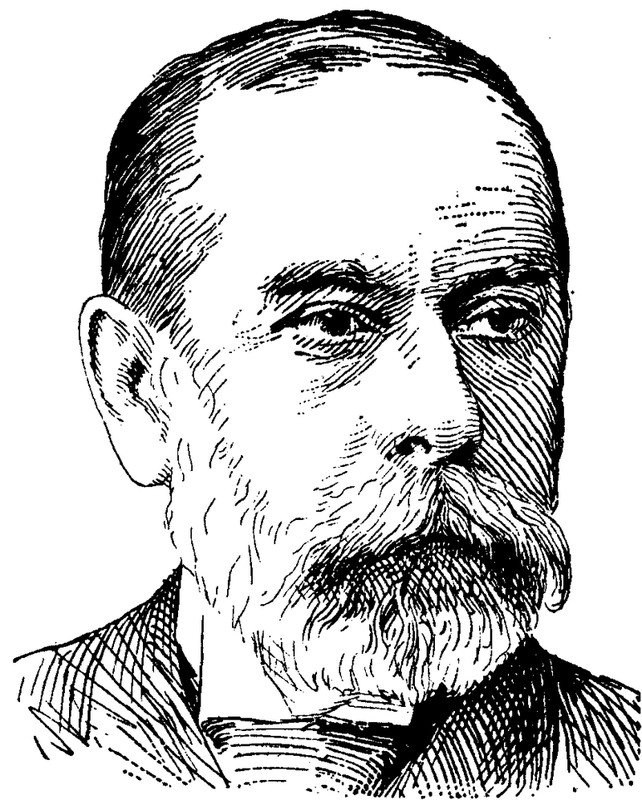
Edwin L. Godkin
Born in Moyne, Ireland, in 1831, he was educated at Queen's College, Belfast. Then came the more practical education derived from a familiarity with men and things, for in early manhood he began newspaper work as war correspondent, in Turkey and the Crimea, of the London Daily News. As correspondent of this paper he came to the United States and settled here, being admitted to the New York bar in 1858. But journalism was to be his life work; and in 1865 he became the editor of The Nation, a weekly,—succeeding the Round Table, but at once taking a much more important place as a journal of political and literary discussion,—and the next year its proprietor. In 1881 he also became one of the owners and the controlling editor of the New York Evening Post, a daily, and his contributions since then have appeared in both papers, which bear to each other the relation of a daily and weekly edition. Thus he has been in active journalistic service for more than thirty years.
From this slight biographical outline it may be seen that Mr. Godkin brought to the pursuit of his profession and to the study of American institutions some valuable qualifications. A college-bred man of wide experience, an adoptive American able to judge by the comparative method, a careful student of the philosophy of government, from Aristotle to Sir Henry Maine, his views combine in an unusual degree the practical and the theoretical. No doubt he has in his writings what to some will seem the defect of his quality. There is in him a certain haughtiness of temper, and what seems like impatient contempt for the opponent in argument, which, conjoined with a notable power of invective and satire in dealing with what he deems to be fallacious, are likely to arouse opposition. Hence the feeling in some quarters that Mr. Godkin is not at heart an American, but a captious critic, with sympathies ill suited to a democratic government.
This opinion is not justified by a fair examination of his writings. He has on the contrary and in the true sense proved himself a true American. He has spoken wise words upon many of the social and political problems of our day. He has defended democracy from the charge of failure, pointing out that here in the United States social defects, wrongly ascribed by foreign critics to the form of government, have been incidental to the settling of a vast new country. He has stated with clearness and cogency the inadvisability of allowing the government paternal power in finance and tariff legislation. He has preached the difference between cheap jingoism or political partisanship, and the enlightened Americanism which puts its finger upon weak points, criticizing in order to correct and purify. Mr. Godkin, in this, has been a consistent worker in a cause of which Lowell was a noble prophet. And in regard of literary excellence, his editorial writing is often a model of lucid, sinewy English style; while his more deliberated essays have been admirable for calm dignity, polish, and organic exposition, with an air of good breeding over it all. The influence of such a man, both as writer and thinker, especially in a land like the United States, has been most salutary.
THE DUTY OF CRITICISM IN A DEMOCRACY
From 'Problems of Modern Democracy.' Copyright 1896, by Charles Scribner's Sons, New York
No intelligent man can or ought to ignore the part which hope of better things plays in our present social system. It has largely, among the working classes, taken the place of religious belief. They have brought their heaven down to earth, and are literally looking forward to a sort of New Jerusalem, in which all comforts and many of the luxuries of life will be within easy reach of all. The great success of Utopian works like Bellamy's shows the hold which these ideas have taken of the popular mind. The world has to have a religion of some kind, and the hope of better food and clothing, more leisure, and a greater variety of amusements, has become the religion of the working classes. Hope makes them peaceful, industrious, and resigned under present suffering. A Frenchman saw a ragged pauper spend his last few cents on a lottery ticket, and asked him how he could commit such a folly. "In order to have something to hope for," he said. And from this point of view the outlay was undoubtedly excusable. It is literally hope which makes the world go round, and one of the hardest things an educated man who opens his mouth about public affairs has to do, is to say one word or anything to dampen or destroy it. Yet his highest duty is to speak the truth.
Luckily, there is one truth which can always be spoken without offense, and that is that on the whole the race advances through the increase of intelligence and the improvement of character, and has not advanced in any other way. The great amelioration in the condition of the working classes in Europe within this century, including the increasing power of the trades-unions, is the result not of any increase of benevolence in the upper classes, but of the growth of knowledge and self-reliance and foresight among the working classes themselves. The changes in legislation which have improved their condition are changes which they have demanded. When a workingman becomes a capitalist, and raises himself in any way above his early condition, it is rarely the result of miracle or accident. It is due to his superior intelligence and thrift. Nothing, on the whole, can be more delusive than official and other inquiries into the labor problem through commissions and legislative committees. They all assume that there is some secret in the relations of labor and capital which can be found out by taking testimony. But they never find anything out. Their reports during the last fifty years would make a small library, but they never tell us anything new. They are meant to pacify and amuse the laborer, and they do so; but to their constant failure to do anything more we owe some of the Socialist movement. The Socialists believe this failure due to want of will, and that Karl Marx has discovered the great truth of the situation, which is, that labor is entitled to the whole product. The great law which Nature seems to have prescribed for the government of the world, and the only law of human society which we are able to extract from history, is that the more intelligent and thoughtful of the race shall inherit the earth and have the best time, and that all others shall find life on the whole dull and unprofitable. Socialism is an attempt to contravene this law and insure a good time to everybody, independently of character and talents; but Nature will see that she is not frustrated or brought to naught, and I do not think educated men should ever cease to call attention to this fact; that is, ever cease to preach hopefulness, not to everybody, but to good people. This is no bar to benevolence to bad people or any people; but our first duty is loyalty to the great qualities of our kind, to the great human virtues which raise the civilized man above the savage.
There is probably no government in the world to-day as stable as that of the United States. The chief advantage of democratic government is, in a country like this, the enormous force it can command on an emergency. By "emergency" I mean the suppression of an insurrection or the conduct of a foreign war. But it is not equally strong in the ordinary work of administration. A good many governments, by far inferior to it in strength, fill the offices, collect the taxes, administer justice, and do the work of legislation with much greater efficiency. One cause of this inefficiency is that the popular standard in such matters is low, and that it resents dissatisfaction as an assumption of superiority. When a man says these and those things ought not to be, his neighbors, who find no fault with them, naturally accuse him of giving himself airs. It seems as if he thought he knew more than they did, and was trying to impose his plans on them. The consequence is that in a land of pure equality, as this is, critics are always an unpopular class, and criticism is in some sense an odious work. The only condemnation passed on the governmental acts or systems is apt to come from the opposite party in the form of what is called "arraignment," which generally consists in wholesale abuse of the party in power, treating all their acts, small or great, as due to folly or depravity, and all their public men as either fools or knaves. Of course this makes but small impression on the public mind. It is taken to indicate not so much a desire to improve the public service as to get hold of the offices, and has as a general rule but little effect. Parties lose their hold on power through some conspicuously obnoxious acts or failures; never, or very rarely, through the judgments passed on them by hostile writers or orators. And yet nothing is more necessary to successful government than abundant criticism from sources not open to the suspicion of particular interest. There is nothing which bad governments so much dislike and resent as criticism, and have in past ages taken so much pains to put down. In fact, a history of the civil liberty would consist largely of an account of the resistance to criticism on the part of rulers. One of the first acts of a successful tyranny or despotism is always the silencing of the press or the establishment of a censorship.
Popular objection to criticism is however senseless, because it is through criticism—that is, through discrimination between two things, customs, or courses—that the race has managed to come out of the woods and lead a civilized life. The first man who objected to the general nakedness, and advised his fellows to put on clothes, was the first critic. Criticism of a high tariff recommends a low tariff; criticism of monarchy recommends a republic; criticism of vice recommends virtue. In fact, almost every act of life, in the practice of a profession or the conduct of a business, condemns one course and suggests another. The word means judging, and judgment is the highest of the human faculties, the one which most distinguishes us from the animals.
There is probably nothing from which the public service of the country suffers more to-day than the silence of its educated class; that is, the small amount of criticism which comes from the disinterested and competent sources. It is a very rare thing for an educated man to say anything publicly about the questions of the day. He is absorbed in science, or art, or literature, in the practice of his profession, or in the conduct of his business; and if he has any interest at all in public affairs, it is a languid one. He is silent because he does not much care, or because he does not wish to embarrass the administration or "hurt the party," or because he does not feel that anything he could say would make much difference. So that on the whole, it is very rarely that the instructed opinion of the country is ever heard on any subject. The report of the Bar Association on the nomination of Maynard in New York was a remarkable exception to this rule. Some improvement in this direction has been made by the appearance of the set of people known as the "Mugwumps," who are, in the main, men of cultivation. They have been defined in various ways. They are known to the masses mainly as "kickers"; that is, dissatisfied, querulous people, who complain of everybody and cannot submit to party discipline. But they are the only critics who do not criticize in the interest of party, but simply in that of good government. They are a kind of personage whom the bulk of the voters know nothing about and find it difficult to understand, and consequently load with ridicule and abuse. But their movement, though its visible recognizable effects on elections may be small, has done inestimable service in slackening the bonds of party discipline, in making the expression of open dissent from party programmes respectable and common, and in increasing the unreliable vote in large States like New York. It is of the last importance that this unreliable vote—that is, the vote which party leaders cannot count on with certainty—should be large in such States. The mere fear of it prevents a great many excesses.
But in criticism one always has hard work in steering a straight course between optimism and pessimism. These are the Scylla and Charybdis of the critic's career. Almost every man who thinks or speaks about public affairs is either an optimist or a pessimist; which he is, depends a good deal on temperament, but often on character. The political jobber or corruptionist is almost always an optimist. So is the prosperous business man. So is nearly every politician, because the optimist is nearly always the more popular of the two. As a general rule, people like cheerful men and the promise of good times. The kill-joy and bearer of bad news has always been an odious character. But for the cultivated man there is no virtue in either optimism or pessimism. Some people think it a duty to be optimistic, and for some people it may be a duty; but one of the great uses of education is to teach us to be neither one nor the other. In the management of our personal affairs, we try to be neither one nor the other. In business, a persistent and uproarious optimist would certainly have poor credit. And why? Because in business the trustworthy man, as everybody knows, is the man who sees things as they are: and to see things as they are, without glamor or illusion, is the first condition of worldly success. It is absolutely essential in war, in finance, in law, in every field of human activity in which the future has to be thought of and provided for. It is just as essential in politics. The only reason why it is not thought as essential in politics is, the punishment for failure or neglect comes in politics more slowly.
The pessimist has generally a bad name, but there is a good deal to be said for him. To take a recent illustration, the man who took pessimistic views of the silver movement was for nearly twenty years under a cloud. This gloomy anticipation of 1873 was not realized until 1893. For a thousand years after Marcus Aurelius, the pessimist, if I may use the expression, was "cock of the walk." He certainly has no reason to be ashamed of his rôle in the Eastern world for a thousand years after the Mohammedan Hegira. In Italy and Spain he has not needed to hang his head since the Renaissance. In fact, if we take various nations and long reaches of time, we shall find that the gloomy man has been nearly as often justified by the course of events as the cheerful one. Neither of them has any special claim to a hearing on public affairs. A persistent optimist, although he may be a most agreeable man in family life, is likely, in business or politics, to be just as foolish and unbearable as a persistent pessimist. He is as much out of harmony with the order of nature. The universe is not governed on optimistic any more than on pessimistic principles. The best and wisest of men make their mistakes and have their share of sorrow and sickness and losses. So also the most happily situated nations must suffer from internal discord, the blunders of statesmen, and the madness of the people. What Cato said in the Senate of the conditions of success, "vigilando, agendo, bene consulendo, prospere omnia cedunt," is as true to-day as it was two thousand years ago. We must remember that though the optimist may be the pleasantest man to have about us, he is the least likely to take precautions; that is, the least likely to watch and work for success. We owe a great deal of our slovenly legislation to his presence in large numbers in Congress and the legislatures. The great suffering through which we are now passing, in consequence of the persistence in our silver purchases, is the direct result of unreasoning optimism. Its promoters disregarded the warnings of economists and financiers because they believed that somehow, they did not know how, the thing would come out right in the end. The silver collapse, together with the Civil War over slavery, are striking illustrations to occur in one century, of the fact that if things come out right in the end, it is often after periods of great suffering and disaster. Could people have foreseen how the slavery controversy would end, what frantic efforts would have been made for peaceful abolition! Could people have foreseen the panic of last year, with its wide-spread disaster, what haste would have been made to stop the silver purchases! And yet the experience of mankind afforded abundant reason for anticipating both results.
This leads me to say that the reason why educated men should try and keep a fair mental balance between both pessimism and optimism, is that there has come over the world in the last twenty-five or thirty years a very great change of opinion touching the relations of the government to the community. When Europe settled down to peaceful work after the great wars of the French Revolution, it was possessed with the idea that the freedom of the individual was all that was needed for public prosperity and private happiness. The old government interference with people's movements and doings was supposed to be the reason why nations had not been happy in the past. This became the creed, in this country, of the Democratic party, which came into existence after the foundation of the federal government. At the same time there grew up here the popular idea of the American character, in which individualism was the most marked trait. If you are not familiar with it in your own time, you may remember it in the literature of the earlier half of the century. The typical American was always the architect of his own fortunes. He sailed the seas and penetrated the forest, and built cities and lynched the horse thieves, and fought the Indians and dug the mines, without anybody's help or support. He had even an ill-concealed contempt for regular troops, as men under control and discipline. He scorned government for any other purposes than security and the administration of justice. This was the kind of American that Tocqueville found here in 1833. He says:—
"The European often sees in the public functionaries simply force; the American sees nothing but law. One may then say that in America a man never obeys a man, or anything but justice and law. Consequently he has formed of himself an opinion which is often exaggerated, but is always salutary. He trusts without fear to his own strength, which appears to him equal to anything. A private individual conceives some sort of enterprise. Even if this enterprise have some sort of connection with the public welfare, it never occurs to him to address himself to the government in order to obtain its aid. He makes his plan known, offers to carry it out, calls other individuals to his aid, and struggles with all his might against any obstacles there may be in his way. Often, without doubt, he succeeds less well than the State would in his place; but in the long run the general result of individual enterprises far surpasses anything the government could do."
Now there is no doubt that if this type of character has not passed away, it has been greatly modified; and it has been modified by two agencies—the "labor problem," as it is called, and legislative protection to native industry. I am not going to make an argument about the value of this protection in promoting native industry, or about its value from the industrial point of view. We may or we may not owe to it the individual progress and prosperity of the United States. About that I do not propose to say anything. What I want to say is that the doctrine that it is a function of government, not simply to foster industry in general, but to consider the case of every particular industry and give it the protection that it needs, could not be preached and practiced for thirty years in a community like this, without modifying the old American conception of the relation of the government to the individual. It makes the government, in a certain sense, a partner in every industrial enterprise, and makes every Presidential election an affair of the pocket to every miner and manufacturer and to his men; for the men have for fully thirty years been told that the amount of their wages would depend, to a certain extent at least, on the way the election went. The notion that the government owes assistance to individuals in carrying on business and making a livelihood has in fact, largely through the tariff discussions, permeated a very large class of the community, and has materially changed what I may call the American outlook. It has greatly reinforced among the foreign-born population the socialistic ideas which many bring here with them, of the powers and duties of the State toward labor; for it is preached vehemently by the employing class.
What makes this look the more serious is, that our political and social manners are not adapted to it. In Europe, the State is possessed of an administrative machine which has a finish, efficacy, and permanence unknown here. Tocqueville comments on its absence among us; and it is, as all the advocates of civil-service reform know, very difficult to supply. All the agencies of the government suffer from the imposition on them of what I may call non-American duties. For instance, a custom-house organized as a political machine was never intended to collect the enormous sum of duties which must pass through its hands under our tariff. A post-office whose master has to be changed every four years to "placate" Tammany, or the anti-Snappers, or any other body of politicians, was never intended to handle the huge mass which American mails have now become. One of the greatest objections to the income tax is the prying into people's affairs which it involves. No man likes to tell what his income is to every stranger, much less to a politician, which our collectors are sure to be. Secrecy on the part of the collector is in fact essential to reconcile people to it in England or Germany, where it is firmly established; but our collectors sell their lists to the newspapers in order to make the contributors pay up.
In all these things, we are trying to meet the burdens and responsibilities of much older societies with the machinery of a much earlier and simpler state of things. It is high time to halt in this progress until our administrative system has been brought up to the level even of our present requirements. It is quite true that, with our system of State and federal constitutions laying prohibitions on the Legislature and Congress, any great extension of the sphere of government in our time seems very unlikely. Yet the assumption by Congress, with the support of the Supreme Court, of the power to issue paper money in time of peace, the power to make prolonged purchases of a commodity like silver, the power to impose an income tax, to execute great public works, and to protect native industry, are powers large enough to effect a great change in the constitution of society and in the distribution of wealth, such as, it is safe to say, in the present state of human culture, no government ought to have and exercise.
One hears every day from educated people some addition to the number of things which "governments" ought to do, but for which any government we have at present is totally unfit. One listens to them with amazement, when looking at the material of which our government is composed,—for the matter of that, of which all governments are composed; for I suppose there is no question that all legislative bodies in the world have in twenty years run down in quality. The parliamentary system is apparently failing to meet the demands of modern democratic society, and is falling into some disrepute; but it would seem as if there was at present just as little chance of a substitute of any kind as of the dethronement of universal suffrage. It will probably last indefinitely, and be as good or as bad as its constituents make it. But this probable extension of the powers and functions of government makes more necessary than ever a free expression of opinion, and especially of educated opinion. We may rail at "mere talk" as much as we please, but the probability is that the affairs of nations and of men will be more and more regulated by talk. The amount of talk which is now expended on all subjects of human interest—and in "talk" I include contributions to periodical literature—is something of which no previous age has had the smallest conception. Of course it varies infinitely in quality. A very large proportion of it does no good beyond relieving the feelings of the talker. Political philosophers maintain, and with good reason, that one of its greatest uses is keeping down discontent under popular government. It is undoubtedly true that it is an immense relief to a man with a grievance to express his feelings about it in words, even if he knows that his words will have no immediate effect. Self-love is apt to prevent most men from thinking that anything they say with passion or earnestness will utterly and finally fail. But still it is safe to suppose that one half of the talk of the world on subjects of general interest is waste. But the other half certainly tells. We know this from the change in ideas from generation to generation. We see that opinions which at one time everybody held became absurd in the course of half a century—opinions about religion and morals and manners and government. Nearly every man of my age can recall old opinions of his own on subjects of general interest, which he once thought highly respectable, and which he is now almost ashamed of having ever held. He does not remember when he changed them, or why, but somehow they have passed away from him.
In communities these changes are often very striking. The transformation, for instance, of the England of Cromwell into the England of Queen Anne, or of the New England of Cotton Mather into the New England of Theodore Parker and Emerson, was very extraordinary, but it would be very difficult to say in detail what brought it about or when it began. Lecky has some curious observations in his "History of Rationalism" on these silent changes in new beliefs, apropos of the disappearance of the belief in witchcraft. Nobody could say what had swept it away; but it appeared that in a certain year people were ready to burn old women as witches, and a few years later were ready to laugh at or pity any one who thought old women could be witches. "At one period," says he, "we find every one disposed to believe in witches; at a later period we find this predisposition has silently passed away." The belief in witchcraft may perhaps be considered a somewhat violent illustration, like the change in public opinion about slavery in this country. But there can be no doubt that it is talk—somebody's, anybody's, everybody's talk—by which these changes are wrought, by which each generation comes to feel and think differently from its predecessor.
No one ever talks freely about anything without contributing something, let it be ever so little, to the unseen forces which carry the race on to its final destiny. Even if he does not make a positive impression, he counteracts or modifies some other impression, or sets in motion some train of ideas in some one else, which helps to change the face of the world. So I shall, in disregard of the great laudation of silence which filled the earth in the days of Carlyle, say that one of the functions of an educated man is to talk; and of course he should try to talk wisely.
GOETHE

GOETHE
(1749-1832)
BY EDWARD DOWDEN

ohann Wolfgang Goethe was born at Frankfort-on-the-Main on August 28th, 1749, and died at Weimar on March 22d, 1832. His great life, extending over upwards of fourscore years, makes him a man of the eighteenth century and also of the nineteenth. He belongs not only to German but to European literature. And in the history of European literature his position is that of successor to Voltaire and Rousseau. Humanity, as Voltaire said, had lost its title-deeds, and the task of the eighteenth century was to recover them. Under all Voltaire's zeal for destruction in matters of religious belief lay a positive faith and a creative sentiment,—a faith in human intellect and the sentiment of social justice. What indefatigable toil! what indefatigable play! Surely it was not all to establish a negation. Voltaire poured a gay yet bitter élan into the intellectual movement of his time. Yet amid his various efforts for humanity he wanted love; he wanted reverence. And although a positive tendency underlies his achievements, we are warranted in repeating the common sentence, that upon the whole he destroyed more than he built up.
Voltaire fought to enfranchise the understanding. Rousseau dreamed, brooded, suffered, to emancipate the heart. A wave of passion, or at least of sentiment, swept over Europe with the 'Nouvelle Héloise,' the 'Émile,' the 'Confessions.' It was Rousseau, exclaims Byron, who "threw enchantment over passion," who "knew how to make madness beautiful." Such an emancipation of the heart was felt, in the eighteenth century, to be a blessed deliverance from the material interests and the eager yet too arid speculation of the age. But Byron in that same passage of 'Childe Harold' names Rousseau "the self-torturing sophist." And a sophist Rousseau was. His intellect fed upon fictions, and dangerous fictions,—fictions respecting nature, respecting the individual man, respecting human society. Therefore his intellect failed to illuminate, clarify, tranquilize his heart. His emotions were turbid, restless, and lacking in sanity.
Here then were Goethe's two great predecessors: one a most vivacious intelligence, the other a brooding sensibility; one aiming at an emancipation of the understanding, but deficient in reverence and in love; the other aiming at an emancipation of the affections, but deficient in sanity of thought. In what relation stood Goethe to these great forces of the eighteenth century?
In his old age Goethe, speaking of Voltaire, uses the words "a universal source of light." But as a young man he was repelled by "the factious dishonesty of Voltaire, and his perversion of so many worthy subjects." "He would never have done," says Goethe, "with degrading religion and the sacred books, for the sake of injuring priestcraft, as they called it." Goethe, indeed, did not deny a use to the spirit of negation. Mephistopheles lives and works. Yet he lives and works as the unwilling servant of the Lord, and the service he renders is to provoke men from indolence to activity.
Into the influence of Rousseau, on the contrary, and into the general movement of feeling to which Rousseau belonged, Goethe in his youth was caught, almost inevitably; and he abandoned himself to it for a time, it might seem without restraint.
Yet Goethe differed from Rousseau as profoundly as he differed from Voltaire. Rousseau's undisciplined sensibility, morbidly excited by the harshness or imagined harshness of his fellows, by bodily torment, by broodings in solitude, became at last one quivering mass of disease. "No tragedy had ever a fifth act so squalid." What a contrast to the closing scenes of Goethe's life in that house of his, like a modest temple of the Muses, listening to Plutarch read aloud by his daughter-in-law, or serenely active, "ohne Hast aber ohne Rast" (without haste, but without rest), in widening his sympathies with men or enlarging his knowledge of nature.
How was this? Why did the ways part so widely for Rousseau and for Goethe?
The young creator of 'Werther' may seem to have started on his career as a German Rousseau. In reality, 'Werther' expressed only a fragment of Goethe's total self. A reserve force of will and an intellect growing daily in clearness and in energy would not permit him to end as Rousseau ended. In 'Götz von Berlichingen' there goes up a cry for freedom; it presents the more masculine side of that spirit of revolt from the bonds of the eighteenth century, that "return to nature," which is presented in its more feminine aspects by 'Werther.' But by degrees it became evident to Goethe that the only true ideal of freedom is a liberation not of the passions, not of the intellect, but of the whole man; that this involves a conciliation of all the powers and faculties within us; and that such a conciliation can be effected only by degrees, and by steadfast toil.
And so we find him willing during ten years at Weimar to undertake work which might appear to be fatal to the development of his genius. To reform army administration, make good roads, work the mines with energetic intelligence, restore the finances to order,—was this fit employment for one born to be a poet? Except a few lyrics and the prose 'Iphigenie,' these years produced no literary work of importance; yet Goethe himself speaks of them as his "zweite Schriftstellerepoche."—his second epoch as a writer. They were needful to make him a master in the art of life, needful to put him into possession of all his powers. Men of genius are quick growers; but men of the highest genius, which includes the wisdom of human life, are not speedily ripe. Goethe had entered literature early; he had stormed the avenues. Now at six-and-twenty he was a chief figure in German, even in European, literature; and from twenty-six to thirty-seven he published, we may say nothing. But though he ceased to astonish the world, he was well employed in widening the basis of his existence; in organizing his faculties; in conciliating passions, intellect, and will; in applying his mind to the real world; in endeavoring to comprehend it aright; in testing and training his powers by practical activity.
A time came when he felt that his will and skill were mature; that he was no longer an apprentice in the art of living, but a master craftsman. Tasks that had grown irksome and were felt to be a distraction from higher duties, he now abandoned. Goethe fled for a time to Italy, there to receive his degree in the high school of life, and to start upon a course of more advanced studies. Thenceforward until his closing days the record is one of almost uninterrupted labor in his proper fields of literature, art, and science. "In Rome," he wrote, "I have for the first time found myself, for the first time come into harmony with myself, and grown happy and rational." He had found himself, because his passions and his intellect now co-operated; his pursuit of truth had all the ardor of a first love; his pursuit of beauty was not a fantastic chase, but was subject to rational law; and his effort after truth and his effort after beauty were alike supported by an adult will.
His task, regarded as a whole, was to do over again the work of the Renascence. But whereas the Renascence had been a large national or European movement, advancing towards its ends partly through popular passions and a new enthusiasm, the work which Goethe accomplished was more an affair of intelligence, criticism, conscious self-direction. It was less of a flood sweeping away old dikes and dams, and more of a dawn quietly and gradually drawing back the borders of darkness and widening the skirts of light. A completely developed human being, for the uses of the world,—this was the ideal in which Goethe's thoughts centred, and towards which his most important writings constantly tend. A completely developed State or commonwealth should follow, as an ideal arising out of the needs and demands of a complete individual. Goethe knew that growth comes not by self-observation and self-analysis, but by exercise. Therefore he turned himself and would turn his disciples to action, to the objective world; and in order that this action may be profitable, it must be definite and within a limited sphere. He preaches self-renunciation; but the self-renunciation he commends is not self-mortification; it is the active self-abandonment of devotion to our appropriate work. Such is the teaching of 'Wilhelm Meister': it traces the progress of a youth far from extraordinary, yet having within him the capacity for growth, progress through a thousand errors and illusions, from splendid dreams to modest reality. Life is discovered by Wilhelm to be a difficult piece of scholarship. The cry for freedom in 'Götz,' the limitless sigh of passion heard in 'Werther,' are heard no more. If freedom is to be attained, it can only be through obedience; if we are to "return to nature," it cannot be in Rousseau's way but through a wise art of living, an art not at odds with nature, but its complement:—
"This is an art which does mend nature—but The art itself is nature."
If we ask,—for this, after all, is the capital question of criticism,—What has Goethe done to make us better? the answer is: He has made each of us aspire and endeavor to be no fragment of manhood, but a man; he has taught us that to squander ourselves in vain desires is the road to spiritual poverty; that to discover our appropriate work, and to embody our passion in such work, is the way to true wealth; that such passion and such toil must be not servile, but glad and free; that the use of our intelligence is not chiefly to destroy, but to guide our activity in construction; and that in doing our best work we incorporate ourselves in the best possible way in the life of our fellows. Such lessons may seem obvious; but they had not been taught by Goethe's great predecessors, Voltaire and Rousseau. Goethe, unlike Voltaire, inculcates reverence and love; unlike Rousseau, he teaches us to see objects clearly as they are, he trains us to sanity. And Europe needed sanity in the days of Revolution and in the days which followed of Reaction.
Sanity for the imagination Goethe found in classical art. The young leader of the Romantic revival in Germany resigned his leadership; he seemed to his contemporaries to have lost the fire and impulse of his youth; his work was found cold and formal. A great change had indeed taken place within him; but his ardor had only grown steadier and stronger, extending now to every part of his complex nature. The change was a transition from what is merely inward and personal to what is outward and general. Goethe cared less than formerly to fling out his private passions, and cared more to comprehend the world and human life and to interpret these through art. He did not go into bondage under the authority of the ancients; but he found their methods right, and he endeavored to work as they had worked. For a time the reaction carried him too far: in seeking for what is general, he sometimes passed on to what is abstract, and so was forced into the error of offering symbols to represent these abstractions, instead of bodying forth his ideas in imaginative creations. But in the noble drama of 'Iphigenie,' in the epic-idyll of 'Hermann und Dorothea,' and in many of the ballads written during his period of close companionship with Schiller, we have examples of art at once modern in sentiment and classical in method.
Goethe's faith in the methods of classical art never passed away, but his narrow exclusiveness yielded. He became, with certain guiding principles which served as a control, a great eclectic, appropriating to his own uses whatever he perceived to be excellent. As in 'Hermann und Dorothea' he unites the influences of Greek art with true German feeling, so in his collection of short lyrics, the 'West-Östlicher Divan' (West-Eastern Divan), he brings together the genius of the Orient and that of the Western world, and sheds over both the spiritual illumination of the wisdom of his elder years. Gradually his creative powers waned, but he was still interested in all—except perhaps politics—that can concern the mind; he was still the greatest of critics, entering with his intelligence into everything and understanding everything, as nearly universal in his sympathies as a human mind can be. The Goethe of these elder years is seen to most advantage in the 'Conversations with Eckermann.'
The most invulnerable of Goethe's writings are his lyrical poems; against the best of these, criticism can allege nothing. They need no interpreter. But the reader who studies them in chronological order will observe that as time went on, the lyric which is a spontaneous jet of feeling is replaced by the lyric in which there is constructive art and considerate evolution. In the poems of the 'West-Östlicher Divan' Goethe returns to the lyric of spontaneity, but their inspiration is rather that of a gracious wisdom, at once serious and playful, than of passion.
His period of romance and sentiment is best represented by 'The Sorrows of Werther.' His adult wisdom of life is found most abundantly in 'Wilhelm Meister's Apprenticeship.' The world has long since agreed that if Goethe is to be represented by a single work, it shall be by 'Faust.' And even those who perceive that 'Faust' is best understood by being taken along with Goethe's other writings—his early 'Prometheus,' his autobiography, his travels in Italy, his classical dramas, his scientific studies, his work as a critic, his vast correspondence, his conversations in old age—cannot quarrel with the judgment of the world.
'Faust,' if we include under that name the First and the Second Parts, is the work of Goethe's whole life. Begun and even far advanced in early manhood, it was taken up again in his midmost years, and was completed with a faltering hand in the closing season of his old age. What it loses in unity, or at least in harmonious development as a piece of art, it gains in autobiographical interest. All his works, Goethe said, constituted a great confession. More than any other of his writings, 'Faust' is the confession of his life.
There are two ways in which a reader may deal with 'Faust.' He may choose for his own delight a fragment, detach it and disregard the rest; he may view this fragment, if he pleases, as a whole, as a rounded work of art. Such a reader will refuse to pass beyond the First Part of the vast encyclopædic poem. To do this is legitimate. The earliest form in which we possess the drama, that of the transcript made by Fräulein von Göchhausen, is a tragedy which might be named 'The Tragedy of Margaret.' Possibilities of further development lay in the subject, were indeed required by the subject, and Goethe had probably already conceived certain of them; yet the stadium in the progress of Faust's history included in 'The Tragedy of Margaret' had a unity in itself. But a reader may approach 'Faust' otherwise; he may view it as expressing the complete mind of Goethe on some of the deepest problems of human life. Viewing it thus, he must accept the whole work as Goethe has given it; he must hold in abeyance, at least for a time, his own particular likings and dislikes. While keeping his mind open to all the poetry of Faust, he will soon discover that here is something more than a poem. It may be unfortunate for the work of art that it belongs, certainly in its execution, possibly even in the growth of its conception, to far sundered periods of its author's career, when his feelings respecting art were different, when his capacity for rendering his ideas was now more and now less adequate. Such a reader, however, would part with nothing: in what is admirable he finds the master's hand; in what is feeble he discovers the same hand, but faltering, and pathetic in its infirmity. He is interested in 'Faust' not solely or chiefly as 'The Tragedy of Margaret': he finds in it the intellect, the character, the life of Goethe; it is a repository of the deepest thoughts and feelings concerning human existence of a wise seer, a repository in which he laid by those thoughts and feelings during sixty years of his mortal wayfaring.
From early manhood to extreme old age 'Faust' was with Goethe, receiving now and again, in Frankfort, in Weimar, in Rome, some new accession. We can distinguish the strata or formations of youth, of manhood, and of the closing years. We recognize by their diversities of style those parts which were written when creation was swift and almost involuntary, a passion and a joy, and those parts through which Goethe labored at an old man's pace, accomplishing to-day a hand's-breadth, to-morrow perhaps less, and binding blank pages into his manuscript, that the sight of the gaps might irritate him to produce. What unity can such a work possess, except that which comes from the fact that it all proceeded from a single mind, and that some main threads of thought—for it would be rash to speak of a ground idea—run through the several parts and bind them together? 'Faust' has not the unity of a lake whose circuit the eye can contemplate, a crystal set among the hills. Its unity is that of a river, rising far away in mountain solitudes, winding below many a mirrored cliff, passing the habitations of men, temple and mart, fields of rural toil and fields of war, reaching it may be dull levels, and forgetting the bright speed it had, until at last the dash of waves is heard, and its course is accomplished; but from first to last one stream, proceeding from a single source. Tourists may pick out a picturesque fragment of its wanderings, and this is well; but perhaps it is better to find the poetry of its entire career, from its cloudy cradle to the flats where it loses itself in the ocean.
The first part of 'Faust' is itself the work of more periods than one. The original conception may belong to Goethe's student days at Strassburg. He had grown weary of the four Faculties,—alas, even of theology; he had known a maiden as fair and sweet and simple as Gretchen, and he had left her widowed of her first love; and there in Strassburg was the presence of that old Cathedral, which inspired so terrible a scene in the 'Faust.' From Strassburg he returned to Frankfort, and no moments of his career of authorship were more fruitful than these which preceded the first Weimar years. It was in the heart of the Storm and Stress; it was the time of 'Götz' and 'Mahomet' and the 'Wandering Jew' and 'Werther' and 'Prometheus.' Here in Faust was another and a nobler Werther seeking the infinite; here was another Prometheus, a Titan shackled yet unsubduable. By Goethe's twenty-sixth year the chief portions of the 'Faust, a Fragment,' published when he was forty-one, had been written. But two scenes were added in Rome,—one of these strange in its fantasy, the Witches' Kitchen,—as if to show that the poet of the North was not quite enslaved by the beauty of classic art. It was in the last decade of the eighteenth century that Schiller succeeded in persuading Goethe to open his Faust papers, and try to recover the threads of his design. Not until 1808, Goethe's fifty-ninth year, was the First Part published as we now possess it. It is therefore incorrect to speak of this Part as the work of the author's youth; even here a series of strata belonging to different periods can be distinguished, and critics have contended that even in this Part may be discovered two schemes or plans not wholly in harmony each with the other.
The first Fragment was written, as has been said, in the spirit of the Storm and Stress. Goethe was weary of the four Faculties. The magic work of the time which was to restore vigor and joy to men was Nature. This is the theme of the opening scene of 'Faust.' Among old instruments and dusty folios and ancestral lumber and brute skeletons, away from Nature and her living founts of inspiration, the old scholar has found neither joy nor true knowledge. He opens the book of Nostradamus and gazes upon the sign of the Macrocosm; here in a symbol he beholds the life and energy of nature:—
"Where shall I grasp thee, infinite Nature, where? Ye breasts, ye fountains of all life whereon Hang heaven and earth."
He cannot grasp them; and then turning from the great Cosmos, he thinks he may at least dare to invoke the spirit of our own mother planet Earth. But to Faust, with eyes bleared with the dust of the study, to Faust, living in his own speculations or in dogmatic systems, the aspect of the Earth Spirit—a living fire—is terrible. He falls back upon himself almost despairing, when the famulus Wagner enters. What Werner was to the idealist Wilhelm Meister, Wagner is to the idealist Faust: the mere scraping together of a little hoard of barren facts contents Wagner; such grief, such despair as Faust's, are for this Philistine of learning impossible. And then the fragment of 1790 passes on to Mephistopheles. Whether or not Goethe found the features of his critical demon in Herder (as Grimm supposes), and afterwards united these to the more pronounced likeness in his friend Mephistopheles Merck, matters little. Whether Herder and Merck had been present or not, Goethe would have found Mephistopheles in his own heart. For the contrast between the idealist Faust and the realist Mephistopheles exists in some form or other in almost every great creation of Goethe. It is the contrast between Werther and Albert, between Tasso and Antonio, between Edward and the Captain. Sometimes the nobler spirit of worldliness is dwelt on, as in the case of Antonio; sometimes the cold, hard, cynical side, as in the case of Mephistopheles. The theme of Faust as originally conceived was the turning of an idealist from his own private thoughts and dreams to the real world; from all that is unnatural,—systems, speculations, barren knowledge,—to nature and the founts of life; from the solitary cell to the company of men; to action, beauty, life, and love. If he can really succeed in achieving this wisely and well, Faust is saved. He is delivered from solitude, the inane of speculation, the vagueness of idealism, and made one with the band of his toiling fellows. But to accompany him there is the spirit of base worldliness, the realist, the cynic, who sees the meaner side of all that is actual, who if possible will seduce Faust into accepting the world apart from that elevating spirit which ennobles actual life, who will try to baffle and degrade Faust by degrading all that he now seeks,—action and beauty and life and love.
It is Goethe himself who is at odds with himself,—the realist Goethe set over against the idealist Goethe; and Mephistopheles is the base realist, the cynic whose endeavor is to mar the union of high poetry and high prose in human life, which union of high poetry with high prose Goethe always looked upon as the true condition of man's activity. In the Prologue in Heaven, written when Schiller had persuaded Goethe to take up the threads of his play, the Lord speaks of Faust as his servant. Mephistopheles wagers that he will seduce Faust from his allegiance to the Highest. The Lord does not wager; he knows:—
"Though now he serve me in a maze of doubt, Yet I will lead him soon where all is clear; The gardener knows, when first the bushes sprout, That bloom and fruit will deck the riper year."
These vague passionate longings of Faust after truth and reality and life and love are not evil; they are good: they are as yet indeed but the sprouting of the immature leaf and bud, but the Lord sees in these the fruit that is to be. Therefore let Mephistopheles, the spirit of negation, try his worst, and at the last discover how an earnest striver's ways are justified by God. Faust may wander, err, fall, grievously offend,—"as long as man lives, man errs;" but for him who ever strives upward, through all his errors, there is redemption in the end.
The poem belongs to its epoch. Faust is the idealist, Mephistopheles is the realist, of the eighteenth century. Faust aspires to nature and freedom like one who had drunk deeply of Rousseau. Mephistopheles speaks like a degraded disciple of Voltaire, who has lost his master's positive faith in the human reason. Goethe can accept as his own neither the position of Voltaire nor that of Rousseau; but actually he started in life as an antagonist of Voltaire and a disciple of Rousseau, and in like manner his Faust starts on his career as one who longs for a "return to nature." While from merely negative criticism nothing virtuous can be born, the vague longings of one who loves and hopes promise measureless good.
Faust's vast aspirations, then, are not sinful; they only need to be limited and directed to suitable ends. It is as God's servant that he goes forth with the Demon from his study to the world. And Mephistopheles's first attempt to degrade Faust is a failure. In the orgy of Auerbach's cellar, while the boisterous young bloods clash their glasses, the old scholar sits silent, isolated, ashamed. It is only by infecting his blood with the witch's poison that Mephistopheles can lay hold of the spirit of Faust even for a time; and had he not seen in the mirror that vision of Helena, whom he rightly loves, and whom indeed he needs, he could not have put to his lips the filthy brewage of the witch. But now indeed he is snared; the poison rages in his veins; for one hour he is transformed into what the world basely calls a man of pleasure. Yet Faust is not wholly lost: his better self, the untrained, untamed idealist, begins to reassert its power; the fumes of the poison dissipate themselves. Guilty though he be, his love of Margaret is not what Mephistopheles requires that it should be: it is not calculating, egoistic, cynical, nor dull, easeful, and lethargic. It is not the crime of an experienced worldling nor of a dull, low liver: it is the crime of one whose unwise heart and untaught imagination delude him; and therefore though his fall be deep, it is not fatal. The wrong he has wrought may be blind and terrible as that of Othello to Desdemona; but it is not the serpentine stinging of an Iago or a Mephistopheles.
So through anguish and remorse Faust is doing off the swathe-bands of delusion, learning to master his will, learning his own heart, learning the meaning of existence: he does not part from his ideal self, his high aspirations, his ardent hopes; he is rather transforming these into realities; he is advancing from dreams to facts, so that in the end, when his life becomes a lofty prose, it may be interpenetrated by a noble poetry.
It were long to trace the history of Faust through the ever purifying and ascending scale of energies exhibited in the Second Part of the drama. Affairs of State, science, art, war—all that Goethe had known by experience—appear in this encyclopædic poem. One word, however, must be said respecting the 'Helena.' It is a mistake to view this central portion of the Second Part as solely or chiefly an allegory of the wedlock of classic and romantic art. As science is shown to form a needful part of Faust's turning from the inane of metaphysics to the positive world, so from the Greek spirit he learns sanity and strength; the deliverance of the ideal man in Faust is aided by the beauty and the healthfulness of classic art. Through beauty, as Schiller tried to show in his letters on 'Æsthetic Culture,' we attain to freedom. Faust is not an artist, but a man; Helena is but one of the spirits whose influence is needed to make him real and elevated. It is she who qualifies him for achieving practical work in a high, ideal spirit.
The Fourth Act of the Second Part is wholly concerned with practical work. What is this which engages the student of the metaphysic cell, who had gone through the four Faculties, and is now once again grown old? What is this? Only well-defined and useful activity. He has rescued some acres of arable land from the rage of the barren sea.
But Faust is not yet wholly delivered from evil; his activity is useful, indeed, but it lacks the finer grace of charity. He commissions Mephistopheles to destroy the cottage of old Philemon and Baucis, which stands in the way of his territorial improvements. It is the last crime of the unregenerate will. The four gray women—Care and Blame and Want and Crime—now assail him; but there is virtue in him to the last. However it may be with himself, grant only that ages hence the children of men, free and happy, may dwell upon the soil which he has saved for their place of labor and of love,—grant but this, and even in the anticipation of it he is made possessor of the highest bliss. Nor indeed is higher permitted to man on earth. And now that Faust has at last found satisfaction, and said to the passing moment, "Stay, thou art so fair," the time has come for Mephistopheles to claim his soul. But in this very aspiration after the perfect joy of others—not his own—Faust is forever delivered from the Evil One. The gray old man lies stretched upon the sand. Higher powers than those of his own will take him, guard him, lead him forward. The messengers of God bear away his immortal part. All Holy Hermits, all Holy Innocents, all Holy Virgins, the less and the greater Angels, and redeemed women who have sinned and sorrowed and have been purified, aid in his ultimate purification. It is the same thought which was interpreted in a lower key when Wilhelm Meister's fate was intrusted to Natalia. Usefulness is good; activity is good: but over all these should soar and brood the Divine graces of life, and love the chief of these. That which leads us farther than all the rest is what Goethe names "the imperishable womanly grace," that of love. And so the great mystery-play reaches its close.

Biographical Note.—Johann Wolfgang von Goethe was born at Frankfort-on-the-Main, August 28th, 1749; he attended the University of Leipzig 1765-1768, and went to Strassburg in 1770, where he met Herder, made the acquaintance of Shakespeare, and in 1771 took his degree. 'Götz von Berlichingen' in 1773 announced the dawn of a new era in German letters, and in 1774 'The Sorrows of Werther' made the poet world-famous. In 1775 Goethe accepted the invitation of Duke Carl August and went to Weimar, which remained thenceforth his home. The Italian journey, marking an epoch in the poet's life, took place in 1786-1787. The 'Faust Fragment' appeared in 1790. The friendship with Schiller, also of far-reaching importance in Goethe's life, began in 1794 and was terminated only by Schiller's death in 1805. 'Hermann and Dorothea' was published in 1797. In 1806 Goethe married Christiane Vulpius. The First Part of 'Faust' appeared in 1808;—in 1816 the poet is at work upon his 'Autobiography' and the 'Italian Journey'; the first part of 'Wilhelm Meister's Apprenticeship' appeared in 1821, and was completed in 1829. 'Faust' was finished on July 20th, 1831. Goethe died at Weimar on March 22d, 1832.
FROM 'FAUST'
Chorus of the Archangels; from the Prologue in Heaven
Shelley's Translation
Raphael—
The sun makes music as of old Amid the rival spheres of heaven, On its predestined circle rolled With thunder speed; the angels even Draw strength from gazing on its glance, Though none its meaning fathom may The world's unwithered countenance Is bright as at creation's day.
Gabriel—
And swift and swift with rapid lightness The adorned earth spins silently, Alternating Elysian brightness With deep and dreadful night; the sea Foams in broad billows from the deep Up to the rocks, and rocks and ocean, Onward, with spheres which never sleep, Are hurried in eternal motion.
Michael—
And tempests in contention roar From land to sea, from sea to land; And raging, weave a chain of power, Which girds the earth as with a band. A flashing desolation there Flames before the thunder's way; But thy servants, Lord, revere The gentle changes of thy day.
CHORUS OF THE THREE
The angels draw strength from thy glance, Though no one comprehend thee may; Thy world's unwithered countenance Is bright as on creation's day.
SCENES FROM 'FAUST'
Translated by Bayard Taylor
All the following selections from 'Faust' are from Taylor's translation. Copyright 1870, by Bayard Taylor, and reprinted here by permission of and special agreement with Mrs. Taylor, and Houghton, Mifflin & Co., publishers, Boston.
Faust and Wagner
FAUST
Oh, happy he, who still renews The hope from Error's deeps to rise forever! That which one does not know, one needs to use, And what one knows, one uses never. But let us not, by such despondence, so The fortune of this hour embitter! Mark how, beneath the evening sunlight's glow, The green-embosomed houses glitter! The glow retreats; done is the day of toil; It yonder hastes, new fields of life exploring; Ah, that no wing can lift me from the soil, Upon its track to follow, follow soaring! Then would I see eternal Evening gild The silent world beneath me glowing, On fire each mountain-peak, with peace each valley filled, The silver brook to golden rivers flowing. The mountain chain, with all its gorges deep, Would then no more impede my godlike motion; And now before mine eyes expands the ocean With all its bays, in shining sleep! Yet finally the weary god is sinking; The new-born impulse fires my mind.— I hasten on, his beams eternal drinking. The Day before me and the Night behind. Above me heaven unfurled, the floor of waves beneath me,— A glorious dream! though now the glories fade. Alas! the wings that lift the mind no aid Of wings to lift the body can bequeath me. Yet in each soul is born the pleasure Of yearning onward, upward and away. When o'er our heads, lost in the vaulted azure, The lark sends down his flickering lay, When over crags and piny highlands The poising eagle slowly soars, And over plains and lakes and islands The crane sails by to other shores.
WAGNER
I've had, myself, at times, some odd caprices, But never yet such impulse felt, as this is. One soon fatigues on woods and fields to look, Nor would I beg the bird his wing to spare us: How otherwise the mental raptures bear us From page to page, from book to book! Then winter nights take loveliness untold, As warmer life in every limb had crowned you; And when your hands unroll some parchment rare and old, All heaven descends, and opens bright around you!
FAUST
One impulse art thou conscious of, at best; Oh, never seek to know the other! Two souls, alas! reside within my breast, And each withdraws from, and repels, its brother. One with tenacious organs holds in love And clinging lust the world in its embraces; The other strongly sweeps, this dust above, Into the high ancestral spaces. If there be airy spirits near, 'Twixt heaven and earth on potent errands fleeing, Let them drop down the golden atmosphere, And bear me forth to new and varied being! Yea, if a magic mantle once were mine, To waft me o'er the world at pleasure, I would not for the costliest stores of treasure— Not for a monarch's robe—the gift resign.
Faust and Mephistopheles
FAUST
Canst thou, poor Devil, give me whatsoever? When was a human soul, in its supreme endeavor. E'er understood by such as thou? Yet hast thou food which never satiates now: The restless, ruddy gold hast thou, That runs quicksilver-like one's fingers through; A game whose winnings no man ever knew; A maid that even from my breast Beckons my neighbor with her wanton glances, And Honor's godlike zest, The meteor that a moment dances,— Show me the fruits that, ere they're gathered, rot, And trees that daily with new leafage clothe them!
MEPHISTOPHELES
Such a demand alarms me not: Such treasures have I, and can show them. But still the time may reach us, good my friend, When peace we crave, and more luxurious diet.
FAUST
When on an idler's bed I stretch myself in quiet, There let at once my record end! Canst thou with lying flattery rule me, Until self-pleased myself I see,— Canst thou with rich enjoyment fool me, Let that day be the last for me! The bet I offer.
MEPHISTOPHELES
Done!
FAUST
And heartily! When thus I hail the Moment flying: "Ah, still delay—thou art so fair!"— Then bind me in thy bonds undying, My final ruin then declare! Then let the death-bell chime the token, Then art thou from thy service free! The clock may stop, the hand be broken, Then Time be finished unto me!
Forest and Cavern
FAUST [alone]
Spirit sublime, thou gav'st me, gav'st me all For which I prayed. Not unto me in vain Hast thou thy countenance revealed in fire. Thou gav'st me nature as a kingdom grand, With power to feel and to enjoy it. Thou Not only cold, amazed acquaintance yield'st, But grantest that in her profoundest breast I gaze, as in the bosom of a friend. The ranks of living creatures thou dost lead Before me, teaching me to know my brothers In air and water and the silent wood. And when the storm in forests roars and grinds, The giant firs, in falling, neighbor boughs And neighbor trunks with crushing weight bear down, And falling, fill the hills with hollow thunders,— Then to the cave secure thou leadest me, Then show'st me mine own self, and in my breast The deep mysterious miracles unfold. And when the perfect moon before my gaze Comes up with soothing light, around me float From every precipice and thicket damp The silvery phantoms of the ages past, And temper the austere delight of thought.
That nothing can be perfect unto Man I now am conscious. With this ecstasy, Which brings me near and nearer to the gods, Thou gav'st the comrade, whom I now no more Can do without, though, cold and scornful, he Demeans me to myself, and with a breath, A word, transforms thy gifts to nothingness. Within my breast he fans a lawless fire, Unwearied, for that fair and lovely form: Thus in desire I hasten to enjoyment, And in enjoyment pine to feel desire.
Margaret
[At the spinning-wheel, alone]
My peace is gone, My heart is sore: I never shall find it, Ah, nevermore!
Save I have him near, The grave is here; The world is gall And bitterness all.
My poor weak head Is racked and crazed; My thought is lost, My senses mazed.
My peace is gone, My heart is sore: I never shall find it, Ah, nevermore!
To see him, him only, At the pane I sit; To meet him, him only, The house I quit.
His lofty gait, His noble size, The smile of his mouth, The power of his eyes,
And the magic flow Of his talk, the bliss In the clasp of his hand, And ah! his kiss!
My peace is gone, My heart is sore: I never shall find it, Ah, nevermore!
My bosom yearns For him alone; Ah, dared I clasp him, And hold, and own!
And kiss his mouth To heart's desire, And on his kisses At last expire!
Martha's Garden
MARGARET
Promise me, Henry!—
FAUST
What I can!
MARGARET
How is't with thy religion, pray? Thou art a dear, good-hearted man, And yet, I think, dost not incline that way.
FAUST
Leave that, my child! Thou know'st my love is tender; For love, my blood and life would I surrender, And as for faith and church, I grant to each his own.
MARGARET
That's not enough: we must believe thereon.
FAUST
Must we?
MARGARET
Would that I had some influence! Then, too, thou honorest not the Holy Sacraments.
FAUST
I honor them.
MARGARET
Desiring no possession. 'Tis long since thou hast been to mass or to confession. Believest thou in God?
FAUST
My darling, who shall dare "I believe in God!" to say? Ask priest or sage the answer to declare, And it will seem a mocking play, A sarcasm on the asker.
MARGARET
Then thou believest not!
FAUST
Hear me not falsely, sweetest countenance! Who dare express Him? And who profess Him, Saying: I believe in Him! Who, feeling, seeing, Deny His being, Saying: I believe Him not! The All-enfolding, The All-upholding, Folds and upholds he not Thee, me, Himself? Arches not there the sky above us? Lies not beneath us, firm, the earth? And rise not, on us shining Friendly, the everlasting stars? Look I not, eye to eye, on thee, And feel'st not, thronging To head and heart, the force, Still weaving its eternal secret, Invisible, visible, round thy life? Vast as it is, fill with that force thy heart, And when thou in the feeling wholly blessed art, Call it, then, what thou wilt,— Call it Bliss! Heart! Love! God!— I have no name to give it! Feeling is all in all: The Name is sound and smoke, Obscuring Heaven's clear glow.
MARGARET
All that is fine and good, to hear it so: Much the same way the preacher spoke, Only with slightly different phrases.
FAUST
The same thing, in all places, All hearts that beat beneath the heavenly day— Each in its language—say; Then why not I in mine as well?
MARGARET
To hear it thus, it may seem passable; And yet some hitch in't there must be, For thou hast no Christianity.
FAUST
Dear love!
MARGARET
I've long been grieved to see That thou art in such company.
FAUST
How so?
MARGARET
The man who with thee goes, thy mate, Within my deepest, inmost soul I hate. In all my life there's nothing Has given my heart so keen a pang of loathing As his repulsive face has done.
FAUST
Nay, fear him not, my sweetest one!
MARGARET
I feel his presence like something ill. I've else, for all, a kindly will, But, much as my heart to see thee yearneth, The secret horror of him returneth; And I think the man a knave, as I live! If I do him wrong, may God forgive!
FAUST
There must be such queer birds, however.
MARGARET
Live with the like of him may I never! When once inside the door comes he, He looks around so sneeringly, And half in wrath: One sees that in nothing no interest he hath: 'Tis written on his very forehead That love, to him, is a thing abhorred. I am so happy on thine arm, So free, so yielding, and so warm, And in his presence stifled seems my heart.
FAUST
Foreboding angel that thou art!
In the Dungeon
In a niche of the wall a shrine, with an image of the Mater Dolorosa. Pots of flowers before it
MARGARET
[Putting fresh flowers in the pots]
Incline, O Maiden, Thou sorrow-laden, Thy gracious countenance upon my pain!
The sword thy heart in, With anguish smarting, Thou lookest up to where thy Son is slain!
Thou seest the Father; The sad sighs gather, And bear aloft thy sorrow and his pain!
Ah, past guessing, Beyond expressing, The pangs that wring my flesh and bone! Why this anxious heart so burneth, Why it trembleth, why it yearneth, Knowest thou, and thou alone!
Where'er I go, what sorrow, What woe, what woe and sorrow Within my bosom aches! Alone, and ah! unsleeping, I'm weeping, weeping, weeping,— The heart within me breaks.
The pots before my window, Alas! my tears did wet, As in the early morning For thee these flowers I set. Within my lonely chamber The morning sun shone red: I sat in utter sorrow, Already on my bed.
Help! rescue me from death and stain! O Maiden! Thou sorrow-laden, Incline thy countenance upon my pain!
IN THE DUNGEON
FAUST
With a bunch of keys and a lamp, before an iron door
A shudder, long unfelt, comes o'er me; Mankind's collected woe o'erwhelms me here. She dwells within the dark, damp walls before me, And all her crime was a delusion dear! What! I delay to free her? I dread, once again to see her? On! my shrinking but lingers Death more near.
[He grasps the lock: the sound of singing is heard inside.]
My mother the harlot, Who put me to death; My father the varlet, Who eaten me hath! Little sister, so good, Laid my bones in the wood, In the damp moss and clay: Then was I a beautiful bird o' the wood: Fly away! Fly away!
FAUST [unlocking]
She does not dream her lover listens near; That he the rattling chain, the rustling straw, can hear.
MARGARET [hiding herself on the pallet]
Woe! woe! They come. O death of bitterness!
FAUST [whispering]
Hush! hush! The hour is come that frees thee.
MARGARET [throwing herself before him]
Art thou a man? then pity my distress!
FAUST
Thy cries will wake the guards, and they will seize thee!
He takes hold of the fetters to unlock them.
MARGARET [on her knees]
Who, headsman! unto thee such power Over me could give? Thou'rt come for me at midnight hour: Have mercy on me; let me live! Is't not soon enough when morning chime has rung? [She rises.
And I am yet so young, so young! And now death comes, and ruin! I, too, was fair, and that was my undoing. My love was near, but now he's far; Torn lies the wreath, scattered the blossoms are. Seize me not thus so violently! Spare me! What have I done to thee? Let me not vainly entreat thee! I never chanced, in all my days, to meet thee!
FAUST
Shall I outlive this misery?
MARGARET
Now am I wholly in thy might. But let me suckle, first, my baby! I blissed it all this livelong night; They took 't away, to vex me, maybe, And now they say I killed the child outright. And never shall I be glad again. They sing songs about me! 'tis bad of the folk to do it! There's an old story has the same refrain; Who bade them so construe it?
FAUST [falling upon his knees]
Here lieth one who loves thee ever, The thraldom of thy woe to sever.
MARGARET [flinging herself beside him]
Oh let us kneel, and call the saints to hide us! Under the steps beside us, The threshold under, Hell heaves in thunder! The Evil One With terrible wrath Seeketh a path His prey to discover!
FAUST [aloud]
Margaret! Margaret!
MARGARET [attentively listening]
That was the voice of my lover!
[She springs to her feet: the fetters fall off.
Where is he? I heard him call me. I am free! No one shall enthrall me. To his neck will I fly, On his bosom lie! On the threshold he stood, and Margaret! calling, 'Midst of hell's howling and noises appalling, 'Midst of the wrathful, infernal derision, I knew the sweet sound of the voice of the vision!
FAUST
'Tis I!
MARGARET
'Tis thou! O, say it once again!
[Clasping him.
'Tis he! 'tis he! Where now is all my pain? The anguish of the dungeon, and the chain? 'Tis thou! Thou comest to save me, And I am saved! Again the street I see Where first I looked on thee; And the garden, brightly blooming, Where I and Martha wait thy coming.
FAUST [struggling to leave]
Come! Come with me!
FAUST AND MARGARET IN PRISON.
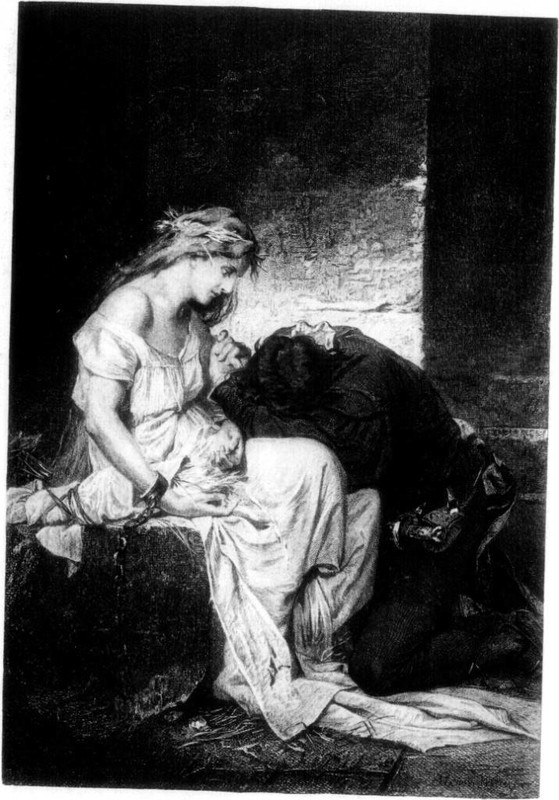
Photogravure from a Drawing by A. Leisen-Mayer.
MARGARET
Delay, now! So fain I stay, when thou delayest!
[Caressing him.
FAUST
Away, now! If longer here thou stayest, We shall be made to dearly rue it.
MARGARET
Kiss me!—canst no longer do it? My friend, so short a time thou 'rt missing, And hast unlearned thy kissing? Why is my heart so anxious, on thy breast? Where once a heaven thy glances did create me, A heaven thy loving words expressed, And thou didst kiss as thou wouldst suffocate me— Kiss me! Or I'll kiss thee!
[She embraces him.
Ah, woe! thy lips are chill, And still. How changed in fashion Thy passion! Who has done me this ill?
[She turns away from him.
FAUST
Come, follow me! My darling, be more bold: I'll clasp thee, soon, with warmth a thousandfold; But follow now! 'Tis all I beg of thee.
MARGARET [turning to him]
And is it thou? Thou, surely, certainly?
FAUST
'Tis I! Come on!
MARGARET
Thou wilt unloose my chain, And in thy lap wilt take me once again. How comes it that thou dost not shrink from me?— Say, dost thou know, my friend, whom thou mak'st free?
FAUST
Come! come! The night already vanisheth.
MARGARET
My mother have I put to death; I've drowned the baby born to thee. Was it not given to thee and me? Thee, too!—'Tis thou! It scarcely true doth seem— Give me thy hand! 'Tis not a dream! Thy dear, dear hand!—But, ah, 'tis wet! Why, wipe it off! Methinks that yet There's blood thereon. Ah, God! what hast thou done? Nay, sheathe thy sword at last! Do not affray me!
FAUST
Oh, let the past be past! Thy words will slay me!
MARGARET
No, no! Thou must outlive us. Now I'll tell thee the graves to give us: Thou must begin to-morrow The work of sorrow! The best place give to my mother, Then close at her side my brother, And me a little away, But not too very far, I pray! And here, on my right breast, my baby lay! Nobody else will lie beside me!— Ah, within thine arms to hide me, That was a sweet and a gracious bliss, But no more, no more can I attain it! I would force myself on thee and constrain it, And it seems thou repellest my kiss: And yet 'tis thou, so good, so kind to see!
FAUST
If thou feelest it is I, then come with me!
MARGARET
Out yonder?
FAUST
To freedom.
MARGARET
If the grave is there, Death lying in wait, then come! From here to eternal rest: No further step—no, no! Thou goest away! O Henry, if I could go!
FAUST
Thou canst! Just will it! Open stands the door.
MARGARET
I dare not go: there's no hope any more. Why should I fly? They'll still my steps waylay! It is so wretched, forced to beg my living, And a bad conscience sharper misery giving! It is so wretched, to be strange, forsaken, And I'd still be followed and taken!
FAUST
I'll stay with thee.
MARGARET
Be quick! Be quick! Save thy perishing child! Away! Follow the ridge Up by the brook, Over the bridge, Into the wood, To the left, where the plank is placed In the pool! Seize it in haste! 'Tis trying to rise, 'Tis struggling still! Save it! Save it!
FAUST
Recall thy wandering will! One step, and thou art free at last!
MARGARET
If the mountain we had only passed! There sits my mother upon a stone,— I feel an icy shiver! There sits my mother upon a stone, And her head is wagging ever. She beckons, she nods not, her heavy head falls o'er; She slept so long that she wakes no more. She slept, while we were caressing: Ah, those were the days of blessing!
FAUST
Here words and prayers are nothing worth; I'll venture, then, to bear thee forth.
MARGARET
No—let me go! I'll suffer no force! Grasp me not so murderously! I've done, else, all things for the love of thee.
FAUST
The day dawns: Dearest! Dearest!
MARGARET
Day? Yes, the day comes,—the last day breaks for me! My wedding day it was to be! Tell no one thou hast been with Margaret! Woe for my garland! The chances Are over—'tis all in vain! We shall meet once again, But not at the dances! The crowd is thronging, no word is spoken: The square below And the streets overflow: The death-bell tolls, the wand is broken. I am seized, and bound, and delivered— Shoved to the block—they give the sign! Now over each neck has quivered The blade that is quivering over mine. Dumb lies the world like the grave!
FAUST
Oh, had I ne'er been born!
MEPHISTOPHELES [appears outside]
Off! or you're lost ere morn. Useless talking, delaying, and praying! My horses are neighing: The morning twilight is near.
MARGARET
What rises up from the threshold here? He! he! suffer him not! What does he want in this holy spot? He seeks me!
FAUST
Thou shalt live.
MARGARET
Judgment of God! myself to thee I give.
MEPHISTOPHELES [to Faust]
Come! or I'll leave her in the lurch, and thee!
MARGARET
Thine am I, Father! rescue me! Ye angels, holy cohorts, guard me, Camp around, and from evil ward me! Henry! I shudder to think of thee.
MEPHISTOPHELES
She is judged!
VOICE [from above]
She is saved!
MEPHISTOPHELES [to Faust]
Hither to me!
[He disappears with Faust.
VOICE [from within, dying away]
Henry! Henry!
The Death of Foust
LEMURES
[Digging with mocking gestures]
In youth when I did love, did love, Methought it was very sweet; When 'twas jolly and merry every way, And I blithely moved my feet.
But now old Age, with his stealing steps, Hath clawed me with his crutch: I stumbled over the door of a grave; Why leave they open such?
FAUST
[Comes forth from the palace, groping his way along the door-posts]
How I rejoice to hear the clattering spade! It is the crowd, for me in service moiling, Till Earth be reconciled to toiling, Till the proud waves be stayed, And the sea girded with a rigid zone.
MEPHISTOPHELES [aside]
And yet thou'rt laboring for us alone, With all thy dikes and bulwarks daring; Since thou for Neptune art preparing— The Ocean Devil—carousal great. In every way shall ye be stranded; The elements with us are banded, And ruin is the certain fate.
FAUST
Overseer!
MEPHISTOPHELES
Here!
FAUST
However possible, Collect a crowd of men with vigor, Spur by indulgence, praise, or rigor,— Reward, allure, conscript, compel! Each day report me, and correctly note How grows in length the undertaken moat.
MEPHISTOPHELES [half aloud]
When they to me the information gave, They spake not of a moat, but of—a grave.
FAUST
Below the hills a marshy plain Infects what I so long have been retrieving; This stagnant pool likewise to drain Were now my latest and my best achieving. To many millions let me furnish soil, Though not secure, yet free to active toil; Green, fertile fields, where men and herds go forth At once, with comfort, on the newest earth, And swiftly settled on the hill's firm base, Created by the bold, industrious race. A land like Paradise here, round about; Up to the brink the tide may roar without, And though it gnaw, to burst with force the limit, By common impulse all unite to hem it. Yes! to this thought I hold with firm persistence; The last result of wisdom stamps it true: He only earns his freedom and existence Who daily conquers them anew. Thus here, by dangers girt, shall glide away Of childhood, manhood, age, the vigorous day: And such a throng I fain would see,— Stand on free soil among a people free! Then dared I hail the Moment fleeing: "Ah, still delay—thou art so fair!" The traces cannot, of mine earthly being, In æons perish,—they are there! In proud fore-feeling of such lofty bliss, I now enjoy the highest Moment,—this!
[Faust sinks back: the Lemures take him and lay him upon the ground.]
MEPHISTOPHELES
No joy could sate him, and suffice no bliss! To catch but shifting shapes was his endeavor: The latest, poorest, emptiest Moment—this,— He wished to hold it fast forever. Me he resisted in such vigorous wise, But Time is lord, on earth the old man lies. The clock stands still—
CHORUS
Stands still! silent as midnight, now! The index falls.
MEPHISTOPHELES
It falls; and it is finished, here!
CHORUS
'Tis past!
MEPHISTOPHELES
Past! a stupid word. If past, then why? Past and pure Naught, complete monotony! What good for us, this endlessly creating?— What is created then annihilating? "And now it's past!" Why read a page so twisted? 'Tis just the same as if it ne'er existed, Yet goes in circles round as if it had, however: I'd rather choose, instead, the Void forever.
The Salvation of Faust
ANGELS
[Soaring in the higher atmosphere, bearing the immortal part of Faust]
The noble spirit now is free, And saved from evil scheming: Whoe'er aspires unweariedly Is not beyond redeeming. And if he feels the grace of love That from on high is given, The blessed hosts, that wait above, Shall welcome him to heaven!
THE YOUNGER ANGELS
They, the roses, freely spended By the penitent, the glorious, Helped to make the fight victorious, And the lofty work is ended. We this precious soul have won us; Evil ones we forced to shun us; Devils fled us when we hit them: 'Stead of pangs of hell, that bit them, Love pangs felt they, sharper, vaster: Even he, old Satan Master, Pierced with keenest pain retreated. Now rejoice! The work's completed!
THE MORE PERFECT ANGELS
Earth's residue to bear Hath sorely pressed us; It were not pure and fair, Though 'twere asbestus. When every element The mind's high forces Have seized, subdued, and blent, No angel divorces Twin natures single grown, That inly mate them: Eternal love alone Can separate them.
THE YOUNGER ANGELS
Mist-like on heights above, We now are seeing Nearer and nearer move Spiritual Being. The clouds are growing clear; And moving throngs appear Of blessed boys, Free from the earthly gloom, In circling poise, Who taste the cheer Of the new springtime bloom Of the upper sphere. Let them inaugurate Him to the perfect state, Now, as their peer!
THE BLESSED BOYS
Gladly receive we now Him, as a chrysalis: Therefore achieve we now Pledge of our bliss. The earth-flakes dissipate That cling around him! See, he is fair and great! Divine Life hath crowned him.
DOCTOR MARIANUS
[In the highest, purest cell]
Free is the view at last, The spirit lifted: There women, floating past, Are upward drifted: The Glorious One therein, With star-crown tender,— The pure, the Heavenly Queen, I know her splendor.
[Enraptured]
Highest Mistress of the World! Let me in the azure Tent of Heaven, in light unfurled, Here thy Mystery measure! Justify sweet thoughts that move Breast of man to meet thee, And with holy bliss of love Bear him up to greet thee! With unconquered courage we Do thy bidding highest; But at once shall gentle be, When thou pacifiest. Virgin, pure in brightest sheen, Mother sweet, supernal,— Unto us Elected Queen, Peer of Gods Eternal! Light clouds are circling Around her splendor,— Penitent women Of natures tender, Her knees embracing, Ether respiring, Mercy requiring! Thou, in immaculate ray, Mercy not leavest, And the lightly led astray, Who trust thee, receivest! In their weakness fallen at length, Hard it is to save them: Who can crush, by native strength, Vices that enslave them? Whose the foot that may not slip On the surface slanting? Whom befool not eye and lip, Breath and voice enchanting?
The Mater Gloriosa soars into the space
CHORUS OF WOMEN PENITENTS
To heights thou'rt speeding Of endless Eden: Receive our pleading, Transcendent Maiden, With mercy laden!
Magna Peccatrix [St. Luke, vii. 36]
By the love before him kneeling,— Him, thy Son, a Godlike vision; By the tears like balsam stealing, Spite of Pharisees' derision; By the box, whose ointment precious Shed its spice and odors cheery; By the locks, whose softest meshes Dried the holy feet and weary!—
MULIER SAMARITANA [St. John, iv.]
By that well, the ancient station Whither Abram's flocks were driven; By the jar, whose restoration To the Savior's lips was given; By the fountain pure and vernal, Thence its present bounty spending,— Overflowing, bright, eternal, Watering the worlds unending!—
MARIA ÆGYPTIACA [Acta Sanctorum]
By the place where the immortal Body of the Lord hath lain; By the arm which, from the portal, Warning, thrust me back again; By the forty years' repentance In the lonely desert land; By the blissful farewell sentence Which I wrote upon the sand!—
THE THREE
Thou thy presence not deniest Unto sinful women ever,— Liftest them to win the highest Gain of penitent endeavor,— So, from this good soul withdraw not— Who but once forgot, transgressing, Who her loving error saw not— Pardon adequate, and blessing!
UNA PŒNITENTIUM
[Formerly named Margaret, stealing closer]
Incline, O Maiden, With mercy laden, In light unfading, Thy gracious countenance upon my bliss! My loved, my lover, His trials over In yonder world, returns to me in this!
BLESSED BOYS
[Approaching in hovering circles]
With mighty limbs he towers Already above us; He, for this love of ours, Will richlier love us. Early were we removed, Ere Life could reach us; Yet he hath learned and proved, And he will teach us.
THE PENITENT
[Formerly named Margaret]
The spirit choir around him seeing, New to himself, he scarce divines His heritage of new-born Being, When like the Holy Host he shines. Behold, how he each band hath cloven The earthly life had round him thrown, And through his garb, of ether woven, The early force of youth is shown! Vouchsafe to me that I instruct him! Still dazzles him the Day's new glare.
MATER GLORIOSA
Rise thou to higher spheres! Conduct him, Who, feeling thee, shall follow there!
DOCTOR MARIANUS
[Prostrate, adoring]
Penitents, look up, elate. Where she beams salvation; Gratefully to blessed fate Grow, in re-creation! Be our souls, as they have been, Dedicate to thee! Virgin Holy, Mother, Queen, Goddess, gracious be!
CHORUS MYSTICUS
All things transitory But as symbols are sent: Earth's insufficiency Here grows to Event: The Indescribable, Here it is done: The Woman Soul leadeth us Upward and on!
MIGNON'S LOVE AND LONGING
From 'Wilhelm Meister's Apprenticeship.' Carlyle's Translation
Nothing is more touching than the first disclosure of a love which has been nursed in silence; of a faith grown strong in secret, and which at last comes forth in the hour of need and reveals itself to him who formerly has reckoned it of small account. The bud which had been closed so long and firmly was now ripe to burst its swathings, and Wilhelm's heart could never have been readier to welcome the impressions of affection.
She stood before him, and noticed his disquietude. "Master!" she cried, "if thou art unhappy, what will become of Mignon?" "Dear little creature," said he, taking her hands, "thou too art part of my anxieties. I must go hence." She looked at his eyes, glistening with restrained tears, and knelt down with vehemence before him. He kept her hands; she laid her head upon his knees, and remained quite still. He played with her hair, patted her, and spoke kindly to her. She continued motionless for a considerable time. At last he felt a sort of palpitating movement in her, which began very softly, and then by degrees, with increasing violence, diffused itself over all her frame. "What ails thee, Mignon?" cried he; "what ails thee?" She raised her little head, looked at him, and all at once laid her hand upon her heart, with the countenance of one repressing the utterance of pain. He raised her up, and she fell upon his breast; he pressed her towards him, and kissed her. She replied not by any pressure of the hand, by any motion whatever. She held firmly against her heart; and all at once gave a cry, which was accompanied by spasmodic movements of the body. She started up, and immediately fell down before him, as if broken in every joint. It was an excruciating moment! "My child!" cried he, raising her up and clasping her fast,—"my child, what ails thee?" The palpitations continued, spreading from the heart over all the lax and powerless limbs; she was merely hanging in his arms. All at once she again became quite stiff, like one enduring the sharpest corporeal agony; and soon with a new vehemence all her frame once more became alive, and she threw herself about his neck, like a bent spring that is closing; while in her soul, as it were, a strong rent took place, and at the same moment a stream of tears flowed from her shut eyes into his bosom. He held her fast. She wept, and no tongue can express the force of these tears. Her long hair had loosened, and was hanging down before her; it seemed as if her whole being was melting incessantly into a brook of tears. Her rigid limbs were again become relaxed; her inmost soul was pouring itself forth; in the wild confusion of the moment, Wilhelm was afraid she would dissolve in his arms, and leave nothing there for him to grasp. He held her faster and faster. "My child!" cried he, "my child! thou art indeed mine, if that word can comfort thee. Thou art mine! I will keep thee, I will never forsake thee!" Her tears continued flowing. At last she raised herself; a faint gladness shone upon her face. "My father!" cried she, "thou wilt not forsake me? Wilt be my father? I am thy child!"
Softly, at this moment, the harp began to sound before the door; the old man brought his most affecting songs as an evening offering to our friend, who, holding his child ever faster in his arms, enjoyed the most pure and undescribable felicity.
Know'st thou the land where citron-apples bloom, And oranges like gold in leafy gloom, A gentle wind from deep-blue heaven blows, The myrtle thick, and high the laurel grows? Know'st thou it then? 'Tis there! Tis there, O my true loved one, thou with me must go!
Know'st thou the house, its porch with pillars tall? The rooms do glitter, glitters bright the hall, And marble statues stand, and look each one: What's this, poor child, to thee they've done? Know'st thou it then? 'Tis there! 'Tis there, O my protector, thou with me must go!
"Know'st thou the hill, the bridge that hangs on cloud? The mules in mist grope o'er the torrent loud, In caves lie coiled the dragon's ancient brood, The crag leaps down, and over it the flood: Know'st thou it then? 'Tis there! 'Tis there Our way runs: O my father, wilt thou go?"
Next morning, on looking for Mignon about the house, Wilhelm did not find her, but was informed that she had gone out early with Melina, who had risen betimes to receive the wardrobe and other apparatus of his theatre.
After the space of some hours, Wilhelm heard the sound of music before his door. At first he thought it was the harper come again to visit him; but he soon distinguished the tones of a cithern, and the voice which began to sing was Mignon's. Wilhelm opened the door; the child came in, and sang him the song we have just given above.
The music and general expression of it pleased our friend extremely, though he could not understand all the words. He made her once more repeat the stanzas, and explain them; he wrote them down, and translated them into his native language. But the originality of its turns he could imitate only from afar: its childlike innocence of expression vanished from it in the process of reducing its broken phraseology to uniformity, and combining its disjointed parts. The charm of the tune, moreover, was entirely incomparable.
She began every verse in a stately and solemn manner, as if she wished to draw attention towards something wonderful, as if she had something weighty to communicate. In the third line, her tones became deeper and gloomier; the "Know'st thou it then?" was uttered with a show of mystery and eager circumspectness; in the "'Tis there! 'Tis there!" lay a boundless longing; and her "With me must go!" she modified at each repetition, so that now it appeared to entreat and implore, now to impel and persuade.
On finishing her song for the second time, she stood silent for a moment, looked keenly at Wilhelm, and asked him, "Know'st thou the land?" "It must mean Italy," said Wilhelm: "where didst thou get the little song?" "Italy!" said Mignon, with an earnest air. "If thou go to Italy, take me along with thee; for I am too cold here." "Hast thou been there already, little dear?" said Wilhelm. But the child was silent, and nothing more could be got out of her.
WILHELM MEISTER'S INTRODUCTION TO SHAKESPEARE
From 'Wilhelm Meister's Apprenticeship.' Carlyle's Translation
"Have you never," said Jarno, taking him aside, "read one of Shakespeare's plays?"
"No," replied Wilhelm: "since the time when they became more known in Germany, I have myself grown unacquainted with the theatre; and I know not whether I should now rejoice that an old taste and occupation of my youth, has been by chance renewed. In the mean time, all that I have heard of these plays has excited little wish to become acquainted with such extraordinary monsters, which appear to set probability and dignity alike at defiance."
"I would advise you," said the other, "to make a trial, notwithstanding: it can do one no harm to look at what is extraordinary with one's own eyes. I will lend you a volume or two; and you cannot better spend your time than by casting everything aside, and retiring to the solitude of your old habitation, to look into the magic lantern of that unknown world. It is sinful of you to waste your hours in dressing out these apes to look more human, and teaching dogs to dance. One thing only I require,—you must not cavil at the form; the rest I can leave to your own good sense and feeling."
The horses were standing at the door; and Jarno mounted with some other cavaliers, to go and hunt. Wilhelm looked after him with sadness. He would fain have spoken much with this man who though in a harsh, unfriendly way, gave him new ideas,—ideas that he had need of.
Oftentimes a man, when approaching some development of his powers, capacities, and conceptions, gets into a perplexity from which a prudent friend might easily deliver him. He resembles a traveler, who, at but a short distance from the inn he is to rest at, falls into the water: were any one to catch him then and pull him to the bank, with one good wetting it were over; whereas, though he struggles out himself, it is often at the side where he tumbled in, and he has to make a wide and weary circuit before reaching his appointed object.
Wilhelm now began to have an inkling that things went forward in the world differently from what he had supposed. He now viewed close at hand the solemn and imposing life of the great and distinguished, and wondered at the easy dignity which they contrived to give it. An army on its march, a princely hero at the head of it, such a multitude of co-operating warriors, such a multitude of crowding worshipers, exalted his imagination. In this mood he received the promised books; and ere long, as may be easily supposed, the stream of that mighty genius laid hold of him and led him down to a shoreless ocean, where he soon completely forgot and lost himself....
Wilhelm had scarcely read one or two of Shakespeare's plays, till their effect on him became so strong that he could go no further. His whole soul was in commotion. He sought an opportunity to speak with Jarno; to whom, on meeting with him, he expressed his boundless gratitude for such delicious entertainment.
"I clearly enough foresaw," said Jarno, "that you would not remain insensible to the charms of the most extraordinary and most admirable of all writers."
"Yes!" exclaimed our friend: "I cannot recollect that any book, any man, any incident of my life, has produced such important effects on me, as the precious works to which by your kindness I have been directed. They seem as if they were performances of some celestial genius descending among men, to make them by the mildest instructions acquainted with themselves. They are no fictions! You would think, while reading them, you stood before the inclosed awful Books of Fate, while the whirlwind of most impassioned life was howling through the leaves, and tossing them fiercely to and fro. The strength and tenderness, the power and peacefulness of this man, have so astonished and transported me, that I long vehemently for the time when I shall have it in my power to read further."
"Bravo!" said Jarno, holding out his hand, and squeezing our friend's. "This is as it should be! And the consequences which I hope for will likewise surely follow."
"I wish," said Wilhelm, "I could but disclose to you all that is going on within me even now. All the anticipations I have ever had regarding man and his destiny, which have accompanied me from youth upwards often unobserved by myself, I find developed and fulfilled in Shakespeare's writings. It seems as if he cleared up every one of our enigmas to us, though we cannot say, Here or there is the word of solution. His men appear like natural men, and yet they are not. These, the most mysterious and complex productions of creation, here act before us as if they were watches, whose dial-plates and cases were of crystal, which pointed out according to their use the course of the hours and minutes; while at the same time you could discern the combination of wheels and springs that turn them. The few glances I have cast over Shakespeare's world incite me, more than anything beside, to quicken my footsteps forward into the actual world, to mingle in the flood of destinies that is suspended over it; and at length, if I shall prosper, to draw a few cups from the great ocean of true nature, and to distribute them from off the stage among the thirsting people of my native land."
WILHELM MEISTER'S ANALYSIS OF HAMLET
From 'Wilhelm Meister's Apprenticeship'
Seeing the company so favorably disposed, Wilhelm now hoped he might further have it in his power to converse with them on the poetic merit of the pieces which might come before them. "It is not enough," said he next day, when they were all again assembled, "for the actor merely to glance over a dramatic work, to judge of it by his first impression, and thus without investigation to declare his satisfaction or dissatisfaction with it. Such things may be allowed in a spectator, whose purpose it is rather to be entertained and moved than formally to criticize. But the actor, on the other hand, should be prepared to give a reason for his praise or censure: and how shall he do this if he have not taught himself to penetrate the sense, the views, and feelings of his author? A common error is, to form a judgment of a drama from a single part in it; and to look upon this part itself in an isolated point of view, not in its connection with the whole. I have noticed this within a few days so clearly in my own conduct, that I will give you the account as an example, if you please to hear me patiently.
"You all know Shakespeare's incomparable 'Hamlet': our public reading of it at the Castle yielded every one of us the greatest satisfaction. On that occasion we proposed to act the piece; and I, not knowing what I undertook, engaged to play the Prince's part. This I conceived that I was studying, while I began to get by heart the strongest passages, the soliloquies, and those scenes in which force of soul, vehemence, and elevation of feeling have the freest scope; where the agitated heart is allowed to display itself with touching expressiveness.
"I further conceived that I was penetrating quite into the spirit of the character, while I endeavored as it were to take upon myself the load of deep melancholy under which my prototype was laboring, and in this humor to pursue him through the strange labyrinths of his caprices and his singularities. Thus learning, thus practicing, I doubted not but I should by-and-by become one person with my hero.
"But the farther I advanced, the more difficult did it become for me to form any image of the whole, in its general bearings; till at last it seemed as if impossible. I next went through the entire piece, without interruption; but here too I found much that I could not away with. At one time the characters, at another time the manner of displaying them, seemed inconsistent; and I almost despaired of finding any general tint, in which I might present my whole part with all its shadings and variations. In such devious paths I toiled, and wandered long in vain; till at length a hope arose that I might reach my aim in quite a new way.
"I set about investigating every trace of Hamlet's character, as it had shown itself before his father's death: I endeavored to distinguish what in it was independent of this mournful event; independent of the terrible events that followed; and what most probably the young man would have been, had no such thing occurred.
"Soft, and from a noble stem, this royal flower had sprung up under the immediate influences of majesty; the idea of moral rectitude with that of princely elevation, the feeling of the good and dignified with the consciousness of high birth, had in him been unfolded simultaneously. He was a prince, by birth a prince; and he wished to reign, only that good men might be good without obstruction. Pleasing in form, polished by nature, courteous from the heart, he was meant to be the pattern of youth and the joy of the world.
"Without any prominent passion, his love for Ophelia was a still presentiment of sweet wants. His zeal in knightly accomplishments was not entirely his own; it needed to be quickened and inflamed by praise bestowed on others for excelling in them. Pure in sentiment, he knew the honorable-minded, and could prize the rest which an upright spirit tastes on the bosom of a friend. To a certain degree, he had learned to discern and value the good and the beautiful in arts and sciences; the mean, the vulgar was offensive to him: and if hatred could take root in his tender soul, it was only so far as to make him properly despise the false and changeful insects of a court, and play with them in easy scorn. He was calm in his temper, artless in his conduct, neither pleased with idleness nor too violently eager for employment. The routine of a university he seemed to continue when at court. He possessed more mirth of humor than of heart; he was a good companion, pliant, courteous, discreet, and able to forget and forgive an injury, yet never able to unite himself with those who overstept the limits of the right, the good, and the becoming.
"When we read the piece again, you shall judge whether I am yet on the proper track. I hope at least to bring forward passages that shall support my opinion in its main points."
This delineation was received with warm approval; the company imagined they foresaw that Hamlet's manner of proceeding might now be very satisfactorily explained; they applauded this method of penetrating into the spirit of a writer. Each of them proposed to himself to take up some piece, and study it on these principles, and so unfold the author's meaning ....
Loving Shakespeare as our friend did, he failed not to lead round the conversation to the merits of that dramatist. Expressing, as he entertained, the liveliest hopes of the new epoch which these exquisite productions must form in Germany, he ere long introduced his 'Hamlet,' who had busied him so much of late.
Serlo declared that he would long ago have played the piece, had this been possible, and that he himself would willingly engage to act Polonius. He added with a smile, "An Ophelia too will certainly turn up, if we had but a Prince."
Wilhelm did not notice that Aurelia seemed a little hurt at her brother's sarcasm. Our friend was in his proper vein, becoming copious and didactic, expounding how he would have 'Hamlet' played. He circumstantially delivered to his hearers the opinions we before saw him busied with; taking all the trouble possible to make his notion of the matter acceptable, skeptical as Serlo showed himself regarding it. "Well then," said the latter finally, "suppose we grant you all this, what will you explain by it?"
"Much, everything," said Wilhelm. "Conceive a prince such as I have painted him, and that his father suddenly dies. Ambition and the love of rule are not the passions that inspire him. As a king's son, he would have been contented; but now he is first constrained to consider the difference which separates a sovereign from a subject. The crown was not hereditary; yet a longer possession of it by his father would have strengthened the pretensions of an only son, and secured his hopes of the succession. In place of this, he now beholds himself excluded by his uncle, in spite of specious promises, most probably forever. He is now poor in goods and favor, and a stranger in the scene which from youth he had looked upon as his inheritance. His temper here assumes its first mournful tinge. He feels that now he is not more, that he is less, than a private nobleman; he offers himself as the servant of every one; he is not courteous and condescending, he is needy and degraded.
"His past condition he remembers as a vanished dream. It is in vain that his uncle strives to cheer him, to present his situation in another point of view. The feeling of his nothingness will not leave him.
"The second stroke that came upon him wounded deeper, bowed still more. It was the marriage of his mother. The faithful tender son had yet a mother, when his father passed away. He hoped in the company of his surviving, noble-minded parent, to reverence the heroic form of the departed; but his mother too he loses, and it is something worse than death that robs him of her. The trustful image which a good child loves to form of its parents is gone. With the dead there is no help; on the living no hold. She also is a woman, and her name is Frailty, like that of all her sex.
"Now first does he feel himself completely bent and orphaned; and no happiness of life can repay what he has lost. Not reflective or sorrowful by nature, reflection and sorrow have become for him a heavy obligation. It is thus that we see him first enter on the scene. I do not think that I have mixed aught foreign with the piece, or overcharged a single feature of it."
Serlo looked at his sister and said, "Did I give thee a false picture of our friend? He begins well; he has still many things to tell us, many to persuade us of." Wilhelm asseverated loudly that he meant not to persuade but to convince; he begged for another moment's patience.
"Figure to yourselves this youth," cried he, "this son of princes; conceive him vividly, bring his state before your eyes, and then observe him when he learns that his father's spirit walks; stand by him in the terrors of the night, when the venerable ghost itself appears before him. A horrid shudder passes over him; he speaks to the mysterious form; he sees it beckon him; he follows it, and hears. The fearful accusation of his uncle rings in his ears; the summons to revenge, and the piercing oft-repeated prayer, Remember me!
"And when the ghost has vanished, who is it that stands before us? A young hero panting for vengeance? A prince by birth, rejoicing to be called to punish the usurper of his crown? No! trouble and astonishment take hold of the solitary young man; he grows bitter against smiling villains, swears that he will not forget the spirit, and concludes with the significant ejaculation:—
"'The time is out of joint: O cursed spite, That ever I was born to set it right!'
"In these words, I imagine, will be found the key to Hamlet's whole procedure. To me it is clear that Shakespeare meant, in the present case, to represent the effects of a great action laid upon a soul unfit for the performance of it. In this view the whole piece seems to me to be composed. There is an oak-tree planted in a costly jar, which should have borne only pleasant flowers in its bosom; the roots expand, the jar is shivered.
"A lovely, pure, noble, and most moral nature, without the strength of nerve which forms a hero, sinks beneath a burden which it cannot bear and must not cast away. All duties are holy for him; the present is too hard. Impossibilities have been required of him, not in themselves impossibilities, but such for him. He winds, and turns, and torments himself; he advances and recoils; is ever put in mind, ever puts himself in mind; at last does all but lose his purpose from his thoughts; yet still without recovering his peace of mind."
Aurelia seemed to give but little heed to what was passing; at last she conducted Wilhelm to another room, and going to the window, and looking out at the starry sky she said to him, "You have still much to tell us about Hamlet; I will not hurry you; my brother must hear it as well as I; but let me beg to know your thoughts about Ophelia."
"Of her there cannot much be said," he answered; "for a few master strokes complete her character. The whole being of Ophelia floats in sweet and ripe sensation. Kindness for the Prince, to whose hand she may aspire, flows so spontaneously, her tender heart obeys its impulses so unresistingly, that both father and brother are afraid; both give her warning harshly and directly. Decorum, like the thin lawn upon her bosom, cannot hide the soft, still movements of her heart; it on the contrary betrays them. Her fancy is smit; her silent modesty breathes amiable desire; and if the friendly goddess Opportunity should shake the tree, its fruit would fall."
"And then," said Aurelia, "when she beholds herself forsaken, cast away, despised; when all is inverted in the soul of her crazed lover, and the highest changes to the lowest, and instead of the sweet cup of love he offers her the bitter cup of woe—"
"Her heart breaks," cried Wilhelm; "the whole structure of her being is loosened from its joinings; her father's death strikes fiercely against it; and the fair edifice altogether crumbles into fragments...."
Serlo, at this moment entering, inquired about his sister; and looking in the book which our friend had hold of, cried, "So you are again at 'Hamlet'? Very good! Many doubts have arisen in me, which seem not a little to impair the canonical aspect of the piece as you would have it viewed. The English themselves have admitted that its chief interest concludes with the third act; the last two lagging sorrily on, and scarcely uniting with the rest: and certainly about the end it seems to stand stock still."
"It is very possible," said Wilhelm, "that some individuals of a nation which has so many masterpieces to feel proud of, may be led by prejudice and narrowness of mind to form false judgments; but this cannot hinder us from looking with our own eyes, and doing justice where we see it due. I am very far from censuring the plan of 'Hamlet': on the other hand, I believe there never was a grander one invented; nay, it is not invented, it is real."
"How do you demonstrate that?" inquired Serlo.
"I will not demonstrate anything," said Wilhelm; "I will merely show you what my own conceptions of it are."
Aurelia rose up from her cushion, leaned upon her hand, and looked at Wilhelm; who, with the firmest assurance that he was in the right, went on as follows:—
"It pleases us, it flatters us to see a hero acting on his own strength; loving and hating as his heart directs him; undertaking and completing; casting every obstacle aside; and at length attaining some great object which he aimed at. Poets and historians would willingly persuade us that so proud a lot may fall to man. In 'Hamlet' we are taught another lesson: the hero is without a plan, but the piece is full of plan. Here we have no villain punished on some self-conceived and rigidly accomplished scheme of vengeance: a horrid deed occurs; it rolls itself along with all its consequences, dragging guiltless persons also in its course; the perpetrator seems as if he would evade the abyss which is made ready for him, yet he plunges in, at the very point by which he thinks he shall escape and happily complete his course.
"For it is the property of crime to extend its mischief over innocence, as it is of virtue to extend its blessings over many that deserve them not; while frequently the author of the one or of the other is not punished or rewarded at all. Here in this play of ours, how strange! The Pit of Darkness sends its spirit and demands revenge; in vain! All circumstances tend one way, and hurry to revenge; in vain! Neither earthly nor infernal thing may bring about what is reserved for Fate alone. The hour of judgment comes: the wicked falls with the good; one race is mowed away, that another may spring up."
After a pause, in which they looked at one another, Serlo said: "You pay no great compliment to Providence, in thus exalting Shakespeare; and besides, it appears to me that for the honor of your poet, as others for the honor of Providence, you ascribe to him an object and a plan which he himself had never thought of."
"Let me also put a question," said Aurelia. "I have looked at Ophelia's part again; I am contented with it, and conceive that under certain circumstances I could play it. But tell me, should not the poet have furnished the insane maiden with another sort of songs? Could not one select some fragments out of melancholy ballads for this purpose? What have double meanings and lascivious insipidities to do in the mouth of such a noble-minded person?"
"Dear friend," said Wilhelm, "even here I cannot yield you one iota. In these singularities, in this apparent impropriety, a deep sense is hid. Do we not understand from the very first what the mind of the good soft-hearted girl was busied with? Silently she lived within herself, yet she scarce concealed her wishes, her longing; the tones of desire were in secret ringing through her soul; and how often may she have attempted, like an unskillful nurse, to lull her senses to repose with songs which only kept them more awake? But at last, when her self-command is altogether gone, when the secrets of her heart are hovering on her tongue, that tongue betrays her; and in the innocence of insanity she solaces herself, unmindful of king or queen, with the echo of her loose and well-beloved songs, 'Tomorrow is Saint Valentine's Day,' and 'By Gis and by Saint Charity.'
"I am much mistaken," cried he, "if I have not now discovered how the whole is to be managed; nay, I am convinced that Shakespeare himself would have arranged it so, had not his mind been too exclusively directed to the ruling interest, and perhaps misled by the novels which furnished him with his materials."
"Let us hear," said Serlo, placing himself with an air of solemnity upon the sofa; "I will listen calmly, but judge with rigor."
"I am not afraid of you," said Wilhelm; "only hear me. In the composition of this play, after the most accurate investigation and the most mature reflection, I distinguish two classes of objects. The first are the grand internal relations of the persons and events, the powerful effects which arise from the characters and proceedings of the main figures: these, I hold, are individually excellent, and the order in which they are presented cannot be improved. No kind of interference must be suffered to destroy them, or even essentially to change their form. These are the things which stamp themselves deep into the soul; which all men long to see, which no one dares to meddle with. Accordingly, I understand, they have almost wholly been retained in all our German theatres.
"But our countrymen have erred, in my opinion, with regard to the second class of objects which may be observed in this tragedy: I allude to the external relations of the persons, whereby they are brought from place to place, or combined in various ways by certain accidental incidents. These they have looked upon as very unimportant; have spoken of them only in passing, or left them out altogether. Now indeed it must be owned that these threads are slack and slender; yet they run through the entire piece, and bind together much that would otherwise fall asunder, and does actually fall asunder when you cut them off, and imagine you have done enough and more if you have left the ends hanging.
"Among these external relations I include the disturbances in Norway, the war with young Fortinbras, the embassy to his uncle, the settling of that feud, the march of young Fortinbras to Poland, and his coming back at the end; of the same sort are Horatio's return from Wittenberg, Hamlet's wish to go thither, the journey of Laertes to France, his return, the dispatch of Hamlet into England, his capture by pirates, the death of the two courtiers by the letter which they carried. All these circumstances and events would be very fit for expanding and lengthening a novel; but here they injure exceedingly the unity of the piece,—particularly as the hero had no plan,—and are in consequence entirely out of place."
"For once in the right!" cried Serlo.
"Do not interrupt me," answered Wilhelm; "perhaps you will not always think me right. These errors are like temporary props of an edifice; they must not be removed till we have built a firm wall in their stead. My project therefore is, not at all to change those first-mentioned grand situations, or at least as much as possible to spare them, both collectively and individually; but with respect to these external, single, dissipated, and dissipating motives, to cast them all at once away, and substitute a solitary one instead of them."
"And this?" inquired Serlo, springing up from his recumbent posture.
"It lies in the piece itself," answered Wilhelm, "only I employ it rightly. There are disturbances in Norway. You shall hear my plan and try it.
"After the death of Hamlet the father, the Norwegians, lately conquered, grow unruly. The viceroy of that country sends his son Horatio, an old school friend of Hamlet's, and distinguished above every other for his bravery and prudence, to Denmark, to press forward the equipment of the fleet, which under the new luxurious King proceeds but slowly. Horatio has known the former King, having fought in his battles, having even stood in favor with him; a circumstance by which the first ghost scene will be nothing injured. The new sovereign gives Horatio audience, and sends Laertes into Norway with intelligence that the fleet will soon arrive, whilst Horatio is commissioned to accelerate the preparation of it; and the Queen, on the other hand, will not consent that Hamlet, as he wishes, should go to sea along with him."
"Heaven be praised!" cried Serlo; "we shall now get rid of Wittenberg and the university, which was always a sorry piece of business. I think your idea extremely good: for except these two distant objects, Norway and the fleet, the spectator will not be required to fancy anything: the rest he will see; the rest takes place before him; whereas his imagination, on the other plan, was hunted over all the world."
"You easily perceive," said Wilhelm, "how I shall contrive to keep the other parts together. When Hamlet tells Horatio of his uncle's crime, Horatio counsels him to go to Norway in his company, to secure the affections of the army, and return in war-like force. Hamlet also is becoming dangerous to the King and Queen; they find no readier method of deliverance than to send him in the fleet, with Rosencrantz and Guildenstern to be spies upon him: and as Laertes in the mean time comes from France, they determine that this youth, exasperated even to murder, shall go after him. Unfavorable winds detain the fleet; Hamlet returns: for his wandering through the church-yard perhaps some lucky motive may be thought of; his meeting with Laertes in Ophelia's grave is a grand moment, which we must not part with. After this, the King resolves that it is better to get quit of Hamlet on the spot: the festival of his departure, the pretended reconcilement with Laertes, are now solemnized; on which occasion knightly sports are held, and Laertes fights with Hamlet. Without the four corpses I cannot end the piece; not one of them can possibly be left. The right of popular election now again comes in force, and Hamlet gives his dying voice for Horatio."
"Quick! quick!" said Serlo; "sit down and work the piece; your plan has my entire approbation; only do not let your zeal for it evaporate." ...
Wilhelm had already been for some time busied with translating Hamlet; making use, as he labored, of Wieland's spirited performance, by means of which he had first become acquainted with Shakespeare. What in Wieland's work had been omitted he replaced; and he had at length procured himself a complete version, at the very time when Serlo and he finally agreed about the way of treating it. He now began, according to his plan, to cut out and insert, to separate and unite, to alter and often to restore; for satisfied as he was with his own conception, it still appeared to him as if in executing it he were but spoiling the original.
So soon as all was finished, he read his work to Serlo and the rest. They declared themselves exceedingly contented with it; Serlo in particular made many flattering observations.
"You have felt very justly," said he, among other things, "that some external circumstances must accompany this piece; but that they must be simpler than those which the great poet has employed. What takes place without the theatre—what the spectator does not see, but must imagine for himself—is like a background, in front of which the acting figures move. Your large and simple prospect of the fleet and Norway will very much improve the piece; if this were altogether taken from it, we should have but a family scene remaining; and the great idea, that here a kingly house by internal crimes and incongruities goes down to ruin, would not be presented with its proper dignity. But if the former background were left standing, so manifold, so fluctuating and confused, it would hurt the impression of the figures."
Wilhelm again took Shakespeare's part: alleging that he wrote for islanders, for Englishmen, who generally, in the distance, were accustomed to see little else than ships and voyages, the coast of France and privateers; and thus what perplexed and distracted others was to them quite natural.
Serlo assented; and both of them were of opinion that as the piece was now to be produced upon the German stage, this more serious and simple background was the best adapted for the German mind.
The parts had been distributed before: Serlo undertook Polonius; Aurelia undertook Ophelia; Laertes was already designated by his name; a young, thick-set, jolly new-comer was to be Horatio; the King and the Ghost alone occasioned some perplexity. For both of these was no one but Old Boisterous remaining. Serlo proposed to make the Pedant King; but against this our friend protested in the strongest terms. They could resolve on nothing.
Wilhelm also had allowed both Rosencrantz and Guildenstern to continue in his piece. "Why not compress them into one?" said Serlo. "This abbreviation will not cost you much."
"Heaven keep me from such curtailments!" answered Wilhelm; "they destroy at once the sense and the effect. What these two persons are and do it is impossible to represent by one. In such small matters we discover Shakespeare's greatness. These soft approaches, this smirking and bowing, this assenting, wheedling, flattering, this whisking agility, this wagging of the tail, this allness and emptiness, this legal knavery, this ineptitude and insipidity,—how can they be expressed by a single man? There ought to be at least a dozen of these people if they could be had, for it is only in society that they are anything; they are society itself; and Shakespeare showed no little wisdom and discernment in bringing in a pair of them. Besides, I need them as a couple that may be contrasted with the single, noble, excellent Horatio."
THE INDENTURE
From 'Wilhelm Meister's Apprenticeship'
Art is long, life short, judgment difficult, opportunity transient. To act is easy, to think is hard; to act according to our thought is troublesome. Every beginning is cheerful; the threshold is the place of expectation. The boy stands astonished, his impressions guide him; he learns sportfully, seriousness comes on him by surprise. Imitation is born with us; what should be imitated is not easy to discover. The excellent is rarely found, more rarely valued. The height charms us, the steps to it do not; with the summit in our eye, we love to walk along the plain. It is but a part of art that can be taught; the artist needs it all. Who knows it half, speaks much and is always wrong; who knows it wholly, inclines to act and speaks seldom or late. The former have no secrets and no force; the instruction they can give is like baked bread, savory and satisfying for a single day; but flour cannot be sown, and seed corn ought not to be ground. Words are good, but they are not the best. The best is not to be explained by words. The spirit in which we act is the highest matter. Action can be understood and again represented by the spirit alone. No one knows what he is doing while he acts aright; but of what is wrong we are always conscious. Whoever works with symbols only is a pedant, a hypocrite, or a bungler. There are many such, and they like to be together. Their babbling detains the scholar; their obstinate mediocrity vexes even the best. The instruction which the true artist gives us opens the mind; for where words fail him, deeds speak. The true scholar learns from the known to unfold the unknown, and approaches more and more to being a master.
THE HARPER'S SONGS
From 'Wilhelm Meister's Apprenticeship'
"What notes are those without the wall, Across the portal sounding? Let's have the music in our hall, Back from its roof rebounding." So spoke the king: the henchman flies; His answer heard, the monarch cries, "Bring in that ancient minstrel."
"Hail, gracious king, each noble knight! Each lovely dame, I greet you! What glittering stars salute my sight! What heart unmoved may meet you! Such lordly pomp is not for me, Far other scenes my eyes must see: Yet deign to list my harping."
The singer turns him to his art, A thrilling strain he raises; Each warrior hears with glowing heart And on his loved one gazes. The king, who liked his playing well, Commands, for such a kindly spell, A golden chain be given him.
"The golden chain give not to me: Thy boldest knight may wear it, Who 'cross the battle's purple sea On lion breast may bear it; Or let it be thy chancellor's prize, Amid his heaps to feast his eyes,— Its yellow glance will please him.
"I sing but as the linnet sings, That on the green bough dwelleth; A rich reward his music brings, As from his throat it swelleth: Yet might I ask, I'd ask of thine One sparkling draught of purest wine To drink it here before you."
He viewed the wine, he quaffed it up: "O draught of sweetest savor! O happy house, where such a cup Is thought a little favor! If well you fare, remember me, And thank kind Heaven, from envy free, As now for this I thank you."
Who never ate his bread in sorrow, Who never spent the darksome hours Weeping and watching for the morrow,— He knows ye not, ye gloomy Powers.
To earth, this weary earth, ye bring us, To guilt ye let us heedless go, Then leave repentance fierce to wring us; A moment's guilt, an age of woe!
MIGNON'S SONG
From 'Wilhelm Meister's Apprenticeship'
Such let me seem, till such I be; Take not my snow-white dress away! Soon from this dusk of earth I flee, Up to the glittering lands of day.
There first a little space I rest, Then wake so glad, to scenes so kind; In earthly robes no longer drest, This band, this girdle left behind.
And those calm shining sons of morn, They ask not who is maid or boy; No robes, no garments there are worn, Our body pure from sin's alloy.
Through little life not much I toiled, Yet anguish long this heart has wrung, Untimely woe my blossoms spoiled: Make me again forever young!
PHILINA'S SONG
From 'Wilhelm Meister's Apprenticeship'
Sing me not with such emotion How the night so lonesome is; Pretty maids, I've got a notion It is the reverse of this.
For as wife and man are plighted, And the better half the wife, So is night to day united,— Night's the better half of life.
Can you joy in bustling daytime,— Day, when none can get his will? It is good for work, for haytime; For much other it is ill.
But when in the nightly glooming, Social lamp on table glows, Face for faces dear illuming, And such jest and joyance goes;
When the fiery pert young fellow, Wont by day to run or ride, Whispering now some tale would tell O,— All so gentle by your side;
When the nightingale to lovers Lovingly her songlet sings, Which for exiles and sad rovers Like mere woe and wailing rings;
With a heart how lightsome-feeling Do ye count the kindly clock, Which, twelve times deliberate pealing, Tells you none to-night shall knock!
Therefore, on all fit occasions, Mark it, maidens, what I sing: Every day its own vexations, And the night its joys will bring.
PROMETHEUS
Blacken thy heavens, Jove, With thunder-clouds, And exercise thee, like a boy Who thistles crops, With smiting oaks and mountain-tops: Yet must leave me standing My own firm earth; Must leave my cottage, which thou didst not build, And my warm hearth, Whose cheerful glow Thou enviest me.
I know naught more pitiful Under the sun, than you, gods! Ye nourish scantily With altar taxes And with cold lip-service, This your majesty;— Would perish, were not Children and beggars Credulous fools.
When I was a child, And knew not whence or whither, I would turn my 'wildered eye To the sun, as if up yonder were An ear to hear to my complaining—A heart, like mine, On the oppressed to feel compassion.
Who helped me When I braved the Titans' insolence? Who rescued me from death, From slavery? Hast thou not all thyself accomplished, Holy-glowing heart? And, glowing, young, and good, Most ignorantly thanked The slumberer above there?
I honor thee! For what? Hast thou the miseries lightened Of the down-trodden? Hast thou the tears ever banished From the afflicted? Have I not to manhood been molded By omnipotent Time, And by Fate everlasting, My lords and thine?
Dreamedst thou ever I should grow weary of living, And fly to the desert, Since not all our Pretty dream buds ripen?
Here sit I, fashion men In mine own image,— A race to be like me, To weep and to suffer, To be happy and enjoy themselves, To be careless of thee too, As I!
Translation of John S. Dwight.
WANDERER'S NIGHT SONGS
Thou that from the heavens art, Every pain and sorrow stillest, And the doubly wretched heart Doubly with refreshment fillest, I am weary with contending! Why this rapture and unrest? Peace descending, Come, ah come into my breast!
O'er all the hill-tops Is quiet now, In all the tree-tops Hearest thou Hardly a breath; The birds are asleep in the trees: Wait; soon like these Thou too shalt rest.
Longfellow's Translation. Reprinted by permission of Houghton, Mifflin & Co., publishers, Boston
THE ELFIN-KING
Who rides so late through the midnight blast? 'Tis a father spurs on with his child full fast; He gathers the boy well into his arm, He clasps him close and he keeps him warm.
"My son, why thus to my arm dost cling?"— "Father, dost thou not see the elfin-king? The elfin-king with his crown and train!"— "My son, 'tis a streak of the misty rain!"
"Come hither, thou darling, come, go with me! Fine games I know that I'll play with thee; Flowers many and bright do my kingdoms hold, My mother has many a robe of gold."
"O father, dear father, and dost thou not hear What the elfin-king whispers so low in mine ear?"— "Calm, calm thee, my boy, it is only the breeze, As it rustles the withered leaves under the trees."
"Wilt thou go, bonny boy, wilt thou go with me? My daughters shall wait on thee daintily; My daughters around thee in dance shall sweep, And rock thee and kiss thee and sing thee to sleep."
"O father, dear father, and dost thou not mark The elf-king's daughters move by in the dark?"— "I see it, my child; but it is not they, 'Tis the old willow nodding its head so gray."
"I love thee! thy beauty it charms me so; And I'll take thee by force, if thou wilt not go!" "O father, dear father, he's grasping me,— My heart is as cold as cold can be!"
The father rides swiftly,—with terror he gasps,— The sobbing child in his arms he clasps; He reaches the castle with spurring and dread; But alack! in his arms the child lay dead!
Translation of Martin and Aytoun.
FROM 'THE WANDERER'S STORM SONG'
Whom thou desertest not, O Genius, Neither blinding rain nor storm Breathes upon his heart a chill. Whom thou desertest not, O Genius, To the lowering clouds, To the beating hail, He will sing cheerly, As the lark there, Thou that soarest.
Whom thou desertest not, O Genius, Him thou'lt lift o'er miry places On thy flaming pinions: He will traverse As on feet of flowers Slime of Deucalion's deluge; Slaying Python, strong, great, Pythius Apollo!
Whom thou desertest not, O Genius, Thou wilt spread thy downy wings beneath him, When he sleeps upon the crags; Thou wilt cover him with guardian pinions In the midnight forest depths.
Whom thou desertest not, O Genius, Thou wilt in whirling snow-storm Warmly wrap him round; To the warmth fly the Muses, To the warmth fly the Graces.
Around me float, ye Muses, And float, ye Graces! This is water, this is earth And the son of water and of earth, Over whom I wander Like the gods.
You are pure like the heart of water, You are pure like the core of earth; You float around me, and I float Over water, over earth, Like the gods.
Translation of Charles Harvey Genung.
THE GODLIKE
Noble be Man, Helpful and good! For that alone Doth distinguish him From all the beings Which we know.
Hail to the Unknown, the Higher Beings Felt within us! His pattern teach us Faith in them!
For unfeeling Is Nature: Still shineth the sun Over good and evil: And to the sinner Smile, as to the best, The moon and the stars.
Wind and waters, Thunder and hailstones, Rustle on their way, Smiting down as They dash along, One for another.
Just so does Fate Grope round in the crowd, Seize now the innocent, Curly-haired boy, Now on the old, bald Crown of the villain.
By great adamantine Laws everlasting, Here we must all our Round of existence Faithfully finish.
There can none but Man Perform the Impossible. He understandeth, Chooseth, and judgeth; He can impart to the Moment duration.
He alone may The Good reward, The Guilty punish, Mend and deliver; All the wayward, anomalous Bind in the Useful.
And the Immortals— Them we reverence, As if they were men, and Did, on a grand scale, What the best man in little Does, or fain would do.
Let noble Man Be helpful and good! Ever creating The Right and the Useful— Type of those loftier Beings of whom the heart whispers!
Translation of John S. Dwight.
SOLITUDE
O ye kindly nymphs, who dwell 'mongst the rocks and the thickets, Grant unto each whatsoever he may in silence desire! Comfort impart to the mourner, and give to the doubter instruction, And let the lover rejoice, finding the bliss that he craves. For from the gods ye received what they ever denied unto mortals, Power to comfort and aid all who in you may confide.
Translation of E. A. Bowring.
ERGO BIBAMUS!
For a praiseworthy object we're now gathered here, So, brethren, sing Ergo bibamus! Though talk may be hushed, yet the glasses ring clear: Remember then, Ergo bibamus! In truth 'tis an old, 'tis an excellent word; With its sound so befitting each bosom is stirred, And an echo the festal hall filling is heard, A glorious Ergo bibamus!
I saw mine own love in her beauty so rare, And bethought me of Ergo bibamus; So I gently approached, and she let me stand there, While I helped myself, thinking, Bibamus! And when she's appeared, and will clasp you and kiss, Or when those embraces and kisses ye miss, Take refuge, till found is some worthier bliss, In the comforting Ergo bibamus!
I am called by my fate far away from each friend; Ye loved ones, then, Ergo bibamus! With wallet light-laden from hence I must wend, So double our Ergo bibamus! Whatever to his treasure the niggard may add, Yet regard for the joyous will ever be had, For gladness lends ever its charms to the glad, So, brethren, sing: Ergo bibamus!
And what shall we say of to-day as it flies? I thought but of Ergo bibamus! 'Tis one of those truly that seldom arise, So again and again sing Bibamus! For joy through a wide-open portal it guides, Bright glitter the clouds as the curtain divides, And a form, a divine one, to greet us in glides, While we thunder our Ergo bibamus.
Translation of E. A. Bowring.
ALEXIS AND DORA
Farther and farther away, alas! at each moment the vessel Hastens, as onward it glides, cleaving the foam-covered flood! Long is the track plowed up by the keel where dolphins are sporting, Following fast in its rear, while it seems flying pursuit. All forebodes a prosperous voyage; the sailor with calmness Leans 'gainst the sail, which alone all that is needed performs. Forward presses the heart of each seaman, like colors and streamers; Backward one only is seen, mournfully fixed near the mast, While on the blue-tinged mountains, which fast are receding, he gazeth, And as they sink in the sea, joy from his bosom departs. Vanished from thee, too, O Dora, is now the vessel that robs thee Of thine Alexis, thy friend,—ah, thy betrothèd as well! Thou, too, art after me gazing in vain. Our hearts are still throbbing, Though for each other, yet ah! 'gainst one another no more. O thou single moment, wherein I found life! thou outweighest Every day which had else coldly from memory fled. 'Twas in that moment alone, the last, that upon me descended Life such as deities grant, though thou perceivèdst it not. Phœbus, in vain with thy rays dost thou clothe the ether in glory: Thine all-brightening day hateful alone is to me. Into myself I retreat for shelter, and there in the silence Strive to recover the time when she appeared with each day. Was it possible beauty like this to see, and not feel it? Worked not those heavenly charms e'en on a mind dull as thine? Blame not thyself, unhappy one! Oft doth the bard an enigma Thus propose to the throng, skillfully hidden in words; Each one enjoys the strange commingling of images graceful, Yet still is wanting the word which will discover the sense. When at length it is found, the heart of each hearer is gladdened, And in the poem he sees meaning of twofold delight. Wherefore so late didst thou remove the bandage, O Amor, Which thou hadst placed o'er mine eyes,—wherefore remove it so late? Long did the vessel, when laden, lie waiting for favoring breezes, Till in kindness the wind blew from the land o'er the sea. Vacant times of youth! and vacant dreams of the future! Ye all vanish, and naught, saving the moment, remains. Yes! it remains,—my joy still remains! I hold thee, my Dora, And thine image alone, Dora, by hope is disclosed. Oft have I seen thee go, with modesty clad, to the temple, While thy mother so dear solemnly went by thy side. Eager and nimble thou wert, in bearing thy fruit to the market, Boldly the pail from the well didst thou sustain on thy head. Then was revealed thy neck, then seen thy shoulders so beauteous, Then, before all things, the grace filling thy motions was seen. Oft have I feared that the pitcher perchance was in danger of falling, Yet it ever remained firm on the circular cloth. Thus, fair neighbor, yes, thus I oft was wont to observe thee, As on the stars I might gaze, as I might gaze on the moon; Glad indeed at the sight, yet feeling within my calm bosom Not the remotest desire ever to call them mine own.
Years thus fleeted away! Although our houses were only Twenty paces apart, yet I thy threshold ne'er crossed. Now by the fearful flood are we parted! Thou liest to Heaven, Billow! thy beautiful blue seems to me dark as the night. All were now in movement: a boy to the house of my father Ran at full speed and exclaimed, "Hasten thee quick to the strand! Hoisted the sail is already, e'en now in the wind it is fluttering, While the anchor they weigh, heaving it up from the sand; Come, Alexis, oh come!"—My worthy stout-hearted father Pressed, with a blessing, his hand down on my curly-locked head, While my mother carefully reached me a newly made bundle; "Happy mayst thou return!" cried they—"both happy and rich!" Then I sprang away, and under my arm held the bundle, Running along by the wall. Standing I found thee hard by, At the door of thy garden. Thou smilingly saidst then, "Alexis! Say, are yon boisterous crew going thy comrades to be? Foreign coasts wilt thou visit, and precious merchandise purchase, Ornaments meet for the rich matrons who dwell in the town; Bring me also, I pray thee, a light chain; gladly I'll pay thee, Oft have I wished to possess some such a trinket as that." There I remained, and asked, as merchants are wont, with precision After the form and the weight which thy commission should have. Modest indeed was the price thou didst name! I meanwhile was gazing On thy neck, which deserved ornaments worn but by queens. Loudly now rose the cry from the ship; then kindly thou spakest:— "Take, I entreat thee, some fruit out of the garden, my friend! Take the ripest oranges, figs of the whitest; the ocean Beareth no fruit, and in truth, 'tis not produced by each land." So I entered in. Thou pluckedst the fruit from the branches, And the burden of gold was in thine apron upheld. Oft did I cry, Enough! But fairer fruits were still falling Into thy hand as I spake, ever obeying thy touch. Presently didst thou reach the arbor; there lay there a basket, Sweet blooming myrtle-trees waved, as we drew nigh, o'er our heads. Then thou began'st to arrange the fruit with skill and in silence: First the orange, which heavy as though 'twere of gold, Then the yielding fig, by the slightest pressure disfigured, And with myrtle, the gift soon was both covered and graced. But I raised it not up. I stood. Our eyes met together, And my eyesight grew dim, seeming obscured by a film. Soon I felt thy bosom on mine! Mine arm was soon twining Round thy beautiful form; thousand times kissed I thy neck. On my shoulder sank thy head; thy fair arms, encircling, Soon rendered perfect the ring knitting a rapturous pair. Amor's hands I felt; he pressed us together with ardor, And from the firmament clear, thrice did it thunder; then tears Streamed from mine eyes in torrents, thou weptest, I wept, both were weeping, And 'mid our sorrow and bliss, even the world seemed to die. Louder and louder they called from the strand; my feet would no longer Bear my weight, and I cried:—"Dora! and art thou not mine?" "Thine forever!" thou gently didst say. Then the tears we were shedding Seemed to be wiped from our eyes, as by the breath of a god. Nearer was heard the cry "Alexis!" The stripling who sought me Suddenly peeped through the door. How he the basket snatched up! How he urged me away! how pressed I thy hand! Dost thou ask me How the vessel I reached? Drunken I seemed, well I know, Drunken my shipmates believed me, and so had pity upon me; And as the breeze drove us on, distance the town soon obscured. "Thine forever!" thou, Dora, didst murmur; it fell on my senses With the thunder of Zeus! while by the thunderer's throne Stood his daughter, the goddess of Love; the Graces were standing Close by her side! so the bond beareth an impress divine! Oh then hasten, thou ship, with every favoring zephyr! Onward, thou powerful keel, cleaving the waves as they foam! Bring me unto the foreign harbor, so that the goldsmith May in his workshop prepare straightway the heavenly pledge! Ay, of a truth, the chain shall indeed be a chain, O my Dora! Nine times encircling thy neck, loosely around it entwined. Other and manifold trinkets I'll buy thee; gold-mounted bracelets, Richly and skillfully wrought, also shall grace thy fair hand. There shall the ruby and emerald vie, the sapphire so lovely Be to the jacinth opposed, seeming its foil; while the gold Holds all the jewels together, in beauteous union commingled. Oh, how the bridegroom exults, when he adorns his betrothed! Pearls if I see, of thee they remind me; each ring that is shown me Brings to my mind thy fair hand's graceful and tapering form. I will barter and buy; the fairest of all shalt thou choose thee; Joyously would I devote all of the cargo to thee. Yet not trinkets and jewels alone is thy loved one procuring; With them he brings thee whate'er gives to a housewife delight: Fine and woolen coverlets, wrought with an edging of purple, Fit for a couch where we both, lovingly, gently may rest; Costly pieces of linen. Thou sittest and sewest, and clothest Me, and thyself, and perchance even a third with it too. Visions of hope, deceive ye my heart! Ye kindly immortals, Soften this fierce-raging flame, wildly pervading my breast! Yet how I long to feel them again, those rapturous torments, When in their stead, Care draws nigh, coldly and fearfully calm. Neither the Furies' torch, nor the hounds of hell with their barking, Awe the delinquent so much, down in the plains of despair, As by the motionless spectre I'm awed, that shows me the fair one Far away: of a truth, open the garden door stands! And another one cometh! For him the fruit, too, is falling, And for him also the fig strengthening honey doth yield! Doth she entice him as well to the arbor? He follows? Oh, make me Blind, ye Immortals! efface visions like this from my mind! Yes, she is but a maiden! And she who to one doth so quickly Yield, to another erelong, doubtless, will turn herself round. Smile not, Zeus, for this once, at an oath so cruelly broken! Thunder more fearfully! Strike!—Stay—thy fierce lightnings withhold! Hurl at me thy quivering bolt! In the darkness of midnight Strike with thy lightning this mast, make it a pitiful wreck! Scatter the planks all around, and give to the boisterous billows All these wares, and let me be to the dolphins a prey!— Now, ye Muses, enough! In vain would ye strive to depicture How, in a love-laden breast, anguish alternates with bliss. Ye cannot heal the wounds, it is true, that love hath inflicted; Yet from you only proceeds, kindly ones, comfort and balm.
Translation of E. A. Bowring.
MAXIMS AND REFLECTIONS
From 'Maxims and Reflections of Goethe.' Translation of Bailey Saunders. Copyright 1892, by Macmillan & Co.
It is not always needful for truth to take a definite shape: it is enough if it hovers about us like a spirit and produces harmony; if it is wafted through the air like the sound of a bell, grave and kindly.
I must hold it for the greatest calamity of our time, which lets nothing come to maturity, that one moment is consumed by the next, and the day spent in the day; so that a man is always living from hand to mouth, without having anything to show for it. Have we not already newspapers for every hour of the day? A good head could assuredly intercalate one or other of them. They publish abroad everything that every one does, or is busy with or meditating; nay, his very designs are thereby dragged into publicity. No one can rejoice or be sorry, but as a pastime for others; and so it goes on from house to house, from city to city, from kingdom to kingdom, and at last from one hemisphere to the other,—all in post-haste.
During a prolonged study of the lives of various men both great and small, I came upon this thought: In the web of the world the one may well be regarded as the warp, the other as the woof. It is the little men, after all, who give breadth to the web, and the great men firmness and solidity; perhaps also the addition of some sort of pattern. But the scissors of the Fates determine its length, and to that all the rest must join in submitting itself.
There is nothing more odious than the majority: it consists of a few powerful men to lead the way; of accommodating rascals and submissive weaklings; and of a mass of men who trot after them without in the least knowing their own mind.
Translators are like busy match-makers: they sing the praises of some half-veiled beauty, and extol her charms, and arouse an irresistible longing for the original.
NATURE
Nature! We are surrounded by her and locked in her clasp: powerless to leave her, and powerless to come closer to her. Unasked and unwarned she takes us up into the whirl of her dance, and hurries on with us till we are weary and fall from her arms.
There is constant life in her, motion and development; and yet she remains where she was. She is eternally changing, nor for a moment does she stand still. Of rest she knows nothing, and to all stagnation she has affixed her curse. She is steadfast; her step is measured, her exceptions rare, her laws immutable.
She loves herself, and clings eternally to herself with eyes and hearts innumerable. She has divided herself that she may be her own delight. She is ever making new creatures spring up to delight in her, and imparts herself insatiably.
She rejoices in illusion. If a man destroys this in himself and others, she punishes him like the hardest tyrant. If he follows her in confidence, she presses him to her heart as it were her child.
She spurts forth her creatures out of nothing, and tells them not whence they come and whither they go. They have only to go their way: she knows the path.
Her crown is Love. Only through Love can we come near her. She puts gulfs between all things, and all things strive to be interfused. She isolates everything, that she may draw everything together. With a few draughts from the cup of Love she repays for a life full of trouble.
She is all things. She rewards herself and punishes herself, and in herself rejoices and is distressed. She is rough and gentle, loving and terrible, powerless and almighty. In her everything is always present. Past or Future she knows not. The Present is her Eternity. She is kind. I praise her with all her works. She is wise and still. No one can force her to explain herself, or frighten her into a gift that she does not give willingly. She is crafty, but for a good end; and it is best not to notice her cunning.