автордың кітабын онлайн тегін оқу Library of the World's Best Literature, Ancient and Modern, Vol. VIII
LIBRARY OF THE
WORLD'S BEST LITERATURE
ANCIENT AND MODERN
CHARLES DUDLEY WARNER
EDITOR
HAMILTON WRIGHT MABIE
LUCIA GILBERT RUNKLE
GEORGE HENRY WARNER
ASSOCIATE EDITORS
Connoisseur Edition
Vol. VIII.
NEW YORK
THE INTERNATIONAL SOCIETY
Connoisseur Edition
LIMITED TO FIVE HUNDRED COPIES IN HALF RUSSIA
No. ..........
Copyright, 1896, by
R. S. PEALE AND J. A. HILL
All rights reserved
THE ADVISORY COUNCIL
CRAWFORD H. TOY, A. M., LL. D.,
Professor of Hebrew, Harvard University, Cambridge, Mass.
THOMAS R. LOUNSBURY, LL. D., L. H. D.,
Professor of English in the Sheffield Scientific School of Yale University, New Haven, Conn.
WILLIAM M. SLOANE, Ph. D., L. H. D.,
Professor of History and Political Science, Princeton University, Princeton, N. J.
BRANDER MATTHEWS, A. M., LL. B.,
Professor of Literature, Columbia University, New York City.
JAMES B. ANGELL, LL. D.,
President of the University of Michigan, Ann Arbor, Mich.
WILLARD FISKE, A. M., Ph. D.,
Late Professor of the Germanic and Scandinavian Languages and Literatures, Cornell University, Ithaca, N. Y.
EDWARD S. HOLDEN, A. M., LL. D.,
Director of the Lick Observatory, and Astronomer, University of California, Berkeley, Cal.
ALCÉE FORTIER, LIT. D.,
Professor of the Romance Languages, Tulane University, New Orleans, La.
WILLIAM P. TRENT, M. A.,
Dean of the Department of Arts and Sciences, and Professor of English and History, University of the South, Sewanee, Tenn.
PAUL SHOREY, Ph. D.,
Professor of Greek and Latin Literature, University of Chicago, Chicago, Ill.
WILLIAM T. HARRIS, LL. D.,
United States Commissioner of Education, Bureau of Education, Washington, D. C.
MAURICE FRANCIS EGAN, A. M., LL. D.,
Professor of Literature in the Catholic University of America, Washington, D. C.
TABLE OF CONTENTS
VOL. VIII
LIVED PAGE John Calvin1509-1564
3117BY ARTHUR CUSHMAN M
cGIFFERT
Prefatory Address to the 'Institutes' Election and Predestination ('Institutes of the Christian Religion') Freedom of the Will (same) Luiz Vaz de Camoens1524?-1580
3129BY HENRY R. LANG
From 'The Lusiads' The Canzon of Life Adieu to Coimbra Thomas Campbell1777-1844
3159 Hope ('The Pleasures of Hope') The Fall of Poland (same) The Slave (same) Death and a Future Life (same) Lochiel's Warning The Soldier's Dream Lord Ullin's Daughter The Exile of Erin Ye Mariners of England Hohenlinden The Battle of Copenhagen From the 'Ode to Winter' Campion-1619
3184BY ERNEST RHYS
A Hymn in Praise of Neptune Of Corinna's Singing From 'Divine and Moral Songs' To a Coquette Songs from 'Light Conceits of Lovers' George Canning1770-1827
3189 Rogero's Soliloquy ('The Rovers') The Friend of Humanity and the Knife-Grinder On the English Constitution ('Speech on Parliamentary Reform') On Brougham and South America Cesare Cantù1807-1895
3199 The Execution ('Margherita Pusterla') Giosue Carducci1835-
3206BY FRANK SEWALL
Roma ('Poesie') Homer ('Levia Gravia') In a Gothic Church ('Poesie') On the Sixth Centenary of Dante ('Levia Gravia') The Ox ('Poesie') Dante ('Levia Gravia') To Satan ('Poesie') To Aurora ('Odi Barbare') Ruit Hora The Mother Thomas Carew1589?-1639
3221 A Song The Protestation Song The Spring The Inquiry Emilia Flygare-Carlén1807-1892
3225 The Pursuit of the Smugglers ('Merchant House among the Islands') Thomas Carlyle1795-1881
3231BY LESLIE STEPHEN
Labor ('Past and Present') The World in Clothes ('Sartor Resartus') Dante ('Heroes and Hero-Worship') Cromwell (same) The Procession ('French Revolution') The Siege of the Bastille (same) Charlotte Corday (same) The Scapegoat (same) Bliss Carman1861-
3302BY CHARLES G.D. ROBERTS
Hack and Hew At the Granite Gate A Sea Child Lewis Carroll (Charles Lutwidge Dodgson)1833-
3307 Alice, the Pig-Baby, and the Cheshire Cat ('Alice in Wonderland') The Mock Turtle's Education (same) A Clear Statement (same) The Walrus and the Carpenter ('Through the Looking-Glass') The Baker's Tale ('Hunting of the Snark') You are Old, Father William ('Alice in Wonderland') Casanova (De Seingalt)1725-1803
3321 Casanova's Escape from the Ducal Palace ('Escapes of Casanova and Latude from Prison') Bartolomeo de las Casas1474-1566
3333 Of the Island of Cuba ('A Relation of the First Voyage') Baldassare Castiglione1478-1529
3339 Of the Court of Urbino ('Il Cortegiano') Cato the Censor234-149 B.C.
3347 On Agriculture ('De Agricultura') From the 'Attic Nights' of Aulus Gellius Jacob Cats1577-1660
3353 Fear after the Trouble "A Rich Man Loses his Child, a Poor Man Loses his Cow" Catullus84-54 B.C.?
3359BY J. W. MACKAIL
Dedication for a Volume of Lyrics A Morning Call Home to Sirmio Heart-Break To Calvus in Bereavement The Pinnace An Invitation to Dinner A Brother's Grave Farewell to His Fellow Officers Verses from an Epithalamium Love is All Elegy on Lesbia's Sparrow "Fickle and Changeable Ever" Two Chords Last Word to Lesbia Benvenuto Cellini1500-1571
3371 The Escape from Prison The Casting of Perseus A Necklace of Pearls Benvenuto Loses his Brother An Adventure in Necromancy Benvenuto Loses Self-Control under Severe Provocation (All the above are from Cellini's 'Memoirs,' Symonds's Translation) Celtic Literature 3403BY WILLIAM SHARP AND ERNEST RHYS
I—Irish The Miller of Hell Signs of Home Oisin in Tirnanoge From 'The Coming of Cuculain' The Mystery of Amergin The Song of Fionn Vision of a Fair Woman From 'The Wanderings of Oisin' The Madness of King Goll II—Scottish St. Bridget's Milking Song Prologue to Gaul Columcille Fecit In Hebrid Seas III—Welsh IV—Cornish From 'The Poem of the Passion' From 'Origo Mundi,' in the 'Ordinalia' Cervantes1547-1616
3451BY GEORGE SANTAYANA
Treating of the Character and Pursuits of Don Quixote Of What Happened to Don Quixote when he Left the Inn Don Quixote and Sancho Panza Sally Forth: and the Adventure with the Windmills Sancho Panza and his Wife Teresa Converse Shrewdly Of Sancho Panza's Delectable Discourse with the Duchess Sancho as Governor The Ending of All Don Quixote's AdventuresFULL-PAGE ILLUSTRATIONS
VOLUME VIII
PAGEMiniature Painting of the Middle Ages (Colored Plate)
Frontispiece
John Calvin (Portrait) 3118 The Septuagint (Fac-simile) 3124 Luiz Vaz de Camoens (Portrait) 3130 "Hohenlinden" (Photogravure) 3178 "Homer" (Photogravure) 3209 Thomas Carlyle (Portrait) 3232 "Charlotte Corday in Prison" (Photogravure) 3290 Benvenuto Cellini (Portrait) 3374 Cervantes (Portrait) 3464VIGNETTE PORTRAITS
Thomas Campbell Bartolorneo de las Casas George Canning Baldassare Castiglione Emilia Flygare-Carlén Jacob Cats Bliss Carman Valerius CatullusJOHN CALVIN
(1509-1564)
BY ARTHUR CUSHMAN McGIFFERT
Though he had apparently renounced forever all thoughts of a clerical life, he retained, even while he was engaged in the study of law and in the more congenial pursuit of literature, his early love for theology; and in 1532, under the influence of some of Luther's writings which happened to fall into his hands, he was converted to the Protestant faith and threw in his fortunes with the little evangelical party in Paris. His intellectual attainments made him a marked man wherever he went, and he speedily became the leading spirit in the circle to which he had attached himself. Compelled soon afterward by the persecuting measures of King Francis I. to flee the country, he took up his residence at Basle and settled down, as he hoped, to a quiet literary life. It was during his stay here that he published in 1536 the first edition of his greatest work, 'The Christian Institutes,' in which is contained the system of theology which has for centuries borne his name, and by which he is best known to the world at large. Probably no other work written by so young a man has ever produced such a wide-spread, profound, and lasting influence. In its original form, it is true, the work was only a brief and simple introduction to the study of the Scriptures, much less imposing and forbidding than the elaborate body of divinity which is now known to theologians as 'Calvin's Institutes': but all the substance of the last edition is to be found in the first; the theology of the one is the theology of the other—the Calvin of 1559 is the Calvin of 1536. The fact that at the age of twenty-six Calvin could publish a system of theology at once so original and so profound—a system, moreover, which with all his activity of intellect and love of truth he never had occasion to modify in any essential particular—is one of the most striking phenomena in the history of the human mind; and yet it is but one of many illustrations of the man's marvelous clearness and comprehensiveness of vision, and of his force and decision of character. His life from beginning to end was the consistent unfolding of a single dominant principle—the unwavering pursuit of a single controlling purpose. From his earliest youth the sense of duty was all-supreme with him; he lived under a constant imperative—in awe of, and in reverent obedience to, the will of a sovereign God; and his theology is but the translation into language of that experience; its translation by one of the world's greatest masters of logical thought and of clear speech.
We have already been told that hardening is not less under the immediate hand of God than mercy. Paul does not, after the example of those whom I have mentioned, labor anxiously to defend God by calling in the aid of falsehood; he only reminds us that it is unlawful for the creature to quarrel with its Creator. Then how will those who refuse to admit that any are reprobated by God, explain the following words of Christ? "Every plant which my heavenly Father hath not planted shall be rooted up" (Matth. xv. 13). They are plainly told that all whom the heavenly Father has not been pleased to plant as sacred trees in his garden are doomed and devoted to destruction. If they deny that this is a sign of reprobation, there is nothing, however clear, that can be proved to them. But if they will still murmur, let us in the soberness of faith rest contented with the admonition of Paul, that it can be no ground of complaint that God, "willing to show his wrath, and to make his power known, endured with much long-suffering the vessels of wrath fitted for destruction: and that he might make known the riches of his glory on the vessels of mercy, which he had afore prepared unto glory" (Rom. ix. 22, 23). Let my readers observe that Paul, to cut off all handle for murmuring and detraction, attributes supreme sovereignty to the wrath and power of God; for it were unjust that those profound judgments which transcend all our powers of discernment should be subjected to our calculation.
Second Period (1385-1521), Spanish influence. Instead of the Provençal style, the courtly circles now began to cultivate the native popular forms, the copla and quadra, and to compose in the dialect of Castile, which communicated to them the influence of the Italian Renaissance, with the vision and allegory of Dante and a fuller understanding of classical antiquity. These two literary currents became the formative elements of the second poetic school of an aristocratic character in Portugal, at the courts of Alphonse V. (1438-1481), John II. (1481-95), and Emanuel (1495-1521), whose works were collected by the poet Garcia de Resende in the 'Cancioneiro Geral' (Lisbon, 1516).
Carlyle's life was a struggle and a warfare. Each of his books was wrenched from him, like the tale of the 'Ancient Mariner,' by a spiritual agony. The early books excited the wrath of his contemporaries, when they were not ridiculed as the grotesque outpourings of an eccentric humorist. His teaching was intended to oppose what most people take to be the general tendency of thought, and yet many who share that tendency gladly acknowledge that they owe to Carlyle a more powerful intellectual stimulus than they can attribute even to their accepted teachers. I shall try briefly to indicate the general nature of his message to mankind, without attempting to consider the soundness or otherwise of particular views.
O evening sun of July, how, at this hour, thy beams fall slant on reapers amid peaceful woody fields; on old women spinning in cottages; on ships far out on the silent main; on Balls at the Orangerie of Versailles, where high-rouged Dames of the Palace are even now dancing with double-jacketed Hussar-Officers;—and also on this roaring Hell-porch of a Hôtel-de-Ville! Babel Tower, with the confusion of tongues, were not Bedlam added with the conflagration of thoughts, was no type of it. One forest of distracted steel bristles, endless, in front of an Electoral Committee; points itself, in horrid radii, against this and the other accused breast. It was the Titans warring with Olympus; and they, scarcely crediting it, have conquered; prodigy of prodigies; delirious,—as it could not but be. Denunciation, vengeance; blaze of triumph on a dark ground of terror; all outward, all inward things fallen into one general wreck of madness!
Besides his 'Memoirs' he also wrote treatises on the goldsmith's art and on sculpture, with especial reference to bronze-founding. They are of great value as manuals of the craftsmanship of the Renaissance, and excellent specimens of good Italian style as applied to technical exposition. And like all cultivated artists of his time Cellini also tried his hand at poetry; but his lack of technical training as a writer comes out even more in his verse than in his prose. The life of Benvenuto was one of incessant activity, laying hold of the whole domain of the plastic arts: of restless wanderings from place to place; and of rash deeds of violence. He lived to the full the life of his age, in all its glory and all its recklessness. As the most famous goldsmith of his time, he worked for all the great personages of the day, and put himself on a footing of familiar acquaintance with popes and princes. As an artist he came into contact with all the phases of Italian society, since a passion for external beauty was at that time the heritage of the Italian people, and art bodied forth the innermost life of the period. Furniture, plate, and personal adornments were not turned out wholesale by machinery as they are to-day, but engaged the individual attention of the most skilled craftsmen. The memory and the traditions of Raphael Sanzio were still cherished by his pupils when Cellini first came to Rome into the brilliant circle of Giulio Romano and his friends; Michelangelo's frescoes were studied with rapturous admiration by the young Benvenuto, and later on he proudly recorded some words of praise of the mighty genius whom he worshiped; and at this time, too, Titian and Tintoretto set the heart of Venice aglow with the splendor and color of their marvelous canvases. The contemporary though not the peer of those masters of the brush and the chisel, Cellini, endowed with a keen feeling for beauty, a dexterous hand, and a lively imagination, in his versatility reached out toward a wider sphere of activity, and laid hold of life at more points, than they.
"I go with him!" said the youth. "Nay, God forbid! no, señor, not for the world; for once alone with me, he would flay me like a Saint Bartholomew."
ohn Calvin was born in the village of Noyon, in northeastern France, on the 10th of July, 1509. He was intended by his parents for the priesthood, for which he seemed to be peculiarly fitted by his naturally austere disposition, averse to every form of sport or frivolity, and he was given an excellent education with that calling in view; but finally at the command of his father—whose plans for his son had undergone a change—he gave up his theological preparation and devoted himself to the study of law. Gifted with an extraordinary memory, rare insight, and an uncommonly keen reasoning faculty, he speedily distinguished himself in his new field, and a brilliant career was predicted for him by his teachers. His tastes however were more literary than legal, and his first published work, written at the age of twenty-three, was a commentary on Seneca's 'De Clementia,' which brought him wide repute as a classical scholar and as a clear and forceful writer.
Though he had apparently renounced forever all thoughts of a clerical life, he retained, even while he was engaged in the study of law and in the more congenial pursuit of literature, his early love for theology; and in 1532, under the influence of some of Luther's writings which happened to fall into his hands, he was converted to the Protestant faith and threw in his fortunes with the little evangelical party in Paris. His intellectual attainments made him a marked man wherever he went, and he speedily became the leading spirit in the circle to which he had attached himself. Compelled soon afterward by the persecuting measures of King Francis I. to flee the country, he took up his residence at Basle and settled down, as he hoped, to a quiet literary life. It was during his stay here that he published in 1536 the first edition of his greatest work, 'The Christian Institutes,' in which is contained the system of theology which has for centuries borne his name, and by which he is best known to the world at large. Probably no other work written by so young a man has ever produced such a wide-spread, profound, and lasting influence. In its original form, it is true, the work was only a brief and simple introduction to the study of the Scriptures, much less imposing and forbidding than the elaborate body of divinity which is now known to theologians as 'Calvin's Institutes': but all the substance of the last edition is to be found in the first; the theology of the one is the theology of the other—the Calvin of 1559 is the Calvin of 1536. The fact that at the age of twenty-six Calvin could publish a system of theology at once so original and so profound—a system, moreover, which with all his activity of intellect and love of truth he never had occasion to modify in any essential particular—is one of the most striking phenomena in the history of the human mind; and yet it is but one of many illustrations of the man's marvelous clearness and comprehensiveness of vision, and of his force and decision of character. His life from beginning to end was the consistent unfolding of a single dominant principle—the unwavering pursuit of a single controlling purpose. From his earliest youth the sense of duty was all-supreme with him; he lived under a constant imperative—in awe of, and in reverent obedience to, the will of a sovereign God; and his theology is but the translation into language of that experience; its translation by one of the world's greatest masters of logical thought and of clear speech.
Calvin's great work was accompanied by a dedicatory epistle addressed to King Francis I., which is by common consent one of the finest specimens of courteous and convincing apology in existence. A brief extract from it will be found in the selections given below.
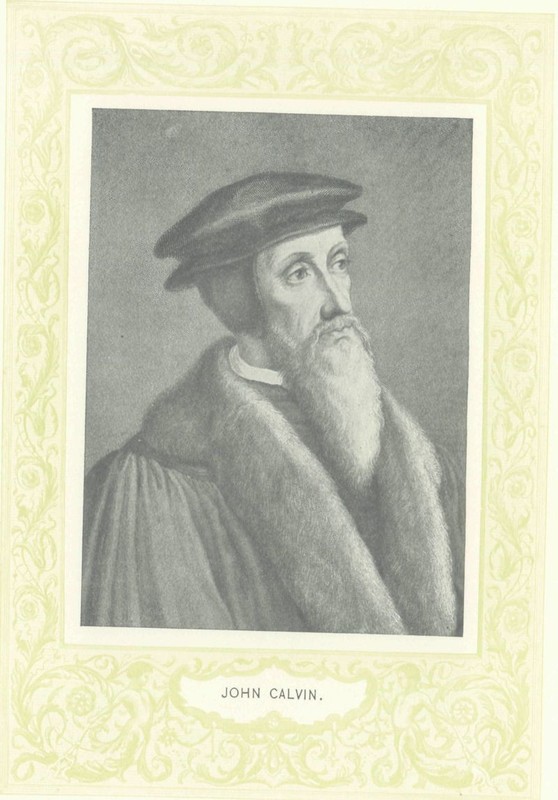
JOHN CALVIN.
Soon after the publication of the 'Institutes,' Calvin's plans for a quiet literary career were interrupted by a peremptory call to assist in the work of reforming the Church and State of Geneva; and the remainder of his life, with the exception of a brief interval of exile, was spent in that city, at the head of a religious movement whose influence was ultimately felt throughout all Western Europe. It is true that Calvin was not the originating genius of the Reformation—that he belonged only to the second generation of reformers, and that he learned the Protestant faith from Luther. But he became for the peoples of Western Europe what Luther was for Germany, and he gave his own peculiar type of Protestantism—that type which was congenial to his disposition and experience—to Switzerland, to France, to the Netherlands, to Scotland, and through the Dutch, the English Puritans, and the Scotch Presbyterians, to large portions of the New World. Calvin, to be sure, is not widely popular to-day even in those lands which owe him most, for he had little of that human sympathy which glorifies the best thought and life of the present age; but for all that, he has left his mark upon the world, and his influence is not likely ever to be wholly outgrown. His emphasis upon God's holiness made his followers scrupulously, even censoriously pure; his emphasis upon God's will made them stern and unyielding in the performance of what they believed to be their duty; his emphasis upon God's majesty, paradoxical though it may seem at first sight, promoted in no small degree the growth of civil and religious liberty, for it dwarfed all mere human authority and made men bold to withstand the unlawful encroachments of their fellows. Thus Calvin became a mighty force in the world, though he gave the world far more of law than of gospel, far more of Moses than of Christ.
Calvin's career as a writer began at an early day and continued until his death. His pen was a ready one and was seldom idle. In the midst of the most engrossing cares and occupations—the cares and occupations of a preacher, a pastor, a teacher of theology, a statesman, and a reformer to whom the Protestants of many lands looked for inspiration and for counsel—he found time, though he died at the early age of fifty-four, to produce works that to-day fill more than threescore volumes, and all of which bear the unmistakable impress of a great mind. In addition to his 'Institutes,' theological and ethical tracts, and treatises, sermons, and epistles without number, he wrote commentaries upon almost all the books of the Bible; which for lucidity, for wide and accurate learning, and for sound and ripe judgment, have never been surpassed. Among the most characteristic and important of his briefer works are his vigorous and effective 'Reply to Cardinal Sadolet,' who had endeavored after Calvin's exile from Geneva in 1539 to win back the Genevese to the Roman Church; his tract on 'The Necessity of Reforming the Church; presented to the Imperial Diet at Spires, A.D. 1544, in the cause of all who wish with Christ to reign'—an admirable statement of the conditions which had made a reformation of the Church imperatively necessary, and had led to the great religious and ecclesiastical revolution; another tract on 'The True Method of Giving Peace to Christendom and Reforming the Church,'—marked by a beautiful Christian spirit and permeated with sound practical sense; still another containing 'Articles Agreed Upon by the Faculty of Sacred Theology at Paris, with the Antidote', and finally an 'Admonition Showing the Advantages which Christendom might Derive from an Inventory of Relics.' Though Calvin was from boyhood up of a most serious turn of mind, and though his writings, in marked contrast to the writings of Luther, exhibit few if any traces of genial spontaneous humor, the last two works show that he knew how to employ satire on occasion in a very telling way for the overthrow of error and for the discomfiture of his opponents.
In addition to the services which Calvin rendered by his writings to the cause of Christianity and of sacred learning, must be recognized the lasting obligation under which as an author he put his mother tongue. Whether he wrote in Latin or in French, his style was always chaste, elegant, clear, and vigorous. His Latin compares favorably with the best models of antiquity; his French is a new creation. The latter language indeed owes almost as much to Calvin as the German language owes to Luther. He was unquestionably its greatest master in the sixteenth century, and he did more than any one else to fix its permanent character—to give it that exactness, that lucidity, that purity and harmony of which it justly boasts.
Calvin's writings bear throughout the imprint of his character. There appears in all of them the same horror of impurity and dishonor, the same stern sense of duty, the same respect for the sovereignty of the Almighty, the same severe judgment of human failings. To read them is to breathe the tonic air of snow-clad heights; but they are seldom if ever touched with the tender glow of human feeling or transfigured with the radiance of creative imagination. There is that in David, in Isaiah, in Paul, in Luther, which appeals to every heart and makes their words immortal; but Calvin was neither poet nor prophet,—the divine afflatus was not his,—and it is not without reason that his writings, vigorous, forceful, profound, as is their context, and pure and elegant as is their style, are read to-day only by theologians or historians.
PREFATORY ADDRESS TO THE 'INSTITUTES'
To Francis, King of the French, the most Christian Majesty, the most Mighty and Illustrious Monarch, his Sovereign,—John Calvin prays peace and salvation in Christ.
Sire:—When I first engaged in this work, nothing was further from my thoughts than to write what should afterwards be presented to your Majesty. My intention was only to furnish a kind of rudiments, by which those who feel some interest in religion might be trained to true godliness. And I toiled at the task chiefly for the sake of my countrymen the French, multitudes of whom I perceived to be hungering and thirsting after Christ, while very few seemed to have been duly imbued with even a slender knowledge of him. That this was the object which I had in view is apparent from the work itself, which is written in a simple and elementary form, adapted for instruction.
But when I perceived that the fury of certain bad men had risen to such a height in your realm that there was no place in it for sound doctrine, I thought it might be of service if I were in the same work both to give instruction to my countrymen, and also lay before your Majesty a Confession, from which you may learn what the doctrine is that so inflames the rage of those madmen who are this day with fire and sword troubling your kingdom. For I fear not to declare that what I have here given may be regarded as a summary of the very doctrine which, they vociferate, ought to be punished with confiscation, exile, imprisonment, and flames, as well as exterminated by land and sea.
I am aware indeed how, in order to render our cause as hateful to your Majesty as possible, they have filled your ears and mind with atrocious insinuations; but you will be pleased of your clemency to reflect that neither in word nor deed could there be any innocence, were it sufficient merely to accuse. When any one, with the view of exciting prejudice, observes that this doctrine of which I am endeavoring to give your Majesty an account has been condemned by the suffrages of all the estates, and was long ago stabbed again and again by partial sentences of courts of law, he undoubtedly says nothing more than that it has sometimes been violently oppressed by the power and faction of adversaries, and sometimes fraudulently and insidiously overwhelmed by lies, cavils, and calumny. While a cause is unheard, it is violence to pass sanguinary sentences against it; it is fraud to charge it, contrary to its deserts, with sedition and mischief.
That no one may suppose we are unjust in thus complaining, you yourself, most illustrious Sovereign, can bear us witness with what lying calumnies it is daily traduced in your presence; as aiming at nothing else than to wrest the sceptres of kings out of their hands, to overturn all tribunals and seats of justice, to subvert all order and government, to disturb the peace and quiet of society, to abolish all laws, destroy the distinctions of rank and property, and in short turn all things upside down. And yet that which you hear is but the smallest portion of what is said; for among the common people are disseminated certain horrible insinuations—insinuations which, if well founded, would justify the whole world in condemning the doctrine with its authors to a thousand fires and gibbets. Who can wonder that the popular hatred is inflamed against it, when credit is given to those most iniquitous accusations? See why all ranks unite with one accord in condemning our persons and our doctrine!
Carried away by this feeling, those who sit in judgment merely give utterance to the prejudices which they have imbibed at home, and think they have duly performed their part if they do not order punishment to be inflicted on any one until convicted, either on his own confession, or on legal evidence. But of what crime convicted? "Of that condemned doctrine," is the answer. But with what justice condemned? The very evidence of the defense was not to abjure the doctrine itself, but to maintain its truth. On this subject, however, not a whisper is allowed....
It is plain indeed that we fear God sincerely and worship him in truth, since, whether by life or by death, we desire his name to be hallowed; and hatred herself has been forced to bear testimony to the innocence and civil integrity of some of our people, on whom death was inflicted for the very thing which deserved the highest praise. But if any, under pretext of the gospel, excite tumults (none such have as yet been detected in your realm), if any use the liberty of the grace of God as a cloak for licentiousness (I know of numbers who do), there are laws and legal punishments by which they may be punished up to the measure of their deserts; only in the mean time let not the gospel of God be evil spoken of because of the iniquities of evil men.
Sire, that you may not lend too credulous an ear to the accusations of our enemies, their virulent injustice has been set before you at sufficient length: I fear even more than sufficient, since this preface has grown almost to the bulk of a full apology. My object however was not to frame a defense, but only with a view to the hearing of our cause, to mollify your mind, now indeed turned away and estranged from us,—I add, even inflamed against us,—but whose good will, we are confident, we should regain, would you but once with calmness and composure read this our Confession, which we desire your Majesty to accept instead of a defense. But if the whispers of the malevolent so possess your ear that the accused are to have no opportunity of pleading their cause; if those vindictive furies, with your connivance, are always to rage with bonds, scourgings, tortures, maimings, and burnings—we indeed, like sheep doomed to slaughter, shall be reduced to every extremity; yet so that in our patience we will possess our souls, and wait for the strong hand of the Lord, which doubtless will appear in its own time, and show itself armed, both to rescue the poor from affliction and also take vengeance on the despisers, who are now exulting so securely.
Most illustrious King, may the Lord, the King of kings, establish your throne in righteousness and your sceptre in equity.
Basle, August 1st, 1536.
ELECTION AND PREDESTINATION
From the 'Institutes of the Christian Religion'
The human mind when it hears this doctrine of election cannot restrain its petulance, but boils and rages as if aroused by the sound of a trumpet. Many, professing a desire to defend the Deity from an invidious charge, admit the doctrine of election but deny that any one is reprobated (Bernard, in 'Die Ascensionis,' Serm. 2). This they do ignorantly and childishly, since there could be no election without its opposite, reprobation. God is said to set apart those whom he adopts for salvation. It were most absurd to say that he admits others fortuitously, or that they by their industry acquire what election alone confers on a few. Those therefore whom God passes by he reprobates, and that for no other cause but because he is pleased to exclude them from the inheritance which he predestines to his children. Nor is it possible to tolerate the petulance of men in refusing to be restrained by the word of God, in regard to his incomprehensible counsel, which even angels adore.
We have already been told that hardening is not less under the immediate hand of God than mercy. Paul does not, after the example of those whom I have mentioned, labor anxiously to defend God by calling in the aid of falsehood; he only reminds us that it is unlawful for the creature to quarrel with its Creator. Then how will those who refuse to admit that any are reprobated by God, explain the following words of Christ? "Every plant which my heavenly Father hath not planted shall be rooted up" (Matth. xv. 13). They are plainly told that all whom the heavenly Father has not been pleased to plant as sacred trees in his garden are doomed and devoted to destruction. If they deny that this is a sign of reprobation, there is nothing, however clear, that can be proved to them. But if they will still murmur, let us in the soberness of faith rest contented with the admonition of Paul, that it can be no ground of complaint that God, "willing to show his wrath, and to make his power known, endured with much long-suffering the vessels of wrath fitted for destruction: and that he might make known the riches of his glory on the vessels of mercy, which he had afore prepared unto glory" (Rom. ix. 22, 23). Let my readers observe that Paul, to cut off all handle for murmuring and detraction, attributes supreme sovereignty to the wrath and power of God; for it were unjust that those profound judgments which transcend all our powers of discernment should be subjected to our calculation.
It is frivolous in our opponents to reply that God does not altogether reject those whom in lenity he tolerates, but remains in suspense with regard to them, if peradventure they may repent; as if Paul were representing God as patiently waiting for the conversion of those whom he describes as fitted for destruction. For Augustine, rightly expounding this passage, says that where power is united to endurance, God does not permit, but rules (August. Cont. Julian., Lib. v., c. 5). They add also, that it is not without cause the vessels of wrath are said to be fitted for destruction, and that God is said to have prepared the vessels of mercy, because in this way the praise of salvation is claimed for God; whereas the blame of perdition is thrown upon those who of their own accord bring it upon themselves. But were I to concede that by the different forms of expression Paul softens the harshness of the former clause, it by no means follows that he transfers the preparation for destruction to any other cause than the secret counsel of God. This indeed is asserted in the preceding context, where God is said to have raised up Pharaoh, and to harden whom he will. Hence it follows that the hidden counsel of God is the cause of hardening. I at least hold with Augustine, that when God makes sheep out of wolves he forms them again by the powerful influence of grace, that their hardness may thus be subdued; and that he does not convert the obstinate, because he does not exert that more powerful grace, a grace which he has at command if he were disposed to use it (August, de Prædest. Sanct., Lib. i., c. 2)....
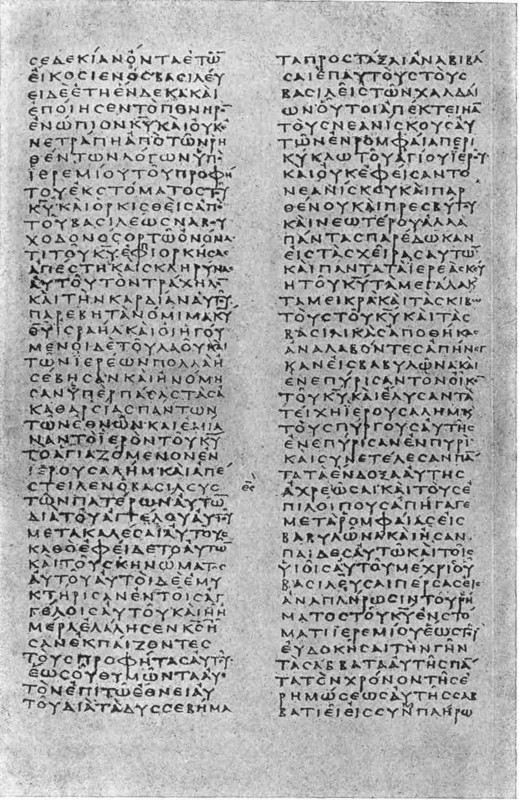
SEPTUAGINT. Facsimile, somewhat reduced, of a page of the VATICAN MANUSCRIPT. Fourth Century. Vatican Library. The Septuagint is the Greek translation, by seventy elders, of the Hebrew Bible.
The earlier copies are all in uncial or "capital" letters, cursive or "lower-case" letters being a later invention.
This is a good specimen of the hand-work of the ecclesiastical scribes of the fourth century.
Accordingly, when we are accosted in such terms as these: Why did God from the first predestine some to death, when as they were not yet in existence, they could not have merited sentence of death?—let us by way of reply ask in our turn, What do you imagine that God owes to man, if he is pleased to estimate him by his own nature? As we are all vitiated by sin, we cannot but be hateful to God, and that not from tyrannical cruelty, but the strictest justice. But if all whom the Lord predestines to death are naturally liable to sentence of death, of what injustice, pray, do they complain? Should all the sons of Adam come to dispute and contend with their Creator, because by his eternal providence they were before their birth doomed to perpetual destruction: when God comes to reckon with them, what will they be able to mutter against this defense? If all are taken from a corrupt mass, it is not strange that all are subject to condemnation. Let them not therefore charge God with injustice, if by his eternal judgment they are doomed to a death to which they themselves feel that, whether they will or not, they are drawn spontaneously by their own nature. Hence it appears how perverse is this affectation of murmuring, when of set purpose they suppress the cause of condemnation which they are compelled to recognize in themselves, that they may lay the blame upon God. But though I should confess a hundred times that God is the author (and it is most certain that he is), they do not however thereby efface their own guilt, which, engraven on their own consciences, is ever and anon presenting itself to their view....
If God merely foresaw human events, and did not also arrange and dispose of them at his pleasure, there might be room for agitating the question, how far his foreknowledge amounts to necessity; but since he foresees the things which are to happen, simply because he has decreed that they are so to happen, it is vain to debate about prescience, while it is clear that all events take place by his sovereign appointment.
They deny that it is ever said in distinct terms, God decreed that Adam should perish by his revolt. As if the same God who is declared in Scripture to do whatsoever he pleases could have made the noblest of his creatures without any special purpose. They say that, in accordance with free will, he was to be the architect of his own fortune; that God had decreed nothing but to treat him according to his desert. If this frigid fiction is received, where will be the omnipotence of God, by which, according to his secret counsel on which everything depends, he rules over all? But whether they will allow it or not, predestination is manifest in Adam's posterity. It was not owing to nature that they all lost salvation by the fault of one parent. Why should they refuse to admit with regard to one man that which against their will they admit with regard to the whole human race? Why should they in caviling lose their labor? Scripture proclaims that all were, in the person of one, made liable to eternal death. As this cannot be ascribed to nature, it is plain that it is owing to the wonderful counsel of God. It is very absurd in these worthy defenders of the justice of God to strain at a gnat and swallow a camel. I again ask how it is that the fall of Adam involves so many nations with their infant children in eternal death without remedy, unless that it so seemed meet to God? Here the most loquacious tongues must be dumb. The decree, I admit, is dreadful; and yet it is impossible to deny that God foreknew what the end of man was to be before he made him, and foreknew because he had so ordained by his decree. Should any one here inveigh against the prescience of God, he does it rashly and unadvisedly. For why, pray, should it be made a charge against the heavenly Judge, that he was not ignorant of what was to happen? Thus, if there is any just or plausible complaint, it must be directed against predestination. Nor ought it to seem absurd when I say that God not only foresaw the fall of the first man, and in him the ruin of his posterity, but also at his own pleasure arranged it. For as it belongs to his wisdom to foreknow all future events, so it belongs to his power to rule and govern them by his hand.
FREEDOM OF THE WILL
From the 'Institutes of the Christian Religion'
God has provided the soul of man with intellect, by which he might discern good from evil, just from unjust, and might know what to follow or to shun, reason going before with her lamp; whence philosophers, in reference to her directing power, have called her [Greek: to hêgemonichon]. To this he has joined will, to which choice belongs. Man excelled in these noble endowments in his primitive condition, when reason, intelligence, prudence, and judgment not only sufficed for the government of his earthly life, but also enabled him to rise up to God and eternal happiness. Thereafter choice was added to direct the appetites and temper all the organic motions; the will being thus perfectly submissive to the authority of reason. In this upright state, man possessed freedom of will, by which if he chose he was able to obtain eternal life. It were here unseasonable to introduce the question concerning the secret predestination of God, because we are not considering what might or might not happen, but what the nature of man truly was. Adam, therefore, might have stood if he chose, since it was only by his own will that he fell; but it was because his will was pliable in either direction, and he had not received constancy to persevere, that he so easily fell. Still he had a free choice of good and evil; and not only so, but in the mind and will there was the highest rectitude, and all the organic parts were duly framed to obedience, until man corrupted its good properties, and destroyed himself. Hence the great darkness of philosophers who have looked for a complete building in a ruin, and fit arrangement in disorder. The principle they set out with was, that man could not be a rational animal unless he had a free choice of good and evil. They also imagined that the distinction between virtue and vice was destroyed, if man did not of his own counsel arrange his life. So far well, had there been no change in man. This being unknown to them, it is not surprising that they throw everything into confusion. But those who, while they profess to be the disciples of Christ, still seek for free-will in man, notwithstanding of his being lost and drowned in spiritual destruction, labor under manifold delusion, making a heterogeneous mixture of inspired doctrine and philosophical opinions, and so erring as to both. But it will be better to leave these things to their own place. At present it is necessary only to remember that man at his first creation was very different from all his posterity; who, deriving their origin from him after he was corrupted, received a hereditary taint. At first every part of the soul was formed to rectitude. There was soundness of mind and freedom of will to choose the good. If any one objects that it was placed, as it were, in a slippery position because its power was weak, I answer, that the degree conferred was sufficient to take away every excuse. For surely the Deity could not be tied down to this condition,—to make man such that he either could not or would not sin. Such a nature might have been more excellent; but to expostulate with God as if he had been bound to confer this nature on man, is more than unjust, seeing he had full right to determine how much or how little he would give. Why he did not sustain him by the virtue of perseverance is hidden in his counsel; it is ours to keep within the bounds of soberness. Man had received the power, if he had the will, but he had not the will which would have given the power; for this will would have been followed by perseverance. Still, after he had received so much, there is no excuse for his having spontaneously brought death upon himself. No necessity was laid upon God to give him more than that intermediate and even transient will, that out of man's fall he might extract materials for his own glory.
LUIZ VAZ DE CAMOENS
(1524?-1580)
BY HENRY R. LANG

ortuguese literature is usually divided into six periods, which correspond, in the main, to the successive literary movements of the other Romance nations which it followed.
First Period (1200-1385), Provençal and French influences. Soon after the founding of the Portuguese State by Henry of Burgundy and his knights in the beginning of the twelfth century, the nobles of Portugal and Galicia, which regions form a unit in race and speech, began to imitate in their native idiom the art of the Provençal troubadours who visited the courts of Leon and Castile. This courtly lyric poetry in the Gallego-Portuguese dialect, which was also cultivated in the rest of the peninsula excepting the East, reached its height under Alphonso X. of Castile (1252-84), himself a noted poet and patron of this art, and under King Dionysius of Portugal (1279-1325), the most gifted of all these troubadours. The collections (cancioneiros) of the works of this school preserved to us contain the names of one hundred and sixty-three poets and some two thousand compositions (inclusive of the four hundred and one spiritual songs of Alphonso X.). Of this body of verse, two-thirds affect the artificial style of Provençal lyrics, while one-third is derived from the indigenous popular poetry. This latter part contains the so-called cantigas de amigo, songs of charming simplicity of form and naïveté of spirit in which a woman addresses her lover either in a monologue or in a dialogue. It is this native poetry, still echoed in the modern folk-song of Galicia and Portugal, that imparted to the Gallego-Portuguese lyric school the decidedly original coloring and vigorous growth which assign it an independent position in the mediæval literature of the Romance nations.
Composition in prose also began in this period, consisting chiefly in genealogies, chronicles, and in translations from Latin and French dealing with religious subjects and the romantic traditions of British origin, such as the 'Demanda do Santo Graal.' It is now almost certain that the original of the Spanish version of the 'Amadis de Gaula' (1480) was the work of a Portuguese troubadour of the thirteenth century, Joam de Lobeira.
Second Period (1385-1521), Spanish influence. Instead of the Provençal style, the courtly circles now began to cultivate the native popular forms, the copla and quadra, and to compose in the dialect of Castile, which communicated to them the influence of the Italian Renaissance, with the vision and allegory of Dante and a fuller understanding of classical antiquity. These two literary currents became the formative elements of the second poetic school of an aristocratic character in Portugal, at the courts of Alphonse V. (1438-1481), John II. (1481-95), and Emanuel (1495-1521), whose works were collected by the poet Garcia de Resende in the 'Cancioneiro Geral' (Lisbon, 1516).
The prose-literature of this period is rich in translations from the Latin classics, and chiefly noteworthy for the great Portuguese chronicles which it produced. The most prominent writer was Fernam Lopes (1454), the founder of Portuguese historiography and the "father of Portuguese prose."
Third Period (1521-1580), Italian influence. This is the classic epoch of Portuguese literature, born of the powerful rise of the Portuguese State during its period of discovery and conquest, and of the dominant influence of the Italian Renaissance. It opens with three authors who were prominently active in the preceding literary school, but whose principal influence lies in this. These are Christovam Falcão and Bernardim Ribeiro, the founders of the bucolic poem and the sentimental pastoral romance, and Gil Vicente, a comic writer of superior talent, who is called the father of the Portuguese drama, and who, next to Camoens, is the greatest figure of this period. Its real initiator, however, was Francesco Sa' de Miranda (1495-1557) who, on his return from a six-years' study in Italy in 1521, introduced the lyric forms of Petrarch and his followers as the only true models for composition. Besides giving by his example a classic form to lyrics, especially to the sonnet, and cultivating the pastoral poem, Sa' de Miranda, desirous of breaking the influence of Gil Vicente's dramas, wrote two comedies of intrigue in the style of the Italians and of Plautus and Terence. His attempts in this direction, however, found no followers, the only exception being Ferreira's tragedy 'Ines de Castro' in the antique style. The greatest poet of this period, and indeed in the whole history of Portuguese literature, is Luiz de Camoens, in whose works, epic, lyric, and dramatic, the cultivation of the two literary currents of this epoch, the national and the Renaissance, attained to its highest perfection, and to whom Portuguese literature chiefly owes its place in the literature of the world.
Among the works in prose produced during this time are of especial importance the historical writings, such as the 'Décadas' of João de Barros (1496-1570), the "Livy of Portugal" and the numerous romances of chivalry.
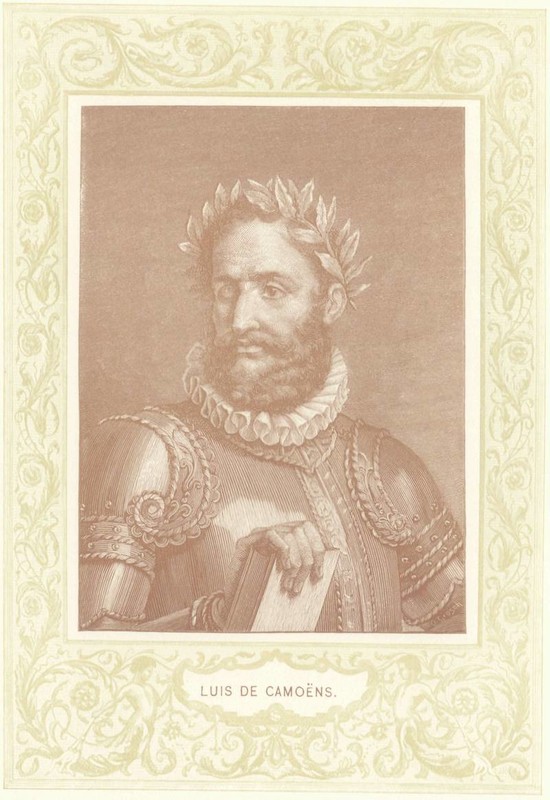
LUIS DE CAMOËNS.
Fourth Period (1580-1700), Culteranistic influence. The political decline of Portugal is accompanied by one in its literature. While some lyric poetry is still written in the spirit of Camoens, and the pastoral romance in the national style is cultivated by some authors, Portuguese literature on the whole is completely under the influence of the Spanish, receiving from the latter the euphuistic movement, known in Spain as culteranismo or Gongorismo. Many writers of talent of this time used the Spanish language in preference to their own. It is thus that the charming pastoral poem 'Diana,' by Jorge de Montemor, though composed by a Portuguese and in a vein so peculiar to his nation, is credited to Spanish literature.
Fifth Period (1700-1825), Pseudo-Classicism. The influence of the French classic school, felt in all European literatures, became paramount in Portugal. Excepting the works of a few talented members of the society called "Arcadia," little of literary interest was produced until the appearance, at the end of the century, of Francisco Manoel de Nascimento and Manoel Maria Barbosa du Bocage, two poets of decided talent who connect this period with the following.
Sixth Period (since 1825), Romanticism. The initiator of this movement in Portugal was Almeida-Garrett (1799-1854), with Gil Vicente and Camoens one of the three great poets Portugal has produced, who revived and strengthened the sense of national life in his country by his 'Camoens,' an epic of glowing patriotism published during his exile in 1825, by his national dramas, and by the collection of the popular traditions of his people, which he began and which has since been zealously continued in all parts of the country. The second influential leader of romanticism was Alexandre Herculano (1810-1877), great especially as national historian, but also a novelist and poet of superior merit. The labors of these two men bore fruit, since the middle of the century, in what may be termed an intellectual renovation of Portugal which first found expression in the so-called Coimbra School, and has since been supported by such men as Theophilo Braga, F. Adolpho Coelho, Joaquim de Vasconcellos, J. Leite de Vasconcellos, and others, whose life-work is devoted to the conviction that only a thorough and critical study of their country's past can inspire its literature with new life and vigor and maintain the sense of national independence.
Luiz Vaz De Camoens, Portugal's greatest poet and patriot, was born in 1524 or 1525, most probably at Coimbra, as the son of Simão Vaz de Camoens and Donna Anna de Macedo of Santarem. Through his father, a cavalleiro fidalgo, or untitled nobleman, who was related with Vasco da Gama, Camoens descended from an ancient and once influential noble family of Galician origin. He spent his youth at Coimbra, and though his name is not found in the registers of the university, which had been removed to that city in 1537, and of which his uncle, Bento de Camoens, prior of the monastery of Santa Cruz, was made chancellor in 1539, it was presumably in that institution, then justly famous, that the highly gifted youth acquired his uncommon familiarity with the classics and with the literatures of Spain, Italy, and that of his own country. In 1542 we find Camoens exchanging his alma mater for the gay and brilliant court of John III., then at Lisbon, where his gentle birth, his poetic genius, and his fine personal appearance brought him much favor, especially with the fair sex, while his independent bearing and indiscreet speech aroused the jealousy and enmity of his rivals. Here he woos and wins the damsels of the palace until a high-born lady in attendance upon the Queen, Donna Catharina de Athaide,—whom, like Petrarch, he claims to have first seen on Good Friday in church, and who is celebrated in his poems under the anagram of Natercia,—inspires him with a deep and enduring passion. Irritated by the intrigues employed by his enemies to mar his prospects, the impetuous youth commits imprudent acts which lead to his banishment from the city in 1546. For about a year he lives in enforced retirement on the Upper Tagus (Ribatejo), pouring out his profound passion and grief in a number of beautiful sonnets and elegies. Most likely in consequence of some new offense, he is next exiled for two years to Ceuta in Africa, where, in a fight with the Moors, he loses his right eye by a chance splinter. Meeting on his return to Lisbon in 1547 neither with pardon for his indiscretions nor with recognition for his services and poetic talent, he allows his keen resentment of this unjust treatment to impel him into the reckless and turbulent life of a bully. It was thus that during the festival of Corpus Christi in 1552 he got into a quarrel with Gonçalo Borges, one of the King's equerries, in which he wounded the latter. For this Camoens was thrown into jail until March, 1553, when he was released only on condition that he should embark to serve in India. Not quite two weeks after leaving his prison, on March 24th, he sailed for India on the flag-ship Sam Bento, bidding, as a true Renaissance poet, farewell to his native land in the words of Scipio which were to come true: "Ingrata patria non possidebis ossa mea." After a stormy passage of six months, the Sam Bento cast anchor in the bay of Goa. Camoens first took part in an expedition against the King of Pimenta, and in the following year (1554) he joined another directed against the Moorish pirates on the coast of Africa. The scenes of drunkenness and dissoluteness which he witnessed in Goa inspired him with a number of satirical poems, by which he drew upon himself much enmity and persecution. In 1556 his three-years' term of service expired; but though ardently longing for his beloved native land, he remained in Goa, influenced either by his bent for the soldier's life or by the sad news of the death of Donna Catharina de Athaide in that year. He was ordered to Macao in China, to the lucrative post of commissary for the effects of deceased or absent Portuguese subjects. There, in the quietude of a grotto near Macao, still called the Grotto of Camoens, the exiled poet finished the first six cantos of his great epic 'The Lusiads.' Recalled from this post in 1558, before the expiration of his term, on the charge of malversation of office, Camoens on his return voyage to Goa was shipwrecked near the mouth of the Me-Kong, saving nothing but his faithful Javanese slave and the manuscript of his 'Lusiads'—which, swimming with one hand, he held above the water with the other. In Cambodia, where he remained several months, he wrote his marvelous paraphrase of the 137th psalm, contrasting under the allegory of Babel (Babylon) and Siam (Zion), Goa and Lisbon. Upon his return to Goa he was cast into prison, but soon set free on proving his innocence by a public trial. Though receiving, in 1557, another lucrative employment, Camoens finally resolved to go home, burning with the desire to lay his patriotic song, now almost completed, before his nation, and to cover with honor his injured name.
He accepted a passage to Sofala offered him by Pedro Barreto, who had become viceroy of Mozambique in that year. Unable to refund the amount of the passage, he was once more held for debt and spent two years of misery and distress in Mozambique, completing and polishing during this time his great epic song and preparing the collection of his lyrics, his 'Parnasso.' In 1559 he was released by the historian Diogo do Couto and other friends of his, visiting Sofala with the expedition of Noronha, and embarked on the Santa Clara for Lisbon.
On the 7th of April, 1570, Camoens once more set foot on his native soil, only to find the city for which he had yearned, sadly changed. The government was in the hands of a brave but harebrained and fanatic young monarch, ruled by the Jesuits; the capital had been ravaged by a terrible plague which had carried off fifty thousand souls; and its society had no room for a man who brought with him from the Indies, whence so many returned with great riches, nothing but a manuscript, though in it was sung in classic verse the glory of his people. Still, through the kind offices of his warm friend Dom Manoel de Portugal, Camoens obtained, on the 25th of September, 1571, the royal permission to print his epic. It was published in the spring of the following year (March, 1572). Great as was the success of the work, which marked a new epoch in Portuguese history, the reward which the poet received for it was meagre. King Sebastian granted him an annual pension of fifteen thousand reis (fifteen dollars, which then had the purchasing value of about sixty dollars in our money), which, after the poet's death, was ordered by Philip II. to be paid to his aged mother. Destitute and broken in spirit, Camoens lived for the last eight years of his life with his mother in a humble house near the convent of Santa Ana, "in the knowledge of many and in the society of few." Dom Sebastian's departure early in 1578 for the conquest in Africa once more kindled patriotic hopes in his breast; but the terrible defeat at Alcazarquivir (August 4th of the same year), in which Portugal lost her king and her army, broke his heart. He died on the 10th of June, 1580, at which time the army of Philip II., under the command of the Duke of Alva, was marching upon Lisbon. He was thus spared the cruel blow of seeing, though not of foreseeing, the national death of his country. The story that his Javanese slave Antonio used to go out at night to beg of passers-by alms for his master, is one of a number of touching legends which, as early as 1572, popular fancy had begun to weave around the poet's life. It is true, however, that Camoens breathed his last in dire distress and isolation, and was buried "poorly and plebeianly" in the neighboring convent of Santa Ana. It was not until sixteen years later that a friend of his, Dom Gonçalo Coutinho, caused his grave to be marked with a marble slab bearing the inscription:—"Here lies Luis de Camoens, Prince of the Poets of his time. He died in the year 1579. This tomb was placed for him by order of D. Gonçalo Coutinho, and none shall be buried in it." The words "He lived poor and neglected, and so died," which in the popular tradition form part of this inscription, are apocryphal, though entirely in conformity with the facts. The correctness of 1580 instead of 1579 as the year of the poet's death is proven by an official document in the archives of Philip II. Both the memorial slab and the convent-church of Santa Ana were destroyed by the earthquake of 1755 and during the rebuilding of the convent, and the identification of the remains of the great man thus rendered well-nigh impossible. In 1854, however, all the bones found under the floor of the convent-church were placed in a coffin of Brazil-wood and solemnly deposited in the convent at Belem, the Pantheon of King Emanuel. In 1867 a statue was erected to Camoens by the city of Lisbon.
'The Lusiads' (Portuguese, Os Lusiadas), a patronymic adopted by Camoens in place of the usual term Lusitanos, the descendants of Lusus (the mythical ancestor of the Portuguese), is an epic poem which, as its name implies, has for its subject the heroic deeds not of one hero, but of the whole Portuguese nation. Vasco da Gama's discovery of the way to the East Indies forms, to be sure, the central part of its action; but around it are grouped, with consummate art, the heroic deeds and destinies of the other Lusitanians. In this, Camoens' work stands alone among all poems of its kind. Originating under conditions similar to those which are indispensable to the production of a true epic, in the heroic period of the Portuguese people, when national sentiment had risen to its highest point, it is the only one among the modern epopees which comes near to the primitive character of epic poetry. A trait which distinguishes this epic from all its predecessors is the historic truthfulness with which Camoens confessedly—"A verdade que eu conto nua e pura Vence toda a grandiloqua escriptura"—represents his heroic personages and their exploits, tempering his praise with blame where blame is due, and the unquestioned fidelity and exactness with which he depicts natural scenes. Lest, however, this adherence to historic truth should impair the vivifying element of imagination indispensable to true poetry, our bard, combining in the true spirit of the Renaissance myth and miracle, threw around his narrative the allegorical drapery of pagan mythology, introducing the gods and goddesses of Olympus as siding with or against the Portuguese heroes, and thus calling the imagination of the reader into more active play. Among the many beautiful inventions of his own creative fancy with which Camoens has adorned his poem, we shall only mention the powerful impersonation of the Cape of Storms in the Giant Adamastor (c. v.), an episode used by Meyerbeer in his opera 'L'Africaine,' and the enchanting scene of the Isle of Love (c. ix.), as characteristic of the poet's delicacy of touch as it is of his Portuguese temperament, in which Venus provides for the merited reward and the continuance of the brave sons of Lusus. For the metric form of his verse, Camoens adopted the octave rhyme of Ariosto, while for his epic style he followed Virgil, from whom many a simile and phrase is directly borrowed. His poem, justly admired for the elegant simplicity, the purity and harmony of its diction, bears throughout the deep imprint of his own powerful and noble personality, that independence and magnanimity of spirit, that fortitude of soul, that genuine and glowing patriotism which alone, amid all the disappointments and dangers, the dire distress and the foibles and faults of his life, could enable him to give his mind and heart steadfastly to the fulfillment of the lofty patriotic task he had set his genius,—the creation of a lasting monument to the heroic deeds of his race. It is thus that through 'The Lusiads' Camoens became the moral bond of the national individuality of his people, and inspired it with the energy to rise free once more out of Spanish subjection.
Lyrics. Here, Camoens is hardly less great than as an epic poet, whether we consider the nobility, depth, and fervor of the sentiments filling his songs, or the artistic perfection, the rich variety of form, and the melody of his verse. His lyric works fall into two main classes, those written in Italian metres and those in the traditional trochaic lines and strophic forms of the Spanish peninsula. The first class is contained in the 'Parnasso,' which comprises 356 sonnets, 22 canzones, 27 elegies, 12 odes, 8 octaves, and 15 idyls, all of which testify to the great influence of the Italian school, and especially of Petrarch, on our poet. The second class is embodied in the 'Cancioneiro,' or song-book, and embraces more than one hundred and fifty compositions in the national peninsular manner. Together, these two collections form a body of lyric verse of such richness and variety as neither Petrarch and Tasso nor Garcilaso de la Vega can offer. Unfortunately, Camoens never prepared an edition of his Rimas; and the manuscript, which, as Diogo do Couto tells us, he arranged during his sojourn in Mozambique from 1567 to 1569, is said to have been stolen. It was not until 1595, fully fifteen years after the poet's death, that one of his disciples and admirers, Fernão Rodrigues Lobo Soropita, collected from Portugal, and even from India, and published in Lisbon, a volume of one hundred and seventy-two songs, four of which, however, are not by Camoens. The great mass of verse we now possess has been gathered during the last three centuries. More may still be discovered, while, on the other hand, much of what is now attributed to Camoens does not belong to him, and the question how much of the extant material is genuine is yet to be definitely answered.
In his lyrics, Camoens has depicted, with all the passion and power of his impressionable temperament, the varied experiences and emotions of his eventful life. This variety and change of sentiments and situations, while greatly enhancing the value of his songs by the impression of fuller truth and individuality which they produce, is in so far disadvantageous to a just appreciation of them, as it naturally brings with it much verse of inferior poetic merit, and lacks that harmony and unity of emotion which Petrarch was able to effect in his Rime by confining himself to the portraiture of a lover's soul.
Drama. In his youth, most likely during his life at court between 1542 and 1546, Camoens wrote three comedies of much freshness and verve, in which he surpassed all the Portuguese plays in the national taste produced up to his time. One, 'Filodemo,' derives its plot from a mediæval novel; the other two, 'Rei Seleuco' (King Seleucus) and 'Amphitryões,' from antiquity. The last named, a free imitation of Plautus's 'Amphitryo,' is by far the best play of the three. In these comedies we can recognize an attempt on the part of the author to fuse the imperfect play in the national taste, such as it had been cultivated by Gil Vicente, with the more regular but lifeless pieces of the classicists, and thus to create a superior form of national comedy. In this endeavor, however, Camoens found no followers.
Bibliography. The most complete edition of the works of Camoens is that by the Viscount de Juromenha, 'Obras de Luiz de Camões,' (6 vols., Lisbon, 1860-70); a more convenient edition is the one by Th. Braga (in 'Bibliotheca da Actualidade,' 3 vols., Porto, 1874). The best separate edition of the text of 'The Lusiads' is by F.A. Coelho (Lisbon, 1880). Camoens' lyric and dramatic works are published in his collected works, no separate editions of them existing thus far. In regard to the life and works of Camoens in general cf. Adamson, 'Memoirs of the Life and Writings of Camoens' (2 vols., London, 1820); Th. Braga, 'Historia de Camoens' (3 vols., Porto, 1873-75); Latino Coelho, 'Luiz de Camoens' (in the 'Galeria de varões illustres,' i., Lisbon, 1880); J. de Vasconcellos, 'Bibliographia Camoniana' (Porto, 1880); Brito Aranha, 'Estudos Bibliographicos' (Lisbon, 1887-8); W. Storck, 'Luis' de Camoens Leben' (Paderborn, 1890); and especially the judicious and impartial article by Mrs. Carolina Michaelis de Vasconcellos in Vol. ii. of Gröber's 'Grundriss der romanischen Philologie' (Strassburg, 1894). The best translations of Camoens' works are the one by W. Storck, 'Camoens' Sämmtliche Gedichte, 6 vols., Paderborn, 1880-85), into German, and the one by R.F. Burton, who has also written on the life of the poet, 'The Lusiads' (2 vols., London, 1880), and 'The Lyricks' (3 vols., London, 1884, containing only those in Italian metres), into English. The extracts given below are from Burton.

THE LUSIADS
Canto I
The feats of Arms, and famed heroick Host, from occidental Lusitanian strand, who o'er the waters ne'er by seaman crost, fared beyond the Taprobane-land, forceful in perils and in battle-post, with more than promised force of mortal hand; and in the regions of a distant race rear'd a new throne so haught in Pride of Place:
And, eke, the Kings of mem'ory grand and glorious, who hied them Holy Faith and Reign to spread, converting, conquering, and in lands notorious, Africk and Asia, devastation made; nor less the Lieges who by deeds memorious brake from the doom that binds the vulgar dead; my song would sound o'er Earth's extremest part were mine the genius, mine the Poet's art.
Cease the sage Grecian, and the man of Troy to vaunt long voyage made in by-gone day: Cease Alexander, Trojan cease to 'joy the fame of vict'ories that have pass'd away: The noble Lusian's stouter breast sing I, whom Mars and Neptune dared not disobey: Cease all that antique Muse hath sung, for now a better Brav'ry rears its bolder brow.
And you, my Tagian Nymphs, who have create in me new purpose with new genius firing; if 'twas my joy whilere to celebrate your founts and stream my humble song inspiring; Oh! lend me here a noble strain elate, a style grandiloquent that flows untiring; so shall Apollo for your waves ordain ye in name and fame ne'er envy Hippokréné.
Grant me sonorous accents, fire-abounding, now serves ne peasant's pipe, ne rustick reed; but blasts of trumpet, long and loud resounding, that 'flameth heart and hue to fiery deed: Grant me high strains to suit their Gestes astounding, your Sons, who aided Mars in martial need; that o'er the world he sung the glorious song, if theme so lofty may to verse belong.
And Thou! O goodly omen'd trust, all-dear[1] to Lusitania's olden liberty, whereon assurèd esperance we rear enforced to see our frail Christianity: Thou, O new terror to the Moorish spear, the fated marvel of our century, to govern worlds of men by God so given, that the world's best be given to God and Heaven:
Thou young, thou tender, ever-flourishing bough, true scion of tree by Christ belovèd more than aught that Occident did ever know, "Cæsarian" or "Most Christian" styled before: Look on thy 'scutcheon, and behold it show the present Vict'ory long past ages bore; Arms which He gave and made thine own to be by Him assurèd on the fatal tree:[2]
Thou, mighty Sovran! o'er whose lofty reign the rising Sun rains earliest smile of light; sees it from middle firmamental plain; And sights it sinking on the breast of Night: Thou, whom we hope to hail the blight, the bane of the dishonour'd Ishmaëlitish knight; and Orient Turk, and Gentoo—misbeliever that drinks the liquor of the Sacred River:[3]
Incline awhile, I pray, that majesty which in thy tender years I see thus ample, E'en now prefiguring full maturity that shall be shrined in Fame's eternal temple: Those royal eyne that beam benignity bend on low earth: Behold a new ensample of hero hearts with patriot pride inflamèd, in number'd verses manifold proclaimèd.
Thou shalt see Love of Land that ne'er shall own lust of vile lucre; soaring towards th' Eternal: For 'tis no light ambition to be known th' acclaimed herald of my nest paternal. Hear; thou shalt see the great names greater grown of Vavasors who hail the Lord Supernal: So shalt thou judge which were the higher station, King of the world or Lord of such a nation.
Hark, for with vauntings vain thou shalt not view phantastical, fictitious, lying deed of lieges lauded, as strange Muses do, seeking their fond and foolish pride to feed Thine acts so forceful are, told simply true, all fabled, dreamy feats they far exceed; exceeding Rodomont, and Ruggiero vain, and Roland haply born of Poet's brain.
For these I give thee a Nuno, fierce in fight, who for his King and Country freely bled; an Egas and a Fuas; fain I might for them my lay with harp Homeric wed! For the twelve peerless Peers again I cite the Twelve of England by Magriço led: Nay, more, I give thee Gama's noble name, who for himself claims all Æneas' fame.
And if in change for royal Charles of France, or rivalling Cæsar's mem'ories thou wouldst trow, the first Afonso see, whose conquering lance lays highest boast of stranger glories low: See him who left his realm th' inheritance fair Safety, born of wars that crusht the foe: That other John, a knight no fear deter'd, the fourth and fifth Afonso, and the third.
Nor shall they silent in my song remain, they who in regions there where Dawns arise, by Acts of Arms such glories toil'd to gain, where thine unvanquisht flag for ever flies, Pacheco, brave of braves; th' Almeidas twain, whom Tagus mourns with ever-weeping eyes; dread Albuquerque, Castro stark and brave, with more, the victors of the very grave.
But, singing these, of thee I may not sing, O King sublime! such theme I fain must fear. Take of thy reign the reins, so shall my King create a poesy new to mortal ear: E'en now the mighty burthen here I ring (and speed its terrors over all the sphere!) of sing'ular prowess, War's own prodigies, in Africk regions and on Orient seas.
Casteth on thee the Moor eyne cold with fright, in whom his coming doom he views designèd: The barb'rous Gentoo, sole to see thy sight yields to thy yoke the neck e'en now inclinèd; Tethys, of azure seas the sovran right, her realm, in dowry hath to thee resignèd; and by thy noble tender beauty won, would bribe and buy thee to become her son.
In thee from high Olympick halls behold themselves, thy grandsires' sprites; far-famèd pair;[4] this clad in Peacetide's angel-robe of gold, that crimson-hued with paint of battle-glare: By thee they hope to see their tale twice told, their lofty mem'ries live again; and there, when Time thy years shall end, for thee they 'sign a seat where soareth Fame's eternal shrine.
But, sithence ancient Time slow minutes by ere ruled the Peoples who desire such boon; bend on my novel rashness favouring eye, that these my verses may become thine own: So shalt thou see thine Argonauts o'erfly yon salty argent, when they see it shown thou seest their labours on the raging sea: Learn even now invok'd of man to be.[5]
Canto III
Now, my Calliope! to teach incline what speech great Gama for the king did frame: Inspire immortal song, grant voice divine unto this mortal who so loves thy name. Thus may the God whose gift was Medicine, to whom thou barest Orpheus, lovely Dame! never for Daphne, Clytia, Leucothoe due love deny thee or inconstant grow he.
Satisfy, Nymph! desires that in me teem, to sing the merits of thy Lusians brave; so worlds shall see and say that Tagus-stream rolls Aganippe's liquor. Leave, I crave, leave flow'ry Pindus-head; e'en now I deem Apollo bathes me in that sovran wave; else must I hold it, that thy gentle sprite, fears thy dear Orpheus fade through me from sight.
All stood with open ears in long array to hear what mighty Gama mote unfold; when, past in thoughtful mood a brief delay, began he thus with brow high-raised and bold:— "Thou biddest me, O King! to say my say anent our grand genealogy of old: Thou bidd'st me not relate an alien story; Thou bidd'st me laud my brother Lusian's glory.
"That one praise others' exploits and renown is honour'd custom which we all desire; yet fear I 'tis unfit to praise mine own; lest praise, like this suspect, no trust inspire; nor may I hope to make all matters known for Time however long were short; yet, sire! as thou commandest all is owed to thee; maugre my will I speak and brief will be.
"Nay, more, what most obligeth me, in fine, is that no leasing in my tale may dwell; for of such Feats whatever boast be mine, when most is told, remaineth much to tell: But that due order wait on the design, e'en as desirest thou to learn full well, the wide-spread Continent first I'll briefly trace, then the fierce bloody wars that waged my race.
"Lo! here her presence showeth noble Spain, of Europe's body corporal the head; o'er whose home-rule, and glorious foreign reign, the fatal Wheel so many a whirl hath made; Yet ne'er her Past or force or fraud shall stain, nor restless Fortune shall her name degrade; no bonds her bellic offspring bind so tight but it shall burst them with its force of sprite.
"There, facing Tingitania's shore, she seemeth to block and bar the Med'iterranean wave, where the known Strait its name ennobled deemeth by the last labour of the Theban Brave. Big with the burthen of her tribes she teemeth, circled by whelming waves that rage and rave; all noble races of such valiant breast, that each may justly boast itself the best.
"Hers the Tarragonese who, famed in war, made aye-perturbed Parthenopé obey; the twain Asturias, and the haught Navarre twin Christian bulwarks on the Moslem way: Hers the Gallego canny, and the rare Castilian, whom his star raised high to sway Spain as her saviour, and his seign'iory feel Bætis, Leon, Granada, and Castile.
"See, the head-crowning coronet is she of general Europe, Lusitania's reign, where endeth land and where beginneth sea, and Phœbus sinks to rest upon the main. Willed her the Heavens with all-just decree by wars to mar th' ignoble Mauritan, to cast him from herself: nor there consent he rule in peace the Fiery Continent.
"This is my happy land, my home, my pride; where, if the Heav'ens but grant the pray'er I pray for glad return and every risk defied, there may my life-light fail and fade away. This was the Lusitania, name applied by Lusus or by Lysa, sons, they say, of antient Bacchus, or his boon compeers, eke the first dwellers of her eldest years.
"Here sprang the Shepherd,[6] in whose name we see forecast of virile might, of virtuous meed; whose fame no force shall ever hold in fee, since fame of mighty Rome ne'er did the deed. This, by light Heaven's volatile decree, that antient Scyther, who devours his seed, made puissant pow'er in many a part to claim, assuming regal rank; and thus it came:—
"A King there was in Spain, Afonso hight, who waged such warfare with the Saracen, that by his 'sanguined arms, and arts, and might, he spoiled the lands and lives of many men. When from Hercùlean Calpè winged her flight his fame to Caucasus Mount and Caspian glen, many a knight, who noblesse coveteth, comes offering service to such King and Death.
"And with intrinsic love inflamèd more for the True Faith, than honours popular, they troopèd, gath'ering from each distant shore, leaving their dear-loved homes and lands afar. When with high feats of force against the Moor they proved of sing'ular worth in Holy War, willèd Afonso that their mighty deeds commens'urate gifts command and equal meeds.
"'Mid them Henrique, second son, men say, of a Hungarian King, well-known and tried, by sort won Portugal which, in his day, ne prizèd was ne had fit cause for pride: His strong affection stronger to display the Spanish King decreed a princely bride, his only child, Teresa, to the count; And with her made him Seigneur Paramount.
"This doughty Vassal from that servile horde, Hagar, the handmaid's seed, great vict'ories won; reft the broad lands adjacent with his sword and did whatever Brav'ery bade be done; Him, for his exploits excellent to reward, God gave in shortest space a gallant son, whose arm to 'noble and enfame was fain the warlike name of Lusitania's reign.
"Once more at home this conqu'ering Henry stood who sacred Hierosol'yma had relievèd, his eyes had fed on Jordan's holy flood, which the Dear Body of Lord God had lavèd; when Godfrey left no foe to be subdued, and all Judæa conquered was and savèd, many that in his wars had done devoir to their own lordships took the way once more.
"But when this stout and gallant Hun attainèd Life's fatal period, age and travail-spent, he gave, by Death's necessity constrainèd, his sprite to him that had that spirit lent: A son of tender years alone remainèd, to whom the Sire bequeath'd his 'bodiment; with bravest braves the youth was formed to cope, for from such sire such son the world may hope.
"Yet old Report, I know not what its weight (for on such antique tale no man relies), saith that the Mother, tane in tow the State, A second nuptial bed did not despise: Her orphan son to disinher'ited fate she doomed, declaring hers the dignities, not his, with seigniory o'er all the land, her spousal dowry by her sire's command.
"Now Prince Afonso (who such style had tane in pious mem'ory of his Grandsire's name), seeing no part and portion in his reign all pilled and plundered by the Spouse and Dame. by dour and doughty Mars inflamed amain, privily plots his heritage to claim: He weighs the causes in his own conceit till firm Resolve its fit effect shall greet.
"Of Guimara'ens the field already flow'd with floods of civil warfare's bloody tide, where she, who little of the Mother show'd, to her own bowels love and land denied. Fronting the child in fight the parent stood; nor saw her depth of sin that soul of pride against her God, against maternal love: Her sensual passion rose all pow'r above.
"O magical Medea! O Progne dire! if your own babes in vengeance dared ye kill for alien crimes, and injuries of the sire, look ye, Teresa's deed was darker still. Foul greed of gain, incontinent desire, were the main causes of such bitter ill: Scylla her agèd sire for one did slay, for both Teresa did her son betray.
"Right soon that noble Prince clear vict'ory won from his harsh Mother and her Fere indign; in briefest time the land obeyed the son, though first to fight him did the folk incline. But reft of reason and by rage undone he bound the Mother in the biting chain: Eftsoons avenged her griefs the hand of God: Such veneration is to parents ow'd.
"Lo! the superb Castilian 'gins prepare his pow'r to 'venge Teresa's injuries, against the Lusian land in men so rare, whereon ne toil ne trouble heavy lies. Their breasts the cruel battle grandly dare, aid the good cause angelic Potencies; unrecking might unequal still they strive, nay, more, their dreadful foe to flight they drive!
"Passeth no tedious time, before the great Prince a dure Siege in Guimaraens dree'd by passing pow'er, for to 'mend his state, came the fell en'emy, full of grief and greed: But when committed life to direful Fate, Egas, the faithful guardian, he was free'd, who had in any other way been lost, all unpreparèd 'gainst such 'whelming host.
"But when the loyal Vassal well hath known how weak his Monarch's arm to front such fight, sans order wending to the Spanish fone, his Sovran's homage he doth pledge and plight. Straight from the horrid siege th' invader flown trusteth the word and honour of the Knight, Egas Moniz: But now the noble breast of the brave Youth disdaineth strange behest.
"Already came the plighted time and tide, when the Castilian Don stood dight to see, before his pow'er the Prince bend low his pride, yielding the promisèd obediency. Egas who views his knightly word belied, while still Castile believes him true to be, Sweet life resolveth to the winds to throw, nor live with foulest taint of faithless vow.
"He with his children and his wife departeth to keep his promise with a faith immense; unshod and strippèd, while their plight imparteth far more of pity than of vengeance: 'If, mighty Monarch! still thy spirit smarteth to wreak revenge on my rash confidence,' quoth he, 'Behold! I come with life to save my pledge, my knightly honour's word I gave.'
"'I bring, thou seest here, lives innocent, of wife, of sinless children dight to die; if breasts of gen'erous mould and excellent accept such weaklings' woeful destiny. Thou seest these hands, this tongue inconsequent: hereon alone the fierce exper'iment try of torments, death, and doom that pass in full Sinis or e'en Perillus' brazen bull.'
"As shrifted wight the hangman stands before, in life still draining bitter draught of death, lays throat on block, and of all hope forlore, expects the blighting blow with bated breath: So, in the Prince's presence angry sore, Egás stood firm to keep his plighted faith: When the King, marv'elling at such wondrous truth, feels anger melt and merge in Royal ruth.
"Oh the great Portingall fidelity of Vassal self-devote to doom so dread! What did the Persian more for loyalty whose gallant hand his face and nostrils shred? When great Darius mourned so grievously that he a thousand times deep-sighing said, far he prefer'd his Zóp'yrus sound again, than lord of twenty Babylons to reign.
"But Prince Afonso now prepared his band of happy Lusians proud to front the foes, those haughty Moors that held the glorious land yon side where clear delicious Tagus flows: Now on Ourique[8] field was pitched and plan'd the Royal 'Campment fierce and bellicose, facing the hostile host of Sarrasin though there so many, here so few there bin.
"Confident, yet would he in naught confide, save in his God that holds of Heav'en the throne; so few baptizèd stood their King beside, there were an hundred Moors for every one: Judge any sober judgment, and decide 'twas deed of rashness or by brav'ery done to fall on forces whose exceeding might a cent'ury showèd to a single Knight.
"Order five Moorish Kings the hostile host of whom Ismár, so called, command doth claim; all of long Warfare large experience boast, wherein may mortals win immortal fame: And gallant dames the Knights they love the most 'company, like that brave and beauteous Dame, who to beleaguered Troy such aidance gave with woman-troops that drained Thermòdon's wave.
"The coolth serene, and early morning's pride, now paled the sparkling stars about the Pole, when Mary's Son appearing crucified in vision, strengthened King Afonso's soul. But he, adoring such appearance, cried, fired with a phrenzied faith beyond control: 'To th' Infidel, O Lord! to th' Infidel:[9] Not, Lord, to me who know Thy pow'er so well.'
"Such gracious marvel in such manner sent 'flamèd the Lusians' spirits fierce and high, towards their nat'ural King, that excellent Prince, unto whom love-boon none could deny: Aligned to front the foeman prepotent, they shouted res'onant slogan to the sky, and fierce the 'larum rose, 'Real, real, for high Afonso, King of Portugal!'
"Accomplishèd his act of arms victorious, home to his Lusian realm Afonso[10] sped, to gain from Peace-tide triumphs great and glorious, as those he gained in wars and battles dread; when the sad chance, on History's page memorious, which can unsepulchre the sheeted dead, befell that ill-starr'd, miserable Dame who, foully slain, a thronèd Queen became.
"Thou, only thou, pure Love, whose cruel might obligeth human hearts to weal and woe, thou, only thou, didst wreak such foul despight, as though she were some foul perfidious foe. Thy burning thirst, fierce Love, they say aright, may not be quencht by saddest tears that flow; Nay, more, thy sprite of harsh tyrannick mood would see thine altars bathed with human blood.
"He placed thee, fair Ignèz! in soft retreat, culling the first-fruits of thy sweet young years, in that delicious Dream, that dear Deceit, whose long endurance Fortune hates and fears: Hard by Mondego's yearned-for meads thy seat, where linger, flowing still, those lovely tears, until each hill-born tree and shrub confest the name of Him deep writ within thy breast.[11]
"There, in thy Prince awoke responsive-wise, dear thoughts of thee which soul-deep ever lay; which brought thy beauteous form before his eyes, whene'er those eyne of thine were far away; Night fled in falsest, sweetest phantasies, in fleeting, flying reveries sped the Day; and all, in fine, he saw or cared to see were memories of his love, his joys, his thee.
"Of many a dainty dame and damosel The coveted nuptial couches he rejecteth; for naught can e'er, pure Love! thy care dispel, when one enchanting shape thy heart subjecteth. These whims of passion to despair compel the Sire, whose old man's wisdom aye respecteth, his subjects murmuring at his son's delay to bless the nation with a bridal day.
"To wrench Ignèz from life he doth design, better his captured son from her to wrench; deeming that only blood of death indign the living lowe of such true Love can quench. What Fury willed it that the steel so fine, which from the mighty weight would never flinch of the dread Moorman, should be drawn in hate to work that hapless delicate Ladye's fate?
"The horr'ible Hangmen hurried her before the King, now moved to spare her innocence; but still her cruel murther urged the more the People, swayed by fierce and false pretence. She with her pleadings pitiful and sore, that told her sorrows and her care immense for her Prince-spouse and babes, whom more to leave than her own death the mother's heart did grieve:
"And heav'enwards to the clear and crystalline skies, raising her eyne with piteous tears bestainèd; her eyne, because her hands with cruel ties one of the wicked Ministers constrainèd: And gazing on her babes in wistful guise, whose pretty forms she loved with love unfeignèd, whose orphan'd lot the Mother filled with dread, until their cruel grandsire thus she said:—
"'If the brute-creatures, which from natal day on cruel ways by Nature's will were bent; or feral birds whose only thought is prey, upon aërial rapine all intent; if men such salvage be'ings have seen display to little children loving sentiment, e'en as to Ninus' mother did befall, and to the twain who rear'd the Roman wall:
"'O thou, who bear'st of man the gest and breast, (an it be manlike thus to draw the sword on a weak girl because her love imprest his heart, who took her heart and love in ward); respect for these her babes preserve, at least! since it may not her òbscure death retard: Moved be thy pitying soul for them and me, although my faultless fault unmoved thou see!
"'And if thou know'est to deal in direful fight the doom of brand and blade to Moorish host, Know also thou to deal of life the light to one who ne'er deserved her life be lost; But an thou wouldst mine inno'cence thus requite, place me for aye on sad exilèd coast, in Scythian sleet, on seething Libyan shore, with life-long tears to linger evermore.
"'Place me where beasts with fiercest rage abound,— Lyons and Tygers,—there, ah! let me find if in their hearts of flint be pity found, denied to me by heart of humankind. There with intrinsic love and will so fond for him whose love is death, there will I tend these tender pledges whom thou see'st; and so shall the sad mother cool her burning woe.'
"Inclin'ed to pardon her the King benign, moved by this sad lament to melting mood; but the rude People and Fate's dure design (that willed it thus) refused the pardon sued: They draw their swords of steely temper fine, They who proclaim as just such deed of blood: Against a ladye, caitiff, felon wights! how showed ye here, brute beasts or noble Knights?
"Thus on Polyxena, that beauteous maid, last solace of her mother's age and care, when doom'd to die by fierce Achilles' shade, the cruel Pyrrhus hasted brand to bare: But she (a patient lamb by death waylaid) with the calm glances which serene the air, casts on her mother, mad with grief, her eyes and silent waits that awesome sacrifice.
"Thus dealt with fair Ignèz the murth'erous crew, in th' alabastrine neck that did sustain the charms whereby could Love the love subdue of him, who crown'd her after death his Queen; bathing their blades; the flow'ers of snowy hue, which often water'ed by her eyne had been, are blood-dyed; and they burn with blinding hate, reckless of tortures stor'd for them by Fate.
"Well mightest shorn of rays, O Sun! appear to fiends like these on day so dark and dire; as when Thyestes ate the meats that were his seed, whom Atreus slew to spite their sire. And you, O hollow Valleys! doomed to hear her latest cry from stiffening lips expire— her Pedro's name,—did catch that mournful sound, whose echoes bore it far and far around!
"E'en as Daisy sheen, that hath been shorn in time untimely, floret fresh and fair, and by untender hand of maiden torn to deck the chaplet for her wreathèd hair; gone is its odor and its colours mourn; So pale and faded lay that Ladye there; dried are the roses of her cheek, and fled the white live color, with her dear life dead.
"Mondego's daughter-Nymphs the death obscure wept many a year, with wails of woe exceeding; and for long mem'ry changed to fountain pure the floods of grief their eyes were ever feeding: The name they gave it, which doth still endure, revived Ignèz, whose murthered love lies bleeding, see yon fresh fountain flowing 'mid the flowers, tears are its waters, and its name 'Amores!'[12]
"Time ran not long, ere Pedro saw the day of vengeance dawn for wounds that ever bled; who, when he took in hand the kingly sway, eke took the murth'erers who his rage had fled: Them a most cruel Pedro did betray; for both, if human life the foemen dread, made concert savage and dure pact, unjust as Lepidus made with Anthony' and Augustus."
[1] Invocation to Dom Sebastian.
[2] The Arms of Portugal (Canto iii., 53, 54).
[3] The Ganges (not the Jordan).
[4] D. Joam III. and the Emperor Charles Quint.
[5] End of exordium: narrative begins.
[6] Viriatus.
[7] Valdevez, or Campo da Matança, A.D. 1128 (Canto iv. 16).
[8] Battle of Ourique, A.D. 1139.
[9] I. e., disclose Thyself; show a sign.
[10] Alfonso IV. (1325-1357).
[11] Writing his name upon the tree-trunks and leaves.
[12] The famous Fonte-dos-Amores, near Coimbra.
THE CANZON OF LIFE
I
[1] Invocation to Dom Sebastian.
[2] The Arms of Portugal (Canto iii., 53, 54).
[3] The Ganges (not the Jordan).
[4] D. Joam III. and the Emperor Charles Quint.
[5] End of exordium: narrative begins.
[6] Viriatus.
[8] Battle of Ourique, A.D. 1139.
[9] I. e., disclose Thyself; show a sign.
[10] Alfonso IV. (1325-1357).
[11] Writing his name upon the tree-trunks and leaves.
[12] The famous Fonte-dos-Amores, near Coimbra.
And Thou! O goodly omen'd trust, all-dear[1]
by Him assurèd on the fatal tree:[2]
that drinks the liquor of the Sacred River:[3]
themselves, thy grandsires' sprites; far-famèd pair;[4]
Learn even now invok'd of man to be.[5]
"Here sprang the Shepherd,[6] in whose name we see
Now on Ourique[8] field was pitched and plan'd
'To th' Infidel, O Lord! to th' Infidel:[9]
home to his Lusian realm Afonso[10] sped,
the name of Him deep writ within thy breast.[11]
tears are its waters, and its name 'Amores!'[12]
Come here! my confidential Secretary Of the complaints in which my days are rife, Paper,—whereon I gar my griefs o'erflow. Tell we, we twain, Unreasons which in life Deal me inexorable, contrary Destinies surd to prayer and tearful woe. Dash we some water-drops on muchel lowe, Fire we with outcries storm of rage so rare That shall be strange to mortal memory. Such misery tell we To God and Man, and eke, in fine, to air, Whereto so many times did I confide My tale and vainly told as I now tell; But e'en as error was my birthtide-lot, That this be one of many doubt I not. And as to hit the butt so far I fail E'en if I sinnèd her cease they to chide: Within mine only Refuge will I 'bide To speak and faultless sin with free intent. Sad he so scanty mercies must content!
II
Long I've unlearnt me that complaint of dole Brings cure of dolours; but a wight in pain To greet is forcèd an the grief be great. I will outgreet; but weak my voice and vain To express the sorrows which oppress my soul; For nor with greeting shall my dole abate. Who then shall grant me, to relieve my weight Of sorrow, flowing tears and infinite sighs Equal those miseries my Sprite o'erpower? But who at any hour, Can measure miseries with his tears or cries? I'll tell, in fine, the love for me design'd By wrath and woe and all their sovenance; For other dole hath qualities harder, sterner. Draw near and hear me each despairing Learner! And fly the many fed on Esperance Or wights who fancy Hope will prove her kind; For Love and Fortune willed, with single mind, To leave them hopeful, so they comprehend What measure of unweal in hand they hend.
III
When fro' man's primal grave, the mother's womb, New eyes on earth I oped, my hapless star To mar my Fortunes 'gan his will enforce; And freedom (Free-will given me) to debar: I learnt a thousand times it was my doom. To know the Better and to work the Worse: Then with conforming tormentize to curse My course of coming years, when cast I round A boyish eye-glance with a gentle zest, It was my Star's behest A Boy born blind should deal me life-long wound. Infantine tear-drops wellèd out the deep With vague enamoured longings, nameless pine: My wailing accents fro' my cradle-stound Already sounded me love-sighing sound. Thus age and destiny had like design: For when, peraunter, rocking me to sleep They sung me Love-songs wherein lovers weep, Attonce by Nature's will asleep I fell, So Melancholy witcht me with her spell!
IV
My nurse some Feral was; Fate nilled approve By any Woman such a name be tane Who gave me breast; nor seemed it suitable. Thus was I suckled that my lips indrain E'en fro' my childhood venom-draught of Love, Whereof in later years I drained my fill, Till by long custom failed the draught to kill. Then an Ideal semblance struck my glance Of that fere Human deckt with charms in foyson, Sweet with the suavest poyson, Who nourisht me with paps of Esperance; Till later saw mine eyes the original, Which of my wildest, maddest appetite Makes sinful error sovran and superb. Meseems as human form it came disturb, But scintillating Spirit's divinest light. So graceful gait, such port imperial Were hers, unweal vainglory'd self to weal When in her sight, whose lively sheen and shade Exceeded aught and all things Nature made.
V
What new unkindly kind of human pain Had Love not only doled for me to dree But eke on me was wholly execute? Implacable harshness cooling fervency Of Love-Desire (thought's very might and main) Drave me far distant fro' my settled suit, Vext and self-shamed to sight its own pursuit. Hence sombre shades phantastick born and bred Of trifles promising rashest Esperance; While boons of happy chance Were likewise feignèd and enfigurèd. But her despisal wrought me such dismay That made my Fancy phrenesy-ward incline, Turning to disconcert the guiling lure. Here mine 'twas to divine, and hold for sure, That all was truest Truth I could divine; And straightway all I said in shame to unsay; To see whatso I saw in còntrayr way; In fine, just Reasons seek for jealousy Yet were the Unreasons eather far to see.
VI
I know not how she knew that fared she stealing With Eyën-rays mine inner man which flew Her-ward with subtlest passage through the eyne Little by little all fro' me she drew, E'en as from rain-wet canopy, exhaling The subtle humours, sucks the hot sunshine. The pure transparent geste and mien, in fine, Wherefore inadequate were and lacking sense "Beauteous" and "Belle" were words withouten weight; The soft, compassionate Eye-glance that held the spirit in suspense: Such were the magick herbs the Heavens all-wise Drave me a draught to drain, and for long years To other Being my shape and form transmew'd; And this transforming with such joy I view'd That e'en my sorrows snared I with its snares; And, like the doomèd man, I veiled mine eyes To hide an evil crescive in such guise; Like one caressèd and on flattery fed Of Love, for whom his being was born and bred.
VII
Then who mine absent Life hath power to paint Wi' discontent of all I bore in view; That Bide, so far from where she had her Bide, Speaking, which even what I spake unknew, Wending, withal unseeing where I went, And sighing weetless for what cause I sigh'd? Then, as those torments last endurance tried, That dreadful dolour which from Tartarus's waves Shot up on earth and racketh more than all, Wherefrom shall oft befall It turn to gentle yearning rage that raves? Then with repine-ful fury fever-high Wishing yet wishing not for Love's surceàse; Shifting to other side for vengeänce, Desires deprived of their esperance, What now could ever change such ills as these? Then the fond yearnings for the things gone by, Pure torment sweet in bitter faculty, Which from these fiery furies could distill Sweet tears of Love with pine the soul to thrill?
VIII
For what excuses lone with self I sought, When my suave Love forfended me to find Fault in the Thing belovèd and so lovèd? Such were the feignèd cures that forged my mind In fear of torments that for ever taught Life to support itself by snares approvèd. Thus through a goodly part of Life I rovèd, Wherein if ever joyed I aught content Short-lived, immodest, flaw-full, without heed, 'Twas nothing save the seed That bare me bitter tortures long unspent. This course continuous dooming to distress, These wandering steps that strayed o'er every road So wrought, they quencht for me the flamy thirst I suffered grow in Sprite, in Soul I nurst With Thoughts enamoured for my daily food, Whereby was fed my Nature's tenderness: And this by habit's long and asperous stress, Which might of mortals never mote resist, Was turned to pleasure-taste of being triste.
IX
Thus fared I Life with other interchanging; I no, but Destiny showing fere unlove; Yet even thus for other ne'er I'd change. Me from my dear-loved patrial nide she drove Over the broad and boisterous Ocean ranging, Where Life so often saw her èxtreme range. Now tempting rages rare and missiles strange Of Mart, she willèd that my eyes should see And hands should touch, the bitter fruit he dight: That on this Shield they sight In painted semblance fire of enemy, Then ferforth driven, vagrant, peregrine, Seeing strange nations, customs, tongues, costumes; Various heavens, qualities different, Only to follow, passing-diligent Thee, giglet Fortune! whose fierce will consumes Man's age upbuilding aye before his eyne A Hope with semblance of the diamond's shine: But, when it falleth out of hand we know, 'Twas fragile glass that showed so glorious show.
X
Failed me the ruth of man, and I descried Friends to unfriendly changèd and contràyr, In my first peril; and I lackèd ground, Whelmed by the second, where my feet could fare; Air for my breathing was my lot denied, Time failed me, in fine, and failed me Life's dull round. What darkling secret, mystery profound This birth to Life, while Life is doomed withhold Whate'er the world contain for Life to use! Yet never Life to lose Though 'twas already lost times manifold! In brief my Fortune could no horror make, Ne certain danger ne ancipitous case (Injustice dealt by men, whom wild-confused Misrule, that rights of olden days abused, O'er neighbour-men upraised to power and place!) I bore not, lashèd to the sturdy stake, Of my long suffering, which my heart would break With importuning persecuting harms Dasht to a thousand bits by forceful arms.
XI
Number I not so numerous ills as He Who, 'scaped the wuthering wind and furious flood, In happy harbour tells his travel-tale; Yet now, e'en now, my Fortune's wavering mood To so much misery obligeth me That e'en to pace one forward pace I quail: No more shirk I what evils may assail; No more to falsing welfare I pretend; For human cunning naught can gar me gain. In fine on sovran Strain Of Providence divine I now depend: This thought, this prospect 'tis at times I greet My sole consoler for dead hopes and fears. But human weakness when its eyne alight Upon the things that fleet, and can but sight The sadding Memories of the long-past years; What bread such times I break, what drink I drain, Are bitter tear-floods I can ne'er refrain, Save by upbuilding castles based on air, Phantastick painture fair and false as fair.
XII
For an it possible were that Time and Tide Could bend them backward and, like Memory, view The faded footprints of Life's earlier day; And, web of olden story weaving new, In sweetest error could my footsteps guide 'Mid bloom of flowers where wont my youth to stray; Then would the memories of the long sad way Deal me a larger store of Life-content: Viewing fair converse and glad company, Where this and other key She had for opening hearts to new intent;— The fields, the frequent stroll, the lovely show, The view, the snow, the rose, the formosure, The soft and gracious mien so gravely gay, The singular friendship casting clean away All villein longings, earthly and impure, As one whose Other I can never see;— Ah, vain, vain memories! whither lead ye me With this weak heart that still must toil and tire To tame (as tame it should) your vain Desire?
L'Envoi
No more, Canzon! no more: for I could prate Sans compt a thousand years; and if befall Blame to thine over-large and long-drawn strain We ne'er shall see (assure who blames) contain An Ocean's water packt in vase so small, Nor sing I delicate lines in softest tone For gust of praise; my song to man makes known Pure Truth wherewith mine own Experience teems; Would God they were the stuff that builds our dreams!
ADIEU TO COIMBRA
Sweet lucent waters of Mondego-stream, Of my Remembrance restful jouïssance, Where far-fet, lingering, traitorous Esperance Long whiles misled me in a blinding Dream: Fro' you I part, yea, still I'll ne'er misdeem That long-drawn Memories which your charms enhance Forbid me changing and, in every chance, E'en as I farther speed I nearer seem. Well may my Fortunes hale this instrument Of Soul o'er new strange regions wide and side, Offered to winds and watery element: But hence my Spirit, by you 'companied, Borne on the nimble wings that Reverie lent, Flies home and bathes her, Waters! in your tide.
THOMAS CAMPBELL
(1777-1844)

he life of Thomas Campbell, though in large measure fortunate, was uneventful. It was not marked with such brilliant successes as followed the career of Scott; nor was fame purchased at the price of so much suffering and error as were paid for their laurels by Byron, Shelley, and Burns; but his star shone with a clear and steady ray, from the youthful hours that saw his first triumph until near life's close. The world's gifts—the poet's fame, and the public honors and rewards that witnessed to it—were given with a generous hand; and until the death of a cherished wife and the loss of his two children—sons, loved with a love beyond the common love of fathers—broke the charm, Campbell might almost have been taken as a type of the happy man of letters.
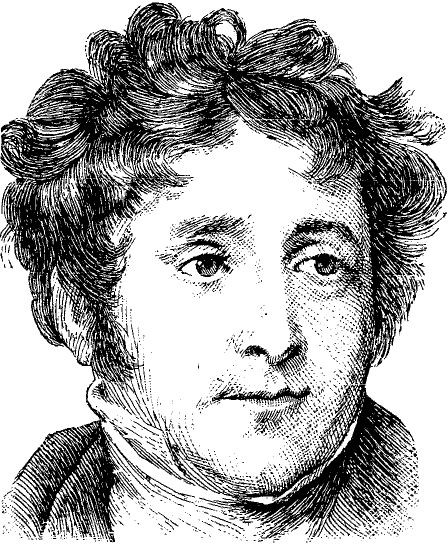
Thomas Campbell
Thomas Campbell was born in Glasgow, July 27th, 1777. His family connection was large and respectable, and the branch to which he belonged had been settled for many years in Argyleshire, where they were called the Campbells of Kirnan, from an estate on which the poet's grandfather resided and where he died. His third son, Alexander, the father of the poet, was at one time the head of a firm in Glasgow, doing a profitable business with Falmouth in Virginia; but in common with almost all merchants engaged in the American trade, he was ruined by the War of the Revolution. At the age of sixty-five he found himself a poor man, involved in a costly suit in chancery, which was finally decided against him, and with a wife and nine children dependent upon him. All that he had to live on, at the time his son Thomas was born, was the little that remained to him of his small property when the debts were paid, and some small yearly sums from two provident societies of which he was a member. The poet was fortunate in his parents: both of them were people of high character, warmly devoted to their children, whose education was their chief care,—their idea of education including the training of the heart and the manners as well as the mind.
When eight years old Thomas was sent to the grammar school at Glasgow, where he began the study of Latin and Greek. "I was so early devoted to poetry," he writes, "that at ten years old, when our master, David Allison, interpreted to us the first Eclogue of Virgil, I was literally thrilled with its beauty. In my thirteenth year I went to the University of Glasgow, and put on the red gown. The joy of the occasion made me unable to eat my breakfast. Whether it was presentiment or the mere castle-building of my vanity, I had even then a day-dream that I should one day be Lord Rector of the university."
As a boy, Campbell gained a considerable familiarity with the Latin and Greek poets usually read in college, and was always more inclined to pride himself on his knowledge of Greek poetry than on his own reputation in the art. His college life was passed in times of great political excitement. Revolution was in the air, and all youthful spirits were aflame with enthusiasm for the cause of liberty and with generous sympathy for oppressed people, particularly the Poles and the Greeks. Campbell was caught by the sacred fire which later was to touch the lips of Byron and Shelley; and in his earliest published poem his interest in Poland, which never died out from his heart, found its first expression. This poem, 'The Pleasures of Hope,' a work whose title was thenceforth to be inseparably associated with its author's name, was published in 1799, when Campbell was exactly twenty-one years and nine months old. It at once placed him high in public favor, though it met with the usual difficulty experienced by a first poem by an unknown writer, in finding a publisher. The copyright was finally bought by Mundell for sixty pounds, to be paid partly in money and partly in books. Three years after the publication, a London publisher valued it as worth an annuity of two hundred pounds for life; and Mundell, disregarding his legal rights, behaved with so much liberality that from the sale of the first seven editions Campbell received no less than nine hundred pounds. Besides this material testimony to its success, scores of anecdotes show the favor with which it was received by the poets and writers of the time. The greatest and noblest of them all, Walter Scott, was most generous in his welcome. He gave a dinner in Campbell's honor, and introduced him to his friends with a bumper to the author of 'The Pleasures of Hope.'
It seemed the natural thing for a young man so successfully launched in the literary coteries of Edinburgh and Glasgow to pursue his advantage in the larger literary world of London. But Campbell judged himself with humorous severity. "At present," he writes in a letter, "I am a raw Scotch lad, and in a company of wits and geniuses would make but a dull figure with my northern brogue and my 'braw Scotch boos.'" The eyes of many of the young men of the time were turned toward Germany, where Goethe and Schiller, Lessing and Wieland, were creating the golden age of their country's literature; and Campbell, full of youthful hope and enthusiasm, and with a little money in his pocket, determined to visit the Continent before settling down to work in London. In 1800 he set out for Ratisbon, which he reached three days before the French entered it with their army. His stay there was crowded with picturesque and tragic incidents, described in his letters to friends at home—"in prose," as his biographer justly says, "which even his best poetry hardly surpasses." From the roof of the Scotch Benedictine Convent of St. James, where Campbell was often hospitably entertained while in Ratisbon, he saw the battle of Hohenlinden, on which he wrote the poem once familiar to every schoolboy. Wearied with the bloody sights of war, he left Ratisbon and the next year returned to England. While living at Altona he wrote no less than fourteen of his minor poems, but few of these escaped the severity of his final judgment when he came to collect his verses for publication. Among these few the best were 'The Exile of Erin' and the noble ode 'Ye Mariners of England,' the poem by which alone, perhaps, his name deserves to live; though 'The Battle of the Baltic' in its original form 'The Battle of Copenhagen'—unfortunately not the one best known—is well worthy of a place beside it.
On his return from the Continent, Campbell found himself received in the warmest manner, not only in the literary world but in circles reckoned socially higher. His poetry hit the taste of all the classes that go to make up the general reading public; his harp had many strings, and it rang true to all the notes of patriotism, humanity, love, and feeling. "His happiest moments at this period," says his biographer, "seem to have been passed with Mrs. Siddons, the Kembles, and his friend Telford, the distinguished engineer, for whom he afterward named his eldest son." Lord Minto, on his return from Vienna, became much interested in Campbell and insisted on his taking up his quarters for the season in his town-house in Hanover Square. When the season was over Lord Minto went back to Scotland, taking the poet with him as traveling companion. At Castle Minto, Campbell found among other visitors Walter Scott, and it was while there that 'Lochiel's Warning' was composed and 'Hohenlinden' revised, and both poems prepared for the press.
In 1803 Campbell married his cousin, Matilda Sinclair. The marriage was a happy one; Washington Irving speaks of the lady's personal beauty, and says that her mental qualities were equally matched with it. "She was, in fact," he adds, "a more suitable wife for a poet than poets' wives are apt to be; and for once a son of song had married a reality and not a poetical fiction."
For seventeen years he supported himself and his family by what was for the most part task-work, not always well paid, and made more onerous by the poor state of his health. In 1801 Campbell's father died, an old man of ninety-one, and with him ceased the small benevolent-society pensions that, with what Thomas and the eldest son living in America could contribute, had hitherto kept the parents in decent comfort. But soon after Thomas's marriage and the birth of his first child, the American brother failed, so that the pious duty of supporting the aged mother now came upon the poet alone. He accepted the addition to his burden as manfully as was to be expected of so generous a nature, but there is no doubt that he was in great poverty for a few years. Although often despondent, and with good reason, his natural cheerfulness and his good sense always came to the rescue, and in his lowest estate he retained the respect and the affection of his many friends.
In 1805 Campbell received a pension of £200, which netted him, when fees and expenses were deducted, £168 a year. Half of this sum he reserved for himself and the remainder he divided between his mother and his two sisters. In 1809 he published 'Gertrude of Wyoming,' which had been completed the year before. It was hailed with delight in Edinburgh and with no less favor in London, and came to a second edition in the spring of 1810. But like most of Campbell's more pretentious poetry, it has failed to keep its place in the world's favor. The scene of the poem is laid in an impossible Pennsylvania where the bison and the beaver, the crocodile, the condor, and the flamingo, live in happy neighborhood in groves of magnolia and olive; while the red Indian launches his pirogue upon the Michigan to hunt the bison, while blissful shepherd swains trip with maidens to the timbrel, and blue-eyed Germans change their swords to pruning-hooks, Andalusians dance the saraband, poor Caledonians drown their homesick cares in transatlantic whisky, and Englishmen plant fair Freedom's tree! The story is as unreal as the landscape, and it is told in a style more labored and artificial by far than that of Pope, to whom indeed the younger poet was often injudiciously compared. Yet it is to be noted that Campbell's prose style was as direct and unaffected as could be wished, while in his two best lyrical poems, 'Ye Mariners of England,' and the first cast of 'The Battle of the Baltic,' he shows a vividness of conception and a power of striking out expression at white heat in which no one of his contemporaries excelled him.
Campbell was deservedly a great favorite in society, and the story of his life at this time is largely the record of his meeting with distinguished people. The Princess of Wales freely welcomed him to her court; he had corresponded with Madame de Staël, and when she came to England he visited her often and at her request read her his lectures on poetry; he saw much of Mrs. Siddons, and when in Paris in 1814, visited the Louvre in her company to see the statues and pictures of which Napoleon had plundered Italy.
In 1826 Campbell was made Lord Rector of Glasgow University, and in 1828 he was re-elected unanimously. During this second term his wife died, and in 1829 the unprecedented honor of an election for a third term was bestowed upon him, although he had to dispute it with no less a rival than Sir Walter Scott. "When he went to Glasgow to be inaugurated as Lord Rector," says his biographer, "on reaching the college green he found the boys pelting each other with snowballs. He rushed into the mêlée and flung about his snowballs right and left with great dexterity, much to the delight of the boys but to the great scandal of the professors. He was proud of the piece of plate given him by the Glasgow lads, but of the honor conferred by his college title he was less sensible. He hated the sound of Doctor Campbell, and said to an acquaintance that no friend of his would ever call him so."
The establishment through his direct agency of the University of London was Campbell's most important public work. Later his life was almost wholly engrossed for a time by his interest in the cause of Poland—a cause indeed that from his youth had lain near his heart. But as he grew older and his health declined he became more and more restless, and finally in 1843 took up his residence at Boulogne. His parents, his brothers and sisters, his wife, his two children, so tenderly loved, were all gone. But he still corresponded with his friends, and to the last his talk was cheerful and pleasant. In June, 1844, he died, and in July he was buried in Westminster Abbey in Poets' Corner. About his grave stood Milman, the Duke of Argyle,—the head of his clan,—Sir Robert Peel, Brougham, Lockhart, Macaulay, D'Israeli, Horace Smith, Croly and Thackeray, with many others, and when the words "Dust to dust" were pronounced, Colonel Szyrma, a distinguished Pole, scattered over the coffin a handful of earth from the grave of Kosciuszko at Cracow.
HOPE
From the 'Pleasures of Hope'
At summer eve, when Heaven's ethereal bow Spans with bright arch the glittering hills below, Why to yon mountain turns the musing eye, Whose sunbright summit mingles with the sky? Why do those cliffs of shadowy tint appear More sweet than all the landscape smiling near? 'Tis distance lends enchantment to the view, And robes the mountain in its azure hue. Thus with delight we linger to survey The promised joys of life's unmeasured way; Thus, from afar, each dim-discovered scene More pleasing seems than all the past hath been, And every form that Fancy can repair From dark oblivion glows divinely there. What potent spirit guides the raptured eye To pierce the shades of dim futurity? Can Wisdom lend, with all her heavenly power, The pledge of Joy's anticipated hour? Ah no! she darkly sees the fate of man— Her dim horizon bounded to a span; Or if she hold an image to the view, 'Tis Nature pictured too severely true. With thee, sweet Hope, resides the heavenly light That pours remotest rapture on the sight; Thine is the charm of life's bewildered way, That calls each slumbering passion into play. Waked by thy touch, I see the sister band, On tiptoe watching, start at thy command, And fly where'er thy mandate bids them steer, To Pleasure's path or Glory's bright career.... Where is the troubled heart consigned to share Tumultuous toils or solitary care, Unblest by visionary thoughts that stray To count the joys of Fortune's better day? Lo! nature, life, and liberty relume The dim-eyed tenant of the dungeon gloom; A long-lost friend, or hapless child restored, Smiles at his blazing hearth and social board; Warm from his heart the tears of rapture flow, And virtue triumphs o'er remembered woe. Chide not his peace, proud Reason; nor destroy The shadowy forms of uncreated joy, That urge the lingering tide of life, and pour Spontaneous slumber on his midnight hour. Hark! the wild maniac sings, to chide the gale That wafts so slow her lover's distant sail; She, sad spectatress, on the wintry shore, Watched the rude surge his shroudless corse that bore, Knew the pale form, and shrieking in amaze, Clasped her cold hands, and fixed her maddening gaze; Poor widowed wretch! 'Twas there she wept in vain, Till Memory fled her agonizing brain:— But Mercy gave, to charm the sense of woe, Ideal peace, that truth could ne'er bestow; Warm on her heart the joys of Fancy beam, And aimless Hope delights her darkest dream. Oft when yon moon has climbed the midnight sky, And the lone sea-bird wakes its wildest cry, Piled on the steep, her blazing fagots burn To hail the bark that never can return; And still she waits, but scarce forbears to weep That constant love can linger on the deep.
THE FALL OF POLAND
From the 'Pleasures of Hope'
O Sacred Truth! thy triumph ceased a while, And Hope, thy sister, ceased with thee to smile, When leagued Oppression poured to Northern wars Her whiskered pandoors and her fierce hussars, Waved her dread standard to the breeze of morn, Pealed her loud drum, and twanged her trumpet horn; Tumultuous horror brooded o'er her van, Presaging wrath to Poland—and to man! Warsaw's last champion from her height surveyed, Wide o'er the fields, a waste of ruin laid— O Heaven! he cried,—my bleeding country save! Is there no hand on high to shield the brave? Yet, though destruction sweep those lovely plains, Rise, fellow-men! our country yet remains. By that dread name, we wave the sword on high, And swear for her to live! with her to die! He said, and on the rampart-heights arrayed His trusty warriors, few but undismayed; Firm-paced and slow, a horrid front they form, Still as the breeze, but dreadful as the storm; Low murmuring sounds along their banners fly, Revenge, or death—the watchword and reply; Then pealed the notes, omnipotent to charm, And the loud tocsin tolled their last alarm! In vain, alas! in vain, ye gallant few! From rank to rank your volleyed thunder flew; Oh, bloodiest picture in the book of Time, Sarmatia fell, unwept, without a crime; Found not a generous friend, a pitying foe, Strength in her arms, nor mercy in her woe! Dropped from her nerveless grasp the shattered spear, Closed her bright eye and curbed her high career; Hope for a season bade the world farewell, And Freedom shrieked, as Kosciusko fell! The sun went down, nor ceased the carnage there; Tumultuous Murder shook the midnight air— On Prague's proud arch the fires of ruin glow, His blood-dyed waters murmuring far below; The storm prevails, the rampart yields a way, Bursts the wild cry of horror and dismay! Hark, as the smoldering piles with thunder fall, A thousand shrieks for hopeless mercy call! Earth shook—red meteors flashed along the sky, And conscious Nature shuddered at the cry! O righteous Heaven! ere Freedom found a grave, Why slept the sword, omnipotent to save? Where was thine arm, O Vengeance! where thy rod, That smote the foes of Zion and of God; That crushed proud Ammon, when his iron car Was yoked in wrath, and thundered from afar? Where was the storm that slumbered till the host Of blood-stained Pharaoh left their trembling coast; Then bade the deep in wild commotion flow, And heaved an ocean on their march below? Departed spirits of the mighty dead! Ye that at Marathon and Leuctra bled! Friends of the world! restore your swords to man, Fight in his sacred cause, and lead the van; Yet for Sarmatia's tears of blood atone, And make her arm puissant as your own; Oh! once again to Freedom's cause return The patriot Tell, the Bruce of Bannockburn!
THE SLAVE
From the 'Pleasures of Hope'
And say, supernal Powers! who deeply scan Heaven's dark decrees, unfathomed yet by man,— When shall the world call down, to cleanse her shame. That embryo spirit, yet without a name, That friend of Nature, whose avenging hands Shall burst the Libyan's adamantine bands? Who, sternly marking on his native soil The blood, the tears, the anguish and the toil, Shall bid each righteous heart exult to see Peace to the slave, and vengeance on the free! Yet, yet, degraded men! th' expected day That breaks your bitter cup is far away; Trade, wealth, and fashion ask you still to bleed, And holy men give Scripture for the deed; Scourged and debased, no Briton stoops to save A wretch, a coward—yes, because a slave! Eternal Nature! when thy giant hand Had heaved the floods and fixed the trembling land, When life sprang startling at thy plastic call, Endless thy forms, and man the lord of all:— Say, was that lordly form inspired by thee, To wear eternal chains and bow the knee? Was man ordained the slave of man to toil, Yoked with the brutes, and fettered to the soil, Weighed in a tyrant's balance with his gold? No! Nature stamped us in a heavenly mold! She bade no wretch his thankless labor urge, Nor, trembling, take the pittance and the scourge; No homeless Libyan, on the stormy deep, To call upon his country's name and weep! Lo! once in triumph, on his boundless plain, The quivered chief of Congo loved to reign; With fires proportioned to his native sky, Strength in his arm, and lightning in his eye; Scoured with wild feet his sun-illumined zone, The spear, the lion, and the woods, his own; Or led the combat, bold without a plan, An artless savage, but a fearless man. The plunderer came;—alas! no glory smiles For Congo's chief, on yonder Indian isles; Forever fallen! no son of nature now, With Freedom chartered on his manly brow. Faint, bleeding, bound, he weeps the night away, And when the sea-wind wafts the dewless day, Starts, with a bursting heart, for evermore To curse the sun that lights their guilty shore! The shrill horn blew; at that alarum knell His guardian angel took a last farewell. That funeral dirge to darkness hath resigned The fiery grandeur of a generous mind. Poor fettered man! I hear thee breathing low Unhallowed vows to Guilt, the child of Woe: Friendless thy heart; and canst thou harbor there A wish but death—a passion but despair? The widowed Indian, when her lord expires, Mounts the dread pile, and braves the funeral fires. So falls the heart at Thraldom's bitter sigh; So Virtue dies, the spouse of Liberty!
DEATH AND A FUTURE LIFE
From the 'Pleasures of Hope'
Unfading Hope! when life's last embers burn, When soul to soul, and dust to dust return! Heaven to thy charge resigns the awful hour. Oh, then thy kingdom comes! Immortal Power! What though each spark of earth-born rapture fly The quivering lip, pale cheek, and closing eye,— Bright to the soul thy seraph hands convey The morning dream of life's eternal day— Then, then the triumph and the trance begin, And all the phœnix spirit burns within! Oh deep-enchanting prelude to repose, The dawn of bliss, the twilight of our woes! Yet half I hear the panting spirit sigh, It is a dread and awful thing to die! Mysterious worlds, untraveled by the sun! Where Time's far-wandering tide has never run,— From your unfathomed shades and viewless spheres, A warning comes, unheard by other ears. 'Tis Heaven's commanding trumpet, long and loud, Like Sinai's thunder, pealing from the cloud! While Nature hears, with terror-mingled trust, The shock that hurls her fabric to the dust; And like the trembling Hebrew, when he trod The roaring waves, and called upon his God, With mortal terrors clouds immortal bliss, And shrieks, and hovers o'er the dark abyss! Daughter of Faith, awake, arise, illume The dread unknown, the chaos of the tomb; Melt and dispel, ye spectre doubts, that roll Cimmerian darkness o'er the parting soul! Fly, like the moon-eyed herald of Dismay, Chased on his night-steed by the star of day! The strife is o'er—the pangs of Nature close, And life's last rapture triumphs o'er her woes. Hark! as the spirit eyes, with eagle gaze, The noon of Heaven undazzled by the blaze, On heavenly winds that waft her to the sky Float the sweet tones of star-born melody; Wild as that hallowed anthem sent to hail Bethlehem's shepherds in the lonely vale, When Jordan hushed his waves, and midnight still Watched on the holy towers of Zion hill. Soul of the just! companion of the dead! Where is thy home, and whither art thou fled? Back to its heavenly source thy being goes. Swift as the comet wheels to whence he rose; Doomed on his airy path a while to burn, And doomed like thee to travel and return. Hark! from the world's exploding centre driven, With sounds that shook the firmament of Heaven, Careers the fiery giant, fast and far, On bickering wheels and adamantine car; From planet whirled to planet more remote, He visits realms beyond the reach of thought; But wheeling homeward, when his course is run, Curbs the red yoke, and mingles with the sun: So hath the traveler of earth unfurled Her trembling wings, emerging from the world; And o'er the path by mortal never trod, Sprung to her source, the bosom of her God! Oh, lives there, Heaven, beneath thy dread expanse, One hopeless, dark idolater of Chance, Content to feed, with pleasures unrefined, The lukewarm passions of a lowly mind, Who, moldering earthward, reft of every trust, In joyless union wedded to the dust, Could all his parting energy dismiss, And call this barren world sufficient bliss? There live, alas! of heaven-directed mien, Of cultured soul, and sapient eye serene, Who hail thee, Man! the pilgrim of a day, Spouse of the worm, and brother of the clay; Frail as the leaf in Autumn's yellow bower, Dust in the wind, or dew upon the flower; A friendless slave, a child without a sire, Whose mortal life and momentary fire Light to the grave his chance-created form, As ocean-wrecks illuminate the storm; And when the guns' tremendous flash is o'er, To-night and silence sink for evermore! Are these the pompous tidings ye proclaim, Lights of the world, and demigods of Fame? Is this your triumph—this your proud applause, Children of Truth, and champions of her cause? For this hath Science searched, on weary wing, By shore and sea, each mute and living thing? Launched with Iberia's pilot from the steep, To worlds unknown, and isles beyond the deep? Or round the cope her living chariot driven, And wheeled in triumph through the signs of Heaven? O star-eyed Science, hast thou wandered there, To waft us home the message of despair? Then bind the palm, thy sage's brow to suit, Of blasted leaf and death-distilling fruit. Ah me! the laureled wreath that Murder rears, Blood-nursed, and watered by the widow's tears, Seems not so foul, so tainted, and so dread, As waves the nightshade round the skeptic's head. What is the bigot's torch, the tyrant's chain? I smile on death, if Heavenward Hope remain! But if the warring winds of Nature's strife Be all the faithless charter of my life; If Chance awaked, inexorable power, This frail and feverish being of an hour; Doomed o'er the world's precarious scene to sweep, Swift as the tempest travels on the deep; To know Delight but by her parting smile, And toil, and wish, and weep a little while;— Then melt, ye elements, that formed in vain This troubled pulse and visionary brain! Fade, ye wild flowers, memorials of my doom, And sink, ye stars, that light me to the tomb! Truth, ever lovely,—since the world began, The foe of tyrants, and the friend of man,— How can thy words from balmy slumber start Reposing Virtue, pillowed on the heart! Yet if thy voice the note of thunder rolled, And that were true which Nature never told, Let Wisdom smile not on her conquered field: No rapture dawns, no treasure is revealed. Oh! let her read, nor loudly, nor elate, The doom that bars us from a better fate; But, sad as angels for the good man's sin, Weep to record, and blush to give it in!
LOCHIEL'S WARNING
WIZARD
Lochiel, Lochiel! beware of the day When the Lowlands shall meet thee in battle array! For a field of the dead rushes red on my sight, And the clans of Culloden are scattered in fight. They rally, they bleed, for their kingdom and crown; Woe, woe to the riders that trample them down! Proud Cumberland prances, insulting the slain, And their hoof-beaten bosoms are trod to the plain. But hark! through the fast-flashing lightning of war, What steed to the desert flies frantic and far? 'Tis thine, O Glenullin! whose bride shall await, Like a love-lighted watch-fire, all night at the gate. A steed comes at morning; no rider is there; But its bridle is red with the sign of despair. Weep, Albin! to death and captivity led! Oh weep! but thy tears cannot number the dead: For a merciless sword on Culloden shall wave, Culloden! that reeks with the blood of the brave.
LOCHIEL
Go, preach to the coward, thou death-telling seer! Or, if gory Culloden so dreadful appear, Draw, dotard, around thy old wavering sight This mantle, to cover the phantoms of fright.
WIZARD
Ha! laugh'st thou, Lochiel, my vision to scorn? Proud bird of the mountain, thy plume shall be torn! Say, rushed the bold eagle exultingly forth, From his home in the dark rolling clouds of the north? Lo! the death-shot of foemen outspeeding, he rode Companionless, bearing destruction abroad; But down let him stoop from his havoc on high! Ah! home let him speed,—for the spoiler is nigh. Why flames the far summit? Why shoot to the blast Those embers, like stars from the firmament cast? 'Tis the fire-shower of ruin, all dreadfully driven From his eyrie, that beacons the darkness of heaven. O crested Lochiel! the peerless in might, Whose banners arise on the battlements' height, Heaven's fire is around thee, to blast and to burn; Return to thy dwelling! all lonely return! For the blackness of ashes shall mark where it stood, And a wild mother scream o'er her famishing brood.
LOCHIEL
False Wizard, avaunt! I have marshaled my clan; Their swords are a thousand, their bosoms are one! They are true to the last of their blood and their breath, And like reapers descend to the harvest of death. Then welcome be Cumberland's steed to the shock! Let him dash his proud foam like a wave on the rock! But woe to his kindred, and woe to his cause, When Albin her claymore indignantly draws; When her bonneted chieftains to victory crowd, Clanronald the dauntless, and Moray the proud, All plaided and plumed in their tartan array—
WIZARD
Lochiel, Lochiel! beware of the day; For, dark and despairing, my sight I may seal, But man cannot cover what God would reveal; 'Tis the sunset of life gives me mystical lore, And coming events cast their shadows before. I tell thee, Culloden's dread echoes shall ring With the bloodhounds that bark for thy fugitive king. Lo! anointed by Heaven with the vials of wrath, Behold, where he flies on his desolate path! Now in darkness and billows, he sweeps from my sight: Rise, rise! ye wild tempests, and cover his flight! 'Tis finished. Their thunders are hushed on the moors: Culloden is lost, and my country deplores. But where is the iron-bound prisoner? where? For the red eye of battle is shut in despair. Say, mounts he the ocean wave, banished, forlorn, Like a limb from his country cast bleeding and torn? Ah no! for a darker departure is near; The war-drum is muffled, and black is the bier; His death-bell is tolling: O Mercy, dispel Yon sight, that it freezes my spirit to tell! Life flutters convulsed in his quivering limbs, And his blood-streaming nostril in agony swims. Accursed be the fagots that blaze at his feet, Where his heart shall be thrown ere it ceases to beat, With the smoke of its ashes to poison the gale—
LOCHIEL
Down, soothless insulter! I trust not the tale: For never shall Albin a destiny meet So black with dishonor, so foul with retreat. Though my perishing ranks should be strewed in their gore, Like ocean-weeds heaped on the surf-beaten shore, Lochiel, untainted by flight or by chains, While the kindling of life in his bosom remains, Shall victor exult, or in death be laid low, With his back to the field, and his feet to the foe! And, leaving in battle no blot on his name, Look proudly to Heaven from the death-bed of fame.
THE SOLDIER'S DREAM
Our bugles sang truce—for the night-cloud had lowered, And the sentinel stars set their watch in the sky; And thousands had sunk on the ground overpowered, The weary to sleep, and the wounded to die.
When reposing that night on my pallet of straw, By the wolf-scaring fagot that guarded the slain, At the dead of the night a sweet vision I saw, And thrice ere the morning I dreamt it again.
Methought from the battle-field's dreadful array, Far, far I had roamed on a desolate track: 'Twas Autumn,—and sunshine arose on the way To the home of my fathers, that welcomed me back.
I flew to the pleasant fields traversed so oft In life's morning march, when my bosom was young; I heard my own mountain-goats bleating aloft, And knew the sweet strain that the corn-reapers sung.
Then pledged we the wine-cup, and fondly I swore From my home and my weeping friends never to part; My little ones kissed me a thousand times o'er, And my wife sobbed aloud in her fullness of heart.
"Stay, stay with us,—rest; thou art weary and worn!" And fain was their war-broken soldier to stay:— But sorrow returned with the dawning of morn, And the voice in my dreaming ear melted away.
LORD ULLIN'S DAUGHTER
A Chieftan, to the Highlands bound, Cries, "Boatman, do not tarry! And I'll give thee a silver pound, To row us o'er the ferry."
"Now who be ye, would cross Lochgyle, This dark and stormy water?" "O, I'm the chief of Ulva's isle, And this Lord Ullin's daughter.
"And fast before her father's men Three days we've fled together; For should he find us in the glen, My blood would stain the heather.
"His horsemen hard behind us ride; Should they our steps discover, Then who will cheer my bonny bride When they have slain her lover?"
Out spoke the hardy Highland wight, "I'll go, my chief—I'm ready;— It is not for your silver bright, But for your winsome lady;
"And by my word! the bonny bird In danger shall not tarry; So though the waves are raging white I'll row you o'er the ferry."
By this the storm grew loud apace, The water-wraith was shrieking; And in the scowl of heaven each face Grew dark as they were speaking.
But still as wilder blew the wind, And as the night grew drearer, Adown the glen rode armèd men, Their trampling sounded nearer.
"O haste thee, haste!" the lady cries, "Though tempests round us gather, I'll meet the raging of the skies, But not an angry father."
The boat has left a stormy land, A stormy sea before her, When, oh! too strong for human hand, The tempest gathered o'er her.
And still they rowed amidst the roar Of waters fast prevailing: Lord Ullin reached that fatal shore; His wrath was changed to wailing.
For sore dismayed, through storm and shade, His child he did discover: One lovely hand she stretched for aid, And one was round her lover.
"Come back! come back!" he cried in grief, "Across this stormy water; And I'll forgive your Highland chief, My daughter!—oh, my daughter!"
'Twas vain: the loud waves lashed the shore, Return or aid preventing:— The waters wild went o'er his child, And he was left lamenting.
THE EXILE OF ERIN
There came to the beach a poor Exile of Erin, The dew on his thin robe was heavy and chill; For his country he sighed, when at twilight repairing To wander alone by the wind-beaten hill; But the day-star attracted his eye's sad devotion, For it rose o'er his own native isle of the ocean, Where once, in the fire of his youthful emotion, He sang the bold anthem of Erin go bragh.
Sad is my fate! said the heart-broken stranger; The wild deer and wolf to a covert can flee, But I have no refuge from famine and danger. A home and a country remain not to me. Never again, in the green sunny bowers Where my forefathers lived, shall I spend the sweet hours, Or cover my harp with the wild-woven flowers, And strike to the numbers of Erin go bragh!
Erin, my country! though sad and forsaken, In dreams I revisit thy sea-beaten shore; But, alas! in a far foreign land I awaken, And sigh for the friends who can meet me no more! O cruel fate! wilt thou never replace me In a mansion of peace, where no perils can chase me? Never again shall my brothers embrace me? They died to defend me, or live to deplore!
Where is my cabin door, fast by the wildwood? Sisters and sire! did ye weep for its fall? Where is the mother that looked on my childhood? And where is the bosom-friend, dearer than all? Oh! my sad heart! long abandoned by pleasure, Why did it dote on a fast fading treasure? Tears, like the raindrop, may fall without measure, But rapture and beauty they cannot recall.
Yet all its sad recollections suppressing, One dying wish my lone bosom can draw: Erin! an exile bequeaths thee his blessing! Land of my forefathers! Erin go bragh! Buried and cold, when my heart stills her motion, Green be thy fields, sweetest isle of the ocean! And thy harp-striking bards sing aloud with devotion— Erin mavournin—Erin go bragh!
YE MARINERS OF ENGLAND
Ye Mariners of England! That guard our native seas; Whose flag has braved, a thousand years, The battle and the breeze! Your glorious standard launch again To match another foe! And sweep through the deep, While the stormy winds do blow; While the battle rages loud and long, And the stormy winds do blow.
The spirit of your fathers Shall start from every wave!— For the deck it was their field of fame, And Ocean was their grave: Where Blake and mighty Nelson fell, Your manly hearts shall glow, As ye sweep through the deep, While the stormy winds do blow; While the battle rages loud and long, And the stormy winds do blow.
Britannia needs no bulwark, No towers along the steep; Her march is o'er the mountain-waves, Her home is on the deep. With thunders from her native oak She quells the floods below,— As they roar on the shore, When the stormy winds do blow; When the battle rages loud and long, And the stormy winds do blow.
The meteor flag of England Shall yet terrific burn, Till danger's troubled night depart, And the star of peace return. Then, then, ye ocean-warriors! Our song and feast shall flow To the fame of your name, When the storm has ceased to blow; When the fiery fight is heard no more, And the storm has ceased to blow.
HOHENLINDEN
On Linden, when the sun was low, All bloodless lay th' untrodden snow; And dark as winter was the flow Of Iser, rolling rapidly.
But Linden saw another sight, When the drum beat, at dead of night, Commanding fires of death to light The darkness of her scenery.
By torch and trumpet fast arrayed, Each horseman drew his battle-blade, And furious every charger neighed, To join the dreadful revelry.
Then shook the hills with thunder riven, Then rushed the steed to battle driven, And louder than the bolts of heaven Far flashed the red artillery.
But redder yet that light shall glow On Linden's hills of stainèd snow, And bloodier yet the torrent flow Of Iser, rolling rapidly.
'Tis morn, but scarce yon level sun Can pierce the war-clouds, rolling dun, Where furious Frank and fiery Hun Shout in their sulph'rous canopy.
The combat deepens. On, ye brave, Who rush to glory or the grave! Wave, Munich! all thy banners wave, And charge with all thy chivalry!
Few, few shall part where many meet! The snow shall be their winding-sheet, And every turf beneath their feet Shall be a soldier's sepulchre.
HOHENLINDEN. Photogravure from a painting by Meissonier.
The battle of Hohenlinden, commemorated by Campbell's lyric, was fought Dec. 3, 1800. The French under Moreau defeated the Austrians under the Archduke John.
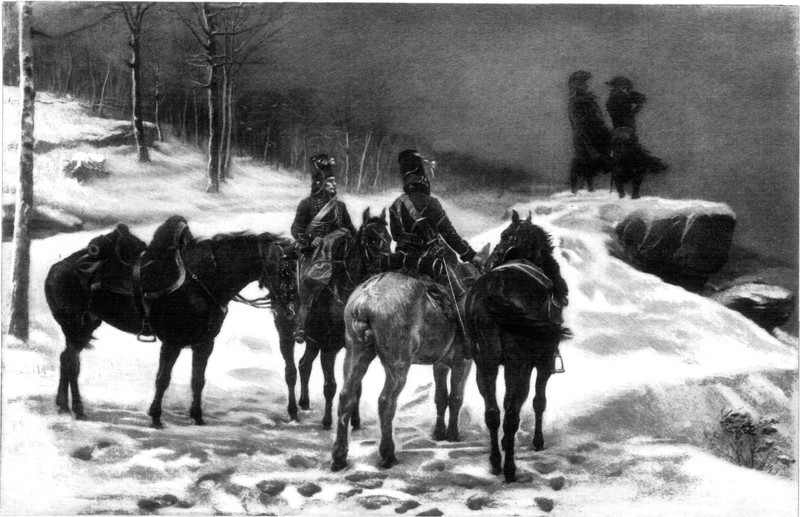
THE BATTLE OF COPENHAGEN
Of Nelson and the North Sing the day! When, their haughty powers to vex, He engaged the Danish decks, And with twenty floating wrecks Crowned the fray!
All bright, in April's sun, Shone the day! When a British fleet came down Through the islands of the crown, And by Copenhagen town Took their stay.
In arms the Danish shore Proudly shone; By each gun the lighted brand, In a bold determined hand, And the Prince of all the land Led them on!
For Denmark here had drawn All her might! From her battle-ships so vast She had hewn away the mast, And at anchor to the last Bade them fight!
Another noble fleet Of their line Rode out, but these were naught To the batteries, which they brought, Like Leviathans afloat, In the brine.
It was ten of Thursday morn, By the chime; As they drifted on their path There was silence deep as death, And the boldest held his breath For a time—
Ere a first and fatal round Shook the flood; Every Dane looked out that day, Like the red wolf on his prey, And he swore his flag to sway O'er our blood.
Not such a mind possessed England's tar; 'Twas the love of noble game Set his oaken heart on flame, For to him 'twas all the same— Sport and war.
All hands and eyes on watch, As they keep; By their motion light as wings, By each step that haughty springs, You might know them for the kings Of the deep!
'Twas the Edgar first that smote Denmark's line; As her flag the foremost soared, Murray stamped his foot on board, And an hundred cannons roared At the sign!
Three cheers of all the fleet Sung huzza! Then, from centre, rear, and van, Every captain, every man, With a lion's heart began To the fray.
Oh, dark grew soon the heavens— For each gun From its adamantine lips Spread a death-shade round the ships, Like a hurricane eclipse Of the sun.
Three hours the raging fire Did not slack; But the fourth, their signals drear Of distress and wreck appear, And the Dane a feeble cheer Sent us back.
The voice decayed, their shots Slowly boom. They ceased—and all is wail, As they strike the shattered sail, Or in conflagration pale Light the gloom.
Oh death!—it was a sight Filled our eyes! But we rescued many a crew From the waves of scarlet hue, Ere the cross of England flew O'er her prize.
Why ceased not here the strife, O ye brave? Why bleeds old England's band, By the fire of Danish land, That smites the very hand Stretched to save?
But the Britons sent to warn Denmark's town; Proud foes, let vengeance sleep; If another chain-shot sweep, All your navy in the deep Shall go down!
Then, peace instead of death Let us bring! If you'll yield your conquered fleet, With the crews, at England's feet, And make submission meet To our king!
Then death withdrew his pall From the day; And the sun looked smiling bright On a wide and woful sight, Where the fires of funeral light Died away.
Yet all amidst her wrecks, And her gore, Proud Denmark blest our chief That he gave her wounds relief; And the sounds of joy and grief Filled her shore.
All round, outlandish cries Loudly broke; But a nobler note was rung, When the British, old and young. To their bands of music sung 'Hearts of Oak!'
Cheer! cheer! from park and tower, London town! When the King shall ride in state From St. James's royal gate, And to all his peers relate Our renown!
The bells shall ring! the day Shall not close, But a blaze of cities bright Shall illuminate the night, And the wine-cup shine in light As it flows!
Yet—yet—amid the joy And uproar, Let us think of them that sleep Full many a fathom deep All beside thy rocky steep, Elsinore!
Brave hearts, to Britain's weal Once so true! Though death has quenched your flame, Yet immortal be your name! For ye died the death of fame With Riou!
Soft sigh the winds of heaven O'er your grave! While the billow mournful rolls, And the mermaid's song condoles, Singing—"Glory to the souls Of the brave!"
FROM THE 'ODE TO WINTER'
But howling winter fled afar, To hills that prop the polar star, And loves on deer-borne car to ride With barren Darkness by his side, Round the shore where loud Lofoden Whirls to death the roaring whale, Round the hall where Runic Odin Howls his war-song to the gale; Save when adown the ravaged globe He travels on his native storm, Deflowering Nature's grassy robe, And trampling on her faded form:— Till light's returning lord assume The shaft that drives him to his polar field; Of power to pierce his raven plume And crystal-covered shield. O sire of storms! whose savage ear The Lapland drum delights to hear, When Frenzy with her bloodshot eye Implores thy dreadful deity. Archangel! power of desolation! Fast descending as thou art, Say, hath mortal invocation Spells to touch thy stony heart? Then, sullen Winter, hear my prayer, And gently rule the ruined year; Nor chill the wanderer's bosom bare, Nor freeze the wretch's falling tear;— To shuddering Want's unmantled bed Thy horror-breathing agues cease to lead, And gently on the orphan head Of innocence descend,— But chiefly spare, O king of clouds! The sailor on his airy shrouds; When wrecks and beacons strew the steep, And spectres walk along the deep. Milder yet thy snowy breezes Pour on yonder tented shores, Where the Rhine's broad billow freezes, Or the dark-brown Danube roars.
CAMPION
(-1619)
BY ERNEST RHYS

r. Thomas Campion, lyric poet, musician, and doctor of medicine,—who, of the three liberal arts that he practiced, is remembered now mainly for his poetry,—was born about the middle of the sixteenth century; the precise date and place being unknown. It has been conjectured that he came of an Essex family; but the evidence for this falls through. Nor was he, as has been ingeniously supposed, of any relationship to his namesake Edmund Campion, the Jesuit. What is certain, and thrice interesting in the case of such a poet, is that he was so nearly a contemporary of Shakespeare's. He was living in London all through the period of Shakespeare's mastery of the English stage, and survived him only by some three or four years. From an entry in the register of St. Dunstan's-in-the-West, Fleet Street, we learn that Campion was buried there in February, 1619-20. But although it is clear that the two poets, one the most famous, the other well-nigh the least known, in the greater Elizabethan galaxy, must have often encountered in the narrower London of that day, there is no single reference in the lives or works of either connecting one with the other.
We first hear of Campion at Gray's Inn, where he was admitted a member in 1586, from which it is clear that his first idea was to go in for law. He tired of it before he was called to the bar, however; and turning to medicine instead, he seems to have studied for his M.D. at Cambridge, and thereafter repaired again to London and begun to practice as a physician,—very successfully, as the names of some of his more distinguished patients show. A man of taste, in the very finest sense,—cultured, musical, urbane,—his own Latin epigrams alone would show that he had all that social instinct and tact which count for so much in a doctor's career. He was fortunate, too, in finding in London the society best adapted to stimulate his finely intellectual and artistic faculty. The first public sign of his literary art was his book of 'Poemata,' the Latin epigrams referred to, which appeared in 1595, and every copy of which has disappeared. Fortunately a second series of epigrams, written in maturer years, gave him an excuse to republish the first series in connection with them, in the year of his death, 1619. From the two series we learn many interesting facts about his circle of friends and himself, and the evident ease and pleasantness of his life, late and early. There is the same sense of style in his Latin verse that one finds in his English lyrics; but though he had a pretty wit, with a sufficient salt in it on occasion,—as in his references to Barnabe Barnes,—his faculty was clearly more lyrical than epigrammatical, and his lyric poems are all that an exacting posterity is likely to allow him to carry up the steep approach to the House of Fame.
His earliest collection of these exquisite little poems was not issued under his own name, but under that of Philip Rosetter the musician, who wrote the music for half the book; the other half being of Campion's own composition. This, the first of the delightful set of old music-books which are the only source we have to draw upon for his lyric poems, was published in 1601. There is no doubt that for many years previous to this, Campion had been in the habit of writing both the words and music of such songs for the private delectation of his friends and himself. Some of his very finest lyrics, as memorable as anything he has given us, appear in this first volume of 1601.
The second collection of Campion's songs was published, this time under his own name, probably in 1613. It is entitled 'Two Books of Airs'; the first, 'Divine and Moral Songs,' which include some of the finest examples of their kind in all English literature; the second book, 'Light Conceits of Lovers,' is very well described by its title, containing many sweetest love-songs. We have not yet exhausted the list of Campion's music-books. In 1617 two more, 'The Third & Fourth Books of Airs,' were published in another small folio; and these again afford songs fine enough for any anthology. Meanwhile we have passed by all his Masques, which are among the prettiest of their kind, and as full of lyrical moments as of picturesque effects. The first was performed at Whitehall for the marriage of "my Lord Hayes" (Sir James Hay), on Twelfth Night, 1606-7. Three more were written by Campion in 1613; and in the same year he published his 'Songs of Mourning,' prompted by the untimely death of the promising young Prince Henry, which had taken place in November, 1612. These songs, which do not show Campion at his best, were set to music by Copario (alias John Cooper). This completes the list of Campion's poetry; but besides his actual practice in the arts of poetry and music, he wrote on the theory of both. His interesting 'Observations in the Art of English Poesie' (1602) resolves itself into a naive attack upon the use of rhyme in poetry, which comes paradoxically enough from one who was himself so exquisite a rhymer, and which called forth a very convincing reply in Daniel's 'Defence of Rhyme.' The 'Observations' contain some very taking examples of what may be done in the lyric form, without rhyme. Campion's musical pamphlet is less generally interesting, since counterpoint, on which he offered some practical rules, and the theory of music, have traveled so far since he wrote. It remains only to add that Campion remained in the limbo of forgotten poets from his own day until ours, when Professor Arber and Mr. A. H. Bullen in their different anthologies and editions rescued him for us. Mr. Bullen's privately printed volume of his works appeared in 1889. The present writer has more recently (1896) edited a very full selection of the lyrics in the 'Lyric Poets' series. Campion's fame, without doubt, is destined to grow steadily from this time forth, based as it is on poems which so perfectly and exquisitely satisfy the lyric sense and the lyric relationship between music and poetry.
A HYMN IN PRAISE OF NEPTUNE
Of Neptune's empire let us sing, At whose command the waves obey; To whom the rivers tribute pay, Down the high mountains sliding; To whom the scaly nation yields Homage for the crystal fields Wherein they dwell; And every sea-god pays a gem Yearly out of his wat'ry cell, To deck great Neptune's diadem.
The Tritons dancing in a ring Before his palace gates do make The water with their echoes quake, Like the great thunder sounding: The sea-nymphs chant their accents shrill, And the Syrens, taught to kill With their sweet voice, Make every echoing rock reply, Unto their gentle murmuring noise, The praise of Neptune's empery.
From 'Ward's English Poets.'
OF CORINNA'S SINGING
When to her lute Corinna sings, Her voice revives the leaden strings, And doth in highest notes appear As any challenged echo clear. But when she doth of mourning speak, E'en with her sighs the strings do break. And as her lute doth live and die, Led by her passions, so must I: For when of pleasure she doth sing, My thoughts enjoy a sudden spring; But if she do of sorrow speak, E'en from my heart the strings do break.
From 'Ward's English Poets'
FROM 'DIVINE AND MORAL SONGS'
(A. H. Bullen's modern text)
Never weather-beaten sail more willing bent to shore, Never tired pilgrim's limbs affected slumber more. Than my wearied sprite now longs to fly out of my troubled breast. O come quickly, sweetest Lord, and take my soul to rest!
Ever blooming are the joys of heaven's high Paradise; Cold age deafs not there our ears, nor vapor dims our eyes: Glory there the sun outshines, whose beams the Blessèd only see. O come quickly, glorious Lord, and raise my sprite to Thee!
TO A COQUETTE
(A. H. Bullen's modern text)
When thou must home to shades of underground, And there arrived, a new admired guest, The beauteous spirits do engirt thee round, White Iope, blithe Helen, and the rest, To hear the stories of thy finished love From that smooth tongue whose music hell can move;
Then wilt thou speak of banqueting delights, Of masques and revels which sweet youth did make, Of tourneys and great challenges of knights, And all these triumphs for thy beauty's sake: When thou hast told these honors done to thee, Then tell, O tell, how thou didst murder me.
SONGS FROM 'LIGHT CONCEITS OF LOVERS'
Where shee her sacred bowre adornes, The Rivers clearely flow; The groves and medowes swell with flowres, The windes all gently blow. Her Sunne-like beauty shines so fayre, Her Spring can never fade; Who then can blame the life that strives To harbour in her shade?
Her grace I sought, her love I wooed; Her love though I obtaine, No time, no toyle, no vow, no faith, Her wishèd grace can gaine. Yet truth can tell my heart is hers, And her will I adore; And from that love when I depart, Let heav'n view me no more!
Give beauty all her right,— She's not to one forme tyed; Each shape yeelds faire delight, Where her perfections bide. Helen, I grant, might pleasing be; And Ros'mond was as sweet as shee.
Some, the quicke eye commends; Some, swelling lips and red; Pale lookes have many friends, Through sacred sweetnesse bred. Medowes have flowres that pleasure move, Though Roses are the flowres of love.
Free beauty is not bound To one unmovèd clime: She visits ev'ry ground, And favours ev'ry time. Let the old loves with mine compare, My Sov'raigne is as sweet and fair.
GEORGE CANNING
(1770-1827)
he political history of this famous British statesman is told by Robert Bell (1846), by F.H. Hill (English Worthies Series), and in detail by Stapleton (his private secretary) in 'Political Life of Canning.' He became a friend of Pitt in 1793, entered the House of Commons in 1794, was made Under-Secretary of State in 1796, was Treasurer of the Navy from 1804 to 1806, Minister for Foreign Affairs from 1807 till 1809, Ambassador to Lisbon from 1814 to 1816, again at the head of foreign affairs in 1822, and was made Premier in 1827, dying under the labor of forming his Cabinet.
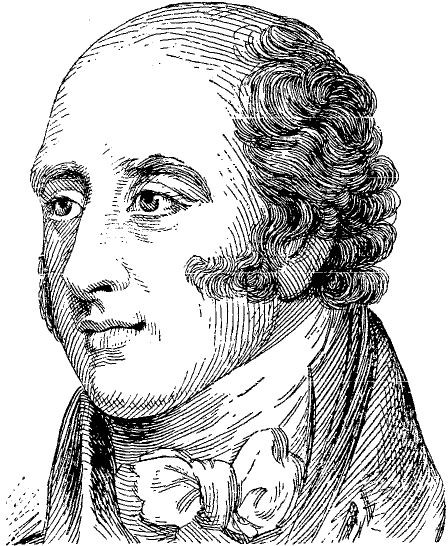
George Canning
Soon after his birth in London, April 11th, 1770, his disinherited father died in poverty, and his mother became an unsuccessful actress. An Irish actor, Moody, took young Canning to his uncle, Stratford Canning, in London, who adopted him and sent him to Eton, where he distinguished himself for his wit and literary talent. With his friends John and Robert Smith, John Hookham Frere, and Charles Ellis, he published a school magazine called The Microcosm, which attracted so much attention that Knight the publisher paid Canning £50 for the copyright. It was modeled on the Spectator, ridiculed modes and customs, and was a unique specimen of juvenile essay-writing. A fifth edition of the Microcosm was published in 1825. Subsequently Canning studied at Oxford. He died August 8th, 1827, at Chiswick (the residence of the Duke of Devonshire), in the same room and at the same age as Fox, and under similar circumstances; and he was buried in Westminster Abbey by the side of William Pitt.
It was not until 1798 that he obtained his great reputation as a statesman and orator. Every one agrees that his literary eloquence, wit, beauty of imagery, taste, and clearness of reasoning, were extraordinary. Byron calls him "a genius—almost a universal one; an orator, a wit, a poet, and a statesman." As a public speaker, we may picture him from Lord Dalling's description:—
"Every day, indeed, leaves us fewer of those who remember the clearly chiseled countenance, which the slouched hat only slightly concealed; the lip satirically curled; the penetrating eye, peering along the Opposition benches, of the old Parliamentary leader in the House of Commons. It is but here and there that we find a survivor of the old days to speak to us of the singularly mellifluous and sonorous voice, the classical language,—now pointed with epigram, now elevated into poetry, now burning with passion, now rich with humor,—which curbed into still attention a willing and long-broken audience."
As a statesman his place is more dubious. Like every English politician not born to a title, however,—Burke is an instance,—he was ferociously abused as a mere mercenary adventurer because his livelihood came from serving the public. The following lampoon is a specimen; the chief sting lies not in Canning's insolent mockery,—"Every time he made a speech he made a new and permanent enemy," it was said of him,—but in his not being a rich nobleman.
THE UNBELOVED
Not a woman, child, or man in All this isle that loves thee, Canning. Fools, whom gentle manners sway, May incline to Castlereagh; Princes who old ladies love Of the Doctor[A] may approve; Chancery lords do not abhor Their chatty, childish Chancellor; In Liverpool, some virtues strike, And little Van's beneath dislike. But thou, unamiable object, Dear to neither prince nor subject, Veriest, meanest scab for pelf Fastening on the skin of Guelph, Thou, thou must surely loathe thyself.
But his dominant taste was literary. His literature helped him to the field of statesmanship; as a compensation, his statesmanship is obscured by his literature. Bell says of him:—
"Canning's passion for literature entered into all his pursuits. It colored his whole life. Every moment of leisure was given up to books. He and Pitt were passionately fond of the classics, and we find them together of an evening after a dinner at Pitt's, poring over some old Grecian in a corner of the drawing-room while the rest of the company are dispersed in conversation.... In English writings his judgment was pure and strict; and no man was a more perfect master of all the varieties of composition. He was the first English Minister who banished the French language from our diplomatic correspondence and indicated before Europe the copiousness and dignity of our native tongue."
Part of the time that he was Foreign Secretary, Châteaubriand held the like post for France, and Canning devoted much attention to giving his diplomatic correspondence a literary polish which has made these national documents famous. He also formed an intimate friendship with Sir Walter Scott, founding with him and Ellis the Quarterly Review, to which he contributed with the latter a humorous article on the bullion question.
In literature Canning takes his place from his association with the Anti-Jacobin, a newspaper established in 1797 under the secret auspices of Pitt as a literary organ to express the policy of the administration,—similar to the Rolliad, the Whig paper published a few years before this date; but more especially to oppose revolutionary sentiment and ridicule the persons who sympathized with it. The house of Wright, its publisher in Piccadilly, soon became the resort of the friends of the Ministry and the staff, which included William Gifford, the editor,—author of the 'Baviad' and 'Mæviad,'—John Hookham Frere, George Ellis, Canning, Mr. Jenkinson (afterward Earl of Liverpool), Lord Clare, Lord Mornington (afterward Lord Wellesley), Lord Morpeth (afterward Earl of Carlisle), and William Pitt, who contributed papers on finance.
The Anti-Jacobin lived through thirty-six weekly numbers, ending July 16th, 1796. Its essays and poetry have little significance to-day except for those who can imagine the stormy political atmosphere of the Reign of Terror, which threatened to extend its rule over the whole of Europe. Hence the torrents of abuse and the violent attacks upon any one tainted with the slightest Sans-culottic tone may be understood.
The greater number of poems in the Anti-Jacobin are parodies, but not exclusively political ones. The 'Loves of the Triangles' is a parody on Dr. Erasmus Darwin's 'Loves of the Plants,' and contains an amusing contest between Parabola, Hyperbola, and Ellipsis for the love of the Phœnician Cone; the 'Progress of Man' is a parody of Payne Knight's 'Progress of Civil Society'; the 'Inscription for the Cell of Mrs. Brownrigg' a parody of Southey; and 'The Rovers,' of which one scene is given below, is a burlesque on the German dramas then in fashion. This was written by Canning, Ellis, Frere, and Gifford, and the play was given at Covent Garden in 1811 with great success, especially the song of the captive Rogero. 'The Needy Knife-Grinder,' also quoted below, a parody of Southey's 'Sapphics,' is by Canning and Frere. The poetry of the Anti-Jacobin was collected and published by Charles Edmonds (London, 1854), in a volume that contains also the original verses which are exposed to ridicule. Canning's public speeches, edited by R. Therry, were published in 1828.
[A] Addington.
ROGERO'S SOLILOQUY
From 'The Rovers; or the Double Arrangement'
ACT I
The scene is a subterranean vault in the Abbey of Quedlinburgh, with coffins, 'scutcheons, death's-heads, and cross-bones; toads and other loathsome reptiles are seen traversing the obscurer parts of the stage.—Rogero appears, in chains, in a suit of rusty armor, with his beard grown, and a cap of a grotesque form upon his head; beside him a crock, or pitcher, supposed to contain his daily allowance of sustenance.—A long silence, during which the wind is heard to whistle through the caverns.—Rogero rises, and comes slowly forward, with his arms folded.
Rogero.—Eleven years! it is now eleven years since I was first immured in this living sepulchre;—the cruelty of a Minister—the perfidy of a Monk—yes, Matilda! for thy sake—alive amidst the dead—chained—coffined—confined—cut off from the converse of my fellow-men. Soft! what have we here! [Stumbles over a bundle of sticks.] This cavern is so dark that I can scarcely distinguish the objects under my feet. Oh, the register of my captivity! Let me see; how stands the account? [Takes up the sticks and turns them over with a melancholy air; then stands silent for a few minutes as if absorbed in calculation.] Eleven years and fifteen days!—Hah! the twenty-eighth of August! How does the recollection of it vibrate on my heart! It was on this day that I took my last leave of Matilda. It was a summer evening; her melting hand seemed to dissolve in mine as I prest it to my bosom. Some demon whispered me that I should never see her more. I stood gazing on the hated vehicle which was conveying her away forever. The tears were petrified under my eyelids. My heart was crystallized with agony. Anon I looked along the road. The diligence seemed to diminish every instant; I felt my heart beat against its prison, as if anxious to leap out and overtake it. My soul whirled round as I watched the rotation of the hinder wheels. A long trail of glory followed after her and mingled with the dust—it was the emanation of Divinity, luminous with love and beauty, like the splendor of the setting sun; but it told me that the sun of my joys was sunk forever. Yes, here in the depths of an eternal dungeon, in the nursing-cradle of hell, the suburbs of perdition, in a nest of demons, where despair in vain sits brooding over the putrid eggs of hope; where agony wooes the embrace of death; where patience, beside the bottomless pool of despondency, sits angling for impossibilities. Yet even here, to behold her, to embrace her! Yes, Matilda, whether in this dark abode, amidst toads and spiders, or in a royal palace, amidst the more loathsome reptiles of a court, would be indifferent to me; angels would shower down their hymns of gratulation upon our heads, while fiends would envy the eternity of suffering love—Soft; what air was that? it seemed a sound of more than human warblings. Again [listens attentively for some minutes]. Only the wind: it is well, however; it reminds me of that melancholy air which has so often solaced the hours of my captivity. Let me see whether the damps of this dungeon have not yet injured my guitar. [Takes his guitar, tunes it, and begins the following air with a full accompaniment of violins from the orchestra:—]
[Air, 'Lanterna Magica.']
SONG
Whene'er with haggard eyes I view This dungeon that I'm rotting in, I think of those companions true Who studied with me at the U— —niversity of Gottingen, —niversity of Gottingen.
[Weeps and pulls out a blue kerchief, with which he wipes his eyes; gazing tenderly at it, he proceeds:—]
Sweet kerchief, checked with heavenly blue, Which once my love sat knotting in!— Alas! Matilda then was true! At least I thought so at the U— —niversity of Gottingen, —niversity of Gottingen.
[At the repetition of this line Rogero clanks his chains in cadence.]
Barbs! barbs! alas! how swift you flew, Her neat post-wagon trotting in! Ye bore Matilda from my view; Forlorn I languished at the U— —niversity of Gottingen, —niversity of Gottingen.
This faded form! this pallid hue! This blood my veins is clotting in! My years are many—they were few When first I entered at the U— —niversity of Gottingen, —niversity of Gottingen.
There first for thee my passion grew, Sweet, sweet Matilda Pottingen! Thou wast the daughter of my Tu- tor, law professor at the U— —niversity of Gottingen, —niversity of Gottingen.
[A]Sun, moon, and thou, vain world, adieu! That kings and priests are plotting in: Here doomed to starve on water gru— el, never shall I see the U— —niversity of Gottingen, —niversity of Gottingen.
[During the last stanza Rogero dashes his head repeatedly against the walls of his prison, and finally so hard as to produce a visible contusion. He then throws himself on the floor in an agony. The curtain drops, the music still continuing to play till it is wholly fallen.]
[A] This verse is said to have been added by the younger Pitt.
THE FRIEND OF HUMANITY AND THE KNIFE-GRINDER
FRIEND OF HUMANITY
Needy Knife-grinder! whither are you going? Rough is the road; your wheel is out of order— Bleak blows the blast; your hat has got a hole in't, So have your breeches!
Weary Knife-grinder! little think the proud ones Who in their coaches roll along the turnpike Road, what hard work 'tis crying all day, "Knives and Scissors to grind O!"
Tell me, Knife-grinder, how you came to grind knives? Did some rich man tyrannically use you? Was it some squire? or parson of the parish? Or the attorney?
Was it the squire, for killing of his game? or Covetous parson, for his tithes distraining? Or roguish lawyer, made you lose your little All in a lawsuit?
Have you not read the 'Rights of Man,' by Tom Paine? Drops of compassion tremble on my eyelids, Ready to fall, as soon as you have told your Pitiful story.
KNIFE-GRINDER
Story? God bless you! I have none to tell, sir; Only last night a-drinking at the Chequers, This poor old hat and breeches, as you see, were Torn in a scuffle.
Constables came up for to take me into Custody; they took me before the justice; Justice Oldmixon put me in the parish- Stocks for a vagrant.
I should be glad to drink your honor's health in A pot of beer, if you will give me sixpence; But for my part, I never love to meddle With politics, sir.
FRIEND OF HUMANITY
I give thee sixpence! I will see thee damned first— Wretch! whom no sense of wrongs can rouse to vengeance! Sordid, unfeeling, reprobate, degraded, Spiritless outcast!
[Kicks the Knife-grinder, overturns his wheel, and exit in a transport of republican enthusiasm and universal philanthropy.]
ON THE ENGLISH CONSTITUTION
From the 'Speech on Parliamentary Reform'
Other nations, excited by the example of the liberty which this country has long possessed, have attempted to copy our Constitution; and some of them have shot beyond it in the fierceness of their pursuit. I grudge not to other nations that share of liberty which they may acquire: in the name of God, let them enjoy it! But let us warn them that they lose not the object of their desire by the very eagerness with which they attempt to grasp it. Inheritors and conservators of rational freedom, let us, while others are seeking it in restlessness and trouble, be a steady and shining light to guide their course; not a wandering meteor to bewilder and mislead them.
Let it not be thought that this is an unfriendly or disheartening counsel to those who are either struggling under the pressure of harsh government, or exulting in the novelty of sudden emancipation. It is addressed much rather to those who, though cradled and educated amidst the sober blessings of the British Constitution, pant for other schemes of liberty than those which that Constitution sanctions—other than are compatible with a just equality of civil rights, or with the necessary restraints of social obligation; of some of whom it may be said, in the language which Dryden puts into the mouth of one of the most extravagant of his heroes, that
"They would be free as Nature first made man, Ere the base laws of servitude began, When wild in the woods the noble savage ran."
Noble and swelling sentiments!—but such as cannot be reduced into practice. Grand ideas!—but which must be qualified and adjusted by a compromise between the aspirings of individuals and a due concern for the general tranquillity;—must be subdued and chastened by reason and experience, before they can be directed to any useful end! A search after abstract perfection in government may produce in generous minds an enterprise and enthusiasm to be recorded by the historian and to be celebrated by the poet: but such perfection is not an object of reasonable pursuit, because it is not one of possible attainment; and never yet did a passionate struggle after an absolutely unattainable object fail to be productive of misery to an individual, of madness and confusion to a people. As the inhabitants of those burning climates which lie beneath a tropical sun, sigh for the coolness of the mountain and the grove; so (all history instructs us) do nations which have basked for a time in the torrid blaze of an unmitigated liberty, too often call upon the shades of despotism, even of military despotism, to cover them,—
"—O quis me gelidis in vallibus Hæmi Sistat, et ingenti ramorum protegat umbra!"
a protection which blights while it shelters; which dwarfs the intellect and stunts the energies of man, but to which a wearied nation willingly resorts from intolerable heats and from perpetual danger of convulsion.
Our lot is happily cast in the temperate zone of freedom, the clime best suited to the development of the moral qualities of the human race, to the cultivation of their faculties, and to the security as well as the improvement of their virtues;—a clime not exempt, indeed, from variations of the elements, but variations which purify while they agitate the atmosphere that we breathe. Let us be sensible of the advantages which it is our happiness to enjoy. Let us guard with pious gratitude the flame of genuine liberty, that fire from heaven, of which our Constitution is the holy depository; and let us not, for the chance of rendering it more intense and more radiant, impair its purity or hazard its extinction!
ON BROUGHAM AND SOUTH AMERICA
I now turn to that other part of the honorable and learned gentleman's [Mr. Brougham's] speech; in which he acknowledges his acquiescence in the passages of the address, echoing the satisfaction felt at the success of the liberal commercial principles adopted by this country, and at the steps taken for recognizing the new States of America. It does happen, however, that the honorable and learned gentleman being not unfrequently a speaker in this House, nor very concise in his speeches, and touching occasionally, as he proceeds, on almost every subject within the range of his imagination, as well as making some observations on the matter in hand,—and having at different periods proposed and supported every innovation of which the law or Constitution of the country is susceptible,—it is impossible to innovate without appearing to borrow from him. Either, therefore, we must remain forever absolutely locked up as in a northern winter, or we must break our way out by some mode already suggested by the honorable and learned gentleman; and then he cries out, "Ah, I was there before you! That is what I told you to do; but as you would not do it then, you have no right to do it now."
In Queen Anne's reign there lived a very sage and able critic named Dennis, who in his old age was the prey of a strange fancy that he had himself written all the good things in all the good plays that were acted. Every good passage he met with in any author he insisted was his own. "It is none of his," Dennis would always say: "no, it's mine!" He went one day to see a new tragedy. Nothing particularly good to his taste occurred till a scene in which a great storm was represented. As soon as he heard the thunder rolling over his head he exclaimed, "That's my thunder!" So it is with the honorable and learned gentleman: it's all his thunder. It will henceforth be impossible to confer any boon, or make any innovation, but he will claim it as his thunder.
But it is due to him to acknowledge that he does not claim everything; he will be content with the exclusive merit of the liberal measures relating to trade and commerce. Not desirous of violating his own principles by claiming a monopoly of fore-sight and wisdom, he kindly throws overboard to my honorable and learned friend [Sir J. Mackintosh] near him, the praise of South America. I should like to know whether, in some degree, this also is not his thunder. He thinks it right itself; but lest we should be too proud if he approved our conduct in toto, he thinks it wrong in point of time. I differ from him essentially; for if I pique myself on anything in this affair, it is the time. That at some time or other, States which had separated themselves from the mother country should or should not be admitted to the rank of independent nations, is a proposition to which no possible dissent could be given. The whole question was one of time and mode. There were two modes: one a reckless and headlong course by which we might have reached our object at once, but at the expense of drawing upon us consequences not lightly to be estimated; the other was more strictly guarded in point of principle, so that while we pursued our own interests, we took care to give no just cause of offense to other Powers.
CESARE CANTÙ
(1805-1895)

esare Cantù, an Italian historian, was born at Brivio on the Adda, December 2d, 1805. The eldest of ten children, he belonged to an old though impoverished family. To obtain for him a gratuitous education his parents destined him for the priesthood. On the death of his father in 1827 he became the sole support of his mother, brothers, and sisters. In 1825 he had made his appearance as a writer with a poem entitled 'Algiso and the Lombard League.' His 'History of Como,' following in 1829, gave him a standing in the world of letters.
Although not a member of the revolutionary society 'Young Italy,' he was the confidant of two of its leaders, Albera and Balzetti, a circumstance which led to his arrest in 1833. Seized by the Austrian officials in the midst of his lecture at the Lyceum in Milan, he was incarcerated in the prison in the Convent of Santa Margherita. Although deprived of books and pen, he beguiled the time by writing with a toothpick and candle-smoke on the back of a map and on scraps of paper, 'Margherita Pusteria,' with one exception the most popular historical novel in the Italian language.
Liberated at the end of a year, but deprived of his professorship, he and his family would probably have starved had he not chanced to meet a publisher who wanted a history of the world. The result of this meeting was his 'Universal History' in thirty-five volumes (Turin, 1836 et seq.), which has gone through forty editions and been translated into many languages. It brought the publisher a fortune and Cantù a modest independence.
Up to the time of his death in 1895, Cantù wrote almost without intermission. Besides the books already mentioned, the most notable are the 'History of a Hundred Years, 1750-1850' (1864), and the 'Story of the Struggles for Italian Independence' (1873). His masterpiece is the 'Universal History,' the best work of its kind in Italian and perhaps in any language for lucidity and rapidity of narration, unity of plan, justness of proportion, and literary art. It is however written from the clerical point of view, and is not based on a critical study of documentary sources. The political offenses for which Cantù suffered persecution were his attempts to secure a federal union of the Italian States under the hegemony of Austria and the Papacy.
THE EXECUTION
From 'Margherita Pusterla'
The beautiful sunshine which one sees in Lombardy only at the season of vintage, spread its white light and gentle warmth upon the sombre façades of Broletto. The Piazza was packed with people; the balconies and belvideres were filled with motley groups. Even ladies were contending for the best places to see the horrible sight. One mother showed her little boy all this preparation for death, and said to him:—
"Do you see that man yonder with the long black beard and rough skin? He devours bad boys in two mouthfuls: if you cry, he will carry you off."
The frightened child tightly clasped his mother's neck with his small arms, and hid his face in her breast. Another, half ashamed at being seen there, asked, "Who is the victim?"
"It is," replied a neighboring stranger, "the wife of the man who was beheaded yesterday."
"Ah, ah!" put in a third, "then it is the mother of the little boy who was executed yesterday with Signor Pusterla?"
"How was that?" resumed the first speaker; "did they behead a child?"
"It is only too true," said a woman, joining in the conversation; "and such a pretty little boy! Two blue eyes, bluer than the sky, and a face as gentle and sweet as that of the Christ-child, and hair like threads of gold. I came here to show my boy how the wicked are punished, and as I stood near the scaffold, I heard and saw everything!"
"Tell us, tell us, Mother Radegonda." And Radegonda, enchanted at occupying the centre of attention, began.
"I will tell you," she said. "When he was there—but for the love of charity, give me more room; you do not wish to stifle my little Tanuccio?—Well, when he began to ascend the ladder, ah, see, the child does not wish to go! He stamps his foot, he weeps, he cries—"
"I believe you," interrupted a person named Pizzabrasa, "for I heard all the way from the Loggia dei Mercanti, where I was being crushed, his cries of 'Papa! Mamma!'"
"That was it," continued Radegonda; "and he recoiled with horror before that savage figure," she said, pointing with her forefinger to Mastro Impicca. "His father sobbed, and could not speak; but his confessor whispered in his ear—"
"I saw also," interrupted Pizzabrasa, determined to show that he had been an eye-witness, and he continued:—"the golden hair of the child soon mingled with the black hair and beard of the father. One would have said they were yellow flames on a funeral pall. I also saw the child caress the priest who talked to him, and the priest—"
"Who is the priest?" interrupted the first speaker. The question was passed from lip to lip, until finally a man, dressed somewhat after the ecclesiastical fashion and having a serene and devout face, replied:—
"He is the one who preached at Lent last year at Santa-Maria del Sacco. He could have converted Herod himself. But the world is so wicked! He had no more success than if he had preached in the desert."
"His name?"
"Fra Buonvicino of the monastery Della Ricchezza de Brera. But the riches that he covets are not those which one acquires in sewing cloaks. Do you know him? Ah, what a man! question him, talk to him, he knows everything, and—"
"But what did he say to the child?"—"And what did the child say?"—"And the child's father, what did he do?"—It was thus they interrupted the speaker, without listening to his eulogy.
Here Radegonda, regretting that she had been deposed from her throne, took occasion to resume her speech, for no one was able to give more details. She began again.
"Here, here," she said, "who is to talk, you or I? There are some people who stick their noses everywhere and who—Now do you want to know what the priest said? and how the poor condemned creature walked with courage? and how in one instant he was in heaven in the company of the angels?"
"And what did the child say?"
"The little child did not want to go along. He said:—'I know that it is beautiful in Paradise, that the angels live there, and the kind God, and there lives the good Madonna: but I would rather stay here with Papa and Mamma; I would rather stay with them!' he repeated, and cried."
"Sacred innocence!" exclaimed one of the listeners by an instinctive compassion, and shed a few tears; but if any one had questioned him regarding the justice of putting the child to death, he would have unhesitatingly answered in the affirmative.
Our eloquent Radegonda continued:—
"But the priest! Is there any one here who did not see his face? Well, you know how it looks when it rains and shines at the same time,—when they say the Devil beats his wife,—that was the face of the good monk. Tears large as the beads of a rosary ran down his cheeks, and at the same time he had a smile like an angel.... He said to the boy, 'Your father goes with you to Paradise!' The child looked at him with sad eyes, and asked, 'But Mamma?'—'Your mother,' replied the priest, 'will come with us.'—'If I stay on earth,' said the child, 'I must then live without them?' The monk answered 'Yes'; and then the little one consented to kneel."
Here sobs checked the course of the narrative; and the narrator was half ashamed at being affected by the fate of the condemned ones, just as a young lady is ashamed when she is caught weeping at the theatre. Pizzabrasa concluded the recital:
"The child dropped upon his knees, and raised towards heaven his little hands that were whiter than snow, and then the executioner cut his hair and opened his great eyes to frighten him."
"How much I would have been willing to pay to have been present," exclaimed one of the group; "such affecting scenes delight me."
"Then why didn't you come?" asked a neighbor.
The other replied, "What do you think? I had to take to Saint-Victor a saddle and bridle which I had mended."
And then with that indifference such compassionate souls have for the sorrows of others which have affected them for a moment, they turned the conversation on a thousand unrelated topics....
On the balconies, on the platforms, and in the magistrates' halls, conversation of another description was held. Ladies and gentlemen of high degree discussed arms and battles, inconstant favors of the court, passage of birds, and the scarcity of hares; they demanded and related news; and read from the books of this one and that one. Signora Theodora, the young wife of Francesco dei Maggi, one of the most famous beauties, asked in the most nonchalant way as she drew on her gloves, "Who is this one about to be executed?"
"Margherita Visconti," replied Forestino, one of the sons of the Duke, who was playing the gallant with all the ladies present.
"Visconti!" exclaimed the young woman. "She is then a relative of Signor Vicario?"
"Yes, a distant relative," responded the young man.
But the jester Grillincervello interposed:—"She might have been a nearer relative, but as she refused this, you see what has happened."
"She must regret her action," said another; "she is so young and beautiful!"
"And then she is not accustomed to dying," put in the fool, a reflection which caused peals of laughter around him.
Then he turned towards Forestino and his brother Bruzio, around whom all had gathered in homage: "Serene Princes, it is my opinion that if you wish to render attentions to the lady of Signor Franciscolo del Maggi, she will not imitate Margherita."
At this moment the clock struck again. There was sullen silence—then a second stroke—then a third, vibrating with a moribund horror.
"She has arrived?"
"No."
"Why is she so late?" was the universal question; for the spectators were impatient, and imbued with expectation and curiosity, as if they were in a theatre waiting for the curtain to rise.
"Perhaps they have pardoned her?" said one.
"Well, for my part, I should be glad." And the people seemed to find as much pleasure in imagining a pardon as in watching the execution: either way it gave them material for applause, emotion, criticism, and discussion.
Soon all observations were interrupted, for upon the parlera, which was covered with black cloth and velvet cushions, they saw appear the magistrates, the podesta, his lieutenant, and finally the captain Lucio. As I have told you, justice was then barbarous but honest, and these men came to admire their work.
Through all the narrow streets, which terminated at this point, ran a whisper; and the murmurs grew more excited towards the large gate which gave entrance to the Pescheria Vecchia. Here was seen the winding funeral procession, which made a long circuit to let the multitude profit by the lesson.
"Here she is! Here she is!" they cried, and exactly like a regiment of infantry in obedience to the commands of a sergeant, the entire crowd stood on tiptoe, stretched their necks, and turned heads and eyes to the scene.
Then appeared a yellow standard bordered with gold lace, upon which was painted a skeleton, erect. In one hand it held a scythe and in the other an hour-glass. At the right of the skeleton there was painted a man with a cord around his neck, and to the left a man carrying his head in his hands. Behind this gonfalon advanced two by two the Brothers of the Consolation. This was a pious fraternity founded in the chapel of Santa Maria dei Disciplini; this chapel was afterwards changed into a church, which yielded to none other in Milan for its beauty of architecture. To-day it is a common school. This fraternity, which was transferred to San Giovanni alle Case rotte, had for its one aim to succor the condemned and to prepare them for death. The brothers advanced. They were attired in white habits, fitting tightly around their figures, and their cowls were sewn around their heads. Instead of a face, one saw a cross embroidered in red, and at the arms of this cross tiny holes were made for the eyes to peer forth. On their breasts they wore a black medal representing the death of Christ, and at the foot of the cross was engraved the head of Saint John the Baptist. With their long unbelted robes, the chains on their wrists, they resembled nocturnal phantoms.
The last ones bore a coffin, and sang in lugubrious tones the doleful 'Miserere.' Chanting a service and carrying the bier of a person still in the flesh! Breaking through the crowd, they arrived near the scaffold and placed the bier upon the ground. Then they arranged themselves in two cordons around the block, so that they could receive the victim among them, and also to form a guard between the world and her who was to leave it. Now a car came, moving slowly and drawn by two oxen caparisoned in black. In this car was our poor Margherita.
In obedience to the curious sentiment which commands one to adorn one's self for all occasions, even the melancholy ones, Margherita had dressed herself in a rich robe of sombre hue. With great pains she had arranged her black hair, which set off to advantage the delicate pallor of the face revealing so much suffering. Upon her neck, which had so often disputed whiteness with pearls, she now wore her rosary, which seemed to outline the circle of the axe. In her hands she clasped the crucifix attached to the chapelet, and from this she never removed her eyes,—eyes which had always beamed with kindness and sweetness, but which were now full of sorrow. They could only look upon one object—the cross, the one hope of salvation.
By her side was seated Buonvicino, even paler, if possible, than she. In his hand he held an image of the Crucified God who has suffered for us. From time to time he spoke some consoling words to the young victim,—a simple prayer such as our mothers have taught us in infancy, and which come to us again in the most critical moments of life:—"Savior, unto thee I yield my spirit. Maria, pray for me at the hour of death. Depart, Christian soul, from this world, which is but a place of exile, and return into that celestial country sanctified by thy suffering, so that angels may bear thee to Paradise!"...
When Margherita appeared, every one exclaimed: "Oh, how beautiful she is! She is so young!"
Then tears flowed. Many a silken handkerchief hid the eyes of fair ladies, and many a hand, accustomed to a sword, tried to retard tears.
Every one looked towards Lucio to see if he would not wave a white handkerchief—the signal of pardon.
Translated through the French by Esther Singleton, for the 'Library of the World's Best Literature.'
GIOSUE CARDUCCI
(1836-)
BY FRANK SEWALL
[A] Addington.
Of the Doctor[A] may approve;
[A] This verse is said to have been added by the younger Pitt.
[A]Sun, moon, and thou, vain world, adieu!

arely in the history of ancient or modern literature has a writer, while living, been so generally recognized by his countrymen as their national prophet as has the Italian poet and essayist Carducci. In January, 1896, he completed his thirty-fifth year as Professor of Belles-Lettres in the University of Bologna; and the solemn and brilliant festivities with which the event was celebrated, extending over three days and including congratulatory addresses from the king, from the municipality, from the students and graduates, from foreign universities, and from distinguished scholars at home and abroad, testified to the remarkable hold this poet has gained on the affections and esteem of the Italian people, and the deep impress his writing has made on the literature of our time.
Born in northern Italy in the year 1836, and entering upon his literary career at a time coincident with the downfall of foreign power in Tuscany, the history of his authorship is a fair reflection of the growth of the new Italy of to-day. In an autobiographical sketch with which he prefaces his volume of 'Poesie' (1871) he depicts with the utmost sincerity and frankness the transition through which his own mind has passed, in breaking from the old traditions in which he had been nursed at his mother's knee, and in meeting the dazzling radiance of modern thought and feeling; the thrill of national liberty and independence,—no longer a glory dreamed of, as by Alfieri, nor sung in tones of despair, as by Leopardi, but as a living experience of his own time. He felt the awakening to be at once a literary, political, and religious one; and following his deep Hellenic instincts, the religious rebound in him was rather to the paganism of the ancient Latin forefathers than to the spiritual worship that had come in with the infusion of foreign blood.
"This paganism," he says, "this cult of form, was naught else but the love of that noble nature from which the solitary Semitic estrangements had alienated hitherto the spirit of man in such bitter opposition. My sentiment of opposition, at first feebly defined, thus became confirmed conceit, reason, affirmation; the hymn to Apollo became the hymn to Satan. Oh! the beautiful years from 1861 to 1865, passed in peaceful solitude and quiet study, in the midst of a home where the venerable mother, instead of fostering superstition, taught us to read Alfieri. But as I read the codices of the fourteenth century, the ideas of the Renaissance began to appear to me in the gilded initial letters like the eyes of nymphs in the midst of flowers, and between the lines of the spiritual laude I detected the Satanic strophe."
So long had Italy lived in passive dependence on the fame of her great writers of the times of Augustus and of the Medici, and in the apathy of a long-abandoned hope of political independence and achievement, that it required a man of powerful instinct and genius to rouse the people to a sense of their actual possession of a national life and of a literature that is not alone of the past, and so to throw off both the "livery of the slave and the mask of the courtesan." Such was the mission of Carducci. As Howells in his 'Modern Italian Poets' remarks of Leopardi:—"He seems to have been the poet of the national mood; he was the final expression of that hopeless apathy in which Italy lay bound for thirty years after the fall of Napoleon and his governments." So it may be said of Carducci that in him speaks the hope and joy of a nation waking to new life, and recalling her past glories, no longer with shame but a purpose to prove herself worthy of such a heritage.
A distinguished literary contemporary, Enrico Panzacchi, says of Carducci:—
"I believe that I do not exaggerate the importance of Carducci when I say that to him and to his perseverance and steadfast work we owe in great part the poetic revival in Italy."
Cesar Lombroso, in the Paris Revue des Revues, says:—"Among the stars of first magnitude shines one of greatest brilliance, Carducci, the true representative of Italian literary genius."
The poem that first attracted attention and caused no little flutter of ecclesiastical gowns was the 'Hymn to Satan,' which appeared in 1865 in Pistoja, over the signature "Enotrio Romaho," and bore the date "MMDCXVIII from the foundation of Rome." It is not indeed the sacrilegious invective that might be imagined from the title, but rather a hymn to Science and to Free Thought, liberated from the ancient thraldom of dogma and superstition. It reveals the strong Hellenic instinct which still survives in the Italian people beneath the superimposed Christianity, and which here, as in many other of Carducci's poems, stands out in bold contrast with the subjective and spiritual elements in religion. It is this struggle of the pagan against the Christian instinct that accounts for the commingled sentiment of awe and of rebellion with which Carducci contemplates his great master Dante; for while he must revere him as the founder of Italian letters and the immortal poet of his race, he cannot but see both in the spirituality of Dante's conception of the Church and in his absolute loyalty to the Empire, motives wholly foreign to the ancient national instinct. Referring again to his transition years, he writes:
"Meanwhile the shadow of Dante looked down reproachfully upon me; but I might have answered:—'Father and Master, why didst thou bring learning from the cloister to the piazza, from the Latin to the vulgar tongue? Thou first, O great public accuser of the Middle Ages, gavest the signal for the rebound of thought. That the alarm was sounded from the bells of a Gothic campanile mattered but little.'"
Without a formal coronation, Carducci may be regarded as the actual poet laureate of Italy. He is still, at sixty years of age, an active and hard-working professor at the University of Bologna, where his popularity with his students in the lecture-room is equal to that which his writings have gained throughout the land. A favorite with the Court, and often invited to lecture before the Queen, he is still a man of great simplicity, even to roughness, of manners, and of a genial and cordial nature. Not only do the Italians with one voice call him their greatest author, but many both in Italy and elsewhere are fain to consider him the foremost living poet in Europe.
The citations here given have been selected as illustrating the prominent features of Carducci's genius. His joy in mental emancipation from the thraldom of dogma and superstition is seen in the 'Roma' and in the 'Hymn to Satan.' His paganism and his "cult of form," as also his Homeric power of description and of color, are seen in 'The Ox' and in 'To Aurora.' His veneration for the great masters finds expression in the sonnets to Homer and Dante, and the revulsion of the pagan before the spiritual religious feeling is shown in the lines 'In a Gothic Church' and in the sonnet 'Dante.'
The poems of Carducci have appeared for the most part in the following editions only:—'Poesie,' embracing the 'Juvenilia,' 'Levia Gravia,' and the 'Decennali'; 'Nuove Poesie,' 'Odi Barbare,' 'Nuove Rime.' Zanichelli in Bologna publishes a complete edition of his writings. His critical essays have appeared generally in the Nuova Antologia, and embrace among the more recent a history and discussion of Tasso's 'Aminta,' and the 'Ancient Pastoral Poetry': a preface to the translation by Sanfelice of Shelley's 'Prometheus'; the 'Torrismondo' of Tasso: 'Italian Life in the Fifteenth Century,' etc. Eight 'Odes' of Carducci have been translated into Latin by Adolfo Gandiglo of Ravenna, and published by Calderini of that city in 1894.
HOMER. THE BLIND POET. Photogravure from a Painting by W. A. Bouguereau.

Translations from Frank Sewall's 'Giosue Carducci and the Hellenic Reaction in Italy' and 'Carducci and the Classic Realism.' By permission of Dodd, Mead and Company, copyright 1892.
ROMA
From the 'Poesie'
Give to the wind thy locks; all glittering Thy sea-blue eyes, and thy white bosom bared. Mount to thy chariot, while in speechless roaring Terror and Force before thee clear the way! The shadow of thy helmet, like the flashing Of brazen star, strikes through the trembling air. The dust of broken empires, cloud-like rising, Follows the awful rumbling of thy wheels. So once, O Rome, beheld the conquered nations Thy image, object of their ancient dread.[A] To-day a mitre they would place upon Thy head, and fold a rosary between Thy hands. O name! again to terrors old Awake the tired ages and the world!
[A] The allusion is to the figure of 'Roma' as seen on ancient coins.
HOMER
From the 'Levia Gravia'
And from the savage Urals to the plain A new barbarian folk shall send alarms, The coast of Agenorean Thebes again Be waked with sound of chariots and of arms; And Rome shall fall; and Tiber's current drain The nameless lands of long deserted farms: But thou like Hercules shalt still remain, Untouched by fiery Etna's deadly charms; And with thy youthful temples, laurel-crowned, Shalt rise to the eternal Form's embrace Whose unveiled smile all earliest was thine; And till the Alps to gulfing sea give place, By Latin shore or on Achæan ground, Like heaven's sun shalt thou, O Homer, shine!
IN A GOTHIC CHURCH
From the 'Poesie'
They rise aloft, marching in awful file, The polished shafts immense of marble gray, And in the sacred darkness seem to be An army of giants
Who wage a war with the invisible; The silent arches soar and spring apart In distant flight, then re-embrace again And droop on high.
So in the discord of unhappy men, From out their barbarous tumult there go up To God the sighs of solitary souls In Him united.
Of you I ask no God, ye marble shafts, Ye airy vaults! I tremble—but I watch To hear a dainty well-known footstep waken The solemn echoes.
'Tis Lidia, and she turns, and slowly turning, Her tresses full of light reveal themselves, And love is shining from a pale shy face Behind the veil.
ON THE SIXTH CENTENARY OF DANTE
From the 'Levia Gravia'
I saw him, from the uncovered tomb uplifting His mighty form, the imperial prophet stand. Then shook the Adrian shore, and all the land Italia trembled as at an earthquake drifting. Like morning mist from purest ether sifting, It marched along the Apenninian strand, Glancing adown the vales on either hand, Then vanished like the dawn to daylight shifting. Meanwhile in earthly hearts a fear did rise, The awful presence of a god discerning, To which no mortal dared to lift the eyes. But where beyond the gates the sun is burning, The races dead of warlike men and wise With joy saluted the great soul's returning.
THE OX
From the 'Poesie'
I love thee, pious ox; a gentle feeling Of vigor and of peace thou giv'st my heart. How solemn, like a monument, thou art! Over wide fertile fields thy calm gaze stealing, Unto the yoke with grave contentment kneeling, To man's quick work thou dost thy strength impart. He shouts and goads, and answering thy smart, Thou turn'st on him thy patient eyes appealing. From thy broad nostrils, black and wet, arise Thy breath's soft fumes; and on the still air swells, Like happy hymn, thy lowing's mellow strain. In the grave sweetness of thy tranquil eyes Of emerald, broad and still reflected dwells All the divine green silence of the plain.
DANTE
From the 'Levia Gravia'
O Dante, why is it that I adoring Still lift my songs and vows to thy stern face, And sunset to the morning gray gives place To find me still thy restless verse exploring? Lucia prays not for my poor soul's resting; For me Matilda tends no sacred fount; For me in vain the sacred lovers mount, O'er star and star, to the eternal soaring. I hate the Holy Empire, and the crown And sword alike relentless would have riven From thy good Frederic on Olona's plains. Empire and Church to ruin have gone down, And yet for them thy songs did scale high heaven. Great Jove is dead. Only the song remains.
TO SATAN
From the 'Poesie'
To thee my verses, Unbridled and daring, Shall mount, O Satan, King of the banquet!
Away with thy sprinkling, O Priest, and thy droning, For never shall Satan, O Priest, stand behind thee.
See how the rust is Gnawing the mystical Sword of St. Michael; And how the faithful
Wind-plucked archangel Falls into emptiness; Frozen the thunder in Hand of Jehovah.
Like to pale meteors, or Planets exhausted, Out of the firmament Rain down the angels.
Here in the matter Which never sleeps, King of phenomena, King of all forms,
Thou, Satan, livest. Thine is the empire Felt in the dark eyes' Tremulous flashing,
Whether their languishing Glances resist, or Glittering and tearful, they Call and invite.
How shine the clusters With happy blood, So that the furious Joy may not perish,
So that the languishing Love be restored, And sorrow be banished And love be increased.
Thy breath, O Satan! My verse inspires, When from my bosom The gods I defy
Of kings pontifical, Of kings inhuman. Thine is the lightning that Sets minds to shaking.
For thee Arimane, Adonis, Astarte; For thee lived the marbles, The pictures, the parchments,
When the fair Venus Anadyomene Blessed the Ionian Heavens serene.
For thee were roaring the Forests of Lebanon, Of the fair Cypri Lover re-born;
For thee rose the chorus, For thee raved the dances, For thee the pure shining Loves of the virgins,
Under the sweet-odored Palms of Idume, Where break in white foam The Cyprian waves.
What if the barbarous Nazarene fury, Fed by the base rites Of secret feastings,
Lights sacred torches To burn down the temples, Scattering abroad The scrolls hieroglyphic?
In thee find refuge The humble-roofed plebs, Who have not forgotten The gods of their household.
Thence comes the power, Fervid and loving, that, Filling the quick-throbbing Bosom of woman,
Turns to the succor Of nature enfeebled; A sorceress pallid, With endless care laden.
Thou to the trance-holden Eye of the alchemist, Thou to the view of the Bigoted mago,
Showest the lightning-flash Of the new time Shining behind the dark Bars of the cloister.
Seeking to fly from thee, Here in the world-life Hides him the gloomy monk In Theban deserts.
O soul that wanderest Far from the straight way, Satan is merciful.— See Heloisa!
In vain you wear yourself Thin in rough gown; I Still murmur the verses Of Maro and Flaccus
Amid the Davidic Psalming and wailing, And—Delphic figures Close at thy side—
Rosy, amid the dark Cowls of the friars, Enters Licorida, Enters Glicera.
Then other images Of days more fair Come to dwell with thee In thy secret cell.
Lo! from the pages of Livy, the Tribunes All ardent, the Consuls, The crowds tumultuous,
Awake; and the fantastic Pride of Italians Drives them, O Monk, Up to the Capitol;
And you whom the flaming Fire never melted, Conjuring voices, Wickliffe and Huss,
Send to the broad breeze The cry of the watchman:— "The age renews itself; Full is the time."
Already tremble The mitres and crowns. Forth from the cloister Moves the rebellion.
Under his stole, see, Fighting and preaching, Brother Girolamo Savonarola.
Off goes the tunic Of Martin Luther; Off go the fetters That bound human thought.
It flashes and lightens, Girdled with flame; Matter, exalt thyself; Satan has won!
A fair and terrible Monster unchained Courses the ocean, Courses the earth.
Flashing and smoking, Like the volcanoes, he Climbs over mountains, Ravages plains,
Skims the abysses; Then he is lost In unknown caverns And ways profound,
Till lo! unconquered, From shore to shore, Like to the whirlwind, He sends forth his cry.
Like to the whirlwind Spreading his wings,... He passes, O people, Satan the great!
Hail to thee, Satan; Hail the rebellion! Hail, of the reason the Great Vindicator!
Sacred to thee shall rise Incense and vows. Thou hast the god Of the priest disenthroned!
TO AURORA
From the 'Odi Barbare'
Thou risest and kissest, O Goddess, with thy rosy breath, the clouds, Kissest the dusky pinnacles of marble temples.
The forests feel thee, and with a cool shiver awake; Up soars the falcon, flashing in eager joy.
Meanwhile amid the wet leaves mutter the garrulous nests, And far off the gray gull screams over the purple sea.
First to delight in thee, down in the laborious plain, Are the streams which glisten amid the rustling poplars.
Daringly the sorrel colt breaks away from his feeding, Runs to the brooks with high-lifted mane, neighing in the wind.
Wakeful answer from the huts the great pack of the hounds, And the whole valley is filled with the noisy sound of their barking.
But the man whom thou awakest to life-consuming labor, He, O ancient Youth, O Youth eternal,
Still thoughtful admires thee, even as on the mountain The Aryan Fathers adored thee, standing amid their white oxen.
Again upon the wing of the fresh morning flies forth The hymn which to thee they sang over their heaped-up spears:—
"Shepherdess thou of heaven! from the stalls of thy jealous sister Thou loosest the rosy kine, and leadest them back to the skies;
"Thou leadest the rosy kine, and the white herds, and the horses With the blond flowing manes dear to the brothers Asvini."
Like the youthful bride who goes from her bath to her spouse, Reflecting in her eyes the love of him her lover,
So dost thou smiling let fall the light garments that veil thee, And serene to the heavens thy virgin figure reveal.
Flushed thy cheeks, with white breast panting, thou runnest To the sovereign of worlds, to the fair flaming Suria.
And he joins, and, in a bow, stretches around his mighty neck Thy rosy arms; but at his terrible glances thou fleest.
'Tis then the Asvinian Twins, the cavaliers of heaven, Welcome thee rosily trembling in thy chariot of gold,
And thither thou turnest where, measured the road of glory, Wearied, the god awaits thee in the dull gloaming of eve.
"Gracious thy flight be above us! so invoked thee the fathers; Gracious the going of thy radiant car over our houses!
"Come from the coasts of the East with thy good fortune, Come with thy flowering oats and thy foaming milk;
"And in the midst of the calves, dancing, with yellow locks, All offspring shall adore thee, O Shepherdess of heaven!"
So sang the Aryans. But better pleased thee Hymettus, Fresh with the twenty brooks whose banks smelt to heaven of thyme;
Better pleased thee on Hymettus the nimble-limbed, mortal huntsman, Who with the buskined foot pressed the first dews of the morn.
The heavens bent down. A sweet blush tinged the forest and the hills When thou, O Goddess, didst descend.
But thou descendedst not; rather did Cephalus, drawn by thy kiss, Mount all alert through the air, fair as a beautiful god,—
Mount on the amorous winds and amid the sweet odors, While all around were the nuptials of flowers and the marriage of streams.
Wet lies upon his neck the heavy tress of gold, and the golden quiver Reaches above his white shoulder, held by the belt of vermilion.
O fragrant kisses of a goddess among the dews! O ambrosia of love in the world's youth-time!
Dost thou also love, O Goddess? But ours is a wearied race; Sad is thy face, O Aurora, when thou risest over our towers.
The dim street-lamps go out; and without even glancing at thee, A pale-faced troop go home, imagining they have been happy.
Angrily at his door is pounding the ill-tempered laborer, Cursing the dawn that only calls him back to his bondage.
Only the lover, perhaps, fresh from the dreams of the loved one, His blood still warm from her kisses, salutes with joy,
Beholds with delight thy face, and feels thy cool breathing upon him: Then cries, "O bear me, Aurora, upon thy swift courser of flame;
"Bear me up into the fields of the stars, that there, looking down, I may behold the earth beneath thy rosy light smiling;
"Behold my fair one, in the face of the rising day, Let fall her black tresses down over her blushing bosom."
RUIT HORA
O green and silent solitudes, far from the rumors of men Hither come to meet us true friends divine, O Lidia, Wine and love.
O tell me why the sea, far under the flaming Hesperus Sends such mysterious moanings; and what songs are these, O Lidia, The pines are chanting.
See with what longing the hills stretch their arms to the setting sun. The shadow lengthens and holds them; they seem to be asking A last kiss, O Lidia!
THE MOTHER
(A Group by Adrian Cecioni)
Surely admired her the rosy day-dawn, when, summoning the farmers to the still gray fields, it saw her barefooted, with quick step passing among the dewy odors of the hay.
Heard her at mid-day the elm-trees white with dust, as, with broad shoulders bent o'er the yellow winrows, she challenges in cheery song the grasshoppers, whose hoarse chirping rings from the hot hillsides.
And when from her toil she lifted her turgid bosom, her sun-browned face with glossy curls surrounded, how then thy vesper fires, O Tuscany, did richly tinge with color her bold figure!
'Tis then the strong mother plays at ball with her infant, the lusty child whom her naked breasts have just sated; tosses him on high and prattles sweetly with him, while he, with eye fixed on the shining eyes of his mother,
His little body trembling all over with fear, holds out his tiny fingers imploring; then loud laughs the mother, and into the one great embrace of love lets him fall, clasped close to her bosom.
Around her smiles the scene of homely labor; tremulous nod the oats on the green hillsides; one hears the distant mooing of the ox, and on the barn-roof the gay plumed cock is crowing.
Nature has her brave ones, who for her despise the masks of glory dear to the vulgar throng. 'Tis thus, O Adrian, with holy visions thou comfortest the souls of fellow-men.
'Tis thus, O artist, with thy blows severe thou putt'st in stone the ages' ancient hope, the lofty hope that cries, "Oh, when shall labor be happy, and faithful love secure from harm?
"When shall a mighty nation of freemen say in the face of the sun, 'Shine no more on the idle ease and the selfish wars of tyrants, but on the pious justice of labor?'"
THOMAS CAREW
(1598?-1639)
homas Carew is deservedly placed among the most brilliant representatives of a class of lyrists who were not only courtiers but men of rank; who, varied in accomplishments, possessing culture and taste, expressed their play of fancy with elegance and ease. The lyre of these aristocratic poets had for its notes only love and beauty, disdain, despair, and love's bounty, sometimes frivolous in sound and sometimes serious; and their work may be regarded as the ancestor of the vers de société, which has reached its perfection in Locker and Austin Dobson. To Carew's lyrics we may apply Izaak Walton's famous criticism: "They were old-fashioned poetry, but choicely good."
Thomas Carew, son of Sir Matthew Carew, was born in London about 1598. He left Corpus Christi, Oxford, without a degree, and early fell into wild habits. In 1613 his father wrote to Sir Dudley Carleton that "one of his sons was roving after hounds and hawks, and the other [Thomas] studying in the Middle Temple, but doing little at law." The result was that Carleton made Thomas his secretary, and took him to Venice and Turin, returning in 1615. Carew accompanied him to the Hague also, but resigned his post and again returned to England. In 1619 he went with Lord Herbert of Cherbury to the French court. He became sewer in ordinary to Charles I., and a gentleman of his privy chamber; and the King, who was particularly fond of him, gave him the royal domain of Sunninghill in Windsor Forest. Carew was an intimate friend of Ben Jonson, Sir John Suckling, John Selden, Sir Kenelm Digby, Davenant, Charles Cotton, and also of Lord Clarendon; who writes:—"Carew was a person of a pleasant and facetious wit, and made many poems (especially in the amorous way) which for the sharpness of the fancy and the elegance of the language in which that fancy was spread, were at least equal, if not superior, to any of that time."
Four editions of Carew's poems appeared between 1640 and 1671, and four have been printed within the present century, the best being a quarto published by Mr. W. C. Hazlitt in 1870. His longest work was a masque called 'Cœlum Britannicum,' performed at Whitehall, February 18th, 1633. Inigo Jones arranged the scenery, Henry Lawes the music, and the King, the Duke of Lennox, and other courtiers played the chief parts. Carew's death is supposed to have occurred in 1639.
A SONG
Ask me no more where Jove bestows, When June is past, the fading rose; For in your beauty's orient deep, These flowers, as in their causes, sleep.
Ask me no more whither doth stray The golden atoms of the day; For in pure love heaven did prepare These powders to enrich your hair.
Ask me no more whither doth haste The nightingale when May is past; For in your sweet dividing throat, She winters and keeps warm her note.
Ask me no more where those stars light That downward fall in dead of night; For in your eyes they sit, and there Fixèd become as in their sphere.
Ask me no more if east or west The Phoenix builds her spicy nest; For unto you at last she flies, And in your fragrant bosom dies.
THE PROTESTATION
No more shall meads be deckt with flowers, Nor sweetness dwell in rosy bowers, Nor greenest buds on branches spring, Nor warbling birds delight to sing, Nor April violets paint the grove, If I forsake my Celia's love.
The fish shall in the ocean burn, And fountains sweet shall bitter turn; The humble oak no flood shall know, When floods shall highest hills o'erflow; Black Lethe shall oblivion leave, If e'er my Celia I deceive.
Love shall his bow and shaft lay by, And Venus's doves want wings to fly; The Sun refuse to shew his light, And day shall then be turned to night; And in that night no star appear, If once I leave my Celia dear.
Love shall no more inhabit earth, Nor lovers more shall love for worth, Nor joy above the heaven dwell, Nor pain torment poor souls in hell; Grim death no more shall horrid prove, If I e'er leave bright Celia's love.
SONG
Would you know what's soft? I dare Not bring you to the down, or air, Nor to stars to shew what's bright, Nor to snow to teach you white;
Nor, if you would music hear, Call the orbs to take your ear; Nor, to please your sense, bring forth Bruisèd nard, or what's more worth;
Or on food were your thoughts placed, Bring you nectar, for a taste: Would you have all these in one, Name my mistress, and 'tis done.
THE SPRING
Now that the winter's gone, the earth hath lost Her snow-white robes; and now no more the frost Candies the grass or casts an icy cream Upon the silver lake or crystal stream; But the warm sun thaws the benumbèd earth, And makes it tender; gives a sacred birth To the dead swallow; wakes in hollow tree The drowsy cuckoo and the bumble-bee. Now do a choir of chirping minstrels bring In triumph to the world the youthful Spring: The valleys, hills, and woods, in rich array, Welcome the coming of the longed-for May. Now all things smile; only my love doth lower; Nor hath the scalding noonday sun the power To melt that marble ice which still doth hold Her heart congealed, and makes her pity cold. The ox, which lately did for shelter fly Into the stall, doth now securely lie In open fields; and love no more is made By the fireside; but, in the cooler shade, Amyntas now doth with his Cloris sleep Under a sycamore, and all things keep Time with the season—only she doth carry June in her eyes, in her heart January.
THE INQUIRY[1]
[A] The allusion is to the figure of 'Roma' as seen on ancient coins.
Thy image, object of their ancient dread.[A]
[1] Attributed to Herrick in Drake's 'Literary Hours.'
Amongst the myrtles as I walked, Love and my sighs together talked; Tell me (said I in deep distress) Where I may find my shepherdess?
Thou fool (said Love), know'st thou not this,— In everything that's good she is: In yonder tulip go and seek; There thou mayst find her lip, her cheek.
In yonder enameled pansy by, There thou shalt have her curious eye; In bloom of peach, in rosy bud, There wave the streamers of her blood;
In brightest lilies that there stands, The emblems of her whiter hands; In yonder rising hill there swells Such sweets as in her bosom dwells.
'Tis true (said I), and thereupon I went to pluck them one by one, To make of parts a union; But on a sudden all was gone.
With that I stopped. Said Love, These be (Fond man) resemblances of thee; And in these flowers thy joys shall die, Even in the twinkling of an eye, And all thy hopes of her shall wither, Like these short sweets thus knit together.
[1] Attributed to Herrick in Drake's 'Literary Hours.'
EMILIA FLYGARE-CARLÉN
(1807-1892)

milia Smith Flygare-Carlén was born at Strömstad, Sweden, August 8th, 1807. She was the daughter of Rutger Smith, a merchant of that place, and here her childhood was passed, varied by frequent sea trips with her father, and excursions to different parts of the coast. It was probably these early maritime experiences that laid the foundation of her accurate knowledge of the character and habits of the Swedish fisherfolk. In 1827 she was married to Dr. Flygare, a physician of Kronbergslän, but after his death in 1833 she returned to her native place. As a child her talent for imaginative literature was known among her friends, but nothing of any permanent value was developed until after her thirtieth year, when her first novel, 'Waldemar Klein,' was published anonymously (1838). After this first successful literary attempt, she went to Stockholm upon the advice of her father (1839), and shortly after she was married to a lawyer of that city, Johan Gabriel Carlén, a Swedish poet and author. Her novels appeared in quick succession; she at once became popular, and her books were widely read. Her productivity was remarkable. The period of her highest accomplishment was from 1838 to 1852, when a great affliction in the loss of her son suspended her activities for several years. It was not until 1858 that she again resumed her writing.
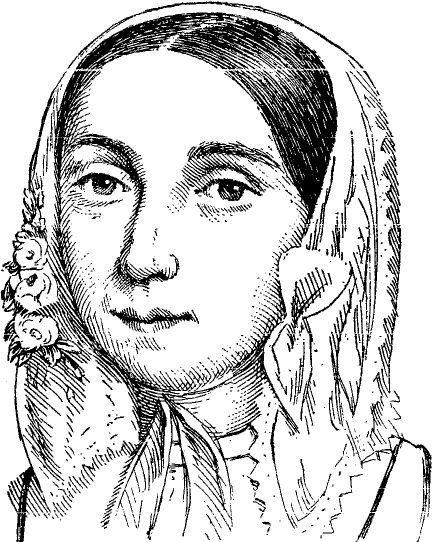
Emilia Carlén
She was honored by the gold medal of the Swedish Academy (1862), and the success of her books was followed by abundant pecuniary reward as well as distinction. Her house in Stockholm was the centre of the literary life of the capital until the death of her husband in 1875, when she completely retired from the world. She established the "Rutger Smith Fund" for poor fishermen and their widows, made an endowment for students to the University of Upsala in memory of her son, and also founded in memory of her husband a fund for the assistance of teachers. She died at Stockholm, February 5th, 1892.
As a novelist she shares national honors with her countrywoman, Fredrika Bremer. Her range in fiction was not confined to a single field, but embraced all classes and conditions of Swedish life. Her stories are full of action and rich in incident, and her delineation of character is natural and shows her real experience of human nature. She is most happy in depicting the humble fisherfolk and peasants. The stirring incidents of the adventurous life of the smugglers were congenial themes, and her graphic descriptions give typical pictures of the rough coast life among sailors, fishers, and revenue officers.
Among her best and most characteristic works are: 'Gustav Lindorm' (1835); 'Rosen på Tistelön' (The Rose of Tistelön), 1842; 'Jungfrutornet' (The Maiden's Tower), 1848; 'Enslingen på Johannisskäret' (The Hermit of the Johannis Rock), 1846. Her autobiography, written in her later years, is sprightly and interesting. Her collected works number more than thirty volumes, the greater part of which have been translated into German, French, and English.
THE PURSUIT OF THE SMUGGLERS
From 'The Merchant House among the Islands'
He [Olagus] thundered his command to his companions:— "Row, row as fast as you can to the open sea!" And as though it had invisible wings, the boat turned and shot forward.
"Halt! halt!" cried the lieutenant, whose blood was now up. "In the name of his Majesty and of the Crown, down with the sails."
Loud laughter from the smugglers' boat sounded across the water.
This scornful laughter was answered from the yacht by the firing of the second cannon, which was fully loaded. The ball fell into the water close to the windward of the boat.
The answer was renewed laughter from the smugglers' boat; whose crew, urged by the twofold desire to save their cargo and to make fools of the Custom-house officers, continued to increase the distance between themselves and the yacht. In spite of the more skillful guidance, the two oars of the latter could not overtake the four men. But the lieutenant's full strong voice could still be heard:—
"Stop, or I will shoot you to the bottom!"
But he did not shoot, for the smugglers' boat was already out of the reach of shot.
At this moment it would have been impossible to detect the least trace of the amiable, good-natured Gudmar Guldbrandsson, the favorite of all the ladies, with his light yellow curls and his slightly arched forehead, and the beautiful dark blue eyes, which when not enlivened by the power of some passion, sometimes revealed that half-dreamy expression that women so often admire.
Majke ought to have seen her commander now, as he stood for a moment on the deck, leaning on his gun, his glass in his hand.
"Row, boys, row with all your might! I will not allow—" The remainder of the sentence was lost in inarticulate tones.
Once more he raised the glass to his eyes.
The chase lasted some time, without any increase of the intervening distance, or any hope of its diminution. It was a grave, a terrible chase.
Meantime new and strange intentions had occurred to the commander of the smugglers' boat. From what dark source could he have received the inspiration that dictated the command?
"Knock out the bung of the top brandy-barrel, and let us drink; that will refresh our courage and rejoice our hearts. Be merry and drink as long as you like."
And now ensued a wild bacchanalia. The men drank out of large mugs, they drank out of cans, and the result was not wanting, while the boat was nearing the entrance to the sea.
"Now, my men," began Olagus in powerful penetrating tones, as he stroked his reddish beard, "shall we allow one of those government fools to force us to go a different way from the one we ourselves wish to go?"
"Olagus," Tuve ventured to interpose,—for Tuve still possessed full consciousness, as he had only made a pretense of drinking,—"dear Olagus, let us be content if we can place the goods in safety. I think I perceive that you mean something else—something dangerous."
"Coward! You ought to sit at home and help your father weave nets. If you are afraid, creep under the tarpaulin; there are others here who do not get the cramp when they are to follow the Mörkö Bears."
"For my part," thought Börje, as he bent over his oar, "I should like to keep away from this hunt. But who dare speak a word? I feel as though I were already in the fortress, the ship and crew in the service of the Crown."
Perhaps Ragnar thought so too; but the great man was so much feared that when he commanded no contradiction was ever heard.
It was almost the first time that Tuve had made an objection, and his brother's scornful rebuke had roused his blood also; but still he controlled himself.
What was resolved on meantime will be seen from what follows.
"Why, what is that?" exclaimed the lieutenant of the yacht. "The oars are drawn in! He is turning,—on my life, he is turning!"
"He knew that we should catch him up," said Sven, delighted once more to be able to indulge in his usual humor. "Fists and sinews like mine are worth as much as four of them; and if we take Pelle into account, they might easily recognize that the best thing they can do is to surrender at once."
"Silence, you conceited idiot!" commanded the lieutenant; "this is no matter of parley. He is making straight for us. The wind is falling; it is becoming calm."
"What does the lieutenant think, Pelle?" asked Sven, in a loud whisper. "Can Olagus have weapons on board and want to attack us?"
"It almost looks like it," answered Pelle shortly.
Meantime the two boats approached one another with alarming speed.
"Whatever happens," said the lieutenant, with icy calm,— "and the game looks suspicious, you know, my friends,—would that the coast-guardsman may not look behind him! The flag of the Crown may wave over living or dead men; that is no matter so long as it does not wave over one who has not done his duty."
"Yes," answered Pelle.
Sven spread out his arms in a significant gesture.
"They may be excited by drink,—their copper-colored faces show that; but here stands a man who will not forget that his name is Sven Dillhufvud. There, I have spoken! But, dear sir, do take care of yourself. They have torn up the boards, and are fetching up stones and pieces of iron."
"Yes, I see. If they attack us, take care of the oars. Do not lay-to on the long side; but row past, and then turn. If they throw, watch their movements carefully; in that way you can escape the danger."
The boats, which were only a few fathoms apart, glided gently towards one another.
The lieutenant's command was punctually executed by his people.
"Olagus Esbjörnsson," exclaimed the commander of the Custom-house yacht, "I charge you once more in the King's name to surrender!"
"O dear, yes," exclaimed the worthy descendant of the Vikings. "I have come back just with that intention. Perhaps I also wanted to fulfill an old vow. Do you remember what I vowed that night by the Oternnest?"
At the same moment a whole shower of pieces of iron whistled through the air, and fell rattling on to the yacht; but the sharp piece of iron thrown by Olagus's own hands was aimed at the lieutenant himself. He however darted aside so quickly that he was not wounded, although it flew so close past him that it tore off his straw hat and dashed it into the sea.
"Olagus, and you others," sounded his voice, in all its youthful power, "consider what you do; consider the price of an attack on a royal boat and crew! The responsibility may cost you dear. I charge you to cease at once."
"What! Are you frightened, you Crown slaves?" roared Olagus, whose sparkling eyes and flushed face, so different from his usual calm in peaceful circumstances, lent increased wildness to his form and gestures. "Come, will this warm you?" And at the same moment another piece of iron flew past, aimed with such certainty that it would have cut off the thread of the lieutenant's life if he had not taken shelter behind the mast. The iron was firmly fixed in the mast.
The yacht was now bombarded on all sides. Here hung a torn sail, there an end of rope; and the side planks had already received a good deal of injury, so that the yacht was threatened with a leak. But now was heard for the last time the young commander's warning:—
"Stop, Olagus, and tell your people to put aside their wretched arms; for, on my life, this gun is loaded with a ball, and the first of you who throws another piece shall be shot down like a stag."
"Do it if you dare! But there, see, miserable Custom-house dog, how the Mörkö Bears respect your threats!"
The third piece of iron was just about to be thrown; but at the same moment the lieutenant took aim.
The shot was fired.
During the long chase and the attack which followed it, the sun had been approaching the horizon, and now might be seen one of those beautiful sunsets which so often delight the eye on this blue-green sea. They are the counterpart of the autumn apparitions during the dark fogs, when the ships wander about seeking their way among the cliffs, then glimmering whitely, and now shining red.
Worthy the inspiration of poet and painter, this warm, divinely peaceful, and lovely scene of nature offered a new, bitter contrast to the terrible picture which human passion and the claims of duty had conjured with lightning speed into these two spots in the sea—the smugglers' boat and the Custom-house yacht.
The shot was fired, and the mighty giant of Mörkö, Olagus Esbjörnsson, sank back into the tarpaulin.
"The accursed devil has shot right into my heart!"
Pale as death, Tuve sprang forward, and wanted to stay the blood.
"Leave it alone," panted Olagus. "It is no use. Give my love to father and Britje; she was a good wife. You must be a father to—my boy. The business may cease."
The subduing touch of death had already extinguished the wild light which the fire of hatred had kindled in these eyes. And the last glance that sought his brother's gaze was gentle.
Suddenly he was once more fired by the remembrance of the earthly life which was fast retreating from him.
"Quickly away with the cargo! No one must know that Olagus Esbjörnsson fell from a shot out of the Custom-house yacht. I—I—fell upon them."
They were his last words.
Tuve's head fell, sobbing, on the man whom he had so completely honored as his superior.
Tuve was now the first in Mörkö, and as though a stronger spirit had come over him, he began to feel his duty. He rose, and gave orders to turn toward the sea, but the crew stood motionless with terror.
THOMAS CARLYLE
(1795-1881)
BY LESLIE STEPHEN
he hundredth anniversary of the birth of Thomas Carlyle—(December 4th, 1795)—was lately commemorated. The house in Cheyne Walk, Chelsea, which he had occupied from 1834 till his death (February 4th, 1881), was handed over to trustees to be preserved as a public memorial. No house in the British islands has more remarkable associations. Thither Carlyle had come in his thirty-eighth year, still hardly recognized by the general public, though already regarded by a small circle as a man of extraordinary powers. There he went through the concluding years of the long struggle which ended by a hard-won and scarcely enjoyed victory. There he had been visited by almost all the most conspicuous men of letters of his time: by Jeffrey, Southey, and J. S. Mill; by Tennyson and Browning, the greatest poets, and by Thackeray and Dickens, the greatest novelists of his generation; by the dearest friends of his youth, Irving and Emerson and John Sterling, and by his last followers, Froude and Ruskin. There too had lived until 1866 the woman who had shared his struggles, whom he loved and admired without stint, and whom he was yet destined to remember with many bitter pangs of remorse. Their story, laid bare with singular fullness, has invested the scene of their joys and sorrows, their alienation and reconciliations, with extraordinary interest. Every one who has read the "Reminiscences" and the later mass of biographical matter must be glad to see the "sound-proof" room, and the garden haunted by the "demon-fowls" and the other dumb witnesses of a long tragi-comedy. No one was so keenly sensitive as Carlyle to the interest of the little gleams of light which reveal our ancestors not only stirred by the great passions, but absorbed like ourselves by the trivialities of the day. A similar interest will long attach to the scene of his own trials.
Carlyle's life was a struggle and a warfare. Each of his books was wrenched from him, like the tale of the 'Ancient Mariner,' by a spiritual agony. The early books excited the wrath of his contemporaries, when they were not ridiculed as the grotesque outpourings of an eccentric humorist. His teaching was intended to oppose what most people take to be the general tendency of thought, and yet many who share that tendency gladly acknowledge that they owe to Carlyle a more powerful intellectual stimulus than they can attribute even to their accepted teachers. I shall try briefly to indicate the general nature of his message to mankind, without attempting to consider the soundness or otherwise of particular views.
Carlyle describes what kind of person people went to see in Cheyne Row. "The very sound of my voice," he says, "has got something savage-prophetic: I am as a John the Baptist girt about with a leather girdle, whose food is locusts and wild honey." Respectable literary society at "aesthetic tea-parties" regarded him as the Scribes and Pharisees regarded the Hebrew prophet. He came among them to tear the mask from their hypocritical cant. Carlyle was not externally a Diogenes. Though the son of peasants, he had the appearance and manner of a thorough gentleman in spite of all his irritable outbreaks. But he was not the less penetrated to the core with the idiosyncrasies of his class. The father, a Davie Deans of real life, had impressed the son profoundly. Carlyle had begun life on the same terms as innumerable young Scots. Strict frugality had enabled him to get a college training and reach the threshold of the ministry. His mother could look forward to the exquisite pleasure of seeing "her own bairn wag his head in a pulpit!" But at this point Carlyle's individuality first asserted itself. He could not step into any of the ordinary grooves. His college teachers appeared to him to offer "sawdust" instead of manna from heaven. The sacred formulæ of their ancestral creed had lost their savor. Words once expressive of the strongest faith were either used to utter the bigotry of narrow pedants, or were adopted only to be explained away into insipid commonplace. Carlyle shared the intellectual movement of his time too much to profess any reverence for what he called the "Hebrew old-clothes." Philosophers and critics had torn them to rags. His quarrel however was with the accidental embodiment, not with the spirit of the old creeds. The old morality was ingrained in his very nature; nor was he shocked, like some of his fellows, by the sternness of the Calvinistic views of the universe and life. The whole problem was with him precisely to save this living spirit. The skeptics, he thought, were, in the German phrase, "emptying out the baby with the bath." They were at war with the spirit as well as with the letter; trying to construct a Godless universe; to substitute a dead mechanism for the living organism; and therefore to kill down at the root every noble aspiration which could stimulate the conscience, or strengthen a man to bear the spectacle of the wrongs and sufferings of mankind.
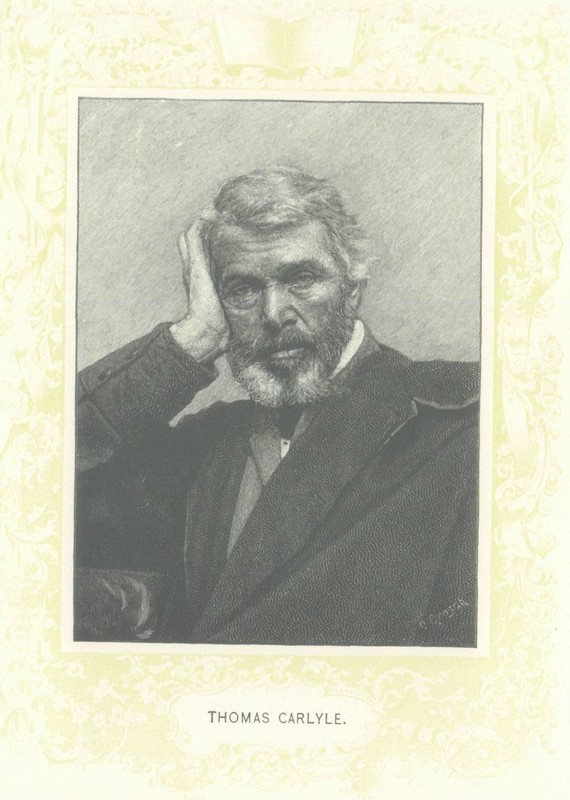
THOMAS CARLYLE.
The crisis of this struggle happened in 1821. After giving up the ministry, Carlyle had tried "schoolmastering" and found himself to be least fitted of mankind for a function which demands patience with stupidity. He had just glanced at the legal profession only to be disgusted with its chicaneries. Hack authorship was his only chance. The dyspeptic disorder which tormented him through life was tormenting him. "A rat was gnawing at the pit of his stomach." Then he was embittered by the general distress of his own class. Men out of work were threatening riots and the yeomanry being called out to suppress them. Carlyle was asked by a friend why he too did not come out with a musket. "Hm! yes," he replied, "but I haven't quite settled on which side." It was while thus distracted, that after three weeks of sleeplessness he experienced what he called his "conversion." The universe had seemed to him "void of life, of purpose, of volition, even of hostility; it was one huge and immeasurable steam-engine, rolling on in its dead indifference, to grind me limb from limb. Oh, the vast, gloomy, solitary Golgotha and mill of death!" And then he suddenly resolved to resist. Why go on trembling like a coward?—"As I so thought, there rushed a stream of fire over my whole soul, and I shook base fear away from me for ever. I was strong, of unknown strength; a spirit; almost a god: ever from that time the temper of my misery was changed; not fear or whining sorrow was in it, but indignation and grim, fell-eyed defiance." These are the phrases of his imaginary hero in 'Sartor Resartus.' In the 'Reminiscences' he repeats the statement in his own person. He had won "an immense victory"; he had escaped from the "foul mud gods" and soared into the "eternal blue of ether" where he had "for the spiritual part ever since lived." He could look down upon his fellow creatures still "weltering in that fatal element," "pitying the religious part of them and indignant against the frivolous"; enjoying an inward and supreme happiness which still remained to him, though often "eclipsed" in later years.
To understand this crisis is to understand his whole attitude. The change was not of the purely logical kind. Carlyle was not converted by any philosophical system. Coleridge, not long before, had found in Kant and Schelling an answer to similar perplexities. Carlyle, though he respected the German metaphysicians, could never find their dogmas satisfactory to his shrewd Scottish sense. His great helper, he tells us, in the strait, was not Kant but Goethe. The contrast between that serene prophet of culture and the rugged Scottish Puritan is so marked that one may be tempted to explain the influence partly by personal accident. Carlyle grew up at a time when the British public was just awaking to the existence of Germany; and not only promoted the awakening but was recognized by the great Goethe himself. He may well have been inclined in later years to exaggerate a debt due to so welcome a recognition. And yet it is intelligible that in Goethe, Carlyle saw what he most required. A man of the highest genius and a full representative of the most advanced thought could yet recognize what was elevating in the past as clearly as what was the true line of progress for us to pursue; and while casting aside the dead trappings as decidedly as Carlyle, could reach serene heights above the petty controversies where men wrangled over extinct issues. Goethe had solved the problem which vexed Carlyle's soul, and set an inspiring example of the true spirit and its great reward.
Carlyle, however, was not qualified by temperament or mental characteristics to follow Goethe's steps. If not primarily a reasoner, and too impatient perhaps for slow logical processes, he was also not a poet. Some of the greatest English teachers of his period embodied their conceptions of the world in poetry. Wordsworth and Shelley and Byron, in particular, were more effective representatives of the chief spiritual influences of the day than the few speculative writers. Carlyle thought for a time that he could utter himself in verse, or at least in prose fiction. He tried, only to feel his incompetence. As Froude observes, he had little ear for metrical composition. There were other and perhaps greater obstacles. A poet must be capable of detachment from the actual world in which he lives, however profound his interest in its great problems. He must be able to dwell with "seraph contemplation" and stand aside from the actual contest. To Carlyle such an attitude was partly impossible, partly contemptible. He had imbibed the Puritan aversion to æsthetic enjoyments. He had been brought up in circles where it was thought wrong for a child to read the 'Arabian Nights,' and where Milton could only obtain a doubtful admission as a versifier of the Scriptural narrative. Carlyle retained the prejudice. He always looked askance at poetry which had no immediate bearing upon conduct, and regarded "æsthetic" as equivalent to frivolous. "May the devil fly away with the fine arts" is a sentiment which he quotes with cordial sympathy. This view was congenial to his inborn characteristics.
One striking peculiarity was his extraordinary "receptivity" of all outward impressions. The strange irritability which he set down to the "hag Dyspepsia" made him resemble a patient in whom disease has produced a morbidly excessive sensibility. Little annoyances were magnified into tragic dimensions. The noises in a next-door house affected him as an earthquake might affect others. His memory was as retentive as his impressions were strong. Froude testifies that his account of a little trip to Paris, written forty years later without reference to memoranda, is verified down to the minutest details by contemporary letters. Scenes instantaneously photographed on his memory never faded. No one had a keener eye for country. When he visited Germany he brought back pictures of the scenes of Frederick's battles, which enabled him to reproduce them with such startling veracity that after reading you seem to remember the reality, not the book. In history he seeks to place before us a series of visions as distinct as actual eyesight: to show us Cromwell watching the descent of the Scottish army at Dunbar, or the human whirlpool raging round the walls of the Bastille. We—the commonplace spectators—should not, it is true, even at present see what was visible to Carlyle, any more than we see a landscape as Turner saw it. We may wish that we could. At any rate, we have the conviction of absolute truthfulness to the impression made on a powerful idiosyncrasy. We perceive, as by the help of a Rembrandt, vast chaotic breadths of gloomy confusion, with central figures thrown out by a light of extraordinary brilliancy. Carlyle, indeed, always has it in mind that what we call reality is but a film on the surface of mysterious depths. We are such stuff, to repeat his favorite quotation, as dreams are made of. Past history is a series of dreams; the magic of memory may restore them for an instant to our present consciousness. But the most vivid picture of whatever is not irrecoverably lost always brings, too, the pathetic sense that we are after all but ephemeral appearances in the midst of the eternities and infinities. Overwhelmed by this sense of the unsubstantiality even of the most real objects, Carlyle clutches, as it were with the energy of despair, every fading image; and tries to invest it with something of its old brightness. Carlyle was so desirous to gain this distinctness of vision that he could not be happy in personal descriptions till, if possible, he had examined the portrait of his hero and satisfied himself that he could reproduce the actual bodily appearance. The face, he holds, shows the soul. And then his shrewd Scottish sagacity never deserts him. If the hero sometimes becomes, like most heroes, a little too free from human infirmities, the actors in his dramas never become mere walking gentlemen. In Dryasdust he gives us lay figures, bedizened at times with shallow paradoxes; but Carlyle always deals in genuine human nature. His judgment may not be impartial, but at least it is not nugatory. He sees the man from within and makes him a credible individual, not a mere bit of machinery worked by colorless formulæ. With this eye for character goes the keen sense of grim humor which keeps him in touch with reality. Little incidents bring out the absurd side of even the heroic. The most exciting scenes of his 'French Revolution' are heightened by the vision of the shivering usher who "accords the grand entries" when the ferocious mob is rushing into the palace—not "finding it convenient," as Carlyle observes, "to refuse them"; and of the gentleman who continues for an hour to "demand the arrestment of knaves and dastards"—a most comprehensive of all known petitions. Carlyle's "mannerism" is one result of this strain to be graphic. It has been attributed to readings of Jean Paul, and by Carlyle himself, partly to Irving and partly to the early talk in his father's home. It appears at any rate as soon as Carlyle gets confidence enough in himself to trust to his own modes of impression; and if it may fairly be called a mannerism, was not an affectation. It was struck out in the attempt to give most effective utterance to his genuine thought, and may be compared, as Burke said of Johnson's conversation, to the "contortions of the Sibyl."
It is time, however, to try to say what was the prophetic message thus delivered. Carlyle, I have said, had no logical system of philosophy, and was too much of a "realist" (in one sense) to find poetry congenial. He has to preach by pictures of the past; by giving us history, though history transfused with poetry; an account of the external fact which shall reveal the real animating principle, quietly omitted by statisticians and constitutional historians. The doctrine so delivered appears to be vague. What, the ordinary believer may ask, would be left of a religion if its historical statements should turn out to be mere figments and its framework of dogmas to be nonsense? He would naturally reply, Nothing. Carlyle replies, Everything. The spirit may survive, though its whole visible embodiment should be dissolved into fiction and fallacy. But to define this spirit is obviously impossible. It represents a tone of thought, a mode of contemplating life and the world, not any distinct set of definite propositions. Carlyle was called a "mystic," and even, as he says, was made into a "mystic school." We may accept the phrase, so far as mysticism means the substitution of a "logic of the heart" for a "logic of the head"—an appeal to sentiment rather than to any definite reasoning process. The "mystic" naturally recognizes the inner light as shining through many different and even apparently contradictory forms. But most mystics retain, in a new sense perhaps, the ancient formulæ. Carlyle rejected them so markedly that he shocked many believers, otherwise sympathetic. His early friend Irving, who tried to restore life to the old forms, and many who accepted Coleridge as their spiritual guide, were scandalized by his utterances. He thought, conversely, that they were still masquerading in "Hebrew old-clothes," or were even like the apes who went on chattering by the banks of the Dead Sea, till they ceased to be human. He regards the "Oxford movement" with simple contempt. His dictum that Newman had "no more brain than a moderate-sized rabbit" must have been followed, as no one will doubt who heard him talk, by one of those gigantic explosions of laughter which were signals of humorous exaggeration. But it meant in all seriousness that he held Newman to be reviving superstitions unworthy of the smallest allowance of brain.
Yet Carlyle's untiring denunciation of "shams" and "unrealities" of this, as of other varieties, does not mean unqualified antipathy. He feels that the attempt to link the living spirit to the dead externals is a fatal enterprise. That may be now a stifling incumbrance, which was once the only possible symbol of a living belief. Accordingly, though Carlyle's insistence upon the value of absolute intellectual truthfulness is directed against this mode of thought, his attack upon the opposite error is more passionate and characteristic. The 'Sartor Resartus,' his first complete book (1833-4), announced and tried to explain his "conversion." To many readers it still seems his best work, as it certainly contains some of his noblest passages. It was unpopular in England, and (an Englishman must say it with regret) seems to have been first appreciated in America. It gave indeed many sharp blows at English society: it expresses his contempt for the upper literary strata, who like Jeffrey complained of him for being so "desperately in earnest"; and for the authors, who were not "prophets," but mere caterers to ephemeral amusement. But the satire, I cannot but think, is not quite happy. The humor of the "Clothes Philosophy" is a little strained; to me, I confess, rather tiresome: and the impressive passages just those where he forgets it.
His real power became obvious beyond all cavil on the publication of the 'French Revolution' (1837). Not for a hundred years, he declared, had the public received any book that "came more direct and flamingly from the heart of a living man." That expresses, as I think, the truth. The book is not to be "read for information." The facts would now require much restatement; and moreover, the narrative is too apt to overleap prosaic but necessary facts in order to fasten upon the picturesque passages. But considered as what it is, a "prose epic," a moving panorama, drawn with astonishing force and perception of the tremendous tragi-comedy involved, it is unequaled in English literature. The doctrine inculcated is significant. Carlyle's sympathies were in one sense with the Revolution. He felt, he says, that the Radicals were "guild-brothers," while the Whigs were mere "amateurs." He was even more thoroughly convinced than the Radicals that a thoroughgoing demolition of the old order was essential. The Revolution was but the first volcanic outburst of the great forces still active below the surface. Europe, he says ('Chartism'), lay "hag-ridden" and "quack-ridden." The quack is the most hideous of hags; he is a "falsehood incarnate." To blow him and his to the four winds was the first necessity. The French Revolution was "the inevitable stern end of much: the fearful but also wonderful, indispensable, and sternly beneficent beginning of much." So far, Carlyle was far more in agreement with Paine than with Burke. But what was to follow when the ground was cleared? When you have cut off your king's head and confiscated the estates of the nobility and the church, you have only begun. A new period is to be born with death-throes and birth-throes, and there are, he guesses ('French Revolution,' Book iv., chapter 4), some two centuries of fighting before "Democracy go through its dire, most baleful stage of 'Quackocracy.'" The radicals represent this coming "Quackocracy." What was their root error? Briefly (I try to expound, not to enlarge), that they were materialists. Their aim was low. They desired simply a multiplication of physical comforts, or as he puts it, a boundless supply of "pigs-wash." Their means too were futile. Society, on their showing, was a selfish herd hungering for an equal distribution of pigs-wash. They put unlimited faith in the mere mechanism of constitution-mongering; in ballot-boxes and manipulation of votes and contrivances by which a number of mean and selfish passions might be somehow so directed as to balance each other. It is not by any such devices that society can really be regenerated. You must raise men's souls, not alter their conventions. They must not simply abolish kings, but learn to recognize the true king, the man who has the really divine right of superior strength and wisdom, not the sham divine right of obsolete tradition. You require not paper rules, but a new spirit which spontaneously recognizes the voice of God. The true secret of life must be to him, as to every "mystic," that we should follow the dictates of the inner light which speaks in different dialects to all of us.
But this implies a difficulty. Carlyle, spite of his emergence into "blue ether," was constitutionally gloomy. He was more alive than any man since Swift to the dark side of human nature. The dullness of mankind weighed upon him like a nightmare. "Mostly fools" is his pithy verdict upon the race at large. Nothing then could be more idle than the dream of the revolutionists that the voice of the people could be itself the voice of God. From millions of fools you can by no constitutional machinery extract anything but folly. Where then is the escape? The millions, he says (essay on Johnson), "roll hither and thither, whithersoever they are led"; they seem "all sightless and slavish," with little but "animal instincts." The hope is that, here and there, are scattered the men of power and of insight, the heaven-sent leaders; and it is upon loyalty to them and capacity for recognizing and obeying them that the future of the race really depends. This was the moral of the lectures on 'Hero-Worship' (1840). Odin, Mahomet, Dante, Shakespeare, Luther, Cromwell, and Napoleon, are types of the great men who now and then visit the earth as prophets or rulers. They are the brilliant centres of light in the midst of the surrounding darkness; and in loyal recognition of their claims lies our security for all external progress. By what signs, do you ask, can they be recognized? There can be no sign. You can see the light if you have eyes; but no other faculty can supply the want of eyesight. And hence arise some remarkable points both of difference from and coincidence with popular beliefs.
In the 'Chartism,' 'Past and Present,' and 'Latter-Day Pamphlets' (1839, 1843, and 1850), Carlyle applied his theories to the problems of the day. They had the disadvantage which generally attaches to the writings of an outsider in politics. They were, said the average reader, "unpractical." Carlyle could not recommend any definite measures; an objection easy to bring against a man who urges rather a change of spirit than of particular measures. Yet it is noticeable that he recommends much that has since become popular. Much of his language might be used by modern Socialists. In 'Past and Present,' for example (Book iii., Chapter 8), he gives the principle of "land nationalization." The great capitalist is to be turned into a "captain of industry," and government is to undertake to organize labor, to protect health, and to enforce education. Carlyle so far sympathizes with the Socialist, not only as agreeing that the great end of government is the raising of the poor, but as denouncing the laissez-faire doctrine. The old-fashioned English Radical had regarded all government as a necessary evil, to be minimized as much as possible. When it had armed the policemen, it had fulfilled its whole duty. But this, according to Carlyle, was to leave the "dull multitude" to drift into chaos. Government should rest upon the loyalty of the lower to the higher. Order is essential; and good order means the spontaneous obedience to the heaven-sent hero. He, when found, must supply the guiding and stimulating force. The Socialist, like Carlyle, desires a strong government, but not the government of the "hero." Government of which the moving force comes from above instead of below will be, he thinks, a government of mere force. And here occurs the awkward problem to which Carlyle is constantly referring. He was generally accused of identifying "right" with "might." Against this interpretation he always protested. Right and Might, he says often, are in the long run identical. That which is right and that alone is ultimately lasting. Your rights are the expression of the divine will; and for that reason, whatever endures must be right. Work lasts so far as it is based upon eternal foundations. The might, therefore, is in the long run the expression of the right. The Napoleonic empire, according to a favorite illustration, could not last because it was founded upon injustice. The two tests then must coincide: what is good proves itself by lasting, and what lasts, lasts because good; but the test of endurance cannot, it is clear, be applied when it is wanted. Hence arises an ambiguity which often gives to Carlyle the air of a man worshiping mere success; when, if we take his own interpretation, he takes the success to be the consequence, not the cause, of the rightness. The hero is the man who sees the fact and disregards the conventional fiction; but for the moment he looks very like the man who disregards principles and attends to his own interest.
Here again Carlyle approximates to a doctrine to which he was most averse, the theory of the struggle for existence and the survival of the fittest. The Darwinian answers in this way Carlyle's problem, how it is to come to pass that the stupidity of the masses comes to blunder into a better order? Here and there, as in his accounts of the way in which the intensely stupid British public managed to blunder into the establishment of a great empire, Carlyle seems to fall in with the Darwinian view. That view shocked him because he thought it mechanical. To him the essence of history was to be found not in the blind striving of the dull, but in the lives of great men. They represent the incarnate wisdom which must guide all wholesome aspiration. History is really the biography of the heroes. All so-called philosophies of history, attempts to discover general laws and to dispense with the agency of great men, are tainted with materialism. They would substitute "blind laws" for the living spirit which really guides the development of the race. But if you ask how your hero is to be known, the only answer can be, Know him at your peril.
Carlyle's most elaborate books, the 'Cromwell' and the 'Frederick,' are designed to give an explicit answer to the "right" and "might" problem. Carlyle in both cases seems to be toiling amidst the dust-heaps of some ancient ruin, painfully disinterring the shattered and defaced fragments of a noble statue and reconstructing it to be hereafter placed in a worthy Valhalla. Cromwell, according to the vulgar legend, was a mere hypocrite, and Frederick a mere cynical conqueror. The success of both—that is his intended moral—was in proportion to the clearness with which they recognized the eternal laws of the universe. Cromwell probably is the more satisfactory hero, as more really sympathetic to his admirer. But each requires an interpreter. Cromwell's gifts did not lie in the direction of lucid utterance; and Frederick, if he could have read, would certainly have scorned, the doctrine of his eulogist. Carlyle, that is, has to dig out in the actions of great men a true significance, certainly not obvious to the actors themselves. Their recognition of the eternal laws was in one case embodied in obsolete formulæ, and in the other, it might seem, altogether unconscious. The hero's recognition of divine purposes does not imply then that his own vision is purged from error, or that his aim is distinctly realized. He may, like Mahomet or the Abbot Sampson, be full of superstition. His "veracity" does not mean that his beliefs are true; only that they are sincere and such a version of the truth as is possible in his dialect. This is connected with Carlyle's constant insistence upon the superiority of silence to speech. The divine light shines through many distracting media; it enlightens many who do not consciously perceive it. It may be recognized because it gives life; because the work to which it prompts is lasting. But even the hero who tries to utter himself is sure to interpolate much that is ephemeral, confused, and imperfect; and speech in general represents the mere perplexed gabble of men who take words for thought, and raise a hopeless clamor which drowns the still small voice of true inspiration. If men are mostly fools, their talk is mostly folly; forming a wild incoherent Babel in which it is hard to pick out the few scattered words of real meaning. Carlyle has been ridiculed for preaching silence in so many words; but then Carlyle was speaking the truth, and of that, he fully admits, we can never have too much. The hero may be a prophet, or a man of letters. He is bound to speak seriously, though not to be literally silent; and his words must be judged not by the momentary pleasure, but by their ultimate influence on life.
Carlyle's message to his fellows, which I have tried imperfectly to summarize, may be condemned on grounds of taste and of morality. Translated into logical formulæ it becomes inconsistent, and it embodies some narrow prejudices in exaggerated terms. Yet I think that it has been useful even by the shock it has given to commonplace optimism. It has been far more useful because in his own dialect, Carlyle—as I think—expresses some vital truths with surpassing force. Whatever our creeds, religious or political, he may stimulate our respect for veracity, in the form of respect for honest work or contempt for hypocritical conventions; our loyalty to all great leaders, in the worlds both of thought and action; and our belief that to achieve any real progress, something is required infinitely deeper than any mere change in the superficial arrangements of society. These lessons are expressed, too, as the merely literary critic must admit, by a series of historical pictures, so vivid and so unique in character that for many readers they are in the full sense fascinating. They are revelations of new aspects of the world, never, when once observed, to be forgotten. And finally, I may add that Carlyle's autobiographical writings—in which we must include the delightful 'Life of Sterling'—show the same qualities in a shape which, if sometimes saddening, is profoundly interesting. No man was more reticent in his life, though he has been made to deliver a posthumous confession of extraordinary fullness. We hear all the groans once kept within the walls of Cheyne Row. After making all allowance for the fits of temper, the harshness of judgment, and the willful exaggeration, we see at last a man who under extraordinary difficulties was unflinchingly faithful to what he took to be his vocation, and struggled through a long life, full of anxieties and vexations, to turn his genius to the best account.
THE INQUIRY[1]
LABOR
From 'Past and Present'
For there is a perennial nobleness, and even sacredness, in Work. Were he never so benighted, forgetful of his high calling, there is always hope in a man that actually and earnestly works: in Idleness alone is there perpetual despair. Work, never so Mammonish, mean, is in communication with Nature; the real desire to get Work done will itself lead one more and more to truth, to Nature's appointments and regulations, which are truth.
The latest Gospel in this world is, Know thy work and do it. "Know thyself": long enough has that poor "self" of thine tormented thee; thou wilt never get to "know" it, I believe! Think it not thy business, this of knowing thyself; thou art an unknowable individual: know what thou canst work at; and work at it like a Hercules! That will be thy better plan.
It has been written, "An endless significance lies in Work;" a man perfects himself by working. Foul jungles are cleared away, fair seed-fields rise instead, and stately cities; and withal the man himself first ceases to be jungle and foul unwholesome desert thereby. Consider how even in the meanest sorts of Labor, the whole soul of a man is composed into a kind of real harmony the instant he sets himself to work! Doubt, Desire, Sorrow, Remorse, Indignation, Despair itself, all these like hell-dogs lie beleaguering the soul of the poor day-worker, as of every man: but he bends himself with free valor against his task, and all these are stilled, all these shrink murmuring far off into their caves. The man is now a man. The blessed glow of Labor in him, is it not as purifying fire, wherein all poison is burnt up, and of sour smoke itself there is made bright blessed flame!
Destiny, on the whole, has no other way of cultivating us. A formless Chaos, once set it revolving, grows round and ever rounder; ranges itself by mere force of gravity into strata, spherical courses; is no longer a Chaos, but a round compacted World. What would become of the Earth did she cease to revolve? In the poor old Earth, so long as she revolves, all inequalities, irregularities, disperse themselves; all irregularities are incessantly becoming regular. Hast thou looked on the Potter's wheel,—one of the venerablest objects; old as the Prophet Ezekiel and far older? Rude lumps of clay, how they spin themselves up, by mere quick whirling, into beautiful circular dishes. And fancy the most assiduous Potter, but without his wheel; reduced to make dishes, or rather amorphous botches, by mere kneading and baking! Even such a Potter were Destiny, with a human soul that would rest and lie at ease, that would not work and spin! Of an idle unrevolving man the kindest Destiny, like the most assiduous Potter without wheel, can bake and knead nothing other than a botch; let her spend on him what expensive coloring, what gilding and enameling she will, he is but a botch. Not a dish; no, a bulging, kneaded, crooked, shambling, squint-cornered, amorphous botch,—a mere enameled vessel of dishonor! Let the idle think of this.
Blessed is he who has found his work; let him ask no other blessedness. He has a work, a life-purpose; he has found it, and will follow it! How, as a free-flowing channel, dug and torn by noble force through the sour mud-swamp of one's existence, like an ever-deepening river there, it runs and flows;—draining off the sour festering water gradually from the root of the remotest grass-blade; making, instead of pestilential swamp, a green fruitful meadow with its clear-flowing stream. How blessed for the meadow itself, let the stream and its value be great or small! Labor is Life: from the inmost heart of the Worker rises his God-given Force, the sacred celestial Life-essence breathed into him by Almighty God; from his inmost heart awakens him to all nobleness,—to all knowledge, "self-knowledge" and much else, so soon as Work fitly begins. Knowledge? The knowledge that will hold good in working, cleave thou to that; for Nature herself accredits that, says Yea to that. Properly thou hast no other knowledge but what thou hast got by working: the rest is yet all a hypothesis of knowledge; a thing to be argued of in schools, a thing floating in the clouds, in endless logic-vortices, till we try it and fix it. "Doubt, of whatever kind, can be ended by Action alone."
And again, hast thou valued Patience, Courage, Perseverance, Openness to light; readiness to own thyself mistaken, to do better next time? All these, all virtues, in wrestling with the dim brute Powers of Fact, in ordering of thy fellows in such wrestle, there, and elsewhere not at all, thou wilt continually learn. Set down a brave Sir Christopher in the middle of black ruined Stone-heaps, of foolish unarchitectural Bishops, red-tape Officials, idle Nell-Gwynn Defenders of the Faith; and see whether he will ever raise a Paul's Cathedral out of all that, yea or no! Rough, rude, contradictory, are all things and persons, from the mutinous masons and Irish hodmen up to the idle Nell-Gwynn Defenders, to blustering red-tape Officials, foolish unarchitectural Bishops. All these things and persons are there not for Christopher's sake and his Cathedral's; they are there for their own sake mainly! Christopher will have to conquer and constrain all these,—if he be able. All these are against him. Equitable Nature herself, who carries her mathematics and architectonics not on the face of her, but deep in the hidden heart of her,—Nature herself is but partially for him; will be wholly against him, if he constrain her not! His very money, where is it to come from? The pious munificence of England lies far-scattered, distant, unable to speak and say, "I am here";—must be spoken to before it can speak. Pious munificence, and all help, is so silent, invisible like the gods; impediments, contradictions manifold, are so loud and near! O brave Sir Christopher, trust thou in those, notwithstanding, and front all these; understand all these; by valiant patience, noble effort, insight, by man's strength, vanquish and compel all these,—and on the whole, strike down victoriously the last topstone of that Paul's Edifice; thy monument for certain centuries, the stamp "Great Man" impressed very legibly on Portland-stone there!
Yes, all manner of help, and pious response from Men of Nature, is always what we call silent; cannot speak or come to light, till it be seen, till it be spoken to. Every noble work is at first "Impossible." In very truth, for every noble work the possibilities will lie diffused through Immensity; inarticulate, undiscoverable except to faith. Like Gideon, thou shalt spread out thy fleece at the door of thy tent; see whether under the wide arch of Heaven there be any bounteous moisture, or none. Thy heart and life-purpose shall be as a miraculous Gideon's fleece, spread out in silent appeal to Heaven; and from the kind Immensities, what from the poor unkind Localities and town and country Parishes there never could, blessed dew-moisture to suffice thee shall have fallen!
Work is of a religious nature;—work is of a brave nature; which it is the aim of all religion to be. All work of man is as the swimmer's: a waste ocean threatens to devour him; if he front it not bravely, it will keep its word. By incessant wise defiance of it, lusty rebuke and buffet of it, behold how it loyally supports him, bears him as its conqueror along. "It is so," says Goethe, "with all things that man undertakes in this world."
Brave Sea-captain, Norse Sea-king,—Columbus, my hero, royalest Sea-king of all! it is no friendly environment, this of thine, in the waste deep waters; around thee mutinous discouraged souls, behind thee disgrace and ruin, before thee the equal, unpenetrated veil of Night. Brother, these wild water-mountains, bounding from their deep basin (ten miles deep, I am told), are not entirely there on thy behalf! Meseems they have other work than floating thee forward:—and the huge Winds, that sweep from Ursa-Major to the Tropics and Equators, dancing their giant-waltz through the kingdoms of Chaos and Immensity, they care little about filling rightly or filling wrongly the small shoulder-of-mutton sails in this cockle-skiff of thine! Thou art not among articulate-speaking friends, my brother; thou art among immeasurable dumb monsters, tumbling, howling, wide as the world here. Secret, far off, invisible to all hearts but thine, there lies a help in them: see how thou wilt get at that. Patiently thou wilt wait till the mad Southwester spend itself, saving thyself by dexterous science of defense, the while: valiantly, with swift decision, wilt thou strike in, when the favoring East, the Possible, springs up. Mutiny of men thou wilt sternly repress; weakness, despondency, thou wilt cheerily encourage: thou wilt swallow down complaint, unreason, weariness, weakness of others and thyself;—how much wilt thou swallow down! There shall be a depth of Silence in thee, deeper than this Sea, which is but ten miles deep: a Silence unsoundable; known to God only. Thou shalt be a great man. Yes, my World-Soldier, thou of the World Marine-service,—thou wilt have to be greater than this tumultuous unmeasured World here round thee is; thou, in thy strong soul, as with wrestler's arms shalt embrace it, harness it down; and make it bear thee on,—to new Americas, or whither God wills!
THE WORLD IN CLOTHES
From 'Sartor Resartus'
As Montesquieu wrote a 'Spirit of Laws,'" observes our Professor, "so could I write a 'Spirit of Clothes'; thus, with an 'Esprit des Lois,' properly an 'Esprit de Coutumes,' we should have an 'Esprit de Costumes.' For neither in tailoring nor in legislating does man proceed by mere Accident, but the hand is ever guided on by mysterious operations of the mind. In all his Modes, and habilatory endeavors, an Architectural Idea will be found lurking; his Body and the Cloth are the site and materials whereon and whereby his beautified edifice, of a Person, is to be built. Whether he flow gracefully out in folded mantles, based on light sandals; tower-up in high headgear, from amid peaks, spangles, and bell-girdles; swell-out in starched ruffs, buckram stuffings, and monstrous tuberosities; or girth himself into separate sections, and front the world an Agglomeration of four limbs,—will depend on the nature of such Architectural Idea: whether Grecian, Gothic, Later-Gothic, or altogether Modern, and Parisian or Anglo-Dandiacal. Again, what meaning lies in Color! From the soberest drab to the high-flaming scarlet, spiritual idiosyncrasies unfold themselves in choice of color: if the cut betoken Intellect and Talent, so does the Color betoken Temper and Heart. In all which, among nations as among individuals, there is an incessant, indubitable, though infinitely complex working of Cause and Effect: every snip of the Scissors has been regulated and prescribed by ever-active Influences, which doubtless to Intelligences of a superior order are neither invisible nor illegible.
"For such superior Intelligences a Cause-and-Effect Philosophy of Clothes, as of Laws, were probably a comfortable winter-evening entertainment: nevertheless, for inferior Intelligences, like men, such Philosophies have always seemed to me uninstructive enough. Nay, what is your Montesquieu himself but a clever infant spelling Letters from a hieroglyphical prophetic Book, the lexicon of which lies in Eternity, in Heaven?—Let any Cause-and-Effect Philosopher explain, not why I wear such and such a Garment, obey such and such a Law; but even why I am here, to wear and obey anything!—Much therefore, if not the whole, of that same 'Spirit of Clothes' I shall suppress as hypothetical, ineffectual, and even impertinent: naked Facts, and Deductions drawn therefrom in quite another than that omniscient style, are my humbler and proper province."
Acting on which prudent restriction, Teufelsdröckh has nevertheless contrived to take-in a well nigh boundless extent of field; at least, the boundaries too often lie quite beyond our horizon. Selection being indispensable, we shall here glance over his First Part only in the most cursory manner. This First Part is, no doubt, distinguished by omnivorous learning, and utmost patience and fairness: at the same time, in its results and delineations, it is much more likely to interest the Compilers of some Library of General, Entertaining, Useful, or even Useless Knowledge than the miscellaneous readers of these pages. Was it this Part of the Book which Heuschrecke had in view, when he recommended us to that joint-stock vehicle of publication, "at present the glory of British Literature"? If so, the Library Editors are welcome to dig in it for their own behoof.
To the First Chapter, which turns on Paradise and Fig-leaves, and leads us into interminable disquisitions of a mythological, metaphorical, cabalistico sartorial, and quite antediluvian cast, we shall content ourselves with giving an unconcerned approval. Still less have we to do with "Lilis, Adam's first wife, whom, according to the Talmudists, he had before Eve, and who bore him, in that wedlock, the whole progeny of aërial, aquatic, and terrestrial Devils,"—very needlessly, we think. On this portion of the Work, with its profound glances into the Adam-Kadmon, or Primeval Element, here strangely brought into relation with the Nifl and Muspel (Darkness and Light) of the antique North, it may be enough to say, that its correctness of deduction and depth of Talmudic and Rabbinical lore have filled perhaps not the worst Hebraist in Britain with something like astonishment.
But quitting this twilight region, Teufelsdröckh hastens from the Tower of Babel, to follow the dispersion of Mankind over the whole habitable and habilable globe. Walking by the light of Oriental, Pelasgic, Scandinavian, Egyptian, Otaheitean, Ancient and Modern researches of every conceivable kind, he strives to give us in compressed shape (as the Nürnbergers give an Orbis Pictus) an Orbis Vestitus; or view of the costumes of all mankind, in all countries, in all times. It is here that to the Antiquarian, to the Historian, we can triumphantly say: Fall to! Here is learning: an irregular Treasury, if you will; but inexhaustible as the Hoard of King Nibelung, which twelve wagons in twelve days, at the rate of three journeys a day, could not carry off. Sheepskin cloaks and wampum belts; phylacteries, stoles, albs; chlamydes, togas, Chinese silks, Afghan shawls, trunk-hose, leather breeches, Celtic philibegs (though breeches, as the name Gallia Braccata indicates, are the more ancient), Hussar cloaks, Vandyke tippets, ruffs, fardingales, are brought vividly before us,—even the Kilmarnock nightcap is not forgotten. For most part, too, we must admit that the Learning, heterogeneous as it is, and tumbled-down quite pell-mell, is true, concentrated and purified Learning, the drossy parts smelted out and thrown aside.
Philosophical reflections intervene, and sometimes touching pictures of human life. Of this sort the following has surprised us. The first purpose of Clothes, as our Professor imagines, was not warmth or decency, but ornament. "Miserable indeed," says he, "was the condition of the Aboriginal Savage, glaring fiercely from under his fleece of hair, which with the beard reached down to his loins, and hung round him like a matted cloak; the rest of his body sheeted in its thick natural fell. He loitered in the sunny glades of the forest, living on wild-fruits; or, as the ancient Caledonian, squatted himself in morasses, lurking for his bestial or human prey; without implements, without arms, save the ball of heavy Flint, to which, that his sole possession and defense might not be lost, he had attached a long cord of plaited thongs; thereby recovering as well as hurling it with deadly unerring skill. Nevertheless, the pains of Hunger and Revenge once satisfied, his next care was not Comfort but Decoration (Putz). Warmth he found in the toils of the chase; or amid dried leaves, in his hollow tree, in his bark shed, or natural grotto: but for Decoration he must have Clothes. Nay, among wild people, we find tattooing and painting even prior to Clothes. The first spiritual want of a barbarous man is Decoration, as indeed we still see among the barbarous classes in civilized countries.
"Reader, the heaven-inspired melodious Singer; loftiest Serene Highness; nay, thy own amber-locked, snow-and-rose-bloom Maiden, worthy to glide sylph-like almost on air, whom thou lovest, worshipest as a divine Presence, which, indeed, symbolically taken, she is,—has descended, like thyself, from that same hair-mantled, flint-hurling Aboriginal Anthropophagus! Out of the eater cometh forth meat; out of the strong cometh forth sweetness. What changes are wrought, not by Time, yet in Time! For not Mankind only, but all that Mankind does or beholds, is in continual growth, regenesis and self-perfecting vitality. Cast forth thy Act, thy Word, into the ever-living, ever-working Universe: it is a seed-grain that cannot die; unnoticed to-day (says one), it will be found flourishing as a Banyan-grove (perhaps, alas, as a Hemlock-forest!) after a thousand years.
"He who first shortened the labor of Copyists by device of Movable Types was disbanding hired Armies, and cashiering most Kings and Senates, and creating a whole new Democratic world: he had invented the Art of Printing. The first ground handful of Nitre, Sulphur, and Charcoal drove Monk Schwartz's pestle through the ceiling: what will the last do? Achieve the final undisputed prostration of Force under Thought, of Animal courage under Spiritual. A simple invention it was in the old-world Grazier,—sick of lugging his slow Ox about the country till he got it bartered for corn or oil,—to take a piece of Leather, and thereon scratch or stamp the mere Figure of an Ox (or Pecus); put it in his pocket, and call it Pecunia, Money. Yet hereby did Barter grow Sale, the Leather Money is now Golden and Paper, and all miracles have been out-miracled: for there are Rothschilds and English National Debts; and whoso has sixpence is sovereign (to the length of sixpence) over all men; commands cooks to feed him, philosophers to teach him, kings to mount guard over him,—to the length of sixpence.—Clothes too, which began in foolishest love of Ornament, what have they not become! Increased Security and pleasurable Heat soon followed: but what of these? Shame, divine Shame (Scham, Modesty), as yet a stranger to the Anthropophagous bosom, arose there mysteriously under Clothes; a mystic grove-encircled shrine for the Holy in man. Clothes gave us individuality, distinction, social polity; Clothes have made Men of us; they are threatening to make Clothes-screens of us.
"But, on the whole," continues our eloquent Professor, "Man is a Tool-using Animal (Handthierendes Thier). Weak in himself, and of small stature, he stands on a basis, at most for the flattest-soled, of some half-square foot, insecurely enough; has to straddle out his legs, lest the very wind supplant him. Feeblest of bipeds! Three quintals are a crushing load for him; the steer of the meadow tosses him aloft, like a waste rag. Nevertheless he can use Tools, can devise Tools: with these the granite mountain melts into light dust before him; he kneads glowing iron, as if it were soft paste; seas are his smooth highway, winds and fire his unwearying steeds. Nowhere do you find him without Tools; without Tools he is nothing, with Tools he is all."
Here may we not, for a moment, interrupt the stream of Oratory with a remark, that this Definition of the Tool-using Animal appears to us, of all that Animal-sort, considerably the precisest and best? Man is called a Laughing Animal: but do not the apes also laugh, or attempt to do it: and is the manliest man the greatest and oftenest laugher? Teufelsdröckh himself, as we said, laughed only once. Still less do we make of that other French Definition of the Cooking Animal: which, indeed, for rigorous scientific purposes, is as good as useless. Can a Tartar be said to cook, when he only readies his steak by riding on it? Again, what Cookery does the Greenlander use, beyond stowing-up his whale-blubber, as a marmot, in the like case, might do? Or how would Monsieur Ude prosper among those Orinoco Indians who, according to Humboldt, lodge in crow-nests, on the branches of trees; and, for half the year, have no victuals but pipe-clay, the whole country being under water? But on the other hand, show us the human being, of any period or climate, without his Tools: those very Caledonians, as we saw, had their Flint-ball, and Thong to it, such as no brute has or can have.
"Man is a Tool-using Animal," concludes Teufelsdröckh in his abrupt way; "of which truth Clothes are but one example: and surely if we consider the interval between the first wooden Dibble fashioned by man, and those Liverpool Steam-carriages, or the British House of Commons, we shall note what progress he has made. He digs up certain black stones from the bosom of the earth, and says to them, Transport me and this luggage at the rate of five-and-thirty miles an hour; and they do it: he collects, apparently by lot, six hundred and fifty-eight miscellaneous individuals, and says to them, Make this nation toil for us, bleed for us, hunger and sorrow and sin for us; and they do it."
DANTE
From 'Heroes and Hero-Worship'
Many volumes have been written by way of commentary on Dante and his Book; yet, on the whole, with no great result. His Biography is, as it were, irrevocably lost for us. An unimportant, wandering, sorrow-stricken man, not much note was taken of him while he lived; and the most of that has vanished, in the long space that now intervenes. It is five centuries since he ceased writing and living here. After all commentaries, the Book itself is mainly what we know of him. The Book;—and one might add that Portrait commonly attributed to Giotto, which, looking on it, you cannot help inclining to think genuine, whoever did it. To me it is a most touching face; perhaps of all faces that I know, the most so. Lonely there, painted as on vacancy, with the simple laurel wound round it; the deathless sorrow and pain, the known victory which is also deathless;—significant of the whole history of Dante! I think it is the mournfulest face that ever was painted from reality; an altogether tragic, heart-affecting face. There is in it, as foundation of it, the softness, tenderness, gentle affection as of a child; but all this is as if congealed into sharp contradiction, into abnegation, isolation, proud, hopeless pain. A soft, ethereal soul, looking-out so stern, implacable, grim-trenchant, as from imprisonment of thick-ribbed ice! Withal it is a silent pain too, a silent scornful one: the lip is curled in a kind of godlike disdain of the thing that is eating out his heart, as if it were withal a mean, insignificant thing, as if he whom it had power to torture and strangle were greater than it. The face of one wholly in protest, and lifelong, unsurrendering battle, against the world. Affection all converted into indignation: an implacable indignation; slow, equable, silent, like that of a god! The eye, too, it looks out in a kind of surprise, a kind of inquiry—Why the world was of such a sort? This is Dante: so he looks, this "voice of ten silent centuries," and sings us "his mystic unfathomable song."
The little that we know of Dante's life corresponds well enough with this Portrait and this Book. He was born at Florence, in the upper class of society, in the year 1265. His education was the best then going; much school-divinity, Aristotelian logic, some Latin classics,—no inconsiderable insight into certain provinces of things: and Dante, with his earnest intelligent nature, we need not doubt, learned better than most all that was learnable. He has a clear cultivated understanding, and great subtlety; this best fruit of education he had contrived to realize from these scholastics. He knows accurately and well what lies close to him; but in such a time, without printed books or free intercourse, he could not know well what was distant: the small clear light, most luminous for what is near, breaks itself into singular chiaroscuro striking on what is far off. This was Dante's learning from the schools. In life, he had gone through the usual destinies: been twice out campaigning as a soldier for the Florentine State; been on embassy; had in his thirty-fifth year, by natural gradation of talent and service, become one of the Chief Magistrates of Florence. He had met in boyhood a certain Beatrice Portinari, a beautiful little girl of his own age and rank, and grown-up henceforth in partial sight of her, in some distant intercourse with her. All readers know his graceful affecting account of this; and then of their being parted; of her being wedded to another, and of her death soon after. She makes a great figure in Dante's Poem; seems to have made a great figure in his life. Of all beings it might seem as if she, held apart from him, far apart at last in the dim Eternity, were the only one he had ever with his whole strength of affection loved. She died: Dante himself was wedded; but it seems not happily, far from happily. I fancy the rigorous earnest man, with his keen excitabilities, was not altogether easy to make happy.
We will not complain of Dante's miseries: had all gone right with him as he wished it, he might have been Prior, Podestà or whatsoever they call it, of Florence, well accepted among neighbors,—and the world had wanted one of the most notable words ever spoken or sung. Florence would have had another prosperous Lord Mayor; and the ten dumb centuries continued voiceless, and the ten other listening centuries (for there will be ten of them and more) had no 'Divina Commedia' to hear! We will complain of nothing. A nobler destiny was appointed for this Dante; and he, struggling like a man led towards death and crucifixion, could not help fulfilling it. Give him the choice of his happiness! He knew not, more than we do, what was really happy, what was really miserable.
In Dante's Priorship, the Guelf-Ghibelline, Bianchi-Neri, or some other confused disturbances rose to such a height, that Dante, whose party had seemed the stronger, was with his friends cast unexpectedly forth into banishment; doomed thenceforth to a life of woe and wandering. His property was all confiscated and more; he had the fiercest feeling that it was entirely unjust, nefarious in the sight of God and man. He tried what was in him to get reinstated; tried even by warlike surprisal, with arms in his hand: but it would not do; bad only had become worse. There is a record, I believe, still extant in the Florence Archives, dooming this Dante, wheresoever caught, to be burnt alive. Burnt alive; so it stands, they say: a very curious civic document. Another curious document, some considerable number of years later, is a Letter of Dante's to the Florentine Magistrates, written in answer to a milder proposal of theirs, that he should return on condition of apologizing and paying a fine. He answers, with fixed stern pride:—"If I cannot return without calling myself guilty, I will never return (nunquam revertar)."
For Dante there was now no home in this world. He wandered from patron to patron, from place to place; proving, in his own bitter words, "How hard is the path (Come è duro calle)." The wretched are not cheerful company. Dante, poor and banished, with his proud earnest nature, with his moody humors, was not a man to conciliate men. Petrarch reports of him that being at Can della Scala's court, and blamed one day for his gloom and taciturnity, he answered in no courtier-like way. Della Scala stood among his courtiers, with mimes and buffoons (nebulones ac histriones) making him heartily merry; when turning to Dante, he said:—"Is it not strange, now, that this poor fool should make himself so entertaining; while you, a wise man, sit there day after day, and have nothing to amuse us with at all?" Dante answered bitterly:—"No, not strange; your Highness is to recollect the Proverb, 'Like to Like;'"—given the amuser, the amusee must also be given! Such a man, with his proud silent ways, with his sarcasms and sorrows, was not made to succeed at court. By degrees, it came to be evident to him that he had no longer any resting-place, or hope of benefit, in this earth. The earthly world had cast him forth, to wander, wander; no living heart to love him now; for his sore miseries there was no solace here.
The deeper naturally would the Eternal World impress itself on him; that awful reality over which, after all, this Time-world, with its Florences and banishments, only flutters as an unreal shadow. Florence thou shalt never see: but Hell and Purgatory and Heaven thou shalt surely see! What is Florence, Can della Scala, and the World and Life altogether? Eternity: thither, of a truth, not elsewhither, art thou and all things bound! The great soul of Dante, homeless on earth, made its home more and more in that awful other world. Naturally his thoughts brooded on that, as on the one fact important for him. Bodied or bodiless, it is the one fact important for all men:—but to Dante, in that age, it was bodied in fixed certainty of scientific shape; he no more doubted of that Malebolge Pool, that it all lay there with its gloomy circles, with its alti guai, and that he himself should see it, than we doubt that we should see Constantinople if we went thither. Dante's heart, long filled with this, brooding over it in speechless thought and awe, bursts forth at length into "mystic unfathomable song"; and this his 'Divine Comedy,' the most remarkable of all modern Books, is the result.
It must have been a great solacement to Dante, and was, as we can see, a proud thought for him at times, that he, here in exile, could do this work; that no Florence, nor no man or men, could hinder him from doing it, or even much help him in doing it. He knew too, partly, that it was great; the greatest a man could do. "If thou follow thy star, Se tu segui tua stella,"—so could the Hero, in his forsakenness, in his extreme need, still say to himself: "Follow thou thy star, thou shalt not fail of a glorious haven!" The labor of writing, we find, and indeed could know otherwise, was great and painful for him; he says, "This Book, which has made me lean for many years." Ah yes, it was won, all of it, with pain and sore toil,—not in sport, but in grim earnest. His Book, as indeed most good Books are, has been written, in many senses, with his heart's blood. It is his whole history, this Book. He died after finishing it; not yet very old, at the age of fifty-six;—broken-hearted rather, as is said. He lies buried in his death-city Ravenna: Hic claudor Dantes patriis extorris ab oris. The Florentines begged back his body, in a century after; the Ravenna people would not give it. "Here am I, Dante, laid, shut-out from my native shores."
I said, Dante's Poem was a Song: it is Tieck who calls it "a mystic unfathomable Song"; and such is literally the character of it. Coleridge remarks very pertinently somewhere, that wherever you find a sentence musically worded, of true rhythm and melody in the words, there is something deep and good in the meaning too. For body and soul, word and idea, go strangely together here as everywhere. Song: we said before, it was the Heroic of Speech! All old Poems, Homer's and the rest, are authentically Songs. I would say, in strictness, that all right Poems are; that whatsoever is not sung is properly no Poem, but a piece of Prose cramped into jingling lines,—to the great injury of the grammar, to the great grief of the reader, for most part! What we want to get at is the thought the man had, if he had any; why should he twist it into jingle, if he could speak it out plainly? It is only when the heart of him is rapt into true passion of melody, and the very tones of him, according to Coleridge's remark, become musical by the greatness, depth, and music of his thoughts, that we can give him right to rhyme and sing; that we call him a Poet, and listen to him as the Heroic of Speakers,—whose speech is Song. Pretenders to this are many; and to an earnest reader, I doubt, it is for most part a very melancholy, not to say an insupportable business, that of reading rhyme! Rhyme that had no inward necessity to be rhymed:—it ought to have told us plainly, without any jingle, what it was aiming at. I would advise all men who can speak their thought, not to sing it; to understand that, in a serious time, among serious men, there is no vocation in them for singing it. Precisely as we love the true song, and are charmed by it as by something divine, so shall we hate the false song, and account it a mere wooden noise, a thing hollow, superfluous, altogether an insincere and offensive thing.
I give Dante my highest praise when I say of his 'Divine Comedy' that it is, in all senses, genuinely a Song. In the very sound of it there is a canto fermo; it proceeds as by a chant. The language, his simple terza rima, doubtless helped him in this. One reads along naturally with a sort of lilt. But I add, that it could not be otherwise; for the essence and material of the work are themselves rhythmic. Its depth, and rapt passion and sincerity, makes it musical;—go deep enough, there is music everywhere. A true inward symmetry, what one calls an architectural harmony, reigns in it, proportionates it all: architectural; which also partakes of the character of music. The three kingdoms, Inferno, Purgatorio, Paradiso, look-out on one another like compartments of a great edifice; a great supernatural world-cathedral, piled-up there, stern, solemn, awful; Dante's World of Souls! It is, at bottom, the sincerest of all Poems; sincerity, here too, we find to be the measure of worth. It came deep out of the author's heart of hearts; and it goes deep, and through long generations, into ours. The people of Verona, when they saw him on the streets, used to say, "Eccovi l' nom ch' è stato all' Inferno" (See, there is the man that was in Hell). Ah yes, he had been in Hell;—in Hell enough, in long severe sorrow and struggle; as the like of him is pretty sure to have been. Commedias that come-out divine are not accomplished otherwise. Thought, true labor of any kind, highest virtue itself, is it not the daughter of Pain? Born as out of the black whirlwind;—true effort, in fact, as of a captive struggling to free himself: that is Thought. In all ways we are "to become perfect through suffering."—But as I say, no work known to me is so elaborated as this of Dante's. It has all been as if molten, in the hottest furnace of his soul. It had made him "lean" for many years. Not the general whole only; every compartment of it is worked out, with intense earnestness, into truth, into clear visuality. Each answers to the other; each fits in its place, like a marble stone accurately hewn and polished. It is the soul of Dante, and in this the soul of the Middle Ages, rendered forever rhythmically visible there. No light task; a right intense one: but a task which is done.
Perhaps one would say, intensity, with the much that depends on it, is the prevailing character of Dante's genius. Dante does not come before us as a large catholic mind; rather as a narrow, and even sectarian mind: it is partly the fruit of his age and position, but partly too of his own nature. His greatness has, in all senses, concentred itself into fiery emphasis and depth. He is world-great not because he is world-wide, but because he is world-deep. Through all objects he pierces as it were down into the heart of Being. I know nothing so intense as Dante. Consider, for example, to begin with the outermost development of his intensity, consider how he paints. He has a great power of vision; seizes the very type of a thing; presents that and nothing more. You remember that first view he gets of the Hall of Dite: red pinnacle, red-hot cone of iron glowing through the dim immensity of gloom;—so vivid, so distinct, visible at once and forever! It is as an emblem of the whole genius of Dante. There is a brevity, an abrupt precision in him: Tacitus is not briefer, more condensed; and then in Dante it seems a natural condensation, spontaneous to the man. One smiting word; and then there is silence, nothing more said. His silence is more eloquent than words. It is strange with what a sharp decisive grace he snatches the true likeness of a matter: cuts into the matter as with a pen of fire. Plutus, the blustering giant, collapses at Virgil's rebuke; it is "as the sails sink, the mast being suddenly broken." Or that poor Brunette Latini, with the cotto aspetto, "face baked", parched brown and lean; and the "fiery snow" that falls on them there, a "fiery snow without wind," slow, deliberate, never-ending! Or the lids of those Tombs; square sarcophaguses, in that silent dim-burning Hall, each with its Soul in torment; the lids laid open there; they are to be shut at the Day of Judgment, through Eternity. And how Farinata rises; and how Cavalcante falls—at hearing of his Son, and the past tense "fue"! The very movements in Dante have something brief; swift, decisive, almost military. It is of the inmost essence of his genius, this sort of painting. The fiery, swift Italian nature of the man, so silent, passionate, with its quick abrupt movements, its silent "pale rages", speaks itself in these things.
For though this of painting is one of the outermost developments of a man, it comes like all else from the essential faculty of him; it is physiognomical of the whole man. Find a man whose words paint you a likeness, you have found a man worth something; mark his manner of doing it, as very characteristic of him. In the first place, he could not have discerned the object at all, or seen the vital type of it, unless he had, what we may call, sympathized with it,—had sympathy in him to bestow on objects. He must have been sincere about it too; sincere and sympathetic: a man without worth cannot give you the likeness of any object; he dwells in vague outwardness, fallacy and trivial hearsay, about all objects. And indeed may we not say that intellect altogether expresses itself in this power of discerning what an object is? Whatsoever of faculty a man's mind may have will come out here. Is it even of business, a matter to be done? The gifted man is he who sees the essential point, and leaves all the rest aside as surplusage: it is his faculty too, the man of business's faculty, that he discern the true likeness, not the false superficial one, of the thing he has got to work in. And how much of morality is in the kind of insight we get of anything; "the eye seeing in all things what it brought with it the faculty of seeing"! To the mean eye all things are trivial, as certainly as to the jaundiced they are yellow. Raphael, the Painters tell us, is the best of all Portrait-painters withal. No most gifted eye can exhaust the significance of any object. In the commonest human face there lies more than Raphael will take away with him.
Dante's painting is not graphic only, brief, true, and of a vividness as of fire in dark night; taken on the wider scale, it is every way noble, and the outcome of a great soul. Francesca and her Lover, what qualities in that! A thing woven as out of rainbows, on a ground of eternal black. A small flute-voice of infinite wail speaks there, into our very heart of hearts. A touch of womanhood in it too: della bella persona, che mi fu tolta; and how, even in the Pit of woe, it is a solace that he will never part from her! Saddest tragedy in these alti guai. And the racking winds, in that aer bruno, whirl them away again, to wail forever!—Strange to think: Dante was the friend of this poor Francesca's father; Francesca herself may have sat upon the Poet's knee, as a bright innocent little child. Infinite pity, yet also infinite rigor of law: it is so Nature is made; it is so Dante discerned that she was made. What a paltry notion is that of his 'Divine Comedy's' being a poor splenetic impotent terrestrial libel; putting those into Hell whom he could not be avenged upon on earth! I suppose if ever pity, tender as a mother's, was in the heart of any man, it was in Dante's. But a man who does not know rigor cannot pity either. His very pity will be cowardly, egoistic,—sentimentality, or little better. I know not in the world an affection equal to that of Dante. It is a tenderness, a trembling, longing, pitying love: like the wail of Æolian harps, soft, soft; like a child's young heart;—and then that stern, sore-saddened heart! These longings of his towards his Beatrice; their meeting together in the 'Paradiso'; his gazing in her pure transfigured eyes, hers that had been purified by death so long, separated from him so far:—one likens it to the song of angels; it is among the purest utterances of affection, perhaps the very purest, that ever came out of a human soul.
For the intense Dante is intense in all things; he has got into the essence of all. His intellectual insight as painter, on occasion too as reasoner, is but the result of all other sorts of intensity. Morally great, above all, we must call him; it is the beginning of all. His scorn, his grief are as transcendent as his love;—as indeed, what are they but the inverse or converse of his love? "A Dio spiacenti ed a' nemici sui, Hateful to God and to the enemies of God:" lofty scorn, unappeasable silent reprobation and aversion; "Non ragionam di lor, We will not speak of them, look only and pass." Or think of this: "They have not the hope to die, Non han speranza di morte." One day, it had risen sternly benign on the scathed heart of Dante, that he, wretched, never-resting, worn as he was, would full surely die; "that Destiny itself could not doom him not to die." Such words are in this man. For rigor, earnestness, and depth, he is not to be paralleled in the modern world; to seek his parallel we must go into the Hebrew Bible, and live with the antique Prophets there.
I do not agree with much modern criticism, in greatly preferring the Inferno to the two other parts of the 'Divina Commedia.' Such preference belongs, I imagine, to our general Byronism of taste, and is like to be a transient feeling. The 'Purgatorio' and 'Paradiso,'—especially the former, one would almost say, is even more excellent than it. It is a noble thing, that Purgatorio, "Mountain of Purification"; an emblem of the noblest conception of that age. If Sin is so fatal, and Hell is and must be so rigorous, awful, yet in Repentance too is man purified; Repentance is the grand Christian act. It is beautiful how Dante works it out. The tremolar dell' onde, that "trembling" of the ocean-waves, under the first pure gleam of morning, dawning afar on the wandering Two, is as the type of an altered mood. Hope has now dawned; never-dying Hope, if in company still with heavy sorrow. The obscure sojourn of dæmons and reprobates is underfoot; a soft breathing of penitence mounts higher and higher, to the Throne of Mercy itself. "Pray for me," the denizens of that Mount of Pain all say to him. "Tell my Giovanna to pray for me, my daughter Giovanna; I think her mother loves me no more!" They toil painfully up by that winding steep, "bent-down like corbels of a building," some of them,—crushed together so "for the sin of pride"; yet nevertheless in years, in ages and æons, they shall have reached the top, which is Heaven's gate, and by Mercy shall have been admitted in. The joy too of all, when one has prevailed; the whole Mountain shakes with joy, and a psalm of praise rises when one soul has perfected repentance and got its sin and misery left behind! I call all this a noble embodiment of a true, noble thought.
But indeed the Three compartments mutually support one another, are indispensable to one another. The 'Paradiso,' a kind of inarticulate music to me, is the redeeming side of the 'Inferno'; the 'Inferno' without it were untrue. All three make-up the true Unseen World, as figured in the Christianity of the Middle Ages; a thing forever memorable, forever true in the essence of it, to all men. It was perhaps delineated in no human soul with such depth of veracity as in this of Dante's; a man sent to sing it, to keep it long memorable. Very notable with what brief simplicity he passes out of the every-day reality, into the Invisible one; and in the second or third stanza, we find ourselves in the World of Spirits; and dwell there, as among things palpable, indubitable! To Dante they were so; the real world, as it is called, and its facts, was but the threshold to an infinitely higher Fact of a World. At bottom, the one was as preternatural as the other. Has not each man a soul? He will not only be a spirit, but is one. To the earnest Dante it is all one visible Fact; he believes it, sees it; is the Poet of it in virtue of that. Sincerity, I say again, is the saving merit, now as always.
Dante's Hell, Purgatory, Paradise, are a symbol withal, an emblematic representation of his Belief about this Universe:—some Critic in a future age, like some Scandinavian ones the other day, who has ceased altogether to think as Dante did, may find this, too, all an "Allegory," perhaps an idle Allegory! It is a sublime embodiment, or sublimest, of the soul of Christianity. It expresses, as in huge world-wide architectural emblems, how the Christian Dante felt Good and Evil to be the two polar elements of this Creation, on which it all turns; that these two differ not by preferability of one to the other, but by incompatibility, absolute and infinite; that the one is excellent and high as light and Heaven, the other hideous, black as Gehenna and the Pit of Hell! Everlasting Justice, yet with Penitence, with everlasting Pity,—all Christianism, as Dante and the Middle Ages had it, is emblemed here. Emblemed: and yet, as I urged the other day, with what entire truth of purpose; how unconscious of any embleming! Hell, Purgatory, Paradise: these things were not fashioned as emblems: was there in our Modern European Mind, any thought at all of their being emblems? Were they not indubitable awful facts, the whole heart of man taking them for practically true, all Nature everywhere confirming them? So is it always in these things. Men do not believe an Allegory. The future Critic, whatever his new thought may be, who considers this of Dante to have been all got up as an Allegory, will commit one sore mistake!—Paganism we recognize as a veracious expression of the earnest awe-struck feeling of man towards the Universe; veracious, true once, and still not without worth for us. But mark here the difference of Paganism and Christianism; one great difference. Paganism emblemed chiefly the Operations of Nature; the destinies, efforts, combinations, vicissitudes of things and men in this world; Christianism emblemed the Law of Human Duty, the Moral Law of Man. One was for the sensuous nature; a rude helpless utterance of the first Thought of men,—the chief recognized Virtue, Courage, Superiority to Fear. The other was not for the sensuous nature, but for the moral. What a progress is here, if in that one respect only!
And so in this Dante, as we said, had ten silent centuries, in a very strange way, found a voice. The 'Divina Commedia' is of Dante's writing; yet in truth it belongs to ten Christian centuries, only the finishing of it is Dante's. So always. The craftsman there, the smith with that metal of his, with these tools, with these cunning methods,—how little of all he does is properly his work! All past inventive men work there with him;—as indeed with all of us, in all things. Dante is the spokesman of the Middle Ages; the Thought they lived by stands here, in everlasting music.
CROMWELL
From 'Heroes and Hero-Worship'
Poor Cromwell,—great Cromwell! The inarticulate Prophet; Prophet who could not speak. Rude, confused, struggling to utter himself, with his savage depth, with his wild sincerity; and he looked so strange, among the elegant Euphemisms, dainty little Falklands, didactic Chillingworths, diplomatic Clarendons! Consider him. An outer hull of chaotic confusion, visions of the Devil, nervous dreams, almost semi-madness; and yet such a clear determinate man's energy working in the heart of that. A kind of chaotic man. The ray as of pure starlight and fire, working in such an element of boundless hypochondria, unformed black of darkness! And yet withal this hypochondria, what was it but the very greatness of the man? The depth and tenderness of his wild affections: the quantity of sympathy he had with things,—the quantity of insight he would yet get into the heart of things, the mastery he would yet get over things: this was his hypochondria. The man's misery, as man's misery always does, came of his greatness. Samuel Johnson too is that kind of man. Sorrow-stricken, half-distracted; the wide element of mournful black enveloping him,—wide as the world. It is the character of a prophetic man; a man with his whole soul seeing, and struggling to see.
On this ground, too, I explain to myself Cromwell's reputed confusion of speech. To himself the internal meaning was sun-clear; but the material with which he was to clothe it in utterance was not there. He had lived silent; a great unnamed sea of Thought round him all his days; and in his way of life little call to attempt naming or uttering that. With his sharp power of vision, resolute power of action, I doubt not he could have learned to write Books withal, and speak fluently enough;—he did harder things than writing of Books. This kind of man is precisely he who is fit for doing manfully all things you will set him on doing. Intellect is not speaking and logicizing; it is seeing and ascertaining. Virtue, Vir-tus, manhood, herohood, is not fair-spoken immaculate regularity; it is first of all, what the Germans well name it, Tugend (Taugend, dow-ing, or Dough-tiness), Courage and the Faculty to do. This basis of the matter Cromwell had in him.
One understands moreover how, though he could not speak in Parliament, he might preach, rhapsodic preaching; above all, how he might be great in extempore prayer. These are the free out-pouring utterances of what is in the heart: method is not required in them; warmth, depth, sincerity are all that is required. Cromwell's habit of prayer is a notable feature of him. All his great enterprises were commenced with prayer. In dark inextricable-looking difficulties, his Officers and he used to assemble, and pray alternately, for hours, for days, till some definite resolution rose among them, some "door of hope," as they would name it, disclosed itself. Consider that. In tears, in fervent prayers, and cries to the great God, to have pity on them, to make His light shine before them. They, armed Soldiers of Christ, as they felt themselves to be; a little band of Christian Brothers, who had drawn the sword against a great black devouring world not Christian, but Mammonish, Devilish,—they cried to God in their straits, in their extreme need, not to forsake the Cause that was His. The light which now rose upon them,—how could a human soul, by any means at all, get better light? Was not the purpose so formed like to be precisely the best, wisest, the one to be followed without hesitation any more? To them it was as the shining of Heaven's own Splendor in the waste-howling darkness; the Pillar of Fire by night, that was to guide them on their desolate perilous way. Was it not such? Can a man's soul, to this hour, get guidance by any other method than intrinsically by that same,—devout prostration of the earnest struggling soul before the Highest, the Giver of all Light; be such prayer a spoken, articulate, or be it a voiceless, inarticulate one? There is no other method. "Hypocrisy"? One begins to be weary of all that. They who call it so, have no right to speak on such matters. They never formed a purpose, what one can call a purpose. They went about balancing expediencies, plausibilities; gathering votes, advices; they never were alone with the truth of a thing at all.—Cromwell's prayers were likely to be "eloquent," and much more than that. His was the heart of a man who could pray.
But indeed his actual Speeches, I apprehend, were not nearly so ineloquent, incondite, as they look. We find he was, what all speakers aim to be, an impressive speaker, even in Parliament; one who, from the first, had weight. With that rude passionate voice of his, he was always understood to mean something, and men wished to know what. He disregarded eloquence, nay despised and disliked it; spoke always without premeditation of the words he was to use. The Reporters, too, in those days seem to have been singularly candid; and to have given the Printer precisely what they found on their own note-paper. And withal, what a strange proof is it of Cromwell's being the premeditative ever-calculating hypocrite, acting a play before the world, that to the last he took no more charge of his Speeches! How came he not to study his words a little, before flinging them out to the public? If the words were true words, they could be left to shift for themselves.
But with regard to Cromwell's "lying," we will make one remark. This, I suppose, or something like this, to have been the nature of it. All parties found themselves deceived in him; each party understood him to be meaning this, heard him even say so, and behold he turns-out to have been meaning that! He was, cry they, the chief of liars. But now, intrinsically, is not all this the inevitable fortune, not of a false man in such times, but simply of a superior man? Such a man must have reticences in him. If he walk wearing his heart upon his sleeve for daws to peck at, his journey will not extend far! There is no use for any man's taking-up his abode in a house built of glass. A man always is to be himself the judge how much of his mind he will show to other men; even to those he would have work along with him. There are impertinent inquiries made: your rule is, to leave the inquirer uninformed on that matter; not, if you can help it, misinformed, but precisely as dark as he was!
This, could one hit the right phrase of response, is what the wise and faithful man would aim to answer in such a case.
Cromwell, no doubt of it, spoke often in the dialect of small subaltern parties; uttered to them a part of his mind. Each little party thought him all its own. Hence their rage, one and all, to find him not of their party, but of his own party! Was it his blame? At all seasons of his history he must have felt, among such people, how if he explained to them the deeper insight he had, they must either have shuddered aghast at it, or believing it, their own little compact hypothesis must have gone wholly to wreck. They could not have worked in his province any more; nay perhaps they could not have now worked in their own province. It is the inevitable position of a great man among small men. Small men, most active, useful, are to be seen everywhere, whose whole activity depends on some conviction which to you is palpably a limited one; imperfect, what we call an error. But would it be a kindness always, is it a duty always or often, to disturb them in that? Many a man, doing loud work in the world, stands only on some thin traditionality, conventionality to him indubitable, to you incredible: break that beneath him, he sinks to endless depths! "I might have my hand full of truth," said Fontenelle, "and open only my little finger."
And if this be the fact even in matters of doctrine, how much more in all departments of practice! He that cannot withal keep his mind to himself cannot practice any considerable thing whatever. And we call it "dissimulation," all this? What would you think of calling the general of an army a dissembler because he did not tell every corporal and private soldier who pleased to put the question, what his thoughts were about everything?—Cromwell, I should rather say, managed all this in a manner we must admire for its perfection. An endless vortex of such questioning "corporals" rolled confusedly round him through his whole course; whom he did answer. It must have been as a great true-seeing man that he managed this too. Not one proved falsehood, as I said; not one! Of what man that ever wound himself through such a coil of things will you say so much?
But in fact there are two errors, widely prevalent, which pervert to the very basis our judgments formed about such men as Cromwell; about their "ambition," "falsity," and suchlike. The first is what I might call substituting the goal of their career for the course and starting-point of it. The vulgar Historian of a Cromwell fancies that he had determined on being Protector of England, at the time when he was plowing the marsh lands of Cambridgeshire. His career lay all mapped-out: a program of the whole drama; which he then step by step dramatically unfolded with all manner of cunning, deceptive dramaturgy, as he went on,—the hollow scheming [Greek: Ypochritês], or Play-actor, that he was! This is a radical perversion; all but universal in such cases. And think for an instant how different the fact is! How much does one of us foresee of his own life? Short way ahead of us it is all dim; an unwound skein of possibilities, of apprehensions, attemptabilities, vague-looming hopes. This Cromwell had not his life lying all in that fashion of Program, which he needed then, with that unfathomable cunning of his, only to enact dramatically, scene after scene! Not so. We see it so; but to him it was in no measure so. What absurdities would fall away of themselves, were this one undeniable fact kept honestly in view by History! Historians indeed will tell you that they do keep it in view;—but look whether such is practically the fact! Vulgar History, as in this Cromwell's case, omits it altogether; even the best kinds of History only remember it now and then. To remember it duly with rigorous perfection, as in the fact it stood, requires indeed a rare faculty; rare, nay impossible. A very Shakespeare for faculty; or more than Shakespeare; who could enact a brother man's biography, see with the brother man's eyes at all points of his course what things he saw; in short, know his course and him, as few "Historians" are like to do. Half or more of all the thick-plied perversions which distort our image of Cromwell, will disappear, if we honestly so much as try to represent them so; in sequence, as they were; not in the lump, as they are thrown down before us.
But a second error which I think the generality commit refers to this same "ambition" itself. We exaggerate the ambition of Great Men; we mistake what the nature of it is. Great Men are not ambitious in that sense; he is a small poor man that is ambitious so. Examine the man who lives in misery because he does not shine above other men; who goes about producing himself, pruriently anxious about his gifts and claims; struggling to force everybody, as it were begging everybody for God's sake, to acknowledge him a great man, and set him over the heads of men! Such a creature is among the wretchedest sights seen under this sun. A great man? A poor morbid prurient empty man; fitter for the ward of a hospital than for a throne among men. I advise you to keep out of his way. He cannot walk on quiet paths; unless you will look at him, wonder at him, write paragraphs about him, he cannot live. It is the emptiness of the man, not his greatness. Because there is nothing in himself, he hungers and thirsts that you would find something in him. In good truth, I believe no great man, not so much as a genuine man who had health and real substance in him of whatever magnitude, was ever much tormented in this way.
Your Cromwell, what good could it do him to be "noticed" by noisy crowds of people? God his Maker already noticed him. He, Cromwell, was already there; no notice would make him other than he already was. Till his hair was grown gray; and Life from the down-hill slope was all seen to be limited, not infinite but finite, and all a measurable matter how it went,—he had been content to plow the ground, and read his Bible. He in his old days could not support it any longer, without selling himself to Falsehood, that he might ride in gilt carriages to Whitehall, and have clerks with bundles of papers haunting him, "Decide this, decide that," which in utmost sorrow of heart no man can perfectly decide! What could gilt carriages do for this man? From of old was there not in his life a weight of meaning, a terror and a splendor as of Heaven itself? His existence there as man set him beyond the need of gilding. Death, Judgment, and Eternity: these already lay as the background of whatsoever he thought or did. All his life lay begirt as in a sea of nameless Thoughts, which no speech of a mortal could name. God's Word, as the Puritan prophets of that time had read it: this was great, and all else was little to him. To call such a man "ambitious," to figure him as the prurient wind-bag described above, seems to me the poorest solecism. Such a man will say: "Keep your gilt carriages and huzzaing mobs, keep your red-tape clerks, your influentialities, your important businesses. Leave me alone, leave me alone; there is too much of life in me already!" Old Samuel Johnson, the greatest soul in England in his day, was not ambitious. "Corsica Boswell" flaunted at public shows with printed ribbons round his hat; but the great old Samuel stayed at home. The world-wide soul, wrapt-up in its thoughts, in its sorrows;—what could paradings and ribbons in the hat, do for it?
Ah yes, I will say again: The great silent men! Looking round on the noisy inanity of the world, words with little meaning, actions with little worth, one loves to reflect on the great Empire of Silence. The noble silent men, scattered here and there, each in his own department; silently thinking; silently working; whom no Morning Newspaper makes mention of! They are the salt of the Earth. A country that has none or few of these is in a bad way. Like a forest which had no roots; which had all turned into leaves and boughs;—which must soon wither and be no forest. Woe for us if we had nothing but what we can show, or speak. Silence, the great Empire of Silence: higher than the stars; deeper than the Kingdoms of Death! It alone is great; all else is small.—I hope we English will long maintain our grand talent pour le silence. Let others that cannot do without standing on barrel-heads, to spout, and be seen of all the market-place, cultivate speech exclusively,—become a most green forest without roots! Solomon says, There is a time to speak; but also a time to keep silence. Of some great silent Samuel, not urged to writing, as old Samuel Johnson says he was, by want of money and nothing other, one might ask, "Why do not you too get up and speak; promulgate your system, found your sect?" "Truly," he will answer, "I am continent of my thought hitherto; happily I have yet had the ability to keep it in me, no compulsion strong enough to speak it. My 'system' is not for promulgation first of all; it is for serving myself to live by. That is the great purpose of it to me. And then the 'honor'? Alas, yes;—but as Cato said of the statue: So many statues in that Forum of yours, may it not be better if they ask, Where is Cato's statue?"
But now, by way of counterpoise to this of Silence, let me say that there are two kinds of ambition: one wholly blamable, the other laudable and inevitable. Nature has provided that the great silent Samuel shall not be silent too long. The selfish wish to shine over others, let it be accounted altogether poor and miserable. "Seekest thou great things, seek them not:" this is most true. And yet, I say, there is an irrepressible tendency in every man to develop himself according to the magnitude which Nature has made him of; to speak out, to act out, what Nature has laid in him. This is proper, fit, inevitable; nay, it is a duty, and even the summary of duties for a man. The meaning of life here on earth might be defined as consisting in this: To unfold your self, to work what thing you have the faculty for. It is a necessity for the human being, the first law of our existence. Coleridge beautifully remarks that the infant learns to speak by this necessity it feels.—We will say therefore: To decide about ambition, whether it is bad or not, you have two things to take into view. Not the coveting of the place alone, but the fitness for the man of the place withal: that is the question. Perhaps the place was his, perhaps he had a natural right, and even obligation to seek the place! Mirabeau's ambition to be Prime Minister, how shall we blame it, if he were "the only man in France that could have done any good there"? Hopefuler perhaps had he not so clearly felt how much good he could do! But a poor Necker, who could do no good, and had even felt that he could do none, yet sitting broken-hearted because they had flung him out and he was now quit of it, well might Gibbon mourn over him.—Nature, I say, has provided amply that the silent great man shall strive to speak withal; too amply, rather!
Fancy, for example, you had revealed to the brave old Samuel Johnson, in his shrouded-up existence, that it was possible for him to do priceless divine work for his country and the whole world. That the perfect Heavenly Law might be made Law on this Earth; that the prayer he prayed daily, "Thy kingdom come," was at length to be fulfilled! If you had convinced his judgment of this; that it was possible, practicable; that he the mournful silent Samuel was called to take a part in it! Would not the whole soul of the man have flamed-up into a divine clearness, into noble utterance and determination to act; casting all sorrows and misgivings under his feet, counting all affliction and contradiction small,—the whole dark element of his existence blazing into articulate radiance of light and lightning? It were a true ambition this! And think now how it actually was with Cromwell. From of old, the sufferings of God's Church, true zealous Preachers of the truth flung into dungeons, whipt, set on pillories, their ears cropt off, God's Gospel-cause trodden under foot of the unworthy: all this had lain heavy on his soul. Long years he had looked upon it in silence, in prayer; seeing no remedy on Earth; trusting well that a remedy in Heaven's goodness would come,—that such a course was false, unjust, and could not last forever. And now behold the dawn of it; after twelve years' silent waiting, all England stirs itself; there is to be once more a Parliament, the Right will get a voice for itself: inexpressible well-grounded hope has come again into the Earth. Was not such a Parliament worth being a member of? Cromwell threw down his plow, and hastened thither.
He spoke there,—rugged bursts of earnestness, of a self-seen truth, where we get a glimpse of them. He worked there; he fought and strove, like a strong true giant of a man, through cannon-tumult and all else,—on and on, till the Cause triumphed, its once so formidable enemies all swept from before it, and the dawn of hope had become clear light of victory and certainty. That he stood there as the strongest soul of England, the undisputed Hero of all England,—what of this? It was possible that the Law of Christ's Gospel could now establish itself in the world! The Theocracy which John Knox in his pulpit might dream of as a "devout imagination," this practical man, experienced in the whole chaos of most rough practice, dared to consider as capable of being realized. Those that were highest in Christ's Church, the devoutest wisest men, were to rule the land: in some considerable degree, it might be so and should be so. Was it not true, God's truth? And if true, was it not then the very thing to do? The strongest practical intellect in England dared to answer, Yes! This I call a noble true purpose; is it not, in its own dialect, the noblest that could enter into the heart of Statesman or man? For a Knox to take it up was something; but for a Cromwell, with his great sound sense and experience of what our world was,—History, I think, shows it only this once in such a degree. I account it the culminating point of Protestantism; the most heroic phasis that "Faith in the Bible" was appointed to exhibit here below. Fancy it: that it were made manifest to one of us, how we could make the Right supremely victorious over Wrong, and all that we had longed and prayed for, as the highest good to England and all lands, an attainable fact!
Well, I must say, the vulpine intellect, with its knowingness, its alertness and expertness in "detecting hypocrites," seems to me a rather sorry business. We have had but one such Statesman in England; one man, that I can get sight of, who ever had in the heart of him any such purpose at all. One man, in the course of fifteen hundred years; and this was his welcome. He had adherents by the hundred or the ten; opponents by the million. Had England rallied all round him,—why, then, England might have been a Christian land! As it is, vulpine knowingness sits yet at its hopeless problem, "Given a world of Knaves, to educe an Honesty from their united action;"—how cumbrous a problem, you may see in Chancery Law Courts, and some other places! Till at length, by Heaven's just anger, but also by Heaven's great grace, the matter begins to stagnate; and this problem is becoming to all men a palpably hopeless one.
THE PROCESSION
From 'The French Revolution'
We dwell no longer on the mixed shouting Multitude, for now, behold, the Commons Deputies are at hand! Which of these Six Hundred individuals, in plain white cravat, that have come up to regenerate France, might one guess would become their king? For a king or leader they, as all bodies of men, must have, be their work what it may; there is one man there who, by character, faculty, position, is fittest of all to do it; that man, as future, not-yet-elected king walks there among the rest. He with the thick black locks, will it be? With the hure, as himself calls it, or black boar's-head, fit to be "shaken" as a senatorial portent? Through whose shaggy beetle-brows and rough-hewn, seamed, carbuncled face there look natural ugliness, small-pox, incontinence, bankruptcy,—and burning fire of genius, like comet-fire glaring fuliginous through murkiest confusions? It is Gabriel Honoré Riquetti de Mirabeau, the world-compeller; man-ruling Deputy of Aix! According to the Baroness de Staël, he steps proudly along, though looked at askance here, and shakes his black chevelure, or lion's mane, as if prophetic of great deeds.
Yes, Reader, that is the Type-Frenchman of this epoch, as Voltaire was of the last. He is French in his aspirations, acquisitions, in his virtues, in his vices; perhaps more French than any other man;—and intrinsically such a mass of manhood too. Mark him well. The National Assembly were all different without that one; nay, he might say, with the old Despot:—"The National Assembly? I am that."
Of a southern climate, of wild southern blood:—for the Riquettis, or Arrighettis, had to fly from Florence and the Guelfs, long centuries ago, and settled in Provence, where from generation to generation they have ever approved themselves a peculiar kindred, irascible, indomitable, sharp-cutting, true, like the steel they wore; of an intensity and activity that sometimes verged towards madness, yet did not reach it. One ancient Riquetti, in mad fulfillment of a mad vow, chains two Mountains together, and the chain, with its "iron star of five rays," is still to be seen. May not a modern Riquetti unchain so much, and set it drifting—which also shall be seen?
Destiny has work for that swart, burly-headed Mirabeau; Destiny has watched over him, prepared him from afar. Did not his Grandfather, stout Col-d'Argent (Silver-Stock, so they named him), shattered and slashed by seven-and-twenty wounds in one fell day, lie sunk together on the Bridge at Casano, while Prince Eugene's cavalry galloped and regalloped over him—only the flying sergeant had thrown a camp-kettle over that loved head; and Vendôme, dropping his spy-glass, moaned out, "Mirabeau is dead, then!" Nevertheless he was not dead; he awoke to breath and miraculous surgery—for Gabriel was yet to be. With his silver stock he kept his scarred head erect, through long years, and wedded, and produced tough Marquis Victor, the friend of men. Whereby at last in the appointed year, 1749, this long-expected, rough-hewn Gabriel Honoré did likewise see the light; roughest lion's-whelp ever littered of that rough breed. How the old lion (for our old Marquis, too, was lion-like, most unconquerable, kingly-genial, most perverse) gazed wondering on his offspring, and determined to train him as no lion had yet been! It is in vain, O Marquis! This cub, though thou slay him and flay him, will not learn to draw in dog-cart of Political Economy, and be a friend of men; he will not be Thou, but must and will be Himself, another than Thou. Divorce law-suits, "whole family save one in prison, and threescore lettres-de-cachet" for thy own sole use, do but astonish the world.
Our luckless Gabriel, sinned against and sinning, has been in the Isle of Rhé, and heard the Atlantic from his tower; in the Castle of If, and heard the Mediterranean at Marseilles. He has been in the Fortress of Joux; and forty-two months, with hardly clothing to his back, in the Dungeon of Vincennes;—all by lettre-de-cachet, from his lion father. He has been in Pontarlier Jails (self-constituted prisoner); was noticed fording estuaries of the sea (at low water), in flight from the face of men. He has pleaded before Aix Parlements (to get back his wife), the public gathering on roofs, to see, since they could not hear: "The clatter-teeth (claque-dents)!" snarls singular old Mirabeau; discerning in such admired forensic eloquence nothing but two clattering jaw-bones, and a head vacant, sonorous, of the drum species.
But as for Gabriel Honoré, in these strange wayfarings, what has he not seen and tried! From drill-sergeants to prime ministers, to foreign and domestic booksellers, all manner of men he has seen. All manner of men he has gained; for at bottom it is a social loving heart, that wild unconquerable one—more especially all manner of women. From the Archer's Daughter at Saintes to that fair young Sophie, Madame Monnier, whom he could not but "steal" and be beheaded for—in effigy! For indeed, hardly since the Arabian Prophet lay dead, to Ali's admiration, was there seen such a Love-hero, with the strength of thirty men. In War again, he has helped to conquer Corsica; fought duels, irregular brawls; horsewhipped calumnious barons. In Literature, he has written on 'Despotism,' on 'Lettres-de-Cachet'; Erotics Sapphic-Werterean, Obscenities, Profanities; Books on the 'Prussian Monarchy,' on 'Cagliostro,' on 'Calonne,' on 'The Water-Companies of Paris':—each book comparable, we will say, to a bituminous alarum-fire, huge, smoky, sudden! The fire-pan, the kindling, the bitumen, were his own; but the lumber, of rags, old wood, and nameless combustible rubbish (for all is fuel to him), was gathered from hucksters and ass-panniers of every description under heaven. Whereby, indeed, hucksters enough have been heard to exclaim: Out upon it, the fire is mine!
Nay, consider it more generally, seldom had man such a talent for borrowing. The idea, the faculty of another man, he can make his; the man himself he can make his. "All reflex and echo (tout de reflet et de réverbère)!" snarls old Mirabeau, who can see, but will not. Crabbed old Friend of Men! it is his sociality, his aggregative nature; and will now be the quality of qualities for him. In that forty years' "struggle against despotism," he has gained the glorious faculty of self-help, and yet not lost the glorious natural gift of fellowship, of being helped. Rare union: this man can live self-sufficing—yet lives also in the life of other men; can make men love him, work with him; a born king of men!
But consider further how, as the old Marquis still snarls, he has "made away with (humé, swallowed, snuffed-up) all Formulas"; a fact which, if we meditate it, will in these days mean much. This is no man of system, then; he is only a man of instincts and insights. A man, nevertheless, who will glare fiercely on any object, and see through it, and conquer it: for he has intellect, he has will, force beyond other men. A man not with logic-spectacles, but with an eye! Unhappily without Decalogue, moral Code or Theorem of any fixed sort; yet not without a strong living Soul in him, and Sincerity there; a Reality, not an artificiality, not a Sham! And so he, having struggled "forty years against despotism," and "made away with all formulas," shall now become the spokesman of a Nation bent to do the same. For is it not precisely the struggle of France also to cast off despotism, to make away with her old formulas,—having found them naught, worn out, far from the reality? She will make away with such formulas;—and even go bare, if need be, till she have found new ones.
Towards such work, in such manner, marches he, this singular Riquetti Mirabeau. In fiery rough figure, with black Samson-locks under the slouch hat, he steps along there. A fiery, fuliginous mass, which could not be choked and smothered, but would fill all France with smoke! And now it has got air; it will burn its whole substance, its whole smoke-atmosphere too, and fill all France with flame. Strange lot! Forty years of that smoldering, with foul fire-damp and vapor enough; then victory over that, and like a burning mountain he blazes heaven-high; and for twenty-three resplendent months, pours out, in flame and molten fire-torrents, all that is in him, the Pharos and Wonder-sign of an amazed Europe;—and then lies hollow, cold forever! Pass on, thou questionable Gabriel Honoré, the greatest of them all: in the whole National Deputies, in the whole Nation, there is none like and none second to thee.
But now, if Mirabeau is the greatest, who of these Six Hundred may be the meanest? Shall we say that anxious, slight, ineffectual-looking man, under thirty, in spectacles; his eyes (were the glasses off) troubled, careful; with upturned face, snuffing dimly the uncertain future time; complexion of a multiplex atrabiliar color, the final shade of which may be the pale sea-green. That greenish-colored (verdâtre) individual is an Advocate of Arras; his name is Maximilien Robespierre. The son of an Advocate; his father founded Mason-lodges under Charles Edward, the English Prince or Pretender. Maximilien, the first-born, was thriftily educated; he had brisk Camille Desmoulins for schoolmate in the College of Louis le Grand, at Paris. But he begged our famed Necklace-Cardinal, Rohan, the patron, to let him depart thence, and resign in favor of a younger brother. The strict-minded Max departed, home to paternal Arras; and even had a Law-case there, and pleaded, not unsuccessfully, "in favor of the first Franklin thunder-rod." With a strict, painful mind, an understanding small but clear and ready, he grew in favor with official persons, who could foresee in him an excellent man of business, happily quite free from genius. The Bishop, therefore, taking counsel, appoints him Judge of his diocese, and he faithfully does justice to the people: till behold, one day, a culprit comes whose crime merits hanging, and the strict-minded Max must abdicate, for his conscience will not permit the dooming of any son of Adam to die. A strict-minded, strait-laced man! A man unfit for Revolutions? whose small soul, transparent wholesome-looking as small-ale, could by no chance ferment into virulent alegar,—the mother of ever-new alegar;—till all France were grown acetous virulent? We shall see.
Between which two extremes of grandest and meanest, so many grand and mean roll on, towards their several destinies, in that Procession! There is Cazalès, the learned young soldier, who shall become the eloquent orator of Royalism, and earn the shadow of a name. Experienced Mounier, experienced Malouet, whose Presidential Parlementary experience the stream of things shall soon leave stranded. A Pétion has left his gown and briefs at Chartres for a stormier sort of pleading; has not forgotten his violin, being fond of music. His hair is grizzled, though he is still young; convictions, beliefs placid-unalterable, are in that man; not hindmost of them, belief in himself. A Protestant-clerical Rabaut-St.-Étienne, a slender young eloquent and vehement Barnave, will help to regenerate France. There are so many of them young. Till thirty the Spartans did not suffer a man to marry: but how many men here under thirty; coming to produce not one sufficient citizen, but a nation and a world of such! The old to heal up rents, the young to remove rubbish:—which latter is it not, indeed, the task here?
Dim, formless from this distance, yet authentically there, thou noticest the Deputies from Nantes? To us mere clothes-screens, with slouch-hat and cloak, but bearing in their pocket a Cahier of doléances with this singular clause, and more such, in it:—"That the master wigmakers of Nantes be not troubled with new guild-brethren, the actually existing number of ninety-two being more than sufficient!" The Rennes people have elected farmer Gérard, "a man of natural sense and rectitude without any learning." He walks there with solid step; unique, "in his rustic farmer-clothes;" which he will wear always, careless of short-cloaks and costumes. The name Gérard, or "Père Gérard, Father Gérard," as they please to call him, will fly far, borne about in endless banter, in Royalist satires, in Republican Didactic Almanacks. As for the man Gérard, being asked once what he did, after trial of it, candidly think of this Parlementary work,—"I think," answered he, "that there are a good many scoundrels among us." So walks Father Gérard, solid in his thick shoes, whithersoever bound.
And worthy Doctor Guillotin, whom we hoped to behold one other time? If not here, the Doctor should be here, and we see him with the eye of prophecy; for indeed the Parisian Deputies are all a little late. Singular Guillotin, respectable practitioner: doomed by a satiric destiny to the strangest immortal glory that ever kept obscure mortal from his resting-place, the bosom of oblivion! Guillotin can improve the ventilation of the Hall; in all cases of medical police and hygiène be a present aid: but greater far, he can produce his 'Report on the Penal Code,' and reveal therein a cunningly devised Beheading Machine, which shall become famous and world-famous. This is the product of Guillotin's endeavors, gained not without meditation and reading; which product popular gratitude or levity christens by a feminine derivative name, as if it were his daughter: La Guillotine! "With my machine, Messieurs, I whisk off your head (vous fais sauter la tête) in a twinkling, and you have no pain;"—whereat they all laugh. Unfortunate Doctor! For two-and-twenty years he, unguillotined, shall hear nothing but guillotine, see nothing but guillotine; then dying, shall through long centuries wander, as it were, a disconsolate ghost, on the wrong side of Styx and Lethe; his name like to outlive Cæsar's.
See Bailly, likewise of Paris, time-honored Historian of Astronomy Ancient and Modern. Poor Bailly, how thy serenely beautiful Philosophizing, with its soft moonshiny clearness and thinness, ends in foul thick confusion—of Presidency, Mayorship, diplomatic officiality, rabid Triviality, and the throat of everlasting Darkness! Far was it to descend from the heavenly Galaxy to the Drapeau Rouge: beside that fatal dung-heap, on that last hell-day, thou must "tremble", though only with cold—"de froid." Speculation is not practice: to be weak is not so miserable, but to be weaker than our task. Woe the day when they mounted thee, a peaceable pedestrian, on that wild Hippogriff of a Democracy, which, spurning the firm earth, nay, lashing at the very stars, no yet known Astolpho could have ridden!
In the Commons Deputies there are Merchants, Artists, Men of Letters; 374 Lawyers, and at least one Clergyman, the Abbé Sieyès. Him also Paris sends, among its twenty. Behold him, the light, thin man; cold, but elastic, wiry; instinct with the pride of Logic; passionless, or with but one passion, that of self-conceit. If indeed that can be called a passion, which in its independent concentrated greatness, seems to have soared into transcendentalism; and to sit there with a kind of godlike indifference, and look down on passion! He is the man, and wisdom shall die with him. This is the Sieyès who shall be System-builder, Constitution-builder General, and build Constitutions (as many as wanted) sky-high,—which shall all unfortunately fall before he get the scaffolding away. "La Politique", said he to Dumont, "polity is a science I think I have completed (achevée)." What things, O Sieyès, with thy clear assiduous eyes, art thou to see! But were it not curious to know how Sieyès, now in these days (for he is said to be still alive) looks out on all that Constitution masonry, through the rheumy soberness of extreme age? Might we hope, still with the old irrefragable transcendentalism? The victorious cause pleased the gods, the vanquished one pleased Sieyès (victa Catoni).
Thus, however, amid sky-rending vivats, and blessings from every heart, has the Procession of the Commons Deputies rolled by.
Next follow the Noblesse, and next the Clergy; concerning both of whom it might be asked What they specially have come for. Specially, little as they dream of it, to answer this question, put in a voice of thunder: What are you doing in God's fair Earth and Task-garden; where whosoever is not working is begging or stealing? Woe, woe to themselves and to all, if they can only answer; Collecting tithes, Preserving game! Remark, meanwhile, how D'Orléans affects to step before his own Order and mingle with the Commons. For him are vivats; few for the rest, though all wave in plumed "hats of a feudal cut," and have sword on thigh; though among them is D'Antraigues, the young Languedocian gentleman,—and indeed many a peer more or less noteworthy.
There are Liancourt and La Rochefoucault, the liberal Anglo-maniac Dukes. There is a filially pious Lally; a couple of liberal Lameths. Above all, there is a Lafayette; whose name shall be Cromwell-Grandison, and fill the world. Many a "formula" has this Lafayette, too, made away with; yet not all formulas. He sticks by the Washington-formula; and by that he will stick;—and hang by it, as by sure bower-anchor hangs and swings the tight war-ship, which, after all changes of wildest weather and water, is found still hanging. Happy for him, be it glorious or not! Alone of all Frenchmen he has a theory of the world, and right mind to conform thereto; he can become a hero and perfect character, were it but the hero of one idea. Note further our old parlementary friend, Crispin-Catiline d'Espréménil. He is returned from the Mediterranean islands, a red-hot royalist, repentant to the finger-ends;—unsettled-looking; whose light, dusky-glowing at best, now flickers foul in the socket; whom the National Assembly will by and by, to save time, "regard as in a state of distraction." Note lastly that globular Younger Mirabeau, indignant that his elder Brother is among the Commons; it is Viscomte Mirabeau; named oftener Mirabeau Tonneau (Barrel Mirabeau), on account of his rotundity, and the quantities of strong liquor he contains.
There, then, walks our French noblesse. All in the old pomp of chivalry; and yet, alas, how changed from the old position; drifted far down from their native latitude, like Arctic icebergs got into the Equatorial sea, and fast thawing there! Once these Chivalry Duces (Dukes, as they are still named) did actually lead the world,—were it only toward battle-spoil, where lay the world's best wages then; moreover, being the ablest leaders going, they had their lion's share, these Duces, which none could grudge them. But now, when so many Looms, improved Plow-shares, Steam-Engines, and Bills of Exchange have been invented; and for battle-brawling itself, men hire Drill-Sergeants at eighteen pence a day,—what mean these gold-mantled Chivalry Figures, walking there in "black-velvet cloaks," in high-plumed "hats of a feudal cut"? Reeds shaken in the wind!
The clergy have got up; with Cahiers for abolishing pluralities, enforcing residence of bishops, better payment of tithes. The Dignitaries, we can observe, walk stately, apart from the numerous Undignified,—who, indeed, are properly little other than Commons disguised in Curate-frocks. Here, however, though by strange ways, shall the Precept be fulfilled, and they that are greatest (much to their astonishment) become least. For one example out of many, mark that plausible Grégoire: one day Curé Grégoire shall be a Bishop, when the now stately are wandering distracted, as Bishops in partibus. With other thought, mark also the Abbé Maury; his broad bold face, mouth accurately primmed, full eyes, that ray out intelligence, falsehood,—the sort of sophistry which is astonished you should find it sophistical. Skillfulest vamper-up of old rotten leather, to make it look like new; always a rising man; he used to tell Mercier, "You will see; I shall be in the Academy before you." Likely indeed, thou skillfulest Maury; nay thou shalt have a Cardinal's hat, and plush and glory; but alas, also, in the long run—mere oblivion, like the rest of us, and six feet of earth! What boots it, vamping rotten leather on these terms? Glorious in comparison is the livelihood thy good old Father earns by making shoes,—one may hope, in a sufficient manner. Maury does not want for audacity. He shall wear pistols by-and-by; and at death-cries of "La lanterne, The Lamp-iron!" answer coolly, "Friends, will you see better there?"
But yonder, halting lamely along, thou noticest next Bishop Talleyrand-Perigord, his Reverence of Autun. A sardonic grimness lies in that irreverend Reverence of Autun. He will do and suffer strange things; and will become surely one of the strangest things ever seen, or like to be seen. A man living in falsehood and on falsehood; yet not what you can call a false man: there is the specialty! It will be an enigma for future ages, one may hope; hitherto such a product of Nature and Art was possible only for this age of ours—Age of Paper, and of the Burning of Paper. Consider Bishop Talleyrand and Marquis Lafayette as the topmost of their two kinds; and say once more, looking at what they did and what they were. O tempus ferax rerum!
On the whole, however, has not this unfortunate clergy also drifted in the Time-stream, far from its native latitude? An anomalous mass of men; of whom the whole world has already a dim understanding that it can understand nothing. They were once a Priesthood, interpreters of Wisdom, revealers of the Holy that is in Man; a true Clerus (or Inheritance of God on Earth): but now?—They pass silently, with such Cahiers as they have been able to redact; and none cries, God bless them.
King Louis with his Court brings up the rear: he cheerful, in this day of hope, is saluted with plaudits: still more Necker his Minister. Not so the Queen, on whom hope shines not steadily any more. Ill-fated Queen! Her hair is already gray with many cares and crosses; her first-born son is dying in these weeks: black falsehood has ineffaceably soiled her name—ineffaceably while this generation lasts. Instead of Vive la reine, voices insult her with Vive d'Orléans. Of her queenly beauty little remains except its stateliness; not now gracious, but haughty, rigid, silently enduring. With a most mixed feeling, wherein joy has no part, she resigns herself to a day she hoped never to have seen. Poor Marie Antoinette; with thy quick, noble instincts, vehement glancings, vision all-too fitful narrow for the work thou hast to do! O there are tears in store for thee, bitterest wailings, soft womanly meltings, though thou hast the heart of an imperial Theresa's Daughter. Thou doomed one, shut thy eyes on the future!
And so in stately Procession, have passed the Elected of France. Some toward honor and quick fire-consummation; most toward dishonor; not a few toward massacre, confusion, emigration, desperation: all toward Eternity!—So many heterogeneities cast together into the fermenting-vat; there, with incalculable action, counteraction, elective affinities, explosive developments, to work out healing for a sick, Moribund System of Society! Probably the strangest Body of Men, if we consider well, that ever met together on our Planet on such an errand. So thousandfold complex a Society, ready to burst up from its infinite depths; and these men, its rulers and healers, without life-rule for themselves,—other life-rule than a Gospel according to Jean Jacques! To the wisest of them, what we must call the wisest, man is properly an Accident under the sky. Man is without Duty round him; except it be "to make the Constitution." He is without Heaven above him, or Hell beneath him; he has no God in the world.
What further or better belief can be said to exist in these Twelve Hundred? Belief in high-plumed hats of a feudal cut; in heraldic scutcheons; in the divine right of Kings, in the divine right of Game-Destroyers. Belief, or what is still worse, canting half-belief; or worst of all, mere Machiavellic pretense-of-belief,—in consecrated dough-wafers, and the godhood of a poor old Italian Man! Nevertheless, in that immeasurable Confusion and Corruption, which struggles there so blindly to become less confused and corrupt, there is, as we said, this one salient point of a New Life discernible—the deep fixed Determination to have done with Shams. A determination which, consciously or unconsciously, is fixed; which waxes ever more fixed, into very madness and fixed-idea; which, in such embodiment as lies provided there, shall now unfold itself rapidly: monstrous, stupendous, unspeakable; new for long thousands of years!—How has the heaven's light, oftentimes in this Earth, to clothe itself in thunder and electric murkiness, and descend as molten lightning, blasting, if purifying! Nay, is it not rather the very murkiness, and atmospheric suffocation, that brings the lightning and the light? The new Evangel, as the old had been, was it to be born in the Destruction of a World?
THE SIEGE OF THE BASTILLE
From 'The French Revolution'
But, to the living and the struggling, a new, Fourteenth morning dawns. Under all roofs of this distracted City is the nodus of a Drama, not untragical, crowding toward solution. The bustlings and preparings, the tremors and menaces; the tears that fell from old eyes! This day, my sons, ye shall quit you like men. By the memory of your fathers' wrongs; by the hope of your children's rights! Tyranny impends in red wrath: help for you is none, if not in your own right hands. This day ye must do or die.
From earliest light, a sleepless Permanent Committee has heard the old cry, now waxing almost frantic, mutinous: Arms! Arms! Provost Flesselles, or what traitors there are among you, may think of those Charleville Boxes. A hundred-and-fifty thousand of us, and but the third man furnished with so much as a pike! Arms are the one thing needful: with arms we are an unconquerable man-defying National Guard; without arms, a rabble to be whiffed with grape-shot.
Happily the word has arisen, for no secret can be kept,—that there lie muskets at the Hôtel des Invalides. Thither will we: King's Procureur M. Ethys de Corny, and whatsoever of authority a Permanent Committee can lend, shall go with us. Besenval's Camp is there; perhaps he will not fire on us; if he kill us, we shall but die.
Alas! poor Besenval, with his troops melting away in that manner, has not the smallest humor to fire! At five o'clock this morning, as he lay dreaming, oblivious in the École Militaire, a "figure" stood suddenly at his bedside; "with face rather handsome, eyes inflamed, speech rapid and curt, air audacious:" such a figure drew Priam's curtains! The message and monition of the figure was that resistance would be hopeless; that if blood flowed, woe to him who shed it. Thus spoke the figure: and vanished. "Withal there was a kind of eloquence that struck one." Besenval admits that he should have arrested him, but did not. Who this figure with inflamed eyes, with speech rapid and curt, might be? Besenval knows, but mentions not. Camille Desmoulins? Pythagorean Marquis Valadi, inflamed with "violent motions all night at the Palais Royal"? Fame names him "Young M. Meillar"; then shuts her lips about him forever.
In any case, behold, about nine in the morning, our National Volunteers, rolling in long wide flood south-westward to the Hôtel des Invalides, in search of the one thing needful. King's Procureur M. Ethys de Corny and officials are there; the Curé of Saint-Étienne du Mont marches unpacific at the head of his militant Parish; the Clerks of the Basoche in red coats we see marching, now Volunteers of the Palais Royal;—National Volunteers, numerable by tens of thousands; of one heart and mind. The King's Muskets are the Nation's; think, old M. de Sombreuil, how, in this extremity, thou wilt refuse them! Old M. de Sombreuil would fain hold parley, send couriers, but it skills not: the walls are scaled, no Invalide firing a shot; the gates must be flung open. Patriotism rushes in tumultuous, from grunsel up to ridge-tile, through all rooms and passages; rummaging distractedly for arms. What cellar or what cranny can escape it? The arms are found; all safe there, lying packed in straw,—apparently with a view to being burnt! More ravenous than famishing lions over dead prey, the multitude, with clangor and vociferation, pounces on them; struggling, dashing, clutching,—to the jamming-up, to the pressure, fracture, and probable extinction of the weaker Patriot. And so, with such protracted crash of deafening, most discordant Orchestra-music, the Scene is changed; and eight-and-twenty thousand sufficient firelocks are on the shoulders of as many National Guards, lifted thereby out of darkness into fiery light.
Let Besenval look at the glitter of these muskets as they flash by! Gardes Françaises, it is said, have cannon leveled on him; ready to open, if need were, from the other side of the river. Motionless sits he; "astonished," one may flatter one's self, "at the proud bearing (fière contenance) of the Parisians." And now to the Bastille, ye intrepid Parisians! There grape-shot still threatens; thither all men's thoughts and steps are now tending.
Old De Launay, as we hinted, withdrew "into his interior" soon after midnight of Sunday. He remains there ever since, hampered, as all military gentlemen now are, in the saddest conflict of uncertainties. The Hôtel-de-Ville "invites" him to admit National Soldiers, which is a soft name for surrendering. On the other hand, his Majesty's orders were precise. His garrison is but eighty-two old Invalides, reinforced by thirty-two young Swiss; his walls, indeed, are nine feet thick; he has cannon and powder, but alas! only one day's provision of victuals. The city, too, is French, the poor garrison mostly French. Rigorous old De Launay, think what thou wilt do!
All morning, since nine, there has been a cry everywhere: To the Bastille! Repeated "deputations of citizens" have been here, passionate for arms, whom De Launay has got dismissed by soft speeches through port-holes. Towards noon, Elector Thuriot de la Rosière gains admittance, finds De Launay indisposed for surrender, nay, disposed for blowing up the place, rather. Thuriot mounts with him to the battlements; heaps of paving-stones, old iron, and missiles lie piled; cannon all duly leveled; in every embrasure a cannon,—only drawn back a little! But outwards, behold, O Thuriot, how the multitude flows on, welling through every street, tocsin furiously pealing, all drums beating the générale; the suburb Saint-Antoine rolling hitherward wholly as one man! Such vision (spectral, yet real) thou, O Thuriot, as from thy Mount of Vision, beholdest in this moment: prophetic of what other Phantasmagories and loud-gibbering Spectral Realities which thou yet beholdest not, but shalt! "Que voulez-vous?" said De Launay, turning pale at the sight, with an air of reproach, almost of menace. "Monsieur," said Thuriot, rising into the moral-sublime, "what mean you? Consider if I could not precipitate both of us from this height,"—say only a hundred feet, exclusive of the walled ditch! Whereupon De Launay fell silent. Thuriot shows himself from some pinnacle to comfort the multitude becoming suspicious, fremes-cent, then descends, departs with protest, with warning addressed also to the Invalides, on whom however it produces but a mixed, indistinct impression. The old heads are none of the clearest; besides, it is said, De Launay has been profuse of beverages (prodigue des buissons). They think they will not fire—if not fired on—if they can help it; but must, on the whole, be ruled considerably by circumstances.
Wo to thee, De Launay, in such an hour, if thou canst not, taking some one firm decision, rule circumstances! Soft speeches will not serve, hard grape-shot is questionable, but hovering between the two is unquestionable. Ever wilder swells the tide of men; their infinite hum waxing ever louder, into imprecations, perhaps into crackle of stray musketry,—which latter, on walls nine feet thick, cannot do execution. The Outer Drawbridge has been lowered for Thuriot; now deputation of citizens (it is the third and noisiest of all) penetrates that way into the Outer Court; soft speeches producing no clearance of these, De Launay gives fire; pulls up his drawbridge. A slight sputter, which has kindled the too combustible chaos, made it a roaring fire-chaos! Bursts forth Insurrection, at sight of its own blood (for there were deaths by that sputter of fire), into endless, rolling explosion of musketry, distraction, execration;—and over head, from the fortress, let one great gun, with its grape-shot, go booming, to show what we could do. The Bastille is besieged!
On, then, all Frenchmen that have hearts in your bodies! Roar with all your throats of cartilage and metal, ye Sons of Liberty; stir spasmodically whatsoever of utmost faculty is in you, soul, body, or spirit; for it is the hour! Smite thou, Louis Tournay, cartwright of the Marais, old-soldier of the Regiment Dauphiné; smite at that Outer Drawbridge chain, though the fiery hail whistles round thee! Never, over nave or felloe, did thy axe strike such a stroke. Down with it, man; down with it to Orcus: let the whole accursed edifice sink thither, and tyranny be swallowed up forever! Mounted, some say, on the roof of the guard-room, some "on bayonets stuck into joints of the wall," Louis Tournay smites, brave Aubin Bonnemère (also an old soldier) seconding him; the chain yields, breaks; the huge Drawbridge slams down, thundering (avec fracas). Glorious! and yet, alas! it is still but the outworks. The Eight Grim Towers, with their Invalide musketry, their paving-stones and cannon-mouths, still soar aloft intact;—Ditch yawning impassable, stone-faced; the inner Drawbridge with its back toward us; the Bastille is still to take!
To describe this Siege of the Bastille (thought to be one of the most important in History) perhaps transcends the talent of mortals. Could one but, after infinite reading, get to understand so much as the plan of the building! But there is open Esplanade at the end of the Rue Saint-Antoine; there are such Forecourts (Cour Avancé), Cour de l'Orme, arched gateway (where Louis Tournay now fights); then new drawbridges, dormant-bridges, rampart-bastions, and the grim Eight Towers: a labyrinthic Mass, high-frowning there, of all ages from twenty years to four hundred and twenty;—beleaguered, in this its last hour, as we said, by mere Chaos come again! Ordnance of all calibres; throats of all capacities; men of all plans, every man his own engineer; seldom since the war of Pygmies and Cranes was there seen so anomalous a thing. Half-pay Elie is home for a suit of regimentals; no one would heed him in colored clothes; half-pay Hulin is haranguing Gardes Françaises in the Place de Grève. Frantic patriots pick up the grape-shots; bear them, still hot (or seemingly so), to the Hôtel-de-Ville:—Paris, you perceive, is to be burnt! Flesselles is "pale to the very lips," for the roar of the multitude grows deep. Paris wholly has got to the acme of its frenzy; whirled, all ways, by panic madness. At every street-barricade, there whirls simmering a minor whirlpool,—strengthening the barricade, since God knows what is coming; and all minor whirlpools play distractedly into that grand Fire-Maelstrom which is lashing round the Bastille.
And so it lashes and it roars. Cholat the wine-merchant has become an impromptu cannoneer. See Georget of the marine service, fresh from Brest, ply the King of Siam's cannon. Singular (if we were not used to the like). Georget lay, last night, taking his ease at his inn; the King of Siam's cannon also lay, knowing nothing of him, for a hundred years; yet now, at the right instant, they have got together, and discourse eloquent music. For hearing what was toward, Georget sprang from the Brest Diligence, and ran. Gardes Françaises, also, will be here, with real artillery: were not the walls so thick!—Upward from the Esplanade, horizontally from all neighboring roofs and windows, flashes one irregular deluge of musketry, without effect. The Invalides lie flat, firing comparatively at their ease from behind stone; hardly through port-holes show the tip of a nose. We fall, shot; and make no impression!
Let conflagration rage; of whatsoever is combustible! Guardrooms are burnt, Invalides mess-rooms. A distracted "Peruke-maker with two fiery torches" is for burning "the saltpetres of the Arsenal," had not a woman run screaming; had not a Patriot, with some tincture of Natural Philosophy, instantly struck the wind out of him (butt of musket on pit of stomach), overturned barrels, and stayed the devouring element. A young beautiful lady, seized, escaping, in these Outer Courts, and thought falsely to be De Launay's daughter, shall be burnt in De Launay's sight; she lies, swooned, on a paillasse; but again a Patriot—it is brave Aubin Bonnemère, the old soldier—dashes in, and rescues her. Straw is burnt; three cartloads of it, hauled hither, go up in white smoke, almost to the choking of Patriotism itself; so that Elie had, with singed brows, to drag back one cart, and Réole the "gigantic haberdasher" another. Smoke as of Tophet; confusion as of Babel; noise as of the Crack of Doom!
Blood flows; the ailment of new madness. The wounded are carried into houses of the Rue Cerisaie; the dying leave their last mandate not to yield till the accursed Stronghold fall. And yet, alas! how fall? The walls are so thick! Deputations, three in number, arrive from the Hôtel-de-Ville; Abbé Fauchet (who was of one) can say with what almost superhuman courage of benevolence. These wave their Town-flag in the arched Gateway, and stand, rolling their drum, but to no purpose. In such Crack of Doom, De Launay cannot hear them, dare not believe them; they return, with justified rage, the whew of lead still singing in their ears. What to do? The Firemen are here, squirting with their fire-pumps on the Invalides cannon, to wet the touch-holes; they unfortunately cannot squirt so high; but produce only clouds of spray. Individuals of classical knowledge propose catapults. Santerre, the sonorous Brewer of the Suburb Saint-Antoine, advises rather that the place be fired by a "mixture of phosphorus and oil of turpentine spouted up through forcing-pumps." O Spinola-Santerre, hast thou the mixture ready? Every man his own engineer! And still the fire-deluge abates not; even women are firing, and Turks; at least one woman (with her sweetheart), and one Turk. Gardes Françaises have come; real cannon, real cannoneers. Usher Maillard is busy; half-pay Elie, half-pay Hulin, rage in the midst of thousands.
How the great Bastille clock ticks (inaudible) in its Inner Court, there, at its ease, hour after hour; as if nothing special, for it or the world, were passing! It tolled One when the firing began, and is now pointing toward Five, and still the firing slakes not.—Far down, in their vaults, the seven Prisoners hear muffled din as of earthquakes; their Turnkeys answer vaguely.
Woe to thee, De Launay, with thy poor hundred Invalides! Broglie is distant, and his ears heavy; Besenval hears, but can send no help. One poor troop of Hussars has crept, reconnoitring, cautiously along the Quais, as far as the Pont Neuf. "We are come to join you," said the Captain; for the crowd seems shoreless. A large-headed dwarfish individual, of smoke-bleared aspect, shambles forward, opening his blue lips, for there is sense in him; and croaks, "Alight then, and give up your arms!" The Hussar-Captain is too happy to be escorted to the barriers and dismissed on parole. Who the squat individual was? Men answer, It is M. Marat, author of the excellent pacific 'Avis au Peuple'! Great, truly, O thou remarkable Dogleech, is this thy day of emergence and new-birth; and yet this same day come four years!—But let the curtains of the Future hang.
What shall De Launay do? One thing only De Launay could have done: what he said he would do. Fancy him sitting, from the first, with lighted taper, within arm's-length of the Powder-Magazine; motionless, like old Roman Senator, or Bronze Lamp-holder; coldly apprising Thuriot, and all men, by a slight motion of his eye, what his resolution was:—Harmless he sat there, while unharmed; but the King's Fortress, meanwhile, could, might, would, or should in nowise be surrendered save to the King's Messenger; one old man's life is worthless, so it be lost with honor: but think, ye brawling canaille, how will it be when a whole Bastille springs skyward? In such statuesque, taper-holding attitude, one fancies De Launay might have left Thuriot, the red clerks of the Basoche, Curé of Saint-Stephen, and all the tagrag and bobtail of the world, to work their will.
And, yet, withal, he could not do it. Hast thou considered how each man's heart is so tremulously responsive to the hearts of all men? Hast thou noted how omnipotent is the very sound of many men? How their shriek of indignation palsies the strong soul; their howl of contumely withers with unfelt pangs? The Ritter Gluck confessed that the ground-tone of the noblest passage in one of his noblest Operas was the voice of the populace he had heard at Vienna, crying to their Kaiser, Bread! Bread! Great is the combined voice of men, the utterance of their instincts, which are truer than their thoughts; it is the greatest a man encounters, among the sounds and shadows which make up this World of Time. He who can resist that, has his footing somewhere beyond Time. De Launay could not do it. Distracted, he hovers between two; hopes in the middle of despair; surrenders not his Fortress; declares that he will blow it up, seizes torches to blow it up, and does not blow it. Unhappy old De Launay, it is the death-agony of thy Bastille and thee! Jail, Jailoring, and Jailor, all three, such as they may have been, must finish.
For four hours now has the World-Bedlam roared; call it the World-Chimæra, blowing fire! The poor Invalides have sunk under their battlements, or rise only with reversed muskets; they have made a white flag of napkins; go beating the chamade, or seeming to beat, for one can hear nothing. The very Swiss at the Portcullis look weary of firing; disheartened in the fire-deluge; a port-hole at the drawbridge is opened, as by one that would speak. See Huissier Maillard, the shifty man! On his plank swinging over the abyss of that stone Ditch; plank resting on parapet, balanced by weight of Patriots, he hovers perilous; such a Dove toward such an Ark! Deftly, thou shifty Usher; one man already fell; and lies smashed, far down there, against the masonry! Usher Maillard falls not; deftly, unerring, he walks, with out-spread palm. The Swiss holds a paper through his port-hole; the shifty Usher snatches it and returns. Terms of surrender, Pardon, immunity to all! Are they accepted? "Foi d'officier, On the word of an officer," answers half-pay Hulin, or half-pay Elie—for men do not agree on it—"they are!" Sinks the drawbridge,—Usher Maillard bolting it when down; rushes in the living deluge; the Bastille is fallen! Victoire! La Bastille est prise!
Why dwell on what follows? Hulin's foi d'officier should have been kept, but could not. The Swiss stand drawn up, disguised in white canvas smocks; the Invalides without disguise, their arms all piled against the wall. The first rush of victors, in ecstasy that the death peril is passed, "leaps joyfully on their necks"; but new victors rush, and ever new, also in ecstasy not wholly of joy. As we said, it was a living deluge, plunging headlong; had not the Gardes Françaises, in their cool military way, "wheeled round with arms leveled," it would have plunged suicidally, by the hundred or the thousand, into the Bastille-ditch.
And so it goes plunging through court and corridor; billowing uncontrollable, firing from windows—on itself; in hot frenzy of triumph, of grief and vengeance for its slain. The poor Invalides will fare ill; one Swiss, running off in his white smock, is driven back, with a death-thrust. Let all prisoners be marched to the Town-hall to be judged! Alas, already one poor Invalide has his right hand slashed off him; his maimed body dragged to the Place de Grève, and hanged there. This same right hand, it is said, turned back De Launay from the Powder-Magazine, and saved Paris.
De Launay, "discovered in gray frock with poppy-colored riband," is for killing himself with the sword of his cane. He shall to the Hôtel-de-Ville; Hulin, Maillard, and others escorting him, Elie marching foremost, "with the capitulation-paper on his sword's point." Through roarings and cursings; through hustlings, clutchings, and at last through strokes! Your escort is hustled aside, fell down; Hulin sinks exhausted on a heap of stones. Miserable De Launay! He shall never enter the Hôtel-de-Ville; only his "bloody hair-queue, held up in a bloody hand"; that shall enter, for a sign. The bleeding trunk lies on the steps there; the head is off through the streets, ghastly, aloft on a pike.
Rigorous De Launay has died; crying out, "O friends, kill me fast!" Merciful De Losme must die; though Gratitude embraces him, in this fearful hour, and will die for him, it avails not. Brothers, your wrath is cruel! Your Place de Grève is become a Throat of the Tiger, full of mere fierce bellowings, and thirst of blood. One other officer is massacred; one other Invalide is hanged on the Lamp-iron; with difficulty, with generous perseverance, the Gardes Françaises will save the rest. Provost Flesselles, stricken long since with the paleness of death, must descend from his seat, "to be judged at the Palais Royal"; alas, to be shot dead by an unknown hand at the turning of the first street!
O evening sun of July, how, at this hour, thy beams fall slant on reapers amid peaceful woody fields; on old women spinning in cottages; on ships far out on the silent main; on Balls at the Orangerie of Versailles, where high-rouged Dames of the Palace are even now dancing with double-jacketed Hussar-Officers;—and also on this roaring Hell-porch of a Hôtel-de-Ville! Babel Tower, with the confusion of tongues, were not Bedlam added with the conflagration of thoughts, was no type of it. One forest of distracted steel bristles, endless, in front of an Electoral Committee; points itself, in horrid radii, against this and the other accused breast. It was the Titans warring with Olympus; and they, scarcely crediting it, have conquered; prodigy of prodigies; delirious,—as it could not but be. Denunciation, vengeance; blaze of triumph on a dark ground of terror; all outward, all inward things fallen into one general wreck of madness!
CHARLOTTE CORDAY
From 'The French Revolution'
In the leafy months of June and July, several French Departments germinate a set of rebellious paper-leaves, named Proclamations, Resolutions, Journals, or Diurnals, "of the Union for Resistance to Oppression." In particular, the Town of Caen, in Calvados, sees its paper-leaf of Bulletin de Caen suddenly bud, suddenly establish itself as Newspaper there; under the Editorship of Girondin National Representatives!