автордың кітабын онлайн тегін оқу Library of the World's Best Literature, Ancient and Modern — Volume 5
LIBRARY OF THE
WORLD'S BEST LITERATURE
ANCIENT AND MODERN
CHARLES DUDLEY WARNER
EDITOR
HAMILTON WRIGHT MABIE
LUCIA GILBERT RUNKLE
GEORGE HENRY WARNER
ASSOCIATE EDITORS
Connoisseur Edition
VOL. V.
1896
THE ADVISORY COUNCIL
CRAWFORD H. TOY, A.M., LL.D.,
Professor of Hebrew,
HARVARD UNIVERSITY, Cambridge, Mass.
THOMAS R. LOUNSBURY, LL.D., L.H.D.,
Professor of English in the Sheffield Scientific School of
YALE UNIVERSITY, New Haven, Conn.
WILLIAM M. SLOANE, PH.D., L.H.D.,
Professor of History and Political Science,
PRINCETON UNIVERSITY, Princeton, N.J.
BRANDER MATTHEWS, A.M., LL.B.,
Professor of Literature,
COLUMBIA UNIVERSITY, New York City.
JAMES B. ANGELL, LL.D.,
President of the
UNIVERSITY OF MICHIGAN, Ann Arbor, Mich.
WILLARD FISKE, A.M., PH.D.,
Late Professor of the Germanic and Scandinavian Languages and Literatures,
CORNELL UNIVERSITY, Ithaca, N.Y.
EDWARD S. HOLDEN, A.M., LL.D.,
Director of the Lick Observatory, and Astronomer
UNIVERSITY OF CALIFORNIA, Berkeley, Cal.
ALCÉE FORTIER, LIT.D.,
Professor of the Romance Languages,
TULANE UNIVERSITY, New Orleans, La.
WILLIAM P. TRENT, M.A.,
Dean of the Department of Arts and Sciences, and Professor of English and History,
UNIVERSITY OF THE SOUTH, Sewanee, Tenn.
PAUL SHOREY, PH.D.,
Professor of Greek and Latin Literature,
UNIVERSITY OF CHICAGO, Chicago, Ill.
WILLIAM T. HARRIS, LL.D.,
United States Commissioner of Education,
BUREAU OF EDUCATION, Washington, D.C.
MAURICE FRANCIS EGAN, A.M., LL.D.,
Professor of Literature in the
CATHOLIC UNIVERSITY OF AMERICA, Washington, D.C.
TABLE OF CONTENTS
VOL. V.
OTTO EDWARD LEOPOLD VON BISMARCK -- 1815-
By Munroe Smith
Letters-- To Fran von Arnim
To His Wife: Aug. 7, 1851; June 6, 1859; June 8, 1859; June 28, 1859; July 26, 1859
To Oscar von Arnim
To His Wife: Aug. 4, 1862; July 9, 1866; Sept. 3, 1870; June 23, 1852
Personal Characteristics of the Members of the Frankfort Diet
From a Speech on the Military Bill
BJÖRNSTJERNE BJÖRNSON -- 1832-
By William Morton Payne
Over the Lofty Mountains ('Arne')
The Cloister in the South ('Arnljot Gelline')
The Plea of King Magnus ('Sigurd Slembe')
Sin and Death (same)
The Princess
Sigurd Slembe's Return
How the Mountain Was Clad ('Arne')
The Father
WILLIAM BLACK -- 1841-
The End of Macleod of Dare
Sheila in London ('A Princess of Thule')
RICHARD DODDRIDGE BLACKMORE -- 1825-
A Desperate Venture ('Lorna Doone')
A Wedding and a Revenge (same)
Landing the Trout ('Alice Lorraine')
A Dane in the Dike ('Mary Anerley')
WILLIAM BLAKE -- 1757-1827
Song
Song
The Two Songs
Night
The Piper and the Child
Holy Thursday
Cradle Song
The Little Black Boy
The Tiger
CHARLES BLANC -- 1813-1882
Rembrandt ('The Dutch School of Painters')
Albert Dürer's 'Melancholia' (same)
Ingres ('Life of Ingres')
Calamatta's Studio ('Contemporary Artists')
Blanc's Début as Art Critic (same)
Delacroix's 'Bark of Dante' (same)
Genesis of the 'Grammar'
Moral Influence of Art ('Grammar of Painting and Engraving')
Poussin's 'Shepherds of Arcadia' (same)
Landscape (same)
Style (same)
Law of Proportion in Architecture (same)
STEEN STEENSEN BLICHER -- 1782-1848
A Picture
The Knitting-Room
The Hosier
MATHILDE BLIND -- 1847-1896
From 'Love in Exile'
Seeking
Songs of Summer
A Parable
Love's Somnambulist
The Mystic's Vision
From 'Tarantella'
O Moon, Large Golden Summer Moon
Green Leaves and Sere
GIOVANNI BOCCACCIO -- 1313-1375
By W.J. Stillman
Frederick of the Alberighi and His Falcon
The Jew Converted to Christianity by Going to Rome
The Story of Saladin and the Jew Usurer
The Story of Griselda
FRIEDRICH MARTIN VON BODENSTEDT -- 1819-1892
Two
Wine
Song
Unchanging
The Poetry of Mirza-Schaffy ('Thousand and One Days in the East')
Mirza-Schaffy (same)
The School of Wisdom (same)
An Excursion into Armenia (same)
Mirza-Jussuf
Wisdom and Knowledge
JOHANN JAKOB BODMER -- 1698-1783
Kinship of the Arts ('Rubens')
Poetry and Painting ('Holbein')
Tribute to Tobacco ('Dürer')
BOËTIUS -- 475-525
Of the Greatest Good ('Consolations of Philosophy')
NICHOLAS BOILEAU-DESPRÉAUX -- 1636-1711
Advice to Authors ('The Art of Poetry')
The Pastoral, the Elegy, the Ode, and the Epigram (same)
To Molière ('The Satires')
GASTON BOISSIER -- 1823-2152
Madame de Sévigné as a Letter-Writer ('Life of Madame de Sévigné')
French Society in the Seventeenth Century (same)
How Horace Lived at his Country-House ('The Country of Horace and Virgil')
GEORGE H. BOKER -- 1823-1890
The Black Regiment
The Sword-Bearer
Sonnets
SAINT BONAVENTURA -- 1221-1274
By Thomas Davidson
On the Beholding of God in His Footsteps in This Sensible World
GEORGE BORROW -- 1803-1881
By Julian Hawthorne
At the Horse-Fair ('Lavengro')
A Meeting ('The Bible in Spain')
JUAN BOSCAN -- 1493-?1540
On the Death of Garcilaso
A Picture of Domestic Happiness ('Epistle to Mendoza')
JACQUES BÉNIGNE BOSSUET -- 1627-1704
By Adolphe Cohn
From the Sermon upon 'The Unity of the Church'
Opening of the Funeral Oration on Henrietta of France
From the 'Discourse upon Universal History'
Public Spirit in Rome
JAMES BOSWELL -- 1740-1795
By Charles F. Johnson
An Account of Corsica
A Tour to Corsica
The Life of Samuel Johnson
PAUL BOURGET -- 1852-
The American Family ('Outre-Mer')
The Aristocratic Vision of M. Renan ('Study of M. Renan')
SIR JOHN BOWRING -- 1792-1872
The Cross of Christ
Watchman! What of the Night?
Hymn
From Luis de Gongora: Not All Nightingales
From John Kollar: Sonnet
From Bogdanovich (Old Russian): Song
From Bobrov: The Golden Palace
From Dmitriev: The Dove and The Stranger
From Sarbiewski: Sapphics to A Rose
HJALMAR HJORTH BOYESEN -- 1848-1895
A Norwegian Dance ('Gunnar')
MARY ELIZABETH BRADDON -- 1837-
Advent of the Hirelings ('The Christmas Hirelings')
"How Bright She Was--" etc. ('Mohawks')
GEORG BRANDES -- 1842-
By William Morton Payne
Björnson ('Eminent Authors of the Nineteenth Century')
The Historical Movement in Modern Literature ('Main Currents in the Literature of the Nineteenth Century')
SEBASTIAN BRANDT -- 1458-1521
The Universal Shyp
Of Hym That Togyder Wyll Serve Two Maysters
Of To[o] Moche Spekynge or Bablynge
FULL-PAGE ILLUSTRATIONS
VOLUME V
Saint Dunstan (Colored Plate)
Frontispiece
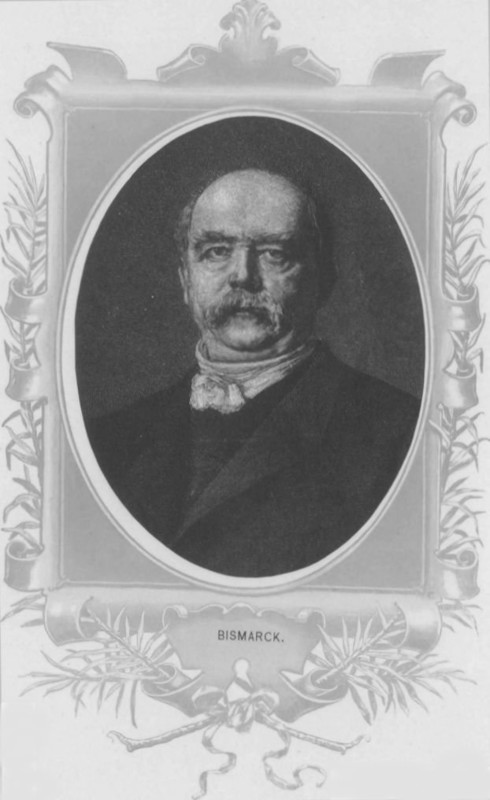
Bismarck(Portrait)
1930 "The Surrender at Sedan"(Photogravure)
1944 Richard Doddridge Blackmore(Portrait)
2012 "Rembrandt and His Wife"(Photogravure)
2055 Giovanni Boccaccio(Portrait)
2090 "The Decameron"(Photogravure)
2108 "Fatima"(Photogravure)
2120 "Domestic Happiness"(Photogravure)
2206
VIGNETTE PORTRAITS
Björnstjerne Björnson
William Black
William Blake
Mathilde Blind
Friedrich M. von Bodenstedt
Johann Jakob Bodmer
Boëtius
Nicholas Boileau-Despréaux
Gaston Boissier
George H. Boker
George Borrow
Jacques Bénigne Bossuet
James Boswell
Paul Bourget
Sir John Bowring
Hjalmar Hjorth Boyesen
Georg Brandes
Sebastian Brandt
OTTO EDWARD LEOPOLD VON BISMARCK
(1815-)
BY MUNROE SMITH
tto Edward Leopold, fourth child of Charles and Wilhelmina von Bismarck, was born at Schönhausen in Prussia, April 1, 1815. The family was one of the oldest in the "Old Mark" (now a part of the province of Saxony), and not a few of its members had held important military or diplomatic positions under the Prussian crown. The young Otto passed his school years in Berlin, and pursued university studies in law (1832-5) at Göttingen and at Berlin. At Göttingen he was rarely seen at lectures, but was a prominent figure in the social life of the student body: the old university town is full of traditions of his prowess in duels and drinking bouts, and of his difficulties with the authorities. In 1835 he passed the State examination in law, and was occupied for three years, first in the judicial and then in the administrative service of the State, at Berlin, Aix-la-Chapelle, and Potsdam. In 1838 he left the governmental service and studied agriculture at the Eldena Academy. From his twenty-fourth to his thirty-sixth year (1839-51) his life was that of a country squire. He took charge at first of property held by his father in Pomerania; upon his father's death in 1845 he assumed the management of the family estate of Schönhausen. Here he held the local offices of captain of dikes and of deputy in the provincial Diet. The latter position proved a stepping-stone into Prussian and German politics; for when Frederick William IV. summoned the "United Diet" of the kingdom (1847), Bismarck was sent to Berlin as an alternate delegate from his province.
The next three years were full of events. The revolution of 1848 forced all the German sovereigns who had thus far retained absolute power, among them the King of Prussia, to grant representative constitutions to their people. The same year witnessed the initiation of a great popular movement for the unification of Germany. A national Parliament was assembled at Frankfort, and in 1849 it offered to the King of Prussia the German imperial crown; but the constitution it had drafted was so democratic, and the opposition of the German princes so great, that Frederick William felt obliged to refuse the offer. An attempt was then made, at a Parliament held in Erfurt, to establish a "narrower Germany" under Prussian leadership; but this movement also came to nothing. The Austrian government, paralyzed for a time by revolts in its own territories, had re-established its power and threatened Prussia with war. Russia supported Austria, and Prussia submitted at Olmütz (1850). In these stirring years, Bismarck--first as a member of the United Diet and then as a representative in the new Prussian Chamber of Deputies--made himself prominent by hostility to the constitutional movement and championship of royal prerogative. He defended the King's refusal of the imperial crown, because "all the real gold in it would be gotten by melting up the Prussian crown"; and he compared the pact which the King, by accepting the Frankfort constitution, would make with the democracy, to the pact between the huntsman and the devil in the 'Freischütz': sooner or later, he declared, the people would come to the Emperor, and pointing to the Imperial arms, would say, "Do you fancy this eagle was given you for nothing?" He sat in the Erfurt Parliament, but had no faith in its success. He opposed the constitution which it adopted, although this was far more conservative than that drafted at Frankfort, because he deemed it still too revolutionary. During the Austro-Prussian disputes of 1850 he expressed himself, like the rest of the Prussian Conservatives, in favor of reconciliation with Austria, and he even defended the convention of Olmütz.
After Olmütz, the German Federal Diet, which had disappeared in 1848, was reconstituted at Frankfort, and to Frankfort Bismarck was sent, in 1857, as representative of Prussia. This position, which he held for more than seven years, was essentially diplomatic, since the Federal Diet was merely a permanent congress of German ambassadors; and Bismarck, who had enjoyed no diplomatic training, owed his appointment partly to the fact that his record made him persona grata to the "presidential power," Austria. He soon forfeited the favor of that State by the steadfastness with which he resisted its pretensions to superior authority, and the energy with which he defended the constitutional parity of Prussia and the smaller States; but he won the confidence of the home government, and was consulted by the King and his ministers with increasing frequency on the most important questions of European diplomacy. He strove to inspire them with greater jealousy of Austria. He favored closer relations with Napoleon III., as a make-weight against the Austrian influence, and was charged by some of his opponents with an undue leaning toward France; but as he explained in a letter to a friend, if he had sold himself, it was "to a Teutonic and not to a Gallic devil."
In the winter of 1858-9, as the Franco-Austrian war drew nearer, Bismarck's anti-Austrian attitude became so pronounced that his government, by no means ready to break with Austria, but rather disposed to support that power against France, felt it necessary to put him, as he himself expressed it, "on ice on the Neva." From 1859 to 1862 he held the position of Prussian ambassador at St. Petersburg. In 1862 he was appointed ambassador at Paris. In the autumn of the same year he became Minister-President of Prussia.
The new Prussian King, William I., had become involved in a controversy with the Prussian Chamber of Deputies over the reorganization of the army; his previous ministers were unwilling to press the reform against a hostile majority; and Bismarck, who was ready to assume the responsibility, was charged with the premiership of the new cabinet. "Under some circumstances," he said later, "death upon the scaffold is as glorious as upon the battlefield." From 1862 to 1866 he governed Prussia without the support of the lower chamber and without a regular budget. He informed a committee of the Deputies that the questions of the time were not to be settled by-debates, but by "blood and iron."
In the diplomatic field it was his effort to secure a position of advantage for the struggle with Austria for the control of Germany,--a struggle which, six years before, he had declared to be inevitable. During his stay in St. Petersburg he had strengthened the friendly feeling already subsisting between Prussia and Russia; and in 1863 he gave the Russian government useful support in crushing a Polish insurrection. To a remonstrance from the English ambassador, somewhat arrogantly delivered in the name of Europe, Bismarck responded, "Who is Europe?" While in Paris he had convinced himself that no serious interference was to be apprehended from Napoleon. That monarch overrated Austria; regarded Bismarck's plans, which appear to have been explained with extraordinary frankness, as chimerical; and pronounced Bismarck "not a serious person." Bismarck, on the other hand, privately expressed the opinion that Napoleon was "a great unrecognized incapacity." When, in 1863, the death of Frederick VII. of Denmark without direct heirs raised again the ancient Schleswig-Holstein problem, Bismarck saw that the opportunity had come for the solution of the German question.
The events of the next seven years are familiar history. In 1864 Prussia and Austria made war on Denmark, and obtained a joint sovereignty over the duchies of Holstein and Schleswig. In 1866, with Italy as her ally, Prussia drove Austria out of the German Confederation; annexed Schleswig, Holstein, Hanover, Electoral Hesse, and Frankfort; and brought all the German States north of the Main, except Luxemburg, into the North German Confederation, of which the King of Prussia was President and Bismarck Chancellor. When war was declared by France in 1870, the South German States also placed their forces at the King of Prussia's disposal; and before the war was over they joined the newly established German Empire, which thus included all the territories of the old Confederation except German Austria and Luxemburg. The old Confederation was a mere league of sovereign States; the new Empire was a nation. To this Empire, at the close of the war, the French Republic paid an indemnity of five milliards of francs, and ceded Alsace and Lorraine.
In giving the German people political unity Bismarck realized their strongest and deepest desire; and the feeling entertained toward him underwent a sudden revulsion. From 1862 to 1866 he had been the best hated man in Germany. The partial union of 1867--when, as he expressed it, Germany was "put in the saddle"--made him a national hero. The reconciliation with the people was the more complete because, at Bismarck's suggestion, a German Parliament was created, elected by universal suffrage, and because the Prussian ministers (to the great indignation of their conservative supporters) asked the Prussian Deputies to grant them indemnity for their unconstitutional conduct of the government during the preceding four years. For the next ten years Bismarck had behind him, in Prussian and in German affairs, a substantial nationalist majority. At times, indeed, he had to restrain their zeal. In 1867, for instance, when they desired to take Baden alone into the new union,--the rest of South Germany being averse to entrance,--Bismarck was obliged to tell them that it would be a poor policy "to skim off the cream and let the rest of the milk turn sour."
Bismarck remained Chancellor of the Empire as well as Minister-President of Prussia until 1890, when William II. demanded his resignation. During these years the military strength of the Empire was greatly increased; its finances were placed upon an independent footing; its authority was extended in legislative matters, and its administrative system was developed and consolidated. Conflicts with the Roman Catholic hierarchy (1873-87), and with the Social Democracy (1878-90) resulted indecisively; though Bismarck's desire to alleviate the misery which in his opinion caused the socialistic movement gave rise to a series of remarkable laws for the insurance of the laboring classes against accident, disease, and old age. With a return to the protective system, which Bismarck advocated for fiscal reasons, he combined the attempt to enlarge Germany's foreign market by the establishment of imperial colonies in Africa and in the Pacific Ocean. In other respects his foreign policy, after 1870, was controlled by the desire to preserve peace. "Germany," he said, "belongs to the satisfied nations." When the Russian friendship cooled, he secured an alliance with Austria (1879), which Italy also joined (1882); and the "triple alliance" thus formed continued to dominate European politics for many years after Bismarck's withdrawal from office.
Of Bismarck's State papers, the greater portion are still buried in the Prussian archives. The most important series that has been published consists of his dispatches from Frankfort (Poschinger, Preussen im Bundestag, 1851-8, 4 vols.). These are marked by clearness of statement, force of argument, and felicity of illustration. The style, although less direct and simple than that of his unofficial writings, is still excellent. A large part of the interest attaching to these early papers lies in their acute characterization of the diplomatists with whom he had to deal. His analysis of their motives reveals from the outset that thorough insight into human nature which was to count for so much in his subsequent diplomatic triumphs. Of his later notes and dispatches, such as have seen the light may be found in Hahn's documentary biography ('Fürst Bismarck,' 5 vols.). His reports and memorials on economic and fiscal questions have been collected by Poschinger in 'Bismarck als Volkswirth.'
Of Bismarck's parliamentary speeches there exists a full collection (reproduced without revision from the stenographic reports) in fifteen volumes. Bismarck was not an orator in the ordinary acceptation of the word. His mode of address was conversational; his delivery was monotonous and halting. He often hesitated, searching for a word; but when it came, it usually seemed the only word that could have expressed his meaning, and the hesitation that preceded it gave it a singular emphasis. It seemed to be his aim to convince his hearers, not to win them; his appeal was regularly to their intelligence, not to their emotions. When the energy and warmth of his own feelings had carried him into something like a flight of oratory, there was apt to follow, at the next moment, some plain matter-of-fact statement that brought the discussion back at once to its ordinary level. Such an anti-climax was often very effective: the obvious effort of the speaker to keep his emotions under restraint vouched for the sincerity of the preceding outburst. It should be added that he appreciated as few Germans do the rhetorical value of understatement.
He was undoubtedly at his literary best in conversation and in his letters. We have several volumes of Bismarck anecdotes, Bismarck table-talk, etc. The best known are those of Busch, which have been translated into English--and in spite of the fact that his sayings come to us at second hand and colored by the personality of the transmitter, we recognize the qualities which, by the universal testimony of those who knew him, made him one of the most fascinating of talkers. These qualities, however, come out most clearly in a little volume of letters ('Bismarck briefe'), chiefly addressed to his wife. (These letters have been excellently translated into English by F. Maxse.) They are characterized throughout by vivid and graphic descriptions, a subtle sense of humor, and real wit; and they have in the highest degree--far more than his State papers or speeches--the literary quality, and that indescribable something which we call style.
Bismarck furnishes, once for all, the answer to the old French question, whether a German can possibly have esprit--witness his response to the German prince who desired his advice regarding the offer of the crown of one of the Balkan States:--"Accept, by all means: it will be a charming recollection for you." He possessed also to a high degree the power of summing up a situation or characterizing a movement in a single phrase; and his sayings have enriched the German language with more quotations than the spoken words of any German since Luther.
Of the numerous German biographies, Harm's gives the greatest amount of documentary material; Hesekiel's (which has been translated into English) is the most popular. The best French biography is by Simon; the only important English work is that by Lowe. For bibliography, see Schulze and Roller, (Bismarck-Literatur) (1895), which contains about 600 titles. The Frankfort dispatches and the speeches have been translated into French, but not into English.
TO FRAU VON ARNIM
SCHÖNHAUSEN, August 7th, 1850.
The fact is, this journey, and I see it more clearly the nearer it approaches, gives me a right of reversion on the new lunatic asylum, or at least a seat for life in the Second Chamber. I can already see myself on the platform of the Genthiner station; then both of us packed in the carriage, surrounded with all sorts of child's necessaries--an embarrassing company; Johanna ashamed to suckle the baby, which accordingly roars itself blue; then the passports, the inn; then at Stettin railway station with both bellowing monkeys; then waiting an hour at Angermünde for the horses; and how are we to get from Kröchlendorf to Külz? It would be perfectly awful if we had to remain for the night at Stettin. I did that last year with Marie and her squallings. I was in such a state of despair yesterday over all these visions that I was positively determined to give the whole thing up, and at last went to bed with the resolve at least to go straight through, without stopping anywhere; but what will one not commit for the sake of domestic peace? The young cousins, male and female, must become acquainted, and who knows when Johanna will see you again? She pounced upon me last night with the boy in her arms, and with all those wiles which formerly lost us Paradise; of course she succeeded in wringing my consent that everything should remain as before. I feel, however, that I am as one to whom fearful injustice is done, and I am certain that I shall have to travel next year with three cradles, wet-nurses, long-clothes, and counterpanes. I am now awake by six o'clock, and already in a gentle simmer of anger; I cannot get to sleep, owing to all the visions of traveling which my imagination paints in the darkest colors, even up to the "picnics" on the sandhills of Stolpmünde. And then if one were only paid for it! But to travel away the last remnants of a once handsome fortune with sucking babies!--I am very unhappy!
Well--Wednesday, then, in Gerswalde--I should have done probably better by driving over Passow, and you would not have had so far to Prenzlau as to G----. However, it is now a fait accompli, and the pain of selection is succeeded by the quiet of resignation. Johanna is somewhat nervous about her dresses, supposing you Boitzenburgers have company.
TO HIS WIFE
FRANKFORT, August 7th, 1851.
I wanted to write to you yesterday and to-day, but, owing to all the clatter and bustle of business, could not do so until now, late in the evening on my return from a walk through the lovely summer-night breeze, the moonlight, and the murmuring of poplar leaves, which I took to brush away the dust of the day's dispatches and papers. Saturday afternoon I drove out with Rochow and Lynar to Rüdesheim; there I took a boat, rowed out upon the Rhine, and swam in the moonlight, with nothing but nose and eyes out of the water, as far as the Mäusethürm near Bingen, where the bad bishop came to his end. It gives one a peculiar dreamy sensation to float thus on a quiet warm night in the water, gently carried down by the current, looking above on the heavens studded with the moon and stars, and on each side the banks and wooded hill-tops and the battlements of the old castles bathed in the moonlight, whilst nothing falls on one's ear but the gentle splashing of one's own movements. I should like to swim like this every evening. I drank some very fair wine afterwards, and then sat a long time with Lynar smoking on the balcony--the Rhine below us. My little New Testament and the star-studded heavens brought us on the subject of religion, and I argued long against the Rousseau-like sophism of his ideas, without, however, achieving more than to reduce him to silence. He was badly treated as a child by bonnes and tutors, without ever having known his parents. Later on, in consequence of much the same sort of education as myself, he picked up the same ideas in his youth; but is more satisfied and more convinced by them than ever I was.
Next day we took the steamer to Coblenz, stopped there an hour for breakfast, and came back the same way to Frankfort, where we arrived in the evening. I undertook this expedition with the intention of visiting old Metternich, who had invited me to do so at Johannisberg; but I was so much pleased with the Rhine that I preferred to make my way over to Coblenz and to postpone the visit. When you and I saw it we had just returned from the Alps, and the weather was bad; on this fresh summer morning, however, and after the dusty monotony of Frankfort, the Rhine has risen very considerably in my estimation. I promise myself complete enjoyment in spending a couple of days with you at Rüdesheim; the place is so quiet and rural, honest people and cheap living. We will hire a small boat and row at our leisure downwards, climb up the Niederwald and a castle or two, and return with the steamer. One can leave this place early in the morning, stay eight hours at Rüdesheim, Bingen, or Rheinstein, etc., and be back again in the evening. My appointment here appears now to be certain.
Moscow, June 6th, 1859.
I will send you at least a sign of life from here, while I am waiting for the samovar; and a young Russian in a red shirt is exerting himself behind me with vain attempts to light a fire--he puffs and blows, but it will not burn. After having complained so much about the scorching heat lately, I woke to-day between Twer and here, and thought I was dreaming when I saw the country and its fresh verdure covered far and wide with snow. I shall wonder at nothing again, and having convinced myself of the fact beyond all doubt, I turned quickly on the other side to sleep and roll on farther, although the play of colors--from green to white--in the red dawn of day was not without its charm. I do not know if the snow still lies at Twer; here it has thawed away, and a cool gray rain is rattling on the green tin of the roofs. Green has every reason to be the Russian favorite color. Of the five hundred miles I have passed in traveling here, I have slept away about two hundred, but each hand-breadth of the remainder was green in every shade. Towns and villages, and more particularly houses, with the exception of the railway stations, I did not observe. Bushy forests with birch-trees cover swamp and hill, a fine growth of grass beneath, long tracts of meadow-land between; so it goes on for fifty, one hundred, two hundred miles. Ploughed land I do not remember to have remarked, nor heather, nor sand. Solitary grazing cows or horses awoke one at times to the presumption that there might be human beings in the neighborhood. Moscow, seen from above, looks like a field of young wheat: the soldiers are green, the cupolas green, and I do not doubt that the eggs on the table before me were laid by green hens.
You will want to know how I come to be here. I also have already asked myself this question, and the answer I received was that change is the soul of life. The truth of this profound saying becomes especially obvious after having lived for ten weeks in a sunny room of a hotel, with the look-out on pavements. The charms of moving become rather blunted if they occur repeatedly within a short period; I therefore determined to forego them, handed over all paper to----, gave Engel my keys, declared that I would put up in a week at Stenbock's house, and drove to the Moscow station. This was yesterday at noon, and this morning, at eight o'clock, I alighted here at the Hôtel de France. First of all I shall pay a visit to a charming acquaintance of former times, who lives in the country, about twenty versts from here; to-morrow evening I shall be here again; Wednesday and Thursday shall visit the Kremlin and so forth; and Friday or Saturday sleep in the beds which Engel will meantime buy. Slow harnessing and fast driving lie in the character of this people. I ordered the carriage two hours ago: to every call which I have been uttering for each successive ten minutes of an hour and a half, the answer is, "Immediately," given with imperturbably friendly composure; but there the matter rests. You know my exemplary patience in waiting, but everything has its limits; afterwards there will be wild galloping, so that on these bad roads horse and carriage break down, and at last we reach the place on foot. I have meanwhile drunk three glasses of tea and annihilated several eggs; the efforts at getting warm have also so perfectly succeeded that I feel the need of fresh air. I should, out of sheer impatience, commence shaving if I had a glass. This city is very straggling, and very foreign-looking, with its green-roofed churches and innumerable cupolas; quite different from Amsterdam, but both the most original cities I know. No German guard has a conception of the luggage people drag with them into the railway carriage; not a Russian goes without two real pillows in white pillow-cases, children in baskets, and masses of eatables of every kind. Out of politeness they bowed me into a sleeping car, where I was worse off than in my seat. Altogether, it is astonishing to me to see the fuss made here about a journey.
Moscow, June 8th.
This city is really, as a city, the handsomest and most original existing: the environs are cheerful, not pretty, not ugly; but the view from the top of the Kremlin on this panorama of green-roofed houses, gardens, churches, spires of the strangest possible form and color, mostly green, or red or bright blue, generally crowned at the top with a gigantic golden onion, and mostly five or more on one church,--there are certainly a thousand steeples!--anything more strangely beautiful than all this lit up by the slanting rays of the setting sun it is impossible to see. The weather has cleared up again, and I should stay here a few days longer if there were not rumors of a great battle in Italy, which may perhaps bring diplomatic work in its train, so I will be off there and get back to my post. The house in which I am writing is, curiously enough, one of the few that survived 1812; old, thick walls, like those at Schönhausen, Oriental architecture, big Moorish rooms.
June 28th, Evening.
After a three hours' drive through the gardens in an open carriage, and a view of all its beauties in detail, I am drinking tea, with a prospect of the golden evening sky and green woods. At the Emperor's they want to be en famille the last evening, as I can perfectly well understand; and I, as a convalescent, have sought retirement, and have indeed done quite enough to-day for my first outing. I am smoking my cigar in peace, and drinking excellent tea, and see, through the smoke of both, a sunset of really rare beauty. I send you the inclosed jasmine as a proof that it really grows and blossoms here in the open air. On the other hand, I must own that I have been shown the common chestnut in shrub-form as a rare growth, which in winter is wrapped up; otherwise, there are very fine large oaks, ash-trees, limes, poplars, and birches as thick as oaks.
Petersburg, July 26, 1859.
Half an hour ago a cabinet courier woke me with war and peace. Our policy drifts more and more into the Austrian wake; and when we have once fired a shot on the Rhine, it is over with the Italian-Austrian war, and in its place a Prussian-French comes on the scene, in which Austria, after we have taken the burden from her shoulders, stands by us or fails to stand by us just so far as her own interests require. She will certainly not allow us to play a very brilliant victor's part.
As God wills! After all, everything here is only a question of time: nations and individuals, folly and wisdom, war and peace, they come and go like the waves, but the sea remains. There is nothing on this earth but hypocrisy and jugglery; and whether fever or grape-shot tear off this fleshly mask, fall it must sooner or later: and then, granted that they are equal in height, a likeness will after all turn up between a Prussian and an Austrian which will make it difficult to distinguish them. The stupid and the clever, too, look pretty much alike when their bones are well picked. With such views, a man certainly gets rid of his specific patriotism; but it would indeed be a subject for despair if our salvation depended on them.
TO HIS BROTHER-IN-LAW, OSCAR VON ARNIM
RHEINFELD, August 16th, 1861.
I have just received the news of the terrible misfortune which has befallen you and Malwine, My first thought was to come to you at once, but in wanting to do so I overrated my powers. My régime has touched me up a good deal, and the thought of suddenly breaking it off met with such decided opposition that I have resolved to let Johanna go alone. Such a blow goes beyond the reach of human consolation. And yet it is a natural desire to be near those we love in their sorrow, and to lament with them in common. It is the only thing we can do. A heavier sorrow could scarcely have befallen you. To lose such an amiable and a so-happily-thriving child in such a way, and to bury along with him all the hopes which were to be the joys of your old days,--sorrow over such a loss will not depart from you as long as you live on this earth; this I feel with you, with deep and painful sympathy. We are powerless and helpless in God's mighty hand, so far as he will not himself help us, and can do nothing but bow down in humility under his dispensations. He can take from us all that he gave, and make us utterly desolate; and our mourning for it will be all the bitterer, the more we allow it to run to excess in contention and rebellion against his almighty ordinance. Do not mingle your just grief with bitterness and repining, but bring home to yourself that a son and a daughter are left to you, and that with them, and even in the feeling of having possessed another beloved child for fifteen years, you must consider yourself blessed in comparison with the many who have never had children nor known a parent's joy.
I do not want to trouble you with feeble grounds for consolation, but only to tell you in these lines how I, as friend and brother, feel your suffering like my own, and am moved by it to the very core. How all small cares and vexations, which daily accompany our life, vanish at the iron appearance of real misfortune! and I feel like so many reproaches the reminiscences of all complaints and covetous wishes, over which I have so often forgotten how much blessing God gives us, and how much danger surrounds us without touching us. We are not to attach ourselves to this world, and not regard it as our home. Another twenty, or in happiest case thirty years, and we are both of us beyond the cares of this life, and our children have reached our present standpoint, and find with astonishment that the freshly begun life is already going down hill. It would not be worth while to dress and undress if it were over with that.
Do you still remember these words of a fellow-traveler from Stolpemünde? The thought that death is the transition to another life will certainly do little to alleviate your grief; for you might think that your beloved son might have been a true and dear companion to you during the time you are still living in this world, and would have continued, by God's blessing, the memory of you here. The circle of those whom we love contracts itself and receives no increase till we have grandchildren. At our time of life we form no fresh bonds which are capable of replacing those that die off. Let us therefore keep the closer together in love until death separates us from one another, as it now separates your son from us. Who knows how soon? Won't you come with Malle to Stolpmünde, and stay quietly with us for a few weeks or days? At all events I shall come to you at Kröchlendorf, or wherever else you are, in three or four weeks. I greet my dearest Malle with all my heart. May God give her, as well as you, strength to bear and patiently submit.
TO HIS WIFE
BIARRITZ, August 4th, 1862.
I am afraid I have caused some confusion in our correspondence, as I induced you to write too soon to places where I have not yet arrived. It will be better for you to address your letters to Paris, just as though I were there; the embassy then sends them after me, and I can more quickly send word there if I alter my route. Yesterday evening I returned from St. Sebastian to Bayonne, where I slept, and am now sitting here in a corner-room of the Hotel de l'Europe, with charming view on the blue sea, which drives its white foam through the curious cliffs against the lighthouse. I have a bad conscience for seeing so many beautiful things without you. If one could transport you here through the air, I would go directly back again to St. Sebastian, and take you with me. Fancy the Siebengebirge with the Drachenfels placed by the sea; close by, Ehrenbreitstein, and between the two, pushing its way into the land, an arm of the sea, somewhat broader than the Rhine, and forming a round bay behind the mountains. In this you bathe in transparently clear water, so heavy and so salt that you swim on the top of it by yourself, and look through the broad gate of rocks into the sea, or landward where the mountain chains top each other, always higher, always bluer.
The women of the middle and lower classes are strikingly pretty, occasionally beautiful; the men surly and uncivil; and the comforts of life to which we are accustomed are missing. The heat is not worse here than there, and I do not mind it; find myself, on the contrary, very well, thank God. The day before yesterday there was a storm, such as I have never seen anything like. I had to take a run three times before I could succeed in getting up a flight of three steps on the jetty; pieces of stone and large fragments of trees were carried through the air. Unfortunately, therefore, I countermanded my place in a sailing vessel to Bayonne, for I could not suppose that after four hours all would be quiet and cheerful. I lost thus a charming sail along the coast, remained a day more at St. Sebastian, and left yesterday in the diligence, rather uncomfortably packed between nice little Spanish women, with whom I could not talk a syllable. So much Italian, however, they understood that I could demonstrate to them my satisfaction with their exterior. I looked to-day at a railway guide to see how I could get from here--that is, from Toulouse--by railway over Marseilles to Nice, then by boat to Genoa; from there over Venice, Trieste, Vienna, Breslau, Posen, Stargard to Cöslin! If it were only possible to go over Berlin! I cannot very well pass through there just now.
TO HIS WIFE
HOHENMAUTH, Monday, July 9th, 1866.
Do you still remember, my heart, how nineteen years ago we passed through here on the way from Prague to Vienna? No mirror showed the future, neither when, in 1852, I went along this line with the good Lynar. Matters are going well with us; if we are not immoderate in our demands, and do not imagine that we have conquered the world, we shall acquire a pace which will be worth the trouble. But we are just as quickly intoxicated as discouraged, and I have the ungrateful task of pouring water in the foaming wine, and making them see that we are not living alone in Europe, but with three neighbors still. The Austrians are in Moravia, and we are already so bold that their positions to-day are fixed for our headquarters to-morrow. Prisoners are still coming in, and one hundred and eighty guns since the 3d up to to-day. If they call up their southern army, with God's good help we shall beat them again. Confidence is universal. I could hug our fellows, each facing death so gallantly, so quiet, obedient, well-behaved, with empty stomachs, wet clothes, wet camp, little sleep, the soles of their boots falling off, obliging to everybody, no looting, no incendiarism, paying where they can, and eating moldy bread. There must after all abide in our man of the soil a rich store of the fear of God, or all that would be impossible. News of acquaintances is difficult to obtain; people are miles apart from one another; no one knows where the other is, and nobody to send; men enough, but no horses. I have had Philip searched for, for four days; he is slightly wounded in the head by a lance, as G---- wrote to me, but I cannot find out where he is, and now we are already forty miles farther on.
The King exposed himself very much indeed on the 3d, and it was a very good thing that I was with him; for all warnings on the part of others were of no avail, and no one would have ventured to speak as I allowed myself to do the last time, and with success, after a heap of ten men and fifteen horses of the Sixth Regiment of cuirassiers were wallowing in their blood near us, and the shells whizzed round the sovereign in the most unpleasant proximity. The worst luckily did not burst. But after all I like it better than if he should err on the other side. He was enchanted with his troops, and rightly, so that he did not seem to remark all the whistling and bursting about him; as quiet and comfortable as on the Kreuzberg, and kept constantly finding battalions that he wanted to thank and say good evening to, until there we were again under fire. But he has had to hear so much about it, that he will leave it alone for the future, and you can be at ease; besides, I hardly believe in another real battle.
If you have no news of a person, you can all implicitly believe that he lives and is well, as all casualties occurring to one's acquaintances are known in twenty-four hours at the longest. We have not come at all into communication with Herwarth and Steinmetz, but know that they are both well. G----- quietly leads his squadron with his arm in a sling. Good-bye, I must go on duty.
YOUR MOST TRUE V.B.
TO HIS WIFE
Note.--This letter did not reach its destination, but, together with the entire post, was captured by franc-tireurs and published by a French newspaper.
VENDRESSE, 3 September [1870].
My Dear Heart:
I left my present quarters before early dawn the day before yesterday, came back to-day, and have in the mean time witnessed the great battle of Sedan, in which we made about thirty thousand prisoners, and threw the remainder of the French army, which we have been pursuing since Bar-le-Duc, into the fortress, where they had to surrender themselves, along with the Emperor, prisoners of war. Yesterday morning at five o'clock, after I had been negotiating until one o'clock A.M. with Moltke and the French generals about the capitulation to be concluded, I was awakened by General Reille, with whom I am acquainted, to tell me that Napoleon wished to speak with me. Unwashed and unbreakfasted, I rode towards Sedan, found the Emperor in an open carriage, with three aides-de-camp and three in attendance on horseback, halted on the road before Sedan. I dismounted, saluted him just as politely as at the Tuileries, and asked for his commands. He wished to see the King; I told him, as the truth was, that his Majesty had his quarters fifteen miles away, at the spot where I am now writing. In answer to Napoleon's question where he should go to, I offered him, as I was not acquainted with the country, my own quarters at Donchéry, a small place in the neighborhood, close by Sedan. He accepted, and drove, accompanied by his six Frenchmen, by me and by Carl (who in the mean time had ridden after me) through the lonely morning towards our lines. Before coming to the spot, he began to hesitate on account of the possible crowd, and he asked me if he could alight in a lonely cottage by the wayside; I had it inspected by Carl, who brought word that it was mean and dirty. "N'importe," said N., and I ascended with him a rickety, narrow staircase. In an apartment of ten feet square, with a deal table and two rush-bottomed chairs, we sat for an hour; the others were below. A powerful contrast with our last meeting in the Tuileries in 1867. Our conversation was a difficult thing, if I wanted to avoid touching on topics which could not but affect painfully the man whom God's mighty hand had cast down. I had sent Carl to fetch officers from the town and to beg Moltke to come. We then sent one of the former to reconnoitre, and discovered two and one-half miles off, in Fresnois, a small château situated an a park. Thither I accompanied him with an escort of the cuirassier regiment of life-guards, which had meantime been brought up; and there we concluded with the French general-in-chief, Wimpffen, the capitulation by virtue of which forty to sixty thousand Frenchmen,--I do not know it accurately at present,--with all they possess, became our prisoners. Yesterday and the day before cost France one hundred thousand men and an Emperor. This morning the latter, with all his suite and horses and carriages, started for Wilhelmshöhe, near Cassel.
It is an event of great weight in the world's history, a victory for which we will humbly thank the Almighty, and which decides the war, even if we have to carry it on against France shorn of her Emperor.
I must conclude. With heartfelt joy I learnt from your and Maria's letters that Herbert has arrived among you. Bill I spoke to yesterday, as already telegraphed, and embraced him from horseback in his Majesty's presence, while he stood motionless in the ranks. He is very healthy and happy. I saw Hans and Fritz Carl, both Billows, in the Second dragoon guards, well and cheerful.
Good-by, my heart; love to the children.
Your
V.B.
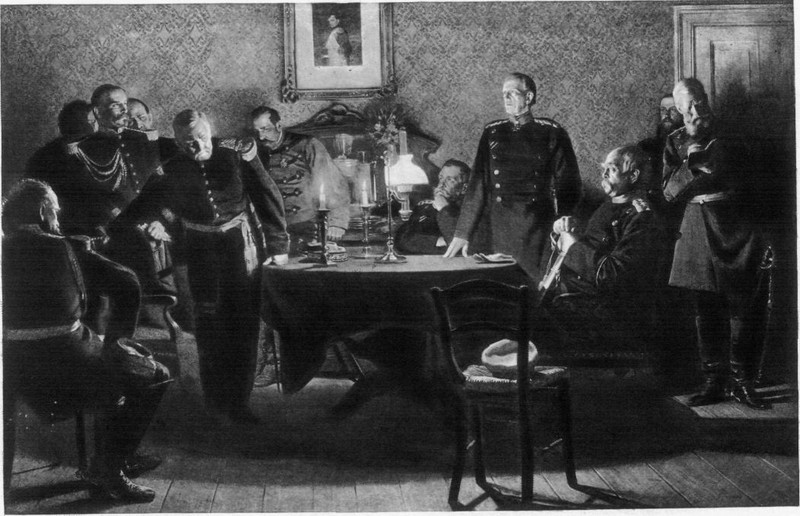
THE SURRENDER AT SEDAN.
Photogravure from a Painting by Anton Von Werner.
The surrender, at Sedan, in 1870, of the French army of 84,000 under Napoleon III.,
MacMahon and Wimpffen, to the Germans, 250,000 strong, under William I., was
the signal for the downfall of the French empire and the establishment of the
republic. In the accompanying picture, the figure seated at the extreme
left is GENERAL FAURE; the middle figure of the group of three, standing,
is GENERAL CASTELNAU. GENERAL WIMPFFEN, who succeeded
MacMahon as commander Sept. 1 and signed the capitulation
Sept. 2, stands in a stooping posture, leaning upon his chair
and the table. Across the table, his right hand resting
upon it, and standing erect, is GENERAL MOLTKE,
The seated figure in the foreground is BISMARCK;
behind whom, writing, stands COUNT NOSTIZ.
TO HIS WIFE
OFEN, June 23d, 1852.
I have just come from the steamer, and do not know how better to employ the moment I have at my disposal before Hildebrand follows with my things, than by sending you a little sign of life from this very easterly but very beautiful world. The Emperor has been graciously pleased to assign me quarters in his castle; and here I am in a large vaulted hall, sitting at an open window through which the evening bells of Pesth are pealing. The outlook is charming. The castle stands high; beneath me, first, the Danube, spanned by the suspension bridge; across it, Pesth; and further off the endless plain beyond Pesth, fading away into the purple haze of evening. To the left of Pesth I look up the Danube; far, very far away on my left,--that is, on its right bank,--it is first bordered by the town of Ofen; back of that are hills, blue and still bluer, and then comes the brown-red in the evening sky that glows behind them. Between the two towns lies the broad mirror of water, like that at Linz, broken by the suspension bridge and a wooded island. The journey here, too, at least from Gran to Pesth, would have delighted you. Imagine the Odenwald and the Taunus pushed near to each other, and the space between filled with the waters of the Danube. The shady side of the trip was its sunny side; it was as hot as if Tokay was to be grown on the boat: and the number of tourists was great, but--only think of it--not an Englishman! They cannot yet have discovered Hungary. There were, however, odd customers enough, of all races, oriental and occidental, greasy and washed. A very amiable general was my chief traveling companion; I sat and smoked with him nearly the whole time, up on the paddle-box.
I am growing impatient as to what has become of Hildebrand; I lean out of the window, partly mooning and partly watching for him as if he were a sweetheart, for I crave a clean shirt--if you could only be here for a moment, and if you too could now see the dull silver of the Danube, the dark hills on a pale-red background, and the lights that shine up from below in Pesth, Vienna would go down a good way in your estimation as compared with "Buda-Pesth," as the Hungarians call it. You see that I too can go into raptures over nature. Now that Hildebrand has really turned up, I shall calm my fevered blood with a cup of tea, and soon after go to bed.
JUNE 24TH: Evening.
As yet I have had no opportunity to send this off. Again the lights are gleaming up from Pesth; on the horizon, in the direction of the Theiss, there are flashes of lightning; above us the sky is clear and the stars are shining. I have been a good deal in uniform to-day; presented my credentials, in formal audience, to the young ruler of this country, and received a very agreeable impression. After dinner the whole court made an excursion into the hills, to the "Fair Shepherdess"--who, however, has long been dead; King Matthias Corvinus loved her several hundred years ago. There is a view from there (over wooded hills, something like those by the Neckar) of Ofen, its hills, and the plain. A country festival had brought together thousands of people; they pressed about the Emperor, who had mingled with the throng, with ringing shouts of "eljen" [vive]; they danced the csardas, waltzed, sang, played music, climbed into the trees, and crowded the court. On a grassy slope there was a supper table for some twenty persons, with seats on one side only, while the other was left free for the view of forest, castle, city, and country. Above us were tall beeches, with climbing Hungarians on the branches; behind and quite near us, a closely crowded and crowding mass of people; further off, music from wind instruments, alternating with song--wild gipsy melodies. Illumination--moonlight and sunset-red, with torches scattered through the forest. It might all be produced without a change as grand scenic effect in a romantic opera. Next to me sat the white-haired Archbishop of Gran, in a black silk gown with a red hood; on the other side a very amiable, trig cavalry general. You see the picture was rich in contrasts. Then we drove home in the moonlight with an escort of torches....
It is very quiet and comfortable up here now; I hear nothing but the ticking of a clock on the wall, and the distant rumble of carriages below. May angels watch over you; over me, a grenadier in a bearskin does it, six inches of whose bayonet I see projecting above the window-sill, a couple of arm's-lengths from me, and reflecting a ray of light. He is standing above the terrace on the Danube, and thinking perhaps of his Nancy.
PERSONAL CHARACTERISTICS OF THE MEMBERS OF THE FRANKFORT DIET
Confidential Dispatch to Minister Von Manteuffel, May 30th, 1853
In connection with my report of to-day regarding the attitude of certain envoys in the Kettenburg affair, I take the liberty of making some confidential remarks regarding the personal traits of my colleagues in general, in case it should interest your Excellency to have the information.
Herr von Prokesch is probably well enough known in Berlin to make further indications of his personal characteristics unnecessary; at the same time, I cannot refrain from remarking that the calmness and ease with which he advances false statements of fact, or contests true statements, surpass my expectations, although I have been led to expect a good deal in this direction. These qualities are supplemented by a surprising degree of coolness in dropping a subject or making a change of front, as soon as the untruth which he has taken as his point of departure is identified beyond the possibility of evasion. In case of necessity he covers a retreat of this sort by an ebullition of moral indignation, or by an attack, often of a very personal character, which transfers the discussion to a new and quite different field. His chief weapons in the petty war which I am obliged to wage with him, as often as the interests which we represent diverge, are: (1) Passive resistance, i.e., a dilatory treatment of the affair, by which he forces upon me the rôle of a tiresome dun, and not infrequently, by reason of the nature of the affair, that of a paltry dun. (2) In case of attack, the fait accompli, in the shape of apparently insignificant usurpations on the part of the Chair. These are commonly so calculated that any protest on my part cannot but seem like a deliberate search for points of controversy or like captious verbal criticism. It is therefore scarcely possible for me to avoid, in my dealings with him, the appearance of quarrelsomeness, unless I am willing to sacrifice the interests of Prussia to a degree which every concession would increase....
The Bavarian envoy, Herr von Schrenk, I place among the best elements in the assembly, as regards both his capacity and his character. He is a thorough and industrious worker, and practical in his views and opinions; although his predominantly juristic training and mode of thinking make him at times disputatious, and tend to impede the progress of affairs. In official intercourse he is frank and obliging, so long as his [Bavarian] patriotism, which is high-strung and extremely irritable, is treated with consideration; a foible for which I take particular pains to make allowance.
Our Saxon colleague, Herr von Nostitz, inspires in me less confidence. It seems to me that he has at bottom a traditional inclination toward Prussia and its political system, which is nourished in part by a Protestantism that is more rationalistic than orthodox, and by his fear of Ultramontane tendencies. I believe, however,--and I should be glad to find that I do him an injustice,--that on the whole, personal interests take precedence with him over political interests, and that the suppleness of his character permits him to view the latter in whatever light best suits the former. His economic position is dependent upon his place, aside from the salary, by reason of the fact that he owns a house here in which he lives, which he bought before 1848 at a high price, and which he has vainly attempted to rent for the last five years. His political course is therefore controlled by his desire of remaining in his official position under every contingency; and with the present tendency of the Saxon government, Austria has certainly more opportunity to help him in keeping his place than has Prussia. This circumstance indeed does not prevent Herr von Nostitz from avoiding, as far as his instructions will allow, any patent injury to Prussia; but with his great capacity for labor, his intelligence, and his long experience, he constitutes the most effective support of all Austria's efforts in the federal assembly. He is particularly adroit in formulating reports and propositions in awkward controversial questions; he knows how to give his draught a color of compromise without the least sacrifice of any Austrian interest, as soon as the correct interpretation comes to the aid of the apparently indeterminate expression. When his draughts become the basis of subsequent discussion, it is then usually discovered for the first time that the real purpose for which they were drawn is contained in what seemed to be casual and incidental words. If the current in Dresden should shift in the Prussian direction, the valuable personal assistance which Herr von Nostitz is able to render by means of his sense, his experience, and the credit both have won him, would be thrown on the Prussian side with the same certainty as now on the Austrian, unless too strong a tie were found in the fact that one of his sons is being educated in the Austrian Naval School, while another is already an officer in the imperial service.
Herr von Bothmer returned to this place a few days ago as representative of Hanover; I learn from him, however, with regret, that his further stay here is in no wise assured. Not only is his a straightforward character that awakens confidence, but he is also the only one of my colleagues who has sufficient independence to give me anything more than passive assistance when I am obliged to protest against the conduct of the Chair.
His opposite is found in Herr von Reinhard. While Herr von Bothmer is thorough, clear, and objective in his productions, those of the Würtemberg envoy bear the stamp of superficiality and confused thinking. His removal from the federal assembly might justly be regarded as a great gain for us. I do not know whether his departure from Berlin was connected with circumstances which have left in him a lasting dislike of Prussia, or whether confused political theories (regarding which he expresses himself with more ease and with greater interest than regarding practical affairs) have brought him to believe that the Prussian influence in Germany is deleterious: but at all events his antipathy to us exceeds the degree which, in view of the political situation of Würtemberg, can be supposed to exist in the mind of his sovereign; and I have reason to assume that his influence upon the instructions which are sent him, and his activity, so far as this is independent of instructions, are exerted, as a matter of principle, to the disadvantage of Prussia.... In his bearing towards me personally there is nothing which would justify the conclusion that his feelings are of the sort I have indicated; and it is only rarely that a point is reached in our debates at which, moderated by a certain timidity, his suppressed bitterness against Prussia breaks out. I may remark incidentally that it is he who invariably appears at our sessions last, and too late; and who, through want of attention and through subsequent participation in the discussion on the basis of misapprehensions, occasions further repetitions and waste of time.
The envoy from Baden, Herr von Marschall, is not without sense and fitness for affairs, but is scrupulously careful to avoid the responsibility of an independent opinion, and to discover in the least dubitable matter an intermediate point of view from it may be possible to agree with both sides, or at least to disagree with neither. If there is no escape, he inclines, either for family reasons or because his government is more afraid of Vienna than of Berlin, to the Austrian side rather than to ours. Support against the Chair--as, for example, in the matter of the order of business, upon which he is charged with a report--I can hardly expect from him.
Our colleague from the Electorate, Herr von Trott, takes as little part as possible in the affairs of the Diet; especially avoids reports and committee work; and is frequently absent, making the representative from Darmstadt his proxy. He prefers country life and hunting to participation in assemblies, and gives the impression rather of a jovial and portly squire than of an envoy. He confines himself to announcing his vote, briefly and in the exact language of his instructions; and while the latter are invariably drawn by the Minister, Hassenpflug, in accordance with the directions received from Austria, it does not appear to me that either Austria or the States of the Darmstadt coalition enjoy the personal support of Herr von Trott any more than we do--an impartiality which is rendered easy to the Hessian envoy as much by his distaste for affairs, and I like to think by the revolt of his essentially honorable nature against all that savors of intrigue, as by his formerly indubitable sympathy for Prussia's interests.
We find a more inimical element in the Grand-Ducal Hessian envoy, Baron von Münch-Bellinghausen. While this gentleman is attached from the start to the interests of Austria by his family connections with the former presidential envoy of the same name, his antagonism to Prussia is considerably intensified by his strong, and I believe sincere, zeal for the Catholic Church. In private intercourse he is a man of agreeable manners; and as regards his official attitude, I have to this extent no cause of complaint--that beyond the degree of reserve imposed upon him by the anti-Prussian policy of his government, I have observed in him no tendency towards intrigue or insincerity. For the rest, he is a natural opponent of the Prussian policy in all cases where this does not go hand in hand with Austria and the Catholic Church; and the warmth with which he not infrequently supports his opinion against me in discussion, I can regard only as a proof of the sincerity of his political convictions. It is certainly, however, an anomalous thing that a Protestant sovereign, who at this moment is in conflict with Catholic bishops, is represented in the Confederacy by Herr von Münch....
One of our trustiest allies is Herr von Scherff, who personally is altogether devoted to the Prussian interests, and has moreover a son in our military service; he is experienced in affairs, and prudent to the point of timidity. This latter trait, as well as the sort of influence which his Majesty the King of the Netherlands exercises upon the federal instructions, often prevents him from giving me, in the sessions of the Diet, that degree of support which I should otherwise receive from him. Outside of the sessions I have always been able to count on him with confidence, whenever I have called upon him for advice, and whenever it has been a question of his aiding me through his influence upon some other envoy or through the collection of information. With his Royal Highness the Prince of Prussia, Herr von Scherff and his family justly stand in special favor.
Nassau and Brunswick are represented by the Baron von Dungern, a harmless character, who has neither the personal capacity nor the political credit requisite to give him influence in the Federal Assembly. If the difference that exists in most questions between the attitude of Brunswick and that of Nassau is settled in most cases in favor of the views held by Nassau, (i.e., by Austria,) this is partly due indeed to the connection of Herr von Dungern and his wife with families that are in the Austrian interest, and to the fact that the envoy, who has two sons in the Austrian military service, feels more dread of Austria's resentment than of Prussia's; but the chief mistake lies in the circumstance that Brunswick is represented by a servant of the Duke of Nassau, who lives here in the immediate neighborhood of his own court,--a court controlled by Austrian influences,--but maintains with Brunswick, I imagine, connections so closely restricted to what is absolutely necessary that they can hardly be regarded as an equivalent for the five thousand florins which his Highness Duke William contributes to his salary.
The Mecklenburg envoy, Herr von Oertzen, justifies in all respects the reputation of an honorable man which I had heard attributed to him before he assumed his present position. In the period immediately following the reopening of the Federal Diet, he, like a large number of his fellow-countrymen, showed an unmistakable leaning to Austria; but it seems to me indubitable that his observation for two years of the methods which Austrian policy employs here through the organ of the Chair has aroused in Herr von Oertzen's loyal nature, in spite of the fact that he too has a son in the Austrian army, a reaction which permits me to count fully upon him as far as his personal attitude is concerned, and upon his political support as far as his instructions--of the character of which, on the whole, I cannot complain--in any wise permit. In any case I can depend upon his pursuing, under all circumstances, an open and honorable course.... His attitude in the debates is always tranquil, and in favor of compromise....
The representative of the Fifteenth Curia is Herr von Eisendecher, a man whose ready sociability, united with wit and vivacity in conversation, prepossesses one in his favor. He was formerly an advanced Gothaite, and it seems that this tendency of his has shaded over into a lively sympathy for the development of the Confederation as a strong, unified, central power; since in this way, and with the help of Austria, he thinks that a substitute will be discovered for the unsuccessful efforts towards unity in the Prussian sense. The Curia, it is reported, is so organized that the two Anhalts and the two Schwarzburgs, if they are united among themselves, outvote Oldenburg.
It is in a simpler way and without stating his reasons that the representative of the Sixteenth Curia, Baron von Holzhausen, throws his influence on the Austrian side of the scales. It is said of him that in most cases he draws up his own instructions, even when he has ample time to send for them, and that he meets any protest raised by his principals by holding his peace, or by an adroit use of the large number of members of his Curia and the lack of connection between them. To this it is to be added that the majority of the little princes are not disposed to spend upon their federal diplomacy the amount that would be required for a regular and organized chancelry and correspondence; and that if Herr von Holzhausen, who after the departure of Baron von Strombeck obtained the place as the lowest asker, should resign from their service, they would hardly be able, with the means at their disposal, to secure so imposing a representative as this prosperous gentleman, who is decorated with sundry grand-crosses and the title of privy councillor, and is a member of the oldest patrician family of Frankfort. The nearest relations of Herr von Holzhausen, who is himself unmarried and childless, are in the service of Austria. Moreover, his family pride, which is developed to an unusual degree, points back with all its memories to the imperial city patriciate that was so closely associated with the glorious era of the Holy Roman Empire; and Prussia's entire position seems to him a revolutionary usurpation, which has played the most material part in the destruction of the privileges of the Holzhausens. His wealth leads me to assume that the ties that bind him to Austria are merely ambitious tendencies--such as the desire for an imperial order or for the elevation of the family to the rank of Austrian counts--and not pecuniary interests, unless his possession of a large quantity of [Austrian] mining shares is to be regarded in the latter light.
If your Excellency will permit me, in closing, to sum up the results of my report, they amount to what follows:--
The only envoys in the Federal Diet who are devoted to our interests as regards their personal views are Herren von Fritsch, von Scherff, and von Oertzen. Herein the first of these follows at the same time the instructions of the government which he represents. Personally assured to Austria, on the other hand, without it being possible to make the same assertion as regards the governments they represent, are Herren von Eisendecher and von Holzhausen, and von Dungern as representing Brunswick. On the Austrian side, besides these, are almost always, in accordance with the instructions of their governments, Herr von Nostitz, Herr von Reinhard, Herr von Münch, Herr von Trott (who, however, displays greater moderation than his Darmstadt colleague), and Herr von Dungern as representing Nassau.
A position in part more independent, in part more mediatory, is assumed by Herren von Schrenk, von Bothmer, von Bülow, von Marschall, and by the representatives of the Free Cities; and yet in the attitude of these envoys also, Austrian influences are not infrequently noticeable.
FROM A SPEECH ON THE MILITARY BILL
IN THE GERMAN IMPERIAL DIET, FEBRUARY 6TH, 1888
When I say that we must constantly endeavor to be equal to all contingencies, I mean by that to claim that we must make greater exertions than other powers in order to attain the same result, because of our geographical position. We are situated in the middle of Europe. We have at least three fronts of attack. France has only its eastern frontier, Russia only its western frontier, on which it can be attacked. We are, moreover, in consequence of the whole development of the world's history, in consequence of our geographical position, and perhaps in consequence of the slighter degree of internal cohesion which the German nation as compared with others has thus far possessed, more exposed than any other people to the risk of a coalition. God has placed us in a situation in which we are prevented by our neighbors from sinking into any sort of indolence or stagnation. He has set at our side the most war-like and the most restless of nations, the French; and he has permitted warlike inclinations, which in former centuries existed in no such degree, to grow strong in Russia. Thus we get a certain amount of spurring on both sides, and are forced into exertions which otherwise perhaps we should not make. The pikes in the European carp-pond prevent us from becoming carps, by letting us feel their prickles on both our flanks; they constrain us to exertions which perhaps we should not voluntarily make; they constrain us Germans also to a harmony among ourselves that is repugnant to our inmost nature: but for them, our tendency would rather be to separate. But the Franco-Russian press in which we are caught forces us to hold together, and by its pressure it will greatly increase our capacity for cohesion, so that we shall reach in the end that state of inseparableness which characterizes nearly all other nations, and which we still lack. But we must adapt ourselves to this decree of Providence by making ourselves so strong that the pikes can do no more than enliven us....
The bill gives us an increase in troops trained to arms--a possible increase: if we do not need it, we need not call for it; we can leave it at home. But if we have this increase at our disposal, and if we have the weapons for it, ... then this new law constitutes a reinforcement of the guarantees of peace, a reinforcement of the league of peace, that is precisely as strong as if a fourth great power with an army of 700,000 men--and this was formerly the greatest strength that existed--had joined the alliance. This powerful reinforcement will also, I believe, have a quieting effect upon our own countrymen, and lessen in some degree the nervousness of our public opinion, our stock-market, and our press. I hope it will act upon them as a sedative when they clearly comprehend that from the moment at which this law is signed and published the men are there. The armament too may be said to be ready, in the shape of what is absolutely necessary: but we must procure a better, for if we form an army of triarians of the best human material that we have,--of the men above thirty, the husbands and fathers,--we must have for them the best weapons there are. We must not send them into the fight with an outfit that we do not regard as good enough for our young troops of the line. The solid men, the heads of families, these stalwart figures that we can still remember from the time that they held the bridge of Versailles,--these men must have the best rifles on their shoulders, the completest armament, and the amplest clothing to protect them from wind and weather. We ought not to economize there.--But I hope it will tranquilize our fellow-citizens, if they are really thinking of the contingency (which I do not expect to occur) of our being attacked simultaneously on two sides,--of course, as I have pointed out in reviewing the events of the last forty years, there is always the possibility of any sort of coalition,--I hope it will tranquillize them to remember that if this happens, we can have a million good soldiers to defend each of our frontiers. At the same time we can keep in the rear reserves of half a million and more, of a million even, and we can push these forward as they are needed. I have been told, "That will only result in the others going still higher." But they cannot. They have long ago reached their limits.... In numbers they have gone as high as we, but in quality they cannot compete with us. Bravery, of course, is equal among all civilized nations; the Russian and the Frenchman fight as bravely as the German: but our men, our 700,000 new men, have seen service; they are soldiers who have served their time, and who have not yet forgotten their training. Besides--and this is a point in which no people in the world can compete with us--we have the material for officers and under-officers to command this enormous army. It is here that competition is excluded, because it involves a peculiarly broad extension of popular culture, such as exists in Germany and in no other country....
There is a further advantage that will result from the adoption of this law: the very strength at which we are aiming necessarily makes us peaceful. That sounds paradoxical, but it is true. With the powerful machine which we are making of the German army no aggression will be attempted. If I saw fit--assuming a different situation to exist from that which in my conviction does exist'--to come before you here to-day and say to you, "We are seriously menaced by France and Russia; the prospect is that we shall be attacked: such at least is my conviction, as a diplomatist, on the basis of the military information that we have received; it is to our advantage to defend ourselves by anticipating the attack, and to strike at once; an offensive war is a better one for us to wage, and I accordingly ask the Imperial Diet for a credit of a milliard or half a milliard, in order to undertake to-day the war against our two neighbors,"--well, gentlemen, I do not know whether you would have such confidence in me as to grant such a request. I hope not. But if you did, it would not be enough for me. If we in Germany desire to wage a war with the full effect of our national power, it must be a war with which all who help to wage it, and all who make sacrifices for it--with which, in a word, all the nation--must be in sympathy. It must be a people's war; it must be a war that is carried on with the same enthusiasm as that of 1870, when we were wickedly attacked. I remember still the joyful shouts that rang in our ears at the Cologne station; it was the same thing from Berlin to Cologne; it was the same thing here in Berlin. The waves of popular approval bore us into the war, whether we liked it or not. So it must be, if a national force like ours is to be brought fully into operation. It will be very difficult, however, to make it clear to the provinces, to the federal states and to their people, that a war is inevitable, that it must come. It will be asked: "Are you so sure of it? Who knows?" If we finally come to the point of making the attack, all the weight of the imponderables, which weigh much more than the material weights, will be on the side of our antagonist whom we have attacked. "Holy Russia" will be filled with indignation at the attack. France will glisten with weapons to the Pyrenees. The same thing will happen everywhere. A war into which we are not borne by the will of the people--such a war will of course be carried on, if in the last instance the established authorities consider and have declared it to be necessary. It will be carried on with energy and perhaps victoriously, as soon as the men come under fire and have seen blood; but there will not be back of it, from the start, the same dash and heat as in a war in which we are attacked....
I do not believe--to sum up--that any disturbance of the peace is in immediate prospect; and I ask you to deal with the law that lies before you, independently of any such idea or apprehension, simply as a means for making the great force which God has lodged in the German nation completely available in the event of our needing it. If we do not need it, we shall not call for it. We seek to avoid the chance of our needing it. This effort on our part is still, in some degree, impeded by threatening newspaper articles from foreign countries; and I wish to address to foreign countries especially the admonition to discontinue these threats. They lead to nothing. The threat which we receive, not from the foreign government, but in the press, is really a piece of incredible stupidity, if you think what it means--that by a certain combination of words, by a certain threatening shape given to printer's ink, a great and proud power like the German Empire is assumed to be capable of intimidation. This should be discontinued; and then it would be made easier for us to assume a more conciliatory and obliging attitude toward our two neighbors. Every country is responsible in the long run, somehow and at some time, for the windows broken by its press; the bill is presented some day or other, in the ill-humor of the other country. We can easily be influenced by love and good-will,--too easily perhaps,--but most assuredly not by threats. We Germans fear God, but nothing else in the world; and it is the fear of God that makes us love and cherish peace. But whoever, despite this, breaks it, will find that the warlike patriotism that in 1813, when Prussia was weak, small, and exhausted by plunder, brought her whole population under her banners, has to-day become the common heritage of the whole German nation; and whoever attacks the German nation will find it united in arms, and in every soldier's heart the firm faith "God will be with us."
BJÖRNSTJERNE BJÖRNSON
(1832-)
BY WILLIAM M. PAYNE

f The two great writers who have, more than any others, made it possible for Norway to share in the comity of intellectual intercourse so characteristic of the modern literary movement, it must be granted that Björnson is, more distinctly than Ibsen, the representative of their common nationality. Both are figures sufficiently commanding to belong, in a sense, to the literature of the whole world, and both have had a marked influence upon the ideals of other peoples than that from which they sprung; but the wider intellectual scope of Ibsen has been gained at some sacrifice of the strength that comes from taking firm root in one's native soil, and speaking first and foremost to the hearts of one's fellow-countrymen. What we may call the cosmopolitan standpoint of the greater part of his work has made its author less typically a Norwegian than Björnson has always remained. It is not merely that the one writer has chosen to spend the best years of his life in countries not his own, while the other has never long absented himself from the scarred and storm-beaten shores of the land, rich in historic memories and "dreams of the saga-night," that gave him birth and nurture. Tourguénieff lived apart from his fellow-countrymen for as many years as Ibsen has done, yet remained a Russian to the core. It is rather a difference of native intellectual bent that has left Björnson to stand as the typical representative of the Norwegian spirit, while the most famous of his contemporaries has given himself up to the pursuit of abstractions, and has been swept along by a current of thought resulting from the confluence of many streams. The intensely national character of Björnson's manifold activity is well illustrated by a remark of Georg Brandes, to the effect that mention of Björnson's name in the presence of any gathering of Norwegians is like running up the national flag. And it seems, on the whole, that the sum total of his literary achievement must be reckoned the greatest to be set down to the credit of any one Norwegian since Norway began to develop a literature of her own. Far nobler and finer than that of either Wergeland or Welhaven, the two most conspicuous of his predecessors, this achievement is challenged by that of Ibsen alone, and even then in but a single aspect. It is only as dramatists that suspense of judgment between the two men is for a moment admissible; as a poet the superiority of Björnson is unquestionable, while his rank as the greatest of Norwegian novelists is altogether beyond dispute.
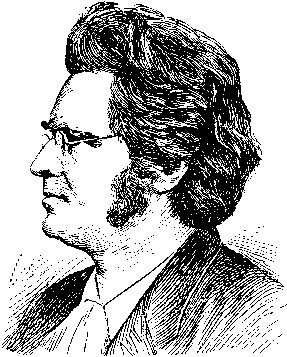
BJÖRNSON
The chief facts of Björnson's life may be briefly set forth. The son of a parish priest, he was born December 8th, 1832, at Kvikne. When the boy was six years of age, his family removed to the Romsdal, and a few years later Björnstjerne was sent to school at Molde. His childhood was thus passed in the midst of the noblest scenery of Norway, and in regions of the richest legendary association. The austere sublimity of the Jötunheim--the home of the frost-giants--first impressed his childish sensibilities, but was soon exchanged for the more varied and picturesque but hardly less magnificent scenery of the western fjords. At the age of seventeen the boy was sent to school in Christiania, and in 1852 entered the University. Instead of devoting himself to his studies, he wrote a play called 'Valborg,' which was actually accepted by the management of the Christiania Theatre. The piece was, however, never printed or even performed; for the author became so conscious of its imperfections that he withdrew it from rehearsal. But it gave him the entrée of the playhouse, a fact which did much to determine the direction of his literary activities. He left the University with his course uncompleted, and for two or three years thereafter supported himself by journalism. In 1857, at the age of twenty-four, his serious literary career began with the publication of 'Synnöve Solbakken,' his first novel, and 'Mellern Slagene' (Between the Battles), his first printed dramatic work. In this year also, upon the invitation of Ole Bull, he went to Bergen, where he remained for two years as director of the theatre. In 1860 he secured from the government a traveling stipend, and spent the greater part of the next two years abroad, mostly in Rome, busily writing all the time. Returning to Norway, he has since remained there for the most part, although his winters have frequently been spent in other countries. For a long time he lived regularly in Paris several months of each year; one winter (1879-80) he was the guest of the Grand Duke of Meiningen; the following (1880-81) he spent in the United States, lecturing in many cities. Since 1874 his Norwegian home has been at Aulestad in the Gausdal, where he has an estate, and occupies a capacious dwelling--half farm-house, half villa--whose broad verandas look out upon the charming open landscape of Southern Norway. For the last twenty years he has been almost as conspicuous a figure in the political as in the literary arena, and the recognized leader of the Norwegian republican movement. Numerous kinds of social and religious controversy have also engaged his attention, and made his life a stirring one in many ways.
In attempting to classify Björnson's writings for the purpose of rendering some critical account of the man's work, the first impulse is to group them into the three divisions of fiction, lyric, and drama. But the most obvious fact of his long literary life is after all not so much that he has done great work in all three of these fundamental forms, as that the whole spirit and method of his work, whatever the form, underwent a radical transformation about midway in his career. For the first twenty years of his active life, roughly speaking, he was an artist pure and simple; during the subsequent twenty years, also roughly speaking, he has been didactic, controversial, and tendentious. (The last word is good Spanish and German and ought to be good English.) For the purpose of the following summary analysis, I have therefore thought it best to make the fundamental grouping chronological rather than formal, since the plays and the novels of the first period have much more in common with one another than either the plays or the novels of the first period have in common with the plays or the novels of the second.
Björnson's work in lyrical and other non-dramatic poetry belongs almost wholly to the first period. It consists mainly of short pieces scattered through the idyllic tales and saga-plays that nearly make up the sum of his activity in its purely creative and poetic phase. Some of these lyrics strike the very highest and purest note of song, and have secured lasting lodgment on the lips of the people. One of them, indeed, has become pre-eminently the national song of Norway, and may be heard wherever Norsemen are gathered together upon festal occasions. It begins in this fashion:--
"Ay, we love this land of ours,
Crowned with mountain domes;
Storm-scarred o'er the sea it towers
With a thousand homes.
Love it, as with love unsated
Those who gave us birth,
While the saga-night, dream-weighted,
Broods upon our earth."
Another patriotic song, hardly less popular, opens with the following stanza:--
"There's a land where the snow is eternally king,
To whose valleys alone come-the joys of the spring,
Where the sea beats a shore rich, with lore of the past,
But this land to its children is dear to the last."
The fresh beauty of such songs as these is, however, almost utterly uncommunicable in another language. Somewhat more amenable to the translator is the song 'Over de Höje Fjelde' (Over the Lofty Mountains), which occurs in 'Arne,' and which is perhaps the best of Björnson's lyrics. An attempt at a version of this poem will be found among the illustrative examples appended to the present essay. The scattered verses of Björnson were collected into a volume of 'Digte og Sange' (Poems and Songs) in 1870, and in the same year was published 'Arnljot Gelline,' the author's only long poem not dramatic in form. This uneven and in passages extraordinarily beautiful work is a sort of epic in fifteen songs, difficult to read, yet simple enough in general outline. Arnljot Gelline was a sort of freebooter of the eleventh century, whose fierce deeds were preserved in popular tradition. The 'Heimskringla' tells us how, grown weary of his lawless life, he joined himself to Olaf the Holy, accepted baptism, and fell at Stiklestad righting for Christianity and the King. From this suggestion, the imagination of the poet has worked out a series of episodes in Arnljot's life, beginning with his capture of the fair Ingigerd--whose father he slew, and who, struggling against her love, took refuge in a cloister--and ending with the day of the portentous battle against the heathen. It is all very impressive, and sometimes very subtle, while occasional sections, such as Ingigerd's appeal for admission to the cloister, and Arnljot's apostrophe to the sea, must be reckoned among the finest of Björnson's inspirations. Since 1870 Björnson has published little verse, although poems of an occasional character and incidental lyrics have now and then found their way into print. 'Lyset' (The Light), a cantata, is the only recent example of any magnitude.
Björnson first became famous as the delineator of the Norwegian peasant. He felt that the peasant is the lineal descendant of the man of the sagas, and that in him lies the real strength of the national character. The story of 'Synnöve Solbakken' (1857) was quickly followed by 'Arne' (1858), 'En Glad Gut' (A Happy Boy: 1860), and a number of small pieces in similar vein. They were at once recognized both at home and abroad as something deeper and truer of their sort than had hitherto been achieved in the Scandinavian countries, and perhaps in Europe. In their former aspect, they were a reaction from the conventional ideals hitherto dominant in Danish literature (which had set the pace for most of Björnson's predecessors); and in their latter and wider aspect they were the Norwegian expression of the tendency that had produced the German and French peasant idyls of Auerbach and George Sand. They embodied a return to Nature in a spirit that may, with a difference, be called Wordsworthian. They substituted a real nineteenth-century pastoral for the sham pastoral of the eighteenth century. They reproduced the simple style of the sagas, and reduced life to its primitive elements. The stories of 'Fiskerjenten' (The Fisher Maiden: 1868), and 'Brude Slaaten' (The Bridal March: 1873), belong, on the whole, with this group; although they are differentiated by a touch of modernity from which a discerning critic might have prophesied something of the author's coming development. These stories have been translated into many languages, and have long been familiar to English readers. It is worth noting that 'Synnöve Solbakken,' the first of them all, appeared in English a year after the publication of the original, in a translation by Mary Howitt. This fact seems to have escaped the bibliographers; which is not surprising, since the name of the author was not given upon the title-page, and the name of the story was metamorphosed into 'Trust and Trial.'
The inspiration of the sagas, strong as it is in these tales, is still more evident in the series of dramas that run parallel with them. These include 'Mellem Slagene' (Between the Battles: 1858), 'Halte Hulda' (Lame Hulda: 1858), 'Kong Sverre' (1861), 'Sigurd Slembe' (1862), and 'Sigurd Jorsalfar' (Sigurd the Jerusalem-Farer: 1872). The first two of these pieces are short and comparatively unimportant. 'Kong Sverre' is a longer and far more ambitious work; while in 'Sigurd Slembe,' a trilogy of plays, the saga-phase of Björnson's genius reached its culmination. This noble work, which may almost claim to be the greatest work in Norwegian literature, is based upon the career of a twelfth-century pretender to the throne of Norway, and the material was found in the 'Heimskringla.' There are few more signal illustrations in literature of the power of genius to transfuse with its own life a bare mediæval chronicle, and to create from a few meagre suggestions a vital and impressive work of art. One thinks instinctively, in seeking for some adequate parallel, of what Goethe did with the materials of the Faust legend, or of what Shakespeare did with the indications offered for 'King Lear' and 'Cymbeline' by Holinshed's chronicle-history. And the two greatest names in modern literature are suggested not only by this general fact of creative power, but also more specifically by certain characters in the trilogy. Audhild, the Icelandic maiden beloved of Sigurd, has more than once been compared with the gracious and pathetic figure of Gretchen; and Earl Harald is one of the most successful attempts since Shakespeare to incarnate once again the Hamlet type of character, with its gentleness, its intellectuality, its tragic irony, and the defect of will which forces it to sink beneath the too heavy burden set upon its shoulders by fate. 'Sigurd Jorsalfar,' the last of the saga-plays, was planned as the second part of a dramatic sequence, of which the first was never written. Another work in this manner, having for its protagonist the great national hero, Olaf Trygvason, was also planned and even begun; but the author's energy flagged, and he felt himself irresistibly impelled to devote himself to more modern themes dealt with in a more modern way. But before leaving this phase of Björnson's work, mention must be made of 'Maria Stuart i Skotland' (1864), chronologically interjected among the saga-plays, and dealing with the more definite history of the hapless Queen of Scots in much of the saga-spirit. Björnson felt that the Scots had inherited no little of the Norse blood and temper, and believed that the psychology of his saga-heroes was adequate to account for the group of men whose fortunes were bound up with those of Mary Stuart in Scotland. He finds his key to the problem of her career in the fact that she was by nature incapable of yielding herself up wholly to a man or a cause, yet was surrounded by men who demanded of her just such whole-souled allegiance. Bothwell and Knox were pre-eminently men of this stamp; as were also, in some degree, Darnley and Rizzio. The theory may seem fanciful, but there is no doubt that Björnson's treatment of this fascinating subject is one of the strongest it has ever received, and that his play takes rank with such European masterpieces as Scott's novel, and Alfieri's tragedy, and Swinburne's great poetic trilogy.
The late sixties and the early seventies were with Björnson a period of unrest and transformation. His previous work had been that of a genius isolated, comparatively speaking, and concentrated upon a small part of human life. His frequent journeys abroad and the wider range of his reading now brought him into the full current of European thought, and led to a substitution of practical ideals for those of the visionary. He felt that he must reculer pour mieux sauter, and for nearly a decade he produced little original work. Yet his first attempt at a modern problem-play, 'De Nygifte' (The Newly Married Pair), curiously enough, dates from as far back as 1865. This work was, however, a mere trifle, and has interest chiefly as a forerunner of what was to come. It was not until 1874 that Björnson became conscious that his new thought was ripe enough to bear fruit, and that he began with 'Redaktören' (The Editor) the series of plays dealing with social problems that have been the characteristic work of his second period. It is interesting to note, for comparison, the fact that the similar striking transformation of energy in Ibsen's case dates from 1877, when 'Samfundet's Stötter' (The Pillars of Society) was produced, and that this work had, like Björnson's 'Redaktören,' a forerunner in 'De Unges Forbund' (The League of Youth), published in 1869. The list of Björnson's problem-plays--many of which have been extraordinarily successful upon the stage, both in the Scandinavian countries and in Germany--includes in addition to 'Redaktören,' seven other pieces. They are: 'En Fallit' (A Bankruptcy: 1875), 'Kongen' (The King: 1877), 'Leonarda' (1879), 'Det Ny System' (The New System: 1879), 'En Hanske' (A Glove: 1883), 'Over Ævne' (Beyond the Strength: 1883), and 'Geografi og Kjærlighed' (Geography and Love: 1885). A sequel to 'Over Ævne' has also recently appeared. The most noteworthy of these works, considered as acting plays, are 'Redaktören' and 'En Fallit.' The one has for its subject the degradation of modern journalism; the other attacks the low standard of commercial morality prevailing in modern society. 'En Hanske' plants itself squarely upon the proposition that the obligations of morality are equally binding upon both sexes; a problem treated by Ibsen, after a somewhat different fashion, in 'Gengangere' (Ghosts). This play has occasioned much heated discussion, for its theme is of the widest interest, besides being pivotal as regards Björnson's sociological views. 'Over Ævne' is a curiously wrought and delicate treatment of religious mysticism, fascinating to read, but not very definite in outcome. 'Kongen' is probably the most remarkable, all things considered, of this series of plays, and Björnson told me some years ago that he considered it the most important of his works. Taking frankly for granted that monarchy, whether absolute or constitutional, is an outworn institution, the play discusses the question whether it may not be possible so to transform the institution as to fit it for a prolongation of existence. The interest centres about the character of a king who is profoundly convinced that the principle he embodies is an anachronism or a lie, and who seeks to do away with the whole structure of convention, and ceremonial, and hypocrisy, that the centuries have built about the throne and its occupants. But his dearest hopes are frustrated by the forces of malice, and dull conservatism, and invincible stupidity; the burden proves too heavy for him, the fight too unequal, and he takes his own life in a moment of despair. The terrible satirical power of certain scenes in this play would be difficult to match were our choice to range through the whole literature of Revolt. Its production brought upon the author a storm of furious denunciation. He had outraged both throne and altar, and his sacrilegious hand had not spared things the most sacrosanct. But a less passionate judgment, while still deprecating something of the author's violence, will recognize the fact that the core of the work is a noble idealism in both politics and religion, and will justify the hot indignation with which the author assails the shams that in modern society stifle the breath of free and generous souls.
During all these years of writing for the stage Björnson did not, however, forget that he was also a novelist; and it is in fiction that he has scored the greatest of his recent triumphs. But the world of 'Synnöve' and 'Arne' is now far behind him. The transition from his earlier to his later manner as a novelist is marked by two or three stories delicate in conception but uncertain of utterance, and relatively unimportant. These books are 'Magnhild' (1877), 'Kaptejn Mansana' (1879), and 'Stöv' (Dust: 1882). They were, however, significant of a new development of the author's genius, for they were the precursors of two great novels soon thereafter to follow. 'Det Flager i Byen og paa Havnen' (Flags are Flying in Town and Harbor) appeared in 1884. (Paa Guds Veje) (In God's Way) was published in 1889. These books are experiments upon a larger scale than their author had previously attempted in fiction, and neither of them exhibits the perfect mastery that went to the simpler making of the early peasant tales. They are somewhat confused and turbulent in style, and it is evident that their author is groping for adequate means of handling the unwieldy material brought to his workshop by so many currents of modern thought. The central theme of 'Det Flager' (in its English translation called, by the way, 'The Heritage of the Kurts') is the influence of heredity upon the life of a family group. The process of rehabilitation, resulting from the introduction of a healthy and vigorous strain into a stock weakened by the vices and passions of several generations, and aided by a scientific system of education, is carried on before our eyes, and the story of this process is the substance of the book. Regeneration is not wholly achieved, but the end leaves us hopeful for the future; and the flags that fly over town and harbor in the closing chapter have a symbolical significance, for they announce a victory of spirit over sense, not alone in the case of certain individuals, but also in the case of the whole community with which they are identified. If this book comes to be forgotten as a novel (which is not likely), it will have a fair chance of being remembered, along with 'Levana' and 'Emile,' as a sort of educational classic. 'Paa Gud's Veje,' the last great work of Björnson, is also strongly didactic in tone, yet it attains at its highest to a tranquillity of which the author seemed for many years to have lost the secret. The struggle it depicts is that between religious bigotry and liberalism as they contend for the mastery in a Norwegian town; and the moral is that "God's way" is the way of people who order their lives aright and keep their souls sweet and pure, rather than the way of the Pharisee who pins his faith to observances and allows the letter of his religion to overshadow the spirit. Not an unchristian inculcation, surely; yet for it and for similar earlier utterances Björnson has been held up as Antichrist by the ministers of a narrow Lutheran orthodoxy, very much as the spokesmen of an antiquated caste-system of society have esteemed his ideas to be those of the most ruthless and radical of iconoclasts. But he is a stout fighter, and attacks of this sort only serve to arouse him to new energy. And so he toils manfully on for the enlightenment of his people, knowing that his cause is the cause of civilization itself--of a rational social organization, an exalted ethical standard, and a purified religion.
Since the period when Björnson began to merge the artist in the thinker and prophet, his work has given a strong impetus to progress in religious, educational, and political affairs. As regards the first of these matters, it must be remembered that the sort of intolerance with which he has had to contend more resembles that of eighteenth-century New England puritanism than anything we are familiar with in our own time. As for the second matter, all of his work may in a sense be called educational, while such a book as 'Det Flager' shows how closely he has considered the subject of education in its special and even technical aspects. Finally, as a political thinker, he has identified himself indissolubly with the movement for the establishment of an independent Norwegian Republic, although he is not sanguine of the near realization of this aim. But if time should justify his prophetic attitude and give birth to a republic in the north of Europe, however remote may be the event, the name of Björnson will be remembered as that of one of the founders, although as the Mazzini rather than as the Cavour of the Norse Risorgimento. And whatever may be the future of the land that claims him for her own, his spirit will walk abroad long after he has ceased to live among men. His large, genial, optimistic personality is of the sort that cannot fail to stamp itself upon other generations than the one that actually counts him among its members.
[The following selections are given in translations of my own, excepting 'The Princess,' which was made by Mr. Nathan Haskell Dole, and the last two, for which I am indebted to the edition of Björnson's novels translated by Professor Rasmus B. Anderson, and published by Messrs. Houghton, Mifflin & Co. The extracts from 'Sigurd Slembe' are taken from my translation of that work published by the same firm.--W.M.P.]

OVER THE LOFTY MOUNTAINS
(From 'Arne')
Often I wonder what there may be
Over the lofty mountains.
Here the snow is all I see,
Spread at the foot of the dark green tree;
Sadly I often ponder,
Would I were over yonder.
Strong of wing soars the eagle high
Over the lofty mountains;
Glad of the new day, soars to the sky,
Wild in pursuit of his prey doth fly;
Pauses, and, fearless of danger,
Scans the far coasts of the stranger.
The apple-tree, whose thoughts ne'er fly
Over the lofty mountains,
Leaves when the summer days draw nigh,
Patiently waits for the time when high
The birds in its bough shall be swinging,
Yet will know not what they are singing.
He who has yearned so long to go
Over the lofty mountains--
He whose visions and fond hopes grow
Dim, with the years that so restless flow--
Knows what the birds are singing,
Glad in the tree-tops swinging.
Why, O bird, dost thou hither fare
Over the lofty mountains?
Surely it must be better there,
Broader the view and freer the air;
Com'st thou these longings to bring me--
These only, and nothing to wing me?
Oh, shall I never, never go
Over the lofty mountains?
Must all my thoughts and wishes so
Held in these walls of ice and snow
Here be imprisoned forever?
Till death shall escape be never?
Hence! I will hence! Oh, so far from here,
Over the lofty mountains!
Here 'tis so dull, so unspeakably drear;
Young is my heart and free from fear--
Better the walls to be scaling
Than here in my prison lie wailing.
One day, I know, shall my free soul roam
Over the lofty mountains.
O my God, fair is thy home,
Ajar is the door for all who come;
Guard it for me yet longer,
Till my soul through striving grows stronger.
THE CLOISTER IN THE SOUTH
From 'Arnljot Gelline'
"Who would enter so late the cloister in?"
"A maid forlorn from the land of snow."
"What sorrow is thine, and what thy sin?"
"The deepest sorrow the heart can know.
I have nothing done,
Yet must still endeavor,
Though my strength is none,
To wander ever.
Let me in, to seek for my pain surcease;--
I can find no peace."
"From what far-off land hast thou taken flight?"
"From the land of the North, a weary way."
"What stayed thy feet at our gate this night?"
"The chant of the nuns, for I heard them pray,
And the song gave peace
To my soul, and blessed me;
It offered release
From the grief that oppressed me.
Let me in, so if peace to give be thine,
I may make it mine."
"Name me the grief that thy life hath crossed."
"Rest may I never, never know."
"Thy father, thy lover, thou hast then lost?"
"I lost them both at a single blow,
And all I held dear
In my deepest affection,
Ay, all that was near
To my heart's recollection.
Let me in, I am failing, I beg, I implore,
I can bear no more."
"How was it that thou thy father lost?"
"He was slain, and I saw the deed."
"How was it that thou thy lover lost?"
"My father he slew, and I saw the deed.
I wept so bitterly
When he roughly would woo me,
He at last set me free,
And forbore to pursue me.
Let me in, for the horror my soul doth fill
That I love him still."
CHORUS OF NUNS WITHIN THE CHURCH
Come child, come bride,
To God's own side.
From grief find rest
On Jesus' breast.
Rest thy burden of sorrow
On Horeb's height;
Like the lark, with to-morrow
Shall thy soul take flight.
Here stilled is all yearning,
No passion returning,
No terror come near thee
Where the Saviour can hear thee!
For He, if in need be
Thy storm-beaten soul,
Though it bruised as a reed be,
Shall raise it up whole.
THE PLEA OF KING MAGNUS
From 'Sigurd Slembe'
"But once more let me the heavens see,
When the stars their watch are keeping,"
Young Magnus begged, and fell on his knee;
It was sad to see,
And the women away turned weeping.
"Let me once more the mountains see,
And the blue of the ocean far-reaching,
Only once more, and then let it be!"
And he fell on his knee,
While his friends were for pity beseeching.
"Let me go to the church, that the sacred sight
Of the blood of God may avail me;
That my eyes may bathe in its holy light,
Ere the day take flight,
And my vision forever shall fail me!"
But the sharp steel sped, and the shadows fell,
As the darkness the day o'erpowers.
"Magnus our king, farewell, farewell!"
"So farewell, farewell,
All my friends of so many glad hours."
Copyrighted by Houghton, Mifflin and Company, Boston.
SIN AND DEATH
From 'Sigurd Slembe'
Sin and Death, at break of day,
Day, day,
Spoke together with bated breath;
Marry thee, sister, that I may stay,
Stay, stay,
In thy house, quoth Death.
Death laughed aloud when Sin was wed,
Wed, wed,
And danced on the bridal day;
But bore that night from the bridal bed,
Bed, bed,
The groom in a shroud away.
Death came to her sister at break of day,
Day, day,
And Sin drew a weary breath;
He whom thou lovest is mine for aye,
Aye, aye,
Mine he is, quoth Death.
Copyrighted by Houghton, Mifflin and Company, Boston.
THE PRINCESS
The Princess sat lone in her maiden bower,
The lad blew his horn at the foot of the tower.
"Why playest thou alway? Be silent, I pray,
It fetters my thoughts that would flee far away,
As the sun goes down."
In her maiden bower sat the Princess forlorn,
The lad had ceased to play on his horn.
"Oh, why art thou silent? I beg thee to play!
It gives wings to my thoughts that would flee far away,
As the sun goes down."
In her maiden bower sat the Princess forlorn,
Once more with delight played the lad on his horn.
She wept as the shadows grew long, and she sighed:
"Oh, tell me, my God, what my heart doth betide,
Now the sun has gone down."
Copyrighted by T.Y. Crowell and Company.
SIGURD SLEMBE'S RETURN
The scene is at first empty. Then Sigurd Slembe enters, climbing over a rock; he comes forward in silence, but powerfully agitated.
The Danes forsake me! The battle is lost! Thus far--and no farther!
Escape to the mountains to-night! Exchange my ships for freedom! There are herds of horses on the mountains: we will climb up there and then fall upon the valleys like a snowstorm.
But when winter comes? To begin at the beginning: the outlaw's life--never more! I have made my last effort; had it been successful, men would have wondered at me. It has failed, and vengeance is loose. I cannot gather another force in Norway!
All over? Thus far and no farther? No! The Danes sail, but we will sail with them! This night, this very night we will raise our yards and follow them to the open sea.
But whither shall we turn our prows? To Denmark? We may raise no third force in Denmark. Start out again as merchant? No! Serve in foreign lands? No! Crusade? No! Hither and no farther! Sigurd, the end has come!
[Almost sobbing.] Death! The thought sprang up in my mind as a door swings open, clashing upon its hinges; light, air, receive me! [He draws his sword.] No; I will fall fighting in the cause I have lived for--my men shall have a leader!
Is there no chance of victory? no trick? Can I not get them ashore? Can I not get them in the toils? try them in point-blank fight, man to man, all the strength of despair fighting with me? Ah, could they but hear me, could I but find some high place and speak to them; tell them how clear as the sun is my right, how monstrous the wrongs I have borne, what a crime is theirs in withstanding me! You murder not me alone, but thousands upon thousands of thoughts for my fatherland's welfare; I have carried nothing out, I have not sown the least grain, or laid one stone upon another to witness that I have lived. Ah, I have strength for better things than strife; it was the desire to work that drove me homewards; it was impatience that wrought me ill! Believe me, try me, give me but half what Harald Gille promised me, even less; I ask but very little, if I may still live and strive to accomplish something! Jesus, my God, it was ever the little that thou didst offer me, and that I ever scorned!
Where am I? I stand upon my own grave, and hear the great bell ring. I tremble as the tower beneath its stroke, for where now are the aims that were mine? The grave opens its mouth and makes reply. But life lies behind me like a dried-up stream, and these eighteen years are lost as in a desert. The sign, the sign that was with me from my birth! In lofty flight I have followed it hither with all the strength of my soul, and here I am struck by the arrow of death. I fall, and behold the rocks beneath, upon which I shall be crushed. Have I, then, seen a-wrong? Ah, how the winds and currents of my life stood yonder, where it was warm and fruitful, while I toiled up where it grew ever colder, and my ship is now clasped by the drifting icebergs; a moment yet, and it must sink. Then let it sink, and all will be over. [On his knees.] But in thy arms, All-Merciful, I shall find peace!
What miracle is this? For in the hour I prayed the prayer was granted! Peace, perfect peace! [Rises.] Then will I go to-morrow to my last battle as to the altar; peace shall at last be mine for all my longings.
[Holds his head bowed and covered by his hands. As he, after a time, slowly removes them, he looks around.]
How this autumn evening brings reconciliation to my soul! Sun and wave and shore and sea flow all together, as in the thought of God all others; never yet has it seemed so fair to me! Yet it is not mine to reign over this lovely land. How greatly I have done it ill! But how has it all come so to pass? for in my wanderings I saw thy mountains in every sky, I yearned for home as a child longs for Christmas, yet I came no sooner, and when at last I came--I gave thee wound upon wound.
But thou, in contemplative mood, now gazest upon me, and givest me at parting this fairest autumn night of thine. I will ascend yonder rock and take a long farewell. [Mounts up.]
And even thus I stood eighteen years ago,--thus looked out upon the sea, blue beneath the rising sun. The fresh breezes of morning seemed wafted to me from a high future; through the sky's light veil a vision of strange lands was mine; in the glow of the morning sun, wealth and honor shone upon me; and to all this, the white sails of the Crusaders should swiftly bear me.
Farewell, dreams of my youth! Farewell, my sweet country! Ah, to what sorrow thou hast brought me forth! But now it will soon be over. [He descends.]
If these ships should sail up to me this very night bearing the fulfillment of all my dreams! Could any one of them be now in truth mine,--or may a tree bear fruit twice in one year?
I give way to make room for some better man. But be thou gracious to me, and let death be mine with these feelings in my heart, for strength to be faithful might not long be vouchsafed me.
"Thou shalt die to-morrow!" How sure a father-confessor is that word! Now for the first time I speak truth to myself.
Ivar [climbing' over a rock]--Yes, here he is. [Gives his hand to the nun.]
The Nun [without seeing]--Sigurd! [Mounts up.] Yes, there he is!
Sigurd--Mother!
The Nun--My child, found once more! [They remain long clasped in each other's arms.] My son, my son, now shalt thou no more escape me!
Sigurd--O my mother!
The Nun--Thou wilt keep away from this battle, is it not so? We two will win another kingdom,--a much better one.
Sigurd--I understand thee, mother. [Leads her to a seat, and falls upon his knee.]
The Nun--Yes, dost thou not? Thou art not so bad as all men would have it. I knew that well, but wanted so much to speak with thee,--and since thou art wearied and hast lost thy hopes for this world, thou hast come back to me, for even now there is time! And of all thy realm they must leave thee some little plot, and there we will live by the church, so that when the bells ring for vespers we shall be near the blessed Olaf, and with him seek the presence of the Almighty. And there we will heal thy wounds with holy water, and thoughts of love, more than thou canst remember ever to have had, shall come back to thee robed in white, and wondering recollection shall have no end. For the great shall be made small and the small great, and there shall be questionings and revelations and eternal happiness. Thou wilt come and thus live with me, my son, wilt thou not? Thou wilt stay from this battle and come quickly?
Sigurd--Mother, I have not wept till now since I lay upon the parched earth of the Holy Land.
The Nun--Thou wilt follow me?
Sigurd--To do thus were to escape the pledges I have made but by breaking them.
The Nun--To what art thou now pledged?
Sigurd--Pledged to the blind king I took from the cloister; pledged to the men I have led hither.
The Nun--And these pledges thou shalt redeem--how?
Sigurd--By fighting and falling at their head.
The Nun [springs to her feet. Sigurd also rises.]--No! No! No! Shall I now, after a lifetime of sorrow, behold thy death?
Sigurd--Yes, mother. The Lord of life and death will have it so.
The Nun--Ah! what sufferings a moment's sin may bring! [She falls upon his breast, then sinks, with outstretched arms.] O my son, spare me!
Sigurd--Do not tempt me, mother!
The Nun--Hast thou taken thought of what may follow? Hast thou thought of capture, of mutilation?
Sigurd--I have some hymns left me from childhood. I can sing them.
The Nun--But I--thy mother--spare me!
Sigurd--Make not to me this hour more bitter than death itself.
The Nun--But why now die? We have found one another.
Sigurd--We two have nothing more to live for.
The Nun--Wilt thou soon leave me?
Sigurd--Till the morning sun appear we will sit together. Let me lift thee upon this rock. [He does so, and casts himself at her feet.] It was fair that thou shouldst come to me. All my life is now blotted out, and I am a child with thee once more. And now we will seek out together the land of our inheritance. I must away for a moment to take my leave, and then I shall be ready, and I think that thou too art ready.
Ivar Ingemundson [falling on his knee]--My lord, now let me be your friend.
Sigurd [extending his hand]--Ivar, thou wilt not leave her to-morrow?
Ivar Ingemundson--Not until she is set free.
Sigurd--And now sing me the Crusader's song. I may joyfully go hence after that.
Ivar Ingemundson [rises and sings]--
Fair is the earth,
Fair is God's heaven;
Fair is the pilgrim-path of the soul.
Singing we go
Through the fair realms of earth,
Seeking the way to our heavenly goal.
Races shall come,
And shall pass away:
And the world from age to age shall roll;
But the heavenly tones
Of our pilgrim song
Shall echo still in the joyous soul.
First heard of shepherds,
By angels sung,
Wide it has spread since that glad morn:
Peace upon earth!
Rejoice all men,
For unto us is a Savior born[1].
[The mother places both her hands on Sigurd's head, and they look into one another's eyes; he then rests his head upon her breast.]
[1] This song is borrowed by Björnson from the Danish poet B.S. Ingemann, although it is slightly altered for its present use.
Copyrighted by Houghton, Mifflin and Company, Boston.
HOW THE MOUNTAIN WAS CLAD
From 'Arne'
There was a deep gorge between two mountains. Through this gorge a large, full stream flowed heavily over a rough and stony bottom. Both sides were high and steep, and so one side was bare; but close to its foot, and so near the stream that the latter sprinkled it with moisture every spring and autumn, stood a group of fresh-looking trees, gazing upward and onward, yet unable to advance this way or that.
"What if we should clothe the mountain?" said the juniper one day to the foreign oak, to which it stood nearer than all the others. The oak looked down to find out who it was that spoke, and then it looked up again without deigning a reply. The river rushed along so violently that it worked itself into a white foam; the north wind had forced its way through the gorge and shrieked in the clefts of the rocks; the naked mountain, with its great weight, hung heavily over and felt cold. "What if we should clothe the mountain?" said the juniper to the fir on the other side. "If anybody is to do it, I suppose it must be we," said the fir, taking hold of its beard and glancing toward the birch. "What do you think?" But the birch peered cautiously up, at the mountain, which hung over it so threateningly that it seemed as if it could scarcely breathe. "Let us clothe it, in God's name!" said the birch. And so, though there were but these three, they undertook to clothe the mountain. The juniper went first.
When they had gone a little way, they met the heather. The juniper seemed as though about to go past it. "Nay, take the heather along," said the fir. And the heather joined them. Soon it began to glide on before the juniper. "Catch hold of me," said the heather. The juniper did so, and where there was only a wee crevice, the heather thrust in a finger, and where it first had placed a finger, the juniper took hold with its whole hand. They crawled and crept along, the fir laboring on behind, the birch also. "This is well worth doing," said the birch.
But the mountain began to ponder on what manner of insignificant objects these might be that were clambering up over it. And after it had been considering the matter a few hundred years, it sent a little brook down to inquire. It was yet in the time of the spring freshets, and the brook stole on until it reached the heather. "Dear, dear heather, cannot you let me pass? I am so small." The heather was very busy; only raised itself a little and pressed onward. In, under, and onward went the brook. "Dear, dear juniper, cannot you let me pass? I am so small." The juniper looked sharply at it; but if the heather had let it pass, why, in all reason, it must do so too. Under it and onward went the brook; and now came to the spot where the fir stood puffing on the hill-side. "Dear, dear fir, cannot you let me pass? I am really so small," said the brook,--and it kissed the fir's feet and made itself so very sweet. The fir became bashful at this, and let it pass. But the birch raised itself before the brook asked it. "Hi, hi, hi!" said the brook, and grew. "Ha, ha, ha!" said the brook, and grew. "Ho, ho, ho!" said the brook, and flung the heather and the juniper and the fir and the birch flat on their faces and backs, up and down these great hills. The mountain sat up for many hundred years musing on whether it had not smiled a little that day.
It was plain enough: the mountain did not want to be clad. The heather fretted over this until it grew green again, and then it started forward. "Fresh courage!" said the heather.
The juniper had half raised itself to look at the heather, and continued to keep this position, until at length it stood upright. It scratched its head and set forth again, taking such a vigorous foothold that it seemed as though the mountain must feel it. "If you will not have me, then I will have you." The fir crooked its toes a little to find out whether they were whole, then lifted one foot, found it whole, then the other, which proved also to be whole, then both of them. It first investigated the ground it had been over, next where it had been lying, and finally where it should go. After this it began to wend its way slowly along, and acted just as though it had never fallen. The birch had become most wretchedly soiled, but now rose up and made itself tidy. Then they sped onward, faster and faster, upward and on either side, in sunshine and in rain. "What in the world can this be?" said the mountain, all glittering with dew, as the summer sun shone down on it. The birds sang, the wood-mouse piped, the hare hopped along, and the ermine hid itself and screamed.
Then the day came when the heather could peep with one eye over the edge of the mountain. "Oh dear, oh dear, oh dear!" said the heather, and away it went. "Dear me! what is it the heather sees?" said the juniper, and moved on until it could peer up. "Oh dear, oh dear!" it shrieked, and was gone. "What is the matter with the juniper to-day?" said the fir, and took long strides onward in the heat of the sun. Soon it could raise itself on its toes and peep up. "Oh dear!" Branches and needles stood on end in wonderment. It worked its way forward, came up, and was gone. "What is it all the others see, and not I?" said the birch; and lifting well its skirts, it tripped after. It stretched its whole head up at once. "Oh,--oh!--is not here a great forest of fir and heather, of juniper and birch, standing upon the table-land waiting for us?" said the birch; and its leaves quivered in the sunshine so that the dew trembled. "Ay, this is what it is to reach the goal!" said the juniper.
THE FATHER
The man whose story is here to be told was the wealthiest and most influential person in his parish; his name was Thord Overaas. He appeared in the priest's study one day, tall and earnest.
"I have gotten a son," said he, "and I wish to present him for baptism."
"What shall his name be?"
"Finn,--after my father."
"And the sponsors?"
They were mentioned, and proved to be the best men and women of Thord's relations in the parish.
"Is there anything else?" inquired the priest, and looked up.
The peasant hesitated a little.
"I should like very much to have him baptized by himself," said he, finally.
"That is to say, on a week-day?"
"Next Saturday, at twelve o'clock noon."
"Is there anything else?" inquired the priest.
"There is nothing else;" and the peasant twirled his cap, as though he were about to go.
Then the priest rose. "There is yet this, however," said he, and walking toward Thord, he took him by the hand and looked gravely into his eyes: "God grant that the child may become a blessing to you!"
One day sixteen years later, Thord stood once more in the priest's study.
"Really, you carry your age astonishingly well, Thord," said the priest; for he saw no change whatever in the man.
"That is because I have no troubles," replied Thord.
To this the priest said nothing, but after a while he asked, "What is your pleasure this evening?"
"I have come this evening about that son of mine who is to be confirmed to-morrow."
"He is a bright boy."
"I did not wish to pay the priest until I heard what number the boy would have when he takes his place in church to-morrow."
"He will stand Number One."
"So I have heard; and here are ten dollars for the priest."
"Is there anything else I can do for you?" inquired the priest, fixing his eyes on Thord.
"There is nothing else."
Thord went out.
Eight years more rolled by, and then one day a noise was heard outside of the priest's study, for many men were approaching, and at their head was Thord, who entered first.
The priest looked up and recognized him.
"You come well attended this evening, Thord," said he.
"I am here to request that the banns may be published for my son: he is about to marry Karen Storliden, daughter of Gudmund, who stands here beside me."
"Why, that is the richest girl in the parish."
"So they say," replied the peasant, stroking back his hair with one hand.
The priest sat awhile as if in deep thought, then entered the names in his book, without making any comments, and the men wrote their signatures underneath. Thord laid three dollars on the table.
"One is all I am to have," said the priest.
"I know that very well, but he is my only child; I want to do it handsomely."
The priest took the money.
"This is now the third time, Thord, that you have come here on your son's account."
"But now I am through with him," said Thord, and folding up his pocket-book he said farewell and walked away.
The men slowly followed him.
A fortnight later, the father and son were rowing one calm, still day, across the lake to Storliden to make arrangements for the wedding.
"This thwart is not secure," said the son, and stood up to straighten the seat on which he was sitting.
At the same moment the board he was standing on slipped from under him; he threw out his arms, uttered a shriek, and fell overboard.
"Take hold of the oar!" shouted the father, springing to his feet and holding out the oar.
But when the son had made a couple of efforts he grew stiff.
"Wait a moment!" cried the father, and began to row toward his son.
Then the son rolled over on his back, gave his father one long look, and sank.
Thord could scarcely believe it; he held the boat still, and stared at the spot where his son had gone down, as though he must surely come to the surface again. There rose some bubbles, then some more, and finally one large one that burst; and the lake lay there as smooth and bright as a mirror again.
For three days and three nights people saw the father rowing round and round the spot, without taking either food or sleep; he was dragging the lake for the body of his son. And toward morning of the third day he found it, and carried it in his arms up over the hills to his gård.
It might have been about a year from that day, when the priest, late one autumn evening, heard some one in the passage outside of the door, carefully trying to find the latch. The priest opened the door, and in walked a tall, thin man, with bowed form and white hair. The priest looked long at him before he recognized him. It was Thord.
"Are you out walking so late?" said the priest, and stood still in front of him.
"Ah, yes! it is late," said Thord, and took a seat.
The priest sat down also, as though waiting. A long, long silence followed. At last Thord said:--
"I have something with me that I should like to give to the poor; I want it to be invested as a legacy in my son's name."
He rose, laid some money on the table, and sat down again. The priest counted it.
"It is a great deal of money," said he.
"It is half the price of my gård. I sold it to-day."
The priest sat long in silence. At last he asked, but gently:
"What do you propose to do now, Thord?"
"Something better."
They sat there for awhile, Thord with downcast eyes, the priest with his eyes fixed on Thord. Presently the priest said, slowly and softly:--
"I think your son has at last brought you a true blessing."
"Yes, I think so myself," said Thord, looking up, while two big tears coursed slowly down his cheeks.
WILLIAM BLACK
(1841-)

n view of Mr. Black's accurate and picturesque descriptions of natural phenomena, it is interesting to know that of his varied youthful studies, botany most attracted him, and that he followed it up as an art pupil in the government schools. But his bent was rather for journalism than for art or science. Before he was twenty-one he had written critical essays for a local newspaper on Ruskin, Carlyle, and Kingsley; and shortly afterward he wrote a series of sketches, after Christopher North, that at this early age gave evidence of his peculiar talent, the artistic use of natural effects in the development of character, the pathos of the gray morning or the melancholy of the evening mist when woven in with tender episode or tragic occurrence.

William Black
William Black was born in Glasgow, Scotland, November 6th, 1841, and received his early education there. He settled in London in 1864, and was a special correspondent of the Morning Star in the Franco-Prussian war, but after about ten years of the life of a newspaper man, during which he was an editor of the London News, he abandoned journalism for novel-writing in 1875. In the intervals of his work he traveled much, and devoted himself with enthusiasm to out-door sports, of which he writes with a knowledge that inspires a certain confidence in the reader. A Scotch skipper once told him he need never starve, because he could make a living as pilot in the western Highlands; and the fidelity of his descriptions of northern Scotland have met with the questionable reward of converting a poet's haunt into a tourist's camp. Not that Mr. Black's is a game-keeper's catalogue of the phenomena of forest or stream, or the poetic way of depicting nature by similes. The fascination of his writing lies in our conviction that it is the result of minute observation, with a certain atmospheric quality that makes the picture alive. More, one is conscious of a sensitive, pathetic thrill in his writing; these sights and sounds, when they are unobtrusively chronicled, are penetrated by a subtle human sympathy, as if the writer bent close to the earth and heard the whispers of the flowers and stones, as well as the murmur of the forest and the roar of the sea.
He is eminently a popular writer, a vivacious delineator of life and manners, even when he exhibits his versatility at the cost of some of his most attractive characteristics. In 'Sunrise' we have a combination of romance and politics, its motive supplied by the intrigues of a wide-spread communistic society. 'Kilmeny' is the story of a painter, 'Shandon Bells' of a literary man, 'The Monarch of Mincing Lane' tells of the London streets, the heroine of 'The Handsome Humes' is an actress, the scenes in 'Briseis' are played in Athens, Scotland, and England. All these novels have tragic and exceptional episodes, the humor is broad, as the humor of a pessimist always is, and the reader finds himself laughing at a practical joke on the heels of a catastrophe. Mr. Black knows his London, especially the drawing-room aspect of it, and his latest novel is sure to have the latest touch of fad and fashion, although white heather does not cease to grow nor deer to be stalked, nor flies to be cast in Highland waters. We cannot admit that he is exceptionally fortunate in the heroines of these novels, however, for they are perfectly beautiful and perfectly good, and nature protests against perfection as a hurt to vanity. Our real favorites are the dark-eyed Queen Titania, the small imperious person who drives in state in 'Strange Adventures of a Phaeton,' and sails with such high courage in 'White Wings,' and the half-sentimental, half-practical, wholly self-seeking siren Bonny Leslie in 'Kilmeny' who develops into something a little more than coquettish in the Kitty of 'Shandon Bells.'
These and half a dozen other novels by Mr. Black entitle him to his place as a popular novelist; they are alternately gay and sad, they are spirited and entertaining; certain characters, like the heroine of 'Sunrise,' cast a bright effulgence over the dark plots of intrigue. But Mr. Black is at his best as the creator of the special school of fiction that has Highland scenery and Highland character for its field. He has many followers and many imitators, but he remains master on his own ground. The scenes of his most successful stories, 'The Princess of Thule,' 'A Daughter of Heth,' 'In Far Lochaber,' 'Macleod of Dare,' and 'Madcap Violet,' are laid for the most part in remote rural districts, amid lake and moorland and mountain wilds of northern Scotland, whose unsophisticated atmosphere is invaded by airs from the outer world only during the brief season of hunting and fishing.
But the visit of the worldling is long enough to furnish incident both poetic and tragic; and when he enters the innocent and primitive life of the native, as Lavender entered that of the proud and beautiful Princess of Thule sailing her boat in the far-off waters of Skye, or the cruel Gertrude in the grim castle of Dare, he finds all the potencies of passion and emotion.
The temperament of the Highlander is a melancholy one. The narrow life, with its isolation and its hardships, makes him pessimistic and brooding, though endowed with the keen instinct and peculiar humor of those who are far removed from the artificialities of life. But Mr. Black ascribes this temperament, not to race or hardship or isolation, but to the strange sights and sounds of the sea and land on which he dwells, to the wild nights and fierce sunsets, to the dark ocean plains that brood over the secrets that lie in their depths.
Under his treatment nature is subjective, and plays the part of fate. Natural scenery is as the orchestra to a Wagnerian opera. The shifting of the clouds, the voice of the sea, the scent of the woods, are made the most important factors in the formation of character. He whose home is in mountain fastnesses knows the solemn glory of sunrise and sunset, and has for his heritage the high brave temper of the warrior, with the melancholy of the poet. The dweller on tawny sands, where the waves beat lazily on summer afternoons and where wild winds howl in storm, is of like necessity capricious and melancholy. The minor key, in which Poe thought all true poetry is written, is struck in these his earlier novels. Let the day be ever so beautiful, the air ever so clear, the shadows give back a sensitive, luminous darkness that reveals tragedies within itself.
Not that the sentient background, as he has painted it, is to be confounded with the "sympathy of nature with character" of the older school, in which hysterical emotion is accentuated by wild wind storms, and the happiness of lovers by a sunshiny day. But character, as depicted by him in these early novels, is so far subordinate to nature that nature assumes moral responsibility. When Macleod of Dare commits murder and then suicide, we accept it as the result of climatic influences; and the tranquil-conscienced Hamish, the would-be homicide, but obeys the call of the winds. Especially in the delightful romances of Skye, Mr. Black reproduces the actual speech and manners of the people.
And as romance of motive clothes barren rocks in rich hues and waste bogland in golden gorse, it does like loving service for homely characters. The dialect these people talk, without editorial comment, delights and amuses from its strangeness, and also from the conviction that it is as real as the landscape. They tell wonderful tales of moor and fen as they tramp the woods or sail on moonlit waters, and sitting by a peat fire of a stormy night, discuss, between deep pulls of Scotch whisky, the Erastianism that vitiates modern theology. We must look in the pages of Scott for a more charming picture of the relation of clansman to chief.
But Mr. Black is his own most formidable rival. He who painted the sympathetic landscapes of northern Scotland has taught the reader the subtle distinction between these delicate scenes and those in which nature's moods are obtrusively chronicled. There are novels by Mr. Black in reading which we exclaim, with the exhausted young lady at the end of her week's sight-seeing, "What! another sunset!" And he set himself a difficult task when he attempted to draw another character so human and so lovable as the Princess of Thule, although the reader were ungracious indeed did he not welcome the beautiful young lady with the kind heart and the proud, hurt smile, whom he became familiar with through frequent encounters in the author's other novels. And if Earlscope, who has a dim sort of kinship with the more vigorous hero of 'Jane Eyre,' has been succeeded by well-bred young gentlemen who never smoke in the presence of their female relatives, though they are master hands at sailing a boat and knocking down obtrusive foreigners, Mr. Black has not since 'A Daughter of Heth' done so dramatic a piece of writing as the story of the Earl's death and Coquette's flight. The "Daughter of Heth," with her friendly simplicity and innocent wiles, and Madcap Violet, the laughter-loving, deserve perhaps a kinder fate than a broken heart and an early grave.
But what the novelist Gogol said of himself and his audience fifty years ago is as true as ever: "Thankless is the task of whoever ventures to show what passes every moment before his eyes." When he is heart-breaking, and therefore exceptional, Mr. Black is most interesting. A sad ending is not necessarily depressing to the reader. "There is something," says La Rochefoucauld, "in the misfortunes of our best friends that doth not displease us."
In Mr. Black's later novels, the burden of tradition has been too heavy for him, and he has ended them all happily, as if they were fairy tales. He chose a more artistic as well as a more faithful part when they were in keeping with life.
THE END OF MACLEOD OF DARE
"DUNCAN." said Hamish in a low whisper,--for Macleod had gone below, and they thought he might be asleep in the small hushed state-room--"this is a strange-looking day, is it not? And I am afraid of it in this open bay, with an anchorage no better than a sheet of paper for an anchorage. Do you see now how strange-looking it is?"
Duncan Cameron also spoke in his native tongue, and he said:--
"That is true, Hamish. And it was a day like this there was when the Solan was sunk at her moorings in Loch Hourn. Do you remember, Hamish? And it would be better for us now if we were in Loch Tua, or Loch-na-Keal, or in the dock that was built for the steamer at Tiree. I do not like the look of this day."
Yet to an ordinary observer it would have seemed that the chief characteristic of this pale, still day was extreme and settled calm. There was not a breath of wind to ruffle the surface of the sea; but there was a slight glassy swell, and that only served to show curious opalescent tints under the suffused light of the sun. There were no clouds; there was only a thin veil of faint and sultry mist all across the sky: the sun was invisible, but there was a glare of yellow at one point of the heavens. A dead calm; but heavy, oppressed, sultry. There was something in the atmosphere that seemed to weigh on the chest.
"There was a dream I had this morning," continued Hamish, in the same low tones. "It was about my little granddaughter Christina. You know my little Christina, Duncan. And she said to me, 'What have you done with Sir Keith Macleod? Why have you not brought him back? He was under your care, grandfather.' I did not like that dream."
"Oh, you are becoming as bad as Sir Keith Macleod himself!" said the other. "He does not sleep. He talks to himself. You will become like that if you pay attention to foolish dreams, Hamish."
Hamish's quick temper leaped up.
"What do you mean, Duncan Cameron, by saying 'as bad as Sir Keith Macleod'? You--you come from Ross: perhaps they have not good masters there. I tell you there is not any man in Ross, or in Sutherland either, is as good a master and as brave a lad as Sir Keith Macleod--not any one, Duncan Cameron!"
"I did not mean anything like that, Hamish," said the other, humbly. "But there was a breeze this morning. We could have got over to Loch Tua. Why did we stay here, where there is no shelter and no anchorage? Do you know what is likely to come after a day like this?"
"It is your business to be a sailor on board this yacht; it is not your business to say where she will go," said Hamish.
But all the same the old man was becoming more and more alarmed at the ugly aspect of this dead calm. The very birds, instead of stalking among the still pools, or lying buoyant on the smooth waters, were excitedly calling, and whirring from one point to another.
"If the equinoctials were to begin now," said Duncan Cameron, "this is a fine place to meet the equinoctials! An open bay, without shelter; and a ground that is no ground for an anchorage. It is not two anchors or twenty anchors would hold in such a ground."
Macleod appeared: the men were suddenly silent. Without a word to either of them--and that was not his wont--he passed to the stern of the yacht. Hamish knew from his manner that he would not be spoken to. He did not follow him, even with all this vague dread on his mind.
The day wore on to the afternoon. Macleod, who had been pacing up and down the deck, suddenly called Hamish. Hamish came aft at once.
"Hamish," said he, with a strange sort of laugh, "do you remember this morning, before the light came? Do you remember that I asked you about a brass-band that I heard playing?"
Hamish looked at him, and said with an earnest anxiety:--
"O Sir Keith, you will pay no heed to that! It is very common; I have heard them say it is very common. Why, to hear a brass-band, to be sure! There is nothing more common than that. And you will not think you are unwell merely because you think you can hear a brass-band playing!"
"I want you to tell me, Hamish," said he, in the same jesting way, "whether my eyes have followed the example of my ears, and are playing tricks. Do you think they are bloodshot, with my lying on deck in the cold? Hamish, what do you see all around?"
The old man looked at the sky, and the shore, and the sea. It was a marvelous thing. The world was all enshrouded in a salmon-colored mist: there was no line of horizon visible between, the sea and the sky.
"It is red, Sir Keith," said Hamish.
"Ah! Am I in my senses this time? And what do you think of a red day, Hamish? That is not a usual thing."
"Oh, Sir Keith, it will be a wild night this night! And we cannot stay here, with this bad anchorage!"
"And where would you go, Hamish--in a dead calm?" Macleod asked, still with a smile on the wan face.
"Where would I go?" said the old man, excitedly. "I--I will take care of the yacht. But you, Sir Keith; oh! you--you will go ashore now. Do you know, sir, the sheiling that the shepherd had? It is a poor place--oh yes; but Duncan Cameron and I will take some things ashore. And do you not think we can look after the yacht? She has met the equinoctials before, if it is the equinoctials that are beginning. She has met them before; and cannot she meet them now? But you, Sir Keith, you will go ashore!"
Macleod burst out laughing, in an odd sort of fashion.
"Do you think I am good at running away when there is any kind of danger, Hamish? Have you got into the English way? Would you call me a coward too? Nonsense, nonsense, nonsense, Hamish! I--why, I am going to drink a glass of the coal-black wine, and have done with it. I will drink it to the health of my sweetheart, Hamish!"
"Sir Keith," said the old man, beginning to tremble, though he but half understood the meaning of the scornful mirth, "I have had charge of you since you were a young lad."
"Very well!"
"And Lady Macleod will ask of me, 'Such and such a thing happened: what did you do for my son?' Then I will say, 'Your ladyship, we were afraid of the equinoctials; and we got Sir Keith to go ashore; and the next day we went ashore for him; and now we have brought him back to Castle Dare!'"
"Hamish, Hamish, you are laughing at me! Or you want to call me a coward? Don't you know I should be afraid of the ghost of the shepherd who killed himself? Don't you know that the English people call me a coward?"
"May their souls dwell in the downmost hall of perdition!" said Hamish, with his cheeks becoming a gray white; "and every woman that ever came of the accursed race!"
He looked at the old man for a second, and he gripped his hand.
"Do not say that, Hamish--that is folly. But you have been my friend. My mother will not forget you--it is not the way of a Macleod to forget--whatever happens to me."
"Sir Keith!" Hamish cried, "I do not know what you mean! But you will go ashore before the night?"
"Go ashore?" Macleod answered, with a return to this wild bantering tone, "when I am going to see my sweetheart? Oh no! Tell Christina, now! Tell Christina to ask the young English lady to come into the saloon, for I have something to say to her. Be quick, Hamish!"
Hamish went away; and before long he returned with the answer that the young English lady was in the saloon. And now he was no longer haggard and piteous, but joyful, and there was a strange light in his eyes.
"Sweetheart," said he, "are you waiting for me at last? I have brought you a long way. Shall we drink a glass now at the end of the voyage?"
"Do you wish to insult me?" said she; but there was no anger in her voice: there was more of fear in her eyes as she regarded him.
"You have no other message for me than the one you gave me last night, Gerty?" said he, almost cheerfully. "It is all over, then? You would go away from me forever? But we will drink a glass before we go!"
He sprang forward, and caught both her hands in his with the grip of a vise.
"Do you know what you have done, Gerty?" said he, in a low voice. "Oh, you have soft, smooth, English ways; and you are like a rose-leaf; and you are like a queen, whom all people are glad to serve. But do you know that you have killed a man's life? And there is no penalty for that in the South, perhaps; but you are no longer in the South. And if you have this very night to drink a glass with me, you will not refuse it? It is only a glass of the coal-black wine!"
She struggled back from him, for there was a look in his face that frightened her. But she had a wonderful self-command.
"Is that the message I was to hear?" said she, coldly.
"Why, sweetheart, are you not glad? Is not that the only gladness left for you and for me, that we should drink one glass together, and clasp hands, and say good-by? What else is there left? What else could come to you and to me? And it may not be this night, or to-morrow night; but one night I think it will come; and then, sweetheart, we will have one more glass together, before the end."
He went on deck. He called Hamish.
"Hamish," said he, in a grave, matter-of-fact way, "I don't like the look of this evening. Did you say the sheiling was still on the island?"
"Oh yes, Sir Keith," said Hamish, with great joy; for he thought his advice was going to be taken, after all.
"Well, now, you know the gales, when they begin, sometimes last for two or three or four days; and I will ask you to see that Christina takes a good store of things to the sheiling before the darkness comes on. Take plenty of things now, Hamish, and put them in the sheiling, for I am afraid this is going to be a wild night."
Now indeed all the red light had gone away; and as the sun went down there was nothing but a spectral whiteness over the sea and the sky; and the atmosphere was so close and sultry that it seemed to suffocate one. Moreover, there was a dead calm; if they had wanted to get away from this exposed place, how could they? They could not get into the gig and pull this great yacht over to Loch Tua.
It was with a light heart that Hamish set about this thing; and Christina forthwith filled a hamper with tinned meats, and bread, and whisky, and what not. And fuel was taken ashore, too; and candles, and a store of matches. If the gales were coming on, as appeared likely from this ominous-looking evening, who could tell how many days and nights the young master--and the English lady, too, if he desired her company--might not have to stay ashore, while the men took the chance of the sea with this yacht, or perhaps seized the occasion of some lull to make for some place of shelter? There was Loch Tua, and there was the bay at Bunessan, and there was the little channel called Polterriv, behind the rocks opposite Iona. Any shelter at all was better than this exposed place, with the treacherous anchorage.
Hamish and Duncan Cameron returned to the yacht.
"Will you go ashore now, Sir Keith?" the old man said.
"Oh no; I am not going ashore yet. It is not yet time to run away, Hamish."
He spoke in a friendly and pleasant fashion, though Hamish, in his increasing alarm, thought it no proper time for jesting. They hauled the gig up to the davits, however, and again the yacht lay in dead silence in this little bay.
The evening grew to dusk; the only change visible in the spectral world of pale yellow-white mist was the appearance in the sky of a number of small, detached bulbous-looking clouds of a dusky blue-gray. They had not drifted hither, for there was no wind. They had only appeared. They were absolutely motionless. But the heat and the suffocation in this atmosphere became almost insupportable. The men, with bare heads, and jerseys unbuttoned at the neck, were continually going to the cask of fresh water beside the windlass. Nor was there any change when the night came on. If anything, the night was hotter than the evening had been. They waited in silence what might come of this ominous calm.
Hamish came aft.
"I beg your pardon, Sir Keith," said he, "but I am thinking we will have an anchor-watch to-night."
"You will have no anchor-watch to-night," Macleod answered slowly, from out of the darkness. "I will be all the anchor-watch you will need, Hamish, until the morning."
"You, sir!" Hamish cried. "I have been waiting to take you ashore; and surely it is ashore that you are going!"
Just as he had spoken, there was a sound that all the world seemed to stand still to hear. It was a low, murmuring sound of thunder; but it was so remote as almost to be inaudible. The next moment an awful thing occurred. The two men standing face to face in the dark suddenly found themselves in a blaze of blinding steel-blue light, and at the very same instant the thunder-roar crackled and shook all around them like the firing of a thousand cannon. How the wild echoes went booming over the sea!
Then they were in the black night again. There was a period of awed silence.
"Hamish," Macleod said, quickly, "do as I tell you now! Lower the gig; take the men with you, and Christina, and go ashore and remain in the sheiling till the morning."
"I will not!" Hamish cried. "O Sir Keith, would you have me do that?"
Macleod had anticipated his refusal. Instantly he went forward and called up Christina. He ordered Duncan Cameron and John Cameron to lower away the gig. He got them all in but Hamish.
"Hamish," said he, "you are a smaller man than I. Is it on such a night that you would have me quarrel with you? Must I throw you into the boat?"
The old man clasped his trembling hands together as if in prayer; and he said, with an agonized and broken voice:--
"O Sir Keith, you are my master, and there is nothing I will not do for you; but only this one night you will let me remain with the yacht? I will give you the rest of my life; but only this one night--"
"Into the gig with you!" Macleod cried, angrily. "Why, man, don't you think I can keep anchor-watch?" But then he added very gently, "Hamish, shake hands with me now. You were my friend, and you must get ashore before the sea rises."
"I will stay in the dingy, then?" the old man entreated.
"You will go ashore, Hamish; and this very instant, too. If the gale begins, how will you get ashore? Good-by, Hamish--good-night!"
Another white sheet of flame quivered all around them, just as this black figure was descending into the gig; and then the fierce hell of sounds broke loose once more. Sea and sky together seemed to shudder at the wild uproar, and far away the sounds went thundering through the hollow night. How could one hear if there was any sobbing in that departing boat, or any last cry of farewell? It was Ulva calling now, and Fladda answering from over the black water; and the Dutchman is surely awake at last!
There came a stirring of wind from the east, and the sea began to moan. Surely the poor fugitives must have reached the shore now. And then there was a strange noise in the distance: in the awful silence between the peals of thunder it would be heard; it came nearer and nearer--a low murmuring noise, but full of a secret life and thrill--it came along like the tread of a thousand armies--and then the gale struck its first blow. The yacht reeled under the stroke, but her bows staggered up again like a dog that has been felled, and after one or two convulsive plunges she clung hard at the strained cables. And now the gale was growing in fury, and the sea rising. Blinding showers of rain swept over, hissing and roaring; the white tongues of flame were shooting this way and that across the startled heavens; and there was a more awful thunder than even the falling of the Atlantic surge booming into the great sea-caves. In the abysmal darkness the spectral arms of the ocean rose white in their angry clamor; and then another blue gleam would lay bare the great heaving and wreathing bosom of the deep. What devil's dance is this? Surely it cannot be Ulva--Ulva the green-shored--Ulva that the sailors, in their love of her, call softly Ool-a-va--that is laughing aloud with wild laughter on this awful night? And Colonsay, and Lunga, and Fladda--they were beautiful and quiet in the still summer-time; but now they have gone mad, and they are flinging back the plunging sea in white masses of foam, and they are shrieking in their fierce joy of the strife. And Staffa--Staffa is far away and alone; she is trembling to her core: how long will the shuddering caves withstand the mighty hammer of the Atlantic surge? And then again the sudden wild gleam startles the night, and one sees, with an appalling vividness, the driven white waves and the black islands; and then again a thousand echoes go booming, along the iron-bound coast. What can be heard in the roar of the hurricane, and the hissing of rain, and the thundering whirl of the waves on the rocks? Surely not the one glad last cry: SWEETHEART! YOUR HEALTH! YOUR HEALTH IN THE COAL-BLACK WINE!
The poor fugitives crouching in among the rocks--is it the blinding rain or the driven white surf that is in their eyes? But they have sailors' eyes; they can see through the awful storm; and their gaze is fixed on one small green point far out there in the blackness--the starboard light of the doomed ship. It wavers like a will-o'-the-wisp, but it does not recede; the old Umpire still clings bravely to her chain cables.
And amidst all the din of the storm they hear the voice of Hamish lifted aloud in lamentation:--
"Oh, the brave lad! the brave lad! And who is to save my young master now? and who will carry this tale back to Castle Dare? They will say to me, 'Hamish, you had charge of the young lad; you put the first gun in his hand; you had charge of him; he had the love of a son for you: what is it you have done with him this night?' He is my Absalom; he is my brave young lad: oh, do you think that I will let him drown and do nothing to try to save him? Do you think that? Duncan Cameron, are you a man? Will you get into the gig with me and pull out to the Umpire?"
"By God," said Duncan Cameron, solemnly, "I will do that! I have no wife; I do not care. I will go into the gig with you, Hamish; but we will never reach the yacht--this night or any night that is to come."
Then the old woman Christina shrieked aloud, and caught her husband by the arm.
"Hamish! Hamish! Are you going to drown yourself before my eyes?"
He shook her hand away from him.
"My young master ordered me ashore: I have come ashore. But I myself, I order myself back again. Duncan Cameron, they will never say that we stood by and saw Macleod of Dare go down to his grave!"
They emerged from the shelter of this great rock; the hurricane was so fierce that they had to cling to one bowlder after another to save themselves from being whirled into the sea. But were these two men by themselves? Not likely! It was a party of five men that now clambered along the slippery rocks to the shingle up which they had hauled the gig, and one wild lightning-flash saw them with their hands on the gunwale, ready to drag her down to the water. There was a surf raging there that would have swamped twenty gigs: these five men were going of their own free will and choice to certain death--so much had they loved the young master.
But a piercing cry from Christina arrested them. They looked out to sea. What was this sudden and awful thing? Instead of the starboard green light, behold! the port red light--and that moving! Oh, see! how it recedes, wavering, flickering through the whirling vapor of the storm! And there again is the green light! Is it a witch's dance, or are they strange death-fires hovering over the dark ocean-grave? But Hamish knows too well what it means; and with a wild cry of horror and despair, the old man sinks on his knees and clasps his hands, and stretches them out to the terrible sea.
"O, Macleod, Macleod! are you going away from me forever? and we will go up the hills together and on the lochs together no more--no more--no more! Oh, the brave lad that he was! and the good master! And who was not proud of him--my handsome lad--and he the last of the Macleods of Dare?"
Arise, Hamish, and have the gig hauled up into shelter; for will you not want it when the gale abates, and the seas are smooth, and you have to go away, to Dare, you and your comrades, with silent tongues and sombre eyes? Why this wild lamentation in the darkness of the night? The stricken heart that you loved so well has found peace at last; the coal-black wine has been drunk: there is an end! And you, you poor, cowering fugitives, who only see each other's terrified faces when the wan gleam of the lightning blazes through the sky, perhaps it is well that you should weep and wail for the young master; but that is soon over, and the day will break. And this is what I am thinking of now: when the light comes and the seas are smooth, then which of you--oh, which of you all will tell this tale to the two women at Castle Dare?
So fair shines the morning sun on the white sands of Iona! The three-days' gale is over. Behold how Ulva--Ulva the green-shored--the Ool-a-va that the sailors love--is laughing out again to the clear skies! And the great skarts on the shores of Erisgeir are spreading abroad their dusky wings to get them dried in the sun; and the seals are basking on the rocks in Loch-na-Keal; and in Loch Scridain the white gulls sit buoyant on the blue sea. There go the Gometra men in their brown-sailed boat to look after the lobster traps at Staffa, and very soon you will see the steamer come round the far Cailleach Point; over at Erraidh they are signaling to the men at Dubh-Artach, and they are glad to have a message from them after the heavy gale. The new, bright day has begun; the world has awakened again to the joyous sunlight; there is a chattering of the sea-birds all along the shores. It is a bright, eager, glad day for all the world. But there is silence in Castle Dare!
SHEILA IN LONDON
[1] This song is borrowed by Björnson from the Danish poet B.S. Ingemann, although it is slightly altered for its present use.
Ivar Ingemundson [rises and sings]--
Fair is the earth,
Fair is God's heaven;
Fair is the pilgrim-path of the soul.
Singing we go
Through the fair realms of earth,
Seeking the way to our heavenly goal.
Races shall come,
And shall pass away:
And the world from age to age shall roll;
But the heavenly tones
Of our pilgrim song
Shall echo still in the joyous soul.
First heard of shepherds,
By angels sung,
Wide it has spread since that glad morn:
Peace upon earth!
Rejoice all men,
For unto us is a Savior born[1].
From 'A Princess of Thule'
She asked if they were lords who owned those beautiful houses built up on the hill, and half-smothered among lilacs and ash-trees and rowan-trees and ivy.
"My darling," Lavender had said to her, "if your papa were to come and live here, he could buy half a dozen of these cottages, gardens and all. They are mostly the property of well-to-do shopkeepers. If this little place takes your fancy, what will you say when you go South--when you see Wimbledon and Richmond and Kew, with their grand old commons and trees? Why, you could hide Oban in a corner of Richmond Park!"
"And my papa has seen all these places?"
"Yes. Don't you think it strange he should have seen them all, and known he could live in any of them, and then gone away back to Borva?"
"But what would the poor people have done if he had never gone back?"
"Oh, some one else would have taken his place."
"And then, if he were living here, or in London, he might have got tired, and he might have wished to go back to the Lewis and see all the people he knew; and then he would come among them like a stranger, and have no house to go to."
Then Lavender said, quite gently:--
"Do you think, Sheila, you will ever tire of living in the South?"
The girl looked up quickly, and said with a sort of surprised questioning in her eyes:--
"No, not with you. But then we shall often go to the Lewis?"
"Oh, yes," her husband said, "as often as we can conveniently. But it will take some time at first, you know, before you get to know all my friends, who are to be your friends, and before you get properly fitted with your social circle. That will take you a long time, Sheila, and you may have many annoyances or embarrassments to encounter; but you won't be very much afraid, my girl?"
Sheila merely looked up to him; there was no fear in the frank, brave eyes.
The first large town she saw struck a cold chill to her heart. On a wet and dismal afternoon they sailed into Greenock. A heavy smoke hung about the black building-yards and the dirty quays; the narrow and squalid streets were filled with mud, and only the poorer sections of the population waded through the mire or hung disconsolately about the corners of the thorough-fares. A gloomier picture could not well be conceived; and Sheila, chilled with the long and wet sail and bewildered by the noise and bustle of the harbor, was driven to the hotel with a sore heart and a downcast face.
"This is not like London, Frank?" she said, pretty nearly ready to cry with disappointment.
"This? No. Well, it is like a part of London, certainly, but not the part you will live in."
"But how can we live in the one place without passing the other and being made miserable by it? There was no part of Oban like this."
"Why, you will live miles away from the docks and quays of London. You might live for a lifetime in London without ever knowing it had a harbor. Don't you be afraid, Sheila. You will live in a district where there are far finer houses than any you saw in Oban, and far finer trees; and within a few minutes' walk you will find great gardens and parks, with lakes in them and wild fowls, and you will be able to teach the boys about how to set the helm and the sails when they are launching their small boats."
"I should like that," said Sheila, her face brightening.
"Perhaps you would like a boat yourself?"
"Yes," she said, frankly. "If there were not many people there, we might go out sometimes in the evening--"
Her husband laughed and took her hand: "You don't understand, Sheila. The boats the boys have are little things a foot or two long--like the one in your papa's bedroom in Borva. But many of the boys would be greatly obliged to you if you would teach them how to manage the sails properly, for sometimes dreadful shipwrecks occur."
"You must bring them to our house. I am very fond of little boys, when they begin to forget to be shy, and let you become acquainted with them."
"Well," said Lavender, "I don't know many of the boys who sail boats in the Serpentine: you will have to make their acquaintance yourself. But I know one boy whom I must bring to the house. He is a German-Jew boy, who is going to be another Mendelssohn, his friends say. He is a pretty boy, with ruddy-brown hair, big black eyes, and a fine forehead; and he really sings and plays delightfully. But you know, Sheila, you must not treat him as a boy, for he is over fourteen, I should think; and if you were to kiss him--"
"He might be angry," said Sheila, with perfect simplicity.
"I might," said Lavender; and then, noticing that she seemed a little surprised, he merely patted her head and bade her go and get ready for dinner.
Then came the great climax of Sheila's southward journey--her arrival in London. She was all anxiety to see her future home; and as luck would have it, there was a fair spring morning shining over the city. For a couple of hours before, she had sat and looked out of the carriage-window as the train whirled rapidly through the scarcely awakened country, and she had seen the soft and beautiful landscapes of the South lit up by the early sunlight. How the bright little villages shone, with here and there a gilt weathercock glittering on the spire of some small gray church, while as yet in many valleys a pale gray mist lay along the bed of the level streams or clung to the dense woods on the upland heights! Which was the more beautiful--the sharp, clear picture, with its brilliant colors and its awakening life, or the more mystic landscape over which was still drawn the tender veil of the morning haze? She could not tell. She only knew that England, as she then saw it, seemed a great country that was very beautiful, that had few inhabitants, and that was still and sleepy and bathed in sunshine. How happy must the people be who lived in those quiet green valleys by the side of slow and smooth rivers, and amid great woods and avenues of stately trees, the like of which she had not imagined even in her dreams!
But from the moment that they got out at Euston Square she seemed a trifle bewildered, and could only do implicitly as her husband bade her--clinging to his hand, for the most part, as if to make sure of guidance. She did indeed glance somewhat nervously at the hansom into which Lavender put her, apparently asking how such a tall and narrow two-wheeled vehicle could be prevented toppling over. But when he, having sent on all their luggage by a respectable old four-wheeler, got into the hansom beside her, and put his hand inside her arm, and bade her be of good cheer that she should have such a pleasant morning to welcome her to London, she said "Yes," mechanically, and only looked out in a wistful fashion at the great houses and trees of Euston Square, the mighty and roaring stream of omnibuses, the droves of strangers, mostly clad in black, as if they were going to church, and the pale blue smoke that seemed to mix with the sunshine and make it cold and distant.
They were in no hurry, these two, on that still morning; and so, to impress Sheila all at once with a sense of the greatness and grandeur of London, he made the cabman cut down by Park Crescent and Portland Place to Regent Circus. Then they went along Oxford Street; and there were crowded omnibuses taking young men into the city, while all the pavements were busy with hurrying passers-by. What multitudes of unknown faces, unknown to her and unknown to each other! These people did not speak: they only hurried on, each intent upon his own affairs, caring nothing, apparently, for the din around them, and looking so strange and sad in their black clothes in the pale and misty sunlight.
"You are in a trance, Sheila," he said.
She did not answer. Surely she had wandered into some magical city, for now the houses on one side of the way suddenly ceased, and she saw before her a great and undulating extent of green, with a border of beautiful flowers, and with groups of trees that met the sky all along the southern horizon. Did the green and beautiful country she had seen, shoot in thus into the heart of the town, or was there another city far away on the other side of the trees? The place was almost as deserted as those still valleys she had passed by in the morning. Here in the street there was the roar of a passing crowd; but there was a long and almost deserted stretch of park, with winding roads and umbrageous trees, on which the wan sunlight fell from between loose masses of half-golden cloud.
Then they passed Kensington Gardens, and there were more people walking down the broad highways between the elms.
"You are getting nearly home now, Sheila," he said. "And you will be able to come and walk in these avenues whenever you please."
Was this, then, her home? this section of a barrack-row of dwellings, all alike in steps, pillars, doors, and windows? When she got inside, the servant who had opened the door bobbed a courtesy to her: should she shake hands with her and say. "And are you ferry well?" But at this moment Lavender came running up the steps, playfully hurried her into the house and up the stairs, and led her into her own drawing-room. "Well, darling, what do you think of your home, now that you see it?"
Sheila looked around timidly. It was not a big room, but it was a palace in height and grandeur and color compared with that little museum in Borva in which Sheila's piano stood. It was all so strange and beautiful--the split pomegranates and quaint leaves on the upper part of the walls, and underneath a dull slate-color where the pictures hung; the curious painting on the frames of the mirrors; the brilliant curtains, with their stiff and formal patterns. It was not very much like a home as yet; it was more like a picture that had been carefully planned and executed; but she knew how he had thought of pleasing her in choosing these things, and without saying a word she took his hand and kissed it. And then she went to one of the three tall French windows and looked out on the square. There, between the trees, was a space of beautiful soft green; and some children dressed in bright dresses, and attended by a governess in sober black, had just begun to play croquet. An elderly lady with a small white dog was walking along one of the graveled paths. An old man was pruning some bushes.
"It is very still and quiet here," said Sheila. "I was afraid we should have to live in that terrible noise always."
"I hope you won't find it dull, my darling," he said.
"Dull, when you are here?"
"But I cannot always be here, you know."
She looked up.
"You see, a man is so much in the way if he is dawdling about a house all day long. You would begin to regard me as a nuisance, Sheila, and would be for sending me to play croquet with those young Carruthers, merely that you might get the rooms dusted. Besides, you know I couldn't work here: I must have a studio of some sort--in the neighborhood, of course. And then you will give me your orders in the morning as to when I am to come round for luncheon or dinner."
"And you will be alone all day at your work?"
"Yes."
"Then I will come and sit with you, my poor boy," she said.
"Much work I should do in that case!" he said. "But we'll see. In the mean time go up-stairs and get your things off: that young person below has breakfast ready, I dare say."
"But you have not shown me yet where Mr. Ingram lives," said Sheila before she went to the door.
"Oh, that is miles away. You have only seen a little bit of London yet. Ingram lives about as far away from here as the distance you have just come, but in another direction."
"It is like a world made of houses," said Sheila, "and all filled with strangers. But you will take me to see Mr. Ingram?"
"By-and-by, yes. But he is sure to drop in on you as soon as he fancies you are settled in your new home."
And here at last was Mr. Ingram come; and the mere sound of his voice seemed to carry her back to Borva, so that in talking to him and waiting on him as of old, she would scarcely have been surprised if her father had walked in to say that a coaster was making for the harbor, or that Duncan was going over to Stornoway, and Sheila would have to give him commissions.
Her husband did not take the same interest in the social and political affairs of Borva that Mr. Ingram did. Lavender had made a pretense of assisting Sheila in her work among the poor people, but the effort was a hopeless failure. He could not remember the name of the family that wanted a new boat, and was visibly impatient when Sheila would sit down to write out for some aged crone a letter to her grandson in Canada. Now Ingram, for the mere sake of occupation, had qualified himself during his various visits to Lewis, so that he might have become the home minister of the King of Borva; and Sheila was glad to have one attentive listener as she described all the wonderful things that had happened in the island since the previous summer.
But Ingram had got a full and complete holiday on which to come up and see Sheila; and he had brought with him the wild and startling proposal that in order that she should take her first plunge into the pleasures of civilized life, her husband and herself should drive down to Richmond and dine at the Star and Garter.
"What is that?" said Sheila.
"My dear girl," said her husband, seriously, "your ignorance is something fearful to contemplate. It is quite bewildering. How can a person who does not know what the Star and Garter is, be told what the Star and Garter is?"
"But I am willing to go and see," said Sheila.
"Then I must look after getting a brougham," said Lavender, rising.
"A brougham on such a day as this?" exclaimed Ingram. "Nonsense! Get an open trap of some sort; and Sheila, just to please me, will put on that very blue dress she used to wear in Borva, and the hat and the white feather, if she has got them."
"Perhaps you would like me to put on a sealskin cap and a red handkerchief instead of a collar," observed Lavender, calmly.
"You may do as you please. Sheila and I are going to dine at the Star and Garter."
"May I put on that blue dress?" said the girl, going up to her husband.
"Yes, of course, if you like," said Lavender meekly, going off to order the carriage, and wondering by what route he could drive those two maniacs down to Richmond so that none of his friends should see them.
When he came back again, bringing with him a landau which could be shut up for the homeward journey at night, he had to confess that no costume seemed to suit Sheila so well as the rough sailor dress; and he was so pleased with her appearance that he consented at once to let Bras go with them in the carriage, on condition that Sheila should be responsible for him. Indeed, after the first shiver of driving away from the square was over, he forgot that there was much unusual about the look of this odd pleasure party. If you had told him eighteen months before that on a bright day in May, just as people were going home from the Park for luncheon, he would go for a drive in a hired trap with one horse, his companions being a man with a brown wide-awake, a girl dressed as though she were the owner of a yacht, and an immense deerhound, and that in this fashion he would dare to drive up to the Star and Garter and order dinner, he would have bet five hundred to one that such a thing would never occur so long as he preserved his senses. But somehow he did not mind much. He was very much at home with those two people beside him; the day was bright and fresh; the horse went a good pace; and once they were over Hammersmith Bridge and out among fields and trees, the country looked exceedingly pretty, and all the beauty of it was mirrored in Sheila's eyes.
"I can't quite make you out in that dress, Sheila," he said. "I am not sure whether it is real and business-like or a theatrical costume. I have seen girls on Ryde Pier with something of the same sort on, only a good deal more pronounced, you know, and they looked like sham yachtsmen; and I have seen stewardesses wearing that color and texture of cloth--"
"But why not leave it as it is," said Ingram--"a solitary costume produced by certain conditions of climate and duties, acting in conjunction with a natural taste for harmonious coloring and simple form? That dress, I will maintain, sprang as naturally from the salt sea as Aphrodite did; and the man who suspects artifice in it, or invention, has had his mind perverted by the skepticism of modern society."
"Is my dress so very wonderful?" said Sheila, with a grave complacence. "I am pleased that the Lewis has produced such a fine thing, and perhaps you would like me to tell you its history. It was my papa bought a piece of blue serge in Stornoway: it cost three shillings sixpence a yard, and a dressmaker in Stornoway cut it for me, and I made it myself. That is all the history of the wonderful dress."
Suddenly Sheila seized her husband's arm. They had got down to the river by Mortlake; and there, on the broad bosom of the stream, a long and slender boat was shooting by, pulled by four oarsmen clad in white flannel.
"How can they go out in such a boat?" said Sheila, with great alarm visible in her eyes. "It is scarcely a boat at all; and if they touch a rock, or if the wind catches them--"
"Don't be frightened, Sheila," said her husband. "They are quite safe. There are no rocks in our rivers, and the wind does not give us squalls here like those on Loch Roag. You will see hundreds of those boats by and by, and perhaps you yourself will go out in one."
"Oh, never, never!" she said, almost with a shudder.
"Why, if the people here heard you they would not know how brave a sailor you are. You are not afraid to go out at night by yourself on the sea, and you won't go on a smooth inland river--"
"But those boats: if you touch them they must go over."
She seemed glad to get away from the river. She could not be persuaded of the safety of the slender craft of the Thames; and indeed, for some time after seemed so strangely depressed that Lavender begged and prayed of her to tell him what was the matter. It was simple enough. She had heard him speak of his boating adventures. Was it in such boats as that she had just seen? and might he not be some day going out in one of them and an accident--the breaking of an oar, a gust of wind--
There was nothing for it but to reassure her by a solemn promise that in no circumstances whatever would he, Lavender, go into a boat without her express permission, whereupon Sheila was as grateful to him as though he had dowered her with a kingdom.
This was not the Richmond Hill of her fancy--this spacious height; with its great mansions, its magnificent elms, and its view of all the westward and wooded country, with the blue-white streak of the river winding through the green foliage. Where was the farm? The famous Lass of Richmond Hill must have lived on a farm; but here surely were the houses of great lords and nobles, which had apparently been there for years and years. And was this really a hotel that they stopped at--this great building that she could only compare to Stornoway Castle?
"Now, Sheila," said Lavender, after they had ordered dinner and gone out, "mind you keep a tight hold on that leash, for Bras will see strange things in the Park."
"It is I who will see strange things," she said; and the prophecy was amply fulfilled. For as they went along the broad path, and came better into view of the splendid undulation of woodland and pasture and fern, when on the one hand they saw the Thames far below them flowing through the green and spacious valley, and on the other hand caught some dusky glimpse of the far white houses of London, it seemed to her that she had got into a new world, and that this world was far more beautiful than the great city she had left. She did not care so much for the famous view from the hill. She had cast one quick look to the horizon, with one throb of expectation that the sea might be there. There was no sea there--only the faint blue of long lines of country, apparently without limit. Moreover, over the western landscape a faint haze prevailed, that increased in the distance and softened down the more distant woods into a sober gray. That great extent of wooded plain, lying sleepily in its pale mists, was not so cheerful as the scene around her, where the sunlight was sharp and clear, the air fresh, the trees flooded with a pure and bright color. Here indeed was a cheerful and beautiful world, and she was full of curiosity to know all about it and its strange features. What was the name of this tree? and how did it differ from that? Were not these rabbits over by the fence? and did rabbits live in the midst of trees and bushes? What sort of wood was the fence made of? and was it not terribly expensive to have such a protection? Could not he tell the cost of a wooden fence? Why did they not use wire netting? Was not that a loch away down there? and what was its name? A loch without a name! Did the salmon come up to it? and did any sea-birds ever come inland and build their nests on its margin?
"O, Bras, you must come and look at the loch. It is a long time since you will see a loch."
And away she went through the thick bracken, holding on to the swaying leash that held the galloping greyhound, and running swiftly as though she had been making down for the shore to get out the Maighdean-mhara.
"Sheila," called her husband, "don't be foolish!"
"Sheila," called Ingram, "have pity on an old man!"
Suddenly she stopped. A brace of partridges had sprung up at some distance, and with a wild whirr of their wings were now directing their low and rapid flight toward the bottom of the valley.
"What birds are those?" she said peremptorily.
She took no notice of the fact that her companions were pretty nearly too blown to speak. There was a brisk life and color in her face, and all her attention was absorbed in watching the flight of the birds. Lavender fancied he saw in the fixed and keen look something of old Mackenzie's gray eye: it was not the first trace of a likeness to her father he had seen.
"You bad girl!" he said, "they are partridges."
She paid no heed to this reproach, for what were those other things over there underneath the trees? Bras had pricked up his ears, and there was a strange excitement in his look and in his trembling frame.
"Deer!" she cried, with her eyes as fixed as were those of the dog beside her.
"Well," said her husband calmly, "what although they are deer?"
"But Bras--" she said; and with that she caught the leash with both her hands,
"Bras won't mind them if you keep him quiet. I suppose you can manage him better than I can. I wish we had brought a whip."
"I would rather let him kill every deer in the Park than touch him with a whip," said Sheila proudly.
"You fearful creature, you don't know what you say. That is high treason. If George Ranger heard you, he would have you hanged in front of the Star and Garter."
"Who is George Ranger?" said Sheila with an air as if she had said, "Do you know that I am the daughter of the King of Borva, and whoever touches me will have to answer to my papa, who is not afraid of any George Ranger?"
"He is a great lord who hangs all persons who disturb the deer in this Park."
"But why do they not go away?" said Sheila impatiently. "I have never seen any deer so stupid. It is their own fault if they are disturbed: why do they remain so near to people and to houses?"
"My dear child, if Bras wasn't here you would probably find some of those deer coming up to see if you had any bits of sugar or pieces of bread about your pockets."
"Then they are like sheep--they are not like deer," she said with some contempt. "If I could only tell Bras that it is sheep he will be looking at, he would not look any more. And so small they are! They are as small as the roe, but they have horns as big as many of the red-deer. Do people eat them?"
"I suppose so."
"And what will they cost?"
"I am sure I can't tell you."
"Are they as good as the roe or the big deer?"
"I don't know that either. I don't think I ever ate fallow-deer. But you know they are not kept here for that purpose. A great many gentlemen in this country keep a lot of them in their parks merely to look pretty. They cost a great deal more than they produce."
"They must eat up a great deal of fine grass," said Sheila almost sorrowfully. "It is a beautiful ground for sheep--no rushes, no peat moss, only fine good grass and dry land. I should like my papa to see all this beautiful ground."
"I fancy he has seen it."
"Was my papa here?"
"I think he said so."
"And did he see those deer?"
"Doubtless."
"He never told me of them."
By this time they had pretty nearly got down to the little lake, and Bras had been alternately coaxed and threatened into a quiescent mood.
Sheila evidently expected to hear a flapping of sea-fowls' wings when they got near the margin; and looked all round for the first sudden dart from the banks. But a dead silence prevailed; and as there were neither fish nor birds to watch, she went along to a wooden bench and sat down there, one of her companions on each hand. It was a pretty scene that lay before her--the small stretch of water ruffled with the wind, but showing a dash of blue sky here and there--the trees in the inclosure beyond, clad in their summer foliage, the smooth greensward shining in the afternoon sunlight. Here at least was absolute quiet after the roar of London; and it was somewhat wistfully that she asked her husband how far this place was from her home, and whether, when he was at work, she could not come down here by herself.
"Certainly," he said, never dreaming that she would think of doing such a thing.
By-and-by they returned to the hotel; and while they sat at dinner a great fire of sunset spread over the west; and the far woods became of a rich purple, streaked here and there with lines of pale white mist. The river caught the glow of the crimson clouds above, and shone duskily red amid the dark green of the trees. Deeper and deeper grew the color of the sun as it sank to the horizon, until it disappeared behind one low bar of purple cloud; and then the wild glow in the west slowly faded away; the river became pallid and indistinct; the white mists over the distant woods seemed to grow denser; and then, as here and there a lamp was lit far down in the valley, one or two pale stars appeared in the sky overhead, and the night came on apace.
"It is so strange," Sheila said, "to find the darkness coming on, and not to hear the sound of the waves. I wonder if it is a fine night at Borva."
Her husband went over to her and led her back to the table, where the candles, shining over the white cloth and the colored glasses, offered a more cheerful picture than the darkening landscape outside. They were in a private room; so that when dinner was over, Sheila was allowed to amuse herself with the fruit, while her two companions lit their cigars. Where was the quaint old piano now; and the glass of hot whisky and water; and the 'Lament of Monaltrie,' or 'Love in thine eyes forever plays'? It seemed, but for the greatness of the room, to be a repetition of one of those evenings at Borva that now belonged to a far-off past. Here was Sheila, not minding the smoke, listening to Ingram as of old, and sometimes saying something in that sweetly inflected speech of hers; here was Ingram, talking, as it were, out of a brown study, and morosely objecting to pretty nearly everything Lavender said, but always ready to prove Sheila right; and Lavender himself, as unlike a married man as ever, talking impatiently, impetuously, and wildly, except at such times as he said something to his young wife, and then some brief smile and look, or some pat on the hand, said more than words. But where, Sheila may have thought, was the one wanting to complete the group? Has he gone down to Borvabost to see about the cargoes of fish to be sent off in the morning? Perhaps he is talking to Duncan outside about the cleaning of the guns, or making up cartridges in the kitchen. When Sheila's attention wandered away from the talk of her companions, she could not help listening for the sound of the waves; and as there was no such message coming to her from the great wooded plain without, her fancy took her away across that mighty country she had traveled through, and carried her up to the island of Loch Roag, until she almost fancied she could smell the peat-smoke in the night air, and listen to the sea, and hear her father pacing up and down the gravel outside the house, perhaps thinking of her as she was thinking of him.
This little excursion to Richmond was long remembered by those three. It was the last of their meetings before Sheila was ushered into the big world to busy herself with new occupations and cares. It was a pleasant little journey throughout; for as they got into the landau to drive back to town, the moon was shining high up in the southern heavens, and the air was mild and fresh, so that they had the carriage opened, and Sheila, well wrapped up, lay and looked around her with a strange wonder and joy as they drove underneath the shadow of the trees and out again into the clear sheen of the night. They saw the river, too, flowing smoothly and palely down between its dark banks; and somehow here the silence checked them, and they hummed no more those duets they used to sing up at Borva. Of what were they thinking, then, as they drove through the clear night along the lonely road? Lavender at least was rejoicing at his great good fortune that he had secured for ever to himself the true-hearted girl who now sat opposite to him, with the moonlight touching her face and hair; and he was laughing to himself at the notion that he did not properly appreciate her or understand her or perceive her real character. If not he, who then? Had he not watched every turn of her disposition, every expression of her wishes, every grace of her manner and look of her eyes? and was he not overjoyed to find that the more he knew of her the more he loved her? Marriage had increased rather than diminished the mystery and wonder he had woven about her. He was more her lover now than he had been before his marriage. Who could see in her eyes what he saw? Elderly folks can look at a girl's eyes, and see that they are brown or blue or green, as the case may be; but the lover looks at them and sees in them the magic mirror of a hundred possible worlds. How can he fathom the sea of dreams that lies there, or tell what strange fancies and reminiscences may be involved in an absent look? Is she thinking of starlit nights on some distant lake, or of the old bygone days on the hills? All her former life is told there, and yet but half told, and he longs to become possessed of all the beautiful past that she has seen. Here is a constant mystery to him, and there is a singular and wistful attraction for him in those still deeps where the thoughts and dreams of an innocent soul lie but half revealed. He does not see those things in the eyes of women he is not in love with; but when in after years he is carelessly regarding this or the other woman, some chance look, some brief and sudden turn of expression, will recall to him, as with a stroke of lightning, all the old wonder-time, and his heart will go nigh to breaking to think that he has grown old, and that he has forgotten so much, and that the fair, wild days of romance and longing are passed away forever.
RICHARD DODDRIDGE BLACKMORE
(1825-)

he literary success of Blackmore came late in life. He was born in Longworth, Berkshire, England, in 1825, was graduated at Exeter College, Oxford, and afterwards studied law in the Middle Temple, practicing his profession as a conveyancer.
But his heart was in an outdoor life. Like his own John Ridd, the hero of 'Lorna Doone,' he is a man of the moors and fields, with a fresh breeze blowing over him and a farmer's cares in his mind. In 1854-5 he published several volumes of poems under the pen-name of "Melanter." 'The Bugle of the Black Sea' and a complete translation of Virgil's 'Georgics' appeared in 1871.
Other volumes of verse followed, of which it may be said that he is a poet more sensitive to influence than fertile in original impulse; although some of his prose, in which even rhythm is observed in what seems to be an unconscious manner, displays high original quality. It is therefore fair to say of him as a poet that while his works did not gain him the reputation that has placed him among the foremost literary men of the day, the subtle influence rural nature exerts on man, and the part it bears in the sweet harmonies of life, are told in passages that are resonant with melody.
The poet's delight is in the prosperity of the fields, as if they were his friends, and in the dumb loving motherhood with which all nature seems, to his eyes, to surround him.
As the precursor of a summer that yielded such a mellow harvest, the spring of Mr. Blackmore's fiction was slow and intermittent. The plot of his stories is never probable, but in his first novel, 'Clara Vaughan,' published in 1864, it impairs belief in the general reality of the book; and though there is hint of the power to excite sympathy of which his latter novels prove him so great a master, the intelligence refuses such shrieking melodrama. 'Lorna Doone' therefore came unheralded. It was published in London in 1869 and slowly grew in favor, then leaped into popularity. In 1878 twenty-two editions had been printed.
Other novels followed. 'The Maid of Sker,' 'Alice Lorraine,' 'Cripps the Carrier,' 'Erema,' 'Mary Anerley,' 'Christowell,' 'Sir Thomas Upton,' came in rapid succession. The paternity of no novel of Mr. Blackmore's is doubtful. All have marked characteristics. They are long and exceedingly minute in detail. With all his finish, he tells his story almost with a child's elaborateness of incident. Every change of the seasons, the history of every walk is set down. He is in love with every feature of the landscape, be it the wild doons of Exmoor or the wilder Yorkshire coast, or, across the seas, the plains of the Sierras. He is a story-teller of the days in which it was quite unimportant whether tales should come to an end or not. He would have saved Scheherazade all her trouble and enjoyed the task. He cannot pass carelessly by the slightest incident; it is his nature to approfondir all his surroundings: if the hero breaks his stirrup and stops at the blacksmith's to have it mended, the blacksmith will appear at the end of the story united to the rider, from the third and fourth generation, by a subtle thread of connection. But all these details, while they encumber the tale, contribute to a harmonious whole; for he has in a peculiar degree an instinct for the judicious introduction of telling human characters that are as much a part of the detail of the scene as the trees and stones. Upon these characters he expends a wealth of humor, and his humor is characteristic of Blackmore alone. It is full of unexpected turns and twists of fancy, quiet fun when we expect grave comment. Friendly old people appear, full of innumerable quips of individuality, and breezy fields and wealthy orchards and a general mellow fruitfulness form the background of the play.
Especially in his prodigality is Blackmore characteristic of Blackmore. Other writers keep their quaint reflections for their dialogue, and confer immortality on their principal characters. But Blackmore has no sense of economy. As Mr. Saintsbury says of Thackeray, he could not introduce a personage, however subordinate, without making him a living creature. He does little with a character he has described in such powerful lines as Stephen Anerley. The fisher village folks, wild and hardy, with their slow speech and sly sagacity, the men at sea and the women at home; the maimed and broken-down yet jolly old tars; the anxious little merchants, and the heavy coast-guardsmen, we learn to know as we know the rocks and caves, the fishing cobbles in their bright colors, the slow-tongued gossips pouring out their long-voweled speech. All these characters, although they have a general resemblance to each other, have also a peculiar, quaint simplicity and wisdom that is Blackmoreish, as Thackeray's characters are Thackeraian. The author steps in and gives his puppets his little twist, the characteristic obliquity each possesses, his quips and cranks. If he would but confine the abundant tide of his flowing and leisurely utterances, he would have more time to bestow on really exciting and dramatic episodes, instead of going off into a little corner and carefully embellishing it, while the denouement waits and the interest grows cold. Neither can he write a page without sending a sly bolt of amused perception through it, in which he discovers some foible or pricks some bubble of pretension, but always tenderly, as if he loved his victim. To the fact that Mr. Blackmore's success came late in life, we have perhaps to be thankful for the softened and indulgent maturity which finds a hundred excuses, and knows that nothing is as good or as bad as it seems.
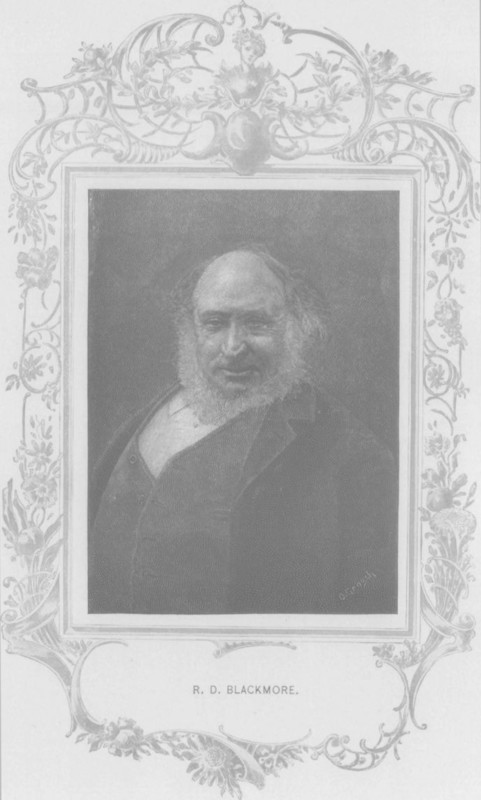
The best expression of his genius in the delineation of character is not--with perhaps the exception of John Ridd--in his heroes and heroines. The former are drawn with the stronger hand. The maidens are pretty girls, sweet and good and brave for the sake of their fathers, and cunning for their lovers. His young men are gallant and true; but as exemplary love is apt to run smooth, it is not here that the drama finds the necessary amount of difficulty and pain. The interest centres in such delicious conceptions as Parson Short, full of muscular energy and sound doctrine, in Dr. Uperandown, his salt-water parish rival, the carrier Cripps, Parson Chowne, and the renowned highwayman Tom Faggus, of whom they were immensely proud. These people, before he has done with them, get hold of our sympathies, while the author keeps perennially fresh his enjoyment of human follies. His rustics do not talk with elaborate humor, nor are they amiable, but they are racy of the soil.
One cannot dismiss a novelist without a reference to his plots, unless indeed he discards plots as an article of faith. Mr. Blackmore has no such intention. His stories are full of adventure and dramatic situations, and his melodrama is of the lurid kind on which the calcium light is thrown. Sometimes, as in 'The Maid of Sker' and 'Cripps' they violate every probability. In others, as in 'Mary Anerley,' the mystery is childishly simple, the oft-repeated plot of a lost child recovered by certain strangely wrought gold buttons. In 'Erema,' the narrative suffers for want of vraisemblance, and loses by being related by a very young girl who has had no opportunity of becoming familiar with the world she describes. He is constantly guilty of that splendid mendacity which fiction loves, but which is nearly impossible to actual life. Self-sacrifice as depicted in 'Christowell,' involving much suffering to little purpose, is unsatisfactory; and it is a sin against the verities to make unreasonable generosity the basis of fiction representing life.
But while the reader quarrels with a waste of precious material, Mr. Blackmore pursues his meditative way, with his smile of genial observation, himself the best of all his personages. The smell of the heather and the wild moorland odors, the honeyed grass and the fragrant thyme, the darker breathings of the sea, get into his pages and render them fragrant. A few villages lie on the edge of that wild region, and a living trout stream darts by, but the landscape does not obtrude itself nor interrupt the story. The quaint philosophy flows on spontaneously, with a tender humanity and cheerful fun. A writer like this may be pardoned if he is an indifferent builder of a tale.
The scene of 'Lorna Doone,' the novelist's masterpiece, is laid in Devonshire; and what Wordsworth did for the lake country, Blackmore has done for the fairest county in England. The time is that of Charles II. The book is historical, it is very long, it is minute in detail, and it is melodramatic: but it is alive. The strange adventures may or may not have happened, but we believe in them, for it is real life that is set before us; and whatever the author may tell us of robber caves and black-hearted villains, there is nothing incredible in any of his confidences. Nothing in recent novel writing is more vivid than the contrast between these outcast nobles the Doones, robbers and brigands, living in the wilds of Bagworthy Forest, locked fast in the hills,--and the peaceful farm-house of the yeoman Ridd who lives on the Downs. This home is not idealized. From the diamond-paned kitchen come savory smells of cooking and substantial fare. Pretty Annie, whose "like has never been seen for making a man comfortable," Lizzie, who was undersized and loved books, "but knew the gift of cooking had not been vouchsafed her by God," the sweet homely mother, and above all the manly figure of the young giant John, make a picture of which the gloomy castle of the Doones is the shadow. And what more charming than the story of the love that takes possession of the young boy, making a poet, a soldier, a knight of him, through a chance encounter with Lorna, the queen of the wild band, the grandchild of old Sir Ensor Doone?
With John Ridd,--"Grit Jan"--the author dwelt till he possessed him with human attributes and made him alive. Around him the interest of the story centres. He is full of mother-wit and observation of men and things, especially of every changing mood of the nature he regards as his true mother. He is brave and resourceful, and rescues Lorna and himself from numberless difficulties by his native shrewdness. And his love is a poem, an idyl that crowns him a shepherd king in his own green pastures. Nothing that he does in his plodding, sturdy way wearies us. His size, his strength, his good farming, the way he digs his sheep out of the snow, entertain us as well as his rescue of Lorna from the clan.
The texture of this novel is close, the composition elaborate. It is impossible to escape from it, the story having been once begun. 'Lorna Doone' is Blackmore at his highest point, full of truest nature and loveliest thoughts.
A DESPERATE VENTURE
From 'Lorna Doone'
The journey was a great deal longer to fetch around the southern hills, and enter by the Doone gate, than to cross the lower land and steal in by the water-slide. However, I durst not take a horse (for fear of the Doones, who might be abroad upon their usual business), but started betimes in the evening, so as not to hurry, or waste any strength upon the way. And thus I came to the robbers' highway, walking circumspectly, scanning the sky-line of every hill, and searching the folds of every valley, for any moving figure.
Although it was now well on toward dark, and the sun was down an hour or so, I could see the robbers' road before me, in a trough of the winding hills, where the brook plowed down from the higher barrows, and the coving banks were roofed with furze. At present there was no one passing, neither post nor sentinel, so far as I could descry; but I thought it safer to wait a little, as twilight melted into night; and then I crept down a seam of the highland, and stood upon the Doone track.
As the road approached the entrance, it became more straight and strong, like a channel cut from rock, with the water brawling darkly along the naked side of it. Not a tree or bush was left, to shelter a man from bullets; all was stern, and stiff, and rugged, as I could not help perceiving, even through the darkness: and a smell as of churchyard mold, a sense of being boxed in and cooped, made me long to be out again.
And here I was, or seemed to be, particularly unlucky; for as I drew near the very entrance, lightly of foot, and warily, the moon (which had often been my friend) like an enemy broke upon me, topping the eastward ridge of rock, and filling all the open spaces with the play of wavering light. I shrank back into the shadowy quarter on the right side of the road, and gloomily employed myself to watch the triple entrance, on which the moonlight fell askew.
All across and before the three rude and beetling archways hung a felled oak overhead, black and thick and threatening. This, as I heard before, could be let fall in a moment, so as to crush a score of men, and bar the approach of horses. Behind this tree the rocky mouth was spanned, as by a gallery, with brushwood and piled timber, all upon a ledge or stone, where thirty men might lurk unseen, and fire at any invader. From that rampart it would be impossible to dislodge them, because the rock fell sheer below them twenty feet, or it may be more; while overhead it towered three hundred, and so jutted over that nothing could be cast upon them, even if a man could climb the height. And the access to this portcullis place--if I may so call it, being no portcullis there--was through certain rocky chambers known to the tenants only.
But the cleverest of their devices, and the most puzzling to an enemy, was that, instead of one mouth only, there were three to choose from, with nothing to betoken which was the proper access, all being pretty much alike, and all unfenced and yawning. And the common rumor was that in times of any danger, when any force was known to be on muster in their neighborhood, they changed their entrance every day, and diverted the other two, by means of sliding-doors, to the chasm and dark abysses.
Now I could see those three rough arches, jagged, black, and terrible, and I knew that only one of them could lead me to the valley; neither gave the river now any further guidance, but dived underground with a sullen roar, where it met the cross-bar of the mountain. Having no means at all of judging which was the right way of the three, and knowing that the other two would lead to almost certain death, in the ruggedness and darkness--for how could a man, among precipices and bottomless depths of water, without a ray of light, have any chance to save his life?--I do declare that I was half inclined to go away, and have done with it.
However, I knew one thing for certain, to wit, that the longer I stayed debating, the more would the enterprise pall upon me, and the less my relish be. And it struck me that, in times of peace, the middle way was the likeliest; and the others diverging right and left in their further parts might be made to slide into it (not far from the entrance) at the pleasure of the warders. Also I took it for good omen that I remembered (as rarely happened) a very fine line in the Latin grammar, whose emphasis and meaning is, "Middle road is fastest."
Therefore, without more hesitation, I plunged into the middle way, holding a long ash-staff before me, shodden at the end with iron. Presently I was in black darkness, groping along the wall, and feeling a deal more fear than I wished to feel; especially when, upon looking back, I could no longer see the light, which I had forsaken. Then I stumbled over something hard, and sharp, and very cold; moreover, so grievous to my legs that it needed my very best doctrine and humor to forbear from swearing in the manner they use in London. But when I arose, and felt it, and knew it to be a culverin, I was somewhat reassured thereby, inasmuch as it was not likely that they would plant this engine except in the real and true entrance.
Therefore I went on again, more painfully and wearily, and presently found it to be good that I had received that knock, and borne it with such patience; for otherwise I might have blundered full upon the sentries, and been shot without more ado. As it was, I had barely time to draw back, as I turned a corner upon them; and if their lantern had been in its place, they could scarce have failed to descry me, unless indeed I had seen the gleam before I turned the corner.
There seemed to be only two of them, of size indeed and stature as all the Doones must be; but I need not have feared to encounter them both, had they been unarmed, as I was. It was plain, however, that each had a long and heavy carbine, not in his hands (as it should have been), but standing close beside him. Therefore it behooved me now to be exceeding careful; and even that might scarce avail, without luck in proportion. So I kept well back at the corner, and laid one cheek to the rock face, and kept my outer eye round the jut in the wariest mode I could compass, watching my opportunity; and this is what I saw:
The two villains looked very happy--which villains have no right to be, but often are, meseemeth; they were sitting in a niche of rock, with the lantern in the corner, quaffing something from glass measures, and playing at pushpin, or shepherd's chess, or basset, or some trivial game of that sort. Each was smoking a long clay pipe, quite of new London shape, I could see, for the shadow was thrown out clearly; and each would laugh from time to time as he fancied he got the better of it. One was sitting with his knees up, and left hand on his thigh; and this one had his back to me, and seemed to be the stouter. The other leaned more against the rock, half sitting and half astraddle, and wearing leathern overalls, as if newly come from riding. I could see his face quite clearly by the light of the open lantern, and a handsomer or a bolder face I had seldom if ever set eyes upon; insomuch that it made me very unhappy to think of his being so near my Lorna.
"How long am I to stay crouching here?" I asked of myself at last, being tired of hearing them cry, "Score one," "Score two," "No, by ----, Charlie!" "By ----, I say it is, Phelps."
And yet my only chance of slipping by them unperceived was to wait till they quarreled more, and came to blows about it. Presently, as I made up my mind to steal along towards them (for the cavern was pretty wide just there), Charlie, or Charleworth Doone, the younger and taller man, reached forth his hand to seize the money, which he swore he had won that time. Upon this the other jerked his arm, vowing that he had no right to do it; whereupon Charlie flung at his face the contents of the glass he was sipping, but missed him and hit the candle, which sputtered with a flare of blue flame (from the strength, perhaps, of the spirit), and then went out completely. At this one swore and the other laughed; and before they had settled what to do, I was past them and round the corner.
And then, like a giddy fool as I was, I needs must give them a startler--the whoop of an owl, done so exactly, as John Fry had taught me, and echoed by the roof so fearfully, that one of them dropped the tinder-box, and the other caught up his gun and cocked it--at least as I judged by the sounds they made. And then, too late, I knew my madness: for if either of them had fired, no doubt but what all the village would have risen and rushed upon me. However, as the luck of the matter went, it proved for my advantage; for I heard one say to the other:--
"Curse it, Charlie, what was that? It scared me so, I have dropped my box; my flint is gone, and everything. Will the brimstone catch from your pipe, my lad?"
"My pipe is out, Phelps, ever so long. D--n it, I am not afraid of an owl, man. Give me the lantern, and stay here. I'm not half done with you yet, my friend."
"Well said, my boy, well said! Go straight to Carver's, mind you. The other sleepy-heads be snoring, as there is nothing up to-night. No dallying now under captain's window: Queen will have naught to say to you, and Carver will punch your head into a new wick for your lantern."
"Will he, though? Two can play at that."
And so, after some rude jests and laughter, and a few more oaths, I heard Charlie (or at any rate somebody) coming toward me, with a loose and not too sober footfall. As he reeled a little in his gait, and I would not move from his way one inch, after his talk of Lorna, but only longed to grasp him (if common sense permitted it), his braided coat came against my thumb, and his leathern gaiters brushed my knee. If he had turned or noticed it, he would have been a dead man in a moment; but his drunkenness saved him.
So I let him reel on unharmed; and thereupon it occurred to me that I could have no better guide, passing as he would exactly where I wished to be--that is to say, under Lorna's window. Therefore I followed him, without any special caution; and soon I had the pleasure of seeing his form against the moonlit sky.
Down a steep and winding path, with a hand-rail at the corners (such as they have at Ilfracombe), Master Charlie tripped along--and indeed there was much tripping, and he must have been an active fellow to recover as he did--and after him walked I, much hoping (for his own poor sake) that he might not turn and espy me.
But Bacchus (of whom I read at school, with great wonder about his meaning--and the same I may say of Venus), that great deity, preserved Charlie, his pious worshiper, from regarding consequences. So he led me very kindly to the top of the meadow-land where the stream from underground broke forth, seething quietly with a little hiss of bubbles. Hence I had fair view and outline of the robbers' township, spread with bushes here and there, but not heavily overshadowed. The moon, approaching now the full, brought the forms in manner forth, clothing each with character, as the moon (more than the sun) does to an eye accustomed.
I knew that the captain's house was first, both from what Lorna had said of it, and from my mother's description, and now again from seeing Charlie halt there for a certain time, and whistle on his fingers, and hurry on, fearing consequence. The tune that he whistled was strange to me, and lingered in my ears, as having something very new and striking and fantastic in it. And I repeated it softly to myself, while I marked the position of the houses and the beauty of the village. For the stream, in lieu of the street, passing between the houses, and affording perpetual change and twinkling and reflections--moreover, by its sleepy murmur, soothing all the dwellers there--this, and the snugness of the position, walled with rock and spread with herbage, made it look in the quiet moonlight like a little paradise. And to think of all the inmates there sleeping with good consciences, having plied their useful trade of making others work for them, enjoying life without much labor, yet with great renown!
Master Charlie went down the village, and I followed him carefully, keeping as much as possible in the shadowy places, and watching the windows of every house, lest any light should be burning. As I passed Sir Ensor's house, my heart leaped up, for I spied a window, higher than the rest above the ground, and with a faint light moving. This could hardly fail to be the room wherein my darling lay; for here that impudent young fellow had gazed while he was whistling. And here my courage grew tenfold, and my spirit feared no evil; for lo! if Lorna had been surrendered to that scoundrel Carver, she would not have been at her grandfather's house, but in Carver's accursed dwelling.
Warm with this idea, I hurried after Charleworth Doone, being resolved not to harm him now, unless my own life required it. And while I watched from behind a tree, the door of the furthest house was opened; and, sure enough, it was Carver's self, who stood bareheaded, and half undressed, in the doorway. I could see his great black chest and arms, by the light of the lamp he bore.
"Who wants me this time of night?" he grumbled, in a deep, gruff voice; "any young scamp prowling after the maids shall have sore bones for his trouble."
"All the fair maids are for thee, are they, Master Carver?" Charlie answered, laughing; "we young scamps must be well content with coarser stuff than thou wouldst have."
"Would have? Ay, and will have," the great beast muttered, angrily. "I bide my time; but not very long. Only one word for thy good, Charlie. I will fling thee senseless into the river if ever I catch thy girl-face here again."
"Mayhap, Master Carver, it is more than thou couldst do. But I will not keep thee; thou art not pleasant company to-night. All I want is a light for my lantern, and a glass of schnapps, if thou hast it."
"What is become of thy light, then? Good for thee I am not on duty."
"A great owl flew between me and Phelps as we watched beside the culverin, and so scared was he at our fierce bright eyes that he fell and knocked the light out."
"Likely tale, or likely lie, Charles! We will have the truth to-morrow. Here, take thy light, and be gone with thee. All virtuous men are in bed now."
"Then so will I be; and why art thou not? Ha! have I earned my schnapps now?"
"If thou hast, thou hast paid a bad debt! there is too much in thee already. Be off! my patience is done with."
Then he slammed the door in the young man's face, having kindled his lantern by this time; and Charlie went up the watch-place again, muttering, as he passed me, "Bad lookout for all of us when that surly old beast is captain. No gentle blood in him, no hospitality, not even pleasant language, nor a good new oath in his frowzy pate! I've a mind to cut the whole of it; and but for the girls I would do so."
My heart was in my mouth, as they say, when I stood in the shade by Lorna's window, and whispered her name gently. The house was of one story only, as the others were, with pine-ends standing forth the stone, and only two rough windows upon that western side of it, and perhaps those two were Lorna's. The Doones had been their own builders, for no one should know their ins and outs; and of course their work was clumsy. As for their windows, they stole them mostly from the houses round about. But though the window was not very close, I might have whispered long enough before she would have answered me, frightened as she was, no doubt, by many a rude overture. And I durst not speak aloud, because I saw another watchman posted on the western cliff, and commanding all the valley. And now this man (having no companion for drinking or for gambling) espied me against the wall of the house, and advanced to the brink, and challenged me.
"Who are you there? Answer. One, two, three and I fire at thee."
The nozzle of his gun was pointed full upon me, as I could see, with the moonlight striking on the barrel; he was not more than fifty yards off, and now he began to reckon. Being almost desperate about it, I began to whistle, wondering how far I should get before I lost my windpipe; and as luck would have it, my lips fell into that strange tune I had practiced last; the one I had heard from Charlie. My mouth would hardly frame the notes, being parched with terror; but to my surprise, the man fell back, dropped his gun, and saluted. Oh, sweetest of all sweet melodies!
That tune was Carver Doone's passport (as I heard long afterward), which Charleworth Doone had imitated, for decoy of Lorna. The sentinel took me for that vile Carver, who was like enough to be prowling there for private talk with Lorna, but not very likely to shout forth his name, if it might be avoided. The watchman, perceiving the danger, perhaps, of intruding on Carver's privacy, not only retired along the cliff, but withdrew himself to good distance.
Meanwhile he had done me the kindest service; for Lorna came to the window at once to see what the cause of the shout was, and drew back the curtain timidly. Then she opened the rough lattice, and then she watched the cliff and trees, and then she sighed very sadly.
"O Lorna, don't you know me?" I whispered from the side, being afraid of startling her by appearing over-suddenly.
Quick though she always was of thought, she knew me not from my whisper, and was shutting the window hastily, when I caught it back and showed myself.
"John!" she cried, yet with sense enough not to speak aloud; "oh, you must be mad, John!"
"As mad as a March hare," said I, "without any news of my darling. You knew I would come--of course you did."
A WEDDING AND A REVENGE
From 'Lorna Doone'
However humble I might be, no one knowing anything of our part of the country would for a moment doubt that now here was a great to-do and talk of John Ridd and his wedding. The fierce fight with the Doones so lately, and my leading of the combat (though I fought not more than need be), and the vanishing of Sir Counselor, and the galloping madness of Carver, and the religious fear of the women that this last was gone to hell,--for he himself had declared that his aim, while he cut through the yeomanry,--also their remorse that he should have been made to go thither, with all his children left behind--these things, I say (if ever I can again contrive to say anything), had led to the broadest excitement about my wedding of Lorna. We heard that people meant to come from more than thirty miles around, upon excuse of seeing my stature and Lorna's beauty, but in good truth out of sheer curiosity and the love of meddling.
Our clerk had given notice that not a man should come inside the door of his church without shilling fee, and women (as sure to see twice as much) must every one pay two shillings. I thought this wrong; and as churchwarden, begged that the money might be paid into mine own hands when taken. But the clerk said that was against all law; and he had orders from the parson to pay it to him without any delay. So, as I always obey the parson when I care not much about a thing, I let them have it their own way, though feeling inclined to believe sometimes that I ought to have some of the money.
Dear mother arranged all the ins and outs of the way in which it was to be done; and Annie and Lizzie, and all the Snowes, and even Ruth Huckaback (who was there, after great persuasion), made such a sweeping of dresses that I scarcely knew where to place my feet, and longed for a staff to put by their gowns. Then Lorna came out of a pew half-way, in a manner which quite astonished me, and took my left hand in her right, and I prayed God that it were done with.
My darling looked so glorious that I was afraid of glancing at her, yet took in all her beauty. She was in a fright, no doubt, but nobody should see it; whereas I said (to myself, at least), "I will go through it like a grave-digger."
Lorna's dress was of pure white, clouded with faint lavender (for the sake of the old Earl Brandir), and as simple as need be, except for perfect loveliness. I was afraid to look at her, as I said before, except when each of us said, "I will;" and then each dwelt upon the other.
It is impossible for any who have not loved as I have to conceive my joy and pride when, after ring and all was done, and the parson had blessed us, Lorna turned to look at me with her glances of subtle fun subdued by this great act.
Her eyes, which none on earth may ever equal or compare with, told me such a depth of comfort, yet awaiting further commune, that I was almost amazed, thoroughly as I knew them. Darling eyes, the sweetest eyes, the loveliest, the most loving eyes--the sound of a shot rang through the church, and those eyes were filled with death.
Lorna fell across my knees when I was going to kiss her, as the bridegroom is allowed to do, and encouraged, if he needs it: a flood of blood came out upon the yellow wood of the altar steps; and at my feet lay Lorna, trying to tell me some last message out of her faithful eyes. I lifted her up, and petted her, and coaxed her, but it was no good; the only sign of life remaining was a spurt of bright red blood.
Some men know what things befall them in the supreme time of their life--far above the time of death--but to me comes back as a hazy dream, without any knowledge in it, what I did, or felt, or thought, with my wife's arms flagging, flagging, around my neck, as I raised her up, and softly put them there. She sighed a long sigh on my breast, for her last farewell to life, and then she grew so cold, and cold, that I asked the time of year.
It was now Whit-Tuesday, and the lilacs all in blossom; and why I thought of the time of year, with the young death in my arms, God or his angels may decide, having so strangely given us. Enough that so I did, and looked, and our white lilacs were beautiful. Then I laid my wife in my mother's arms, and begging that no one would make a noise, went forth for my revenge.
Of course I knew who had done it. There was but one man in the world, or at any rate in our part of it, who could have done such a thing--such a thing. I use no harsher word about it, while I leaped upon our best horse, with bridle, but no saddle, and set the head of Kickums toward the course now pointed out to me. Who showed me the course I cannot tell. I only know that I took it. And the men fell back before me.
Weapon of no sort had I. Unarmed, and wondering at my strange attire (with a bridal vest wrought by our Annie, and red with the blood of the bride), I went forth just to find out this--whether in this world there be or be not a God of justice.
With my vicious horse at a furious speed, I came up Black Barrow Down, directed by some shout of men, which seemed to me but a whisper. And there, about a furlong before me, rode a man on a great black horse, and I knew that man was Carver Doone.
"Your life, or mine," I said to myself; "as the will of God may be. But we two live not upon this earth one more hour together."
I knew the strength of this great man; and I knew that he was armed with a gun--if he had time to load again, after shooting my Lorna--or at any rate with pistols, and a horseman's sword as well. Nevertheless, I had no more doubt of killing the man before me than a cook has of spitting a headless fowl.
Sometimes seeing no ground beneath me, and sometimes heeding every leaf, and the crossing of the grass-blades, I followed over the long moor, reckless whether seen or not. But only once the other man turned round and looked back again, and then I was beside a rock, with a reedy swamp behind me.
Although he was so far before me, and riding as hard as ride he might, I saw that he had something on the horse in front of him; something which needed care, and stopped him from looking backward. In the whirling of my wits, I fancied first that this was Lorna; until the scene I had been through fell across hot brain and heart, like the drop at the close of a tragedy. Rushing there through crag and quag at utmost speed of a maddened horse, I saw, as of another's fate, calmly (as on canvas laid), the brutal deed, the piteous anguish, and the cold despair.
The man turned up the gully leading from the moor to Cloven Rocks, through which John Fry had tracked Uncle Ben, as of old related. But as Carver entered it, he turned round, and beheld me not a hundred yards behind; and I saw that he was bearing his child, little Ensie, before him. Ensie also descried me, and stretched his hands and cried to me; for the face of his father frightened him.
Carver Doone, with a vile oath, thrust spurs into his flagging horse, and laid one hand on a pistol-stock, whence I knew that his slung carbine had received no bullet since the one that pierced Lorna. And a cry of triumph rose from the black depths of my heart. What cared I for pistols? I had no spurs, neither was my horse one to need the rowel; I rather held him in than urged him, for he was fresh as ever; and I knew that the black steed in front, if he breasted the steep ascent, where the track divided, must be in our reach at once.
His rider knew this, and having no room in the rocky channel to turn and fire, drew rein at the crossways sharply, and plunged into the black ravine leading to the Wizard's Slough. "Is it so?" I said to myself, with brain and head cold as iron: "though the foul fiend come from the slough to save thee, thou shalt carve it, Carver."
I followed my enemy carefully, steadily, even leisurely; for I had him as in a pitfall, whence no escape might be. He thought that I feared to approach him, for he knew not where he was; and his low disdainful laugh came back. "Laugh he who wins," thought I.
A gnarled and half-starved oak, as stubborn as my own resolve, and smitten by some storm of old, hung from the crag above me. Rising from my horse's back, although I had no stirrups, I caught a limb, and tore it (like a mere wheat-awn) from the socket. Men show the rent even now with wonder; none with more wonder than myself.
Carver Doone turned the corner suddenly on the black and bottomless bog; with a start of fear he reined back his horse, and I thought he would have turned upon me. But instead of that, he again rode on, hoping to find a way round the side.
Now there is a way between cliff and slough for those who know the ground thoroughly, or have time enough to search it; but for him there was no road, and he lost some time in seeking it. Upon this he made up his mind; and wheeling, fired, and then rode at me.
His bullet struck me somewhere, but I took no heed of that. Fearing only his escape, I laid my horse across the way, and with the limb of oak struck full on the forehead his charging steed. Ere the slash of the sword came nigh me, man and horse rolled over and well-nigh bore my own horse down with the power of their onset.
Carver Doone was somewhat stunned, and could not arise for a moment. Meanwhile I leaped on the ground and awaited, smoothing my hair back, and baring my arms, as though in the ring for wrestling. Then the little boy ran to me, clasped my leg, and looked up at me, and the terror in his eyes made me almost fear myself.
"Ensie dear," I said quite gently, grieving that he should see his wicked father killed, "run up yonder round the corner, and try to find a pretty bunch of bluebells for the lady." The child obeyed me, hanging back, and looking back, and then laughing, while I prepared for business. There and then I might have killed mine enemy with a single blow while he lay unconscious, but it would have been foul play.
With a sullen and black scowl, the Carver gathered his mighty limbs and arose, and looked round for his weapons; but I had put them well away. Then he came to me and gazed, being wont to frighten thus young men.
"I would not harm you, lad," he said, with a lofty style of sneering: "I have punished you enough for most of your impertinence. For the rest I forgive you, because you have been good and gracious to my little son. Go and be contented."
For answer I smote him on the cheek, lightly, and not to hurt him, but to make his blood leap up. I would not sully my tongue by speaking to a man like this.
There was a level space of sward between us and the slough. With the courtesy derived from London, and the procession I had seen, to this place I led him. And that he might breathe himself, and have every fibre cool, and every muscle ready, my hold upon his coat I loosed, and left him to begin with me whenever he thought proper.
I think he felt that his time was come. I think he knew from my knitted muscles, and the firm arch of my breast, and the way in which I stood, but most of all from my stern blue eyes, that he had found his master. At any rate, a paleness came, an ashy paleness on his cheeks, and the vast calves of his legs bowed in, as if he were out of training.
Seeing this, villain as he was, I offered him first chance. I stretched forth my left hand as I do to a weaker antagonist, and I let him have the hug of me. But in this I was too generous; having forgotten my pistol-wound, and the cracking of one of my short lower ribs. Carver Doone caught me round the waist with such a grip as never yet had been laid upon me.
I heard my rib go; I grasped his arm and tore the muscle out of it[2] (as the string comes out of an orange); then I took him by the throat, which is not allowed in wrestling, but he had snatched at mine; and now was no time of dalliance. In vain he tugged and strained and writhed, dashed his bleeding fist into my face, and flung himself on me with gnashing jaws. Beneath the iron of my strength--for God that day was with me--I had him helpless in two minutes, and his fiery eyes lolled out.
[2]A far more terrible clutch than this is handed down, to weaker ages, of the great John Ridd.--ED. L.D.
"I will not harm thee any more," I cried, so far as I could for panting, the work being very furious: "Carver Doone, thou art beaten; own it, and thank God for it; and go thy way, and repent thyself."
It was all too late. Even if he had yielded in his ravening frenzy--for his beard was like a mad dog's jowl--even if he would have owned that for the first time in his life he had found his master, it was all too late.
The black bog had him by the feet; the sucking of the ground drew on him, like the thirsty lips of death. In our fury we had heeded neither wet nor dry, nor thought of earth beneath us. I myself might scarcely leap, with the last spring of o'erlabored legs, from the engulfing grave of slime. He fell back, with his swarthy breast (from which my grip had rent all clothing), like a hummock of bog-oak, standing out the quagmire; and then he tossed his arms to heaven, and they were black to the elbow, and the glare of his eyes was ghastly. I could only gaze and pant; for my strength was no more than an infant's from the fury and the horror. Scarcely could I turn away, while, joint by joint, he sank from sight.
LANDING THE TROUT
From 'Alice Lorraine'
The trout knew nothing of all this. They had not tasted a worm for a month, except when a sod of the bank fell in, through cracks of the sun, and the way cold water has of licking upward. And even the flies had no flavor at all; when they fell on the water, they fell flat, and on the palate they tasted hot, even under the bushes.
Hilary followed a path through the meadows, with the calm bright sunset casting its shadow over the shorn grass, or up in the hedge-road, or on the brown banks where the drought had struck. On his back he carried a fishing-basket, containing his bits of refreshment; and in his right hand a short springy rod, the absent sailor's favorite. After long council with Mabel, he had made up his mind to walk up-stream as far as the spot where two brooks met, and formed body enough for a fly flipped in very carefully to sail downward. Here he began, and the creak of his reel and the swish of his rod were music to him, after the whirl of London life.
The brook was as bright as the best cut-glass, and the twinkles of its shifting facets only made it seem more clear. It twisted about a little, here and there; and the brink was fringed now and then with something, a clump of loosestrife, a tuft of avens, or a bed of flowering water-cress, or any other of the many plants that wash and look into the water. But the trout, the main object in view, were most objectionably too much in view. They scudded up the brook at the shadow of a hair, or even the tremble of a blade of grass; and no pacific assurance could make them even stop to be reasoned with, "This won't do," said Hilary, who very often talked to himself, in lack of a better comrade. "I call this very hard upon me. The beggars won't rise till it is quite dark. I must have the interdict off my tobacco, if this sort of thing is to go on. How I should enjoy a pipe just now! I may just as well sit on a gate and think. No, hang it, I hate thinking now. There are troubles hanging over me, as sure as the tail of that comet grows. How I detest that comet! No wonder the fish won't rise. But if I have to strip, and tickle them in the dark, I won't go back without some for her."
He was lucky enough to escape the weight of such horrible poaching upon his conscience; for suddenly to his ears was borne the most melodious of all sounds, the flop of a heavy fish sweetly jumping after some excellent fly or grub.
"Ha, my friend!" cried Hilary, "so you are up for your supper, are you? I myself will awake right early. Still I behold the ring you made. If my right hand forget not its cunning, you shall form your next ring in the frying-pan."
He gave that fish a little time to think of the beauty of that mouthful, and get ready for another, the while he was putting a white moth on, in lieu of his blue upright. He kept the grizzled palmer still for tail-fly, and he tried his knots, for he knew that this trout was a Triton.
Then, with a delicate sidling and stooping, known only to them that fish for trout in very bright water of the summer-time,--compared with which art the coarse work of the salmon-fisher is as that of a scene-painter to Mr. Holman Hunt's--with, or in, or by, a careful manner, not to be described to those who have never studied it, Hilary won access of the water, without any doubt in the mind of the fish concerning the prudence of appetite. Then he flipped his short collar in, not with a cast, but a spring of the rod, and let his flies go quietly down a sharpish run into that good trout's hole. The worthy trout looked at them both, and thought; for he had his own favorite spot for watching the world go by, as the rest of us have. So he let the grizzled palmer pass, within an inch of his upper lip; for it struck him that the tail turned up in a manner not wholly natural, or at any rate unwholesome. He looked at the white moth also, and thought that he had never seen one at all like it. So he went down under his root again, hugging himself upon his wisdom, never moving a fin, but oaring and helming his plump, spotted sides with his tail.
"Upon my word, it is too bad," said Hilary, after three beautiful throws, and exquisite management down-stream; "everything Kentish beats me hollow. Now, if that had been one of our trout, I would have laid my life upon catching him. One more throw, however. How would it be if I sunk my flies? That fellow is worth some patience."
While he was speaking, his flies alit on the glassy ripple, like gnats in their love-dance; and then by a turn of the wrist, he played them just below the surface, and let them go gliding down the stickle, into the shelfy nook of shadow where the big trout hovered. Under the surface, floating thus, with the check of ductile influence, the two flies spread their wings and quivered, like a centiplume moth in a spider's web. Still the old trout, calmly oaring, looked at them both suspiciously. Why should the same flies come so often, and why should they have such crooked tails, and could he be sure that he did not spy the shadow of a human hat about twelve yards up the water? Revolving these things, he might have lived to a venerable age but for that noble ambition to teach, which is fatal to even the wisest. A young fish, an insolent whipper-snapper, jumped in his babyish way at the palmer, and missed it through over-eagerness. "I'll show you the way to catch a fly," said the big trout to him: "open your mouth like this, my son."
With that he bolted the palmer, and threw up his tail, and turned to go home again. Alas! his sweet home now shall know him no more. For suddenly he was surprised by a most disagreeable sense of grittiness, and then a keen stab in the roof of his month. He jumped, in his wrath, a foot out of the water, and then heavily plunged to the depths of his hole.
"You've got it, my friend," cried Hilary, in a tingle of fine emotions; "I hope the sailor's knots are tied with professional skill and care. You are a big one, and a clever one too. It is much if I ever land you. No net, or gaff, or anything. I only hope that there are no stakes here. Ah, there you go! Now comes the tug."
Away went the big trout down the stream, at a pace very hard to exaggerate, and after him rushed Hilary, knowing that his line was rather short, and that if it ran out, all was over. Keeping his eyes on the water only, and the headlong speed of the fugitive, headlong over a stake he fell, and took a deep wound from another stake. Scarcely feeling it, up he jumped, lifting his rod, which had fallen flat, and fearing to find no strain on it. "Aha, he is not gone yet!" he cried, as the rod bowed like a springle-bow.
He was now a good hundred yards down the brook from the corner where the fight began. Through his swiftness of foot, and good management, the fish had never been able to tighten the line beyond yield of endurance. The bank had been free from bushes, or haply no skill could have saved him; but now they were come to a corner where a nut-bush quite overhung the stream.
"I am done for now," said the fisherman; "the villain knows too well what he is about. Here ends this adventure."
Full though he was of despair, he jumped anyhow into the water, kept the point of his rod close down, reeled up a little as the fish felt weaker, and just cleared the drop of the hazel boughs. The water flapped into the pockets of his coat, and he saw red streaks flow downward. And then he plunged out to an open reach of shallow water and gravel slope.
"I ought to have you now," he said, "though nobody knows what a rogue you are; and a pretty dance you have led me!"
Doubting the strength of his tackle to lift even the dead weight of the fish, and much more to meet his despairing rally, he happily saw a little shallow gut, or back-water, where a small spring ran out. Into this by a dexterous turn he rather led than pulled the fish, who was ready to rest for a minute or two; then he stuck his rod into the bank, ran down stream, and with his hat in both hands appeared at the only exit from the gut. It was all up now with the monarch of the brook. As he skipped and jumped, with his rich yellow belly, and chaste silver sides, in the green of the grass, joy and glory of the highest merit, and gratitude, glowed in the heart of Lorraine. "Two and three quarters you must weigh. And at your very best you are! How small your head is! And how bright your spots are!" he cried, as he gave him the stroke of grace. "You really have been a brave and fine fellow. I hope they will know how to fry you."
While he cut his fly out of this grand trout's mouth, he felt for the first time a pain in his knee, where the point of the stake had entered it. Under the buckle of his breeches blood was soaking away inside his gaiters; and then he saw how he had dyed the water. After washing the wound and binding it with dock-leaves and a handkerchief, he followed the stream through a few more meadows, for the fish began to sport pretty well as the gloom of the evening deepened; so that by the time the gables of the old farm-house appeared, by the light of a young moon, and the comet, Lorraine had a dozen more trout in his basket, silvery-sided and handsome fellows, though none of them over a pound perhaps, except his first and redoubtable captive.
A DANE IN THE DIKE
From 'Mary Anerley'
Now, whether spy-glass had been used by any watchful mariner, or whether only blind chance willed it, sure it is that one fine morning Mary met with somebody. And this was the more remarkable, when people came to think of it, because it was only the night before that her mother had almost said as much.
"Ye munna gaw doon to t' sea be yersell," Mistress Anerley said to her daughter: "happen ye mought be one too many."
Master Anerley's wife had been at "boarding-school," as far south as Suffolk, and could speak the very best of southern English (like her daughter Mary) upon polite occasion. But family cares and farm-house life had partly cured her of her education, and from troubles of distant speech she had returned to the ease of her native dialect.
"And if I go not to the sea by myself," asked Mary, with natural logic, "why, who is there now to go with me?" She was thinking of her sadly missed comrade, Jack.
"Happen some day, perhaps, one too many."
The maiden was almost too innocent to blush; but her father took her part as usual.
"The little lass sall gaw doon," he said, "wheniver sha likes." And so she went down the next morning.
A thousand years ago the Dane's Dike must have been a very grand intrenchment, and a thousand years ere that perhaps it was still grander; for learned men say that it was a British work, wrought out before the Danes had ever learned to build a ship. Whatever, however, may be argued about that, the wise and the witless do agree about one thing--the stronghold inside it had been held by Danes, while severed by the Dike from inland parts, and these Danes made a good colony of their own, and left to their descendants distinct speech and manners, some traces of which are existing even now. The Dike, extending from the rough North Sea to the calmer waters of Bridlington Bay, is nothing more than a deep dry trench, skillfully following the hollows of the ground, and cutting off Flamborough Head and a solid cantle of high land from the rest of Yorkshire. The corner so intercepted used to be and is still called "Little Denmark"; and the in-dwellers feel a large contempt for all their outer neighbors. And this is sad, because Anerley Farm lies wholly outside of the Dike, which for a long crooked distance serves as its eastern boundary.
Upon the morning of the self-same day that saw Mr. Jellicorse set forth upon his return from Scargate Hall, armed with instructions to defy the devil, and to keep his discovery quiet--upon a lovely August morning of the first year of a new century, Mary Anerley, blithe and gay, came riding down the grassy hollow of this ancient Dane's Dike. This was her shortest way to the sea, and the tide would suit (if she could only catch it) for a take of shrimps, and perhaps even prawns, in time for her father's breakfast. And not to lose this, she arose right early, and rousing Lord Keppel, set forth for the spot where she kept her net covered with sea-weed. The sun, though up and brisk already upon sea and foreland, had not found time to rout the shadows skulking in the dingles. But even here, where sap of time had breached the turfy ramparts, the hover of the dew-mist passed away, and the steady light was unfolded.
For the season was early August still, with beautiful weather come at last; and the green world seemed to stand on tiptoe to make the extraordinary acquaintance of the sun. Humble plants which had long lain flat stood up with a sense of casting something off; and the damp heavy trunks which had trickled for a twelvemonth, or been only sponged with moss, were hailing the fresher light with keener lines and dove-colored tints upon their smoother boles. Then, conquering the barrier of the eastern land crest, rose the glorious sun himself, strewing before him trees and crags in long steep shadows down the hill. Then the sloping rays, through furze and brush-land, kindling the sparkles of the dew, descended to the brink of the Dike, and scorning to halt at petty obstacles, with a hundred golden hurdles bridged it wherever any opening was.
Under this luminous span, or through it where the crossing gullies ran, Mary Anerley rode at leisure, allowing her pony to choose his pace. That privilege he had long secured, in right of age, and wisdom, and remarkable force of character. Considering his time of life, he looked well and sleek, and almost sprightly; and so, without any reservation, did his gentle and graceful rider. The maiden looked well in a place like that, as indeed in almost any place; but now she especially set off the color of things, and was set off by them. For instance, how could the silver of the dew-cloud, and golden weft of sunrise, playing through the dapples of a partly wooded glen, do better (in the matter of variety) than frame a pretty moving figure in a pink checked frock, with a skirt of russet murrey, and a bright brown hat? Not that the hat itself was bright, even under the kiss of sunshine, simply having seen already too much of the sun, but rather that its early lustre seemed to be revived by a sense of the happy position it was in; the clustering hair and the bright eyes beneath it answering the sunny dance of life and light. Many a handsomer race, no doubt, more perfect, grand and lofty, received--at least if it was out of bed--the greeting of that morning sun; but scarcely any prettier one, or kinder, or more pleasant, so gentle without being weak, so good-tempered without looking void of all temper at all.
Suddenly the beauty of the time and place was broken by sharp, angry sound. Bang! bang! came the roar of muskets fired from the shore at the mouth of the Dike, and echoing up the winding glen. At the first report the girl, though startled, was not greatly frightened; for the sound was common enough in the week when those most gallant volunteers entitled the "Yorkshire Invincibles" came down for their annual practice of skilled gunnery against the French. Their habit was to bring down a red cock, and tether him against a chalky cliff, and then vie with one another in shooting at him. The same cock had tested their skill for three summers, but failed hitherto to attest it, preferring to return in a hamper to his hens, with a story of moving adventures.
Mary had watched those Invincibles sometimes from a respectful distance, and therefore felt sure (when she began to think) that she had not them to thank for this little scare. For they always slept soundly in the first watch of the morning; and even supposing they had jumped up with nightmare, where was the jubilant crow of the cock? For the cock, being almost as invincible as they were, never could deny himself the glory of a crow when the bullet came into his neighborhood. He replied to every volley with an elevated comb, and a flapping of his wings, and a clarion peal, which rang along the foreshore ere the musket roar died out. But before the girl had time to ponder what it was, or wherefore, round the corner came somebody, running very swiftly.
In a moment Mary saw that this man had been shot at, and was making for his life away; and to give him every chance she jerked her pony aside, and called and beckoned; and without a word he flew to her. Words were beyond him, if his breath should come back, and he seemed to have no time to wait for that. He had outstripped the wind, and his own wind, by his speed.
"Poor man!" cried Mary Anerley, "what a hurry you are in. But I suppose you cannot help it. Are they shooting at you?"
The runaway nodded, for he could not spare a breath, but was deeply inhaling for another start, and could not even bow without hindrance. But to show that he had manners, he took off his hat. Then he clapped it on his head and set off again.
"Come back!" cried the maid; "I can show you a place. I can hide you from your enemies forever."
The young fellow stopped. He was come to that pitch of exhaustion in which a man scarcely cares whether he is killed or dies. And his face showed not a sign of fear.
"Look! That little hole--up there--by the fern. Up at once, and this cloth over you!"
He snatched it, and was gone, like the darting lizard, up a little puckering side issue of the Dike, at the very same instant that three broad figures and a long one appeared at the lip of the mouth. The quick-witted girl rode on to meet them, to give the poor fugitive time to get into his hole and draw the brown skirt over him. The dazzle of the sun, pouring over the crest, made the hollow a twinkling obscurity; and the cloth was just in keeping with the dead stuff around. The three broad men, with heavy fusils cocked, came up from the sea-mouth of the Dike, steadily panting, and running steadily with a long-enduring stride. Behind them a tall bony man with a cutlass was swinging it high in the air, and limping, and swearing with great velocity.
"Coast-riders," thought Mary, "and he a free-trader [smuggler]! Four against one is cowardice."
"Halt!" cried the tall man, while the rest were running past her; "halt! ground arms; never scare young ladies." Then he flourished his hat, with a grand bow to Mary. "Fair young Mistress Anerley, I fear we spoil your ride. But his Majesty's duty must be done. Hats off, fellows, at the name of your king! Mary, my dear, the most daring villain, the devil's own son, has just run up here--scarcely two minutes--you must have seen him. Wait a minute; tell no lies--excuse me, I mean fibs. Your father is the right sort. He hates those scoundrels. In the name of his Majesty, which way is he gone?"
"Was it--oh, was it a man, if you please? Captain Carroway, don't say so."
"A man? Is it likely that we shot at a woman? You are trifling. It will be the worse for you. Forgive me--but we are in such a hurry. Whoa! whoa! pony."
"You always used to be so polite, sir, that you quite surprise me. And those guns look so dreadful! My father would be quite astonished to see me not even allowed to go down to the sea, but hurried back here, as if the French had landed."
"How can I help it, if your pony runs away so?" For Mary all this time had been cleverly contriving to increase and exaggerate her pony's fear, and so brought the gunners for a long way up the Dike, without giving them any time to spy at all about. She knew that this was wicked from a loyal point of view; not a bit the less she did it. "What a troublesome little horse it is!" she cried. "O Captain Carroway, hold him just a moment. I will jump down, and then you can jump up, and ride after all his Majesty's enemies."
"The Lord forbid! He slews all out of gear, like a carronade with rotten lashings. If I boarded him, how could I get out of his way? No, no, my dear, brace him up sharp, and bear clear."
"But you wanted to know about some enemy, captain. An enemy as bad as my poor Lord Keppel?"
"Mary, my dear, the very biggest villain! A hundred golden guineas on his head, and half for you. Think of your father, my dear, and Sunday gowns. And you must have a young man--by-and-by, you know--such a beautiful maid as you are. And you might get a leather purse, and give it to him. Mary, on your duty, now?"
"Captain, you drive me so, what can I say? I cannot bear the thought of betraying anybody."
"Of course not, Mary dear; nobody asks you. He must be half a mile off by this time. You could never hurt him now; and you can tell your father that you have done your duty to the king."
"Well, Captain Carroway, if you are quite sure that it is too late to catch him, I can tell you all about him. But remember your word about the fifty guineas."
"Every farthing, every farthing, Mary, whatever my wife may say to it. Quick! quick! Which way did he run, my dear?"
"He really did not seem to me to be running at all; he was too tired."
"To be sure, to be sure, a worn-out fox. We have been two hours after him; he could not run; no more can we. But which way did he go, I mean?"
"I will not say anything for certain, sir; even for fifty guineas. But he may have come up here--mind, I say not that he did--and if so, he might have set off again for Sewerby. Slowly, very slowly, because of being tired. But perhaps, after all, he was not the man you mean."
"Forward, double-quick! We are sure to have him!" shouted the lieutenant--for his true rank was that--flourishing his cutlass again, and setting off at a wonderful pace, considering his limp. "Five guineas every man Jack of you. Thank you, young mistress--most heartily thank you. Dead or alive, five guineas!"
With gun and sword in readiness, they all rushed off; but one of the party, named John Cadman, shook his head and looked back with great mistrust at Mary, having no better judgment of women than this, that he never could believe even his own wife. And he knew that it was mainly by the grace of womankind that so much contraband work was going on. Nevertheless, it was out of his power to act upon his own low opinions now.
The maiden, blushing deeply with the sense of her deceit, was informed by her guilty conscience of that nasty man's suspicions, and therefore gave a smack with her fern whip to Lord Keppel, impelling him to join, like a loyal little horse, the pursuit of his Majesty's enemies. But no sooner did she see all the men dispersed, and scouring the distance with trustful ardor, than she turned the pony's head toward the sea again, and rode back round the bend of the hollow. What would her mother say if she lost the murrey skirt, which had cost six shillings at Bridlington fair? And ten times that money might be lost much better than for her father to discover how she lost it. For Master Stephen Anerley was a straight-backed man, and took three weeks of training in the Land Defense Yeomanry, at periods not more than a year apart, so that many people called him "Captain" now; and the loss of his suppleness at knee and elbow had turned his mind largely to politics, making him stiffly patriotic, and especially hot against all free-traders putting bad bargains to his wife, at the cost of the king and his revenue. If the bargain were a good one, that was no concern of his.
Not that Mary, however, could believe, or would even have such a bad mind as to imagine, that any one, after being helped by her, would be mean enough to run off with her property. And now she came to think of it, there was something high and noble, she might almost say something downright honest, in the face of that poor persecuted man. And in spite of all his panting, how brave he must have been, what a runner, and how clever, to escape from all those cowardly coast-riders shooting right and left at him! Such a man steal that paltry skirt that her mother made such a fuss about! She was much more likely to find it in her clothes-press filled with golden guineas.
Before she was as certain as she wished to be of this (by reason of shrewd nativity), and while she believed that the fugitive must have seized such a chance and made good his escape toward North Sea or Flamborough, a quick shadow glanced across the long shafts of the sun, and a bodily form sped after it. To the middle of the Dike leaped a young man, smiling, and forth from the gully which had saved his life. To look at him, nobody ever could have guessed how fast he had fled, and how close he had lain hid. For he stood there as clean and spruce and careless as ever a sailor can be wished to be. Limber yet stalwart, agile though substantial, and as quick as a dart while as strong as a pike, he seemed cut out by nature for a true blue-jacket; but condition had made him a smuggler, or, to put it more gently, a free-trader. Britannia, being then at war with all the world, and alone in the right (as usual), had need of such lads, and produced them accordingly, and sometimes one too many. But Mary did not understand these laws. This made her look at him with great surprise, and almost doubt whether he could be the man, until she saw her skirt neatly folded in his hand, and then she said, "How do you do, sir?"
The free-trader looked at her with equal surprise. He had been in such a hurry, and his breath so short, and the chance of a fatal bullet after him so sharp, that his mind had been astray from any sense of beauty, and of everything else except the safety of the body. But now he looked at Mary, and his breath again went from him.
"You can run again now; I am sure of it," said she; "and if you would like to do anything to please me, run as fast as possible."
"What have I to run away from now?" he answered, in a deep sweet voice. "I run from enemies, but not from friends."
"That is very wise. But your enemies are still almost within call of you. They will come back worse than ever when they find you are not there."
"I am not afraid, fair lady, for I understand their ways. I have led them a good many dances.... When they cannot take another step, they will come back to Anerley for breakfast."
"I dare say they will; and we shall be glad to see them. My father is a soldier, and his duty is to nourish and comfort the forces of the King."
"Then you are young Mistress Anerley? I was sure of it before. There are no two such. And you have saved my life. It is something to owe it so fairly."
The young sailor wanted to kiss Mary's hand; but not being used to any gallantry, she held out her hand in the simplest manner to take back her riding skirt; and he, though longing in his heart to keep it, for a token or pretext for another meeting, found no excuse for doing so. And yet he was not without some resource.
For the maiden was giving him a farewell smile, being quite content with the good she had done, and the luck of recovering her property; and that sense of right which in those days formed a part of every good young woman said to her plainly that she must be off. And she felt how unkind it was to keep him any longer in a place where the muzzle of a gun, with a man behind it, might appear at any moment. But he, having plentiful breath again, was at home with himself to spend it.
"Fair young lady," he began, for he saw that Mary liked to be called a lady, because it was a novelty, "owing more than I ever can pay you already, may I ask a little more? Then it is that on your way down to the sea, you would just pick up (if you should chance to see it) the fellow ring to this, and perhaps you will look at this to know it by. The one that was shot away flew against a stone just on the left of the mouth of the Dike, but I durst not stop to look for it, and I must not go back that way now. It is more to me than a hatful of gold, though nobody else would give a crown for it."
"And they really shot away one of your earrings? Careless, cruel, wasteful men! What could they have been thinking of?"
"They were thinking of getting what is called 'blood-money.' One hundred pounds for Robin Lyth. Dead or alive--one hundred pounds."...
"Then are you the celebrated Robin Lyth--the new Robin Hood, as they call him? The man who can do almost anything?"
"Mistress Anerley, I am Robin Lyth; but, as you have seen, I cannot do much.... They have missed the best chance they ever had at me; it will make their temper very bad. If they shot at me again, they could do no good. Crooked mood makes crooked mode."
"You forget that I should not see such things. You may like very much to be shot at; but--but you should think of other people."
"I shall think of you only--I mean of your great kindness, and your promise to keep my ring for me. Of course you will tell nobody. Carroway will have me like a tiger if you do. Farewell, young lady--for one week, fare well." With a wave of his hat he was gone, before Mary had time to retract her promise; and she thought of her mother.
WILLIAM BLAKE
(1757-1827)

oet-painter, visionary, and super-mystic in almost all capacities, William Blake was born in London in 1757. He was the second son of humble people--his father but a stocking merchant. An "odd little boy," he was destined to be recognized as "one of the most curious and abnormal personages of the later eighteenth and earlier nineteenth centuries." Allan Cunningham describes him by saying that Blake at ten years of age was an artist and at twelve a poet. He seems really to have shown in childhood his double gift. But the boy's education was rudimentary, his advantages not even usual, it would seem. To the end of his life, the mature man's works betray a defective common-schooling, a lamentable lack of higher intellectual training--unless we suspect that the process would have disciplined his mind, to the loss of bizarre originality. Most of what Blake learned he taught himself, and that at haphazard. The mistiness and inexplicability of his productions is part of such a process, as well as of invincible temperament.
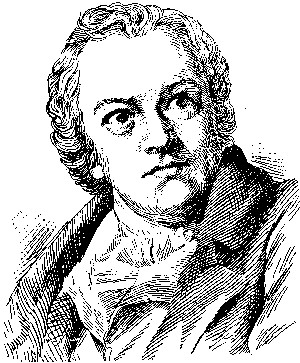
William Blake
In 1767 Blake was studying drawing with Mr. Pars, at the sometime famous Strand Academy, where he was reckoned a diligent but egotistical pupil. At fourteen he became apprenticed, for a livelihood,--afterward exchanged for the painter's and illustrator's freer career,--to James Basire, an academic but excellent engraver, whose manner is curiously traceable through much of Blake's after work. Even in the formal atmosphere of the Royal Academy's antique school, Blake remained an opinionated and curiously "detached" scholar, with singular critical notions, with half-expressed or very boldly expressed theories as to art, religion, and most other things. In 1782 he married a young woman of equally humble derivation, who could not even sign the marriage register. He developed her character, educated her mind, and made her a devoted and companionable wife, full of faith in him. Their curious and retired ménage was as happy in a practical and mundane aspect as could be hoped from even a normal one.
In 1780 he began to exhibit, his first picture being 'The Death of Earl Godwin.' After exhibiting five others, however, ending with 'Jacob's Dream,' he withdrew altogether from public advertisement. Several devoted patrons--especially Mr. Linnell, and a certain Mr. Thomas Butts, who bought incessantly, anything and everything,--seized upon all he drew and painted. In his literary undertakings he was for the most part his own editor and printer and publisher. His career in verse and prose began early. In 1783 came forth the charming collection 'Poetical Sketches,' juvenile as the fancies of his boyish days, but full of a sensitive appreciation of nature worthy of a mature heart, and expressed with a diction often exquisite. The volume was not really public nor published, but printed by the kindly liberality of two friends, one of them Flaxman. In 1787, "under the direction of the spirit of his dead brother," Robert, he decided on publishing a new group of lyrics and fancies, 'Songs of Innocence,' by engraving the text of the poems and its marginal embellishments on copper--printing the pages in various tints, coloring or recoloring them by hand, and even binding them, with his wife's assistance. The medium for mixing his tints, by the by, was "revealed to him by Saint Joseph."
With this volume--now a rarity for the bibliophile--began Blake's system of giving his literary works and many of his extraordinary artistic productions their form and being. Like a poet-printer of our own day, Mr. William Morris, Blake insisted that each page of text, all his delicate illustrations, every cover even, should pass through his own fingers, or through those of his careful and submissive helpmeet. The expense of their paper was the chief one to the light purse of the queerly assorted, thrifty pair.
In 1789 appeared another little volume of verses, 'Songs of Innocence.' This also was ushered into existence as a dual book of pictures and of poetry. In 1794 came the 'Songs of Experience,' completing that brief lyrical trio on which rests Blake's poetical reputation and his claim on coming generations of sympathetic readers. To these early and exquisite fruits of Blake's feeling succeeded a little book 'For Children,' the mystic volume 'The Gates of Paradise,' 'The Visions of the Daughters of Albion,' 'America, a Prophecy,' Part First of his 'Book of Urizen,' and a collection of designs without text, treated in the methods usual with him, besides other labors with pencil and pen.
But the wonderful and disordered imagination of the artist and poet now embodied itself in a strange group of writings for which no parallel exists. To realize them, one must imagine the most transcendent notions of Swedenborg mingled with the rant of a superior kind of Mucklewrath. Such poems as 'The Book of Thel,' in spite of beautiful allegoric passages; 'The Gates of Paradise'; 'Tiriel,' an extended narrative-fantasy in irregular unrhymed verses; even the striking 'Marriage of Heaven and Hell,'--may be reckoned as mere prologues to such productions as 'Jerusalem,' 'The Emanation of the Giant Albion.' 'Milton,' and the "prophecies" embodied in the completed 'Urizen,' the 'Europe,' 'Ahania,' and 'The Book of Los.' Such oracular works Blake put forth as dictated to him by departed spirits of supreme influence and intellectuality, or by angelic intelligences, quite apart from his own volition; indeed, only with his "grateful obedience." Such claims are not out of place in the instance of one who "saw God"; who often "conversed familiarly with Jesus Christ"; who "was" Socrates; who argued conclusions for hours at a time with Moses, with Milton, with Dante, with the Biblical prophets, with Voltaire; who could "see Satan" almost at will--all in vivid conceptions that sprang up in his mind with such force as to set seemingly substantial and even speaking beings before him. In his assumption of the seer, Blake was not a charlatan: he believed fully in his supernatural privileges. To him his modest London lodging held great company, manifest in the spirit.
Blake's greater "prophetic" writings ended, he busied himself with painting and illustration. He was incessant in industry; indeed, his ordinary recreation at any time was only a change of work from one design to another. So were wrought out the (incomplete) series of plates for Young's 'Night Thoughts'; the drawings for Hayley's 'Life of Cowper,' and for the same feeble author's 'Ballads on Anecdotes relating to Animals'; the 'Dante' designs: the 'Job' series of prints; a vast store of aquarelle and distemper paintings and plates, and a whole gallery of "portraits" derived from sitters of distinction in past universal history. These sitters, it is needless to say, were wholly invisible to other eyes than Blake's. The subjects vary from likenesses of Saint Joseph and the Virgin Mary to those of Mahomet and Shakespeare. Sundry of the old masters, Titian included, reviewed his efforts and guided his brush! Such assertions do not ill accord with the description of his once seeing a fairy's funeral, or that he first beheld God when four years old.
But all his fantasies did not destroy his faith in the fundamentals of orthodoxy. He never ceased to be a believer in Christianity. His convictions of a revealed religion were reiterated. While incessant in asserting that he had a solemn message-spiritual to his day and generation, he set aside nothing significant in the message of the Scriptures. There is something touching in the anecdote of him and his devoted Kate told by the portrait-painter Richmond. Himself discouraged with his imperfect work, Richmond one day visited Blake and confessed his low mood. To his astonishment, Blake turned to his wife suddenly, and said, "It is just so with us, is it not, for weeks together, when the visions forsake us! What do we do then, Kate?" "We kneel down and pray, Mr. Blake."
So passed Blake's many years, between reality and dream, labors and chimeras. The painter's life was not one of painful poverty. He and his Kate needed little money; and the seer-husband's pencils and burin, or the private kindness so constantly shown him, provided daily bread. Despite the visions and inspirations and celestial phenomena that filled his head, Blake withal was sane enough in everyday concerns. He lived orderly, even if he thought chaos. Almost his last strokes were on the hundred water-colors for the 'Divina Commedia,' the 'Job' cycle, the 'Ancient of Days' drawing, or a "frenzied sketch" of his wife which he made, exclaiming in beginning it, "Stay! Keep as you are! You have ever been an angel to me. I will draw you." Natural decay and painful chronic ailments increased. He seldom left his rooms in Fountain Court, Strand, except in a visit to the Linnells, at Hampstead. He died gently in 1827, "singing of the things he saw in Heaven." His grave, to-day unknown, was a common one in Bunhill Fields Cemetery. Many friends mourned him. With all his eccentricities and the extravagances of his "visions" and "inspirations," he was loved. His ardor of temperament was balanced by meekness, his aggressiveness by true politeness. He was frank, abstemious, a lover of children,--who loved him,--devout in prayer, devoid of vice. Yet whenever he was in contact with his fellow-men, he was one living and walking apart. As an influence in literature he is less considerable than in painting. In the latter art, a whole group of contemporary notables, intellectualists, and rhapsodists of greater or less individuality have to do with him, among whom Dante Gabriel Rossetti was in much his literary child, still more his child in art.
A brief and early 'Life' of Blake, prepared by his intimate friend Allan Cunningham, appeared in 1829. In 1839, for the first time, his works were really given to the public. Mr. Gilchrist's invaluable biography and study appeared in 1863; revised and enlarged in an edition of 1880. Mr. Swinburne's critical essay on him is a notable aid to the student. The artist-poet's complete works were edited by Mr. William Michael Rossetti in 1874, with a complete and discriminating memoir. More recent contributions to Blake literature are the Ellis and Yeats edition of his works, also with a Memoir and an Interpretation; and Mr. Alfred J. Story's volume on 'The Life, Character, and Genius of William Blake.' Some of the rarest of his literary productions, as well as the scarcest among his drawings, are owned in America, chiefly by two private collectors in the Eastern States.
SONG
My silks and fine array,
My smiles and languished air,
By love are driven away,
And mournful lean Despair
Brings me yew to deck my grave:
Such end true lovers have.
His face is fair as heaven
When springing buds unfold;
Oh, why to him was 't given,
Whose heart is wintry cold?
His breast is Love's all-worshiped tomb,
Where all Love's pilgrims come.
Bring me an axe and spade,
Bring me a winding-sheet;
When I my grave have made,
Let winds and tempests beat:
Then down I'll lie, as cold as clay:
True love doth never pass away.
SONG
Love and harmony combine
And around our souls entwine,
While thy branches mix with mine
And our roots together join.
Joys upon our branches sit,
Chirping loud and singing sweet;
Like gentle streams beneath our feet,
Innocence and virtue meet.
Thou the golden fruit dost bear,
I am clad in flowers fair;
Thy sweet boughs perfume the air,
And the turtle buildeth there.
There she sits and feeds her young;
Sweet I hear her mournful song;
And thy lovely leaves among,
There is Love: I hear his tongue.
There his charmed nest he doth lay,
There he sleeps the night away,
There he sports along the day,
And doth among our branches play.
THE TWO SONGS
I HEARD an Angel singing
When the day was springing:
"Mercy, pity, and peace,
Are the world's release."
So he sang all day
Over the new-mown hay,
Till the sun went down,
And the haycocks looked brown.
I heard a devil curse
Over the heath and the furse:
"Mercy could be no more
If there were nobody poor,
And pity no more could be
If all were happy as ye:
And mutual fear brings peace.
Misery's increase
Are mercy, pity, peace."
At his curse the sun went down,
And the heavens gave a frown.
NIGHT
From 'Songs of Innocence'
The sun descending in the west,
The evening star does shine,
The birds are silent in their nest,
And I must seek for mine.
The moon, like a flower
In heaven's high bower,
With silent delight,
Sits and smiles in the night.
Farewell, green fields and happy groves
Where flocks have ta'en delight;
Where lambs have nibbled, silent move
The feet of angels bright;
Unseen they pour blessing,
And joy without ceasing,
On each bud and blossom,
And each sleeping bosom.
They look in every thoughtless nest,
Where birds are covered warm;
They visit caves of every beast,
To keep them all from harm;
If they see any weeping
That should have been sleeping,
They pour sleep on their head,
And sit down by their bed.
When wolves and tigers howl for prey,
They pitying stand and weep;
Seeking to drive their thirst away,
And keep them from the sheep.
But if they rush dreadful,
The angels most heedful
Receive each wild spirit,
New worlds to inherit.
And there the lion's ruddy eyes
Shall flow with tears of gold;
And pitying the tender cries,
And walking round the fold,
Saying, "Wrath by His meekness,
And by His health, sickness,
Are driven away
From our immortal day.
"And now beside thee, bleating lamb,
I can lie down and sleep,
Or think on Him who bore thy name,
Graze after thee and weep.
For washed in life's river,
My bright mane forever
Shall shine like the gold,
As I guard o'er the fold."
THE PIPER AND THE CHILD
Introduction to 'Songs of Innocence'
Piping down the valleys wild,
Piping songs of pleasant glee,
On a cloud I saw a child,
And he laughing said to me:--
"Pipe a song about a lamb."
So I piped with merry cheer.
"Piper, pipe that song again:"
So I piped; he wept to hear.
"Drop thy pipe, thy happy pipe;
Sing thy songs of happy cheer:"
So I sang the same again,
While he wept with joy to hear.
"Piper, sit thee down and write,
In a book that all may read."
So he vanished from my sight;
And I plucked a hollow reed;
And I made a rural pen,
And I stained the water clear,
And I wrote my happy songs
Every child may joy to hear.
HOLY THURSDAY
From 'Songs of Innocence'
'Twas on a Holy Thursday, their innocent faces clean,
Came children walking two and two, in red and blue and green:
Gray-headed beadles walked before, with wands as white as snow,
Till into the high dome of Paul's they like Thames waters flow.
Oh, what a multitude they seemed, these flowers of London town!
Seated in companies they sit, with radiance all their own.
The hum of multitudes was there, but multitudes of lambs,
Thousands of little boys and girls raising their innocent hands.
Now like a mighty wind they raise to heaven the voice of song,
Or like harmonious thunderings the seats of heaven among:
Beneath them sit the aged men, wise guardians of the poor.
Then cherish pity, lest you drive an angel from your door.
A CRADLE SONG
From 'Songs of Experience'
Sleep, sleep, beauty bright,
Dreaming in the joys of night;
Sleep, sleep; in thy sleep
Little sorrows sit and weep.
Sweet babe, in thy face
Soft desires I can trace,
Secret joys and secret smiles,
Little pretty infant wiles.
As thy softest limbs I feel,
Smiles as of the morning steal
O'er thy cheek and o'er thy breast,
Where thy little heart doth rest.
Oh, the cunning wiles that creep
In thy little heart asleep!
When thy little heart shall wake,
Then the dreadful light shall break.
THE LITTLE BLACK BOY
From 'Songs of Innocence'
My Mother bore me in the Southern wild,
And I am black, but oh, my soul is white!
White as an angel is the English child,
But I am black, as if bereaved of light.
My mother taught me underneath a tree,
And sitting down before the heat of day,
She took me on her lap and kissed me,
And, pointing to the East, began to say:--
"Look on the rising sun: there God does live,
And gives his light, and gives his heat away,
And flowers and trees and beasts and men receive
Comfort in morning, joy in the noonday.
"And we are put on earth a little space,
That we may learn to bear the beams of love;
And these black bodies and this sunburnt face
Are but a cloud, and like a shady grove.
"For when our souls have learned the heat to bear,
The cloud will vanish, we shall hear his voice,
Saying, 'Come out from the grove, my love and care,
And round my golden tent like lambs rejoice.'"
Thus did my mother say, and kissèd me,
And thus I say to little English boy:
When I from black, and he from white cloud free,
And round the tent of God like lambs we joy,
I'll shade him from the heat till he can bear
To lean in joy upon our Father's knee;
And then I'll stand and stroke his silver hair,
And be like him, and he will then love me.
THE TIGER
From 'Songs of Experience'
Tiger! Tiger! burning bright
In the forests of the night,
What immortal hand or eye
Framed thy fearful symmetry?
In what distant deeps or skies
Burned that fire within thine eyes?
On what wings dared he aspire?
What the hand dared seize the fire?
And what shoulder, and what art,
Could twist the sinews of thy heart?
When thy heart began to beat,
What dread hand formed thy dread feet?
What the hammer, what the chain,
Knit thy strength and forged thy brain?
What the anvil? What dread grasp
Dared thy deadly terrors clasp?
When the stars threw down their spears,
And watered heaven with their tears,
Did he smile his work to see?
Did He who made the lamb make thee?
[2]A far more terrible clutch than this is handed down, to weaker ages, of the great John Ridd.--ED. L.D.
I heard my rib go; I grasped his arm and tore the muscle out of it[2] (as the string comes out of an orange); then I took him by the throat, which is not allowed in wrestling, but he had snatched at mine; and now was no time of dalliance. In vain he tugged and strained and writhed, dashed his bleeding fist into my face, and flung himself on me with gnashing jaws. Beneath the iron of my strength--for God that day was with me--I had him helpless in two minutes, and his fiery eyes lolled out.
CHARLES BLANC
(1813-1882)

e have few personal details of Charles Blanc. We know that he lived in a luminous world of form and thought, a life in harmony with his work; we have books containing his conception of art; we know that art was his one absorbing passion: and this should satisfy us, for it was his own opinion that all which does not tend to illustrate an artist's conception of art is of but secondary importance in his life.
Of Franco-Italian extraction, Charles Blanc was born in Castres, France, on the 15th of November, 1813. When in 1830 he and his brother Louis, youths of eighteen and nineteen, came to Paris, their aged father, an ex-inspector of finance whose career had been ruined by the fall of Napoleon, was dependent on them for support. Louis soon procured work on a newspaper; but Charles, whose ambition from his earliest years was to become a painter, spent his days in the Louvre, or wandering about Paris looking in the old-print-shop windows, and he thus learned much that he afterwards developed in his works. As his brother's position improved, he was enabled to study drawing with Delaroche and engraving with Calamatta. His masters gave him but little encouragement, however, and he soon turned his thoughts to literature, his maiden effort being a description of the Brussels Salon of 1836 for his brother's paper.
Exquisite sensitiveness and responsiveness to beauty eminently fitted Charles Blanc for the position of art critic, and gave a charm to his earliest writings. He brought to his new task the technical knowledge of an artist, and a penetrating critical insight which, aided by study, ripened rapidly. The evidence of talent afforded by his first art criticism induced Louis Blanc to confide to him successively the editorship of several provincial papers. But Charles's inclinations were toward the calm atmosphere of art; he was, and ever remained, indifferent to politics, and looked upon the fiery, active Louis with astonishment, even while catching his energy and ambition. On his return to Paris he began a history of the 'French Painters of the Nineteenth Century,' but one volume of which appeared; and the 'Painters of All Schools,' completed in 1876. Very little was then known of the lives of the painters. By illustrating each biographical sketch with engravings of the artists' pictures, Blanc met a long-felt want. As the work was intended for the general reader, it was not overloaded with erudition: but numerous anecdotes, combined with vivacity of style, aroused interest in painting and created a public for the more purely technical works which followed. Though assisted by others in this undertaking, Blanc himself planned the method of treatment, and wrote the history of the Dutch and French schools; and the work justly retains his name.
The Socialists had taken a prominent part in the events of February, 1848, which led to the overthrow of Louis Philippe; and they yielded to the universal desire by appointing Charles Blanc Director of Fine Arts--a position which he had prophesied to his friends several years before that he would one day fill. When he assumed office, the position of artists was critical; as, owing to social convulsions, government and private orders had dwindled into insignificance. Thanks to his energy, work was resumed on public monuments, and the greater part of the sum of 900,000 francs, voted by the National Assembly for the Champs de Mars festival, was devoted to work which gave employment to a legion of decorative painters and sculptors. After the Salon of 1848, as the government coffers were depleted, he obtained 80,000 francs' worth of Sèvres porcelain from the Minister of Commerce, to give as prizes. He combated a proposition made by the Committee on Finance to suppress the Louvre studios of molding; he opposed the motion to reduce the corps of professors at the School of Fine Arts, and defended the School of Rome, threatened with suppression.
While Director of Fine Arts, Blanc fought his first and only duel, in defence of his brother, although he had never fired a pistol in his life. During the political agitation of 1848, Louis was condemned by the National Assembly, and fled to London. After his departure, he was abused in very insulting language by one Lacombe, and Charles called the latter to account. In the duel which followed, Lacombe was hit, but the ball struck his pocket-book and glanced off, when Méry, one of the seconds, exclaimed, "That was money well invested!" and there the matter ended.
Another event, which occurred several years previous, has a certain psychological significance. One evening Charles Blanc was visiting a friend who resided a distance of one hundred and fifty miles from Paris. In the midst of conversation, he suddenly grew pale and exclaimed that he had received a shock, adding that something must have happened to Louis. The next day his fears were confirmed by the receipt of a letter, telling him that the latter had been knocked down in the streets of Paris by a blow across the forehead. When Dumas père heard of this coincidence, he utilized it in his 'Corsican Brothers.'
Notwithstanding his fine record as an administrator and his encouragement of talent, Blanc was sacrificed to the spirit of reaction which set in about 1850. His removal displeased the entire art world, so highly was he esteemed for his integrity, his progressive ideas, and his unerring taste. On his return to private life he resumed his 'History of the Painters.' 'L'Oeuvres de Rembrandt' (1853 to 1863), containing also a life of the artist, was illustrated by the first photographic plates which ever appeared in a book.
The name 'Peintres des Fêtes Galantes' was derived by Blanc from the title conferred on Watteau by the French Academy. Of the artists therein mentioned, Watteau occupied the realm of poetry; Lancret that of the conventional, the fashionable; Pater that of vulgar, jovial reality; Boucher, the most distinctively French of artists, that of brilliancy, dash, and vivacity. These painters are a curious study for the historian interested in the external forms of things.
With the exception of Dupré, Blanc knew all the painters of whom he writes in the 'Artistes de mon Temps' (Artists of My Time). The work is therefore replete with personal recollections. Here again the general interest is deepened by the warm interest which the author takes in the men and events of the time. There are many charming pages devoted to Félix Duban, Delacroix, and Calamatta; to the contemporary medallions of David d'Angers; to Henri Leys, Chenavard, and Troyon; to Corot, the lover of nature who saw her through a veil of poetry; to Jules Dupré and Rousseau, who saw the poetry innate in her. He introduces us to the caricaturists Grandville and Gavarni; to Barye's lifelike animals. On reading the lives of these men, one is struck by the fact that they produced their masterpieces at about the age of twenty years.
The 'Treasures of Art in Manchester,' and 'From Paris to Vienna,' were published in 1857. The latter contained curious information about the sale of art works during the seventeenth century, with the prices they brought, and is enlivened with short spirited sketches of artists and amateurs. In 1867 Blanc became a member of the Academic des Beaux Arts. The 'Treasures of Curiosity' is a catalogue of pictures and engravings sold between 1830 and the date of the appearance of the book.
Devoted to purely artistic subjects, the Journal des Beaux Arts, founded by Blanc, rendered great service to art by spreading a taste for it among the cultivated classes. The 'Grammar of Painting and Engraving' first appeared in this periodical. Though given up to a consideration of technical subjects, the work abounds in poetic touches and has great interest for the general reader. In 1875 it was discussed in the French Academy, when its author competed for the chair left vacant by the death of Vitel. He was not elected until the following year, though his book met with great success, and led to the revival of engraving in France.
When he began his studies for the life of Ingres, which appeared in 1867, he found many letters of the artist, which enabled him to follow the latter through the various phases of his life: to know the changes of his temper, the inflexibility of his character; his emotions day by day; his momentary discouragements, his great will-power; the heroic efforts he made to reach the heights; his ideas on art, his opinions of others as well as himself: and thanks to these documents, he was enabled to reproduce one of the most remarkable personalities, if not the most original one, of the French school.
In 1870 he was again made Director of Fine Arts. He introduced several reforms in the organization of the Salon, and founded a 4,000-franc prize. But the spirit of reaction could not forgive his political antecedents; and in 1873, on the fall of Thiers, he was removed before he could complete his plan for establishing a museum of copies to reproduce the masterpieces of painting. One well-deserved satisfaction was granted him in 1878 by the creation of a chair of Æsthetics and Art History in the College of France, which he was called by special decree to fill; and there he taught for three years.
The first part of the 'Grammar of the Decorative Arts' appeared in 1881; the second part, dealing with interior decorations, in 1882. The third part, 'The Decoration of Cities,' was not completed, owing to his sudden death. Elected President of the French Academy in 1882, he did not enjoy this well-deserved honor long. A few weeks before his death--which occurred on February 17th, 1882, from the effects of an operation for cancer--he began a catalogue of the collection presented by Thiers to the Louvre. This was the last work of a pen wielded with unimpaired vigor to the end.
"The great artist," wrote Blanc, "is he who guides us into the region of his own thoughts, into the palaces and fields of his own imagination, and while there, speaks to us the language of the gods;" and to none are these words more applicable than to himself. In the world of thought he was a man of great originality, though neither architect, painter, nor sculptor. He had all the artist nature from a boy, and never lost the tender sensibility and naïf admiration for the beautiful in nature and art which give such glow of enthusiasm to his writings. His 'Grammar of Painting and Engraving' founded the scientific method of criticism. In this work he brought his intellectual qualifications and extensive reading to bear upon a subject until then treated either by philosophical theorizers or eloquent essayists. He has left one of the purest literary reputations in France. He was above all an idealist, and made the World Beautiful more accessible to us.
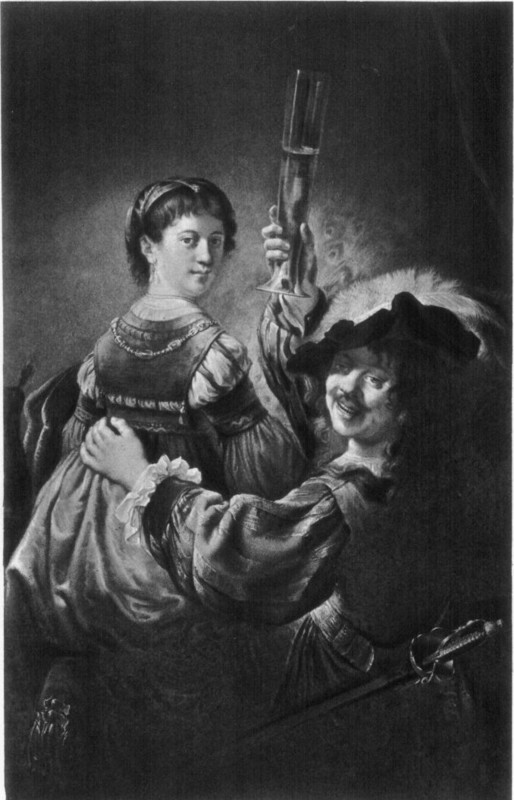
Rembrandt and his Wife
Photogravure from the original Painting by Rembrandt.
Dresden Gallery.
REMBRANDT
From 'The Dutch School of Painters'
Rembrandt has taken great pains to transmit to us paintings of his person, or at least of his face, from the time of his youth up to that of shrunken old age. He was a man at once robust and delicate. His broad and slightly rounded forehead presented a development that indicated a powerful imagination. His eyes were small, deep-set, bright, intelligent, and full of fire. His hair, of a warm color bordering on red and curling naturally, may possibly have indicated a Jewish extraction. His head had great character, in spite of the plainness of his features; a large flat nose, high cheek-bones, and a copper-colored complexion imparted to his face a vulgarity which, however, was relieved by the form of his mouth, the haughty outline of his eyebrows, and the brilliancy of his eyes. Such was Rembrandt; and the character of the figures he painted partakes of that of his own person. That is to say, they have great expression, but are not noble; they possess much pathos, while deficient in what is termed style.
An artist thus constituted could not but be exceedingly original, intelligent, and independent, though selfish and entirely swayed by caprice. When he began to study nature, he entered upon his task not with that good nature which is the distinctive characteristic of so many of the Dutch painters, but with an innate desire to stamp upon every object his own peculiarity, supplementing imagination by an attentive observation of real life. Of all the phenomena of nature, that which gave him most trouble was light; the difficulty he most desired to conquer was that of expression.
ALBERT DÜRER'S 'MELANCHOLIA'
From 'The Dutch School of Painters'
The love of the extravagant and fantastic observable in Dürer's first pictures never abandoned him. He has probably expressed the inspiration of his own soul in the figure of Melancholy, who, seated on the sea-shore, seems trying to penetrate with her gaze into infinite space. For my part, I have this picture always before me. How could it be possible to forget an engraving of Dürer's, even though seen but once? I can see her proud and noble head resting thoughtfully upon one hand, her long hair falling in disheveled tresses upon her shoulders; her folded wings emblematic of that impotent aspiration which directs her gaze towards heaven; a book, closed and useless as her wings, resting upon her knee. Nothing can be more gloomy, more penetrating, than the expression of this figure. From the peculiar folds of her dress, one would suppose she was enveloped in iron draperies. Near her is a sun-dial with a bell which marks the hours as they glide away. The sun is sinking beneath the ocean, and darkness will soon envelop the earth. Above hovers a strange-looking bat with spreading wings, and bearing a pennon on which is written the word "Melancholia."
All is symbolical in this composition, of which the sentiment is sublime. Melancholy holds in her right hand a pair of compasses and a circle, the emblem of that eternity in which her thoughts are lost. Various instruments appertaining to the arts and sciences lie scattered around her; after having made use of them, she has cast them aside and has fallen into a profound revery. As typical of the mistrust which has crept into her heart with avarice and doubt, a bunch of keys is suspended to her girdle; above her is an hour-glass, the emblem of her transitory existence. Nothing could be more admirable than the face of Melancholy, both in the severe beauty of her features and the depth of her gaze.
Neither the sentiment of melancholy nor the word which expresses it had appeared in art before the time of Albert Dürer.
INGRES
From the 'Life of Ingres'
Small of stature, square of figure, rough of manner, devoid of distinction, Ingres's personality afforded a great contrast to the refinement of his taste and the charm of his feminine figures. I can hardly conceive how a man thus built could show such delicacy in the choice of his subjects; how those short, thick fingers could draw such lovely, graceful forms.
Ingres hated academic conventionality; he mingled the Florentine and Greek schools; he sought the ideal not outside of reality but in its very essence, in the reconciliation of style with nature. Color he considered of secondary importance; he not only subordinated it voluntarily to drawing, but he did not have a natural gift for it. Ingres is the artist who has best expressed the voluptuousness not of flesh but of form; who has felt feminine beauty most profoundly and chastely.
CALAMATTA'S STUDIO
From 'Contemporary Artists'
I can still see Lamennais, with his worn-out coat, his round back, his yellow, parchment-like face, his eyes sparkling beneath a forehead imprinted with genius, and resembling somewhat Hoffmann's heroes. George Sand sometimes visited us, and it seemed to me that her presence lighted up the whole studio. She always spoke to me, for she knew that I was the brother of a distinguished writer, and when she looked over my plate I trembled like a leaf.
Thus our calm sedentary life was enlivened by an occasional sunbeam; and when I was hard at work with my graver, my mind was nourished by the minds of others. Giannone, the poet, read his commentaries on Shakespeare to us, and Mercure always had a witty retort in that faulty French which is so amusing in an Italian mouth. Calamatta would listen in silence, his eyes glued to his drawing of the 'Joconde,' at which he worked on his good days.
BLANC'S DÉBUT AS ART CRITIC
From 'Contemporary Artists'
In those days things happened just as they do now; the criticism is almost invariably the work of beginners. A youth who has acquired a smattering of learning, who has caught up the slang of the studios, and pretends to have a system or to defend a paradox, is chosen to write an account of the Salon. I was that youth, that novice. And after all, how become a workman unless you work? how become expert if you do not study, recognize your mistakes and repair them? Beneath our mistakes truth lies hidden.
So I arrived at Brussels to exercise the trade of critic, and found myself in the presence of two men who were then making a brilliant debut as painters: De Keyser and Henri Leys. I hope I shall be forgiven if I reproduce my criticism of the latter's 'Massacre of the Magistrates of Louvain.'
"Imagine to yourself a small public square, such as might have existed in Louvain in the fourteenth century; this square filled with angry people demanding satisfaction for the death of their chief, Gautier de Lendes, assassinated by the nobles; the approach to the palace of justice crowded with men armed to the teeth; at the top of the stairs the city magistrates on their way to execution, some as calm as if about to administer justice, others bewailing that the people know not what they do; peasants awaiting them at the foot of the stairs, dagger in hand, a smile upon their lips; here and there fainting women, dead bodies being stripped, dying men being tortured, and an inextricable confusion of monks, burghers, soldiers, children and horses. Then if you fancy this scene painted with the warmth and impetuosity of a Tintoretto, or as Hugo would have written it, you will have an idea of Leys's picture. It may not be prudent to trust an enthusiastic criticism; but my opinion is shared by every one. I may be rash in praising a young man whose wings may melt in the sun; but when, as is the case with M. Leys, the artist possesses exact knowledge of the times and manners, when he has verve, dash, and deep feeling, he needs only to moderate ardor by reflection, and to ripen inspiration by study, in order to become great."
One must admit that the above was not a bad beginning for an apprentice-connoisseur, and that I was fortunate in praising an unknown artist destined to make a great reputation.... There is something more real than reality in what passes in the soul of a great artist!
DELACROIX'S 'BARK OF DANTE'
From 'Contemporary Artists'
An admirable and altogether new quality is the weird harmony of color which makes the painting vibrate like a drama; or in other words, that sombre harmony itself is the foundation of the tragedy. Lyricism is expressed by mere difference in tones, which, heightened by their contrasts and softened by their analogy, become harmonious while clashing with each other. A new poetry was born of the French school, until then so sober of color, so little inclined to avail itself of the material resources of painting. And yet the expression thus achieved by Delacroix appeals to the soul as much as to the eyes. It is not merely optical beauty, but spiritual beauty of the highest order, that is produced by his superb coloring. In this picture the young painter's genius was revealed unto himself. He then knew that he had guessed the secret of an art which he was to carry to a perfection undreamed of before,--the orchestration of color....
Delacroix was the hero of Romanticism. His life was one long revolt in the name of color against drawing, of flesh against marble, of freedom of attitude against traditionary precision. He is an essentially modern genius inflamed by the poetry of Christianity, and he added tumultuous passions and feverish emotions to the antique serenity of art.
In those days youth was entirely given up to noble aspirations, to dreams of glory, to enthusiasm for beauty of expression and feeling, to an ardent love of liberty. Men were indifferent to stock quotations, but they rated spiritual values high. Mere theories inspired passion; quarrels on the subject of style and painting were common; men became enthusiastic over poetry and beauty--the ideal!
GENESIS OF THE 'GRAMMAR'
At dinner one day with the dignitaries of one of the largest cities of France, conversation turned upon the arts. All of the guests spoke of them, and well; but each intrenched himself behind his own personal views, in virtue of the adage "One cannot argue about tastes." I protested in vain against this false principle, saying that it was inadmissible, and that the classic Brillat-Savarin would have been shocked at such blasphemy. Even his name had no weight, and the guests separated gayly, after uttering heresies that made you shiver. Among the eminent men present there was one, however, who seemed somewhat mortified that he had not the most elementary idea of art; and he asked me if there was not some book in which its principles were presented in a clear and brief form. I replied that no such book existed, and that on leaving college I should have been only too happy to find such a work; and thereupon determined to write one.
MORAL INFLUENCE OF ART
From 'Grammar of Painting and Engraving'
Painting purifies people by its mute eloquence. The philosopher writes his thoughts for those who can think and read. The painter shows his thought to all who have eyes to see. That hidden and naked virgin, Truth, the artist finds without seeking. He throws a veil over her, encourages her to please, proves to her that she is beautiful, and when he has reproduced her image he makes us take her, and takes her himself, for Beauty.
In communicating to us what has been seen and felt by others, the painter gives new strength and compass to the soul. Who can say of how many apparently fugitive impressions a man's morality is composed, and upon what depends the gentleness of his manners, the correctness of his habits, the elevation of his thoughts? If the painter represents acts of cruelty or injustice, he inspires us with horror. The 'Unhappy Family' of Proudhon moves the fibres of charity better than the homilies of a preacher.... Examples of the sublime are rare in painting, as the painter is compelled to imprison every idea in a form. It may happen, nevertheless, that moved by thoughts to which he has given no form, the artist strikes the soul as a thunderbolt would the ear. It is then by virtue of the thought perceived, but not formulated, that the picture becomes sublime.
POUSSIN'S 'SHEPHERDS OF ARCADIA'
From 'Grammar of Painting and Engraving'
In a wide, heavily wooded country, the sojourning-place of that happiness sung by the poets, some peasants have discovered a tomb hidden by a thicket of trees, and bearing this brief inscription: "Et in Arcadia ego" (I too lived in Arcadia). These words, issuing from the tomb, sadden their faces, and the smiles die upon their lips. A young girl, carelessly leaning upon the shoulder of her lover, seems to listen, mute and pensive, to this salutation from the dead. The thought of death has also plunged into reverie a youth who leans over the tomb with bowed head, while the oldest shepherd points out the inscription he has just discovered. The landscape that completes this quiet picture shows reddened leaves upon arid rocks; hillocks that melt in the vague horizon, and in the distance, something ill-defined that resembles the sea. The sublime in this painting is that which we cannot see; it is the thought that hovers over it, the unexpected emotion that fills the soul of the spectator, transported suddenly beyond the tomb into the infinite unknown.
LANDSCAPE
From 'Grammar of Painting and Engraving'
The poetry of the fields and forests is inseparable from truth. But the painter must idealize this truth by making it express some sentiment; faithfulness of imitation alone would not suffice. The artist, master of reality, enlightens it with his eyes, transfigures it according to his heart, and makes it utter what is not in it--sentiment; and that which it neither possesses nor understands--thought.
STYLE
From 'Grammar of Painting and Engraving'
Drawing is a work of the mind; every drawing is the expression of a thought or sentiment, and is charged with showing us something superior to the apparent truth when that reveals neither sentiment nor thought. But what is this superior truth? It is sometimes the character of the object drawn, sometimes the character of the designer, and in high art is what we call style.
The artist sees in the creations of nature what he himself carries in the depth of his soul, tints them with the colors of his imagination, lends them the witchery of his genius. The temperament of the artist modifies the character of objects, and even that of living figures. But this power of taking possession is the appanage of great hearts, of great artists, of those whom we call masters,--who, instead of being the slaves of reality, dominate it. These have a style; their imitators have only a manner.
Aside from the style peculiar to every great master, there is in art something still superior and impersonal, which is style proper. Style is truth aggrandized, simplified, freed from all insignificant details, restored to its original essence, its typical aspect. This "style" par excellence, in which instead of recognizing the soul of an artist we feel the breath of the universal soul, was realized in the Greek sculpture of the time of Pericles.
THE LAW OF PROPORTION IN ARCHITECTURE
From 'Grammar of Painting and Engraving'
Man, from the fact that he is the only intelligent being in creation, desires to show his intelligence in his works. In order to do so he makes them resemble himself in a measure, by impressing upon them the characteristic of his intelligence, which is logic, and that of his body, which is proportion. Architecture employs inorganic matter alone--stone, marble, brick, iron, wood, when the sap has been dried out of it and it ceases to be an organic substance; and yet, under the hand of the architect, this inert matter expresses sentiments and feelings. By subjecting it to the laws of order, symmetry, and proportion, in a manner which appeals to the eye, he lends them a semblance of life and an organism conceived after his own image. By this artificial proportion, inert matter is raised to the dignity of the animal kingdom; it is rendered eloquent and capable of expressing the soul of the artist, and often that of a race.
But human monuments have still another point in common with the body. Order, symmetry, and proportion are needed rigorously only on the exterior. Within, general beauty no longer dominates, but individual life. If we look at the interior of the human body we find no symmetry, no arrangement but that demanded by the function of the organs. The brain, it is true, has two symmetrical lobes, because the brain is destined to a life of relation, to the life of intelligence. But in their individual functions the life of the internal organs presents another aspect. The stomach is a shapeless bag; the heart is a single muscle which is not even placed in the centre; the left lung is longer and narrower than the right; the spleen is a ganglion placed on the left side without any corresponding organ; but all this mechanism, which scientists consider wonderful in its irregularity, is hidden beneath a layer of similar members which repeat each other and correspond at equal distances from a central line, and constitute symmetry in animals, beauty in man. Similar in this respect to the human body, architectural monuments have a double life and a double aspect.
On the exterior, it is meet that they should be regular, symmetrical--but symmetrical from left to right like man, not from top to bottom nor from face to back. Their resemblance to man is further shown by openings, which are as the eyes and ears of the persons who inhabit them; their entrance occupies the centre of the edifice, as the mouth is placed on the central line of the face; they have rounded or angular forms according as they have been built to express strength, a virile idea, or grace, a feminine one; lastly, they have proportion, for there is a harmonious relation between their apparent members, and a mutual dependence which subordinates the variety of the parts to the unity of the whole, and which constitutes the necessary conditions of the beautiful in art.
The interior is not subjected to the necessity for duplicate members, to regularity of façade, nor to unity of appearance. Thus when the artist who has designed the monument performs its autopsy,--so to say,--we see, as in the human body, unequal dimensions, irregular shapes, disparities which resemble disorder to the eye, but which constitute the individuality of the edifice. Within reigns relative beauty, free, with fixed rule; without reigns a necessary beauty subjected to its own laws.
In man, character is the soul's expression. In architecture, character is the moral physiognomy o£ a building. As a portrait without character is but a vain shadow of the person represented, so a monument which does not appeal to the intelligence, which evokes no thought, is merely a pile of stones, a body without a soul. The soul of architecture is the thought it expresses.
Character tends towards beauty in man as well as in his works. If we glance at human society, we see faces which appear to be nothing more than a sketch. Parsimonious nature has given them only sufficient life to move in a narrow circle; they are mere individuals; they represent nothing but themselves. However, in the midst of the crowd, some men are noticeable for an abundance of vitality, whom favorable events have developed along their natural tendencies: they impersonate many individuals in one; their unity is equal to numbers; for good or evil, they have a character. In proportion as an individuality becomes more enriched, more pronounced, it attains character; in proportion as character loses its roughness it becomes beauty. This is also true of architecture.
STEEN STEENSEN BLICHER
(1782-1848)

mong the men nearest to the heart of the Danish people is Steen Steensen Blicher, who was born in 1782 on the border of the Jutland heath with which his name is so inseparably linked. The descendant of a line of country parsons, he was destined like them to the ministry, and while awaiting his appointment he supported his family by teaching and by farming.
When after years of hardship he finally obtained a parish on the Jutland heath, the salary was too small to support his large family. It was only during the very last years of his life that he was freed from harassing cares by the generosity of three friends, who, grateful for his literary work, paid off his debts.
While he was in college at Copenhagen he heard the lectures of the Norwegian Henrik Steffens, an interpreter of the German philosophic and romantic school. Steffens aroused a reaction against the formalism of the eighteenth century, and introduced romanticism into the North by his powerful influence over men like Oehlenschläger, Grundtvig, and Mynster in Denmark, and Ling and the "Phosphorists" in Sweden. Through these lectures Blicher became much interested in the Ossianic poems, of which he made an. Excellent Danish translation.
The poems and dramas with which he followed this work were of no great importance. It was not until he began to look into the old Danish traditions that he found his true sphere. The study of these quaint and simple legends led him to write those national peasant stories which he began to publish in 1826. They are not only the best of their kind in Danish, but they bear favorable comparison with the same kind of work in other literatures. They are not written as a study of social problems, or of any philosophy of life or moods of nature as they are reflected in human existence; they are merely a reproduction of what the country parson's own eyes beheld--the comedy and tragedy of the commonplace. What a less sensitive observer might have passed in silence--the brown heath, the breakers of the North Sea, the simple heart and life of the peasant--revealed to him the poesy, now merry, now sad, which he renders with so much art and so delicate a sympathy. Behind the believer in romanticism stands the lover of nature and of humanity.
Among his works the best known are 'E Bindstouw' (The Knitting-room), a collection of stories and poems, full of humor, simple and naive, told by the peasants themselves in their own homely Jutland dialect. These, as well as some of his later poems, especially 'Sneklokken' (The Snowbell), and 'Trækfuglene' (Birds of Passage), possess a clear, true, and national lyric quality.
Dying in 1848, Blicher was buried in Jutland, near the heath on which he spent whole days and nights of happy solitude. On one side of the stone above his grave is engraved a golden plover, on the other a pair of heath-larks, and around the foot a garland of heather, in memory of that intimate life with nature which, through his own great love for it, he endeared to all his readers.
A PICTURE
From the 'Poems'
I lay on my heathery hills alone;
The storm-winds rushed o'er me in turbulence loud;
My head rested lone on the gray moorland stone;
My eyes wandered skyward from cloud unto cloud.
There wandered my eyes, but my thoughts onward passed,
Far beyond cloud-track or tempest's career;
At times I hummed songs, and the desolate waste
Was the first the sad chimes of my spirit to hear.
Gloomy and gray are the moorlands where rest
My fathers, yet there doth the wild heather bloom,
And amid the old cairns the lark buildeth her nest,
And sings in the desert, o'er hill-top and tomb.
From Hewitt's 'Literature of Northern Europe.'
THE KNITTING-ROOM
It was the eve before Christmas Eve--no, stop! I am lying--it was the eve before that, come to think of it, that there was a knitting-bee going on at the schoolmaster's, Kristen Kornstrup's,--you know him? There were plenty that knew him, for in the winter he was schoolmaster, and in the summer he was mason, and he was alike clever at both. And he could do more than that, for he could stop the flow of blood, and discover stolen goods, and make the wind turn, and read prayers over felons, and much more too. But at this exorcising he was not so good as the parson, for he had not been through the black school.
So we had gathered there from the whole town,--oh, well, Lysgaard town is not so mighty big: there are only six farms and some houses, but then they were there too from Katballe and Testrup, and I think the lads from Knakkeborg had drifted over too--but that doesn't matter. We had got it measured off at last, and all of us had got our yarn over the hook in the ceiling above the table, and had begun to let the five needles work. Then the schoolmaster says, "Isn't there one of you that will sing something or tell something? then it will go so nicely with the work here." Then she began to speak, Kirsten Pedersdatter from Paps,--for she is always forward about speaking:--"I could sing you a little ditty if you cared to hear it--" "That we do," said I, "rattle it off!"--And she sang a ditty--I had never heard it before, but I remember it well enough, and it ran this way:--
But now I will tell you a story about a Poorman [gipsy] and what happened to him.
"If," said he--Mads Ur--"if you have been in Herning or thereabout, you know that there is a great marsh south of it. That same marsh is not so very nice to cross for those that don't know it well.
"It was the summer I was working for Kristens that a cow sank down out there, and it was one of those I was watching. I took her by the horns and I took her by the tail, but she would not help herself at all, and when one won't do a little bit, what is going to become of one? As I stand there pulling at that same refractory cow, up comes a Poorman from over at Rind, one of those they call knackers. 'I'll have to help you,' said he: 'you take hold of the horns, and I'll lift the tail.' That worked, for he pricked her under the tail with his pikestaff, and she was of a mind to help herself too. 'What do you give me for that now?' said he. 'I have nothing to give you,' said I, 'nothing but thanks.' 'I won't have them,' answered he, 'but if ever I should sink down on one road or another, will you lend me a hand if you are near by?' 'That I will do, indeed,' answered I; and then he tramped up to town, and that was all.
"How was it now that I came to work in Sund's parsonage?--well, that doesn't matter--I could swing a scythe, but how old I was I don't remember, for I don't rightly know how old I am now. The parson was a mighty good man, but God help us for the wife he had! She was as bad to him as any woman could be, and he hadn't a dog's chance with her. I have saved him twice from her grip, for he was a little scared mite of a thing, and she was big and strong, but I was stronger still, and I could get the better of her. Once she chased him around the yard with a knife in her hand, and cried that she would be even with him. I did not like that, so I took the knife from her and warned her to behave herself,--but that wasn't what I meant to say. Well, once while I was working there I stood near the pond looking at the aftermath. And up comes this same customer--this Poorman--drifting along the road toward me, and he had two women following him, and they each had a cradle on their backs and a child in each cradle. 'Good day to you,' said I. 'Same to you,' said he; 'how is your cow? Have you let her get into the marsh since?' 'Oh, no,' said I, 'and here is another thank-ye to you.' 'Are you working in this here bit of a parsonage?' said he. 'That I am,' said I. 'Well, now listen,' said he; 'couldn't you hide me these two with their little ones a day or so? for to-morrow there is to be a raid on our people, and I wouldn't like to have these in Viborghouse; I can stow myself away easy enough.' 'I'll see what I can do,' answered I; 'let them come, say a little after bedtime, to the West house there, and I'll get a ladder ready and help them up on the hayloft,--but have you food and drink yourself?' 'Oh, I shall do well enough,' said he, 'and now farewell to you until the sun is down.' So then they drifted along the road to a one-horse farm, and that evening they came, sure enough, and I hid the two women and the children until the second night; then they slipped away again. Before I parted with them, the Poorman said, 'I'd like to repay you this piece of work: isn't there something you want very much?' 'Yes,' said I.--'What might it be?'--'Hm! The only thing is Morten's Ane Kirstine at the farm where you went last night. But her parents won't let me have her; they say I have too little, and that is true too.' 'Hm, man,' says he, 'you look as if you had a pair of strong arms of your own; that is a good heirloom, and she has some pennies,--in a couple of days you might go and see what the old man's mind is. I'll help along the best I know how.' I listened to that, for evil upon them, those gipsies--they are not such fools. They can tell fortunes and discover stolen goods, and they can do both good and evil as it may happen.
"I thought over this thing a couple of days and some of the nights too, and then the third day I drifted over to Morten's. Ane Kirstine stood alone outside the gate with her back turned, for she was busy whitewashing a wall, so I came upon her before she knew it. 'Mercy on us! is that you?' she cried, 'where have you been all these many days?'--'I have been at home, and in the field, and on the heath, as it happened, and now I come to take a look at you.'--'I am not worth looking at,' said she, and thrust her clay-covered hands down into the pail to rinse off the clay. 'I don't care,' says I, 'whether you are yellow or gray, for you are the best friend I've got in this world; but I suppose I shall never be worthy of taking you in my arms in all honor and virtue.'--'It would be bad if that couldn't be,' said she, 'but it may happen we have got to wait awhile.'--'I can't wait over-long,' said I, 'for my mother will have no roof over her head, and either I shall have to take the farm or else a sister; that is how it stands, and it cannot be otherwise.'--Then she began to sniffle, and dried her eyes and sighed, but said nothing. I felt sorry for her, but what was there for one to do?
"Well, some one came who could tell us what to do, and it was none other than that same Poorman. Along he tramps with one of his women, and had his glass case on his back and wanted to get into the farm." Then he turned toward us and said:--'Well, well! what are you two doing there? Come along in with me, little girl, and I'll see if I can't manage it for you; but you stay out here, my little man! then we'll see what may come of it.'--They went, and I sat down on a stone that was lying there and folded my hands. I was not over-happy. I don't know how long I sat there, for I had fallen asleep; but then I was waked by some one kissing me, and it was no other than Ane Kirstine. 'Are you sitting there sleeping?' said she; 'come along in now, it is as it ought to be. The knacker has spoken a good word for us to mother, and when nothing could change her he said, "There is a black cock sitting on the perch: maybe a red one will crow over you if you don't do as I say." At this she got a little bit scared, and said, "Then let it be! but this I tell you, Ane Kirstine, I'll keep the black-headed cow for milking, and I'll have all the hay that is my share."--"That is no more than reasonable," said I, "and now we have no more to quarrel about, I suppose." Now you can let them publish the banns when you please.' 'And now, Ane Kirstine,' said I, 'this tramp here, he must have a reward, and I'll give it with a good will; and if we can get hold of him when we have our feast, he shall have a pot of soup and a hen to himself and those women and children.'--'That is right enough,' said she; 'and I will give them a rag or so, or a few more of my half-worn clothes.'
"Well, then my mother-in-law made a splendid feast, and there was plenty of everything. The Poorman was there, too, with all his following; but they had theirs by themselves, as you might know, seeing that they were of the knacker kind. Him I gave a coat, and Ane Kirstine gave the women each a cap and a kerchief and a piece of homespun for a petticoat for each of the young ones, and they were mighty well pleased.
"I and Ane Kirstine had lived happily together for about four years, as we do still, and all that time we had seen nothing of that Poorman, although we had spoken of him now and again. Sometimes we thought he had perished, and sometimes that they had put him into Viborghouse. Well, then it was that we were to have our second boy christened, him we called Sören, and I went to the parson to get this thing fixed up. As I came on the marsh to the selfsame place where I saw that Poor-customer the first time, there was somebody lying at one edge of the bog, on his back in the heather and with his legs in the ditch. I knew him well enough. 'Why are you lying here alone?' said I: 'is anything the matter with you?' 'I think I am dying,' said he, but he gasped so I could hardly understand him. 'Where are those women,' said I, 'that you used to have with you? Have they left you to lie here by the road?' He nodded his head and whispered, 'A drop of water.' 'That I will give you,' said I, and then I took some of the rainwater that stood in the ditch, in the hollow of my hat, and held it to his mouth. But that was of no use, for he could drink no longer, but drew up his legs and opened his mouth wide, and then the spirit left him. I felt so sorry for him that when I came to the parson's I begged that his poor ghost might be sheltered in the churchyard. That he gave me leave to do, and then I fetched him on my own wagon and nailed a couple of boards together and laid him down in the northwestern corner, and there he lies."
"Well now, that was it," said Kristen Katballe, "but why do you sit there so still, Marie Kjölvroe? Can you neither sing nor tell us something?" "That is not impossible," said she, and heaved a sigh, and sang so sadly that one might almost think it had happened to her.
THE HOSIER
"The greatest sorrow of all down here,
Is to lose the one we hold most dear."
Sometimes, when I have wandered far out on the wide heath, where I have had nothing but the brown heather around me and the blue sky above me; when I walked far away from mankind and the monuments of its busy doings here below,--which after all are only molehills to be leveled by time or by some restless Tamerlane;--when I drifted, light-hearted, free, and proud, like the Bedouin, whom no house, no narrowly bounded field chains to the spot, but who owns, possesses, all he sees,--who does not dwell, but who goes wherever he pleases; when my far-hovering eye caught a glimpse of a house in the horizon, and was thus disagreeably arrested in its airy flight, sometimes there came (God forgive me this passing thought, it was no more than that) the wish--would that this dwelling of man were not! there too is trouble and sorrow; there too they quarrel and fight about mine and thine!--Oh! the happy desert is mine, is thine, is everybody's, is nobody's.--It is said that a forester has proposed to disturb the settlements, to plant forests on the fields of the peasants and in place of their torn-down villages; the far more inhuman thought has taken possession of me at times--what if the heather-grown heath were still here the same as it was centuries ago, undisturbed, untouched by the hand of man! But as I have said, I did not mean it seriously. For when tired and weary, suffering from hunger and thirst, I thought longingly of the Arab's tent and coffee-pot, I thanked God that a heather-thatched roof--be it even miles away--promised me shelter and refreshment.
On a still, warm September day, several years ago, I found myself walking on this same heath, which, Arabically speaking, I call mine. No wind stirred the blushing heather; the air was heavy and misty with heat. The far-off hills that limited the horizon seemed to hover like clouds around the immense plain, and took many wonderful shapes: houses, towers, castles, men and animals; but all of dark uncertain outline, changing like dream pictures; now a cottage grew into a church, and that in turn into a pyramid; here a spire arose, there another sank; a man became a horse, and this in turn an elephant; here floated a boat, there a ship with all sails set.
My eye found its pleasure for quite a while in watching these fantastic figures--a panorama which only the sailor and the desert-dweller have occasion to enjoy--when finally I began to look for a real house among the many false ones; I wanted right ardently to exchange all my beautiful fairy palaces for a single human cottage.
Success was mine; I soon discovered a real farm without spires and towers, whose outlines became distincter and sharper the nearer I came to it, and which, flanked by peat-stacks, looked much larger than it really was. Its inmates were unknown to me. Their clothes were poor, their furniture simple, but I knew that the heath-dweller often hides noble rental in an unpainted box or in a miserable wardrobe, and a fat pocketbook inside a patched coat; when therefore my eyes fell on an alcove packed full of stockings, I concluded, and quite rightly, that I was in the house of a rich hosier. (In parenthesis it may be said that I do not know any poor ones.)
A middle-aged, gray-haired, but still strong man rose from his slice and offered me his hand with these words: "Welcome!--with permission to ask, where does the good friend come from?"
Do not jeer at so ill-mannered and straightforward a question! the heath peasant is quite as hospitable as the Scotch laird, and but a little more curious; after all, he cannot be blamed for wanting to know who his guest is.
When I had told him who I was and whence I came, he called his wife, who immediately put all the delicacies of the house before me and begged me insistently, with good-hearted kindness, to eat and drink, although my hunger and thirst made all insistence unnecessary.
I was in the midst of the repast and a political talk with my host, when a young and exceedingly beautiful peasant girl came in, whom I should undoubtedly have declared a lady who had fled from cruel parents and an unwished-for marriage, had not her red hands and unadulterated peasant dialect convinced me that no disguise had taken place. She nodded in a friendly way, cast a passing glance under the table, went out and came in soon again with a dish of milk and water, which she put down on the floor with the words, "Your dog may need something too."
I thanked her for her attention; but this was fully given to the big dog, whose greediness soon made the dish empty, and who now in his way thanked the giver by rubbing himself up against her; and when she raised her arms, a little intimidated, Chasseur misunderstood the movement, put himself on the alert, and forced the screaming girl backwards toward the alcove. I called the dog back and explained his good intentions.
I would not have invited the reader's attention to so trivial a matter, but to remark that everything is becoming to the beautiful; for indeed this peasant girl showed, in everything she said and did, a certain natural grace which could not be called coquetry unless you will so call an innate unconscious instinct.
When she had left the room I asked the parents if this was their daughter. They answered in the affirmative, adding that she was an only child.
"You won't keep her very long," I said.
"Dear me, what do you mean by that?" asked the father; but a pleased smile showed that he understood my meaning.
"I think," I answered, "that she will hardly lack suitors."
"Hm!" grumbled he, "of suitors we can get a plenty; but if they are worth anything, that is the question. To go a-wooing with a watch and a silver-mounted pipe does not set the matter straight; it takes more to ride than to say 'Get up!' Sure as I live," he went on, putting both clenched hands on the table and bending to look out of the low window, "if there is not one of them--a shepherd's boy just out of the heather--oh yes, one of these customers' who run about with a couple of dozen hose in a wallet--stupid dog! wooes our daughter with two oxen and two cows and a half--yes, I am on to him!--Beggar!"
All this was not addressed to me, but to the new-comer, on whom he fastened his darkened eyes as the other came along the heather path toward the house. The lad was still far enough away to allow me time to ask my host about him, and I learned that he was the son of the nearest neighbor--who, by the way,
MATHILDE BLIND
(1847-1896)

athilde Blind was born at Mannheim, Germany, March 21st, 1847. She was educated principally in London, and subsequently in Zurich. Since her early school days, with the exception of this interval of study abroad, and numerous journeys to the south of Europe and the East, she has lived in London. Upon her return from Zurich she was thrown much into contact with Mazzini, in London, and her first essay in literature was a volume of poems (which she published in 1867 under the pseudonym Claude Lake) dedicated to him. She was also in close personal relationship with Madox Brown, W.M. Rossetti, and Swinburne. Her first literary work to appear under her own name was a critical essay on the poetical works of Shelley in the Westminster Review in 1870, based upon W.M. Rossetti's edition of the poet. In 1872 she wrote an account of the life and writings of Shelley, to serve as an introduction to a selection of his poems in the Tauchnitz edition. She afterwards edited a selection of the letters of Lord Byron with an introduction, and a selection of his poems with a memoir. A translation of Strauss's 'The Old Faith and the New' appeared in 1873, which contained in a subsequent edition a biography of the author. In 1883, Miss Blind wrote the initial volume, 'George Eliot,' for the 'Eminent Women Series,' which she followed in 1886 in the same series with 'Madame Roland.' Her first novel, 'Tarantella,' appeared in 1885. Besides these prose works, she has made frequent contributions of literary criticism to the Athenaeum and other reviews, and of papers and essays to the magazines; among them translations of Goethe's 'Maxims and Reflections' in Fraser's Magazine, and 'Personal Recollections of Mazzin' in the Fortnightly Review.
Mathilde Blind.
Her principal claim to literary fame is however based upon her verse. This is from all periods of her productivity. In addition to the book of poems already noticed, she has written 'The Prophecy of St. Oran, and other Poems,' 1882; 'The Heather on Fire,' a protest against the wrongs of the Highland crofters, 1886; 'The Ascent of Man,' her most ambitious work, 1889; 'Dramas in Miniature' 1892; 'Songs and Sonnets,' 1893; and 'Birds of Passage: Songs of the Orient and Occident,' 1895.
'The Ascent of Man' is a poetical treatment of the modern idea of evolution, and traces the progress of man from his primitive condition in a state of savagery to his present development. Miss Blind has been an ardent advocate of the betterment of the position of woman in society and the State. To this end she has worked and written for an improved education, and against a one-sided morality for the sexes. In her verse she shows characteristically a keen appreciation of nature. Her minor poems particularly, many of which are strong in feeling and admirable in form, entitle her to a distinguished place among the lyric poets of England.
She died in London near the end of November, 1896.
FROM 'LOVE IN EXILE'
I charge you, O winds of the West, O winds with the wings of the
dove,
That ye blow o'er the brows of my Love, breathing low that I
sicken for love.
I charge you, O dews of the Dawn, O tears of the star of the morn,
That ye fall at the feet of my Love with the sound of one weeping
forlorn.
I charge you, O birds of the Air, O birds flying home to your nest,
That ye sing in his ears of the joy that for ever has fled from my
breast.
I charge you, O flowers of the Earth, O frailest of things, and most
fair,
That ye droop in his path as the life in me shrivels, consumed by
despair.
O Moon, when he lifts up his face, when he seeth the waning of thee,
A memory of her who lies wan on the limits of life let it be.
Many tears cannot quench, nor my sighs extinguish, the flames of
love's fire,
Which lifteth my heart like a wave, and smites it, and breaks its
desire.
I rise like one in a dream when I see the red sun flaring low,
That drags me back shuddering from sleep each morning to life with
its woe.
I go like one in a dream; unbidden my feet know the way
To that garden where love stood in blossom with the red and white
hawthorn of May.
The song of the throstle is hushed, and the fountain is dry to its
core;
The moon cometh up as of old; she seeks, but she finds him no more.
The pale-faced, pitiful moon shines down on the grass where I weep,
My face to the earth, and my breast in an anguish ne'er soothed
into sleep.
The moon returns, and the spring; birds warble, trees burst into
leaf;
But Love, once gone, goes for ever, and all that endures is the
grief.
SEEKING
In many a shape and fleeting apparition,
Sublime in age or with clear morning eyes,
Ever I seek thee, tantalizing Vision,
Which beckoning flies.
Ever I seek Thee, O evasive Presence,
Which on the far horizon's utmost verge,
Like some wild star in luminous evanescence,
Shoots o'er the surge.
Ever I seek Thy features ever flying,
Which, ne'er beheld, I never can forget:
Lightning which flames through love, and mimics dying
In souls that set.
Ever I seek Thee through all clouds of error;
As when the moon behind earth's shadow slips,
She wears a momentary mask of terror
In brief eclipse.
Ever I seek Thee, passionately yearning;
Like altar fire on some forgotten fane,
My life flames up irrevocably burning,
And burnt in vain.
THE SONGS OF SUMMER
The songs of summer are over and past!
The swallow's forsaken the dripping eaves;
Ruined and black 'mid the sodden leaves
The nests are rudely swung in the blast:
And ever the wind like a soul in pain
Knocks and knocks at the window-pane.
The songs of summer are over and past!
Woe's me for a music sweeter than theirs--
The quick, light bound of a step on the stairs,
The greeting of lovers too sweet to last:
And ever the wind like a soul in pain
Knocks and knocks at the window-pane.
A PARABLE
Between the sandhills and the sea
A narrow strip of silver sand,
Whereon a little maid doth stand,
Who picks up shells continually,
Between the sandhills and the sea.
Far as her wondering eyes can reach,
A vastness heaving gray in gray
To the frayed edges of the day
Furls his red standard on the breach
Between the sky-line and the beach.
The waters of the flowing tide
Cast up the sea-pink shells and weed;
She toys with shells, and doth not heed
The ocean, which on every side
Is closing round her vast and wide.
It creeps her way as if in play,
Pink shells at her pink feet to cast;
But now the wild waves hold her fast,
And bear her off and melt away,
A vastness heaving gray in gray.
LOVE'S SOMNAMBULIST
Like some wild sleeper who alone, at night
Walks with unseeing eyes along a height,
With death below and only stars above,
I, in broad daylight, walk as if in sleep
Along the edges of life's perilous steep,
The lost somnambulist of love.
I, in broad day, go walking in a dream,
Led on in safety by the starry gleam
Of thy blue eyes that hold my heart in thrall;
Let no one wake me rudely, lest one day,
Startled to find how far I've gone astray,
I dash my life out in my fall.
THE MYSTIC'S VISION
Ah! I shall kill myself with dreams!
These dreams that softly lap me round
Through trance-like hours, in which meseems
That I am swallowed up and drowned;
Drowned in your love, which flows o'er me
As o'er the seaweed flows the sea.
In watches of the middle night,
'Twixt vesper and 'twixt matin bell,
With rigid arms and straining sight,
I wait within my narrow cell;
With muttered prayers, suspended will,
I wait your advent--statue-still.
Across the convent garden walls
The wind blows from the silver seas;
Black shadow of the cypress falls
Between the moon-meshed olive-trees;
Sleep-walking from their golden bowers,
Flit disembodied orange flowers.
And in God's consecrated house,
All motionless from head to feet,
My heart awaits her heavenly Spouse,
As white I lie on my white sheet;
With body lulled and soul awake,
I watch in anguish for your sake.
And suddenly, across the gloom,
The naked moonlight sharply swings;
A Presence stirs within the room,
A breath of flowers and hovering wings:
Your presence without form and void,
Beyond all earthly joys enjoyed.
My heart is hushed, my tongue is mute,
My life is centred in your will;
You play upon me like a lute
Which answers to its master's skill,
Till passionately vibrating,
Each nerve becomes a throbbing string.
Oh, incommunicably sweet!
No longer aching and apart,
As rain upon the tender wheat,
You pour upon my thirsty heart;
As scent is bound up in the rose,
Your love within my bosom glows.
FROM 'TARANTELLA'
Sounds of human mirth and laughter from somewhere among them were borne from time to time to the desolate spot I had reached. It was a Festa day, and a number of young people were apparently enjoying their games and dances, to judge by the shouts and laughter which woke echoes of ghostly mirth in the vaults and galleries that looked as though they had lain dumb under the pressure of centuries.
There was I know not what of weird contrast between this gaping ruin, with its fragments confusedly scattered about like the bleaching bones of some antediluvian monster, and the clear youthful ring of those joyous voices.
I had sat down on some fragment of wall directly overhanging the sea. In my present mood it afforded me a singular kind of pleasure to take up stones or pieces of marble and throw them down the precipice. From time to time I could hear them striking against the sharp projections of the rocks as they leaped down the giddy height. Should I let my violin follow in their wake?
I was in a mood of savage despair; a mood in which my heart turned at bay on what I had best loved. Hither it had led me, this art I had worshiped! After years of patient toil, after sacrificing to it hearth and home, and the security of a settled profession, I was not a tittle further advanced than at the commencement of my career. For requital of my devoted service, starvation stared me in the face. My miserable subsistence was barely earned by giving lessons to females, young and old, who, while inflicting prolonged tortures on their victim, still exacted the tribute of smiles and compliments.
Weakened and ill, I shuddered to think of returning and bowing my neck once more to that detested yoke.
"No! I'll never go back to that!" I cried, jumping up. "I'll sooner earn a precarious livelihood by turning fisherman in this island! Any labor will be preferable to that daily renewing torture." I seized my violin in a desperate clutch, and feverishly leant over the wall, where I could hear the dirge-like boom of the breakers in the hollow caves.
Only he who is familiar with the violin knows the love one may bear it--a love keen as that felt for some frail human creature of exquisitely delicate mold. Caressingly I passed my fingers over its ever-responsive strings, thinking, feeling rather, that I could endure no hand to handle it save mine!
No! rather than that it should belong to another, its strings should for ever render up the ghost of music in one prolonged wail, as it plunged shivering from this fearful height.
For the last time, I thought, my fingers erred over its familiar chords. A thrill of horrid exultation possessed me, such as the fell Tiberius may have experienced when he bade his men hurl the shrinking form of a soft-limbed favorite from this precipice.
Possibly my shaken nerves were affected by the hideous memories clinging to these unhallowed ruins; possibly also by the oppressive heat of the day.
Sea and sky, indeed, looked in harmony with unnatural sensations; as though some dread burst of passion were gathering intensity under their apparently sluggish calm.
Though the sky overhead was of a sultry blue, yet above the coast-line of Naples, standing out with preternatural distinctness, uncouth, livid clouds straggled chaotically to the upper sky, here and there reaching lank, shadowy films, like gigantic arms, far into the zenith. Flocks of sea-birds were uneasily flying landward; screaming, they wheeled round the sphinx-like rocks, and disappeared by degrees in their red clefts and fissures.
All at once I was startled in my fitful, half-mechanical playing by a piercing scream; this was almost immediately followed by a confused noise of sobs and cries, and a running of people to and fro, which seemed, however, to be approaching nearer. I was just going to hurry to the spot whence the noise proceeded, when some dozen of girls came rushing towards me.
But before I had time to inquire into the cause of their excitement, or to observe them more closely, a gray-haired woman, with a pale, terror-stricken face, seized hold of my hand, crying:
"The Madonna be praised, he has a violin! Hasten, hasten! Follow us or she will die!"
And then the girls, beckoning and gesticulating, laid hold of my arm, my coat, my hand, some pulling, some pushing me along, all jabbering and crying together, and repeating more and more urgently the only words that I could make out--"Musica! Musica!"
But while I stared at them in blank amazement, thinking they must all have lost their wits together, I was unconsciously being dragged and pulled along till we came to a kind of ruined marble staircase, down which they hurried me into something still resembling a spacious chamber; for though the wild fig-tree and cactus pushed their fantastic branches through gaps in the walls, these stood partly upright as yet, discovering in places the dull red glow of weather-stained wall-paintings.
The floor, too, was better preserved than any I had seen; though cracked and in part overrun by ivy, it showed portions of the original white and black tessellated work.
On this floor, with her head pillowed on a shattered capital, lay a prostrate figure without life or motion, and with limbs rigidly extended as in death.
The old woman, throwing herself on her knees before this lifeless figure, loosened the handkerchief round her neck, and then, as though to feel whether life yet lingered, she put her hand on the heart of the unconscious girl, when, suddenly jumping up again, she ran to me, panting:--
"O sir, good sir, play, play for the love of the Madonna!" And the others all echoed as with one voice, "Musica! Musica!"
"Is this a time to make music?" cried I, in angry bewilderment. "The girl seems dying or dead. Run quick for a doctor--or stay, if you will tell me where he lives I will go myself and bring him hither with all speed."
For all answer the gray-haired woman, who was evidently the girl's mother, fell at my feet, and clasping my knees, cried in a voice broken by sobs, "O good sir, kind sir, my girl has been bitten by the tarantula! Nothing in the world can save her but you, if with your playing you can make her rise up and dance!"
Then darting back once more to the girl, who lay as motionless as before, she screamed in shrill despair, "She's getting as cold as ice; the death-damps will be on her if you will not play for my darling."
And all the girls, pointing as with one accord to my violin, chimed in once again, crying more peremptorily than before, "Musica! Musica!"
There was no arguing with these terror-stricken, imploring creatures, so I took the instrument that had been doomed to destruction, to call the seemingly dead to life with it.
What possessed me then I know not: but never before or since did the music thus waken within the strings of its own demoniacal will and leap responsive to my fingers.
Perhaps the charm lay in the devout belief which the listeners had in the efficacy of my playing. They say your fool would cease to be one if nobody believed in his folly.
Well, I played, beginning with an andante, at the very first notes of which the seemingly lifeless girl rose to her feet as if by enchantment, and stood there, taller by the head than the ordinary Capri girls her companions, who were breathlessly watching her. So still she stood, that with her shut eyes and face of unearthly pallor she might have been taken for a statue; till, as I slightly quickened the tempo, a convulsive tremor passed through her rigid, exquisitely molded limbs, and then with measured gestures of inexpressible grace she began slowly swaying herself to and fro. Softly her eyes unclosed now, and mistily as yet their gaze dwelt upon me. There was intoxication in their fixed stare, and almost involuntarily I struck into an impassioned allegro.
No sooner had the tempo changed than a spirit of new life seemingly entered the girl's frame. A smile, transforming her features, wavered over her countenance, kindling fitful lightnings of returning consciousness in her dark, mysterious eyes. Looking about her with an expression of wide-eyed surprise, she eagerly drank in the sounds of the violin; her graceful movements became more and more violent, till she whirled in ever-widening circles round about the roofless palace chamber, athwart which flurried bats swirled noiselessly through the gathering twilight. Hither and thither she glided, no sooner completing the circle in one direction than, snapping her fingers with a passionate cry, she wheeled round in an opposite course, sometimes clapping her hands together and catching up snatches of my own melody, sometimes waving aloft or pressing to her bosom the red kerchief or mucadore she had worn knotted in her hair, which, now unloosened, twined about her ivory-like neck and shoulders in a serpentine coil.
Fear, love, anguish, and pleasure seemed alternately to possess her mobile countenance. Her face indicated violent transitions of passion; her hands appeared as if struggling after articulate expression of their own; her limbs were contorted with emotion: in short, every nerve and fibre in her body seemed to translate the music into movement.
As I looked on, a demon seemed to enter my brain and fingers, hurrying me into a Bacchanalian frenzy of sound; and the faster I played, the more furiously her dizzily gliding feet flashed hither and thither in a bewildering, still-renewing maze, so that from her to me and me to her an electric impulse of rhythmical movement perpetually vibrated to and fro.
Ever and anon the semicircle of eagerly watching girls, sympathetically thrilled by the spectacle, clapped their hands, shouting for joy; and balancing themselves on tiptoe, joined in the headlong dance. And as they glided to and fro, the wild roses and ivy and long tendrils of the vine, flaunting it on the crumbling walls, seemed to wave in unison and dance round the dancing girls.
As I went on playing the never-ending, still-beginning tune, night overtook us, and we should have been in profound obscurity but for continuous brilliant flashes of lightning shooting up from the horizon, like the gleaming lances hurled as from the vanguard of an army of Titans.
In the absorbing interest, however, with which we watched the deliriously whirling figure, unconscious of aught but the music, we took but little note of the lightning. Sometimes, when from some black turreted thunder-cloud, a triple-pronged dart came hissing and crackling to the earth as though launched by the very hand of Jove, I saw thirteen hands suddenly lifted, thirteen fingers instinctively flying from brow to breast making the sign of the cross, and heard thirteen voices mutter as one, "Nel nome del Padre, e del Figlio, e dello Spirito Santo."
But the ecstatic dancer paused not nor rested in her incredible exertions; the excited girls alternately told their beads and then joined in the dance again, while the gray-haired mother, kneeling on the marble pediment of what might have been the fragment of a temple of Bacchus, lifted her hands in prayer to a little shrine of the Madonna, placed there, strangely enough, amidst the relics of paganism.
All of a sudden, however, a horrific blaze, emitted from a huge focus of intolerable light, set the whole heavens aflame. As from a fresh-created baleful sun, blue and livid and golden-colored lightnings were shivered from it on all sides; dull, however, in comparison to the central ball, which, bursting instantaneously, bathed the sky, earth, and air in one insufferable glare of phosphorescent light. The deadly blue flame lit up everything with a livid brightness unknown to day.
Walls and faded wall-paintings, limbs of decapitated goddesses gleaming white through the grass and rioting weeds, tottering columns, arches, and vaults, and deserted galleries receding in endless perspective, leaped out lifelike on a background of night and storm.
With piercing shrieks the horrified maidens scattered and fled to the remotest corner of the ruin, where they fell prone on their faces, quivering in a heap. In a voice strangled by fear, the kneeling mother called for protection on the Virgin and all the saints! The violin dropped from my nerveless grasp, and at the self-same moment the beautiful dancer, like one struck by a bullet, tottered and dropped to the ground, where she lay without sense or motion.
At that instant a clap of thunder so awful, so heaven-rending, rattled overhead, so roared and banged and clattered among the clouds, that I thought the shadowy ruin, tottering and rocking with the shock, would come crashing about us and bury us under its remains.
But as the thunder rolled on farther and farther, seemingly rebounding from cloud to cloud, I recovered my self-possession, and in mortal fear rushed to the side of the prostrate girl. I was trembling all over like a coward as I bent down to examine her. Had the lightning struck her when she fell so abruptly to the ground? Had life forever forsaken that magnificent form, those divinest limbs? Would those heavy eyelashes never again be raised from those dazzling eyes? Breathlessly I moved aside the dusky hair covering her like a pall. Breathlessly I placed my hand on her heart; a strange shiver and spark quivered through it to my heart. Yet she was chill as ice and motionless as a stone. "She is dead, she is dead!" I moaned; and the pang for one I had never known exceeded everything I had felt in my life.
"You mistake, signor," some one said close beside me; and on looking up I saw the mother intently gazing down on her senseless child. "My Tolla is not hurt," she cried: "she only fell when you left off playing the tarantella; she will arise as soon as you go on."
Pointing to the lightning still flickering and darting overhead, I cried, "But you are risking your lives for some fantastic whim, some wild superstition of yours. You are mad to brave such a storm! You expose your child to undoubted peril that you may ward off some illusory evil. Let me bear her to the inn, and follow me thither." And I was going to lift the senseless form in my arms when the woman sternly prevented me.
In vain I argued, pleaded, reasoned with her. She only shook her head and cried piteously, "Give her music, for the love of the dear Madonna!" And the girls, who by this time had plucked up courage and gathered round us, echoed as with one voice, "Musica! Musica!"
What was I to do? I could not drag them away by force, and certainly, for aught I knew, she might have been in equal danger from the poison or the storm, wherever we were. As for peril to myself, I cared not. I was in a devil of a mood, and all the pent-up bitter passion of my soul seemed to find a vent and safety-valve in that stupendous commotion of the elements.
So I searched for my instrument on the ground, and now noticed, to my astonishment, that although the storm had swept away from us, the whole ruin was nevertheless brightly illuminated. On looking up I saw the topmost branches of a solitary stone-pine one dazzle of flames. Rising straight on high from a gap in the wall which its roots had shattered, it looked a colossal chandelier on which the lightning had kindled a thousand tapers. There was not a breath of air, not a drop of rain, so that the flames burned clear and steady as under cover of a mighty dome.
By this brilliant light, by which every object, from a human form to a marble acanthus leaf, cast sharp-edged shadows, I soon discovered my violin on a tangle of flowering clematis, and began tuning its strings.
No sooner had I struck into the same lively tune, than the strange being rose again as by magic, and, slowly opening her intoxicating eyes, began swaying herself to and fro with the same graceful gestures and movements that I had already observed.
Thus I played all through the night, long after the rear-guard of the thunder-storm had disappeared below the opposite horizon whence it first arose--played indefatigably on and on like a man possessed, and still, by the torch of the burning pine, I saw the beautiful mænad-like figure whirling to and fro with miraculous endurance. Now and then, through the deep silence, I heard a scarred pine-bough come crackling to the earth; now and then I heard the lowing of the stabled cattle in some distant part of the ruin; once and again, smiting like a cry, I heard one string snapping after another under my pitiless hands.
Still I played on, though a misty quiver of sparks was dancing about my eyes, till the fallow-tinted dawn gleamed faintly in the east.
At last, at last, a change stole over the form and features of the indefatigable dancer. Her companions, overcome with fatigue, had long ago sunk to the ground, where, with their little ruffled heads resting on any bit of marble, they lay sleeping calmly like little children. Only the mother still watched and prayed for her child, the unnatural tension of whose nerves and muscles now seemed visibly to relax; for the mad light of exaltation in her eyes veiled itself in softness, her feet moved more and more slowly, and her arms, which had heretofore been in constant motion, dropped languidly to her side. I too relaxed in my tempo, and the thrilling, vivacious tune melted away in a dying strain.
At the expiring notes, when I had but one string left, her tired eyes closed as in gentlest sleep, a smile hovered about her lips, her head sank heavily forward on her bosom, and she would have fallen had not her mother received the swooning form into her outstretched arms.
At the same moment my last string snapped, a swarming darkness clouded my sight, the violin fell from my wet, burning hands, and I reeled back, faint and dizzy, when I felt soft arms embracing me, and somebody sobbed and laughed, "You have saved her, Maestro; praise be to God and all His saints in heaven! May the Madonna bless you forever and ever--" I heard no more, but fell into a death-like swoon.
"O MOON, LARGE GOLDEN SUMMER MOON!"
O MOON, large golden summer moon,
Hanging between the linden trees,
Which in the intermittent breeze
Beat with the rhythmic pulse of June!
O night-air, scented through and through
With honey-colored flower of lime,
Sweet now as in that other time
When all my heart was sweet as you!
The sorcery of this breathing bloom
Works like enchantment in my brain,
Till, shuddering back to life again,
My dead self rises from its tomb.
And lovely with the love of yore,
Its white ghost haunts the moon-white ways;
But when it meets me face to face,
Flies trembling to the grave once more.
GREEN LEAVES AND SERE
Three tall poplars beside the pool
Shiver and moan in the gusty blast;
The carded clouds are blown like wool,
And the yellowing leaves fly thick and fast.
The leaves, now driven before the blast,
Now flung by fits on the curdling pool,
Are tossed heaven-high and dropped at last
As if at the whim of a jabbering fool.
O leaves, once rustling green and cool!
Two met here where one moans aghast
With wild heart heaving towards the past:
Three tall poplars beside the pool.
GIOVANNI BOCCACCIO
(1313-1375)
BY W.J. STILLMAN
t has been justly observed, and confirmed by all that we know of the early history of literature, that the first forms of it were in verse. This is in accordance with a principle which is stated by Herbert Spencer on a different but related theme, that "Ornament was before dress," the artistic instincts underlying and preceding the utilitarian preoccupations. History indeed was first poetry, as we had Homer before Thucydides, and as in all countries the traditions of the past take the form of metrical, and generally musical, recitation. An excellent and polished school of prose writers is the product of a tendency in national life of later origin than that which calls out the bards and ballad-singers, and is proof of a more advanced culture. The Renaissance in Italy was but the resumption of a life long suspended, and the succession of the phenomena in which was therefore far more rapid than was possible in a nation which had to trace the path without any survivals of a prior awakening; and while centuries necessarily intervened between Homer and the "Father of History," a generation sufficed between Dante and Boccaccio, for Italian literature had only to throw off the leaden garb of Latin form to find its new dress in the vernacular. Dante certainly wrote Italian prose, but he was more at ease in verse; and while the latter provoked in him an abundance of those happy phrases which seem to have been born with the thought they express, and which pass into the familiar stock of imagery of all later time, the prose of the 'Convito' and the 'Vita Nuova' hardly ever recalls itself in common speech by any parallel of felicity.
And Boccaccio too wrote poetry of no ignoble type, but probably because he was part of an age when verse had become the habitual form of culture, and all who could write caught the habit of versification,--a habit easier to fall into in Italian than in any other language. But while the consecration of time has been given to the 'Commedia,' and the 'Convito' passes into the shadow and perspective of lesser things, so the many verses of Boccaccio are overlooked, and his greatest prose work, the 'Decameron,' is that with which his fame is mostly bound up.
Born in 1313, at seven years of age he showed signs of a literary facility, and his father, a merchant of Florence, put him to school with a reputable grammarian; but afterward, deciding to devote him to merchandise, sent him to study arithmetic,--restive and profitless in which, he was sent to study canon law, and finding his level no better there, went back to traffic and to Naples in his father's business when he was about twenty. The story runs that the sight of the tomb of Virgil turned his thoughts to poetry; but this confusion of the post hoc with the propter hoc is too common in remote and romantic legend to value much. The presence of Petrarch in the court of Robert, King of Naples, is far more likely to have been the kindling of his genius to its subsequent activity: and the passion he acquired while there for the illegitimate daughter of the King, Maria,--the Fiammetta of his later life,--furnished the fuel for its burning; his first work, the 'Filocopo,' being written as an offering to her. It is a prose love story, mixed with mythological allusions,--after the fashion of the day, which thought more of the classics than of nature; and like all his earlier works, prolix and pedantic.
The 'Theseide,' a purely classic theme, the war of Theseus with the Amazons, is in verse; and was followed by the 'Ameto,' or 'Florentine Nymphs,' a story of the loves of Ameto, a rustic swain, with one of the nymphs of the valley of the Affrico, a stream which flows into the Arno not far from where the poet was born, or where at least he passed his youth; and to which valley he seems always greatly attached, putting there the scene of most of his work, including the 'Decameron.' 'Ameto' is a mythological fiction, in which the characters mingle recitations of verse with the prose narration, and in which the gods of Greece and Rome masque in the familiar scenes. Following these came the 'Amorosa Visione,' and 'Filostrato,' in verse; 'Fiammetta' in prose, being the imaginary complaint of his beloved at their separation; 'Nimfale Fiesolano,' in verse, the scene also laid on the Affrico; and then the 'Decameron,' begun in 1348 and finished in 1353, after which he seems to have gradually acquired a disgust for the world he had lived in as he had known it, and turned to more serious studies. He wrote a life of Dante, 'II Corbaccio,' a piece of satirical savagery, the 'Genealogy of the Gods,' and various minor works; and spent much of his time in intercourse with Petrarch, whose conversation and influence were of a different character from that of his earlier life.
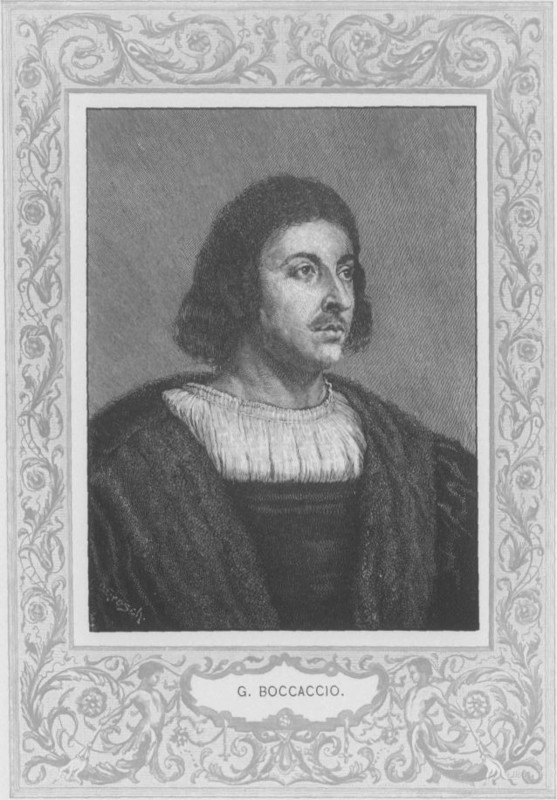
Boccaccio died at Certaldo in the Val d'Elsa, December 2d, 1375. Of the numerous works he left, that by which his fame as a writer is established is beyond any question the 'Decameron,' or Ten Days' Entertainment; in which a merry company of gentlemen and ladies, appalled by the plague raging in their Florence, take refuge in the villas near the city, and pass their time in story-telling and rambles in the beautiful country around, only returning when the plague has to a great extent abated. The superiority of the 'Decameron' is not only in the polish and grace of its style, the first complete departure from the stilted classicism of contemporary narrative, the happy naturalness of good story-telling,--but in the conception of the work as a whole, and the marvelous imagination of the filling-in between the framework of the story of the plague by the hundred tales from all lands and times, with the fine thread of the narrative of the day-by-day doings of the merry and gracious company, their wanderings, the exquisite painting of the Tuscan landscape (in which one recognizes the Val d'Arno even to-day), and the delicate drawing of their various characters. It is only when all these elements have been taken into consideration, and the unity wrought through such a maze of interest and mass of material without ever becoming dull or being driven to repetition, that we understand the power of Boccaccio as an artist.
We must take the ten days' holiday as it is painted: a gay and entrancing record of a fortunate and brilliant summer vacation, every one of its hundred pictures united with the rest by a delicate tracery of flowers and landscape, with bird-songs and laughter, bits of tender and chaste by-play--for there were recognized lovers in the company; and when this is conceived in its entirety, we must set it in the massive frame of terrible gloom of the great plague, through which Boccaccio makes us look at his picture. And then the frame itself becomes a picture; and its ghastly horror--the apparent fidelity of the descriptions, which makes one feel as if he had before him the evidence of an eye-witness--gives a measure of the power of the artist and the range of his imagination, from an earthly inferno to an earthly paradise, such as even the 'Commedia' does not give us. In this stupendous ensemble, the individual tales become mere details, filling in of the space or time; and, taken out of it, the whole falls into a mere story-book, in which the only charm is the polish of the parts, the shine of the fragments that made the mosaic. The tales came from all quarters, and only needed to be amusing or interesting enough to make one suppose that they had been listened to with pleasure: stories from the 'Gesta Romanorum,' the mediæval chronicles, or any gossip of the past or present, just to make a whole; the criticism one might pass on them, I imagine, never gave Boccaccio a thought, only the way they were placed being important. The elaborate preparation for the story-telling; the grouping of them as a whole, in contrast with the greater story he put as their contrast and foil; the solemn gloom, the deep chiaroscuro of this framing, painted like a miniature; the artful way in which he prepares for his lieta brigata the way out of the charnel-house: these are the real 'Decameron.' The author presents it in a prelude which has for its scope only to give the air of reality to the whole, as if not only the plague, but the 'Decameron,' had been history; and the proof of his perfect success is in the fact that for centuries the world has been trying to identify the villas where the merry men and maidens met, as if they really had met.
"Whenever, most gracious ladies, I reflect how pitiful you all are by nature, I recognize that this work will in your opinion have a sad and repulsive beginning, as the painful memory of the pestilence gone by, fraught with loss to all who saw or knew of it, and which memory the work will bear on its front. But I would not that for this you read no further, through fear that your reading should be always through sighs and tears. This frightful beginning I prepare for you as for travelers a rough and steep mountain, beyond which lies a most beautiful and delightful plain, by so much the more pleasurable as the difficulty of the ascent and passage of the mountain had been great. And as the extreme of pleasure touches pain, so suffering is effaced by a joy succeeding. To this brief vexation (I call it brief, as contained in few words) follow closely the sweets and pleasures I have promised, and which would not be hoped for from such a beginning if it were not foretold. And to tell the truth, if I had been able frankly to bring you where I wished by other way than this rough one, I had willingly done so; but because I could not, without these recollections, show what was the occasion of the incidents of which you will read, I was obliged to write of them."
The elaborate description of the plague which follows, shows not only Boccaccio's inventive power,--as being, like that of Defoe of the plague of London (which is a curious parallel to this) altogether imaginary, since the writer was at Naples during the whole period of the pestilence,--but also that it was a part indispensable of the entire scheme, and described with all its ghastly minuteness simply to enhance the value of his sunshine and merriment. He was in Naples from 1345 until 1350, without any other indication of a visit to Florence than a chronological table of his life, in which occurs this item:--"1348, departs in the direction of Tuscany with Louis of Taranto:" as if either a prince on his travels would take the plague in the course of them, or a man so closely interested in the events of the time at Naples, and in the height of his passion for Fiammetta,--the separation from whom he had hardly endured when earlier (1345) he was separated from her by his duty to his aged father,--would have chosen the year of the pestilence, when every one who could, fled Florence, to return there; and we find him in May, 1349, in Naples, in the full sunshine of Fiammetta's favor, and remaining there until his father's death in 1350.
There is indeed in Boccaccio's description of the plague that which convicts it of pure invention, quickened by details gathered from eye-witnesses,--the very minuteness of the description in certain points not in accord with the character of the disease, as when he narrates that the hogs rooting in the garments of the dead thrown out into the streets "presently, as if they had taken poison, after a few dizzy turns, fell dead"; and this, which he says he saw with his own eyes, is the only incident of which he makes this declaration (the incident on which the unity of his work hinges, the meeting of the merry troupe in the church of S. Maria Novella, being recorded on the information of a person "worthy of belief"). Nor does he in his own person intrude anywhere in the story; so that this bit of intense realization thrown into the near foreground of his picture, as it were by chance, and without meaning, yet certified by his own signature, is the point at which he gets touch of his reader and convinces him of actuality throughout the romance.
And to my mind this opening chapter, with all its horrors and charnel-house realization, its slight and suggestive delineation of character, all grace and beauty springing out of the chaos and social dissolution, is not only the best part of the work, but the best of Boccaccio's. The well-spun golden cord on which the "Novelle" are strung is ornamented, as it were, at the divisions of the days by little cameos of crafty design; but the opening, the portico of this hundred-chambered palace of art, has its own proportions and design, and may be taken and studied alone. Nothing can, it seems to me, better convey the idea of the death-stricken city, "the surpassing city of Florence, beyond every other in Italy most beautiful,"--a touch to enhance the depth of his shade, than the way he brings out in broad traits the greatness of the doom: setting in the heavens that consuming sun; the paralysis of the panic; the avarice of men not daunted by death; the helplessness of all flesh before--
"the just wrath of God for our correction sent upon men; for healing of such maladies neither counsel of physician nor virtue of any medicine whatever seemed to avail or have any effect--even as if nature could not endure this suffering or the ignorance of the medical attendants (of whom, besides regular physicians, there was a very great number, both men and women, who had never had any medical education whatever), who could discover no cause for the malady and therefore no appropriate remedy, so that not only very few recovered, but almost every one attacked died by the third day-after the appearance of the above-noted signs, some sooner and some later, and mostly without any fever or violent symptoms. And this pestilence was of so much greater extent that by merely communicating with the sick the well were attacked, just as fire spreads to dry or oiled matter which approaches it.... Of the common people, and perhaps in great part of the middle classes, the situation was far more miserable, as they, either through hope of escaping the contagion or poverty, mostly kept to their houses and sickened by thousands a day, and not being aided or attended in any respect, almost without exception died. And many there were who ended their lives in the public streets by day or night, and many who, dying in their houses, were only discovered by the stench of their dead bodies; and of these and others that died everywhere the city was full. These were mainly disposed of in the same way by their neighbors, moved more by the fear that the corruption of the dead bodies should harm them than by any charity for the deceased. They by themselves or with the aid of bearers, when they could find any, dragged out of their houses the bodies of those who had died, and laid them before the doors, where, especially in the morning, whoever went about the streets could have seen them without number,--even to that point had matters come that no more was thought of men dying than we think of goats; more than a hundred thousand human beings are believed to have been taken from life within the walls of Florence, which before the mortal pestilence were not believed to have contained so many souls. Oh! how many great palaces, how many beautiful houses, how many noble dwellings, once full of domestics, of gentlemen and ladies, became empty even to the last servant! How many historical families, how many immense estates, what prodigious riches remained without heirs! How many brave men, how many beautiful women, how many gay youths whom not only we, but Galen, Hippocrates, or Esculapius would have pronounced in excellent health, in the morning dined with their relatives, companions and friends, and the coming night supped with those who had passed away."
The ten companions, meeting in the church of S. Maria Novella, seven ladies and three gentlemen, agree to escape this doom, and, repairing to one of the deserted villas in the neighborhood, to pass the time of affliction in merry doings and sayings; and with four maids and three men-servants, move eastward out of the gloomy city. Their first habitation is clearly indicated as what is known to-day as the Poggio Gherardi, under Maiano. After the second day they return towards the city a short distance and establish themselves in what seems a more commodious abode, and which I consider incontrovertibly identified as the Villa Pasolini, or Rasponi, and which was in their day the property of the Memmi family, the famous pupils of Giotto. The site of this villa overlooks the Valley of the Ladies, which figures in the framework of the "Novelle," and in which then there was a lake to which Boccaccio alludes, now filled up by the alluvium of the Affrico, the author's beloved river, and which runs through the valley and under the villa. The valley now forms part of the estate of Professor Willard Fiske. As the entire adventure is imaginary, and the "merry company" had no existence except in the dreams of Boccaccio, it is useless to seek any evidence of actual occupation; but the care he put in the description of the localities and surroundings, distances, etc., shows that he must have had in his mind, as the framework of the story, these two localities. The modern tradition ascribing to the Villa Palmieri the honor of the second habitation has no confirmation of any kind.
The house-flitting is thus told:--
"The dawn had already, under the near approach of the sun, from rosy become golden: when on Sunday, the Queen[3] arising and arousing all her company, and the chamberlain--having long before sent in advance to the locality where they were to go, enough of the articles required so that he might prepare what was necessary--seeing the Queen on the way, quickly loading all other things as if it were the moving of the camp, went off with the baggage, leaving the servants with the Ladies and the Gentlemen. The Queen, then, with slow steps, accompanied and followed by her Ladies and the three Gentlemen, with the escort of perhaps twenty nightingales and other birds, by a little path not too frequented, but full of green plants and flowers which by the rising sun began to open, took the road towards the west; and gossiping, laughing, and exchanging witticisms with her brigade, arrived before having gone two thousand steps at a most beautiful and rich palace, which, somewhat raised above the plain, was posted on a hill."
[3] Each day a Queen or King was chosen to rule over the doings of the company and determine all questions.
As the description of the surroundings of the villa into which the gay assembly now entered is one of the most vivid and one of the gayest pieces of description in the brilliant counterfoil which the author has contrived, to set off the gloom of the city, it is worth giving entire; being as well a noble example of the prose of the 'Decameron':--
"Near to which [the balcony on which they had reposed after their walk] having ordered to open a garden which was annexed to the palace, being all inclosed in a wall, they entered in; and as it appeared to them on entering to be of a marvelous beauty altogether, they set themselves to examine it in detail. It had within, and in many directions through it, broad paths, straight as arrows and covered with arbors of vine which gave indications of having that year an excellent vintage, and they all giving out such odors to the garden, that, mingled with those of many other things which perfumed it, they seemed to be in the midst of all the perfumeries that the Orient ever knew; the sides of the paths being closed in by red and white roses and jasmine, so that not only in the morning, but even when the sun was high, they could wander at pleasure under fragrant and odoriferous shade, without entanglement. How many, of what kind, and how planted were the plants in that place, it were long to tell; but there is nothing desirable which suits our climate which was not there in abundance. In the midst of which (which is not less delightful than other things that were there, but even more so) was a meadow of the most minute herbs, and so green that it seemed almost black, colored by a thousand varieties of flowers, and closed around by green and living orange and lemon trees, which, having the ripe and the young fruit and the flowers together, gave not only grateful shade for the eyes, but added the pleasures of their odors. In the midst of that meadow was a fountain of the whitest marble with marvelous sculptures. From within this, I know not whether by a natural vein or artificial, through a figure which stood on a column in the midst of it, sprang so much water, and so high, falling also into the fountain with delightful sound, that it would at least have driven a mill. This, then (I mean the water which ran over from the fountain), through hidden channels went out of the meadow, and by little canals beautiful and artfully made becoming visible outside of it, ran all around it; and then by similar canals into every part of the garden, gathering together finally in that part of it where from the beautiful garden it escaped, and thence descending limpid to the plain, and before reaching it, with great force and not a little advantage to the master, turned two mills. To see this garden, its beautiful orderliness, the plants and the fountain with the brooks running from it, was so pleasing to the ladies and the three youths that all commenced to declare that if Paradise could be found on earth, they could not conceive what other form than that of this garden could be given to it, nor what beauty could be added to it. Wandering happily about it, twining from the branches of various trees beautiful garlands, hearing everywhere the songs of maybe twenty kinds of birds as it were in contest with each other, they became aware of another charm of which, to the others being added, they had not taken note: they saw the garden full of a hundred varieties of beautiful animals, and pointing them out one to the other, on one side ran out rabbits, on another hares, here lying roe-deer and there feeding stags, and besides these many other kinds of harmless beasts, each one going for his pleasure as if domesticated, wandering at ease; all which, beyond the other pleasures, added a greater pleasure. And when, seeing this or that, they had gone about enough, the tables being set around the beautiful fountain, first singing six songs and dancing six dances, as it pleased the Queen, they went to eat, and being with great and well-ordered service attended, and with delicate and good dishes, becoming gayer they arose and renewed music and song and dance, until the Queen on account of the increasing heat judged that whoever liked should go to sleep. Of whom some went, but others, conquered by the beauty of the place, would not go, but remained, some to read romances, some to play at chess and at tables, while the others slept. But when passed the ninth hour, they arose, and refreshing their faces with the fresh water, they came to the fountain, and in their customary manner taking their seats, waited for the beginning of the story-telling on the subject proposed by the Queen."
Of the character of the Novelle I have need to say little: they were the shaping of the time, and made consonant with its tastes, and nobody was then disturbed by their tone. Some are indelicate to modern taste, and some have passed into the classics of all time. The story of 'Griselda'; that of 'The Stone of Invisibility,' put into shape by Irving; 'Frederick of the Alberighi and his Falcon'; 'The Pot of Basil'; and 'The Jew Abraham, Converted to Christianity by the Immorality of the Clergy,' are stories which belong to all subsequent times, as they may have belonged to the ages before. Those who know what Italian society was then, and in some places still is, will be not too censorious, judging lightness of tongue and love of a good story as necessarily involving impurity. And Boccaccio has anticipated his critics in this vein, putting his apology in the mouth of Filomena, who replies to Neifile, when the latter speaks of scandal growing out of their holiday, "This amounts to nothing where I live virtuously and my conscience in no wise reproaches me--let them who will, speak against me: I take God and the truth for my defense."
FREDERICK OF THE ALBERIGHI AND HIS FALCON
You must know that Coppo di Borghese Domenichi--who was in our city, and perhaps still is, a man of reverence and of great authority amongst us, both for his opinions and for his virtues, and much more for the nobility of his family, being distinguished and wealthy and of enduring reputation, being full of years and experience--was often delighted to talk with his neighbors and others of the things of the past, which he, better than anybody else, could do with excellent order and with unclouded memory. Amongst the pleasant stories which he used to tell was this:--
In Florence there was a young man called Frederick, son of Master Philip Alberighi, who for military ability and for courteous manners was reputed above all other gentlemen of Tuscany, He, as often happens with gentlemen, became enamored of a gentle lady called Madonna Giovanni, in her time considered the most beautiful and most graceful woman in Florence. In order that he might win her love he tilted and exercised in arms, made feasts and donations, and spent all his substance without restraint. But Madonna Giovanni, no less honest than beautiful, cared for none of these things which he did for her, nor for him. Frederick then spent more than his means admitted, and gaining nothing, as easily happens, his money disappeared, and he remained poor and without any other property than a poor little farm, by the income of which he was barely able to live; besides this, he had his falcon, one of the best in the world. On this account, and because unable to remain in the city as he desired, though more than ever devoted, he remained at Campi, where his little farm was; and there, as he might hunt, he endured his poverty patiently.
Now it happened one day when Frederick had come to extreme poverty, that the husband of Madonna Giovanni became ill, and seeing death at hand, made his will; and being very rich, in this will left as his heir his son, a well-grown boy; and next to him, as he had greatly loved Madonna Giovanni, he made her his heir if his son should die without legitimate heirs, and then died. Remaining then a widow, as the custom is amongst our women, Madonna Giovanni went that summer with her son into the country on an estate of hers near to that of Frederick, so that it happened that this boy, beginning to become friendly with Frederick and to cultivate a liking for books and birds, and having seen many times the falcon of Frederick fly, took an extreme pleasure in it and desired very greatly to have it, but did not dare to ask it, seeing that it was so dear to Frederick.
In this state of things it happened that the boy became ill, and on this account the mother sorrowing greatly, he being that which she loved most of everything which she had, tended him constantly and never ceased comforting him; and begged him that if there was anything that he wanted, to tell her, so that she certainly, if it were possible to get it, would obtain it for him. The young man, hearing many times this proposal, said: "Mother, if you can manage that I should have the falcon of Frederick, I believe that I should get well at once." The mother, hearing this, reflected with herself and began to study what she might do. She knew that Frederick had long loved her, and that he had never received from her even a look; on this account she said, How can I send to him or go to him, to ask for this falcon, which is, by what I hear, the thing that he most loves, and which besides keeps him in the world; and how can I be so ungrateful as to take from a gentleman what I desire, when it is the only thing that he has to give him pleasure? Embarrassed by such thoughts, and feeling that she was certain to have it if she asked it of him, and not knowing what to say, she did not reply to her son, but was silent. Finally, the love of her son overcoming her, she decided to satisfy him, whatever might happen, not sending but going herself for the falcon; and she replied, "My son, be comforted and try to get well, for I promise you that the first thing that I do to-morrow will be to go and bring to you the falcon;" on which account the son in his joy showed the same day an improvement. The lady the next day took as companion another lady, and as if for pleasure went to the house of Frederick and asked for him. It being early, he had not been hawking, and was in his garden attending to certain little operations; and hearing that Madonna Giovanni asked for him at the door, wondering greatly, joyfully went. She, seeing him coming, with a ladylike pleasure went to meet him, and Frederick having saluted her with reverence, she said, "I hope you are well, Frederick," and then went on, "I have come to recompense you for the losses which you have already had on my account, loving me more than you need; and the reparation is, then, that I intend with this my companion to dine with you familiarly to-day." To this Frederick humbly replied, "Madonna, I do not remember ever to have suffered any loss on your account, but so much good that if I ever was worth anything, it is due to your worth, and to the love which I have borne you; and certainly your frank visit is dearer to me than would have been the being able to spend as much more as I have already spent, for you have come to a very poor house." So saying, he received them into his house in humility and conducted them into his garden; and then, not having any person to keep her company he said, "Madonna, since there is no one else, this good woman, the wife of my gardener, will keep you company while I go to arrange the table."
He, although his poverty was so great, had not yet realized how he had, without method or pleasure, spent his fortune; but this morning, finding nothing with which he could do honor to the lady for whose love he had already entertained so many men, made him think and suffer extremely; he cursed his fortune, and as a man beside himself ran hither and thither, finding neither money nor anything to pawn. It being late, and his desire to honor the gentle lady in some manner, and not wishing to call on anybody else, but rather to do all himself, his eyes fell upon his beloved falcon, which was in his cage above the table. He therefore took it, and finding it fat, and not having any other resource, he considered it to be a proper food for such a woman; and without thinking any further, he wrung its neck and ordered his servant that, it being plucked and prepared, it should be put on the spit and roasted immediately. And setting the table with the whitest of linen, of which he had still a little left, with a delighted countenance he returned to the lady and told her that such dinner as he was able to prepare for her was ready. Thereupon, the lady with her companion, rising, went to dinner, and without knowing what she ate or what Frederick served, ate the good falcon.
Then leaving the table, and after pleasant conversation with him, it appeared to the lady that it was time to say what she had come for, and so she began amiably to say to Frederick:--"Frederick, recalling your past life and my honesty, which perhaps you considered cruelty and severity, I do not doubt in the least that you will be astonished at my presumption, hearing what I have come for; but if you had ever had children, through whom you might know how great is the love which one bears them, it seems to me certain that in part you would excuse me. But as you have not, I, who have one, cannot escape the law common to all mothers; obeying which, I am obliged, apart from my own pleasure and all other convention and duty, to ask of you a gift which I know is extremely dear, and reasonably so, because no other delight and no other amusement and no other consolation has your exhausted fortune left you; this gift is your falcon, which my boy has become so strongly enamored of, that if I do not take it to him I fear that his illness will become so much aggravated that I may lose him in consequence; therefore I pray you, not on account of the love which you bear me, but because of your nobility, which has shown greater courtesy than that of any other man, that you would be so kind, so good, as to give it to me, in order that by this gift the life of my son may be preserved, and I be forever under obligation to you."
[3] Each day a Queen or King was chosen to rule over the doings of the company and determine all questions.
"The dawn had already, under the near approach of the sun, from rosy become golden: when on Sunday, the Queen[3] arising and arousing all her company, and the chamberlain--having long before sent in advance to the locality where they were to go, enough of the articles required so that he might prepare what was necessary--seeing the Queen on the way, quickly loading all other things as if it were the moving of the camp, went off with the baggage, leaving the servants with the Ladies and the Gentlemen. The Queen, then, with slow steps, accompanied and followed by her Ladies and the three Gentlemen, with the escort of perhaps twenty nightingales and other birds, by a little path not too frequented, but full of green plants and flowers which by the rising sun began to open, took the road towards the west; and gossiping, laughing, and exchanging witticisms with her brigade, arrived before having gone two thousand steps at a most beautiful and rich palace, which, somewhat raised above the plain, was posted on a hill."
Frederick, hearing what the lady demanded, and knowing that he could not serve her, because he had already given it to her to eat, commenced in her presence to weep so that he could not speak a word in reply; which weeping the lady first believed to be for sorrow at having to give up his good falcon more than anything else, and was about to tell him that she did not want it, but, hesitating, waited the reply of Frederick until the weeping ceased, when he spoke thus:--"Madonna, since it pleased God that I bestowed my love upon you, money, influence, and fortune have been contrary to me, and have given me great trouble; but all these things are trivial in respect to what fortune makes me at present suffer, from which I shall never have peace, thinking that you have come here to my poor house--to which while I was rich you never deigned to come--and asked of me a little gift, and that fortune has so decreed that I shall not be able to give it to you; and why I cannot do so I will tell you in a few words. When I heard that you in your kindness wished to dine with me, having regard for your excellence and your worth, I considered it worthy and proper to give you the dearest food in my power, and therefore the falcon for which you now ask me was this morning prepared for you, and you have had it roasted on your plate and I had prepared it with delight; but now, seeing that you desire it in another manner, the sorrow that I cannot so please you is so great that never again shall I have peace;" and saying this, the feathers and the feet and the beak were brought before them in evidence; which thing the lady seeing and hearing, first blamed him for having entertained a woman with such a falcon, and then praised the greatness of his mind, which his poverty had not been able to diminish. Then, there being no hope of having the falcon on account of which the health of her son was in question, in melancholy she departed and returned to her son; who either for grief at not being able to have the falcon, or for the illness which might have brought him to this state, did not survive for many days, and to the great sorrow of his mother passed from this life.
She, full of tears and of sorrow, and remaining rich and still young, was urged many times by her brothers to remarry, which thing she had never wished; but being continually urged, and remembering the worth of Frederick and his last munificence, and that he had killed his beloved falcon to honor her, said to her brothers:--"I would willingly, if it please you, remain as I am; but if it please you more that I should take a husband, certainly I will never take any other if I do not take Frederick degli Alberighi." At this her brothers, making fun of her, said, "Silly creature, what do you say? Why do you choose him? He has nothing in the world." To this she replied, "My brothers, I know well that it is as you say; but I prefer rather a man who has need of riches, than riches that have need of a man." The brothers, hearing her mind, and knowing Frederick for a worthy man,--although poor,--as she wished, gave her with all her wealth to him; who, seeing this excellent woman whom he had so much loved become his wife, and besides that, being most rich, becoming economical, lived in happiness with her to the end of his days.
THE JEW CONVERTED TO CHRISTIANITY BY GOING TO ROME
As I, gracious ladies, have heard said, there was in Paris a great merchant, a very good man, who was called Gianotto di Chevigné, a man most loyal and just, who had a great business in stuffs, and who had a singular friendship with a rich Jew named Abraham, who also was a merchant and also an honest and loyal man. Gianotto, seeing his justice and loyalty, began to feel great sorrow that the soul of so worthy and good a man should go to perdition through want of religion, and on that account he began to beg in a friendly way that he would abandon the errors of the Jewish faith and become converted to Christian truth, in which he could see, being holy and good, that he would always prosper and enrich himself; while in his own faith, on the contrary, he might see that he would diminish and come to nothing, The Jew replied that he did not believe anything either holy or good outside of Judaism; that he in that was born and intended therein to live, and that nothing would ever move him out of it.
Gianotto did not cease on this account to repeat after a few days similar exhortations, showing him in a coarse manner, which merchants know how to employ, for what reasons our faith was better than the Jewish; and though the Jew was a great master in the Jewish law, nevertheless either the great friendship which he had with Gianotto moved him, or perhaps the words which the Holy Spirit put on the tongue of the foolish man accomplished it, and the Jew began finally to consider earnestly the arguments of Gianotto; but still, tenacious in his own faith, he was unwilling to change. As he remained obstinate, so Gianotto never ceased urging him, so that finally the Jew by this continual persistence was conquered, and said:--"Since, Gianotto, it would please you that I should become a Christian and I am disposed to do so, I will first go to Rome and there see him whom you call the vicar of God on earth, and consider his manners and his customs, and similarly those of his brother cardinals; and if they seem to me such that I can, between your words and them, understand that your religion is better than mine, as you have undertaken to prove to me, I will do what I have said; but if this should not be so, I will remain a Jew as I am." When Gianotto heard this he was very sorrowful, saying to himself: I have lost all my trouble which it seemed to me I had very well employed, believing that I had converted this man; because if he goes to the court at Rome and sees the wicked and dirty life of the priests, he not only, being a Jew, will not become a Christian, but if he had become a Christian he would infallibly return to Judaism.
Therefore Gianotto said to Abraham:--"Alas, my friend, why do you desire to take this great trouble and expense of going from here to Rome? By land and by sea, even to a rich man as you are, it is full of trouble. Do you not believe that here we can find one who will baptize you? and if perchance you have still some doubts as to the religion which I show you, where are there better teachers and wiser men in this faith than there are here, to immediately tell you what you want to know or may ask? On which account my opinion is that this voyage is superfluous: the prelates whom you would see there are such as you can see here, and besides they are much better, as they are near to the chief Shepherd; and therefore this fatigue you will, by my counsel, save for another time,--for some indulgence in which I may perhaps be your companion." To this the Jew replied:--"I believe, Gianotto, that it is as you say to me; but summing up the many words in one, I am altogether, if you wish that I should do what you have been constantly begging me to do, disposed to go there; otherwise I will do nothing." Gianotto seeing his determination said, "Go, and good luck go with you;" but he thought to himself that Abraham never would become a Christian if he had once seen the court of Rome, but as he would lose nothing he said no more.
The Jew mounted his horse, and as quickly as possible went to the court of Rome, where arriving, he was by his fellow Jews honorably received; and living there without saying to anybody why he came, began cautiously to study the manners of the Pope and the cardinals and the prelates and all the other courtesans; and he learned, being the honest man that he was, and being informed by other people, that from the greatest to the lowest they sinned most dishonestly, not only in natural but in unnatural ways, without any restraint or remorse to shame them; so much so that for the poor and the dissolute of both sexes to take part in any affair was no small thing. Besides this he saw that they were universally gluttons, wine-drinkers, and drunkards, and much devoted to their stomachs after the manner of brute animals; given up to luxury more than to anything else. And looking further, he saw that they were in the same manner all avaricious and desirous of money, so that human blood, even that of Christians, and sacred interests, whatever they might be, even pertaining to the ceremonies or to the benefices, were sold and bought with money; making a greater merchandise out of these things and having more shops for them than at Paris of stuffs or any other things, and to the most open simony giving the name and support of procuration, and to gluttony that of sustentation: as if God, apart from the signification of epithets, could not know the intentions of these wretched souls, but after the manner of men must permit himself to be deceived by the names of things. Which, together with many other things of which we will say nothing, so greatly displeased the Jew, that as he was a sober and modest man it appeared to him that he had seen enough, and proposed to return to Paris. Accordingly he did so; upon which Gianotto, seeing that he had returned, and hoping nothing less than that he should have become a Christian, came and rejoiced greatly at his return, and after some days of rest asked him what he thought of the Holy Father, the cardinals, and the other courtesans; to which the Jew promptly replied:--"It seems to me evil that God should have given anything to all those people, and I say to you that if I know how to draw conclusions, there was no holiness, no devotion, no good work or good example of life in any other way, in anybody who was a priest; but luxury, avarice, and gluttony,--such things and worse, if there could be worse things in anybody; and I saw rather liberty in devilish operations than in divine: on which account I conclude that with all possible study, with all their talent and with all their art, your Shepherd, and consequently all the rest, are working to reduce to nothing and to drive out of the world the Christian religion, there where they ought to be its foundation and support. But from what I see, what they are driving at does not happen, but your religion continually increases; and therefore it becomes clearer and more evident that the Holy Spirit must be its foundation and support, as a religion more true and holy than any other. On which account, where I was obstinate and immovable to your reasoning and did not care to become a Christian, now I say to you distinctly that on no account would I fail to become a Christian. Therefore let us go to church, and there according to the custom of your holy religion let me be baptized."
Gianotto, who had expected exactly the opposite conclusion to this, when he heard these things was more satisfied than ever a man was before, and with him he went to Notre Dame of Paris and requested the priest there to give Abraham baptism: who, hearing what he asked, immediately did so; and Gianotto was his sponsor and named him Giovanni, and immediately caused him by competent men to be completely instructed in our religion, which he at once learned and became a good and worthy man and of a holy life.
THE STORY OF SALADIN AND THE JEW USURER
Saladin, whose valor was so great that he not only became from an insignificant man Sultan of Babylon, but also gained many victories over the Saracen and Christian kings, having in many wars and in his great magnificence spent all his treasure, and on account of some trouble having need of a great quantity of money, nor seeing where he should get it quickly as he had need to, was reminded of a rich Jew whose name was Melchisedech, who loaned at interest at Alexandria; and thinking to make use of him if he could, though he was so avaricious that of his own good-will he would do nothing, the Sultan, not wishing to compel him, but driven by necessity, set himself to devise means by which the Jew should satisfy him, and to find some manner of compelling him to do so with a good pretext. Thus thinking, he called him, and receiving him familiarly, said to him: "My good man, I hear from many here that you are the wisest and in divine affairs the most profound of men, and on that account I would like to know from you which of the three good religions you consider the true one: the Jewish, the Saracenic, or the Christian?" The Jew, who really was a wise man, saw too clearly that the Sultan desired to catch him in his words in order to raise against him some question, and decided not to praise any one of the religions more than the other, so that the Sultan should not accomplish his purpose; on account of which, as one who seemed to have need of a reply as to which there could not be any reasoning, and his wits being sharpened, there quickly came to him what he ought to say, and he said:--
"My lord, the question which you have put to me is important, and in order to explain to you what I think, it is necessary to tell you a fable which you will hear. If I do not mistake, I have heard tell many times of a great and rich man who lived once, and who amongst other jewels had a beautiful and valuable ring, the most precious in his treasury, which on account of its value and its beauty he desired to honor and to leave in perpetuity to his descendants; and he ordered that that one of his sons to whom this ring should be left, as it had been to him, should be considered his heir and be by all the others honored and reverenced. The one to whom this ring should be left should give a similar order to his descendants, and do as had done his predecessor. In short, this ring went from hand to hand to many successors, and finally came to the hands of one who had three sons, honest men, virtuous and all obedient to their father, on which account he loved all three equally; and the young men, who knew the custom of the ring, as each one desired to be the most honored amongst them, each one to the utmost of his power urged the father to leave the ring to him when death should take him. The worthy man, who loved them all alike, not knowing himself how to choose to whom he should leave it, decided, having promised each one, to satisfy all three: and secretly ordered from a good workman two others, which were so similar to the first that he himself who had made them could scarcely tell which was the true one; and death approaching, he secretly gave to each one of his sons his ring. After the death of the father, each one wishing to enjoy the heritage and denying it to the others, each produced a ring in evidence of his rights, and finding them so similar that no one could tell which was the true one, the question which was the real heir of the father remained undecided, and it is still undecided. And so I say to you, my lord, of the three religions given to the three people by God the Father, concerning which you put me this question, that each one believes that he has as his heritage the true law; but as it is with the three rings, the question is still quite undecided."
Saladin, recognizing how this man had most cleverly escaped from the trap which had been set before his feet, decided on that account to expose to him his necessities and see if he was willing to help him; and so he did, saying that which he had intended to say if the Jew had not replied so wisely as he had done. The Jew freely accorded to Saladin whatever he asked, and Saladin gave him entire security, and besides that he gave him great gifts and retained him always as his friend, and kept him in excellent and honorable condition always near to himself.
THE STORY OF GRISELDA
A long time ago, in the family of the Marquis Saluzzo, the head of the house was a young man called Walter, who, having neither wife nor children, spent his time entirely in hunting and hawking, and never troubled himself to marry or to have a family,--on account of which he was considered very wise. This thing not being pleasing to his retainers, they many times begged of him that he should take a wife, in order that he should not be without an heir and they without a master, offering to find him one descended from such a father and mother that he might hope to have successors and they be satisfied. To which Walter replied:--"My friends, you urge me to what I have never been disposed to do, considering how grave a matter it is to find a woman who adapts herself to one's ways, and on the contrary how great are the burdens and how hard the lives of those who happen on wives who do not suit them. And to say that you know daughters from the fathers and mothers, and from that argue that you can give me what will satisfy me, is a foolishness; since I do not know how you can learn the fathers or know the secrets of the mothers of these girls, since even knowing them oft-times we find the daughters very different from the fathers and mothers: but since you desire to entangle me in these chains, I wish to be satisfied; and in order that I should not have to suffer through others than myself if any mistake should be made, I wish myself to be the finder, assuring you that if I do not take this responsibility and the woman should not be honorable, you would find out to your very great loss how much opposed to my desire it was to have taken a wife at your supplication."
The good men were satisfied, so long as he would take a wife. For a long time the ways of a poor young woman who belonged to a little house near his own had attracted Walter, and as she was sufficiently beautiful, he considered that with her he might have a life peaceful enough; and on that account, without going any further, he proposed to marry this one, and calling upon her father, who was very poor, arranged with him to marry her. This being arranged, he convoked his friends and said to them: "My friends! it has pleased and pleases you that I should dispose myself to marry, and I am so disposed more to please you than for the desire that I should have a wife. You know what you promised me,--that is, to be satisfied with and to honor as your lady whoever I should select; and, for that the time has come that I should keep my promise to you, and I wish you to keep yours to me, I have found very near here a young woman according to my heart, whom I intend to take for my wife and to bring her in a few days to my house; and for this you must think how the entertainment of the day shall be attractive and how you will honorably receive her, in order that I may show myself satisfied with the fulfillment of your promise as you may consider yourselves with mine."
The good men, joyful, all replied that that gave them pleasure, and whoever it might be, they would accept her for lady and would honor her in everything as their lady. This being arranged, all set themselves to making a magnificent, joyful, and splendid festa, which also did Walter. He prepared for the wedding festivities very abundantly and magnificently, and invited many of his friends, great gentlemen, his relatives and others from all around. And beyond this he had dresses cut and made up by the figure of a young woman who, he thought, had the same figure as the woman he proposed to marry. And besides this, he arranged girdles and rings and a rich and beautiful coronet, and everything that a newly married bride should demand.
On the day settled for the wedding, Walter, about the third hour, mounted his horse, as did all those who had come to honor him, and having arranged everything conveniently, said, "Gentlemen, it is time to go to take the bride;" and starting with his company he arrived at the little villa, and going to the house of the father of the girl, and finding her returning in great haste with water from the spring, in order to go with the other women to see the bride of Walter, he called her by name,--that is, Griselda,--and asked her where her father was, to which she modestly replied, "My lord, he is in the house." Then Walter, dismounting and commanding his men that they should wait for them, went along into the little house, where he found her father, whose name was Giannucoli, and said to him, "I have come to marry Griselda, but I wish to learn certain things in your presence." He then asked her if, should he take her for his wife, she would do her best to please him, and at nothing that he should do or say would she trouble herself, and if she would be obedient, and many such-like questions, to all of which she replied "yes." Then Walter took her by the hand, and in the presence of all his company and all the other persons had her stripped naked, and calling for the dresses which he had had made, immediately had her dressed and shod, and on her hair, disheveled as it was, had the crown put; and all this being done while everybody marveled, Walter said:--"Gentlemen, this is she whom I intend shall be my wife if she wishes me for husband" and then, turning to her, who stood by herself abashed and confused, said to her, "Griselda, will you take me for your husband?" To which Griselda replied, "Yes, my lord;" and he said, "I desire her for my wife, and in the presence of the assembly to marry her;" and mounting her on a palfrey he led her, honorably accompanied, to his house. There the marriage ceremonies were fine and great, and the festivities were not less than if he had married the daughter of the king of France.
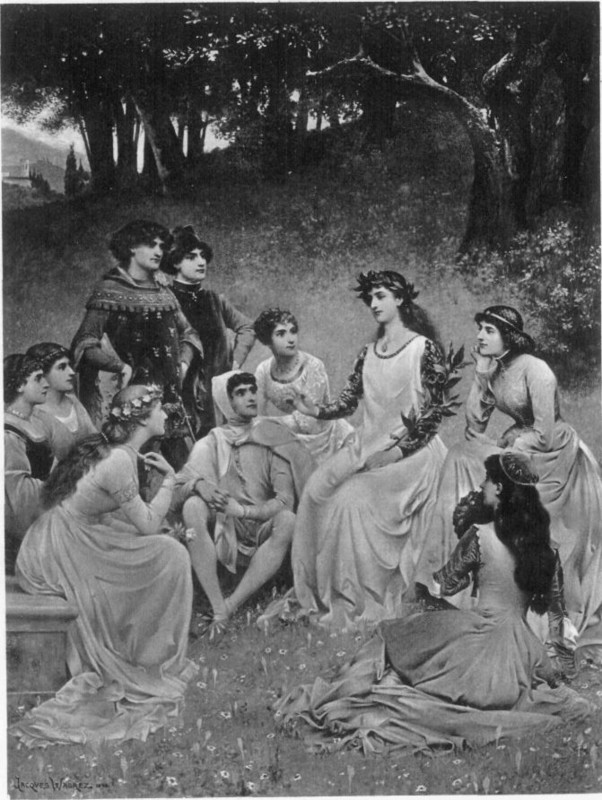
The Decameron
This is a collection of 100 tales written by Boccaccio, and published in 1353. Seven ladies and three gentlemen of Florence, during the plague of 1348, are supposed to be enjoying themselves in a garden telling stories--ten each day for ten days.
Photogravure from a Painting by Jacques Wagrez.
It seemed as if the young bride, in changing her vestments, changed her mind and her manners. She was, as we have said, in figure and face beautiful; and as she was beautiful she became so attractive, so delightful, and so accomplished, that she did not seem to be the daughter of Giannucoli the keeper of sheep, but of some noble lord, which made every man who had known her astonished; and besides this, she was so obedient to her husband and so ready in service that he was most contented and delighted; and similarly, toward the subjects of her husband she was so gracious and so kind that there was no one who did not love her more than himself; and gentlemen honored her with the best good-will, and all prayed for her welfare and her health and advancement. Whereupon they who had been accustomed to say that Walter had done a foolish thing in marrying her, now said that he was the wisest and the most far-seeing man in the world, because no other than he would have been able to see her great virtue hidden under the poor rags of a peasant's costume. In a short time, not only in his own dominions but everywhere, she knew so well how to comport herself that she made the people talk of his worth and of his good conduct, and to turn to the contrary anything that was said against her husband on account of his having married her.
She had not long dwelt with Walter when she bore a daughter, for which Walter made great festivities; but a little afterwards, a new idea coming into his mind, he wished with long experience and with intolerable proofs to try her patience. First he began to annoy her with words, pretending to be disturbed, and saying that his men were very discontented with her low condition, and especially when they saw that she had children; and of the daughter, that she was born most unfortunately; and he did nothing but grumble. But the lady, hearing these words, without changing countenance or her demeanor in any way, said, "My lord, do with me what you think your honor and your comfort demand, and I shall be satisfied with everything, as I know that I am less than they, and that I was not worthy of this honor to which you in your courtesy called me." This reply pleased Walter much, knowing that she was not in any arrogance raised on account of the honor which he or others had done her.
A little while afterwards, having often repeated to his wife that his subjects could not endure this daughter born of her, he instructed one of his servants and sent him to her, to whom with sorrowful face he said, "My lady, if I do not wish to die, I am obliged to do what my lord commands me; he has commanded that I should take your daughter and that I--" and here he stopped. The lady, seeing the face of the servant and hearing the words that he said, and the words said by her husband, bethinking herself, understood that this man had been ordered to kill the child; upon which, immediately taking her from the cradle, kissing her, and placing her as if in great sorrow to her heart, without changing countenance she placed her in the arms of the servant and said, "Take her and do exactly what your and my lord has imposed on you to do, but do not leave her so that the beasts and the birds shall devour her, unless he should have commanded you that." The servant having taken the child and having repeated to Walter what his wife had said, he, marveling at her constancy, sent him with her to Bologna to one of his relatives, beseeching him that without ever saying whose daughter she might be, he should carefully rear her and teach her good manners. It happened that the lady again in due time bore a son, who was very dear to Walter. But not being satisfied with what he had done, with greater wounds he pierced his wife, and with a countenance of feigned vexation one day he said to her, "My lady, since you have borne this male child I have in no way been able to live with my people, so bitterly do they regret that a grandchild of Giannucoli should after me remain their lord; and I make no question that if I do not wish to be deposed, it will be necessary to do what I did before, and in the end leave you and take another wife." The lady with patience heard him, and only replied, "My lord! think of your own content, and do your own pleasure, and have no thought of me; because nothing is so agreeable to me as to see you satisfied." A little after, Walter, in the same manner as he had sent for the daughter, sent for the son, and in the same way feigned to have ordered it to be killed, and sent him to nurse in Bologna as he had sent the daughter. On account of which thing the lady behaved no otherwise and said no other word than she had done for the daughter. At this Walter marveled greatly, and declared to himself that no other woman could have done what she did; and had it not been that he found her most affectionate to her children, as he saw her to be, he would have believed that she could only do so because she did not care for them, although he knew her to be very prudent. His subjects, believing that he had had the child killed, blamed him greatly and considered him a most cruel man, and had great compassion for the lady, who, with the women who came to condole with her on the death of her children, never said other thing than that that pleased her which pleased her lord who had begotten them.
But many years having passed since the birth of the daughter, it seemed time to Walter to make the last proof of her patience; and so he said to many of his people that in no way could he endure any longer to have Griselda for his wife, and that he recognized that he had done badly and like a boy when he took her for wife, and that on that account he intended to apply to the Pope for a dispensation that he might take another wife and leave Griselda. On which account he was much reproved by very good men, to which he replied in no other wise than that it was convenient that he should do so. The lady, hearing these things, and seeing that it was necessary for her to look forward to returning to her father's house, and perhaps to watch the sheep as she had in other times done, and to see that another should have him to whom she wished nothing but good, suffered greatly in her own mind; but also, as with the other injuries which she had endured from fortune, so with a firm countenance she disposed herself to support even this. Not long afterwards, Walter had caused to be sent to him counterfeit letters from Rome, which he showed to all his subjects to inform them that the Pope had given him the dispensation to take another wife and leave Griselda. After which, having called her to him, in the presence of many people he said:--"Lady, by the dispensation made to me by the Pope I may take another wife and leave you; and because my ancestors were great gentlemen and lords in this country, whereas yours have always been workmen, I mean that you shall not longer be my wife, but that you shall return to the house of your father with the dowry which you brought me, and that I shall take another wife whom I have found more fitting for me." The lady, hearing these words, not without great difficulty and contrary to the nature of women kept back her tears, and replied:--"I knew always my low condition not to suit in any way your nobility, and what I have done, by you and by God will be recognized: nor have I ever acted or held it as given to me, but simply always had it as a loan; it pleases you to take it back, and to me it ought to give pleasure to return it to you. Here is your ring with which you married me; take it. You command me to take back the dowry which I brought you; to do which neither of you to pay it nor of me to receive it will demand either a purse or a beast of burden, because it has escaped your mind that you took me naked: and if you consider it honest that this body by which I have borne the children begotten by you shall be seen by everybody, I will go away naked; but I pray you in consideration of my virginity, which I brought to you and which I cannot take away, that at least a single shirt more than my dowry it will please you that I shall take." Walter, who had more desire to weep than anything else, remained with a hard face and said, "You may take with you a shirt." He was prayed by all who were about him that one garment more he should give, that it should not be seen that she who had been his wife for thirteen years or more should leave his house so poorly and shamefully as to go away in her shirt; but in vain were the prayers made. On which account the lady in her shirt, and barefoot, and without anything on her head, went out of the house and returned to the house of her father with the tears and lamentations of all who saw her.
Giannucoli, who had never been able to consider it a reality that Walter should have taken his daughter for a wife, and expected every day this end, had kept the clothes which had been taken from her that morning that Walter married her; so that bringing them to her, she dressed herself in them and returned to the little service of her father's house as she had been accustomed, supporting with a strong mind these savage attacks of fortune. When Walter had done this, he gave his people to understand that he had taken the daughter of one of the Counts of Panago for a wife, and having great preparations made for the marriage, sent for Griselda that she should come; to whom, having come, he said:--"I bring this lady whom I have now taken, and intend on her arrival to honor her, and you know that I have not in the house women who know how to arrange the chambers and to do many things that pertain to such festivities; on which account you, who better than anybody else know the things in this house, shall put in order whatever there is to be done, and cause to be invited the ladies whom you see fit, as if you were mistress here; then, after the marriage ceremony, you can go back to your house." Although these words were like so many knives in the heart of Griselda, as she had not been able to divest herself of the love which she bore him as she had of her good fortune,--she replied, "My lord, I am ready and prepared;" and so entered with her coarse peasant's clothing in the house from which she had shortly before gone in her shirt, and began to sweep and put in order the rooms, the hangings and carpets for the halls, and to put the kitchen in order, and in every respect as if she had been a little servant in the house, did she put her hand. Nor did she pause until she had put everything in order and arranged it as it was most convenient. And having done this, and Walter at her indications having invited all the ladies of the country, she began to arrange the festivities; and when the day of the marriage came, with the apparel which she had on her back, but with the mind and manner of a lady, received with a cheerful countenance all the ladies who came. Walter, who had had his children educated carefully by a relative in Bologna who had married into the house of the Counts of Panago,--the girl being already of the age of twelve years and the most beautiful creature that ever was seen, and the boy being of six,--had written to his relative at Bologna, praying him that he would be kind enough to come with this his daughter to Saluzzo, and to arrange to bring with him a fine and honorable company, and to say to all that these things were brought for his wife, without telling anything to anybody that it was otherwise. Having done what the Marquis asked of him, the Count started on his way after several days with the girl and her brother and with a noble company, and arrived at Saluzzo at the hour of dinner, when all the peasants and many neighbors were present waiting for the new bride of Walter; who being received by the ladies and going into the hall where the tables were set, Griselda came forward joyfully to meet her, saying, "Welcome, my lady." The ladies (who had much, but in vain, prayed Walter that he would arrange that Griselda should remain in the chamber, or that he would give her some one of the dresses which had been hers, in order that she should not appear in this way before his strangers) were set at the table and had begun to be served. The girl was looked at by every man, and everybody said that Walter had made a good exchange: but amongst the others Griselda praised her most; both her and her little brother.
Walter, who seemed to have finally learned as much as he desired of the patience of his lady, and seeing that the enduring of these things produced no change in her, and being certain that this did not happen from hypocrisy, because he knew that she was very wise, considered it time to lighten her of the bitterness which he felt that she held hidden in her heart under her strong self-control. Therefore, calling her in presence of all the company, and smiling, he said, "What do you think of our bride?" "My lord," replied Griselda, "she seems to me very good, and if she is as wise as she is beautiful, as I believe, I do not doubt in the least that you will live with her the most comfortable gentleman in the world. But I pray you as much as I can that these cruelties which you bestowed on the other which was yours you will not give to this one, because I believe that she could not support them; partly because she is young, and again because she has been brought up delicately, while the other has been always accustomed to hardships from a child." Walter, seeing that she firmly believed that this one was his wife, nor on that account spoke otherwise than well, made her sit down at his side and said:--"Griselda, it is time now that you should feel the rewards of your long patience, and that those who have considered me a cruel, wicked, and brutal man should know that that which I have done was done for a purpose, wishing to teach you to be a wife, and them to know how to take and to keep one, and for myself for the establishment of unbroken quiet while I live with you. Because when I came to take a wife I had great fear that this could not be the case, and on that account, and to assure myself in all the ways which you know, I have tried to pain you. And yet I have never perceived that either in thought or deed have you ever contradicted my pleasure: convinced that I shall have from you that comfort which I desire, I now intend to return to you all at once what I took from you on several occasions; and with the greatest tenderness to heal the wounds which I have given you; and so with a happy soul know this one whom you believed to be my bride, and this one her brother, as your and my children; they are those whom you and many others have long believed that I had cruelly caused to be killed; and I am your husband who above all things loves you, believing that I may boast that there is no other man who may be as well satisfied with his wife as I am." And so saying he embraced her and kissed her, and with her, who wept for joy, rising, went where the daughter sat stupefied, hearing these things; and, embracing her tenderly and her brother as well, undeceived her and as many as were there. The ladies, joyfully rising, went with Griselda to her chamber, and with the most joyful wishes dressed her as a lady,--which even in her rags she had seemed,--and then brought her back to the hall; and there, making with the children a wonderful festivity, every person being most joyful over these things, the rejoicings and the festivities were kept up for many days, and they all considered Walter the wisest of men, as they had considered bitter and intolerable the proofs which he had imposed on his wife; and especially they considered Griselda most discreet.
The Count of Panago returned after a few days to Bologna, and Walter, having taken Giannucoli from his work, settled him in the condition of his father-in-law, so that he lived with great honor and with great comfort and so finished his old age. And Walter afterwards, having married his daughter excellently, long and happily lived with Griselda, honoring her always as much as he could. And here we may say that as in royal houses come those who are much more worthy to keep the hogs than to have government over men, so even into poor houses there sometimes come from Heaven divine spirits besides Griselda, who could have been able to suffer with a countenance not merely tearless but cheerful the severe, unheard-of proofs imposed on her by Walter; to whom it would perhaps not have been unjust that he should have happened on one who, when he turned her out of his house in her shirt, should have become unfaithful with another, as his actions would have made fitting.
FRIEDRICH MARTIN VON BODENSTEDT
(1819-1892)

odenstedt was born at Peine, Hanover, April 22d, 1819. From his earliest years his poetic nature broke through the barriers of his prosaic surroundings; but in spite of these significant manifestations, the young poet was educated to be a merchant. He was sent to a commercial school in Brunswick, and then put to serve an apprenticeship in business. His inclinations, however, were not to be repressed; and he devoted all of his holidays and many hours of the night to study and writing. At last he conquered his adverse fate, and at the age of twenty-one entered the University. He studied at Göttingen, Munich, and Berlin, and then through a fortunate chance went to Moscow as tutor in the family of Prince Galitzin. Here he remained three years, during which time he diligently studied the Slavonic languages and literature.
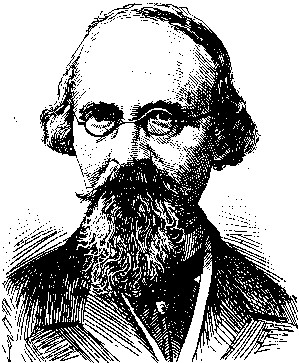
Bodenstedt.
The first fruits of these studies were translations from the poems of Kaslow, Pushkin, and Lermontoff (1843); which were considered equal to the originals in poetic merit. In Stuttgart, two years later, appeared his 'Poetische Ukraine' (Poetical Ukraine). He went to Tiflis in 1842 as instructor in Latin and French in the Gymnasium. Here he studied the Tartar and Persian languages, under the direction of the "wise man" Mirza-Schaffy (Scribe Schaffy), and began to translate Persian poems. "It was inevitable," he afterwards said, "that with such occupations and influences many Persian strains crept into my own poetry." Here he wrote his first poems in praise of wine. Later he became an extensive traveler, and made long tours through the Caucasus and the East. The fruit of these journeys was the book 'Die Völker des Caucasus und ihre Freiheitskämpfe gegen die Russen' (The People of the Caucasus and their Struggle for Freedom against the Russians), published in 1848. After his return to Germany he settled in Münich to study political economy in the University.
Two years later, in 1850, appeared his delightful book in prose and poetry, 'Tausend und ein Tag im Orient' (Thousand and One Days in the East), a reminiscence of his Eastern wanderings and his sojourn at Tiflis, The central figure is his Oriental friend Mirza-Schaffy. "It occurred to me," he says, "to portray with poetic freedom the Caucasian philosopher as he lived in my memory, with all his idiosyncrasies, and at the same time have him stand as the type of an Eastern scholar and poet; in other words, to have him appear more important than he really was, for he never was a true poet, and of all the songs which he read to me as being his own, I could use only a single one, the little rollicking song, 'Mullah, pure is the wine, and it's sin to despise it.' For his other verse I substituted poems of my own, which were in keeping with his character and the situations in which he appeared." The poems by themselves, together with others written at different times and places, Bodenstedt published in 1856 under the title 'Lieder des Mirza-Schaffy' (Songs of Mirza-Schaffy). Quite unintentionally they have occasioned one of the most amusing of literary mystifications. For a long time they were supposed to be real translations; and even to-day, despite the poet's own words, the "Sage of Tiflis" is considered by some a very great poet. A Tartar by birth, who had absorbed Persian culture, he was a skillful versifier, and could with facility translate simple songs from the Persian into the Tartar language. Bodenstedt put into Mirza-Schaffy's mouth the songs which were written during his intercourse with the Eastern sage, to give vividness to the picture of an Eastern divan of wisdom.
They portray Oriental life on its more sensuous, alluring side. In most musical, caressing verse they sing of wine and love, of the charms of Zuleika and Hafisa, of earthly bliss and the delights of living. Yet with all their warm Eastern imagery and rich foreign dress they are essentially German in spirit, and their prevailing note of joyousness is now and again tempered by more serious strains.
The book was received with universal applause, and on it Bodenstedt's fame as poet rests. It has been translated into all the European languages, even into Hebrew and Tartar, and is now in its one hundred and forty-third German edition. Twenty-four years later Bodenstedt followed it with a similar collection, 'Aus dem Nachlass des Mirza-Schaffy' (From the Posthumous Works of Mirza-Schaffy: 1874), where he shows the more serious, philosophic aspect of Eastern life. Bodenstedt's poems and his translations of Persian poetry are the culmination of the movement, begun by the Romantic School, to bring Eastern thought and imagery home to the Western world. Other well-known examples are Goethe's 'West-Eastern Divan,' and the poems and paraphrases of Rückert and others; but the 'Songs of Mirza-Schaffy' are the only poems produced under exotic influences which have been thoroughly acclimatized on German soil.
Bodenstedt was for a time director of the court theatre at Meiningen; and though he held this difficult position for only a short time, he did much to lay the foundation of the success which the Meininger, as the best German stock company of actors, achieved later on their starring tours through the country. He was ennobled in 1867, while in this position. He spent the last year of his life at Wiesbaden, where he died in 1892.
Bodenstedt was a voluminous writer; his work includes poems, romances, novels, and dramas. 'Vom Atlantischen zum Stillen Ocean' (From the Atlantic to the Pacific Ocean: 1882) is a description of his lecturing tour to the United States the year before. His autobiography, 'Erinnerungen aus Meinem Leben' (Recollections of my Life), gives interesting glimpses into his eventful career. His mind was more receptive than creative, and this, combined with his great technical skill and his quick intuition, fitted him peculiarly to be a translator and adapter. His translation of Shakespeare's works, in conjunction with Paul Heyse, Kurz, and others (fifth edition, Leipzig, 1890), is especially noteworthy, as also his rendering of Shakespeare's sonnets. But he will live in German literature as the poet Mirza-Schaffy.
TWO
To one exalted aim we both are tending,
I and thou!
To one captivity we both are bending,
I and thou!
In my heart thee I close--thou me in thine;
In twofold life, yet one, we both are blending,
I and thou!
Thee my wit draws--and me thine eye of beauty;
Two fishes, from one bait we are depending,
I and thou!
Yet unlike fishes--through the air of Heaven,
Like two brave eagles, we are both ascending,
I and thou!
WINE
In THE goblet's magic measure,
In the wine's all-powerful spirit,
Lieth poison and delight:
Lieth purest, basest pleasure,
E'en according to the merit
Of the drinker ye invite.
Lo, the fool in baseness sunken,
Having drunk till he is tired,
When he drinks, behold him drunken;
When we drink, we are inspired.
SONG
Down on the vast deep ocean
The sun his beams doth throw,
Till every wavelet trembles
Beneath their ruddy glow.
How like thou to those sunbeams
Upon my song's wild sea;
They tremble all and glitter,
Reflecting only thee.
UNCHANGING
In early days methought that all must last;
Then I beheld all changing, dying, fleeting;
But though my soul now grieves for much that's past,
And changeful fortunes set my heart oft beating,
I yet believe in mind that all will last,
Because the old in new I still am meeting.
THE POETRY OF MIRZA-SCHAFFY
From the 'Thousand and One Days in the East'
ABBAS KULI KHAN was one of those gifted ambiguous natures who, without inspiring confidence, always know how to work an imposing effect, inasmuch as they hold to the principle of displeasing no one, as a first rule of prudence.
It so happened then that even Mirza-Schaffy, bribed by the flattery which the Khan of Baku, when he once surprised us in the Divan of Wisdom, lavished upon him, declared him to be a great Wise Man.
The mutual praise, so overflowing in its abundance, which they bestowed on one another put them both in a very happy humor. From the Koran, from Saadi, Hafiz, and Fizuli, each authenticated the other to be the moving embodiment of all the wisdom of earth.
A formal emulation in old and original songs took place between them; for every piece of flattery was overlaid with a tuneful quotation. Unfortunately, however, the entertainment flowed so swiftly that I was unable to note down any coherent account of it.
Nevertheless, being unwilling to let the long session go by without any gain on my part, I requested the Khan to write for me one of his artistic songs in remembrance. He nodded with an approving look, and promised to write the most beautiful song that ever the mouth of man had uttered; a song in praise of his Fatima, playing on her stringed instrument.
Whilst Mirza-Schaffy raised a questioning look on hearing the praise which the Khan expended on himself, the latter took the kalem (reed-pen) and wrote what follows:--
FATIMA PLAYING ON HER STRINGED INSTRUMENT
"O'er the strings thy fingers are straying,
O'er my heart stray the tones;
And it wanders obeying,
Far away from the zones;
Up tending,
Round thee bending,
Round thy heart to be growing
And clinging,
Round thee flinging,
Its glad mirth overflowing--
Oh! thou Spirit from me springing,
Life on me bestowing!
Dazzled, blinded, confounded,
I see in thy glances
The whole world and its rounded
Unbounded expanses;
And round us it dances
In drunken confusion,
Like floating illusion;
Around thee I'm reeling,
All round me is wheeling--
And Heaven and Ocean,
In flashing commotion,
Round us both as thou singest,
Roll reeling and rushing--
Thou Joy to me that wingest,
Thou Soul from me outgushing!"
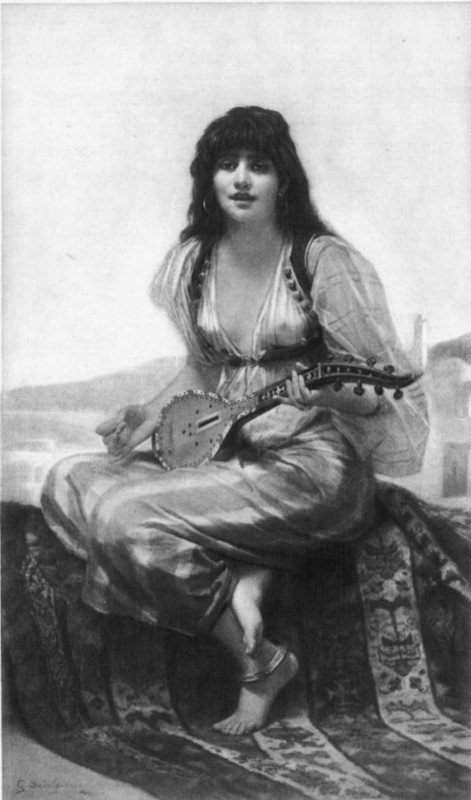
Fatima
Photogravure from a Painting by G.C. Saintpierre.
"O'er the strings thy fingers are straying,
O'er my heart stray the tones."
"On the following evening," said Mirza-Schaffy, "I appeared at the appointed hour. During the day I had written a love song which none of womankind could resist. I had sung it over about twenty times to myself, in order to be sure of success. Then I had been into the bath, and had had my head shaved so perfectly that it might have vied in whiteness with the lilies of the vale of Senghi. The evening was calm and clear; from the garden-side where I stood, I could distinctly see my Zuléikha; she was alone with Fatima on the roof, and had her veil put a little back, as a sign of her favor. I took courage, and pushed my cap down behind to show my white head, just fresh shaved, to the maiden's eyes. Thou canst comprehend what an impression that would make on a woman's heart! Alas! my head was much whiter then than it is now. But that is more than ten years since!" he said sorrowfully, and would have continued in this digression if I had not interposed the words:--
"Thy head is quite white enough now to fascinate the most maidenly heart; but thou hast not yet told me how thou sangest thy love song, and what impression it made upon Zuléikha."
"I had folded the song," said the Mirza, "round a double almond kernel, and thrown it on the roof, as a keepsake for the Beauty, before I began to sing it; and then I began with clear voice:--
"What is the eye of wild gazelle, the slender pine's unfolding,
Compared with thy delightful eyes, and thine ethereal molding?
What is the scent from Shiraz' fields, wind-borne, that's hither
straying,
Compared with richer scented breath from thy sweet mouth
out-playing?
What is Ghazel and Rubajat, as Hafiz ere was singing,
Compared with one word's mellow tone, from thy sweet mouth
outwinging?
What is the rosy-chaliced flower, where nightingales are quaffing,
Compared with thy sweet rosy mouth, and thy lips' rosy laughing?
What is the sun, and what the moon, and all heaven's constellations?
Love-glancing far for thee they glow with trembling scintillations!
And what am I myself, my heart, my songful celebration,
But slaves of royal loveliness, bright beauty's inspiration!"
"Allah, how beautiful!" I cried. "Mirza-Schaffy, thy words sound as sweet as the songs of the Peris, in the world of spirits! What is Hafiz to thee? What is a drop to the ocean?"
MIRZA-SCHAFFY
From the 'Thousand and One Days in the East'
My first object in Georgia was to secure an instructor in Tartar, that I might learn as quickly as possible a language so indispensably necessary in the countries of the Caucasus. Accident favored my choice, for my learned teacher Mirza-Schaffy, the Wise Man of Gjändsha, as he styles himself, is, according to his own opinion, the wisest of men.
With the modesty peculiar to his nation, he only calls himself the first wise man of the East; but as according to his estimation the children of the West are yet living in darkness and unbelief, it is a matter of course with him that he soars above us in wisdom and knowledge. Moreover, he indulges the hope that, thanks to his endeavors, the illumination and wisdom of the East will also, in the progress of years, actually spread amongst us. I am already the fifth scholar, he tells me, who has made a pilgrimage to him for the purpose of participating in his instructions. He argues from this that the need of traveling to Tiflis and listening to Mirza-Schaffy's sayings of wisdom is ever becoming more vividly felt by us. My four predecessors, he is further of opinion, have, since their return into the West, promoted to the best of their ability the extension of Oriental civilization amongst their races. But of me he formed quite peculiar hopes; very likely because I paid him a silver ruble for each lesson, which I understand is an unusually high premium for the Wise Man of Gjändsha.
It was always most incomprehensible to him how we can call ourselves wise or learned, and travel over the world with these titles, before we even understand the sacred languages. Nevertheless he very readily excused these pretensions in me, inasmuch as I was at least ardently endeavoring to acquire these languages, but above all because I had made the lucky hit of choosing him for my teacher.
The advantages of this lucky hit he had his own peculiar way of making intelligible to me. "I, Mirza-Schaffy," said he, "am the first wise man of the East! consequently thou, as my disciple, art the second. But thou must not misunderstand me: I have a friend, Omar-Effendi, a very wise man, who is certainly not the third among the learned of the land. If I were not alive, and Omar-Effendi were thy teacher, then he would be the first, and thou, as his disciple, the second wise man!" After such an effusion, it was always the custom of Mirza-Schaffy to point with his forefinger to his forehead, at the same time giving me a sly look; whereupon, according to rule, I nodded knowingly to him in mute reciprocation.
That the Wise Man of Gjändsha knew how to render his vast superiority in the highest degree palpable to any one who might have any misgiving on the point, he once showed me by a striking example.
Among the many learned rivals who envied the lessons of Mirza-Schaffy, the most conspicuous was Mirza-Jussuf, the Wise Man of Bagdad. He named himself after this city, because he had there pursued his studies in Arabic; from which he inferred that he must possess more profound accomplishments than Mirza-Schaffy, whom he told me he considered a "Fschekj," an ass among the bearers of wisdom. "The fellow cannot even write decently," Jussuf informed me of my reverend Mirza, "and he cannot sing at all! Now I ask thee: What is knowledge without writing? What is wisdom without song? What is Mirza-Schaffy in comparison with me?"
In this way he was continually plying me with perorations of confounding force, wherein he gave especial prominence to the beauty of his name Jussuf, which Moses of old had celebrated, and Hafiz sung of in lovely strains; he exerted all his acuteness to evince to me that a name is not an empty sound, but that the significance attached to a great or beautiful name is inherited in more or less distinction by the latest bearers of this name. He, Jussuf, for example, was a perfect model of the Jussuf of the land of Egypt, who walked in chastity before Potiphar, and in wisdom before the Lord.
THE SCHOOL OF WISDOM
From the 'Thousand and One Days in the East'
"Mirza-Schaffy!" I began, when we sat again assembled in the Divan of Wisdom, "what wilt thou say when I tell thee that the wise men of the West consider you as stupid as you do them?"
"What can I do but be amazed at their folly?" he replied. "What new thing can I learn from them, when they only repeat mine?"
He ordered a fresh chibouk, mused awhile meditatingly before him, bade us get ready the kalemdan (writing-stand), and then began to sing:--
"Shall I laughing, shall I weeping
Go, because men are so brute,
Always foreign sense repeating,
And in self-expression mute?
"No, the Maker's praise shall rise
For the foolish generation;
Else the wisdom of the wise
Would be lost from observation!"
"Mirza-Schaffy," said I, interrupting him again, "would it not be a prudent beginning to clothe thy sayings in a Western dress, to the end that they might be a mirror for the foolish, a rule of conduct for the erring, and a source of high enjoyment for our wives and maidens, whose charm is as great as their inclination to wisdom?"
"Women are everywhere wise," replied my reverend teacher, "and their power is greater than fools imagine. Their eyes are the original seat of all true devotion and wisdom, and he who inspires from them needs not wait for death to enter upon the joys of Paradise. The smallest finger of woman overthrows the mightiest edifice of faith, and the youngest maiden mars the oldest institutions of the Church!"
"But thou hast not yet given me an answer to my question, O Mirza!"
"Thou speakest wisely. The seed of my words has taken root in thy heart. Write; I will sing!"
And now he sang to me a number of wonderful songs, part of which here follow in an English dress.
MIRZA-SCHAFFY'S OPINION OF THE SHAH OF PERSIA
A learnèd scribe once came to me from far:
"Mirza!" said he, "what think'st thou of the Shah?
Was wisdom really born in him with years?
And are his eyes as spacious as his ears?"
"He's just as wise as all who round them bind
Capuche and gown: he knows what an amount
Of stupid fear keeps all his people blind,
And how to turn it to his own account."
MIZA-SCHAFFY PRAISES THE CHARMS OF ZULÉIKHA
Looking at thy tender little feet
Makes me always wonder, sweetest maiden,
How they so much beauty can be bearing!
Looking at thy lovely little hands
Makes me always wonder, sweetest maiden,
How they so to wound me can be daring!
Looking at thy rosy luring lips
Makes me always wonder, sweetest maiden,
How they of a kiss e'er can be sparing!
Looking at thy meaningful bright eyes
Makes me always wonder, sweetest maiden,
How for greater love they can be caring
Than I feel. Oh, look at me, and love!
Warmer than my heart, thou sweetest maiden,
Heart in thy love never will be sharing.
Listen to this rapture-reaching song!
Fairer than my mouth, thou sweetest maiden,
Mouth thy praise will never be declaring!
AN EXCURSION INTO ARMENIA
From the 'Thousand and One Days in the East'
Now follow me into that blessed land wherein tradition places Paradise, and wherein I also placed it, until I found that it lay in thine eyes, thou, mine Edlitam!
Follow me to the banks of the Senghi and Araxes, rich in bloom, sacred in tradition; where I sought for rest after long wandering in the mazes of a strange land, until I knew that rest is nowhere to be found but in one's own bosom; follow me into the gardens where Noah once planted the vine for his own enjoyment and heart's delight, and for the gladness of all subsequent races of toiling men; follow me through the steep mountain-paths overhung with glaciers, to the arid table-lands of Ararat, where, clad in a garment red as blood, on his steed of nimble thigh, the wild Kurd springs along, with flashing glance and sunburnt face, in his broad girdle the sharp dagger and long pistols of Damascus, and in his practiced hand the slender, death-slinging lance of Bagdad--where the nomad pitches his black tent, and with wife and child cowers round the fire that scares away the beasts of the wilderness--where caravans of camels and dromedaries wend their way, laden with the treasures of the Orient, and guided by watchful leaders in wide many-colored apparel--where the Tartar, eager for spoil, houses in hidden rocks, or in half-subterranean, rudely excavated huts; follow me into the fruitful valleys, where the sons of Haïghk, like the children of Israel, far from the corruption of cities, still live in primeval simplicity, plough their fields and tend their flocks, and practice hospitality in Biblical pureness; follow me to Ararat, which still bears the diluvian Ark upon his king-like, hoary head--follow me into the highlands of Armenia!
In Paradise we will be happy, and refresh our eyes with a glance at the fair daughters of the land; and at the grave of Noah we will sit down, the drinking-horn in our hand, a song on our lips, and joyous confidence in our hearts; for the God who once when the whole world deserved hanging favored mankind with a watery grave, and suffered only Noah to live because he cultivated the vine and rejoiced in love and drinking, will also to us, who cherish like desires, be as favorable as to the father of post-diluvian men.
MIRZA-JUSSUF
See Mirza-Jussuf now,
How critical a wight 'tis!
The day displeases him,
Because for him too bright 'tis.
He doesn't like the rose,--
Her thorn a sad affront is;
And doesn't like mankind,
Because its nose in front is.
On ev'rything he spies
His bitter bane he passes;
For naught escapes his eyes,
Except that he an ass is.
Thus, evermore at strife
With Art and Nature too,
By day and night he wanders
Through wastes of misty blue,
Mirza-Schaffy bemocks him
With sly and roguish eye,
And makes of all his bitterness
The sweetest melody.
WISDOM AND KNOWLEDGE
Friend, wouldst know why as a rule
Bookish learning marks the fool?
'Tis because, though once befriended,
Learning's pact with wisdom's ended.
No philosophy e'er throve
In a nightcap by the stove.
Who the world would understand
In the world must bear a hand.
If you're not to wisdom wed,
Like the camel you're bested,
Which has treasures rich, to bear
Through the desert everywhere,
But the use must ever lack
Of the goods upon his back.
JOHANN JAKOB BODMER
(1698-1783)
n the beginning of the eighteenth century, the political and intellectual life of Germany showed no signs of its imminent awakening. French supremacy was undisputed. French was spoken by polite society, and only the middle and lower classes consented to use their mother tongue. French literature was alone fashionable, and the few scientific works that appeared were published in Latin. Life was hard and sordid. Thought and imagination languished. Such writings as existed were empty, pompous, and pedantic. Yet from this dreary waste-land was to spring that rich harvest of literature which, in a brief half-century, made the German nation famous.
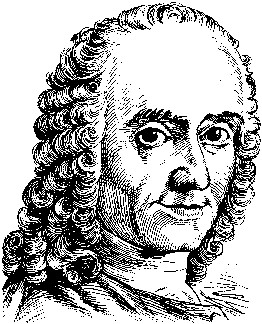
Johann Jakob Bodmer.
Klopstock, Wieland, Lessing, Herder, Goethe, and Schiller--those were the great names that were soon to shine like stars in the literary firmament. But the lesser men who broke the ground and opened paths for their brilliant followers are almost forgotten.
Toward the middle of the century, there lived in Zürich a modest professor of history, Johann Jakob Bodmer by name (born July 19th, 1698), who spoke the first word for a national literature, and who was the first writer to attempt a scientific criticism of contemporary authors. His efforts were rude beginnings of a style that culminated in the polished essays of Lessing. It was Bodmer whose independence of thought and feeling first revolted from the slavish imitation of French culture that enchained the German mind. In his youth he had been sent to Italy to study commerce. This visit aroused his poetic and artistic nature. He forgot his business in listening to street singers, in imitation of whom he wrote Italian lyrics. He read French works on art, and wrote artificial French verses according to French models. With equal versatility he composed German poetry, copying Opitz, whom he esteemed a great poet. Nor did he hesitate to try his skill at Latin hexameters.
By chance a copy of Addison's Spectator fell into his hands. He turned at once from French and Italian culture to admire English classics. The first German to appreciate Milton and Shakespeare (the latter he called the English Sophocles), he never wavered in his devotion to the English school. With his faithful friend, Johann Jakob Breitinger, a conscientious scholar, he started in Zürich a critical weekly paper on the plan of the Spectator. It was called Discoursen der Mahlern (Discourses of the Painters), and its essays embody the first literary effort of the Swiss as a nation. A little weekly coterie soon gathered about Bodmer to discuss the conduct of the paper; but much of the spirit and enthusiasm of these councils evaporated in print, the journal being subjected to a rigid censorship. Not alone art and literature came under discussion, but social subjects. All contributions were signed with the names of famous painters, and dealt with mistakes in education, the evils of card-playing, the duties of friendship, love and matrimony, logic, morality, pedantry, imagination, self-consciousness, and the fear of death. These discourses were chiefly written by Bodmer and his colleague Breitinger. The earlier papers, awkwardly expressed, often in Swiss dialect, masqueraded as the work of Holbein, Dürer, Raphael, or Michael Angelo. Although intended at first for Swiss readers only, the little weekly soon captured a German public. Its purpose was to kindle the imagination, and to suggest a parallel between the art of painting and the art of literature. Bodmer only dimly outlined what an infinitely greater mind defined with unerring precision some twenty years later in the 'Laocoon.' But the service of the older man to literature is not therefore to be undervalued. Bodmer created the function of analytic and psychological criticism in Germany. Hitherto no writer had been called to account for any literary offense whatever. Bodmer maintained that the man who demanded a hearing from the public must show good cause for this demand.
After two years the Discourses were discontinued; but Bodmer had gained great influence over the young writers of the time. He increased his reputation by translating Milton's 'Paradise Lost,' which he considered "a masterpiece of poetic genius, and the leading work of modern times." He deplores, however, the low standard of public taste, which, delighting in inferior poets, cannot at once rise to the greatest works. Already there existed in Leipzig a sort of literary centre, where Gottsched was regarded as a dictator in matters of taste. This literary autocrat praised Bodmer's translation of 'Paradise Lost' more than the original poem, in which he condemned the rhymeless metre. A sharp controversy soon divided the literary world into two hostile parties, known in German literature as the "conflict between Leipzig and Zürich." Gottsched followed Voltaire in considering the English style rude and barbarous; whereas Bodmer, with keener artistic perception and deeper insight, defended Milton and Shakespeare. The quarrel, in which Zürich prevailed, called the attention of Germany to the English literature, so closely affiliated to the German mind and taste, and hastened its liberation from the French yoke. Besides these services, Bodmer showed untiring zeal in rescuing from oblivion the beautiful poems and epics of the Middle Ages. In his essay 'The Excellent Conditions for Poetic Production under the Rule of the Swabian Emperors,' he directs public attention to the exquisite lyrics of the Minnesänger. It was he who revealed that hidden treasure of German literature, the Nibelungenlied. By his studies and translations of Middle High German, he opened the vast and important field of Germanic philology. To the end of his eighty-five years he was occupied with preparing selections from the Minnesänger, and his joy was unbounded when his half-century of work was crowned with success, and the first volume of these poems was placed in his hands.
Notwithstanding his true appreciation of poetry, he could not write it. He placed the religious above all other poetic productions, and valued the fable highly.
His hospitable roof in Zürich had an ever cordial welcome for all writers, and many were the poets who sojourned in the "Dichterherberge" (poets' inn); among them Klopstock, Wieland, and Goethe. He held the esteem of the nation long after his own writings had been crowded into forgetfulness by the new men whose way he had prepared,--for the genius of Herder and Lessing may be said to have completed the work that was so courageously begun by Bodmer.
THE KINSHIP OF THE ARTS
From 'Rubens'
When I consider the close relationship of the arts that are represented by the pen, brush, and chisel, I am inclined to think that the manes of these excellent painters and sculptors whose names our contributors have assumed would probably not be displeased with the liberty we have taken. Provided these departed spirits still feel a passionate interest in our worldly affairs, they might wish to instruct these painting writers to follow nature as closely and skillfully with their pens as they themselves had done with delicate brush or chisel. Nature is indeed the one universal teacher of all artists. Painter, sculptor, author, not one can succeed unless he hold counsel with her. The writer who does not respect her is a falsifier, and the painter or sculptor who departs from her is a dabbler. The highest place in art belongs to the writer, for his field comprehends most. With one stroke of the pen he will describe more than a painter can represent in a succession of pictures. On the other hand, the painter appeals more to the imagination, and leaves a stronger impression than description can possibly awaken.
POETRY AND PAINTING
From 'Holbein'
A true poet will try to paint pictures on the imagination, which at a man's birth is devoid of impressions, I hold that the imagination is a vast plain, capable of comprehending all that nature may bring forth, besides innumerable illusions, fancies, and poetic figures. A writer's pen is his brush, and words are his colors, which he must blend, heighten, or tone down, so that each object may assume a natural living form. The best poet will so paint his pictures that his readers will see the originals reflected as in a mirror. If his imagination be vivid, words grow eloquent, he feels all that he sees: he is impelled onward like a madman, and he must follow whither his madness leads. This frenzy need not be inspired by any real object, but it must kindle his imagination to arouse a real emotion. A new conception delights the fancy. The newest is the most marvelous. To this must be given a semblance of probability, and to probability a touch of the marvelous. The poet must portray to the imagination the struggles of passion and the emotions of the human heart. His diction must be splendid and emphatic. Casting aside all earthly love, he must depict the love that springs from the soul, the love felt by him whose thoughts soar towards heaven, where God is the source of eternal beauty. The most artistic ode is that in which art is concealed, and in which the poet, unfettered, is driven by his own ardor.
A TRIBUTE TO TOBACCO
From 'Dürer'
Whoever excels in any direction desires to be considered an extraordinary personage. Even the coquettish Phryne, fearing that the arts in which she really excelled might be forgotten, offered to rebuild the walls of Thebes on condition that the following inscription were cut thereon:--"The great Alexander razed these walls, but the hetaira Phryne rebuilt them." Gentlemen, I adore tobacco, and I appeal to the world for recognition. The floor of my room is strewn with tobacco ashes, on which my footsteps fall like those of the priests in the temple of Babylon. Pipes that I have buried in this tobacco desert lift their bowls here and there like stones in a cemetery. I shall make a pyramid of these relics, yellow, brown, and black, from which I shall reap renown as others win it with trophies gained on the battle-field. Besides books, which I love best after tobacco, my shelves and walls hold pipes collected from all nations, and grouped as if they were guns or sabres. My favorite pipe I never fill except on birthdays or festivals. A Frenchman who brought this from Canada swore that it was an Iroquois pipe of peace. Certain people take me for an alchemist, and my pipes for retorts with chimneys; but they do me wrong. Not only do I draw smoke but food from my distilling apparatus. I should be hailed rather as a philosopher, for while I watch the floating smoke I meditate on the vanity of man and his fleeting occupations. The moral of my tale is moderation; for my pipe is food and drink at once, and I know no better example of Nature's frugality than the fact that an ounce of tobacco provides me with a meal. Women delight in tea even as men prize tobacco. This difference in taste leads to friction of temper. Drinkers of tea inhale many a disagreeable whiff of tobacco, and lovers of tobacco are driven to accept many an unwelcome cup of tea. I, as a sufferer, would gladly set on foot a formal league which should compel an armed neutrality, and protect the one belligerent from the odor of the delicious pipe and the other from the complaisance of the tyrannous tea-cup.
Breath is smoke, and reason is but a spark in our hearts. When the spark is extinguished, our body perishes like smoldering ashes, and our breath floats away like the smoke.
BOËTIUS
(475-525)
nicius Manlius Severinus Boëtius was born about 475 A. D. His father was Flavius Manlius Boëtius, a patrician of great wealth and influence, who was trusted by the Emperor Odoacer and held the consulship in 487. The father died before his son reached manhood; and the youth was left to the guardianship of his kinsmen Festus and Symmachus, by whom he was carefully educated. He was remarkable early in life for his scholarship, and especially for his mastery of the Greek language, an accomplishment unusual for a Roman of this period. He entered public life when about thirty years of age, but duties of State were not permitted to put an end to his studies. He had married Rusticiana, the daughter of his guardian Symmachus.
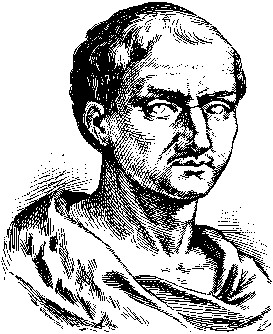
BOËTIUS
The Roman world was now ruled by Theodoric the Ostrogoth. This leader had succeeded to the headship of the Ostrogoths on the death of his father Theodomir in 474. For a time he was a pensioner of the Byzantine court, with the duty of defending the lower Danube; but in 488 he determined to invade Italy and become a sovereign subordinate to no one. By the defeat of Odoacer in 489 he accomplished that end; and desiring to conciliate the Senatorial party at Rome, he called Boëtius from his studious retirement, as one who by his position and wealth could reconcile his countrymen to the rule of a barbarian chief.
In 510 Boëtius was made consul, and he continued in the public service till after his sons Symmachus and Boëtius were elevated to the consulship in 522. Thus far he had enjoyed the full confidence of Theodoric; but in 523 he was thrown into prison in Pavia and his property confiscated, and the Senate condemned him to death. Two years later he was executed. Unfortunately, the only account we have of the causes which led to this downfall is Boëtius's own in the 'Consolations.' According to this, he first incurred Theodoric's displeasure by getting the province of Campania excepted from the operation of an edict requiring the provincials to sell their corn to the government, and otherwise championing the people against oppression; was the victim of various false accusations; and finally was held a traitor for defending Albinus, chief of the Senate, from the accusation of holding treasonable correspondence with the Emperor Justin at Constantinople. "If Albinus be criminal, I and the whole Senate are equally guilty, Boëtius reports himself to have said. There is no good reason to doubt his truthfulness in any of these matters; but he does not tell the whole truth, except in a sentence he lets slip later. Theodoric's act was no outbreak of barbarian suspicion and ferocity. Boëtius and the whole Senate were really guilty of holding an utterly untenable political position, which no sovereign on earth would endure: they wished to make the Emperor at Constantinople a court of appeal from Theodoric, as though the latter were still a subordinate prince. This may not have been technical treason, but it was practical insubordination; and under any other barbarian ruler or any one of fifty native ones, Rome would have flowed with blood. Theodoric contented himself with executing the ringleader, and the following year put to death Boëtius's father-in-law Symmachus in fear of his plotting revenge. Even so, the executions were a bad political mistake: they must have enraged and thoroughly alienated the Senatorial party,--that is, the chief Italian families,--and made a fusion of the foreign and native elements definitively out of the question. We need not blame Boëtius or the Senate for their very natural aspiration to live under a civilized instead of a barbarian jurisdiction, even though they had their own codes and courts; but the de facto governing power had its rights also.
In 996 Boëtius's bones were removed to the church of St. Augustine, where his tomb may still be seen. As time elapsed, his death was considered a martyrdom, and he was canonized as St. Severinus.
Boëtius was a thorough student of Greek philosophy, and formed the plan of translating all of Plato and Aristotle and reconciling their philosophies. This work he never completed. He wrote a treatise on music which was used as a text-book as late as the present century; and he translated the works of Ptolemy on astronomy, of Nicomachus on arithmetic, of Euclid on geometry, and of Archimedes on mechanics. His great work in this line was a translation of Aristotle, which he supplemented by a commentary in thirty books. Among his writings are a number of works on logic and a commentary on the 'Topica' of Cicero. In addition to these, five theological tracts are ascribed to him, the most important being a discussion of the doctrine of the Trinity.
The work which has done most to perpetuate his name is the 'Consolations of Philosophy,' in five books,--written during his imprisonment at Pavia,--which has been called "the last work of Roman literature." It is written in alternate prose and verse, and treats of his efforts to find solace in his misfortune. The first book opens with a vision of a woman, holding a book and sceptre, who comes to him with promises of comfort. She is his lifelong companion, Philosophy. He tells her the story of his troubles. In the second book, Philosophy tells him that Fortune has the right to take away what she has bestowed, and that he still has wife and children, the most precious of her gifts; his ambition to shine as statesman and philosopher is foolish, as no greatness is enduring. The third book takes up the discussion of the Supreme Good, showing that it consists not in riches, power, nor pleasure, but only in God. In the fourth book the problems of the existence of evil in the world and the freedom of the will are examined; and the latter subject continues through the fifth book. During the Middle Ages this work was highly esteemed, and numerous translations appeared. In the ninth century Alfred the Great gave to his subjects an Anglo-Saxon version; and in the fourteenth century Chaucer made an English translation, which was published by Caxton in 1480. Before the sixteenth century it was translated into German, French, Italian, Spanish, and Greek.
It is now perhaps best known for the place it occupies in the spiritual development of Dante. He turned to it for comfort after the death of his Beatrice in 1291. Inspired by its teachings, he gave himself up for a time to the study of philosophy, with the result of his writing the 'Convito,' a book in which he often refers to his favorite author. In his 'Divine Comedy' he places Boëtius in the Heaven of the Sun, together with the Fathers of the Church and the schoolmen.
OF THE GREATEST GOOD
From the 'Consolations of Philosophy'
Every mortal is troubled with many and various anxieties, and yet all desire, through various paths, to arrive at one goal; that is, they strive by different means to attain one happiness: in a word, God. He is the beginning and the end of every good, and he is the highest happiness. Then said the Mind:--This, methinks, must be the highest good, so that men should neither need, nor moreover be solicitous, about any other good besides it; since he possesses that which is the roof of all other good, inasmuch as it includes all other good, and has all other kinds within it. It would not be the highest good if any good were external to it, because it would then have to desire some good which itself had not. Then answered Reason, and said:--It is very evident that this is the highest happiness, for it is both the roof and the floor of all good. What is that then but the best happiness, which gathers the other felicities all within it, and includes and holds them within it; and to it there is a deficiency of none, neither has it need of any, but they come all from it and again all to it, as all waters come from the sea and again all come to the sea? There is none in the little fountain, which does not seek the sea, and again from the sea it returns into the earth, and so it flows gradually through the earth, till it again comes to the same fountain that it before flowed from, and so again to the sea.
Now, this is an example of the true good, which all mortal men desire to obtain, though they by various ways think to arrive at it. For every man has a natural good in himself, because every mind desires to obtain the true good; but it is hindered by the transitory good, because it is more prone thereto. For some men think that it is the best happiness that a man be so rich that he have need of nothing more, and they choose their life accordingly. Some men think that this is the highest good, that he be among his fellows the most honorable of his fellows; and they with all diligence seek this. Some think that the supreme good is in the highest power. These strive either themselves to rule, or else to associate themselves to the friendship of rulers. Some persuade themselves that it is best that a man be illustrious and celebrated and have good fame; they therefore seek this both in peace and in war. Many reckon it for the greatest good and for the greatest happiness that a man be always blithe in this present life, and follow all his lusts. Some indeed who desire these riches are desirous thereof because they would have the greater power, that they may the more securely enjoy these worldly lusts, and also the riches. Many there are who desire power because they would gather money; or again, they are desirous to spread their name.
On account of such and other like frail and perishing advantages, the thought of every human mind is troubled with anxiety and with care. It then imagines that it has obtained some exalted good when it has won the flattery of the people; and to me it seems that it has bought a very false greatness. Some with much anxiety seek wives, that thereby they may above all things have children, and also live happily. True friends, then, I say, are the most precious things of all these worldly felicities. They are not indeed to be reckoned as worldly goods, but as divine; for deceitful fortune does not produce them, but God, who naturally formed them as relations. For of every other thing in this world, man is desirous, either that he may through it obtain power, or else some worldly lust; except of the true friend, whom he loves sometimes for affection and for fidelity, though he expect to himself no other rewards. Nature joins and cements friends together with inseparable love. But with these worldly goods, and with this present wealth, men make oftener enemies than friends. From these, and from many such proofs, it may be evident to all men that all the bodily goods are inferior to the faculties of the soul. We indeed think that a man is the stronger, because he is great in his body. The fairness, moreover, and the strength of the body, rejoices and invigorates the man, and health makes him cheerful. In all these bodily felicities men seek one single happiness, as it seems to them. For whatsoever every man chiefly loves above all other things, that, he persuades himself, is best for him, and that is his highest good. When therefore he has acquired that, he imagines that he may be very happy. I do not deny that these goods and this happiness are the highest good of this present life. For every man considers that thing best which he chiefly loves above other things, and therefore he deems himself very happy if he can obtain what he then most desires. Is not now clearly enough shown to thee the form of the false goods; namely, riches, and dignity, and power, and glory, and pleasure? Concerning pleasure, Epicurus the philosopher said, when he inquired concerning all those other goods which we before mentioned: then said he, that pleasure was the highest good, because all the other goods which we before mentioned gratify the mind and delight it, but pleasure chiefly gratifies the body.
But we will still speak concerning the nature of men, and concerning their pursuits. Though, then, their mind and their nature be now obscured, and they are by that descent fallen to evil and inclined thither, yet they are desirous, so far as they can and may, of the highest good. As the drunken man knows that he should go to his house and to his rest, and yet is not able to find the way thither, so is it also with the mind, when it is weighed down by the anxieties of this world. It is sometimes intoxicated and misled by them, so far that it cannot rightly find out good. Nor yet does it appear to those men that they aught mistake who are desirous to obtain this, namely, that they need labor after nothing more. But they think that they are able to collect together all these goods, so that none may be excluded from the number....
Two things may dignity and power do, if they come to the unwise. It may make him honorable and respectable to other unwise persons. But when he quits the power, or the power him, then is he to the unwise neither honorable nor respectable. Has power, then, the custom of exterminating and rooting out vices from the minds of great men and planting therein virtues? I know, however, that earthly power never sows the virtues, but collects and gathers vices; and when it has gathered them, then it nevertheless shows and does not conceal them. For the vices of great men many men see; because many know them and many are with them. Therefore we always lament concerning power, and also despise it, when we see that it comes to the worst, and to those who are to us most unworthy.
Every virtue has its proper excellence; and the excellence and the dignity which it has, it imparts immediately to every one who loves it. Thus, wisdom is the highest virtue, and it has in it four other virtues; of which one is prudence, another temperance, the third is fortitude, the fourth justice. Wisdom makes its lovers wise, and prudent, and moderate, and patient, and just; and it fills him who loves it with every good quality. This they who possess the power of this world cannot do. They cannot impart any virtue to those who love them, through their wealth, if they have it not in their nature. Hence it is very evident that the rich in worldly wealth have no proper dignity; but the wealth is, come to them from without, and they cannot from without have aught of their own. Consider now, whether any man is the less honorable because many men despise him. But if any man be the less honorable, then is every foolish man the less honorable, the more authority he has, to every wise man. Hence it is sufficiently clear that power and wealth cannot make its possessor the more honorable. But it makes him the less honorable, when it comes to him, if he were not before virtuous. So is also wealth and power the worse, if he who possesses it be not virtuous. Each of them is the more worthless, when they meet with each other.
But I can easily instruct you by an example, so that you may clearly enough perceive that this present life is very like a shadow, and in that shadow no man can attain the true good. If any very great man is driven from his country, or goes on his lord's errand, and so comes to a foreign people, where no man knows him, nor he any man, nor even knows the language, do you think his greatness can make him honorable in that land? Of course it cannot. But if dignity were natural to wealth and were its own, or again if wealth were the rich man's own, then it could not forsake him. Let the man who possessed them be in whatsoever land he might, then his wealth and his dignity would be with him. But because the wealth and the power are not his own, they forsake him; and because they have no natural good in themselves, they go away like a shadow or smoke. Yet the mistaken opinion and fancy of unwise men judge that power is the highest good. It is entirely otherwise. When a great man is either among foreigners, or among wise men in his own country, his wealth counts nothing to either one when they learn that he was exalted for no virtue, but through the applause of the ignorant. But if his power arose from any personal merit, he would keep that even if he lost the power. He would not lose the good that came from nature; that would always follow him and always make him honorable, whatever land he was in....
Worthless and very false is the glory of this world! Concerning this a certain poet formerly sung. When he contemned this present life, he said:--O glory of this world! wherefore do erring men call thee, with false voice, glory, when thou art none!--For man more frequently has great renown, and great glory, and great honor, through the opinion of the unwise, than he has through his deserts. But tell me now, what is more unmeet than this; or why men may not rather be ashamed of themselves than rejoice, when they hear that any one belies them. Though men even rightly praise any one of the good, he ought not the sooner to rejoice immoderately at the people's words. But at this he ought to rejoice, that they speak truth of him. Though he rejoice at this, that they spread his name, it is not the sooner so extensively spread as he persuades himself; for they cannot spread it over all the earth, though they may in some land; for though it be to one known, yet it is to another unknown. Though he in this land be celebrated, yet is he in another not celebrated. Therefore is the people's favor to be held by every man for nothing; since it comes not to every man according to his deserts, nor indeed remains always to any one. Consider first concerning noble birth. If any one boast of it, how vain and how useless is the boast; for every one knows that all men come from one father and from one mother. Or again, concerning the people's favor, and concerning their applause, I know not why we rejoice at it. Though they whom the vulgar applaud be illustrious, yet are they more illustrious and more rightly to be applauded who are dignified by virtues. For no man is really the greater or the more praiseworthy for the excellence of another, or for his virtues, if he himself has it not. Are you ever the fairer for another man's beauty? A man is little the better though he have a good father, if he himself is incapable of anything. Therefore I advise that you rejoice in other men's good and their nobility, but so far only that you ascribe it not to yourself as your own; because every man's good, and his nobility, is more in the mind than in the flesh. This only, indeed, I know of good in nobility: that it shames many a man if he is worse than his ancestors were, and he therefore endeavors with all his power to imitate the manners of some one of the best, and his virtues.
NICHOLAS BOILEAU-DESPRÉAUX
(1636-1711)
he name of Louis XIV. suggests ultra-lavishness in life and taste; a time when French society, surfeited with pleasure, demanded a stimulus of continual novelty in current literature. The natural result was preciosité, hyperbole, falsetto sentiment, which ranked the unusual above the natural, clever conceit above careful workmanship. It was tainted with artificiality, and now seems mawkish and superficial.
But Boileau changed all that. Perhaps no author unendowed with genius has ever so influenced literature,
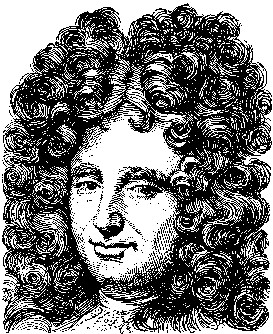
Boileau.
Aside from his work, the man and his life seem essentially commonplace. Nicholas Boileau, who, adding another name to his own,--quite a fashion then,--was usually called Despréaux by his contemporaries, was born in Paris, in the palace court, nearly opposite the royal Sainte Chapelle. He rarely went farther from the city than to the little house at Auteuil, where he spent twenty summers. So he knew his Paris very intimately, and was limited too by knowing only her life and thought. To his repressed youth, guarded by a strict father and a cross servant,--for his mother died in his babyhood,--is sometimes attributed his lack of emotional quality. But his was not an intense nature, and probably no training could have made the didactic poet lyric or passionate. Sincerity and common-sense were his predominating qualities, and he had the rare faculty of obedience to his own instincts. He first studied for the priesthood, but anything like mysticism was too repellent to his matter-of-fact mind. Then, as many of his family had been lawyers, he naturally turned toward that career. But the practice as taught him seemed senseless and arbitrary. Its rational basis upon a logical theory only dawned upon him later. In spite of his literary tastes, there was something extremely mundane about the pleasure-loving bachelor, so fond of good eating and of jovial café revels with Racine, Furetière, Ninon de L'Enclos, and other witty Bohemians. With them he was much happier than in the more fastidious society of the Hôtel Rambouillet, from which he retired after reading aloud a satiric poem not favorably received. Neither was he happy at court, in spite of the favor of Louis XIV., who, entertained by his rough honesty, gave him a pension of two thousand francs. Later, when appointed with Racine to write a history of the reign,--that unfortunate history which was accidentally burned,--we find him an unwilling follower on royal expeditions, his ungainly horsemanship the mock of high-bred courtiers. In fact, he was bourgeois through and through, and not at ease with the aristocrats. He was thrifty bourgeois too; so often called miserly as well as malicious that it is pleasant to remember certain illustrations of his nobler side. The man who offered to resign his own pension if that of old disfavored Corneille might be continued, and when the latter was forced to sell his library, paid him its full value and then left him in lifelong possession,--was generous if he did love to save sous. His was a fine independence, which felt his art too lofty for purchase, and would accept nothing from the booksellers.
He had always wished to be a poet. Feeble of body, asthmatic, and in later life deaf and almost deprived of voice, he found in writing all the charm of a brilliant and ingenious game. Then too he had something definite to say, as all his work consistently testifies. Neither rich nor poor, without family cares, he could give himself unreservedly to authorship. In 1660 he published a satire upon the vices of Paris, which inaugurated his great success. Seven satires appeared in 1666, and he afterward added five others. Their malicious wit, their novel form, the harmonious swing of the couplet rhyme, forced immediate attention. They held up contemporary literary weaknesses to scorn, and indulged in the most merciless personalities, sparing not even his own brother, the poet Gilles Boileau. All retorts upon himself the author bore with complacent superiority which forced his adversaries to feel worsted.
From 1666 to 1774 most of the 'Epistles' were written; and also his best known work, 'L'Art poétique' (The Art of Poetry). In the satires he had been destructive, but he was too practical to be negative. The 'Art of Poetry,' modeled after Horace's work of that name, offers the theory of poetic composition. It is a work in four cantos of couplets: the first setting forth general rules of metrical composition; the second a dissertation upon different forms--ode, sonnet, pastoral, and others; the third treating tragedy, comedy, and epic poetry; and the last consisting of general reflections and advice to authors. Briefly stated, Boileau's desire was to establish literature upon a foundation of unchanging laws. Why did some works speedily die while others endure through the centuries? Because works akin to the eternal classics did not, like much contemporary writing, reflect the trivial and evanescent. They contained what is perennially true of humanity; and stated this in a simple, interesting, and reasonable way. Above all, Boileau demands truth in subject, and the conscientious workmanship which finds the most suitable form of expression. To see a word at the end of a couplet only because it rhymes with the word above it, he finds inexcusable. Without a method resulting in unity, clearness, and proportion, writing is not literature. Later, in his 'Reflections upon Longinus,' Boileau repeated and emphasized these views.
His mock-heroic poem 'Le Lutrin' (The Reading-Desk), ridiculing clerical pettinesses, was strong in realistic descriptions, and was perhaps his most popular work.
A modern poet's definition of poetry as "the heat and height of sane emotion" would have been unintelligible to Boileau. Deficient in imagination, he always saw life on its material side, and was irritated by any display of emotion not reducible to logic. So his poetry is sensible, clear argument in exquisitely careful metre. His great strength lay in a taste which recognized harmony and fitness instinctively. To us his quality is best translated by the dainty, perfect couplets of his imitator Pope. His talent, essentially French in its love of effect and classification, has strewn the language with clever saws, and his works have been studied as authoritative models by generation after generation of students.
But after all, it is less as a poet than as a critic, "the lawgiver of the French Parnassus," that the world has always known Boileau, Before him the art of criticism had hardly existed. Authors had received indiscriminate praise or blame, usually founded upon interested motives or personal bias; but there had been little comparison with an acknowledged standard. This "slashing reviewer in verse," as Saintsbury calls him, was a severe pedagogue, but his public did learn their lesson. He made mistakes, was neither broad-minded nor profound in attainments, was occasionally unjust; but he showed readers why they should praise or blame; taught them appreciation of his greater friends Molière and Racine; and pointed out to authors what their purpose should be. With a greater creative power seeking self-expression, he might have accomplished less in literary reform.
ADVICE TO AUTHORS
From 'The Art of Poetry'
There is a kind of writer pleased with sound,
Whose fustian head with clouds is compassed round--
No reason can disperse them with its light;
Learn then to think, ere you pretend to write
As your idea's clear, or else obscure,
The expression follows, perfect or impure;
What we conceive with ease we can express;
Words to the notions flow with readiness.
Observe the language well in all you write,
And swerve not from it in your loftiest flight.
The smoothest verse and the exactest sense
Displease if uncouth language give offense;
A barbarous phrase no reader can approve;
Nor bombast, noise, or affectation love.
In short, without pure language, what you write
Can never yield us profit or delight.
Take time for thinking; never work in haste;
And value not yourself for writing fast;
A rapid poem, with such fury writ,
Shows want of judgment, not abounding wit.
More pleased we are to see a river lead
His gentle streams along a flowery mead,
Than from high banks to hear loud torrents roar,
With foamy waters, on a muddy shore.
Gently make haste, of labor not afraid;
A hundred times consider what you've said;
Polish, repolish, every color lay,
And sometimes add, but oftener take away.
'Tis not enough, when swarming faults are writ,
That here and there are scattered sparks of wit;
Each object must be fixed in the true place,
And differing parts have corresponding grace;
Till, by a curious art disposed, we find
One perfect whole of all the pieces joined.
Keep to your subject close in all you say,
Nor for a sounding sentence ever stray.
The public censure for your writings fear,
And to yourself be critic most' severe;
Fantastic wits their darling follies love,
But find you faithful friends that will reprove,
That on your works may look with careful eyes,
And of your faults be zealous enemies.
Lay by an author's pride and vanity,
And from a friend a flatterer descry,
Who seems to like, but means not what he says;
Embrace true counsel, but suspect false praise.
A sycophant will everything admire;
Each verse, each sentence, sets his soul on fire;
All is divine! there's not a word amiss!
He shakes with joy and weeps with tenderness;
He overpowers you with his mighty praise.
Truth never moves in those impetuous ways.
A faithful friend is careful of your fame,
And freely will your heedless errors blame;
He cannot pardon a neglected line,
But verse to rule and order will confine,
Reprove of words the too-affected sound,--
"Here the sense flags, and your expression's bound,
Your fancy tires, and your discourse grows vain;
Your term's improper;--make it just and plain."
Thus 'tis a faithful friend will freedom use.
But authors partial to their darling muse
Think to protect it they have just pretense,
And at your friendly counsel take offense.
"Said you of this, that the expression's flat?
Your servant, sir, you must excuse me that,"
He answers you. "This word has here no grace,
Pray leave it out."--"That, sir, 's the properest place."
"This term I like not."--"'Tis approved by all."
Thus, resolute not from one fault to fall,
If there's a symbol as to which you doubt,
'Tis a sure reason not to blot it out.
Yet still he says you may his faults confute,
And over him your power is absolute.
But of his feigned humility take heed:
'Tis a bait laid to make you hear him read;
And when he leaves you, happy in his muse,
Restless he runs some other to abuse.
And often finds; for in our scribbling times
No fool can lack a fool to praise his rhymes;
The flattest work has here within the court
Met with some zealous ass for its support;
And in all times a forward scribbling fop
Has found some greater fool to cry him up.
THE PASTORAL, THE ELEGY, THE ODE, AND THE EPIGRAM
From 'The Art of Poetry'
As A fair nymph, when rising from her bed,
With sparkling diamonds dresses not her head,
But without gold, or pearl, or costly scents,
Gathers from neighboring fields her ornaments:
Such, lovely in its dress, but plain withal,
Ought to appear a perfect Pastoral.
Its humble method nothing has of fierce,
But hates the rattling of a lofty verse;
There native beauty pleases and excites,
And never with harsh sounds the ear affrights.
But in this style a poet, often spent
In rage, throws by his rural instrument,
And vainly, when disordered thoughts abound,
Amidst the eclogue makes the trumpet sound;
Pan flies alarmed into the neighboring woods,
And frighted nymphs dive down into the floods.
Opposed to this, another, low in style,
Makes shepherds speak a language low and vile;
His writings, flat and heavy, without sound,
Kissing the earth and creeping on the ground;
You'd swear that Randal, in his rustic strains,
Again was quavering to the country swains,
And changing, without care of sound or dress,
Strephon and Phyllis into Tom and Bess.
'Twixt these extremes 'tis hard to keep the right:
For guides take Virgil and read Theocrite;
Be their just writings, by the gods inspired,
Your constant pattern, practiced and admired.
By them alone you'll easy comprehend
How poets without shame may condescend
To sing of gardens, fields, of flowers and fruit,
To stir up shepherds and to tune the flute;
Of love's rewards to tell the happy hour,
Daphne a tree, Narcissus make a flower,
And by what means the eclogue yet has power
To make the woods worthy a conqueror;
This of their writings is the grace and flight;
Their risings lofty, yet not out of sight.
The Elegy, that loves a mournful style,
With unbound hair weeps at a funeral pile;
It paints the lover's torments and delights,
A mistress flatters, threatens, and invites;
But well these raptures if you'll make us see,
You must know love as well as poetry.
I hate those lukewarm authors, whose forced fire
In a cold style describes a hot desire;
That sigh by rule, and raging in cold blood,
Their sluggish muse whip to an amorous mood.
Their transports feigned appear but flat and vain;
They always sigh, and always hug their chain,
Adore their prisons and their sufferings bless,
Make sense and reason quarrel as they please.
'Twas not of old in this affected tone
That smooth Tibullus made his amorous moan;
Nor Ovid, when, instructed from above,
By nature's rule he taught the art of love.
The heart in elegies forms the discourse.
The Ode is bolder and has greater force;
Mounting to heaven in her ambitious flight,
Amongst the gods and heroes takes delight;
Of Pisa's wrestlers tells the sinewy force,
And sings the lusty conqueror's glorious course;
To Simois's streams does fierce Achilles bring,
And makes the Ganges bow to Britain's king.
Sometimes she flies like an industrious bee,
And robs the flowers by nature's chemistry;
Describes the shepherd's dances, feasts, and bliss,
And boasts from Phyllis to surprise a kiss,
When gently she resists with feigned remorse,
That what she grants may seem to be by force.
Her generous style at random oft will part,
And by a brave disorder shows her art.
Unlike those fearful poets whose cold rime
In all their raptures keeps exactest time;
That sing the illustrious hero's mighty praise--
Lean writers!--by the terms of weeks and days,
And dare not from least circumstances part,
But take all towns by strictest rules of art.
Apollo drives those fops from his abode;
And some have said that once the humorous god,
Resolving all such scribblers to confound,
For the short Sonnet ordered this strict bound,
Set rules for the just measure and the time,
The easy-running and alternate rime;
But above all, those licenses denied
Which in these writings the lame sense supplied,
Forbade a useless line should find a place,
Or a repeated word appear with grace.
A faultless sonnet, finished thus, would be
Worth tedious volumes of loose poetry.
A hundred scribbling authors, without ground,
Believe they have this only phoenix found,
When yet the exactest scarce have two or three,
Among whole tomes, from faults and censure free;
The rest, but little read, regarded less,
Are shoveled to the pastry from the press.
Closing the sense within the measured time,
'Tis hard to fit the reason to the rime.
The Epigram, with little art composed,
Is one good sentence in a distich closed.
These points, that by Italians first were prized,
Our ancient authors knew not, or despised;
The vulgar, dazzled with their glaring light,
To their false pleasures quickly they invite;
But public favor so increased their pride,
They overwhelmed Parnassus with their tide.
The Madrigal at first was overcome,
And the proud Sonnet fell by the same doom;
With these grave Tragedy adorned her flights,
And mournful Elegy her funeral rites,
A hero never failed them on the stage:
Without his point a lover durst not rage;
The amorous shepherds took more care to prove
True to his point, than faithful to their love.
Each word, like Janus, had a double face,
And prose, as well as verse, allowed it place;
The lawyer with conceits adorned his speech,
The parson without quibbling could not preach.
At last affronted reason looked about,
And from all serious matters shut them out;
Declared that none should use them without shame,
Except a scattering, in the epigram--
Provided that by art, and in due time,
They turned upon the thought, and not the rime.
Thus in all parts disorders did abate;
Yet quibblers in the court had leave to prate,
Insipid jesters and unpleasant fools,
A corporation of dull, punning drolls.
'Tis not but that sometimes a dextrous muse
May with advantage a turned sense abuse,
And on a word may trifle with address;
But above all, avoid the fond excess,
And think not, when your verse and sense are lame,
With a dull point to tag your epigram.
TO MOLIÈRE
From 'The Satires'
Unequaled genius, whose warm fancy knows
No rhyming labor, no poetic throes;
To whom Apollo has unlocked his store;
Whose coin is struck from pure Parnassian ore;
Thou, dextrous master, teach thy skill to me,
And tell me, Molière, how to1 rhyme like thee!
You never falter when the close comes round,
Or leave the substance to preserve the sound;
You never wander after words that fly,
For all the words you need before you lie.
But I, who--smarting for my sins of late--
With itch of rhyme am visited by fate,
Expend on air my unavailing force,
And, hunting sounds, am sweated like a horse.
In vain I often muse from dawn till night:
When I mean black, my stubborn verse says white;
If I should paint a coxcomb's flippant mien,
I scarcely can forbear to name the Dean;
If asked to tell the strains that purest flow,
My heart says Virgil, but my pen Quinault;
In short, whatever I attempt to say,
Mischance conducts me quite the other way.
At times, fatigued and fretted with the pain,
When every effort for relief is vain,
The fruitless chase I peevishly give o'er,
And swear a thousand times to write no more:
But, after thousand vows, perhaps by chance,
Before my careless eyes the couplets dance.
Then with new force my flame bursts out again,
Pleased I resume the paper and the pen;
And, all my anger and my oaths forgot,
I calmly muse and resolutely blot.
Yet, if my eager hand, in haste to rhyme,
Should tack an empty couplet at a time,
Great names who do the same I might adduce;
Nay, some who keep such hirelings for their use.
Need blooming Phyllis be described in prose
By any lover who has seen a rose?
Who can forget heaven's masterpiece, her eye,
Where, within call, the Loves and Graces lie?
Who can forget her smile, devoid of art,
Her heavenly sweetness and her frozen heart?
How easy thus forever to compound,
And ring new changes on recurring sound;
How easy, with a reasonable store
Of useful epithets repeated o'er,
Verb, substantive, and pronoun, to transpose,
And into tinkling metre hitch dull prose.
But I--who tremble o'er each word I use,
And all that do not aid the sense refuse,
Who cannot bear those phrases out of place
Which rhymers stuff into a vacant space--Ponder
my scrupulous verses o'er and o'er,
And when I write five words, oft blot out four.
Plague on the fool who taught us to confine
The swelling thought within a measured line;
Who first in narrow thraldom fancy pent,
And chained in rhyme each pinioned sentiment.
Without this toil, contentment's soothing balm
Might lull my languid soul in listless calm:
Like the smooth prebend how might I recline,
And loiter life in mirth and song and wine!
Roused by no labor, with no care opprest,
Pass all my nights in sleep, my days in rest.
My passions and desires obey the rein;
No mad ambition fires my temperate vein;
The schemes of busy greatness I decline,
Nor kneel in palaces at Fortune's shrine.
In short, my life had been supremely blest
If envious rhyme had not disturbed my rest:
But since this freakish fiend began to roll
His idle vapors o'er my troubled soul,
Since first I longed in polished verse to please,
And wrote with labor to be read with ease,
Nailed to my chair, day after day I pore
On what I write and what I wrote before;
Retouch each line, each epithet review,
Or burn the paper and begin anew.
While thus my labors lengthen into years,
I envy all the race of sonneteers.
Hail, happy Scudére! whose prolific brain
Brings forth a monthly volume without pain;
What though thy works, offending every rule,
Proclaim their author an insipid fool;
Still have they found, whate'er the critic says,
Traders to buy and emptier fools to praise.
And, truly, if in rhymes the couplets close,
What should it matter that the rest is prose?
Who stickles now for antiquated saws,
Or cramps his verses with pedantic laws?
The fool can welcome every word he meets,
With placid joy contemplating his feats;
And while each stanza swells his wondering breast
Admires them all, yet thinks the last the best.
But towering Genius, hopeless to attain
That unknown summit which he pants to gain,
Displeased himself, enchanting all beside,
Scorns each past effort that his strength supplied,
And filling every reader with delight,
Repents the hour when he began to write.
To you, who know how justly I complain,
To you I turn for medicine to my pain!
Grant me your talent, and impart your store,
Or teach me, Molière, how to rhyme no more.
GASTON BOISSIER
(1823-)
arie Louis Gaston Boissier is known in Paris as one of the most prominent professors of the Collège de France, and to the outside world as the author of a number of scholarly books of essays, most of them on Roman subjects. Born at Nîmes in 1823, his life has been devoted entirely to literature. Soon after his graduation from the École Normale he was made professor of rhetoric at Angoulême, and later held the same position at Nîmes. He has received the degree of Doctor, and occupied a number of high positions, culminating in that of professor of Latin poetry in the Collège de France, which he still holds. His works have a high value in the world of scholars, and have won him the red ribbon of the Legion of Honor, as well as a seat in the Académie Française, which he entered in 1876. His best known works, 'Cicero et ses Amis' (Cicero and His Friends), was crowned by the Académie; and 'Proménades Archéologiques, Rome et Naples,' written in 1880, has been translated into English, as has also his life of Madame de Sévigné, which contains many charming bits of comment on the seventeenth century. As a biographer, and also as a historian, he is quiet and accurate--never dry. He has great charm of style, and writes with elegance, correctness, clearness, and originality. He contributes largely, also, to the Revue des Deux Mondes and to scientific publications.
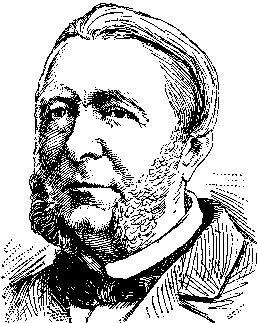
Gaston Boissier.
MADAME DE SÉVIGNÉ AS A LETTER-WRITER
From the 'Life of Madame de Sévigné'
The passages just cited appear so simple, and utter so naturally what we all experience, that they are read the first time without surprise. There seems nothing remarkable about them except this very simplicity and naturalness. Now, these are not the qualities which attract attention. It is difficult to appreciate them in works where they occur, and it is only by reading works where they are lacking that we realize all their importance. But here, as soon as we reflect, we are astonished to perceive that this great emotion is expressed in language strong, confident, and correct, with no hesitation and no bungling. The lively sequence of these complaints implies that they were poured forth all at once, in a single outburst; and yet the perfection of the style seems impossible of attainment without some study and some retouching. It is sometimes said that a strong passion at once creates the language to express it. I greatly doubt this. On the contrary, it seems to me that when the soul is violently agitated, the words by which we try to express our feelings always appear dull and cold; we are tempted to make use of exaggerated and far-fetched expressions in order to rise to the level of our sorrow or joy. Hence come sometimes excessive terms, discordant metaphors. We might be inclined to regard these as thought out at leisure and in cold blood, while on the contrary they are the product of the first impulse of the effort we instinctively make to find an expression corresponding to the intensity of our passion. There is nothing of this kind in Madame de Sévigné's letters; and however violent her grief may be, it always speaks in accurate and fitting language. This is a valuable quality, and one extremely rare. That we may not be surprised at finding it so highly developed in her, we need only remember what has just been said of the way in which she was unconsciously prepared to become a great writer.
Another characteristic of Madame de Sévigné's letters, not less remarkable, is that generally her most loving messages are cleverly expressed. I do not refer merely to certain isolated phrases that have sometimes appeared rather affected. "The north wind bound for Grignan makes me ache for your chest." "My dear, how the burden within you weighs me down!" "I dare not read your letters for fear of having read them." These are only occasional flashes; but almost always, when on the point of giving way to all her emotion, she gives her phrase an ingenious turn, she makes witty observations, is bright, pleasing, elegant. All this seems to some readers to proceed from a mind quite self-possessed, and not so far affected by passion as to be inattentive to elegant diction.
Just now I placed naturalness among Madame de Sévigné's leading qualities. There are those who are not of this opinion, and contend that naturalness is just the merit she most lacks; but we must define our meaning. Naturalness for each one is what is conformable to his nature; and as each one of us has a nature of his own very different from that of his neighbors, naturalness cannot be exactly the same in every instance. Moreover, education and habit give us each a second nature which often has more control over us than the original one. In the society in which Madame de Sévigné lived, people made a point of speaking wittily. The first few times one appeared in this society, it required a little study and effort to assume the same tone as the rest. One had to be on the watch for those pleasant repartees that, among the frequenters of the Rambouillet and Richelieu houses, gave the new-comer a good reputation; but after a while these happy sayings came unsought. To persons trained in such a school, what might at first sight appear subtle and refined is ordinary and natural. Whether they speak or write, their ideas take a certain form which is not the usual one; and bright, witty, and dainty phrases, which would require labor from others, occur to them spontaneously.
To be sure, I do not mean that Madame de Sévigné wrote well without knowing it. This is a thing of which a witty woman always has an inkling; and besides, her friends did not permit her to be ignorant of it. "Your letters are delightful," they told her, "and you are like your letters." It was all the easier to believe this, because she paid to herself in a whisper such compliments as others addressed to her aloud. One day, when she had recently written to her friend Dr. Bourdelot, she said to her daughter, "Brava! what a good answer I sent him! That is a foolish thing to say, but I had a good, wide-awake pen that day." It is very delightful to feel that one has wit, and we can understand how Madame de Sévigné might sometimes have yielded to this feeling with some satisfaction. In her most private correspondence, that in which she least thought of the public, we might note certain passages in which she takes pleasure in elaborating and decorating her thought, and in adding to it new details more and more dainty and ingenious. This she does without effort, to satisfy her own taste and to give herself the pleasure of expressing her thought agreeably. It has been remarked that good talkers are not sensitive to the praises of others only: they also wish to please themselves, independently of the public around them; and like to hear themselves talk. It might be said in the same sense that Madame de Sévigné sometimes likes to see herself write. This is one of those pretty artifices which in women do not exclude sincerity, and which may be united with naturalness. Copyrighted by A.C. McClurg and Company, Chicago.
FRENCH SOCIETY IN THE SEVENTEENTH CENTURY
From the (Life of Madame de Sévigné)
Studying the seventeenth century in the histories is one thing, and seeking to become acquainted with it by reading contemporary letters is another and a far different thing. The two procedures give rise to conflicting impressions. Historians, taking a bird's-eye view of their subject, portray its most general characteristics; they bring out only the prominent features, and sacrificing all the rest, draw pictures whose precision and simplicity captivate our minds. We finally get into the habit of seeing an epoch as they have painted it, and cannot imagine there was anything in it besides the qualities they specify. But when we read letters relating, without alteration or selection, events as they took place, the opinions of men and things we have drawn from the historians are greatly modified. We then perceive that good and evil are at all times mingled, and even that the proportions of the mixture vary less than one would think. Cousin says somewhere, "In a great age all is great." It is just the contrary that is true: there is no age so great that there is not much littleness about it; and if we undertake to study history we should expect this, so as not to reckon without our host. No epoch has been more celebrated, more admired, than the reign of Louis XIV.; there is danger lest the correspondence of Madame de Sévigné may much abate the warmth of our admiration. She is constantly telling strange stories that compel us to pause and reflect. When, in a society represented as so noble, so delicate, so regular, we meet with so many shameful disorders, so many ill-assorted households, so many persons whose fortunes are sustained only by dishonest expedients, with great lords buying and not paying, promising and not keeping their word, borrowing and never returning, kneeling before ministers and ministers' mistresses, cheating at play like M. de Cessac, living like Caderousse at the expense of a great lady, surrendering like Soubise a wife to the king, or like Villarceaux a niece, or insisting with Bussy that "the chariest of their honor should be delighted when such a good fortune befalls their family,"--it seems to me we have a right to conclude that people then were hardly our superiors; that perhaps in some points we are better than they were; and that in any case it is not worth while to set them up as models to the disparagement of our own times.
In one respect, however, they were unlike us. In those days there were certain subjects on which people were generally agreed, and these were precisely the subjects that now give rise to the greatest divisions,--religion and politics. Not that all were pious then,--far from it,--but almost all were believers, and almost none contested the principle of royal authority. To-day, religious belief and belief in monarchy are well-nigh extinct; and there are hardly any left of those commonly received opinions, escaped by none, impregnating all, breathed in like the air, and always found at the bottom of the heart on occasions of grave need, despite all the inward changes that experience has wrought. Is this a good or an evil? Should we rejoice at it or regret it? Each one will answer according to his character and inclinations. Daring minds that feel strong enough to form their own convictions are glad to be delivered from prejudices interfering with independence of opinion, glad to have free scope. But the rest, who form the vast majority, who are without such high aims, and whose life is moreover taken up with other cares, are troubled, uncertain, ill at ease, when they have to settle these great problems independently. They regret that they can no longer find the solutions all worked out, and sadly repeat with Jocelyn:--
"Ah, why was I born in days stormy and dread,
When the pilgrim of life hath no rest for his head;
When the way disappears; when the spent human mind,
Groping, doubting, still strives some new pathway to find,
Unable to trust in the hopes of the Old
Or to strike out a New from its perishing mold!"
This sort of anguish of spirit was unknown in the seventeenth century, as Madame de Sévigné's letters clearly show.
HOW HORACE LIVED AT HIS COUNTRY HOUSE
From 'The Country of Horace and Virgil'
It is very annoying that Horace, who has described with so many details the employment of his days while he remained in Rome, should not have thought it necessary to tell us as clearly how he spent his life in the country. The only thing we know with certainty is that he was very happy there: he for the first time tasted the pleasure of being a proprietor. "I take my meals," said he, "before household gods that are mine own" ("ante larem proprium vescor"). To have a hearth and domestic gods, to fix his life in a dwelling of which he was the master, was the greatest happiness that could befall a Roman. To enjoy it, Horace had waited until he was more than thirty years of age. We have seen that his domain, when he took possession of it, was very much neglected, and that the house was falling into ruins. He first had to build and plant. Do not let us pity him; these cares have their charms. One loves one's house when one has built or repaired it, and the very trouble our land costs us attaches us to it. He came to it as often as he could, and always with pleasure. Everything served him as a pretext to leave Rome. It was too hot there, or too cold; the Saturnalia were approaching--an unbearable time of the year, when all the town was out of doors; it was the moment to finish a work which Mæcenas had pressingly required. Well, how could anything good be done at Rome, where the noises of the street, the bustle of intercourse, the troublesome people one has to visit or receive, the bad verses one has to listen to, take up the best part of your time? So he put Plato with Menander into his portmanteau, took with him the work he had begun, promising to do wonders, and started for Tibur. But when he was at home, his good resolutions did not hold out. He had something to do quite different from shutting himself up in his study. He had to chat with his farmer, and superintend his laborers. He went to see them at work, and sometimes lent a hand himself. He dug the spade into the field, took out the stones, etc., to the great amusement of the neighbors, who marveled both at his ardor and his clumsiness:--
"Rident vicini glebas et saxa moventem."
In the evening he received at his table a few of the neighboring proprietors. They were honest folk, who did not speak ill of their neighbors, and who, unlike the fops of Rome, had not for sole topic of conversation the races or the theatre. They handled most serious questions, and their rustic wisdom found ready expression in proverbs and apologues. What pleased Horace above all at these country dinners was that etiquette was laughed at, that everything was simple and frugal, that one did not feel constrained to obey those silly laws which Varro had drawn up, and which had become the code of good company. Nobody thought of electing a king of the feast, to fix for the guests the number of cups that must be drained. Every one ate according to his hunger and drank according to his thirst. "They were," said Horace, "divine repasts" ("O noctes cenæque Deum").
Yet he did not always stay at home, however great the pleasure he felt in being there. This steady-going, regular man thought it right from time to time to put a little irregularity into one's life. Does not a Grecian sage--Aristotle, I think--recommend that one excess per month be indulged in, in the interest of health? It serves at least to break the round of habit. Such also was the opinion of Horace. Although the most moderate of men, he found it pleasant to commit an occasional wildness ("dulce est desipere in loco"). With age these outbursts had become less frequent, yet he still loved to break the sage uniformity of his existence by some pleasure jaunt. Then he returned to Præneste, to Baiæ, or to Tarentum, which he had loved so much in his youth. Once he was unfaithful to these old affections, and chose for the goal of his journey spots that were new to him. The occasion of the change was this: Antonius Musa, a Greek physician, had just cured Augustus of a dangerous illness, which it had been thought must prove fatal, by means of cold water. Hydrotherapeutics at once became fashionable. People deserted the thermal springs, formerly so much sought after, to go off to Clusium, to Gabii, into the mountains, where springs of icy water were found. Horace did like the rest. In the winter of the year 730, instead of going as usual towards Baiæ, he turned his little steed towards Salerno and Velia. This was the affair of a season. Next year Marullus, the Emperor's son-in-law and heir, falling very ill, Antonius Musa was hastily sent for, and applied his usual remedy. But the remedy no longer healed, and hydrotherapeutics, which had saved Augustus, did not prevent Marullus from dying. They were at once forsaken, and the sick again began following the road to Baiæ.
When Horace started on these extraordinary journeys, he took a change of diet. "At home," said he, "I can put up with anything; my Sabine table wine seems to me delicious; and I regale myself with vegetables from my garden seasoned with a slice of bacon. But when I have once left my house, I become more particular, and beans, beloved though they be of Pythagoras, no longer suffice me." So before starting in the direction of Salerno, where he did not often go, he takes the precaution to question one of his friends as to the resources of the country; whether one can get fish, hares, and venison there, that he may come back home again as fat as a Phæacian. Above all, he is anxious to know what is drunk in those parts. He wants a generous wine to make him eloquent, and "which will give him strength, and rejuvenate him in the eyes of his young Lucanian sweetheart." We see he pushes precaution a considerable length. He was not rich enough to possess a house of his own at Baiæ, Præneste, or Salerno, the spots frequented by all the Roman fashionable world, but he had his wonted lodgings ("deversoria nota"), where he used to put up. When Seneca was at Baiæ, he lived above a public bath, and he has furnished us a very amusing account of the sounds of all kinds that troubled his rest. Horace, who liked his ease and wished to be quiet, could not make a very long stay in those noisy places. His whim gratified, he returned as soon as possible to his peaceful house amid the fields, and I can well imagine that those few fatiguing weeks made it seem more pleasant and more sweet to him.
One cannot read his works carefully without noticing that his affection for his country estate goes on constantly increasing. At first, when he had passed a few weeks there, the memory of Rome used to re-awaken in his thoughts. Those large towns, which we hate when we are forced to live in them, have only to be left in order to be regretted! When Horace's slave, taking an unfair advantage of the liberty of the Saturnalia, tells his master so many unpleasant things, he reproaches him with never being pleased where he is:--
"Romæ rus optas, absentem villicus urbem
Tollis ad astra levis?"
He was himself very much vexed at his inconstancy, and accused himself of "only loving Rome when he was at Tibur, and only thinking of Tibur from the moment he found himself in Rome." However, he cured himself at last of this levity, which annoyed him so much. To this he bears witness in his own favor in the letter addressed to his farmer, where he strives to convince him that one may be happy without having a public-house next door. "As for me," he tells him, "thou knowest that I am self-consistent, and that each time hated business recalls me to Rome I leave this spot with sadness." He doubtless arranged matters so as to live more and more at his country house. He looked forward to a time when it would be possible for him scarcely ever to leave it, and counted upon it to enable him to bear more lightly the weight of his closing years.
They are heavy, whatever one may do, and age never comes without bringing many griefs. Firstly, the long-lived must needs leave many friends upon the way. Horace lost some to whom he was very tenderly attached. He had the misfortune to survive Virgil and Tibullus ten years. What regrets he must have felt on the death of the great poet, of whom he said he "knew no soul more bright, and had no better friend"! The great success of Virgil's posthumous work could only have half consoled him for his loss, for he regretted in him the man as well as the poet. He had also great cause to grieve for Mæcenas, whom he so dearly loved. This favorite of the Emperor, this king of fashion, whose fortune all men envied, finished by being very unhappy. It is all very well to take every kind of precaution in order to insure one's happiness--to fly from business, to seek pleasure, to amass wealth, to gather clever men about one, to surround one's self with all the charms of existence; however one may try to shut the door on them, troubles and sorrows find a way in. The saddest of it all is that Mæcenas was first unhappy through his own fault. Somewhat late in life this prudent, wise man had been foolish enough to marry a coquette, and to fall deeply in love with her. He had rivals, and among them the Emperor himself, of whom he dared not be jealous. He who had laughed so much at others afforded the Romans a comedy at his own expense. His time was passed in leaving Terentia and taking her back again. "He has been married more than a hundred times," said Seneca, "although he has had but one wife." To these domestic troubles illness was added. His health had never been good, and age and sorrows made it worse. Pliny tells us that he passed three whole years without being able to sleep. Enduring pain badly, he grieved his friends beyond measure by his groans. Horace, with whom he continually conversed about his approaching end, answered him in beautiful verses:--
"Thou, Mæcenas, die first! Thou, stay of my fortune, adornment of my life! The gods will not allow it, and I will not consent. Ah! if Fate, hastening its blows, should tear from me part of myself in thee, what would betide the other? What should I henceforth do, hateful unto myself, and but half of myself surviving?"
In the midst of these sorrows, Horace himself felt that he was growing old. The hour when one finds one's self face to face with age is a serious one. Cicero, when approaching it, tried to give himself courage in advance, and being accustomed to console himself for everything by writing, he composed his 'De Senectute,' a charming book in which he tries to deck the closing years of life with certain beauties. He had not to make use of the consolations which he prepared for himself, so we do not know whether he would have found them sufficient when the moment came. That spirit, so young, so full of life, would I fear have resigned itself with difficulty to the inevitable decadences of age. Nor did Horace love old age, and in his 'Ars Poetica' he has drawn a somewhat gloomy picture of it. He had all the more reason to detest it because it came to him rather early. In one of those passages where he so willingly gives us the description of his person, he tells us that his hair whitened quickly. As a climax of misfortune he had grown very fat, and being short, his corpulence was very unbecoming to him. Augustus, in a letter, compares him to one of those measures of liquids which are broader than they are high. If, in spite of these too evident signs which warned him of his age, he had tried to deceive himself, there was no lack of persons to disabuse him. There was the porter of Neæra, who no longer allowed his slave to enter; an affront which Horace was obliged to put up with without complaining. "My hair whitening," said he, "warns me not to quarrel. I should not have been so patient in the time of my boiling youth, when Plancus was consul." Then it was Neæra herself who declined to come when he summoned her, and again resigning himself with a good enough grace, the poor poet found that after all she was right, and that it was natural love should prefer youth to ripened age.
"Ahi,
Quo blandæ juvenum te revocant preces."
Fortunately he was not of a melancholy disposition, like his friends Tibullus and Virgil. He even had opinions on the subject of melancholy which differ widely from ours. Whereas, since Lamartine, we have assumed the habit of regarding sadness as one of the essential elements of poetry, he thought on the contrary that poetry has the privilege of preventing us from being sad. "A man protected by the Muses," said he, "flings cares and sorrows to the winds to bear away." His philosophy had taught him not to revolt against inevitable ills. However painful they be, one makes them lighter by bearing them. So he accepted old age because it cannot be eluded, and because no means have yet been found of living long without growing old. Death itself did not frighten him. He was not of those who reconcile themselves to it as well as they can by never thinking about it. On the contrary, he counsels us to have it always in mind. "Think that the day which lights you is the last you have to live. The morrow will have more charm for you if you have not hoped to see it:"--
"Omnem crede diem tibi diluxisse supremum;
Grata superveniet quæ non sperabitur hora."
This is not, as might be supposed, one of those bravadoes of the timid, who shout before Death in order to deaden the sound of his footsteps. Horace was never more calm, more energetic, more master of his mind and of his soul, than in the works of his ripe age. The last lines of his that remain to us are the firmest and most serene he ever wrote.
Then, more than ever, must he have loved the little Sabine valley. When we visit these beautiful tranquil spots, we tell ourselves that they appear made to shelter the declining years of a sage. It seems as if with old servants, a few faithful friends, and a stock of well-chosen books, the time must pass there without sadness. But I must stop. Since Horace has not taken us into his confidence respecting his last years, and nobody after him has told us of them, we are reduced to form conjectures, and we should put as few of them as possible into the life of a man who loved truth so well.
Copyrighted by G. P. Putnam's Sons, New York.
GEORGE H. BOKER
(1823-1890)
r. Boker was a man of leisure by inheritance, and a scholar and author by training and choice. His work is usually deliberate, careful, and polished: the work of a man of solid culture, of much experience and knowledge of the world; of a man of dignity and social position, not a Bohemian. It is thoughtfully planned and carefully executed, but not written through inspiration or prompted by passion. Yet it does not lack vigor, nor are his puppets merely automata. His plays have life and force; and they are moreover good acting dramas. 'Francesca da Rimini' especially, with Lawrence Barrett in the role of Lanciotto, was decidedly successful on the stage. In keeping with the character of his work, the scenes of his plays are all laid in foreign countries and in other times: Portugal, England, Spain, and Italy are the fields in which his characters play their parts. His personages have an individuality of their own and are consistently drawn; the action is lively, the humor is natural and a needful foil to the tragedy.
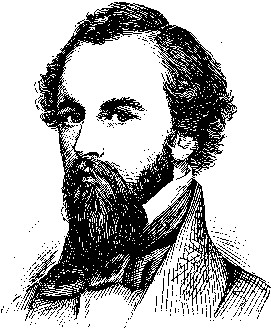
George H. Boker.
Mr. Boker was fond of the sonnet, as poets are apt to be who have once yielded to its attraction, and he used it with much effect. But chiefly his poems of the Civil War will make his name remembered. His lyre responded sympathetically to the heroic deeds which characterized that conflict--not always with the smoothness and polish of his more studied work, but worthily, and in the spirit of the time.
He was born in Philadelphia, October 6th, 1823, and died there January 2d, 1890. He was graduated from Princeton in 1842, and after studying law and traveling for a number of years in Europe, settled down in his native city, where most of his life was spent. He was Minister to Turkey from 1871 to 1875, and Minister to Russia from 1875 to 1879. His first volume, 'The Lesson of Life and other Poems,' was published in 1847, and was followed by various plays.--'Calaynos,' 'Anne Boleyn,' 'The Betrothal,' 'Leonor de Guzman,' 'Francesca da Rimini,' etc., which, with some shorter pieces, were collected in 'Plays and Poems,' published in 1856. His 'Poems of the War' appeared in 1864, and still later a number of other volumes: 'Street Lyrics,' 'Our Heroic Themes' (1865), 'Königsmark' (1869), 'The Book of the Dead' (1882), a very close imitation of 'In Memoriam' in both matter and form, and 'Sonnets' (1886).
THE BLACK REGIMENT
From 'Plays and Poems'
Port Hudson, May 27th, 1863.
Dark as the clouds of even,
Ranked in the western heaven,
Waiting the breath that lifts
All the dread mass, and drifts
Tempest and falling brand
Over a ruined land;--
So still and orderly,
Arm to arm, knee to knee,
Waiting the great event,
Stands the black regiment.
Down the long dusky line
Teeth gleam and eyeballs shine;
And the bright bayonet,
Bristling and firmly set,
Flashed with a purpose grand,
Long ere the sharp command
Of the fierce rolling drum
Told them their time had come,
Told them what work was sent
For the black regiment.
"Now," the flag-sergeant cried,
"Though death and hell betide,
Let the whole nation see
If we are fit to be
Free in this land; or bound
Down, like the whining hound,--
Bound with red stripes of pain
In our old chains again!"
Oh, what a shout there went
From the black regiment!
"Charge!" Trump and drum awoke,
Onward the bondmen broke;
Bayonet and sabre-stroke
Vainly opposed their rush.
Through the wild battle's crush,
With but one thought aflush,
Driving their lords like chaff,
In the guns' mouths they laugh;
Or at the slippery brands
Leaping with open hands,
Down they tear man and horse,
Down in their awful course;
Trampling with bloody heel
Over the crashing steel,
All their eyes forward bent,
Rushed the black regiment.
"Freedom!" their battle-cry,--
Freedom! or leave to die!"
Ah! and they meant the word,--
Not as with us 'tis heard,
Not a mere party shout:
They gave their spirits out;
Trusted the end to God,
And on the gory sod
Rolled in triumphant blood.
Glad to strike one free blow,
Whether for weal or woe;
Glad to breathe one free breath,
Though on the lips of death.
Praying--alas! in vain!--
That they might fall again,
So they could once more see
That bust to liberty!
This was what "freedom" lent
To the black regiment.
Hundreds on hundreds fell;
But they are resting well;
Scourges and shackles strong
Never shall do them wrong.
Oh, to the living few,
Soldiers, be just and true!
Hail them as comrades tried;
Fight with them side by side;
Never, in field or tent,
Scorn the black regiment!
Copyright: permission of George Boker, Esq.
THE SWORD-BEARER
From 'Poems of the War'
March 8th, 1862
Brave Morris saw the day was lost;
For nothing now remained,
On the wrecked and sinking Cumberland,
But to save the flag unstained.
So he swore an oath in the sight of Heaven,--
If he kept it the world can tell:--
"Before I strike to a rebel flag,
I'll sink to the gates of hell!
"Here, take my sword; 'tis in my way;
I shall trip o'er the useless steel;
For I'll meet the lot that falls to all
With my shoulder at the wheel."
So the little negro took the sword;
And oh, with what reverent care,
Following his master step by step,
He bore it here and there!
A thought had crept through his sluggish brain,
And shone in his dusky face,
That somehow--he could not tell just how--
'Twas the sword of his trampled race.
And as Morris, great with his lion heart,
Rushed onward from gun to gun,
The little negro slid after him,
Like a shadow in the sun.
But something of pomp and of curious pride
The sable creature wore,
Which at any time but a time like that
Would have made the ship's crew roar.
Over the wounded, dying, and dead,
Like an usher of the rod,
The black page, full of his mighty trust,
With dainty caution trod.
No heed he gave to the flying ball,
No heed to the bursting shell;
His duty was something more than life,
And he strove to do it well.
Down, with our starry flag apeak,
In the whirling sea we sank,
And captain and crew and the sword-bearer
Were washed from the bloody plank.
They picked us up from the hungry waves;--
Alas! not all!--"And where,
Where is the faithful negro lad?"--
"Back oars! avast! look there!"
We looked; and, as Heaven may save my soul,
I pledge you a sailor's word,
There, fathoms deep in the sea, he lay,
Still grasping the master's sword!
We drew him out; and many an hour
We wrought with his rigid form,
Ere the almost smothered spark of life
By slow degrees grew warm.
The first dull glance that his eyeballs rolled
Was down towards his shrunken hand;
And he smiled, and closed his eyes again
As they fell on the rescued brand.
And no one touched the sacred sword,
Till at length, when Morris came,
The little negro stretched it out,
With his eager eyes aflame.
And if Morris wrung the poor boy's hand,
And his words seemed hard to speak,
And tears ran down his manly cheeks,
What tongue shall call him weak?
This and the sonnets on next page are copyrighted, and used by permission of George Boker, Esq.
SONNETS
Either the sum of this sweet mutiny
Amongst thy features argues me some harm,
Or else they practice wicked treachery
Against themselves, thy heart, and hapless me.
For as I start aside with blank alarm,
Dreading the glitter which begins to arm
Thy clouded brows, lo! from thy lips I see
A smile come stealing, like a loaded bee,
Heavy with sweets and perfumes, all ablaze
With soft reflections from the flowery wall
Whereon it pauses. Yet I will not raise
One question more, let smile or frown befall,
Taxing thy love where I should only praise,
And asking changes that might change thee all.
Oh for some spirit, some magnetic spark,
That used nor word, nor rhyme, nor balanced pause
Of doubtful phrase, which so supinely draws
My barren verse, and blurs love's shining mark
With misty fancies!--Oh! to burst the dark
Of smothered feeling with some new-found laws,
Hidden in nature, that might bridge the flaws
Between two beings, end this endless cark,
And make hearts know what lips have never said!
Oh! for some spell, by which one soul might move
With echoes from another, and dispread
Contagious music through its chords, above
The touch of mimic art: that thou might'st tread
Beneath thy feet this wordy show of love!
Here let the motions of the world be still!--
Here let Time's fleet and tireless pinions stay
Their endless flight!--or to the present day
Bind my Love's life and mine. I have my fill
Of earthly bliss: to move is to meet ill.
Though lavish fortune in my path might lay
Fame, power, and wealth,--the toys that make the play
Of earth's grown children,--I would rather till
The stubborn furrows of an arid land,
Toil with the brute, bear famine and disease,
Drink bitter bondage to the very lees,
Than break our union by love's tender band,
Or drop its glittering shackles from my hand,
To grasp at empty glories such as these.
SAINT BONAVENTURA
(1221-1274)
BY THOMAS DAVIDSON

aint Bonaventura, whose original name was Giovanni di Fidenza, was born at Bagnaréa in Tuscany in 1221. At the age of four he was attacked by a severe illness, during which his mother appealed to St. Francis for his prayers, promising that if the child recovered, he should be devoted to God and become one of Francis's followers. When the child did recover, the saint, seeing him, exclaimed "O bona ventura!" a name which clung to the boy ever afterwards, and under which he entered religion and the order of St. Francis in 1243.
Soon after, he went to the then world-renowned university of Paris, where he had for his teacher an Englishman, Alexander of Hales, the first of the schoolmen who studied the whole of Aristotle's works, and attempted to construct a Christian theology on the basis of them. Even at this time the young Italian's life was so saintly that his master (so it is reported) said of him that he seemed to have been born without the taint of original sin. He graduated in the same year as Thomas Aquinas, and immediately afterward began his career as a public teacher under the auspices of the Franciscan order, while Thomas did the same under those of the Dominican. These two men, the greatest of the schoolmen, and the sweetest and sanest of the mystics, were bosom friends; and one can hardly imagine a loftier friendship.
In 1256, at the early age of thirty-five, he became general of his order, a post which he held till his death. He did much to ennoble and purify the order, and to bring it back to orthodoxy, from which then, as nearly always, it was strongly inclined to swerve. In 1265 Clement V. nominated him to the see of York; but Bonaventura, unwilling probably to face so rude a climate and people, persuaded the Pope to withdraw the nomination. A few years later, under Gregory X., he was raised to the cardinalate and appointed bishop of Albano. In 1274 he attended the Council of Lyons, and must have been deeply affected when he learned that Thomas Aquinas had died on his way thither. The success of the efforts of the council to come to terms with the Greeks was mainly due to him.
This was Bonaventura's last work on earth. He died before the council was over, and was honored with a funeral whose solemnity and magnificence have seldom been equaled. It was attended by the Pope, the Eastern Emperor, the King of Aragon, the patriarchs of Antioch and Constantinople, and a large number of bishops and priests. His relics were preserved with much reverence by the Lyonnese until the sixteenth century, when the Huguenots threw them into the Saône. In 1482 he was canonized by Sixtus IV., and in 1588 declared a doctor of the Church by Sixtus V. Dante places him in the Heaven of the Sun.
Bonaventura is the sweetest and tenderest of all the mediæval saints. His mode of teaching was so inspiring that even in his lifetime he was known as the "Seraphic Doctor." He was a voluminous writer, his works in the Lyons edition of 1688 filling seven folio volumes. They consist largely of sermons, and commentaries on the Scriptures and the 'Sentences' of Peter the Lombard. Besides these, there is a number of 'Opuscula,' mostly of a mystic or disciplinary tendency. Most famous among these are the 'Breviloquium,' perhaps the best compend of mediæval Christian theology in existence; and the 'Itinerarium Mentis in Deum,' a complete manual of mysticism, such as was aspired to by the noblest of the mystics; a work worthy to be placed beside the 'Imitation of Christ,' though of a different sort.
Bonaventura was above all things a mystic; that is, he belonged to that class of men, numerous in many ages, who, setting small store by the world of appearance open to science, and even by science itself, seek by asceticism, meditation, and contemplation to attain a vision of the world of reality, and finally of the supreme reality, God himself. Such mysticism is almost certainly derived from the far East; but so far as Europe is concerned it owes its origin mainly to Plato, and his notion of a world of ideas distinct from the real world, lying outside of all mind, and attainable only by strict mental discipline. This notion, simplified by Aristotle into the notion of a transcendent God, eternally thinking himself, was developed into a hierarchic system of being by the Neo-Platonists, Plotinus, Porphyry, etc., and from them passed into the Christian Church, partly through Augustine and the Pseudo-Dionysius Areopagita (q.v.), and partly through the Muslim and Jewish thinkers of later times. Though at first regarded with suspicion by the Western Church, it was too closely interwoven with Latin Christianity, and too germane to the spirit of monasticism, not to become popular. Its influence was greatly strengthened by the mighty personality of that prince of mystics, St. Bernard (1091-1153), from whom it passed on to the monastery school of St. Victor in Paris, where it was worthily represented by the two great names of Hugo (1096-1141) and Richard (1100?-1173). From the writings of these, and from such works as the 'Liber de Causis,' recently introduced into Europe through the Muslim, Bonaventura derived that mystical system which he elaborated in his 'Itinerarium' and other works.
A magnificent edition of his works is now being edited by the fathers of the College of St. Bonaventura, at Quaracchi, near Florence (1882-). There is a small, very handy edition of the 'Breviloquium' and 'Itinerarium' together, by Hefele (Tübingen, 1861).

ON THE BEHOLDING OF GOD IN HIS FOOTSTEPS IN THIS SENSIBLE WORLD
But since, as regards the mirror of sensible things, we may contemplate God not only through them as through footprints, but also in them in so far as he is in them by essence, power, and presence,--and this consideration is loftier than the preceding; therefore this kind of consideration occupies the second place, as the second grade of contemplation, whereby we must be guided to the contemplation of God in all created things which enter our minds through the bodily senses.
We must observe, therefore, that this sensible world, which is called the macrocosm--that is, the long world--enters into our soul, which is called the microcosm--that is, the little world--through the gates of the five senses, as regards the apprehension, delectation, and distinction of these sensible things; which is manifest in this way:--In the sensible world some things are generant, others are generated, and others direct both these. Generant are the simple bodies; that is, the celestial bodies and the four elements. For out of the elements, through the power of light, reconciling the contrariety of elements in things mixed, are generated and produced whatever things are generated and produced by the operation of natural power. Generated are the bodies composed of the elements, as minerals, vegetables, sensible things, and human bodies. Directing both these and those are the spiritual substances: whether altogether conjunct, like the souls of the brutes; or separably conjunct, like rational souls; or altogether separate, like the celestial spirits; which the philosophers call Intelligences, we Angels. On these, according to the philosophers, it devolves to move the heavenly bodies; and for this reason the administration of the universe is ascribed to them, as receiving from the First Cause--that is, God--that inflow of virtue which they pour forth again in relation to the work of government, which has reference to the natural consistence of things. But according to the theologians the direction of the universe is ascribed to these same beings, as regards the works of redemption, with respect to which they are called "ministering spirits, sent forth to do service for the sake of them that shall inherit salvation."
Man, therefore, who is called the lesser world, has five senses, like five gates, through which the knowledge of all the things that are in the sensible world enters into his soul. For through sight there enter the sublime and luminous bodies and all other colored things; through touch, solid and terrestrial bodies; through the three intermediate senses, the intermediate bodies; through taste, the aqueous; through hearing, the aërial; through smell, the vaporable, which have something of the humid, something of the aërial, and something of the fiery or hot, as is clear from the fumes that are liberated from spices. There enter, therefore, through these doors not only the simple bodies, but also the mixed bodies compounded of these. Seeing then that with sense we perceive not only these particular sensibles--light, sound, odor, savor, and the four primary qualities which touch apprehends--but also the common sensibles--number, magnitude, figure, rest, and motion; and seeing that everything which moves is moved by something else, and certain things move and rest of themselves, as do the animals; in apprehending through these five senses the motions of bodies, we are guided to the knowledge of spiritual motions, as by an effect to the knowledge of causes.
In the three classes of things, therefore, the whole of this sensible world enters the human soul through apprehension. These external sensible things are those which first enter into the soul through the gates of the five senses. They enter, I say, not through their substances, but through their similitudes, generated first in the medium, and from the medium in the external organ, and from the external organ in the internal organ, and from this in the apprehensive power; and thus generation in the medium, and from the medium in the organ, and the direction of the apprehensive power upon it, produce the apprehension of all those things which the soul apprehends externally.
This apprehension, if it is directed to a proper object, is followed by delight. The sense delights in the object perceived through its abstract similitude, either by reason of its beauty, as in vision, or by reason of its sweetness, as in smell and hearing, or by reason of its healthfulness, as in taste and touch, properly speaking. But all delight is by reason of proportion. But since species is the ground of form, power, and action, according as it has reference to the principle from which it emanates, the medium into which it passes, or the term upon which it acts, therefore proportion is observed in three things. It is observed in similitude, inasmuch as it forms the ground of species or form, and so is called speciosity, because beauty is nothing but numerical equality, or a certain disposition of parts accompanied with sweetness of color. It is observed in so far as it forms the ground of power or virtue, and thus is called sweetness, when the active virtue does not disproportionally exceed the recipient virtue, because the sense is depressed by extremes, and delighted by means. It is observed in so far as it forms the ground of efficacy and impression, which is proportional when the agent, in impressing, satisfies the need of the patient, and this is to preserve and nourish it, as appears chiefly in taste and touch. And thus we see how, by pleasure, external delightful things enter through similitude into the soul, according to the threefold method of delectation.
After this apprehension and delight there comes discernment, by which we not only discern whether this thing be white or black (because this alone belongs to the outer sense), and whether this thing be wholesome or hurtful (because this belongs to the inner sense), but also discern why this delights and give a reason therefor. And in this act we inquire into the reason of the delight which is derived by the sense from the object. This happens when we inquire into the reason of the beautiful, the sweet, and the wholesome, and discover that it is a proportion of equality. But a ratio of equality is the same in great things and in small. It is not extended by dimensions; it does not enter into succession, or pass with passing things; it is not altered by motions. It abstracts therefore from place, time, and motion; and for this reason it is immutable, uncircumscribable, interminable, and altogether spiritual. Discernment, then, is an action which, by purifying and abstracting, makes the sensible species, sensibly received through the senses, enter into the intellective power. And thus the whole of this world enters into the human soul by the gates of the five senses, according to the three aforesaid activities.
All these things are footprints, in which we may behold our God. For, since an apprehended species is a similitude generated in a medium and then impressed upon the organ, and through that impression leads to the knowledge of its principle,--that is, of its object,--it manifestly implies that that eternal light generates from itself a similitude or splendor co-equal, consubstantial, and co-eternal; and that He who is the image and similitude of the invisible God, and the splendor of the glory, and the figure of the substance which is everywhere, generates by his first generation of himself his own similitude in the form of an object in the entire medium, unites himself by the grace of union to the individual of rational nature, as a species to a bodily organ, so that by this union he may lead us back to the Father as the fontal principle and object. If therefore all cognizable things generate species of themselves, they clearly proclaim that in them, as in mirrors, may be seen the eternal generation of the Word, the Image, and the Son, eternally emanating from God the Father....
Since therefore all things are beautiful, and in a certain way delightful, and since beauty and delight are inseparable from proportion, and proportion is primarily in numbers, all things must of necessity be full of number. For this reason, number is the chief exemplar in the mind of the artificer, and in things the chief footprint leading to wisdom. Since this is most manifest to all and most close to God, it leads us most closely and by seven differences to God, and makes him known in all things, corporeal and sensible. And while we apprehend numerical things, we delight in numerical proportions, and judge irrefragably by the laws of these....
For every creature is by nature an effigy and similitude of that eternal Wisdom: but especially so is that creature which in the book of Scriptures was assumed by the spirit of prophecy for the prefiguration of spiritual things; more especially those creatures in whose effigy God was willing to appear for the angelic ministry; and most especially that creature which he was willing to set forth as a sign, and which plays the part not only of a sign, as that word is commonly used, but also of a sacrament.
GEORGE BORROW
(1803-1881)
BY JULIAN HAWTHORNE

eorge Borrow lived eight-and-seventy years and published ten books. In his veins was mingled the blood of Cornwall and of Normandy; but though proud of this strain, he valued still more that personal independence which, together with his love of strange tongues and his passion for outdoor life, molded his career. His nature was mystical and eccentric, and he sometimes approached--though he never crossed--the confines of insanity; yet his instincts were robust and plain, he was an apostle of English ale and a master of the art of self-defense, he was an uncompromising champion of the Church of England and the savage foe of Papistry, he despised "kid-glove gentility" in life and literature, and delighted to make his spear ring against the hollow shield of social convention. A nature so complicated and individual, so outspoken and aggressive, could not slip smoothly along the grooves of civilized existence; he was soundly loved and hated, but seldom, or never understood. And the obstinate pride which gave projection to most of his virtues was also at the bottom of his faults: he better liked to perplex than to open himself to his associates; he willfully repelled where he might have captivated, Some human element was wanting in him: he was strong, masculine, subtle, persistent; of a lofty and austere spirit; too proud even to be personally ambitious; gifted with humor and insight; fearless and faithful;--but no tenderness, no gentleness, no inviting human warmth ever appears in him; and though he could reverence women, and admire them, and appreciate them also from the standpoint of the senses, they had no determining sway over his life or thought. If there be any man in English history whom such a summary of traits as this recalls, it is Dean Swift. Nevertheless Borrow's differences from him are far greater than the resemblances between them. Giant force was in both of them; both were enigmas; but the deeper we penetrate into Borrow, the more we like him; not so with the blue-eyed Dean. Borrow's depths are dark and tortuous, but never miasmic; and as we grope our way through them, we may stumble upon treasures, but never upon rottenness.
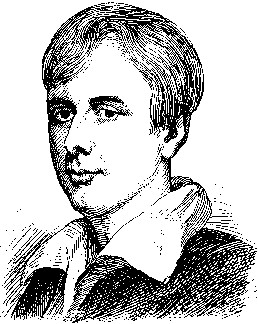
George Borrow.
A man who can be assigned to no recognized type--who flocks by himself, as the saying is--cannot easily be portrayed: we lose the main design in our struggle with the details. Indeed, no two portraits of such a man can be alike: they will vary according to the temperament and limitations of the painter. It is safe to assert, however, that insatiable curiosity was at the base both of his character and of his achievements. Instincts he doubtless had in plenty, but no intuitions; everything must be construed to him categorically. But his capacity keeps pace with his curiosity; he promptly assimilates all he learns, and he can forget nothing. Probably this investigating passion had its cause in his own unlikeness to the rest of us: he was as a visitor from another planet, pledged to send home reports of all he saw here. His success in finding strange things is prodigious: his strange eye detects oddities and beauties to which we to the manner born were strange. Adventures attend him everywhere, as the powers of earth and air on Prospero. Here comes the King of the Vipers, the dry stubble crackling beneath his outrageous belly; yonder the foredoomed sailor promptly fulfills his own prediction, falling from the yard-arm into the Bay of Biscay; anon the ghastly visage of Mrs. Herne, of the Hairy Ones, glares for a moment out of the midnight hedge; again, a mysterious infatuation drives the wealthy idler from his bed out into the inclement darkness, and up to the topmost bough of the tree, which he must "touch" ere he can rest; and now, in the gloom of the memorable dingle, the horror of fear falls upon the amateur tinker, the Evil One grapples terribly with his soul, blots of foam fly from his lips, and he is dashed against the trees and stones. An adventure, truly, fit to stand with any of mediæval legend, and compared with which the tremendous combat with Blazing Bosville, the Flaming Tinman, is almost a relief. But in what perilous Faery Land forlorn do all these and a thousand more strange and moving incidents take place?--Why, in the quiet lanes and byways of nineteenth-century England, or perchance in priest-ridden Spain, where the ordinary traveler can for the life of him discover nothing more startling than beef and beer, garlic and crucifixes. Adventures are in the adventurer.
Man and nature were Borrow's study, but England was his love. In him exalted patriotism touches its apogee. How nobly and uncompromisingly is he jealous of her honor, her glory, and her independence! In what eloquent apostrophes does he urge her to be true to her lofty traditions, to trample on base expediency and cleave to the brave and true! In what resounding jeremiads does he denounce woe upon her traitors and seducers! With what savage sarcasm and scorn does he dissect the soul of the "man in black"! No other writing more powerful, picturesque, and idiomatic has been done in this century. He will advocate no policy less austere than purity, courage, and truth. There is in his zeal a narrowness that augments its strength, yet lessens its effect so far as practical issues are concerned. He is an idealist: but surely no young man can read his stern, throbbing pages without a kindling of the soul, and a resolve to be high in deed and aim; and there is no gauging the final influence of such spiritual stimulus. England and mankind must be better for this lonely, indignant voice.
England, and England's religion, and the Bible in its integrity,--these are the controlling strings of Borrow's harp. Yet he had his youthful period of religious doubt and philosophic sophism: has he not told how walls and ceilings rang with the "Hey!" of the man with the face of a lion, when the gray-haired boy intimated his skepticism? But vicissitudes of soul and body, aided by the itinerant Welsh preacher, cleansed him of these errors, and he undertook and carried through the famous crusade recorded in 'The Bible in Spain'--a narrative of adventure and devotion which fascinated and astonished England, and sets its author abreast of the great writers of his time. It is as irresistible to-day as it was fifty years ago: it stands alone; only Trelawny's 'Adventures of a Younger Son' can be compared with it as narrative, and Trelawny's book lacks the grand central feature which gives dignity and unity to Borrow's. Being a story of fact, 'The Bible in Spain' lacks much of the literary art and felicity, as well as the imaginative charm, of 'Lavengro'; but within its own scope it is great, and nothing can supersede it.
Gipsydom in all its aspects, though logically a side-issue with Borrow, was nevertheless the most noticeable thing relating to him: it engaged and colored him on the side of his temperament; and in the picture we form of a man, temperament tells far more than intellect because it is more individual. Later pundits have called in question the academic accuracy of Borrow's researches in the Romany language: but such frettings are beside the mark; Borrow is the only genuine expounder of Gipsyness that ever lived. He laid hold of their vitals, and they of his; his act of brotherhood with Mr. Jasper Petulengro is but a symbol of his mystical alliance with the race. This is not to say that he fathomed the heart of their mystery; the gipsies themselves cannot do that: but he comprehended whatever in them is open to comprehension, and his undying interest in them is due not only to his sympathy with their way of life, but to the fact that his curiosity about them could never be quite satisfied. Other mysteries come and go, but the gipsy mystery stays with us, and was to Borrow a source of endless content. For after sharpening his wits on the ethnological riddle, he could refresh himself with the psychical aspect of the matter, discovering in them the incarnation of one essential human quality, incompletely present in all men. They are the perfect vagabonds; but the germ of vagabondage inheres in mankind at large, and is the source of the changes that have resulted in what we call civilization. Borrow's nature comprised the gipsy, but the gipsy by no means comprised him; he wandered like them, but the object of his wanderings was something more than to tell dukkeripens, poison pigs, mend kettles, or deal in horseflesh. Therefore he puzzled them more than they did him.
'The Gipsies of Spain' (1841) was his first book about them; 'Lavengro' came ten years later, and 'Romany Rye' six years after that. In 1874 he returns to the subject in 'Roman Lavo-lil,' a sort of dictionary and phrase-book of the language, but unlike any other dictionary and phrase-book ever conceived: it is well worth reading as a piece of entertaining literature. His other books are translations of Norse and Welsh poetry, and a book of travels in 'Wild Wales,' published in 1862. All these works are more than readable: the translations, though rugged and unmusical, have about them a frank sensuousness and a primitive force that are amusing and attractive. But after all, Borrow is never thoroughly himself in literature unless the gipsies are close at hand; and of all his gipsy books 'Lavengro' is by far the best. Indeed, it is so much the best and broadest thing that he produced, that the reader who would know Borrow need never go beyond these pages. In 'Lavengro' we get the culmination of both the author and the man; it is his book in the full sense, and may afford profitable study to any competent reader for a lifetime.
'Lavengro,' in fact, is like nothing else in either biography or fiction--and it is both fictitious and biographical. It is the gradual revelation of a strange, unique being. But the revelation does not proceed in an orderly and chronological fashion: it is not begun in the first chapter, and still less is it completed in the last. After a careful perusal of the book, you will admit that though it has fascinated and impressed you, you have quite failed to understand it. Why is the author so whimsical? Wherefore these hinted but unconfessed secrets? Why does he stop short on the brink of an important disclosure, and diverge under cover of a line of asterisks into another subject?--But Borrow in 'Lavengro' is not constructing a book, he is creating one. He has the reserves of a man who respects his own nature, yet he treats the reader fairly. If you are worthy to be his friend, by-and-by you will see his heart,--look again, and yet again! That passage in a former chapter was incomplete; but look ahead a hundred pages and consider a paragraph there: by itself it seems to say little; but gradually you recognize in it a part of the inwoven strand which disappears in one part of the knot and emerges in another. Though you cannot solve the genial riddle to-day, you may to-morrow. The only clue is sympathy. This man hides his heart for him who has the mate to it; and beneath the whimsical, indifferent, proud, and cold exterior, how it heaves and fears and loves and wonders! This is a wild, unprecedented, eloquent, mysterious, artistic yet artless book; it is alive; it tells of an existence apart, yet in contact with the deep things of all human experience. No other man ever lived as Borrow did, and yet his book is an epitome of life. The magic of his personal quality beguiles us on every page; but deeper still lie the large, immutable traits that make all men men, and avouch the unity of mankind.
'Romany Rye' is the continuation of 'Lavengro,' but scarcely repeats its charm; its most remarkable feature is an 'Appendix,' in which Borrow expounds his views upon things in general, including critics and politics. It is a marvelously trenchant piece of writing, and from the literary point of view delightful; but it must have hurt a good many people's feelings at the time it was published, and even now shows the author on his harsh side only. We may agree with all he says, and yet wish he had uttered it in a less rasping tone.
Like nearly all great writers, Borrow, in order to get his best effects, must have room for his imagination. Mere fact would not rouse him fully, and abstract argument still less. In 'Lavengro' he hit upon his right vein, and he worked it in the fresh maturity of his power. The style is Borrow's own, peculiar to him: eloquent, rugged, full of liturgical repetitions, shunning all soft assonances and refinements, and yet with remote sea-like cadences, and unhackneyed felicities that rejoice the jaded soul. Writing with him was spontaneous, but never heedless or unconsidered; it was always the outcome of deep thought and vehement feeling. Other writers and their books may be twain, but Borrow and his books are one. Perhaps they might be improved in art, or arrangement, or subject; but we should no longer care for them then, because they would cease to be Borrow. Borrow may not have been a beauty or a saint; but a man he was; and good or bad, we would not alter a hair of him.
Nothing like an adequate biography of Borrow has ever been published: a few dates, and some more or less intelligent opinions about his character and work, are the sum of what we know of him--outside his own books. Some of the dates are probably guess-work; most of the opinions are incompetent: it is time that some adequate mind assembled all available materials and digested them into a satisfactory book. It is hardly worth while to review the few meagre details. Borrow was born in 1803 and died in 1881; his father, a soldier, failed to make a solicitor of him, and the youth, at his father's death, came up to London to live or die by literature. After much hardship (of which the chapters in 'Lavengro' describing the production of 'Joseph Sell' convey a hint), he set out on a wandering pilgrimage over England, Europe, and the East. As agent for the British and Foreign Bible Society he traversed Spain and Portugal, sending to the Morning Herald letters descriptive of his adventures, which afterwards were made the substance of his books. He married at thirty-seven, and lived at Outton Broad nearly all his life after. His wife died a dozen years before him, in 1869. She left no children.
His first book, a translation of Klinger's 'Faust,' appeared in 1825; his last, 'The Gipsy Dictionary,' in 1874; a volume called 'Penquite and Pentyre,' on Cornwall, was announced in 1857, but seems never to have been published, 'Targum,' a collection of translations from thirty languages and dialects, was a tour de force belonging to the year 1835. On the whole, Borrow was not a voluminous writer; but what he wrote tells.