автордың кітабын онлайн тегін оқу Library of the World's Best literature, Ancient and Modern, Vol. 12
JAVANESE ILLUMINATED MANUSCRIPT.
The origin of the Oceanic dialects, and of those of India beyond the Ganges, more especially the civilized idioms of the Indian Archipelago, is referred to a language which was that of an unknown people inhabiting the island of Java. From this primitive language the modern Javanese is supposed to be immediately derived. Javanese literature consists of poems, dramas, songs, and historical and religious writings. The accompanying facsimile is from a mythological-religious tract written upon a vegetable paper of native manufacture, and ornamented with grotesque drawings.
LIBRARY OF THE
WORLD'S BEST LITERATURE
ANCIENT AND MODERN
CHARLES DUDLEY WARNER
EDITOR
HAMILTON WRIGHT MABIE
LUCIA GILBERT RUNKLE
GEORGE HENRY WARNER
ASSOCIATE EDITORS
Connoisseur Edition
Vol. XII.
NEW YORK
THE INTERNATIONAL SOCIETY
Connoisseur Edition
LIMITED TO FIVE HUNDRED COPIES IN HALF RUSSIA
No. ..........
Copyright, 1896, by
R. S. PEALE AND J. A. HILL
All rights reserved
THE ADVISORY COUNCIL
CRAWFORD H. TOY, A. M., LL. D.,
Professor of Hebrew, Harvard University, Cambridge, Mass.
THOMAS R. LOUNSBURY, LL. D., L. H. D.,
Professor of English in the Sheffield Scientific School of Yale University, New Haven, Conn.
WILLIAM M. SLOANE, Ph. D., L. H. D.,
Professor of History and Political Science, Princeton University, Princeton, N. J.
BRANDER MATTHEWS, A. M., LL. B.,
Professor of Literature, Columbia University, New York City.
JAMES B. ANGELL, LL. D.,
President of the University of Michigan, Ann Arbor, Mich.
WILLARD FISKE, A. M., Ph. D.,
Late Professor of the Germanic and Scandinavian Languages and Literatures, Cornell University, Ithaca, N. Y.
EDWARD S. HOLDEN, A. M., LL. D.,
Director of the Lick Observatory, and Astronomer, University of California, Berkeley, Cal.
ALCÉE FORTIER, LIT. D.,
Professor of the Romance Languages, Tulane University, New Orleans, La.
WILLIAM P. TRENT, M. A.,
Dean of the Department of Arts and Sciences, and Professor of English and History, University of the South, Sewanee, Tenn.
PAUL SHOREY, Ph. D.,
Professor of Greek and Latin Literature, University of Chicago, Chicago, Ill.
WILLIAM T. HARRIS, LL. D.,
United States Commissioner of Education, Bureau of Education, Washington, D. C.
MAURICE FRANCIS EGAN, A. M., LL. D.,
Professor of Literature in the Catholic University of America, Washington, D. C.
TABLE OF CONTENTS
VOL. XII
LIVED PAGE Denis Diderot1713-1784
4689 From 'Rameau's Nephew' Franz von Dingelstedt1814-1881
4704 A Man of Business ('The Amazon') The Watchman (same) Diogenes Laertius200-250 A. D.?
4711 Life of Socrates ('Lives and Sayings of the Philosophers') Examples of Greek Wit and Wisdom: Bias; Plato; Aristippus; Aristotle; Theophrastus; Demetrius; Antisthenes; Diogenes; Cleanthes; Pythagoras Isaac D'Israeli1766-1848
4725 Poets, Philosophers, and Artists Made by Accident ('Curiosities of Literature') Martyrdom of Charles the First ('Commentaries on the Reign of Charles the First') Sydney Dobell1824-1874
4733 Epigram on the Death of Edward Forbes How's My Boy? The Sailor's Return Afloat and Ashore The Soul ('Balder') England (same) America Amy's Song of the Willow ('Balder') Austin Dobson1840-
4741BY ESTHER SINGLETON
On a Nankin Plate The Old Sedan-Chair Ballad of Prose and Rhyme The Curé's Progress "Good-Night, Babbette" The Ladies of St. James's Dora versus Rose Une Marquise A Ballad to Queen Elizabeth The Princess De Lamballe ('Four Frenchwomen') Mary Mapes Dodge1840?-
4751 The Race ('Hans Brinker') John Donne1573-1631
4771 The Undertaking A Valediction Forbidding Mourning Song Love's Growth Song Feodor Mikhailovitch Dostoévsky1821-1881
4779BY ISABEL F. HAPGOOD
From 'Poor People': Letter from Varvara Debrosyeloff to Makar Dyevushkin; Letter from Makar Dyevushkin to Varvara Alexievna Dobrosyeloff The Bible Reading ('Crime and Punishment') Edward Dowden1843-
4806 The Humor of Shakespeare ('Shakespeare; a Critical Study of His Mind and Art') Shakespeare's Portraiture of Women ('Transcripts and Studies') The Interpretation of Literature (same) A. Conan Doyle1859-
4815 The Red-Headed League ('The Adventures of Sherlock Holmes') Bowmen's Song ('The White Company') Holger Drachmann1846-
4840 The Skipper and His Ship ('Paul and Virginia of a Northern Zone') The Prince's Song ('Once Upon a Time') Joseph Rodman Drake1795-1820
4851 A Winter's Tale ('The Croakers') The Culprit Fay The American Flag John William Draper1811-1882
4865 The Vedas and Their Theology ('The Intellectual Development of Europe') Primitive Beliefs Dismissed by Scientific Knowledge (same) The Koran (same) Michael Drayton1563-1631
4877 Sonnet The Ballad of Agincourt Queen Mab's Excursion ('Nymphidia, the Court of Faery') Gustave Droz1832-1895
4885 How the Baby Was Saved ('The Seamstress's Story') A Family New-Year's ('Monsieur, Madame, and Bébé') Their Last Excursion ('Making an Omelette') Henry Drummond1851-
4897 The Country and Its People ('Tropical Africa') The East-African Lake Country (same) White Ants (same) William Drummond of Hawthornden1585-1649
4913 Sextain Madrigal Reason and Feeling Degeneracy of the World Briefness of Life The Universe On Death ('Cypress Grove') John Dryden1631-1700
4919BY THOMAS R. LOUNSBURY
From 'The Hind and the Panther' To My Dear Friend Mr. Congreve Ode to the Pious Memory of Mrs. Anne Killigrew A Song Lines Printed under Milton's Portrait Alexander's Feast; or, The Power of Music Achitophel ('Absalom and Achitophel') Maxime Du Camp1822-
4951 Street Scene during the Commune ('The Convulsions of Paris') Alexandre Dumas, Senior1802-1870
4957BY ANDREW LANG
The Cure for Dormice that Eat Peaches ('The Count of Monte Cristo') The Shoulder of Athos, the Belt of Porthos, and the Handkerchief of Aramis ('The Three Musketeers') Defense of the Bastion St.-Gervais (same) Consultation of the Musketeers (same) The Man in the Iron Mask ('The Viscount of Bragelonne') A Trick is Played on Henry III. by Aid of Chicot ('The Lady of Monsoreau') Alexandre Dumas, Junior1824-1895
5001BY FRANCISQUE SARCEY
The Playwright Is Born—and Made (Preface to 'The Prodigal Father') An Armed Truce ('A Friend to the Sex') Two Views of Money ('The Money Question') M. De Remonin's Philosophy of Marriage ('L'Étrangére') Reforming a Father ('The Prodigal Father') Mr. and Mrs. Clarkson ('L'Étrangére') George Du Maurier1834-1896
5041 At the Heart of Bohemia ('Trilby') Christmas in the Latin Quarter (same) "Dreaming True" ('Peter Ibbetson') Barty Josselin at School ('The Martian') William Dunbar1465?-1530?
5064 The Thistle and the Rose From 'The Golden Targe' No Treasure Avails Without Gladness Jean Victor Duruy1811-1894
5069 The National Policy ('History of Rome') Results of the Roman Dominion (same)FULL-PAGE ILLUSTRATIONS
VOLUME XII
PAGE Javanese Manuscript (Colored Plate)Frontispiece
The Alexandrine Manuscript (Fac-simile) xii Old Black-Letter Quarto (Fac-simile) 4726 "Charles I. Going to Execution" (Photogravure) 4730 "The Skater of the Zuyder Zee" (Photogravure) 4758 African Arabic Manuscript (Fac-simile) 4870 John Dryden (Portrait) 4920 Alexandre Dumas (Portrait) 4958 Alexandre Dumas, Fils (Portrait) 5002VIGNETTE PORTRAITS
Denis Diderot Joseph Rodman Drake Franz von Dingelstedt John William Draper Isaac D'Israeli Michael Drayton Austin Dobson Gustav Droz Mary Mapes Dodge Henry Drummond John Donne William Drummond Feodor Dostoévsky Maxime Du Camp A. Conan Doyle George du Maurier Holger Drachmann Jean Victor DuruyFrom the tragic-est novels at Mudie's— At least on a practical plan— To the tales of mere Hodges and Judys, One love is enough for a man. But no case that I ever yet met is Like mine: I am equally fond Of Rose, who a charming brunette is, And Dora, a blonde.
Each rivals the other in powers— Each waltzes, each warbles, each paints— Miss Rose, chiefly tumble-down towers; Miss Do., perpendicular saints. In short, to distinguish is folly; 'Twixt the pair I am come to the pass Of Macheath, between Lucy and Polly,— Or Buridan's ass.
If it happens that Rosa I've singled For a soft celebration in rhyme, Then the ringlets of Dora get mingled Somehow with the tune and the time; Or I painfully pen me a sonnet To an eyebrow intended for Do.'s, And behold I am writing upon it The legend, "To Rose."
Or I try to draw Dora (my blotter Is all over scrawled with her head), If I fancy at last that I've got her, It turns to her rival instead; Or I find myself placidly adding To the rapturous tresses of Rose Miss Dora's bud-mouth, and her madding, Ineffable nose.
Was there ever so sad a dilemma? For Rose I would perish (pro tem.); For Dora I'd willingly stem a— (Whatever might offer to stem); But to make the invidious election,— To declare that on either one's side I've a scruple,—a grain,—more affection, I cannot decide.
And as either so hopelessly nice is, My sole and my final resource Is to wait some indefinite crisis,— Some feat of molecular force, To solve me this riddle conducive By no means to peace or repose, Since the issue can scarce be inclusive Of Dora and Rose.
THE BRIEFNESS OF LIFE
At the outset of his career he found himself received with consideration by the men whose acquaintance he most desired. Following the fashion of the day, and inspired by the books of anecdotes so successfully published by his friend Douce, D'Israeli in 1791 produced anonymously a small volume entitled 'Curiosities of Literature,' the copyright of which he magnanimously presented to his publisher. The extraordinary success of this book can be accounted for only by the curious taste of the time, which still reflected the more unworthy traditions of the Addisonian era. It was an age of clubs and tea-tables, of society scandal-mongering and fireside gossip; and the reading public welcomed a contribution whose refined dilettantism so well matched its own. The mysteries of Eleusis and the origin of wigs received the same grave attention. This popularity induced D'Israeli to buy back the copyright at a generous valuation; he enlarged the work to five volumes, which passed through twelve in his own lifetime, and still serves to illustrate a curious literary phase.
At a dinner given by Sir William Cecil during the plague in 1563, at his apartments at Windsor, where the Queen had taken refuge, a number of ingenious men were invited. Secretary Cecil communicated the news of the morning, that several scholars at Eton had run away on account of their master's severity, which he condemned as a great error in the education of youth. Sir William Petre maintained the contrary; severe in his own temper, he pleaded warmly in defense of hard flogging. Dr. Wootton, in softer tones, sided with the Secretary. Sir John Mason, adopting no side, bantered both. Mr. Haddon seconded the hard-hearted Sir William Petre, and adduced as an evidence that the best schoolmaster then in England was the hardest flogger. Then was it that Roger Ascham indignantly exclaimed that if such a master had an able scholar it was owing to the boy's genius and not the preceptor's rod. Secretary Cecil and others were pleased with Ascham's notions. Sir Richard Sackville was silent; but when Ascham after dinner went to the Queen to read one of the orations of Demosthenes, he took him aside, and frankly told him that though he had taken no part in the debate he would not have been absent from that conversation for a great deal; that he knew to his cost the truth Ascham had supported, for it was the perpetual flogging of such a schoolmaster that had given him an unconquerable aversion to study. And as he wished to remedy this defect in his own children, he earnestly exhorted Ascham to write his observations on so interesting a topic. Such was the circumstance which produced the admirable treatise of Roger Ascham.
"This is not only a tale of vivid description, interesting and instructive; it is a romance. There are adventures, startling and surprising, there are mysteries of buried gold, there are the machinations of the wicked, there is the heroism of the good, and the gay humor of happy souls. More than these, there is love—that sentiment which glides into a good story as naturally as into a human life; and whether the story be for old or young, this element gives it an ever-welcome charm. Strange fortune and good fortune come to Hans and to Gretel, and to many other deserving characters in the tale, but there is nothing selfish about these heroes and heroines. As soon as a new generation of young people grows up to be old enough to enjoy this perennial story, all these characters return to the days of their youth, and are ready to act their parts again to the very end, and to feel in their own souls, as everybody else feels, that their story is just as new and interesting as when it was first told."
Thus extending our view from the earth to the solar system, from the solar system to the expanse of the group of stars to which we belong, we behold a series of gigantic nebular creations rising up one after another, and forming greater and greater colonies of worlds. No numbers can express them, for they make the firmament a haze of stars. Uniformity, even though it be the uniformity of magnificence, tires at last, and we abandon the survey; for our eyes can only behold a boundless prospect, and conscience tells us our own unspeakable insignificance.
Dryden's first published literary effort appeared in a little volume made up of thirty-three elegies, by various authors, on the death of a youth of great promise who had been educated at Westminster. This was Lord Hastings, the eldest son of the Earl of Huntingdon. He had died of the small-pox. Dryden's contribution was written in 1649, and consisted of but little over a hundred lines. No one expects great verse from a boy of eighteen; but the most extravagant anticipations of sorry performance will fail to come up to the reality of the wretchedness which was here attained. It was in words like these that the future laureate bewailed the death of the young nobleman and depicted the disease of which he died:—
It is notorious that Dumas was at the head of a "Company" like that which Scott laughingly proposed to form "for writing and publishing the class of books called Waverley Novels." In legal phrase, Dumas "deviled" his work; he had assistants, "researchers," collaborators. He would briefly sketch a plot, indicate the authorities to be consulted, hand his notes to Maquet or Fiorentino, receive their draught, and expand that into a romance. Work thus executed cannot be equal to itself. Many books signed by Dumas may be neglected without loss. Even to his best works, one or other of his assistants was apt to assert a claim. The answer is convincing. Not one of these ingenious men ever produced, by himself, anything that could be mistaken for the work of the master. All his good things have the same stamp and the same spirit, which we find nowhere else. Again, nobody contests his authorship of his own 'Memoirs,' or of his book about his dogs, birds, and other beasts—'The Story of My Pets.' Now, the merit of these productions is, in kind, identical with many of the merits of his best novels. There is the same good-humor, gayety, and fullness of life. We may therefore read Dumas's central romances without much fear of being grateful to the wrong person. Against the modern theory that the Iliad and Odyssey are the work of many hands in many ages, we can urge that these supposed "hands" never did anything nearly so good for themselves; and the same argument applies in the case of Alexandre Dumas.
Such was indeed the young man's intention. His first work was a one-act play in verse, 'The Queen's Jewel,' which no one, assuredly, would mention to-day but for his signature. The date was 1845, and the author was then twenty-one. Other works by him were published at various times in the Journal des Demoiselles.
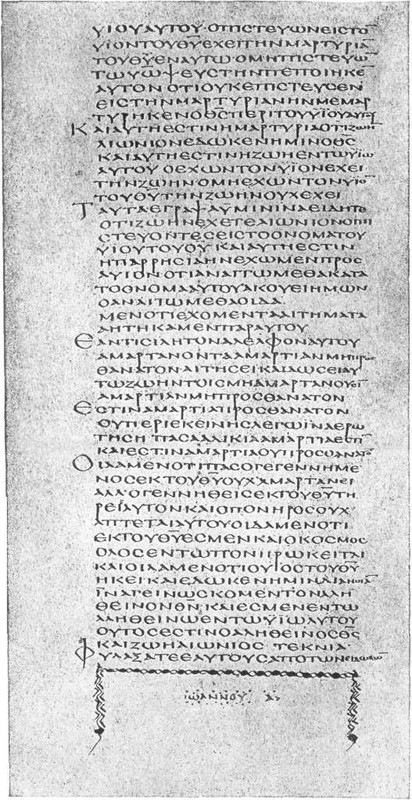
CODEX ALEXANDRINUS. Fifth Century. British Museum.
The Alexandrine Manuscript of the Christian Scriptures is almost complete in both Testaments, the Septuagint version of the Old and the original Greek of the New. It consists of 773 sheets, 12¾ by 10¾ inches, of very thin gray goatskin vellum, written on both sides in two columns of faint but clear characters. It was made in the early part of the fifth century, under the supervision of Thecla, a noble Christian lady of Alexandria, in the fifth century. It was brought from Alexandria to Constantinople by Cyril Lucar, Patriarch of Constantinople, who in 1624 gave it into the charge of the English Ambassador for presentation to King James I.; but owing to James' death before the presentation could be made, it was presented instead to Charles I. It remained in the possession of the English sovereigns until the Royal Library was presented to the nation by George II. in 1753. With the exception of the greater part of Matthew to Chapter xxv., two leaves of John, and three of Second Corinthians, it contains the whole Greek Bible, including the two Epistles of Clement of Rome, which in early times ranked among the inspired books. Its table of contents shows that it once included also the "Psalms of Solomon," though, from their position and title in the index, it is evident that they were regarded as standing apart from the other books. The Museum has bound the leaves of this precious manuscript in four volumes, and has had photographic copies made of each page for the use of students. The accompanying reproduction is from the last chapter of the First Epistle of John, from "His Son," in verse 9, to the end.
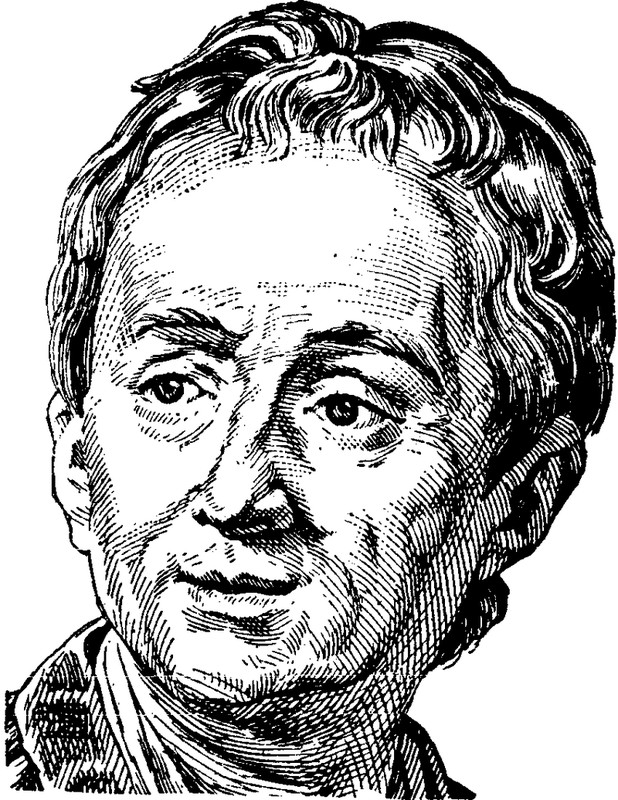
DENIS DIDEROT
(1713-1784)

mong the French Encyclopædists of the eighteenth century Denis Diderot holds the place of leader. There were intellects of broader scope and of much surer balance in that famous group, but none of such versatility, brilliancy, and outbursting force. To his associates he was a marvel and an inspiration.
Denis Diderot
He was born in October 1713, in Langres, Haute-Marne, France; and died in Paris July 31st, 1784. After a classical education in Jesuit schools, he utterly disgusted his father by turning to the Bohemian life of a littérateur in Paris. Although very poor, he married at the age of thirty. The whole story of his married life—the common Parisian story in those days—reflects no credit on him; though his liaison with Mademoiselle Voland presents the aspects of a friendship abiding through life. Poverty spurred him to exertion. Four days of work in 1746 are said to have produced 'Pensées Philosophiques' (Philosophic Thoughts). This book, with a little essay following it, 'Interprétation de la Nature,' was his first open attack on revealed religion. Its argument, though only negative, and keeping within the bounds of theism, foretokened a class of utterances which were frequent in Diderot's later years, and whose assurance of his materialistic atheism would be complete had they not been too exclamatory for settled conviction. He contents himself with glorifying the passions, to the annulling of all ethical standards. On this point at least his convictions were stable, for long afterward he writes thus to Mademoiselle Voland:—"The man of mediocre passion lives and dies like the brute.... If we were bound to choose between Racine, a bad husband, a bad father, a false friend, and a sublime poet, and Racine, good father, good husband, good friend, and dull worthy man, I hold to the first. Of Racine the bad man, what remains? Nothing. Of Racine the man of genius? The work is eternal."
About 1747 he produced an allegory, 'Promenade du Sceptique.' This French 'Pilgrim's Progress' scoffs at the Church of Rome for denying pleasure, then decries the pleasures of the world, and ends by asserting the hopeless uncertainty of the philosophy which both scoffs at the Church and decries worldly pleasure. At this period he was evidently inclined to an irregular attack on the only forms of Christianity familiar to him, asceticism and pietism.
In 1749 Diderot first showed himself a thinker of original power, in his Letter on the Blind. This work, 'Lettre sur les Avengles à l'Usage de Ceux qui Voient' (Letter on the Blind for the Use of Those who See) opened the eyes of the public to Diderot's peculiar genius, and the eyes of the authorities to the menace in his principles. The result was his imprisonment, and from that the spread of his views. His offense was, that through his ingenious supposition of the mind deprived of its use of one or more of the bodily senses, he had shown the relativity of all man's conceptions, and had thence deduced the relativity, the lack of absoluteness, of all man's ethical standards—thus invalidating the foundations of civil and social order. The broad assertion that Diderot and his philosophic group caused the French Revolution has only this basis, that these men were among the omens of its advance, feeling its stir afar but not recognizing the coming earthquake. Yet it may be conceded that Diderot anticipated things great and strange; for his mind, although neither precise nor capable of sustained and systematic thought, was amazingly original in conception and powerful in grasp. The mist, blank to his brethren, seems to have wreathed itself into wonderful shapes to his eye; he was the seer whose wild enthusiasm caught the oracles from an inner shrine. A predictive power appears in his Letter on the Blind, where he imagines the blind taught to read by touch; and nineteenth-century hypotheses gleam dimly in his random guess at variability in organisms, and at survival of those best adapted to their environment.
Diderot's monumental work, 'L'Encyclopédie,' dates from the middle of the century. It was his own vast enlargement of Ephraim Chambers's Cyclopædia of 1727, of which a bookseller had demanded a revision in French. D'Alembert was secured as his colleague, and in 1751 the first volume appeared. The list of contributors includes most of the great contemporary names in French literature. From these, Diderot and D'Alembert gathered the inner group known as the French Encyclopædists, to whose writings has been ascribed a general tendency to destroy religion and to reconstitute society. The authorities interfered repeatedly, with threats and prohibitions of the publication; but the science of government included the science of connivance for an adequate consideration, and the great work went forward. Its danger lurked in its principles; for Diderot dealt but little in the cheap flattery which the modern demagogue addresses to the populace. D'Alembert, wearied by ten years of persecution, retired in 1759, leaving the indefatigable Diderot to struggle alone through seven years, composing and revising hundreds of articles, correcting proofs, supervising the unrivaled illustrations of the mechanic arts, while quieting the opposition of the authorities.
The Encyclopædia under Diderot followed no one philosophic path. Indeed, there are no signs that he ever gave any consideration to either the intellectual or the ethical force of consistency. His writing indicates his utter carelessness both as to the direction and as to the pace of his thought. He had an abiding conviction that Christianity was partly delusion and largely priestcraft, and was maintained chiefly for upholding iniquitous privilege. His antagonism was developed primarily from his emotions and sympathies rather than from his intellect; hence it sometimes swerved, drawing perilously near to formal orthodoxy. Moreover, this vivacious philosopher sometimes rambled into practical advice, and easily effervesced into fervid moralizings of the sentimental and almost tearful sort. His immense natural capacity for sentiment appears in his own account of his meeting with Grimm after a few months' absence. His sentimentalism, however, had its remarkable counterpoise in a most practical tendency of mind. In the Encyclopædia the interests of agriculture and of all branches of manufacture were treated with great fullness; and the reform of feudal abuses lingering in the laws of France was vigorously urged in a style more practical than cyclopædic.
Diderot gave much attention to the drama, and his 'Paradoxe sur le Comédien' (Paradox on the Actor) is a valuable discussion. He is the father of the modern domestic drama. His influence upon the dramatic literature of Germany was direct and immediate; it appeared in the plays of Lessing and Schiller, and much of Lessing's criticism was inspired by Diderot. His 'Père de Famille' (Family-Father) and 'Le Fils Naturel' (The Natural Son) marked the beginning of a new era in the history of the stage, in the midst of which we are now living. Breaking with the old traditions, Diderot abandoned the lofty themes of classic tragedy and portrayed the life of the bourgeoisie. The influence of England, frequently manifest in the work of the Encyclopædists, is evident also here. Richardson was then the chief force in fiction, and the sentimental element so characteristic in him reappears in the dramas of Diderot.
Goethe was strongly attracted by the genius of Diderot, and thought it worth his while not only to translate but to supply with a long and luminous commentary the latter's 'Essay on Painting.' It was by a singular trick of fortune, too, that one of Diderot's most powerful works should first have appeared in German garb, and not in the original French until after the author's death. A manuscript copy of the book chanced to fall into the hands of Goethe, who so greatly admired it that he at once translated, annotated, and published it. This was the famous dialogue 'Le Neveu de Rameau' (Rameau's Nephew), a work which only Diderot's peculiar genius could have produced. Depicting the typical parasite, shameless, quick-witted for every species of villainy, at home in every possible meanness, the dialogue is a probably unequaled compound of satire, high æsthetics, gleaming humor, sentimental moralizing, fine musical criticism, and scientific character analysis, with passages of brutal indecency.
Among literary critics of painting, Diderot has his place in the highest rank. His nine 'Salons'—criticisms which in his good-nature he wrote for the use of his friend Grimm, on the annual exhibitions in the Paris Salon from 1759 onward—have never been surpassed among non-technical criticisms for brilliancy, freshness, and philosophic suggestiveness. They reveal the man's elemental strength; which was not in his knowledge, for he was without technical training in art and had seen scarcely any of the world's masterpieces, but in his sensuously sympathetic nature, which gave him quickness of insight and delicacy in interpretation.
He had the faculty of making and keeping friends, being unaffected, genial, amiable, enthusiastically generous and helpful to his friends, and without vindictiveness to his foes. He needed these qualities to counteract his almost utter lack of conscientiousness, his gush of sentiment, his unregulated morals, his undisciplined genius, his unbalanced thought. His style of writing, often vivid and strong, is as often awkward and dull, and is frequently lacking in finish. As a philosophic author and thinker his voluminous work is of little enduring worth, for though plentiful in original power it totally lacks organic unity; his thought rambles carelessly, his method is confused. It has been said of him that he was a master who produced no masterpiece. But as a talker, a converser, all witnesses testify that he was wondrously inspiring and suggestive, speaking sometimes as from mysterious heights of vision or out of unsearchable deeps of thought.
FROM 'RAMEAU'S NEPHEW'
Be the weather fair or foul, it is my custom in any case at five o'clock in the afternoon to stroll in the Palais Royal. I am always to be seen alone and meditative, on the bench D'Argenson. I hold converse with myself on politics or love, on taste or philosophy, and yield up my soul entirely to its own frivolity. It may follow the first idea that presents itself, be the idea wise or foolish. In the Allée de Foi one sees our young rakes following upon the heels of some courtesan who passes on with shameless mien, laughing face, animated glance, and a pug nose; but they soon leave her to follow another, teasing them all, joining none of them. My thoughts are my courtesans.
When it is really too cold or rainy, I take refuge in the Café de la Régence and amuse myself by watching the chess-players. Paris is the place of the world and the Café de la Régence the place of Paris where the best chess is played. There one witnesses the most carefully calculated moves; there one hears the most vulgar conversation; for since it is possible to be at once a man of intellect and a great chess-player, like Légal, so also one may be at once a great chess-player and a very silly person, like Foubert or Mayot.
One afternoon I was there, observing much, speaking rarely, and hearing as little as possible, when one of the most singular personages came up to me that ever was produced by this land of ours, where surely God has never caused a dearth of singular characters. He is a combination of high-mindedness and baseness, of sound understanding and folly; in his head the conceptions of honor and dishonor must be strangely tangled, for the good qualities with which nature has endowed him he displays without boastfulness, and the bad qualities without shame. For the rest, he is firmly built, has an extraordinary power of imagination, and possesses an uncommonly strong pair of lungs. Should you ever meet him and succeed in escaping from the charm of his originality, it must be by stopping both ears with your fingers or by precipitate flight. Heavens, what terrible lungs!
And nothing is less like him than he himself. Sometimes he is thin and wasted, like a man in the last stages of consumption; you could count his teeth through his cheeks; you would think he had not tasted food for several days, or had come from La Trappe.
A month later he is fattened and filled out as if he had never left the banquets of the rich or had been fed among the Bernardines. To-day, with soiled linen, torn trousers, clad in rags, and almost barefoot, he passes with bowed head, avoids those whom he meets, till one is tempted to call him and bestow upon him an alms. To-morrow, powdered, well groomed, well dressed, and well shod, he carries his head high, lets himself be seen, and you would take him almost for a respectable man.
So he lives from day to day, sad or merry, according to the circumstances. His first care, when he rises in the morning, is to take thought where he is to dine. After dinner he bethinks himself of some opportunity to procure supper, and with the night come new cares. Sometimes he goes on foot to his little attic, which is his home if the landlady, impatient at long arrears of rent, has not taken the key away from him. Sometimes he goes to one of the taverns in the suburbs, and there, between a bit of bread and a mug of beer, awaits the day. If he lacks the six sous necessary to procure him quarters for the night, which is occasionally the case, he applies to some cabman among his friends or to the coachman of some great lord, and a place on the straw beside the horses is vouchsafed him. In the morning he carries a part of his mattress in his hair. If the season is mild, he spends the whole night strolling back and forth on the Cours or in the Champs Élysées. With the day he appears again in the city, dressed yesterday for to-day and to-day often for the rest of the week.
For such originals I cannot feel much esteem, but there are others who make close acquaintances and even friends of them. Once in the year perhaps they are able to put their spell upon me, when I meet them, because their character is in such strong contrast to that of every-day humanity, and they break the oppressive monotony which our education, our social conventions, our traditional proprieties have produced. When such a man enters a company, he acts like a cake of yeast that raises the whole, and restores to each a part of his natural individuality. He shakes them up, brings things into motion, elicits praise or censure, drives truth into the open, makes upright men recognizable, unmasks the rogues, and there the wise man sits and listens and is enabled to distinguish one class from another.
This particular specimen I had long known; he frequented a house into which his talents had secured him the entrée. These people had an only daughter. He swore to the parents that he would marry their daughter. They only shrugged their shoulders, laughed in his face, and assured him that he was a fool. But I saw the day come when the thing was accomplished. He asked me for some money, which I gave him. He had, I know not how, squirmed his way into a few houses, where a couvert stood always ready for him, but it had been stipulated that he should never speak without the consent of his hosts. So there he sat and ate, filled the while with malice; it was fun to see him under this restraint. The moment he ventured to break the treaty and open his mouth, at the very first word the guests all shouted "O Rameau!" Then his eyes flashed wrathfully, and he fell upon his food again with renewed energy.
You were curious to know the man's name; there it is. He is the nephew of the famous composer who has saved us from the church music of Lulli which we have been chanting for a hundred years, ... and who, having buried the Florentine, will himself be buried by Italian virtuosi; he dimly feels this, and so has become morose and irritable, for no one can be in a worse humor—not even a beautiful woman who in the morning finds a pimple on her nose—than an author who sees himself threatened with the fate of outliving his reputation, as Marivaux and Crébillon fils prove.
Rameau's nephew came up to me. "Ah, my philosopher, do I meet you once again? What are you doing here among the good-for-nothings? Are you wasting your time pushing bits of wood about?"
I—No; but when I have nothing better to do, I take a passing pleasure in watching those who push them about with skill.
He—A rare pleasure, surely. Excepting Légal and Philidor, there is no one here that understands it....
I—You are hard to please. I see that only the best finds favor with you.
He—Yes, in chess, checkers, poetry, oratory, music, and such other trumpery. Of what possible use is mediocrity in these things?
I—I am almost ready to agree with you....
He—You have always shown some interest in me, because I'm a poor devil whom you really despise, but who after all amuses you.
I—That is true.
He—Then let me tell you. (Before beginning, he drew a deep sigh, covered his forehead with both hands, then with calm countenance continued:—) You know I am ignorant, foolish, silly, shameless, rascally, gluttonous.
I—What a panegyric!
He—It is entirely true. Not a word to be abated; no contradiction, I pray you. No one knows me better than I know myself, and I don't tell all.
I—Rather than anger you, I will assent.
He—Now, just think, I lived with people who valued me precisely because all these qualities were mine in a high degree.
I—That is most remarkable. I have hitherto believed that people concealed these qualities even from themselves, or excused them, but always despised them in others.
He—Conceal them? Is that possible? You may be sure that when Palissot is alone and contemplates himself, he tells quite a different story. You may be sure that he and his companion make open confession to each other that they are a pair of arrant rogues. Despise these qualities in others? My people were much more reasonable, and I fared excellently well among them. I was cock of the walk. When absent, I was instantly missed. I was pampered. I was their little Rameau, their good Rameau, the shameless, ignorant, lazy Rameau, the fool, the clown, the gourmand. Each of these epithets was to me a smile, a caress, a slap on the back, a box on the ears, a kick, a dainty morsel thrown upon my plate at dinner, a liberty permitted me after dinner as if it were of no account; for I am of no account. People make of me and do before me and with me whatever they please, and I never give it a thought....
I—You have been giving lessons, I understand, in accompaniment and composition?
He—Yes.
I—And you knew absolutely nothing about it?
He—No, by Heaven; and for that very reason I was a much better teacher than those who imagine they know something about it. At all events, I didn't spoil the taste nor ruin the hands of my young pupils. If when they left me they went to a competent master, they had nothing to unlearn, for they had learned nothing, and that was just so much time and money saved.
I—But how did you do it?
He—The way they all do it. I came, threw myself into a chair:—"How bad the weather is! How tired the pavement makes one!" Then some scraps of town gossip:... "At the last Amateur Concert there was an Italian woman who sang like an angel.... Poor Dumênil doesn't know what to say or do," etc., etc. ... "Come, mademoiselle, where is your music-book?" And as mademoiselle displays no great haste, searches every nook and corner for the book, which she has mislaid, and finally calls the maid to help her, I continue:—"Little Clairon is an enigma. There is talk of a perfectly absurd marriage of—what is her name?"—"Nonsense, Rameau, it isn't possible."—"They say the affair is all settled." ... "There is a rumor that Voltaire is dead,"—"All the better."—"Why all the better?"—"Then he is sure to treat us to some droll skit. That's a way he has, a fortnight before his death." What more should I say? I told a few scandals about the families in the houses where I am received, for we are all great scandal-mongers. In short, I played the fool; they listened and laughed, and exclaimed, "He is really too droll, isn't he?" Meanwhile the music-book had been found under a chair, where a little dog or a little cat had worried it, chewed it, and torn it. Then the pretty child sat down at the piano and began to make a frightful noise upon it. I went up to her, secretly making a sign of approbation to her mother. "Well, now, that isn't so bad," said the mother; "one needs only to make up one's mind to a thing; but the trouble is, one will not make up one's mind; one would rather kill time by chattering, trifling, running about, and God knows what. Scarcely do you turn your back but the book is closed, and not until you are at her side again is it opened. Besides, I have never heard you reprimand her." In the mean time, since something had to be done, I took her hands and placed them differently. I pretended to lose my patience; I shouted,—"Sol, sol, sol, mademoiselle, it's a sol." The mother: "Mademoiselle, have you no ears? I'm not at the piano, I'm not looking at your notes, but my own feeling tells me that it ought to be a sol. You give the gentleman infinite trouble. You remember nothing, and make no progress." To break the force of this reproof a little, I tossed my head and said: "Pardon me, madame, pardon me. It would be better if mademoiselle would only practice a little, but after all it is not so bad."—"In your place I would keep her a whole year at one piece."—"Rest assured, I shall not let her off until she has mastered every difficulty; and that will not take so long, perhaps, as mademoiselle thinks."—"Monsieur Rameau, you flatter her; you are too good." And that is the only thing they would remember of the whole lesson, and would upon occasion repeat to me. So the lesson came to an end. My pupil handed me the fee, with a graceful gesture and a courtesy which her dancing-master had taught her. I put the money into my pocket, and the mother said, "That's very nice, mademoiselle. If Favillier were here, he would praise you." For appearance's sake I chattered for a minute or two more; then I vanished; and that is what they called in those days a lesson in accompaniment.
I—And is the case different now?
He—Heavens! I should think so. I come in, I am serious, throw my muff aside, open the piano, try the keys, show signs of great impatience, and if I am kept a moment waiting I shout as if my purse had been stolen. In an hour I must be there or there; in two hours with the Duchess So-and-so; at noon I must go to the fair Marquise; and then there is to be a concert at Baron de Bagge's, Rue Neuve des Petits Champs.
I—And meanwhile no one expects you at all.
He—Certainly not.... And precisely because I can further my fortune through vices which come natural to me, which I acquired without labor and practice without effort, which are in harmony with the customs of my countrymen, which are quite to the taste of my patrons, and better adapted to their special needs than inconvenient virtues would be, which from morning to night would be standing accusations against them, it would be strange indeed if I should torture myself like one of the damned to twist and turn and make of myself something which I am not, and hide myself beneath a character foreign to me, and assume the most estimable qualities, whose worth I will not dispute, but which I could acquire and live up to only by great exertions, and which after all would lead to nothing,—perhaps to worse than nothing. Moreover, ought a beggar like me, who lives upon the wealthy, constantly to hold up to his patrons a mirror of good conduct? People praise virtue but hate it; they fly from it, let it freeze; and in this world a man has to keep his feet warm. Besides, I should always be in the sourest humor: for why is it that the pious and the devotional are so hard, so repellent, so unsociable? It is because they have imposed upon themselves a task contrary to their nature. They suffer, and when a man suffers he makes others suffer. Now, that is no affair of mine or of my patrons'. I must be in good spirits, easy, affable, full of sallies, drollery, and folly. Virtue demands reverence, and reverence is inconvenient; virtue challenges admiration, and admiration is not entertaining. I have to do with people whose time hangs heavy on their hands; they want to laugh. Now consider the folly: the ludicrous makes people laugh, and I therefore must be a fool; I must be amusing, and if nature had not made me so, then by hook or by crook I should have made myself seem so. Fortunately I have no need to play the hypocrite. There are hypocrites enough of all colors without me, and not counting those who deceive themselves.... Should it ever occur to friend Rameau to play Cato, to despise fortune, women, good living, idleness, what would he be? A hypocrite. Let Rameau remain what he is, a happy robber among wealthy robbers, and a man without either real or boasted virtue. In short, your idea of happiness, the happiness of a few enthusiastic dreamers like you, has no charm for me....
I—He earns his bread dearly, who in order to live must assail virtue and knowledge.
He—I have already told you that we are of no consequence. We slander all men and grieve none.
[The dialogue reverts to music.]
I—Every imitation has its original in nature. What is the musician's model when he breaks into song?
He—Why do you not grasp the subject higher up? What is song?
I—That, I confess, is a question beyond my powers. That's the way with us all. The memory is stored with words only, which we think we understand because we often use them and even apply them correctly, but in the mind we have only indefinite conceptions. When I use the word "song," I have no more definite idea of it than you and the majority of your kind have when you say reputation, disgrace, honor, vice, virtue, shame, propriety, mortification, ridicule.
He—Song is an imitation in tones, produced either by the voice or by instruments, of a scale invented by art, or if you will, established by nature; an imitation of physical sounds or passionate utterances; and you see, with proper alterations this definition could be made to fit painting, oratory, sculpture, and poetry. Now to come to your question, What is the model of the musician or of song? It is the declamation, when the model is alive or sensate; it is the tone, when the model is insensate. The declamation must be regarded as a line, and the music as another line which twines about it. The stronger and the more genuine is this declamation, this model of song, the more numerous the points at which the accompanying music intersects it, the more beautiful will it be. And this our younger composers have clearly perceived. When one hears "Je suis un pauvre diable," one feels that it is a miser's complaint. If he didn't sing, he would address the earth in the very same tones when he intrusts to its keeping his gold: "O terre, reçois mon trésor." ... In such works with the greatest variety of characters, there is a convincing truth of declamation that is unsurpassed. I tell you, go, go, and hear the aria where the young man who feels that he is dying, cries out, "Mon cœur s'en va." Listen to the air, listen to the accompaniment, and then tell me what difference there is between the true tones of a dying man and the handling of this music. You will see that the line of the melody exactly coincides with the line of declamation. I say nothing of the time, which is one of the conditions of song; I confine myself to the expression, and there is nothing truer than the statement which I have somewhere read, "Musices seminarium accentus,"—the accent is the seed-plot of the melody. And for that reason, consider how difficult and important a matter it is to be able to write a good recitative. There is no beautiful aria out of which a beautiful recitative could not be made; no beautiful recitative out of which a clever man could not produce a beautiful aria. I will not assert that one who recites well will also be able to sing well, but I should be much surprised if a good singer could not recite well. And you may believe all that I tell you now, for it is true.
(And then he walked up and down and began to hum a few arias from the "Île des Fons," etc., exclaiming from time to time, with upturned eyes and hands upraised:—) "Isn't that beautiful, great heavens! isn't that beautiful? Is it possible to have a pair of ears on one's head and question its beauty?" Then as his enthusiasm rose he sang quite softly, then more loudly as he became more impassioned, then with gestures, grimaces, contortions of body. "Well," said I, "he is losing his mind, and I may expect a new scene." And in fact, all at once he burst out singing.... He passed from one aria to another, fully thirty of them,—Italian, French, tragic, comic, of every sort. Now with a deep bass he descended into hell; then, contracting his throat, he split the upper air with a falsetto, and in gait, mien, and action he imitated the different singers, by turns raving, commanding, mollified, scoffing. There was a little girl that wept, and he hit off all her pretty little ways. Then he was a priest, a king, a tyrant; he threatened, commanded, stormed; then he was a slave and submissive. He despaired, he grew tender, he lamented, he laughed, always in the tone, the time, the sense of the words, of the character, of the situation.
All the chess-players had left their boards and were gathered around him; the windows of the café were crowded with passers-by, attracted by the noise. There was laughter enough to bring down the ceiling. He noticed nothing, but went on in such a rapt state of mind, in an enthusiasm so close to madness, that I was uncertain whether he would recover, or if he would be thrown into a cab and taken straight to the mad-house; the while he sang the Lamentations of Jomelli.
With precision, fidelity, and incredible warmth, he rendered one of the finest passages, the superb obligato recitative in which the prophet paints the destruction of Jerusalem; he wept himself, and the eyes of the listeners were moist. More could not be desired in delicacy of vocalization, nor in the expression of overwhelming grief. He dwelt especially on those parts in which the great composer has shown his greatness most clearly. When he was not singing, he took the part of the instruments; these he quickly dropped again, to return to the vocal part, weaving one into the other so perfectly that the connection, the unity of the whole, was preserved. He took possession of our souls and held them in the strangest suspense I have ever experienced. Did I admire him? Yes, I admired him. Was I moved and melted? I was moved and melted, and yet something of the ludicrous mingled itself with these feelings and modified their nature.
But you would have burst out laughing at the way he imitated the different instruments. With a rough muffled tone and puffed-out cheeks he represented horns and bassoon; for the oboe he assumed a rasping nasal tone; with incredible rapidity he made his voice run over the string instruments, whose tones he endeavored to reproduce with the greatest accuracy; the flute passages he whistled; he rumbled out the sounds of the German flute; he shouted and sang with the gestures of a madman, and so alone and unaided he impersonated the entire ballet corps, the singers, the whole orchestra,—in short, a complete performance,—dividing himself into twenty different characters, running, stopping, with the mien of one entranced, with glittering eyes and foaming mouth.... He was quite beside himself. Exhausted by his exertions, like a man awakening from a deep sleep or emerging from a long period of abstraction, he remained motionless, stupefied, astonished. He looked about him in bewilderment, like one trying to recognize the place in which he finds himself. He awaited the return of his strength, of his consciousness; he dried his face mechanically. Like one who upon awaking finds his bed surrounded by groups of people, in complete oblivion and profound unconsciousness of what he had been doing, he cried, "Well, gentlemen, what's the matter? What are you laughing at? What are you wondering about? What's the matter?"
I—My dear Rameau, let us talk again of music. Tell me how it comes that with the facility you display for appreciating the finest passages of the great masters, for retaining them in your memory, and for rendering them to the delight of others with all the enthusiasm with which the music inspires you,—how comes it that you have produced nothing of value yourself?
(Instead of answering me, he tossed his head, and raising his finger towards heaven, cried:—)
The stars, the stars! When nature made Leo, Vinci, Pergolese, Duni, she wore a smile; her face was solemn and commanding when she created my dear uncle Rameau, who for ten years has been called the great Rameau, and who will soon be named no more. But when she scraped his nephew together, she made a face and a face and a face.—(And as he spoke he made grimaces, one of contempt, one of irony, one of scorn. He went through the motions of kneading dough, and smiled at the ludicrous forms he gave it. Then he threw the strange pagoda from him.) So she made me and threw me down among other pagodas, some with portly well-filled paunches, short necks, protruding goggle eyes, and an apoplectic appearance; others with lank and crooked necks and emaciated forms, with animated eyes and hawks' noses. These all felt like laughing themselves to death when they saw me, and when I saw them I set my arms akimbo and felt like laughing myself to death, for fools and clowns take pleasure in one another; seek one another out, attract one another. Had I not found upon my arrival in this world the proverb ready-made, that the money of fools is the inheritance of the clever, the world would have owed it to me. I felt that nature had put my inheritance into the purse of the pagodas, and I tried in a thousand ways to recover it.
I—I know these ways. You have told me of them. I have admired them. But with so many capabilities, why do you not try to accomplish something great?
He—That is exactly what a man of the world said to the Abbé Le Blanc. The abbé replied:—"The Marquise de Pompadour takes me in hand and brings me to the door of the Academy; then she withdraws her hand; I fall and break both legs."—"You ought to pull yourself together," rejoined the man of the world, "and break the door in with your head."—"I have just tried that," answered the abbé, "and do you know what I got for it? A bump on the head." ... (Then he drank a swallow from what remained in the bottle and turned to his neighbor.) Sir, I beg you for a pinch of snuff. That's a fine snuff-box you have there. You are a musician? No! All the better for you. They are a lot of poor deplorable wretches. Fate made me one of them, me! Meanwhile at Montmartre there is a mill, and in the mill there is perhaps a miller or a miller's lad, who will never hear anything but the roaring of the mill, and who might have composed the most beautiful of songs. Rameau, get you to the mill, to the mill; it's there you belong . . . But it is half-past five. I hear the vesper bell which summons me too. Farewell. It's true, is it not, philosopher, I am always the same Rameau?
I—Yes, indeed. Unfortunately.
He—Let me enjoy my misfortune forty years longer. He laughs best who laughs last.
Translated for 'A Library of the World's Best Literature.'
FRANZ VON DINGELSTEDT
(1814-1881)

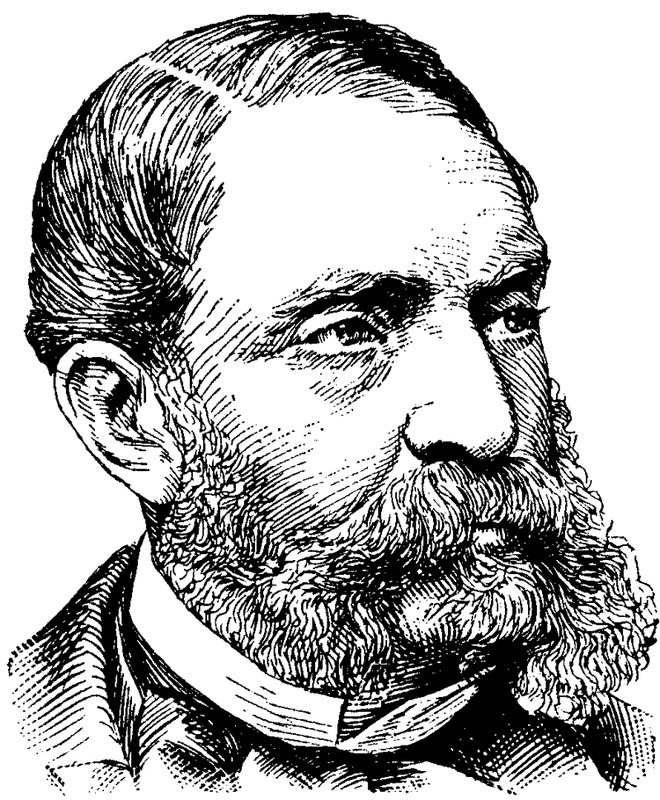
ranz von Dingelstedt was born at Halsdorf, Hessen, Germany, June 30th, 1814. He attained eminence as a poet and dramatist, but his best powers were devoted to his principal calling as theatre director.
His boyhood's education was received at Rinteln. At the University of Marburg he applied himself to theology and philology, but more especially to modern languages and literature. After leaving the university he became instructor at Ricklingen, near Hanover. He was characterized, even as a young man, by his political freedom and independence of thought; and at Cassel, where in 1836 he was teacher in the Lyceum, he was on this account looked upon so much askance that it was found expedient to transfer him to the gymnasium at Fulda (1838). He resigned this position, however, in order to devote himself to writing. A collection of his poems appeared in 1838-45, and of these, 'Lieder eines Kosmopolitischen Nachtwächters' (Songs of a Cosmopolitan Night-Watchman: 1841) may be said to have produced a genuine agitation. These were not only important as literature, but as political promulgations, boldly embodying the radical sentiments of freethinking Germany.
Dingelstedt
In 1841 he went to Augsburg, connected himself with the Allgemeine Zeitung, and traveled as newspaper correspondent in France, Holland, Belgium, and England. 'Das Wanderbuch' (The Wander-Book), and 'Jusqu' à la Mer—Erinnerungen aus Holland' (As Far as the Sea—Remembrances of Holland: 1847), were the fruits of these journeys. He had in contemplation a voyage to the Orient, and preparatory to this he settled for a short time in Vienna; but the journey was not undertaken, for just at this time he was appointed librarian of the Royal Library of Stuttgart, and reader to the king, with the title of Court Councilor. Here in 1844 he married the celebrated singer Jenny Lutzer. He returned to Vienna, where in 1850 his drama 'Das Haus der Barneveldt' (The House of the Barneveldts) was produced with such brilliant success that he was thereupon appointed stage manager of the National Theatre at Munich. To this for six years he devoted his best efforts, presenting in the most admirable manner the finest of the German classics. The merit of his work was recognized by the king, who ennobled him in 1857. He was pre-eminently a theatrical manager, and served successively at Weimar (1857) and at Vienna, where he was appointed director of the Court Opera House in 1867, and of the Burg Theatre in 1870. He brought the classic plays of other lands upon the stage, and his revivals of Shakespeare's historical plays and the 'Winter's Tale,' and of Molière's 'L'Avare' (The Miser), were brilliant events in the theatrical annals of Vienna. He was made Imperial Councilor by the Emperor, and raised in 1876 to the rank of baron. In 1875 he took the position of general director of both court theatres of Vienna. He died at Vienna, May 15th, 1881.
The novels 'Licht und Schatten der Liebe' (The Light and Shadow of Love: 1838); 'Heptameron,' 1841; and 'Novellenbuch,' 1855, were not wholly successful; but in contrast to these, 'Unter der Erde' (Under the Earth: 1840); 'Sieben Friedliche Erzählungen' (Seven Peaceful Tales: 1844), and 'Die Amazone' (The Amazon: 1868), are admirable.
Regarded purely as literature, Dingelstedt's best productions are his early poems, although his commentaries upon Shakespeare and Goethe are wholly praiseworthy. He was successful chiefly as a political poet, but his muse sings also the joys of domestic life. 'Hauslieder' (Household Songs: 1844), and his poems upon Chamisso and Uhland, are among the most beautiful personal poems in German literature.
A MAN OF BUSINESS
From 'The Amazon': copyrighted by G.P. Putnam's Sons
Herr Krafft was about to reply, but was prevented by the hasty appearance of Herr Heyboldt, the first procurist, who entered the apartment; not an antiquated comedy figure in shoe-buckles, coarse woolen socks, velvet pantaloons, and a long-tailed coat, his vest full of tobacco, and a goose-quill back of his comically flexible ear; no, but a fine-looking man, dressed in the latest style and in black, with a medal in his button-hole, and having an earnest, expressive countenance. He was house-holder, member of the City Council, and militia captain; the gold medal and colored ribbon on his left breast told of his having saved, at the risk of his own life, a Leander who had been carried away by the current in the swimming-baths.
His announcement, urgent as it was, was made without haste, deliberate and cool, somewhat as the mate informs the captain that an ugly wind has sprung up. "Herr Principal," he said, "the crowd has broken in the barriers and one wing of the gateway; they are attacking the counting-house." "Who breaks, pays," said Krafft, with a joke; "we will charge the sport to their account."—"The police are not strong enough; they have sent to the Royal Watch for military."—"That is right, Heyboldt. No accident, no arms or legs broken?"—"Not that I know of."—"Pity for Meyer Hirsch; he would have thundered magnificently in the official Morning News against the excesses of the rage for speculation. Nor any one wounded by the police?"—"Not any, so far."—"Pity for Hirsch Meyer. The oppositional Evening Journal has missed a capital opportunity of weeping over the barbarity of the soldateska. At all events, the two papers must continue to write—one for, the other against us. Keep Hirsch Meyer and Meyer Hirsch going."—"All right, Herr Principal."—"Send each of them a polite line, to the effect that we have taken the liberty of keeping a few shares for him, to sell them at the most favorable moment, and pay him over the difference."—"It shall be attended to, Herr Principal."—"So our Southwestern Railway goes well, Heyboldt?"—"By steam, Herr Principal." The sober man smiled at his daring joke, and Herr Krafft smiled affably with him. "The amount that we have left to furnish will be exhausted before one has time to turn around. The people throw money, bank-notes, government bonds, at our cashiers, who cannot fill up the receipts fast enough. On the Bourse they fought for the blanks."—"For the next four weeks we will run the stock up, Heyboldt; after that it can fall, but slowly, with decorum."—"I understand, Herr Principal."
A cashier came rushing in without knocking. "Herr Principal," he stammered in his panic, "we have not another blank, and the people are pouring in upon us more and more violently. Wild shouts call for you." "To your place, sir," thundered Krafft at him. "I shall come when I think it time. In no case," he added more quietly, "before the military arrive. We need an interference, for the sake of the market." The messenger disappeared; but pale, bewildered countenances were to be seen in the doorways of the comptoir; the house called for its master: the trembling daughter sent again and again for her father.
"Let us bring the play to a close," said Herr Krafft, after brief deliberation; he stepped into the middle office, flung open a window, and raising his harsh voice to its loudest tones, cried to the throng below, "You are looking for me, folks. Here I am. What do you want of me?" "Shares, subscriptions," was the noisy answer.—"You claim without any right or any manners. This is my house, a peaceable citizen's house. You are breaking in as though it were a dungeon, an arsenal, a tax-office,—as though we were in the midst of a revolution. Are you not ashamed of yourselves?" A confused murmur rang through the astonished ranks. "If you wish to do business with me," continued the merchant, "you must first learn manners and discipline. Have I invited your visit? Do I need your money, or do you need my shares? Send up some deputies to convey your requests. I shall have nothing to do with a turbulent mob." So saying, he closed the window with such violence that the panes cracked, and the fragments fell down on the heads of the assailants.
"The Principal knows how to talk to the people," said Heyboldt with pride to Roland, the mute witness of this strange scene. "He speaks their own language. He replies to a broken door with a broken window."
Meantime a company of soldiers had arrived on double-quick, with a flourish of drums. The officer's word of command rang through the crowd, now grown suddenly quiet: "Fix bayonets! form line! march!" Yard and passages were cleared, the doors guarded; in the street the low muttering tide, forced back, made a sort of dam. Three deputies, abashed and confused, appeared at Krafft's door and craved audience. The merchant received them like a prince surrounded by his court, in the midst of his clerks, in the large counting-room. The spokesman commenced: "We ask your pardon, Herr Krafft, for what has happened."—"For shame, that you should drag in soldiers as witnesses and peacemakers in a quiet little business affair among order-loving citizens."—"It was reported that we had been fooled with these subscriptions, and that the entire sum had been already disposed of on the Bourse."—"And even if that were so, am I to be blamed for it? The Southwestern Railway must raise thirty millions. Double, treble that amount is offered it. Can I prevent the necessity of reducing the subscriptions?"—"No; but they say that we poor folks shall not get a cent's worth; the big men of the Bourse have gobbled up the best bits right before our noses."—"They say so? Who says so? Court Cooper Täubert, I ask you who says so?"—"Gracious Herr Court Banker—" "Don't Court or Gracious me. My name is Krafft, Herr Hans Heinrich Krafft. I think we know each other, Master Täubert. It is not the first time that we have done business together. You have a very snug little share in my workingmen's bank. Grain-broker Wüst, you have bought one of the houses in my street. Do I ever dun you for the installments of purchase money?" "No indeed, Herr Krafft; you are a good man, a public-spirited man, no money-maker, no leech, no Jew!" cried the triumvirate of deputies in chorus.—"I am nothing more than you are: a man of business, who works for his living, the son of a peasant, a plain simple citizen. I began in a smaller way than any of you; but I shall never forget that I am flesh of your flesh, blood of your blood. Facts have proved it. I will give you a fresh proof to-day. Go home and tell the people who have sent you, Hans Heinrich Krafft will give up the share which his house has subscribed to the Southwestern Railway, in favor of the less wealthy citizens of this city. This sum of five hundred thousand thalers shall be divided up pro rata among the subscriptions under five hundred dollars."
"Heaven bless you, Herr Krafft!" stammered out the court cooper, and the grain-broker essayed to shed a tear of gratitude; the confidential clerk Herr Lange, the third of the group, caught at the hand of the patron to kiss it, with emotion. Krafft drew it back angrily. "No self-abasement, Herr Lange," he said. "We are men of the people; let us behave as such. God bless you, gentlemen. You know my purpose. Make it known to the good people waiting outside, and see that I am rid of my billeting. Let the subscriptions be conducted quietly and in good order. Adieu, children!" The deputation withdrew. A few minutes afterwards there was heard a thundering hurrah:—"Hurrah for Herr Krafft! Three cheers for Father Krafft!" He showed himself at the window, nodded quickly and soberly, and motioned to them to disperse.
While the tumult was subsiding, Krafft and Roland retired into the private counting-room. "You have," the latter said, "spoken nobly, acted nobly."—"I have made a bargain, nothing more, nothing less; moreover, not a bad one."—"How so?"—"In three months I shall buy at 70, perhaps still lower, what I am now to give up to them at 90."—"You know that beforehand?"—"With mathematical certainty. The public expects an El Dorado in the Southwestern Railway, as it does in every new enterprise. The undertaking is a good one, it is true, or I should not have ventured upon it. But one must be able to wait until the fruit is ripe. The small holders cannot do that; they sow today, and tomorrow they wish to reap. At the first payment their heart and their purse are all right. At the second or third, both are gone. Upon the least rise they will throw the paper, for which they were ready to break each other's necks, upon the market, and so depreciate their property. But if some fortuitous circumstance should cause a pressure upon the money market, then they drop all that they have, in a perfect panic, for any price. I shall watch this moment, and buy. In a year or so, when the road is finished and its communications complete, the shares that were subscribed for at 90, and which I shall have bought at 60 to 70, will touch 100, or higher."
"That is to say," said Roland, thoughtfully, "you will gain at the expense of those people whose confidence you have aroused, then satisfied with objects of artificial value, and finally drained for yourself." "Business is business," replied the familiar harsh voice. "Unless I become a counterfeiter or a forger I can do nothing more than to convert other persons' money into my own; of course, in an honest way."—"And you do this, without fearing lest one day some one mightier and luckier than you should do the same to you?"—"I must be prepared for that; I am prepared."—"Also for the storm,—not one of your own creating, but one sent by the wrath of God, that shall scatter all this paper splendor of our times, and reduce this appalling social inequality of ours to a universal zero?" "Let us quietly abide this Last Day," laughed the banker, taking the artist by the arm.
THE WATCHMAN
The last faint twinkle now goes out Up in the poet's attic; And the roisterers, in merry rout, Speed home with steps erratic.
Soft from the house-roofs showers the snow, The vane creaks on the steeple, The lanterns wag and glimmer low In the storm by the hurrying people.
The houses all stand black and still, The churches and taverns deserted, And a body may now wend at his will, With his own fancies diverted.
Not a squinting eye now looks this way, Not a slanderous mouth is dissembling, And a heart that has slept the livelong day May now love and hope with trembling.
Dear Night! thou foe to each base end, While the good still a blessing prove thee, They say that thou art no man's friend,— Sweet Night! how I therefore love thee!
DIOGENES LAERTIUS
(200-250 A. D.?)

t is curious how often we are dependent, for our knowledge of some larger subject, upon a single ancient author, who would be hardly worthy of notice but for the accidental loss of the books composed by fitter and abler men. Thus, our only general description of Greece at the close of the classical period is written by a man who describes many objects that he certainly did not see, who leaves unmentioned numberless things we wish explained, and who has a genius for so misplacing an adverb as to bring confusion into the most commonplace statement. But not even to Pausanias do we proffer such grudging gratitude and such ungrateful objurgations as to Diogenes Laertius, our chief—often our sole—authority for the 'Lives and Sayings of the Philosophers.' His book is a fascinating one, and even amusing, if we can forget what we so much wanted in its stead. At second or third hand, from the compendiums of the schools rather than from the original works of the great masters themselves, Diogenes does give us a fairly intelligible sketch, as a rule, of the outward life lived by each sage. This slight frame is crammed with anecdotes, evidently culled with most eager and uncritical hand from miscellaneous collections. Many of these stories are so fragmentary as to be pointless. Others are unquestionably attached to the wrong person. This method is at its maddest in the author's sketch of his namesake, the Recluse of the Tub. (One of Ali Baba's jars, by the way, would give a better notion of the real hermitage.) Since this "philosopher" had himself little character and no doctrines, the loose string of anecdotes, puns, and saucy answers suits all our needs. Throughout the work are scattered, apocryphal letters, and feeble poetic epigrams composed by the compiler himself. The leaning of our most unphilosophic author was apparently toward Epicurus. The loss of that teacher's own works causes us to prize doubly the extensive fragments of them preserved in this relatively copious and serious study. The lover of the great Epicurean poem of Lucretius on the 'Nature of Things' will often be surprised to find here the source of many among the Roman poet's most striking doctrines and images. The sketch of Zeno is also an important authority on Stoicism. Instruction in these particular chapters, then, and rich diversion elsewhere, await the reader of this most gossipy, formless, and uncritical volume. The English reader, by the way, ought to be provided with something better than the "Bohn" version. This adds a goodly harvest of ludicrous misprints and other errors of every kind to Diogenes's own mixture of borrowed wisdom and native silliness. The classical student will prefer the Didot edition by Cobet, with the Latin version in parallel columns.
It has been thought desirable to offer here a version, slightly abridged, of Diogenes's chapter on Socrates. The original sources, in Plato's and Xenophon's extant works, will almost always explain, or correct, the statements of Diogenes. Such wild shots as the assertion that the plague repeatedly visited Athens, striking down every inhabitant save the temperate Socrates, hardly need a serious rejoinder. Diogenes cannot even speak with approximate accuracy of Socrates's famous Dæmon or Inward Monitor. We know, on the best authority, that it prophesied nothing, even proposed nothing, but only vetoed the rasher impulses of its human companion. But to apply the tests of mere accuracy to Diogenes would be like criticizing Uncle Remus for his sins against English syntax.
Of the author's life we know nothing. Our assignment of him to the third century is based merely on the fact that he quotes writers of the second, and is himself in turn cited by somewhat later authors.
LIFE OF SOCRATES
From the 'Lives and Sayings of the Philosophers'
Socrates was the son of Sophroniscus a sculptor and Phænarete a midwife [as Plato also states in the 'Theaetetus'], and an Athenian, of the deme Alopeke. He was believed to aid Euripides in composing his dramas. Hence Mnesimachus speaks thus:—
"This is Euripides's new play, the 'Phrygians': And Socrates has furnished him the sticks."
And again:—
"Euripides, Socratically patched."
Callias also, in his 'Captives,' says:—
A—"Why art so solemn, putting on such airs? B—Indeed I may; the cause is Socrates."
Aristophanes, in the 'Clouds,' again, remarks:—
"And this is he who for Euripides Composed the talkative wise tragedies."
He was a pupil of Anaxagoras, according to some authorities, but also of Damon, as Alexander states in his 'Successions.' After the former's condemnation he became a disciple of Archelaus the natural philosopher. But Douris says he was a slave, and carried stones. Some say, too, that the Graces on the Acropolis are his; they are clothed figures. Hence, they say, Timon in his 'Silli' declares:—
"From them proceeded the stone-polisher, Prater on law, enchanter of the Greeks, Who taught the art of subtle argument, The nose-in-air, mocker of orators, Half Attic, the adept in irony."
For he was also clever in discussion. But the Thirty Tyrants, as Xenophon tells us, forbade him to teach the art of arguing. Aristophanes also brings him on in comedy, making the Worse Argument seem the better. He was moreover the first, with his pupil Æschines, to teach oratory. He was likewise the first who conversed about life, and the first of the philosophers who came to his end by being condemned to death. We are also told that he lent out money. At least, investing it, he would collect what was due, and then after spending it invest again. But Demetrius the Byzantine says it was Crito who, struck by the charm of his character, took him out of the workshop and educated him.
Realizing that natural philosophy was of no interest to men, it is said, he discussed ethics, in the workshops and in the agora, and used to say he was seeking
"Whatsoever is good in human dwellings, or evil."
And very often, we are told, when in these discussions he conversed too violently, he was beaten or had his hair pulled out, and was usually laughed to scorn. So once when he was kicked, and bore it patiently, some one expressed surprise; but he said, "If an ass had kicked me, would I bring an action against him?"
Foreign travel he did not require, as most men do, except when he had to serve in the army. At other times, remaining in Athens, he disputed in argumentative fashion with those who conversed with him, not so as to deprive them of their belief, but to strive for the ascertainment of truth. They say Euripides gave him the work of Heraclitus, and asked him, "What do you think of it?" And he said, "What I understood is fine; I suppose what I did not understand is, too; only it needs a Delian diver!" He attended also to physical training, and was in excellent condition. Moreover, he went on the expedition to Amphipolis, and when Xenophon had fallen from his horse in the battle of Delium he picked him up and saved him. Indeed, when all the other Athenians were fleeing he retreated slowly, turning about calmly, and on the lookout to defend himself if attacked. He also joined the expedition to Potidæa—by sea, for the war prevented a march by land; and it was there he was said once to have remained standing in one position all night. There too, it is said, he was pre-eminent in valor, but gave up the prize to Alcibiades, of whom he is stated to have been very fond. Ion of Chios says moreover that when young he visited Samos with Archelaus, and Aristotle states that he went to Delphi. Favorinus again, in the first book of his 'Commentaries' says he went to the Isthmus.
He was also very firm in his convictions and devoted to the democracy, as was evident from his not yielding to Critias and his associates when they bade him bring Leon of Salamis, a wealthy man, to them to be put to death. He was also the only one who opposed the condemnation of the ten generals. When he could have escaped from prison, too, he would not. The friends who wept at his fate he reproved, and while in prison he composed those beautiful discourses.
He was also temperate and austere. Once, as Pamphila tells us in the seventh book of her 'Commentaries,' Alcibiades offered him a great estate, on which to build a house; and he said, "If I needed sandals, and you offered me a hide from which to make them for myself, I should be laughed at if I took it." Often, too, beholding the multitude of things for sale, he would say to himself, "How many things I do not need!" He used constantly to repeat aloud these iambic verses:—
"But silver plate and garb of purple dye To actors are of use,—but not in life."
He disdained the tyrants,—Archelaus of Macedon, Scopas of Crannon, Eurylochus of Melissa,—not accepting gifts from them nor visiting them. He was so regular in his way of living that he was frequently the only one not ill when Athens was attacked by the plague.
Aristotle says he wedded two wives, the first Xanthippe, who bore him Lamprocles, and the second Myrto, daughter of Aristides the Just, whom he received without dowry and by whom he had Sophroniscus and Menexenus. Some however say he married Myrto first; and some again that he had them both at once, as the Athenians on account of scarcity of men passed a law to increase the population, permitting any one to marry one Athenian woman and have children by another; so Socrates did this.
He was a man also able to disdain those who mocked him. He prided himself on his simple manner of living, and never exacted any pay. He used to say he who ate with best appetite had least need of delicacies, and he who drank with best appetite had least need to seek a draught not at hand; and that he who had fewest needs was nearest the gods. This indeed we may learn from the comic poets, who in their very ridicule covertly praise him. Thus Aristophanes says:—
"O thou who hast righteously set thy heart on attaining to noble wisdom, How happy the life thou wilt lead among the Athenians and the Hellenes! Shrewdness and memory both are thine, and energy unwearied Of mind; and never art thou tired from standing or from walking. By cold thou art not vexed at all, nor dost thou long for breakfast. Wine thou dost shun, and gluttony, and every other folly."
Ameipsias also, bringing him upon the stage in the philosopher's cloak, says:—
"O Socrates, best among few men, most foolish of many, thou also Art come unto us; thou'rt a patient soul; but where didst get that doublet? That wretched thing in mockery was presented by the cobblers! Yet though so hungry, he never however has stooped to flatter a mortal."
This disdain and arrogance in Socrates has also been exposed by Aristophanes, who says:—
"Along the streets you haughtily strut; your eyes roll hither and thither: Barefooted, enduring discomforts, you go with countenance solemn among us."
And yet sometimes, suiting himself to the occasion, he dressed finely; as when for instance in Plato's 'Symposium' he goes to Agathon's.
He was a man able both to urge others to action, and to dissuade them. Thus, when he conversed with Theætetus on Knowledge, he sent him away inspired, as Plato says. Again, when Euthyphron had indicted his own father for manslaughter, by conversing with him on piety Socrates turned him from his purpose. Lysis also by his exhortations he rendered a most moral man. He was moreover skillful in fitting his arguments to the circumstances. He changed the feeling of his son Lamprocles when he was enraged with his mother, as Xenophon somewhere relates. Plato's brother Glaucon, who wished to be active in politics, he dissuaded because of his inexperience, as Xenophon states; but Charmides on the other hand, who was well fitted, he urged on. He roused the spirit of Iphicrates the general also, pointing out to him the cocks of Midias the barber fighting those of Callias. He said it was strange that every man could tell easily how many sheep he had, but could not call by name the friends whom he had acquired, so negligent were men in that regard. Once seeing Euclid devoting great pains to captious arguments, he said, "O Euclid, you will be able to manage sophists—but men, never!" For he thought hair-splitting on such matters useless, as Plato also says in his 'Euthydemus.'
When Glaucon offered him some slaves, so that he might make a profit on them, he did not take them.
He praised leisure as the best of possessions, as Xenophon also says in his 'Symposium.' He used to say, too, that there was but one good—knowledge; and one evil—ignorance. Wealth and birth, he said, had no value, but were on the contrary wholly an evil. So when some one told him Antisthenes's mother was a Thracian, "Did you think," quoth he, "so fine a man must be the child of two Athenians?" When Phaedo had been captured in war and shamefully enslaved, Socrates bade Crito ransom him, and made him a philosopher.
He also learned, when already an old man, to play the lyre, saying there was no absurdity in learning what one did not know. He used to dance frequently, too, thinking this exercise helpful to health. This Xenophon tells us in the 'Symposium.'
He used to say that his Dæmon foretold future events: and that he knew nothing, except that very fact that he did know nothing. Those who bought at a great price what was out of season, he said, had no hope of living till the season came around. Once being asked what was virtue in a young man, he said, "To avoid excess in all things." He used to say one should study geometry (surveying) just enough to be able to measure land in buying and selling it.
When Euripides in the 'Auge' said of virtue:—
"These things were better left to lie untouched,"
he rose up and left the theatre, saying it was absurd to think it proper to seek for a slave if he was not to be found, but to let virtue perish unregarded. When his advice was asked whether to marry or not, he said, "Whichever you do, you will regret it!" He used to say that he marveled that those who made stone statues took pains to make the stone as like the man as possible, but took none with themselves, that they might not be like the stone. He thought it proper for the young to look constantly in the mirror, so that if they had beauty they might prove themselves worthy of it, and if they were ugly, that they might conceal their ugliness by their accomplishments.
When he had invited rich friends to dinner, and Xanthippe was ashamed, he said, "Do not be troubled. If they are sensible, they will bear with us. If not, we shall care nothing for them." Most men, he said, lived to eat; but he ate to live. As to those who showed regard for the opinions of the ignoble multitude, he said it was as if a man should reject one tetradrachm [coin] as worthless, but accept a heap of such coins as good. When Æschines said, "I am poor and have nothing else, but I give you myself," he said, "Do you then not realize you are offering me the greatest of gifts?" To him who said, "The Athenians have condemned you to death," he responded, "And nature has condemned them also thereto:" though some ascribe this to Anaxagoras. When his wife exclaimed, "You die innocent!" he answered, "Do you wish I were guilty?"
When a vision in sleep seemed to say:—
"Three days hence thou'lt come to the fertile region of Phthia,"
he said to Æschines, "On the third day I shall die." When he was to drink the hemlock, Apollodorus gave him a fine garment to die in: "But why," quoth he, "is this garment of mine good enough to live in, but not to perish in?" To him who said, "So-and-so speaks ill of you," he answered, "Yes, he has not learned to speak well." When Antisthenes turned the ragged side of his cloak to the light, he remarked, "I see your vanity through your cloak." He declared we ought to put ourselves expressly at the service of the comedy writers: "For if they say anything about us that is true, they will correct us; and if what they say be untrue, it does not concern us at all."
When Xanthippe had first reviled him, then drenched him with water, "Didn't I tell you," said he, "it was thundering and would soon rain?" To Alcibiades, who said Xanthippe's scolding was unbearable, he replied, "I am accustomed to it, as to a constantly creaking pulley. And you," he added, "endure the cackling of geese." Alcibiades said, "Yes, for they bring me eggs and goslings." "And Xanthippe," retorted Socrates, "bears me children." Once when she pulled off his cloak in the agora, his friends advised him to defend himself with force. "Yes," said he, "by Jove, so that as we fight, each of you may cry, 'Well done, Socrates!' 'Good for you, Xanthippe!'" He used to say he practiced on Xanthippe just as trainers do with spirited horses. "Just as they if they master them are able to control any other horse, so I who am accustomed to Xanthippe shall get on easily with any one else."
It was for such words and acts as this that the Delphic priestess bore witness in his honor, giving to Chairephon that famous response:—
"Wisest of all mankind is Socrates."
He became extremely unpopular on account of this oracle; but also because he convicted of ignorance those who had a great opinion of themselves, particularly Anytus, as Plato also says in the 'Meno.' For Anytus, enraged at the ridicule Socrates brought upon him, first urged Aristophanes and the rest on to attack him, and then induced Meletus to join in indicting him for impiety and for corrupting the young men. Plato in the 'Apology' says there were three accusers,—Anytus, Lycon, and Meletus: Anytus being incensed at him in behalf of the artisans and politicians, Lycon for the orators, and Meletus for the poets, all of whom Socrates pulled to pieces. The sworn statement of the plaintiffs ran as follows; for it is still recorded, Favorinus says, in the State archives:—"Socrates is guilty, not honoring the gods whom the State honors, but introducing other strange divinities; and he is further guilty of corrupting the young. Penalty, death."
When Lysias wrote a speech for his defense, he read it, and said, "A fine speech, Lysias, but not suited to me;" for indeed it was rather a lawyer's plea than a philosopher's. Lysias said, "But why, if the speech is a fine one, should it not be suitable for you?" Socrates replied, "Would not fine robes, then, and sandals, be unfitting for me?"
While he was on trial, it is stated that Plato ascended the bema and began, "Being the youngest, O men of Athens, of all who ever came upon the bema"—but at this point the judges cried out, "Come down! come down!" So he was convicted by two hundred and eighty-one votes more than were cast for his acquittal. And when the judges considered what penalty or fine he should receive, he said he would pay five-and-twenty drachmæ. Euboulides says he agreed to pay a hundred, but when the judges expressed their indignation aloud, he said, "For what I have done, I consider the proper return to be support at the public expense in the town hall." But they condemned him to death, the vote being larger than before by eighty.
Not many days later he drank the hemlock in the prison, after uttering many noble words, recorded by Plato in the 'Phædo.' According to some, he wrote a poem beginning—
"Greeting, Apollo of Delos, and Artemis, youthful and famous."
He also versified, not very successfully, a fable of Æsop's which began—
"Æsop once to the people who dwell in the city of Corinth Said, 'Let virtue be judged not by the popular voice.'"
So he passed from among men; but straightway the Athenians repented of their action, so that they closed the gymnasia, and exiling the other accusers, put Meletus to death. Socrates they honored with a statue of bronze, the work of Lysippus, which was set up in the Pompeion. Anytus in exile, entering Heraclea, was warned out of town that very day.
The Athenians have had the same experience not only in Socrates's case, but with many others. Indeed, it is stated that they fined Homer as a madman, and adjudged Tyrtæus to be crazy. Euripides reproves them in the 'Palamedes,' saying:—
"Ye have slain, ye have slain the all-wise, the harmless nightingaleof the Muses."
That is so. But Philochorus says Euripides died before Socrates.
Socrates and Euripides were both disciples of Anaxagoras. It appears to me, too, that Socrates did talk on natural philosophy. In fact, Xenophon says so, though he states that Socrates held discourse only upon moral questions. Plato indeed, in the 'Apology,' mentioning Anaxagoras and other natural philosophers, himself says of them things whereof Socrates denies any knowledge; yet it is all ascribed to Socrates.
Aristotle states that a certain mage from Syria came to Athens, and among other prophecies concerning Socrates foretold that his death would be a violent one.
The following verses upon him are our own:—
Drink, in the palace of Zeus, O Socrates, seeing that truly Thou by a god wert called wise, who is wisdom itself. Foolish Athenians, who to thee offered the potion of hemlock, Through thy lips themselves draining the cup to the dregs!
Translated for 'A Library of the World's Best Literature,' by William C. Lawton.
EXAMPLES OF GREEK WIT AND WISDOM
Bias
Once he was on a voyage with some impious men. The vessel was overtaken by a storm, and they began to call upon the gods for aid. But Bias said, "Be silent, so they may not discover that you are aboard our ship!"
He declared it was pleasanter to decide a dispute between his enemies than between friends. "For of two friends," he explained, "one is sure to become my enemy; but of two enemies I make one friend."
Plato
It is said Socrates, in a dream, seemed to be holding on his knees a cygnet, which suddenly grew wings and flew aloft, singing sweetly. Next day Plato came to him; and Socrates said he was the bird.
It is told that Plato, once seeing a man playing at dice, reproved him. "The stake is but a trifle," said the other. "Yes, but," responded Plato, "the habit is no trifle."
Once when Xenocrates came into Plato's house, the latter bade him scourge his slave for him, explaining that he could not do it himself, because he was angry. Again, he said to one of his slaves, "You would have had a beating if I were not angry."
Aristippus
Dionysius once asked him why it is that the philosophers are seen at rich men's doors, not the rich men at the doors of the sages. Aristippus replied, "Because the wise realize what they lack, but the rich do not." On a repetition of the taunt on another occasion he retorted, "Yes, and physicians are seen at sick men's doors; yet none would choose to be the patient rather than the leech!"
Once when overtaken by a storm on a voyage to Corinth, he was badly frightened. Somebody said to him, "We ordinary folk are not afraid, but you philosophers play the coward." "Yes," was his reply, "we are not risking the loss of any such wretched life as yours."
Some one reproached him for his extravagance in food. He answered, "If you could buy these same things for threepence, wouldn't you do it?"—"Oh yes."—"Why then, 'tis not I who am too fond of the luxurious food, but you that are over-fond of your money!"
Aristotle
When asked, "What is Hope?" he answered, "The dream of a man awake." Asked what grows old quickest, he replied, "Gratitude." When told that some one had slandered him in his absence, he said, "He may beat me too—in my absence!" Being asked how much advantage the educated have over the ignorant, he replied, "As much as the living over the dead."
Some one asked him why we spend much time in the society of the beautiful. "That," he said, "is a proper question for a blind man!" [Cf. Emerson's 'Rhodora.']
Once being asked how we should treat our friends, he said, "As we would wish them to treat us." Asked what a friend is, he answered, "One soul abiding in two bodies."
Theophrastus
To a man who at a feast was persistently silent, he remarked, "If you are ignorant, you are acting wisely; if you are intelligent, you are behaving foolishly."
Demetrius
It was a saying of his that to friends in prosperity we should go when invited, but to those in misfortune unbidden.
When told that the Athenians had thrown down his statues, he answered, "But not my character, for which they erected them."
Antisthenes
Some one asked him what he gained from philosophy. He replied, "The power to converse with myself."
He advised the Athenians to pass a vote that asses were horses. When they thought that irrational, he said, "But certainly, your generals are not such because they have learned anything, but simply because you have elected them!"
Diogenes
He used to say that when in the course of his life he saw pilots, and physicians, and philosophers, he thought man the most sensible of animals; but when he saw interpreters of dreams, and soothsayers, and those who paid attention to them, and those puffed up by fame or wealth, he believed no creature was sillier than man.
Some said to him, "You are an old man. Take life easy now." He replied, "And if I were running the long-distance race, should I when nearing the goal slacken, and not rather exert myself?"
When he saw a child drink out of his hands, he took the cup out of his wallet and flung it away, saying, "A child has beaten me in simplicity."
He used to argue thus, "All things belong to the gods. The wise are the friends of the gods. The goods of friends are common property. Therefore all things belong to the wise."
To one who argued that motion was impossible, he made no answer, but rose and walked away.
When the Athenians urged him to be initiated into the Mysteries, assuring him that in Hades those who were initiated have the front seats, he replied, "It is ludicrous, if Agesilaus and Epaminondas are to abide in the mud, and some ignoble wretches who are initiated are to dwell in the Isles of the Blest!"
Plato made the definition "Man is a two-footed featherless animal," and was much praised for it. Diogenes plucked a fowl and brought it into his school, saying "This is Plato's man!" So the addition was made to the definition, "with broad nails."
When a man asked him what was the proper hour for lunch, he said, "If you are rich, when you please; if you are poor, when you can get it."
He used often to shout aloud that an easy life had been given by the gods to men, but they had covered it from sight in their search for honey-cakes and perfumes and such things.
The musician who was always left alone by his hearers he greeted with "Good morning, cock!" When the other asked him the reason, he said, "Because your music starts everybody up."
When an exceedingly superstitious man said to him, "With one blow I will break your head!" he retorted, "And with a sneeze at your left side I will make you tremble."
When asked what animal had the worst bite, he said, "Of wild beasts, the sycophant; and of tame creatures, the flatterer."
Being asked when was the proper time to marry, he responded, "For young men, not yet; and for old men, not at all."
When he was asked what sort of wine he enjoyed drinking, he answered, "Another man's." [Of a different temper was Dante, who knew too well "how salt the bread of others tastes!"]
Some one advised him to hunt up his runaway slave. But he replied, "It is ridiculous if Manes lives without Diogenes, but Diogenes cannot without Manes."
When asked why men give to beggars, but not to philosophers, he said, "Because they expect themselves to become lame and blind; but philosophers, never!"
Cleanthes
When a comic actor apologized for having ridiculed him from the stage, he answered gently, "It would be preposterous, when Bacchus and Hercules bear the raillery of the poets without showing any anger, if I should be indignant when I chance to be attacked."
Pythagoras
Precepts
Do not stir the fire with a sword. Do not devour your heart. Always have your bed packed up. Do not walk in the main street. Do not cherish birds with crooked talons. Avoid a sharp sword. When you travel abroad, look not back at your own borders. [Diogenes explains this: be resigned to death.] Consider nothing exclusively your own. Destroy no cultivated tree, or harmless animal. Modesty and decorum consist in never yielding to laughter, and yet not looking stern. [Cf. Emerson on Manners.]
Translated for 'A Library of the World's Best Literature,' by William C. Lawton.
ISAAC D'ISRAELI
(1766-1848)

mong the writers whose education and whose tastes were the outcome of the classicism of the eighteenth century, yet whose literary life lapped over into the Victorian epoch, was Isaac D'Israeli, born at Enfield in May 1766. D'Israeli was of Jewish origin, his ancestors having fled from the Spanish persecutions of the fifteenth century to find a home in Venice, whence a younger branch migrated to England.
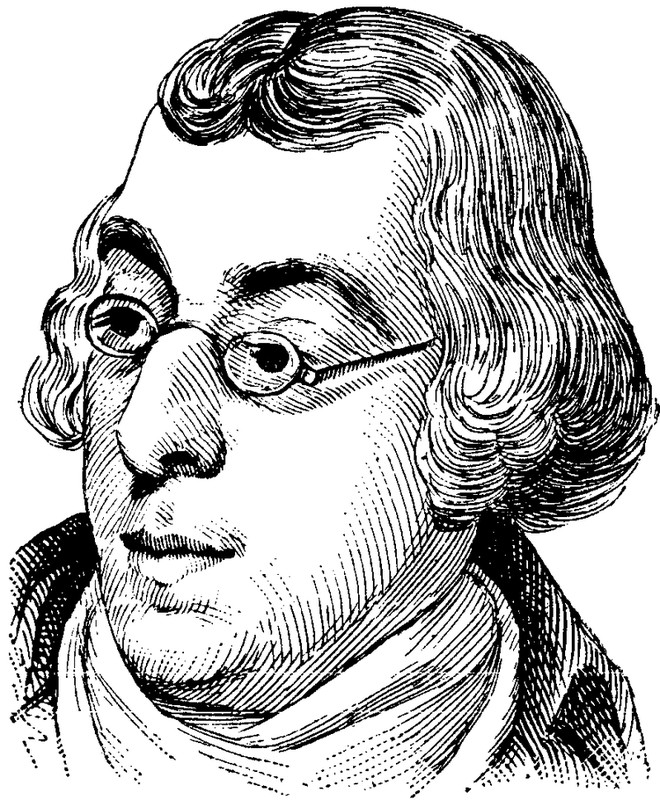
Isaac D'Israeli
At the time of his birth his family had stood for generations among the foremost English Jews, his father having been made a citizen by special legislation. The boy, however, did not inherit the commercial spirit which had established his house. He was a lover of books and a dreamer of dreams, and so early developed literary tendencies that his frightened father sent him off to Amsterdam to school, in the hope of curing proclivities so dangerous. Here he became familiar with the works of the Encyclopædists, and adopted the theories of Rousseau. On returning to England in his nineteenth year, he replied to his father's proposition that he should enter a commercial house at Bordeaux, by a long poem in which he passionately inveighed against the commercial spirit, and avowed himself a student of philosophy and letters. His father's reluctant acquiescence was obtained at last through the good offices of the laureate Pye, to whom the youth had already dedicated his first book, 'A Defence of Poetry.'
At the outset of his career he found himself received with consideration by the men whose acquaintance he most desired. Following the fashion of the day, and inspired by the books of anecdotes so successfully published by his friend Douce, D'Israeli in 1791 produced anonymously a small volume entitled 'Curiosities of Literature,' the copyright of which he magnanimously presented to his publisher. The extraordinary success of this book can be accounted for only by the curious taste of the time, which still reflected the more unworthy traditions of the Addisonian era. It was an age of clubs and tea-tables, of society scandal-mongering and fireside gossip; and the reading public welcomed a contribution whose refined dilettantism so well matched its own. The mysteries of Eleusis and the origin of wigs received the same grave attention. This popularity induced D'Israeli to buy back the copyright at a generous valuation; he enlarged the work to five volumes, which passed through twelve in his own lifetime, and still serves to illustrate a curious literary phase.
Other compilations of similar nature met the same success: 'The Calamities of Authors,' 'Quarrels of Authors,' and 'Literary Recollections'; but the 'Amenities of Literature,' his last work, is the most purely literary in form, and affords perhaps the best index to D'Israeli's abilities as a writer. The reader of to-day, however, is struck by the ephemeral nature of this criticism, which yet by a curious literary experience is keeping a place among the permanent productions of its age. The reader is everywhere impressed by the human sympathy, by the wide if rather superficial knowledge, and by innumerable felicities of expression and style, which betray the cultivated mind. To lovers of the curious the books still appeal, and they will continue to hold an honorable place among the bric-a-brac of literature.
The spirit of curiosity which characterized the mind of D'Israeli assumed its most dignified concrete form in the 'Commentaries on the Reign of Charles I.' D'Israeli had an artistic sense of the values in a historical picture, with a keen perception of the importance of side lights; and although the book is not a great contribution to the literature of history, yet it became popular, and in July 1832 earned for its author the degree of D.C.L. from Oxford.
D'Israeli's romances were tedious tales, but his hold upon the public was secure, and the vast amount of miscellaneous matter which he published always found a delighted audience. 'The Genius of Judaism,' a philosophical inquiry into the historical significance of the permanence of the Jewish race, showed the author's psychic limitations. He designed a history of English literature, for which he had gathered much material, but increasing blindness forced him to abandon it. Much of D'Israeli's popularity was unquestionably due to his qualities of heart. His nature was fine; he was an affectionate and devoted friend, and held an enviable position in the literary circles of the day. Campbell, Byron, Rogers, and Scott alike admired and loved him, while a host of lesser men eagerly sought his friendship.
Although brought up in the Jewish faith, D'Israeli affiliated early in life with the Church of England, in which his three sons and one daughter were baptized. He died in 1848, and was buried at Brandenham. Twenty years later his daughter-in-law, the Countess of Beaconsfield, erected at Hughenden a monument to his memory.
OLD BLACK-LETTER QUARTO. Slightly reduced facsimile of title-page of first edition of "THE POSIES." London, about 1572. Original, 4⅛ x 6⅜ inches.
An example of title-page, typography, and spelling a hundred years after the introduction of printing into England. The Old English, Gothic, or Black-letter type was being superseded by the modern "Roman;" and on this title page both forms were used.
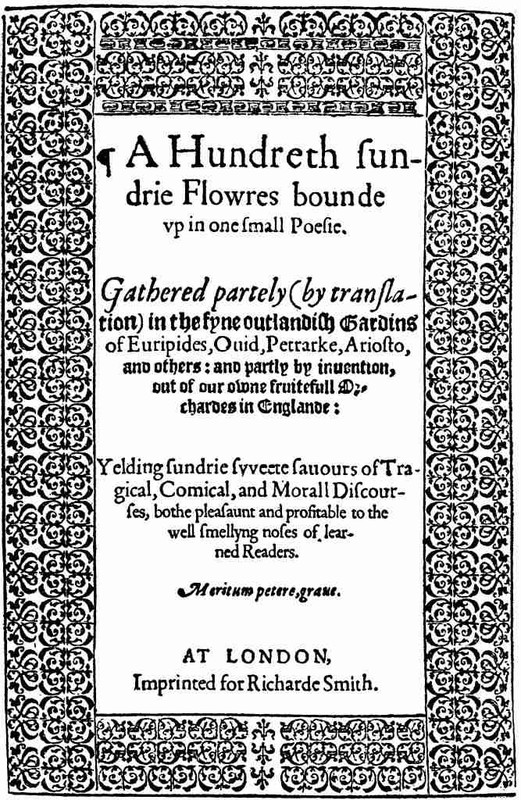
POETS, PHILOSOPHERS, AND ARTISTS MADE BY ACCIDENT
From 'Curiosities of Literature'
Accident has frequently occasioned the most eminent geniuses to display their powers. It was at Rome, says Gibbon, on the fifteenth of October, 1764, as I sat musing amidst the ruins of the Capitol, while the barefooted friars were singing vespers in the Temple of Jupiter, that the idea of writing the decline and fall of the city first started to my mind.
Father Malebranche, having completed his studies in philosophy and theology without any other intention than devoting himself to some religious order, little expected the celebrity his works acquired for him. Loitering in an idle hour in the shop of a bookseller, and turning over a parcel of books, 'L'Homme de Descartes' fell into his hands. Having dipt into some parts, he read with such delight that the palpitations of his heart compelled him to lay the volume down. It was this circumstance that produced those profound contemplations which made him the Plato of his age.
Cowley became a poet by accident. In his mother's apartment he found, when very young, Spenser's 'Fairy Queen,' and by a continual study of poetry he became so enchanted of the Muse that he grew irrecoverably a poet.
Dr. Johnson informs us that Sir Joshua Reynolds had the first fondness of his art excited by the perusal of Richardson's Treatise.
Vaucanson displayed an uncommon genius for mechanics. His taste was first determined by an accident: when young, he frequently attended his mother to the residence of her confessor; and while she wept with repentance, he wept with weariness! In this state of disagreeable vacation, says Helvetius, he was struck with the uniform motion of the pendulum of the clock in the hall. His curiosity was roused; he approached the clock-case, and studied its mechanism; what he could not discover he guessed at. He then projected a similar machine, and gradually his genius produced a clock. Encouraged by this first success, he proceeded in his various attempts; and the genius which thus could form a clock, in time formed a fluting automaton.
If Shakespeare's imprudence had not obliged him to quit his wool trade and his town; if he had not engaged with a company of actors, and at length, disgusted with being an indifferent performer, he had not turned author, the prudent wool-seller had never been the celebrated poet.
Accident determined the taste of Molière for the stage. His grandfather loved the theatre, and frequently carried him there. The young man lived in dissipation; the father, observing it, asked in anger if his son was to be made an actor. "Would to God," replied the grandfather, "he was as good an actor as Montrose." The words struck young Molière; he took a disgust to his tapestry trade; and it is to this circumstance France owes her greatest comic writer.
Corneille loved; he made verses for his mistress, became a poet, composed 'Mélite,' and afterwards his other celebrated works. The discreet Corneille had remained a lawyer.
Thus it is that the devotion of a mother, the death of Cromwell, deer-stealing, the exclamation of an old man, and the beauty of a woman, have given five illustrious characters to Europe.
We owe the great discovery of Newton to a very trivial accident. When a student at Cambridge, he had retired during the time of the plague into the country. As he was reading under an apple-tree, one of the fruit fell, and struck him a smart blow on the head. When he observed the smallness of the apple, he was surprised at the force of the stroke. This led him to consider the accelerating motion of falling bodies; from whence he deduced the principle of gravity, and laid the foundation of his philosophy.
Ignatius Loyola was a Spanish gentleman who was dangerously wounded at the siege of Pampeluna. Having heated his imagination by reading the Lives of the Saints, which were brought to him in his illness instead of a romance, he conceived a strong ambition to be the founder of a religious order; whence originated the celebrated society of the Jesuits.
Rousseau found his eccentric powers first awakened by the advertisement of the singular annual subject which the Academy of Dijon proposed for that year, in which he wrote his celebrated Declamation against the arts and sciences; a circumstance which determined his future literary efforts.
La Fontaine, at the age of twenty-two, had not taken any profession or devoted himself to any pursuit. Having accidentally heard some verses of Malherbe, he felt a sudden impulse, which directed his future life. He immediately bought a Malherbe, and was so exquisitely delighted with this poet that after passing the nights in treasuring his verses in his memory, he would run in the daytime to the woods, where, concealing himself, he would recite his verses to the surrounding dryads.
Flamsteed was an astronomer by accident. He was taken from school on account of his illness, when Sacrobosco's book 'De Sphæra' having been lent to him, he was so pleased with it that he immediately began a course of astronomic studies. Pennant's first propensity to natural history was the pleasure he received from an accidental perusal of Willoughby's work on birds; the same accident, of finding on the table of his professor Reaumur's 'History of Insects,'—of which he read more than he attended to the lecture.—and having been refused the loan, gave such an instant turn to the mind of Bonnet that he hastened to obtain a copy, but found many difficulties in procuring this costly work. Its possession gave an unalterable direction to his future life: this naturalist indeed lost the use of his sight by his devotion to the microscope.
Dr. Franklin attributes the cast of his genius to a similar accident. "I found a work of Defoe's, entitled an 'Essay on Projects,' from which perhaps I derived impressions that have since influenced some of the principal events of my life."
I shall add the incident which occasioned Roger Ascham to write his 'Schoolmaster,' one of the most curious and useful treatises among our elder writers.
At a dinner given by Sir William Cecil during the plague in 1563, at his apartments at Windsor, where the Queen had taken refuge, a number of ingenious men were invited. Secretary Cecil communicated the news of the morning, that several scholars at Eton had run away on account of their master's severity, which he condemned as a great error in the education of youth. Sir William Petre maintained the contrary; severe in his own temper, he pleaded warmly in defense of hard flogging. Dr. Wootton, in softer tones, sided with the Secretary. Sir John Mason, adopting no side, bantered both. Mr. Haddon seconded the hard-hearted Sir William Petre, and adduced as an evidence that the best schoolmaster then in England was the hardest flogger. Then was it that Roger Ascham indignantly exclaimed that if such a master had an able scholar it was owing to the boy's genius and not the preceptor's rod. Secretary Cecil and others were pleased with Ascham's notions. Sir Richard Sackville was silent; but when Ascham after dinner went to the Queen to read one of the orations of Demosthenes, he took him aside, and frankly told him that though he had taken no part in the debate he would not have been absent from that conversation for a great deal; that he knew to his cost the truth Ascham had supported, for it was the perpetual flogging of such a schoolmaster that had given him an unconquerable aversion to study. And as he wished to remedy this defect in his own children, he earnestly exhorted Ascham to write his observations on so interesting a topic. Such was the circumstance which produced the admirable treatise of Roger Ascham.
THE MARTYRDOM OF CHARLES THE FIRST
From the 'Commentaries on the Reign of Charles the First'
At Whitehall a repast had been prepared. The religious emotions of Charles had consecrated the sacrament, which he refused to mingle with human food. The Bishop, whose mind was unequal to conceive the intrepid spirit of the King, dreading lest the magnanimous monarch, overcome by the severity of the cold, might faint on the scaffold, prevailed on him to eat half a manchet of bread and taste some claret. But the more consolatory refreshment of Charles had been just imparted to him in that singular testimony from his son, who had sent a carte blanche to save the life of his father at any price. This was a thought on which his affections could dwell in face of the scaffold which he was now to ascend.
CHARLES I. GOING TO EXECUTION. Photogravure from a painting by E. Crofts.

Charles had arrived at Whitehall about ten o'clock, and was not led to the scaffold till past one. It was said that the scaffold was not completed; it might have been more truly said that the conspirators were not ready. There was a mystery in this delay. The fate of Charles the First to the very last moment was in suspense. Fairfax, though at the time in the palace, inquired of Herbert how the King was, when the King was no more! and expressed his astonishment on hearing that the execution had just taken place. This extraordinary simplicity and abstraction from the present scene of affairs has been imputed to the General as an act of refined dissimulation, yet this seems uncertain. The Prince's carte blanche had been that morning confided to his hands, and he surely must have laid it before the "Grandees of the Army," as this new order of the rulers of England was called. Fairfax, whose personal feelings respecting the King were congenial with those his lady had so memorably evinced, labored to defer for a few days the terrible catastrophe; not without the hope of being able, by his own regiment and others in the army, to prevent the deed altogether. It is probable—inexplicable as it may seem to us—that the execution of Charles the First really took place unknown to the General. Fairfax was not unaccustomed to discover that his colleagues first acted, and afterwards trusted to his own discernment.
Secret history has not revealed all that passed in those three awful hours. We know, however, that the warrant for the execution was not signed till within a few minutes before the King was led to the scaffold. In an apartment in the Palace, Ireton and Harrison were in bed together, and Cromwell, with four colonels, assembled in it. Colonel Huncks refused to sign the warrant. Cromwell would have no further delay, reproaching the Colonel as "a peevish, cowardly fellow," and Colonel Axtell declared that he was ashamed for his friend Huncks, remonstrating with him, that "the ship is coming into the harbor, and now would he strike sail before we come to anchor?" Cromwell stepped to a table, and wrote what he had proposed to Huncks; Colonel Hacker, supplying his place, signed it, and with the ink hardly dry, carried the warrant in his hand and called for the King.
At the fatal summons Charles rose with alacrity. The King passed through the long gallery by a line of soldiers. Awe and sorrow seem now to have mingled in their countenances. Their barbarous commanders were intent on their own triumph, and no farther required the forced cry of "Justice and Execution." Charles stepped out of an enlarged window of the Banqueting House, where a new opening leveled it with the scaffold. Charles came forward with the same indifference as "he would have entered Whitehall on a masque night," as an intelligent observer described. The King looked towards St. James's and smiled. Curious eyes were watchful of his slightest motions; and the Commonwealth papers of the day express their surprise, perhaps their vexation, at the unaltered aspect and the firm step of the Monarch. These mean spirits had flattered themselves that he who had been cradled in royalty, who had lived years in the fields of honor, and was now, they presumed, a recreant in imprisonment,—"the grand Delinquent of England,"—as they called him, would start in horror at the block.
This last triumph at least was not reserved for them,—it was for the King. Charles, dauntless, strode "the floor of Death," to use Fuller's peculiar but expressive phraseology. He looked on the block with the axe lying upon it, with attention; his only anxiety was that the block seemed not sufficiently raised, and that the edge of the axe might be turned by being swept by the flappings of cloaks, or blunted by the feet of some moving about the scaffold. "Take care they do not put me to pain!—Take heed of the axe! take heed of the axe!" exclaimed the King to a gentleman passing by. "Hurt not the axe; that may hurt me!" His continued anxiety concerning these circumstances proves that he felt not the terror of death, solely anxious to avoid the pain, for he had an idea of their cruelty. With that sedate thoughtfulness which was in all his actions, he only looked at the business of the hour. One circumstance Charles observed with a smile. They had a notion that the King would resist the executioner; on the suggestion of Hugh Peters, it is said, they had driven iron staples and ropes into the scaffold, that their victim, if necessary, might be bound down upon the block.
The King's speech has many remarkable points, but certainly nothing so remarkable as the place where it was delivered. This was the first "King's Speech" spoken from a scaffold. Time shall confirm, as history has demonstrated, his principle that "They mistook the nature of government; for people are free under a government, not by being sharers in it, but by the due administration of the laws." "It was for this," said Charles, "that now I am come here. If I could have given way to an arbitrary sway, for to have all laws changed according to the power of the sword, I need not have come here; and therefore I tell you that I am the Martyr of the People!"
SYDNEY DOBELL
(1824-1874)

ydney Dobell, the son of a wine merchant, was born at Cranbrook in Kent. His parents, both persons of strong individuality, believed in home training, and not one of their eight children went either to school or to university. They belonged to the Broad Church Community founded by Sydney's maternal grandfather, Samuel Thompson; a church intended to recall in its principles the primitive Christian ages. The parents looked upon Sydney, their eldest-born, as destined to become the apostle of this creed. He grew up in a kind of religious fervor, with his precocious mind unnaturally stimulated; a course of conduct which materially weakened his constitution, and made him a chronic invalid at the early age of thirty-three. He read whatever books came to hand, many of them far beyond his years. At the age of eight he filled his diary with theological discussions.
Entering his father's counting-house as a mere lad, he remained to the end of his life a business man of great energy. Notwithstanding his rare poetic endowments, he never seems to have entertained a single-minded purpose to be a poet and nothing more. On the contrary, he thought the ideal and the practical life perfectly compatible, and he strove to unite in himself the poet and the man of affairs. He wrote habitually until 1856, when regular literary work was forbidden by his physicians. With characteristic energy he now turned his thoughts into other channels; identified himself with the affairs of Gloucester, where he was living, looked after his business, and was one of the first to adopt the system of industrial co-operation. The last four years of his life, a period of suffering and helplessness, he spent at Barton-End House, above the Stroud valley, where he died in the spring of 1874.
In the work of Dobell it is curious to find so few traces of the influences under which he grew up. He had every encouragement to become a writer of religious poetry; yet much of his work is philosophic and recondite. His delicate health is in a measure responsible for his failure to achieve the success which his natural endowments promised. All his literary work was done between the ages of twenty-three and thirty-three. 'The Roman,' his first long poem, appeared in 1850. Dedicated to the Italian struggle for liberty, it showed his breadth of sympathy. In 'Balder,' finished in 1853, Dobell is at his best both as thinker and as poet. Yet its many fine passages, its wealth of metaphor, and the exquisite songs of Amy, hardly counterbalance the remoteness of its theme, and its over-subtle analysis of morbid psychic states. It is a poem to be read in fragments, and has aptly been called a mine for poets.
With Alexander Smith he published in 1855 a series of sonnets inspired by the Crimean War. This was followed in 1856 by 'England in War Time,' a collection of Dobell's lyrical and descriptive poems, which possess more general human interest than any other of his books.
After continuous work was interdicted, he still contributed verse and prose to the periodicals. His essays have been collected by Professor Nichol, under the title 'Thoughts on Art, Philosophy, and Religion.' As a poet Dobell belongs to the so-called "spasmodic school," a school "characterized by an undercurrent of discontent with the mystery of existence, by vain effort, unrewarded struggle, skeptical unrest, and an uneasy striving after some incomprehensible end.... Poetry of this kind is marked by an excess of metaphor which darkens rather than illustrates, and by a general extravagance of language. On the other hand, it manifests freshness and originality, and a rich natural beauty." Dobell's descriptions of scenery are among the finest in English literature. His senses were abnormally acute, like those of a savage, a condition which intensified his appreciation of natural beauty. Possessing a vivid imagination and wide sympathies, he was often over-subtle and obscure. He strove to realize in himself his ideal of a poet, and during his years of ill-health gave himself up to promoting the welfare of his fellow-men; but of his seventeen years of inactivity he says:—"The keen perception of all that should be done, and that so bitterly cries for doing, accompanies the consciousness of all that I might but cannot do."
EPIGRAM ON THE DEATH OF EDWARD FORBES
Nature, a jealous mistress, laid him low. He wooed and won her; and, by love made bold, She showed him more than mortal man should know— Then slew him lest her secret should be told.
HOW'S MY BOY?
"Ho, sailor of the sea! How's my boy—my boy?"— "What's your boy's name, good wife, And in what good ship sailed he?"
"My boy John— He that went to sea— What care I for the ship, sailor? My boy's my boy to me.
"You come back from the sea, And not know my John? I might as well have asked some landsman, Yonder down in the town. There's not an ass in all the parish But knows my John.
"How's my boy—my boy? And unless you let me know, I'll swear you are no sailor, Blue jacket or no— Brass buttons or no, sailor, Anchor and crown or no—
"Sure, his ship was the Jolly Briton—" "Speak low, woman, speak low!
"And why should I speak low, sailor, About my own boy John? If I was loud as I am proud I'd sing him over the town! Why should I speak low, sailor?"— "That good ship went down."
"How's my boy—my boy? What care I for the ship, sailor? I was never aboard her. Be she afloat or be she aground, Sinking or swimming, I'll be bound Her owners can afford her! I say, how's my John?"— "Every man on board went down, Every man aboard her."
"How's my boy—my boy? What care I for the men, sailor? I'm not their mother. How's my boy—my boy? Tell me of him and no other! How's my boy—my boy?"
THE SAILOR'S RETURN
This morn I lay a-dreaming, This morn, this merry morn; When the cock crew shrill from over the hill, I heard a bugle horn.
And through the dream I was dreaming, There sighed the sigh of the sea, And through the dream I was dreaming, This voice came singing to me:—
"High over the breakers, Low under the lee, Sing ho! The billow, And the lash of the rolling sea!
"Boat, boat, to the billow, Boat, boat, to the lee! Love, on thy pillow, Art thou dreaming of me?
"Billow, billow, breaking, Land us low on the lee! For sleeping or waking, Sweet love, I am coming to thee!
"High, high, o'er the breakers, Low, low, on the lee, Sing ho! The billow That brings me back to thee!"
AFLOAT AND ASHORE
"Tumble and rumble, and grumble and snort, Like a whale to starboard, a whale to port; Tumble and rumble, and grumble and snort, And the steamer steams thro' the sea, love!"
"I see the ship on the sea, love; I stand alone On this rock; The sea does not shock The stone; The waters around it are swirled, But under my feet I feel it go down To where the hemispheres meet At the adamant heart of the world. Oh that the rock would move! Oh that the rock would roll To meet thee over the sea, love! Surely my mighty love Should fill it like a soul, And it should bear me to thee, love; Like a ship on the sea, love, Bear me, bear me, to thee, love!"
"Guns are thundering, seas are sundering, crowds are wondering, Low on our lee, love. Over and over the cannon-clouds cover brother and lover, but over and over The whirl-wheels trundle the sea, love; And on through the loud pealing pomp of her cloud The great ship is going to thee, love, Blind to her mark, like a world through the dark, Thundering, sundering, to the crowds wondering, Thundering over to thee, love."
"I have come down to thee coming to me, love; I stand, I stand On the solid sand; I see thee coming to me, love; The sea runs up to me on the sand: I start—'tis as if thou hadst stretched thine hand And touched me through the sea, love. I feel as if I must die, For there's something longs to fly, Fly and fly, to thee, love.
As the blood of the flower ere she blows Is beating up to the sun, And her roots do hold her down, And it blushes and breaks undone In a rose, So my blood is beating in me, love! I see thee nigh and nigher; And my soul leaps up like sudden fire, My life's in the air To meet thee there, To meet thee coming to me, love! Over the sea, Coming to me, Coming, and coming to me, love!"
"The boats are lowered: I leap in first, Pull, boys, pull! or my heart will burst! More! more!—lend me an oar!— I'm thro' the breakers! I'm on the shore! I see thee waiting for me, love!"
"A sudden storm Of sighs and tears, A clenching arm, A look of years. In my bosom a thousand cries, A flash like light before my eyes, And I am lost in thee, love!"
THE SOUL
From 'Balder'
And as the mounting and descending bark, Borne on exulting by the under deep, Gains of the wild wave something not the wave, Catches a joy of going and a will Resistless, and upon the last lee foam Leaps into air beyond it,—so the soul Upon the Alpine ocean mountain-tossed, Incessant carried up to heaven, and plunged To darkness, and, still wet with drops of death, Held into light eternal, and again Cast down, to be again uplift in vast And infinite succession, cannot stay The mad momentum.
ENGLAND
From 'Balder'
This dear English land! This happy England, loud with brooks and birds, Shining with harvests, cool with dewy trees, And bloomed from hill to dell: but whose best flowers Are daughters, and Ophelia still more fair Than any rose she weaves; whose noblest floods The pulsing torrent of a nation's heart; Whose forests stronger than her native oaks Are living men; and whose unfathomed lakes, Forever calm, the unforgotten dead In quiet grave-yards willowed seemly round, O'er which To-day bends sad, and sees his face. Whose rocks are rights, consolidate of old Through unremembered years, around whose base The ever-surging peoples roll and roar Perpetual, as around her cliffs the seas That only wash them whiter; and whose mountains, Souls that from this mere footing of the earth Lift their great virtues through all clouds of Fate Up to the very heavens, and make them rise To keep the gods above us!
AMERICA
Nor force nor fraud shall sunder us! O ye Who north or south, or east or western land, Native to noble sounds, say truth for truth, Freedom for freedom, love for love, and God For God; O ye who in eternal youth Speak with a living and creative flood This universal English, and do stand Its breathing book; live worthy of that grand Heroic utterance—parted, yet a whole, Far, yet unsevered,—children brave and free Of the great Mother tongue, and ye shall be Lords of an empire wide as Shakespeare's soul, Sublime as Milton's immemorial theme, And rich as Chaucer's speech, and fair as Spenser's dream.
AMY'S SONG OF THE WILLOW
From 'Balder'
The years they come, and the years they go, Like winds that blow from sea to sea; From dark to dark they come and go, All in the dew-fall and the rain. Down by the stream there be two sweet willows, —Hush thee, babe, while the wild winds blow,— One hale, one blighted, two wedded willows, All in the dew-fall and the rain.
She is blighted, the fair young willow; —Hush thee, babe, while the wild winds blow,— She hears the spring-blood beat in the bark; She hears the spring-leaf bud on the bough; But she bends blighted, the wan weeping willow, All in the dew-fall and the rain.
The stream runs sparkling under the willow, —Hush thee, babe, while the wild winds blow,— The summer rose-leaves drop in the stream; The winter oak-leaves drop in the stream; But she bends blighted, the wan weeping willow, All in the dew-fall and the rain.
Sometimes the wind lifts the bright stream to her, —Hush thee, babe, while the wild winds blow,— The false stream sinks, and her tears fall faster; Because she touched it her tears fall faster; Over the stream her tears fall faster, All in the sunshine or the rain.
The years they come, and the years they go; Sing well-away, sing well-away! And under mine eyes shines the bright life-river; Sing well-away, sing well-away! Sweet sounds the spring in the hale green willow, The goodly green willow, the green waving willow, Sweet in the willow, the wind-whispering willow; Sing well-away, sing well-away! But I bend blighted, the wan weeping willow, All in the sun, and the dew, and the rain.
AUSTIN DOBSON
(1840-)
BY ESTHER SINGLETON

t first thought it seems difficult to consider Austin Dobson as belonging to the Victorian period, so entirely is he saturated with the spirit of the eighteenth century. A careful study of his verse reveals the fact that the Georgian era, seen through the vista of his poetic imagination, is divested of all that is coarse, dark, gross, and prosaic. The mental atmosphere and the types and characters that he gives, express only beauty and charm.
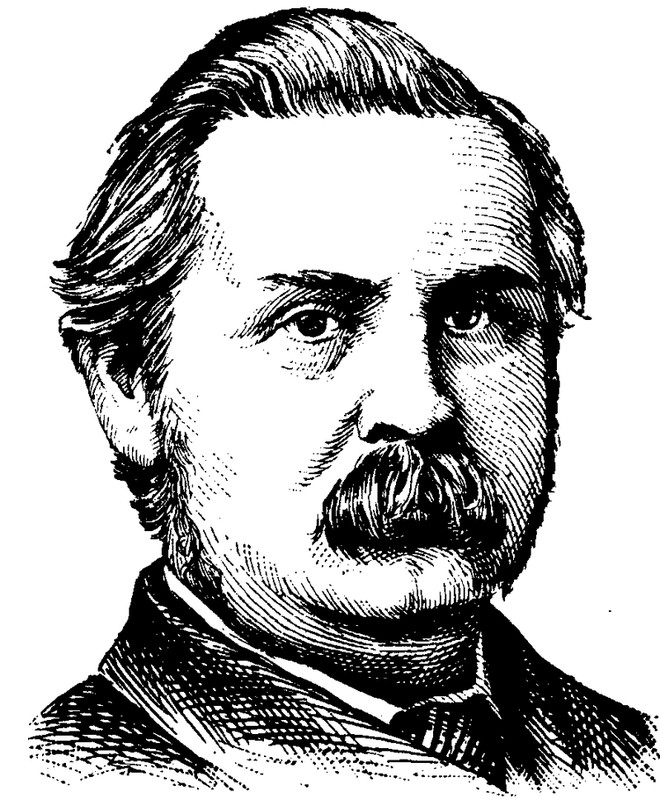
Austin Dobson
One approaches the poems of Austin Dobson as one stands before a rare collection of enamels, fan-mounts, jeweled snuff-boxes, and delicate carvings in ivory and silver; and after delighting in the beauty and finish of these graceful curios, passes into a gallery of paintings and water-colors, suggesting Watteau, Fragonard, Boucher, Meissonier, and Greuze. We also wander among trim box-hedges and quaint gardens of roses and bright hollyhocks; lean by sun-dials to watch the shadow of Time; and enjoy the sight of gay belles, patched and powdered and dressed in brocaded gowns and gypsy hats. Gallant beaux, such as are associated with Reynolds's portraits, appear, and hand them into sedan-chairs or lead them through stately minuets to the notes of Rameau, Couperin, and Arne.
Just as the scent of rose-leaves, lavender, and musk rises from antique Chinese jars, so Dobson's delicate verse reconstructs a life
"Of fashion gone, and half-forgotten ways."
He is equally at home in France. Nothing could be more sympathetic and exquisite than 'A Revolutionary Relic,' 'The Curé's Progress,' 'Une Marquise,' and the 'Proverbs in Porcelain,' one of which is cited below.
In the 'Vers de Société,' as well as his other poetry, Dobson fulfills all the requirements of light verse—charm, mockery, pathos, banter, and, while apparently skimming the surface, often shows us the strange depths of the human heart. He blends so many qualities that he deserves the praise of T.B. Aldrich, who says, "Austin Dobson has the grace of Suckling and the finish of Herrick, and is easily master of both in metrical art."
Henry Austin Dobson, the son of Mr. George Clarisse Dobson, a civil engineer, was born in Plymouth, England, January 18th 1840. His early years were spent in Anglesea, and after receiving his education in Beaumaris, Coventry, and Strasburg, he returned to England to become a civil engineer. In 1856 he entered the civil service of Great Britain, and ever since that date he has held offices in the Board of Trade. His leisure was devoted to literature, and when Anthony Trollope first issued his magazine St. Paul's in 1868, he introduced to the public the verse of Austin Dobson. In 1873 his fugitive poems were published in a small volume entitled 'Vignettes in Rhyme' and 'Vers de Société.' This was followed in 1877 by 'Proverbs in Porcelain,' and both books, with additional poems, were printed again in two volumes: 'Old World Idylls' (1883), and 'At the Sign of the Lyre' (1885). Mr. Dobson's original essays are contained in three volumes: 'Four Frenchwomen,' studies of Charlotte Corday, Madame Roland, the Princess de Lamballe, and Madame de Genlis (1890), and 'Eighteenth-Century Vignettes' (first series 1892, second series 1894), which touch upon a host of picturesque and fascinating themes. He has written also several biographies: of Hogarth, of Fielding, of Steele (1886), of Goldsmith (1888), and a 'Memoir of Horace Walpole' (1890). He has also written felicitous critical introductions to many new editions of the eighteenth-century classics.
Austin Dobson has been most happy in breathing English life into the old poems of French verse, such as ballades, villanelles, roundels, and rondeaux; and he has also written clever and satirical fables, cast in the form and temper of Gay and Prior, with quaint obsolete affectations, redolent of the classic age of Anne.
So serious is his attitude towards art, and so large his audience, that the hope expressed in the following rondeau will certainly be realized:—
In after days, when grasses high O'er-top the stone where I shall lie, Though ill or well the world adjust My slender claim to honored dust, I shall not question nor reply.
I shall not see the morning sky, I shall not hear the night-wind sigh; I shall be mute, as all men must, In after days.
But yet, now living, fain were I That some one then should testify, Saying—He held his pen in trust To Art, not serving shame or lust. Will none?—Then let my memory die In after days!
ON A NANKIN PLATE
Villanelle
"Ah me, but it might have been! Was there ever so dismal a fate?" Quoth the little blue mandarin.
"Such a maid as was never seen: She passed, tho' I cried to her, 'Wait,'— Ah me, but it might have been!
"I cried, 'O my Flower, my Queen, Be mine!'—'Twas precipitate," Quoth the little blue mandarin.
"But then ... she was just sixteen,— Long-eyed, as a lily straight,— Ah me, but it might have been!
"As it was, from her palankeen She laughed—'You're a week too late!'" (Quoth the little blue mandarin.)
"That is why, in a mist of spleen I mourn on this Nankin Plate. Ah me, but it might have been!" Quoth the little blue mandarin.
THE OLD SEDAN-CHAIR
"What's not destroyed by Time's devouring Hand? Where's Troy,—and where's the May-Pole in the Strand?" —Bramston's 'Art of Politicks.'
It stands in the stable-yard, under the eaves, Propped up by a broomstick and covered with leaves; It once was the pride of the gay and the fair, But now 'tis a ruin,—that old Sedan-chair!
It is battered and tattered,—it little avails That once it was lacquered, and glistened with nails; For its leather is cracked into lozenge and square Like a canvas by Wilkie,—that old Sedan-chair.
See, here come the bearing-straps; here were the holes For the poles of the bearers—when once there were poles; It was cushioned with silk, it was wadded with hair, As the birds have discovered,—that old Sedan-chair.
"Where's Troy?" says the poet! Look; under the seat Is a nest with four eggs; 'tis a favored retreat Of the Muscovy hen, who has hatched, I dare swear, Quite an army of chicks in that old Sedan-chair.
And yet—Can't you fancy a face in the frame Of the window,—some high-headed damsel or dame, Be-patched and be-powdered, just set by the stair, While they raise up the lid of that old Sedan-chair?
Can't you fancy Sir Plume, as beside her he stands, With his ruffles a-droop on his delicate hands, With his cinnamon coat, with his laced solitaire, As he lifts her out light from that old Sedan-chair?
Then it swings away slowly. Ah, many a league It has trotted 'twixt sturdy-legged Terence and Teague; Stout fellows!—but prone, on a question of fare, To brandish the poles of that old Sedan-chair!
It has waited by portals where Garrick has played; It has waited by Heidegger's "Grand Masquerade"; For my Lady Codille, for my Lady Bellair, It has waited—and waited, that old Sedan-chair!
Oh, the scandals it knows! Oh, the tales it could tell Of Drum and Ridotto, of Rake and of Belle,— Of Cock-fight and Levee, and (scarcely more rare!) Of Fête-days at Tyburn, that old Sedan-chair!
"Heu! quantum mutata," I say as I go. It deserves better fate than a stable-yard, though! We must furbish it up, and dispatch it,—"With Care,"— To a Fine-Art Museum—that old Sedan-chair.
THE BALLAD OF PROSE AND RHYME
When the ways are heavy with mire and rut, In November fogs, in December snows, When the North Wind howls, and the doors are shut,— There is place and enough for the pains of prose; But whenever a scent from the whitethorn blows, And the jasmine-stars at the casement climb, And a Rosalind-face at the lattice shows, Then hey! for the ripple of laughing rhyme!
When the brain gets dry as an empty nut, When the reason stands on its squarest toes, When the mind (like a beard) has a "formal cut,"— There is place and enough for the pains of prose; But whenever the May-blood stirs and glows, And the young year draws to the "golden prime," And Sir Romeo sticks in his ear a rose,— Then hey! for the ripple of laughing rhyme!
In a theme where the thoughts have a pedant-strut, In a changing quarrel of "Ayes" and "Noes," In a starched procession of "If" and "But,"— There is place and enough for the pains of prose; But whenever a soft glance softer grows And the light hours dance to the trysting-time, And the secret is told "that no one knows,"— Then hey! for the ripple of laughing rhyme!
Envoy
In the work-a-day world,—for its needs and woes, There is place and enough for the pains of prose; But whenever the May-bells clash and chime, Then hey! for the ripple of laughing rhyme!
THE CURÉ'S PROGRESS
Monsieur The Curé down the street Comes with his kind old face,— With his coat worn bare, and his straggling hair, And his green umbrella-case.
You may see him pass by the little "Grande Place," And the tiny "Hôtel-de-Ville"; He smiles as he goes, to the fleuriste Rose, And the pompier Théophile.
He turns as a rule through the "Marché" cool, Where the noisy fishwives call; And his compliment pays to the "belle Thérèse," As she knits in her dusky stall.
There's a letter to drop at the locksmith's shop, And Toto, the locksmith's niece, Has jubilant hopes, for the Curé gropes In his tails for a pain d'épice.
There's a little dispute with a merchant of fruit Who is said to be heterodox, That will ended be with a "Ma foi, oui!" And a pinch from the Curé's box.
There is also a word that no one heard To the furrier's daughter Lou; And a pale cheek fed with a flickering red, And a "Bon Dieu garde M'sieu!"
But a grander way for the Sous-Préfet, And a bow for Ma'am'selle Anne; And a mock "off-hat" to the Notary's cat, And a nod to the Sacristan:—
For ever through life the Curé goes With a smile on his kind old face— With his coat worn bare, and his straggling hair. And his green umbrella-case.
"GOOD-NIGHT, BABETTE"
"Si vieillesse pouvait!"
Scene.—A small neat room. In a high Voltaire chair sits a white-haired old gentleman.
M. VIEUXBOIS [turning querulously]
Day of my life! Where can she get? Babette! I Say! Babette!—Babette!
BABETTE [entering hurriedly]
Coming, M'sieu'! If M'sieu' speaks So loud, he won't be well for weeks!
M. VIEUXBOIS
Where have you been?
BABETTE
Why, M'sieu' knows:—
April!... Ville-d' Avray!... Ma'm'selle Rose!
M. VIEUXBOIS
Ah! I am old,—and I forget. Was the place growing green, Babette?
BABETTE
But of a greenness!—Yes, M'sieu'! And then the sky so blue!—so blue! And when I dropped my immortelle, How the birds sang! [Lifting her apron to her eyes.] This poor Ma'm'selle!
M. VIEUXBOIS
You're a good girl, Babette, but she,— She was an angel, verily. Sometimes I think I see her yet Stand smiling by the cabinet; And once, I know, she peeped and laughed Betwixt the curtains.... Where's the draught? [She gives him a cup.] Now I shall sleep, I think, Babette;— Sing me your Norman chansonnette.
BABETTE [sings]
"Once at the Angelus (Ere I was dead), Angels all glorious Came to my bed;— Angels in blue and white, Crowned on the head."
M. VIEUXBOIS [drowsily]
"She was an Angel" ... "Once she laughed" ...
What! was I dreaming? Where's the draught?
BABETTE [showing the empty cup]
The draught, M'sieu'?
M. VIEUXBOIS
How I forget! I am so old! But sing, Babette!
BABETTE [sings]
"One was the Friend I left Stark in the Snow; One was the Wife that died Long,—long ago; One was the Love I lost— How could she know?"
M. VIEUXBOIS [murmuring]
Ah Paul! ... old Paul! ... Eulalie, too! And Rose ... And O! "the sky so blue!"
BABETTE [sings]
"One had my Mother's eyes, Wistful and mild; One had my Father's face; One was a Child: All of them bent to me,— Bent down and smiled!" [He is asleep!]
M. VIEUXBOIS [almost inaudibly]
How I forget! I am so old!... Good-night, Babette!
THE LADIES OF ST. JAMES'S
A Proper New Ballad of the Country and the Town
"Phyllida amo ante alias."—Virgil.
The ladies of St. James's Go swinging to the play; Their footmen run before them With a "Stand by! Clear the way!" But Phyllida, my Phyllida! She takes her buckled shoon, When we go out a-courting Beneath the harvest moon.
The ladies of St. James's Wear satin on their backs; They sit all night at Ombre, With candles all of wax: But Phyllida, my Phyllida! She dons her russet gown, And runs to gather May-dew Before the world is down.
The ladies of St. James's! They are so fine and fair, You'd think a box of essences Was broken in the air: But Phyllida, my Phyllida! The breath of heath and furze, When breezes blow at morning, Is not so fresh as hers.
The ladies of St. James's! They're painted to the eyes; Their white it stays forever, Their red it never dies: But Phyllida, my Phyllida! Her color comes and goes; It trembles to a lily,— It wavers like a rose,
The ladies of St. James's! You scarce can understand The half of all their speeches, Their phrases are so grand: But Phyllida, my Phyllida! Her shy and simple words Are clear as after rain-drops The music of the birds.
The ladies of St. James's! They have their fits and freaks; They smile on you—for seconds; They frown on you—for weeks: But Phyllida, my Phyllida! Come either storm or shine, From Shrove-tide unto Shrove-tide, Is always true—and mine.
My Phyllida! my Phyllida! I care not though they heap The hearts of all St. James's, And give me all to keep; I care not whose the beauties Of all the world may be,— For Phyllida, my Phyllida, Is all the world to me.
DORA VERSUS ROSE
"The Case is Proceeding"
From the tragic-est novels at Mudie's— At least on a practical plan— To the tales of mere Hodges and Judys, One love is enough for a man. But no case that I ever yet met is Like mine: I am equally fond Of Rose, who a charming brunette is, And Dora, a blonde.
Each rivals the other in powers— Each waltzes, each warbles, each paints— Miss Rose, chiefly tumble-down towers; Miss Do., perpendicular saints. In short, to distinguish is folly; 'Twixt the pair I am come to the pass Of Macheath, between Lucy and Polly,— Or Buridan's ass.
If it happens that Rosa I've singled For a soft celebration in rhyme, Then the ringlets of Dora get mingled Somehow with the tune and the time; Or I painfully pen me a sonnet To an eyebrow intended for Do.'s, And behold I am writing upon it The legend, "To Rose."
Or I try to draw Dora (my blotter Is all over scrawled with her head), If I fancy at last that I've got her, It turns to her rival instead; Or I find myself placidly adding To the rapturous tresses of Rose Miss Dora's bud-mouth, and her madding, Ineffable nose.
Was there ever so sad a dilemma? For Rose I would perish (pro tem.); For Dora I'd willingly stem a— (Whatever might offer to stem); But to make the invidious election,— To declare that on either one's side I've a scruple,—a grain,—more affection, I cannot decide.
And as either so hopelessly nice is, My sole and my final resource Is to wait some indefinite crisis,— Some feat of molecular force, To solve me this riddle conducive By no means to peace or repose, Since the issue can scarce be inclusive Of Dora and Rose.
(After-thought)
But perhaps if a third (say, a Norah), Not quite so delightful as Rose, Nor wholly so charming as Dora, Should appear, is it wrong to suppose,— As the claims of the others are equal,— And flight—in the main—is the best,— That I might ... But no matter,—the sequel Is easily guessed.
UNE MARQUISE
A Rhymed Monologue in the Louvre
"Belle Marquise, vos beaux yeux me font mourir d'amour."
—Molière.
I
As you sit there at your ease, O Marquise! And the men flock round your knees Thick as bees, Mute at every word you utter, Servants to your least frill-flutter, "Belle Marquise!" As you sit there, growing prouder, And your ringed hands glance and go, And your fan's frou-frou sounds louder, And your "beaux yeux" flash and glow;— Ah, you used them on the Painter, As you know, For the Sieur Larose spoke fainter, Bowing low, Thanked Madame and Heaven for Mercy That each sitter was not Circe,— Or at least he told you so; Growing proud, I say, and prouder To the crowd that come and go, Dainty Deity of Powder, Fickle Queen of Fop and Beau, As you sit where lustres strike you, Sure to please, Do we love you most, or like you, "Belle Marquise!"
II
You are fair; oh yes, we know it Well, Marquise; For he swore it, your last poet, On his knees; And he called all heaven to witness Of his ballad and its fitness, "Belle Marquise!" You were everything in ère (With exception of sévère),— You were cruelle and rebelle, With the rest of rhymes as well; You were "Reine" and "Mère d' Amour"; You were "Vénus à Cythère"; "Sappho mise en Pompadour," And "Minerve en Paravère"; You had every grace of heaven In your most angelic face, With the nameless finer leaven Lent of blood and courtly race; And he added, too, in duty, Ninon's wit and Boufflers's beauty; And La Valliere's yeux veloutés Followed these; And you liked it, when he said it (On his knees), And you kept it, and you read it, "Belle Marquise!"
III
Yet with us your toilet graces Fail to please, And the last of your last faces, And your mise; For we hold you just as real, "Belle Marquise!" As your Bergers and Bergères, Tes d' Amour and Batelières; As your pares, and your Versailles, Gardens, grottoes, and socailles; As your Naiads and your trees;— Just as near the old ideal Calm and ease, As the Venus there by Coustou, That a fan would make quite flighty, Is to her the gods were used to,— Is to grand Greek Aphroditè, Sprung from seas. You are just a porcelain trifle, "Belle Marquise!" Just a thing of puffs and patches Made for madrigals and catches, Not for heart wounds, but for scratches, O Marquise!
Just a pinky porcelain trifle, "Belle Marquise!" Wrought in rarest rose-Dubarry, Quick at verbal point and parry, Clever, doubtless;—but to marry, No, Marquise!
IV
For your Cupid, you have clipped him, Rouged and patched him, nipped and snipped him, And with chapeau-bras equipped him, "Belle Marquise!" Just to arm you through your wife-time, And the languors of your lifetime, "Belle Marquise!" Say, to trim your toilet tapers Or—to twist your hair in papers, Or—to wean you from the vapors;— As for these, You are worth the love they give you, Till a fairer face outlive you, Or a younger grace shall please; Till the coming of the crows'-feet, And the backward turn of beaux' feet, "Belle Marquise!" Till your frothed-out life's commotion Settles down to Ennui's ocean, Or a dainty sham devotion, "Belle Marquise!"
V
No: we neither like nor love you, "Belle Marquise!" Lesser lights we place above you,— Milder merits better please. We have passed from Philosophe-dom Into plainer modern days,— Grown contented in our oafdom, Giving grace not all the praise; And, en partant, Arsinoé,— Without malice whatsoever,— We shall counsel to our Chloë To be rather good than clever; For we find it hard to smother Just one little thought, Marquise! Wittier perhaps than any other,— You were neither Wife nor Mother. "Belle Marquise!"
A BALLAD TO QUEEN ELIZABETH
Of the Spanish Armada
King Philip had vaunted his claims; He had sworn for a year he would sack us; With an army of heathenish names He was coming to fagot and stack us; Like the thieves of the sea he would track us, And shatter our ships on the main; But we had bold Neptune to back us,— And where are the galleons of Spain?
His carackes were christened of dames To the kirtles whereof he would tack us; With his saints and his gilded stern-frames, He had thought like an egg-shell to crack us; Now Howard may get to his Flaccus, And Drake to his Devon again, And Hawkins bowl rubbers to Bacchus,— For where are the galleons of Spain?
Let his Majesty hang to St. James The axe that he whetted to hack us: He must play at some lustier games. Or at sea he can hope to out-thwack us; To his mines of Peru he would pack us To tug at his bullet and chain; Alas! that his Greatness should lack us!— But where are the galleons of Spain?
Envoy
Gloriana!—the Don may attack us Whenever his stomach be fain; He must reach us before he can rack us,... And where are the galleons of Spain?
THE PRINCESS DE LAMBALLE
From 'Four Frenchwomen'
A tender wife, a loving daughter, and a loyal friend,—shall we not here lay down upon the grave of Marie de Lamballe our reverential tribute, our little chaplet of immortelles, in the name of all good women, wives, and daughters?
"Elle était mieux femme que les autres."[A] To us that apparently indefinite, exquisitely definite sentence most fitly marks the distinction between the subjects of the two preceding papers and the subject of the present. It is a transition from the stately figure of a marble Agrippina to the breathing, feeling woman at your side; it is the transition from the statuesque Rachelesque heroines of a David to the "small sweet idyl" of a Greuze. And, we confess it, we were not wholly at ease with those tragic, majestic figures. We shuddered at the dagger and the bowl which suited them so well. We marveled at their bloodless serenity, their superhuman self-sufficiency; inly we questioned if they breathed and felt. Or was their circulation a matter of machinery—a mere dead-beat escapement? We longed for the sexe prononcé of Rivarol—we longed for the showman's "female woman!" We respected and we studied, but we did not love them. With Madame de Lamballe the case is otherwise. Not grand like this one, not heroic like that one, "elle est mieux femme que les autres."
She at least is woman—after a fairer fashion—after a truer type. Not intellectually strong like Manon Philipon, not Spartan-souled like Marie de Corday, she has still a rare intelligence, a courage of affection. She has that clairvoyance of the heart which supersedes all the stimulants of mottoes from Reynel or maxims from Rousseau; she has that "angel instinct" which is a juster lawgiver than Justinian. It was thought praise to say of the Girondist lady that she was a greater man than her husband; it is praise to say of this queen's friend that she was more woman than Madame Roland. Not so grand, not so great, we like the princess best. Elle est mieux femme que les autres.
[A] She was more woman than the others.
MARY MAPES DODGE
(1840?-)

o write a story which in thirty years should pass through more than a hundred editions, which should attain the apotheosis of an edition de luxe, which should be translated into at least four foreign languages, be allotted the Montyon prize of 1500 francs for moral as well as literary excellence, and be crowned by the French Academy—this is a piece of good fortune which falls to the lot of few story-tellers. The book which has deserved so well is 'Hans Brinker, or The Silver Skates,' a story of life in Holland. Its author, born in New York, is a daughter of Professor James Jay Mapes, an eminent chemist and inventor, an accomplished writer and brilliant talker.
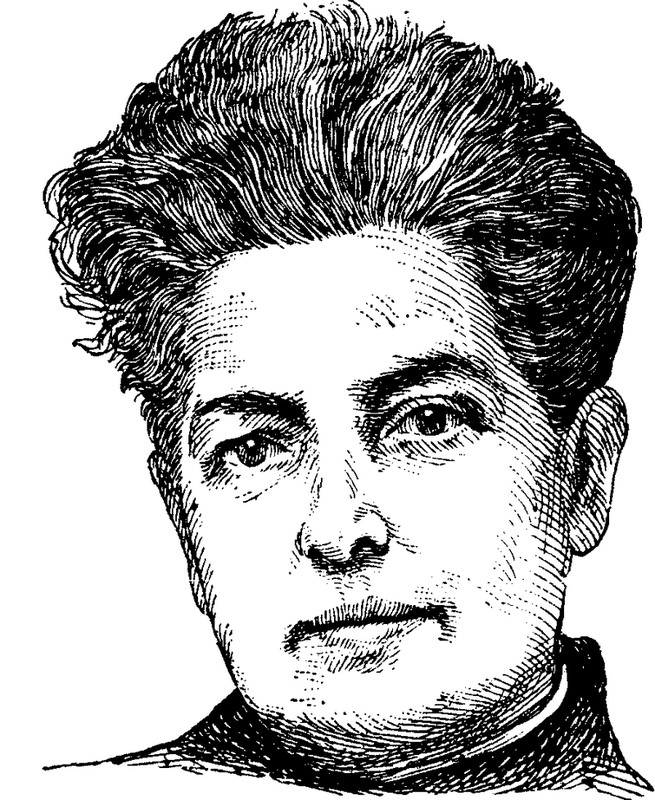
Mary Mapes Dodge
In a household where music, art, and literature were cultivated, and where the most agreeable society came, talents were not likely to be overlooked. Mrs. Dodge, very early widowed, began writing before she was twenty, publishing short stories, sketches, and poems in various periodicals. 'Hans Brinker' appeared in 1864,—her delight in Motley's histories and their appeal to her own Dutch blood inspiring her to write it. Of this book Mr. Frank R. Stockton says:—
"There are strong reasons why the fairest orange groves, the loftiest mountain peaks, or the inspiriting waves of the rolling sea, could not tempt average boys and girls from the level stretches of the Dutch canals, until they had skated through the sparkling story, warmed with a healthy glow.
"This is not only a tale of vivid description, interesting and instructive; it is a romance. There are adventures, startling and surprising, there are mysteries of buried gold, there are the machinations of the wicked, there is the heroism of the good, and the gay humor of happy souls. More than these, there is love—that sentiment which glides into a good story as naturally as into a human life; and whether the story be for old or young, this element gives it an ever-welcome charm. Strange fortune and good fortune come to Hans and to Gretel, and to many other deserving characters in the tale, but there is nothing selfish about these heroes and heroines. As soon as a new generation of young people grows up to be old enough to enjoy this perennial story, all these characters return to the days of their youth, and are ready to act their parts again to the very end, and to feel in their own souls, as everybody else feels, that their story is just as new and interesting as when it was first told."
Besides this book, Mrs. Dodge has published several volumes of juvenile verse, such as 'Rhymes and Jingles,' and 'When Life was Young'; a volume of serious verse, 'Along the Way'; a volume of satirical and humorous sketches, 'Theophilus and Others'; a second successful story for young people, 'Donald and Dorothy,' and a number of other works. Her stories evince an unusual faculty of construction and marked inventiveness,—inherited perhaps from her father,—truthful characterization, literary feeling, a strong sense of humor, and a high ethical standard. Her whimsical character sketch, 'Miss Maloney on the Chinese Question,' which has been reprinted thousands of times and repeated by every elocutionist in the land, is in its way as searching a satire as Bret Harte's 'Heathen Chinee.'
Since its beginning in 1873, Mrs. Dodge has edited the St. Nicholas Magazine, whose pages bear witness to her enormous industry.
THE RACE
From 'Hans Brinker, or The Silver Skates,' Copyright 1896, by Charles Scribner's Sons
The 20th of December came at last, bringing with it the perfection of winter weather. All over the level landscape lay the warm sunlight. It tried its power on lake, canal, and river; but the ice flashed defiance, and showed no sign of melting. The very weathercocks stood still to enjoy the sight. This gave the windmills a holiday. Nearly all the past week they had been whirling briskly; now, being rather out of breath, they rocked lazily in the clear still air. Catch a windmill working when the weathercocks have nothing to do!
THE SKATER OF THE ZUYDER ZEE. Photogravure from a Painting by G. H. Boughton, A. R. A.
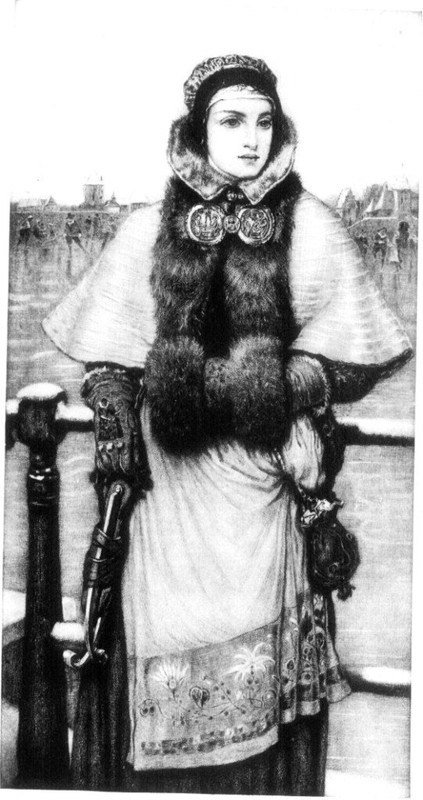
There was an end to grinding, crushing, and sawing for that day. It was a good thing for the millers near Broek. Long before noon, they concluded to take in their sails and go to the race. Everybody would be there. Already the north side of the frozen Y was bordered with eager spectators; the news of the great skating-match had traveled far and wide. Men, women, and children, in holiday attire, were flocking toward the spot. Some wore furs and wintry cloaks or shawls; but many, consulting their feelings rather than the almanac, were dressed as for an October day.
The site selected for the race was a faultless plain of ice near Amsterdam, on that great arm of the Zuyder Zee, which Dutchmen of course must call the Eye. The townspeople turned out in large numbers. Strangers in the city deemed it a fine chance to see what was to be seen. Many a peasant from the northward had wisely chosen the 20th as the day for the next city-trading. It seemed that everybody, young and old, who had wheels, skates, or feet at command, had hastened to the scene.
There were the gentry in their coaches, dressed like Parisians fresh from the Boulevards; Amsterdam children in charity uniforms; girls from the Roman Catholic Orphan House, in sable gowns and white head-bands; boys from the Burgher Asylum, with their black tights and short-skirted harlequin coats. There were old-fashioned gentlemen in cocked hats and velvet knee-breeches; old-fashioned ladies too, in stiff quilted skirts and bodices of dazzling brocade. These were accompanied by servants bearing foot-stoves and cloaks. There were the peasant folk, arrayed in every possible Dutch costume,—shy young rustics in brazen buckles; simple village maidens concealing their flaxen hair under fillets of gold; women whose long narrow aprons were stiff with embroidery; women with short corkscrew curls hanging over their foreheads; women with shaved heads and close-fitting caps, and women in striped skirts and windmill bonnets; men in leather, in homespun, in velvet and broadcloth; burghers in modern European attire, and burghers in short jackets, wide trousers, and steeple-crowned hats.
There were beautiful Friesland girls in wooden shoes and coarse petticoats, with solid gold crescents encircling their heads, finished at each temple with a golden rosette, and hung with lace a century old. Some wore necklaces, pendants, and earrings of the purest gold. Many were content with gilt, or even with brass; but it is not an uncommon thing for a Friesland woman to have all the family treasure in her headgear. More than one rustic lass displayed the value of two thousand guilders upon her head that day.
Scattered throughout the crowd were peasants from the Island of Marken, with sabots, black stockings, and the widest of breeches; also women from Marken, with short blue petticoats, and black jackets gayly figured in front. They wore red sleeves, white aprons, and a cap like a bishop's mitre over their golden hair.
The children often were as quaint and odd-looking as their elders. In short, one-third of the crowd seemed to have stepped bodily from a collection of Dutch paintings.
Everywhere could be seen tall women and stumpy men, lively-faced girls, and youths whose expressions never changed from sunrise to sunset.
There seemed to be at least one specimen from every known town in Holland. There were Utrecht water-bearers, Gouda cheese-makers, Delft pottery-men, Schiedam distillers, Amsterdam diamond-cutters, Rotterdam merchants, dried-up herring-packers, and two sleepy-eyed shepherds from Texel. Every man of them had his pipe and tobacco pouch. Some carried what might be called the smoker's complete outfit,—a pipe, tobacco, a pricker with which to clean the tube, a silver net for protecting the bowl, and a box of the strongest of brimstone matches.
A true Dutchman, you must remember, is rarely without his pipe on any possible occasion. He may for a moment neglect to breathe; but when the pipe is forgotten, he must be dying indeed. There were no such sad cases here. Wreaths of smoke were rising from every possible quarter. The more fantastic the smoke-wreath, the more placid and solemn the smoker.
Look at those boys and girls on stilts! That is a good idea. They can look over the heads of the tallest. It is strange to see those little bodies high in the air, carried about on mysterious legs. They have such a resolute look on their round faces, what wonder that nervous old gentlemen with tender feet wince and tremble while the long-legged little monsters stride past them!
You will read in certain books that the Dutch are a quiet people. So they are, generally. But listen! did you ever hear such a din? All made up of human voices—no, the horses are helping somewhat, and the fiddles are squeaking pitifully; (how it must pain fiddles to be tuned!) but the mass of the sound comes from the great vox humana that belongs to a crowd.
That queer little dwarf, going about with a heavy basket, winding in and out among the people, helps not a little. You can hear his shrill cry above all other sounds, "Pypen en tabac! Pypen en tabac!"
Another, his big brother, though evidently some years younger, is selling doughnuts and bonbons. He is calling on all pretty children, far and near, to come quickly or the cakes will be gone.
You know quite a number among the spectators. High up in yonder pavilion, erected upon the border of the ice, are some persons whom you have seen very lately. In the centre is Madame Van Gleck. It is her birthday, you remember; she has the post of honor. There is Mynheer Van Gleck, whose meerschaum has not really grown fast to his lips; it only appears so. There are Grandfather and Grandmother, whom you met at the St. Nicholas fête. All the children are with them. It is so mild, they have brought even the baby. The poor little creature is swaddled very much after the manner of an Egyptian mummy; but it can crow with delight, and when the band is playing, open and shut its animated mittens in perfect time to the music.
Grandfather, with his pipe and spectacles and fur cap, makes quite a picture as he holds Baby upon his knee. Perched high upon their canopied platforms, the party can see all that is going on. No wonder the ladies look complacently at the glassy ice; with a stove for a footstool, one might sit cosily beside the North Pole.
There is a gentleman with them, who somewhat resembles St. Nicholas as he appeared to the young Van Glecks on the fifth of December. But the Saint had a flowing white beard, and this face is as smooth as a pippin. His Saintship was larger round the body too, and (between ourselves) he had a pair of thimbles in his mouth, which this gentleman certainly has not. It cannot be St. Nicholas, after all.
Near by in the next pavilion sit the Van Holps, with their son and daughter (the Van Gends) from The Hague. Peter's sister is not one to forget her promises. She has brought bouquets of exquisite hot-house flowers for the winners.
These pavilions,—and there are others beside,—have all been erected since daylight. That semicircular one, containing Mynheer Korbes's family, is very pretty, and proves that the Hollanders are quite skilled at tentmaking; but I like the Van Glecks' best,—the centre one, striped red and white, and hung with evergreens.
The one with the blue flags contains the musicians. Those pagoda-like affairs, decked with sea-shells and streamers of every possible hue, are the judges' stands; and those columns and flagstaffs upon the ice mark the limit of the race-course. The two white columns twined with green, connected at the top by that long floating strip of drapery, form the starting point. Those flagstaffs, half a mile off, stand at each end of the boundary line, cut sufficiently deep to be distinct to the skaters, though not deep enough to trip them when they turn to come back to the starting-point.
The air is so clear, it seems scarcely possible that the columns and flagstaffs are so far apart. Of course the judges' stands are but little nearer together. Half a mile on the ice, when the atmosphere is like this, is but a short distance after all, especially when fenced with a living chain of spectators.
The music has commenced. How melody seems to enjoy itself in the open air! The fiddles have forgotten their agony, and everything is harmonious. Until you look at the blue tent, it seems that the music springs from the sunshine, it is so boundless, so joyous. Only the musicians are solemn.
Where are the racers? All assembled together near the white columns. It is a beautiful sight,—forty boys and girls in picturesque attire, darting with electric swiftness in and out among each other, or sailing in pairs and triplets, beckoning, chatting, whispering, in the fullness of youthful glee.
A few careful ones are soberly tightening their straps; others, halting on one leg, with flushed eager faces, suddenly cross the suspected skate over their knee, give it an examining shake, and dart off again. One and all are possessed with the spirit of motion. They cannot stand still. Their skates are a part of them, and every runner seems bewitched.
Holland is the place for skaters, after all. Where else can nearly every boy and girl perform feats on the ice that would attract a crowd if seen on Central Park? Look at Ben! I did not see him before. He is really astonishing the natives; no easy thing to do in the Netherlands. Save your strength, Ben; you will need it soon. Now other boys are trying! Ben is surpassed already. Such jumping, such poising, such spinning, such india-rubber exploits generally! That boy with a red cap is the lion now; his back is a watch-spring, his body is cork—no, it is iron, or it would snap at that. He is a bird, a top, a rabbit, a corkscrew, a sprite, a flesh-ball, all in an instant. When you think he is erect, he is down; and when you think he is down, he is up. He drops his glove on the ice, and turns a somerset as he picks it up. Without stopping, he snatches the cap from Jacob Poot's astonished head, and claps it back again "hind side before." Lookers-on hurrah and laugh. Foolish boy! It is arctic weather under your feet, but more than temperate overhead. Big drops already are rolling down your forehead. Superb skater as you are, you may lose the race.
A French traveler, standing with a notebook in his hand, sees our English friend Ben buy a doughnut of the dwarf's brother, and eat it. Thereupon he writes in his note-book that the Dutch take enormous mouthfuls, and universally are fond of potatoes boiled in molasses.
There are some familiar faces near the white columns. Lambert, Ludwig, Peter, and Carl are all there, cool, and in good skating order. Hans is not far off. Evidently he is going to join in the race, for his skates are on,—the very pair that he sold for seven guilders. He had soon suspected that his fairy godmother was the mysterious "friend" who bought them. This settled, he had boldly charged her with the deed; and she, knowing well that all her little savings had been spent in the purchase, had not had the face to deny it. Through the fairy god-mother, too, he had been rendered amply able to buy them back again. Therefore Hans is to be in the race. Carl is more indignant than ever about it; but as three other peasant boys have entered, Hans is not alone.
Twenty boys and twenty girls. The latter by this time are standing in front, braced for the start; for they are to have the first "run." Hilda, Rychie, and Katrinka are among them. Two or three bend hastily to give a last pull at their skate-straps. It is pretty to see them stamp, to be sure that all is firm. Hilda is speaking pleasantly to a graceful little creature in a red jacket and a new brown petticoat. Why, it is Gretel! What a difference those pretty shoes make; and the skirt and the new cap! Annie Bouman is there too. Even Janzoon Kolp's sister has been admitted; but Janzoon himself has been voted out by the directors because he killed the stork, and only last summer was caught in the act of robbing a bird's nest,—a legal offense in Holland.
This Janzoon Kolp, you see, was—There, I cannot tell the story just now. The race is about to commence.
Twenty girls are formed in a line. The music has ceased.
A man whom we shall call the crier stands between the columns and the first judges' stand. He reads the rules in a loud voice:—
"The girls and boys are to race in turn, until one girl and one boy have beaten twice. They are to start in a line from the united columns, skate to the flagstaff line, turn, and then come back to the starting-point; thus making a mile at each run."
A flag is waved from the judges' stand. Madame Van Gleck rises in her pavilion. She leans forward with a white handkerchief in her hand. When she drops it, a bugler is to give the signal for them to start.
The handkerchief is fluttering to the ground. Hark!
They are off!
No. Back again. Their line was not true in passing the judges' stand.
The signal is repeated.
Off again. No mistake this time. Whew! how fast they go!
The multitude is quiet for an instant, absorbed in eager, breathless watching.
Cheers spring up along the line of spectators. Huzza! five girls are ahead. Who comes flying back from the boundary mark? We cannot tell. Something red, that is all. There is a blue spot flitting near it, and a dash of yellow nearer still. Spectators at this end of the line strain their eyes, and wish they had taken their post nearer the flagstaff.
The wave of cheers is coming back again. Now we can see. Katrinka is ahead!
She passes the Van Holp pavilion. The next is Madame Van Gleck's. That leaning figure gazing from it is a magnet. Hilda shoots past Katrinka, waving her hand to her mother as she passes. Two others are close now, whizzing on like arrows. What is that flash of red and gray? Hurrah, it is Gretel! She too waves her hand, but toward no gay pavilion. The crowd is cheering; but she hears only her father's voice, "Well done, little Gretel!" Soon Katrinka, with a quick merry laugh, shoots past Hilda. The girl in yellow is gaining now. She passes them all,—all except Gretel. The judges lean forward without seeming to lift their eyes from their watches. Cheer after cheer fills the air; the very columns seem rocking. Gretel has passed them. She has won.
"Gretel Brinker, one mile!" shouts the crier.
The judges nod. They write something upon a tablet which each holds in his hand.
While the girls are resting,—some crowding eagerly around our frightened little Gretel, some standing aside in high disdain,—the boys form in a line.
Mynheer Van Gleck drops the handkerchief this time. The buglers give a vigorous blast. Off start the boys!
Half-way already. Did ever you see the like!
Three hundred legs flashing by in an instant. But there are only twenty boys. No matter; there were hundreds of legs, I am sure. Where are they now? There is such a noise one gets bewildered. What are the people laughing at? Oh! at that fat boy in the rear. See him go! See him! He'll be down in an instant; no, he won't. I wonder if he knows he is all alone: the other boys are nearly at the boundary line. Yes, he knows it. He stops. He wipes his hot face. He takes off his cap, and looks about him. Better to give up with a good grace. He has made a hundred friends by that hearty, astonished laugh. Good Jacob Poot!
The fine fellow is already among the spectators, gazing as eagerly as the rest.
A cloud of feathery ice flies from the heels of the skaters as they "bring to," and turn at the flagstaffs.
Something black is coming now,—one of the boys: it is all we know. He has touched the vox humana stop of the crowd; it fairly roars. Now they come nearer; we can see the red cap. There's Ben, there's Peter, there's Hans!
Hans is ahead. Young Madame Van Gend almost crushes the flowers in her hand: she had been quite sure that Peter would be first. Carl Schummel is next, then Ben, and the youth with the red cap. The others are pressing close. A tall figure darts from among them. He passes the red cap, he passes Ben, then Carl. Now it is an even race between him and Hans. Madame Van Gend catches her breath.
It is Peter! He is ahead! Hans shoots past him. Hilda's eyes fill with tears: Peter must beat. Annie's eyes flash proudly. Gretel gazes with clasped hands: four strokes more will take her brother to the columns.
He is there! Yes; but so was young Schummel just a second before. At the last instant, Carl, gathering his powers, had whizzed between them, and passed the goal.
"Carl Schummel, one mile!" shouts the crier.
Soon Madame Van Gleck rises again. The falling handkerchief starts the bugle, and the bugle, using its voice as a bowstring, shoots off twenty girls like so many arrows.
It is a beautiful sight; but one has not long to look: before we can fairly distinguish them they are far in the distance. This time they are close upon one another. It is hard to say, as they come speeding back from the flagstaff, which will reach the columns first. There are new faces among the foremost,—eager glowing faces, unnoticed before. Katrinka is there, and Hilda; but Gretel and Rychie are in the rear. Gretel is wavering, but when Rychie passes her she starts forward afresh. Now they are nearly beside Katrinka. Hilda is still in advance: she is almost "home." She has not faltered since that bugle note sent her flying: like an arrow, still she is speeding toward the goal. Cheer after cheer rises in the air. Peter is silent, but his eyes shine like stars. "Huzza! Huzza!"
The crier's voice is heard again.
"Hilda van Gleck, one mile!"
A loud murmur of approval runs through the crowd, catching the music in its course, till all seems one sound, with a glad rhythmic throbbing in its depths. When the flag waves all is still.
Once more the bugle blows a terrific blast. It sends off the boys like chaff before the wind,—dark chaff, I admit, and in big pieces.
It is whisked around at the flagstaff, driven faster yet by the cheers and shouts along the line. We begin to see what is coming. There are three boys in advance this time, and all abreast,—Hans, Peter, and Lambert. Carl soon breaks the ranks, rushing through with a whiff. Fly, Hans; fly, Peter; don't let Carl beat again!—Carl the bitter, Carl the insolent. Van Mounen is flagging, but you are as strong as ever. Hans and Peter, Peter and Hans; which is foremost? We love them both. We scarcely care which is the fleeter.
Hilda, Annie, and Gretel, seated upon the long crimson bench, can remain quiet no longer. They spring to their feet, so different! and yet one in eagerness. Hilda instantly reseats herself: none shall know how interested she is; none shall know how anxious, how filled with one hope. Shut your eyes then, Hilda, hide your face rippling with joy. Peter has beaten.
"Peter van Holp, one mile!" calls the crier.
The same buzz of excitement as before, while the judges take notes, the same throbbing of music through the din; but something is different. A little crowd presses close about some object near the column. Carl has fallen. He is not hurt, though somewhat stunned. If he were less sullen, he would find more sympathy in these warm young hearts. As it is, they forget him as soon as he is fairly on his feet again.
The girls are to skate their third mile.
How resolute the little maidens look, as they stand in a line! Some are solemn with a sense of responsibility; some wear a smile, half bashful, half provoked; but one air of determination pervades them all.
This third mile may decide the race. Still, if neither Gretel nor Hilda win, there is yet a chance among the rest for the silver skates.
Each girl feels sure that this time she will accomplish the distance in one-half the time. How they stamp to try their runners! How nervously they examine each strap! How erect they stand at last, every eye upon Madame Van Gleck!
The bugle thrills through them again. With quivering eagerness they spring forward, bending, but in perfect balance. Each flashing stroke seems longer than the last.
Now they are skimming off in the distance.
Again the eager straining of eyes; again the shouts and cheering; again the thrill of excitement, as after a few moments, four or five in advance of the rest come speeding back, nearer, nearer to the white columns.
Who is first? Not Rychie, Katrinka, Annie, nor Hilda, nor the girl in yellow, but Gretel,—Gretel, the fleetest sprite of a girl that ever skated. She was but playing in the earlier race: now she is in earnest, or rather, something within her has determined to win. That blithe little form makes no effort; but it cannot stop,—not until the goal is passed!
In vain the crier lifts his voice: he cannot be heard. He has no news to tell: it is already ringing through the crowd,—Gretel has won the silver skates!
Like a bird she has flown over the ice; like a bird she looks about her in a timid, startled way. She longs to dart to the sheltered nook where her father and mother stand. But Hans is beside her; the girls are crowding round. Hilda's kind, joyous voice breathes in her ear. From that hour none will despise her. Goose-girl or not, Gretel stands acknowledged Queen of the Skaters.
With natural pride, Hans turns to see if Peter Van Holp is witnessing his sister's triumph. Peter is not looking toward them at all. He is kneeling, bending his troubled face low, and working hastily at his skate-strap. Hans is beside him at once.
"Are you in trouble, mynheer?"
"Ah, Hans! that you? Yes; my fun is over. I tried to tighten my strap to make a new hole, and this botheration of a knife has cut it nearly in two."
"Mynheer," said Hans, at the same time pulling off a skate, "you must use my strap!"
"Not I, indeed, Hans Brinker!" cried Peter, looking up; "though I thank you warmly. Go to your post, my friend: the bugle will sound in a minute."
"Mynheer," pleaded Hans in a husky voice, "you have called me your friend. Take this strap—quick! There is not an instant to lose. I shall not skate this time: indeed, I am out of practice. Mynheer, you must take it;" and Hans, blind and deaf to any remonstrance, slipped his strap into Peter's skate, and implored him to put it on.
"Come, Peter!" cried Lambert from the line: "we are waiting for you."
"For Madame's sake," pleaded Hans, "be quick! She is motioning to you to join the racers. There, the skate is almost on: quick, mynheer, fasten it. I could not possibly win. The race lies between Master Schummel and yourself."
"You are a noble fellow, Hans!" cried Peter, yielding at last. He sprang to his post just as the handkerchief fell to the ground. The bugle sends forth its blast, loud, clear, and ringing.
Off go the boys!
"Mein Gott!" cries a tough old fellow from Delft. "They beat everything, these Amsterdam youngsters. See them!"
See them, indeed! They are winged Mercuries, every one of them. What mad errand are they on? Ah, I know; they are hunting Peter Van Holp. He is some fleet-footed runaway from Olympus. Mercury and his troop of winged cousins are in full chase. They will catch him! Now Carl is the runaway. The pursuit grows furious. Ben is foremost!
The chase turns in a cloud of mist. It is coming this way. Who is hunted now? Mercury himself. It is Peter, Peter Van Holp! Fly, Peter! Hans is watching you. He is sending all his fleetness, all his strength, into your feet. Your mother and sister are pale with eagerness. Hilda is trembling, and dare not look up, Fly, Peter! The crowd has not gone deranged; it is only cheering. The pursuers are close upon you. Touch the white column! It beckons; it is reeling before you—it—
"Huzza! Huzza! Peter has won the silver skates!"
"Peter van Holp!" shouted the crier. But who heard him? "Peter Van Holp!" shouted a hundred voices; for he was the favorite boy of the place. "Huzza! Huzza!"
Now the music was resolved to be heard. It struck up a lively air, then a tremendous march. The spectators, thinking something new was about to happen, deigned to listen and to look.
The racers formed in single file. Peter, being tallest, stood first. Gretel, the smallest of all, took her place at the end. Hans, who had borrowed a strap from the cake-boy, was near the head.
Three gayly twined arches were placed at intervals upon the river, facing the Van Gleck pavilion.
Skating slowly, and in perfect time to the music, the boys and girls moved forward, led on by Peter, It was beautiful to see the bright procession glide along like a living creature. It curved and doubled, and drew its graceful length in and out among the arches; whichever way Peter, the head, went, the body was sure to follow. Sometimes it steered direct for the centre arch; then, as if seized with a new impulse, turned away and curled itself about the first one; then unwound slowly, and bending low, with quick snake-like curvings, crossed the river, passing at length through the farthest arch.
When the music was slow, the procession seemed to crawl like a thing afraid; it grew livelier, and the creature darted forward with a spring, gliding rapidly among the arches, in and out, curling, twisting, turning, never losing form, until at the shrill call of the bugle rising above the music it suddenly resolved itself into boys and girls, standing in double semicircle before Madame Van Gleck's pavilion.
Peter and Gretel stand in the centre, in advance of the others. Madame Van Gleck rises majestically. Gretel trembles, but feels that she must look at the beautiful lady. She cannot hear what is said, there is such a buzzing all around her. She is thinking that she ought to try and make a courtesy, such as her mother makes to the meester, when suddenly something so dazzling is placed in her hand that she gives a cry of joy.
Then she ventures to look about her. Peter too has something in his hands. "Oh, oh! how splendid!" she cries; and "Oh! how splendid!" is echoed as far as people can see.
Meantime the silver skates flash in the sunshine, throwing dashes of light upon those two happy faces.
"Mevrouw Van Gend sends a little messenger with her bouquets,—one for Hilda, one for Carl, and others for Peter and Gretel."
At sight of the flowers, the Queen of the Skaters becomes uncontrollable. With a bright stare of gratitude, she gathers skates and bouquet in her apron, hugs them to her bosom, and darts off to search for her father and mother in the scattering crowd.
JOHN DONNE
(1573-1631)
[A] She was more woman than the others.
"Elle était mieux femme que les autres."[A] To us that apparently indefinite, exquisitely definite sentence most fitly marks the distinction between the subjects of the two preceding papers and the subject of the present. It is a transition from the stately figure of a marble Agrippina to the breathing, feeling woman at your side; it is the transition from the statuesque Rachelesque heroines of a David to the "small sweet idyl" of a Greuze. And, we confess it, we were not wholly at ease with those tragic, majestic figures. We shuddered at the dagger and the bowl which suited them so well. We marveled at their bloodless serenity, their superhuman self-sufficiency; inly we questioned if they breathed and felt. Or was their circulation a matter of machinery—a mere dead-beat escapement? We longed for the sexe prononcé of Rivarol—we longed for the showman's "female woman!" We respected and we studied, but we did not love them. With Madame de Lamballe the case is otherwise. Not grand like this one, not heroic like that one, "elle est mieux femme que les autres."

he memory of Dr. Donne must not, cannot die, as long as men speak English," wrote Izaak Walton, "whilst his conversation made him and others happy. His life ought to be the example of more than that age in which he died."

John Donne
Born in 1573, all the influences of the age in which Donne lived nourished his large nature and genius. Shakespeare and Marlowe were nine years older than he; Chapman fourteen; Spenser, Lyly, and Richard Hooker each twenty; while Sir Philip Sidney counted one year less. Lodge and Puttenham were grown men, and Greene and Nash riotous boys. In the following year Ben Jonson "came forth to warm our ears," and soon after we have his future co-worker Inigo Jones. It was the time of a multitude of poets,—Drayton, the Fletchers, Beaumont, Wither, Herrick, Carew, Suckling, and others. Imagination was foremost, and was stimulated by vast discoveries. Debates upon ecclesiastical reform, led by Wyclif, Tyndal, Knox, Foxe, Sternhold, Hopkins, and others, had prepared the way; and the luminous literatures of Greece and Italy, but recently brought into England, had made men's spirits receptive and creative. It was a period of vast conceptions, when men discovered themselves and the world afresh.
Under such outward conditions Donne was born, in London, "of good and virtuous parents," says Walton, being descended on his mother's side from no less distinguished a personage than Sir Thomas More. In 1584, when he was eleven years old, with a good command both of French and Latin, he passed from the hands of tutors at home to Hare Hall, a much frequented college at Oxford. Here he formed a friendship with Henry Wotton, who, after the poet's death, collected the material from which Walton wrote his tender and sincere 'Life of Donne.'
After leaving Oxford he traveled for three years on the Continent, and on his return in 1592 became a member of Lincoln's Inn, with intent to study law; but his law never, says Walton, "served him for other use than an ornament and self-satisfaction." While a member of Lincoln's Inn he became one of the coterie of the poets of his youth. To this time are to be referred those of his 'Divine Poems' which show him a sincere Catholic. Stirred by the increasing differences between the Romanist and the Anglican denominations, Donne turned toward theological questions, and finally cast his lot with the new doctrines. His large nature, impetuously reacting from the asceticism to which he had been bred, turned to excess and overboldness in action, and an occasional coarseness of phrasing in his poems.
The first of his famous 'Satires' are dated 1593, and all were probably written before 1601. During this time also he squandered his father's legacy of £3000. In 1596, when the Earl of Essex defeated the Spanish navy and pillaged Cadiz, Donne, now one of the first poets of the time, was among his followers. "Not long after his return into England ... the Lord Ellesmere, the Keeper of the Great Seal,... taking notice of his learning, languages, and other abilities, and much affecting his person and behavior, took him to be his chief secretary, supposing and intending it to be an introduction to some weighty employment in the State;... and did always use him with much courtesy, appointing him a place at his own table." Here he met the niece of Lady Ellesmere,—the daughter of Sir George More, Lord Lieutenant of the Tower,—whom at Christmas, 1600, he married, despite the opposition of her father. Sir George, transported with wrath, obtained Donne's imprisonment; but the poet finally regained his liberty and his wife, Sir George in the end forgiving the young couple. "Mr. Donne's estate was the greatest part spent in many chargeable travels, books, and dear-bought experience, he [being] out of all employment that might yield a support for himself and wife." The depth and intensity of Donne's feeling for this beautiful and accomplished woman are manifested, says Mr. Norton, in all the poems known to be addressed to her, such as 'The Anniversary' and 'The Token.'
Of 'The Valediction Forbidding Mourning' Walton declares:—"I beg leave to tell that I have heard some critics, learned both in languages and poetry, say that none of the Greek or Latin poets did ever equal them;" while from Lowell's unpublished 'Lecture on Poetic Diction' Professor Norton quotes the opinion that "This poem is a truly sacred one, and fuller of the soul of poetry than a whole Alexandrian Library of common love verses."
During this period of writing for court favors, Donne wrote many of his sonnets and studied the civil and canon law. After the death of his patron Sir Francis in 1606, Donne divided his time between Mitcham, whither he had removed his family, and London, where he frequented distinguished and fashionable drawing-rooms. At this time he wrote his admirable epistles in verse, 'The Litany,' and funeral elegies on Lady Markham and Mistress Bulstrode; but those poems are merely "occasional," as he was not a poet by profession. At the request of King James he wrote the 'Pseudo-Martyr,' published in 1610. In 1611 appeared his funeral elegy 'An Anatomy of the World,' and one year later another of like texture, 'On the Progress of the Soul,' both poems being exalted and elaborate in thought and fancy.
The King, desiring Donne to enter into the ministry, denied all requests for secular preferment, and the unwilling poet deferred his decision for almost three years. All that time he studied textual divinity, Greek, and Hebrew. He was ordained about the beginning of 1615. The King made him his chaplain in ordinary, and promised other preferments. "Now," says Walton, "the English Church had gained a second St. Austin, for I think none was so like him before his conversion, none so like St. Ambrose after it; and if his youth had the infirmities of the one, his age had the excellences of the other, the learning and holiness of both."
In 1621 the King made him Dean of St. Paul's, and vicar of St. Dunstan in the West. By these and other ecclesiastical emoluments "he was enabled to become charitable to the poor and kind to his friends, and to make such provision for his children that they were not left scandalous, as relating to their or his profession or quality."
His first printed sermons appeared in 1622. The epigrammatic terseness and unexpected turns of imagination which characterize the poems, are found also in his discourses. Three years later, during a dangerous illness, he composed his 'Devotion.' He died on the 31st of March, 1631.
"Donne is full of salient verses," says Lowell in his 'Shakespeare Once More,' "that would take the rudest March winds of criticism with their beauty; of thoughts that first tease us like charades, and then delight us with the felicity of their solution." There are few in which an occasional loftiness is sustained throughout, but this occasional excellence is original, condensed, witty, showing a firm and strong mind, clear to a degree almost un-English. His poetry has somewhat of the stability of the Greeks, though it may lack their sweetness and art. His grossness was the heritage of his time. He is classed among the "metaphysical poets," of whom Dr. Johnson wrote:—"They were of very little care to clothe their notions with elegance of dress, and therefore miss the notice and the praise which are often gained by those who think less, but are more diligent to adorn their thoughts." It was in obedience to such a dictum, and to Dryden's suggestion, doubtless, that Pope and Parnell recast and re-versified the 'Satires.'
The first edition of Donne's poems appeared two years after his death. Several editions succeeded during the seventeenth century. In the more artificial eighteenth century his harsh and abrupt versification and remote theorems made him difficult to understand. The best editions are 'The Complete Poems of John Donne,' edited by Dr. Alexander Grosart (1872); and 'The Poems of John Donne,' from the text of the edition of 1633, edited by Charles Eliot Norton (1895), from whose work the citations in this volume are taken.
THE UNDERTAKING
I have done one braver thing Than all the Worthies did, And yet a braver thence doth spring, Which is, to keep that hid.
It were but madness now t' impart The skill of specular stone, When he which can have learned the art To cut it, can find none.
So, if I now should utter this, Others (because no more Such stuff to work upon there is) Would love but as before:
But he who loveliness within Hath found, all outward loathes; For he who color loves, and skin, Loves but their oldest clothes.
If, as I have, you also do Virtue attired in women see, And dare love that and say so too, And forget the He and She;
And if this love, though placed so, From profane men you hide, Which will no faith on this bestow, Or, if they do, deride;
Then you have done a braver thing Than all the Worthies did, And a braver thence will spring, Which is, to keep that hid.
A VALEDICTION FORBIDDING MOURNING
As virtuous men pass mildly away, And whisper to their souls to go, Whilst some of their sad friends do say, "The breath goes now," and some say "No";
So let us melt and make no noise, No tear-floods nor sigh-tempests move; 'Twere profanation of our joys To tell the laity our love.
Moving of th' earth brings harms and fears; Men reckon what it did and meant; But trepidation of the spheres, Though greater far, is innocent.
Dull sublunary lovers' love (Whose soul is sense) cannot admit Absence, because it doth remove Those things which elemented it.
But we by a love so much refined That ourselves know not what it is, Inter-assurèd of the mind, Care less eyes, lips, hands to miss.
Our two souls, therefore, which are one, Though I must go, endure not yet A breach, but an expansiòn, Like gold to airy thinness beat.
If they be two, they are two so As stiff twin compasses are two; Thy soul, the fixt foot, makes no show To move, but doth if the other do,
And though it in the centre sit, Yet when the other far doth roam, It leans and hearkens after it, And grows erect as that comes home.
Such wilt thou be to me, who must, Like th' other foot, obliquely run; Thy firmness makes my circle just, And makes me end where I begun.
SONG
Go and catch a falling star, Get with child a mandrake root, Tell me where all past years are, Or who cleft the devil's foot, Teach me to hear mermaids singing, Or to keep off envy's stinging, And find What wind Serves to advance an honest mind.
If thou be'st born to strange sights, Things invisible to see, Ride ten thousand days and nights, Till age snow white hairs on thee, Then, when thou return'st, wilt tell me All strange wonders that befell thee, And swear, Nowhere Lives a woman true and fair.
If thou find'st one, let me know; Such a pilgrimage were sweet; Yet do not: I would not go, Though at next door we might meet; Though she were true when you met her, And last till you write your letter, Yet she Will be False, ere I come, to two or three.
LOVE'S GROWTH
I scarce believe my love to be so pure As I had thought it was, Because it doth endure Vicissitude and season as the grass; Methinks I lied all winter, when I swore My love was infinite, if spring make it more. But if this medicine love, which cures all sorrow With more, not only be no quintessence But mixed of all stuffs paining soul or sense, And of the sun his working vigor borrow, Love's not so pure and abstract as they use To say, which have no mistress but their muse, But as all else, being elemented too, Love sometimes would contemplate, sometimes do.
And yet no greater, but more eminent, Love by the spring is grown; As in the firmament Stars by the sun are not enlarged, but shown, Gentle love-deeds, as blossoms on a bough, From love's awakened root do bud out now. If, as in water stirred, more circles be Produced by one, love such additions take, Thou, like so many spheres, but one heaven make, For they are all concentric unto thee; And though each spring do add to love new heat, As princes do in times of action get New taxes and remit them not in peace, No winter shall abate the spring's increase.
SONG
Sweetest Love, I do not go For weariness of thee, Nor in hope the world can show A fitter Love for me: But since that I Must die at last, 'tis best To use myself in jest Thus by feigned deaths to die.
Yesternight the sun went hence, And yet is here to-day; He hath no desire nor sense, Nor half so short a way. Then fear not me, But believe that I shall make Speedier journeys, since I take More wings and spurs than he.
Oh, how feeble is man's power, That, if good fortune fall, Cannot add another hour, Nor a lost hour recall! But come bad chance, And we join to it our strength, And we teach it art and length, Itself o'er us to advance.
When thou sigh'st, thou sigh'st not wind, But sigh'st my soul away; When thou weep'st, unkindly kind, My life's blood doth decay. It cannot be That thou lov'st me as thou say'st, If in thine my life thou waste; Thou art the best of me.
Let not thy divining heart Forethink me any ill; Destiny may take thy part, And may thy fears fulfill: But think that we Are but turned aside to sleep: They who one another keep Alive, ne'er parted be.
FEODOR MIKHAILOVITCH DOSTOÉVSKY
(1821-1881)
BY ISABEL F. HAPGOOD

n certain respects Dostoévsky is the most characteristically national of Russian writers. Precisely for that reason, his work does not appeal to so wide a circle outside of his own country as does the work of Turgénieff and Count L.N. Tolstoy. This result flows not only from the natural bent of his mind and temperament, but also from the peculiar vicissitudes of his life as compared with the comparatively even tenor of their existence, and the circumstances of the time in which he lived. These circumstances, it is true, were felt by the writers mentioned; but practically they affected him far more deeply than they did the others, with their rather one-sided training; and his fellow-countrymen—especially the young of both sexes—were not slow to express their appreciation of the fact. His special domain was the one which Turgénieff and Tolstoy did not understand, and have touched not at all, or only incidentally,—the great middle class of society, or what corresponds thereto in Russia.
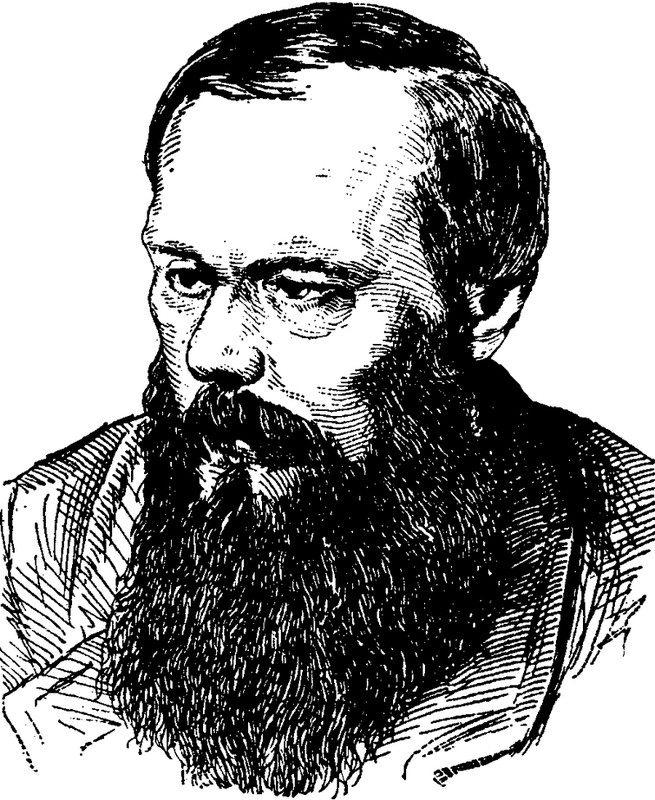
Feodor Dostoévsky
Through his father, Mikhail Andréevitch Dostoévsky, Feodor Mikhailovitch belonged to the class of "nobles,"—that is to say, to the gentry; through his mother, to the respectable, well-to-do merchant class, which is still distinct from the other, and was even more so during the first half of the present century; and in personal appearance he was a typical member of the peasant class. The father was resident physician in the Marie Hospital for the Poor in Moscow, having entered the civil service at the end of the war of 1812, during which he had served as a physician in the army. In the very contracted apartment which he occupied in the hospital, Feodor was born—one of a family of seven children, all of whom, with the exception of the eldest and the youngest, were born there—on October 30th (November 11th), 1821. The parents were very upright, well-educated, devoutly religious people; and as Feodor expressed it many years later to his elder brother, after their father died, "Do you know, our parents were very superior people, and they would have been superior even in these days." The children were brought up at home as long as possible, and received their instruction from tutors and their father. Even after the necessity of preparing the two elder boys for a government institution forced the parents to send them to a boarding-school during the week, they continued their strict supervision over their associates, discouraged nearly all friendships with their comrades, and never allowed them to go into the street unaccompanied, after the national custom in good families, even at the age of seventeen or more.
Feodor, according to the account of his brothers and relatives, was always a quiet, studious lad, and he with his elder brother Mikhail spent their weekly holidays chiefly in reading, Walter Scott and James Fenimore Cooper being among their favorite authors; though Russian writers, especially Pushkin, were not neglected. During many of these years the mother and children passed the summers on a little estate in the country which the father bought, and it was there that Feodor Mikhailovitch first made acquaintance with the beauties of nature, to which he eloquently refers in after life, and especially with the peasants, their feelings and temper, which greatly helped him in his psychological studies and in his ability to endure certain trials which came upon him. There can be no doubt that his whole training contributed not only to the literary tastes which the famous author and his brother cherished throughout their lives, but to the formation of that friendship between them which was stronger than all others, and to the sincere belief in religion and the profound piety which permeated the spirit and the books of Feodor Mikhailovitch.
In 1837 the mother died, and the father took his two eldest sons to St. Petersburg to enter them in the government School of Engineers. But the healthy Mikhail was pronounced consumptive by the doctor, while the sickly Feodor was given a certificate of perfect health. Consequently Mikhail was rejected, and went to the Engineers' School in Revel, while Feodor, always quiet and reserved, was left lonely in the St. Petersburg school. Here he remained for three years, studying well, but devoting a great deal of time to his passionately beloved literary subjects, and developing a precocious and penetrating critical judgment on such matters. It is even affirmed that he began or wrote the first draft of his famous book 'Poor People,' by night, during this period; though in another account he places its composition later. After graduating well as ensign in 1841, he studied for another year, and became an officer with the rank of sub-lieutenant, and entered on active service, attached to the draughting department of the Engineers' School, in August 1843.
A little more than a year later he resigned from the service, in order that he might devote himself wholly to literature. His father had died in the mean time, and had he possessed any practical talent he might have lived in comfort on the sums which his guardian sent him. But throughout his life people seemed to fleece him at will; he lost large sums at billiards with strangers, and otherwise; he was generous and careless; in short, he was to the end nearly always in debt, anxiety, and difficulties. Then came the first important crisis in his life. He wrote (or re-wrote) 'Poor People'; and said of his state of mind, as he reckoned up the possible pecuniary results, that he could not sleep for nights together, and "If my undertaking does not succeed, perhaps I shall hang myself." The history of that success is famous and stirring. His only acquaintance in literary circles was his old comrade D.V. Grigorovitch (also well known as a writer), and to him he committed the manuscript. His friend took it to the poet and editor Nekrásoff, in the hope that it might appear in the 'Collection' which the latter was intending to publish. Dostoévsky was especially afraid of the noted critic Byelinsky's judgment on it: "He will laugh at my 'Poor People,'" said he; "but I wrote it with passion, almost with tears."
He spent the evening with a friend, reading with him, as was the fashion of the time, Gogol's 'Dead Souls,' and returned home at four o'clock in the morning. It was one of the "white nights" of early summer, and he sat down by his window. Suddenly the door-bell rang, and in rushed Grigorovitch and Nekrásoff, who flung themselves upon his neck. They had begun to read his story in the evening, remarking that "ten pages would suffice to show its quality." But they had gone on reading, relieving each other as their voices failed them with fatigue and emotion, until the whole was finished. At the point where Pokrovsky's old father runs after his coffin, Nekrásoff pounded the table with the manuscript, deeply affected, and exclaimed, "Deuce take him!" Then they decide to hasten to Dostoévsky: "No matter if he is asleep—we will wake him up. This is above sleep."
This sort of glory and success was exactly of that pure, unmixed sort which Dostoévsky had longed for. When Nekrásoff went to Byelinsky with the manuscript of 'Poor People,' and announced, "A new Gogol has made his appearance!" the critic retorted with severity, "Gogols spring up like mushrooms among us." But when he had read the story he said, "Bring him hither, bring him quickly;" and welcomed Dostoévsky when he came, with extreme dignity and reserve, but exclaimed in a moment, "Do you understand yourself what sort of a thing this is that you have written?" From that moment the young author's fame was assured, and he became known and popular even in advance of publication in a wide circle of literary and other people, as was the fashion of those days in Russia. When the story appeared, the public rapturously echoed the judgment of the critics.
The close friendship which sprang up between Byelinsky and Dostoévsky was destined, however, to exert an extraordinary influence upon Dostoévsky's career, quite apart from its critical aspect. Byelinsky was an atheist and a socialist, and Dostoévsky was brought into relations with persons who shared those views, although he himself never wavered, apparently, in his religious faith, and was never in harmony with any other aspirations of his associates except that of freeing the serfs. Notwithstanding this, he became involved in the catastrophe which overtook many visitors, occasional or constant, of the "circles" at whose head stood Petrashevsky. The whole affair is known as the Conspiracy of Petrashevsky. During the '40's the students at the St. Petersburg University formed small gatherings where sociological subjects were the objects of study, and read the works of Stein, Haxthausen, Louis Blanc, Fourier, Proudhon, and other similar writers. Gradually assemblies of this sort were formed outside of the University. Petrashevsky, an employee of the Department of Foreign Affairs, who had graduated from the Lyceum and the University, and who was ambitious of winning power and a reputation for eccentricity, learned of these little clubs and encouraged their growth. He did not however encourage their close association among themselves, but rather, entire dependence on himself, as the centre of authority, the guide; and urged them to inaugurate a sort of propaganda. Dostoévsky himself declared, about thirty years later, that "the socialists sprang from the followers of Petrashevsky; they sowed much seed." He has dealt with them and their methods in his novel 'Demons'; though perhaps not with exact accuracy. But they helped him to an elucidation of the contemporary situation, which Turgénieff had treated in 'Virgin Soil.' The chief subject of their political discussions was the emancipation of the serfs, and many of Petrashevsky's followers reckoned upon a rising of the serfs themselves, though it was proved that Dostoévsky maintained the propriety and necessity of the reform proceeding from the government. This was no new topic; the Emperor Nicholas I. had already begun to plan the Emancipation, and it is probable that it would have taken place long before it did, had it not been for this very conspiracy. From the point of view of the government, the movement was naturally dangerous, especially in view of what was taking place in Europe at that epoch. Dostoévsky bore himself critically toward the socialistic writings and doctrines, maintaining that in their own Russian system of workingmen's guilds with reciprocal bonds there existed surer and more normal foundations than in all the dreams of Saint-Simon and all his school. He did not even visit very frequently the circle to which he particularly belonged, and was rarely at the house of Petrashevsky, whom many personally disliked.
But on one occasion, as he was a good reader, he was asked to read aloud Byelinsky's famous letter to Gogol, which was regarded as a victorious manifest of "Western" (i. e., of socialistic) views. This, technically, was propagating revolution, and was the chief charge against him when the catastrophe happened, and he, together with over thirty other "Petrashevtzi," was arrested on April 23d (May 5th), 1849. In the Peter-Paul Fortress prison, where he was kept for eight months pending trial, Dostoévsky wrote 'The Little Hero,' two or three unimportant works having appeared since 'Poor People.' At last he, with several others, was condemned to death and led out for execution. The history of that day, and the analysis of his sensations and emotions, are to be found in several of his books: 'Crime and Punishment,' 'The Idiot,' 'The Karamazoff Brothers.' At the last moment it was announced to them that the Emperor had commuted their sentence to exile in varying degrees, and they were taken to Siberia. Alexei Pleshtcheeff, then twenty-three years of age, the man who sent Byelinsky's letter to Dostoévsky, was banished for a short term of years to the disciplinary brigade in Orenburg; and when I saw him in St. Petersburg forty years later, I was able to form a faint idea of what Dostoévsky's popularity must have been, by the way in which he,—a man of much less talent, originality, and personal power,—was surrounded, even in church, by adoring throngs of young people. Dostoévsky's sentence was "four years at forced labor in prison; after that, to serve as a common soldier"; but he did not lose his nobility and his civil rights, being the first noble to retain them under such circumstances.
The story of what he did and suffered during his imprisonment is to be found in his 'Notes from the House of the Dead,' where, under the disguise of a man sentenced to ten years' labor for the murder of his wife, he gives us a startling, faithful, but in some respects a consoling picture of life in a Siberian prison. His own judgment as to his exile was, "The government only defended itself;" and when people said to him, "How unjust your exile was!" he replied, even with irritation, "No, it was just. The people themselves would have condemned us." Moreover, he did not like to give benefit readings in later years from his 'Notes from the House of the Dead,' lest he might be thought to complain. Besides, this catastrophe was the making of him, by his own confession; he had become a confirmed hypochondriac, with a host of imaginary afflictions and ills, and had this affair not saved him from himself he said that he "should have gone mad." It seems certain, from the testimony of his friend and physician, that he was already subject to the epileptic fits which he himself was wont to attribute to his imprisonment; and which certainly increased in severity as the years went on, until they occurred once a month or oftener, in consequence of overwork and excessive nervous strain. In his novel 'The Idiot,' whose hero is an epileptic, he has made a psychological study of his sensations before and after such fits, and elsewhere he makes allusions to them.
After serving in the ranks and being promoted officer when he had finished his term of imprisonment, he returned to Russia in 1859, and lived first at Tver; afterward, when permitted, in St. Petersburg. The history of his first marriage—which took place in Siberia, to the widow of a friend—is told with tolerable accuracy in his 'Humbled and Insulted,' which also contains a description of his early struggles and the composition of 'Poor People,' the hero who narrates the tale of his love and sacrifice being himself. Like that hero, he tried to facilitate his future wife's marriage to another man. He was married to his second wife, by whom he had four children, in 1867, and to her he owed much happiness and material comfort. It will be seen that much is to be learned concerning our author from his own novels, though it would hardly be safe to write a biography from them alone. Even in 'Crime and Punishment,' his greatest work in a general way, he reproduces events of his own life, meditations, wonderfully accurate descriptions of the third-rate quarter of the town in which he lived after his return from Siberia, while engaged on some of his numerous newspaper and magazine enterprises.
This journalistic turn of mind, combined in nearly equal measures with the literary talent, produced several singular effects. It rendered his periodical 'Diary of a Writer' the most enormously popular publication of the day, and a success when previous ventures had failed, though it consisted entirely of his own views on current topics of interest, literary questions, and whatever came into his head. On his novels it had a rather disintegrating effect. Most of them are of great length, are full of digressions from the point, and there is often a lack of finish about them which extends not only to the minor characters but to the style in general. In fact, his style is neither jewel-like in its brilliancy, as is Turgénieff's, nor has it the elegance, broken by carelessness, of Tolstoy's. But it was popular, remarkably well adapted to the class of society which it was his province to depict, and though diffuse, it is not possible to omit any of the long psychological analyses, or dreams, or series of ratiocinations, without injuring the web of the story and the moral, as chain armor is spoiled by the rupture of a link. This indeed is one of the great difficulties which the foreigner encounters in an attempt to study Dostoévsky: the translators have been daunted by his prolixity, and have often cut his works down to a mere skeleton of the original. Moreover, he deals with a sort of Russian society which it is hard for non-Russians to grasp, and he has no skill whatever in presenting aristocratic people or society, to which foreigners have become accustomed in the works of his great contemporaries Turgénieff and Tolstoy; while he never, despite all his genuine admiration for the peasants and keen sympathy with them, attempts any purely peasant tales like Turgénieff's 'Notes of a Sportsman' or Tolstoy's 'Tales for the People.' Naturally, this is but one reason the more why he should be studied. His types of hero, and of feminine character, are peculiar to himself. Perhaps the best way to arrive at his ideal—and at his own character, plus a certain irritability and tendency to suspicion of which his friends speak—is to scrutinize the pictures of Prince Myshkin ('The Idiot'), Ivan ('Humbled and Insulted'), and Alyosha ('The Karamazoff Brothers'). Pure, delicate both physically and morally, as Dostoévsky himself is described by those who knew him best; devout, gentle, intensely sympathetic, strongly masculine yet with a large admixture of the feminine element—such are these three; such is also, in his way, Raskolnikoff ('Crime and Punishment'). His feminine characters are the precise counterparts of these in many respects, but are often also quixotic even to boldness and wrong-headedness, like Aglaya ('The Idiot'), or to shame, like Sonia ('Crime and Punishment'), and the heroine of 'Humbled and Insulted.' But Dostoévsky could not sympathize with and consequently could not draw an aristocrat; his frequently recurring type of the dissolute petty noble or rich merchant is frequently brutal; and his unclassed women, though possibly quite as true to life as these men, are painful in their callousness and recklessness. His earliest work, 'Poor People,' written in the form of letters, is worthy of all the praises which have been bestowed upon it, simple as is the story of the poverty-stricken clerk who is almost too humble to draw his breath, who pleads that one must wear a coat and boots which do not show the bare feet, during the severe Russian winter, merely because public opinion forces one thereto; and who shares his rare pence with a distant but equally needy relative who is in a difficult position. As a compact, subtle psychological study, his 'Crime and Punishment' cannot be overrated, repulsive as it is in parts. The poor student who kills the aged usurer with intent to rob, after prolonged argument with himself that great geniuses, like Napoleon I. and the like, are justified in committing any crime, and that he has a right to relieve his poverty; and who eventually surrenders himself to the authorities and accepts his exile as moral salvation,—is one of the strongest in Russian literature, though wrong-headed and easily swayed, like all the author's characters.
In June 1880 Dostoévsky made a speech at the unveiling of Pushkin's monument in Moscow, which completely overshadowed the speeches of Turgénieff and Aksakoff, and gave rise to what was probably the most extraordinary literary ovation ever seen in Russia. By that time he had become the object of pilgrimages, on the part of the young especially, to a degree which no other Russian author has ever experienced, and the recipient of confidences, both personal and written, which pressed heavily on his time and strength. That ovation has never been surpassed, save by the astonishing concourse at his funeral. He died of a lesion of the brain on January 28th (February 8th), 1881. Thousands followed his coffin for miles, but there was no "demonstration," as that word is understood in Russia. Nevertheless it was a demonstration in an unexpected way, since all classes of society, even those which had not seemed closely interested or sympathetic, now joined in the tribute of respect, which amounted to loving enthusiasm.
The works which I have mentioned are the most important, though he wrote also 'The Stripling' and numerous shorter stories. His own characterization of his work, when reproached with its occasional lack of continuity and finish, was that his aim was to make his point, and the exigencies of money and time under which he labored were to blame for the defects which, with his keen literary judgment, he perceived quite as clearly as did his critics. If that point be borne in mind, it will help the reader to appreciate his literary-journalistic style, and to pardon shortcomings for the sake of the pearls of principle and psychology which can be fished up from the profound depths of his voluminous tomes, and of his analysis. The gospel which Dostoévsky consistently preached, from the beginning of his career to the end, was love, self-sacrifice even to self-effacement. That was and is the secret of his power, even over those who did not follow his precepts.
FROM 'POOR PEOPLE'
Letter from Varvara Dobrosyeloff to Makar Dyevushkin
Pokrovsky was a poor, very poor young man; his health did not permit of his attending regularly to his studies, and so it was only by way of custom that we called him a student. He lived modestly, peaceably, quietly, so that we could not even hear him from our room. He was very queer in appearance; he walked so awkwardly, bowed so uncouthly, spoke in such a peculiar manner, that at first I could not look at him without laughing. Moreover, he was of an irritable character, was constantly getting angry, flew into a rage at the slightest trifle, shouted at us, complained of us, and often went off to his own room in a fit of wrath without finishing our lesson. He had a great many books, all of them expensive, rare books. He gave lessons somewhere else also, received some remuneration, and just as soon as he had a little money, he went off and bought more books.
In time I learned to understand him better. He was the kindest, the most worthy man, the best man I ever met. My mother respected him highly. Later on, he became my best friend—after my mother, of course....
From time to time a little old man made his appearance at our house—a dirty, badly dressed, small, gray-haired, sluggish, awkward old fellow; in short, he was peculiar to the last degree. At first sight one would have thought that he felt ashamed of something, that his conscience smote him for something. He writhed and twisted constantly; he had such tricks of manner and ways of shrugging his shoulders, that one would not have been far wrong in assuming that he was a little crazy. He would come and stand close to the glazed door in the vestibule, and not dare to enter. As soon as one of us, Sasha or I or one of the servants whom he knew to be kindly disposed toward him, passed that way, he would begin to wave his hands, and beckon us to him, and make signs; and only when we nodded to him or called to him,—the signal agreed upon, that there was no stranger in the house and that he might enter when he pleased,—only then would the old man softly open the door, with a joyous smile, rubbing his hands together with delight, and betake himself to Pokrovsky's room. He was his father.
Afterward I learned in detail the story of this poor old man. Once upon a time he had been in the government service somewhere or other, but he had not the slightest capacity, and his place in the service was the lowest and most insignificant of all. When his first wife died (the mother of the student Pokrovsky), he took it into his head to marry again, and wedded a woman from the petty-merchant class. Under the rule of this new wife, everything was at sixes and sevens in his house; there was no living with her; she drew a tight rein over everybody. Student Pokrovsky was a boy at that time, ten years of age. His stepmother hated him. But fate was kind to little Pokrovsky. Bykoff, a landed proprietor, who was acquainted with Pokrovsky the father and had formerly been his benefactor, took the child under his protection and placed him in a school. He took an interest in him because he had known his dead mother, whom Anna Feodorovna had befriended while she was still a girl, and who had married her off to Pokrovsky. From school young Pokrovsky entered a gymnasium, and then the University, but his impaired health prevented his continuing his studies there. Mr. Bykoff introduced him to Anna Feodorovna, recommended him to her, and in this way young Pokrovsky had been taken into the house as a boarder, on condition that he should teach Sasha all that was necessary.
But old Pokrovsky fell into the lowest dissipation through grief at his wife's harshness, and was almost always in a state of drunkenness. His wife beat him, drove him into the kitchen to live, and brought matters to such a point that at last he got used to being beaten and ill-treated, and made no complaint. He was still far from being an old man, but his evil habits had nearly destroyed his mind. The only sign in him of noble human sentiments was his boundless love for his son. It was said that young Pokrovsky was as like his dead mother as two drops of water to each other. The old man could talk of nothing but his son, and came to see him regularly twice a week. He dared not come more frequently, because young Pokrovsky could not endure his father's visits. Of all his failings, the first and greatest, without a doubt, was his lack of respect for his father. However, the old man certainly was at times the most intolerable creature in the world. In the first place he was dreadfully inquisitive; in the second, by his chatter and questions he interfered with his son's occupations; and lastly, he sometimes presented himself in a state of intoxication. The son broke the father, in a degree, of his faults,—of his inquisitiveness and his chattering; and ultimately brought about such a condition of affairs that the latter listened to all he said as to an oracle, and dared not open his mouth without his permission.
There were no bounds to the old man's admiration of and delight in his Petinka, as he called his son. When he came to visit him he almost always wore a rather anxious, timid expression, probably on account of his uncertainty as to how his son would receive him, and generally could not make up his mind for a long time to go in; and if I happened to be present, he would question me for twenty minutes: How was Petinka? Was he well? In what mood was he, and was not he occupied in something important? What, precisely, was he doing? Was he writing, or engaged in meditation? When I had sufficiently encouraged and soothed him, the old man would at last make up his mind to enter, and would open the door very, very softly, very, very cautiously, and stick his head in first; and if he saw that his son was not angry, and nodded to him, he would step gently into the room, take off his little coat, and his hat, which was always crumpled, full of holes and with broken rims, and hang them on a hook, doing everything very softly, and inaudibly. Then he would seat himself cautiously on a chair and never take his eyes from his son, but would watch his every movement in his desire to divine the state of his Petinka's temper. If the son was not exactly in the right mood, and the old man detected it, he instantly rose from his seat and explained, "I only ran in for a minute, Petinka. I have been walking a good ways, and happened to be passing by, so I came in to rest myself." And then silently he took his poor little coat and his wretched little hat, opened the door again very softly, and went away, forcing a smile in order to suppress the grief which was seething up in his soul, and not betray it to his son.
But when the son received his father well, the old man was beside himself with joy. His satisfaction shone forth in his face, in his gestures, in his movements. If his son addressed a remark to him, the old man always rose a little from his chair, and replied softly, cringingly, almost reverently, and always made an effort to employ the most select, that is to say, the most ridiculous expressions. But he had not the gift of language; he always became confused and frightened, so that he did not know what to do with his hands, or what to do with his person, and went on, for a long time afterward, whispering his answer to himself, as though desirous of recovering his composure. But if he succeeded in making a good answer, the old man gained courage, set his waistcoat to rights, and his cravat and his coat, and assumed an air of personal dignity. Sometimes his courage rose to such a point, his daring reached such a height, that he rose gently from his chair, went up to the shelf of books, took down a book. He did all this with an air of artificial indifference and coolness, as though he could always handle his son's books in this proprietary manner, as though his son's caresses were no rarity to him. But I once happened to witness the old man's fright when Pokrovsky asked him not to touch his books. He became confused, hurriedly replaced the book upside down, then tried to put it right, turned it round and set it wrong side to, leaves out, smiled, reddened, and did not know how to expiate his crime.
One day old Pokrovsky came in to see us. He chatted with us for a long time, was unusually cheerful, alert, talkative; he laughed and joked after his fashion, and at last revealed the secret of his raptures, and announced to us that his Petinka's birthday fell precisely a week later, and that it was his intention to call upon his son, without fail, on that day; that he would don a new waistcoat, and that his wife had promised to buy him some new boots. In short, the old man was perfectly happy, and chattered about everything that came into his head.
His birthday! That birthday gave me no peace, either day or night. I made up my mind faithfully to remind Pokrovsky of my friendship, and to make him a present. But what? At last I hit upon the idea of giving him some books. I knew that he wished to own the complete works of Pushkin, in the latest edition. I had thirty rubles of my own, earned by my handiwork. I had put this money aside for a new gown. I immediately sent old Matryona, our cook, to inquire the price of a complete set. Alas! The price of the eleven volumes, together with the expenses of binding, would be sixty rubles at the very least. I thought and thought, but could not tell what to do. I did not wish to ask my mother. Of course she would have helped me; but, in that case every one in the house would have known about our gift; moreover, the gift would have been converted into an expression of gratitude, a payment for Pokrovsky's labors for the whole year. My desire was to make the present privately, unknown to any one. And for his toilsome lessons to me I wished to remain forever indebted to him, without any payment whatever. At last I devised an escape from my predicament. I knew that one could often buy at half price from the old booksellers in the Gostinny Dvor, if one bargained well, little used and almost entirely new books. I made up my mind to go to the Gostinny Dvor myself. So it came about; the very next morning both Anna Feodorovna and we needed something. Mamma was not feeling well, and Anna Feodorovna, quite opportunely, had a fit of laziness, so all the errands were turned over to me, and I set out with Matryona.
To my delight I soon found a Pushkin, and in a very handsome binding. I began to bargain for it. How I enjoyed it! But alas! My entire capital consisted of thirty rubles in paper, and the merchant would not consent to accept less than ten rubles in silver. At last I began to entreat him, and I begged and begged, until eventually he yielded. But he only took off two rubles and a half, and swore that he had done so only for my sake, because I was such a nice young lady, and that he would not have come down in his price for any one else. Two rubles and a half were still lacking! I was ready to cry with vexation. But the most unexpected circumstance came to my rescue in my grief. Not far from me, at another stall, I caught sight of old Pokrovsky. Four or five old booksellers were clustered about him; he had completely lost his wits, and they had thoroughly bewildered him. Each one was offering him his wares, and what stuff they were offering, and what all was he not ready to buy! I stepped up to him and asked him what he was doing there? The old man was very glad to see me; he loved me unboundedly,—no less than his Petinka, perhaps. "Why, I am buying a few little books, Varvara Alexievna," he replied; "I am buying some books for Petinka." I asked him if he had much money? "See here,"—and the poor old man took out all his money, which was wrapped up in a dirty scrap of newspaper; "here's a half-ruble, and a twenty-kopek piece, and twenty kopeks in copper coins." I immediately dragged him off to my bookseller. "Here are eleven books, which cost altogether thirty-two rubles and a half; I have thirty; put your two rubles and a half with mine, and we will buy all these books and give them to him in partnership." The old man was quite beside himself with joy, and the bookseller loaded him down with our common library.
The next day the old man came to see his son, sat with him a little while, then came to us and sat down beside me with a very comical air of mystery. Every moment he grew more sad and uneasy; at last he could hold out no longer.
"Listen, Varvara Alexievna," he began timidly, in a low voice: "do you know what, Varvara Alexievna?" The old man was dreadfully embarrassed. "You see, when his birthday comes, do you take ten of those little books and give them to him yourself, that is to say, from yourself, on your own behalf; then I will take the eleventh and give it from myself, for my share. So you see, you will have something to give, and I shall have something to give; we shall both have something to give."
I was awfully sorry for the old man. I did not take long to think it over. The old man watched me anxiously. "Listen to me, Zakhar Petrovitch," I said: "do you give him all."—"How all? Do you mean all the books?"—"Yes, certainly, all the books."—"And from myself?"—"From yourself."—"From myself alone—that is, in my own name?"—"Yes, in your own name." I thought I was expressing myself with sufficient clearness, but the old man could not understand me for a long time.
"You see," he explained to me at last, "I sometimes indulge myself, Varvara Alexievna,—that is to say, I wish to state to you that I nearly always indulge myself,—I do that which is not right,—that is, you know, when it is cold out of doors, and when various unpleasant things happen at times, or when I feel sad for any reason, or something bad happens,—then sometimes, I do not restrain myself, and I drink too much. This is very disagreeable to Petrushka, you see, Varvara Alexievna; he gets angry, and he scolds me and reads me moral lectures. So now I should like to show him by my gift that I have reformed, and am beginning to conduct myself well; that I have been saving up my money to buy a book, saving for a long time, because I hardly ever have any money, except when it happens that Petrushka gives me some now and then. He knows that. Consequently, he will see what use I have made of my money, and he will know that I have done this for his sake alone."...
"Well, yes," he said, after thinking it over, "yes! That will be very fine, that would be very fine indeed,—only, what are you going to do, Varvara Alexievna?"—"Why, I shall not give anything."—"What!" cried the old man almost in terror; "so you will not give Petinka anything, so you do not wish to give him anything?" He was alarmed. At that moment it seemed as though he were ready to relinquish his own suggestions, so that I might have something to give his son. He was a kind-hearted old man! I explained that I would be glad to give something, only I did not wish to deprive him of the pleasure.
On the festive day he made his appearance at precisely eleven o'clock, straight from the mass, in his dress coat, decently patched, and actually in a new waistcoat and new boots. We were all sitting in the hall with Anna Feodorovna, and drinking coffee (it was Sunday). The old man began, I believe, by saying that Pushkin was a good poet; then he lost the thread of his discourse and got confused, and suddenly jumped to the assertion that a man must behave well, and that if he does not behave himself well, then it simply means that he indulges himself; he even cited several terrible examples of intemperance, and wound up by stating that for some time past he had been entirely a reformed character, and that he now behaved with perfect propriety. That even earlier he had recognized the justice of his son's exhortations, and had treasured them all in his heart, and had actually begun to be sober. In proof of which he now presented these books, which had been purchased with money which he had been hoarding up for a long time.
I could not refrain from tears and laughter, as I listened to the poor old fellow; he knew well how to lie when the occasion demanded! The books were taken to Pokrovsky's room and placed on the shelf. Pokrovsky immediately divined the truth.
Pokrovsky fell ill, two months after the events which I have described above. During those two months he had striven incessantly for the means of existence, for up to that time he had never had a settled position. Like all consumptives, he bade farewell only with his last breath to the hope of a very long life.... Anna Feodorovna herself made all the arrangements about the funeral. She bought the very plainest sort of a coffin, and hired a truckman. In order to repay herself for her expenditure, Anna Feodorovna took possession of all the dead man's books and effects. The old man wrangled with her, raised an uproar, snatched from her as many books as possible, stuffed all his pockets with them, thrust them into his hat and wherever he could, carried them about with him all the three days which preceded the funeral, and did not even part with them when the time came to go to the church. During all those days he was like a man stunned, who has lost his memory, and he kept fussing about near the coffin with a certain strange anxiety; now he adjusted the paper band upon the dead man's brow, now he lighted and snuffed the candles. It was evident that he could not fix his thoughts in orderly manner on anything. Neither my mother nor Anna Feodorovna went to the funeral services in the church. My mother was ill, but Anna Feodorovna quarreled with old Pokrovsky just as she was all ready to start, and so stayed away. The old man and I were the only persons present. A sort of fear came over me during the services—like the presentiment of something which was about to happen. I could hardly stand out the ceremony in church. At last they put the lid on the coffin and nailed it down, placed it on the cart and drove away. I accompanied it only to the end of the street. The truckman drove at a trot. The old man ran after the cart, weeping aloud; the sound of his crying was broken and shaken by his running. The poor man lost his hat and did not stop to pick it up. His head was wet with the rain; the sleet lashed and cut his face. The old man did not appear to feel the bad weather, but ran weeping from one side of the cart to the other. The skirts of his shabby old coat waved in the wind like wings. Books protruded from every one of his pockets; in his hands was a huge book, which he held tightly clutched. The passers-by removed their hats and made the sign of the cross. Some halted and stared in amazement at the poor old man. Every moment the books kept falling out of his pockets into the mud, People stopped him, and pointed out his losses to him; he picked them up, and set out again in pursuit of the coffin. At the corner of the street an old beggar woman joined herself to him to escort the coffin. At last the cart turned the corner, and disappeared from my eyes. I went home, I flung myself, in dreadful grief, on my mother's bosom.
Letter from Makar Dyevushkin to Varvara Alexievna Dobrosyeloff
September 9th.
My dear Varvara Alexievna!
I am quite beside myself as I write this. I am utterly upset by a most terrible occurrence. My head is whirling. I feel as though everything were turning in dizzy circles round about me. Ah, my dearest, what a thing I have to tell you now! We had not even a presentiment of such a thing. No, I don't believe that I did not have a presentiment—I foresaw it all. My heart forewarned me of this whole thing! I even dreamed of something like it not long ago.
This is what has happened! I will relate it to you without attempting fine style, and as the Lord shall put it into my soul. I went to the office to-day. When I arrived, I sat down and began to write. But you must know, my dear, that I wrote yesterday also. Well, yesterday Timofei Ivan'itch came to me, and was pleased to give me a personal order. "Here's a document that is much needed," says he, "and we're in a hurry for it. Copy it, Makar Alexievitch," says he, "as quickly and as neatly and carefully as possible: it must be handed in for signature to-day." I must explain to you, my angel, that I was not quite myself yesterday, and didn't wish to look at anything; such sadness and depression had fallen upon me! My heart was cold, my mind was dark; you filled all my memory, and incessantly, my poor darling. Well, so I set to work on the copy; I wrote clearly and well, only,—I don't know exactly how to describe it to you, whether the Evil One himself tangled me up, or whether it was decreed by some mysterious fate, or simply whether it was bound to happen so, but I omitted a whole line, and the sense was utterly ruined. The Lord only knows what sense there was—simply none whatever. They were late with the papers yesterday, so they only gave this document to his Excellency for signature this morning. To-day I presented myself at the usual hour, as though nothing at all were the matter, and set myself down alongside Emelyan Ivanovitch.
I must tell you, my dear, that lately I have become twice as shamefaced as before, and more mortified. Of late I have ceased to look at any one. As soon as any one's chair squeaks, I am more dead than alive. So to-day I crept in, slipped humbly into my seat, and sat there all doubled up, so that Efim Akimovitch (he's the greatest tease in the world) remarked in such a way that all could hear him, "Why do you sit so like a y-y-y, Makar Alexievitch?" Then he made such a grimace that everybody round him and me split with laughter, and of course at my expense. They kept it up interminably! I drooped my ears and screwed up my eyes, and sat there motionless. That's my way; they stop the quicker. All at once I heard a noise, a running and a tumult; I heard—did my ears deceive me? They were calling for me, demanding me, summoning Dyevushkin. My heart quivered in my breast, and I didn't know myself what I feared, for nothing of the sort had ever happened to me in the whole course of my life. I was rooted to my chair,—as though nothing had occurred, as though it were not I. But then they began again, nearer at hand, and nearer still. And here they were, right in my very ear: "Dyevushkin! Dyevushkin!" they called; "where's Dyevushkin?" I raise my eyes, and there before me stands Evstafiy Ivanovitch; he says:—"Makar Alexievitch, hasten to his Excellency as quickly as possible! You've made a nice mess with that document!"
That was all he said, but it was enough, wasn't it, my dear,—quite enough to say? I turned livid, and grew as cold as ice, and lost my senses; I started, and I simply didn't know whether I was alive or dead as I went. They led me through one room, and through another room, and through a third room, to the private office, and I presented myself! Positively, I cannot give you any account of what I was thinking about. I saw his Excellency standing there, with all of them around him. It appears that I did not make my salute; I forgot it completely. I was so scared that my lips trembled and my legs shook. And there was sufficient cause, my dear. In the first place, I was ashamed of myself; I glanced to the right, at a mirror, and what I beheld therein was enough to drive any man out of his senses. And in the second place, I have always behaved as though there were no place for me in the world. So that it is not likely that his Excellency was even aware of my existence. It is possible that he may have heard it cursorily mentioned that there was a person named Dyevushkin in the department, but he had never come into any closer relations.
He began angrily, "What's the meaning of this, sir? What are you staring at? Here's an important paper, needed in haste, and you go and spoil it. And how did you come to permit such a thing?" Here his Excellency turned on Evstafiy Ivanovitch. I only listen, and the sounds of the words reach me: "It's gross carelessness. Heedlessness! You'll get yourself into trouble!" I tried to open my mouth for some purpose or other. I seemed to want to ask forgiveness, but I couldn't; to run away, but I didn't dare to make the attempt: and then—then, my dearest, something so dreadful happened that I can hardly hold my pen even now for the shame of it. My button—deuce take it—my button, which was hanging by a thread, suddenly broke loose, jumped off, skipped along (evidently I had struck it by accident), clattered and rolled away, the cursed thing, straight to his Excellency's feet, and that in the midst of universal silence. And that was the whole of my justification, all my excuse, all my answer, everything which I was preparing to say to his Excellency!
The results were terrible! His Excellency immediately directed his attention to my figure and my costume. I remembered what I had seen in the mirror; I flew to catch the button! A fit of madness descended upon me! I bent down and tried to grasp the button, but it rolled and twisted, and I couldn't get hold of it, in short, and I also distinguished myself in the matter of dexterity. Then I felt my last strength fail me, and knew that all, all was lost! My whole reputation was lost, the whole man ruined! And then, without rhyme or reason, Teresa and Faldoni began to ring in both my ears. At last I succeeded in seizing the button, rose upright, drew myself up in proper salute, but like a fool, and stood calmly there with my hands lined down on the seams of my trousers! No, I didn't, though. I began to try to fit the button on the broken thread, just as though it would stick fast by that means; and moreover, I began to smile and went on smiling.
At first his Excellency turned away; then he scrutinized me again, and I heard him say to Evstafiy Ivanovitch:—"How's this? See what a condition he is in! What a looking man! What's the matter with him?" Ah, my own dearest, think of that—"What a looking man!" and "What's the matter with him!"—"He has distinguished himself!" I heard Evstafiy say; "he has no bad marks, no bad marks on any score, and his conduct is exemplary; his salary is adequate, in accordance with the rates." "Well then, give him some sort of assistance," says his Excellency; "make him an advance on his salary."—"But he has had it, he has taken it already, for ever so long in advance. Probably circumstances have compelled him to do so; but his conduct is good, and he has received no reprimands, he has never been rebuked." My dear little angel, I turned hot and burned as though in the fires of the bad place! I was on the point of fainting. "Well," says his Excellency in a loud voice, "the document must be copied again as quickly as possible; come here, Dyevushkin, make a fresh copy without errors; and listen to me;" here his Excellency turned to the others and gave them divers orders, and sent them all away. As soon as they were all gone, his Excellency hastily took out his pocket-book, and from it drew a hundred-ruble bank-note. "Here," said he, "this is all I can afford, and I am happy to help to that extent; reckon it as you please, take it,"—and he thrust it into my hand. I trembled, my angel, my whole soul was in a flutter; I didn't know what was the matter with me; I tried to catch his hand and kiss it. But he turned very red in the face, my darling, and—I am not deviating from the truth by so much as a hair's-breadth—he took my unworthy hand, and shook it, indeed he did; he took it and shook it as though it were of equal rank with his own, as though it belonged to a General like himself. "Go," says he; "I am glad to do what I can. Make no mistakes, but now do it as well as you can."
Now, my dear, this is what I have decided: I beg you and Feodor—and if I had children I would lay my commands upon them—to pray to God for him; though they should not pray for their own father, that they should pray daily and forever, for his Excellency! One thing more I will say, my dearest, and I say it solemnly,—heed me well, my dear,—I swear that, no matter in what degree I may be reduced to spiritual anguish in the cruel days of our adversity, as I look on you and your poverty, on myself, on my humiliation and incapacity,—in spite of all this, I swear to you that the hundred rubles are not so precious to me as the fact that his Excellency himself deigned to press my unworthy hand, the hand of a straw, a drunkard! Thereby he restored my self-respect. By that deed he brought to life again my spirit, he made my existence sweeter forevermore, and I am firmly convinced that, however sinful I may be in the sight of the Almighty, yet my prayer for the happiness and prosperity of his Excellency will reach his throne!
My dearest, I am at present in the most terrible state of spiritual prostration, in a horribly overwrought condition. My heart beats as though it would burst out of my breast, and I seem to be weak all over. I send you forty-five rubles, paper money. I shall give twenty rubles to my landlady, and keep thirty-five for myself; with twenty I will get proper clothes, and the other fifteen will go for my living expenses. But just now all the impressions of this morning have shaken my whole being to the foundations. I am going to lie down for a bit. Nevertheless, I am calm, perfectly calm. Only, my soul aches, and down there, in the depths, my soul is trembling and throbbing and quivering. I shall go to see you; but just now I am simply intoxicated with all these emotions. God sees all, my dearest, my own darling, my precious one.
Your worthy friend,
Makar Dyevushkin.
Translation of Isabel F. Hapgood.
THE BIBLE READING
From 'Crime and Punishment'
Raskolnikoff went straight to the water-side, where Sonia was living. The three-storied house was an old building, painted green. The young man had some difficulty in finding the dvornik, and got from him vague information about the quarters of the tailor Kapernasumoff. After having discovered in a corner of the yard the foot of a steep and gloomy staircase, he ascended to the second floor, and followed the gallery facing the court-yard. Whilst groping in the dark, and asking himself how Kapernasumoff's lodgings could be reached, a door opened close to him; he seized it mechanically.
"Who is there?" asked a timid female voice.
"It is I. I am coming to see you," replied Raskolnikoff, on entering a small ante-room. There on a wretched table stood a candle, fixed in a candlestick of twisted metal.
"Is that you? Good heavens!" feebly replied Sonia, who seemed not to have strength enough to move from the spot.
"Where do you live? Is it here?" And Raskolnikoff passed quickly into the room, trying not to look the girl in the face.
A moment afterwards Sonia rejoined him with the candle, and remained stock still before him, a prey to an indescribable agitation. This unexpected visit had upset her—nay, even frightened her. All of a sudden her pale face colored up, and tears came into her eyes. She experienced extreme confusion, united with a certain gentle feeling. Raskolnikoff turned aside with a rapid movement and sat down on a chair, close to the table. In the twinkling of an eye he took stock of everything in the room.
This room was large, with a very low ceiling, and was the only one let out by the Kapernasumoffs; in the wall, on the left-hand side, was a door giving access to theirs. On the opposite side, in the wall on the right, there was another door, which was always locked. That was another lodging, having another number. Sonia's room was more like an out-house, of irregular rectangular shape, which gave it an uncommon character. The wall, with its three windows facing the canal, cut it obliquely, forming thus an extremely acute angle, in the back portion of which nothing could be seen, considering the feeble light of the candle. On the other hand, the other angle was an extremely obtuse one. This large room contained scarcely any furniture. In the right-hand corner was the bed; between the bed and the door, a chair; on the same side, facing the door of the next set, stood a deal table, covered with a blue cloth; close to the table were two rush chairs. Against the opposite wall, near the acute angle, was placed a small chest of drawers of unvarnished wood, which seemed out of place in this vacant spot. This was the whole of the furniture. The yellowish and worn paper had everywhere assumed a darkish color, probably the effect of the damp and coal smoke. Everything in the place denoted poverty. Even the bed had no curtains. Sonia silently considered the visitor, who examined her room so attentively and so unceremoniously.
"Her lot is fixed," thought he,—"a watery grave, the mad-house, or a brutish existence!" This latter contingency was especially repellent to him, but skeptic as he was, he could not help believing it a possibility. "Is it possible that such is really the case?" he asked himself. "Is it possible that this creature, who still retains a pure mind, should end by becoming deliberately mire-like? Has she not already become familiar with it, and if up to the present she has been able to bear with such a life, has it not been so because vice has already lost its hideousness in her eyes? Impossible again!" cried he, on his part, in the same way as Sonia had cried a moment ago. "No, that which up to the present has prevented her from throwing herself into the canal has been the fear of sin and its punishment. May she not be mad after all? Who says she is not so? Is she in full possession of all her faculties? Is it possible to speak as she does? Do people of sound judgment reason as she reasons? Can people anticipate future destruction with such tranquillity, turning a deaf ear to warnings and forebodings? Does she expect a miracle? It must be so. And does not all this seem like signs of mental derangement?"
To this idea he clung obstinately. Sonia mad! Such a prospect displeased him less than the other ones. Once more he examined the girl attentively. "And you—you often pray to God, Sonia?" he asked her.
No answer. Standing by her side, he waited for a reply. "What could I be, what should I be without God?" cried she in a low-toned but energetic voice, and whilst casting on Raskolnikoff a rapid glance of her brilliant eyes, she gripped his hand.
"Come, I was not mistaken!" he muttered to himself.—"And what does God do for you?" asked he, anxious to clear his doubts yet more.
For a long time the girl remained silent, as if incapable of reply. Emotion made her bosom heave. "Stay! Do not question me! You have no such right!" exclaimed she, all of a sudden, with looks of anger.
"I expected as much!" was the man's thought.
"God does everything for me!" murmured the girl rapidly, and her eyes sank.
"At last I have the explanation!" he finished mentally, whilst eagerly looking at her.
He experienced a new, strange, almost unhealthy feeling on watching this pale, thin, hard-featured face, these blue and soft eyes which could yet dart such lights and give utterance to such passion; in a word, this feeble frame, yet trembling with indignation and anger, struck him as weird,—nay, almost fantastic. "Mad! she must be mad!" he muttered once more. A book was lying on the chest of drawers. Raskolnikoff had noticed it more than once whilst moving about the room. He took it and examined it. It was a Russian translation of the Gospels, a well-thumbed leather-bound book.
"Where does that come from?" asked he of Sonia, from the other end of the room.
The girl still held the same position, a pace or two from the table. "It was lent me," replied Sonia, somewhat loth, without looking at Raskolnikoff.
"Who lent it you?"
"Elizabeth—I asked her to!"
"Elizabeth. How strange!" he thought. Everything with Sonia assumed to his mind an increasingly extraordinary aspect. He took the book to the light, and turned it over. "Where is mention made of Lazarus?" asked he abruptly.
Sonia, looking hard on the ground, preserved silence, whilst moving somewhat from the table.
"Where is mention made of the resurrection of Lazarus? Find me the passage, Sonia."
The latter looked askance at her interlocutor. "That is not the place—it is the Fourth Gospel," said she dryly, without moving from the spot.
"Find me the passage and read it out!" he repeated, and sitting down again rested his elbow on the table, his head on his hand, and glancing sideways with gloomy look, prepared to listen.
Sonia at first hesitated to draw nearer to the table. The singular wish uttered by Raskolnikoff scarcely seemed sincere. Nevertheless she took the book. "Have you ever read the passage?" she asked him, looking at him from out the corners of her eyes. Her voice was getting harder and harder.
"Once upon a time. In my childhood. Read!"
"Have you never heard it in church?"
"I—I never go there. Do you go often yourself?"
"No," stammered Sonia.
Raskolnikoff smiled. "I understand, then, you won't go tomorrow to your father's funeral service?"
"Oh, yes! I was at church last week. I was present at a requiem mass."
"Whose was that?"
"Elizabeth's. She was assassinated by means of an axe."
Raskolnikoff's nervous system became more and more irritated. He was getting giddy. "Were you friends with her?"
"Yes. She was straightforward. She used to come and see me—but not often. She was not able. We used to read and chat. She sees God."
Raskolnikoff became thoughtful. "What," asked he himself, "could be the meaning of the mysterious interviews of two such idiots as Sonia and Elizabeth? Why, I should go mad here myself!" thought he. "Madness seems to be in the atmosphere of the place!—Read!" he cried all of a sudden, irritably.
Sonia kept hesitating. Her heart beat loud. She seemed afraid to read. He considered "this poor demented creature" with an almost sad expression. "How can that interest you, since you do not believe?" she muttered in a choking voice.
"Read! I insist upon it! Used you not to read to Elizabeth?"
Sonia opened the book and looked for the passage. Her hands trembled. The words stuck in her throat. Twice did she try to read without being able to utter the first syllable.
"Now a certain man was sick, named Lazarus, of Bethany," she read, at last, with an effort; but suddenly, at the third word, her voice grew wheezy, and gave way like an overstretched chord. Breath was deficient in her oppressed bosom. Raskolnikoff partly explained to himself Sonia's hesitation to obey him; and in proportion as he understood her better, he insisted still more imperiously on her reading. He felt what it must cost the girl to lay bare to him, to some extent, her heart of hearts. She evidently could not, without difficulty, make up her mind to confide to a stranger the sentiments which probably since her teens had been her support, her viaticum—when, what with a sottish father and a stepmother demented by misfortune, to say nothing of starving children, she heard nothing but reproach and offensive clamor. He saw all this, but he likewise saw that notwithstanding this repugnance, she was most anxious to read,—to read to him, and that now,—let the consequences be what they may! The girl's look, the agitation to which she was a prey, told him as much, and by a violent effort over herself Sonia conquered the spasm which parched her throat, and continued to read the eleventh chapter of the Gospel according to St. John. She thus reached the nineteenth verse:—
"And many of the Jews came to Martha and Mary, to comfort them concerning their brother. Then Martha, as soon as she heard that Jesus was coming, went and met him; but Mary sat still in the house. Then said Martha unto Jesus, Lord, if thou hadst been here, my brother had not died. But I know that even now, whatsoever thou wilt ask of God, God will give it thee."
Here she paused, to overcome the emotion which once more caused her voice to tremble.
"Jesus saith unto her, Thy brother shall rise again. Martha saith unto him, I know that he shall rise again in the resurrection at the last day. Jesus said unto her, I am the Resurrection and the Life; he that believeth in me, though he were dead, yet shall he live; and whosoever liveth and believeth in me shall never die. Believest thou this? She saith unto him,"—
and although she had difficulty in breathing, Sonia raised her voice, as if in reading the words of Martha she was making her own confession of faith:—
"Yea, Lord: I believe that thou art the Christ, the Son of God, which should come into the world."
She stopped, raised her eyes rapidly on him, but cast them down on her book, and continued to read. Raskolnikoff listened without stirring, without turning toward her, his elbows resting on the table, looking aside. Thus the reading continued till the thirty-second verse.
"Then when Mary was come where Jesus was, and saw him, she fell down at his feet, saying unto him, Lord, if thou hadst been here, my brother had not died. When Jesus therefore saw her weeping, and the Jews also weeping which came with her, he groaned in the spirit and was troubled, and said, Where have ye laid him? They said unto him, Lord, come and see. Jesus wept. Then said the Jews, Behold how he loved him. And some of them said, Could not this man, which opened the eyes of the blind, have caused that even this man should not have died?"
Raskolnikoff turned towards her and looked at her with agitation. His suspicion was a correct one. She was trembling in all her limbs, a prey to fever. He had expected this. She was getting to the miraculous story, and a feeling of triumph was taking possession of her. Her voice, strengthened by joy, had a metallic ring. The lines became misty to her troubled eyes, but fortunately she knew the passage by heart. At the last line, "Could not this man, which opened the eyes of the blind—" she lowered her voice, emphasizing passionately the doubt, the blame, the reproach of these unbelieving and blind Jews, who a moment after fell as if struck by lightning on their knees, to sob and to believe. "Yes," thought she, deeply affected by this joyful hope, "yes, he—he who is blind, who dares not believe—he also will hear—will believe in an instant, immediately, now, this very moment!"
"Jesus therefore, again groaning in himself, cometh to the grave. It was a cave, and a stone lay upon it. Jesus said, Take ye away the stone. Martha, the sister of him that was dead, saith unto him, Lord, by this time he stinketh: for he hath been dead four days."
She strongly emphasized the word four.
"Jesus saith unto her. Said I not unto thee, that if thou wouldst believe, thou shouldst see the glory of God? Then they took away the stone from the place where the dead was laid. And Jesus lifted up his eyes, and said, Father, I thank thee that thou hast heard me. And I knew that thou hearest me always; but because of the people which stand by I said it, that they may believe that thou hast sent me. And when he thus had spoken, he cried with a loud voice, Lazarus, come forth. And he that was dead came forth,"—
(on reading these words Sonia shuddered, as if she herself had been witness to the miracle)
"bound hand and foot with grave-clothes; and his face was bound about with a napkin. Jesus saith unto them, Loose him, and let him go. Then many of the Jews which came to Mary, and had seen the things which Jesus did, believed on him."
She read no more,—such a thing would have been impossible to her,—closed the book, and briskly rising, said in a low-toned and choking voice, without turning toward the man she was talking to, "So much for the resurrection of Lazarus." She seemed afraid to raise her eyes on Raskolnikoff, whilst her feverish trembling continued. The dying piece of candle dimly lit up this low-ceiled room, in which an assassin and a harlot had just read the Book of books.
EDWARD DOWDEN
(1843-)

e are all hunters, skillful or skilless, in literature—hunters for our spiritual good or for our pleasure," says Edward Dowden; and to his earnest research and careful exposition many readers owe a more thorough appreciation of literature. He was educated at Queen's College, Cork (his birthplace), and then at Trinity College, Dublin, where he received the Vice-Chancellor's prize in both English verse and English prose, and also the first English Moderatorship in logic and ethics. For two years he studied divinity. Then he obtained by examination a professorship of oratory at the University of Dublin, where he was afterwards elected professor of English literature. The scholarship of his literary work has won him many honors. In 1888 he was chosen president of the English Goethe Society, to succeed Professor Müller. The following year he was appointed first Taylorian lecturer in the Taylor Institute, Oxford. The Royal Irish Academy has bestowed the Cunningham gold medal upon him, and he has also received the honorary degree LL. D. of the University of Edinburgh, and from Princeton University.
Very early in life Professor Dowden began to express his feeling for literature, and the instinct which leads him to account for a work by study of its author's personality. For more than twenty years English readers have known him as a frequent contributor of critical essays to the leading reviews. These have been collected into the delightful volumes 'Studies in Literature' and 'Transcripts and Studies.' His has been called "an honest method, wholesome as sweet." He would offer more than a mere résumé of what his author expresses. He would be one of the interpreters and transmitters of new forms of thought to the masses of readers who lack time or ability to discover values for themselves. Very widely read himself, he is fitted for just comparisons and comprehensive views. As has been pointed out, he is fond of working from a general consideration of a period with its formative influences, to the particular care of the author with whom he is dealing. Saintsbury tells us that Mr. Dowden's procedure is to ask his author a series of questions which seem to him of vital importance, and find out how he would answer them.
Dowden's style is careful, clear, and thorough, showing his scholarship and incisive thought. His form of expression is strongly picturesque. It is nowhere more so than in 'Shakespeare: a Study of His Mind and Art.' This, his most noteworthy work, has been very widely read and admired. His intimate acquaintance with German criticism upon the great Elizabethan especially fitted him to present fresh considerations to the public.
He has also written a brilliant 'Life of Shelley' (bitterly criticized by Mark Twain in the North American Review, 'A Defense of Harriet Shelley'), and a 'Life of Southey' in the English Men of Letters Series; and edited most capably 'Southey's Correspondence with Caroline Bowles,' 'The Correspondence of Sir Henry Taylor,' 'Shakespeare's Sonnets,' 'The Passionate Pilgrim,' and a collection of 'Lyrical Ballads.'
THE HUMOR OF SHAKESPEARE
From 'Shakespeare: a Critical Study of His Mind and Art'
A study of Shakespeare which fails to take account of Shakespeare's humor must remain essentially incomplete. The character and spiritual history of a man who is endowed with a capacity for humorous appreciation of the world must differ throughout, and in every particular, from that of the man whose moral nature has never rippled over with genial laughter. At whatever final issue Shakespeare arrived after long spiritual travail as to the attainment of his life, that precise issue, rather than another, was arrived at in part by virtue of the fact of Shakespeare's humor. In the composition of forces which determined the orbit traversed by the mind of the poet, this must be allowed for as a force among others, in importance not the least, and efficient at all times even when little apparent. A man whose visage "holds one stern intent" from day to day, and whose joy becomes at times almost a supernatural rapture, may descend through circles of hell to the narrowest and the lowest; he may mount from sphere to sphere of Paradise until he stands within the light of the Divine Majesty; but he will hardly succeed in presenting us with an adequate image of life as it is on this earth of ours, in its oceanic amplitude and variety. A few men of genius there have been, who with vision penetrative as lightning have gazed as it were through life, at some eternal significances of which life is the symbol. Intent upon its sacred meaning, they have had no eye to note the forms of the grotesque hieroglyph of human existence. Such men are not framed for laughter. To this little group the creator of Falstaff, of Bottom, and of Touchstone does not belong.
Shakespeare, who saw life more widely and wisely than any other of the seers, could laugh. That is a comfortable fact to bear in mind; a fact which serves to rescue us from the domination of intense and narrow natures, who claim authority by virtue of their grasp of one-half of the realities of our existence and their denial of the rest. Shakespeare could laugh. But we must go on to ask, "What did he laugh at? and what was the manner of his laughter?" There are as many modes of laughter as there are facets of the common soul of humanity, to reflect the humorous appearances of the world. Hogarth, in one of his pieces of coarse yet subtile engraving, has presented a group of occupants of the pit of a theatre, sketched during the performance of some broad comedy or farce. What proceeds upon the stage is invisible and undiscoverable, save as we catch its reflection on the faces of the spectators, in the same way that we infer a sunset from the evening flame upon windows that front the west. Each laughing face in Hogarth's print exhibits a different mode or a different stage of the risible paroxysm. There is the habitual enjoyer of the broad comic, abandoned to his mirth, which is open and unashamed; mirth which he is evidently a match for, and able to sustain. By his side is a companion female portrait—a woman with head thrown back to ease the violence of the guffaw; all her loose redundant flesh is tickled into an orgasm of merriment; she is fairly overcome. On the other side sits the spectator who has passed the climax of his laughter; he wipes the tears from his eyes, and is on the way to regain an insecure and temporary composure. Below appears a girl of eighteen or twenty, whose vacancy of intellect is captured and occupied by the innocuous folly still in progress; she gazes on expectantly, assured that a new blossom of the wonder of absurdity is about to display itself. Her father, a man who does not often surrender himself to an indecent convulsion, leans his face upon his hand, and with the other steadies himself by grasping one of the iron spikes that inclose the orchestra. In the right corner sits the humorist, whose eyes, around which the wrinkles gather, are half closed, while he already goes over the jest a second time in his imagination. At the opposite side an elderly woman is seen, past the period when animal violences are possible, laughing because she knows there is something to laugh at, though she is too dull-witted to know precisely what. One spectator, as we guess from his introverted air, is laughing to think what somebody else would think of this. Finally, the thin-lipped, perk-nosed person of refinement looks aside, and by his critical indifference condemns the broad, injudicious mirth of the company.
All these laughers of Hogarth are very commonplace, and some are very vulgar persons; one trivial, ludicrous spectacle is the occasion of their mirth. When from such laughter as this we turn to the laughter of men of genius, who gaze at the total play of the world's life; and when we listen to this, as with the ages it goes on gathering and swelling, our sense of hearing is enveloped and almost annihilated by the chorus of mock and jest, of antic and buffoonery, of tender mirth and indignant satire, of monstrous burlesque and sly absurdity, of desperate misanthropic derision and genial affectionate caressing of human imperfection and human folly. We hear from behind the mask the enormous laughter of Aristophanes, ascending peal above peal until it passes into jubilant ecstasy, or from the uproar springs some exquisite lyric strain. We hear laughter of passionate indignation from Juvenal, the indignation of "the ancient and free soul of the dead republics." And there is Rabelais, with his huge buffoonery, and the earnest eyes intent on freedom, which look out at us in the midst of the zany's tumblings and indecencies. And Cervantes, with his refined Castilian air and deep melancholy mirth, at odds with the enthusiasm which is dearest to his soul. And Molière, with his laughter of unerring good sense, undeluded by fashion or vanity or folly or hypocrisy, and brightly mocking these into modesty. And Milton, with his fierce objurgatory laughter,—Elijah-like insult against the enemies of freedom and of England. And Voltaire, with his quick intellectual scorn and eager malice of the brain. And there is the urbane and amiable play of Addison's invention, not capable of large achievement, but stirring the corners of the mouth with a humane smile,—gracious gayety for the breakfast-tables of England. And Fielding's careless mastery of the whole broad common field of mirth. And Sterne's exquisite curiosity of oddness, his subtile extravagances and humors prepense. And there is the tragic laughter of Swift, which announces the extinction of reason, and loss beyond recovery of human faith and charity and hope. How in this chorus of laughters, joyous and terrible, is the laughter of Shakespeare distinguishable?
In the first place, the humor of Shakespeare, like his total genius, is many-sided. He does not pledge himself as dramatist to any one view of human life. If we open a novel by Charles Dickens, we feel assured beforehand that we are condemned to an exuberance of philanthropy; we know how the writer will insist that we must all be good friends, all be men and brothers, intoxicated with the delight of one another's presence; we expect him to hold out the right hand of fellowship to man, woman, and child; we are prepared for the bacchanalia of benevolence. The lesson we have to learn from this teacher is, that with the exception of a few inevitable and incredible monsters of cruelty, every man naturally engendered of the offspring of Adam is of his own nature inclined to every amiable virtue, Shakespeare abounds in kindly mirth: he receives an exquisite pleasure from the alert wit and bright good sense of a Rosalind; he can dandle a fool as tenderly as any nurse qualified to take a baby from the birth can deal with her charge. But Shakespeare is not pledged to deep-dyed ultra-amiability. With Jacques, he can rail at the world while remaining curiously aloof from all deep concern about its interests, this way or that. With Timon he can turn upon the world with a rage no less than that of Swift, and discover in man and woman a creature as abominable as the Yahoo. In other words, the humor of Shakespeare, like his total genius, is dramatic.
Then again, although Shakespeare laughs incomparably, mere laughter wearies him. The only play of Shakespeare's, out of nearly forty, which is farcical,—'The Comedy of Errors,'—was written in the poet's earliest period of authorship, and was formed upon the suggestion of a preceding piece. It has been observed with truth by Gervinus that the farcical incidents of this play have been connected by Shakespeare with a tragic background, which is probably his own invention. With beauty, or with pathos, or with thought, Shakespeare can mingle his mirth; and then he is happy, and knows how to deal with play of wit or humorous characterization; but an entirely comic subject somewhat disconcerts the poet. On this ground, if no other were forthcoming, it might be suspected that 'The Taming of the Shrew' was not altogether the work of Shakespeare's hand. The secondary intrigues and minor incidents were of little interest to the poet. But in the buoyant force of Petruchio's character, in his subduing tempest of high spirits, and in the person of the foiled revoltress against the law of sex, who carries into her wifely loyalty the same energy which she had shown in her virgin sauvagerie, there were elements of human character in which the imagination of the poet took delight.
Unless it be its own excess, however, Shakespeare's laughter seems to fear nothing. It does not, when it has once arrived at its full development, fear enthusiasm, or passion, or tragic intensity; nor do these fear it. The traditions of the English drama had favored the juxtaposition of the serious and comic: but it was reserved for Shakespeare to make each a part of the other; to interpenetrate tragedy with comedy, and comedy with tragic earnestness.
SHAKESPEARE'S PORTRAITURE OF WOMEN
From 'Transcripts and Studies'
Of all the daughters of his imagination, which did Shakespeare love the best? Perhaps we shall not err if we say one of the latest born of them all,—our English Imogen. And what most clearly shows us how Shakespeare loved Imogen is this—he has given her faults, and has made them exquisite, so that we love her better for their sake. No one has so quick and keen a sensibility to whatever pains and to whatever gladdens as she. To her a word is a blow; and as she is quick in her sensibility, so she is quick in her perceptions, piercing at once through the Queen's false show of friendship; quick in her contempt for what is unworthy, as for all professions of love from the clown-prince, Cloten; quick in her resentment, as when she discovers the unjust suspicions of Posthumus. Wronged she is indeed by her husband, but in her haste she too grows unjust; yet she is dearer to us for the sake of this injustice, proceeding as it does from the sensitiveness of her love. It is she, to whom a word is a blow, who actually receives a buffet from her husband's hand; but for Imogen it is a blessed stroke, since it is the evidence of his loyalty and zeal on her behalf. In a moment he is forgiven, and her arms are round his neck.
Shakespeare made so many perfect women unhappy that he owed us some amende. And he has made that amende by letting us see one perfect woman supremely happy. Shall our last glance at Shakespeare's plays show us Florizel at the rustic merry-making, receiving blossoms from the hands of Perdita? or Ferdinand and Miranda playing chess in Prospero's cave, and winning one a king and one a queen, while the happy fathers gaze in from the entrance of the cave? We can see a more delightful sight than these—Imogen with her arms around the neck of Posthumus, while she puts an edge upon her joy by the playful challenge and mock reproach—
"Why did you throw your wedded lady from you? Think that you are upon a rock, and now Throw me again;"
and he responds—
"Hang there like a fruit, my soul, Till the tree die."
We shall find in all Shakespeare no more blissful creatures than these two.
THE INTERPRETATION OF LITERATURE
From 'Transcripts and Studies'
The happiest moment in a critic's hours of study is when, seemingly by some divination, but really as the result of patient observation and thought, he lights upon the central motive of a great work. Then, of a sudden, order begins to form itself from the crowd and chaos of his impressions and ideas. There is a moving hither and thither, a grouping or coordinating of all his recent experiences, which goes on of its own accord; and every instant his vision becomes clearer, and new meanings disclose themselves in what had been lifeless and unilluminated. It seems as if he could even stand by the artist's side and co-operate with him in the process of creating. With such a sense of joy upon him, the critic will think it no hard task to follow the artist to the sources from whence he drew his material,—it may be some dull chapter in an ancient chronicle, or some gross tale of passion by an Italian novelist,—and he will stand by and watch with exquisite pleasure the artist handling that crude material, and refashioning and refining it, and breathing into it the breath of a higher life. Even the minutest difference of text between an author's earlier and later draft, or a first and second edition, has now become a point not for dull commentatorship, but a point of life, at which he may touch with his finger the pulse of the creator in his fervor of creation.
From each single work of a great author we advance to his total work, and thence to the man himself,—to the heart and brain from which all this manifold world of wisdom and wit and passion and beauty has proceeded. Here again, before we address ourselves to the interpretation of the author's mind, we patiently submit ourselves to a vast series of impressions. And in accordance with Bacon's maxim that a prudent interrogation is the half of knowledge, it is right to provide ourselves with a number of well-considered questions which we may address to our author. Let us cross-examine him as students of mental and moral science, and find replies in his written words. Are his senses vigorous and fine? Does he see color as well as form? Does he delight in all that appeals to the sense of hearing—the voices of nature, and the melody and harmonies of the art of man? Thus Wordsworth, exquisitely organized for enjoying and interpreting all natural, and if we may so say, homeless and primitive sounds, had but little feeling for the delights of music. Can he enrich his poetry by gifts from the sense of smell, as did Keats; or is his nose like Wordsworth's, an idle promontory projecting into a desert air? Has he like Browning a vigorous pleasure in all strenuous muscular movements; or does he like Shelley live rapturously in the finest nervous thrills? How does he experience and interpret the feeling of sex, and in what parts of his entire nature does that feeling find its elevating connections and associations? What are his special intellectual powers? Is his intellect combative or contemplative? What are the laws which chiefly preside over the associations of his ideas? What are the emotions which he feels most strongly? and how do his emotions coalesce with one another? Wonder, terror, awe, love, grief, hope, despondency, the benevolent affections, admiration, the religious sentiment, the moral sentiment, the emotion of power, irascible emotion, ideal emotion—how do these make themselves felt in and through his writings? What is his feeling for the beautiful, the sublime, the ludicrous? Is he of weak or vigorous will? In the conflict of motives, which class of motives with him is likely to predominate? Is he framed to believe or framed to doubt? Is he prudent, just, temperate, or the reverse of these? These and such-like questions are not to be crudely and formally proposed, but are to be used with tact; nor should the critic press for hard and definite answers, but know how skillfully to glean its meaning from an evasion. He is a dull cross-examiner who will invariably follow the scheme which he has thought out and prepared beforehand, and who cannot vary his questions to surprise or beguile the truth from an unwilling witness. But the tact which comes from natural gift and from experience may be well supported by something of method,—method well hidden away from the surface and from sight.
This may be termed the psychological method of study. But we may also follow a more objective method. Taking the chief themes with which literature and art are conversant—God, external nature, humanity—we may inquire how our author has dealt with each of these. What is his theology, or his philosophy of the universe? By which we mean no abstract creed or doctrine, but the tides and currents of feeling and of faith, as well as the tendencies and conclusions of the intellect. Under what aspect has this goodly frame of things, in whose midst we are, revealed itself to him? How has he regarded and interpreted the life of man? Under each of these great themes a multitude of subordinate topics are included. And alike in this and in what we have termed the psychological method of study, we shall gain double results if we examine a writer's works in the order of their chronology, and thus become acquainted with the growth and development of his powers, and the widening and deepening of his relations with man, with external nature, and with that Supreme Power, unknown yet well known, of which nature and man are the manifestation. As to the study of an artist's technical qualities, this, by virtue of the fact that he is an artist, is of capital importance; and it may often be associated with the study of that which his technique is employed to express and render—the characteristics of his mind, and of the vision which he has attained of the external universe, of humanity, and of God. Of all our study, the last end and aim should be to ascertain how a great writer or artist has served the life of man; to ascertain this, to bring home to ourselves as large a portion as may be of the gain wherewith he has enriched human life, and to render access to that store of wisdom, passion, and power, easier and surer for others.
A. CONAN DOYLE
(1859-)

he author of 'The White Company,' 'The Great Shadow,' and 'Micah Clarke' has been heard to lament the fact that his introduction to American readers came chiefly through the good offices of his accomplished friend "Sherlock Holmes." Dr. Doyle would prefer to be judged by his more serious and laborious work, as it appears in his historic romances. But he has found it useless to protest. 'The Adventures of Sherlock Holmes' delighted a public which enjoys incident, mystery, and above all that matching of the wits of a clever man against the dumb resistance of the secrecy of inanimate things, which results in the triumph of the human intelligence. Moreover, in Sherlock Holmes himself the reader perceived a new character in fiction. The inventors of the French detective story,—that ingenious Chinese puzzle of literature,—have no such wizard as he to show. Even Poe, past master of mystery-making, is more or less empirical in his methods of mystery-solving.
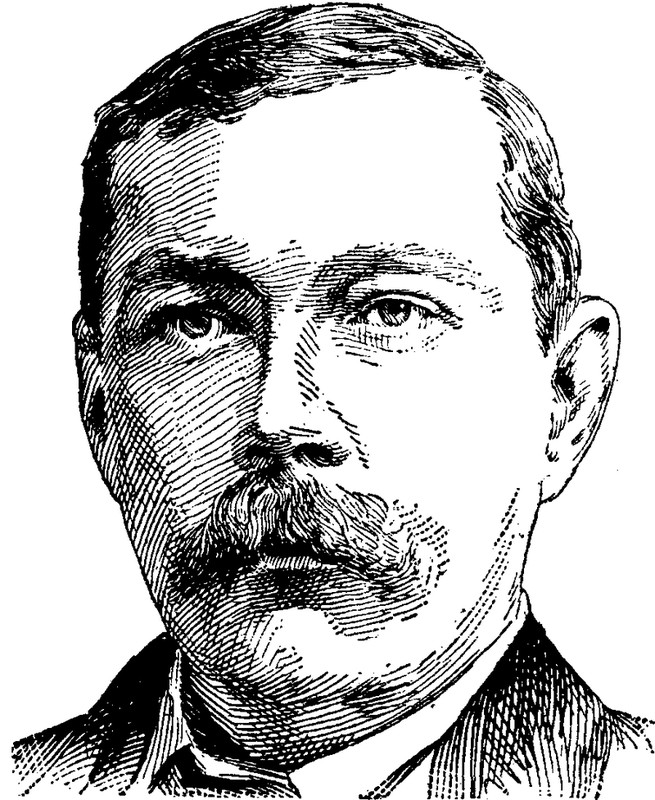
A. Conan Doyle
But Sherlock Holmes is a true product of his time. He is an embodiment of the scientific spirit seeing microscopically and applying itself to construct, from material vestiges and psychologic remainders, an unknown body of proof. From the smallest fragments he deduces the whole structure, precisely as the great naturalists do; and so flawless are his reasonings that a course of 'The Adventures of Sherlock Holmes' would not be bad training in a high-school class in logic.
The creator of this eminent personage was born in Edinburgh in 1859, of a line of artists; his grandfather, John Doyle, having been a famous political caricaturist, whose works, under the signature "H. B.," were purchased at a high price by the British Museum. The quaint signature of his father—a capital D, with a little bird perched on top, gained him the affectionate sobriquet of "Dicky Doyle"; and Dicky Doyle's house was the gathering-place of artists and authors, whose talk served to decide the destiny of the lad Conan. For though he was intended for the medical profession, and after studying in Germany had kept his terms at the Medical College of Edinburgh University, the love of letters drove him forth in his early twenties to try his fortunes in the literary world of London.
Inheriting from his artist ancestry a sense of form and color, a faculty of constructiveness, and a vivid imagination, his studiousness and his industry have turned his capacities into abilities. For his romance of 'The White Company' he read more than two hundred books, and spent on it more than two years of labor. 'Micah Clarke' and 'The Great Shadow' involved equal wit and conscience. In his historic fiction he has described the England of Edward III., of James II., and of to-day, the Scotland of George III., the France of Edward III., of Louis XIV., and of Napoleon, and the America of Frontenac; while, in securing this correctness of historic detail, he has not neglected the first duty of a story-teller, which is to be interesting.
THE RED-HEADED LEAGUE
From 'The Adventures of Sherlock Holmes.' Copyright 1892, by Harper & Brothers
I had called upon my friend Mr. Sherlock Holmes one day in the autumn of last year, and found him in deep conversation with a very stout, florid-faced elderly gentleman, with fiery red hair. With an apology for my intrusion I was about to withdraw, when Holmes pulled me abruptly into the room and closed the door behind me.
"You could not possibly have come at a better time, my dear Watson," he said, cordially.
"I was afraid that you were engaged."
"So I am. Very much so."
"Then I can wait in the next room."
"Not at all. This gentleman, Mr. Wilson, has been my partner and helper in many of my most successful cases, and I have no doubt that he will be of the utmost use to me in yours also."
The stout gentleman half rose from his chair and gave a bob of greeting, with a quick little questioning glance from his small, fat-encircled eyes.
"Try the settee," said Holmes, relapsing into his arm-chair and putting his finger-tips together, as was his custom when in judicial moods. "I know, my dear Watson, that you share my love of all that is bizarre and outside the conventions and humdrum routine of every-day life. You have shown your relish for it by the enthusiasm which has prompted you to chronicle, and if you will excuse my saying so, somewhat to embellish so many of my own little adventures."
"Your cases have indeed been of the greatest interest to me," I observed.
"You will remember that I remarked the other day, just before we went into the very simple problem presented by Miss Mary Sutherland, that for strange effects and extraordinary combinations we must go to life itself, which is always far more daring than any effort of the imagination."
"A proposition which I took the liberty of doubting."
"You did, doctor; but none the less you must come round to my view, for otherwise I shall keep on piling fact upon fact on you, until your reason breaks down under them and acknowledges me to be right. Now, Mr. Jabez Wilson here has been good enough to call upon me this morning, and to begin a narrative which promises to be one of the most singular which I have listened to for some time. You have heard me remark that the strangest and most unique things are very often connected not with the larger but with the smaller crimes; and occasionally, indeed, where there is room for doubt whether any positive crime has been committed. As far as I have heard, it is impossible for me to say whether the present case is an instance of crime or not; but the course of events is certainly among the most singular that I have ever listened to. Perhaps, Mr. Wilson, you would have the great kindness to recommence your narrative. I ask you, not merely because my friend Dr. Watson has not heard the opening part, but also because the peculiar nature of the story makes me anxious to have every possible detail from your lips. As a rule, when I have heard some slight indication of the course of events, I am able to guide myself by the thousands of other similar cases which occur to my memory. In the present instance I am forced to admit that the facts are, to the best of my belief, unique."
The portly client puffed out his chest with an appearance of some little pride, and pulled a dirty and wrinkled newspaper from the inside pocket of his great-coat. As he glanced down the advertisement column, with his head thrust forward, and the paper flattened out upon his knee, I took a good look at the man, and endeavored, after the fashion of my companion, to read the indications which might be presented by his dress or appearance. I did not gain very much, however, by my inspection. Our visitor bore every mark of being an average commonplace British tradesman, obese, pompous, and slow. He wore rather baggy gray shepherd's-check trousers, a not over clean black frock-coat unbuttoned in the front, and a drab waistcoat, with a heavy brassy Albert chain and a square pierced bit of metal dangling down as an ornament. A frayed top-hat and a faded brown overcoat with a wrinkled velvet collar lay upon a chair beside him. Altogether, look as I would, there was nothing remarkable about the man save his blazing red head, and the expression of extreme chagrin and discontent upon his features.
Sherlock Holmes's quick eye took in my occupation, and he shook his head with a smile as he noticed my questioning glances. "Beyond the obvious facts that he has at some time done manual labor, that he takes snuff, that he is a Freemason, that he has been in China, and that he has done a considerable amount of writing lately, I can deduce nothing else."
Mr. Jabez Wilson started up in his chair, with his forefinger upon the paper, but his eyes upon my companion.
"How in the name of good fortune did you know all that, Mr. Holmes?" he asked. "How did you know, for example, that I did manual labor? It's as true as gospel, for I began as a ship's carpenter."
"Your hands, my dear sir. Your right hand is quite a size larger than your left. You have worked with it, and the muscles are more developed."
"Well, the snuff, then, and the Freemasonry?"
"I won't insult your intelligence by telling you how I read that; especially as, rather against the strict rules of your order, you use an arc-and-compass breastpin."
"Ah, of course, I forgot that. But the writing?"
"What else can be indicated by that right cuff so very shiny for five inches, and the left one with the smooth patch near the elbow where you rest it upon the desk?"
"Well, but China?"
"The fish that you have tattooed immediately above your right wrist could only have been done in China. I have made a small study of tattoo marks, and have even contributed to the literature of the subject. That trick of staining the fishes' scales of a delicate pink is quite peculiar to China. When in addition I see a Chinese coin hanging from your watch-chain, the matter becomes even more simple."
Mr. Jabez Wilson laughed heavily. "Well, I never!" said he. "I thought at first that you had done something clever, but I see that there was nothing in it, after all."
"I begin to think, Watson," said Holmes, "that I make a mistake in explaining. 'Omne ignotum pro magnifico,' you know, and my poor little reputation, such as it is, will suffer shipwreck if I am so candid. Can you not find the advertisement, Mr. Wilson?"
"Yes, I have got it now," he answered, with his thick red finger planted half-way down the column. "Here it is. This is what began it all. You just read it for yourself, sir."
I took the paper from him, and read as follows:—
"To the Red-Headed League:—On account of the bequest of the late Ezekiah Hopkins, of Lebanon, Pa., U.S.A., there is now another vacancy open, which entitles a member of the League to a salary of £4 a week for purely nominal services. All red-headed men who are sound in body and mind, and above the age of twenty-one years, are eligible. Apply in person on Monday, at eleven o'clock, to Duncan Ross, at the offices of the League, 7 Pope's Court, Fleet Street."
"What on earth does this mean?" I ejaculated, after I had twice read over the extraordinary announcement.
Holmes chuckled, and wriggled in his chair, as was his habit when in high spirits. "It is a little off the beaten track, isn't it?" said he. "And now, Mr. Wilson, off you go at scratch, and tell us all about yourself, your household, and the effect which this advertisement had upon your fortunes. You will first make a note, doctor, of the paper and the date."
"It is the Morning Chronicle of April 27th, 1890. Just two months ago."
"Very good. Now, Mr. Wilson?"
"Well, it is just as I have been telling you, Mr. Sherlock Holmes," said Jabez Wilson, mopping his forehead: "I have a small pawnbroker's business at Coburg Square, near the city. It's not a very large affair, and of late years it has not done more than just give me a living. I used to be able to keep two assistants, but now I only keep one; and I would have a job to pay him, but that he is willing to come for half wages, so as to learn the business."
"What is the name of this obliging youth?" asked Sherlock Holmes.
"His name is Vincent Spaulding, and he's not such a youth, either. It's hard to say his age. I should not wish a smarter assistant, Mr. Holmes; and I know very well that he could better himself, and earn twice what I am able to give him. But after all, if he is satisfied, why should I put ideas in his head?"
"Why, indeed? You seem most fortunate in having an employé who comes under the full market price. It is not a common experience among employers in this age. I don't know that your assistant is not as remarkable as your advertisement."
"Oh, he has his faults, too," said Mr. Wilson. "Never was such a fellow for photography. Snapping away with a camera when he ought to be improving his mind, and then diving down into the cellar like a rabbit into its hole to develop his pictures. That is his main fault; but on the whole, he's a good worker. There's no vice in him."
"He is still with you, I presume?"
"Yes, sir. He and a girl of fourteen, who does a bit of simple cooking, and keeps the place clean—that's all I have in the house, for I am a widower, and never had any family. We live very quietly, sir, the three of us; and we keep a roof over our heads, and pay our debts, if we do nothing more.
"The first thing that put us out was that advertisement. Spaulding, he came down into the office just this day eight weeks, with this very paper in his hand, and he says:—
"'I wish to the Lord, Mr. Wilson, that I was a red-headed man.'
"'Why that?' I asks.
"'Why,' says he, 'here's another vacancy on the League of the Red-Headed Men. It's worth quite a little fortune to any man who gets it, and I understand that there are more vacancies than there are men, so that the trustees are at their wits' end what to do with the money. If my hair would only change color, here's a nice little crib all ready for me to step into.'
"'Why, what is it, then?' I asked. You see, Mr. Holmes, I am a very stay-at-home man, and as my business came to me instead of my having to go to it, I was often weeks on end without putting my foot over the door-mat. In that way I didn't know much of what was going on outside, and I was always glad of a bit of news.
"'Have you never heard of the League of the Red-Headed Men?' he asked, with his eyes open.
"'Never.'
"'Why, I wonder at that, for you are eligible yourself for one of the vacancies.'
"'And what are they worth?' I asked.
"'Oh, merely a couple of hundred a year; but the work is slight, and it need not interfere very much with one's other occupations.'
"Well, you can easily think that that made me prick up my ears, for the business has not been over good for some years, and an extra couple of hundred would have been very handy.
"'Tell me all about it,' said I.
"'Well,' said he, showing me the advertisement, 'you can see for yourself that the League has a vacancy, and there is the address where you should apply for particulars. As far as I can make out, the League was founded by an American millionaire, Ezekiah Hopkins, who was very peculiar in his ways. He was himself red-headed, and he had a great sympathy for all red-headed men; so when he died it was found that he had left his enormous fortune in the hands of trustees, with instructions to apply the interest to the providing of easy berths to men whose hair is of that color. From all I hear, it is splendid pay and very little to do.'
"'But,' said I, 'there would be millions of red-headed men who would apply.'
"'Not so many as you might think,' he answered. 'You see it is really confined to Londoners, and to grown men. This American had started from London when he was young, and he wanted to do the old town a good turn. Then again, I have heard it is no use your applying if your hair is light red, or dark red, or anything but real bright, blazing, fiery red. Now if you care to apply, Mr. Wilson, you would just walk in; but perhaps it would hardly be worth your while to put yourself out of the way for the sake of a few hundred pounds.'
"Now, it is a fact, gentlemen, as you may see for yourselves, that my hair is of a very full and rich tint, so that it seemed to me that if there was to be any competition in the matter, I stood as good a chance as any man that I had ever met. Vincent Spaulding seemed to know so much about it that I thought he might prove useful, so I just ordered him to put up the shutters for the day, and to come right away with me. He was very willing to have a holiday; so we shut the business up, and started off for the address that was given us in the advertisement.
"I never hope to see such a sight as that again, Mr. Holmes. From north, south, east, and west, every man who had a shade of red in his hair had tramped into the city to answer the advertisement. Fleet Street was choked with red-headed folk, and Pope's Court looked like a coster's orange-barrow. I should not have thought there were so many in the whole country as were brought together by that single advertisement. Every shade of color they were—straw, lemon, orange, brick, Irish-setter, liver, clay; but as Spaulding said, there were not many who had the real vivid flame-colored tint. When I saw how many were waiting, I would have given it up in despair; but Spaulding would not hear of it. How he did it I could not imagine, but he pushed and pulled and butted until he got me through the crowd, and right up to the steps which led to the office. There was a double stream upon the stair, some going up in hope, and some coming back dejected; but we wedged in as well as we could, and soon found ourselves in the office."
"Your experience has been a most entertaining one," remarked Holmes, as his client paused and refreshed his memory with a huge pinch of snuff. "Pray continue your very interesting statement."
"There was nothing in the office but a couple of wooden chairs and a deal table, behind which sat a small man, with a head that was even redder than mine. He said a few words to each candidate as he came up, and then he always managed to find some fault in them which would disqualify them. Getting a vacancy did not seem to be such a very easy matter, after all. However, when our turn came, the little man was much more favorable to me than to any of the others, and he closed the door as we entered, so that he might have a private word with us.
"'This is Mr. Jabez Wilson,' said my assistant, 'and he is willing to fill a vacancy in the League.'
"'And he is admirably suited for it,' the other answered. 'He has every requirement. I cannot recall when I have seen anything so fine.' He took a step backward, cocked his head on one side, and gazed at my hair until I felt quite bashful. Then suddenly he plunged forward, wrung my hand, and congratulated me warmly on my success.
"'It would be injustice to hesitate,' said he. 'You will, however, I am sure, excuse me for taking an obvious precaution.' With that he seized my hair in both his hands, and tugged until I yelled with the pain. 'There is water in your eyes,' said he, as he released me. 'I perceive that all is as it should be. But we have to be careful, for we have twice been deceived by wigs and once by paint. I could tell you tales of cobbler's wax which would disgust you with human nature.' He stepped over to the window, and shouted through it at the top of his voice that the vacancy was filled. A groan of disappointment came up from below, and the folk all trooped away in different directions, until there was not a red head to be seen except my own and that of the manager.
"'My name,' said he, 'is Mr. Duncan Ross, and I am myself one of the pensioners upon the fund left by our noble benefactor. Are you a married man, Mr. Wilson? Have you a family?'
"I answered that I had not.
"His face fell immediately.
"'Dear me,' he said, gravely, 'that is very serious indeed! I am sorry to hear you say that. The fund was of course for the propagation and spread of the red-heads, as well as for their maintenance. It is exceedingly unfortunate that you should be a bachelor.'
"My face lengthened at this, Mr. Holmes, for I thought that I was not to have the vacancy after all; but after thinking it over for a few minutes, he said that it would be all right.
"'In the case of another,' said he, 'the objection might be fatal, but we must stretch a point in favor of a man with such a head of hair as yours. When shall you be able to enter upon your new duties?'
"'Well, it is a little awkward, for I have a business already,' said I.
"'Oh, never mind about that, Mr. Wilson!' said Vincent Spaulding. 'I shall be able to look after that for you.'
"'What would be the hours?' I asked.
"'Ten to two.'
"Now a pawnbroker's business is mostly done of an evening, Mr. Holmes, especially Thursday and Friday evening, which is just before pay-day; so it would suit me very well to earn a little in the mornings. Besides, I knew that my assistant was a good man, and that he would see to anything that turned up.
"'That would suit me very well,' said I. 'And the pay?'
"'Is £4 a week.'
"'And the work?'
"'Is purely nominal.'
"'What do you call purely nominal?'
"'Well, you have to be in the office, or at least in the building, the whole time. If you leave, you forfeit your whole position forever. The will is very clear upon that point. You don't comply with the conditions if you budge from the office during that time.'
"'It's only four hours a day, and I should not think of leaving,' said I.
"'No excuse will avail,' said Mr. Duncan Ross, 'neither sickness nor business nor anything else. There you must stay, or you lose your billet.'
"'And the work?'
"'Is to copy out the Encyclopædia Britannica. There is the first volume of it in that press. You must find your own ink, pens, and blotting-paper, but we provide this table and chair. Will you be ready to-morrow?'
"'Certainly,' I answered.
"'Then good-by, Mr. Jabez Wilson; and let me congratulate you once more on the important position which you have been fortunate enough to gain.' He bowed me out of the room, and I went home with my assistant, hardly knowing what to say or do, I was so pleased at my own good fortune.
"Well, I thought over the matter all day, and by evening I was in low spirits again; for I had quite persuaded myself that the whole affair must be some great hoax or fraud, though what its object might be I could not imagine. It seemed altogether past belief that any one could make such a will, or that they would pay such a sum for doing anything so simple as copying out the 'Encyclopædia Britannica.' Vincent Spaulding did what he could to cheer me up, but by bedtime I had reasoned myself out of the whole thing. However, in the morning I determined to have a look at it anyhow, so I bought a penny bottle of ink, and with a quill pen and seven sheets of foolscap paper I started off for Pope's Court.
"Well, to my surprise and delight, everything was as right as possible. The table was set out ready for me, and Mr. Duncan Ross was there to see that I got fairly to work. He started me off upon the letter A, and then he left me; but he would drop in from time to time to see that all was right with me. At two o'clock he bade me good-by, complimented me upon the amount that I had written, and locked the door of the office after me.
"This went on day after day, Mr. Holmes, and on Saturday the manager came in and planked down four golden sovereigns for my week's work. It was the same next week, and the same the week after. Every morning I was there at ten, and every afternoon I left at two. By degrees Mr. Duncan Ross took to coming in only once of a morning, and then after a time he did not come in at all. Still, of course, I never dared to leave the room for an instant, for I was not sure when he might come, and the billet was such a good one, and suited me so well, that I would not risk the loss of it.
"Eight weeks passed away like this, and I had written about Abbots and Archery and Armor and Architecture and Attica, and hoped with diligence that I might get on to the B's before very long. It cost me something in foolscap, and I had pretty nearly filled a shelf with my writings. And then suddenly the whole business came to an end."
"To an end?"
"Yes, sir. And no later than this morning. I went to my work as usual at ten o'clock, but the door was shut and locked with a little square of card-board hammered on to the middle of the panel with a tack. Here it is, and you can read for yourself."
The Red-Headed League
is
Dissolved.
October 9th, 1890.
Sherlock Holmes and I surveyed this curt announcement and the rueful face behind it, until the comical side of the affair so completely overtopped every other consideration that we both burst out into a roar of laughter.
"I cannot see that there is anything very funny," cried our client, flushing up to the roots of his flaming head. "If you can do nothing better than laugh at me, I can go elsewhere."
"No, no," cried Holmes, shoving him back into the chair from which he had half risen. "I really wouldn't miss your case for the world. It is most refreshingly unusual. But there is, if you will excuse my saying so, something just a little funny about it. Pray, what steps did you take when you found the card upon the door?"
"I was staggered, sir. I did not know what to do. Then I called at the offices round, but none of them seemed to know anything about it. Finally I went to the landlord, who is an accountant living on the ground-floor, and I asked him if he could tell me what had become of the Red-Headed League. He said that he had never heard of any such body. Then I asked him who Mr. Duncan Ross was. He answered that the name was new to him.
"'Well,' said I, 'the gentleman at No. 4.'
"'What, the red-headed man?'
"'Yes.'
"'Oh,' said he, 'his name was William Morris. He was a solicitor, and was using my room as a temporary convenience until his new premises were ready. He moved out yesterday.'
"'Where could I find him?'
"'Oh, at his new offices. He did tell me the address. Yes, 17 King Edward Street, near St. Paul's.'
"I started off, Mr. Holmes, but when I got to that address it was a manufactory of artificial knee caps, and no one in it had ever heard of either Mr. William Morris or Mr. Duncan Ross."
"And what did you do then?" asked Holmes.
"I went home to Saxe-Coburg Square, and I took the advice of my assistant. But he could not help me in any way. He could only say that if I waited I should hear by post. But that was not quite good enough, Mr. Holmes. I did not wish to lose such a place without a struggle; so as I had heard that you were good enough to give advice to poor folk who were in need of it, I came right away to you."
"And you did very wisely." said Holmes. "Your case is an exceedingly remarkable one, and I shall be happy to look into it. From what you have told me, I think that it is possible that graver issues hang from it than might at first sight appear."
"Grave enough!" said Mr. Jabez Wilson. "Why, I have lost four pound a week."
"As far as you are personally concerned," remarked Holmes, "I do not see that you have any grievance against this extraordinary league. On the contrary, you are, as I understand, richer by some £30, to say nothing of the minute knowledge which you have gained on every subject which comes under the letter A. You have lost nothing by them."
"No, sir. But I want to find out about them, and who they are, and what their object was in playing this prank—if it was a prank—upon me. It was a pretty expensive joke for them, for it cost them two-and-thirty pounds."
"We shall endeavor to clear up these points for you. And first one or two questions, Mr. Wilson. This assistant of yours who first called your attention to the advertisement—how long had he been with you?"
"About a month then."
"How did he come?"
"In answer to an advertisement."
"Was he the only applicant?"
"No; I had a dozen."
"Why did you pick him?"
"Because he was handy, and would come cheap."
"At half wages, in fact."
"Yes."
"What is he like, this Vincent Spaulding?"
"Small, stout-built, very quick in his ways, no hair on his face, though he's not short of thirty. Has a white splash of acid upon his forehead."
Holmes sat up in his chair in considerable excitement. "I thought as much," said he. "Have you ever observed that his ears are pierced for earrings?"
"Yes, sir. He told me that a gipsy had done it for him when he was a lad."
"Hum!" said Holmes, sinking back in deep thought. "He is still with you?"
"Oh yes, sir; I have only just left him."
"And has your business been attended to in your absence?"
"Nothing to complain of, sir. There's never very much to do of a morning."
"That will do, Mr. Wilson. I shall be happy to give you an opinion upon the subject in the course of a day or two. To-day is Saturday, and I hope that by Monday we may come to a conclusion."
"Well, Watson," said Holmes, when our visitor had left us, "what do you make of it all?"
"I make nothing of it," I answered, frankly. "It is a most mysterious business."
"As a rule," said Holmes, "the more bizarre a thing is, the less mysterious it proves to be. It is your commonplace, featureless crimes which are really puzzling, just as a commonplace face is the most difficult to identify. But I must be prompt over this matter."
"What are you going to do, then?" I asked.
"To smoke," he answered. "It is quite a three-pipe problem, and I beg that you won't speak to me for fifty minutes." He curled himself up in his chair, with his thin knees drawn up to his hawk-like nose, and there he sat with his eyes closed and his black clay pipe thrusting out like the bill of some strange bird. I had come to the conclusion that he had dropped asleep, and indeed was nodding myself, when he suddenly sprang out of his chair with the gesture of a man who has made up his mind, and put his pipe down upon the mantel-piece.
"Sarasate plays at the St. James's Hall this afternoon," he remarked. "What do you think, Watson? Could your patients spare you for a few hours?"
"I have nothing to do to-day. My practice is never very absorbing."
"Then put on your hat and come. I am going through the city first, and we can have some lunch on the way. I observe that there is a good deal of German music on the programme, which is rather more to my taste than Italian or French. It is introspective, and I want to introspect. Come along!"
We traveled by the Underground as far as Aldersgate; and a short walk took us to Saxe-Coburg Square, the scene of the singular story which we had listened to in the morning. It was a poky little shabby-genteel place, where four lines of dingy two-storied brick houses looked out into a small railed-in inclosure, where a lawn of weedy grass and a few clumps of faded laurel-bushes made a hard fight against a smoke-laden and uncongenial atmosphere. Three gilt balls, and a brown board with "Jabez Wilson" in white letters, upon a corner house, announced the place where our red-headed client carried on his business. Sherlock Holmes stopped in front of it, with his head on one side, and looked it all over, with his eyes shining brightly between puckered lids. Then he walked slowly up the street, and then down again to the corner, still looking keenly at the houses. Finally he returned to the pawnbroker's, and having thumped vigorously upon the pavement with his stick two or three times he went up to the door and knocked. It was instantly opened by a bright-looking, clean-shaven young fellow, who asked him to step in.
"Thank you," said Holmes, "I only wish to ask you how you would go from here to the Strand."
"Third right, fourth left," answered the assistant, promptly, closing the door.
"Smart fellow, that," observed Holmes, as we walked away. "He is, in my judgment, the fourth smartest man in London, and for daring I am not sure that he has not a claim to be third. I have known something of him before."
"Evidently," said I, "Mr. Wilson's assistant counts for a good deal in this mystery of the Red-Headed League. I am sure that you inquired your way merely in order that you might see him."
"Not him."
"What then?"
"The knees of his trousers."
"And what did you see?"
"What I expected to see."
"Why did you beat the pavement?"
"My dear doctor, this is a time for observation, not for talk. We are spies in an enemy's country. We know something of Saxe-Coburg Square. Let us now explore the parts which lie behind it."
The road in which we found ourselves as we turned round the corner from the retired Saxe-Coburg Square presented as great a contrast to it as the front of a picture does to the back. It was one of the main arteries which convey the traffic of the city to the north and west. The roadway was blocked with the immense stream of commerce, flowing in a double tide inward and outward, while the foot-paths were black with the hurrying swarm of pedestrians. It was difficult to realize, as we looked at the line of fine shops and stately business premises, that they really abutted on the other side upon the faded and stagnant square which we had just quitted.
"Let me see," said Holmes, standing at the corner and glancing along the line, "I should like just to remember the order of the houses here. It is a hobby of mine to have an exact knowledge of London. There is Mortimer's, the tobacconist, the little newspaper shop, the Coburg branch of the City and Suburban Bank, the Vegetarian Restaurant, and McFarlane's carriage-building depot. That carries us right on to the other block. And now, doctor, we've done our work, so it's time we had some play. A sandwich and a cup of coffee, and then off to violin-land, where all is sweetness and delicacy and harmony, and there are no red-headed clients to vex us with their conundrums."
My friend was an enthusiastic musician, being himself not only a very capable performer, but a composer of no ordinary merit. All the afternoon he sat in the stalls wrapped in the most perfect happiness, gently waving his long thin fingers in time to the music, while his gently smiling face and his languid, dreamy eyes were as unlike those of Holmes the sleuth-hound, Holmes the relentless, keen-witted, ready-handed criminal agent, as it was possible to conceive. In his singular character the dual nature alternately asserted itself, and his extreme exactness and astuteness represented, as I have often thought, the reaction against the poetic and contemplative mood which occasionally predominated in him. The swing of his nature took him from extreme languor to devouring energy; and as I knew well, he was never so truly formidable as when for days on end he had been lounging in his arm-chair, amid his improvisations and his black-letter editions. Then it was that the lust of the chase would suddenly come upon him, and that his brilliant reasoning power would rise to the level of intuition, until those who were unacquainted with his methods would look askance at him as on a man whose knowledge was not that of other mortals. When I saw him that afternoon so enwrapped in the music at St. James's Hall, I felt that an evil time might be coming upon those whom he had set himself to hunt down.
"You want to go home, no doubt, doctor," he remarked as we emerged.
"Yes, it would be as well."
"And I have some business to do which will take some hours. This business at Coburg Square is serious."
"Why serious?"
"A considerable crime is in contemplation. I have every reason to believe that we shall be in time to stop it. But to-day being Saturday rather complicates matters. I shall want your help to-night."
"At what time?"
"Ten will be early enough."
"I shall be at Baker Street at ten."
"Very well. And I say, doctor, there may be some little danger, so kindly put your army revolver in your pocket." He waved his hand, turned on his heel, and disappeared in an instant among the crowd.
I trust that I am not more dense than my neighbors, but I was always oppressed with a sense of my own stupidity in my dealings with Sherlock Holmes. Here I had heard what he had heard, I had seen what he had seen, and yet from his words it was evident that he saw clearly not only what had happened, but what was about to happen, while to me the whole business was still confused and grotesque. As I drove home to my house in Kensington I thought over it all, from the extraordinary story of the red-headed copier of the 'Encyclopædia' down to the visit to Saxe-Coburg Square, and the ominous words with which he had parted from me. What was this nocturnal expedition, and why should I go armed? Where were we going, and what were we to do? I had the hint from Holmes that this smooth-faced pawnbroker's assistant was a formidable man—a man who might play a deep game. I tried to puzzle it out, but gave it up in despair, and set the matter aside until night should bring an explanation.
It was a quarter past nine when I started from home and made my way across the Park, and so through Oxford Street to Baker Street. Two hansoms were standing at the door, and as I entered the passage I heard the sound of voices from above. On entering his room I found Holmes in animated conversation with two men, one of whom I recognized as Peter Jones, the official police agent, while the other was a long thin sad-faced man, with a very shiny hat and oppressively respectable frock-coat.
"Ha! our party is complete," said Holmes, buttoning up his pea-jacket, and taking his heavy hunting crop from the rack. "Watson, I think you know Mr. Jones, of Scotland Yard? Let me introduce you to Mr. Merryweather, who is to be our companion in to-night's adventure."
"We're hunting in couples again, doctor, you see," said Jones, in his consequential way. "Our friend here is a wonderful man for starting a chase. All he wants is an old dog to help him to do the running down."
"I hope a wild goose may not prove to be the end of our chase," observed Mr. Merryweather, gloomily.
"You may place considerable confidence in Mr. Holmes, sir," said the police agent, loftily. "He has his own little methods, which are, if he won't mind my saying so, just a little too theoretical and fantastic, but he has the makings of a detective in him. It is not too much to say that once or twice, as in that business of the Sholto murder and the Agra treasure, he has been more nearly correct than the official force."
"Oh, if you say so, Mr. Jones, it is all right," said the stranger, with deference, "Still, I confess that I miss my rubber. It is the first Saturday night for seven-and-twenty years that I have not had my rubber."
"I think you will find," said Sherlock Holmes, "that you will play for a higher stake to-night than you have ever done yet, and that the play will be more exciting. For you, Mr. Merryweather, the stake will be some £30,000; and for you, Jones, it will be the man upon whom you wish to lay your hands."
"John Clay, the murderer, thief, smasher, and forger. He's a young man, Mr. Merryweather, but he is at the head of his profession, and I would rather have my bracelets on him than on any criminal in London. He's a remarkable man, is young John Clay. His grandfather was a royal duke, and he himself has been to Eton and Oxford. His brain is as cunning as his fingers, and though we meet signs of him at every turn, we never know where to find the man himself. He'll crack a crib in Scotland one week, and be raising money to build an orphanage in Cornwall the next. I've been on his track for years, and have never set eyes on him yet."
"I hope that I may have the pleasure of introducing you to-night. I've had one or two little turns also with Mr. John Clay, and I agree with you that he is at the head of his profession. It is past ten, however, and quite time that we started. If you two will take the first hansom, Watson and I will follow in the second."
Sherlock Holmes was not very communicative during the long drive, and lay back in the cab humming the tunes which he had heard in the afternoon. We rattled through an endless labyrinth of gas-lit streets until we emerged into Farringdon Street.
"We are close there now," my friend remarked. "This fellow Merryweather is a bank director, and personally interested in the matter. I thought it as well to have Jones with us also. He is not a bad fellow, though an absolute imbecile in his profession. He has one positive virtue. He is as brave as a bull-dog, and as tenacious as a lobster if he gets his claws upon any one. Here we are, and they are waiting for us."
We had reached the same crowded thoroughfare in which we had found ourselves in the morning. Our cabs were dismissed, and following the guidance of Mr. Merryweather, we passed down a narrow passage and through a side door, which he opened for us. Within, there was a small corridor, which ended in a very massive iron gate. This also was opened, and led down a flight of winding stone steps, which terminated at another formidable gate. Mr. Merryweather stopped to light a lantern, and then conducted us down a dark, earth-smelling passage, and so, after opening a third door, into a huge vault or cellar, which was piled all around with crates and massive boxes.
"You are not very vulnerable from above," Holmes remarked, as he held up the lantern and gazed about him.
"Nor from below," said Mr. Merryweather, striking his stick upon the flags which lined the floor. "Why, dear me, it sounds quite hollow!" he remarked, looking up in surprise.
"I must really ask you to be a little more quiet," said Holmes, severely. "You have already imperiled the whole success of our expedition. Might I beg that you would have the goodness to sit down upon one of those boxes, and not to interfere?"
The solemn Mr. Merryweather perched himself upon a crate, with a very injured expression upon his face, while Holmes fell upon his knees upon the floor, and with the lantern and a magnifying lens began to examine minutely the cracks between the stones. A few seconds sufficed to satisfy him, for he sprang to his feet again, and put his glass in his pocket.
"We have at least an hour before us," he remarked; "for they can hardly take any steps until the good pawnbroker is safely in bed. Then they will not lose a minute, for the sooner they do their work the longer time they will have for their escape. We are at present, doctor—as no doubt you have divined—in the cellar at the City branch of one of the principal London banks. Mr. Merryweather is the chairman of directors, and he will explain to you that there are reasons why the more daring criminals of London should take a considerable interest in this cellar at present."
"It is our French gold," whispered the director. "We have had several warnings that an attempt might be made upon it."
"Your French gold?"
"Yes. We had occasion some months ago to strengthen our resources, and borrowed for that purpose 30,000 napoleons from the Bank of France. It has become known that we have never had occasion to unpack the money, and that it is still lying in our cellar. The crate upon which I sit contains 2,000 napoleons packed between layers of lead foil. Our reserve of bullion is much larger at present than is usually kept in a single branch office, and the directors have had misgivings upon the subject."
"Which were very well justified," observed Holmes. "And now it is time that we arranged our little plans. I expect that within an hour matters will come to a head. In the mean time, Mr. Merryweather, we must put the screen over that dark lantern."
"And sit in the dark?"
"I am afraid so. I had brought a pack of cards in my pocket, and I thought that, as we were a partie carrée, you might have your rubber after all. But I see that the enemy's preparations have gone so far that we cannot risk the presence of a light. And first of all, we must choose our positions. These are daring men, and though we shall take them at a disadvantage, they may do us some harm unless we are careful. I shall stand behind this crate, and do you conceal yourselves behind those. Then when I flash a light upon them, close in swiftly. If they fire, Watson, have no compunction about shooting them down."
I placed my revolver, cocked, upon the top of the wooden case behind which I crouched. Holmes shot the slide across the front of his lantern, and left us in pitch darkness—such an absolute darkness as I had never before experienced. The smell of hot metal remained to assure us that the light was still there, ready to flash out at a moment's notice. To me, with my nerves worked up to a pitch of expectancy, there was something depressing and subduing in the sudden gloom, and in the cold dank air of the vault.
"They have but one retreat," whispered Holmes. "That is back through the house into Saxe-Coburg Square. I hope that you have done what I asked you, Jones?"
"I have an inspector and two officers waiting at the front door."
"Then we have stopped all the holes. And now we must be silent and wait."
What a time it seemed! From comparing notes afterwards it was but an hour and a quarter, yet it appeared to me that the night must have almost gone, and the dawn be breaking above us. My limbs were weary and stiff, for I feared to change my position; yet my nerves were worked up to the highest pitch of tension, and my hearing was so acute that I could not only hear the gentle breathing of my companions, but I could distinguish the deeper, heavier in-breath of the bulky Jones from the thin, sighing note of the bank director. From my position I could look over the case in the direction of the floor. Suddenly my eyes caught the glint of a light.
At first it was but a lurid spark upon the stone pavement. Then it lengthened out until it became a yellow line, and then, without any warning or sound, a gash seemed to open and a hand appeared; a white, almost womanly hand, which felt about in the centre of the little area of light. For a minute or more the hand, with its writhing fingers, protruded out of the floor. Then it was withdrawn as suddenly as it appeared, and all was dark again save the single lurid spark which marked a chink between the stones.
Its disappearance, however, was but momentary. With a rending, tearing sound, one of the broad white stones turned over upon its side, and left a square gaping hole, through which streamed the light of a lantern. Over the edge there peeped a clean-cut, boyish face, which looked keenly about it, and then, with a hand on either side of the aperture, drew itself shoulder-high and waist-high, until one knee rested upon the edge. In another instant he stood at the side of the hole, and was hauling after him a companion, lithe and small like himself, with a pale face and a shock of very red hair.
"It's all clear," he whispered. "Have you the chisel and the bags?—Great Scott! Jump, Archie, jump, and I'll swing for it!"
Sherlock Holmes had sprung out and seized the intruder by the collar. The other dived down the hole, and I heard the sound of rending cloth as Jones clutched at his skirts. The light flashed upon the barrel of a revolver, but Holmes's hunting crop came down on the man's wrist and the pistol clinked upon the stone floor.
"It's no use, John Clay," said Holmes, blandly, "You have no chance at all."
"So I see," the other answered, with the utmost coolness. "I fancy that my pal is all right, though I see you have got his coat-tails."
"There are three men waiting for him at the door," said Holmes.
"Oh, indeed! You seem to have done the thing very completely. I must compliment you."
"And I you," Holmes answered. "Your red-headed idea was very new and effective."
"You'll see your pal again presently," said Jones. "He's quicker at climbing down holes than I am. Just hold out, while I fix the derbies."
"I beg that you will not touch me with your filthy hands," remarked our prisoner, as the handcuffs clattered upon his wrists. "You may not be aware that I have royal blood in my veins. Have the goodness, also, when you address me always to say 'sir' and 'please.'"
"All right," said Jones, with a stare and a snigger. "Well, would you please, sir, march upstairs, where we can get a cab to carry your Highness to the police station?"
"That is better," said John Clay, serenely. He made a sweeping bow to the three of us, and walked quietly off in the custody of the detective.
"Really, Mr. Holmes," said Mr. Merryweather, as we followed them from the cellar, "I do not know how the bank can thank you or repay you. There is no doubt that you have detected and defeated in the most complete manner one of the most determined attempts at bank robbery that have ever come within my experience."
"I have had one or two little scores of my own to settle with Mr. John Clay," said Holmes. "I have been at some small expense over this matter, which I shall expect the bank to refund; but beyond that I am amply repaid by having had an experience which is in many ways unique, and by hearing the very remarkable narrative of the Red-Headed League."
"You see, Watson," he explained, in the early hours of the morning, as we sat over a glass of whisky and soda in Baker Street, "it was perfectly obvious from the first that the only possible object of this rather fantastic business of the advertisement of the League, and the copying of the 'Encyclopædia,' must be to get this not over bright pawnbroker out of the way for a number of hours every day. It was a curious way of managing it, but really, it would be difficult to suggest a better. The method was no doubt suggested to Clay's ingenious mind by the color of his accomplice's hair. The £4 a week was a lure which must draw him,—and what was it to them, who were playing for thousands? They put in the advertisement, one rogue has the temporary office, the other rogue incites the man to apply for it, and together they manage to secure his absence every morning in the week. From the time that I heard of the assistant having come for half wages, it was obvious to me that he had some strong motive for securing the situation."
"But how could you guess what the motive was?"
"Had there been women in the house, I should have suspected a mere vulgar intrigue. That however was out of the question. The man's business was a small one, and there was nothing in his house which could account for such elaborate preparations and such an expenditure as they were at. It must then be something out of the house. What could it be? I thought of the assistant's fondness for photography, and his trick of vanishing into the cellar. The cellar! There was the end of this tangled clue. Then I made inquiries as to this mysterious assistant, and found that I had to deal with one of the coolest and most daring criminals in London. He was doing something in the cellar—something which took many hours a day for months on end. What could it be, once more? I could think of nothing save that he was running a tunnel to some other building.
"So, far I had got when we went to visit the scene of action. I surprised you by beating upon the pavement with my stick. I was ascertaining whether the cellar stretched out in front or behind. It was not in front. Then I rang the bell, and as I hoped, the assistant answered it. We have had some skirmishes, but we had never set eyes upon each other before. I hardly looked at his face. His knees were what I wished to see. You must yourself have remarked how worn, wrinkled, and stained they were. They spoke of those hours of burrowing. The only remaining point was what they were burrowing for. I walked round the corner, saw that the City and Suburban Bank abutted on our friend's premises, and felt that I had solved my problem. When you drove home after the concert I called upon Scotland Yard, and upon the chairman of the bank directors, with the result that you have seen."
"And how could you tell that they would make their attempt to-night?" I asked.
"Well, when they closed their League offices, that was a sign that they cared no longer about Mr. Jabez Wilson's presence—in other words, that they had completed their tunnel. But it was essential that they should use it soon, as it might be discovered, or the bullion might be removed. Saturday would suit them better than any other day, as it would give them two days for their escape. For all these reasons I expected them to come to-night."
"You reasoned it out beautifully," I exclaimed, in unfeigned admiration. "It is so long a chain, and yet every link rings true."
"It saved me from ennui," he answered, yawning. "Alas! I already feel it closing in upon me. My life is spent in one long effort to escape from the commonplaces of existence. These little problems help me to do so."
"And you are a benefactor of the race," said I.
He shrugged his shoulders. "Well, perhaps after all it is of some little use," he remarked. "'L'homme c'est rien—l'œuvre c'est tout,' as Gustave Flaubert wrote to George Sand."
THE BOWMEN'S SONG
From 'The White Company'
What of the bow? The bow was made in England: Of true wood, of yew wood, The wood of English bows; So men who are free Love the old yew-tree And the land where the yew-tree grows.
What of the cord? The cord was made in England: A rough cord, a tough cord, A cord that bowmen love; So we'll drain our jacks To the English flax And the land where the hemp was wove.
What of the shaft? The shaft was cut in England: A long shaft, a strong shaft, Barbed and trim and true; So we'll drink all together To the gray goose feather, And the land where the gray goose flew.
What of the men? The men were bred in England: The bowman—the yeoman— The lads of dale and fell. Here's to you—and to you! To the hearts that are true And the land where the true hearts dwell.
Reprinted by permission of the American Publishers' Corporation, Publishers.
HOLGER DRACHMANN
(1846-)

olger Drachmann, born in Copenhagen October 9th, 1846, belongs to the writers characterized by Georg Brandes as "the men of the new era."
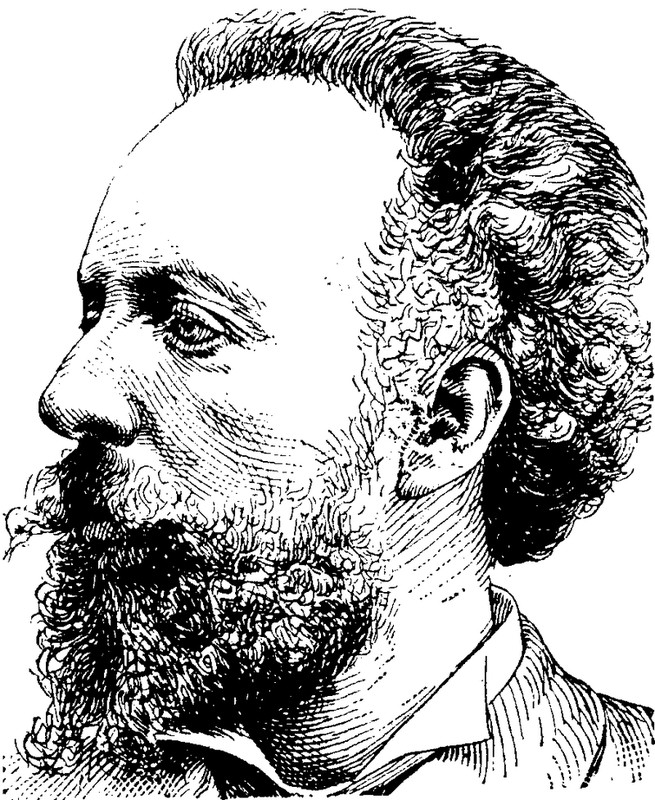
Holger Drachmann
Danish literature had stood high during the first half of the nineteenth century. In 1850 Oehlenschläger died. In 1870 there was practically no Danish literature. The reason for this may have been that after the new political life of 1848-9 and the granting of the Danish Constitution, politics absorbed all young talent, and men of literary tastes put themselves at the service of the daily press.
In 1872 Georg Brandes gave his lectures on 'Main Currents in the Literature of the Nineteenth Century' at the University of Copenhagen. That same year Drachmann published his first collection of 'Poems,' and so began his extraordinary productivity of poems, dramas, and novels. Of these, his lyric poems are undoubtedly of the greatest value. His is a distinctly lyric temperament. The new school had chosen for its guide Brandes's teaching that "Literature, to be of significance, should discuss problems." In view of this fact it is somewhat hard to understand why Drachmann should be called a man of the new era. He never discusses problems. He always gives himself up unreservedly to the subject which at that special moment claims his sympathy. Taken as a whole, therefore, his writings present a certain inconsistency. He has shown himself alternately as socialist and royalist, realist and romanticist, freethinker and believer, cosmopolitan and national, according to the lyric enthusiasm of the moment. Independent of these changes, the one thing to be admired and enjoyed is his lyric feeling and the often exquisite form in which he presents it. His larger compositions, novels, and dramas do not show the same power over his subject.
If Drachmann discusses any problem, it is the problem Drachmann. He does this sometimes with what Brandes calls "a light and joking self-irony," in a most sympathetic way. Brandes quotes one of Drachmann's early stories, where it is said of the hero:—"His name was really Palnatoke Olsen; a continually repeated discord of two tones, as he used to say." Olsen is one of the most commonplace Danish names. Palnatoke is the name of one of the fiercest warriors of heathen antiquity, who, like a veritable Valhalla god, dared to oppose the terrible Danish king Harald Blaatand. When Olsen's parents gave him this name they unwittingly described their son, "forever drawn by two poles: one the plain Olsen, the other the hot-headed fiery Viking." With this in mind, and considering Drachmann's literary works as a whole, one is irresistibly reminded of his friend and contemporary in Norway, Björnsterne Björnson. There is this difference between them, however, that if the irony of Palnatoke Olsen may be applied to both, one might for Drachmann use the abbreviation P. Olsen and for Björnson undoubtedly Palnatoke O.
It might be said of Drachmann, as Sauer said of the Italian poet Monti:—"Like a master in the art of appreciation, he knew how to give himself up to great time-stirring ideas; somewhat as a gifted actor throws himself into his part, with the full strength of his art, with an enthusiasm carrying all before it, and in the most expressive way; then when the part is played, lays it quietly aside and takes hold of something else."
When a young man, Drachmann studied at the Academy of Arts in Copenhagen, and met with considerable success as a marine painter. His love for the Northern seas shows itself in his poetry and prose, and his descriptions of the sea and the life of the sailor and fisherman are of the truest and best yielded by his pen. He is the author of no less than forty-six volumes of poems, dramas, novels, short stories, and sketches, and of two unpublished dramas. His most important work is 'Forskrevet' (Condemned), which is largely autobiographical; his most attractive though not his strongest production is the opera 'Der Var Engang' (Once Upon a Time), founded on Andersen's 'The Swineherd,' with music by Sange Müller; his best poems and tales are those dealing with the sea.
At present he lives in Hamburg, where on October 10th, 1896, he celebrated his fiftieth birthday and his twenty-fifth "Author-Jubilee," as the Danes call it. Among the features of the celebration were the sending of an enormous number of telegrams from Drachmann's admirers in Europe and America, and the performance of two of his plays,—one at the Royal Theatre in Copenhagen, the other at the Stadt Theatre in Altona.
THE SKIPPER AND HIS SHIP
From 'Paul and Virginia of a Northern Zone': copyright 1895, by Way and Williams, Chicago
The Anna Dorothea, in the North Sea, was pounding along under shortened sail. The weather was thick, the air dense; there was a falling barometer.
It had been a short trip this time. Leroy and Sons, wine merchants of Havre, had made better offers than the old houses in Bordeaux. At each one of his later trips, Captain Spang had said it should be his last. He would "lay up" at home; he was growing too stout and clumsy for the sea, and now he must trust fully to Tönnes, his first mate. The captain's big broad face was flushed as usual; he always looked as if he were illuminated by a setting October sun; there was no change here—rather, the sunset tint was stronger. But Tönnes noted how the features, which he knew best in moments of simple good-nature and of sullen tumult, had gradually relaxed. He thought that it would indeed soon be time for his old skipper to "lay up"; yet perhaps a few trips might still be made.
"Holloa, Tönnes! let her go about before the next squall strikes her. She lies too dead on this bow."
The skipper had raised his head above the cabin stairs. As usual, he was in his shirt-sleeves, and his scanty hair fluttered in the wind. When he had warned his mate, he again disappeared in the cabin.
Tönnes gave the order to the man at the helm, and hurried to help at the main-braces. The double-reefed main-topsail swung about, the Anna Dorothea caught the wind somewhat sluggishly, and not without getting considerable water over her; then followed the fore-topsail, the reefed foresail, and the trysail. When the tacking was finished and the sails had again caught the wind, the trysail was torn from the boltropes with a loud crack.
The captain's head appeared again,
"We must close-reef!" said he.
The last reef was taken in; the storm came down and lashed the sea; the sky grew more and more threatening; the waves dashed over the deck at each plunge of the old bark in the sea. The old vessel, which had carried her captain for a generation, lay heavily on the water—Tönnes thought too heavily.
The second mate—the same who had played the accordion at the inn—came over to Tönnes.
"It was wrong to stow the china-clay at the bottom and the casks on top; she lies horribly dead, and I'm afraid we shall have to use the pumps."
"Yes, I said so to the old man, but he would have it that way," answered Tönnes. "We shall have a wet night."
"We shall, surely," said the second mate.
Tönnes crawled up to the helm and looked at the compass. Two men were at the helm—lashed fast. Tönnes looked up into the rigging and out to windward; then suddenly he cried, with the full force of his lungs:—
"Look out for breakers!"
Tönnes himself helped at the wheel; but the vessel only half answered the helm. The greater portion of the sea struck the bow, the quarter, and the bulwarks and stanchions amidship, so that they creaked and groaned. One of the men at the helm had grasped Tönnes, who would otherwise have been swept into the lee scupper. When the ship had righted from the terrible blow, the captain stood on the deck in his oilcloth suit.
"Are any men missing?" cried he, through the howling of the wind and the roaring of the water streaming fore and aft, unable to escape quickly enough through the scuppers.
The storm raged with undiminished fury. The crew—and amongst them Prussian, who had been promoted to be ship's-dog—by-and-by dived forward through the seething salt water and the fragments of wreck that covered the deck.
Now it was that the second mate was missing.
The captain looked at Tönnes, and then out on the wild sea. He scarcely glanced at the crushed long-boat; even if a boat could have been launched, it would have been too late. Tönnes and his skipper were fearless men, who took things as they were. If any help could have been given, they would have given it. But their eyes sought vainly for any dark speck amidst the foaming waves—and it was necessary to care for themselves, the vessel and the crew.
"God save his soul!" murmured Captain Spang.
Tönnes passed his hand across his brow, and went to his duty. Evening set in; the wind increased rather than decreased.
"She is taking in water," said the captain, who had sounded the pumps.
Tönnes assented.
"We must change her course," said the captain. "She pitches too heavily in this sea."
The bark was held up to the wind as closely as possible. The pumps were worked steadily, but often got out of order on account of the china-clay, which mixed with the water down in the hold.
It was plain that the vessel grew heavier and heavier; her movements in climbing a wave were more and more dead.
During the night a cry arose: again one of the crew was washed overboard.
It was a long night and a wet one, as Tönnes had predicted. Several times the skipper dived clown into the cabin—Tonnes knew perfectly well what for, but he said nothing. Few words were spoken on board the Anna Dorothea that night.
In the morning the captain, returning from one of his excursions down below, declared that the cabin was half full of water.
"We must watch for a sail," he said, abruptly and somewhat huskily.
Tönnes passed the word round amongst the crew. One might read on their faces that they were prepared for this, and that they had ceased to hope, although they had not stopped work at the pumps.
The whole of the weather bulwark, the cook's cabin and the long-boat, were crushed or washed away; the water could be heard below the hatches. While keeping a sharp lookout for sails, many an eye glanced at the yawl as the last resort. But on board Captain Spang's vessel the words were not yet spoken which carried with them the doom of the ship: "We are sinking!"
In the gray-white of the dawn a signal was to be hoisted; the bunting was tied together at the middle and raised half-mast high.
Both the captain and Tönnes had lashed themselves aft; for now the bark was but little better than a wreck, over which the billows broke incessantly, as the vessel, reeling like a drunken man, exposed herself to the violent attacks of the sea instead of parrying them.
"A sail to windward, captain!" cried Tönnes.
Captain Spang only nodded.
"She holds her course!" cried one of the crew excitedly. "No," said Tönnes, quietly. "She has seen us, and is bearing down upon us!"
The captain again nodded.
"Tis a brig!" cried one of the crew.
"A schooner-brig!" Tönnes corrected. "She carries her sails finely. I am sure she is a fruit-trader."
At last the strange vessel was so near that they could see her deck each time she was thrown upon her side in the violent seething sea.
"Yes, 'tis the schooner-brig!" exclaimed Tönnes. "Do you remember, captain, the time when—"
Again Captain Spang nodded. He acted strangely. Tönnes looked sharply at him, and shook his head.
Now Tönnes hailed the vessel:—
"Help us!—We are sinking!"
At this moment two or three of the bark's crew rushed toward the yawl, although Tönnes warned them back.
Captain Spang seemed changed. Evidently some opposing feelings contended within him. Seeing the insubordination of the men, he only shrugged his shoulders, and let Tönnes take full charge.
The men were in the yawl, still hanging under the iron davits. Now they cut the ropes; the yawl touched the water. The crew of the other vessel gestured warningly; but it was too late. A sea seized the yawl with its small crew, and the next moment crushed it against the main chains of the bark. Their shipmates raised a cry, and rushed to help them; but help was impossible. Boat and crew had disappeared.
"Didn't I say so?" cried Tönnes, with flaming eyes.
Over there in the schooner-brig all was activity. From the Anna Dorothea they could plainly see how the captain gave his orders. He manoeuvred his vessel like a true sailor. To board the wreck in such a sea would be madness. Therefore they unreeved two long lines and attached them to the long-boat, one on each side. Then they laid breeching under the boat, and hauled it up amidships by means of tackle. Taking advantage of a moment when their vessel was athwart the seas, they unloosed the tackle, and the boat swung out over the side; then they cut the breeching, the boat fell on the water aft, and now both lines were eased off quickly; while the brig caught the wind, the boat drifted toward the stern-sheets of the bark.
Tönnes was ready with a boat-hook, and connections were quickly made between the boat and the wreck.
"Quick now!" cried Tönnes. "Every man in the boat. No one takes his clothes with him! We may be thankful if we save our lives."
The men were quickly over the stern-sheets and down in the boat. Prussian whined, and kept close to Captain Spang, who had not moved one step on the deck.
"Come, captain!" cried Tönnes, taking the skipper by the arm.
"What's the matter?" asked the old man angrily.
Tönnes looked at him. Prussian barked.
"We must get into the boat, captain. The vessel may sink at any moment. Come!"
The captain pressed his sou'wester down over his forehead, and glanced around his deck.
The men in the boat cried out to them to come.
"Well!" said Captain Spang, but with an air so absent-minded and a bearing so irresolute that Tönnes at last took a firm hold on him.
Prussian showed his teeth at his former master.
"You go first!" exclaimed Tönnes, snatching the dog and throwing him down to the men, who were having hard work to keep the boat from wrecking.
When the dog was no longer on the deck, it seemed as if Captain Spang's resistance was broken. Tönnes did not let go his hold on him; but the young mate had to use almost superhuman strength to get the heavy old man down over the vessel's side and placed on a seat in the boat.
As soon as they had observed from the brig that this had been done, they hauled in both lines. The boat moved back again; but it was a dangerous voyage, and all were obliged to lash themselves fast to the thwarts with ropes placed there for that purpose.
Captain Spang was like a child. Tönnes had to lash him to the seat. The old man sat with his face hidden in his hands, his back turned toward his ship, inactive, and seemingly unconscious of what took place around him.
At last, when after a hard struggle all were on the deck of the schooner-brig, her captain came forward, placed his hand on his old friend's shoulder, and said:—
"It is the second time, you see! Well, we all cling to life, and the vessel over there is pretty old."
Captain Spang started. He scarcely returned his friend's hand-shaking.
"My vessel, I say! My papers! All that I have is in the vessel. I must go aboard, do you hear? I must go aboard. How could I forget?"
The other skipper and Tönnes looked at each other.
Captain Spang wrung his hands and stamped on the deck, his eyes fixed on his sinking vessel. She was still afloat; what did he care for the gale and the heavy sea? He belonged to the old school of skippers; he was bound to his vessel by ties longer than any life-line, heavier than any hawser: he had left his ship in a bewildered state, and had taken nothing with him that might serve to prove what he possessed and how long he had possessed it. His good old vessel was still floating on the water. He must, he would go there; if nobody would go with him, he would go alone.
All remonstrances were in vain.
Tönnes pressed the other skipper's hand.
"There is nothing else to be done. I know him," said he.
"So do I," was the answer.
Captain Spang and his mate were again in the boat. As they were on the point of starting, a loud whine and violent barking sounded from the deck, and Prussian showed his one eye over the railing.
"Stay where you are!" cried Tönnes. "We shall be back soon."
But the dog did not understand him. Perhaps he had his doubts; no one can say. He sprang overboard; Tönnes seized him by the ear, and hauled him into the boat.
And then the two men and the dog ventured back to the abandoned vessel.
This time the old man climbed on board without assistance.
Prussian whined in the boat.
"Throw that dog up to me!" cried the master.
Tönnes did so.
"Shall I come up and help you?" he called out.
"No, I can find my own way."
"But hurry, captain! do you understand?" said Tönnes, who anxiously noticed that the motions of the vessel were becoming more and more dangerous, while he needed all his strength to keep the boat clear of the wreck.
An answer came from the bark, but he could not catch it. In this moment Tönnes recalled the day when he rowed the captain out on the bay to the brig. His next thought was of Nanna. Oh, if she knew where they were!
And at this thought the mate's breast was filled with conflicting emotions. The dear blessed girl! Oh, if her father would only come!
"Captain!" cried Tönnes; "Captain Spang! for God's sake, come! Leave those papers alone. The vessel is sinking. We may at any moment—"
He paused.
The captain stood at the stern-sheets. At his side was Prussian, squinting down into the boat. There was an entirely strange expression in Andreas Spang's face; a double expression—one moment hard and defiant, the next almost solemn.
The sou'wester had fallen from his old head. His scanty hairs fluttered in the wind. He held in his hand a parcel of papers and a coil of rope. He pointed toward the brig.
"There!" he cried, throwing the package and the rope down to Tonnes. "Give the skipper this new line for his trouble. He has used plenty of rope for us. You go back. I stay here. Give—my—love—to the girl at home.—You and she—You two—God bless you!"
"Captain!" cried Tönnes in affright; "you are sick; come, let me—"
He prepared to climb on board.
Captain Spang lifted his hand threateningly, and Prussian barked furiously.
"Stay down there, boy, I say! The vessel and I, we belong together. You shall take care of the girl. Good-by!"
The Anna Dorothea rolled heavily over on one side, righted again, and then began to plunge her head downwards, like a whale that, tired of the surface, seeks rest at the bottom. The crew of the brig hauled in the lines of the boat. Tossed on the turbid sea, Tönnes saw his old skipper leaning against the helm, the dog at his side. His gray hairs fluttered in the wind as if they wafted a last farewell; and down with vessel and dog went the old skipper—down into the wild sea that so long had borne him on its waves.
THE PRINCE'S SONG
From 'Once Upon a Time'
Princess, I come from out a land that lieth— I know not in what arctic latitude: Though high in the bleak north, it never sigheth For sunny smiles; they wait not to be wooed. Our privilege we know: the bright half-year Illumines sea and shore with sunlit glory; In twilight then our fertile fields we ear, And round our brows we twine a wreath of story.
When winter decks with frost the bearded oak, In songs and sagas we our youth recover; Around the hearthstone crowd the listening folk, While on the wall mysterious shadows hover. The summer night, suffused with loving glow, The future, dawning in a golden chalice, Enkindles hope in hearts of high and low, From peasant's cottage to the royal palace.
The snow of winter spreads o'er hill and valley Its soft and silken blue-white veil of sleep; The springtime bids the green-clad earth to rally, When through the budding leaves the sunbeams peep, The autumn brings fresh breezes from the ocean And paints the lad's fair cheeks a rosy red; The maiden's heart is stirred with new emotion, When summer's fragrance o'er the world is spread.
To roam in our fair land is like a dream, Through these still woods, renowned in ancient story, Along the shores, deep-mirrored in the gleam Of fjords that shine beneath the sky's blue glory. Upon the meadows where the flowers bloom The elfin maidens hide themselves in slumbers, But soon along the lakes where shadows gloom In every bosky nook they'll dance their numbers.
There are no frowning crags on our green mountains, No dark, forbidding cliffs where gorges yawn; The streams flow gently seaward from their fountains, As through the silent valley steals the dawn. Here nature smoothes the rugged, tames the savage. And men born here in victory are kind, Forbearing still the foeman's land to ravage, And in defeat they bear a steadfast mind.
I'm proud of land, of kindred, and of nation, I'm proud my home is where the waters flow; Afar I see in golden radiation My native land like sun through amber glow. Its warmth revives my heart, however lonely: Forgive me, Princess, if my soul's aflame,— But rather be at home, a beggar only, Than, exiled thence, have universal fame.
Translation of Charles Harvey Genung.
JOSEPH RODMAN DRAKE
(1795-1820)

onspicuous among the young poets, essayists, and journalists, who made up literary New York in the early part of the century, was Joseph Rodman Drake, the friend of Halleck, and the best beloved perhaps of all that brilliant group. Hardly known to this generation save by 'The Culprit Fay' and 'The American Flag,' Drake was essentially a true poet and a man of letters. His work was characteristic of his day. He had a certain amount of classical knowledge, a certain eighteenth-century grace and style, yet withal, an instinctive Americanism which flowered out into our first true national literature. The group of writers among whom were found Irving, Halleck, Willis, Dana, Hoffman, Verplanck, Brockden Brown, and a score of others, reflected that age in which they sought their literary models. With the exception of Poe, who belonged to a somewhat later time and whose genius was purely subjective, much of the production of these Americans followed the lines of their English predecessors,—Johnson, Goldsmith, Addison, and Steele. It is only in their deeper moments of thought and feeling that there sounds that note of love of country, of genuine Americanism, which gives their work individuality, and which will keep their memory green.
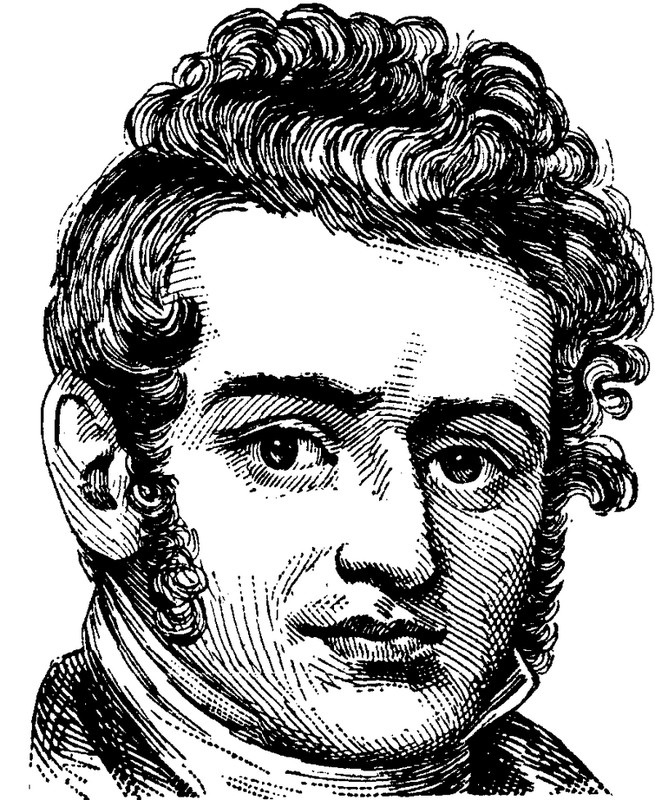
Joseph Rodman Drake
Drake was born in New York, in August 1795. He was descended from the same family as the great admiral of Elizabethan days, the American branch of which had served their country honorably both in colonial and Revolutionary times. The scenes of his boyhood were the same as those that formed the environment of Irving, memories of which are scattered thick through the literature of the day. New York was still a picturesque, hospitable, rural capital, the centre of the present town being miles distant in the country. The best families were all intimately associated in a social life that was cultivated and refined at the same time that it was gay and unconventional; and in this society Drake occupied a place which his lovable qualities and fine talents must have won, even had it been denied him by birth. He was a precocious boy, for whom a career was anticipated by his friends while he was yet a mere child; and when he met Halleck, in his eighteenth year, he had already won some reputation.
The friendship of Drake and Halleck was destined to prove infinitely valuable to both. A discussion between Cooper, Halleck, and Drake, upon the poetic inspiration of American scenery, prompted Drake to write 'The Culprit Fay'—a poem without any human character. This he completed in three days, and offered it as the argument on his side. The scene of the poem is laid in the Highlands of the Hudson, but Drake added many pictures suggested by memories of Long Island Sound, whose waters he haunted with boat and rod. He apologized for this by saying that the purposes of poetry alone could explain the presence so far up the Hudson of so many salt-water emigrants. 'The Culprit Fay' is a creation of pure fancy, full of delicate imagery, and handled with an ethereal lightness of touch. Its exquisite grace, its delicate coloring, its prodigality of charm, explain its immediate popularity and its lasting fame. But the Rip Van Winkle legend is a far more genuine product of fancy.
Drake's few shorter lyrics throb with genuine poetic feeling, and show the loss sustained by literature in the author's early death. Best known of these is 'The American Flag,' which appeared in the Evening Post as one of a series of jeux d'esprit, the joint productions of Halleck and Drake, who either alternated in the composition of the numbers or wrote them together. The last four lines only of 'The American Flag' are Halleck's. The entire series appeared between March and July, 1819, under the signature of "The Croakers." Literary New York was mystified as to the authorship of these skits, which hit off the popular fads, follies, and enthusiasms of the day with so easy and graceful a touch. Politics, music, the drama, and domestic life alike furnished inspiration for the numbers; some of whose titles, as 'A Sketch of a Debate in Tammany' and 'The Battery War,' suggest the local political issues of the present day. There is now in existence a handsome edition of these verses, with the names of the authors of the several pieces appended, and in the case of the joint ownership with the initials D. and H. subscribed.
Drake's complete poems were not published during his lifetime. Sixteen years after his death by consumption in his twenty-sixth year, his daughter issued a volume dedicated to Halleck, in which were included the best specimens of her father's work. Many of the lesser known verses indicate his true place as a poet. In the touching poem 'Abelard to Eloise,' in the third stanza of 'The American Flag,' and in innumerable beautiful lines scattered throughout his work, appears a genuine inspiration.
In his own day, Drake filled a place which his death left forever vacant. His rare and winning personality, his generous friendships, his joy in life, and his courage in the contemplation of his inevitable fate, still appeal to a generation to whom they are but traditions. The exquisite monody in which Halleck celebrated his loss, links their names and decorates their friendship with imperishable garlands.
A WINTER'S TALE
From 'The Croakers'
"A merry heart goes all the way, A sad one tires in a mile-a." —Winter's Tale.
The man who frets at worldly strife Grows sallow, sour, and thin; Give us the lad whose happy life Is one perpetual grin: He, Midas-like, turns all to gold; He smiles when others sigh; Enjoys alike the hot and cold, And laughs through wet and dry.
There's fun in everything we meet; The greatest, worst, and best Existence is a merry treat, And every speech a jest: Be 't ours to watch the crowds that pass Where mirth's gay banner waves; To show fools through a quizzing glass, And bastinade the knaves.
The serious world will scold and ban, In clamor loud and hard, To hear Meigs[A] called a Congressman, And Paulding called a bard: But come what may, the man's in luck Who turns it all to glee, And laughing, cries with honest Puck, "Good Lord! what fools ye be!"
[A] Henry Meigs of New York, a Congressman from 1819 to 1821 in the Sixteenth Congress.
THE CULPRIT FAY
My visual orbs are purged from film, and lo! Instead of Anster's turnip-bearing vales, I see old Fairyland's miraculous show! Her trees of tinsel kissed by freakish gales, Her ouphs that, cloaked in leaf-gold, skim the breeze, And fairies, swarming.... —Tennant's 'Anster Fair'
'Tis the middle watch of a summer's night— The earth is dark, but the heavens are bright; Naught is seen in the vault on high But the moon, and the stars, and the cloudless sky, And the flood which rolls its milky hue, A river of light on the welkin blue. The moon looks down on old Cronest; She mellows the shades on his shaggy breast, And seems his huge gray form to throw In a silver cone on the wave below; His sides are broken by spots of shade, By the walnut bough and the cedar made, And through their clustering branches dark Glimmers and dies the firefly's spark— Like starry twinkles that momently break Through the rifts of the gathering tempest's rack.
The stars are on the moving stream, And fling, as its ripples gently flow, A burnished length of wavy beam In an eel-like, spiral line below; The winds are whist, and the owl is still; The bat in the shelvy rock is hid; And naught is heard on the lonely hill But the cricket's chirp, and the answer shrill Of the gauze-winged katydid; And the plaint of the wailing whippoorwill, Who moans unseen, and ceaseless sings. Ever a note of wail and woe, Till morning spreads her rosy wings, And earth and sky in her glances glow.
'Tis the hour of fairy ban and spell: The wood-tick has kept the minutes well; He has counted them all with click and stroke Deep in the heart of the mountain oak, And he has awakened the sentry elve Who sleeps with him in the haunted tree, To bid him ring the hour of twelve, And call the fays to their revelry; Twelve small strokes on his tinkling bell— ('Twas made of the white snail's pearly shell) "Midnight comes, and all is well! Hither, hither, wing your way! 'Tis the dawn of the fairy day."
They come from beds of lichen green, They creep from the mullein's velvet screen; Some on the backs of beetles fly From the silver tops of moon-touched trees, Where they swung in their cobweb hammocks high, And rocked about in the evening breeze; Some from the hum-bird's downy nest— They had driven him out by elfin power, And pillowed on plumes of his rainbow breast, Had slumbered there till the charmèd hour; Some had lain in the scoop of the rock, With glittering ising-stars inlaid; And some had opened the four-o'clock, And stole within its purple shade. And now they throng the moonlight glade, Above, below, on every side, Their little minim forms arrayed In the tricksy pomp of fairy pride!
They come not now to print the lea, In freak and dance around the tree, Or at the mushroom board to sup, And drink the dew from the buttercup;— A scene of sorrow waits them now, For an ouphe has broken his vestal vow; He has loved an earthly maid, And left for her his woodland shade; He has lain upon her lip of dew, And sunned him in her eye of blue, Fanned her cheek with his wing of air, Played in the ringlets of her hair, And nestling on her snowy breast, Forgot the lily-king's behest. For this the shadowy tribes of air To the elfin court must haste away: And now they stand expectant there, To hear the doom of the culprit fay.
The throne was reared upon the grass, Of spice-wood and of sassafras; On pillars of mottled tortoise-shell Hung the burnished canopy— And o'er it gorgeous curtains fell Of the tulip's crimson drapery. The monarch sat on his judgment seat; On his brow the crown imperial shone; The prisoner fay was at his feet, And his peers were ranged around the throne. He waved his sceptre in the air, He looked around and calmly spoke; His brow was grave and his eye severe, But his voice in a softened accent broke:—
"Fairy! Fairy! list and mark: Thou hast broke thine elfin chain; Thy flame-wood lamp is quenched and dark, And thy wings are dyed with a deadly stain— Thou hast sullied thine elfin purity In the glance of a mortal maiden's eye; Thou hast scorned our dread decree, And thou shouldst pay the forfeit high. But well I know her sinless mind Is pure as the angel forms above, Gentle and meek, and chaste and kind, Such as a spirit well might love; Fairy! had she spot or taint, Bitter had been thy punishment: Tied to the hornet's shardy wings; Tossed on the pricks of nettles' stings; Or seven long ages doomed to dwell With the lazy worm in the walnut-shell; Or every night to writhe and bleed Beneath the tread of the centipede; Or bound in a cobweb dungeon dim, Your jailer a spider, huge and grim, Amid the carrion bodies to lie Of the worm, and the bug, and the murdered fly: These it had been your lot to bear, Had a stain been found on the earthly fair. Now list, and mark our mild decree— Fairy, this your doom must be:—
"Thou shalt seek the beach of sand Where the water bounds the elfin land; Thou shalt watch the oozy brine Till the sturgeon leaps in the bright moonshine, Then dart the glistening arch below, And catch a drop from his silver bow. The water-sprites will wield their arms And dash around, with roar and rave, And vain are the woodland spirits' charms; They are the imps that rule the wave. Yet trust thee in thy single might: If thy heart be pure and thy spirit right, Thou shalt win the warlock fight.
"If the spray-bead gem be won, The stain of thy wing is washed away; But another errand must be done Ere thy crime be lost for aye: Thy flame-wood lamp is quenched and dark,— Thou must re-illume its spark. Mount thy steed and spur him high To the heaven's blue canopy; And when thou seest a shooting star, Follow it fast, and follow it far— The last faint spark of its burning train Shall light the elfin lamp again. Thou hast heard our sentence, fay; Hence! to the water-side, away!"
The goblin marked his monarch well; He spake not, but he bowed him low, Then plucked a crimson colen-bell, And turned him round in act to go. The way is long; he cannot fly; His soilèd wing has lost its power, And he winds adown the mountain high For many a sore and weary hour. Through dreary beds of tangled fern, Through groves of nightshade dark and dern, Over the grass and through the brake, Where toils the ant and sleeps the snake; Now o'er the violet's azure flush He skips along in lightsome mood; And now he thrids the bramble-bush, Till its points are dyed in fairy blood. He has leaped the bog, he has pierced the brier, He has swum the brook and waded the mire, Till his spirits sank and his limbs grew weak, And the red waxed fainter in his cheek. He had fallen to the ground outright, For rugged and dim was his onward track, But there came a spotted toad in sight, And he laughed as he jumped upon her back; He bridled her mouth with a silkweed twist, He lashed her sides with an osier thong. And now, through evening's dewy mist, With leap and spring they bound along, Till the mountain's magic verge is past, And the beach of sand is reached at last. . . . . . . . . . . . . . . . . . . . . . . . . . . . Up, fairy! quit thy chickweed bower, The cricket has called the second hour, Twice again, and the lark will rise To kiss the streaking of the skies— Up! thy charmèd armor don; Thou'lt need it ere the night be gone.
He put his acorn helmet on: It was plumed of the silk of the thistle-down; The corselet plate that guarded his breast Was once the wild bee's golden vest; His cloak, of a thousand mingled dyes, Was formed of the wings of butterflies; His shield was the shell of a lady-bug queen, Studs of gold on a ground of green; And the quivering lance which he brandished bright Was the sting of a wasp he had slain in fight. Swift he bestrode his firefly steed; He bared his blade of the bent-grass blue; He drove his spurs of the cockle-seed, And away like a glance of thought he flew, To skim the heavens, and follow far The fiery trail of the rocket-star.
The moth-fly, as he shot in air, Crept under the leaf and hid her there; The katydid forgot its lay, The prowling gnat fled fast away, The fell mosquito checked his drone And folded his wings till the fay was gone. And the wily beetle dropped his head, And fell on the ground as if he were dead; They crouched them close in the darksome shade, They quaked all o'er with awe and fear, For they had felt the blue-bent blade, And writhed at the prick of the elfin spear; Many a time, on a summer's night, When the sky was clear, and the moon was bright, They had been roused from the haunted ground By the yelp and bay of the fairy hound; They had heard the tiny bugle-horn, They had heard the twang of the maize-silk string, When the vine-twig bows were tightly drawn, And the needle-shaft through air was borne, Feathered with down of the hum-bird's wing. And now they deemed the courier ouphe Some hunter-sprite of the elfin ground; And they watched till they saw him mount the roof That canopies the world around; Then glad they left their covert lair, And freaked about in the midnight air.
Up to the vaulted firmament His path the firefly courser bent, And at every gallop on the wind, He flung a glittering spark behind; He flies like a feather in the blast Till the first light cloud in heaven is past. But the shapes of air have begun their work, And a drizzly mist is round him cast; He cannot see through the mantle murk; He shivers with cold, but he urges fast; Through storm and darkness, sleet and shade, He lashes his steed, and spurs amain— For shadowy hands have twitched the rein, And flame-shot tongues around him played, And near him many a fiendish eye Glared with a fell malignity, And yells of rage, and shrieks of fear, Came screaming on his startled ear.
His wings are wet around his breast, The plume hangs dripping from his crest, His eyes are blurred with the lightning's glare, And his ears are stunned with the thunder's blare. But he gave a shout, and his blade he drew; He thrust before and he struck behind, Till he pierced their cloudy bodies through, And gashed their shadowy limbs of wind; Howling the misty spectres flew; They rend the air with frightful cries; For he has gained the welkin blue, And the land of clouds beneath him lies.
Up to the cope careering swift, In breathless motion fast, Fleet as the swallow cuts the drift, Or the sea-roc rides the blast, The sapphire sheet of eve is shot, The sphered moon is past, The earth but seems a tiny blot On a sheet of azure cast. Oh! it was sweet, in the clear moonlight, To tread the starry plain of even! To meet the thousand eyes of night, And feel the cooling breath of heaven! But the elfin made no stop or stay Till he came to the bank of the Milky Way; Then he checked his courser's foot, And watched for the glimpse of the planet-shoot.
Sudden along the snowy tide That swelled to meet their footsteps' fall, The sylphs of heaven were seen to glide, Attired in sunset's crimson pall; Around the fay they weave the dance, They skip before him on the plain. And one has taken his wasp-sting lance, And one upholds his bridle rein; With warblings wild they lead him on To where, through clouds of amber seen, Studded with stars, resplendent shone The palace of the sylphid queen. Its spiral columns, gleaming bright, Were streamers of the northern light; Its curtain's light and lovely flush Was of the morning's rosy blush; And the ceiling fair that rose aboon, The white and feathery fleece of noon. . . . . . . . . . . . . . . . . . . . . . . . . . . . Borne afar on the wings of the blast, Northward away he speeds him fast, And his courser follows the cloudy wain Till the hoof-strokes fall like pattering rain. The clouds roll backward as he flies. Each flickering star behind him lies, And he has reached the northern plain, And backed his firefly steed again, Ready to follow in its flight The streaming of the rocket-light.
The star is yet in the vault of heaven, But it rocks in the summer gale, And now 'tis fitful and uneven, And now 'tis deadly pale; And now 'tis wrapped in sulphur-smoke, And quenched is its rayless beam; And now with a rattling thunder-stroke It bursts in flash and flame. As swift as the glance of the arrowy lance That the storm spirit flings from high, The star-shot flew o'er the welkin blue, As it fell from the sheeted sky. As swift as the wind in its train behind The elfin gallops along: The fiends of the clouds are bellowing loud. But the sylphid charm is strong; He gallops unhurt in the shower of fire, While the cloud-fiends fly from the blaze; He watches each flake till its sparks expire, And rides in the light of its rays.
But he drove his steed to the lightning's speed, And caught a glimmering spark; Then wheeled around to the fairy ground, And sped through the midnight dark. . . . . . . . . . . . . . . . . . . . . . . . . . . . Ouphe and goblin! imp and sprite! Elf of eve! and starry fay! Ye that love the moon's soft light, Hither, hither, wend your way; Twine ye in a jocund ring, Sing and trip it merrily, Hand to hand, and wing to wing, Round the wild witch-hazel tree.
Hail the wanderer again With dance and song, and lute and lyre; Pure his wing and strong his chain, And doubly bright his fairy fire. Twine ye in an airy round, Brush the dew and print the lea; Skip and gambol, hop and bound, Round the wild witch-hazel tree.
The beetle guards our holy ground, He flies about the haunted place, And if mortal there be found, He hums in his ears and flaps his face; The leaf-harp sounds our roundelay, The owlet's eyes our lanterns be; Thus we sing and dance and play, Round the wild witch-hazel tree.
But hark! from tower on tree-top high, The sentry elf his call has made; A streak is in the eastern sky; Shapes of moonlight! flit and fade! The hill-tops gleam in Morning's spring, The skylark shakes his dappled wing, The day-glimpse glimmers on the lawn,— The cock has crowed, and the fays are gone.
THE AMERICAN FLAG
[A] Henry Meigs of New York, a Congressman from 1819 to 1821 in the Sixteenth Congress.
To hear Meigs[A] called a Congressman,
When Freedom from her mountain height Unfurled her standard to the air, She tore the azure robe of night, And set the stars of glory there; She mingled with its gorgeous dyes The milky baldric of the skies, And striped its pure celestial white With streakings of the morning light; Then from his mansion in the sun She called her eagle-bearer down, And gave unto his mighty hand The symbol of her chosen land.
Majestic monarch of the cloud! Who rear'st aloft thy regal form, To hear the tempest-trumpings loud, And see the lightning lances driven, When strive the warriors of the storm, And rolls the thunder-drum of heaven— Child of the sun! to thee 'tis given To guard the banner of the free, To hover in the sulphur-smoke, To ward away the battle-stroke, And bid its blendings shine afar, Like rainbows on the cloud of war, The harbingers of victory!
Flag of the brave! thy folds shall fly, The sign of hope and triumph high, When speaks the signal trumpet-tone, And the long line comes gleaming on: Ere yet the life-blood, warm and wet, Has dimmed the glistening bayonet, Each soldier eye shall brightly turn To where the sky-born glories burn, And as his springing steps advance, Catch war and vengeance from the glance; And when the cannon-mouthings loud Heave in wild wreaths the battle-shroud, And gory sabres rise and fall, Like shoots of flame on midnight's pall;— Then shall thy meteor-glances glow, And cowering foes shall sink beneath Each gallant arm that strikes below That lovely messenger of death.
Flag of the seas! on ocean wave Thy stars shall glitter o'er the brave; When death, careering on the gale, Sweeps darkly round the bellied sail, And frighted waves rush wildly back Before the broadside's reeling rack, Each dying wanderer of the sea Shall look at once to heaven and thee, And smile to see thy splendors fly In triumph o'er his closing eye.
Flag of the free heart's hope and home! By angel hands to valor given; Thy stars have lit the welkin dome, And all thy hues were born in heaven. Forever float that standard sheet! Where breathes the foe but falls before us, With Freedom's soil beneath our feet, And Freedom's banner streaming o'er us!
JOHN WILLIAM DRAPER
(1811-1882)

he subject of this sketch was born at St. Helen's, near Liverpool, England, on the 5th of May, 1811. His earliest education was obtained at a Wesleyan Methodist school, but after a time he came under private teachers, with whose help he made rapid progress in the physical sciences, thus showing in his boyhood the natural bent of his mind and the real strength of his intellect. He afterwards studied for a time at the University of London, but in 1833 came to the United States, and three years later graduated at the University of Pennsylvania with the degree of M. D. In 1839 he was elected to the chair of chemistry in the University of New York, a position which he held until his death in 1882.
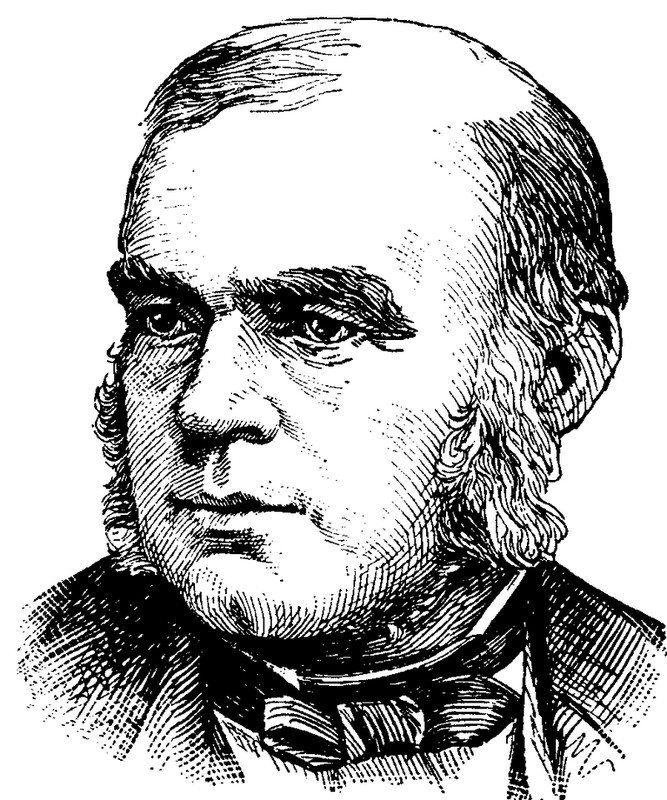
John William Draper
Draper's contributions to science were of a high order. He discovered some of the facts that lie at the basis of spectrum analysis; he was one of the first successful experimenters in the art of photography; and he made researches in radiant energy and other scientific phenomena. He published in 1858 a treatise on 'Human Physiology,' which is a highly esteemed and widely used text-book. He died on the 4th of January, 1882.
Draper's chief contributions to literature are three works: 'History of the Intellectual Development of Europe' (1863), a 'History of the American Civil War' (1867-1870), and 'The History of the Conflict between Religion and Science,' which appeared in the International Scientific Series in 1873. Of these works, the one on the intellectual development of Europe is the ablest, and takes a place beside the works of Lecky and Buckle as a contribution to the history of civilization. The history of the Civil War was written too soon after the events described to have permanent historical value. 'The History of the Conflict between Religion and Science' is a judicial presentation of the perennial controversy from the standpoint of the scientist.
Draper's claims to attention as a philosophic historian rest mainly on his theory of the influence of climate on human character and development. He maintains that "For every climate, and indeed for every geographical locality, there is an answering type of humanity"; and in his history of the American Civil War, as well as in his work on the intellectual development of Europe, he endeavored to prove that doctrine. Another theory which is prominent in his principal work is, that the intellectual development of every people passes through five stages; namely, 1, the Age of Credulity; 2, the Age of Inquiry; 3, the Age of Faith; 4, the Age of Reason; 5, the Age of Decrepitude. Ancient Greece, he thinks, passed through all those stages, the age of reason beginning with the advent of physical science. Europe as a whole has now also entered the age of reason, which as before he identifies with the age of physical science; so that everywhere in his historical works, physical influences and the scientific knowledge of physical phenomena are credited with most of the progress that mankind has made. Draper has left a distinct mark upon the scientific thought of his generation, and made a distinct and valuable contribution to the literature of his adopted country.
THE VEDAS AND THEIR THEOLOGY
From 'History of the Intellectual Development of Europe.' Copyright 1876, by Harper & Brothers
The Vedas, which are the Hindu Scriptures, and of which there are four,—the Rig, Yagust, Saman, and Atharvan,—are asserted to have been revealed by Brahma. The fourth is however rejected by some authorities, and bears internal evidence of a later composition, at a time when hierarchical power had become greatly consolidated. These works are written in an obsolete Sanskrit, the parent of the more recent idiom. They constitute the basis of an extensive literature, Upavedas, Angas, etc., of connected works and commentaries. For the most part they consist of hymns suitable for public and private occasions, prayers, precepts, legends, and dogmas. The Rig, which is the oldest, is composed chiefly of hymns; the other three of liturgical formulas. They are of different periods and of various authorship, internal evidence seeming to indicate that if the later were composed by priests, the earlier were the production of military chieftains. They answer to a state of society advanced from the nomad to the municipal condition. They are based upon an acknowledgment of a universal Spirit, pervading all things. Of this God they therefore necessarily acknowledge the unity: "There is in truth but one Deity, the Supreme Spirit, the Lord of the universe, whose work is the universe." "The God above all gods, who created the earth, the heavens, and waters." The world, thus considered as an emanation of God, is therefore a part of him; it is kept in a visible state by his energy, and would instantly disappear if that energy were for a moment withdrawn. Even as it is, it is undergoing unceasing transformations, everything being in a transitory condition. The moment a given phase is reached, it is departed from, or ceases. In these perpetual movements the present can scarcely be said to have any existence, for as the Past is ending, the Future has begun.
In such a never-ceasing career all material things are urged, their forms continually changing, and returning as it were through revolving cycles to similar states. For this reason it is that we may regard our earth and the various celestial bodies as having had a moment of birth, as having a time of continuance, in which they are passing onward to an inevitable destruction; and that after the lapse of countless ages similar progresses will be made, and similar series of events will occur again and again.
But in this doctrine of universal transformation there is something more than appears at first. The theology of India is underlaid with Pantheism. "God is One because he is All." The Vedas, in speaking of the relation of nature to God, make use of the expression that he is the material as well as the cause of the universe, "the clay as well as the Potter." They convey the idea that while there is a pervading spirit existing everywhere, of the same nature as the soul of man, though differing from it infinitely in degree, visible nature is essentially and inseparably connected therewith; that as in man the body is perpetually undergoing changes, perpetually decaying and being renewed,—or as in the case of the whole human species, nations come into existence and pass away,—yet still there continues to exist what may be termed the universal human mind, so forever associated and forever connected are the material and the spiritual. And under this aspect we must contemplate the Supreme Being, not merely as a presiding intellect, but as illustrated by the parallel case of man, whose mental principle shows no tokens except through its connection with the body: so matter, or nature, or the visible universe, is to be looked upon as the corporeal manifestation of God.
PRIMITIVE BELIEFS DISMISSED BY SCIENTIFIC KNOWLEDGE
From 'History of the Intellectual Development of Europe.' Copyright 1876, by Harper & Brothers
As man advances in knowledge, he discovers that of his primitive conclusions some are doubtless erroneous, and many require better evidence to establish their truth incontestably. A more prolonged and attentive examination gives him reason, in some of the most important particulars, to change his mind. He finds that the earth on which he lives is not a floor covered over with a starry dome, as he once supposed, but a globe self-balanced in space. The crystalline vault, or sky, is recognized to be an optical deception. It rests upon the earth nowhere, and is no boundary at all; there is no kingdom of happiness above it, but a limitless space adorned with planets and suns. Instead of a realm of darkness and woe in the depths on the other side of the earth, men like ourselves are found there, pursuing, in Australia and New Zealand, the innocent pleasures and encountering the ordinary labors of life. By the aid of such lights as knowledge gradually supplies, he comes at last to discover that this our terrestrial habitation, instead of being a chosen, a sacred spot, is only one of similar myriads, more numerous than the sands of the sea, and prodigally scattered through space.
Never, perhaps, was a more important truth discovered. All the visible evidence was in direct opposition to it. The earth, which had hitherto seemed to be the very emblem of immobility, was demonstrated to be carried with a double motion, with prodigious velocity, through the heavens; the rising and setting of the stars were proved to be an illusion; and as respects the size of the globe, it was shown to be altogether insignificant when compared with multitudes of other neighboring ones—insignificant doubly by reason of its actual dimensions, and by the countless numbers of others like it in form, and doubtless like it the abodes of many orders of life.
And so it turns out that our earth is a globe of about twenty-five thousand miles in circumference. The voyager who circumnavigates it spends no inconsiderable portion of his life in accomplishing his task. It moves round the sun in a year, but at so great a distance from that luminary that if seen from him, it would look like a little spark traversing the sky. It is thus recognized as one of the members of the solar system. Other similar bodies, some of which are of larger, some of smaller dimensions, perform similar revolutions round the sun in appropriate periods of time.
If the magnitude of the earth be too great for us to attach to it any definite conception, what shall we say of the compass of the solar system? There is a defect in the human intellect, which incapacitates us for comprehending distances and periods that are either too colossal or too minute. We gain no clearer insight into the matter, when we are told that a comet which does not pass beyond the bounds of the system may perhaps be absent on its journey for more than a thousand years. Distances and periods such as these are beyond our grasp. They prove to us how far human reason excels imagination; the one measuring and comparing things of which the other can form no conception, but in the attempt is utterly bewildered and lost.
But as there are other globes like our earth, so too there are other worlds like our solar system. There are self-luminous suns, exceeding in number all computation. The dimensions of this earth pass into nothingness in comparison with the dimensions of the solar system, and that system in its turn is only an invisible point if placed in relation with the countless hosts of other systems, which form with it clusters of stars. Our solar system, far from being alone in the universe, is only one of an extensive brotherhood, bound by common laws and subject to like influences. Even on the very verge of creation, where imagination might lay the beginning of the realms of chaos, we see unbounded proofs of order, a regularity in the arrangement of inanimate things, suggesting to us that there are other intellectual creatures like us, the tenants of those islands in the abysses of space.
Though it may take a beam of light a million years to bring to our view those distant worlds, the end is not yet. Far away in the depths of space we catch the faint gleams of other groups of stars like our own. The finger of a man can hide them in their remoteness. Their vast distances from one another have dwindled into nothing. They and their movements have lost all individuality; the innumerable suns of which they are composed blend all their collected light into one pale milky glow.
Thus extending our view from the earth to the solar system, from the solar system to the expanse of the group of stars to which we belong, we behold a series of gigantic nebular creations rising up one after another, and forming greater and greater colonies of worlds. No numbers can express them, for they make the firmament a haze of stars. Uniformity, even though it be the uniformity of magnificence, tires at last, and we abandon the survey; for our eyes can only behold a boundless prospect, and conscience tells us our own unspeakable insignificance.
But what has become of the time-honored doctrine of the human destiny of the universe?—that doctrine for the sake of which the controversy I have described in this chapter was raised? It has disappeared. In vain was Bruno burnt and Galileo imprisoned; the truth forced its way, in spite of all opposition, at last. The end of the conflict was a total rejection of authority and tradition, and the adoption of scientific truth.
THE KORAN
From 'History of the Intellectual Development of Europe.' Copyright 1876, by Harper & Brothers
Arabian influence, thus imposing itself on Africa and Asia by military successes, and threatening even Constantinople, rested essentially on an intellectual basis, the value of which it is needful for us to consider. The Koran, which is that basis, has exercised a great control over the destinies of mankind, and still serves as a rule of life to a very large portion of our race. Considering the asserted origin of this book,—indirectly from God himself,—we might justly expect that it would bear to be tried by any standard that man can apply, and vindicate its truth and excellence in the ordeal of human criticism. In our estimate of it, we must constantly bear in mind that it does not profess to be successive revelations made at intervals of ages and on various occasions, but a complete production delivered to one man. We ought therefore to look for universality, completeness, perfection. We might expect that it would present us with just views of the nature and position of this world in which we live, and that whether dealing with the spiritual or the material, it would put to shame the most celebrated productions of human genius, as the magnificent mechanism of the heavens and the beautiful living forms of the earth are superior to the vain contrivances of man. Far in advance of all that has been written by the sages of India, or the philosophers of Greece, on points connected with the origin, nature, and destiny of the universe, its dignity of conception and excellence of expression should be in harmony with the greatness of the subject with which it is concerned.
AFRICAN ARABIC MANUSCRIPT. Thirteenth Century. National Library, Paris. Reduced fac-simile of part of a page of an Arabic Koran, in the African character, captured at Tunis by Charles V.
The scribes of the East are distinguished by their efforts to acquire a perfect style of execution; and their success merits the greater praise, since they generally stand while writing, resting only on the left arm; and notwithstanding the inferiority of the reed to the modern pen, the Arabs have succeeded in producing the most excellent specimens of calligraphy.
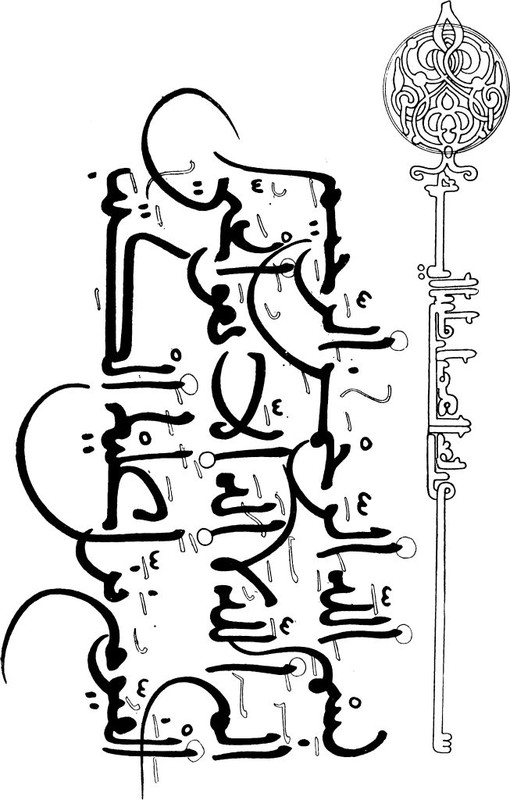
We might expect that it should propound with authority, and definitively settle, those all-important problems which have exercised the mental powers of the ablest men of Asia and Europe for so many centuries, and which are at the foundation of all faith and all philosophy; that it should distinctly tell us in unmistakable language what is God, what is the world, what is the soul, and whether man has any criterion of truth; that it should explain to us how evil can exist in a world the Maker of which is omnipotent and altogether good; that it should reveal to us in what the affairs of men are fixed by Destiny, in what by free-will; that it should teach us whence we came, what is the object of our continuing here, what is to become of us hereafter. And since a written work claiming a divine origin must necessarily accredit itself even to those most reluctant to receive it, its internal evidences becoming stronger and not weaker with the strictness of the examination to which they are submitted, it ought to deal with those things that may be demonstrated by the increasing knowledge and genius of man; anticipating therein his conclusions.
Such a work, noble as may be its origin, must not refuse but court the test of natural philosophy, regarding it not as an antagonist but as its best support. As years pass on, and human science becomes more exact and more comprehensive, its conclusions must be found in unison therewith. When occasion arises, it should furnish us at least the foreshadowings of the great truths discovered by astronomy and geology, not offering for them the wild fictions of earlier ages, inventions of the infancy of man. It should tell us how suns and worlds are distributed in infinite space, and how in their successions they come forth in limitless time. It should say how far the dominion of God is carried out by law, and what is the point at which it is his pleasure to resort to his own good providence or his arbitrary will. How grand the description of this magnificent universe, written by the Omnipotent hand! Of man it should set forth his relations to other living beings, his place among them, his privileges and responsibilities. It should not leave him to grope his way through the vestiges of Greek philosophy, and to miss the truth at last; but it should teach him wherein true knowledge consists, anticipating the physical science, physical power, and physical well-being of our own times, nay, even unfolding for our benefit things that we are still ignorant of. The discussion of subjects so many and so high is not outside the scope of a work of such pretensions. Its manner of dealing with them is the only criterion it can offer of its authenticity to succeeding times.
Tried by such a standard, the Koran altogether fails. In its philosophy it is incomparably inferior to the writings of Chakia Mouni, the founder of Buddhism; in its science it is absolutely worthless. On speculative or doubtful things it is copious enough; but in the exact, where a test can be applied to it, it totally fails. Its astronomy, cosmogony, physiology, are so puerile as to invite our mirth, if the occasion did not forbid. They belong to the old times of the world, the morning of human knowledge. The earth is firmly balanced in its seat by the weight of the mountains; the sky is supported over it like a dome, and we are instructed in the wisdom and power of God by being told to find a crack in it if we can. Ranged in stories, seven in number, are the heavens, the highest being the habitation of God, whose throne—for the Koran does not reject Assyrian ideas—is sustained by winged animal forms. The shooting stars are pieces of red-hot stone, thrown by angels at impure spirits when they approach too closely. Of God the Koran is full of praise, setting forth, often in not unworthy imagery, his majesty. Though it bitterly denounces those who give him any equals, and assures them that their sin will never be forgiven; that in the Judgment Day they must answer the fearful question, "Where are my companions about whom ye disputed?"—though it inculcates an absolute dependence on the mercy of God, and denounces as criminals all those who make a merchandise of religion,—its ideas of the Deity are altogether anthropomorphic. He is only a gigantic man, living in a paradise. In this respect, though exceptional passages might be cited, the reader rises from a perusal of the one hundred and fourteen chapters of the Koran with a final impression that they have given him low and unworthy thoughts; nor is it surprising that one of the Mohammedan sects reads it in such a way as to find no difficulty in asserting that "from the crown of the head to the breast God is hollow, and from the breast downward he is solid;" that he "has curled black hair, and roars like a lion at every watch of the night." The unity asserted by Mohammed is a unity in special contradistinction to the Trinity of the Christians, and the doctrine of a Divine generation. Our Savior is never called the Son of God, but always the Son of Mary. Throughout there is a perpetual acceptance of the delusion of the human destiny of the universe. As to man, Mohammed is diffuse enough respecting a future state, speaking with clearness of a resurrection, the Judgment Day, Paradise, the torment of hell, the worm that never dies, the pains that never end; but with all this precise description of the future, there are many errors as to the past. If modesty did not render it unsuitable to speak of such topics here, it might be shown how feeble is his physiology when he has occasion to allude to the origin or generation of man. He is hardly advanced beyond the ideas of Thales. One who is so untrustworthy a guide as to things that are past cannot be very trustworthy as to events that are to come.
Of the literary execution of his work, it is perhaps scarcely possible to judge fairly from a translation. It is said to be the oldest prose composition among the Arabs, by whom Mohammed's boast of the unapproachable excellence of his work is almost universally sustained; but it must not be concealed that there have been among them very learned men who have held it in light esteem. Its most celebrated passages, as those on the nature of God, in Chapters ii., xxiv., will bear no comparison with parallel ones in the Psalms and Book of Job. In the narrative style, the story of Joseph in Chapter xii., compared with the same incidents related in Genesis, shows a like inferiority. Mohammed also adulterates his work with many Christian legends, derived probably from the apocryphal gospel of St. Barnabas; he mixes with many of his own inventions the Scripture account of the temptation of Adam, the Deluge, Jonah and the whale, enriching the whole with stories like the later Night Entertainments of his country, the seven sleepers, Gog and Magog, and all the wonders of genii, sorcery, and charms.
An impartial reader of the Koran may doubtless be surprised that so feeble a production should serve its purpose so well. But the theory of religion is one thing, the practice another. The Koran abounds in excellent moral suggestions and precepts; its composition is so fragmentary that we cannot turn to a single page without finding maxims of which all men must approve. This fragmentary construction yields texts and mottoes and rules complete in themselves, suitable for common men in any of the incidents of life. There is a perpetual insisting on the necessity of prayer, an inculcation of mercy, almsgiving, justice, fasting, pilgrimage, and other good works; institutions respecting conduct, both social and domestic, debts, witnesses, marriage, children, wine, and the like; above all, a constant stimulation to do battle with the infidel and blasphemer. For life as it passes in Asia, there is hardly a condition in which passages from the Koran cannot be recalled suitable for instruction, admonition, consolation, encouragement. To the Asiatic and to the African, such devotional fragments are of far more use than any sustained theological doctrine. The mental constitution of Mohammed did not enable him to handle important philosophical questions with the well-balanced ability of the great Greek and Indian writers; but he has never been surpassed in adaptation to the spiritual wants of humble life, making even his fearful fatalism administer thereto. A pitiless destiny is awaiting us; yet the prophet is uncertain what it may be. "Unto every nation a fixed time is decreed. Death will overtake us even in lofty towers, but God only knoweth the place in which a man shall die." After many an admonition of the resurrection and the Judgment Day, many a promise of Paradise and threat of hell, he plaintively confesses, "I do not know what will be done with you or me hereafter."
The Koran thus betrays a human and not a very noble intellectual origin. It does not however follow that its author was, as is so often asserted, a mere impostor. He reiterates again and again, "I am nothing more than a public preacher." He defends, not always without acerbity, his work from those who even in his own life stigmatized it as a confused heap of dreams, or what is worse, a forgery. He is not the only man who has supposed himself to be the subject of supernatural and divine communications, for this is a condition of disease to which any one, by fasting and mental anxiety, may be reduced.
In what I have thus said respecting a work held by so many millions of men as a revelation from God, I have endeavored to speak with respect and yet with freedom, constantly bearing in mind how deeply to this book Asia and Africa are indebted for daily guidance, how deeply Europe and America for the light of science.
As might be expected, the doctrines of the Koran have received many fictitious additions and sectarian interpretations in the course of ages. In the popular superstition angels and genii largely figure. The latter, being of a grosser fabric, eat, drink, propagate their kind, are of two sorts, good and bad, and existed long before men, having occupied the earth before Adam. Immediately after death, two greenish livid angels, Monkir and Nekkar, examine every corpse as to its faith in God and Mohammed; but the soul, having been separated from the body by the angel of death, enters upon an intermediate state, awaiting the resurrection. There is however much diversity of opinion as to its precise disposal before the Judgment Day: some think that it hovers near the grave; some, that it sinks into the well Zemzem; some, that it retires into the trumpet of the angel of the resurrection; the difficulty apparently being that any final disposal before the Day of Judgment would be anticipatory of that great event, if indeed it would not render it needless. As to the resurrection, some believe it to be merely spiritual, others corporeal; the latter asserting that the os coccygis, or last bone of the spinal column, will serve as it were as a germ; and that, vivified by a rain of forty days, the body will sprout from it. Among the signs of the approaching resurrection will be the rising of the sun in the west. It will be ushered in by three blasts of a trumpet: the first, known as the blast of consternation, will shake the earth to its centre, and extinguish the sun and stars; the second, the blast of extermination, will annihilate all material things except Paradise, hell, and the throne of God. Forty years subsequently, the angel Israfil will sound the blast of resurrection. From his trumpet there will be blown forth the countless myriads of souls who have taken refuge therein, or lain concealed. The Day of Judgment has now come. The Koran contradicts itself as to the length of this day; in one place making it a thousand, in another fifty thousand years. Most Mohammedans incline to adopt the longer period, since angels, genii, men, and animals have to be tried.
As to men, they will rise in their natural state, but naked; white-winged camels, with saddles of gold, awaiting the saved. When the partition is made, the wicked will be oppressed with an intolerable heat, caused by the sun, which, having been called into existence again, will approach within a mile, provoking a sweat to issue from them; and this, according to their demerits, will immerse them from the ankles to the mouth; but the righteous will be screened by the shadow of the throne of God. The Judge will be seated in the clouds, the books open before him, and everything in its turn called on to account for its deeds. For greater dispatch, the angel Gabriel will hold forth his balance, one scale of which hangs over Paradise and one over hell. In these all works are weighed. As soon as the sentence is delivered, the assembly, in a long file, will pass over the bridge Al-Sirat. It is as sharp as the edge of a sword, and laid over the mouth of hell. Mohammed and his followers will successfully pass the perilous ordeal; but the sinners, giddy with terror, will drop into the place of torment. The blessed will receive their first taste of happiness at a pond which is supplied by silver pipes from the river Al-Cawthor. The soil of Paradise is of musk. Its rivers tranquilly flow over pebbles of rubies and emeralds. From tents of hollow pearls the Houris, or girls of Paradise, will come forth, attended by troops of beautiful boys. Each saint will have eighty thousand servants and seventy-two girls. To these, some of the more merciful Mussulmans add the wives they have had upon earth; but the grimly orthodox assert that hell is already nearly filled with women. How can it be otherwise, since they are not permitted to pray in a mosque upon earth?
I have not space to describe the silk brocades, the green clothing, the soft carpets, the banquets, the perpetual music and songs. From the glorified body all impurities will escape, not as they did during life, but in a fragrant perspiration of camphor and musk. No one will complain, "I am weary;" no one will say, "I am sick.".
From the contradictions, puerilities, and impossibilities indicated in the preceding paragraphs, it may be anticipated that the faith of Mohammed has been broken into many sects. Of such it is said that not less than seventy-three may be numbered. Some, as the Sonnites, are guided by traditions; some occupy themselves with philosophical difficulties,—the existence of evil in the world, the attributes of God, absolute predestination and eternal damnation, the invisibility and non-corporeality of God, his capability of local motion.... But the great Mohammedan philosophers, simply accepting the doctrine of the oneness of God as the only thing of which man can be certain, look upon all the rest as idle fables—having however this political use: that they furnish contention and therefore occupation to disputatious sectarians, and consolation to illiterate minds.
MICHAEL DRAYTON
(1563-1631)

hile London still crowded to the new "Theatre" in Shoreditch, the first built in England; while Ben Jonson was still soldiering in the Low Countries; while Marlowe was working out the tragedy that was to revolutionize all stage traditions, and Shakespeare was yet but a "looker-on at greatness,"—there came up from Warwickshire a young man of good family who had served as page in a noble house, who had studied possibly at Oxford, and who in the first flush of manhood aspired to a place among those prodigies who made the later Elizabethan period immortal. This was Michael Drayton, whose gentle birth and breeding, education and talents, knowledge of the world and of men, together with a most sweet and lovable disposition, made him at once welcome in the literary Bohemia of the day. He became the "deare and bosom friend" of Beaumont and Fletcher, and his work received unquestioned honor from his illustrious contemporaries.
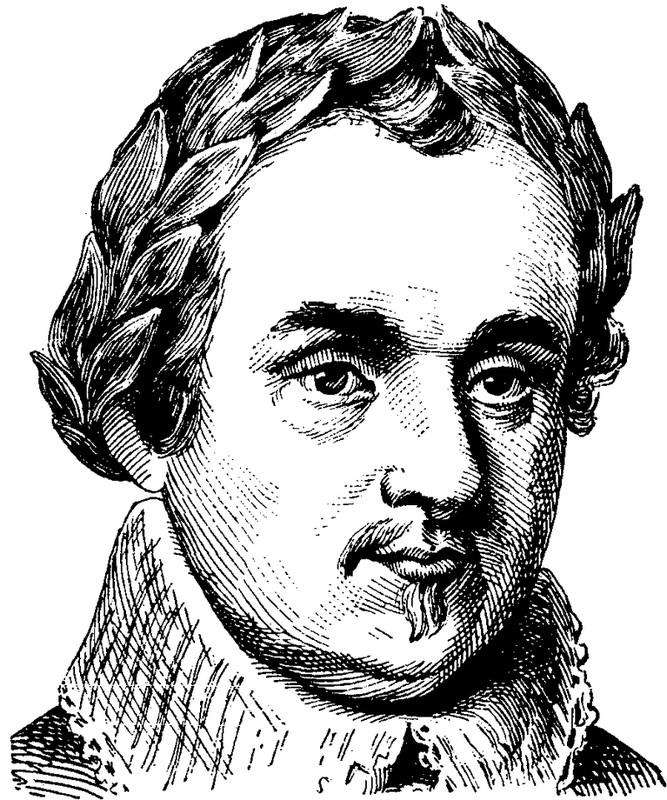
Michael Drayton
As a child he had demanded of his elders to know what kind of beings poets were, had spent many hours in writing childishly fantastic verses, and had begged of his tutor to make a poet of him. And although he seems to have been poor and to have lived by the gifts of wealthy patrons, he cast in his lot with literature, and cherished no other ambition than that of writing well. His first book, a volume of spiritual poems, or metrical renderings of the Bible, was published in 1590 under the title 'The Harmony of the Church.' It is difficult to see why this commonplace and orthodox performance should have given such umbrage that the Archbishop of Canterbury condemned the entire edition to destruction. Yet this was its fate, with the exception of forty copies which Archbishop Whitgift ordered to be reserved for the ecclesiastical library at Lambeth Palace. Undiscouraged, the poet next produced a cycle of sixty-four sonnets and a collection of pastorals entitled 'Idea: the Shepherd's Garland,' in which under the name "Rowland" he celebrated an early love. It is strange that the intrinsic merit of these verses, and their undoubted popularity, should not have urged Drayton to continue in the same vein. Instead, however, he set about the composition of a series of historical poems which extended over the next twenty-four years, and to which he gave the best energies of his life. Beginning with the epic 'Matilda,' studied from English history, the series was continued by a poem on the 'Wars of the Roses,' afterward enlarged into 'The Barons' Wars.' This was followed by the epic 'Robert, Duke of Normandy.' Destitute of imagination, prolix and tedious, these verses were yet so popular in Drayton's day that in 1612 he began the publication of a poem in thirty books, meant to include the entire chronology and topography of Great Britain, from the earliest times. This was the famous 'Poly-Olbion,' in which, in spite of the inspiring work of his contemporaries, Drayton harked back in spirit to the dreary monotony of the Saxon Chronicle; the detail is so minute, the matter so unimportant, and the absence of discrimination so apparent, that notwithstanding many noticeable beauties of thought and style, it is hard to realize that this poem was a favorite with that brilliant group which had known Shakespeare, and still delighted in Ben Jonson. After issuing eighteen books of 'Poly-Olbion,' his publishers—with whom he was always quarreling, and whom he declared that he "despised and kicked at"—refused to undertake the remaining twelve books of the second part. His friends, however, loyal in their love and praise of him, secured a more complaisant tradesman to bring out the rest of the already famous poem.
Fortunately for his fame, Drayton had in the mean time produced two other volumes of verse, which displayed the real grace and fancifulness of his charming muse. The first of these, 'Poems Lyrical and Pastoral,' included the satire 'The Man in the Moon'; while in the second were printed the 'Ballad of Agincourt,' the most spirited of English martial lyrics, and that delightful fantasy 'Nymphidia, or the Court of Faery,' in which the touch is so light, the fancy so dainty, and the conceit so delicate, that the poem remains immortally fresh and young. Because everybody wrote plays, Drayton turned playwright, and is said to have collaborated with Massinger and Ford. Of his long works, the 'Heroicall Episodes' is perhaps the most readable. His last effort was 'The Muses' Elizium,' published in 1630. A year later he died, and was buried in Westminster, where a monument was erected to him by the Countess of Dorset.
Drayton's place in English literature is with that considerable and not unimportant band who have done somewhat, but whose repute is much more for what they were in their friends' eyes than for what they did. In an age of great intellectual achievement, he yet managed, in spite of the stimulus of kindred minds and his own undoubted gift, to produce little that has sustained the reputation accorded him by his acquaintances. Most of his work lives chiefly to afford pleasing studies for the literary antiquary, to whom the tide of time brings nothing uninteresting. Yet in the art of living, in the unselfish devotion of his powers to his chosen calling, in the graces of affection and the offices of noble friendship, he was so excellent and exemplary that he won and kept the undying regard of the most able men of the most brilliant period of English literature—men who felt a personal and unrequitable loss when he passed away, and who spoke of him always with admiring tenderness.
In person he seems to have been small and dark. He describes himself as of "swart and melancholy face." Yet his talk was most delightful, and a strong proof of his wide popularity appears in the fact that he is quoted not less than one hundred and fifty times in 'England's Parnassus,' published as early as 1600. The tributes of his friends are innumerable, from the "good Rowland" of Barnfield to the "golden-mouthed Drayton, musicall," of Fitz-Geoffrey, the "man of vertuous disposition, honest conversation, and well-preserved carriage" of Meres, or the tender lines of his friend Ben Jonson:—
"Do, pious marble, let thy readers know What they and what their children owe To Drayton's name; whose sacred dust We recommend unto thy trust. Protect his memory, and preserve his story, Remain a lasting monument of his glory. And when thy ruins shall disclaim To be the treasurer of his name, His name, that cannot die, shall be An everlasting monument to thee."
SONNET
Since there's no help, come, let us kiss and part,— Nay, I have done, you get no more of me; And I am glad, yea, glad with all my heart, That thus so clearly I myself can free: Shake hands forever, cancel all our vows, And when we meet at any time again, Be it not seen in either of our brows That we one jot of former love retain. Now, at the last gasp of Love's latest breath. When, his pulse failing, Passion speechless lies, When Faith is kneeling by his bed of death, And Innocence is closing up his eyes,— Now, if thou wouldst, when all have given him over, From death to life thou mightst him yet recover!
THE BALLAD OF AGINCOURT
Fair stood the wind for France, When we our sails advance, Nor now to prove our chance Longer will tarry; But putting to the main, At Kaux, the mouth of Seine, With all his martial train, Landed King Harry.
And taking many a fort, Furnished in warlike sort, Marched towards Agincourt In happy hour— Skirmishing day by day With those that stopped his way, Where the French gen'ral lay With all his power.
Which in his height of pride, King Henry to deride, His ransom to provide To the King sending; Which he neglects the while, As from a nation vile, Yet, with an angry smile, Their fall portending.
And turning to his men, Quoth our brave Henry then:— "Though they to one be ten, Be not amazed; Yet have we well begun— Battles so bravely won Have ever to the sun By fame been raised.
"And for myself," quoth he, "This my full rest shall be; England ne'er mourn for me, Nor more esteem me; Victor I will remain, Or on this earth lie slain; Never shall she sustain Loss to redeem me.
"Poitiers and Cressy tell, When most their pride did swell, Under our swords they fell; No less our skill is Than when our grandsire great, Claiming the regal seat, By many a warlike feat Lopped the French lilies."
The Duke of York so dread The eager vaward led; With the main Henry sped, Amongst his henchmen. Excester had the rear— A braver man not there: O Lord! how hot they were On the false Frenchmen!
They now to fight are gone; Armor on armor shone; Drum now to drum did groan— To hear was wonder; That with the cries they make The very earth did shake; Trumpet to trumpet spake, Thunder to thunder.
Well it thine age became, O noble Erpingham! Which did the signal aim To our hid forces; When from a meadow by, Like a storm suddenly, The English archery Struck the French horses,
With Spanish yew so strong, Arrows a cloth-yard long, That like to serpents stung, Piercing the weather; None from his fellow starts, But playing manly parts, And like true English hearts, Stuck close together.
When down their bows they threw, And forth their bilbows drew, And on the French they flew, Not one was tardy; Arms were from shoulders sent; Scalps to the teeth were rent; Down the French peasants went;— Our men were hardy.
This while our noble king, His broadsword brandishing, Down the French host did ding, As to o'erwhelm it; And many a deep wound lent, His arm with blood besprent, And many a cruel dent Bruisèd his helmet.
Glo'ster, that duke so good, Next of the royal blood, For famous England stood, With his brave brother— Clarence, in steel so bright, Though but a maiden knight, Yet in that furious fight Scarce such another.
Warwick in blood did wade; Oxford the foe invade, And cruel slaughter made, Still as they ran up. Suffolk his axe did ply; Beaumont and Willoughby Bare them right doughtily, Ferrers and Fanhope.
Upon Saint Crispin's day Fought was this noble fray, Which fame did not delay To England to carry; Oh, when shall Englishmen With such acts fill a pen, Or England breed again Such a King Harry?