


автордың кітабын онлайн тегін оқу Актуальные проблемы современности. Практикум общественно-политического перевода (английский язык). Учебное пособие
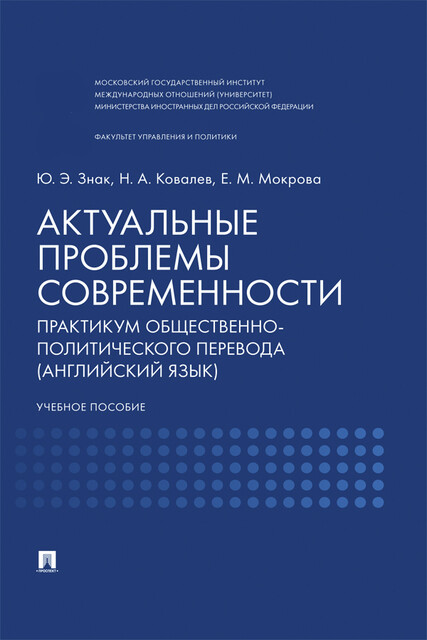
Ю. Э. Знак, Н. А. Ковалев, Е. М. Мокрова
Актуальные проблемы современности
Практикум общественно-политического перевода (английский язык)
Учебное пособие

Информация о книге
УДК 811.111(075.8)
ББК 81.2Англ-923
З-71
Авторы:
Знак Ю. Э., Ковалев Н. А., Мокрова Е. М.
Рецензенты:
Антюхова Е. А., доктор политических наук, доцент кафедры мировых политических процессов факультета управления и политики Московского государственного института международных отношений (университета) Министерства иностранных дел Российской Федерации;
Климова Г. В., кандидат филологических наук, доцент кафедры лексикологии английского языка факультета английского языка Московского государственного лингвистического университета.
В предлагаемом учебном пособии представлен и систематизирован материал по актуальным проблемам современного мира на основе аутентичных публицистических и научно-популярных текстов, которые расширяют профессиональные фоновые знания и повышают эрудицию студентов. Кроме того, пособие является практикумом по общественно-политическому переводу, способствует формированию навыков перевода политологических терминов, развивает переводческие компетенции в целом. Тренировочный формат многих заданий приближен к экзаменационным требованиям, что позволяет студентам в ходе занятий готовиться к ГИА.
Данное учебное пособие предназначено для студентов бакалавриата, обучающихся по направлению «Политология».
УДК 811.111(075.8)
ББК 81.2Англ-923
© Знак Ю. Э., Ковалев Н. А., Мокрова Е. М., 2023
© ООО «Проспект», 2023
Предисловие
Настоящее учебное пособие «Актуальные проблемы современности. Практикум общественно-политического перевода (английский язык)» предназначено для студентов бакалавриата, обучающихся по направлению «Политология», а также широкому кругу читателей, интересующихся актуальными мировыми проблемами. В основе учебного пособия лежит компетентностный подход к обучению иностранного языка для уровней профессионального владения С1 — С2.
Необходимость создания данного пособия обусловлена задачей обновления учебно-методических материалов для обучения английскому языку на старших курсах бакалавриата с учетом современных подходов к содержанию и методам обучения. Цель учебного пособия — развитие переводческих компетенций (применение лексико-грамматических и структурных трансформаций), необходимых для студентов бакалавриата четвертого года обучения по направлению «Политология», а также расширение фоновых знаний как части общекультурных и профессиональных компетенций. Основными задачами являются формирования умений выполнять зрительно-устный перевод и письменный перевод научных и научно-популярных текстов, а также публицистических текстов с английского языка на русский, с русского языка на английский, а также умения работать с профессионально ориентированными текстами на английском языке. Особое внимание уделяется развитию активного словаря по предложенной тематике уроков, а также формированию навыков перевода политологических терминов. Пособие рассчитано на продвинутое владение английским языком. Пособие разработано с учетом рекомендаций, полученных от кафедры мировых политических процессов факультета управления и политики МГИМО, в соответствии с федеральными государственными образовательными стандартами высшего профессионального образования.
Практический курс построен по тематическому принципу и состоит из пяти уроков, каждый из которых посвящен актуальному вопросу современности: цифровизация современных международных отношений; санкции в мировой политике; ядерный фактор в мировой политике и новые виды вооружений; национализм в современном мире; современные глобальные проблемы и вызовы.
Пособие содержит аппарат упражнений, направленных на введение и закрепление активной лексики по изучаемым темам, развитие переводческих умений и навыков.
Текстовый материал пособия является аутентичным, современным и профессионально ориентированным, авторы используют правомерно обнародованные произведения и отрывки из них в качестве иллюстраций (в широком смысле) в объеме, оправданном поставленной учебной целью издания. Развитие переводческой компетенции обеспечивается при помощи заданий, направленных на отработку перевода определенных языковых единиц по изучаемым темам в рамках настоящего пособия, а также закрепления навыков их перевода в более широком контексте.
Учебное пособие прошло апробацию на четвертом курсе бакалавриата по направлению подготовки «Политология» на факультете управления и политики МГИМО МИД России (с сентября 2022 года по настоящее время). Планируемое издание обогатит фонд актуальной учебно-методической литературы на факультете и повысит эффективность обучения английскому языку.
Учебное пособие «Актуальные проблемы современности. Практикум общественно-политического перевода (английский язык)» может быть использовано как в сочетании с учебниками по практике английского языка, так и в качестве самостоятельного учебного пособия.
Авторы выражают признательность Ю.А. Карауловой за ценные методические рекомендации, а также преподавателям кафедры английского языка № 6 за высокопрофессиональные советы.
МЕТОДИЧЕСКАЯ ЗАПИСКА
Пособие включает в себя корпус аутентичных текстов, предназначенных для устно-зрительного и письменного перевода, содержит аппарат упражнений, направленных на отработку перевода определенных языковых единиц по изучаемым темам, а также закрепления навыков их перевода в более широком контексте. Развитие переводческой компетенции обеспечивается в рамках индуктивного и дедуктивного подходов, при которых осуществляется обобщение частных особенностей перевода и в последствии применение выработанных закономерностей к новому материалу.
Поскольку настоящее учебное пособие предназначено для студентов с продвинутым уровнем владения английским языком, а также сформированными на младших курсах базовыми переводческими компетенциями, авторы ставили задачу развития и закрепления уже имеющихся навыков, не добавляя подробные переводческие комментарии.
Все уроки пособия имеют одинаковую структуру, что облегчает общую навигацию и восприятие материала. Задания могут выполняться в ходе аудиторных занятий при непосредственном контроле со стороны преподавателя, а также предназначены для самостоятельной работы дома и в качестве «самопроверки» при подготовке к экзамену.
Каждый урок (Unit) включает четыре раздела:
1. Texts for Practicing Sight Translation;
2. Texts for Practicing Translation in Writing;
3. Translation of Texts from Russian into English;
4. Texts for Reviewing in English.
Представленный корпус публицистических и научно-популярных текстов расширяет эрудицию, а также профессиональные фоновые знания студентов, необходимые не только для развития переводческих компетенций, но также для обогащения словарного запаса по актуальным проблемам международной повестки.
В первом разделе студентам предлагается бегло прочитать текст, сделать предпереводческий анализ про себя или представить преподавателю, а затем устно с листа перевести текст на английский язык — Skim read the text, do the pre-translation analysis and translate the text into Russian. Предложенный формат задания является тренировочным и приближен к экзаменационным требованиям, что позволяет студентам в ходе занятий готовиться к ГИА.
Во втором разделе представлены тексты для письменного перевода, которые чуть больше по объему и несколько сложнее по степени трудности, — Texts for Practicing Translation in Writing. Подобранный материал позволяет студентам развивать умения работать с профессионально ориентированными текстами, используя различные стратегии и виды чтения, более вдумчиво анализировать материал, поскольку при выполнении письменных домашних заданий на перевод они уже не так ограничены во времени. После первого и второго разделов предложены упражнения на повторение и закрепление перевода лексических единиц по изучаемой в рамках этого урока теме (Revision), а также на отработку переводческих навыков с использованием изучаемых словарных единиц в других примерах, содержащихся в аутентичных текстах.
Задания третьего раздела — Translation of Texts from Russian into English — предназначены для отработки навыков зрительно-устного перевода с русского языка на английский.
В рамках четвертого раздела Texts for Reviewing in English студентам необходимо осуществлять реферативный перевод предложенных текстов или отрывков из них на английском языке, что будет способствовать как расширению фоновых знаний, так и развитию переводческих компетенций.
Необходимо отметить, что пособие не ограничивает ни преподавателей, ни слушателей в последовательности и объеме освоения материала. На каждом занятии можно использовать те тексты и задания, которые в наибольшей степени отвечают основной задаче на данном этапе учебного процесса.
В соответствии со ст. 1274 Гражданского кодекса Российской Федерации авторы данного издания использовали в своей работе с обязательным указанием имени автора, произведение которого используется, и источника заимствования правомерно обнародованные произведения и отрывки из них в качестве иллюстраций в объеме, оправданном поставленной целью.
Авторы
Unit 1. DIGITALIZATION OF INTERNATIONAL RELATIONS. INFORMATION SOCIETY
Part 1. Texts for Practicing Sight Translation
Text 1
Skim read the text, do the pre-translation analysis and translate the text into Russian.
INFORMATION SOCIETY FACES BOTH NEW OPPORTUNITIES AND CHALLENGES
UNCTAD discusses the state of the information society at the 15-year anniversary since the landmark World Summit on the Information Society summit.
The pace of technological development and digitalization has been remarkably and exponentially fast. Indeed, when the world came together for the World Summit on the Information Society (WSIS) in 2003 and 2005 to discuss information and communication technology (ICT) development and digital divides, some technologies widely used today were in their infancy or did not even exist. Yet, they are now mainstream. Others have become obsolete and or replaced by later innovations. The scope and scale of the impact of digital technologies on economy, society, culture and governance just accelerated exponentially.
On the other hand, digital divides remain a challenge, hampering equitable reaping of benefits from the information society. “Today, digital divides are no longer only about access but increasingly about the growing concentration of benefits from and influence over digitalization,” said UNCTAD’s director of technology and logistics, Shamika N. Sirimanne. “There are also new forms of challenges brought by this rapid technological development such as cybersecurity, privacy rights and data protection.”
She was speaking at the World Summit on the Information Society Forum 2020 (WSIS Forum 2020), the world’s largest annual gathering of the “ICT for development” community co-organized by the International Telecommunications Union, UNCTAD, UNESCO and the United Nations Development Programme. UNCTAD hosted an online session on what is needed to build the information society of the future in collaboration with all United Nations Regional Commissions on 4 August. The virtual workshop was designed to reflect about the dramatic changes that the information society has experienced and the pathways that it could take for the future.
https://unctad.org/news/information-society-faces-both-
new-opportunities-and-challenges
Text 2
Skim read the text, do the pre-translation analysis and translate the text into Russian.
DIGITAL EVOLUTION
By John W.Houghton
Digital technologies are one of the most important sources of growth for national economies. They enable economies to create more jobs, improve people’s lives and build better and greener societies. Citizens, enterprises, universities and governments become increasingly connected in the digital world. Digital is changing people’s lives: the way they work, shop, socialise, communicate and educate.
It also reshapes traditional industries and transforms the business environment, from fashion to automotive, from transport and logistics to energy distribution. New technological developments speed up and improve the way new innovative products and services are conceived, developed, produced and accessed. They are enabling businesses to faster develop and bring to market innovative products and services that it was impossible to think about before.
Digital technologies help to totally re-shape value chains, sharpen market intelligence, improve efficiency, reduce time-to-market and increase customer satisfaction. In addition, with the aid of technology, small enterprises (SMEs) can now go global from day one, reaching overseas markets and talent pools instantly. Not surprisingly, European SMEs grow two to three times faster when they are empowered by digital technologies. With a business climate currently being transformed by digital technologies — both disrupting existing businesses and opening opportunities for new companies and industries — it could be said that an economy almost fully driven by (micro) SMEs could be the ideal catalyst to make the most of the huge potential of digital technologies.
However, the huge potential of digital evolution still remains untapped in many countries. There is a need to stimulate a more innovative and entrepreneurial mind-set and accelerate smarter use of ‘digital’ technology in various sectors of the world economy.
https://www.researchgate.net/publication/220939749_ICT_and_the_Environment_in_Developing_Countries_A_Review_of_Opportunities_and_Developments
Text 3
Skim read the text, do the pre-translation analysis and translate the text into Russian.
HOW TO MAKE DIGITAL PROGRESS IN EUROPE?
By John W.Houghton
Governments and policy makers are beginning to recognise the important role of digital in the economy and efforts are being made to foster digital entrepreneurship. However, despite these efforts, there are still many barriers and challenges that can stand in the way of doing business in the digital age. Understanding and anticipating these barriers and challenges is important when establishing the policy background for digital entrepreneurship. These barriers have been identified according to five different pillars: low take-up and use of digital technologies by industries and SMEs; lack of digital entrepreneurial culture in Europe; low level of entrepreneurial skills and talent; difficult access to finance and investments; fragmented digital market.
Digital technologies disrupt not only existing businesses, but also open up opportunities for new companies in new industries. With a European economy, consisting of more than 60% of traditional, service-orientated companies, there is a huge potential to be leveraged. The future of doing business in the digital age will mainly depend on the outlook of both digital progress and the European business climate. This outlook will be highly influenced both by the choices individuals and businesses make on using digital technologies and the way policy and regulatory challenges are addressed at the same pace.
To turn ambitions from vision to reality, bold policy reforms are needed for Europe to accelerate its transformation. Policymakers need to act fast, and cannot simply rely on Europe’s past performance and a business environment designed for the analogue era. When taking into account the potential impact and implementation effort required a set of ‘quick wins’, ‘strategic investment and ‘tactical investments’ projects were identified. Embedding digital innovators in existing industry clusters, launching awareness campaigns on digital entrepreneurship, the use of open data, promotion of existing financial instruments and leveraging the national Points of Single Contact are classified as ‘quick win’ projects.
https://www.researchgate.net/publication/220939749_ICT_and_the_Environment_in_
Developing_Countries_A_Review_of_Opportunities_and_Developments
Text 4
Skim read the text, do the pre-translation analysis and translate the text into Russian.
DIGITAL TOUCH
By Thomas Rid and Marc Hecker
Two sweeping changes have occurred in the past decade. Life now has a digital touch: we search new jobs online, find old friends on the Web, and plan vacations; we spot new restaurants, read the news and our favorite blogs, shop, and keep in touch with parents, children, and colleagues through mobile phones, texting, and video-chat. We send them digital images of our weddings and getaways. We collaborate, engage others, and sometimes flirt by instant messaging. Arcane communities meet online, for example, young Mormon families in Utah or amateur butchers in England. Even fraud and crime and hate are hooked up. Once in front of a screen, be it on a desktop, laptop, or increasingly a handheld device, we “log in” — not into a system, but into a community. The new media, in short, have become social.
The second revolution concerns armed conflict: only a few years back, the world’s best armies saw themselves as lethal fighting machines, networked at the joints through signals and satellites. Such forces were capable of striking down on any foe rapidly and with crippling firepower, anywhere, even piercing through sandstorms and thick clouds, thanks to the wonders of modern sensor technology. Then came a surprising kink: new irregular enemies were hiding among the people, where sensors could not find them. Here religious motivations mattered, as well as ideology, sectarian hatred, close-knit social ties, language, dialects, cultural affinities, trust, and deep-seated grievances. These were pushing fighters to join the resistance, to form cells, to commit suicide attacks, and to lay roadside bombs. The new wars, in short, have become more social.
https://www.google.ru/books/edition/War_2_0/2ILDEAAAQBAJ?hl=ru&gbpv=1&dq=
Two+sweeping+changes+have+occurred+in+the+past+decade.+Life+now+has+a+digital+to
uch:+we+search+new+jobs+online,+find+old+friends+on+the+Web,+and+plan+vacations%
3B+we+spot+new+restaurants,&pg=PR7&printsec=frontcover
Text 5
Skim read the text, do the pre-translation analysis and translate the text into Russian.
INFORMATION WARFARE AND THE CHANGING FACE OF WAR
By William Perry, Secretary of Defense
Information warfare (IW) represents a rapidly evolving and, as yet, imprecisely defined field of growing interest for defense planners and policymakers. The source of both the interest and the imprecision in this field is the so-called information revolution — led by the ongoing rapid evolution of cyberspace, microcomputers, and associated information technologies. The U.S. defense establishment, like U.S. society as a whole, is moving rapidly to take advantage of the new opportunities presented by these changes. At the same time, current and potential U.S. adversaries (and allies) are also looking to exploit the evolving global information infrastructure and associated technologies for military purposes.
The end result and implications of these ongoing changes for international and other forms of conflict are highly uncertain, befitting a subject that is this new and dynamic. Will IW be a new but subordinate facet of warfare in which the United States and its allies readily overcome their own potential cyberspace vulnerabilities and gain and sustain whatever tactical and strategic military advantages that might be available in this arena? Or will the changes in conflict wrought by the ongoing information revolution be so rapid and profound that the net result is a new and grave threat to traditional military operations and U.S. society that fundamentally changes the future character of warfare?
In response to this situation and these uncertainties, in January 1995 the Secretary of Defense formed the IW Executive Board to facilitate “the development and achievement of national information warfare goals.”
https://www.rand.org/pubs/monograph_reports/MR661.html#top
Text 6
Skim read the text, do the pre-translation analysis and translate the text into Russian.
DIGITAL CURRENCIES WORLDWIDE
By Diksha Madhok
Nine countries have established CBDCs (Central bank digital currencies) thus far, and 15 others, including China, Russia, and Sweden, currently have pilot programs in place. Altogether, 87 countries that collectively represent 90 percent of global GDP are in some stage in the development of CBDCs. The European Central Bank (ECB) is also moving forward with the implementation of its own CBDC, the digital euro, and Deutsche Bank predicts that central banks collectively representing one-fifth of the world’s population will issue CBDCs by 2025.
Agustin Carstens, general manager of the Bank of International Settlements, explained one of the key motivations to create CBDCs at an October 2020 IMF seminar: “We don’t know who is using a $100 bill today, we don’t know who’s using a 1,000-peso bill today. The key difference with a CBDC is the central bank will have absolute control of the rules and regulations that will determine the use of that central bank liability, and also we will have the technology to enforce that.”
China has taken the lead on implementation among the world’s major economies, issuing its e-CNY, or digital yuan, in 2020. By the end of 2021, the digital yuan had 261 million users, representing about one-fifth of China’s population, according to the People’s Bank of China. China issues the e-CNY directly from its central bank to consumers, who set up a digital-wallet app that allows them to buy from vendors by scanning their phone at the point of sale, thereby transferring digital yuan directly from the buyer’s government account to the vendor’s without transaction fees. For those who don’t have a smartphone, a British company called Walletmor now offers microchips that are implanted into a person’s palm. The buyer makes payments by placing his hand over a vendor’s card reader.
https://edition.cnn.com/2022/03/03/investing/india-cryptocurrency-investing-future-
hnk-intl/index.html
Text 7
Skim read the text, do the pre-translation analysis and translate the text into Russian.
ON-AGAIN, OFF-AGAIN RELATIONSHIP
By Diksha Madhok
New Delhi (CNN Business) The excitement over crypto is rising in India despite the country’s on-again, off-again relationship with digital currencies. The central bank has long expressed concerns that cryptocurrencies can be used for money laundering and to finance terrorism. A cryptically worded proposal posted on the Indian parliament website last year even suggested the government was exploring plans to “prohibit all private cryptocurrencies in India.”
This year, however, started on a more cheerful note for enthusiasts. Earlier this month, the Indian government announced it would impose a 30% tax on income from virtual digital assets, which many industry experts took as a sign that crypto trading won’t be banned after all. The government also said it would launch a digital rupee in the coming months. “Taxation of virtual digital assets or crypto is a step in the right direction. It gives much-needed clarity and confidence to the industry,” Gupta said at the time of the announcement. Siddharth Menon, the co-founder of WazirX, told CNN Business that following the announcement, his platform saw daily sign-ups jump by over 50%. He also noticed rising interest among Indian developers and other professionals in joining the crypto industry.
But the Indian government soon put a damper on the mood, by clarifying that the cryptocurrencies are not yet legal in the country. “I am not doing anything to legalize it or ban it or not legalize it,” Finance Minister Nirmala Sitharaman said in parliament a few days after announcing the tax rate. “Banning or not banning will come subsequently ... But I will tax because it is a sovereign right.”
https://edition.cnn.com/2022/03/03/investing/india-cryptocurrency-investing-future-
hnk-intl/index.html
Text 8
Skim read the text, do the pre-translation analysis and translate the text into Russian.
WHY ELON MUSK’S ‘X APP’ COULD BE AN EVEN BIGGER HEADACHE FOR D.C. THAN TWITTER
By Rebecca Kern, Sam Sutton, Ruth Reader and Tanya Snyder
Twitter is crashing straight into politics — but Elon Musk’s grandiose next idea could be a full pile-up with the federal government.
(POLITICO) Even before Elon Musk’s dramatic and controversial takeover of Twitter, the restless mogul was pitching the social-media company as his key to realizing a much bigger dream.
Musk calls his next idea the “X App.” And if Musk-owned Twitter has already been a challenge for Washington’s politicians and regulators, the disruption caused by the X App could easily dwarf it.
The idea is a Western version of WeChat, the Chinese super-app that more than a billion people use for messaging, payments, shopping, rideshares, gaming, news and other daily activities. Musk is clearly serious about the plan: He tweeted about it this fall and pitched it to Twitter employees before he even bought the company, and reiterated the idea during a Twitter Spaces session in early December, saying “WeChat has a lot of functionality that Twitter should have.”
But building a “super-app” like WeChat is a far more complicated challenge than Twitter, with far more points of conflict with regulators in Washington, California, Brussels and elsewhere. Nothing like it exists yet in the West, and it could create a “regulatory nightmare,” said Caitriona Fitzgerald, the deputy director for the Electronic Privacy Information Center, a nonprofit that advocates for privacy reform.
If Musk tried to launch it, he’d be doing it in a moment when regulators and politicians are increasingly worried about Big Tech’s appetite for data, its impact on consumers’ lives and its unique ability to build monopolies — to say nothing of the political storm Musk has brought down on his own head with his increasingly partisan forays into politics. (Twitter did not reply to a request for comment about Musk’s app plans or regulatory strategy.)
https://www.politico.com/news/2023/01/03/elon-musk-x-app-collides-
washington-00075467
Text 9
Skim read the text, do the pre-translation analysis and translate the text into Russian.
BIDEN ADMIN TAKES STEPS TOWARD A DIGITAL DOLLAR
Critics call the prospect a frightening “means of control.”

https://www.theamericanconservative.com/biden-admin-takes-steps-toward-a-
digital-dollar/
By Kevin Stocklin (The American Conservative)
“Give me control of a nation’s money,” an 18th-century banking oligarch once said, “and I care not who makes its laws.” That may have sounded like hubris at the time, but digital technology could soon make it an understatement. Central bank digital currencies (CBDCs), currently in various stages of development around the world, are being created as a new form of money that, depending on how they are structured, could give government bureaucrats more control over citizens than any law ever could. In contrast to what most Americans today understand as money, commercial bank deposits denominated as dollars, a U.S. CBDC could be issued directly by our central bank to individuals in the form of a “digital wallet.” A digital dollar could also be programmable with controlling features.
On March 9, President Biden took a first step toward creating a U.S. CBDC, directing his administration to report to him by this fall on whether and how to implement a federal digital dollar. And in February, the Boston Fed completed the first phase of Project Hamilton, a CBDC simulation it has been developing together with MIT’s Digital Currency Initiative. “My Administration places the highest urgency on research and development efforts into the potential design and deployment options of a United States CBDC,” Biden’s order stated. Among the goals he cited for a U.S. CBDC were faster and cheaper payments, financial stability, fighting financial crime, maintaining the preeminence and security of America’s currency, and “financial inclusion and equity.” Biden also ordered a report on “the potential for these technologies to impede or advance efforts to tackle climate change.”
Biden instructed Attorney General Merrick Garland to determine whether or not he will need congressional approval to implement a CBDC, and if so, to draft legislation by October, leading some observers to speculate that Democrats may try to introduce a bill before the midterms.
https://www.theamericanconservative.com/biden-admin-takes-steps-toward-a-
digital-dollar/
Text 10
Skim read the text, do the pre-translation analysis and translate the text into Russian.
CRYPTO NEEDS MORE RULES AND BETTER ENFORCEMENT, REGULATORS WARN
By Ephrat Livni (New York Times)
A federal panel responsible for monitoring financial system risks sounded a warning on Monday about cryptocurrency markets, saying that the widespread adoption of digital assets poses risks if the market continues to grow without better oversight and enforcement.
It is the first major report on cryptocurrencies by the Financial Stability Oversight Council, which is led by the Treasury Department and was created after the 2008 financial crisis to help identify and mitigate threats to the financial system.
“The scale of crypto-asset activities has increased significantly in recent years. Although interconnections with the traditional financial system are currently relatively limited, they could potentially increase rapidly,” the report said.
Concerns about vulnerabilities in the crypto markets have become more pronounced in recent months, in the wake of wild swings in price and serious losses in the industry. In May, the collapse of a single asset led to a downward spiral in prices throughout crypto markets, prompting a rash of bankruptcies, consolidation and layoffs in the industry, and leaving many investors stranded, unable to access their assets.
When the cryptocurrency market exploded and reached about $3 trillion in value around this time last year, officials feared that rampant speculation and insufficient oversight of digital asset activity could infect the wider system and called for an assessment. Although about $2 trillion in value has been wiped out since then, the risks are no less pressing now.
https://www.nytimes.com/2022/10/03/business/cryptocurrency-regulation-
stablecoin.html
REVISION
Exercise 1. Translate the following expressions from the texts from English into Russian.
Some technologies widely used today were in their infancy; to stimulate a more innovative and entrepreneurial mind-set; to turn ambitions from vision to reality; bold policy reforms; digital technologies help to totally re-shape value chains; life now has a digital touch; close-knit social ties; overcome potential cyberspace vulnerabilities; digital divides; the use of that central bank liability; a cryptically worded proposal; virtual digital assets; the Indian government soon put a damper on the mood; that may have sounded like hubris at the time; Administration places the highest urgency on research and development efforts; help identify and mitigate threats to the financial system; rampant speculation and insufficient oversight of digital asset activity; the restless mogul.
Exercise 2. Translate the following expressions from Russian into English using the vocabulary of the texts.
Темпы технического развития и цифровизации; создание препятствий справедливому использованию выгод; огромный потенциал цифровой эволюции все еще остается неиспользованным; содействие развитию цифрового предпринимательства; среди крупнейших стран Китай занимает лидирующие позиции в реализации этой стратегии; за последнее десятилетие произошли радикальные изменения; быстро воспользоваться новыми возможностями; предлагать микрочипы, которые имплантируются в ладонь человека; для энтузиастов начали на более радостной ноте; виртуальные цифровые активы; масштабы деятельности с криптовалютой значительно возросли за последнее время.
Exercise 3. Translate from English into Russian the following sentences with the expressions from the texts.
1. They are not reacting to changes fast enough and few can rapidly take advantage of new opportunities or adapt to unexpected changes.
2. While many Governments had taken the lead in moving implementation forward, action had been taken locally too.
3. The reason may be that smaller towns still pursue a community way of living, with close-knit social networks and ‘collective’ thinking.
4. “Unfortunately, because of our disputes, unresolved disputes, the huge potential remains untapped,” said the Prime Minister of Pakistan.
5. A unique festival to foster entrepreneurship, a wealth of events were held to inspire and celebrate innovative ideas — especially those that push the envelope and enrich the nation.
6. We would like to invite you to turn your life and professional ambitions into reality at the famous and stable international company.
7. The Committee calls on the Government to recognize the urgency of the needed legislative and policy changes, and to place the highest priority on the adoption of the proposed legislation.
8. Efforts to develop these standards are in their infancy but are being driven by traditional standardization bodies and emerging consortia.
9. Reaping benefits while averting potential harm requires appropriate policies and programmes.
10. To overcome potential vulnerabilities, it is vital to have deep awareness of what is going on across all levels of the organization.
11. This means, above all, seizing the opportunity now while growth remains relatively strong to implement the bold policy reforms needed to support the economic momentum and sustain it.
12. Some states might seek to mitigate threats to their nuclear arsenals; for instance, they might hide their weapons.
Part 2. Texts for Practicing Translation in Writing
Information society
Exercise 1. Skim read the text paying special attention to the translation of the words in italics into Russian.
Text 1
Aurora Cuevas-Cerveró
Major theorists of the XX century were determined to name the society in which we live. The American sociologist Daniel Bell (1973, 1991 and 2001), raised one of the concepts that have been more successful in Western discourse, Information Society, trying to highlight the strategic value and great social, economic, political and cultural impact that information has had on advanced industrial societies. In the early nineties, this concept was complemented by a new notion, Knowledge Society (Drucker, 1993) that took root in the European Community policy and international institutions such as UNESCO (2005). During the Lisbon European Council in 2000, heads of State and Government marked a common goal for Europe: the effort to become a more competitive knowledge economy and, simultaneously, in a more inclusive knowledge society. It was argued that in this new economic and social structure, knowledge would be one of the main causes of growth together with capital investment of resources and employment. Therefore, the production of knowledge-intensive products was highly relevant as well as services based in knowledge, and the importance of education and training processes were emphasized, both in their educational and initial training dimension as well as throughout life.
Other scholars have referred to our society with a surprisingly variety of terms: learning society (Hutchins, 1970, UNESCO, 2005) network society and information era (Castells 1999, 2001) global village (McLuhan, 1996), postindustrial society, third wave society (Toffler, 1986), “telepolis” (Echeverría, 1999), surveillance society (Lyon, 1995 y 2001), interconnected society (Martin, 1980), interconnected intelligence society (Tapscott, 1996), digital society (Mercier, 1980; Terceiro, 1986; Negroponte, 2000), cyber culture or virtual culture (Levy, 2001; Picistelli, 2002).
When the different approaches and theories, or the results from the indicators or methods for measuring the information society, are analyzed in depth; and when the policies that drive public or private national and international institutions that operate in this area are examined, the picture drawn is neither homogeneous nor encouraging, and is subject to a variety of interpretations and perspectives.
https://www.igi-global.com/book/handbook-research-comparative-approaches-
digital/127521
Exercise 2. Translate the text from English into Russian in writing.
Text 2
Exercise 1. Skim read the text paying special attention to the translation of the words in italics into Russian.
AN ECONOMY IN TRANSITION: FROM DIGITAL TO DIGITALLY-DRIVEN
By John W.Houghton
There is no debate over whether digital innovation is a profound force in our economy. The digital economy isn’t just about speeding up communication across borders or changing the skills workers need; it is about changing the very nature of consumption, competition and how markets operate. More profoundly, it is also driving a significant shift in the balance of power between organisations and individuals. The explosion in connectivity and the availability of information is putting today’s consumers, employees, citizens, patients and other individuals in a controlling position.
Digital technologies and innovations are powerful, pervasive and have multiple, indirect impacts. Digital technologies reduce barriers to entry, blur category boundaries, and open doors for a new generation of entrepreneurs and innovators. In turn, current market leaders will face substantial pressures. The idea of digital disruption is about how much additional change a business will experience in the years to come, and how a business can realise its potential across a spectrum of digital opportunities by building on the way it
...