


автордың кітабын онлайн тегін оқу Национальные и международные судебные органы. Учебное пособие по английскому языку для студентов-юристов
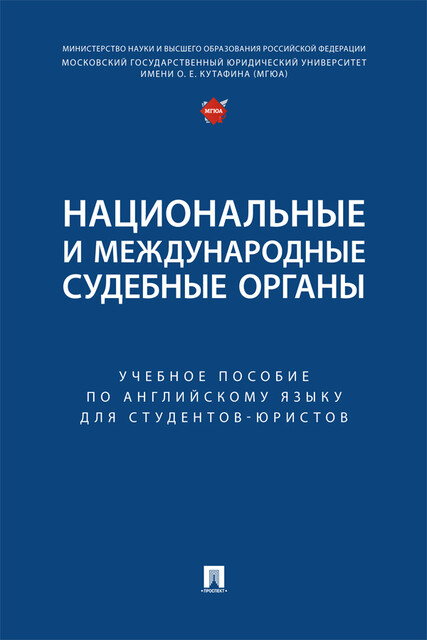
Национальные и международные судебные органы
Учебное пособие по английскому языку для студентов-юристов

Информация о книге
УДК 811.111(075.8)
ББК 81.2Англ-923
Н35
Автор-составитель:
Дегтярева Е. А., доцент кафедры английского языка Московского государственного юридического университета имени О. Е. Кутафина (МГЮА).
Рецензенты:
Прокофьева О. Г., кандидат филологических наук, доцент кафедры юридического перевода Московского государственного юридического университета имени О. Е. Кутафина (МГЮА);
Калмазова Н. А., кандидат филологических наук, доцент кафедры иностранных языков юридического института Российского университета дружбы народов;
Ефремова Л. С., кандидат филологических наук, доцент кафедры романо-германской филологии и переводоведения Саратовского государственного университета имени Н. Г. Чернышевского.
Учебное пособие состоит из шести разделов, содержащих тексты о национальных судебных системах на английском языке для чтения и обсуждения. В публикацию вошли материалы о международных судебных органах, таких как Экономический суд СНГ, Суд Евразийского экономического союза, которые обычно не включаются в учебники по английскому языку, предназначенные для студентов юридических вузов.
Тексты сопровождаются англо-русским глоссарием юридических терминов, комплексом упражнений для совершенствования лексических и грамматических навыков у студентов, а также заданиями на развитие навыков чтения, устной и письменной речи.
УДК 811.111(075.8)
ББК 81.2Англ-923
© Дегтярева Е. А., составление, 2023
ПРЕДИСЛОВИЕ
Данное учебное пособие предназначено для студентов юридических вузов, изучающих английский язык в рамках дисциплины «Английский язык в юриспруденции».
Издание предназначено для студентов, владеющих английским языком на уровне B1.
Пособие состоит из шести разделов:
1. Судебная система Российской Федерации.
2. Конституционный суд Российской Федерации.
3. Верховный суд Российской Федерации.
4. Судебная система Соединенного Королевства Великобритании и Северной Ирландии.
5. Судебная система США.
6. Международные суды:
1) Экономический суд Содружества независимых государств,
2) Суд Евразийского экономического союза.
Каждая из шести глав включает в себя один текст или более, список юридических терминов, встречающихся в тексте, лексические и грамматические упражнения, а также задания для развития у студентов навыков перевода, устной и письменной речи.
В конце пособия помещен глоссарий расположенных в алфавитном порядке юридических терминов, встречающихся в текстах.
Предлагаемое учебное пособие может также оказаться полезным для специалистов, желающих самостоятельно повышать свой уровень владения английским языком в профессиональной сфере.
CHAPTER JUDICIAL SYSTEM
Unit 1. The Judicial System of the Russian Federation
Lead-in
1. Answer the questions.
What are the three branches of government in the Russian Federation?
What types of courts do you know?
Text. The Judicial System of the Russian Federation
Vocabulary
1) judicial power — судебная власть
2) to administer justice — отправлять правосудие
3) to consider / handle / hear a case / an appeal — рассматривать /слушать дело/апелляцию
4) constitutional / civil / administrative / criminal proceeding — конституционное / гражданское / административное / уголовное судопроизводство
5) to establish / create (a court) — учредить / создать (суд)
6) to strengthen public trust — укреплять доверие общества
7) to ensure a unified approach to — обеспечить / гарантировать единый подход к
8) amendment to — поправка к
9) Commercial court (in Russia) — Арбитражный суд
10) Supreme Court — Верховный суд
11) the State Prosecutor’s Office — прокуратура
12) constitutional (charter) court of a constituent entity of the Russian Federation — Конституционный суд субъекта Российской Федерации
13) Supreme Commercial Court of the Russian Federation — Высший арбитражный суд Российской Федерации
14) justice of the peace — мировой судья
15) constituent entity of the Russian Federation — субъект Российской Федерации
16) Federation Council of the Federal Assembly of the Russian Federation — Совет Федерации Федерального Собрания Российской Федерации
17) adherence (to) — соблюдение
18) pursuant to — в соответствии с, согласно чему-либо
19) advisory body — консультативный орган
20) issue — вопрос, проблема
21) an amount of claim — сумма иска
22) imprisonment — лишение свободы, тюремное заключение
23) district court — районный суд
24) vis-à-vis — по отношению к, в отношении
25) ex officio — по должности, в силу занимаемой должности
26) to launch (a reform, campaign) — начать (реформу, кампанию)
27) point of fact — вопрос факта
28) point of law — вопрос права
29) jury trial — суд присяжных
30) juror — присяжный
31) to commit a crime — совершить преступление
2. Read the text and decide if it has answers to the following questions.
1. What is justice administered by?
2. When was the judicial system of the Russian Federation established?
3. What was the result of the adoption of the Law in 2014?
4. What is the judicial system of the Russian Federation composed of?
5. How many justices are there in the Constitutional Court of the Russian Federation?
6. What cases does the Constitutional Court of the Russian Federation resolve?
7. What courts are subordinate to the Supreme Court of the Russian Federation?
8. What is the time-limit for the district court to rule on appeals against decisions of justices of the peace?
9. What cases do district courts handle?
10. Are there courts of constituent entities of the Russian Federation?
11. What are the specialized courts within the system of courts of the Russian Federation?
12. Where do appeals from the Intellectual Property Rights Court go?
Justice is administered in the Russian Federation only by the courts. The judicial power is autonomous and acts independently from the legislative and executive powers. Justice is administered in the forms of constitutional, civil, administrative and criminal proceedings.
The judicial system of the Russian Federation is established by the Constitution of the Russian Federation and Federal Constitutional Law “On the Judicial System of the Russian Federation” of 31 December 1996.
In February 2014, in order to strengthen public trust in the judiciary and ensure a unified approach to the resolution of disputes between legal as well as private persons, a Law on the amendment to the Constitution of the Russian Federation “On the Supreme Court of the Russian Federation and the State Prosecutor’s Office of the Russian Federation” was adopted. As a result, the Supreme Court of the Russian Federation, heading the system of courts of general jurisdiction, was merged with the Supreme Commercial Court of the Russian Federation, heading the system of commercial courts, to form a new Supreme Court of the Russian Federation, which is now the highest judicial body for civil, administrative, criminal cases, cases on resolution of economic disputes and other cases.
Currently, Russia’s judicial system is composed of the Constitutional Court of the Russian Federation, the Supreme Court of the Russian Federation, federal courts, and also constitutional (charter) courts and justices of the peace of constituent entities of the Russian Federation.
Judges of the Constitutional Court of the Russian Federation and of the Supreme Court of the Russian Federation are appointed by the Federation Council of the Federal Assembly of the Russian Federation (upper house of parliament) on proposal of the President of the Russian Federation. Judges of federal courts are appointed by the President of the Russian Federation. Judges of constitutional (charter) courts and justices of the peace of constituent entities of the Russian Federation are appointed in accordance with the legislation of the respective constituent entities.
The main task of the Constitutional Court of the Russian Federation is to resolve cases regarding the constitutionality of normative legal acts of all levels. Constitutional (charter) courts have been created in a number of constituent entities of the Russian Federation (republics, territories, regions, federal cities, etc.) to check the adherence of normative legal acts of those constituent entities to their own constitutions (charters). Pursuant to a law adopted in December of 2020, constitutional courts of constituent entities will be replaced by advisory bodies under regional parliaments by J
...